
Coconut Creek City Zoning Code
ARTICLE II
SUBDIVISION REGULATIONS5
Cross reference— Any ordinance dedicating or accepting any plat or subdivision in the city saved from repeal, § 1-6(8); fees for subdivisions, § 13-81.
DIVISION 2. - SUBDIVISION PLAT REQUIREMENTS[6]
State Law reference— Platting, F.S. § 177.011 et seq.
Sec. 13-131. - Authority and enactment clause.
Pursuant to the authority conferred by House Bill No. 1092, Chapter 28946, Laws of Florida, Special Acts of 1953 (as amended by House Bill No. 1085, Chapter 30626, Laws of Florida, Special Acts of 1955; Senate Bill No. 1300, Chapter 571196, Laws of Florida, Special Acts of 1957; House Bill No. 3095, Chapter 611964, Laws of Florida, Special Acts of 1961; and Senate Bill No. 1299, Chapter 631179; House Bill No. 1604, Chapter 631169, Laws of Florida, Special Acts of 1963), the city does hereby enact into law this article.
(Ord. No. 115-86, § 200, 7-10-86; Ord. No. 159-87, § 200, 6-11-87)
Sec. 13-132. - Short title.
This article shall be known and cited as the Subdivision Regulations of the City of Coconut Creek, Florida.
(Ord. No. 115-86, § 201, 7-10-86; Ord. No. 159-87, § 201, 6-11-87)
Sec. 13-133. - Purpose.
This article is intended to provide for the orderly development of the city; provide for the coordination of streets within subdivisions with other existing or planned streets or with other features of the city's comprehensive plan; provide uniform standards for the construction and installation of all public and private improvements, such as streets, roads, alleys, highways, bulkheading, public utilities and other facilities; provide adequate open spaces for traffic, recreation, light and air; provide adequate means of ingress and egress to property and provide uniform development of curb cut and driveway approaches so as to afford maximum safety and traffic control; prevent the subdivision of land which is unsuitable for development; ensure conformance with city zoning regulations, along with highway and public improvements of the state and county; and ensure equitable processing of all subdivision plats by providing uniform procedures and standards.
(Ord. No. 115-86, § 202, 7-10-86; Ord. No. 159-87, § 202, 6-11-87)
Sec. 13-134. - Jurisdiction.
The provisions of this article shall apply to all land located within the legal boundaries of the city, including that which is subsequently annexed.
(Ord. No. 115-86, § 203, 7-10-86; Ord. No. 159-87, § 203, 6-11-87)
Sec. 13-135. - Applicability.
The planning and zoning board is hereby designated as the advisory agency to the city commission on all matters related to the subdivision of land. All proposed subdivisions shall be reviewed by the planning and zoning board prior to review by the city commission.
(Ord. No. 115-86, § 204, 7-10-86; Ord. No. 159-87, § 204, 6-11-87)
Sec. 13-136. - Interpretation of regulations.
(a)
For the purposes of interpreting this article, it shall be held to be minimum requirements for the promotion of the public safety, health, and general welfare.
(b)
If any section, paragraph, sentence, clause, phrase or word of this article is for any reason held by the court to be unconstitutional, inoperative or void, such holding shall not affect the remainder of this article.
(Ord. No. 115-86, § 205, 7-10-86; Ord. No. 159-87, § 205, 6-11-87)
Sec. 13-137. - Definitions.
The following words, terms and phrases, when used in this article, shall have meanings ascribed to them in this section, except where the context clearly indicates a different meaning:
AASHTO means the American Association of State Highway and Transportation Officials.
Alley. See section 13-295.
Bikepath means a paved path built or reserved for bicycle traffic.
Block means a subdivision or portion thereof which is further divided into lots and which is surrounded by public rights-of-way, water bodies, railroads or other physical barriers.
Board means the Planning and Zoning Board of the City of Coconut Creek, Florida.
Bond (public improvements bond). See section 13-185.
Canal means an open artificial channel or waterway.
City standards means the minimum specifications, design standards and construction details as established by the city engineer.
Clear sight distance means the maximum extent of unobstructed vision required for the safe execution of a crossing maneuver at an intersection.
Comprehensive plan. See section 13-295.
Dedication means the conveyance of land by its owner for any general or public use.
Department of transportation (DOT) standards means standards outlined in the state department of transportation standard specifications and design and guideline manuals, as currently adopted and in use and as referenced in this article.
Design means the preparation of drawings and specifications and preliminary plats in anticipation of construction. Facilities for which designs are prepared include street right-of-way alignment, street paving, stormwater collection and retention; wastewater collection, pumping and transmission; and potable water transmission and distribution. The design shall also include the establishment of lot dimensions and relationships of land uses.
Developer. See Subdivider.
Ditch, swale means an open channel for the collection and/or flow of surface drainage.
Driveway means an improved surface for vehicular access to a lot or parcel of land.
Easement. See section 13-295.
Engineer means a registered engineer licensed to practice engineering in the state and/or such person designated by the city to serve in such capacity, i.e., city engineer.
Engineering plan, final means a detailed engineering plan which includes construction details and specifications for consideration and approval of the city engineer, prior to the issuance of the construction permits. The final engineering plan shall be used as a basis for the actual construction of the infrastructure improvements.
Engineering plan, plat improvement means a conceptual engineering plan in lesser detail than a final engineering plan, for consideration and approval of the city engineer, prior to the final plat approval by the city commission. The plat improvement engineering plan shall be used as a basis for developing the cost-estimate for the public improvement bonding as required for plat approval.
Engineering plan, preliminary means a conceptual engineering plan, in lesser detail than a final engineering plan, for consideration and approval by the city engineer, prior to the site plan approval by the city commission.
Frontage road means access lanes for vehicular use along a street frontage providing access to abutting properties but separated from the street by a median strip for controlled access.
Highway means a major street which carries a large volume of traffic, generally an arterial road.
Lake means an open body of water, natural or man-made, wholly surrounded by land; a widened or enlarged area of a canal.
Lot means any parcel of land separated from other parcels or portions by a subdivision plat or deed or record or by metes and bounds description, except that for purposes of this article, contiguous undersized lots under one (1) ownership shall be considered one (1) lot. Further, no portion of a public street shall be included in calculating the lot boundaries or areas.
Lot, corner means a lot at the junction of and abutting two (2) or more intersecting streets where the interior angle of intersection does not exceed one hundred thirty-five (135) degrees.
Lot depth, means a mean horizontal distance between the front and rear lines of a lot, measured in the general direction of the side lot lines.
Lot, double frontage, means a lot, other than a corner lot, with street frontage on two (2) or more sides.
Lot of record means a lot which is a part of a plat, a map of which has been recorded in the office of the recorder of deeds of the county.
Lot, reverse frontage, means a lot extending between and having frontage on a major traffic street and a minor street with no vehicular access from the major traffic street.
Lot, through, means a lot other than a corner lot with frontage on more than one (1) street. Through lots abutting two (2) streets may be referred to as "double frontage lots."
Lot width means the mean horizontal distance between the side lot lines, measured at right angles to the depth.
Lowest floor means the lowest floor of the lowest enclosed area including the basement. An unfinished or flood resistant enclosure, useable solely for parking of vehicles, building access or storage in an area other than the basement area is not considered a building's lowest floor, provided that such enclosure is not built so as to render the structure in violation of the applicable nonelevation design requirement of the criteria for land management and use as set forth by the Federal Emergency Management Agency (FEMA).
Major thoroughfare plan means a plan for the guidance of alignment, function and improvements of city streets, including modifications or refinements.
Median strip means a separation between opposite directional flows of traffic. Also, a separation between the traffic lanes on a traffic street or highway and the parallel frontage road which provides access to property nominally fronting on the trafficways.
Parcel. See section 13-295.
Plat means a map representing a tract of land, showing the boundaries and location of individual properties and streets; a map of a subdivision.
Plat, final, means a final subdivision plan, including all necessary legal and engineering information, which is presented to the board and the city commission for final approval in accordance with city requirements and county recording provisions.
Plat, preliminary, means a tentative subdivision plan, in lesser detail than a final plat, for consideration prior to preparation of a final plat.
Plat, sketch, means an informal plan, not necessarily to scale, indicating salient existing features of a tract, its surroundings and the general layout of a proposed subdivision.
Principal use. See section 13-295.
Public improvements means improvements related to the excavation of canals, waterways and construction or drainage, streets, water, wastewater and other utilities, pedestrian circulation, parks and recreation space, constructed on public rights-of-way, easements and/or other public lands.
Record drawings means a complete set of engineering drawings signed and sealed by the engineer of record, and prepared after completion of construction. It includes all changes in materials, equipment, locations and dimensions of the work, to reflect how the facilities were actually constructed.
Restricted building area means an area, designated on a subdivision plan where, for reasons of environmental protection, pedestrian circulation, linear parks or easement, major construction of roads and buildings is expressly prohibited.
Right-of-way. See section 13-295.
Sidewalk means a paved path at the side of a street or road built for pedestrian traffic.
Site development permit means any permit for engineering improvements, tree removal, clearing and grubbing, or excavation, undertaken pursuant to an approved site plan.
Street means a public or private right-of-way which affords a primary means of vehicular access to abutting property, whether designated as a street, avenue, highway, road, boulevard, lane, throughway or otherwise designated, but does not include driveways to buildings.
Street, arterial, means a street or highway used primarily for high volume traffic traveling considerable distances at relatively higher speeds.
Street, collector, means a street, which in addition to giving access to abutting properties, carries traffic from local streets to the system of arterial highways.
Street, cul-de-sac, means a local or private street intersecting another street at one (1) end and terminating in a vehicular turnaround at the other end.
Street, dead-end, means a short street having one (1) end open to vehicular traffic and the other end terminated without vehicular turnaround.
Street, local, means a street which is used primarily for access to abutting properties.
Street pavement, means the portion of the street intended for vehicular use, generally the paved portion, extending from edge of pavement to edge of pavement.
Street, private, means an internal local street serving a subdivided parcel which is not dedicated to the public.
Subdivider, developer means an entity undertaking the subdivision of lands as defined by this article.
Subdivision means the division of land into two (2) or more parcels for the purpose of transfer of ownership or development.
Surveyor means any person authorized and licensed to practice surveying in the state.
(Ord. No. 115-86, § 206, 7-10-86; Ord. No. 159-87, § 206, 6-11-87; Ord. No. 138-90, § 1, 1-10-91; Ord. No. 122-94, § 2, 5-26-94; Ord. No. 2009-014, § 2, 9-10-09; Ord. No. 2012-006, § 2, 4-26-12; Ord. No. 2024-012, § 2, 4-11-24)
Cross reference— Definitions and rules of construction generally, § 1-2.
Sec. 13-138. - General provisions.
The application of this article shall be governed by the following provisions:
(1)
Conformance to comprehensive plan. In subdividing property, consideration shall be given to suitable sites for schools, parks, playgrounds and other common areas for public use so as to conform to the recommendations of the comprehensive plan. Any provision for schools, parks and playgrounds should be indicated on the preliminary plat so that it may be determined when and in what manner such areas will be provided or acquired by an appropriate agency.
(2)
Conformance to major thoroughfare plan. Unless otherwise approved by the planning and zoning board, provision must be made for the extension of arterial and collector streets as shown on the major thoroughfare plan of the city and local streets must provide for extension within the subdivision in compliance with the design standards of this article.
(3)
Acreage subdivisions. Where the parcel of land is subdivided into larger tracts than ordinarily used for building lots, such parcel shall be divided as to allow for the extension of streets as shown on the major thoroughfare plan.
(4)
Protection from through traffic. Subdivisions shall be designed such that local and collector streets shall be arranged to discourage their use by through traffic.
(5)
Plats adjacent to railroad or arterial rights-of-way. Where a subdivision borders on or contains a right-of-way for a railroad, arterial street, drainage canal or waterway, the city, may require a street approximately parallel to and on each side of such right-of-way, at a distance suitable for the appropriate use of the intervening land. Such distances shall also be determined with due regard for the requirements of approach grades for future grade separations.
(Ord. No. 115-86, § 210, 7-10-86; Ord. No. 159-87, § 210, 6-11-87; Ord. No. 2017-008, § 2, 1-11-18)
Sec. 13-139. - Exceptions and modifications.
(a)
Basis, effect. As noted in this article, where, in the case of a particular proposed subdivision, it can be shown that strict compliance with the requirements of a regulation would result in extraordinary hardship to the developer because of unusual topography or other such pre-existing conditions or that these conditions would result in inhibiting the achievement of the objectives of this article, the city commission, after report by the planning and zoning board and the city engineer, may vary, modify or waive the requirements so that substantial justice may be done and the public interest secured. Such variance, modifica-tion or waiver will not adversely affect the character of the surrounding development and will not have the effect of nullifying the intent and purpose of this article. Such modification will not interfere with implementation of the comprehensive plan. In no case shall any variation or modification have the effect of reducing the traffic capacity of any street that is shown on the major thoroughfare plan or be in conflict with Article III of this chapter.
(b)
Conditional approval. In granting variances and modifications, the city commission may require such conditions as will, in its judgment, secure substantially the objectives of the requirements so varied or modified.
(Ord. No. 115-86, § 212.02, 7-10-86; Ord. No. 159-87, § 212.02, 6-11-87)
Sec. 13-140. - Consistency and concurrency determination standards; consistency with city/county comprehensive plan.
(a)
Generally. No development activity may be approved unless it is found that the development is consistent with the city/county comprehensive plan and that the provision of certain public facilities will be available at prescribed levels of service concurrent with the impact of the development on those facilities.
(b)
Definitions relating to plan implementation.
(1)
Administrative rules document means a publication containing rules, guidelines, procedures, and methodologies reviewed, revised, adopted and amended by the Broward County Planning Council and Board of County Commissioners for the purpose of providing assistance and guidance to local governmental entities and providing direction to council staff in implementing the Broward County Land Use Plan.
(2)
Amendment means any change to an adopted comprehensive plan exception corrections, updates and modifications of the capital improvements element concerning costs, revenue services, acceptance of facilities or facility construction dates consistent with the plan as provided in Subsection 163.3177(3)(b), Florida Statutes, and corrections, updates or modifications of current costs in other elements, as provided in Section 163.3187(2), Florida Statutes.
(3)
Broward County Land Use Plan means the future land use plan element for all of Broward County adopted by the Broward County Commission in conformance with the requirements of the Broward County Charter and the Local Government Comprehensive Planning and Land Development Regulation Act.
(4)
Broward County Trafficways Plan means the plan promulgated by the Broward County Planning Council pursuant to Chapter 59-1154, Laws of Florida, as amended, and the Broward County Charter, which depicts a network of trafficways for Broward County (also known as the Broward County Planning Council Trafficways Plan).
(5)
Building permit means:
a.
Any permit for the erection or construction of a new building required by Section 104.1 of the Florida Building Code.
b.
Any permit for an addition to an existing building which would:
1.
Create one (1) or more additional dwelling units; or
2.
Involve a change in the occupancy of a building as described in Section 104 of the Florida Building Code.
c.
Any permit which would be required for the nonresidential operations included in Section 104.1 of the Florida Building Code.
(6)
Capital budget means the portion of each local government's budget which reflects capital improvements scheduled for a fiscal year.
(7)
Capital improvement means physical assets constructed or purchased to provide, improve or replace a public facility and which are large scale and high in cost. The cost of a capital improvement is generally nonrecurring and may require multi-year financing. For the purpose of this rule, physical assets which have been identified existing or projected needs in the individual comprehensive plan elements shall be considered capital improvements.
(8)
Certified land use plan means a local land use plan which has been certified by the Broward County Planning Council as being in substantial conformity with the Broward County Land Use Plan and which has been adopted by a unit of local government in conformance with the requirements of the Local Government Comprehensive Planning and Land Development Regulation Act.
(9)
Comprehensive plan means a plan that meets the requirements of Sections 163.3177 and 163.3178, Florida Statutes.
(10)
Concurrence means public facilities and services needed to support development shall be available at the same time or coincidental with the impacts of such development.
(11)
Concurrence management system means the provisions in the local government comprehensive plan including implementation regulations, encompassing the restrictions, methods, resources, timing and solutions intended to be compatible with and further compliance with the statutory requirement to provide public facilities and services needed to support development concurrent with the impacts of such development.
(12)
Consistent means compatible with and furthers. "Compatible with" means not in conflict with. "Further" means to take action in the direction of realizing the goals and policies. As applied to the local plan, a local plan shall be consistent with the state plan and the regional plan.
(13)
Developer means any person, including a governmental agency, undertaking any development.
(14)
Development. The term "development" means:
a.
The carrying out of any building activity or mining operation, the making of any material change in the use of appearance of any structure of land, or the dividing of land into two (2) or more parcels.
b.
The following activities or uses shall be taken for the purposes of this chapter to involve "development", as defined in this section:
1.
A reconstruction, alteration of the size, or material change in the external appearance of a structure on land.
2.
A change in the intensity of use of land, such as an increase in the number of dwelling units in a structure or on land or a material increase in the number of businesses, manufacturing establishments, offices, or dwelling units in a structure or on land.
3.
Alteration of a shore or bank of a seacoast, river, stream, lake, pond, or canal, including any "coastal constructure" as defined in Section 161.021.
4.
Commencement of drilling, except to obtain soil samples, mining, or excavation on a parcel of land.
5.
Demolition of a structure.
6.
Clearing of land as an adjunct of construction.
7.
Deposit of refuse, solid or liquid waste, or fill on a parcel of land.
c.
The following operations or uses shall not be taken for the purpose of this chapter to involve "development" as defined herein:
1.
Work by a highway or road agency or railroad company for the maintenance or improvement of a road or railroad track, if the work is carried out on land within the boundaries of the right-of-way.
2.
Work by any utility and other persons engaged in the distribution or transmission of gas or water, for the purpose of inspecting, repairing, renewing, or constructing on established rights-of-way any sewer.
3.
Work for the maintenance, renewal, improvement, or alteration of any structure, if the work affects only the interior or the color of the structure or the decoration of the exterior of the structure.
4.
The use of any structure or land devoted to dwelling uses or any purpose customarily incidental to enjoyment of the dwelling.
5.
The use of any land for the purpose of growing plants, crops, trees, and other agricultural or forestry products; raising livestock; or for other agricultural purposes.
6.
A change in use of land or structure from a use within a class specified in an ordinance or rule to another use in the same class.
7.
A change in the ownership or form of ownership of any parcel or structure.
8.
The creation or termination of rights of access, riparian rights, easements, covenants concerning development of land, or other rights of land.
d.
"Development," as designated in an ordinance, rule, or development rule includes all other development customarily associated with it unless otherwise specified. When appropriate to the context, "development" refers to the act of developing to the result of development. Reference to any specific operation is not intended to mean that the operation or activity, when part of other operations or activities, is not development. Reference to particular operations is not intended to limit the generality of subsection (a).
(15)
Development order means any order, ordinance, resolution, or administrative approval issued pursuant to this chapter, granting, denying, or granting with conditions, an application for a development permit.
(16)
Development permit includes any building permit, zoning certificate, plat approval, or rezoning, certification, variance, or other action having the effect of permitting development.
(17)
Drainage facilities means a system of manmade structures designed to collect, convey, hold, divert or discharge stormwater, and includes stormwater sewers, canals, detention structures, and retention structures.
(18)
Improvements may include, but are not limited to, street pavements, curbs and gutters, sidewalks, alley pavements, walkway pavements, water mains, sanitary sewers, storm sewers or drains, street names, signs, landscaping, permanent reference monuments, permanent control points, or any other improvement required by a governing body.
(19)
Infrastructure means those manmade structures which serve the common needs of the population, such as: Sewage disposal systems; potable water systems; potable water wells serving a system; solid waste disposal sites or retention area; stormwater systems; utilities; piers; docks; wharves; breakwaters; bulkheads; seawalls; bulwarks; revetments; causeways; marinas; navigation channels; bridges; and roadways.
(20)
Land development code means the various types of regulations for the development of land within the jurisdiction of a unit of local government when combined into a single document.
(21)
Land development regulation means ordinances enacted by governing bodies for the regulation of any aspect of development and includes any local government zoning, rezoning, subdivision, building construction, or sign regulations or any other regulations controlling the development of land.
(22)
Land use means the development that has occurred on the land, the development that is proposed by a developer on the land, or the use that is permitted or permissible on the land under an adopted comprehensive plan or element or portion thereof, land development regulations, or a land development code, as the context may indicate.
(23)
Level of service means an indicator of the extent or degree of service provided by, or proposed to be provided by a facility based on and regulated to the operational characteristics of the facility. Level of service shall indicate the capacity per unit of demand for each public facility.
(24)
Local comprehensive plan means any or all local comprehensive plans or elements or portions thereof prepared, adopted, or amended pursuant to the Local Government Comprehensive Planning and Land Development Regulation Act.
(25)
Neighborhood park means a park which serves the population of a neighborhood and is generally accessible by bicycle or pedestrian ways.
(26)
Park means a community, or regional park.
(27)
Planning Act means the Local Government Comprehensive Planning and Land Development Regulation Act, Sections 163.3161 et seq., Florida Statutes.
(28)
Plat means a map or delineated representation of the subdivision of lands, being a complete exact representation of the subdivision and other information in compliance with the requirement of all applicable sections of this chapter and of any local ordinances, and may include the terms "replat," "amended plat," or "revised plat."
(29)
Potable water facilities means a system of structures designed to collect, treat, or distribute potable water, and includes water wells, treatment plants, reservoirs, and distribution mains.
(30)
Principal building means a building which is occupied by, devoted to, a principal use or an addition to an existing principal building which is larger than the original existing building. In determining whether a building is of primary importance, the use of the entire parcel shall be considered. There may be more than one (1) principal building on a parcel.
(31)
Principal use means the primary or main use of a parcel of land as distinguished from any accessory use. There may be more than one (1) principal or main use on a parcel of land.
(32)
Private recreation sites means sites owned by private, commercial or non-profit entities available to the public for purposes of recreational use.
(33)
Public facilities means major capital improvements, including, but not limited to, transportation, sanitary, solid waste, drainage, potable water, educational, parks and recreational, and health systems and facilities.
(34)
Public recreation sites means sites owned or leased on a long-term basis by a federal, state, regional or local government agency for purposes of recreational use.
(35)
Public utility includes any public or private utility, such as, but not limited to, storm drainage, sanitary sewers, electric power, water service, gas service, or telephone line, whether underground or overhead.
(36)
Recreation means a local land use plan which has previously been certified by the Broward County Planning Council, but because of amendments, decertification, or amendment to the Broward County Land Use Plan, is no longer in conformity, and must be recertified by the Broward County Planning Council as being in substantial conformity with the Broward County Land Use Plan.
(37)
Recreational facility means a component of a recreation site used by the public such as a trial, court, athletic field or swimming pool.
(38)
Regional roadway network means the roads contained within the Broward County Metropolitan Planning Organization's adopted Year 2010 Highway Network, except for those roads functionally classified as city collector roads.
(39)
Resident population means inhabitants counted in the same manner utilized by the United States Bureau of the Census, in the category of total population. Resident population does not include seasonal population.
(40)
Sanitary sewer facilities means structures or systems designed for the collection, transmission, treatment, or disposal of sewage and includes trunk mains, interceptors, treatment plants and disposal systems.
(41)
Seasonal population means part-time inhabitants who utilize, or may be expected to utilize, public facilities or services, but are not residents. Seasonal population shall include tourists, migrant farmworkers, and other short-term and long-term visitors.
(42)
Services means the program and employees determined necessary by local government to provide adequate operation and maintenance of public facilities and infrastructure as well as those educational, health care, social and other programs necessary to support the programs, public facilities, and infrastructure set out in the local plan or required by local, state, or federal law.
(43)
Solid waste means sludge from a waste treatment works, water supply treatment plant, or air pollution control facility or garbage, rubbish, refuse, or other discarded material, including solid, liquified, semisolid, or contained gaseous material resulting from domestic, industrial, commercial, mining, agricultural, or governmental operations.
(44)
Solid waste facilities means structures or systems designed for the collection, processing or disposal of solid wastes, including hazardous wastes, and includes transfer stations, processing plants, recycling plants, and disposal systems.
(45)
State Comprehensive Plan means the goals and policies contained within the state comprehensive plan, Section 187.201, F.S.
(46)
State land planning agency means the agency or department designated as the state land planning agency by the State of Florida.
(47)
Structure means anything constructed, installed or portable, the use of which requires a location on a parcel of land. It includes a movable structure while it is located on land which can be used for housing, business, commercial, agricultural, or office purposes either temporarily or permanently. "Structure" also includes fences, billboards, swimming pools, poles, pipelines, transmission lines, tracks, and advertising signs.
(48)
Subdivision means the platting or real property into two (2) or more lots, parcels, tracts, tiers, blocks, sites, units, or any other division of land; and includes establishment of new streets and alleys, additions, and resubdivisions; and, when appropriate to the context, relates to the process of subdividing or to the lands or area subdivided.
(49)
Substantial conformity refers to the Broward County Charter requirements contained in Article VI, Section 6.05 D and E that local governmental future land use plans shall be materially and pertinently compatible with and further the Broward County Land Use Plan in order to be certified or recertified.
(50)
Vested rights means rights which have so completely and definitely accrued to or settled in a person, which is right and equitable that government should recognize and protect, as being lawful in themselves, and settled according to then current law.
(c)
Determining consistency with the city/county comprehensive plan. If a development proposal is found to meet all the requirements of chapter 13, City of Coconut Creek Code of Ordinances entitled "Land Development Code," it shall be presumed to be consistent with the comprehensive plan in all respects except for compliance with the concurrency requirement. The land development code shall be amended from time to time to implement the effective comprehensive plan. The director of sustainable development, other public official or any citizen may, however, question the consistency of a development proposal with the comprehensive plan. If a question of consistency is raised, the director of sustainable development, with a technical evaluation from the director of utilities and engineering, and/or finance and administrative services director, shall make a determination of consistency or inconsistency and support that determination with written findings. If an appeal is made of findings, the city manager may review the determination and render a decision. An appeal after the city manager shall be in accordance with section 13-34, "Administrative appeals," of the City of Coconut Creek Code of Ordinances.
(d)
Development subject to adequacy determination.
(1)
For plats or replats, or for site plans or building permits where the property is unplatted or was platted, with plat approval received before March 20, 1979, all development of previously vacant land except that specified in subsection (3) below, shall be subject to adequacy determination unless a site plan has been approved prior to November 1, 1989 and development activity has occurred within the plat or replat area.
(2)
For plats or replats, or for site plans or building permits in Coconut Creek where the property is unplatted or was platted, with plat approval received before March 20, 1989, all development of previously improved lands shall be subject to an adequacy determination for the additional capacity that equal the difference between the capacity to be generated or consumed by the development specified in the proposed note on the plat and the capacity generated or consumed by the existing development. Existing development shall be construed to include previous development demolished no earlier than eighteen (18) months previous to the date the final plat is submitted, or the application for a site plan or building permit approval is submitted.
(3)
For a replat, or an amendment to a note on a plat, or a requirement to place a note on a plat, where property was platted after March 20, 1979, an adequacy determination shall be required for those additional capacities that equal the difference between the previous plat and the replat; or the previous note in the proposed amendment to the note; or the development approved by the county commission at the time of plat approval and the proposed note to be placed on the plat.
(4)
All plats approved after October 1, 1989 by the Broward County Commission and all development permits (i.e., site plans) approved after November 1, 1989 by the City of Coconut Creek must undergo adequacy determination of concurrency.
(e)
Measurement of capacities.
(1)
Water and wastewater. Measurement of water and wastewater facilities will be based on design capacities and service flows. Usage and discharge will be based on adopted level of service standards. These levels may be amended after consideration and substantiation of engineering studies and/or amendment to the Coconut Creek Comprehensive Plan.
(2)
Roadways. The procedure for the initial measuring of highway capacities is the Florida DOT Table of Generalized Daily level-of-Service Maximum Volumes made available to local government for use from January 1989 through December 1990. Future capacities standards will be issued by FDOT as necessary. The measurement of capacity may also be determined by substantiation in the form of engineering studies or other data. Traffic analysis techniques must be technically sound and justifiable as determined by the Broward County Office of Planning and city engineer. Alterations to capacity on the State Highway Network shall require the opportunity for FDOT review. Measurement of county and state roads shall be in accordance with the development review requirements (section 5-182) of the Broward County Land Development Code. Any developments that are determined to be within or create a compact deferral area shall be reviewed in conjunction with Broward County Office of Planning and any other affected agencies to determine if an action plan can resolve the capacity deficiencies.
(3)
Drainage. Measurement of drainage facilities will be based on the water management district basin design standards. Variations may exist for specific parcels but the overall effect of an areas drainage system must meet established water management practices criteria.
(4)
Solid waste. Measurement of solid waste shall be based on assumed generation rates and the design capacity of the landfill.
(5)
Recreation. Measurement shall be based on net acreage of land that qualifies as fulfilling the public recreation lands requirement of section 13-267 of the Coconut Creek Code of Ordinances. Ten (10) percent of county-owned regional parks and fifteen-percent of private golf courses may be counted towards the local parks requirement.
(f)
Maintaining level of service standards.
(1)
Levels of service must be maintained.
a.
No development activity may be approved unless it meets the following requirements designed to insure that certain public services are available at prescribed levels of service concurrent with the impacts of the development.
b.
Notwithstanding the foregoing, the prescribed levels of service may be degraded during construction of new facilities in a specific area if upon completion of the new facilities the prescribed levels of service will be met.
(2)
Determination of available capacity. For purposes of these regulations the available capacity of a facility shall be determined by:
a.
Adding together:
1.
the total design capacity of existing facilities operating at the required level of service; and
2.
the total design capacity of new facilities that will come available concurrent with the impact of the development. The capacity of new facilities may be counted only if one (1) or more of the following is shown:
i.
The necessary facilities are in place at the time a plat approval is issued, or a plat approval is issued subject to the condition that the necessary facilities will be in place when the impacts of development occur.
ii.
Construction of the new facilities is under way at the time of application.
iii.
The new facilities are the subject of a binding executed contract for the construction of the facilities to be constructed within a period of time as stipulated in the contract or the provision of services at the time the development permit is issued.
iv.
The new facilities have been included in the city/county capital improvement program annual budget.
v.
The new facilities are guaranteed at a specific time in an enforceable development agreement. An enforceable development agreement may include, but is not limited to, development agreements pursuant to Section 163.3220, Florida Statutes, or an agreement or development order pursuant to Chapter 380, Florida Statutes. Such facilities must be consistent with the capital improvements element of the city/county comprehensive plan and approved by the city/county engineer.
vi.
The developer has contributed funds to the city/county necessary to provide new facilities consistent with the capital improvements element of the city/county comprehensive plan. Commitment that the facilities will be built must be evidenced by an appropriate budget amendment and appropriation by the city/county or other governmental entity.
vii.
The proposed development does not place any trips on the over capacity roadway link.
viii.
There is an approved action plan to accommodate the traffic impact of the development.
ix.
The subject area has been determined to be a special transportation area (STA) relating to roadway concurrency issues.
x.
The development is authorized by an approved development of regional impact (DRI) development order.
xi.
The proposed development is found to have vested rights with regard to any effected roadway segments or infrastructure capacity reservations.
xii.
The proposed development is one (1) single-family or duplex dwellings on a lot, or parcel of record prior to March 1, 1989 and the lot or parcel is in an infill area.
xiii.
The proposed development is a government facility which the Coconut Creek City commission finds is essential to the health or safety of persons residing in or using previously approved or existing development.
xiv.
This determination may not be satisfied by the transfer of committed capacity from a previously approved plat or DRI to another parcel of land not included within the previous plat or DRI.
xv.
The necessary facilities are provided by any of the aforementioned methods (paragraphs i. through xiv.) for the approval of new development orders for lands which are already platted or the subsequent approval of development orders after new plats are approved.
b.
Subtracting from that number the sum of:
1.
The design demand for the service created by existing development; and
2.
The new design demand for the service (by phase or otherwise) that will be created concurrent with the impacts of the proposed development by the anticipated completion of other presently approved developments.
(g)
Burden of showing compliance on developer. The burden of showing compliance with these levels of service requirements shall be upon the developer. In order to be approvable, applications for development approval shall provide sufficient and verifiable information showing compliance with these standards. The department of sustainable development shall supply concurrency management forms to be completed by the developer.
(h)
Concurrency monitoring system.
(1)
Responsibility. The director of sustainable development, through his duties and authority of chairman of the development review committee, shall be responsible for monitoring development activity to ensure the development is consistent with the City of Coconut Creek Comprehensive Plan. A concurrency monitoring system is instituted to verify that public facilities and services will be available at adopted levels of service concurrent with the impacts of the development on those prescribed facility or service standards.
(2)
Development review committee. Applications shall be submitted for all development permits to the department of sustainable development and development review committee (DRC) as noted in sections 13-18 through 13-36. Processing shall be in accordance with regularly scheduled meetings of the DRC, planning and zoning board and city commission. The department of sustainable development shall act as the monitoring entity of the city's comprehensive plan.
(3)
Required information. At every stage of the development process (including but not limited to development of regional impact applications for development approval, land use plan amendments, rezonings, plats, minor plat resurveys, site plans, final engineering, and building permits) the developer shall provide the required information of their project to the appropriate city department for review and verification. All concurrency monitoring forms shall be forwarded to and collated by the department of sustainable development for determination of comprehensive plan compliance. The department of sustainable development shall provide to the developer a comprehensive plan concurrency monitoring system, including a matrix of required submittals based on the specific chronologic stage of the development in process and the subject level of service standard, a glossary of concurrency related terminology, a standard concurrency monitoring form and other material as may be amended from time to time to verify and monitor concurrency.
(4)
Concurrency rights and effective period. Compliance will be calculated and capacity reserved at time of final action of an approved site plan or enforceable developers agreement for those concurrency matters within the authority of the City of Coconut Creek. Applications for development approval shall be chronologically logged to determine rights to available capacity.
The concurrency time limit for plats after October 1, 1989 will be five (5) years for water, sewer, roadways, drainage, and solid waste. Developers agreements as described in F.S. § 163.3220 shall offer a valid concurrency period for five (5) years or as modified by the "Florida Local Government Development Agreement Act." Site plans or master plans must be submitted for approved plats within two (2) years of plat approval and the effective time limit for concurrency determinations for site plans will be two (2) years. An extension of one (1) year may be issued by administrative approval. At each annual renewal of public performance bonds, the city shall make a determination if the bonds shall be drawn upon for construction. Recreation concurrency shall be in effect forever. Building and engineering permits will have a concurrency time limit of one hundred eighty (180) days with renewals of one hundred eighty (180) days as long as construction and inspections continues.
(5)
Infrastructure construction. If infrastructure is necessary to meet adopted levels of service, the developer must complete construction and issue performance bonds to insure completion of work within the concurrency time limit or risk forfeiture of favorable concurrency status. If a developer in the area wishes to complete off-site infrastructure construction that may or may not be part of other effective developers agreements, he may do so in accordance with a new developers agreement that may entail reimbursable clauses for off-site work and facility oversizing to meet area needs. The original developer will be contacted concerning the potential of work being deleted from his developers agreement. It shall be determined by the city that modifying the original developers agreement is in the best interests of the city. In this case, the original developer must pay reasonable infrastructure costs to new developer under the terms of the original or modified developers agreement.
(6)
Development permit approval or disapproval. Development permits shall be processed to the furthest degree possible. If adequacy determinations of a project show unacceptable levels of service in any one of the necessary public facility or service standards, the project shall be tabled during final action of the development permit approval. If capacity conditions change at some time in the future, concurrency shall be rechecked to verify compliance with adopted levels of service. If compliance is found the development shall be rescheduled for final action.
(7)
Intergovernmental coordination. The department of sustainable development shall coordinate concurrency activities within and outside the city. The department of sustainable development, public works department, utilities and engineering department, finance and administrative services, police, and fire, shall act as liaisons depending on the specific level of service standard with the South Florida Regional Planning Council, Broward County and/or any other municipality or governmental entity to review technical issues of development approval.
(Ord. No. 163-89, § 1, 10-26-89; Ord. No. 2001-042, § 5, 2-28-02; Ord. No. 2024-012, § 2, 4-11-24)
Sec. 13-141. - Levels of service.
(a)
Potable water. New development shall not be approved unless there is sufficient available design capacity to sustain the following levels of service for potable water as established in the potable water sub-element of the city comprehensive plan:
(1)
Minimum design flow:
a.
Residential:
1.
Planning purposes: 100 pgd/capita
2.
At site plan*
b.
Commercial/office:
1.
Planning purposes: 3,000 gpad
2.
At site plan*
c.
Industrial:
1.
Planning purposes: 2,000 gpad
2.
At site plan*
d.
Other nonresidential:
1.
Planning purposes: 162 gpad
2.
At site plan*
* Specific design estimates of minimum design flow shall be prepared using established standards at time of site plan or determination of specific use.
(b)
Wastewater. New development shall not be approved unless there is sufficient available design capacity to sustain the following levels of service for wastewater treatment as established in the Sanitary Sewer Sub-Element of the city comprehensive plan:
* Specific design estimates of minimum design flow shall be prepared using established standards at time of site plan or determination of specific use.
(c)
Transportation system.
(1)
Levels of service. New development shall not be approved unless there is sufficient available design capacity to sustain the following levels of service for transportation systems as established in the transportation circulation element of the city/county comprehensive plan:
(2)
Determination of project impact. The impact of proposed development activity on available design capacity shall be determined as follows:
a.
The area of impact of the development (a traffic shed) shall be determined. The limits of the effected traffic shed area shall be determined in accordance with Broward County Land Development Code Trafficways Plan criteria. The traffic shed shall be that area where the primary impact of traffic to and from the site occurs. If the city/county has designated sectors of the county for determining development impacts and planning capital improvements, such sectors or planning areas may be used. If the application is for a building permit for a single-family or duplex development, the impact shall be presumed to be limited to the collector or arterial serving the local street giving access to the lot, or to the collector or arterial giving direct access to the lot.
b.
The projected level of service for arterials and collectors within the traffic shed shall be calculated based upon estimated trips to be generated by the project, or where applicable, the first phase of the project, and taking into consideration the impact of other approved but not completed developments within the traffic shed. Information on committed development within the traffic shed shall be provided by the city/county.
(d)
Drainage system. New development shall not be approved unless there is sufficient available design capacity to sustain the following levels of service for the drainage system as established in the drainage sub-element of the city/county comprehensive plan:
(e)
Solid waste. New development shall not be approved unless there is sufficient available design capacity to sustain the following levels of service for the solid waste as established in the solid waste sub-element of the city comprehensive plan:
(f)
Recreation. New development shall not be approved unless there is sufficient available capacity to sustain the following levels of service for the recreational facilities as established in the recreation and open space element of the city comprehensive plan:
(Ord. No. 163-89, § 2, 10-26-89)
Sec. 13-142. - Underground utilities; required.
(a)
Definitions.
(1)
Utilities. "Utilities" shall mean all utilities and similar facilities including, but not limited to gas, telephone, cable, fiber, internet, broadband, telecommunications, and other communications and electrical distributing and transmission facilities.
(2)
Substantially redevelop or reconstruct. "Substantially redevelop or reconstruct" shall mean (i) the cost of rebuilding, repair or reconstruction will exceed fifty (50) percent of the replacement cost of the building or structure or (ii) a modification to an approved site plan that is not permitted by administrative approval as regulated by section 13-549, "Modifications to approved site plan," as amended from time to time.
(b)
Undergrounding required. For any development application approved after January 1, 2020, for new development or to substantially redevelop or reconstruct existing development, on property located within, or along the perimeter roads of, the MainStreet Regional Activity Center (RAC) as provided in Section 13-360, "MainStreet Regional Activity Center (RAC)," as amended from time to time, all utilities to be located within or in the public rights-of-way adjacent to the development and within that development even if not in the public rights-of-way shall be installed underground at the developer's and/or owner's cost. Existing overhead utilities, including "service laterals" and "service drops" that serve individual residences, units, or commercial establishments, on public rights-of-way adjacent to the new development and within that development, regardless whether such utility facilities are located in the rights-of-way or on private property, shall be converted to underground utilities at the developer's and/or owner's cost.It is the intent of this section that the city will not be responsible for any such costs and that the apportionment of such costs between the developer, owner, and any utility, when applicable, shall be pursuant to a written agreement between those involved parties. For a project parcel located at a roadway intersection, the developer and/or owner shall be responsible to provide the underground conversion to the nearest point/points of connection across the intersection at no cost to the city. No overhead poles shall be allowed to stay adjacent to any parcel that is required to underground utilities pursuant to this section of the City Code.
(c)
Exception. Electrical transmission or distribution lines with a rated load of more than 27 kV (27,000 volts) shall be exempt from the requirements of this section. All electrical transmission or distribution lines with a rated load of 27 kV (27,000 volts) or less shall not be exempted from the requirements of this section.
(d)
City participation. Upon application and execution of an agreement by a developer or property owner consistent with the section, the city may participate as an applicant or co-applicant for undergrounding projects in order to take advantage of benefits that may be available from the utility to local government applicants. The developer or property owner shall agree to reimburse the city for the city's costs, including, without limitation, attorney's costs, incurred in the city's participation in the project as contemplated by this section. In certain areas or projects, where the city participates to underground utilities and pays all costs up front to obtain benefits available from any utility including, without limitation, from Florida Power and Light Company (FPL), AT&T, Comcast, etc. each owner and/or developer, who benefits from this conversion or undergrounding, shall pay the city all expenses related to the conversion or undergrounding, including but not limited to design and construction and/or any fees in a pro-rated manner as determined by the city commission.
(e)
Process timing. The developer and/or owner shall evidence compliance with the requirements in this division by providing to the city a signed agreement between the developer and/or the owner and each relevant utility showing that the utility has agreed, at the developer or owner's cost, to place or convert the relevant utilities underground, or the developer and/or owner has established an agreement with the city indicating their intent to comply with the undergrounding requirements of this section. This evidence shall be submitted with the development application; if not thus submitted, then the development application shall be deemed incomplete.
(Ord. No. 2005-032, § 2, 12-22-05; Ord. No. 2008-005, § 2, 2-14-08; Ord. No. 2010-023, § 2, 10-28-10; Ord. No. 2020-010, § 2, 9-10-20)
Sec. 13-143. - Public art requirement—Short title, intent and definitions.
(a)
This section shall be known and cited as the "public art requirement".
(b)
It is the intent and purpose of this article to further the commitment of the City of Coconut Creek to providing public art to beautify the appearance of the city, commemorate the city's history, and to enhance cultural opportunities throughout the city.
(c)
Definitions. For the purposes of this section, the following words and phrases shall have the following meanings:
(1)
"Alteration" means any change or modification in construction or occupancy.
(2)
"Artist" or "professional artist" means a practitioner in the visual arts, generally recognized by critics and peers as a professional of serious intent and ability. Indications of a person's status as a professional artist include, but are not limited to, income realized through the sole commission of artwork, frequent or consistent art exhibitions, placement of artwork in public institutions or museums, receipt of honors and awards, and training in the arts.
(3)
"Art", "artwork" or "works of art" means tangible creations by artists exhibiting the highest quality of skill and aesthetic principles and includes all forms of the visual arts conceived in any medium, material, or combination thereof, including, but not limited to, paintings, sculptures, engravings, carvings, frescos, stained glass, mosaics, mobiles, tapestries, murals, photographs, video projections, digital images, bas-relief, high relief, fountains, kinetics, collages, drawings, monuments erected to commemorate person or an event, functional furnishings, such as artist designed seating and payers, architectural elements designed by an artist, and artist designed landforms or landscape elements. The following shall not be considered artwork or works of art for purposes of this chapter:
a.
Reproductions or unlimited copies of original artwork.
b.
Art objects which are mass produced.
c.
Works that are decorative, ornamental, or functional elements of the architecture or landscape design except when commissioned from an artist as an integral aspect of a structure or site.
(4)
"Building" means any structure that encloses space and is used or built for the shelter or enclosure of persons, businesses, chattel or property.
(5)
"Development" means any construction, redevelopment, alteration or repair of any private or public building within the limits of the city.
(6)
"Nonresidential construction" is the gross floor area of buildings and other structures used for non-residential purposes. For the purpose of this requirement, all parking garages, structures and decks shall be considered non-residential construction.
(7)
"Public art fund" means a separate, interest bearing account set up by the city to receive monies for public art.
(8)
"Repair" or "maintenance" means the reconstruction or renewal of any part of an existing building for the purpose of maintenance.
(Ord. No. 2008-008, § 2, 2-14-08)
Sec. 13-144. - Same—Applicability.
(a)
All development, redevelopment, remodeling or converting greater than twelve thousand five hundred (12,500) square feet in gross floor area which are in non-residential zoning districts, as of the effective date of this section, shall participate in the public art requirement. The requirements of this section shall apply to the following activities:
(1)
All nonresidential construction, alteration or repair for which a building permit is required.
(2)
All new public construction for which a building permit is required.
(3)
Exceptions: the requirements of this chapter shall not apply to public works and utilities projects or remodeling, repair or reconstruction of structures which have been damaged by fire, flood, wind, earthquake, hurricane or other disaster.
(b)
(1)
The owner of a development shall provide artwork in the development site equal or greater than fifty cents ($0.50) per square foot of estimated gross floor area for the development. Owners who are remodeling or converting may provide artwork on the development site equal to or greater than twenty five cents ($0.25) per square foot of estimated gross floor area being remodeled or converted.
a.
The owner shall provide a performance bond to the city equal to the value of the art prior to the issuance of a building permit.
b.
Prior to placement on the development site, the artwork must be approved by the city commission as recommended by the city manager or designee. It is a requirement that the artwork be accessible and readily visible to the public based on location of artwork and normal traffic of vehicles/pedestrians in the proposed location.
c.
A minimum of seventy-five (75) percent of the total value of the art requirement shall be placed in areas that are clearly visible from the public sidewalk or public space.
d.
The owner shall be given up to six (6) months after issuance of the building permit to obtain approval of the proposed artwork from the city commission, unless the city manager grants an extension for good cause as determined in his/her sole discretion. If no such approval is obtained within the time period, the city shall require transfer of aforementioned funds to the public art fund.
e.
The owner shall be given up to six (6) months after the issuance of a certificate of occupancy to install artwork, as approved by the city commission unless the city manager grants an extension for good cause as determined in his/her sole discretion. If no installation occurs within the time period, said funds shall be transferred to the public art fund.
(2)
In lieu of providing artwork, the owner of a development shall pay forty cents ($0.40) per square foot of estimated gross floor area as an art fee to the city's public art fund prior to the issuance of a building permit. In lieu of providing artwork, owners who are remodeling or converting shall pay twenty cents ($0.20) per square foot of estimated gross floor area being remodeled or converted as an art fee to the city's public art fund prior to the issuance of a building permit.
(b)
If an owner chooses to pay a public art fee, it shall be collected by the building department at the time of permit issuance.
(c)
The public art requirement shall not include any development with an approved site plan that has an effective date prior to February 15, 2008.
(Ord. No. 2008-008, § 2, 2-14-08)
Sec. 13-145. - Same—Public art fund.
(a)
There is hereby created a public art fund which shall consist of all contributions received from art fees for development, redevelopment, renovation and repair, from public and private development, cash grants, and donations to the city for public art projects from governmental or private resources, and all other funds allocated by the city through the budgetary process for the provision of public art.
(b)
The public art fund shall be used solely for expenses associated with the selection, commissioning, acquisition, transportation, maintenance, promotion, administration, removal and insurance of the works of art or in relation thereto. Expenditures shall be authorized by the city manager or designee.
(Ord. No. 2008-008, § 2, 2-14-08)
Sec. 13-146. - Same—Art selection criteria.
The following criteria, at a minimum, shall be considered by the city manager or designee in the review and recommendation of artwork to the city commission:
(1)
Appropriateness of the artwork to the site and site environmental conditions;
(2)
Maximum visual accessibility to pedestrian or vehicular traffic;
(3)
Quality of the artwork;
(4)
Whether the artwork too closely resembles a business logo or sign.
(5)
Any other criteria set forth in the public art program guidelines, as adopted from time to time.
(Ord. No. 2008-008, § 2, 2-14-08)
Sec. 13-147. - Public school concurrency.
Pursuant to the public school facilities element (PSFE) of the City of Coconut Creek Comprehensive Plan and the Interlocal Agreement for Public School Facility Planning (ILA), as amended, the city, in collaboration with the School Board of Broward County (school board), shall ensure public school facilities will be available for current and future students consistent with available financial resources and adopted level of service standards and that such facilities will be available concurrent with the impact of proposed residential development.
(a)
Applications subject to a public school concurrency determination. The city shall not approve an application for a residential plat, replat, plat note amendment, or any site plan, until the school board has reported that the school concurrency requirement has been satisfied or unless the city has determined that the application is exempt or vested.
(b)
Exemptions and vested development.
(1)
The following residential applications shall be exempt from the requirements of public school concurrency:
a.
An application which generates less than one (1) student at each school level in the relevant concurrency service area (CSA). Such development shall nevertheless be subject to the payment of school impact fees.
b.
An application for age restricted communities with no permanent residents under the age of eighteen (18). Exemption for an age restricted community shall only be applicable provided that a recorded restrictive covenant prohibiting the residence of school aged children in a manner not inconsistent with federal, state or local law or regulations is provided.
c.
A development of regional impact (DRI) with a development order issued before July 1, 2005 or an application submitted before May 1, 2005.
d.
As may otherwise be exempted by Florida Statutes, including but not limited to, applications within municipalities which meet specific qualifying criteria outlined in the statute and approved by the school board.
(2)
The following residential applications shall be vested from the requirements of public school concurrency:
a.
Any application located within a previously approved comprehensive plan amendment or rezoning which is subject to a mitigation agreement in accordance with the following:
1.
The mitigation to address the impact of the new students anticipated from the development has been accepted by the school board consistent with School Board Policy 1161, entitled "Growth Management," as may be amended from time to time; and
2.
A declaration of restrictive covenant executed and recorded by the developer, or the development is located within a boundary area that is subject to an executed and recorded tri-party agreement (between the school board, local government and the applicant) consistent with School Board Policy 1161, as may be amended from time to time.
3.
The applicant shall provide a letter from the school board or other evidence acceptable to the city verifying 1 and 2 above. Other evidence may include documentation as specified in the tri-party agreement.
b.
Any application which is included within a residential plat or development agreement for which school impacts have been satisfied for the dwelling units included in the proposed application. This includes any unexpired application approved by the city between February 2, 1979, and the effective date of the public school facilities element and other related amendments regarding school concurrency to the comprehensive plan.
c.
Any residential site plan (or functional equivalent) that has received final approval, and which has not expired, prior to the effective date of public school concurrency.
(3)
To be exempt or vested from the requirements of public school concurrency, an applicant seeking such a determination shall be required to submit documentation with the application to the city, which shall include written evidence sufficient to verify that the subject development meets the exemptions stated herein, and as such, is exempt from the requirements of public school concurrency.
(c)
Level of service standards. Consistent with the third amended and restated interlocal agreement for public school facility planning ("TRILA"), the minimum level of service standard (LOS) for school facilities shall be as follows:
1.
School type A—One hundred (100) percent gross capacity. School type A is a bounded elementary, middle, or high school that has the equivalent of a least ten (10) percent of its permanent Florida Inventory of School Houses (FISH) capacity available onsite in relocatables.
2.
School type B—One hundred ten (110) percent permanent FISH capacity. School type B is a bounded elementary, middle, or high school that has less than the equivalent of ten (10) percent of its permanent FISH capacity available onsite in relocatables.
The LOS shall be achieved and maintained within the period covered by the five-year schedule of capital improvements contained in the effective five-year adopted board educational facilities plan (DEFP). The DEFP shall also contain an LOS plan, which reflects data required to demonstrate the achievement and maintenance of the adopted LOS.
(d)
Concurrency service areas (CSAs). The areas for the implementation of public school concurrency in Broward County shall be known as Concurrency Service Areas (CSA), and such CSAs shall be the approved school boundaries for elementary, middle, and high schools as annually adopted by the school board. For the purposes of public school concurrency, such CSAs shall be effective on the first day of the school year and end on the last day before the beginning of the next school year.
(e)
Student generation rates. The Broward County adopted student generation rate(s) contained in Broward County Land Development Code Section 5-182(m)(6) "Student Generation Rates" shall be utilized to determine the potential student impact anticipated from the residential development proposed in submitted applications.
(f)
Review procedure.
(1)
Public school impact application (PSIA). Any applicant submitting an application with a residential component, that is not exempt or vested, is subject to public school concurrency and shall be required to submit a Public School Impact Application (PSIA) for review by the school board. Evidence of acceptance of the PSIA and payment of the applicable application fee to the school board shall be required prior to acceptance of the application by the city.
(2)
School capacity availability determination letter (SCAD).
a.
No residential application or amendments thereto, shall be approved by the city, unless the residential development is exempt or vested from the requirements of public school concurrency, or until a School Capacity Availability Determination (SCAD) Letter has been received from the school board confirming that capacity is available, or if capacity is not available, that proportionate share mitigation has been accepted by the school board. The SCAD Letter shall be sent to the applicant, the Broward County Development Management Division, and the city no later than forty-five (45) days after acceptance of the completed PSIA by the school board.
b.
The school board shall determine the potential student impact from proposed residential development on the applicable CSA by performing the review procedure specified in School Board Policy 1161, as amended.
c.
If the school board determines that sufficient permanent capacity is available at the adopted LOS to accommodate students anticipated from the development, the school board shall issue a SCAD Letter indicating that adequate school facilities exist to accommodate the student impact and that the proposed development satisfies public school concurrency requirements.
d.
If the SCAD Letter states that the development has not satisfied public school concurrency requirements, the SCAD Letter shall state the basis for such determination, and the applicant shall have thirty (30) days to propose proportionate share mitigation to the School Board.
e.
If the applicant proposes proportionate share mitigation within the thirty-day deadline, upon the subsequent acceptance of the proposed mitigation by the school board, and upon the execution of a legally binding document among the school board, the city (if applicable) and the applicant, an amended SCAD Letter shall state that adequate capacity anticipated from the accepted proportionate share mitigation will be available to accommodate the student impact anticipated from the proposed development and that the proposed development satisfies public school concurrency requirements. The total amount committed for any mitigation option shall not be less than the school impact fees due for the proposed units as calculated based upon the adopted school impact fee schedule provided in Section 5-182(m)(3) of the Broward County Code of Ordinances. The school impact fee for the development shall be considered included in the total proportionate share mitigation amount due or paid. If the proportionate share mitigation is not accepted by the school board, the amended SCAD Letter shall state the basis upon which the mitigation proposal(s) was rejected and why the development is not in compliance with public school concurrency requirements.
f.
An applicant adversely impacted by a SCAD determination may appeal such determination by written request to the school board within the designated thirty-day time period. A timely request for an appeal shall stay the requirement for an applicant to propose proportionate share mitigation until the appeal has been resolved.
g.
Term of public school concurrency:
1.
The public school concurrency approval for a residential application shall expire if development does not commence, as outlined in (2) below, within five (5) years following the date of city approval.
2.
If a residential application receives city approval, the development and anticipated students shall be considered vested for up to five (5) years from the date of city approval. Vesting of a residential application beyond the five (5) years requires that one of the following conditions are met within the five-year period: 1) the issuance of a building permit for a principal building and first inspection approval or 2) substantial completion of project water lines, sewer lines, and the rock base for internal roads. If the development is denied, the school board shall deduct students associated with the development from its database.
(Ord. No. 2009-009, § 2, 6-11-09; Ord. No. 2012-007, § 2, 4-26-12; Ord. No. 2024-002, § 2, 5-23-24)
Editor's note— Ord. No. 2009-009, § 2, adopted June 11, 2009, set out provisions intended for use as § 13-143. Inasmuch as there were already provisions designated as such, these provisions have been included as § 13-147 at the editor's discretion.
Sec. 13-161. - Prerequisite to issuance of building permit.
Building permits for construction of a principal building shall not be issued until a plat, including the site of the proposed building, has been approved by the city commission in accordance with section 13-38(d). All construction and improvements shall conform to the approved plat and site plan.
(Ord. No. 115-86, § 207, 7-10-86; Ord. No. 159-87, § 207, 6-11-87)
Sec. 13-162. - Review procedures.
(a)
Preplan review. The applicant may review the proposed subdivision plat with the director of sustainable development, or city engineer to confirm general compliance with applicable land use, zoning and land development regulations.
(b)
Review. The application shall be reviewed by the development review committee and shall be processed as provided in section 13-26, "Application review procedures," and section 13-27, "Application notices."
(c)
Planning and zoning board review. The planning and zoning board shall review subdivision plat applications.
(d)
City commission review. The city commission shall, by resolution, review and approve or deny subdivision plat applications.
(e)
A plat approval previously approved by ordinance may be amended by the city commission by resolution.
(Ord. No. 115-86, § 207.01, 7-10-86; Ord. No. 159-87, § 207.01, 6-11-87; Ord. No. 2017-008, § 2, 1-11-18; Ord. No. 2024-012, § 2, 4-11-24)
Sec. 13-163. - Sketch plats.
(a)
Sketch plats may be submitted for informal review between the developer, city engineer, director of sustainable development and development review committee. Submissions of a sketch plat shall not constitute formal filing of a plat to be reviewed by the planning and zoning board and/or city commission.
(b)
Sketch plats should include the following information:
(1)
Tract boundaries and acreage;
(2)
Legal description and general location;
(3)
Existing streets within and adjacent to the property and all existing rights-of-way and easements;
(4)
Existing watercourses, topographical information and other significant natural and physical features either on or adjacent to the site;
(5)
Proposed lot layout, including streets and proposed uses for all lot areas;
(6)
A written statement describing conformance of the proposed subdivision to existing or proposed zoning and land use regulations;
(7)
Name of developer and nature of developer's interest in the property;
(8)
Scale and north arrow.
(Ord. No. 115-86, § 207.02, 7-10-86; Ord. No. 159-87, § 207.02, 6-11-87; Ord. No. 138-90, § 2, 1-10-91; Ord. No. 2024-012, § 2, 4-11-24)
Sec. 13-164. - Preliminary plats.
(a)
A preliminary plat shall be drawn on a sheet size of twenty-four (24) by thirty-six (36) inches, at a scale not less than one (1) inch equaling two hundred (200) feet. Preliminary plats shall include the following information:
(1)
Proposed name of subdivision, which shall not resemble or approximate the name of any other subdivision or development in the county;
(2)
Site location map;
(3)
North arrow, graphic scale, date and the name of registered surveyor responsible for the plat on each page of the drawing;
(4)
All property lines, all boundary dimensions of tracks and all existing rights-of-way, easements, streets and public facilities adjacent to the tract as well as all proposed streets and public facilities planned within the tract;
(5)
The legal description of the land depicted in the plat;
(6)
Identification of all adjacent properties. The plat shall be accurately tied to the established county, township range and section lines by distance and bearing;
(7)
The location and size of all proposed lots, streets, rights-of-way, easements and public facilities, including the proposed use of all areas to be subdivided and the land areas and locations proposed to be dedicated for public use with the tract;
(8)
The name and address of the developer, the nature of the developer's interest in the land and the names of all persons having an interest in the land.
(b)
The preliminary plat shall be submitted by the developer to the department of sustainable development for processing and agendizing for planning and zoning board consideration. The planning and zoning board shall conduct a public hearing during their meeting. The planning and zoning board shall recommend approval to the city commission, approval with condition(s) or disapproval of the preliminary plat.
(c)
The release or vacation of right-of-way and/or easement wholly or partially within a proposed plat shall be processed concurrently with the preliminary plat. The procedure shall be in accordance with section 13-36.2 of article I, division 3 of this chapter.
(Ord. No. 115-86, § 207.03, 7-10-86; Ord. No. 159-87, § 207.03, 6-11-87; Ord. No. 138-90, § 2, 1-10-91; Ord. No. 163-97, § 1, 10-23-97; Ord. No. 2017-008, § 2, 1-11-18; Ord. No. 2024-012, § 2, 4-11-24)
Sec. 13-164.1. - Plat improvements engineering plan.
(a)
A plat improvements engineering plan shall be submitted with the preliminary plat application to the department of sustainable development for review and approval. If the plat improvements engineering plan is not approved by the department of sustainable development at least seven (7) days prior to the planning and zoning board meeting date at which the plat is scheduled for review by the planning and zoning board, the plat shall not be placed on the agenda, but shall be placed on the next available planning and zoning board agenda for a recommendation to the city commission after the department of sustainable development has approved the plat improvements engineering plan. Cost estimates shall be prepared by the developer and reviewed and approved by the department of sustainable development during the review of the plat improvements engineering plan. Cost estimates shall serve as the basis of bond amounts required in section 13-186, "Required."
(b)
The plat improvements engineering plan shall consist of but not be limited to the following:
(1)
Location, right-of-way and pavement width of all proposed roadways internal to the proposed plat and, if any, proposed off-site roadways directly impacted and/or relate to the development.
(2)
A general plan for off-site water and sewer facilities consistent with the infrastructure element of the Coconut Creek Comprehensive Plan, for water and sewer facilities necessary to provide water and sewer service to the proposed plat.
(3)
A general plan for on-site and/or off-site public drainage facilities that are necessary to provide drainage or outfalls to the connections of the proposed plat.
(Ord. No. 138-90, § 2, 1-10-91; Ord. No. 103-97, § 1, 2-13-97; Ord. No. 2017-008, § 2, 1-11-18; Ord. No. 2024-012, § 2, 4-11-24)
Sec. 13-165. - Final plat submission.
(a)
A final plat shall be prepared in accordance with the State Plat Law, F.S. Ch. 177. Such plat shall appear on sheets measuring twenty-four (24) inches by thirty-six (36) inches and at a scale as described in section 13-164 or as acceptable to the city engineer for final plats and shall substantially conform to a preliminary plat if previously approved by the planning and zoning board. Such final plat shall include the following information:
(1)
The title under which the subdivision is to be recorded on each sheet;
(2)
The date, scale and north-pointing arrow on each sheet and a key map showing the general location of the proposed subdivision on the first sheet;
(3)
The legal description of the area being platted;
(4)
Permanent reference monuments and permanent control points, as described in section 13-275;
(5)
Accurate distances and bearings of all boundary lines of the subdivision including all section lines and established survey data;
(6)
Identification of all adjoining properties;
(7)
Lines of all lots with systematic method of numbering to identify all lots and blocks;
(8)
The purpose of all reserved areas such as parks, rights-of-way, easements and other areas reserved for the use of residents and/or public shall be defined in the dedication on the plat;
(9)
All easements provided for public service together with their dimensions and any limitations of easements. Platted easements should conform to section 13-266(d);
(10)
The layout, location and dimensions of all streets including rights-of-way and centerlines. Names of streets shall be shown on the plat;
(11)
The exact street angles of intersection, lengths and location of radii or curvature, tangent bearings, all lot lines with dimensions in feet and hundredths with bearings and angles if other than at right angles to the street right-of-way line;
(12)
A certificate of ownership, showing simple title and encumbrances;
(13)
Private restrictive covenants, deed restrictions and their period of existence;
(14)
A signature block on the first sheet which shall read as follows:
CITY OF COCONUT CREEK
PLANNING AND ZONING BOARD:
This is to certify that this plat has been approved by the Planning and Zoning Board of the City of Coconut Creek, Florida, this _____ day of ________, A.D. 19___.
___________
Chairman
CITY COMMISSION:
This is to certify that this plat has been approved for record by the City Commission of the City of Coconut Creek by Ordinance No. _____ adopted this _____ day of ________, A.D. 19___, pursuant to section 13-166, Coconut Creek Code of Ordinances.
___________
City Clerk
CITY ENGINEER:
This plat is hereby approved for record this _____ day of ________, A.D. 19___.
___________
City Engineer
Florida P.E. Reg. No.___________
(b)
A property transaction site assessment (PTSA), conducted pursuant to section 13-42(b)(5), "Property transaction site assessments," must be submitted to the city engineer for review and approval prior to submission of any final plat that includes a dedication of land to the public or to the city for conservation, park or recreational purposes, unless waived by the city engineer. The city engineer may require a PTSA for any other dedications of land to the public or to the city by plat, if needed, to protect the interests of the public heath, safety and welfare. The recommendations of the city engineer pursuant to the PTSA must be included as part of the plat review and any applicable dedication or acceptance procedures.
(Ord. No. 115-86, § 207.04, 7-10-86; Ord. No. 159-87, § 207.04, 6-11-87; Ord. No. 138-90, § 2, 1-10-91; Ord. No. 113-94, § 1, 3-10-94; Ord. No. 2021-007, § 4, 3-11-21)
Editor's note— Section 2 of Ord. No. 138-90, adopted Jan. 10, 1991, renumbered § 13-166 as § 13-165 and amended such provisions to read as set out herein.
Sec. 13-166. - Final plat acceptance.
(a)
Upon verification by the development review committee and the city engineer that the final plat conforms or shall conform to the requirements of section 13-165, "Final plat submission," all required copies of the final plat shall be transmitted to the director of sustainable development. The director of sustainable development shall transmit the final plat to the city commission together with a written report describing action of the planning and zoning board, a report from the city engineer and a report from the director of sustainable development.
(b)
The city commission shall approve, approve with conditions or disapprove the final plat within sixty (60) days after the plat is agendized for approval. The conditions of approval or the grounds for disapproval of a final plat shall be stated in the minutes of the city commission meeting. The city commission final approval shall take the form of an ordinance which incorporates by reference the conditions for plat approval, as required by the commission, or as required by the Coconut Creek Code of Ordinances. Broward County platting subdivision requirements are also binding upon the subject property. The passage of an ordinance accepting the final plat shall constitute final city approval for the platting of the area. The city commission shall consider such ordinance at a public hearing called for that purpose. Such ordinance shall, at least ten (10) days prior to passage, be noticed once in a newspaper of general circulation. The notice shall state the date, time, and place of the meeting; the title of the proposed ordinance and the place within the city where such proposed ordinance may be inspected by the public. The notice shall also advise that interested parties may appear at the meeting and be heard with respect to the proposed ordinance.
(c)
After the final plat has been approved by the city commission, the developer shall submit improvement bonds as required in section 13-186(b) and (c). The improvement bonds shall be submitted prior to any applications for engineering permits, building permits or the recordation of the plat in the public records of Broward County, Florida, whichever shall occur first. However, at the operation of the city, a plat may be recorded in the public records of Broward County, Florida, without the improvement bonds being submitted to the city. In any case, a water and sewer developers agreement must be executed prior to any of the aforementioned actions to set forth the terms and conditions of proposed water and sewer service. The city shall withhold any and all building permits for the land covered by such plat until the improvement bonds have been submitted to and approved by the appropriate city officials.
(d)
Such performance guarantees shall be refunded if the final plat is not recorded in the public records of Broward County, Florida, within the time limitations established by Broward County Ordinance. If the plat is not recorded in the public records of Broward County, Florida, as established by county ordinance, the city's approval shall be immediately null and void. Any person wishing to plat lands included in the voided plat area shall submit a new plat in accordance with the provisions of Chapter 13, Coconut Creek Code of Ordinances.
(e)
After city commission approval, the city engineer and director of sustainable development shall thereafter return the final plat and plans with the letters required by county ordinance to the developer who, in turn, shall forward the plat to the appropriate county agency for approval and recordation. It is the responsibility of the developer to process the plat through the Broward County plat recordation procedure. The city engineer shall withhold his seal and signature on the plat until all the requirements of sections 13-164.1, 13-165, 13-186(a)(b)(d) and this section 13-166 have been fully met. One (1) mylar set of the plat shall be submitted to the city engineer after plat recordation within fifteen (15) days.
(f)
Acceptance of any property dedicated to the city as part of a final plat shall be by city ordinance. This ordinance shall be approved, approved with condition(s) or disapproved prior to the issuance of any engineering permit, building permit or recordation of the plat in the public records of Broward County, Florida. However, at the option of the city, the ordinance may be delayed until after the recordation of the plat in the public records of Broward County, Florida. The city shall withhold any and all building permits for the land covered by such plat until the ordinance has been submitted to and approved, approved with condition(s) or disapproved by the city commission. Property so dedicated to the city shall be transferred by deed in a form acceptable to the city attorney within forty-five (45) days of plat recordation.
(Ord. No. 115-86, § 207.0402, 7-10-86; Ord. No. 159-87, § 207.0402, 6-11-87; Ord. No. 138-90, § 2, 1-10-91; Ord. No. 112-91, § 1, 3-19-91; Ord. No. 113-94, § 1, 3-10-94; Ord. No. 2024-012, § 2, 4-11-24)
Editor's note— Section 2 of Ord. No. 138-90, adopted Jan. 10, 1991, amended and renumbered § 13-168 as § 13-166 to read as herein set out.
Sec. 13-167. - Preliminary engineering plan.
A preliminary engineering plan shall be submitted to the city engineer for review and approval. The preliminary engineering plan shall consist of, but shall not be limited to the following:
(1)
The location and size of all proposed watercourses, drainage facilities, all other significant features and a general grading and drainage plan.
(2)
Location, right-of-way and pavement width of all existing and proposed roadways, both internal and adjacent to the property related to the development;
(3)
The incorporation and compatible development of present and future streets and drainage systems which such present or future systems are affected by the proposed subdivision;
(4)
A general utilities plan, including plans for water and sewer and other facilities, both internal and adjacent to the tract.
(Ord. No. 115-86, § 207.0301, 7-10-86; Ord. No. 159-87, § 207.0301, 6-11-87; Ord. No. 138-90, § 2, 1-10-91)
Editor's note— Section 2 of Ord. No. 138-90, adopted Jan. 10, 1991, renumbered § 13-165 as § 13-167 and amended such provisions to read as herein set out.
Sec. 13-168. - Final engineering plan.
(a)
Final engineering plans and specifications for the proposed subdivision improvements shall be submitted to the city engineer for review and approval. The developer shall submit the final engineering plan prior to submitting site development permit applications. The final engineering plan shall be consistent with the approved preliminary engineering plan, plat improvements engineering plan and site plan. At the developer's option, the final engineering plan may be submitted for review concurrently with the site plan. Prior to the issuance of site development permits, building permit and final engineering approval, the developer must obtain necessary state, county and any other necessary agency approvals and post the appropriate bonds with the city engineer. Final engineering plans shall be completed in order to allow total review and analysis without research of any outside data.
(b)
The plans shall consist of the following:
(1)
A cover sheet including vicinity sketch;
(2)
Plans with minimum scale no larger than one (1) inch to fifty (50) feet, showing complete details of water transmission system, wastewater collection system, paving, grading, storm drainage systems, street lighting and landscaping, irrigation within the right-of-way and parks and recreational areas;
(3)
All calculations used to design the aforementioned water, wastewater and drainage systems;
(4)
A drainage map showing the complete drainage system, including but not limited to, closed drainage area, design high water and the effect to and compatibility of drainage of surface waters;
(5)
Profile sheets to show locations of the wastewater collection systems and invert elevations of pipes and manhole structures;
(6)
Construction details showing compliance with city standards, as set forth under this article;
(7)
Specific profile sheet, if necessary, to show special or unusual situations;
(8)
Subsurface investigation to show locations and results of test borings of soil conditions in the proposed development;
(9)
The plans shall contain, but shall not be limited to, the following specifications pertaining to the subdivision improvements:
a.
Minimum standards for materials;
b.
Test requirements for water, wastewater, backfills, stabilization and limerock base;
c.
Source of water and wastewater service;
d.
Required compliance with this chapter;
e.
Required compliance with state or county standards as currently adopted and in use, where applicable.
(10)
Final engineering plans shall be prepared, certified and approved by a Florida registered engineer.
(c)
An itemized cost estimate shall be prepared by an engineer registered in the State of Florida and reviewed and approved by the city engineer. The cost estimate shall serve as the basis of bond amounts required by section 13-186(c).
(Ord. No. 115-86, § 207.0401, 7-10-86; Ord. No. 159-87, § 207.0401, 6-11-87; Ord. No. 138-90, § 2, 1-10-91)
Editor's note— Section 2 of Ord. No. 138-90, adopted Jan. 10, 1991, renumbered § 13-167 as § 13-168 and amended such provisions to read as herein set out.
Sec. 13-169. - Water and wastewater extension regulations.
(a)
This section and the following ten (10) sections of the Code of Ordinances are hereby declared to be the "Water and Wastewater Extension Regulations" of the city. Property owners who wish to develop or redevelop their property may be required to execute a "water and wastewater agreement" setting forth such reasonable provisions governing the property owners and the city's responsibility pertaining to the installation of water and wastewater service facilities; the connection of consumer installations with the facilities of the city; the manner and method of payment of impact fees; standards of construction or specifications; time commitments to "take and use water and wastewater services"; engineering errors and omissions; rules, regulations and procedures of the city and other reasonable regulations.
(b)
The city is willing to provide, in accordance with the provisions hereinafter set out, central water and wastewater facilities, and to extend such facilities by way of water distribution mains and wastewater collection and transmission mains, and to thereafter operate such facilities so that the occupants of each residence, building, or unit constructed on properties will receive an adequate water and wastewater service from the city.
(c)
General requirements. The city hereby adopts this regulation regarding the extension of all water and wastewater facilities within its service area, as further defined in section 13-169.1, "Definitions." In addition to the other provisions set forth herein, a real property owner who plans to extend the city's water and/or wastewater infrastructure must, at a minimum and at his/her/its sole expense:
(1)
Build infrastructure that meets all standards and specifications described herein, and in accordance with engineering plans that have been prepared by a Florida registered professional engineer and previously approved by all federal, state, or county regulatory agencies prior to submitting an application for a city engineering permit to the city pursuant to section 13-40, "Engineering permits," as may be amended;
(2)
Build any supporting infrastructure, to ensure that water quality standards are met, or to ensure compatibility for connection to then-existing city-owned facilities, as deemed necessary by the city engineer, or designee, in his/her sole discretion based on the standards and specifications described herein;
(3)
Build infrastructure terminus that provide ready access to each individual adjacent lot or tract of land, as described herein. The access point must be provided at the property line(s) of the unserved adjacent lot(s) or tract(s), as determined by the city engineer, or designee, based on the surrounding conditions. As such, no partial or halfway installations will be permitted. New development extending water and/or wastewater facilities must provide adequate assurance to the city that unserved adjacent lots or tracts will have access to infrastructure for purposes of extension; and
(4)
Restore any disturbed lands as required by the city, the City of Parkland, or unincorporated Broward County based on having concurrent jurisdiction within the city's service area.
(5)
Enter into a water and wastewater agreement with the city pursuant to subsection 13-169(a).
(d)
Exceptions to adjacent property access required under subsection 13-169(c)3 herein. To the extent that a real property owner can demonstrate that the city's mandatory adjacent property access requirement, as applied to the real property owner's land, will cause an unfair, disproportionate, or inordinate burden upon the individual's property, the city engineer, or designee, may grant appropriate relief consistent with the provisions herein. Evidence of expenses or costs, without consideration of the totality of the circumstances, will not be sufficient to show an unfair, disproportionate, or inordinate burden as required by this subsection.
(1)
To prove unfair, disproportionate, or inordinate burden, the property owner must have standing to challenge the regulation and has the initial burden of:
a.
Showing the degree of burden suffered by the property owner;
b.
Identifying and resolving any specifc environmental, public health, and safety concerns that may arise if the regulation is not applied;
c.
Providing justification for why the extension is not needed; and
d.
Indicating the specific relief sought.
(2)
The city engineer, or designee, will determine if the property owner has met the burden of demonstrating sufficient facts to support an exception. The decision to grant relief pursuant to this section rests in the sound discretion of the city engineer, or designee, in the exercise of his/her professional expertise and accepted industry practices. the relief granted must be based on the following factors:
a.
The degree of burden (or potential burden) suffered by the property owner;
b.
The nature and significance of the public interest that is served by the application of the regulation to the property;
c.
The purposes that the extension regulations are intended to serve;
d.
The burden (or potential burden) carried by other property owners who are similarly situated, if any; and
e.
The burden that will be carried by other property owners if the waiver is granted.
(3)
Resolution of extension of facilities disputes. The decision of the city engineer may be appealed pursuant to section 13-34, "Appeals."
(Ord. No. 145-95, § 1, 10-13-94; Ord. No. 2024-048, § 2, 10-24-24)
Sec. 13-169.1. - Definitions.
The following definitions and references are for the purpose of interpreting the terms as used in this division.
(a)
Agreement: The water and wastewater agreement, and any amendments thereto and all applicable exhibits hereto;
(b)
Consumer installation: All facilities on the consumer's side of the point of delivery;
(c)
Customer class: For purposes of ERC equivalent values, customer class shall include single-family, multifamily, mobile home, commercial, industrial office, motel/hotel and restaurant classes to be determined based on the city's Water and Wastewater Rate Ordinance and the permitted land use and the zoning of the Property. If the customer class is indeterminable based on the Water and Wastewater Rate Ordinance, land use and zoning, then the city engineer shall determine, at the time of final plat approval, which customer class shall be used for ERC equivalent values for said property;
(d)
Developer: Each and every owner, its successor and assigns, of every parcel of land located with the property;
(e)
Equivalent Residential Connection (ERC): A property consuming three hundred (300) gallons of water per day;
(f)
Final plat: That definition as set forth in Division 2, Article II, Chapter 13 of the Land Development Code of the City of Coconut Creek, Florida;
(g)
Hydraulic share: That fraction of the hydraulic capacity of the water and wastewater facilities. The hydraulic capacity being the quantity of water or wastewater capable of being delivered by the aforementioned facilities under approved design pressures and operating conditions.
(h)
Lot or tract: Each building site as platted for record or as shown on the site plan and/or plat;
(i)
Point of delivery: That point for water where the meter(s) of the city are connected with the pipe(s) of the consumer. For sewer, the point of delivery shall be that point where the pipe(s) cross consumer's lot or tract line;
(j)
Property: All the land which is subject to a water and wastewater agreement.
(k)
Service area: That area as defined in the agreements between Coconut Creek and Broward County for potable water and transmission and treatment of wastewater, those agreements being recorded in Broward County Public Records, as follows and made a part hereof by reference:
(l)
Water distribution and wastewater collection and transmission facilities: Those facilities contemplated to be constructed under this water and wastewater extension policy and more specifically as follows:
a.
On-site facilities: Each developer shall be responsible for the design, installation, inspection and testing of the complete water distribution and wastewater collection and transmission facility located in the right-of-way or rights-of-ways adjoining or within the boundaries of the developer's property. The term "complete water distribution and wastewater collection and transmission facility" as used herein, shall include all component parts of a water distribution system, including valves, fittings, laterals, hydrants and all appurtenances as shown upon the approved design for the installation of such water distribution system. The wastewater collection and transmission facility shall include all collection and transmission lines, manholes, force mains, gravity mains, lift or pumping stations, including the sites for same, and all other appurtenances as shown upon the approved design for the installation of such wastewater collection and transmission system.
b.
Off-site facilities: The location, size or proposed density of developer's property may make service to such property dependent upon the extension of off-site water distribution and wastewater collection and transmission facilities. For the purposes of this agreement, the term "off-site" shall be defined as those water distribution lines, wastewater collection and transmission lines, force mains, water tank(s) pumping stations, valves, fittings, laterals, hydrants and all appurtenances necessary to connect developer's Property with the water distribution and wastewater collection and transmission facilities of the city. Said system shall distribute to developer's property an adequate quantity of water under adequate pressure and collect and transmit wastewater collected on developer's property to an approved treatment plant or disposal site;
(m)
Water and wastewater impact fees: The sum of money for which the developer agrees to pay for the debt service charges and impact fees for securing water and wastewater capacity from Broward County and to pay for the design and construction of water and wastewater facilities and other backbone improvements outside the scope of the developer's financial obligations; and as payment for water and wastewater facilities on any city owned property which is necessary to serve the developer's area. The payment by the developer of such fee to the city shall be a condition precedent to the rendering of water and wastewater service by the city.
(n)
Water and wastewater service: The readiness and ability on the part of the city to furnish water and wastewater service to each lot or tract. Thus the maintenance by the city of adequate pressure at the point of delivery with potable water shall constitute the rendering of water service, and the maintenance of a connection providing for the adequate collection and transmission of wastewater shall constitute the rendering of wastewater service.
(Ord. No. 145-95, § 1, 10-13-94)
Sec. 13-169.2. - City maintenance and operation of facilities.
The developer shall grant and give to the city, its successors and assigns, the exclusive right or privilege to construct, own, maintain and operate said facilities in, under, upon, over and across the present and future streets, roads, terraces, alleys, easements, reserve utility strips and utility sites, and any public places as provided and dedicated to public use in recorded plats, or as provided for in agreements, dedications, or grants made otherwise and independent of said recorded plats. The developer shall grant to the city easements of rights-of-ways corresponding with the installation of the proposed facilities. The grant or conveyance shall be in form satisfactory to the city commission. The conveyances, whether or not located on the property shall be made without cost to the city. The city reserves the right to require such easement or right-of-way to the point at which the meter is proposed to be installed or at the "point of delivery of service", being the point at which the facilities of the city joins with the developer's installation.
The developer [shall] agree that the foregoing grants include the necessary right of ingress and egress to any part of the property; that the foregoing grants shall be for such period of time as the city or its successors or assigns require such rights, privileges or easements in the construction, ownership, maintenance, operation or expansion of the water distribution and wastewater collection and transmission facilities. The city covenants that it will use due diligence in ascertaining all easement locations; however, should the city install any of its facilities outside of a dedicated easement area, the developer shall covenant and agree that the city will not be required to move or relocate any facilities lying outside a dedicated easement area so long as the facilities do not interfere with existing uses of the area in which the facilities have been installed. In any event, developer agrees to provide an easement for the actual location of said facilities.
The city shall agree that all easement grants will be utilized in accordance with the established and generally accepted practices of the water and wastewater industry with respect to the installation of all its water distribution and wastewater collection and transmission facilities in any of the easement areas; and that the developer in granting said easements, or pursuant to the terms of the water and wastewater agreement, shall have the right to grant nonexclusive rights, privileges and easements to other persons, firms or corporations to provide to the Property any utility services other than water or wastewater service.
(Ord. No. 145-95, § 1, 10-13-94)
Sec. 13-169.3. - Connection of facilities and commencement of services by city.
Upon accomplishment of all of the prerequisites to be performed by the developer as contained in the water and wastewater agreement, the city shall covenant and agree that it will connect the water distribution and wastewater collection facilities installed by the developer to the water distribution and wastewater collection and transmission facilities of the city, in accordance with the terms and intent of the water and wastewater agreement. Such connection shall at all times be in accordance with rules, regulations, and orders of the Florida Department of Environmental Regulation, or any other governmental agency or department which has jurisdiction thereof.
The city agrees that once it provides water and wastewater services to the property, and the developer or others have connected consumer installations to the city's water distribution and wastewater collection and transmission system, the city will continuously provide water and wastewater service to the property in a manner to conform with all Environmental Regulation and Health and Rehabilitative Services and other governmental agencies having jurisdiction over the water distribution and wastewater collection and transmission facilities and services of the city. Notwithstanding anything herein to the contrary, the city shall not be responsible for any delays in connections, commencement of service or interruptions of service due to fires, casualties, accidents, power failures, maintenance work, breakdowns, damage to equipment or facilities, civil or military authority, strikes, war, riot, unusual weather conditions, judgments of any court, Act of God, and any such delay in connection or commencement of service. Interruption of service shall not constitute a breach of the water and wastewater agreement nor impose any liability upon the city.
(Ord. No. 145-95, § 1, 10-13-94)
Sec. 13-169.4. - Developer obligations.
The developer shall covenant and agree to construct and transfer ownership and control of the on-site water distribution and wastewater collection and transmission systems referred to herein to the city at no cost to the city.
It shall be developer's obligation to furnish to the city accurate information with regard to matters of engineering, construction of buildings and dwellings and proposed densities. The developer is responsible for any increase in the city's construction or operating costs resulting from any engineering errors or changes furnished to the city. Plans and specifications shall be submitted and approved for compliance with applicable city ordinances.
a.
Construction of facilities by developer. After the approval of plans and specifications, the developer shall cause to be constructed, at the developer's own cost and expense, the water distribution and wastewater collection and transmission facilities as shown on the approved plans and specifications, or as the same may be modified and approved from time to time. Such facilities shall include those on-site elements and the hydraulic share of the off-site elements applicable to the developer's Property. Complete "as built" plans shall be submitted to the city by the developer upon completion of construction. Construction and, inspection of the water distribution and wastewater collection and transmission facilities by the developer, shall be in accordance with any applicable city Ordinances and in accordance with good engineering practices.
The developer may also be required to construct or finance all or a portion of the off-site water distribution and wastewater collection and transmission facilities in order to provide a physical interconnection of developer's property with the facilities of the city at their present terminus. Such eventualities are covered by provisions in the following subsection f. If the city requires facilities before the developer requires said facilities, the developer shall pay the hydraulic share applicable to the developer's property, upon receipt of notice to pay from the city. This does not limit, in any way, the ability of the city to require payment through any other lawful means.
b.
Transfer of title and ownership. By this agreement, the developer, shall convey to the city, title to all water distribution and wastewater collection and transmission facilities installed by the developer or the developer's contractor, pursuant to the provisions of the water and wastewater agreement. Such conveyance shall take effect pursuant to Divisions 3 and 4 of Article II, Chapter 13 of the Coconut Creek Land Development Code. Included in the approval and acceptance of the system by the city Engineer, shall be documentation demonstrating the developer's compliance with the above-referenced sections of the Land Development Code. As further evidence of said transfer of title, and upon the completion of the installation and prior to the rendering of service by the city, the developer shall convey to the city at the request of the city by "Bill of Sale, "in form satisfactory to the city's counsel, the complete on-site water distribution and wastewater collection and transmission facilities. The developer shall further cause to be conveyed to the city all easements and rights-of-ways covering areas in which water and wastewater facilities are installed, by recordable document in form satisfactory to the city's counsel.
The developer shall also convey, by warranty deed, any and all wastewater collection and transmission facilities. All conveyance of easements, rights-of-ways, or warranty deeds shall be accompanied by evidence of title, satisfactory to the city, establishing the developer's right to convey such easements, rights-of-ways or warranty deeds and further evidencing the city's right to the continuous enjoyment of such easements, rights-of-way or warranty deed properties to the exclusion of any other person in interest. The city agrees that the acceptance of the water distribution and wastewater collection and transmission facilities installed by the developer shall constitute the assumption of responsibility by the city for the continuous operation and maintenance of such systems from that date forward. Mortgagees, if any, holding prior liens on such properties shall be required to release such liens, subordinate their position or join in the grant dedication of the easements, rights-of-way or warranty deeds, prior to acceptance of said dedication, easement, right-of-way or deed by the city. All water distribution or wastewater collection and transmission facilities, save and except consumer installations, shall be covered by easements, rights-of-way or warranty deeds.
Neither the developer, nor any person or other entity holding title to any of the property, shall have any present or future right, title, claim or interest in and to the fee or to any of the water distribution and wastewater collection and transmission facilities and properties of the city. All prohibitions applicable to the developer, are applicable to all subsequent owners, person or entities.
The city shall not be required to accept title to any component part of the water distribution or wastewater collection and transmission facilities as constructed by the developer until the city's engineer has approved the construction of said lines and accepted the tests to determine that such construction is in accordance with applicable provisions of the Coconut Creek Land Development Code, and final approval has been received by any other agency having jurisdiction.
Said approval shall be made as required in the Coconut Creek Land Development Code and shall be evidence of the city's acceptance of said lines for the city's ownership, operation and maintenance.
c.
Facilities retained by developer. Any facilities in the category of consumer installations located on the discharge side of the water meter or on the consumer's side of the point of delivery of service shall not be transferred to the city and shall remain the property of the developer. Each consumer installation shall remain the maintenance responsibility of developer. The city reserves the right to refuse connection and to deny the commencement of service to any consumer seeking to be connected to portions of the water distribution and wastewater collection and transmission facilities installed by the developer until such time as the provisions of this paragraph have been fully met by the developer.
d.
Water and wastewater impact fee. In addition to the transfer of ownership and control of the on-site water distribution and wastewater collection and transmission facilities, the developer shall pay to the city the water and wastewater impact fee which is set forth in the particular water and wastewater agreement. However it is anticipated that the impact fee will be increased, and said increase may occur prior to or after the recordation of the plat(s) covering the property subject to the water and wastewater agreement, or prior to the issuance of building permits for said property. Developer shall specifically agree to pay the prevailing impact fee applicable to the building at the time of issuance of the building permit.
The city requires the payment of the water and wastewater impact fee as described below. The payment by the developer of such fee to the city shall be precedent to the rendering of water and wastewater service by the city. Said water and wastewater impact fee shall be utilized by the city to pay for the debt service charges and impact fees for securing the water and wastewater capacity from Broward County and to pay for the design and construction of other water and wastewater facilities and other backbone improvements outside the scope of the developer's financial obligation and as payment for water and wastewater facilities on any city owned property as may be necessary to service developer's area.
Payment of the water and wastewater impact fee does not and will not result in the city waiving any of its water and wastewater charges, rates, rules and regulations, and their enforcement shall not be affected in any manner whatsoever by the developer paying the fee.
i.
The water and wastewater impact fee shall be at a rate to be determined by the city engineer, per Equivalent Residential Connection (ERC). Said rate shall be kept on file at the office of the city engineer. The city may increase this impact fee from time to time based upon Broward County's increase to the city in debt services and impact fees to secure capacity for water and wastewater service and other capital improvements needed to improve transmission lines within the city to service the developer's area, and said increases may also be based on other necessary criteria. The developer will be charged in total the prevailing impact fee applicable to the building(s) at the time of application for the building permit less previous county reserve charges paid at the time of engineering permit application.
ii.
The water and wastewater impact fees shall be assessed against each final plat(s) or portion thereof, to be developed by the developer. The thirty (30) percent (county reserve charge) of the total amount of charges for each final plat or portion thereof shall be due and payable on or by five (5) working days after developer's request for final engineering permit approval which includes "Application for Installation of Wastewater Collection/Transmission System" (DNRP Permit) or "Application for Construction Permit Extension to Community Water II System" (HRS/BCPHU/DEP Permit) or similar agency document.
iii.
In addition, the remaining seventy (70) percent (balance charge) of the prevailing impact fee on each individual lot, parcel or phase shall be paid to the city concurrent with the developer's or his agent's building permit application for each individual lot, parcel or phase. The city shall require that the balance of the Water and Wastewater Impact Fee be paid to the city for each phase of residential building, residential unit or other building or structure concurrent with the first permit application for said each phase or unit(s), building(s) or structure(s). The balance of the fee shall be calculated as the initial water and wastewater impact fee as adjusted according to the provisions of subsection f. and in effect at the time of building permit application submittal less county reserve fees paid at the time of final engineering plat(s) which includes said building(s) or structure(s).
iv.
Should the developer enter into an agreement with Broward County to have the right to commence construction on his property prior to the recordation of the final plat, payment of one hundred (100) percent of the total of the above Water and Wastewater Impact Fees shall be made five (5) working days after the developer has made joint application for final engineering permits and initial building permit(s) on the property. No building permit will be issued for any lot, parcel or phase in each final plat portion thereof or proposed plat included in the area until said water and wastewater impact fee for said area has been paid.
v.
The customer class as shown in the following "ERC schedule" will be determined based on the water and wastewater rate ordinance, the permitted land use and zoning of the property. If the property will be developed in a manner in which the land use or zoning does not provide a clear determination of the customer class for the purposes of the below referenced ERC schedule, the city engineer shall determine at the time of final engineering approval, which customer class shall be used for calculating ERC equivalent values for said property.
ERC SCHEDULE
e.
Developer's hydraulic share of off-site facilities. It shall be the city's policy to apportion the cost of the water and wastewater facilities on a pro rata basis against the property receiving service from such main transmission lines located off-site as to the developer's property. Since each developer draws from the hydraulic capacity of such lines, the city will require that the developer pay his property's hydraulic share of the cost of the off-site water distribution and wastewater collection and transmission facilities through which service is rendered to developer's property. Said costs shall be changed from time to time in accordance with any amendments as set forth section 13-169.12. "Amendments to Plans and Specifications."
The city further declares that the fee for the developer's hydraulic share of off-site facilities will be applicable to the developer's property whether or not the water distribution and wastewater collection and transmission facilities have been previously constructed. It is the intent of this section to apportion the costs of off-site water distribution and wastewater collection and transmission facilities on a hydraulic share basis irrespective of whether such water distribution and wastewater collection and transmission facilities have been previously constructed or are proposed to be constructed.
The developer may also be required to advance all or a portion of the off-site water distribution and wastewater collection and transmission facilities in order to provide a physical interconnection of the developer's property with the facilities of the city at their then present terminus. Such eventualities are covered by provisions of "refundable advances," subsection e. If the City requires the facilities before the developer requires them, the developer shall pay its hydraulic share upon receipt of notice to pay from the city.
It shall be warranted and represented by the city to the developer that a water and wastewater system is located within the municipal boundary to which the developer may connect at the cost provided in the water and wastewater agreement. Said warranty and representation is subject to the city contracting with Broward County for said wastewater capacity, pursuant to "wastewater agreement", as amended from time to time and is further subject to obtaining necessary volumes of potable water from Broward County, pursuant to "water agreement" as amended from time to time.
f.
Refundable advances. The city may require, in addition to the contribution provisions set forth herein, a refundable advance by developer. The purpose of this advance is to further temporarily defray the cost of any off-site extension of water distribution and wastewater collection and transmission facilities necessary to connect the developer's property with the then terminus of the city's facilities. As set forth elsewhere in this Water and Wastewater Extension Policy, the developer shall always be responsible for its "hydraulic share" of the cost of off-site facilities. However, this Water and Wastewater Extension Policy recognizes instances in which a developer may be required to advance the hydraulic share applicable to other undeveloped property in order that off-site facilities may be constructed to serve the developer's property and at the same time be sized in accordance with the city's master water and wastewater system plan. All amounts expended by the developer, over and above the developer's hydraulic share for off-site facilities shall be refunded to the developer in accordance with the terms and conditions of a refunding agreement between the parties, to be entered into before developer obtains any permits for the construction of said off site facilities. The provisions of the refund agreement shall be based upon the connection of other properties served by the off-site facilities installed by the developer, to the extent of their hydraulic share.
Notwithstanding the provisions of this section, the city may limit the life of such refunding agreement to a term of not more than five (5) years. Following the expiration of the refunding agreement, any refund not made to the developer will have lapsed and thereafter, such refunding agreement will be cancelled. In no event shall the developer recover an amount greater than the difference between the capitalized cost of such off-site improvements and the developer's own hydraulic share of such improvements. The city shall not include any interest upon the refund of the developer's advance.
g.
Water and wastewater impact fee adjustment formula- escalation provisions. The water and wastewater impact fee schedule set forth herein has been structured by the city with regard to the present level of construction costs of water distribution and wastewater collection and transmission facilities. The impact fee schedule may be increased from time to time to reflect increases in the construction cost of water distribution and wastewater collection and transmission facilities and related debt services and impact fees charged by Broward County. Additionally, the city hereby declares that the schedule of Water and Wastewater Impact Fees set forth herein shall be automatically escalated based upon increases in utility construction costs as evidenced by the quarterly construction cost index published in Engineering News Record Magazine, entitled "U.S.-20 Cities Construction Cost Index." Regardless of the foregoing, the city shall automatically adjust the water and wastewater impact fees set forth herein on a quarterly basis, effective January 1, April 1, July 1 and October 1 of each year.
(Ord. No. 145-95, § 1, 10-13-94; Ord. No. 2001-023, § 1, 6-28-01)
Sec. 13-169.5. - Obligations of the city.
The City shall maintain copies of the water and wastewater agreement for inspection by any property owner, developer, builder or prospective consumer desiring information regarding the cost of connection to the water distribution and wastewater collection and transmission facilities of the city.
The city shall maintain "as-built" information on its water distribution and wastewater collection and transmission facilities, for the purpose of providing information concerning the location of its water distribution and wastewater collection and transmission facilities.
The city shall install all meters upon the request of prospective consumers, providing that water and wastewater impact fees, as described herein and meter set charges as set forth in the city's ordinances have been paid.
(Ord. No. 145-95, § 1, 10-13-94)
Sec. 13-169.6. - Other governmental approvals.
The parties hereto recognize that prior to the time the developer may actually commence upon a program to carry out the terms and conditions of this agreement, the city must obtain approval notification from various federal, state and local governmental authorities having jurisdiction and regulatory power over the construction, maintenance and operation of water and wastewater facilities.
(Ord. No. 145-95, § 1, 10-13-94)
Sec. 13-169.7. - City ownership of facilities.
The parties agree that all water distribution and wastewater collection and transmission facilities used, useful or held for use in connection with providing water service and wastewater service to the property, shall at all times remain in the sole, complete and exclusive ownership of the city, its successors or assigns. Any person or entity owning any part of the property or any residence, building, or unit constructed or located thereon, shall not have any right, title, claim or interest in and to such facilities, or any part of them, for any purpose, except as otherwise provided in this agreement, including the furnishing of water and wastewater service to other persons or entities located within or beyond the limits of the property.
The developer agrees that it shall not (the words "shall not" being used in the mandatory definition) engage in the business or businesses of providing water and wastewater services to the property without the city's consent during the period of time the city, its successors and assigns provide water or wastewater services to the property. It is the intention of the parties hereto, that under the foregoing provision and also other provisions of this agreement, that the city shall have the sole and exclusive right and privilege to provide water and wastewater service to the property and to the occupants of each residence, building or unit constructed thereon.
(Ord. No. 145-95, § 1, 10-13-94)
Sec. 13-169.8. - Water and wastewater rates and regulations.
The city, its successors or assigns, may amend, revise and enforce from time to time the rate or rate schedules as shall be reasonable. Rates charged to the developer or consumers located upon the property shall at all times be identical to rates charged for the same classification of service as are or may be in effect throughout the city's service area. However, rates charged for property serviced outside the city's municipal boundaries shall be twenty-five (25) percent higher than those rates inside municipal boundaries.
The initial water and wastewater rates, including any increase or decrease thereof, and the rules and regulations established, amended, or revised and enforced by the city from time to time in the future, shall be binding upon the developer, upon any person or other entity holding by, through or under the developer and upon any user or consumer of the water service and wastewater service provided to the property by the city.
The city also retains the right to promulgate from time to time reasonable rules and regulations relating to the furnishing of water service and wastewater service to consumers. The rules and regulations may relate to, but are not limited to, the right to discontinue the service under specified and reasonable conditions, and the type and quantity of material permitted to be discharged into the city's wastewater collection and transmission facilities.
(Ord. No. 145-95, § 1, 10-13-94)
Sec. 13-169.9. - Connection of consumer installations by developer.
The developer, or any owner of any parcel of the property, or any occupant of any residence, building, or unit located thereon, shall not have the right to and shall not connect any consumer installation to the water distribution and wastewater collection and transmission facilities of the city until formal written application has been made by the prospective user and approved by the city in accordance with the rules and regulations of the city in effect at the time of said application.
The city will charge to each prospective consumer requesting water and wastewater service, a meter installation fee otherwise known as a meter set charge, to defray the city's cost of the meter, meter appurtenances and cost of installation. The meter set charge shall be based on the current city ordinance establishing said meter set charge at the time of meter installation. The city will require the payment of such meter set charge concurrently with the request by prospective consumers for the meter installation.
The ultimate responsibility for connecting the consumer installation to the lines of the city at the point of delivery is that of the developer or parties other than the city, however the parties shall agree as follows:
a.
All consumer installation connections must be inspected by the city before backfilling and covering of any pipes;
b.
Notice (forty-eight (48) hours in advance) requesting an inspection of a consumer installation connection shall be given by the plumber, contractor or developer to the city;
c.
If the developer does not comply with the foregoing inspection provisions, the city may refuse service to a connection that has not been inspected until the developer complies with these provisions.
The parties shall further agree that the costs or expenses of constructing any and all consumer installations and all costs and expenses of operating, repairing and maintaining any consumer installation shall be that of the consumer and not the city.
(Ord. No. 145-95, § 1, 10-13-94)
Sec. 13-169.10. - Prohibition against septic tanks, water wells.
The developer and the owners and occupants of the buildings on the developer's property are hereby prohibited from installing or maintaining any septic tanks except as permitted by the city for temporary purposes; and are further prohibited from installing or maintaining any water wells except as permitted by the city for temporary purposes, or as permitted by the city for irrigation purposes.
(Ord. No. 145-95, § 1, 10-13-94)
Sec. 13-169.11. - Developer's schedule of connections.
The parties acknowledge that the city is not guaranteeing water and wastewater service until and unless the city obtains the necessary wastewater treatment and transmission capacity from Broward County pursuant to the provisions of the "wastewater agreement" for wastewater utility service and also obtains the necessary volumes of potable water from Broward County pursuant to the "water agreement" for supply of potable water. The developer shall give to the city a schedule of the dates when the water distribution and wastewater collection and transmission facilities are needed. The city shall then obtain water and wastewater service from Broward County according to the schedule provided by the developer.
If the developer requests water and wastewater service at a date earlier than indicated in its schedule, the city is not responsible for providing said water and wastewater service. However, the city shall make all reasonable attempts to secure said water and wastewater service.
If the developer does not require water and wastewater service at the time indicated on its schedule, the city reserves the right to divert said service to other users of the water and wastewater system.
It is the developer's responsibility to notify the city, in writing, of its inability to meet the schedule dates of requested water and wastewater service. At that time, the city may, at its discretion, amend the schedule.
(Ord. No. 145-95, § 1, 10-13-94)
Sec. 13-169.12. - Amendments to plans and specifications.
In the event the developer, subsequent to the execution of the water and wastewater agreement, alters any plans and specifications of the proposed system, acquires additional property or alters the densities of the property, an amendment to the water and wastewater agreement shall be executed by the parties. Said amendment shall be negotiated and executed prior to the commencement of service to those areas altered by the developer. Said amendment shall be recorded in the Public Records of Broward County, Florida at the expense of the developer.
(Ord. No. 145-95, § 1, 10-13-94)
Sec. 13-169.13. - Term of the agreement.
In no event shall the term of the water and wastewater agreement extend beyond five (5) years from the date of execution. It is contemplated that all construction and development of the property under the provisions of the water and wastewater agreement shall be completed within the five-year term. In the event the agreement terminates under this paragraph, then the agreement shall either be extended or renegotiated at the sole discretion of the city.
(Ord. No. 145-95, § 1, 10-13-94)
Sec. 13-169.14. - Assignability.
The water and wastewater agreement as provided herein may be assigned to any successors in interest of developer to the property which is subject to said agreement.
(Ord. No. 145-95, § 1, 10-13-94)
Sec. 13-169.15. - Recording of agreement.
The water and wastewater agreement, and any amendments thereto, shall be recorded in the Public Records of Broward County, Florida, for the sole purpose of placing all owners or occupants of properties in the developer's property connected to or to be connected to said water distribution and wastewater collection and transmission facilities of the city on notice of these provisions to the same extent and with the same force and effect as if said owners and occupants had joined in the execution of the water and wastewater agreement. The cost of recording said agreement, and any amendments hereto, shall be borne by the developer. The acquisition or occupancy of any portion of the property connected to or to be connected to the said sewer system of the city shall be deemed conclusive evidence of the fact the said owners or occupants have consented to, become bound by and accepted the water and wastewater agreement. By reference the agreements between the city and Broward County for water and wastewater services have been made an integral part of this agreement.
(Ord. No. 145-95, § 1, 10-13-94)
Sec. 13-185. - Definitions.
The following words, terms and phrases, when used in this division, shall have the meanings ascribed to them in this section, except where the context clearly indicates a different meaning:
Improvement bond means a surety bond, cash, irrevocable bank letter of credit, cashier's check or any other form of security acceptable to the city, posted with the city to secure an obligation to construct and maintain public improvements constructed by a developer as required by a condition of plat or site plan approval.
Off-site improvements means any water, sewer, drainage, road and other infrastructure improvement as required to adequately serve the facilities within the proposed site as determined by the city engineer, in the infrastructure element of the Coconut Creek Comprehensive Plan internal or adjacent to the proposed plat, necessary to connect the proposed plat to the existing water, sewer, drainage, road and other infrastructure systems, unless waived by the city engineer.
On-site improvement means any water, sewer, drainage, road and other infrastructure improvements as required to adequately serve the facilities within the proposed site as determined by the city engineer.
Recreation bond means a surety bond, cash, irrevocable bank letter of credit, cashier's check or any other form of security acceptable to the city, posted with the city to secure an obligation to make a cash equivalent, in lieu of land dedication, to the city for the purchase and development of municipal recreational land and facilities pursuant to section 13-267(6).
(Ord. No. 138-90, § 3, 1-10-91)
Sec. 13-186. - Required.
(a)
Prior to agendizing the final plat for approval by the city commission, the developer shall submit to the city engineer for city approval the amount of improvement bonds for all public improvements shown on the final plat in accordance with section 13-164.1. The amount of such improvement bonds shall be based upon the approved plat improvements engineering plan. After final plat approval by the city commission but prior to any applications for site development permits, building permits, or the recordation of the plat, submittal and approval of an improvement bond for all public improvements shown on the approved final plat is required. However, at the option of the city, a plat may be recorded in the public records of Broward County, Florida, without the improvement bonds being submitted to the city. The city shall withhold any and all building permits for the land covered by such plat until improvement bonds have been submitted to and approved by the appropriate city officials. The public improvement bonds shall be initially posted for a one-year period. Thereafter, the bonds shall remain in effect in accordance with the provisions of section 13-187.
(b)
The developer shall be required to post a bond for the construction of all off-site public improvements and those on-site public improvements as shown on the approved final plat, including but not limited to the following improvements, if the improvements are required in order to construct off-site public improvements or on-site public improvements shown on the approved final plat, and if the improvements will be dedicated to the public: Canal or lake excavation, bulkheads, bridges, culverts, headwalls, endwalls, median crossings, guardrails, storm drainage, water distribution, wastewater collection systems, survey monument and permanent control points, earthworks (clear and grub, cut and fill) grading, subbase, rock base, paving, sidewalks, bikepaths, curbs and gutters, traffic control signals, traffic and street signs and pavement markers.
(c)
During the final engineering plan review process the developer and the city engineer shall establish the amount of improvement bonds for all public improvements shown on the engineering plans. Prior to the issuance of any permits for the proposed development, submittal and approval of an improvement bond for all public improvement shown on the engineering plans is required. The developer shall be required to post a bond for the construction of all off-site public improvements, if any, and those on-site improvements as shown on the engineering plans, including, but not limited to, the following improvements if such improvements will be dedicated to the public: Canal or lake excavation, bulkheads, bridges, culverts, headwalls, endwalls, median crossings, guardrails, storm drainage, water distribution, wastewater collection systems, survey monument and permanent control points, earthworks (clear and grub, cut and fill) grading, subbase, rock base, paving, sidewalks, bikepaths, curbs and gutters, traffic-control signals, traffic and street signs and pavement markers. The developer shall not be required to post a bond for improvements for which bonds are in effect pursuant to section 13-186(b). Such bond shall be posted by the developer with the city in the amount of one hundred (100) percent of the estimated itemized cost, prepared and certified by an engineer registered in the State of Florida.
(d)
After final plat approval by the city commission and prior to the applications for building permits or recordation of the plat, the developer of a residential plat or the residential portion of a plat shall be required to post a recreation bond. Such recreation bond shall remain in full force until either acreage or cash equivalent required by section 13-267 are dedicated by deed or deposited in the city's recreation acquisition and development fund as provided in section 13-267(7) and as provided in the conditions of plat approval.
(e)
All bonds except recreation bonds shall be approved as to form by the city attorney and as to dollar amount by the city engineer. Recreation bonds shall be approved as to form by the city attorney and as to dollar amount by the director of sustainable development. Either may require such terms or conditions as deemed necessary for the protection of the city. The bond shall guarantee the completion of all stipulated improvements required under this division.
(Ord. No. 115-86, § 208.03, 7-10-86; Ord. No. 159-87, § 208.03, 6-11-87; Ord. No. 138-90, § 3, 1-10-91; Ord. No. 112-91, § 2, 3-19-91; Ord. No. 113-94, § 2, 3-10-94; Ord. No. 2004-032, § 1, 8-26-04; Ord. No. 2024-012, § 2, 4-11-24)
Sec. 13-187. - Term of improvement bond; maintenance bond.
The performance improvement bond required by this division shall remain in full force until all certifications, record drawings and other required documents have been submitted to the engineering division, and the city engineer certifies that the improvement meet the standards established through city ordinances and the improvements have been accepted by the city engineer. A one-year maintenance bond shall be posted by the developer with the city prior to the city engineer's certification of the improvements. The developer shall have the option to satisfy this maintenance bond requirement by amending the improvement bond or by posting a maintenance bond of twenty-five (25) percent of the original improvement bond or twenty-five (25) percent of the actual construction cost whichever is greater, and then submitting either document to the city. When the maintenance bond is accepted by the city engineer, the public improvement performance bond required in section 13-186 shall be concurrently released.
(Ord. No. 115-86, § 208.03, 7-10-86; Ord. No. 159-87, § 208.03, 6-11-87; Ord. No. 138-90, § 3, 1-10-91; Ord. No. 113-94, § 2, 3-10-94; Ord. No. 122-94, § 3, 5-26-94; Ord. No. 2002-034, § 4, 11-14-02; Ord. No. 2004-032, § 1, 8-26-04)
Sec. 13-188. - Correction of insufficiencies in workmanship and materials generally.
If the developer fails or refuses to correct insufficiencies in workmanship or materials within thirty (30) days following written notice by the city engineer, the city shall have the right, pursuant to public advertisement and receipt and acceptance of bids, to cause such insufficiencies in workmanship or materials to be corrected. In such case, the principal and surety, to the extent of the improvement bond, shall be jointly and severally liable to pay to and indemnify the city for the total cost thereof, including but not limited to engineering, legal and contingent costs, together with any damage, direct or consequential, which the city may sustain on account of the failure of the principal to comply with all requirements contained in this division.
(Ord. No. 115-86, § 208.04, 7-10-86; Ord. No. 159-87, § 208.04, 6-11-87)
Sec. 13-189. - Emergency correction of insufficiencies.
If the city engineer should determine that such insufficiencies have created an emergency condition requiring immediate correction in order to protect the public health, safety and welfare, the city may cause such immediate action to be taken as may be necessary to correct such insufficiencies. If such an emergency should be determined, the city engineer shall notify the principal and the surety as soon as possible of the nature of the emergency and of the actions being taken by the city to correct the emergency.
(Ord. No. 115-86, § 208.05, 7-10-86; Ord. No. 159-87, § 208.05, 6-11-87)
Sec. 13-190. - Release procedure.
The procedure for release of the improvement bond shall be as follows:
(1)
Upon completion and acceptance of all improvements by the city engineer after final inspection, the developer shall submit to the city engineer record drawings and certified actual costs together with its request for release of the improvement bond. A registered engineer shall certify all actual costs.
(2)
Within thirty (30) working days of receipt of a request for release of an improvement bond meeting the requirements of subsection (1) above, the city engineer shall either:
a.
Approve the improvements in writing and notify the developer to deliver the twenty-five-percent maintenance bond. Upon receipt by city of the maintenance bond the city engineer shall release the improvement bond; or
b.
Inform the developer in writing of any discrepancies in the improvements related to the approved engineering drawings and related documents or any faults with the record drawings in which case the city engineer shall inform the developer in writing if the improvement bond must be extended due to incomplete and/or unapproved improvements or required record documentation and the time frame during which the improvements are to be completed.
(3)
If subsection (2)b. occurs, the developer shall make the necessary corrections and upon completion, request an inspection by the city engineer for verification that the corrections have been made and submit the corrected record drawings and or documents. Inspection for the performance bond release shall include but not be limited to visual inspection, operating valves and hydrants; lamping and/or television inspection of the drainage and television inspection of the sewer lines; start-up of pump station and other equipment; and other tests or reports as requested by the city engineer. Television inspection must be performed and approved by the city engineer on all gravity sewer mains prior to release of the performance bond after repairs have been conducted to correct deficiencies.
(4)
Upon approval of the improvement, a twenty-five-percent maintenance bond shall be submitted concurrently with the release of the performance bond. A bill of sale referencing the transfer of the facilities to the city shall be furnished prior to the release of the performance bond.
(5)
The twenty-five-percent maintenance bond shall stand against all insufficiencies, including, but not limited to, design, workmanship and materials included in the accepted improvements as shown on the record drawings and detailed specifications discovered within one (1) year of the date the work has been accepted by the city engineer, provided a minimum of ninety (90) percent of the certificates of occupancy for the buildings in the area covered by the bonded improvements have been issued or ninety (90) percent of the building floor area has been completed. If less than ninety (90) percent of the certificates of occupancy or building floor area have been completed at the end of the one-year maintenance period, then the maintenance period will extend for one (1) additional year or the completion of ninety (90) percent of the certificates of occupancy or building floor area, whichever occurs first. The developer shall request the city engineer to reinspect such improvements prior to the expiration date of the maintenance bond. Reinspection shall include, but not be limited to, visual inspection of the improvements, operation of valves, hydrants, pump station and other equipment; and other tests as requested by the city engineer. If reinspection shows deficiencies, the developer shall make necessary repair to correct such deficiencies as determined by the city engineer. The developer shall extend the maintenance bond until said deficiencies are corrected. If inspection is satisfactory to the city engineer as evidenced by a maintenance bond release report, the maintenance bond shall be released.
(Ord. No. 115-86, § 208.06, 7-10-86; Ord. No. 159-87, § 208.06, 6-11-87; Ord. No. 138-90, § 3, 1-10-91; Ord. No. 113-94, § 2, 3-10-94; Ord. No. 2004-032, § 1, 8-26-04)
Sec. 13-211. - General requirements.
(a)
All record drawings shall be prepared on twenty-four-inch by thirty-six-inch size sheets unless otherwise approved by the city engineer. The minimum allowable scale shall be one (1) inch for each fifty (50) feet.
(b)
The developer shall engage the engineer of record to prepare record drawings, as described in this division, which shall clearly indicate any deviations from the approved engineering drawings for all public and private improvements. Preliminary record drawing submittals shall consist of four (4) sets of prints submitted prior to placement of any and all surface course pavement. The final submittal which shall include paving record drawings, shall consist of four (4) sets of prints and one (1) mylar sepia set. All record drawing submittals shall be signed by the engineer of record.
(c)
Preliminary record drawings of all underground installations, consisting of four (4) sets of prints, shall be provided to the city engineer and his/her approval must be obtained prior to any and all limerock base course construction. If preliminary record drawings are approved by the city engineer, then limerock base course construction may commence, after notification of such approval. If the city engineer finds any or all of the work not constructed in accordance with city ordinances or the approved plan, then it shall be the responsibility of the developer to correct such work and provide new record drawings, as described below. Within ten (10) working days, the city engineer will either:
(1)
Accept the record drawings in writing; or
(2)
Inform the developer, in writing, of any discrepancies or any faults with the information shown on the record drawings.
(d)
The public improvement bond shall not be released until the city engineer has approved the final record drawings for the improvements. In addition, release of the bond shall be contingent upon receipt by the city engineer of a certificate in which the engineer of record certifies that the completed improvements are in compliance with the applicable city ordinances; will function as designed; and are installed in accordance with manufacturers' recommendations and approved plans. Such certificate shall also state that the engineer of record has witnessed all tests, i.e., pressure testing and bacteriological sampling for water distribution, infiltration, exfiltration, lamping and/or television inspection, equipment start-up operations for wastewater collection and density tests for backfills, subgrade and limerock, etc.; that such testing has been conducted in accordance with the appropriate standard and; that the system in question has passed such testing.
(e)
In phased projects the limit of the as-built information supplied must be clearly shown.
(f)
Upon completion of construction and prior to final inspection or commencement of any bonded maintenance period, the engineer of record shall furnish to the engineering division full print sets of the record drawing submitted. As-built information must be shown on the design drawings which were submitted for final engineering approval. The record drawing submitted shall also include approved detail drawings. All drawing sheets must clearly be marked "Record drawings."
(g)
Information must be clearly shown and shall include any deviations from the approved drawings including but not limited to line lengths, materials, invert and rim elevations, grades, additional structures, conflicts, cross sections, sizes, slopes, deleted structures, revised locations and the additional information necessary to clearly depict the as-built field conditions.
(h)
Information must clearly show that the facilities to be dedicated to the city for maintenance have been constructed within dedicated rights-of-way or easements as shown on the plat. If the facilities have been constructed outside of a dedicated right-of-way or easement, legal descriptions and sketches of additional easements must be submitted in recordable form for approval by the city attorney.
(Ord. No. 115-86, § 209.01, 7-10-86; Ord. No. 159-87, § 209.01, 6-11-87; Ord. No. 122-94, § 4, 5-26-94)
Sec. 13-212. - Paving.
(a)
Record drawings of the finished rock base must be submitted to the city engineer for approval before proceeding with asphalt pavement. These drawings must show finished rock base elevations and offsets at centerline, edge of median and edge of pavement, plus elevations of bottom of swale or flow line of gutter, top of curb and right-of-way line, at high and low points, intersections and breaks not to exceed three hundred (300) feet measured along the profile grade line.
(b)
Final paving record drawings shall not be submitted to the city engineer until the requirements of section 13-236(d)(3) have been satisfied. The record drawings shall include:
(1)
Plan view of all paved areas and right-of-way or easement limits;
(2)
Spot elevations for the edges and centerlines of pavement for streets and parking lots at fifty-foot intervals and/or changes in grade;
(3)
Spot elevations for curbs and gutters at fifty-foot intervals and/or changes in grade.
(Ord. No. 115-86, § 209.02, 7-10-86; Ord. No. 159-87, § 209.02, 6-11-87; Ord. No. 122-94, § 4, 5-26-94)
Sec. 13-213. - Stormwater management.
Record drawings shall include:
(1)
Surface drainage:
a.
Sufficient grades or contours to show drainage away from buildings and to a canal or other positive drainage system.
b.
The centerline of swales showing flow arrows and percent of slope.
c.
Sufficient grades and contours to show drainage from all paved areas including streets and parking lots. Drawings shall also include flow arrows and percent of slope.
(2)
Collection facilities:
a.
Length of stormwater collection pipe shall run from center of structure to center of structure and shall include the size, type and slope of pipe.
b.
Type and size of each structure and its location with reference to property lines and/or the street centerlines.
c.
Rim elevations and invert elevations of all pipes or conduits within each structure.
d.
Outfall structures detailed to show that proper connections, which will allow the drainage system to operate properly, have been made and that the proper endwalls have been provided.
(3)
Retention facilities; canals and lakes:
a.
Canal design sections and as-built cross sections at a maximum of one-hundred-foot intervals, showing canal right-of-way, edge of bank, water surface elevation, edge of water and adjacent property lines.
b.
Details of all culverts to be shown on canal excavation as-builts including rights-of-way, riprap endwalls and invert elevations, as they relate to the canal excavation.
c.
Storm drainage system connections to canals or lakes, demonstrating that proper connections to the canal or lake systems have been made.
(Ord. No. 115-86, § 209.03, 7-10-86; Ord. No. 159-87, § 209.03, 6-11-87)
Sec. 13-214. - Sanitary wastewater system.
The engineer of record shall provide documentation from the county environmental quality control board that the wastewater system facilities have been approved for operation. Record drawings shall include:
(1)
That the length of pipe runs from center of structure to center of structure including the size, type and slope of pipe.
(2)
The type and size of each structure and its location with reference to property lines and/or the street centerlines.
(3)
The rim elevations and invert elevation of all pipes within each structure.
(4)
That the location of all lateral connections at the main line and sanitary tees or cleanouts at the terminus of such laterals are accurate either by station and offset measurements or by swing ties to fixed points.
(5)
A profile drawing of all gravity flow systems showing grade, wastewater pipe and manholes as constructed.
(6)
Complete and detailed information on wastewater pumping stations including type and size of each structure and its location with reference to property lines, detail drawings of mechanical, electrical, structural, instrumentation and control systems and design data used to size wet wells and pumps. Along with the record drawing submittal the developer shall submit three (3) copies of operation and maintenance (O & M) manuals for all major equipment, two (2) sets of final shop drawings for all major equipment and certification from the manufacturer that the equipment has been installed properly and has passed start-up testing.
(7)
Length of wastewater pressure mains including type, size, locations, and depth of cover.
(Ord. No. 115-86, § 209.04, 7-10-86; Ord. No. 159-87, § 209.04, 6-11-87)
Sec. 13-215. - Water transmission and distribution system.
The engineer of record shall also provide documentation from the county board of health that the water system facilities have been approved for operation. Record drawings shall include:
(1)
The length of pipe including type, size, and depth of cover of pipe.
(2)
The type and size of each valve and fire hydrant.
(3)
All lateral connections at the main line, fire hydrants and water meters and valves must be accurately located either by station and offset measurements or by swing ties to fixed points. In addition, each valve shall be located with reference to objects such as edge of pavement or other visible, above-grade, permanent objects or structures. A minimum of three (3) dimensions, referenced to different permanent objects, shall be shown for each valve unless otherwise approved by the city engineer.
(Ord. No. 115-86, § 209.05, 7-10-86; Ord. No. 159-87, § 209.05, 6-11-87)
Sec. 13-216. - Electrical system.
Record drawings for electrical facilities shall be provided by Florida Power and Light Company or shown on the developer's drawings. Record drawings shall include:
(1)
The type, size and depth of cover of all electrical conduits and/or cables;
(2)
The type and size of all streetlights for both public and private streets;
(3)
The location of all electrical structures and enclosures including transformers and junction boxes with references to property lines and/or street center lines.
(Ord. No. 115-86, § 209.06, 7-10-86; Ord. No. 159-87, § 209.06, 6-11-87)
Sec. 13-217. - Telephone and cable television systems.
Record drawings for telephone and cable television facilities shall be provided by the system owner or shown on the developer's drawings. Record drawings shall include:
(1)
The type, size and depth of cover of all conduits and/or cables;
(2)
The location of all structures and enclosures with references to property lines and/or street centerlines.
(Ord. No. 115-86, § 209.07, 7-10-86; Ord. No. 159-87, § 209.07, 6-11-87)
Sec. 13-218. - Irrigation system.
Record drawings for irrigation systems shall be provided by the system owner or shown on the developer's drawings. Record drawings shall include:
(1)
The length of pipe including type, size and depth of cover for all pipes larger than two (2) inches in diameter;
(2)
The location of all structures and enclosures, with references to property lines and/or street centerlines.
(Ord. No. 115-86, § 209.08, 7-10-86; Ord. No. 159-87, § 209.08, 6-11-87)
Sec. 13-236. - Purpose; Adoption of Utilities and Engineering Standards Manual.
(a)
The purpose of this division is to ensure high quality municipal improvements for the city in order that the residents be served by reliable pavement, drainage and utility systems with low maintenance requirements.
(1)
The city hereby adopts the 2025 edition of the utilities and engineering standards manual, as amended, which shall be kept in the office of the city clerk.
(2)
The manual shall be maintained, and amended as needed, by the city engineer to maintain consistency with current industry standards.
(3)
Design standards shall be in conformance with the 2025 edition of the city's utilities and engineering standards manual, and those established in this division or as required by the city engineer.
(4)
Where cited, the utilities and engineering standards manual within this Code of Ordinances refers to the 2025 edition, as amended.
(b)
Design plans for the above-mentioned systems must be submitted to the city engineer for approval prior to construction. Design plans and specifications shall include all the necessary information which is contained in this division and show the facilities and information required in Division 4 of this article.
(c)
Upon approval, the city engineer shall set the appropriate permit fees, inspection fees and bond requirements as specified in Division 4 of Article I of this chapter and Division 3 of this article. One (1) set of the approved design plans shall be present at the job site at all times. The approval of the plans and specifications by the city engineer shall not relieve the developer from responsibility for correcting errors, omissions, violations of regulations and unsafe conditions in subdivision improvements. The city engineer reserves the right to order the developer to stop work if, in his opinion, a condition warrants such action regardless of prior approval of plans and specifications.
(d)
In addition, the purpose of this division shall be to:
(1)
Establish uniform standards for these improvements resulting in equitable treatment for all subdividers;
(2)
Provide for the inspection of the construction of all improvements by the city;
(3)
Ensure that all subdivision improvements including both public and private improvements shall meet the current minimum requirements of the city and of other applicable county and state agencies.
(e)
In the event of any conflict of the regulations in this division with those of external governmental agencies, the regulations in this division shall govern.
(f)
The location and street classification for city streets shall conform to the comprehensive plan and all subsequent amendments or additions thereto, as adopted by the city commission.
(Ord. No. 115-86, § 211.01, 7-10-86; Ord. No. 159-87, § 211.01, 6-11-87; Ord. No. 2001-023, § 3, 6-28-01; Ord. No. 2017-023, § 4, 7-27-17; Ord. No. 2025-016, § 2, 5-22-25)
Sec. 13-236.1. - General provisions.
Subdivision design improvement items shall be governed by the following provisions:
(1)
Conflict manholes. All conflict manholes must have approval of the appropriate state, county and city reviewing agencies before being permitted by the engineering division, and must conform to the requirements of section 13-236 of this division. This shall also apply to field changes.
(2)
Detection aid. After nonmetallic utilities or conduit have been installed, but before backfill has progressed beyond the top of these facilities, approved electro-magnetic location devices or metallic tape shall be placed with the conduit or utility.
(3)
Utility crossings. Each underground utility crossing of paved city roads shall be made by the "jack and bore" method, unless an alternate method is approved by the city engineering division. Proposed open cuts shall be shown on the drawings submitted for approval. When a pipe is driven through the earth under pavement, jetting, or the use of air or water forced into direct contact with the earth shall be prohibited. Pipe driving shall leave no voids in the underlying earth. This requirement does not prohibit the use of air hammers for driving.
(4)
Extraction of pipe from bore. The extraction of pipe or conduit from beneath any roadway, generally, is prohibited. In extreme situations, where pipe must be removed, the roadway must be trenched and later restored in accordance with the city's utility and engineering standards manual.
(5)
Removal of pavement, drives, sidewalks, curbs and gutters. Edges of permanent type pavement shall be pre-cut straight, clean and square beyond any damaged base area including well point locations. Utility cuts in existing pavement shall be restored as indicated in the city's utility and engineering standards manual. When the removal of sidewalks, curbs or gutters is necessary for construction, they shall be removed in full sections or a minimum of five (5) feet in length, and all broken edges cut smooth by use of a suitable power saw or other appropriate means.
(6)
Abandoned facilities. All exposed facilities and such underground facilities as may be designated by the engineering division that are abandoned within the public right-of-way, shall be removed by the owner of the facility unless other provisions are approved by the engineering division. Any abandoned facility allowed to remain in the right-of-way shall continue to be the responsibility of the owner or operator by whom last used. Such owner or operator shall be liable for all costs arising from the presence of the abandoned facility in the right-of-way. This section does not apply to facilities required to remain in place by the engineering division.
(7)
Restoration of right-of-way. The entire work area utilized for the performance of any permitted work shall be restored by the permittee to the condition that existed before work began except as required by the nature of the permitted work. Paved sections shall conform in type, shape, elevation and texture with adjacent paved areas and shall be of at least equal quality. Design mixes for flexible pavement shall be subject to approval by the engineering section. All damaged or undermined areas of existing pavement, not previously removed, shall be removed and restored in the specified manner. Where pavement is removed for installation, maintenance or removal of any underground facility, restoration shall be in accordance with the city's utility and engineering standards manual. Equipment shall not travel over loose rock fragments or other hard material lying on sections of pavement which are not to be removed.
(8)
Disposition of excavated materials. Broken pavement and other debris, shall be removed from the site as soon as practical, unless otherwise directed by the engineering division. Excavated materials shall not be stockpiled in the right-of-way during construction without specific approval of the engineering division. All excess materials shall be removed from the work site and disposed of legally by the permittee at his own expense.
(9)
Bracing and shoring. Sheeting, bracing, etc., shall be used as required to support the sides of the excavation and to prevent any movements which can in any way alter the grade of or injure the facility being installed, diminish the width of excavation or otherwise injure or delay the work or endanger personnel, adjacent pavements or other structures. Safety procedures shall be followed and adequate protection shall be furnished to all personnel as required by OSHA. All sheeting or bracing which is not left in place is to be removed in a manner that will not endanger the work, personnel or adjacent structures.
(10)
Traffic and utility controls. Excavation for pipe, structures or cable laying operations shall be conducted in a manner that will cause the least interruption to traffic. To the extent possible, fire hydrants, valve boxes, fire and police call boxes and other utility controls shall be left unobstructed and accessible during the construction period. When such obstruction is unavoidable, it must be the minimum amount necessary to accomplish the construction. The contractor shall give sufficient notice, preferably forty-eight (48) hours in advance to the affected parties to allow other provisions to be made.
(11)
Backfilling embankments. Backfill material shall be placed in layers not to exceed eight (8) inches in thickness, with each layer carefully compacted to ninety-eight (98) percent of maximum density, per AASHTO (T-99-C). Density tests shall be taken in each lane and shoulders at intervals of five hundred (500) feet or not less than or one thousand two hundred (1,200) square feet as approved by the engineering division.
(12)
Backfilling pits and trenches. After a structure, cable, conduit or pipe is acceptably installed, tested and approved, backfilling shall be done with approved material. In dry trenches, except those covered in Item 13, below, backfill material shall be placed evenly and carefully around and over the pipe in twelve (12) inch maximum layers, each layer being thoroughly compacted, until one (1) foot of cover exists above the crown of the pipe. The remaining trench portion up to the pavement base shall be backfilled in layers not exceeding eight (8) inches with each layer being compacted to one hundred (100) percent and tested at intervals of one hundred (100) feet maximum before placing succeeding layers. Swale areas shall be compacted to ninety-eight (98) percent of maximum, and testing shall be at the city engineering inspector's discretion. All materials shall be able to pass through a six-inch ring. Laboratory testing for the optimum moisture and maximum soil density shall conform to the specifications of AASHTO T-99-C (Standard Proctor). Restoration of the roadway shall be in accordance with the city's utility and engineering standards manual as applicable. At the contractor's option, with the approval of the engineer of record, and with the city project engineer's approval, after the compacted backfill has reached the centerline of the newly installed pipe or conduit, the remaining trench backfill may be placed to one (1) foot above the ground water level without interim compaction, provided that the water is allowed to rise in the trench to its natural level and then be pumped down to the pipe invert, at least twice. The balance of the trench backfill must then be placed and compacted as described for dry trenches.
(13)
Backfilling narrow trenches. Narrow trenches, not greater than six (6) inches in width, containing not more than two (2) three-inch cables or one (1) four-inch pipe or conduit may be backfilled with clean sand to a point two (2) inches above the cable or conduit. The remainder of the trench shall be filled to a point two (2) or three (3) inches below the finished roadway surface with a one to ten (1:10) mixture of Portland cement and sand, placed with and allowed to set overnight. The top three (3) inches of the trench may be filled with sand when the concrete is wet. The sand shall be removed on the following day and the permanent asphalt patch placed and rolled in.
(14)
Disposal of water from excavation. Adequate provisions shall be made for the satisfactory disposal of water resulting from de-watering or pumping operations or from encounters with water in any manner. The method of handling or disposing of such water shall be in accordance with applicable regulations of all agencies having jurisdiction including, but not limited to, the City of Coconut Creek, the State Health Department, the State Department of Environmental Regulation and the Broward County Water Resources Management Division and Broward County Department of Natural Resource Protection.
(15)
Maintenance of traffic. When a plan is required for maintenance of traffic (MOT) the contractor shall adhere to such plan as approved, in strict accordance with the provisions of the Manual of Uniform Traffic Control Devices, through the construction period. Temporary measures shall be taken, if necessary, to provide a minimum of one (1) lane of traffic in each direction on each affected road at all times, unless specific permission is obtained from the engineering division to deviate from this requirement. Contractor must also provide for vehicular access to each home and place of business or assembly abutting the affected right-of-way.
The right-of-way must be maintained by the contractor in safe and drivable condition until the permitted work is complete and the right-of-way is restored and accepted for maintenance by the engineering division.
The latter provision shall be in effect under all weather conditions, twenty-four (24) hours per day, every day, from the commencement of work until final acceptance by the engineering division, except in time of emergency.
(16)
Job site safety. All permitted work must be done in strict accordance with the provisions of the Occupational Safety and Health Administration (OSHA) Regulations, and all other applicable codes.
(Ord. No. 122-94, § 5, 5-26-94; Ord. No. 2001-023, § 3, 6-28-01)
Sec. 13-237. - Streets.
(a)
A traffic impact analysis shall be required for all subdivisions projected to generate, at built-out, more than three thousand (3,000) single direction vehicle trips in one (1) day or more than two hundred fifty (250) single direction trips in a one-hour period. The analysis shall include an evaluation of the street system within and adjacent to the subdivision. The traffic impact analysis shall be used for determining the necessary improvements to the street system.
(b)
The following table shows the basic design criteria for city streets. Sketches of proposed typical sections, indicating design speed, shall be submitted to the engineering division, utilities and engineering department for approval prior to beginning the preparation of plans, and shall show or note all existing conditions or facilities that might affect a proper engineering evaluation of the proposed project.
Street Classification Table
(c)
Sidewalks are generally included on both sides of rights-of-way except where equivalent walks allowing two-way pedestrian traffic are provided for as approved by the planning and zoning board. However, sidewalks must be provided on both sides of the right-of-way for arterial and collector roads.
(d)
Where streets of different classification intersect, the design requirements of the larger street shall govern.
(e)
Whenever a street changes direction, or connecting street lines deflect from each other by more than ten (10) degrees, there shall be a horizontal curve.
(f)
Where a subdivision abuts or contains an existing street of inadequate right-of-way width, additional right-of-way in conformance with the above standards may be required.
(g)
Curvilinear streets are desirable for residential minor and collector streets in order to discourage excessive vehicular speeds and to provide attractive vistas.
(h)
Intersections with arterials or major collectors shall be located not less than eight hundred (800) feet apart, measured from centerline to centerline, unless otherwise approved by the board.
(i)
Property line, right-of-way and edge of pavement radii at local street intersections shall be twenty-five (25) feet. Larger radii may be required for streets of other classification, as determined by the city engineer. Where the angle of intersection is less than ninety (90) degrees, greater radii may be required by the board.
(j)
If possible, streets shall be laid out to intersect at right angles. Multiple intersections involving junction of more than two (2) streets shall be prohibited, except where found by the city engineer to be unavoidable.
(k)
New half or partial streets shall not be permitted within a subdivision. Wherever a tract to be subdivided borders on an existing half or partial street right-of-way, the remaining part of the street right-of-way shall be dedicated within such tract to provide the total width of right-of-way as required.
(l)
Streets having cul-de-sacs, permanently designed as such, shall not exceed five hundred (500) feet in length. This may vary where the cul-de-sac protrudes into an area surrounded by water or golf course or other permanently designated green area or where the cul-de-sac serves less than twenty (20) dwellings or uses of equivalent traffic generation. Cul-de-sacs shall be provided at the closed end with a dedicated circular turnaround clear area of not less than one hundred (100) feet in diameter having a paved area of not less than ninety (90) feet in diameter.
(m)
Alleys may be provided in all subdivisions. The width of any alley shall be at least sixteen (16) feet in residential districts and twenty (20) feet in business and industrial districts. Changes in alignment of alleys shall be made on a centerline radius of not less than thirty-eight (38) feet for residential alleys and forty (40) feet for business alleys. Dead-end alleys are prohibited.
(n)
The system of streets designated for the subdivision, except in unusual cases, must connect with streets already dedicated in adjacent subdivisions. Where no adjacent connections are platted the system must be the reasonable projection of streets in the nearest subdivisions and must be continued to the boundaries of the tract subdivided so that other subdivisions may connect therewith. Such streets shall be of a width at least as great as that of the streets so continued or projected. Rights-of-way providing for the future opening and extension of streets may be made a requirement.
(o)
Off-center street intersections will not be approved except in unusual cases.
(p)
Clear sight distances for intersecting streets shall be in accordance with section 3 of the state department of transportation's Manual of Uniform Minimum Standards for Design, Construction and Maintenance of Streets and Highways.
(q)
All commercial frontage along arterials and major collector streets shall be provided with controlled access entrances and egress drives or with a controlled access frontage road. Distances between curb cuts shall be as required by Article III of this chapter. Adequate turning lanes for access to the commercial area shall be provided and approved by the city engineer.
(r)
Design and construction of median strips shall comply with the standards of the state department of transportation standards or as approved by the city engineer.
(s)
All streets shall be designed to allow safe travel and adequate emergency access. No speed bumps shall be placed on any vehicular or bicycle traffic lane. The use and installation of speed humps, rumble strips, roundabouts, and or any other traffic calming device on any vehicular or bicycle traffic lane shall only be allowed following a review and affirmative finding by the traffic management team (TMT) and city manager's office. For the purposes of this section, the TMT shall be comprised of staff members from the departments of police, fire, sustainable development, and public services.
(Ord. No. 115-86, § 211.02, 7-10-86; Ord. No. 159-87, § 211.02, 6-11-87; Ord. No. 122-94, § 5, 5-26-94; Ord. No. 2001-023, § 3, 6-28-01; Ord. No. 2011-009, § 1, 3-24-11)
Cross reference— Streets, sidewalks and other public places, Ch. 17.
Sec. 13-237.1. - Street pavement markings, signage, controls and signalization.
(a)
The design and construction of pavement marking systems shall be in accordance with the following standards:
(1)
State Department of Transportation's Standard Specifications for Road and Bridge Construction, largest edition.
(2)
Florida Roadway and Traffic Design Standards.
(3)
United States Department of Transportation Manual on Uniform Traffic Control Devices.
(b)
A pavement marking and signage plan shall be submitted to the engineering division for review and approval as part of the paving and drainage plan for roadways and parking areas. These plans shall show all new markings including tie-ins to existing markings. Removals of existing markings shall be shown. Materials shall be specified. The location of raised reflective pavement markers shall be identified.
(c)
Reflective pavement markings shall consist of alkyd-based thermoplastic or inlaid preformed plastic material. All such materials shall be fully reflectorized and shall conform with the state department of transportation's "Standard Specifications for Road and Bridge Construction," latest revision.
(d)
Temporary pavement markings may be used during intermediate phases of road construction or where pavement overlay or further construction of the road is imminent (generally within two (2) years).
(e)
Old pavement markings shall be covered by a pavement overlay prior to installing new markings. Old markings can be removed by grinding provided there is not created a residual scar on the pavement surface which interferes with the new markings. Old markings can be painted over with black paint as a temporary measure only.
(f)
Pavement markings (either permanent or temporary) shall be installed on the project as soon as practicable following paving. In the event a road is placed in service, the temporary or permanent pavement striping shall be applied by the end of each day's operation unless precluded by increment weather, in which case it shall be striped during the next daylight period. Any road placed in service without striping shall have the traffic lanes delineated in accordance with the "United States Department of Transportation Manual on Uniform Traffic Control Devices."
(g)
All "STOP," "YIELD," "DO NOT ENTER" and "WRONG WAY" signs and street name signs shall be fabricated entirely with high intensity reflective sheeting. Other signs shall be fabricated using engineering grade materials. Post-mounted signs shall be mounted on single or double steel U-Channel posts. Tubular post shall not be used.
(h)
"STOP" and "YIELD" signs shall be maintained during construction. All temporary signs shall conform to the same specifications as permanent signs.
(i)
Shop drawings and quantities for overhead sign structures, special designs for ground sign structures, and large guide sign panels shall be submitted to the Engineering Division for approval.
(j)
Sign item number, profile size, wind zone and area, shall be determined by the "Department of Transportation's Traffic Operations Standards." Minimum vertical clearances for overhead signs shall be as detailed in Florida Department of Transportation's "Traffic Operations Standards."
(k)
All publicly maintained streets shall be designed to allow safe travel and adequate emergency access. No speed bumps shall be placed on any vehicular or bicycle traffic lane. The use and installation of speed humps, rumble strips, roundabouts, and or any other traffic calming devices on any vehicular or bicycle traffic lane shall only be allowed following a review and affirmative finding by the traffic management team (TMT) and city manager's office. For the purposes of this section, the TMT shall be comprised of staff members from the departments of police, fire, sustainable development, and public services.
(l)
Street signs shall be installed at all street intersections. The design and placement of such signs shall be subject to review and approval by the city engineer.
(m)
The developer shall be responsible for and bear all costs for the installation of all required traffic-control signage, signals, and markers on streets within and bordering the subdivision.
(Ord. No. 122-94, § 5, 5-26-94; Ord. No. 2011-009, § 2, 3-24-11)
Sec. 13-237.2. - Traffic signals.
(a)
All materials and workmanship shall meet the requirements of the Manual of Uniform Traffic Control Devices, Institute of Transportation Engineers, the National Electrical Code, Underwriters Laboratories, Inc., Industrial Control Standard of NEMA and applicable state and local agency standards. All materials used in the work shall be manufactured by a firm engaged in production of materials for at least a five-year period, and shall be of the manufacturer's latest standard design.
(b)
All signal poles are to be constructed of prestressed concrete, and shall be able to withstand a one hundred fifty (150) mph wind. Poles shall be of the hollow core type, as listed in Hughes Supply Catalogue, Pre-Cast specialties, or Industrial Publications, or approved equal. Minimum size pole shall be a Class V.
(c)
Pole foundation installations shall be back-filled and compacted to a firm, stable condition equal to or greater than that of the surrounding soil. Where applicable, the pole base shall be finished flush with the adjoining sidewalk so as to allow an obstruction free walking surface. Poles generally, shall be located at the right-of-way lines (back of the sidewalk).
(d)
Pole positions and conduit routing may be adjusted as approved by the Engineering Division to prevent conflicts with utility and drainage structures not indicated on plans.
(e)
All signal poles should have a minimum height adequate to provide a minimum seventeen-inch low point center for bottom of signal head and not more than nineteen-inch low point center for bottom of signal head.
(f)
All poles, span wires, controllers, and detector cabinets, and other elements of the installation shall be grounded by installing either a ground rod assembly or a ground rod array.
(g)
The span wire assemblies shall be attached to four (4) places, one (1) located in each quadrant of the intersection and each span wire assembly extended between two (2) poles at an angle of approximately ninety (90) degrees to the roadway approaches. Both the catenary wire and the messenger wire are to be three-eighths inch. It shall be the responsibility of the contractor to determine the number of conductors required for signal and interconnect cable meeting IMSA specifications.
(h)
A minimum of two (2) signal heads for each approach for vehicular traffic shall be provided. Pedestrian signal, push buttons, and signs shall be provided on all corners. Vehicular signals shall be installed with drop pipes and disconnect hangers.
(i)
Controller and BC4T cabinet. All "T" intersections shall have a four-phase actuated controller in a BC4T cabinet and all four-way intersections shall have an eight-phase full actuated controller in a BC4T cabinet, unless otherwise specified by Broward County Traffic Engineering Department.
(j)
Vehicle inductive loop detectors shall be five (5) feet wide by forty (40) feet long, with ten (10) feet extending in front of STOP bar in a quadruple pattern of 1-2-1 winding, unless otherwise specified by the Broward County Traffic Engineering Department.
(k)
The contractor shall submit to the engineering division for approval, the manufacturer's descriptive literature and technical data which fully describes the types of signal equipment proposed for use, and shall not order this equipment prior to receipt of such approval.
(l)
The engineering division shall be provided with two (2) sets of drawings of the traffic signal installations, drawn to scale, at no charge.
(Ord. No. 122-94, § 5, 5-26-94)
Sec. 13-237.3. - Guardrails.
The following standards are to be implemented in the design of all roadway construction involving lakes and canals when it is necessary for such waterways to exist adjacent and parallel to the roadway:
(1)
Minimum distance to canal. The distance from the outside edge of the through travel lane to the top of the lake/canal side ultimate slope nearest the road will be no less than sixty (60) feet for highways with design speeds of fifty (50) mph or greater. For highways with design speeds less than fifty (50) mph, this minimum distance may be reduced to fifty (50) feet for rural highways of forty (40) feet for urban (curb and gutter) highways. When a new lake/canal or roadway alignment is required (at less than the ultimate cross-section) distances greater than these above should be provided, if possible, to accommodate possible future improvements (widening, etc.)
(2)
Installation of protection. Installation of guardrail or other approved protective devices, is required throughout all areas where it is impossible to meet the above criteria. When guardrail is required for canal protection, it will normally be placed at or near the edge of the clear recover area. The distance from the outside edge of pavement to the face of guardrail should, in all cases be greater than twelve (12) feet. The roadway slope in back of the guardrail may be steepened to 2:1.
(Ord. No. 122-94, § 5, 5-26-94)
Sec. 13-238. - Streetlights.
(a)
The developer shall demonstrate the adequacy of specific design of streetlights and be responsible for installation.
(b)
The following are standards of design and construction:
(1)
All design and installation of street lighting systems shall comply with the standards of the Florida Power and Light Company and the state department of transportation and be approved by the city engineer.
(2)
Fixtures in residential areas shall be spaced no further than three hundred (300) feet center to center. Fixtures shall be required at all intersections and other locations considered hazardous by the city engineer.
(3)
Spacing of fixtures in commercial areas shall be determined on an individual basis.
(4)
All luminaries shall be high pressure sodium lights mounted on concrete poles or approved alternate mounting approved by the city engineer.
(5)
Wiring for street lighting shall be underground.
(6)
The above requirements shall be met for all public and private streets.
(c)
For site lights for individual tracts refer to section 13-374.
(d)
Installation shall be required on local public or private streets before ten (10) percent of the structures in the affected subdivision or project phase have been certified for occupancy. The city engineer may require installation sooner for locations considered hazardous.
(Ord. No. 115-86, § 211.03, 7-10-86; Ord. No. 159-87, § 211.03, 6-11-87; Ord. No. 122-94, § 5, 5-26-94)
Cross reference— Streets, sidewalks and other public places, Ch. 17.
Sec. 13-239. - Roadways and pavement.
(a)
Street and pavement. Streets shall be graded to the full width of the right-of-way and shall be filled, excavated or constructed in accordance with the minimum requirements set forth in this article and as follows:
(1)
Street pavement:
a.
Transverse slope—2 percent
b.
W/gutter, longitudinal slope—0.2 (minimum) percent
c.
W/swales, longitudinal slope—0.4 (minimum) percent
(2)
Shoulder, transverse slope—2 to 6 percent; 8 percent for local streets
(3)
Inverted crown pavement:
a.
Transverse slope—1 percent
b.
Longitudinal slope—0.5 (minimum) percent
(4)
Earthen embankments—2:1 to 6:1 (horizontal: vertical)
(b)
Construction of street paving generally. Minimum pavement widths shall be in conformance with minimum standards as set forth in section 13-237. Pavement shall be constructed in accordance with standards and specifications of this article or where applicable, approved by the county and state.
(c)
Geotechnical report. A geotechnical investigation report, including but not limited to, test drilling, SPT (standard penetration test) and soil test data, shall be prepared by the developer. The report shall contain adequate information to support the design of streets, drainage facilities, utilities, buildings and other facilities.
(d)
Unsuitable materials to be removed. Vegetation, muck and any other deleterious or organic noncompactible or similarly unsuitable material within the right-of-way limits of all streets and alleys shall be removed and replaced with clean fill material free of stumps, large roots or other matter not suitable for inclusion in roadway fill as determined by the city engineer.
(e)
Construction of new pavement. As a minimum, all street pavements within the city shall consist of an eight-inch (compacted thickness) limerock base and a one and one-half-inch Type S-I or S-II asphalt concrete surface course. Pavement and base materials and thickness shall comply with Florida Department of Transportation standards.
(1)
The subbase shall comply with the stabilization requirements of the state department of transportation standard specifications. Subbase compaction density shall be, at the minimum, ninety-eight (98) percent of the maximum density as determined by AASHTO T 180.
(2)
Limerock base shall conform to state department of transportation standard specification section 911 and shall have a minimum percentage of carbonates (calcium and magnesium) of seventy (70) percent a liquid limit less than 35, and a plasticity index less than 6, and a limerock bearing ratio (LBR) of 100. Limerock materials from a rock pit, approved by the Florida Department of Transportation, shall be determined by the city engineer.
(3)
Compaction density requirements shall be as follows: The full depth of the base shall be compacted to a density of ninety-eight (98) percent of maximum density as determined by AASHTO T 180 (Modified Proctor). The minimum density acceptable at any location shall be ninety-six (96) percent and in determining the average, one hundred two (102) percent shall be the maximum used.
(4)
All pavement shoulders shall have a six-foot width stabilized to an LBR value of at least forty (40). The minimum depth of the stabilized shoulder shall be eight (8) inches. All shoulders shall be compacted to ninety-eight (98) percent of maximum density as determined by AASHTO T-99C.
(5)
All curb elements shall have a foundation or "pad" with a minimum LBR ratio of seventy (70) and shall be at least four (4) inches in thickness, extending six (6) inches (min.) beyond the edges of the concrete, compacted to ninety-eight (98) percent of the maximum density, per AASHTO (T-180), unless otherwise approved.
(6)
Bottom of swales, measured from top to turf, shall be at least four (4) inches below the edge of adjoining pavement. Swales shall be compacted to ninety-eight (98) percent of maximum density, per AASHTO T-99-C.
(7)
The top of asphalt or concrete driveway connection with adjoining pavement through the swale should be two (2) inches below the edge of the adjoining pavement at the center of the swale.
(f)
Listing. As the road construction proceeds and the developer indicates the area is compacted and ready for testing (carbonate, LBR, and density tests), the city engineer shall specify locations for testing and the number of tests to be conducted. One (1) density test shall be required for every lift of fill placed in continuously constructed areas over time or every two thousand four hundred (2,400) square feet of fill, whichever is less. The developer shall pay for carbonate, LBR and density tests required by the engineer.
(g)
Surface course. The surface course shall consist of a 1½-inch layer of Type S-I or S-III asphaltic concrete as specified in sections 310 and 331 of the Florida department of transportation's Standard Specifications for Road and Bridge Construction. A prime coat will be required as specified in section 300 of such specifications. A tack coat shall be used between paving courses, and a prime coat shall be used on the finished rock base. Depending on the nature and duration of the development, the city engineer, at his option, may require the placement of asphaltic concrete in the following sequence: the first three-fourths-inch layer shall be installed in conjunction with the initial site development; the final three-fourths-inch layer with appropriate striping and markings shall be installed after eighty (80) percent of the building is completed. Wearing surface courses shall not be placed on public streets until all underground utilities are installed and accepted, and a finished rock survey has been submitted to the engineering division and accepted.
(h)
Acceptance of pavement by city. New pavement will not be accepted by the city until all of the requirements stated in this division are met. In addition, all damage to new and existing pavement caused by the developer, such as damage due to construction traffic, shall be repaired by the developer. The public improvement bond shall be retained by the city until this condition, along with conditions for release stated in this article are met.
(i)
Restoration of existing pavement. Restoration of existing street pavement shall be in accordance with the city's utility and engineering standards manual and the following standards:
(1)
A permit from the city engineer shall be required to open or cut any pavement, street or median or alter or cut any swale, exclusive of plantings, or any curb adjacent to any street or thoroughfare.
(2)
For fees, see Division 4 of Article I of this chapter.
(3)
The city engineer shall have jurisdiction and shall inspect any restoration two (2) times during the course of restoration. One (1) such inspection shall be made prior to the placement of any Portland cement concrete or asphalt concrete and the second inspection shall be a final inspection at the completion of the restoration.
(4)
Restoration of existing street pavement shall be in accordance with the methods designated in the city's utility and engineering standards manual. All other areas and/or cuts such as median, curb or swale, shall be restored to original condition.
(5)
Any restoration as provided for in this division shall be completed within forty-eight (48) hours from the cutting of the pavement, street, curb, median or swale or within such time as approved in writing by the city engineer. Any settlement occurring within a wearing period of ninety (90) days following restoration, which causes depression of the restored surface, shall be repaired by the developer as determined necessary by the city engineer.
(6)
During the course of cutting and restoring any thoroughfare or street which consists of more than one (1) lane in either direction, not more than one (1) lane in either direction may be rendered impassable by traffic at any given time. Where practical, steel plates shall be used to facilitate through traffic during the period of construction. In all cases the time during which work will be permitted shall be governed by the city engineer.
(7)
Any person who applies for a permit described in this article, shall at the time of such application, post a performance bond in an amount equal to the estimated cost of the work to be done, including required replacement, plus an additional twenty-five (25) percent thereof. The amount of the bond shall be determined by the city engineer. The bond shall be in cash or shall be executed by a surety company acceptable by the city and shall be conditioned upon the faithful performance of all the requirements of this section. The bond shall be retained by the city until the ninety-day wearing period has passed and necessary repairs have been completed and approved by the city engineer. If there is a failure to perform as required under this section, the bond shall be immediately forfeited to the city for the purpose of fulfilling the requirements of this section together with all necessary and reasonable costs. The city engineer may, however, dispense with the requirement of the posting of a bond where the work to be done is performed by or under the contract for a company or corporation having a franchise within the city. Such action shall be within the discretion of the city engineer.
(j)
Temporary facilities, unrelated to any ongoing construction in the right-of-way, and intended to provide an essential service for a period of time not to exceed five (5) years, may be constructed in the right-of-way, contingent upon engineering division approval of project plans and specifications, and issuance of an engineering construction permit. There will be no relaxation of safety requirements, but lighter duty construction will be allowed, where public interest will not be adversely affected. A performance bond shall be required to assure replacement of the temporary roadway with the ultimate roadway section after the fifth year or as conditions may deem necessary.
(k)
In cases where temporary facilities must be constructed to provide or maintain an essential feature around portions of a public right-of-way for public safety or convenience during construction, such temporary facility construction plans must be resubmitted be clearly drawn in sufficient detail on standard size drafting sheets, and submitted to the engineering division for review and approval prior to implementation.
(Ord. No. 115-86, § 211.04, 7-10-86; Ord. No. 159-87, § 211.04, 6-11-87; Ord. No. 2001-023, § 3, 6-28-01)
Cross reference— Streets, sidewalks and other public places, Ch. 17.
Sec. 13-240. - Minimum elevations.
(a)
Minimum elevations for the crowns of street pavements shall be those shown on the flood criteria map of the county dated August 16, 1977, recorded in Miscellaneous Plat Book 4, page 14, of the public records of the county, with such changes or revisions thereto which have been and may be made in the future.
(b)
Lowest floor elevations for building structures shall be those shown on the flood criteria map of the county dated August 16, 1977, recorded in Miscellaneous Plat Book 4, page 14, of the public records of the county, with such changes or revisions thereto which have been and may be made in the future or those elevations shown on the flood insurance rate map (FIRM) developed by the Federal Emergency Management Agency with an effective date of April 12, 1979, with such changes or revisions thereto which have been and may be made in the future. The higher of the two (2) maps shall govern the minimum structure elevation.
(c)
The finish ground grade of any building shall not be less than six (6) inches below the lowest floor elevation inside any building. The finish ground grade shall not be less than three (3) inches below any patio or any porch slab. The lot shall be graded so that all water will drain away from the building and the lowest floor shall be eighteen (18) inches above the crown of the highest street abutting the property.
(Ord. No. 115-86, § 211.05, 7-10-86; Ord. No. 159-87, § 211.05, 6-11-87)
Sec. 13-241. - Sidewalks.
(a)
Sidewalks to encourage pedestrian movement and for the health, safety and welfare of the public shall be constructed where other suitable facilities for pedestrian movement are not available and shall be located within the right-of-way subject to the location approval of city engineer or designee. Alternate materials and methods of construction will be considered for temporary installations.
(b)
All sidewalks shall have a minimum width of five (5) feet with a maximum transverse slope of two percent (2%) and shall be constructed under the supervision of and approval of the city engineer or designee.
(c)
Sidewalks shall be constructed of Portland cement concrete having a twenty-eight (28) day design strength of two thousand five hundred (2,500) pounds per square inch and shall have a minimum thickness of four (4) inches in exclusively pedestrian areas of the sidewalk and of a six (6) inch thickness in all traffic bearing portions of the sidewalk per the utilities and engineering standards manual. The city engineer may permit asphaltic concrete sidewalks. The elevation of the sidewalk in reference to the crown of the road shall be approved by the city engineer. Sidewalks with widths larger than six (6) feet shall have a minimum thickness of six (6) inches for all areas.
(d)
The surface of the concrete sidewalk shall be given a broom finish. The surface variations shall not be more than five percent (5%) longitudinally, nor more than two percent (2%) in the transverse direction. The edge of the sidewalk shall be carefully finished with an edging tool having a radius of one-half (1/2) inch thick. Special surface treatments such as pavers, tile, etc., shall be considered upon request of the engineer of record and shall be subject to the approval of the city engineer or designee.
(e)
Open type expansion joints bond breaker shall be formed at no more than thirty (30) foot intervals and saw cuts provided at no more than five (5) foot intervals for sidewalks up to six (6) feet in width. Expansion joint and saw cut frequency shall be subject to the approval of the city engineer or designee for sidewalks larger than six (6) feet in width.
(f)
Portland cement concrete curbs shall be provided as necessary to ensure proper drainage, traffic and vehicular control and shall comply with the Florida Department of Transportation (FDOT) standards.
(g)
Sidewalks and their appurtenances shall be constructed in accordance with the FDOT Roadway and Traffic Design Standards latest revision and the Americans With Disability Act Handbook latest revision.
(h)
Multiuse paths shall be located in conformance with the city's comprehensive plan or where recommended by and as approved by the city engineer or designee. Multiuse paths shall be a minimum of eight (8) feet wide with a one (1) inch thick asphaltic concrete surface course, with a four (4) inch thick limerock base compacted to ninety-eight percent (98%) AASHTO T-180 LBR 100 and twelve (12) inch subgrade compacted to ninety-five percent (95%) AASHTO T-180 LBR 40, or six (6) inch concrete with twelve (12) inch subgrade compacted to ninety-five percent (95%) AASHTO T-180 LBR 40, or as approved by the city engineer or designee. Design of bike paths/lanes shall comply with the requirements of the FDOT, and the "Manual on Uniform Traffic Control Devices."
(i)
It is the responsibility of the property owner(s) abutting all sidewalks to clean the sidewalk and adjacent curb and gutter, including but not limited to, clearing debris, dirt, trash, vegetation, mold, mildew and other deleterious surface conditions. No vegetation shall be permitted to overhang the sidewalk to within a head room clearance of seven (7) feet. No obstruction shall be permitted within the width of the sidewalk within a head room clearance of seven (7) feet. The city shall be responsible for the repair of structurally damaged sidewalks only within city rights-of-way or public sidewalk easements. It is the responsibility of the abutting property owner to notify the city when the sidewalk is in need of repair.
(Ord. No. 115-86, § 211.06, 7-10-86; Ord. No. 159-87, § 211.06, 6-11-87; Ord. No. 122-94, § 5, 5-26-94; Ord. No. 146-96, § 1, 8-7-96; Ord. No. 2015-014, § 2, 5-14-15)
Cross reference— Streets, sidewalks and other public places, Ch. 17.
Sec. 13-242. - Water distribution.
(a)
Connection to public system. The developer shall install or have installed a system of water mains and connect such systems to a public water supply provided that:
(1)
A water distribution system supplying water from an approved treatment facility shall be provided to serve all parcels of the subdivision. The pipes shall be sized to provide fire protection and an adequate supply of domestic water for all reasonably anticipated construction and occupant demands. The engineer of record shall submit to the city engineer complete calculations showing the capability of the proposed water distribution system to provide fire flows with a minimum residual pressure of twenty (20) pounds per square inch. The calculations of required fire flows for selected locations or developments, in gallons per minute shall take into account the construction, occupancy, exposure and communication as outlined in the I.S.O. (Insurance Services Organization) Fire Suppression Rating Schedule, latest edition.
(2)
A connection to each lot shall be installed prior to the paving of the street if possible.
The city commission may require the installation of water mains and appurtenances which are in excess of the subdivision design needs and mutually establish an equitable reimbursement program with the developer.
(b)
Standards of design and construction. The water distribution system shall conform to all requirements and/or minimum standards of state and county government unless more stringent standards are established in this article.
(1)
No pipe other than service lines shall be smaller than six (6) inches in nominal diameter.
(2)
Water mains shall be ductile iron pipe, in conformance to ANSI/AWWA C-151/A21.51 and installed in rights-of-way and unless changed by reason of interference with existing utilities, the platting of half streets or other valid cause, they shall be on the south and east sides of the rights-of-way. In general, the offset from the property line shall be ten (10) feet.
(3)
The minimum cover on all water mains shall be thirty (30) inches. Service crossings shall have a minimum of twenty-four (24) inches of cover and be constructed in accordance with the city's utility and engineering standards manual. Casings shall be provided for all service lateral underneath pavements. Casings shall be extended to two (2) feet beyond edge of pavement and/or four (4) feet from the connection to the water main. Steel casing pipe, black iron or galvanized shall be used and shall conform to ANSI/AWWA C800 Section A and B and ASTM Specifications A 120 or poly vinyl chloride (PVC) schedule 40 shall conform to ASTM D1785.
(4)
Terminal blowoff connections shall be installed on all dead-end lines not equipped with a fire hydrant in accordance with the city's utility and engineering standards manual.
(5)
Fire hydrants to serve residential districts shall be placed on lines six (6) inches or larger and shall be spaced so that all building areas of lots and parcels are within three hundred (300) feet of a hydrant as measured along street centerlines. In commercial and industrial districts, the minimum line size shall be eight (8) inches. Hydrants shall be provided along major streets, spaced at a minimum distance of eight hundred (800) feet or as determined by the city engineer. A fire hydrant shall be placed a minimum of one hundred fifty (150) feet from public roadway centerline intersections. Fire hydrants shall be installed in accordance with the method shown in the city's utility and engineering standards manual. The city engineer may require special spacing in commercial and industrial districts depending on use.
(6)
Each hydrant shall be capable of delivering the required flow as determined by ISO requirements with a residual pressure of not less than twenty (20) pounds per square inch and shall be provided with auxiliary gate valve.
(7)
Valves shall be so located that a break at any point in the system may be isolated without causing interruption to service of more than one (1) commercial or business block or two (2) residential blocks and they shall be situated on the extended property line of intersecting streets where practical. In addition, valves shall be installed so that the maximum length of pipe between any two (2) valves is one thousand (1,000) linear feet for residential areas and eight hundred (800) linear feet for commercial and/or industrial areas.
(8)
Small meters, defined as five-eighths to two (2) inches in diameter, shall be set in precast concrete, or other approved material, boxes and located inside property lines. Large meters, defined as those greater than two (2) inches in diameter, and their controlling valves shall be located in concrete vaults with removable plates or grating covers. The meters and backflow preventers shall be placed inside property lines on the right-of-way or easement lines outside of the buildings and shall be readily accessible. Water service connection shall be installed in accordance with the city's utility and engineering standards manual.
(9)
After a new water main has been laid and backfilled between joints it shall be flushed for a sufficient time to replace the water in the main at least twice. It shall then be pumped to a pressure of one hundred fifty (150) pounds per square inch and all visible leaks stopped by approved methods.
(10)
A leakage test shall be conducted at the above-mentioned pressure in accordance with the American Water Works Association's specification C600-93 and no installation will be accepted until the leakage is less than the number of gallons per hour as determined by the following formula:
L = SDP1/2
133,200
L = allowable leakage, in gallons per hour
S = length of pipe tested, in feet
D = nominal diameter of main, in inches
P = average pressure during test, in psi
The test shall be maintained for a minimum of two (2) hours but it may be continued for one (1) additional hour if the leakage is equal to or greater than the amount allowable. Water supplied to the main during the test to maintain the required pressure shall be measured by a five-eighths-inch meter installed on the discharge side of the test pump, or by pumping from a calibrated container. A hose bib connection will be provided to accept the test gauge supplied by the city's utilities and engineering department. The test shall not vary by more than five (5) pounds per square inch for the duration of the test. The maximum allowable length of pipe for each test shall be two thousand (2,000) linear feet. Any questions pertaining to procedures used during the test shall be decided by the city engineer.
(11)
Sterilization. After the water mains have satisfied the leakage requirement they shall be disinfected in accordance with the applicable sections of the American Water Works Association's specification C-651, latest revision. On main breaks, cut-ins, etc., a liberal application of calcium hyphochlorite shall be made.
(12)
Mains will not be put into domestic service until after the necessary bacteriological samples have been approved by the county health department. Sampling points shall be provided at maximum intervals of one thousand (1,000) feet.
(c)
Materials.
(1)
Pipe.
a.
All pipe, fittings and appurtenances intended for conveying or transmitting water shall be designed for a minimum working pressure of one hundred fifty (150) pounds per square inch.
b.
Ductile iron pipe shall conform to the American Water Works Association's specification C151. Fittings shall be ductile or cast iron conforming to the American Water Works Association's C110, latest revision. All pipe and fittings shall be cement mortar lined conforming to the American Water Works Association's C104, latest revision. Asbestos cement pipe and PVC pressure pipe shall not be permitted on new construction of community water systems.
c.
Minimum wall thickness of ductile iron pipe shall be Class 51. Greater wall thickness shall be utilized as set forth in the American Water Works Association's C101, latest revision.
d.
Polyethylene pipe for water service lines shall conform to the American Water Works Association's C901-96, latest revision. The minimum wall thickness shall be SDR 9. Two-inch tubing shall be used for both one and one-half-inch and two-inch meter sets. Tubing shall be fully labeled with brand name and manufacturer, NSF seal, size, type of plastic material, and ASTM designation with which the tubing complies.
e.
Joints for bell and spigot ductile iron pipe and fitting shall conform to ANSI/AWWA Standard C111/A21.11 latest revision. Mechanical joint or push-on joint shall be rubber gasket compression-type. Special fittings and joints shall be considered for specific installation subject to the approval of the city engineer.
f.
Joints for polyethylene or polybutylene shall be of the compression type utilizing a totally confined grip seal and coupling nut. Stainless steel type stiffener insert shall also be used for tubing services. Other type joints may be considered for specific installations upon submission of specifications and approval by the city engineer.
g.
Pipe deflection. When it is necessary to deflect pipe from a straight line in either the vertical or horizontal plane or where long radius curves are permitted, the amount of deflection shall not exceed seventy-five (75) percent maximum deflection recommended by manufacturer.
(2)
Valves.
a.
Gate valves three (3) inches and larger shall comply with the American Water Works Association's specification C509, latest revision, and shall be iron body, bronze mounted, double disk, resilient seat, nonrising stem, parallel fit type, opening counterclockwise and shall have a minimum working pressure of two hundred (200) pounds per square inch. Nongeared valves shall be furnished with "O" ring packing (two (2) "O" rings.) Gate valves shall be used for all valves twelve (12) inches or smaller. Gate valves shall be installed in accordance with the city's utility and engineering standards manual.
b.
Butterfly valves shall comply with the American Water Works Association's specification C504-80, latest revision, and shall be cast-iron body with a minimum working pressure of two hundred fifty (250) pounds per square inch.
c.
Meter valves shall be of bronze construction in conformance with ASTM specification B-62, latest revision. Meter valves for meters one (1) inch and less shall be equipped with a coupling knot on the outlet side. Valves of one and one-half- and two-inch meters shall be flanged on the outlet side. Meter valves two (2) inches and under shall be as manufactured by the Ford Company, or their approved equal.
(3)
Valve boxes shall be telescoping plastic valve box not less than five-inch inside diameters and with locking cast-iron covers marked "water," as shown in the city's utility and engineering standards manual.
(4)
Fire hydrants shall be safety flange construction, cast-iron body, fully bronze mounted, suitable for a working pressure of one hundred fifty (150) pounds per square inch and shall be compression-type with 5¼-inch valve opening and fitted with two (2) 2½-inch hose connections and one (1) pumper nozzle meeting the requirements of the American Water Works Association's specification C502, latest revision. Hydrants shall be equipped with six-inch mechanical joint bases and have bury lengths of three (3) feet six (6) inches. The hydrant connection to the water main shall include a six-inch diameter gate valve. The hydrant shoe and gate valve shall be mechanically restrained to the water main tee. Fire hydrants shall be made by the American-Darling Company or Mueller Company, Model No. 423, or approved equal. Hydrants shall be painted a color corresponding to flow capacity as designated by the insurance services office.
(5)
Meters and miscellaneous appurtenances.
a.
All water meters shall conform to the requirements of the American Water Works Association's specification C700, latest revision, for cold water meters, all types. They shall have measurements in gallons and be round reading or straight reading up to and including the two-inch size. Installation shall be in accordance with the city's utility and engineering standards manual. Small residential meters shall be five-eighths inch by three-fourths inch, six-spindle, round reading or straight reading in gallons. Oil enclosed registers are optional. All other meters shall be no less than the size consistent with the anticipated maximum water demand of the customer and capacity rating of the meted. The size of the building service line shown on the architect's plan shall not be used as a criterion for the size of the meter.
b.
Corporation stops shall be installed at the main for all service connections less than two (2) inches in diameter and shall be manufactured of brass alloy in conformance with ASTM specification B-62, latest revision. Corporation stops shall be as manufactured by the Ford company, or approved equal.
(6)
Tapping sleeves and valves.
a.
Steel tapping sleeves shall have a welded steel body with flat faced steel flange, recessed for a tapping valve, in accordance with MSS-SP6-60. Gaskets shall be neoprene "O" ring type with some type of gasket restraint incorporated in the sleeve. Test plug shall be provided on the outlet throat.
b.
Cast iron tapping sleeves shall be of the mechanical joint type having a flat faced cast iron flange, recessed for a tapping valve. All end and side gaskets shall be totally confined. The throat section of taping sleeves through twelve-inch size shall conform to MSS-SP6-60. Test plug shall be provided on the outlet throat.
c.
Minimum tap sizes for water transmission lines
d.
Tapping gate valves four (4) inches and larger shall comply with AWWA Standard C500 latest revision and shall comply with paragraph e. below. The valve port shall be free and full to allow clutter passage without interference.
e.
All gate valves are to be iron body, bronze, mounted, double disc, resilient seat nonrising stem, parallel fit type, opening left (counter clockwise). Nongeared valves shall be furnished with "O" rings packing (two (2) "O" rings).
(7)
Air release valve.
a.
Air release valves shall be of a type comprising a special float enclosed in the valve body with attached lever for opening and closing the air discharge port. Access to the ball float and interior discharge vent seat shall be provided by means of a bolted flange as made by Val Matic or approved equal.
b.
The design of the float and level shall be such as to insure opening of valve port under 150 PSI working pressure. The assembly shall not leak nor shall the valve stick under service conditions.
(8)
Detector check valves with LA pattern low flow bypass meter must meet Underwriter's Laboratories and Factory Mutual approvals and shall comply with the following:
a.
Detector check valve to be galvanized cast iron body full opening with removal cover for inspection. The mainline valve shall automatically open upon a pressure loss difference of approximately 1.5 PSI.
b.
Internal working parts shall be readily accessible for repair removal or replacement without removal of the valve from the pipeline.
c.
Internal working parts shall be readily accessible for repair removal or replacement without removal of bronze or stainless steel material.
d.
Seating surface shall be bronze metal to metal and may be integral or a separate ring fastened securely to the disc.
e.
Detector check valves to four (4) inches = ten (10) inches shall have minimum working pressure of 175 PSI and be tested at 3050 PSI.
f.
Meter low flow bypass line shall contain check valve, fittings and piping of bronze or stainless steel materials. Meter size per manufacturer's requirements to meet displacement water meter standard per above.
(Ord. No. 115-86, § 211.07, 7-10-86; Ord. No. 159-87, § 211.07, 6-11-87; Ord. No. 138-90, § 4, 1-10-91; Ord. No. 122-94, § 5, 5-26-94; Ord. No. 2001-023, § 3, 6-28-01; Ord. No. 2002-034, § 5, 11-14-02)
Cross reference— Utilities generally, Ch. 20.
Sec. 13-256. - Sanitary sewers.
A system of sanitary sewers together with all necessary pumping stations and appurtenances shall be provided to serve all parcels of the subdivision. The system shall be designed to accommodate all reasonably anticipated wastewater flows from construction activities and occupants. The collection system shall conduct the wastewater directly or indirectly through sewers of adequate capacity to an approved treatment facility.
(1)
Sanitary sewage disposal. Where a public sanitary sewer is within one thousand (1,000) feet of the subdivision, the developer shall connect with the sewer and provide a connection to each lot, providing:
a.
Such sanitary wastewater system shall be installed prior to the installation of the street pavement, if possible.
b.
The city commission may require the installation of sanitary wastewater facilities which are in excess of the subdivision design needs and mutually establish an equitable reimbursement program with the developer.
c.
Where a public sanitary sewer is not accessible, the subdivision may be serviced by a disposal plant system or by septic tanks, if approved by applicable county and state agencies. If such alternative is not approved, the subdivision plat shall not be approved until a public sanitary sewer is available for connection.
(2)
Standards of design and construction. The wastewater collection system shall conform to all requirements and/or minimum standards of the applicable state and county agencies. Design shall be in essential compliance with the Sewage Guide issued by the Florida Department of Health.
a.
Gravity wastewater lines shall be installed in the center of the right-of-way or easement except that double main systems may be installed on state roads or other wide right-of-ways. The minimum size for wastewater lines is eight (8) inches.
b.
Wastewater lateral services shall be provided for connection to each lot and shall be installed in accordance with the alternate methods, where applicable, pursuant to the city's utility and engineering standards manual. The minimum size for a wastewater lateral service is six (6) inches and the maximum length of service lateral shall be one hundred fifty (150) feet. Service laterals shall not be permitted through manhole walls.
c.
Native and imported materials and back-fills beneath and around manholes or other underground structures shall be mechanically compacted in lifts of no larger than eight (8) inches thick or by other approved methods to a density of ninety-six (96) percent maximum density as determined by AASHTO T-180. Testing of backfill will be made to verify the degree of compaction of the fill material with locations and actual number of tests determined by the city engineer.
d.
Force mains shall generally be installed at the north or west edges of the street pavement, never under the sidewalk locations and shall be designed and constructed in conformance to the city's utility and engineering standards manual materials conforming to those indicated for water mains. (Ref. Section 13-242) Test of force mains shall be in conformance with section 13-242. Upon completion of the hydrostatic testing all force main piping shall be flushed with a sufficient amount of clear water to displace test water. Force main valves shall be installed so that the maximum allowable length of pipe between any two (2) valves shall be no longer than one thousand (1,000) feet.
e.
In all cases where wastewater lines cross water lines, whether above or below, with a distance of less than eighteen (18) inches between the outside walls of the pipes, the sewer shall be cast-iron or concrete encased PVC pipe for a distance of at least ten (10) feet on either side of the point of crossing. Sewers, including force mains which parallel water mains, shall have a minimum ten-foot horizontal separation from water mains. Where the ten-foot minimum horizontal separation cannot be attained, both water and sewer mains shall be ductile iron or concrete-encased PVC pipe until the ten-foot clearance is attained.
f.
Pumping stations shall be designed such that they will be compatible with the existing lift and pumping stations of the city. Stations shall consist of a minimum of two (2) totally submersible sewage pumps as manufactured by EMU, FLYGT or other approved manufacturer. Each pump shall be equipped with three-phase, sixty-cycle electric motors. For a pump station with a relatively high design capacity, an emergency generator shall be required, as determined by the city engineer. Pumping control panel shall be equipped with alarm and alarm light.
g.
Pump stations shall also include radio telemetry RTU (remote terminal units) as manufactured by the city's approved manufacturer with antennas, pressure transducers, HOA (hand off automatic) switches, pressure switches and other equipment that are compatible with the city's radio telemetry operation.
h.
Equipment such as valves and meters for use in pumping stations shall be similar to those used in existing city pump stations. The city reserves the right to reject any and all equipment and/or materials deemed by the city engineer to be inappropriate or of unacceptable quality.
i.
A six-foot high fence with a fourteen-foot wide double gate shall be provided for the pump station enclosure. The access drive shall be a minimum of twelve (12) feet wide. The length of access drive shall be a minimum of eighteen (18) feet in addition to providing adequate clearance from the pedestrian sidewalk.
(3)
Materials.
a.
Gravity sewers and house connection shall be polyvinyl chloride pipe (PVC) SDR 35, conforming to ASTM D 3034-73 or the latest revision with the additional requirement that pipe out-of-round in excess of the following tolerances will be rejected:
Maximum difference in side ordinate (as measured from the concave side of the pipe) shall not exceed one-sixteenth inch per foot of length. The inside diameter shall be measured at right angles.
b.
Precast concrete manholes shall conform with the requirements of ASTM C-478-70, latest revision, except that the minimum thickness for the shell and base will be eight (8) inches. The precast base shall be cast monolithically with the bottom section of the manhole well. The base slab shall be extended to a minimum of six (6) inches from the outside wall of the manholes. Lifting holes through the structures shall not be permitted. Minimum height of base section shall be three (3) feet from the bottom of base slab. Manhole sections shall be joined with a mastic compound or a round compression ring of neoprene material set in annual spaces cast into the spigot and of a bell spigot type joint. The mastic compound or ring shall form a water tight joint. All precast manhole sections, as delivered to the job site, shall be unpatched and shall bear the stamp of a certified engineering testing laboratory, certifying that the manhole sections meet the requirements of ASTM standard C-478 for concrete strength, steel reinforcement area and placement, and appearance when manufactured.
c.
Pipes connecting to manholes shall be provided with flexible connections as designated in Figure 200A of the Utility and Engineering Standards Manual.
d.
Two (2) coats (each a different color) of Koppers 300-M or approved equal shall be applied to the inside and outside surfaces of all manholes.
e.
Castings shall be of close-grained gray cast iron conforming to ASTM A-48, Class 30 iron.
f.
Leakage testing may be required on part or all gravity sewer piping as directed by the city engineer. Pipe joints shall sustain a maximum limit of 0.16 gallon per hour per inch-diameter per one hundred (100) feet when field tested. Infiltration tests shall be performed on sections of gravity sewer pipe that are predominantly below the surrounding water table. At the discretion of the city engineer, exfiltration tests shall be performed on sections of gravity sewer pipe that are predominantly above the surrounding water table. The developer shall notify the city engineer prior to all testing activities. The engineer of record shall provide the city engineer with certification that all sections of the gravity sewer system have passed leakage testing. The pipe test section may be filled twenty-four (24) hours prior to the time of exfiltration testing, if desired, to permit normal absorption into the pipe walls to take place.
g.
Lamping and/or television inspection shall be performed on all gravity sewer mains. The gravity system shall be watertight, free of debris, with manhole tops set to the permanent grade and position. Any defect disclosed during inspection must be corrected by the developer prior to the city's acceptance of the sewer line.
h.
Mandrel test. At the discretion of the city engineer, the developer shall test designated lines for excessive deflection. Maximum deflection shall be no more than seven and one-half (7.5) percent reduction in diameter due to manufacturing and installation imperfection.
i.
All service connection footage included in the test section and subjected to the minimum head specified, shall be taken into account in computing allowable leakage.
(Ord. No. 115-86, § 211.08, 7-10-86; Ord. No. 159-87, § 211.08, 6-11-87; Ord. No. 138-90, § 4, 1-10-91; Ord. No. 122-94, § 5, 5-26-94; Ord. No. 2001-023, § 3, 6-28-01; Ord. No. 2002-034, § 5, 11-14-02)
Cross reference— Utilities generally, Ch. 20.
Sec. 13-257. - Stormwater management.
Adequate provisions shall be made for the management of stormwater, including erosion and sediment control, in accordance with the requirements of the city engineer, city's engineering standards, the Cocomar Water Control District (COCOMAR), the South Florida Water Management District (SFWMD), Florida Department of Environmental Protection (FDEP) and any other agency that may have jurisdiction over such activities. In case of any conflict, the most stringent requirements shall govern. Contractors or owners shall be liable for the full cost of clean-up or fines or both for spilling or causing to spill any harmful substance, including but not limited to chemicals, oil, tar, asphalt, concrete, debris, soils, etc. that may ultimately flow into a public conveyance system, including pipes, canals or lakes.
(1)
Stormwater pollution prevention plan. A stormwater pollution prevention plan (SWPPP) shall be developed and submitted with all applications for building, utilities and engineering permits. The SWPPP shall be in substantial compliance with the requirements of Chapter 62.621, Florida Administrative Code (F.A.C.) as amended from time to time. A copy of the SWPPP and Notice of Intent (NOI) filed with the Florida Department of Environmental Protection (FDEP) shall be considered sufficient for permitting by the city.
(2)
Water quality standards. All runoff from any construction site flowing into a pipe or any water body controlled by the City or COCOMAR or State of Florida shall be managed so as not to degrade the water quality of the public drainage or conveyance system. The city's standards and requirements for maintaining water quality shall be in substantial compliance with Sec. 27-195 and Section 27-196 of the Broward County Code of Ordinances as amended from time to time.
(3)
Violations and penalties. Any person or entity found in violation of this section after notice and opportunity to be heard shall pay a fine of one hundred dollars ($100.00) plus costs. Any person or entity which allows said violation to continue beyond twenty-four (24) hours after paying the aforementioned fine of one hundred dollars ($100.00) plus costs, shall pay an additional fine of two hundred-fifty dollars ($250.00). Any person or entity who allows said violation to continue beyond forty-eight (48) hours shall pay a fine of one thousand dollars ($1,000.00), and for each day of violation thereafter shall also pay a fine of one thousand dollars ($1,000.00). These fines are in addition to any fines that may be imposed by other agencies having jurisdiction over such activities. Repeat violations may result in fines up to $10,000.00 per day including stopping the work if the violation is of a serious nature, affecting health, safety and welfare of the residents or environment.
(4)
Use of funds. Funds collected from the fines shall be deposited in the stormwater management utility fund and shall be used to pay for the services as outlined in section 20-116 of the city code as amended from time to time.
(Ord. No. 115-86, § 211.09, 7-10-86; Ord. No. 159-87, § 211.09, 6-11-87; Ord. No. 2005-050, § 1, 1-12-06)
Cross reference— Flood prevention and protection, Ch. 10; drainage generally, § 20-101 et seq.
Sec. 13-258. - Stormwater drainage.
(a)
A stormwater drainage system shall be provided that will drain the entire subdivision to positive outlets that can be legally maintained in permanent use or into a public drainage system of adequate capacity which discharges into such positive outlets, including all rights-of-way, easements and necessary construction at no expense to the city. Side ditches along public roads shall not necessarily be considered as such public drainage systems or positive outlets. Dry well catch basins shall in no case be permitted.
(b)
Standards of design and construction. The drainage shall be designed by accepted engineering principles and in accordance with the following design criteria unless required otherwise by the above governmental agencies:
(1)
Rational formula (Q = ACI).
Q = Runoff in cubic feet per second
A = Discharge area in acres
C = Coefficient of runoff
I = Rainfall intensity in inches per hour
(2)
Coefficient of runoff (C) shall be 0.8 for paved and roof areas and 0.4 for grassed areas. The coefficient of runoff for other areas shall be determined by the engineer of record by considering vegetation, slope, soil type and seasonal high groundwater elevation.
(3)
A five-year design storm event shall be used for all local streets, minor collectors and other subdivision drainage. However, a ten-year design storm event shall be used for all major collector and arterial roads. Rainfall intensities shall be based on United States Weather Bureau Technical Paper No. 25 as it applies to Zone 10 (Miami).
(4)
Manning's "N" shall be 0.013 for concrete pipe or fully paved corrugated metal pipe and 0.024 for corrugated metal pipe.
(5)
For minimum swale or gutter gradient refer to section 13-239(a).
(6)
The minimum size pipe allowed shall be fifteen (15) inches in diameter.
(7)
The minimum canal width, as measured along the surface of the design water level, shall be sixty (60) feet.
(8)
Design computations shall be submitted with drainage plans to be reviewed by the city engineer prior to the city approving such plans for construction. The city engineer may permit other design criteria to be used or may require the developer to use criteria other than that given above.
(9)
All drainage pipe in the public right-of-way shall have a minimum of eighteen (18) inches of cover, unless otherwise approved by the city engineer.
(c)
A yard drainage system shall be provided that will adequately drain any stormwater runoff away from buildings and structures. The minimum slope for overland flow shall be 0.3 percent. Swales may be used in a yard drainage system as noted in section 13-259. All yard drainage plans shall include the following notes:
(1)
No trees or berms are to be located within five (5) feet of the centerline of any swale.
(2)
No berms shall impede the overland flow by running parallel to or across any swales.
(3)
Sidewalks and driveways constructed through a typical roadside swale shall be constructed with a transverse grade at two (2) inches below the tie-in edge of pavement elevation. The typical adjacent six (6) inches deep swale shall be graded to match the sidewalk.
Yard drainage plans must be submitted to the city engineer for approval. The yard drainage plans shall be incorporated into the landscape plans and building plans as a point of information to the landscape and building contractor.
(d)
Inlets, headwalls, manholes and other drainage structures shall be of a design approved by the city engineer. Headwalls shall be provided for all drainage outfalls. Generally, structures and facilities designed in accordance with the state department of transportation's Standard Specifications for Road and Bridge Construction, latest edition, will be satisfactory; however, the city engineer may permit the use of other designs or require the use of other designs.
(e)
All stormwater drainage materials and construction shall be in accordance with the state department of transportation's Standard Specifications for Road and Bridge Construction, latest edition.
(f)
All drainage pipe installation under and parallel to the roadway in present or planned paved area shall be reinforced concrete, conforming to ASTM specification C301.
(g)
Drainage structures and manholes shall not have less than a three-inch inside dimension between opposing walls or a four-inch diameter. The structures shall meet the requirements of ASTM Standard C-478. Walls shall be not less than six (6) inches thick. Top and bottom slabs shall be not less than eight (8) inches thick. The base slab shall be extended to a minimum of six (6) inches from the outside wall of the structure.
(Ord. No. 115-86, § 211.0901, 7-10-86; Ord. No. 159-87, § 211.0901, 6-11-87; Ord. No. 122-94, § 5, 5-26-94)
Cross reference— Flood prevention and protection, Ch. 10; drainage generally, § 20-101 et seq.
Sec. 13-259. - Canals, lakes, ditches and swales.
(a)
Standards of design and construction for canals and lakes.
(1)
Right-of-way. Canals are to be dedicated to the public and shall have a minimum right-of-way width of eighty (80) feet.
(2)
Width and depth. No canal shall have a width between faces of seawalls of less than sixty (60) feet. Where no seawall is used, the canal shall have a minimum width of sixty (60) feet as measured at the design water elevation. The side slopes below the design water level of the canal or lake shall be consistent with the natural angle of repose of the subsurface material. However, the side slope below the design water level shall not be greater than 2 horizontal to 1 vertical. Canal cross sections and design control water levels shall be as required by the Cocomar Water Control District or the South Florida Water Management District.
(3)
Bulkheads and seawalls. Bulkhead construction shall be continuous and shall follow closely behind the excavation or seawall. The face or cap of the wall shall coincide with the right-of-way so as to place the wall on private property and outside of the right-of-way limits. Bulkhead or seawall shall be designated by a structural professional engineer, registered in the State of Florida. Complete details of the bulkhead shall be shown on the design drawings. Maintenance of bulkheads, after final approval, shall be the responsibility of the property owner. No modification, removal or addition shall be made to any canal bulkhead or seawall without prior approval of plans and issuance of a permit by the city.
(4)
Side slopes and slope protection. Where bulkheads are not issued, the side slopes of the canal or lake above the design water level shall be no steeper than 4 horizontal to 1 vertical. A stand of perennial grass shall be well established on such slopes from the water line to the top of the slope prior to final acceptance. Maintenance of the canal slope above the normal water level shall be the responsibility of the owner of the abutting properties.
(5)
Maintenance easements. A maintenance easement of twenty (20) feet shall be provided on each side of the canal. A maintenance easement twenty (20) feet in width or greater shall be provided adjacent to the entire boundary of a lake.
(6)
Flow connections. All retention and detention areas shall connect directly or indirectly to a public canal system. All culvert connections between canals and/or lakes shall be a minimum of thirty-six (36) inches.
(7)
Final acceptance. Canals, lakes and bulkheads will not be accepted nor approved until final inspection by the city engineer. Canals and lakes shall be kept clean and free of debris and aquatic growth until such final inspection. No approval shall be given until as-built cross sections, prepared by the designing engineer, have been submitted to the city engineer.
(b)
Standards of design and construction for ditches and swales. Ditches and swales will not be approved except for roadside swales or swales which are used in conjunction with yard drainage systems. A typical swale section shall be a minimum of eight (8) feet wide and six (6) inches deep and have a minimum longitudinal slope of 0.4 percent.
(1)
Whenever a length of roadway slope(s) or adjacent areas have been graded, they shall be grassed at the earliest practical time, and in all cases before the final paving course.
(2)
As a minimum provision, Argentine Bahia grass seed shall be used. In areas where erosion and/or growing conditions may be a problem, solid sod (Argentine Bahia) should be installed.
(3)
The contractor shall maintain the grass, including watering and mowing until the project is accepted. Areas to be grassed shall have a growing stand of grass for a period of at least one (1) year after completion/acceptance of the project. All grassed areas shall be mowed prior to acceptance of a developed area.
(Ord. No. 115-86, § 211.0902, 7-10-86; Ord. No. 159-87, § 211.0902, 6-11-87; Ord. No. 122-94, § 5, 5-26-94; Ord. No. 2004-035, § 1, 9-23-04)
Sec. 13-260. - Detention and retention basins.
Detention and retention basins shall be designed in accordance with the requirements of the city, local, county and state agencies listed in section 13-257.
(Ord. No. 115-86, § 211.0903, 7-10-86; Ord. No. 159-87, § 211.0903, 6-11-87)
Sec. 13-261. - Bridges.
(a)
Generally. At locations where secondary canals are to be crossed by thoroughfares of any type or size and as designated by the city engineer, bridges shall be constructed.
(b)
Standards of design and construction. All bridge structures shall conform to state department of transportation and AASHTO bridge design standards and to the following requirements:
(1)
Loading: HS 20-44.
(2)
Span: For a single-span bridge, thirty (30) feet shall be a minimum. A multispan bridge shall be provided with a center span of at least thirty (30) feet.
(3)
Vertical clearance: The elevation of the low member of the center span of a bridge or any structure crossing a canal or waterway shall be as required by the county water resources management division or the South Florida Water Management District.
(4)
Roadway width: The clear roadway between curb lines shall have a width of not less than four (4) feet greater than the approach pavement.
(5)
Sidewalk: Sidewalks having a clear unobstructed width of not less than five (5) feet shall be constructed at each side of all bridges.
(6)
Guardrails: Guardrails shall be constructed at each side of the bridge and shall be of reinforced concrete, stainless steel or structural aluminum. Masonry guardrails shall not be permitted.
(7)
Approach slabs: Reinforced concrete approach slabs with a minimum centerline length of fifteen (15) feet shall be incorporated in each bridge design. Each bridge design shall incorporate wingwalls to retain and prevent washouts.
(8)
All exposed surfaces of concrete traffic barriers, handrail barriers, sides of deck units and end bent wing walls shall receive a Class 5 applied finish coating (See F.D.O.T. Standards.)
(9)
Maintenance of traffic. Where an existing bridge is replaced by a new structure, pedestrian (as well as vehicular) traffic must be maintained during periods of phase construction.
(Ord. No. 115-86, § 211.10, 7-10-86; Ord. No. 159-87, § 211.10, 6-11-87; Ord. No. 122-94, § 5, 5-26-94)
Sec. 13-262. - Electrical systems.
Standards of design and construction for electrical systems shall be as follows:
(1)
Underground electrical service shall be provided in all new subdivisions and/or developments, except as provided in paragraph (2) of this section.
(2)
Above ground electrical service may be permitted by the city engineer in or adjacent to the right-of-way of principal and minor arterial roads. Above ground electrical service may also be permitted in the right-of-way of collector roads and easements directly adjacent to the collector roads if such collector roads are in or adjacent to areas not designated for residential land use on the Coconut Creek Land Use Plan Map.
(3)
Design criteria, materials, equipment and installation procedures shall be in accordance with Florida Power and Light Company standards as far as practicable. All underground facilities shall be installed at a minimum distance of four (4) feet from the city's utilities.
(Ord. No. 115-86, § 211.11, 7-10-86; Ord. No. 159-87, § 211.11, 6-11-87; Ord. No. 138-90, § 4, 1-10-91)
Sec. 13-263. - Telephone and cable television.
Standards of design and construction for telephone and cable television systems shall be as follows:
(1)
Underground telephone and cable television service shall be provided in all new subdivisions and/or developments.
(2)
Design criteria, materials, equipment and installation procedures shall be in accordance with those of the system owner and standard engineering practices as far as practicable. All underground facilities shall be installed at a minimum distance of four (4) feet from the city's utilities.
(Ord. No. 115-86, § 211.12, 7-10-86; Ord. No. 159-87, § 211.12, 6-11-87)
Sec. 13-264. - Residential blocks.
(a)
Residential blocks shall not be less than three hundred (300) feet nor more than twelve hundred (1200) feet in length except as the board considers necessary to secure efficient use of land or to achieve desired features of the street system.
(b)
Residential blocks shall be of sufficient width to provide two (2) tiers of lots of at least minimum depth, except where prevented by topographical conditions or size of the property, in which case the planning and zoning board may approve a single tier of lots of at least minimum depth.
(Ord. No. 115-86, § 211.13, 7-10-86; Ord. No. 159-87, § 211.13, 6-11-87)
Sec. 13-265. - Lots.
(a)
The lot arrangement and design shall be such that all lots will provide satisfactory and desirable building sites, properly rated to the character of the surrounding development.
(b)
No lot shall be less than the required width and area required by Article III of this chapter.
(c)
Corner lots for residential use shall have such additional width, greater than a corresponding interior lot, as may be necessary to provide appropriate building sites no smaller than that provided by minimum interior lots.
(d)
Side lot lines shall be substantially at right angles or radial to street lines.
(e)
Double frontage and reverse frontage lots for residential use shall be avoided, except where essential to provide separation of residential development from traffic arteries or to overcome specific handicaps of topography and orientation. A planting screen easement of at least ten (10) feet, across which there shall be no right of access, shall be provided along the line of lots abutting such a traffic artery or other disadvantageous situation.
(Ord. No. 115-86, § 211.14, 7-10-86; Ord. No. 159-87, § 211.14, 6-11-87)
Sec. 13-266. - Easements.
(a)
Easements shall be required for drainage, utilities and other purposes of such size and location as may be determined by the city engineer.
(b)
Easements shall be provided along the boundaries of the property. Easements across lots or centered on side lot lines or rear lot lines shall be provided for public utilities, when necessary and shall be at least twelve (12) feet in total width.
(c)
Where a subdivision is traversed by a watercourse, drainageway, canal or stream, a stormwater easement or drainage right-of-way conforming substantially with the lines of such watercourses shall be provided and such further width or construction, or both, as will be adequate for the purpose.
(d)
When easements are shown on the plat, the plat and affected deeds shall state, "Easements shall not contain permanent improvements including but not limited to patios, decks, pools, air conditioners, structures, utility sheds, poles, fences, trees, shrubs, hedges, plants and landscaping, except that utilities, public improvements and sod are allowed."
(Ord. No. 115-86, § 211.15, 7-10-86; Ord. No. 159-87, § 211.15, 6-11-87)
Sec. 13-267. - Reserved.
Editor's note— Ord. No. 2025-001, § 4, adopted Feb. 13, 2025, repealed § 13-267, which pertained to public sites and open spaces and derived from Ord. No. 115-86, § 211.16, adopted July 10, 1986; Ord. No. 159-87, § 211.16, adopted June 11, 1987; Ord. No. 138-90, § 4, adopted Jan. 10, 1991; Ord. No. 122-94, § 5, adopted May 26, 1994; Ord. No. 2017-008, § 2, adopted Jan. 11, 2018.
Sec. 13-268. - Unsuitable land.
Unless adequate methods of correction are formulated and approved in accordance with the provisions of this article, land which is determined to be unsuitable for subdivision due to poor soil quality, flooding for drainage or other features likely to be harmful to the health, safety and welfare of future residents, shall not be subdivided.
(Ord. No. 115-86, § 211.17, 7-10-86; Ord. No. 159-87, § 211.17, 6-11-87)
Sec. 13-269. - Other improvements.
The city commission may require the installation of other recommended improvements, constructed in accordance with standards and specifications as duly approved and adopted.
(Ord. No. 115-86, § 211.18, 7-10-86; Ord. No. 159-87, § 211.18, 6-11-87)
Sec. 13-270. - Other utilities.
Other utilities to be installed in a street shall generally be located in the grass plot between the curb line or edge of pavement and the street right-of-way line. If stubs to the property lines are not installed, then connections between the lots and the utility lines shall be made without breaking into the wearing surface of the streets, if possible.
(Ord. No. 115-86, § 211.19, 7-10-86; Ord. No. 159-87, § 211.19, 6-11-87)
Sec. 13-271. - Construction inspection.
(a)
Inspection, under the supervision of the city engineer, shall be required for the construction of all sanitary wastewater systems, water distribution systems, storm sewers, subgrade, pavement and sidewalks and other required improvements.
(b)
The city engineer shall have the authority to order the developer to stop work, if, in his opinion, an emergency condition exists which violates any provision of this chapter. The city engineer shall, upon discovering such violation, give the developer written notice describing the violation and stating that the work be stopped. The developer, upon written request to the city manager, shall be entitled to a hearing before the planning and zoning board to review the propriety of the actions of the city engineer. Such hearing shall take place within seventy-two (72) hours of the work stoppage exclusive of weekends and holidays. The developer may be represented by legal counsel and may present testimony and evidence. The city engineer, on behalf of the city, may also present testimony and evidence. If the board reverses the city engineer's stop work order, the developer may immediately resume work. If the board affirms the actions of the city engineer, the developer may appeal the decision of the board to the circuit court.
(c)
All inspections and tests necessary to insure construction in conformity with the plans and specifications as approved by the engineering division shall be made by or under the direct supervision of an engineer registered in the State of Florida, the engineer of record or his representative. The engineer of record or his representative shall carefully observe and inspect all portions of the permitted installation sufficiently to determine that the contractor has substantially complied with all approved plans and specifications related thereto, and the engineer of record shall so certify at the completion of the work.
(1)
Inspection of signs, pavement markings and signalization, water, sewer, drainage, paving, earthwork, and related work shall be done by the engineering division.
(2)
Inspection of street lighting shall be performed by the maintaining agency.
(d)
Supervision of construction. The permittee shall keep sufficient competent supervision on the site while work is in progress to insure that the work is being performed properly and in a safe and orderly manner.
(e)
Performance of tests. No labor, material or equipment required for testing of facilities, shall be furnished by the engineering division except as noted hereinafter. The contractor shall perform the test(s) in the presence of the engineer of record and an engineering division representative. If the engineering division fails to witness a properly scheduled test, the certification of the engineer of record may be accepted, in the discretion of the city engineer.
(f)
Reports. Any reports relating to construction progress, tests or other matters which may be required by the engineering section, the Broward County Public Health Unit, the engineer of record or other agencies shall be made available to the engineering section upon request without charge. All final tests and inspections shall be witnessed by a representative of the engineering division, unless the engineering division fails to attend such properly scheduled event, in which case the certification of the engineer of record may be accepted in the discretion of the city engineer.
(g)
Interruption and restoration of services. Adequate provision shall be made for the safe, continuous operation of any utilities, drainage facilities or water courses encountered during construction, unless other approved arrangements have been made. The operators of all such services and the owners of all structures altered or damaged during construction shall be notified im-mediately, and all such services and structures shall be satisfactorily restored upon completion of work.
(Ord. No. 115-86, § 211.20, 7-10-86; Ord. No. 159-87, § 211.20, 6-11-87; Ord. No. 122-94, § 5, 5-26-94)
Sec. 13-272. - Notification of construction.
The developer shall notify the designated inspector prior to the start of the construction, at key times during construction as designated by the city engineer and upon completion of the improvements. Such notification shall be in writing, no less than one (1) week in advance so that a preconstruction meeting can be arranged at the city engineer's discretion. The engineer of record shall coordinate the preconstruction meetings with the city engineer division and other agency representatives involved in the project construction prior to the start of construction.
(Ord. No. 115-86, § 211.2001, 7-10-86; Ord. No. 159-87, § 211.2001, 6-11-87; Ord. No. 122-94, § 5, 5-26-94)
Sec. 13-273. - Shop drawing.
The developer's engineer shall be responsible for reviewing and approving all shop drawings for the project. The engineer shall ensure that pipes, appurtenances, equipment, fittings, parts, etc. are properly aligned, assembled and constructed for their functionality and performance without adversely impacting the existing systems. All material shall be in compliance with the City Code of Ordinances and Utility and Engineering Standards. Failure to meet these requirements shall result in the city rejecting the project or part of the project until the deficiencies are corrected. All shop drawings shall be stamped, sealed and signed by the developer's engineer and made part of the construction plans. Any shops drawing changes during construction shall be submitted as part of the as-built records. The city engineer may establish additional list of materials or waive any requirements provided an equivalency in material and performance can be established.
(Ord. No. 115-86, § 211.2002, 7-10-86; Ord. No. 159-87, § 211.2002, 6-11-87; Ord. No. 122-94, § 5, 5-26-94; Ord. No. 2007-05, § 2, 5-10-07)
Sec. 13-274. - Testing.
The developer shall pay for all required tests. All tests including but not limited to hydrostatic pressure tests, bacteriological tests, mandrel tests, lamping, television inspection, compaction and density tests, limerock quality tests, concrete compression tests, pump station start ups, etc., shall be conducted with the city inspector as a witness. The developer shall notify the designated city inspector forty-eight (48) hours in advance of performance of the test. For material such as asphaltic concrete, pipe valves and other equipments, the manufacturer's certification on the material specification may be accepted subject to verification by the city engineer of test methods used.
(Ord. No. 115-86, § 211.2003, 7-10-86; Ord. No. 159-87, § 211.2003, 6-11-87)
Sec. 13-275. - Survey monuments and control points.
(a)
The developer shall install on the exterior boundaries and within the subdivision of the platted areas, a sufficient number of permanent reference monuments (PRMs) and permanent control points (PCPs). The minimum requirements for location and placement of PRMs shall be at the subdivision boundary, all block boundaries and all public right-of-way boundaries. PRMs shall be placed at all corners, at changes in direction, at all points of curvature and at all points of tangency and shall be no more than one thousand four hundred (1,400) feet apart. Elevation of the PRM shall be provided. PCPs shall be placed at the intersection of the right-of-way centerline, at the intersection of all streets, along street right-of-way lines or block lines, at all corners, on tangent, at all changes in direction, and shall be no more than one thousand (1,000) feet apart.
(b)
The PRMs shall be constructed in accordance with Figure 18 of section 13-276. Each PCP shall be four-inch by four-inch concrete monument, a minimum of twenty-four (24) inches in length or a metal marker. All PCPs shall be marked with the point of reference and shall bear the registration number of the surveyor filing the plat of record. The location of monuments and measured angles and distance between all monuments and control points shall be shown on the subdivision plat. All PCPs shall be placed after construction of street, drainage, utility and other public improvements have been completed. PRMs and PCPs shall be in accordance with F.S. Ch. 177, Maps and Plats, latest revision.
(c)
All benchmarks and Permanent Reference Monuments (PRM's) disturbed during the course of construction shall be replaced at an equal or better level of precision, at the permittee's expense, by a professional land surveyor registered in the State of Florida.
(Ord. No. 115-86, § 211.21, 7-10-86; Ord. No. 159-87, § 211.21, 6-11-87; Ord. No. 122-94, § 5, 5-26-94)
Sec. 13-276. - Figures.
The following figures are referred to in the previous sections of this chapter.
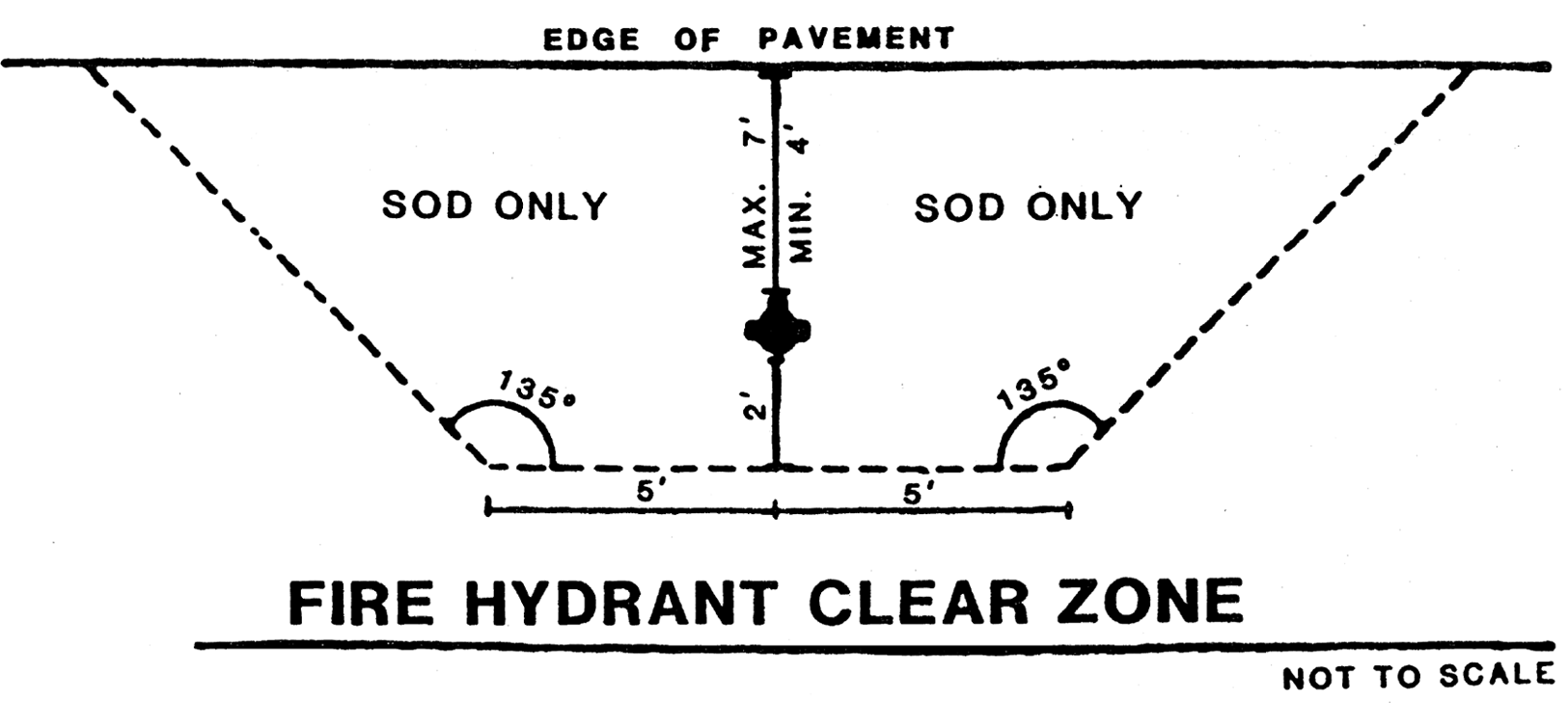
Fire Hydrant Clear Zone, Figure 1
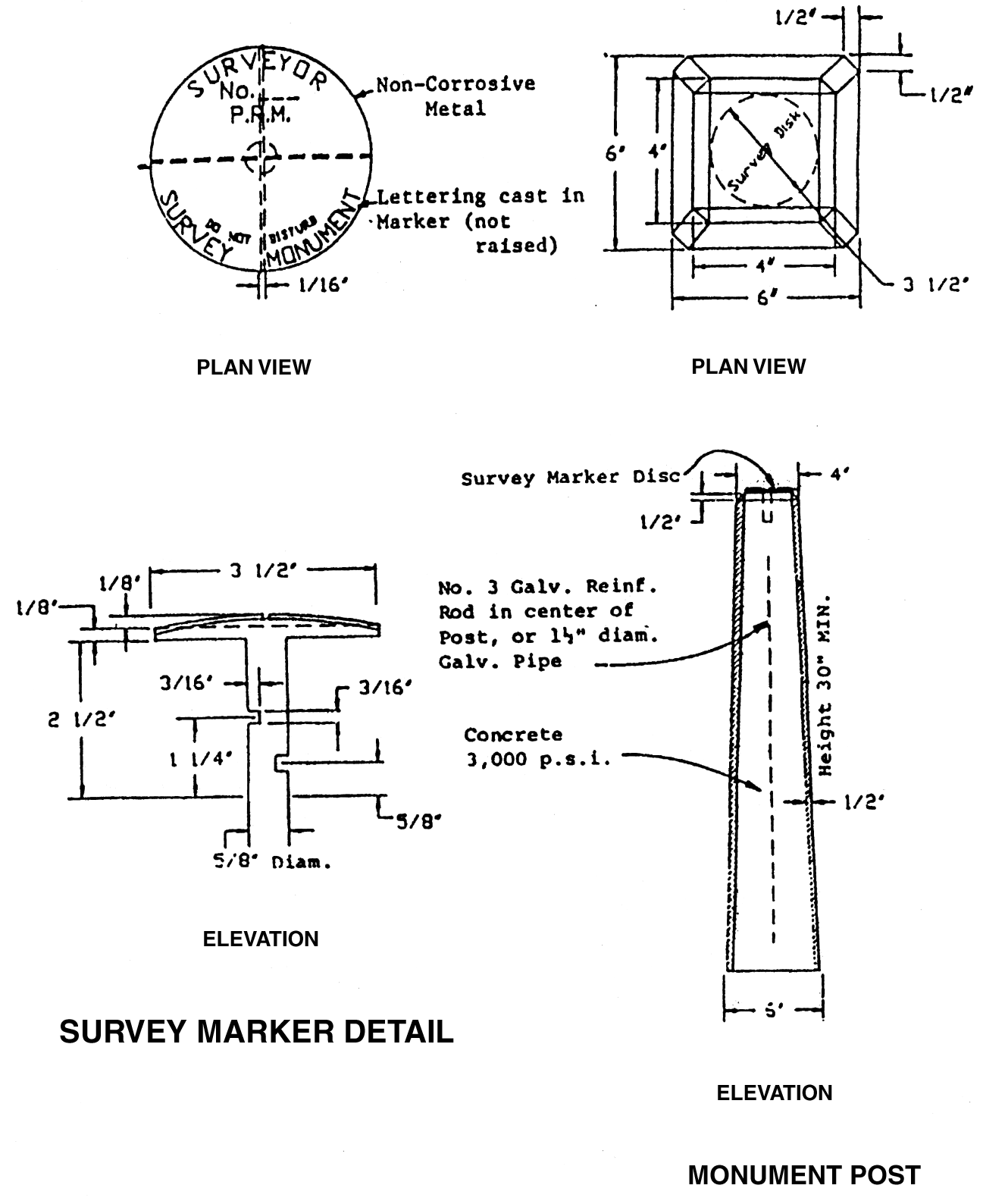
Permanent Reference Monument, Figure 2
(Ord. No. 115-86, Figs. 1—18, 7-10-86; Ord. No. 159-87, Figs. 1—18, 6-11-87; Ord. No. 138-90, § 4, (Fig. 6), 1-10-91; Ord. No. 103-96, § 1, 1-25-96; Ord. No. 2001-23, § 3, 6-28-01)

