
Colfax City Zoning Code
ARTICLE I
- GENERAL PROVISIONS
17.04.010 - Title.
This title shall be known and may be cited as the zoning law of the city.
(Ord. No. 519, 8-8-2012)
17.04.020 - Adoption.
There is adopted a zoning plan for the city.
(Ord. No. 519, 8-8-2012)
17.04.030 - Purpose.
The purpose of this title is to promote and protect the public health, safety, peace, morals, comfort and general welfare of the city. The zoning plan consists of the establishment of various districts, including therein all the territory within the boundaries of the city, within some of which districts is lawful and within some of which it is unlawful, to erect, construct, alter or maintain certain buildings or to carry on certain trades or occupations or to make certain uses of land and/or within which certain open spaces shall be required about buildings. The zoning plan also consists of appropriate regulations to be enforced in such districts.
(Ord. No. 519, 8-8-2012)
17.08.010 - Purpose.
This chapter specifies the authority and procedures to insure the consistent interpretation and application of the requirements of this title.
(Ord. No. 519, 8-8-2012)
17.08.020 - Rules of interpretation.
A.
Minimum Requirements. The provisions of this title shall be deemed to be the minimum standards required for the protection of the public health, safety, and welfare.
B.
Conflicting Requirements. Where the provisions of this ordinance impose a more stringent development requirement or a greater restriction upon the use of buildings or land than are imposed or required by other laws, rules, and regulations, or by easements, covenants, or agreements, the planning director, acting in the best interest of the city, shall make a determination which requirements or restrictions shall govern.
C.
Conflicts Between Provisions. In the event of any conflict between the respective articles in this title, the provisions of such articles shall be read together and the planning director, acting in the best interest of the city, shall make a determination which regulations shall govern.
D.
Single Lot in Multiple Zoning Districts. In the event two or more lots are merged through the approval of a lot line adjustment, parcel or tentative map in compliance with Title 16 of this code (subdivisions), such that a single lot is covered by two or more zoning districts, the uses of that parcel shall be consistent with the zoning district as shown for the portion of the lot on which the use is proposed to be placed.
E.
Uncertainties in Zoning District Boundaries. Where the boundaries of any zoning district shown on the zoning map are uncertain, the planning director shall apply the rules set forth in Section 17.20.040 regarding boundary determinations.
(Ord. No. 519, 8-8-2012)
17.08.030 - Authority for interpretations.
The planning director shall have the authority to issue administrative interpretation of the provisions of this title to resolve ambiguities.
A.
Record of Interpretations. Whenever the planning director determines that the applicability or meaning of any of the standards in this title is ambiguous, the planning director may issue an official interpretation. Official interpretations shall be in writing, and shall cite the provisions being interpreted, together with an explanation of their meaning or applicability in the particular or general circumstances that caused the need for interpretation. Any provision of this title that is determined by the planning director to be ambiguous shall be clarified by amendment as soon as is practical. The planning director shall maintain a complete record of all official interpretations available for public review, indexed by the section number of this title that is the subject of the interpretation.
B.
Appeal. Interpretations by the planning director may be appealed to the city manager pursuant to Chapter 17.44.
(Ord. No. 519, 8-8-2012)
17.12.010 - Purpose.
This chapter provides definitions of the terms and phrases used in this title that are technical or specialized, or that may not reflect common usage. This chapter also determines how language used throughout the title will be construed. Where any of the definitions in this chapter may conflict with definitions in other titles of the Colfax Municipal Code, these definitions prevail for the purposes of this title.
(Ord. No. 519, 8-8-2012)
17.12.020 - General rules for construction of language.
The meaning and construction of words and phrases as set forth shall apply throughout this title, except where the context of such words or phrases clearly indicates a different meaning or construction. Definitions contained in the California Building Code shall be applicable except when in conflict with definitions contained in this title, in which case the zoning definition shall apply. The following general rules of construction shall apply to the textual provisions of this title:
A.
Headings. The section and subsection headings of this title do not govern, limit, modify, or in any manner affect the scope, meaning or intent of any provision of this title.
B.
Illustrations. In case of any difference of meaning or implication between the text of any provision and any illustration, the text of the provision shall control.
C.
Shall, May and Should. "Shall" is always mandatory and not discretionary. "May" is permissive or discretionary. "Should" is advisory and not mandatory.
D.
Tense, Number, and Gender. Words used in the present tense include the past and future tense. Words used in the singular include the plural, and the plural the singular, unless the context clearly indicates the contrary. The masculine and feminine genders are both inclusive of the masculine, feminine, and neuter.
E.
Conjunctions. Unless the context clearly indicates the contrary, the following conjunctions shall be interpreted as follows:
"And" indicates that all connected items or provisions shall apply.
"Or" indicates that the connected items or provisions may apply singly or in any combination.
"Either…Or" indicates that the connected items or provisions shall apply singly but not in combination.
(Ord. No. 519, 8-8-2012)
17.12.030 - Definitions (A—Z).
Definitions are as hereafter set forth in this chapter.
"Accessory use or structure" means a use or structure subordinate to the principal use of a building on the same lot and serving a purpose customarily incidental to the use of the principal building.
"Agent of owner" means any person certified in writing by the property owner as his or her agent.
"Alley" means a public or private way not more than thirty (30) feet wide which affords only secondary access to abutting property.
"Amendment" means any change, modification, deletion, or addition to the wording, text or substance of this title or any change, modification, deletion, or addition to the application of this title to property within the City of Colfax, including any alteration in the boundaries of a zone district, when adopted by ordinance passed by the city council in the manner prescribed by law.
"Antenna" means a device used in communications which transmits or receives radio signals. Common forms of antennae are panel arrays and whip antennas. Panel arrays are designed to concentrate a radio signal in a particular area and are typically flat and rectangular in design. Whip antennas transmit a signal 360 degrees and are cylindrical with an 18-foot height limit.
1.
Co-location. Locating wireless communications equipment from more than one provider on a single site.
2.
Dish Antenna. A dish-like antenna used to link communication sites together by wireless transmission of voices or data. Also called microwave antenna or microwave dish antenna.
3.
Equipment Building, Shelter or Cabinet. A structure designed and used to house equipment used by telecommunication providers at a facility.
4.
Monopole. A structure of a single spire used to support communications equipment.
5.
Related Equipment. All equipment ancillary to the transmission and reception of voice and data via radio frequencies. Such equipment may include, but is not limited to, cable, conduit and connectors.
6.
Satellite Antennas. A satellite antenna is a dish like antenna used to link communications sites together by wireless transmission of voice or data. Also called microwave antenna or microwave dish antenna.
7.
Stealth Facility. Any communications facility which is designed to blend into the surrounding environment. Examples of stealth facilities may include architecturally screened roof-mounted antennas, building mounted antennas painted to match the existing structure, antennas integrated into architectural elements, and antenna structures designed to link like light poles. Also called concealed antennas.
8.
Telecommunication Facility. A land use facility supporting antennas and microwave dishes that sends and/or receives radio-frequency signals. Communication facilities include structures (aka monopole, towers) and accessory buildings.
9.
Telecommunication Tower. A mast, pole, monopole or guyed or lattice, free-standing tower designed and primarily used to support antennas, to include dishes, arrays and similar devices.
"Automobile or trailer sales area" means an open area used for the display, sale or rental of new or used motor vehicles or trailers in operable condition and where no repair work is done.
"Automobile repair, major" means the general repair, rebuilding or reconditioning of engines, motor vehicles or trailers, collision service, including body, frame or fender repair and overall painting.
"Automobile service station" means a place where gasoline or any other motor fuel, lubricating oil or grease for operating motor vehicles is offered for sale to the public and deliveries are made directly into motor vehicles and where services are performed, including tube and tire repair, battery charging, storage of merchandise, lubricating of automobiles, automobile washing (not including mechanical washes) and the replacement of spark plugs, lights, fan belts and other small parts.
"Basement" means a story whose floor is more than twelve (12) inches below the average level of the adjoining ground but where no more than one-half of its floor-to-ceiling height is below the average contact level of the adjoining ground. A basement shall be counted as a story for the purposes of height measurement and as a half-story for the purposes of side yard determinations, when usable as a dwelling. (Also see "cellar," of this chapter.)
"Block" means a tract of land bounded by streets, railroad rights-of-way, watercourses, a city boundary or large areas devoted to such uses as schools, parks, institutions or major industries.
"Boarding or lodging house" means a dwelling or part thereof, where meals and/or lodging are provided for compensation for three or more persons not transients and other than for members of the resident family.
"Building" means any structure having a roof supported by columns or walls and used or intended to be used, for the shelter or enclosure of persons, animals or property. "Building" shall include structure. (Also see "structure," of this chapter.)
"Building, main" means a building in which is conducted the principal use of the building site on which the main building is situated. A dwelling in any residential district shall be deemed to be a main building on the building site on which the dwelling is located.
"Building, significant" means a building which has special historic significance and is listed on the National Register of Historic Places or California Register of Historic Places. Significant buildings are listed in subsection 17.200.030A of this title.
"Bus depot or station" means a place of business serving as a point of arrival or departure for passengers traveling by intercity or interstate bus, except those buses operated by a governmental entity.
"Camp car" means a vehicle with its own motive power, which camp car is designed for human habitation.
"Camper" means a portable dwelling unit designed to be transported on a motor vehicle.
"Cargo trailer" means a vehicle designed to be drawn by a motor vehicle for the purpose of transporting cargo, including a boat or livestock.
"Carport." See "garage, private," of this chapter.
"Cellar" means a story where more than one-half of its floor-to-ceiling height is below the average contact ground level of the adjoining ground. For the purposes of the height regulations, a cellar shall be counted as a story. (Also see "basement," of this chapter.)
"Chief building official" means the chief building official of the city or any employee lawfully authorized to perform any duty or exercise any power as his or her representative.
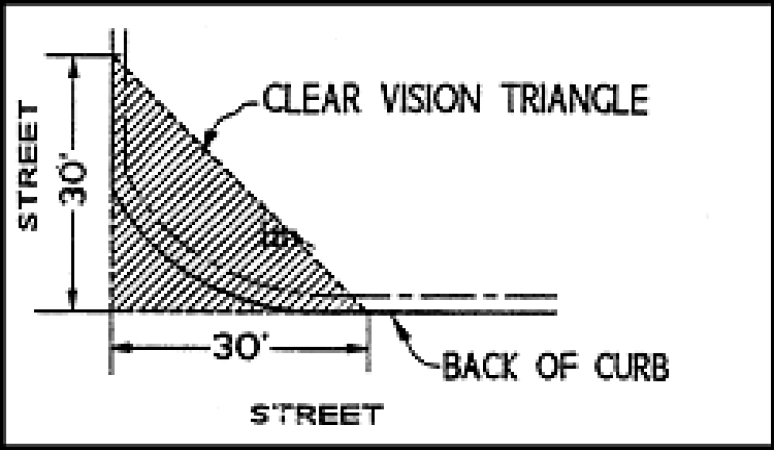
"Clear vision triangle, commercial" means that portion of both private property and public right-of-way located at any corner defined by the triangular area created by the diagonal connection of two points measured thirty (30) feet back from the intersection of the prolongation of points measured along the front and corner street side back of curb (see figure below). The dimensions of the clear vision triangle may be required to be increased if the director of public works determines that additional area is needed to ensure that a potential traffic hazard is not created.
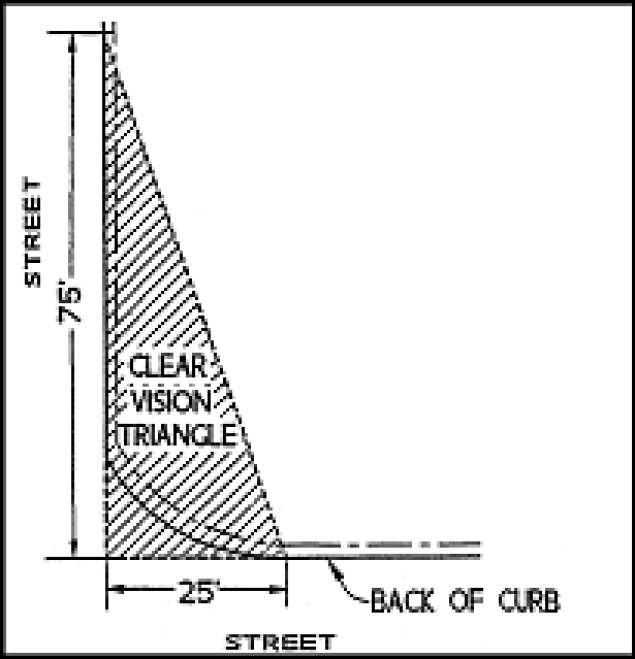
"Clear vision triangle, residential" means that portion of both private property and public right-of-way located at any corner defined by the triangular area created by the diagonal connection of two points measured 25 feet along the front and 75 feet along the side of a property measured from the back of curb. The third side of the clear vision triangle shall be the hypotenuse of the triangle described connecting the other two sides (see figure below). The dimensions of the clear vision triangle may be required to be increased if the director of public works determines that additional area is needed to ensure that a potential traffic hazard is not created.
"Commission" means the Planning Commission of the City of Colfax.
"Community services director" means the community services director of the city or any employee lawfully authorized to perform any duty or exercise any power as his or her representative.
"Construction, beginning of" means any and all action to begin construction, including breaking ground or installation of the foundation of a building or other improvement, and the incorporation of labor and materials to accomplish these preliminary steps.
"Court" means an open space on the same lot with a building, which court is bounded on two or more sides by the exterior walls of buildings on the same lot.
"Coverage" means the percent of the total site area covered by structures other than those excepted by the provisions of this title.
"Days" means calendar days. If the deadline to perform an action required under this title falls upon a weekend, holiday, or a day that the city is not open for business, the deadline shall be extended to the end of the next available business day.
"Density" means the number of dwelling units per gross acre.
"Design guidelines" means the set of guidelines adopted by the City of Colfax, defining elements and dimensions to be followed in site, building design, landscaping and development.
"Development review committee" means any combination of the planning director, community services director, chief building official and city engineer.
"Development standard" means those parts of a zone district and any other regulation of this title which regulates aspects of physical development, including, but not limited to, density, lot area, lot width, lot coverage, building height, and setbacks.
"Distance between residential structures" means the shortest horizontal distance, excluding the roofline, between the vertical walls of two residential structures.
"District" means a portion of the city within which certain uniform regulations and requirements or various combinations thereof, apply under the provisions of this title. "District" shall include "zone" and "zoning district."
"Driveway" means a private road, the use of which is limited to persons residing, employed or otherwise using or visiting the parcel on which such driveway is located.
"Dwelling" means any building or portion thereof, except a tent or trailer, designed or used as the residence or sleeping place of one or more persons. Mobilehomes which are not placed on a permanent foundation will be treated as a trailer for the purposes of this definition. In order to be deemed a residence under the provisions of this title, such buildings shall be used only for residence purposes and for such other purposes as are included under home occupations, as set forth in Chapter 17.152 of this title.
"Dwelling, duplex" means a building designed or intended to be used for residence purposes by two families or housekeeping units living independently of one another.
"Dwelling, multiple" means a building or portion thereof, designed or intended to be used for residence purposes by two or more families or housekeeping units living independently of one another.
"Dwelling, single-family" means a building designed or intended to be used for residence purposes by one family.
"Dwelling unit" means one room or a suite of two or more rooms designed or intended to be used by one family for living and sleeping.
"Dwelling unit, accessory" means a dwelling as defined in Government Code Section 65852.2 as it now exists or may hereafter be amended or replaced.
"Dwelling unit, junior accessory" means a dwelling as defined in Government Code Section 65852.22 as it now exists or may hereafter be amended or replaced.
"Expansion, building or structure" means an alteration of or an addition to a building/structure that results in an increase in its size, either in extent or bulk, or an increase in its area or volume.
"Expansion, use" means an alteration of a use that results in an increase in its size, either in extent, intensity or in the nature of the activities conducted.
"Family" means an individual or two or more persons related by blood, marriage or adoption or a group of not more than three persons (excluding servants) who need not be related living in a dwelling unit as a single housekeeping unit and using common cooking facilities.
"Fence" means an artificially constructed barrier of any material or combination of materials erected to enclose, screen, or separate areas.
"Filling station." See "automobile service station," of this chapter.
"Floor area" means the gross floor area used or intended to be used, by tenants or for services to customers, patrons, clients or patients, including areas used principally for nonpublic purposes, such as the storage, incidental repair, processing or packaging of merchandise. "Floor area" shall pertain to offices, merchandising or service types of uses.
"Foot lambert" means one foot lambert equaling brightness equivalent to one lumen per square foot reflected from a surface. One lumen per square foot shall be equal to a square foot illuminated evenly by one footcandle at any point.
"Garage, private" means a detached accessory building or a portion of a main building, used or intended to be used, for the storage of vehicles of persons occupying the main building on the lot.
When a garage is used for the storage of a commercial vehicle of more than one and one-half tons capacity or for more than one commercial vehicle of any capacity, such garage shall be deemed to be a public garage.
"Garage, public" means a structure or portion thereof, other than a private garage, used for the storage, sale, care, repair or refinishing of motor vehicles or trailers.
"Gateway/entrances" means the access, ingress, or entrance to a subdivision of land, apartments, condominiums, city, community, region, district, area of open space (example: park, golf course, etc.), or land use established by landscaping, signage, statuary, walls, fences, gates, or lighting that distinguishes the entrance to the land use from other street and properties.)
"General plan" means the City of Colfax General Plan, and all revisions and amendments to the plan.
"Grade plane" means a reference plane representing the average of the finished ground level adjoining the building at all exterior walls. Where the finished ground level slopes away from the exterior walls, the reference plane shall be established by the lowest points within the area between the building and the lot line or, where the lot line is more than six feet from the building between the structure and a point six feet from the building.
"Group home" means those uses or facilities identified in this title which provide for the care of disabled or supervised individual(s).
"Height, building and other structures" means the vertical distance from grade plane to the average height of the highest roof surface.
"Height, fence or wall" means the height of a fence or wall shall be determined from the highest finished grade on either side of the fence or wall.
"Home occupation" means a commercial activity conducted entirely within the dwelling, clearly incidental and secondary to the use of the dwelling for residential purposes and in accordance with the provisions of Chapter 17.152 of this title.
"Hospital" means an institution for the diagnosis, treatment and care of human illnesses, including facilities for the performance of major surgery.
"Hotel," "motor hotel" and "motel" mean a building or group of buildings, comprising individual sleeping or living units without kitchens, except as otherwise provided in this title, for the accommodation of transient guests.
"Landscaped area" means an area devoted to lawn, groundcover, trees, or shrubs or hardscape, and as specified in this title, the design guidelines, any applicable specific plan or by other city requirement.
"Loading space" means an area, other than a street, alley, or driving aisle, on the same lot with a building or a group of buildings which is permanently reserved and maintained for the temporary parking of commercial vehicles while loading or unloading merchandise or materials.
"Lot" means a piece or parcel of land occupied or intended to be occupied, by a main building or a group of such buildings and accessory buildings or utilized for a principal use and uses accessory thereto, together with such open spaces as required by this title, having frontage on a public or approved private street.
"Lot, area" means the area contained within the boundary lines of a lot.
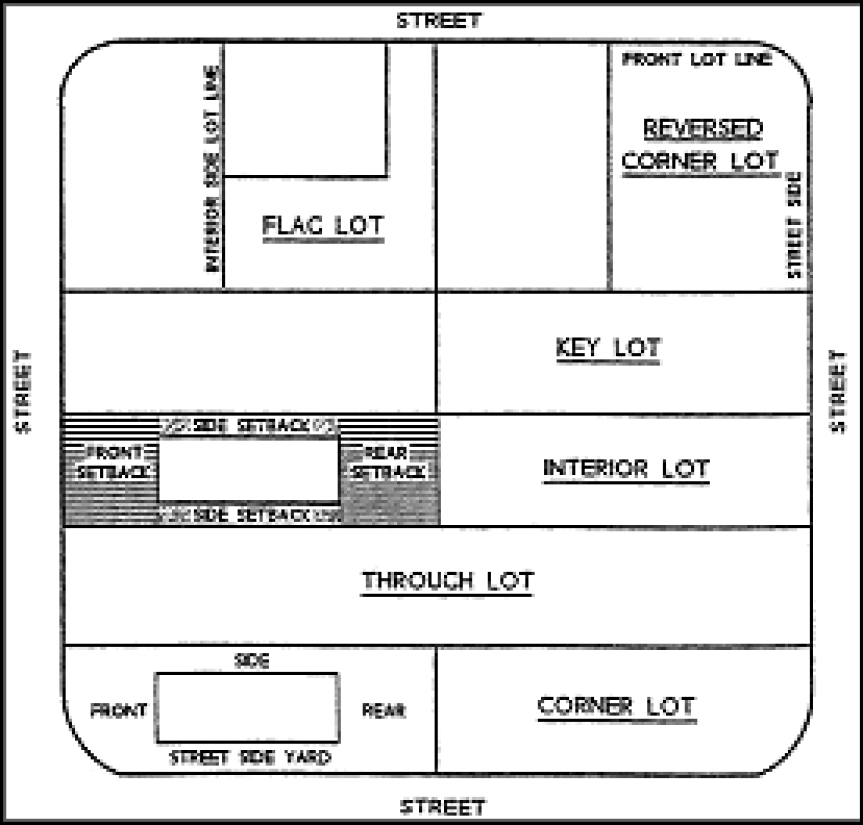
"Lot, corner" means a lot located at the intersection of two or more streets, with one property boundary bordering on each street frontage. (see figure below)
"Lot depth" means the mean horizontal distance between the front and the rear lot lines or between the front lot line and the intersection of the two side lines if there is no rear lot line.
"Lot, developed" means a lot with buildings or structures.
"Lot, flag" means a lot having access to a public or private street by a narrow strip of land. (see figure under "lot, corner").
"Lot, frontage" means that portion of the lot contiguous to the street.
"Lot, interior" means a lot other than a corner lot, abutting only one street (see figure under "lot, corner").
"Lot, key" means a lot with a side line that abuts the rear line of any one or more adjoining lots. (see figure under "lot, corner").
"Lot line" means the property line bounding the lot.
"Lot line, front" means the lot line separating a lot from a street right-of-way, unless the lot line goes to the center of the street, in which case the front lot line shall be measured from the setback for the street right-of-way. The front lot line of a corner lot may face either street frontage, at the option of the owner, provided that the required rear yard setback is obtainable opposite from the front lot line.
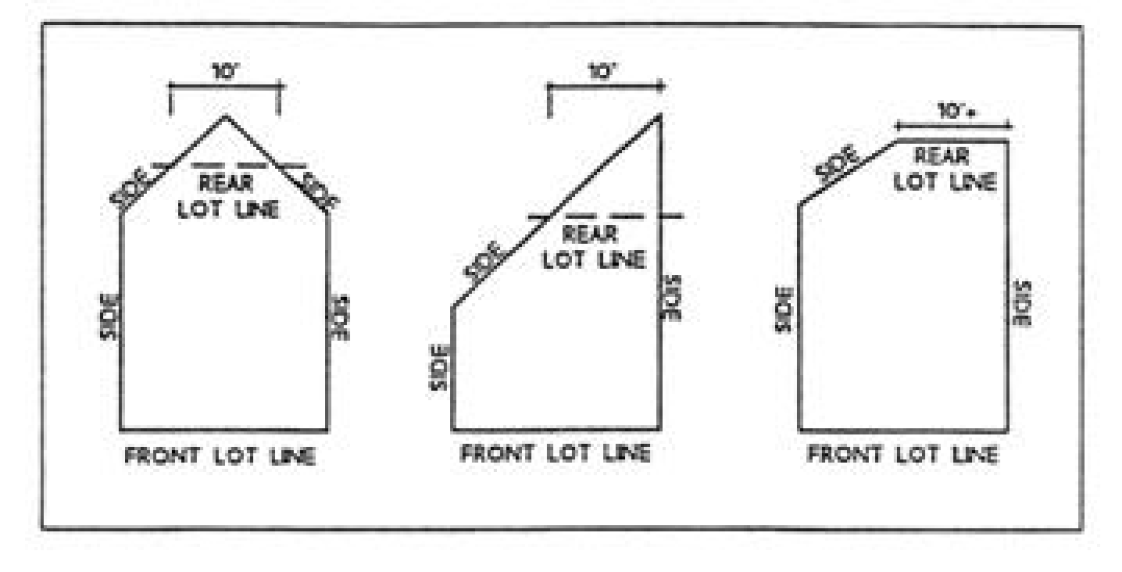
"Lot line, rear" means that lot line, not intersecting a front lot line, which is most distant from and most closely parallel to the front lot line. In the case of an irregularly-shaped lot or a lot bounded by only three lot lines, a line within the lot having a length of ten (10) feet parallel to and most distant from the front lot line shall be interpreted as the rear lot line for the purpose of determining required yards, setbacks, and other provisions of this title. (see figures below)
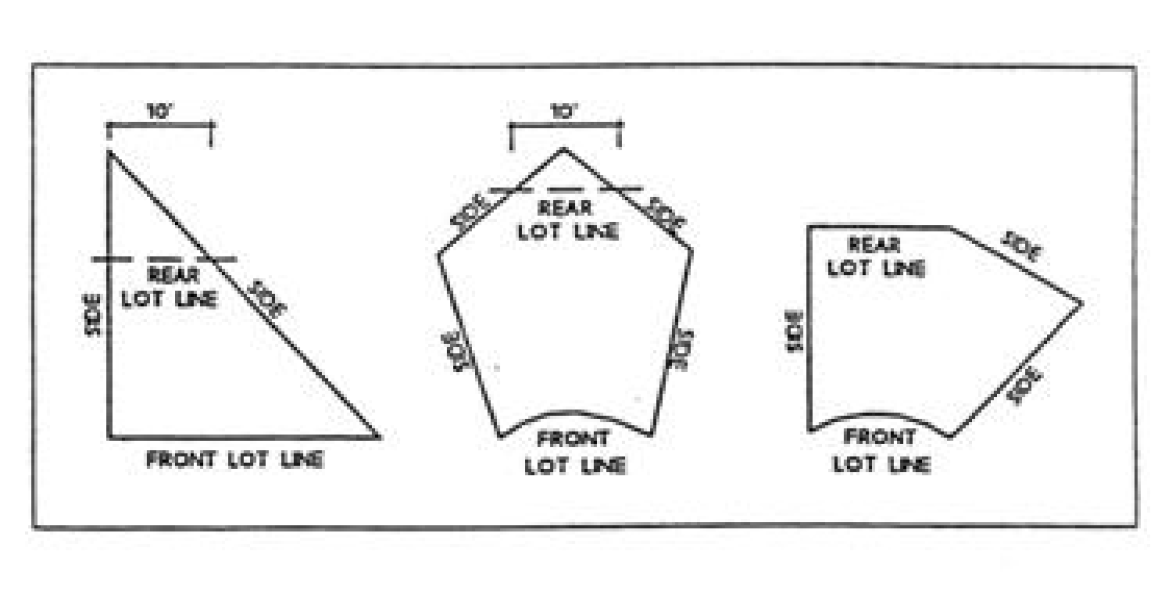
"Lot line, side" means any lot line, other than a front or rear lot line, which intersects a front lot line. A side lot line separating a lot from a street shall be a side street lot line.
"Lot line, street or alley" means a lot line separating the lot from a street or alley.
"Lot, reversed corner" means a corner lot, the rear of which abuts the side of another lot (see figure under "lot, corner").
"Lot, through" means a lot having frontage on two generally parallel streets (see figure under "lot, corner").
"Lot, width" means the horizontal distance between the side lot lines, measured at the front setback line.
"Manufactured home" means a factory-built or manufactured home permitted by State of California and federal laws.
"Mobilehome" means a vehicle, other than a motor vehicle, designed for human habitation. "Mobilehome" shall include a camp trailer or a trailer coach.
"Dependent mobilehome" means a mobilehome which is not equipped with a toilet for sewage disposal.
"Independent mobilehome" means a mobilehome which is equipped with a toilet for sewage disposal.
"Mobilehome park" means any area or tract of land where one or more mobilehome lots are rented or leased or held out for rent or lease to accommodate mobilehomes used for human habitation. The rental paid for any such mobilehome shall be deemed to include rental for the lot it occupies.
"Natural grade" means the elevation of the original or undisturbed natural surface of the ground.
"Nonconforming structure" means a structure which does not conform to the regulations for height, coverage or yards of the district in which such structure is located, but which was in conformity with applicable regulations, if any, at the time of its erection.
"Nonconforming use" means the use of a structure or land which use does not conform to the use regulations for the district in which such use is located but, which was in conformity with applicable regulations, if any, at the time of its establishment.
"Nursing home" means any premises, other than a hospital, with sleeping rooms where persons are lodged and furnished with meals and nursing care. Any facility providing care for persons suffering from contagious diseases, mental diseases, alcoholism or drug addiction shall be deemed a hospital and not a nursing home.
"Open-air vending facilities" means a stand or non-motorized non-stationary cart or pushcart, for the sale of prepared food, fresh-cut flowers or plants, or other items determined by the planning director to be consistent with this type of use.
"Outdoor sales area" means an outdoor area located on the same lot as the principal business used for merchandise display or storage as allowed under this title.
"Parcel" means an area of land.
"Parcel, non-conforming" means a parcel of land having less area, frontage, or dimensions than required in the zoning district in which it is located.
"Parking lot" means an area of land, a yard or other open space on a lot legally used for or designed for parking motor vehicles.
"Parking space" means a permanently surfaced area of a size as set forth in Chapter 17.108 of this title, either within a structure or in the open for the parking of a motor vehicle, excluding paved areas necessary for access pursuant to the provisions of this title.
"Parking space, private" means an open area for the same uses as a private garage.
"Parking space, public" means an open area used for the parking of automobiles and available to the public, whether for a fee, free or as an accommodation for clients or customers.
"Permitted" means any use or activity allowed by the provisions of this title, and subject to the applicable regulations contained within this title.
"Planning commission." See "commission," of this chapter.
"Planning director" means the planning director of the city or any employee lawfully authorized to perform any duty or exercise any power as his or her representative.
"Persons with a possessory interest in property" means a person or persons holding a possessory interest in the property, for example a periodic tenancy, estate at will, or sufferance, or a person having a contractual right which will ripen into such a possessory interest in the property.
"Property owner" means a person or persons with fee title to the property.
"Quasi-public use" means a use essentially for public purposes, although such use is under private ownership or control.
"Residential density" means the average number of families living on one acre of land in a given area. The net residential density shall be determined by dividing the total number of families in a defined area by the total acreage of all parcels of land used for residential and accessory purposes within the area.
"Sale, fund-raising" means the temporary sale of new or used merchandise, food or food products conducted by a charitable, eleemosynary, or non-profit organization or by groups associated with churches, schools and clubs.
"Seating capacity" means the actual seating capacity of an area as indicated in the most recent edition of the California Building Code.
"Secondary use" means a purpose for which land or a building is or may be intended, occupied, maintained, arranged, or designed, which is less visible, prominent, or important than the primary use(s) on the same lot or parcel.
Setback" means the required distance that a building, parking lot or other designated item must be located from a lot line.
"Setback, front" means an area formed by a line parallel to a front lot line. The front setback is measured at right angles to the front lot line.
"Setback, rear" means an area formed by a line parallel to the rear lot line. Rear setbacks are measured at right angles to the rear lot lines.
"Setback, side" means an area formed by a line parallel to the side lot line, that extends between front and rear setback areas. Side setbacks are measured at right angles to the side lot lines.
"Shopping center" means two or more contiguous or separate retail commercial stores that share access and/or parking, which function by design, or ultimately function, as a single entity.
"Story" means that portion of a building included between the upper surface of a floor and the upper surface of the floor or roof next above.
"Story, above grade plane" means any story having its finished floor surface entirely above grade plane, except that a basement shall be considered as a story above grade plane where the finished surface of the floor above the basement meets any one of the following:
1.
Is more than six feet above grade plane.
2.
Is more than six feet above the finished ground level for more than fifty (50) percent of the total building perimeter.
3.
Is more than twelve (12) feet above the finished ground level at any point.
"Story, height" means the vertical distance from top to top of two successive tiers of beams or finished floor surfaces; and, for the topmost story, from the top of the floor finish to the top of the ceiling joists or, where there is not a ceiling, to the top of the roof rafters.
"Street" means a public right-of-way which provides a principal means of access to the abutting property. "Street" shall include avenue, drive, circle, road, parkway, boulevard, highway, thoroughfare and any other similar term.
"Street, private" means a right-of-way or easement in private ownership, not dedicated or maintained as a public street, which private street affords the principal means of access to two or more sites.
"Structural alteration" means any change in the structural members of a building.
"Structure" means anything constructed, the use of which requires permanent location on the ground or attachment to something having a permanent location on the ground.
"Substantial compliance" means compliance with the substantial or essential requirements of this title that, in the judgment of the city, satisfies its purpose or objective even though all of the formal requirements are not strictly adhered to.
"Substantial construction" means substantial completion of the work or works of improvement associated with a given permit.
"Theater" means a building or structure used for the purpose of conducting live dramatic, comedic or musical performances, the showing of motion pictures or similar recorded media, or other live performing arts.
"Trailer." See "camp car," "camper," "cargo trailer," and "mobilehome," of this chapter.
"Trailer camp," "trailer park" and "mobilehome park" mean any lot or part thereof or any parcel of land which is used or offered as a location for one or more camp trailers or mobilehomes occupied as a residence, except as provided in Section 17.80.020 of this title.
"Unified control" means a parcel of land under one ownership or a group of parcels, the owners of which have agreed in writing to subject the development of their properties to a single control.
"Usable open space" means one or more open areas adjacent to residential uses, the purpose of which is to provide an outdoor area designed for outdoor living and recreation, and which is located at, below, or above grade.
"Use" means the purpose for which land or a building is arranged, designed, or intended, or for which either land or a building is or may be occupied or maintained.
"Use, conditionally permitted" means a use type subject to a conditional use permit, which use may be essential or desirable to the public convenience or welfare in one or more zones but which may also impair the integrity and character of the zone or adjoining zone or be detrimental to the public health, safety or welfare unless additional restrictions on location and extent of use are imposed and enforced. Such use shall be permitted when all specific additional restrictions are completed and permanently satisfied in conformance with an approved conditional use permit. Should such restrictions be of a continuing nature, the use will remain conditional so long as the restrictions are complied with, even in the case of a change in zoning, but shall become an illegal use whenever and so long as the restrictions are not complied with.
"Use, primary" means the primary use or uses for which land or a building is or may be intended, occupied, maintained, arranged or designed and includes principally, conditionally and administratively permitted uses.
"Use, principally permitted" means the primary use of land or of a main building which use is compatible with the purpose of the zone and which is permitted in the zone. If a use is listed in a specific zone as a principally permitted use, it means that the owner, lessee or other person who has legal right to use the land, has right to conduct such principally permitted use subject to the regulations and procedural requirements of this title.
"Use type" means a category or class of land uses which share common functional, product or compatibility characteristics and which have been classified under a discreet use type in these regulations.
"Used" means and includes arranged, designed, constructed, altered, converted, rented, leased or intended to be used.
"Wineries and cideries" means facilities producing and bottling wine or cider for sale. These facilities may or may not include tasting rooms and the retail sales of wine, cider and other incidental goods.
"Yard, front" means an open space extending the full width of the lot measured between the building closest to the front lot line which open space is between a building and the front lot line, unoccupied and unobstructed from the ground upward, except as otherwise provided in this title.
"Yard, front, depth" means the shortest distance, measured horizontally, between any part of a building, other than parts excepted by the provisions of this title and the front lot line. Such depth shall be measured from the front lot line; provided, however, if an official plan line has been established for such street by action of the council, the required front yard depth shall be measured from the plan line of such street as adopted or such building shall comply with the official setback lines adopted by the city.
"Yard, rear" means an open space between a building and the rear lot line, unoccupied and unobstructed from the ground upward and extending across the full width of the lot, except as otherwise provided in this title.
"Yard, rear, depth" means the shortest distance, measured horizontally, between any part of a principal building, other than parts excepted by the provisions of this title and the rear lot line.
"Yard, side" means an open space extending from the front yard to the rear yard between a building and the nearest side lot line, unoccupied and unobstructed from the ground upward, except as otherwise provided in this title.
"Yard, side, width" means the shortest distance, measured horizontally, between any part of a building, other than parts excepted by the provisions of this title and the nearest side lot line. Such width shall be measured from the nearest side lot line and, in the event the nearest side lot line is a side street lot line, from the right-of-way line of the existing street; provided, however, if the proposed location of the plan line of such street as adopted by the city differs from that of the existing street, the required side yard width shall be measured from the right-of-way street as adopted or such building shall comply with the official setback lines adopted by the city.
"Zoning clearance certification" means an official document authorizing a building, structure or use consistent with the provisions of this title and for the purpose of carrying out and enforcing the provisions of this title.
"Zoning map" means the zoning map of the city, dated July 25, 1967, together with all amendments thereto subsequently adopted.
(Ord. No. 519, 8-8-2012; Ord. No. 555, § 1(Exh. A), 10-11-2023)
17.16.010 - Established.
The city is divided into the following designated districts as shown on the zoning map:
**The Historic District is not an actual district, but an overlay zone. See Chapter 17.84.020.
(Ord. No. 519, 8-8-2012; Ord. No. 555, § 1(Exh. A), 10-11-2023)
17.16.020 - Regulations—Exceptions.
Except as otherwise provided in this title, the regulations set forth in this title for each district shall be the minimum regulations and shall apply uniformly to each class or kind of structure or land and particularly as follows:
A.
On and after August 24, 1967, no building, structure or land shall be used or occupied and no building or structure or part thereof, shall be erected, constructed, reconstructed, moved or structurally altered, unless it is in substantial compliance with all of the regulations set forth in this title for the district in which such building, structure or land is located.
B.
No part of a yard, other open space or off-street parking or loading space required around or in connection with any building for the purpose of complying with this title shall be included as a part of a yard, open space or off-street parking or loading space similarly required for any other building, except as otherwise allowed in subsection 17.108.040D. (purchase or lease or parking spaces).
C.
No yard or lot existing on or before July 25, 1967, shall be reduced in dimension or area below the minimum requirements set forth in this title, unless it is in substantial compliance with all of the regulations set forth in this title for the district in which such yard or lot is located. Yards or lots created on or after July 25, 1967 shall meet at least the minimum requirements established by this title.
(Ord. No. 519, 8-8-2012)
17.20.010 - Provisions into zones.
To carry out the purposes and provisions of this code, the city is divided into zones as specified in this chapter.
(Ord. No. 519, 8-8-2012)
17.20.020 - Boundaries—Maps—Ordinances.
A.
The boundaries of zones described in this chapter are as shown upon the official zoning map as originally adopted, as amended by all previous ordinances and as may be amended by future ordinance of the city as from time to time enacted.
B.
The official zoning map, all notations thereon, references and other information contained thereon are incorporated herein as though set forth in this chapter in full and are declared to be part of this title.
(Ord. No. 519, 8-8-2012)
17.20.030 - Custody and maintenance of official maps.
A.
The official zoning map, properly attested, shall be and remain on file in the office of the city clerk.
B.
The official zoning map on file in the office of the city clerk shall be conclusively presumed as correctly reflecting the boundaries of the zones described in this title and shall be the final authority thereon.
C.
The official zoning map shall be maintained, amended and updated by such city staff as designated by the city manager.
(Ord. No. 519, 8-8-2012)
17.20.040 - Boundary determination.
Where uncertainty exists as to the boundaries of the districts as shown on the official zoning map, the following rules shall apply:
A.
Boundaries indicated as approximately following the center lines of streets, highways or alleys shall be construed to follow such center lines.
B.
Boundaries indicated as approximately following plotted lot lines shall be construed as following such lot lines.
C.
Boundaries indicated as approximately following the city limits shall be construed as following such city limits.
D.
Boundaries indicated as following railroad tracks shall be construed to be midway between such railroad tracks.
E.
Where a public street or alley is officially vacated by the city, the property within the vacated portion of the street or alley shall be the zoning on the adjoining property. Where the vacated street or alley was the boundary of two or more districts, the new district boundary shall be determined by the planning director at the time of abandonment.
F.
Boundaries indicated as parallel to or extensions of the features described in subsections A. through E. of this section shall be so construed. Distances not specifically indicated on the zoning map shall be determined by the scale of the map.
G.
Where physical or cultural features existing on the ground are at variance with those shown on the zoning map or in other circumstances not described in subsections A. through F. of this section, the planning director shall interpret the district boundaries.
H.
Where a district boundary line divides a lot which was in single ownership on July 25, 1967, the planning director may permit the extension of the regulations for either portion of the lot, not to exceed fifty (50) feet beyond the district line into the remaining portion of the lot, as a special exception.
(Ord. No. 519, 8-8-2012)

