
College Place City Zoning Code
CHAPTER 14
20 - DEFINITIONS
_____
14.20.010 - Introduction.
Certain terms and words used in this title may have special meaning as defined in this chapter.
(Ord. No. 20-021, § 2(Exh. A), 11-24-2020)
14.20.020 - Interpretations.
A.
Except where specifically defined in this chapter, all words used in this title shall carry their customary meanings. Words used in the present tense include the future; the plural includes the singular and vice versa; the word "shall" is mandatory; "may" is permissive; the words "used or occupied" are considered as though followed by the words "or intended, arranged, or designed to be used or occupied"; and the word "lot" includes the words "plot, tract, or parcel."
B.
Any word not specifically defined in this chapter shall have the meaning as defined by and determined by the city in accordance with the provisions of:
1.
The Revised Code of Washington (RCW);
2.
The Washington Administrative Code (WAC);
3.
North American Industry Classification System (NAICS), 2017 Edition or as subsequently updated;
4.
Webster's Dictionary; and
5.
Administrative code interpretations by the city.
C.
Any question or uncertainty about the meaning of a word used in this title may, at the sole discretion of the city, be resolved by an administrative code interpretation.
D.
References to the International Codes shall include the International Building Code, the International Residential Code, and related codes as adopted, or subsequently amended, by the city council.
E.
References to the City of College Place Engineering and Design Standards shall include the following documents, as approved, or subsequently amended by the city council:
1.
The City of College Place Standard Specifications and Drawings; and
2.
The City of College Place Stormwater Facility Standards.
F.
References in the College Place Municipal Code to Titles 15, 16, 17 18, or 19 shall refer to the comparable provisions in Title 14, as determined by the city.
(Ord. No. 20-021, § 2(Exh. A), 11-24-2020)
14.20.030 - Definitions.
A.
The following words and phrases are hereby defined as follows, unless otherwise determined by the city through an administrative code interpretation:
"Accessory building" means a building or structure, the use of which is incidental and subordinate to the principal or main building or use on the same lot, including a private garage or carport. If an accessory building is attached to the main building by a common wall or roof, the accessory building shall be considered a part of the main building. Garden houses, tool sheds, playhouses or greenhouses are examples of accessory buildings.
"Accessory use" means a use incidental and subordinate to the principal use and located on the same lot or in the same building as the principal use.
"Adjacent" in the context of administering the critical areas protections in College Place Municipal Code Chapter 14.70 shall mean any activity or development located:
a.
On a site immediately adjoining a critical area;
b.
A distance equal to or less than the required critical area buffer width and building setback;
c.
A distance equal to or less than 200 feet upland from a stream, wetland, or water body;
d.
Bordering or within the floodway, floodplain or channel migration zone; or
e.
A distance equal to or less than 200 feet from a critical aquifer recharge area.
"Adult home" or "adult family home" means a residential home, licensed by Washington State, to provide personal care to up to six adults.
"Base flood" means a flood event having a one percent chance of being equaled or exceeded in any given year, also referred to as the 100-year flood. Designations of base flood areas on flood insurance map(s) always include the letters A or V.
"Bed and breakfast inn" means a hotel or similar lodging facility offering from one to eight overnight lodging units to travelers or guests.
"Boarding house" or "rooming house" or "lodging house" means a dwelling unit having only one kitchen within which is provided not more than two guest rooms providing lodging (with or without provision of meals) for compensation. A boarding, rooming or lodging house containing three or more guest rooms shall be considered a hotel. Boarding, rooming and lodging houses shall not be construed to mean convalescent, nursing, adult family, or retirement homes.
"Camper" means a structure designed to be mounted upon a motor vehicle which provides facilities for human habitation or for temporary outdoor or recreational lodging and which is five feet or more in overall length and five feet or more in height from its floor to its ceiling when fully extended, but shall not include motor homes as defined in RCW 46.04.305.
"Child day care center" means an agency that regularly provides child day care and early learning services for a group of children for periods of less than 24 hours.
"Child day care in-home facility" or "family day care provider" means a facility licensed by Washington State where care is provided for not more than 12 children in the provider's home living quarters.
"Closed record appeal" means an administrative appeal on the record to a local government body or officer, including the legislative body, following an open record hearing on a project permit application when the appeal is on the record with no or limited new evidence or information allowed to be submitted and only appeal argument allowed.
"Co-housing" means a residential development that combines individual owned dwelling units clustered around shared space. Units may have smaller kitchens with a larger community kitchen and dining room intended for communal use on a regular basis The development may also provide other facilities for communal use and interaction, and in which residents may agree to share in the provision of regular communal services such as cooking meals or providing child care.
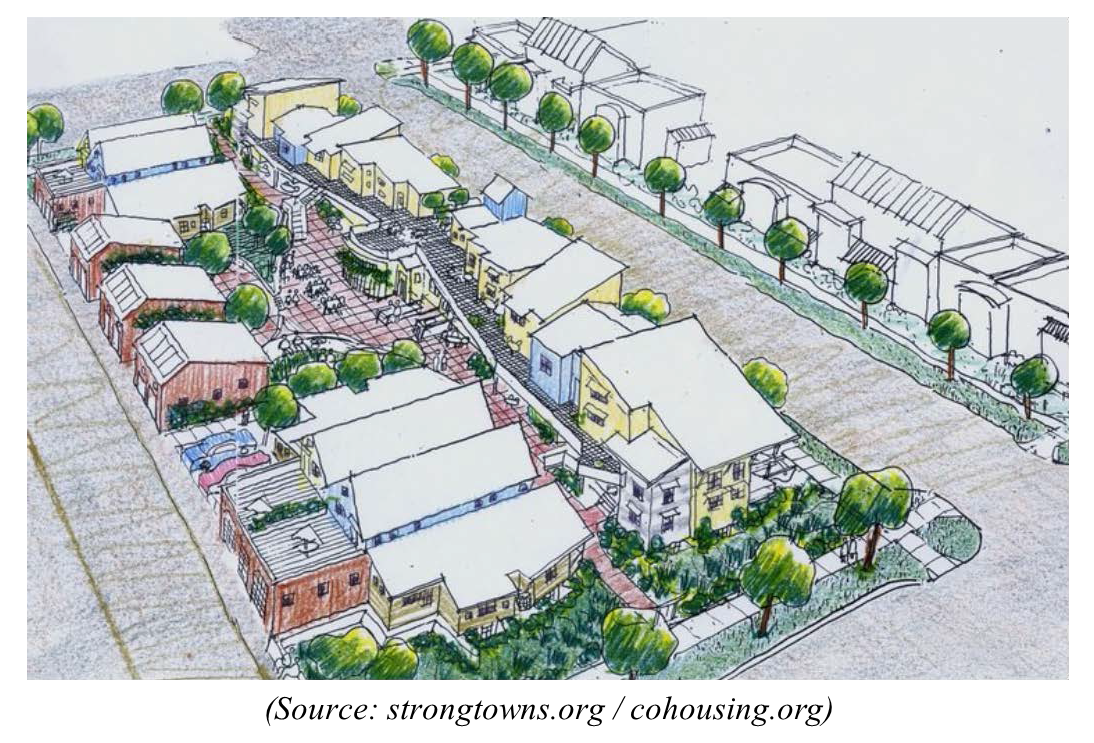
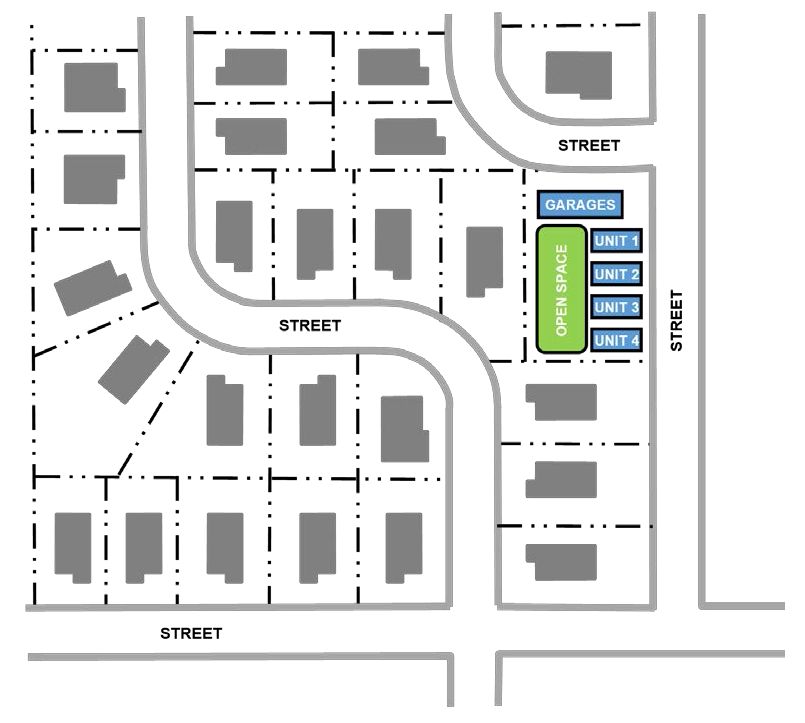
"Cottage housing" means a grouping of small, single-family dwelling units clustered around a common area and developed with a coherent plan for the entire site.
"Critical aquifer recharge area" means areas designated by the city in accordance with the provisions of WAC 365-190-030(3) and WAC 365-190-100 that are determined to have a critical recharging effect on aquifers used for potable water.
"Dwelling" or "dwelling unit" means a building designed for residential purposes that contains complete independent living facilities for one or more persons including permanent provisions for living, sleeping, eating, cooking, and sanitation.
"Dwelling, multiple residential units" or "multiple family dwelling" means a building containing three or more dwelling units. This definition includes "row house" and may include condominiums.
"Dwelling, single residential unit " or "single-family residence", means a building containing one dwelling unit. Single residential dwelling units may be site-built or manufactured off-site, such as modular housing.
"Dwelling, two residential units" or "duplex," means a building on a lot containing two dwelling units.
"Dwelling unit, accessory (ADU)" means a dwelling unit that is use incidental and subordinate to a principal use that is located on the same lot or in the same building as the principal use.
"Early learning" includes but is not limited to programs and services for childcare; state, federal, private, and nonprofit preschool; childcare subsidies; childcare resource and referral; parental education and support; and training and professional development for early learning professionals.
"Fish and wildlife habitat conservation area" means areas as determined by the city to be necessary for maintaining species in suitable habitats within their natural geographic distribution so that isolated subpopulations are not created. These areas are designated in accordance with the provisions of WAC 365-190-030(6) and WAC 365-190-130. These areas are guided by the state's priority habitats and species list and include the following:
a.
Areas with which state or federally designated endangered, threatened, and sensitive species have a primary association;
b.
Habitats of local importance, including but not limited to areas designated as priority habitat by the department of fish and wildlife, areas that provide important habitat for neotropical migratory songbirds, areas that provide important habitat for wintering birds of prey, and areas that provide unique habitats within the city;
c.
Naturally occurring ponds under 20 acres and their submerged aquatic beds that provide fish or wildlife habitat, including those artificial ponds intentionally created from dry areas in order to mitigate impacts to ponds;
d.
Waters of the state, including lakes, rivers, ponds, streams, inland waters, underground waters, salt waters and all other surface waters and watercourses within the jurisdiction of the State of Washington;
e.
Lakes, ponds, streams, and rivers planted with game fish by a governmental or tribal entity;
f.
State natural area preserves and natural resource conservation areas; and
g.
Land essential for preserving connections between habitat blocks and open spaces.
"Floodplain" means the total land area adjoining a river, stream, watercourse or lake subject to inundation by the base flood.
"Floodway" or "zero rise floodway" means the channel of a river or other watercourse and the adjacent land area that must be reserved in order to discharge the base flood without cumulatively increasing the surface water elevation more than one foot.
"Frequently flooded areas" means lands in the floodplain subject to a one percent or greater chance of flooding in any given year and those lands that provide important flood storage, conveyance, and attenuation functions, as determined by the city in accordance with the provisions of WAC 365-190-030(8)80(3) and WAC 360-190-110. Frequently flooded areas perform important hydrologic functions and may present a risk to persons and property. Classifications of frequently flooded areas include, at a minimum, the 100-year floodplain designations of the Federal Emergency Management Agency and the National Flood Insurance Program.
"Functions and values" mean the beneficial roles served by critical areas including, but not limited to, water quality protection and enhancement, fish and wildlife habitat, food chain support, flood storage, conveyance and attenuation, ground water recharge and discharge, erosion control, wave attenuation, protection from hazards, historical and archaeological and aesthetic value protection, and recreation. These beneficial roles are not listed in order of priority.
"Geological hazard areas" mean areas as determined by the city that may not be suited to development consistent with public health, safety, or environmental standards, because of their susceptibility to erosion, sliding, earthquake, or other geological events in accordance with the provisions of WAC 365-190-030(9) and WAC and WAC 365-190-120. Types of geologically hazardous areas include erosion, landslide, seismic, mine, and volcanic hazards.
"Group home" means a residential facility designed and operated to serve persons with disabilities, mental or physical.
"Habitats of local importance" mean areas as determined by the city that include a seasonal range or habitat element with which a given species has a primary association, and which, if altered may reduce the likelihood that the species will maintain and reproduce over the long term. These might include areas of high relative density or species richness, breeding habitat, winter range, and movement corridors. These might also include habitats that are of limited availability or high vulnerability to alterations such as cliffs, talus, and wetlands. (WAC 365-190-0130).
"Hazardous substance" means any liquid, solid, gas, or sludge, including any material, substance, product, commodity, or waste, regardless of quantity, that exhibits any of the physical, chemical or biological properties described in WAC 173-303-090 or 173-303-100.
"Hemp production" refers to planting, cultivation, growing, or harvesting of hemp, including seed hemp, as licensed by the State of Washington.
"Home business" means a commercial enterprise operated within a dwelling or accessory building, which use is distinctly incidental and secondary to the dwelling purposes and does not change the character thereof.
"Hydric soil" means a soil that is saturated, flooded or ponded long enough during the growing season to develop anaerobic conditions in the upper part. The presence of hydric soil shall be determined following the methods described in the Washington State Wetland Identification and Delineation Manual, as amended.
"Impervious surface" means a hard surface area that either prevents or retards the entry of water into the soil mantle as under natural conditions prior to development or that causes water to run off the surface in greater quantities or at an increased rate of flow from the flow present under natural conditions prior to development. Common impervious surfaces include, but are not limited to, roof tops, walkways, patios, driveways, parking lots or storage areas, concrete or asphalt paving, gravel roads, packed earthen materials, and oiled macadam or other surfaces which similarly impede the natural infiltration of stormwater.
"Injection well", or "underground injection control well", or "UIC well" means a well that is used to discharge fluids into the subsurface. A UIC well is one of the following:
a.
A bored, drilled or driven shaft, or dug hole whose depth is greater than the largest surface dimension;
b.
An improved sinkhole; or
c.
A subsurface fluid distribution system.
UIC wells are regulated by the State of Washington and subject to the provisions of WAC 173-218.
"Inter-rill" means an area subject to sheetwash.
"Kennel" means a place where four or more adult dogs or cats or any combination thereof are kept, whether by owners of the dogs or cats or by persons providing facilities and care, whether or not for compensation, but not including a small animal hospital or clinic.
"Landfills" includes the underground storage of hazardous or dangerous waste, municipal solid waste, special waste, wood waste, and inert and demolition waste.
"Landslide hazard area" means an area that is potentially subject to risk of mass movement due to a combination of geologic landslide resulting from a combination of geologic, topographic, and hydrologic factors. These areas are typically susceptible to landslides because of a combination of factors including bedrock, soil, slope gradient, slope aspect, geologic structure, ground water, or other factors.
"Lot" means a fractional part of divided lands having fixed, legal boundaries, established in conformance with the applicable state and local laws in effect at the time it was created. The term shall include tracts or parcels.
a.
Lots being of sufficient area and dimension to meet minimum zoning requirements for width and area may be considered legal, conforming lots.
b.
Lots with dimensions that do not comply with current minimum zoning requirements but did comply with minimum zoning requirements at the time they were created may be considered legal, nonconforming lots.
"Lot width" means the dimension of the lot line at the street; or, in an irregularly shaped lot, the dimension across the lot at the building setback line; or, in a corner lot, the narrow dimension of the lot at a street or building setback line.
"Manufactured home" means a structure, designed and constructed to be transportable in one or more sections, and is built on a permanent chassis, and designed to be used as a single-family dwelling with or without a permanent foundation when connected to required utilities (plumbing, heating, and electrical systems, built in accordance with regulations adopted under the National Manufactured Housing Construction and Safety Standards Act, of 1974.
"Marijuana medical cooperative" or "marijuana cooperative" means a group of more than one, but no more than four, qualified medical marijuana patients and/or designated providers registered with the Washington State Liquor and Cannabis Board who share responsibility for growing and processing marijuana only for the medical use of the members of the cooperative, in accordance with the Laws of Washington State.
"Marijuana processing" or "marijuana processor" means a person licensed by the Washington State Liquor and Cannabis Board to process marijuana into marijuana concentrates, useable marijuana, and marijuana-infused products, package and label marijuana concentrates, useable marijuana, and marijuana-infused products for sale in retail outlets, and sell marijuana concentrates, useable marijuana, and marijuana-infused products at wholesale to marijuana retailers, in accordance with the Laws of Washington State.
"Marijuana production" or "marijuana producer" means a person licensed by the Washington State Liquor and Cannabis Board to produce and sell marijuana at wholesale to marijuana processors and other marijuana producers, in accordance with the Laws of Washington State.
"Marijuana retail sales" or "marijuana retailer" means a person licensed by the Washington State Liquor and Cannabis Board to sell marijuana concentrates, useable marijuana, and marijuana-infused products in a retail outlet, in accordance with the Laws of Washington State.
"Mini-warehouse" or "self-storage" means a fully enclosed building or group of buildings in a compound that contains individual, compartmentalized and controlled-access stalls, lockers, or units for the storage of customer's tangible personal property.
"Mobile home" means a factory-built dwelling built prior to June 15, 1976, to standards other than the National Manufactured Housing Construction and Safety Standards Act of 1974, and acceptable under applicable state codes in effect at the time of construction or introduction of the home into the state of Washington.
"Mobile home lot" or "mobile home space" means a portion of a mobile home park or manufactured housing community designated as the location of one mobile home, manufactured home, tiny home on wheels, or park model and its accessory buildings, and intended for the exclusive use as a primary residence by the occupants of the mobile home, manufactured home, or park model.
"Mobile home park," "manufactured housing community," or "manufactured mobile home community" means any real property which is rented or held out for rent to others for the placement of two or more mobile homes, manufactured homes, or park models for the primary purpose of production of income, except where such real property is rented or held out for rent for seasonal recreational purpose only and is not intended for year-round occupancy.
"Mobile vendor" means a vendor or seller of merchandise or food from a motorized or trailered vehicle or other motorized or trailered conveyance.
"Mobile vendor food court" means a site where two or more mobile food vendors congregate to offer food or beverages for sale to the public as the principal use of the land.
"Modular home" means a factory-assembled structure designed primarily for use as a dwelling when connected to the required utilities that include plumbing, heating, and electrical systems contained therein, does not contain its own running gear, and must be mounted on a permanent foundation. A modular home does not include a mobile home or manufactured home.
"Motel" or "hotel" means a building or group of buildings containing six or more individual sleeping units or guest rooms, where lodging with or without provision of meals is provided for compensation. Motels are designed to temporarily accommodate the automobile tourist or transient with parking facilities conveniently located near each unit. The term includes tourist, motor and automobile courts and motor lodges.
"Non-project permit" or "non-project permit application" includes the following:
a.
Building permit.
b.
Accessory dwelling unit permit.
c.
Special use permit.
d.
Boundary or lot line adjustment.
e.
Interior alterations to approve site plans including construction activities that do not modify the exiting site layout or its current use and involve no exterior work adding to the building footprint in accordance with the applicable provisions of state law including RCW 36.70B.130.
f.
Adoption or amendment of a comprehensive plan, subarea plan, or development regulations.
g.
Landmark designations.
h.
Street vacations.
i.
Approvals relating to the use of public rights-of-way, areas, or facilities.
j.
Other permits, approvals, and actions, as determined by the city not subject to RCW 36.70B.060 through RCW 36.70B.090 and RCW 36.70B.1310 through RCW 36.70B.130.
"Open record hearing" means a hearing, conducted by a single hearing body or officer authorized by the local government to conduct such hearings, that creates the local government's record through testimony and submission of evidence and information, under procedures prescribed by the local government by ordinance or resolution. An open record hearing may be held prior to a local government's decision on a project permit to be known as an "open record pre-decision hearing." An open record hearing may be held on an appeal, to be known as an "open record appeal hearing," if no open record pre-decision hearing has been held on the project permit.
"Ordinary high-water mark (OHM)" means that mark which is found by examining the bed and banks and ascertaining where the presence and action of waters are so common and usual, and so long continued in all ordinary years, that the soil or vegetation has a character distinct from that of the abutting upland.
"Park model" or "park trailer" means a park trailer as defined in the American national standards institute A119.5 standard for park trailers.
"Primary association area" means area used on a regular basis by, is in close association with, or is necessary for the proper functioning of the habitat of a critical species. Regular basis means that the habitat area is normally, or usually known to contain a critical species, or based on known habitat requirements of the species, the area is likely to contain the critical species. Regular basis is species and population dependent. Species that exist in low numbers may be present infrequently yet rely on certain habitat types.
"Priority habitat" means habitat types or elements with unique or significant value to one or more species as classified by the department of fish and wildlife. A priority habitat may consist of a unique vegetation type or dominant plant species, a described successional stage, or a specific structural element. (WAC 173-26-020(34))
"Project permit" or "project permit application" means any land use or environmental permit, or license required for a project action, including, but not limited to, subdivisions, binding site plans, planned unit developments, conditional uses, shoreline substantial development permits, site plan review, permits or approvals required by critical area ordinances, or site specific rezones that do not require a comprehensive plan amendment.
"Public utilities" means an organization performing some public service and subject to government regulation, the services of which are paid for by the recipients thereof. The services include but are not limited to: Electrical substation; pumping lift stations or similar regulatory appurtenances for the transmission or distribution of electricity, natural gas, water and sewer, oil or steam and storage tanks for any of incinerators and sanitary landfills; radio, television and telephone stations, exchanges, transmitting, receiving or relay structures; and wireless communications.
"Qualified professional" means a person with required applicable education, training, and experience in the field or profession and who holds the necessary license(s), certificate(s), registration(s) or permit(s) necessary to qualify to provide services therein. The city shall determine whether a particular person or entity is a qualified professional for the purposes of this title.
a.
For the purposes of administering the regulations to protect environmentally sensitive areas a qualified professional shall include a person with experience and training in the pertinent scientific discipline, and who is a qualified scientific expert with expertise appropriate for the relevant critical area subject in accordance with WAC 365-195-905(4). A qualified professional must have obtained a B.S. or B.A. or equivalent degree in biology, engineering, environmental studies, fisheries, geomorphology or related field, and two years of related work experience.
(1)
A qualified professional for habitats or wetlands must be a professional wetland scientist with at least two years of full-time work experience as a wetland professional, including delineating wetlands using the state or federal manuals, preparing wetland reports, conducting function assessments, and developing and implementing mitigation plans.
(2)
A qualified professional for a geological hazard must be a professional geologist (preferred) or engineer, licensed in the State of Washington.
(3)
A qualified professional for critical aquifer recharge areas means a currently licensed Washington State geologist holding a current specialty license in hydrogeology.
b.
For purposes of administering the International Codes a qualified professional shall include a design professional, architect, engineers, and land surveyors licensed under the provisions of RCW 18.08, WAC 308-12 or RCW 18.43.
c.
For purposes of administering the land use regulations and development standards a qualified professional may include urban planners, architects, landscape architects, attorneys, civil engineers, and traffic engineers, and GIS specialists.
"Recreational vehicle (RV)" means a vehicular-type unit primarily designed for recreational camping or travel use that has its own motive power or is mounted on or towed by another vehicle. The units include travel trailers, fifth-wheel trailers, folding camping trailers, truck campers, and motor homes.
"Retail sales, large scale" means a retail establishment, or any combination of retail establishments in a single building with:
a.
A building footprint of 50,000 square feet or more (including outdoor display and sales areas);
b.
A gross square footage of 80,000 square feet or more (including outdoor display and sales areas); or
c.
Multiple retail establishments in separate but abutting buildings, reviewed as one site plan, with a combined building footprint of 100,000 square feet or more (including outdoor display and sales areas) (also known as "big box" retail or "superstores").
"Riparian habitat" means an area adjacent to surface water which possesses elements of both aquatic and terrestrial ecosystems that mutually influence each other. The width of these areas extends from the OHM to that portion of the terrestrial landscape that directly influences the aquatic ecosystem by providing shade, fine or large woody material, nutrients, organic and inorganic debris, terrestrial insects, or habitat for riparian-associated wildlife. It includes the entire extent of the floodplain and the extent of vegetation adapted to wet conditions as well as adjacent upland plant communities that directly influence aquatic ecosystem. Riparian habitat areas include those riparian areas severely altered or damaged due to human development activities.
"Secure community transition facility" means a residential facility for persons civilly committed and conditionally released to a less restrictive alternative in accordance with the provisions of RCW 71.09. A secure community transition facility has supervision and security, and either provides or ensures the provision of sex offender treatment services.
"Service station" means a drive-up type business in which service can be provided with or without the customer's leaving the vehicle. Service to vehicles can also include the following:
a.
The servicing of motor vehicles and operations incidental thereto limited to the retail sale of petroleum products and automotive accessories; tire changing and repair (excluding recapping); battery service, charging and replacement and installation of accessories.
b.
Operations, including but not limited to the following, if conducted within a building: Lubrication of motor vehicles; brake servicing limited to servicing and replacement of brake cylinders, lines and brake shoes; wheel balancing; testing, adjustment, replacement, and servicing of carburetors, coils, condensers, distributor caps, fan belts, filters, generators, points, rotors, spark plugs, voltage regulators, water and fuel pumps, water hoses, minor engine repair and wiring.
c.
This does not include auto body and wrecking activities, painting or seal coating, major engine repair and overhaul, machine shop functions, steam and pressure cleaning and use of oxyacetylene and electric welding and cutting.
"Sexually oriented business" and "sexually oriented business and services" include, but is not limited to movie theaters, bookstores, video stores, adult-only hotels/motels or other temporary hourly or overnight accommodations, massage parlors, peep shows, and erotic dancing establishments and any other service or business that caters to adults only and is in sexually oriented as determined by the city.
"Short subdivision" or "short plat" means the division of land into nine or fewer lots, tracts, parcels, sites or divisions for the purpose of sale or lease.
"Sign" means any device for visual communications that is used for the purpose of bringing the subject thereof to the attention of the public.
"Special flood hazard area" means the land in the floodplain within an area subject to a one percent or greater chance of flooding in any given year. Designations of special flood hazard areas on flood insurance map(s) always include the letters A or V.
"Species, priority" means a fish or wildlife species requiring protective measures and/or management guidelines to ensure their persistence as genetically viable population levels as classified by the department of fish and wildlife, including endangered, threatened, sensitive, candidate and monitor species, and those of recreational, commercial, or tribal importance (WAC 173-26-020(31)).
"Species, threatened" means a fish or wildlife species that is likely to become an endangered species within the foreseeable future throughout a significant portion of its range without cooperative management or removal of threats, and is listed by the state or federal government as a threatened species.
"Street vendor" means a vendor selling food, nonalcoholic beverages, and/or other goods or services within a public or private parking lot, pedestrian plaza, public street, alley, sidewalk, public right-of-way, or public property using a nonmotorized cart or temporary structure.
"Subdivision" means the division of land into ten or more lots, tracts, parcels, sites or divisions for the purpose of sale or lease and includes all re-subdivision of land into ten or more parcels.
"Tiny house" and "tiny house with wheels" means a dwelling to be used as permanent housing with permanent provisions for living, sleeping, eating, cooking, and sanitation built in accordance with the state building code.
"Townhouse" means a building constructed in a group of two or more attached dwelling units in which each unit extends from foundation to roof and with a yard or public way on at least two sides. Townhouses may be constructed on one lot or on more than one lot as a zero-lot line residential structure.
"Vacation rental" or "short-term rental" refers to the use of real property for less than 30 consecutive days, such as a bed and breakfast inn or a vacation rental by owner. Under the Laws of Washington State, a vacation rental or short-term rental involves a license to use real property, as opposed to the use of real property for 30 or more consecutive days, which is considered a lease or rental of real estate and is taxed differently. Guests, residents, or other occupants of short-term rentals are considered transient tenants.
"Wetland" means an area that is inundated or saturated by surface or ground water at a frequency and duration sufficient to support, and that under normal circumstances do support, a prevalence of vegetation adapted for life in saturated soil conditions. Wetlands generally include swamps, marshes, bogs and similar areas. Wetlands do not include those artificial wetlands intentionally created from non-wetland sites, including, but not limited to, irrigation and drainage ditches, grass-lined swales, canals, detention facilities, wastewater treatment facilities, farm ponds, and landscape amenities, or those wetlands created after July 1, 1990, that were unintentionally created as a result of the construction of a road, street, or highway. Wetlands may include those artificial wetlands intentionally created from non-wetland areas to mitigate the conversion of wetlands. For identifying and delineating a wetland, local government shall use the Washington State Wetland Identification and Delineation Manual, as amended.
"Wetland, high quality" means a wetland that meet the following criteria:
a.
No, or isolated, human-caused alteration of the wetland topography;
b.
No human-caused alteration of the hydrology or the wetland appears to have recovered from the alteration;
c.
Low cover and frequency of exotic plant species;
d.
Relatively little human-related disturbance of the native vegetation, or recovery from past disturbance;
e.
If the wetland system is degraded, it still contains a viable and high-quality example of a native wetland community; and
f.
No known major water quality problems.
"Wireless communication facility, minor" is wireless communication facility that consists of antennas equal to or less than ten feet in height or up to one meter (39.37 inches) in diameter and with an area not more than 30 square feet in the aggregate that is affixed to an existing structure that is not considered a component of the facility.
"Wireless communication facility, major" is an attached wireless communication facility that consists of antennas greater than ten feet in height, one meter (39.37 inches) in diameter and with an area greater than 30 square feet in the aggregate that is affixed to an existing structure or any size antenna or related equipment that is attached to a lattice tower or monopole.
"Wireless communication facility, academic" means the facilities, structures, and equipment associated with providing educational, experimental, and/or instructional activities within the designated boundaries of an academic institution.
(Ord. No. 20-021, § 2(Exh. A), 11-24-2020; Ord. No. 21-017, § 1.d.(Exh. B), 11-23-2021; Ord. No. 24-002, § 9, 1-23-2024)

