
College Place City Zoning Code
CHAPTER 14
60 - DEVELOPMENT STANDARDS
_____
14.60.010 - Introduction.
The purpose of this chapter is to highlight the special standards and conditions applicable to specific types or locations of development activities and land uses. This chapter should be used in conjunction with the table of permitted uses (Table 14.50.030). If you have any question about the applicability of these standards, please contact the community development department.
(Ord. No. 20-021, § 2(Exh. A), 11-24-2020)
14.60.020 - Environmental performance standards.
It is the responsibility of the operator and/or proprietor of any permitted use to comply with the following environmental performance standards as set forth in this chapter. It shall further be the responsibility of the operator and/or proprietor of any permitted use to provide such reasonable evidence and technical data as the city may require documenting compliance with this chapter, if and when such need arises.
A.
Noise. Noise emissions from any permitted use shall comply with the maximum permissible sound level standards or any subsequent amendments thereto, in accordance with the noise regulations of the city, please refer to Subsection 8.24.020 Y., Obnoxious or Offensive Sound.
B.
Pollutants and Contaminants.
1.
State and federal ambient air quality standards.
2.
Toxic substances (including asbestos, beryllium compounds, vinyl chlorides and benzol and any others added to the toxics list of the U.S. Environmental Protection Agency) shall be handled in accordance with U.S. Environmental Protection Agency standards. Asbestos demolition (including the handling of scrap asbestos from any source) shall be conducted in accordance with the state department of ecology requirements.
3.
Liquid or solid wastes or spills shall be disposed of in keeping with the best operating practices of the industry and in compliance with the regulations and requirements of local, regional, state or federal agencies having jurisdiction in liquid or solid waste disposal and environmental health and safety.
4.
The use, transportation, storage and disposal of all radioactive materials and handling devices shall be subject to the regulatory controls of any local, regional, state or federal agency having jurisdiction.
5.
Materials used or created in any commercial/industrial process shall be handled in such a manner so as to prevent groundwater or soil contamination which destroys or endangers the support of natural vegetation or which may pollute underground aquifers or other natural drainage systems.
C.
Perceptual Nuisances.
1.
Any operation producing intense heat or glare shall be performed within an enclosure so as to completely obscure such operation from view from any point along the property line except during the period of on-site construction.
2.
No use-activity or use shall cause earth vibrations or concussions detectable without the aid of instruments beyond its lot lines, with the exception of the temporary vibration produced as a result of construction activity.
a.
Such temporary construction activity shall be restricted to the hours between 7:00 a.m. and 8:00 p.m.
b.
Emergency conditions, as determined by the city, are exempt from these provisions.
(Ord. No. 20-021, § 2(Exh. A), 11-24-2020)
14.60.030 - Density, dimension, area, height, and setback standards.
The density, dimension, area, height, and setback standards of this chapter shall apply to all lots, uses, structures, buildings, and fences, unless otherwise specifically provided by the provisions of this title, or a variance is granted.
A.
Table 14.60.030 Density, Dimension, Area, Height, and Setback Standards.
Table 14.60.030: Density, Dimension, Area, Height, and Setback Standards
(1) The maximum density for a specific parcel may be calculated as follows, provided that the achieved density will be based on compliance with the provisions of this Title, including minimum lot size, lot width, required improvements, etc.:
a. Single-family residential: parcel size (square feet)/43,560 *7 (results ending in 0.51 or greater may be rounded up).
(2) The maximum density shall be determined based on compliance with the applicable development standards including building height, setbacks, lot coverage, parking, landscaping, building codes, and the like.
(3) Critical areas and their buffers shall not be included in lot size calculations.
(4) For cottage housing and townhouses, the minimum lot size and lot width requirements may be waved by the community development director, provided that the density and setback requirements can reasonably be met.
(5) There is no minimum lot size, provided the density, lot width, setback, building height and building separation requirements can be met.
(6) Lot width means the dimension of the lot at the front property line, unless otherwise provided in this title.
(7) Building heights are measured from the average elevation of the proposed finished grade around the building to the highest point of a flat roof and to the mean height between eaves and ridge of a pitched roof or to the mean height of any parapet or false front.
(8) Building setbacks shall be from property lines, or from critical area buffers when present.
a. Buildings must also be set back two feet from easements.
b. No building or foundation may encroach into a setback or easement.
c. Ramps, or other devices necessary for access for the disabled and elderly, which meet Washington state rules and regulations for barrier free design, may be permitted in all required setbacks.
(9) Garages must be set back at least 20 feet from the front property line, but the setback for the residential portion of building may be reduced to 15 feet, if:
a. The single-family residence includes a front porch open on three sides and is at least four feet deep; or
b. A five-foot wide or larger planter strip is installed along the street frontage in accordance with city standards.
(10) The maximum front yard setback shall be ten feet and on corner lots 15 feet.
(11) On corner lots, the exterior side yard setback shall be at least 15 feet from the property line.
(12) Multi-story buildings adjacent to single-family residences and parcels in the single-family residential zone (SFR):
a. The setback shall be equal to or exceed the height of the building at the eave, not to exceed 20 feet; and
b. The rear of the building shall be set back from the property line a distance greater than or equal to the height of the building at the eave, not to exceed 20 feet.
(13) No setback is required, except when abutting a SFR, MFR, or PUD district, then the following landscaped buffers shall be required in accordance with the provisions of Section 14.60.040, Landscaping, Fences and Visibility Standards.
a. Side yard: ten feet.
b. Rear yard: 15 feet.
(14) No setback required except when abutting a SFR, MFR, or PUD then a landscaped buffer equal to the height of the building at eave shall be required in accordance with the provisions of Section 14.60.040, landscaping, fences and visibility standards.
(15) Accessory buildings may be located in the rear yard setback up to five feet from the property line.
(16) On corner lots the rear yard setback may be reduced to five feet.
(17) All dwellings and buildings shall be located at least 15 feet from the perimeter of the park. Unless an intervening fire wall is provided, no residence shall be located closer than ten feet from any other residence, nor closer than ten feet from any, common parking area or common walkway, or 15 feet from any dedicated street. Detached accessory structures shall not be closer than five feet from any residence.
(Ord. No. 20-021, § 2(Exh. A), 11-24-2020; Ord. No. 21-017, § 1.d.(Exh. B), 11-23-2021; Ord. No. 22-024, § 1.b.(Exh. A), 12-13-2022; Ord. No. 24-002, § 27, 1-23-2024)
_____
14.60.035 - Addressing standards and guidelines.
A.
The purpose of these standards is to:
1.
Prescribe a system for the naming of streets and the numbering of structures.
2.
Provide a uniform pattern of addresses for law enforcement, medical, fire, utility responders, and mail service.
3.
Provide a uniform database to support the delivery of public services such as property research, GIS mapping, and enhanced 911 services.
B.
The public works director or designee, is responsible for implementing, enforcing, and maintaining the city addressing and street naming standards, unless otherwise authorized by the city administrator. This shall include, but is not limited to:
1.
Establishing and implementing, as well as periodically reviewing and updating, such administrative procedures as may be necessary to achieve the purposes of these standards in an efficient and effective manner.
2.
Maintaining a master list of all street and road names within the city, including both public and private streets.
3.
Notifying public agencies and public service providers of approved street names and addresses in a timely manner. This may include, but is not limited to:
a.
Regional 911 dispatch center;
b.
U.S. Postal Service;
c.
Walla Walla County master street addressing guide coordinator;
d.
Walla Walla County GIS office; and
e.
City departments including police, fire, and community development.
4.
Erecting and maintaining public road signs.
C.
The responsibilities of private property owners shall include:
1.
Obtaining approval from the city for all street names and addresses on their properties.
2.
Erecting and maintaining private road signs and providing extra signs as required by the city.
3.
Posting and the continuing maintenance of address numbers in accordance with the provisions of this section.
a.
The City of College Place is not responsible if an emergency call cannot be located by emergency service personnel, if address numbers are not properly posted or are not visible from the street providing access to the property.
D.
All street names and addresses shall be approved by the city. Addresses may be assigned in conjunction with issuing a building permit, land use approval, issuance of a city business license, and/or upon request by a property owner, in accordance with these standards and guidelines.
1.
The failure of to obtain an address as required by the city, and/or the utilization street names or addresses not approved by the city, shall be considered a violation of this Code, and subject to code enforcement actions.
2.
Upon notification that a private street sign or building number is missing, illegible, incorrect, or not properly posted, the property owner shall make the necessary corrections within 30 days of such notice. The failure of a property or business owner to comply with such notices shall be considered a violation of this Code, and subject to code enforcement actions.
3.
Any person, firm or corporation that violates any portion of this chapter may be subject to civil and/or criminal penalties, with each day considered to be a separate offense.
E.
All public and private streets and roads shall have a name approved by the city.
1.
When selecting and approving street and road names, consideration shall be given to the following:
a.
There shall be no duplication of existing names within like zip codes or ESN (emergency service numbers) zones.
b.
Names of similar pronunciation and/or spelling shall be avoided (ex: "Briar Lane," "Brier Lane.")
c.
Variations of the same name within a different road designation shall be avoided (ex: "Pine Street," "Pine Drive," "Pine Lane").
d.
Articles (the, a, an) shall not be used to begin names.
e.
Names duplicating facilities shall not be used (ex: "Bowling Alley," "Tennis Court").
f.
Names are limited to three words not including the road type designator.
g.
Names that exceed 15 characters including spaces should be avoided.
h.
Usage of names derived from community names or geographic features shall be limited to locations in close proximity to such communities or geographic features.
i.
Where a proposed street or road is a continuation of or in alignment with an existing street or road, it should generally utilize the same name as the existing name. A new name shall be required if the proposed street or road is disconnected from the existing street or road by an offset greater than 60 feet.
j.
Streets or roads that extend from unincorporated areas into incorporated areas may retain the same name.
2.
Street type designators should be consistent with the roadway's expected traffic use, physical design, and location in accordance with the following guidelines, provided that the city may vary or waive these guidelines in certain circumstance, in accordance with established procedures.
a.
Court (CT): A dead-end street or cul-de-sac when not an extension of an existing road or a continuation of a proposed road.
b.
Place (PL): A dead-end street or cul-de-sac from which other culs-de-sac originate.
c.
Loop (LP): A street that begins and ends on the same street.
d.
Circle (CIR): A street that circles back on itself.
e.
Avenue (AVE): A collector or arterial street in the community with a north/south directional course.
f.
Street (ST): A collector or arterial street in the community with an east/west directional course.
g.
Drive (DR), road (RD), and way (WAY): Streets that do not have a definite directional course.
h.
Boulevard (BLVD): A wide street with median and landscaping.
i.
Parkway (PKWY): A scenic or landscaped street.
j.
Highway (HWY): A federal or state designated primary street or road.
k.
Bend (BEND), cove (COVE), grove (GRV), and terrace (TER): Typically, a minor street in a subdivision.
l.
Bluff (BLF): Typically, a street along high ground.
m.
Crossing (CSG): A street that crosses a geographic feature (such as a creek), or a short street that serves as a connector between two other streets.
n.
Lane (LN): A street that serves a limited number of lots.
3.
All streets shall contain a directional prefix in accordance with the following standards:
a.
The base intersection for assigning a directional prefix will be College Avenue and Whitman Drive.
b.
All streets that lie west of College Avenue and north of Whitman Drive shall have the prefix "northwest" attached to its name.
c.
All streets that lie east of College Avenue and north of Whitman Drive shall have the prefix "northeast" attached to its name.
d.
All streets that lie west of College Avenue and south of Whitman Drive shall have the prefix "southwest" attached to its name.
e.
All streets that lie east of College Avenue and South of Whitman Drive shall have the prefix "southeast" attached to its name.
f.
Whitman Drive shall have the prefix "west" attached to its name for that portion of the street that is west of College Avenue and Whitman Drive shall have the prefix "east" attached to its name for that portion of the road that is east of College Avenue.
g.
College Avenue shall have the prefix "north" attached to its name for that portion of the street that is north of Whitman Drive and College Avenue shall have the prefix "south" attached to its name for that portion of the street that is south of Whitman Drive.
F.
All addresses shall consist of a number followed by a directional indicator, street name, and a street name designator. Numbering will be calculated by the position of the lot or building relative to the base streets of College Avenue and Whitman Drive. Address numbers shall be assigned in accordance with the following guidelines:
1.
All addresses assigned to lots and buildings situated within the first block north or south of Whitman Drive fronting on intersecting or generally perpendicular streets shall be given numbers between one and 99 inclusive; within the second block, numbers between 100 and 199 inclusive shall be used, and so on, in each succeeding block.
2.
All addresses assigned to lots and buildings situated within the first block east or west of College Avenue fronting on intersecting or generally perpendicular streets shall be given numbers between one and 99 inclusive; within the second block, numbers between 100 and 199 inclusive shall be used, and so on, in each succeeding block.
3.
Within any block, the lots or buildings nearer the base street shall use the smaller numbers. In assigning numbers, consideration shall be given to vacant lots and the future development potential of lots.
4.
Odd numbers shall be used on the left-hand side of streets and roads and even numbers shall be used on the right-hand side of streets and roads. In determining the right and left side of streets, it shall be assumed that the numbers are being assigned progressively with the smallest number at the base street and proceeding away from the same.
5.
The following numbering guidelines shall also be used by the city:
a.
Prior to the completion of a site plan or final plat, all lots will be given an address. Addressing will, as much as possible, be done with a ten-number spacing between lots (e.g. 701, 711, 721, etc.). However, numbers shall not be officially assigned until the final site plan or subdivision has been approved.
b.
Loops: Streets begin at the low numbered intersection and are numbered with odd numbers on the left side of the road. The outside of the loop is numbered first and consecutively. The inside is then numbered to match and mix with the outside. This may result, in some cases, in fewer numbers on the inside of the loop, and with gaps in numbering sequences.
c.
The numbering of corner lots shall be assigned utilizing the front of the lot, as determined by the city.
d.
Duplex/triplex: A number shall be provided for the building and each individual unit shall be assigned a unit number. The building number shall be placed in a conspicuous area visible from the street and the unit number placed by the individual unit door.
e.
Four-plexes and larger are considered multi-tenant structures and should be numbered with the middle of the building determining the number and then assigning apartment or suite numbers. An example of an apartment address would be 750 NE Bruce Street, Suite 101. No alphabetical characters are to be used in place of numbers. In multi-level buildings, the main level will have 100 numbers, the second floor will have 200 numbers, and consecutively for each floor. The basement will be numbered from one to 99 inclusive.
f.
Addresses shall be assigned in mobile home parks, manufactured housing communities, or manufactured/mobile home communities, and RV parks in conjunction with the review and approval of required site plans. Numbers will be based on the primary access to each lot, building, dwelling, or designated RV space.
g.
Accessory dwelling units will be assigned an address upon approval by the city.
G.
Following approval by the city, address numbers shall be posted by property owners in accordance with the following guidelines:
1.
All numbers shall be visible from streets in accordance with the following guidelines:
a.
Residential Type Development. Property owners shall post Arabic numerals only in contrasting background with the residence (light on dark/dark on light). The numbers shall be at least four inches in height and shall be located above or to either side of the main entrance door.
b.
Commercial/Industrial Type Development. Property owners shall post Arabic numerals only in contrasting background with the residence (light on dark/dark on light). The numbers shall be at least six inches in height and shall be located above or to either side of the main entrance door.
c.
Buildings located more than 30 feet from the street and/or the front entrance is not visible from the street, the owner shall post addresses on a city-approved address post and placed in an area approved by the City. Dual postings and exceptions may be approved by the city in accordance with established procedures.
2.
On corner lots, the number shall only be displayed to face the street upon which the property is numbered.
3.
Any numbers previously displayed which could be confused with or mistaken for the assigned address number shall be removed from the mailbox and property.
4.
Numbers shall be properly maintained by the property owner to ensure that they are clearly discernible from the roadway upon which the property is numbered.
5.
It shall be the duty of each property owner assigned a property number to comply with this chapter within 30 days of habitation.
6.
Display of address numbers for multitenant structures and multi-building complexes:
a.
If a building is divided into multiple units with separate entrances and each unit has been assigned an individual number, then each unit number shall be displayed on or next to the main doorway.
b.
The address range of all individual unit numbers within a multi-unit building shall be displayed in a manner that is clearly visible from the road upon which the units are numbered. If more than one building shares an access, then the address range shall also be displayed on each building.
(Ord. No. 20-021, § 2(Exh. A), 11-24-2020; Ord. No. 24-002, § 28, 1-23-2024)
14.60.040 - Landscaping, fences, and visibility standards.
A.
Landscaping Standards.
1.
All developments throughout the city shall provide adequate screening and landscaping of their use activities so as to reasonably protect abutting properties from the effects of noise, light, glare, exhaust fumes and other adverse impacts and to provide an attractive urban environment.
2.
All required landscaping and landscaped buffers shall be designed by a qualified professional and submitted as a landscape plan in a format prescribed by the city, for review and approval.
a.
Unless otherwise provided, all required landscaping shall be evenly distributed and shall consist of a mixture of hardy evergreen planted material including trees, low, medium and high-profile shrubs, together with suitable ground cover consisting of natural grasses, vines, bark mulch, and rockeries;
b.
When plantings are used in screening or landscaping, they shall be compatible with area climate conditions and shall be provided with either a manual or automatic irrigation system;
c.
The use of native plants and low water usage plantings is encouraged; and
d.
All landscaping shall be placed and maintained in such a manner as not to impair vehicular visibility at parking area points of ingress/egress, emergency vehicle access, city maintenance activities, and shall comply with the sight visibility requirements in this section.
3.
All shrubs, trees and vegetative material used in the screening or landscaping of these activities shall be perpetually maintained in a healthy, growing condition. Dead or dying trees or shrubs shall be replaced immediately and planting areas shall be maintained free of trash and weeds and shall not present a fire hazard. Fences used in screening and landscaping shall be perpetually maintained in an attractive and structurally sound condition.
4.
All mechanical equipment, outdoor storage and manufacturing areas, and loading, service, and delivery areas, shall be screened from view from all public streets and any residential zones. The screening shall be provided by one or more the following (minimum of six feet tall):
a.
Decorative wall (i.e., masonry or similar quality material);
b.
Evergreen hedge;
c.
Sight-obscuring fence; or
d.
Similar feature that provides a non-see through barrier.
5.
Refuse Enclosures. Trash dumpsters or compactors that are required by this Code shall be enclosed by a refuse enclosure consisting of a six-foot tall decorative wall.
6.
All required off-street parking facilities which have 15 or more parking spaces shall provide landscaping in conformance with the standards in this section and the following:
a.
A perimeter landscaped border of at least five feet wide around the parking area.
b.
Interior landscaping in at least ten percent of the total land area covered in parking.
c.
The interior of the parking areas shall contain landscape islands and peninsulas located in such a manner as to:
(1)
Divide and break up large expanses of paving;
(2)
Guide traffic flow and direction;
(3)
Promote pedestrian and vehicular safety; and
(4)
Preserve existing trees and vegetation.
7.
Landscape islands shall be installed to break up the parking area into rows of not more than 20 contiguous parking spaces or ten spaces in one row.
a.
Each end of each row of parking spaces shall require a landscape island unless the end of such row of parking spaces is adjacent to a perimeter landscape;
b.
The minimum width for a landscape island or peninsula shall be five feet; and
c.
Each landscape island or peninsula shall contain a minimum of one shade tree and a combination of five deciduous and evergreen shrubs or groundcover.
B.
The following standards shall apply to all fences in the city:
1.
No fence shall exceed eight feet in height measured from the existing grade to the highest board, rail, or wire, including any retaining wall.
a.
Fences exceeding seven feet in height shall require a building permit and must comply with the provisions of the International Codes, as adopted by the city.
b.
All fences of any height require a fence placement permit.
2.
No fence located within a required front yard setback (including half depth front yards) shall exceed 42 inches in height; provided, however, that in the case of corner lots, fences exceeding 42 inches in height may be erected within the required front yard setback for second front yards so long as no fence exceeding 42 inches in height is erected within 30 feet of the front property line of the primary front yard.
3.
The maximum fence height limitations are further qualified and limited by the sight visibility triangle provisions of this section.
4.
No privately-owned fence may be constructed on public property or encroach into public right-of-way.
C.
Site Visibility Triangles. In an effort to make intersections safer for vehicles, bicyclists, pedestrians, and other legal uses, the following standards shall apply to all buildings, structures, fences, vegetation, and landscaping.
1.
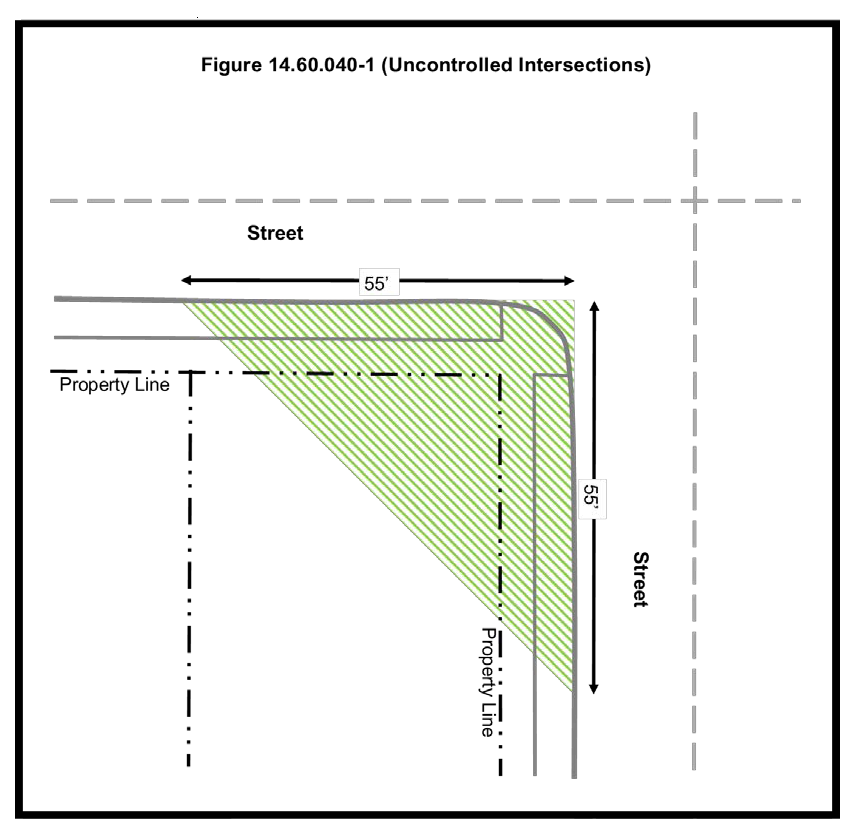
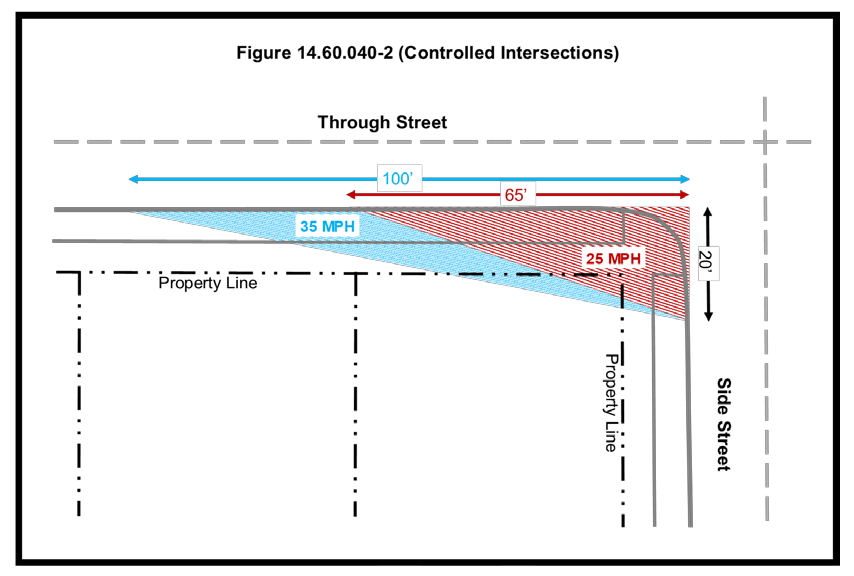
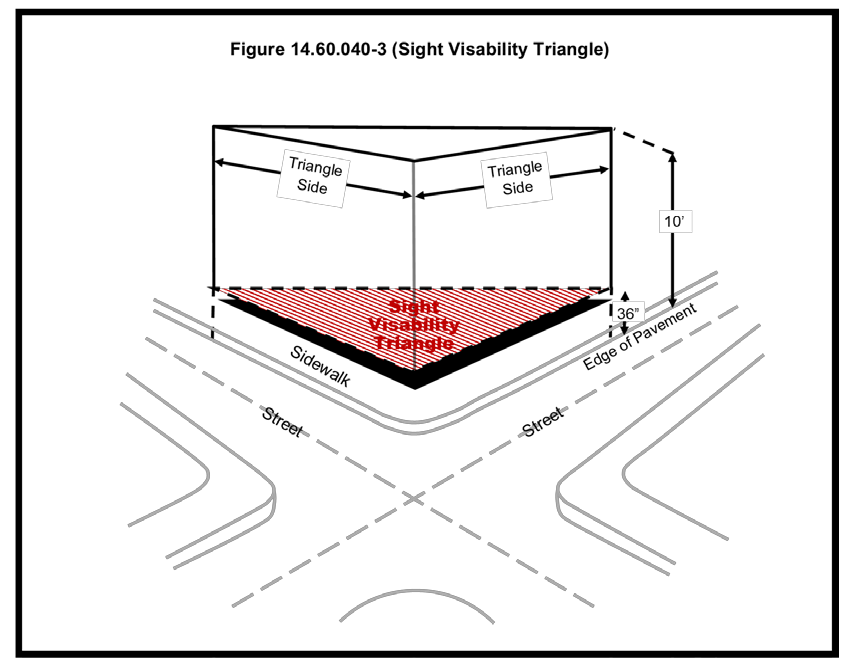
Figures 14.60.040-1, 14.60.040-2, and 14.60.040-3 illustrate dimensions and terminology used in this chapter with reference to sight visibility triangles.
2.
At uncontrolled intersections, the sight visibility triangle shall be formed by measuring back from the point where the extensions of the face of curb (or edge of paved road surface for streets without gutters) meet, a distance of 55 feet along the extensions, with the third side of the triangle being the straight line connection between the above-mentioned side lines (refer to Figure 14.60.040-1).
3.
At controlled intersections the side street side of the sight visibility triangle shall be a distance of 20 feet measured back from the point where the extensions of the face of curb (or edge of paved road surface for streets without gutters) meet; the through street side of the triangle shall be a distance of 65 feet for speed limits up to 25 miles per hour and 100 feet for speed limits up to 35 miles per hour; the third side of the triangle being the straight line connection between the above-mentioned side lines (refer to Figure 14.60.040-2).
4.
On property located within any sight visibility triangle there shall be located no structure, fence, wall, hedge, natural growth, tree, sign or other object which materially impairs vision between a height of 36 inches and a height of ten feet above the edge of the pavement except as provided for in Section 14.60.040(C)(5) (refer to Figure 14.60.040-3).
5.
The sight visibility triangle regulations of this chapter shall not apply to:
a.
Permanent structures and fences which were existing prior to passage of this title, unless such are determined by the city to be a public hazard or nuisance;
b.
Existing public utility poles;
c.
Existing trees, so long as they are not planted in the form of a hedge and are trimmed to the trunk to a height of at least ten feet above the grade level of the centerline of the intersection so as to leave, in all seasons, a clear and unobstructed cross view;
d.
Official warning signs or signals; or
e.
Where existing conditions preclude compliance, as determined by the city engineer.
6.
The sight visibility triangle requirements of this chapter are declared to be minimums only and do in no way prohibit the city from applying more restrictive height and location requirements where this action is warranted in consideration of the public health, safety and welfare.
7.
Any structure, fence, wall, hedge, natural growth, tree, sign or other object erected or placed in violation of the sight visibility triangle requirements of this chapter is declared to be a public nuisance and shall be subject to abatement in accordance with the provisions of Chapter 8.24.
(Ord. No. 20-021, § 2(Exh. A), 11-24-2020; Ord. No. 21-017, § 1.d.(Exh. B), 11-23-2021; Ord. No. 24-002, § 29, 1-23-2024)
14.60.050 - Clearing and grading.
A.
All activities that involve the clearing, grading, filling, and/or covering of the ground with impervious surface must receive a city permit or written approval, unless specifically exempted by the city.
1.
Applications shall be submitted on forms provided by the city, provided that the city may authorize the submittal of the required information as a part of a related application, such as a building permit.
2.
Clearing and grading permit applications should be submitted and processed concurrently with all associated project permits/approvals/actions.
B.
The following activities may be determined by the city to be exempt from the requirements of this chapter, provided that grading activities that would alter drainage courses, critical areas, archaeological sites, and/or impact stormwater facilities (with a public nexus) are not generally candidates for exemption:
1.
Excavating a foundation for a single-family residence, duplex, or accessory dwelling unit when authorized through a building permit;
2.
Resurfacing a conforming impervious surface such as a parking lot, provided that it does not alter the flows or volumes of stormwater and/or does not require excavation;
3.
Construction or maintenance of public roads when done by a public agency when the project has completed an environmental checklist and has been approved by the city;
4.
The installation of utilities in accordance with a valid permit, franchise or road construction plan from the city, well drilling activities, or excavation for soil logs;
5.
Excavation or fill quantities less than 50 cubic yards;
6.
The broadcasting of less than 50 yards of peat, sawdust, mulch, bark, chips, topsoil, or soil nutrients on a lot, tract or parcel of land, or the broadcasting of any amount of the above material to a maximum depth of 12 inches;
7.
Landscaping, routine vegetation management, and minor home improvement activities that do not involve heavy equipment such as excavators, bulldozers, etc.;
8.
The storage or stockpiling of less than 50 cubic yards of material such as fill, gravel, sand, beauty bark etc.;
9.
The removal of diseased, damaged, or unwanted trees from an existing yard or landscaped area;
10.
Routine maintenance and operation activities at cemeteries and public parks; and/or
11.
Emergency sandbagging, diking, ditching, filling or similar work during or after periods of extreme weather conditions when done to protect life or property.
C.
All clearing and grading activities shall be designed and implemented in accordance with city standards, provided that the city may apply more stringent standards when necessary to protect the public health, safety, and welfare.
1.
All clearing and grading activities shall include temporary erosion control and stormwater management provisions designed and implemented in accordance with the requirements of the city's engineering and design manual, unless specifically exempted by the city.
2.
Excavation Standards—Cut Slopes.
a.
Slopes shall be no steeper than is safe for the intended use and shall not be steeper than two horizontal to one vertical (2H:1V), unless otherwise recommended by a professional engineer licensed to practice in the State of Washington and approved by the city.
b.
The top of cut slopes shall be set back from a down-grade site boundary line at a 2H:1V ratio or as dictated by the relevant building code, whichever is more restrictive, unless a retaining wall is designed by a qualified professional and approved by the city.
3.
Fill Standards.
a.
No material other than earth material shall be buried or placed in fills, unless specifically approved by the city. Placement of other than earth material is regulated by state statutes or federal laws and additional permits may be required.
b.
Fill which is intended for building sites shall be constructed in conformance with the requirements of the latest edition of the International Codes, as adopted and administered by the city.
c.
The ground surface for fills over five feet in height shall be prepared by removing vegetation, noncomplying fill, topsoil and other unsuitable materials, scarifying to provide a bond with the new fill, and, where existing slopes are steeper than five horizontal to one vertical, by benching into competent material as determined by the engineer. At a minimum, the bench under the toe of a fill on a slope steeper than five horizontal to one vertical shall be at least ten feet wide or as dictated by the relevant building code, whichever is more restrictive, or as recommended by a geotechnical professional engineer licensed to practice in the State of Washington. Additionally, grading activities shall conform to the minimum requirements and standards of the city's engineering and design manual.
(Ord. No. 20-021, § 2(Exh. A), 11-24-2020; Ord. No. 24-002, § 30, 1-23-2024)
14.60.060 - Stormwater management.
The city is required to manage stormwater runoff in accordance with the provisions of federal and state law as well as a Washington State Department of Ecology-issued National Pollutant Discharge Elimination System (NPDES) and a State Waste Discharge General Permit for Discharges from Small Municipal Separate Storm Sewers in Eastern Washington, commonly known as the Eastern Washington NPDES Phase II Municipal Stormwater Permit. As a result, the city has adopted the Stormwater Manual for Eastern Washington prepared by the Washington State Department of Ecology and established a stormwater utility.
For the applicable stormwater standards and requirements please refer to Chapter 13.86, Stormwater Management, and the City of College Place engineering design standards.
(Ord. No. 20-021, § 2(Exh. A), 11-24-2020)
14.60.070 - Parking and loading standards.
Project sponsors shall make adequate provisions to meet the projected parking and loading needs associated with all new development activities including the construction of new buildings, the expansion of existing buildings, changes of use, and/or changes to the terms and conditions of occupancy such as enlarging, moving or increasing capacity by creating or adding dwelling units, commercial or industrial floor space, or seating facilities, or by making alterations to parking areas.
A.
General Requirements.
1.
The provision and maintenance of off-street parking and loading facilities as required by the city, shall be a continuing obligation of the property owner and project sponsor. It is unlawful to discontinue, reduce, modify, or otherwise dispense with parking and loading facilities that comply with the requirements of this chapter, without a permit or written authorization from the city.
2.
With regard to preexisting parking facilities, the following shall apply:
a.
A preexisting use which does not have sufficient parking facilities to meet the requirements of this chapter may continue to operate with the parking deficiency so long as no enlargement or other change is made in the use or building size which would require additional parking facilities;
b.
When a preexisting use is modified or enlarged so as to require additional parking facilities, the requirements of this chapter shall apply; and
c.
When additional uses are placed on the same lot with the preexisting use or an enlarged lot of which the preexisting use lot is a part, the requirements of this chapter shall apply only to the additional use.
3.
All required parking spaces shall be located on the same site with the building they serve, unless:
a.
A shared or joint use parking agreement has been approved by the city;
b.
A voluntary in lieu of payment to provide the required parking in a public or cooperative parking facility has been approved by the city; and/or
c.
The city makes a written finding that adequate on-street parking exists to reasonably serve the new development/use.
4.
A shared or joint use parking agreement may be approved by the city, provided that:
a.
The agreement is in writing, in a form approved by the city, and has been signed by the property owners;
b.
There is no substantial conflict in the principal operating hours of the buildings or uses for which a joint use of off-street parking facilities is proposed; and
c.
Following approval by the city, the agreement shall be recorded with the county auditor and filed for permanent record with the city.
5.
The installation and improvement of required off-street parking facilities shall be completed to the required standards before a certificate of occupancy is issued unless a time limit extension to a specified date is authorized by the city and financial protection is provided in accordance with the provisions of this title.
6.
When a change in use within a historic structure would necessitate additional off-street parking, the additional off-street parking may be reduced or waived by the city, based on a finding that the reduction or waiver is necessary to preserve the historic character of the building or site. The applicant shall be required to show the need for a reduction or waiver and shall be the minimum necessary.
7.
The city may waive, grant a variance, or modify required parking spaces based on a finding that adequate provisions for parking have been made.
B.
Design Standards.
1.
All driveways, parking areas, loading areas, bicycle facilities, and walkways shall be designed in accordance with the provisions of the City of College Place engineering design standards and shall accommodate pedestrians, motor vehicles and bicycles used by occupants or visitors of a building or use.
2.
All off-street parking areas shall be paved with asphalt or concrete and shall manage stormwater in accordance with the provisions of the College Place engineering design standards.
3.
All parking areas shall comply with the landscaping provisions in Section 14.60.040.
4.
Parking spaces, loading facilities, and all pedestrian areas shall be provided in accordance with the provisions of state and federal law, including the American with Disabilities Act (ADA), and the International Codes, as adopted by the city.
5.
Required parking, pedestrian, loading, and bicycle facilities proposed in the downtown mixed-use district must also comply with the downtown mixed-use district standards, please see Section 14.60.230.
6.
Shared detached garages and surface parking shall comply with the following standards, unless otherwise provided:
a.
Parking areas should be located so their visual presence is minimized, and associated noise or other impacts do not intrude into public spaces.
b.
Shared detached garage structures may not exceed four garage doors per building, and a total of 1,200 square feet.
c.
For shared detached garages, the design of the structure must be similar and compatible to that of the dwelling units within the development.
d.
Shared detached garage structures and surface parking areas must be screened from public streets and adjacent residential uses by landscaping or architectural screening.
e.
Shared detached garage structures shall be reserved for the parking of vehicles owned by the residents of the development. Storage of items which preclude the use of the parking spaces for vehicles is prohibited.
f.
The design of carports must include roof lines similar and compatible to that of the dwelling units within the development.
C.
Minimum Parking Requirements. All new uses, changes of use, modifications of an existing use, as well as all new buildings, and modifications to existing buildings shall provide off-street parking in accordance with the following standards, unless otherwise provided in this title.
1.
If the parking requirements for a use are not specifically identified in this chapter, the parking requirements shall be determined by the city in a written finding based upon:
a.
The requirements for the most comparable use defined in this Chapter; and/or
b.
The appropriate standards derived from the Institute of Transportation Engineers (ITE)'s Parking Generation Manual, as adopted by the city; and/or
c.
A parking study prepared by the applicant documenting the expected parking demand for the proposed use; and/or
d.
Required parking for the proposed use as determined by other comparable jurisdictions.
2.
Required Off-Street Parking Spaces.
a.
Single residential dwelling units and duplexes: Two spaces/dwelling unit.
b.
Multiple family dwellings:
(1)
One and one-half spaces/dwelling unit with two or more bedrooms; or
(2)
One space/dwelling unit with one bedroom or a studio apartment.
c.
Accessory dwelling unit: One additional space/ADU.
d.
Mobile home park: Two spaces/dwelling unit.
e.
Cottage housing: One space/dwelling unit.
f.
Vacation rentals:
(1)
Two spaces/dwelling unit with two or more bedrooms.
(2)
One space/dwelling unit with one bedroom or studio dwelling unit.
g.
Bed and breakfast inn: One space/guest room.
h.
Hotel/motel:
(1)
One space/guest room; and
(2)
At least one space for each employee at work during peak periods; and
(3)
One space/500 feet of common areas.
i.
Retail, commercial and office:
(1)
One space/200 square feet plus adequate employee parking; and
(2)
At least one space for each employee at work during peak periods.
j.
Industry and warehouse: One space/500 square feet.
(Ord. No. 20-021, § 2(Exh. A), 11-24-2020)
14.60.080 - Lighting.
A.
Exterior lighting for all uses and signs shall be directed downward and otherwise arranged, shaded, screened, shielded, and of a design that results in the light being directed onto the site and of an intensity or brightness as follows:
1.
So as not to interfere with the safe operation of motor vehicles, bicyclists, and other legal use of the roadway or sidewalk.
2.
Maximum illumination at neighboring property lines shall not exceed 0.5 foot-candles at grade level.
3.
Luminaries shall be aimed and shielded in a manner that shall not direct illumination on adjacent properties.
4.
Full cutoff shielding is required for all luminaries to prevent wasted light up into the dark sky and prevent glare from normal viewing angles.
5.
Shielding is required for luminaries located along property lines to prevent spill light onto adjacent properties.
B.
The city may require that the project sponsor submit a photometric plan and analysis to verify compliance with these standards.
(Ord. No. 20-021, § 2(Exh. A), 11-24-2020)
14.60.090 - Signs.
A.
Intent and Purpose.
1.
Signs have a strong visual impact on the character and quality of our community. As a prominent part of the scenery, they attract or repel the viewing public, affect the safety of vehicular traffic, and their suitability or appropriateness helps to set the tone for our community. The city relies upon its physical setting and beauty to attract commerce and aesthetic considerations assume economic value. The intent of this chapter is to protect and enhance both the City's residential character and its economic base using appropriate and aesthetic signage.
2.
The purpose of this chapter is to promote the public health, safety, and welfare through a comprehensive system of reasonable, effective, consistent, content-neutral, and nondiscriminatory sign standards and requirements that:
a.
Promote and accomplish the goals and policies of the city's comprehensive plan;
b.
Provide minimum standards to safeguard life, health, property, and public welfare, and promote traffic safety by controlling the design, quality of materials, construction, illumination, size, location, and maintenance of signs and sign structures and discouraging excessive numbers of signs;
c.
Recognize free speech rights by regulating signs in a content-neutral manner;
d.
Promote the free flow of traffic and protect pedestrians and motorists from injury and property damage caused by or which may be fully or partially attributable to signage;
e.
Promote a positive visual image of the city and protect the beauty of the city's built environment by encouraging signs that are compatible with the architectural style, characteristics, and scale of the building to which they may be attached, appropriate to the size of the subject property and amount of street frontage adjacent to the subject property, and compatible with adjacent buildings and businesses;
f.
Protect property values, the local economy, and the quality of life by preserving and enhancing the appearance of the city's streetscape;
g.
Provide consistent sign design standards;
h.
Protect and encourage creative and innovative approaches to signage and signs that are of a quality design, pleasing in appearance, and are appropriate in size, materials, and illumination to the surrounding neighborhood or commercial district;
i.
Provide an improved visual environment for the citizens and visitors of the city;
j.
Adopt clear, understandable regulations that will assure equal protection and fair treatment under the law through consistent application of the regulations and consistent enforcement of this section;
k.
Balance both public and private business needs with the specific objectives of creating a community with an unmatched quality of life and a strong focus on economic well-being, aesthetics, community, the environment, and public infrastructure;
l.
Support and enhance the economic well-being of all businesses within the city and recognize the needs of all businesses to identify their premises and advertise their products and services; and
m.
Recognize that the aesthetic value of the total environment affects economic values and that an unrestricted proliferation of signs, or the absence of regulations governing the size, location, or materials of signs detracts from the economic value of the community.
B.
Applicability. This section applies to all signs within the city which may be visible from any street, sidewalk, or public place, regardless of the type or nature.
1.
All signs shall fall into one of the following categories, as determined by the city:
a.
Exempt Signs. Signs that meet the criteria of Section 14.60.090 C. may be installed without a sign permit from the city. Please note that exempt signs may be subject to other local, state, or federal regulations and persons installing signs are encouraged to contact the city to determine if other permits or approvals may be required.
b.
Prohibited Signs. Signs determined by the city to meet the criteria in Section 14.60.090 D. shall not be permitted or displayed in any zoning district.
c.
Regulated Signs. Signs that are not specifically exempted or prohibited, may be displayed only in accordance with the provisions of this section. Regulated signs include both temporary and permanent signs.
2.
No person shall erect, alter, or relocate any sign without first submitting the required application(s) and receiving an approved sign permit from the city, and any associated permits that may be required, in accordance with the provisions of this title, unless the sign is determined by the city to be exempt and a permit is not required.
3.
This section is not intended to, and shall not be interpreted to, restrict speech on the basis of its content, viewpoint, or message. Any classification of signs in this section which purports to permit speech by reason of the type of sign, identity of the sign user or otherwise, shall be interpreted to allow commercial or non-commercial speech on the sign. No part of this section shall be construed to favor commercial speech over non-commercial speech. To the extent that any provision of this section is ambiguous, the term shall be interpreted not to regulate speech on the basis of the content of the message.
4.
It shall be the responsibility of the property owners, project sponsors, and applicants to be knowledgeable of and comply with the provisions of applicable local, state, and federal standards.
a.
This shall include, but is not limited to, the International Building Code and related International Codes, as adopted and administered by the city.
b.
It is important to note that some signs may also be subject to the provisions of state and federal laws, such as the Scenic Vistas Act (RCW 47.42), the regulations of the Washington State Department of Transportation, the regulations of the Washington State Liquor and Cannabis Control Board, and/or the Manual of Uniform Traffic Control Devices.
C.
Exemptions. The following types of signs and activities may be exempt from the provisions of this section and a sign permit may not be required, based on a finding by the city that the proposed sign does not present a risk to the public health, safety, and welfare. Please note that exempt signs must still comply with applicable provisions of the International Codes as adopted and administered by the city and a building permit may be required. Sponsors should contact the city to confirm that a permit is not required before installing or displaying any of the following types of signs, or initiating the following actions:
1.
Changes to the face or copy of legal signs that do not change the material appearance, type, or size of the sign as originally permitted by the city;
2.
The normal repair and maintenance of conforming and legal nonconforming signs;
3.
The flag of any nation, state, city, or other governmental agency, nonprofit organization, or educational institution;
4.
Signs necessary to the expression of constitutionally protected forms of free speech as determined by the city attorney;
5.
Signs or decorations temporarily placed on private property in observance of religious, state, or national holidays (i.e., Christmas, Halloween, Fourth of July);
6.
Legal notices, postings, or similar sign placed by or required by a governmental agency carrying out its responsibility to protect the public health, safety, and welfare;
7.
Signs of a noncommercial nature and in the public interest erected by or on the order of a public official in the performance of his/her/their public duty, such as safety signs, danger signs, trespassing signs, traffic signs, memorial plaques, signs of historical interest, and the like.
8.
Signs owned and maintained by a federal, state, or local government agency including but not limited to, street and highway signs, signs necessary to protect the public health, safety, and welfare, directional and wayfinding signs, and/or public information signs;
9.
Privately maintained traffic control signs or directional signs for pedestrians on private roads or property;
10.
Building address numbers;
11.
One sign not exceeding two square feet in area, attached to a building, provided that the sign:
a.
Is securely attached flush to the face of the building.
b.
Does not project above the eave or roof line; and
c.
Only announces the name and address of the occupant(s) and contact information.
12.
Names of buildings, dates of erection, commemorative tablets, and the like when carved into stone, concrete, or similar material or made of bronze, aluminum, or other permanent type construction and made an integral part of the structure;
13.
Approved interpretative signs and historic markers; and
14.
Temporary signs located on fences of a construction site, provided that there is an active building or development permit that includes external work or modifications of the site.
D.
Prohibited Signs. No person shall erect, alter, maintain, or relocate any of the following signs in any zone in the city, unless specifically authorized in this section.
1.
Signs that are determined by the city attorney to meet the judicial standards for obscenity;
2.
Signs that create a safety hazard for pedestrian or vehicular traffic, or any other person legally using the property;
3.
Signs that are specifically designed to move or have parts/mechanisms that physically move or that may cause a safety hazard by swinging or otherwise noticeably moving as a result of wind pressure because of the manner of their suspension or attachment;
4.
Any sign, poster or other advertising matter of any nature placed upon a utility pole or other poles, fences, trees, sidewalks, streets, signs, traffic signs or other traffic control devices or other structures or places within streets, alleys or other public places or rights-of-way in accordance with this chapter and Chapter 8.24, Nuisances;
5.
Off premise signs;
6.
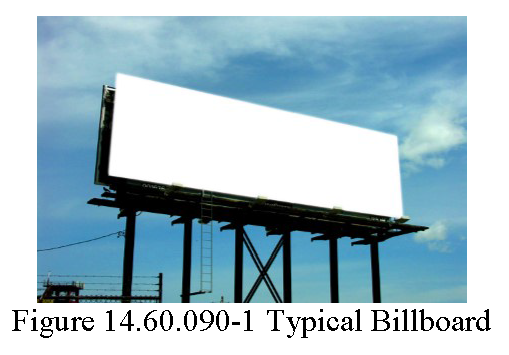
Billboards (see Figure 14.60.090-1);
7.
Signs with flashing lights or reflective materials;
8.
Signs attached to or placed on a vehicle or trailer parked on public or private property, stored or displayed conspicuously in a manner to attract the attention of the public; provided however that signs that are permanently painted or wrapped on the surface of the vehicle, or adhesive vinyl film affixed to the interior or exterior surface of a vehicle window, or signs magnetically attached to motor vehicles or rolling stock that are actively used in the daily conduct of business are not prohibited so long as such vehicles are operable and parked in a lawful or authorized manner;
9.
Mobile signs;
10.
Permanent signs on vacant lots or parcels. Signs may only be established as an accessory use to a permitted primary use;
11.
Roof mounted signs; and
12.
Signs attached to towers or wireless communication support towers, except as required by law.
E.
General Provisions. All signs shall comply with the following provisions unless otherwise provided in this section:
1.
Street signs shall be designed in accordance with the provisions of the College Place engineering design standards and the Manual of Uniform Traffic Control Devices.
2.
No signs may be placed on private property without the permission of the owner.
3.
Signs may not be located in, or extend into or over, the public right-of-way, unless specifically authorized in this section.
4.
All signs shall be permanently attached to the ground, to a building, or another structure by direct attachment to a rigid wall, frame or structure, unless otherwise provided in this section.
5.
No sign may be erected or displayed in a manner that may present a threat to public safety and required clear sight distances shall be maintained at all times.
6.
All signs shall be made of durable, weather resistant materials that are intended for outdoor applications.
a.
Signs shall not be made with reflective material or moving parts; and
b.
No signs shall have full motion digital images, video or film displays or stream content in real time.
7.
Externally illuminated signs shall be illuminated only with steady, stationary, fully shielded light sources directed solely onto the sign without causing glare. Light shielding shall ensure that the lamp or light source is not visible beyond the premises and shall further ensure that the light is contained within the sign face.
8.
Flashing signs or light sources are not permitted, except when used as a safety device during an approved construction project.
9.
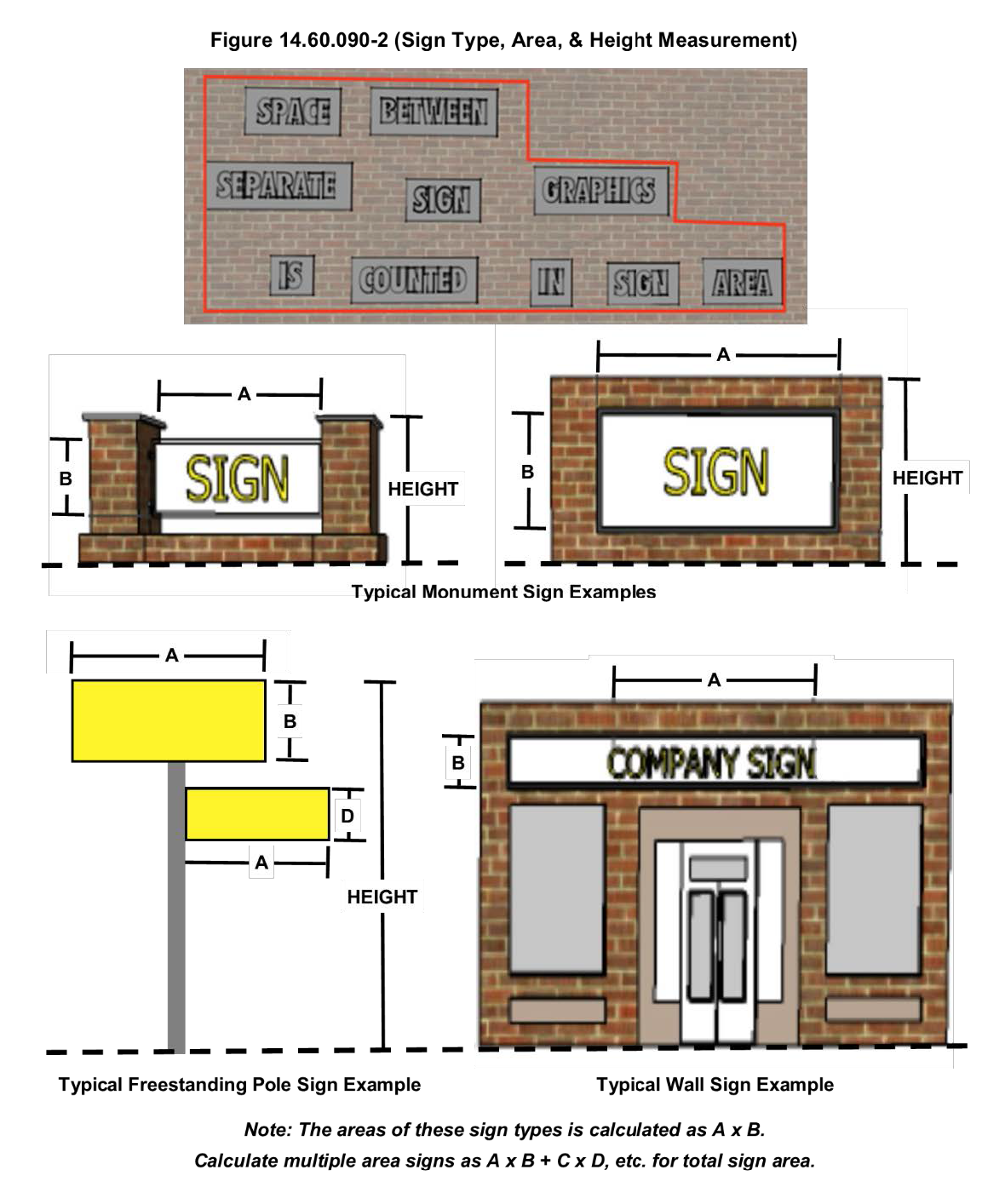
The size of signs shall be determined by the city based upon a measurement of the area of the sign devoted to copy, unless otherwise provided in this section (see Figure 14.60.090-2).
10.
Where a height limit is imposed by this section, the height shall be measured from the existing grade (see Figure 14.60.090-2).
11.
All signs and components thereof must be maintained in good repair and in a safe, neat, clean and attractive condition. Maintenance of a sign shall include periodic cleaning, replacement of flickering, burned out or broken light bulbs or fixtures, repair or replacement of any faded, peeled, cracked or otherwise damaged or broken parts of a sign, and any other activity necessary to restore the sign so that it continues to comply with the requirements of this section and the conditions of its approval.
a.
Legally installed signs that do not meet the provisions of this section, shall be considered legal, nonconforming signs and may be continued, provided that they are maintained in good condition and the degree of nonconformity is not increased.
b.
Legal, nonconforming signs may not be altered, replaced, or relocated except in full compliance with the provisions of this section.
F.
Temporary Signs. Temporary signs may be displayed for a limited duration without a sign permit, in accordance with the following provisions, unless otherwise provided in this section:
1.
Temporary signs shall not have direct or internal illumination, changing image features, or electronic elements, provided that battery operated string lights that comply with lighting designs in this chapter may be permitted.
2.
No temporary signs may be displayed in such a position that it covers or obstructs another sign.
3.
Temporary banners advertising city-approved activities or events may be displayed over streets in designated locations through the issuance of a special use or right-of-way use permit in accordance with the provisions of Chapter 12.32.
4.
Small banners or similar type temporary signs with a non-commercial message, may be displayed on light poles or streetlights with brackets designed specifically for that purpose by the city, in accordance with the provisions of Chapter 12.32.
5.
Temporary signs with a non-commercial message may be placed in the city right-of-way, without a permit, only between the property line and the back of the nearest curb, or where no curb exists, between the property line and the nearest edge of the pavement, provided that the temporary sign is:
a.
Not placed in or over a roadway, median, traffic circle, designated parking place, driveway, sidewalk, other paved areas designed for pedestrian, bicycle, or vehicle use, unless specifically authorized by the city; and
b.
Not placed in any location or manner so as to create a threat to public safety, to adversely affect critical areas, or to adversely affect the health of trees, shrubs, or other landscaping; and
c.
Placed in a location acceptable to the abutting private property owner(s); and
d.
Attached to a stake that can be manually pushed or hammered into the ground, and shall not exceed four square feet per side or three feet in height, from the ground to the top of the sign; or
e.
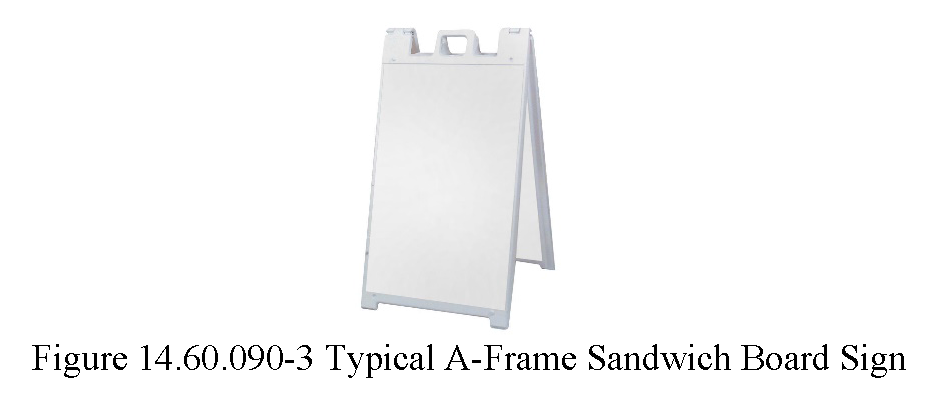
Is an A-frame sandwich board sign not more than six square feet per side and shall be constructed or secured in such a manner as to be resistant to being blown over, becoming airborne, or otherwise becoming a threat to public safety in strong winds (see Figure 14.60.090-3).
_____
6.
Temporary signs may be displayed on properties actively advertised for sale or lease, without a permit, while the property is advertised for sale or lease, in accordance with the following provisions:
a.
In the single-family (SFR) and multi-family residential (MFR) zoning districts:
(1)
One temporary sign, for each street frontage of developed sites, displaying a commercial message that does not exceed six square feet in area, can be attached to the building, displayed in a window, or if less than seven feet in height, placed on the property; or
(2)
One temporary sign, for each street frontage of undeveloped sites, displaying a commercial message that does not exceed 32 square feet or seven feet in height may be placed on the property.
b.
In the general commercial (GC), light industrial (LI), and downtown mixed-use (DMU) zoning districts, one or more temporary signs, displaying a commercial message that does not exceed a total area of 35 square feet for each street frontage of the site, can be attached to the building, displayed in a window, or if less than seven feet in height, placed on the property.
7.
One temporary banner sign may be permitted per tenant of a building in the general commercial (GC), light industrial (LI), and downtown mixed-use (DMU) zoning districts provided that:
a.
The maximum size of the banner shall not exceed 32 feet;
b.
The banner shall be attached to the face of the building, and may not extend above the roofline; and
c.
Temporary banner signs shall count against the maximum area of building mounted signs.
8.
One A-frame, sidewalk/sandwich board sign per licensed business may be permitted on each street frontage, in the general commercial (GC), light industrial (LI), and downtown mixed-use (DMU) zoning districts, provided that:
a.
The sign shall not exceed six square feet per side;
b.
The sign must be removed during non-business hours;
c.
The sign is located on private property at the site of the business, or in an abutting right-of-way on a sidewalk, or in areas not used as a roadway, driveway, bike lane, or for required parking;
d.
At no time shall sandwich board/sidewalk sign block or present a hazard to pedestrians, obstruct safe sight distance, be placed in a street or gutter and/or become a nuisance, hazard and/or danger to the public as determined by the city; and
9.
Temporary signs that contain or consist of pennants, ribbons, streamers, feather shaped pennants, or similar types of displays as determined by the city, as well as searchlights, balloons, or inflated figures may be displayed on private property only in the general commercial (GC), and light industrial (LI) zoning districts.
10.
Temporary signs may be installed on private property in the university district, without a permit, in accordance with the provisions in this section.
11.
Temporary signs may be permitted in the public use district in accordance with the following provisions:
a.
No temporary signs may be permitted on city-owned property including, but not limited to parks, trails, open space, or public buildings, except in conjunction with an approved special event, special use permit, or other permit or approval from the city.
G.
Permanent Signs Permitted in all Zoning Districts. The following signs may be permitted in all zoning districts in accordance with the following provisions:
1.
Signs designated by the city's historic preservation commission as:
a.
Eligible for inclusion on the College Place Historic Register;
b.
Being iconic or of special historical interest to the community; or
c.
Integral to a historic site or building.
2.
Community message board signs may be permitted on the site of municipal buildings, schools, universities, churches, and other public buildings in all zones, provided that:
a.
The messages shall be non-commercial and should advertise community events, meeting times, public service announcements, and public notices;
b.
The community message board may be wall mounted, or a monument style sign;
c.
The message board may be designed for messages that are changed by hand or with a changeable message that is electronically displayed and controlled;
d.
Electronically changeable signs shall display images for a period of at least three seconds before transitioning to another image;
e.
Full motion digital images, video or film display or streamed in real time is not permitted; and
f.
Community message board signs shall not exceed 32 square feet in area or and monument style signs shall not exceed six feet in height.
H.
Permanent Signs in Residential Zoning Districts. Permanent signs may be permitted in the single-family residential (SFR) and the multi-family residential (MFR) zoning districts in accordance with the following provisions (see Figure 14.60.090-2 for sign types and measurements):
1.
One freestanding monument sign, not to exceed 32 square feet in area, or six feet in height, may be installed along each road entering a residential subdivision.
2.
One freestanding monument sign, not to exceed 32 square feet in area, or six feet in height, may be installed at each entrance into a multi-family development from a road.
3.
Each city-licensed business may have one sign not exceeding two square feet, that is permanently attached to the building that is its primary place of business, provided that the sign:
a.
Is securely attached flush to the face of the building;
b.
Does not project above the eave or roof line; and
c.
Only announces the name and address of the occupant(s) and contact information.
I.
Permanent Signs in Non-Residential Zoning Districts. Permanent signs may be permitted in commercially oriented non-residential zoning districts, including but not limited to the general commercial (GC), light industrial (LI), and downtown mixed-use (DMU) zoning districts in accordance with the following provisions (see Figure 14.60.090-2 for sign types and measurements):
1.
Signs in the downtown mixed-use district must also comply with the downtown design standards and guidelines as adopted or subsequently amended by the city.
2.
Building Mounted Signs. Building mounted signs includes signs attached to or painted on the exterior wall of a building, awning or canopy signs, projecting signs, or signs displayed in a window. Building mounted signs may be permitted on each face of a building fronting a street or parking lot, provided that:
a.
The maximum area for all building façade signs, projecting signs, and temporary banner signs shall not exceed 25 percent of the building façade area.
b.
No building façade sign may extend above the parapet or eave line.
c.
Wall signs must be attached or erected parallel to and not extending more than ten inches from the wall, façade, or face of any building to which it is attached and supported throughout its entire length with the exposed face of the sign parallel to the plane of the wall or façade.
d.
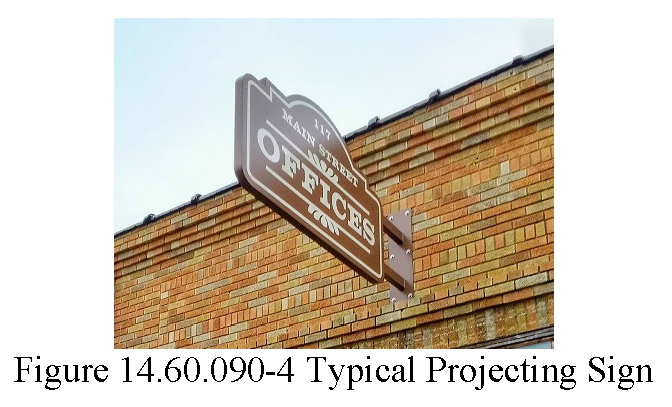
One projecting sign (see Figure 14.60.090-4) per street or parking lot frontage may be permitted, provided that:
(1)
The sign is perpendicular to the face of the building and is permanently attached in accordance with manufacturers specifications and the provisions of the International Codes, as adopted and administered by the city.
(2)
Projecting signs may be two-sided and not exceed 16 square feet per side.
(3)
Projecting signs extending over public right-of-way and pedestrian pathways (sidewalks) shall be erected with clearance and projection limitations as set forth in the International Building Code; provided, that in no case shall any sign be permitted to extend within four feet of the back of curb line.
e.
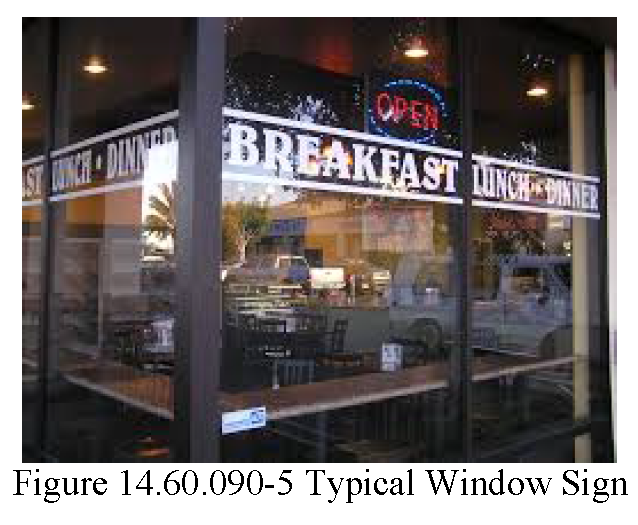
Window signs (see Figure 14.60.090-5) located inside and affixed to a window and intended to be viewed from the exterior of the structure may be displayed without a permit, provided that:
(1)
Window signs shall not exceed 25 percent of the area of the window on which they are displayed; and
(2)
The window signs may be illuminated or a neon sign.
f.
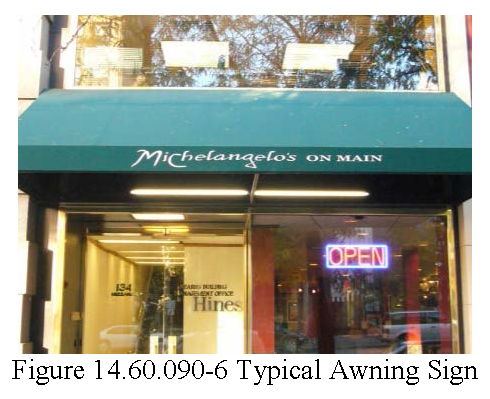
A non-electric sign may be printed on, painted on, or attached to the vertical surface or flap of an approved awning or canopy (see Figure 14.60.090-6), provided that:
(1)
The awning or canopy shall be erected with clearance and projection limitations as set forth in the International Building Code; provided, that in no case shall any sign be permitted to extend within four feet of the back of curb line.
_____
3.
Monument and Pole Signs (see Figure 14.60.090-2 for sign types and measurements). One pole or monument sign is permitted on sites when buildings are setback at least 20 feet from the right-of-way, provided that:
a.
Pole signs:
(1)
Shall not exceed 60 square feet per side or 30 feet in height in the downtown mixed-use district;
(2)
Shall not exceed 200 square feet per side or 50 feet in height in the general commercial or light industrial districts; and
(3)
If more than 30 feet in height, must be located at least 100 feet from any residential zone.
b.
Monument Signs:
(1)
Must be set back at least five feet from the property lines;
(2)
Shall not exceed 60 square feet per side or five feet in height in the downtown mixed-use district; and
(3)
Shall not exceed 200 square feet per side or six feet in height in the general commercial or light industrial districts.
c.
Monument or pole signs may contain LED displays and/or electronically changeable messages, provided that:
(1)
All electronic message centers shall come equipped with automatic dimming technology which automatically adjusts the sign's brightness based on ambient light conditions;
(2)
Electronically changeable signs shall display images for a period of at least three seconds before transitioning to another image;
(3)
Full motion digital images, video or film display or streamed in real time is not permitted; and
(4)
Signs located within 100 feet of a residential zoning district may only operate between the hours of 6:00 a.m. and 11:00 p.m.
J.
Permanent Signs in the University District. Permanent signs may be permitted in the university district in accordance with the following provisions:
1.
Permanent signs without a commercial message may be installed on private property without a sign permit.
2.
Permanent signs with a commercial message may be installed on private property in accordance with the provisions of the downtown mixed-use district.
K.
Enforcement and Removal. Any violations of this section, such as the placement of prohibited signs on a property or the failure to maintain existing or new signage in good condition, shall be subject to a code enforcement action.
1.
In addition to the remedies in this section and Title 8, the city shall have the authority to require the repair, maintenance or removal of any sign or sign structure which has become dilapidated or represents a hazard to the safety, health or welfare of the public, at the cost of the sign and/or property owner.
2.
Abandoned or illegal signs are hereby deemed to be a public nuisance and shall be removed by the property owner within 45 days after notice from the city. Any sign not removed following such notice may summarily be abated by the city at the cost of the sign and/or property owner.
3.
Legal, conforming structural supports for abandoned signs may remain, if installed with a blank sign face and the supporting structures are maintained.
(Ord. No. 20-021, § 2(Exh. A), 11-24-2020; Ord. No. 24-002, § 31, 1-23-2024)
14.60.100 - Outdoor storage.
Storage and screening requirements for permitted commercial/industrial and residential uses or activities shall be as follows:
A.
Every reasonable effort shall be made by persons conducting commercial/industrial activity to store merchandise, raw materials, equipment, fixtures, scrap, junk or solid wastes in such a manner so as not to create visual nuisance conditions and shall comply with the following:
1.
All such materials shall be enclosed entirely within a building with the following exceptions:
a.
Where such inside or screened storage is not practical or desirable when justified with regard to health, fire or safety codes, as determined by the city;
b.
Where the outside storage of merchandise, manufactured products or raw materials open to view from the public right-of-way is normal and standard practice, such as in the sale of auto equipment, manufactured homes, recreational vehicles, nursery stock and the like, but not including the storage of secondhand or used materials or junk;
c.
Where the outside storage of junk, used or secondhand furniture, appliances and other similar items is necessary, provided in this case such items shall be entirely enclosed within a sight-obscuring fence (six feet in height minimum) with such enclosed area being located no closer than 20 feet from the right-of-way of any street as herein defined; and
d.
Where outside storage is temporary during permitted construction only.
2.
Outside storage of such materials shall be maintained in an orderly manner consistent with good housekeeping practices and shall create no visual or noxious offense to adjacent properties, or the public right-of-way, or create a fire, safety, or health hazard, or public nuisance and shall comply with the provisions of local, state, and federal laws, as well as the provisions of city NPDES permits.
B.
Storage pertaining to residential activities shall comply with the same requirements as those specified for commercial/industrial activities noted in this section, and in addition comply with the following:
1.
Appliances any other mechanical equipment normally used in the residential environment which is no longer operable shall not be stored outside;
2.
Motor vehicles no longer operable and/or abandoned shall comply with the requirements of Chapters 10.24, Abandoned Vehicles, and 8.24, Nuisances; and
3.
Boats, recreational vehicles, and the like may be stored on the premises provided they are not parked within a required front yard or side yard setback.
C.
Storage in the public right-of-way is prohibited.
(Ord. No. 20-021, § 2(Exh. A), 11-24-2020)
14.60.110 - Alternative energy infrastructure.
A.
Purpose and Intent. This section is established to:
1.
Promote clean energy production by citizens and businesses;
2.
Ensure that alternative energy infrastructure is compatible with the development and development on adjacent properties;
3.
Provide options to traditional energy use; and
4.
Promote reduction of energy use within the city.
B.
General Criteria. Alternative energy infrastructure shall meet all of the following criteria:
1.
Alternative energy infrastructure shall not be located within any building setback or required setback, unless below grade or for panels that are components of roof structures.
2.
Any installation of an alternative energy system shall comply with any and all applicable provisions of the International Codes, as adopted by the city.
3.
No alternative energy system shall be installed unless evidence has been provided to the city that the utility company has been informed of the customer's intent to install an interconnected customer-owned power generation system. Off-grid systems shall be exempt from this requirement.
4.
Any installation of alternative energy infrastructure shall comply with all applicable environmental regulations.
C.
Geothermal Infrastructure Criteria. In addition to the general criteria in subsection B above, geothermal alternative energy systems shall comply with the following standards:
1.
Geothermal infrastructure shall be located entirely within the subject property, or within appropriate easements.
2.
Installation of geothermal infrastructure shall comply with all applicable federal, state, and local laws and regulations.
D.
Solar and Wind Infrastructure. Alternative energy facilities, including solar and wind equipment, are encouraged, subject to the following provisions:
1.
Solar and Wind Infrastructure Requirements.
a.
Building-mounted solar and wind equipment shall be integrated into the structure's architectural design. Techniques for achieving this include, but are not limited to, aligning equipment with a building's structural or functional articulation, coordinating panel placement with other building features or using equipment to enhance a building's architectural expression.
b.
Roof-mounted solar and wind equipment may extend above the building height limit without screening but shall be designed to avoid creating glare or blocking views and solar access to surrounding properties.
2.
Solar and Wind Infrastructure Guidelines.
a.
Use of solar panels to serve other functions, like weather protection, shading, building articulation and place-making, is encouraged.
b.
Exposing solar and wind equipment in a way that enhances architectural design and demonstrates the viability of alternative energy is encouraged.
(Ord. No. 20-021, § 2(Exh. A), 11-24-2020)
14.60.120 - Sexually oriented businesses.
A.
Purpose. The purpose of this section is to establish standards for the siting of sexually oriented businesses and services to minimize adverse impacts to the public health, safety, and welfare, including but not limited to children, individuals with a developmental disability(ies), and to individuals' ability to quiet enjoyment and use of their property or property interests. It is also intended to disperse adult concessions to avoid a concentration of these uses that likely will negatively impact the city's ability to adequately and efficiently provide emergency, law enforcement, and peace keeping activities to the general public.
B.
Location Standards.
1.
Sexually oriented businesses shall not be located within 500 feet of the following:
a.
A single-family residential (SFR), multi-family (MFR), or downtown mixed-use (DMU) zoning district.
b.
Property used for public or private schools;
c.
Public parks, playgrounds, recreation facilities, and/or public libraries;
d.
State-licensed day care facilities;
e.
Youth or community centers;
f.
Churches, cemeteries, mausoleum, or other religious facilities;
g.
Sports complexes and recreational facilities;
h.
Cultural or historical centers and other facilities;
i.
Secure community transition facilities;
j.
Other sexually oriented businesses or services; and
k.
Other facilities or land uses which provide as a substantial portion of their activities, the provision of services to children and/or youth.
2.
The 500-foot distance shall be measured by following a straight line, without regard to intervening structures or obstacles, from the nearest point of the property line upon which the proposed use is to be located, to the nearest point of the property from which the proposed land use is to be separated.
C.
All sexually oriented businesses shall comply with the following standards:
1.
No person owning, operating, or managing a sexually oriented business or service or his/her/their employee or agent shall invite, allow, or permit any person under the age of 18 years to enter, go over, or remain on the premises.
2.
There shall be no window, marquee, or other display of any matter depicting or portraying city specified anatomical areas or sexual activities.
3.
Nothing in this section is intended to authorize, legalize or permit the establishment, operation, or maintenance of any business, building, or use which violates any ordinance or statute of the city, county, state or the United States.
4.
Violation of the use provisions of this section is declared to be a public nuisance per se and is subject to abatement as well as criminal and/or civil penalties in accordance with the provisions of this Code.
(Ord. No. 20-021, § 2(Exh. A), 11-24-2020; Ord. No. 24-002, § 31, 1-23-2024)
14.60.130 - Temporary uses.
Temporary uses include limited duration activities on private property that may be permitted for a specified period through the issuance of a special use permit. Limited duration activities on public property may be permitted through a special use permit or a right-of-way use permit.
A.
In addition to the temporary uses identified in the table of permitted uses, limited duration activities on private property permitted through a special use permit may also include, but is not limited to:
1.
Roadside stands;
2.
Carnivals, circus, rodeo, festival, or street fairs;
3.
Christmas tree sales;
4.
Fireworks sales;
5.
Outdoor concerts, or theatrical performances;
6.
Parking lot/outdoor sales events;
7.
Seasonal sale of agricultural products grown off premises;
8.
Outdoor dining areas, wine tastings, beer gardens, and the like;
9.
The rental of buildings or grounds for events such as weddings, family reunions, and the like;
10.
Temporary construction and sales offices; or
11.
Other activities that involve the temporary alteration of a site, temporary changes in ingress and egress, or uses of a limited duration that would not adversely affect the public health and safety.
B.
Yard sales/garage sales do not require a permit, provided that a special use permit must be obtained for yard sales/garage sales more than 3 days in length, or that occur more frequently than four times in the same calendar year.
(Ord. No. 20-021, § 2(Exh. A), 11-24-2020)
14.60.140 - Mobile vendors, street vendors, and vendor food courts.
Mobile vendors, street vendors, and mobile food carts are permitted to operate in the city in accordance with the following provisions.
A.
General Provisions.
1.
Mobile vendors, street vendors, and mobile vendor food courts shall obtain, and maintain in good standing, a city business license, as required by the city.
2.
Mobile vendors, street vendors, and mobile vendor food courts must comply with applicable local, state, and federal laws, including, but not limited to:
a.
College Place Municipal Code:
(1)
Solid Waste Collection and Disposal and Policies—Chapter 8.12 (as amended).
(2)
Nuisances—Chapter 8.24 (as amended).
(3)
Litter—Chapter 8.28 (as amended).
(4)
Vehicles and Traffic—Title 10; and
(5)
Streets, Sidewalks, and Public Places—Title 12.
b.
Walla Walla County-city health department rules and regulations.
3.
Mobile vendors shall comply with all Washington State Department of Licensing requirements, including, but not limited to:
a.
Obtaining and maintaining a valid motor vehicle operator's license for all vehicle operators.
b.
Proof of required vehicle liability insurance coverage.
c.
Proof of vehicle registration.
4.
No mobile vendors, street vendors, or mobile vendor food courts may operate on or utilize private property without written approval of the property owner.
5.
All permits, registrations, and licenses for mobile and street vendors shall be prominently displayed on all vehicles, trailers, or temporary structures being used.
B.
Exemptions. The following vendors and uses may be exempt from the provisions of this section, as determined by the city.
1.
Authorized vendors at city-sponsored events.
2.
Vendors authorized through a special event permit issued by the city pursuant to CPMC 12.04.
C.
Mobile Vendor and Street Vendor Standards.
1.
No mobile vendor or street vendor shall operate in a manner which obstructs or causes to be obstructed, including obstruction caused by people or vehicles congregating, in part or in whole, the use of any public right-of-way, including, but not limited to, sidewalks, streets, roads, alleys, public facilities, or any other public place.
2.
No mobile or street vendor shall sell or vend any services or wares from their vehicle or conveyance:
a.
In a lane of travel.
b.
Within 400 feet of any public or private school grounds during regular school hours, extra-curricular activities, or school related or sponsored events, except when specifically authorized by the school.
c.
Within 100 feet of the entrance of any business which is open for business offering as a main featured item or items of similar goods or services for sale as the vendor, except when specifically authorized by the business.
d.
Within 100 feet of any eating establishment which is open for business if selling food or food items, if the vendor is selling food items, except when specifically authorized by the business or the city.
e.
Within 300 feet of any city sponsored event or an event for which the city has issued a special event permit and the event includes the sale or provision of food and/or goods, except when specifically authorized by the city.
f.
Within 300 feet of any city authorized concession stand in a city park, except when specifically authorized by the city.
5.
Mobile vendors shall be prohibited from residential zones except for those vendors which operate for less than 15 minutes at a location.
D.
Mobile Vendor Food Court Standards. In addition to the requirements in this chapter, a mobile vendor food court must obtain a special use permit and comply with the following provisions:
1.
Submit a site plan with the special use permit application to include, but not limited to:
a.
Location of mobile vendors.
b.
Site access for vehicles, pedestrians, and emergency service providers.
c.
Off-street parking areas.
d.
Public spaces and seating areas.
e.
Restrooms, potable water availability and sanitation stations.
f.
Solid waste and any recycling facilities.
g.
Landscaping and screening, if any.
h.
Proposed measures to minimize or mitigate potential adverse impacts on neighboring properties.
2.
Provide seating at the rate of six seats per vendor.
3.
Provide restroom facilities with handwashing facilities on site or within an adjacent building that is accessible to the mobile vendor food court when vendors are in operation. A mobile vendor food court shall have a minimum of one restroom for every five vendors in the court.
4.
Prohibit tents, tarps, or pop-up shelters.
5.
Direct any site lighting away from adjacent properties and shield and aim all lighting downward.
E.
Operations and Enforcement.
1.
All mobile vendors, street vendors, and mobile vendor food courts shall be responsible for cleaning up each day all litter originating from or due to their business.
2.
During operation the vendor(s) shall continue to monitor the level and nature of use by the public and may propose and/or the city may require additional measures by the vendors in the interest of public health, safety, and welfare.
3.
The city may suspend or revoke a vendor's city business license and/or initiate code enforcement actions for failure to comply with applicable laws and regulations, including this chapter, provided notice and reasonable time for the vendor(s) to take timely corrective actions is provided. Posting at the site is sufficient notice.
4.
The city may immediately revoke a business license or permit if operation of a mobile vendor, street vendor, or mobile food vendor court poses an immediate or imminent risk to the health, safety, or welfare of the public or may pose a significant risk to the health, safety or welfare of the public as determined by the city.
(Ord. No. 24-002, § 32, 1-23-2024)
14.60.145 - Temporary use of sidewalks.
Business owners or operators may use specified areas within public sidewalks or other public areas within the public right-of-way to sell goods and/or services on a temporary basis subject to compliance with the following provisions.
A.
General Provisions.
1.
All business owners and operators shall obtain, and maintain in good standing, a city business license, as required by the city.
2.
Business owners and operators must comply with applicable local, state, and federal standards. This shall include, but is not limited to:
a.
The College Place Municipal Code:
(1)
Solid Waste Collection and Disposal and Policies—Chapter 8.12 (or as amended).
(2)
Nuisances—Chapter 8.4 (or as amended).
(3)
Litter—Chapter 8.28 (or as amended).
(4)
Vehicles and Traffic—Title 10; and
(5)
Streets, Sidewalks, and Public Places—Title 12.
b.
Walla Walla County-city health department rules and regulations.
c.
The regulations of the Washington State Liquor and Cannabis Board for outside public seating.
3.
The business owner and operators must provide evidence of insurance coverage for the use of the right-of-way with the City of College Place as an additional insured.
4.
The use must be adjacent to and of the same nature as the business's usual operations.
5.
The use must not interfere with the public's reasonable use of city rights-of-way and may only have a negligible impact on the existing use of neighboring properties.
B.
Operations.
1.
All business owners and operators shall be responsible for cleaning up each day all litter originating from or due to their business.
2.
During the period of the authorized special use, the business owner shall continue to monitor the level and nature of use by the public. The city reserves the right to require additional measures in the interest of public health, safety, and welfare and vendors shall comply with such requirements.
3.
Upon completion of the temporary use, the business owner or operator shall clean and return the site(s) to its previous condition.
(Ord. No. 24-002, § 33, 1-23-2024)
14.60.150 - Home businesses.
A.
Applicability. The residents of a legal dwelling unit may conduct a business(es) in their home as an accessory use, subject to city review and approval.
1.
All home businesses shall obtain and maintain in good standing, a city business license and shall annually renew the license, as required by the city;
2.
All home businesses shall operate in a residence or approved accessory building in compliance with the provisions of this title including, but not limited to the International Codes, as adopted and administered by the city;
3.
In addition to the requirements in this section, the city may place additional conditions of approval to protect the public health, safety, and welfare, and critical areas, as well as to reasonably minimize adverse impacts on neighboring properties;
4.
The city may deny, revoke, and/or suspend a home business license based upon non-compliance with the provisions of this title;
5.
Home businesses may be subject to inspection by the city; and
6.
Uses identified in the table of permitted uses as being permitted in a residential zone such as in-home child day care, and bed and breakfast inns, are not considered home businesses and are not subject to the provisions of this section.
B.
Permitted Uses. The following uses, and similar uses as determined by the city, may be permitted as a home business, in accordance with the provisions of this section:
1.
Artist and sculpture studio;
2.
The sale of art and handcrafted items produced on site;
3.
Home crafts, such as model-making, rug weaving, and lapidary work;
4.
Dressmaking, seamstresses, tailors;
5.
Music instruction, no more than two students at a time;
6.
Interior design;
7.
Message therapy;
8.
Beauty parlor, barber shop, tanning bed, or salon (one chair/bed only);
9.
Professional services such as accounting or business consulting;
10.
Tutoring, not to exceed two students at one time;
11.
Repair of small household items;
12.
Personal trainer, no more than two clients at a time;
13.
Professional office;
14.
Pet grooming;
15.
Telephone answering or soliciting;
16.
Computer programming and small-scale repair;
17.
Construction or assembly of products for sale off site;
18.
Manufacturer's representative; and
19.
Other business activities as determined by the city that meet all of the standards of this section.
C.
Uses Not Permitted as a Home Businesses. The following uses or activities, or similar activities as determined by the city, shall not be permitted as home a business:
1.
Any use generating, storing, or utilizing hazardous waste;
2.
Animal breeding;
3.
Kennels;
4.
Veterinary clinic or hospital;
5.
Automotive servicing, maintenance, repairs, or construction;
6.
Painting, seal or clear coating of vehicles, trailers, boats and the like;
7.
Storage of vehicles, boats, or equipment;
8.
Parking or storage of heavy equipment;
9.
Shipping, trucking, dispatching of vehicles, or related activities;
10.
Contractor yards, landscaping, or related businesses;
11.
Sexually oriented businesses;
12.
Marijuana production, processing, or sales;
13.
Machine and metal shop;
14.
Antique/vintage store, thrift or secondhand store, or junk yard;
15.
Refurbishing used appliances and/or sales;
16.
Uses specifically prohibited in the table of permitted uses in the zone; and
17.
Other uses, as determined by the city, that do not meet the standards of this section.
D.
Conditions of Approval. The residents of a dwelling unit may be permitted to conduct a business(es) in their home, subject to compliance with applicable state and federal laws, this Code, including the following provisions, and any additional conditions of approval that may be established by the city to protect the public health and safety and to promote compatibility with the use of neighboring properties:
1.
Not more than one non-resident may work on the site of the home business.
2.
Hours of operation shall occur between 8:00 a.m. and 7:00 p.m. unless otherwise authorized or restricted by the city.
3.
There shall be no exterior evidence of the home business, other than a permitted sign, that would cause the premises to differ from its residential appearance and character.
a.
Only one sign is permitted to advertise a home business. The sign shall be no larger than two square feet in area, non-illuminated, and must be attached to the dwelling.
b.
Windows may not be used to display commercial messages.
4.
Home business activities shall be conducted within the dwelling unit and/or inside approved accessory buildings.
a.
There shall be no business activities conducted outside of the residence or approved accessory buildings;
b.
There shall be no outside storage of materials, supplies, or display of goods or equipment of any kind related to the home business; and
c.
No goods or merchandise shall be displayed such that they are visible from public rights-of-way or adjacent properties.
5.
There shall be no offensive noise, vibration, smoke, dust, odors, heat, light or glare noticeable at or beyond the property line, in accordance with the provisions of Chapters 8.20, Noise Control, and 8.24, Nuisances.
6.
The home business shall not use electrical or mechanical equipment that results in:
a.
A change to the fire rating of the structure(s) used for the home business;
b.
Visual or audible interference in radio or television transmitters or receivers, cellular or satellite signals, digital signals, or electronic equipment located off premises; or
c.
Fluctuations in line voltage off premises.
7.
There shall be no storage and/or distribution of toxic or flammable materials, and spray painting or spray finishing operations that involve toxic or flammable materials that, in the judgment of the fire and county health departments, pose a dangerous risk to the residence, its occupants, and/or surrounding properties. Those individuals who are engaged in home occupations shall make available to the fire or county health departments for review the material safety data sheets which pertain to all potentially toxic and/or flammable materials associated with the use.
8.
The on-site sale of goods is not permitted, except as follows:
a.
The sale of items is incidental to a permitted home occupation (e.g., a barber shop that sells hair-care products, etc.);
b.
Hand crafted items made on site, such as art, jewelry, fishing lures, etc.; and
c.
Online, mail order and telephone sales, with off-site delivery.
9.
Any need for any parking created by the home business shall be provided on site, provided that with the exception of existing driveways, no parking shall be allowed in setbacks or buffers.
a.
No on-street parking of employees or commercial vehicles, or vehicle with a commercial message display associated with the business is allowed.
b.
No more than one vehicle associated with the business may be permitted. Such vehicle shall not exceed a nominal model designation of one ton (i.e., Ford F350; Chevy-GMC 3500).
10.
No traffic shall be generated by a home business in greater volumes than normally expected in a residential neighborhood.
11.
Home businesses may be subject to an annual public health, safety, and welfare inspections by the city.
(Ord. No. 20-021, § 2(Exh. A), 11-24-2020)
14.60.160 - Vacation rentals.
A.
Applicability. The purpose of this section is to establish the standards under which an approved single-family residence, accessory dwelling unit, or other approved real property, may be used as a vacation rental or short-term rental, as well as bed and breakfast inns.
1.
Vacations rentals shall be limited to legally established single-family residences, or accessory dwelling units, as approved by the city, provided that the following shall not be used for vacation rentals or short-term rentals under any circumstances:
a.
Railroad cars;
b.
Boats;
c.
Shipping containers; and
d.
Structures that do not meet the standards of the International Codes, as adopted and administered by the city.
2.
The following may only be permitted as a vacation rental or short-term rental in a conforming mobile home or RV park:
a.
RVs;
b.
Camper trucks;
c.
Tents;
d.
Park models or tiny homes;
e.
Trailers; and
f.
Mobile homes.
B.
Vacation rentals and bed and breakfast inns require a city issued special use permit. Each dwelling unit is required to have a separate special use permit.
1.
It shall be the responsibility of the property owner to ensure that all vacation rentals and bed and breakfast inns are be operated and used in compliance with applicable state and federal laws, the College Place Municipal Code, and any additional conditions of approval that may be established by the city to protect the public health, safety, and welfare and to promote compatibility with the use of neighboring properties.
2.
A property owner may designate a local agent to manage a vacation rental(s) or bed and breakfast inn on his/her/their behalf.
3.
The maximum capacity for overnight guests for each vacation rental and bed and breakfast inn shall be based on information provided by the applicant and shall not exceed two adults per room identified to accommodate overnight sleeping.
4.
Each room identified to accommodate overnight sleeping must comply with the International Codes as adopted and administered by the city, including, but not limited to, the International Building Code, International Residential Code, and International Fire Code.
5.
All exterior lighting shall be downward facing and screened.
6.
All uses of a vacation rental or bed and breakfast inn shall not generate noise in excess of what is typically associated with residential uses in the neighborhood and shall comply with the provisions of College Place Municipal Code Section 8.24.020, regulation of noise.
7.
The property owner of each vacation rental and bed and breakfast inn, or his/her/their designee, shall maintain on file with the city up to date copies of:
a.
A property management plan, that:
(1)
Identifies the property owner and agents authorized to act on the property owner's behalf.
(2)
Provides emergency and local contact information.
(3)
Identifies how the property owner will ensure that solid waste and recycling containers are put out and picked up in a timely manner.
(4)
Identifies how the exterior of the building, grounds, and landscaping will be maintained; and
(5)
Identifies how the property owner will enforce compliance with the terms and conditions of approval.
b.
A professionally prepared site plan that identifies the location of:
(1)
The rental facilities;
(2)
On-site amenities;
(3)
Required off-street parking in accordance with the provisions of Section 14.60.070, parking and loading;
(4)
Refuse and recycling facilities; and
(5)
Emergency shut-off valves and fire extinguishers.
c.
A professionally prepared floor plan that identifies:
(1)
The designated use and dimensions of each room;
(2)
The capacity of each room designated for sleeping;
(3)
The location of windows, doors, and emergency exits;
(4)
Fire extinguisher locations; and
(5)
The location of the circuit box and the emergency shut-off valves.
8.
The special use permit may include conditions of approval to protect the public health, safety, and welfare and to minimize adverse impacts on neighboring properties.
9.
The owner of a short term or vacation rental, or a bed and breakfast inn shall obtain and maintain in good standing, a city business license.
10.
The property owner or his/her/their designee shall be responsible for the collection and payment of all required taxes including lodging taxes, state business and occupation taxes, fees, and charges and shall provide the city with annual documentation of compliance, in a format acceptable to the city.
C.
A special use permit issued for a vacation rental or bed and breakfast inn may be subject to periodic review and renewal as specified by the city.
1.
Additional conditions may be added at the time of renewal.
2.
The vacation rental or the bed and breakfast inn may be subject to an annual public health and safety inspection by the city.
3.
It shall be the responsibility of the property owner to ensure that the users of a vacation rental, and all guests, are respectful of their neighbors, and shall be in compliance at all times with the terms and conditions of approval and the provisions of this Code.
a.
It shall be the responsibility of the property owner, or his/her/their authorized agent to promptly investigate and appropriately respond to complaints. Repeated complaints and/or the failure to respond to complaints in a timely manner, may result in the suspension or revocation of approval, and/or civil or criminal penalties.
4.
A special use permit issued for a vacation rental or a bed and breakfast inn is not transferable and upon sale or transfer of the property a new business license application must be submitted.
5.
Failure to comply with the conditions of approval of a special use permit may result in the suspension or revocation of the permit, and/or civil or criminal penalties.
(Ord. No. 20-021, § 2(Exh. A), 11-24-2020; Ord. No. 24-002, § 34, 1-23-2024)
14.60.170 - Accessory buildings, structures, dwelling units, and uses.
A.
Accessory structures or buildings shall not occupy any parcel or lot independent of the primary building and shall comply with the following provisions:
1.
Accessory buildings may include the following or similar structures, in accordance with the provisions of this title, as determined by the city:
a.
Detached and attached accessory dwelling units;
b.
Garages;
c.
Shops;
d.
Buildings utilized by an approved home business;
e.
Storage sheds;
f.
Greenhouses and potting rooms; and
g.
Children's playrooms.
2.
The following shall not be converted to, or used as a storage building, accessory building, or accessory dwelling unit, unless specifically authorized in this title.
a.
Trailer;
b.
Bus;
c.
RV;
d.
Vehicle;
e.
Camper;
f.
Mobile home;
g.
Railroad car;
h.
Tent; or
i.
Park model or tiny house.
3.
The rental of buildings or rooms for periods of 30 days or less requires a special use permit and/or related permits from the city, in accordance with the provisions governing short-term or vacation rentals.
4.
Accessory buildings, dwelling units, or structures shall only be permitted on parcels with a legally established primary residence, primary building, and/or primary use.
5.
All accessory buildings and structures shall comply with the applicable provisions of this title, including setback, building height, and stormwater management, as well as the provisions of the International Codes, as adopted and administered by the city, unless otherwise specifically authorized in this title.
6.
No accessory building or structure shall occupy the front or side yard setback.
7.
An accessory building or structure may be located in the rear yard setback up to the property line except in instances where the city routinely plows snow on the abutting alley, in which case it may be located up to five feet of the property line.
8.
The minimum distance to buildings on an adjacent lot shall be at least ten feet in accordance with the provisions of the International Codes as adopted and administered by the city.
9.
The maximum height of a detached accessory building or structure shall not exceed 24 feet.
B.
Accessory Dwelling Units. In addition to the preceding criteria applicable to all accessory buildings, the following criteria shall also apply to accessory dwelling units:
1.
Not more than two accessory dwelling units may be permitted on a parcel.
2.
An accessory dwelling unit may be detached from the primary structure, an addition to a primary structure, within a primary structure, or above an approved detached accessory building such as a garage or shop, provided that an accessory dwelling unit that is attached to or within the primary building, must have a separate entrance and must be a self-contained residential unit.
3.
Existing nonconforming accessory buildings may be converted to accessory dwelling units provided that the degree of nonconformity is not increased and that all improvements comply with the provisions of this chapter.
4.
Accessory dwelling units shall comply with the provisions of the International Codes, as adopted and administered by the city.
5.
All accessory dwelling units must have water and sewer service in accordance with city standards, provided that the accessory dwelling unit may share sewer and water connections and services with the primary residence.
a.
A capital facility charge for water and sewer service will be required regardless of whether the water and sewer service are shared or not; and
b.
Accessory dwelling units 600 square feet or less may be eligible for a reduced capital facility charge.
6.
One additional paved, off-street parking space is required for each accessory dwelling unit, provided that this requirement shall not apply to accessory dwelling units that are located within one-half mile of a "major transit stop" as determined by the city. This shall include:
a.
A stop on a high-capacity transportation system funded or expanded under the provisions of Chapter 81.104 RCW;
b.
Commuter rail stops;
c.
Stops on rail or fixed guideway systems, including transitways;
d.
Stops on bus rapid transit routes or routes that run on high occupancy vehicle lanes; or
e.
Stops for a bus or other transit mode providing actual fixed route service at intervals of at least 15 minutes for at least five hours during the peak hours of operation on weekdays.
(Ord. No. 20-021, § 2(Exh. A), 11-24-2020; Ord. No. 24-002, § 35, 1-23-2024)
14.60.180 - Housing standards.
The following regulations are intended to supplement the general provisions of this title and the International Building Codes, as adopted by the city.
A.
Applicability. These provisions shall apply to the following uses, as defined by the city:
1.
Manufactured housing;
2.
Multiple residential dwelling units;
3.
Cottage housing and co-housing;
4.
Townhouses;
5.
Tiny homes; and
6.
Mixed-use commercial and residential development.
B.
Manufactured housing conforming to the standards of 42 U.S.C. § 5401-5403, as amended, and RCW 35.63.160, as amended, shall be permitted in all zones where single-family residences are permitted, provided that:
1.
Manufactured homes shall be set upon a permanent foundation, as specified by the manufacturer, and the space from the bottom of the home to the ground shall be enclosed by concrete or an approved concrete product which can be either load bearing or decorative.
2.
Manufactured homes in an approved manufactured home park are not required to be set upon a permanent foundation, provided that they are attached to the ground and that the space from the bottom of the home to the ground is enclosed as specified by the manufacturer, and approved by the city.
3.
The manufactured home shall comply with all city design standards, including setbacks, applicable to all other homes in the neighborhood.
4.
The new manufactured home shall be thermally equivalent to the state energy code.
C.
Multiple Residential Dwelling Units. Housing in buildings with multiple residential dwelling units may be permitted in accordance with the following standards:
1.
All required parking shall be provided onsite;
2.
A minimum of 1,000 square feet per dwelling unit shall be designated and permanently reserved as usable common open space in multi-family dwellings with ten or more units;
3.
All ground-floor housing units shall have front or rear patios or decks measuring at least 35 square feet. Ground-floor housing means the housing unit entrance (front or rear) is within five feet of the finished ground elevation (i.e., after grading and landscaping);
4.
A minimum of 75 percent of all upper-floor housing units shall have balconies or porches measuring at least 35 square feet. Upper-floor housing means housing units which are more than five feet above the finished grade;
5.
Private open space areas shall be oriented toward common open space areas and away from adjacent single-family residences, trash receptacles, parking, and driveways to the greatest extent practicable; and
6.
See College Place Municipal Code Section 14.60.040, landscaping, for more details.
D.
Cottage Housing. Three or more detached, single-family dwelling units may be clustered on a lot around a shared open space or courtyard, provided that:
1.
The cottage development shall comply with the density, dimension, area, height, and setback standards for the applicable zoning district, provided that:
a.
The minimum lot size and lot width requirements may be waived by the community development director, provided that the density, and setback requirements can reasonably be met;
b.
The footprint of each dwelling unit shall not exceed 800 square feet;
c.
The maximum overall floorspace of each dwelling unit, excluding garages, shall not exceed 1,200 square feet;
d.
The height of the cottage units shall not exceed 15 feet at the eave line;
e.
There must be at least ten feet of separation between all buildings; and
f.
Two dwelling units may be attached to form a duplex.
2.
Each dwelling unit shall have at least 64 square feet of personal outdoor space, which may include patios, decks, or covered porches. The minimum dimension of this personal outdoor space shall be seven feet on all sides.
3.
Cottage units will be clustered around a shared open space that provides a sense of openness, visual relief, and community for the residents. A cottage development should not be designed to "turn its back" on the surrounding neighborhood.
a.
There shall be at least 400 square feet of shared open space per dwelling unit.
(1)
Critical areas and their buffers shall not be considered as shared open space.
(2)
Land located between dwelling units and an abutting right-of-way or access easement greater than 21 feet in width may not serve as required common open space, unless the area is reserved as a separate tract, and does not contain pathways leading to individual units or other elements that detract from its appearance and function as a shared space for all residents.
b.
Shared open space shall be located in a centrally located area and be easily accessible to dwelling units within the development.
(1)
The shared open space may be divided into no more than two separate areas per cluster of dwelling units.
(2)
Each shared open space area shall have a minimum dimension of 20 feet on all sides.
c.
At least 50 percent of the units in the development shall abut a common open space.
(1)
A cottage is considered to "abut" an area of open space if there is no structure between the unit and the open space.
(2)
The site shall be designed so that cottages abut at least two sides of all shared open space.
d.
Shared open space shall be designed to provide passive and/or active recreation opportunities and may include shared gardens, picnic facilities, and recreation areas.
e.
Each dwelling unit that abuts a common open space shall have a primary entry and/or covered porch oriented to the common open space.
f.
Each dwelling unit abutting a public right-of-way (not including alleys) shall have an inviting façade, with the primary entrance oriented to the public right-of-way. If a dwelling unit abuts more than one public right-of way, the city shall determine to which right-of-way the inviting façade shall be oriented.
4.
Community buildings are encouraged in cottage developments, provided that:
a.
Community buildings shall be clearly incidental in use and size to the dwelling units;
b.
Community buildings shall be no more than one story. Where the community space is located above another common structure, such as a detached garage or storage building, standard building heights apply; and
c.
Community buildings must be located on the same site as the cottage housing development and be commonly owned by the residents.
5.
Cottage housing that is designed as co-housing shall also comply with the following standards:
a.
Only be required to contain minimal kitchen facilities (e.g., a sink and stove or hot plate), consistent with the International Codes, as adopted and administered by the city, provided that a common structure(s) provides a fully equipped kitchen (e.g., containing a stove, refrigerator, and sink) and dining area available to all residents of the development; and
b.
Co-housing projects may contain any number of common structures, however, no more than two common structures shall exceed 800 square feet in size, and none shall exceed 5,000 square feet in size. At least one common structure shall contain a dining room and kitchen large enough to serve at least 50 percent of the development's residents at a time (based upon occupancy of one person per bedroom, and at least one of the following: a children's day care center, recreational facilities (such as pool tables or exercise equipment), or a meeting room available for the use of all residents.
6.
A landscaping plan shall be prepared by a qualified professional and submitted for city review and approval in accordance with the provisions of Section 14.60.040, Landscaping. This shall include, but is not limited to:
a.
Areas under private ownership or use;
b.
Areas under common ownership or shared use;
c.
Proposed landscaping or fencing to buffer or otherwise provide privacy for abutting properties;
d.
Mature trees to be retained;
e.
Draft documents creating a homeowners' or property owners' association, as regulated by State law, and any other documents establishing the maintenance responsibilities for the ongoing maintenance of common areas, shared spaces, and stormwater facilities; and
f.
Parking areas and documentation that parking requirements have been met.
7.
At least one off-street parking space shall be required for each cottage unit in accordance with the provisions of Section 14.60.070, Parking, provided that:
a.
At least one and one-half off-street parking spaces shall be provided for each cottage unit if no on-street parking is available.
b.
Garages or carports, if provided, shall be detached.
c.
At least one-half parking spaces per cottage unit will be reserved as shared guest parking.
8.
If the topography or lot configuration precludes the full compliance with these standards, a variance may be granted for alternative methods based on a finding that the public interest is served.
9.
Cottage housing may be constructed in accordance with the provisions of a phasing plan approved by the city, provided that all frontage improvements, access improvements, and common areas are constructed first.
E.
Townhouses may be permitted in accordance with the following standards:
1.
Each development shall comply with the density, dimension, area, height and setback standards for the applicable zoning district; provided that:
a.
The minimum lot size and lot width requirements may be waived by the community development director, provided that the density, and setback requirements can reasonably be met.
b.
The building placement, landscaping, and/or design of windows on the non-zero lot line sides of the structure shall provide a buffer for the occupants of abutting lots. The side of the building, which is located on the property line, cannot have any openings (vents, windows, doors, etc.), nor an eave that overhangs the property line.
c.
Usable outdoor living areas shall be provided in rear and side-oriented courtyards.
2.
Each building shall comply with the townhouse provisions of the International Residential Code as adopted and implemented by the city, provided that:
a.
The International Residential Code exception to the required parapet construction is not applicable to zero lot line residential structures.
F.
Tiny Homes.
1.
Tiny homes may be approved for use as a residential dwelling unit, only if:
a.
The wheels have been removed and the tiny home has been attached to a permanent foundation, in accordance with the provisions of local, state, and federal laws, including but not limited to WAC 296-150I-0310;
b.
The tiny home has been connected to utilities, including but not limited to water, sewer, and electricity, in the same manner as a typical single-family residence;
c.
The tiny home complies with the applicable provisions of the International Codes, including but not limited to Appendix Q of the International Residential Code, as adopted and administered by the City of College Place; and
d.
The tiny home has received a modular gold label insignia or comparable certification from the Washington State Department of Labor and Industries.
G.
Mixed-Use Commercial and Residential Development. Residential and commercial uses may be permitted in the same development as a part of a "vertical" mixed use (housing above ground floor commercial) or a "horizontal" mixed use (housing and commercial permitted on the ground floor in buildings), in accordance with the following standards:
1.
All required off-street vehicle parking, including surface lots and garages, shall be oriented to alleys, placed underground, placed in structures above the ground floor, or located in parking areas located behind or to the side of the building; except that side-yards facing a street (i.e., corner yards) shall not be used for surface parking. All garage entrances facing a street (e.g., underground or structured parking) shall be recessed behind the front building elevation by a minimum of four feet. On corner lots, garage entrances should be oriented to a side-street (i.e., away from the arterial or collector street) when access cannot be provided from an alley.
2.
A minimum of 400 square feet per dwelling unit shall be designated and permanently reserved as usable common open space in multi-family dwellings with ten or more units or the voluntary payment to the city in lieu of the permanent reservation of usable open space consistent with the provisions of section 14.90.040 I.5.
3.
All ground-floor housing units shall have front or rear patios or decks measuring at least 35 square feet. Ground-floor housing means the housing unit entrance (front or rear) is within five feet of the finished ground elevation (i.e., after grading and landscaping).
4.
A minimum of 75 percent of all upper-floor housing units shall have balconies or porches measuring at least 35 square feet. Upper-floor housing means housing units which are more than five feet above the finished grade.
5.
Private open space areas shall be oriented toward common open space areas and away from adjacent single-family residences, trash receptacles, parking, and driveways to the greatest extent practicable. See Section 14.60.040, landscaping, for additional requirements.
6.
All common areas (e.g., walkways, drives, courtyards, private alleys, parking courts, etc.), private stormwater facilities, and building exteriors shall be maintained by the property owner, a homeowner's or property owner's association, or other legal entity approved by the city.
7.
The documents creating a homeowners' or property owners association, as regulated by state law, and/or any other documents establishing the maintenance responsibilities for common areas shall be subject to city review and approval by the community development director or his/her/their designee in consultation with the city attorney. Such documents may be required to be recorded with the county and to run with the land.
(Ord. No. 20-021, § 2(Exh. A), 11-24-2020; Ord. No. 21-017, § 1.d.(Exh. B), 11-23-2021; Ord. No. 22-024, § 1.c.(Exh. A), 12-13-2022; Ord. No. 24-002, § 36, 1-23-2024)
14.60.190 - Mobile home parks, manufactured housing community, and manufactured/mobile home community.
A.
This section shall apply to the placement of manufactured homes, mobile homes, RVs, park models, and tiny homes in designated developments where individual spaces are leased or rented, but not sold to the occupants. This shall include:
1.
Mobile home parks;
2.
Manufactured housing communities; and
3.
Manufactured/mobile home communities.
B.
Permitted uses in a mobile home park, manufactured housing community, or manufactured/mobile home community may include:
1.
Manufactured homes, mobile homes, RVs, park models, tiny homes, and campers;
2.
Parks and playgrounds;
3.
Clubhouses, community centers, and recreation facilities for the primary use of park residents; and
4.
One single-family dwelling for the primary use of a manager or caretaker responsible for maintaining or operating the property.
C.
Permitted accessory uses in a mobile home park, manufactured housing community, or manufactured/mobile home community include:
1.
Garages and carports;
2.
Garden house, tool shed, playhouse, or greenhouse not used for commercial purposes;
3.
Any use customarily incidental to a permitted principal use, i.e., the sale of new manufactured homes for use within the park; and
4.
Home business when in compliance with Section 14.60.150.
D.
The following standards shall be applicable to the development of mobile home parks, manufactured housing community, or manufactured/mobile home community:
1.
Only one dwelling shall be permitted per designated residential space.
2.
All dwellings and buildings shall be located at least 15 feet from the perimeter of the park.
3.
Unless an intervening fire wall is provided, no residence shall be located closer than ten feet from any other residence, nor closer than ten feet from any, common parking area or common walkway, or 15 feet from any dedicated street. Detached accessory structures shall not be closer than five feet from any residence.
4.
Along all property lines adjacent to a single-family residential (SFR) or multi-family residential (MFR) zone, screening consisting of a sight-obscuring fence or dense evergreen hedge designed to constitute a solid planting to a minimum height of six feet shall be installed and maintained. See CPMC 14.60.040, Landscaping, for more details.
5.
All manufactured homes and mobile homes shall be placed on a foundation or a concrete pad in accordance with the applicable provisions of:
a.
National Manufactured Housing Construction and Safety Standards Act of 1974 and rules and regulations adopted thereunder;
b.
Regulations and interpretations of the Washington State Department of Labor and Industries adopted pursuant to HUD rules; and
c.
Information supplied by the manufacturer.
6.
All manufactured and mobile homes not placed on a permanent foundation shall be attached to the ground and the space from the bottom of the home to the ground is enclosed with weather resistant skirting as specified by the manufacturer and approved by the city.
7.
Use of recreational vehicles, tiny homes, park models, or campers for permanent residences is permitted provided that all utility hookups meet state or federal health standards for recreational vehicle parks.
8.
A recreational vehicle must contain at least one internal toilet and at least one internal shower. If the park owner or manager permits the use of recreational vehicles that do not have at least one internal toilet and shower the manufactured home community must provide adequate sewer utilities, including toilets and showers.
9.
All other utilities to each residential space shall be underground except for outlets and risers at each space.
10.
All residential spaces must be served by an adequate supply of water, as determined by the city, in accordance with local, state, and federal standards, provided that the city may require a certificate of water availability from a certified water provider for lots not served by the city water system. All required water system improvements shall be designed and constructed in conformance with city standards and shall address:
a.
Potable water from a public water supply source;
b.
Adequate water supply, pressure, and facilities for fire protection purposes; and
c.
Water necessary to maintain required landscaping.
11.
All lots must be served by city sewers, if available, in accordance with the provisions of the Laws of Washington State. If not, the city may authorize the use of a septic system(s) designed to the standards of the Walla Walla County Health Department, provided that the city may require the execution of a no protest LID agreement, or other instrument to ensure that a connection is made when city sewer service is available.
12.
All mobile home parks, manufactured housing communities, and manufactured/mobile home communities shall be served by one or more public streets providing ingress and egress at not less than two points. This requirement may be waived based on a finding by the city that the proposed access complies with the provisions of:
a.
The City of College Place Engineering Design Standards;
b.
The International Fire Code, as adopted by the City; and
c.
Is in the public interest.
13.
All streets shall comply with all city transportation plans, including but not limited to:
a.
Comprehensive plan transportation map;
b.
Arterial street plan; and
c.
City six-year transportation plan.
14.
All street networks and improvements shall provide ready access for fire and other emergency vehicles and equipment and route of escape for inhabitants, in accordance with the provisions of the International Fire Code, as adopted by the city.
15.
All streets shall be dedicated to the city and designed in accordance with the City of College Place Engineering Design Standards. This shall include street lighting, street signs, sidewalks, landscaping strips, curbs, gutters, stormwater facilities, pedestrian facilities, and bike lanes, as required.
a.
Private streets are discouraged, and all streets shall be dedicated to the city, unless a private street is approved by the city. Private streets may be permitted in:
(1)
When serving parcels that are isolated by topography or the configuration of existing lots and that connection with other streets is unachievable; and
(2)
Unusual situations based on a finding by the city that it is in the public interest.
b.
Private streets, when permitted, must be designed and constructed in accordance with the City of College Place standard specifications and, provided that:
(1)
Pedestrian access must be provided to existing and future streets or pathways;
(2)
Provisions must be made for privately owned and maintained water and sewer improvements, designed and constructed to city standards, as no public utilities shall be located under a private street;
(3)
Traffic circulation shall not be obstructed or cut off future development from public access or utilities; and
(4)
The transition to a public street shall not occur in mid-block, unless a mid-block transition is unavoidable, a public turn-around designed to meet city standards must be constructed.
c.
All residential spaces shall be accessible from a city street, driveway, joint use driveway, or in the limited circumstances provided in this title, a private street, in accordance with city standards and the needs of emergency service and utility providers.
16.
Frontage improvements may be deferred by the city, if:
a.
There are no frontage improvements on either side of the mobile home park, manufactured housing community, or manufactured/mobile home community; and
b.
A no protest LID agreement is executed; or
c.
A financial guarantee is executed to ensure that the improvements are installed by a certain date or event.
17.
The city may accept a voluntary payment in lieu of the installation of required frontage improvements, to be used at a later date, and/or for similar improvements at another location.
18.
Street lighting shall be provided in accordance with city lighting standards.
19.
Each mobile home park, manufactured housing community, and manufactured/mobile home community shall provide 300 square feet of usable common open space per dwelling. Common open space shall not include:
a.
Areas reserved for the exclusive use or benefit of an individual tenant;
b.
Dedicated vehicular and pedestrian right-of-way, easement or off-street parking areas; or
c.
Critical areas and their buffers.
20.
A designated storage area for recreational vehicles, boats, or trailers may be provided. If provided, a six-foot-high, sight-obscuring fence shall be erected around the perimeter of such storage area. Storage of recreational vehicles, boats, or trailers on individual manufactured home spaces or required parking stalls is prohibited.
E.
Maintenance. It shall be the responsibility of the mobile home park, manufactured housing community, or manufactured/mobile home community owner or manager to:
1.
Assure that all required landscape and common areas are perpetually maintained.
2.
Keep the park free of unsightly brush, leaves, weeds and debris which might communicate fires between manufactured homes and other improvements.
3.
Keep the park free from nuisances as defined in Chapter 8.24 CPMC.
4.
Assure that all private stormwater facilities are perpetually maintained.
F.
The city shall issue only building permits and certificates of occupancy which conform to the approved final plans of park development and all other applicable sections of this chapter, other city ordinances, and all applicable laws and regulations.
1.
No building permit for the placement of manufactured homes shall be issued prior to completion of manufactured home park improvements, including drives and screening and landscaping of required common open spaces.
2.
No major changes, as determined by the city, such as rearrangement of spaces, blocks, or drives may be made to an approved manufactured home park plan without again going through the procedures provided under this chapter for original manufactured home park approval.
G.
All residents in mobile home parks, manufactured housing communities, and manufactured/mobile home communities shall be given at least six months' notice by the manufactured/mobile home park property owner in advance of requested or proposed zoning changes, changes to development standards, and/or to variances from development standards.
H.
Residents, park homeowners' association and eligible organizations must be given an opportunity to purchase or lease the manufactured/mobile home park. Prior to any sale, lease, or transfer, a park owner must provide written notice to all residents and any homeowners' association on or before the date the owner advertises or lists or otherwise proffers the park for sale, lease, or transfer, a notice of opportunity to purchase or lease. Resident(s), homeowners' association or eligible organization must provide the owner written notice of intent to consider purchase (if for sale) or lease (if for lease) the park within 45 days of receipt [of] the owner's notice of opportunity to purchase or lease. If the owner receives notice of intent to consider purchase or lease from a resident(s), homeowners' association or eligible organization, owner must negotiate in good faith to sell or lease the park to the resident(s), homeowners' association or eligible organization and owner must not sell, lease, or transfer the property or accept an offer to lease or purchase from any other party for a period of 120 days after receipt of notice of intent to consider purchase or lease from the resident(s), homeowners' association or eligible organization.
1.
The notice of opportunity to purchase or lease must include a statement that residents, homeowners' association and eligible organizations have 45 days from the date on which the notice of opportunity to purchase was personally delivered or postmarked to provide the owner with notice of intent to consider purchasing or leasing the manufactured/mobile home park. The notice must also provide the address where the notice of intent to consider purchase or lease must be delivered and the name of the person to whom it must be delivered.
2.
"Eligible organizations" include community land trusts, resident nonprofit cooperatives, local governments, local housing authorities, nonprofit community or neighborhood-based organizations, federally recognized Indian tribes in the state of Washington, and regional or statewide nonprofit housing assistance organizations.
3.
A notice of opportunity to purchase or lease is not required with respect to a sale, transfer, conveyance, or lease of the manufactured/mobile home community or the property on which it sits where the transaction is:
a.
Due to foreclosure;
b.
Incidental to financing the park;
c.
Pursuant to eminent domain;
d.
Pursuant to a tax sale;
e.
Between joint tenants or tenants in common;
f.
Among the partners or shareholders who own the manufactured/mobile home community; or
g.
To a member of the owner's family or to a trust for the sole benefit of members of the owner's family.
4.
Owner is not required to wait 120 days to sell, lease, or transfer the property if all timely notice(s) of intent to consider purchase or lease is withdrawn in writing.
(Ord. No. 20-021, § 2(Exh. A), 11-24-2020; Ord. No. 21-017, § 1.b.(Exh. A), 11-23-2021)
14.60.200 - Recreational vehicles (RVs), campers, trailers, tiny houses, and tents.
A.
Recreational vehicles, campers, trailers, tiny houses, and tents (aka recreational units) may be used for human habitation only in approved recreational vehicle parks unless otherwise specifically provided in this title.
1.
All applications for new RV parks or modifications to existing RV parks or approved RV park site plans, shall include a site plan prepared by a qualified professional in a format prescribed by the city. This site plan should include, but is not limited to:
a.
Identification of the RV park boundaries;
b.
Internal streets and driveways;
c.
The location and dimensions of designated RV spaces;
d.
Required setbacks and buffers;
e.
Designated open spaces and common areas;
f.
Park facilities such as community center, restrooms, waste disposal, and laundry facilities;
g.
The location and dimensions of required parking spaces;
h.
A landscaping plan; and
i.
Identification of "no parking" areas and fire lanes.
2.
The project sponsor shall also include with any application:
a.
A narrative description and documentation of how the site plan complies with the provisions of this title; and
b.
A copy of the RV park management plan.
3.
All recreational units shall retain their mobility and the wheels or means of transport shall not be removed or disabled.
4.
The RV park owner or a designated agent shall always be on the site. It shall be the continuing responsibility of the RV park owner to:
a.
Assure that all required landscape and common areas are perpetually maintained;
b.
Keep the park free of unsightly brush, leaves, weeds, and debris;
c.
Keep the park free from nuisances as defined in Chapter 8.24;
d.
Establish and enforce standards for the maintenance of recreational units occupied for more than 180 days;
e.
Assure that all private stormwater facilities are perpetually maintained; and
f.
That no outside storage of materials or equipment is allowed.
5.
RV parks shall be designed, constructed, operated, and maintained in compliance with all applicable federal, state, and local laws and regulations.
6.
RV park owners shall always maintain in good standing a city business license, provided that:
a.
The business license shall be subject to annual renewal;
b.
The RV park may be inspected by the fire marshal or other representative of the city in conjunction with the renewal process; and
c.
The city may suspend or revoke a business license for failure to comply with the provisions of this title.
B.
All recreational vehicle (RV) parks shall be designed in accordance with the following standards:
1.
RVs, campers, trailers, tiny houses, and tents may only be located in RV spaces as designated on a site plan approved by the city.
a.
The minimum width for each RV space shall be 12 feet.
b.
The minimum length for a back-in RV space shall be 56 feet long and for each pull through RV space, 70 feet long, and the space shall not include any common areas, roadways, general use structures, walkways, parking areas for vehicles other than RVs, or landscape areas.
c.
There shall be a minimum distance of ten feet between all recreational vehicles, campers, trailers, tiny houses, and tents.
d.
Each designated space shall have at least one ten-foot by 20-foot parking space.
e.
Parking and driveway areas shall be paved with asphalt or concrete or similar surface, in accordance with city standards.
2.
RV parks shall be designed with the following setbacks:
a.
All designated RV spaces and buildings within the RV park shall be setback at least 20 feet from all exterior property lines.
b.
Recreational units shall be setback at least 20 feet from vegetative hedges.
3.
Streets within an RV park shall have a minimum 12-foot wide paved surface for one-way travel, and a minimum 24-foot wide paved surface for two-way travel.
a.
No dead-end streets are allowed.
b.
Streets shall be paved with asphalt, concrete, or similar surface, in accordance with city standards.
4.
All parking associated with the RV park, including guests, visitors, and employees, shall be on-site in areas designated on the site plan approved by the city. No off-site parking or parking that obstructs access by emergency vehicles shall be permitted at any time;
5.
Three hundred square feet of usable open space or recreational area per recreational unit shall be provided, in common areas, accessible by all tenants, exclusive of:
a.
Areas reserved for the use or benefit of individual tenants;
b.
Dedicated vehicular and pedestrian rights-of-way, easements, and off-street parking areas;
c.
Required perimeter setbacks; and
d.
Critical areas and their buffers.
6.
A landscaping plan prepared in accordance with the provisions of Section 14.60.040 prepared by a qualified professional, that includes, but is not limited to:
a.
Perimeter landscaping and screening on all sides in accordance with city standards.
b.
Interior landscaping including grass, shade trees, shrubs, and an automated sprinkler system.
7.
The RV park shall be designed in compliance with the city stormwater standards;
8.
All RV spaces shall have access to water, sewer, and electrical service in accordance with city standards;
9.
Recreational units may without internal toilets or showers may only be permitted if the RV park provides toilets, lavatories, and showers as required by state and local laws and regulations;
10.
At least one sanitary disposal station for removing and disposing of wastes from holding tanks shall be provided;
11.
Trash receptacles for the disposal of solid waste materials shall be provided in convenient locations throughout the park. The number and capacity of trash receptacles shall be sufficient to insure there is no uncovered accumulation of trash at any time in the park;
12.
All lighting shall be screened and downward facing; and
13.
No permanent buildings, structures, or additions may be constructed on a designated RV space, or attached to an RV, camper, trailer, or tiny house, or tent.
C.
Recreational vehicles, campers, trailers, tiny houses, and tents may be occupied by visitors to a single-family residence on a temporary basis for a period not to exceed 14 calendar days in duration and not to exceed a total number of 28 days in any calendar year, provided that the recreational vehicle, trailer, or tent is located in the driveway, or in the yard outside of required setbacks.
D.
Recreation vehicles may be stored/parked in residential zoning districts by residences or their guests, provided the following conditions are met:
1.
The recreational vehicle must not be in use for temporary or permanent housing.
2.
No more than one recreational vehicle may be stored outside on a parcel.
3.
The recreation vehicle shall not intrude into the public right-of-way or obstruct sight visibility from adjacent driveways.
4.
The recreation vehicle shall not be parked in the front or side yard setback.
5.
The recreation vehicle shall be maintained in a clean, well-kept state which does not detract from the appearance of the surrounding area.
6.
The recreational vehicle and its use comply with the provisions of Chapter 8.24, Nuisances.
(Ord. No. 20-021, § 2(Exh. A), 11-24-2020; Ord. No. 24-002, § 37, 1-23-2024)
14.60.210 - Temporary homeless encampments.
A.
Religious organizations may be permitted to host encampments for the homeless on a temporary basis in accordance with the provisions of RCW 36.01.290, provided that:
1.
The city may impose conditions of approval necessary to protect the public health, safety, and welfare.
2.
Prospective applicants shall submit for city review and approval, plans that at a minimum address:
a.
The maximum number of occupants to be allowed in the encampment;
b.
Provisions for toilets, running water, and garbage collection that meet local health standards;
c.
Provisions for cooking facilities including food storage and dish washing;
d.
Provisions for tents or similar sleeping shelters; and
e.
Plans for the location of first aid equipment, fire extinguishers, designated smoking areas (if any), maintenance of necessary access, plans for keeping the site free of liter or garbage, and plans for prohibiting open flames.
3.
Encampments shall be open for inspection by the city at all times, without prior notice, to determine compliance with the conditions of approval. This shall include, but is not limited to the health department, fire department, police department, and the department of community development.
(Ord. No. 20-021, § 2(Exh. A), 11-24-2020)
14.60.220 - Reserved.
(Ord. No. 20-021, § 2(Exh. A), 11-24-2020)
14.60.230 - Downtown mixed-use district standards.
A.
Development activities in the downtown mixed-use district (DMU) shall comply with the following standards:
1.
The City of College Place Downtown Design Standards and Guidelines dated January 10, 2018 or as subsequently amended by the city;
2.
Building storefronts must face College Avenue and shall be placed at back of sidewalk, allowing for a minimum ten-foot wide sidewalk with 20 feet encouraged to promote sidewalk activities like outdoor dining, etc. Sidewalks shall be designed and constructed by project sponsors in accordance with the provisions of the College Place engineering design standards;
3.
Street trees shall be provided by the project sponsor in accordance with the provisions of the City of College Place engineering design standards;
4.
Street lighting shall be provided by the project sponsor in accordance with the provisions of the College Place engineering design standards;
5.
Required on-site parking facilities shall be provided by the project sponsor, at the rear or side of the building; and
6.
Normal daytime display of salable items may be placed in a neat and orderly manner on the sidewalk adjacent to the merchant's business. The display shall not materially affect sidewalk traffic or ADA compliance and shall be moved from the sidewalk at the end of each day.
(Ord. No. 20-021, § 2(Exh. A), 11-24-2020)
14.60.240 - Light industrial district (LI) standards.
The following provisions, in addition to all other requirements of this title, shall apply to all development activities and changes of use in the light industrial district, as established by the city, unless otherwise provided in this chapter.
A.
The manufacture, fabrication, assembly, packaging, handling and storage of previously prepared materials may be permitted in accordance with the provisions of this title, provided there shall be no manufacture, refining or treatment of any of the following products or materials:
1.
Asphalt, tar;
2.
Acetylene;
3.
Brick, tile, terra cotta;
4.
Concrete, cement, lime, gypsum, and plaster of paris;
5.
Chemicals of a hazardous, noxious or a poisonous nature such as and similar to strong acids and alkalines, ammonia, bleaching powder, chlorine, dyestuff, glue, gelatin, herbicides and pesticides;
6.
Explosive or highly flammable material;
7.
Fats, oils and soaps;
8.
Fertilizer, offal, bones and the reduction of dead animals;
9.
Forging or smelting of metal;
10.
Lampblack and stove or shoe polish;
11.
Heavy timber lumber and planing mills;
12.
Oilcloth and linoleum;
13.
Paint, shellac, turpentine, lacquer and varnish;
14.
Petroleum;
15.
Primary manufacture of paper and pulp;
16.
Slaughtering and processing of meat and fish products; and
17.
Tannery and curing of raw hide.
(Ord. No. 20-021, § 2(Exh. A), 11-24-2020)
14.60.250 - University district standards.
The following provisions shall apply to all development activities and changes of use in the university district, as established by the city, unless otherwise provided in this chapter.
A.
Applicability. All new construction of buildings and structures, the modification or expansion of existing building or structures, new uses, or changes of use, and any related development activities shall comply with the provisions of this title and must receive the required permits and approvals from the city, before the initiation of any development activities.
1.
In an effort to promote the timely review and approval of all proposed development activities, the university is encouraged to schedule a pre-application meeting with the city community development department to review what the university plans to accomplish and the city's application requirements.
2.
Properties that are owned by the university that are not located within the boundaries of the university district, shall be subject to the provisions of the zoning district in which they are located.
B.
Permitted Uses. In addition to the uses identified in Section 14.50.030, Table of Permitted Uses, the following uses may be permitted, provided they are designed to primarily serve university students, faculty, staff, volunteers, and visitors:
1.
Classrooms and lecture halls;
2.
Administrative buildings and offices;
3.
Dormitories and student housing;
4.
Maintenance facilities;
5.
Indoor and outdoor athletic and recreation facilities;
6.
Food preparation and eating facilities;
7.
Parking facilities;
8.
Places of worship;
9.
Meeting and performance facilities;
10.
Bookstores;
11.
Special and temporary uses; and
12.
Other uses typically associated with small, private universities as determined by the city through an administrative code interpretation.
C.
Development Standards. The following development standards shall apply to the university campus:
1.
The university shall provide documentation that all parking needs generated by the proposed development will be met on the campus.
a.
This may require additional on-campus parking improvements, efficiencies, or increased enforcement.
b.
Parking on city streets shall not be permitted.
2.
The university shall prepare a traffic study or otherwise provide documentation on the number and frequency of trips that will be generated by the proposed development and whether the new trips can reasonably be accommodated without a reduction in established levels of service. The city may require the university to construct road improvements to maintain level of service standards and to protect public safety.
3.
All proposed development activities shall comply with the provisions of the International Codes, as adopted and administered by the City of College Place. This shall include, but is not limited to:
a.
All new buildings, and the expansion of existing buildings, shall meet the building separation requirements.
b.
Additional separation or access improvements for emergency vehicles may be required in order to meet the requirements of the International Fire Code.
4.
The university shall provide documentation that adequate water is available to serve the proposed use and meet required fire flows.
5.
The university shall provide documentation that adequate provisions have been made to connect to the city's utilities.
6.
The university shall meet the city stormwater regulations.
7.
All new lighting on the campus shall comply with city lighting standards.
8.
The university shall contact the city when planning for special or temporary uses to determine if a special use permit is required and/or measures should be taken to protect the public health, safety, and welfare. This may include, but is not limited to:
a.
Consultation with the public works director, city engineer, city police chief, or fire chief to ensure access by emergency vehicles; and
b.
Consultation with the county health department regarding sanitation measures and permits.
D.
Campus Master Plan. As an alternative to the provisions of this chapter, the university may submit for city review and approval, a campus master plan to guide the use of existing facilities and new development activities on the campus.
1.
This campus master plan shall be based on a projected student population and the projected number of faculty and staff.
2.
The campus master plan shall include a map(s) of the campus along with supporting narrative and studies that identifies:
a.
All existing buildings and facilities and the use of each building.
b.
The projected location and use of future buildings and facilities.
c.
Existing and proposed parking areas, the capacity of each area, and documentation of projected parking needs on campus.
d.
The documented location of all existing and planned water and sewer mains, lines, valves, connections, irrigation lines, and fire hydrants.
(1)
In addition, the location of all existing and planned fire hydrants shall be identified.
e.
Documentation of the water service needs for the campus including all proposed buildings and uses, and demonstration that adequate water supply exists to meet the potable water requirements and the requirements of the International Fire Codes, as adopted by the city.
f.
Documentation of the sewer service needs for the campus including all proposed buildings.
g.
A traffic plan that identifies where ingress and egress for vehicles and deliveries will occur, the baseline level of trips to and from the campus, and the projected number of trips associated with proposed buildings or uses. Proposed improvements to maintain safety and city level of service standards will also be depicted.
h.
A bicycle and pedestrian circulation plan that identifies road crossings and proposed improvements to maintain a safe environment for students, faculty, staff, and visitors to the campus.
i.
The identification of all existing and proposed stormwater management facilities and improvements. The stormwater operation and maintenance plans and access agreements should also be included.
3.
The proposed campus master plan shall be prepared in consultation with neighboring property owners and shall feature measures to avoid or minimize potential adverse impacts.
4.
The city shall conduct an environmental review of the proposed campus master plan.
a.
Subsequent project specific development proposals that are consistent with the provisions of the approved campus master plan, and that fall within the parameters evaluated during the environmental review, may be permitted by the city without additional environmental review.
b.
Proposed development activities that do not fall within the parameters of the environmental review may be required to prepare and addendum or supplemental environmental review, or a new environmental review, as determined by the city.
5.
The proposed campus master plan shall be processed by the city through the same process as a conditional use permit.
a.
Minor amendments to the campus master plan may be approved administratively, in writing, by the city.
b.
All other amendments shall be processed as a conditional use permit.
6.
The city and the university may elect to execute a development agreement in accordance with the provisions of the Laws of Washington State, to implement the approved campus master plan.
(Ord. No. 20-021, § 2(Exh. A), 11-24-2020)
14.60.260 - Reserved.
(Ord. No. 20-021, § 2(Exh. A), 11-24-2020)
14.60.270 - Wireless communication facilities.
A.
The purpose of this chapter is to establish permit requirements and development standards for wireless communication facilities and services within the city that address the appearance, placement, and safety of antennas, facilities, and equipment associated with wireless communications; to provide predictability to service providers in the permitting process and to allow for site development issues to be addressed through clear and objective placement criteria and development standards.
1.
Interpretations of this section shall be guided by Section 6409 of the Spectrum Act; the Wireless FCC Eligible Facilities Request Rules, the FCC's Report and Order in In re Acceleration of Broadband Deployment by Improving Wireless Facilities Siting Policies, WT Docket Nos. 13-238, 13-32; WC Docket No. 11-59; FCC 14-153.
2.
In the event of a conflict between the provisions of this section and the provisions of federal laws, federal regulations, and/or the decisions of federal courts, the federal provisions shall apply unless otherwise determined by the city attorney.
B.
The provisions of this section shall apply to all new wireless communication facilities as well as the expansion and/or modification of any existing facilities within the city, unless specifically exempted.
1.
The following wireless communication facilities are exempt and may be installed without a conditional use permit in accordance with the provisions of this section:
a.
VHF and UHF receive-only television antennas;
b.
Amateur and academic wireless communication facilities;
c.
Satellite to earth stations using antennae not more than two meters in diameter in commercial and industrial districts and direct-to-home satellite services using any size antenna in any zoning district;
d.
Send-and-receive citizen band radio antennae operated by federally licensed amateur (ham) radio operators;
e.
Industrial, scientific and medical equipment as regulated by the FCC in 47 CFR Part 18; and
f.
Military and government radar antennae and associated communication towers used for navigational purposes as regulated by the FCC by 47 CFR Parts 97 and 95 respectively.
2.
The following wireless communication facilities are exempt and may be installed without a building and mechanical permit in accordance with the provisions of this section:
a.
VHF and UHF receive-only television antennas;
b.
Amateur and academic wireless communication facilities;
c.
Satellite to earth stations using antennae not more than two meters in diameter in commercial and industrial districts and direct-to-home satellite services using any size antenna in any zoning district; and
d.
Send-and-receive citizen band radio antennae operated by federally licensed amateur (ham) radio operators.
3.
Existing and future Federal Communications Commission (FCC) exemptions and/or rulings not explicitly mentioned in this Code shall be in effect at the time of enactment by the FCC.
C.
The city shall prescribe the application requirements for all non-exempt wireless communication facilities, provided that a pre-application conference shall be required for all major wireless communication facilities.
D.
Development Standards. The following standards shall be applied to all non-exempt wireless communication facilities, consisting of equipment enclosures, antenna support structures, and antennas, unless otherwise provided.
1.
Co-location on existing antenna support structures or alternative antenna support structures is preferred if technically feasible and otherwise suitable for the proposed wireless communication services. Attachment of antennas to existing nonresidential structures and buildings primarily within light industrial and commercial zoning districts is preferable to additional antenna support structures.
2.
Amateur wireless communication facilities shall not be used for the placement or operation of non-exempt wireless communication equipment and shall not be used to provide or offer non-exempt wireless communication services.
3.
The facilities shall comply with the applicable provisions of Section 14.60.030, Density, Dimensions, Area, Height, and Setback Standards, unless otherwise provided in this section.
a.
Non-exempt, non-amateur, or non-academic wireless communication facilities and related structures shall be located not less than 100 feet from any nearby residentially zoned property, as measured from the base of the facility to the property line of each nearby residentially zoned property. Antennas located on an alternative antenna support structure are exempt from the 100-foot requirement provided that related structures are screened in accordance with the provisions of this section.
b.
Antenna support structures and attached antennas shall be located at a point farthest from lot lines as feasible, provided that these locations allow optimal signalization.
c.
Antenna placements in the downtown mixed-use district shall extend up no farther than 25 feet and shall be placed as far back from the building exterior as is feasible.
4.
Wireless communication facilities shall not be located within easements or any required building setback areas.
5.
Wireless communication facilities shall not be used for the purposes of signage.
6.
A structural engineer licensed in the state of Washington shall certify in writing that both construction plans and final construction of the antenna support structure or alternative antenna support structure upon which attached antennas may be mounted is designed to reasonably withstand wind and seismic loads as established by the International Building Code.
7.
Screening of wireless communication facilities shall be provided in accordance with the provisions of this section.
8.
Development standards for amateur and academic wireless communication facilities.
a.
Wireless communication facilities shall not be located within any easements or building setback areas. Antenna support structures held up by stays or guys may encroach into building setback areas.
b.
Mountings and antenna support structures should be no taller than the minimum required for the purposes of obtaining an obstruction-free reception/transmission window and optimal signalization.
c.
"Lattice" and "monopole" towers regardless of height are subject to current state code requirements.
d.
Antenna support structures shall not be used for the purposes of signage.
e.
Antenna support structures may be ground- or roof-mounted.
f.
Amateur wireless communication facilities shall not be used for the placement or operation of non-exempt wireless communication equipment and shall not be used to provide or offer non-exempt wireless communication services.
g.
Equipment enclosures, equal to or less than 120 square feet, designed or used to accommodate amateur or academic radio equipment and/or antenna support structures shall be exempt from any development standards contained elsewhere within this Chapter, except for those specified and applicable in Section 14.60.270 D.3.c.
E.
Removal of Wireless Communications Facilities. Any antenna or tower that is not operated for wireless communications for a continuous period of 12 months, shall be removed by the owner of the property on which the tower or antenna is situated, or by the owner or lessee of the tower or antenna within 90 days of receipt of notice to remove from the city. If the antenna and/or tower is not removed within said 90 days, the city may remove the antenna or tower at the owner's expense. If there are two or more wireless communications providers collocated on a single tower, this provision shall not become effective until all provider's cease using the wireless communication facility for a continuous period of 12 months.
F.
Disrepair, Hazard, Nuisance, Improper Maintenance—Abatement Required.
1.
When the city determines that any wireless communication facility, structure, and/or antenna is in a state of disrepair, presents a safety hazard to the public, constitutes a public nuisance due to disrepair or improper maintenance, or is otherwise not properly maintained, the city shall notify the owner of the facility of such concern by certified mail. Such notice shall specify the problems and the expected resolution.
2.
The facility owner shall specify in writing the actions which will be undertaken to rectify the problems with the site. The city may accept or modify the proposed actions as it determines necessary.
3.
Failure to complete work specified by the city shall constitute a violation of the conditional use permit or other authorization as provided in this code and may result in the removal of the facility at the expense of the responsible parties.
4.
The owner of the telecommunications facility, the lessee of the property upon which the facility is located (if different from the owner of the facility), and the owner of the property (if different from the owner of the facility and/or the holder of the lease) are individually, jointly, and severally responsible for removal of the facility as described above.
a.
Should the responsible parties fail to remove a facility or component thereof, or resolve maintenance issues, as directed by the city pursuant to this section, the city may remove the facility at the expense of the responsible parties.
b.
The city may pursue recovery of costs for its actions from any and all responsible parties through any means available in courts of competent jurisdiction.
(Ord. No. 20-021, § 2(Exh. A), 11-24-2020)

