
Columbia County Unincorporated
City Zoning Code
City Zoning Code
ARTICLE I
- IN GENERAL
Sec. 90-1. - Jurisdiction.
The provisions of this chapter shall apply to all land, buildings and structures within the unincorporated areas in the county.
(Code 1979, § 2-16-1)
Sec. 90-2. - Short title.
This chapter shall be known as and may be cited as the "Comprehensive Zoning Ordinance of Columbia County, Georgia."
(Code 1979, § 2-16-2)
Sec. 90-3. - General intent.
The intent of this chapter is for the purpose of promoting the health, safety, morals, convenience, order, prosperity and general welfare of the present and future inhabitants of the county.
(Code 1979, § 2-16-3)
Sec. 90-4. - Planning commission created; duties.
(a)
There is created the county planning commission, which will consist of five members. Each commissioner of Columbia County shall appoint one member to the planning commission who must be a resident at the time of his/her appointment of the district from which the appointing commissioner of Columbia County is elected. The chairman of the board of commissioners shall appoint a member who resides anywhere in Columbia County at the time of his/her appointment. Any person appointed to the planning commission by a commissioner of Columbia County elected from a district must continue to be a resident of the district from which he/she was appointed and the appointee of the chairman of the board of commissioners must continue to be a resident of Columbia County throughout the term of his/her service. A vacancy shall be created in the office of any member of the planning commission who no longer meets the residency requirement. Individuals serving as members of the planning commission on the date of adoption of this section shall continue to serve for the balance of their terms. Individuals appointed to serve as members of the planning commission succeeding those members whose terms expire December 31, 2008 and those members whose terms expire December 31, 2010 shall be appointed to serve at the pleasure of the Board of Commissioners of Columbia County. The Board of Commissioners of Columbia County may remove the member of the planning commission at anytime with or without cause provided that the commissioner of Columbia County who appointed the planning commission member in question must vote with the majority of the board of commissioners to remove the planning commission member. A member of the planning commission shall no longer serve after the time that the commissioner of Columbia County who appointed such member ceases to be a member of the board of commissioners; provided, however, that such member of the planning commission shall continue to serve as a member of the planning commission until his/her successor has been duly appointed and qualified for office. A vacancy on the planning commission shall be filled by an appointment made by the commissioner of Columbia County who appointed the member that is being replaced, or, if such commissioner of Columbia County is no longer serving on the board of commissioners or by his/her successor.
(b)
Annually the planning commission shall elect one of its members as chairman and another of its members as vice chairman.
(c)
The duties of the planning commission shall include:
(1)
Review and approve those plats as required under chapter 74 of this Code.
(2)
Annually assess the county's adopted growth management plan with regard to changing conditions, rezoning approvals and other data, as appropriate.
(3)
Recommend approval or disapproval to the board of commissioners of all amendments to the growth management plan.
(4)
Recommend approval, disapproval or other action to the board of commissioners on all requests for zoning changes or variances as provided in this chapter.
(5)
Recommend changes in chapters 42, 54, 74 and this chapter to the board of commissioners that the planning commission believes are appropriate.
(6)
Hear and decide appeals from administrative decisions or for interpretation of the zoning map, in accordance with section 90-183.
(7)
Hear and decide requests for temporary permits for mobile homes as provided for in chapter 54 of this Code.
(8)
Hear and decide all appeals and requests for variances from the requirements of chapter 42 of this Code.
(9)
Conduct such other business and affairs as may be designated by the board of commissioners from time to time.
(d)
A member of the planning commission who does not attend three consecutive regularly scheduled meetings of the planning commission shall automatically be removed as a member with no further action being necessary.
(e)
Any member of the planning commission who files a declaration of intention to accept campaign contributions to finance a campaign for an elective public office on a local, state or federal level shall resign from the planning commission at the time of such filing.
(f)
The board of commissioners may from time to time promulgate bylaws to provide for and govern the operation of the planning commission. If there is any conflict between the provisions in the bylaws and the provisions of this chapter or applicable federal or state laws, the provisions of this chapter or the applicable federal and state laws shall govern.
(Code 1979, § 2-16-4; Ord. No. 03-11, § 1, 10-7-2003; Ord. No. 07-12, §§ 1—5, 12-18-2007)
Cross reference— Boards and commissioners, § 2-186 et seq.
Sec. 90-5. - Official zoning map.
(a)
The boundaries of the various zoning districts of the county shall be shown upon the official zoning map of the county. The official zoning map is made a part of this chapter, and all notations, references and other information shown on such map shall be a part of this chapter as if set forth in this section.
(b)
The official zoning map, as adopted by the board of commissioners and subsequently amended from time to time by its action, shall be maintained as revised by the director of the county.
(c)
Effective March 1, 1998, the official zoning map of the county shall be the digital zoning map which has been developed by the county planning and development services division in conjunction with Zimmerman, Evans and Leopold Engineers, which shall be maintained in a digital format, a large size format suitable for wall mounting and a binder-type book format where pages may be substituted.
(Code 1979, § 2-16-5)
Sec. 90-6. - Zoning districts established.
For the purposes of this chapter, the following zoning districts are established:
(1)
Residential zoning districts:
(2)
Nonresidential zoning districts:
(3)
Planned zoning districts:
(4)
Overlay zoning districts:
(Code 1979, § 2-16-6; Ord. No. 00-4, § 1, 6-20-2000; Ord. No. 02-15, § 1, 11-18-2002; Ord. No. 12-10, § 1, 7-17-2012)
Sec. 90-7. - Interpretation of district boundaries.
(a)
Unless otherwise shown on the official zoning map of the county, the boundary lines of zoning districts are lot lines, the centerlines of streets or alleys, or such lines extended, railroad right-of-way lines, the centerlines of creeks and streams or municipal corporate boundary lines as they existed at the time of the enactment of this chapter or as pertain at the time of approval of a rezoning of the land in question.
(b)
Zoning district boundary lines not coinciding with lot lines, the centerlines of streets or alleys, or such lines extended, railroad right-of-way lines, the centerlines of creeks or streams, or the corporate lines of any incorporated places in the county shall be determined by use of the scale of the official zoning map of the county, unless actual dimensions are noted.
(Code 1979, § 2-16-7)
Sec. 90-8. - Changes to zoning district boundaries.
(a)
If, in accordance with the provisions of this chapter, changes are made in the district boundaries or other information portrayed in the official zoning map, changes shall be made on the official zoning map by the director promptly, after the amendment has been approved by the board of commissioners.
(b)
Regardless of the existence of purported copies of the official zoning map which may, from time to time, be made or published, the final authority as to the current zoning status of land in the county shall be the ordinance as adopted by the board of commissioners.
(Code 1979, § 2-16-8)
Sec. 90-9. - Definitions.
The following words, terms and phrases, when used in this chapter, shall have the meanings ascribed to them in this section, except where the context clearly indicates a different meaning. The term "shall" is always mandatory and not directory; and the word "may" is permissive. The word "used" or "occupied," as applied to any land or building, shall be construed to include the words "intended, arranged or designed" to be used or occupied. Terms not defined in this section shall have the meaning customarily assigned to them.
Accessory use or structure means a use or structure on the same lot with, and of a nature customarily incidental and subordinate to, the principal use or structure.
Adult use means a building or structure, or portion of a building or structure, which is used or proposed to be used for an adult bookstore, adult entertainment establishment or adult theater.
(1)
Adult bookstore means a store which contains or is used for the display or sale of books, magazines, movie films, still pictures and all other written materials, photographic material, novelties, devices and related items which are distinguished or characterized by their emphasis on matters depicting, describing or related to specified sexual activities or specified anatomical areas, as defined in this section; or an establishment with a segment or section devoted to the sale or display of such material constituting a majority of its retail value of stock displayed for sale or a majority of the monthly gross receipts of the business.
(2)
Adult entertainment establishment means an establishment which contains or is used for commercial entertainment where the patron directly or indirectly is charged a fee to engage in personal contact with or to allow personal contact by employees, devices, equipment or by personnel provided by the establishment, or where the patron views a series of dance routines, strip performances or other gyrational choreography provided by the establishment which appeals to the prurient interest of the patron.
(3)
Adult theater means a regulated use for the viewing of performances or activities by others, whether such performances are in the form of live shows, motion pictures, slide shows or other forms of photographic or visual display, which are distinguished or characterized by the emphasis on matters depicting, describing or relating to specified sexual activities or specified anatomical areas as defined in this section, or an establishment with a segment or section devoted to the sale or display of such material.
(4)
Specified anatomical areas mean human genitals and pubic regions, buttocks, the female breast below a point immediately above the top of the areola, if less than completely and opaquely covered, and human male genitals in a discernibly turgid state, even if completely and opaquely covered.
(5)
Specified sexual activities mean acts of human masturbation, sexual intercourse, sodomy or any acts of bestiality and fondling, or other erotic touching of human genitals, pubic region, buttock or breast of either a male or female.
Adverse impact means a negative consequence for the physical, social or economic environment resulting from an action or project.
Agricultural pursuit means all agricultural pursuits, including, but not limited to, field crop farming, forestry, dairying, pasturage, beekeeping, poultry husbandry, plant nursery, gardening and livestock breeding, raising and care, and the necessary accessory uses.
Ancillary dwelling means a structure intended for residential use such as a guest home, caretaker's quarters, or cottage which is located on a lot or tract of land that also contains a separate main or principal dwelling structure.
Animated sign means a sign with action, motion, changing colors, flashing lights or moving characters. Such signs may require electrical energy, but shall also include wind-activated devices, including, but not limited to, spinners, aerial devices and other attention-getting devices. This definition does not include rotating signs that revolve no faster than five revolutions per minute, or electronic message boards which include time and/or temperature no less than 20 seconds out of every minute, and which change messages no more often than 12 times per minute.
Apartment house means a residential building designed or used for three or more apartment dwelling units.
Apartment unit means an individual dwelling unit, each of which has separate cooking facilities, that is located within an apartment house and that is intended for occupancy by a single family. An apartment unit may be rented, leased or owned, however there is typically not an ownership interest in the apartment unit or the common areas and facilities of the property on which the apartment unit is located; however, in certain situations there may be such an ownership interest such as in an apartment cooperative.
Automobile service station or center means a buildings and premises where gasoline, diesel fuel, oil, grease, batteries, tire and automobile accessories may be supplied and dispensed at retail, and where, in addition, only the following services may be rendered and sales made:
(1)
Sale and servicing of spark plugs, batteries, distributors and distribution parts;
(2)
Tire servicing and repair, excluding recapping or regrooving;
(3)
Replacement of mufflers and tailpipes, water hoses, fan belts, brake fluid, lightbulbs, fuses, floor mats, seat covers, windshield wipers and wiper blades, grease retainers, wheel bearings, mirrors, etc.;
(4)
Radiator cleaning and flushing;
(5)
Washing and polishing, and the sale of automotive washing and polishing materials;
(6)
Greasing and lubrication;
(7)
Providing and repairing fuel pumps, oil pumps and fuel and oil lines;
(8)
Emergency wiring repairs;
(9)
Minor servicing and repair of carburetors;
(10)
Adjusting and repairing brakes;
(11)
Minor motor adjustments not involving removal of the head or crankcase, or racing the motor;
(12)
Sales of cold drinks, packaged foods, tobacco and similar convenience goods for station customers accessory and incidental to the principal operation;
(13)
Provision of road maps and other informational material to customers; and
(14)
Provision of restroom facilities to customers.
Uses permissible at an automobile service station or center do not include major mechanical and body work, straightening of body parts, painting, welding, storage of automobiles not in operating condition or other work involving noise, glare, fumes, smoke or other characteristics to an extent greater than normally found in automobile service stations or centers. An automobile service station or center is not a repair garage or a body shop.
Automobile wrecking means the dismantling, storage, sale or dumping of used, wrecked, damaged or inoperable motor vehicles, trailers or parts thereof.
Awning or canopy sign means an on-premises sign imposed or painted upon or suspended beneath any rooflike structure which provides either permanent or temporary shelter for adjacent walkways or entrances to a building or property. For the purposes of this chapter, such signs shall be regulated as wall signs.
Banner sign means a sign other than an official flag, made of paper, cloth, thin plastic or similar lightweight material, and containing a message or logo.
Bed and breakfast facility means a business establishment operated within a dwelling by the owner-occupant, offering temporary lodging to the traveling public while away from their normal places of residence, and containing no more than seven bedrooms which are available for temporary lodging.
Billboard, if a freestanding structure, means any sign larger than the maximum permitted size of a freestanding sign in the zoning district or sign overlay district where the structure is located. If the billboard is a wall sign or a sign attached to a building, such term shall mean any sign larger than the maximum permitted size for a wall sign in the zoning district or sign overlay district where the sign is located.
Buffer means an area of natural vegetation or manmade construction which is intended to provide a visual and dimensional separation between dissimilar land uses.
(1)
Natural buffer means a visual screen created by vegetation of such a density so as to present an opaque visual separation when viewed from one side to the other throughout the year.
(2)
Structural buffer means a visual screen created through construction of a solid wood fence, decorative masonry wall, earthen berm or a combination of a fence or wall with an earthen berm which may be supplemented with vegetation so as to present an opaque visual separation when viewed from one side to the other.
Buildable area of lot means that portion of a lot bounded by and interior to the required rear, side and front building setback lines.
Building means any structure used or intended for supporting or sheltering any use or occupancy.
Building area means the total floor area of all heated spaces within a building measured within the inside of the exterior walls, exclusive of uncovered porches, terraces and unheated stairwells, storage areas, garages and loading docks.
Building height means the vertical distance above the average existing grade measured to the highest point of the building.
Building setback line (also referred to as the "principal building setback line") means a line delineating the minimum allowable distance between the property line or the centerline of an abutting street and a principal building on a lot, within which no principal building shall be placed.
(1)
Front principal building setback line means the minimum allowable distance between the centerline of an abutting street, or the property line, and the exterior wall of a principal building on a lot. Roof overhangs may encroach into the building setback, provided that such extension is at least two feet from the vertical plane of any lot line. The front setback line is applied to the full width of the lot, and is parallel to or concentric with the street centerline.
(2)
Rear principal building setback line means the minimum allowable distance between the rear lot line and the exterior wall of a principal building on a lot. Roof overhangs may encroach into the building setback, provided that such extension is at least two feet from the vertical plane of any lot line. The rear setback line applies to and extends along the full length of and is parallel to or concentric with the rear lot line.
(3)
Side principal building setback line means the minimum allowable distance between a side lot line and the exterior wall of a principal building on a lot. Roof overhangs may encroach into the building setback, provided that such extension is at least two feet from the vertical plane of any lot line. The side setback line applies to and is parallel to or concentric with a side lot line, between the front principal building setback line and other principal building setback lines.
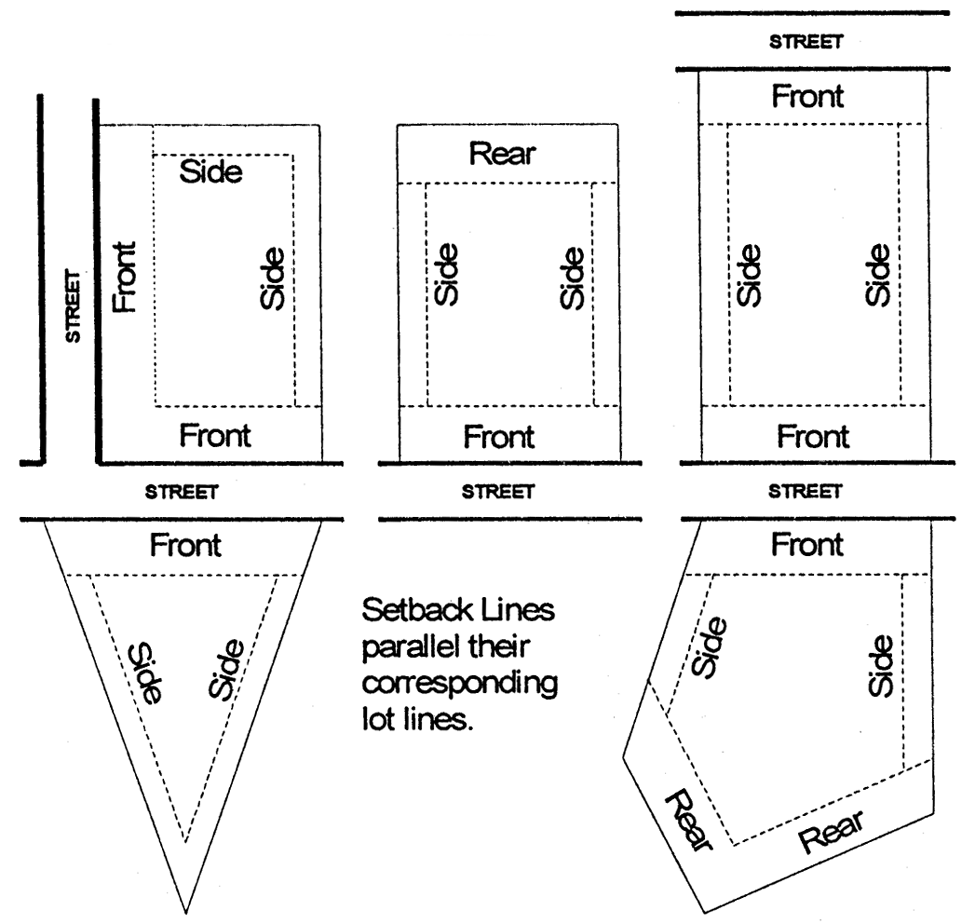
Building Setback Lines
Caliper means the diameter of a tree (usually nursery stock) measured at a point six inches above the ground or top of the root ball for up to and including four-inch caliper trees, and at a point 12 inches above the ground or top of the root ball for larger size trees.
Canopy means a type of building that is a rooflike structure supported by columns or projecting from a building and open on at least three sides.
Car wash means the use of mechanical facilities for washing, cleaning and detailing of automobiles, pick-up trucks, passenger vehicles, recreational vehicles, or other light duty equipment.
Cattery means a building which is soundproof, heated and air conditioned where domestic housecats are boarded, kept and cared for on a temporary basis. Retail items specific to domestic housecats may be sold in such a facility.
Centerline means the line determined as the centerline of a street by the official authority having jurisdiction over the street; otherwise, it shall be the succession of midpoints between the identifiable limits of any improvements on the ground or of any easement.
Clinic means an establishment where medical or dental patients, who are not lodged overnight, are admitted for examination or treatment.
Common area shall have the same meaning as open space.
Conditional use means a use that may be compatible with other uses in a zoning district under certain circumstances or with special restrictions. Establishment of a conditional use on a property requires approval by the board of commissioners in accordance with the procedures set forth in this chapter.
Condominium unit means a residential or commercial unit located in a building, consisting of the interior air space bounded by designated exterior walls, ceilings and floors and in addition to this airspace consists of designated undivided interests in common elements and limited common elements that make up the overall condominium development. Each condominium unit is a separate parcel of real estate and is owned by a fee simple title or an interest therein.
Construction sign means a temporary sign erected and maintained on a premises during construction to identify a construction project for which a building or grading permit has been issued.
Convenience gas station, food and/or general merchandise stores means a building and premises where gasoline, diesel fuel and oil may be dispensed at retail, with no automobile repair facilities. Uses permissible also include the sale of cold drinks, snacks, packaged goods, other food products, tobacco and similar convenience goods for customers.
Corner lot. See the definition of Lot in this section.
Day care center means an establishment that is required to be licensed by the state as a group care home or a day care center, as defined by regulations of the state, or which otherwise enrolls, for pay, supervision and nonmedical care, seven or more children or adults.
Diameter breast height (DBH) means the diameter of a tree trunk (usually a mature tree) measured at a height of 4½ feet above the ground. If a tree splits into multiple trunks below 4½ feet, the trunk shall be measured at its most narrow point beneath the split.
Director means the director of the county department of planning and development services as designated by the board of commissioners, or his designee.
Double frontage lot. See the definition of Lot in this section.
Drive-in, commercial business, means a retail or service enterprise oriented to automobile driving patrons wherein service is provided to the consumer while in their automobiles rather than within a building or structure, other than drive-in restaurants and drive-in theaters.
Dwelling means a building or portion of a building arranged or designed to provide living quarters for one or more families on a permanent or long term basis.
(1)
Single-family detached dwelling means a residential building, whether site-built, a manufactured /mobile home or an industrialized/modular building, designed for or occupied by one family, including:
a.
Site-built single-family detached dwelling means a single-family detached dwelling constructed on the building site from basic materials delivered to the site, and which is constructed in accordance with all requirements of the building codes adopted by the county, and meets or exceeds the standards for single-family and two-family dwellings under section 90-131(7).
b.
Industrialized/modular building (residential) means any dwelling unit designed and constructed in compliance with the Georgia State Minimum Standard One and Two Family Dwelling Code which is wholly or in substantial part, made, fabricated, formed, or assembled in a manufacturing facility and cannot be inspected at the installation site without disassembly, damage to, or destruction thereof. Any such structure shall not contain a permanent chassis and shall be affixed to a permanent load-bearing foundation. The term shall not include manufactured homes as defined by the National Manufactured Housing Construction and Safety Standards Act of 1974, 42 U.S.C. Section 5401, et seq. For the purposes of this chapter, once certified by the State of Georgia, modular homes shall be subject to the same standards as site-built homes.
(2)
Two-family dwelling means a residential building designed exclusively for occupancy by two families in separate dwelling units living independently of each other, including:
a.
Site-built two-family dwelling means a two-family dwelling constructed on the building site from basic materials delivered to the site, and which is constructed in accordance with all requirements of the building codes adopted by the county, and meets or exceeds the standards for single-family and two-family dwellings under section 90-131(7).
b.
Industrialized/modular two-family building means a two-family dwelling which is designed and constructed as described in subsection (1)b. immediately above in the definition of "industrialized/modular building (residential)."
(3)
Group dwelling means a building or portion of a building occupied or intended for occupancy by several unrelated persons or families as their normal place of residence, but in which separate cooking facilities are not provided for such resident persons or families. This term includes, but is not limited to, the terms "rooming house," "apartment hotel," "fraternity house" or "sorority house." A hotel, motel or tourist home shall not be deemed to be a group dwelling.
(4)
Multifamily dwelling means a dwelling on a single lot, designed for or occupied by three or more families living independently of each other, with the number of families in residence not exceeding the number of dwelling units provided.
(5)
Townhouse or row house dwelling means one of a series of three or more attached one-family dwelling units on separate lots which:
a.
May or may not have a common roof;
b.
Shall not have a common exterior wall;
c.
Are separated from each other by fire restrictive party wall partitions extending at least from the lowest floor level to the roof.
Dwelling unit means one or more connected rooms constituting a separate, independent housekeeping establishment for use on a basis involving owner occupancy, rental or lease on a weekly, monthly or longer basis, with provisions for cooking, eating and sleeping, and physically set apart from any other rooms or dwelling units in the same structure.
Electronic message board means a type of sign that presents its message through illumination of flashing, intermittent or moving lights forming the letters, numbers or symbols of the message, whether or not the message appears to move across the sign face.
Exempt sign means a sign that does not require a permit as set forth in section 90-135(10).
Family means one or more persons living together as a household. Domestic servants employed on the premises may be housed on the premises.
Fast food restaurant means an establishment, building or structure where food or drink are served for consumption, either on or off the premises, by order from or service to persons either over an interior counter, outside the structure, from an outdoor service window or automobile service window, or by delivery. This definition shall not include otherwise permitted restaurants where outdoor table service is provided to customers in established outdoor dining areas.
Fence means a barrier constructed of wood, vinyl, wire, wire mesh or decorative metal or any other materials, erected to enclose, screen or separate portions of a lot.
Flag. See the definitions of "Banner," "Official flag," "Pennant," "Streamer" and "Unofficial flag" in this section.
Freestanding sign means a sign permanently attached to the ground which is located on a tract of land that also contains an operating commercial or industrial building or a building which is actually being used for professional offices as permitted in zoning district P-1.
Freestanding wall means a barrier constructed of concrete, brick, stone or other masonry materials, or any combination of masonry and decorative metal, erected to enclose, screen or separate portions of a lot. For the purposes of this chapter, this term includes retaining walls, but excludes any wall that is a structural part of a building.
Green space means land that is owned and maintained by Columbia County for the use and benefit of the general public. This space shall be set aside in perpetuity for permanent protection to be included as part of Columbia County's Green Space Program that can be used for passive recreation purposes.
Greenhouses, nursery, or landscaping business means an establishment which specializes in horticultural and floricultural products that are grown outdoors or in open or enclosed buildings, and/or offers products and services to clients that involve planting and caring for said products.
Gross floor area means the total area of all floors of a building, measured from the outside planes of the exterior walls.
Growth management plan means a document, composed of text and associated maps, entitled as the growth management plan, and adopted by the board of commissioners, as amended from time to time in accordance with the requirements of the Georgia Comprehensive Planning Act.
High density residential zoning district means a zoning district established to provide for the development of townhouse or apartment residential units which shall include the T-R and A-R districts.
Household means an individual living alone or a group of individuals living together in a single dwelling unit, sharing common use of and access to all living and eating areas, bathrooms and food preparation areas, who mutually combine their efforts and share responsibilities for domestic chores such as child rearing, cleaning and cooking in a permanent and longterm relationship, as contrasted to one in a transient relationship who pays for lodging such as a boarder.
Identification sign means an on-site sign giving the address of the building or premises, and the name of the occupant thereof.
Improved lands means lands that have had improvements made on them which enhance the physical, social or economic state of that property.
Incidental sign means an announcement or other display providing information about the occupancy or conduct of business permitted on a premises, such as logos of credit cards accepted on the premises, hours of operation, a "closed" or "open sign," emergency contact person's name and telephone number, street address, "help wanted," "no loitering or solicitations," "no trespassing," "no hunting," security system notices, signs required by law and similar information.
Industrialized/modular building (commercial) means any commercial building designed and constructed in compliance with the Georgia State Code which is wholly or in substantial part, made, fabricated, formed, or assembled in a manufacturing facility and cannot be inspected at the installation site without disassembly, damage to, or destruction thereof. Any such structure shall not contain a permanent chassis and shall be affixed to a permanent load-bearing foundation. For the purposes of this chapter, once certified by the State of Georgia, industrialized/modular buildings shall be subject to the same standards as site-built buildings.
Inflatable sign means a sign which can be inflated with air or gas, and mounted or flown over a site.
Instructional sign means an on-site sign used to give directions or specific instructions to the public, such as, but not limited to, "Enter," "Exit," "No Parking," "Drive Through," "Restroom," etc. Such signs shall contain only instructional information, and shall not be used for the purpose of a business name and/or advertisement, other than the occupant's logo on the parking area entrance and exit signs.
Interior lot. See the definition of Lot in this section.
Junkyard or salvage yard means a lot, land or structure, or part thereof, used primarily for the collecting, storage or sale of wastepaper, rags, scrap metal or other discarded material, and for the collecting, dismantling, storage or salvage of machinery or vehicles not in running condition, or for the sale of parts of such machinery or vehicles.
Kennel means a shelter where dogs or cats are bred, raised, trained or boarded as a business and for animal rescue for more than five animals.
Light industrial operations means predominantly indoor industrial activities involving only those operations generating no significant particulate or gaseous emission which could create harmful or unpleasant effects outside the immediate area of activity and includes operations such as assembly, binding, bottling, engraving, fabricating, freezing, grinding, optical goods, packaging, printing, processing, welding, research, storing, or testing of previously manufactured components or previously prepared materials.
Livestock includes cattle, sheep, horses, goats, and other domestic animals ordinarily raised or used on the farm. Livestock does not include cats or dogs.
Loading space means a space within the main building or on the same lot with the main building, providing for the standing, loading or unloading of trucks, buses or other vehicles.
Lot means a parcel or tract of land held in one ownership, which may include one or more separately deeded or platted parcels.
(1)
Corner lot means any lot bounding the intersection of two streets.
(2)
Double frontage lot means a lot bounding on two or more streets, but not at the intersection of such streets, so that it is not a corner lot.
(3)
Interior lot means a lot bounded on only one side by a street.
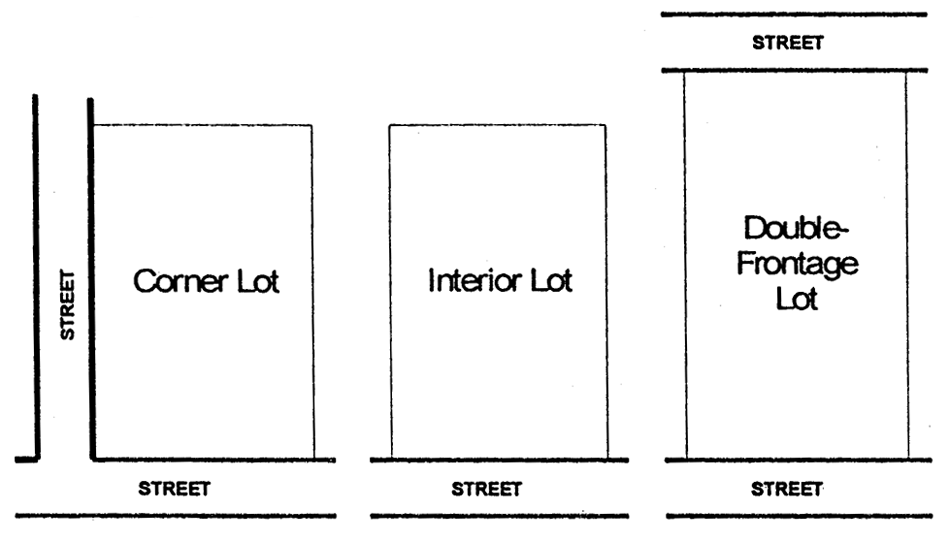
Type of Lots
Lot area means the total horizontal area included within lot lines.
Lot depth means the distance measured along a line extending from a lot's frontage, through the midpoint of the lot's width, to the midpoint of a lot's rear property line. For a lot that has more than one frontage, the depth shall be measured from the shortest frontage line. For a lot that has no rear property line, the depth shall be measured at a right angle (90 degrees) to the lot width. For a lot that has more than one rear property line, the depth shall be measured to the midpoint of the property line most nearly opposite and parallel to the lot width.
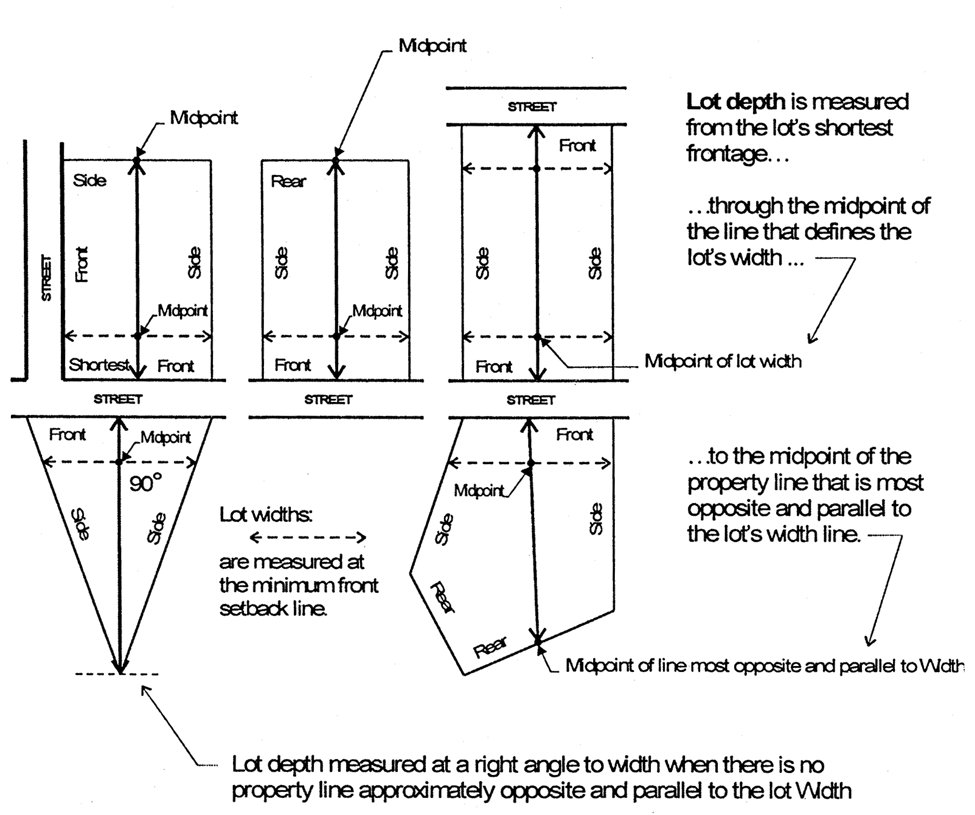
Measurement of Lot Depth
Lot frontage means the length of a lot line abutting the right-of-way line of a public street or the easement line of a private street from which access is or may be gained to the lot. A lot may have more than one frontage.
Lot lines means the boundary dividing a given lot from the street, an alley or adjacent lots.
(1)
Front lot line means a boundary line of a lot that corresponds with a public street right-of-way line or private street boundary line. A lot adjacent to more than one street will have more than one front lot line.
(2)
Rear lot line means a boundary line of a lot that does not intersect with a public street right-of-way line or private street easement line, and is not a front lot line.
(3)
Side lot line means a boundary line of a lot that intersects with a public street right-of-way line or private street easement line, and is not a front lot line.
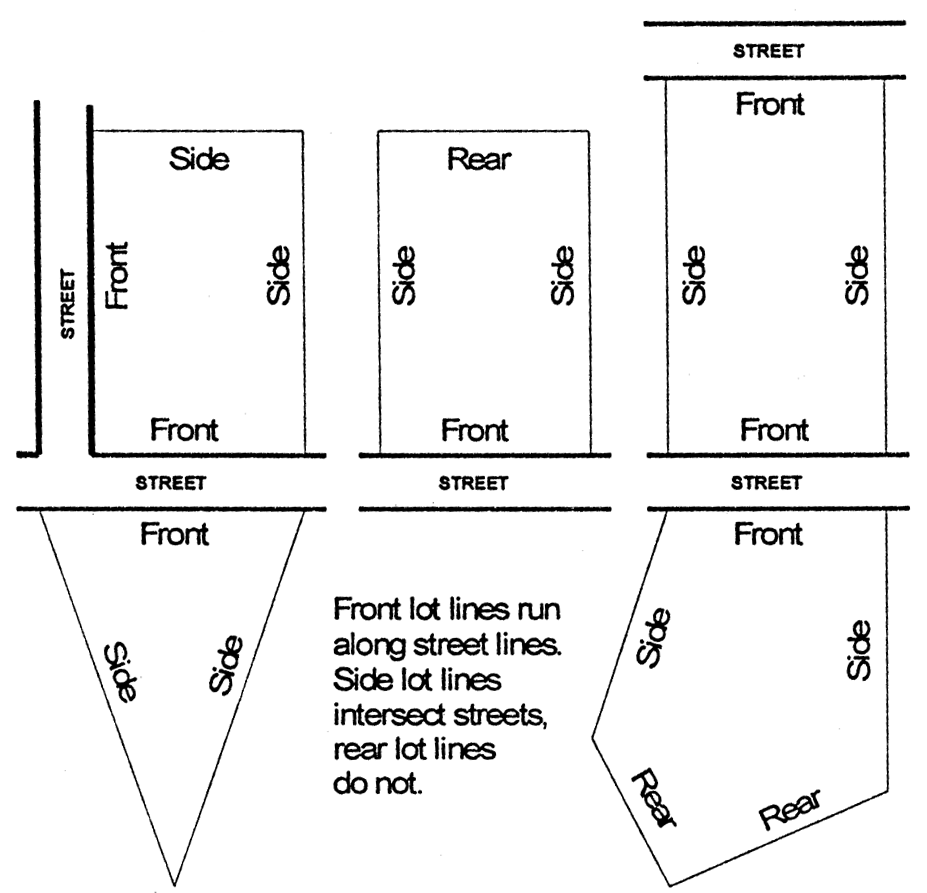
Types of Lot Lines
Lot of record means a lot which is part of a subdivision recorded in the office of the clerk of superior court, or a lot described by metes and bounds, the description of which has been recorded in the office of the clerk of superior court.
Low-impact development means a design approach to managing stormwater runoff through the implementation of small-scale hydrologic controls to replicate the pre-development hydrologic regime of the watershed through infiltrating, filtering, storing, evaporating and detaining runoff close to its source.
Lot width means the distance measured along and following the line of the front principal building setback line between the points of intersection of the front principal building setback line with the property's lot lines.
Low-moderate density residential zoning district means a zoning district established to provide for the development of single-family and two-family residential dwellings which shall include the R-A, R-1, R-1A, R-2, R-3, R-3A and R-4 districts.
Manufactured home park means a plot or tract of land on which two or more manufactured homes are to be located or are intended to be located for purposes of residential occupancy.
Manufactured/mobile home means a structure, transportable in one or more sections, which, in the traveling mode, is eight body feet or more in width or 40 body feet or more in length or, when erected on site, is 320 or more square feet and which is built on a permanent chassis and designed to be used as a dwelling with or without a permanent foundation when connected to the required utilities and includes the plumbing, heating, air-conditioning, and electrical systems contained therein; except that such term shall include any structure which meets all the requirements of this paragraph except the size requirements and with respect to which the manufacturer voluntarily files a certification required by the Secretary of Housing and Urban Development and complies with the standards established under the National Manufactured Housing Construction and Safety Standards Act of 1974, 42 U.S.C. Section 5401, et seq.
(1)
Double-wide manufactured home means a home which meets all of the requirements of a manufactured home and which is typically 24 feet wide.
(2)
Single-wide manufactured home means a home which meets all of the requirements of a manufactured home and which is typically 14 feet wide.
Massage means the manipulation and treatment of soft tissues of the body, including the use of effleurage, petrissage, pressure, friction, tapotement, kneading, vibration, range of motion stretches and any other soft tissue manipulation, whether manual or by mechanical or electrical apparatus, and may include the use of oils, lotions, creams, salt glows, hydrotherapy, heliotherapy and hot and cold packs. Massage services shall include the practice of Reiki.
Mobile vending unit means a self-contained, purpose-built food service, retail, or service establishment that is vehicle-mounted or wheeled and is capable of being readily moveable.
Monument sign means a freestanding sign in which the entire bottom of the sign structure is in contact with the ground, providing a solid and continuous background for the sign face from the ground to the top of the sign.
Motel or hotel means a business establishment offering temporary lodging to the traveling public while away from their normal places of residence, and containing more than seven bedrooms which are intended for temporary lodging. (See also the definitions of "Bed and breakfast facility" and "Tourist home" in this section.)
Multifaced sign means a sign structure that contains two or more sign face surfaces that are located on different sides of the structure, and are separated from each other at their nearest point by no more than three feet.
Nonconforming sign means a sign which, at the time it was erected, complied with all laws then applicable to it, but which does not conform with the requirements of subsequent amendments to such applicable laws.
Nonconforming use means a building, structure or use of land lawfully existing at the time of enactment of this chapter or at the time of approval of any amendment to the text of this chapter or the official zoning map which does not comply with or conform to the provisions of the zoning district in which it is located.
Nonresidential zoning district means a zoning district established to provide for the development of office, commercial, industrial or similar uses which shall include the P-1, C-1, C-C, C-2, C-3, M-1, M-2 and S-1 districts.
Occupant directory sign means a sign listing the occupants or tenants of a building or group of buildings, including their respective professions or business activities, and their location within the building or group of buildings.
Official flag means a cloth, paper, thin plastic or similar material, which is displayed by hanging or flying, representing, in whole, the officially adopted symbol or emblem of a government, political subdivision, person, institution, organization or corporation.
On-site sign means a sign relating in its subject matter to the premises on which it is located.
Opaque means impenetrable to view, or so obscuring to view that features, buildings, structures and uses, as the case may be, become visually indistinguishable.
Open space is land within a development that is generally undeveloped and set aside for public or private use. Open space may be land either preserved in its natural condition or revegetated, and may accommodate community amenities and active or passive recreation. Green space, as defined by this section, may be counted toward a development's open space requirement. Stormwater infrastructure shall not be counted toward the required open space, unless designed as part of a low-impact system that utilizes bio-swales and natural recharge areas. Utility easements shall not be counted toward the required open space, unless utilized as part of a common trail network or other amenity. Excavated or filled slopes steeper than six horizontal to one vertical (6H:1V) shall not be counted toward the required open space.
Operating commercial or industrial building means a structure located on property zoned for commercial or industrial use which has been in operation as a commercial or industrial enterprise for more than 60 days, and which maintains operating hours of 30 hours or more per week. The term shall also include such commercial or industrial buildings that are temporarily vacant, but for which the sale or lease of the property or building is being actively sought by the owner.
Outdoor display area means a portion of a property outside of a building where merchandise, goods or other items are placed in public view for the purpose of advertising or for sale or lease. An area under a permanent canopy, roofline, or enclosure is not considered an outdoor display area.
Outdoor storage means the keeping, within an unroofed area, of any goods, material, merchandise or vehicles in the same place for more than 24 hours.
Overlay zoning district means a zoning district that encompasses one or more underlying zoning districts, and that imposes additional requirements or grants additional rights as a supplement to those required or permitted by the underlying zoning district.
Park space means land that is owned and maintained by Columbia County for the use and benefit of the general public. This space shall be set aside to be included as part of Columbia County's Recreation Master Plan that can be used for active or passive recreation purposes.
Parking bay means three or more parking spaces adjacent to one another and aligned side-by-side.
Pennant means a lightweight plastic, fabric or similar material, not containing a message or logo of any kind, suspended from a rope, wire or string, usually in a series, designed to move in the wind. This term shall not include a banner or an official flag, as such terms are defined in this section.
Permanent sign means a sign determined to meet the structural and construction requirements for signs according to the county's building codes.
Personal care home means a dwelling, whether operated for profit or not, which undertakes, through its ownership or management, to provide or arrange for the provision of housing, food service and one or more personal care services for two or more adults who are not related to the owner or administrator by blood or marriage.
(1)
Congregate personal care home means a personal care home that offers care to 16 or more adults.
(2)
Family personal care home means a personal care home in a family type residence, noninstitutional in character, that offers care for two to six adults.
(3)
Group personal care home means a personal care home that offers care for seven to 15 adults.
Personal care service means individual assistance with or supervision of self-administered medication and essential activities of daily living such as eating, bathing, grooming, dressing and toileting.
Planned center means a building or group of buildings in close proximity to each other that are operated under a common promotional plan, occupied by six or more retail stores, service establishments, offices, industries or any other business.
Planned zoning district means a zoning district where a variety of residential and nonresidential uses are permitted on the basis of a master plan and other specific development controls, and includes the PUD and PDD districts.
Planning commission means the county planning commission as established in section 90-4.
Political sign means a sign identifying and/or urging voter support for a particular election issue, political party or candidate for public office.
Portable sign means a sign designed to be transported or easily relocated and not permanently attached to the ground, a foundation or other permanent structure, including, but not limited to, the following:
(1)
A sign designed to be temporarily placed on the ground, whether or not affixed to the ground with stakes or other nonpermanent devices.
(2)
A sign mounted on a trailer, with or without wheels.
(3)
An A-frame or sandwich board sign.
(4)
An umbrella used for advertising.
(5)
A sign mounted or painted upon a parked vehicle which is positioned for the primary purpose of acting as a sign exposed to the public, and is not in use in the ordinary course of carrying out its transportation function.
(6)
A sign mounted or painted upon a vehicle which is operated on the public streets for the primary purpose of presenting a message or symbol offering or supporting the sale, rent, lease, loan or other availability of any property, product or service, and is not otherwise in use in the normal course of transporting people, merchandise or freight.
Principal building means a building constructed on a tract of land in which the principal use is conducted.
Principal use means the specific, primary purpose for which land or a building is used.
Private club means a recreational facility for the exclusive use of the members, and their guests, of the private organization operating the facility.
Private schools means an educational institution other than a public school which offers instruction in primary, secondary, or post-secondary education where instruction is given in the vocational, professional, or recreational fields.
Professional offices means an establishment used for conducting the affairs of a business, profession, or service industry such as accountants, architects, data processing, doctors, dentists, engineering, insurance agents, lawyers, real estate agents, sales offices, and similar services.
Project entrance sign means a sign identifying the name of a residential subdivision, multifamily development, office park or industrial park, located at a discernible entrance into the subdivision, development or park.
Projecting sign means a sign affixed to a wall, and projecting more than 18 inches from the surface of such wall.
Property owner means an individual or group of individuals, or a corporation, partnership, trust or other legal entity having title to a parcel of real estate. If there are multiple owners, all owners collectively shall constitute the property owner.
Public sewerage means a sanitary sewerage system for the collection of waterborne wastes, complete with a sewerage treatment plant or stabilization pond. The entire system must be either operated by the county or a municipality within the county, or have been approved by the county and county health department, in the case of a privately owned system.
Radial lot means a lot with frontage on a curve or cul-de-sac.
Real estate directional sign means an off-site sign which conveys directions to a specific real estate property for sale or lease, such as a real estate development, residential subdivision, apartment or condominium project, home for sale, apartment for rent or any other real estate property which is for sale or lease.
Real estate sign means a temporary sign advertising the sale, rent or lease of the property on which it is located.
Residential zoning district means a zoning district established under article II of this chapter for the development of single-family, two-family and multifamily dwellings which shall include the R-A, R-1, R-1A, R-2, R-3, R-3A, R-4, T-R and A-R districts.
Restaurant means an establishment where food and drink are prepared to individual order, ordered and served at the table and consumed primarily within the principal building, as contrasted to a fast food restaurant.
Retirement community means an age-restricted development which offers significant services and facilities for the elderly, including social and recreational activities, personal care services or health facilities limited to use by the development's residents. At least 80 percent of the units must be occupied by residents who are 62 years of age or older, and the remaining units must be occupied by at least one resident who is 55 years of age or older.
Roof sign means a sign or graphic erected or maintained on a building, any portion of which extends above the lowest horizontal line of the roof.
Self-expression sign means a sign limited in its content to an idea, opinion or belief of the owner or occupant of the property upon which it is placed, and excluding any message or symbol offering or supporting the sale, rent, lease, loan or free availability of any property, product or service, whether on the premises or not.
Shopping center means a planned center which is one of the following three types of shopping centers:
(1)
Community shopping center means a shopping center that consists entirely or primarily of service, convenience and retail shopping goods outlets, with the largest tenant occupying no more than 70,000 square feet of gross floor area, often containing a grocery store or junior department store as the primary anchor, but generally not having enclosed air conditioned malls and similar amenities typical of major shopping centers.
(2)
Major shopping center means a shopping center having a primary anchor tenant occupying more than 70,000 square feet of gross floor area, and offering the full range of retail commercial outlets.
(3)
Neighborhood shopping center means a shopping center that consists entirely or primarily of personal service and convenience goods outlets, with the largest tenant occupying no more than 35,000 square feet of gross floor area, generally not containing enclosed air conditioned malls and similar amenities typical of major shopping centers.
Sign means a structure, display or device that is used to advertise, identify, direct or attract attention to a business, institution, organization, person, idea, service, event or location by any means, including words, letters, figures, design characteristics, symbols, logos, fixtures, colors, movement or illumination.
Sign face means the portion of the surface of a sign structure where words, letters, figures, symbols, logos, fixtures, colors or other design elements are or may be located in order to convey the message, idea or intent for which the sign has been erected or placed. The sign face may be composed of two or more modules on the same surface that are separated or surrounded by portions of a sign structure not intended to contain any advertising message or idea and are purely structural or decorative in nature.
Sign face module means each portion or unit of a sign face that is clearly separable from other such units by virtue of the expression of a complete thought, message, logo or idea.
Specimen tree means any tree or grouping of trees that has been determined to be of high value because of its species, size, age, location or historic value. Generally, a tree is considered a specimen tree if it has achieved a diameter breast height of 24 inches for a deciduous canopy tree and 30 inches for an evergreen canopy tree.
State road system means all streets, roads and highways designated as interstate highways, U.S.-numbered or state route-numbered highways; more specifically, those roads designated by the state department of transportation and approved by the United States Secretary of Transportation pursuant to the provisions of 23 USC § 103.
Streamer means a long narrow banner, pennant or strip of fabric or other material.
Street means a road or street that is classified as one of the following:
(1)
Arterial street means a road identified as a major arterial or minor arterial in the county growth management plan, as most recently adopted or amended.
(2)
Collector street means a road identified as a major collector or minor collector in the county growth management plan, as most recently adopted or amended.
(3)
Local street or land service street means a road identified as such, or not otherwise identified as a major or minor arterial or a major or minor collector street in the county growth management plan, as most recently adopted or amended.
(4)
Service drive means a road identified as such in the current county official road register.
Structure means anything constructed or erected with a fixed location on the ground, or attached to something having a fixed location on the ground. Structures include, but are not limited to, buildings, manufactured homes, swimming pools, decks and patios, parking lots, walls, fences, billboards and poster panels.
Temporary sign means a nonpermanent sign lasting for a limited time, but not including a portable sign.
Tiny house means a dwelling that is 400 square feet or less in floor area, excluding lofts, as defined in the 2018 International Residential Code, ancillary dwellings, and manufactured/mobile homes. Tiny houses shall include tiny houses built on trailers or permanent chassis or are otherwise mobile.
Tourist home means a business establishment operated within a dwelling, offering temporary lodging to the traveling public while away from their normal places of residence, and containing no more than seven bedrooms which are available for temporary lodging.
Travel trailer means a motorized camper, converted bus, tent trailer, motor home or other similar vehicle or portable structure which is used or designed for temporary portable housing or occupancy while on vocational, recreational or other trips, and provided with sleeping accommodations.
Travel trailer park means a lot on which two or more travel trailers are located or intended to be located for purposes of occupancy.
Tree means a woody plant having one erect perennial stem or trunk, a more or less definitely formed crown of foliage, and a height of at least 13 feet (at maturity).
Unofficial flag means a cloth, paper, thin plastic or similar material which is displayed by hanging or flying, and which is not an official flag, banner, pennant or streamer.
Usable project area means the portion of a development parcel which can be devoted to buildings and structures. Generally, areas outside of floodplains, wetlands, and stream buffers are considered usable project area.
Use means the purpose for which land, a building or other structure is designed, arranged or intended, or for which it is or may be occupied or maintained. (See also the definitions of "Principal use" and "Accessory use or structure" in this section.)
Wall sign means a sign fastened, placed or painted upon and parallel to the exterior wall or door of a building, whether on the front, rear or side of the structure. For the purposes of this chapter, awning and canopy signs shall be regulated as wall signs.
Window sign means a sign that is placed on or behind a window pane and is intended to be viewed from outside the building.
Worship directional sign means an off-site sign which conveys directions to a specific church or place of worship.
Yard means an area that lies between the principal building on a lot and the nearest lot line.
(1)
Front yard means a yard situated along any public street right-of-way or private street easement.
(2)
Rear yard means a yard situated along a rear lot line.
(3)
Side yard means a yard situated along a side lot line, but does not extend into a front or rear yard.
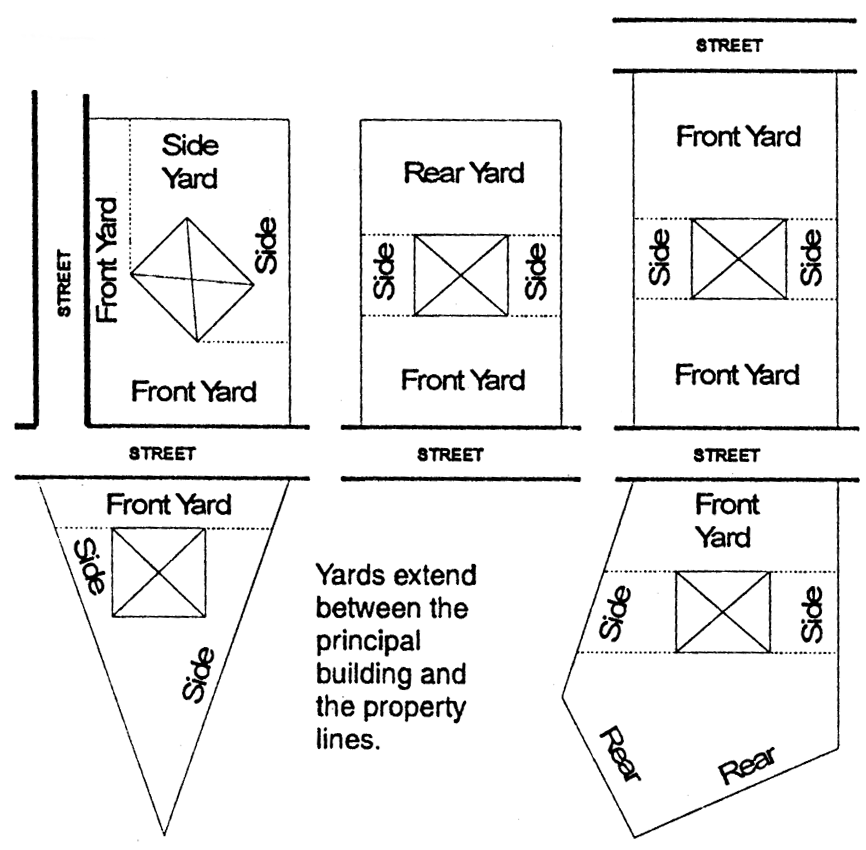
Types of Yards
Zoning change means an action by the board of commissioners causing a change in the boundary of a zoning district so as to change the zoning district or overlay district designation on a property or a portion of a property, or causes the establishment of a conditional use on such property.
(Code 1979, § 2-16-9; Ord. No. 99-17, § 1, 11-16-1999; Ord. No. 00-8, § 1, 8-15-2000; Ord. No. 01-11, § 3, 11-6-2001; Ord. No. 02-16, § 1, 2-18-2003; Ord. No. 11-01, § 1, 3-1-2011; Ord. No. 12-04, § 1(Exh. A), 5-15-2012; Ord. No. 12-11, § 1(Exh. A), 7-17-2012; Ord. No. 12-14, § 1(Exh. A(1)), 12-18-2012; Ord. No. 14-07, §§ 1, 2, 8-5-2014; Ord. No. 14-20, § 1, 12-16-2014; Ord. No. 15-07, § 1, 3-31-2015; Ord. No. 15-08, § 1, 3-31-2015; Ord. No. 15-18, § 1, 6-16-2015; Ord. No. 15-23, §§ 1, 2, 8-18-2015; Ord. No. 16-12, §§ 1, 2, 6-7-2016; Ord. No. 19-09, § 1(Exh. A), 8-6-2019)
Cross reference— Definitions generally, § 1-2.

