
Columbia County Unincorporated
City Zoning Code
City Zoning Code
ARTICLE IV
- SUPPLEMENTAL REQUIREMENTS
Sec. 90-131. - In general.
The following requirements shall apply in all zoning districts in the unincorporated areas of the county:
(1)
Conformity. No structure or land shall be used, and no structure shall be erected, except in conformity with the provisions of this chapter and other provisions of this Code.
(2)
Sewage, rubbish and other liquid and solid waste. No discharge shall be allowed into any private sewage disposal system, into the ground, or into any stream of any materials of such nature or temperature which can contaminate any water supply or otherwise create a harmful effect on groundwater or surface water, except in accordance with county health standards and applicable laws. No garbage, rubbish or other solid wastes shall be stored outdoors or allowed to accumulate in areas which can be viewed from the streets or alleys adjoining such area for periods in excess of 24 hours. All solid wastes stored outdoors shall be kept in tightly covered containers.
(3)
Maximum residential occupancy. No single-family, two-family or multifamily dwelling unit containing a gross floor area of 800 square feet or less, shall be occupied by more than four people. Dwelling units containing more than 800 square feet, but not more than 1,200 square feet, shall not be occupied by more than seven people. Dwelling units containing a gross floor area in excess of 1,200 square feet may be allowed one additional occupant for each 500 square feet of gross floor area in excess of 1,200 square feet.
(4)
Exemptions to height restrictions. The following structures, or parts thereof, are exempt from the height limitations set forth in this chapter:
a.
Agricultural buildings such as barns, silos, windmills, grain elevators and other farm structures, but not including dwellings.
b.
Cooling towers, gas holders or other industrial structures where required by the manufacturing process.
c.
Church spires, belfries, cupolas, domes, monuments, water towers, observation towers, transmission towers, windmills, chimneys, smokestacks, derricks, conveyors, radio towers and aerials.
d.
Additional building heights may be authorized in the C-2, C-3, M-1, M-2 and PUD districts by the planning commission after approval of such building heights by the fire marshal.
(5)
Street access control. In order to promote the safety of motorists and pedestrians and to minimize traffic congestion and conflict, the following regulations shall apply:
a.
All commercial driveway locations, widths, and configurations shall be approved by the county after having been designed and stamped by a professional engineer (PE), licensed in the State of Georgia, in accordance with the most current version of Columbia County's "Project Access Improvement Policy", the Georgia Department of Transportation's Regulations for Driveway Encroachment Control, the American Association of State Highway Transportation Officials "Green Book," the Manual on Uniform Traffic Control Devices, and the Americans with Disabilities Act.
b.
For residential uses, no more than two points of vehicular access from a property to each abutting public street shall be permitted.
c.
Along collector and arterial streets, no more than one point of vehicular access from a development or subdivision shall be permitted for each 300 feet of lot frontage; provided, however, that property with less than 300 feet of frontage shall have no more than one point of access to any one local street, and provided further that:
1.
Nonresidential developments that will result in two or more lots shall limit direct access to collector and arterial streets through the use of shared driveways and internal access to the greatest extent practical.
2.
Residential subdivisions shall limit direct access to collector and arterial streets through the use of reverse-frontage lots or other techniques as provided in section 74-82.
d.
Interparcel access requirements are as follows:
1.
Internal access easements. For any office or retail sales or services use, the property owner shall grant an access easement as set forth in subsection (5)e.2. of this section to each adjoining property that is zoned or used for an office or retail sales or services use. The purpose of the easement is to facilitate movement of customers from business to business, without generating additional turning movements on the public street.
2.
Access easements.
i.
The access easement shall be at least 30 feet in width, and shall permit two-way automobile access from the adjoining property to driveways and parking areas intended for customer or tenant use, but parking spaces may be restricted to use by the owner's customers and tenants only.
ii.
The granting of an access easement shall be effective upon the granting of a reciprocal easement by the adjoining property owner.
iii.
Upon the availability of access to driveways and parking areas of the adjoining lot, the pavement or other surfacing of the owner's driveways and parking areas shall be extended to the point of access on the property line.
iv.
The easement shall be granted for a term that will expire upon the rezoning of either property to a residential zoning district, and shall provide that maintenance of the driveway connection be the responsibility of the owner of each property on which the driveway is located.
3.
Relief. Where the proposed land use is such that adverse impact or impracticability of the required easement on use of the property would outweigh the reduced impact on the public street provided by the reciprocal easements, the planning commission may administratively waive the requirement of access easements, in whole or in part.
e.
No point of access shall be allowed within 35 feet of the right-of-way line of any street intersection.
f.
No curbs or medians on county roads or rights-of-way shall be cut or altered for access without approval of the county engineer.
(6)
Maximum depth of residential lots.
a.
Any lot in a residential zoning district which consists of more than three acres and has a lot width of more than 300 feet is not otherwise restricted to its lot depth, provided that the lot shall comply with all other requirements of this Code, and shall have been complied with the provisions of chapter 74.
b.
Any lot in a residential zoning district consisting of three acres or less, or having a lot width of 300 feet or less, shall have a lot depth no greater than five times the lot's width, unless a greater lot depth is specifically approved by the planning commission.
(7)
Single-family and two-family dwellings. All site-built/industrialized/modular single-family detached dwellings, manufactured homes, mobile homes and two-family dwellings shall meet or exceed the following requirements:
a.
Each dwelling shall be connected to a potable water supply and sanitary sewage disposal system which is approved by the county health department.
b.
Foundation requirements shall be as follows:
1.
The structure shall be attached to a permanent foundation which is constructed in accordance with the building code for site-built buildings, state law for industrialized buildings or state law and guidelines of the U.S. Department of Housing and Urban Development for manufactured homes.
2.
Upon placement of a manufactured home, all means of transportation, such as towing devices, tongue, brakes, wheels, axles and hitches shall have been removed.
3.
The area beneath the structure shall be enclosed around the exterior of the structure with masonry, including, but not limited to brick, concrete, rock or other masonry materials that have been approved by the building inspector, penetrated by openings only for installed vents and access doors. This subsection shall apply to nonload bearing curtain walls, but not to load bearing curtain walls around the periphery of a manufactured home.
c.
Exterior siding materials shall consist of wood, brick, stone, concrete, stucco or similar materials, or lap siding of Masonite, metal, vinyl or similar materials, or any combination of such thereof.
d.
Roof requirements shall be as follows:
1.
All roof surfaces shall have a minimum pitch of 2¼ inches of rise for every 12 inches of run, except that mansard and gambrel roofs must meet this requirement only for those surfaces that rise from the eaves of the structure.
2.
All roof surfaces exposed to view shall be covered with asphalt or fiberglass shingles, wood shakes or shingles, standing seam (noncorrugated) tin, clay tiles, slate or similar materials.
e.
A porch or landing shall be provided within two steps from each exterior door, which porch or landing shall be at least 48 inches in width and 36 inches in depth.
f.
The minimum width of the structure shall be greater than 16 feet.
g.
The building official may approve deviations from the requirements of this section on the basis of a finding that the materials to be utilized or the architectural style proposed for the dwelling unit will be compatible with, and harmonious or superior to, existing structures in the vicinity, and that such deviation shall be consistent with the intent of this section.
h.
The dwelling shall be constructed in accordance with all applicable requirements of the building code as adopted by the county, or in accordance with the standards established by the National Manufactured Housing Construction and Safety Standards Act or the Georgia Industrialized Buildings Act for residential industrialized buildings.
(8)
Minimum street standards. All streets located or to be located within or abutting a subdivision or other land development project shall comply with the right-of-way width and street construction standards set forth in chapter 74 of this Code, and the construction standards and specifications adopted by the board of commissioners, for the appropriate classification of the street as shown in the growth management plan, as well as comply with specific road design requirements for street projects that have been engineered by the state department of transportation or the county. All new streets shall be constructed to the applicable standards. Existing substandard streets shall be improved to the minimum standards for a land service or local street along the land development's frontage as part of the development project's improvements.
(Code 1979, § 2-16-60; Ord. No. 00-8, § 4, 8-15-2000; Ord. No. 11-07, § 1, 3-1-2011; Ord. No. 17-09, § 1(Exh. A), 12-5-2017)
Sec. 90-132. - Nonconforming uses of land and structures.
(a)
Intent. It is intent of this section to avoid any unreasonable invasion of established private property rights; however, this chapter recognizes that the elimination of existing structures and uses that are not in conformity with this chapter is as much a subject of health, safety and general welfare as is the prevention of the establishment of new uses which would violate the purpose, intent and provisions of this chapter. A structure, building or use which was lawfully established before the effective date of this chapter, or any amendment thereto, and which does not conform to one or more of the requirements of this chapter, is a nonconformity.
(b)
Continuation in perpetuity. A nonconforming use, building or other structure may be continued in perpetuity, subject to the following conditions that the nonconforming use, building or sign not be:
(1)
Changed to or replaced by another nonconforming use.
(2)
Expanded or enlarged in any way.
(3)
Reestablished, repaired, replaced or rebuilt after damage to the extent of 75 percent or more of its value.
(4)
Reestablished after discontinuance of operation for one year.
(c)
Maintenance and repairs.
(1)
On a nonconforming structure, or portion thereof, which contains a nonconforming use, work may be done on ordinary repairs or on repair or replacement of nonbearing walls, fixtures, wiring or plumbing to an extent not exceeding 75 percent of the current replacement cost of the nonconforming structure, or portion thereof, provided that the bulk existing when such structure became nonconforming shall not be increased.
(2)
Nothing in this section shall be deemed to prevent the strengthening or restoring to a safe condition of any building, or part thereof, which is declared to be unsafe by an official charged with protecting the public safety, upon order of such official.
(d)
Nonconforming lots. A lot that was a lot of record prior to the adoption of the ordinance from which this chapter is derived, which does not meet the minimum area, width or frontage requirements of this chapter, may be used as a building site, provided that access is provided directly from a public street or through a private easement, and provided that minimum building setbacks are not reduced more than 20 percent of the minimum building setbacks set forth in this chapter; provided, however, that the setback shall not be reduced to less than 15 feet from the right-of-way.
(Code 1979, § 2-16-61)
Sec. 90-133. - Parking.
(a)
Off-street parking required. At the time of the establishment of or change to a permitted use as set forth in sections 90-50 and 90-97, or erection of any building, or at the time any principal building is enlarged or increased in capacity by adding dwelling units, guest rooms, seats and/or floor area, there shall be provided permanent off-street parking spaces, improved with an asphalt or concrete surface, in accordance with the following:
(1)
Combination of required parking space. The required parking spaces for any number of separate uses may be combined in one lot, but the required parking spaces assigned to each use may not be assigned to another use, except where the parking spaces required for churches or other assembly halls whose peak attendance will be at night, on Sunday or another time, does not coincide with an adjacent use, such required parking spaces may be assigned to the adjacent use.
(2)
Proximity of off-street parking spaces to use. All required parking spaces for all uses shall be either on the same lot or within 300 feet of the building or open use area such parking spaces are to serve; provided, however, that no required parking spaces may be located across any arterial street from the use such parking spaces are intended to serve.
(3)
Design of parking lots.
a.
Except for parcels of land devoted to one-family and two-family residential uses, all areas devoted to off-street parking shall be designed and of such size that no vehicle is required to back into a public street to obtain access to such public street.
b.
Each parking space shall not be less than nine feet wide by 18 feet long, except that handicapped spaces shall comply with the requirements of the Federal Americans with Disabilities Act.
c.
An off-street parking plan and calculations to include the number of spaces required by code and the number of spaces provided by the applicant shall be required and shall accompany all applications for development approval.
(4)
Off-street parking by use. The minimum and maximum number of off-street parking spaces required for each type of use shall be determined by the following table, to include the number of spaces required by the Americans with Disabilities Act. The developer can provide parking spaces not less than the minimum amount or up to the maximum amount. The reference to area in square feet relates to the gross floor area of the entire building being served by the off street parking spaces.
(5)
Restriction on use of required parking. The required off-street parking shall be for employees, occupants, customers, clients and visitors of the business supplying the required parking spaces, and shall be limited in use to temporary parking of motor vehicles with current license plates. The storage or parking of merchandise or motor vehicles for sale, the servicing or repairing of vehicles or equipment and regular truck loading and unloading is prohibited in such required parking spaces.
(6)
Administrative variation of parking requirements. The number of parking spaces required by this section may be increased or decreased upon approval by the director based on the actual use of a property.
(7)
Pervious surface requirements. The department director or his/her designee (collectively the "director") may approve an alternative permanent surface material or a substitute for concrete curbs, or both, which the director determines best fits the needs of the parking application.
a.
In making such a determination the director must find that:
1.
The alternative surface will not degrade the public street;
2.
The alternative surface will adequately withstand the anticipated parking demand; and
3.
The alternative surface will reduce the impervious surface area of the parcel or parking lot.
b.
The following provisions apply to parking areas where a pervious surface treatment is applied to the area dedicated for surface parking spaces and drive aisles:
1.
Parking lot areas eligible for pervious or permeable surfaces include parking spaces and access aisles but not driveways, parking lot perimeter roads or heavily used parking access drives. The design engineer is required to demonstrate to the director how the surface design will be satisfactory for the intended use.
2.
Pervious surfaces include pervious concrete and asphalt, pervious pavers and turf block or other surface treatment approved by the director.
3.
The stormwater reductions that result from permeable pavement may be considered in any stormwater management plans.
b.
The following provisions apply to parking areas where a pervious surface treatment is applied to the area dedicated for surface parking spaces and drive aisles:
1.
Parking lot areas eligible for pervious or permeable surfaces include parking spaces and access aisles but not driveways, parking lot perimeter roads or heavily used parking access drives. The design engineer is required to demonstrate to the director how the surface design will be satisfactory for the intended use.
2.
Pervious surfaces include pervious concrete and asphalt, pervious pavers and turf block or other surface treatment approved by the director.
3.
The stormwater reductions that result from permeable pavement may be considered in any stormwater management plans.
(Ord. No. 09-02, § 8, 6-2-2009; Ord. No. 10-09, § 1(Exh. A), 11-2-2010; Ord. No. 15-09, §§ 1, 2, 3-31-2015)
Sec. 90-134. - Reserved.
Editor's note— Ord. No. 18-01, § 1, adopted March 6, 2018, repealed § 90-134, which pertained to Savannah River corridor buffer and derived from Code 1979, § 2-16-63.
Sec. 90-135. - Signs.
(a)
Findings. The board of commissioners find that signs provide an important medium through which individuals may convey a variety of noncommercial and commercial messages. However, left completely unregulated, signs can become a threat to public safety as a traffic hazard and a detriment to property values and the county's overall public welfare, as well as an aesthetic nuisance.
(b)
Intent. By enacting the ordinance codified in this chapter, the board of commissioners intends to:
(1)
Balance the rights of individuals to convey their messages through signs and the right of the public to be protected against the unrestricted proliferation of signs;
(2)
Further the objectives of the county's comprehensive plan, which is expressly incorporated herein;
(3)
Protect the public health, safety and welfare of the citizens and others within the county;
(4)
Reduce traffic and pedestrian hazard;
(5)
Promote the aesthetic qualities of the county;
(6)
Protect property values by minimizing the possible adverse effects and visual blight caused by signs;
(7)
Promote economic development;
(8)
Ensure the fair and consistent enforcement of sign regulations.
(c)
Intent of sign regulations. Notwithstanding any other restrictions in this chapter, any sign authorized under this chapter can contain any commercial or noncommercial message.
(d)
Compliance. No sign shall be placed or maintained on any property, building or other structure within the county, whether zoned or unzoned, except in conformity with these sign regulations.
(e)
Violations. In case any sign, advertising device or other device covered by this chapter is or is proposed to be erected, constructed, altered, converted or used in violation of any provision of this chapter, the division director or designee may, in addition to other remedies, and after due notice to the appropriate person, issue a citation for violation of this Code requiring the presence of the violator in the municipal court, or institute injunction or other appropriate action or proceeding to prevent such unlawful erection, construction, alteration, conversion or use, or to correct or abate such violation. Without limitation, businesses, organizations, builders, developers, contractors, property owners, and such other parties responsible for the violation may be cited for violation of any provisions of this chapter.
(f)
Definitions of land use categories. Land use categories referred to in this chapter are defined herein for the purpose of regulating signs. The use in this chapter of the term "property" relative to a land use category includes both developed and undeveloped properties, while the term "use" means a property that is developed, occupied or otherwise in operation under the land use category. The land use categories are as follows:
Agricultural means a property used primarily for the cultivation of crops, dairying or the raising of livestock, or a vacant property zoned or offered for sale or lease for such purpose.
Commercial means a property occupied by one or more business establishments, contained within a roofed and walled structure built for permanent use, which establishments are primarily engaged in the sale of goods; the provision of personal, professional, business, entertainment or other commercial services; the management of a business enterprise; or the provision of temporary housing to the traveling public (such as a motel); or a vacant property zoned or offered for sale or lease for such purposes.
Industrial means a property occupied by one or more business establishments, contained within a roofed and walled structure built for permanent use, which establishments are primarily engaged in the fabrication, manufacture or production of durable or nondurable goods, or a vacant property zoned or offered for sale or lease for such purpose.
Institutional means a property occupied by a private, nonprofit religious, recreational, educational or philanthropic organization, club or semipublic institution.
Multifamily residential means a property occupied primarily by one or more residential buildings containing three or more dwelling units, or a mobile home park, or a vacant property zoned or offered for sale or lease for such purposes.
Single- and two-family residential means a property occupied primarily by one or more single-family dwellings or duplex dwellings, or a vacant property zoned or offered for sale or lease for such purpose.
(g)
Definitions related to signs. The following words and phrases have specific meanings as used in this chapter:
Abandoned sign means cessation for a period of 12 months of the use of a sign by either the owner of the sign or the occupant of the property on which the sign is placed, or through the removal or relocation of the previous occupant of the property, or a sign that has ceased to be used for a period of 12 months through the removal of its copy or the deterioration of its copy through lack of maintenance, but excluding temporary or short-term periods of remodeling, refurbishment or maintenance of the sign.
Animated sign means a sign that uses movement or changes of lighting to depict action or to create a special effect or scene.
Awning means a roof-like cover that projects from the wall of a building for the purpose of shielding a doorway, or window from the elements. Awnings are often made of fabric or flexible plastic supported by a rigid frame, and may be retracted into the face of the building.
Awning sign. See building sign.
Banner means a sign made of, cloth, thin plastic, or similar lightweight material, and usually containing a message or logo.
Billboard, if a freestanding structure, means any sign larger than the maximum permitted size of a freestanding sign in the zoning district or sign overlay district where the structure is located. If the billboard is a wall sign or a sign attached to a building, such term shall mean any sign larger than the maximum permitted size for a wall sign in the zoning district or sign overlay district where the sign is located.
Building sign means a sign that in any manner is fastened to, projects from, or is placed or painted upon the exterior wall, window, door, or roof of a building. The term "building sign" includes but is not limited to the following:
(1)
Awning sign means a sign imposed, mounted or painted upon an awning.
(2)
Canopy sign means a sign affixed to, superimposed upon, or painted on any canopy, such that the sign is mounted in such a manner that a continuous face with the canopy is formed.
(3)
Mansard sign means a sign imposed, mounted or painted upon a mansard and not extending above the top of the mansard.
(4)
Marquee sign means any sign painted on or attached flat to the face of a marquee.
(5)
Parapet sign means a sign imposed, mounted or painted on a parapet and not extending above the top of the parapet.
(6)
Projecting sign means a sign affixed to a wall and extending more than 18 inches from the surface of such wall, usually perpendicular to the wall surface.
(7)
Roof sign means a sign projecting over the coping of a flat roof, or over the ridge of a gambrel, hip or gable roof, and supported by or attached to the roof.
(8)
Under-canopy sign means a display attached to the underside of a marquee or canopy and protruding over private sidewalks.
(9)
Wall or fascia sign means a sign that is fastened directly to or is placed or painted directly upon the exterior wall of a building, with the sign face parallel to the wall, and extending from the surface of the wall no more than 18 inches.
(10)
Window sign means a sign that is placed on or behind a windowpane or glass door and intended to be viewed from outside the building.
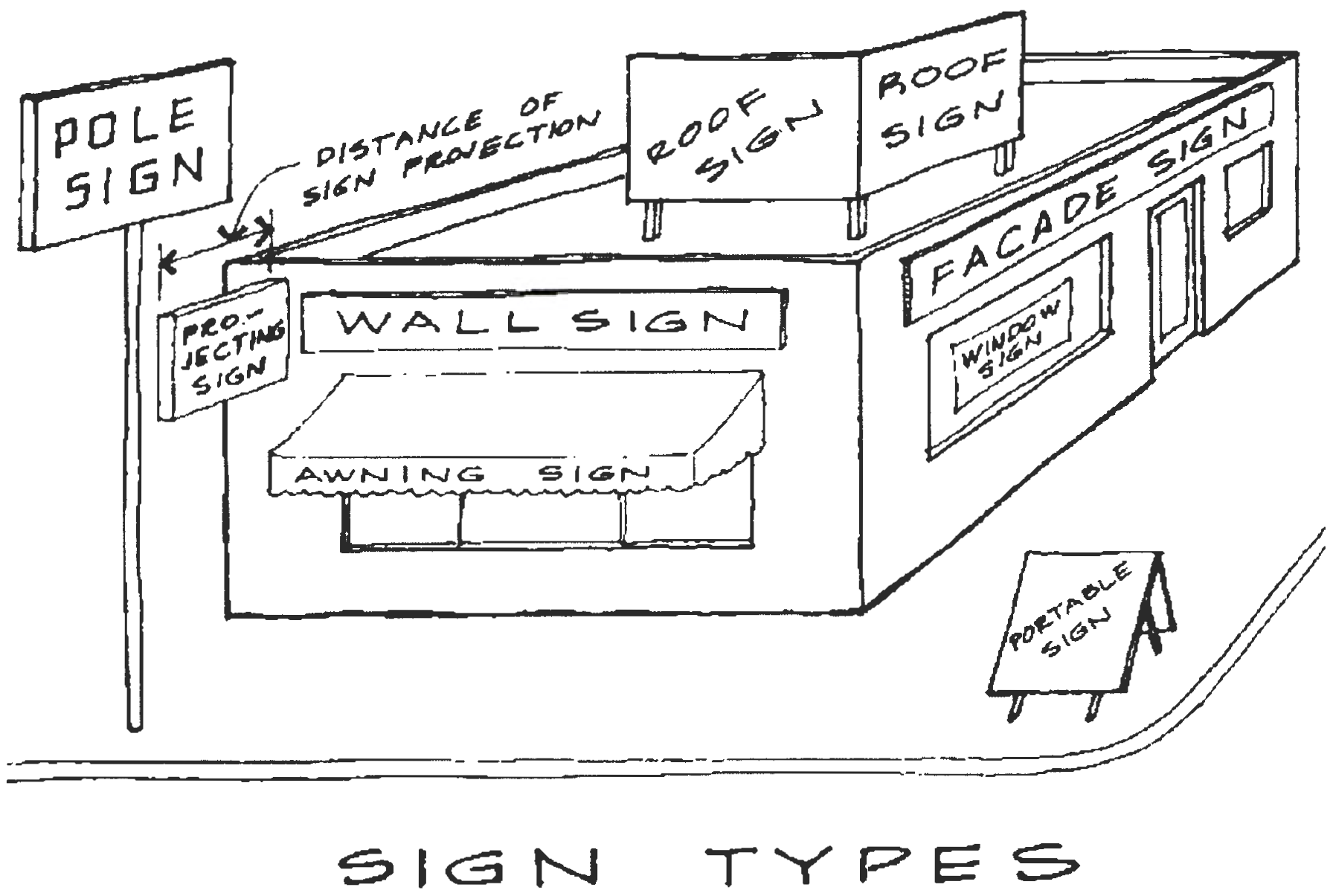
Canopy means a permanent roof-like structure projecting from a building and open on at least one side for the purpose of shielding a pedestrian walkway from the elements, or a freestanding roof-like structure supported by columns intended to shield a vehicular driveway or service area from the elements.
Changeable copy sign includes but is not limited to the following:
(1)
Automatic changeable copy sign means a sign on which the copy changes automatically on a lamp bank or through mechanical means (e.g., electrical or electronic time and temperature units). The term "copy" means words, numbers and/or pictorial representations.
(2)
Manual changeable copy sign means a sign on which copy is changed manually in the field (e.g., reader boards with changeable letters). Copy shall mean words and numbers.
Channeled letters (internally illuminated letters) includes but is not limited to the following:
(1)
Internally channeled letters means letters or other symbols with recessed surfaces designed to accommodate incandescent bulbs or luminous tubing.
(2)
Reverse channeled letters means letters or other symbols with raised surfaces designed to be lighted from behind.
Double-faced sign means a sign structure with two sign faces that are parallel (back-to-back) or that form an angle to one another of no more than 60 degrees, where each sign face is designed to be seen from a different direction.
Festoons means strings of ribbons, tinsel, small flags, pennants, streamers, pinwheels, or other devices or long narrow strips of fabric, plastic, or other pliable material designed to move in the wind.
Flashing sign means a sign that contains an intermittent or sequential flashing light source used primarily to attract attention. It does not include electronic signs.
Freestanding sign means a sign permanently attached to the ground and that is wholly independent of any building or other structure. The term "freestanding sign" includes but is not limited to the following:
(1)
Pole or pylon sign means a sign that is mounted on a freestanding pole, pylon, columns, or similar support such that the bottom of the sign face or lowest sign module is not in contact with the ground.
(2)
Monument sign means a freestanding sign in which the entire bottom of the sign face or structure is in contact with the ground, providing a solid and continuous background for the sign face from the ground to the top of the sign.
Frontage, building, means the width in linear feet of the front exterior wall of a particular establishment.
Frontage, road, means the width in linear feet of each lot where it abuts the right-of-way of any street.
Holiday means a day fixed by law or custom commemorating an event or honoring a person.
Illuminated signs includes but is not limited to the following:
(1)
Internally illuminated sign means a sign that is illuminated by an artificial light source from within the sign structure, usually projected through a transparent or translucent sign face.
(2)
Externally illuminated sign means any sign that is only illuminated by an artificial light source that directly or indirectly illuminates the face of the sign from outside the sign structure.
Incidental building sign means a small sign, emblem, or decal no larger than six square feet located on a building or structure. Such signs are normally located on doors, windows, and gas pumps, and are generally not readily visible or legible from public rights-of-way.
Internally illuminated letters. See channeled letters.
Mansard means a steeply sloped, roof-like facade architecturally similar to a building wall.
Mansard sign. See building sign.
Marquee means a permanent roof-like structure or canopy of rigid materials supported by and extending from the façade of a building.
Marquee sign. See building sign.
Minimum front setback means the minimum distance required by the zoning on a property between an adjoining street and the facade of a principal building on the property.
Monument sign. See freestanding sign.
Multi-faced sign means a single sign structure consisting of two sign faces (see double-faced sign) or three or more sign faces that are separated from each other at their nearest point by no more than three feet. Sign faces on a single sign structure that are separated by more than three feet are treated as separate signs.
Pennant means any lightweight plastic, fabric or similar material designed to move in the wind; pennants are often suspended from a rope, wire, or string in series. The term "pennant" shall not include a banner as defined in this chapter.
Planned center means a building or group of buildings occupied by two or more retail stores, service establishments, offices, industries or any other businesses that do not share common space, which is located on a property that is in common ownership or condominium ownership. Buildings that are occupied by two or more businesses that share common space, such as but not limited to a branch bank in a grocery store, a fast-food restaurant in a merchandise store, or booths in a flea market, are not considered planned centers.
Pole or pylon sign. See freestanding sign.
Portable sign means a sign designed to be transported or easily relocated and not permanently attached to the ground, such as but not limited to the following:
(1)
A sign designed to be temporarily placed upon the ground and not otherwise permanently affixed to it as otherwise required by the building code;
(2)
A sign mounted on a trailer, with or without wheels; or
(3)
A sidewalk, sandwich board or curb-type sign.
Principal building sign means the main, predominant or largest sign on an individual wall of a building or tenant space.
Principal freestanding sign means the main, predominant or largest freestanding sign on a property.
Project entrance sign means a permanent freestanding sign located at a discernible entrance into a multi-family development, or into a development containing multiple lots, such as but not limited to a particular residential or commercial subdivision, business center, office park or industrial park.
Projecting sign. See building sign.
Roof sign. See building sign.
Sidewalk or sandwich sign means a moveable sign not permanently secured or attached to the ground or surface upon which it is located.
Sign means any structure, display, or device that is used to advertise, identify, direct, or attract attention to a business, institution, organization, person, idea, product, service, event, or location by any means, including words, letters, figures, design characteristics, symbols, logos, fixtures, colors, movement, or illumination.
Sign face means that portion of the surface of a sign structure where words, letters, figures, symbols, logos, fixtures, colors, or other design elements are or may be located in order to convey the message, idea, or intent for which the sign has been erected or placed. The sign face may be composed of two or more modules on the same surface that are separated or surrounded by open space or by portions of a sign structure not intended to contain any advertising message or idea, and are purely structural or decorative in nature.
Sign module means each portion or unit of a sign face that is clearly and physically separable from other such units by virtue of the expression of a complete thought, message, logo, or idea.
Sign structure means all elements of a freestanding sign, including the sign face, background, or decorative elements related to the presentation or support of the sign's message, and the structural supports.
Swinging or projecting sign means a sign projecting perpendicularly from the outside wall of the building upon which it is located. See projecting sign under building sign.
Tenant means a natural person, business or other entity that occupies land or buildings by ownership, under a lease, or through payment of rent; an occupant, inhabitant, or dweller of a place.
Under-canopy sign. See building sign.
Vehicular sign means any sign placed on, mounted on, painted on or affixed to a motor vehicle, freight, flatbed or storage trailer or other conveyance when same are placed or parked in such a manner as to be viewed or intended to be viewed from the public right-of-way, except that this definition shall not apply when:
(1)
Such conveyances are actively being used to load, transport or unload persons, goods or services in the normal course of business;
(2)
Such conveyances are parked in an inconspicuous area, such as but not limited to a loading dock, to the side or rear of a building away from the street, or in a designated parking space in reasonable proximity to the place of business; or
(3)
Such conveyances are actively being used for storage of construction materials for, and on the same lot with, a bona fide construction project for which building and other applicable permits have been issued and where construction is underway, and provided said conveyances are located within designated storage areas.
Wall sign. See building sign.
(h)
Computation of sign area. In order to determine compliance with the maximum allowable sign areas permitted under this chapter, the following shall establish how sign areas are measured.
(1)
Sign face area.
a.
The area of a sign face shall be computed as the area within the smallest rectangle enclosing the limits of a sign face, or the combination of the areas of all such rectangles delimiting each sign module, together with any frame or material, texture, or color forming an integral part of the sign face or used to differentiate the sign face from the structure upon which it is placed.
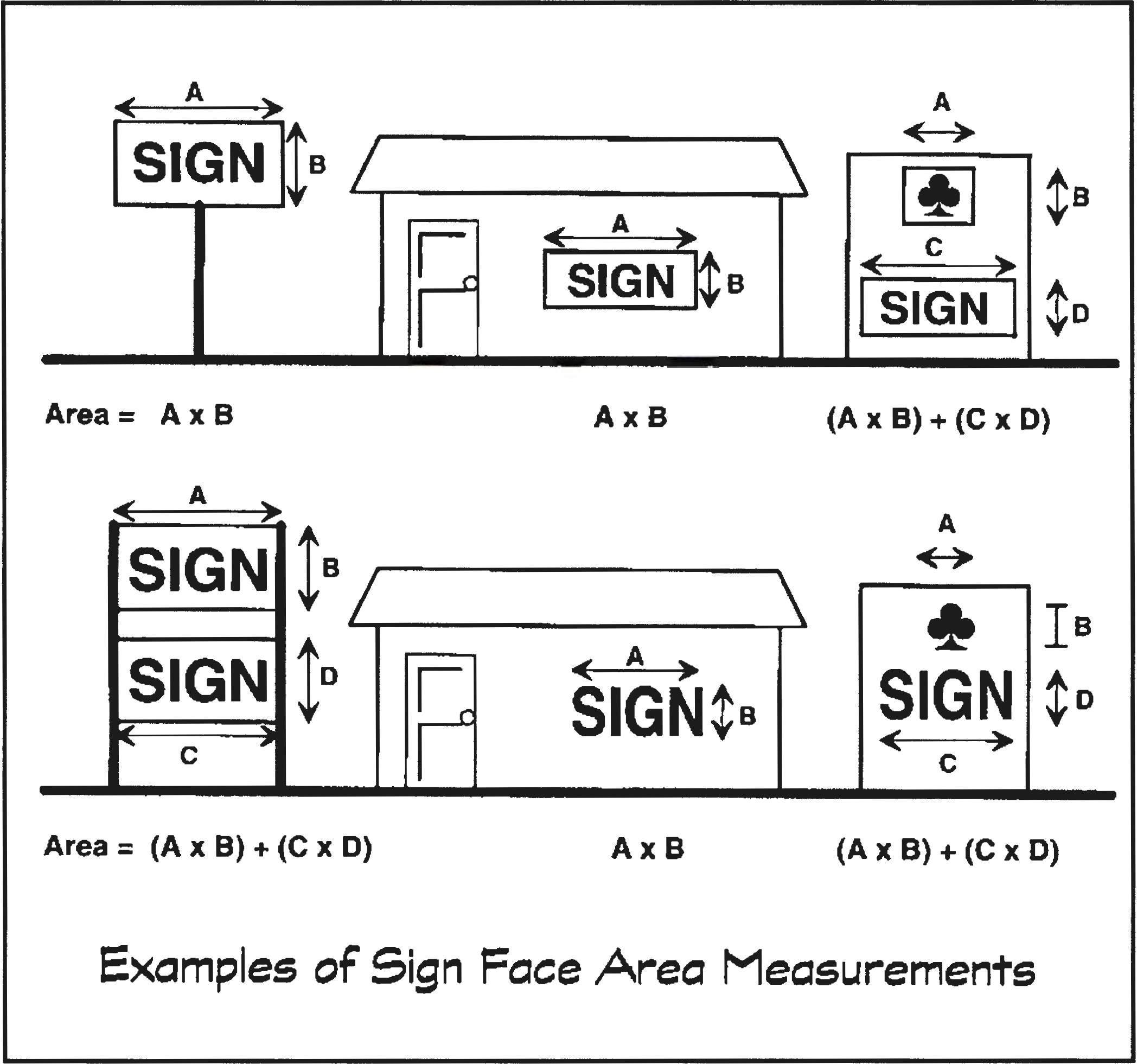
b.
For signs that have no identifiable frame or border, the smallest rectangle that includes all of the sign's words, letters, figures, symbols, logos, fixtures, colors, or other design elements intended to convey the sign's message shall establish the area of the sign's face.
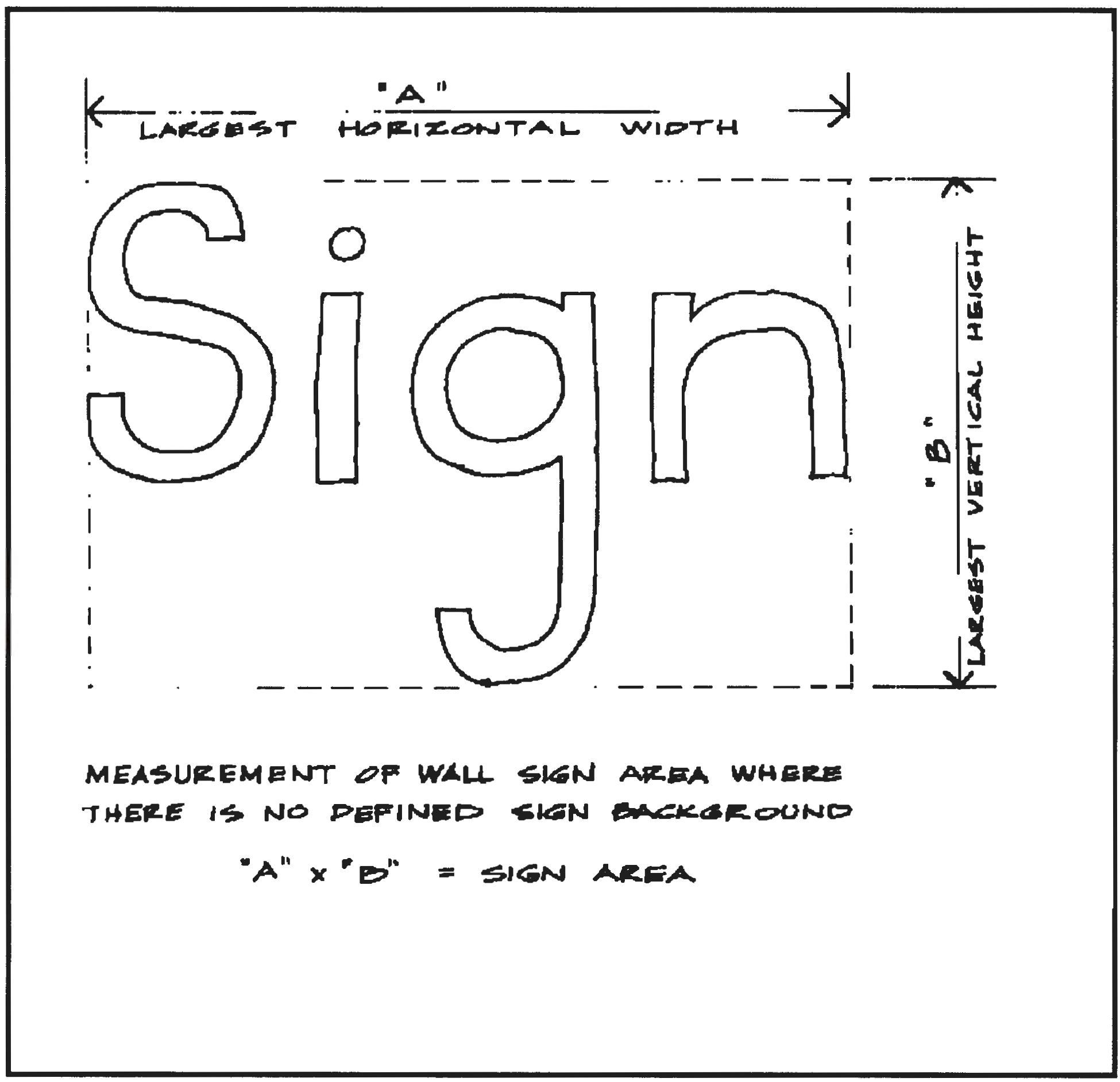
c.
For signs applied to a kiosk or other cylindrical sign structure, the area of the sign face shall be computed as the largest rectangular area achieved from any one view of the sign. Measurements shall be made as a flat plane rectangle projected on the sign.
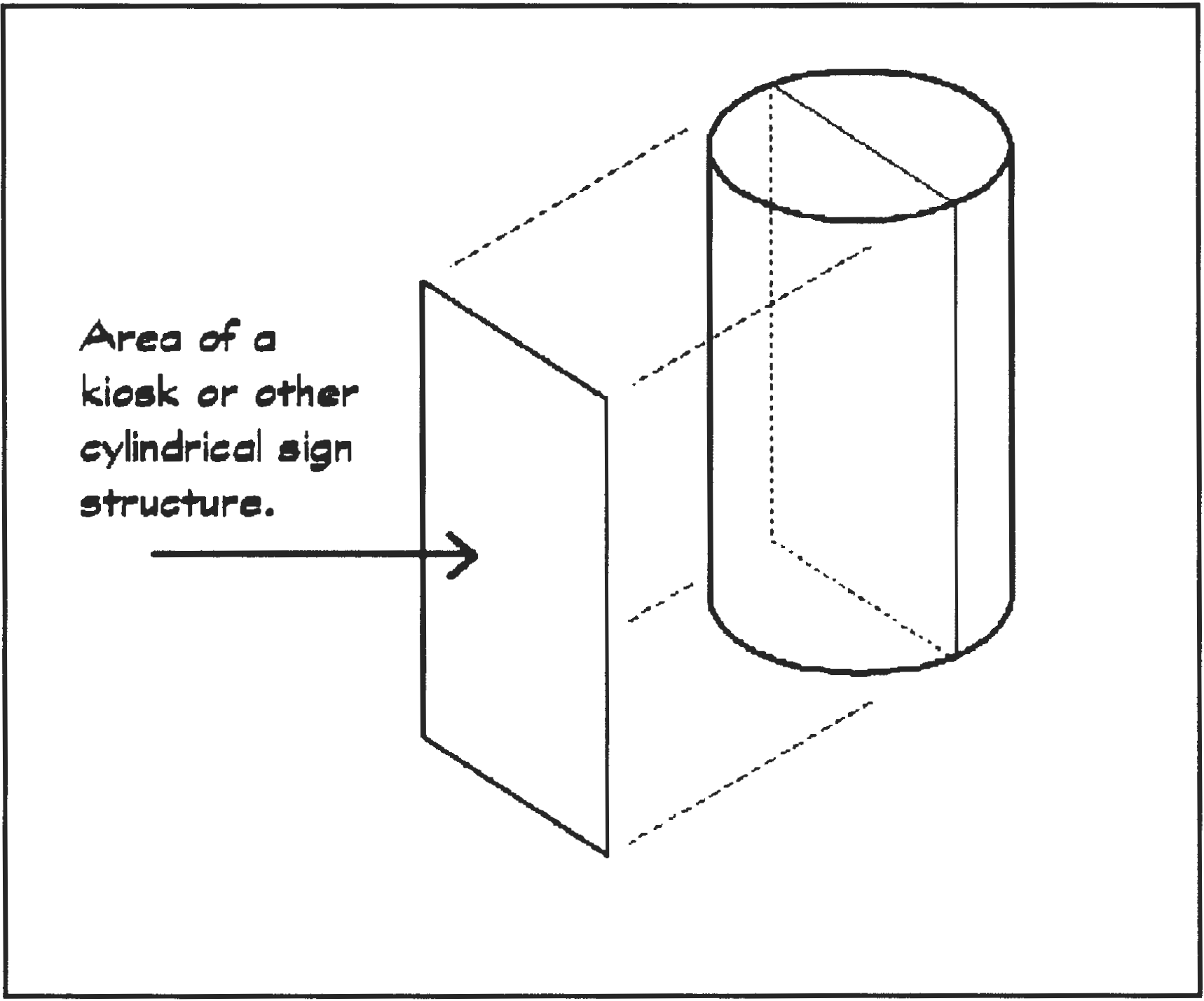
d.
The computation of the area of a sign face shall not include the structure, supports, or uprights on which the sign face is placed or any portions of a sign structure that are not intended to contain any message or idea and are purely structural or decorative in nature, other than those portions contained within the rectangle that delimits the sign face or a sign module.
e.
Automatic or manual changeable copy signs. For any sign on which any of the words, letters, figures, symbols, logos, fixtures, colors, or other design elements are routinely changed or are intended to be changed from time to time, the sign face area shall include the entire area within which any words, letters, figures, symbols, logos, fixtures, colors, or other design elements may be placed, together with any frame or material, texture, or color forming an integral part of the sign face or used to differentiate the sign face from the structure upon which it is placed.
(2)
Treatment of open spaces. Any open space contained within the limits of the rectangle delimiting the sign face, sign module, or sign structure shall be included in the computation of the area of such sign face, sign module, or sign structure. For window signs, open spaces or clear backgrounds designed to allow an unobstructed view into a place of business shall not be counted toward the maximum allowable sign face area.
(3)
Multi-faced signs.
a.
Double-faced signs. For double-faced signs, when the sign face surfaces are parallel (back-to-back), or where the smallest angle formed between the two faces is 60 degrees or less, the area of the sign shall be taken as the area on the largest side. For double-faced signs where the interior angle formed by the faces is more than 60 degrees, the area of the sign shall be the total area of all sides.
b.
Signs with three or more faces. For sign structures having only three faces and the interior angle formed between each of the faces is 60 degrees, the area of the sign shall be taken as the area on the largest side. For all other multi-faced signs with three or more sides, the area of the sign shall be the largest total of all faces that are joined by an interior angle of more than 60 degrees that can be viewed from any one direction.
(i)
Measurement of sign height and distance.
(1)
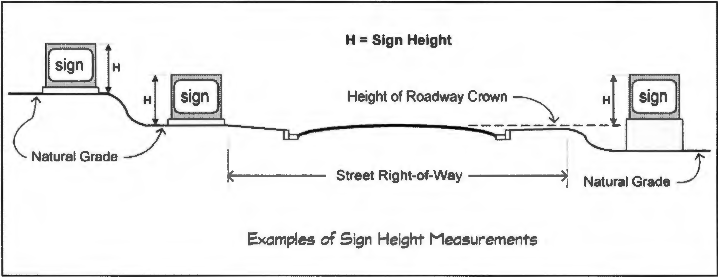
Sign height. The height of a sign shall be equal to the vertical distance from the average grade at the base of the sign, or from the crown of the roadway of the nearest street if the street is within 100 feet of any portion of the sign (when measured perpendicular to the street), to the highest point of any portion of the sign, whichever results in the greater sign height. Any earthen berms and elevated foundations supporting signs, signposts or other sign supports shall be included in the height of the sign.
(2)
Measurement of distance. Minimum distances required hereunder shall be measured along the shortest straight line from the nearest point on a sign structure to the nearest point on a property line, sign structure, building or structure to which the minimum distance requirement applies.
(j)
Signs that are regulated.
(1)
Applicability. The regulations and requirements of this chapter apply to all signs that are or are intended to be viewed from a public right-of-way, a private street or adjacent property, except as otherwise exempt under this section.
(2)
Exclusions. The following are not considered signs and are excluded from all restrictions and regulations imposed by this chapter:
a.
Window displays not visible from a public or private street or from adjoining property are not considered to be signs and are exempt from these sign regulations.
b.
Words and/or graphics on products that are an integral part of the product, the product's original packaging, and product dispensers (such as but not limited to a soft drink machine) are not considered to be signs and are exempt from these sign regulations. Product containers intended for the storage of products are not exempt from these regulations.
c.
A building design, color, architectural element or motif that is associated with a particular establishment or organization but which conveys no message is not considered to be a sign and is exempt from these sign regulations.
(3)
Exemptions. Each of the following types of signs is allowed on any property and is exempt from the restrictions imposed by this chapter:
a.
Official signs. Signs placed by or at the direction of a governmental body, governmental agency, board of education or public authority pursuant to O.C.G.A. § 32-6-50 et seq. As provided by O.C.G.A. § 32-6-51, such signs are authorized within all rights-of-way or other properties controlled by such governmental body, agency, board of education or public authority and at such other locations as a governmental body, governmental agency or public authority may direct.
b.
Incidental signs. Small signs no more than six square feet, provided that the aggregate of all such signs on a property may not exceed 16 square feet unless a larger aggregate area is required by law or government regulation.
(k)
Prohibited signs. Unless otherwise exempt under Section 90-135(j)(3), the following types of signs are prohibited:
(1)
Animated and flashing signs.
a.
Signs (excluding automatic changeable copy signs) that flash, blink, and signs containing reflective elements that sparkle in the sunlight or otherwise simulate illumination during daylight hours are not allowed.
b.
For automatic changeable copy signs, see subsection (u)(3).
(2)
Attached and painted signs. Signs that are painted on or attached to trees, curbs, utility poles, or rocks or other natural features are not allowed.
(3)
Courtesy benches, trash cans, etc.. Courtesy benches, trash cans, and similar devices on which a sign is displayed are not allowed.
(4)
Dilapidated signs. Signs that are dilapidated or in such condition as to create a hazard, nuisance or to be unsafe or fail to comply with any provision of the building code, are not allowed.
(5)
Festoons. Strings of ribbons, tinsel, small flags, pennants, streamers, pinwheels, balloons or other devices, or long narrow strips of fabric, plastic, or other pliable material designed to move in the wind or by mechanical fan are not allowed.
(6)
Misleading statements. It is unlawful for a person to display false or misleading statements upon signs or other public places calculated to mislead the public as to anything sold, services to be performed, or information disseminated. The fact that any such sign or display contains words or language sufficient to mislead a reasonable or prudent person shall be prima facie evidence of a violation of this section by the persons displaying such sign or permitting such sign to be displayed at their residence, establishment or place of business.
(7)
Obscene signs. Obscene signs, as defined by the state at O.C.G.A. § 16-12-80(b), are not allowed.
(8)
Obstructions. No sign shall obstruct any fire escape, window, door, or opening usable for fire prevention or suppression, or prevent free passage from one part of a roof to any other part thereof. No sign shall extend above a parapet wall, be affixed to a fire escape, or interfere with any opening required for ventilation.
(9)
Pole or pylon signs. Signs meeting the definition of pole or pylon as defined in this chapter are not allowed as principal freestanding signs, unless specifically allowed by subsection (v)(2).
(10)
Portable signs. A sign designed to be transported or easily relocated and not permanently attached to the ground, such as but not limited to the following, is not allowed:
a.
A sign designed to be temporarily placed upon the ground and not otherwise permanently affixed to it as otherwise required by the building code;
b.
A sign mounted on a trailer, with or without wheels.
(11)
Private signs placed on public property. Any sign posted or erected on utility poles, public rights-of-way or any other public property as regulated by O.C.G.A. § 16-7-58 et seq. is not allowed, except as required or authorized by O.C.G.A. § 32-6-50 or any other law.
(12)
Roof signs. Roof signs, including signs painted or adhered on roofs, are not allowed. This prohibition does not apply to the fascia portion of a mansard roof, or to the face of a parapet wall, provided that the sign must not extend above the top of the mansard roof or parapet wall.
(13)
Rope lighting. LED or otherwise illuminated rope lighting used to outline windows, doors, or building features is prohibited.
(14)
Searchlights and similar devices. Searchlights and similar devices are not allowed.
(15)
Signs advertising illegal activity. Signs that advertise an activity illegal under state or federal law are not allowed.
(16)
Signs imitating public warning or traffic devices.
a.
Any sign that displays intermittent lights resembling the flashing lights customarily used in traffic signals or in police, fire, ambulance, or rescue vehicles, and any sign that uses the words "stop," "go," "slow," "caution," "danger," "warning" or other message or content in a manner that might mislead or confuse a driver, is not allowed.
b.
Any sign that uses the words, slogans, dimensional shape or size, or colors of governmental traffic signs is not allowed.
c.
No red, green, and yellow illuminated sign shall be permitted within 300 feet of any traffic light.
(17)
Sound or smoke emitting signs. A sign that emits or utilizes in any manner any sound capable of being detected on any traveled road or highway by a person with normal hearing, or a sign that emits smoke, vapor or odors, is not allowed.
(18)
Vehicular signs. Any sign that meets the definition of a vehicular sign as defined in this chapter is prohibited.
(l)
Business license and insurance for sign contractors required. It shall be unlawful for any person to engage in the business of erecting or maintaining signs within the county unless and until such person has obtained a business license issued in the state and a certificate of insurance from an insurance company authorized to do business in the state evidencing that the person has in effect public liability and property damage insurance providing coverage in the sum of $25,000.00 for property damage for any one claim and public liability insurance in an amount not less than $100,000.00 for injuries, including accidental death, to one person. The certificate of insurance shall state that the insurance carrier will notify the county 30 days in advance of any termination or restriction of the coverage.
(m)
Enforcement. The division director or designee is responsible for general administration of this chapter; the receipt, review and processing of all applications for sign permits; and all sign variance requests filed with the county.
(n)
Removal of illegal or abandoned signs.
(1)
Removal order. The division director or designee may order the removal of any sign in violation of this chapter, or any sign abandoned for 12 consecutive months or more, by written notice to the permit holder; or if there is no permit holder, then to the owner of the property on which the sign is erected; or if the property owner cannot be found or cannot be determined, then to the sign erector and any party that procured the erection of the sign. If a permit was issued, such notice shall operate to revoke the permit. The removal order shall be issued only after the appropriate party fails to comply within seven days after the county gives written notice of noncompliance.
a.
Exception; vehicular signs. The division director or designee may order the removal of any vehicular sign in violation of this chapter after the appropriate party fails to comply within 24 hours after the county gives written notice of noncompliance.
(2)
Procedure following removal order. An aggrieved party may appeal the removal order within ten days from the date that the notice was mailed. Such appeal shall be made to the board of commissioners. If the sign is not removed within 30 days after the order of removal (or 30 days after the date any appeal becomes final), the division director or designee is authorized to remove the sign or cause the sign to be removed the sign and to collect the costs thereof as provided below.
(3)
Removal without notice.
a.
The division director or designee or any other agent of the county having jurisdiction under the circumstances may remove or direct the removal of any sign in violation of this chapter, without giving notice to any party, if:
1.
Said sign is illegally placed upon the public right-of-way or upon other public property; or
2.
Said sign poses an immediate safety threat to the life or health of any members of the public.
b.
Following such removal, the county may collect the costs as provided in subsection (4) of this section.
(4)
Costs of removal.
a.
Removal of any sign found in violation shall be without liability to the county, its officers, agents, and employees. The permit holder shall be primarily responsible for the costs of removal. If there is no permit holder, then the property owner shall be responsible. If the sign owner cannot be determined, then the costs of removal shall be the responsibility of any party that procured the erection of the sign.
b.
If payment or arrangement to make payment is not made within 60 days after the receipt of a statement of removal costs, the division director or designee shall certify the amount thereof for collection to the county attorney.
c.
Costs of removal shall be charged in accordance with a fee schedule established by the county or at the actual cost to the county, whichever is more appropriate to the action taken.
(o)
Sign permits.
(1)
When required. In addition to a building permit as may be required under the building code, a sign permit shall be obtained from the division director or designee prior to installation, relocation, expansion, construction or structural alteration of any sign regulated under this chapter except for those signs specifically exempted under subsection (2) of this section.
(2)
Exemptions.
a.
A sign permit will not be required under the following conditions:
1.
Painting, repairing, cleaning, or maintaining a sign shall not require a sign permit unless a structural change is made.
b.
A sign permit will not be required for the following listed signs, provided that such signs meet the requirements of this chapter:
1.
A sign that is otherwise exempt from regulation under subsection (j)(3) does not require a sign permit.
2.
A freestanding sign on a single-family or two-family residential property and no larger than six square feet does not require a sign permit.
3.
Miscellaneous freestanding signs that are allowed under subsection (w)(2) and (w)(3) do not require a sign permit.
(p)
Issuance of a sign permit.
(1)
Review required. For any sign requiring issuance of a sign permit under the provisions of this chapter, review of a completed application shall be required prior to installation, relocation, renovation, expansion, construction or reconstruction of the sign. The sign application, with the nonrefundable application fee established by the county, shall be submitted to the division director or designee.
(2)
Sign permit application. Applications for sign permits shall be filed by the sign owner or his agent in the office of the division director or designee upon forms furnished by this office. The application shall describe and set forth the following:
a.
The type of the sign as defined in this chapter.
b.
The value of the sign.
c.
The street address of the property upon which the subject sign is to be located, and the proposed location of the subject sign on the subject property. In the absence of a street address, a method of location acceptable to the division director or designee shall be used.
d.
The square foot area of the sign face and the sign structure, and the aggregate square foot area if there is more than one sign face.
e.
The name and address of the owner of the real property upon which the subject sign is to be located.
f.
The written consent of the owner or his agent granting permission for the placement or maintenance of the subject sign.
g.
A sketch or print drawn to scale showing all pertinent information required by the division director or designee, such as wind pressure requirements and display materials. The division director or designee may require additional information on such print or sketch to ensure compliance with this chapter.
h.
The name, address, telephone number and business license number of the sign contractor.
i.
A site plan drawn to scale or elevation drawing showing the placement of the sign, including its relation to any existing or proposed landscaping. To the greatest practical extent, signs shall be located in a manner that reduces conflicts with existing or proposed landscaping.
j.
Plans for a planned center or mixed use development signage in accordance with the master signage plan requirements of subsection (q).
(3)
Conformance to building codes.
a.
Plans required for issuance of a sign permit shall be certified as to conformance with all structural and wind-load resistive standards of the building code by a qualified structural engineer, or be prepared using standard drawings prepared by a structural engineer or other qualified professional meeting, or exceeding all requirements of the building code, if applicable.
b.
All signs involving internal lights or other electrical devices or circuits shall display a label certifying it as being approved by the Underwriters Laboratories, Inc.
c.
All electrical service to a sign shall be in compliance with the electrical code. A licensed electrical contractor must obtain an electrical permit and wire the sign to code.
d.
Clearance from all electrical power lines shall be in conformance with the requirements of the electrical code.
(4)
Issuance of sign permit.
a.
The county shall process all sign permit applications within 30 days of the county's actual receipt of a complete application for a sign permit. Revisions or amendments to an application shall extend the review period to 30 days from the date of submission of the revision or amendment. Revisions or amendments received after the issuance of a permit shall constitute a new application.
1.
The division director or designee shall reject any application as incomplete that does not include all items required for a sign permit application as set forth under subsection (b) of this section.
2.
The division director or designee shall reject any application containing any false material statements or omissions. Any rejected application later resubmitted shall be deemed to have been submitted on the date of resubmission instead of the original date of submission.
b.
Within 30 days of receipt of a complete application, the division director or designee shall:
1.
Issue the permit; or
2.
Inform the applicant of the reasons why the permit cannot be issued.
c.
Upon determination that the application fully complies with the provisions of this chapter, the building code, and all other applicable laws, regulations and chapters of the county, the sign permit shall be issued by the division director or designee.
d.
Should it be determined that a sign permit was issued pursuant to an application containing a false material statement, the division director or designee shall revoke the subject sign permit and the subject sign shall be removed. A revocation pursuant to this section shall be appealable pursuant to the appeal procedures of this chapter.
(5)
Permit fee; registration of existing signs.
a.
No sign permit shall be issued until the appropriate application has been filed with the division director or designee and fees have been paid as provided in this subsection. The fee for such permits shall be based on the square footage of each sign face. If a sign has more than one face, the square footage for purposes of determining the permit fee shall be computed from the sign face with the greatest square footage. The permit fee shall be fixed from time to time by the board of commissioners.
(q)
Master signage plans.
(1)
Approval required. Signage for a planned center or a mixed use development, whether new or existing, may be established by approval of a master signage plan in accordance with the provisions of this section.
(2)
Master signage plan approval.
a.
Master signage plans must be approved by the board of commissioners pursuant to section 90-180 prior to the issuance of any sign permits for the planned center or mixed use development.
b.
An application for master signage plan approval shall be submitted to the planning services director or designee.
(3)
Master signage plan standards. Standards as to type, number, size, height, location, orientation or other design provisions established in addition to or in lieu of the restrictions placed on signs by this chapter are to be incorporated into the master signage plan.
a.
Master signage plans shall illustrate all proposed signs in sufficient detail so as to provide knowledgeable review and design specificity. Master signage plans shall show, describe or illustrate all signs proposed to be located on a lot and the buildings and structures therein, whether existing or new, and whether permitted by right or as additional signage under these regulations.
b.
Signs that are otherwise exempt under this chapter need not be shown on the master signage plan.
c.
Upon approval, the master signage plan shall supersede any conflicting restrictions and regulations of this chapter for the property to which it pertains.
(r)
Nonconforming signs.
(1)
Defined.
a.
A nonconforming sign is a sign that does not comply with one or more of the regulations or restrictions imposed by this chapter.
b.
A legal nonconforming sign is a freestanding sign or building sign that was lawfully erected and maintained prior to the adoption or amendment of the ordinance codified in this chapter, and which by reason of such adoption or amendment no longer conforms to one or more of the applicable regulations and restrictions of this chapter as adopted or amended.
c.
Any sign that was not lawfully erected in accordance with the sign regulations in effect at the time of the sign's construction, or was subsequently altered in a way inconsistent with the sign regulations in effect at the time of its alteration, is considered an illegal sign and shall not be granted legal nonconformity status. Illegal signs are subject to removal.
(2)
Removal of nonconforming signs or abandoned signs. When a business or service is discontinued, all nonconforming signs relating to the business or service, including all nonconforming principal freestanding signs and sign structures and all nonconforming building signs, shall be removed after 12 months from the date of discontinuance.
(3)
Retention of legal nonconformity status.
a.
A legal nonconforming sign shall immediately lose its legal nonconforming designation and become an illegal sign if:
1.
The sign is altered in any way that would make the sign less in compliance with the requirements of this chapter than it was before the alteration;
2.
The sign is relocated on the property;
3.
The sign structure is replaced;
4.
The sign is abandoned for at least 12 months;
5.
The deterioration of the sign or damage for any reason to the sign makes it a hazard to public safety; or
6.
The sign has been damaged to such extent that repairs required to restore the sign would cost more than 50 percent of its current replacement value.
b.
On the occurrence of any of the foregoing, the sign shall be immediately brought into compliance with all requirements of this chapter or the sign shall be removed immediately.
(4)
Removal of abandoned signs. Signs that have been abandoned, as defined in this chapter, for 12 consecutive months or more shall be removed thereupon by the owner of the property on which they are located.
(5)
DOT action requiring removal of nonconforming sign.
a.
Where, as a result of design or other requirements imposed by the state department of transportation (DOT), a legal nonconforming sign, as defined herein, must be removed, such sign may be relocated on the same property upon the approval of the planning services director or designee. Such approval shall be granted upon the sign owner providing the planning services director or designee with written documentation of the actions of the DOT resulting in the required removal of the sign.
b.
In the event relocating the nonconforming sign would cause it to be less structurally sound than before its relocation, as determined by the planning services director or designee based on evidence provided by the sign owner consisting of certification provided by a qualified professional engineer registered in the state, the sign owner may construct a new sign on the property. A new sign constructed under this provision shall be substantially similar to the original nonconforming sign.
c.
Any sign relocated or constructed under this section shall be subject to all other requirements of this chapter and any other applicable ordinances of the county.
(s)
Appeals. If an applicant for a sign permit has been denied a permit by the director, the applicant may appeal this decision by filing a written request with the planning commission in accordance with the provisions of section 90-179.
(t)
General requirements applying to all signs.
(1)
Conformance to state law. Every sign erected in the county must comply with state law and the terms of this chapter and any other ordinance of the county. Between the state and the county regulations, such sign must comply with the most restrictive requirements with respect to each and every item of regulation.
(2)
Sign maintenance.
a.
All signs shall be maintained in good condition so as to present a neat and orderly appearance. The planning services director or designee may cause any sign to be removed, after due notice, if the sign shows gross neglect or becomes dilapidated, or if the ground area around the sign is not well maintained.
b.
The planning services director or designee will give the owner 14 days' written notice to correct the deficiencies or to remove the sign. If the owner refuses to correct the deficiencies or remove the sign, the division director or designee shall have the sign removed at the expense of the owner.
(3)
Minimum sign setback.
a.
No sign or sign structure of any kind is authorized to extend into or above, or be anchored or placed in any portion of a public right-of-way or easement (without an encroachment agreement) except as specifically provided in this chapter.
b.
No sign or sign structure of any kind shall be located less than ten feet from a side or rear property line.
3.
The minimum setback from a street right-of-way shall be as specified in subsection (v).
(4)
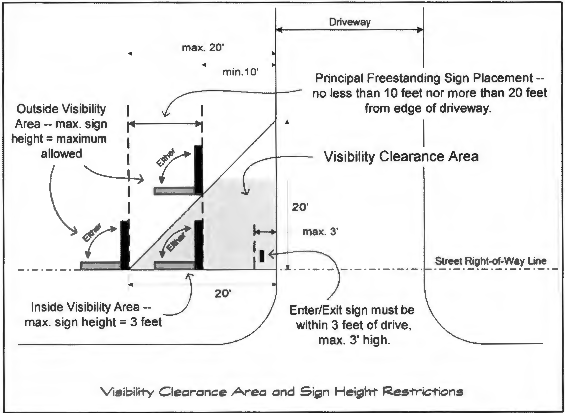
Visibility clearance area. Any portion of a sign located within 25 feet of the intersection of the right-of-way lines of streets or within 20 feet of the intersection of the edge of a driveway and the right-of-way line of a street shall be no more than 36 inches in height, nor shall such sign otherwise obstruct visibility or pose a threat to traffic safety.
(5)
Illuminated signs.
a.
Types of illumination.
1.
Externally illuminated sign. An externally illuminated sign, when permitted, shall have concealed wiring and controls, and shall have shielded and screened external light sources.
2.
Internally illuminated sign. Internally illuminated signs, where permitted, must completely shield the source of light from direct view.
b.
Traffic control. No sign illumination device shall resemble an official traffic control or warning sign, nor shall it hide from view or distract from any traffic or street sign or signal.
c.
Hazards. Illumination devices shall be placed, filtered, and shielded so direct rays will not be cast into the eyes of drivers or pedestrians.
d.
Light pollution. Sign illumination shall not cast light directly upon adjacent properties or roadways. No illuminated signs are allowed within 100 feet of any residential zoning district or property occupied by a dwelling.
e.
Exposed wires. No sign may have exposed electrical wires.
f.
Hours of illumination. No sign shall be illuminated between 11:00 p.m. and 6:00 a.m. except for those hours during which the premises on which the sign is located is open for business or events are taking place on the premises.
g.
UL listing. All components of an illuminated sign shall be underwriters laboratories (UL) listed, or the equivalent thereof, with an identification label that shows the manufacturer of the sign.
(u)
Signs allowed, by land use category.
(1)
Residential land uses. The following types of signs are allowed on residential properties:
a.
Project entrance signs in accordance with section (w)(4). Such signs may be externally illuminated only (see section 90-135(g).
b.
Other freestanding signage.
1.
Only one per frontage per property shall be located within the minimum front yard setback as determined by the zoning district applied to the property.
2.
No such sign shall be more than six square feet in area and three feet in height when located on a lot within a developed residential subdivision.
3.
Such signs shall not be illuminated.
c.
Wall signs.
1.
No wall signs are allowed on a single-family or two-family residence or accessory structure.
2.
Wall signs on a multifamily residential building: one wall sign per wall no more than 16 square feet in area.
(2)
Nonresidential and mixed land uses. The following types of signs are allowed on nonresidential, institutional or mixed use properties in the county:
a.
Principal signage.
1.
Properties occupied by a single business or multiple businesses sharing common space (i.e., not a planned center). One principal freestanding sign on each street frontage and one principal building sign per building elevation visible from a public or private street.
2.
Planned centers. One principal freestanding sign on each street frontage and one principal building sign for each business with an exterior wall visible from a public or private street.
3.
Size increase. Single businesses or planned centers with multiple frontages may be allowed a 25 percent increase over the allowed sign face area and height if only one sign is constructed.
4.
Undeveloped properties. One principal freestanding sign on each street frontage.
b.
Permanent project entrance signs for a residential subdivision or mixed use development, with a maximum area of 32 square feet and maximum height of eight feet. Such signs may not be internally illuminated.
(3)
Automatic changeable copy signs. Automatic changeable copy signs are allowed only on commercial, industrial, and institutional properties, and only allowed as part of a principal freestanding sign, except that such signs that display a message for less than two seconds are prohibited.
(4)
Rear entrance signs.
a.
One rear entrance sign is required for each tenant within a planned center.
b.
Rear entrance signs shall be located on the tenant's rear door and shall list the tenant and suite number.
c.
The area of rear entrance signs shall not exceed three square feet; however, the sign may not be less than 18 inches wide and 12 inches high and shall be clearly legible for public safety personnel.
(v)
Size, height and setback requirements.
(1)
Building signs, nonresidential uses. Building signs are subject to the following restrictions:
a.
The maximum sign area allowed on each building elevation visible from a public or private street shall be in accordance with the table in subsection (v)(3).
b.
A building sign may not project higher than the wall or surface to which it is attached.
c.
A building sign may not project more than 18 inches from the wall surface unless approved as a swinging or projecting sign as defined by subsection (g).
d.
Projecting signs.
1.
Projecting signs, if allowed by the division director or designee, shall not project more than 42 inches beyond the face of the building, nor exceed 16 square feet in area.
2.
Projections shall be at a 90-degree angle to the building face.
3.
All sides of a projecting sign shall be finished.
e.
Miscellaneous building signs as allowed under section (w)(3).
f.
Building signs may be internally or externally illuminated.
g.
Ground clearance under signs.
1.
Projecting signs shall provide a minimum of eight feet of clearance from ground level to the bottom of the sign.
2.
Under-canopy signs of greater than four square feet shall be rigidly mounted, and there shall be eight feet of clearance below the base of any rigidly mounted under-canopy sign. There shall be a minimum clearance of seven feet below the base of any non-rigidly mounted under-canopy sign.
3.
Awning, mansard and marquee signs shall be no less than eight feet above the ground when erected over pedestrian walkways at the lowest extremity of the sign.
(2)
Principal freestanding signs, nonresidential uses. Principal freestanding for commercial, institutional or industrial uses are subject to the following restrictions:
a.
Maximum sign face area and height shall be in accordance with subsection (v)(3).
b.
Minimum setback is 13 feet from the curb or five feet behind the right-of-way, whichever is greater. See subsection (t)(4) regarding the visibility clearance area. No more than one principal freestanding sign may be located within the minimum front yard as specified by the zoning district applied to the property.
c.
The principal freestanding sign authorized by such street frontage shall be located in accordance with subsection (t)(4).
d.
Principal freestanding signs shall be separated from other principal freestanding signs as follows:
1.
Signs 48 square feet in area or less. Each principal freestanding sign having an area of 48 square feet or less shall be located at least 50 feet from any other principal freestanding sign on the same side of the street. The division director or designee may reduce this distance if it cannot be met due to the location of existing signs on separate but adjoining lots. Such reduction shall be the minimum required in order to maintain the greatest separation possible from such existing signs.
2.
Signs between 48 and 99 square feet in area. Each principal freestanding sign having an area of between 48 and 99 square feet shall be located at least 100 feet from any other principal freestanding sign on the same side of the street. The division director or designee may reduce this distance if it cannot be met due to the location of existing signs on separate but adjoining lots. Such reduction shall be the minimum required in order to maintain the greatest separation possible from such existing signs.
3.
Signs greater than 99 square feet in area. Each principal freestanding sign having an area greater than 99 square feet shall be located at least 1,000 feet from any other principal freestanding sign having an area greater than 99 square feet, and at least 100 feet from any other principal freestanding sign on the same side of the street. Distance measurements are to be made horizontally in all directions from the nearest edge of the sign structure.
e.
Principal freestanding signs located within 100 feet of a public right-of-way shall display the street address of the property. Within a planned center where multiple addresses exist, the highest and lowest street address numbers shall be identified. This section does not apply to any principal freestanding sign where the sign is located on property that has more than one street frontage and the property address is assigned from a street other than the street frontage whereupon such sign is erected. Street numbers shall be of contrasting colors against the background, visible from both directions of travel along the street, no less than six inches or more than nine inches in height.
f.
Miscellaneous freestanding signs as allowed under subsection (u).
g.
Principal freestanding signs may be internally or externally illuminated.
h.
Monument signs are preferred. Pylon signs shall be allowed, provided that the pylon is no smaller than 36 inches wide. Pylon materials shall coordinate with those of the primary structure(s) on the site.
(3)
Table of Maximum Size and Height Requirements.
(4)
Signs in planned centers. Signs in planned (i.e., multitenant) centers must adhere to the minimum requirements of this article or uniform guidelines established by master signage plans. Master signage plans are to be filed with the division director or designee and approved by the board of commissioners prior to issuance of a sign permit.
(5)
Canopy signs. Canopy signs are restricted to one canopy sign, not to exceed 12 square feet per side facing public or private road.
(6)
Double frontage and corner lots. Where any lot, parcel, or tract of land exists and has frontage on two or more streets, only one principal freestanding sign per road frontage shall be allowed. Each such sign shall conform to the requirements of section 111-73(b) individually.
(7)
Window signs. Window signs, as defined by this section, placed on, inside, or outside of the window may obstruct no more than 50 percent of the window area. Window signs shall not obstruct a clear line of sight into the place of business.
(8)
Signs along arterial roadways. Signs for nonresidential uses on parcels with frontage on roadways classified as arterials shall be granted size and height increases not to exceed 25 percent over the maximum sizes and heights allowed in subsection (v)(3). Size and height increases will be allowed on the following roads:
(9)
Interstate signs. Maximum sign face area and height of freestanding signs on non-residential parcels within 660 feet of the right-of-way of any interstate highway shall be allowed in accordance with subsection (v)(3).
(w)
Other signs allowed.
(1)
Billboard signs.
a.
Billboard signs shall be erected or placed in conformity with the side, front and rear setback requirements for permanent structures for the district in which the sign is located.
b.
No billboard sign shall be erected which contains a sign face that exceeds 750 square feet in area, or which is more than 60 feet in height above ground level, or 55 feet in length. The bottom coping of a billboard sign shall be at least three feet above ground or street level.
c.
The erection, construction or maintenance of billboard signs shall be limited to properties adjacent to either side of the right-of-way of roads designated as part of the state road system, excluding roads which are temporarily designated as part of the state road system, which properties are located in the C-2, C-3, M-1 and M-2 zoning districts; provided, however, that no billboards shall be constructed or maintained in the ETCOD (Evans Town Center Overlay District), and no billboard shall be constructed or maintained in any location which is more than 500 feet from an operating commercial or industrial building.
d.
Billboard signs erected adjacent to interstate highways shall not be located closer than to 500 feet to another billboard sign. No more than two billboard signs are allowed per quadrant of any interchange adjacent to an interstate highway. These signs shall be restricted to an area of 1,200 feet long in each quadrant beginning 550 feet from the road that crosses the interstate highway or 500 feet beyond the point where the pavement begins to widen on the main travelway of the interstate highway to accommodate an exit or entrance ramp, whichever is farther from the interchange. All billboard signs must comply with state regulations.
e.
Billboard signs erected adjacent to roads other than interstate highways shall not be located closer to another billboard sign on the same side of the road than 1,000 feet; nor shall such a billboard sign be located within 500 feet, as measured in any direction, of any other billboard sign.
f.
No portion of a billboard sign shall be located within 300 feet in any direction of a zoning district other than in the C-2, C-3, M-1 or M-2 zoning districts.
g.
No billboard sign shall be attached to a wall, building or rooftop.
h.
Billboard signs shall not advertise tobacco, distilled spirits, beer, wine or any other product that a minor cannot legally use, within 1,000 feet of public or private schools, or within 500 feet of a place of worship, a publicly owned recreation center or a publicly owned park designed for use by minors.
(2)
Miscellaneous freestanding signs. Freestanding signs in addition to those allowed under section 90-135(u) are allowed as accessory uses on a property occupied by any multifamily, commercial, institutional, or industrial use if each sign complies with all of the following:
a.
Within the area between a street and the minimum front yard setback for principal buildings required for the zoning district, additional signs may be located within three feet of driveways that provide access into or from the property. There shall be no more than two such signs per driveway and each such sign shall not exceed three square feet in sign area, nor be more than three feet in height. Signs shall be located at least 12 feet from the curb or two feet behind the right-of-way, whichever is greater.
(3)
Miscellaneous building signs. Miscellaneous building signs are allowed in addition to the principal building signs allowed under section 90-135(u). Miscellaneous building signs shall not exceed the following:
a.
For single-occupant buildings, the maximum allowed area for a miscellaneous building sign shall be 0.25 square feet of sign face area per linear foot of the length of the wall on which the sign is affixed, or the applicable total aggregate in the table following subsection (v)(3), whichever is smaller.
b.
For planned centers, the maximum allowed area for a miscellaneous building sign for each business or tenant shall be 0.25 square feet of sign face area per linear foot of the tenant frontage (as defined in this chapter), or the applicable total aggregate in the table following subsection (v)(3), whichever is smaller.
(4)
Project entrance signs.
a.
Project entrance signs are signs located at an entrance into a residential subdivision, into a multifamily development, or into a mixed use development. Each project entrance shall have no more than one such sign per entrance if double-faced or two signs if attached to symmetrical entrance structures.
1.
Minimum setback is 12 feet from the curb or two feet behind the right-of-way, whichever is greater.
2.
The maximum sign face area is 32 square feet per sign face.
(5)
Temporary signs.
a.
Time period.
1.
Temporary signs allowed under this section may be displayed for a maximum of 30 days per calendar year.
2.
Inflatable signs, as defined by this section, may be displayed for a maximum of 12 days per calendar year.
3.
One banner of not more than 16 square feet of sign area and five feet in height may be located at the entrance into a residential subdivision, into a multifamily development, or into a mixed use development.
b.
Size limitations.
1.
One freestanding sign may be permitted per road frontage with a sign face of no more than 32 square feet.
2.
One temporary building sign may be permitted per business and may be no larger than five percent of the building frontage.
c.
Sign identification labels.
1.
With each sign permit, the division director or designee shall issue a sticker bearing the same number as the permit with which it is issued. It shall be the duty of the permittee or his agent to affix such sticker to the sign in the lower right-hand area so it will be easily seen. The absence of a proper sticker shall be prima facie evidence that the sign has been or is being erected or operated in violation of the provisions of this chapter.
2.
It shall be unlawful for any person to attach a sign decal to any sign for which it was not issued, or to remove, tamper with, deface or mutilate any sign identification label or sticker issued or placed pursuant to this section.
d.
Seasonal sales.
1.
Seasonal sales, as described in Section 90-143, are allowed one temporary freestanding sign per location with a maximum of 32 square feet of sign face for the duration of the seasonal business.
(x)
Variances.
(1)
Changes to the dimensional requirements of this section or to the size or number of signs allowed by this section, as they apply to a particular parcel of land or a particular business not covered by a master signage plan, must be sought through an application for a variance in accordance with the requirements of section 90-179 of this chapter.
(2)
Changes to the design requirements of this section, as they apply to freestanding or building signs on a particular parcel or particular business not covered by a master signage plan, may be approved at the discretion of the planning services director, or his or her designee. An appeal of the director's decision shall be made in accordance with the requirements of section 90-179 of this chapter.
(Ord. No. 17-04, § 1(Exh. A), 5-16-2017; Ord. No. 22-06, § 1(Exh. A), 12-6-2022)
Sec. 90-136. - Automobile wrecking yards, junkyards and salvage yards.
The following provisions shall apply to all automobile wrecking yards, junkyards and salvage yards.
(1)
No automobile wrecking yard, junkyard or salvage yard shall be located closer than 300 feet to any residential district.
(2)
All outdoor storage of salvage and wrecking operations shall be conducted within an area entirely enclosed by an opaque fence or wall, except driveway areas. Fences or walls shall be not less than eight feet in height. Storage between such fence or wall and the street or property lines is expressly prohibited. Any fence or wall erected for screening purposes shall be properly painted or otherwise maintained in a good condition.
(Code 1979, § 2-16-65)
Sec. 90-137. - Unspecified uses.
(a)
It is not the intent of this chapter to prohibit any valid use of land or structures where it can be shown that such use is essential or desirable to the public convenience or welfare.
(b)
When a use is not specified as a permitted use or a prohibited use in any zoning district, the director shall determine the appropriate zoning districts in which such a use may be located. Any property owner aggrieved by a decision of the director may appeal such decision to the planning commission, as set forth in section 90-179.
(Code 1979, § 2-16-66)
Sec. 90-138. - Adult bookstores, adult entertainment establishments, adult theaters.
(a)
Adult bookstores, adult entertainment establishments and adult theaters (referred to in this section as "adult uses") may be permitted in the C-2 and C-3 zoning districts, provided that the following location requirements must be complied with. No adult bookstore, adult entertainment establishment or adult theater shall be located in any of the following:
(1)
Within 500 feet of the lot line of a private residential dwelling;
(2)
Within 500 feet of the lot line of any public library;
(3)
Within 500 feet from the lot line of any church, synagogue, shrine, chapel or mortuary, or other place used for religious services;
(4)
Within 1,000 feet of the lot line of any school or college campus. The schools and colleges referred to in this subsection shall include only such public, private or church-supported schools that teach the subjects commonly taught in the common schools and colleges of this state, and shall not include private schools or colleges wherein only specialized subjects, such as law, stenography, business, music, art, vocational, occupational and other special subjects, are taught.
(b)
The distance restrictions set forth in subsection (a) of this section shall apply in all directions from the lot line of the proposed adult use at the point closest to the lot line of the other property, as measured in a straight line to the point on the lot line of the other property that is located closest to the lot line of the proposed adult use property. Such distance shall be verified by plat showing distances furnished by the applicant which has been prepared by a land surveyor registered in the state. This plat shall accompany and be made part of the application for a special exception.
(c)
Nothing in this section shall be construed to authorize or legalize the selling, lending, renting, leasing, giving, advertising, publishing or other dissemination to any person, any book, magazine, movie film, still picture or any other written material, pornographic matter, novelty, device or related sundry item which is obscene material under the laws of the state.
(d)
Nothing in this section shall be construed to authorize or legalize any act of prostitution, sodomy, solicitation for sodomy, masturbation for hire or distribution of obscene materials, as such acts are defined by the laws of the state.
(Code 1979, § 2-16-67)
Sec. 90-139. - Buffers and screening.
(a)
Purpose. Buffer yards and screening are required in order to reduce the impact of a use of land on adjacent uses that are of a significantly different character, density, or intensity. Buffers shall be required to be located on any development project, as specified in this section.
(b)
Applicability.
(1)
New construction. Any new building or site improvement must comply with the buffering and screening requirements of this section.
(2)
Exceptions. These regulations shall not apply to the construction or renovation of a single-family detached dwelling or two-family dwelling.
(3)
Maintenance and repair. An existing building or site may be repaired, maintained or modernized without providing additional buffering or screening, provided there is no increase in gross floor area or improved site area.
(4)
Additions.
a.
When an existing building is increased in gross floor area or improved site area by up to 25 percent cumulatively, buffering and screening is required for the additional floor or site area only.
b.
When an existing building is increased in gross floor area or improved site area by more than 25 percent cumulatively, both the existing building and site area and the additional floor or site area must conform to the buffering and screening requirements of this section.
(5)
Change in use. A change in use only triggers the application of these requirements if a previously-developed site or building has been unused for one year or longer, or when there is a specific use standard requiring buffering or screening for the new use.
(c)
Design standards.
(1)
Buffer areas shall contain no structures, parking areas, patios, stormwater detention facilities or any other accessory uses, except for a fence, wall or earthen berm which is constructed to provide the visual screening required to meet the standards of this chapter. Underground utilities and driveways may be permitted to cross a buffer if the screening standards of this chapter will subsequently be achieved. Buffer widths are established to provide areas for landscaping throughout the entire width of the buffer and not to appear as a single planted row.
(2)
Natural buffers may contain deciduous or perennial vegetation, but shall contain evergreen shrubs and trees suitable to local growing conditions that will provide visual screen during all seasons of the year. Natural buffers can be in the form of existing vegetation that is supplemented to provide the required separation from adjacent properties. Buffers should be designed to provide reasonable protection to adjacent neighbors from lights, sounds and other nuisance elements. The property owner shall be responsible for demonstrating the manner in which these criteria are met.
(3)
Structural buffers shall meet the following requirements:
a.
Structural barriers shall be vegetated throughout the minimum area required for the buffer around any fences or walls and upon any earthen berms, which may include grass, groundcovers, shrubs and trees.
b.
Trees shall be located or planted within any structural buffer at a density of not less than one tree for each 20 feet of buffer length, or portion thereof. New trees shall have a caliper of not less than two inches upon planting, and may be clustered for decorative effect following professional landscaping standards for spacing, location and design.
c.
Fences and walls shall present a finished and decorative appearance to the abutting property, and shall be located within two feet of the property line or on the highest elevation within the buffer area, provided that a variance in the location of such fences and walls may be granted in order to save and preserve existing vegetation where appropriate. The plan review staff will consult with the property owner to arrive at an agreement as to the optimum position for the location of the fence or wall consistent with the requirements set forth in the preceding sentence and depending on the need to address site specific conditions.
d.
Buffers shall be designed to provide reasonable protection to adjacent residential uses from lights, sounds and other nuisance elements of nonresidential uses. The property owner shall be responsible for demonstrating the manner in which these criteria are met. The plan for the buffers submitted by the property owner must show the types and heights of exterior light fixtures proposed and the calculations for the foot candles originating from the property on and adjacent to the property before an electrical permit will be issued.
(d)
Residential zoning districts. Required buffers in residential zoning districts shall meet the following requirements:
(1)
Width of buffer. Buffer width shall be as indicated in section 90-139(h).
(2)
Minimum required screening. Minimum required screening shall consist of a natural buffer, utilizing existing vegetation, or, upon written approval of the planning services director or his or her designee, a planted berm which provides a visual screen to a minimum height of six feet, or any combination of existing and replanted vegetation which can reasonably be expected to create a visual screen to a minimum height of six feet within two growing seasons.
(3)
A minimum 25-foot natural buffer shall be maintained along the exterior boundary of a common development adjacent to a public or private road or right-of-way. Said buffer shall be fully contained in the development's common area. Such buffer shall remain undisturbed, except for areas improved as part of an attractive entrance feature. The planning services director shall approve alternate entrance buffer treatments.
(e)
High density residential zoning districts. Required buffers in high density residential zoning districts shall meet the following requirements:
(1)
Width of buffer. Buffer width shall be as indicated in section 90-139(h).
(2)
Minimum required screening. Minimum required screening shall consist of a natural buffer, utilizing existing vegetation, which provides visual screen to a height of six feet, or any combination of existing and replanted vegetation which can reasonably be expected to create visual screen to a height of six feet within two growing seasons.
(3)
Modifications. In lieu of a natural buffer, if a structural buffer is provided that creates a visual screen to a height of no less than six feet, the buffer may be reduced to a width of no less than ten feet.
(f)
Planned zoning districts. Required buffers in planned zoning districts shall meet the following requirements:
(1)
Width of buffer. Buffer width shall be as indicated in section 90-139(h).
(2)
Minimum required screening.
a.
Minimum required screening of multifamily projects as a part of a planned development shall consist of a natural buffer, utilizing exiting vegetation which provides visual screen to a height of six feet, or any combination of existing and replanted vegetation which can reasonably be expected to create visual screen to a height of six feet within two growing seasons.
b.
Minimum required screening of non-residential projects as a part of a planned development shall consist of a structural buffer which creates a visual screen to a height of no less than six feet upon construction.
(3)
Modifications.
a.
Buffers may be established, increased or decreased by the board of commissioners as part of the zoning approval of the PUD, PRD, S-1, or PDD district.
b.
In lieu of a natural buffer, if a structural buffer is provided for a multifamily project that creates a visual screen to a height of no less than six feet, the buffer area may be reduced to a width of no less than ten feet.
(g)
Nonresidential zoning districts. Required buffers in nonresidential zoning districts shall meet the following requirements:
(1)
Width of buffer. Buffer width shall be as indicated in section 90-139(h).
(2)
Minimum required screening. Minimum required screening shall consist of a structural buffer which creates a visual screen to a height of no less than six feet, upon construction of such screen.
(3)
Modifications.
a.
Structural buffers in nonresidential zoning districts may be increased to a maximum height of ten feet where necessary or relocated on the site due to site-specific conditions by the planning services director or their designee during site plan review to achieve the optimum screening required.
b.
A natural buffer may be provided in lieu of a structural buffer if the existing and planted vegetation in the buffer area creates a visual screen to a height of six feet.
c.
On properties that abut property owned by the county, the board of commissioners, the county school district, the county board of education, or any other entity that is not subject to the provisions of chapter 90 of this Code, buffers may be waived or reduced during site plan review by the planning services director or their designee.
d.
Buffers may be reduced or waived on properties that contain or abut areas on adjacent property where floodplain and/or wetlands are present, which will provide the intended buffering protection for adjacent property. Any such request shall be made during site plan review to the planning services director or their designee and shall be reviewed in conjunction with the county stormwater compliance department.
(h)
Summary tables of requirements. The following tables present a summary of where buffers are required, the minimum width of such buffers, in feet, and the type of buffer.
*C-C zoning districts and above MUST install a structural buffer.
**Buffer shall follow comparable lot sizes for neighboring development from Table 3.
(i)
Additional screening requirements. In addition to the buffering and screening required in this section, evergreen screening shall be required to conceal specific areas of high visual impact or hazardous areas. Plants and a solid fence or wall, at least the height of the item being screened, but not more than eight feet tall, shall be installed around all sides, excluding access gates, of the following areas:
(1)
Loading and service areas.
(2)
Refuse collection points/recycling drop-off centers.
(3)
Ground level mechanical, heating and air-conditioning equipment (except for single-family detached dwellings).
(4)
Outdoor electrical or other above-ground utility equipment.
(5)
Outdoor storage lots.
(6)
Storage tanks.
(7)
Communication towers and associated equipment structures.
Access gates to these areas shall be solid and, to the extent practical, not oriented to a public street.
(Ord. No. 16-08, § 1(Exh. A), 6-7-2016; Ord. No. 16-29, § 1(Exh. A), 9-20-2016; Ord. No. 25-03, § 1(Exh. A), 5-20-2025; Ord. No. 25-07, § 1(Exh. A), 12-2-2025)
Editor's note— Ord. No. 16-08, § 1(Exh. A), adopted June 7, 2016, repealed the former § 90-139, and enacted a new § 90-139 as set out herein. The former § 90-139 pertained to similar subject matter and derived from Code 1979, § 2-16-68, Ord. No. 09-03, §§ 1—13, adopted Dec. 1, 2009; Ord. No. 12-06, § 1(Exh. A), adopted May 15, 2012.
Sec. 90-140. - Landscaping
(a)
Applicability.
(1)
New construction. Any new building or site improvement must comply with the landscaping and screening requirements of this section.
(2)
Exceptions. These regulations shall not apply to the construction or renovation of a single-family detached dwelling or two-family dwelling.
(3)
Maintenance and repair. An existing building or site may be repaired, maintained or modernized without providing additional landscaping or screening, provided there is no increase in gross floor area or improved site area.
(4)
Additions.
a.
When an existing use is increased in gross floor area or improved site area by up to 25 percent cumulatively, landscaping and screening is required for the additional floor or site area only.
b.
When an existing use is increased in gross floor area or improved site area by more than 25 percent cumulatively, both the existing building and site area and the additional floor or site area must conform to the landscaping and screening requirements of this section.
(5)
Change in use. A change in use only triggers the application of these requirements if a previously-developed site or building has been unused for one year or longer, or when there is a specific use standard requiring landscaping or screening for the new use.
(b)
Landscape plan required.
(1)
Before any building permit is issued, the building, use, or site must be found by the director of planning services to be in compliance with all requirements of this section. The director of development services cannot allow occupancy or use of a building until advised by the director of planning services that the building, use, or site meet the requirements of this section.
(2)
Landscape design and planning must be integrated with the overall design concept for any project; therefore, site plan approval will evaluate landscaping schemes as to their relationship to the existing natural landscape, developed, or proposed landscapes on adjacent properties and the public rights-of-way, and the building or buildings existing or proposed on the subject property and adjacent sites.
(3)
Landscape plans shall be prepared by a landscape architect, architect, or engineer legally registered under the laws of this state regulating the practice of landscape architecture, architecture, or engineering , and shall affix their seal to such plan. Landscape designers and installers may prepare landscape plans upon review and approval of the director of planning services.
(c)
Alternative landscape plan.
(1)
At the discretion of the planning services director, alternate landscaping plans, plant material, planting methods, or landscape design may be used where unreasonable or impractical situations would result from application of landscaping requirements, or where necessary to protect existing vegetation, or where a more creative plan is proposed which substantially complies with the intent of these requirements. Landscaping requirements may be reduced if existing trees or other types of existing vegetation are preserved. Alternative plans, materials, or methods may be justified from natural conditions such as streams, natural rock formations, topography, and other physical conditions related to the site. Lot configuration and the presence and location of utility easements may justify an alternative landscaping plan.
(d)
Landscape strip.
(1)
Non-residential and multi-family developments are required to maintain a minimum ten-foot wide landscape strip adjacent to any public or private street, or along any common driveway serving the purpose of a public or private street.
a.
For sites containing 50—100 parking spaces, the landscape strip must be 20 feet wide.
b.
For sites containing 100—200 parking spaces, the landscape strip must be 25 feet wide.
c.
For sites containing more than 200 parking spaces, the landscape strip must be 30 feet wide.
(2)
The landscape strip shall be planted as follows:
a.
One shade tree for every 40 feet of frontage shall be provided. Trees shall be a minimum of two and one half caliper inches at the time of planting, and must be selected from the list of approved tree species in section 90-145 or as approved by the planning services director or his or her designee. When overhead powerlines are present, one small or medium tree may be planted for every 30 feet of frontage.
b.
One evergreen shrub for every four feet of frontage shall be provided. Each shrub shall be a species native or suitable to the region.
c.
Plantings may be evenly spaced or grouped to achieve an attractive effect, as long as the minimum required plantings are met.
d.
The remainder of the landscape strip shall be sodded, planted with groundcover species, and/or mulched to ensure stabilization.
e.
Landscape strips wider than ten feet shall be planted with tree and shrub quantities proportional to the width of the strip (e.g. a 20-foot wide landscape strip would require two shade trees for every 40 feet of frontage and two shrubs for every four feet of frontage).
(3)
Parking spaces, driveway surfaces, and stormwater facilities may not encroach within the landscape strip. Driveway crossings and sidewalks may encroach at the most perpendicular angle as possible. Low-impact stormwater facilities such as bio-swales and rain gardens may encroach within the landscape strip upon the approval of the director of planning services.
(e)
Street trees. Street trees may be provided as a substitute for a required landscape strip, upon approval by the planning services director, within the Evans Town Center Overlay District (ETCOD) or a Node Protection Overlay District (NPOD), and shall be maintained within, or adjacent to, all existing and proposed street rights-of-way in accordance with the following requirements:
(1)
Street trees shall be planted at a spacing of 45 feet on-center for shade trees or 25 feet on-center for ornamental and understory trees along the entire length of the street frontage of the proposed development, or as approved by the planning services director based on the development plans. Ornamental and understory trees shall be used as street trees only when there is an overhead obstacle which would preclude the use of taller-growing shade trees. Spacing and placement of trees within 120 feet of an intersection shall require the engineering services department's approval. A list of acceptable street trees is available in section 90-145.
(2)
Street trees shall be planted in a minimum six-foot wide tree lawn between the curb and sidewalk, and shall be planted no closer than three feet from the curb or sidewalk. The planning services director may approve an alternate planting plan to avoid conflicts with utilities.
(3)
Street trees shall include only those trees listed in the approved list of tree species in section 90-145, unless use of an alternative species is approved by the planning services director.
(4)
Street trees shall be located in a manner that minimizes conflicts with underground and above-ground utility lines.
(5)
A street tree planting plan shall be included with the development plan, and shall detail species, placement, size, number of trees, and the party responsible for perpetual maintenance.
(6)
Street trees shall be installed prior to the issuance of a certificate of occupancy for the building to which the street trees closest relate. Street trees that are proposed in areas that are not associated with a building shall be installed on a timeline agreed to by the developer and the planning services director and noted on the planting plan.
(f)
Interior parking lot landscaping.
(1)
In addition to all other landscape requirements, all parking lots subject to this section shall provide and maintain landscaped planting areas within the interior of the parking lot. These standards shall not apply to parking structures. Each planting area shall consist of at least 180 square feet, or as approved by the administrator.
(2)
In cases where the area required for the construction of the minimum parking spaces as required by section 90-135 would cause the removal of a historic or heritage tree, the administrator may modify the landscaping requirements and/or the parking requirements in order to preserve the affected historic or heritage tree.
(3)
Interior planting areas shall be designed within parking areas as:
a.
Islands located at the end of parking bays;
b.
Islands located between parallel rows of cars, used to visually separate parking areas into pods;
c.
Driveway medians, which shall have a minimum width of six feet.
(4)
Each interior planting area shall contain approved shade trees and be planted at the following rates:
a.
One shade tree and eight shrubs for every 2,000 square feet, or portion thereof, of the total parking lot area, including drives and service areas.
b.
Not more than 12 continuous parking spaces shall be allowed in a row of parking without separation by a 180 square foot median containing at least one shade tree.
(5)
Each parking space must be located within 60 feet of a tree measured from the closest point of the parking space to the tree trunk.
(6)
Proposed shade trees being used to meet the interior parking lot landscaping requirements shall be located no further than ten feet and no closer than four feet, from the edge of pavement.
(7)
Existing shade trees may be used to meet the interior parking lot landscaping requirements at the discretion of the administrator if the tree(s) meet the intent of the interior parking lot landscaping requirements and the tree protection requirements.
(8)
Trees used to comply with interior parking lot requirements shall not count toward the number of trees required to meet the street tree requirements.
(9)
No more than 25 percent of required shrubs may be deciduous.
(Code 1979, § 2-16-69; Ord. No. 02-16, §§ 3, 4, 2-18-2003; Ord. No. 05-06, § 2, 6-7-2005; Ord. No. 06-04, §§ 1—5, 11-7-2006; Ord. No. 10-10, § 1(Exh. A), 11-2-2010; Ord. No. 16-09, § 1(Exh. A), 6-7-2016; Ord. No. 19-15, § 1(Exh. A), 12-17-2019; Ord. No. 25-04, § 1(Exh. A), 5-20-2025)
Sec. 90-141. - Tree protection.
(a)
Purpose and intent. The purposes and intent of the following tree protection requirements are to:
(1)
Provide standards for the preservation of trees as part of the land development process;
(2)
Protect trees during construction and land development whenever possible in order to enhance the aesthetic appeal and quality of life within Columbia County;
(3)
Protect specimen trees while providing for reasonable use of land; and
(4)
Promote environmental quality.
(b)
Applicability.
(1)
The tree protection requirements of this section apply to any activity that requires a development permit, except as specifically exempted in section 90-141(c).
(2)
The tree removal and maintenance requirements of this section apply to all properties within Columbia County's jurisdiction, except as specifically exempted in section 90-141(c).
(3)
No land disturbance permit may be issued until it is determined that the proposed development conforms to the tree protection requirements of this section.
(4)
The minimum tree density requirements of sections 90-141(h) and (i) shall apply to new residential development, new non-residential construction and development, and expansion or renovation of existing non-residential development exceeding 75 percent or greater of the market value of the site and improvements.
(c)
Exemptions. The following activities are exempt from the provisions of this section:
(1)
The removal of trees from any lot which contains or is zoned and platted or to be platted for purposes of constructing an individual single-family or two-family dwelling.
(2)
The removal of trees from horticultural properties such as farms, nurseries, or orchards.
(3)
The removal of trees from a site maintained for ongoing timbering activity. A land disturbance permit will not be issued for a period of three years following tree removal.
(4)
The removal of trees by a utility company within dedicated utility easements, where necessary to install, remove, repair, or maintain utilities within the easement.
(5)
The removal of trees on public rights-of-way by or on behalf of any federal, state, county, municipal, or other government agency with jurisdiction, where necessary to lawfully construct, maintain, repair, or improve public rights-of-way.
(6)
The removal of trees from detention ponds and drainage easements where necessary for the construction, maintenance, or operation of detention ponds or drainage improvements within drainage easements.
(7)
The removal of any tree which has become or threatens to become a danger to human life or property, as determined by a certified arborist.
(d)
Site grading. Clearance of trees and vegetation during the land development process shall be limited to areas necessary for and directly related to the construction of improvements, including buildings, roads, related structures, stock pile staging areas, and material storage areas, or other areas specifically authorized by the approved land disturbance permit.
(e)
Tree protection survey and plan.
(1)
Tree survey required.
a.
Survey required. A tree survey must be submitted to the planning services director before the commencement of any alteration, defoliation, or land disturbing activity that requires the issuance of a land disturbance permit or a preliminary plat.
b.
Survey requirements. The tree survey must be in the form of a map drawn to scale or a site plan prepared and sealed by a registered land surveyor, registered professional engineer, registered landscape architect, an arborist certified by the International Society of Arboriculture, or a registered forester.
c.
Natural features. Important natural features such as streams, stream buffers, and wetlands must be shown on the tree survey.
d.
Specimen trees. All specimen trees, defined as deciduous and evergreen hardwood trees 16 inch caliper and larger and all pine varieties 20 inch caliperand larger, and their critical root zones and drip lines must be labeled and must be shown on the tree survey and inventoried by size and species. This includes specimen trees to be preserved as well as those proposed for removal.
e.
Other trees to be retained. All other trees to be counted toward meeting tree density unit requirements must be shown on the survey and inventoried by size and species. Only trees of three inch caliper or greater are eligible for tree density unit compliance purposes. Trees to be retained must be designated as tree save areas, including their drip line and critical root zones.
f.
Trees to be removed. Trees other than specimen trees that are proposed to be removed are not required to be counted and shown individually on the tree survey. Such trees may be estimated in number, size, and species and quantified as part of the total site inventory of tree population.
g.
Sampling. Sampling methods may be used to determine tree densities for forested areas over two acres.
h.
Tree-save areas. All tree-save areas must be delineated on the tree survey. All buffers with existing trees must be delineated as tree-save areas. Land disturbance within any buffer must be approved by the planning services director.
i.
List and tree density unit calculations. The tree survey must provide an accurate list of trees to be saved and their tree density units.
(2)
Tree survey inspection. Within ten working days following the receipt of a tree survey, the planning services director, or his designee, will conduct an inspection of the proposed development site. The applicant will be advised as to the date and time of the inspection and given an opportunity to attend and observe the inspection. Following the inspection, the planning services director, or his designee, will advise the applicant in writing or on the survey of any recommended changes to the applicant's tree survey.
(3)
Tree protection plan required. Before commencement of any alteration, defoliation, or land disturbing activity which requires the issuance of a land disturbance permit, as specified in chapter 34 of the Code, a tree protection plan must be submitted to Columbia County for approval.
(4)
Tree protection plan specifications. A tree protection plan is a detailed plan designed to protect and preserve trees before, during, and for a period of two years after issuance of a final certificate of occupancy, including the following:
a.
Separate drawing. The tree protection plan must be submitted as a separate drawing unless the planning services director approves a combination of tree protection plan with a tree replacement plan on a single drawing.
b.
Boundary survey. The tree protection plan must be submitted on a current boundary survey of the proposed site, drawn to scale, and must clearly show all required information.
c.
Tract identification. The plan must identify the tract of land involved by acreage and location.
d.
Owner and contact. The name, address, and phone number of the owner of the land and the name, address, and phone number of any tenant of the property, and 24-hour emergency contact phone number.
e.
Trees to be protected. The type, location, and size in caliper inches of all trees to be protected. Only trees designated on the approved tree protection plan will be counted toward meeting the minimum required tree density requirements.
f.
Specimen trees. Location, species, size, critical root zone, and drip line for specimen trees proposed to be protected or removed. Where a critical root zone or drip line for a tree on abutting property is proposed to be protected, it must be included in the tree protection plan.
g.
Tree save areas and clearing limits. All natural areas to be retained and buffers must be included in a tree save area.
h.
Tree protection methods. Methods of tree protection for all tree save areas, including tree fencing, erosion control, retaining walls, tunneling for utilities, aeration systems, transplanting, staking, signage, geoweb or similar material, permeable paving, bollards, and similar methods, must be included in the tree protection plan.
i.
Development characteristics. The plan must identify the location of roads, existing and proposed structures, paving, driveways, cut and fill areas, drainage before and after construction, including detention areas, and similar aspects of the proposed project that may affect tree protection.
j.
Utilities and easements. The plan must include the location of all existing and proposed utility lines or easements, including the location of any boring sites for underground utilities.
k.
Tree density units. Calculations showing the trees to be retained to meet minimum required tree density units must be included in the plan.
l.
Irrigation systems. The tree protection plan must indicate any irrigation systems.
m.
Additional information. Additional information may be required on a case-by-case basis by the planning services director.
(5)
As part of a tree protection plan, the planning services director may require relocation or replacement of trees as uniformly as possible throughout the site. The planning services director may also require the use of active tree protection fencing for any or all tree save areas.
(f)
Tree removal.
(1)
Applicability.
a.
The removal provisions apply to any person removing trees, as well as any person removing trees on behalf of any other person, including all tree removal companies, utility companies, or persons in the business of removing trees or construction.
b.
It is unlawful for any person or company to remove any tree or undertake any work for which a land disturbance permit is required unless a valid permit is in effect and displayed on the site.
c.
Utility companies may conduct emergency work without formal approval; provided, however, that emergency actions are reported in writing to the planning services director within three working days after completion of all emergency services. Further, the permit taken by any person, company, or utility may include defined areas of tree cutting and trimming under one permit.
(2)
Removal of specimen trees. No specimen tree may be removed unless in accordance with the following requirements.
a.
Justification for removal. Any applicant proposing to remove a specimen tree must apply for a tree removal permit. In addition to the requirements for tree removal permits, the applicant must provide a written explanation as to why the specimen tree cannot be retained on the site. This description must include a description of alternative site plans considered to avoid the removal of the specimen tree. The written explanation must at a minimum include the following:
1.
Consideration of whether any buildings or structures, parking areas, stormwater facilities, utilities, driveways, or other features of the proposed development can be relocated or designed to retain the specimen tree, and the additional costs of redesign, if any.
2.
Consideration of whether the land area consumed by the proposed development can be reduced via parking structures, reduction of the building footprint by increasing the building height, placement of stormwater facilities underground, and other appropriate means to retain the specimen tree, and the additional costs involved in the surface area modifications, if any.
b.
Planning services director approval. The director of planning services will approve or deny the application to remove a specimen tree, after review and recommendation from a certified arborist. The planning services director may issue a permit to remove one or more specimen trees after finding that one or more of the following conditions are met:
1.
The written analysis provides convincing evidence that alternative site and building designs have been considered by the applicant, but would not result in retention of the specimen tree.
2.
The additional cost associated with developing the site or constructing buildings as redesigned or reducing the site area consumed to retain one or more specimen trees would be disproportional to the value of the specimen tree retained, calculated at $100.00 per tree density unit.
3.
Where more than one specimen tree is proposed to be removed, the site design results in the minimum number of specimen trees removed that are necessary to accommodate the proposed development.
4.
The request to remove one or more specimen trees is reasonable considering the remaining specimen trees on the site that will be retained.
5.
A variance to the dimensional requirements of the zoning district may be an appropriate remedy to preserve a specimen tree. Where, in the opinion of the planning director, one or more variances would enable a site and building design to be accomplished while saving one or more specimen trees, and where the objectives of tree protection would outweigh the purposes of the dimensional requirements that would be varied, the planning director may suggest an applicant apply for variances instead of proposing to remove one or more specimen trees. A determination by the planning director that one or more variances to the dimensional requirements would not be appropriate may support a finding by the planning director in favor of granting approval to remove one or more specimen trees.
(3)
Removal of non-specimen trees.
a.
Removal of non-specimen trees from a site may be allowed at the discretion of the planning services director when:
1.
The tree is located in an area where a structure or improvement will be placed, and the tree cannot by relocated on the site because of age, species, or size;
2.
The tree is in an irreversible state of decline, or is structurally unsound and has been rated as a high risk tree by a qualified tree risk assessor;
3.
The tree is injured or poses an imminent danger, or has been rated as a high risk tree by a qualified tree risk assessor;
4.
The tree interferes with existing utility service; or
5.
The tree creates an unsafe visual obstruction for vehicular movement.
(4)
Site clean-up required. All tree removal companies, utility companies, or persons in the business of construction or removing trees must remove from the site any trees, stumps, limbs, or debris caused by tree removal activities.
(g)
Variances and appeals.
(1)
Applicants with a hardship imposed by the standards for tree protection may seek a variance from the standards pursuant to section 90-179.
(2)
Applicants dissatisfied with a staff decision regarding tree protection may appeal the decision to the planning commission pursuant to section 90-179.
(h)
Minimum tree density.
(1)
Minimum. All sites subject to the tree protection requirements must maintain a minimum tree density, measured in units per acre. The term "unit" is an expression of basal area, and is not synonymous with "tree." The tree density requirement must be met whether or not a site has trees prior to development.
(2)
Required tree density units. Tree density units required vary based on the type of development.
(3)
Methods of achievement. The minimum required tree unit density may be achieved by protecting existing trees and by planting new trees on the site.
(4)
Calculation of existing tree density. Required tree density units are calculated on the basis of total (gross) area of the site or lot in question, excluding existing easements that are required to be cleared of trees. Only existing trees of not less than three inches DBH left in good growing condition and protected in tree save areas on the site count toward the minimum required tree density units. Protected trees are eligible for tree density credit based on the following table.
(i)
Tree replacement.
(1)
Tree replacement plan. Trees must be relocated or replaced on site. As many trees as can reasonably be expected to survive must be planted on the site. This provision may require planting less trees of a larger caliper than the minimum required caliper. Tree selection and planting shall meet ANSI A300 and Z60.1 standards.
a.
Separate drawing. A separate tree replacement plan indicating the location of all proposed trees for revegetation is required. This plan must be submitted as a separate drawing, but with the planning services director's approval, may be included as a part of the tree protection plan.
b.
Planting schedules and species names. The tree replacement plan must include planting schedules with proposed trees species names (botanical and common), quantity, size, spacing, and any special planting notes.
c.
Overstory/understory ratio. Replanting must be at a ratio of not less than one overstory tree for every three understory trees. Tree density credit may be met by planting all overstory trees, but not by planting only understory trees.
d.
Diversity. No more than 40 percent of any one genus may be included in any replanting plan. Exceptions to this requirement may be authorized by the planning services director.
e.
Approved trees. Unless otherwise approved by the planning services director, trees selected for replanting must be on the tree species selection list in section 90-145. Invasive trees are not allowed under any circumstances. Trees selected must be free from injury, pests, disease, nutritional disorders, or root defects, and must be in good vigor in order to assure a reasonable expectation of survival. It is desirable that replanted trees be ecologically compatible with the site and neighboring sites. Accordingly, replanted trees must be of the same or similar species as those removed, when practical.
f.
Flowering ornamental trees. The use of flowering ornamental trees or plants classified as large shrubs may be included in the tree replacement plan, but may not be used for the purpose of meeting minimum tree density unit requirements for the site, unless approved by the planning services director.
g.
Transplanting trees. Standards for transplanting must be in keeping with those established in the latest edition of ANSI A300 (Part 6), and described in the published Best Management Practices: Tree Planting, developed by the International Society of Arboriculture.
h.
Planting and staking details. Planting and staking details must be provided on the tree replacement plan using International Society of Arboriculture standards.
i.
Practices. Columbia County encourages environmentally sustainable design practices such as drought-tolerant landscaping, keeping turf away from native trees, and planting trees strategically for energy conservation.
j.
Debris. All debris from trees cut or substantially damaged must be removed from the site or chipped in a timely fashion, including the removal or chipping of any portion of the tree stump above the original natural grade or elevation of land.
(2)
Calculation of replacement tree density. Newly planted trees are eligible for tree density credit based on the following table. Replacement trees may include street trees planted in public rights-of-way, either adjacent to or within the site.
a.
A seven-gallon container-grown pine tree is given replacement credit of 0.5 units.
b.
For tree relocation, replacement units will be granted to trees relocated on site. Tree relocation is subject to approval by the planning services director.
(3)
Replacement tree size and height.
a.
All replanted overstory trees must be a minimum of eight feet tall and have a trunk of not less than three caliper inches.
b.
All replanted understory trees must be a minimum of six feet tall and have a trunk of not less than two caliper inches.
(4)
Minimum root zone.
a.
In order to provide sufficient growing area for planted trees, the following minimum criteria must be observed unless otherwise approved by the planning services director:
1.
Overstory tree: 200 square feet of pervious root zone.
2.
Understory tree: 75 square feet of pervious root zone.
b.
Impervious surface area may encroach into no more than 30 percent of the pervious root zone of a tree to be protected or planted, with techniques approved by the planning services director.
(5)
Permit. No land disturbance permit may be issued until the planning services director has approved the tree replacement plan.
(6)
Maintenance. All replacement trees must be maintained properly to ensure their survival.
(7)
Cut or filled slopes. Cut or filled slopes within residential developments and outside of building lots shall be replanted with evergreen trees at a rate of 20 tree density units per acre, independent of the tree density requirement for the overall development. Trees planted to meet this requirement may be counted toward the tree density requirement for the overall development.
(j)
Tree protection during construction.
(1)
Materials prohibited in tree save areas. No structure, improvement, or other activity, including solvents, material, construction machinery, portable toilets, construction trailers, or temporary soil deposits may encroach or be placed within a drip line or within six feet of the area immediately outside the drip line of any specimen tree or any tree within a tree save area.
(2)
Tree protection devices. Before land disturbance, the developer is required to erect suitable protective barriers pursuant to an approved tree protection plan, including tree fences, tree protection signs, and erosion barriers. County inspection of tree protection barriers is required prior to the commencement of any land disturbance or development. Tree protection measures must remain in functioning condition until completion of site landscaping, completion of the project, or until the certificate of occupancy is issued. Authorization to remove the protective devices must be evidenced by approval in writing by the planning services director or issuance of a final certificate of occupancy.
(3)
Active tree protection devices. Materials for active tree protection must consist of chain link, wooden post and rail fencing, or other equivalent restraining material. In addition to fencing, where active tree protection is required, each tree to be saved must be marked at the base of the trunk with blue colored water-based paint.
(4)
Passive tree protection. Passive tree protection fencing is to be used only for areas remote from construction activity. Materials for passive tree protection must consist of orange laminated plastic or heavy plastic flagging, a minimum of four inches wide with dark letters reading "Tree Protection Area—Do Not Enter" or equivalent signage on a continuous durable restraint.
(5)
Additional measures. The developer must take measures to ensure the health of protected trees during construction, including, but not limited to:
a.
Water, fertilize, and treat the trees for pests or disease, as needed, in accordance with standards of the International Society of Arboriculture.
b.
Where grading covers the trees with dust, hose them off.
c.
Do not prune branches so that equipment or structures "fit" within the trees' protected zone.
d.
Do not strip the topsoil or remove the natural leaf mulch or material from beneath a protected tree.
e.
Trees should be felled away from, rather than into, tree save areas.
f.
Provide adequate mulching and water for trees that will be retained.
(6)
Tree damage. Any tree designated on a tree protection plan to be saved that is damaged during construction or as a result of construction, must be treated according to accepted standards, or replaced with trees equal to the tree density unit value of the tree removed or damaged. Any specimen tree removed or damaged must be replaced with twice the tree density unit value of the tree removed or damaged. Where a damaged specimen tree must be removed, the area occupied by its drip line must remain in a pervious state. A replacement plan must be approved by the planning services director.
(k)
Tree maintenance.
(1)
To prevent long-term harm to the health of trees or their structure, all pruning of trees within Columbia County must be done in accordance with ANSI A300 Tree, Shrub, and Other Woody Plant Management Standard Practices (Pruning).
(2)
On a single lot that contains or is zoned and platted for purposes of constructing a detached or attached house, tree maintenance requirements only apply to specimen trees.
(3)
"Topping," defined as reduction of tree size using intermodal cuts without regard to tree health or structural integrity, is prohibited.
(4)
Required tree density must be maintained on the site in perpetuity. Replacement of damaged or diseased trees shall meet the requirements of this section.
(Ord. No. 16-10, § 1(Exh. A), 6-7-2016; Ord. No. 16-28, § 1(Exh. A), 9-20-2016; Ord. No. 19-16, § 1(Exh. A), 12-17-2019)
Sec. 90-142. - Home occupations.
(a)
A home occupation is a business or profession carried on by an occupant of a dwelling as a secondary use, which is incidental to the main residential use.
(b)
All home occupations must comply with the following requirements:
(1)
The applicant for the home occupation must reside at the address of the home occupation.
(2)
A home occupation may not produce more than 12 additional vehicle trips to the residence per day.
(3)
Home occupations may not produce noise, dust, odor, light, or other impacts that unreasonably impact the use or enjoyment of adjacent properties.
(c)
Home occupations shall be allowed when they comply with the following requirements:
(1)
The operation of the business produces no change to the character or exterior appearance of the principal building or property from that of a residence.
(2)
The business is conducted only by members of the family residing on the premises, or is conducted in such a manner that employees are not required to travel to the residence as part of their occupation.
(3)
The business operations take place within the principal residential dwelling on the site and are out of sight of neighboring properties, and occupy less than 20 percent of the floor area of the principal dwelling, except that where personal care or daycare is provided, the business may occupy more than 20 percent of the dwelling.
(4)
The business does not have more than one commercial vehicle stored on the site.
(5)
The business does not require any storage, whether outside or in accessory structures, of any materials, equipment, or inventory.
(d)
Provisional home occupations may be approved by the planning commission for residential properties two acres or larger. Provisional home occupations may not be approved in multi-family zoning districts.
(1)
Provisional approval must be sought if any of the following apply:
i.
The business will take place in an accessory building including, but not limited to, a detached garage, workshop, ancillary dwelling, or similar structure. The use in the structure shall not exceed 50 percent of the square footage of the primary residence on the property, except in the case of agricultural operations.
ii.
The business will involve more than one commercial vehicle being stored on the property, or will involve the use of construction or other equipment intended to be stored on the property.
iii.
The business may involve limited outdoor or indoor storage, not to be visible from public right-of-way or from adjacent properties.
(2)
In order to apply for a provisional home occupation, the applicant must submit the following:
i.
Applicant name, address, and contact information; business name.
ii.
Property owner name, address, contact information, and evidence of approval by the property owner, if different from applicant.
iii.
Site plan clearly showing location of all buildings on the property and any parking or storage areas and their relationship to property lines and adjacent parcels. Driveways or other points of access must also be shown.
iv.
Narrative description of the proposed business and any site modifications to be made.
(3)
Once the application is complete, the application will be scheduled to be heard by the planning commission Notice of the public hearing shall follow the requirements set forth in section 90-180(5). Notice of this hearing shall be mailed to the applicant and owner of the property that is subject to the requested action. The planning commission shall have the authority to review and approve or deny provisional home occupations. The hearing shall follow procedures as outlined in section 90-180(6) of Columbia County Code. Approval of an occupational tax license associated with a provisional home occupation shall not occur until said occupation is approved by the planning commission. Applications for provisional home occupations shall be evaluated based on the established conditional use criteria in subsection 90-180(7).
(4)
Approval of a provisional home occupation may be revoked in the event that the applicant does not operate in the manner described in their application or fails to comply with any conditions established by the planning commission.
(5)
Approval of a provisional home occupation is not transferable to subsequent business owners or properties; any change in ownership, type of business, business location, or other aspect of the business will require a new application to the planning commission.
(e)
The following are prohibited as home occupations:
(1)
Vehicle-related businesses including car washes, vehicle repair, service, sales, and leasing.
(2)
Adult businesses, as defined in section 90-9.
(3)
Indoor or outdoor recreation facilities except where specifically allowed under section 90-50.
(f)
The following occupations, subject to the requirements of this section, are permitted as home occupations:
(1)
Barbershops and beauty shops, operated by not more than two members of the residence, with no more than two chairs.
(2)
Artists, dressmakers, seamstresses, tailors, crafts and interior decorators, gunsmith and other similar services.
(3)
Offices for architects, accountants, lawyers, engineers or other similar professionals.
(4)
Teaching, instruction and a day care, limited to six pupils each, at a given time.
(5)
Offices for businesses such as electricians, plumbers, HVAC and other contractors that perform their services at other locations and do not store materials or equipment at the site of the home occupation.
(6)
Agents for manufacturers and sales persons for records and bookkeeping only. Any orders shall be solicited from the dwelling only by telephone or fax, and no deliveries may be made at the dwelling.
(7)
Personal care home, not to exceed six persons receiving care.
(8)
Internet based business where no foot/car traffic is required.
(Code 1979, § 2-16-71; Ord. No. 11-08, § 1, 3-1-2011; Ord. No. 18-08, § 1(Exh. A), 4-17-2018; Ord. No. 23-04, § 1(Exh. A), 6-20-2023)
Cross reference— Businesses and business regulations, ch. 22.
Sec. 90-143. - Temporary uses and structures.
(a)
Purpose. This section allows for the establishment of certain temporary uses of limited duration, provided that such uses are discontinued upon the expiration of a prescribed time period. Temporary uses do not involve the construction or alteration of any permanent building or structure.
(b)
General standards for all temporary uses and structures. All temporary uses and structures shall meet the following general requirements, unless otherwise specified in this chapter:
(1)
All temporary uses shall obtain a temporary use permit from the development services division, as approved by the director, or his or her designee.
(2)
The temporary use shall not be detrimental to property or improvements in the surrounding area or to the public health, safety, or general welfare.
(3)
Permanent alterations to the site are prohibited.
(4)
If the property is developed, the site of the temporary use or structure shall be located in an area that supports the temporary use without encroaching into, or creating a negative impact upon: existing buffers; open space; landscaping; pedestrian and vehicular traffic movements (including emergency vehicle access); and parking space availability.
(5)
If the property is undeveloped, the site of the temporary use and structure shall be located in an area with sufficient land area to enable the temporary use to function adequately, including any parking and vehicular and pedestrian traffic movement that may be associated with the temporary use, without disturbing sensitive or protected resources, including required buffers.
(6)
The temporary use shall not violate any applicable conditions of approval that apply to the principal use on the site.
(7)
If applicable, off street parking shall be adequate to accommodate the proposed temporary use.
(8)
All approved temporary signs associated with the temporary use shall be removed when the activity ceases.
(9)
All applicable inspections and permits have been approved and issued.
(c)
Specific standards for certain temporary uses and structures.
(1)
Seasonal sales. Seasonal sales, including the sale of such items as Christmas trees, pumpkins, seasonal produce, and other similar products may be permitted for a maximum of 90 days per calendar year, per site.
(2)
Sidewalk and parking lot sales. Sidewalk and parking lot sales, not under a permanent canopy, roofline, or enclosure, and located on the same lot as the merchant's principal use, may be permitted for a maximum of 90 days per calendar year. Sidewalk sales are prohibited within the public right-of-way.
(3)
Temporary office facilities and construction-related activities. Temporary facilities used as sales or leasing offices, construction offices, storage buildings, outdoor storage, and employee parking areas may be permitted on the same site as the permanent use, and shall be subject to the provisions of section 54-9, temporary uses.
(4)
Use of travel trailer or motorized home as a temporary residence. The use of a travel trailer or motorized home as a temporary residence may be permitted subject to the provisions of section 54-9, temporary uses.
(5)
Use of a temporary storage structure or shipping container for sales, service, storage, or other business. The use of any temporary storage structure or shipping container in which, out of which, or from which any goods are sold, services performed, or other businesses conducted shall be prohibited in all zoning districts. The use of a temporary storage structure or shipping container to store merchandise or goods may be permitted on properties zoned or used for commercial purposes for a maximum of 90 days per calendar year, provided that:
a.
The temporary storage structure or shipping container is located behind a business and in a manner that reasonably screens it from view from rights-of-way and neighboring properties;
b.
The temporary storage structure or shipping container does not occupy any required parking spaces;
c.
No more than one temporary storage structure or shipping container shall be permitted for any property under one acre in size.
d.
Temporary uses shall be allowed no more than one temporary storage structure or shipping container.
(d)
Specific standards for mobile vendors. This subsection provides specific standards for the operation of mobile food, retail, and service establishments out of a mobile vending unit at a specific location for more than two consecutive days.
(1)
A valid mobile vending permit issued by Columbia County is required prior to setting up or selling merchandise. Permit certificates shall be attached to the mobile vending unit where they are readily visible, and shall include the current name, mailing address, and valid phone number of the mobile vending unit owner;
(2)
Permitted merchandise shall be limited to food, non-alcoholic beverages, clothing and clothing accessories, and items related to such merchandise;
(3)
Written permission to operate must be obtained from the property representative or owner. If at any time the property owner or representative revokes that permission, the mobile vendor permit shall be automatically revoked;
(4)
Required parking for the primary business(es) shall be minimally affected;
(5)
Signage shall be permitted on the vehicle. A separate sandwich board is allowed, not exceeding 12 square feet in area and 40 inches height. This sign must be located on the same property as and within 50 feet of the mobile vending unit, and may not be placed on the sidewalk or in the public right-of-way;
(6)
Garbage receptacles must be made available for patron use and must be removed from the site daily by the vendor;
(7)
Mobile food vendors shall meet all applicable Columbia County Health Department regulations and possess a valid mobile food service permit, where applicable;
(8)
Any mobile food vendor or vending unit that has been issued a notice of health violation by any department of the State of Georgia, which remains uncorrected upon a subsequent inspection, shall have its mobile vendor permit automatically revoked;
(9)
All vendors must obtain from Columbia County an appropriate, current occupational tax;
(10)
No vendor shall:
a.
Leave any vehicle unattended;
b.
Store, park or leave any vehicle overnight on any street or sidewalk;
c.
Leave from any location without first picking up, removing and disposing of all trash or refuse remaining from sales made by the vendor;
d.
Solicit or conduct business with persons in motor vehicles;
e.
Sell anything other than that for which a permit to vend has been issued;
f.
Sound or permit the sounding of any device that produces a loud and raucous noise, or use or operate any loudspeaker, public address system, radio, sound amplifier or similar device to attract the attention of the public;
g.
Change vending locations without first notifying the licensing and permitting department and submitting the required permissions and site plan; and
h.
Discharge fat, oil, grease, or waste water into the sanitary sewer system. All waste shall be properly stored and disposed of at a properly designated disposal location.
(Ord. No. 17-01, § 1(Exh. A), 3-21-2017)
Editor's note— Ord. No. 17-01, § 1(Exh. A), adopted March 21, 2017, repealed the former § 90-143, and enacted a new § 90-143 as set out herein. The former § 90-143 pertained to similar subject matter and derived from Code 1979, § 2-16-72; Ord. No. 15-05, § 1(Exh. A), adopted March 31, 2015.
Sec. 90-144. - Placement of buildings and structures.
(a)
Minimum principal building setbacks. All principal buildings on a lot shall be set back from the street centerlines and from the front, side and rear lot lines bounding the lot no less than the set forth in section 90-53 for residential zoning districts and section 90-98 for other zoning districts, or as may otherwise provided in this chapter.
(b)
Accessory buildings. Minimum setbacks for accessory buildings shall be as follows:
(1)
Accessory buildings having a floor area of 400 square feet or less must be at least five feet from any property line.
(2)
Accessory buildings having a floor area greater than 400 square feet must comply with the same setbacks as required for principal buildings in each zoning district.
(c)
Accessory structures. Minimum setbacks for accessory structures, excluding buildings, but including parking lots, shall be as follows:
(1)
Fences and freestanding walls. There shall be a minimum setback for fences and freestanding walls, other than those provided as part of a structural buffer as set forth in section 90-139 or specifically required by this subsection, provided that any fence or freestanding wall shall not obstruct visibility at street intersections, in accordance with the provisions of chapter 74, and shall conform to the following height restrictions:
a.
In the R-1A, R-2, R-3, R-3A, and PRD zoning districts, and residential portions of PUDs, the following shall apply:
1.
A fence or freestanding wall placed along a collector or arterial street, or other placed for privacy or decorative purposes along a street that adjoins a subdivision, may not exceed eight feet in height, and shall not be constructed of, wire or chainlink. Such fences and freestanding walls shall present a finished and decorative appearance to the adjoining street, and shall be located no closer than two feet to the right-of-way line. Shrubs, groundcovers or other vegetation shall be provided between the fence or wall and the right-of-way line so as to provide a decorative effect, following professional landscaping standards for spacing, location and design.
2.
All other fences or freestanding walls that are closer to a street than the front principal building setback line located between the front exterior wall of the house and the road shall not exceed three feet (36 inches) and shall not be constructed of wire or chainlink. The front exterior wall shall be determined based on the orientation of the house, independent of street frontages.
3.
On corner or double frontage lots, fences or freestanding walls located closer to a street than the front principal building setback line, between other than the front exterior wall of the house and the road, shall not exceed four feet (48 inches), shall not be constructed of wire or chainlink, and shall not extend past the front exterior wall of the house. The front exterior wall shall be determined based on the orientation of the house, independent of street frontages.
4.
A fence or freestanding wall that is closer to a side or rear property line than the front, side or rear principal building setback line, may not exceed six feet in height.
b.
In the R-A, R-1, T-R and A-R residential zoning districts, any fence or freestanding wall that is closer to a property line than the front, side or rear principal building setback line, may not exceed eight feet in height.
c.
A fence or freestanding wall that is closer to a property line than the front, side or rear principal building setback line, as applicable in the commercial, industrial, professional, special or planned development or commercial sections of planned unit development zoning districts, may not exceed eight feet in height, with no more than an additional two feet of security wire.
(2)
Gasoline pumps. Pumps that dispense gasoline, kerosene, propane, natural gas or diesel fuel shall comply with the front, side or rear principal building setback lines, as applicable, in each zoning district, except that the setback may be reduced in the C-2 zoning district to no less than 50 feet from the street right-of-way at the discretion of the board of commissioners.
(3)
Canopies. Canopies shall conform to the front, side or rear principal building setback line, as applicable, in each zoning district, except that the setback may be reduced in the C-2 zoning district to no less than 50 feet from the street right-of-way at the discretion of the board of commissioners.
(4)
Other accessory structures. Accessory structures, excluding buildings, but including parking lots, not otherwise set forth in this section, must be at least five feet from any property line.
(d)
Exemptions. The following shall be exempt from the setback requirements of this chapter:
(1)
Surface parking areas.
(2)
Driveways and circulation aisles.
(3)
Landscaping areas, buffer plantings and buffer structures.
(4)
Sidewalks and other pedestrian facilities, including benches.
(5)
Stormwater drainage facilities, and public and private utility connections.
(6)
Flagpoles, customary yard accessories, ornaments and furniture.
(7)
Satellite dishes of one meter in diameter or less, and television reception antennas.
(Ord. No. 17-02, § 1(Exh. A), 8-1-2017)
Editor's note— Ord. No. 17-02, § 1(Exh. A), adopted Aug. 1, 2017, repealed the former § 90-144, and enacted a new 90-144 as set out herein. The former § 90-144 pertained to similar subject matter and derived from Ord. No. 09-02, § 3, adopted June 2, 2009.
Cross reference— Buildings and building construction, ch. 18.
Sec. 90-145. - List of recommended trees.
(a)
This section lists trees recommended for planting as part of the requirements of section 90-139 buffers and screening, section 90-140 landscaping, and section 90-141 tree protection, and other instances where trees must be planted as part of the development of land. The director of planning services may approve the use of additional species not listed below.
* Denotes acceptable street tree species
Small trees
Flowering Crabapple (Malus sp.)
Washington Hawthorn (Crataegus phaenopyrum)
Redbud (Cercis canadensis or C. reniformis)
Serviceberry (Amelanchier sp.)
Dogwood (Cornus florida or C. kousa)
Crapemyrtle (Lagerstroemia indica, L. faurei or hybrids—varieties with mature height under 20 feet)
Trident Maple (Acer buergeranum)
Medium trees
Littleleaf Linden (Tilia cordata)
Kentucky coffee tree (Gymnocladus dioicus)
Chalk Maple (Acer leucoderme)
Southern Sugar Maple (Acer barbatum)
Chinese pistache (Pistacia chinensis)
Chinese elm (Ulmus parvifolia) *
Zelkova (Zelkova serrata)
Tree Hollies (Ilex x attenuata)
Katsura-tree (Cercidiphyllum japonicum)
Crapemyrtle (Lagerstroemia indica, L. faurei or hybrids—varieties with mature height over 20 feet).
Large trees
Oak (Quercus sp.) *
Basswood (Tilia americanum)
(b)
Prohibited trees.
Callery pear (including 'Bradford' and other varieties of Pyrus calleriana)
Leyland Cypress (Cupressocyparis x leylandii)
Silver Maple (Acer saccharinum)
Goldenrain Tree (Koelreuteria paniculata)
Chinese Flametree (Koelreuteria bipinnata)
White Poplar (Populus alba)
White Mulberry (Morus alba)
Paper Mulberry (Broussonetiapapyrifera)
Mimosa (Albizia julibrissin)
Empress-tree (Paulownia sp.)
Ash (Fraxinus sp.)
Chinaberry (Melia azedarach)
Tree-of-heaven (Ailanthus altissima)
Tallowtree (Triadica sebifera)
(Ord. No. 16-11, § 1(Exh. A), 6-7-2016)
Editor's note— Ord. No. 16-11, § 1(Exh. A), adopted June 7, 2016, repealed the former § 90-145, and enacted a new § 90-145 as set out herein. The former § 90-145 pertained to similar subject matter and derived from Ord. No. 02-16, adopted Feb. 18, 2002; Ord. No. 06-07, §§ 1, 2, adopted Nov. 7, 2006.
Sec. 90-146. - Additional requirements for the S-1 special district—Outdoor firearm training and sports facilities.
The following provisions shall apply to all outdoor firearm training and sports facilities.
(1)
Definitions.
Outdoor firearm training and sports facilities means facilities designed and specifically designated for training, shooting practice, and competition with firearms, whether open to the public, open only to private membership, open to organizational training, or any combination thereof.
NRA range manual means the range manual—A Guide to Planning and Construction, The National Rifle Association, 2012, available for inspection at planning services department.
Safety fan of an outdoor firearm training and sports facilities consists of the direct fire zone and the safety zone. The direct fire zone is that area into which all shots are fired during the normal course of shooting. This zone includes all directions and angles of fire used on an outdoor firearm training and sports facilities while shooting at a specific target, either stationary or moving, from a specific firing point. The length of the direct fire zone extends to the maximum range of the ammunition and firearm used on the outdoor firearm training and sports facilities. The safety zone extends 45 degrees to the left and right of the direct fire zone, beginning from the firing lane, and protects against errant bullets caused by ricochet, cross fire and accidental discharge of a firearm.
(2)
Development standards.
a.
NRA range manual. In addition to the requirements herein, all outdoor firearm training and sports facilities shall be designed in accordance with the guidelines and specifications set forth in the NRA range manual. In the event of a conflict between the provisions of this chapter and the NRA range manual, the provision of this chapter shall control.
b.
Outdoor firearm training and sports facilities design. Outdoor firearm training and sports facilities design shall include sufficient land area under the ownership and control of the land owner to accommodate the maximum range of the ammunition and firearm used on the firearm training and sports facilities. Notwithstanding the foregoing, the parcel of land on which the outdoor firearm training and sports facility is located shall contain no less than 30 acres.
(3)
Hours of operation. Outdoor firearm training and sports facilities shall only be open for use between 10:00 a.m. and 5:00 p.m.
(4)
Application. In addition to the information required for an S-1 special zoning district, the following additional information is required for an application for an S-1 special district zoning, as described in section 90-93 of this Code, for use as an outdoor firearm training and sports facilities:
a.
The tax assessor's map of the subject property.
b.
The types of firearms, ammunition and shooting to be allowed, such as trap, skeet, muzzle loader, high power rifle, small bore rifle, pistol, action pistol, etc.
c.
A site plan prepared by a licensed surveyor, engineer, or architect drawn to scale illustrating the items listed below. The site plan shall be drawn at a scale not smaller than one inch equals 200 feet, and not larger than one inch equals 50 feet:
1.
The property lines of the parcel(s) of land on which the outdoor firearm training and sports facilities is to be developed.
2.
The safety fan and its component parts.
3.
All existing and proposed structures on the outdoor firearm training and sports facilities, labeled for their intended use.
4.
The location and dimensions of all firing lanes and firing positions on the outdoor firearm training and sports facilities.
5.
The location and dimensions of all target lines and related facilities on the outdoor firearm training and sports facilities.
6.
The locations, dimensions and slope of all backstops and side berms, whether natural or manmade; the volume, material and source of all imported materials shall be noted.
7.
The locations and dimensions of all baffles; horizontal drawings of the baffles shall be included, and building materials shall be identified.
8.
The location and dimensions of all walkways.
9.
All screening, landscaping and fencing.
10.
The location of all utilities, including but not limited to electrical, potable water, wastewater disposal, and drainageways, both natural and artificial.
11.
The location of all lighting facilities.
12.
The location of all roads, driveways, and parking facilities, including the number of parking spaces.
13.
The location of all streams, watercourses, and wetlands on the property.
d.
A list of all property owners within 2,640 feet of the perimeter of the property on which the outdoor firearm training and sports facilities is proposed for development.
e.
The land uses of all properties abutting the outdoor firearm training and sports facilities property.
f.
Other information deemed appropriate by the director of planning services.
(5)
Penalties—Violations. Violations are subject to the provisions of section 1-6 of these ordinances. Any violation is a public nuisance. Each day a violation exists is a separate violation. Payment of any penalty imposed for a violation does not relieve a person from the duty to comply with this chapter.
(6)
Liability for damages. The ordinance codified in this chapter shall not be construed to hold the county of Columbia County, or any officer or employee thereof, responsible for any damages to persons or property by reason of the certification, inspection or no inspection of any building, equipment or property as herein authorized.
(Ord. No. 15-25, § 1(Exh. A), 8-18-2015)
Sec. 90-147. - Use provisions.
(a)
Classification of uses.
(1)
Principal uses.
a.
In order to regulate a variety of similar uses, use categories have been established for principal uses. Use categories provide a systematic basis for assigning uses to appropriate categories with other similar uses. Use categories classify principal uses and activities based on common functional, product, or physical characteristics.
b.
Where a use category contains a list of included uses, the list is to be considered example uses, and not all-inclusive. The planning services director has the responsibility for categorizing all uses.
c.
The tables of allowed uses in section 90-50 and section 90-97 establish permitted uses by district. Use definitions and limited use standards for principal uses are specified in section 90-147.
(2)
Accessory uses.
a.
An accessory use is any use that is subordinate in both purpose and size, incidental to and customarily associated with a permitted principal use located on the same lot.
b.
The tables of allowed uses in section 90-50 and section 90-97 establish permitted accessory uses by district. Use definitions and limited use standards for accessory uses are specified in section 90-147.
(b)
Principal uses not listed. A principal use not specifically listed is prohibited unless the planning services director determines the use to be part of a use category as described below.
(1)
The planning services director is responsible for categorizing all principal uses. If a proposed use is not listed in a use category, but is similar to a listed use, the planning services director may consider the proposed use part of that use category. When determining whether a proposed use is similar to a listed use, the planning services director must consider the following criteria.
a.
The actual or projected characteristics of the proposed use;
b.
The relative amount of site area or floor area and equipment devoted to the proposed use;
c.
Relative amounts of sales;
d.
The customer type;
e.
The relative number of employees;
f.
Hours of operation;
g.
Building and site arrangement;
h.
Types of vehicles used and their parking requirements;
i.
The number of vehicle trips generated;
j.
How the proposed use is advertised;
k.
The likely impact on surrounding properties; and
l.
Whether the activity is likely found independent of other activities on the site.
(2)
Where a use not listed is found by the planning services director not to be similar to any other allowed use, the use is only allowed following a text amendment, pursuant to section 90-180.
(c)
Accessory uses not listed. An accessory use not specifically listed is prohibited unless the planning services director determines the accessory use:
(1)
Is clearly incidental to and customarily found in connection with an allowed principal use;
(2)
Is subordinate to and serving an allowed principal use;
(3)
Is subordinate in area, extent, and purpose to the principal use served;
(4)
Contributes to the comfort, convenience, or needs of occupants, business, or industry in the principal use served; and
(5)
Is located on the same lot as the principal use served.
(d)
Agricultural uses.
(1)
Defined. The production or management of crops, livestock, or poultry. Agriculture also includes the following:
a.
Barn, pole barn, storage structure.
b.
Small-scale agriculture.
c.
Timber harvesting.
(2)
Use standards. Where allowed as a limited use, the operation of commercial poultry houses, dairies, ranges, and/or feedlots for the commercial sale of meat or eggs is prohibited.
(3)
Barn, pole barn, storage structure.
a.
Defined. A fully or partially enclosed structure, used primarily for storage of agricultural equipment, livestock, or other similar items.
b.
Use standards. Where a barn, pole barn, or storage structure is allowed as a limited use, the storage of equipment, material, or other items related to the operation of a business is prohibited. An agricultural business is exempt from this standard.
(4)
Small-scale agriculture.
a.
Defined. The limited production or management or crops, livestock, or poultry for individual or family use. A community garden is considered small-scale agriculture.
b.
Use standards. Where allowed as a limited use, small-scale agriculture is subject to the following:
1.
Operation of poultry houses, dairies, ranges, and feedlots for the commercial sale of meat or eggs is prohibited.
2.
On parcels smaller than one acre, residential gardening and the keeping of no more than six chickens may take place. The nuisance provisions of chapter 34, article II shall apply.
(5)
Timber harvesting.
a.
Defined. The cutting, harvesting, or hauling of timber (softwood or hardwood) for delivery as pulpwood, logs, poles, posts, or wood chips.
b.
Use standards. Where allowed as a limited use, timber harvesting is subject to the standards enumerated in section 34-1 of the Columbia County Code of Ordinances.
(e)
Residential uses.
(1)
Household living.
a.
Defined. Residential occupancy of a dwelling unit by a household. Household living includes the following:
1.
Single-family, two-family, townhouse, multi-family.
2.
Manufactured home.
b.
Single-family.
1.
Defined. One dwelling unit in a single principal structure; may also contain an accessory unit in an attached accessory apartment or a carriage house.
c.
Two-family.
1.
Defined. Two dwelling units in a single principal structure.
d.
Townhouse.
1.
Defined. Three or more dwelling units where each unit is separated vertically by a common side wall. Units cannot be vertically mixed.
e.
Multi-family.
1.
Defined. Three or more dwelling units in a single principal structure that do not meet the definition of a townhouse above.
2.
Use standards. Where multi-family is allowed as a conditional use, it may be permitted subject to section 90-180 and the following:
(i)
Multi-family units are allowed only in the upper stories of a mixed use building within Evans Town Center Overlay District (ETCOD) or Node Protection Overlay District (NPOD). A lobby or other entrance is allowed on the ground floor.
f.
Manufactured home.
1.
Defined. A structure, transportable in one or more sections, which, in the traveling mode, is eight feet or more in width or 40 feet or more in length, when erected on site, is 320 or more square feet in floor area, and which is built on a permanent chassis and designed to be used as a dwelling with or without a permanent foundation when connected to the required utilities, and includes the plumbing, heating, air-conditioning, and electrical systems; or a structure that otherwise comes within the definition of a "manufactured home" under the National Manufactured Housing Construction and Safety Standards Act of 1974, as amended (42 USC 5401-5445). A single-wide manufactured home is a home meeting all of the requirements of a manufactured home and which is typically 14 feet wide. A double-wide manufactured home is a home meeting all of the requirements of a manufactured home and which is typically 24 feet wide.
2.
Use standards. Where a manufactured home is allowed as a conditional use, it may be permitted by the board of commissioners subject to section 90-180, and the standards below. Where a manufactured home is allowed as a limited use, it is subject to the following:
(i)
The property on which a single-wide manufactured home is located must be a minimum of five acres, and the minimum front building setback must be a minimum of 125 feet from the street centerline.
(ii)
Manufactured homes must adhere to the applicable requirements of chapter 54 of the Columbia County Code of Ordinances.
g.
Manufactured home park.
1.
Defined. A plot or tract of land on which two or more manufactured homes are to be located or are intended to be located for purposes of residential occupancy.
2.
Use standards. Where a manufactured home park is allowed as a conditional use, it may be permitted by the board of commissioners subject to section 90-180, and chapter 54 of the Columbia County Code of Ordinances.
h.
Tiny house.
1.
Defined. Tiny house means a tiny house as defined in section 90-9 of this Code of Ordinances.
2.
Use standards. Where a tiny house is allowed as a limited use, it may be permitted subject to chapter 54 of the Columbia County Code of Ordinances. Where permitted as a conditional use, it may be permitted by the board of commissioners subject to section 90-180 and chapter 54 of this Code of Ordinances.
i.
Tiny house community.
1.
Defined. Any parcel or tract of land on which four or more tiny houses are located or are intended to be located.
2.
Use standards. Where a tiny house community is allowed as a limited use it may be permitted subject to chapter 54 of the Columbia County Code of Ordinances. Where permitted as a conditional use it may be permitted by the board of commissioners subject to section 90-180 and chapter 54 of the Columbia County Code of Ordinances.
(2)
Group living.
a.
Defined. Residential occupancy of a structure by a group of people that does not meet the definition of household living. Generally, group living facilities have a common eating area for residents, and residents may receive care or training. Group living includes the following:
1.
Continuing care retirement community.
2.
Group home.
3.
Hospice.
4.
Institutional residential.
5.
Monastery, convent.
b.
Continuing care retirement community.
1.
Defined. A residential facility providing multiple comprehensive services to older adults. Allows residents to continue living in the same complex as their housing and health care needs change. Continuing care retirement communities offer a variety of services such as assisted living, independent living, skilled nursing, health and wellness, recreational facilities, support services, and entertainment and social uses.
2.
Use standards. Where continuing care retirement community is allowed as a conditional use it may be permitted subject to section 90-180 and the standards below. Where it is allowed as a limited use, it is subject to the following:
(i)
The minimum campus size is ten acres.
(ii)
A continuing care retirement community must maintain a minimum of 25 percent of its units as assisted living or skilled nursing care units; and
(iii)
The continuing care retirement community may have on site as a part of its campus the following accessory uses for use of residents and their guests only: full-service kitchen for meals, exercise facilities, swimming pools, tubs and spas, administrative offices, nursing stations, treatment rooms, emergency paging systems, indoor and outdoor recreational facilities, handicap-assisted restrooms, hair salons, computer facilities, game and card rooms, chapel, movie theaters, wellness centers, billiard rooms, restaurant facilities, common areas, libraries, dining rooms, mail rooms, housekeeping and storage areas, laundry facilities, and gift shops.
c.
Group home.
1.
Defined.
(i)
A residential dwelling unit containing up to six unrelated persons who are mentally or physically impaired who are protected under the Fair Housing Act, along with support or supervisory personnel or family members who may reside at the facility.
(ii)
The term mental or physical impairment includes conditions such as blindness, hearing impairment, mobility impairment, HIV infection, mental retardation, alcoholism, drug addiction, chronic fatigue, learning disability, head injury, and mental illness.
(iii)
Current users of illegal controlled substances, persons convicted for illegal manufacture or distribution of a controlled substance, sex offenders, and juvenile offenders are not considered mentally or physically impaired under the Fair Housing Act.
(iv)
The Fair Housing Act affords no protections to individuals with or without disabilities who present a direct threat to the persons or property of others. Determining whether someone poses such a direct threat must be made on an individual basis, however, and cannot be based on general assumptions or speculation about the nature of the disability.
d.
Hospice.
1.
Defined. A healthcare facility for the terminally ill that emphasizes pain control and emotional support for the patient and family, typically refraining from taking extraordinary measures to prolong life.
e.
Institutional residential.
1.
Defined. An umbrella term that encompasses the following uses as defined below: assisted living facility, independent living, intermediate care home, nursing home, personal care home (over six persons), and skilled nursing care facility.
2.
Assisted living facility. Residences that offer a housing alternative for older adults who may need help with dressing, bathing, eating, and toileting, but do not require the intensive medical and nursing care provided in nursing homes.
3.
Independent living. Adults at least 55 years of age or older living within multi-family rental properties with central dining facilities that provide residents, as part of their monthly fee, access to meals and other services such as housekeeping, linen service, transportation, and social and recreational activities. Independent living facilities do not provide, in a majority of the units, assistance with activities of daily living such as supervision of medication, bathing, dressing, and toileting. There are no licensed skilled nursing beds on the property.
4.
Intermediate care home. A facility that admits residents on medical referral only, and includes the provision of food and special diets when required, shelter, laundry, and personal care services, such as help with dressing, getting in and out of bed, bathing, feeding, medications, and similar assistance, such services being under appropriate licensed supervision. Intermediate care does not include providing care for bed-ridden patients except on an emergency or temporary basis.
5.
Nursing home. A facility that admits patients on medical referral only and for whom arrangements have been made for continuous medical supervision, maintains the services and facilities for skilled nursing care, and has a satisfactory agreement with a physician and dentist who will be available for any medical or dental emergency and who will be responsible for the general medical and dental supervision of the home.
6.
Skilled nursing care facility. A facility that admits residents on medical referral, maintains the services and facilities for skilled nursing care and has a satisfactory agreement with a physician and dentist who will provide continuing supervision including emergencies, complies with rules and regulations of the Georgia Department of Human Resources. The term "skilled nursing care" means the application of recognized nursing methods, procedures, and actions directed toward implementation of a physician's therapeutic and diagnostic plan, detection of changes in the human body's regulatory system, preservation of such body defenses, prevention of complications and emotional well-being, including but not limited to the following:
(i)
The administration of oral or injectable medications which cannot be self-administered. Other examples include the administration of oxygen, the use of suction, the insertion or changing of catheters, the application of medicated dressings, the use of aseptic technique, and preparation of the patient for special procedures;
(ii)
Observation in the care of the patient for symptoms and/or physical and mental signs that may develop and which will require attention of the physician and a revision in the patient's treatment regimen.
f.
Monastery, convent.
1.
Defined. A place of residence providing group living accommodations to a community of persons living in seclusion under religious vows.
(3)
Social service and educational.
a.
Defined. A facility that provides treatment for persons not protected under the Fair Housing Act or who present a direct threat to the persons or property of others. Includes persons convicted for illegal manufacture or distribution of a controlled substance, sex offenders, and juvenile offenders. Also includes facilities that provide transient housing related to post-incarceration and social service programs.
(f)
Public/institutional uses.
(1)
Civic.
a.
Defined. Places of public assembly that provide ongoing governmental, life safety, educational, and cultural services to the general public, as well as meeting areas for religious practice. Civic includes the following:
1.
College, university.
2.
Club or lodge, nonprofit.
3.
Museum, library.
4.
Nonprofit service organization.
5.
Place of worship.
6.
Public use.
7.
School, private (K-12).
8.
School, special.
b.
College, university.
1.
Defined. An institution of higher education having authority to award degrees.
c.
Club or lodge, nonprofit.
1.
Defined. A facility used for associations or organizations of an educational, fraternal, or social character, not operated or maintained for profit.
d.
Museum, library.
1.
Defined. A facility having public significance by reason of its architecture or former use or occupancy, or a building serving as a repository for a collection of books, natural, scientific, literary curiosities or objects of interest, or works of art, and arranged, intended, and designed to be viewed by members of the public, with or without an admission fee, and which may include as an accessory use the sale of goods to the public as gifts or for their own use.
e.
Nonprofit service organization.
1.
Defined.
(i)
An organization that serves as an advocate for the public in the areas of emergency assistance and basic needs relating to housing, healthcare, and social services. The emergency assistance involves needs relating to nourishment, clothing, rent, utilities, transportation, and holiday assistance. In addition, the organization may provide volunteer programs and workshops to assist in financial planning for those needing emergency assistance.
(ii)
A nonprofit service organization may be involved in the collection and distribution of donated items, and the retailing of items not to exceed 40 percent of the overall on-site facility housing the organization.
f.
Place of worship.
1.
Defined. A building or structure that by design and construction is primarily intended for conducting organized religious services. Associated accessory uses include, but are not limited to, schools, meeting halls, indoor and outdoor recreational facilities, clergy house, day care, counseling facilities, and kitchens.
g.
Public use.
1.
Defined. Any building, structure, or use owned or operated by the federal government, State of Georgia, Columbia County or other county, municipality, or any authority, agency, board, or commission of the above governments, that is necessary to serve a public purpose, including but not limited to, government administrative buildings, post offices, fire and EMS stations, public health facilities, public works facilities, community centers, and jails and correctional facilities.
h.
School, private (K—12).
1.
Defined. An educational facility for students in grades pre-kindergarten through 12 not operated by the Columbia County Board of Education that has a curriculum at least equal to a public school with regard to the branches of learning and study required to be taught in the public schools of the State of Georgia.
i.
School, special.
1.
An educational facility not operated by the Columbia County Board of Education that provides special education to more than two students at a time, including but not limited to the training of gifted, learning disabled, and mentally or physically handicapped persons.
(2)
Parks and open space.
a.
Defined. Uses focusing on natural areas consisting mostly of vegetation, passive or active outdoor recreation areas, and having few structures. Parks and open space includes the following:
1.
Cemetery.
2.
Community recreation.
3.
Conservation area.
4.
Golf course.
5.
Park, recreation field.
6.
Reservoir, water supply, water well.
b.
Cemetery.
1.
Defined. The use of property as a burial place.
2.
Use standards. Where a cemetery is allowed as a conditional use, it may be permitted subject to section 90-180, and buildings and graves must be set back a minimum of 50 feet from any property line.
c.
Community recreation.
1.
Defined. A private recreational facility for use solely by the residents and guests of a particular residential development, including indoor facilities such as community meeting rooms and outdoor facilities such as swimming pools, tennis courts, and playgrounds. These facilities are usually proposed, planned, and provided in association with a development and are usually located within the boundaries of the development.
2.
Use standards. Where community recreation is allowed as a limited use, it is subject to the following:
(i)
Swimming pools and tennis courts must be set back a minimum of 50 feet from the property line of the tract of land devoted to community recreation.
(ii)
Buildings must be set back a minimum of 25 feet from the property line of the tract; and
(iii)
Where adjacent to a residential use, a minimum 20-foot wide structural buffer, meeting the requirements of section 90-139, must be provided along the property line.
d.
Conservation area.
1.
Defined. A tract of land that is protected in order to ensure that natural features, cultural heritage, or biota are preserved. May include recreation trails, greenways, nature preserves, and land dedicated to the Columbia County Greenspace program.
e.
Golf course.
1.
Defined. A tract of land laid out with at least nine holes for playing golf and improved with tees, greens, fairways, and hazards. A golf course may include a clubhouse, shelters, and maintenance facilities as accessory uses.
f.
Reservoir, water supply, well.
1.
Defined. A facility that provides a source of water.
(3)
Major utilities.
a.
Defined. Public or private infrastructure, including but not limited to water, sewer, gas, electric, telephone, internet, cable, and other similar services serving the general community and possibly having on-site personnel. Major utilities include the following:
1.
Electrical substation.
2.
Electric or gas generation plant.
3.
Telecommunication tower.
4.
Water or sanitary sewer treatment plant.
b.
Telecommunication tower.
1.
Defined. Any structure that is design and constructed primarily for the purpose of supporting one or more antennas, including self-supporting lattice towers, guy towers, or monopole towers. Does not include any structure erected solely for a residential, noncommercial individual use, such as television antennas, satellite dishes, or amateur radio antennas.
2.
Use standards. Where a telecommunication tower is allowed as a conditional use, it is subject to the requirements of chapter 18, article IX of the Columbia County Code of Ordinances.
(4)
Minor utilities.
a.
Defined. Public or private infrastructure, including but not limited to water, sewer, gas, electric, telephone, internet, cable, and other similar services serving a limited area with no on-site personnel. Minor utilities include the following:
1.
On-site stormwater retention or detention facilities.
2.
Neighborhood-serving cable, telephone, gas, or electric facility.
3.
Water or wastewater pump or lift station.
b.
Use standards. Where a minor utility is allowed as a limited use, it is subject to the following:
1.
Minor utility facilities must be essential to the service of the immediate area;
2.
Materials storage is not permitted;
3.
Vehicles must not be permitted to access the site, except for purposes of maintenance, repair, and inspections; and
4.
All minor utilities must be screened by a structural buffer meeting the requirements of section 90-139.
(g)
Commercial uses.
(1)
Day care.
a.
Defined. A facility providing care, protection, and supervision of children or adults on a regular basis away from their primary residence. Care is provided to a given individual for less than 24 hours a day. Day care includes the following:
1.
Adult care center.
2.
Day care center.
b.
Adult care center.
1.
Defined. A facility, whether operated for profit or not, that undertakes through its ownership or management to provide for less than 24-hour per day, basic adult day care or adult day health services to three or more adults, not related by blood or marriage, who require basic services. Includes any establishment that regularly provides adult custodial services.
2.
Use standards. Where an adult care center is allowed as a limited use, the facility must meet the requirements of section 90-142 pertaining to customary home occupations.
c.
Day care center.
1.
Defined. Any place operated by a person, society, agency, corporation, institution, or group, and licensed or registered by the State of Georgia as a group day care home or day care center, where services are received for pay for group supervision and care, for fewer than 24 hours per day, for children under 18 years of age.
2.
Use standards. Where a day care is allowed as a conditional use, it may be permitted subject to section 90-180 and the standards below. Where a day care is allowed as a limited use, it is subject to the following:
(i)
A day care center must have at least 100 square feet of outdoor play area and at least 35 square feet of indoor space provided for each child served; and
(ii)
The outdoor play area must be enclosed by a fence with a minimum height of four feet.
(iii)
Where the above requirements conflict with requirements of the State of Georgia, the more restrictive standard applies.
(iv)
Where limited in a residential district, the use must meet the requirements of section 90-142 pertaining to customary home occupations.
(2)
Indoor recreation.
a.
Defined. A commercial facility, varying in size, providing daily or regularly scheduled recreation-oriented activities in an indoor setting. Indoor recreation includes the following:
1.
Adult business.
2.
Amusement center, game/video arcade.
3.
Assembly hall, auditorium, meeting hall.
4.
Billiard hall, pool hall.
5.
Bowling alley.
6.
Extreme sports facility, such as BMX, skateboarding, or roller blading.
7.
Firearm training and sports facility.
8.
Gym, health spa, or yoga studio.
9.
Ice or roller skating rink.
10.
Indoor sports facility.
11.
Inflatable playground.
12.
Miniature golf facility.
13.
Motor track.
14.
Movie theater or other indoor theater.
15.
School for the arts, including dance, singing, music, painting, sculpting, fine arts, or martial arts.
16.
Special event facility.
b.
Adult business.
1.
Defined. Any business or establishment, as described in chapter 90 of the Code of Ordinances, where employees or patrons expose specified anatomical areas or engage in specified sexual activities for the purpose of sexual gratification, or any business which offers its patrons goods, services, or entertainment characterized by an emphasis on matter depicting, describing, discussing, or relating to specified sexual activities or specified anatomical areas. A business or establishment offering goods, articles, publications, books, magazines, movies, videotapes, or other reproductions relating to specified sexual activities or specified anatomical areas is not deemed an adult business if the segment or section devoted to the sale of such materials comprises less than five percent of its total space.
2.
Use standards. Where an adult business is allowed as a conditional use, the facility must meet all specifications of chapter 6 of the Code of Ordinances, and may be permitted subject to section 90-180.
c.
Firearm training and sports facility.
1.
Defined. A facility with an enclosed firing range with targets for archery, rifle, or handgun practice.
d.
Gym, health spa, yoga studio.
1.
Defined. An establishment which for profit or gain provides as one of its primary purposes services or facilities which are purported to assist patrons improve their physical condition or appearance. Not included within this definition are facilities operated by nonprofit organizations, facilities wholly owned and operated by a licensed physician at which such physician is engaged in the practice of medicine, or any establishment operated by a health care facility, hospital, intermediate care facility, or skilled nursing care facility.
2.
Use standards. Where allowed a limited use, outdoor activities or training are prohibited.
e.
School of the arts.
1.
Defined. An educational facility not operated by the Columbia County Board of Education that offers or provides instruction to more than two students at a time in dancing, singing, music, painting, sculpting, fine arts, martial arts, gymnastics, or cheerleading.
f.
Special event facility.
1.
Defined. A facility or assembly hall available for lease by private parties or special events, such as weddings.
(3)
Medical.
a.
Defined. A facility providing medical or surgical care to patients. Some facilities may offer overnight care. Medical includes the following:
1.
Ambulatory surgical center.
2.
Blood plasma donation center, medical or dental laboratory.
3.
Hospital, urgent care, emergency medical office.
4.
Medical, dental office or chiropractor, osteopath, physician, medical practitioner.
5.
Medical clinic.
6.
Social service, medical.
b.
Social service, medical.
1.
Defined. A facility that provides treatment for persons who present a direct threat to the persons or property of others. Includes persons convicted for illegal manufacture or distribution of a controlled substance, sex offenders, and juvenile offenders.
(4)
Office.
a.
Defined. A facility used for activities conducted in an office setting and generally focused on business, professional, or financial services. Office includes the following:
1.
Business services including, but not limited to, advertising, business management consulting, computer or data processing, graphic design, commercial art, or employment agency.
2.
Professional services including, but not limited to, lawyer, accountant, auditor, bookkeeper, engineer, architect, sales office, travel agency, interior decorator, or security system services.
3.
Financial services including, but not limited to, lender, investment or brokerage house, bank, call center, bail bonds, insurance adjuster, real estate or insurance agent, mortgage agent, or collection agency.
4.
Counseling in an office setting.
5.
Radio, TV station, recording studio.
6.
Trade, vocational, business school.
7.
Vehicle broker.
b.
Bail bonds.
1.
Defined. A facility with a bail bond agent, or bondsman, that provides surety and pledges money or property as bail for the appearance of persons accused in court.
c.
Call center.
1.
Defined. A facility used for the purpose of receiving or transmitting a large volume of telephone calls.
d.
Radio, TV station, recording studio.
1.
Defined. A facility in which video, radio, or sound production takes place, either for live broadcasting or for the acquisition of raw footage for post-production.
e.
Trade, vocational, business school.
1.
Defined. An educational use not operated by the Columbia County Board of Education or Georgia Board of Regents and having a curriculum devoted primarily to business (including barbers and beauticians), industry, trade, or other vocational-technical instruction.
(5)
Outdoor recreation.
a.
Defined. A commercial facility, varying in size, providing daily or regularly-scheduled recreation-oriented activities. Activities take place predominantly outdoors or within outdoor structures. Outdoor recreation includes the following:
1.
Drive-in theater.
2.
Camp or campground.
3.
Commercial marina.
4.
Extreme sports facility such as BMX, skateboarding, or roller blading.
5.
Firearm training and sports facility.
6.
Outdoor amusements such as batting cage, golf driving range, amusement park, miniature golf facility, or water park.
7.
Outdoor theater.
8.
Outdoor sports field/court.
9.
Riding stable.
10.
Racetrack.
11.
Stadium, arena.
b.
Commercial marina.
1.
Defined. A facility that extends into or over a navigable waterway and offers services to the public or members of the marina for docking, loading or unloading, fueling, or other servicing of recreational watercraft. Marinas may also include wet or dry storage facilities and restaurants.
c.
Firearm training and sports facility.
1.
Defined. A facility designed and specifically designated for training, shooting practice, and competition with firearms, whether open to the public, open only to private membership, open to organizational training, or any combination thereof.
2.
Use standards. Where firearm training and sports facility is allowed as a conditional use, it may be permitted subject to the provisions of section 90-146.
d.
Riding stable.
1.
Defined. A facility used primarily for the care, breeding, boarding, rental, riding, or training of horses or for the teaching of equestrian skills.
2.
Use standards. Where a riding stable is allowed as a limited use, it may be permitted subject to the following:
(i)
No part of any building, structure, or run in which animals are housed can be closer than 150 feet from any property line, except property owned or occupied by an owner or operator of the facility.
(6)
Overnight lodging.
a.
Defined. Accommodations arranged for short term stays. Overnight lodging includes the following:
1.
Bed and breakfast (up to six rooms).
2.
Boutique hotel (seven to 30 rooms).
3.
Hotel/motel (more than 30 rooms).
b.
Bed and breakfast (up to six rooms).
1.
Defined. A facility where overnight accommodations not exceeding six rooms are provided for compensation, with or without a morning meal, and which may include an afternoon or evening meal for guests, and where the operators of the facility live on the premises. Bed and breakfast does not include retail uses, public bar, conference center, or special events facility.
c.
Boutique hotel (seven to 30 rooms)
1.
Defined. A facility not exceeding 30 rooms where overnight accommodations for 15 days or less are provided for compensation and where entry to individual guest rooms is via a central lobby. A boutique hotel may include as accessory uses the following: full dining, public bar, retail use, and special events facility.
d.
Hotel/motel (more than 30 rooms).
1.
Defined. A facility with more than 30 rooms where overnight accommodations for 15 days or less are provided for compensation. A hotel/motel may include as accessory uses the following: full dining, public bar, retail uses, special events and conference center facilities.
(7)
Parking.
a.
Defined. A facility that provides parking as a principal use. Parking includes the following:
1.
Commercial parking.
2.
Remote parking.
b.
Commercial parking.
1.
Defined. A facility that provides parking as a principal use on the site. A fee may or may not be charged.
2.
Use standards. Where commercial parking is allowed as a conditional use, it may be permitted subject to section 90-180 and the standards below. Where commercial parking is allowed as a limited use, it is subject to the following:
(i)
A 20-foot structural buffer must be established along all lot lines abutting a ground floor residential use;
(ii)
All surface parking areas must meet the requirements of section 90-140.
(8)
Personal service
a.
Defined. A facility involved in providing personal or repair services to the general public. Personal service includes the following:
1.
Animal care.
2.
Beauty, hair, or nail salon.
3.
Catering establishment.
4.
Cleaning establishment, dry-cleaning or laundry drop-off facility, laundromat, washeteria.
5.
Copy center, printing, binding, photocopying, blueprinting, mailing service.
6.
Funeral home, funeral parlor, mortuary, undertaking establishment, crematorium.
7.
Locksmith.
8.
Optometrist.
9.
Palmist, psychic, medium, fortune telling.
10.
Repair of appliances, bicycles, canvas product, clocks, computers, jewelry, musical instruments, office equipment, radios, shoes, television, watch, or similar items.
11.
Tailor, milliner, or upholsterer.
12.
Tattoo parlor or body piercing.
13.
Taxidermist.
14.
Therapeutic massage.
15.
Tutoring.
16.
Wedding chapel.
b.
Animal care (indoor).
1.
Defined. A facility designed or arranged for the care of animals without any outdoor activity. No outdoor activity associated with care of animals is allowed. Includes animal grooming, animal hospital, veterinary clinic, pet clinic, animal boarding, animal shelter, cattery, commercial kennel (six or more dogs), and doggy day care.
c.
Animal care (outdoor).
1.
Defined. A facility designed or arranged for the care of animals that includes outdoor activity. Includes animal grooming, animal hospital, veterinary clinic, pet clinic, animal boarding, animal shelter, cattery, commercial kennel (six or more dogs), and doggy day care.
2.
Use standards. Where outdoor animal care is allowed as a conditional use, it may be permitted subject to section 90-180, and the standards below. Where outdoor animal care is allowed as a limited use, it is subject to the following:
(i)
All outdoor exercise areas and runs must be fenced for the safe confinement of animals;
(ii)
A minimum ten-foot structural buffer meeting the requirements of section 90-139 must be established along any outside areas used to exercise, walk, or keep animals that abuts a ground floor residential use; and
(iii)
No animal may be outdoors between 11:00 p.m. and 6:00 a.m.
d.
Massage.
1.
Defined. Massage means the manipulation and treatment of soft tissues of the body, including the use of effleurage, petrissage, pressure, friction, tapotement, kneading, vibration, range of motion stretches and any other soft tissue manipulation, whether manual or by mechanical or electrical apparatus, and may include the use of oils, lotions, creams, salt glows, hydrotherapy, heliotherapy and hot and cold packs. Massage services shall include the practice of Reiki.
2.
Use standards. Where massage is allowed as a conditional use, it may be permitted subject to section 90-180, and the requirements of chapter 22, article JV massage service.
e.
Tattoo parlor.
1.
Defined. Any permanent building or structure on a permanent foundation in which any tattoos, body art, body art services or body art procedures as defined in Chapter 46, Article V Body Art, are performed.
2.
No proposed tattoo parlor shall be permitted within one mile of an existing tattoo parlor.
3.
For purposes of this section, distances shall be measured in a straight line from the main entrance door of the establishment for which the license under this article is being sought to the front door of the existing tattoo parlor.
4.
No establishment which is being operated pursuant to a county license for a tattoo parlor on October 3, 2023, the effective date of this article, shall be denied continued operation under such existing license, nor denied any renewal of such license, nor shall any new owner of such establishment be denied a new license based upon the measurements set forth in this section. Upon cessation of the operation of the establishment for over one year, or upon the revocation of the existing license as set forth in section 46-131, such exemption shall cease.
f.
Use standards for all other personal service. Where personal service is allowed as a conditional use, it may be permitted subject to section 90-180 and the standards below. Where personal service is allowed as a limited use, it is subject to the following:
1.
The floor area of the use cannot exceed 15 percent of the gross floor area of the entire building or 5,000 square feet, whichever is greater; and
2.
Hours of operation can begin no earlier than 6:00 a.m. and end no later than 11:00 p.m., including all deliveries.
(9)
Restaurant.
a.
Defined. A facility that prepares and sells food and drink for on- or off-premise consumption. Restaurant includes the following:
1.
Brewpub.
2.
Coffee or tea shop.
3.
Restaurant, take out or pizza delivery facility.
4.
Restaurant, fast food.
5.
Restaurant, sit down.
6.
Yogurt or ice cream shop.
b.
Brewpub.
1.
Defined. An eating establishment in which malt beverages are manufactured subject to state law production limits. As used in this chapter, the term "eating establishment" means a business which is licensed to sell distilled spirits, malt beverages, and or wines, and which derives at least 50 percent of its total annual gross food and beverage sales from the sale of prepared meals or food; provided, however, that when determining the total annual gross food and beverage sales, barrels of malt beverages sold to licensed wholesale dealers, or to the public for consumption off the premises, as authorized by state law and Columbia County ordinances, shall not be considered.
c.
Use standards. Where a restaurant is allowed as a limited use, it is subject to the following:
1.
The floor area cannot exceed 15 percent of the gross floor area of the entire building, or 7,500 square feet, whichever is greater; and
2.
Hours of operation can begin no earlier than 6:00 a.m. and end no later than 11:00 p.m., including all deliveries.
(10)
Retail sales.
a.
Defined. A facility involved in the sale, lease, or rental of new or used products. Retail sales includes the following:
1.
Antiques, appliances, art supplies, baked goods, bicycles, books, building supplies, cameras, carpet and floor coverings, crafts, clothing, computers, convenience goods, dry goods, electronics, fabric, flowers, furniture, garden supplies, gifts or novelties, groceries, hardware, home improvement, household products, jewelry, medical supplies, music, musical instruments, office supplies, package shipping, pets, pet supplies, pharmaceuticals, phones, photo finishing, picture frames, plants, pottery, printed materials, produce, seafood, shoes, souvenirs, sporting goods, stationery, tobacco, toys, vehicle part and accessories, videos, video games, and related products.
2.
Art gallery.
3.
Cottage industries such as candle making, glass blowing, pottery making, weaving, woodworking, sculpting, and other similar or associated activities.
4.
Convenience store with fuel pumps or gas station.
5.
Convenience store without fuel pumps.
6.
Manufactured building or mobile home sales.
7.
Mobile vending.
8.
Pawnshop.
9.
Payday/title loans or check cashing.
b.
Convenience store with fuel pumps.
1.
Defined. A facility with a floor area less than 7,500 square feet that sells convenience goods, such as prepackaged food items and a limited line of groceries. A convenience store with fuel pumps can sell vehicle fuel, but cannot have any type of vehicle repair or service.
2.
Use standards. Where a convenience store with fuel pumps is allowed as a conditional use, it may be permitted subject to section 90-180, and the standards below. Where a convenience store with fuel pumps is allowed as a limited use, it is subject to the following:
(i)
All fuel pumps must be located at least 25 feet from any public right-of-way or lot line, and all buildings and appurtenances must be located at least 100 feet from all lot lines abutting a residential use.
(ii)
A minimum ten-foot structural buffer meeting the requirements of section 90-139 must be established along all lot lines abutting a residential use.
(iii)
All fuel must be stored underground outside of any right-of-way.
(iv)
When the use is within or attached to a multi-tenant building, the floor area cannot exceed 15 percent of the gross floor area of the entire building or 5,000 square feet, whichever is greater; and
(v)
Hours of operation can begin no earlier than 6:00 a.m. and end no later than 11:00 p.m., including all deliveries.
c.
Convenience store without fuel pumps.
1.
Defined. A facility with a floor area less than 7,500 square feet that sells convenience goods, such as prepackaged food items and a limited line of groceries. A convenience store without fuel pumps cannot sell vehicle fuel or have any type of automotive service.
2.
Use standards. Where a convenience store without fuel pumps is allowed as a limited use, it is subject to the following:
(i)
When the use is within or attached to a multi-tenant building, the floor area cannot exceed 15 percent of the gross floor area of the entire building or 5,000 square feet, whichever is greater; and
(ii)
Hours of operation can begin no earlier than 6:00 a.m. and end no later than 11:00 p.m., including all deliveries.
d.
Manufactured building, mobile home, or tiny house sales.
1.
Defined. A facility that displays outdoors pre-constructed storage buildings, mobile or modular homes, or tiny houses for sale, rent, or lease.
2.
Use standards. Where manufactured building, mobile home, or tiny house sales is allowed as a limited use, it is subject to the following:
(i)
The minimum lot size is one acre;
(ii)
A minimum 20-foot structural buffer meeting the requirements of section 90-139 must be established along all property lines abutting a ground floor residential use;
(iii)
Parked or stored structures may not encroach upon any public right-of-way or sidewalk; and
(iv)
The lot must contain a permanent structure to be used as a business or sales office.
e.
Mobile vending.
1.
Defined. Retail sales from a self-contained, purpose-built food service, retail, or service establishment that is vehicle-mounted or wheeled and is capable of being readily moveable.
2.
Use standards. Where mobile vending is allowed as a conditional use, it may be permitted subject to the requirements of section 90-180 and the specific standards for mobile vendors found in subsection 90-143(d). Where mobile vending is allowed as a limited use, it is subject to the specific standards for mobile vendors found in subsection 90-143(d).
f.
Pawnshop.
1.
Defined. An establishment engaged in a business involving in any part of the pledge, pawn, or exchange of any goods, wares, merchandise, or any kind of personal property or title as security for the repayment of money lent.
2.
Use standards. Where a pawnshop is allowed as a limited use, the pawnshop cannot be located within 5,000 feet of any other pawnshop or title loan or check cashing business (measured in a straight line from building entrance to building entrance).
g.
Title loans, check cashing.
1.
Defined. A facility engaged in the business of making loans in exchange for possession of the certificate of title to property or a security interest in titled property. Also includes check-cashing, which is a business other than a bank or savings and loan or similar financial institution that cashes checks for a fee as a business activity and may or may not also make title loans as part of that business activity.
2.
Use standards. Where title loan or check cashing is allowed as a limited use, it cannot be located within 5,000 feet of any other title loan or check cashing business or pawnshop (measured in a straight line from building entrance to building entrance).
h.
Retail package sale of distilled spirits for off-premise consumption.
1.
Establishments operating pursuant to a license permitting the sale of distilled spirits in packages may sell alcoholic beverages in packages through a drive-up window allowing pass through to automobiles or pedestrians, provided that all such packages are sealed.
2.
No establishment operated pursuant to a license under this article shall be located in a building which is closer than 1,000 feet to a church building, a school building, county park or playground, or an alcoholic treatment facility. In applying this section, the director of development services or designee shall determine what property is included in a church building, school building county park or playground or alcoholic treatment facility.
3.
No proposed establishment in the business of retail package sales of distilled spirits for off-premise consumption shall be permitted within one mile of an existing establishment in the business of retail package sales of distilled spirits for off-premise consumption.
4.
For purposes of this section, subject to the qualifications set forth in this subsection, distances shall be measured in a straight line from the main entrance door of the establishment for which the license under this article is being sought to the nearest point on the boundary line of the land making up the campus of the church building, school building, county park or playground, or alcoholic treatment facility.
5.
No establishment which is being operated pursuant to a county license to sell alcohol on May 17, 2022, the effective date of this article, shall be denied continued operation under such existing license, nor denied any renewal of such license, nor shall any new owner of such establishment be denied a new license based upon the measurements set forth in this section. Upon cessation of the operation of the establishment as set forth in section 6-56 pursuant to such license, such exemption shall cease. Notwithstanding the foregoing, if the cessation of the operation of the establishment is for one year or less, such exemption shall not cease.
(11)
Vehicle sales/rental.
a.
Defined. A facility that sells, rents, or leases passenger vehicles, light and medium trucks, and other consumer motor vehicles such as motorcycles, boats, and recreational vehicles. Vehicle sales/rental includes the following:
1.
Recreational vehicle sales, leasing, or rental
2.
Vehicle rental.
3.
Vehicle sales or leasing, new.
4.
Vehicle sales or leasing, used.
b.
Recreational vehicle sales, leasing, or rental.
1.
Defined. A facility that sells, leases, or rents motor vehicles or trailers which include living quarters designed for temporary accommodation.
2.
Use standards. Where recreational vehicle sales, leasing, or rental is allowed as a limited or conditional use, it may be permitted subject to the requirements set forth in section 90-180, and/or the following:
(i)
The minimum lot size is one and one-half acres;
(ii)
The lot must contain a permanent structure to be used as a business or sales office;
(iii)
The area used for the parking and display of recreational vehicles must contain a stabilized base of not less than four inches covered by a minimum of two inches of pavement or concrete;
(iv)
The lot must have two driveways, one for ingress and one for egress, or one driveway adequate to permit simultaneous ingress and egress;
(v)
A minimum 20-foot structural buffer meeting the requirements of section 90-139 must be established along all lot lines abutting a ground floor residential use;
(vi)
Recreational vehicle display areas may not be artificially elevated above the general topography of the site;
(vii)
Parked or stored recreational vehicles may not encroach upon any public right-of-way or sidewalk; and
(viii)
No loud or boisterous noises can emanate from the place of business, either by persons congregating there or by the playing of recorded instruments, radios, or television sets, or other sound producing equipment.
c.
Vehicle rental.
1.
Defined. A facility that rents motor vehicles for short periods of time (usually ranging from a few hours up to two weeks) for a fee.
2.
Use standards. Where vehicle rental is allowed as a limited use, it is subject to the following:
(i)
A minimum ten-foot structural buffer meeting the requirements of section 90-139 must be established along all property lines abutting a ground floor residential use;
(ii)
All surface parking areas must meet the requirements of section 90-140;
(iii)
Vehicle display areas may not be artificially elevated above the general topography of the site; and
(iv)
Parked or stored vehicles may not encroach upon any public right-of-way or sidewalk.
d.
Vehicle sales or leasing, new.
1.
Defined. A facility where a manufacturer-authorized business or dealer engages in the sale or lease of new and used motor vehicles where a majority of the sales inventory is new.
2.
Use standards. Where new vehicle sales or leasing is allowed as a limited use, it is subject to the following:
(i)
The minimum lot size is one and one-half acres;
(ii)
The lot must contain a permanent structure to be used as a business or sales office;
(iii)
The lot must have two driveways, one for ingress and one for egress, or one driveway adequate to permit simultaneous ingress and egress;
(iv)
A minimum 20-foot structural buffer meeting the requirements of section 90-139 must be established along all lot lines abutting a ground floor residential use;
(v)
The area used for the parking and display of vehicles must contain a stabilized base of not less than four inches covered by a minimum of two inches of pavement or concrete;
(vi)
Vehicle display areas may not be artificially elevated above the general topography of the site; and
(vii)
Parked or stored vehicles may not encroach upon any public right-of-way or sidewalk.
(viii)
No loud or boisterous noises can emanate from the place of business, either by persons congregating there or by the playing of recorded instruments, radios, or television sets, or other sound producing equipment.
e.
Vehicle sales or leasing, used.
1.
Defined. A facility that sells used vehicles. A used vehicle is any pre-owned, leased, or second-hand vehicle to which a certificate of title and license plates have been issued to a consumer or dealer, and any used or second-hand vehicle, defined as any vehicle required to be titled and trailers weighing over 2,500 pounds.
2.
Use standards. Where used vehicle sales or leasing is allowed as a conditional use, it may be permitted subject to section 90-180, and the following:
(i)
The minimum lot size is one and one-half acres;
(ii)
The lot must contain a permanent structure to be used as a business or sales office;
(iii)
The area used for the parking and display of vehicles must contain a stabilized base of not less than four inches covered by a minimum of two inches of pavement or concrete;
(iv)
The lot must have two driveways, one for ingress and one for egress, or one driveway adequate to permit simultaneous ingress and egress;
(v)
A minimum 20-foot structural buffer meeting the requirements of section 90-139 must be established along all lot lines abutting a ground floor residential use;
(vi)
Vehicle display areas may not be artificially elevated above the general topography of the site;
(vii)
Parked or stored vehicles may not encroach upon any public right-of-way or sidewalk; and
(viii)
No loud or boisterous noises can emanate from the place of business, either by persons congregating there or by the playing of recorded instruments, radios, or television sets, or other sound producing equipment.
(h)
Industrial uses.
(1)
Light industrial.
a.
Defined. Uses that are located on or have ready access to a major street or state highway, and are well adapted to industrial development, but whose proximity to residential or commercial districts makes it desirable to limit the intensity of industrial operations and processes. This district limits industrial, manufacturing, and warehousing uses to those which are most often conducted indoors, with the exception of outdoor storage, which is screened and situated in a side or rear yard. Light industrial uses include the following:
1.
Automobile or truck storage lot (excluding junk/wrecked vehicles).
2.
Bottling plant.
3.
Brewery, distillery, microbrewery.
4.
Clothing, textile, or apparel manufacturing.
5.
Contractors office with storage.
6.
Detention center, jail, or prison.
7.
Facilities engaged in the assembly or manufacture of scientific measuring instruments; semiconductor and related devices, including, but not limited to clocks, integrated circuits, jewelry, medical, musical, photographic, optical, or timing instruments.
8.
Food processing/packaging/canning plant (other than poultry/meat processing).
9.
Laundry, dry-cleaning, and carpet cleaning plants.
10.
Pest control, extermination business.
11.
Pharmaceutical or medical supply manufacturing.
12.
Sale or rental of machinery, heavy equipment, or special trade tools.
13.
Sheet metal, welding, machine shop, tool repair.
14.
Stone, clay, glass, or concrete products.
15.
Taxicab and limousine service.
16.
Towing/wrecker service and impound lot.
17.
Woodworking, cabinet makers, furniture manufacturing, upholstery shop.
b.
Brewery.
1.
Defined. A facility involved in the creation of malt beverages that produces 15,000 barrels or more (or the equivalent) per year.
c.
Contractors office with storage.
1.
Defined. A facility engaged in the provision of off-site contractor activities, including, but not limited to, plumbing, electrical work, building, grading, paving, roofing, carpentry, exterminating, landscaping, and other such activities, including the storage of material and the overnight parking of commercial vehicles.
2.
Use standards. Where contractors storage is allowed as a limited use, all outdoor storage areas must be fully screened from view from the public right-of-way, public parking areas, and abutting properties using a minimum ten-foot wide structural buffer, which meets the requirements of section 90-139.
d.
Detention center, jail, prison (private).
1.
Defined. A privately run facility to which people are legally committed as a punishment for crimes they have committed or while awaiting trial.
e.
Distillery.
1.
Defined. A facility involved in the creation of any alcoholic spirits beverage with an alcohol volume greater than 21 percent.
f.
Microbrewery.
1.
Defined. A facility involved in the creation of malt beverages that produces fewer than 15,000 barrels per year.
g.
Sale or rental of machinery, heavy equipment, or special trade tools.
1.
Defined. A service industry providing machinery, equipment, and tools for a limited period of time or for sale.
(2)
Heavy industrial.
a.
Defined. Industrial operations and processes conducted both indoors and outdoors, which due to their intensity of use, should be located on or have ready access to a major thoroughfare or state highway, and not in close proximity to residential areas. Limited overnight quarters for managerial or supervisory staff are allowed. Heavy industrial uses include the following:
1.
Asphalt plant.
2.
Chemical plant (non-pharmaceutical).
3.
Concrete or masonry plant.
4.
Explosives plant, storage.
5.
Landfill.
6.
Manufacturing or assembly plant.
7.
Metal smelting or forging works.
8.
Paper mill.
9.
Poultry/meat processing plant.
10.
Quarry/mining operation, borrow pit.
11.
Recycling and recovery facility.
12.
Salvage operation, junkyard.
13.
Sawmill, lumberyard.
14.
Septic tank pumping company.
15.
Slaughterhouse.
16.
Tree service, log splitting, chipping and shredding operation.
b.
Concrete or masonry plant.
1.
Defined. A facility that manufactures concrete, concrete blocks, bricks, or artificial stone products.
2.
Use standards. Where a concrete or masonry plant is allowed as a conditional use, it may be permitted subject to the requirements of section 90-180 and the standards below. Where concrete or masonry plant is allowed as a limited use, it is subject to the following:
(i)
The facility must be fully screened from view from the public right-of-way, public parking areas, and abutting properties using a minimum 30-foot structural buffer, which meets the requirements of section 90-139; and
(ii)
Hours of operation can begin no earlier than 6:00 a.m. and end no later than 11:00 p.m., including all deliveries.
c.
Manufacturing or assembly plant.
1.
Defined. A facility devoted entirely to the manufacture or assembly of consumer goods or industrial products.
2.
Use standards. Where manufacturing or assembly plant is allowed as a conditional use, it may be permitted subject to the requirements of section 90-180 and the standards below. Where manufacturing or assembly plant is allowed as a limited use, it is subject to the following:
(i)
The operation must be entirely indoors, with limited outdoor storage screened and situated to the side or rear;
(ii)
Outdoor storage must be fully screened from view from the public right-of-way, public parking areas, and abutting properties using a minimum ten-foot structural buffer, which meets the requirements of section 90-139; and
(iii)
Hours of operation can begin no earlier than 6:00 a.m. and end no later than 11:00 p.m., including all deliveries.
d.
Tree service, log splitting, chipping, and shredding operation.
1.
Defined. An operation that processes and/or stores trees or limbs on-site. Storage for a period not to exceed two weeks.
2.
Use standards. Where tree service, etc. is allowed as a conditional use, it may be permitted subject to the requirements of section 90-180 and the standards below. Where tree service, etc. is allowed as a limited use, it is subject to the following:
(i)
Where within 1,000 feet of a residential use or residentially-zoned property, the hours of operation can begin no earlier than 6:00 a.m. and end no later than 11:00 p.m., including all deliveries.
(ii)
A minimum 50-foot wide undisturbed buffer must be maintained along all external property lines. If existing vegetation is not sufficient to meet the width or opacity, the buffer may be revegetated.
(3)
Self-service storage
a.
Defined. Facilities providing separate storage areas for personal or business use designed to allow private access by the tenant for storing or removing personal property. Limited accommodations for overnight managerial or security staff are allowed if associated with the main office. Overnight accommodations in a storage unit are prohibited. Self-service storage includes the following:
1.
Indoor multi-story storage.
2.
Mini-warehouse.
3.
Warehouse, self-service.
b.
Use standards. Where self-service storage is allowed as a conditional use, it may be permitted subject to the requirements of section 90-180 and the standards below. Where self-service storage is allowed as a limited use, it is subject to the following:
1.
The minimum lot size is two acres;
2.
All storage must be contained within a fully-enclosed building; however, the storage of boats, recreation vehicles, or other similar vehicles are allowed subject to the provisions for outdoor storage in subsection 90-147(i)(10).
3.
A minimum 20-foot structural buffer meeting the requirements of section 90-139 must be established along all shared property lines, except when abutting another self-storage facility or industrial use.
(4)
Vehicle service and repair.
a.
Defined. Repair and service to passenger vehicles, light and medium trucks, and other consumer motor vehicles, such as motorcycles, boats, and recreational vehicles. Vehicle service and repair includes the following:
1.
Car wash.
2.
Vehicle repair (minor).
3.
Vehicle repair (major).
4.
Vehicle repair (commercial vehicle).
b.
Car wash.
1.
Defined. A facility with mechanical or hand-operated equipment used for cleaning, washing, polishing, or waxing of motor vehicles.
2.
Use standards. Where a car wash is allowed as a conditional use, it may be permitted subject to the requirements of section 90-180 and the standards below. Where a car wash is allowed as a limited use, it is subject to the following:
(i)
No car wash is permitted within 50 feet of a ground floor residential use (measured from the residential lot line to the lot line of the car wash facility);
(ii)
A minimum ten-foot structural buffer meeting the requirements of section 90-139 must be established along all lot lines abutting a ground floor residential use; and
(iii)
When abutting a ground floor residential use, the car wash facility cannot operate before 6:00 a.m. or after 11:00 p.m.
c.
Vehicle repair (minor).
1.
Defined. A facility where minor vehicle repair and service is conducted. Includes audio and alarm installation, custom accessories, quick lubrication facilities, minor scratch and dent repair, emissions testing, bed liner installation, and glass repair or replacement.
2.
Use standards. Where minor vehicle repair is allowed as a conditional use, it may be permitted subject to the requirements of section 90-180 and the standards below. Where minor vehicle repair is allowed as a limited use, it is subject to the following:
(i)
The outdoor overnight storage of vehicles is allowed in accordance with subsection 90-147(i)(10).
(ii)
A minimum ten-foot structural buffer meeting the requirements of section 90-139 must be established along all lot lines abutting a ground floor residential use; and
(iii)
The dismantling of vehicles for salvage and the storage of impounded vehicles is not allowed.
d.
Vehicle repair (major).
1.
Defined. A facility where general vehicle repair is conducted, including transmission, brake, muffler, and tire shops, along with body and paint shops.
2.
Use standards. Where major vehicle repair is allowed as a conditional use, it may be permitted subject to the requirements of section 90-180 and the standards below. Where major vehicle repair is allowed as a limited use, it is subject to the following:
(i)
The outdoor overnight storage of vehicles is allowed in accordance with subsection 90-147(i)(10).
(ii)
A minimum ten-foot structural buffer meeting the requirements of section 90-139 must be established along all lot lines abutting a ground floor residential use; and
(iii)
The dismantling of vehicles for salvage and the storage of impounded vehicles is not allowed.
e.
Vehicle repair (commercial vehicle)
1.
Defined. A facility conducting repair, service, washing, or accessory installation for commercial vehicles, including box trucks, 18-wheelers, and construction or other heavy equipment.
2.
Use standards. Where commercial vehicle repair is allowed as a conditional use, it may be permitted subject to the requirements of section 90-180 and the standards below. Where vehicle repair (commercial vehicle) is allowed as a limited use, it is subject to the following:
(i)
The outdoor overnight storage of vehicles is allowed in accordance with section 90-147(i)(10).
(ii)
A minimum 20-foot structural buffer meeting the requirements of section 90-139 must be established along all lot lines abutting a ground floor residential use; and
(iii)
The dismantling of vehicles for salvage and the storage of impounded vehicles is not allowed.
(5)
Warehouse and distribution.
a.
Defined. A facility involved in the storage or movement of goods for themselves or other firms. Goods are generally delivered to other firms or the final consumer with little on-site sales activity to customers. Warehouse and distribution includes the following:
1.
Bulk storage, including nonflammable liquids, cold storage plants, frozen food lockers, household moving, and general freight storage.
2.
Distribution of products and merchandise.
3.
Parcel services.
4.
Transfer and storage businesses where there are no individual storage areas or where employees are the primary movers of the goods to be stored or transferred.
5.
Trailer storage, drop-off lot.
b.
Use standards. Where warehouse and distribution is allowed as a limited use, it is subject to the following:
1.
Outdoor areas used for the loading, parking, and storage of tractor trailers must be screened using a minimum 20-foot structural buffer meeting the requirements of section 90-139 along all shared property lines, except for an abutting warehouse and distribution or light industrial use, and along all public or private rights-of-way.
(6)
Data centers and research and development facilities.
a.
Defined.
1.
Data center. A facility that houses computing and networking equipment, along with storage and management systems, to support the storage, processing, and distribution of digital data and applications. A data center typically features high-performance servers, storage arrays, networking equipment, cooling systems, and power backup solutions to ensure uninterrupted operation. Server rooms or similar IT operations that are subordinate to a primary use are not included in this definition.
2.
Research and development facilities. Facilities that investigate, design, test, and refine new or improved technologies. They involve systematic study and experimentation to create innovative products, enhance existing solutions, or discover new methods and materials. Engineering, healthcare, information technology, and manufacturing users use these facilities.
3.
Substation. An electric facility system facility that converts higher voltages within or separate from a data center to generate sufficient power at maximum efficiency. Can operate independently for a dedicated site once directly connected to a transmission line.
b.
Accessory uses. The following are allowed as accessory uses only.
1.
Office, storage, power supply and other such uses including utilities and battery energy storage systems normally auxiliary to the permitted principal use.
2.
Off-street parking and parking garages.
3.
Security facilities and structures.
4.
Employee gym, health spa, yoga studio.
5.
Daycare for employees only.
6.
Medical office for employees only.
7.
Cafeteria for employees only.
8.
Solar energy systems. See requirements for this use in this section.
9.
Public or private transit facilities.
10.
Temporary construction yards, temporary construction trailers, and/or temporary concrete batch production that is part of the construction of the site. These temporary uses shall be removed upon completion of construction.
11.
Minor utilities subject to the requirements of section 90-147 (f)(4) of this Code.
12.
Substations. See requirements for this use in this section.
c.
Use standards.
1.
Sound.
(i)
Facilities may not emit noise that exceeds 70 decibels (db) measured at the exterior property line. With an application for rezoning, a sound study of the proposed property shall be submitted showing ambient noise levels at the exterior property line prepared to industry standards. If noise levels exceed the allowable threshold, the developer or property owner shall implement mitigation measures including, but not limited to, acoustically treated enclosures for generators, cooling systems, and other operations equipment. All mitigation measures shall be designed to attune sound impacts on adjacent property which can be achieved through directing sound upward or other methods.
(ii)
All facilities will adhere to nuisance requirements related to noise as found in section 34-32 of this Code.
(iii)
Prior to the issuance of a certificate of occupancy for each building and with all systems functioning, a sound study showing compliance with this section shall be provided to Columbia County Planning. Said sound study shall follow industry standards.
2.
Generators. All generators shall be located away from any adjacent property zoned for residential use, agricultural use, or containing ground floor residential use, located to the interior of a site or proposed building complex to the most practical extent possible, and shall not be placed within a buffer or building setback. Except for generator testing, maintenance, or commissioning activities, generator use is limited to backup or emergency use only. Testing shall be conducted in a manner that minimizes noise, vibration, is within allowable sound limits as noted by this section and minimizes any traffic impacts on adjacent property.
3.
Wells. The development shall not utilize wells to provide water for any purpose. Development of this use is limited to areas that are served by the county water utility.
4.
Lighting. All exterior lighting shall comply with applicable county and state regulations concerning illumination levels, shielding requirements, and fixture specifications. Such compliance shall include, but not limited to, the following standards:
(i)
All lighting shall be full cut off, which prohibits any light vertically projecting and shall be directed away from any adjacent residential or agricultural property.
(ii)
Any accent or architectural lighting shall be recessed and directed downward onto the illuminated object or area.
(iii)
Any safety or utility structure lighting is exempt from these regulations. However, any strobe lighting utilized at night is limited to red.
(iv)
Construction lighting is permitted on a temporary basis but shall be shielded to prevent glare and light spillover onto adjacent property. Lighting will be off during non-construction hours.
(v)
A photometric and lighting plan shall be required and reviewed during building plan review for compliance with this section.
5.
Fencing. A fence or freestanding wall that is closer to a property line than the front, side, or rear principal building setback line may not exceed 12 feet in height and shall have no barbed or razor wire. All fencing shall be black coated or painted vinyl or metal. Slats shall be limited to vertical placement only.
6.
Buffers.
(i)
A minimum 250-foot-wide natural buffer shall be required along all property lines making up the exterior boundaries of the development, including all road frontages. However, along the interstate highway frontage only, the buffer may be reduced to 50 feet but shall remain undisturbed along that frontage except that any required utility crossings may be permitted within that buffer if they cross in as horizontal a manner as possible.
(ii)
Where adjacent to property zoned D-C, M-1 (light industrial), M-2 (general industrial), or a planned district that includes data centers as a use, no buffer shall be required along that shared property line.
(iii)
Where adjacent to a property zoned for residential use, agricultural use, or with ground level residential, a minimum 500-foot-wide natural buffer shall be required.
(iv)
If a planted berm that provides a minimum visual screen that blocks the line of sight measured at the highest point at adjacent property lines and roads to the highest point on proposed structures in the development is proposed within the buffer along adjacent property or road frontages, the buffer may be reduced to 250 feet where adjacent to a property zoned for residential use, agricultural use, or with ground level residential and 125 feet where adjacent to other property or road frontages. No reduction in the buffer by use of a berm is permitted along the interstate highway.
(v)
If a reduction is proposed, a visual survey showing line of sight to the highest point on proposed structures in the development and at adjacent property lines and roads shall be provided for review by the county during the rezoning process. Also provided shall be a study showing visuals and sight lines utilizing natural buffers as noted in subsections a. and c. above. The county planning services division director or their designee shall determine if the provided information warrants a reduction in the buffer and provide their determination to the applicant prior to issuance of a land disturbance permit.
(vi)
All plantings on the berm shall be reviewed by the county landscape architect for compliance with this section prior to issuance of a land disturbance permit wherein the buffer is constructed. Any berm utilized shall not be constructed closer than 25 feet from any adjacent property line or road frontage and any stormwater runoff from said berm shall be directed away from adjacent properties.
(vii)
All required buffers shall remain undisturbed to the maximum extent practicable, except for necessary access points and utility crossings which shall cross the buffer in as horizontal a manner as feasible. In the case of a reduction in the buffer due to the use of a planted berm, disturbance for construction of the berm is permitted as approved during the land disturbance permit process.
(viii)
Where existing vegetation is insufficient to provide effective screening or is disturbed, including installation of berms, it shall be planted to a condition that provides screening per section 90-139(c) of this Code.
7.
Parking. There are no established minimum or maximum number of off-street parking spaces required. The number of spaces required shall be determined based upon the number of employees associated with the actual use of the property and determined in conjunction with site plan review.
8.
Mechanical equipment. Property owners shall screen mechanical equipment, whether roof or ground mounted, visible to adjacent property or roads using opaque fences or walls. Mechanical equipment includes, but is not limited to, meter boxes, utility conduits, HVAC equipment, vent and exhaust pipes, and cooling towers. Where air flow is desired, perforated brick walls and other methods may be considered. Any dumpster or trash enclosure shall follow the requirements of section 90-139(i).
9.
Solar energy systems. When ground mounted, solar energy systems shall be screened with a minimum structural buffer of 20 feet meeting the requirements of section 90-139(c)(3). If roof mounted, the solar energy system shall be screened to not be visible from any adjoining property or public street. The method of screening shall be determined at building plan review.
10.
Landscaping and tree protection. When developed as a campus, alternative methods of meeting sections 90-140 and 90-141 of this Code, such as utilizing basal area per acre, may be utilized in collaboration with the county planning services division. Said methods shall be determined during site plan review for the campus.
11.
Building design. All buildings on the site shall be limited in their exterior color or finish to earth tones, such as beiges, tans, greens, browns, and similar on all exterior elevations. Columbia County Planning Services shall review these requirements during the building permit plan review process for compliance with this section.
12.
Substations. For the purposes of this section, a substation shall be screened so as not to be visible at ground level from any adjoining property or public street. The method of screening shall be determined at site plan review but shall meet the requirements of section 90-139(c) of this Code dependent on which type of screening is determined. No storage of vehicles or materials shall be permitted within the substation area.
13.
Utilities. Any upgrades required to county-owned utilities shall be the sole responsibility of the applicant.
14.
Environmental regulations. The development shall meet all local, state, and federal requirements in regard to applicable environmental regulations at the time of construction.
15.
Electrical utility provider. Prior to issuance of a land disturbance permit or building permit, whichever occurs sooner, for the site, a letter from the utility provider shall be submitted to Columbia County Planning verifying that the owner, operator, or developer is in compliance with all policies, procedures, and guidelines established by the provider.
16.
Project access improvements. All projects shall comply with the most recent edition of the Columbia County Project Access Improvements Manual at the time of construction.
17.
Cessation of operations.
(i)
Upon permanent cessation of operation of the primary use on the site, which is defined as zero electrical load to the primary use only for 90 consecutive days or a total of 180 days over a 365-day period, whichever occurs first, the owner shall notify the county within 30 days of such occurrence. If the cessation of operation is caused by an Act of God, then repair or removal shall commence within 180 days.
(ii)
Within 12 months of the date of the notification to the county, all structures on the site shall be demolished or removed to grade and the site restored to agricultural viability. Soil tests on the site shall be performed and provided to the county and native grasses or crops shall be replanted per USDA guidelines.
(iii)
The board of commissioners may, at its sole discretion, approve an agreement to extend the timeline for compliance with this section for no more than 90 days.
(i)
Accessory uses.
(1)
Ancillary dwelling.
a.
Define. A structure, other than a tiny house, intended for residential use such as a guest home, caretaker's quarters, or cottage which is located on a lot or tract of land that also contains a separate main or principal dwelling.
b.
Use standards. Where allowed as a limited use, an ancillary dwelling must meet the requirements of section 90-52.
(2)
Car wash.
a.
Defined. An accessory facility with mechanical equipment used for cleaning, washing, polishing, or waxing of motor vehicles, typically associated with a convenience store with fuel pumps.
b.
Use standards. Where an accessory car wash is allowed as a limited use, it is subject to the following:
1.
Only one single-bay automatic (not self-service) car wash that is completely enclosed except for openings necessary to allow entry and exit of vehicles is allowed;
2.
No car wash is permitted within 50 feet of a ground floor residential use (measured from the residential lot line to the lot line of the car wash facility);
3.
A minimum ten-foot structural buffer meeting the requirements of section 90-139 must be established along all lot lines abutting a ground floor residential use; and
4.
When abutting a ground floor residential use, the car wash facility cannot operate before 6:00 a.m. or after 11:00 p.m.
(3)
Drive-thru facility.
a.
Defined. A facility at which the customer is served while sitting in a vehicle, typically associated with drive-thru restaurants, banks, and pharmacies.
b.
Use standards. Where a drive-thru is allowed as a conditional use, it may be permitted subject to section 90-180 and the standards below, where a drive-thru is allowed as a limited use, it is subject to the following:
1.
No drive-thru window, lane, or order box is permitted within 50 feet of a ground floor residential use (measured from the residential lot line to the closest point of the drive-thru lane); and
2.
In ETCOD, CPOD, and NPOD, all drive-thru areas, including but not limited to menu boards, stacking lanes, trash receptacles, ordering box, drive up windows, and other objects associated with the drive-thru, must be located to the side or rear of the building. Drive-thru windows and lanes may not be placed between a public street (not including an alley) and the associated building.
(4)
Helicopter landing area.
a.
Defined. A designated area, either at ground level or elevated on a structure, used for the landing and takeoff of helicopters.
(5)
Home occupation.
a.
Defined. A business or profession carried on by an occupant of a dwelling as a secondary use which is clearly incidental to the main residential use.
b.
Use standards. Where a home occupation is allowed as a limited use, it is subject to the requirements of section 90-142.
(6)
Ice vending machine.
a.
Defined. A freestanding machine that produces and dispenses bulk ice, usually for a fee.
(7)
Mobile vending.
a.
Defined. Retail sales from a self-contained, purpose-built food service, retail, or service establishment that is vehicle-mounted or wheeled and is capable of being readily moveable.
b.
Use standards. Where mobile vending is allowed as a limited use, it is subject to the specific standards for mobile vendors found in section 90-143(d).
(8)
Outdoor dining.
a.
Defined. A seating area specifically designed for the consumption of food or drink, typically associated with a restaurant or coffee shop and which is either located entirely outside the walls of the building, enclosed on two sides or less by walls, with or without a solid roof cover, or enclosed on three sides by walls without a solid roof cover.
b.
Use standards. Where outdoor dining is allowed as a limited use, it is subject to the following:
1.
The outdoor dining area must not interfere with the circulation of pedestrian or vehicular traffic. Outdoor dining cannot be located in a required parking space;
2.
The hours of operation for the outdoor dining area may not be greater than those of the principal use; and
3.
The outdoor dining area counts as part of the overall square footage of the restaurant when calculating parking requirements.
(9)
Outdoor display.
a.
Defined. The outdoor display of products actively available for sale. The outdoor placement of propane gas storage racks, ice storage bins, soft drink, or similar vending machines, including outdoor sales areas for sheds, building supplies, plants, lawn mowers, barbeques, and other similar items, is considered outdoor display. Outdoor display does not include merchandise or material in boxes, in crates, or other kinds of shipping containers (see limited outdoor storage).
b.
Use standards. Where outdoor display is allowed as a limited use, it is subject to the following:
1.
Outdoor display is only allowed with a permitted nonresidential use;
2.
Outdoor display must take place under a permanent canopy, roofline, or enclosure extending from the primary façade, however, outdoor sales areas for sheds, building supplies, plants, lawn mowers, barbeques, and other similar items are exempt from this requirement;
3.
Outdoor display may not exceed six feet in height;
4.
Outdoor display must be removed and placed inside a fully-enclosed building at the end of each business day, except propane gas storage racks, ice storage bins, soft drink or similar vending machines, and outdoor sales areas for sheds, building supplies, lawn mowers, barbeques, and other similar items may remain outside overnight; and
5.
Outdoor display may not encroach upon any pedestrian walkway, sidewalk, or public right-of-way. Outdoor display may not impair the ability of pedestrians to use the sidewalk. There must be a minimum of six feet of clear distance of sidewalk at all times.
(10)
Outdoor storage, limited.
a.
Defined. Limited outdoor storage includes, but is not limited to:
1.
The overnight outdoor storage of vehicles awaiting repair;
2.
The outdoor storage of merchandise or material in boxes, in crates, on pallets, or other kinds of shipping containers;
3.
The outdoor storage of vehicles, boats, recreational vehicles, or other similar vehicles at a storage facility.
b.
Use standards. Where limited outdoor storage is allowed as a limited use, it is subject to the following:
1.
Limited outdoor storage may not be more than 12 feet in height and must be fully screened from view from the public right-of-way, public parking areas, and abutting ground floor residential uses.; and
2.
Vehicles awaiting repair may be stored up to 14 days within the screened storage area.
(11)
Outdoor storage, general.
a.
Defined. General outdoor storage includes, but is not limited to:
1.
The outdoor storage of contractors equipment or construction machinery;
2.
The outdoor storage of fleet vehicles;
3.
The outdoor storage of soil, mulch, stone, lumber, pipe, steel, salvage or recycled materials, and other similar merchandise, material, or equipment.
b.
Use standards. Where general outdoor storage is allowed as a limited use, it must be fully screened from view from the public right-of-way, public parking areas, and abutting properties using a minimum ten-foot structural buffer, which meets the requirements of section 90-139.
(12)
Parking, on-site.
a.
Defined. Parking provided on-site to serve a principal use of the site.
(Ord. No. 17-03, § 1(Exh. A), 3-21-2017; Ord. No. 19-03, § 1(Exh. A), 4-2-2019; Ord. No. 19-13, § 1(Exh. A), 8-6-2019; Ord. No. 20-02, § 1(Exh. A), 2-4-2020; Ord. No. 22-03, § 1(Exh. A), 5-17-2022; Ord. No. 23-07, § 1(Exh. B), 10-3-2023; Ord. No. 25-07, § 1(Exh. A), 12-2-2025)

