
Commerce City Zoning Code
ARTICLE 1
- GENERAL PROVISIONS
CHAPTER 1.03: - DEFINITIONS
Except as otherwise provided herein, all words shall have their customary dictionary meaning. The present tense includes the future tense. The singular number includes the plural and the plural includes the singular. The word "person" includes a firm, corporation, association, organization, trust or partnership. The word "lot" includes "tract," "plot" or "parcel". The word "building" includes "structure". The word "used" or "occupied", as applied to any land or building, shall be construed to include the words "intended, arranged, or designed to be used or occupied". The word "used" shall be deemed also to include "designed", "intended", or "arranged to be used". The term "erected" shall be deemed also to include "constructed", "reconstructed", "altered", "placed", or "moved". The word "land use" and "use of land" shall be deemed also to include "building use" and "use of building". The word "adjacent" means "nearby" and not necessarily "contiguous". The word "map" means the "Official Zoning Map of Commerce, Georgia, November 1995, and as may be amended."
When used in this ordinance, the following words and phrases shall have the meaning given in this section.
1.03.001.Accessory building. A subordinate building, the use of which is incidental to, and reasonably related to, a main building on the same lot or to the primary use of the property. The accessory building shall be of a size and nature customarily incidental and subordinate to the principal building. A "detached" accessory building shall be one that does not have a common wall with the main building on the same lot.
1.03.002.Accessory use. A use on the same lot with, and of a nature customarily incidental and subordinate to, the principal use.
1.03.003.Agriculture or agricultural. A parcel used primarily for soil-dependent cultivation of agricultural crop production, the raising of livestock or poultry, pasture, or forestry.
1.03.004.Alley. A service way providing a secondary means of access to abutting properties.
1.03.005.Alteration. Any change in the supporting member of a building, any modification or change in construction, any addition which increases the area or height, any change in use of or moving of a building from one location to another, or any increase in the amount or volume of space used for any activity.
1.03.006.Animal units. The number of all such animals or fowl allowed on a lot shall be limited to the square footage of the animal or fowl confinement area, less the lot square footage devoted to yard setbacks and the house, divided by the total minimum area required per animal or fowl. Total minimum area required per animal or fowl shall be as follows: horses—43,560 square feet (one acre); cattle—43,560 square feet; sheep or goat—20,000 square feet; fowl—20 per 43,560 square feet; or other livestock (including rattites)—43,560 square feet. (Area requirements are based on minimum acreage averages for grazing such animals in the State of Georgia.) Total minimum area required per animal or fowl shall be a yearly average. Fluctuations in herd or flock size associated with general farming practices shall be permissible under this provision.
1.03.007.Apartment. A suite of two or more rooms and a bath which is designed or intended for occupancy by one family or one person doing cooking therein. For zoning purposes, an apartment is regarded as a dwelling unit. A structure containing two apartments is a duplex. A structure containing three or more apartments is a multi-family dwelling.
1.03.008.Applicant. Any person who applies for a zoning action and any attorney or other person representing or acting on behalf of a person who applies for a zoning action.
1.03.009.Bed and breakfast. A dwelling unit, other than a hotel, motel or boarding house, or portion thereof, where short-term lodging rooms and meals are provided for compensation to registered guests.
1.03.010.Block. A piece or parcel of land entirely surrounded by public highways or streets, but excluding alleys.
1.03.011.Board of appeals. The board of appeals for Commerce, Georgia.
1.03.012.Boarding house. An establishment with lodging for five or more persons where meals are prepared and served for compensation and where food is placed on the table family-style, without service or ordering of individual portions from a menu.
1.03.013.1.Brew pub. Any eating establishment in which beer or malt beverages are manufactured or brewed for retail consumption on the premises and solely in draft form. The term "eating establishment" means an establishment which is licensed to sell distilled spirits, malt beverages, or wines and which derives at least fifty percent of its total annual gross food and beverage sales from the sale of prepared meals or food.
1.03.013.2.Brewery. An establishment where malt beverages are manufactured or brewed.
1.03.013.3Brewery, micro. Any brewery designed to accommodate the processing of fewer than 5,000 barrels of beer or ale within any consecutive 12-month period.
1.03.013.4.Buffer area. A landscaped or naturalized area used to separate and partially obstruct the view of a development from adjacent or contiguous development.
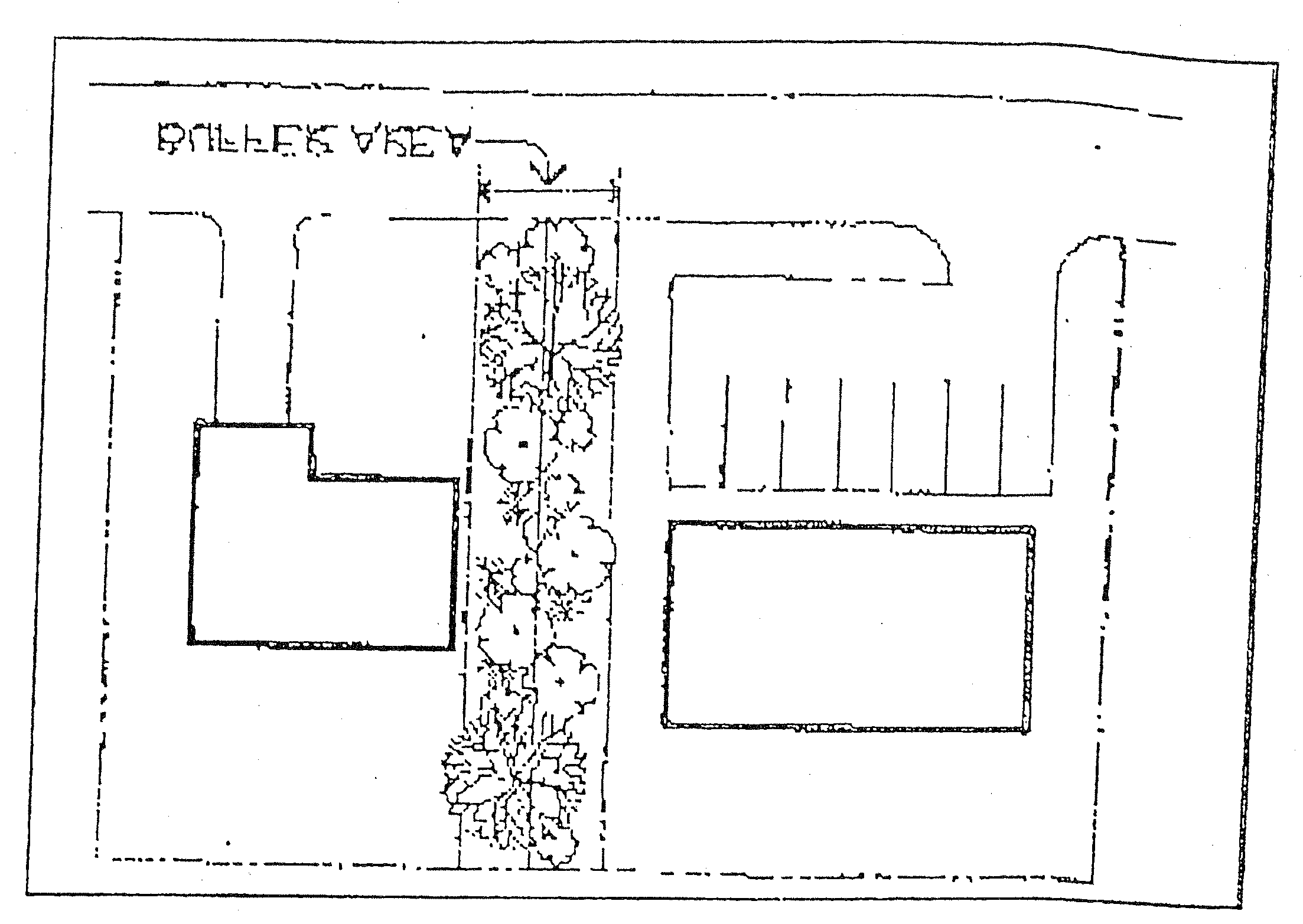
Figure 1.1 Buffer Area
1.03.014.Building. Any structure, either permanent or temporary, above or below ground, having a roof or other covering, and designed, built or used as a shelter or enclosure for persons, animals, or property of any kind including tents used for the purposes of a building.
1.03.015.Building, height of. The vertical distance to the highest point of the roof for flat roofs, to the deck line of mansard roofs, and to the average height between the eaves and the ridge for gable, hip, and gambrel roofs, measured from the grade.
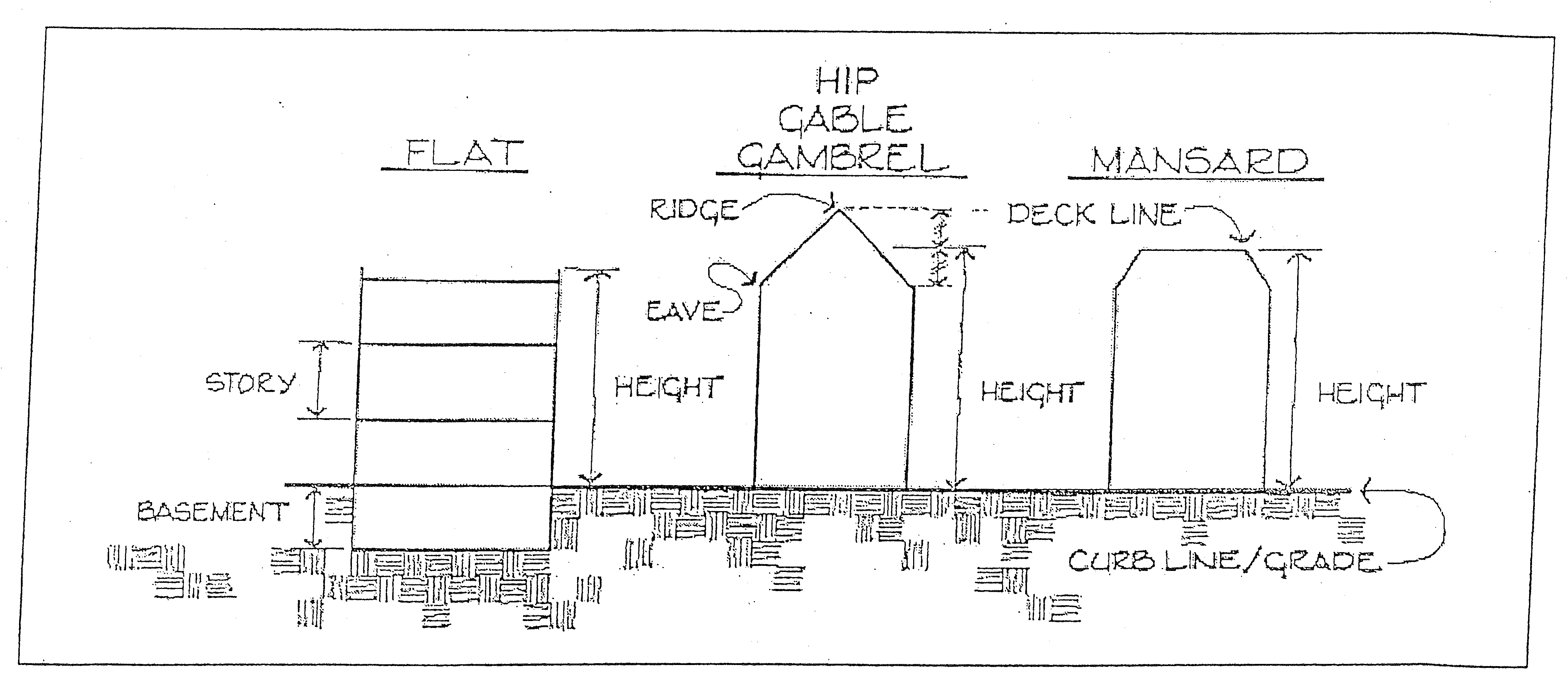
Figure 1.2 Building Height
1.03.016.Building envelope. The area formed by the front, side, and rear building setback lines of a lot within which the principal building must be located.
1.03.017.Building official. The individual designated by the mayor and council to serve as building inspector for Commerce.
1.03.018.Building line. A line, parallel to the street right-of-way line, the minimum distance which all or any part of the building is set back from the right-of-way line.
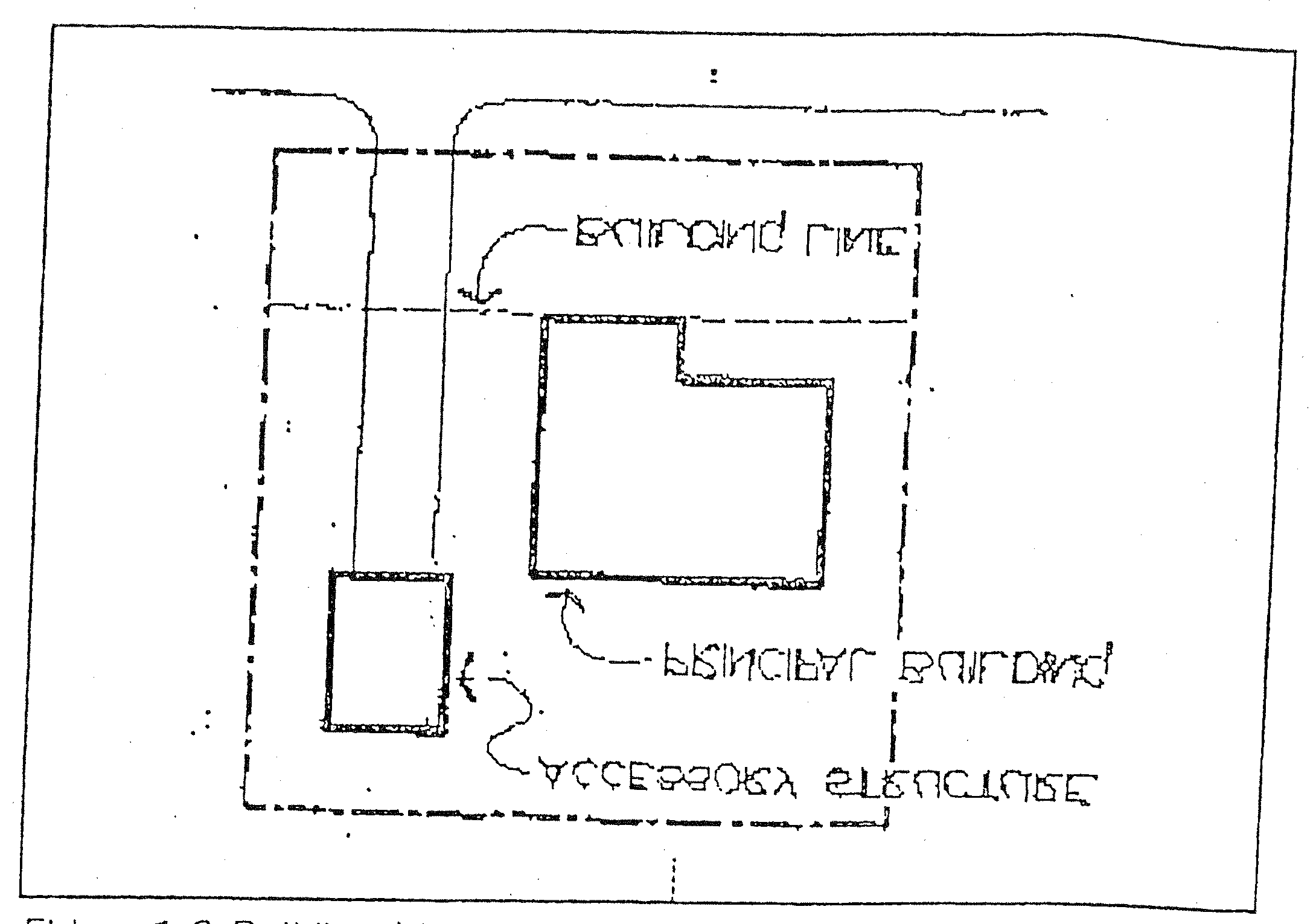
Figure 1.3 Building Line
1.03.019.Building, principal. A building in which the primary use of the lot on which the building is located is conducted.
1.03.020.Business entity. Any corporation, partnership, limited partnership, limited liability company, firm, enterprise, franchise, association, or trust.
1.03.021.Campaign contribution. A contribution as defined in paragraph (6) of O.C.G.A. § 21-5-3.
1.03.022.City. Commerce, Jackson County, Georgia 30529.
1.03.023.City official. The mayor and council of Commerce, Georgia or any member of the planning commission or board of zoning appeals.
1.03.024.Clinic. A building where human patients, who are not lodged overnight, are admitted for examination and treatment.
1.03.025.Club or lodge. Buildings and facilities owned or operated by a corporation, association, or persons for social, educational or recreational purposes, but not primarily for profit or to render a service that is generally carried on as a business.
1.03.026.Commercial use. An occupation, employment, or enterprise that is carried on for profit by the owner, lessee, or licensee.
1.03.027.Community center. A place, structure, area, or other facility used for and providing religious, fraternal, social, and/or recreational programs generally open to the public and designed to accommodate and serve significant segments of the community.
1.03.028.Comprehensive plan. The "Comprehensive Plan for Jackson County and the cities of Arcade, Braselton, Commerce, Hoschton, Jefferson, Nicholson, Pendergrass, and Talmo, March 1998" as adopted and as may be amended.
1.03.029.Conditional use. A use which is not permitted inherently but which may be permitted within a zoning district subject to approval by the mayor and council.
1.03.030.Conditional use permit. The permit issued by the mayor and council as a precondition to allowing any conditional use in a zoning district.
1.03.031.Conservation easement. A nonpossessory interest in real property imposing limitations or affirmative obligations, the purpose of which include retaining or protecting natural, scenic, or open space values of real property, assuring its availability for agriculture, forest, recreational, or open space use; protecting natural resources, or maintaining air or water quality. Protection is in perpetuity.
1.03.032.Contaminant. Any "regulated substance," as defined by the Federal Resource Conservation and Recovery Act, as in effect on the date of passage of this ordinance and as amended from time to time, and all petroleum products, including gasoline, oil, waste oils, and other fuels as well as their hazardous constituents.
1.03.033.Convenience store. A small retail store that is designed and stocked to sell primarily prepackaged food items, but may have beverages, periodicals, and other household supplies to customers who purchase only a relatively few items (in contrast to a supermarket). It is designed to attract and depends upon a large volume of stop-and-go traffic. Illustrative examples of convenience stores are those operated by "7-11," "Golden Pantry," and "Kangaroo." Gas pumps are an accessory use to a convenience store.
1.03.034.Convenience store/service station/fast food restaurant. A parcel that contains a combination service station, convenience store, and fast food restaurant in one structure located on one parcel.
1.03.035.Corridor. All land within the buffer areas established adjacent to reservoirs or perennial streams within a water supply watershed.
1.03.036.County. Jackson County, Georgia.
1.03.037.Daycare center. A building operated by a person, society, agency, corporation, partnership, limited partnership, limited liability company, institution, or group, where children under 18 years of age are received for group care for less than 24 hours per day without transfer of legal custody.
1.03.038.Daycare home. A private dwelling operated by any person who receives pay for supervision and care, fewer than 24 hours per day, without transfer of legal custody, three but not more than six children under 18 years of age who are not related to such persons and whose parents or guardians are not residents in the same private dwelling.
1.03.039.Development or single development density. Any project or group of related projects constructed or planned for construction on a single parcel or on contiguous parcels under single ownership.
1.03.040.Development density. The number of dwelling units permitted in a development. See Chapter 2.02 to determine development density.
1.03.041.Development permit. This shall include building permits, rezoning applications, preliminary and final subdivision plat applications, conditional use permit applications, and variance applications.
1.03.042.Diameter breast height (dbh). The diameter of a tree measured four and one-half feet above the ground. Should a tree fork below the four and one-half-foot height, each fork is measured separately and treated as individual trees. Should the tree fork above the four and one-half-foot height, the forks are treated as one tree and measured at four and one-half-foot height. If the tree is situated on a slope, the diameter is measured at a four and one-half-foot height on the uphill side of the tree.
1.03.043.Disability glare. The eye's line-of-sight contact with a direct light source, which causes a momentary partial blindness.
1.03.044.Dry cleaners. A business that provides laundry cleaning, excluding self service, and contains equipment on the premises necessary for processing laundry.
1.03.045.Dwelling, single-family. A structure including site-built, modular, manufactured and mobile homes that contains one dwelling unit designed for residential use that is surrounded by open space on the same lot.
1.03.046.Dwelling, two-family (Duplex). A structure containing two dwelling units designed and arranged for residential use by two families living independently of each other.
1.03.047.Dwelling unit. A single unit providing complete, independent living facilities for one or more persons, including permanent provisions for living, sleeping, eating, cooking, and sanitation.
1.03.048.Easement. A grant of property rights by the owner to, or for the use by, the public, a corporation, partnership, limited partnership, limited liability company, or another person or entity.
1.03.049.Family. One or more individuals permanently occupying a dwelling unit and living as a single housekeeping unit, as distinguished from persons occupying a boarding house, group home, or hotel, as defined in this ordinance.
1.03.050.1.Farmers market. A retail business, often outdoors and/or within open structures, consisting of individual stalls where farmers and sometimes other vendors sell their produce and other food items directly to the public.
1.03.050.2.Fence. An artificially constructed barrier erected to function as an enclosure or for screening. See Chapter 4.27 for specific provisions related to fences and walls.
1.03.051.Fence or wall height. The vertical distance between the ground and top of a fence measured from the existing grade. The height shall be measured in a continuum at each point along the fence.
1.03.052.Financial interest. All direct ownership interests of the total assets or capital stock of a business entity or ownership interest in a limited liability company where such ownership interest is ten percent or more.
1.03.053.1.Flea market/open-air market. A retail business, often outdoors and/or within open structures, consisting of individual stalls selling old or used articles, curios and antiques, miscellaneous merchandise.
1.03.053.2.Floor area. The sum of the gross horizontal areas of the total number of floors of a building measured from the exterior faces of the exterior walls or from the centerline of the walls separating two buildings, including stairwells and elevator shafts, but not including: attic space providing headroom for less than six feet six inches, unusable basement or cellar space not used for retailing, uncovered steps or fire escape, open porches, accessory water or cooling towers, accessory off-street parking spaces, or accessory off-street loading berths.
1.03.054.Frontage, lot. The horizontal distance between the side lot lines measured at the point where the side lot lines intersect the street right-of-way. All sides of a lot that abut a street shall be considered frontage. On curvilinear streets, the arc between the side lot lines shall be considered the lot frontage.
1.03.055.Frontage street. The street coincident to the front boundary line of the parcel.
1.03.056.Full cut-off type fixture. A luminary or light fixture that, by design of the housing, does not allow any light dispersion or direct glare to shine above a 90 degree, horizontal plane from the base of the fixture. Full cut-off fixtures must be installed in a horizontal position as designed, or the purpose of the design is defeated, and disability glare will result.
1.03.057.Garage, private. An accessory building or a portion of a principal building used for parking or storage of automobiles of the principal building's occupants. A carport is considered a private garage.
1.03.058.Garage, repair. A building and premises designed or used for the purpose of service or commercial repair of motor vehicles. All body work and painting shall be conducted within fully enclosed buildings. The storage of junk, wrecked vehicles, dismantled parts or supplies shall be solely for the purpose of repairing motor vehicles and not as a salvage or junkyard business. The storage of junk, wrecked vehicles, dismantled parts or supplies shall not be visible beyond the premises.
1.03.059.Greenspace. Land shown on a development plan, master plan, or official map for conservation, preservation, recreation, landscaping, or park.
1.03.060.Gross floor area. The total floor area of a building measured by taking the outside dimensions of the building at each floor level intended for occupancy or storage.
1.03.061.Health department. Jackson County, Georgia Health Department.
1.03.062.Home occupation. An occupation or profession conducted entirely within a dwelling unit or accessory building for financial gain, which is clearly subordinate to the principal use of the parcel and which does not change the character thereof.
1.03.063.Home office. An office use conducted entirely within a dwelling unit which is carried on solely by the unit's occupant and is incidental and secondary to the principal use of the dwelling. The office may be for the purpose of service or tradeworkers who customarily work at various locations or individuals who work at home. "Home Office" shall not include any business which involves the sale, manufacture or repair of merchandise on the premises. Home Office shall also not include any business requiring access by the public, including, but not limited to, customers, clients or vendors.
1.03.064.Horizontal illuminance. The measurement of brightness from a light source, usually measured in footcandles or lumens, which is taken through a light meter's sensor at a horizontal position.
1.03.065.1.Hotel/motel. A building with rooms for temporary occupancy by registered guests.
1.03.065.2.Industrialized building. A factory fabricated transportable building consisting of units designed for incorporation into a permanent structure at a building site on a permanent foundation to be used for residential purposes. A modular home shall be certified by the manufacturer to meet the approval of the State Building Administration Board (SBAB) and to meet the same requirements as a site-built home within Commerce.
1.03.066. Reserved.
1.03.067.Junk. Old or scrap copper, brass, rope, rags, batteries, paper, trash, rubber debris, or waste, junked, dismantled, or wrecked automobiles, or parts thereof, iron, steel, and old scrap ferrous or nonferrous metal.
1.03.068.Junked vehicle. Any wrecked, dismantled, non-operating motorized vehicle or vehicle which does not bear a current license plate which is not located in a garage or carport or is visible from the right-of-way or from adjacent properties.
1.03.069.Kennel. Any location where, for commercial purposes, four or more adult dogs, cats, rabbits or other domestic animals are kept for the purpose of boarding, caring for, raising, grooming, breeding, training or sale.
1.03.070.Kindergarten. A school for pre-elementary school children ranging in age from four through six years which provides preparation for elementary school.
1.03.071.Laundromat. A business that provides home-type washing, drying, ironing machines or coin operated dry cleaning machines for hire and use by customers on the premises.
1.03.072.Laundry and dry cleaning pick-up. A business that provides only for the convenience of taking and picking up laundry and which does not have any on-site equipment for processing laundry.
1.03.073.Light trespass. Light from an artificial light source that is intruding into an area where it is not wanted or does not belong.
1.03.074.Loading space. A space within the principal use or on the same lot that provides for standing or loading and/or unloading of trucks and other carriers.
1.03.075.Lot. A portion of, or parcel of land separated from other portions or parcels by description, metes and bounds, intended for transfer of ownership or for building development and having a separate tax parcel reference.
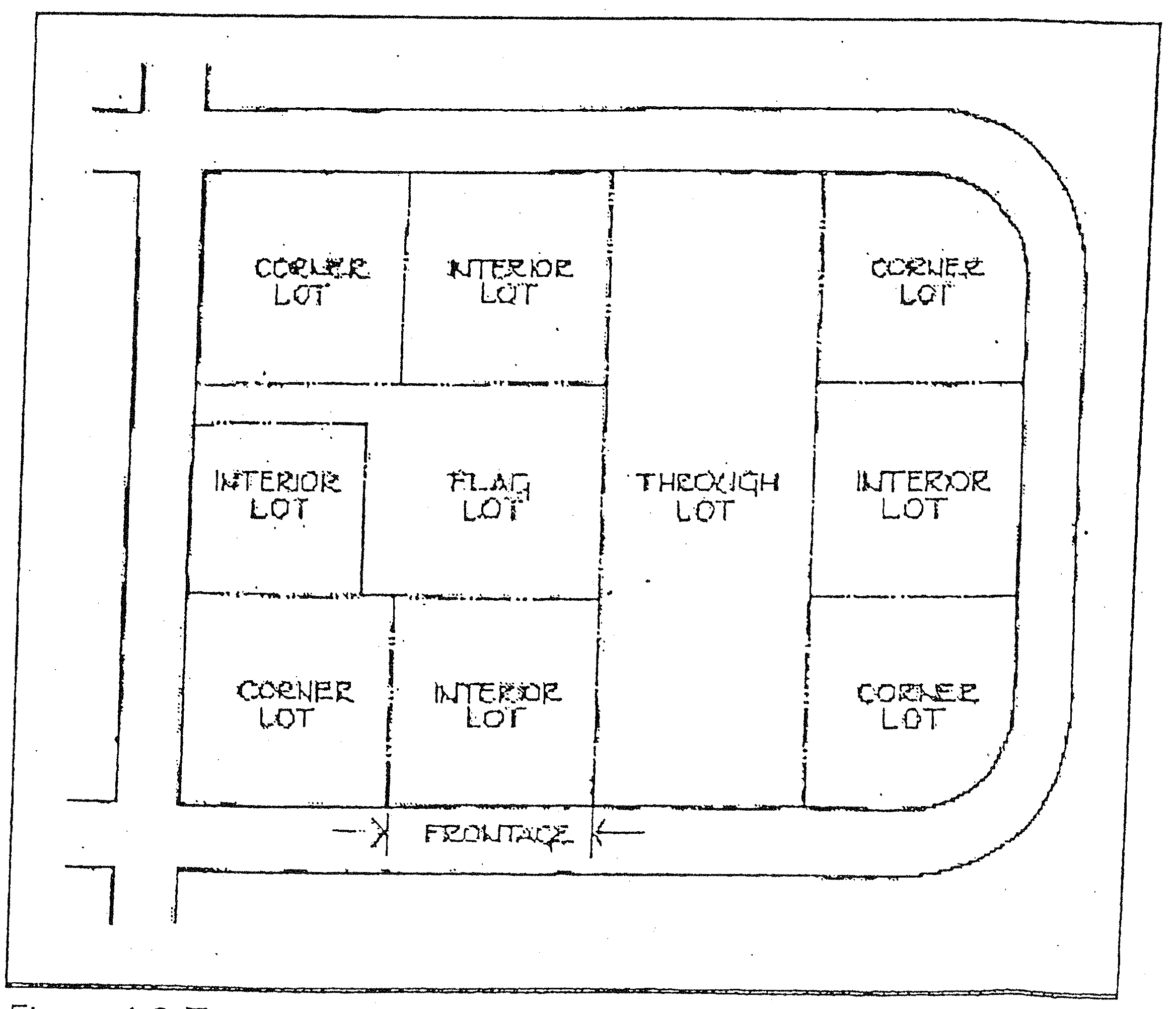
Figure 4.2 Types of Lots
1.03.076.Lot, corner. A lot abutting 2 or more public streets or city maintained roads at their intersection.
1.03.077.Lot, double frontage or through lot. A lot with frontage on two public streets and/or city maintained roads that does not intersect at a point abutting the property.
1.03.078.Lot, interior. A lot other than a corner lot.
1.03.079.Lot line, rear. The rear lot line is generally opposite the front lot line. If the rear lot line is less than ten feet in length or if the lot comes to a point at the rear, the rear lot line shall be deemed to be a line parallel to the front lot line, not less than ten feet long, and lying wholly within the lot and farthest from the front lot line.
1.03.080.Lot of record. A lot whose existence, location, and dimensions have been legally recorded or registered in a deed or on a plat in the office of the Clerk of the Superior Court of Jackson County, Georgia.
1.03.081.Lot width. The horizontal distance between one side lot line and the other side lot line measured at the minimum front setback line.
1.03.082.Manufactured home, Class A. A dwelling unit, meeting the definition of "manufactured home" contained in O.C.G.A. § 8-2-160, fabricated in an off-site facility for installation or assembly at the building site, bearing a label certifying it is constructed in compliance with the Federal Manufactured Home Construction and Safety Standards Act, 42 U.S.C. § 5401 et seq., and meeting the following development standards:
A.
The unit shall have a minimum width of at least 28 feet.
B.
The roof shall have a minimum 5:12 roof pitch which means having a pitch equal to at least five inches of vertical height for every 12 inches of horizontal run. The roof shall have a surface of wood shakes, asphalt composition, wood shingles, concrete, fiberglass tiles, slate, built-up gravel materials, standing seam (non-corrugated tin or steel) or other materials approved by the Building Official. The roof overhang must be at least one foot when measured from the vertical side.
C.
The exterior siding materials shall consist of wood, masonry, hardboard, stucco, masonite, vinyl lap or other materials of like appearance comparable in composition, appearance, and durability to the exterior siding commonly used in site-built dwellings.
D.
The unit shall be attached to a permanent foundation that meets all building code requirements.
E.
A landing must be installed at each outside doorway. The minimum size of the landing shall be at least four feet by six feet (excluding steps) at each doorway. The structure must include steps which lead to ground level, and both landing and steps must meet the requirements of the Standard Building Code.
1.03.083.Manufactured home, Class B. A dwelling unit, meeting the definition of "manufactured home" contained in O.C.G.A. § 8-2-160, fabricated in an off-site facility for installation or assembly at the building site, bearing a label certifying it as constructed in compliance with the Federal Manufactured Home Construction and Safety Standards Act, 42 U.S.C. § 5401 et seq., but which does not meet the criteria of a Class A manufactured home. The dwelling must be installed in accordance with O.C.G.A. § 8-2-160 et seq., and the rules promulgated thereunder.
1.03.084.Mayor and council. Mayor and Council of the City of Commerce, Jackson County, Georgia 30529.
1.03.085.Member of the family. The spouse, mother, father, brother, sister, son, or daughter of a Commerce official. This definition applies to Chapter 5.09 only.
1.03.086.Mini-warehouse. A building consisting of individual, small, self-contained units that are leased or owned for the storage of business and household goods or contractor's supplies.
1.03.087.1.Mobile food unit. A motor vehicle used for the preparation and/or serving of food and food products direct to consumers.
1.03.087.2.Mobile home. A transportable, factory-built structure designed to be used as a year-round residential dwelling and built prior to the enactment of the Federal Manufactured Housing Act of 1974, which became effective June 15, 1976.
1.03.088.Modular home. See "Industrialized Building."
1.03.089.1.Motor vehicle repair shop. A business including, but not limited to, top and body, paint shop, automotive glass, transmission, and tire repair shops, car washes, including automated and staffed facilities, and oil change and lubrication facilities.
1.03.089.2.Non-conforming building or structure. Any lawfully existing building or structure which does not conform to these ordinances governing the type, bulk, location, height or size of buildings or structures permitted in the district prior to the adoption of this ordinance but which is in full compliance with all applicable federal, state and local laws, rules and ordinances, and for which all required federal, state and local permits have been issued.
1.03.090.Non-conforming lot. A lot, the area, width, or other characteristics of which fails to comply with applicable ordinances and which was of-record and in full compliance with all applicable federal, state and local laws, rules and ordinances prior to the enactment of this or other ordinances or other predecessor ordinance, but which does not comply with the requirements of this ordinance.
1.03.091.Non-conforming use. A lawful use of land that does not comply with the use ordinance for its zoning district but which complied with applicable ordinances at the time the use was established.
1.03.092.Nursing home. A facility for three or more unrelated ill or aged persons not operating as the functional equivalent of a family, that provides food, shelter, and medical care for compensation in addition to meeting the physical, emotional, and social needs of its patients.
1.03.093.Off-street parking. An area exclusive of a public or private thoroughfare where motor vehicles may be stored for the purposes of temporary, daily, or overnight parking.
1.03.094Open space. Land used for recreation, resource protection, amenity, or buffers. In no event must any area of a lot constituting the minimum lot area nor any part of an existing or future road, right-of-way, off-street parking, loading space, or area immediately underneath electrical transmission lines be counted as open space.
1.03.095.Opponent. Any person who opposes a rezoning action or any attorney or other person representing or acting on behalf of a person who opposes a rezoning action.
1.03.096.Oppose. To appear before, discuss with, or contact, either orally or in writing, a Commerce official and argue against a zoning action.
1.03.097.Overlay district. A district that applies supplementary regulations to land previously classified as belonging to a specific zoning district or land-use category.
1.03.098.Permitted use. Any use by right which is specifically authorized in a particular zoning district.
1.03.099.Person. An individual, partnership, limited partnership, limited liability company, committee, association, corporation, labor organization, or any other organization or group of persons.
1.03.100.Personal care home. Any dwelling, whether operated for profit or not, which undertakes through its ownership or management to provide or arrange for the provision of housing, food service, and one or more personal services for two or more adults who are not related by blood or marriage to the owner or administrator of the home. Personal services includes, but is not limited to, individual assistance with or supervision of self-administered medication and essential activities of daily living such as eating, bathing, grooming, dressing, and toileting.
1.03.101.Planning commission. The City of Commerce Planning Commission.
1.03.102.Plat. A sketch, map or survey of a lot, tract or parcel of land including lot lines, courses and distances, street rights-of-way and easements, with the dimensions of these features inscribed thereon, suitable for recording with the Jackson County Superior Court.
1.03.103.Playschool. A school for pre-kindergarten children ranging in age from three to four years of age which operates for less than four hours per day.
1.03.104.Principal use. The primary purpose for which land or a building is used.
1.03.105.Professional. When used in connection with "use" and "occupancy", a use or occupancy by persons generally engaged in rendering personal, executive, sales, or administrative services or activities, including but not limited to accountants, architects, professional engineers and land surveyors, doctors, lawyers, insurance offices, real estate offices, religious organizations, stock brokers and administrative agencies considered professional in character. The term, however, does not include repairs or sales of tangible personal property stored or located within the building nor any use which would create any loud noise or noxious odors within Commerce.
1.03.106.Property interest. The direct ownership of real property, including any percentage of ownership less than total ownership.
1.03.107.Public utility. An above-ground structure or facility (other than buildings, unless such buildings are used as storage incidental to the operation of such structure or facility) used in connection with the production, generation, transmission, delivery, collection, or storage of water, sewage, electricity, gas, oil, or electronic signals. Excepted from this definition are electric power, telephone, telegraph, cable television, gas, water, and sewer lines, wires or pipes, together with supporting poles or structures located within a public right-of-way.
1.03.108.Real property. Any tract or parcel of land and, if developed, any buildings or structures located on the land.
1.03.109.Recreation facility, commercial. A recreation facility operated as a business and open to the public for a fee.
1.03.110.Recreation facility, private. A recreation facility operated by a nonprofit organization and open only to bonafide members and guests of such nonprofit organization.
1.03.111.Recreational vehicle. A vehicle primarily designed for recreation, camping, travel or seasonal use which has its own motor power or is mounted on or towed by another vehicle. The basic types are: travel trailer, folding camping trailer, park trailer, truck camper, motor home, and custom van conversions.
1.03.112.1.Recycling station. Recycling station means an unattended facility located throughout the community to accept donation or delivery of recyclable goods, including glass, cardboard, newspaper, paper, plastic and similar materials. (Ord. No. 2008-14, (012), 7-21-08)
1.03.112.2.Recycling center. Recycling center means an enclosed and roofed facility that accepts recycled materials and processes or treats such materials, such as glass, cardboard, newspaper, paper, plastic and similar materials, and returns them into a condition where they may be used again for production of other goods. All collection and processing shall take place inside the facility and shall not be stored outside the facility. (Ord. No. 2008-14, (113), 7-21-08)
1.03.112.Religious institution. A building, together with accessory buildings and use, where persons regularly assemble for religious purposes and related social events and which building, together with its accessory buildings and uses, is maintained and controlled by a religious body organized to sustain religious ceremonies and purposes. Includes churches, chapels, cathedrals, temples, and similar designations.
1.03.113.Restaurant. An establishment where food and beverages are sold for consumption on the premises, generally in an enclosed building. A snack bar or refreshment stand at a public or non-profit community swimming pool, playground, or park operated solely for the convenience of patrons of the facility is not a restaurant.
1.03.114.Retail sales, general merchandise. Establishments which are retail operations that carry an assortment of merchandise from many retail categories. Such establishments may include, but are not limited to, department stores, discount stores, farm stores, and similar establishments.
1.03.115.Retail sales, household. Establishments which are retail operations that sell goods for furnishing or improving housing units. These establishments may include, but are not limited to, furniture stores, home improvement centers, electronic stores, appliance stores, and similar establishments.
1.03.116.Retail sales, specialty. Retail operations that specialize in one type or line of merchandise. Such stores may include, but are not limited to, apparel stores, jewelry stores, bookstores, shoe stores, stationary stores, antique stores, and similar establishments.
1.03.117.Retail services establishments. Establishments providing services or entertainment, as opposed to products, to the general public for personal or household use, including hotels and motels, finance, real estate, insurance, personal service, amusement and recreation services, museums, galleries, and health, educational, and social services.
1.03.118.Right-of-way. That area, distinguished from an easement, which is owned in fee-simple by Commerce, Jackson County, Georgia 30529 or other government, for the present or future use of roads, streets, and highways, together with its drainage facilities and other supporting uses and structures.
1.03.119.Right-of-way line. The outside boundary of a right-of-way, whether such right-of-way is established by usage, recorded easement, deed, dedication or by an official right-of-way map of Commerce, Jackson County, Georgia, 30529.
1.03.120.School. A public or private facility that provides a curriculum of elementary, middle, and/or secondary academic instruction.
1.03.121.Screening. A method where a view of one site is shielded, concealed, or hidden from another site. Screening techniques include fences, walls, berms, densely planted vegetation, natural vegetation or other features. Screening must provide a visual and acoustical barrier which is of such nature and density that it provides year-round maximum shielding, concealment or hiding from the ground to a height of at least eight feet or from view from the normal level of a first story window on an abutting lot.
1.03.122.Self-storage facility. See "mini-warehouses."
1.03.123.Service station. Any area of land, including structures thereon, used for the retail sale of gasoline or oil, automobile accessories and/or incidental services including facilities for lubricating, hand or automatic washing and cleaning, or otherwise servicing automobiles, excluding painting or major repairs.
1.03.124.Setback. The minimum horizontal distance between the lot or property right-of-way line and the nearest front, side or rear line of the building, including terraces or any covered projections excluding steps.
1.03.125.Shopping center. A group of retail business and service uses on a single site planned and developed as a unit, with common off-street parking facilities.
1.03.126.Sign. A structure or device designed or intended to convey information to the public in written or pictorial form.
1.03.127.Sign area. The entire area within a continuous perimeter, enclosing the extreme limits of sign display, including any frame or border. Curved, spherical, or any other shaped sign face shall be computed on the basis of actual surface area. The copy of signs composed of individual letters, numerals, or other devices shall be the sum of the area of the smallest rectangle or other geometric figure encompassing all of said letters or devices. The calculation for a double-faced sign shall be the area of one face only. Double-faced signs shall be constructed so that the perimeter of both faces coincide and are parallel and not more than 24 inches apart.
1.03.128.Sign face. The area or display surface used for the message.
1.03.129.Sign height. The vertical measurement from the highest part of a sign, including all support structures, to the ground level. Any earth berm or elevated foundation that supports a sign, sign post, or sign support is included in the height of the sign.
1.03.130.Sign structure. Construction used or designed to support a sign.
1.03.131.Site-built. A building constructed on-site with approved building materials, inspected periodically during construction, and constructed according to locally adopted building codes.
1.03.132.Site-built home. A dwelling unit constructed on the building site from basic materials delivered to the site, and constructed in accordance with the Standard Building Code of the Southern Building Code Congress International (SBCII). A site-built home must meet the following development standards:
A.
The unit shall have a minimum width in excess of 28 feet.
B.
The roof shall have a minimum 5:12 roof pitch which means having a pitch equal to at least five inches of vertical height for every 12 inches of horizontal run. The roof shall have a surface of wood shakes, asphalt composition, wood shingles, concrete, fiberglass tiles, slate, built up gravel materials or standing seam (non-corrugated tin or steel) or other materials approved by the mayor and council. The roof overhang must be at least one square foot when measured from the vertical side.
C.
The exterior siding materials shall consist of wood, masonry, hardboard, stucco, masonite, or vinyl lap or other materials of like appearance.
D.
The unit shall be attached to a permanent foundation that meets all building code requirements.
E.
A landing must be installed at each outside doorway. The minimum size of the landing shall be at least four feet by six feet (excluding steps) at each doorway. The structure must include steps which lead to ground level, and both landing and steps must meet the requirements of the Standard Building Code.
1.03.133.Sketch. A rough drawing that identifies the layout of the development on the parcel.
1.03.134.Solid fence. An artificially constructed barrier of any material or combination of materials generally manufactured for fencing, erected to enclose or screen areas of land in a manner where the area inside the fencing is not readily visible at any distance.
1.03.135.Solid wall. A wall constructed in such a manner to prohibit viewing of land, materials, buildings, etc., located behind the wall, by an individual standing outside and parallel to the wall.
1.03.136.Special events. Circuses, fairs, carnivals, festivals, or other types of special events that (1) run for longer than one day but not longer than two weeks, (2) are intended to or likely to attract substantial crowds, and (3) are unlike the customary or usual activities generally associated with the property where the special event is to be located.
1.03.137.Storage trailer A trailer commonly attached to a cab or chassis for transportation (ex: trailer attached to 18-wheel cab for transporting goods).
1.03.138.Story. That portion of a building, other than a cellar, included between the surface of the floor and the ceiling above it.
1.03.139.Street. A public or private thoroughfare which affords the principal means of ingress and egress to abutting property. See Chapter 4.05 for street classifications.
1.03.140.Street, public. A street that is titled by description or deed and vested in the City of Commerce, Jackson County, Georgia 30529.
1.03.141.Street line. The legal line between street right-of-way and abutting property.
1.03.142.Structure. Anything constructed or erected with a fixed location on or in the ground, or attached to something having a fixed location on the ground. Structures include, but are not limited to the following: site-built buildings, manufactured, mobile and modular homes, swimming pools, and signs.
1.03.143.Subdivision. The division of a tract, lot or parcel into two or more lots, building sites, or other divisions for the immediate or future purpose of sale, lease, offer or development. Also see Commerce Subdivision Regulations.
1.03.144.Subdivision regulations. Commerce Subdivision Regulations dated November, 1995 and as may be amended.
1.03.145.1.Temporary outdoor event. A temporary outdoor event is any event conducted in the open air or within a tent or other temporary structure produced for a limited time, and includes the following:
A.
A festival, carnival or exhibition where: (i) Unpackaged food is served, sold or transferred to members of the public, or (ii) Motorized amusement devices, a tent or an outdoor stage is used; or
B.
Any temporary commercial event conducted on residential property, other than a yard sale; or
C.
Any temporary event conducted on residential property where more than 200 guests or attendees are expected on any one day; or
D.
Any outdoor sales or commercial activity by a peddler or transient merchant on non-residential property, other than a licensed flea market.
Provided, however, that "temporary outdoor event" excludes the following:
A.
Any event conducted on property owned by any government entity if authorized by the property owner; and
B.
Any event conducted on the grounds of any developed lot whose principle use is one of public assembly, such as a church, school, library, park or membership organization.
1.03.145.2.Townhouse. A single-family dwelling unit, with a private entrance, which is part of a structure whose dwelling units are attached horizontally in a linear arrangement, and having a totally exposed front and rear wall to be used for access, light, and ventilation.
1.03.146.Tower. Any structure designed and constructed primarily for the purpose of supporting one or more antennas, including self-supporting lattice towers, guy towers, or monopole towers. The term includes radio and television transmission towers, microwave towers, common-carrier towers, cellular telephone towers, amateur radio licensees tower, alternative tower structures, and the like.
1.03.147.Uplighting. Any light source that distributes illumination above a horizontal plane.
1.03.148.Upper floor residential apartment. A studio, one-bedroom, or two-bedroom dwelling unit located on any floor other than the basement, ground, or street level floor.
1.03.149.Variance, area. A minimal relaxation or modification of the strict terms of the height, area, placement, setback, yard, buffer, landscape strip, parking and loading ordinances as applied to specific property when, because of particular physical surroundings, shape, or topographical condition of the property, not due to the fault of the owner of said property, compliance would result in a particular hardship upon the owner, as distinguished from a mere inconvenience or a desire to make a profit.
1.03.150.Yard. An open space at grade between a building and the adjoining lot lines, unoccupied and unobstructed by any portion of a structure from the ground upward, except as otherwise provided herein. In measuring a yard for the purpose of determining the width of a side yard, the depth of a front yard, or the depth of the rear yard, the minimum horizontal distance between the lot line and the main building shall be used.
1.03.151.Yard, front. An open, unoccupied space on the same lot with the principal use, extending the full width of the lot and situated between the right-of-way line and the building line projected to the side lines of the lot. On corner lots, the front yard is considered parallel to the street upon which the lot has its largest dimension.
1.03.152.Yard, rear. A yard extending across the full width of the lot and lying between the rear lot line and the nearest line of the building.
1.03.153.Yard, side. A yard lying between the side line of the lot and the nearest line of the building and extending from the front yard to the rear yard, or in the absence of either of such front or rear yards, to the front or rear lot lines. Side yard width shall be measured at right angles to side lines of the lot.
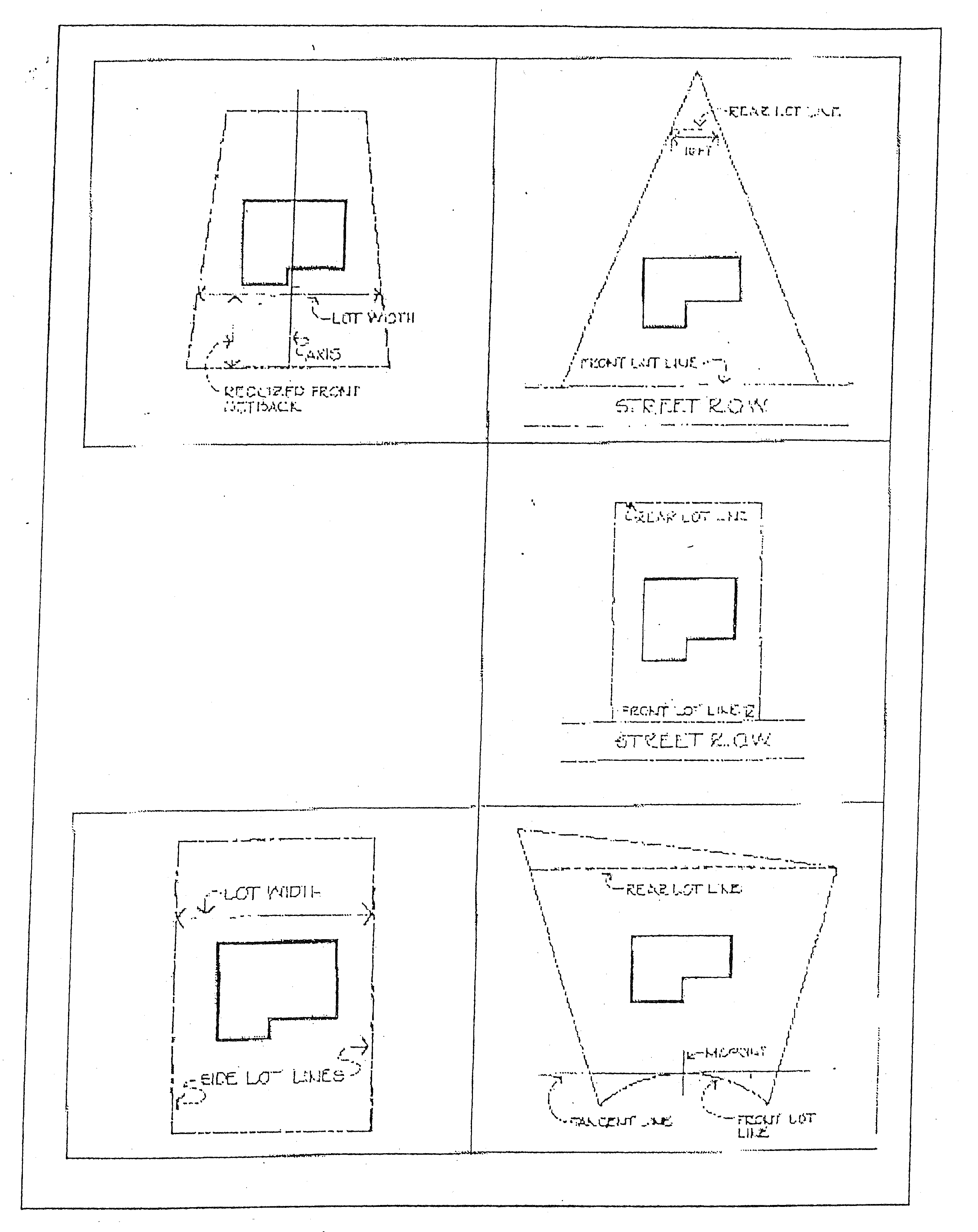
Figure 4.4 Yards and Setbacks
1.03.154.Zoning action. An action by the Mayor and Council adopting an amendment to the zoning ordinance and map that has the effect of zoning real property from one zoning classification to another.
1.03.155.Zoning administrator. The individual or his/her designated representative, who is vested with the duty of administrating land use regulations within the areas of the City of Commerce, Jackson County, Georgia 30529.
1.03.156.Zoning district. A section of the City of Commerce, Jackson County, Georgia 30529 where the zoning ordinance is uniform.
(Ord. No. 2018-003, 6-4-18)
1.01.001. - Short title.
This ordinance shall be known and may be cited as "The Zoning Ordinance for Commerce, Georgia".
1.01.002. - Purpose and objectives.
The purpose of this ordinance is to set forth standards and permissible uses designed to conserve and protect the natural, economic and scenic resources of Commerce; health, aesthetics, morals, convenience, order, prosperity and general welfare; to provide adequate light and air; to protect natural resources; to prevent the overcrowding of land; to promote desirable living conditions and stability of neighborhoods, to facilitate the adequate provision of transportation, water, sewerage, schools, parks, and other public requirements by dividing Commerce into districts of such size and shapes as may be best suited to carry out the purposes of the legislative act and of this ordinance.
1.01.003. - Legislative authority.
The mayor and council of Commerce, Georgia under the authority of Article IX, Section 2, Paragraph 4 of the Constitution of the State of Georgia and O.C.G.A. Chapter 66, Title 36, and for the purpose of promoting the health, safety, morals, convenience, order, prosperity, or the general welfare of the city and designed to lessen congestion in the streets; to secure safety from fire, panic, and other dangers; to promote health and avoid overcrowding of land; to avoid undue concentration of population; to facilitate the adequate provision of transportation, water, sewerage, schools, parks, and other requirements, ordains and enacts into law the Zoning Ordinance for Commerce.
1.01.004. - Method of regulation.
The mayor and council of Commerce, Georgia, as authorized by the Constitution of the State of Georgia, adopts zoning regulations for the following purposes: to define certain words used therein; to create zone boundaries; to regulate the location of trades, professions, businesses, and industries; to regulate the density in distribution of population; to provide for the gradual elimination of nonconforming uses of land, buildings and structures; to provide for the method of administration, amendment and enforcement; to provide for the imposition of penalties for violations; repeal conflicting ordinances and resolutions; and for other purposes.
1.01.005. - Jurisdiction.
This zoning ordinance shall govern the use of all land and development within the city limits of Commerce, Georgia and in accordance with O.C.G.A. § 36-70-5.
1.01.006. - Zoning map.
The boundaries of the zoning districts are hereby established as shown on the map entitled "The Official Zoning Map of Commerce, Georgia" dated November 1995 and as may be amended. Said map is hereby made a part of this ordinance and shall be available for public inspection in the office of the city clerk. As evidence of its authenticity, the official zoning map shall be signed by the commerce mayor and attested to by the city clerk.
1.01.007. - Rules for determining boundaries.
The following rules apply where uncertainty exists with respect to the boundaries of any of the zoning districts shown on the official zoning map.
A.
Unless otherwise indicated, the zoning district boundaries are indicated as approximately following property lines, land lot lines, centerlines of streets, highways, alleys or railroads, centerlines of streams, reservoirs, or other bodies of water, or civil boundaries, and they shall be construed to follow such lines.
B.
Where zoning district boundaries are approximately parallel to or extend to the centerlines of streets, highways, railroads, including their rights-of-way, or the centerlines of streams, reservoirs, or other bodies of water, zoning district boundaries shall be construed as being parallel thereto and at such distance therefrom as indicated on the official zoning map. If no distance is given, dimensions shall be determined by the scale shown on the official zoning map.
C.
Where a zoning district boundary line divides a lot that is under single ownership at the time of enactment of this ordinance, the use classification of a larger portion may be extended by the mayor and council to the remainder without recourse to the amendment procedure.
D.
Where a public road, street or alley is officially abandoned, the ordinances applicable to the parcel to which it reverts shall apply.
E.
In case the exact location of a boundary cannot be determined by the foregoing methods, the mayor and council shall, upon application, determine the location of the boundary.
1.02.001. - Defining words.
Words used in the zoning ordinance have their normal dictionary meaning unless they are otherwise defined.
1.02.002. - Use of "shall" and "may".
A.
Shall means mandatory. The word "shall" means that the directives or requirements are mandatory and may not be waived or modified. If used within the text, "will," and "must," also mean "shall."
B.
May means permissive. The word "may" means that the directives or requirements are permissive and are imposed at the option of the decision-maker. "Can" and "should" also mean "may."
1.02.003. - Use of "and" and "or".
A.
"And" means that each item identified shall be required.
B.
"Or" means any combination of one or more of the identified items may be required.
1.02.004. - Definition sources for words not defined within the zoning ordinance.
A.
Development terms not defined within any chapter of the zoning ordinance shall have the meaning contained within The New Illustrated Book of Development Definitions , by Moskowitz and Lindbloom, published by the Center for Urban Policy Research of Rutgers University, Piscataway, New Jersey.
B.
Terms not defined in any cited sources shall have the meaning as established in the current edition of the Websters Unabridged Dictionary, published by Merriam-Webster, Inc.
1.04.001. - Use.
No building, structure, premises, or land shall be used or occupied and no building or part thereof shall be erected, extended, enlarged, constructed, moved, or altered except in conformity with this ordinance.
1.04.002. - Building height.
No building or structure shall be erected, constructed or altered that exceeds the height limit for the zoning district in which it is located.
1.04.003. - Lot area and lot size.
Unless acquired for public use, no lot shall be reduced in size so that it does not comply with the applicable provision of this ordinance.
1.04.004. - Yards.
No part of a yard or other open space required for one building shall be included as part of a yard or other open space similarly required for another building. Every part of a required yard or court shall be open from its lowest point to the sky unobstructed, except for the ordinary projection of sills, cornices, buttresses, ornamental features, chimneys, flues, and eaves, provided such projections do not extend more than two feet into the yard area requirements.
1.04.005. - Corner lots.
Minimum side yard requirements for corner lots shall not be less than the minimum front yard requirements for such lots.
1.04.006. - Principal buildings.
In the C-1, C-H, CBD, M-1, and M-2, more than one principal building containing a permitted or conditional use may be erected on a single lot or tract of land provided that all yard and other space requirements of this ordinance are met for each structure as though it were on an individual lot.
The owner must record a plat of subdivision of the lot(s) with the clerk of the superior court of Jackson County before a building permit can be issued where a parcel of land is under single ownership and two or more principal buildings are located on the parcel.
1.04.007. - Minimum distance between buildings.
The following minimum distances between buildings are required unless otherwise specified within this ordinance.
A.
The minimum distance between principal uses located on the same lot or parcel:
1.
Front to front arrangement .....40 ft.
2.
Front to rear arrangement .....50 ft.
3.
Rear to rear arrangement .....30 ft.
4.
Side to side arrangement .....20 ft.
5.
All other combinations .....20 ft.
B.
There shall be a distance of not less than 20 feet between a principal and accessory building located on the same lot or parcel.
C.
No accessory building shall be located closer than 20 feet to any lot line in any zoning district.
1.04.008. - Temporary buildings.
Temporary buildings used in conjunction with construction work only may be permitted in any non-residential zoning district and shall be removed within 30 days of the issuance of a certificate of occupancy.
1.04.009. - Building envelope.
The building envelope shall not exceed 15 feet beyond the building footprint with the exception of one, 15-foot wide construction entrance to the site and the location of underground utilities. Building envelope lines should not be drawn into wetlands, floodplains, or steep slopes (slopes in excess of 25 percent) and shall not include the tops of ridge lines. In residential development, the minimum tree density outside the building envelope shall comply with section 12.4 of the City of Commerce Subdivision Regulations. Trees outside the building envelope shall be protected. In commercial and industrial development, the building envelope shall not exceed 15 feet beyond the building footprint and parking and loading area. Areas beyond building envelopes should be restricted from development. Commercial and industrial uses shall meet the buffer requirements of Chapter 4.07.
Existing features that would add value to property or to the local government as a whole, such as trees, watercourses and falls, historic spots, and similar irreplaceable assets, shall be preserved. No trees shall be removed from any property nor any change of grade of the land effected until a building permit has been granted. All trees on the sketch plat required to be retained shall be preserved, and all trees, where required, shall be welled and protected against change of grade. The sketch plat shall show the location of existing trees as required by these regulations and shall further indicate all those marked for retention.
A.
Protection of root system and tree protection zones. The root system of trees can easily extend two to three times beyond the dripline of the tree canopy. The root system within the dripline region is generally considered to be the critical root zone. Disturbance within this zone can directly affect a tree's chances for survival. To protect these critical root zones the following standards shall apply:
1.
The use of tree save islands and stands are encouraged rather than the protection on individual (non-specimen) trees scattered throughout a site. This will facilitate overall site organization as related to tree protection.
2.
The protection zone of specimen trees or stands of trees or otherwise designated tree save areas shall include no less than the total area beneath the tree canopy. A specimen tree is defined as:
Any tree in fair or better condition which equals or exceeds the following diameter sizes:
a.
Large hardwoods, i.e. oaks, hickories, yellow poplars, etc.: 30 inches DBH (diameter at breast height).
b.
Large softwoods, e.g. pines, evergreens, etc.: 30 inches DBH.
c.
Small trees, e.g. dogwoods, redbuds, sourwoods, etc.: Ten inches DBH.
Any tree in fair or better condition should meet the following minimum standards:
a.
A life expectancy of greater than 15 years.
b.
A relatively sound and solid trunk with no extensive decay or hollow, and less than 20 percent radial trunk dieback.
c.
No major insect or pathological problem.
3.
Layout of the project site utility and grading plans should accommodate the required tree protection zones. Utilities must be placed outside tree protection zones.
4.
Construction site activities such as parking, material storage, concrete washouts, burn pit placement, vehicle and equipment maintenance shall be located outside tree protection zones and arranged so as to prevent disturbances within tree protection zones.
5.
No disturbance shall occur within the protection zone of specimen trees or stands of trees without prior approval of the zoning administrator.
6.
To avoid soil compaction, vehicular traffic should not be permitted in the root or tree protection zone. If vehicular traffic must occur in the root zone, minimize soils compaction by applying a four to 12-inch layer of coarse mulch in the traffic area.
7.
Active tree protection tree fencing shall be installed along the outer edge of and completely surrounding the critical root zones of all specimen trees or stands of trees, or otherwise designated tree protection zones, prior to any land disturbance.
8.
These fences will be a minimum of four feet high constructed in post and rail configuration. A two-inch by four-inch post and a double one-inch by four-inch rail is recommended. Four-foot orange polyethylene laminar safety fencing is also acceptable. This fencing shall remain in place until the final inspection is issued on said project by the building official.
9.
Passive forms of tree protection may be utilized to designate tree save areas which are remote from areas of land disturbance. These areas must be surrounded with continuous rope or flagging (heavy mil minimum four-inch wide). All passive tree protection must be accompanied by "keep out" signage.
10.
All specimen trees or stands of trees, or otherwise designated tree protection zones must be protected from the construction processes that cause sedimentation, erosion, flooding, and other conditions resulting in tree damage.
a.
Silt screening must be placed along the outer uphill edge of tree protection zones at the land disturbance interface.
b.
Silt screening should be backed by 12 gauge, two inches by four-inch wire mesh fencing in areas of steep slope (a grade of 2:1 or greater).
c.
All erosion control must comply with the Commerce Soil Erosion and Sedimentation Control Ordinance.
11.
All tree fencing and erosion control barriers must be installed prior to any land disturbance and maintained throughout the land disturbance process and the building construction. The fencing shall not be removed until landscaping is installed.
1.04.010. - Annexation.
Once an annexation is effective, which occurs on the first day of the month following the month in which the annexation occurred, the property transfers from the jurisdiction of the county, losing whatever zoning the county provided, and becomes unzoned. The City of Commerce, Jackson County, GA 30529 must zone the property in accordance with applicable provisions of O.C.G.A. § 36-6-1 et seq.
To prohibit a landowner from stepping in and applying for a building permit based on no zoning and creating a vested rights issue during the period that the property has no zoning, building permits, land disturbance permits or certificates of zoning compliance shall not be issued until the property is finally zoned by the mayor and council of the City of Commerce, Jackson County, Georgia 30529.

