
Commerce City Zoning Code
ARTICLE 4
- SUPPLEMENTAL REGULATIONS APPLYING TO ALL DISTRICTS
CHAPTER 4.03: - OFF-STREET LOADING AND UNLOADING SPACE
Off-street loading and unloading spaces shall be provided as hereinafter required by this Ordinance.
CHAPTER 4.04: - CURB CUTS AND VISION CLEARANCE
The requirements for controlling curb cuts and maintaining vision clearance shall be as follows:
CHAPTER 4.05: - CLASSIFICATION OF STREETS
All streets in Commerce, Georgia, are divided into the following classes. See Chapter 1.03 "Streets" for diagram of street classifications.
CHAPTER 4.08: - LANDSCAPING
These standards for the landscaping of development within the city are intended to ensure the continued attractiveness and character of the city. The standards in this section shall apply to all public and private development, new construction, exterior remodeling, or enlargement of buildings and structures, unless otherwise specifically stated.
CHAPTER 4.09: - OUTDOOR LIGHTING[1]
(See Appendix A for Examples of Light Fixtures)
CHAPTER 4.10: - SIGNS[2]
Editor's note— Ord. No. 2009-008, adopted Aug. 10, 2009, deleted §§ 4.10.001—4.10-013 and enacted §§ 4.10.001—4.10.012 to read as set out herein. Former §§ 4.10.001—4.10.013 pertained to similar subject matter and derived from 2007-006, adopted July 9, 2007.
CHAPTER 4.15: - GAS STATIONS
Within the zoning districts permitting gas stations, the following requirements shall apply:
CHAPTER 4.21: - TOWERS
See section 78-121 et seq. of the Code of Ordinances for the City of Commerce, Georgia.
CHAPTER 4.22: - COMBINATION GAS STATION/CONVENIENCE STORE/FAST FOOD RESTAURANT
Combination gas station, fast-food restaurant, and convenience stores shall be regulated on a site-by-site basis under conditional standards that address the following issues.
CHAPTER 4.27: - FENCES AND WALLS
The following provisions shall govern the location and height of fences and walls:
4.01.001.- Purpose.
The purpose of this chapter is to provide for uniform application of certain standards, specifications, and improvements as a condition of project approval and permit issuance for development permits, subdivisions, building permits, conditional use permits, or other permits issued by Commerce.
4.01.002. - Curb, gutter, and drainage requirements.
All future or new street frontages shall include a curb and gutter.
4.01.003. - Driveway and parking surface.
For areas that must unavoidably be paved, porous pavement materials limit runoff at the paved source. They eliminate auto oil and other street pollutants by treating them in contact with the soil wherever they are generated.
All driveways and parking areas shall be surfaced in a porous pavement material. Porous pavement shall be used on all public and private driveways, parking lots, sidewalks, bike and footpaths walkways, and pedestrian plazas and courts, except where it is infeasible due to site-specific constraints such as steep unstable slopes, swelling soils, proximity of structural foundations, or steep slope of pavement subgrade. In new developments and in additions to developments where similar porous pavements have not previously been used, representative portions of porous pavements shall be marked by permanent stencil or sign identifying the porous pavements and special restraint that needs to be taken in using and maintaining them.
4.01.004. - Stormwater, stormwater detention, and stormwater retention.
Adequate provision shall be made for the retention, detention, or discharge of stormwater, ground water, surface water, subsurface drainage, and roof runoff as required by the zoning administrator.
4.02.001.- Purpose.
The purpose of this chapter is to establish standards for the development of parking facilities, access to private and public property, and ensure public health and safety with facilities which safely accommodate vehicles, bicycles, and pedestrians.
4.02.002. - General.
A.
Applicability.
1.
New development. The off-street parking standards apply to any new development and to any new use established.
2.
Expansions and alterations. The off-street parking standards apply when an existing structure or use is expanded or enlarged. Additional off-street parking space shall be required only to serve the enlarged or expanded areas, not the entire building or use. The zoning administrator may require increases in parking for non-conforming parking areas when found necessary to ensure adequate off-street parking.
3.
Change or use. Off-street parking shall be required for any change of use or change of operation that would result in a requirement for more parking than the existing use. Additional parking shall be required only in proportion to the extent of the change, not for the entire building or use.
4.02.003. - Off-street parking.
Within Commerce, Georgia, off-street automobile storage or parking space shall be provided on every lot on which any permitted or conditional use is established in accordance with this ordinance.
A.
General requirements. For the purpose of this ordinance the following general requirements are specified:
1.
The term "off-street parking space" means a space at least nine feet wide and 20 feet in length with a minimum net area of 180 square feet, excluding area for egress and ingress and maneuverability of vehicles.
2.
If an off-street parking space cannot be reasonably provided on the same lot on which the principal use is conducted, the zoning administrator may permit such space to be provided on other off-street property, provided such space lies within 600 feet of the property line of the principal use. The parking space shall be associated with the permitted use and shall not thereafter be reduced or encroached upon in any manner.
3.
The required number of parking spaces for any number of separate uses may be combined in one lot, but the required space assigned to one use may not be assigned to another use at the same time.
4.
Area reserved for off-street parking in accordance with the requirements of this ordinance shall not be reduced in area or changed to any other use unless the permitted use which it serves is discontinued or modified, and unless equivalent parking space is provided to the satisfaction of the zoning administrator.
5.
Off-street parking existing at the effective date of this ordinance in connection with the operation of an existing building or use shall not be reduced to an amount less than hereinafter required for a similar new building or use.
6.
All parking within the commercial districts shall be to the side or rear of the principal structure.
B.
Parking space requirements for all zoning districts. Off-street automobile storage of parking space shall be provided with vehicular access to a street or alley, and shall be equal in or to at least the minimum requirements for the specific land use set forth.
C.
Off-street parking for land uses with unique parking requirements. Land uses which have widely varying parking demand characteristics, make it impossible to specify a single off-street parking standard. Uses found by the zoning administrator to have unique parking requirements shall comply with the provisions of this subsection.
1.
A developer proposing to develop or expand a land use with unique parking requirements shall submit a parking study that provides justification for the number of off-street parking spaces proposed. A parking study shall include:
a.
Estimates of parking demand based on recommendations of the Institute of Traffic Engineers, or other acceptable estimates as approved by the zoning administrator, and should include other reliable data collected from uses of combinations of uses that are the same as or comparable with the proposed use. Comparability will be determined by density, scale, bulk, area, type of activity, location, or parameters of the use that may be estimated to parking requirements.
b.
The study shall document the source of data used, and methods used to develop the recommendations. After reviewing the parking study, the zoning administrator shall establish a minimum off-street parking standard for the proposed use.
2.
Appeals of the administrative decision may be made to the board of zoning appeals in accordance with section 6.07.
4.02.004. - Rules for computing requirements.
The following rules apply when computing off-street parking and loading requirements:
A.
Multiple uses. Lots containing more than one use shall provide shared parking as specified in section 4.02.005.
B.
Fractions. When measurements of the number of required spaces result in fractions, any fraction of one-half or less will be disregarded and any fraction of more than one-half will be rounded upward to the next highest whole number.
C.
Area measurements. Unless otherwise specifically noted, all square footage-based parking and loading standards are to be computed on the basis of gross floor area.
D.
Unlisted uses. Upon receiving a development application for a use not specifically listed in an off-street parking schedule, the zoning administrator shall apply the off-street parking standard specified for the listed use that is deemed most similar to the proposed use or require a parking study in accordance with this chapter.
4.02.005. - Shared parking.
Two or more uses shall share parking facilities without providing the minimum number of on-site required spaces for each use, provided the following conditions are met:
A.
The minimum required number of parking spaces for the combined uses shall be reduced by 20 percent where hours of operation overlap and the uses within the businesses share general customer traffic.
B.
Off-site spaces shall be within 600 feet walking distance of a building entrance or use. If the pedestrian access is to cross an arterial street, appropriate safety measures must be present to help the pedestrian cross the street. In any event, safe and convenient pedestrian access, such as a sidewalk or path, must exist or be provided from the structure or use to the parking lot.
C.
The parking facility to be shared must contain at least the minimum required spaces of the largest individual use sharing the lot and shall be developed to the extent of at least being paved and striped according to the standards of this ordinance.
D.
The parking facility to be shared must be owned by the owner of one of the uses or leased for at least a 20-year term or through a permanent easement by the owner of the uses being served.
E.
No changes shall be made to the shared parking facility which would reduce the parking provided for the uses, unless the owner of one of the uses makes other arrangements to provide parking. No such changes shall be made without approval of the zoning administrator.
F.
Parking spaces to be shared must not be reserved for a specific person, individual, or use on a 24-hour basis.
G.
Handicap parking spaces cannot be shared, unless the uses that are to share the spaces are adjacent to the handicap spaces and no inconvenience to the users of such spaces would be created.
H.
Loading space shall not be shared.
I.
Any proposed change in the use of a structure that shares a parking facility will require proof that adequate parking is available.
J.
Off-site and shared parking may be used in combination to develop parking facilities, provided all the requirements of this section are met.
4.02.006. - Stacking space for drive-through facilities.
A.
Stacking spaces shall be provided for any use having a drive-through facility or areas having drop-off and pick-up areas. The following general standards shall apply to all stacking spaces and drive-through facilities:
1.
Stacking spaces and lanes for drive-through stations shall not impede on- and off-site traffic movements, shall not cross or pass through off-street parking areas, and shall not create a potentially unsafe condition where crossed by pedestrian access to a public entrance of a building.
2.
Drive-through lanes shall be separated from off-street parking areas. Individual lanes shall be striped, marked or otherwise distinctly delineated.
3.
Approach lanes for drive-through facilities shall have the following minimum widths:
One lane: .....12 feet per lane
Two or more lanes: .....10 feet per lane
4.
All drive-through facilities shall be provided with a bypass lane with a minimum width of ten feet.
5.
Alleys or driveways in residentially zoned areas adjacent to drive-through facilities shall not be used for circulation of customer traffic.
6.
Each stacking space shall be a minimum of ten feet by 20 feet.
B.
The number of stacking spaces shall be provided as follows:
4.02.007. - Parking area site requirements.
All off-street parking shall be laid out, constructed, and maintained according to the following requirements (except for residential lots in the residential zoning districts). Off-street parking includes parking spaces or lots for customers and employees.
A.
All parking areas shall be hard surfaces with concrete or plant bituminous material and maintained in dustproof condition.
B.
Lighting facilities shall be arranged so that light is reflected away from adjacent properties and streets. If individual light posts are integrated into or mounted on an exposed concrete base, the exposed concrete base cannot exceed six inches in height.
C.
The parking area shall be adequately drained.
D.
No sign shall be placed within the public right-of-way. Signs and planting strips shall not obstruct the visibility of drivers or pedestrians.
4.02.008. - Use of required parking spaces.
A.
Use of parking areas. Required off-street parking areas shall be used solely for the parking of licensed, motor vehicles in operating condition. Required spaces may not be used for the storage of vehicles, boats, recreational vehicles, mobile homes, or building materials.
B.
Use of parking areas for temporary events and sales.
1.
A portion of a parking lot that allows at least 75 percent of the remaining legal parking spaces to be used for parking in conformance with the standards of this chapter may be set aside for purposes of a temporary event, such as a "tent sale," "sidewalk/parking lot sale," or other permitted activity. These events may not exceed seven consecutive days in length and may not occur more than once each calendar quarter.
2.
The property owner and operator of the licensed business at the location are jointly responsible for ensuring that events blocking parking lots do not result in unsafe traffic or circulation conditions and ensuring that there is adequate fire and emergency vehicle access. The police chief, fire chief or their designee may order the event canceled and removed without hearing or notice if found that the arrangement of the temporary event or sale interferes with safe flow of traffic or emergency vehicle access to a site.
3.
The property owner, business licensed at the site, and entity responsible for the event are jointly responsible for ensuring there is adequate parking at the event site. The use of public right-of-way for event parking is prohibited. Parking arrangements may be made for use of adjoining or nearby parking areas with a 300-foot radius, but a copy of the agreements shall be in writing and filed with the zoning administrator at least two working days prior to the event.
C.
Long-term vendors located in parking lots.
1.
Temporary long-term use of a parking lot for a vendor (for example but not limited to: Christmas trees, seasonal food sales) that will be located in the parking lot for more than seven consecutive days may be permitted by the zoning administrator provided that a copy of a written agreement for use of the parking area is submitted to the zoning administrator prior to the establishment of the use.
2.
A site plan showing the location of the facility and an indication of the total number of existing spaces in the parking lot and parking to be removed by the vendor shall be submitted to the zoning administrator.
3.
In no case shall a long-term vendor be permitted to remove more than five percent of the subject property's parking spaces from general usage.
4.03.001.- Size of off-street loading spaces.
Each off-street loading space shall have minimum dimensions of 14 feet in height, 12 feet in width, and 55 feet in length. However, upon sufficient demonstration that a particular loading space will be used exclusively by shorter trucks, the zoning administrator may reduce the minimum length accordingly to as little as 35 feet.
4.03.002. - Connection to street or alley.
Each required off-street loading space shall have direct access to a street or alley or have a driveway which offers satisfactory ingress and egress for trucks.
4.03.003. - Floor area over 10,000 square feet.
Sufficient space for off-street loading and unloading must be provided for each hospital, institution, hotel, commercial or industrial building or similar use requiring the receipt or distribution of materials or merchandise, and having a floor area of more then 10,000 square feet of floor space or fraction thereof. Such space must be located so as not to hinder the free movement of pedestrians and vehicles over a sidewalk, street or alley.
4.03.004. - Floor area less than 10,000 square feet.
Sufficient off-street loading space (not necessarily a full space if shared by adjacent establishments) must be provided for each commercial or industrial building requiring the receipt or distribution of materials for merchandise and having a floor area of less than 10,000 square feet. The space must be located so as not to hinder the free movement of pedestrians and vehicles over a sidewalk, street or alley.
4.03.005. - Location of off-street loading spaces.
All required off-street loading spaces shall be located on the same lot as the building which they are intended to serve, or on an adjacent lot when the loading spaces are shared with the use occupying said adjacent lot.
4.03.006. - Permanent reservation.
Area reserved for off-street loading in accordance with this ordinance must not be reduced or changed to any other use unless the permitted use that the off-street loading serves is discontinued or modified. However, equivalent loading space may be provided and approved by the zoning administrator.
4.04.001.- Curb cuts.
No curb cut shall be less than nine feet nor greater than 30 feet in length unless the property will primarily serve tractor-trailer traffic. Single-family residential curb cuts shall not exceed 12 feet. Except in residential zoning districts, no curb cut shall be closer than 100 feet to another curb cut or access point. At street intersections, no curb cut or other access point shall be located closer to the intersection than is necessary to serve the property but in no case shall be closer than 50 feet from the intersecting point of the two street right-of-way or property lines involved (or such lines extended in case of a rounded corner), whichever is the least restrictive.
Adjacent properties are strongly encouraged to utilize shared parking arrangements as outlined in section 4.02.005 in an effort to minimize curb cuts and impervious parking area.
A permit must be obtained from the Georgia Department of Transportation before curb cuts or any other point of access is authorized onto state-owned highway rights-of-way from abutting property.
4.04.002. - Vision clearance.
In all zoning districts, no fence, wall, shrubbery, sign, marquee or other obstruction to vision between the heights of two and one-half feet and ten feet from the ground level is permitted within 20 feet of the intersection of the right-of-way lines of two streets or railroad lines, of a street intersection with a railroad line, or of curb cuts or driveways.
4.05.001.- Arterials.
A.
Principal arterial. Streets and highways which serve major activity centers and emphasize traffic service rather than access to abutting land. Principal arterials include all limited access freeways, expressways or parkways, and carry high proportion of total area travel on a minimum of mileage.
B.
Major arterial. Streets which interconnect with the principal arterial system and provide service and land access and generally do not penetrate identifiable single-family residential neighborhoods.
C.
Minor arterial. Intra-community continuity but should not penetrate identifiable neighborhoods.
4.05.002. - Collector.
A.
Collector streets. Distribute trips from arterial streets to their ultimate origin or destination. Collector streets provide a greater level of land access than arterial streets, may enter or traverse identifiable neighborhoods, and rarely serve significant volumes of through-traffic.
B.
Local streets. Comprise all facilities not classified as arterial or collector. Local streets provide land access with service to through-traffic being actively discouraged.
4.06.001.- Storage and parking of recreational vehicle, trailers, and other vehicles.
Commercial vehicles and trailers of all types, including travel, boat, camping and hauling, and recreational vehicles shall not be parked or stored on any lot or parcel in any zoning district except in accordance with the following requirements:
A.
No commercial vehicle used for hauling explosives, gasoline or liquefied petroleum products is permitted in any residential zoning district. They may only be parked in C-2 or manufacturing zoning districts and no closer than 200 feet to a resident.
B.
Recreational vehicles, hauling trailers rated less than 5,000 pounds, or boat trailers are permitted if parked or stored behind the front yard building line in any zoning district.
C.
A recreational vehicle shall not be occupied either temporarily or permanently while it is parked or stored in any area except in a recreational vehicle park authorized under this ordinance, or as otherwise stated in this ordinance.
D.
In all residentially zoned districts, it is prohibited to park or store abandoned, wrecked or junked vehicles, salvage or scrap materials, power-driven construction equipment, used lumber or metal, or any other miscellaneous scrap or salvageable material unless it is in an enclosed accessory building. In all residentially zoned areas, all junked or wrecked vehicles not located in a garage or carport must not be visible from the public right-of-way or by adjacent neighbors. These vehicles must be shielded by either planted and maintained plant materials or solid fencing. Auto covers or tarpaulins will not qualify as shielding materials.
E.
No automobile, recreational vehicle, trailer, or other vehicle offered for sale shall be parked in the public right-of-way.
F.
Commercial vehicles weighing greater than 10,000 pounds may be parked over night in residential areas under the following conditions:
1.
Commercial vehicle must be owned by the owner of the residential address where the vehicle is parked.
2.
A hard surface driveway of either asphalt or concrete must be provided from the street pavement edge to the private property line.
3.
Spare parts, tires, and accessory item must be stored in an enclosed accessory building.
4.
Once the above provisions are met and prior to October 1, 2002, owners may apply for and receive a permanent permit to continue parking their vehicles (including a replacement vehicle) over night on their property. Over night is defined as that period of time from sun-set to sun-rise. After October 1, 2002, no permit will be issued for the parking of commercial vehicles in any residential zoned district.
4.07.001.- Buffer areas.
All required buffer areas and landscape strips are in addition to area, yard, and height requirements for the zoning district as specified in section 2.03.002.
A.
In the commercial districts, any operation not conducted within a building, such as outdoor recreation, outdoor storage of materials, and outdoor servicing activities, shall be enclosed by a solid wall or solid fence or tight evergreen hedge not less than eight feet in height. The bottom of the fence must be no higher than four inches from the ground. The top of the fence must not evidence significant elevation changes (i.e. the top of the fence at the highest topographic elevation will determine the height of all portions of the fence, regardless of elevation changes). If constructed from wood, the fence height must be achieved by the installation of one continuous eight-foot, or greater, board. The zoning administrator shall, based on the character of the area, determine whether the applicant must install the solid wall, solid fence, or tight evergreen hedge.
B.
In any zoning district not subject to the requirements of section 4.07 but requiring screening of a specified operation, said screening shall be a solid wall or solid fence or tight evergreen hedge not less than eight feet in height. The tight evergreen hedge shall grow to at least eight feet in height within five years. There shall be a perimeter landscape strip at least 20 feet wide, unless otherwise specified, that conforms to the planting requirements of section 4.08. All buffer area requirements are in addition to the area, yard, and height requirements for that zoning district (section 2.03.002). Prior to any site construction or grading, the zoning administrator must approve a landscaping plan prepared pursuant to section 4.08.
C.
Any grading, improvement or construction adjacent to the buffer must not disturb or encroach on the buffer area.
4.07.002. - Buffer composition.
A.
Buffer requirements on industrial property adjacent to residential zones:
1.
Buffers shall provide year-round visual screening from the ground to a height of at least six feet.
2.
Buffers shall be natural/undisturbed areas of existing mature trees, which meet the intent of this section. Where substantially devoid of existing trees, or where it is necessary to disturb the existing natural area, a planted/landscaped buffer shall be established in accordance with this section.
3.
Buffers shall consist of 60 percent evergreen and 40 percent deciduous plantings when natural buffer is not extant.
4.
Buffers shall be designated on the site plan and required plats as permanent buffer area. Buffer design shall be integrated with the overall design concept of the project prior to plat approval.
5.
Buffers shall be established and maintained along required adjoining property to meet the minimum width requirements as stated in Table 2.03.003.
6.
Buffers that utilize trees and/or other vegetation shall be installed not only to provide visual screening, but to allow for proper plan growth and maintenance.
7.
Existing tree cover and natural vegetation shall be undisturbed for areas designated as natural/undisturbed except for the addition of supplemental plantings or other approved screening, devices, or for the provision of required access or utility crossings as approved by the zoning administrator. Where a buffer is substantially devoid of trees and shrubbery, or where a planted/landscaped buffer is proposed by the developer, grading may be allowed within the buffer area prior to replanting or the provision of other screening devises as required.
8.
All plantings, with exception of infill plantings as may be approved by the zoning administrator, shall be in staggered rows, with vegetation spaced 15 feet apart (measured trunk center to trunk center) with a minimum of two staggered rows of plantings for buffers designated to be 15 feet or smaller in width. Planting, maintenance, and removal shall be in accordance with Chapter 4.08.
9.
Dying, diseased or dead vegetation may be removed from a buffer provided minimal disturbance occurs. Vegetation thus removed shall be replaced where necessary to meet the screening requirements contained herein.
10.
Deciduous trees shall be a minimum of two and a half inch caliper, measured at a point six inches above the ground or top of the root ball, at planting. Evergreen trees shall be a minimum height of six feet at planting.
11.
Structural buffers, such as fencing, walls, and other screenings are not permissible as a buffer composition element.
B.
Buffer requirements on residential property adjacent to industrial zones:
1.
Buffers shall provide year-round visual screening from the ground to a height of at least six feet.
2.
Buffers shall be natural/undisturbed areas of existing mature trees, which meet the intent of this section. Where substantially devoid of existing trees, or where it is necessary to disturb the existing natural area, a planted/landscaped buffer shall be established in accordance with this section.
3.
Buffers shall consist of 60 percent evergreen and 40 percent deciduous plantings when natural buffer is not extant.
4.
Buffers shall be designated on the site plan and required plats as permanent buffer area. Buffer design shall be integrated with the overall design concept of the project prior to plat approval.
5.
Buffers shall be established and maintained along required adjoining property to meet the minimum width requirements as stated in Table 2.03.003.
6.
Buffers that utilize trees and/or other vegetation shall be installed not only to provide visual screening, but to allow for proper plan growth and maintenance.
7.
Existing tree cover and natural vegetation shall be undisturbed for areas designated as natural/undisturbed except for the addition of supplemental plantings or other approved screening, devices, or for the provision of required access or utility crossings as approved by the zoning administrator. Where a buffer is substantially devoid of trees and shrubbery, or where a planted/landscaped buffer is proposed by the developer, grading may be allowed within the buffer area prior to replanting or the provision of other screening devises as required.
8.
All plantings, with exception of infill plantings as may be approved by the zoning administrator, shall be in staggered rows, with vegetation spaced 15 feet apart (measured trunk center to trunk center) with a minimum of two staggered rows of plantings for buffers designated to be 15 feet or smaller in width. Planting, maintenance, and removal shall be in accordance with Chapter 4.08.
9.
Dying, diseased or dead vegetation may be removed from a buffer provided minimal disturbance occurs. Vegetation thus removed shall be replaced where necessary to meet the screening requirements contained herein.
10.
Deciduous trees shall be a minimum of two and a half inch caliper, measured at a point six inches above the ground or top of the root ball, at planting. Evergreen trees shall be a minimum height of six feet at planting.
11.
A Structural buffer may be utilized provided that the structure complies with the screening fence requirements of section 4.27.011., and further provided that electric fences shall be prohibited as a structural buffer.
(Ord. No. 2020-003, § II, 2-17-20)
4.08.001.- Exemptions.
The following are exempt from the standards of this section:
A.
Agriculture structures and agricultural uses in the agricultural districts;
B.
Minor improvements or repairs to existing development that do not result in an increase in floor area; major facade renovations may generate a landscaping requirement;
C.
Detached single-family dwellings on individual lots, unless required to install landscaping as a condition of project approval;
D.
Accessory dwelling units.
4.08.002. - Required landscaping.
Required landscaping shall be installed in all yard areas, along the perimeter of the lot, around buildings, and all other portions of the property not specifically utilized for driveways, parking, loading, or other functions for which landscaping may not be practical as determined by the zoning administrator.
Landscaping shall be utilized for such purposes including, but not limited to:
A.
Establishing a visual separation or screen of parking areas from the public right-of-way;
B.
Providing a separation of pedestrian and service areas;
C.
Providing a separation where the lot or parcel opposite of the boundary of the proposed development is a residentially zoned;
D.
Providing a vertical transition from the grounds to the building;
E.
Maintaining and enhancing natural drainage patterns; and
F.
Maintaining the small town character of Commerce through the aesthetics of landscaping as Commerce continues to grow.
4.08.003. - Landscaping rights-of-way.
All public rights-of-way and private road rights-of-way or access easements shall provide a planted landscaped strip to city specifications. The species and size of street trees shall be approved by the zoning administrator. Plantings within the right-of-way may count towards meeting the landscape requirements of this chapter.
4.08.004. - Landscaping for lots which are partially developed.
At the discretion of the zoning administrator, projects with substantial portions of the parcel area left for future development may be exempt from landscaping the undeveloped portion of the property. If any portion of the undeveloped area of the lot fronts a public right-of-way, standard improvements such as curb, gutter, sidewalk, and installation of street trees and other appropriate landscaping shall be required at the time of development.
4.08.005. - Landscaping when expansion or additional development occurs.
If a parcel with existing development is proposed for additional development, the zoning administrator has the discretion to review the landscaping installed on the entire property and may require improvements to be installed or conformance with other provisions of this section.
4.08.006. - Waiver of landscaping standards for small industrial and commercial lots.
Waiver for a site being developed with commercial uses that is less than 20,000 square feet: In cases where required landscaping plant units, parking lot landscaping, and parking lot borders consume more than 20 percent of the proposed development site, the zoning administrator may exercise discretion regarding the width or location of landscape borders. In such cases, the developer may be required to add additional plant material to remaining landscape borders or elsewhere on the site in order to meet the purpose of this section.
4.08.007. - Landscaping required for interior remodeling that results in a change of use.
When a structure's use is changed to a use other than single-family and there is no change in exterior appearance, the applicant shall conform with the landscaping requirements of this chapter.
4.08.008. - Landscaping objectives.
Landscaping regulations are intended to provide for two options. If a property owner desires to create a landscaping plan that meets the needs of the individual project, the plan may be prepared pursuant to this section and is classified as a "performance" landscaping plan. If a property owner wishes to have the standards specified and identified in order to prepare a plan to city specifications, see section 4.08.009, Prescriptive Landscaping Standards.
A.
Landscaping is a community enhancement. Landscaping is intended to enhance the aesthetics of development within the city. Each development has unique characteristics based on location, land use, or physical site features. Project proponents may utilize the performance standards in this section in preparing professional quality landscape plans for review and approval by the zoning administrator in association with overall site development. Proponents not desiring to utilize the flexibility and creative opportunities in this section shall utilize the prescribed standards of this section.
B.
Landscaping performance objectives. In addition to the purposes of this chapter, performance landscape plans shall, as determined by the zoning administrator, meet the following objectives:
1.
Provide a transitional landscape area between the public right-of-way and the parking areas: Landscaping shall be used to provide a screening of vehicles in a parking lot from the ground to approximately 36 to 42 inches.
2.
Establish a separation and transition from parking to the building through a gradual increase in elevation of landscaping from the parking area to the building height: plant materials may be a mixture of heights and shapes but designed to bring an appearance of reducing the height of a structure when viewed from the road or neighboring properties, as determined by the zoning administrator.
C.
Enhance or develop pedestrian-oriented spaces and creation of usable outdoor spaces.
1.
Ensure that service areas are enclosed and landscaping utilized to transition from the parking area: Landscaping or decorative materials used to screen service areas in a combination of concepts, including and not limited to shrubs of similar height to the walls, the design of walls as planters, climbing vines, or other treatment that will break up the appearance of walls.
2.
Provide a balance between the overall appearance of the landscaping as a part of a planned site and the buildings on the site. The city's objective is to ensure that the site has dense landscaping in terms of the land area dedicated to landscaping and in vertical elevation of landscaping.
3.
Any flexibility to be applied by the zoning administrator shall be based on achieving an attractive site with installations of landscaping that are designed to complement and enhance the site development.
D.
Submission of performance landscape plans.
1.
Performance landscaping plans shall be of adequate size and detail so that the zoning administrator can see the land area to be planted and the appearance of plantings at the time of installation, at five years healthy growth, and at ten years healthy growth.
2.
Performance landscaping site plans and elevations shall be drawn in a professional manner with credible representations of drip lines, plant growth diameters, and plant sizes. The zoning administrator shall not require that plans and elevations be prepared by a licensed professional, but the planning commission may reject plans which do not accurately depict the site landscaping proposal in suitable detail for it to make a decision.
3.
Performance landscaping plans shall be accompanied by a planting schedule that identifies both the common and scientific name of each species. The schedule shall include the size at planting, the size a five years of growth, and ten years of growth if the proposed plants are different than the adopted plant schedule.
E.
Review of performance landscape plans.
1.
In reviewing proposed performance landscape plans, favorable consideration shall be given to exceptional landscape designs that preserve and incorporate existing vegetation and demonstrate innovative design and use of plant materials. Performance landscape plans may be approved upon a finding that the plan meets or exceeds the purposes and objective of this section thorough either:
a.
Natural land characteristics or existing vegetation on the proposed development site; or
b.
Innovative landscaping or architectural design.
4.08.009. - Prescriptive landscaping standards.
A.
Calculating plant units. Development must have the following minimum plant units:
1.
For development within the residential zones: a minimum of 60 plant units is required for each dwelling unit.
2.
For development within the commercial and industrial zones: a minimum of ten plant units for each 1,000 square feet, or fraction thereof, of gross land area.
3.
For development within the office-institutional zone: a minimum of 30 plant units for each 1,000 square feet, or fraction thereof, of gross land area.
B.
Plant unit values.
C.
Bonus points. Bonus points may be earned towards the total landscaping requirement by using plants which fall into the following categories. Each plant unit is only subject to one bonus multiplier.
4.08.010. - Landscape material standards.
A.
Plants shall be nursery-grown and adapted to the local climate.
B.
When more than ten trees are required to meet the standards of this chapter, a mix of species shall be planted. In order to promote diversity in the urban landscape, the minimum number of species to be planted shall vary according to the overall number of trees required. Street trees within the right-of-way are intended to be of a uniform species and are not subject to the provisions of this subsection. In addition to the diversity of species, the zoning administrator may require diversity of shapes and sizes as a part of the landscape plan. If a landscape proposal is submitted in which a cohesive element of the landscaping design proposes a uniform species as a part of a unique landscape plan, the zoning administrator may waive the species diversity requirement.
C.
Groundcover. The ground area within required landscape areas shall have appropriate planted landscape treatment applied and present a finished appearance and reasonably complete coverage upon planting.
D.
No artificial plants or artificial vegetation shall be used to meet any standards of this Chapter.
4.08.011. - Installation, replacement, occupancy.
A.
Accepted practices required. All landscaping shall be installed according to sound nursery practices in a manner designed to encourage vigorous and healthy growth. All landscape material, living and non-living, shall be in place prior to the issuance of the final certificate of occupancy. Living materials shall be in a healthy condition.
B.
Protection of existing trees during construction. Any trees identified or approved for preservation by the zoning administrator shall be protected utilizing accepted techniques for protection including and not limited to those shown in Figure 4.1.
C.
Replacement of dead, diseased, or dying vegetation. The zoning administrator may require that landscaping be replaced in-kind if vegetation becomes dead, diseased, or dying. In the event of blight or species-specific diseases, substitution of plants shall be approved by the zoning administrator.
D.
Temporary occupancy requirements. A certificate of occupancy may be issued prior to the installation of required landscaping upon execution of an agreement with the city and acceptance by the city of appropriate surety.
1.
Land development that does not require or is normally utilized without obtaining a certificate of occupancy shall have landscaping installed per this section prior to the initiation of any use or any occupancy of the facility, structure, or grounds.
2.
An agreement for temporary occupancy shall be used only under extenuating circumstances which prohibit the physical installation of landscaping at the time the certificate of occupancy is issued (drought, flooding, etc.). Financial or similar issues shall not constitute extenuating circumstances for the purposes of this section.
3.
Financial surety shall be equal to 110 percent of the estimated cost of the plant material, labor, and installation, and other materials.
a.
The amount of the surety shall be calculated from a written cost estimate prepared by an appropriately licensed professional and provided to the zoning administrator by the developer. If the zoning administrator finds that the cost estimates are not generally within accepted standards for estimating the costs of landscaping installation, the mayor shall require that surety be based on accepted estimating practices.
b.
Each estimate shall be guaranteed valid at the maturity of the surety instrument.
c.
An irrevocable letter of credit, cash deposit, certificate of deposit endorsed in favor of the city, performance bond issued by a bonding company with an investment grade rating by Moodys or Standard and Poors, or savings account passbook issued in favor of the city shall be acceptable forms of surety.
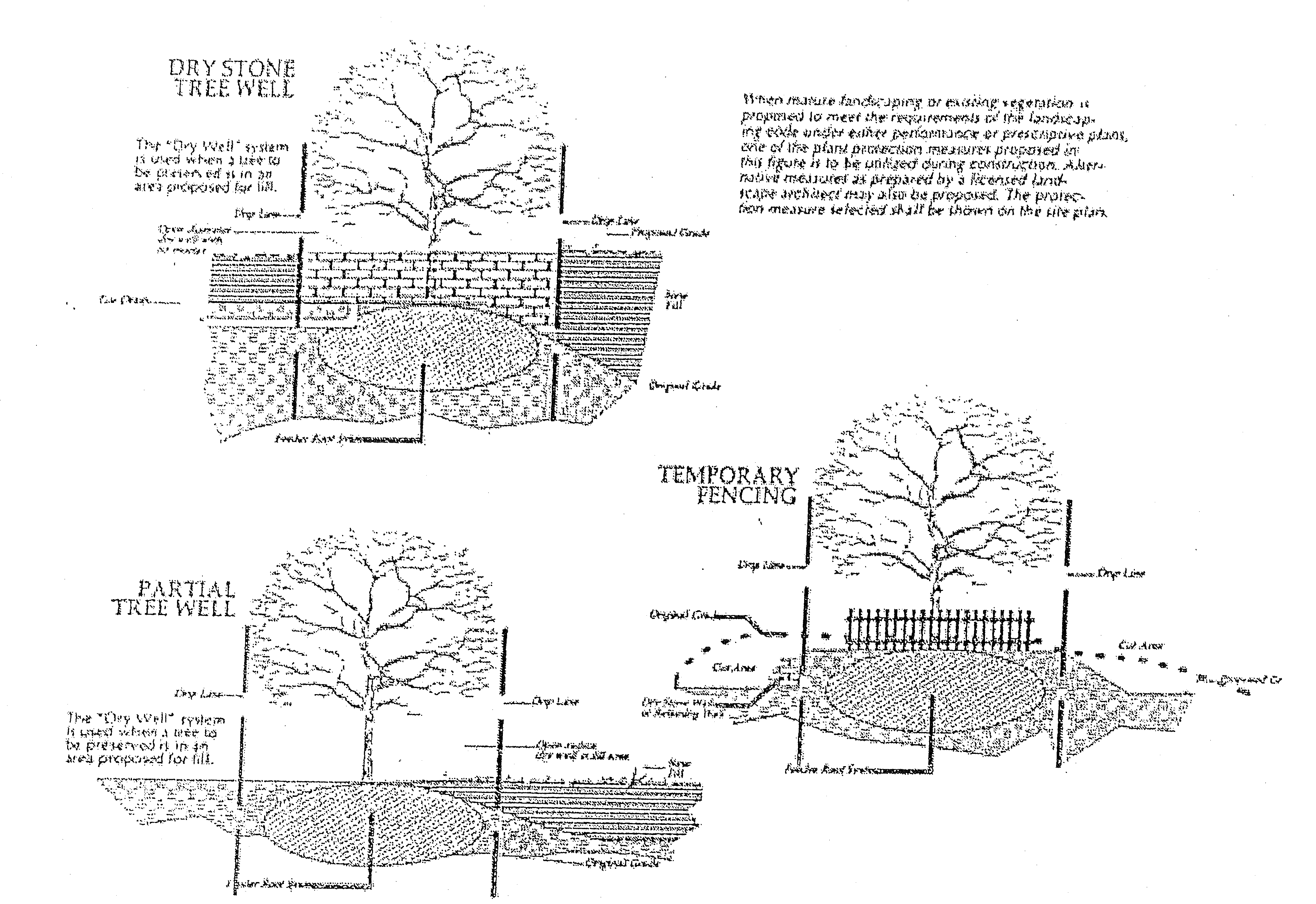
Figure 4.1 Tree Protection Measures
4.
Automatic irrigation required. All landscaping installations shall be required to incorporate an automatic underground irrigation system. Irrigation system shall be approved by the zoning administrator.
4.08.012. - Landscaping features are a part of the overall approval.
Trees, shrubs, fences, walls and other landscape features depicted on plans approved by the city shall be considered as elements of the project in the same manner as parking, building materials, and other details are elements of the plan. The landowner, heirs, successors in interest, lessees, or agent, shall be jointly and severally responsible for installation, maintenance, and upkeep as specified.
4.08.013. - Maintenance and upkeep of landscaping.
A.
Landscaping to be maintained in a vigorous and healthy condition.
1.
Regular maintenance of all landscaping to present a healthy, neat and orderly appearance shall be required.
2.
All landscaping shall be maintained free from disease, pests, weeds, and litter.
3.
Maintenance shall include weeding, watering, fertilizing, pruning, mowing, edging, mulching and other maintenance as needed and in accordance with acceptable horticultural practices.
B.
Repair and replacement of landscaping.
1.
Required landscape structures (examples include but are not limited to walls, fences, curbs, planters) shall be maintained in a structurally sound and aesthetically pleasing condition.
2.
The regular maintenance, repair, or replacement of any landscaping irrigation systems is required.
3.
Continuous maintenance of the site as a whole is required.
4.
All trees, shrubs, groundcover, and other plant materials must be replaced during the next suitable planting period if they die or become unhealthy because of accidents, drainage problems, disease; or other causes.
4.08.014. - Parking lot landscaping.
Parking lot landscaping standards of this section establish minimum landscaping requirements for the perimeter and interior of off-street parking areas. The general purpose of such landscaping is to reduce the visual impact of parking and pavement. Parking lots should be effectively landscaped with trees and shrubs to reduce the visual impact of glare, headlights, and parking lot lights from the public right-of-way and from adjoining properties. In addition, parking lots should be adequately shaded to reduce the amount of reflected heat.
A.
Perimeter parking lot landscaping: The parking lot perimeter landscaping requirements apply to all off-street parking lots that are not otherwise fully screened from view of adjacent public right-of-way. When a lot is located adjacent to a public right-of-way, alternatives should be considered to reduce the visual impact of the parking lot. Some alternatives are:
1.
Use of landscape perimeter borders: Required landscape borders shall be dedicated solely for open space and landscaping. No structures of paving shall be located within the border area, with the exception of walls, walkways or other features incorporated into the landscaping.
2.
Perimeter landscape border options: Any of the following types of perimeter landscape border detailed in the below chart, may be used to satisfy parking lot border landscaping requirements of this section.
2 Maximum distance: The greatest depth of the parking lot as measured from the front yard property line and the greatest width of the parking lot as measured from adjacent side yard property lines.
3 Minimum width of the border: The minimum width of the border shall be in addition to the required setbacks. A parking perimeter border shall be required between the parking areas and the property line but will not apply between the parking area and interior structures or areas.
4 Minimum number of plant units: The minimum number of plant units to be located within the parking perimeter border shall be in addition to the requirements for the square footage of the lot. The number of units shall be calculated based upon the perimeter of the parking area.
5 Type A parking borders may be used on any parking lot. If the depth of the parking lot measured from the property line is more than 150 feet. Type A parking border shall be required. If the depth is from 100 to 150 feet, a Type A or Type B border is required. If the depth is less than 100 feet, Type A, B, C, or D border shall be required. The applicant may select the optional border. Depending on site design, a single site may have more than one landscape parking border type.
6 Landscaping is required on the berm.
7 On property line fronting a public or private road as required by the zoning administrator. Landscaping is required in between the wall and right-of-way.
B.
Parking lot interior landscaping requirements. The parking lot interior landscaping requirements apply to the interior of all off-street parking lots that contain five or more parking spaces. Interior Planting Areas are required within all parking lots as specified in the subsection.
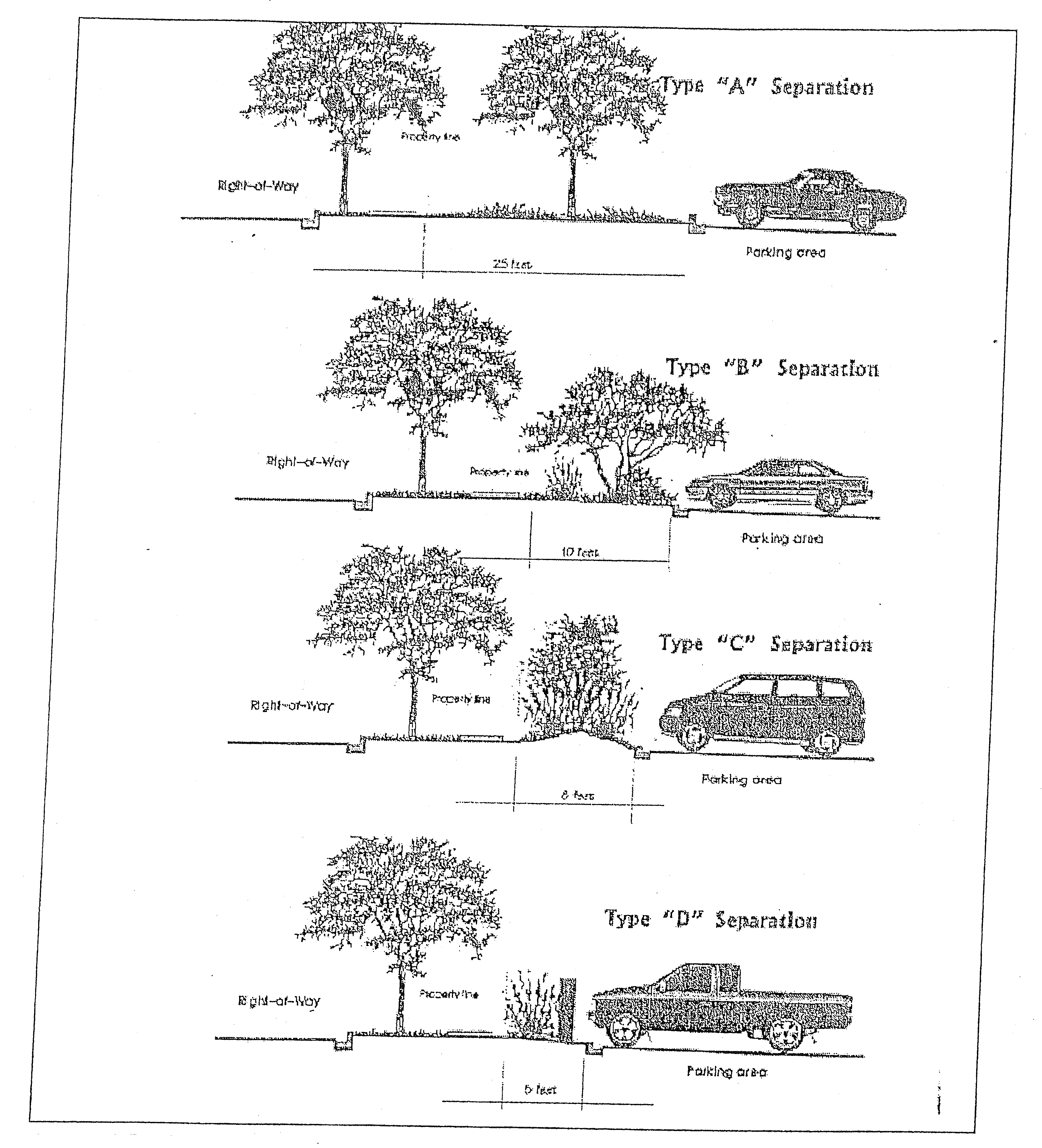
Figure 4.2 parking lot landscaping options for separation from right-of-way
1.
At least ten square feet of landscape planting area shall be provided within the interior of all off-street parking area for each parking space contained with the area. For parking areas with more than 20 total parking stalls in a double-loaded aisle, a ten-foot wide landscaped island shall run the length of the aisle. This island shall be required for each such aisle.
2.
Landscaping located on the interior of parking areas shall be dispersed throughout the area. All planting areas shall be protected to prevent damage by vehicles and vehicle overhang.
3.
The size of planting areas used to satisfy parking lot interior landscaping requirements shall be sufficient to protect plant materials and ensure proper growth and maintenance.
C.
Parking lot landscaping requirements when more than the maximum number of parking space is approved.
1.
When the parking space in excess of the defined maximum in Chapter 4.02 is approved, the minimum interior lot landscaping requirements shall be increased to 12.5 square feet of landscaping for each parking space.
2.
All aisles shall have landscaped areas at each end of the aisle.
3.
Landscaped medians at least ten feet in width shall be required for aisles that align with street access.
4.08.015. - Screening of service areas.
A.
Waste disposal receptacles.
1.
Waste disposal receptacle located in all commercial and government zones shall be completely screened from view on all sides by a fence or wall with a minimum height of six feet or one foot taller than the receptacle, whichever is greater.
2.
The enclosure shall be compatible in material and color with the primary structure on the lot if located within 20 feet of the building. If located beyond 20 feet from any structure, the enclosure should be designed to minimize the visual impact and blend in with surrounding landscaping.
3.
Waste disposal receptacles shall be consolidated to reasonably minimize the number of collection sites and to equalize the distance from the buildings they serve.
a.
Waste disposal receptacles shall be located out of the public view insofar as is practical.
b.
Waste disposal receptacles shall be located to avoid causing excessive nuisance or offense to other buildings or adjoining properties.
B.
Loading docks, storage areas. Loading docks, storage of materials or vehicles, and other service areas shall be screened from public view. Screening may include plant materials, fencing, walls, or a combination as approved by the zoning administrator.
4.08.016. - Landscaping in the public right-of-way between the edge of pavement and the property line.
A.
Property owners shall be responsible for maintaining landscaping within the public right-of-way along the entire frontage of the property unless otherwise determined by the zoning administrator.
B.
No conversion of right-of-way landscaping to any other use or surface material shall be permitted without the written permission of the zoning administrator.
C.
Landscaping and any other surface material located within the right-of-way between the edge of the traveled way and the property shall not be used for the storage, sale, display, or merchandise.
4.09.001.- Purpose.
The purpose of the proposed amendments is to provide more specific guidelines for site plan applications and standards in regard to lighting, in order to maximize the effectiveness of site lighting, to avoid unnecessary upward illumination and illumination of adjacent properties, and to reduce glare.
4.09.002. - Applicability.
Except as provided in section 4.09.005, this chapter shall apply to each outdoor luminary installed or replaced after the date of adoption of these regulations which is:
A.
Located on property within a commercial or industrial zoning district and is equipped with a lamp which emits 3,000 or more initial lumens; or
B.
Located on property within a residential zoning district or agricultural zoning district and is equipped with a high intensity discharge lamp, regardless of its initial lumens.
4.09.003. - Standards.
A.
All exterior lights and illuminated signs shall be designed, located, installed and directed in such a manner as to prevent objectionable light at, and glare across, the property lines and disability glare at any location on or off the property. The "maintained horizontal illuminance recommendations" set by the Illuminating Engineering Society of North American shall be observed.
B.
All parking area lighting will be full cut-off type fixtures.
C.
Uplighting is prohibited. Externally lit signs, display, building and aesthetic lighting must be lit from the top and shine downward. The lighting must be shielded to prevent direct glare and/or light trespass. The lighting must also be, as much as physically possible, contained to the target area. Internally lighted signs are acceptable, provided they meet the requirements of chapter 4.10.
D.
All building lighting for security or aesthetics will be full cut-off or a shielded type, not allowing any upward distribution of light. Floodlighting is discouraged, and if used, must be shielded to prevent:
1.
Disability glare for drivers or pedestrians.
2.
Light trespass beyond the property line, and
3.
Light above a 90 degree, horizontal plane.
Wallpack type fixtures are not acceptable.
E.
Adjacent to residential property, no direct light source will be visible at the property line at ground level or above.
F.
All non-essential lighting will be required to be turned off after business hours, leaving only the necessary lighting for site security. Non-essential shall apply to display, aesthetic, parking and sign lighting.
4.09.004. - Modification, waiver, or variation.
A modification, waiver or variation from the standard set forth in section 4.09.003 may be granted by the zoning administrator, as provided herein:
A.
The zoning administrator may modify, waive or vary the standard set forth in section 4.09.003 in a particular case, and impose conditions on such a modification, waiver or variation which it deems appropriate to further the purposes of these outdoor lighting regulations, in either of the following circumstances:
1.
Upon finding that strict application of the standard would not forward the purposes of this chapter or otherwise serve the public interest, or that alternative proposed by the owner would satisfy the purposes of these outdoor lighting regulations at least to an equivalent degree.
2.
Upon finding that an outdoor luminary, or system of outdoor luminaries, required for a baseball, softball, football or soccer field cannot reasonably comply with the standard and provide sufficient illumination of the field for its safe use, as determined by recommended practices adopted by the illuminating Engineering Society of North America for that type of field and activity or other evidence if a recommended practice is not applicable.
4.09.005. - Exempt outdoor lighting and related acts.
The following outdoor lighting and related acts shall be exempt from the requirements of these outdoor lighting regulations:
A.
Lighting which is not subject to this chapter by state or federal law.
B.
Construction, agricultural, emergency or holiday decorative lighting, provided that the lighting is temporary, and is discontinued within seven days upon completion of the project or holiday for which the lighting was provided.
C.
Lighting of the United States of America flag, State of Georgia flag, and other non-commercial flags expressing constitutionally protected speech.
D.
Security lighting controlled by sensors which provides illumination for 15 minutes or less.
E.
The replacement of an inoperable lamp or component which is in a luminary that was installed prior to the date of adoption this chapter.
F.
The replacement of a failed or damaged luminary which is one of a matching group serving a common purpose.
4.10.001.- Purpose and intent.
101.
Purpose of sign regulation.
A.
The purpose of this chapter is to support the economic vitality of the city through adequate identification of occupants, services, and events; to safeguard life through traffic safety; to protect the use of property, property values, and the public welfare; and to afford adequate opportunity for self-expression through free speech. These purposes are realized by regulating and controlling the number, location, size, sign type, and type of illumination of signs and sign structures so that all persons have ample opportunity to be equally heard and the public health, safety, and general welfare are adequately secured.
B.
Regulation of the location, size, placement, and certain features of signs is necessary to enable the public to locate goods, services, and facilities in the city without difficulty and confusion, to improve the general attractiveness of the city, to take advantage of the beauty of the city's natural environment, and to protect property values therein. Such regulation is also necessary to facilitate and aid in the identification and location of businesses in the city in the event of police, fire, or other emergencies and to avoid confusion and delay in response to such emergencies. Accordingly, it is the intention of the city to establish regulations governing the display of signs that will foster these objectives.
The objectives of this chapter include, but are not limited to, the following:
1.
Provide a reasonable balance between the right of a person to convey his or her message and the right of the public to be protected against the visual discord resulting from the unrestricted proliferation of signs and advertising devices;
2.
Guard against an excess of large, aesthetically unappealing, intense signs which cause visual blight on the appearance of the community. Visual blight adversely affects the aesthetic quality of life and traffic safety in the community for residents, businesses, pedestrians, and persons in vehicles;
3.
Protect the public health, safety and general welfare while protecting the rights of sign owners to expression;
4.
Provide regulations that vary the sign area based on the type of land use and zoning district, and based on need which is determined in part by the type of road frontage to which signage is directed;
5.
Provide regulations which are content-neutral. It is not the intent to regulate the content of messages in any way. To accomplish this, these regulations do not distinguish between on-site or off-site sign content, nor do they distinguish between commercial and noncommercial content. Any sign permitted pursuant to this chapter may contain commercial or noncommercial content. Sign allowances in this chapter take into account the needs for off-premises signs and signs carrying messages of a noncommercial character;
6.
Protect property values by minimizing the possible adverse effects and visual blight caused by unregulated or inadequately regulated signs;
7.
Ensure that signs are compatible with adjacent land uses and with the total visual environment of the community;
8.
Eliminate excessive and confusing sign displays; and
9.
Preserve and improve the appearance of the community as a place in which to live and to work and as an attraction to nonresidents who come to visit or trade.
102.
Regulation of signs. Signs erected within the city shall meet the placement and physical standards established by this chapter. The requirements of this chapter shall apply to all properties, regardless of zoning district.
103.
Intent of sign regulations. Notwithstanding any other restrictions in this sign ordinance, any sign authorized under this chapter can contain any message, other than messages containing obscenity, or other than a sign that advertises an activity that is illegal under Georgia or federal laws.
(Ord. No. 2009-008, Art. 1, 8-10-09; Ord. No. 2018-002, 3-19-18)
4.10.002. - Definitions.
201.
Zoning categories. The zoning categories listed herein are defined in the City of Commerce Zoning Ordinance.
202.
Definitions of words and phrases. For the purposes of this chapter, certain terms and words are hereby defined. As used in this chapter, unless the context otherwise indicates, the following words and terms shall have the meanings ascribed to them.
Abandoned sign: A permanent principal use sign on property containing a building or activity that has ceased operations. Permanent principal use signs on property shall be considered abandoned when there is clear evidence that a business or activity has vacated the building or grounds; provided, however, that this definition shall not apply to any case where a business or activity is temporarily suspended and there is evidence that the business or activity will resume operations within a six-month period.
Animated sign: A sign with action, motion, sound, or changing colors which accomplishes such action, motion, sound, or changing colors with or without electrical energy. This includes signs with lights or other illuminating devices that blink, flash, fluctuate, or have a changing light intensity, brightness, or color. This definition does not include a "swinging sign" or "multiple message sign" as defined by this chapter. For purposes of this chapter, the transition of a message on an electronic multiple message sign shall not be considered "animation."
Area of sign: The area within a continuous perimeter enclosing the limits of writing, representation, emblem, figure, or character together with any frame, other material, open space, or color forming an integral part of the message or used to differentiate such writing, representation, emblem, figure, or character from the background against which it is placed. The area of sign includes the term "sign face."
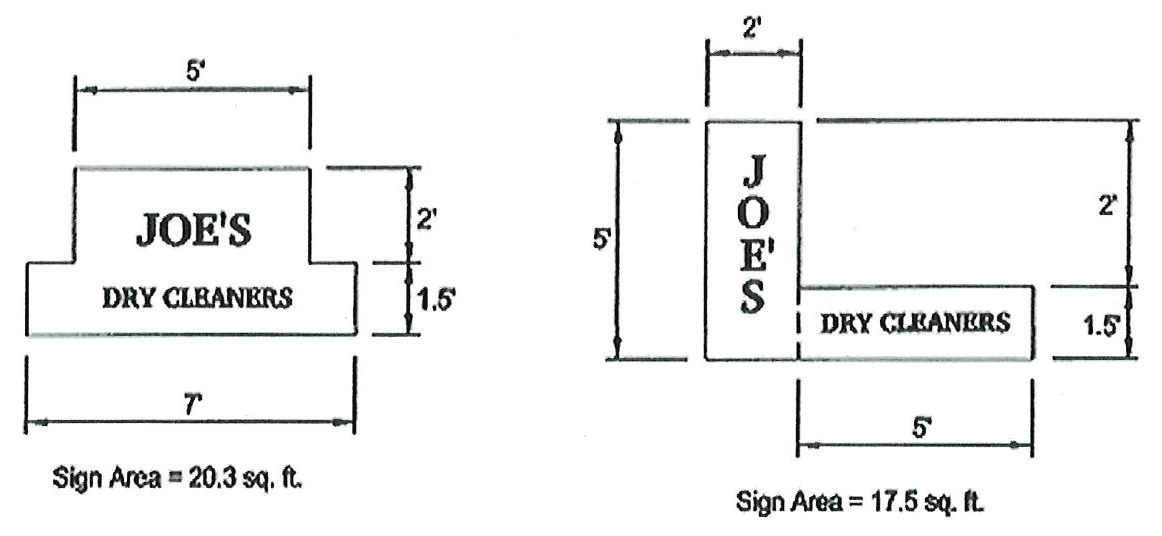
SIGN AREA MEASUREMENT
For double-faced signs, only the largest display face shall be measured in computing the sign area, or only one face shall be measured in computing sign area if the display faces are the same size. The display of street address on a ground sign, wall, or window shall not be computed in determining the maximum allowable area of a ground, wall, or window sign.
Awning: An architectural projection or shelter projecting from and supported by the exterior wall of a building and composed of a covering of rigid or non-rigid materials and/or fabric on a supporting framework that may be either permanent or retractable.
Awning sign: An awning that contains letters, numbers, symbols, pictures, logos, or visual display, or other communication, attached, painted on, or made an integral part of an awning. For purposes of this chapter, "awning signs" shall be considered "wall signs."
Banner: A sign with or without characters, letters, illustrations, or ornamentation applied to cloth, paper, plastic, or natural or synthetic fabric of any kind with only such material for a backing. For purposes of this chapter, the term "banner" includes the term "pennant."
Building marker: Any sign cut into a masonry surface of a building or made of bronze or other permanent material and permanently affixed to a building.
Building sign: A sign that in any manner is fastened to, projects from, or is placed or painted upon the exterior wall, window, door, or roof of a building. The term "building sign" includes but is not limited to the following:
A.
Mansard sign: A sign imposed, mounted or painted upon a mansard and not extending above the top of the mansard.
B.
Parapet sign: A sign imposed, mounted or painted on a parapet and not extending above the top of the parapet.
C.
Under-canopy sign: A display attached to the underside of a marquee, awning or canopy and protruding over public or private sidewalks.
D.
Wall sign: A single-sided sign with one visible face applied to or mounted to the wall or surface of a building or structure, the display surface of which if attached to a wall or portico and does not project more than 12 inches from the outside wall of such building or structure, or if on an awning or canopy, is flush with the material of said awning or canopy (see also figure, "types of attached signs").
Canopy, attached: A multisided structure or architectural projection supported by attachment to a building on one or more sides and also supported by columns at additional points. Signs placed on attached canopies are considered "wall signs" for the purposes of this chapter.
Canopy, freestanding: A multisided structure or architectural projection supported by columns. Signs placed on freestanding canopies are considered "wall signs" for the purposes of this chapter.
Canopy sign: A sign on a canopy. For purposes of this chapter, a sign on a canopy is a "wall sign" (see figure, "types of attached signs").
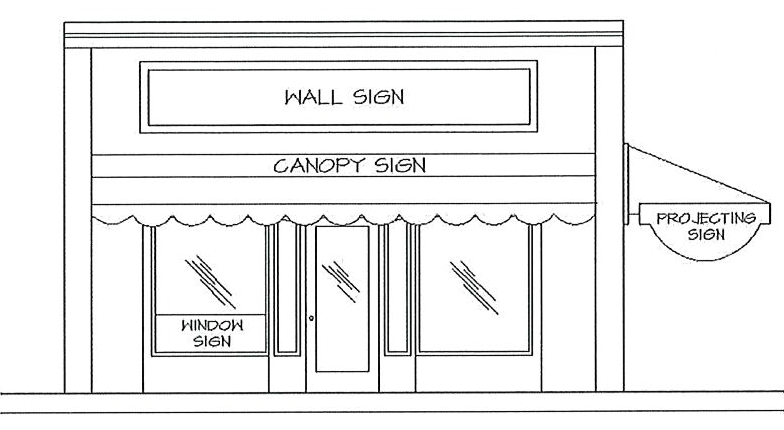
TYPES OF ATTACHED SIGNS
Channeled letters:
A.
Internally channeled letters: Letters or other symbols with recessed surface designed to accommodate incandescent bulbs or luminous tubing.
B.
Reverse channeled letters: Letters or other symbols with raised surface designed to be lighted from behind by incandescent bulbs or luminous tubing.
Code enforcement: The Commerce City Code Enforcement Department.
Code enforcement director: The director of the Commerce City Code Enforcement Department or the code enforcement director's designee.
Code enforcement officer: An officer of the Commerce City Code Enforcement Department. The term "officer" shall include the code enforcement director.
Dissolve: A mode of message transition on an electronic multiple message sign accomplished by varying the light intensity or pattern, where the first message gradually appears to dissipate and lose legibility simultaneously with the gradual appearance and legibility of the subsequent message.
Double-faced sign: A sign which has two display areas against each other or where one face is designed to be seen from one direction and the other face from another direction separated from each other at their nearest point by no more than three feet. Sign faces on a single sign structure that are separated by more than three feet are treated as separate signs. Only one face shall be used in computing allowable sign area.
Erect: To construct, build, raise, assemble, place, affix, attach, create, paint, draw, or in any other way bring into being or establish, but it shall not include any of the foregoing activities when performed as an incident to the change of the sign copy or the normal maintenance or repair of a sign structure.
Externally Illuminated Sign: A sign illuminated by an external source.
Fade: A mode of message transition on an electronic multiple message sign accomplished by varying the light intensity, where the first message gradually reduces intensity to the point of not being legible and the subsequent message gradually increases intensity to the point of legibility.
Flag: Fabric containing colors, patterns or symbols used as the symbol of a government or other entity or organization or concept.
Freestanding sign: A sign permanently attached to the ground and that is wholly independent of any building or other structure. The term "freestanding sign" includes but is not limited to the following:
A.
Pole sign: A sign that is mounted on a freestanding pole, columns, or similar support such that the bottom of the sign face or lowest sign module is not in contact with the ground. Pole sign includes the term "interstate sign."
B.
Ground sign: A sign in which the entire bottom of the sign face is in contact with the ground, providing a solid and continuous background for the sign face from the ground to the top of the sign. A ground sign may consist of more than one sign panel; provided all such sign panels are attached to or integrated into one sign structure.
C.
Monument sign: A sign where the structural part of the sign below the sign face encompasses an area at least 40 percent of the area of the sign face but no more than 1.5 times the area of the sign face, and which is composed of brick, stone, or other similar material.
Frontage, building: The width in linear feet of the front exterior wall of a particular building in which an establishment is located.
Frontage, road: The distance in linear feet of each lot where it abuts the right-of-way of any public street.
Height of sign: The distance in vertical feet from the ground to the highest point of the sign, whether that highest point is the frame of the sign face or panel or the support of the sign.
Holiday decorations: Displays erected on a seasonal basis in observance of religious, national, or state holidays, which are not intended to be permanent.
Inflatable sign: Any sign that is or can be filled with three cubic feet or more of air or gas.
Internally illuminated sign: A sign illuminated by an internal light source which is viewed through a translucent panel.
Incidental sign: A small sign, emblem, or decal no larger than one square foot. Such signs are normally located on doors, windows, and gas pumps, and are generally not readily visible or legible from public rights-of-way.
Marquee: A roof like structure attached to and supported by a building wall (with no vertical supports) and that projects in a cantilever fashion from the wall of a building.
Marquee sign: A sign painted on, attached to, or hung from a marquee. For purposes of this chapter, "marquee signs" shall be considered "wall signs."
Master signage plan: A plan establishing parameters for the size, location, design, and color of signs on a property which contains multiple uses, buildings, or tenants but which is constructed or managed as a single development.
Minimum street-side setback: The minimum distance required by the zoning on a property between an adjoining right-of-way and the facade of a principal building on the property.
Multi-faced sign: A single sign structure consisting of two sign faces (see "double-faced sign) or three or more sign faces that are separated from each other at their nearest point by no more than three feet. Sign faces on a single sign structure that are separated by more than three feet are treated as separate signs.
Multiple message sign: A sign, display, or device which changes the message or copy on the sign. Such a change of message or copy can be accomplished electronically, or by movement or rotation of panels or slats, or by changing the copy by manual means.
Multiple message sign, electronic: Any "sign," as defined in this chapter, which results in the illuminated display of messages or information by the use of a matrix of electric lamps (e.g., digital, LED (light emitting diode) or similar or refined display technology), or other electric methods, which allows the message change to be actuated by an electronic control mechanism. It is characteristic of such signs that the sequence of messages and the rate of change can be electronically programmed and can be modified by electronic processes. Electronic multiple message signs are also "internally illuminated signs.
Nit: A standard unit of luminance; a measurement of direct light (i.e., looking directly at the light source), used to describe displays. A "nit" is an amount of emanating light equal to one candela per square meter (cd/m2).
Nonconforming sign: Any sign which lawfully existed on the effective date of this chapter but which does not conform to the provisions of this chapter, or which does not comply with this chapter due to amendments to this chapter since the date of erection of the sign.
Pennant: A small, triangular or rectangular banner, or multiples thereof, made of lightweight plastic, fabric, or other material, individually supported or attached to each other by means of a string, rope, or other material and meant to be stretched across or fastened to buildings, or between poles and/or structures, and which is designed to move in the wind. For purposes of this chapter, "pennants" are "signs."
Portable sign: Any sign whether on its own trailer, wheels, or otherwise, which is designed to be transported from one place to another. It is characteristic of a portable sign that the space provided for advertising messages may be changed at will by the replacement of lettering or symbols (i.e., a changeable copy sign). Even if the wheels or supports of such sign are removed and the sign [is] converted and attached, temporarily or permanently, to the ground or other structure, said sign shall remain a portable sign. The term "portable sign" shall include the term "temporary sign."
Portico: A porch or walkway, open to the outside air that is covered by a roof supported by columns or pillars, typically leading to the entrance of a building. Signs attached to porticos are considered "wall signs" for purposes of this chapter.
Principal use sign: The primary freestanding and/or building sign allocated to a particular premises or lot. The owner of the principal use sign may display a message, the content of which is not regulated by this chapter.
Project entrance sign: A freestanding monument sign erected at the entrance to a subdivision designed for residences, offices, businesses, institutions, or light industries or combination thereof.
Projecting sign: A sign projecting more than 14 inches from the outside wall or walls of any building, or canopy, portico, or awning, upon which it is located (see also figure, "types of attached signs").
Roof sign: A sign projecting higher than the front building wall or any sign supported by or attached to said roof.
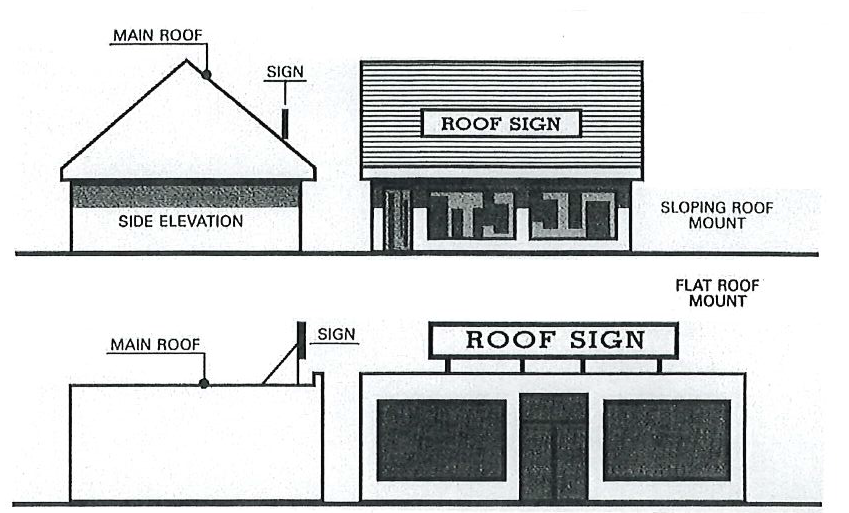
Source: United States Sign Council. 2001. Guideline Code for Regulation of On-Premise Signs.
Sign: A lettered, numbered, symbolic, pictorial, or illuminated visual display, device, or communication designed or used for the purpose of identifying, announcing, directing, informing, or bring to the attention of others the subject thereon, that is visible from the public right-of-way, a driveway or parking lot with access to a public right-of-way, or from an adjacent property, except as specifically noted otherwise in this chapter. For purposes of this chapter, the term "sign" includes but is not limited to "banners," "balloons," "flags," "pennants," "streamers" and "windblown devices." Furthermore, the term "sign" includes the sign structure, supports, lighting system, and any attachments, ornaments, or other features used to draw the attention of the observers.
Sign face: That part of a sign that is or can be used for the sign's message.
Signable area: In the case of a wall sign, signable area shall be the building face on which the sign is proposed, excluding windows and doors. In the case of marquees or canopies, signable area shall be the area of the marquee or canopy wall on which the sign is proposed. For window signs, signable area shall be measured and calculated on the basis of the proportion of area within each individual window frame, not the total window area of all building windows visible from a street.
Shared sign: A sign which is allowed on a premise with more than one tenant or occupants of a building and available for use by those tenants or occupants. It may be freestanding or attached (wall).
Standard informational sign: A standard informational sign is a nonpermanent sign that is no larger than four and one-half (4½) square feet in area and three feet in height.
Streamers: See "pennants."
Swinging sign: A sign other than an animated sign as defined by this chapter, where the sign copy area is attached to a sign structure in a way that can be set in motion with pressure, and where the sign structure is attached to a building at a height above normal eye level. This term does not include any freestanding signs. A swinging sign may be considered in lieu of permitted wall signage.
Temporary sign: A sign of a nonpermanent nature and erected for a limited duration. Temporary signs include, but are not limited to, flags in quantities of more than three, pennants, banners attached to structures, fringe, twirling, balloons, streamers, portable signs, air- or gas-filled figures, and other similar temporary signs.
Transition: A visual effect used on an electronic multiple message sign to change one message to another.
Visible: Capable of being seen (whether or not legible) without visual aid by a person of normal visual acuity.
Vehicular sign: Any sign placed, mounted, painted on or affixed to a motor vehicle, freight, flatbed or storage trailer or other conveyance when same are placed or parked in such a manner as to be viewed or intended to be viewed from the public right(s)-of-way except that this definition shall not apply when:
A.
Such conveyances are actively being used to transport persons, goods or services in the normal course of business;
B.
When such conveyances are parked in an inconspicuous area; or
C.
When such conveyances are actively being used for storage of construction materials for, and on the same lot with a bona fide construction project for which building and other applicable permits have been issued and where construction is underway and provided said conveyances are located within designated storage areas.
Windblown device: Any device not otherwise specifically defined in this chapter, that is designed to inform or attract, whether or not such device carries a message, and which all or part of the device is set in motion by wind. For purposes of this chapter, "windblown devices" are "signs."
Window sign: A sign installed on or within two feet of an exterior window or door and intended to be visible from the exterior of the building. (See also figure, "types of attached signs".)
(Ord. No. 2009-008, Art. 2, 8-10-09; Ord. No. 2018-002, 3-19-18)
4.10.003. - Applicability.
301.
Signs that are regulated. The regulations and requirements of this chapter apply to all signs that are or are intended to be viewed from a street or public right-of-way or adjacent property, or that are intended to be viewed from outdoor areas of public property.
302.
Signs that are exempt from regulation. Each of the following types of signs are allowed on any property, with permission of the land owner, and are exempt from permitting requirements, provided they otherwise meet the standards of this chapter:
A.
Flags, as many as three per lot, when designed and displayed in a way that allows for routine, daily removal or raising and lowering of the flags, not exceeding 40 square feet. Poles for such flags shall not exceed 25 feet in height, and shall not be more than 25 feet from the main building entrance;
B.
Street address identifiers and building identification numbers on multitenant buildings no more than six inches in height in residential zoning districts and no more than twelve inches in height in all other zoning districts;
C.
Signs not oriented or intended to be legible from a public right-of-way, private road or driveway, or adjacent property;
D.
Signs which are designed to be read only from close range (i.e., five feet), attached to a device or structure more than 25 feet from the right-of-way of a road, not to exceed one square foot in area; provided, however, that drive-through lanes may have display boards not exceeding six feet in height or 36 square feet in area;
E.
Signs erected more than two feet inside a building;
F.
Building markers no greater than six square feet in area;
G.
Traffic safety and traffic directional signs, installed within the right-of-way of a public street under the authority of the government with jurisdiction and meeting the standards of the Manual of Uniform Traffic Control Devices;
H.
Traffic safety and traffic directional signs along private streets and driveways, and in off-street parking lots that are installed per the requirements of the city planning director and which do not exceed four square feet each;
I.
Shared signs, as defined by this chapter, which do not exceed four square feet each nor six feet in height;
J.
Signs erected by or on the order of a governmental entity or a public officer in the performance of his duty;
K.
Handicapped parking signs, when required per state law;
L.
An A-frame or sandwich board sign. These signs may be placed in any commercial or CBD district provided that (1) the sign does not exceed six square feet per side (12 square feet total) of sign structure area; (2) the sign is only placed outside during business hours; (3) the sign is placed within three feet of the primary entrance to the owner's building; and (4) the sign is not placed in a manner or location such that an adequate portion of the sidewalk remains unobstructed for pedestrian traffic. Any A-frame or sandwich board sign that does not meet this criterion must be permitted;
M.
Incidental signs. Small signs and postings as defined in this chapter of no more than one square foot, provided that the aggregate of all such signs on a property may not exceed 12 square feet.
(Ord. No. 2009-008, Art. 3, 8-10-09; Ord. No. 2018-002, 3-19-18)
4.10.004. - Prohibited signs.
The following types of signs are prohibited:
401.
Attached and painted signs. Signs attached to trees or utility poles or boxes; signs painted on or otherwise attached to rocks or other natural objects; signs, other than those placed by a local, state or federal government, located within the public street right-of-way or within ten feet from the back of the curb or from the edge of the pavement on streets with no curbing are not allowed.
402.
Dilapidated signs. Signs that are dilapidated or in such condition as to create a hazard, nuisance or to be unsafe or fail to comply with any provision of the building code of the city are not allowed.
403.
Signs within the right-of-way. Signs attached to traffic signs, governmental signs, public rights-of-way or other public property, utility poles, or guy wires are not allowed; except for those signs erected with permission of the governing body with jurisdiction for a public purpose.
404.
Festoons. Strings of ribbons, tinsel, small flags, pennants, streamers, pinwheels, or other devices or long narrow strips of fabric, plastic or other pliable material designed to move in the wind, are not allowed, except as provided for temporary signage under this chapter.
405.
Obscene signs. Obscene signs, as defined by the State of Georgia at O.C.G.A. Section 16-12-80 (b), are not allowed.
406.
Obstructions:
A.
No sign shall obstruct any of the following: any fire escape, window, door, or opening usable for fire prevention or suppression, or prevent free passage from one part of a roof to any other part thereof;
B.
No sign shall extend above a parapet wall, be affixed to a fire escape, or interfere with any opening required for ventilation;
C.
No sign shall be placed in such a manner that it obstructs the vision of pedestrians or traffic in a public right-of-way or the entrance of a private street or driveway to a public right-of-way;
D.
No sign shall be located so as to obscure or otherwise interfere with the effectiveness of an official traffic control sign, signal, or device.
408.
Portable signs. A sign designed to be transported or easily relocated and not permanently attached to the ground, such as, but not limited to, the following, is not allowed, except as provided for temporary signage under this chapter:
A.
A sign designed to be temporarily placed upon the ground and not otherwise affixed to it.
B.
A sign mounted on a trailer, with or without wheels.
C.
Umbrellas except those hand held by persons or utilized for shade in an outdoor dining area.
D.
Signs displayed on benches.
E.
Signs displayed on trashcans.
408.
Roof signs. Roof signs, including signs painted or adhered on roofs, are not allowed. This prohibition does not apply to the fascia portion of a mansard roof, or to the face of a parapet wall, provided that the sign must not extend above the top of the mansard roof or parapet wall.
409.
Signs imitating warning signals. Signs displaying lights resembling the flashing lights customarily used in traffic signals or in police, fire, ambulance or rescue vehicles or signs using words, slogans, dimensional shape or size, or colors of governmental traffic signs are not allowed.
410.
Sound or smoke emitting signs. A sign that emits or utilizes in any manner any sound capable of being detected on any traveled road or highway by a person with normal hearing, or a sign that emits smoke, vapor or odors, is not allowed.
411.
Signs advertising illegal activity. Signs that advertise an activity illegal under Georgia or federal law are not allowed.
412.
Signs placed on unlicensed motor vehicles. Any sign placed, mounted, painted on or affixed to a unlicensed motor vehicle, freight, flat-bed or storage trailer or other conveyance when same are placed or parked in such a manner as to be viewed or intended to be viewed from the public right(s)-of-way is not allowed.
413.
Inflatable Signs. Inflatable signs, except as specifically permitted as a special event sign are not allowed.
414.
Signs not allowed by property owner. Signs erected without the permission of the property owner are not allowed.
415.
Vehicular signs. Vehicular signs are not allowed.
(Ord. No. 2009-008, Art. 4, 8-10-09; Ord. No. 2018-002, 3-19-18)
4.10.005. - General requirements applying to all signs.
501.
Conformance to building codes.
A.
In addition to any sign permit required under this chapter, a building permit shall be obtained from the city planning director prior to installation or placement of any freestanding sign having a sign structure area greater than 15 square feet or any building sign having a sign face area greater than six square feet. All signs for which a building permit is required shall be constructed and maintained in conformance with all building code and electrical code requirements.
B.
For any freestanding sign with a sign face greater than 240 square feet in area, plans for the sign shall be certified as to conformance with all structural and wind-load resistive standards of the building code by a qualified structural engineer or be prepared using standard drawings prepared by a structural engineer or other qualified professional meeting or exceeding all requirements of the building code.
C.
All signs involving internal lights or other electrical devices or circuits shall display a label certifying it as being approved by the Underwriter's Laboratories, Inc. All electrical service to a sign shall be in compliance with the electrical code. Clearance from all electrical power lines shall be in conformance with the requirements of the electrical code.
502.
Conformance to state law. The following applies to any sign located or to be located within 660 feet of the nearest edge of the right-of-way of a U.S. or State-numbered highway (or any other road designated as a "primary highway" by the State of Georgia and approved by the U.S. Department of Transportation), or located or to be located beyond 660 feet of such highway but visible and intended to be read from such highway:
A.
Such sign shall comply with all requirements of the Georgia Outdoor Advertising Act, O.C.G.A. 32-6-70 et seq.
B.
Such sign shall comply with all requirements of this chapter. Between the Georgia and Commerce City regulations, such sign must comply with the most restrictive requirements with respect to each and every item of regulation.
503.
Sign maintenance. All signs shall be maintained by the sign owner in good condition so as to present a neat and orderly appearance. Upon discovery of a sign in need of maintenance, a code enforcement officer shall give written notice to the owner of the sign or the owner of the property on which the sign is located if the owner of the sign itself cannot be determined. Said notice shall state the item or items requiring repair or maintenance. The owner shall have 30 days in which to repair or maintain the sign before a citation is issued. If the owner has failed to make repairs or the necessary maintenance within that time, a code enforcement officer shall cause a citation to be issued. A code enforcement officer may cause to be removed after notice pursuant to this section any sign which shows gross neglect, is dilapidated or poses an imminent threat to public safety. It shall be unlawful, after being notified pursuant to this section and after the 30 day notice has expired, for any person to display a sign in any of the following conditions:
A.
Lettering or other elements of the sign have become detached or have fallen off the sign or become misaligned;
B.
Painted surfaces on the sign or sign structure have begun to peel, flake over a significant portion of the sign, or have faded or oxidized to an extent that the sign no longer displays the message as originally intended;
C.
A significant number of the bricks, stones, or other materials on the structural base of a sign have become detached or have fallen off, or have become misaligned;
D.
For lighted signs, one or more illumination devices are not working and have not been replaced;
E.
All signs, together with all their supports, braces, guys, and anchors that are not kept in good repair and, unless constructed of galvanized or non-corroding metal, covered by a protective coating as necessary to maintain a clean appearance and safe condition;
F.
Signs displaying visible rust;
G.
Any sign not maintained in accordance with all applicable City regulations, including any regulations concerning nuisances and vegetation.
504.
Minimum sign setback.
A.
No sign or sign structure of any kind is authorized to extend into or above, or be anchored or placed in any portion of a public right-of-way (except signs erected by local, state or federal governments).
B.
No sign on a property shall be located in the public right-of-way, and in any event will be no less than ten feet from the back of the curb or from the edge of the pavement on streets with no curbing.
505.
Principal freestanding signs; distance between.
A.
Signs 100 square feet in area or less. Each principal freestanding sign having a sign face area of 100 square feet or less shall be located at least 50 feet from any other principal freestanding sign on the same side of the street. This distance may be reduced due to the location of existing signs on separate but adjoining lots but such reduction shall be the minimum required in order to maintain the greatest separation possible from such existing signs. Distance measurements are to be made horizontally from the nearest edge of the sign structure.
B.
Signs from 100 square feet to 240 square feet in area. Each principal freestanding sign having a sign face area from 100 square feet to 240 square feet shall be located at least 500 feet from any other freestanding sign, on the same side of the street, having a sign face area from 100 square feet to 240 square feet, and at least 200 feet in any direction from a property where signs having a sign face area of at least 100 square feet are not allowed. Distance measurements are to be made horizontally from the nearest edge of the sign structure.
C.
Signs greater than 240 square feet in area. Each principal freestanding sign having a sign face area greater than 240 square feet shall be located at least 750 feet from any other freestanding sign, on the same side of the street, having a sign face area greater than 240 square feet, and at least 200 feet from a property where signs having a sign face area of greater than 100 square feet are not allowed. Distance measurements are to be made horizontally from the nearest edge of the sign structure.
506.
Ground clearance under signs.
A.
Projecting signs shall not project more than three feet beyond the face of the building. Projecting signs shall provide a minimum of eight feet of clearance from ground level to the bottom of the sign.
B.
Under-canopy signs of greater than four square feet shall be rigidly mounted, and there shall be eight feet of clearance below the base of any rigidly mounted under-canopy sign. There shall be a minimum clearance of eight feet below the base of any non-rigidly mounted under-canopy sign.
C.
Awning, mansard and marquee signs shall be no less than eight feet above the ground at the lowest extremity of the sign when erected over pedestrian walkways.
507.
Visibility clearance area.
A.
No portion of a sign face, and no portion of a sign structure wider than 12 inches, between the heights of three feet and 15 feet shall be located within 20 feet of the intersection of the right-of-way lines of streets, roads, highways or railroads, or within 20 feet of the intersection of a street right-of-way and either edge of a driveway.
508.
Illuminated signs.
A.
Where restricted. Signs are allowed to be externally or internally illuminated, except as follows:
1.
A sign located on an agricultural property may not be internally illuminated. External illumination must be installed so that it illuminates only the sign face and does not shine onto public rights-of-way or neighboring properties. The source of the external illumination shall be shielded from view from public rights-of-way and neighboring properties.
2.
A sign located on single- or two-family residential property may not be internally illuminated. External illumination must be installed so that it illuminates only the sign face and does not shine onto public rights-of-way or neighboring properties. The source of the external illumination shall be shielded from view from public rights-of-way and neighboring properties.
3.
Temporary signs allowed under section 4.10.008 shall not be illuminated.
4.
Signs located in the city central business district shall not have internal illumination.
B.
Traffic control. No sign illumination device shall resemble an official traffic control sign, signal or device.
C.
Hazards. Illumination devices shall be placed, filtered, and shielded so direct rays will not be cast into the eyes of drivers or pedestrians.
D.
Light pollution. Sign illumination shall not cast light directly upon adjacent properties or roadways.
E.
Neon tubes. No sign that has exposed neon tubes or other exposed tubes containing luminescent gas shall be used outside a building.
F.
Exposed wires. All wiring must meet city building and electrical code requirements.
G.
Strings of bulbs. Strings of bulbs are not permitted, except as part of a holiday decoration.
H.
Types of illumination.
1.
Externally-illuminated sign. An externally-illuminated sign, when permitted, shall have concealed wiring and controls, and shall have shielded and screened external light sources.
2.
Internally-illuminated sign. Internally-illuminated signs, where permitted, must completely shield the source of light from direct view. Internally illuminated channeled or reverse-channeled letters are permitted only in instances of wall signs affixed to a building.
I.
Multiple message signs. A multiple message sign shall not allow the display or message to change more frequently than once every ten seconds. The display or message shall not scroll or fade and must change instantaneously.
509.
Abandoned signs.
A.
If the principal use or activity on a property has ceased operation, any permanent ground signs, including supports, and wall signs, permitted in connection with said principal use or activity shall be removed within 90 days of the discontinuance of said principal use or activity. No new sign shall be permitted to be erected on the same property until the discontinued sign, including its supports, has been removed or is converted to a lawfully conforming sign.
B.
If an accessory use or activity on a property has ceased operation, any permanent ground signs, including supports, and wall signs permitted in connection with said accessory use or activity shall be removed within 45 days of the discontinuance of said accessory use or activity. No new sign shall be permitted to be erected on the same property until the discontinued sign including supports has been removed or is converted to a lawfully conforming sign. Upon the expiration of the applicable time period provided in this section for the removal of discontinued signs and sign supports, said signs shall be deemed unlawful abandoned signs.
C.
If a discontinued use sign contains a sign face that is in the form of a removable panel, the panel containing messaging shall be removed and replaced with a panel without messaging until another sign permit issued for a new use sign. If a discontinued use sign contains a sign copy area that is not removable without disassembling the sign, then the said sign copy area shall be painted over if possible, or, where it cannot be painted over, covered with durable cloth or canvas so that the sign copy area is no longer visible, until such time as a new sign permit is applied for and granted and new sign copy is placed on the existing panel or structure.
510.
Nonconforming Signs.
A.
A nonconforming sign shall not be replaced by another nonconforming sign.
B.
Nonconforming signs shall not be modified to add additional lighting or to be altered in any way.
C.
A nonconforming sign that is a multiple message sign but the messages are changeable only by manual means may continue to have its copy changed by manual means.
D.
A nonconforming sign that is a multiple message sign but the messages are changeable by means of the movement or rotation of panels or slats may continue to have its copy changed, and change copy, by any such same means.
E.
A nonconforming sign that does not meet the definition of a "multiple message sign, electronic" as defined in this chapter shall not be changed, modified, or retrofitted in any way so as to become a "multiple message sign, electronic."
F.
No structural repairs, change in shape, or size of a nonconforming sign shall be permitted except to make the sign comply with the requirements of this chapter. Minor repairs and maintenance of nonconforming signs shall be permitted.
G.
When a nonconforming sign is damaged by nature or an act of God, such sign may be promptly repaired, rebuilt or restored to the same dimensions, type, shape, location, size and height as the original nonconforming sign. The failure to repair, rebuild or restore such a sign within 180 days of the date of damage shall be deemed to be abandonment of the sign and any re-erection of such sign shall conform in all respects with the requirements of this chapter.
(Ord. No. 2009-008, Art. 5, 8-10-09; Ord. No. 2018-002, 3-19-18)
4.10.006. - Measurement of sign area and height.
601.
Computation of sign area. In order to determine compliance with the maximum allowable sign areas permitted under this chapter, the following shall establish how sign areas are measured. The terms "sign area" and "sign face area" are interchangeable and have the same meaning for the purpose of regulating maximum sign sizes.
A.
Sign face area (See Figure 4).
1.
The area of a sign face shall be computed as the area within the smallest rectangle enclosing the limits of a sign face, or the combination of the areas of all such rectangles delimiting each sign module, together with any frame or material, texture, or color forming an integral part of the sign face or used to differentiate the sign face from the structure upon which it is placed.
2.
For signs that have no identifiable frame or border, the smallest rectangle that includes all of the sign's words, letters, figures, symbols, logos, fixtures, colors, or other design elements intended to convey the sign's message shall establish the area of the sign's face (See Figure 6).
3.
For signs applied to a kiosk or other cylindrical sign structure, the area of the sign face shall be computed as the largest rectangular area achieved from any one view of the sign. Measurements shall be made as a flat plane rectangle projected on the sign (See Figure 7).
4.
The computation of the area of a sign face shall not include the structure, supports, or uprights on which the sign face is placed or any portions of a sign structure that are not intended to contain any message or idea and are purely structural or decorative in nature, other than those portions contained within the rectangle that delimits the sign face or a sign module.
5.
Manual changeable copy signs. For any sign on which any of the words, letters, figures, symbols, logos, fixtures, colors, or other design elements are routinely changed or are intended to be changed from time to time, the sign face area shall include the entire area within which any words, letters, figures, symbols, logos, fixtures, colors, or other design elements may be placed, together with any frame or material, texture, or color forming an integral part of the sign face or used to differentiate the sign face from the structure upon which it is placed.
B.
Sign structure area (See Figure 5).
1.
The area of a sign structure shall be computed as the area within the smallest rectangle enclosing the limits of the surface of a sign whereon the sign face or sign modules may be placed, including all portions of a sign structure that provide a background for the sign face but are not intended to contain any message or idea and are purely structural or decorative in nature.
2.
For a kiosk or other cylindrical sign structure, the area of the sign structure shall be the largest measurement achieved from any view of the sign structure. Measurements shall be made as a flat plane rectangle projected on or bisecting the sign structure.
3.
For project entrance signs or other signs that are imposed, mounted or painted on a wall or other decorative structure, the sign structure area shall be computed as that portion of such wall or other decorative structure that is discernibly devoted to the support of the sign or, by its design or architectural treatment, intended to provide a background or frame for the sign.
C.
Treatment of oven spaces. Any open space contained within the limits of the rectangle delimiting the sign face, sign module, or sign structure shall be included in the computation of the area of such sign face, sign module, or sign structure.
D.
Multi-faced signs.
1.
Double-faced signs. For double-faced signs, when the sign face surfaces are parallel (back-to-back), or where the smallest angle formed between the two faces is 60 degrees or less, the area of the sign shall be taken as the area on the largest side. For double-faced signs where the interior angle formed by the faces is more than 60 degrees, the area of the sign shall be the total area of all sides.
2.
Signs with three or more faces. For sign structures having only three faces and the interior angle formed between all of the faces is 60 degrees, the area of the sign shall be taken as the area on the largest side. For all other multi-faced signs with three or more sides, the area of the sign shall be the largest total of all faces that are joined by an interior angle of more than 60 degrees that can be viewed from any one direction.
602.
Measurement of sign height. The height of a sign shall be equal to the vertical distance from the average grade at the base of the sign, or from the crown of the roadway of the nearest street within 50 feet of any portion of the sign, to the highest point of any portion of the sign, whichever results in the greater sign height. Any earthen berms and elevated foundations supporting signs, sign posts or other sign supports shall be included in the height of the sign.
(Ord. No. 2009-008, Art. 6, 8-10-09; Ord. No. 2018-002, 3-19-18)
Sec. 4.10.007. - Sign types permitted by zoning.
The following sections present the maximum number, size, height, and other restrictions relating to specific signage that are permitted by right in each land use category. Additional signage is permitted under section 4.10.008, Temporary Signs, of this chapter.
701.
Principal freestanding sign—One use on property. "Principal freestanding sign—One use on property" on Table 1 applies to a lot where there is only one use being made of the property, such as but not limited to one single-family or two-family dwelling, one multi-family development, one public or community institution, or one business occupant. A predominantly agricultural property, with or without a residence on the property, is considered a single agricultural use. Properties that are vacant but zoned or offered for sale or lease for a particular land use also fall under this category.
See Table 1
702.
Principal freestanding sign—Planned center. "Principal freestanding sign—Planned center" on Table 1 applies to a single commercial or industrial property that is designed or intended for occupancy by two or more principal businesses that are separately-owned and have no corporate relationship. A planned center may consist of several businesses in a single building or individual businesses in several buildings on the property.
703.
Project entrance signs. Each project entrance sign shall not exceed the number, area or height limitations shown on Table 1.
704.
Maximum number of principal freestanding signs. Only one principal freestanding sign is allowed on each parcel, whether the sign is located on a property occupied by only one use, is a planned center sign or is a project entrance sign. 4.10.007.705. Building signs. For building signs permitted on Table 2, the following shall apply:
705.
Building signs. For building signs permitted on Table 2, the following shall apply:
A.
For buildings, the maximum allowed area for a building sign on a wall shall be calculated on the basis of the percentage of the entire area of said wall, including all windows and doors.
B.
In no case shall a window sign obscure more than 25 percent of a window.
1 On a lot in a commercial subdivision, office or industrial park, the maximum sign height is 70 feet adjacent to the lot frontage on an Interstate or 4-Lane U.S. or State numbered highway, 25 feet along other U.S. or State numbered highway and 15 feet along all other streets/roads.
2 These developments may have project entrance signs at a maximum of two entrances per project street front. For these developments, project entrance signs may be either single sign or dual sign structures, each type counting as one sign under "Max. Number" on the table.
3 For these developments, project entrance signs may only be single sign project entrance signs.
4 In a Commercial or Industrial district, for a tenant occupying 50,000 to 100,000 square feet of floor area, the maximum sign area is 150 square feet, and for a tenant occupying more than 100,000 square feet of floor area, the maximum sign area is 200 square feet.
5 In the Central Business District, for a tenant occupying 25,000 to 50,000 square feet of floor area, the maximum sign area is 150 square feet, and for a tenant occupying more than 50,000 square feet of floor area, the maximum sign area is 200 square feet.
706.
Residential signs. In residential zoning districts a lot may contain no more than five standard informational signs with a maximum aggregate sign face area of twenty two and one-half (22.5) square feet without a permit or fee. A lot may contain one banner without a permit or fee but the sign face area of the banner shall be included in the maximum aggregate sign face area. No sign shall exceed three (3) feet in height. For those lots with conditional uses existing within residential zoning districts, one additional permanent freestanding sign not exceeding sixteen (16) feet in sign area and six feet in height may be erected.
707.
Outdoor recreational facility. Signs erected on walls, fences, dugouts, press boxes, stadium stands, concession stands, ticket booths, benches and locker rooms on any public or community use outdoor recreational facility (such as a baseball stadium or soccer field) are permitted with the following restrictions:
A.
Each individual sign shall not exceed eight feet in height and 32 square feet in area and must face inward to the recreational activity area.
B.
There shall be no limit on the number of signs per site provided that such sign faces are not visible from neighboring residential property or public rights-of-way.
708.
Flags.
A.
Number and size of flags.
1.
No more than three flags may be displayed on a lot in a residential zoning district without a permit.
2.
In non-residential zoning districts, no more than three flags may be displayed on a lot without a permit.
3.
For any flag larger than 40 square feet, engineering drawings for the proposed supporting structure shall be submitted to the code enforcement director for review prior to construction.
4.
Flags shall not be located in the public right-of-way, and in any event will be no less than ten feet from the back of the curb or from the edge of the pavement on streets with no curbing.
709.
Automatic changeable copy signs/Animated and flashing signs. Automatic changeable copy signs and animated and flashing signs are only allowed on commercial and industrial zoned properties, but must comply with regulations contained in Section 4.10.005.508.
710.
Interstate signs. In addition to those signs shown on Table 1, freestanding signs are allowed along Interstate Highway 85 and U.S. Highway 441 under the following provisions:
A.
Each freestanding sign located within 660 feet of Interstate Highway 85 or U.S. Highway 441 and within an area 1,500 feet long from the point where the pavement widens on the main traveled way to accommodate the longest entrance or exit ramp shall be termed an "interstate sign." Interstate signs must be within an area zoned under the city commercial or industrial zoning districts.
B.
Three interstate signs are allowed per quadrant of any interchange adjacent to Interstate Highway 85.
C.
The maximum outside measurements of all interstate signs shall be 14 feet in height and 48 feet in length, with or without trim.
D.
All illuminated signs shall use base mounted fluorescent or mercury vapor lights and shall be activated by photoelectric cells. Additional lighting including but not limited to neon, animation and running lights is prohibited.
E.
All interstate signs shall be a minimum of ten feet above adjacent interstate pavement measuring from the lower portion of the sign face. Pole signs shall not exceed 70 feet in height and all other types shall not exceed 35 feet in height.
F.
Extrusions beyond the face of the sign, excluding aprons are prohibited.
G.
Only one sign shall be allowed to face the same direction per location. This allows back to back or V formation signs but prohibits two signs (side by side) facing the same direction.
H.
Sign locations shall be no less than 1,000 feet apart measuring from the two closest points.
I.
Sign structures shall be located no less than twelve feet from any property line or right or way line or the distance required by this chapter or any other City of Commerce ordinance, whichever is greater.
J.
No sign shall be placed in or obstruct the view of an area designated by local, state or federal agency as historic.
K.
All portions of the face and support members of any interstate sign shall be setback from all buildings and structures by at least 75 feet.
711.
Vacant and undeveloped property. Any property which is not occupied on a regular basis and any property which is not developed property may contain only one sign authorized by this section. Such property that is also located within the CBD district shall also comply with the requirements for that district. Vacant and undeveloped properties shall comply with the following requirements:
A.
Freestanding signs. Such property may contain one freestanding sign in accordance with the following:
1.
Number of signs. One freestanding sign limited to 32 square feet of sign face area provided that their support members shall not be located in the public right-of-way, and in any event will be no less than 10 feet from the back of the curb or from the edge of the pavement on streets with no curbing.
2.
Height restrictions. The height of any freestanding sign at its highest point above the level of the ground shall not exceed 12 feet at its highest point. Provided, however, if the ground is lower than the level of the adjoining street pavement, then a sign may be raised so as to be no more than 12 feet above the level of the pavement. The level of the ground shall not be altered in such a way as to provide additional sign height.
3.
Signs shall not project over property lines.
(Ord. No. 2009-008, Art. 7, 8-10-09; Ord. No. 2018-002, 3-19-18)
Sec. 4.10.008. - Temporary signs.
801.
Area, height and setback. In a non-residential zoning district pole signs no larger than six square feet in sign face area and five feet in height may be permitted as a temporary sign. No temporary pole sign shall be located in the public right-of-way, and in any event shall be located no less than ten feet from the back of the curb or from the edge of the pavement on streets with no curbing. The square footage of said pole sign, when combined with other signs on the same lot, shall not exceed the total square footage authorized for signs in the land use category. Said pole sign shall not have flashing lights.
802.
Duration of temporary signs. Each temporary permit will be valid for a period not to exceed 30 consecutive days. No 30-day permit may be issued within 60 days after the expiration of any other 30-day permit. No individual business in a planned commercial center shall be allowed to erect a temporary sign or be issued such a permit.
803.
Number of temporary signs. One permit for a combination of the listed types of temporary sign may be issued if all the temporary signs are for a concurrent time period. The permit holder shall be responsible for the prompt and complete removal of such signs upon the expiration of the permit.
804.
Location of temporary signs.
A.
No temporary sign shall be located in the public right-of-way, and in any event will be no less than ten feet from the back of the curb or from the edge of the pavement on streets with no curbing.
B.
Temporary signs are not allowed to be placed within or on the railroad right-of-way or private street easement.
C.
A temporary sign shall not be affixed to any tree, utility pole or official traffic control sign or structure.
D.
A temporary sign shall be erected and maintained only with the permission of the owner of the property upon which the sign is located.
805.
Construction and lighting standards of temporary signs.
1.
Nonpermanent but water-resistant construction materials may be used, such as, but not limited to, poster board, foam core board or illustration board.
2.
The words, letters, figures, symbols, logos, fixtures, colors, or other design elements that convey the sign's message shall be permanently applied to the sign's face. Automatic changeable copy signs shall not be allowed.
3.
Temporary signs shall not be internally illuminated.
806.
Portable signs and streamers. Portable signs and streamers are allowed as temporary signs only on a property zoned commercial, industrial or in the city central business district subject to all provisions that pertain to temporary signs and the following additional restrictions
A.
Portable signs. One portable sign per developed lot or business is allowed under the following conditions and requirements
1.
Prior to the erection or placement of these signs or devices, all required fees and taxes shall be paid by the owner of the sign.
2.
The maximum size allowance for these devices and signs shall not exceed 32 square feet. The square footage of said portable sign, when combined with other signs on the same lot, shall not exceed the total square footage authorized for signs in the land use category. Said sign shall not have flashing lights.
3.
No portable sign shall be placed on a lot that is used for residential purposes.
4.
The sign must be placed on the site in such a manner as to be at least five feet from the right-of-way and to not be an obstruction for traffic or visibility.
5.
To prevent wind damage to the sign or other property, the sign must be securely anchored to the site.
6.
All electrical connections to the sign must be in compliance with the electrical codes as adopted by the city, and must be inspected prior to use.
7.
The maximum number of portable sign permits to be issued to a single location or site at any given time shall be one sign.
8.
A site or location for the purpose of this section shall be defined as land under common ownership.
B.
Streamers.
1.
Streamers shall be counted towards the total square foot sign area permitted for the lot on which they are placed, and when added to the area of all other signs on said lot shall not exceed the total sign area permitted for the lot.
2.
No part of any streamer shall be located in, on or within five feet of a public right-of-way.
(Ord. No. 2009-008, Art. 8, 8-10-09; Ord. No. 2018-002, 3-19-18)
Sec. 4.10.009. - Sign permitting.
901.
Sign permits; when required. In addition to a building permit as may be required under the building code, a sign permit shall be required prior to installation, erection, relocation, renovation, alteration, conversion, expansion, construction or reconstruction of any sign regulated under this chapter except for those signs specifically exempted from permitting under this chapter. No permit shall be issued except in conformance with the provisions of this chapter.
902.
Exemptions from requirement for sign permitting.
A.
Sign permitting will not be required for legally existing signs for which a sign permit has previously been issued, under the following conditions:
1.
Replacing or altering the words, letters, figures, symbols, logos, fixtures, colors or other design elements that compose a sign's message, in whole or in part shall not require a sign permit unless a structural or size change is made.
2.
Painting, repairing, cleaning, or maintaining a sign shall not require a sign permit unless a structural change is made.
B.
Sign permitting will not be required for any signs that are exempt from permitting according to this chapter.
C.
Sign permits are not required for residential signs as allowed under section 4.10.007.706.
903.
Issuance of sign approval.
Sign review required. For any sign requiring a sign permit under the provisions of this chapter, sign review shall be required prior to the issuance of the permit. The city planning director shall provide application forms upon request. A non-refundable application fee of $50.00 for non-temporary signs and $25.00 for temporary signs shall be paid with the completed application. The sign application shall be submitted to the city planning director. The application shall be approved or disapproved within ten days of filing and if disapproved written notice of the reasons for disapproval shall be given to the applicant.
A.
Application for signs other than temporary signs. The application for a sign permit for all types of signs other than temporary signs must include the following:
1.
An itemized list and a keyed scaled site plan showing the location of all existing signs and sign structures currently on the property.
2.
An itemized list and a keyed scaled site plan showing the location of all proposed signs to be located on the property and all existing signs proposed to be removed.
3.
A scaled drawing with dimensions and specifications, specifying materials, illumination, character sizes, colors, and support systems for each proposed sign.
4.
The estimated cost of construction for each proposed sign.
5.
An agreement wherein the applicant shall indemnify the city against all damages, demands, or expenses of any kind caused by the sign or sign structure.
6.
Any other information as may be reasonably required to determine compliance with all provisions of this development code.
B.
Application for temporary signs. The application for a sign approval for a temporary sign must include the following:
1.
A list of the temporary signs to be placed on the property.
2.
A description of the temporary signs to be placed on the property.
3.
For portable signs and streamers, written and graphic evidence of compliance with all requirements of subsection 4.10.008.806.
C.
Issuance of sign permit. Once a complete application for a sign approval, complete in all respects, has been received by the planning director, the planning director shall, within ten business days, review same for compliance with applicable regulations and either (a) issue the approval or (b) inform the applicant of the reasons why the approval cannot be issued.
D.
Building permit required. For any sign requiring a building permit under the provisions of Section 4.10.005.501, issuance of a City building permit shall be required prior to the issuance of the sign permit.
E.
Permit identification to be placed on the sign. Every permanent sign for which a permit is issued shall be plainly marked with the name of the permittee and shall have the number of the sign permit affixed on the framework in the lower right hand area of the sign or on the sign face using a durable material so that it is easily seen and weatherproof.
F.
Expiration of sign permit for uncompleted construction. A sign permit shall expire if the sign for which the permit was issued has not been substantially completed (to the extent of at least 60 percent completion based on the estimated cost of construction from the application for sign approval) within six months of issuance. One six-month extension may be granted by the planning director for circumstances beyond applicant's control. Expiration of a sign permit shall automatically void any building permit issued for the construction of the sign.
G.
Fee schedule. The mayor and council may from time to time by resolution, establish and/or modify said fee schedule as necessary to include, but not necessarily be limited to, the cost of issuing permits, making inspections and other administrative matters related to this chapter.
(Ord. No. 2009-008, Art. 9, 8-10-09; Ord. No. 2012-010, 9-10-12; Ord. No. 2018-002, 3-19-18)
Sec. 4.10.010. - Nonconforming signs.
In all zoning districts, signs which on the effective date of this chapter become nonconforming with respect to the requirements set forth in this chapter may continue in existence so long as the size is not increased beyond that existing as of the effective date of this chapter.
1001.
Nonconforming signs; defined. A nonconforming sign is a sign that was lawfully erected and maintained prior to the adoption or amendment of this chapter, and which by reason of such adoption or amendment fails to conform to all applicable regulations and restrictions of this chapter.
1002.
Annexed nonconforming signs. Existing signs on the property of newly annexed territory that were legally erected under the county ordinance which would become nonconforming under this chapter upon annexation by the city will be allowed to remain.
1003.
Temporary signs to be removed. Any nonconforming sign that is temporary in nature and not permanently affixed to the ground or to a building, such as but not limited to a portable sign, a streamer or pennant, shall be removed within 30 days of becoming a nonconforming sign.
1004.
Treatment of illegal signs.
A.
Illegal signs located within a public right-of-way or on public lands:
1.
Signs located illegally within any public right-of-way or other public lands shall be removed immediately upon adoption of this chapter.
2.
The planning director, building inspector, code enforcement director or officer or other city employee(s), (and/or private individuals, corporations and entities, if so authorized by the mayor and council), are authorized to remove and dispose of illegal signs from public rights-of-way and other public lands with or without notice to and at the expense of the owner, builder or other parties responsible for placement of said sign.
B.
Illegal signs not located within a public right-of-way or on public lands:
1.
A sign that was not lawfully existing under the city's regulations prior to adoption of this chapter shall, within 30 days of adoption of this chapter, either (a) be removed or (b) be brought into conformance with all provisions of this chapter.
2.
Failure to remove such illegal sign or bring it into conformance following 30 days' notice to the owner or occupant of the property by the Planning Director shall constitute a violation of this chapter.
1005.
Removal due to road improvements. If a nonconforming sign must be removed due to a city or state road improvement project, the mayor and council may authorize the relocation of said sign even though the new location may not meet the setbacks, location and/or spacing or other provisions of this section provided any deviation from standards is the minimum practical. This subsection shall not allow the relocation of any sign for which the value has been paid to the owner by any government or government agency in conjunction with a road widening project.
(Ord. No. 2009-008, Art. 10, 8-10-09; Ord. No. 2018-002, 3-19-18)
Sec. 4.10.011. - Administration, enforcement, penalties, and remedies.
1101.
Planning director. It shall be the duty of the Commerce city planning director, and he or she is hereby given the authority, to administer the provisions of this chapter and to issue sign permits consistent with the requirements of this chapter.
1102.
Code enforcement director. It shall be the duty of the Commerce city code enforcement director and/or officer, and he or she is hereby given the authority, to enforce the provisions of this chapter.
1103.
Penalties for violation.
A.
Any person violating any provision of this chapter shall be guilty of an offense and, upon conviction, shall be punished for each offense according to City Code Section 1-12. Each day such violation continues shall constitute a separate offense.
B.
A sign permit may be revoked by the planning director for any violation of this chapter. The planning director shall give written notice to the permittee stating the reasons for the revocation at least ten days prior to the effective date of the revocation.
1104.
Remedies. If any sign or sign structure is installed, erected, relocated, renovated, constructed, reconstructed, altered, expanded, repaired, converted, or maintained in violation of this chapter, the mayor and council of Commerce City, the planning director, the code enforcement director or officer or any adjacent or other property owner who would be damaged by such violation, in addition to other remedies, may institute injunction, mandamus or other appropriate action or proceeding to stop the violation.
1105.
Required action. In each case in this chapter where the issuance of a sign permit, a building permit or other action by any official of the city is required and a time period for such action is specified, then the failure of the official responsible for same to take such action or issue such permit shall be deemed an approval of the matter or the issuance of the permit, as the case may be. If at any place in the chapter an action is required by any such official and no time frame is provided herein, then such timeframe shall be deemed to be 45 days and the failure to act to either approve or deny same shall be deemed an approval of the matter or the issuance of the permit, as the case may be.
(Ord. No. 2009-008, Art. 11, 8-10-09; Ord. No. 2018-002, 3-19-18)
Sec. 4.10.012. - Appeals.
This section is established to identify the procedure whereby any aggrieved party may appeal the order, requirement, decision or determination of the planning director, the code enforcement director or officer or any other party in the administration of this chapter.
1201.
Appeals process. Any party aggrieved because of the alleged error in any order, requirement, decision, or determination made by the planning director, the code enforcement director or officer or any other party in the administration of this chapter, may appeal in writing to the mayor and council for an interpretation of this chapter. In exercising this power of interpretation, the mayor and council may, in conformity with the provisions of this chapter, reverse or affirm any order, requirement, decision, or determination.
Appeals must be filed in writing with the city clerk within 30 days of the date on which the action being appealed was taken.
The city planning commission shall conduct a public meeting upon at least five days' notice to applicant and at which the applicant and the city may present evidence. The planning commission shall make a recommendation to the mayor and city council on any such appeal with 60 days of an appeals application being filed with the city clerk. The planning commission shall transmit the full record to the mayor and council. Within 30 days following the planning commission recommendation, the mayor and city council will make a decision concerning the appeal and the city clerk will issue the decision in writing to the applicant. The decision of the mayor and city council shall be based solely on the record from the planning commission.
Should the planning commission fail to act within such 60-day period and/or the mayor and city council fail to act within the subsequent 30-day period, then the appeal shall be deemed to have been concluded in favor of the appealing party and any permit which is the subject of such appeal shall be deemed to be issued.
1202.
Appeal from the mayor and council. Any person aggrieved by the decision by the mayor and city council may petition the Jackson Superior Court for a writ of certiorari. The petition must be filed with the court within 30 days of the issuance by the clerk of the decision by the mayor and city council.
(Ord. No. 2009-008, Art. 12, 8-10-09; Ord. No. 2018-002, 3-19-18)
4.10.013 - Severability.
It is hereby declared to be the intention of the mayor and council that the sections, paragraphs, sentences, clauses and phrases of this chapter are severable, and if any phrase, clause, sentence, paragraph or section of this chapter shall be declared unconstitutional by the valid judgment or decree of any court of competent jurisdiction, such unconstitutionality shall not affect any of the remaining phrases, clauses, sentences, paragraphs and sections of this chapter, since the same would have been enacted by the mayor and council without the incorporation in this chapter of any such unconstitutional phrase, clause, sentence, paragraph or section.
(Ord. No. 2018-002, 3-19-18)
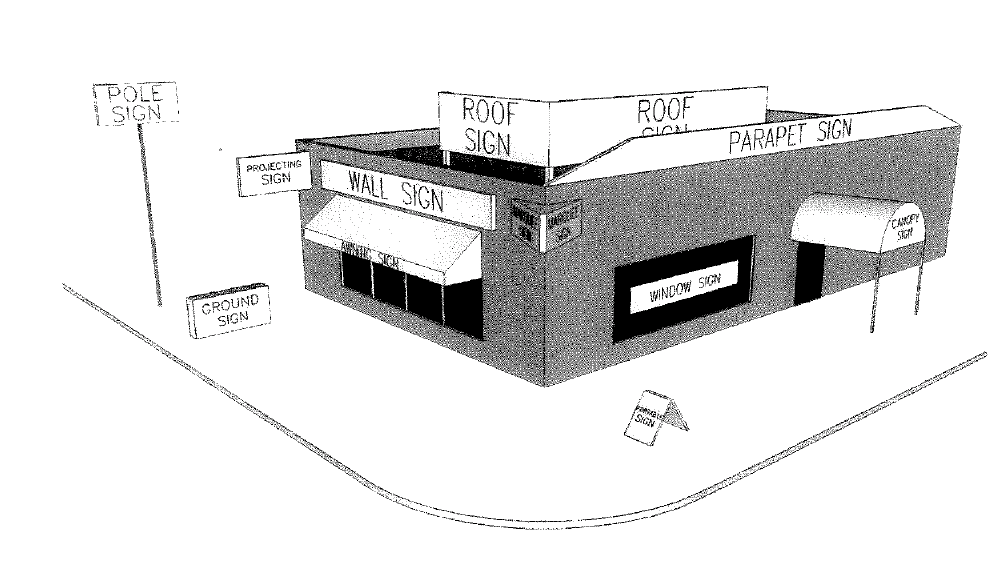
Figure 1: Sign Types
(Ord. No. 2009-008, 8-10-09)
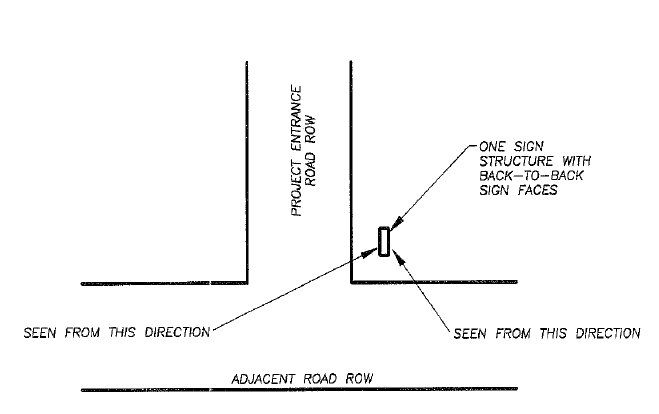
Figure 2: Single Sign
(Ord. No. 2009-008, 8-10-09)
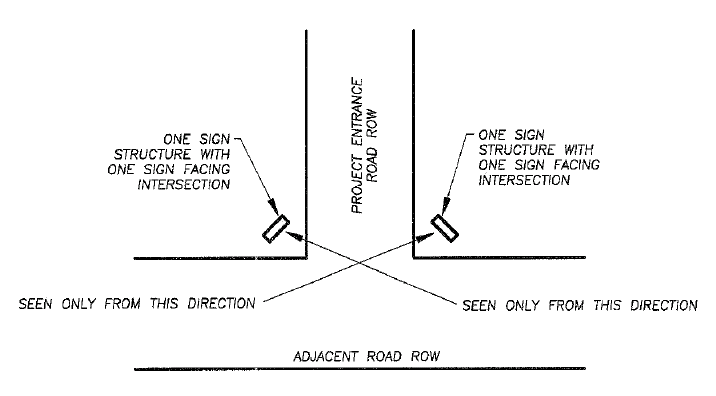
Figure 3: Dual Sign
(Ord. No. 2009-008, 8-10-09)
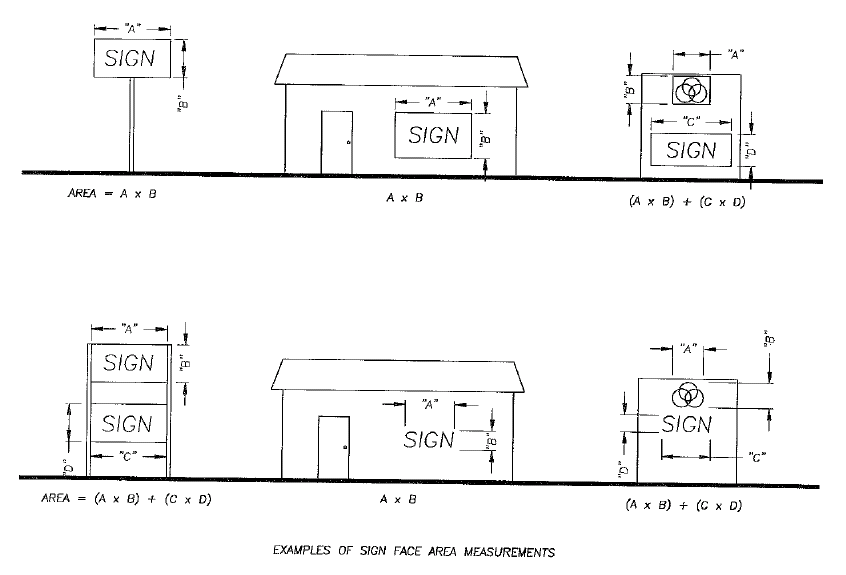
Figure 4: Sign Face Area Measurements
(Ord. No. 2009-008, 8-10-09)
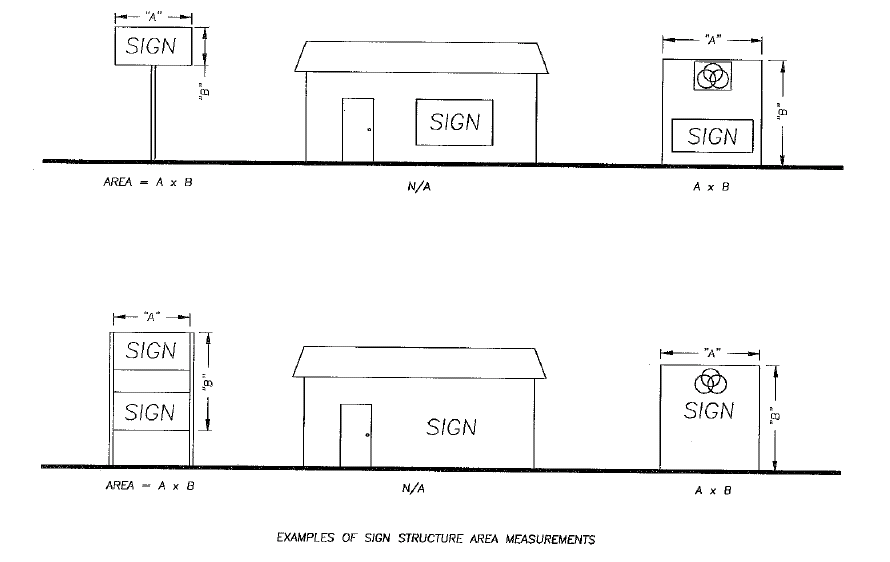
Figure 5: Sign Structure Area Measurements
(Ord. No. 2009-008, 8-20-09)
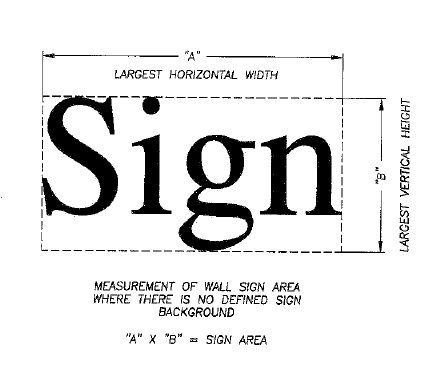
Figure 6: Wall Sign Measurement
(Ord. No. 2009-008, 8-10-09)
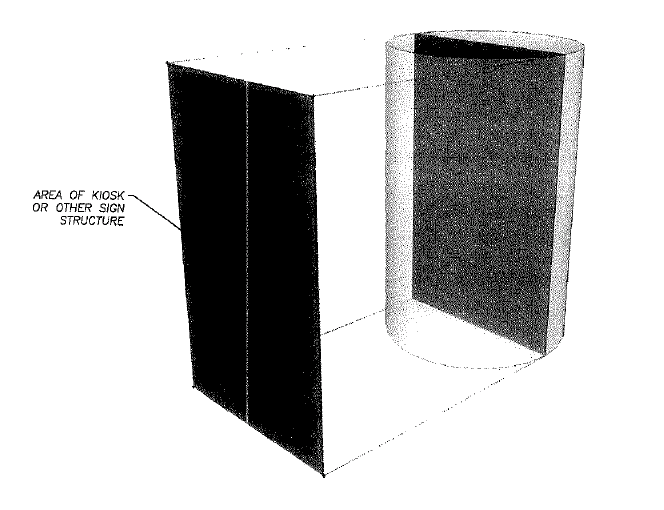
Figure 7: Area Measurement for Cylindrical Sign
(Ord. No. 2009-008, 8-20-09)
4.11.001.- Individual mobile homes or individual manufactured homes.
Individual mobile or manufactured homes not meeting the definition of "Manufactured Home, Class A" shall comply with the following and other applicable sections of this ordinance.
A.
Limitations. No mobile home, as defined in this section, is permitted to be used as a residential dwelling. No mobile home, as defined in this section, is permitted to be moved into Commerce for use as a residential dwelling. Any mobile home which is currently being used as a residential dwelling prior to September l, 2016 may continue to be used as a residential dwelling as a non-conforming use subject to the requirements of Chapter 5.04 of this Code. The attachment of a mobile home or manufactured home to an existing mobile or manufactured home is permitted only if both units were engineered and manufactured for such attachment.
B.
Building and occupancy permits. Building and occupancy permits issued by the Commerce Zoning Administrator or his/her authorized agent are required for any mobile or manufactured home:
1.
Which is hereafter located to Commerce;
2.
Which is moved from one location to a second location within the city where that manufactured housing unit will house persons or property;
3.
Which has not been occupied within the preceding 12 months;
4.
Where there is a change in use of the manufactured housing unit; or
5.
If the mobile or manufactured home is added to or structurally altered 100 square feet or more.
A building permit shall not be issued for a mobile home containing aluminum wiring.
Prior to issuing a building permit, it is unlawful to move, locate, relocate, erect or make utility connections of any kind to a mobile or manufactured home in Commerce.
All mobile and manufactured homes must be registered with the Jackson County Tax Commissioner and approval of the septic system by the Jackson County Health Department must be obtained before an occupancy permit can be issued.
Prior to issuing an occupancy permit it is unlawful to occupy or otherwise use as a residence a mobile or manufactured home in Commerce.
C.
Application requirements for building and occupancy permits for mobile or manufactured homes. An application for permits for location and occupancy of a mobile or manufactured home is required to be filed by the owner or the owner's agent in the office of the Commerce Zoning Administrator before a building or occupancy permit is issued.
The permit application shall describe the mobile or manufactured home as to size, dimension, year, model, the zoning district and tax map and parcel number of the planned location of the mobile or manufactured home, the intended use of the mobile or manufactured home, the name of the owner and the name of the intended occupants, and the source of water and type of waste disposal system.
If the intended use of the mobile or manufactured home is as an accessory use, hardship use or farm caretaker, then details of such proposed use shall be provided by the applicant.
Mobile and manufactured homes shall:
Be provided with prefabricated or permanent stairs and landing, constructed of pressure treated lumber, masonry or metal sufficient to provide safe ingress and egress from two exterior doors of the unit. Individual landings shall meet Commence building codes; and, be underpinned with skirting material of masonry construction (bricks, concrete blocks faced with brick, or concrete blocks faced with stucco). All manufactured homes must be attached to a permanent foundation with underpinning of brick or masonry construction and meet all other applicable state and city statutes, regulations and ordinances. However, for manufactured homes, load bearing masonry curtain walls shall not be required (although curtain walls may be required for aesthetic purposes), and non-load bearing curtain walls for manufactured homes shall not have contact with the manufactured home for the purpose of structural support, although non-load bearing curtain walls may be attached to the manufactured home for aesthetic purposes and not for structural support. See Georgia Rules and Regulations section 120-3-7-.14, as may hereinafter be amended.
D.
Temporary usage. A manufactured home may be used as an office in a subdivision or commercial district, by a contractor during construction or development. The above use must be requested in writing, be for a period not to exceed 12 months, and have written approval of the zoning administrator. The zoning administrator may extend the 12-month period one time where necessary for up to an additional 12-month period.
E.
Accessory buildings. A mobile or manufactured home may not be used as an accessory building.
(Ord. No. 2016-010, 9-19-16)
4.12.001.- Installation.
All manufactured homes, located to or moved with the City of Commerce at or after the adoption of this ordinance shall be installed by a licensed installer as required by O.C.G.A. § 8-2-164, and in accordance with the applicable manufacturer's installation instructions, specifically including, without limitation, correctly installed tie-downs and anchors. In the absence of such instructions, installation shall be performed in accordance with the applicable rules and regulations adopted by the Georgia Safety fire commissioner. (See O.C.G.A. § 8-2-160 et seq.)
A.
A curtain wall or foundation, unpierced except for required ventilation and access and constructed of masonry, is installed so that it encloses the area located under the home to the ground level. Such a wall shall have a minimum thickness of four inches.
B.
The tongue, axles, transporting lights, and towing apparatus are removed after placement on the lot and before occupancy.
C.
Reserved.
D.
For purposes of this definition, no manufactured home may be attached to any other Manufactured Home, Class A, by means of breezeway, corridor or hallway.
E.
No manufactured home shall be located within 30 feet of any permanent building.
F.
Landings of the requisite composition and size as per Section 1113 of the Standard Building Code of the Southern Building Code Congress International, with said provisions being expressly incorporated by reference herein as part of this requirement.
G.
Manufactured homes are not permitted to be used as storage buildings.
H.
Manufactured home, Class B's are restricted to approved and conforming mobile home parks only. No Class B mobile home may be placed on a single-family lot within the City of Commerce.
I.
Certificates of occupancy will only be issued when all of the above items are approved by the building official.
(Ord. No. 2010-014, 10-11-10)
4.13.001.- Accessory buildings.
The location of accessory buildings and uses must meet the following requirements:
A.
All accessory building, structures, and uses of land, including off-street parking, shall be located on the same lot as the principal building(s) to which they are accessory.
B.
Where an accessory building is attached to the main building, a substantial part of one wall of the accessory building shall be an integral part of the main building or such accessory building shall be attached to the main building in a substantial manner by a roof, and therefore meet requirements applicable to the main building.
C.
No accessory building shall be utilized unless the principal structure is also occupied.
D.
A property owner seeking to erect or install any accessory building or structure which is in a residential district and which exceeds 1,000 square feet of gross interior space must apply for a permit prior to commencing construction or installation. The application shall be presented first to the planning commission which shall make its recommendation to the city council for final approval or denial, as to the location, architectural design, and size.
E.
Any accessory building, except detached garage or carport, must be located behind the rear building line of the principal building on the parcel where the accessory building is located. A detached garage or carport shall not be located forward of the front building line.
F.
Manufactured homes shall not be used as accessory building in any residential zoning district.
G.
No storage trailer shall be used as a temporary or accessory structure.
H.
All accessory buildings shall have a maximum height of two stories or 35 feet, whichever is lower.
I.
Accessory buildings over 200 square feet shall not be constructed of metal exterior material.
J.
An accessory use shall not occupy more than 30 percent of the rear yard.
(Ord. No. 2008-013, 7-21-08)
4.13.002. - Temporary buildings.
Temporary buildings used in conjunction with construction work only may be permitted in any non-residential zoning district provided that no temporary building shall be used for a residential purpose and the building shall be removed immediately upon completion of construction.
4.13.003 - Accessory dwelling unit.
A.
Purpose and intent. Affordable housing and neighborhood stability are important public objectives in the city. Accessory dwellings are also known as "carriage houses," "granny flats," or "ECHO homes" (an acronym for "elder cottage housing opportunities"). This section allows accessory dwelling units to provide the opportunity to develop small dwellings designed, in particular, to meet the special housing needs of single persons and households. It is the intent of this section to ensure that the single-family character of the property will be maintained, and that the accessory dwelling unit remains subordinate to the primary living quarters.
B.
Permit and number. Each accessory dwelling unit shall obtain a permit from the city planning administrator. There shall be no fee charged for the permit. Only one accessory dwelling unit may be permitted per lot.
C.
Location. An accessory dwelling unit shall only be located in the side or rear yard of a lot. If the accessory dwelling unit is non-extant and classified as new construction, it must be located behind the rear building line of the principal dwelling unit.
D.
Entrance. The entrance to an accessory dwelling unit shall be from a rear or side yard and shall not face the street to which the principal dwelling is oriented.
E.
Setback. An accessory dwelling unit shall meet the setbacks required by the zoning district in which the unit is located for accessory structures. If the accessory dwelling unit is part of the principal dwelling (i.e., attached), it shall be required to comply with principal building setbacks for the zoning district in which the unit is located.
F.
Height. The height of the accessory dwelling unit shall not exceed the greater of the height of the principal structure on the lot or two stories. This allows for a two-story garage (with a dwelling unit on the second floor) even if the principal dwelling is only one story in height.
G.
Size. An accessory dwelling unit shall not contain more than two bedrooms. The gross floor area of an accessory dwelling unit shall not exceed 1,000 gross heated square feet in area. The building footprint of such a unit is subject to the overall maximum building coverage for the zoning district in which it is located.
H.
Design. In order to maintain the architectural design, style, appearance, and character of the primary structure as a single-family residence, an accessory dwelling unit shall have a roof pitch, siding, and window proportions substantially similar to that of the principal dwelling unit, as approved by the zoning administrator.
I.
Parking and driveway access. One parking space, on an approved and permitted driveway or parking pad, shall be provided for the accessory dwelling unit, in addition to parking required for the principal dwelling. The driveway for the principal dwelling unit shall also serve the accessory dwelling unit.
J.
Utilities. All required utilities of the accessory dwelling unit shall be connected to the principal dwelling. Separate or secondary meters are prohibited. If the principal dwelling is served by an on-site sewage management system (septic tank), the accessory dwelling unit shall receive approval of the Jackson County Environmental Health Department with regard to the size and suitability of the on-site sewage management system (septic tank) prior to permitting. If the principal dwelling is served by sewer, the accessory dwelling unit shall be connected to the sewer service line at a point before the connection of the lot to the City system.
K.
Occupancy. The property owner must occupy the principal dwelling unit as the owner's permanent residence. For purposes of this subsection, "property owner" means the title holder and/ or contract purchaser of the lot, and "owner occupancy" means that a property owner makes his/her permanent residence at the site, as evidenced by homestead exemption, voter registration, vehicle registration, or similar means.
L.
Variations. An applicant may propose, and the city council may approve modifications to the strict provisions of this section in an individual case, upon application for and approval and issuance of a conditional use permit.
M.
Subdivision. The accessory dwelling unit may not be subdivided from the primary residence.
N.
Rental or lease prohibited. The accessory dwelling unit may not be leased, rented, or sublet.
O.
Occupancy. An affidavit must be signed and submitted to the planning and zoning administrator affirming the occupant of the accessory dwelling unit and affirming compliance with this section. This shall be submitted on an annual basis by January 31 st and resubmitted within 30 days of any occupancy changes during the year.
P.
Commercial use. The accessory dwelling unit shall not be used as a commercial space or for commercial purposes.
(Ord. No. 2020-015, 12-21-20)
4.14.001.- Home occupation.
The conduct of business in residential units may be permitted under the provisions of this section. It is the intent of this section to: ensure the compatibility of home occupations with other uses permitted in the applicable zoning districts; maintain and preserve the character of residential neighborhoods; and provide peace, quiet, and domestic tranquility within all residential neighborhoods within the zoning district, in order to guarantee to all residents freedom from excessive noise, excessive traffic, nuisance, fire hazard, and other possible effect of commercial uses being conducted in this zoning district. Residential home occupations, where permitted, must meet the following special requirements:
A.
A home occupation is subordinate to the use of a dwelling unit for residential purposes. No more than 25 percent of the floor area of the dwelling unit may be used in connection with a home occupation or for storage purposes in connection with a home occupation.
B.
No more than one home occupation shall be permitted within a single dwelling unit.
C.
A home occupation shall be carried on wholly within the principal use. No home occupation nor any storage of goods, materials, or products connected with a home occupation shall be allowed in accessory buildings or garages, attached or detached.
D.
No one other than residents of the dwelling shall be employed in the conduct of a home occupation.
E.
A home occupation shall produce no noise or obnoxious odors, vibrations, glare, fumes, or electrical interference detectable to normal sensory perception outside the structure.
F.
A home occupation which will constitute a fire hazard to neighboring residences, will adversely affect neighboring property values, or will constitute a nuisance or otherwise be detrimental to the neighbors because of excessive traffic, excessive noise, odors, or other circumstances is not be permitted.
G.
No traffic shall be generated by such home occupations in greater volumes than would normally be expected in a residential neighborhood, and any need for parking generated by the conduct of such home occupation shall be met off-street and other than in a front yard.
H.
On the premises, retail sales are prohibited except for the retail sales of products or goods produced or fabricated on the premises as a result of the home occupation.
I.
There shall be no exterior indication of the home occupation or variation from the residential character of the principal use.
J.
There shall be no on-street parking of business related vehicles (either marked or commercially equipped) in any residential district. No more than one business-related vehicle that is no larger than a van, panel truck, or pick-up truck is permitted to park overnight on a residentially zoned parcel.
K.
Permitted residential home occupations:
1.
Architectural services.
2.
Art studio.
3.
Beauty shop.
4.
Consulting services.
5.
Data processing.
6.
Direct sale product distribution (Amway, Avon, Jaffra, Tupperware, Herbalife).
7.
Drafting and graphic services.
8.
Dressmaking, sewing, tailoring, contract sewing (one machine).
9.
Electronic assembly.
10.
Engineering service.
11.
Financial planning or investment services.
12.
Flower arranging.
13.
House cleaning service.
14.
Insurance sales or broker.
15.
Interior design.
16.
Locksmith.
17.
Real estate sales or broker.
18.
Tutoring.
19.
Writing, computer programming.
20.
Other similar uses as approved by the mayor and council.
L.
Prohibited residential home occupations:
1.
Ambulance service.
2.
Appliance repair.
3.
Automobile repair, parts sales, upholstery, or detailing, washing service (including businesses working at customer's home).
4.
Boarding house, bed and breakfast.
5.
Carpentry, cabinet makers.
6.
Contracting, masonry, plumbing, or painting.
7.
Medical or dental office (nor any practice of physical or medical application, including chiropractors).
8.
Restaurants, food preparation.
9.
Tow truck services.
10.
Veterinary uses (including care, grooming or boarding).
4.15.001.- Location.
The property on which a gasoline service station is located shall not be within 100 feet of any residential zoning district, or any property containing a school, public playground, church, hospital, public library, institution for children or dependents.
4.15.002. - Site requirements.
A gas station shall have a minimum frontage on the primary street of 100 feet and a minimum area of 12,000 square feet. All buildings shall be set back 40 feet from all street right-of-way lines and all canopies shall be set back 15 feet from all street right-of-way lines.
4.15.003. - Access to site.
Vehicular entrances or exits at an gasoline service station:
A.
Shall not be provided with more than two curb cuts for the first 100 feet of street frontage or fraction thereof.
B.
Shall contain an access width along the curb line of the street of not more than 30 feet as measured parallel to the street at its narrowest point and shall not be located closer than 25 feet from the intersecting point of the two streets rights-of-way or ten feet to the adjoining property.
C.
Shall not have any two driveways, or curb cuts, any closer than 20 feet at both the right-of-way line and the curb or edge of the pavement along a single street.
4.15.004. - Gasoline pump islands.
All gasoline pump islands shall be set back at least 15 feet from the right-of-way line, or where a future widening line has been established, the setback line shall be measured from such line, and where pump islands are constructed perpendicular to the right-of-way line, the pump island shall be located not less than 30 feet from the right-of-way line; however, the pump island shall be at least 60 feet from the center line of an arterial street and 45 feet from the center line of other streets.
4.15.005. - Off-street parking.
A minimum of two off-street parking spaces are required with an additional off-street parking space for each lubrication and wash bay.
4.15.006. - Other site improvements.
In addition to the above requirements, the following additional site improvements shall be adhered to:
A.
A raised curb of at least six inches in height shall be erected along the street property lines, except for driveway openings.
B.
A transitional buffer is required between dissimilar districts or uses. Buffers shall be natural, undisturbed, and free of encroachments except as authorized by a condition of zoning, or as authorized herein, and shall contain the existing tree cover and vegetation as well as any supplemental plantings as may be required. Buffers shall be of such nature and density so as to screen activities, structures, and uses on the property from view from the normal level of a first story window on an abutting lot and shall further provide a year-round effective visual screen. Buffers required along side property lines shall extend to a street right-of-way line unless otherwise required to observe the sight distance requirements or as authorized as a condition of zoning. In situations where the required buffer width is partially or completely contained within an existing easement (i.e. power or natural gas transmission, etc.) the screening requirements of this ordinance shall be met outside of the easement area.
C.
Exterior lighting shall be arranged so that it is deflected away from adjacent properties and streets.
D.
Signs, whether permanent or temporary, shall not be placed within the public right-of-way and shall be arranged so that they do not obstruct visibility for drivers or pedestrians.
E.
All drives, parking storage, and service areas shall be paved and curbed and a good stand of grass shall be maintained on the remainder of the lot.
F.
A drive-through lane of sufficient width to allow motor vehicle to enter and exit the property.
4.15.007. - Storage of inflammable products.
Outside above ground tanks for the storage of gasoline, liquefied petroleum gas, oil or other inflammable liquids or gases shall be prohibited at any gas station. All used motor oil shall be stored in underground tanks. However, storage tanks for the retail sales of propane gas shall be permitted.
4.16.001.- Bed and breakfast.
A.
The acceptance of paying guests shall be an accessory use to the dwelling unit;
B.
The only uses permitted shall be the renting of rooms and the serving of foods to guests renting said rooms (accessory uses commonly associated with hotels and motels, i.e. laundry services, gift shops, banquet halls, barber and beauty shops, shall not be permitted);
C.
All parking shall be off-street; and
D.
The operator of the bed and breakfast must live on the premises.
4.17.001.- Outdoor storage.
A.
Standards for outdoor storage in residential districts. Outdoor storage on properties used or zoned for residential purposes shall meet the following standards:
(1)
Shall not be used for occupancy, either temporarily or permanently.
(2)
Boats, recreational vehicles, campers, trailers, or personal watercraft or other recreational vehicles shall be located behind the plane of the front building façade of the primary residence (storage of such items within a completely enclosed garage or storage building shall be exempt from this standard).
B.
Standards for outdoor storage in commercial or industrial districts. Outdoor storage on properties used or zoned for commercial or industrial uses shall meet the following standards:
(1)
Outdoor storage shall be located behind the front building facade of the principal structure.
(2)
Outdoor storage areas shall be paved with a concrete or asphalt surface.
(3)
Materials shall not be stacked more than 12 feet in height and shall be fully screened from view from road rights-of-way and adjacent properties by a fence or wall at least eight feet in height.
C.
The storage yard must not be located within a required front yard. Outdoor storage shall only be allowed in the rear yard of any property zoned or approved for commercial or industrial uses.
D.
The storage yard must be setback at least 25 feet from any side or rear property lines.
E.
Storage areas may also be used as outdoor display areas.
(Ord. No. 2018-003, 6-4-18)
4.18.001.- Club or lodge.
The buildings are placed not less than 50 feet from any property line:
A.
Unless located adjacent to a residential district, there shall be a planted buffer area ten feet wide along its exterior boundary lines not bordering the frontage street and not extending into the required front yard. The buffer area should be planted with evergreen trees or evergreen shrubs that grow at least eight feet tall within five years and provide an effective visual screen.
B.
A complete development sketch must be submitted with the application.
C.
Adequate paved and lined off-street parking must be provided.
4.19.001.- Non-operating vehicles.
A.
All vehicles not in operating condition must be parked in the rear yard, carport, or garage. If parked in rear yard, the vehicle may not be visible from any public street or adjacent property.
B.
All automobile parts must be stored within a garage or enclosed building.
4.20.001.- Satellite dish antenna.
A.
Thirteen-foot diameter or larger satellite antenna dish must be located behind the rear building line and outside the side yard setback.
B.
Eighteen-inch or smaller satellite antenna dish shall not be located on the dwelling's front yard wall or on any front yard roof plane. Dish antennas may be located on either a backyard roof plane, backyard dwelling wall, or side yard dwelling wall.
4.22.001.- Circulation.
The zoning administrator shall required that the site accommodate high levels of traffic while maintaining the smooth circulation of vehicles on site.
A.
Driveways and service areas shall be place in locations that reduce the chance of interrupting on-site vehicle movement. Buildings must be placed in a manner that screens the drive-through land and creates pedestrian pathways and spaces. In order to maintain on-site circulation, each drive-through area is to be separate from pump islands and from routes necessary for entering and exiting the property.
4.22.002. - Parking.
On-site parking for facilities that combine gas stations with convenience stores and fast food restaurants must equal three spaces per 1,000 square feet of gross floor area.
4.22.003. - Landscaping/buffering.
A.
Where the site is adjacent to residential development or commercially zoned properties, landscaping requirements include the construction of a 30-foot-deep transitional organically landscaped buffer yard and an opaque or nearly opaque screen consisting of a wall, fence, or evergreen vegetation to a height of at least eight feet, in addition to a minimum total landscaping equal to at least 20 percent of the area of the site not covered by buildings.
B.
Speaker boxes shall not be audible on any residential property adjacent to the business.
4.22.004. - Signs.
Signs shall comply with this chapter as applied to the commercial zoning districts with the following limitations:
A.
Only one freestanding sign identifying businesses located on the property is allowed.
B.
One wall sign is allowed per subtenant but the aggregate square footage of all subtenant signs cannot exceed 25 percent of the front wall area.
4.23.001.- Swimming pools, location and approval.
Above or below ground swimming pools must be located behind the rear building line and shall not be closer than ten feet to any property line. If the pool is served by a septic tank, the pool must be constructed in accordance with ICC regulations.
(Ord. No. 2010-007, 6-14-10)
4.24.001.- Minimum floor space requirements and maximum number of occupants.
A.
Studio unit—500 square feet—Two occupants.
B.
One bedroom—750 square feet—Two occupants.
C.
Two bedroom—1,000 square feet—Four occupants.
4.24.002. - Building codes.
All upper floor residential renovations shall comply with all existing commercial building codes and fire codes (NEPA Life Safety Code, 1990 Edition, Southern Building Code, Standards Fire Prevention Code) with fire walls.
4.24.003. - Restrictions.
A.
All window treatments must be color coordinated with other window treatments in the upper floor residential apartment. No signs, drawing or photographs incorporated into the window treatments.
B.
No outside mailboxes are permitted.
C.
No outside television or radio antennas or satellite reception equipments is permitted. Cable TV connections are permitted if located at the rear of the building.
D.
Daily or weekly boarding rooms are prohibited. Only full-time renter or owner occupied dwelling units are permitted.
E.
Each dwelling unit shall be furnished with a washer and dryer and garbage disposal unit.
F.
No drying of clothes is permitted on the outside of any building.
G.
No household pets are allowed. This includes animals that are customarily kept as companion animals within the home and includes, but is not limited to, domestic dogs, domestic cats, birds, rodents, swine, reptile or fowl.
H.
Entry to the unit or to a hallway serving one or more units shall be provided by a stairway opening directly to the outside; except where the owner occupies both the ground level and the upper floor residential apartment, then entry may be through the ground floor. No dwelling unit shall occupy street level frontage.
I.
No window unit air-conditioning unit shall be visible from the front street.
J.
Washing or waxing of vehicles is not permitted in the parking are for the dwelling unit.
K.
No recreation, entertainment, public gathering or placement of furniture is allowed on the sidewalks unless permitted by the mayor and council.
L.
No garage sales or yard sales are allowed.
4.24.004. - Parking.
A.
Each resident of an upper floor residential unit shall be restricted to one vehicle for a studio unit and two for all other units. No vehicle shall park on the public streets or alleys in those areas designated as "two-hour parking zones" during the hours of 8:00 a.m. to 6:00 p.m., Monday through Friday or from 8:00 a.m. to 4:00 p.m. on Saturday. All parking shall be restricted to off-street parking when ever possible.
B.
violations of this requirement shall be prosecuted the same as violation of the two-hour parking restriction set forth in the city's Code of Ordinances.
C.
A separate residential approved trash container shall be furnished for each dwelling unit with its location approved by the city.
D.
A copy of Chapter 4.24 of this ordinance shall be made a part of each lease agreement.
4.25.001.- Building and site plan review application.
All application for building and site plan review shall be filed with the city clerk at least 45 days prior to the planning commission meeting at which the application will be reviewed. An application for building and site plan review shall contain the following:
A.
Three copies of a preliminary building and site plan, drawn to scale of not more than one inch equals 200 feet, showing the following information must be submitted to the planning commission for review:
1.
Surveyed plat signed by a registered surveyor.
2.
Project name.
3.
Project owner.
4.
Date, scale, and north arrow.
5.
Vicinity map.
6.
Use of adjacent property.
7.
Exterior dimensions of the site.
8.
Total project acreage.
9.
Location, name and width of all existing or proposed streets.
10.
Location of all proposed structures.
11.
Location of all off-street parking and driveway serving the project.
12.
Proposed buffers and/or screening.
13.
Location, height, fixture type and wattage of site lighting.
14.
Dumpster locations.
15.
Rough floor plans, including gross floor area.
16.
Building height.
B.
Once the application is submitted, it cannot be amended. Incomplete applications will not be processed.
4.25.002. - Approve, approve with conditions, disapprove, or table for further action the proposed site plan.
The planning commission shall approve, approve with conditions, disapprove, or table for further action the proposed site plan. If the planning commission fails to act on the application within 60 days of its submission or by its next regularly scheduled meeting, whichever is later, the application is deemed to have been approved unless the application is tabled, postponed, or withdrawn.
4.25.003. - Permit required.
After approval of the site and building plan, a manufactured home park permit must be obtained by the developer prior to any grading or clearing.
4.25.004. - Park design standards.
A.
Minimum size of park: Ten acres.
B.
Minimum road frontage for an entrance and exit: 100 feet.
C.
Minimum lot width for the portion of the park containing manufactured home space, or stands: 80 feet.
D.
Minimum lot size: 11,000 square feet.
E.
Density: A maximum of three and one-half manufactured home units per acre.
F.
At least 20 percent of the park area must be set aside as open area for recreation purposes.
G.
Setbacks. The manufactured home park shall be designed so that each home and its accessory structures shall be a minimum distance of 15 feet from interior park streets, and at least 40 feet from any publicly dedicated right-of-way. Manufactured home stands shall be designed so as to provide a distance of at least 30 feet between manufactured homes.
H.
Access. The manufactured home park shall front upon at least one publicly dedicated street for a minimum width of 100 feet. Each home site and its parking area shall have direct access to the internal street system of the park.
I.
Streets. In general, streets within a manufactured home park shall be privately owned, constructed, and maintained. Streets and curb and gutter within the subdivision shall be constructed in accordance with the Commerce Subdivision Regulations.
J.
Parking. Each manufactured home stand shall be provided with a minimum of two paved off-street parking spaces. The front yard space may be used for parking of motor vehicles. However, the side yard and rear yard space may not be used for parking vehicles of any description.
4.25.005. - Stand requirements.
Each manufactured home stand shall be provided with the following minimum requirements:
A.
Access frontage of at least 50 feet;
B.
A garbage rack designed to prevent rodent and animal access;
C.
Necessary commercial dumpsters with accessible locations throughout the park for garbage collection.
D.
A properly grounded, water-proofed electrical receptacle with a minimum rated capacity of 200 amperes and including a properly sized electrical disconnect;
E.
A minimum five-eighth-inch water meter placed on the front of the lot adjacent to the street right-of-way line;
F.
Fire hydrants placed within 500 feet of each manufactured home stand;
G.
A properly sized residential gas meter;
H.
A property and/or street designation or other appropriate numbering device at least 12 inches high and visible from the road, properly identifying each manufactured home stand placed at the interior side lot line at a point within five feet of the road right-of-way of the park; and
I.
On-site parking of at least 400 square feet in the front yard finished in a hard pavement surface.
4.25.006. - General requirements.
A.
At least 30 spaces must be approved before the manufactured home park can be approved for occupancy.
B.
No space shall be rented for a period of less than 30 days.
C.
Manufactured homes must not be more than seven years in age.
D.
All spaces shall be rental only. No space may be sold and all manufactured homes shall be occupied either by the owner of the home, the owner of the park, or the resident manager.
E.
The park shall be provided with a sewer collection system approved by the City of Commerce of the Jackson County Health Department, allowing service to each stand and commercial structure.
F.
Publicly dedicated easements of proper size for their intended use shall be provided within the park if individual stands and accessory park uses are to be serviced by a public system.
G.
All utilities shall be installed to City of Commerce specifications.
H.
A copy of the park management rules and regulations must be submitted to the building official for approval. The park operator will be responsible for compliance with these regulations by all tenants. Failure to abide by these regulations or any other of the City of Commerce will be considered a valid reason for revoking the manufactured home park permit required to operate a manufactured home park in the City of Commerce.
I.
No commercial establishment of any description except an on-site laundry may be allowed within the park boundary.
J.
All manufactured homes must be located on a permanent foundation.
4.25.007. - Manufactured home installation.
Manufactured homes placed within the park shall meet the following conditions before they can be approved for occupancy:
A.
Setback requirements of subsection [4.25.004.G];
B.
Connection to approved water and sewerage disposal systems;
C.
Electrical connections that comply with electrical codes;
D.
Home cannot be more than seven years old;
E.
Installation in accordance with the Official Code of Georgia Annotated;
F.
Enclosed by a curtain wall of manufactured home skirting material, or masonry construction painted to match the exterior of the manufactured home;
G.
Home must bear the approval seal of either H.U.D. or Georgia Department of Community Affairs.
4.26.001.- Parking.
A.
All parking shall be off-street and shall be grouped in bays, either adjacent to the street or in interior of blocks. An off-street parking space shall not be more than 100 feet by the most direct pedestrian route from a door of the dwelling unit it is intended to serve.
B.
All parking shall be paved.
4.26.002. - Pavement width.
All streets, drives or alleys in the development shall have a pavement width of 20 feet, and have a bituminous, concrete surface, or asphalt surface.
4.26.003. - Utilities.
All apartments and multi-family dwellings shall be served by the public sanitary sewerage and water systems.
4.27.001.- In the front yard.
Fences and walls in the front yard shall not exceed four feet in height. Fences and walls shall be set back at least two feet from the edge of the right-of-way and must conform to clear view triangle standards. Chain link fences are prohibited in the front yard. In a commercial or industrial district, the maximum fence height shall be ten feet in the front yard.
(Ord. No. 2008-011, 5-12-08; Ord. No. 2019-008, § II, 7-15-19)
4.27.002. - In the side yard.
Fences and walls may be placed on or behind the side property line. No fence or wall shall exceed six feet eight inches in height within the required side yard setback area from a street. In commercial and industrial districts, ten feet shall be the maximum height behind the required street setback and in the side yards not bordering a street.
4.27.003. - In the rear yard.
Fences and walls may be placed on or behind the rear property line. In the residential districts six feet eight inches is the maximum fence or wall height in the rear yard. Provided, that when the rear yard abuts a designated arterial, the maximum height shall be eight feet. In a commercial or industrial district, ten feet is the maximum height.
4.27.004. - Privacy area for zero lot line dwelling.
Where any property line of a zero lot line dwelling abuts other property within the same overall development zoned or used for residential purposes, there shall be provided and properly maintained along the property line a continuous visual screen not less than six feet in height. The requirement does not apply to townhouse development. The screen shall be a windowless wall or fence constructed from material which is aesthetically compatible with existing development. However, the requirement for a privacy wall along any property line may be omitted or modified where the planning commission has determined that one or more of the following conditions exist:
A.
Due to special conditions and circumstances of a physical or dimensional nature which are peculiar to the property involved, a privacy wall would serve no valid purpose.
B.
The provision of a privacy wall along any side and/or rear property line would deny the property involved advantages of amenities specifically associated with the overall development.
4.27.005. - Fence and wall construction materials.
Fences and wall constructed pursuant to this chapter shall be constructed any of the following materials:
A.
Chain link (vinyl and non vinyl coated).
B.
Masonry (brick, stuccoed concrete block).
C.
Wood (generally produced for fence construction).
D.
Wood-like materials.
E.
Barbed wire or hog wire in agriculturally zoned areas only.
4.27.006. - Gates required.
In those instances where a fence or wall is erected as an enclosure which restricts access from the front to the rear yard, a gate shall be a minimum of three feet in width. The location of the gate shall be positioned at any point paralleling the front lot line between the side lot line and the principal structure.
4.27.007. - Tennis courts.
Fencing of outdoor tennis courts may be link and shall not exceed 16 feet in height and shall conform to the principal building setback requirements for the zoning district.
4.27.008. - Maintenance.
Every fence or wall shall be maintained in a condition of reasonable repair and shall not be allowed to become and remain in a condition of disrepair, damage, or unsightliness, or constitute a nuisance, public or private. Any such fence or wall which is, or has become dangerous to the public safety, health or welfare, or has become unsightly through improper maintenance or neglect is a public nuisance and the building official shall commence proper proceedings for the abatement thereof.
4.27.009. - Exemptions.
Areas zoned agricultural are exempt from the height requirements of this chapter.
4.27.010. - Finished fence.
Finished side of fence shall face to the outside of the property.
4.27.011. - Fencing for screening purposes.
Whenever in this Code fencing is required for the purposes of screening a lot or a use from view, such fencing shall be a minimum of six feet in height, unless a greater height is specified, and such fencing shall be constructed of chain link fence with vertical winged slats, or solid vinyl, masonry or composite materials.
(Ord. No. 2018-003, 6-4-18; Ord. No. 2019-008, § I, 7-15-19)
Editor's note— Ord. No. 2018-003, adopted June 4, 2018, set out provisions intended for use as § 4.27.001. To avoid duplication of section numbers, and at the editor's discretion, these provisions have been included as § 4.27.011.
4.28.001.- Daycare facilities.
Daycare center and home daycare outdoor play area and outdoor playground equipment shall be enclosed and screened from view on all sides by a fence.
(Ord. No. 2018-003, 6-4-18)
4.29.001.- Flea markets and open-air markets.
Flea markets and open-air markets shall be located either in an enclosed building or under a permanent roof. This section shall not apply to yard sales allowed under section 18-41 of the City Code or to temporary outdoor events.
(Ord. No. 2018-003, 6-4-18)
4.30.001.- Hotels/motels.
The following standards shall apply to hotels/motels:
A.
Minimum acreage shall be one and one-half acres;
B.
All guestrooms shall be accessed via internal corridors;
C.
Lobby area shall be a minimum of 500 square feet in size;
D.
No hotel shall rent a room to the same guest for more than 180 days or be used as a multi-family apartment building;
E.
Each hotel shall provide 24-hour on-site management and, at a minimum, weekly cleaning shall be performed for each room or suite; and
F.
No outside storage or parking of equipment or vehicles shall be allowed other than vehicles used daily by guests and employees.
(Ord. No. 2018-003, 6-4-18)
4.31.001.- Manufactured home sales, leasing or renting.
A.
Businesses engaged in the sale, lease or rental of manufactured housing shall maintain an office on the premises located in a permanent building.
B.
Property abutting public rights-of-way shall be screened by a three-foot wide landscaped buffer consisting of plantings to provide a vertical visual screen at least three feet in height.
C.
Outdoor display of manufactured homes is allowed notwithstanding other provisions of this Code subject to the following restrictions:
(1)
All manufactured homes offered for sale, lease, or rent shall be parked on an asphalt or concrete surface in good condition and free of damage.
(2)
A minimum separation of at least ten feet shall be maintained between manufactured homes on outdoor display.
(3)
Manufactured homes shall be secured to their display pads as approved by the building department.
(4)
Any display area not paved for display pads or parking or driveways shall be grassed or mulched.
(Ord. No. 2018-003, 6-4-18)
4.32.001.- Outdoor storage containers.
A.
Standards:
(1)
Outdoor storage containers shall be used only for the storage of plant materials such as hay or straw for direct retail sale to customers provided however that outdoor storage containers may be used during construction to temporarily store equipment or material but shall be removed upon occupancy of the building and/or expiration of the building permit, whichever occurs first.
(2)
Outdoor storage containers shall be incidental to the principal use of a site and shall not be located on vacant property.
(3)
Outdoor storage containers shall be kept in good condition and free of damage, rust, graffiti, signs, banners, etc.
(4)
Outdoor storage containers shall not:
a.
Be used as a dwelling nor any other purpose but storage;
b.
Be provided with utility services;
c.
Have any structure connecting outdoor storage containers with one another;
d.
Be stacked; or
e.
Used to store flammable liquids or other hazard materials as determined by the fire chief.
(Ord. No. 2018-003, 6-4-18)
4.33.001.- Pawnshop, payday loans, title pawn, check cashing and bail bond businesses.
A pawnshop, payday loan, title pawn, check cashing or bail bond business shall be located a minimum of 1,000 feet away from any other building containing a like business. This restriction does not apply to FDIC and FSLIC insured financial businesses.
(Ord. No. 2018-003, 6-4-18)
4.34.001.- Mini-warehouse/self-storage facilities.
A.
Standards:
(1)
All vehicular circulation and parking within the site shall have concrete or asphalt surfaces.
(2)
Any storage of watercraft, RVs or other similar vehicles shall be screened from view by fencing from any street right-of-way.
B.
Prohibited uses. The following uses shall be prohibited within self-storage facilities:
(1)
Individual storage bays shall not be considered or used as a premise for assigning a legal address.
(2)
Storage of flammable liquids, highly combustible or explosive materials, or hazardous chemicals is prohibited.
(3)
Uses not related to the temporary storage of personal property including use as a residence, office, workshop (including vehicle, appliance or equipment repair), studio, band rehearsal area or other place of business or worship are prohibited.
(4)
Commercial transactions including auctions, retail or wholesale sales, or garage sales other than those associated with the rental of the storage units or the specific disposal of items within a unit by the owner of the self-storage facility are prohibited.
(5)
Operation of power tools, spray-painting equipment, table saws, lathes, compressors, welding equipment, kilns, or similar equipment is prohibited.
(Ord. No. 2018-003, 6-4-18)
4.35.001.- Tattoo establishments.
A.
There shall be a minimum separation distance of 500 feet between tattoo establishments.
B.
Tattoo parlors shall be separated by at least 500 feet from any residential district, existing residential use, excluding upper floor residential uses in the central business district.
C.
All federal, state, and local regulations for tattoo establishments shall be met.
(Ord. No. 2018-003, 6-4-18)
4.36.001.- Therapeutic massage establishments.
Any establishment offering therapeutic massages shall be required to have the person providing the massage therapy to hold a valid massage therapy license issued by the Georgia Board of Massage Therapy.
(Ord. No. 2018-003, 6-4-18)
4.37.001.- Outdoor display and retail sales of merchandise or goods.
A.
Merchandise or goods may be on display outdoors for the purpose of customer selection or direct sale or lease to customers only as follows:
(1)
Outdoor display areas shall only be allowed on property zoned or approved for retail, sales of goods and merchandise.
(2)
All lots used for outdoor display shall have a permanent sales structure on the lot.
(3)
Outdoor display shall not encroach on any required parking areas or be located in a designated landscape area.
(4)
Outdoor display shall be limited to store hours and removed and placed inside a fully enclosed building each day.
(5)
No person shall be allowed or permitted to obstruct any sidewalk or street in the city by putting any box, table, steps, merchandise or any other similar thing thereon or to use the streets and sidewalks for the display of goods, wares or merchandise of any kind.
(6)
Outdoor display shall be confined to within five feet of the business structure's front building facade. It shall not occupy more than 30 percent of the horizontal width of the front building facade.
(7)
Outdoor display shall not impair the ability of pedestrians to use the sidewalk or parking areas and shall comply with ADA clearance and accessibility.
B.
Outdoors retail sales of certain merchandise or goods is subject to the following restrictions:
(1)
Only the following types of businesses are subject to the provisions of this subsection:
a.
The sale or display of plant material and seasonal items such as Christmas trees, pumpkins, and fruits and vegetables.
b.
Sale, leasing or renting displays of boats, personal recreational vehicles, farm and agricultural implements or equipment.
(2)
Outdoors retail sales shall only be allowed in commercial district.
(3)
All merchandise shall be located a minimum of 30 feet from the road/street and 25 feet from any property line, except in the central business district where section 4.37.00l.A shall apply.
(4)
Merchandise and goods for sale shall not exceed a height of ten feet in the front yard and 20 feet in the rear yard.
(5)
Merchandise in outdoor retail sales areas may be kept outside after store hours but shall be kept organized and clean.
(6)
Merchandise shall not be displayed in any required parking or landscape/buffer area without the consent of the property owner.
(7)
All display and storage areas shall have merchandise placed upon a concrete or asphalt surface.
(Ord. No. 2018-003, 6-4-18)
4.38.001.- Motor vehicle sales or rental lot.
The term "motor vehicle" as used in this section is defined as any self-propelled or towed vehicles required by the state to be titled or registered, including, but not limited to, automobiles, trucks, motorcycles, recreational vehicles, trailer coaches, campers, and trailers, and weighing over 2,500 pounds. No motor vehicle sales or rental lot shall be located in any zone other than C-2 and M-l.
Used motor vehicle: Any pre-owned, leased, or second-hand motor vehicle to which a certificate of title and license plates have been issued and which at a prior time has been registered for use on the highways by a consumer or by a dealer, and any used or second-hand vehicle, defined as:
A.
The lot of record must be a minimum of one and one-half acres in order to operate a motor vehicle sales lot. If repair center is on the same lot, the minimum lot size shall be two acres.
B.
In order for there to be an automotive repair shop on the same property as a motor vehicle sales lot, the sales lot must offer new motor vehicles for sale.
C.
The applicant shall submit to the city planning department written detailed site plans and landscaping plans for the property to be used including method proposed for improvement, drainage, parking and display areas, driveways for ingress and egress, signage and buildings to be built or existing buildings to be used in the operation of the business. Off-street parking spaces, site plans, landscaping and buffers, and signage shall be in accordance with the requirements for the applicable zoning district in which the property use is located.
D.
A sales or rental office shall be provided and shall meet all requirements of the current building code as adopted by the City of Commerce.
E.
If the facility provides an automotive repair shop, it must be separately licensed to do so, and all applicable requirements must be separately met.
F.
Setback. An off-street pavement setback from public thoroughfares shall be maintained for the safety of prospective buyers viewing displayed vehicles. The setback shall be a minimum of five feet from the parking lot pavement to the right-of-way or, on corner lots, five feet from the parking lot pavement to the right-of-way along both rights-of-way. Within this setback area, a landscaped strip of at least five feet wide, which shall not include a sidewalk or trail, shall be located between the vehicular parking area and the public right-of-way, except where driveways cross the property line. Notwithstanding the above, no vehicles may be displayed or parked on the public right-of-way.
G.
Surface pavement. All motor vehicles for sale, lease, or rent shall be parked on an asphalt or concrete surface which shall be maintained in good condition and free of damage. In no event shall vehicles be parked on grass or unprepared surfaces.
H.
Required parking spaces for customers shall be designated separately from those areas used to display motor vehicles for sale.
I.
Turn-around. An adequate turn-around area shall be provided so that vehicles shall not back out into traffic from the property.
J.
Disabled or damaged vehicles shall not be permitted to remain in an exterior location unless screened from public view. Screened areas shall only be allowed in areas to the rear of the principal structure of the business. Screening fences shall be provided on any property line that abuts any right-of-way and any adjoining property.
K.
Other types of existing businesses requesting to operate a motor vehicle sales or rental lot shall not be permitted to utilize existing designated required parking spaces for that existing business for a motor vehicle sales or rental lot. Any existing business requesting license or zoning for a motor vehicle sales or rental lot shall meet all of the criteria described herein.
L.
Any change in business ownership or discontinuance in the use of the property for the purpose of a motor vehicle sales or rental lot shall cancel the motor vehicle sales or rental lot occupational tax certificate and business license. To become licensed as a motor vehicle sales or rental lot again, all of the necessary requirements and physical improvements described herein must be met. A site plan and landscape plan shall be submitted to ensure compliance.
M.
No loud or boisterous noises, including outdoor public-address systems, shall emanate from the business, either by persons congregating there or by the playing of recording instruments, radios, and/or television sets or other sound-producing equipment.
N.
All motor vehicle repairs shall take place inside an enclosed building. No motor vehicle repair work shall occur outside of an enclosed building.
(Ord. No. 2018-003, 6-4-18)
4.39.001.- Motor vehicle repair shop.
The term "motor vehicle" as used in this section is defined as any self-propelled vehicle required by the state to be titled, including, but not limited to, automobiles, trucks, motorcycles, recreational vehicles, trailer coaches and trailers, and weighing over 2,500 pounds. No motor vehicle repair shop shall be located in any zone other than C-2 and M-l.
A.
The lot of record must be a minimum of one acre in order to operate a motor vehicle repair shop.
B.
The applicant shall submit to the city planning department written detailed site plans and landscaping plans for the property to be used including method proposed for improvement, drainage, parking and display areas, driveways for ingress and egress, signage and buildings to be built or existing buildings to be used in the operation of the business. Off-street parking spaces, site plans, landscaping and buffers, and signage shall be in accordance with the requirements for the applicable zoning district in which the property use is located.
C.
A repair shop building shall be provided and shall meet all requirements of the current building code as adopted by the City of Commerce.
D.
Setback. An off-street pavement setback from public thoroughfares shall be maintained for the safety of customers. The setback shall be a minimum of five feet from the parking lot pavement to the right-of-way or, on corner lots, five feet from the parking lot pavement to the right-of-way along both rights-of-way. Within this setback area, a landscaped strip of at least five feet wide, which shall not include a sidewalk or trail, shall be located between the vehicular area and the public right-of-way, except where driveways cross the property line. Notwithstanding the above, no vehicles may be displayed or parked on the public right-of-way.
E.
Surface pavement. All surface area for motor vehicle traffic and/or parking shall be an asphalt or concrete surface which shall be maintained in good condition and free of damage. In no event shall vehicles be parked on grass or unprepared surfaces.
F.
Required parking spaces for customers shall be designated separately from those areas used repaired motor vehicles.
G.
Turn-around. An adequate turn-around area shall be provided so that vehicles shall not back out into traffic from the property.
H.
Disabled or damaged vehicles shall not be permitted to remain in an exterior location unless screened from public view. Screened areas shall only be allowed in areas to the rear of the principal structure of the dealership. Screening fences shall be provided on any property line that abuts any right-of-way and any adjoining property.
I.
Any change in business ownership or discontinuance in the use of the property for the purpose of a motor vehicle sales lot shall cancel the motor vehicle sales lot occupational tax certificate and business license. To become licensed as a motor vehicle sales lot again, all of the necessary requirements and physical improvements described herein must be met. A site plan and landscape plan shall be submitted to ensure compliance.
J.
No loud or boisterous noises, including outdoor public-address systems, shall emanate from the business, either by persons congregating there or by the playing of recording instruments, radios, and/or television sets or other sound-producing equipment.
K.
All motor vehicle repairs shall take place inside the repair shop building. No motor vehicle repairs shall occur outside of the repair shop building.
L.
Motor vehicle repair shops shall not be permitted within 300 feet of any property used for a school, park, playground or hospital or on a lot which is either adjacent to or directly across the street from any residential zoning district or use.
(Ord. No. 2018-003, 6-4-18)
4.40.001.- Restaurants with outdoor dining.
Outdoor dining for restaurant service is permitted subject to the following standards:
A.
Outdoor dining areas are allowed in the front or side yard of the subject property. In order for there to be outdoor dining to the rear of the building, there must be a public entrance from the rear of the building.
B.
The perimeter of the outdoor dining area shall be delineated using non-permanent fixtures such as railings, potted plants, decorative chains, or other similar decorative fixtures other than signs and that do not present a public health or safety hazard.
C.
Tables, chairs, umbrellas, canopies, awnings and any other fixtures shall be of uniform design and shall be made of quality materials and workmanship to ensure the safety and convenience of users and to enhance the visual quality of the urban environment. Design, materials and colors shall be compatible with any applicable design guidelines.
D.
Outdoor dining abutting a public sidewalk shall be subject to the following additional development standards:
(1)
A minimum of one unobstructed pedestrian path at least four feet wide shall be maintained to connect the building entrances to the curb line of the abutting street.
(2)
A minimum setback of at least two feet from the curb line shall be provided adjacent to on street parking spaces in order to maintain adequate space for pedestrian access to motor vehicles.
(3)
The city may at any time require the removal of the outdoor seating abutting a public sidewalk when street, sidewalk, or utility repairs necessitate such action or when it is necessary to clear sidewalks for other events permitted by the city. The owner/proprietor of the restaurant shall not be entitled to any refund for such removal and the city shall not be responsible for any costs associated with the removal or return and installation of any outdoor seating fixtures.
(4)
The city may cause the immediate removal or relocation of all or any part of outdoor seating abutting public sidewalks in emergency situations. The city, its officers, agents and employees shall not be responsible for any damages or loss of outdoor seating fixtures relocated during emergency situations and shall not be responsible for any costs associated with the removal or the return and installation of any outdoor seating fixtures.
(Ord. No. 2018-003, 6-4-18)
4.41.001.- Mobile food unit.
A.
Any person conducting business from a mobile food unit shall apply for and receive an occupational tax certificate from the city or a temporary outdoor event permit from the city.
B.
Mobile food units are required to have a commissary (base of operation) and provide that information to the city in order to receive a permit.
C.
Mobile food units are required to obtain and maintain a permit from the Jackson County Board of Health—Division of Environmental Health and to abide by their regulations for operation. Mobile food units must display such permit on demand by the city.
D.
Any such mobile food unit operating on private property shall obtain the written consent of the owner to use the property for such sales.
E.
Mobile food units may only be located on a lot containing a principal building or use.
F.
Mobile food units must be located at least 100 feet from the main entrance of any restaurant and at least 100 feet from any outdoor dining area serving a restaurant.
G.
Mobile food units may not obstruct pedestrian, bicycle or vehicle circulation routes, and must be set back at least five feet from the edge of any driveway or public sidewalk and at least 15 feet from fire hydrants.
H.
Mobile food units and any associated seating areas may not occupy parking spaces provided to meet the minimum parking requirements of the principal use, unless the principal use's hours of operation do not coincide with those of the mobile food unit business. Mobile food units may not occupy any parking spaces reserved for persons with disabilities.
I.
Power sources must meet applicable local and state electric codes.
J.
Ventilation hoods require inspection and approval of the Commerce fire marshal.
K.
Hours of operation of mobile food units are limited to the hours between 6:00 a.m. and 11:00 p.m.
L.
Mobile food units and associated outdoor seating must be removed from all permitted locations when not in operation.
M.
Operators are responsible for ensuring that all waste is disposed of in accordance with city regulations and for maintaining all areas used for food vending and customer activity in a safe and clean condition.
(Ord. No. 2018-003, 6-4-18)

