
Conyers City Zoning Code
ARTICLE B
- BASE DISTRICT REGULATIONS
Sec. 8-7-30.- Division of the City into districts.
For the purposes of this chapter, the City is divided into the following districts:
The property development standards for these districts are summarized in Tables 1, 1B, and 2.
Table 1. Development Standards for Residential Districts
Notes:
1 Yards do not include buffers, if required by Section 8-7-95.
2 Larger side yards dimension is for corner lots.
3 Larger floor area is for two-story or split-level house.
4 Higher density available through bonus calculations. See Section 8-7-36.
Table 1B. Minimum Floor Area for RM Zoning District (in square feet)
Table 2. Development Standards for Nonresidential Districts
Notes:
1 Yards do not include buffers, if required by section 8-7-95.
2 Larger side yards dimension is for corner lots.
(Code 1990, § 8-7-30; Ord. No. 693, 8-18-2004; Ord. No. 868, § 3, 4-18-2012; Ord. No. 881, § 1, 7-18-2012; Ord. No. 970, § 3, 9-17-2014; Memo of 8-26-16; Ord. No. 1102, § 1, 11-15-2017; Ord. No. 1103, § 1(Exh. A), 11-15-2017; Ord. No. 1167, § 1, 5-15-2019; Ord. No. 1192, § 1, 12-18-2019; Ord. No. 1225, §§ 2, 3, 12-16-2020; Ord. No. 1264, § 2, 9-18-2021; Ord. No. 1382, § 1, 9-18-2024)
Sec. 8-7-31. - R-A Residential-Agriculture District.
(a)
Purpose and intent. The R-A District is intended to provide for transitional areas in outlying areas of the City where residential development can co-exist compatibly with an agricultural environment.
(b)
Principal uses and structures. All of the principal uses of land and structures listed under the R-A District in the use table in Section 8-7-90 shall be permitted. All of the permitted principal uses of land and structures in the R-A District shall also comply with all other additional applicable land use requirements, including Section 8-7-92, Supplemental Use Standards.
(c)
Accessory uses. Accessory uses customarily incidental and subordinate to the principal building and located on the same lot, shall be permitted in the R-A District in accordance with the regulations in Section 8-7-91.
(d)
Special uses. Special uses may be permitted in the R-A District in accordance with the use table shown in Section 8-7-90. Special use permits shall be approved only by the City Council with a review and recommendation provided by the Planning Commission as per the procedures set forth in Section 8-7-126.
(e)
Property development standards.
(1)
Minimum lot size:
a.
One acre for single-family residences;
b.
Three acres for residences with private stables;
c.
Five acres for agriculture and forestry uses.
(2)
Minimum lot width at building line: 150 feet.
(3)
Minimum lot depth: 250 feet.
(4)
Minimum yard requirements:
a.
Front: 75 feet.
b.
Rear: 50 feet.
c.
Side, interior lot: 30 feet.
d.
Side, corner lot: 30 feet.
(5)
Minimum house size (heated floor area): 1,600 square feet, one story; 1,800 square feet, two story or split-level.
(6)
Maximum building height: 35 feet.
(7)
Maximum impervious coverage: 25 percent of the gross area of the lot.
(8)
Specific regulations for dwelling units:
a.
Developments involving the construction of between one and five single-family dwellings shall provide an adequate number of front building elevation variations to ensure that in no instance shall the same two front elevations be used immediately adjacent to or directly across the street from one another. Developments of six or more single-family dwellings shall provide at least six different front building elevations, and in no instance shall the same two front elevations be used immediately adjacent to or directly across the street from one another. In either situation front elevations shall be substantially differentiated with regard to architectural style, exterior materials, color, and architectural elements. Mirrored or reversed front elevations shall not be considered adequate to fulfill this requirement.
b.
A minimum width of 24 feet.
c.
A minimum roof pitch of 4:12, which means having a pitch equal to at least four inches of vertical height for every 12 inches of horizontal run. Any dwelling unit for which a building permit was obtained prior to the adoption of the ordinance from which this chapter is derived may be extended, enlarged or repaired as otherwise provided by this chapter with the same roof pitch as that allowed by the previous building permit.
d.
A minimum roof overhang of 12 inches is required. All roof surfaces exposed to view shall be covered with asphalt or fiberglass shingles, wood shakes or shingles, standing seam (noncorrugated tin or steel), clay tiles, slate or similar materials approved by the City Manager or his or her designee.
e.
Exterior materials shall consist of brick, masonry, stone or siding consisting of wood or hardboard.
f.
No more than 25 percent of the exterior walls may be finished with aluminum or vinyl, covered or painted, but in no case exceeding the reflectivity of gloss white paint.
g.
The dwelling shall be placed on a permanent foundation, either slab or pier, which meets the requirements of the International Residential Code. A permanent foundation wall, or curtain wall, unpierced, except for required ventilation and access, shall enclose the area located under the home to the ground level. Such a wall shall have a minimum thickness of 3.5 inches and shall be constructed of masonry, brick or similar material. Installation shall meet or exceed any applicable rules or regulations promulgated by the Georgia Fire Safety Commissioner and shall be completed prior to permanent electrical service.
h.
Utility meters shall be mounted to the structure rather than on a utility pole; and all axles, tongues and transporting and towing apparatus of manufactured homes shall be removed before occupancy.
i.
All residential structures shall have a minimum four feet by eight feet covered front porch and a minimum six feet by eight feet back porch, patio or deck. The structure shall include steps that lead to ground level, and both landing and steps shall meet the requirements of the International Residential Code.
j.
A manufactured home shall be installed in accordance with the above regulations and O.C.G.A. § 8-2-160 et seq. and the rules promulgated thereunder.
(Code 1990, § 8-7-31; Ord. No. 693, 8-18-2004; Ord. No. 1000, § 36, 11-18-2015; Ord. No. 1081, § 1, 7-19-2017)
Sec. 8-7-32. - RS-20 Residential Single-Family District.
(a)
Purpose and intent. The RS-20 District is intended to provide for single-family residences at low densities on individual lots served by public water and wastewater treatment systems. Where sewer service is not available, single-family residences may be served by septic tanks.
(b)
Principal uses and structures. All of the principal uses of land and structures listed under the RS-20 District in the use table in Section 8-7-90 shall be permitted. All of the permitted principal uses of land and structures in the RS-20 District shall also comply with all other additional applicable land use requirements, including Section 8-7-92, Supplemental Use Standards.
(c)
Accessory uses. Accessory uses customarily incidental and subordinate to the principal building and located on the same lot, shall be permitted in the RS-20 District in accordance with the regulations in Section 8-7-91.
(d)
Special uses. Special uses may be permitted in the RS-20 District in accordance with the use table shown in Section 8-7-90. Special use permits shall be approved only by the City Council with a review and recommendation provided by the Planning Commission as per the procedures set forth in Section 8-7-126.
(e)
Property development standards.
(1)
Minimum lot size: 20,000 square feet, if served by sewer; 25,000 square feet, if served by septic tank.
(2)
Minimum lot width at building line: 100 feet.
(3)
Minimum lot depth: 150 feet.
(4)
Minimum yard requirements:
a.
Front: 40 feet.
b.
Rear: 50 feet.
c.
Side, interior lot: ten feet.
d.
Side, corner lot: 30 feet.
(5)
Minimum house size (heated floor area): 1,600 square feet, one story; 1,800 square feet, two story or split-level.
(6)
Maximum building height: 35 feet.
(7)
Maximum impervious coverage: 33 percent of the gross area of the lot.
(8)
Specific regulations for dwelling units:
a.
To create diversity and individuality throughout a neighborhood, it is critical that a variety of styles and color packages be provided for home in proximity of one another. Developments involving the construction of between two to five single-family dwellings shall provide at least four different front building facades, and in no instance shall the same two front facades be used immediately adjacent to or directly across the street from one another. Developments of six or more single-family dwellings shall provide at least nine different front building facades, and in no instance shall the same two front facades be used immediately adjacent to or directly across the street from one another. In either situation front facades shall be substantially differentiated with regard to architectural style, exterior materials, color, and architectural elements. Mirrored or reversed front facades shall not be considered adequate to fulfill this requirement.
b.
Minimum dwelling width is 24 feet.
c.
Each dwelling unit shall provide a minimum of two off-street parking and loading spaces to be located side-by-side, and covered within an enclosed residential parking garage, either attached or detached. Developments involving the construction of 25 or more single-family dwellings shall provide no less than 25 percent of the garages be side or rear entry. These alternate garage entrance locations shall be incorporated in the project design where practical, including but not limited to, residences located on corner lots. It is envisioned that these standards relative to garage design, along with conventional front entry garages, will provide an aesthetically pleasing streetscape.
d.
When residential design includes a pitched roof, the minimum roof pitch shall be 4:12, which means having a pitch equal to at least four inches of vertical height for every 12 inches of horizontal run. Any dwelling unit for which a building permit was obtained prior to the adoption of the ordinance from which this chapter is derived may be extended, enlarged or repaired as otherwise provided by this chapter with the same roof pitch as that allowed by the previous building permit. All roof penetrations, including vent stacks, shall be placed on the rear slope of the roof, and all such roof penetrations shall be finished to match the color of the roof.
e.
A minimum roof overhang of 12 inches beyond the face of exterior walls is required. All roofs shall be clad in architectural shingles, except those ancillary roofs used to shade decks, patios, and porches may be clad in standing seam metal. Where used, all standing seam metal roofs shall be finished to match the color of the principal roof.
f.
When visible from an adjacent street, alley, or designated open space, roof profiles shall vary to include, but are not limited to, two of the following: two or more visible roof planes; dormers, lookouts, turrets, or cornice elements such as corbels, spaced consistently along the façade plane.
g.
Each dwelling shall contain a minimum masonry exterior finish material on the front, rear, and side facades in the form of brick, rock, or stone in at least one of the following options:
i.
Each facade, calculated independently, shall contain at least 20 percent masonry in the form of a water table originating at finished lot grade and terminating at the sill of the windows along the first floor. If a facade contains floor-to-ceiling windows, then the water table shall be at least 30 inches in height from the finished grade;
ii.
Each façade, calculated independently, shall contain at least 20 percent masonry in the form of a raised slab not less than 24 inches in height from finished grade; or
iii.
The front building façade shall be finished with at least 40 percent masonry. The side and rear façade, calculated independently, shall be finished with at least 20 percent masonry.
The remaining finish material for each façade shall be either masonry, cementitious board (fiber cement panels, planks, and shake), or wood siding.
For developments containing six or more single-family detached dwellings, no more than 65 percent of the dwellings shall contain masonry finishes as described under option (i), (ii) or (iii) hereinabove, and at least 35 percent of the dwellings shall contain masonry finishes from one of the two remaining options described hereinabove.
h.
Building materials may be combined on each building facade horizontally, with the heavier material below the lighter material.
i.
The front building facade shall contain no less than ten percent glass in the form of windows, transoms above doors, sidelight in door casings, or window panels in garage doors. Facades facing an abutting street, alley, or designated open space shall contain no less than ten percent glass.
j.
A minimum of two facades shall incorporate at least one type of modulation in the façade plane, including but not limited to, projections, recesses, and step backs that articulate the wall planes and break up building mass. At least one such modulation shall be visible from the abutting street. Modulation for qualifying projections, pop outs, bays, recesses, and varied step backs shall be a minimum depth of one foot from the primary façade plane. A minimum of 50 percent of total modulation shall be visible above permanent barriers, such as berms and fencing, from an adjacent street, alley, or designated open space.
k.
Windows installed within facades finished with brick, rock, or stone shall not be flush mounted to the exterior façade. From the exterior facade, window jambs shall be recessed, contain a sill, apron, casing, and head. Windows installed within facades finished with cementitious or wood siding may be mounted flush to the exterior wall plane; however, they shall be finished along the sides, bottom, and header with a minimum one-inch by four-inch trim board.
l.
The dwelling shall be placed on a permanent foundation, either slab or pier, which meets the requirements of the International Residential Code. A permanent foundation wall, or curtain wall, unpierced, except for required ventilation and access, shall enclose the area located under the home to the ground level. Such a wall shall have a minimum thickness of 3.5 inches and shall be constructed of masonry, brick or similar material. Installation shall meet or exceed any applicable rules or regulations promulgated by the State Fire Safety Commissioner and shall be completed prior to permanent electrical service.
m.
All utilities shall be underground, and utility meters shall be mounted to the structure rather than on a utility pole.
n.
All residential structures shall have a minimum four feet by six feet covered front entry and a minimum six feet by eight feet back porch, patio or deck. Entries and decks elevated above the finished grade shall include steps that lead to ground level, and both landing and steps shall meet the requirements of the International Residential Code. For developments involving the construction of 25 or more single-family dwelling units, no less than 25 percent of the dwelling units shall contain a covered front porch that is no less than eight feet in depth and ten feet in length.
o.
All mechanical service elements, including but not limited to, air conditioning units, communications equipment, condensers, exhaust vents, generators, HVAC mechanical equipment systems or other related elements that are located at finished grade, shall be completely screened from all frontage lines and off-street parking and loading areas with either dense evergreen hedges or an opaque wall constructed from a brick, indigenous rock or natural stone finish material that is of an appropriate height and matches the architectural aesthetic of the building.
p.
The front, side, and rear yards shall be sodded prior to the issuance of the certificate of occupancy.
q.
A manufactured home shall be installed in accordance with the above regulations and O.C.G.A. § 8-2-160 et seq. and the rules promulgated thereunder.
(f)
Clearing and grading. Preference is given to preserving the existing vegetation and trees on individual lots; however, in the event the existing vegetation and trees are either dying, diseased, or otherwise must be removed in order to accommodate the grading for positive stormwater drainage and construction, at least two shade trees, selected from the approved tree list, shall be planted on each lot prior to the issuance of a certificate of occupancy. The trees planted shall be no less than three inches in caliper, of quality nursery stock, and limited to one genus per lot. This is in addition to the required tree density units identified in the Tree Preservation and Landscape ordinance located in Chapter 10 of Title 8 of this Code.
(Code 1990, § 8-7-32; Ord. No. 693, 8-18-2004; Ord. No. 1000, § 37, 11-18-2015; Ord. No. 1081, § 2, 7-19-2017; Ord. No. 1383, § 1, 10-16-2024)
Sec. 8-7-33. - RS-14 Residential Single-Family District.
(a)
Purpose and intent. The RS-14 District is intended to provide for single-family residences on moderate size lots served by public water and wastewater treatment systems.
(b)
Principal uses and structures. Principal uses are as permitted in the use table in Section 8-7-90; but those uses which are not listed as uses permitted, shall be prohibited in the RS-14 District.
(c)
Accessory uses. Accessory uses customarily incidental and subordinate to the principal building and located on the same lot shall be permitted in the RS-14 District in accordance with the regulations in Section 8-7-91.
(d)
Special uses. Special uses may be permitted in the RS-14 District in accordance with the use table shown in Section 8-7-90. Special use permits shall be approved only by the City Council with a review and recommendation provided by the Planning Commission as per the procedures set forth in Section 8-7-126.
(e)
Property development standards.
(1)
Minimum lot size: 14,000 square feet.
(2)
Minimum lot width at building line: 85 feet.
(3)
Minimum lot depth: 150 feet.
(4)
Minimum yard requirements:
a.
Front: 25 feet.
b.
Rear: 50 feet.
c.
Side, interior lot: ten feet.
d.
Side, corner lot: 25 feet.
(5)
Minimum house size (heated floor area): 1,800 square feet, one story; 2,200 square feet, two story or split-level.
(6)
Maximum building height: 35 feet.
(7)
Maximum impervious coverage: 50 percent of the gross area of the lot.
(8)
Specific regulations for dwelling units:
a.
To create diversity and individuality throughout a neighborhood, it is critical that a variety of styles and color packages be provided for home in proximity of one another. Developments involving the construction of between two to five single-family dwellings shall provide at least four different front building facades, and no instance shall the same two front facades be used immediately adjacent to or directly across the street from one another. Developments of six or more single-family dwellings shall provide at least nine different front building facades, and in no instance shall the same two front facades be used immediately adjacent to or directly across the street from one another. In either situation front facades shall be substantially differentiated with regard to architectural style, exterior materials, color, and architectural elements. Mirrored or reversed front facades shall not be considered adequate to fulfill this requirement.
b.
A minimum dwelling width of 24 feet.
c.
Each dwelling unit shall provide a minimum of two off-street parking and loading spaces to be located side-by-side, and covered within an enclosed residential parking garage, either attached or detached. Developments involving the construction of 25 or more single-family dwellings shall provide no less than 25 percent of the garages be side or rear entry. These alternate garage entrance locations shall be incorporated in the project design where practical, including but not limited to, residences located on corner lots. It is envisioned that these standards, relative to garage design, along with conventional front entry garages, will provide an aesthetically pleasing streetscape.
d.
When residential design includes a pitched roof, the minimum roof pitch shall be 4:12, which means having a pitch equal to at least four inches of vertical height for every 12 inches of horizontal run. Any dwelling unit for which a building permit was obtained prior to the adoption of the ordinance from which this chapter is derived may be extended, enlarged or repaired as otherwise provided by this chapter with the same roof pitch as that allowed by the previous building permit. All roof penetrations, including vent stacks, shall be placed on the rear slope of the roof, and all such roof penetrations shall be finished to matched the color of the roof.
e.
A minimum roof overhang of 12 inches beyond the face of the exterior wall is required. All roofs shall be clad in architectural shingles, except those ancillary roofs used to shade decks, patios, and porches may be clad in standing seam metal. Where used, all standing seam metal roofs shall be finished to match the color of the principal roof.
f.
When visible from an adjacent street, alley, or designated open space, roof profiles shall vary to include, but are not limited to, two of the following: two or more visible roof planes; dormers, lookouts, turrets, or cornice elements such as corbels, spaced consistently along the façade plane.
g.
Each dwelling shall contain a minimum masonry exterior finish material on the front, rear, and side facades in the form of brick, rock, or stone in at least one of the following options:
i.
Each façade, calculated independently, shall contain at least 20 percent masonry in the form of a water table originating at finished lot grade and terminating at the sill of the windows along the first floor. If a facade contains floor-to-ceiling windows, then the water table shall be at least 30 inches in height from the finished grade;
ii.
Each façade, calculated independently, shall contain at least 20 percent masonry in the form of a raised slab not less than 24 inches in height from finished grade; or
iii.
The front building façade shall be finished with at least 40 percent masonry. The side and rear facade, calculated independently, shall be finished with at least 20 percent masonry.
The remaining finish material for each façade shall be either masonry, cementitious board (fiber cement panels, planks, and shake), or wood siding.
For developments containing six or more single-family detached dwellings, no more than 65 percent of the dwellings shall contain masonry finishes as described under option (i), (ii) or (iii) hereinabove, and at least 35 percent of the dwellings shall contain masonry finishes from one of the two remaining options described hereinabove.
h.
Building materials may be combined on each building facade horizontally, with the heavier material below the lighter material.
i.
The front building facade shall contain no less than ten percent glass in the form of windows, transoms above doors, sidelight in door casings, or window panels in garage doors. Facades facing an abutting street, alley, or designated open space and shall contain no less than ten percent glass.
j.
A minimum of two side facades shall incorporate at least one type of modulation in the façade plane, including but not limited to, projections, recesses, and step backs that articulate the wall planes and break up building mass. At least one such modulation shall be visible from the abutting street. Modulation for qualifying projections, pop outs, bays, recesses, and varied step backs shall be a minimum depth of one foot from the primary façade plane. A minimum of 50 percent of total modulation shall be visible above permanent barriers, such as berms and fencing, from an adjacent street, alley, or designated open space.
k.
Windows installed within facades finished with brick, rock, or stone shall not be flush mounted to the exterior façade. From the exterior facade, window jambs shall be recessed, contain a sill, apron, casing, and head. Windows installed within facades finished with cementitious or wood siding may be mounted flush to the exterior wall plane however they shall be finished along the sides, bottom, and header with a minimum one-inch by four-inch trim board.
l.
The dwelling shall be placed on a permanent foundation, either slab or pier, which meets the requirements of the International Residential Code. A permanent foundation wall, or curtain wall, unpierced, except for required ventilation and access, shall enclose the area located under the home to the ground level. Such a wall shall have a minimum thickness of 3.5 inches and shall be constructed of masonry, brick, or similar material. Installation shall meet or exceed any applicable rules or regulations promulgated by the State Fire Safety Commissioner and shall be completed prior to permanent electrical service.
m.
All utilities shall be underground and utility meters shall be mounted to the structure rather than on a utility pole.
n.
All residential structures shall have a minimum four feet by six feet covered front entry and a minimum six feet by eight feet back porch, patio or deck. Entries and decks elevated above the finished grade shall include steps that lead to ground level, and both landing and steps shall meet the requirements of the International Residential Code.
For developments involving the construction of 25 or more single-family dwelling units, no less than 25 percent of the dwelling units shall contain a covered front porch that is no less than eight feet in depth and ten feet in length.
o.
All mechanical service elements, including but not limited to, air conditioning units, communications equipment, condensers, exhaust vents, generators, HVAC mechanical equipment systems or other related elements that are located at finished grade shall be completely screened from all frontage lines and off-street parking and loading areas with either dense evergreen hedges, or an opaque wall constructed from a brick, indigenous rock or natural stone finish material that is of an appropriate height and matches the architectural aesthetic of the building.
p.
The front, side, and rear yards shall be sodded prior to the issuance of the certificate of occupancy.
q.
A manufactured home shall be installed in accordance with the above regulations and O.C.G.A. § 8-2-160 et seq. and the rules promulgated thereunder.
(f)
Clearing and grading. Preference is given to preserving the existing vegetation and trees on individual lots; however, in the event the existing vegetation and trees are either dying, diseased, or otherwise must be removed in order to accommodate the grading for positive stormwater drainage and construction, at least two shade trees, selected from the approved tree list, shall be planted on each lot prior to the issuance of a certificate of occupancy. The trees planted shall be no less than three inches in caliper, of quality nursery stock, and limited to one genus per lot. This is in addition to the required tree density units identified in the Tree Preservation and Landscape ordinance located in Chapter 10 of Title 8 of this Code.
(Code 1990, § 8-7-33; Ord. No. 693, 8-18-2004; Ord. No. 1000, § 38, 11-18-2015; Ord. No. 1081, § 3, 7-19-2017; Ord. No. 1384, § 1, 10-16-2024)
Sec. 8-7-34. - TND Traditional Neighborhood Design District.
(a)
Purpose and intent. The purpose and intent of the TND District is to establish a zoning district classification that promotes the public health, safety and general welfare by permitting greater flexibility in site planning and building arrangements under a unified plan of development rather than lot-by-lot regulation. The TND District is intended to encourage:
(1)
A quality residential environment in close proximity to an urban center.
(2)
More diversity in residential patterns.
(3)
Creativeness and innovation in land planning.
(4)
Quality development of attractive and cohesive design.
(5)
Respect for natural resources and environmental constraints.
(6)
Conservation of open space.
(7)
Provision of adequate public facilities and services.
(8)
Amenities to serve the recreational, educational and social needs of residents to create a more self-sufficient community.
(b)
Requirements. The TND District shall satisfy the following requirements:
(1)
A development that has a greater net benefit to the City than that resulting from conventional development. Net benefit to the City may be demonstrated by one or more of the following factors:
a.
Inclusion of a variety of residential uses.
b.
Creation of a community of compact scale and design, which encourages pedestrian circulation.
c.
A network of connected streets with sidewalks and landscaping to facilitate convenient, efficient and safe movement within surrounding neighborhoods and business areas.
d.
Design of streets, sidewalks and buildings to provide an attractive and lively streetscape that encourages pedestrian activity.
e.
Creation of a design featuring amenities and accessory uses that increases the energy efficiency and self-sufficiency of the neighborhood with respect to its use of single-occupant automobiles, without undermining the basic residential character of the neighborhood. Community facilities and accessory commercial uses are so located as to be readily accessible to residents of the community.
f.
Interconnected usable open space.
g.
Aesthetic features and harmonious design.
h.
The site plan for the proposed use provides for adequate ingress and egress of vehicular traffic and would not create safety, health or unreasonable traffic problems in the area.
i.
There are adequate provisions for community facilities such as water, sewer, recreation and open space.
j.
The TND District results in fewer burdens on present and projected public services and utilities than would result from conventional subdivision development.
(2)
Program for unified control. Each applicant for the TND District shall provide evidence of the unified control of the entire parcel. During the development process, more than one builder may participate in the development of the approved plan so long as each parcel of land remains subject to all of the terms and conditions of the plan approved by the City Council for the property as a whole.
(3)
Legal instrument for permanent protection of common areas and open space. The common areas and open space shall be protected in perpetuity by a binding legal instrument that is recorded with the deed. The instrument shall be one of the following:
a.
A permanent conservation easement in favor of either:
1.
A land trust or similar conservation-oriented nonprofit organization with legal authority to accept such easements. The organization shall be bona fide and in perpetual existence, and the conveyance instruments shall contain an appropriate provision for transfer in the event the organization becomes unable to carry out its functions;
2.
A governmental entity with an interest in pursuing goals compatible with the purposes of this chapter; or
3.
If the entity accepting the easement is not the City, then a third right of enforcement favoring the City shall be included in the easement;
b.
As set forth in O.C.G.A. § 44-5-60(c) as hereinafter may be amended, a permanent restrictive covenant for conservation purposes in favor of a governmental entity; or
c.
An equivalent legal tool that provides permanent protection, if approved by the City.
(4)
Approval. The instrument for permanent protection shall incorporate restrictions on the use of the open space contained in this article, as well as any further restrictions, as approved by the City Manager or his or her designee.
(5)
Membership to association mandatory. Membership in a property owners' association shall be mandatory for all property owners within the development.
(c)
Principal uses and structures. All of the principal uses of land and structures listed under the TND District in the use table in Section 8-7-90 shall be permitted. All of the permitted principal uses of land and structures in the TND District shall also comply with all other additional applicable land use requirements, including Section 8-7-92, Supplemental Use Standards.
(d)
Accessory uses. Accessory uses customarily incidental and subordinate to the principal building and located on the same lot shall be permitted in the TND District in accordance with the regulations in Section 8-7-91.
(e)
Special uses. Special uses may be permitted in the TND District in accordance with the use table shown in Section 8-7-90. Special use permits shall be approved only by the City Council with a review and recommendation provided by the Planning Commission as per the procedures set forth in Section 8-7-126.
(f)
Property development standards. The following standards shall apply to each application for the TND District classification:
(1)
Minimum size tract. All applications for the TND District designation shall be for a tract of land having a gross area of not less than ten acres.
(2)
Density. Developments in a TND District may not exceed a net density of four dwelling units per net acre of land.
(3)
Open space conservation.
a.
No less than 20 percent of the TND District shall consist of open space, greenways, trails and outdoor recreation areas.
b.
To the extent possible, lands containing streams, lakes, 100-year floodplains, wetlands, slopes over 15 percent and exposed rock shall remain undisturbed and included in open space.
c.
To the extent possible, open space areas shall form an interconnected and continuous network to facilitate connections for habitat and provisions for greenways, paths and trails throughout the development.
d.
No more than ten percent of open space areas maybe constructed with impervious areas.
e.
The residents of the development shall have access to the open space lands.
(4)
Streets and sidewalks.
a.
All streets serving the district must be suitable in design and adequate in capacity to carry the anticipated traffic within and through the district.
b.
All streets in a TND District, except for alleys, shall be public streets.
c.
Alleys are permitted as private streets providing secondary or service access. Alleys serving four or more occupied structures shall provide a continuous connection between two public streets and shall meet the following standards:
1.
Alleys shall be paved to a width of not less than 15 feet and constructed to the same paving standards as the connecting streets.
2.
No alleys shall be longer than 500 feet.
3.
No alley shall have a slope greater than seven percent.
4.
Buildings shall be set back at least ten feet from the edge of pavement of an alley.
(5)
Sidewalks. A five-foot wide sidewalk with a five-foot wide landscape strip between the sidewalk and curb shall be provided on each street within the TND District.
(6)
Off-street parking requirements. Off-street parking requirements for uses and structures authorized and permitted in the TND District are required as follows:
a.
There shall be a minimum of two off-street parking spaces provided for each single-family attached or detached dwelling unit designed so as to not block the sidewalks.
b.
All other uses shall provide off-street parking as required in Section 8-7-93.
(7)
Minimum lot size. The minimum lot size for TND District: 10,000 square feet.
(8)
Minimum lot width. The minimum lot width for TND District: 65 feet.
(9)
Minimum yard requirement. Minimum yard requirements for buildings within a TND Traditional Neighborhood Design District:
a.
Front yard. None, except that where single-family dwellings have front-entry garages, the front of the garage shall be set back at least 25 feet from the front property line.
b.
Back yard. The minimum yard requirement for back yards: 20 feet.
(10)
Minimum spacing requirements between buildings. Minimum spacing between buildings containing attached single-family residences and multifamily dwellings:
a.
The front or back face of a dwelling unit shall be not less than 50 feet from the front or back face of another dwelling unit. The side face of a single-family attached building shall be not less than 20 feet from the side face of another such building and not less than 40 feet from the front or back face of another such building or unit.
b.
No dwelling unit shall be situated so as to face the back of another dwelling unit closer than 50 feet away, unless terrain differences or screening will provide effective visual separation.
(11)
Maximum height of buildings. The maximum height of buildings shall be 35 feet.
(12)
Maximum impervious surface. Impervious surface coverage for individual lots within a TND District shall not exceed 40 percent.
(13)
Minimum size of principal dwelling unit (heated floor area). The minimum size of principal dwelling unit (heated floor area): 1,800 square feet, one story; 2,200 square feet, two story or split-level dwelling.
(14)
Clearing and grading. Only the areas within the proposed street right-of-way, alleys, stormwater infrastructure, and utility placement may be cleared and graded. Individual lots without these features shall remain in their natural, vegetative state until a building permit is issued. Mass clearing and grading for the construction of street(s), installation of utilities, and individual lot grades is prohibited.
Trees, five inches in diameter at breast height and greater, located on individual lots shall be identified on the structure location and drainage plan. Except for driveway placement and utility connections, those trees that are located outside of the buildable lot area shall be protected and not damaged or removed as a result of the clearing and grading associated with the permitted construction activity.
Violations of this provision are subject to penalties identified in Section 8-10-14(15), specific regulations for dwelling units:
a.
To create diversity and individuality throughout a neighborhood, it is critical that a variety of styles and color packages be provided for home in proximity of one another. Developments involving the construction of between two to five single-family dwellings shall provide at least four different front building facades, and in no instance shall the same two front facades be used immediately adjacent to or directly across the street from one another. Developments of six or more single-family dwellings shall provide at least nine different front building facades, and in no instance shall the same two front facades be used immediately adjacent to or directly across the street from one another. In either situation front facades shall be substantially differentiated with regard to architectural style, exterior materials, color, and architectural elements. Mirrored or reversed front facades shall not be considered adequate to fulfill this requirement.
b.
A minimum dwelling width of 24 feet.
c.
Each dwelling unit shall provide a minimum of two off-street parking and loading spaces to be located side-by-side, and covered within an enclosed residential parking garage, either attached or detached. Developments involving the construction of 25 or more single-family dwellings shall provide no less than 25 percent of the garages be side or rear entry. These alternate garage entrance locations shall be incorporated in the project design where practical, including but not limited to, residences located on corner lots. It is envisioned that these standards, relative to garage design, along with conventional front entry garages, will provide an aesthetically pleasing streetscape.
d.
A minimum roof pitch of 6:12, which means having a pitch equal to at least six inches of vertical height for every 12 inches of horizontal run.
e.
All roof penetrations, including vent stacks, shall be placed on the rear slope of the roof, and all such roof penetrations shall be finished to matched the color of the roof.
f.
A minimum roof overhang of 12 inches beyond the face of exterior walls is required.
g.
When visible from an adjacent street, alley, or designated open space, roof profiles shall vary to include, but not limited to, two of the following: two or more visible roof planes; dormers, lookouts, turrets, or cornice elements such as corbels, spaced consistently along the façade plane.
h.
All roofs shall be clad in architectural shingles, except those ancillary roofs used to shade decks, patios, and porches may be clad in standing seam metal. Where used, all standing seam metal roofs shall be finished to match the color of the principal roof.
1.
With the exception of openings for doors and windows, the front building façade shall be finished with no less than 40 percent brick, rock, or stone with the balance being brick, rock, stone, cementitious siding, or wood siding. Calculated independently, the rear and side facades shall be finished with no less than 20 percent brick, rock, or stone with the balance of each being brick, rock, stone, cementitious siding or wood siding. The sides and rear facades shall be of the same finished construction quality and the same palate of exterior paint color as the front building facade.
j.
Building materials may be combined on each building facade horizontally, with the heavier material below the lighter material.
k.
The front building facade shall contain no less than ten percent glass in the form of windows, transoms above doors, sidelight in door casings, or window panels in garage doors. Facades facing an abutting street, alley, or designated open space shall contain no less than ten percent glass.
l.
A minimum of two side façades shall incorporate at least one type of modulation in the façade plane, including but not limited to, projections, recesses, and step backs that articulate the wall planes and break up building mass. At least one such modulation shall be visible from the abutting street. Modulation for qualifying projections, pop outs, bays, recesses, and varied step backs shall be a minimum depth of one foot from the primary façade plane. A minimum of 50 percent of total modulation shall be visible above permanent barriers, such as berms and fencing, from an adjacent street, alley, or designated open space.
m.
Windows installed within facades finished with brick, rock, or stone shall not be flush mounted to the exterior façade. From the exterior facade, window jambs shall be recessed, contain a sill, apron, casing, and head. Windows installed within facades finished with cementitious or wood siding may be mounted flush to the exterior wall plane; however, they shall be finished along the sides, bottom, and header with a minimum one-inch by four-inch trim board.
n.
The dwelling shall be placed on a permanent foundation, either slab or pier, which meets the requirements of the International Residential Code. A permanent foundation wall, or curtain wall, unpierced, except for required ventilation and access, shall enclose the area located under the home to the ground level. Such a wall shall have a minimum thickness of 3.5 inches and shall be constructed of masonry, brick, or similar material. Installation shall meet or exceed any applicable rules or regulations promulgated by the State Fire Safety Commissioner and shall be completed prior to permanent electrical service.
o.
All utilities shall be underground, and utility meters shall be mounted to the structure rather than on a utility pole.
p.
All residential structures shall have a minimum four feet by six feet covered front entry and a minimum six feet by eight feet back porch, patio or deck. Entries and decks elevated above the finished grade shall include steps that lead to ground level, and both landing and steps shall meet the requirements of the International Residential Code.
For developments involving the construction of 25 or more single-family dwelling units, no less than 25 percent of the dwelling units shall contain a covered front porch that is no less than eight feet in depth and no less than 100 square feet in area.
q.
All mechanical service elements, including but not limited to, air conditioning units, communications equipment, condensers, exhaust vents, generators, HVAC mechanical equipment systems or other related elements that are located at finished grade shall be completely screened from all frontage lines and off-street parking and loading areas with either dense evergreen hedges or an opaque wall constructed from a brick, indigenous rock or natural stone finish material that is of an appropriate height and matches the architectural aesthetic of the building.
(16)
Ground cover. Front, side, and rear yards shall be sodded prior to the issuance of the certificate of occupancy.
(17)
Buffers and screenings. Buffers and screening are not required between adjacent land uses within the development, but shall be required with respect to property along the external boundary of this district where it abuts other single-family detached zoning districts and is otherwise required in Section 8-7-95.
(18)
Commercial and convenience retail uses. No more than 15 percent of the gross acreage developed for a TND District may be used for commercial and convenience retail uses. Retail uses shall be primarily for the use of the residents of the TND District and be subject to the following property development standards:
a.
If a retail sales and service area is provided, a maximum of 4,800 square feet of floor space for retail sales and services is permitted for each 100 dwelling units.
b.
Retail sales and service shall be conducted entirely within a wholly and permanently enclosed building or buildings. No such building shall contain more than 2,500 square feet of net leasable floor area.
c.
Commercial buildings shall conform to the setback, yard and height requirements of residential buildings.
d.
Commercial buildings shall be constructed in an architectural character that is consistent with the roof shapes, massing and materials of the residential buildings in the TND District.
e.
Building entrances shall be oriented to the sidewalks along the adjacent streets. No parking shall be allowed in required front yards.
f.
Signage shall be limited to one ground sign per building, not to exceed six feet in height and 15 square feet in area, plus up to 30 square feet of additional window signs, wall signs or awning signs. No internally illuminated signs are permitted.
g.
For nonresidential uses, one off-street parking space shall be required for every 750 square feet of gross floor area used for nonresidential purposes.
h.
The off-street loading and unloading requirements shall be provided in accordance with Section 8-7-93.
1.
Dumpsters shall be prohibited in front or side yards and be located within an enclosure in accordance with Section 8-7-94.
(19)
Phasing of projects.
a.
Development within the TND District may be phased.
b.
In all cases where a project is to be phased, each phase of the project shall contain the required parking spaces, open space, recreation space, landscaping and utilities required for that phase.
(Code 1990, § 8-7-34; Ord. No. 693, 8-18-2004; Ord. No. 707, 6-15-2005; Ord. No. 1000, § 39, 11-18-2015; Ord. No. 1081, § 4, 7-19-2017; Ord. No. 1109, § 1, 1-17-2018; Ord. No. 1385, § 1, 9-18-2024)
Sec. 8-7-35. - TH Townhouse Residential District.
(a)
Purpose and intent. The purpose and intent of the TH District is to:
(1)
Provide for the housing needs of a diverse population with attractive, attached and pedestrian scaled residential structures that are compatible with adjacent residential neighborhoods;
(2)
Provide an orderly and smooth transition in land use density and intensity between detached single-family residential neighborhoods and other residential, nonresidential and mixed-use neighborhoods; and
(3)
Encourage imaginative and innovative land development and redevelopment proposals that will set high standards for architectural design, community amenities and landscaping.
(b)
Principal uses. Principal uses are as permitted in the use table in Section 8-7-90; but those uses which are not listed as uses permitted, shall be prohibited in the TH District.
(c)
Accessory uses. Accessory uses customarily incidental and subordinate to the principal building and located on the same lot shall be permitted in the TH District in accordance with the regulations in Section 8-7-91.
(d)
Special uses. Special uses may be permitted in the TH District in accordance with the use table shown in Section 8-7-90. Special use permits shall be approved only by the City Council with a review and recommendation provided by the Planning Commission as per the procedures set forth in Section 8-7-126.
(e)
Properly development requirements.
(1)
Minimum land area requirements. All applications seeking the TH district designation shall have a minimum of five contiguous acres of land, and 150 linear feet of street frontage along a street classified by the Rockdale County/City of Conyers Functional System as an arterial or a collector.
(2)
Maximum impervious surface coverage. Impervious surfaces shall not cover more than 80 percent of the gross area of the site.
(3)
Minimum open space. At least 20 percent of the gross area of the site shall be preserved as open space. Open space may be in the form of common areas used as passive or active recreation, pocket parks, courtyards, view shed preservation areas, natural or sensitive environmental areas. In no such case shall any required buffers or stormwater conveyance or detention facilities be counted towards this open space requirement.
(4)
Individual land lot dimensional requirements. The individual land lot dimensional requirements for each dwelling unit shall comply with the following:
a.
Minimum lot size: 2,000 square feet.
b.
Minimum lot width: 25 feet.
c.
Yard requirements:
1.
Front. Five feet minimum, and 25 feet maximum.
2.
Rear. Five feet minimum.
3.
Side yard, corner. Five feet minimum, and 15 feet maximum.
4.
Side yard, interior. There shall be no minimum distance between attached dwelling units; and a minimum ten-foot setback on end units creating a minimum distance of 20 feet between groups of townhouse dwelling units.
(5)
Minimum heated floor area requirements. The minimum heated floor area for a townhouse dwelling unit shall be 1,400 square feet.
(6)
Building height requirements. The building height requirements for all dwelling units shall be in accordance with the following:
a.
Minimum: 18 feet.
b.
Maximum: 45 feet.
(7)
Compatibility requirement. Under no circumstances shall any attached dwelling unit be located within 75 linear feet of a detached single-family dwelling unit as measured in a straight-line distance from the nearest portion of any dwelling unit to the nearest portion of said detached single-family dwelling unit.
(8)
Residential density. The density for the construction of dwellings shall not exceed ten units per net acre of land.
(9)
Additional property development standards:
a.
No more than eight dwelling units shall be attached under the same roof.
b.
All dwelling units shall face private streets or preserved open space areas, and not a public street.
c.
The minimum width for each dwelling unit shall be 25 feet.
d.
Each dwelling unit shall be properly equipped with a sprinkler system to be approved by the County Fire Marshal.
(t)
Property owners' association requirements. A property owners' association shall be required for all proposals in the TH District. Membership within the property owners' association shall be mandatory for all property owners and their successors in interest. The documents establishing the property owners' association shall be recorded with the Clerk of the County Superior Court and shall also be submitted to the City prior to the issuance of any certificate of occupancy. The mandatory property owners' association shall be responsible for the maintenance of the following, at a minimum:
(1)
Alleys;
(2)
Buffers and landscaping;
(3)
Common areas, preserved open spaces, and community amenities;
(4)
Fencing; and
(5)
Private streets, pedestrian paths, sidewalks and trails.
(g)
Architectural standards:
(1)
To create diversity and individuality throughout a neighborhood, it is critical that a variety of styles and color packages be provided for home in proximity of one another. Developments involving the construction of six or more townhouse dwellings shall provide at least nine different front building facades, and in no instance shall the same two front facades be used immediately adjacent to or directly across the street from one another. In either situation front facades shall be substantially differentiated with regard to architectural style, exterior materials, colors, and architectural elements. Mirrored or reversed front facades shall not be considered adequate to fulfill this requirement.
(2)
Foundations shall be brick or natural stone. Where another type of structural material is used, it shall be faced with brick, cast stone or natural stone no less than six inches in depth.
(3)
With the exception of openings for doors and windows, the exterior materials on all dwelling units shall be no less than 60 percent brick, indigenous rock or natural stone; with the balance of each facade being brick, cementitious siding, indigenous rock, natural stone, natural wood shake, natural wood shingles or natural wood siding. Portland cement plaster and lathe systems (stucco) may only be used as an accent, and shall be limited to ten percent of the total building wall area, with each façade being calculated independently.
a.
All natural wood siding shall be painted or stained.
b.
All natural wood shakes and natural wood shingles shall be smooth-cut and stained.
c.
All Portland cement plaster and lathe systems (stucco) shall have three traditional coats with smooth-sand finish.
(4)
Where multiple exterior materials are used on a single dwelling, they shall only be combined on each facade horizontally, with the heavier material below the lighter.
(5)
The rear façade and the side façades shall be of the same construction quality, the same exterior finish and exterior color as the front façade.
(6)
Balconies and decks shall be supported by brackets made of metal or wood having an appropriate size and strength or with architectural columns or pillars also having an appropriate size and strength, and constructed from natural wood, smooth concrete or smooth natural stone. The required brackets or architectural columns or pillars shall have an appearance that is complementary to the architecture of the townhouse residential structure.
(7)
Bay windows shall be habitable spaces carried to the ground or supported by brackets made of metal or wood.
(8)
Stoops, where facing streets or open spaces, shall be between four feet and six feet deep, and constructed of brick, indigenous rock or natural stone material matching the adjacent building façade.
(9)
Doors and windows shall be rectangular in orientation and proportion, with the height of the door or window opening greater than its width where facing streets or open spaces.
(10)
Security bars on doors or windows shall not be visible from any street or open space.
(11)
Chimneys shall be finished with brick, indigenous rock, natural stone or Portland cement plaster and lathe systems (stucco) having three traditional coats with smooth-sand finish, except that flues for pot belly stoves shall be metal with an appropriate jack arch or lintel.
a.
All chimneys and fireplace enclosures shall extend to the ground.
b.
All chimneys shall be capped to conceal spark arresters.
(12)
Dwellings designed to have pitched roofs shall meet the following standards:
a.
Pitched roofs shall be sloped no less than 6:12, except that pitched roof structures for attached sheds and stoops may be sheds, with pitches no less than 2:12.
b.
Pitched roofs shall be clad in asphalt shingles, natural slate or wood shingles, except that standing seam metal may be used provided that it complements an architectural style while minimizing glare.
c.
The eaves of pitched roofs shall overhang exterior walls a minimum of 12 inches.
(13)
The design of façades fronting streets or open spaces shall be further subject to the requirements as provided in below:
a.
The principal entrance shall be a stoop and face the street or preserved open space area.
b.
Exterior stairs shall have enclosed risers of brick, concrete, indigenous rock or natural stone.
c.
Façades shall be articulated at intervals a maximum length of 40 feet to avoid blank walls.
d.
Façade shall be no less than 15 percent glazed in clear glass.
e.
Doors and windows that operate as sliders are prohibited.
f.
Doors and windows in upper floors shall align with those below.
g.
Stoops shall be covered by a pitched roof structure.
h.
Stoops shall not be enclosed with glass, plastic or screen wire.
i.
Stoops shall be raised a minimum of two feet from the average sidewalk grade.
(h)
Screening requirements.
(1)
Detention facilities and ponds. All detention facilities and ponds shall be appropriately screened from pedestrian view from all required sidewalks along adjacent private streets and sidewalks abutting a common area or community amenity. With the exception of entrances, all detention facilities and ponds shall be completely enclosed with an opaque wall having a minimum height of four feet, and veneered in indigenous rock or natural stone. A black vinyl chain link fence may be used to satisfy the detention facility and pond screening requirement, provided the black vinyl chain link fence is at least four feet in height, and is surrounded by dense evergreen vegetation or trees a minimum of four feet in height at the time of planting that will effectively screen the chain vinyl link fence and facility. The following shall also apply to all detention facilities and ponds:
a.
Detention facilities and ponds shall be prohibited in all front yards.
b.
Detention facilities and ponds may be incorporated into the required landscaping plan for the site as a common area, a community amenity or a water feature.
c.
No detention facility or pond shall be located within 100 linear feet as measured in a straight-line distance, from the nearest point of the detention facility or pond, including the required visual screening materials, to any portion of a dwelling unit.
(2)
Mechanical equipment elements and features. Under no circumstances shall any mechanical equipment or related elements such as air conditioning units, meter boxes and utility conduits, HYAC mechanical equipment systems, satellite dishes or any other similar mechanical equipment or related elements be attached or mounted to any exterior building façade that is visible from pedestrian view from required sidewalks along adjacent private streets or sidewalks abutting a common area or community amenity. Any mechanical equipment or related elements located at finished grade shall be completely screened from view with dense, evergreen landscaping or an opaque wall veneered in brick, indigenous rock or natural stone, with an appearance that is complementary to the architecture of the dwelling unit. Banks of meters are prohibited. Each dwelling unit shall contain its own electrical meter.
(3)
Utilities. All utilities shall be buried underground. The City Manager or designee may approve an exception to this requirement if subsurface rock or other unique hardship makes such installation infeasible. If an exception is approved by the City Manager or designee, then utilities shall be placed in the rear.
(i)
Landscaping requirements. The ground cover of all yards shall consist of sod, or natural landscaping to consist of any combination of flowering plants, grass lawns, low-height hardy and green shrubbery and trees that are native to the County (see the City Tree Preservation and Landscape Ordinance).
(j)
Internal circulation requirements.
(1)
Within the TH District, all private streets shall meet the requirements as set forth in the City of Conyers Subdivision Regulations Ordinance. The following shall also apply to the design of all private streets:
a.
All private streets shall be laid out in a grid or a modified grid pattern.
b.
The design speed of private streets shall not exceed 25 miles per hour.
c.
Sidewalks having a minimum width of five feet shall be provided along both sides of private streets. A sidewalk landscaping strip having a minimum width of two feet, and located between the required sidewalk and the curb and gutter, shall also be provided. All required sidewalk landscaping strips shall be planted with grass.
(2)
Alleys shall comply with the construction standards stipulated in subsection 8-6-78(k), alleys, unless an exception is otherwise approved by the City Manager or designee.
(k)
Off-street parking and loading space requirements.
(1)
Each dwelling unit shall have a minimum of two off-street parking and loading spaces to be located side-by-side, and covered within an enclosed residential parking garage. Doors of each residential parking garages shall contain decorative, carriage style architectural elements that are complimentary to the architecture of the townhouse. The required enclosed residential parking garage may be integrated into the architectural design of the dwelling unit, or detached. Detached residential parking garages shall be located in the rear yard.
(2)
A minimum of 60 percent of the townhouse dwelling units shall have the required residential parking garages located in the rear yard. Access to the required enclosed residential parking garage shall be provided from an alley in the rear. The enclosed residential parking garage shall be setback a minimum of ten linear feet from the alley edge of pavement.
(3)
A maximum of 40 percent of townhouse dwelling units may have the required residential parking garage located in the front yard. The require residential parking garage shall be setback a minimum of 25 feet from the back of the curb of the adjacent street to accommodate for vehicular parking in the driveway without impeded pedestrian access on the adjacent sidewalk. Garage doors shall be recessed at least one foot behind the front wall plane of the dwelling unit or a second-story element over the garage door shall be provided that extends at least one foot beyond the front wall plane.
(4)
Developments containing more than 20 townhouse dwellings shall provide additional parking at a minimum ratio of one parking space per five dwelling units. Additional parking shall be on a paved or concrete surface, evenly distributed throughout the site, and appropriately striped.
(5)
At no such time shall any vehicle be parked in a manner which impedes a sidewalk, designated trail, or a neighboring driveway.
(l)
Refuse collection. The mandatory property owners' association shall be responsible for providing designated areas for refuse collection from all dwelling units. Refuse collection will not be provided on private alleys.
(Code 1990, § 8-7-35; Ord. No. 693, 8-18-2004; Ord. No. 707, 6-15-2005; Ord. No. 852, § 1(Att. A), 10-19-2011; Ord. No. 1011, § 1(Exh. A), 5-18-2016; Ord. No. 1225, § 1, 12-16-2020; Ord. No. 1264, § 1, 9-15-2021; Ord. No. 1386, § 1, 9-18-2024)
Sec. 8-7-36. - RM Residential Multifamily District.
(a)
Purpose and intent. The purpose and intent of the Residential Multi-family (RM) Zoning District is to provide suitable locations for high-density residential development that will support the construction of attached multi-family residential dwelling units such as apartments and condominiums. Appropriate locations for the RM District are in areas where surrounding land uses are not only compatible with high-density residential development, but will also benefit from being located in close proximity to each other. Appropriate areas for the RM District shall have adequate amenities and public facilities, including public water and sewer systems. Because the residential density is increased, it is critical that all factors relating to drainage, open space areas, topography, and other environmental factors be examined carefully to ensure suitability.
(b)
Principal uses. Principal uses are as permitted in the use table in section 8-7-90; but those uses which are not listed as uses permitted, shall be prohibited in the RM District.
(c)
Accessory uses. Accessory uses customarily incidental and subordinate to the principal building and located on the same lot shall be permitted in the RM District in accordance with the regulations in section 8-7-91.
(d)
Special uses. Special uses may be permitted in the RM District in accordance with the use table shown in section 8-7-90. Special use permits shall be approved only by the City Council with a review and recommendation provided by the Planning Commission as per the procedures set forth in section 8-7-126.
(e)
Property development requirements.
(1)
Minimum area. All applications seeking the RM District designation shall have a minimum of five contiguous acres of land, and 150 linear feet of street frontage along a street classified by the Rockdale County/City of Conyers Functional System as an arterial or collector.
(2)
Minimum yards.
a.
Front: 15 feet. The depth of the front yard shall not exceed 40 feet.
b.
Rear: 35 feet.
c.
Side, corner: 15 feet.
d.
Side, interior: 10 feet.
(3)
Maximum lot coverage. Impervious surfaces shall not cover more than 60 percent of the gross area of the land lot.
(4)
Maximum residential density. The base density for multi-family residential developments shall not exceed 10 units per net acre. Bonus density may be achieved with the following:
a.
2 additional dwelling units per net acre shall be permitted if a minimum of 25 percent of the total number of required off-street parking and loading spaces are located within an enclosed residential parking garage that is consistent with the design requirements in subsection (i)(2) of this section.
b.
5 additional dwelling units per net acre shall be permitted by conserving a total of 40 percent open space of the gross project area to be used as passive or active recreation common area to be owned and maintained by the owner or owner's association. Stormwater detention and water quality areas shall not count towards this open space requirement for a density bonus. A system of pedestrian pathways consisting of sidewalks or multi-use paths shall be provided linking multifamily structures to the common area(s).
In no such instance shall the overall density exceed 17 dwelling units per net acre
(5)
Traffic impact. The City Manager, or his or her designee may require a traffic impact analysis for any proposed multi-family development project however all proposed projects in excess of 99 dwelling units shall provide a traffic impact analysis with the development permit application so that all impacts upon adjacent and nearby streets are accounted for.
(6)
Minimum heated floor area.
a.
One bedroom: 850 square feet;
b.
Two bedrooms: 1,000 square feet;
c.
Three bedrooms: 1,150 square feet; and
d.
Four bedrooms: 1,200 square feet.
(7)
Building height.
a.
Minimum: 3 stories and 30 feet.
b.
Maximum: 6 stories and 70 feet.
(8)
Building size. No multi-family building shall exceed 200 feet in length.
(9)
Building safety. Each individual multi-family residence shall be appropriately equipped with a sprinkler system to be approved by the Rockdale County Fire Marshal and pre-wired for a security system.
(10)
Open space areas. Open space areas shall be provided for the residents' recreational and visual enjoyment. All open space areas shall comply with the following:
a.
Common recreation activity areas shall be provide and equipped in scale with the recreation needs of the residents of the development. A minimum of 50 square feet of developed recreation space shall be provide for each dwelling unit, provided that no single active recreational space shall be less than 400 square feet in area. Recreational activity areas shall be aggregated, located in readily accessible sites and shall be any recreational/leisure activity area (indoors and outdoors) and may include, but are not limited to, at least two of the following:
1.
Active recreation courts and lawns.
2.
Clubhouse.
3.
Swimming pool and associated areas.
4.
Tot lots and playgrounds.
5.
Exercise and weight training equipment rooms.
6.
Picnic and pavilion areas with improved trails and walking paths.
7.
Other similar type of active or passive areas.
b.
Active forms of recreation such as swimming pools and tennis courts may be provided shall be located within 1,000 linear feet of the geographic center of the site.
c.
In order to ensure equitable access for each resident to required open space areas, open space areas shall be purposefully dispersed throughout the entire site.
(11)
Additional property development standards:
a.
In no event shall any property assigned to the RM district abut property in the R-A, RS-20, RS-14, TND, D-Edge, and GV-RV districts.
b.
The minimum distance separating multi-family buildings shall be 20 linear feet from side-to-side; and 40 linear feet from front-to-front, front-to-rear and rear-to-rear.
c.
The leasing or property manager's office shall be located on the ground building floor of a multi-family residential structure that is located within 500 linear feet of the geographic center of the site.
(f)
Architectural standards.
(1)
Primary building entrances shall be visibly emphasized and accessible from a street or sidewalk. Entrances that do not face a street shall face a pedestrian path that connects directly to a street, sidewalk, courtyard or plaza.
(2)
Open or exterior corridors that provide access to multiple units and multiple floors are prohibited. All primary entrances into individual units shall be from internal corridors. Such corridors shall be conditioned or ventilated in such a manner that is not distinguishable from the primary building frontage, adjacent properties, or public right-of-way.
(3)
Stairways shall be located internally within all multi-family buildings and shall not be visible from public right-of-ways and/or any adjacent properties.
(4)
An interior lobby containing a minimum of 200 square feet in size shall be provided at the ground level of each building. Said lobby shall be designed to locate a mail kiosk for the building's residents and to act as a meeting place.
(5)
To reduce the perceived height bulk, façade walls that exceed 80 continuous horizontal feet shall utilize offsets such as full height projections or recesses a minimum of 20-inches in depth. This adds architectural interest and variety, creates the appearance of separate buildings and shall vary in appearance with different finish colors, architectural features, building materials, etc.
(6)
The exterior materials on multi-family residential buildings shall be no less than 60 percent brick, indigenous rock or natural stone; with the balance of each elevation being brick, cementitious siding, cementitious panels, indigenous rock, natural stone, natural wood shake, natural wood shingles or natural wood siding. Portland cement plaster and lathe systems (stucco) may only be used as an accent, and shall be limited to 10 percent of the total building wall area, with each facade being calculated independently.
a.
All natural wood siding shall be painted or stained.
b.
All natural wood shakes and natural wood shingles shall be smooth-cut and stained.
c.
All Portland cement plaster and lathe systems (stucco) shall have three traditional coats with smooth-sand finish.
d.
All cementitious siding and panels shall be at least 5/16 of an inch thick and have a smooth faced finish.
(7)
Where multiple exterior materials are used on a single dwelling, they shall only be combined on each facade horizontally, with the heavier material below the lighter.
(8)
The rear facade and the side facades shall be of the same construction quality and the same exterior finish and exterior color as the front facade.
(9)
Balconies and decks shall be supported by brackets made of metal or wood having an appropriate size and strength or with architectural columns or pillars also having an appropriate size and strength, and constructed from natural wood, smooth concrete or smooth natural stone. The required brackets or architectural columns or pillars shall have an appearance that is complementary to the architecture of the multi-family residential structure.
(10)
Bay windows shall be habitable spaces carried to the ground or supported by brackets made of metal or wood.
(11)
If visible from the exterior of the building, all gutters, scuppers, and down spouts shall be of compatible architectural material and complimentary in scale and color to the facades. Downspouts shall be tied into the stormwater managements system or collected for irrigation purposes. Stormwater shall not be discharged from the downspouts over the surface of the ground.
(12)
Security bars on doors and or windows shall be prohibited.
(13)
Each multi-family residence shall provide a balcony, patio or porch no less than 75 square feet in area.
(14)
Doors and windows shall be rectangular in orientation and proportion, with the height of the door or window opening greater than its width.
(15)
Facades shall be no less than 15 percent glazed in clear glass.
(16)
Doors and windows that operate as sliders are prohibited.
(17)
Chimneys shall be finished with brick, indigenous rock, natural stone or Portland cement plaster and lathe systems (stucco) having three traditional coats with smooth-sand finish, except that flues for pot belly stoves shall be metal with an appropriate jack arch or lintel.
a.
All chimneys and fireplace enclosures shall extend to the ground.
b.
All chimneys shall be capped to conceal spark arresters.
(18)
All multi-family residential buildings with flat roofs, irrespective of the roof slope, shall be designed to accommodate a resident amenity area and exterior mechanical equipment, such as but not limited to HVAC units, condensers, conduits, satellite dishes, etc. A decorative parapet wall, no less than 24 inches in height, shall encompass the roof top and conceal all mechanical equipment by at least 12 inches from the top of the tallest mechanical element. Parapets in building masses exceeding 80 continuous horizontal feet shall be varied in height and projection and shall use decorative elements such as crown moldings, dentil, brick soldier course or similar detail.
(19)
Multi-family residential buildings with pitched roofs shall meet the following standards:
a.
Pitched roof slopes shall not be less than 4:12.
b.
Pitched roofs shall be clad in asphalt shingles, natural slate or wood shingles, except that standing seam metal may be used provided that it complements an architectural style while minimizing glare.
c.
The eaves of pitched roofs shall overhang exterior walls a minimum of 12 inches.
(g)
Screening requirements.
(1)
Detention facilities and ponds. All detention facilities and ponds shall be appropriately screened from pedestrian view from required sidewalks along adjacent streets, sidewalks abutting required open space areas and off-street parking and loading spaces. With the exception of detention facility and pond entrances, detention facilities and ponds shall be enclosed with an opaque wall having a minimum height of four feet with veneers of indigenous rock or natural stone. A black vinyl chain link fence may be used to satisfy the detention facility and pond screening requirement, provided the black vinyl chain link fence is at least four feet in height, and is completely surrounded by dense evergreen vegetation or trees a minimum of four feet in height at the time of planting that will effectively screen the chain link fence and facility. The following requirements shall also apply:
a.
Detention facilities and ponds shall be prohibited in all front yards.
b.
No detention facility or pond shall be located within 100 linear feet as measured in a straight-line distance from the nearest point, including the required visual screening materials, to any portion of a multi-family residential building.
(2)
Dumpster enclosure facilities. All dumpster enclosures shall comply with the provisions contained in section 8-7-94.
(3)
Mechanical equipment or related elements. Under no circumstances shall any mechanical equipment or related elements such as air conditioning units, banks of meter boxes and utility conduits, HVAC mechanical equipment systems, satellite dishes or any other similar mechanical equipment or related elements be attached or mounted to any exterior building elevation that is visible from a required sidewalk along an adjacent street, or a sidewalk abutting a required open space area. Any mechanical equipment or related elements located at finished grade, shall be completely screened from view with dense evergreen hedges, or with an opaque wall that is veneered in brick, indigenous rock or natural stone with an appearance that is complementary to the architecture of the multi-family residential structure.
(4)
Utilities. All utilities shall be buried underground. The City Manager or designee may approve an exception to this requirement if subsurface rock or other unique physical hardships make such installation infeasible. If an exception is approved by the City Manager or designee, then all utilities shall be placed in the rear yard.
(5)
Retaining walls. Where required, all retaining walls shall be faced with brick, rock, or stone. Retaining walls that are greater than 4 feet in height shall be appropriately screened from public view from all fronting streets, sidewalks, and parking or loading spaces with dense evergreen plantings.
(h)
Landscape. All yards shall be sodded or naturally landscaped with native shrubs and trees in accordance with the provisions existing in chapter 10 of this title. Naturally occurring rock outcroppings shall be preserved as an integrated landscape feature wherever possible.
(i)
Off-street parking and loading standards. In addition to the provisions shown in section 8-7-93:
(1)
All parking areas shall be internal to the site; parking shall be prohibited in areas between public right-of-way and multi-family residential buildings.
(2)
All garages shall be integrated into the overall design of the building or site, and shall be prohibited in the front yards and side yards. All garages shall be designed in a manner consistent with the architectural design of the multi-family residential building(s).
(j)
Exterior lighting standards. Unless otherwise noted below, all provisions of Section 8-7-86.1, Design Standards for Exterior Lighting, shall apply to all exterior lights within a multi-family development.
(1)
Sodium vapor, fluorescent neon, and colored lighting shall be prohibited.
(2)
Cobra head and shoe box style exterior lighting fixtures are prohibited.
(3)
All exterior lighting fixtures on site shall be full cut-off luminaires and visually compatible with the architectural character of the multi-family building(s).
(4)
Pedestrian scale streetlights shall be installed at intervals of 50 linear feet, on center, along all public streets abutting a multi-family residential development. Such pedestrian lighting fixtures shall be 16 feet in height, coated in a black finish and shall have a Shepherd's Crook design, subject to approval by the City Manager or his/her designee. See diagram 3 of Section 8-7-44 for an example.
(5)
Lighting fixtures in parking and loading spaces shall not exceed 20 feet in height, shall have curved arms to focus light downward, and shall not be permitted to have more than two curved arms.
(Code 1990, § 8-7-36; Ord. No. 693, 8-18-2004; Ord. No. 853, § 1(Att. A), 10-19-2011; Ord. No. 1012, § 1(Exh. A), 5-18-2016; Ord. No. 1030, § 1, 8-17-2016; Ord. No. 1099, §§ 1, 2, 10-18-2017; Ord. No. 1192, § 2, 12-18-2019)
Sec. 8-7-37. - O-I Office-Institutional District.
(a)
Purpose and intent. The purpose of the O-I District is to promote a suitable business environment for service-oriented business and professional services, administrative services, nonprofit, public institutions and related offices located along with community facilities. Limited retail and service uses normally supportive of office and institutional tenants also are permitted as accessory uses within the same building. This district may serve as a transition between less intense residential and more intense commercial or industrial districts. Uses within this district should be located on streets classified as arterial or collector streets and shall not generate excessive noise, traffic congestion or other health issues.
(b)
Principal uses and structures. All of the principal uses of land and structures listed under the O-I District in the use table in Section 8-7-90 shall be permitted. All of the permitted principal uses of land and structures in the O-I District shall also comply with all other additional applicable land use requirements, including Section 8-7-92, Supplemental Use Standards.
(c)
Accessory uses. Accessory uses customarily incidental and subordinate to the principal building and located on the same lot shall be permitted in the O-I District in accordance with the regulations in Section 8-7-91.
(d)
Special uses. Special uses may be permitted in the O-I District in accordance with the use table shown in Section 8-7-90. Special use permits shall be approved only by the City Council with a review and recommendation provided by the Planning Commission as per the procedures set forth in Section 8-7-126.
(e)
Property development standards.
(1)
Minimum lot width: 75 feet.
(2)
Minimum setback requirements:
a.
Front: 25 feet.
b.
Side, interior lot: ten feet.
c.
Side, corner lot: 25 feet.
d.
Rear lot: 35 feet.
(3)
Minimum lot area: 10,000 square feet.
(4)
Minimum floor area: 1,000 gross square feet.
(5)
Maximum density: 25,000 gross square feet per net acre.
(6)
Maximum impervious surface coverage: 75 percent of the gross area of the lot.
(7)
Maximum height: 75 feet.
(8)
Parking requirements: Off-street parking and loading space shall be provided in accordance with Section 8-7-93.
(9)
Buffer: Where abutting incompatible uses or districts, a buffer is required in conformance with Section 8-7-95.
(10)
All uses in this district shall be conducted entirely within an enclosed building with no outside storage of equipment, vehicles or materials.
(11)
All buildings in this district shall comply with the design standards contained in Sections 8-7-86 and 8-7-86.1.
(Code 1990, § 8-7-37; Ord. No. 693, 8-18-2004; Ord. No. 1000, § 40, 11-18-2015; Ord. No. 1009, § 1, 4-20-2016)
Sec. 8-7-38. - BN Neighborhood Business District.
(a)
Purpose and intent. The BN District is composed primarily of low-intensity retail and commercial services generally designed to satisfy the common and frequent needs of the residents of nearby neighborhoods. BN Districts should be located on collector streets where they are convenient by car and on foot to surrounding neighborhoods but will not cause excessive traffic on residential streets. It is the intent of this district to encourage such uses to be of a residential scale and character that is compatible with adjacent neighborhoods.
(b)
Principal uses and structures. All of the principal uses of land and structures listed under the BN District in the use table in Section 8-7-90 shall be permitted. All of the permitted principal uses of land and structures in the BN District shall also comply with all other additional applicable land use requirements, including Section 8-7-92, Supplemental Use Standards.
(c)
Accessory uses. Accessory uses customarily incidental and subordinate to the principal building and located on the same lot shall be permitted in the BN District in accordance with the regulations in Section 8-7-91.
(d)
Special uses. Special uses may be permitted in the BN District in accordance with the use table shown in Section 8-7-90. Special use permits shall be approved only by the City Council with a review and recommendation provided by the Planning Commission as per the procedures set forth in Section 8-7-126.
(e)
Property development standards.
(1)
Minimum lot width: 60 feet.
(2)
Minimum setback requirements:
a.
Front: 15 feet.
b.
Side, interior lot: ten feet.
c.
Side, corner lot: 15 feet.
d.
Rear lot: 35 feet.
(3)
Minimum lot area: 10,000 square feet.
(4)
Minimum floor area: 1,000 gross square feet.
(5)
Maximum density: 10,000 gross square feet per net acre.
(6)
Maximum impervious surface coverage: 75 percent of the gross area of the lot.
(7)
Maximum height: 35 feet.
(8)
Parking requirements. Off-street parking and loading space shall be provided in accordance with Section 8-7-93.
(9)
Buffer: Where abutting incompatible uses or districts, a buffer is required in conformance with Section 8-7-95.
(10)
There shall be no outside storage.
(11)
All buildings in this district shall comply with the design standards contained in Sections 8-7-86 and 8-7-86.1.
(Code 1990, § 8-7-38; Ord. No. 693, 8-18-2004; Ord. No. 1000, § 41, 11-18-2015; Ord. No. 1009, § 2, 4-20-2016)
Sec. 8-7-39. - MxD—Mixed-Use Development District.
(a)
Purpose. The purpose of the Mixed-use Development (MxD) District is to advocate the creation and preservation of a distinct and visually harmonious community of choice that is compact, mixed-use and pedestrian friendly; and supports patterns of urbanization that are stimulating, safe and ecologically sustainable. It is further the purpose of this district to introduce urban planning techniques that will repair and transform the autocentric patterns of suburbia that produced banal housing subdivisions, big box stores and a proliferation of parking areas into a complete community that is sustainable and more than capable of accommodating a diversity of income levels, building types, modes of transportation and open space. To this end, and as expressed in the Comprehensive Land Use Plan, this district seeks to enable, encourage and implement land development patterns that will purposefully integrate dwellings with open space, offices, schools and stores, resulting in the manifestation of a distinct and visually harmonious community of choice that is wholesome, sustainable and healthy.
(b)
Intent. The intent of this district is to create and to preserve a visually harmonious and orderly community that is compact, mixed-use and pedestrian friendly wherein:
(1)
An interconnected network of streets disperse traffic and reduce the length of automobile trips, while encouraging walking and bicycling as healthy and sustainable forms of transportation and recreation;
(2)
A diversity of uses enable a variety of economic, recreational, retail and residential activity;
(3)
The ordinary activities of daily living occurs within walking and bicycling distance of most dwellings, allowing independence to those who do not drive, while expanding the transportation options that are available to those who do drive;
(4)
A range of housing types and price levels accommodate diverse ages and incomes;
(5)
A range of open space accommodate various community recreational purposes; and
(6)
Architecture and landscape designs grow from local topography, history, climate and building technique.
(c)
Definitions. This paragraph provides definitions for terms in this section that are either technical in nature, or that may not reflect common usage of the term. If a term is not defined in this paragraph, then it shall be as defined in Section 8-7-15, definitions. In the event of conflicts between these definitions and those in Section 8-7-15, definitions, those in this section shall take precedence. Terms requiring interpretation specific to this section are as follows:
Frontage line shall mean a property line bordering either a street or an open space. The exterior walls of a building facing a frontage line defines the public realm, and is therefore more regulated than the exterior walls facing other property lines.
Frontage line, principal shall mean the property line that is designated to bear the measure of the minimum lot width.
Frontage line, secondary shall mean the property line that is not designated as the principal frontage line.
Main open space shall mean the primary outdoor gathering place for a community.
Mixed-use building shall mean a building that provides a vertical mix of uses, with the first floor(s) supplied with nonresidential uses and the upper floor(s) occupied with residential uses.
(1)
Residential uses may be for lease as an apartment or for sale as a condominium.
Shared vehicular lane marking shall mean a pavement marking featuring a bicycle symbol and a chevron applied to an arterial street that is too narrow to accommodate dedicated bicycle lanes that will allow bicyclists to travel safely with motor vehicles.
(d)
Streetscape standards.
(1)
General.
a.
All streets are intended for use by vehicular, pedestrian and bicycle traffic, and to provide access to lots and open space.
b.
All streets shall intersect with, or terminate at, other streets in order to form a network. Cul-de-sacs shall only be permitted to accommodate natural environmental conditions that are specific to the site such as:
i.
A protected habitat;
ii.
A protected wetland;
iii.
A riparian corridor; or
iv.
Surface waterbodies.
c.
All streets shall have sidewalks that are no less than five feet in width installed on both sides.
i.
In no such case shall any sidewalk be greater than 25 feet in width, unless approved by the City Manager or his/her designee.
d.
All streets shall have a sidewalk landscaping strip that is no less than four feet in width between the vehicular/bicycle travel lane and the sidewalk.
i.
Stamped concrete shall be prohibited.
(2)
Specific to arterial streets.
a.
The posted vehicle speed for all new arterial streets shall not exceed 35 miles per hour.
b.
Bicycles are a sustainable and viable mode of transportation and recreation in the City. In furtherance of promoting bicycling as a sustainable and viable mode of transportation in the City, arterial streets with sufficient paving width to accommodate safe movement of bicyclists shall provide dedicated bicycle lanes that will satisfy the following:
i.
All such dedicated bicycle lanes shall be separated from vehicular travel and/or parking lanes by striped pavement markings which function as a buffer; and
ii.
All such dedicated bicycle lanes shall be no less than five feet in width.
c.
Arterial streets that are too narrow to accommodate dedicated bicycle lanes shall provide shared vehicular lane markings.
d.
A sidewalk landscape strip that is no less than four feet in width shall be located between the vehicle/bicycle travel lane and the sidewalk. Sod shall be placed within the landscape strip.
e.
Within three feet from the back of the sidewalk, in the frontage strip, the land developer or the land owner shall install pedestrian lighting fixtures at intervals of 50 feet, on center. Such pedestrian lighting fixtures shall be 16 feet in height, coated in black paint and shall have a Shepherd's Crook design style to be approved by the City Manager or his/her designee.
f.
Within five feet from the back of the sidewalk, in the frontage strip, the introduced species of street trees shall be limited to the following:
i.
An eastern hornbeam;
ii.
A red maple;
iii.
A southern sugar maple; or
iv.
A willow oak.
All street trees shall be planted on center within the required sidewalk landscaping strip, and equidistant (25 feet) between pedestrian lighting fixtures. All street trees shall have a caliper no less than two inches at the time of planting, and shall be warranted by the land developer or the land owner, for at least two years. Additionally, all street trees shall have an expandable tree trunk protector, or a root barrier system provided at its base.
(3)
Specific to collector streets.
a.
The posted vehicle speed for all new collector streets shall not exceed 30 miles per hour.
b.
Both vehicles and bicycles may share use of vehicular travel lanes.
i.
Shared vehicular lane markings are not required.
c.
A sidewalk landscape strip that is no less than four feet in width shall be located between the vehicle/bicycle travel lane and the sidewalk. Sod shall be placed within the landscape strip.
d.
Within three feet from the back of the sidewalk, in the frontage strip, the land developer or the land owner shall install pedestrian lighting fixtures at intervals of 50 feet, on center. Such pedestrian lighting fixtures shall be 16 feet in height, coated in black paint and shall have a Shepherd's Crook design style to be approved by the City Manager or his/her designee.
e.
Within five feet from the back of the sidewalk, in the frontage strip the introduced species of street trees shall be limited to the following:
i.
An eastern hornbeam;
ii.
A red maple;
iii.
A southern sugar maple; or
iv.
A willow oak.
All street trees shall be planted on center within the required sidewalk landscaping strip, and equidistant (25 feet) between pedestrian lighting fixtures. All street trees shall have a caliper that is no less than two inches at the time of planting, and shall be warranted by the land developer or the land owner, for at least two years. Additionally, all street trees shall have an expandable tree trunk protector, or a root barrier system provided at its base.
(4)
Specific to local streets.
a.
The posted vehicle speed for all new local streets shall not exceed 25 miles per hour.
b.
Both vehicles and bicycles may share use of vehicular travel lanes.
i.
Shared vehicular lane markings are not required.
c.
A sidewalk landscape strip that is no less than two feet in width shall be located between the vehicle/bicycle travel lane and the sidewalk. Sod shall be placed within the landscape strip.
d.
Within three feet from the back of the sidewalk, in the frontage strip, the land developer or the land owner shall install pedestrian lighting fixtures at intervals of 50 feet, on center. Such pedestrian lighting fixtures shall be a minimum of ten feet and a maximum of 16 feet in height, coated in black paint and shall have a design style to be approved by the City Manager or his/her designee.
(5)
Specific to alleys.
a.
All alleys shall be private.
i.
An easement shall also be provided, and recorded within the deed covenants/restrictions that will allow access for emergency personnel, public safety personnel, public works personnel, et cetera.
b.
All alleys shall provide continuous access between two streets.
c.
All alleys shall be internal to the land development or infill proposal.
d.
All alleys shall be constructed, and paved with surface materials that are similar to the surface materials used to pave all streets.
e.
Refuse collection will not be provided on alleys.
(6)
Specific to multi-purpose trails. Multi-purpose trails shall be provided to connect open space with the built environment. Any proposed land development or infill proposal occurring on five or more acres of land, and within 1,500 feet of the Olde Town Conyers multi-purpose trail, shall provide a direct connection to the multi-purpose trail. Multi-purpose trails when provided, or required, shall satisfy the following:
a.
With the exception of golf carts, the use of motorized vehicles shall be prohibited.
b.
Multi-purpose trails shall require an easement of no less than 30 feet in width.
c.
The maximum grade of multi-purpose trails shall be six percent.
d.
Multi-purpose trails shall require a pavement width of ten feet.
e.
Shoulders having a minimum width of five feet, and either mulched or planted with grass, shall be provided on both sides of the multi-purpose trail.
f.
The materials used to pave multi-purpose trails shall also be consistent with the materials used in the construction of the Olde Town Conyers multi-purpose trail.
(7)
Unless specified otherwise in this section, all streets, alleys, sidewalks, trails and paths shall conform to the provisions in Chapter 6 of this title.
(e)
Lot dimensions and building height standards.
(1)
Unless specified otherwise in this section, each newly platted lot shall front at least one street. The portion of each newly platted lot fronting a street, unless specified otherwise in this section, shall be designated as its principal frontage line.
a.
For a newly platted lot sharing a property line with more than one street, one property line shall be designated as its principal frontage line, and the other property lines shall be designated as secondary frontage lines.
b.
For all newly platted lots, the principal pedestrian entrance shall be on a principal frontage line.
(2)
Each newly platted lot shall be dimensioned according to Table 1-A and Table 1-B.
TABLE 1-A. RESIDENTIAL LOT DIMENSIONS
1 The lot size for townhouse dwellings may be reduced to 1,500 square feet to provide additional open space as enumerated in Section 8-7-39(f)(7). This open space shall consist of 400 square feet of open space per each reduced lot and shall be in addition to the required 20 percent minimum of the total acreage of the site reserved as permanent open space. This additional open space shall be located so that no townhome is more than 200 linear feet away from the open space.
TABLE 1-B. NONRESIDENTIAL AND MIXED-USE LOT DIMENSIONS
(3)
The height for all buildings shall be in accordance with Table 2. The following shall also apply:
a.
In no such case shall any building that exceeds 35 feet in height be within 75 feet of any building that is 35 feet in height or less. This distance shall be measured from the nearest property line of any building proposed to exceed 35 feet in height from any such building that is 35 feet in height or less.
b.
For multi-family, nonresidential and mixed-use buildings within 1,000 feet of the Interstate 20 right-of-way, an additional building height increase of 40 feet shall be permitted, provided that:
i.
A parking structure is constructed within 500 feet of its principal pedestrian entrance; and
ii.
The parking structure provides, at a minimum, 70 percent of the required parking spaces for the multi-family, nonresidential or mixed-use building it serves.
TABLE 2. BUILDING HEIGHT
[*] An additional building height increase of 40 feet shall only be permitted for multi-family residential, nonresidential and mixed-use buildings within 1,000 feet of the Interstate 20 right-of-way, and satisfying the parking requirements in Section 8-7-39(E)(3)(b).
(f)
Principal uses.
(1)
General.
a.
Principal uses shall be permitted within this district according to the use table in Section 8-7-90, permitted and special uses. All principal uses shall satisfy the provisions of this section, and all other applicable provisions in Chapter 7 of this title, including any such provisions in Section 8-7-92, supplemental use standards.
b.
The residential density for detached single-family dwellings and townhouse dwellings shall not exceed ten dwellings per net acre.
c.
The nonresidential density shall not exceed 30,000 square feet of gross leasable floor area per net acre.
d.
Open space shall be required for all land development and infill proposals occurring on five or more acres of land. No less than 20 percent of the total acreage of the site shall be set aside as permanent open space in accordance with the mandatory legal provisions that are set forth in this section.
e.
Unless otherwise specified in this section, all permitted principal uses shall be conducted within enclosed buildings.
(2)
Specific to detached single-family dwellings.
a.
Unless specified otherwise in this section, the minimum finished floor area for a detached single-family dwelling shall be at least 1,800 square feet.
b.
The interior height of the first floor for all detached single-family dwellings shall be no less than nine feet in height as measured from the finished floor to the finished ceiling.
(3)
Specific to townhouse dwellings.
a.
The finished floor area for each townhouse dwelling shall satisfy the following:
i.
Two bedrooms: 1,000 square feet;
ii.
Three bedrooms: 1,150 square feet; and
iii.
Four bedrooms: 1,200 square feet.
b.
Each townhouse dwelling shall be properly equipped with a sprinkler system to be approved by the County Fire Marshal, and shall also be pre-wired for a security system.
(4)
Specific to multi-family dwellings.
a.
The finished floor area for each multi-family dwelling shall satisfy the following:
i.
One bedroom: 850 square feet;
ii.
Two bedrooms: 1,000 square feet;
iii.
Three bedrooms: 1,150 square feet; and
iv.
Four bedrooms: 1,200 square feet.
b.
Each multi-family dwelling shall be properly equipped with a sprinkler system to be approved by the County Fire Marshal, and shall also be pre-wired for a security system.
c.
Stairways shall be internal to all multi-family buildings.
d.
Shall be in accordance with the Supplemental Use Standards in Section 8-7-92.
(5)
Specific to nonresidential uses.
a.
Each nonresidential use shall have no less than 1,000 square feet of gross leasable floor area.
b.
With the exception of those buildings and lots that are intended for educational instruction and/or religious assembly only, the provision of all other permitted principal nonresidential uses north of Interstate 20 shall be restricted to the following streets:
i.
Dogwood Drive;
ii.
Fairground Street;
iii.
Green Street;
iv.
Hardin Street;
v.
O'Kelly Street;
vi.
Old Covington Highway;
vii.
Vaughn Street;
viii.
West Avenue; or
ix.
West Circle.
c.
Stairways shall be internal to all nonresidential buildings.
(6)
Specific to mixed-use buildings.
a.
Density calculations. The residential density for mixed-use buildings shall be expressed in terms of dwellings per net acre, and the nonresidential density for mixed-use buildings shall be expressed in terms of gross leasable floor area per net acre. The density for all residential uses shall not exceed ten dwellings per net acre; and the density for all nonresidential uses shall not exceed 30,000 square feet of gross leasable floor area per net acre.
i.
All residential uses shall be considered as equivalent to multi-family dwellings.
b.
Prohibitions.
i.
With the exception of pedestrian entrances and lobbies to residential uses only, in no case shall any residential uses be permitted on the first floor.
ii.
The integration of residential and nonresidential uses on the same floor, within the same building, shall be prohibited.
c.
Additional standards and limitations.
i.
Uses shall be mixed such that at no time will residential uses be located below nonresidential uses.
ii.
Nonresidential uses shall be subject to the same limitations in Section 8-7-39(f)(5).
iii.
Stairways shall be internal to all mixed-use buildings.
(7)
Specific to open space.
a.
The permitted uses of open space shall be limited to the following only:
i.
Athletic field. An athletic field is a type of open space that is exposed to the open sky, and is made available for structured recreational activity. An athletic field shall be spatially defined on at least one side by a street. Athletic fields may consist of any combination of baseball fields, football fields, soccer fields or other similar fields. Athletic fields shall be confined to primarily residential environments only, and shall be no less than three acres in size, but no greater than five acres in size.
ii.
Natural area. A natural area is a type of open space that is exposed to the open sky, and is made available for learning purposes and unstructured recreation. A natural area shall consist of natural environmental conditions to include, but shall not be limited to, lakes, meadows, ponds, natural rock outcroppings, reservoirs, riparian corridors, steep slopes, wildlife ecosystems, woodlands and all other similar natural characteristics and natural features. Natural areas may be independent of streets and buildings, and are encouraged to follow the lineal and natural trajectories of riparian corridors, wildlife corridors and woodlands. All natural areas shall be naturalistically disposed. Open shelters may be provided only if constructed from any combination of indigenous rock, natural stone or natural wood exterior finish material. All natural areas shall be accessed and traversed with pedestrian paths and/or bicycle trails that are constructed from environmentally sensitive or permeable surfaces to be approved by the City Manager or his/her designee. There shall be no minimum or maximum size.
iii.
Park. A park is a type of open space that is exposed to the open sky and is made available for unstructured or structured recreation. A park shall be spatially defined on at least two of its sides with a street or a building. A park may be formally, or naturalistically disposed, with any combination of flowering plants, grass lawns, natural rock outcroppings, shrubbery and trees. Seating benches and litter receptacles that are of commercial quality shall be required for each park. Open shelters may be provided only if constructed from any combination of indigenous rock, natural stone or natural wood exterior finish material. Parks are encouraged to follow the lineal and natural trajectories of riparian corridors and woodlands. Where provided, all parks shall be no less than one acre in size, but no greater than ten acres in size.
iv.
Playground. A playground is a type of open space that is exposed to the open sky, and is specifically made available for the recreation of children. A playground may be fenced, and may also include an open shelter that is constructed from any combination of indigenous rock, natural stone or natural wood exterior finish material. Playgrounds shall be confined to primarily residential environments, and may be included within natural areas and parks. There shall be no minimum or maximum size for playgrounds.
v.
Plaza. A plaza is a type of open space that is exposed to the open sky and is made available for unstructured recreation, programmed activities and civic purposes. All plazas shall be spatially defined on all sides with a street or a building containing nonresidential uses on the first floor. Plazas shall be formally disposed with any combination of flowering plants, grass lawns, shrubbery and trees; and public art in the form of a monument, statue, water feature or water fountain shall also be provided in the geographic center of the open space in further support of pedestrian activity. Seating benches and litter receptacles that are of commercial quality shall also be required for all plazas. A minimum of 50 percent and a maximum of 75 percent of the total area of a plaza, excluding sidewalks adjoining streets, shall be hard surfaced. Where provided, all plazas shall be at least one-quarter of an acre in size, but no greater than five acres in size.
vi.
Pocket park. A pocket park is a type of open space that is exposed to the open sky, and is made available for unstructured recreation. A pocket park shall be spatially defined on all sides with a street or a building. Pocket parks shall be naturalistically disposed with any combination of flowering plants, grass lawns, natural rock outcroppings, shrubbery and trees. Where provided, all pocket parks shall be less than one acre in size.
b.
In no such case shall a principal building be more than 1,000 feet from a required, or a provided open space. This distance shall be measured from the nearest property line of said principal building to the nearest edge of such open space.
c.
With the exception of plazas, pedestrian paths, and bicycle trails, no more than 15 percent of the required, or provided open space, shall consist of impermeable surfaces, to include parking and loading space areas.
(8)
Additional limitations and standards for specific uses.
a.
Automobile dealers. All automobile dealers shall be restricted to buildings and lots fronting the following streets only:
i.
Dogwood Drive; and
ii.
Iris Drive.
b.
Drive-through facilities.
i.
All drive-through facilities shall be located in the rear yard or side yard only.
ii.
All drive-through facilities shall be landscaped with any combination of dense evergreen hedges, flowering plants or natural rock outcroppings no less than 18 inches in height at the time of planting. The height of the landscaping shall achieve a maximum height of 36 inches within three years of planting.
iii.
All drive-through roofs shall be pitched at an angle, and shall also use materials matching the roof of the principal building.
c.
Gasoline stations with convenience stores.
i.
Gasoline station canopies and pumps shall not be within 500 feet of a residential building. This distance shall be measured from the nearest property line of the gasoline station with a convenience store to the nearest property line of any residential building.
ii.
Minor automotive repair and maintenance shall be prohibited.
iii.
All lighting shall be shielded to direct light and glare onto the lot where the gasoline station with a convenience store is located.
d.
Housing developments for older persons (senior housing).
i.
Home occupations shall not be approved for any dwelling in any such housing development for older persons.
ii.
Notwithstanding any provision for housing developments for older persons to the contrary, at least 75 percent of each building facade for all dwellings and buildings shall be finished in any combination of brick, indigenous rock or natural stone as specified herein, with each building facade being calculated independently.
e.
Specialty trades contractors.
i.
No equipment or process shall create any noise, dust, vibration, odor, smoke, glare or electrical interference that would be detectable beyond the tenant space.
ii.
Any equipment and/or materials shall be stored inside a building, and shall not be visible from any street, open space or parking area.
iii.
Any vehicle associated with a specialty trades contractor business shall be limited to one and one-half tons in carrying capacity.
iv.
Outdoor storage is prohibited.
(g)
Accessory uses.
(1)
General.
a.
Accessory uses customarily incidental and subordinate to the principle building and located on the same lot, shall be permitted in the MxD District in accordance with the regulations in Section 8-7-91.
(2)
Location.
a.
Accessory structures shall be located in the rear yard only.
(3)
Additional architectural standards.
a.
Accessory structures shall match the architectural aesthetic of the principal building.
b.
Accessory structures shall be enclosed or shaded with a pitched roof.
(4)
Additional limitations and standards for home occupations.
a.
A home occupation shall be clearly secondary in use to:
i.
A detached single-family dwelling; or
ii.
A townhouse dwelling.
(h)
Special use permits. Certain uses within this district may require the approval of a special use permit according to the use table in Section 8-7-90, permitted and special uses. Uses requiring a special use permit shall require the approval of City Council pursuant to Section 8-7-126, special use permits. Notwithstanding any of the provisions in this section, all approved special use permits shall also satisfy all other applicable provisions of Chapter 7 of this title, including Section 8-7-92, supplemental use standards.
(i)
Special area plans. In furtherance of the purpose and the intent of this district, a land developer or a land owner may prepare or may have prepared on their behalf, a special area plan. A special area plan allows for a parcel, or abutting parcels, that consists of ten or more contiguous acres, to be assembled and master planned in order to provide for a greater integration of private and public improvements and infrastructure; to enable street connectivity; to provide higher quality design elements; and to create a finer grain of urbanism with a more focused approach to the coordinated and harmonious integration of residential, recreational, economic and retail uses. A special area plan shall be required for all developments proposed on ten or more contiguous acres. Concerning project approval, a land developer or a land owner that prepares a special area plan in accordance with the requirements of this section shall only require administrative approval by the City Manager or his/her designee; and a land developer or a land owner that prepares a special area plan in accordance with the requirements of this section, but requests a variance pursuant to the standards and procedures in Section 8-7-129, variances, shall require approval by the Board of Zoning Appeals and Adjustments. A land developer or a land owner may not request a variance from the residential mix standards, the construction requirements for cottages or the phasing requirements for housing developments of 250 or more housing units.
(1)
General.
a.
Each special area plan shall consist of no fewer than ten contiguous acres.
b.
All special area plans shall be mixed-use developments, as defined in Section 8-7-15, and shall contain at a minimum one permitted principal residential use and one permitted principal non-residential use for each proposed mixed-use development or mixed-use building.
i.
Mixed-use buildings shall adhere to the orientation of uses defined in Section 8-7-39(c).
(2)
Additional streetscape standards.
a.
New streets shall not extend for greater than 660 feet in distance without either intersecting with, or terminating at, another street.
i.
Culs-de-sac shall be prohibited.
b.
Each newly platted lot shall front a street, except that up to 50 percent of the newly platted residential lots may have their principal frontage line front an open space in lieu of a street as required in Chapter 6 of this title that conforms to one of the following types of open space specified in this section:
i.
A natural area;
ii.
A park;
iii.
A plaza; or
iv.
A pocket park.
(3)
Residential mix.
a.
At least 50 percent of the residential mix shall be allocated towards the construction of detached single-family dwellings;
b.
No greater than 20 percent of the residential mix shall be allocated towards the construction of townhouse dwellings; and
c.
No greater than 30 percent of the residential mix shall be allocated towards the construction of multi-family dwellings.
i.
For the purposes of the residential mix, the residential uses in a mixed-use building shall be considered as equivalent to a multi-family dwelling, and shall count towards the residential mix.
(4)
Cottages. A land developer or a land owner may construct cottages to assure a range of housing types and price levels to accommodate the housing needs of people of different generations and incomes. If constructed, all cottages shall satisfy the following:
a.
All cottages shall be considered as equivalent to a detached single-family dwelling.
b.
All cottages shall have at least 1,600 square feet of finished floor area.
c.
There shall be a phased approach to the construction of cottages so that:
i.
In no such case shall the construction of cottages exceed 15 percent of the total number of detached single-family dwellings proposed for construction; and
ii.
At no such time shall the construction of cottages exceed 15 percent of the total number of detached single-family dwellings that are either under construction, or already constructed.
(5)
Main open space. Each special area plan shall contain a main open space. The main open space for each special area plan shall be within 500 feet of its geographic center, unless topographic conditions, pre-existing street alignments or other circumstances prevent such location. Notwithstanding any other provisions for open space in this section, each special area plan shall allocate ten percent of its urbanized area to a main open space. The main open space shall conform to one of the following types of open space specified in this section:
a.
A natural area;
b.
A park; or
c.
A plaza.
(6)
Ownership of land.
a.
All of the land in a special area plan shall initially be under one ownership. Individual properties in the special area plan may be sold after a plat has been recorded, with the properties subject to deed covenants/restrictions that will ensure the continuance of the special area plan as originally approved, and developed.
(7)
Phasing. Each phase of a special area plan shall conform to the provisions in this section. For a special area plan proposing the construction of 250 or more housing units, the following shall also apply:
a.
The land developer or the land owner shall build at least one detached single-family dwelling for every five multi-family dwellings, until such time the maximum number of multi-family dwellings that may be constructed has been reached.
b.
The land developer or the land owner shall provide nonresidential uses at a minimum ratio of 1,000 square feet of gross leasable floor area for every five dwellings.
c.
Notwithstanding any of the foregoing provisions, the percentages for the residential mix in Section 8-7-39(i)(3) shall continue to be applicable.
(j)
Property owners' associations. All land development and infill proposals occurring on five or more acres of land shall establish a property owners' association. Membership within the property owners' association shall be mandatory for all land owners and their successors in interest. The documents establishing the property owners' association shall be recorded with the Clerk of the Superior Court of Rockdale County, and shall also be submitted to the City prior to the issuance of any certificate of occupancy. The mandatory property owners association, at a minimum, shall be responsible for the maintenance of common areas and open space as follows:
(1)
Common areas. The mandatory property owners' association shall be responsible for the maintenance of all common areas, to include the following:
a.
Alleys;
b.
Amenity areas;
c.
Buffers;
d.
Fencing;
e.
Landscaping;
f.
Opaque walls; and
g.
Parking and loading areas.
(2)
Open space. The mandatory property owners' association shall be responsible for the maintenance of all required open space. The instrument for the permanent protection of all required open space shall incorporate restrictions on the uses of open space that are contained in this district, as well as any further restrictions found necessary by the City Manager or his/her designee to provide for the adequate long-term protection of open space consistent with the intent of this district. All required open space shall be permanently protected in accordance with one of the following legal mechanisms;
a.
A permanent conservation easement that is in favor of one of the following; if the entity accepting the easement is not the City, then a third party right of enforcement in favor of the City shall be included in the easement:
i.
A land trust or similar conservation-oriented nonprofit organization with legal authority to accept such easements. The organization shall be bona fide and in perpetual existence, and the conveyance of such instruments shall contain an appropriate provision for transfer in the event the organization becomes unable to carry out its functions.
ii.
A governmental entity with an interest in pursuing the goals compatible with the purpose and intent of this chapter.
b.
As set forth in O.C.G.A. § 44-5-60(c), as amended, a permanent or restrictive covenant for conservation purposes in favor of a governmental entity.
c.
An equivalent legal tool that provides for permanent protection and is approved by the City Attorney.
(k)
Architectural standards. In furtherance of the purpose and the intent of this district, the architectural standards herein specify the configurations and techniques for building facades, openings, roofs and other architectural elements. These architectural standards are intended to produce visual compatibility among disparate building types and uses. Because urban quality is enhanced by architectural coherence, but is not necessarily dependent on it, the provisions of these architectural standards range from liberal to strictly deterministic. To this end, the architectural aesthetic of all new buildings, and the restoration and renovation of all existing buildings, shall satisfy the following:
(1)
The principal pedestrian entrance(s) providing access into each first-floor use shall be architecturally distinguished from the other portions of the building facade through the incorporation of accentual lighting fixtures, awnings, door patterns, glass and/or other similar architectural elements.
(2)
Blank, and unarticulated exterior walls shall be prohibited. Exterior walls facing frontage lines shall be architecturally modulated to reduce the scale of the building to human scaled proportions, and to provide for visual interest. To accomplish this, variations in architectural modulations shall occur at intervals that are no greater than 40 feet in distance.
(3)
The exteriors of all buildings shall express the construction techniques and the structural constraints of traditional, and long-lasting building wall materials. With the exception of openings for doors and windows, the schedule of exterior finish materials for all buildings within this district shall be limited to: brick, cementitious board (fiber cement board panels and planks), indigenous rock, natural stone, natural wood shake, natural wood shingles, natural wood siding and/or Portland cement plaster and lathe systems (stucco). The following configurations and techniques shall also apply:
a.
Configurations and techniques for brick:
i.
All brick shall consist of modular units of fired clay, and may be tumbled in order to create the impression of antiquated or old brickwork; and
ii.
All mortar joints shall be exposed to view.
b.
Configurations and techniques for cementitious board (fiber cement board panels and planks):
i.
All cementitious board (fiber cement board panels and planks) shall be in the pattern of board-and-batten, clapboard or drop siding.
c.
Configurations and techniques for indigenous rock and natural stone:
i.
All indigenous rock and natural stone shall be stacked organically;
ii.
All indigenous rock and natural stone shall retain their integral color;
iii.
All indigenous rock and natural stone shall have a rough, uneven surface; and
iv.
All mortar joints shall be exposed to view.
d.
Configurations and techniques for natural wood:
i.
All natural wood shall be in the pattern of board-and-batten, clapboard or drop siding; and
ii.
All natural wood shall either be painted or stained.
e.
Configurations and techniques for Portland cement plaster and lathe systems (stucco):
i.
Portland cement plaster and lathe systems (stucco) shall not exceed ten percent of the total building wall area for any building facade, with each building facade being calculated independently;
ii.
Portland cement plaster and lathe systems (stucco) shall have a traditional three coat finish;
iii.
All Portland cement plaster and lathe systems (stucco) may be painted; and
iv.
All Portland cement plaster and lathe systems (stucco) shall have a sanded or smooth finish.
With the exception of the exterior finish material prescribed herein, no other exterior finish material shall be permitted within this district, including exterior insulated finishing systems (E.I.F.S.).
(4)
Building façades, if painted, shall use white or traditional colors shown in Figure 1: Color Palette. The combined trim and accent colors shall not exceed five percent of the total building wall area, with each façade being calculated independently. In addition:
a.
Painted façades shall contain one primary color, one trim color, and a maximum of two accent colors.
b.
Black may be used on façades only as a trim or accent color.
(5)
With the exception of architectural elements such as, but shall not be limited to, balconies, building foundations, decks, doors, patios, porches and windows, no more than three differing exterior finish materials, exterior colors or any combination thereof shall be used on any building within this district.
(6)
Exterior finish material shall only be combined on building facades horizontally, with the exterior finish having the structurally heavier weight placed below the exterior finish having the structurally lighter weight.
(7)
Building facades facing the rear and side yards shall be finished in the same proportion of building wall materials and exterior paint colors, and shall be of the same finished construction quality, as the building facade facing the front yard.
(8)
Where provided as architectural elements, all arches, columns, piers and posts shall be made from a finish material that is durable, and that matches the architectural aesthetic of the building. All arches and piers shall be made from a brick, indigenous rock or natural stone finish material. All columns and posts shall be made from a brick, concrete, indigenous rock, natural stone, Portland cement plaster and lathe systems (stucco), or natural wood finish material (an equivalent or a superior finish material that faithfully simulates the aesthetic appearance and construction quality of natural wood is permitted). The following configurations and techniques shall also apply to all arches, columns, piers and posts:
a.
All arches and piers shall be no less than 12 inches by 12 inches in plan;
b.
All columns and posts shall be no less than six inches by six inches in plan; and
c.
All intercolumniation shall be vertical in proportion.
(9)
Where visible from frontage lines, exterior entry steps shall have enclosed risers that are made from a brick, indigenous rock, natural stone or natural wood finish material (or an equivalent or a superior finish material that faithfully simulates the aesthetic appearance and construction quality of natural wood).
(10)
Along all frontage lines, window openings along upper floors shall be centered directly above window openings along the first floor.
(11)
Mechanical service elements such as, but shall not be limited to, air conditioning units, communications equipment, condensers, exhaust vents, generators, HVAC mechanical equipment systems and all other related elements shall not be attached or mounted to any building facade. All such mechanical service elements shall be located at finished grade and appropriately screened from pedestrian view from all frontage lines and off-street parking and loading areas according to the visual screening provisions in Section 8-7-39(m)(2); or all such mechanical service elements shall be placed on top of a flat roof, pursuant to the provisions in Section 8-7-39(k)(23).
(12)
Utility elements such as, but shall not be limited to, cable, electric, gas and telephone meter boxes and all other related elements shall be prohibited on all building facades facing frontage lines. Where placed on building facades, all such utility elements shall be appropriately screened with an opaque wall that is constructed from a brick, indigenous rock or natural stone finish material that matches the architectural aesthetic of the building.
(13)
Where provided as an architectural element, chimneys that are attached to the exterior of any building shall originate from finished grade. All exterior chimneys shall be clad with any combination of brick, indigenous rock, natural stone or Portland cement plaster and lathe system (stucco) finish material. All exterior chimneys shall also satisfy the following configurations and techniques:
a.
All such chimneys shall have a projecting cap; and
b.
All such chimneys shall extend between three and six feet above the roof line.
(14)
Where provided as an architectural element, chimneys that originate from the interior of any building, and that extend beyond the roof line, shall be clad with any combination of brick, indigenous rock, natural stone, or Portland cement plaster and lathe system (stucco) finish material, where exposed beyond the roof line. All interior chimneys shall also satisfy the following configurations and techniques:
a.
All such chimneys shall have a projecting cap; and
b.
All such chimneys shall extend between three and six feet above the roof line.
(15)
Exposed foundations are prohibited, except for patios and porches with floors made of a natural wood finish material (or an equivalent or superior finish material that faithfully simulates the aesthetic appearance and construction quality of natural wood) attached to a detached single-family dwelling, and facing a frontage line, which may be supported by piers of a brick, indigenous rock or natural stone finish material. Otherwise, foundations shall be constructed of a brick, indigenous rock or natural stone finish material or, if not, shall be covered with brick, indigenous rock, natural stone, or Portland cement plaster and lathe systems (stucco). All such foundations and foundation covers shall extend vertically from finished grade or sidewalk grade to the level of the first finished floor along each building facade. Architectural standards for foundations and foundation covers do not apply to slab construction.
(16)
With the exception of openings for doors and windows, no less than 75 percent of the total surface area of each building facade for all multi-family buildings shall be finished in any combination of brick, indigenous rock or natural stone as specified herein, with each building facade being calculated independently.
(17)
With the exception of first floor multi-family dwellings facing a frontage line only, each multi-family dwelling shall have a balcony, deck, patio or porch that is not less than 15 square feet in area. In no such case shall any such balcony, deck, patio or porch be enclosed with glass, plastics, screen wire or other similar material having the potential to hinder the natural flow of air or restrict visibility.
(18)
All balconies, decks, patios and porches that are attached to the upper floor(s) of any building shall be structurally supported by visible brackets that are either made from a metal, or a natural wood finish material (or an equivalent or superior finish material that faithfully simulates the aesthetic appearance and construction quality of natural wood). All brackets shall be of an appropriate size and strength. Columns and posts may also be used to provide structural support.
(19)
Specific to residential frontage lines:
a.
Doors and windows that slide on horizontal tracks shall be prohibited.
b.
Doors and windows that span more than one floor shall be prohibited, all doors and windows shall correspond to their interior space.
c.
Window openings shall be equal to a minimum of 15 percent and a maximum of 40 percent of the total building wall area, with each exterior wall being calculated independently.
d.
With the exception of glass sidelights and glass transoms only, all other window openings shall be rectangular in orientation, proportion and shape, with the height of the window opening greater than its width.
e.
Where provided as an architectural element, exterior window shutters shall occur in pairs, shall be operable, and shall also match one-half the width of the window opening to which they are adjacent. Exterior window shutters shall either be louvered or paneled, and made of a cementitious board or natural wood finish material. In addition:
i.
Windows that are less than three square feet in area may utilize a single shutter.
f.
Burglar bars and other similar building components shall be prohibited.
g.
For detached single-family dwellings only:
i.
To create diversity and individuality throughout a neighborhood, it is critical that a variety of styles and color packages be provided for home in proximity of one another. Developments involving the construction of between two and five single-family dwellings shall provide at least four different front building facades, and in no instance shall the same two front facades be used immediately adjacent to or directly across the street from one another. Developments of six or more single-family dwellings shall provide at least nine different front building facades, and in no instance shall the same two front facades be used immediately adjacent to or directly across the street from one another. In either situation front facades shall be substantially differentiated with regard to architectural style, exterior materials, color, and architectural elements. Mirrored or reversed front facades shall not be considered adequate to fulfill this requirement.
ii.
Patios or porches located at the principal entrance of a single-family dwelling, if provided, shall have a pitched roof and shall be no less than eight feet in depth and no less than 100 square feet in area. Patios or porches shall not be enclosed with glass, plastics, screen wire or other similar material having the potential to hinder the natural flow of air or restrict visibility.
iii.
Exterior materials shall consist of brick, masonry or stone, or siding consisting of wood or cementitious hardboard. The rear and side facades shall be of the same finished construction quality and the same palate of exterior paint color as the front building facade.
iv.
Each dwelling shall contain a minimum masonry exterior finish material on the front, rear, and side facades in the form of brick, rock, or stone in at least one of the following options:
a.
Each façade, calculated independently, shall contain at least 20 percent masonry in the form of a water table originating at finished lot grade and terminating at the sill of the windows along the first floor. If a facade contains floor-to-ceiling windows, then the water table shall be at least 30 inches in height from the finished grade;
b.
Each façade, calculated independently, shall contain at least 20 percent masonry in the form of a raised slab not less than 24 inches in height from finished grade; or
c.
The front building façade shall be finished with at least 40 percent masonry. The side and rear façade, calculated independently, shall be finished with at least 20 percent masonry.
The remaining finish material for each façade shall be either masonry, cementitious board (fiber cement panels, planks, and shake), or wood siding.
For developments containing six or more single-family detached dwellings, no more than 65 percent of the dwellings shall contain masonry finishes as described under option (a), (b) or (c) hereinabove, and at least 35 percent of the dwellings shall contain masonry finishes from one of the two remaining options described hereinabove.
v.
Windows installed within facades finished with brick, rock, or stone shall not be flush mounted to the exterior façade. From the exterior facade, window jambs shall be recessed, contain a sill, apron, casing, and head. Windows installed within facades finished with cementitious or wood siding may be mounted flush to the exterior wall plane however they shall be finished along the sides, bottom, and header with a minimum one-inch by four-inch trim board and header.
vi.
Facades facing an abutting street or alley and shall contain no less than 15 percent glass.
vii.
A minimum of two façades shall incorporate at least one type of modulation in the façade plane, including but not limited to, projections, recesses, and step backs that articulate the wall planes and break up building mass. Modulation for qualifying projections, pop outs, bays, recesses, and varied step backs shall be a minimum of one foot from the primary façade plane. A minimum of 50 percent of total modulation shall be visible above permanent barriers, such as berms and fencing, form an adjacent street, alley or designated open space.
h.
For townhouse dwellings only:
i.
To create diversity and individuality throughout a neighborhood, it is critical that a variety of styles and color packages be provided for home in proximity of one another. Developments involving the construction of six or more townhouse dwellings shall provide at least nine different front building facades, and in no instance shall the same two front facades be used immediately adjacent to or directly across the street from one another. In either situation front facades shall be substantially differentiated with regard to architectural style, exterior materials, colors, and architectural elements. Mirrored or reversed front facades shall not be considered adequate to fulfill this requirement.
ii
The architectural elements of all building facades facing frontage lines shall vary to such an extent that adjacent townhouse dwellings appear visually compatible, but not identical in architectural aesthetic.
iii.
Patios or porches located at the principal entrance of a townhouse dwelling, if provided, shall have a pitched roof and shall not be less than eight feet in depth, five feet in width, and 40 square feet in area. To create a stoop, a patio or porch may be raised to a maximum of five feet in height. The patio or porch shall not be enclosed with glass, plastics, screen wire or other similar material having the potential to hinder the natural flow of air or restrict visibility.
iv.
Each dwelling shall contain a minimum masonry exterior finish material on the front, rear, and side facades in the form of brick, rock, or stone in at least one of the following options:
a.
Each façade, calculated independently, shall contain at least 20 percent masonry in the form of a water table originating at finished lot grade and terminating at the sill of the windows along the first floor. If a facade contains floor-to-ceiling windows, then the water table shall be at least 30 inches in height from the finished grade;
b.
Each façade, calculated independently, shall contain at least 20 percent masonry in the form of a raised slab not less than 24 inches in height from finished grade; or
c.
The front building façade shall be finished with at least 40 percent masonry. The side and rear façade, calculated independently, shall be finished with at least 20 percent masonry.
The remaining finish material for each façade shall be either masonry, cementitious board (fiber cement panels, planks, and shake), or wood siding.
For developments containing six or more townhouse dwellings, no more than 65 percent of the dwellings shall contain masonry finishes as described under option (a), (b) or (c) hereinabove, and at least 35 percent of the dwellings shall contain masonry finishes from one of the two remaining options described hereinabove.
v.
The rear and side facades shall be of the same construction quality, the same exterior finish materials, and the same exterior color as the front façade.
vi.
Where facing a public street or open space, doors and windows shall be rectangular in orientation and proportion, with the height of the door or window opening greater than its width.
vii.
The design of facades fronting streets or open spaces shall be further subject to the following requirements as provided in below:
a.
Exterior stairs shall have enclosed risers of brick, indigenous rock, or natural stone.
b.
Facades shall be articulated at intervals a maximum length of 40 feet to avoid blank, uninteresting walls.
c.
Facades shall contain no less than 15 percent glass.
d.
Doors and windows in upper floors shall align with those below.
e.
Stoops shall not be enclosed with glass, plastic, or screen wire.
f.
Doors and windows that operate as sliders are prohibited.
i.
For multi-family dwellings only:
i.
Each first floor multi-family unit facing a frontage line shall have an individual pedestrian entrance provided. Although a shaded patio or porch shall not be required, the individual pedestrian entrance shall be shaded with a pitched roof. The individual pedestrian entrance shall also be directly connected to the nearest sidewalk with a pedestrian path that is no less than five feet in width, and is paved in brick, indigenous rock, natural stone or poured concrete. The edges of all such pedestrian paths may be landscaped with evergreen plantings that are either formally or naturalistically disposed.
(20)
Specific to nonresidential and mixed-use frontage lines:
a.
The principal pedestrian entrance for all first floor uses shall be at sidewalk grade.
b.
Doors and windows that slide on horizontal tracks shall be prohibited.
c.
Doors and windows that span more than one floor shall be prohibited, all doors and windows shall respond to their corresponding interior space.
d.
With the exception of glass sidelights and glass transoms only, which may be horizontal or vertical in orientation, all window openings shall be rectangular in orientation, proportion and shape, with the height of the window opening greater than its width.
e.
Window glass shall not be coated, concealed or covered with paint or any other similar opaque material that visually obstructs pedestrian views into the interior of the building. Window glass may be tinted to secure privacy for interior occupants. In no circumstance shall window glass be tinted to such an extent that pedestrian views into the interior of the building are visually obstructed. In order to prevent visual obstruction, tinted window glass shall have a visible transmittance factor of 60 percent or greater, which creates the impression of clear and transparent glass. This provision shall not be construed to prohibit the use of exterior and/or interior window shutters, shades, blinds or other similar building components to secure increased privacy for interior occupants.
f.
Window openings on the first floor shall originate no less than 18 inches, and no greater than 36 inches in height above finished grade or sidewalk grade.
g.
With the exception of educational instruction and religious worship uses only, window openings on upper floors shall be equal to a minimum of 30 percent and a maximum of 60 percent of the total building wall area, with each exterior wall being calculated independently. All window openings on upper floors shall satisfy the following configurations and techniques:
i.
All windows shall be equally sized;
ii.
All windows shall be equally spaced; and
iii.
All windows shall be arranged in a grid pattern.
h.
Where provided as an architectural element, exterior window shutters shall occur in pairs, shall be operable, and shall also match one-half the width of the window opening to which they are adjacent. Exterior window shutters shall either be louvered or paneled, and made of a cementitious board or natural wood finish material. In addition:
i.
Windows that are less than three square feet in area may utilize a single shutter.
i.
Burglar bars and other similar building components shall be prohibited. However, security grilles and security screens, if provided, shall be of the mesh type that pedestrians can see through from the abutting street or open space (i.e. permit view of the spaces within when closed) and located on the inside of the glassed area. In addition:
i.
At least 75 percent of the total area of the security grille or security screen shall be transparent, with or without internal illumination.
ii.
All security grilles and security screens shall be fully retracted during business hours.
iii.
All security grille and security screen housing and shield systems shall be located indoors, and be invisible from the building exterior on all sides.
j.
For retail uses only:
i.
Window openings along the first floor shall be equal to a minimum of 75 percent of the total building wall area, with each exterior wall being calculated independently. All such window openings shall extend from a point that is not less than 18 inches to a point that is not less than ten feet in height above finished grade or sidewalk grade.
ii.
A glass transom window that is no less than 24 inches in height, and no greater than 48 inches in height, shall be placed directly above the principal pedestrian entrance and all first floor window openings.
k.
For educational instruction and religious worship uses only:
i.
Window openings on the first floor shall be equal to a minimum of 25 percent of the total building wall area, with each exterior wall being calculated independently.
l.
For all other uses only:
i.
Window openings on the first floor shall be equal to a minimum of 75 percent of the total building wall area, with each exterior wall being calculated independently.
(21)
Specific to awnings:
a.
Awnings shall only provide cover for door openings and shade for window openings.
b.
Awnings shall not block, conceal or cover any architectural element.
c.
Awnings shall be made of canvas, fabric or metal materials.
d.
Awnings shall not be illuminated, internally.
(22)
Specific to roofs:
a.
Pitched roofs.
i.
All principal pitched roofs, where either required, or provided, shall be sloped at a ratio not less than 6:12. All ancillary pitched roofs provided for accessory structures, balconies, decks, patios, porches and architectural elements such as, but shall not be limited to, bay windows, canopies and dormers, shall be sloped at a ratio not less than 2:12.
ii.
The eaves of all pitched roofs shall overhang exterior walls for a minimum of 12 inches, and roof rafters, where provided, may be exposed to view.
iii.
All pitched roofs shall be clad in asphalt shingles, natural cedar shakes, natural slate or standing seam metal.
iv.
All detached single-family dwellings shall be enclosed with a pitched roof.
v.
All other residential, nonresidential and mixed-use buildings .35 feet in height, or less, shall also be enclosed with a pitched roof.
b.
Flat roofs. All flat roofs, irrespective of the roof slope, shall be completely enclosed on each building facade with a decorative cornice line or parapet wall no less than 24 inches in height. The cornice line or parapet wall shall also match the architectural aesthetic of the building. Where mechanical service elements to include, but shall not be limited to, air conditioning units, communications equipment, condensers, exhaust vents, generators, HVAC mechanical equipment systems or other related elements are placed on top of the flat roof, the height of the cornice line or parapet wall shall be raised to a point that is not less than 12 inches in height above the height of the tallest of such mechanical service element so as to conceal all such elements from view on each building facade.
c.
Roof colors.
i.
Roof colors shall be restricted to black, brown, dark gray, gray, green or red.
(l)
Sign standards.
(1)
Specific to primary groundsigns.
a.
Residential primary ground signs.
i.
With the exception of the sign face(s) only, all residential primary ground signs shall be made of brick, rock, stone, or painted wood.
ii.
Sign faces on residential primary ground signs shall be made of painted wood or metal.
iii.
Sign faces made of cardboard, foam, paper, plastic, unpainted wood, or similar materials are prohibited.
b.
Nonresidential primary ground signs. Nonresidential primary grounds signs within 500 feet of the centerline of Interstate 20 shall be exempt from the following requirements only (this distance shall be measured from the nearest property line of such lot to the centerline of Interstate 20):
i.
With the exception of the sign face(s) only, all nonresidential primary ground signs shall be made of brick, rock, or stone.
ii.
Sign faces on residential primary ground signs shall be made of painted wood or metal.
iii.
Sign faces made of cardboard, foam, paper, plastic, unpainted wood, or similar materials are prohibited.
iv.
Nonresidential primary ground signs shall not exceed 12 feet in height.
c.
Mixed-use primary ground signs. For the purpose of this section, all primary ground signs for project proposals mixing residential uses with nonresidential uses within the same building through superimposition, or in multiple buildings by adjacency, shall be treated as nonresidential signs, subject to the requirements of this section.
(2)
Specific to wall signs.
a.
Wall signs shall not project vertically above the roof line.
(3)
Specific to sidewalk signs.
a.
Sidewalk signs shall consist of freestanding, double-sided temporary signs that are placed at the principal pedestrian entrance to a business, in a primarily pedestrian environment.
i.
All sidewalk signs shall be placed no greater than 24 inches from the principal pedestrian entrance providing access into the business.
b.
Sidewalk signs shall be removed at the close of business each day.
c.
Sidewalk signs shall not exceed 42 inches in height or 26 inches in width.
i.
All sidewalk signs shall be made of cut wood shapes or painted wood panels.
ii.
Chaser lights and illuminated sidewalk signs shall be prohibited.
d.
Sidewalk signs shall be moved inside during high winds, or other weather conditions that might pose a hazard to public safety.
e.
Each first floor business with a principal pedestrian entrance shall be permitted to have one sidewalk sign.
(4)
Specific to blade signs.
a.
Blade signs shall be installed perpendicular to the building facade facing the principal frontage line.
b.
Blade signs may be double-sided.
c.
Blade signs shall not exceed six square feet in area.
d.
Blade signs shall clear the sidewalk vertically, by at least eight feet.
e.
Each first floor business with a principal pedestrian entrance shall be permitted to have one blade sign.
f.
Blade signs shall not be illuminated.
(5)
Specific to exposed neon signs and LED signs.
a.
Exposed neon signs and LED signs shall not exceed two square feet in area.
i.
All exposed neon signs and LED signs shall be positioned on the interior as a window sign that is not more than five feet from the principal pedestrian entrance of the business.
b.
Each first floor business shall be permitted to have one exposed neon sign or LED sign.
(6)
Illumination. The illumination of all signs shall satisfy the following:
a.
Residential signs. Residential signs, if illuminated, shall be externally illuminated.
i.
All residential primary ground signs, if illuminated, shall be externally lit by ground lighting fixtures.
ii.
All external lights for signage shall be shielded to prevent glare and focused directly on the sign face.
b.
Nonresidential signs. With the exception of approved exposed neon and LED signs only, the illumination of all nonresidential signs shall conform to the following:
i.
All nonresidential signs installed on buildings and lots within 500 feet or less of the centerline of Interstate 20 may be illuminated internally. This distance shall be measured from the nearest point on the property line of all such nonresidential buildings and their lots, to the centerline of Interstate 20.
ii.
All nonresidential signs installed on buildings and lots more than 500 feet from the centerline of Interstate 20, if illuminated, shall be illuminated externally.
1.
Nonresidential ground signs six feet or less in height, if illuminated, shall be lit externally with ground lighting fixtures.
2.
Nonresidential ground signs greater than six feet in height, if illuminated, shall be lit externally by ground lighting fixtures or lighting fixtures designed to angle light downward onto the sign.
3.
Where permitted, all other nonresidential signs, if illuminated, shall be lit externally by lighting fixtures designed to angle light downward onto the sign.
iii.
All external lights used to illuminate primary nonresidential ground signs more than 500 feet from the centerline of Interstate 20 shall be shielded to prevent glare and focused directly on the sign face.
(7)
Unless specified otherwise in this section, all signs shall conform to the provisions in Chapter 5 of this title.
(m)
Screening standards.
(1)
Detention facilities and ponds. All detention facilities and ponds shall be appropriately screened from pedestrian view from all frontage lines and off-street parking and loading areas. Except for detention facility and pond entrances, all detention facilities and ponds shall be enclosed with an opaque wall that is not less than four feet in height, and that is constructed from an indigenous rock or a natural stone finish material. A black vinyl chain link fence may also be used to satisfy the detention facility and pond visual screening requirement, provided that the black vinyl chain link fence is not less than four feet in height, and is also completely screened by dense evergreen vegetation or trees that are no less than four feet in height at the time of planting and will effectively screen the black vinyl chain link fence and facility. All detention facilities and ponds shall also satisfy the following:
a.
Unless specified otherwise in this section, in no case shall detention facilities and ponds be permitted in front yards.
b.
In no case shall any detention facility or pond be located within 100 linear feet of any principal residential building. This distance shall be measured from the nearest property line of any such residential building to the nearest point of the detention facility or pond, including the required visual screening materials.
In lieu of the detention facility and pond screening requirements, the land developer or the land owner may incorporate detention facilities and ponds into the required landscaping plan for the site as a community amenity or a water feature, in which case, any such detention facilities and ponds may be placed in the front yard, and shall not be subject to the visual screening requirements specified herein.
(2)
Mechanical service elements. All mechanical service elements such as air conditioning units, communications equipment, condensers, exhaust vents, generators, HVAC mechanical equipment systems or other related elements that are located at finished grade shall be completely screened from all frontage lines and off-street parking and loading areas with either dense evergreen hedges, or an opaque wall constructed from a brick, indigenous rock or natural stone finish material that is of an appropriate height and matches the architectural aesthetic of the building.
(3)
Off-street parking and loading areas. All off-street parking areas shall be appropriately screened from all frontage lines with dense evergreen hedges or an opaque wall constructed from a brick, indigenous rock or natural stone finish material that matches the architectural aesthetic of the building. All dense evergreen hedges and opaque walls shall be a minimum of 30 inches in height and a maximum of 42 inches in height, unless otherwise approved by the City Manager or his/her designee.
(4)
Loading dock and service areas. All loading dock and service areas shall be located in the rear yard only. All loading dock and service areas shall be screened from abutting properties with landscaping to include any combination of dense evergreen vegetation, natural rock outcroppings, and trees or an opaque wall constructed from a brick, indigenous rock or natural stone finish material that matches the architectural aesthetic of the building. All such screening shall be of an appropriate height to conceal loading dock and service areas from view.
(5)
Underground utilities. All utilities shall run underground. The City Manager or his/her designee may approve an exception to this provision if subsurface rock or other unique physical hardship makes such installation infeasible. If an exception is approved by the City Manager or his/her designee, then all utilities shall be placed in the rear yard only.
(n)
Landscaping standards.
(1)
All yards shall either be planted in sod, or naturalistically disposed with landscaping consisting of trees and any combination of flowering plants, grass lawns, natural rock outcroppings or shrubbery.
(2)
Fences shall be made from a natural wood finish material that is oiled, painted, stained or varnished or from wrought iron that matches the architectural aesthetic of the principal building (or an equivalent or a superior finish material that faithfully simulates the aesthetic appearance and construction quality of natural wood). Fences that are provided for the front yard shall not exceed four feet in height, and fences provided for the rear and side yards shall be a minimum of four feet in height and a maximum of eight feet in height, unless otherwise approved by the City Manager or his/her designee.
(3)
Garden walls shall be made from a brick, indigenous rock or natural stone finish material that matches the architectural aesthetic of the principal building. A garden wall may be made from dense evergreen hedges as well. All gates in garden walls shall be made from either a natural wood finish material or wrought iron. Gates shall be no larger than necessary to allow automobile or pedestrian access. The height of all garden walls shall satisfy the following:
a.
Garden walls that are provided for front yards shall be no less than two feet in height and no taller than four feet in height, unless otherwise approved by the City Manager or his/her designee in order to allow interior occupants to secure increased privacy for front yards.
b.
Garden walls that are provided for rear and side yards shall be no less than four feet in height and no taller than eight feet in height, unless otherwise approved by the City Manager or his/her designee in order to allow occupants to secure increased privacy for rear and side yards.
(4)
Preference is given to preserving the existing vegetation and trees on individual lots; however, in the event the existing vegetation and trees are either dying, diseased, or otherwise must be removed in order to accommodate the grading for positive stormwater drainage and construction, at least two shade trees, selected from the approved tree list, shall be planted on each lot prior to the issuance of a certificate of occupancy. The trees planted shall be no less than three inches in caliper, of quality nursery stock, and limited to one genus per lot. This is in addition to the required tree density units identified in the Tree Preservation and Landscape Ordinance located in Chapter 10 of Title 8 of this Code.
(5)
Land development shall be prohibited on slopes that are in excess of 15 percent.
(6)
Where required due to the natural environmental conditions of the site, all retaining walls shall be faced with a brick, indigenous rock or natural stone finish material. Retaining walls that are greater than four feet in height shall be appropriately screened from pedestrian view from all frontage lines and parking areas with dense evergreen plantings.
(7)
All on-site lakes, ponds, reservoirs and other similar bodies of water, and riparian corridors, shall remain exposed and open to the sky, undisturbed by intrusive human activity, and incorporated into the landscaping plan for the site or special area plan as a community amenity.
(8)
No disturbed ground shall be left exposed or uncovered. Grass, mulch or other appropriate and approved groundcovers shall provide cover for all exposed ground.
(9)
Notwithstanding any provision in Section 8-7-92, supplemental use standards, buffers shall not be required between uses within this district. However, buffers shall be required between this district and other districts pursuant to the provisions in Section 8-7-95, landscaping and buffering.
(o)
Parking standards.
(1)
Parking calculations.
a.
Each single-family detached dwelling unit shall provide a minimum of two off-street parking and loading spaces to be located side-by-side, and covered within an enclosed residential parking garage, either attached or detached. Developments involving the construction of 25 or more single-family dwellings shall provide no less than 25 percent of the garages be side or rear entry. These alternate garage entrance locations shall be incorporated in the project design where practical including but not limited to, residences located on corner lots. It is envisioned that these standards, relative to garage design, along with conventional front entry garages, will provide an aesthetically pleasing streetscape.
b.
Each townhouse dwelling unit shall have a minimum of two off-street parking and loading spaces to be located side-by-side, and covered within an enclosed residential parking garage. The required enclosed residential parking garage may be integrated into the architectural design of the dwelling unit, or detached. Detached residential parking garages shall be located in the rear yard.
c.
Each multi-family dwelling shall be assigned at least one, but no more than three parking spaces.
d.
Each nonresidential use shall be assigned parking spaces in accordance with the provisions in Section 8-7-93, off-street parking and loading standards. Because this district intends to encourage walking and bicycling as a healthy, and a sustainable form of transportation and recreation, the minimum amount of parking required for each nonresidential use shall be the maximum amount of parking provided.
e.
For mixed-use buildings, parking shall be provided for each use as follows:
i.
Residential uses shall be assigned at least one, but no more than three parking spaces; and
ii.
Nonresidential uses shall be assigned parking spaces in accordance with the provisions in Section 8-7-93, off-street parking and loading standards. Because this district intends to encourage walking and bicycling as a healthy, and a sustainable form of transportation and recreation, the minimum amount of parking required for each nonresidential use shall be the maximum amount of parking provided.
(2)
Parking locations.
a.
Parking spaces for detached single-family dwellings may be located in the front, rear or side yards, except if:
i.
The detached single-family dwelling has 65 feet of street frontage or less, in which case the garage shall be located in the rear yard only and accessed by an alley;
ii.
The detached single-family dwelling satisfies the provisions for cottages, in which case the garage shall be located in the rear yard only and accessed by an alley; or
iii.
A rear alley is provided, in which case the garage shall be located in the rear yard only.
b.
Parking spaces for townhouse dwellings shall be located in the rear yard only.
i.
The garages of all townhouse dwellings shall be accessed from an alley.
c.
Parking spaces for multi-family, nonresidential and mixed-use buildings shall be located in the rear or interior side yards only.
d.
At no such time shall a vehicle be parked in a manner that impedes a sidewalk, designated trail, or neighboring driveway.
(3)
On-street parking lanes.
a.
On-street parking lanes are prohibited within 20 feet from the crosswalk of an intersection and within 30 feet upon the approach of to any flashing signal, stop sign, yield sign, or traffic-control signal located at the side of the roadway.
b.
On-street parking lanes may be provided on either one side, or both sides of the street.
i.
All on-street parking lanes shall be appropriately striped.
(4)
Shared parking. Shared parking shall be calculated according to the provisions in Section 8-7-93, off-street parking and loading standards.
(5)
Bicycle parking.
a.
All bicycle racks shall be capable of securing bicycles with at least two points of contact.
b.
All bicycle racks shall be securely anchored to the ground.
(6)
Specific to garages.
a.
Garages may either be attached or detached from a dwelling.
i.
All detached garages shall match the architectural aesthetic of the dwelling.
ii.
All detached garages shall satisfy the provisions for setbacks in Section 8-7-91, accessory use standards.
b.
Garages with access openings facing an alley shall be setback a minimum of ten feet from the property line adjacent to the alley.
(7)
Specific to parking lots.
a.
Pedestrian entrances to all parking lots shall be directly from a frontage line.
b.
Parking lots shall be screened from all frontage lines according to the provisions in Section 8-7-39(m)(3).
(8)
Specific to parking structures.
a.
Parking structures shall be within 500 feet of the primary pedestrian entrance of a multi-family, nonresidential or mixed-use building. This distance shall be measured from the nearest practical street route to the principal pedestrian entrance. The City Manager or his/her designee may waive this provision if an approved shuttle service or similar transit system is operational, and provides adequate access from the parking structure to the principal pedestrian entrance.
b.
Pedestrian entrances to all parking structures shall be directly from a frontage line, except that underground parking structures or underground parking levels, may be entered by pedestrians directly from a principal building.
c.
Parking structures shall not exceed 60 feet in height.
d.
Parking structures shall match the architectural aesthetic of the principal building it serves. In addition:
i.
All exteriors facing frontage lines shall have brick, concrete, indigenous rock and/or natural stone finishes;
ii.
All ramping shall be internalized; and
iii.
All internal elements such as, but shall not be limited to, ducts, fans, lighting and plumbing pipes shall be screened from all frontage lines and abutting properties.
(9)
Additional limitations and standards.
a.
Inoperable vehicles shall be stored only in storage facilities or other approved places such that they are completely concealed from view.
(10)
Unless specified otherwise in this section, all off-street parking and loading areas shall conform to the provisions in Section 8-7-93, off-street parking and loading standards.
Figure 1: Color Palette
This color palette identifies exterior paint colors that are approved for building facades in the MxD, Mixed-use Development District. Although Sherwin-Williams standard paint numbers are used for reference, any manufacturer's similarly colored paint is acceptable. The colors shown below may not be accurate representations of the paint color referenced and the manufacturer's paint sample should be consulted for exact color depiction.
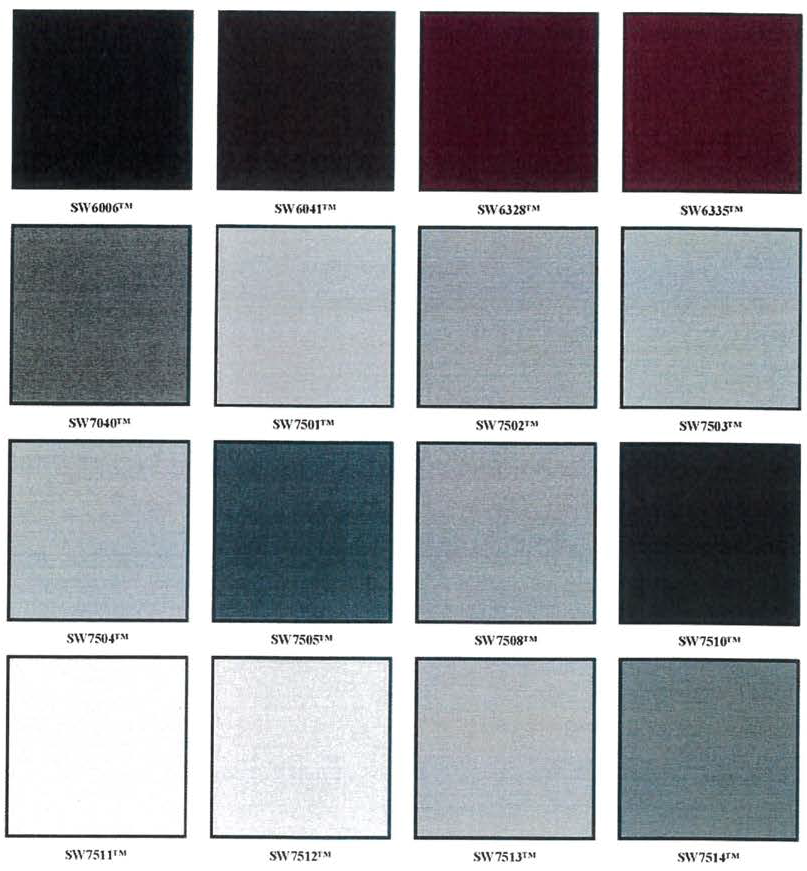
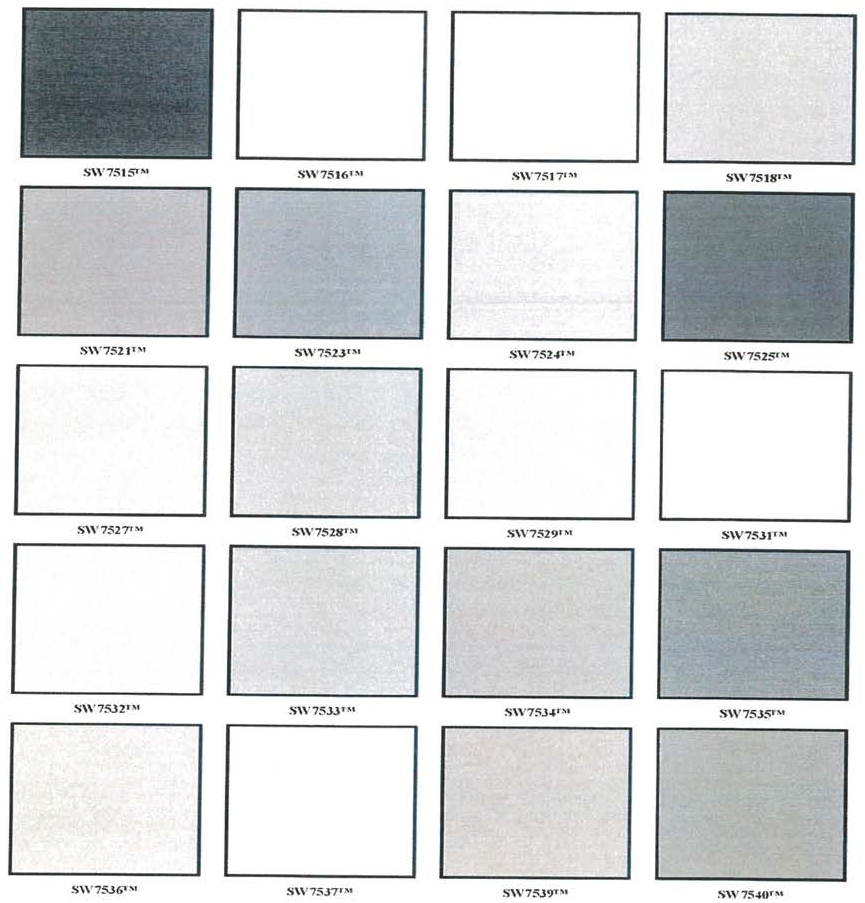
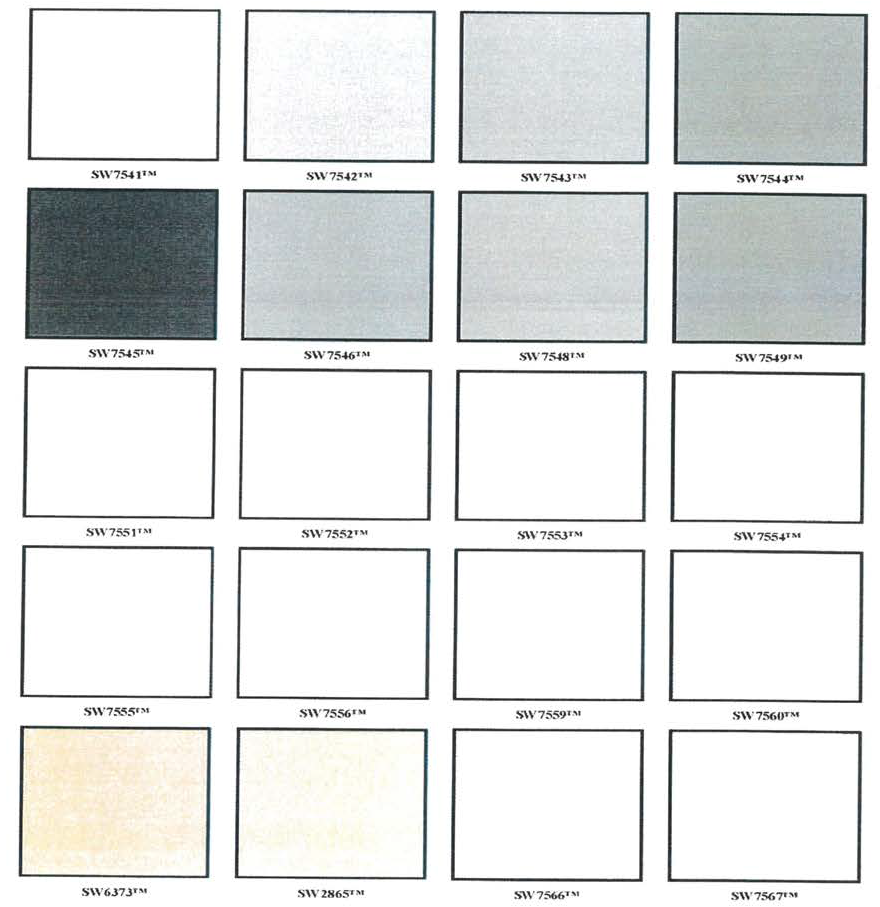
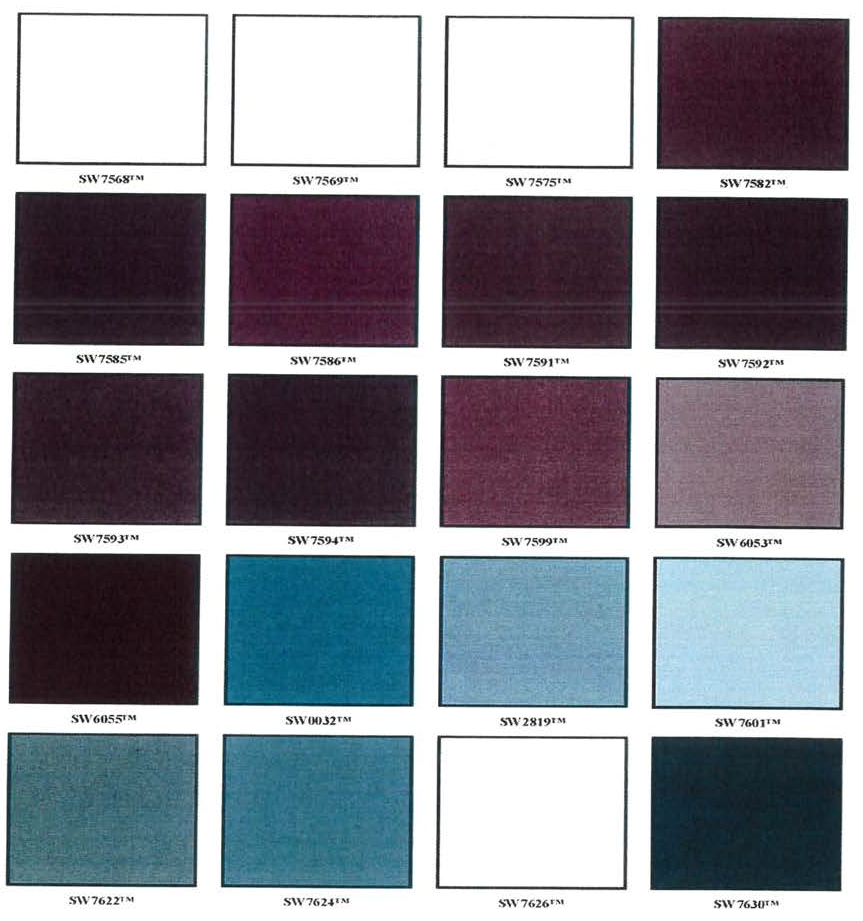
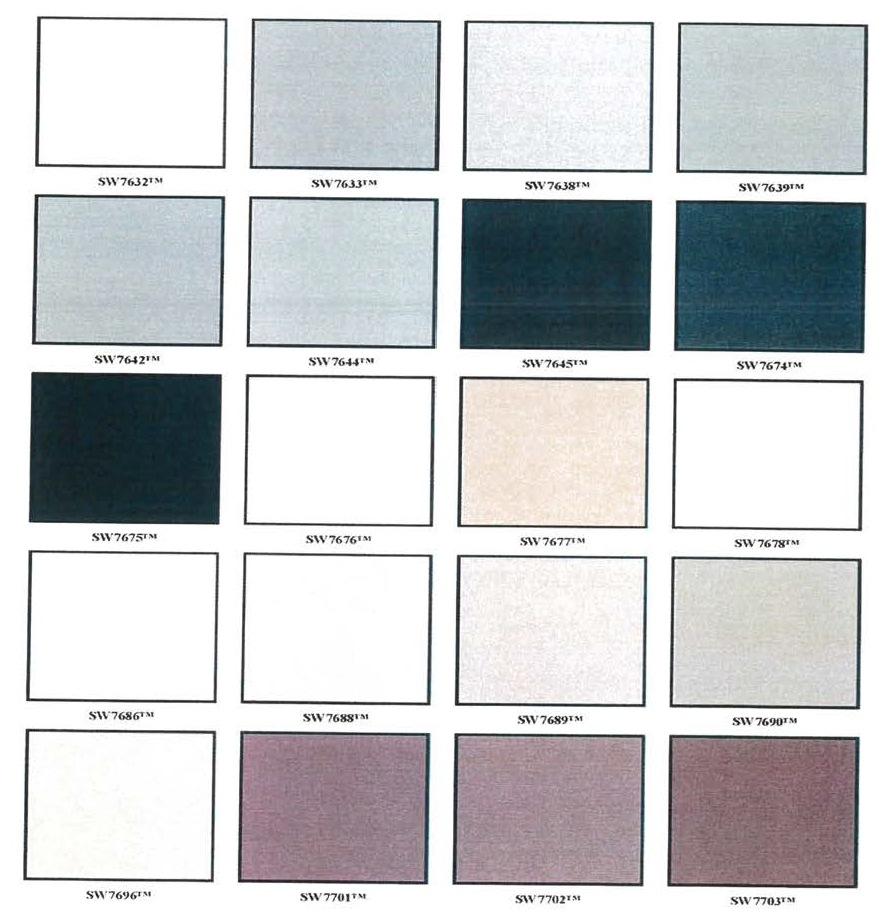
(Code 1990, § 8-7-39; Ord. No. 693, 8-18-2004; Ord. No. 776, 9-17-2008; Ord. No. 829, §§ 1, 2, 5-18-2011; Ord. No. 914, § 1, 3-20-2013; Ord. No. 940, § 1, 8-21-2013; Ord. No. 949, § 2, 12-18-2013; Ord. No. 958, §§ 1—5, 3-19-2014; Ord. No. 971, § 1, 9-17-2014; Ord. No. 1000, §§ 42, 51, 11-18-2015; Ord. No. 1008, § 1, 4-20-2016; Ord. No. 1050, §§ 1, 2, 2-15-2017 ; Ord. No. 1053, § 1, 2-15-2017; Ord. No. 1059, § 1, 4-19-2017; Ord. No. 1081, § 5, 7-19-2017; Ord. No. 1082, § 1, 7-19-2017; Ord. No. 1090, § 1, 9-20-2017; Ord. No. 1109, § 2, 1-17-2018; Ord. No. 1119, §§ 1—14, 3-21-2018; Ord. No. 1130, § 1, 6-20-2018; Ord. No. 1131, § 1, 6-20-2018; Ord. No. 1195, §§ 1—3, 12-18-2019; Ord No. 1227, § 1, 12-16-2020; Ord. No. 1387, § 1, 10-16-2024)
Sec. 8-7-40. - BG General Business District.
(a)
Purpose and intent. The purpose of the BG District is to provide suitable areas for the various types of community and regional-oriented commercial activities including retail uses and wholesale uses, serving a large sector of the community. BG Districts are intended to be located along arterial streets and at locations that are appropriate for community and regional commercial areas, as opposed to locations that primarily serve local neighborhoods.
(b)
Principal uses and structures. All of the principal uses of land and structures listed under the BG District in the use table in Section 8-7-90 shall be permitted. All of the permitted principal uses of land and structures in the BG District shall also comply with all other additional applicable land use requirements, including Section 8-7-92, Supplemental Use Standards.
(c)
Accessory uses. Accessory uses customarily incidental and subordinate to the principal building and located on the same lot shall be permitted in the BG District in accordance with the regulations in Section 8-7-91.
(d)
Special uses. Special uses may be permitted in the BG District in accordance with the use table shown in Section 8-7-90. Special use permits shall be approved only by the City Council with a review and recommendation provided by the Planning Commission as per the procedures set forth in Section 8-7-126.
(e)
Property development standards.
(1)
Minimum lot width: 100 feet.
(2)
Minimum setback requirements:
a.
Front: 25 feet. No more than 75 percent of the required front yard may be used for vehicular parking.
b.
Side, interior lot: ten feet.
c.
Side, corner lot: 25 feet.
d.
Rear lot: 35 feet.
(3)
Minimum lot area: 10,000 square feet.
(4)
Minimum floor area: 1,000 gross square feet.
(5)
Maximum density: 15,000 gross square feet per net acre.
(6)
Maximum impervious surface coverage: 75 percent of the gross area of the lot.
(7)
Maximum height: 50 feet.
(8)
Parking requirements: Off-street parking and loading space shall be provided in accordance with Section 8-7-93.
(9)
Buffer: Where abutting incompatible uses or districts, a buffer is required in conformance with Section 8-7-95.
(10)
Outside storage shall require a special use permit.
(11)
All buildings in this district shall comply with the design standards contained in Sections 8-7-86 and 8-7-86.1.
(Code 1990, § 8-7-40; Ord. No. 693, 8-18-2004; Ord. No. 1000, § 43, 11-18-2015; Ord. No. 1009, § 3, 4-20-2016)
Sec. 8-7-41. - D Downtown District.
(a)
Purpose and intent. The D Downtown District encompasses the Olde Town Historic District and traditional core of the City. As such, the purpose of the Downtown District is to both retain the existing historic resources and development patterns within the district, as well as to promote future development that is pedestrian oriented and that provides a vibrant area for residents to live and work. A significant component of this goal is to encourage a diverse mixture of residential, civic, and commercial activities that creates a space for community events, entertainment, and interaction.
(b)
Definitions. Terms used throughout this section shall take their commonly accepted meanings unless defined herein, or defined in Section 8-7-15, Specific definitions. When there are conflicts between the definitions herein, and definitions as provided in Section 8-7-15, Specific definitions, the definitions of this section shall take precedence. For purposes of this section, the following definitions shall apply:
Backbuilding shall mean a single-story structure connecting a principal building to an accessory building.
Block face shall mean the aggregate of all the building façades on one side of a block.
Contributing resource shall mean a building or a structure that adds to the architectural and/or historical qualities of the Olde Town Conyers Historic District as qualified in Chapter 9 of this title.
Frontage line shall mean a property line bordering a street, whether at the front, rear, or side of the lot. Building façades facing frontage lines define the public realm, and are therefore more regulated than the building façades facing the other property lines.
Frontage line, principal shall mean the property line designated to bear the measure of the minimum lot width.
Frontage line, secondary shall mean the frontage line that is not the principal frontage line.
Green shall mean an outdoor area available for unstructured recreation. A green shall be spatially defined by building frontages. Its landscape shall consist of lawn, and trees naturalistically disposed. There are no size constraints for greens.
Light manufacturing, fabrication. processing, or assembly (no hazardous gasses or liquid materials) uses include the following: processing, fabricating, assembly, storing, transporting, distributing, wholesaling, testing, servicing, repairing, or repurposing of goods, materials or things, excluding fuel, gas, and oil storage and loading, volatile or hazardous chemical storage or processing, hazardous waste storage, chemical and paint manufacturing, explosive and flammable materials manufacturing, medical waste incinerating, food processing and slaughterhouses, and noxious or objectionable waste materials.
Urban farm shall mean agricultural land dedicated to food production to be locally consumed.
Wholesale-light (no outdoor storage and restricted truck traffic) shall mean establishments or places of business engaged in selling merchandise to other businesses, including retailers, industrial, commercial, institutional, or professional business users, other wholesalers, or acting as agents or brokers and buying merchandise for, or selling merchandise to, such individuals or companies. No direct or retail sales to the general public, no outdoor storage permitted and truck traffic permitted only from Irwin Bridge Road and Ellington Drive.
(c)
Boundaries, applicability, conflicts and nonconforming situations.
(1)
The boundaries of the D Downtown District shall be shown on the official zoning map of the City. Proposals to expand the boundaries of the D Downtown District, shall be limited to those lots and buildings abutting the D Downtown District and the Olde Town Conyers Historic District only.
(2)
After the effective date of this ordinance, the mapping of new property into the Downtown Center subarea shall only be allowed where such property is contiguous to existing property zoned as Downtown Center subarea.
(3)
These transect-based standards shall apply to all new construction, including additions to existing structures that are not subject to review and approval by the Historic Preservation Commission.
(4)
The provisions of this section, when in conflict, shall supersede and shall take precedence over those of other zoning regulations.
(5)
The figures in Section 8-7-41(r) are integral to this section, and are intended to provide a graphic example of a specific provision, or provisions, set forth herein. Regulatory language that is integral to figures in Section 8-7-41(r) is deemed part of this section.
(6)
Nothing in this section shall be construed to prevent, or discourage the ordinary maintenance or repair of any building when such maintenance or repair does not constitute an addition or modification as set forth in Chapter 9 of this title, nor to prevent the ordinary maintenance of landscape areas.
(7)
Nonconforming uses and structures are subject to the standards in Section 8-7-96, Nonconforming uses and structures.
(d)
Downtown subarea descriptions. The D Downtown District, is divided into four subareas based on building usage and density.
(1)
The Downtown Edge subarea is intended for single-family residential development, with commercial use limited to bed and breakfast inns.
(2)
The Downtown Civic subarea consists of buildings utilized for educational, governmental, religious, and cultural purposes, as well as general office uses.
(3)
The Downtown Center subarea contains traditional main street building forms and uses, including retail, restaurants, offices, and apartments, with limited detached single-family housing.
(4)
The Downtown Light-Industrial subarea is a specific area of the Irwin Bridge Road corridor and allows light-industrial uses set forth herein that have historically supported the nearby residents and commercial businesses.
(e)
Streetscape requirements.
(1)
Specific to streets.
a.
All streets are intended for use by vehicular, pedestrian and bicycle traffic and to provide access to lots.
b.
All streets shall intersect with other streets, forming an interconnected network.
c.
New cul-de-sac are prohibited.
d.
All future streetscape improvements to arterial streets and collector streets shall be subject to the requirements as follows:
1.
All arterial and collector streets shall have hard-surfaced sidewalks a minimum of five feet in width provided along both sides of the street.
2.
All sidewalks shall be separated from vehicular travel lanes by a sidewalk landscaping strip a minimum of four feet wide planted with grass and a row of street lights and street trees alternating at 25-foot intervals.
3.
The street lights shall be 16 feet high, painted black, and of a Shepherd's Crook design.
4.
The street trees shall consist of a single or alternating species of eastern hornbeam, gingko, red maple, southern sugar maple, willow oak and/or other street tree species appropriate for an urban environment. All varieties of gingko shall be President, male gender or autumn gold.
5.
The street trees shall have a minimum caliper of two inches at the time of planting, and shall be warranted by the builder or land developer for at least two years. In addition, all street trees shall have an expandable tree trunk protector or, if not, shall provide a root barrier system at its base.
6.
Arterial and collector streets with a right-of-way width of 40 feet or less shall be exempt from the street tree requirement.
e.
All future streetscape improvements to local streets shall be subject to the requirements as follows:
1.
Sidewalks shall be provided along both sides of the street.
2.
Sidewalks shall be separated from the vehicular travel lanes by a sidewalk landscaping strip a minimum of four feet in width. The sidewalk landscaping strip shall be planted with grass and may also accommodate an aligned, and a row of street lights and street trees alternating at 50-foot intervals.
3.
Street lights, if any, shall be ten feet high, painted black, and shall have a design style approved by the City Manager or his/her designee.
4.
The street trees may consist of a single or alternating species of eastern hornbeam, gingko, red maple, southern sugar maple and/or willow oak. All varieties of gingko shall be President, male gender or autumn gold.
5.
The street trees shall have a minimum caliper of two inches at the time of planting, and shall be warranted by the builder or land developer for at least two years. In addition, all street trees shall have an expandable tree trunk protector or, if not, shall provide a root barrier system at its base.
(2)
Specific to alleys.
a.
All alleys shall provide continuous access between two streets, except where waived by the City to accommodate a pocket neighborhood development.
(3)
Specific to sidewalks.
a.
All new sidewalks shall match the location, paving materials, paving patterns and width of sidewalks on the same block face. ln the absence of any such sidewalks, then the design of the sidewalk shall be consistent with the paving materials shown in Chapter 6 of this title.
b.
All historic sidewalks shall be restored and preserved.
c.
In no case shall any new sidewalk be less than five feet in width.
(4)
Specific to pedestrian paths.
a.
Pedestrian paths shall be limited to one per pedestrian entrance.
b.
Pedestrian paths shall be no less than five feet in width.
c.
All historic pedestrian paths shall be restored and preserved.
(5)
Specific to street furniture.
a.
All street furniture shall be made of a metal, composite wood and/or wood material.
1.
Street furniture made of metal materials shall be painted black.
(6)
Except where limited elsewhere in this section, the design of all streets, alleys and sidewalks in the D Downtown District, shall otherwise conform to the provisions set forth in Chapter 6 of this title.
(f)
General lot and building regulations for all Downtown subareas. All lots and buildings located within the D Downtown District, shall be subject to the requirements as follows:
(1)
Each newly platted lot shall adhere to the specifications set forth in Table 1.
(2)
Each newly platted lot shall front a street.
(3)
Property lines bordering a street are designated as frontage lines. The property line bordering the street shall be designated as the principal frontage line. Lots with property lines bordering more than one street shall designate one property line as the principal frontage line, and the remaining ones shall be designated as secondary frontage lines. In addition:
a.
The principal pedestrian entrance for each principal building shall be on a principal frontage line, except that the principal pedestrian entrance for each detached single-family house within a pocket neighborhood development shall face the required greenspace or urban farm.
(4)
Setbacks for accessory buildings shall be as follows:
a.
Accessory buildings shall be separated a minimum of 20 feet from principal buildings.
b.
Accessory buildings shall be separated a minimum of ten feet from property lines.
(5)
Except where limited elsewhere in this section, all principal buildings shall have a minimum height of 18 feet and a maximum height of 45 feet.
a.
Principal buildings located in the Downtown Civic and Downtown Center subareas located between Milstead Avenue and Pine Log Road, as shown in Exhibit B, may have a maximum height of 60 feet.
b.
Accessory buildings shall have a maximum height of 30 feet, provided that in no circumstance shall an accessory building exceed the height of the principal building on the same lot.
(6)
There are no density calculations or density requirements. Except where permitted elsewhere in this section either by-right, or approval of a special use permit, the number of dwellings on each lot shall be restricted to one.
(7)
The finished floor area of a principal building or an accessory building shall be subject to the following limits:
a.
Except where limited elsewhere in this section, the finished floor area for a detached single-family house shall be a minimum of 1,800 square feet.
b.
The finished floor area for all other principal buildings shall be a minimum of 1,000 square feet.
c.
In no case shall the finished floor area of any single principal building exceed 15,000 square feet.
d.
Except for detached garages, the finished floor area for an accessory building, shall not exceed the lesser of 1,000 square feet or 20 percent of the total finished floor area of the principal building it serves.
1.
No lot shall be permitted more than two accessory buildings, except that an approved pocket neighborhood development shall be permitted a maximum of four accessory buildings.
e.
The finished floor area for detached garages shall not exceed the lesser of 1,000 square feet or 30 percent of the total finished floor area of the principal building it serves.
(8)
The finished floor area for an apartment shall be a minimum of 500 square feet in the Downtown Center subarea.
(9)
In no case shall the finished floor area of the upper stories exceed that of the ground floor, with the finished floor area of each story being calculated independently.
(10)
Accessory buildings and detached garages shall be subject to the following requirements:
a.
All accessory buildings shall be composed of the same exterior finish materials used on the principal building façades.
b.
All accessory buildings shall have pitched roofs sloped no less than 2:12.
c.
A backbuilding may connect a principal building to an accessory building. In addition:
1.
Backbuildings shall be composed of the same exterior finish materials as the principal building façades.
2.
Backbuildings shall be no greater than 24 feet in width.
TABLE 1.
This table establishes the location of the principal buildings relative to the boundaries of each individual lot.
(g)
Principal permitted and special uses.
(1)
Principal permitted and special uses are identified in Table 2 and are subject to any additional restrictions stipulated in Section 8-7-92, Supplemental use standards. Any use not listed in the table is prohibited within the district unless the City Manager, or his or her designee, determines that the use is similar in nature, intensity and impact to a use that is listed and permitted and is otherwise consistent with the purposes and intent of the Downtown District.
(2)
Table 2, Principal permitted and special uses identifies the uses that are permitted by-right or that are eligible for a special use permit within each Downtown District subarea.
a.
Principal permitted uses are denoted by "P."
b.
Uses eligible for consideration under the issuance of a special use permit are denoted by "S."
c.
Prohibited uses are denoted by a blank cell.
(3)
The majority of uses in Table 2, Principal permitted and special uses are organized utilizing the Land Based Classification Standards (LBCS) developed by the American Planning Association.
(4)
Any nonconforming use lawfully established prior to the effective date of this section may be continued pursuant to the provisions of Section 8-7-96, Nonconforming uses and structures.
TABLE 2. PRINCIPAL PERMITTED AND SPECIAL USES
[1] Drinking place shall be restricted to properties located within the Conyers Entertainment District as established in Title 9, Chapter 1, Article N. The distance requirement established in subsection 8-7-92(t) shall not apply.
(h)
Specific lot and building regulations for Downtown Edge subareas. All Downtown Edge lots and buildings shall be subject to the following requirements:
(1)
Building configuration.
a.
For new construction only, the first story shall be at least nine feet in height from finished floor to finished ceiling.
b.
A first story residential use may be raised from sidewalk grade to secure privacy for the windows.
(2)
Accessory uses. The following accessory uses are permitted by-right in the Downtown Edge subarea:
a.
Home occupation, provided that the work quarters shall be invisible from the frontage line. [1]
b.
Home swimming pool. [1]
c.
Satellite antennae. [1]
d.
Storm shelter.
[1] The use is also subject to the provisions in Section 8-7-92, Supplemental use standards.
(3)
Additional use limitations and regulations.
a.
Except for a pocket neighborhood development, the number of dwellings on each lot is restricted to one within a principal building.
b.
All accessory buildings, home swimming pools, hot tubs, permanent play equipment, storm shelters and the like shall be permitted at rear yards only.
(4)
Parking. Notwithstanding the parking requirements in Section 8-7-93, Off-street parking and loading standards, the number of parking places provided shall be as required by the use or uses accommodated by each building and its lot in the Downtown Edge subarea, except that for all new parking areas:
a.
All parking areas and garages shall be located in the rear yard and side yards only.
b.
All garages shall have carriage style doors where visible from the frontage line.
c.
All garage doors facing a frontage line shall be a maximum of ten feet in width.
d.
All garages shall be detached from the detached single-family house, except as permitted otherwise for a detached-single family house in an approved pocket neighborhood development in Section 8-7-41(k).
1.
A backbuilding may connect the detached single-family house to the detached garage, subject to the standards specified in Section 8-7-41(f)(10).
(i)
Specific lot and building regulations/or Downtown Civic subareas. All Downtown Civic lots and buildings shall be subject to the following requirements:
(1)
Accessory uses. The following accessory uses are permitted by-right in the Downtown Civic subarea:
a.
Satellite antennae. [1]
b.
Storm shelter.
[1] The use is also subject to the provisions in Section 8-7-92, Supplemental use standards.
(2)
Additional use limitations and regulations.
a.
All accessory buildings, permanent play equipment, satellite antennae, storm shelters, swimming pools and the like shall be permitted at rear yards only.
(3)
Parking. Notwithstanding the parking requirements in Section 8-7-93, Off-street parking and loading standards, the number of parking places provided shall be as required by the use or uses accommodated by each building and its lot in the downtown civic subarea, except that for all new parking areas:
a.
Parking lots shall be located in the rear yard or side yards only.
b.
Parking shall be accessed by rear alleys, when such are available.
c.
Parking lots shall be masked from frontage lines by a building, or a freestanding wall constructed of brick, rock, or stone matching the adjacent façade. In addition:
1.
The freestanding wall shall be between two feet and four feet in height;
2.
The freestanding wall may be replaced or supplemented by a continuous, evergreen hedge; and
3.
The freestanding wall shall have openings no larger than is necessary to allow automobile and pedestrian access.
(j)
Specific lot and building regulations for Downtown Center subareas. All Downtown Center lots and buildings shall be subject to the following requirements:
(1)
Building configuration.
a.
For new detached single-family construction only, the first story shall be at least nine feet in height from finished floor to finished ceiling, and for all other new construction, the first story shall be at least 12 feet in height from finished floor to finished ceiling.
b.
A first story residential or lodging use may be raised from sidewalk grade to secure privacy for the windows.
(2)
Accessory uses. The following accessory uses are permitted by-right in the downtown center subarea:
a.
Home occupation, as an accessory only to a detached single-family house that is wholly used for residential occupancy, provided that the work quarters shall be invisible from the frontage line. [1]
b.
Home swimming pool, as an accessory only to a detached single-family house. [1]
c.
Satellite antennae. [1]
d.
Sidewalk cafe, provided as an accessory only to a drinking place or food service establishment. [1]
e.
Storm shelter.
f.
Swimming pool. [1]
[1] The use is also subject to the provisions in Section 8-7-92, Supplemental use standards.
(3)
Additional use limitations and regulations.
a.
All accessory buildings, hot tubs, permanent play equipment, storm shelters, swimming pools and the like shall be permitted at rear yards only.
b.
No commercial use shall be located on or above a floor containing a residential use.
c.
Drive-through facilities are prohibited.
d.
Gas sales and pumps are prohibited.
e.
Specific to appliance repair/electronics repair:
1.
All equipment, materials, items for repair, and activities shall be stored or conducted inside an enclosed building.
2.
No equipment or activities shall be used or conducted on the premises which creates electrical interference, or undue fumes, glare, noise, odors, or vibrations that can be detected outside the boundaries of the property.
f.
No automotive broker shall store automobiles for retail sales on the premises.
g.
No collection agency shall store merchandise or commodities on the premises.
h.
All dry cleaning facilities shall limit their operation to drop-off and pick-up services only, with all cleaning activities taking place off-site.
i.
Event planners/wedding planners shall not hold events on the premises containing their office.
j.
Fish markets, meat markets, and poultry markets shall not slaughter animals on the premises.
k.
Specific to multi-family residential buildings:
1.
Any multi-family residential building shall be a mixed-use building with ground floor commercial and/or office uses.
2.
All multi-family residential units shall be equipped with a sprinkler system subject to approval by the County Fire Marshal, and pre-wired for a security system.
l.
Pet services, pet stores, and pet supply stores shall not have outdoor kennels.
m.
Specific to recording studios:
1.
Recording activities shall be limited to the recording of music and video only.
2.
No recording studio shall have a finished floor area exceeding 2,500 square feet.
3.
All recording studios shall be sound proof.
n.
Specific to single-family residential, detached houses. The conversion of a detached single-family house into an office, restaurant, or retail use, or the conversion of a detached single-family house from an office, restaurant, or retail use to residential occupancy, shall be permitted provided that:
1.
The use the building is being converted for is allowed in the Downtown District subarea for which it is proposed.
2.
No detached single-family house shall be issued an occupational tax license for more than one business.
3.
No ramping providing access for persons with disabilities, when required by ADA, shall be located within the front yard, unless formally waived by the City because topographic conditions prevent such location within the side yard.
4.
No detached single-family house shall be altered to produce a storefront, a flat roof enclosed by a parapet, or other architectural features that will be inconsistent with the original architectural style of the house.
o.
Specific to sign shops:
1.
All equipment, materials, and activities shall be stored or conducted inside an enclosed building.
2.
No equipment or activities shall be used or conducted on the premises which creates electrical interference, or undue fumes, glare, noise, odors, or vibrations that can be detected outside the boundaries of the property.
(4)
Parking. Notwithstanding the parking requirements in Section 8-7-93, Off-street parking and loading standards, the number of parking places provided shall be as required by the use or uses accommodated by each building and its lot in the Downtown Center subarea, except that for all new parking areas:
a.
The number of apartments and condominiums sharing a building and a lot with commercial use on the first story is limited by the requirement of 1.5 parking places for each residential unit, in addition to the parking requirement for each first story commercial use. All buildings providing four or less apartments or condominiums shall be exempt from the provision of parking, except for the location of parking areas. In addition, the ratio of parking may be reduced according to the shared parking standards described in Section 8-7-93, Off-street parking and loading standards, for buildings with five or more apartments and condominiums.
b.
All office, restaurant and retail uses with less than 5,000 square feet of finished floor area shall be exempt from the provision for parking, except for the location of parking areas.
c.
Garages and parking lots shall be located in the rear yard or side yards only.
d.
Parking shall be accessed by rear alleys, when such are available.
e.
All garages shall have carriage style doors where visible from the frontage line.
f.
All garage doors facing a frontage line shall be a maximum of ten feet in width.
g.
All garages shall be detached from the detached single-family house, except as permitted otherwise for a detached single-family house in an approved pocket neighborhood development in Section 8-7-41(k).
1.
A backbuilding may connect the detached single-family house to the detached garage, subject to the standards specified in Section 8-7-41(f)(10).
h.
Parking lots shall be masked from frontage lines by a building, or a freestanding wall constructed of brick, rock, or stone matching the adjacent façade. In addition:
1.
The freestanding wall shall be between two feet and four feet in height;
2.
The freestanding wall may be replaced or supplemented by a continuous, evergreen hedge; and
3.
The freestanding wall shall have openings no larger than is necessary to allow automobile and pedestrian access.
(k)
Specific lot and building regulations for Downtown Light-Industrial subareas. All Downtown Light-Industrial lots and buildings shall be subject to the following requirements.
(1)
Location. The Downtown Light-Industrial subarea is limited to the area located south of North Main Street and north of Railroad Street along the Irwin Bridge Road corridor. Each property shall contain no less than 100 feet of road frontage along Irwin Bridge Road or North Main Street west of Irwin Bridge Road. Driveway access shall be restricted to Irwin Bridge Road or Ellington Drive.
(2)
Building configuration.
a.
For new construction only, the maximum floor area shall not exceed 15,000 square feet.
b.
Accessory buildings shall be located no less than 20 feet behind the front building line established by the principal building and no less than 20 feet from a side or rear property line.
(3)
Additional use limitations and regulations.
a.
Drive-through facilities are prohibited.
b.
Outdoor storage is prohibited. All materials and business activities shall be conducted within an enclosed building.
c.
No equipment or activities shall be used or conducted on the premises which creates electrical interference, or undue fumes, glare, noise, odors, or vibrations that can be detected outside the boundaries of the property.
d.
Commercial vehicles associated with and servicing businesses within the subarea shall be directed to avoid residential areas along North Main Street.
e.
Specific to appliance repair/electronics repair:
1.
All equipment, materials, items for repair, and activities shall be stored or conducted inside an enclosed building.
2.
No equipment or activities shall be used or conducted on the premises which creates electrical interference, or undue fumes, glare, noise, odors, or vibrations that can be detected outside the boundaries of the property.
f.
No automotive broker shall store automobiles for retail sales on the premises.
g.
No collection agency shall store merchandise or commodities on the premises.
h.
Event planners/wedding planners shall not hold events on the premises containing their office.
i.
Fish markets, meat markets, and poultry markets shall not slaughter animals on the premises.
j.
Pet services, pet stores, and pet supply stores shall not have outdoor kennels.
k.
Specific to recording studios:
1.
Recording activities shall be limited to the recording of music and video only.
2.
No recording studio shall have a finished floor area exceeding 2,500 square feet.
3.
All recording studios shall be soundproof.
l.
Specific to sign shops:
1.
All equipment, materials, and activities shall be stored or conducted inside an enclosed building.
2.
No equipment or activities shall be used or conducted on the premises which creates electrical interference, or undue fumes, glare, noise, odors, or vibrations that can be detected outside the boundaries of the property.
(4)
Parking. Notwithstanding the parking requirements in Section 8-7-93, Off-street parking and loading standards, the number of parking places provided shall be as required by the use or uses accommodated by each building and its lots in the Downtown Light-Industrial subarea. The following shall apply for all new parking areas:
a.
Parking lots shall be masked by frontage lines by one of the following methods:
i.
A freestanding wall containing the following elements:
1.
Shall be no less than three feet in height and constructed of brick, rock or stone matching the adjacent building façade;
2.
Shall be supplemented with shrubs located between the street and freestanding wall; and
3.
The freestanding wall shall have openings no larger than necessary to allow automobile and pedestrian access.
ii.
In lieu of a freestanding wall, an earthen berm containing the following:
1.
Shall be no less than three feet in height;
2.
Shall be planted with a continuous evergreen hedge located between the top and toe of the berm. The hedge material shall be at least two feet in height at the time of planting; and
3.
The earthen berm shall have openings no larger than necessary to allow automobile and pedestrian access.
(5)
Buffers. For new construction only, a planted buffer shall be required to protect properties used for residential purposes and those within the Downtown Edge subarea from excessive, heat, dust, wind, light, unsightly views, odors and other characteristics commonly associated with light industrial uses and related vehicular traffic, which can adversely impact the quality of life for residents. The required buffer shall be established and maintained by the developer, owner and all future owners of real property abutting residentially used properties or those within the Downtown Edge subarea. The buffer must:
a.
Be no less than 50 feet in width, however can be reduced to 25 feet with the addition of an opaque fence or wall no less than eight feet in height.
b.
Be depicted in detail (the type and locations of natural and planted vegetation are to be illustrated) on each site plan or plan prior to approval and shall be designated as a permanent easement.
c.
Not be disturbed by grading, property improvements or construction activities; except where necessary to prevent a nuisance, or to thin such natural growth where too dense to permit normal growth, or to remove diseased, misshapen, or dangerous and decayed timbers. Any contemplated disturbance shall first be brought to the attention of the City Manager or his/her designee and formal approval secured prior to initiating activity within the required buffer area.
d.
Utilize existing vegetation where it has been determined that existing vegetation is appropriate for inclusion within the buffer strip or when required to be supplemented with approved, additional plantings.
e.
Retain the natural topography of the land, except when a portion must be cleared and graded as required to prevent stormwater damage, soil erosion or sedimentation.
f.
Be completely installed in accordance with the approved plan prior to issuance of a certificate of occupancy.
g.
Not be used for temporary or permanent parking or loading or for a structure other than a fence.
h.
Attain a height of not less than six feet within three years of the planting date.
(l)
Specific requirements for pocket neighborhood developments. Pocket neighborhood developments are clustered residential units intended to expand and diversify the housing stock in the Downtown area. A pocket neighborhood development consists of a single lot under common ownership, with privately owned detached single-family homes arranged around a central greenspace or an urban farm. Pocket neighborhood developments are subject to the specific requirements as follows:
(1)
A pocket neighborhood development requires at least 150 feet of public street frontage.
(2)
A pocket neighborhood development shall consist of at least one acre, and no more than five acres.
(3)
A minimum of ten percent of the pocket neighborhood development shall be permanently allocated to a green or an urban farm.
(4)
A pocket neighborhood development shall comprise of at least five, and no more than ten detached single-family houses. The finished floor area of each detached single-family house shall be no less than 1,600 and no more than 1,800 square feet.
(5)
The detached single-family houses shall be subject to the following requirements:
a.
All detached single-family houses shall be arranged around the required greenspace or urban farm.
b.
The minimum width of each detached single-family house shall be 25 feet.
c.
Each detached single-family house shall be separated by a minimum of ten feet.
d.
Each principal pedestrian entrance shall face the required greenspace or urban farm.
e.
Each detached single-family house shall be assigned two parking places. Required parking places may be uncovered or covered with an attached or detached garage subject to the requirements set forth in this section. In addition, the required parking places shall be accessed from a rear alley that is privately held and maintained by the mandatory homeowners' association. Rear alleys shall have an easement provided and recorded within the deed covenants/restrictions that will allow access for emergency personnel, public safety personnel, public works personnel, et cetera.
f.
All uncovered parking places shall be masked from the street, greenspace or urban farm by a freestanding wall between two feet and four feet in height and constructed of brick, rock, or stone matching the adjacent façade. The freestanding wall may be replaced by a continuous, maintained evergreen hedge between two feet and four feet in height. Freestanding walls shall have openings no larger than is necessary to allow automobile and pedestrian access.
g.
Notwithstanding any provision for architecture shown in Section 8-7-41(n), in no case shall any two detached single-family houses in a pocket neighborhood development have the same exterior appearance. Each detached single-family house shall be substantially differentiated with regard to architectural style, exterior materials, color, and detail.
(6)
Except for detached garages, no more than four accessory structures shall be permitted within a pocket neighborhood development. All accessory structures shall be located to the rear of the lot, and match the architectural styles of the detached single-family houses on the site. In no case shall the finished floor area of an accessory structure, or accessory structures, exceed the lesser of 2,000 square feet, or 20 percent of the total finished floor area of all the detached single-family houses built on site.
(7)
To ensure pocket neighborhood developments will be interspersed around the Downtown District, no pocket neighborhood development shall be within a radius of 1,000 feet of another pocket neighborhood development. This distance shall be measured from the nearest point of the property line of an existing pocket neighborhood development to the nearest point of the property line of a proposed pocket neighborhood development.
(8)
Except where stated elsewhere in this section, the edges of a pocket neighborhood development shall not contain buffers.
(9)
In no case shall the impermeable surface for a pocket neighborhood development exceed 40 percent.
(10)
In no case shall any detached single-family house or any other incidental activities be located within, or occur within 20 feet of any property line.
(11)
In no case shall any detached single-family house in a pocket neighborhood development be converted into an office as a principal use.
(12)
Each pocket neighborhood development shall require a homeowners' association. Membership within the association shall be mandatory for all homeowners, and their successors in interest. The documents establishing the mandatory homeowners' association shall be recorded with the Clerk of the County Superior Court, and shall be submitted to the City prior to the issuance of any certificate of occupancy. The homeowners' association shall be responsible for the maintenance of all common areas, including, but not limited to:
a.
Greenspace;
b.
Interior sidewalks;
c.
Landscaping;
d.
Parking areas;
e.
Pedestrian paths;
f.
Rear alleys; and
g.
Urban farms.
(m)
Specific requirements for urban farms. Urban farms are ways of incorporating food production along the rural-to-urban transect within downtown. Urban farms can encourage lower-cost food supplies because of a reduction in the energy consumption for food transport and provide a locus of recreation and sociability greater than that of the private yard. Urban farms are permitted by-right in each subarea, subject to the specific requirements as follows:
(1)
An occupational tax license is not required for an urban farm.
(2)
The urban farm may be divided into separate plots for cultivation by one or more individuals.
(3)
Running water is required, and the urban farm shall be designed and maintained so that water will not drain onto abutting lots.
(4)
The donation and sale of food products grown in the urban farm may occur on-site.
(5)
The urban farm may accommodate no more than five individual storage sheds and/or other incidental structures, provided that all such individual storage sheds and incidental structures shall be made from any combination of indigenous rock, natural stone, wood or other similar materials. Roofs shall be pitched and sloped no less than 2:12.
(6)
The raising of animals is not permitted.
(7)
There are no parking requirements for an urban farm.
(8)
There shall be no minimum or maximum size for an urban farm.
(9)
In no case shall any farming or any other incidental activities occur within ten feet of any property line.
(10)
All urban farms shall be privately maintained and privately managed.
(n)
Special requirements for the Olde Town Conyers Historic District. For lots and buildings located in both the D Downtown District, and the Olde Town Conyers Historic District:
(1)
The Historic Preservation Commission may require that a proposed building match the setbacks of a contributing resource on the same block face, rather than the provisions of this section.
(2)
The Historic Preservation Commission may require that a proposed building match the height of a contributing resource on the same block face, rather than the provisions of this section.
(3)
All lots and buildings located in the D Downtown District and the Olde Town Conyers Historic District shall, in addition to complying with the requirements and standards of this section, receive a certificate of appropriateness from the Historic Preservation Commission as required by Chapter 9 of this title, prior to receiving any permits and/or undertaking work.
(o)
Architecture. All new building construction and the renovation of existing buildings located in the D Downtown District, shall be subject to the following:
(1)
Not withstanding any provisions for pocket neighborhood developments stated in Section 8-7-41(k), developments involving the construction of between one and five single-family dwellings shall provide an adequate number of front building elevation variations to ensure that in no instance shall the same two front elevations be used immediately adjacent to or directly across the street from one another. Developments of six or more single-family dwellings shall provide at least six different front building elevations, and in no instance shall the same two front elevations be used immediately adjacent to or directly across the street from one another. In either situation front elevations shall be substantially differentiated with regard to architectural style, exterior materials, color, and architectural elements. Mirrored or reversed front elevations shall not be considered adequate to fulfill this requirement.
(2)
Principal buildings shall have their principal pedestrian entrance on a principal frontage line, except that a detached single-family house in a pocket neighborhood development shall have its principal pedestrian entrance on a greenspace or an urban farm. In addition, each principal pedestrian entrance shall be defined by an alcove, a pitched roof, a porch, a stoop, or by a recession.
(3)
Exterior stairs on a frontage line or facing a greenspace or an urban farm shall have enclosed risers of brick, concrete, rock, stone, or wood.
(4)
Foundations shall be made of brick, rock or stone. Foundations shall extend from the ground-level to the first floor level on each façade. Painted or stained wooden porches may utilize brick, rock, or stone piers no less than 18 inches by 18 inches for support. Where another type of structural material is used for piers, it shall be faced with brick, rock, or stone from the ground-level to the first floor level on each façade. Physical requirements for foundations shall not apply to slab on grade construction.
(5)
Façades on a frontage line or where facing a greenspace or an urban farm shall be articulated at intervals not to exceed 40 feet in length.
(6)
Building wall materials in this district shall be limited to brick, cementitious board (fiber cement board panels and planks), rock, stone, or painted or stained wood, with the exception of multi-family residential buildings, whose first story commercial uses shall be brick, rock and/or stone. Portland cement plaster and lathe systems (stucco) may only be used as an accent material, providing that it does not exceed ten percent of the total building wall area, with each façade being calculated independently. In addition:
a.
All Portland cement plaster and lathe systems (stucco) shall be applied to brick or concrete materials.
(7)
Where multiple exterior materials are used on a single building, they shall only be combined on each façade horizontally, with the heavier materials at the bottom.
a.
Building walls shall combine no more than two materials above the foundation.
(8)
Painted building facades are encouraged to use white or the traditional colors shown in Figure 9.
a.
Black shall be used only as a trim or accent color.
b.
Bright, metallic, neon, and fluorescent colors are not recommended and should be avoided.
(9)
Columns shall be brick, fiberglass, rock, stone, or pre-cast concrete and shall be no less than 12 inches by 12 inches.
a.
Columns shall be centered on the spandrel beam.
b.
Columns shall have a base, a shaft and a capital.
c.
Columns shall be located a minimum of eight feet from the façade.
d.
Porches and stoops shall have equally spaced columns.
1.
All columns on upper floors shall align with columns below.
(10)
Posts shall be rock, stone, and/or wood and shall be no less than six inches by six inches in plain view.
(11)
Porches and stoops on a frontage line, green or an urban farm shall not be enclosed with glass, mesh screens, or similar materials.
(12)
Porches shall be made of brick, concrete, rock, stone, or painted or stained wood.
(13)
The rear façade and the side facades shall be of the same construction quality, material, finish, and exterior color as the front façade.
(14)
Service elements such as communications, electrical, mechanical and plumbing equipment shall only be located towards the rear or side of a building and shall be visually screened from view from any frontage line, greenspace or urban farm by a freestanding wall that is between three feet and eight feet in height, and constructed of or veneered with brick, rock, or stone material matching the adjacent façade. Service elements may be located on a flat roof, provided that all such service elements are visually screened from view from all sides in conformance with Section 8-7-41(n)(20).
a.
No service element shall be attached to any façade.
(15)
Utility meters including electric meters, gas meters and water meters are prohibited on the front façade.
(16)
Doors and windows that operate on sliding tracks are prohibited on frontage lines, greenspaces or urban farms.
(17)
Security bars and the like are prohibited on doors and windows on frontage lines, greenspaces, or urban farms.
(18)
Chimneys shall be finished with brick or natural stone, except that flues for pot belly stoves shall be metal with an appropriate jack arch or lintel.
a.
All chimneys and fireplace enclosures shall extend to the ground.
b.
All chimneys shall be capped to conceal spark arresters.
(19)
Bay windows, if provided, shall extend to the floor inside and to the ground outside or be supported by visible wall brackets made of wood.
(20)
Pitched roofs shall be sloped no less than 6:12, except that pitched roofs for stoops, porches and accessory buildings shall be no less than 2:12. In addition:
a.
Principal buildings shall have pitched roofs.
b.
All pitched roofs shall be clad in asphalt shingles, slate, or standing seam metal.
c.
Pitched roofs shall be shades of black, brown, gray, dark green, or dark red.
d.
Roof penetrations, including vent stacks, shall not be placed on the slope of the roof facing the street, and all roof penetrations shall be finished to match the color of the roof.
(21)
Flat roofs shall be enclosed by parapets a minimum of two feet high, except that parapets shall be raised to a point no less than 12 inches higher than the tallest service element located on the flat roof in order to conceal all such service elements from view on all façades.
(22)
Specific architectural standards for all principal buildings in the Downtown Edge subareas:
a.
Façades on a principal frontage line or where facing a green or an urban farm shall complement one of the following architectural styles shown in Figure 6 in Section 8-7-41(r):
1.
Colonial Revival.
2.
Craftsman.
3.
English Vernacular Revival.
4.
Folk Victorian.
5.
Greek Revival.
6.
Queen Anne.
b.
Principal pedestrian entrances shall be defined with a porch or a stoop that meets the requirements as follows:
1.
Porches shall be no less than eight feet deep and 100 square feet in area, and shall be covered with a pitched roof sloped no less than 2:12 that is supported by columns or posts.
2.
Stoops shall be made of brick, rock, or stone no less than five feet deep and five feet wide. All stoops shall be raised a minimum of two feet from average sidewalk grade, and may be covered with a pitched roof sloped no less than 2:12 that is supported by columns or wood wall brackets.
c.
Façades on a frontage line, greenspace or urban farm shall be no less than 15 percent and no more than 40 percent glazed in glass. All doors and windows shall use transparent glass that transmits at least 60 percent of visible daylight, except that transoms may be stained or lightly tinted.
d.
All windows shall be made of aluminum, vinyl, or wood and shall be glazed with glass.
1.
Aluminum shall be painted.
2.
Wood shall be painted or stained.
e.
Façades on frontage lines or facing a greenspace or an urban farm shall have windows that are consistent with the examples displayed in Figure 5 in Section 8-7-41(r). Flush mounted windows are prohibited.
f.
Muntins shall be true divided panes or fixed on the interior and exterior surface.
g.
Windows on a principal frontage line shall be no lower and no higher than the adjacent door frame.
(23)
Specific architectural standards for all principal buildings in the Downtown Civic subareas:
a.
Windows on a principal frontage line, if provided, shall be rectangular in orientation, proportion and shape, with the height of the window greater than its width and glazed in stained or transparent glass that transmits at least 60 percent of visible daylight. In addition, the centerline of the window sash shall align within the centerline of the wall. There shall be no flush mounted windows on the principal frontage line.
b.
Windows in façades facing rear and side lot lines may have stained glass.
c.
All windows shall be made of aluminum, vinyl, or wood and shall be glazed with glass. In addition:
1.
Aluminum shall be painted.
2.
Wood shall be painted or stained.
d.
First story windows shall sit on knee walls between one and one-half feet and three feet high on a frontage line and where facing a greenspace or an urban farm. The knee walls shall be materially compatible with the rest of the façade and shall not be made of glass.
e.
Principal buildings may have flat roofs enclosed by parapets or pitched roofs.
(24)
Specific architectural standards for all principal buildings in the Downtown Center subareas:
Except for detached single-family houses, which shall adhere to the standards stated in Section 8-7-41(n)(21) for the Downtown Edge subareas, all other principal buildings shall be subject to the following:
a.
Façades on the principal frontage line shall meet the requirements as follows:
1.
The façade shall be no less than 60 percent and no more than 90 percent glazed in transparent glass on the first story between two and eight feet above the sidewalk. Transoms shall be placed above first story doors and/or windows.
2.
The façade shall be no less than 30 percent and no more than 60 percent glazed in transparent glass on the second and third story, with each story being calculated independently.
3.
All transparent glass shall transmit at least 60 percent of visible daylight, except that transoms may be stained or lightly tinted.
b.
Windows on frontage lines, greenspaces or urban farms shall be made of aluminum, vinyl, or wood and glazed with glass. In addition:
1.
Aluminum shall be painted.
2.
Wood shall be painted or stained.
c.
Except for transoms, façades on frontage lines, greens or urban farms shall have windows that are rectangular in orientation, proportion and shape with the height of the window greater than its width. Transoms shall be oriented horizontally with vertically proportioned panes of glass. In addition, the centerline of the window sash shall align within the centerline of the wall. There shall be no flush mounted windows on frontage lines, greenspaces or urban farms. In addition, all doors and windows in the second and third story shall be centered directly above the doors and windows in the first story on frontage lines, greenspaces or urban farms.
d.
Awnings, if provided, shall meet the following requirements:
1.
Awnings shall either be made of fabric or metal. Fabric awnings may be fixed or retractable. Metal awnings shall be fixed.
2.
Awnings shall be straight sheds without side flaps, not cubed or curved, with a drip edge no greater than 12 inches.
3.
Awnings shall not be internally lit or back lit.
4.
Awnings shall be at least four feet deep and may overlap the sidewalk to within two feet of the curb, but must clear the curb vertically by at least eight feet at the lower drip edge.
e.
First story windows shall sit on knee walls between one and one-half feet and three feet high on a frontage line and where facing a greenspace or an urban farm. The knee walls shall be materially compatible with the rest of the façade and shall not be made of glass.
f.
Muntins shall be true divided panes or fixed on the interior and exterior surface.
g.
Security grilles and security screens, if provided, shall be of the mesh type that pedestrians can see through from the abutting street or open space (i.e. permit view of the spaces within when closed) and located on the inside of the glassed area. In addition:
1.
At least 75 percent of the total area of the security grille or security screen shall be transparent, with or without internal illumination.
2.
All security grilles and security screens shall be fully retracted during business hours.
3.
All security grille and security screen housing and shield systems shall be located indoors, and be invisible from the building exterior on all sides.
(25)
Specific architectural standards for all principal buildings in the Downtown Light Industrial subareas for new building construction and construction involving 50 percent of the gross building area of existing buildings at the time of the adoption of this ordinance:
a.
Façades on the principal frontage line shall meet the requirements as follows:
1.
The façade shall be no less than 35 percent glazed in transparent glass on the first story between two and eight feet above the sidewalk.
2.
All transparent glass shall transmit at least 60 percent of visible daylight, except that transom may be stained or lightly tinted.
b.
Window frames on frontage lines shall be made of aluminum, vinyl, or wood and glazed with glass. In addition:
1.
Aluminum shall be painted.
2.
Wood shall be painted or stained.
c.
Windows shall be rectangular in orientation, proportion and shape with the height of the window greater than its width.
d.
First story windows shall sit on knee walls between one and one-half feet and three feet high on a frontage line. The knee wall shall be materially compatible with the rest of the façade and not be made of glass.
e.
Security grills and security screens, if provided, shall be of the mesh type that pedestrians can see through from the abutting street or open space (i.e. permit view of the spaces within when closed) and located on the inside of the glassed area. In addition:
1.
At least 75 percent of the total area of the security grille or security screen shall be transparent, with or without internal illumination.
2.
All security grilles and security screens shall be fully retracted during business hours.
3.
All security grille and security screen housing and shield systems shall be located indoors, and be invisible from the building exterior on all sides.
(p)
Signs. Signs in the Downtown District, shall be subject to the following requirements:
(1)
Specific to signs in the Downtown Edge subarea.
a.
Primary ground signs.
1.
Primary ground signs may be double-sided.
2.
Sign faces shall not exceed 18 square feet in area.
3.
Primary ground signs shall not exceed six feet in height.
4.
Primary ground signs shall be constructed from brick, rock, stone and/or painted wood.
b.
Sign faces on primary ground and wall signs shall be constructed of painted wood or metal.
c.
Sign faces constructed of cardboard, foam, paper, plastic, unpainted wood and/or similar materials are prohibited.
d.
Signs, if illuminated, shall be externally illuminated only.
1.
All primary ground signs, if illuminated, shall be externally lit by ground lighting fixtures.
2.
Where permitted, all other signs, if illuminated, shall be lit externally by lighting fixtures designed to angle light downward onto the sign.
3.
All external lights for signage shall be shielded to prevent glare and focused directly on the sign face.
e.
Except where prohibited in Section 8-7-41(o)(4), signs in the Downtown Edge subarea shall otherwise conform to the sign provisions for residential uses in Chapter 5 of this title.
(2)
Specific to signs in the Downtown Civic subarea.
a.
Primary ground signs.
1.
Primary ground signs may be double-sided.
2.
Sign faces shall not exceed 32 square feet in area.
3.
Primary ground signs shall not exceed six feet in height.
4.
Primary ground signs shall be constructed from brick, rock, stone and/or painted wood.
b.
Sign faces on primary ground and wall signs shall be constructed of painted wood or metal.
c.
Sign faces constructed of cardboard, foam, paper, plastic, unpainted wood and/or similar materials are prohibited.
d.
Signs, if illuminated, shall be externally illuminated only.
1.
All primary ground signs, if illuminated, shall be externally lit by ground lighting fixtures.
2.
Where permitted, all other signs, if illuminated, shall be lit externally by lighting fixtures designed to angle light downward onto the sign.
3.
All external lights for signage shall be shielded to prevent glare and focused directly on the sign face.
e.
Except where prohibited in Section 8-7-41(o)(4), signs in the Downtown Civic subarea shall otherwise conform to the sign provisions for nonresidential uses in Chapter 5 of this title.
(3)
Specific to signs in the Downtown Center and Downtown Light-Industrial subareas.
a.
Primary ground signs.
1.
Primary ground signs may be double-sided.
2.
Sign faces shall not exceed 32 square feet in area.
3.
Primary ground signs shall not exceed six feet in height.
4.
Primary ground signs shall be constructed from brick, rock, stone and/or painted wood.
b.
Wall signs.
1.
Wall signs shall not exceed 32 square feet in area, per building façade.
2.
Wall signs shall not project vertically above the roof line.
c.
Blade signs.
1.
Each first story business with a principal pedestrian entrance shall be permitted to have one blade sign.
2.
Blade signs may be double-sided.
3.
Blade signs shall not exceed four square feet in area.
4.
Blade signs shall clear the sidewalk vertically, by at least eight feet.
5.
Blade signs shall not be illuminated.
d.
Neon signs.
1.
Each first story business with a principal pedestrian entrance shall be permitted one neon lit sign not to exceed two square feet in area, provided that such neon lit sign is located within five feet of the principal pedestrian entrance.
e.
Illumination.
1.
Except for neon lit signs in conformance with the provisions of this section, and where prohibited elsewhere in this section, all signs within the Downtown Center subarea shall be externally illuminated.
2.
All primary ground signs, if illuminated, shall be externally lit by ground lighting fixtures.
3.
Where permitted, all other signs, if illuminated, shall be lit externally by lighting fixtures designed to angle light downward onto the sign.
4.
All external lights for signage shall be shielded to prevent glare and focused directly on the sign face.
f.
Sign faces on primary ground and wall signs shall be constructed of painted wood or metal.
g.
Sign faces constructed of cardboard, foam, paper, plastic, unpainted wood and/or similar materials are prohibited.
h.
Except where prohibited in Section 8-7-41(o)(4), signs in the Downtown Center subarea shall otherwise conform to the sign provisions for nonresidential districts in Chapter 5 of this title.
(4)
Prohibited signs. In addition to those signs prohibited in Chapter 5 of this title, the following signs are also prohibited within each subarea:
a.
Billboard signs;
b.
Internally illuminated signs; and
c.
Pole-supported signs.
(q)
Screening.
(1)
Loading docks and service areas. All loading docks and service areas shall be located at the rear of buildings. Doors for access to interior loading docks and service areas shall not face a street, greenspace, or urban farm.
(2)
Service elements. All service elements, including communications, electrical, mechanical, and plumbing equipment, shall be located at the rear of buildings and screened from view from any frontage line, greenspace, or urban farm with evergreen landscaping or a freestanding wall constructed of or veneered with brick, rock, or stone matching the adjacent façade. Service elements may be located on flat roofs as specified in Section 8-7-41(n)(20). In addition, all landscaping and freestanding walls shall be of an appropriate height to conceal all such service elements.
(3)
Underground utilities. All utilities shall run underground. The City, upon application and approval, may approve an exception to this provision if subsurface rock or other unique physical hardship makes such installation infeasible. If an exception is approved by the City Manager, or his/her designee, then all utilities shall be located within the rear yard only.
(r)
Landscape.
(1)
On-site lakes, ponds, reservoirs and other similar bodies of water, and riparian corridors, shall remain, undisturbed by human activity or development, and preserved as an integrated landscape feature.
(2)
Naturally occurring rock outcroppings and the like shall be preserved as integrated landscape features.
(3)
No disturbed ground shall be left exposed, except for urban farms seasonally tilled for cultivation. All exposed ground shall be covered with grasses, shrubs, and trees.
(4)
Retaining walls visible from frontage lines, greenspaces, or urban farms shall be constructed of or veneered with brick, rock, or stone matching the adjacent façade. Retaining walls greater than four feet high shall be supplemented with dense evergreen plantings.
(5)
Stormwater detention and retention ponds shall be integrated landscape features, rather than single-purpose flood control and stormwater management ponds.
(6)
Stormwater detention and retention ponds shall be planted with appropriate grasses, shrubs, and trees.
(7)
In the event stormwater detention and retention ponds cannot be integrated landscape features, then all such stormwater detention and retention ponds shall be located within the rear yard only, and masked from the frontage line, abutting lot, and areas visible from public view. With the exception of entrances only, all storm water detention and retention ponds shall be appropriately screened with a freestanding wall at least four feet high, and constructed from rock or stone matching the adjacent façade. The freestanding wall may be replaced by a black, vinyl coated chain-link fence, also at least four feet high, and completely surrounded by dense evergreen vegetation and/or trees at least four feet high at the time of planting that effectively masks the chain-link fence and stormwater detention or retention pond from direct view.
(8)
Except as regulated elsewhere in this section, in Section 8-7-92, Supplemental use standards, or in Section 8-7-95, Landscaping and buffering, to screen unsightly places, service yards and/or mitigate incongruent conditions, buffers are not required between property lines internal to the D Downtown District.
(9)
Specific to the Downtown Edge subarea:
a.
Trees shall be naturalistically planted, and the spacing and placement of trees shall be adequate and appropriate for the typical size, shape and pattern of the tree species at maturity.
(s)
Figures. The figures provided in this section are intended to provide examples of requirements set forth in this section.
Figure 1.
This illustration provides a depiction of the character of each subarea along a rural-to-urban transect intended for Downtown.
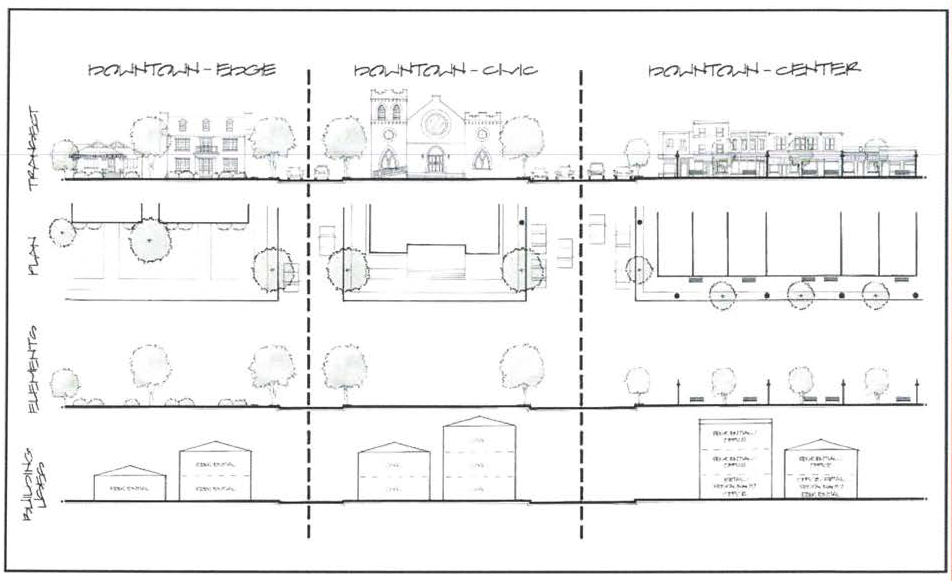
Figure 2-A.
This illustration shows a typical arterial/collector street cross-section, assembled from required elements that appear in Section 8-7-41(e)(1). The numerical dimensions are the minimum required. The dimensional requirements for travel lanes only include pavement width, and do not include curb and gutter. Curb and gutter shall be no less than 18 inches and no more than 24 inches wide.
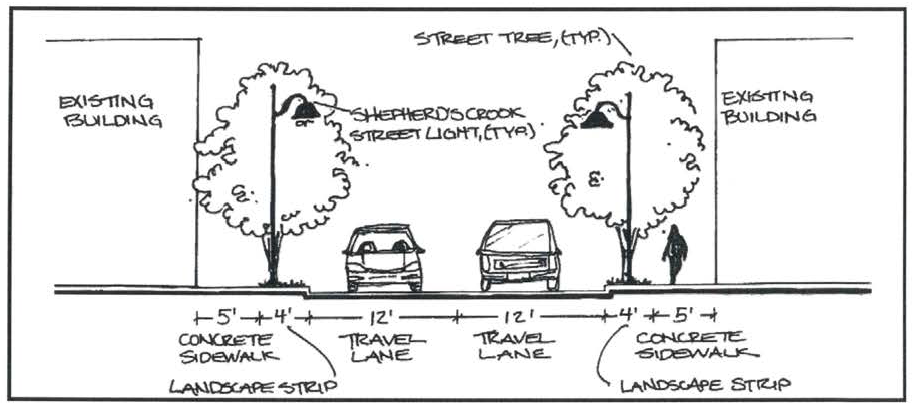
Figure 2-B.
This illustration shows a typical local street cross-section, assembled from required elements that appear in Section 8-7-41(e)(1). The numerical dimensions are the minimum required. The dimensional requirements for travel lanes only include pavement width, and do not include curb and gutter. Curb and gutter shall be no less than 18 inches and no more than 24 inches wide.
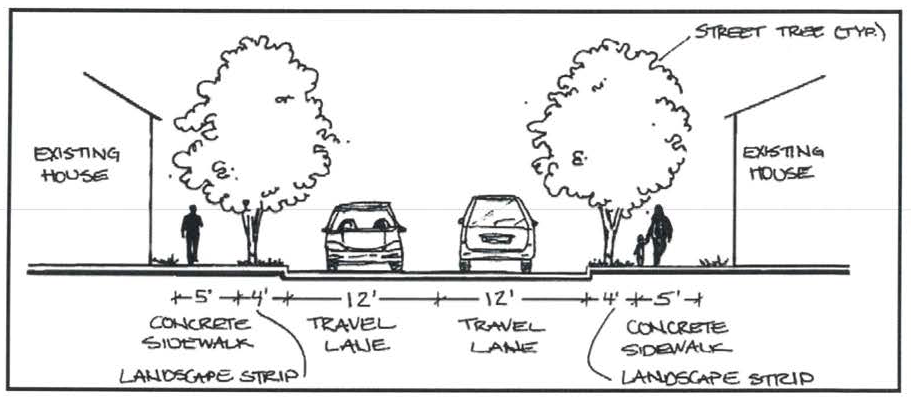
Figure 3.
This illustration shows an appropriate arrangement of detached single-family houses in a pocket neighborhood. A rear alley provides access to garages and parking areas. Additionally, garages and parking areas must be masked from the required green or urban farm, by a detached single-family house, or a freestanding wall constructed of or faced with a brick, indigenous rock or natural stone material matching the adjacent façade. The freestanding wall may be replaced or supplemented by a continuous, evergreen hedge.
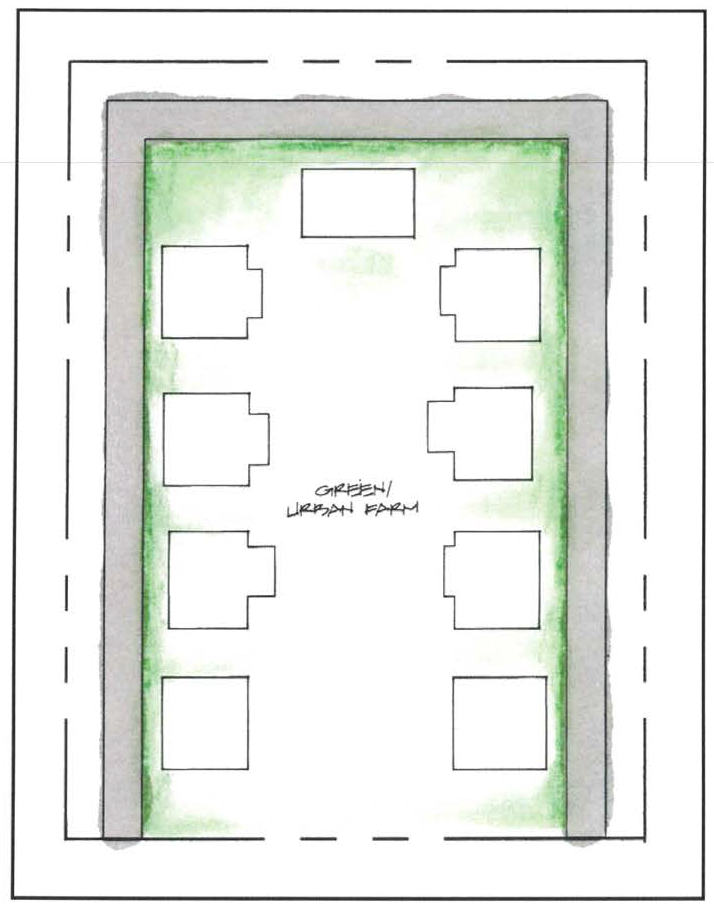
Figure 4.
Urban farms are encouraged to support local food production, to provide a locus of recreation and sociability greater than that of the private yard and for other environmental and health reasons. As shown in this illustration. the urban farm is designed with individual separate plots for cultivation by one or more individual lots, sitting areas and a storage shed that may also accommodate space for the sale and/or donation of food grown on-site.
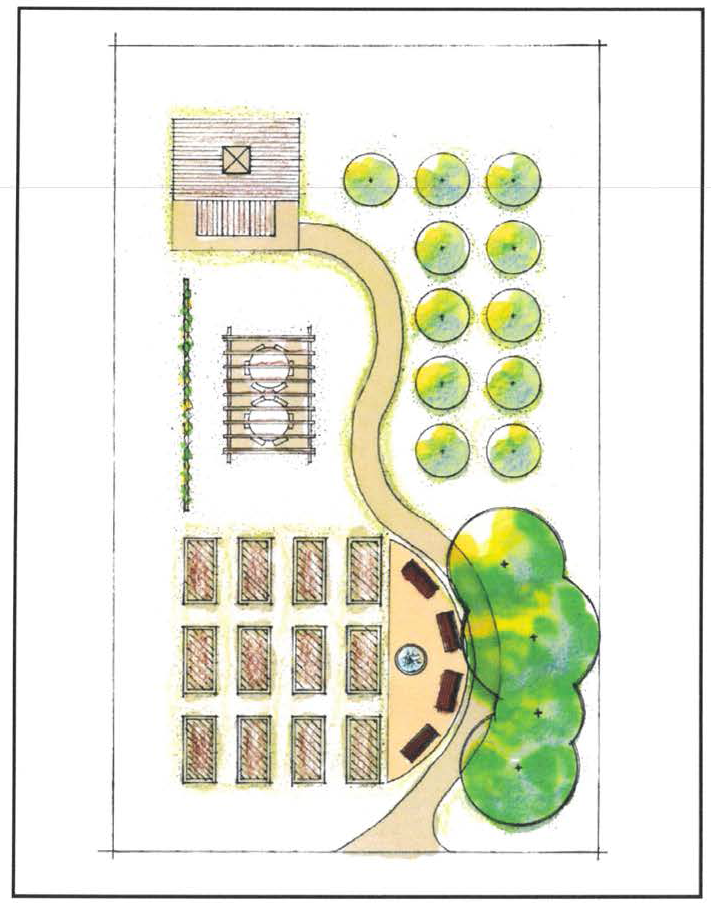
Figure 5.
Residential windows, doors, roof lines and dormers shall be configured as shown, and appropriate to each architectural style.
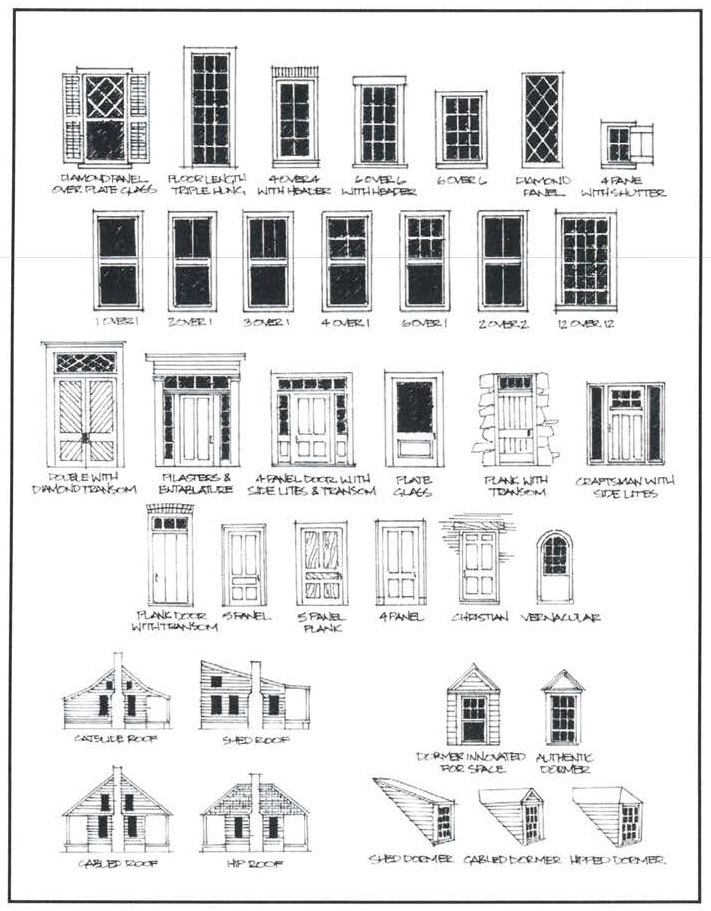
Figure 6.
This illustration shows the six architectural styles and their common architectural details.
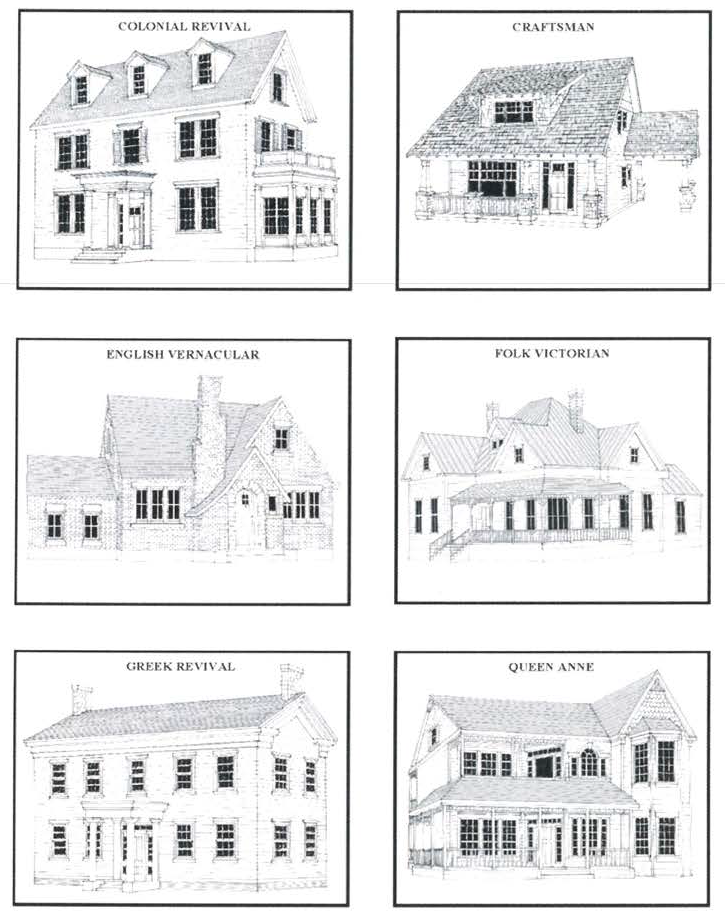
Figure 7.
Except for a detached single-family house, the first story or sidewalk-level of each principal building shall be detailed as a storefront in the downtown center subarea.
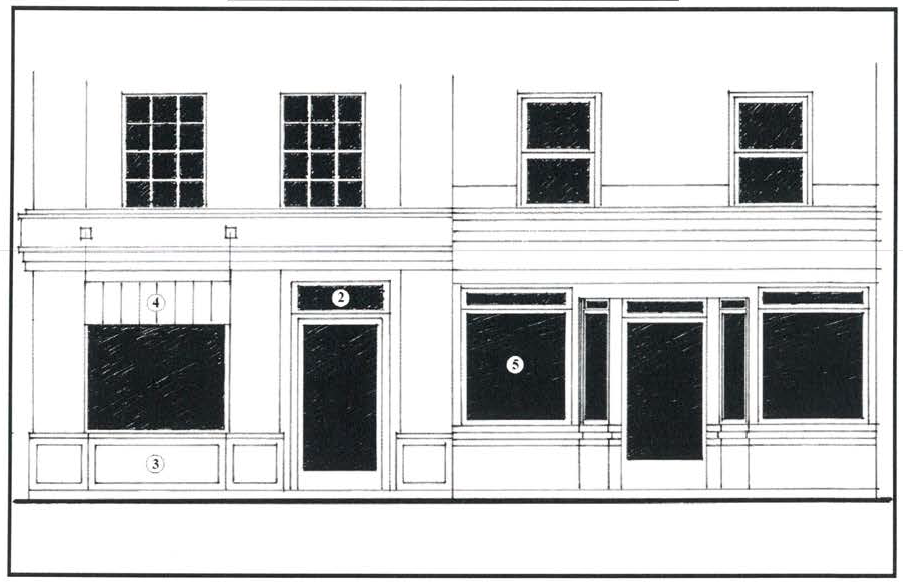
(1)
At least 60 percent and no more than 90 percent of the first story or sidewalk level between two and eight feet above the sidewalk shall be glazed in glass to permit view of human activities and spaces within (Note: this provision of architecture is not enumerated).
(2)
A transom shall be placed above all first story doors and/or windows. Transoms shall be provided above first story windows and oriented horizontally with vertically proportioned panes of glass.
(3)
Windows on the first story shall rest on non-glass knee walls a minimum of one and one-half feet and a maximum of three feet high.
(4)
Awnings may encroach the sidewalk to within two feet of the street curb, but must clear the sidewalk vertically by at least eight feet.
(5)
Except for transoms, all other windows shall be rectangular in orientation, proportion and shape, with the height of the window greater than its length on principal frontage lines.
Figure 8-A.
This illustration shows the desired design of a primary ground sign in each subarea.
Figure 8-B.
This illustration shows the placement of various signs for office, restaurant and retail use in the downtown center subarea only.
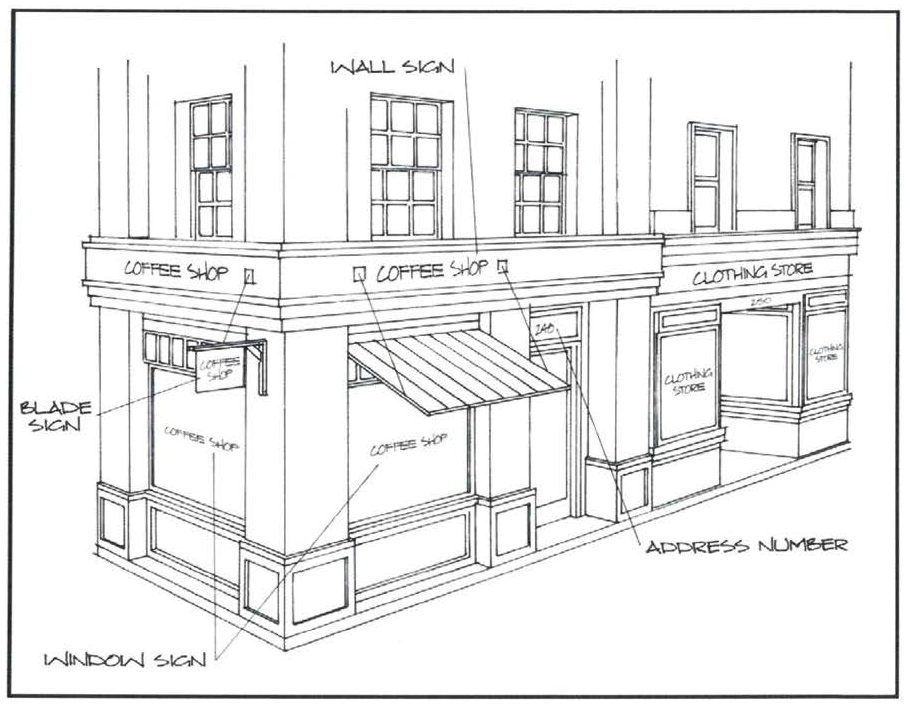
Figure 9: Color Palette.
This color palette identifies exterior paint colors recommended for buildings in the D. Downtown District; bright, metallic, neon, and fluorescent colors are not recommended for primary or trim colors and, if used at all, are more appropriate for accent colors on doors, signs, or awnings. Sherwin-Williams standard paint numbers are used for reference but any manufacturer's similarly colored paint is also encouraged. The colors shown may not be accurate representations of the paint color referenced and the manufacturer's paint sample should be consulted for exact color depiction.
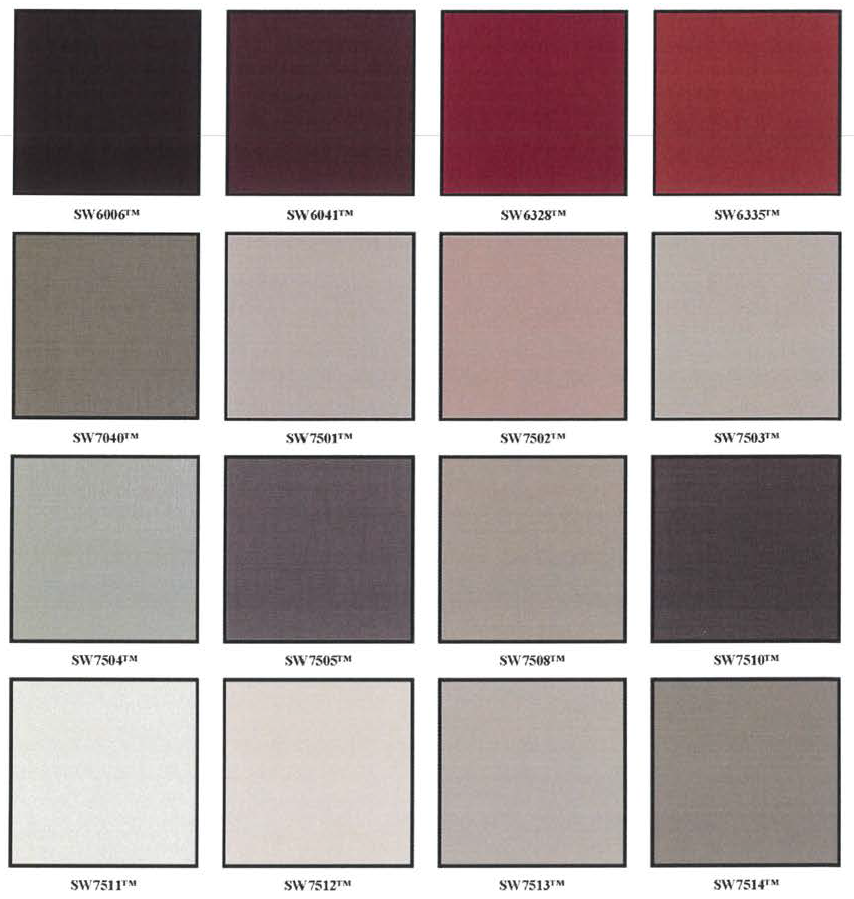
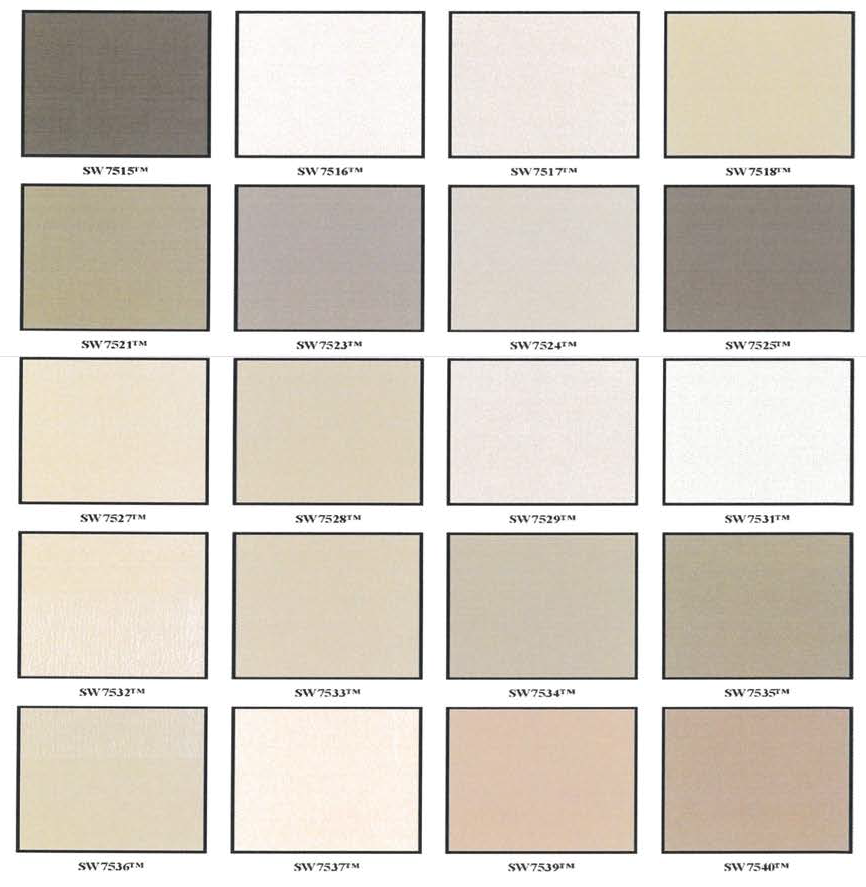
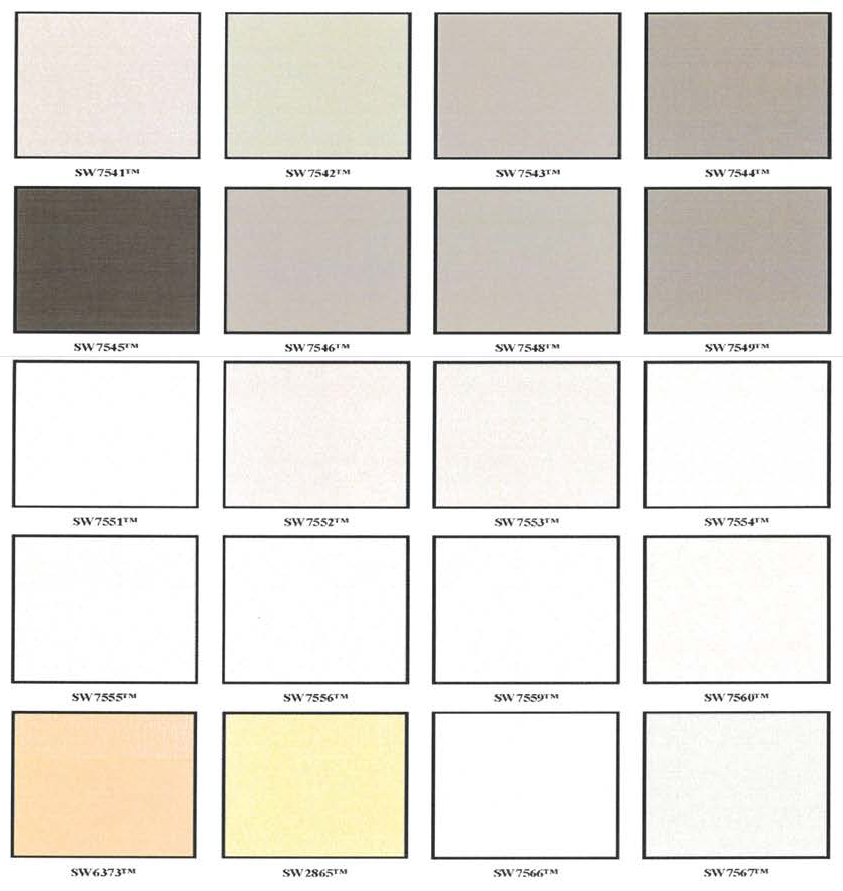
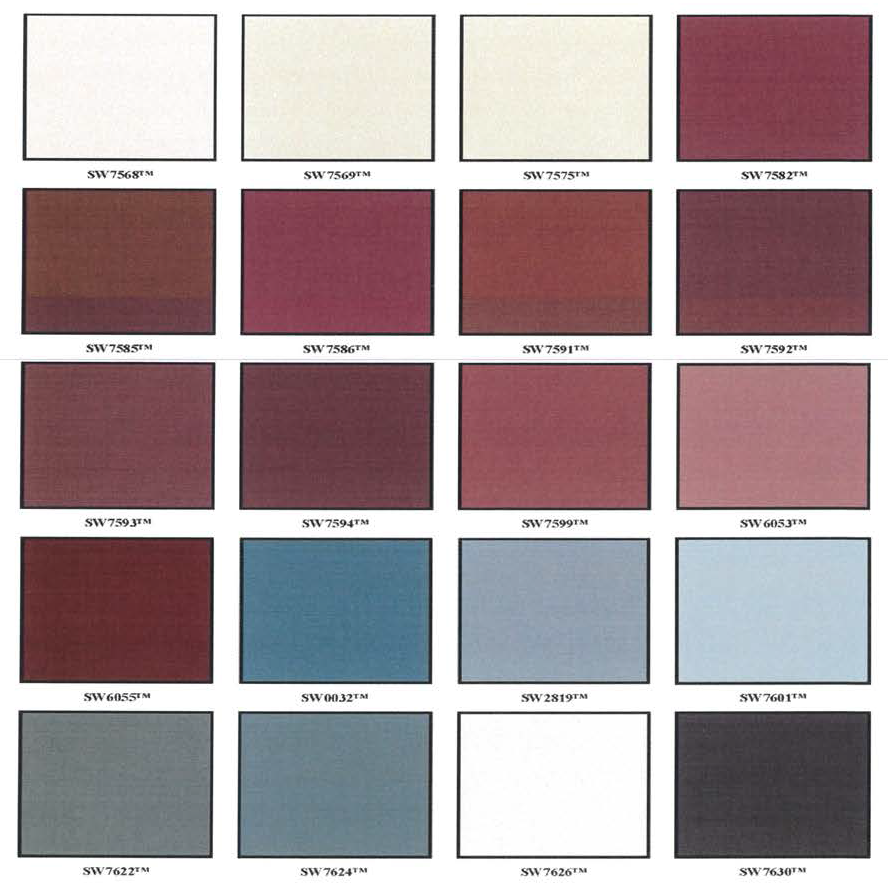
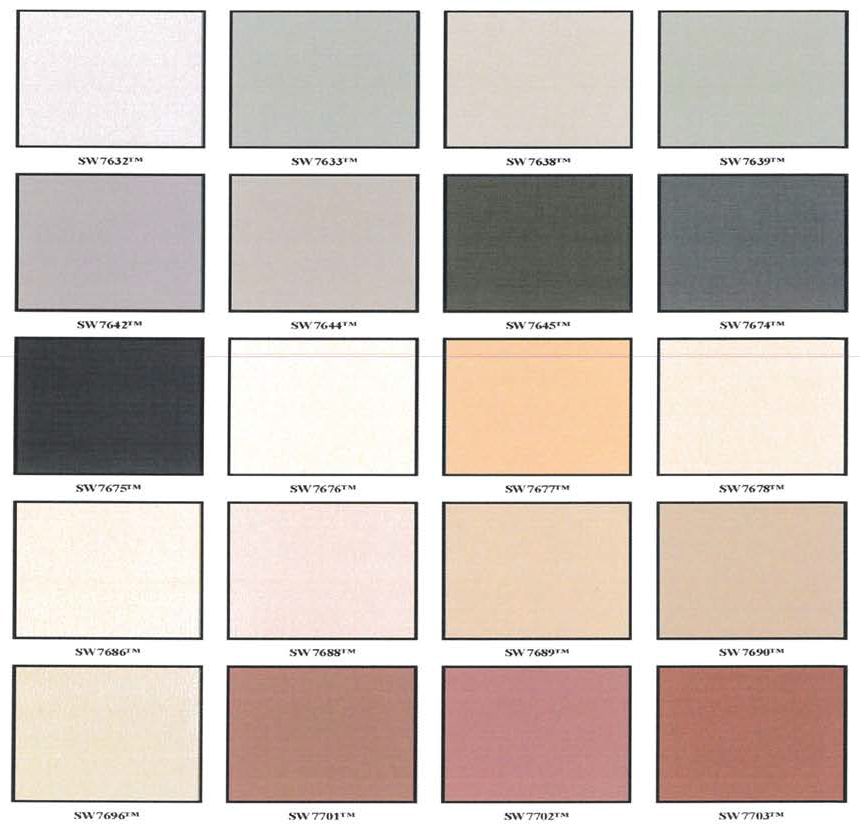
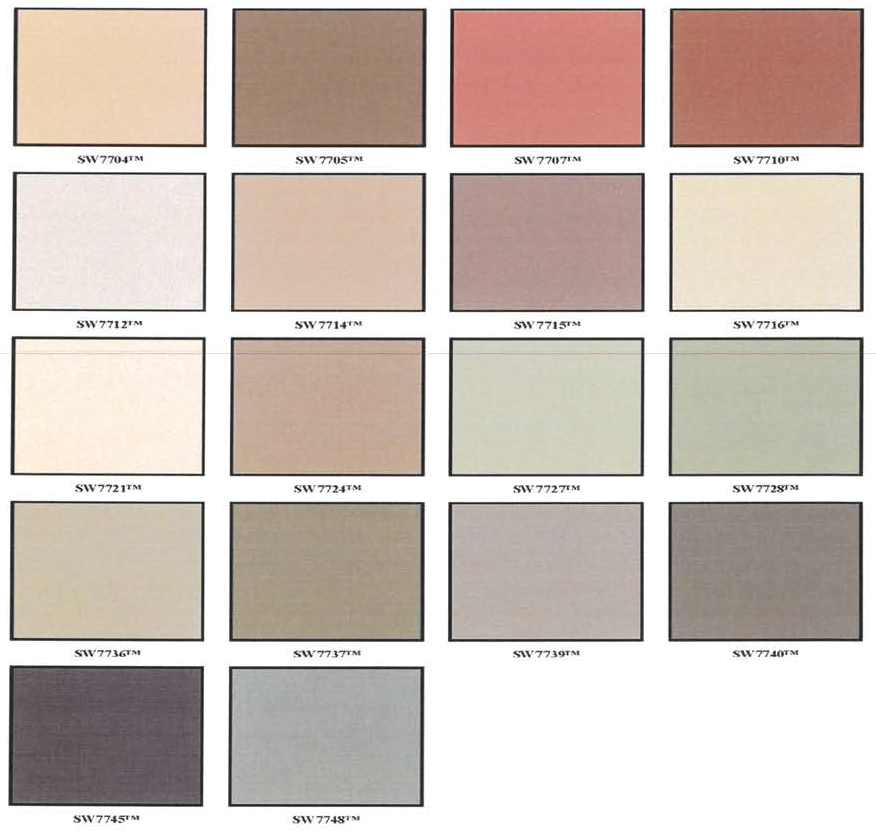
Exhibit B.
Section 8-7-41, D Downtown District Zoning Map
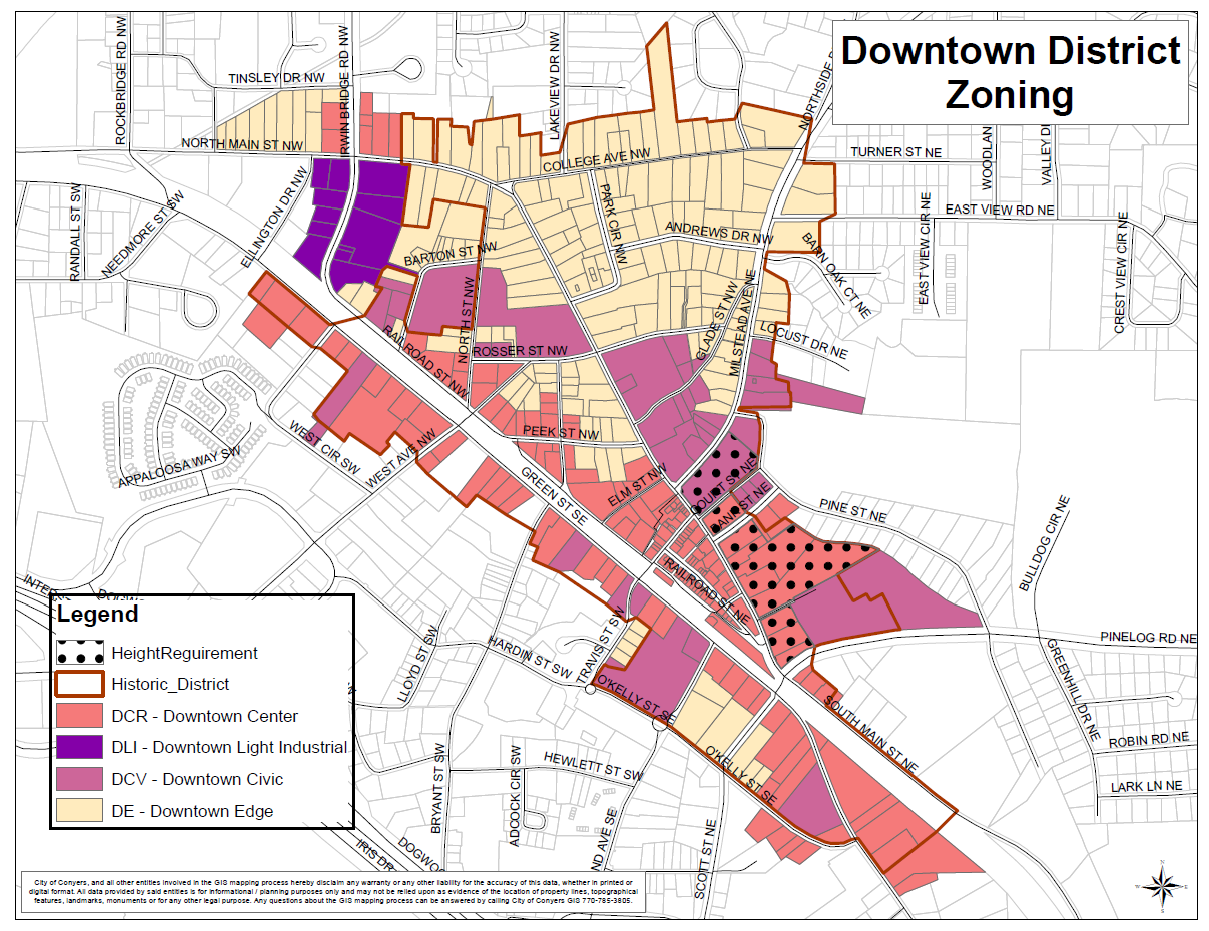
(Ord. No. 1066, § 1(Exh. A), 5-17-2017; Ord. No. 1081, § 6, 7-19-2017; Ord. No. 1138, §§ 1, 2, 8-15-2018; Ord. No. 1191, § 1, 12-18-2019; Ord. No. 1190, § 2, 3-18-2020; Ord. No. 1276, § 1, 1-19-2022; Ord. No. 1317, §§ 1, 2, 5-17-2023; Ord. No. 1391, § 1, 11-20-2024; Ord. No. 1398, § 1, 12-18-2024; Ord. No. 1445, § 1, 9-17-2025)
Sec. 8-7-42. - HSB Highway Service Business District.
(a)
Purpose and intent. The purpose of the HSB District is to provide places for heavier commercial, business and wholesale uses and to facilitate the use of land adjacent to major arterials and principal highway intersections that are designed primarily to serve the automotive traveling public. The HSB District shall be located only on major arterial streets.
(b)
Principal uses and structures. All of the principal uses of land and structures listed under the HSB District in the use table in Section 8-7-90 shall be permitted. All of the permitted principal uses of land and structures in the HSB District shall also comply with all other additional applicable land use requirements, including Section 8-7-92, Supplemental Use Standards.
(c)
Accessory uses. Accessory uses customarily incidental and subordinate to the principal building and located on the same lot shall be permitted in the HSB District in accordance with the regulations in Section 8-7-91.
(d)
Special uses. Special uses may be permitted in the HSB District in accordance with the use table shown in Section 8-7-90. Special use permits shall be approved only by the City Council with a review and recommendation provided by the Planning Commission as per the procedures set forth in Section 8-7-126.
(e)
Property development standards.
(1)
Minimum lot width: 100 feet.
(2)
Minimum setback requirements:
a.
Front: 50 feet. No more than 75 percent of the required front yard shall be used for vehicular parking.
b.
Side, interior lot: 15 feet.
c.
Side, corner lot: 25 feet.
d.
Rear lot: 40 feet.
(3)
Minimum lot area: 20,000 gross square feet.
(4)
Minimum heated floor area: 1,000 gross square feet.
(5)
Maximum density: 15,000 gross square feet per net acre.
(6)
Maximum impervious surface coverage: 75 percent of the gross area of the lot.
(7)
Maximum height: The maximum height of buildings shall be 60 feet.
(8)
Parking requirements: Off-street parking and loading space shall be provided in accordance with Section 8-7-93.
(9)
Where abutting incompatible uses or districts, a buffer is required in conformance with Section 8-7-95.
(10)
All buildings in this district shall comply with the design standards contained in Sections 8-7-86 and 8-7-86.1.
(Code 1990, § 8-7-42; Ord. No. 693, 8-18-2004; Ord. No. 814, § 6, 11-17-2010; Ord. No. 1000, § 44, 11-18-2015; Ord. No. 1009, § 4, 4-20-2016)
Sec. 8-7-43. - I-D Industrial/Distribution District.
(a)
Purpose and intent. The purpose of the I-D District is to provide a suitable location along arterial highways for wholesale warehousing, trade shops and light manufacturing uses, usually located on or near existing community facilities and transportation corridors. The intent of this district is to establish areas of industrial use that would not be objectionable by reasons of dust, odor, noise, traffic safety or congestion. Such uses should be encouraged to locate away from residential districts in accordance with policies outlined in the City comprehensive plan and under the following conditions:
(1)
Such proposed use will not substantially affect or alter nearby property values.
(2)
The site plan for such use provides for adequate ingress and egress of vehicular traffic and will not cause health, safety or unreasonable traffic safety or congestion problems in the area.
(b)
Principal uses and structures. All of the principal uses of land and structures listed under the I-D District in the use table in Section 8-7-90 shall be permitted. All of the permitted principal uses of land and structures in the I-D District shall also comply with all other additional applicable land use requirements, including Section 8-7-92, Supplemental Use Standards.
(c)
Accessory uses. Accessory uses customarily incidental and subordinate to the principal building and located on the same lot shall be permitted in the I-D District in accordance with the regulations in Section 8-7-91.
(d)
Special uses. Special uses may be permitted in the I-D District in accordance with the use table shown in Section 8-7-90. Special use permits shall be approved only by the City Council with a review and recommendation provided by the Planning Commission as per the procedures set forth in Section 8-7-126.
(e)
Property development standards.
(1)
Minimum lot width: 100 feet.
(2)
Minimum setback requirements:
a.
Front: 50 feet.
b.
Side, interior lot: 25 feet.
c.
Side, corner lot: 50 feet.
d.
Rear lot: 50 feet.
(3)
Minimum lot area: One acre.
(4)
Minimum floor area: 2,000 gross square feet.
(5)
Maximum density: 30,000 gross square feet per net acre.
(6)
Maximum impervious surface: 75 percent of the gross area of the lot.
(7)
Maximum height of buildings: 75 feet.
(8)
Parking requirements: Off-street parking and loading space shall be provided in accordance with Section 8-7-93.
(9)
Buffer: Where abutting incompatible uses or districts, a buffer is required in conformance with Section 8-7-95.
(10)
All buildings in this district shall comply with the design standards contained in Sections 8-7-86 and 8-7-86.1.
(Code 1990, § 8-7-43; Ord. No. 693, 8-18-2004; Ord. No. 1000, § 45, 11-18-2015; Ord. No. 1009, § 5, 4-20-2016; Ord. No. 1102, § 2, 11-15-2017)
Sec. 8-7-44. - GV Gateway Village District.
(a)
Purpose. The purpose of the GV district is to respond to the growing market demand for mixed-use development that creates an integrated and complimentary combination of commercial, office, and residential uses. Additionally, the purpose of this district is to promote pedestrian oriented development and redevelopment through increased accessibility between commercial corridors and adjacent residential neighborhoods, as well as to establish consistent architectural and design standards that enhance the aesthetics of the district.
(b)
Intent. The intent of the GV district is to enhance and maximize the character and development of the significant gateway and commercial corridors within the district. Inherent in this intent is the desire to create a sustainable, walkable community, to enable a diversity of goods, services, and housing options offered within the district, to reduce traffic congestion and sprawl development, and to encourage quality land use and redevelopment.
(c)
Definitions. This section provides definitions for terms herein that are either technical in nature or that otherwise may not reflect a common usage of the term. Those terms not defined in this section shall be accorded their commonly accepted meanings, unless defined in Section 8-7-15, Specific Definitions. In the event of conflicts between these definitions and those of Section 8-7-15, those of this section shall take precedence.
Attic means the interior part of a building contained within a pitched roof structure.
Encroach means to break the plane of a vertical or a horizontal regulatory limit with a structural element, so that it extends into a setback, into the area between the curb of the vehicular lanes and the frontage line or above a height limit.
Front setback means the distance from the frontage line to the point where a building may be constructed. This area must be maintained clear of permanent structures with the exception of encroachments.
Frontage line means a lot line bordering a street or an open space.
Frontage line, principal means the lot line designated to bear the measure of minimum lot width.
Function means the use or the uses accommodated by a building and its lot, and categorized as residential or other.
Function, other means any function other than residential.
Principal entrance means the main point of access for pedestrians into a building.
Private frontage means the privately held lot layer between the frontage line and the principal building façade.
Story means a habitable level within a building by which height is measured, excluding an attic or a raised basement.
(d)
Establishment of subareas. To promote mixed-use development patterns, this district is divided into three subareas based upon usage and building development. The general character of each subarea is as follows:
(1)
Residential village. Low density, single-family residential area.
(2)
Neighborhood village. Greater density of residential units with an emphasis on mixed-use buildings.
(3)
Urban village. High density subarea with larger scale buildings and with the greatest variety of uses.
(e)
Streetscape design standards. Unless otherwise noted below, all provisions of Chapter 6 of this title, Subdivision Regulations, shall apply to all streetscape improvements and alterations in this district.
(1)
General streetscape requirements.
a.
All lots shall share a frontage line with a street.
b.
All streets shall terminate at other streets in intersections, forming an interconnected network.
c.
All streets shall have hard-surfaced sidewalks a minimum of five feet in width and a maximum of 25 feet in width, placed on each side of the street.
d.
All sidewalks shall be separated from vehicular travel lanes by a sidewalk landscaping strip a minimum of four feet wide and covered with grass.
e.
Reserved.
f.
For all development proposals encompassing five or more acres, streets shall not exceed a block length of 660 feet between intersecting streets.
(2)
Specific standards for arterial and collector streets. In addition to the general streetscape requirements, arterial streets and collector streets shall meet the following standards, as generally illustrated in Diagram 3:
a.
All sidewalk landscaping strips shall accommodate streetlights and street trees.
b.
Streetlights shall be installed at intervals of 50 linear feet, on center, within the sidewalk landscaping strip and shall consist of a shepherd's crook design (diagram 4), subject to approval of the City Manager or his/her designee.
c.
All streetlights shall be 16 feet in height and finished in black.
d.
Street trees shall be planted on center and at an equal distance between streetlight fixtures (25 linear feet) within the sidewalk landscaping strip, and shall be limited to the following species:
1.
Eastern hornbeam.
2.
Red maple.
3.
Southern sugar maple.
4.
Willow oak.
e.
All street trees shall have a minimum caliper of two inches at the time of planting and shall be warranted by the builder or the property owner for a minimum of two years. Additionally, all street trees shall have an expandable tree trunk protector or a root barrier system at its base.
f.
Installation and placement of streetlights and street trees shall be coordinated with neighboring properties to create a visually integrated streetscape.
g.
Specific to Flat Shoals Road, Iris Drive, Miller's Chapel Road, Old McDonough Highway, Old Salem Road, State Route 20 and/or State Route 138.
1.
The first ten feet of depth for all yards fronting the specified streets shall consist of a landscape strip planted with grass, flowering plants, natural rock outcroppings, and/or shrubbery.
2.
A fence 42 inches in height shall be setback behind the required ten-foot landscape strip on private property.
3.
The fence shall be designed with three rails made of vinyl or wood materials finished in white and with columns of brick or natural stone material matching the adjacent building façade. Columns shall be mandatory at fence corners and termini.
4.
Excluding openings for automobile and pedestrian access, such fences shall remain continuous along the street frontage. At all openings, fences shall be returned inward, and onto the private lot for a minimum distance of ten feet. The fence must be kept in good repair and condition by the property owner.
(3)
Specific to local streets.
a.
The posted speed shall not exceed 25 miles per hour for a new local street.
b.
A local street shall have two vehicular travel lanes.
c.
Sidewalks a minimum of five feet in width shall be provided along both sides of the street.
d.
Sidewalks shall be separated from vehicular travel lanes by a sidewalk landscaping strip a minimum of two feet in width. Sidewalk landscaping strips shall be planted with grass, and may accommodate an aligned, and regularly spaced row of street lights and/or street trees alternating at 50-foot intervals.
e.
Street lights, if any, shall be ten feet tall, painted black and of a design subject to approval by the City Manager or his/her designee.
f.
Street trees may consist of a single or alternating species of eastern hornbeam, red maple, southern sugar maple and/or willow oak.
g.
Street trees shall have a minimum caliper of two inches at the time of planting, and shall be warranted by the builder or land developer for at least two years. In addition, all street trees shall have an expandable tree trunk protector or, if not, shall provide a root barrier system at its base.
h.
One on-street parking lane that is eight feet wide, subject to approval by the City Manager or his/her designee, may be provided along a local street with curbed bulb-outs at street intersections and termini as appropriate.
(4)
Where required or provided, all alleys shall comply with the construction standards stipulated in Section 8-6-78(k), Alleys. In addition, all alleys shall meet the following standards:
a.
The alley shall connect two streets and be located at the rear of lots.
b.
The alley shall be constructed and paved similar to public streets and shall be privately owned and maintained.
c.
The alley shall contain easements for utilities, emergency, and sanitation services.
d.
The alley shall be landscaped along both sides with a maintained evergreen hedge between two feet and three and one-half feet in height.
(5)
Where required or provided, all traffic signals shall be affixed to mast arms finished in black with a design subject to approval by the City Manager or his/her designee.
(f)
Building form and scale standards. This section sets forth the standards applicable to the development and modification of all buildings and other elements of the built environment within private lots located in this district.
(1)
Building function.
a.
Mixed-use developments, as defined in Section 8-7-15, shall meet the following standards:
1.
Residential units shall be located above the ground floor, and may be either for rent as an apartment or for sale as a condominium.
2.
The building area available for retail use or food service is restricted to the ground floor.
3.
No other functions shall be allowed on floors above a residential unit.
4.
Office uses are allowed on any floor so long as it is not located on or above a floor containing a residential unit.
b.
Mixed, commercial, and office uses, as well as other non-residential functions, are limited to building locations along arterial streets or collector streets.
c.
Residential functions are limited to building locations along local streets. For corner lots at intersections with arterial or collector streets, buildings may be for residential, mixed-use, or other functions allowed in that subarea.
(2)
Lot requirements.
a.
The portion of a lot fronting a street shall be designated its principal frontage line. At corner lots, one of the two streets shall be designated the principal frontage line. In no event shall the rear façade of any principal building front State Highway 20 and/or State Highway 138.
b.
Lot coverage by impermeable surface shall not exceed the maximum percentages in Tables 1 and 2.
c.
Principal buildings shall be setback from the boundaries of their lots by subarea according to Tables 1 and 2.
1.
The rear setback for principal buildings shall be a minimum of ten feet measured from the alley edge of pavement. In the absence of an alley, the rear setback shall be as shown in Tables 1 and 2.
d.
Accessory buildings shall be located on lots in accordance with Section 8-7-91, Accessory use standards.
(3)
Building height. Unless otherwise noted below, minimum and maximum building heights shall adhere to the heights listed in Table 3.
a.
For mixed-use buildings:
1.
Upper floor residential units shall have a minimum story height of nine feet.
2.
Ground floor retail units shall have a minimum story height of 11 feet and a maximum story height of 25 feet.
b.
An additional building height increase of 40 feet shall be permitted for all nonresidential buildings if they are:
1.
Within the Neighborhood Village Subarea, a nonresidential building is located within 1,000 linear feet of the centerline of Interstate 20 (this distance shall be measured from the nearest property line of the building's lot to the centerline of Interstate 20).
2.
Within the Urban Village Subarea, a nonresidential building fronts an arterial street between Interstate Highway 20 and Flat Shoals Road.
c.
Accessory buildings are restricted to 30 feet in height in all subareas, and shall be no higher than the principal building on the same lot.
(4)
Density calculations.
a.
The maximum residential housing units per net acre and non-residential gross leasable floor area permitted per subarea shall not exceed the maximum densities stipulated in Table 4.
(5)
Private frontage.
a.
A private frontage is mandatory for all ground floor residential and retail functions. A residential function requires that a building provide a porch or stoop in the private frontage; and all ground floor retail functions require that a building provide a shopfront at sidewalk-level along the entire length of its private frontage. Porches, stoops, and shopfronts shall be defined as:
1.
Porch means a planted private frontage wherein the façade is setback from the frontage line with an attached porch permitted to encroach. A fence or a hedge may be installed at the frontage line to maintain street spatial definition (see Diagram 1-A).
2.
Stoop means a private frontage wherein the façade is aligned close to the frontage line with the first story elevated from the sidewalk for privacy, with an exterior stair and a landing at the entrance (see Diagram 1-B).
3.
Shopfront means a private frontage wherein the façade is either aligned close to the frontage line, or to a paved section dedicated exclusively to pedestrian activity, with the building entrance at sidewalk grade. This type is conventional for retail use. It has substantial glazing on the sidewalk level and may have an awning that may overlap the sidewalk (see Diagram 1-C).
(6)
Building projections.
a.
Balconies and bay windows may extend a maximum of three feet into the front setback.
b.
Awnings may extend to within two feet of the street curb.
c.
Porches may extend into the front setback up to 50 percent of its depth.
1.
Porches shall be no less than eight feet deep.
d.
Stoops may extend into the front setback up to 100 percent of its depth.
1.
Stoops shall be raised a minimum of two feet from the average sidewalk grade.
(7)
Building size.
a.
No single tenant building, south of Old Salem Road, shall exceed 50,000 square feet of gross leasable floor area.
(g)
Parking standards.
(1)
Parking calculations.
a.
Both detached single-family and townhouse dwellings shall be assigned at least two parking spaces located by side-by-side and covered in a garage.
b.
Each multi-family dwelling shall be assigned at least one, but no more than three parking spaces.
c.
Each nonresidential use shall be assigned parking spaces in accordance with the provisions in Section 8-7-93, Off-street parking and loading standards. Because this district intends to encourage walking and bicycling as a healthy, and a sustainable form of transportation and recreation, the minimum amount of parking required for each nonresidential use shall be the maximum amount of parking provided.
d.
For mixed-use buildings, parking shall be provided for each use as follows:
1.
Residential uses shall be assigned at least one, but no more than three parking spaces.
2.
Nonresidential uses shall be assigned parking spaces in accordance with the provisions in Section 8-7-93, Off-street parking and loading standards. Because this district intends to encourage walking and bicycling as a healthy, and a sustainable form of transportation and recreation, the minimum amount of parking required for each nonresidential use shall be the maximum amount of parking provided.
(2)
Parking locations.
a.
Parking spaces for detached single-family dwellings may be located in the front, rear or side yards. A single-family lot shall have no less than 60 feet of street frontage when the garage entry faces the front yard. A single-family lot shall have no less than 55 feet of street frontage when the garage entry faces the rear yard and is accessed by an alley.
b.
Parking spaces for townhouse dwellings:
1.
A minimum of 60 percent of townhouse dwellings shall have the required residential parking garage located in the rear yard. Access to the required enclosed residential parking garage shall be accessed from an alley in the rear. The enclosed residential parking garage shall be set back a minimum of ten feet from the alley edge of pavement.
2.
A maximum of 40 percent of townhouse dwellings may have the required residential parking garage located in the front yard. The required residential parking garage shall be set back a minimum of 25 feet from the back of the curb of the adjacent street to accommodate for vehicular parking in the driveway without impeded pedestrian access on the adjacent sidewalk. Garage doors shall be recessed at least one foot behind the front wall plane of the dwelling unit or a second-story element over the garage door shall be provided that extends at least one foot beyond the front wall plane.
3.
The doors of each residential parking garage shall contain decorative, carriage style architectural elements that are complimentary to the architecture of the townhouse.
4.
Developments containing more than 20 townhouse dwellings shall provide additional off-street parking that shall be provided at a minimum ratio of one parking space per five dwelling units. Off-street parking shall be on a paved or concrete surface, evenly distributed throughout the site and appropriately striped.
c.
Parking spaces for multi-family, nonresidential, and mixed-use buildings located between the frontage line and principal building façade shall not exceed 35 percent of the maximum amount of parking allowed. The remainder of the required parking will be located in the rear or interior side yards only.
(3)
On-street parking lanes.
a.
On-street parking lanes are prohibited within 25 feet of street intersections.
b.
On-street parking lanes may be provided on either one side, or both sides of the street.
1.
All on-street parking lanes shall be appropriately striped.
(4)
Shared parking. Shared parking shall be calculated according to the provisions in Section 8-7-93, Off-street parking and loading standards.
(5)
Bicycle parking.
a.
All multi-family residential, townhouse residential, and non-residential buildings shall provide one bicycle rack for every 50 parking and loading spaces.
b.
All bicycle racks shall be capable of securing bicycles with at least two points of contact.
c.
All bicycle racks shall be securely anchored to the ground.
(6)
Specific to garages.
a.
Garages may either be attached or detached from a dwelling.
1.
All detached garages shall match the architectural aesthetic of the dwelling.
2.
All detached garages shall satisfy the provisions for setbacks in Section 8-7-91, Accessory use standards.
b.
Garages with access openings facing an alley shall be setback a minimum of ten feet from the edge of the pavement.
c.
All garages shall contain carriage style door hardware.
(7)
Specific to parking lots.
a.
Pedestrian entrances to all parking lots shall be directly from a frontage line.
b.
Parking lots shall be screened from all frontage lines with an earthen berm covered in grass and three feet in height. Shrubs and trees at least two feet in height at the time of planting shall be planted on top of the earthen berm. Where mandatory, all fences designed in accordance with Section 8-7-44(e)(2)g shall be installed in front of the earthen berm.
(8)
Specific to parking structures.
a.
Parking structures shall be located within 500 feet of the primary pedestrian entrance of a multi-family, nonresidential, or mixed-use building. This distance shall be measured from the nearest practical street route to the principal pedestrian entrance. The City Manager or his/her designee may waive this provision if an approved shuttle service or similar transit system is operational, and provides adequate access from the parking structure to the principal pedestrian entrance.
b.
Pedestrian entrances to all parking structures shall be directly from a frontage line, except that underground parking structures or underground parking levels, may be entered by pedestrians directly from a principal building.
c.
Parking structures shall not exceed 60 feet in height.
d.
Parking structures shall match the architectural aesthetic of the principal building it serves. In addition:
1.
All exteriors facing frontage lines shall have brick, concrete, rock and/or stone finishes.
2.
All ramping shall be internalized.
3.
All internal elements such as, but not limited to, ducts, fans, lighting and plumbing pipes shall be screened from all frontage lines and abutting properties.
(9)
Additional limitations and standards.
a.
Inoperable vehicles shall be stored only in storage facilities or other approved places such that they are completely concealed from view.
(10)
Unless specified otherwise in this section, all off-street parking and loading areas shall conform to the provisions in Section 8-7-93, Off-street parking and loading standards.
(h)
Open space standards. Open space shall be required for all land development and infill redevelopment proposals occurring on five or more acres of land. No less than 20 percent of the total acreage of the site shall be set aside as permanent open space in accordance with the mandatory legal provisions that are contained in this section. All required open space shall conform to the following:
(1)
The permitted uses of open space shall be restricted to the following:
a.
Natural area. A natural area is a form of open space that is made available for learning purposes and unstructured recreation. A natural area shall consist of natural environmental conditions such as, but shall not be limited to, lakes, meadows, ponds, natural rock outcroppings, reservoirs, riparian corridors, steep slopes, wildlife ecosystems, woodlands and all other similar natural characteristics and natural features. Natural areas may be independent of fronting streets and are encouraged to follow the lineal and natural trajectories of riparian corridors, wildlife corridors and woodlands. Open shelters may also be provided; such shelters must be constructed from brick, rock, stone, or wood. All natural areas shall contain pedestrian paths or bicycle trails that are constructed from environmentally sensitive and/or permeable surfaces to be approved by the City Manager or his/her designee. There shall be no minimum or maximum size restrictions for natural areas.
b.
Park. A park is a form of open space that is made available for either unstructured and/or structured recreation. A park shall be located so that no less than two of its sides abut a fronting street or a building. All parks may either be landscaped or naturally set with any combination of flowering plants, grass lawns, natural rock outcroppings, shrubbery, and trees. Seating benches and trash receptacles that are of commercial quality shall be required for each park. Open shelters may also be provided; such shelters must be constructed from brick, rock, stone, or wood. Parks are encouraged to follow the lineal and natural trajectories of riparian corridors and woodlands. There shall be no minimum or maximum size restrictions for parks.
c.
Plaza. A plaza is a form of open space that is made available for unstructured recreation, programmed activities and/or civic purposes. Plazas shall abut on all sides either a fronting street or a nonresidential building. All plazas shall be landscaped with any combination of flowering plants, grass lawns, shrubbery and trees; public art in the form of a monument, statue, and water feature or water fountain shall be provided in the center of the plaza. Seating benches and trash receptacles that are of commercial quality shall also be required for all plazas. A minimum of 50 percent and a maximum of 75 percent of the total area of a plaza, excluding sidewalks adjoining fronting streets, shall be hard surfaced. There shall be no minimum or maximum size restrictions for plazas.
d.
Pocket Park. A pocket park is a form of open space that is made available for unstructured recreation. Pocket parks shall abut on all sides either a fronting street or a nonresidential building. Pocket parks shall be either landscaped or naturally set with any combination of flowering plants, grass lawns, natural rock outcroppings, shrubbery and trees. The maximum size of a pocket park shall be one-half acre.
(2)
In no circumstance shall any principal building form be located more than 1,000 linear feet from a required open space. This distance shall be measured from the nearest property line of any such principal building form to the nearest edge of such open space.
(3)
Except for plazas, pedestrian paths, and bicycle trails, no more than 15 percent of the required or provided open space shall consist of impermeable surfaces, to include parking and loading space areas.
(i)
Establishment of property owner's association. All detached single-family and attached townhouse residential development and infill proposals occurring on five or more acres of land shall establish a property owners' association. Membership within the property owners' association shall be mandatory for all land owners and their successors in interest. The documents establishing the property owners' association shall be recorded with the Clerk of the County Superior Court, and shall also be submitted to the City prior to the issuance of any certificate of occupancy. The mandatory property owner's association, at a minimum, shall be responsible for the maintenance of common areas and open space as follows:
(1)
Common areas. The mandatory property owners' association shall be responsible for the maintenance of all common areas, to include the following:
a.
Alleys;
b.
Amenity areas;
c.
Buffers;
d.
Fencing;
e.
Landscaping;
f.
Opaque walls;
g.
Parking and loading areas;
(2)
Open space. The mandatory property owners' association shall be responsible for the maintenance of all required open space. The instrument for the permanent protection of all required open space shall incorporate restrictions on the uses of open space that are contained in this district, as well as any further restrictions found necessary by the City Manager or his/her designee to provide for the adequate long-term protection of open space consistent with the intent of this district. All required open space shall be permanently protected in accordance with one of the following legal mechanisms;
a.
A permanent conservation easement that is in favor of one of the following; if the entity accepting the easement is not the City, then a third party right of enforcement in favor of the City shall be included in the easement:
1.
A land trust or similar conservation-oriented nonprofit organization with legal authority to accept such easements. The organization shall be bona fide and in perpetual existence, and the conveyance of such instruments shall contain an appropriate provision for transfer in the event the organization becomes unable to carry out its functions.
2.
A governmental entity with an interest in pursuing the goals compatible with the purpose and intent of this chapter.
3.
As set forth in O.C.G.A. § 44-5-60(c), as amended, a permanent or restrictive covenant for conservation purposes in favor of a governmental entity.
4.
An equivalent legal tool that provides for permanent protection and is approved by the City Attorney.
Table 1. Residential Lot Requirements
[*] Reduced width when garage entry faces the rear yard and accessed by an alley as enumerated in Section 8-7-44(g)(2)a.
[1] Note: The rear setback for single-family residence shall be as shown in Table 1, or a minimum of ten feet from the alley edge of pavement where alleys are present.
Table 2. Nonresidential and Mixed-Use Lot Requirements
[1] Note: The rear setback for a principal building shall be as shown in Table 2, or a minimum of ten feet from the alley edge of pavement where alleys are present.
Table 3. Building Height
[*] Provided that the nonresidential building form is within 1,000 linear feet of the centerline of Interstate 20 as enumerated in Section 8-7-44 (f)(3)b.
[**] Provided that the nonresidential building form fronts any portion of Flat Shoals Road, or is located north of Flat Shoals Road as enumerated in Section 8-7-44 (f)(3)b.
Table 4. Residential and Non-Residential Density Standards
(j)
Principal permitted and special uses.
(1)
Principal permitted and special uses are identified in Table 5 and are subject to any additional restrictions stipulated in Section 8-7-92, Supplemental use standards. Any use not listed in the table is prohibited within the district unless the City Manager, or his or her designee, determines that the use is similar in nature, intensity and impact to a use that is listed and permitted and is otherwise consistent with the purposes and intent of the GV district. Any party denied approval to allow a use of their property in a zoning district other than as provided in this section may file an appeal before the board of zoning appeals and adjustments, as provided in Article F of this chapter.
(2)
Table 5 Principal permitted and special uses identifies the uses that are permitted by-right or that are eligible for a special use permit within each subarea.
a.
Principal permitted uses are denoted by "P."
b.
Uses eligible for consideration under the issuance of a special use permit are denoted by "S."
c.
Prohibited uses are denoted by a blank cell.
(3)
The majority of uses in Table 5. Principal permitted and special uses are organized utilizing the Land Based Classification Standards (LBCS) developed by the American Planning Association.
(4)
Any nonconforming use lawfully established prior to the effective date of this section may be continued pursuant to the provisions of Section 8-7-96, Nonconforming uses and structures.
Table 5. Principal Permitted and Special Uses
(k)
Additional standards for accessory uses. Accessory uses customarily incidental and subordinate to the principal building and located on the same lot shall be permitted in accordance with the regulations contained under Section 8-7-91, Accessory use standards, and Section 8-7-92, Supplemental use standards.
(1)
Additionally, all accessory structures shall satisfy the following:
a.
Accessory structures shall be located in the rear yard only.
b.
Accessory structures shall be visually compatible with the architectural character of the detached single-family or townhouse residential building form.
c.
Accessory structures shall either be enclosed or built with a pitched roof.
(2)
Additional limitations and standards for specific uses.
a.
Car washes and all other similar uses shall be prohibited on lots fronting State Highway 20 and/or State Highway 138, or any portions thereof; except that car washes that are customarily incidental to the normal business operations of a gasoline station with a convenience store shall be considered an accessory use when located on the same lot. All accessory car wash structures shall be visually compatible with the architectural character of said gasoline station with a convenience store. Additionally:
1.
All accessory car wash structures shall be restricted to locations that are in the rear and side yards only.
b.
All floor covering stores south of Old Salem Road shall be restricted to lots fronting State Highway 20 and/or State Highway 138, or any portions thereof.
c.
Satellite antennae that conform to the provisions in Section 8-7-92, Supplemental use standards and are customarily incidental to the occupancy of a nonresidential building, shall be permitted as an accessory use, if located in the rear or side yards only and appropriately screened from public view from fronting streets, open space, and abutting properties.
d.
Service bays that are incidental to the normal business operations of an automotive parts, accessories and tire stores, minor automotive repair, maintenance shops, and other similar uses shall not front State Highway 20 and/or State Highway 138, or any portions thereof.
e.
Only telecommunications towers that conform to the provisions stipulated in Article E, Telecommunications Towers, shall be permitted.
(l)
Specific standards for Residential Village Subarea. In accordance with the intent of this district, this section sets forth the standards applicable to the development and to the modification of buildings and other elements of the built environment within all private lots located in the Residential Village Subarea.
(1)
Residential buildings.
a.
A residential building's principal entrance shall be on a principal frontage line. A pedestrian path that is no less than five feet in width and constructed from brick, concrete, stone, or other similar surface materials shall directly connect the principal entrance with the sidewalk adjacent to the principal frontage line or the driveway.
b.
A single-family residence shall have a minimum habitable area of 1,800 square feet.
c.
Architectural standards are enumerated in Section 8-7-44(o).
(2)
Additional standards for signs. Unless noted below, all signs shall otherwise conform to the provisions in Chapter 5, Signs, of this title.
a.
Specific to primary ground signs.
1.
With the exception of the sign face(s) only, all primary ground signs shall be made from brick or stone materials.
2.
Primary ground signs shall not exceed six feet in height.
b.
Illumination. Signs shall be only externally illuminated.
1.
All external lights shall be shielded from direct view to reduce glare.
(m)
Specific standards for Neighborhood Village Subarea. In accordance with the intent of this district, this section sets forth the standards applicable to the development and to the modification of buildings and other elements of the built environment within all private lots located in the Neighborhood Village Subarea.
(1)
Residential buildings.
a.
A townhouse residential unit's principal entrance shall be on a principal frontage line. A pedestrian path that is no less than five feet in width and constructed from brick, concrete, stone, or other similar surface materials shall directly connect the principal entrance with the sidewalk adjacent to the principal frontage line. The five feet pedestrian path for a detached single family residential unit shall connect the principal entrance with the sidewalk adjacent to the principal frontage line sidewalk or the driveway.
b.
A single-family residence shall have a minimum habitable area of 1,800 square feet.
c.
The minimum habitable area for all townhouse residential buildings shall be 1,400 heated square feet.
d.
No more than four townhouse residential units shall be attached under the same roof.
e.
For all residential development proposals occurring on five or more acres, no more than 30 percent of the total number of proposed dwelling units shall consist of townhouses.
f.
No townhouse residential building shall be constructed within 75 linear feet of a detached single-family dwelling unit. This distance shall be measured from the closest property line of the proposed townhouse building to the closest property line of any such single-family dwelling unit, including those outside of the City limits.
g.
Architectural standards are enumerated in Section 8-7-44(o).
(2)
Non-residential buildings.
a.
A non-residential building's principal entrance shall be on a principal frontage line. A pedestrian path that is no less than five feet in width and constructed from brick, stone, or other similar surface materials shall directly connect the principal entrance with the sidewalk adjacent to the principal frontage line.
b.
A non-residential building shall have a minimum of 1,000 gross square feet of tenant space.
c.
A single tenant space dedicated to commercial functions shall not exceed 2,500 gross square feet; all other functions permitted by right in accordance with Table 5. Principal permitted and special uses are exempt from this restriction.
d.
Outdoor storage shall be prohibited, except the outdoor display of products customarily incidental to the normal business operations of either a grocery store, market, or a hardware store, which shall be permitted if:
1.
Outdoor displays are limited to flowers, plants, produce, shrubs, vegetables, or other similar products, and
2.
The outdoor display is not located on any parking and loading spaces, sidewalks, or in areas for buffers and landscaping.
e.
Drive-through services shall be restricted to the rear or side yard only. Drive-through lanes shall be landscaped with any combination of shrubbery, flowering plans, or natural rock outcroppings that are no less than 36 inches in height at the time of planting on all sides not facing a building elevation.
1.
All roofs for drive-through and drive-in service areas shall be pitched at an angle and shall use materials visually compatible with the roof line and exterior materials of the principal building.
f.
Loading docks shall be located at the rear of a building only.
(3)
Additional standards for signs. Unless otherwise noted below, all signs shall conform to the provisions in Chapter 5, Signs, of this title.
a.
Specific to residential primary ground signs.
1.
With the exception of the sign face(s) only, all primary ground signs shall be made from brick or stone materials.
b.
Specific to nonresidential primary ground signs. Nonresidential primary grounds signs within 500 linear feet of the centerline of Interstate 20 shall be exempt from the following requirements (this distance shall be measured from the nearest property line of all such nonresidential building forms to the centerline of Interstate 20):
1.
With the exception of the sign face(s) only, all primary ground signs shall be made from brick or stone materials.
2.
Nonresidential primary ground signs shall not exceed 12 feet in height.
c.
Specific to exposed neon signs and LED signs.
1.
With the exception of home occupations, each business shall be permitted to have an exposed neon or LED sign.
2.
Exposed neon and LED signs shall not exceed two square feet in area.
3.
All exposed neon and LED signs shall be positioned on the interior as a window sign that is no more than five feet from the principal building entrance of the business.
d.
Illumination.
1.
Residential signs shall be illuminated externally only.
2.
With the exception of exposed neon and LED signs and those primary ground signs within 500 linear feet of the centerline of Interstate 20, all other nonresidential signs shall be illuminated externally only.
3.
All external lights shall be shielded from direct view to reduce glare.
e.
All signage for mixed-use buildings shall be treated as nonresidential signs.
(n)
Specific standards Urban Village Subarea. In accordance with the intent of this district, this section sets forth the standards applicable to the development and to the modification of buildings and other elements of the built environment within all private lots located in the Urban Village Subarea.
(1)
Specific standards for residential buildings.
a.
The minimum habitable area for all townhouse residential buildings shall be 1,400 heated square feet.
b.
No more than eight townhouse residential units shall be attached under the same roof.
c.
No townhouse residential building shall be constructed within 75 linear feet of a detached single-family dwelling unit. This distance shall be measured from the closest property line of the proposed townhouse building to the closest property line of any such single-family dwelling unit, including those outside of the City limits.
d.
The minimum habitable area for all multi-family residences shall be as follows:
a.
One bedroom: 850 square feet;
b.
Two bedrooms: 1,000 square feet;
c.
Three bedrooms: 1,150 square feet; and
d.
Four bedrooms: 1,200 square feet.
e.
Reserved.
(2)
Specific standards for non-residential buildings.
a.
A non-residential building shall have a minimum of 1,000 gross square feet of tenant space.
b.
Outdoor storage shall be prohibited, except the outdoor display of products customarily incidental to the normal business operations of either a grocery store, market, or a hardware store, which shall be permitted if:
1.
Outdoor displays are limited to flowers, plants, produce, shrubs, vegetables, or other similar products, and
2.
The outdoor display is not located on any parking and loading spaces, or sidewalks, or in areas for buffers and landscaping.
c.
Drive-through services shall be restricted to the rear or side yard only. Drive-through lanes shall be landscaped with any combination of shrubbery, flowering plants, or natural rock outcroppings that are no less than 36 inches in height at the time of planting on all sides not facing a building elevation.
1.
All roofs for drive-through and drive-in service areas shall be pitched at an angle and shall use materials visually compatible with the roof line and exterior materials of the principal building.
d.
Loading docks shall be located at the rear of a building only.
(3)
Signs. All signs shall conform to the provisions in Chapter 5, Signs, of this title.
(o)
Architectural standards. This section provides standards for the materials and designs permitted for all façades, roofs, fenestration, and other building elements located in this district.
(1)
Foundations shall be brick or stone. Where another type of structural material is used, it shall be faced with brick or stone no less than six inches in depth. Porch floors of wood planks along frontage lines may be supported by piers constructed of brick or natural stone material matching the adjacent building façade and no less than 18 inches by 18 inches when viewed in plan.
a.
Foundation requirements do not apply to slab on grade construction 18 inches or less.
(2)
Stairways providing access to the upper floors of all multifamily dwellings and mixed-use buildings shall be internal within the façade of the building.
(3)
Exterior stairs located along frontage lines shall have enclosed risers of brick, concrete, stone or wood.
(4)
For nonresidential buildings, blank exterior walls facing frontage lines shall be prohibited. Vertical architectural features shall be incorporated at intervals no greater than 40 linear feet. Such features can include, but are not limited to, decorative moldings and brick work, pilasters, arcades, colonnades, accentual lighting features, awnings, archways, glazing and entryways, and embellished entry and window surrounds. Horizontal architectural features shall be incorporated at intervals no greater than 18 linear feet above grade. Such features include, but are not limited to, cornices, decorative moldings and brick work, belt courses, drip moldings, water tables, and lintels and sills.
(5)
With the exception of doors and windows, exterior finish materials within this district shall be limited to: brick, rock, stone, wood shingles or clapboard, and Portland cement plaster and lathe systems (stucco). The following shall also apply:
a.
Brick:
1.
When utilized, brick veneer walls shall use full-size, individual units bonded with mortar.
2.
Brick may be painted.
b.
Rock and stone:
1.
When utilized, rock or stone veneer walls shall use full-size, individual units bonded with mortar.
2.
Cast stone or a similar material equal in quality and appearance may be used as a substitute for rock or stone.
c.
Wood shingles and clapboard:
1.
All wood shall either be stained or painted.
2.
Cementitious clapboard or a similar material equal in quality and appearance may be used as a substitute for wood.
d.
Portland cement plaster and lathe systems (stucco):
1.
Portland cement plaster and lath systems (stucco) may only be used as an accent material on the first four stories of a building, and shall not exceed ten percent of the total wall area for those stories, with each building elevation being calculated separately.
2.
Use of Portland cement plaster and lath systems (stucco) above the first four stories of a building shall not exceed 25 percent of the total wall area for those stories, with each building elevation being calculated separately.
3.
Portland cement plaster and lathe systems (stucco) may be painted.
e.
No other exterior finish material shall be used on any building within this district, to include the following: aluminum siding, any faux, manufactured and synthetic representation of brick, common cement block (except when coated with a Portland cement plaster and lathe system), corrugated steel, exterior insulated finishing systems (E.I.F.S.); pre-fabricated steel panels (including textured), sheet metal, or vinyl siding.
(6)
Where multiple exterior materials are used on a single building, they shall only be combined on each façade horizontally, with the heavier materials at the bottom.
(7)
The exterior walls of buildings shall be cream, ivory, white, or painted or stained with colors selected from earth tones of brown, gray, green or red, except that accents and trim may be any color, excluding fluorescent or neon.
(8)
The rear façade and the side facades shall be of the same construction quality, material, finish, and exterior color as the front façade.
(9)
Balconies shall be supported by brackets, columns, arches, or similar architectural elements made of metal or wood.
(10)
Bay windows shall be habitable spaces extending to grade or supported by brackets made of metal or wood.
(11)
Porches and stoops shall have their columns made of fiberglass, pre-cast concrete, or poured concrete along frontage lines.
a.
Columns shall be centered on the spandrel beam.
b.
Columns shall have a base, a shaft and a capital.
c.
Columns shall be located a minimum of eight feet from the façade.
d.
Porches and stoops shall have equally spaced columns.
1.
All columns on upper floors shall align with columns below.
(12)
Porches shall have their posts made of cast stone, natural stone or wood along frontage lines.
a.
Posts shall be no less than eight inches by eight inches when viewed in plan.
(13)
Porch floors shall be of concrete slab or wood planks along frontage lines.
a.
Synthetic materials are permitted provided they have the appearance of the materials noted above.
(14)
Stoops shall be constructed of brick or stone matching the adjacent building façade along frontage lines.
(15)
Mechanical service equipment shall be located at grade or atop flat roofs, and shall adhere to the screening standards stipulated in Section 8-7-44(p). Mechanical service equipment shall not be permitted to be attached or mounted to any building elevations.
(16)
Utility meters, including electric meters, gas meters and water meters shall not be attached to facades set along frontage lines.
(17)
Where used to protect outdoor spaces from sun, rain and other natural conditions, or to cover outdoor seating for cafés and restaurants, awnings shall meet the following standards:
a.
Awnings shall be a fixed or a movable shading structure and made of fabric or metal.
b.
Awnings shall be sloping rectangles without side or bottom soffit panels.
c.
Awnings shall not be internally lit.
d.
Awnings shall provide a minimum vertical clearance of eight feet, and project horizontally from the façade a minimum of six feet.
(18)
All doors and windows shall be rectangular in orientation along frontage lines, with the height of the opening greater than the width, with the exception of transoms, fanlights, or rose windows.
a.
The glass in such doors and windows shall transmit at least 60 percent of visible daylight.
b.
All window openings visible in public view from fronting streets, open spaces, or parking areas shall not be painted or covered in any fashion that visually obstructs pedestrian views into the building. Window glass may be tinted up to the 60 percent light transmission previously stated. This provision shall not be construed to prohibit the use of exterior and/or interior window shutters, shades, blinds, or other similar building components to secure increased privacy for interior occupants.
(19)
Exterior shutters, if installed, shall be operable and be sized to cover the entire window when closed.
(20)
Security bars on doors or windows shall not be visible from the street or an outdoor area permanently dedicated for public use.
(21)
Chimneys shall be finished with brick or natural stone, except that flues for pot belly stoves shall be metal with an appropriate jack arch or lintel.
a.
All chimneys and fireplace enclosures shall extend to the ground.
b.
All chimneys shall be capped to conceal spark arresters.
(22)
Pitched roofs shall be sloped no less than 6:12, except that pitched roof structures for attached sheds, porches and stoops may be sheds, with pitches no less than 2:12.
a.
Roofing material shall only be asphalt shingles, natural slate, or wood shingles, except that standing seam metal may be used provided that it complements an architectural style while minimizing glare.
b.
The colors of all pitched roofs shall be limited to: black, brown, gray, green, or red.
c.
The eaves of all pitched roofs shall overhang the exterior walls a minimum of 12 inches. Roof rafters are allowed to be visible beneath eaves.
(23)
Flat roofs shall be enclosed by parapets no less than two feet high along each façade.
a.
Mechanical service units such as, but not limited to, air conditioning units, communications equipment, condensers, exhaust vents, generators, or HVAC systems located on top of a flat roof shall be screened from public view by the parapet wall. The parapet wall shall be no shorter than 12 inches in height above the height of the tallest mechanical equipment located on the flat roof.
b.
A flat roof permanently dedicated to a roof garden is permitted provided such roof garden is easily accessible from a room on the roof.
(24)
All residential buildings shall be further subject to the requirements as provided below:
a.
Developments involving the construction of between one and five single-family dwellings shall provide an adequate number of front building elevation variations to ensure that in no instance shall the same two front elevations be used immediately adjacent to or directly across the street from one another. Developments of six or more single-family dwellings shall provide at least six different front building elevations, and in no instance shall the same two front elevations be used immediately adjacent to or directly across the street from one another. In either situation front elevations shall be substantially differentiated with regard to architectural style, exterior materials, color, and architectural elements. Mirrored or reversed front elevations shall not be considered adequate to fulfill this requirement.
b.
The front building façade shall be glazed in no less than 15 percent clear glass.
c.
Doors and windows that operate as sliders are prohibited along frontage lines.
d.
Doors and windows in upper floors of the building's front facade, facing the principal frontage line, shall align with those below.
e.
Doors and windows that span more than one floor shall be prohibited along frontage lines.
f.
A porch, no less than eight feet in depth or width and 100 square feet in area, shall be attached to the front building façade of each detached single-family house and located in proximity to the principal pedestrian entrance. Porches shall be covered by a pitched roof structure supported by columns or posts; and stoops constructed along frontage lines shall be covered by a pitched roof structure supported by columns or wall brackets.
1.
When constructed along frontage lines; Porches, stoops, and patios shall not be enclosed with glass, plastic, or screen wire.
2.
A deck or patio no less than 50 square feet in area, shall be attached to the rear building façade of each detached single-family house. The deck or patio shall not be visible from the frontage line.
g.
All residential buildings shall have pitched roofs that adhere to Section 8-7-44(o)(22).
h.
Under no circumstances shall any mechanical equipment or related elements such as air conditioning units, meter boxes and utility conduits, HVAC mechanical equipment systems, satellite dishes or any other similar mechanical equipment or related elements be attached or mounted to any exterior building elevation that is visible from pedestrian view from required sidewalks along adjacent private streets or sidewalks abutting a common area or community amenity. Any mechanical equipment or related elements located at finished grade shall be completely screened from view with dense, evergreen landscaping or an opaque wall veneered in brick, indigenous rock or natural stone, with an appearance that is complementary to the architecture of the dwelling unit. Banks of meters are prohibited. Each dwelling unit shall contain its own electrical meter.
(25)
All nonresidential and mixed-use buildings shall be further subject to the requirements as provided below:
a.
Mixed-use buildings shall be limited to brick or stone materials on the first four stories. Portland cement plaster and lath systems (stucco) may only be used as an accent material on the first four stories of a mixed-use building, and its use as an accent material shall not exceed ten percent of the total wall area for those stories, with each building elevation being calculated separately.
b.
Use of Portland cement plaster and lath systems (stucco) above the first four stories of a building shall not exceed 25 percent of the total wall area for those stories, with each building elevation being calculated separately.
c.
All mixed-use buildings and those buildings intended for retail use shall have a storefront(s) along the entire distance of the first floor elevation containing the principal entrance, examples of which are shown in Diagrams 4A—4E. Storefronts shall contain large display windows and transoms above the principal entrance; storefronts may also include fanlights above or sidelights around the principal entrance, awnings, accentual lighting features, pilasters, cornices, and other traditional ornamentation.
1.
All storefront elements that span multiple retail tenants shall use visually compatible materials, aesthetics and ornamentation, color, awnings, accentual lighting fixtures, glass transoms or other similar architectural features.
2.
For storefronts of buildings located on corner lots, the storefront elements shall be applied on both first-floor building elevations.
d.
All ground floor windows shall rest on bulkheads between 18 inches and three feet in height where visible from public view.
e.
All ground floor uses shall meet the following glazing requirements:
1.
The mandatory storefront for all retail uses shall be glazed with clear glass for no less than 75 percent of the total building wall area between two feet and 12 feet from the average sidewalk grade.
2.
The front façade of all other commercial functions shall be glazed with clear glass for no less than 50 percent of the total building wall area between two feet and 12 feet from the average sidewalk grade.
3.
The front facade of all religious assemblies and schools shall be glazed with glass for no less than 25 percent of the total building wall area between two feet and 12 feet from the average sidewalk grade.
f.
Glazed openings above the first story shall not exceed 50 percent of the total building wall area, with each facade being calculated independently.
g.
Where provided, security screens shall be of the mesh type that pedestrians can see through (i.e. permit view of the spaces within when closed) from the frontage line, and located on the inside of the glassed area.
1.
At least 75 percent of the total area of the security screen shall be transparent, with or without internal illumination, when closed.
2.
All security screens shall be fully retracted during business hours.
3.
All security screen housing and shield systems shall be invisible from the building exterior on all sides.
h.
Nonresidential buildings shall have pitched roofs in Residential Village; nonresidential buildings may have flat roofs enclosed by parapets or pitched roofs in Neighborhood Village and Urban Village.
(26)
Administrative waiver from the architectural standards:
a.
An administrative waiver from the required architectural standard(s) enumerated in Section 8-7-44(o) may be applied for only in specific cases in which the land developer or owner has demonstrated that a non-financial hardship exists due to architectural design or construction issues that are unique to the intended use of the building; and the City Manager or his/her designee has determined that relief will not violate the purpose or the intent of the required standard(s) if the listed alternatives are applied to the proposal. An administrative waiver shall not be authorized for: permitted exterior materials; permitted exterior paint colors; the minimum required percentages of brick, rock and/or stone exterior materials for townhouse residential buildings; or security treatments. All administrative waivers shall be submitted in writing to the City Manager or his/her designee for consideration at the same time as plans review submittal. If the administrative waiver is approved by the City Manager or his/her designee, then in lieu of conforming with the prescribed standard(s) in Section 8-7-44(o), that has been waived administratively, the land developer or owner shall amend their building plan and/or site plans, as appropriate, to comply with one or more of the following alternatives, as required by the City Manager or his/her designee:
1.
An increase in the use of brick, rock and/or stone exterior finish materials as specified in this paragraph;
2.
Variations in architectural modulations shall occur every 20 linear feet;
3.
Additional landscaping to be provided around principal building entrances, or on-site; or
4.
Other similar aesthetic benefits to be approved by the City Manager or his/her designee.
b.
Appeals from an administrative waiver decision by an aggrieved land developer, or a land owner, shall follow the procedures that are set forth in Section 8-7-128, Appeals.
(p)
Screening standards.
(1)
All detention facilities and ponds shall be screened from public view from all fronting streets, required open space, and parking and loading spaces. Except for detention facility and pond entrances, all detention facilities and ponds shall be enclosed with an opaque brick, rock, or stone wall that is no less than four feet in height. A black vinyl chain link fence may also be used to screen detention facilities and ponds provided that the black vinyl chain link fence is no less than four feet in height, and is itself completely screened by dense evergreen vegetation or trees that are no less than four feet in height at the time of planting. The following standards shall also apply:
a.
Except where specifically stated otherwise in this paragraph, detention facilities and ponds shall be prohibited in all front yards.
b.
In no circumstance shall any detention facility or pond be located within 100 linear feet of any principal residential building. This distance shall be measured from the nearest property line of any such residential building form, including any such residential building form outside the City limits to the nearest point of the detention facility or pond, including the required visual screening materials.
In lieu of the detention facility and pond screening requirements, the land developer or the land owner may incorporate detention facilities and ponds into the required landscaping plan for the site as a community amenity or a water feature, in which case, any such detention facilities and ponds may be placed in the front yard, and shall not be subject to the visual screening requirements specified herein.
(2)
Mechanical service elements such as, but shall not be limited to, air conditioning units, communications equipment, condensers, exhaust vents, generators, HVAC mechanical equipment systems or other related elements, that are located at finished grade, shall be completely screened from public view from all fronting streets, open space, and parking and loading areas with either dense evergreen hedges, or a brick, rock, or stone wall that is of an appropriate height and is visually compatible with the architectural character of the principal building.
(3)
All parking and loading spaces, including all loading dock and service areas, shall be appropriately screened from public view from all earthen berm that is 30 inches in height, and covered with planted grass. The slope of the earthen berm shall not exceed a ratio of 3:1, and shall also be planted with trees, and any combination of flowering plants, natural rock outcroppings and shrubbery that are no less than 24 inches in height at the time of planting. A dense evergreen hedge that is no less than 30 inches, but no greater than 42 inches in height, may also be used to satisfy the screening requirement in front yards only. Except for approved street, driveway, pedestrian path and bicycle trail crossings, the earthen berm and/or dense row of evergreen hedges shall remain continuous and uninterrupted.
(4)
All utilities shall run underground. The City Manager or his/her designee may approve an exception to this standard if subsurface rock or other unique physical hardship make such installation infeasible. If an exception is approved rear yard.
(q)
Landscaping standards.
(1)
All front yards shall either be planted with sod or landscaped with flowering plants, grass lawns, natural rock outcroppings, shrubbery and trees. Tree density units shall be in accordance with the City of Conyers Tree Preservation and Landscape Ordinance.
(2)
Mass grading for the construction of residential buildings shall be prohibited. Rather, grading for the construction of all residential building forms shall follow the natural contours of the site.
(3)
Land development shall be prohibited on slopes that are in excess of 15 percent.
(4)
Where required, all concrete retaining walls shall be faced with brick, rock or stone. The use of engineered blocks as retaining walls are also acceptable. Retaining walls that are greater than four feet in height shall be appropriately screened from public view from all fronting streets, sidewalks, and parking or loading spaces with dense evergreen plantings. Retaining walls 30 inches and higher, measured from finished grade, shall contain a fall restraint system across the top.
(5)
All on-site lakes, ponds, reservoirs, or other similar bodies of water, and all riparian corridors, shall remain exposed, undisturbed by intrusive human activity, and incorporated into the landscaping plan for the site as a community amenity.
(6)
No disturbed ground shall be left exposed or uncovered. Grass, mulch, or other approved groundcovers shall be utilized.
(7)
Internal property lines shall not require a buffer. External property lines shall require a buffer that conforms to the standards established for the General Business (BG) District.
(r)
Exterior lighting standards. Unless otherwise noted below, all provisions of Section 8-7-86.1., Design standards for exterior lighting, shall apply to all exterior lights in this district.
(1)
Exposed neon and LED lighting strips outlining and/or detailing architectural elements such as, but not limited to, doors, roof lines and windows, shall be prohibited.
(2)
Sodium vapor, fluorescent exterior neon, and colored lighting shall be prohibited.
(3)
Cobra style and shoe box style exterior lighting fixtures are prohibited.
(4)
All exterior lighting fixtures on site shall be visually compatible with the architectural character of the principal building.
(5)
When required, exterior lighting fixtures in parking and loading space areas for all nonresidential buildings shall meet the following:
a.
Exterior lighting fixtures shall not exceed 20 feet in height.
b.
Exterior lighting fixtures shall have curved arms to focus light downward.
c.
No exterior lighting fixture shall be permitted to have more than two curved arms.
(6)
[Reserved].
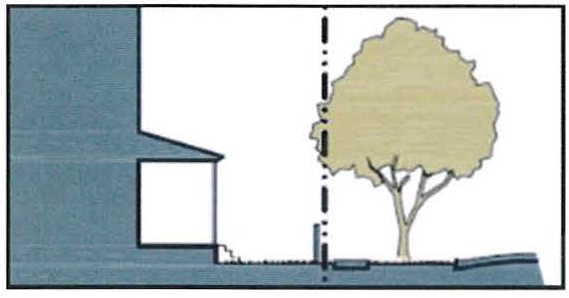
Diagram 1-A: Porch and fence private frontage.
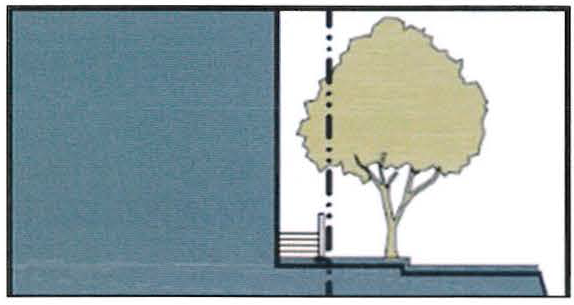
Diagram 1-B: Stoop private frontage.
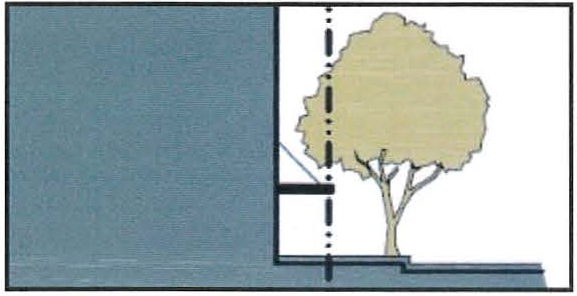
Diagram 1-C: Shopfront private frontage.
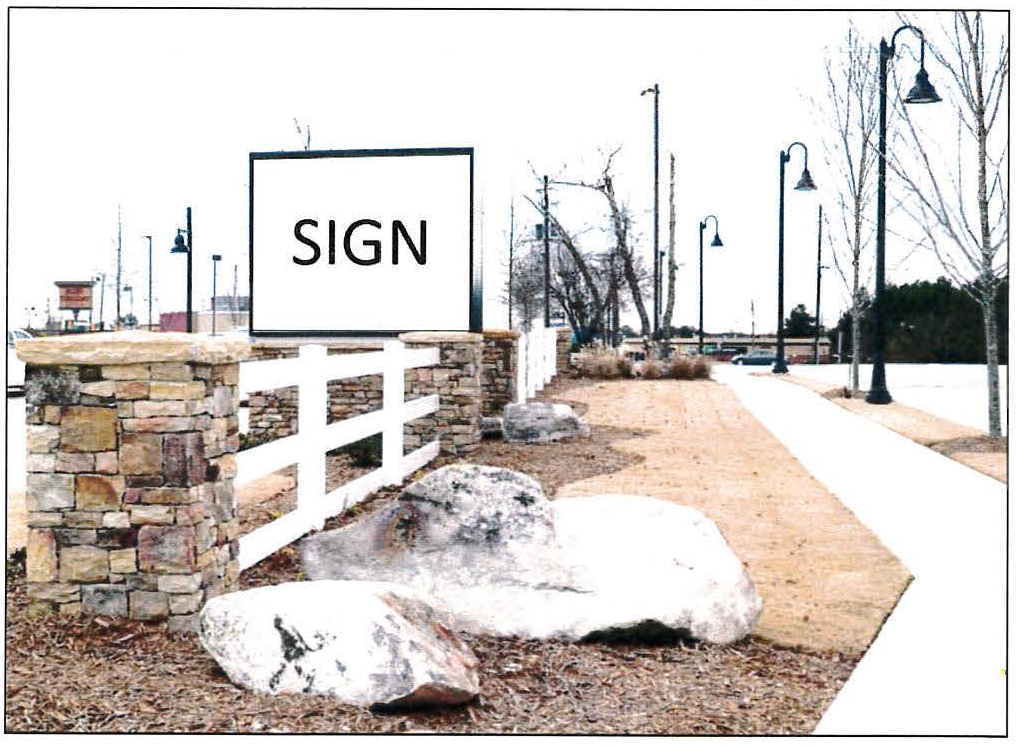
Diagram 2: Streetscape requirements. This diagram illustrates one example of the mandatory
streetscape design for all arterial streets and collector streets.
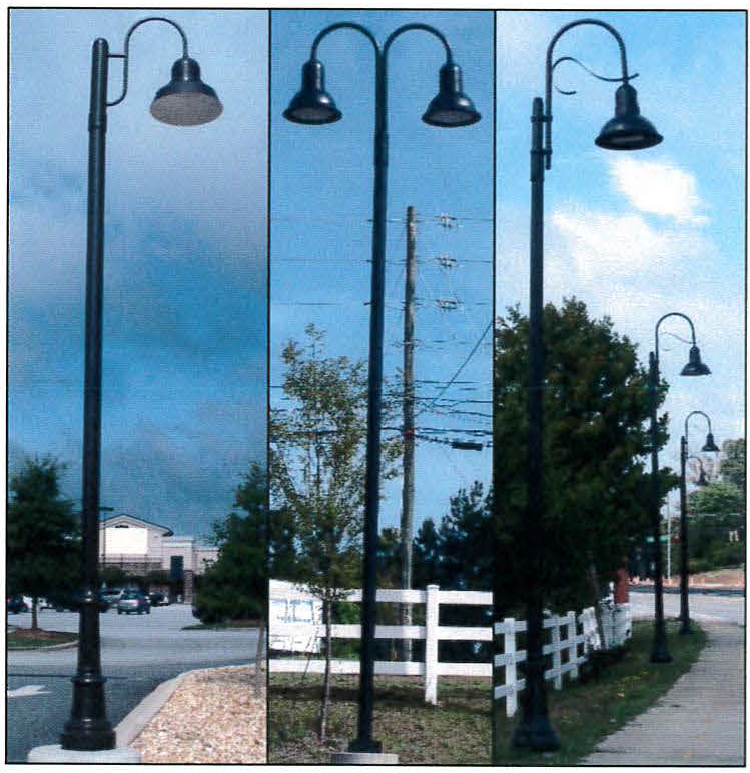
Diagram 3. Streetlight requirements. This image illustrates three examples of the
mandatory Shepherd's Crook streetlight design.
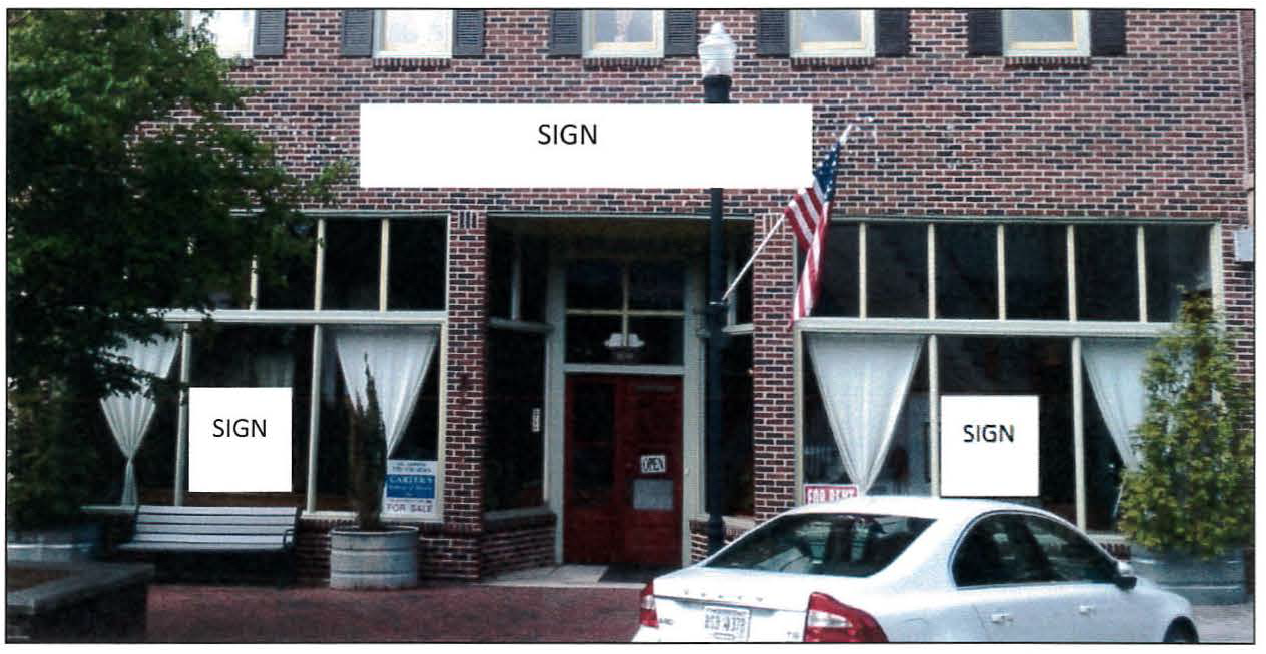
Diagram 4-A. Storefronts. The following illustration is one example of a storefront
design for mixed-use and retail use buildings.
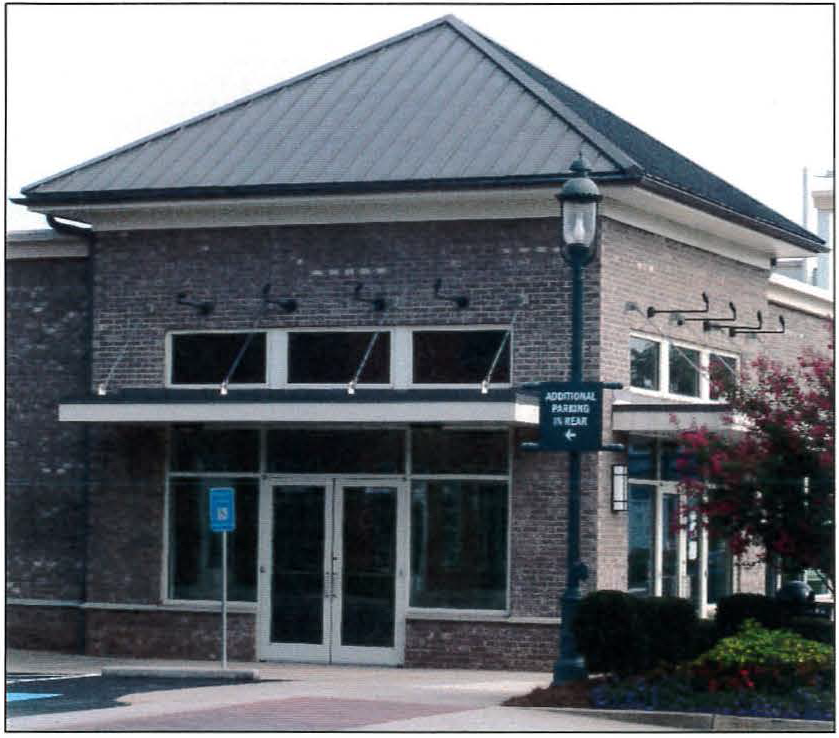
Diagram 4-B. Storefronts. The following illustration is one example of storefront
design for mixed-use and retail use buildings.
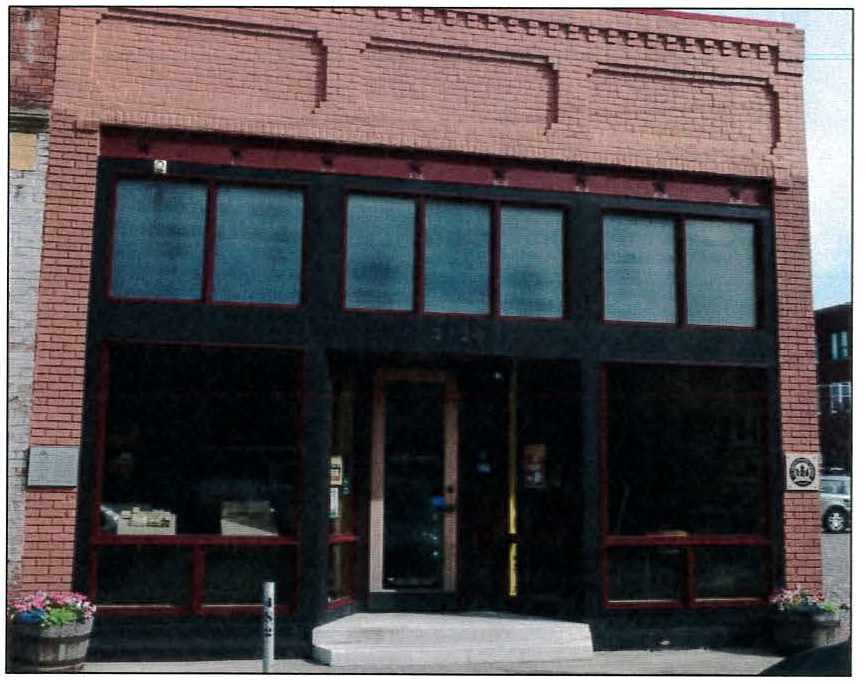
Diagram 4-C. Storefronts. The following illustration is one example of storefront
design for mixed-use and retail use buildings.
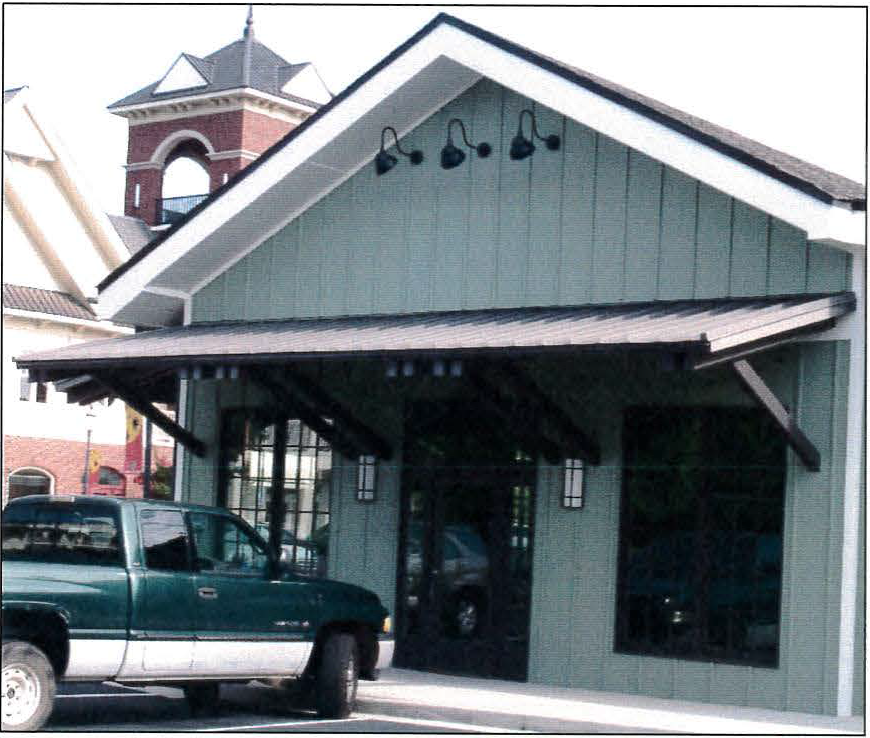
Diagram 4-D. Storefronts. The following illustration is one example of the mandatory
storefront design for mixed-use and retail use buildings.
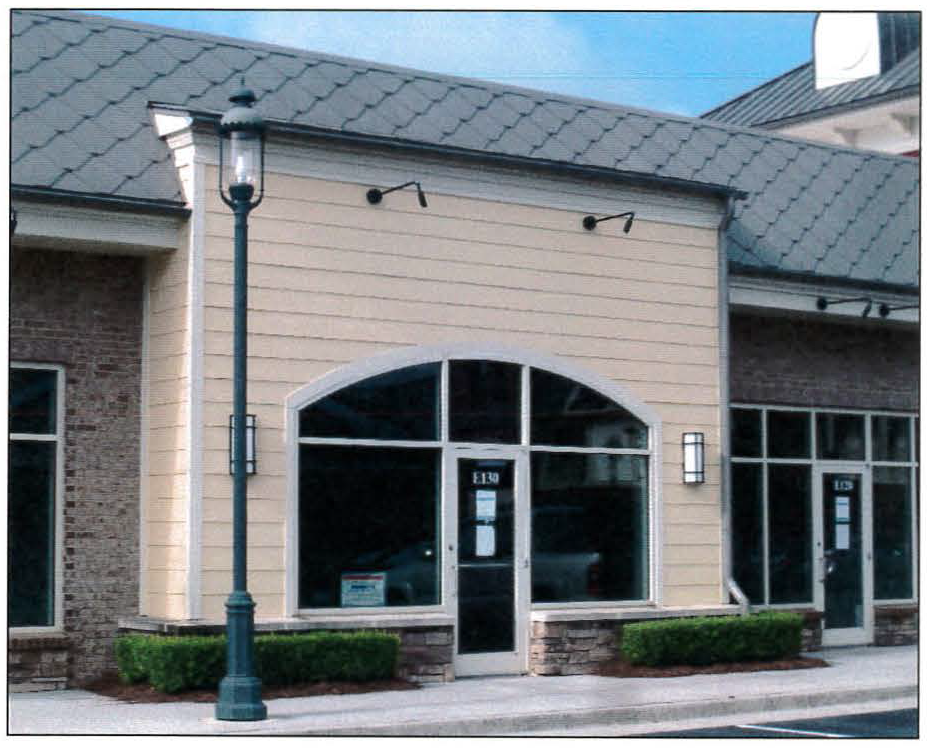
Diagram 4-E. Storefronts. The following illustration is one example of the mandatory
storefront design for mixed-use and retail use buildings.
(Ord. No. 1027, § 1, 8-17-2016; Ord. No. 1051, § 1, 2-15-2017; Ord. No. 1075, § 1, 6-21-2017; Ord. No. 1076, §§ 1, 2, 6-21-2017; Ord. No. 1077, § 1, 6-21-2017; Ord. No. 1081, § 7, 7-19-2017; Ord. No. 1099, § 3, 10-18-2017; Ord. No. 1109, § 3, 1-17-2018; Ord. No. 1122, § 1, 4-18-2018; Ord. No. 1130, § 2, 6-20-2018; Ord. No. 1139, § 2(Exh. A), 8-15-2018; Ord. No. 1191, § 2, 12-18-2019; Ord. No. 1196, § 1, 12-18-2019; Ord. No. 1190, § 3, 3-18-2020; Ord. No. 1202, §§ 1, 2, 6-3-2020; Ord. No. 1226, §§ 1—7, 12-16-2020; Ord. No. 1300, § 1, 2-15-2023; Ord. No. 1318, § 1, 5-17-2023; Ord. No. 1392, § 1, 11-20-2024; Ord. No. 1457, § 1, 10-15-2025)
Editor's note— Ord. No. 1027, § 7, adopted Aug. 17, 2016, repealed the former § 8-7-44, and enacted a new § 8-7-44 as set out herein. The former § 8-7-44 pertained to similar subject matter and derived from Ord. No. 868, § 1, adopted April 18, 2012; Ord. No. 881, § 1, adopted July 18, 2012; Ord. No. 923, § 1, adopted April 17, 2013; Ord. No. 945, §§ 1, 2, adopted November 20, 2013; Ord. No. 971, § 2, adopted September 17, 2014; Ord. No. 981, §§ 1, 2, adopted April 1, 2015; Ord. No. 1000, §§ 46, 47, adopted November 18, 2015; Ord. No. 1021, § 3, adopted July 20, 2016; and Ord. No. 1023, § 3, adopted July 20, 2016.
Sec. 8-7-45. - RED Recreation and Entertainment District.
(a)
Purpose. The purpose of the RED district is to accommodate large scale indoor and outdoor recreational and entertainment uses that are both active and passive for not only the participants but also spectators. Additionally, the purpose of this district is to establish consistent architectural and design standards that enhance the aesthetics and pedestrian accessibility throughout the district.
(b)
Intent. The intent of the RED district is to enhance and maximize the character and development within the district. Inherent of this intent is the desire to create a sustainable, master planned and developed facilities that locates primary recreational and entertainment uses with supplemental commercial uses at one centralized location that will mitigate traffic congestion, utilize existing public infrastructure as deemed suitable, and reduce negative impacts to existing residential properties.
(c)
Minimum lot size. The RED district is limited to a minimum of 250 contiguous acres.
(d)
Location. The RED district is limited in location to property that is north of the Yellow River, west of Gees Mill Road, South of Centennial Olympic Parkway, and east of Georgia Highway 138.
(e)
Definitions. This paragraph provides definitions for terms in this section that are either technical in nature, or that may not reflect common usage of the term. If a term is not defined in this paragraph, then it shall be as defined in Section 8-7-15, definitions. In the event of conflicts between these definitions and those in Section 8-7-15, definitions, those in this section shall take precedence. Terms requiring interpretation specific to this section are as follows:
Dormitory or temporary housing shall mean a building intended or used principally for sleeping and living accommodations where such building is related to an educational institution.
Frontage line shall mean a property line bordering either a street or an open space. The exterior walls of a building facing a frontage line defines the public realm, and is therefore more regulated than the exterior walls facing other property lines.
Frontage line, principal shall mean the property line that is designated to bear the measure of the minimum lot width.
Frontage line, secondary shall mean the property line that is not designated as the principal frontage line.
Main open space shall mean the primary outdoor gathering place for a community.
(f)
Master plan. In furtherance of the purpose and intent of this district, a land developer or a land owner shall prepare, or have prepared on their behalf, a master plan. The master plan is to provide a greater integration of private and public improvements and infrastructure; to enable street connectivity; to provide higher quality design elements; and to create a finer grain of urbanism with a more focused approach to the coordinated and harmonious integration of uses. A land developer or land owner that prepares a master plan in accordance with the requirements of this section shall only require administrative approval by the City Manager or his/her designee; and a land developer or land owner that prepares a master plan in accordance with the requirements of this section, but requests a variance pursuant to the standards and procedures in Section 8-7-129, variances, shall require approval by the Board of Zoning Appeals and Adjustments.
(1)
A land developer or land owner may create one overall master plan or smaller plans that are intended to be developed over a period of less than five years. A master plan shall consist of no fewer than 50 contiguous acres.
(2)
At a minimum a master plan shall contain the following:
a.
A site plan showing the proposed development and uses identifying the square foot of each structure or use;
b.
The off-street parking lots or structures and their location including the number of parking spaces in each;
c.
Location of stormwater facilities;
d.
Infrastructure such as, but not limited to, water, sanitary sewer, gas, and electric required and the approximate location of where said infrastructure will be placed;
e.
Open space percentage and type of open space proposed;
f.
Total impervious surface;
g.
Type and location of signage; and
h.
Phases of construction with timeline for when each phase is projected to commence and be completed.
(3)
Additional information may be required by the City Manager or his/her designee in relation to the master plan.
(g)
Lot dimensions and building height standards.
(1)
Unless specified otherwise in this section, each newly platted lot shall front at least one street. The portion of each newly platted lot fronting a street, unless specified otherwise in this section, shall be designated as its principal frontage line.
a.
For a newly platted lot sharing a property line with more than one street, one property line shall be designated as its principal frontage line, and the other property line shall be designated as secondary frontage line.
b.
For all newly platted lots, the principal pedestrian entrance to a structure shall face the principal frontage line.
(2)
Each newly platted lot shall be dimensioned according to Table 1.
Table 1-B. Nonresidential and Mixed-Use Lot Dimensions
(3)
General site standards.
a.
The nonresidential density shall not exceed 30,000 square feet of gross leasable floor area per net acre.
b.
No less than 20 percent of the total acreage of the site shall be set aside as permanent open space to be owned and maintained as such by the land developer or owner(s) and recorded in a perpetual easement.
i.
A maximum of ten percent of the required open space may be calculated from unbuildable areas, such as, flood plains, transitional buffers, and areas of steep topography greater than 25 percent slope.
ii.
The overall open space may be used as passive recreation in the form of trails for the use of hiking, bicycling, horseback riding, open/unstructured grassed areas of at least three contiguous acres.
(4)
The minimum height for all buildings shall be 18 feet. The maximum height for all buildings shall be 75 feet. In no such case shall any building that exceeds 35 feet in height be within 75 feet of any building that is 35 feet in height or less. This distance shall be measured from the nearest wall of any building proposed to exceed 35 feet in height from any such building that is 35 feet in height or less.
(5)
The maximum impervious surface for the aggregate contiguous area shall be 60 percent.
(6)
All streets and sidewalks connecting uses within the site shall be constructed to the standards specified in Article 7, Street and sidewalks however shall not be dedicated as public right-of-way and shall remain the responsibility of the property owner(s) and/or developer in perpetuity. At no such time shall any infrastructure located off the right-of-way of Centennial Olympic Parkway become public. Access and utility easements shall be recorded for egress, construction and maintenance purposes.
(h)
Streetscape standards. Specific to Centennial Olympic Parkway and interior streets connecting to multiple lots and parking areas accessed by the general public.
a.
Intended for use by vehicular, pedestrian, and bicycle traffic, and to provide access to lots and open space.
b.
Interior streets connecting uses and parking areas shall have sidewalks that are no less than five feet in width installed on both sides.
c.
A sidewalk landscape strip no less than four feet in width shall be located between the vehicular/bicycle travel lane and the sidewalk.
d.
Within the required sidewalk landscaping strip on all streets other than Centennial Olympic Parkway, the land developer or land owner shall install pedestrian lighting fixtures at intervals of 150 feet, on center. Such pedestrian lighting fixtures shall be 16 feet in height, coated in black paint and shall have a shepherd's crook design style to be approved by the City Manager or his/her designee.
e.
Within the required sidewalk landscaping strip, the introduced species of street trees shall be limited to the following:
i.
Eastern Hornbeam;
ii.
Red Maple;
iii.
Southern Sugar Maple;
iv.
Willow Oak;
v.
Shumard Oak;
vi.
Lacebark Elm;
vii.
London Planetree
All street trees shall be planted 50 feet, on center within the required landscape strip, and equidistant between pedestrian lighting fixtures. All street trees shall have a caliper no less than four inches at the time of planting, and shall be warranted by the land developer or the land owner, for at least two years. Additionally, all street trees shall have an expandable tree trunk protector, and a root barrier system provided at its base.
(i)
Principal permitted and special uses.
(1)
Principal permitted and special uses are identified in Table 2 and are subject to any additional restrictions stipulated in Section 8-7-92, Supplemental use standards. Any use not listed in the table is prohibited within the district unless the City Manager, or his or her designee, determines that the use is similar in nature, intensity and impact to a use that is listed and permitted and is otherwise consistent with the purposes and intent of the RE district.
(2)
Table 5. Principal permitted and special uses identifies the uses that are permitted by right or that are eligible for a special use permit.
a.
Principal permitted uses are denoted by "P."
b.
Uses eligible for consideration under the issuance of a special use permit are denoted by "S."
(3)
Reserved.
(4)
Any nonconforming use lawfully established prior to the effective date of this section may be continued pursuant to the provisions of Section 8-7-96, Nonconforming uses and structures.
Table 2. Principal Permitted and Special Uses
(5)
Specific to school dormitories.
a.
School dormitories provides temporary quarters to such transient persons whose permanent residence is elsewhere. Such temporary housing shall not be occupied by any individual for more than 365 consecutive days. No occupant of such temporary housing may claim residency at such location.
b.
The school dormitories shall only be used to provide temporary housing to the faculty, staff, coaches, trainers and athletes enrolled with a private organization for on-site training and instruction and/or students enrolled in an on-site private school for education and athletic training. Persons not enrolled in athletic training or private school and athletic training are prohibited from occupying a school dormitory.
c.
The maximum number of units is 200.
d.
The minimum finished floor area for individual units within a school dormitory shall satisfy the following:
i.
One bedroom: 750 square feet; and
ii.
Two bedrooms: 850 square feet.
e.
Each unit shall be properly equipped with a sprinkler system to be approved by the County Fire Marshal.
f.
The architectural requirements for school dormitories shall adhere to supplemental use standards for multifamily residential as found in Section 8-7-92.
(6)
Specific to non-residential uses.
a.
Each nonresidential use shall have no less than 1,000 square feet of gross leasable area.
b.
Stairways shall be internal to all nonresidential buildings.
(7)
Specific to drive-through facilities.
a.
All drive-through facilities such as points of order and points of sale shall be located in the rear or side yard only.
b.
All drive-through facilities shall be landscaped with any combination of dense evergreen hedges, flowering plants or natural rock outcroppings no less than 18 inches in height at the time of planting. The height of the landscaping shall achieve a maximum height of 36 inches within three years of planting.
(8)
Specific to warehouse and distribution.
a.
Warehouse and distribution shall be limited to apparel that is used and sold onsite and may be sold offsite through other retail means.
b.
Warehouse and distribution shall be limited to no more than two percent of the gross acreage of the overall site and located within structure(s) with an aggregate of no greater than 60,000 square feet.
c.
No structure used for warehouse and distribution shall be located within 2,000 feet of a structure containing a residential use.
d.
All structures where warehouse and distribution take place shall have a dedicated and separate vehicular point of access, separate from that of the general public that uses the overall facility.
e.
Outdoor storage is prohibited.
(j)
Open space standards.
(1)
The permitted uses of open space shall be limited to the following only:
a.
Natural area. A natural area is a type of open space that is exposed to the open sky, and is made available for learning purposes and unstructured recreation. A natural area shall consist of natural environmental conditions to include, but shall not be limited to, lakes, meadows, ponds, natural rock outcroppings, reservoirs, riparian corridors, steep slopes, wildlife ecosystems, woodlands and all other similar natural characteristics and natural features. Natural areas may be independent of the streets, parking areas, and buildings, and are encouraged to follow the lineal and natural trajectories of riparian corridors, wildlife corridors, and woodlands. All natural areas shall be naturalistically disposed. Open shelters may be provided only if constructed from any combination of indigenous rock, natural stone, or natural wood exterior finish material. All natural areas shall be accessed and traversed with pedestrian paths and/or bicycle trails that are constructed from environmentally sensitive or permeable surfaces to be approved by the City Manager or his/her designee. There shall be no minimum or maximum size.
b.
Park. A park is a type of open space that is exposed to the open sky and is made available for unstructured or structured recreation. A park shall be spatially defined on at least two of its sides with a street or a building. A park may be formally, or naturalistically disposed, with any combination of flowering plants, grass lawns, natural rock outcroppings, shrubbery and trees. Seating benches and litter receptacles that are of commercial quality shall be required for each park. Open shelters may be provided only if constructed from any combination of indigenous rock, natural stone or natural wood exterior finish material. Parks are encouraged to follow the lineal and natural trajectories of riparian corridors and woodlands. Where provided, all parks shall be no less than one-half acre in size, but no greater than ten acres in size.
c.
Playground. A playground is a type of open space that is exposed to the open sky, and is specifically made available for the recreation of children. A playground may be fenced, and may also include an open shelter that is constructed from any combination of indigenous rock, natural stone or natural wood exterior finish material. Playgrounds shall be confined to primarily residential environments, and may be included within natural areas and parks. There shall be no minimum or maximum size for playgrounds.
d.
Plaza. A plaza is a type of open space that is exposed to the open sky and is made available for unstructured recreation, programmed activities and civic purposes. All plazas shall be spatially defined on all sides with a street or a building containing nonresidential uses on the first floor. Plazas shall be formally disposed with any combination of flowering plants, grass lawns, shrubbery and trees; and public art in the form of a monument, statue, water feature or water fountain shall also be provided in the geographic center of the open space in further support of pedestrian activity. Seating benches and litter receptacles that are of commercial quality shall also be required for all plazas. A minimum of 50 percent and a maximum of 75 percent of the total area of a plaza, excluding sidewalks adjoining streets, shall be hard surfaced. Where provided, all plazas shall be at least one-quarter of an acre in size, but no greater than five acres in size.
e.
Pocket park. A pocket park is a type of open space that is exposed to the open sky, and is made available for unstructured recreation. A pocket park shall be spatially defined on all sides with a street or a building. Pocket parks shall be naturalistically disposed with any combination of flowering plants, grass lawns, natural rock outcroppings, shrubbery and trees. Where provided, all pocket parks shall be less than a quarter acre in size.
(2)
In no such case shall a principal building be more than 2,000 feet from a required, or a provided open space. This distance shall be measured from the principal building's nearest pedestrian point of access for the general public to the nearest edge of such open space.
(k)
Tree preservation and landscaping. This district shall provide a minimum tree density requirement of 20 units per gross acre and shall adhere to the specifications and standards found in Chapter 10, Tree Preservation and Landscape.
(1)
Existing tree density units located within riparian buffers shall not be counted towards the required tree density as disturbance within riparian buffers is prohibited.
(2)
All yard areas shall be planted in sod, or naturally disposed with landscaping consisting of trees and any combination of flowering plants, grass lawns, natural rock outcroppings or shrubbery.
(3)
Wood fences shall be oiled, painted, stained or varnished that matches the architectural aesthetic of the buildings. An equivalent or superior finish material that simulates the aesthetics of wood may be submitted as alternative to the City Manager or his/her designee. Wrought iron, or similar aluminum picket fence, shall be finished in black. At no such time shall any fence exceed eight feet in height and opaque fences are prohibited from being located between any building and the public street.
(4)
Where required due to the environmental conditions of the site, all retaining walls shall be split faced block of an earth tone color or faced with a brick, or natural stone finish material.
(5)
No disturbed ground shall be left exposed or uncovered. Grass, mulch or other appropriate and approved groundcover shall provide cover for all exposed ground.
(6)
Landscape buffers shall not be required between uses within this district.
(l)
Screening standards.
(1)
Detention facilities and ponds. All detention facilities and ponds shall be appropriately screened from pedestrian view from all frontage lines and off-street parking and loading areas. Except for detention facility and pond entrances, all detention facilities and ponds shall be enclosed with an opaque wall that is not less than four feet in height, and that is constructed from an indigenous rock or a natural stone finish material. A black vinyl chain link fence may also be used to satisfy the detention facility and pond visual screening requirement, provided that the black vinyl chain link fence is not less than four feet in height, and is also completely screened by dense evergreen vegetation or trees that are no less than four feet in height at the time of planting and will effectively screen the black vinyl chain link fence and facility. All detention facilities and ponds shall also satisfy the following:
a.
Unless specified otherwise in this section, in no case shall detention facilities and ponds be permitted in front yards.
b.
In no case shall any detention facility or pond be located within 200 linear feet of any building. This distance shall be measured from the nearest exterior wall of any such building to the nearest point of the detention facility or pond, including the required visual screening materials.
In lieu of the detention facility and pond screening requirements, the land developer or the land owner may incorporate detention facilities and ponds into the required landscaping plan for the site as a community amenity or a water feature, in which case, any such detention facilities and ponds may be placed in the front yard, and shall not be subject to the visual screening requirements specified herein.
(2)
Mechanical service elements. All mechanical service elements such as air conditioning units, communications equipment, condensers, exhaust vents, generators, HVAC mechanical equipment systems or other related elements that are located at finished grade shall be completely screened from all frontage lines and off-street parking and loading areas with either dense evergreen hedges, or an opaque wall constructed from a brick, indigenous rock or natural stone finish material that is of an appropriate height and matches the architectural aesthetic of the building.
(3)
Off-street parking and loading areas. All off-street parking areas shall be appropriately screened from all frontage lines with dense evergreen hedges or an opaque wall constructed from a brick, indigenous rock or natural stone finish material that matches the architectural aesthetic of the building. All dense evergreen hedges and opaque walls shall be a minimum of 30 inches in height and a maximum of 42 inches in height, unless otherwise approved by the City Manager or his/her designee.
(4)
Loading dock and service areas. All loading dock and service areas shall be located in the rear yard only. All loading dock and service areas shall be screened from abutting properties with landscaping to include any combination of dense evergreen vegetation, natural rock outcroppings, and trees or an opaque wall constructed from a brick, indigenous rock or natural stone finish material that matches the architectural aesthetic of the building. All such screening shall be of an appropriate height to conceal loading dock and service areas from view.
(5)
Underground utilities. All utilities shall run underground. The City Manager or his/her designee may approve an exception to this provision if subsurface rock or other unique physical hardship makes such installation infeasible. If an exception is approved by the City Manager or his/her designee, then all utilities shall be placed in the rear yard only.
(m)
Exterior lighting standards. The maximum lamp allowance (lumens) shall not exceed 44,000 lumens per acre and adhere to the specifications and standards found in Section 8-7-86.1, Design standards for exterior lighting.
(n)
Parking standards.
(1)
A parking plan shall be submitted to the City Manager, or his/her designee, with construction plans. The plan shall demonstrate the requirements with this Section and the Americans with Disabilities Act. At a minimum, the parking plan shall indicate the number of parking spaces provided and how that number is calculated. It shall contain graphics and tabular information to indicate angle, type, and size of parking spaces and aisle width; number of handicapped spaces, locations and dimensions; and number, location, and design of bicycle parking spaces.
(2)
There shall be no minimum requirements for surface parking, only a maximum of one parking space per 200 square feet of building floor area. Within a multi-level parking structure, the maximum shall be one parking space per 100 square feet of building floor area.
(3)
Electric vehicle charging stations. In the event that electric vehicle charging stations are installed, the free-standing electric supply cabinetry shall be screened from public view with a dense evergreen hedge at the time of installation. The individual charging stations shall be discrete and shall be visibly compatible with the surrounding environment. The individual charging stations shall not contain any of the following elements:
i.
Video message screens greater than eight square inches;
ii.
LED strip lighting, neon lights, strobe lights; and
iii.
Shall not be painted or contain a finish of neon or day-glow colors.
(4)
All other off-street parking and loading requirements shall comply with the requirement established in Section 8-7-93, Off-street parking and loading standards.
(o)
Architectural standards. This section provides standards for the materials and designs permitted for all facades, roofs, fenestration, and other building elements within this district.
(1)
For all buildings, blank exterior walls facing frontage lines shall be prohibited. Vertical architectural features shall be incorporated at intervals no greater than 40 linear feet. Such features may include, but are not limited to, decorative moldings and brick work, pilasters, arcades, colonnades, accentual lighting features, awnings, archways, glazing and entryways, and embellished entry and window surrounds. Horizontal architectural features shall be incorporated at intervals no greater than 18 linear feet above grade. Such features may include, but are not limited to, cornices, decorative moldings and brick work, belt courses, drip moldings, water tables, and lintels and sills.
(2)
Stairways providing access to the upper floors of all buildings shall be internal within the façade of the building.
(3)
Exterior stairs located along frontage lines shall have enclosed risers of brick, concrete, stone or wood.
(4)
The exteriors of all buildings shall express the construction techniques and the structural constraints of traditional, and long-lasting building wall materials. With the exception of openings for doors and windows, the schedule of exterior finish materials for all buildings within this district shall be limited to: brick, cementitious board (fiber cement board panels and planks), indigenous rock, natural stone, natural wood shake, natural wood shingles, natural wood siding, split-faced block, Portland cement plaster and lathe systems (stucco), and/or pre-fabricated metal. The following configurations and techniques shall also apply:
a.
Configuration and technique for brick:
i.
All brick shall consist of modular units of fire clay, and may be tumbled in order to create the impression of antiquated or old brickwork: and
ii.
All mortar joints shall be exposed to view.
b.
Configurations and techniques for indigenous rock and natural stone:
i.
All indigenous rock and natural stone shall be stacked organically;
ii.
All indigenous rock and natural stone shall retain their integral color;
iii.
All indigenous rock and natural stone shall have a rough, uneven surface; and
iv.
All mortar joints shall be exposed to view.
c.
Configurations and techniques for natural wood:
i.
All-natural wood shall be in the pattern of board-and-batten, clapboard or drop siding; and
ii.
All-natural wood shall either be painted or stained.
d.
Configurations and techniques for split-faced block:
i.
Split-faced block shall not exceed 20 percent of the total building wall area for any building elevation, with each building elevation being calculated independently.
e.
Configurations and techniques for Portland cement plaster and lathe systems (stucco):
i.
For buildings containing two or more stories, Portland cement plaster and lathe systems (stucco) shall not exceed 35 percent of the total building wall area for any building elevation above the first story and ten percent of the total building wall area for the first story, with each building elevation being calculated independently;
ii.
For one-story buildings, Portland cement plaster and lathe system (stucco) shall not exceed ten percent of the total building wall area for any building elevation, with each building elevation being calculated independently;
iii.
Portland cement plaster and lathe systems (stucco) shall have a traditional three coat finish;
iv.
All Portland cement plaster and lathe systems (stucco) shall have a sanded or smooth finish; and
v.
All Portland cement plaster and lathe systems (stucco) may be painted.
f.
Configurations and techniques for pre-fabricated metal:
i.
Pre-fabricated metal, including but not limited to, aluminum, brushed nickel, copper, stainless steel and titanium shall not exceed 15 percent of the total building wall area for any building elevation, with each building elevation being calculated independently; and
ii.
All steel shall be protected with a primer and paint or enamel coating. The color shall be limited to earth tones of brown, gray, green, reds, or black. Fluorescent, neon, and dayglow colors are prohibited.
With the exception of the exterior finish material prescribed herein, no other exterior finish material shall be permitted within this district, including exterior insulated finishing systems (E.I.F.S.).
(5)
The exterior walls of buildings shall be cream, ivory, white, or painted or stained with colors selected from earth tones of brown, gray, green, or red, except that accents and trim may be any color, excluding fluorescent, neon, or dayglow.
(6)
No more than four differing exterior finish materials, exterior colors or any combination thereof shall be used on any building within this district.
(7)
Exterior finish material shall only be combined on building elevations horizontally, with the exterior finish having the structurally heavier weight placed below the exterior finish having the structurally lighter weight.
(8)
Building elevations facing the rear and side yards shall be finished in the same proportion of building wall materials and exterior paint colors, and shall be of the same finished construction quality, as the building elevation facing the front yard.
(9)
Where visible from frontage lines, exterior entry steps shall have enclosed risers that are made from a brick, indigenous rock, natural stone or concrete.
(10)
Mechanical service elements such as, but shall not be limited to, air conditioning units, communications equipment, condensers, exhaust vents, generators, HVAC mechanical equipment systems and all other related elements shall not be attached or mounted to any building elevation. All such mechanical service elements shall be located at finished grade and appropriately screened from pedestrian view from all frontage lines and off-street parking and loading areas according to the visual screening provisions in Section 8-7-45(K)(2); or all such mechanical service elements shall be placed on top of a flat roof, pursuant to the provisions in Section 8-7-45(N)(16).
(11)
Utility elements such as, but shall not be limited to, cable, electric, gas and telephone meter boxes and all other related elements shall be prohibited on all building elevations facing frontage lines. Where placed on building elevations, all such utility elements shall be appropriately screened with an opaque wall that is constructed from a brick, indigenous rock or natural stone finish material that matches the architectural aesthetic of the building.
(12)
Window openings on the first floor shall rest on bulkheads and originate no less than 18 inches, and no greater than 36 inches in height above finished grade or sidewalk grade.
(13)
The front facade of all buildings shall be glazed with clear glass for no less than 50 percent of the total building wall area between two feet and 12 feet from the average sidewalk grade. The glass in such doors and windows shall transmit at least 60 percent of visible daylight.
(14)
For storefronts of buildings located on corner lots or at the corner of said building, the storefront elements shall be applied on both first-floor building elevations.
(15)
Spandrel or opaque glass may not exceed ten percent of the total building wall area for any building elevation, with each building elevation being calculated independently.
(16)
Where provided, security screens shall be of the mesh type that pedestrians can see through (i.e. permit view of the spaces within when closed) from the frontage line, and located on the inside of the glassed area.
a.
At least 75 percent of the total area of the security screen shall be transparent, with or without internal illumination, when closed.
b.
All security screens shall be fully retracted during business hours.
c.
All security screen housing and shield systems shall be invisible from the building exterior on all sides.
(17)
Pitched roofs shall be sloped no less than 6:12, except that pitched roof structures for attached sheds, porches and stoops may be sheds, with pitches no less than 2:12.
a.
Roofing material shall only be asphalt shingles, except that standing seam metal may be used provided that it complements an architectural style while minimizing glare.
b.
The colors of all pitched roofs shall be limited to: black or gray.
c.
The eaves of all pitched roofs shall overhang the exterior walls a minimum of 18 inches. Roof rafters are allowed to be visible beneath eaves.
(18)
Flat roofs shall be enclosed by parapets no less than two feet high along each façade.
a.
Mechanical service units such as, but not limited to, air conditioning units, communications equipment, condensers, exhaust vents, generators, or HVAC systems located on top of a flat roof shall be screened from public view by the parapet wall. The parapet wall shall be no shorter than 12 inches in height above the height of the tallest mechanical equipment located on the flat roof.
b.
A flat roof permanently dedicated to a roof garden is permitted provided such roof garden is easily accessible from a room on the roof.
(19)
Administrative waiver from the architectural standards:
a.
An administrative waiver from the required architectural standard(s) enumerated in Section 8-7-45(o) may be applied for only in specific cases in which the land developer or owner has demonstrated that a non-financial hardship exists due to architectural design or construction issues that are unique to the intended use of the building; and the City Manager or his/her designee has determined that relief will not violate the purpose or the intent of the required standard(s) if the listed alternatives are applied to the proposal. An administrative waiver shall not be authorized for: permitted exterior materials; permitted exterior paint colors; or security treatments. All administrative waivers shall be submitted in writing to the City Manager or his/her designee for consideration at the same time as plans review submittal. If the administrative waiver is approved by the City Manager or his/her designee, then in lieu of conforming with the prescribed standard(s) in Section 8-7-44(o), that has been waived administratively, the land developer or owner shall amend their building plan and/or site plans, as appropriate, to comply with one or more of the following alternatives, as required by the City Manager or his/her designee:
i.
An increase in the use of brick, rock and/or stone exterior finish materials as specified in this paragraph;
ii.
Variations in architectural modulations shall occur every 20 linear feet;
iii.
Additional tree planting and landscaping to be provided around building entrances; or
iv.
Other similar aesthetic benefits to be approved by the City Manager or his/her designee.
b.
Appeals from an administrative waiver decision by an aggrieved land developer, or a land owner, shall follow the procedures that are set forth in Section 8-7-128, Appeals.
(p)
Sign standards. All signs shall adhere to the specifications and standards found in Chapter 5, Signs.
(Ord. No. 1330, § 1, 9-20-2023)

