
Conyers City Zoning Code
ARTICLE D
- REGULATIONS APPLYING TO ALL DISTRICTS
Sec. 8-7-79.- Distance measurement.
All distance measurements between buildings, structures, uses, parcels, zoning districts, or other objects shall be made by measurement of the shortest path along a straight line connecting the nearest points and between the two objects.
(Code 1990, § 8-7-79; Ord. No. 693, 8-18-2004)
Sec. 8-7-80. - Building projections into yards.
(a)
No part of a lot's required yard, setback, buffer or open space shall be included as part of the yard, setback, buffer or open space required for another lot, except as specifically provided for herein.
(b)
Architectural features such as cornices, eaves, steps, gutters and fire escapes may project not more than three feet beyond any required setback line, except where such projections would obstruct access for service and/or emergency vehicles; provided, however, that canopies that extend from faces of buildings over sidewalks or entryways to shelter pedestrians shall be allowed to encroach into yards so long as they are no closer than five feet to the street right-of-way line.
(Code 1990, § 8-7-80; Ord. No. 693, 8-18-2004)
Sec. 8-7-81. - Corner lots.
The side of a corner lot fronting on the street with the highest functional classification, according to the Rockdale County/City of Conyers Functional Classification System, shall be deemed to be the front of the lot. If both streets have the same functional classification, then the front of the lot shall be deemed to be the side with the least street frontage.
(Code 1990, § 8-7-81; Ord. No. 693, 8-18-2004)
Sec. 8-7-82. - Height limits.
The height limitations of this article shall not apply to church spires, belfries, flag poles, monuments, cupolas, domes, ornamental towers or observation towers not intended for human occupancy, water towers, transmission towers, radio or television towers or antennas. These exclusions shall not apply in the vicinity of airports where Federal Aviation Administration runway protection zone standards shall apply.
(Code 1990, § 8-7-82; Ord. No. 693, 8-18-2004)
Sec. 8-7-83. - Classification of streets.
Streets shall be classified into a street hierarchy system, based on the Rockdale County/City of Conyers Functional Classification System. Design and engineering standards for streets shall be in accordance with these classifications as provided in Chapter 6 of this title.
(Code 1990, § 8-7-83; Ord. No. 693, 8-18-2004)
Sec. 8-7-84. - Front yard setback of dwelling.
(a)
It is intended that front yard setbacks be similar among buildings sharing a block and located on the same side of the street. The minimum front yard setback requirements for buildings may be reduced by the Director when it exceeds the average setback of existing buildings located within the same block and zoning district fronting on the same side of the street. In cases where the average setback along a block face varies by ten feet from the minimum setback required by this chapter, the Director may require the new dwelling to be constructed with a setback that is within ten feet of an adjacent dwelling.
(b)
When a single-family dwelling or townhouse has a garage or carport, the entry to the garage or carport shall be set back a minimum of 25 feet from the public right-of-way.
(Code 1990, § 8-7-84; Ord. No. 693, 8-18-2004)
Sec. 8-7-85. - Fences and free-standing walls.
Fences and free-standing walls, excluding required retaining walls or fences for screening or other provisions specifically provided in other sections of this Code, shall be subject to the following provisions:
(1)
General standards. No privately owned fence or free-standing wall shall be constructed within any public right-of way. It shall be the responsibility of the owner of the property on which a fence or wall is located to maintain said fence or wall in good condition so that at all times it presents a neat and orderly appearance to the surrounding property owners and to the general public. Barbed or razor wire, fabric or mesh windscreens, privacy screens, metal or plastic strips interwoven into chain-link fencing, and similar materials are prohibited on all fences and free-standing walls. The height of a fence or a free-standing wall shall be measured from the top of the adjacent grade, street curb, or surface of an alley, whichever is highest. On interior lot lines the measurement shall be from the average grade of the lot line of the parcel or property having the lower elevation.
(2)
Front yards. No fence or free-standing wall located in the front yard of a property shall exceed four feet in height, including columns and ornament. Fences or free-standing walls in the front yard shall be constructed of wood, brick, rock, stone, wrought iron, or a similar material approved by the City Manager or his or her designee. Fences or free-standing walls shall be built in a manner that does not visually obscure the front yard or the principal building on the property and shall be constructed with the finished side facing outward toward any abutting properties or the public right-of-way. Chain-link, chicken wire, wire mesh, or similar materials are prohibited in front yards.
(3)
Side and rear yards. No fence or free-standing wall shall exceed eight feet in height, including columns and ornament, in a side or rear yard. Fences and free-standing walls located in a rear or side yard may be opaque and built of wood, brick, rock, stone, or wrought iron or may be constructed of chain-link, provided that the chain-link is not visible from the public right-of-way. Such fences and free-standing walls shall be constructed with the finished side facing outward toward any abutting properties or the public right-of-way.
(4)
Exceptions. The City Council may condition the approval of a permit or zoning that fences or free-standing walls of a height in excess of these regulations shall be placed in any yard where such fence or wall is necessary to provide screening, provided that the requirements of Section 8-7-85(b) of this section are met.
(5)
Visibility at intersections. On corner lots within all zoning districts, no fence, free-standing wall or other obstruction to the line of sight of motorists shall exceed a height of two and one-half feet within 20 feet of the intersection of the right-of-way along either adjacent street. This requirement shall not apply to:
a.
A post or pole no more than eight inches in diameter that is needed to support an authorized sign, street light or utility.
b.
Signs, lights or similar objects having their lowest point at least 12 feet above the adjacent edge of pavement of the nearest street or driveway.
(Ord. No. 1041, §§ 1, 2, 11-16-2016; Ord. No. 1091, § 1, 9-20-2017)
Editor's note— Ord. No. 1041, §§ 1, 2, adopted Nov. 16, 2016, repealed the former § 8-7-85, and enacted a new § 8-7-85 as set out herein. The former § 8-7-85 pertained to fences and derived from Code 1990, § 8-7-85; Ord. No. 693, adopted Aug. 18, 2004.
Sec. 8-7-86. - Design requirements.
(a)
Application of the design requirements. The design requirements of this section shall apply to all new construction, and to all additions, alterations or renovations of existing structures within all commercial and industrial districts, with the exception of the MxD and GV districts, resulting in a material change in appearance of any building element addressed in this section.
(b)
Design requirements.
(1)
The principal pedestrian entrance leading into the interior of each first floor use shall be visible from, and face, the required sidewalk along the adjacent street. The principal pedestrian entrance for each first floor use shall be architecturally distinguished from the other portions of the exterior building elevation through the incorporation of awnings, door patterns, glass, lighting or other similar architectural treatments.
(2)
With the exception of all openings for doors and windows as enumerated herein, the finish material on all exterior building elevations visible from any portion of the public right-of-way shall be limited to brick, hardi-plank clapboard siding, indigenous rock, natural stone (including cast stone and cultured stone if the faux or synthetic finish material authentically replicates the exterior color and texture of natural stone), natural wood clapboard siding, natural wood shake, natural wood shingles, stucco (including exterior insulated finishing systems), textured concrete masonry units, tile and/or tilt-up panels (with textured finish). In no circumstance shall any exterior building elevation visible from any portion of the public right-of-way have finishes of common cement block, corrugated steel, pre-fabricated steel panels (including textured), sheet metal, vinyl siding or other similar materials.
(3)
High quality metal finishes to include aluminum, brushed nickel, copper, stainless steel and titanium may be used as architectural accents, but in no circumstance shall any such finish cover more than 15 percent of the total building wall area visible from any public right-of-way, with each exterior building elevation being calculated independently.
(4)
Concerning architectural modulations, all exterior building elevations in commercial districts shall be architecturally modulated every 40 linear feet where visible from any public right-of-way; and all exterior building elevations in industrial districts shall be architecturally modulated every 100 linear feet where visible from any public right-of-way.
(5)
On all commercial structures, no less than 50 percent of the total building wall area of the exterior building elevation along the first floor shall have window openings where facing the required sidewalk along the adjacent street. On all industrial structures, no less than 15 percent of the total building wall area of the exterior building elevation along the first floor shall have window openings where facing the required sidewalk along the adjacent street. Such window openings shall be calculated by way of the area between the finished floor and the finished ceiling of the first floor. There are no required calculations for window openings above the first floor.
(6)
Window openings visible from any portion of the public right-of-way shall be vertical in orientation, proportion and shape, with the height of the window opening greater than its width.
(7)
Window openings visible from any portion of the public right-of-way shall originate no less than 18 inches in height, but no greater than 36 inches in height above finished grade or sidewalk grade.
(8)
With the exception of conforming window signs, and except where stated otherwise in the City of Conyers Code of Ordinances, windows shall not be coated, concealed or covered with paint, or any other similar opaque material, that visually obstructs pedestrian views into the interior of the structure. Windows may be tinted to secure privacy for interior occupants of a structure; but in no circumstance shall any window glass be tinted to such an extent that pedestrian views into the interior of the structure are visually obstructed. To prevent visual obstruction, tinted window glass shall have a visible transmittance factor of 60 percent or greater, which creates the impression of clear and transparent glass.
(9)
Burglar bars and the like are prohibited on all doors and windows facing a street or open space. However, security grilles and security screens, if provided, shall be of the mesh type that pedestrians can see through from the abutting street or open space (i.e., permit view of the spaces within when closed) and located on the inside of the glassed area. In addition:
a.
At least 75 percent of the total area of the security grille or security screen shall be transparent, with or without internal illumination.
b.
All security grilles and security screens shall be fully retracted during business hours.
c.
All security grille and security screen housing and shield systems shall be located indoors, and be invisible from the building exterior on all sides.
(10)
Banks of meter boxes, electrical utility conduits, gas meters and other related elements shall be prohibited on all front yard facing exterior building elevations; such elements shall be permitted along the rear yard and side yard facing exterior building elevations.
(11)
Exterior wall mounted mechanical equipment and related elements shall be prohibited.
(12)
Mechanical equipment and related elements placed at finished grade shall be screened from pedestrian view from the public right-of-way and off-street parking areas with a dense evergreen hedge or a wall veneered in brick, indigenous rock or natural stone.
(13)
Flat roofs, regardless of the roof slope, shall be completely enclosed on all building elevations with a cornice line, or a parapet wall, having a minimum height of 24 inches. The required cornice line or parapet wall shall be architecturally articulated to provide for visual diversity and visual relief, with an appearance that is complementary to the architecture of the structure. Where mechanical equipment and related elements such as air conditioning units, exhaust vents, generators, HVAC units, satellite dishes and other similar mechanical equipment and related elements are placed on top of the flat roof, the height of the required cornice line, or parapet wall, shall be raised a minimum of 12 inches in height above the height of the tallest of such equipment so as to conceal such equipment from pedestrian view from the public right-of-way and off-street parking areas.
(14)
Pitched roofs, if provided, shall have a minimum pitch of 4:12, except that all pitched roofs used to provide permanent cover over patios, porches and pedestrian connections shall have a minimum pitch of 2:12.
(15)
Areas designated for the loading and unloading of merchandise shall be located in the rear yard or the side yards. Such areas shall be effectively screened from view with a wall complementary to the architecture of the building or dense evergreen landscaping, if visible from the public right-of-way or off-street parking areas.
(16)
All out-parcel buildings and accessory structures shall complement the architectural theme of the multi-tenant building or retail shopping center.
(Ord. No. 815, § 1, 11-17-2010; Ord. No. 855, § 1, 10-19-2011; Ord. No. 888, § 1, 10-17-2012; Ord. No. 971, § 5, 9-17-2014)
Sec. 8-7-86.1. - Design standards for exterior lighting.
(a)
Purpose. The purpose of this section is to promote public safety, nighttime vision, natural resource conservation, community values and aesthetics by establishing standards for the design and application of exterior lighting sources and fixtures for nighttime use. The specific regulatory objectives of this section are as follows:
(1)
Promote nighttime visibility by directing appropriate levels of illumination upon intended targets;
(2)
Redress the disabling visual effects of glare and excessive illumination, and the extreme contrasts between brightly lighted areas and the lower ambient levels of adjacent areas;
(3)
Limit light trespass across property lines, and its intrusive and devaluing effects upon nearby private and public property; and
(4)
Limit light pollution to restore natural cycles of light and dark to the indigenous natural environment and darken the night sky by reducing the unnecessary transmission of upward light.
(b)
Applicability. For all zoning districts, land uses, developments and buildings that require a permit, all exterior lighting fixtures shall meet the requirements of this section. All building additions or modifications of 25 percent or more in terms of additional dwelling units, gross floor area, or parking spaces, either with a single addition or with cumulative additions subsequent to the effective date of the ordinance from which this provision is derived, shall invoke the requirements of this section for the entire property, including previously installed and any new exterior lighting. Cumulative modification or replacement of exterior lighting constituting 60 percent or more of the permitted lumens for the parcel, no matter the actual amount of lighting already on a nonconforming site, shall require compliance with the requirements of this section. Additions or modifications of less than 25 percent to existing uses, and that require a permit, shall require the submission of a complete inventory and site plan detailing all existing and any proposed new exterior lighting. Any new lighting on the site shall meet the requirements of this section with regard to shielding and lamp type.
(c)
General exterior lighting standards.
(1)
Exterior lighting for all land uses and developments shall be limited to incandescent, fluorescent, metal halide, color corrected high pressure sodium, and LED light only.
(2)
All exterior lighting shall be shielded and directed downward, except for spotlighting on landscaping, foliage or escarpments. Notwithstanding any applicable provision for exterior lighting set forth herein, all spotlighting on landscaping, foliage or escarpments:
a.
Shall be shielded;
b.
Shall not create any disabling or nuisance glare; and
c.
Shall conform to the illumination levels as set forth in Section 8-7-86.1(g).
(3)
All exterior lighting shall be designed, installed, located, and maintained such that light trespass onto abutting properties and the public right-of-way is prevented, and any light generated on that property is kept within the boundaries of that property.
(4)
The opaque housing for all exterior lighting shall mask the direct horizontal surface of the lamp. The light shall be directed to ensure the illumination is only pointing downward onto the ground surface, with no upward escaping light permitted to contribute to sky glow, in order to prevent light trespass.
(5)
Luminaires may be controlled with dimmers, motion sensors or time switches in order to manage light output, assist in reducing energy usage and lowering impacts on the dark night sky.
a.
Dimmers, motion sensors and time switches that control the hours of illumination, shall remain on the applicable Eastern Standard Time in effect throughout the year.
b.
Motion sensors shall be installed in such a manner as to prevent the trespass of light onto abutting properties or onto the public right-of-way.
c.
Motion sensor systems shall be designed, installed and maintained so that its luminaires are not activated by activity on abutting properties or the public right-of-way.
(6)
Direct light emissions shall not be visible above the roof line, or beyond the edge of any structure or object.
(7)
In no case shall any lighting impair the vision of motorists on adjacent public rights-of-way.
(d)
Aesthetics. All exterior lighting shall be architecturally compatible with the building style, material, and colors. When required in parking areas, the following provisions shall also apply to all exterior lighting:
(1)
Luminaires shall have curved arms to focus light downward.
(2)
Directional floodlights and cobra style and shoebox style lighting fixtures are prohibited.
(e)
Mounting height. Fixture mounting height shall be appropriate for the project and setting. The overall height of all lighting within parking lots shall not exceed 30 feet in height from finished grade to the top of the light fixture. Lower mounting heights are encouraged where sites are located adjacent to residential areas or other sensitive land uses. Use of low, bollard-type fixtures that are three to four feet in height, may be provided in order to guide and direct pedestrians along sidewalks, trails and paths.
(f)
Light fixtures. All light fixtures shall be a full cutoff luminaire whose source is completely concealed with opaque housing, and shall not be visible from any abutting property or the public right-of-way. This provision includes lights on mounted poles, as well as architectural display and decorative lighting visible from the public right-of-way. Light fixtures shall be designed, installed, located and maintained in such a manner that the cone of light is not directed at any property line or the public right-of-way in order to prevent the spillover effect of light. The same type of lighting must be utilized for all fixtures and light sources on the site.
(g)
Illumination levels. All exterior lighting shall be designed so that the level of illumination is measured in lumens (lu) per acre, with the exception of exterior lighting for landscaping, foliage and escarpments.
(1)
Specific to landscaping, foliage and escarpments in all zoning districts.
a.
The maximum lamp allowance (lumens) shall not exceed 2,200 lu.
(2)
Specific to the R-A zoning district.
a.
The maximum lamp allowance (lumens) shall not exceed 6,500 lu per acre.
i.
All luminaires shall be full cutoffs.
(3)
Specific to the RS-20, RS-14, TH, TND, RMH, RM and GV-RV zoning districts.
a.
The maximum lamp allowance (lumens) shall not exceed 17,000 lu per acre.
i.
All luminaires shall be full cutoffs.
(4)
Specific to the O-I, BN, MxD, BG, D, GV-NV and GV-UV zoning districts.
a.
The maximum lamp allowance (lumens) shall not exceed 44,000 lu per acre.
i.
All luminaires shall be full cutoffs.
(5)
Specific to the HSB and I-D zoning districts.
a.
The maximum lamp allowance (lumens) shall not exceed 60,000 lu per acre.
i.
All luminaires shall either be full cutoffs or semi-cutoffs.
(h)
Canopy lighting. Lighting underneath canopies for service stations or similar uses shall be restricted to no more than 40 lu per square foot of canopy. All luminaires shall be recessed into the ceiling of the canopy. Lighting for ATM machines shall be recessed, and mounted flush with the actual canopy above the ATM machine, and shall also comply with the latest requirements identified within the Illuminating Engineering Society of North America (IESNA) Lighting Handbook or as established by federal regulations.
(i)
Wall packs and sconces. Wall packs and sconces may be used only at service entrances to buildings and shall not be used to draw attention to the building or provide general building or site lighting. Wall packs on the exterior of a building shall be shielded and aimed so that the center of the light beam is no more than 62 degrees above nadir.
(j)
Security lighting. All security lighting shall be directed towards the targeted area.
(k)
Exemptions. The following lighting practices and systems are exempt from the provisions of this section:
(1)
All temporary emergency lighting needed by police, fire or other emergency services;
(2)
All hazard warning luminaires required by federal or state regulatory agencies;
(3)
All vehicular luminaires;
(4)
Security lighting controlled and activated by a motion sensor device;
(5)
Underwater lighting used for illumination of swimming pools and fountains;
(6)
Seasonal decorations;
(7)
All exterior light fixtures producing light directly from the combustion of fossil fuels, such as, but shall not be limited to, natural gas, kerosene and gasoline;
(8)
Exterior sports, recreation fields, or performance areas;
(9)
Pedestrian and street lighting fixtures;
(10)
Traffic control signals and devices;
(11)
Exposed neon signs and LED signs that are no greater than two square feet in area, and are positioned on the interior as a window sign that is not more than five feet from the principal pedestrian entrance of the business;
(12)
Covered lighting for balconies, decks, patios and porches, provided that such lighting does not exceed 2,200 lumens;
(13)
Any exterior lighting temporarily installed for periodic events approved by City Council (i.e. carnivals, circuses, concerts, fairs, festivals) provided that all such lighting is extinguished immediately upon the conclusion of the event or activity; and
(14)
Signs meeting the standards of Chapter 5 in this title.
(15)
String lights may only be used for ambiance for outdoor dining or gathering spaces with the following conditions:
a.
The string of lights shall contain individual bulbs that hang below the wiring that is located within a UL listed weatherproof protective covering.
b.
The individual bulbs shall be no less than one inch and no greater than four inches in diameter.
c.
The individual bulbs shall contain a visible filament, be a 40-watt equivalent or less, and provide a Kelvin temperature no greater than 2,700 degrees.
(l)
Prohibited lighting. The following lighting practices and systems are prohibited:
(1)
Aerial lasers, promotional beacon lights, search lights, strobe lights and all other similar high-intensity luminaires;
(2)
The use of colored, exterior neon (either enclosed or exposed) or other similar lighting in the R-A, RS-20, RS-I4, TH, TND, RMH, RM and GV-RV zoning districts;
(3)
The use of neon, LED ribbon, LCD and all other similar bulbs, strips, and rope lighting used for exterior lighting, or to outline any architectural element of a structure such as, but shall not be limited to, doors, roof lines, and windows, excluding signs as regulated in Chapter 5 of this title;
(4)
The use of glass tubes filled with argon, krypton, neon or other gas, and used for exterior lighting, or to outline any architectural element of a structure such as, but shall not be limited to, doors, roof lines and windows;
(5)
The use of mercury vapor;
(6)
Any luminaires exceeding the maximum lamp allowance (lumens) imposed for the zoning district;
(7)
Any internally illuminated canopies constructed from a transparent or translucent plastic material, and attached to any structure;
(8)
Excessive illumination of buildings or site features shall be avoided. Roof lighting and down-lighting washing exterior walls is prohibited; and
(9)
Any lighting installed inside doors or windows, or behind clear or transparent panels so as to be visible on the exterior of the building if such lighting would be prohibited by this section as exterior lighting.
(m)
Lighting plan. A lighting plan shall be required for all permits triggering reviews under this section in the RM, O-I, BN, MxD, BG, D, HSB, I-D, GV-NV and GV-UV zoning districts. When required, all lighting plans shall include the following information:
(1)
A site plan indicating the location of all proposed luminaires;
(2)
A description of all luminaires, including lamps, housings provided as catalogue illustrations from the manufacturer;
(3)
Photometric data furnished by the manufacturer showing the downward angle of light emission;
(4)
The contact information for either the professional engineer or architect (registered and licensed in the State of Georgia) responsible for the preparation of the exterior lighting plan;
(5)
The contact information for the tenant, person, owner or agent that is in charge of the property; and
(6)
Any other additional information as required by the City Manager or his/her designee in order to ensure compliance with the provisions in this section.
(n)
Reference to professional standards. In administering the provisions in this section, the City Manager or his/her designee may consult or rely on professional standards for exterior lighting which may include, but shall not be limited to, those that are or may in the future be published by IESNA, or a similar reputable professional association.
(o)
Conflicts. Where in conflict with any other provision in Chapter 7 of this title, the more stringent provision shall take precedence.
(Ord. No. 926, § 2, 5-15-2013; Ord. No. 952, § 1, 3-19-2014; Ord. No. 970, § 3, 9-17-2014; Memo of 8-15-2016; Ord. No. 1397, § 1, 12-18-2024)
Sec. 8-7-87. - Minimum lot size.
Table 1 in Section 8-7-30 shows the minimum lot size, minimum lot width and maximum coverage for each land development district. However, notwithstanding the standards of this chapter, no lot shall have a lesser area than that approved by the Rockdale County Board of Health for Safe Drinking Water and Septic Tank Operation.
(Code 1990, § 8-7-87; Ord. No. 693, 8-18-2004)
Sec. 8-7-88. - Minimum space between buildings.
The minimum distance between main and accessory buildings located on the same lot or parcel shall be 20 feet.
(Code 1990, § 8-7-88; Ord. No. 693, 8-18-2004)
Sec. 8-7-89. - Traffic study.
A traffic study is required when applying for certain types of rezonings, special use permits and preliminary plat approvals, as specified by this chapter. The City Manager, or his or her designee, may require that a traffic study be provided for any development where increased traffic volumes may impact the existing capacity significantly, traffic flow or safety on any existing City street. When required, three copies of the final traffic study must accompany rezoning, special use permits and preliminary plat applications for the proposed developments. Copies of the final traffic study must accompany applications for developments that require studies before the application deadline, or they will be declared incomplete.
(Code 1990, § 8-7-89; Ord. No. 693, 8-18-2004)
Sec. 8-7-90. - Principal permitted and special uses.
(a)
Principal permitted and special uses.
(1)
A principal permitted use is allowed within a zoning district where identified as such on the following table or by other provisions of this chapter and is subject to the restrictions applicable to that zoning district as well as any additional restrictions of Section 8-7-92. Any use not listed in the table is prohibited within the districts provided in that table unless the City Manager, or his or her designee, determines that the use is similar in nature, intensity and impact to a use that is listed and permitted and is otherwise consistent with the purposes and intent of the subject zoning district. Any party denied approval to allow a use of their property in a zoning district other than as provided in this section may file an appeal before the board of zoning appeals and adjustments, as provided in Article F of this chapter.
(2)
The principal permitted and special uses table identifies the uses that are permitted in each zoning district and the uses that are eligible for a special use permit.
a.
Principal permitted uses are denoted by "■".
b.
Uses eligible for consideration under the issuance of a special use permit are denoted by "□".
c.
Prohibited uses are denoted by a blank cell.
(3)
The majority of uses in the Principal Permitted and Special Uses Table are organized utilizing the Land Based Classification Standards (LBCS) developed by the American Planning Association.
(b)
For mixed use development in the MxD zoning district, each use must be allowed under the MxD zoning district.
(c)
The principal permitted and special uses for the D and GV zoning districts are identified in Sections 8-7-41 and 8-7-44 respectively.
(d)
Any nonconforming use lawfully established prior to the effective date of this section may be continued pursuant to the provisions of Section 8-7-96.
Principal Permitted and Special Use Table
(Code 1990, § 8-7-90; Ord. No. 693, 8-18-2004; Ord. No. 814, §§ 2, 3, 1-17-2010; Ord. No. 829, § 1(attach. B), 5-18-2011; Ord. No. 852, § 2(Att. B), 10-19-2011; Ord. No. 905, § 1, 2-6-2013; Ord. No. 910, § 2, 2-20-2013; Ord. No. 916, § 1, 3-20-2013; Ord. No. 922, § 2, 4-17-2013; Ord. No. 928, § 1, 5-15-2013; Ord. No. 949, § 1, 12-18-2013; Ord. No. 970, § 8, 9-17-2014; Ord. No. 980, § 1, 3-18-2015; Ord. No. 1000, § 50, 11-18-2015; Ord. No. 1016, § 1, 6-15-2016; Ord. No. 1021, § 4, 7-20-2016; Ord. No. 1023, § 5, 7-20-2016; Ord. No. 1029, § 3, 8-17-2016; Ord. No. 1033, § 2, 9-21-2016; Ord. No. 1040, §§ 1—4, 11-16-2016; Ord. No. 1061, § 1, 4-19-2017; Ord. No. 1067, § 1, 5-17-2017; Ord. No. 1068, § 1, 5-17-2017; Ord. No. 1069, § 1, 5-17-2017; Ord. No. 1071, § 1, 5-17-2017; Ord. No. 1084, § 1, 7-19-2017; Ord. No. 1110, § 3, 1-17-2018; Ord. No. 1125, § 1, 4-18-2018; Ord. No. 1129, § 1, 6-20-2018; Ord. No. 1139, § 3(Exh. B), 8-15-2018; Ord. No. 1191, § 3, 12-18-2019; Ord. No. 1190, § 4, 3-18-2020; Ord. No. 1228, §§ 1, 2, 12-16-2020; Ord. No. 1324, § 1, 6-21-2023; Ord. No. 1390, § 1, 11-20-2024; Ord. No. 1467, § 1, 3-18-2026; Ord. No. 1468, § 1, 3-18-2026)
Sec. 8-7-91. - Accessory use standards.
(a)
Relationship to the principal use.
(1)
No accessory use shall be established and no accessory building shall be constructed on any lot until the construction of the principal building has commenced, except for a barn in the R-A zoning district, which may be constructed before the construction of a principal building.
(2)
No lot shall contain more than two accessory buildings, except for barns and stables in the R-A zoning district and except where specifically provided otherwise for a pocket neighborhood development in the D zoning district.
(3)
No accessory building shall exceed two stories and 30 feet in height, except for a barn, which may reach 45 feet in height.
(4)
No accessory building shall be utilized unless the principal building it serves is occupied.
(5)
The elevations of an accessory building shall be distanced a minimum of 20 feet from a principal building and a minimum of ten feet from a lot line except that:
a.
Where an accessory building is attached to a principal building by a back building (i.e. a single-story structure extending to the rear of a principal building, and connecting it with an accessory building) it shall be subject to and must conform to all the setback requirements set forth in this chapter for the principal building.
(6)
Accessory buildings shall be located toward the rear or the side of the same lot as the principal building it serves and behind the front building line.
(7)
Except where specifically provided otherwise for the D zoning district, the total floor area for accessory buildings on any lot in the TND and TH zoning districts shall not exceed 20 percent of the total floor area of the principal building(s). The total floor area for accessory building(s) on any lot in the R-A, RS-20, and RS-14 zoning districts shall not exceed 33 percent of the total floor area of the principal building(s). The total floor area for accessory building(s) on any lot in the O-I, BN, MxD, BG, HSB, I-D, and GV shall not exceed 30 percent of the total floor area of the principal building(s).
(8)
Temporary storage container. Lawfully established business within the BN, MxD, BG, HSB and GV-UV Districts may, from time to time, need to deploy the use of a temporary storage container(s) beyond the confines of their principal building. Temporary storage container(s) shall be subject to the following requirements:
a.
The maximum number of temporary storage containers any one business may use at one time is based upon the gross floor area of the business use:
b.
A permit is required prior to the placement of any temporary storage container. Permits are valid for 45 consecutive days and upon expiration, the temporary storage container(s) shall be removed from the property. Temporary storage container(s) shall be removed from a property for 120 consecutive days before a subsequent application for a temporary storage container may be submitted.
c.
When being used to store equipment, goods, and materials associated with the business's remodel or new construction for which a building permit has been issued and is valid, then the temporary storage container(s) shall be removed from the property within ten days after issuance of the certificate of occupation or certificate of completion.
d.
One permit extension may be granted in a calendar year by the City Manager or his or her designee for a period of not more than 30 days beyond the time originally specified, subject to the following:
1.
The applicant has demonstrated a sufficient reason for the time extension, such as extenuating circumstances requiring additional and reasonably necessary time for storage; and
2.
That all requirements of this section were satisfied by the applicant during the initially approved period of storage.
e.
Temporary storage container(s) shall be limited to pre-fabricated storage or intermodal shipping containers. Individual containers shall not exceed 40 feet in length, nine feet in width, and ten feet in height.
f.
Temporary storage container(s) shall be located in the rear or side yard of the principal building. They shall not be placed in any required parking or loading spaces, nor shall they block the egress to a building, drive aisle, or obstruct the passage and function of public safety and emergency service vehicles. A site plan illustrating the proposed location of temporary storage container(s) shall accompany the permit application.
(b)
Aesthetics. The aesthetic appearance of all accessory buildings shall be subject to the following requirements:
(1)
In the R-A, RS-20, RS-14 and TND zoning districts:
a.
All accessory buildings with 200 gross square feet or more shall be built on permanent foundations. All elevations for such accessory buildings should be clad in brick, cementitious board (fiber cement board panels and planks), indigenous rock, natural stone, stucco, wood board-and-batten, wood clapboard and/or wood drop siding to match the principal building(s).
b.
Accessory buildings under 200 gross square feet are exempt from these aesthetic requirements.
(2)
In all other zoning districts, the exterior cladding on all elevations shall match the exterior cladding on the principal building(s).
(3)
Prefabricated objects, including but not limited to storage or shipping containers, mobile homes, recreational vehicles, and trailers, shall not be permitted as accessory buildings in any zoning district.
(c)
Customary accessory uses to dwellings. Each of the following uses is considered to be a customary accessory use to a dwelling, and shall be located on the same lot with the principal use to which it serves as an accessory use.
(1)
Enclosed quarters for the keeping of pets owned by the residents of the dwelling indoors or outdoors.
(2)
Garage for parking and storage of automobiles.
(3)
Home occupation in accordance with the provisions existing in Section 8-7-92.
(4)
Private garden.
(5)
Satellite antennae in accordance with the provisions existing in Section 8-7-92.
(6)
Storage shed dedicated for domestic storage.
(7)
Storm shelter (restricted to one per lot).
(8)
Tennis court or similar recreational facility for private use.
(9)
In addition to the customary accessory uses in paragraphs (1)—(8) above, a detached single-family dwelling shall also be permitted:
a.
Ancillary residential unit in accordance with the provisions existing in Section 8-7-92.
1.
An ancillary residential unit is only permitted in the R-A zoning district.
b.
Bee keeping.
c.
Greenhouse in accordance with the provisions existing in Section 8-7-92.
d.
Home swimming pool in accordance with all applicable codes adopted by the City.
(10)
In addition to the customary accessory uses in paragraphs (1)—(8) above, a single-family or a townhouse dwelling shall also be permitted:
a.
Home swimming pool in accordance with all applicable codes adopted by the City.
(11)
In addition to the customary accessory uses in paragraphs (1)—(8) above, a multi-family residential development shall also be permitted:
a.
Common laundry facilities located entirely within a multifamily development for the exclusive use of its residents.
b.
Parking structure.
c.
Swimming pool in accordance with all applicable codes adopted by the City.
(d)
Customary accessory uses to colleges, parochial schools and private schools. Each of the following uses is considered to be a customary accessory use to a college, a parochial school and a private school, and shall be located on the same lot with the principal use to which it serves as an accessory use.
(1)
Automated teller machine (ATM) in accordance with the provisions existing in Section 8-7-92.
(2)
Children's daycare in accordance with the provisions existing in Section 8-7-92.
(3)
Enclosures for donation bins or dumpsters in accordance with the provisions existing in Section 8-7-94.
(4)
Food service dedicated exclusively for employees, faculty, students and visitors.
(5)
Parking structure.
(6)
Private garden.
(7)
School dormitory in accordance with the provisions existing in Section 8-7-92.
(8)
Storage shed dedicated for domestic storage.
(9)
Storm shelter (restricted to one per lot).
(10)
Summer camp.
(11)
Swimming pool for private or public use in accordance with all applicable codes adopted by the City.
(12)
Vending machines in accordance with the provisions existing in Section 8-7-92.
(13)
In addition to the customary accessory uses in paragraphs (1)—(12) above, a college shall also be permitted accessory retail sales and services in accordance with Section 8-7-91(g)(10).
(e)
Customary accessory uses to religious assembly. Each of the following uses is considered to be a customary accessory use to religious assembly and shall be located on the same lot with the principal use to which it serves as an accessory use.
(1)
Adult daycare or children's daycare in accordance with the provisions existing in Section 8-7-92.
(2)
Counseling.
(3)
Enclosures for donations or dumpsters in accordance with the provisions existing in Section 8-7-94.
(4)
Private garden (no raising animals allowed).
(5)
Satellite antennae in accordance with the provisions existing in Section 8-7-92.
(6)
Storage shed dedicated for domestic storage.
(7)
Storm shelter (restricted to one per lot).
(8)
Recreational facilities and structures for members and guests.
(9)
Summer camp.
(10)
Vending machines in accordance with the provisions existing in Section 8-7-92.
(f)
Customary accessory uses to farms. Each of the following uses is considered to be a customary accessory use to farms and shall be located on the same lot with the principal use to which it serves as an accessory use.
(1)
Barn.
(2)
Kennel in accordance with the provisions existing in Section 8-7-92.
(3)
Livestock pen in accordance with the provisions existing in Section 8-7-92.
(4)
Satellite antennae in accordance with the provisions existing in Section 8-7-92.
(5)
Stable.
(6)
Storage shed dedicated for domestic storage.
(7)
Storm shelter (restricted to one per lot).
(g)
Customary accessory uses to all other non-residential uses (excluding colleges, religious assembly and schools). Each of the following uses is considered to be the customary accessory use to a non-residential use (excluding colleges, religious assembly and schools), and shall be located on the same lot with the principal used to which it serves as an accessory use.
(1)
Automated teller machine (ATM) in accordance with the provisions existing in Section 8-7-92.
(2)
Enclosures for donation bins or dumpsters in accordance with the provisions existing in Section 8-7-94.
(3)
Parking structure.
(4)
Satellite antenna in accordance with the provisions existing in Section 8-7-92.
(5)
Storm shelter (restricted to one per lot).
(6)
Swimming pool for private or public use in accordance with all applicable codes adopted by the City.
(7)
Vending machines in accordance with the provisions existing in Section 8-7-92.
(8)
In addition to the customary accessory uses in paragraphs (1)—(7) above, a gas station (with or without a convenience goods store, a corner store or a general store) shall also be permitted:
a.
Car wash facility in accordance with the provisions existing in Section 8-7-92.
(9)
In addition to the customary accessory uses in paragraphs (1)—(7) above, and industrial facility shall also be permitted:
a.
Caretaker residence in accordance with the provisions existing in Section 8-7-92.
b.
Greenhouse.
(10)
In addition to the customary accessory uses in paragraphs (1)—(7) above, a hospital, a hotel and any industrial facility, office building or retail building providing 30,000 square feet of gross leasable area or greater, shall also be permitted retail sales and services provided that:
a.
Drive-through facilities are prohibited, except in conjunction with a bank or a financial institution.
b.
The retail sales or service use is restricted to the first story of the principal building.
c.
The entrances to such retail sales and services should be from the interior of the building, except that:
i.
A food service establishment is permitted to have one entry that faces an adjacent sidewalk.
d.
The secondary occupation of spaces for retail sales and services shall be for the following types of businesses:
i.
Apparel store or specialty apparel store (restricted to the retail sales of new merchandise).
ii.
Bagel store, bakery, café, coffee shop, confectionery or ice cream shop.
iii.
Bank or financial institution.
iv.
Barber, hairdresser or salon.
v.
Bookseller, bookstore or newsstand.
vi.
Casual shoes store or dress shoes store (restricted to the retail sales of new merchandise).
vii.
Convenience goods store, corner store or general store (no gasoline sales are allowed).
viii.
Drugstore or pharmacy.
ix.
Dry cleaner.
x.
Florist.
xi.
Food market or specialty food market.
xii.
Gift store.
xiii.
Leather goods in luggage store.
xiv.
Mail center.
xv.
Optical goods store.
xvi.
Restaurant.
xvii.
Shoe repair shop.
xviii.
Tailor.
(h)
Prohibitions. Any customary accessory use or building/structure not specified in Section 8-7-91 is prohibited.
(i)
Exemptions. The following activities and structures are exempt from the requirements in Section 8-7-91, and are permitted in the front setback, rear setback or side setback except where specifically provided otherwise:
(1)
Arbor or trellises provided with living plant material, with no size limit and maximum 15 feet in height.
(2)
Barbecue and/or fire pit constructed of brick, indigenous rock or natural stone materials.
(3)
Basketball goal.
(4)
Birdhouse or flagpole.
(5)
Building mechanical equipment located in the rear yard or the side yard and appropriately screen.
(6)
Children's play equipment or playhouse (permitted in rear yards only).
(7)
Clotheslines (permitted in rear yards only).
(8)
Decks, patios and porches in accordance with the provisions of the underlying zoning district.
(9)
Fences, hedges and walls in accordance with the provisions existing in Section 8-7-85.
(10)
Fountain or public art.
(11)
Gazebo or pergola, inside or rear yards only, provided that:
a.
The area of the gazebo shall not exceed 256 square feet.
b.
The height of the gazebo shall not exceed 15 feet.
c.
The gazebo shall be constructed of brick, indigenous rock, natural stone and or wood.
(12)
Lighting fixtures and mailboxes located in the public right-of-way.
(13)
Manufactured home or temporary building in accordance with the provisions existing in Section 8-7-92.
(14)
Outdoor fireplace constructed of brick, indigenous rock or natural stone materials.
(15)
Outdoor kitchen.
(16)
Signs in accordance with the provisions of Chapter 5 at this title.
(17)
Utilities placed underground, within the public right-of-way, including roadway lanes and sidewalks.
(Code 1990, § 8-7-91; Ord. No. 693, 8-18-2004; Ord. No. 1000, § 52, 11-18-2015; Ord. No. 1042, §§ 1, 2, 11-16-2016; Ord. No. 1168, § 1, 5-15-2019; Ord. No. 1410, § 1, 3-19-2025)
Sec. 8-7-92. - Supplemental use standards.
The regulations set forth in this zoning ordinance within each district are the minimum regulations that apply uniformly to each class or kind of structure or land. The following regulations also shall apply to each type of use listed, whether such use is authorized as of right or by special use permit. When applied to special use permits these regulations shall be in addition to all additional criteria and procedures set forth in Section 8-7-126.
(Code 1990, § 8-7-92; Ord. No. 693, 8-18-2004; Ord. No. 714, 11-16-2005; Ord. No. 721, 12-14-2005; Ord. No. 791, § 1, 6-17-2009; Ord. No. 814, §§ 4, 5, 11-17-2010; Ord. No. 846, § 1, 8-17-2011; Ord. No. 853, § 2, 10-19-2011; Ord. No. 905, §§ 2, 3, 2-6-2013; Ord. No. 909, § 1, 2-20-2013; Ord. No. 910, § 3, 2-20-2013; Ord. No. 922, § 3, 4-17-2013; Ord. No. 927, § 1, 5-15-2013; Ord. No. 947, § 1, 12-18-2013; Ord. No. 953, § 1, 3-19-2014; Ord. No. 959, §§ 1, 2, 4-16-2014; Ord. No. 979, § 1, 3-18-2015; Ord. No. 980, § 2, 3-18-2015; Ord. No. 1000, § 53, 11-18-2015; Ord. No. 1021, § 5, 7-20-2016; Ord. No. 1022, § 2, 7-20-2016; Ord. No. 1033, § 3, 9-21-2016; Ord. No. 1040, § 5, 11-16-2016; Ord. No. 1052, § 1, 2-15-2017; Ord. No. 1057, § 2, 4-19-2017; Ord. No. 1061, § 2, 4-19-2017; Ord. No. 1064, §§, 1, 2, 4-19-2017; Ord. No. 1072, § 1, 5-17-2017; Ord. No. 1084, § 2, 7-19-2017; Ord. No. 1086, §§ 1, 2, 8-16-2017; Ord. No. 1089, § 1, 9-20-2017; Ord. No. 1093, §§ 1—18, 9-20-2017; Ord. No. 1191, § 4, 12-18-2019; Ord. No. 1190, § 5, 3-18-2020; Ord. No. 1283, § 1, 3-16-2022; Ord. No. 1319, § 1, 5-17-2023; Ord. No. 1320, § 1, 5-17-2023; Ord. No. 1388, § 1, 11-20-2024)
Sec. 8-7-92.1. - Adult entertainment establishment.
(A)
Location. No adult entertainment establishment shall be located:
1.
Within 1,000 feet of any parcel of land that falls within any of the following zoning districts as defined by the Zoning Code of the City of Conyers and the official zoning map of the City: R-A, RS-20, RS-14, TND, TH, RM, LCI, MxD, GV-RV, GV-NV, GV-UV, D-Edge, D-Civic, D-Center or MxVOD.
2.
Within 1,000 feet of any parcel of land on which a church, school, park, recreation facility or children's day care facility is located, including any such uses and facilities outside the City limits.
3.
Within 500 feet of any parcel of land upon which any establishment licensed and authorized to sell alcoholic beverages or malt beverages and wine for consumption on the premises is located, including any such establishment outside the City limits.
4.
In any zoning district other than as a special use in a HSB or I-D District subject to the regulations set forth in Chapter 10 of Title 9.
5.
Within 1,000 feet of any parcel of land upon which another adult entertainment establishment as defined in Chapter 10 of Title 9 is located.
(B)
To ensure compliance with the aforementioned location requirements, any party proposing an adult entertainment establishment shall submit a site survey certified by a professional engineer, landscape architect, or land surveyor licensed by the State of Georgia to the Department of Planning and Inspection Services verifying the location requirements relating to the stated zoning districts and land uses.
(C)
Requirements. Adult entertainment establishments are subject to the requirements set forth in Chapter 10 of Title 9.
(Ord. No. 1388, § 1, 11-20-2024)
Sec. 8-7-92.2. - Animal clinics.
(A)
Any structure or structures used as an animal clinic shall be located and shall have its activities conducted at least 100 feet from any property zoned or used for residential purposes.
(B)
Medical care or surgical care shall be practiced only within an enclosed building or structure.
(C)
Kennel or boarding operations incidental to the principal use shall be permitted only within an enclosed building or structure.
(D)
The building or structure shall be designed to prevent the adverse impact of noise and/or odor from the animals on adjoining properties.
(Ord. No. 1388, § 1, 11-20-2024)
Sec. 8-7-92.3. - Airport.
(A)
All facilities shall be located and so designed that the operation thereof will not seriously affect adjacent areas, particularly with respect to noise levels.
(B)
All areas used by aircraft under its own power shall be provided with an all-weather, dustless surface.
(C)
A map shall be presented showing the landing and take-off corridors as projected, with the map to cover an area within at least a 5,000-foot radius of the boundaries of the proposed facility.
(Ord. No. 1388, § 1, 11-20-2024)
Sec. 8-7-92.4. - Ancillary residential units.
(A)
One ancillary residential unit shall be permitted per primary dwelling unit (single-family residence).
(B)
The primary dwelling unit shall be owner-occupied.
(C)
Heated floor area: minimum 600 square feet; maximum 1,200 square feet.
(D)
Accessory dwelling unit shall not be larger than 50 percent of primary dwelling unit.
(E)
Accessory dwelling unit may be in same building or separate building from primary dwelling unit.
(F)
If in a separate building, the accessory dwelling unit shall be of a height which is not greater than the building containing the primary dwelling unit.
(G)
The ancillary residential unit shall be architecturally compatible with the construction of the primary residential unit with regard to exterior color, exterior finish material, fenestration, roof pitch, et cetera.
(H)
If the ancillary residential unit has a separate entrance from the primary residential unit, the exterior doorway shall not be visible from the front yard of the principal structure.
(I)
Windows of an accessory dwelling unit shall not be directly opposite windows of a dwelling unit on the abutting lot unless screened by a fence, wall or hedge or separated by more than 50 feet.
(J)
Accessory dwelling unit shall have at least one parking space in addition to parking spaces required for primary dwelling unit.
(Ord. No. 1388, § 1, 11-20-2024)
Sec. 8-7-92.5. - Antennas, amateur radio.
See Section 8-7-100(e) for regulations pertaining to amateur radio antennas.
(Ord. No. 1388, § 1, 11-20-2024)
Sec. 8-7-92.6. - Antennas, satellite.
(A)
Satellite antennas shall be located as follows:
1.
In any office, commercial, industrial or multifamily residential district, satellite antennas may be located anywhere in the buildable area of the lot or on a building thereon, subject to applicable zoning district setback regulations.
2.
In other districts, satellite antennas shall be located only to the rear of any principal structure. If usable communication signals cannot be obtained from the rear location, the satellite antenna may be located in the side yard. Both locations shall be subject to applicable zoning district setbacks or regulations.
3.
In the event that usable satellite communication signals cannot be received by locating the antennas in the rear or to the side of the principal structure, such antennas may be placed in the front yard or on the roof of the dwelling, provided that approval of the City Manager, or his or her designee, shall be obtained prior to such installation. The City Manager, or his or her designee, shall issue such a permit only upon a showing by the applicant that usable communication signals are not receivable from any location on the property other than the location selected by the applicant.
(B)
Satellite antennas shall comply with the following regulations for height, screening and grounds:
1.
In any district other than office, commercial, industrial or multifamily residential, a satellite antenna shall not exceed 36 inches in diameter.
2.
A ground-mounted satellite antenna shall not exceed 20 feet in height including any platform or structure upon which said antenna is mounted or affixed. All non-ground-mounted satellite antennas shall not exceed 35 feet in height.
3.
If usable satellite signals cannot be obtained from an antenna installed in compliance with the height limitation imposed by subsection 2. above, such satellite antenna may be installed at a greater height, provided the greater height is approved by the City Manager, or his or her designee. Such approval shall be granted only upon a showing by the applicant that installation at a greater height is necessary for the reception of usable communication signals. Under no circumstances shall said antennas exceed 50 feet in height.
4.
Except in office, commercial, industrial or multifamily residential districts, satellite antennas shall be located and designed to screen and reduce visual impact from surrounding properties at street level and from public streets.
5.
All satellite antennas shall meet all manufacturers' specifications, be located on noncombustible and corrosion-resistant material and be erected in a secure, wind-resistant manner.
6.
All satellite antennas shall be adequately grounded for protection against a direct strike of lightning.
(Ord. No. 1388, § 1, 11-20-2024)
Sec. 8-7-92.7. - Automated teller machines (ATMs) outdoor.
(A)
Outdoor automated teller machines shall be prohibited in all yards fronting a street, except that outdoor automated teller machines integrated into a building façade shall be permitted to face a street.
(B)
Exterior lighting for outdoor automated teller machines shall conform to the provisions in Section 8-7-86.1.
(C)
No outdoor automated teller machine shall reduce any required parking or eliminate any landscaping.
(D)
Each outdoor automated teller machine shall be provided with a litter receptacle of sufficient size. The trash receptacle shall be placed within five feet of the outdoor automated teller machine, and shall also be kept free of debris, graffiti and trash at all times.
(E)
Specific to outdoor automated teller machines attached to building façades:
1.
In the event the outdoor automated teller machine is removed, the building façade shall be restored to match the exterior finish materials on the adjacent building façade.
(F)
Specific to freestanding (drive-through) outdoor automated teller machines:
1.
All freestanding outdoor automated teller machines shall be completely encased in brick, indigenous rock, manufactured stone and/or natural stone materials as permitted in the underlying district.
2.
All exterior finish material(s) encasing the freestanding outdoor automated teller machine(s) shall be complementary to the exterior finish materials used on the principal building.
3.
Except where prohibited in any yard fronting a street, no freestanding outdoor automated teller machine shall be located within 50 feet of any property line.
(Ord. No. 1388, § 1, 11-20-2024)
Sec. 8-7-92.8. - Automotive, major repair and maintenance.
(A)
All repair and maintenance activities shall be carried on entirely within an enclosed building.
(B)
No outdoor speakers or amplification system.
(C)
There shall be no outdoor storage or outdoor display of any kind.
(D)
All repair and maintenance operations must cease at 10:00 p.m.
(Ord. No. 1388, § 1, 11-20-2024)
Sec. 8-7-92.9. - Automotive, minor repair and maintenance.
See Section 8-7-92.8, automotive, major repair and maintenance.
(Ord. No. 1388, § 1, 11-20-2024)
Sec. 8-7-92.10. - Banquet halls.
(A)
Banquet halls shall be located on streets classified as an arterial or collector.
(B)
The hours of operation for all banquet halls shall be limited to 8:00 a.m. to 11:00 p.m., unless extended by the City Manager or his/her designee.
(C)
A minimum distance of 1,000 feet shall be required to separate a banquet hall from any dwelling unit, including any dwelling unit outside of the City limits. The minimum distance shall be measured from the property line of the proposed banquet hall to the closest property line of the protected residential use.
1.
To ensure compliance with the aforementioned distance of separation from dwelling units, any party proposing a banquet hall shall submit a site survey certified by a professional engineer, landscape architect, or land surveyor licensed by the State of Georgia to the Department of Planning and Inspection Services verifying adherence to the distance of separation.
(D)
The owner(s), operator(s) or manager(s) of all such establishments shall provide the department with the name, telephone number and address of a 24-hour contact with authority to address any code compliance issues that may arise.
(Ord. No. 1388, § 1, 11-20-2024)
Sec. 8-7-92.11. - Bed and breakfast inns.
(A)
The bed and breakfast inn shall be owner-occupied.
(B)
Bed and breakfast inns shall have a floor area within the dwelling unit of no less than 2,500 square feet.
(C)
No guest shall reside in a bed and breakfast inn for a period in excess of 14 days.
(D)
In addition to the above:
1.
One parking space is provided for each guest bedroom, and one space is provided for the operator's or owner's unit in the building.
2.
The residential character of the neighborhood shall not be changed as a result of increased traffic in the neighborhood caused by the use.
3.
The structure is compatible with the character of the neighborhood in terms of height, setbacks and bulk. Any modifications to the structure are compatible with the character of the neighborhood.
4.
The proposed use will maintain acceptable residential noise standards.
5.
No restaurant use is permitted. Breakfast shall be served on the premises only for guests and employees of the bed and breakfast inn.
6.
Rooms may not be equipped with cooking facilities.
7.
Bed and breakfast inn uses must comply with all other applicable provisions in this chapter.
8.
External entry for guest bedrooms shall be prohibited; all guest bedrooms shall have internal access.
(Ord. No. 1388, § 1, 11-20-2024)
Sec. 8-7-92.12. - Car sales and motorcycle sales (indoor or outdoor).
(A)
All vehicles shall be parked on paved surfaces or approved pervious paving materials.
(B)
All outdoor display areas shall be set back at least 100 feet from the nearest residence.
(C)
Vehicle maintenance, repair, painting and body work must take place within a building.
(D)
No outdoor speakers or amplification shall be permitted.
(E)
Outdoor displays shall be separated from the public right-of-way by:
1.
An earthen berm three feet high planted with grass and landscaped with flowers, rock outcroppings and/or similar natural landscaping not to exceed 18 inches in height;
2.
A decorative wrought iron fence four feet in height; or
3.
An opaque wall constructed of or faced with brick, indigenous rock or natural stone four feet in height. The standards of this provision shall remain continuous, except for openings no larger than necessary for automobile and pedestrian access.
Where a fence line is required along select streets in the GV zoning district, decorative wrought iron fences or opaque walls shall not be used to satisfy the visual screening requirement.
(Ord. No. 1388, § 1, 11-20-2024)
Sec. 8-7-92.13. - Car washes.
(A)
Definitions.
1.
In-bay automatic car wash means a commercial car wash where the driver pulls into the bay and parks the car. The vehicle remains stationary while a machine moves back and forth over the vehicle to clean it.
2.
Conveyor car wash means a commercial car wash where the car moves on a conveyor belt during the wash. The driver of the vehicle can remain in the vehicle or wait outside of the vehicle.
3.
Recycled water system means a water system that captures and reuses water previously used in wash or rinse cycles.
4.
Self-service car wash means a commercial car wash where the customers wash their cars themselves with spray wands and/or brushes.
(B)
Conveyor car wash water recycling requirement.
1.
All conveyor car washes that are permitted and constructed after January 1, 2011, must install operational recycled water systems. A minimum of 50 percent of the water utilized by the conveyor car wash shall be recycled.
2.
This water recycling requirement shall not apply to any conveyor car washes that were permitted or constructed before January 1, 2011.
(C)
Sand traps required. All car washes, regardless of type, shall be required to install sand traps to remove the grit, sand or gravel from the wastewater stream. All sand traps shall be sized, located and constructed in accordance with the provisions of the duly adopted City plumbing code. The discharge of the materials collected from the sand traps into the public sanitary sewer is strictly prohibited.
(D)
Wastewater. Wastewater from all car washes shall drain directly into the public sanitary sewer, unless otherwise approved by the County Health Department if public sewer is not available.
(E)
Lanes. Paved stacking lanes with the capacity for up to five vehicles shall be provided for vehicles waiting to use automatic or conveyor car wash facilities and two vehicles per bay for self-service car washes.
(F)
Storage. No storage or repair of vehicles shall be allowed within the car washing facility.
(G)
Access. The use shall provide a safe access to the street. Access shall only be through defined driveway locations.
(H)
Buffer. A buffer shall be provided adjacent to residential property in conformance with Section 8-7-95.
(Ord. No. 1388, § 1, 11-20-2024)
Sec. 8-7-92.14. - Cemeteries.
Private and public cemeteries shall comply with all provisions of State law. In addition:
1.
A plat of the cemetery shall be recorded in the office of the County Clerk of Superior Court.
2.
Any new private cemetery shall be located on a site containing not less than 20 acres.
3.
The site proposed for a cemetery shall not interfere with the development of a system of collector or larger streets in the vicinity of such site. In addition, such site shall have direct access to a thoroughfare by way of an access way not less than 20 feet wide.
4.
Any new cemetery shall be enclosed by a fence or wall not less than four feet in height.
5.
All structures shall be set back no less than 25 feet from any property line or street right-of-way line.
6.
All graves or burial lots shall be set back not less than 25 feet from any property line or minor street right-of-way lines and not less than 50 feet from any collector, arterial, expressway or freeway right-of-way line.
7.
The entire cemetery property shall be landscaped and maintained.
8.
Prior to approval of the request for the location of a new cemetery, a site plan and perpetual care plan must be submitted to the department.
(Ord. No. 1388, § 1, 11-20-2024)
Sec. 8-7-92.15. - Check cashing services and pawn shops (including payday lending, title lending and title pawn services).
(A)
All check cashing services and pawn shops shall be located exclusively on lots having frontage on one or more arterial streets or collector streets.
(B)
The gross floor area for all check cashing services and pawn shops shall be in accordance with the following:
1.
If said establishment is approved within the GV-UV and HSB districts, the gross floor area for the check cashing service or pawn shop shall not exceed 5,000 square feet.
2.
If said establishment is approved within the BG District, the gross floor area for the check cashing service or pawn shop shall not exceed 2,500 square feet.
(C)
In no circumstance shall any check cashing service or pawn shop establishment be located on the same property as another such establishment.
(D)
Outdoor repairs and/or outdoor storage of any kind shall be prohibited.
(E)
A minimum distance of 1,500 feet shall be required to separate a check cashing service and a pawn shop from another check cashing service or pawn shop, including any such establishments outside of the City limits. The minimum distance shall be measured from the property line of the proposed check cashing service or pawn shop establishment to the closest property line of an existing check cashing service or pawn shop.
(F)
A minimum distance of 1,500 feet shall be required to separate check cashing services and pawn shops from any dwelling unit, including any dwelling unit outside of the City limits. The minimum distance shall be measured from the property line of the proposed check cashing service or pawn shop establishment to the closest property line of the protected residential use.
(G)
To ensure compliance with the aforementioned distance of separation from existing check cashing services, pawn shops, and dwelling units, any party proposing a check cashing service or pawn shop shall submit a site survey certified by a professional engineer, landscape architect, or land surveyor licensed by the State of Georgia to the Department of Planning and Inspection Services verifying adherence to the distances of separation.
(Ord. No. 1388, § 1, 11-20-2024)
Sec. 8-7-92.16. - Colleges.
A traffic study and DRI review application shall be completed, as required in Section 8-7-89.
(Ord. No. 1388, § 1, 11-20-2024)
Sec. 8-7-92.17. - Compost facilities.
(A)
Composting materials shall be limited to tree stumps, branches, leaves, grass clippings or similar putrescent vegetative materials; not including manure, animal products or inorganic materials such as bottles, cans, plastics, metals or similar materials.
(B)
Along the entire road frontage (except for approved access crossings), provide a four-foot high landscaped earthen berm with a maximum slope of three to one and/or a minimum six feet high, 100 percent opaque, solid wooden fence or masonry wall. The fence/wall or berm must be located outside of any public right-of-way and interior to a 25-foot wide landscaped strip.
(C)
A 40-foot opaque buffer shall be provided along side and rear property lines, except where penetrated by driveways or utility lines, which shall be placed perpendicular to property lines.
(Ord. No. 1388, § 1, 11-20-2024)
Sec. 8-7-92.18. - Contractors (office only).
(A)
No equipment or process shall be used which creates undue fumes, glare, noise, odors or vibration detectable to normal senses off the property.
(B)
No equipment or supplies shall be stored on-site.
(C)
Outdoor storage is prohibited.
(Ord. No. 1388, § 1, 11-20-2024)
Sec. 8-7-92.19. - Day care centers or day care facilities, adult and child.
(A)
The use shall comply with all applicable State day care requirements for standards, licensing and inspections.
(B)
The use must provide at least 100 square feet of outdoor recreation area per child for each group using the play area at any one time.
(C)
The outdoor play area must be enclosed with a six-foot high fence.
(D)
The use shall provide paved driveways with drop-off areas and turnarounds to be reviewed by the department so that traffic associated with the use does not impede the flow of traffic on adjacent streets.
(Ord. No. 1388, § 1, 11-20-2024)
Sec. 8-7-92.20. - Drinking places.
(A)
Drinking places shall be located on streets classified as an arterial or collector.
(B)
The gross floor area shall not exceed 4,000 square feet.
(C)
No drinking place shall be established within 2,000 linear feet from another lawfully established drinking place or nightclub. For the purposes of this standard only, distance shall be measured in lineal feet and shall be in a straight line from the front customer entrance of the proposed location to the front customer entrance form which the distance is being measured. To ensure compliance with the aforementioned distance of separation from a lawfully established drinking place or nightclub, any party proposing a drinking place shall submit a site survey certified by a professional engineer, landscape architect, or land surveyor licensed in the State of Georgia to the Department of Planning and Inspection Services verifying adherence to the stated distance.
(Ord. No. 1388, § 1, 11-20-2024)
Sec. 8-7-92.21. - Electric substations.
(A)
Structures shall be placed not less than 50 feet from any property line.
(B)
Structures are to be enclosed by a chain link fence at least eight feet high.
(C)
The lot shall be suitably landscaped, including a buffer strip at least ten feet wide along the front, side and rear property lines; planted with evergreen trees and shrubs that grow at least eight feet tall and provide an effective visual screen.
(Ord. No. 1388, § 1, 11-20-2024)
Sec. 8-7-92.22. - Farm equipment stores, farm supply stores or feed and seed stores.
(A)
No outdoor displays shall be permitted in the front yard of the use.
(B)
Any outdoor storage must be screened in compliance with this chapter.
(Ord. No. 1388, § 1, 11-20-2024)
Sec. 8-7-92.23. - Fitness center and health spas.
If located in or abutting the R-A, RS-20, RS-14, TND, TH, RM, MxD, D-Edge, D-Center, GV-RV or GV-NV districts, the following standards shall apply:
1.
Outdoor recreation activities shall be limited to the hours of 8:30 a.m. to 11:00 p.m.
2.
No outdoor loudspeakers or sound amplification systems shall be permitted.
3.
No swimming pools, tennis courts, ballfields or other form of incidental outdoor recreation shall be located closer than 50 feet from abutting property zoned for single-family residential use.
4.
Property lines abutting property zoned for single-family residential use shall provide a minimum 25-foot opaque buffer continuous except where penetrated for driveways or utility lines that shall be located perpendicular to property lines.
(Ord. No. 1388, § 1, 11-20-2024)
Sec. 8-7-92.24. - Flea markets.
(A)
The flea market must be located entirely within an enclosed structure or building.
(B)
The flea market must provide adequate off-street parking for its employees, dealers and customers.
(C)
The flea market must provide adequate restroom facilities located within the structure or building.
(D)
A building permit shall be required for interior spaces.
(E)
No flea market shall be located closer than 1,500 feet to another flea market.
1.
To ensure compliance with the aforementioned distance of separation from existing flea markets, any party proposing a flea market shall submit a site survey certified by a professional engineer, landscape architect, or land surveyor licensed by the State of Georgia to the Department of Planning and Inspection Services verifying adherence to the distance of separation.
(Ord. No. 1388, § 1, 11-20-2024)
Sec. 8-7-92.25. - Forestry and logging.
(A)
Such activities shall be conducted consistent with Georgia's Best Management Practices for Forestry.
(B)
Forestry and logging activities taking place on commercially zoned property shall preserve undisturbed buffers as required in Section 8-7-95.
(C)
Forestry and logging activities taking place on property that is adjacent to occupied residential property shall preserve a 50-foot undisturbed buffer.
(D)
Access shall only be by way of arterial streets or collector streets.
(Ord. No. 1388, § 1, 11-20-2024)
Sec. 8-7-92.26. - Gas stations with and without a convenience goods store, a corner store or a general merchandise store.
(A)
The use shall have a minimum frontage on the arterial street or collector street of 100 feet, and a minimum lot area of 12,000 square feet.
(B)
All principal buildings shall be set back 40 feet from all right-of-way lines.
(C)
Gas pumps, canopies, air hoses and other accessories, appurtenances and equipment shall be set back at least 15 feet from a right-of-way line.
(D)
Vehicular entrances or exits:
1.
Shall not be allowed more than two curb cuts for the first 100 feet of street frontage;
2.
Shall contain an access width along curb line of the street of not more than 35 feet, as measured parallel to the street at its narrowest point and shall not be located closer than 50 feet to a street intersection or closer than ten feet to the adjoining property;
3.
Shall provide for adequate acceleration and deceleration lanes, if required by the State Department of Transportation or the City.
(E)
Where pump islands are constructed perpendicular to the right-of-way line, the pumps shall be at least:
1.
60 feet from the centerline of an arterial street;
2.
55 feet from the centerline of a collector street; and
3.
45 feet from the centerline of other streets.
(F)
Provide buffers as required in Section 8-7-95.
(G)
All drives, parking, storage and service areas shall be paved and curbed.
(H)
Outside above-ground tanks for the storage of gasoline, liquefied petroleum gas, oil and other flammable liquids or gases shall be prohibited at any automobile service station.
(Ord. No. 1388, § 1, 11-20-2024)
Sec. 8-7-92.27. - Group homes.
(A)
If in a residential district, the following standards shall apply:
1.
At least one caregiver shall be present on the premises at all times.
2.
No more than six residents, not including caregiver(s).
3.
Parking must be provided in the rear or side yard.
4.
If in a residential neighborhood, the outer appearance shall be compatible in height, style, front yard setback, roof type, fenestration and floor area with buildings on the same block.
5.
If meals are served on the premises, meals may only be served to residents and caregivers.
6.
Services shall not be provided on an out-patient basis to persons who are not regular residents of the facility, as described in subsection 1. above.
7.
At least 1,000 feet shall separate a group home from another group home, transitional shelter, rooming and boardinghouse, or personal care home.
a.
To ensure compliance with the aforementioned distance of separation from existing group homes, transitional shelters, rooming and boardinghouses, and personal care homes, any party proposing a group home shall submit a site survey certified by a professional engineer, landscape architect, or land surveyor licensed by the State of Georgia to the Department of Planning and Inspection Services verifying adherence to the distances of separation.
(B)
All group homes shall be licensed by the appropriate Georgia Department and meet all standards of that department. Proof of licensure shall be provided to the City at the time of payment of the occupation tax.
(C)
When a proposed zoning map amendment, text amendment or special use permit application relates to or will allow the location of a halfway house, drug rehabilitation center, or other facility for treatment of drug dependency, a public hearing shall be held on the proposed action by the City Council. Such public hearing shall be held at least six months and not more than nine months prior to the date of final action on the zoning decision. The hearing required by this subsection shall be in addition to any required hearing under Sections 8-7-124(f)(7) and 8-7-126(e). Public notice of such hearing shall be in the manner prescribed in Section 8-7-124(g)(1) and (2). Both the posted notice and the published notice shall include a prominent statement that the proposed zoning decision relates to or will allow the location or relocation of a halfway house, drug rehabilitation center, or other facility for treatment of drug dependency. The published notice shall be at least six column inches in size and shall not be located in the classified advertising section of the newspaper. (Reference: O.C.G.A. § 36-66-4(f)). Homes requiring a hearing under this subsection shall not be located within a single-family residential district nor abut a single-family residential district.
(Ord. No. 1388, § 1, 11-20-2024)
Sec. 8-7-92.28. - Home occupations.
(A)
Only residents of the dwelling containing the home occupation may be engaged in the home occupation. The dwelling unit shall be the primary and legal place of residence for the owner of the home occupation. A home occupation shall be conducted entirely within the living area of the dwelling unit which may include the basement. Use of the building for the purpose of a home occupation shall not exceed 25 percent or 500 square feet of the gross floor area of the principal building, whichever is less. Such space may also be contained in a lawful accessory structure.
(B)
No person other than a resident of the dwelling shall work on premises. The dwelling unit must be the primary and legal place of residence for the owner of the home occupation. Owner of the home occupation is defined as an individual, not a partnership or corporation, which has sole ownership of 51 percent or more of the stock, assets, or value of the home occupation. Renters shall provide written and notarized evidence of owner's approval for a home occupation with their application.
(C)
The home occupation shall be clearly incidental and secondary to the residential use of the dwelling and shall not change the essential residential character of the building.
(D)
There shall be no display or storage of products, materials, equipment, or machinery where they may be visible from the exterior of residence, except that bona fide agricultural products grown on the premises may be displayed in the R-A zoning district.
(E)
Home occupation shall not include manufacturing or repair businesses. Retail sales also shall be prohibited on the premises except for products or goods produced or fabricated on the premises as a result of the home occupation. Said items may only be those produced on the premises or incidental supplies necessary for and consumed in the conduct of the home occupation. Samples, however, may be kept on the premises but neither sold nor distributed from the residence. Said retail sales shall not be defined to include the exhibition of a sample and the subsequent order and delivery of goods.
(F)
All signs shall comply with Chapter 5, Conyers Sign Ordinance. Signs located within any residential district shall only be externally illuminated. Window displays shall not be utilized.
(G)
No internal or external alterations inconsistent with the residential use of the building shall be permitted. No separate building entrance or driveway shall be permitted for the home occupation.
(H)
The occupation shall not constitute a nuisance to the neighborhood. Furthermore, except as would be caused by a typical residential use, no noise, vibration, dust, odor, smoke, glare, heat or electric disturbance that is perceptible beyond any property line will be permitted to occur as a result of the home occupation.
1.
No automotive painting, body work, salvage or commercial repair, taxi service, van service, limousine service, wrecker service, car wash, etc. shall be conducted.
2.
No machinery or equipment shall be used that generates noise detectable outside of the accessory structure.
3.
There shall be no assembly or group instructions in connection with the home occupation.
4.
Toxic, explosive, flammable, combustible, corrosive, radioactive, or other restricted materials, if any, shall be used, stored and disposed of in accordance with the International Fire Code and the National Fire Protection Association Life Safety Code. Activities conducted and material/equipment used shall not be of a nature to require the installation of fire safety features not common to residential.
5.
No on-street parking associated with the business shall be permitted. No traffic shall be generated by such home occupation in greater volumes than would normally be expected in the neighborhood.
6.
If customer contact is involved in the home occupation, at least two off-street parking spaces, meeting the standards of Section 8-7-93, shall be provided in the rear yard or in an enclosed garage.
7.
In no case shall the home occupation be open to the public or receive deliveries earlier than 7:30 a.m. nor later than 9:00 p.m.
8.
Deliveries to the home occupation business shall be made by passenger vehicles, mail carriers, or step vans including express delivery services and must not restrict traffic circulation within residential district.
9.
The home occupation shall not cause the fire rating or occupancy type of the structure to change pursuant to the currently adopted building and/or fire code.
(I)
Pursuant to the above requirements, a home occupation includes, but is not limited to, the following:
1.
Art studio to include painting, sculpturing, composing and writing.
2.
Dressmaking, sewing and tailoring.
3.
Cottage food operator, provided that:
a.
Cottage food operators shall comply with all of the Cottage Food Regulations stipulated in Chapter 40-7-19 of the Rules of Georgia Department of Agriculture Food Safety Division.
b.
The cottage food operator shall provide to the Department of Planning & Inspection Services a copy of the cottage food license issued by the Georgia Department of Agriculture Food Safety Division prior to the issuance of a City of Conyers business license.
c.
The cottage food operator shall only produce non-potentially hazardous foods as permitted by the Georgia Department of Agriculture Food Safety Division.
d.
The sale of cottage food products shall only be to the end consumer. No distribution or wholesale shall be allowed, including to hotels, restaurants, or institutions.
4.
Home crafts, such as model making, rug weaving, and lapidary work (limited to polishing, engraving or cutting precious or semi-precious stones).
5.
Professional office of a lawyer, engineer, architect, accountant, salesman, real estate agent, insurance agent, or other similar occupation.
6.
Consultants and representatives for the sales industry, having no product displays onsite or for distribution.
7.
Teaching of any kind, provided instruction is limited to not more than two pupils at a time.
8.
Shop of a barber, beautician, manicurist or similar occupation, provided facilities are designed to accommodate only two persons at a time and provided personal services such as these are provided on an appointment only basis.
9.
Telephone answering service and office service to include word processing, bookkeeping, transcribing and data entry.
10.
Computer applications and internet sales, not including sale of computers or software.
11.
Home occupations requiring a special use permit to operate include, but are not limited to, the following:
12.
Janitorial and cleaning services, lawn care and maintenance, general construction office, maintenance contractor's office, and mobile car detailing.
13.
However, a home occupation shall not be interpreted to include any occupation or profession providing medical or mental health services including, but not limited to, physician, veterinarian, dentist, psychiatrist or psychologist and it shall not be interpreted to allow the preparation of food for sale on the premises, excluding cottage food operators licensed by the Georgia Department of Agriculture Food Safety Division.
(J)
No materials, equipment or business vehicles shall be stored or parked on the premises unless they are confined entirely within the residence or an enclosed garage, except that one business vehicle with a carrying capacity which shall not exceed two tons used exclusively by the resident may be parked in a carport, garage, or rear or side yard. This shall not include earth-moving equipment or a wrecker, dump truck, flatbed truck, or any truck with more than six wheels or more than two axles, or van capable of carrying 15 passengers, including the driver.
(Ord. No. 1388, § 1, 11-20-2024)
Sec. 8-7-92.29. - Hospitals.
(A)
The lot shall have access to an arterial street or a collector street.
(B)
Side and rear setbacks shall be at least 25 feet or the minimum required by the zoning district, whichever is greater.
(C)
Front building setback shall be at least 50 feet.
(Ord. No. 1388, § 1, 11-20-2024)
Sec. 8-7-92.30. - Housing developments for older persons (senior housing).
(A)
Definitions.
1.
Permanently reside shall mean any person who is younger than 55 years of age residing in a housing development for older persons for longer than 90 consecutive days in any 180-day period; or that establishes residency as defined by state or local law.
(B)
Site and location.
1.
All housing developments for older persons shall have no fewer than five acres.
2.
Housing developments for older persons are recommended for siting in locations that are within one-fourth mile (1,320 feet) to one-half mile (2,640 feet) of the following ordinary daily uses:
a.
Barber shops, hairdressers and salons;
b.
Convenience goods stores and corner stores;
c.
Dry cleaning and laundry services;
d.
Grocery stores and supermarkets;
e.
Hardware sales and hardware stores;
f.
Health services;
g.
Hospitals;
h.
Medical clinics;
i.
Pharmacies;
j.
Post offices;
k.
Religious assembly; and
l.
Restaurants.
Within the MxD zoning district, ordinary daily uses that are necessary for the activities of life such as, but shall not be limited to the foregoing, may be supplied and integrated into the housing development, horizontally or vertically, provided that the integration of such uses will satisfy the provisions of the MxD zoning district.
(C)
Open space. Each housing development for older persons shall contain a main open space. The open space shall be within 500 feet of its geographic center. Open space shall be designed and structured so as to allow residents of the housing development to exercise, gather and/or socialize. At least 400 square feet of open space shall be provided for each dwelling for senior housing in a multi-family or single family attached format.
(D)
Internal streets.
1.
All internal streets of a housing development for older persons shall be owned and maintained by the housing development owner or property owners' association.
2.
Internal streets shall be illuminated by pedestrian lighting fixtures spaced at intervals of 50 feet.
(E)
Pedestrian paths.
1.
All pedestrian paths shall have surfaces that are smooth, and clear of obstacles.
a.
Where required to accommodate specific site conditions, ramps shall run in the direction of travel.
2.
All pedestrian paths shall be at least five feet in width.
3.
All pedestrian paths shall be illuminated with pedestrian lighting fixtures.
4.
Resting areas shall be provided as follows:
a.
For every one-fourth mile (1,320 feet) of pedestrian path; and
b.
Where grade changes or similar circumstances require heightened levels of exertion.
5.
All resting areas shall provide street furniture that is of commercial grade and quality.
(F)
Building height. No multi-family dwelling or structure shall exceed 45 feet in height; unless a building height increase of not more than 15 feet is approved by the City Manager or his/her designee. Single family detached and attached dwellings shall conform to the height limits of the district in which they are located.
(G)
Building distance. A minimum distance of 20 feet shall separate all multi-family dwellings and structures.
(H)
Building safety. Each multi-family dwelling shall be properly equipped with a sprinkler system to be approved by the Rockdale County Fire Marshal, and shall also be pre-wired for a security system.
(I)
Density. Dwellings in housing developments for older persons located in RM or O-I zoning districts shall be exempted density limits; however in no case shall any housing development for older persons have more than 150 dwellings.
(J)
Finished floor area.
1.
Specific to single-family detached dwellings.
a.
A one bedroom single-family detached dwelling shall have at least 900 square feet of finished floor area.
b.
A two bedroom single-family detached dwelling shall have at least 1,200 square feet of finished floor area.
2.
Specific to single-family attached and multi-family dwellings.
a.
A one bedroom attached single-family or multi-family dwelling shall have at least 700 square feet of finished floor area.
b.
A two bedroom attached single-family or multi-family dwelling shall have at least 1,000 square feet of finished floor area.
(K)
Architecture. Notwithstanding any architectural standards specified in Chapter 7 of this title, the following standards shall also apply to the appearance and design of all dwellings:
1.
All exterior door openings shall be illuminated with external lighting sources activated by motion detectors.
2.
All bathrooms shall comply with the provisions of the Americans with Disabilities Act.
3.
Each detached dwelling shall have a shaded patio or porch that is not less than 75 square feet in area.
4.
Each single-family attached dwelling shall have a shaded patio or porch that is not less than 50 square feet in area.
5.
Each detached dwelling shall also satisfy the following:
a.
There shall be provided one zero-step entrance to each dwelling from an accessible pedestrian path at the front or side of each dwelling.
b.
There shall be at least one bedroom on the first floor of each dwelling.
c.
There shall be at least one full bathroom provided on the first floor of each dwelling.
d.
All first floor interior doorways (including bathrooms) shall provide 36 inches of clear passage.
6.
Each multi-family dwelling shall be accessed internally, either from a common hall or a lobby.
7.
All single-family attached and detached dwellings and structures shall be enclosed with a pitched roof.
(L)
Parking. All parking shall satisfy the following:
1.
Specific to detached dwellings:
a.
At least one parking space shall be assigned for each dwelling.
b.
Each parking space shall be covered in an enclosed garage.
2.
Specific to single-family attached and multi-family dwellings:
a.
At least one parking space shall be assigned for each dwelling.
3.
At a minimum, two parking spaces shall be assigned for every 1,000 square feet of gross leasable floor area dedicated to supportive activities and uses such as, but shall not be limited to: administrative offices; classrooms; common areas; conference rooms; day care facilities; exercise rooms; guest areas; kitchen and dining facilities; property maintenance facilities; security facilities; social rooms (e.g. library, television, et cetera); swimming pools; various craft, exercise, health, music and vocational activities; and wellness centers.
4.
All parking areas shall be restricted to locations that are in the rear and/or side yards only.
(M)
Compliance. All housing developments for older persons shall comply with all applicable local, state and federal regulations, and copies of any applicable permits shall be provided to the City Manager or his/her designee prior to the issuance of a certificate of occupancy.
(N)
Property owners' association. A mandatory property owners' association shall be required for all housing developments for older persons designed for home ownership. In those zoning districts where property owners' associations are already required, the following provisions shall also be included, as applicable. Said property owners' association shall publish and adhere to policies and procedures that demonstrate that the community is intended to provide housing for persons 55 years of age or older, including maintaining surveys or affidavits verifying compliance with 55 years of age or older occupancy requirements as permitted by 42 U.S.C. Section 3607(b)(2)(c) of the Federal Fair Housing Act and implementing regulations. Said association shall provide an affirmative declaration to be governed by the "Georgia Property Owners' Association Act" (POA) and the applicable provisions of O.C.G.A. § 44-3-220 et seq. Where no property owners' association exists, the owner of the property shall be responsible for ensuring compliance with the requirements of this subsection.
1.
Age restrictions.
a.
At least 90 percent of the dwellings shall be occupied by at least one resident who is 55 years of age or older.
b.
Except as specified herein, in no such case shall any person who is 18 years of age or younger be allowed to permanently reside in housing developments for older persons. However, the property owners' association shall provide a hardship provision allowing for a resident who is 55 years of age or older to care for persons 18 years of age or younger due to urgent circumstances stemming from events that are not under the control of an occupant or an owner of a dwelling in the housing development.
2.
Open space and common areas. The mandatory property owners' association, or property owner where no property owners' association exists, shall be responsible for the maintenance of all open space, and all common areas, to include the following:
a.
Alleys;
b.
Amenity areas;
c.
Buffers;
d.
Fencing;
e.
Landscaping;
f.
Opaque walls;
g.
Open space; and
h.
Parking and loading areas.
3.
Recordation.
a.
The documents establishing the property owners' association shall be recorded with the Clerk of the Superior Court of Rockdale County, and shall also be submitted to the City Manager or his/her designee prior to the issuance of any certificate of occupancy.
b.
The property owners' association for the housing development for older persons shall give written notice to any grantee of the restrictions specified herein before the sale or transfer of any property.
4.
Perpetuity.
a.
All of the covenants and restrictions imposed by the mandatory property owners' association shall run with the land, and shall bind the applicant, assignee, buyer, mortgagee and all other parties that receive title to the property.
(Ord. No. 1388, § 1, 11-20-2024)
Sec. 8-7-92.31. - Hotels.
(A)
All guest rooms shall be accessed internally to the building with no direct room access to the outside. The lobby shall be a minimum of 700 square feet in size.
(B)
Each hotel site shall be a minimum of two acres.
(C)
Each hotel must provide management on duty 24 hours a day.
(D)
Each guest room shall have a minimum of 300 square feet and shall be accessed with a magnetic keycard entry/locking device.
(E)
For buildings three stories or less or containing less than 130 rooms, each hotel building shall have a minimum roof pitch of 4:12.
(F)
Outdoor storage of commercial equipment is prohibited.
(G)
No occupational tax registration shall be issued for any business operating from any guest room of the facility.
(H)
Provide a 75-foot natural buffer, enhanced with an additional 25-foot landscaped buffer (total 100 feet) adjacent to any property that either permits, or is zoned for residential use. Within the GV-NV, GV-UV and MxD districts only, this natural buffer requirement may be reduced by 50 feet.
(I)
Any outdoor recreational areas provided shall be located to the rear of the site.
(Ord. No. 1388, § 1, 11-20-2024)
Sec. 8-7-92.32. - Intermodal terminals.
(A)
All such uses proposed by a public authority shall include a certified copy of the law, zoning ordinance, resolution or other official act adopted by the governmental entity proposing the use and authorizing the establishment of the proposed use at the proposed location.
(B)
All applications shall include evidence that the proposed facility will meet the standards and requirements imposed by regulating agencies and all other applicable Federal, State or local statutes, zoning ordinances or rules or regulations.
(C)
A statement shall be provided detailing noise abatement procedures, methods and devices that will be employed in the operation of the facility, and sufficient analysis shall be presented to indicate what adjoining lands will be affected by the anticipated noise.
(D)
All facilities shall be located and so designed that the operation thereof will not seriously affect adjacent residential areas, particularly with respect to noise levels.
(E)
All facilities shall provide a 200-foot landscaped buffer adjacent to any property zoned as R-A, RS-20, RS-14, TND, TH, RM, MxD, D-Edge, D-Civic, D-Center, GV-RV or GV-NV.
(F)
All facilities shall complete a visibility study to ensure that no lights, structures or storage buildings are visible from existing residences.
(Ord. No. 1388, § 1, 11-20-2024)
Sec. 8-7-92.33. - Kennels (commercial enterprise).
(A)
The lot size shall be no less than three acres.
(B)
Any building or enclosed structures for the housing of animals shall have minimum side and rear setbacks of at least 100 feet.
(C)
All areas maintaining animals outside shall be completely enclosed by walls or fences at least six feet in height and shall be located no closer than 200 feet from property lines or street right-of-way.
(D)
No commercial kennel shall be located within 500 feet of any property zoned as RS-20, RS-14, TND, TH, RM, MxD, D-Edge, D-Civic, D-Center, GV-RV or GV-NV.
1.
To ensure compliance with the aforementioned distances of separation from the stated zoning districts, any party proposing a kennel shall submit a site survey certified by a professional engineer, landscape architect, or land surveyor licensed by the State of Georgia to the Department of Planning and Inspection Services verifying adherence to the stated distances of separation.
(Ord. No. 1388, § 1, 11-20-2024)
Sec. 8-7-92.34. - Landfills.
(A)
Prior to a rezoning for a sanitary landfill, the applicant shall provide to the Director a detailed site plan and a conceptual design prepared by a State registered professional engineer. The site plan shall include all of the property under consideration and shall identify proposed points of ingress and egress, the location of all surface water, the location and extent of wetlands, unusable land and buffer areas.
(B)
The conceptual design shall include:
1.
The location and type of structures to be included on the site;
2.
The location and dimensions of the landfill cells;
3.
A map depicting site geology, hydrology and soils;
4.
A description and schematic drawings of the proposed liner, leachate collection system and groundwater monitoring plan that will be used if the landfill is constructed;
5.
The limits of any 100-year floodplain or a stream buffer of 200 feet, whichever is greater, shall be preserved as natural, undisturbed area; except for approved perpendicular access and utility crossings;
6.
A 500-foot buffer conforming to specifications of this chapter shall be provided around the periphery of the tract, except for approved perpendicular access and utility crossings;
7.
A fence at least six feet in height shall be provided around the periphery;
8.
The City will not issue any construction or development permits for a sanitary landfill without documentation from the EPD that a permit has been issued and the proposed landfill meets all requirements of applicable State and Federal statutes and regulations.
(Ord. No. 1388, § 1, 11-20-2024)
Sec. 8-7-92.35. - Libraries.
When located in residential districts, standards shall be applied as follows:
1.
Be located on an arterial street or a collector street;
2.
Provide a 50-foot buffer adjacent to residential zoning; and
3.
Set back driveways and parking areas a minimum of 25 feet from side and rear property lines.
(Ord. No. 1388, § 1, 11-20-2024)
Sec. 8-7-92.36. - Livestock pens.
(A)
The keeping and raising of all farm animals and fowl and use of livestock pens shall be limited to property located on lots having a minimum lot area of three acres and within the R-A District and the W-P, Watershed Protection Overlay District.
(B)
The maximum number of livestock shall be equal to two animals per acre.
(C)
Any structure, pens, corral or other building appurtenant to the keeping and raising of livestock must be located a minimum of 100 feet from any property line.
(D)
The keeping and raising of all farm animals and fowl shall be subject to all regulations promulgated by the County Health Department.
(Ord. No. 1388, § 1, 11-20-2024)
Sec. 8-7-92.37. - Manufactured home placement or movement.
Placement or movement of a manufactured home in the City requires the applicant to submit a completed permit application form supplied by the Department that contains illustrations of the residential unit along with information on the dimensions, roof pitch, siding material, roofing material, skirting and landings of the home; and such other information as the City Manager or his/her designee may require. Any denial of the permit application shall be made in writing within ten working days.
(Ord. No. 1388, § 1, 11-20-2024)
Sec. 8-7-92.38. - Manufactured homes as accessory uses.
(A)
The use must satisfy all review criteria for issuance of a permit for a temporary building, as specified in Section 8-7-92.63.
(B)
A manufactured house may be used for an office in a subdivision or an office by a contractor during construction or development. However, such manufactured home requires a building permit.
(C)
A manufactured house may be used for the housing of a caretaker or security personnel.
(D)
A manufactured home may also be used as a temporary residence during reconstruction of a permanent residence for a period not to exceed 12 months, when the permanent residence has been destroyed by natural disaster or condemnation. Manufactured homes used for temporary residence also must be issued a permit and must be removed from the property within 60 days of issuance of a certificate of occupancy or approval for permanent electrical power for the new permanent residence.
(E)
The manufactured home must satisfy the yard and area requirements of the district in which it is located.
(Ord. No. 1388, § 1, 11-20-2024)
Sec. 8-7-92.39. - Manufacturing and processing.
(A)
Every use shall be so operated as to minimize the emission into the air of dirt, dust, fly ash or any other solid matter that causes damage to property or harm or discomfort to persons or animals at or beyond the lot line of the property on which the use is located and shall comply with applicable Federal and State air quality regulations.
(B)
The applicant shall be responsible for identifying all applicable Federal and State regulations and permitting requirements and shall provide evidence of compliance.
(C)
Such uses shall not be located adjacent to or across the street from any property zoned as R-A, RS-20, RS-14, TND, TH, RM, MxD, D-Edge, D-Civic, D-Center, GV-RV or GV-NV.
(D)
Specific to any manufacturing and/or processing activity involving wood materials only:
1.
Any storage areas shall be located a minimum of 200 feet from any property line and a minimum of 100 feet from any public right-of-way line.
(E)
A caretaker house shall be permitted as an accessory use to manufacturing and processing activities, provided that:
1.
The habitable space of the dwelling shall not exceed 800 square feet.
(Ord. No. 1388, § 1, 11-20-2024)
Sec. 8-7-92.40. - Materials manufacturing, storage and disposal (hazardous and non-hazardous).
See Section 8-7-92.39 of this section, manufacturing and processing.
(Ord. No. 1388, § 1, 11-20-2024)
Sec. 8-7-92.41. - Mausoleum.
Mausoleums shall comply with all provisions of State law. In addition:
1.
The site proposed for a mausoleum shall have direct access to a public street by way of an access way not less than 20 feet wide.
2.
All mausoleum structures shall be set back no less than 50 feet from any property line or right-of-way line.
3.
The entire property shall be landscaped and maintained.
4.
Prior to approval of the request for the location of a new mausoleum, a site plan and perpetual care plan must be submitted to the City Manager or his/her designee.
(Ord. No. 1388, § 1, 11-20-2024)
Sec. 8-7-92.42. - Microbrewery/micro distillery.
(A)
The rules and procedures found in Title 9, Chapter 1 of this Code shall be followed.
(B)
The minimum gross floor area shall be no less than 4,000 square feet.
(C)
Outdoor speaker systems shall be prohibited.
(D)
All production, material storage and related equipment shall be wholly enclosed within a building.
(E)
Outdoor storage shall be prohibited in the MxD, GV-UV and DCR zoning districts. The outdoor storage supplemental regulations shall apply in the I-D zoning district.
(F)
No fumes, vapor, odor, smoke, dust or other particulate matter or offensive vibration, noise, heat, humidity, glare or other objectionable effect generated by the operation shall be perceptible at the property boundary of the microbrewery or micro distillery.
(Ord. No. 1388, § 1, 11-20-2024)
Sec. 8-7-92.43. - Multifamily residential (apartment for rent or condominium for sale).
The following shall apply only to those properties within the MxD, DCR, and GV-UV zoning districts. Specific zoning districts may have their own standards and in cases of conflict the more restrictive shall apply.
1.
Density. The base residential density in these zoning districts shall not exceed 20 units per net acre. The following density bonus calculations are in addition to the base density provided in the respective zoning districts.
a.
Twelve additional dwelling units per net acre shall be permitted if the total number of required off-street parking and loading spaces are located within an enclosed residential parking deck structure or garage that is consistent with the design requirements in subsection [2] of this section.
b.
Ten additional dwelling units per net acre shall be permitted. To prevent the undesirable effects of incompatible densities and to reduce the dependency of the automobile, the core of the multi-family dwellings shall be within walking distance from areas of commerce that provides convenient goods and services to satisfy the daily and common needs of nearby residents. Walking distance is defined as no more than one-fourth of a mile to absolute center of an area of commerce via safe, pedestrian walk ways such as improved sidewalks and identified multi-use paths.
2.
Architectural standards.
a.
Primary building entrances shall be visibly emphasized and accessible from a street or sidewalk. Entrances that do not face a street shall face a pedestrian path that connects directly to a street, sidewalk, courtyard or plaza. The primary building entrance shall not overlook a designated parking lot.
b.
Open or exterior corridors that provide access to multiple units and multiple floors are prohibited. All primary entrances into individual units shall be from internal corridors. Such corridors shall be conditioned or ventilated in such a manner that is not distinguishable from the primary building frontage, adjacent properties, or public right-of-way.
c.
Stairways shall be located internally within all multi-family buildings and shall not be visible from public rights-of-way and/or any adjacent properties.
d.
An interior lobby containing a minimum of 200 square feet in size shall be provided at the ground level of each building. Said lobby shall be designed to locate a mail kiosk for the building's residents and to act as a meeting place.
e.
To reduce the perceived height bulk, façade walls that exceed 80 continuous horizontal feet shall utilize offsets such as full height projections or recesses a minimum of 20-inches in depth. This adds architectural interest and variety, creates the appearance of separate buildings and shall vary in appearance with different finish colors, architectural features, building materials, etc.
f.
The exterior materials on multi-family residential buildings shall be no less than 50 percent brick, indigenous rock or natural stone; with the balance of each elevation being brick, cementitious siding, cementitious panels, indigenous rock, natural stone, natural wood shake, natural wood shingles or natural wood siding. Portland cement plaster and lathe systems (stucco) may only be used as an accent, and shall be limited to 10 percent of the total building wall area, with each facade being calculated independently.
1.
All natural wood siding shall be painted or stained.
2.
All natural wood shakes and natural wood shingles shall be smooth-cut and stained.
3.
All cementitious siding and panels shall be at least 5/16 of an inch thick and have a smooth faced finish.
4.
All Portland cement plaster and lathe systems (stucco) shall have three traditional coats with smooth-sand finish.
g.
Where multiple exterior materials are used on a single dwelling, they shall only be combined on each facade horizontally, with the heavier material below the lighter.
h.
The rear facade and the side facades shall be of the same construction quality and the same exterior finish and exterior color as the front facade.
i.
Balconies and decks shall be supported by brackets made of metal or wood having an appropriate size and strength or with architectural columns or pillars also having an appropriate size and strength, and constructed from natural wood, smooth concrete or smooth natural stone. The required brackets or architectural columns or pillars shall have an appearance that is complementary to the architecture of the multi-family residential structure.
j.
Bay windows shall be habitable spaces carried to the ground or supported by brackets made of metal or wood.
k.
If visible from the exterior of the building, all gutters, scuppers, and down spouts shall be of compatible architectural material and complimentary in scale and color to the facades. Downspouts shall be tied into the stormwater managements system or collected for irrigation purposes. Stormwater shall not be discharged from the downspouts over the surface of the ground.
l.
Security bars on doors and or windows shall be prohibited.
m.
Each multi-family residence shall provide a balcony, patio or porch no less than 75 square feet in area.
n.
Doors and windows shall be rectangular in orientation and proportion, with the height of the door or window opening greater than its width.
o.
Facades shall be no less than 15 percent glazed in clear glass.
p.
Doors and windows that operate as sliders are prohibited.
q.
Chimneys shall be finished with brick, indigenous rock, natural stone or Portland cement plaster and lathe systems (stucco) having three traditional coats with smooth-sand finish, except that flues for pot belly stoves shall be metal with an appropriate jack arch or lintel.
1.
All chimneys and fireplace enclosures shall extend to the ground.
2.
All chimneys shall be capped to conceal spark arresters.
r.
All multi-family residential buildings with flat roofs, irrespective of the roof slope, shall be designed to accommodate a resident amenity area and exterior mechanical equipment, such as but not limited to HVAC units, condensers, conduits, satellite dishes, etc. A decorative parapet wall, no less than 24 inches in height, shall encompass the roof top and conceal all mechanical equipment by at least 12 inches from the top of the tallest mechanical element. Parapets in building masses exceeding 80 continuous horizontal feet shall be varied in height and projection and shall use decorative elements such as crown moldings, dentil, brick soldier course or similar detail.
s.
Multi-family residential buildings with pitched roofs shall meet the following standards:
1.
Pitched roofs shall not exceed a slope greater than 4:12.
2.
Pitched roofs shall be clad in asphalt shingles, natural slate or wood shingles, except that standing seam metal may be used provided that it complements an architectural style while minimizing glare.
3.
The eaves of pitched roofs shall overhang exterior walls a minimum of 12 inches.
3.
Building safety. Each individual multi-family residence shall be appropriately equipped with a sprinkler system to be approved by the Rockdale County Fire Marshal and pre-wired for a security system.
4.
Screening requirements.
a.
Detention facilities and ponds. All detention facilities and ponds shall be appropriately screened from pedestrian view from required sidewalks along adjacent streets, sidewalks abutting required open space areas and off-street parking and loading spaces. With the exception of detention facility and pond entrances, detention facilities and ponds shall be enclosed with an opaque wall having a minimum height of four feet with veneers of indigenous rock or natural stone. A black vinyl chain link fence may be used to satisfy the detention facility and pond screening requirement, provided the black vinyl chain link fence is at least four feet in height, and is completely surrounded by dense evergreen vegetation or trees a minimum of four feet in height at the time of planting that will effectively screen the chain link fence and facility. The following requirements shall also apply:
1.
Detention facilities and ponds shall be prohibited in all front yards.
2.
No detention facility or pond shall be located within 100 linear feet as measured in a straight-line distance from the nearest point, including the required visual screening materials, to any portion of a multi-family residential building.
b.
Dumpster enclosure facilities. All dumpster enclosures shall comply with the provisions contained in section 8-7-94.
c.
Mechanical equipment or related elements. Under no circumstances shall any mechanical equipment or related elements such as air conditioning units, banks of meter boxes and utility conduits, HVAC mechanical equipment systems, satellite dishes or any other similar mechanical equipment or related elements be attached or mounted to any exterior building elevation that is visible from a required sidewalk along an adjacent street, or a sidewalk abutting a required open space area. Any mechanical equipment or related elements located at finished grade, shall be completely screened from view with dense evergreen hedges, or with an opaque wall that is veneered in brick, indigenous rock or natural stone with an appearance that is complementary to the architecture of the multi-family residential structure.
d.
Utilities. All utilities shall be buried underground. The City Manager or designee may approve an exception to this requirement if subsurface rock or other unique physical hardships make such installation infeasible. If an exception is approved by the City Manager or designee, then all utilities shall be placed in the rear yard.
e.
Retaining walls. Where required, all retaining walls shall be faced with brick, rock, or stone. Retaining walls that are greater than 4 feet in height shall be appropriately screened from public view from all fronting streets, sidewalks, and parking or loading spaces with dense evergreen plantings.
5.
Landscape. All yards shall be sodded or naturally landscaped with native shrubs and trees in accordance with the provisions existing in chapter 10 of this title. Naturally occurring rock outcroppings shall be preserved as an integrated landscape feature wherever possible.
6.
Off-street parking and loading standards. In addition to the provisions shown in section 8-7-93:
a.
All parking areas shall be internal to the site; parking shall be prohibited in areas between public right-of-way and multi-family residential buildings.
b.
All parking decks and garages shall be integrated into the overall design of the building or site, and shall be prohibited in the front yards and side yards along public street frontages. All parking decks and garages shall be designed in a manner consistent with the architectural design of the multi-family residential building(s).
7.
Traffic impact. The City Manager, or his or her designee may require a traffic impact analysis for any proposed multi-family development project however all proposed projects in excess of 99 dwelling units shall provide a traffic impact analysis with the development permit application so that all impacts upon adjacent and nearby streets are accounted for.
8.
Exterior lighting standards. Unless otherwise noted below, all provisions of Section 8-7-86.1, Design Standards for Exterior Lighting, shall apply to all exterior lights within a multi-family development.
a.
Sodium vapor, fluorescent neon, and colored lighting shall be prohibited.
b.
Cobra head and shoe box style exterior lighting fixtures are prohibited.
c.
All exterior lighting fixtures on site shall be full cut-off luminaires and visually compatible with the architectural character of the multi-family building(s).
d.
Pedestrian scale streetlights shall be installed at intervals of 50 linear feet, on center, along all public streets abutting a multi-family residential development. Such pedestrian lighting fixtures shall be 16 feet in height, coated in a black finish and shall have a Shepherd's Crook design, subject to approval by the City Manager or his/her designee. See diagram 3 of Section 8-7-44 for an example.
e.
Lighting fixtures in parking and loading spaces shall not exceed 20 feet in height, shall have curved arms to focus light downward, and shall not be permitted to have more than two curved arms.
(Ord. No. 1388, § 1, 11-20-2024)
Sec. 8-7-92.44. - Museums.
See Section 8-7-92.35, libraries.
(Ord. No. 1388, § 1, 11-20-2024)
Sec. 8-7-92.45. - Nightclubs.
(A)
Nightclubs shall be located on streets classified as an arterial or collector.
(B)
In no circumstance shall any nightclub be located on the same property as another such establishment or as a drinking place.
(C)
The gross floor area shall not exceed 4,000 square feet.
(D)
A minimum of ten parking spaces shall be provided for every 1,000 square feet of gross floor area. In addition, the minimum required parking shall be provided on site. On-street parking, shared parking and/or valet parking shall not be calculated in order to satisfy required parking.
(E)
A minimum distance of 1,500 feet shall be required to separate a proposed nightclub from: (i) any property that is zoned as R-A, RS-20, RS-14, TND, TH, RM, D-Edge, GV-RV or GV-NV; and (ii) any property outside the City limits that is zoned for residential use or is currently being used as a nightclub. The minimum distance shall be measured from the closest property line of the proposed nightclub to the closest property line of any one of the aforesaid zoning districts. To ensure compliance with the aforementioned distance of separation from the stated zoning districts, any party proposing a nightclub shall submit a site survey certified by a professional engineer, landscape architect, or land surveyor licensed by the State of Georgia to the Department of Planning and Inspection Services verifying adherence to the stated distance.
(F)
No nightclub shall be established within 2,000 linear feet from any property within the City limits that is currently being used as a lawfully established nightclub or drinking place. The minimum distance shall be measured in lineal feet and shall be in a straight line from the front customer entrance of the proposed location to the front customer entrance from which the distance is being measured. To ensure compliance with the aforementioned distance of separation from a lawfully established nightclub or drinking place, any party proposing a nightclub shall submit a site survey certified by a professional engineer, landscape architect, or land surveyor licensed in the State of Georgia to the Department of Planning and Inspection Services verifying adherence to the stated distance.
(G)
The owner(s), operator(s), or manager(s) of all such establishments shall provide the Department with the name, telephone number and address of a 24-hour contact with authority to address any code compliance issues that may arise.
(Ord. No. 1388, § 1, 11-20-2024)
Sec. 8-7-92.46. - Outdoor recreation.
(A)
Only accessory services and parking related exclusively to the recreational operations shall be allowed.
(B)
The building(s) shall be located at least 100 feet from property in residential use.
(C)
The site shall be at least one acre in size.
(D)
Outdoor recreational activity areas shall be sufficiently screened and insulated so as to protect adjacent property from noise and other disturbances.
(E)
No outdoor storage shall be allowed.
(F)
No outdoor public address system shall be allowed.
(G)
If abutting a property in residential use, the hours of operation shall be limited to 7:30 a.m. to 11:00 p.m.
(Ord. No. 1388, § 1, 11-20-2024)
Sec. 8-7-92.47. - Outdoor storage.
(A)
Outdoor storage areas shall be screened by a solid fence or wall at least eight feet high on all sides.
(B)
The setback distance shall be appropriately landscaped to provide a vegetative screen.
(C)
In no case shall any outdoor storage area be permitted within any yard located between a street and a building.
(D)
In addition to the above, outdoor display of merchandise shall only be permitted within front yards of the BN, MxD, BG and HSB zoning districts as ancillary to retail sales, provided that:
1.
No outdoor display merchandise shall be permitted to occupy any parking space, any driveway or any landscape area, with the exception of motor vehicles and motorcycles for retail sale.
2.
No outdoor display merchandise shall be located closer than ten feet from the front lot line.
3.
All merchandise, with the exception of motor vehicles and motorcycles for retail sale only, shall be moved inside at the close of business each day.
(Ord. No. 1388, § 1, 11-20-2024)
Sec. 8-7-92.48. - Parochial school or private school, elementary, middle and high.
The minimum lot size for parochial and private elementary, middle and high schools shall be as provided below:
1.
Elementary school. Five acres, plus one additional acre for each 100 students based on the design capacity of the school.
2.
Middle school. Twelve acres plus one additional acre for each 100 students based on the design capacity of the school.
3.
High school. Twenty acres, plus one additional acre for each 100 students based on the design capacity of the school.
(Ord. No. 1388, § 1, 11-20-2024)
Sec. 8-7-92.49. - Personal care homes.
(A)
All personal care homes shall meet all current state requirements, and shall display its state issued license(s) and permit(s) in plain view.
(B)
The personal care home shall be operated in a manner that is compatible with the character of the neighborhood, and shall not be detrimental to adjacent lots as a result of traffic, noise, light, refuse, parking or other activities. Personal care homes located in single family residential districts are limited to six residents, plus the live in caregiver.
(C)
The personal care home shall maintain an aesthetic appearance that is compatible with the neighborhood. Specific to lots zoned as R-A, RS-20, RS-14, TND, TH, RM or D-Edge districts:
1.
Ramping providing access for people with disabilities shall be placed to the rear or side of the structure.
2.
Each resident room shall have at least one opening for a window.
(D)
Bedrooms shall have at least 100 square feet of heated floor space per resident. Heated floor space is defined as that floor space under a ceiling at least seven feet in height, except where required otherwise by the underlying district.
(E)
There shall be no more than two residents per bedroom.
(F)
To prevent the institutional atmosphere created by a concentration of multiple personal care homes and to retain the residential character of an area, no personal care home located in a detached single-family dwelling or an attached single-family townhouse shall be within 1,500 feet of another personal care home located in a detached single-family dwelling or an attached single-family townhouse. This distance shall be measured from the nearest point of a property line of a proposed personal care home to the nearest point of a property line of an existing personal care home.
1.
To ensure compliance with the aforementioned distance of separation from an existing personal care home, any party proposing a personal care home shall submit a site survey certified by a professional engineer, landscape architect, or land surveyor licensed by the State of Georgia to the Department of Planning and Inspection Services verifying adherence to the stated distance of separation.
(G)
All signs for personal care homes shall conform to the provisions in Chapter 5 of this title, and any sign that is illuminated, shall only be illuminated externally.
(H)
No other business may obtain an occupational tax license to operate in any personal care home, including but not limited to, home occupations and hospice care.
(I)
Specific to registered personal care homes:
1.
If operated by a corporation, partnership, Limited Liability Company or any other entity, then the administrator/operator identified in the state license application shall permanently reside in the registered personal care home. If operated by an individual, then the individual shall permanently reside in the registered personal care home.
(Ord. No. 1388, § 1, 11-20-2024)
Sec. 8-7-92.50. - Places of public assembly (e.g. auditorium, live theater, performing arts center, sports stadium and other similar venues).
(A)
Places for public assembly shall be located on an arterial street or a collector street.
(B)
A 50-foot buffer or 25-foot buffer with opaque screening shall be provided when either located within or adjacent to residential zoning.
(C)
Driveways and parking areas must set back 25 feet from side property lines.
(D)
Outdoor activity shall be limited to the hours of 8:30 a.m. to 11:00 p.m. within a residential district or within 500 feet of a residential district, unless a temporary use permit is obtained from the Director of Planning and Inspection Services.
1.
To ensure compliance with the aforementioned hours of operation in or within 500 feet of residential districts, any party proposing a place of public assembly shall submit a site survey certified by a professional engineer, landscape architect, or land surveyor licensed by the State of Georgia to the Department of Planning and Inspection Services verifying the distance from residential districts.
(Ord. No. 1388, § 1, 11-20-2024)
Sec. 8-7-92.51. - Public storage facilities (mini-ware/houses).
(A)
A 50-foot wide buffer supplemented with an eight-foot high solid masonry wall constructed of or finished in brick, indigenous rock, natural stone or Portland cement plaster and lathe systems (stucco) shall be required when abutting property in the R-A, RS-20, RS-14, TND, TH, RM, MxD, D-Edge, D-Civic, D-Center, GV-RV and GV-NV districts.
(B)
Aesthetic requirements:
1.
Building exteriors shall be brick, cast stone, indigenous rock, natural stone or Portland cement plaster and lathe systems (stucco).
2.
Buildings shall have a gabled or hipped roof with a minimum slope of 4:12.
3.
Access to all mini-warehouse units shall be internal to the site.
(C)
No sale of merchandise or flea markets shall be conducted on the property.
(D)
Access shall be only to streets classified as arterials.
(E)
No outdoor storage shall be permitted.
(F)
No outdoor speakers or amplification shall be permitted.
(G)
A caretaker house shall be permitted as an accessory use to public storage facilities in the I-D zoning district only, provided that:
1.
The dwelling must maintain a residential appearance and shall produce no impacts in appearance, noise, light and traffic that are detrimental to adjacent properties.
2.
The exterior of the dwelling on all sides shall match the materials of the public storage facility.
3.
The habitable space of the dwelling shall not exceed 800 square feet.
(Ord. No. 1388, § 1, 11-20-2024)
Sec. 8-7-92.52. - Quarries.
(A)
No quarry shall be permitted within 1,500 feet of Interstate 20. The distance shall be measured from the centerline of Interstate 20 to the closest property line of such use.
(B)
Quarry areas being excavated shall be entirely enclosed within an opaque wall constructed of or faced with brick, indigenous rock, manufactured stone or natural stone located at least ten feet from the edge of any excavation and of such construction and height so as to be demonstrably able to exclude children and animals from entering into the quarry area.
(C)
The operators and owners of the quarry shall present to the Mayor and City Council an acceptable comprehensive plan for the reuse of the property at the cessation of operations.
(D)
In the case of an existing quarry, an extension of quarry operations beyond the areas being quarried or approved for quarrying at the effective date of the ordinance from which this chapter is derived shall be permitted and shall not be considered a new operation, provided that the extension does not extend to within 1,000 feet of a residential or commercial zoning district boundary line.
(E)
To ensure compliance with the aforementioned distance of separation from Interstate 20, and if applicable for an extension of quarry operations in relation to residential and commercial zoning districts, any party proposing a quarry shall submit a site survey certified by a professional engineer, landscape architect, or land surveyor licensed by the State of Georgia to the Department of Planning and Inspection Services verifying adherence to the stated distance of separation.
(Ord. No. 1388, § 1, 11-20-2024)
Sec. 8-7-92.53. - Recovered materials facility and recycling collection centers.
(A)
No recovered materials facility or recycling collection center shall be permitted within 1,500 feet of Interstate 20. The distance shall be measured from the centerline of Interstate 20 to the closest property line of such use.
1.
To ensure compliance with the aforementioned distance of separation from Interstate 20, any party proposing a recovered materials facility or recycling collection center shall submit a site survey certified by a professional engineer, landscape architect, or land surveyor licensed by the State of Georgia to the Department of Planning and Inspection Services verifying adherence to the stated distance of separation.
(B)
Activities shall be limited to collection, sorting, compacting, and shipping.
(C)
Along the entire road frontage (except for approved access crossings), a three-foot high landscape earthen berm with a maximum slope of three to one and/or a minimum six feet high, 100 percent opaque, solid wooden fence or an opaque wall constructed of or faced with brick, indigenous rock, manufactured stone or natural stone shall be provided. The fence/wall or berm must be located outside of any public right-of-way and interior to any landscaped strip. The finished side of a fence/wall shall face the exterior property lines.
(D)
The facility shall not be located adjacent to or across the street from any property zoned as R-A, RS-20, RS-14, TND, TH, RM, MxD, D-Edge, D-Civic, D-Center, GV-RV or GV-NV.
(E)
Materials collected shall not be visible and shall be deposited in a bin or bunker. All sorting and collection bins shall either be enclosed and have chutes available to the public or be located inside a fully enclosed building.
(F)
No outdoor storage of non-containerized materials shall be allowed.
(Ord. No. 1388, § 1, 11-20-2024)
Sec. 8-7-92.54. - Repossession service (automobiles and objects may be stored on the premises).
(A)
Outdoor parking and storage areas shall be screened by a solid fence or wall at least eight feet high on all sides.
(B)
The setback distance shall be appropriately landscaped to provide a vegetative screen.
(C)
In no case shall any outdoor storage area be permitted within any yard located between a street and a building.
(Ord. No. 1388, § 1, 11-20-2024)
Sec. 8-7-92.55. - Religious assembly.
(A)
Places for religious assembly shall be located on an arterial street or a collector street.
(B)
A 50-foot buffer or 25-foot buffer with opaque screening shall be provided when either located within or adjacent to residential zoning.
(C)
Driveways and parking areas must set back 25 feet from side property lines.
(D)
Outdoor activity shall be limited to the hours of 8:30 a.m. to 11:00 p.m. within a residential district or within 500 feet of a residential district, unless a temporary use permit is obtained from the Director of Planning and Inspection Services.
1.
To ensure compliance with the aforementioned hours of operation in or within 500 feet of residential districts, any party proposing a religious assembly shall submit a site survey certified by a professional engineer, landscape architect, or land surveyor licensed by the State of Georgia to the Department of Planning and Inspection Services verifying the distance from residential districts.
(Ord. No. 1388, § 1, 11-20-2024)
Sec. 8-7-92.56. - Rooming houses.
If in a residential district or abutting a residential district, the following standards shall apply:
1.
No more than six occupants, not including owner and owner's family, if residing on the premises.
2.
Parking must be provided in an enclosed garage or in the rear or side yard.
3.
The outer appearance of the building shall be compatible in height, style, front yard setback, roof type, fenestration and floor area with buildings on the same block.
4.
If meals are served on the premises, meals may only be served to residents and owner's family members, if present.
5.
At least 1,000 feet shall separate a rooming and boardinghouse from another rooming house and boarding house, group home, transitional shelter, or personal care home.
a.
To ensure compliance with the aforementioned distance of separation from existing rooming houses or boardinghouses, group homes, transitional shelters, or personal care homes, any party proposing a rooming house or boardinghouse shall submit a site survey certified by a professional engineer, landscape architect, or land surveyor licensed by the State of Georgia to the Department of Planning and Inspection Services verifying adherence to the distances of separation.
(Ord. No. 1388, § 1, 11-20-2024)
Sec. 8-7-92.57. - Salvage yards (junkyards).
(A)
No salvage yard shall be permitted within 1,500 feet of Interstate 20. The distance shall be measured from the centerline of Interstate 20 to the closest property line of such use.
(B)
The yard is to be located no closer than 300 feet to any residential or commercial zoning district.
(C)
To ensure compliance with the aforementioned distance of separation from Interstate 20, residential zoning districts, and commercial zoning districts, any party proposing a salvage yard shall submit a site survey certified by a professional engineer, landscape architect, or land surveyor licensed by the State of Georgia to the Department of Planning and Inspection Services verifying adherence to the stated distance of separation.
(D)
The yard is to be completely enclosed with a solid fence or an opaque wall constructed of or faced with brick, indigenous rock, manufactured stone or natural stone of not less than eight feet high and no closer than 15 feet from the right-of-way of any adjoining roadway. In no case shall the fence be less than a height necessary to screen effectively all storage and other operations from view.
(E)
The yard is to be located no closer than 100 feet from the right-of-way of any major arterial roadway.
(F)
The yard is a minimum of five acres with a maximum slope of five percent.
(Ord. No. 1388, § 1, 11-20-2024)
Sec. 8-7-92.58. - School dormitories.
A school dormitory used exclusively for incidental sleeping accommodations for students, faculty or staff related to a college, a parochial high school or a private high school, may be provided if:
1.
The minimum lot size shall be 20 acres.
2.
The school dormitory shall meet all applicable building, life safety and zoning codes adopted by the City.
3.
Where abutting the R-A, RS-20, RS-14, TND, D-Edge or GV-RV districts, no school dormitory shall be located closer than 100 feet from any residential structure on adjacent property.
4.
The entire site shall be surrounded by a 50-foot undisturbed buffer meeting the standards of this chapter.
(Ord. No. 1388, § 1, 11-20-2024)
Sec. 8-7-92.59. - Sidewalk cafes (permitted only in the MxD and D-Center districts).
(A)
A licensee operating a sidewalk café shall not have the right to serve alcoholic beverages to any person who is not seated at a table and in a chair provided by the licensee.
(B)
Alcoholic beverages shall only be transported into the sidewalk café and/or opened in sidewalk café by licensee's employees as part of their work duties.
(C)
All sidewalk cafés shall be confined to the portion of the sidewalk that is directly in front of the abutting restaurant; and the width of the sidewalk café shall not extend beyond the width of the abutting restaurant. A sidewalk café may either remain open to the elements, or be covered with an awning, pitched roof or other similar architectural element, provided that all such awnings and architectural elements do not encroach within 24 inches of the street curb.
(D)
A sidewalk café shall contain no more than 25 percent of the total seating capacity for the abutting restaurant. The sidewalk café shall be maintained, at all times, by the restaurant licensee, in a clean, neat and safe condition, to also include the following:
1.
All chairs, tables and other furnishings shall be of uniform design, and shall be made of quality materials and workmanship to ensure the safety and convenience of restaurant guests, and to enhance the visual quality of the urban environment; and
2.
All chairs, tables and other furnishings shall be fire retardant or manufactured from fire resistant material.
(E)
All sidewalk cafés shall comply with the provisions of the Americans with Disabilities Act, specifically including, but not limited to, a minimum distance of 48 inches between the street curb and any chairs and tables.
(F)
All sidewalk cafés shall operate in compliance with the City's noise ordinance.
(G)
All sidewalk cafés shall be subject to the same hours of operation and use limitations of the abutting restaurant.
(Ord. No. 1388, § 1, 11-20-2024)
Sec. 8-7-92.60. - Solid waste transfer stations.
(A)
No solid waste transfer station shall be permitted within 1,500 feet of Interstate 20. The distance shall be measured from the centerline of Interstate 20 to the closest property line of such use.
1.
To ensure compliance with the aforementioned distance of separation from Interstate 20, any party proposing a solid waste transfer station shall submit a site survey certified by a professional engineer, landscape architect, or land surveyor licensed by the State of Georgia to the Department of Planning and Inspection Services verifying adherence to the stated distance of separation.
(B)
Along the entire road frontage (except for approved access crossings), provide a three-foot high landscape earthen berm with a maximum slope of three to one and/or a minimum five-foot high opaque solid wooden fence or masonry wall. The fence/wall or berm must be located outside of any public right-of-way and interior to any landscaped strip. The finished side of a fence/wall shall face the exterior property lines.
(C)
The facility shall not be located adjacent to or across the street from any property zoned as R-A, RS-20, RS-14, TND, RM, O-I, BN, MxD, D-Edge, D-Civic, D-Center, GV-RV, GV-NV or GV-UV.
(D)
Lighting for such facilities shall be placed so as to direct away from any nearby residential areas.
(E)
No outdoor storage of noncontainerized materials shall be allowed.
(Ord. No. 1388, § 1, 11-20-2024)
Sec. 8-7-92.61. - Storage tanks, bulk.
(A)
No above-ground storage facilities may be located on the same lot as an automobile service station or closer than 500 feet from any property zoned R-A, RS-20, RS-14, TND, TH, RM, MxD, D-Edge, D-Civic, D-Center, GV-RV or GV-NV and from any school.
1.
To ensure compliance with the aforementioned distance of separation from the stated zoning districts, any party proposing a bulk storage tank shall submit a site survey certified by a professional engineer, landscape architect, or land surveyor licensed by the State of Georgia to the Department of Planning and Inspection Services verifying adherence to the stated distance of separation.
(B)
A fire prevention, evacuation and safety plan must be approved by the County Fire Department.
(C)
A spill containment and noise and air pollution abatement plan must be approved by the Department.
(D)
The use must comply with all applicable State and Federal laws.
(Ord. No. 1388, § 1, 11-20-2024)
Sec. 8-7-92.62. - Summer camps.
(A)
Summer camps must be licensed through the State of Georgia Department of Early Care and Learning, unless exempt. The summer camp shall submit either the state license or exemption approval letter to Planning and Inspection Services before the issuance of any City licenses or permits.
(B)
Summer camps shall be located on an arterial street or collector street.
(C)
Day camps shall not operate more than 12 hours per day.
(D)
Outdoor activity shall be limited to the hours of 8:30 a.m. to 11:00 p.m., unless a temporary use permit is obtained from the Director of Planning and Inspection Services.
(E)
If present, outdoor recreation areas must provide at least 100 square feet of space per child using the outdoor recreation area at any one time.
(F)
If present, outdoor recreation areas must be enclosed by a six-foot high fence.
(G)
No summer camp shall be located within 500 feet of any property zoned as RS-20, RS-14, TND, TH, RM, D-Edge, GV-RV, GV-NV, or any property outside the City limits that is zoned for residential use. The minimum distance shall be measured from the closest property line of the proposed summer camp to the closest property line of any one of the aforesaid zoning districts or properties.
1.
To ensure compliance with the aforementioned distance of separation from the stated zoning districts and residential uses, any party proposing a summer camp shall submit a site survey certified by a professional engineer, landscape architect, or land surveyor licensed by the State of Georgia to the Department of Planning and Inspection Services verifying adherence to the stated distance of separation.
(Ord. No. 1388, § 1, 11-20-2024)
Sec. 8-7-92.63. - Telecommunication towers.
See Article E for regulations pertaining to telecommunication towers.
(Ord. No. 1388, § 1, 11-20-2024)
Sec. 8-7-92.64. - Temporary buildings.
See Section 8-7-92.38, manufactured house as an accessory use. A temporary building or building for use in connection with a construction project or land subdivision development shall be permitted on the land of the project during the construction period. Temporary buildings related to a subdivision development shall be removed when 80 percent of all lots are occupied by completed homes or within four years, whichever occurs first. A special use permit is required.
(Ord. No. 1388, § 1, 11-20-2024)
Sec. 8-7-92.65. - Tobacco lounges.
(A)
Tobacco lounges shall adhere to the provisions set forth in Chapter 11 of Title 9.
(B)
Any tobacco lounge applying for a license to sell or possess for sale alcoholic beverages shall be required to act in accordance with the stipulations set forth for drinking places in the Code of the City of Conyers, Georgia, including:
1.
Operation in the permitted zoning districts for drinking places.
2.
Compliance with the supplemental use standards for drinking places established in this section.
3.
The requirements set forth in Chapter 1 of Title 9.
(Ord. No. 1388, § 1, 11-20-2024)
Sec. 8-7-92.66. - Towing/wrecker service (automobiles may be stored on the premises).
(A)
Outdoor parking areas for towed vehicles shall be screened by a solid fence or wall at least eight feet high on all sides.
(B)
The setback distance shall be appropriately landscaped to provide a vegetative screen.
(C)
In no case shall any outdoor storage area be permitted within any yard located between a street and a building.
(Ord. No. 1388, § 1, 11-20-2024)
Sec. 8-7-92.67. - Tractor trailer parking area.
Is an area designated and designed for the parking of vehicles, that which requires a commercial drivers' licenses to operate, and where a fee, contract, or membership is required for entry. The following shall apply:
1.
The location shall contain a minimum of five acres.
2.
The use shall provide the following vegetative buffers:
a.
One-hundred-foot wide when abutting property zoned anything other than Industrial Distribution District (I-D) or Rockdale County Limited Industrial.
b.
Twenty-five-foot wide when abutting property zoned Industrial Distribution District (1-D) or Rockdale County Limited Industrial.
c.
Twenty-five-foot wide when adjacent to all right-of-way.
3.
All parking areas shall be no closer than 100 feet from the nearest residence.
4.
All parking areas shall be screened on all sides by an opaque, solid wood fence or masonry wall at least eight feet in height from the finished grade of the parking surface.
a.
The screening fence or wall shall be no closer than 25 feet from the right-of-way of any adjacent street.
b.
The structural support side of the screening fence or wall shall face the interior of the property.
c.
The external side of the screen fence or wall shall be supplemented with landscaping consisting of trees, shrubbery, or a combination thereof adequate in number and size to visually obscure the screening fence or wall.
d.
The required vegetative buffer may be utilized and supplemented to fulfill the landscape screening requirement on the sides of the parcel(s) not fronting a street.
e.
The required screening fence or wall and landscaping shall be continuous on all sides of the property, except for openings no larger than necessary for vehicle access.
5.
A post-development stormwater management plan shall be designed, constructed, and maintained as established in Chapter 4 of Title 12, Water Quality.
6.
The entire parking surface shall be encompassed with curb and gutter to direct stormwater, contain any loose aggregate, and to ensure vehicles remain on an appropriate surface.
7.
Parking and driving surfaces shall be structurally designed to accommodate heavy commercial vehicles with frequent turning movements. Portions of driveways within the public right-of-way shall be six inches thick, 4,000 psi fiber-reinforced concrete and extend a minimum of 40 feet into the parking area. The parking surface shall be constructed to the following standards:
a.
The sub-grade shall be compacted to 98 percent standard Proctor density.
b.
The base course thickness shall be a minimum of four inches of Graded Aggregate Base (GAB). The director may, at his or her discretion, require additional base course material as determined by the anticipated traffic volume.
c.
The top course shall be spread and compacted uniformly across the parking surface. It shall be maintained to prevent erosion and rutting caused by vehicles and weather. The following top course materials may be used:
i.
Asphalt millings may be used and shall be no less than four inches thick. The director may, at his or her discretion, require additional base course material as determined by the anticipated traffic volume.
ii.
Nineteen-millimeter asphalt super pave may be used and shall be no less than four inches thick.
iii.
Four thousand psi concrete may be used and shall be no less than six inches thick.
8.
All structures, if proposed, shall comply with the architectural standards set forth in Section 8-7-86.
9.
A security camera system shall be installed and maintained to provide 24-hour surveillance.
10.
Trash receptacles shall be provided, distributed around the premises, and maintained daily by the owner or his/her designee to ensure the property is free from litter and debris at all times.
11.
Outdoor lighting shall be provided within the parking area(s). Lighting shall comply with the requirements established in Section 8-7-86.1.
12.
Outdoor storage of any kind is strictly prohibited on the property.
13.
Automotive repair of any kind is strictly prohibited on the property.
14.
The property shall not contain any structures or permit any uses that would constitute a truck stop. See Section 8-7-15 for the definition of a truck stop.
(Ord. No. 1388, § 1, 11-20-2024)
Sec. 8-7-92.68. - Transitional housing facilities (including emergency shelters, homeless shelters or temporary shelters).
If in a residential district or abutting a residential district, the following standards shall apply:
1.
No more than six residents, not including owner and owner's family, if residing on the premises.
2.
Parking must be provided in an enclosed garage or in the rear or side yard.
3.
The outer appearance of the building shall be compatible in height, style, front yard setback, roof type, fenestration and floor area with buildings on the same block.
4.
If meals are served on the premises, meals may only be served to residents and owner's family members, if present.
5.
Services shall not be provided on an out-patient basis to persons who are not regular residents of the facility, as described in Section 8-7-92.62.
6.
At least 1,000 feet shall separate a transitional housing facility from another transitional housing facility, rooming house and boardinghouse, group home, or personal care home.
a.
To ensure compliance with the aforementioned distance of separation from an existing transitional housing facility, rooming house, boardinghouse, group home, or personal care home, any party proposing a transitional housing facility shall submit a site survey certified by a professional engineer, landscape architect, or land surveyor licensed by the State of Georgia to the Department of Planning and Inspection Services verifying adherence to the stated distance of separation.
(Ord. No. 1388, § 1, 11-20-2024)
Sec. 8-7-92.69. - Car, truck and van rental.
(A)
All car, truck or van rental facilities shall be located on an arterial street or a collector street.
(B)
Outdoor storage shall be limited to operable rental vehicles only. No junk vehicles, as identified in Title 11, Chapter 2, Article D, shall be parked or stored on the premises at any time.
(C)
No outdoor speakers or amplification shall be permitted.
(D)
All rental vehicles shall be parked on paved surfaces or approved pervious paving materials.
(E)
All car, truck or van rental facilities parking rental vehicles in a parking lot shared with other businesses or principal uses shall at no time reduce the amount of available parking spaces below the number of spaces required in Section 8-7-93.
(F)
All parking areas for rental vehicles shall be screened from view from all streets by:
1.
An earthen berm three feet in height planted with grass and landscaped with flowers or vegetation not to exceed 18 inches in height;
2.
A decorative wrought iron fence four feet in height; or
3.
An opaque wall constructed of or faced with brick, rock, or stone four feet in height.
The method of screening shall remain continuous, except for openings no larger than necessary for automobile and pedestrian access.
(G)
Facilities must provide sufficient on-site queuing lanes to prevent rental returns from spilling in public rights-of-way.
(H)
On-site circulation shall accommodate rental vehicles, trucks, and customer vehicles without backing movements into public streets.
(I)
Outdoor vehicle movement, staging, idling and washing shall be limited to the hours of 7:00 a.m. to 8:00 p.m.
(J)
No vehicle may idle for more than 15 minutes and at no time shall there be more than three vehicles idling.
(K)
Where abutting property that is residential in use or zoning classification (including mixed-use), the following shall apply:
i.
No vehicle parking or storage area shall be closer than 100 linear feet from said property; and
ii.
A combination of decorative fencing or walls (at least eight feet in height above grade) and landscaping shall be placed between the vehicle parking or storage area and the abutting property(s).
(L)
Vehicles parked behind the principal building are considered storage and shall be screened from view via opaque fence or free-standing wall at least eight feet in height.
(M)
All landscaping and screening elements shall be continuously maintained in a healthy and orderly condition.
(Ord. No. 1388, § 1, 11-20-2024; Ord. No. 1468, § 2, 3-18-2026)
Sec. 8-7-92.70. - Utility trailer sales.
(A)
Outdoor storage shall be screened from view from all streets with an earthen berm covered in grass and three feet tall. Evergreen hedges, flowers, rock outcroppings and/or similar natural landscaping no less than two feet tall at the time of planting shall be placed/planted on top of the earthen berm to mask the outdoor storage from view from streets. The earthen berm and its landscaping shall remain continuous, except for openings no larger than necessary for automobile and pedestrian access. The outdoor storage shall be visually screened along the rear lot lines and the side lot lines by a minimum five-foot wide landscape buffer which shall include a fence or a wall, and a planted hedge not to exceed eight feet in height. Fences shall be painted or stained wood, and may have brick, indigenous rock or natural stone columns; and walls shall be constructed of brick, indigenous rock or natural stone.
1.
All hedging shall be planted outside the fence or the wall enclosure.
(B)
The maximum height of outdoor storage shall not exceed the height of the fence or the wall enclosure.
(C)
The outdoor storage shall be located toward the rear or the side of the same lot as the principal building.
(D)
Outdoor storage shall be limited to those materials and supplies for retail sale.
(E)
Outdoor storage shall not be allowed to expand to adjacent properties.
(F)
Barbed wire and razor wire are prohibited.
(G)
The establishment may provide incidental maintenance or repair services as appropriate, but all operations in relation to such services shall be conducted within a completely enclosed building that is designed in accordance with the provisions of architectural standards set forth in this section, and shall not be visible from any street, parking area or open space.
(H)
The establishment shall not be allowed to occupy any lot fronting an arterial street.
(I)
The establishment shall not be contiguous to or across a street from any residential use.
(Ord. No. 1388, § 1, 11-20-2024)
Sec. 8-7-92.71. - Vehicle impound lot.
(A)
Parking areas for impounded vehicles shall be screened by a solid fence or wall at least eight feet high on all sides.
(B)
The setback distance shall be appropriately landscaped to provide a vegetative screen.
(C)
In no case shall any outdoor storage area be permitted within any yard located between a street and a building.
(Ord. No. 1388, § 1, 11-20-2024)
Sec. 8-7-92.72. - Vending machines.
(A)
Definitions. For the purpose of these provisions:
1.
Vending machine shall mean an automated and enclosed mechanical device that dispenses goods or services to a customer upon receipt of monetary compensation.
2.
Vending machine, reverse shall mean an automated and enclosed mechanical device that accepts empty beverage containers (e.g., aluminum cans, glass, and plastic bottles), handheld electronics or other similar items for sorting and processing, and may issue a cash refund, or a redeemable credit slip.
(B)
All vending machines shall be located indoors, except that vending machines for newspapers and other print media shall be permitted outside, provided that all such vending machines shall be kept free of debris, graffiti and trash at all times.
1.
To ensure compliance with the aforementioned distance of separation from residential property, any party proposing a video arcade shall submit a site survey certified by a professional engineer, landscape architect, or land surveyor licensed by the State of Georgia to the Department of Planning and Inspection Services verifying adherence to the stated distance of separation.
(C)
All vending machines shall be installed, operated and maintained in compliance with the City Code of Ordinances as applicable.
(D)
No vending machine shall be visible from any building exterior.
(E)
Specific to reverse vending machines only:
1.
A reverse vending machine may also sort and process items mechanically, provided that the entire process is enclosed within the machine.
2.
Reverse vending machines are not permitted to occupy more than ten percent of the gross leasable floor area of the tenant space.
3.
Each reverse vending machine shall require an occupational tax license.
4.
No tenant space shall be permitted to have more than four reverse vending machines.
(Ord. No. 1388, § 1, 11-20-2024)
Sec. 8-7-92.73. - Video arcades.
(A)
Side and rear property lines shall include a 50-foot landscaped buffer that shall be continuous except for penetrations necessary to allow driveways and/or utility lines that are placed perpendicular to property lines.
(B)
Any entertainment that takes place outside a fully enclosed building shall be no closer than 1,000 feet from the nearest residential property.
(C)
Such outdoor activities shall be limited to the hours of 10:00 a.m. to 11:00 p.m.
(D)
Any rides or moving machinery shall be no closer than 50 feet from a property line.
(Ord. No. 1388, § 1, 11-20-2024)
Sec. 8-7-92.74. - Youth centers.
(A)
Youth centers shall operate entirely within an enclosed building.
(B)
Youth center operating hours shall be limited to 6:00 a.m. to 9:30 p.m. Sunday through Thursday, and 6:00 a.m. to 11:00 p.m. Friday and Saturday.
(C)
No youth center shall be located within 100 feet of any property zoned as RS-20, RS-14, TND, TH, RM, D-Edge, GV-RV, GV-NV, or any property outside the city limits that is zoned for residential use. The minimum distance shall be measured from the closest property line of the proposed youth development center to the closest property line of any one of the aforesaid zoning districts or properties.
(Ord. No. 1388, § 1, 11-20-2024)
Sec. 8-7-92.75. - Zero lot line (single-family residential).
(A)
Adjacent interior lots on the block face shall be developed as zero lot line dwellings.
(B)
The side yard requirement may be eliminated on one side of each lot. The remaining side yard shall maintain the minimum side yard dimension of the zoning district.
(C)
Each lot shall meet the minimum area requirements of the zoning district.
(D)
Easement agreements shall be recorded which allow maintenance and access for that side of the dwelling adjacent to the property line.
(E)
When the minimum side yard is used, a privacy fence at least six feet high is required between buildings.
(Ord. No. 1388, § 1, 11-20-2024)
Sec. 8-7-92.76 - Package liquor store.
(A)
It is the policy of the Mayor and Council of the City that licensed establishments for the retail package sale of distilled spirits be regulated in such a way as to avoid their over-accumulation within the City.
(B)
No license shall be issued for retail distilled spirits unless the number of active retail distilled spirit licenses issued in the City is less than one license for every 5,000 people residing within the corporate limits of the City, according to the latest United States Decennial Census.
(C)
For existing retail package stores:
(1)
Notwithstanding any other provision of this section, any valid licenses for retail distilled spirits that have already been issued prior to the effective date of this ordinance may be renewed in accordance with Chapter 1 of Title 9 of this Code and subsequently thereafter.
(2)
Notwithstanding any other provision of this Section, the limitation on the issuance of licenses for the retail package sales of distilled spirits shall not prevent an owner of an establishment that currently possesses a valid license for the retail package sales of distilled spirits from selling or otherwise transferring ownership of said business.
(3)
Except as otherwise provided in this subsection (C), upon the revocation, expiration, or surrender of any existing retail distilled spirits license, no renewal thereof or new licenses therefore shall be issued contrary to the limitation described in subsection (B).
(D)
When additional licenses for the retail package sale of distilled spirits become available, whether due to the revocation, expiration or surrender of an existing license, or through the City's population growth, as determined by the latest United States Decennial Census, new complete applications for licenses for retail package sales of distilled spirits shall be given priority in the order in which they are received. No applications shall be accepted or held by the City at any time while the number of active licenses for retail package sales of distilled spirits exceeds the number of active licenses allowed for the City. Any such license application that is inadvertently accepted shall be returned as incomplete in accordance with Chapter 1 of Title 9 of this Code. The City Manager shall set the dates during which new applications under this section shall be accepted.
(E)
In the event that there are multiple new simultaneously submitted valid applications for retail package sales of distilled spirits within the City, priority shall be granted to the application whose proposed premises is the greatest distance from the nearest other existing establishment within the City. Nothing in this subsection shall be construed to allow new applications to be granted in such a way as to exceed the limits of subsection (B).
(F)
The limitations imposed by this section shall be in addition to all other requirements specified in Chapter 1 of Title 9 of this Code, including, without limitation, the distance requirements imposed by Section 9-1-12.
(Ord. No. 1389, § 1, 11-20-2024)
Sec. 8-7-93. - Off-street parking and loading standards.
(a)
General requirements.
(1)
Purpose. To establish the requirements and restrictions on the provision of automobile parking spaces for each development to accommodate its residents, employees, customers and visitors, and for adequate truck parking to serve any business or industrial building, hospital, institution, or hotel.
(2)
Application.
a.
Automobile parking spaces shall be provided for every permitted or special use established in accordance with this chapter.
b.
A parking plan for all but single-family residential uses shall be submitted to the City Manager, or his or her designee, with construction plans. The plan shall demonstrate requirements with this chapter and the Americans with Disabilities Act. At a minimum, the parking plan shall indicate the number of parking spaces required and how that number is calculated. It shall contain graphics and tabular information to indicate the angle, type and size of auto parking spaces and aisle widths; number of handicapped spaces, locations and dimensions; number, location and design of bicycle parking spaces. It shall also identify the location of on-street or shared parking, including shared parking calculations and shared parking agreements with third parties, where required by this chapter.
c.
Parking and loading areas shall be completed, landscaped and ready for use prior to the issuance of a certificate of occupancy.
d.
Additions and renovations.
1.
Additions or renovations to a building or use that increases its floor area by 200 or more gross square feet shall provide additional parking and loading space commensurate with the addition.
2.
When an addition or renovation of an existing building or use increases the extent of a building or use by more than 50 percent, the entire building or use shall meet parking and loading requirements of this chapter; unless a special exception or administrative variance is granted in accordance with Section 8-7-134.
3.
No addition to an existing building shall reduce the number of spaces or usability of an existing parking or loading area unless it conforms to this chapter.
e.
Permanent off-street parking spaces shall be provided in accordance with the requirements of this section whenever the following occurs:
1.
At the time of the establishment of any use, or erection of any building.
2.
At the time of occupancy of any building by a new use.
3.
At the time any principal building is enlarged or increased in capacity by adding dwelling units, guest rooms, seats or floor area.
f.
Parking spaces provided to meet the requirements of this section, along with the drive aisles and driveways necessary to provide access to those spaces, shall not be used for any other purpose than the temporary parking of vehicles. Specifically, no such parking area may be used for the sale, repair, dismantling or servicing of any vehicles, or for the sale, display or storage of equipment, goods, materials or supplies.
(3)
Parking in the Downtown District.
a.
Off-street parking and loading requirements are waived in the D District except as provided in accordance with Section 8-7-41(j)(7).
b.
No parking areas may be used for the sale, repair, dismantling, servicing or long-term storage of any vehicles or equipment, unless permitted by the zoning district in which the area is located.
(b)
Parking space requirements.
(1)
Space for parking of motor vehicles shall be provided to serve every property that contains a principal use, for the safety and convenience of the people who live or work on the property, shop or do business on the property, or otherwise visit the property in the normal course of activity of the principal use.
a.
Maximum number of parking spaces allowed. The maximum number of outdoor off-street parking spaces to be provided for residents, employees, customers and visitors for each type of land use shall be determined according to Table 3, rounded up to the nearest whole parking space. Additional spaces may be provided for residential and lodging uses within fully enclosed garages.
b.
Minimum number of parking spaces required.
i.
At least two parking spaces for each dwelling unit in a single-family detached, two-family or townhouse building shall be provided, either in outdoor areas or driveways, or within enclosed garages, or both. Parking spaces shall be designed for the vehicle to be parked side-by-side. For multi-family developments, the minimum shall be 1.5 parking spaces per dwelling unit.
ii.
For all uses other than single-family detached, two-family, townhouse or multi-family residential, the minimum number of outdoor parking spaces allowed on a property for residents, employees, customers and visitors shall not be less than 50 percent of the maximum number of parking spaces allowed, as determined for the type of land use on Table 3. Developments containing two or more of the uses listed on Table 3 may provide up to 75 percent of the number of spaces allowed for each use (except as may be further reduced through shared parking).
(2)
Maximum parking requirements.
a.
Maximum parking requirements are established in order to promote efficient use of land, enhance urban form, encourage alternate modes of transportation, provide for better pedestrian movement, reduce the amount of impervious surface and to protect air and water quality.
b.
The maximum number of parking spaces allowed is shown in Table 3. For authorized uses not specifically mentioned, off-street parking facilities shall be in accordance with a use which the City Manager, or his or her designee, considers similar in type, intensity, and impact.
c.
When units of measurements determining the maximum number of parking spaces results in a fractional space, any fraction shall allow one parking space.
Table 3. Maximum Parking Requirements
* Minimum parking requirement is 50 percent of the maximum allowed.
(c)
Shared parking. The parking spaces provided for separate uses may be combined in one parking lot, but the spaces assigned to each use may not be assigned to another use, except as follows:
(1)
Shared parking between day and night users. One-half of the parking spaces assigned to an auditorium, religious assembly, or other public assembly whose peak attendance will be at night or on Sundays may be assigned to a use that will be closed at night or on Sundays.
(2)
Mixed use developments. Parking spaces may be shared by more than one of the uses if the City Manager or his or her designee finds that the total number of spaces will be adequate at the peak hours of the uses they serve. The ratios shown in Table 4 may be used in determining the time of day and the day of the week at which the maximum number of spaces will be needed by the uses served by the shared parking facility.
Table 4. Parking Ratios by Use and Time of Day for Mixed-Use Developments
Example:
Spaces needed or uses in a mixed-use project, calculated individually:
Spaces required apply the peak demand percentage to the example:
Highest demand = 433 instead of 590
(3)
Availability of shared spaces. Parking spaces that are proposed to be shared among two or more uses must be clearly available to all uses collectively and not appear in any way to be serving a particular use, either through signage dedicating the spaces or through design techniques that would tend to orient use of the spaces to a particular business or building.
(4)
Recordation of shared parking agreement. Shared parking arrangements must be committed to writing in an instrument acceptable to the City Manager or his or her designee, and approved by the owners of each of the affected properties or uses. The instrument must be approved by the City Manager or his or her designee and shall be recorded with the Clerk of Superior Court, and a copy of the recorded document shall be provided to the City Manager or his or her designee. The document must be written to survive future changes in ownership in perpetuity, unless the agreement is dissolved with approval by the City Manager or his or her designee.
(d)
Administrative variance. The City Manager or his or her designee shall have the authority to grant an increase or reduction by no more than 20 percent in the total number of parking spaces permitted on a site when all of the following conditions are met:
(1)
The request for additional parking shall show that the increase is justified on the basis of the characteristics unique to the specifically proposed use(s) in contrast to the characteristics of other uses;
(2)
Adequate land area for meeting the basing parking requirements is located on the lot, whether at grade or in a parking structure; and
(3)
The City Manager or his or her designee shall provide an applicant a written response to any request for an increase in parking spaces, stated specific reasons for the decision to grant or deny the request. The City Manager or his or her designee may impose conditions based upon his or her decision.
(e)
Parking structures.
(1)
Parking structures are allowed in the O-I, D, BG, MxD, and HSB Zoning Districts.
(2)
Where off-street parking spaces are provided in parking structures, a bonus floor area of 350 square feet (gross floor area of building) shall be allowed for each parking space in the parking structure.
Table 5. Minimum Number of Handicap-Accessible Parking Spaces Required
(f)
Handicap-accessible parking.
(1)
Off-street parking for persons with disabilities are to be provided as required by the Federal Americans with Disabilities Act and the Georgia Accessibility Code for all multifamily and nonresidential uses.
(2)
Handicap-accessible parking spaces shall be counted as part of the total number of parking spaces required in Table 3 of this section.
(3)
The number of required handicap-accessible parking spaces is shown in Table 5.
(4)
The number of parking spaces required for persons with disabilities is not subject to variance and may not be reduced in number to below the minimum number required by the Federal Americans with Disabilities Act Accessibility Guidelines for Buildings and Facilities, as amended.
(g)
Bicycle parking.
(1)
Bicycle parking spaces (racks or lockers). At least one bicycle parking space must be provided for each 100 vehicle parking spaces.
(2)
Required bicycle parking spaces shall be no more than 100 feet from the main entrance of the principal building or use on a parcel.
(3)
Bicycle racks or lockers shall be permanently and securely attached to the ground.
(h)
Construction and dimensional requirements of parking areas.
(1)
Layout.
a.
Off-street parking areas shall be laid out, constructed, and maintained in accordance with the following requirements (except for single- and two-family residential uses):
1.
All parking areas shall have access to a public street and shall be designed to ensure ease of mobility, ample clearance, and the safety of pedestrians and vehicles.
2.
Adequate interior driveways shall connect each parking space with a public right-of-way.
3.
Parking spaces shall be separated from sidewalks and streets in public tight-of-ways by wheel bumpers and by a strip of land at least ten feet wide reserved as open space and planted in grass, shrubs and trees.
4.
All parking areas must be striped in conformance with the parking dimension standards of this chapter.
5.
Pedestrian movement.
6.
Parking areas shall be designed to facilitate safe and convenient use by pedestrians.
7.
The pathways from the principal building entrance to the adjacent streets shall include a sidewalk at least five feet wide with marked crosswalks across all interior driveways.
(2)
Parking area dimensions.
a.
Standard off-street parking stalls and aisles shall conform to the minimum dimensions shown in Table 6 and Figure 1.
Table 6. Minimum Parking Space Dimensions
* Depth measured perpendicular to aisle to farthest corner or nearest wall.
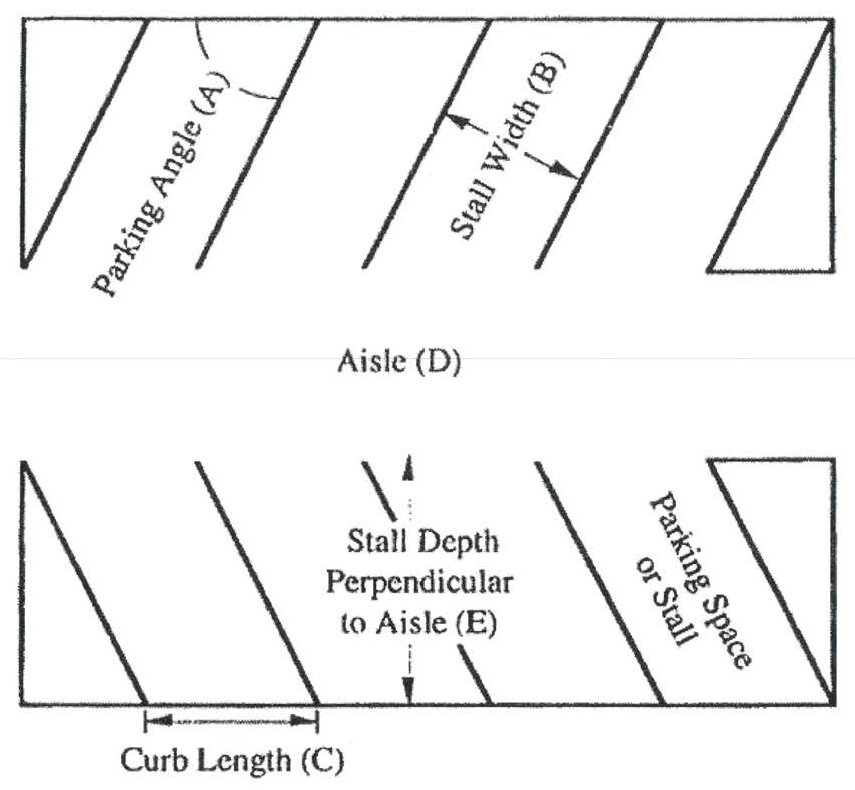
Figure 1. Dimensions of Parking Stalls
b.
Parallel parking spaces shall be a minimum of eight feet wide and 22 feet and six inches long.
(3)
Handicapped spaces. Parallel spaces for the handicapped adjacent to a walk shall be a minimum of 12 feet in width by 24 feet in length. If a walk is at an elevation different from the elevation of the parking space, a 1:6 ramp shall be provided up to the walk. For 90-degree or angled spaces, the minimum width of a stall shall be nine and one-half feet. An aisle, having a width of not less than three and one-half feet shall be identified by pavement markings and by appropriate signage.
(i)
Paving materials for parking areas.
(1)
In all zoning districts, parking areas shall be paved with asphalt, concrete or pervious materials approved by the City Manager, or his or her designee. Recommended pervious paving materials include those described in Volume 2, Technical Handbook of the Georgia Stormwater Management Manual (First Edition, August 2001) as the Porous Concrete or Modular Porous Paver Systems under the Limited Application Stormwater Structural Controls.
(2)
Paving areas shall be of sufficient size and strength to support the weight of service vehicles.
(j)
Driveways.
(1)
All driveways shall be paved with asphalt, concrete, porous paving blocks, or other materials approved by the City Manager, or his or her designee.
(2)
Parking areas shall provide an adequate ingress and egress with a minimum vertical clearance of 12 feet and a driveway grade no greater than five percent.
(3)
Driveways entering public streets must be designed as follows:
a.
No driveway curb cut may be located closer than 75 feet from the extended curb line of an intersecting street.
b.
Except for driveways that are restricted to right-in/right-out access only, no driveway curb cut may be located opposite an exclusive left turn lane that serves an adjacent intersection.
c.
Except for driveways that are restricted to right-in/right-out access only, the minimum spacing between driveways along the same side of an arterial or major collector street shall be as follows:
d.
The centerline of driveway curb cuts located on public streets that are not divided by a raised median should be aligned with the driveways on the opposite side of the street where feasible. Driveways that are not aligned shall be offset by a minimum of least 125 feet.
(k)
Landscaping in parking lots.
(1)
Parking lots shall be designed with cultivated landscape areas, in accordance with Section 8-10-11. Refer to Ordinance No. 638, along with the associated exhibits and figures.
(2)
Where the parking lot fronts a public street or public right-of-way, trees preserved or planted in the perimeter planting strip may be used to meet the parking lot planting requirement.
(3)
Landscaped median islands in parking lots may be constructed as stormwater bioretention areas with a grade level that is recessed at least four inches below the grade of the adjacent paved surfaces. Curbs separating recessed landscaped median islands from parking areas shall be either flush with the paved surface or notched at intervals of four feet to allow stormwater runoff to pass through them into the landscaped areas for bioretention.
(4)
The property owner shall be responsible for the maintenance of all bioretention areas and shall ensure that such areas are kept clear of litter and debris.
(5)
Landscape materials in median islands shall be selected to be compatible with the bioretention function of the landscaped areas, and adequate drainage shall be provided for the chosen species. Recommended plant species are shown in Table 7. Additional appropriate species are listed in the Georgia Stormwater Management Manual, Volume 2, Appendix F, Table F.5 on page F-23.
Table 7. Approved Plant Species/or Bioretention Areas in Parking Lots
* Source: Georgia Stormwater Manual, Volume 2, Appendix F, Table F-4, Page F-20.
(l)
Lighting in parking lots. If parking and loading areas are to be used at night, they shall be properly illuminated for the safety and security of pedestrians and vehicles. All lighting shall meet the standards of Section 8-7-86.1.
(m)
Parking vehicles in residential districts.
(1)
Driveways serving single-family or duplex dwelling units must provide adequate space and adequate width to allow off-street parking for at least two cars side-by-side.
(2)
In any residential district, the parking of any vehicle shall be within a driveway, garage, or carport within a side or rear yard, except for official government vehicles, moving vans that are actually loading and unloading or franchised or regulated utility vehicles. Parking areas shall be paved with asphalt, concrete or pervious materials approved by the City Manager, or his or her designee. Recommended pervious paving materials include those described in Volume 2, Technical Handbook of the Georgia Stormwater Management Manual (First Edition, August 2001) as the Porous Concrete or Modular Porous Paver Systems under the Limited Application Stormwater Structural Controls.
(n)
Off-street loading and unloading space.
(1)
Maximum number of off-street loading spaces. Whenever the normal operation of any development requires that goods, merchandise or equipment be routinely delivered to or shipped from the development, a sufficient off-street loading and unloading area must be provided in accordance with this chapter.
a.
The maximum number of off-street spaces required for buildings containing more than 5,000 gross square feet of retail business, office, wholesale, industrial, governmental and institutional uses including public assembly places, hospitals and educational institutions, shall be one space for the first 25,000 square feet of total floor area or fractional part thereof. For such uses in excess of 25,000 square feet, the building may provide loading spaces as indicated in Table 8.
Table 8. Maximum Loading and Unloading Space Requirements
b.
No area allocated to loading and unloading facilities may be used to satisfy the area requirements for off-street parking, nor shall any portion of any off-street parking area be used to satisfy the area requirements for loading and unloading facilities.
(2)
Location of off-street loading spaces.
a.
All off-street loading spaces shall be located on the same lot as the building that they are intended to serve or on an adjacent lot where shared with the use occupying said adjacent lot.
b.
Each off-street loading space shall have direct access to a street or alley that provides safe and adequate ingress and egress for trucks.
(3)
Permanent reservation. Areas reserved for off-street loading, in accordance with the requirements of this chapter, shall not be reduced in area or changed to any other use unless the permitted use that is served, discontinued or modified; except where equivalent loading space is provided and approved by the City Manager, or his or her designee.
(o)
Construction and dimensions of off-street loading spaces.
(1)
Required dimensions for each loading stall. Each loading shall be a minimum of ten feet wide and 30 feet in length, except that for wholesale and industrial use, loading stalls shall be a minimum of ten feet wide and 50 feet in length.
(2)
Ingress and egress for loading areas. Loading areas shall provide an adequate ingress and egress with a minimum vertical clearance of 12 feet and a driveway grade no greater than four percent. The loading area shall not exceed a grade of two percent.
(3)
Paving. All required loading areas shall be paved with asphalt, concrete, porous paving blocks, or other materials as approved by the City Manager, or his or her designee. Paving areas shall be of sufficient size and strength to support the weight of service vehicles.
(Code 1990, § 8-7-93; Ord. No. 569, 7-11-1995; Ord. No. 693, 8-18-2004; Ord. No. 926, § 3, 5-15-2013; Ord. No. 1000, §§ 54—56, 11-18-2015; Ord. No. 1017, § 2, 6-15-2016; Ord. No. 1020, §§ 1—4, 7-20-2016; Memo of 8-15-2016; Ord. No. 1043, §§ 1, 2, 11-16-2016; Ord. No. 1083, § 1, 7-19-2017; Ord. No. 1088, § 2, 9-20-2017; Ord. No. 1158, § 1, 2, 12-19-2018; Ord. No. 1446, § 2, 9-17-2025; Ord. No. 1447, § 1, 9-17-2025)
Sec. 8-7-94. - Enclosure requirements.
(a)
Dumpster enclosures.
(1)
Aesthetic appearance and location. All dumpster enclosures shall be visually concealed on three sides by an opaque architectural wall that is not less than eight feet in height, and constructed from brick, indigenous rock or natural stone finish material that is visually compatible with the aesthetic appearance of the principal structure(s); and on the fourth side, by an opaque gate, that is not less than eight feet in height, and is constructed from a durable metal finish material. A row of dense evergreen hedges and/or trees may be planted to further supplement the aesthetic appearance of the dumpster enclosure. All dumpster enclosures shall be restricted to locations that are in the rear yard only.
(2)
Pads.
a.
All dumpster enclosures shall be placed on concrete pads and have an approach pad that is of sufficient size and strength to support the weight of service vehicles. The approach pad shall be reinforced concrete, 3,000 pounds per square inch, and shall be no less than eight inches in thickness.
b.
The combined dimensions of both the concrete pad and the approach pad shall be no less than 20 feet in length by 10 feet in width.
(b)
Donation bins, containers and drop boxes.
(1)
Donation bins, containers and drop boxes that are provided for the collection of clothing, small electronics, toys and all other related items, or for recycling, shall be restricted to locations that are in the rear yard and side yards only. No donation bin, container or drop box shall be located between any building, principal or accessory, and a street.
(2)
Donation bins, containers and drop boxes are prohibited on all lots zoned as R-A, RS-20, RS-14, TND, TH, RM or GV-RV zoning district. No donation bin, container or drop box shall be located within 75 feet of any lot designated or intended for residential activity, including all principal buildings mixing residential and commercial uses under a single roof.
(3)
No property shall be permitted to have more than one donation bin, container or drop box.
(4)
Donation bins, containers and drop boxes shall be placed on a paved surface, but shall not be located within a parking stall, aisle or loading dock and service area. Donation bins, containers and drop boxes are not permitted within any buffer area or landscape area.
(5)
No donation bin, container or drop box shall exceed 48 inches in width, 48 inches in length and 72 inches in height, as measured from finished grade to the height point of the roof.
(6)
Except where otherwise required by the MxD, GV-NV and GV-UV districts, all donation bins, containers and drop boxes shall be painted, or stained with a low reflectance and subtle, neutral or earth-tone color scheme. High-intensity colors, metallic colors, black, or fluorescent colors shall be prohibited.
(7)
All donation bins, containers and drop boxes shall be free of debris, graffiti, litter, refuse, rust, et cetera at all times.
(8)
All donation bins, containers and drop boxes shall be safely designed in a manner that prevents such structures from tipping over, and also prevents children from entering the bin.
(9)
Each donation bin, container or drop box shall bear the name and a contact telephone number of the property owner, property manager, or the donation bin, container or drop box owner which benefits from the collected materials on a sign. Said sign shall not exceed two square feet in area, and only one sign shall be permitted on each side of the donation bin, container or drop box.
(10)
Advertising of any kind shall be prohibited on all donation bins, containers and drop boxes.
(11)
All donation bins, containers and drop boxes shall be removed within two days from all lots that have been abandoned or vacated at the expense of the property owner, property manager or the donation bin, container or drop box owner.
(12)
No donation bin, container or drop box shall be placed upon any lot without the written approval of the property owner and/or property manager. Upon request, the owner of the donation bin, container, or drop box shall produce, within two business days, a copy of such approval to the City Manager or his/her designee.
(Code 1990, § 8-7-94; Ord. No. 693, 8-18-2004; Ord. No. 889, § 1, 10-17-2012; Ord. No. 943, § 1, 11-20-2013)
Sec. 8-7-95. - Landscaping and buffering.
(a)
General requirements. A planted buffer strip is required to protect residential land uses from excessive heat, dust, wind, light, unsightly views, odors and other characteristics commonly associated with commercial and industrial land uses and related vehicular and pedestrian traffic, which can adversely impact the quality of residential life. The required buffer shall provide necessary visual and acoustical privacy for the conduct of residential lifestyles in an undisturbed environment and shall provide for the protection and preservation of property values in residential districts.
Required buffers shall be established and maintained by the developer and owner of the incompatible (less restrictive) land use. The required buffer must:
(1)
Be depicted in detail (the type and locations of natural and planted vegetation are to be illustrated) on each site plan or plan prior to approval and shall be designated as a permanent easement;
(2)
Not be disturbed by grading, property improvements or construction activities; except where necessary to prevent a nuisance, or to thin such natural growth where too dense to permit normal growth, or to remove diseased, misshapen, or dangerous and decayed timbers. Any contemplated disturbance first shall be brought to the attention of the Director and formal approval secured prior to initiating activity within the required buffer area;
(3)
Utilize existing vegetation where it has been determined that existing vegetation is appropriate for inclusion within the buffer strip or when required to be supplemented with approved, additional plantings;
(4)
Retain the natural topography of the land, except when a portion must be cleared and graded as required by the local law to prevent soil erosion or sedimentation;
(5)
Be completely installed in accordance with the approved plan prior to issuance of a certificate of occupancy;
(6)
Not be used for temporary or permanent parking or loading, other than for provision of drainage improvements as mandated by the local law or for a structure other than a fence;
(7)
Attain a height of not less than six feet within three years of the planting date.
(b)
Buffer required. It is recognized that the location of multifamily residential, commercial or industrial zoning districts directly adjacent to single-family residential districts can create an incompatible situation. Additionally, the location of multifamily residential districts or manufactured home parks directly adjacent to single-family residential zoning districts can be an incompatible situation. Accordingly, in multifamily residential, commercial and industrial districts, when a principal structure is constructed, expanded or modified, a planted screening buffer shall be provided and maintained along all side and rear property lines contiguous with a single-family residential district. The City Council requires a similar buffer strip between other districts and land uses deemed to be incompatible, as indicated in Table 9.
It is recognized that the location of single-family residential uses accessed directly from collector or arterial roads can create safety issues. Accordingly, in single-family residential districts, when a new subdivision is built where a public street is adjacent to the rear property line of single-family residential lots, a screened buffer area including, but not limited to, solid fences or masonry walls shall be provided and maintained to create a barrier between the public road and the rear yards. This shall include a ten-foot planted strip in a no access easement. Such buffer, however, shall not obstruct traffic visibility. The City Council may require a similar buffer between other districts and public roads for safety purposes.
(c)
Minimum buffer specifications. As different types of land uses generate varying degrees of incompatibility, it follows that variable widths for a buffer are appropriate. Therefore, the amount and type of planting required to accomplish adequate screening and insulation shall be variable, and in each instance shall be determined by the intensity and extent of the use judged incompatible. Table 9 provides the minimum specifications for buffer widths to be used by the Planning Commission and City Council.
In other instances, where an incompatible situation is determined, the width of the buffer shall be recommended by the Planning Commission but shall not be less than 15 feet. The required buffer shall be in addition to the minimum yard area, as specified in the appropriate zoning district.
*Buffer widths may be reduced by 20 feet by the addition of a solid, opaque fence or wall at least six feet in height.
(d)
Composition of buffer. In those instances where it is clearly obvious that existing natural vegetation and topography could not possibly achieve the desired level of screening as determined by this chapter, a planted buffer shall be provided and shall consist of plant material of such growth characteristics as will provide an acoustical and visual screen of planting. Plant materials for buffers shall be in accordance with the tree preservation and landscape zoning ordinance.
Other evergreen plant materials having the same growth characteristics as the aforementioned may be substituted, subject to approval by the City Manager, or his or her designee, prior to installation.
(e)
Maintenance. The screening buffer planting and any required landscaped open space planting shall be guaranteed for the life of the commercial, industrial or residential development. Necessary trimming and maintenance shall be performed by the installing property owner to maintain the health of the plant materials, to provide aesthetically pleasing appearance and to ensure that the buffer actually serves the purpose for which it is intended.
(f)
Other screening requirements. Certain uses such as junk or salvage yard operations and other commercial and industrial operations requiring the storage of inoperative equipment, vehicles and other types of bulk storage for prolonged periods of time could present unsightly views or health hazards. To preclude this from occurring, the Director shall require owners of such properties to completely enclose such operations by a fence or wall that completely obscures views of the property from adjacent sidewalks, streets and other properties built to a height greater than that of the height of the highest piece of equipment or vehicle and types of bulk storage stored on the property. Such fences shall be constructed of masonry, wood or combination thereof or other materials approved by the City. Construction of cyclone fencing that utilizes metal inserts as screening shall be prohibited.
(Code 1990, § 8-7-95; Ord. No. 693, 8-18-2004; Ord. No. 1037, § 1, 9-21-2016)
Sec. 8-7-96. - Nonconforming uses and structures.
(a)
General rules.
(1)
Within the zoning districts established by this chapter or amendments that may later be adopted, there might exist land, structures and uses of land and structures in combination that were lawful before this chapter was passed or amended, but that would be prohibited, regulated or restricted under the terms of this chapter or future amendment. It is the intent of this chapter to permit these nonconformities to continue until they are removed but not to encourage their survival. It is further the intent of this chapter that nonconformities shall not be enlarged upon, expanded, extended or used as grounds for adding other structures or uses prohibited elsewhere in the same district.
(2)
Nonconforming uses are declared by this chapter to be incompatible with permitted uses in the districts involved. A nonconforming use of structure and land in combination shall not be extended or enlarged after passage of this chapter.
(3)
To avoid undue hardship, nothing in this chapter shall be deemed to require change in the plans, construction or designated use of any building on which actual construction was lawfully begun prior to the effective date of adoption of this chapter. All duly authorized nonconforming projects, on the effective date of the ordinance from which this chapter is derived, may be completed in accordance with the terms of their permits, so long as these permits were validly issued and remain unrevoked and unexpired. If a development is designed to be completed in phases, this shall apply only to the particular phase or phases that received approval prior to enactment of this chapter.
(b)
Nonconforming lots of record.
(1)
In any district, a building may be erected on any single undeveloped lot of record at the effective date of adoption or amendment of this chapter, notwithstanding limitations imposed by other provisions of this chapter. Such lot must be in separate ownership and not of continuous frontage with other lots in the same ownership. This provision shall apply even though such lots fail to meet the requirements for area or width, or both, that are generally applicable in the district; provided that yard dimensions and requirements, other than those applying to area or width, or both, of the lots shall conform to the regulations for the district in which such lot is located.
(2)
If two or more undeveloped lots or combinations of undeveloped lots and portions of undeveloped lots with continuous frontage in single ownership are of record at the time of passage or amendment of this chapter and if all or part of the lots do not meet the requirements established for lot width and area, the land involved shall be considered to be an undivided parcel for the purposes of this chapter; and no portion of said parcel shall be used or sold in a manner that diminishes compliance with lot width and area requirements established by this chapter, and no division of any parcel shall be made that creates a lot width or area less than the requirements stated in this chapter.
(c)
Extension or enlargement of nonconforming situations.
(1)
Except as specifically provided herein, no person may engage in any activity that causes an increase in the extent of nonconformity of a nonconforming situation. In particular, physical alteration of structures or the placement of new structures on open land is unlawful if such activity results in:
a.
An increase in the total amount of space devoted to a nonconforming use;
b.
Greater nonconformity with respect to dimensional restrictions such as setback requirements, height limitations or density requirements or other requirements.
(2)
Subject to other provisions of this section, a nonconforming use may be extended throughout the portion of a completed building that, when the use was made nonconforming by this chapter, was designed or arranged to accommodate such use. However, a nonconforming use may not be extended to additional buildings or to land outside of the original building.
(3)
Subject to other provisions of this section, a nonconforming use of open land may not be extended to cover more land than was occupied by that use when it became nonconforming.
(4)
Any change in use of property where a nonconforming situation exists that would normally require a rezoning shall require removal of the nonconforming situation.
(d)
Repair, maintenance and reconstruction.
(1)
Minor improvements and additions that are made to single-family residences previously built in a subdivision of record zoned R-A, RS-20 or RS-14 with a final plat approved prior to enactment of this chapter shall not be subject to the provisions of this section, provided that such minor improvements and additions are limited to the following actions:
a.
Additions of heated floor area less than 50 percent of the existing floor area.
b.
Construction of an accessory structure or garage not to exceed 500 square feet in floor area.
c.
Improvements to outdoor space, such as swimming pools, courts for basketball, tennis or handball, gazebos, trellises, patios, decks, balconies, and similar nonoccupied structures.
(2)
If a structure located on a lot where a nonconforming situation exists is damaged to an extent that the costs of repair or replacement would exceed 50 percent of the appraised valuation of the damaged structure, then the damaged structure may be repaired or replaced only in a conforming manner.
(3)
If a nonconforming structure or portion of a structure containing a nonconforming use becomes physically unsafe or unlawful as a result of lack of repairs and maintenance and is declared by any duly authorized official to be unlawful by reasons of physical condition, it shall not thereafter be restored, repaired or rebuilt except in conformity with the regulations of the district in which it is located.
(4)
Nonconformity compliance certificate. A nonconformity compliance certificate is required before issuance of a land disturbance permit or a building permit affecting a nonconforming use, lot, or structure. See Section 8-7-121.
(e)
Replacement of nonconforming manufactured homes. All mobile homes shall be located within mobile home parks, except that nonconforming mobile homes legally existing May 6, 1964, may remain under the following conditions:
(1)
If any nonconforming home is moved, it cannot be relocated within the City or replaced by another mobile home except in conformity with the provisions of this chapter, provided that a nonconforming home may be moved on its present site to more nearly comply with the applicable yard requirements of Article B of this chapter.
(2)
If any nonconforming home is destroyed, it cannot be rebuilt or replaced except in conformity with the terms of this chapter.
(3)
A nonconforming manufactured home cannot be expanded in size and no additions or structural alterations or changes in foundation can be made thereto, unless the nonconforming home is made to conform to the provisions of this chapter.
(4)
Nothing in the above subsections of this section shall be construed or interpreted to prevent the normal maintenance and repair of any mobile home.
(f)
Discontinuance of nonconforming situations.
(1)
When a nonconforming use is discontinued for a consecutive period of 180 days or discontinued for any period of time without a definite intention to reinstate the nonconforming use, the property involved may thereafter be used only for conforming purposes.
(2)
When a structure or operation made nonconforming by this chapter is vacant or discontinued at the effective date of the ordinance from which this chapter is derived, the 180-day period for purposes of this article begins on the effective date of the ordinance from which this chapter is derived.
(Code 1990, § 8-7-96; Ord. No. 693, 8-18-2004)
Sec. 8-7-97. - Exhibits.
The following exhibits shall serve as design guidelines where referenced elsewhere in this chapter:
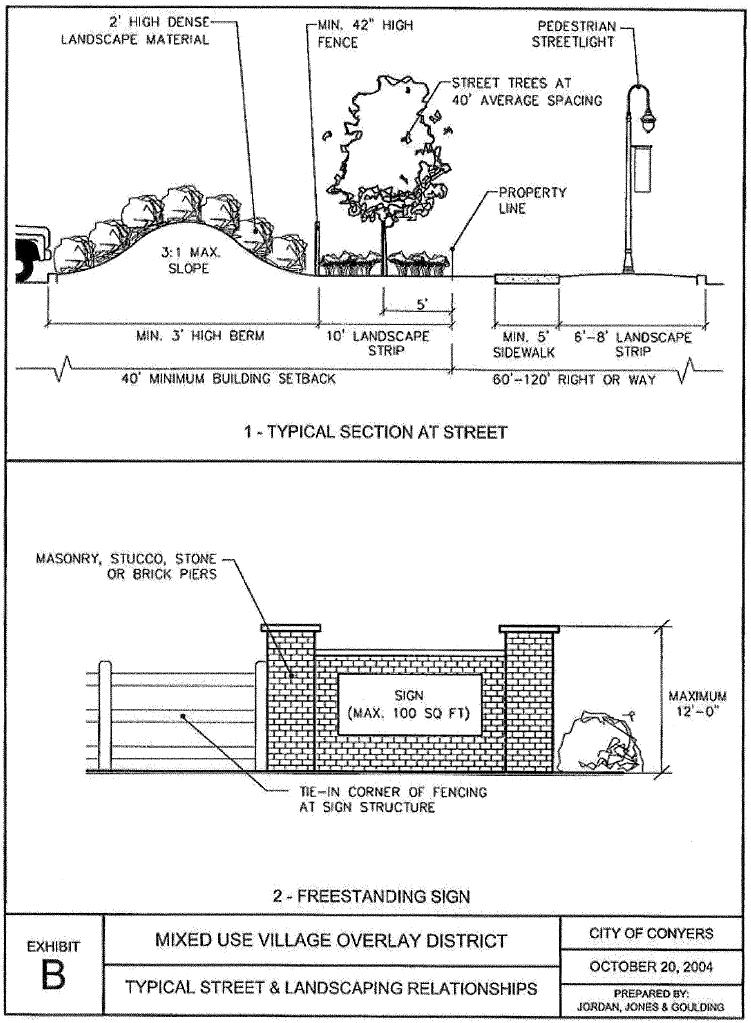
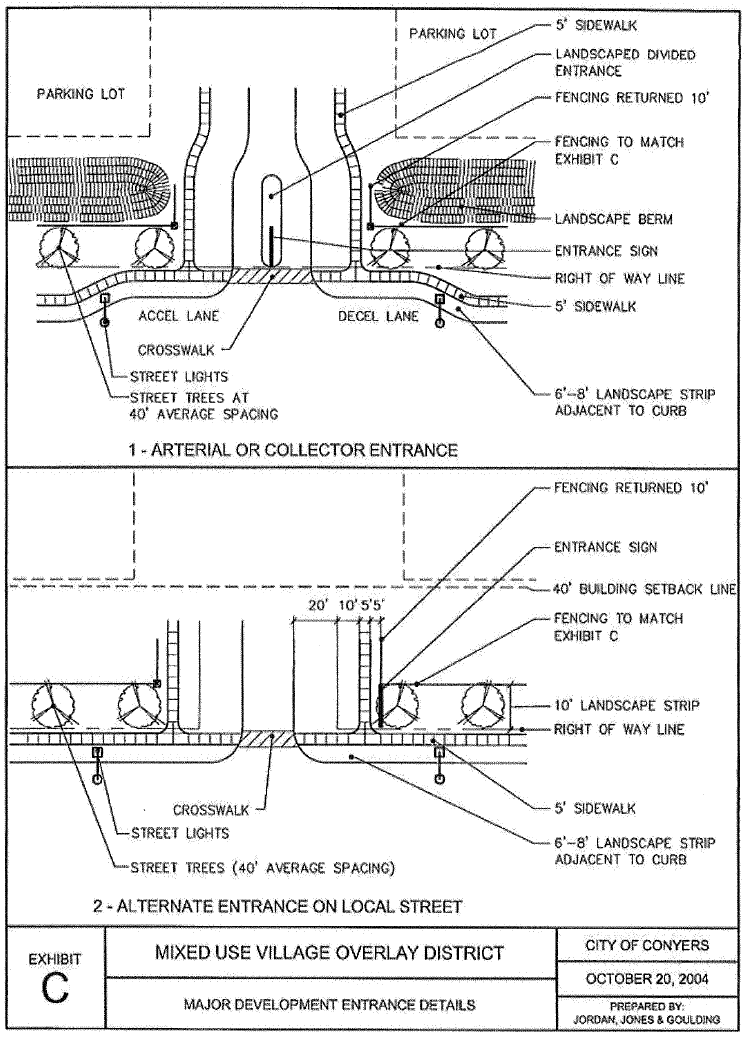
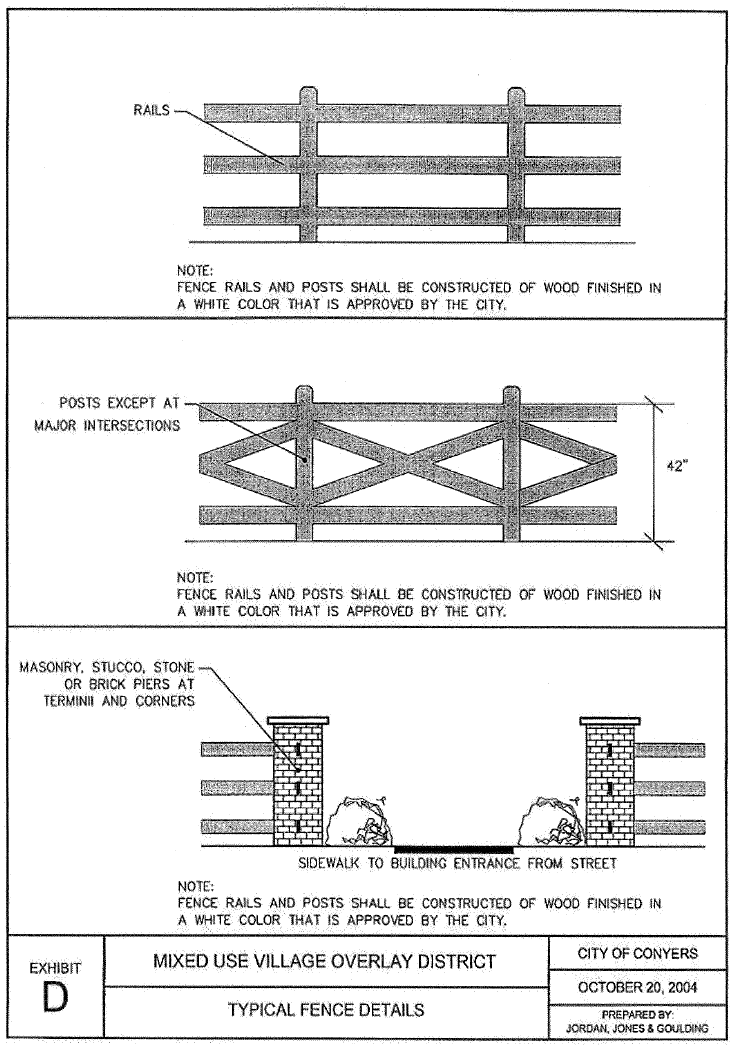
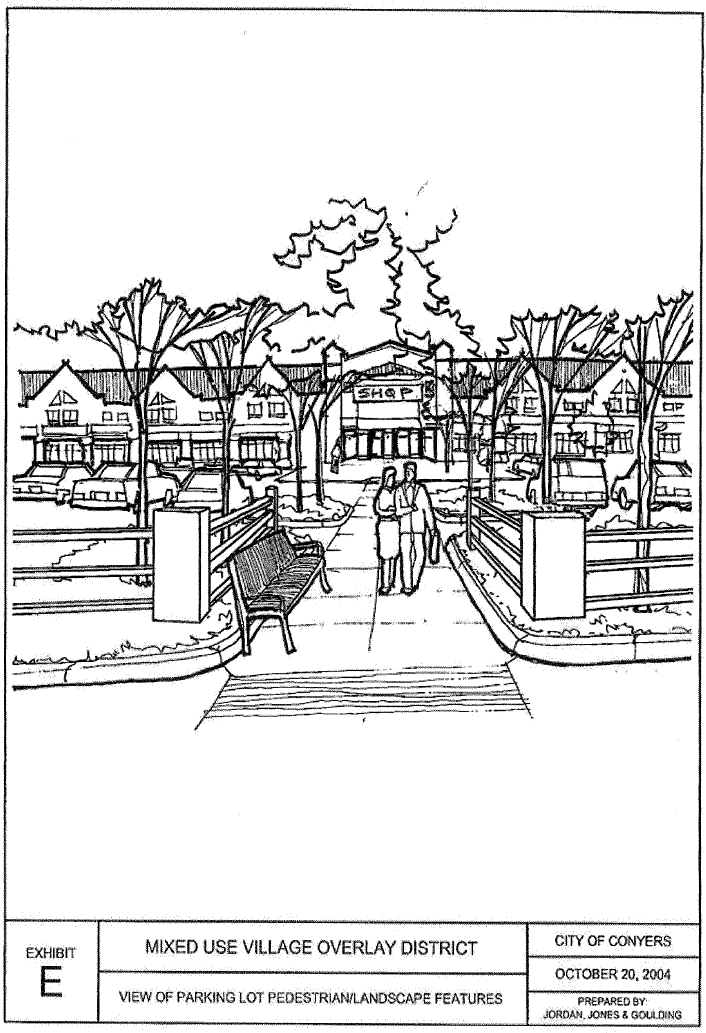
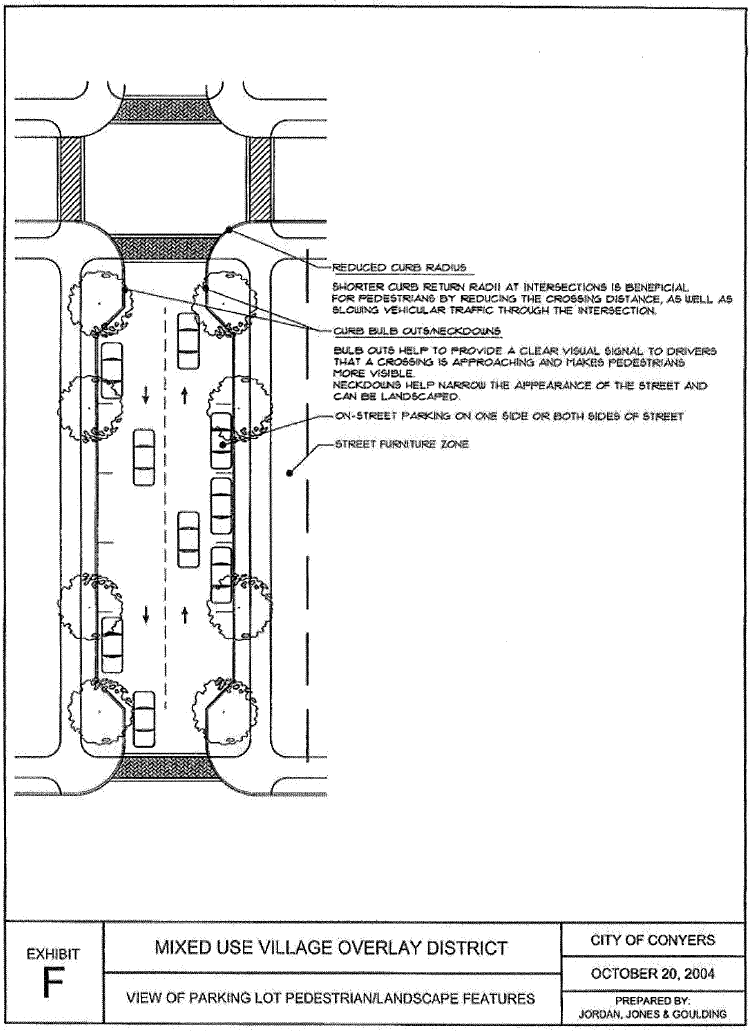
(Code 1990, § 8-7-97; Ord. No. 693, 8-18-2004)

