
Coral Springs City Zoning Code
ARTICLE XVII
DOWNTOWN MIXED-USE DT-MU ZONING DISTRICT
Sec. 2501046.- Purpose.
The purpose of this article is to ensure that the Downtown Mixed-Use (DT-MU) Zoning District is developed in a manner supporting the Local Activity Center (LAC) and Community Redevelopment Plan goals:
(1)
Establish an identifiable character and an economic vitality for the Community Redevelopment Area;
(2)
Recognize redevelopment areas are a community of diversified interests with the goal of economic revitalization;
(3)
Create a safe efficient traffic circulation system that provides sufficient access between activity areas and the balance of the community; and
(4)
Recognize the challenges of redevelopment within a built environment and allows for modifications to standards to promote reinvestment within the DT-MU District.
(Ord. No. 2017-115, § 3, 1-17-18)
Sec. 2501047. - Relationship to the Comprehensive Plan and Community Redevelopment Plan.
The Downtown Mixed Use (DT-MU) Zoning District assists in:
(1)
The support of the Downtown Land Use designated a LAC land use designation;
(2)
The implementation of the Goals, Objectives and Policies of the LAC land use category in the Future Land Use Element of the Comprehensive Plan; and
(3)
The implementation of the Coral Springs Community Redevelopment Plan, adopted June 2014 and as may be amended from time to time, which requires regulations by sub-district that address design, scale and appearance of developing within the Community Redevelopment Area.
(Ord. No. 2017-115, § 3, 1-17-18)
Sec. 2501048. - Applicability.
Provisions of the article are applicable as depicted in Map 1.0, Downtown Regulating Plan. This article shall apply to:
(1)
All new development.
(2)
Renovations and redevelopment. In the case of additions or renovations to, or redevelopment of, an existing building or project, where the cost of such addition, renovation, or redevelopment exceeds twenty-five (25) percent of the square footage of the existing structures, the provisions of this article shall apply.
(3)
Discontinuance. Where the use of a structure ceases for any reason for a period of more than one hundred eighty (180) days, except where governmental action impedes access to the premises, the provisions of this article, excluding setback requirements, which may require structural alterations, shall be adhered to prior to re-occupancy.
(Ord. No. 2017-115, § 3, 1-17-18)
Sec. 2501049. - Downtown Regulating Plan.
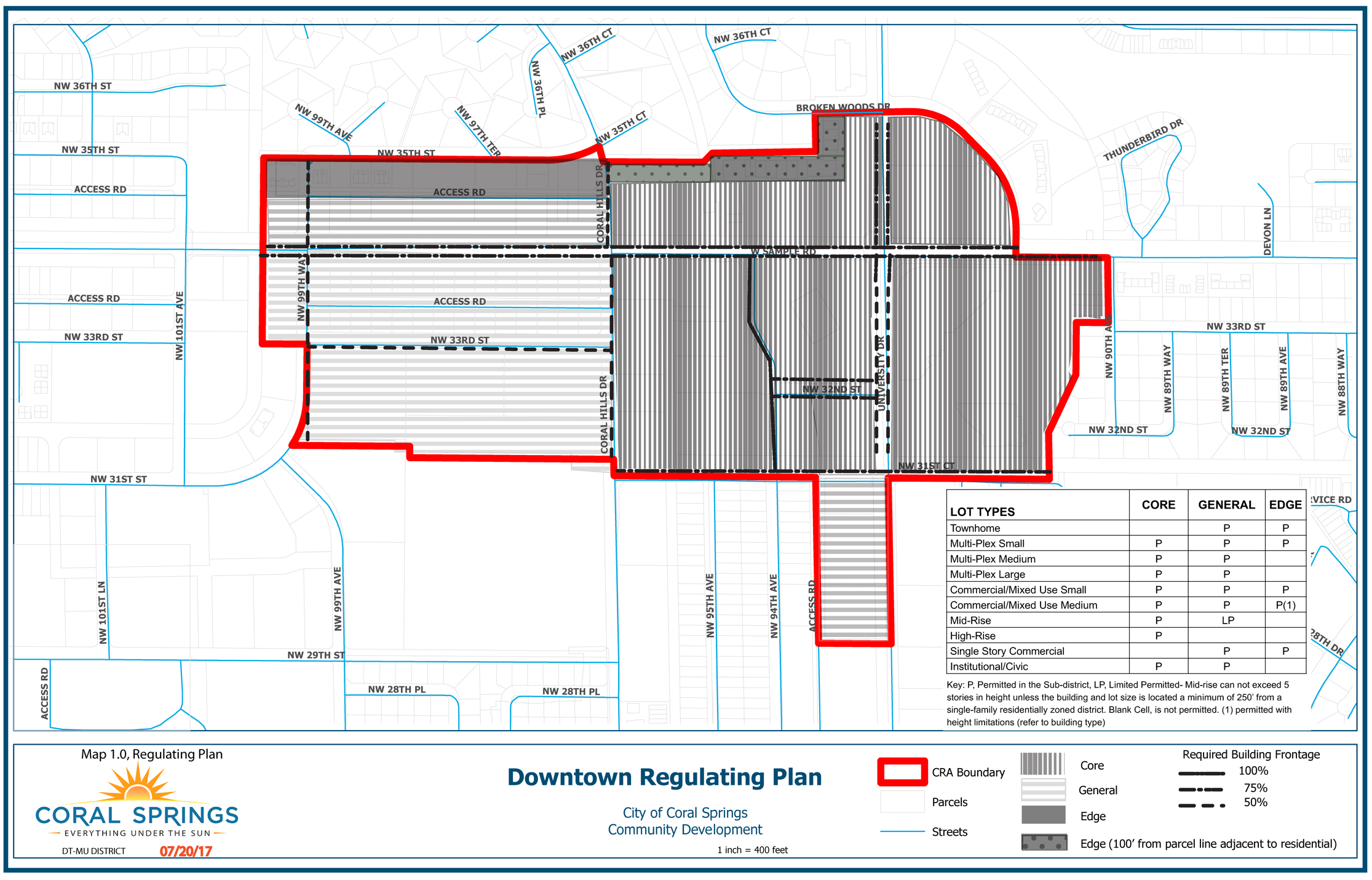
The Downtown Regulating Plan (Map 1.0) is the principal tool for implementing the standards in this article and identifies the subdistricts, permitted building types and building frontage requirements.
(Ord. No. 2017-115, § 3, 1-17-18)
Sec. 2501050. - DT-MU Subdistrict(s).
The DT-MU includes three (3) subdistricts as identified in the Downtown Regulating Plan:
(1)
Downtown Core, the most intense uses with the highest density will be located in the Downtown Core, permitting a range of mixed use building types while providing the most interconnected, walkable areas within the DT-MU.
(2)
Downtown General, has moderate density that permits a medium intensity mix of uses that are typically adjacent to the Downtown Core sub-areas and provide a range of building types that permit medium scale mixed-use buildings, live/work and townhomes. Pedestrian connections with a slightly larger block are required in Downtown General.
(3)
Downtown Edge, has the lowest mass and scale within the downtown while still providing building types that complement the overall downtown development while providing compatibility to the adjacent single family residential and multi-family residential development with single story buildings, small scale multi-family and townhomes. Pedestrian and vehicular connections within the Downtown Edge areas will be maintained while respecting the adjacent residential area(s).
(Ord. No. 2017-115, § 3, 1-17-18)
Sec. 2501051. - Eligibility requirements for Downtown General and Downtown Edge subdistricts.
(1)
Eligibility. The Downtown Regulating Plan, set forth in this article, assigns three (3) subdistricts within the Downtown Mixed-Use (DT-MU) District. The Downtown General Zone and Downtown Edge Zone are hereby established with potential applicability to any property within those two (2) zones which meets the following eligibility requirements:
(a)
The underlying parcel is located within the LAC designation.
(b)
The parcel is within the DT-MU District boundary as designated by the city commission.
(2)
Boundary. The boundaries of each DT-MU District shall be fixed by amendment to the official city zoning map as authorized by the city commission, wherever this district is applied.
(3)
Although it is anticipated that DT-MU General and Edge rezoning applications will be submitted on a voluntary basis by applicants, the city may, in addition to considering these applications, rezone property to Downtown General and/or Downtown Edge Districts. As part of the voluntary rezone, an evaluation of the master parking shall be done to determine the availability of parking and site constraints, if any.
(Ord. No. 2017-115, § 3, 1-17-18)
Sec. 2501052. - Uses permitted.
In the Downtown Mixed Use District (DT-MU) only the following uses shall be permitted:
(1)
Multi-family residential units (minimum floor area of a dwelling unit shall be five hundred (500) square feet).
(2)
Residential, live/work, single family residential units.
(3)
Stores for sale or rental of new merchandise, including vehicles, conducted solely within a building, directed primarily to the ultimate consumer and may also include pop-up temporary stores.
(4)
Personal services limited to the following: Travel agency, barbershop, beauty shop, shoe repair, postal facilities, consumer electronic repair and small appliance repair, business service agencies, consumer electronic and small appliance repair home service agencies, tailoring and alterations, photographic film pickup, print shop and cyber café.
(5)
Grocery stores.
(6)
Offices such as the following: Professional, business offices, incubators, medical or dental offices or clinics.
(7)
Banks and financial institutions: Any drive-through facilities must be fully integrated within the building and must meet the design requirements of the district.
(8)
Indoor commercial recreation uses limited to motion picture and performance theaters, martial arts, dance and exercise studios, assembly hall, skating rink, tennis, racquetball, handball facilities, health clubs, and physical fitness facilities.
(9)
Nursery school or child center subject to the following standards:
(a)
Building shall be located at least thirty (30) feet from any R-zoned lands;
(b)
At least one (1) completely fenced and secure play lot shall be established, maintained and used for children at play. The fence shall be not less than five (5) feet in height.
(c)
Play lots located closer than fifty (50) feet to the plot line shall be screened by an opaque fence or wall or compact evergreen hedge not less than five (5) feet in height.
(10)
Institutions such as places of worship, libraries, museums, art galleries, and similar facilities.
(11)
Night clubs, bars, taverns, cigar bars.
(12)
Stores for sale of antiques and used books, furniture and clothing.
(13)
Dry cleaning establishment for direct service to the customers subject to a maximum of twenty-five hundred (2,500) square feet of gross area per establishment.
(14)
Restaurant, lounge, and catering, without pickup window or drive-through facilities.
(15)
Hotels and motels subject to the following:
(a)
Any outdoor recreation areas including swimming pools shall be located at least twenty-five (25) feet from the property line of any adjacent residentially-zoned property unless the adjacent property is being utilized for business related parking or recreation areas are elevated as part of the main structure or parking garage.
(b)
The minimum floor area of any rental sleeping room in a motel or hotel, which includes all areas to be individually rented by a customer, shall be three hundred (300) square feet.
(16)
Private club, lodge, fraternity, and similar uses.
(17)
Veterinary and animal hospitals, subject to the following conditions and limitations:
(a)
Adequate soundproofing in any area where animals are contained or treated.
(b)
No exterior cages.
(c)
Fenced or walled walking areas are permitted subject to all other land development code requirements. At no time shall an animal be unsupervised nor shall runs nor cages be permitted in the outside walking area.
(d)
Shall contain an approved air-handling system for disinfection and odor control.
(e)
Shall contain adequate waste control facilities, such as a flush system or equal.
(f)
Shall contain no crematory facilities.
(g)
Such facility shall contain a minimum of twenty-five hundred (2,500) square feet.
(h)
All boarding activities shall be ancillary to the primary use.
(18)
Heliport, helistops and off-heliport sites subject to the requirements, as outlined in this chapter.
(19)
Mixed-use development, in accordance with the provisions of this article.
(20)
Vehicle rental offices, subject to the following conditions and limitations:
(a)
No more than fifteen (15) rental vehicles shall be located on the site.
(b)
Vehicles shall not occupy more than one-half (½) of the lot on which the business is located.
(c)
No fueling, vehicle service or car wash facilities or activities shall be permitted on the site.
(d)
There shall be no automobile storage other than the interim, incidental and customary parking of the rental cars.
(e)
There shall be no employee or rental car parking in any master parking areas.
(f)
Parking spaces for rental cars shall be provided in addition to the required parking for the business.
(g)
No outdoor speakers shall be permitted.
(h)
Vehicles bearing signs, painted or otherwise affixed to the vehicles, may not be stored in a manner or at any location which enables said signs to be visible from any abutting street.
(i)
Exterior lighting, consistent with the illumination requirements of section 250144, shall be provided for all rear parking areas used for vehicle storage.
(21)
Convenience stores integrated within mixed-use buildings.
(22)
Universities/colleges.
(23)
Theater, amphitheater, outdoor commercial uses.
(24)
Movie theater, maximum eighty thousand (80,000) square feet in size.
(25)
Microbrewery, subject to the following conditions:
(a)
A copy of federal and state permits and/or licenses shall be provided to the city each calendar year.
(b)
No more than fifty (50) percent of the gross floor area may be occupied by the combined brewing operations.
(c)
No distribution of malt beverages by commercial vehicles.
(26)
Accessory uses and structures.
(a)
Outdoor commercial recreation uses limited only to tennis, racquetball, squash, and handball courts, swimming pools, and running tracks, and accessory uses and structures, provided that:
(i)
Playing courts, pools, and tracks may be located no closer than twenty-five (25) feet to any street line or residential plot.
(ii)
High intensity lighting fixtures located within one hundred (100) feet of any residential plot shall be extinguished no later than 10:00 p.m. unless landscaping/screening is provided so as to have a maximum measurement of zero (0) foot candles at property line(s).
(iii)
No outdoor commercial recreational uses permitted by this subsection shall be placed on any parcel of land less than one (1) acre in size.
(b)
Dormitories.
(c)
Outdoor seating.
(d)
Outdoor entertainment.
(e)
Pharmacies and medical marijuana dispensing facilities that are accessory to retail stores in excess of ten thousand (10,000) square feet.
(27)
Certain family community residences, transitional community residences, recovery communities, and congregate living facilities as provided for in and in accordance with section 250152 of this chapter including but not limited to, Table "A." Congregate living facilities proposed to be located within the spacing distance specified in subsection 250152(3)(b) of this chapter must first be approved as a conditional use.
(Ord. No. 2017-115, § 3, 1-17-18; Ord. No. 2019-104, § 11, 4-3-19; Ord. No. 2023-114, § 24, 9-13-23)
Sec. 2501052.1. - Conditional use.
The following uses shall only be conditionally permitted subject to the criteria listed below and the procedures and requirements provided elsewhere in this chapter:
(1)
Trade professional or other schools, conducted solely within a building. Trades for which on-the-job training facilities are provided shall be limited to those which are permitted uses within the district unless they comprise less than ten (10) percent of the floor area of the building or plot.
(2)
Public or private elementary, junior or senior high schools or micro schools less than fifty (50) students subject to the following standards:
(a)
Buildings shall be located at least thirty (30) feet from any R-zoned lands.
(b)
Outdoor recreation areas located closer than fifty (50) feet to an R-zoned plot shall be screened by an opaque fence or wall or compact hedge not less than five (5) feet in height.
(c)
The petitioner shall submit a noise study by an acoustical consultant which demonstrates that the noise generated to receiving land uses is within acceptable levels established by the noise ordinance. The noise study will be reviewed by the city, or the city's designee, and the cost shall be paid by the petitioner.
(3)
Fast food restaurants with drive-through facilities are subject to the following:
(a)
Drive-through facilities shall be fully integrated within the building and shall not be visible from any right-of-way.
(b)
The petitioner shall submit a noise study by an acoustical consultant which demonstrates that the noise generated to receiving land uses is within acceptable levels established by the noise ordinance. The noise study will be reviewed by the city, or the city's designee, and the cost shall be paid by the petitioner.
(c)
A traffic study shall be submitted by a registered, professional engineer which identifies the impact of the project on the external roadway system as well as internal circulation patterns, parking configurations and turning movements. The traffic study shall be reviewed by the city, or the city's consultant, and the cost shall be paid by the petitioner.
(4)
Stand-alone large-scale retail establishments or any combination of large retail establishments in a single building (single self-contained bay) occupying a footprint greater than forty thousand (40,000) square feet are subject to the following:
(a)
The criteria set forth in the Architectural Guidelines for large scale commercial development.
(b)
The petitioner shall submit a noise study by an acoustical consultant which demonstrates that the noise generated to receiving land uses is within acceptable levels established by the noise ordinance. The noise study will be reviewed by the city, or the city's designee, and the cost shall be paid by the petitioner.
(c)
A traffic study shall be submitted by a registered, professional engineer which identifies the impact of the project on the external roadway system as well as internal circulation patterns, parking configurations and turning movements. The traffic study shall be reviewed by the city, or the city's consultant, and the cost shall be paid by the petitioner.
(d)
The petitioner shall enter into a maintenance agreement to monitor the proper preparation of planting beds, material quality and long-term maintenance. A comprehensive inspection scheduled by an independent landscape professional will be required as part of the agreement. The agreement will require either a letter of credit or cash in the amount of fifty (50) percent of the fair market value be placed with the city prior to the issuance of a certificate of occupancy.
(5)
Boutique furniture stores.
(6)
If an addition of more than five (5) percent of the original floor area is being added to any of the uses described in this section which had previously qualified as a legal nonconforming use, then the above regulations for each use shall apply.
(Ord. No. 2017-115, § 3, 1-17-18)
Sec. 2501053. - Uses prohibited.
The permitted uses enumerated in this district shall not be construed to include, either as a principal or accessory use, any of the following:
(1)
Any use not specifically permitted.
(2)
Any business which is or may be obnoxious because of dust, dirt, smoke, fumes, odors, noises, vibrations, radioactive waves, traffic or appearance.
(3)
Adult entertainment establishments as defined in section 250145 of the land development code.
(4)
Sale of goods to other than the ultimate consumer.
(5)
Sales, display or storage of used merchandise other than antiques, books, furniture and clothing as identified in section 2501052.
(6)
Sale and dispensing of automobile fuel.
(7)
Laundromats.
(8)
Sale of tobacco products as the main use (other than cigar bars).
(9)
Pain management clinics as defined elsewhere in this chapter.
(10)
Pawn shops.
(Ord. No. 2017-115, § 3, 1-17-18)
Sec. 2501054. - Limitations of uses and structures.
(1)
All activities of permitted uses, including sale, display, preparation and storage, shall be conducted entirely within a completely enclosed building except as follows:
(a)
Open-air retail sales of plant materials not grown on site, home garden supplies and related merchandise (garden shop) are permitted as an accessory use to a retail business.
(b)
Seating area when utilized as an accessory use to a restaurant, bar, tavern, or nightclub.
(c)
Play areas of day nurseries or public or private schools.
(d)
Any drive-through business.
(e)
Heliports, helistops, and off-landing sites subject to the requirements outlined in this chapter.
(f)
Tennis racquetball, squash and handball courts, swimming pools, and running tracks.
(Ord. No. 2017-115, § 3, 1-17-18)
Sec. 2501055. - Circulation.
In order to create a system of land subdivision and development which links one area to another, land should be organized by development blocks. When a proposed development is four (4) acres or greater for the core area, six (6) acres or greater for the general area a block configuration shall be required as part of the proposed development which requires the proposed development to construct a block assembly as part of the development. The following street cross sections shall be utilized for newly constructed streets within the DT-MU District and designed consistent with illustrations and tables found in this section.
(1)
Main street. If the assembly of blocks is developed, at least one (1) street within the DT-MU core area shall be developed as a Main Street.
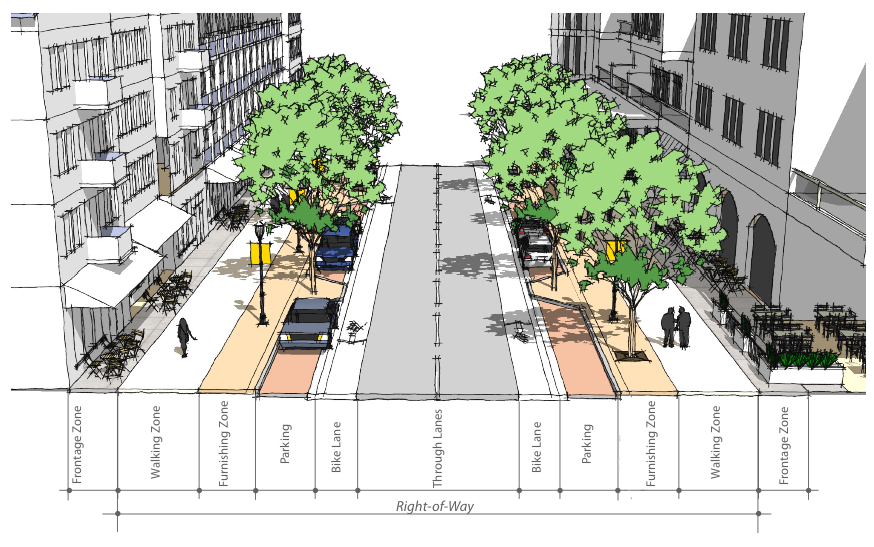
Figure 1, Main Street Design
The curb extension, also known as a bulb out, when provided, shall be designed to prevent any drainage issues between the parking stall and the adjacent bike lane.
(2)
Pedestrian streets are permitted within any of the subdistricts within the DT-MU.
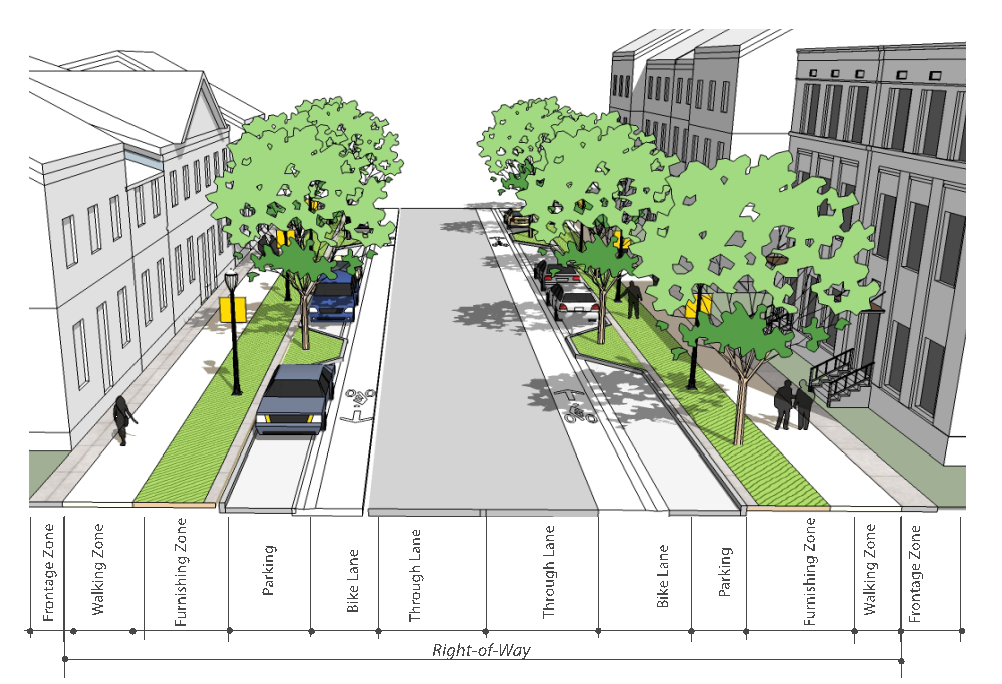
Figure 2, Pedestrian Street Design
The curb extension, also known as a bulb out, when provided, shall be designed to prevent any drainage issues between the parking stall and the adjacent bike lane.
(3)
Alleys, when designed are permitted within any subdistrict of the DT-MU.
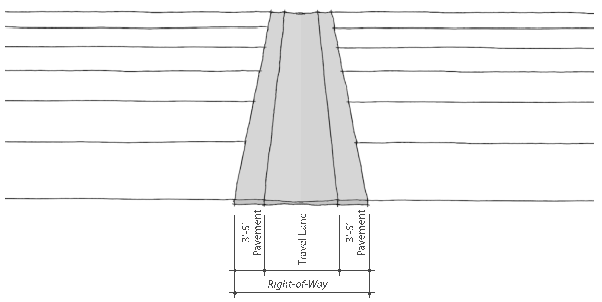
Figure 3, Alleyway Illustration
(Ord. No. 2017-115, § 3, 1-17-18)
Sec. 2501056. - Block length and perimeter.
The block length shall range, shall be established, by subdistrict and is as follows:
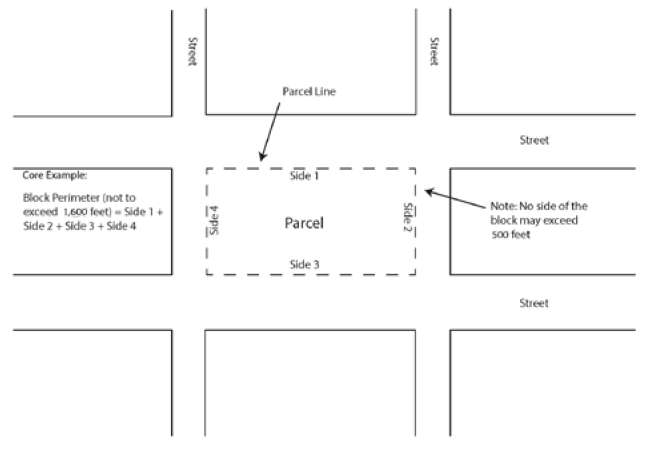
Figure 4, Block configuration (Core example)
(1)
Block perimeters may exceed the maximum block perimeter, up to one (1) block length, if one (1) or more of the following conditions apply:
(a)
The block is adjacent to a residentially zoned single-family district;
(b)
The Department of Transportation's minimum access standards, when applicable for the proposed street, require a larger block length; or
(c)
The block contains valuable natural features or significant historic resources that should not be crossed by a street as determined by the Development Services Department.
(Ord. No. 2017-115, § 3, 1-17-18)
Sec. 2501057. - Pedestrian network standards.
Pedestrian standards include two (2) components, circulation and design, in order to provide access to transit, neighborhoods and provide pedestrian connections to surrounding properties as illustrated in Figure 5.
(1)
The circulation and framework for the pedestrian standards are:
(a)
One (1) of the following types of pedestrian facilities shall be placed along each side of a block, if a roadway is not being constructed:
(i)
Continuous sidewalks, six (6) feet to twenty (20) feet in width, along roadways, alleys less than or equal to five hundred (500) feet in length; or
(ii)
Pass-throughs located at mid-block locations or at cul-de-sac heads; or
(iii)
Boardwalks; or
(iv)
Multi-use trails.
(b)
Pedestrian pathways and sidewalks shall be well lit and physically separated from driveways and parking spaces by landscaping, berms, barriers, grade separations, or other means to protect pedestrians from vehicular traffic.
(i)
A crosswalk shall be required when a sidewalk crosses a public driveway or a paved area accessible to vehicles.
(ii)
Whenever walkways are provided, raised crosswalks or other traffic-calming measures shall be used to slow traffic at points as approved by the city's traffic management team and/or fire marshal.
(iii)
Where sidewalks cross a lane of vehicle travel, sidewalks shall be located at all points where a walkway crosses the lane of vehicle travel.
(iv)
The pedestrian network shall provide direct pedestrian and bicycle pathways to surrounding buildings, adjacent parcels, all neighborhoods, public and private schools, and parks and recreational spaces greater than or equal to five (5) acres in size within a corridor.
(v)
The pedestrian network shall be in a connected block pattern throughout the developed area. Pedestrian connections to other facilities, internal to the development shall occur every five hundred (500) feet at a minimum.
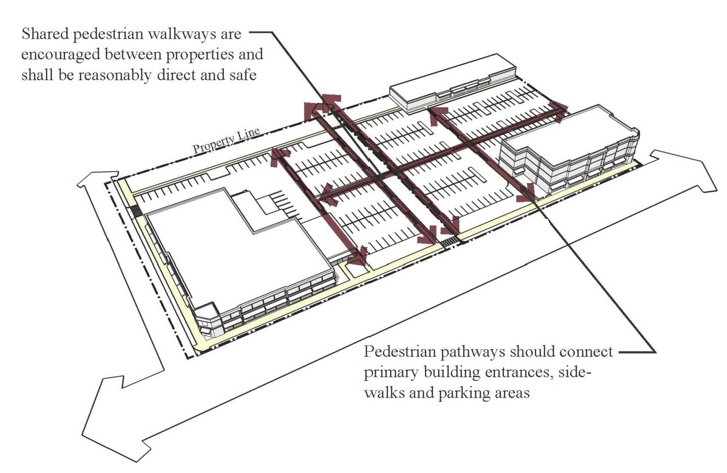
Figure 5, Pedestrian Standards
(Ord. No. 2017-115, § 3, 1-17-18)
Sec. 2501058. - Building typologies.
Building types are permitted within the DT-MU when new and/or redevelopment occurs on any parcel. The use of the building typologies is to be consistent with the size, scale and character desired within the DT-MU. The following building typologies are permitted, by area:
(1)
Building lot type assembly.
(a)
Additions, renovations and new buildings on existing built parcels, will require the assembly of at least one (1) permitted building type by area as permitted in this section. Parcels that can meet the minimum building lot size requirements are permitted to assemble more than one (1) building type.
(b)
Modifications to building lot types. If an applicant is expanding an existing building that predates this article and does not meet the minimum or maximum lot size requirements the development services director may remove the lot size requirements, if:
(i)
The use is permitted as outlined in section 2501052, uses permitted.
(ii)
The existing or proposed building and/or additions do not exceed the overall block requirements as provided in section 2501055, circulation standards.
(iii)
The overall design standards are met as outlined in section 2501061, general building standards.
(2)
Building type parameters. The following building lot type parameters are included in the table provided for each building type. Each standard is labeled by a letter (A, example) which directly relates to the table provided on each building type. Building types shall be consistently applied by and not permitted a variance to increase in building size, however, administrative zoning review committee may modify the standards as permitted in article IV, administrative zoning review committee and the relevant sections in this article. The categories for each building type parameter are described as follows:
(a)
Building Lot requirements: Provisions for minimum and maximums; lot depth, lot size and the permitted lot coverage and/or building footprint.
(b)
Building envelope: Provisions for the minimum and maximum setbacks permitted by front, side, and rear yards. The maximum and minimum frontage refers to the proportion of the lot width along which the primary building façade must be within the minimum and maximum front setback.
(c)
Accessory structure envelope: Provides the setbacks and maximum building footprints permitted for accessory structures.
(d)
Building height: Provisions for permitted heights in stories. The maximum height for first floor residential development shall be fourteen (14) feet and twenty (20) feet for non-residential. The maximum height for second story and higher shall not exceed twelve (12) feet. An applicant may be permitted to increase the maximum floor height if the overall maximum height, by building type is met. Each building lot typology provides the range of height appropriate for the building type.
(3)
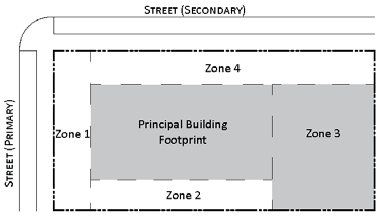
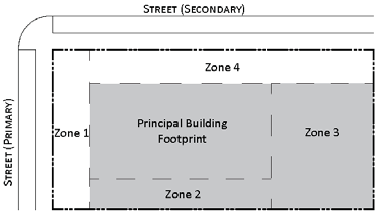
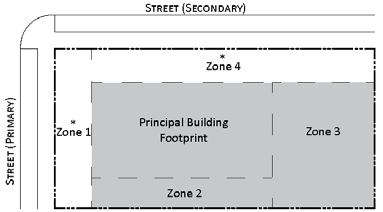
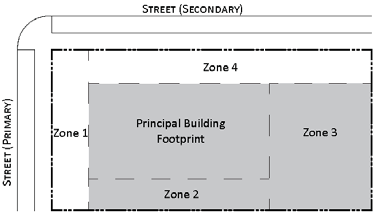
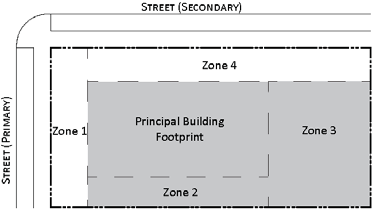
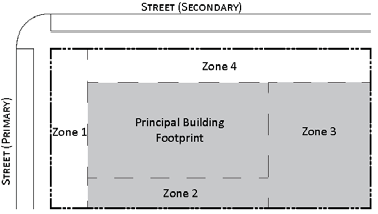
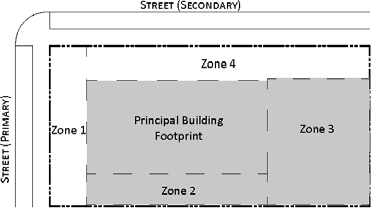
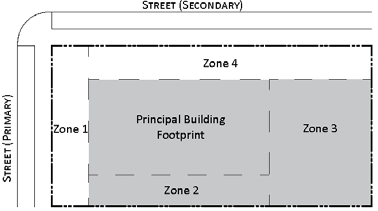
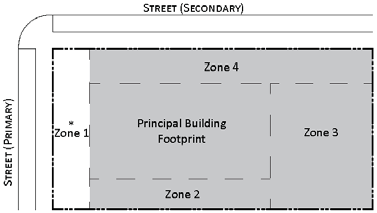
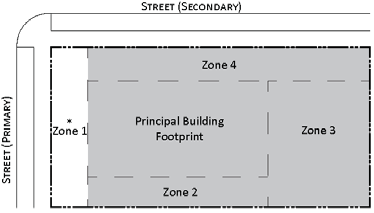
Parking provisions. The amount of parking shall be determined as outlined in section 2501062, parking. Parking provisions provide zones where parking is permitted. The parking zone refers to any uncovered parking area located on the parcel. Driveways are permitted in any zone provided the frontage requirements have been met as required by building type. The diagram illustrates a primary and secondary street. Primary streets are streets that are addressed to the parcel of land. Secondary streets may or may not have access to the parcel. Zones are defined and illustrated by the lot area between the principal building frontage and:
(a)
Zone 1: The right-of-way of any primary street.
(b)
Zone 2: Any common interior lot line.
(c)
Zone 3: Any rear lot line.
(d)
Zone 4: The right-of-way of any secondary street.
(e)
On corner lots, the street (front) shall be the street with the higher classification. If both streets are of equal classification, the street (front) shall be the street abutting the front lot line. On through lots, the director of development services or designee shall determine which street or streets function as primary streets and which function as secondary streets. Limited access roads abutting lots shall not be considered primary streets for purposes of this section.
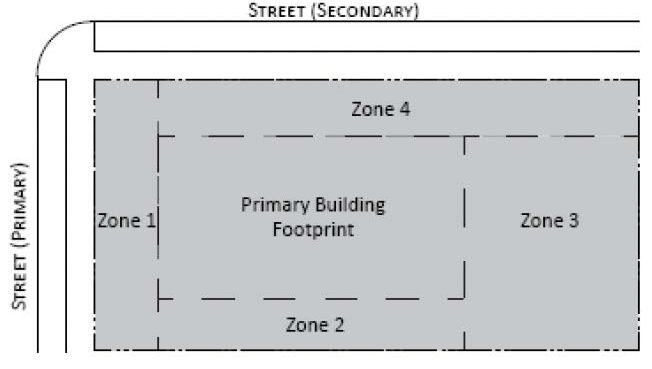
Figure 6, Parking Zone Illustration
(4)
Private frontages, refers to the area that is attached or integrated into the primary building. Each building type identifies the range of frontages permitted within that building type. If there are multiple frontages provided in the table, the applicant may choose what private frontage to provide per building. The private frontage area may count towards the calculation of the frontage build out requirement as identified in the regulating plan.
(Ord. No. 2017-115, § 3, 1-17-18)
Sec. 2501059. - DT-MU Building Type Table.
The following building types are permitted, by subdistrict as listed:
Key:
P, Permitted in the Subdistrict.
LP, Limited Permitted.
Mid-rise cannot exceed five (5) stories in height unless the building and lot size is located a minimum of two hundred fifty (250) feet from a single family residentially zoned district.
Blank Cell, is not permitted.
One (1) permitted with height limitations (refer to building type).
TH TOWNHOUSE
A building lot located and designed to accommodate a building with sidewalls on both side building lot lines and a private garden to the rear.
| LOT REQUIREMENTS | MIN | MAX | LOT REQUIREMENTS AND BUILDING ENVELOPE |
| A - Lot Width (ft.) | 15 | 25^ | 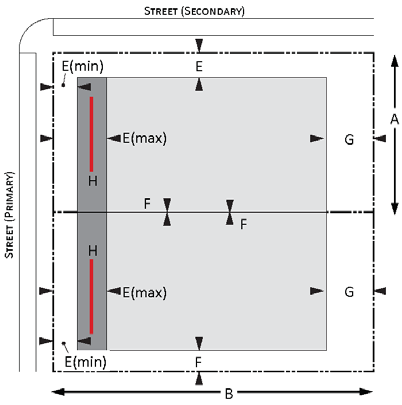 |
| B - Lot Depth (ft.) | 80 | 120 | |
| C - Lot Size (sf.) | 1,600 | 3,500 | |
| D - Lot Coverage (%) | — | 60 | |
| BUILDING ENVELOPE | MIN | MAX | |
| E - Street Setback (ft.) | Refer to specific street type for setback: | ||
| Sample Road | 10 | 25 | |
| University Drive | N/A | N/A | |
| Secondary Roads | 10 | 25 | |
| F - Side Setback (ft.) | 0*, ** | — | |
| G - Rear Setback (ft.) | 15 | — | |
| H - Frontage Buildout (%) | Regulating Plan | ||
| ACC STR ENVELOPE | MIN | MAX | |
| I - Street Setback (ft.) | 30 | ACCESSORY STRUCTURE ENVELOPE | |
| J - Side Setback (ft.) | 10 | -- | 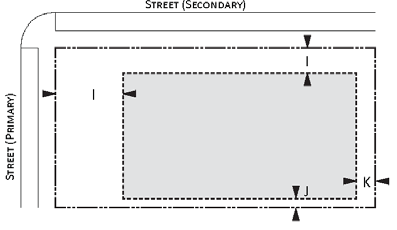 |
| K - Rear Setback (ft.) | 10 | — | |
| L - Building Footprint (sf.) | — | 800 | |
| BUILDING HEIGHT | MIN | MAX | |
| M - Principal Building (st.) | 1 | 3 | |
| N - Accessory Structure(s) (ft.) | — | 30 | |
| PARKING PROVISIONS | |||
| Location | Zone 3 | BUILDING HEIGHT | |
| PRIVATE FRONTAGES | 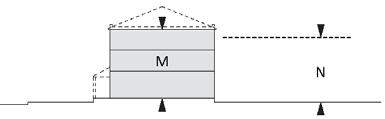 | ||
| Required | P, S | ||
| ^ End Unit may be up to 10'. | |||
| *10' Separation required from adjacent detached building. | |||
| ** No more than 8 units may be attached without an additional side setback of 20'. | PARKING LOCATION | ||
 | |||
MS MULTI-PLEX SMALL
A building lot type is a medium structure that consists of 3-6 side and/or stacked dwelling units typically with one shared entry of individual entries along the front. This type has the appearance of a medium-sized family home that occupies most of its building lot width and is setback from the sidewalk.
| LOT REQUIREMENTS | MIN | MAX | LOT REQUIREMENTS AND BUILDING ENVELOPE |
| A - Lot Width (ft.) | 40 | 70 | 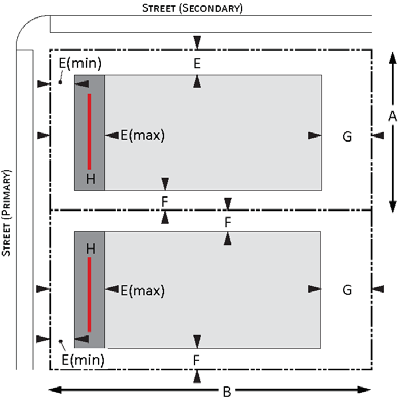 |
| B - Lot Depth (ft.) | 100 | 140 | |
| C - Lot Size (sf.) | 4,000 | 9,800 | |
| D - Lot Coverage (%) | — | 70 | |
| BUILDING ENVELOPE | MIN* | MAX | |
| E - Street Setback (ft.) | Refer to specific street type for setback: | ||
| Sample Road | 10 | 20 | |
| University Drive | 10 | 20 | |
| Secondary Roads | 10 | 20 | |
| F - Side Setback (ft.) | 0* | — | |
| G - Rear Setback (ft.) | 10** | — | |
| H - Frontage Buildout (%) | Regulating Plan | ||
| ACC STR ENVELOPE | MIN | MAX | |
| I - Street Setback (ft.) | 30 | ACCESSORY STRUCTURE ENVELOPE | |
| J - Side Setback (ft.) | 10 | -- | 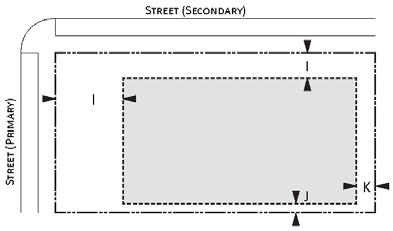 |
| K - Rear Setback (ft.) | 10 | — | |
| L - Building Footprint (sf.) | — | 800 | |
| BUILDING HEIGHT | MIN | MAX | |
| M - Principal Building (st.) | 1 | 3 | |
| N - Accessory Structure(s) (ft.) | — | 30 | |
| PARKING PROVISIONS | |||
| Location | Zones 2 and 3 | BUILDING HEIGHT | |
| PRIVATE FRONTAGES | 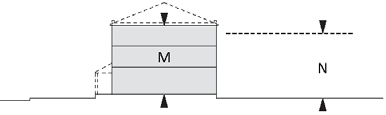 | ||
| Required | P, F, S | ||
| *10' Separation required from adjacent detached building. | |||
| ** When adjacent to single family zoning, the rear setback must be a minimum of 25'. | |||
| PARKING LOCATION | |||
 | |||
| *Zone 1 permitted in existing conditions only. | |||
MM MULTI-PLEX MEDIUM
A building lot that a medium to large type structure that consists of 7—12 side and/or stacked dwelling units typically with one shared entry of individual entries along the front. This type has the appearance of an estate home that occupies most of its building lot width and is placed close to the sidewalk.
| LOT REQUIREMENTS | MIN | MAX | LOT REQUIREMENTS AND BUILDING ENVELOPE |
| A - Lot Width (ft.) | 80 | 120 | 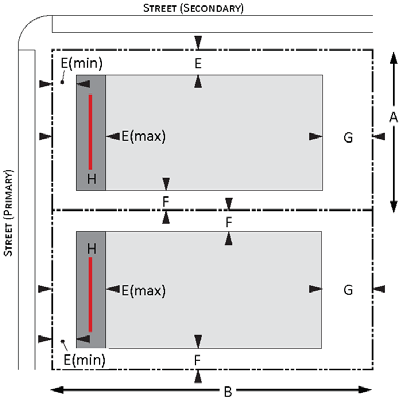 |
| B - Lot Depth (ft.) | 80 | 180 | |
| C - Lot Size (sf.) | 9,000 | 20,000 | |
| D - Lot Coverage (%) | — | 80 | |
| BUILDING ENVELOPE | MIN | MAX | |
| E - Street Setback (ft.) | Refer to specific street type for setback: | ||
| Sample Road | 10 | 20 | |
| University Drive | 10 | 20 | |
| Secondary Roads | 10 | 20 | |
| F - Side Setback (ft.) | 0* | 10 | |
| G - Rear Setback (ft.) | 10* | — | |
| H - Frontage Buildout (%) | Regulating Plan | ||
| ACC STR ENVELOPE | MIN | MAX | |
| I - Street Setback (ft.) | 30 | ACCESSORY STRUCTURE ENVELOPE | |
| J - Side Setback (ft.) | 10 | -- | 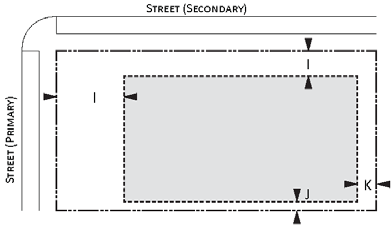 |
| K - Rear Setback (ft.) | 10 | — | |
| L - Building Footprint (sf.) | — | 800 | |
| BUILDING HEIGHT(1) | MIN | MAX | |
| M - Principal Building (st.) | 2 | 4 | |
| N - Accessory Structure(s) (ft.) | — | 30 | |
| PARKING PROVISIONS | |||
| Location | Zones 2 and 3 | BUILDING HEIGHT | |
| PRIVATE FRONTAGES | 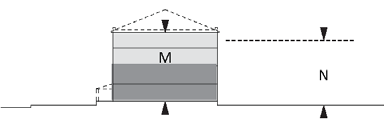 | ||
| Required | P, F, S | ||
| * When adjacent to single family zoning, the rear setback must be a minimum of 25'. | |||
| PARKING LOCATION | |||
 | |||
| *Zone 1 permitted in existing conditions only. | |||
ML MULTI-PLEX LARGE
A building lot that a medium to large type structure that consists of 13—20 side and/or stacked dwelling units typically with one shared entry of individual entries along the front. This type has the appearance of an estate home that occupies most of its building lot width and is placed close to the sidewalk.
| LOT REQUIREMENTS | MIN | MAX | LOT REQUIREMENTS AND BUILDING ENVELOPE |
| A - Lot Width (ft.) | 40 | 150 | 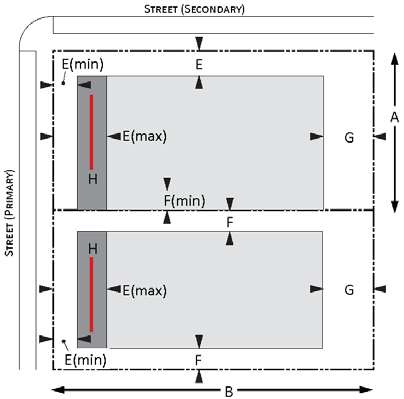 |
| B - Lot Depth (ft.) | 100 | 300 | |
| C - Lot Size (sf.) | 4,000 | 40,000 | |
| D - Lot Coverage (%) | — | 90 | |
| BUILDING ENVELOPE | MIN | MAX | |
| E - Street Setback (ft.) | Refer to specific street type for setback: | ||
| Sample Road | 10 | 20 | |
| University Drive | 10 | 20 | |
| Secondary Roads | 10 | 20 | |
| F - Side Setback (ft.) | 5 | — | |
| G - Rear Setback (ft.) | 15 | — | |
| H - Frontage Buildout (%) | Regulating Plan | ||
| ACC STR ENVELOPE | MIN | MAX | |
| I - Street Setback (ft.) | 30 | ACCESSORY STRUCTURE ENVELOPE | |
| J - Side Setback (ft.) | 10 | -- | 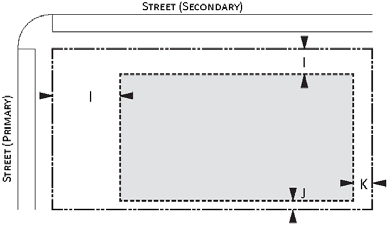 |
| K - Rear Setback (ft.) | 10 | — | |
| L - Building Footprint (sf.) | — | 800 | |
| BUILDING HEIGHT | MIN | MAX | |
| M - Principal Building (st.) | 2 | 5 | |
| N - Accessory Structure(s) (ft.) | — | 30 | |
| PARKING PROVISIONS | |||
| Location | Zones 2 and 3 | BUILDING HEIGHT | |
| PRIVATE FRONTAGES | 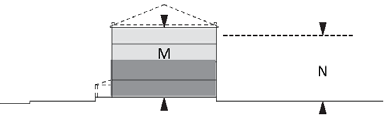 | ||
| Required | P, F, S | ||
| PARKING LOCATION | |||
 | |||
| *Zone 1 permitted in existing conditions only. | |||
CS COMMERCIAL/MIXED-USE-SMALL
A building lot located and designed to accommodate a multistory building with commercial, office and/or multiple dwellings in any story that is designed for smaller lot sizes.
| LOT REQUIREMENTS | MIN | MAX | LOT REQUIREMENTS AND BUILDING ENVELOPE |
| A - Lot Width (ft.) | 16 | 60 | 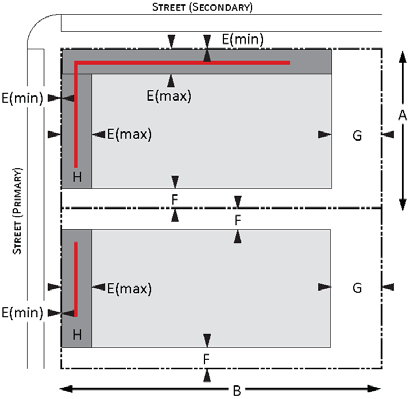 |
| B - Lot Depth (ft.) | 80 | 140 | |
| C - Lot Size (sf.) | 1,280 | 8,400 | |
| D - Lot Coverage (%) | — | 90 | |
| BUILDING ENVELOPE | MIN | MAX | |
| E - Street Setback (ft.) | Refer to specific street type for setback: | ||
| Sample Road | 10 | 30 | |
| University Drive | 10 | 20 | |
| Secondary Roads | 10 | 20 | |
| F - Side Setback (ft.) | 0 | 6 | |
| G - Rear Setback (ft.) | 5* | — | |
| H - Frontage Buildout (%) | Regulating Plan | ||
| ACC STR ENVELOPE | MIN | MAX | |
| I - Street Setback (ft.) | 30 | ACCESSORY STRUCTURE ENVELOPE | |
| J - Side Setback (ft.) | 10 | -- | 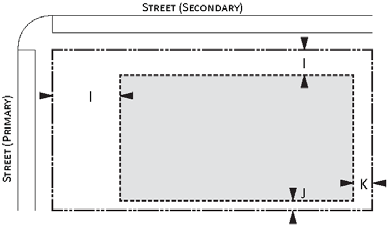 |
| K - Rear Setback (ft.) | 10 | — | |
| L - Building Footprint (sf.) | — | 800 | |
| BUILDING HEIGHT | MIN | MAX | |
| M - Principal Building (st.) | 2 | 4 | |
| N - Accessory Structure(s) (ft.) | — | 30 | |
| PARKING PROVISIONS | |||
| Location | Zones 2 and 3 | BUILDING HEIGHT | |
| PRIVATE FRONTAGES | 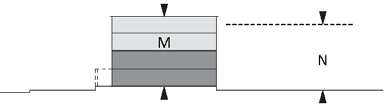 | ||
| Required | C | ||
| *When adjacent to single family zoning, the rear setback must be a minimum of 25'. | |||
| PARKING LOCATION | |||
 | |||
CM COMMERCIAL/MIXED-USE-MEDIUM
A building lot located and designed to accommodate a multistory building with commercial, office and/or multiple dwellings in any story that is designed for average lot sizes.
| LOT REQUIREMENTS | MIN | MAX | LOT REQUIREMENTS AND BUILDING ENVELOPE |
| A - Lot Width (ft.) | 60 | 120 | 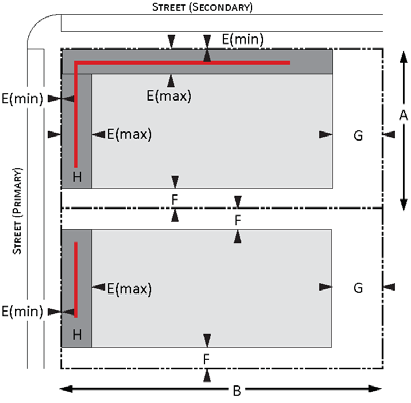 |
| B - Lot Depth (ft.) | — | 500 | |
| C - Lot Size (sf.) | — | 150,000 | |
| D - Lot Coverage (%) | — | 90 | |
| BUILDING ENVELOPE | MIN | MAX | |
| E - Street Setback (ft.) | Refer to specific street type for setback: | ||
| Sample Road | 10 | 30 | |
| University Drive | 0 | 20 | |
| Secondary Roads | 10 | 20 | |
| F - Side Setback (ft.) | 0 | — | |
| G - Rear Setback (ft.) | 10* | — | |
| H - Frontage Buildout (%) | Regulating Plan | ||
| ACC STR ENVELOPE | MIN | MAX | |
| I - Street Setback (ft.) | 30 | ACCESSORY STRUCTURE ENVELOPE | |
| J - Side Setback (ft.) | 10 | -- | 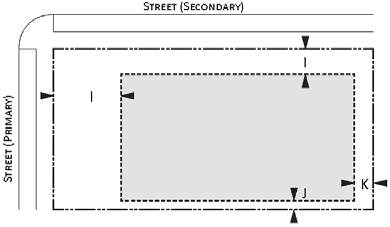 |
| K - Rear Setback (ft.) | 10 | — | |
| L - Building Footprint (sf.) | — | 800 | |
| BUILDING HEIGHT | MIN | MAX | |
| M - Principal Building (st.) | 2 | 5** | |
| N - Accessory Structure(s) (ft.) | — | 30 | |
| PARKING PROVISIONS | |||
| Location | Zones 2 and 3 | BUILDING HEIGHT | |
| PRIVATE FRONTAGES | 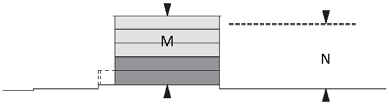 | ||
| Required | C | ||
| *When adjacent to single family zoning, the rear setback must be a minimum of 25'. | |||
| **If adjacent to a single family residential zoning district and within the edge district, this building type may not exceed 4 stories in height. | |||
| PARKING LOCATION | |||
 | |||
MR MID-RISE
This building type is a medium to large sized structure, 4—8 stories tall, built on a large lot that typically incorporates structured parking. It can be used to provide a vertical mix of uses with ground-floor retail, or service uses and upper-floor service, or residential uses; or may be a single-use building, typically service or residential. This type is a primary component of an urban downtown providing high-density buildings.
| LOT REQUIREMENTS | MIN | MAX | LOT REQUIREMENTS AND BUILDING ENVELOPE |
| A - Lot Width (ft.) | 120 | 300 | 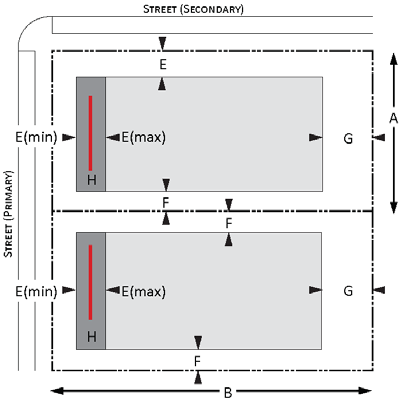 |
| B - Lot Depth (ft.) | — | 500 | |
| C - Lot Size (sf.) | — | 150,000 | |
| D - Lot Coverage (%) | — | 90 | |
| BUILDING ENVELOPE | MIN | MAX | |
| E - Street Setback (ft.) | Refer to specific street type for setback: | ||
| Sample Road | 5 | 30 | |
| University Drive | 10 | 20 | |
| Secondary Roads | 5 | 15 | |
| F - Side Setback (ft.) | 0 | — | |
| G - Rear Setback (ft.) | 10 | — | |
| H - Frontage Buildout (%) | Regulating Plan | ||
| ACC STR ENVELOPE | MIN | MAX | |
| I - Street Setback (ft.) | N/A | N/A | ACCESSORY STRUCTURE ENVELOPE |
| J - Side Setback (ft.) | N/A | N/A | 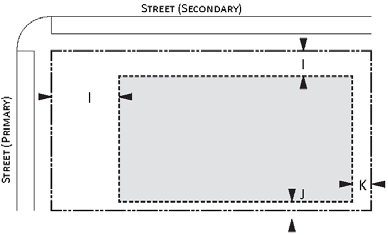 |
| K - Rear Setback (ft.) | N/A | N/A | |
| L - Building Footprint (sf.) | N/A | N/A | |
| BUILDING HEIGHT | MIN | MAX | |
| M - Principal Building (st.) | 4 | 8 | |
| N - Accessory Structure(s) (ft.) | — | — | |
| PARKING PROVISIONS | |||
| Location | Zones 2 and 3 | BUILDING HEIGHT | |
| PRIVATE FRONTAGES | 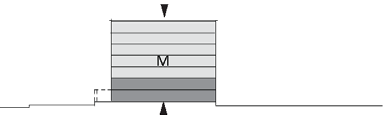 | ||
| Required | C | ||
| PARKING LOCATION | |||
 | |||
HR HIGH-RISE
The High-Rise building lot is a large sized structure with portions or all of the building more than eight stories tall, built on a large lot that typically incorporates structured parking. It is used to provide a vertical mix of uses with ground-floor retail, or service uses and upper-floor service, or residential uses. This type is a primary component of an urban downtown providing high-density buildings.
| LOT REQUIREMENTS | MIN | MAX | LOT REQUIREMENTS AND BUILDING ENVELOPE |
| A - Lot Width (ft.) | 120 | 450 | 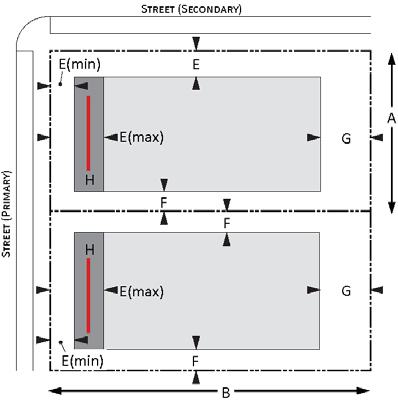 |
| B - Lot Depth (ft.) | 200 | 450 | |
| C - Lot Size (sf.) | 24,000 | 202,500 | |
| D - Lot Coverage (%) | — | 90 | |
| BUILDING ENVELOPE | MIN | MAX | |
| E - Street Setback (ft.) | Refer to specific street type for setback: | ||
| Sample Road | 15 | ||
| University Drive | 15 | 20 | |
| Secondary Roads | 10 | 20 | |
| F - Side Setback (ft.) | 0 | — | |
| G - Rear Setback (ft.) | 10 | — | |
| H - Frontage Buildout (%) | Regulating Plan | ||
| ACC STR ENVELOPE | MIN | MAX | |
| I - Street Setback (ft.) | N/A | N/A | ACCESSORY STRUCTURE ENVELOPE |
| J - Side Setback (ft.) | N/A | N/A | 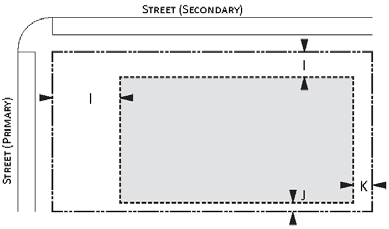 |
| K - Rear Setback (ft.) | N/A | N/A | |
| L - Building Footprint (sf.) | N/A | N/A | |
| BUILDING HEIGHT | MIN | MAX | |
| M - Principal Building (st.) | 4 | ||
| N - Accessory Structure(s) (ft.) | — | — | |
| PARKING PROVISIONS | |||
| Location | Zones 2 and 3 | BUILDING HEIGHT | |
| PRIVATE FRONTAGES | 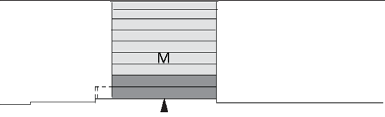 | ||
| Required | C | ||
| PARKING LOCATION | |||
 | |||
SC SINGLE STORY COMMERCIAL BUILDING
A building lot located and designed to accommodate single use office and retail.
| LOT REQUIREMENTS | MIN | MAX | LOT REQUIREMENTS AND BUILDING ENVELOPE |
| A - Lot Width (ft.) | 50 | 300 | 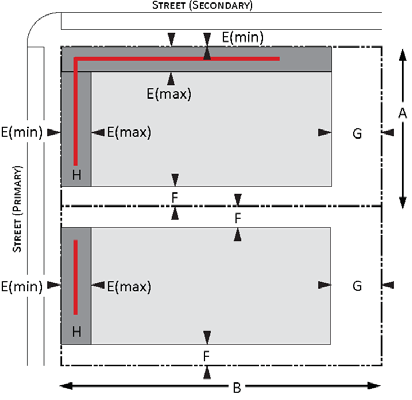 |
| B - Lot Depth (ft.) | 100 | 300 | |
| C - Lot Size (sf.) | 7,500 | 90,000 | |
| D - Lot Coverage (%) | — | 60 | |
| BUILDING ENVELOPE | MIN | MAX | |
| E - Street Setback (ft.) | Refer to specific street type for setback: | ||
| Sample Road | 10 | 50 | |
| University Drive | 0 | 50 | |
| Secondary Roads | 10 | 20 | |
| F - Side Setback (ft.) | 0 | — | |
| G - Rear Setback (ft.) | 15 | — | |
| H - Frontage Buildout (%) | Regulating Plan | ||
| ACC STR ENVELOPE | MIN | MAX | |
| I - Street Setback (ft.) | 30 | ACCESSORY STRUCTURE ENVELOPE | |
| J - Side Setback (ft.) | 10 | -- | 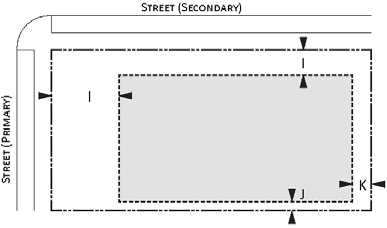 |
| K - Rear Setback (ft.) | 10 | — | |
| L - Building Footprint (sf.) | — | 800 | |
| BUILDING HEIGHT | MIN | MAX | |
| M - Principal Building (st.) | 1 | 1 | |
| N - Accessory Structure(s) (ft.) | — | 30 | |
| PARKING PROVISIONS | |||
| Location | Zones 2, 3 and 4 | BUILDING HEIGHT | |
| PRIVATE FRONTAGES | 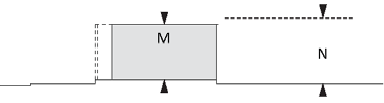 | ||
| Required | C | ||
| PARKING LOCATION | |||
 | |||
| *Zone 1 allowed in (going to permit in existing conditions) | |||
CV CIVIC-INSTITUTION
A building lot located and designed to accommodate a building containing public or civic uses such as community services, day care, education, government, places of worship, or social services.
| LOT REQUIREMENTS | MIN | MAX | LOT REQUIREMENTS AND BUILDING ENVELOPE |
| A - Lot Width (ft.) | Established by max. block length | 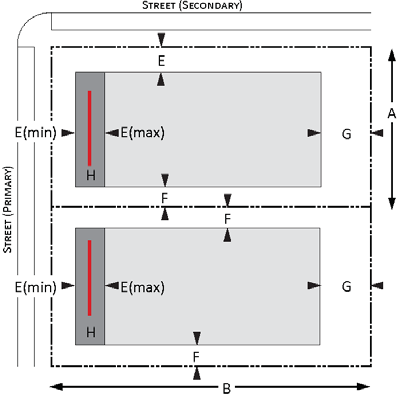 | |
| B - Lot Depth (ft.) | — | — | |
| C - Lot Size (sf.) | — | — | |
| D - Lot Coverage (%) | — | 90 | |
| BUILDING ENVELOPE | MIN | MAX | |
| E - Street Setback (ft.) | Refer to specific street type for setback: | ||
| Sample Road | 10 | 30 | |
| University Drive | 0 | 20 | |
| Secondary Roads | 0 | 30 | |
| F - Side Setback (ft.) | 10 | — | |
| G - Rear Setback (ft.) | 15 | — | |
| H - Frontage Buildout (%) | Regulating Plan | ||
| ACC STR ENVELOPE | MIN | MAX | |
| I - Street Setback (ft.) | 30 | ACCESSORY STRUCTURE ENVELOPE | |
| J - Side Setback (ft.) | 10 | -- | 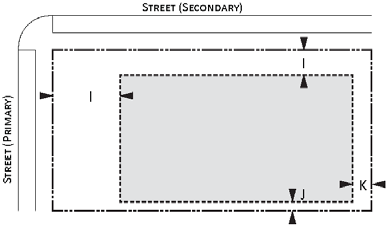 |
| K - Rear Setback (ft.) | 10 | — | |
| L - Building Footprint (sf.) | — | 800 | |
| BUILDING HEIGHT | MIN | MAX | |
| M - Principal Building (st.) | 1 | * | |
| N - Accessory Structure(s) (ft.) | — | 30 | |
| PARKING PROVISIONS | |||
| Location | Zones 2, 3 and 4 | BUILDING HEIGHT | |
| PRIVATE FRONTAGES | 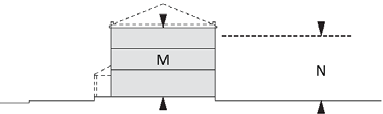 | ||
| Required | None | ||
| *Maximum building shall be consistent with the max. building heights permitted within the subdistrict. | |||
| PARKING LOCATION | |||
 | |||
P PORCH
The facade is set back from the front lot line per applicable street setback requirements. The facade includes an attached front porch structure. A wide variety of porch designs are possible.
| FRONTAGE ZONE (FZ) | MIN | MAX | FRONTAGE ZONE AND INTERFACE ZONE DIMENSIONS |
| Porch structure requirements: | 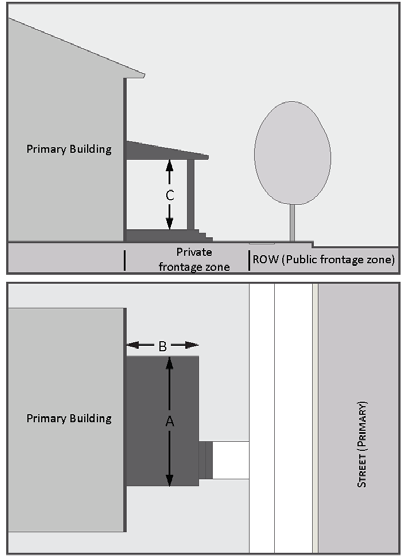 | ||
| A - Width (clear) (ft.) | 10 | — | |
| B - Depth (clear) (ft.) | 5 | — | |
| C - Height (clear) (ft.) | 7 | — | |
| INTERFACE ZONE (IZ) | |||
S STOOP
The facade is set back from the front lot line per applicable street setback requirements. The facade includes an attached entry stoop (an elevated landing with stairs) that is placed at or near the front lot line. The ground floor is elevated to provide privacy. The stoop may include a roof.
| FRONTAGE ZONE (FZ) | MIN | MAX | FRONTAGE ZONE DIMENSIONS |
| Stoop structure requirements: | 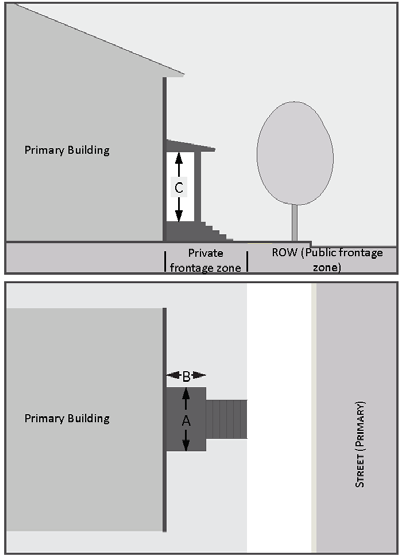 | ||
| A - Width (clear) (ft.) | 5 | 10 | |
| B - Depth (clear) (ft.) | 3 | 8 | |
| C - Height (clear) (ft.) | 7 | — | |
| INTERFACE ZONE (IZ) | |||
| Landscape with path (3' wide min.) from sidewalk to structure. | |||
F FORECOURT
The facade is set back from the front lot line per applicable street setback requirements. A portion of the facade is recessed to form an uncovered court. The court is suitable for outdoor dining, gardens, vehicle drop-offs, formal entries etc. A fence or wall may be used to define the private space of the court. The court may be elevated behind a retaining wall at or near the front lot line with entry steps to the court.
| FRONTAGE ZONE (FZ) | MIN | MAX | FRONTAGE ZONE AND INTERFACE ZONE DIMENSIONS |
| Courtyard requirements: | 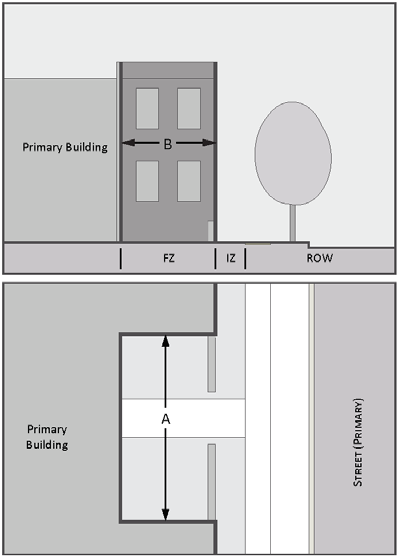 | ||
| A - Width (clear) (ft.) | 12 | — | |
| B - Depth (clear) (ft.) | 12 | 50 | |
| INTERFACE ZONE (IZ) | |||
| Landscape with path (6' wide min.) from sidewalk to structure. | |||
| OTHER REQUIREMENTS | |||
C COMMERCIAL
The facade is set back from the front lot line per applicable street setback requirements, typically at or near the front lot line with the entrance at sidewalk grade. The facade may include an awning, shed roof, or gallery (a lightweight colonnade with no habitable building space above it) that covers the sidewalk and may extend into the right-of-way. The facade has a substantial amount of glazing at the sidewalk level. Recessed entrances are acceptable.
| FRONTAGE ZONE (FZ) | MIN | MAX | FRONTAGE ZONE AND INTERFACE ZONE DIMENSIONS |
| Building facade requirements: | 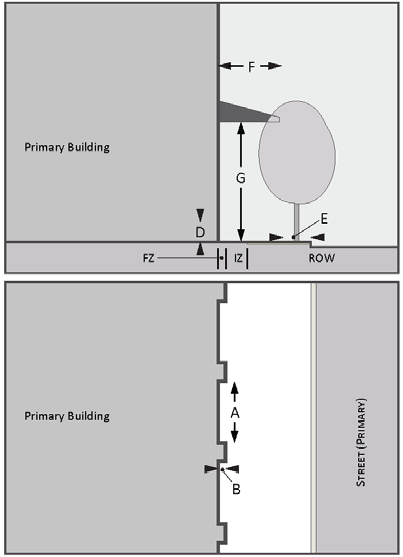 | ||
| A - Distance between openings (ft.) | — | 20 | |
| B - Door recess (ft.) | — | 5 | |
| C - Ground floor transparency (%) | 60 | — | |
| D - Height to bottom of window (ft.) | — | 2.5 | |
| INTERFACE ZONE (IZ) | |||
| Extended sidewalk from right-of-way edge to structure | |||
| OPTIONAL ELEMENTS | MIN | MAX | |
| AWNING OR GALLERY | |||
| E - Setback from curb (ft.) | 2 | — | |
| F - Depth (clear) (ft.)* (Gallery min. 8') | 4 | 10 | |
| G - Height (clear) (ft.) | 8 | — | |
| OTHER REQUIREMENTS | |||
Additional Standards for Mid-Rise and High-Rise Building Types
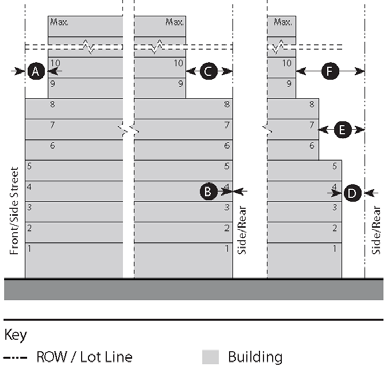 | A. High-Rise/Mid-Rise Building | ||
| Front/Side Street Setback | |||
| Floors 9+ | 10' min. |  | |
| Side/Rear Setback | |||
| Abutting Core | |||
| Floors 1—8 | 0' min. |  | |
| Floors 9+ | 30' min. |  | |
| Abutting General | |||
| Floors 1—5 | 0' min. |  | |
| Floors 6—8 | 10' min. |  | |
| Floors 9+ | 30' min. |  | |
| Abutting Edge | |||
| Floors 1—5 | 10'min. | | |
| Floors 6—8 | 20' min. | | |
| Floors 9+ | 30' min. | | |
Sec. 2501060. - Landscape requirements.
(1)
Landscape buffers between land uses within the DT-MU:
(a)
Control of redevelopment land uses and emphasis on mixed use development simplifies the requirements for buffers between adjacencies. Buffers shall apply only when the DT-MU area is adjacent to existing residential neighborhoods that require buffering from non-residential land uses as outlined in article IX, minimum landscape standards of the city's land development code for business districts.
(2)
Front buffers:
(a)
Any building utilizing a setback of thirty (30) feet or greater shall defer to the landscape standards in article IX, minimum landscape standards of the city's land development code for business districts.
(3)
Furnishing zones and landscape standards:
(a)
When an applicant has added additional streets as outlined in this article, the furnishing zones shall meet the required landscaping for any buildings fronting the street.
(b)
Furnishing zones shall provide, at a minimum, the following standards:
(i)
A minimum six-foot wide landscape area that includes:
a.
Canopy trees. One (1) canopy tree shall be located for every thirty (30) linear feet (or majority portion thereof) of building frontage that is located within the furnishing zone as identified in section 2501055, circulation standards. Canopy trees shall be of a species with a mature crown spread that will not conflict with the building roof, awnings or other façade projections. Canopy trees in pedestrian areas shall be installed with a minimum five-foot clear trunk, and shall be maintained, following establishment at a minimum six-foot clear trunk.
b.
Canopy tree planting area shall conform to the following standards:
i.
Canopy tree in sidewalk planter: A minimum of a five-foot by five-foot planter or sidewalk cut-out shall be provided for the installation of the canopy tree. This planter shall be installed with low shrubs or groundcover planting to provide one hundred (100) percent coverage of the area within one (1) growing season. For any planter measuring less than two hundred (200) square feet, additional soil volume shall be provided under the adjacent paving in the form of structured soils, cell systems or other approved soil volume extenders, to a minimum total area of six hundred (600) cubic feet (two hundred (200) square feet by three (3) feet depth).
ii.
Canopy tree in tree grate: Canopy trees may be installed in tree pits with a pedestrian grate. Tree grates shall be ADAAG compliant and shall contain design features that allow the tree ring to expand with the growth of the tree. Additional soil volume shall be provided under the adjacent paving in the form of structured soils, cell systems or other approved soil volume extenders, to a minimum total area of six hundred (600) cubic feet (two hundred (200) square feet by three (3) feet depth).
iii.
Canopy tree in landscape area. Canopy trees that are installed in open landscape areas or landscape islands with an area of four hundred (400) square feet or more do not require soil volume extension measures. Shrub and groundcover requirements for these landscape areas shall be per landscape buffer requirements or Vehicular Use Area requirements as applicable to the site plan layout.
c.
Planters, when designed, shall permit breaks for pedestrian access to the sidewalk (walk zone).
d.
Benches and trash receptacles shall be required and frequency will be determined during site plan review.
e.
Bicycle racks may also be located in the furnishing zone.
(Ord. No. 2017-115, § 3, 1-17-18)
Sec. 2501061. - General design standards.
The following standards apply to all buildings that are located within a Mixed-Use development area:
(1)
Height when adjacent to residential area(s).
(a)
Regardless of permitted heights, by building types, no building type may exceed four (4) stories when directly adjacent to existing or planned single family residential. Additional height will be permitted as follows
i.
For each one hundred (100) feet of distance from a parcel line, and/or alleyway or canal, a building may have one (1) additional story, not to exceed the maximum story permitted, by building type(s).
(2)
Parking garage.
(a)
Direct pedestrian access from parking garages to each adjacent street shall be provided.
(b)
The exterior facades of all parking garages fronting on any street shall be designed to achieve an architectural unity with the block.
(c)
Parking garages facing a street shall have the ground floor developed with enclosed residential, commercial or civic floor space to a minimum building depth of thirty (30) feet along the entire length of the structure on each street frontage, unless separated from the street or driveway by another building, parking lot and/or landscaped open space with a minimum depth of twenty (20) feet.
(d)
Parking garages shall comply with all building design standards for building façade, mass and scale, building features and lighting as described in this section. Inside garage light source shall be screened.
(3)
Drive-through facilities, when permitted must be designed as outlined:
(a)
Drive-through facilities shall only be located at the rear of a building as illustrated in Figure 7.
(b)
In the event that a rear drive-through location is impossible due to site constraints, then a side drive-through is permissible provided that all of the following requirements are met:
i.
The drive-through facilities shall be screened to minimize visual and noise impacts to residences and to preclude visibility from any streets or sidewalks. A masonry wall and landscape buffer shall screen drive-through facilities. The wall shall be one (1) foot higher not to exceed eight (8) feet in height than the facilities being screened on all sides where access is not needed.
ii.
No portion of queuing or access lanes or driveways shall be located between the building and the street or within forty (40) feet from the primary façade of the building.
iii.
For corner lots, the drive-through shall be located on the side of the building that is furthest from the corner.
(c)
Gas station pumps shall be located at the side or rear of the primary building and may not be visible to the street or sidewalk.
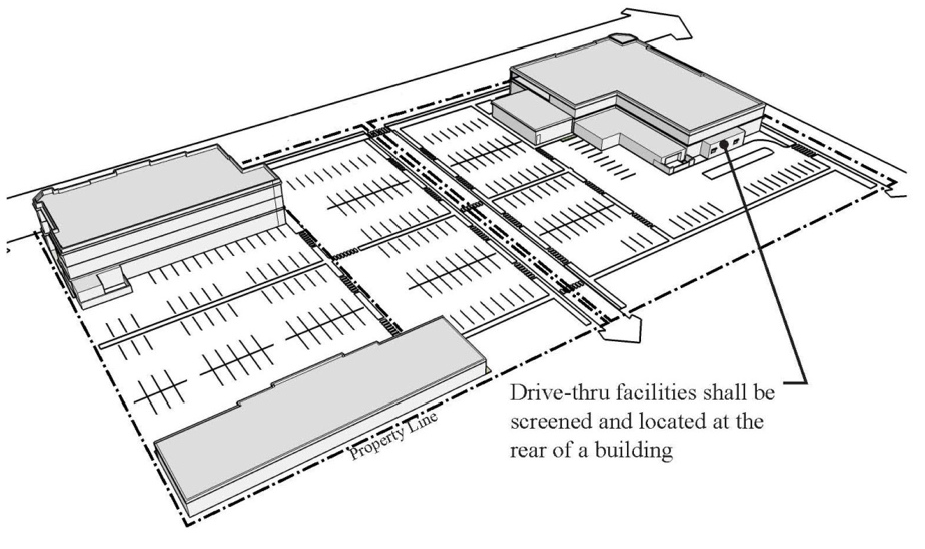
Figure 7, Drive-Through facilities
(4)
Screening requirements.
(a)
Loading docks, truck parking, outdoor storage, utility meters, HVAC equipment, trash dumpsters, trash compactors, and other service functions shall not be visible from any street or sidewalk or adjacent residential area as illustrated in Figure 8. These facilities may be incorporated into the overall design of the principal building using screening walls of compatible material, style, color, texture, pattern, trim and details whether these service functions are attached or detached from the principal building.
(b)
The screening wall shall be one (1) foot higher than the largest object being screened, but not more than ten (10) feet high, on all sides where access is not needed and no higher than eight (8) feet when the area being screened is adjacent to existing single family zoned area(s) planned or built. An opaque gate, with the same height as the wall, shall be included where access is needed.
(c)
Building equipment at ground level shall be placed on the parking lot side of the building away from view from any streets, sidewalks and residential areas. The mechanical equipment shall be screened from view by fencing, vegetation, or parapet walls (if located on a roof) using the same materials as the principal building, i.e., stone, brick or stucco. The screening shall be at least equal to the width and height of the equipment to be screened from view.
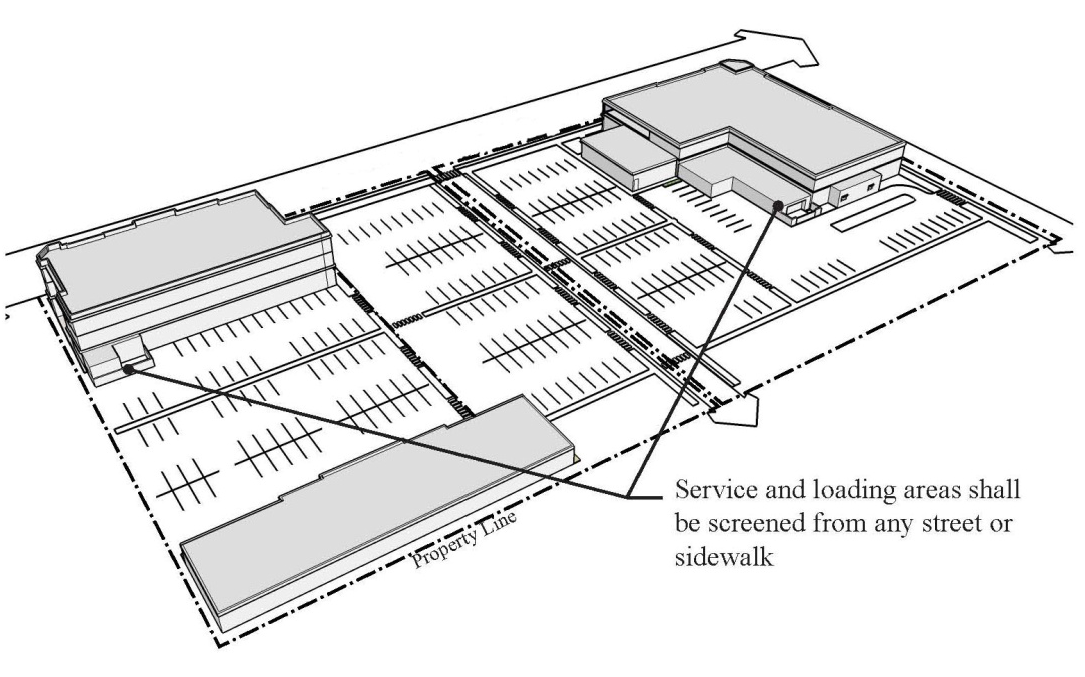
Figure 8, Screening Areas
(5)
Building façade.
(a)
Buildings shall provide a foundation or base, typically from ground to bottom of the lower windowsills, with changes in volume or material as illustrated in Figure 9. A clear visual division shall be maintained between the ground level floor and upper floors with either a cornice line or awning from twelve (12) feet to sixteen (16) feet above base floor elevation or grade, whichever height applies to the proposed development.
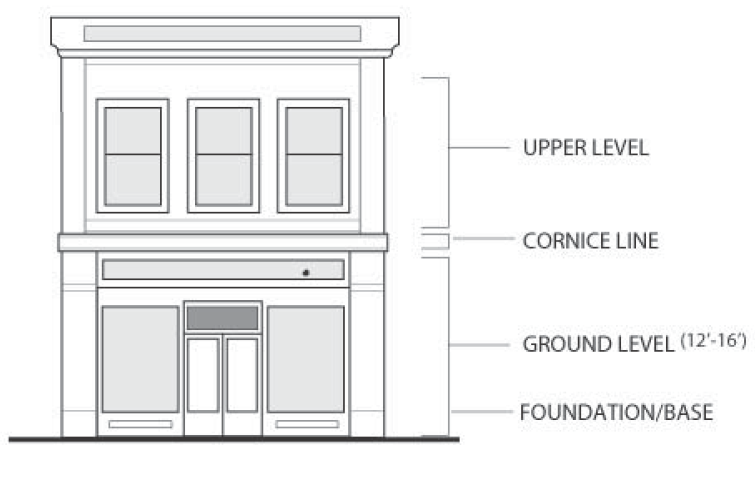
Figure 9, Building Facade
(6)
Building features.
(a)
All buildings shall utilize at least three (3) of the following design features to provide visual relief along all elevations of the building as illustrated in Figure 10 and Figure 11:
i.
Divisions or breaks in materials or textures (materials should be drawn from a common palette).
ii.
Window bays.
iii.
Separate entrances and entry treatments, porticoes extending at least five (5) feet.
iv.
Variation in roof lines.
v.
Arcades.
vi.
Awnings installed in increments of fifteen (15) feet or less.
vii.
Dormers.
viii.
Canopies, extending at least five (5) feet.
ix.
Overhang, extending at least five (5) feet.
x.
Recessed entries (at least three (3) feet from the primary façade).
xi.
Protruding entries (at least three (3) feet from the primary façade).
xii.
Covered porch entries.
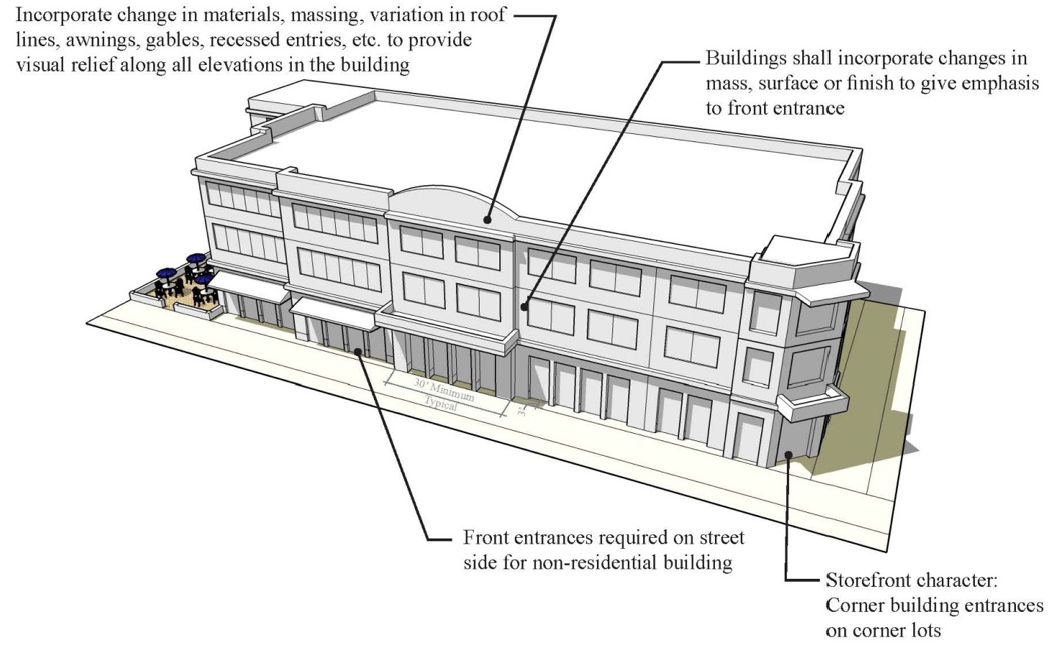
Figure 10, Building features and storefront character
(7)
Architectural style. The DT-MU does not require a specific architectural style. The intent of regulating architectural style is to ensure the development is being designed with a defined architectural style. Style is defined by the particular combination of details, architectural elements, window patterns, finishes and material that identify a building as being part of a larger aesthetic idea of how a build appears. An applicant may use one style per development to ensure a consistent quality and design and shall identify the architectural style being used. Architectural style shall be any design that is documented in the subject of architectural history and not bound by any specific style.
(8)
Public entrance. Buildings that are open to the public shall have an entrance for pedestrians from the street to the building interior. This entrance shall be designed to be a distinctive and prominent element of the architectural design, and shall be open to the public during business hours. Buildings shall incorporate lighting and changes in mass, surface or finish which places an emphasis to the entrance.
(9)
Storefront character.
(a)
Commercial and mixed-use buildings shall express a "storefront character" as illustrated in Figure 10, in addition to the private frontage requirements. This guideline is met by providing all of the following architectural features, as illustrated in Figure 10, along the street building frontage, as applicable.
i.
Corner building entrances on corner lots.
ii.
Regularly spaced and similar shaped windows with window hoods or trim (all building stories).
iii.
Large display windows on the ground floor. Facades of all buildings facing streets, parks and plazas shall have windows covering a minimum of forty (40) percent and a maximum eighty (80) percent of the surface area of the ground floor of each storefront's linear frontage. Blank walls shall not occupy over fifty (50) percent of a street facing frontage and shall not exceed thirty (30) feet without being interrupted by a window or entry. Mirrored glass, obscured glass and glass block cannot be used in meeting this requirement.
iv.
The bottom edge of display windows on the ground floor facades shall be no more than thirty (30) inches above finished floor level.
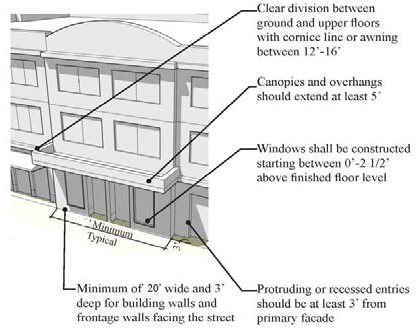
Figure 11, Building features
(10)
Building orientation. The primary building entrances shall be visible and directly accessible from a street. Building massing such as tower elements shall be used to call out the location of building entries.
(11)
Lighting. Exterior lighting shall be designed with cut-off luminaries that are directed downward and away from other property so as to eliminate glare and light spillage to other property.
(Ord. No. 2017-115, § 3, 1-17-18)
Sec. 2501062. - Parking requirements.
The DT-MU District provides for the following parking standards:
(1)
Off-street parking requirements are established by using the following parking rates, by relevant land use:
Table 1.0 DT-MU Parking Calculations
(2)
Shared parking. An applicant may also be permitted for additional parking reductions that were established in "Downtown Coral Springs Mixed-Use District Shared Parking Study, dated June 18, 2015". This study recommended specific parking rate calculations by area within the Coral Springs Community Redevelopment Area. An applicant may utilize additional reductions for development and redevelopment based on mix of uses and hours of operation. These tables may be updated from time to time and are available in the development services department and on the city's website. An applicant may run the parking ratio analysis online, however, the final reduction and analysis shall be confirmed by the development services department. The tables are located at http://www.coralsprings.org.
(Ord. No. 2017-115, § 3, 1-17-18)

