
Corrales City Zoning Code
SECTION 18
30. - General regulations.
(a)
Access to structures. All structures shall be located such that safe and legal access is provided for emergency vehicles, service vehicles, police and fire protection, and required off-street parking or loading.
(1)
Gates on driveways must provide minimum clearances of sixteen (16) feet in width and thirteen and one-half feet (13 feet 6 inches) in height to provide adequate clearance for emergency vehicles.
(2)
Where a lot is served by a roadway having a width of twenty (20) feet or less and a length of one thousand (1,000) feet or more, the Administrator may, at their discretion, require the construction of a street pull-off at a designated location on the roadway as a condition of development approval for the lot.
(3)
Access to and from roads and highways owned and maintained by the New Mexico Department of Transportation (NMDOT), including Corrales Road (New Mexico State Highway 448) shall be in accordance with applicable regulations of NMDOT. An applicant for a building permit, site development plan, special use permit, or any other permit under this Chapter or under Chapter 8 may be required to demonstrate compliance with applicable NMDOT regulations and approval by the NMDOT as a condition for approval of such permit.
(b)
Standards for driveway access to private properties.
(1)
Permit required. After February 28, 2015, every person seeking to make a driveway connection, paved or unpaved, for access to private property from any street owned or maintained by the Village shall do so only in accordance with a permit issued by the Building Inspector with the approval of the public works department.
(2)
Application and supporting documentation. Every person seeking to make a driveway connection for access to private property from a street owned or maintained by the Village shall submit an application in the form prescribed by the Village, with the required application fee and with a sketch or design drawing sufficient to show that the proposed driveway connection will not obstruct or otherwise impair any drainage or irrigation structures; any trail, sidewalk or pathway; any utility or other permitted use of the right-of-way; or any vision clearance triangle or other public safety requirement of the roadway as designed and constructed. Where the proposed driveway connection will cross any ditch, swale, channel, lateral or other drainage or irrigation structure in the right-of-way, the Village may require that the proposed design be supported by a design and calculations, prepared by an engineer licensed in New Mexico, to show that the driveway connection as designed will not impede the flow of water required to be carried by such ditch, swale, channel, lateral or other drainage or irrigation structure in a 100-year flood event, and upon completion a certification by the engineer that the driveway connection as constructed meets the design specifications.
(3)
Driveway width. No driveway connection to residential or agricultural property in the A-1, A-2 or H zone shall be more than twenty-four (24) feet in width or less than 12 feet in width.
(4)
Existing driveway connections. Driveway connection existing prior to February 28, 2015, shall be allowed to remain in place provided that they do not impede the flow of water in any ditch, swale, channel, lateral or other water conveyance facility and do not constitute a hazard or impediment to traffic or otherwise constitute a hazard to human health, safety or welfare. No such driveway connection shall be modified, reconstructed, rebuilt or repaired except in accordance with a permit issued by the Village under this Subsection 18-30(m).
(c)
Addressing.
(1)
Street numbers shall be assigned only by the Planning and Zoning Department. Numbers other than those designated must be removed
(2)
Street numbers shall be legible and placed in plain view, where the property meets the street, and be no less than 4 inches in height.
(d)
Storm water retention. Storm water retention shall be in accordance with all applicable Village and State ordinances and requirements including those provided in Section 18-160. All improved or developed lots shall retain localized storm water on site. Land east of the Corrales Main Canal shall be exempt from the requirement to submit a grading and drainage plan for developed properties provided that an affidavit stipulating that the land has a 1% or less slope signed and sealed by a surveyor or professional engineer licensed in the State of New Mexico has been provided and a grading a drainage plan has not been specifically required by the Commission or the Administrator. The Commission or the Administrator may require a grading and drainage plan in the event the Commission or the Administrator finds that a grading and drainage plan is needed to adequately address water retention on the site even if located east of the Corrales Main Canal.
(e)
Grading permits. When a grading permit is required, applications for the permit shall show compliance with the following minimum standards.
(1)
Cut and fill slopes.
a.
Cut slopes on a site shall not exceed ten (10) feet in height. In no case shall the height of a cut exceed the height of the building.
b.
Fill slopes on a site shall not exceed fifteen (15) feet in height. Retaining walls for fill slopes shall be no greater than ten (10) feet in height. Retaining walls in the case of concrete, generating no additional runoff, shall be a matching earth tone color or constructed of natural materials. Unstabilized fill slopes shall be no steeper than 3:1 (3 horizontal to 1 vertical); unless a structural alternative such as a retaining wall or some other measure acceptable to the Village Engineer or the Planning and Zoning Administrator is provided.
c.
Cut or fill slopes for roads and driveways shall not exceed 15 feet in height; and
d.
All cut slopes that are not stabilized by a retaining wall or some other measure acceptable to the Village Engineer, shall be no steeper than 3:1 (3 horizontal to 1 vertical), unless a structural alternative is provided or unless it can be demonstrated by the geotechnical study that existing soils will naturally accommodate a steeper slope and acceptable revegetation, or other erosion control can be achieved;
(2)
Grading.
a.
Grading on building sites is limited to fifteen (15) feet beyond the outer edge of the building foundation, patio, wall, driveway, road, street, parking area, or other constructed facility on all sites and construction projects including both new construction and reconstruction except:
1.
As necessary for the construction of runoff management measures in compliance with this section; or
2.
As necessary to accommodate required horizontal to vertical measurements for cut and fill slopes.
3.
As necessary to accommodate water and wastewater systems.
4.
Private driveways shall not exceed a grade of 8 percent, nor shall the inside turning radius of any private driveway be less than fifteen (15) feet. All cul-de-sacs shall not exceed five (5) percent grade for any lot or subdivision.
5.
Natural slopes greater than eight (8) percent but less than fifteen (15) percent may be regraded to create building pads, slab on grade, stem wall and split level, so long as the following conditions are satisfied:
(i)
The applicants meet requirements for cut and fill slopes.
(ii)
An approved revegetation plan is executed for the disturbed areas including lot or subdivision roadways.
(3)
Erosion control. Swales alongside roadways shall have drop structures or other erosion control structures (such as gabion baskets, rip-rap stone) as necessary to prevent damage caused by erosion.
(f)
Areas subject to flooding. All buildings or structures erected or improvements constructed upon, or mobile homes moved onto or installed upon, any lot within the Village shall conform to Chapter 18, Article IV of this Code. All new construction located within the flood zones as determined by the current Federal Emergency Management Agency Flood Insurance Rate Map shall have an elevation certificate attached to the building permit prior to commencement of construction.
(g)
Water and wastewater requirement. All buildings constructed within the Village shall be in compliance with applicable regulations established by the New Mexico Environment Department and the New Mexico State Engineer's Office concerning water and wastewater facilities and systems.
(h)
Portable restroom facilities. Portable restroom facilities are allowed on a property only in conjunction with an active construction project. They are not to be used for permanent or semi-permanent use for employees or residents.
(i)
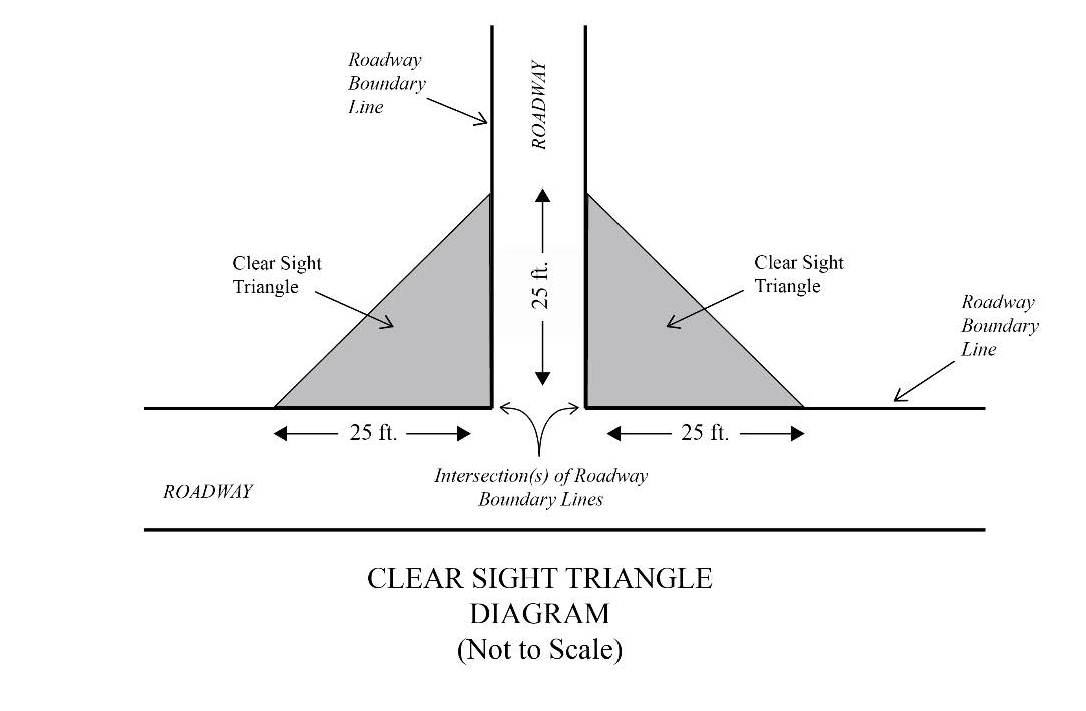
Clear sight triangles. The triangular shaped portion of land at the corner of a street or driveway intersection, which shall be maintained such that there is nothing between the height of three (3) feet and eight (8) feet above the roadway grade. Such triangular space shall be bounded by the roadway boundary lines and a diagonal line connecting two points twenty-five (25) feet distant from the intersection of the roadway boundary lines. Where unique roadway conditions exist, such as curves, the Commission, on the recommendation of the Village engineer, may require a distance greater than twenty-five (25) feet distant from the intersection of the roadway boundary lines to ensure vision clearance.
(j)
Height restrictions. No building, antenna, and/or structure of any type shall exceed twenty-six (26) feet in height, with the exception of municipal uses for public safety and/or municipal water storage facilities; and provided further that utility poles needed to provide service to facilities located in areas of the Village where the established utility structures are above ground in existing overhead public utility easements shall not exceed forty (40) feet in height (elevation) from grade.
(k)
Preservation of solar access. No structure shall be placed in any way to diminish an existing building's access to the sun and protection for solar collectors as set forth in the Solar Rights Act, NMSA 1978, Chapter 47, Article 3.
(l)
Lot width requirement. At least eighty-five (85) percent of the area of the lot must meet the lot width standard in a specific zone. All lots shall have at least a twenty (20) foot frontage to ensure adequate access.

(m)
Fences. No wall or fence over six feet tall shall be constructed unless a building permit has been approved by the Village. Walls and fences shall be built of brick, adobe, rock, decorative concrete block, masonry, wood, wood and metal wire, pipe, wrought iron or similar materials. Walls of unstuccoed concrete block, unstuccoed concrete, or similar materials are prohibited.
(1)
For properties along Corrales Road, no solid fence exceeding four (4) feet in height shall be constructed along the Corrales Road frontage, unless the fence is at least twenty-five (25) feet away from the Corrales Road property line. For fences/walls closer than twenty-five (25) feet.
(2)
Open fencing, with a least sixty-five (65) percent of the top being open, may be placed upon the four-foot solid wall/fence to a maximum height of six (6) feet.
(n)
Manufactured housing. All manufactured housing as defined in this Chapter shall be placed upon permanent foundations.
(o)
Mobile home installation. All mobile homes shall be skirted within ninety (90) days of placement on the lot, with material similar in color and texture to the exterior of the mobile home, so that the mobile home will look like a home site-built on a foundation. In no case shall there be a gap visible between the bottom of the mobile home and its skirting.
(p)
Occupancy requirements. No building shall be occupied unless it is connected to a functional well or water supply system permitted by the State engineer and connected to a functional liquid waste system permitted by the New Mexico Environment Department, and a certificate of occupancy has been issued by the building inspector or a site development certificate of occupancy has been issued by the Administrator within twenty-four (24) months following approval of a site development plan by the Commission.
(q)
Communications and electrical distribution lines.
(1)
New communications lines, single phase electrical distribution lines, and three phase electrical distribution lines carrying no more than forty (40) kilovolts (kV) shall be installed underground in all areas of the Village, except as otherwise specifically provided in this chapter.
(2)
This subsection shall not be construed to require the replacement of overhead communications and electrical distribution lines in existence prior to September 30, 2017. Owners and operators of such overhead communications and electrical distribution lines may repair or replace components of and accessories to the lines, including, but not limited to, poles, wires or cables, transformers, and similar equipment, without any requirement that such components be placed underground. If owners or operators propose to replace all of an existing overhead communications or electrical distribution line or lines, including the poles or other structures on which they are located, over a line distance greater than one-half (½) mile, such installation shall be placed underground.
(3)
Communications or electrical service connections to an individual building or lot may be located overhead if there are existing overhead communications or electrical distribution lines extending within the lot or to a boundary of the lot, provided the lot is not within a subdivision subject to the underground utility requirements of Section 18-81.
(4)
The governing body by resolution may permit the construction or installation of a new overhead communications or electrical distribution line, notwithstanding the provisions of paragraph (1) of this subsection, if the governing body finds that no significant public purpose would be served by requiring the new construction to be placed underground and:
a.
The location is within an area already served entirely by overhead lines; or
b.
Subsurface or other conditions make an underground line economically unreasonable; or
c.
Installation of the underground line would require customers to convert their service connections from overhead to underground service, and the cost of such conversion would be economically unreasonable.
(r)
Cannabis and hemp: compliance with applicable law and regulatory requirements.
(1)
The cultivation, production, intentional growth, manufacture and distribution of cannabis and cannabis-derived products shall be in compliance with the provisions of the Lynn and Erin Compassionate Use Act, the Cannabis Regulation Act, all regulations promulgated thereunder by the Department of Health or Regulation and Licensing Department, and all applicable Village Code requirements, including those relating to zoning and building.
(2)
The cultivation, growth, manufacture and sale of hemp shall be in compliance with all provisions of applicable federal and state law and regulations thereunder, in addition to all applicable Village code requirements, including those relating to zoning and building.
History: Ord. No. 220, § 2, adopted 10-9-89; Ord. No. 192, § 8-1-6, adopted 11-13-89; Ord. No. 303, adopted 7-22-97; Ord. No. 06-02, adopted 5-23-06; Ord. No. 07-06, adopted 6-12-07; Ord. No. 07-08 § 2, adopted 6-26-07; Ord. No. 09-005, adopted 5-19-09; Ord. No. 10-012, adopted 12-21-10; Ord. No. 10-013, adopted 12-21-10; Ord. No. 14-04, adopted 2-11-14; Ord. No. 15-05, adopted 2-24-15; Ord. No. 17-012, adopted 10-24-17; Ord. No. 19-005, § 5, adopted 11-12-19; Ord. No. 22-01, adopted 3-22-22; Ord. No. 22-03, adopted 8-23-22.

