
Creston City Zoning Code
ARTICLE I
- IN GENERAL
Sec. 105-1.- Definitions and rules of construction.
(a)
In the construction of this chapter, the definitions contained in this section shall be observed and applied, except when the context clearly indicates otherwise.
(b)
In the construction of this chapter, the rules contained in this subsection shall be observed and applied, except when the context clearly indicates otherwise.
(1)
Words used in the present tense shall include the future. Words used in the singular number shall include the plural number, and the plural the singular.
(2)
The words "shall" and "will" are mandatory and not discretionary.
(3)
The word "may" is permissive.
(4)
The word "lot" shall include the words "plot," "piece" and "parcel."
(5)
Unless otherwise specified, all distances shall be measured horizontally.
(6)
Whenever a word or term defined in this section appears in the text of this chapter, its meaning shall be construed as set forth in the definition thereof.
(7)
The masculine gender shall include the feminine and neuter.
(8)
All measured distances shall be expressed in feet and shall be calculated to the nearest tenth of a foot.
(9)
The word "person" shall include the words "association," "corporation," "estate," "governmental agency," "individual," "joint venture," "partnership," "venture" or any other legal entity.
(10)
The word "building" shall include the word "structure."
(11)
The phrase "used for" shall include the phrases "arranged for," "designed for," "intended for," "maintained for" and "occupied for."
(c)
The following words, terms and phrases, when used in this chapter, shall have the meanings ascribed to them in this section, except where the context clearly indicates a different meaning. Words and terms not defined in this section shall be defined as specified in the latest published edition of Webster's New Collegiate Dictionary.
Accessory structure (use) means a building (use) customarily incidental to and auxiliary to the use of a principal building (use) on the same premises with such principal building (use). When the wall of an accessory building is a part of or joined to the wall of the principal building, such accessory building shall be construed as a part of the principal building.
Adult care center means a building or group of buildings providing daytime care to six or more persons with disabilities or senior citizens unrelated by blood or marriage to, and not legal wards or foster children of, the attendant adult within an occupied residence.
Adult use. See section 105-214(5).
Agriculture means the land, buildings and accessory structures used for:
(1)
Producing plants by tilling the soil or through floriculture, horticulture, nurseries, orchards, forestry or viticulture; or
(2)
When animal products are produced, through apiculture, dairying or pasturage, or the breeding, raising and feeding of farm animals, except commercial feedlots and feeding of garbage to animals, or the breeding, raising and feeding of canines and felines for commercial purposes, or the breeding, raising and feeding of laboratory animals.
Accessory structures customarily incidental to agricultural activities include, but are not limited to, the farm dwelling, dwellings for tenants full-time farm workers, and dwelling or lodging rooms for seasonal workers, silos, grain, storage bins and equipment sheds.
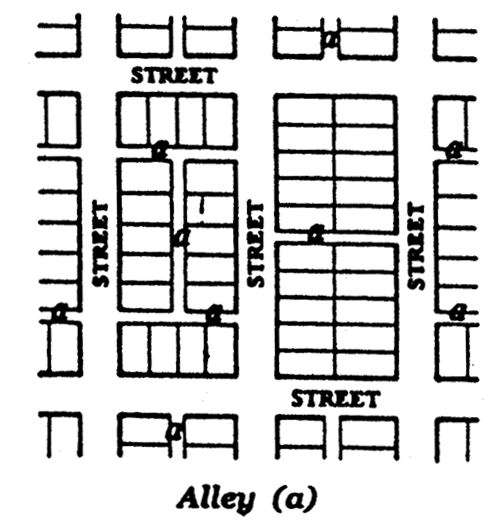
Alley means a public or private way primarily designed to serve as a secondary means of access to those parcels whose principal frontage is on a public street.
Alteration, structural. See Structural alteration.
Amusement arcade means an establishment devoted to the use of four or more coin-operated amusement devices.
Animal hospital means a place where animals are given medical or surgical treatment and the boarding of animals is limited to shortterm care incidental to the hospital use.
Animals, farm, means the fowl, ovine, caprine, bovine, equine, fur-bearing and other species domesticated for agricultural uses.
Antenna means an arrangement of wires, metal rods, parabolic or concave dishes, or similar materials used for the transmission and/or reception of electromagnetic waves.
Antenna tower means any structure designed for the purpose of mounting an antenna.
Apartment means a room or suite of rooms in a multiple-dwelling structure which is arranged, designed, used or intended to be used as a residence for one family.
Apartment hotel means a building or portion thereof designed for or containing both individual guestrooms, or suites of rooms, and dwelling units, the majority of which are for permanent guests. Maid and janitor service may be provided, but kitchen facilities are not necessarily included.
Apiculture means beekeeping.
Arbor means a leafy, shady recess formed by tree branches, or latticework intertwined with shrubs or vines.
Arcade means a building frontage type where the building facade above the ground level overlaps the public sidewalk while the ground level portion of the building maintains a setback or is located at the build-to line.

Artwork means any object, such as a sculpture, figure, statue, monument, painting, photograph or the like, constructed out of such materials as stone, clay, wood or metals, which exhibits individual expression and creativity.
Awning means a roof-like cover that is temporary in nature and that projects from the wall of a building for the purpose of shielding a doorway or window from the elements.
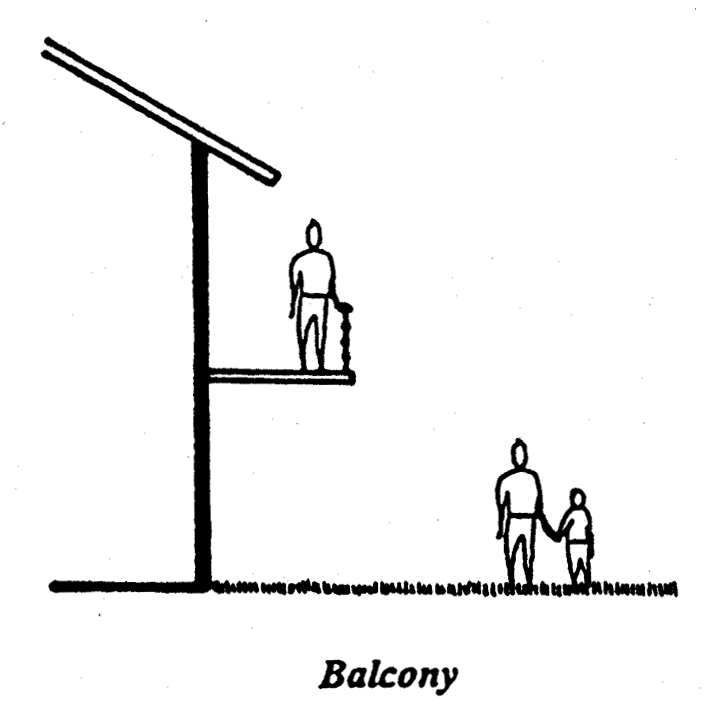
Balcony means an elevated platform open to the elements, not supported by the ground and projecting from an upper story and enclosed entirely by a railing.
Bar means a room or a counter accessory to the principal use of the building or tenant space in the building where alcoholic beverages are served for consumption on the premises, and which may provide for dancing.
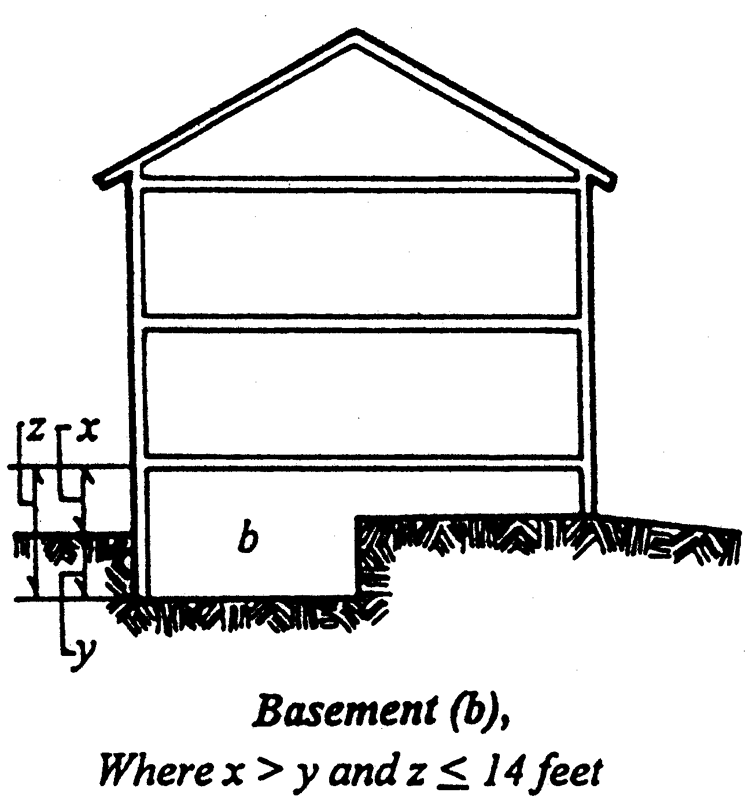
Basement means a space within a building which has one-half or more of its floor-to-ceiling height above the average level of the adjoining ground and with a floor-to-ceiling height of not less than 6.5 feet.
Bay window means a window projecting beyond the wall line of the building and not supported by a foundation.
Bed and breakfast lodge or inn means a residential building containing not more than five lodging rooms offered for rent on a daily basis to transient guests for a continuous period of 30 days or less, and containing the owner's principal residences, where provision of meals is limited to the breakfast meal served exclusively to overnight guests between the hours of 5:00 a.m. and 10:00 a.m.
Bedroom means any room designed, intended or used principally for sleeping purposes, including a study or a den.
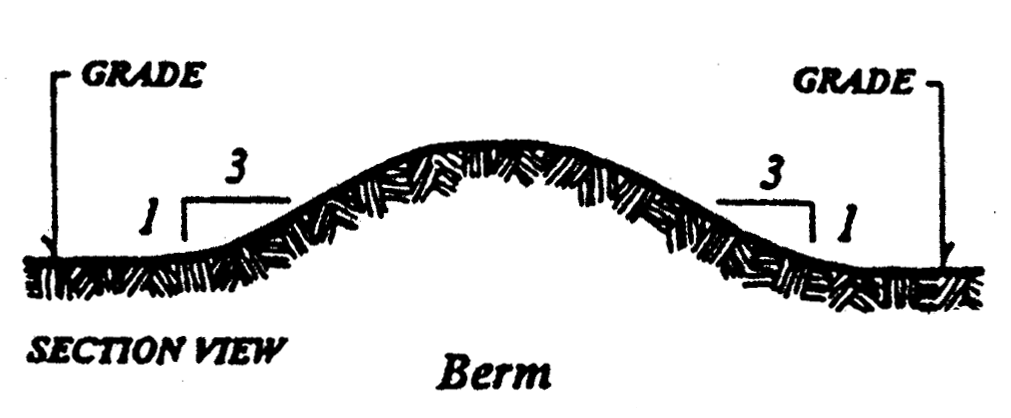
Berm means soil of good quality, uncompacted, raised generally above the surrounding finish grade with side slopes generally no steeper than three horizontal units to one vertical unit; it generally is a manmade slope.
Block means a tract of land bounded by streets, or by a combination of streets and public parks, cemeteries, railroad right-of-way, shorelines of waterways, and municipal, township and county boundary lines.
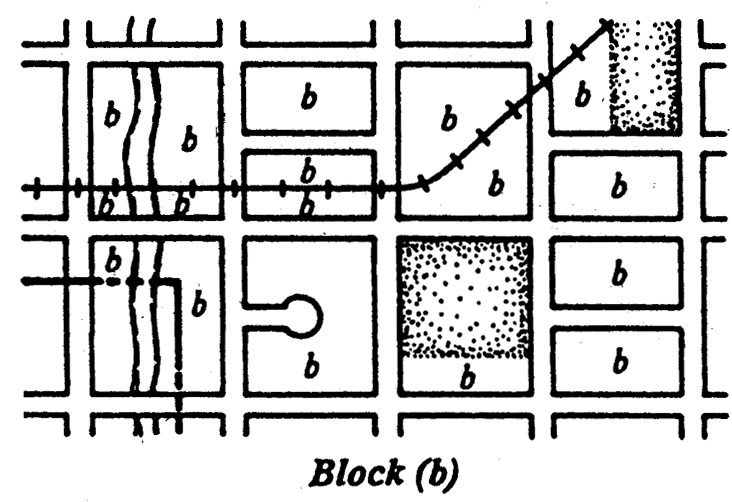
Body shop, motor vehicle, means any building or portion thereof used for the repair or straightening of a motor vehicle body or frame, or painting of motor vehicles. Maintenance, service and engine repair may be performed as an accessory function to the body work.
Breezeway means a covered pedestrian passageway, as between a house and a garage, but otherwise exposed to the elements.
Buildable area means the area of a lot or parcel remaining after yard, parking or any other requirements of this chapter have been satisfied.
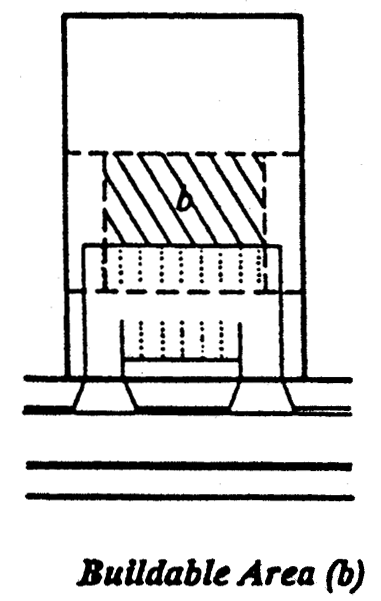
Building means a roofed structure designed or intended for the enclosure, shelter or protection of persons, animals or other property. All forms of vehicles, even if immobilized, are excluded from this definition.
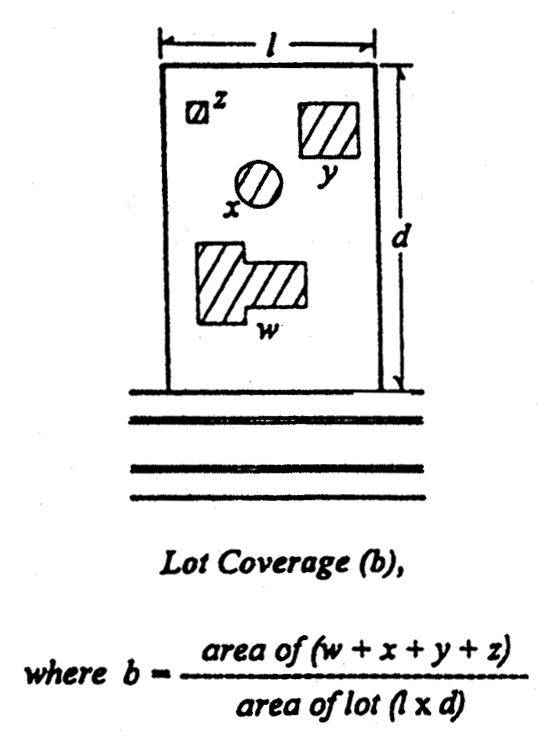
Building coverage means the area of a zoning lot occupied by the principal buildings and accessory structures.
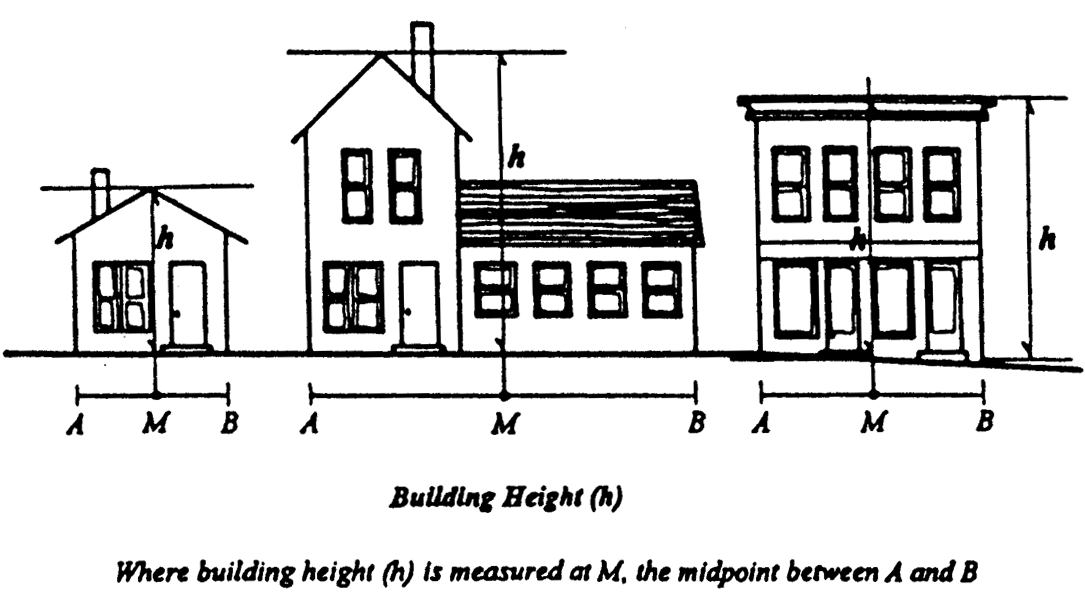
Building height means the vertical distance of a building measured at the midpoint of the front wall of a building between the finished grade at the front wall of the building and the highest point of the roof or parapet walls, excluding chimneys, mechanical equipment, cooling towers, storage tanks, bulkheads, spires, water towers and antennas attached to or resting upon the building.
Building line means a line parallel to adjacent property lines at a specified distance from such property lines establishing the minimum open space to be provided between the building and an adjacent lot line, also known as the "building setback line" or "setback line."
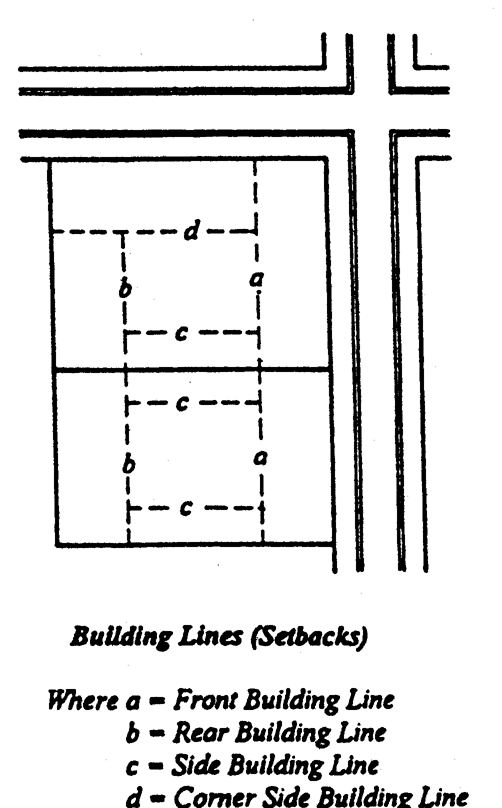
Bulk means the size and mutual relationships of buildings and other structures as to size, height, coverage, shape and location of exterior walls in relation to lot lines, to the centerline of streets, to other walls of the same building and to all open spaces relating to the building or structure.
Burial building means any building used for the interment of bodies or other remains of persons who have died, including mausoleums, vaults or columbaria.
Business means an occupation, employment or enterprise which occupies time, attention, labor and materials, or wherein merchandise is exhibited, bought or sold, or where services are offered for compensation.
Caliper means the diameter of a tree trunk six inches above the existing grade or proposed planted grade and in conformance with the provisions of the Code of Standards (Z60.1-1986 or latest version) published by the American Association of Nurserymen, Inc.
Carwash means a structure, or portion thereof, containing facilities for washing automobiles, which may utilize production-line methods using a conveyor, blower, steam-cleaning device or other mechanical devices, and may include detailing services.
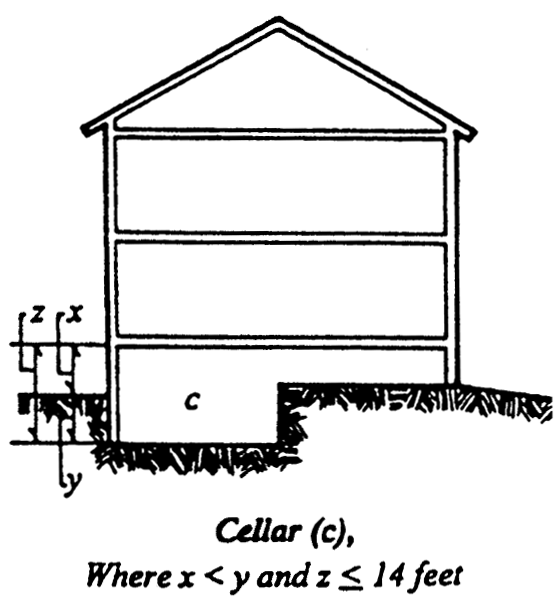
Cellar means a space within a building with less than one-half of its floor-to-ceiling height above the average finished grade of the adjoining ground or with a floor-to-ceiling height of less than 6.5 feet.
Club and lodge mean a group of people organized for a common purpose to pursue common goals, interests or activities and usually characterized by certain membership qualifications, payment of dues, regular meetings and a constitution and bylaws.
Cluster means plant material installed as a clump or group as opposed to individual specimens. An odd number of shrubs is desired.
Cocktail lounge means a room or an establishment where alcoholic beverages are served for consumption on the premises, and which may provide for dancing or live entertainment on the premises.
Commercial recreation means any establishment or use of land which provides active recreational opportunities, including but not limited to water slides and water parks, batting cages, miniature golf, go-cart racing, carnival games and the like.
Commercial use means an activity carried out for pecuniary gain.
Condominium means an estate in real property consisting of an individual interest in common with other purchasers in a portion of real property, together with a separate interest in space in a building and/or separate interest in other portions of such real property.
Convalescent home and rest home mean an establishment for the care of the aged or infirm, or a place of rest for those suffering bodily disorders, but excluding contagious or communicable diseases and excluding surgery.
Conventional energy system means an energy system utilizing fossil fuel, nuclear or hydroelectric energy and the components of such system, including transmission lines, burners, furnaces, tanks, boilers, related controls, distribution systems, room or area units and other components.
Cottage, accessory, means a room or group of rooms meeting habitable room sizes as required by the village building code which are arranged, designed, used and intended for use as living quarters for one household, including sleeping, cooking, eating and sanitation facilities, which may be located in a freestanding accessory building, and having its own exterior entrance.
Cottage office, accessory, means a room or group of rooms meeting habitable room sizes as required by the village building code which are arranged, designed, used and intended for use as a private office and having no sleeping, cooking, eating or sanitation facilities, located in a freestanding accessory building and having its own exterior entrance.
Country club means a land area and building containing recreational facilities, a clubhouse and usual accessory uses, typically open only to members and their guests for a membership fee.
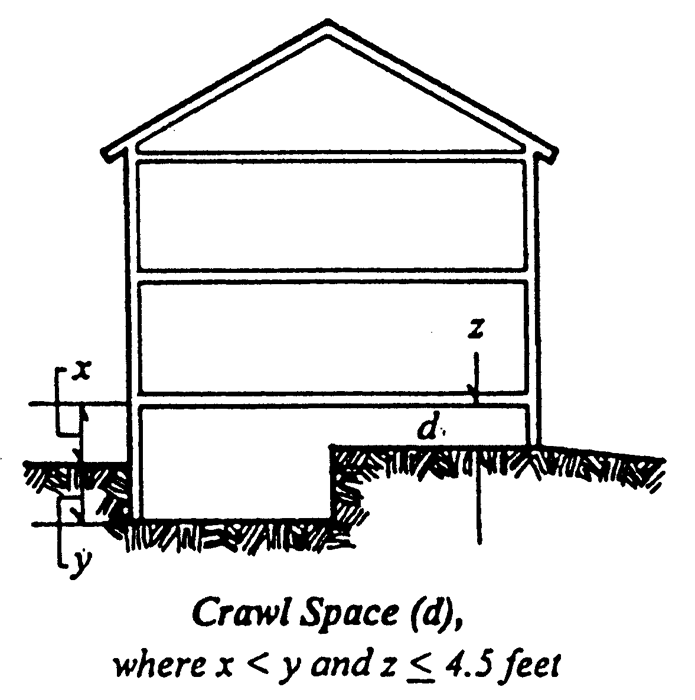
Crawl space means a space between the ceiling of one story and the floor of the next story above, which normally contains pipes, ducts, wiring and lighting fixtures and permits access but is too low for an individual to stand. A crawl space may be a cellar area no more than 4.5 feet in height, or, if between a ceiling and a shed roof or a flat roof, a cockloft.
Cul-de-sac means a short street having one end open to traffic and being terminated at the other end by a vehicular turnaround.
Day care center means a facility commonly called "infant and toddler centers," "child care centers," "day nurseries," "nursery schools," "play groups," "kindergartens" and "after-school programs for young school-age children" licensed by the state department of children and family services.
Day care home means a residence licensed by the state department of children and family services for the care of at least three but not more than 12 children for less than 24 hours per day. The maximum number of children permitted includes the family's natural, foster or adopted children and all other persons under the age of 12. The term does not include residences or facilities which receive only children from a single household.
Deciduous means plants which do not retain leaves or needles during the winter season of the year.
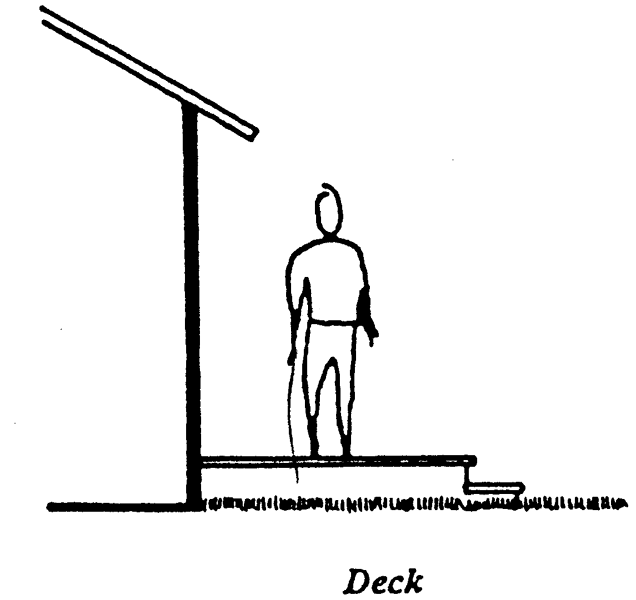
Deck means a level, unenclosed platform serving as a floor and located above the finished grade, and usually directly adjoining or attached to a building.
Disability means a personal condition which:
(1)
Is attributed to mental, intellectual or physical impairment or a combination of mental, intellectual or physical impairments;
(2)
Is likely to continue for a significant amount of time or indefinitely; and
(3)
Results in functional limitation in three or more of the following areas of major life activities: self-care, receptive or expressive language, learning, mobility, self-direction, capacity for independent living or economic self-sufficiency; and reflects the person's need for a combination and sequence of special interdisciplinary or generic care treatment, or other service of lifelong or extended duration, but is not the result of a communicable disease or substance abuse or alcohol abuse.
District, zoning, means a section of the corporate areas of the village within which the regulations governing the use of land are uniform.
Dog run means an enclosed outdoor area intended for the exercising and/or containment of dogs or other animals.
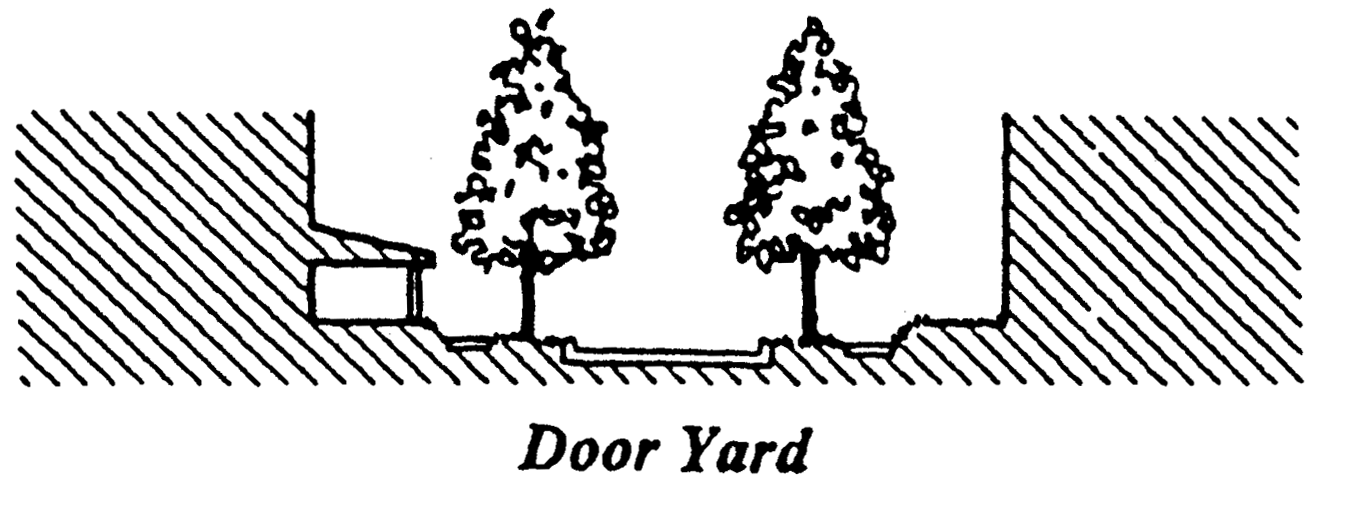
Dooryard means a building frontage type where the building facade is set back from the frontage line and the space between the frontage line and the building facade is elevated.
Dormitory means a building where sleeping accommodations, dining facilities and common bathroom facilities are provided for more than ten unrelated individuals, exclusive of the resident family, who are students or members of a religious order, college, university, convent, monastery or other institutional use.
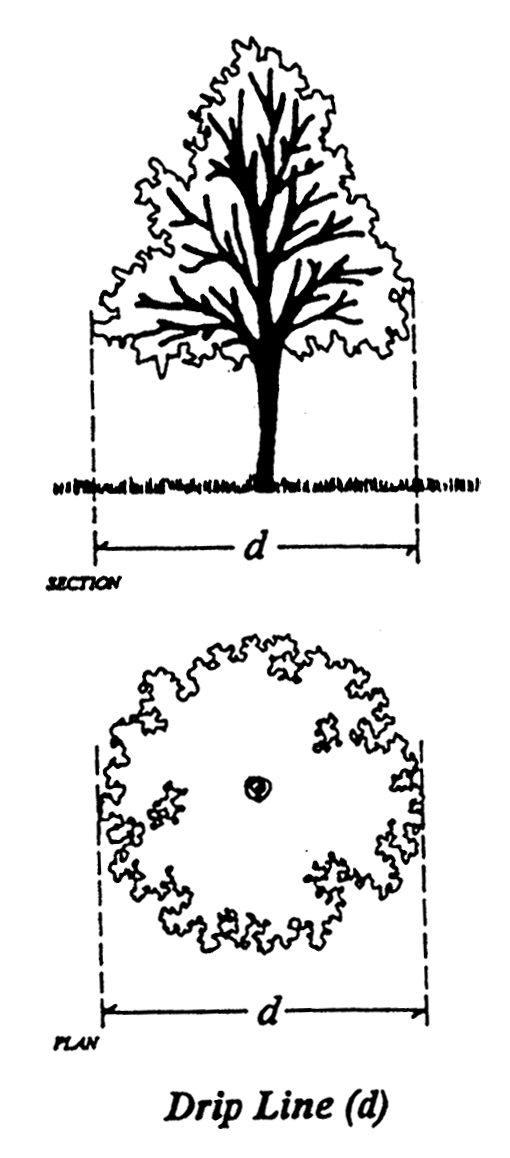
Dripline means the zone lying between the trunk of a tree or shrub and the extreme outer edge of the leaf and branch structure, i.e., the diameter of the leaf and branch structure extended vertically down to the soil surface.
Drive-up facility means a facility or establishment which is designed, intended or used for transaction of business with customers in automobiles. A drive-up facility may be the principal or an auxiliary function of the business. A drive-up facility does not include mail or parcel collection boxes.
Driveway means a private roadway providing vehicular access from a street or alley to adjacent property.
Dwelling means a building or portion thereof designed or used exclusively for residential occupancy, including single-family, two-family and multiple-family dwellings, but not including hotels, motels or lodginghouses.
Dwelling, apartment, means a building or portion thereof in which a dwelling unit or a portion thereof is located above or below another dwelling unit, or above or below any other independently used portion of the building.
Dwelling, attached single-family, means a building consisting of dwelling units each of which is attached by a common vertical wall to at least one other dwelling unit, with each dwelling unit having a separate exterior entrance and occupying the ground, including, but not limited to, the following: townhouse, row house, duplex, four-plex and three-plex. In addition, no dwelling unit or portion thereof within an attached dwelling shall be located above or below another dwelling unit, and each dwelling unit shall have its primary access to the outside on the ground floor.
Dwelling, detached single-family, means a freestanding building containing one dwelling unit.
Dwelling, duplex, means a building containing two dwelling units where one dwelling unit is joined with the other dwelling unit on one side by a common wall. No dwelling unit or portion thereof within a duplex dwelling shall be located above or below another dwelling unit. Each dwelling unit shall have an exterior entrance located on the ground floor.
Dwelling, efficiency, means a dwelling unit consisting of not more than one habitable room together with cooking and sanitary facilities.
Dwelling, multiple-family, means a building, or portion thereof, consisting of three or more dwelling units with varying arrangements of entrances and party walls and where one or more of the dwelling units do not occupy the ground, including but not limited to the following: apartment, condominium, cooperative, manor home, coach house, three-flat and six-flat.
Dwelling, roominghouse, means a building or a portion thereof utilized as a dwelling unit which is the primary residence of the owner and which contains lodging rooms for occupancy at a monthly rate of compensation by permanent residents who are not related to the owner. A roominghouse maintains a common household. Roominghouse dwellings include boardinghouses and lodginghouses, but exclude residential care facilities.
Dwelling, two-family, means a building consisting of two dwelling units where one dwelling unit is located on the first floor and the second dwelling unit is located on the second floor and each dwelling may or may not have a separate exterior entrance.
Dwelling unit means one or more rooms, including at least one complete permanently installed bathroom and not more than one complete kitchen facility, arranged, designed or used living quarters for not more than one family. Each dwelling unit shall have an independent entrance and cooking, sleeping and sanitary facilities.
Easement means a grant by a property owner for the use of a strip or parcel of his land by the general public, a corporation or a certain person for a specific purpose.
Eave means the projecting lower edges of a roof, overhanging the wall of a building.
Evergreen means plants which continuously retain leaves or needles over four seasons of the year.
Extended care facility means an institution or a distinct part of an institution which is licensed or approved to provide health care under medical supervision for 24 or more consecutive hours to two or more patients.
Facade refers to matters of spatial definition and means the vertical surface of a building set along a frontage line. Facades are subject to visual definition by building height, setback lines, recess lines and transition lines.
Family means, excepting domestic servants, any number of persons related by blood, marriage or adoption, not to exceed five persons not so related, using common cooking facilities and living and eating together on the premises as a single housekeeping unit.
Farm means any tract of land ten acres or more in area being used for agriculture purposes.
Farm homestead means the dwelling located on a farm that is the residence of the farm owner or tenant, operator or caretaker.
Farm owner means the person holding title to the farm land.
Farm, research or experimental, means an agriculture use, including buildings and land, for the purpose of obtaining new knowledge in agriculture processes or procedures.
Feedlot, commercial, means a structure or area of land in which 25 or more farm animal units are confined for a limited period of time prior to being shipped to market. One farm animal unit shall be equivalent to one head of cattle, seven hogs, nine sheep or goats or 140 chickens or other fowl.
Fence means a freestanding structure of metal, masonry, composition or wood or any combination thereof permanently installed by being partially buried in the ground and rising above ground level, and used for confinement, screening or partition purposes, including the following:
(1)
Fence, decorative. A fence having a regular pattern that has more than 25 percent of the surface open and unobstructed to vision, light and air when viewed perpendicular to the plane of the fence, and intended primarily for aesthetic purposes;
(2)
Fence, natural. A living barrier that is made of natural growth, such as shrubs, hedges, evergreens and similar planted vegetation; and
(3)
Fence, solid. A fence having a regular pattern that has less than 25 percent of the surface open and unobstructed to vision, light and air when viewed perpendicular to the plane of the fence, and intended primarily for privacy and security purposes.
Festoon lighting means a group of two or more incandescent lightbulbs hung or strung overhead, or on a building or structure, which are exposed to persons on a public right-of-way, or which are not shaded or hooded to prevent the direct rays of light from being visible from the property line.
Floor area, gross (GFA), means the sum of the gross horizontal areas of the several floors of the building measured from the exterior faces of the exterior walls or from the centerline of walls separating two buildings, and shall include cellar floor area; elevator shafts, escalators and stairwells at each floor; floorspace used for mechanical, telephone and electrical equipment, open or enclosed, except when located on the roof; penthouses, except mechanical penthouses; attic space having headroom of seven feet ten inches or more; interior balconies and mezzanines; enclosed porches; outdoor display areas; interior off-street parking and loading facilities; and floor area devoted to accessory uses.
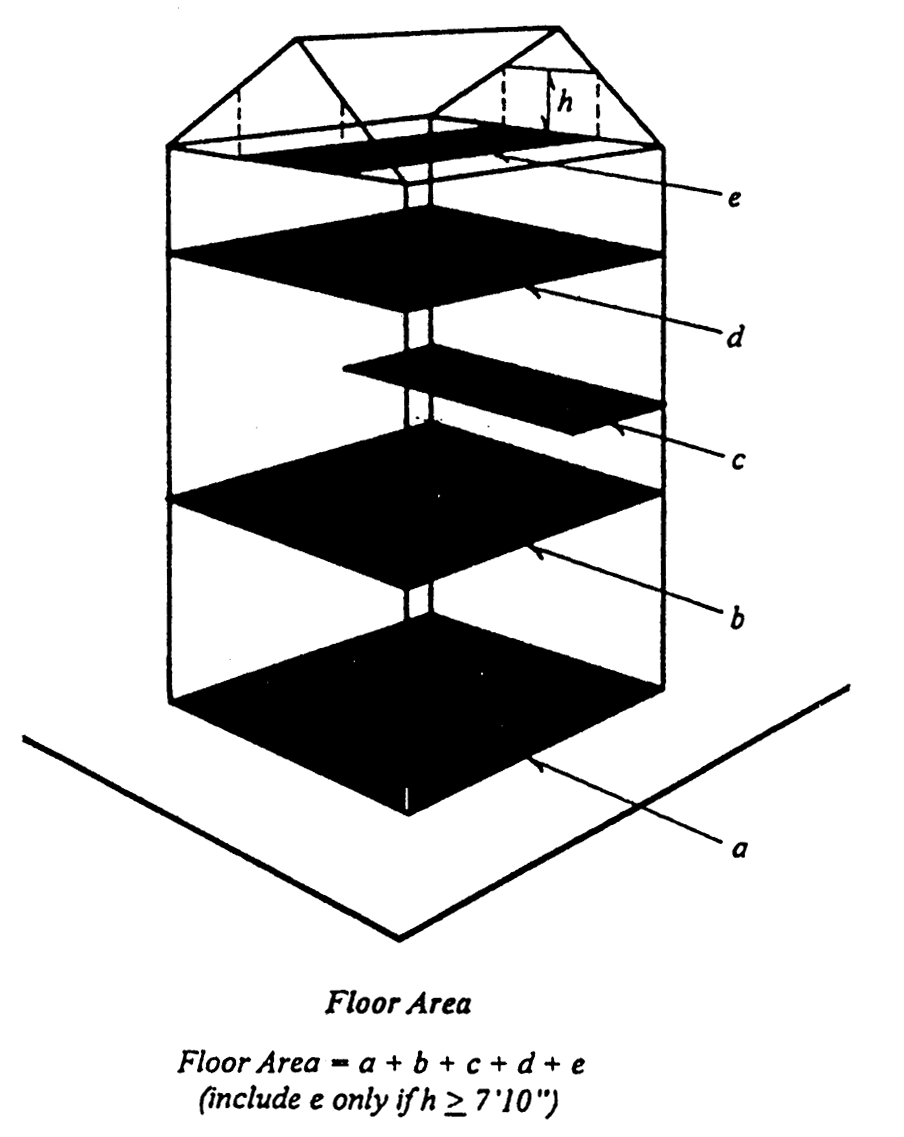
Floor area, net (NFA), means the gross floor area of the several floors of the building less cellar floor area when used for storage; elevator shafts, escalators and stairwells at each floor; floorspace used for mechanical, telephone and electrical equipment, open or enclosed, except when located on the roof; penthouses, except mechanical penthouses; attic space having headroom of seven feet ten inches or more; public restrooms, interior balconies and mezzanines and other interior common areas designed primarily for pedestrian circulation; enclosed porches; outdoor display areas; interior off-street parking and loading facilities; and entrance lobbies.
Floor area ratio (FAR) means the gross floor area of the building measured from the exterior faces of the exterior walls or from the centerline of walls separating attached buildings on that lot, divided by the area of such lot or, in the case of planned unit developments, by the net site area.
Food store means an establishment where the principal use is the retail sale of food, including meats, produce and bakery and dry goods, and may include accessory preparation of food for consumption on or off the premises.
Forecourt means a building frontage type where the building facade is set back and is replaced with a low wall at the frontage line.

Fraternal organization means a group of individuals formally organized for a common interest, usually cultural, religious or entertainment, with regular meetings and formal written membership requirements.
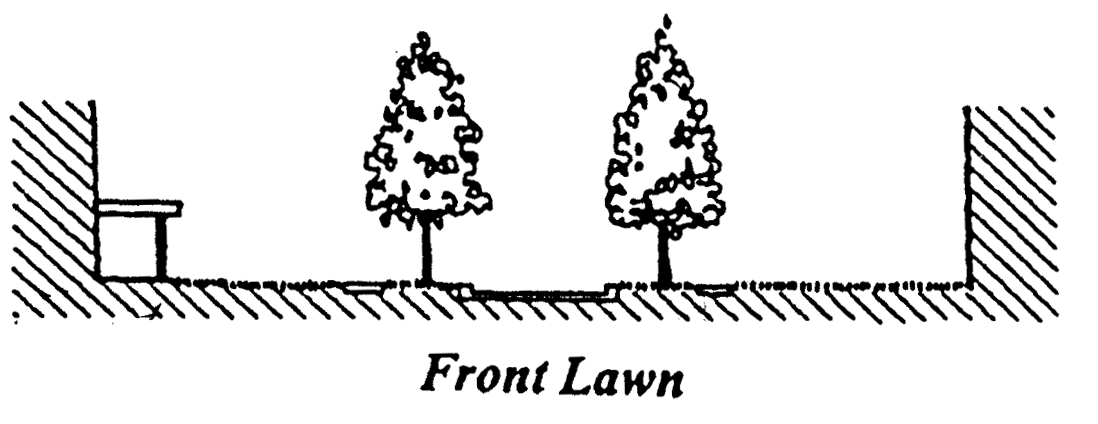
Front lawn means a building frontage type where the building facade is set back substantially from the frontage line and is uninterrupted by fences, porches and other structures.
Garage, private, means a building, or an accessory portion of the principal building, for the private use of the owner or occupant of the principal building, designed or used for the storage and shelter of motor vehicles, with no facilities for mechanical service or repair of a retail nature.
Garage, public, means a building or portion thereof, other than a private garage, designed or used for the care and storage of motor vehicles, or where such vehicles are kept for remuneration, hire or sale.
Garden center means a place of business where plants, nursery products, fertilizers, potting soil, garden tools and utensils are sold to the customer. The sale and storage of the merchandise is permitted in any open area, which must be attached to the building and fenced.
Garden shed means an accessory structure used primarily for the storage of residential garden or lawn equipment and supplies.
Gasoline station means any building, land area or other premises, or a portion thereof, used or intended to be used only for the retail dispensing or sale of motor vehicle fuels and fluids.
Ground cover means woody or nonwoody plants with a maintained or unmaintained average mature height less than 12 inches.
Group home means a dwelling for six or more persons not related by blood, marriage or adoption who live together as a single housekeeping unit, and which contains common cooking facilities and common living and eating areas. Group homes include, but are not limited to, convents, residences for persons with disabilities, orphanages and monasteries. Group homes do not include residences that serve as an alternative to incarceration for persons convicted of criminal offenses, or residences for persons whose primary reason for placement therein is the treatment of a communicable disease.
Habitable space means space in a structure designed for living, sleeping, eating or cooking, but excluding bathrooms, toilet compartments, closets, halls, storage or utility spaces and similar areas.
Health and welfare facility means a facility specializing in medical treatment, physical therapy (alcohol and drug treatment) or assisted living for all ages, retirement communities and shelters.
Health club means a facility designed for the major purpose of physical conditioning and fitness or weight reduction which includes but is not limited to such equipment as free weights, weight resistance machines, cardiovascular machines, whirlpools, saunas, showers, lockers, swimming pools or basketball and racquet courts. This shall not include municipally owned recreation buildings.
Height (for landscaping) refers to the total finished height of a structure or general mature height of plant materials installed above the adjacent elevation of soil or paving. Specified height of a screening may be provided by a berm, a combination of a berm and planting or a structure unless otherwise specified in this chapter.
Home-based business means a business, profession, occupation or trade conducted for pecuniary gain entirely within a residential building or, when permitted by this chapter, within a structure that is accessory to a residential building.
Home improvement center means an establishment where home improvement materials, including but not limited to kitchen and bathroom accessories and fixtures, wall coverings, window coverings, heating and air conditioning, plumbing and electrical supplies, painting and decorating material, tools and residential construction and remodeling materials and supplies are sold at retail. Outdoor storage of building materials may be provided but only if accessory to the principal use and structure and only as permitted by the district in which it is located.
Hospital means an institution providing primary health services and medical or surgical care to inpatients suffering from illness, disease, injury, deformity and other abnormal physical or mental conditions and including, as an integral part of the institution, related facilities such as laboratories, pharmacies, outpatient facilities or training facilities.
Hotel means a building designed for transient occupancy containing lodging rooms or suites accessible from a common interior hall or entrance, providing living, sleeping and sanitary facilities. A central kitchen, meeting rooms, dining room and recreation room are generally provided.
Joint solar energy system means a solar energy system that supplies energy for structures or processes on more than one lot or in more than one condominium unit or leasehold, but not to the general public, and involving at least two owners or users.
Junkyard. See Wrecking yard, vehicle.
Kennel means any lot or premises, or portion thereof, where household pets are bred, trained, boarded or groomed for commercial purposes. The housing of five or more domestic animals at one location shall be deemed to constitute a kennel.
Laboratory means a building, or portion thereof, in which scientific research, investigation, testing, analyzing or experimentation is conducted on a regular basis, but not devoted to the manufacturing of a product.
Liquor store means a place of business selling beer, wine and/or distilled liquors at retail, to the general public, in sealed bottles or containers for consumption or use away from the premises where the establishment is located.
Lot means land which is part of a subdivision, the plat of which has been recorded in the office of the county recorder of deeds, or it may be and consist of a part of such recorded lot, or it may include parts of or a combination of several lots when adjacent to one another and used as one parcel.
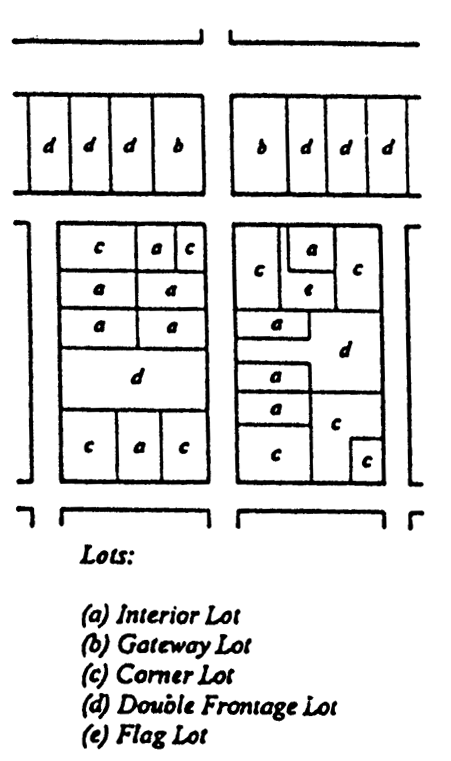
Lot area means the area of a horizontal plane bounded by the front, side and rear lot lines. Calculation of the required minimum lot area shall not include street right-of-way, whether dedicated to the public or a private street or easement for street purposes and, when adjacent to a watercourse, drainageway, channel or stream, the area included in floodplain or easements reserved for the maintenance of such surface waters.
Lot, corner, means a lot that is situated at and abuts the intersection of two or more streets or adjoins a curved street at the end of a block. The term "corner lot" also means a lot that has its front and one side yard bordering on a street.
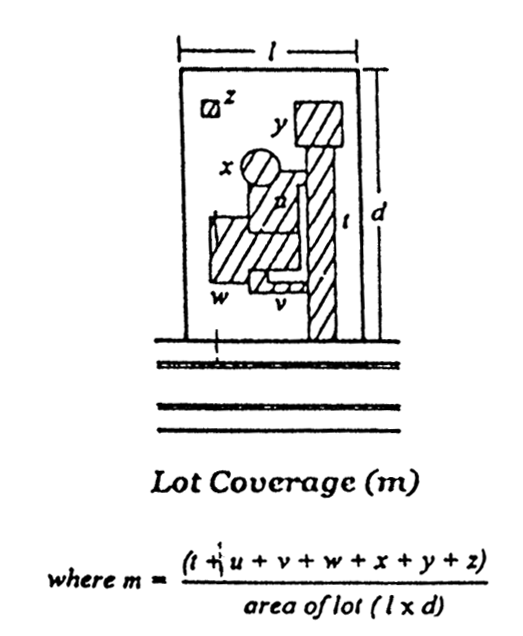
Lot coverage means the percentage of a zoning lot occupied by buildings, including accessory buildings and structures, driveways, sidewalks, decks and patios.
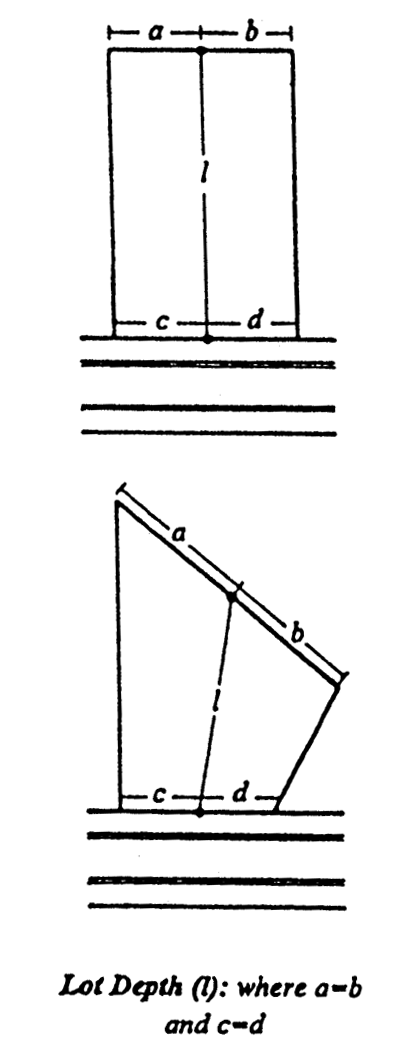
Lot depth means the distance between the midpoints of the front lot line and the midpoint of the rear lot line.
Lot, double frontage, means a lot that has its rear and front yard bordering on a street.
Lot, flag, means a lot with access provided to the bulk of the lot by a narrow corridor of property and where the narrow corridor frontage is the only public street frontage.
Lot, gateway, means a lot that has its front, rear and one side yard bordering on a street.
Lot, interior, means a lot that has only its front yard bordering on a street.
Lot line, front, means a street right-of-way forming a boundary of a lot. On a corner lot, the zoning administrator shall designate which of the two lot lines abutting a street right-of-way shall be considered a front lot line and which shall be considered a side lot line.
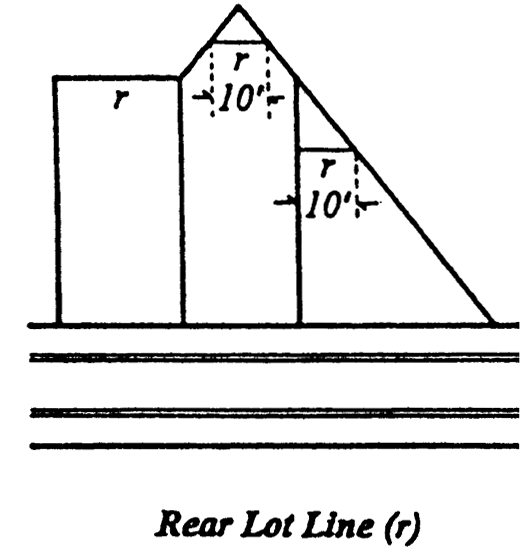
Lot line, rear, means a lot line which is opposite and most distant from the front lot line and, in the case of triangular or gore-shaped lots, a line ten feet in length within the lot, parallel to and at the maximum distance from the front lot line.
Lot line, side, means any lot boundary line not a front lot line or a rear lot line setback.
Lot lines means the lines bounding a lot as defined in this section. On a corner lot, the zoning administrator shall designate which of the two lines abutting a street right-of-way shall be considered a corner lot line and which shall be considered a front lot line.
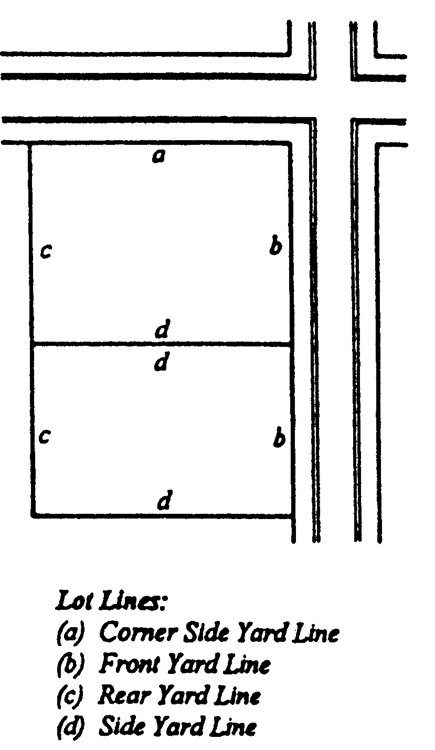
Lot of record means a lot which is part of a subdivision, the plat of which has been recorded in the office of the county recorder of deeds.
Lot width means the horizontal distance between the side lot lines of a lot measured within the lot boundary along the front building line.
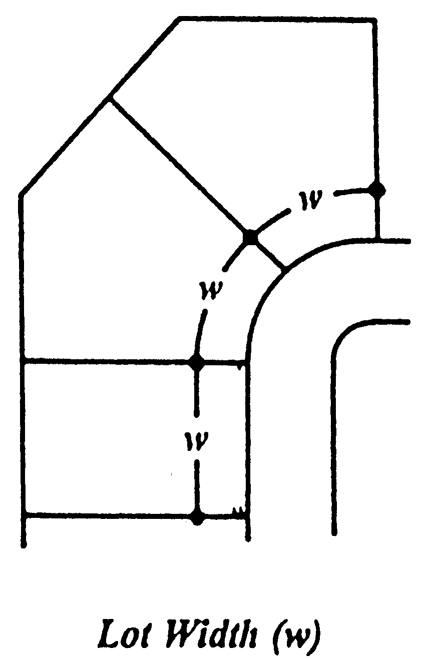
Lot, zoning, means a designated parcel, tract or area of land within a block established by a plat or subdivision or otherwise permitted by law to be used, developed or built upon as a single unit under single ownership or control. The entire area designated by a shopping center as part of its development shall be considered one zoning lot. The entire area approved as a planned development shall be considered one zoning lot.
Lounge means a room accessory to the principal use of the building or tenant space in the building where alcoholic beverages are served for consumption on the premises, and which may provide for live entertainment on the premises.
Low-growing shrub means a woody shrub with a maintained or unmaintained average mature height of three feet or less.
Lumberyard means an establishment where the principal activity is the retail and wholesale sale of wood products and generally involving outdoor storage of building materials and supplies.
Manufacture means an economic activity engaged in the mechanical or chemical transformation of materials or substances, including the assembling of component parts, the manufacturing of products and the blending of materials, such as lubricating oils, plastics, resins or liquors, into new products.
Manufacturing means the mechanical or chemical transformation of materials or substances into new products, including the assembling of component parts, the manufacturing of products and the blending of materials.
Massing refers to the shape and form a building takes on through architectural design. There are ten architectural design elements which create urban space. A specific project need not incorporate all ten elements.
(1)
Building silhouette—a similar pitch and scale to the roofline;
(2)
Spacing between building facades;
(3)
Setback from property line;
(4)
Proportion of windows, bays and doorways and vertical or horizontal elements tied together in bands across the facade length;
(5)
Proportion of primary facade—size of facades similar in area and height-to-width ratios;
(6)
Location and treatment of entryway;
(7)
Materials used in the building's exterior;
(8)
Building scale;
(9)
Landscaping; and
(10)
Shadow patterns forming decorative features with the light and dark surfaces from materials used and projections forming window bays and creating visual breaks.
Medical or dental clinic means an establishment where three or more licensed doctors of medicine or dentistry engage in the practice of medicine, operating on a group or individual basis, with pooled facilities such as coordinated laboratory, X-ray and allied departments, for the diagnosis and treatment of humans, and may include a drug prescription counter (not a drugstore) for dispensing prescription drugs and pharmaceutical products to the patients of the medical or dental clinic.
Minimart, motor vehicle, means a gas station which offers or includes, as an accessory use, the retail sale of merchandise or services not related to dispensing fuel or the maintenance, service or repair of motor vehicles.
Minimum contiguous area means the area that may constitute a separate or detached part of any zoning district classification as set forth in this chapter.
Mobile home means a structure designed for permanent habitation and so constructed as to permit its transport on wheels, temporarily or permanently attached to its frame, from the place of its construction to the location, or subsequent locations, at which it is intended to be a permanent habitation and designed to permit the occupancy thereof as a dwelling place for 1 or more persons. The term "mobile home" shall include manufactured homes constructed after June 30, 1976, in accordance with the Federal "National Manufactured Housing Construction and Safety Standards Act of 1974", 42 USCA 5401 et seq.
State Law reference— Definition of mobile home, 210 ILCS 115/2.1.
Mobile home park means a tract of land or two or more contiguous tracts of land upon which contain sites with the necessary utilities for five or more independent mobile homes for permanent habitation either free of charge or for revenue purposes, and shall include any building, structure, vehicle, or enclosure used or intended for use as a part of the equipment of such mobile home park. Separate ownership of continuous tracts of land shall not preclude the tracts of land from common licensure as a mobile home park if they are maintained and operated jointly. Neither an immobilized mobile home nor a motorized recreational vehicle shall be construed as being a part of a mobile home park.
State Law reference— Definition of mobile home park, 210 ILCS 115/2.5.
Motel means a building offering transient occupancy containing lodging rooms directly accessible from an exterior hall or entrance, providing living, sleeping and sanitary facilities, whether such establishment is designated as a hotel, inn, automobile court, motor inn, motor lodge, tourist court or otherwise.
Nightclub means an establishment where alcoholic beverages are served for consumption on the premises and live entertainment is provided. The establishment may provide for dancing and a menu for prepared food items during hours of operation.
Nonconforming use means any building or structure or use of any building or structure or tract of land, lawfully existing or under construction at the time of adoption of the ordinance enacting this chapter or at the time of adoption of a later amendment, but that does not conform with one or more of the requirements or restrictions of this chapter.
Nursery means a land or structure or a combination used to raise flowers, shrubs, trees and other plant material for sale.
Nursery school. See Day care center.
Nursing home means an extended or intermediate care facility licensed or approved to provide fulltime convalescent or chronic care to individuals who, by reason of advanced age, chronic illness or infirmity, are unable to care for themselves.
Ornamental tree means a tree with an unmaintained average mature height less than 20 feet. Flowers, spring and fall color and interesting growth habits are characteristics of these trees.
Overlay district means a set of regulations which add an additional layer of design provisions to an underlying zoning district.
Parking area, public, means an open area, other than a street or alley, used for the temporary parking of more than four automobiles or commercial vehicles, and available for public use, whether free, for compensation, or as an accommodation for clients, customers or employees.
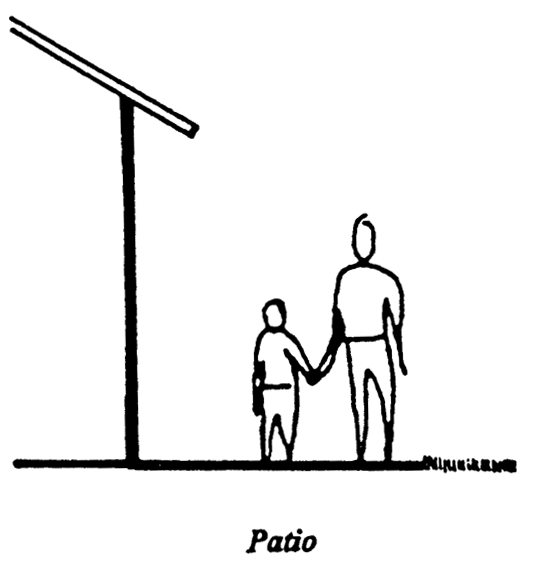
Patio means a level, unenclosed surfaced area located at grade and usually directly adjoining or attached to a building.
Personal wireless service. See section 105-214(7).
Personal wireless service facility. See section 105-214(7).
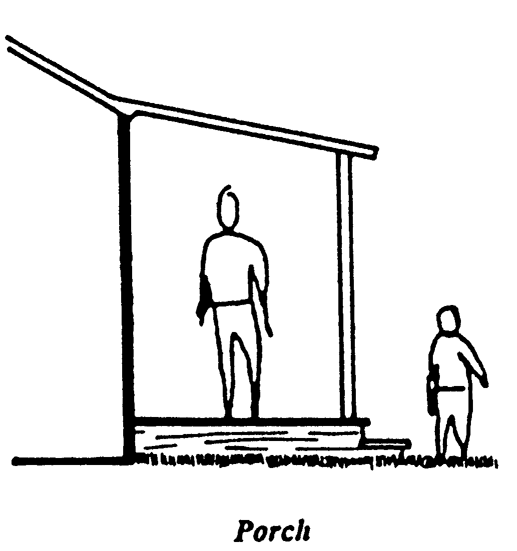
Porch means a roofed platform projecting from the wall of a building and having direct access to or from the building to which it is attached. A porch has no solid walls other than the wall of the building to which it is attached. A porch may be enclosed with a mesh screen to keep out unwanted insects, but is otherwise exposed to the elements throughout the year.
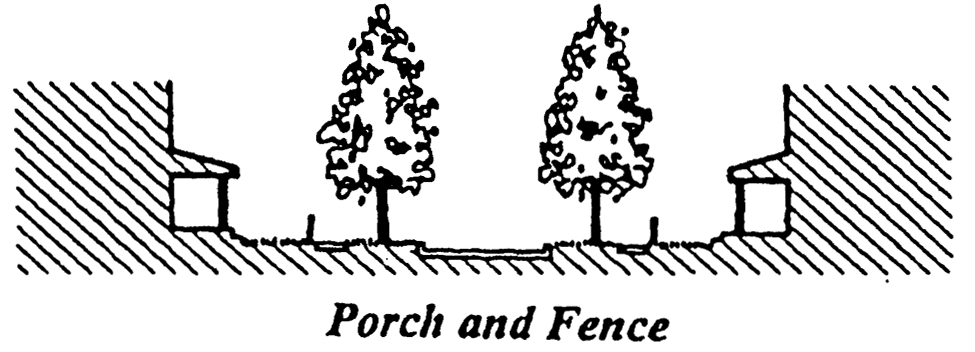
Porch and fence means a building frontage type where the building facade is set back substantially from the frontage line and the porch encroaches in the setback.
Property owners' association and homeowners' association mean a private, not-for-profit corporation of property owners that operates and maintains various common properties in a subdivision or development.
Pub. See Tavern.
Queuing space means the reservoir space occupied by any number of cars that must be accommodated while awaiting ingress or egress to or from specified business or service establishments.
Recess line refers to matters of spatial definition and means a line prescribed for the full width of the facade, above which the facade is set back.
Recreational vehicle means any vehicle or boat originally designed for living quarters, recreation or human habitation and not used as a commercial vehicle, including, but not limited to, the following:
(1)
Boat, meaning any vessel used for water travel; a boat mounted on a trailer shall be considered one vehicle;
(2)
Camping trailer, meaning a folding or collapsible vehicle without its own motive power, designed as temporary living quarters for travel, camping, recreation or vacation use;
(3)
Motor home, meaning a temporary dwelling designed and constructed for travel, camping, recreational or vacation use as an integral part of a self-propelled vehicle;
(4)
Off-road vehicles, meaning vehicles intended primarily for recreational use off of roads where state vehicle licenses are required, e.g., dune buggy, go-cart, snowmobile;
(5)
Racing cars/cycles, meaning vehicles intended to be used in racing competition, such as a race car or racing cycle; a racing car/cycle mounted on a trailer shall be considered one vehicle;
(6)
Travel trailer, meaning a vehicle without its own motive power, designed to be used as a temporary dwelling for travel, camping, recreational or vacation uses;
(7)
Truck camper, meaning a structure designed primarily to be mounted on a pickup truck or truck chassis and designed to be used as a temporary dwelling for travel, camping, recreational or vacation uses; when mounted on a truck, such structure shall be considered one vehicle;
(8)
Vans, meaning noncommercial motor vehicles licensed by the state as a recreational vehicle; and
(9)
Vehicle trailer, meaning a vehicle without its own motive power that is designed to transport another vehicle, such as a boat, motorcycle or snowmobile for recreational or vacation use, and that is eligible to be licensed or registered and insured for highway use; a vehicle trailer with a vehicle mounted on it shall be considered one vehicle.
Recycling center means a facility that is not a junkyard, in which recoverable resources from used materials and products are purchased, collected, processed to a condition for reuse or temporarily stored prior to sale to others who will use the recovered resources to manufacture new products.
Recycling collection center means a building or a portion thereof in which recoverable resources from used products and materials are collected and temporarily stored prior to delivery or sale to others who will process the recoverable resources.
Remodel and remodeling mean to remake or redecorate the interior or exterior of a structure without making structural alterations.
Renovation means to restore to an earlier condition.
Repair facility, motor vehicle, means any building, or portion thereof, used for the repair or replacement of engines, transmissions, differentials or drive trains, or any part thereof, in addition to the replacement of parts, service and incidental repairs to motor vehicles, but excluding operations specified under Body shop, motor vehicle.
Rest home. See Convalescent home.
Restaurant means any building or part thereof providing a menu of food items cooked and prepared for compensation for the general public for immediate consumption on and/or off the premises, including any part of such building or part thereof which may be used for dining by the general public. The retail sale of beer, wine and other alcoholic beverages for consumption on the premises and dancing may be provided on the premises. Reheating of already prepared food by microwave and/or the selling of already prepared food for consumption off-premises does not constitute a restaurant.
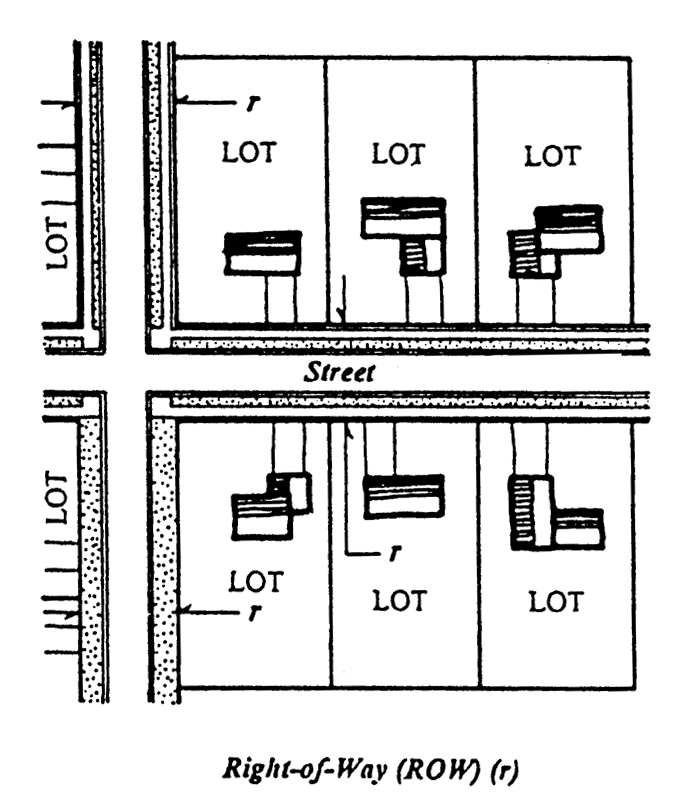
Right-of-way, public, means a strip of land dedicated for public use, primarily intended to be occupied or occupied by a road, sidewalk and/or public utility line.
Roadside stand means a structure for the display and sale of agricultural products, with no space for customers within the structure.
Roominghouse means a building or portion thereof containing a room or suite of rooms rented as sleeping and living quarters, but without cooking facilities and with or without an individual bathroom, for compensation.
Sanitarium. See Hospital.
Satellite station means any disc antenna with an essentially solid surface, whether flat, concave or parabolic, which is designed for receiving television, radio or data electromagnetic or microwave signals from satellites or other satellite stations.
School, commercial, means a school which principally offers, for profit, specific courses of instruction in business, trade, industry or other trained skills, but does not offer academic instruction equivalent to the standards prescribed by the School Code of Illinois.
School, private, means an institution conducting regular academic instruction at kindergarten, elementary, junior high and senior high school levels, operated by nongovernmental organizations, which programs are accepted by the state in lieu of public instruction. This shall not include private commercial schools.
School, public, means a public institution conducting regular academic instruction at the kindergarten, elementary, junior high and senior high school levels equivalent to the standards prescribed by the School Code of Illinois.
Screen means a structure or planting composed of sufficient material to obstruct vision beyond the screen. Generally, but not always, a screen is intended to provide in excess of 90 percent opaque obstruction to vision during all seasons of the year.
Self-service storage facility means a building or group of buildings in a controlled-access and fenced compound that contains various sizes of individual, compartmentalized and controlled-access stalls or lockers for the storage of customers' goods or wares.
Septic system means an underground system with a septic tank used for the discharge of domestic sewage waste.
Service facility, motor vehicle, means an establishment where gasoline or other motor fuel, lubricating oil or grease, or fluids for operating or protecting motor vehicles, or accessories to provide added value and convenience to the owner of the vehicle, are offered for sale to the public and servicing vehicles with such products is performed on the premises.
Service station means a gasoline station, a portion of which is used for the repair or replacement of engines, transmissions, differentials, drive trains or any part thereof, in addition to the replacement of parts, service and incidental repairs to motor vehicles, but excluding operations specified under Body shop, motor vehicle.
Setback refers to matters of spatial definition and means the mandatory distance between a frontage line and a facade, or a lot line and an elevation.
Shade tree means a large tree of standard growth habit with an average mature height in excess of 20 feet. The main purpose of this type of tree in landscape designs is to provide shade and scale against buildings.
Shop front means a building frontage type where the building facade is aligned directly on the frontage line with the building entrance at grade.

Shopping center means a group of more than five business establishments planned, developed and managed as a unit, located on the same lot with off-street parking provided on the property.
Shrub means a branched woody plant with an unmaintained average mature height less than eight feet.
Sight triangle means a triangular area established on private property at the intersection of two streets or a street and a driveway in which nothing shall be erected, planted or allowed to grow so as to limit or obstruct the sight distance of motorists and pedestrians. The area between 2.5 feet and eight feet above grade is to be free and clear of obstructions.
Sign means every device, frame, letter, figure, character, mark, plane, point, design, picture, stroke, stripe, trademark or reading matter which is used or intended to be used to attract attention or convey information when placed in view of the general public. For the purpose of determining number of signs, a sign shall be considered to be a single display surface or display containing elements organized, related and composed to form a unit. Where matter is displayed in a random manner without organized relationship to elements, or where there is reasonable doubt as to the relationship of elements, each element shall be considered to be a single sign.
Site, building, means the ground area of a building or a group of buildings together with all open spaces as required by this chapter.
Solar collector means:
(1)
An assembly, structure or design, including passive elements, used for gathering, concentrating or absorbing direct or indirect solar energy, specially designed for holding a substantial amount of useful thermal energy and to transfer that energy to a gas, solid or liquid or to use that energy directly;
(2)
A mechanism that absorbs solar energy and converts it into electricity;
(3)
A mechanism or process used for gathering solar energy through wind or thermal gradients; or
(4)
A component used to transfer thermal energy to a gas, solid or liquid, or to convert it into electricity.
Solar energy means radiant energy received from the sun at wavelengths suitable for heat transfer, photosynthetic use or photovoltaic use.
Solar energy system.
(1)
Solar energy system means:
a.
A complete assembly, structure or design of a solar collector, or a solar mechanism, which uses solar energy for generating electricity or for heating or cooling gases, solids, liquids or other materials;
b.
The design, materials or elements of a system and its maintenance, operation and labor systems designed or constructed to interface with a solar energy system; and
c.
Any legal, financial or institutional orders, certificates or mechanisms, including easements, leases and agreements, required to ensure continued access to solar energy, its source or its use in a solar energy system, and including monitoring and educational elements of a demonstration project.
(2)
The term "solar energy system" does not include:
a.
Distribution equipment that is equally usable in a conventional energy system except for such components of such equipment as are necessary for meeting the requirements of efficient solar energy utilization;
b.
Components of a solar energy system that serve structural, insulating, protective, shading, aesthetic or other nonsolar energy utilization purposes, as defined in the regulations of the department; and
c.
Any facilities of a public utility used to transmit or distribute gas or electricity.
Solar storage mechanism means equipment or elements, such as piping and transfer mechanisms, containers and heat exchangers, or controls thereof, and gases, solids, liquids or combinations thereof, that are utilized for storing solar energy, gathered by a solar collector, for subsequent use.
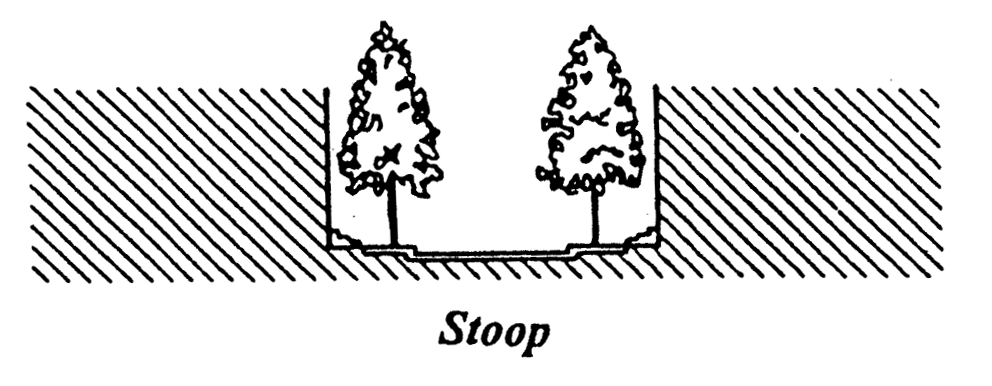
Stoop means a building frontage type where the building facade is aligned directly on the frontage line with the ground floor elevated to provide secure privacy at the windows.
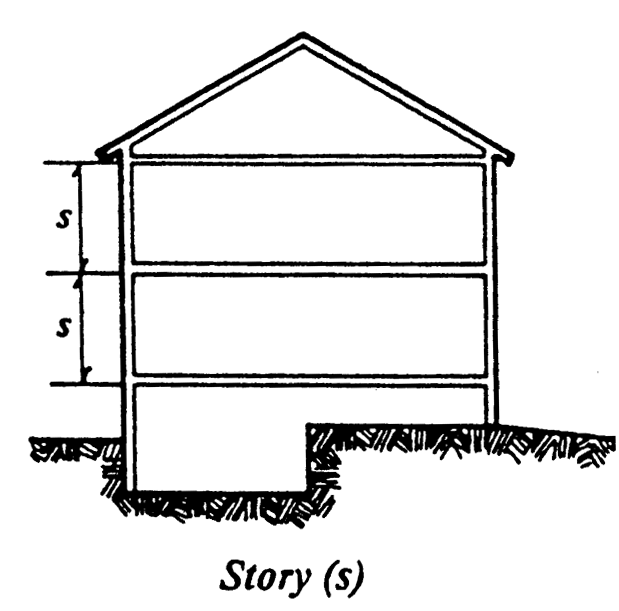
Story means that portion of a building included between the surface of any floor and the surface of the floor next above; or, if there is no floor above, the space between the floor and the ceiling next above.
Street means the paved or unpaved portion of a public or private right-of-way, other than an alley, which affords the principal means of vehicular access to abutting property.
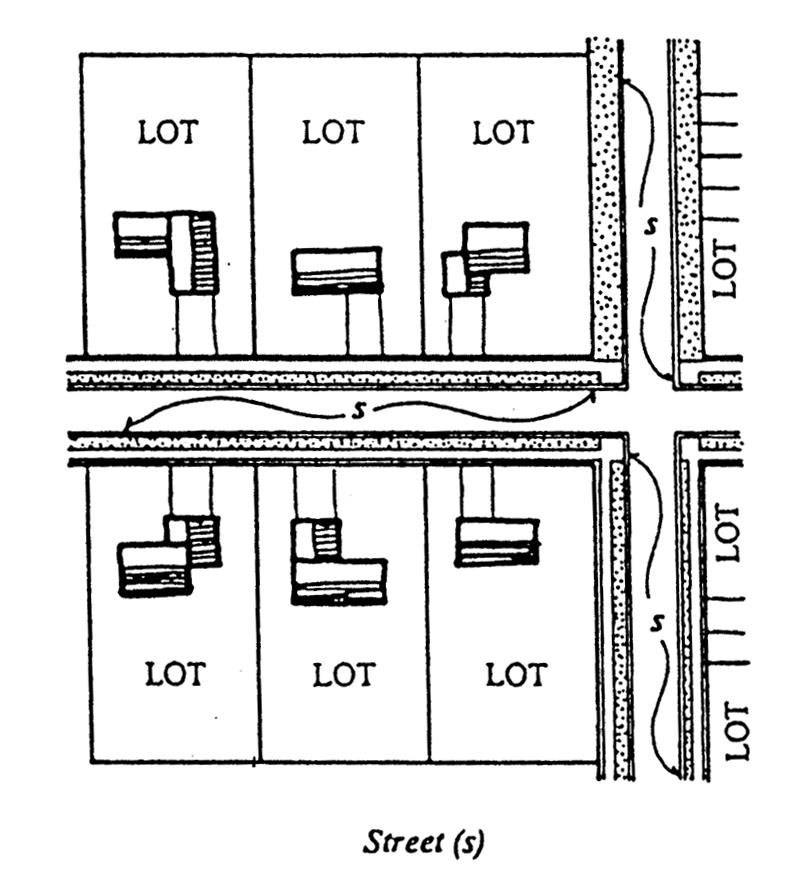
Street, local, means a street of limited continuity used primarily for access to abutting properties and designated "nonarterial" by the public works director.
Street orientation means the direction of the architectural front facade of a building in relation to the street.
Street tree means a tree of standard growth habit acceptable to the village for installing within the public right-of-way.
Structural alteration means any change or modification, other than incidental repairs or which are required by provisions of this chapter, which would prolong the life of the supporting members of a structure such as bearing walls, columns, beams, girders or foundations.
Structure means anything erected, the use of which requires more or less permanent location on or in the ground or attached to something having a permanent location on or in the ground, including, for example, buildings, towers, antennas, freestanding signs, decks, garden sheds and swimming pools.
Swimming pool means a structure designed to hold water and maintain a water depth of 24 inches or more, but not including hot tubs or wading pools.
Tavern means an establishment for the retail sale of beer, wine and other alcoholic beverages for consumption on the premises and providing a menu of food items prepared during all hours of operation. The incidental sale of packaged liquor may be provided during the hours of operation. Dancing may be permitted on the premises.
Terminal, bus or train, means a building or area specifically designated for the assembly and boarding and unboarding of passengers to/from a train or bus.
Terminal, motor freight, means a building or an area in which freight brought by truck is assembled and/or temporarily stored for routing or reshipment, or in which semitrailers, including tractor and/or trailer units and other trucks, are parked or stored.
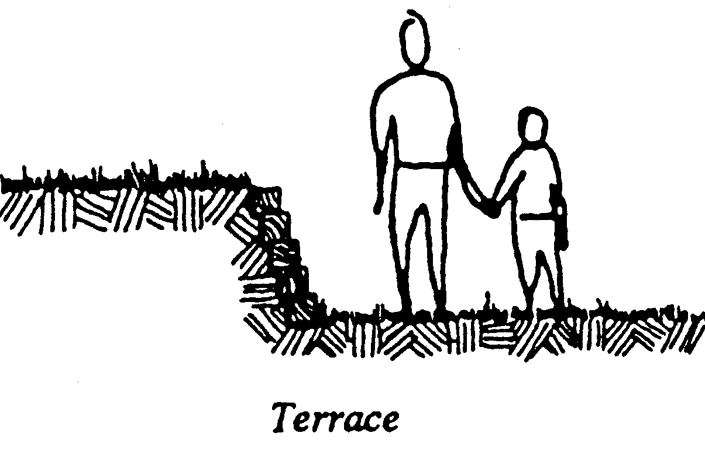
Terrace means a landscape treatment of mounded earth, rock wall, railroad tie wall or other retaining device used to modify steep grade differences on a lot. A terrace shall not include a patio or deck surface.
Tract is used interchangeably with the term "lot," particularly in the context of subdivisions, where one tract is subdivided into several lots.
Trailer means any structure built on a chassis for licensing by the secretary of state as a trailer and designed for general hauling or recreational purposes.
Transition line refers to matters of spatial definition and means a line prescribed for the full width of the facade, expressed by a variation in material or by a limited projection such as a cornice or a balcony.
Tree survey means a scaled drawing accurately locating and indicating the size, condition and species (common and botanical names) of all trees having a caliper of four inches or larger, and the location of any buildings, parking areas, sidewalks and streets on a parcel of property.
Use means the purpose for which land, buildings or structures are designed, arranged or intended, or for which they are or may be occupied or maintained.
Variation means a modification of the application of this chapter in specific cases where practical difficulties or particular hardships, not intended or not common to other property owners in the district, would result from following the strict letter of this chapter.
Wall, common, means an interior wall that separates and distinguishes two or more uses located in the same building or structure. A common wall extends from floor to ceiling and from exterior wall to exterior wall, and conforms to the fire resistance requirements of the village building code.
Warehouse means a structure, or part thereof, or area used principally for the storage of goods and merchandise.
Warehouse and distribution center means a building used in the storage, wholesaling and distribution of manufactured products, supplies, and equipment, but excluding bulk storage of materials that are flammable or explosive or that create hazardous or commonly recognized offensive conditions.
Wholesale establishment means a business establishment principally engaged in selling to retailers or distributors rather than consumers.
Wireless communication facility. See section 105-214(7).
Wrecking yard, vehicle, means a lot or any portion of a lot where two or more motor vehicles or trailers are stored which, for a period of 30 days, have not been capable of operating under their own power, and from which parts have been or are to be removed for sale or reuse, or any land, buildings or structures used for the wrecking, dismantling, salvage, sale or storage of such motor vehicles, trailers or the parts thereof.
Yard means a open space on a lot which is unoccupied and unobstructed from its lowest level to the sky, except for permitted yard obstructions, and which extends along a lot line and at right angles or radial thereto to a depth or width specified in the yard regulations for the district in which the zoning lot is located.
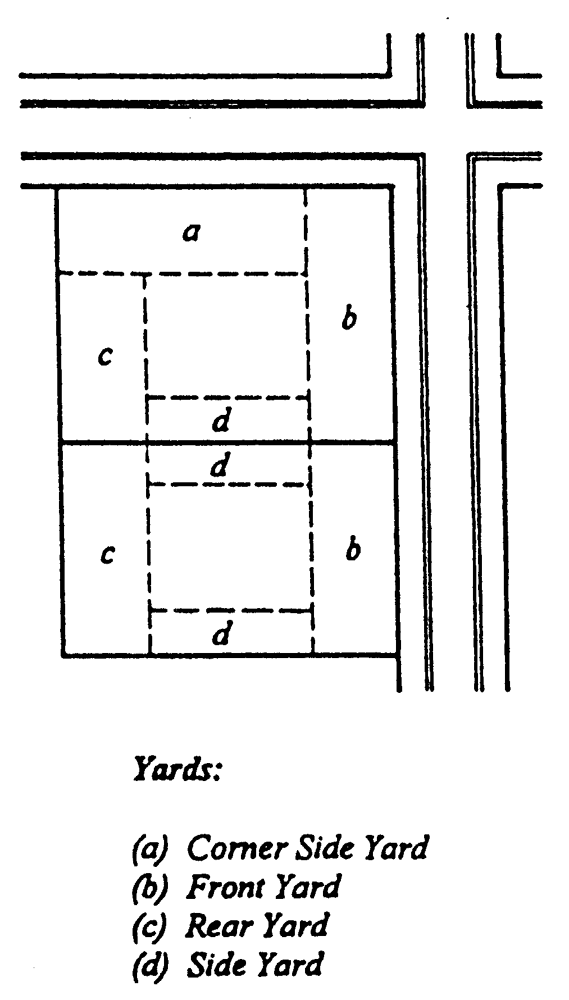
Yard, corner side, means a yard extending the full length of a corner side lot line and back to a line drawn parallel to the corner side lot line at a distance equal to the required corner side yard depth.
Yard, front, means a yard extending along the full length of a front lot line and back to a line drawn parallel to the front lot line at a distance equal to the required front yard depth.
Yard, rear, means a yard extending along the full length of a rear lot line and back to a line drawn parallel to the rear lot line at a distance therefrom equal to the required rear yard depth, but excluding any area encompassed within a required corner side yard.
Yard, side, means a yard extending along the full length of a side lot line and back to a line drawn parallel to the side lot line at a distance equal to the required side yard depth, but excluding any area encompassed within a required front yard or rear yard.
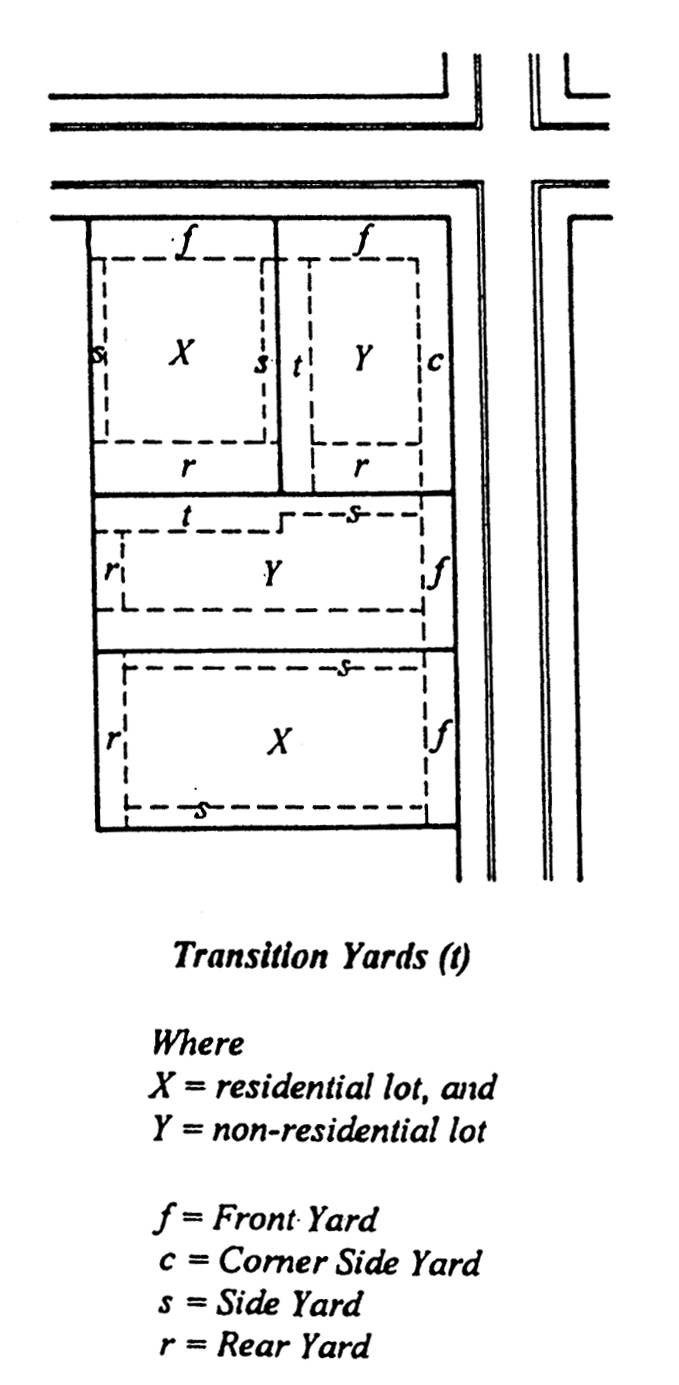
Yard, transition, means the required front, side, corner side or rear yard on a lot in a commercial or industrial district and an adjoining residential district, or the required front, side, corner side or rear yard for a nonresidential use and adjoining residential uses in a residential district, except when such yard is adjacent to a railroad right-of-way, alley or street.
Zone. See District, zoning.
Zoning administrator means the individual designated by the village board to enforce this chapter, or his designee.
Sec. 105-2. - Applicability.
This chapter shall apply to all structures and uses of land and water within the corporate limits of the village.
Sec. 105-3. - Purpose and intent.
This chapter is adopted for the following purposes:
(1)
Promote the public health, safety, morals, comfort and general welfare of the people;
(2)
Divide the village into zones or districts regulating and restricting therein the location and use of buildings, structures and land for residence, business, manufacturing and other specified purposes;
(3)
Protect the character and stability of the agricultural, residential, business, and manufacturing areas within the village and promote the orderly and beneficial development of such areas;
(4)
Provide adequate light, air, privacy and convenience of access to property;
(5)
Regulate the intensity of use of lot areas, and determine the area of open spaces surrounding buildings, necessary to provide adequate light and air and to protect the public health;
(6)
Establish building lines and the location of buildings designed for residential, business and manufacturing or other uses within such areas;
(7)
Fix reasonable standards to which buildings or structures shall conform therein;
(8)
Prohibit uses, buildings or structures incompatible with the character of development or intended uses within specified zoning districts;
(9)
Limit congestion in the public streets and protect the public health, safety, convenience and general welfare by providing for the off-street parking of motor vehicles and the loading of commercial vehicles;
(10)
Protect against fire, explosion, noxious fumes and other hazards in the interest of the public health, safety, comfort and general welfare;
(11)
Prevent the overcrowding of land and undue concentration of structures, so far as is possible and appropriate in each district, by regulating the use and bulk of buildings in relation to the land surrounding them;
(12)
Conserve and enhance the taxable value of land and buildings throughout the village;
(13)
Provide for the gradual elimination of nonconforming uses of land, buildings and structures which are adversely affecting the character and value of desirable development in each district;
(14)
Prevent additions or alterations or remodeling of existing buildings or structures in such a way as to avoid the restrictions and limitations lawfully imposed in this chapter;
(15)
Facilitate and ensure the preservation of sites, areas and structures of historical, architectural and aesthetic importance;
(16)
Define and limit the powers and duties of the administrative officers and bodies provided in this chapter;
(17)
Regulate or forbid any structure or activity which may hinder solar access to solar energy necessary for the proper functioning of a solar energy system;
(18)
Enhance aesthetic values within the village;
(19)
Encourage the use of alternative and renewable energy sources;
(20)
Advance the goals and objectives of the comprehensive plan of the village; and
(21)
Prescribe penalties for the violation of, and methods for the enforcement of, the provisions of this chapter or any amendment thereto.
Sec. 105-4. - Illustrations.
The illustrations used in this chapter are not drawn to scale and are intended only to graphically represent the requirements and concepts contained in this chapter, and are not intended, nor should they be construed, to represent every situation or circumstance that may exist in the village. When there is a conflict between the text of this chapter and an illustration in this chapter, the text shall prevail.
Sec. 105-5. - Zoning map.
(a)
The location and boundaries of the districts established by this chapter are indicated upon the map entitled "Official Zoning Map, Village of Creston, Illinois," which, together with all explanatory matter thereon, is hereby adopted by reference and declared to be a part of this chapter.
(b)
The official zoning map shall be on file in the village clerk's office and shall be the final authority as to the current zoning status of land and buildings, subject to such authorized amendments that may be in effect.
Sec. 105-6. - Zoning of annexed land.
All territory that may hereafter be annexed to the village shall be classified A-1 district until otherwise classified by amendment as provided in this chapter. If owners requesting annexation of their property desire a classification other than A-1 district, a petition shall be submitted for the desired zoning classification simultaneously with the petition for annexation.
Sec. 105-7. - District boundary lines.
If uncertainties exist with respect to the intended boundaries of the various districts as shown on the zoning map, the following rules shall apply:
(1)
District boundaries are the centerlines of the streets or alleys, unless otherwise indicated. Where designation of a boundary line on the zoning map coincides with the location of a street or alley, the centerline of such street or alley shall be construed to be the boundary of such district.
(2)
Where the district boundaries do not coincide with the location of streets or alleys, but do coincide with lot lines, such lot lines shall be construed to be the boundary of such district.
(3)
Where the district boundaries do not coincide with the location of streets, alleys or lot lines, the district boundary shall be determined by the use of the scale shown on the zoning map.
(4)
When a lot held in one ownership on the effective date of the ordinance enacting this chapter is divided by a district boundary line, the entire lot shall be construed to be within the more restrictive district.
(5)
All streets, alleys, public ways, and railroad rights-of-way, if not otherwise specifically designated, shall be deemed to be in the same zone as the property immediately abutting upon such alleys, streets, public ways and railroad rights-of-way. Where the centerline of a street, alley, public way or railroad right-of-way serves as a district boundary, the zoning of such areas, unless otherwise specifically designated, shall be deemed to be the same as that of the property abutting up to such centerline.
(6)
Boundaries indicated as approximately following municipal boundary limits shall be construed to follow municipal boundary limits.
(7)
Boundaries indicated as following railroad lines shall be construed to be midway between the main tracks.
(8)
Boundaries indicated as following shorelines shall be construed to follow such shorelines, and in the event of change in the shoreline shall be construed as moving with the actual shoreline. Boundaries indicated as approximately following the centerlines of streams, rivers, canals, lakes or other bodies of water shall be construed to follow such centerlines.
(9)
Streets, alleys, public ways or railroad rights-of-way which are shown on the zoning map and which have heretofore been vacated, or which may be vacated hereafter, shall be in the same district as the land abutting both sides of the street, alley, public way or railroad right-of-way involved. If the land abutting each side of the street, alley, public way or railroad right-of-way was located in different districts before the street, alley, public way or railroad right-of-way was vacated, the centerline of such vacated street, alley, public way or railroad right-of-way shall be the district boundary line of the respective zoning districts.
Sec. 105-8. - Interpretation.
(a)
In their interpretation and application, the provisions of this chapter shall be held to be the minimum requirements for the promotion of the public health, safety, morals and welfare.
(b)
Where the conditions imposed by any provision of this chapter upon the use of land or buildings or upon the bulk of buildings are either more restrictive or less restrictive than comparable conditions imposed by any other provisions of this Code or of any other law, ordinance, resolution, rule or regulations of any kind, the regulations which are more restrictive (or which impose higher standards or requirements) shall govern.
(c)
Nothing in this chapter shall be deemed to be a consent, license or permit to use any property, to locate, construct, or maintain any building, structure or facility, or to carry on any business, industry, occupation or trade.
Sec. 105-9. - Platted building and setback lines.
If a recorded subdivision plat imposes a building or setback line for a lot which is less than the minimum yard required by the applicable section of this chapter, then, notwithstanding the recorded plat, the minimum yard shall be the same as required by the applicable section of this chapter.
Sec. 105-10. - Incorporation by reference.
Any and all standards and other codes, regulations and public records incorporated by reference into this chapter have been adopted in accordance with the requirements established in 65 ILCS 5/1-3-1 et seq. and 50 ILCS 220/1001 et seq.
Sec. 105-11. - Disclosure by trustee of land trust.
Whenever any trustee of a land trust or any beneficiary of a land trust makes application to the village or any of its agencies pursuant to the provisions of this chapter relating to the land which is the subject of such trust, any interest therein, improvements thereto, or use thereof, such application shall identify each beneficiary of such land trust by name and address and define his interest therein. All such applications shall be verified by the applicant in his capacity as trustee, or by the beneficiary as the beneficial owner of an interest in such land trust.
Sec. 105-12. - Incorporation of rules or standards adopted by successor agencies.
Whenever in this chapter a governmental or private agency is referred to as the promulgator of a rule or standard, the rule or standard shall continue to be incorporated by reference within this chapter if the same rule or standard is adopted by a successor agency in name or substance.
Sec. 105-13. - Private agreements.
This chapter is not intended to abrogate any easement, covenant or other private agreement; provided that, where the regulations of this chapter are more restrictive or impose higher standards or requirements than easements, covenants or other private agreements, the requirements of this chapter shall be controlling.

