
Dallas City Zoning Code
CHAPTER 2
2 Residential Districts
2.2.010 Purpose And Applicability
- Purpose. The Residential Districts are intended to promote the livability, stability and improvement of the City’s neighborhoods, while accommodating development of needed housing types at a range of densities, including attached and detached housing, multi-family housing, senior housing, manufactured and site-built housing, group housing, and other special needs housing. The Residential Districts also accommodate parks, schools, places of worship, and other services that are necessary to serve and create complete neighborhoods.
- Applicability. Residential land use districts or zones are applied in accordance with the policies and Land Use Map contained in the City of Dallas Comprehensive Plan. See Table 2.2.010A. The district standards are based on the following principles:
- Promote the orderly development and improvement of Dallas’s neighborhoods, while maintaining and enhancing the community’s historic character and traditional neighborhood development patterns.
- Make efficient use of land and public services and implement the Comprehensive Plan.
- Designate land for the range of housing types and densities needed by the community, including owner-occupied, rental housing, and special needs housing.
- Provide flexible lot standards that encourage a mixture of compatible land uses, efficiency in site design, and environmental compatibility.
- Provide for compatible building and site design at an appropriate scale; provide standards that are in character with the built and natural environment of Dallas.
- Apply the minimum amount of regulation necessary to ensure compatibility with existing residences, schools, parks, transportation facilities, and neighborhood services.
- Reduce reliance on the automobile for neighborhood travel and provide options for multiple modes of travel, including walking, bicycling and transit.
- Provide direct and convenient access to schools, parks, trails, and neighborhood services.
- Residential Districts.
Residential Low. The Residential Low (RL) district accommodates a residential density of between 4 and 9 dwelling units per net buildable acre under the base development standards of the district. The predominant uses are single family dwellings, duplexes and accessory uses; however, other housing is allowed with specific limitations. Parks, schools, and other civic and institutional uses are also allowed. Residential Medium. The Residential Medium (RM) district accommodates detached single family homes on small lots and small-scale multi-family housing, as well as duplexes and townhomes, at densities between 6 and 16 dwelling units per net buildable acre under the base development standards of the district. Parks, schools, and other civic and institutional uses are also allowed. Residential High. The Residential High (RH) district accommodates a mix of housing types at densities between 10 and 40 dwelling units per net buildable acre. Parks, schools and other civic and institutional uses are also allowed.
Amended by Ord. 1850 (HB2001) on 6/21/2021
Amended by Ord. 1892 on 3/4/2024
2.2.020 Allowed Land Uses And Building Types
Table 2.2.020 identifies the land uses and building types that are allowed in the Residential Districts. The specific land use categories are described and uses are defined, respectively, in Articles 1 and 6.
| Table 2.2.020– Land Uses and Building Types Allowed in Residential Districts | ||||
| Land Uses and Building Types | Land Use Districts | Special Use Provisions | ||
(Uses & building types in Chapter 1.3; definitions in Chapter 6.1) | RL | RM | RH | |
| Residential Categories | ||||
| Household Living | ||||
| Single Family House | P | P | P | |
Accessory Dwelling Unit | S | S | S | Section 2.2.120A |
Duplex (2 dwelling units sharing a common wall on one lot) Attached House (2 dwelling units sharing a common wall with each unit on its own lot) | P P | P P | P P | |
Attached House (3 or more common-wall dwelling |
N |
S | S |
Section 2.2.120B |
Cottage Cluster (2-8 single family dwellings on one | S | S | S | Section 2.2.120H |
Manufactured Home on a Lot | S | S | N | Section 2.2.120F |
Manufactured Dwelling Park - Equal to or less than 3 acres - Greater than 3 acres | N N | S N | S S | Chapter 2.9 |
Modular Home on a lot | S | S | S | Section 2.2.120M |
Multi-family (3 or more dwellings on a lot; Includes | N | S | S | Section 2.2.120H |
Zero Lot Line Courtyard Housing (not common | N | S | S | Section 2.2.120J |
Group Living | ||||
Residential Home | S | S | N | Section 2.2.120D |
Residential Facility | CU + S | S | S | Section 2.2.120D |
Commercial Categories | ||||
Drive-Up/Drive-In/Drive-Through (drive-up | N | N | CU + S | Section 2.3.100 |
Bed and Breakfast Inn | CU + S | CU + S | CU + S | Section 2.2.120C |
Educational Services, Commercial (e.g., tutoring or | N | CU + S | CU + S | Limited to 1,200 square feet of floor area |
Entertainment, Major Event | N | N | N | |
Home Occupation | S | S | S | Per standards of Section 2.2.120E and procedures in Chapter 4.9 |
Office, not a home occupation; fully enclosed in | N | CU + S | CU + S | Limited to 1,200 square feet of floor area |
Outdoor Recreation, Commercial | N | N | N | |
Indoor Recreation, Commercial | N | N | N | |
Commercial Parking | CU | CU | CU | |
Quick Vehicle Servicing or Vehicle Repair | N | N | N | |
Recreational Vehicle Park | N | N | N | |
Retail Sales and Service | N | N | N | |
Self-Service Storage, when not accessory to a | N | N | CU | |
Short-Term Vacation Rental, primary dwelling or | CU + S | CU + S | N | Section 2.2.120I |
Industrial Categories | ||||
Industrial Service, enclosed in primary building | N | N | N | |
Manufacturing and Production, fully enclosed in Warehouse and Freight Movement | N
| N
| N
| |
Waste-Related when not accessory to a primary |
|
|
| |
Wholesale Sales when accessory to a primary | N | N | N | |
Institutional Categories | ||||
Basic Utilities when not accessory to a primary | CU | CU | CU | Wireless Communication Facilities Subject to CU |
Community Service; Government, except drive-up | CU | CU | CU | |
Daycare, adult or child care; Family Childcare (16 or fewer children) | CU + S
| CU + S
| CU + S
| Provide City with evidence of compliance with ORS 329A.250 and 329A.440(4) |
Medical Centers | N | N | N | |
Incarceration Facilities | N | N | N | |
Parks, Open Space, and Common Areas | P | P | P | |
Religious Institution, House of Worship | CU | CU | CU | Conditional Use Permit required, except where City codes preempted by Federal or State law |
Schools | P/CU | P/CU | P/CU | Permitted (P) when part of a Master Plan; otherwise CU |
Park and Ride | N | P/CU | P/CU | Permitted (P) when part of a Master Plan; otherwise CU |
Accessory Structures, total of all accessory - Not taller than 15 ft. and not wider than 50% of - Taller than 15 ft. or wider than 50% of width of |
|
|
| |
Agriculture | N | N | N |
|
| ||||
Mining | N | N | N | |
Wireless Communication Facilities, Wind | N | N | N | Ham and Similar Amateur Radio exempt when height limits are met |
Utility Corridors (e.g., regional gas pipelines, | CU | CU | CU | |
Temporary Uses | P/CU | Temporary uses subject to Section 4.9.010 | ||
Transportation Facilities (operation, maintenance, preservation, and construction in accordance with applicable standards of the roadway authority) are Permitted; other Transportation Facilities require Conditional Use Permit and are subject to review and approval by the applicable roadway authority. | ||||
Non-Conforming Uses. Uses and structures lawfully established prior to January 22, 2010 may continue pursuant to Chapter 5.2 Non-Conforming Situations. The City may require upon annexation rezoning that uses conform to the current code requirements for the zone in which they are located. | ||||
Uses Subject to Preemptive State or Federal Law are allowed pursuant to applicable laws | ||||
Adopted by Ord. 1850 (HB2001) on 6/21/2021
Amended by Ord. 1892 on 3/4/2024
Amended by Ord. No. 1919 on 3/2/2026
2.2.030 General Development Standards
The development standards in Table 2.2.030 apply to all uses, structures, buildings, and development, and major remodels, in the Residential Districts.
Table 2.2.030– Development Standards for Residential Districts | ||||
Standard | Land Use Districts | |||
RL | RM | RH | ||
A) | Minimum and Maximum Residential Density (Dwelling units per net buildable acre after subtracting required right-of-way. Does not apply to partitions of 3 or fewer lots and to conversion of existing detached single-family houses to duplex.) All residential zones are subject to Housing Density standards in Section 2.2.050. |
|
|
|
B) | Minimum Average Lot Area* |
|
|
|
C) | Minimum Lot Width/Depth (feet), per minimum lot size, density, setbacks, and lot coverage |
|
|
|
| D) | Building/Structure Height | 28 ft 15 ft + 5 ft | 40 ft 15 ft + 8 ft | 48 ft 15 ft + 8 ft |
E) | Lot Coverage (Impervious Surfaces): | 50% | 65% | 75% |
F) | Min. Open Space Area (% site area); except does not apply to Single Family House, Attached House, or duplex dwelling lots, only the subdivision as a whole. Where a subdivision site does not contain suitable land for open space, the City may accept a fee equal to 6% of the site's Real Market Value, per the current Assessor's file, in lieu of open space. The landscaped portion of common area or green roof, when approved by Planning Official, may count toward meeting landscape area requirement under Section 3.2.030.D. | 6% per | 6% per | 15% |
G) | Minimum Setbacks (feet), except as otherwise required for Clear Vision areas and per Section 3.2.050, Fences and Walls. Other standards may preclude building at a minimum setback. Structures shall not encroach into easements for utilities, access ways, etc. See also, Clear Vision Area requirements and special setbacks for planned street improvements, respectively, in Chapter 3.2 and Chapter 3.4. | |||
G.1) | Front/Street Side Yard, Primary Structures, Fronting Local Street with Standard ROW | 15 ft | 12 ft | 12 ft |
G.2) | Front Yards and Street Side Yards, Primary Structures, Fronting a Collector or Arterial Street with Standard ROW | 20 ft | 20 ft | 20 ft |
G.3) | Front Yards and Street Side Yards, Primary Structures, Fronting Any Street Without Standard ROW (measured from designated street centerline) | 1/2 - width standard ROW, plus setback | ||
G.4) | Garage or Carport Opening Facing a Street | 20 ft | 20 ft | 20 ft |
G.5) | Front/Street Side Yard, Accessory Structures | Where an accessory structure is visible from a street, it shall be set back behind the front/side building elevation adjacent to the subject street. The street side yard setback for an accessory structure may be reduced to 5 ft, if the structure is screened with a 6 ft high sight-obscuring fence, wall or hedge. | ||
G.6) | Interior Side Yards, Primary Structure, Not Abutting Alley. Note additional setbacks may be required pursuant to building codes and other Development Code provisions. | 5 ft | 3 ft | 3 ft |
G.7) | Interior Side Yards, where common wall or zero-lot line is allowed. See also, | 0 ft | 0 ft | 0 ft |
G.8) | Interior Side Yard, Accessory Structure | Accessory Dwelling: 3 ft Other Structures: No setback for structures up to 15 ft in height; Taller structures shall conform to Primary Structure setbacks | ||
G.9) | Yard Abutting Alley; Allowed Only Where Alley is Improved to City Standards | 3 ft | 3 ft | 3 ft |
G.10) | RM or RH Yard Abutting RL Yard | 10 ft | 10 ft | 15 ft |
G.11) | Parking Lot (e.g., multi-family, commercial, or institutional use) abutting RL District; see Chapter 3.2 Landscaping | 10 ft | 10 ft | 10 ft |
G.12) | Rear Yard, Primary Structure | 10 ft | 10 ft | 15 ft |
G.13) | Rear Yard, Accessory Structure | Accessory Dwelling: 3 ft Other Structures: No setback for structures up to 15 ft in height; Taller structures shall conform to Primary Structure setbacks | ||
G.14) | Reduced Setback for Covered Front Porch | 8 ft Reduction in front and street side setbacks allowed where structure does not conflict with any easement | ||
G.15) | Special Setback for Development on Oversized Lot | Where a lot is more than twice the minimum lot size of the zone, the dwelling shall be placed to allow for future land division in accordance with the minimum dimensional standards of this Chapter and requirements of the Land Division criteria of Chapter 4.3. | ||
Adopted by Ord. 1850 (HB2001) on 6/21/2021
Amended by Ord. 1892 on 3/4/2024
Amended by Ord. No. 1906 on 7/7/2025
2.2.040 Adjustments And Exceptions To General Development Standards
- Adjustments. The City may approve modifications to the dimensional standards of Section 2.2.030 through the Adjustment procedure (Type II), provided the adjustment is not more than 20% of the standard and the modification is consistent with the following criteria:
- There is sufficient space for private yards and building separation is maintained for fire protection, security, building maintenance, sunlight and air circulation.
- The adjustment does not diminish street visibility from dwellings for public safety and neighborhood security.
- The adjustment maintains compatibility between the proposed structure and existing structures.
- The adjustment does not increase the visual presence of vehicle storage areas or garages along any public way.
- The adjustment does not result in residential densities exceeding the densities allowed by the Comprehensive Plan and applicable land use district.
- For subdivisions, adjustments are limited to 20% of proposed lots. Subdivisions requiring adjustments to more than 20% of lots may be approved under the Master Plan Development procedure of Chapter 4.5.
- Setback Yards – Exceptions. Exceptions to the standard setback yards follow:
- Where existing lawfully established buildings have yard setbacks that are less than the minimum standards of this Code, they are allowed to remain as legal, non-conforming structures subject to the provisions of Chapter 5.2.
- The special setback requirement for oversized lots does not apply where future division of oversized lots is not practical due steep slopes, natural features, or other physical site characteristics.
- The following architectural features may encroach into the setback yards by no more than 36 inches, provided that a setback of not less than thirty-six (36) inches is preserved, all applicable building and fire codes are met, and the clear vision standards in Section 3.1.020 are met. Eaves, chimneys, bay windows, overhangs, and similar architectural features may encroach into a setback yard by not more than 36 inches. Porches, decks and similar unenclosed structures may extend into front and street side yard setbacks by eight (8) feet as provided in Table 2.2.030. Walls and fences built on property lines are subject to the height standards in Table 2.2.030 and the provisions of Sections 3.1.020, Vision Clearance, and 3.2.050, Fences and Walls.
- Residential equipment less than 48 inches in height is exempt from interior side and/or rear yard setback requirements.
- Setback Yards – Reverse Frontage Lots. On reverse-frontage lots (through lots), the front yard setback standard shall apply to all yards abutting a street, except where the City decision-making body approves a reduced setback to accommodate a landscape buffer adjacent to a sidewalk. Reverse frontage lots are subject to the fence height and setback requirements in Section 2.2.030 and the landscape buffer requirements in Chapter 3.2.030.
- Setback Yards – Flag Lots. The front yard of a flag lot may orient to an abutting street or the driveway (flagpole) from which access is taken. The City Community Development Director shall specify one or the other based on which one provides for the greatest compatibility between residences on abutting lots with respect to building orientation, setbacks, and privacy between residences. See also, Chapter 4.3.
2.2.050 Housing Density
- The total number of dwelling units in single family subdivisions is calculated by multiplying the total parcel or lot area in acres (including fractions to 0.01) after subtracting required right-of-way by the applicable density standard of the zone. The result is the allowable number of dwelling units, subject to compliance with applicable development standards.
- The total number of dwelling units allowed in housing developments that contain units other than single family dwellings is calculated in the same manner as under subsection ‘A’, except that dwelling units have the following values with respect to calculating the actual density of a development proposal:*
- Group Living: 0.25 dwelling unit per full-time resident
- Apartment: 0.50 dwelling unit per studio or 1-bedroom apartment; 0.75 dwelling unit per 2-bedroom apartment; 1.0 dwelling unit per 3-bedroom apartment
- Duplex and Attached House: 2 dwelling units per Duplex or Attached House
- Single Family House: 1 dwelling unit per single family dwelling (attached or non-attached)
- Accessory Dwelling Unit: 0.50 dwelling unit per accessory dwelling unit
- Cottage Cluster: 0.75 dwelling unit per cottage
- Other Dwelling Types: Determined by Planning Official through Type II Code Interpretation (Section 4.8) based on data and comparison to listed housing types
- Group Living: 0.25 dwelling unit per full-time resident
- Areas reserved for private access, stormwater treatment, and open space are counted for the purpose of calculating allowable density.
- Areas conveyed or dedicated to the public for stormwater treatment or open space, exclusive of public street rights-of-way, are counted for the purpose of calculating allowable density.
- Areas reserved for flag lot access (flag poles) are counted for the purpose of calculating allowable density but are not included in calculating minimum lot area for subject flag lots.
*The above density standards under A and B, are applicable in review of new housing development applications. In accordance with OAR 660-046-0120(2), maximum density does not apply to the development of duplexes. Also, in accordance with OAR 660-046-0130, conversion of existing detached single-family housing dwellings to duplex are allowed and subject to the above, provided that the conversion does not increase nonconformity with the applicable development standards for building height, lot coverage and setbacks as contained in Article 2.
Amended by Ord. 1850 (HB2001) on 6/21/2021
Amended by Ord. 1892 on 3/4/2024
2.2.060 Lot Coverage And Impervious Surfaces
The maximum allowable lot coverage shall be as provided in Table 2.2.030. The purpose of the lot coverage standard is to provide flexibility in development design while encouraging developments that minimize stormwater runoff and incorporate water quality treatment. Therefore, lot coverage is calculated as the percentage of a lot or parcel covered by impervious surfaces (e.g., asphalt, concrete, and similar non-porous paving). It does not include areas that function as water quality treatment facilities and those allowing infiltration of treated surface water; such exempt areas may include porous paving systems, swales, landscape areas and other water quality treatment facilities conforming to City standards and as approved by the Public Works Director.
2.2.070 Building Orientation Standards
- Purpose. The following standards are intended to orient building entrances toward streets to allow for safe and effective use of multiple modes of transportation, including walking, bicycling and transit. Placing residences and other buildings close to the street also encourages crime prevention, natural surveillance and security of public and private property, and overall neighborhood safety and livability by having more eyes-on-the-street.
- Applicability. Section 2.2.070 applies to buildings and developments that are subject to Site Design Review under Chapter 4.2. See also, Chapter 3.1 Access and Circulation. The standards of this Section may be adjusted through a Type II review, provided the adjustment is consistent with the above purpose and the applicant demonstrates that an alternative proposal meets the intent of the standard.
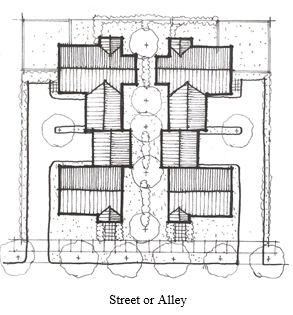
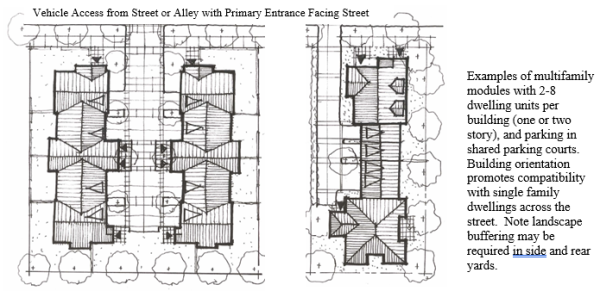
- Building Orientation Standards. All dwelling units shall have their primary entrance oriented to a public street sidewalk, as generally illustrated in this Section. Where no adjacent public street sidewalk exists or it is not practical to orient an entrance to a public street due to topographic or other physical site constraints, dwelling entrances may orient to a walkway, courtyard, or common lobby or breezeway (i.e., for multi-multiple family buildings) meeting the standards of Section 3.1.030. Where a site contains multiple buildings and there is insufficient street frontage to which buildings can be oriented, a primary entrance may be oriented to common green, open space, plaza, or courtyard (e.g., Cottage Cluster). When oriented in this way, the primary entrance(s) and green, plaza, or courtyard shall be connected to the street, and all primary building entrances shall be connected to one another, by pedestrian walkway(s) meeting the standards in Section 3.1.030. See example in Figure 2.2.070.C(1) “acceptable site plan.”
- Where a proposed development abuts a City-approved alley or shared access drive that has been created for purposes of accessing the subject site, off-street parking for the development shall be accessed primarily from the alley or shared driveway and direct access to abutting streets shall be minimized.
- Off-street parking, driveways, and other vehicle areas shall not be placed between primary building entrances and the street(s) to which they are oriented, except the vehicle areas described in subsections 3-5 below are allowed where the decision making body finds that they will not adversely affect pedestrian safety and convenience:
Figure 2.2.070.C(1) – Residential District Building Orientation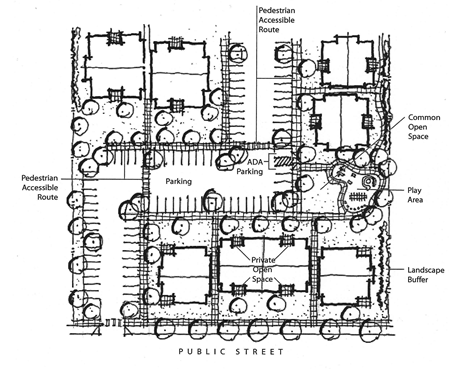 Multi-family Site Plan – Preferred (above)
 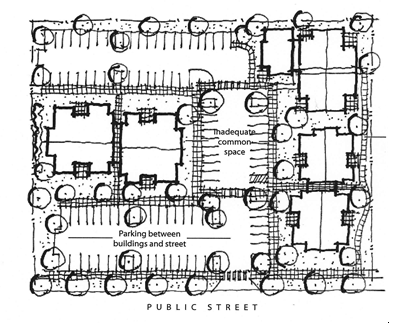 Multi-family Site Plan - Unacceptable (above)
 - Nursing homes, assisted living facilities, schools, places of public assembly or religious worship, and similar institutional uses may have one driveway located between the street and the primary building entrance, provided that the building’s primary entrance is connected to an adjacent street by a raised pedestrian walkway, as required by Section 3.1.030. The intent of this exception is to provide for one drop-off/loading zone while maintaining a direct, convenient and safe pedestrian access to a primary building entrance;
- Single-family and duplex dwellings may have off-street parking between building entrances and the street, provided that garage openings shall meet the relevant setback from the street right-of-way.
- Attached Houses (townhomes) that contain street-facing garage openings shall have not more than one (1) driveway access located between the street and the primary building entrance for every two (2) attached dwelling units; except that this requirement does not apply where the width of townhome lots is 50 feet or greater. Where a shared driveway is required, it shall meet the following criteria, as generally shown in Figure 2.2.070C(2):
- Where two abutting attached houses )(townhomes are required to share one driveway, the driveway access shall not exceed 16 feet in width where it crosses the sidewalk and where it intersects the street (excluding driveway apron);
- All primary building entrances shall be connected to the driveway (and sidewalk) via a pedestrian walkway as required by Section 3.1.030.
- All street-facing garage openings and carport openings shall meet the relevant setback from the street right-of-way and shall be recessed at least six (6) feet behind the front building elevation; a front porch projecting at least six (6) feet beyond the garage opening meets the “recess” requirement;
- The width of all street-facing garage openings on attached houses (townhome) building shall not exceed fifty percent (50%) of the overall width of the building façade or street-facing elevation, as generally illustrated in Figure 2.2.070.C(2). Figure 2.2.070.C(2) – Townhome Building Orientation
- Commercial buildings and uses (e.g., neighborhood commercial or mixed-use), where permitted in a Residential District, shall have their off-street parking areas located behind or to the side of such buildings and uses and screened from abutting properties in accordance with Chapter 3.2, as generally shown in Figure 2.2.070.C(3). Off-street parking shall not be located between any building and any street.
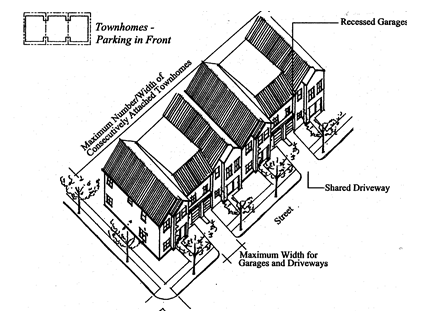
Figure 2.2.070.C(3) – Commercial Building Orientation in a Residential District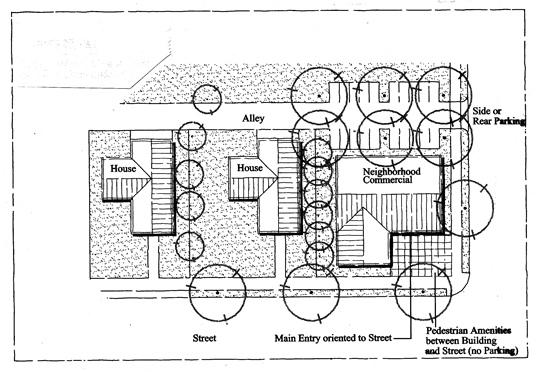
Adopted by Ord. 1850 (HB2001) on 6/21/2021
Amended by Ord. 1892 on 3/4/2024
2.2.080 Housing Variety Standards
- Purpose. Require new neighborhoods and large subdivisions to contain a variety of housing types. Housing variety is in the public interest because it supports housing at price ranges and rent levels that are commensurate to local incomes, promotes livability by offering housing choices, and contributes to the development of complete neighborhoods, consistent with the Comprehensive Plan.
- Applicability. Section 2.2.080 applies to land divisions creating or having the potential to create twenty (20) or more lots on any parcel or contiguous parcels in the RL and RM zones. For the purpose of this Section, “project proposal” means the sum total of all proposed development (acres and dwellings) and potential future development on contiguous land under the same ownership that could occur under existing zoning. “Same ownership” means ownership by the same individual, group, organization, corporation or other legal entity; or such entity holds a majority interest. The standards of this Section may be adjusted through a Type II review, provided the adjustment is consistent with the above purpose and the applicant demonstrates that an alternative proposal meets the intent of the standard.
- Housing Variety Standards. Project proposals shall achieve a minimum of twelve (12) points based on the following criteria. Lots and housing units used to comply with the standards below should be evenly distributed throughout all phases of the subdivision.
- Minimum Density (required). Projects are required to meet the minimum density standard, per Table 2.2.030, except as allowed elsewhere in this code. No points are awarded for compliance with the minimum density standard.
- Option 1: Lot Size Variety. Choose one of the following options:*This option may not be used if it would result in a lot size less than the minimum for the zone. Percentages are rounded to the closest whole percent (1%); fractional points are not awarded.
Criteria Points a) At least 10% of lots in the project are at least 20% smaller than the project's median lot size** 3 b) At least 20% of the lots in the project are at least 20% smaller than the project's median lot size 6 c) At least 30% of the lots in the project are at least 20% smaller than the project's median lot size* 9 - Option 2: Small houses. Choose one of the following options:*Lots to be reserved under this option shall be identified with the land division application. Reservation shall be enforced through deed-restrictions for a period not less than 15 years. Small houses are single-family dwelling units that individually contain less than 1,600 square feet of enclosed floor area excluding garages. Percentages are rounded to the closest whole percent (1%); fractional points are not awarded. Small houses may include duplex dwelling units that contain less than 1,600 square feet per unit.
Criteria Points a) At least 10% of the lots in the project are reserved for "small houses"* 3 b) At least 20% of the lots in the project are reserved for "small houses"* 6 c) At least 30% of the lots in the project are reserved for "small houses"* 9 - Option 3: Affordable housing. Choose one of the following options:* Income levels determined based on household size and other factors, in accordance with U.S. Department of Housing and Urban Development criteria. Housing must ensure housing affordability through deed-restrictions for a period not less than 15 years. Percentages are rounded to closest whole percent (1%); fractional points are not awarded. A development agreement is required.
Criteria Points a) At least 15% of the dwelling units in the project reserved for qualifying buyers or renters with incomes at or below Polk County area median income.* 6 b) At least 20% of the dwelling units in the project reserved for qualifying buyers or renters with incomes at or below Polk County area median income.* 3 c) At least 25% of the dwelling units in the project reserved for qualifying buyers or renters with incomes at or below Polk County area median income.* 9 - Option 4: Middle housing types. Choose one of the following options:* Lots to be reserved under this option shall be identified with the land use application. Reservation shall be enforced through deed-restrictions for a period not less than 15 years. Percentages are rounded to closest whole percent (1%); fractional points are not awarded.
Criteria Points a) At least 10% of the lots in the project are reserved for duplexes, attached houses, or detached single-family houses with accessory dwelling units.* 3 b) At least 20% of the lots in the project are attached houses, or accessory dwelling units.* 6 c) At least 35% of the lots in the project are reserved for duplexes, attached houses, or accessory dwelling units.* 9 d) More than 50% of the lots in the project are reserved for duplexes, attached houses, or accessory dwelling units.* 12
Adopted by Ord. 1850 (HB2001) on 6/21/2021
Amended by Ord. 1892 on 3/4/2024
2.2.090 Low-Impact Development Incentives (Reserved)
[This section deleted, reserved for future use]
2.2.100 Building Design Standards
A. Purpose. Establish clear and objective standards for building design in Residential Districts to promote land use compatibility and livability while protecting property values and ensuring predictability in the development process. The intent is to:
1. Reinforce Dallas’ sense of place and respect the local architectural vernacular of Dallas. 2. Reduce the visual dominance of garage openings as viewed from abutting streets, parks, and other public use areas 3. Encourage a diversity of building facades and rooflines at an appropriate neighborhood scale. 4. Promote compatible building-to-building relationships, and to create a sense of street enclosure at a pedestrian-scale in urban neighborhoods.
B. Applicability. Section 2.2.100 applies to all new dwelling types, including multi-dwelling buildings, single family house, attached house (townhome), duplexes, and cottage cluster developments. The standards are applied through building plan review for single family house dwellings or duplexes, and Site Design Review and/or Planned Unit Development Review, as applicable, for other building types. In addition, other building design standards may apply for certain types of land use and development, as provided under Section 2.2.120 Special Use Standards. The standards of Section 2.2.100 may be adjusted through the Adjustment (Type II) procedure provided the Adjustment is consistent with the above purpose and the applicant demonstrates that the proposed design meets the intent of the standard for which an Adjustment is sought.
C. Standards
1. Garage Orientation and Design.
- Purpose. The following requirements for garage design are intended to balance residents’ desire for convenient vehicle access to their homes with the community’s desire to have safe and aesthetically pleasing streetscapes. The standards therefore promote pedestrian safety and aesthetic concerns associated with garages, while allowing garages that do not detract from the appearance and walkability of Dallas’ neighborhoods.
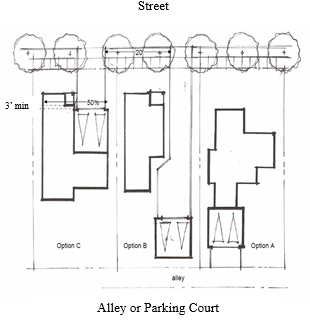
- Alleys. Where alleys or shared driveways exist or are proposed (Option A), all garages and off-street parking areas shall orient to the alley/driveway.
- Garage Setback. Where street-loaded garages are proposed (Options B or C), all garage openings shall be setback from the street property line as specified in Section 2.2.030.G.4.
.
- Garage Openings. Garage openings shall not exceed fifty percent (50%) of the width of the front building elevation, except where at least one of the following criteria is met:
- The garage is side-loaded and does not have any openings facing a street (e.g., garage oriented to a driveway or parking court); such side-loaded garages shall have windows on at least a portion of the street-facing elevation; or
- The garage opening(s) are recessed or offset at least three (3) feet behind the front elevation of dwelling as viewed from the street. Projections may include arbors, porticos and/or similar architectural feature extending for the width of all garage openings.
 See also, requirements for three-car and wider garages under subsection 2.2.100.C.1.h.
- Driveway Approaches. Driveway throats serving detached single-family houses shall not exceed the following widths:Driveways may expand to a width greater than the maximum width where they are located behind the property line. For driveways serving attached single-family houses (townhomes) see section 2.2.070.C.5.
Lot frontage Driveway width <55’ 22' 55’-70’ 26' >70’ 32' - Recreational Vehicles and Outdoor Vehicle Storage. All RVs, boats, trailers, and similar vehicles and equipment shall be stored in one of the following locations:
- An approved off-street parking space such as a driveway, or
- Setback from the street property line by at least twenty (20) feet, or
- Screened behind a sight-obscuring fence (e.g., wood, chain-link with slats, or similar screening).
- Driveway Spacing and On-Street Parking. To the extent practicable, subdivision lots and dwelling plans should be oriented to provide for on-street parking (e.g., by staggering driveways on opposite sides of a street). Driveway curb openings shall be spaced at least eighteen (18) feet apart from one another to provide space for on-street parking between them; alternatively, where closer spacing results in more efficient on-street parking, driveways may be paired together. Where driveways are paired, a four (4) minimum foot landscape strip beginning ten (10) feet back from the sidewalk or right-of-way is required between them for surface water runoff, i.e., two (2) foot landscape strip on each lot between driveway and common property line.
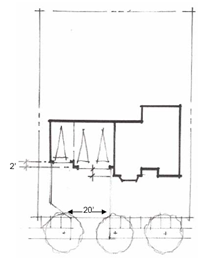
- Three-Car and Wider Garages. Where three (3) or more contiguous garage parking bays on the same structure are proposed facing the street, the garage opening closest to a side property line shall be off-set at least two (2) feet from the adjacent bays to break up the appearance of the garage elevation. Note: Side-loaded garages where the garage openings do not face a street are exempt from this requirement.
2. Front/Street Facade Variation.
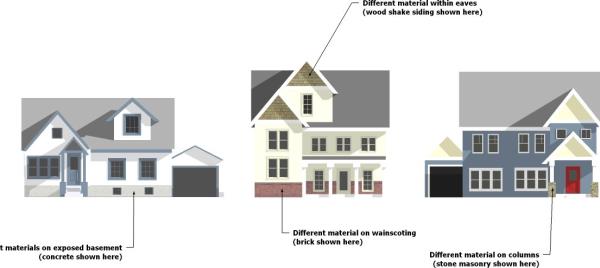
a. Purpose. The following requirements for façade variation promote variety in housing design to improve the appearance and aesthetics of new subdivisions and multifamily developments. The standards are intended to promote architecturally varied neighborhoods, avoiding homogeneous street frontages that detract from a neighborhood’s appearance. b. Standards. No two directly adjacent or opposite dwelling units may possess the same front or street-facing elevation. This standard is met when front or street-facing elevations differ from one another by at least 5 of the 8 following elements: 1) Mix of Materials – Different mix of materials in compliance with subsection 2e below. 2) Articulation – Different offsets or articulation of front building elevation in compliance with subsection 3 below. 3) Variation in Roof Elevation – Different roof form or changes in roof elevation and orientation of roof line (e.g., cross-gable) or use of projections such as gables and dormers over at least ten percent (10%) of roof elevation. 4) Entry/Porch – Different configuration or design of front porch or covered primary entrance. 5) Fenestration – Different placement or pattern of windows and doors (must comprise at least 30 percent of front/street facing elevation). 6) Architectural Style – Different architectural style, provided such styles borrow from the vocabulary of at least one of the following: Craftsman, Prairie, Four Square, Northwest Contemporary, Ranch, Victorian, Colonial, English Arts and Crafts, or other Dallas Style as determined by the Planning Official (traditional or contemporary adaptations are acceptable). 7) Height – Change in elevation of primary roof line (along the axis of the longest roofline) by not less than two (2) feet; requires variation from building to building, or dwelling unit to dwelling unit (e.g., townhome units), as applicable. 8) Color Palette – Complementary variation in color palette; no metallic, day-glow, or similar loud, bright colors. c. Repeated facades. Buildings not differentiated by at least 5 of the criteria listed above shall be considered a group of similar buildings for purpose of this subsection; individually such groups shall not comprise more than 25% of the dwelling units on any block. No single façade shall repeat more than once on the same block face. See Standards for façade variation under subsection 2.2.100.C.2.b. d. Neighborhood variety. When facades repeat on the same block face, they must have at least three intervening lots between them that meet the façade variation criteria. On any one block face, a mirrored façade (one that repeats but appears reversed as in a mirror) may count as two separate facades only once, so long as there is at least one intervening lot containing a different façade between the mirrored facades. e. Mix of materials. When a mix of building materials is selected to satisfy the façade variation standards of this Section, the following materials (i.e., when used in combination) meet the standard: wood or wood fiber cement (lap, panel, board and batten, timber, shingle or similar siding), brick, stucco, stone and/or similar masonry. See illustrations below for suggested ways to mix building materials. For example, stone, heavy timbers, or brick may be used as detailing material in combination with different siding materials to meet the standard. Stone or brick may be incorporated in the facade in several ways, such as on the whole facade, trim, wainscoting, or on a partial building story. Varying dimensions or spacing of siding and detailing may be used to create an appropriate building scale. For example, use of heavy timbers, or closer spacing or smaller dimensions of lap siding may be used around building entrances, dormers, gables and other elements, to accent those elements, while applying wider spacing or larger dimensions elsewhere. f. Façade Includes Building Corners. The material(s) used on the front facade must turn the corner and appear on at least a portion of the side elevations; at least some of the same combinations of materials used on the front façade must be used on the sides and rear of the house; however, the same patterns and proportions of materials used on the front façade need not be used on the sides and rear elevations.
Examples of Ways to Mix Building Materials on any one Structure
g. Duplex Attachment Options. Duplexes and Attached Houses shall share a common wall or common floor/ceiling, consistent with attachment options described in the figures below.
Examples of Duplex Structure Attachment Options
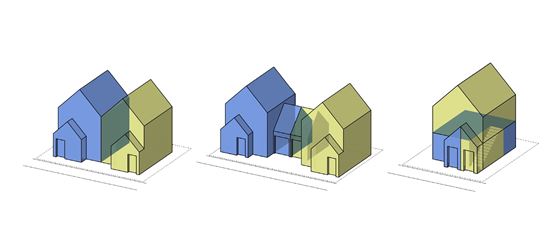 Duplex Side-by-Side Attached Duplex Attached by Garage Duplex Stacked
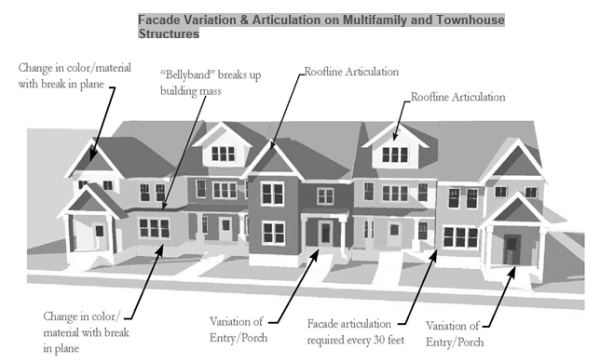
3. Articulation When the front, side, or rear elevation of any residential structure is more than 500 square feet in area, that elevation must be divided into distinct planes of not more than 500 square feet. For the purpose of this standard, areas of wall planes that are entirely separated from other wall planes are those that are separated by windows or doors, or by a recess or projecting section of the structure that projects or recedes at least one (1) foot from the adjacent plane, for a length of at least six (6) feet. Building offsets, bellybands, bays, dormers, porch canopies and other secondary roof forms are examples of acceptable changes in plane. The vertical mass of buildings shall be broken up through the use of architectural features such as horizontal cornices, pediments, beltcourses, canopies (e.g., covered porches) and/or bellybands at least 12” in width across the length of the elevation. Roofs must provide offsets or breaks in roof line, with at least one break of at least one (1) foot for every ninety (90) lineal feet of roof line. Roof offsets, cross gables, and similar interruptions are examples of acceptable breaks in roofline on sloped roofs. On flat roofs, stepped parapets or cornices proportioned to the building elevation may be used to meet this standard.
Adopted by Ord. 1850 (HB2001) on 6/21/2021
Amended by Ord. 1892 on 3/4/2024
2.2.110 Building And Structure Height; Mixed-Use Bonus
Building and structure heights shall conform to the standards in Table 2.2.030A. Additional height may be approved for mixed-use buildings through the Master Planned Development procedure and pursuant to the density bonus provisions of Section 2.2.090 Low-Impact Development.
1892
No. 1919
No. 1906
2.2.120.A Accessory Dwelling
Accessory Dwelling Unit (attached, separate cottage, or above detached garage). Accessory dwelling units shall conform to all of the following standards:
- Floor Area. Accessory dwellings shall not exceed 800 square feet of floor area, or one-half of the primary dwelling unit floor area, whichever is smaller. The unit can be a detached cottage, a unit attached to a garage, or in a portion of an existing house. The floor area of the primary dwelling unit’s garage is not included in the calculation;
- Housing Density for subdivision review. Accessory dwellings shall equal 0.5 dwelling unit for purposes of calculating allowable density, if proposed as part of a subdivision or master plan development. See Table 2.2.030;
- Oregon Structural Specialty Code. The accessory dwelling shall comply with applicable building code;
- One Unit. A maximum of one (1) accessory dwelling unit is allowed per legal lot;
- Building Height. The building height of a detached accessory dwelling (e.g., separate cottage) shall not exceed the height of the primary dwelling;
- Buffering. The decision making body may require a landscape hedge or fence be installed on the property line separating a detached accessory dwelling from an abutting single family dwelling for the purposes of visual screening and privacy between uses.
- Setbacks. Newly constructed, detached accessory dwellings must be set back at least 3 feet from interior side and rear property lines. Conversion of existing lawfully established detached structures into accessory dwellings need not meet setback requirements so long as fire code standards are met.
Amended by Ord. 1892 on 3/4/2024
Amended by Ord. No. 1906 on 7/7/2025
2.2.120.B Attached Single Family Dwellings (Townhomes)
Attached House (Townhome) Dwellings of three or more units. Attached House (townhome or rowhouse) dwellings shall comply with the standards in sub-sections 1 and 2, below, which are intended to control development scale; avoid or minimize impacts associated with traffic, parking, and design compatibility; and ensure management and maintenance of any common areas.
- Alley Access Required for Subdivisions Principally Containing Attached House (Townhomes) of three or more units. Subdivisions, or phases of subdivisions, proposed to contain three (3) or more consecutively attached house dwellings on any block, shall provide vehicle access to all such lots and units from an alley or interior parking court, as generally illustrated below; except that this requirement does not apply where the width of townhome lots is 50 feet or greater. Alleys and parking courts shall be created at the time of subdivision approval, and may be contained in private tracts or, if approved by the City, in public right-of-way, in accordance with Section 3.4.020, Transportation Standards, and Chapter 4.3, Land Divisions. Exceptions may be granted to this standard for physically constrained sites, or when an alternative form of grouped access results in no more than one access for every four units.
- Common Areas. Any common areas (e.g., landscaping, private tracts, common driveways, private alleys, building exteriors, and/or similar common areas with split interest ownership) shall be owned and maintained by a homeowners association or other legal entity as approved by the City. A copy of any applicable covenants, restrictions and conditions shall be recorded and provided to the city prior to building permit approval.
2.2.120.C Bed And Breakfast Inns
Bed and Breakfast Inns. Where Bed and Breakfast Inns are allowed in the Residential District, they shall comply with all of the following standards. (See also, Vacation Rentals, which are different than Bed and Breakfast Inns, under Section 2.2.120.I).
- Accessory Use. The use must be accessory to a household already occupying the structure as a residence.
- Maximum Size. Not more than four (4) bedrooms for guests, and a maximum of eight (8) guests are permitted per night. A bed and breakfast use may occupy the primary dwelling and/or not more than one lawfully established guest cottage or accessory dwelling unit.
- Length of Stay. Maximum length of stay is 28 days per guest; anything longer is classified as a hotel or commercial lodging.
- Employees. Up to two (2) non-resident employees. There is no limit on residential employees.
- Food Service. May be provided only to overnight guests of the business, except where a restaurant uses is permitted as accessory to the bed and breakfast use (requires Conditional Use Permit in Residential Districts).
- Owner-Occupied. The primary dwelling shall be owner-occupied.
- Signs. Signs shall comply with the City of Dallas sign regulations.
2.2.120.D Group Living
Group Living (Residential Homes and Residential Facilities). “Residential Home” is a residential treatment or training or adult foster home licensed by or under the authority of the department, as defined in ORS 443.400, under ORS 443.400 to 443.825, a residential facility registered under ORS 443.480 to 443.500 or an adult foster home licensed under ORS 443.705 to 443.825 that provides residential care alone or in conjunction with treatment or training or a combination thereof for five (5) or fewer individuals who need not be related. (See also, ORS 197.660.). “Residential Facility” is defined under ORS 430.010 (for alcohol and drug abuse programs); ORS 443.400 (for persons with disabilities); and ORS 443.880; residential facilities provide housing and care for 6 to 15 individuals (“facilities”) who need not be related. Staff persons required to meet State-licensing requirements is not counted in the number of facility residents and need not be related to each other or the residents. Residential homes and residential facilities shall comply with the following requirements unless otherwise preempted by State or Federal law:
- Licensing. All residential care homes and facilities shall be duly licensed by the State of Oregon.
- Parking. Parking shall be provided in accordance with Chapter 3.3.
- Site Development Review. Site Development Review shall be required for new or remodeled structures to be used as residential homes or residential facilities, to ensure compliance with the licensing, parking, landscaping, and other requirements of this Code.
- Signs. Signs shall comply with the City of Dallas sign regulations.
2.2.120.E Home Occupations
Home Occupations. The purpose of this Section is to encourage those who are engaged in small commercial ventures that could not necessarily be sustained if it were necessary to lease commercial quarters, or which by the nature of the venture, are appropriate in scale and impact to be operated within a residence. Home occupations are encouraged for their contribution in reducing the number of vehicle trips often generated by conventional businesses. Two types of home occupations are allowed by this Code:
- Home Occupations meeting the standards in subsections 1-8, below, are allowed by right, provided all uses and structures on the subject property are in conformance with the applicable zoning; and
- Home Occupations exceeding any of the threshold standards in subsections 1-8 may receive approval through the Type III Home Occupation Permit procedure under Section 4.9.020.
Type I Standards for Home Occupations:
- Appearance of Residence:
- The home occupation shall be restricted to lawfully-built enclosed structures and be conducted in such a manner as not to give an outward appearance of a business.
- The home occupation shall not result in any structural alterations or additions to a structure that will change its primary use or building code occupancy classification.
- The home occupation shall not violate any conditions of development approval (i.e., prior development permit approval).
- No products and or equipment produced or used by the home occupation may be displayed to be visible from outside any structure.
- Storage:
- Outside storage, visible from the public right-of-way or adjacent properties, that exceeds what is customary for a single family residence in the vicinity, is prohibited.
- On-site storage of hazardous materials (including toxic, explosive, noxious, combustible or flammable) beyond those normally incidental to residential use is prohibited.
- Storage of inventory or products and all other equipment, fixtures, and activities associated with the home occupation shall be allowed in any structure.
- Employees:
- Other than members of a household residing within the dwelling located on the home occupation site, there shall be not more than one (1) full time equivalent employee at the home occupation site at any given time. As used in this chapter, the term “home occupation site” means the legal lot on which the home occupation is conducted.
- Additional individuals may be employed by or associated with the home occupation, so long as they do not report to work or pick up/deliver at the home occupation site.
- The home occupation site shall not be used as a headquarters for the assembly of employees for instruction or other purposes, including dispatch of employees to other locations.
- Advertising and Signs: Signs are regulated the same as for a single-family dwelling and shall comply with the City of Dallas sign regulations.
- Vehicles, Parking and Traffic:
- One (1) commercially-licensed vehicle associated with the home occupation is allowed at the home occupation site. It shall be of a size that would not overhang into the public right-of-way when parked in the driveway or other location on the home occupation site.
- There shall be no more than three (3) commercial vehicle deliveries to or from the home occupation site daily excluding regular US Mail service. There shall be no commercial vehicle deliveries during the hours of 9:00 p.m. to 7:00 a.m.
- There shall be no more than one (1) client or customer vehicle at any one time and no more than eight (8) per day at the home occupation site.
- Business Hours. There shall be no restriction on business hours, except that clients or customers are permitted at the home occupation from 7:00 a.m. to 9:00 p.m. only, subject to subsections 1 and 5, above.
- Prohibited Home Occupation Uses:
- Any activity that produces radio, TV, or other electronic interference; noise, glare, vibration, smoke, or odor beyond allowable levels as determined by local, state or federal standards, or that can be detected beyond the property line; is prohibited.
- Any activity involving on-site retail sales, including garage sales exceeding the thresholds of a temporary use, is prohibited, except that the sale of items that are incidental to a permitted home occupation is allowed. For example, the sale of lesson books or sheet music from music teachers, art or craft supplies from arts or crafts instructors, computer software from computer consultants, and similar incidental items for sale by home business is allowed subject to 1-6, above.
- The following uses and uses with similar objectionable impacts because of motor vehicle traffic, noise, glare, odor, dust, smoke or vibration, are prohibited:
- Ambulance service;
- Animal hospital, veterinary services, kennels or animal boarding;
- Auto and other vehicle repair, including auto painting; and
- Repair, reconditioning or storage of motorized vehicles, boats, recreational vehicles, airplanes or large equipment on-site.
- Enforcement: The Code Enforcement Officer, with due cause, may visit and inspect the site of a home occupation in accordance with this chapter periodically to ensure compliance with all applicable regulations, during normal business hours, and with reasonable notice, in accordance with Dallas Municipal Code.
2.2.120.F Manufactured Homes On Individual Lots
Manufactured Homes on Individual Lots. Manufactured homes are permitted on individual lots, subject to all of the following design standards. Exceptions: 1) The standards in subsection 1-8, below, do not apply to units that lawfully existed within the City prior to [effective date of code]; except that when a unit is removed and/or relocated to another lot or parcel, then its replacement shall conform to Section 2.2.120F; New or replacement units in a manufactured home park need not conform to subsections 1-8, but changes or additions to non-conforming manufactured home parks shall conform to Chapter 5.2.
- Floor Plan. The manufactured home shall be multi-sectional and have an enclosed floor area of not less than 1,000 square feet;
- Roof. The manufactured home shall have a pitched roof with a slope not less than three (3) feet in height for each 12 feet in width;
- Residential Building Materials. The manufactured home shall have exterior siding and roofing which in color, material and appearance are similar or superior to the exterior siding and roof material used on nearby residences. For purposes of this subsection, horizontal wood, vinyl, or similar wood-appearance siding is considered “superior” to metal siding and roofing;
- Garages and Carports. If the majority of single family dwellings within 200 feet of the proposed manufactured dwelling and abutting the same street as the proposed manufactured dwelling have a garage, the manufactured home shall have a garage. If the majority single family dwellings within 200 feet have a carport, the proposed manufactured home shall have a garage or carport. Manufactured home garages and carports shall be constructed of materials like those used on the proposed dwelling;
- Thermal Envelope. The manufactured home shall be certified by the manufacturer to meet the thermal envelope requirements equivalent to those for a single family dwelling constructed under the State Building Code. Evidence from a qualified expert demonstrating that the manufactured home meets Northwest Energy Efficiency Manufactured Housing (NEEM) standards, or equivalent standards, is deemed to satisfy the exterior thermal envelope certification requirement; manufacturer certification may be required;
- Placement. The manufactured home shall be placed on an excavated and back-filled foundation and enclosed at the perimeter such that the manufactured home is located not more than 16 inches above grade, and complies with the minimum set-up standards of the state Administrative Rules for Manufactured Dwellings, OAR Chapter 918. Where the building site has a sloped grade, no more than 16 inches of the enclosing material shall be exposed on the uphill side of the home;
- Foundation Skirt. The foundation area of the manufactured home shall be fully skirted with concrete block or similar materials that resemble a concrete foundation;
- Prohibited. The manufactured home shall not be located in a designated historic district.
2.2.120.G Manufactured/Mobile Home Parks
Manufactured/Mobile Home Parks. Manufactured Dwelling Parks shall conform to the provisions of Chapter 2.9.
2.2.120.H Multiple Family Housing
Multi-Family Housing (including Cottage Cluster Housing). Where multi-family housing is allowed, it shall conform to all of the following standards, which are intended to promote livability for residents and compatibility with nearby uses. The standards of subsection 2.2.120.H may be adjusted through Site Design Review pursuant to Chapter 4.1. Figure 2.2.120.H provides a conceptual illustration of the requirements listed below.
- Density. The residential density of multi-family developments is calculated pursuant to Section 2.2.050.
- Building Mass. The maximum width or length of a multi-family building shall not exceed 150 feet from end-wall to end-wall, not including outdoor living areas. (e.g., porches, balconies, patios, and similar unenclosed spaces). Buildings shall avoid monolithic facades by including architectural elements such as bay windows, recessed entrances, changes in materials, or other articulation so as to provide pedestrian scale to the ground floor at no more than 30-foot intervals.
- Common Open Space. Open space shall be provided with all multi-family developments in accordance with Table 2.2.030 and all of the following criteria:
- The multi-family development shall contain one or more of the following: outdoor recreation area, protection of sensitive lands (e.g., trees preserved), play fields, outdoor playgrounds, outdoor sports courts, swim pools, walking fitness courses, pedestrian amenities, or similar open space amenities for residents. The decision making body shall have discretion to determine the appropriate type of open space based on the characteristics of the site and impacts of the proposed use. For example, multi-family developments that are not age-restricted (senior housing) are presumed to require a child play area with appropriate play equipment.
- Historic buildings or landmarks that are to be preserved in accordance with the requirements of the State Historic Preservation Office may count toward meeting the common open space requirements.
- To receive credit under Section 2.2.120.H3, the common open space shall have an average width that is not less than 20 feet and an average length that is not less than 20 feet. The City decision making body may require additional open space if some portions of a proposed open space area are unsuitable for the intended use;
- Where the development contains pedestrian amenities located between primary building entrance(s) and adjoining streets (e.g., parkway, plaza, transit stop, or similar amenity with appropriate landscaping and furnishings), such area may count toward fulfilling up to 50 percent of required common open space; however, parking areas and required landscaping buffers are not counted toward meeting the required open space standard;
- The decision making body may waive the common open space requirement for a multi-family project containing fewer than twenty-four (24) dwellings that is located within 1,320 feet (measured walking distance) of a public park, where there is a direct, accessible (i.e., Americans With Disabilities Act-compliant), lighted walkway connecting the site to the park. If the park is not developed, or only partially developed, the decision making body may accept improvements to park land in an amount comparable to that which would otherwise be required and waive the on-site common open space requirement.
- Up to 50 percent of the required common open space area may be in a rooftop garden, where the proposal involves a density bonus or increase of building height pursuant to Section 2.2.090 Low-Impact Development Incentives.
- Private Open Space. Private open space areas shall be provided, in addition to common open space, as follows:
- All housing units shall have private open space consisting of front or rear patios or decks, or balconies (upper stories) measuring at least 48 square feet; or
- Additional common open space shall be provided in an area equivalent to the private open space that is not provided (48 square feet per dwelling unit) and that common area shall be accessible to all dwelling units that do not have private open space.
- Trash Receptacles. Trash receptacles, including sorting and storage of trash and recyclables, shall be oriented away from building entrances, setback at least ten (10) feet from any public right-of-way and adjacent residences and shall be screened with an evergreen hedge or solid enclosure of not less than six (6) feet in height. Receptacles shall be accessible to trash pick-up trucks.
Amended by Ord. 1892 on 3/4/2024
2.2.120.I Short-Term Vacation Rentals
Short-Term Vacation Rentals. Where short-term vacation rentals are allowed, they shall conform to all of the following criteria:
- Vacation rentals allowed under this subsection are those with twenty eight (28) or fewer days continuous occupancy by the same tenant.
- A Conditional Use Permit is required;
- The vacation rental unit shall provide two (2) off-street parking spaces (not in addition to those otherwise required for a single family dwelling;
- All required parking shall be provided on the same lot as the vacation home rental unit;
- All vacation home rentals shall have a maximum occupancy of one person per 200 square feet or not more than 16 people, whichever is more restrictive; and
- All other requirements of the code as applicable to single family dwellings shall apply.
- The property owner must provide receptacles for the deposit of garbage and subscribe to a solid waste collection service for the vacation rental dwelling.
- All vacation rentals are subject to the Transient Lodging Tax (Dallas City Code Chapter 7)
- The property owner shall designate a local representative who permanently resides within the Dallas Urban Growth Boundary or a licensed property management company with a physically staffed office within ten (10) vehicular miles of the Dallas Urban Growth Boundary. The owner may be the designated representative where the owner resides in the Dallas Urban Growth Boundary. The local representative must be authorized by the owner of the dwelling to respond to the tenant and neighborhood questions or concerns. The local representative shall serve as the initial contact person if there are questions or complaints regarding the operation of the dwelling for vacation rental purposes. The local representative must respond to complaints in a timely manner to ensure the dwelling complies with the standards for vacation rental dwellings and other city ordinances pertaining to noise, disturbances, nuisances, as well as state laws pertaining to the consumption of alcohol, or the use of illegal drugs.
2.2.120.J Zero-Lot Line Housing
Zero-Lot Line Housing. Zero-lot line houses are subject to the same standards as other non-attached single-family housing, except that a side yard setback is not required on one side of the lot. The standards for zero-lot line housing are intended to ensure adequate outdoor living area, compatibility between adjacent buildings, and access to side yards for building maintenance. All zero-lot line houses shall conform to all of the criteria in subsections 1-4, below:
- Site Design Review Required. Site Design Review is required for new zero-lot line developments. When a zero-lot line development is proposed as part of a Land Division, Master Planned Development, or other application, the Site Design Review may be combined with the other application(s).
- Setbacks for Primary and Accessory Structures. The allowance of a zero (0) side yard setback is for one single family dwelling on each lot; it does not extend to accessory structures which shall conform to the applicable setback requirements of the zone;
- Setbacks Adjacent to Non-Zero Lot Line Development. When a zero-lot line house shares a side property line with a non-zero lot line development, the zero-lot line building shall be setback from that common property line by not less than 10 feet;
- Building Orientation and Design. Placement and design of zero lot line dwellings shall encourage privacy for the occupants of abutting lots. For example, this standard can be met by staggering foundation plans, by placing windows (along the zero lot line) above sight lines with direct views into adjacent yards, by using frosted/non-see-through windows, by avoiding placement of windows on the zero lot line, or other designs approved by the decision making body through Site Design Review. (Note building code fire wall requirements for zero lot line dwellings); and
- Construction and Maintenance Easement. Prior to building permit approval, the applicant shall submit a copy of a recorded easement for every zero-lot line house that guarantees access onto adjoining lot for the purpose of construction and maintenance of the zero-lot line house. The easement shall require that no fence or other structure shall be placed in a manner that would prevent maintenance of the zero-lot line house. The easement shall not preclude the adjoining owner from landscaping the easement area with turf or other ground cover plants.
2.2.120.K Temporary Medical Hardship Dwellings
Temporary Medical Hardship Dwellings.
- A temporary medical hardship dwelling must meet the following requirements:
- The temporary hardship dwelling must either be occupied by someone who will care for the resident of the subject property, or it may be occupied by a relative of the resident when the relative has the medical hardship and the resident of the property will be the caregiver. (Relative is defined as a parent, child, grandparent, grandchild, brother, or sister of the existing resident.)
- The temporary hardship dwelling must use the same subsurface sewage disposal system as the existing dwelling, provided that the system is adequate to accommodate the additional dwelling. If on an existing septic system, the system will need to be inspected and approved by a County Sanitarian. Once the hardship has ended, the system must be abandoned in accordance with DEQ requirements.
- The application must include a written statement from the patient’s primary care medical doctor (MD) or osteopath (DO). The statements must be on the doctor’s stationery or stamped by their office. The statement must indicate that for health or age-related reasons the patient is unable to maintain a residence on a separate property and is dependent upon someone being close by for assistance.
- The permit authorizing the temporary hardship dwelling must be renewed every two years. In order to renew the temporary hardship permit, a letter from a doctor stating that the hardship still exists must be submitted to the Department, along with the renewal fee. If the hardship dwelling is connected to the same septic system as the existing dwelling, the septic system may also need to be re-inspected.
- Within three (3) months of the end of the hardship, the manufactured dwelling, recreational vehicle, or travel trailer must be removed from the property or demolished. In the case of an existing building, which has been converted for temporary residential use, the building must be removed, demolished or returned to an allowed use.
- The temporary dwelling must comply with applicable fire safety standards.
- A Temporary Medical Hardship Dwelling permit is obtained through a Type I Land Use Review, in accordance with Section 4.1. The application must include the following information:
- The aforementioned letter from a medical doctor or osteopath confirming that the person with the hardship is unable to maintain their own separate residence because of a health or age related condition or infirmity; and
- A site plan, drawn to scale on 8½ “ by 11" paper, showing property lines, existing streets and driveways, existing and proposed buildings, including distances to property lines, location of any existing wells and/or septic systems, location of any physical features on the parcel such as streams, irrigation ditches, steep slopes, etc. must be submitted with the application.
- The Planning Official will review the application to determine whether it conforms to the approval criteria listed above. If approved, a manufactured dwelling installation permit must be obtained from Polk County. If the hardship dwelling is to be a recreational vehicle or travel trailer, applicable sewage disposal requirements shall be met.
2.2.120.L Agricultural Uses In RL District
Agricultural Uses.
- The following agricultural uses are permitted:
- Gardens, accessory to residential use
- Community Gardens
- The following agricultural uses are not allowed:
- Raising of livestock or other animals for commercial purposes
- Veterinary clinics, animal boarding, kennels and similar uses
- Animal cemeteries, crematoria, and similar uses
- Agricultural uses may be subject to state and federal requirements. Property owners are responsible for complying with applicable regulations, including nuisance laws.
Amended by Ord. 1892 on 3/4/2024
2.2.120.M Modular Home Special Use Standards
Modular Home Special Use Standards.
Modular Homes on Individual Lots. Modular homes are permitted on individual lots, subject to all of the following design standards. Exceptions: 1) The standards below do not apply to units that lawfully existed within the City prior to January 19, 2016; except that when a unit is removed and/or relocated to another lot or parcel, then its replacement shall conform to the standards listed below.
- Floor and Lot Area. The modular home shall have an enclosed floor area of not less than the following:
- Lot area 4,000 square feet or less in size – 600 square feet,
- Lot area 4,001 – 5,000 square feet in size – 800 square feet,
- Lot area 5,001 square feet or larger – 1,000 square feet.
- Residential Building Materials. The modular home shall have exterior siding and roofing which in color, material and appearance are similar or superior to the exterior siding and roof material used on nearby residences. For purposes of this subsection, horizontal wood, vinyl, or similar wood-appearance siding is considered “superior” to metal siding and roofing;
- Garages and Carports. If the majority of single family dwellings within 200 feet of the proposed modular home and abutting the same street as the proposed modular home have a garage or carport, the modular home shall have a garage or carport. Modular home garages and carports shall be constructed of materials like those used on the proposed dwelling.

