Dallas City Zoning Code
CHAPTER 2
3 Commercial Districts
2.3.010 Purpose And Applicability
This Chapter provides three commercial districts to accommodate the range of commercial land uses in the community.
- Overall Intent.
- Promote efficient use of land and urban services;
- Create a mixture of land uses that encourages employment and housing options in close proximity to one another;
- Provide formal and informal community gathering places and opportunities for socialization (i.e., along an active street front);
- Integrate land use, urban design, and transportation to create places that accommodate multiple modes of transportation, including walking, bicycling, and transit; support pedestrian-oriented development with appropriate building and site design standards;
- Create a distinct storefront character that is scaled to the applicable land use district;
- Provide connections to and appropriate transitions between neighborhoods and commercial employment centers;
- Provide for visitor accommodations and tourist amenities;
- Manage off-street parking supply and demand to promote compact development patterns and to reduce reliance on the automobile; and
- Maintain and improve the livability and aesthetics of Dallas’s commercial areas by establishing design standards for open space (civic space), landscaping, and architecture.
- Purpose of Individual Districts.
- The Central Business District (CBD) serves as the commercial and civic core of the community. It is the location of city and county offices, downtown commercial uses, and tourism oriented uses. The CBD provides opportunities for mixed-use development, with a variety of commercial retail and services, office uses, high-density housing, and civic facilities.
- The Commercial General (CG) District applies to commercial areas outside or adjacent to the central business area. It provides opportunities for a mix of community-oriented businesses such as grocery stores, and restaurants, highway oriented commercial uses, and other services adjacent to medium- and high-density housing areas.
- The Commercial Neighborhood (CN) District applies to limited commercial areas that primarily serve the immediate, surrounding neighborhood. It provides neighborhood goods and services at a smaller scale than the Commercial General District and is focused at designated arterial crossroads locations.
- Applicability. The land use districts (zones) are as designated on the City of Dallas Zoning Map. Changes to the Zoning Map are applied in accordance with the policies and Land Use Map contained in the City of Dallas Comprehensive Plan. See Table 2.3.020A Allowed Land Uses and Building Types. The specific land use categories are described and uses are defined in Chapter 1.3
2.3.020 Allowed Land Uses And Building Types
| Table 2.3.020A – Building Types Allowed in Commercial Districts | ||||
| Building Types | Status of Building Type in District | |||
| (Uses and building types in Chapter 1.3; definitions in Chapter 6.1) | CBD | CG | CN | Special Standards |
| Building Types | ||||
| Store/Shop/Dining | P | P | P | Drive-up and drive-thru facilities, where allowed, are subject to Section 2.3.100.
For buildings with floor plate >50,000 square feet, see Section 2.3.060
See also, Chapter 2.6 Mixed Use Master Plan provisions, and Chapter 4.5 Master Planned Developments. |
| Office Building | P | P | P | |
| Mixed-Use Building | P | P | P | |
| Automotive Services Building | CU+S | CU+S | CU+S | |
| Large-Format Commercial: floor plate exceeds 50,000 square feet | CU | CU | N | |
| Neighborhood Commercial: total floor plate of building <20,000 square feet; and total leasable floor area of building < 50,000 square feet | P | P | P | |
| Parking Structures, public parking structures; and other parking structures when accessory to a primary permitted use | P | P | P | |
Key:
P = Permitted, subject to site/development review
S = Permitted with standards (Section 2.3.030)
CU = CU permit required (Chapter 4.3)
N = Not permitted
| Table 2.3.020B – Land Uses Allowed in Commercial Districts | ||||
| Land Uses | Status of Use in District | |||
| (Uses and building types in Chapter 1.3; definitions in Chapter 6.1) | CBD | CG | CN | Special Use Standards |
| Residential Categories | ||||
| Residential (Household Living and Group Living): | New residential buildings (not in conjunction with ground floor commercial use) must conform to the Architectural Standards contained in Section 2.2.070 and 2.2.100. | |||
| Dwelling lawfully existing in its current location as of January 22, 2010 (may be rebuilt in the event of involuntary damage or destruction due to fire or other event beyond owner’s control) | P | P | P | |
| New dwelling built in conjunction with a permitted commercial use, above ground floor commercial space | P | P | P | |
| New dwelling on the ground floor or not in conjunction with a permitted commercial use: 24 or more units/acre | N | CU+S | N | |
| New dwelling not in conjunction with a permitted commercial use: <24 units/acre | N | N | CU+S | |
| Commercial Categories | ||||
| Drive-Up/Drive-In/Drive-Through (drive-up windows, kiosks, ATM’s, similar uses/facilities) | CU+S | CU+S | CU+S | Section 2.3.100 |
| Transient Lodging, including hotel, motel, bed and breakfast inn, and similar uses; excluding recreational vehicle park | P | P | P | |
| Educational Services, Commercial | P | P | P | |
| Entertainment, Major Event | CU | CU | N | |
| Offices | P | P | P | |
Outdoor Recreation, Commercial | CU | CU | CU | |
Indoor Recreation, Commercial | P | P | P | |
| Commercial Parking | CU | CU | CU | |
| Automobile Service: Quick Vehicle Servicing or Vehicle Repair. (See also Drive-Up/Drive-In/Drive-Through Uses) | Section 2.3.100 applies to uses with drive-up/drive-in/drive-through facilities | |||
| - Fully enclosed in a building | CU | P | CU | |
| - Not fully enclosed in a building | N | CU+S | N | |
| - Automobile fueling | N | CU+S | CU+S | |
| Retail Sales and Service | Section 2.3.100 applies to uses with drive-up/drive-in/drive-through facilities. | |||
| Primary use enclosed in building (allows 10% of sales/service area outside) | P | P | P | |
| More than >10% of use not enclosed in building | CU | CU | CU | |
| Outdoor retail sales of Agricultural goods produced within 25 miles of site | P | P | P | |
| Recreational Vehicle Park (3 or more RVs) | N | CU | N | |
| Industrial Categories | ||||
| Industrial Service | Industrial uses, where allowed, are subject to Industrial Performance Standards in Chapter 2.4. | |||
| - Fully enclosed (e.g., similar to office) | S | S | CU+S | |
| - Not fully enclosed (e.g., with some outdoor storage or activity) | N | CU+S | N | |
| Manufacturing and Production | ||||
| - Fully enclosed | S | S | S | |
| - Not fully enclosed and not accessory to Retail Sales | N | N | N | |
| Self-Service Storage not accessory to a primary permitted use | N | N | N | |
| Warehouse and Freight Movement when not accessory to a primary permitted use | CU+S | CU+S | N | |
| Waste-Related, when not accessory to a primary permitted use | N | N | N | |
| Wholesale Sales | ||||
| - Primary use enclosed in building (allows 10% of sales area outside) | P | P | P | |
| - More than 10% of use not enclosed in building | CU | CU | CU | |
| - Outdoor sales of Agricultural goods, the majority of which are produced within 100 miles of site | P | P | P | |
| Institutional Categories | ||||
| Basic Utilities when not accessory to a primary permitted use | CU | CU | CU | Wireless Communication Facilities Subject to CU and Chapter 3.5. |
| Community Service; Government, except drive-up facilities or uses | ||||
| Clubs and lodges | CU | CU | CU | |
| Public and quasi-public buildings where public is received | P | P | P | |
| Other Community Services | CU | CU | CU | |
| Daycare, adult or child day care; not Family Daycare under ORS 329A.250 | CU | CU | CU | |
| Parks, Open Space, and Common Areas: pedestrian amenities (e.g., plaza or outdoor seating, parks and recreation facilities, and other open space uses) | P | P | P | |
| Religious Institutions and Houses of Worship | CU | CU | CU | |
| Schools, primary or secondary | CU | CU | CU | |
| Medical Centers | CU | CU | CU | |
| Incarceration Facilities | CU | CU | N | |
| Park and Ride | N | CU | CU | |
| Other Use Categories | ||||
| Accessory Structures (with a permitted use) | P | P | P | |
| Buildings and Structures exceeding height standards. See Table 2.3.030 | CU | CU | CU | Height/density bonus subject to performance standards in Section 2.3.070B |
| Radio Frequency Transmission Facilities, Wind Turbines and Similar Structures when not accessory to a primary permitted use | CU | CU | CU | These facilities are Permitted when height limits of district are met. See also, Chapter 3.5 for Wireless Communication Facilities |
| Utility Corridors when not accessory to a permitted use | CU | CU | CU | |
| Temporary Uses when not accessory to a permitted use | P/CU | Only those uses designated as “P” or “CU”, are allowed and may be permitted, per Section 4.8.010. | ||
| Non-Conforming Uses. Uses and structures lawfully established prior to [effective date of code] may continue pursuant to Chapter 5.2 Non-Conforming Situations. Upon annexation or rezoning, uses shall conform to the current code requirements for the zone in which they are located. | ||||
| Transportation Facilities (operation, maintenance, preservation, and construction in accordance with applicable standards of the roadway authority) are Permitted; other Transportation Facilities require Conditional Use Permit. | ||||
| Uses Subject to Preemptive State or Federal Law are allowed pursuant to applicable laws. | ||||
Key:
P = Permitted, subject to site/development review
S = Permitted with standards (Section 2.3.030)
CU = CU permit required (Chapter 4.3)
N = Not permitted
Amended by Ord. 1892 on 3/4/2024
Amended by Ord. No. 1919 on 3/2/2026
2.3.030 Development Standards
The development standards in Table 2.3.030 apply to all new structures, buildings, and development, and major remodels, in the Commercial Districts.
| Table 2.3.030 – Development Standards for Commercial Districts | ||||
| Standard | CBD | CG | CN | [Reserved] |
| Minimum Lot Area* (square feet) *Development must conform to lot width, depth, yard setback, landscaping, and coverage standards. | 5,000 sf minimum | |||
| Minimum Lot Width/Depth | 20 ft | |||
| Building/Structure Height | ||||
| Minimum Building Height for new buildings located within the Downtown Pedestrian Core Area (see Section 6.1.030 – Definitions for a map of the Downtown Pedestrian Core Area) | 2 Stories 22 ft | NA | NA | |
| Maximum Building Height | 5 Stories 64 ft | 3 Stories 40 ft | 3 Stories 40 ft | |
| Maximum Building Height for mixed-use projects (residential above commercial) See Section 2.3.070 | 8 Stories 100 ft | 5 Stories 64 ft | NA | |
Fences and Screening Walls See also, Sections 3.1.020N, Vision Clearance; and 3.2.050, Fences and Walls | Allowed for screening and security only. Some fences and walls may be subject to Site Design Review when they exceed the height standards that are prescribed in Section 3.2.050. | |||
| Lot Coverage/Impervious Surface: Max. Lot Coverage by All Impervious Surfaces (Building Foundation, Pavement, etc.) subject to civic space, landscaping, parking, and other code requirements, as applicable | 90% | 80% | 80% | |
| Min. Landscape Area Requirement (% site area), may include portion of required Civic Space, per Section 2.3.090. See also, Section 3.2.030C. | 5% | 10% | 10% | |
| Minimum Setbacks (feet): | ||||
| Front, Street, Side, and Rear property lines | 0 ft except as otherwise required for Civic Space, for future street improvement (per Transportation System Plan), for utilities or clear vision at street intersection, or as required by other applicable codes; and a minimum setback of 10 ft is required abutting a Residential District | |||
| Garage Opening, setback from public right of way | 10 ft (no parking/backing movement by vehicles) | |||
| Alley Setback | 7 ft | |||
| Build-To Line (feet): New Buildings Only: At least one primary building entrance shall be built no farther from the street right-of-way than the build-to line; except where a greater setback is required for a Planned Street Improvement, then the build-to line increases proportionately. The build-to line may also be increased through Site Design Review when pedestrian amenities are provided between a primary building entrance and the street right-of-way. (See also, Section 2.3.090.) | 0 ft; may be increased when civic space is provided between a primary building entrance and street | 10 ft; may be increased in the following situations:
| ||
Amended by Ord. 1865 on 1/18/2022
2.3.040 Exceptions To General Development Standards
- Zero Setbacks and Build-To Line – Fire Code and Clear Vision. Where no minimum setback is required, all structures and buildings shall conform to the vision clearance standards in Chapter 3.1.020.N and the applicable fire and building codes (e.g., for attached structures, fire walls, and related requirements).
- Setback Yards – Reverse Frontage Lots. Buildings on reverse-frontage lots (through lots) shall be required to meet the build-to line standard on only one street. Reverse frontage lots are subject to the landscape buffer requirements in Chapter 3.2.030 Landscaping.
- Setback Yards – Exceptions. Where existing lawfully established buildings have yard setbacks that do not conform to this Code, they are allowed to remain as legal, non-conforming structures.
2.3.050 Lot Coverage And Impervious Surface
The maximum allowable lot coverage shall be as provided in Table 2.3.030. Lot coverage is calculated as the percentage of a lot or parcel covered by buildings and impervious surfaces (e.g., asphalt, concrete, and similar impervious paving). It does not include planted areas, and other areas allowing water quality treatment and surface water retention/infiltration, as approved by the City Engineer.
2.3.060 Building Orientation; Large-Format Commercial; Commercial Blocks
- Purpose. Section 2.3.060 orients buildings close to streets to promote pedestrian-oriented development where walking is encouraged, and to discourage automobile-oriented development. Placing commercial storefronts, residences and other buildings close to the street also encourages crime prevention, natural surveillance or security, and safety by having more “eyes-on-the-street.”
- Applicability. Section 2.3.060 applies to all new primary structures in the CBD, CG and CN districts, and new primary commercial structures in Residential land use districts when allowed through a Master Plan. The standards of this Section may be adjusted through a Type II review, provided the adjustment is consistent with the above purpose and the applicant demonstrates that an alternative proposal meets the intent of the standard.
- Building Orientation Standards. Developments subject to this Section shall have their buildings oriented to a street, as generally shown in Figure 2.3.060C(1). This standard is met when all of the following criteria are met:
- Compliance with the setback and build-to line standards in Table 2.3.030, where applicable. The build-to line may be setback to provide pedestrian amenities between a building and its adjoining street;
- Except as provided in subsections 2.3.060.C(4) and (5), below, all buildings shall have at least one primary building entrance (i.e., dwelling entrance, a tenant entrance, lobby entrance, or breezeway/courtyard entrance) facing an adjoining street (i.e., within 45 degrees of the street property line), or if the building entrance is turned more than 45 degrees from the street (i.e., front door is on a side elevation), the primary entrance shall not be farther from a street sidewalk than the build-to line, except where pedestrian amenities are provided, in which case a walkway shall connect the primary entrance to the sidewalk.
Figure 2.3.060(C)(1) - Building Orientation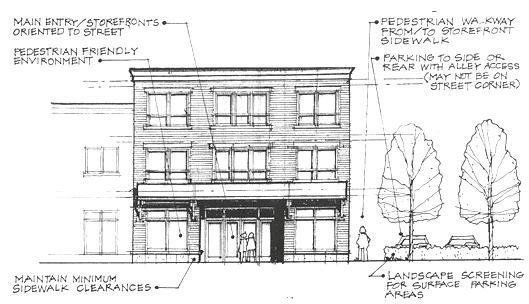
- Off-street parking, trash pick-up, and above ground utilities (e.g., utility vaults) shall not be placed between building entrances and the street(s) to which they are oriented, but shall be oriented internally to the block and accessed by alleys to the extent practicable. Off-street parking shall be oriented internally to the site to the extent practicable, and shall be divided by landscape areas into bays of not more than ten (10) parking spaces per bay; incidental breaks in the building wall to accommodate pedestrian and vehicle access into the block is permitted. Exceptions to alley access provision are allowed where no system of alleys exists and where extension of alleys is precluded by existing development.
- The building orientation standard may be adjusted through a Type II review with vehicle areas allowed between the street right-of-way and a building’s primary entrance when the decision making body finds that the following criteria are met:
- Placing vehicle areas between the street right-of-way and building’s primary entrance will not adversely affect pedestrian safety and convenience, based on the distance from the street sidewalk to the building entrance, projected vehicle traffic volumes, and available pedestrian walkways;
- The proposed vehicle areas are limited to one driveway of not more than twenty four (24) feet in width with not more than one row of parking spaces on both sides of the drive aisle (including ADA accessible spaces), divided by landscape areas into bays of not more than eight (8) parking spaces each. The intent is to create a drive aisle that is street-like, and break up parking into small bays with landscaping; and
- The building’s primary entrance is connected to an adjoining street by a pedestrian walkway that meets the standards for pedestrian walkways under Section 3.1.030.
- Where a development contains multiple buildings and there is insufficient street frontage to which buildings can be oriented, a primary entrance may be oriented to plaza, courtyard, or similar pedestrian space containing pedestrian amenities, subject to Site Design Review. When oriented this way, the primary entrance(s), plaza, or courtyard shall be connected to the street by a pedestrian walkway conforming to Section 3.1.030.
- Block Layout Standard. Commercial developments (office, or retail/wholesale/service) containing more than one building, with the sum total of buildings equal to or greater than 20,000 square feet of floor plate, shall meet all of the following standards:
- The site shall be configured into blocks that have frontage onto streets, interior parking courts, or “shopping streets” (as generally shown below). All shopping streets shall contain on-street parking (parallel or angled parking), sidewalks, street trees, and pedestrian lighting; and all buildings shall orient their primary entrances to a street, plaza or courtyard. Additionally, buildings placed at a street/block corner shall have a primary entrance within 40 feet of the street/block corner;
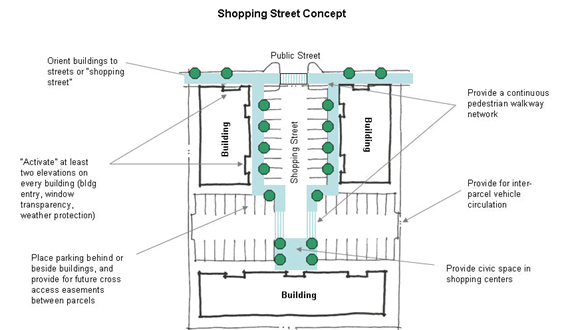
- Where a subdivision or multi-building development is proposed (e.g., new commercial center), blocks shall be broken down into lengths of not more than 400 feet, and shall have a perimeter not exceeding 1,200 feet;
- Walkways shall connect the street right-of-way to building entrances and the interior parking bays between buildings, as necessary to ensure reasonably safe, direct, and convenient access to building entrances and off-street parking;
- The site shall be configured into blocks that have frontage onto streets, interior parking courts, or “shopping streets” (as generally shown below). All shopping streets shall contain on-street parking (parallel or angled parking), sidewalks, street trees, and pedestrian lighting; and all buildings shall orient their primary entrances to a street, plaza or courtyard. Additionally, buildings placed at a street/block corner shall have a primary entrance within 40 feet of the street/block corner;
2.3.070 Building And Structure Height; Mixed-Use Bonus
Building and structure heights shall conform to the standards in Table 2.3.030. A height bonus may be approved for residential uses above commercial uses (mixed-use building) pursuant to the requirements of this Chapter and subject to Type III Site Design Review approval. The City decision making body may limit the extent of height increases, or otherwise require modifications to the proposed building, including the number of stories, height, or location, configuration, and design of primary or secondary roof forms, for compatibility with adjacent historic landmarks and to prevent adverse impacts on adjacent residential uses due to shade or diminished privacy.
2.3.080 Building Design Standards
- Purpose. Section 2.3.080 is intended to support the development of traditional downtown, village commercial, and mixed use commercial areas with architecture that responds to and reconciles Dallas’s historical context and its existing built environment. Because much of Dallas’s historic downtown is intact, the following standards draw on the available architectural vocabulary while allowing a contemporary interpretation of rural building forms and styles scaled to each land use district. It is not the City’s intent to create an architectural theme, but rather to ensure that new buildings and remodels fit within the context of their surroundings and contribute toward the development of compact, walkable districts. The key elements of mixed use district building design are summarized as follows:
- Draw upon the local vocabulary of building styles and elements, including compatibility with locally significant historic structures where applicable
- Create a sense of street enclosure with appropriate building heights and detailing that express a pedestrian-scale
- Address differences in scale between the Central Business District, Commercial General, and Commercial Neighborhood districts
- Transition building height between Commercial districts and adjacent residential neighborhoods
- Require the use of contextually appropriate materials, textures and colors
- Promote a storefront character (windows, pedestrian shelter, furnishings, etc.)
- Encourage a diversity of building facades and rooflines that fall into a consistent rhythm
- Promote corner lots as focal points
- Improve the streetscape with adequate civic space, street furnishings and public art
- Encourage advances in building design technology that make Dallas more sustainable
- Applicability. These standards apply to all new structures and exterior remodels of structures in the CBD, CG, and CN districts and where commercial and mixed-use structures are permitted in other districts. The standards of this Section may be adjusted through a Type II review, provided the adjustment is consistent with the above purpose and the applicant demonstrates that an alternative proposal meets the intent of the standard.
- Building Design Standards.
- Height. Minimum and maximum building height shall conform to the standards of the applicable zone district. Project proposals involving a building height increase under Section 2.3.070 are subject to Type III Site Design Review. See Section 4.2.040.
- Build-to Line. Commercial buildings, including mixed-use buildings containing residential and commercial uses, shall conform to the Build-to Line standards in Section 2.3.030. The standard is met in the CG and CN districts when at least fifty (50) percent of the abutting street frontage has a building placed no farther from at least one street property line than the required Build-to Line in Table 2.3.030. In the CBD, at least eighty (80) percent of the abutting street frontage shall have a building placed no farther from at least one street property line than the required Build-to-Line. An exception to the Build-to Line may be approved or required in the following situations:
- Where a proposed building is adjacent to a single-family dwelling, and an increased setback promotes compatibility with the adjacent dwelling.
- Where access limitations or other applicable transportation requirements preclude development at the build-to line, the building shall orient to an internal shopping street, as described under subsection 2.3.060D, where the build-to line shall apply.
- Where the sidewalk width is extended for public use, or a public plaza is proposed to be placed between the building and public right-of-way, subject to Site Design Review. Exceptions to the build-to line may also be made through Site Design Review for planter boxes and other non-permanent structures incorporated into the building wall, provided the planter box does not exceed a height of thirty (30) inches above sidewalk grade.
- Where a significant tree or other environmental feature precludes strict adherence to the standard and will be retained and incorporated in the design of the project.
- Where a public utility easement or similar restricting legal conditions make conformance with the Build-to Line impracticable, the building shall instead be placed as close to the street as possible given the legal constraint, and pedestrian amenities (e.g., plaza, courtyard, landscaping, outdoor seating area, etc.) shall be provided within the street setback in said location.
- Where an existing building was lawfully created but does not conform to the above standard, it shall be allowed to continue under the non-conforming use provisions of this Title.
- All Facades. Architectural designs shall address all four sides of a building; building forms, detailing, materials, textures, and color shall to contribute to a unified design with architectural integrity. Materials used on the front façade must turn the building corners and include at least a portion of the side elevations, consistent with the building’s overall composition and design integrity.
- Storefront Character. Buildings shall conform to the following standards which are intended to draw on the building forms, scale, and proportions, found on in Downtown Dallas, while allowing contemporary interpretations of downtown building styles.
- Transparency along Ground Level. Except as approved for parking structures or accessory structures, buildings shall provide display windows, windowed doors and transom windows to express a storefront character. The ground floor, street-facing elevation(s) of all buildings shall comprise at least sixty percent (60%) transparent windows, measured as a section extending the width of the street-facing elevation between the building base (or 30 inches above the sidewalk grade, whichever is less) and a plane seventy-two (72) inches above the sidewalk grade. Upper floors may have less window area, but shall follow the vertical lines of the lower level piers and the horizontal definition of spandrels and any cornices. Buildings without a street-facing elevation, such as those that are setback behind another building and those that are oriented to a civic space (e.g., internal plaza or court), shall meet the sixty percent (60%) transparency standard on all elevations abutting civic spaces(s) and on elevations containing a primary entrance. All side and rear elevations, except for zero-lot line/common wall elevations (where windows are not required), shall provide no less than thirty percent (30%) transparency. Exceptions to the elevations described above (30” – 72” above sidewalk) may be approved where existing topography makes compliance impractical. Where an exception to the window transparency requirement is made for parking garages or similar structures, the building design must incorporate openings or other detailing that resembles the window patterns (rhythm and scale).
- Ground Floor Windows. Ground floor elevations must contain windows that are framed, for example, by piers or pilasters (sides); awnings, canopies or trim/hoods (tops); and kick plates or bulkheads (base).
- Upper Floor Windows. Upper floor window orientation shall primarily be vertical, or have a width that is no greater than height. Paired or grouped windows that, together, are wider than they are tall, shall be visually divided to express the vertical orientation of individual windows.
- Window Trim. At a minimum, windows shall contain trim, reveals or recesses of not less than four (4) inches in width or depth as applicable. The use of decorative detailing and ornamentation around windows (e.g., corbels, medallions, pediments, or similar features) is encouraged.
- Projecting Windows, Display Cases. Windows and display cases shall not break the front plane of the building (e.g., projecting display boxes are discouraged). For durability and aesthetic reasons, display cases, when provided, shall be flush with the building façade (not affixed to the exterior) and integrated into the building design with trim or other detailing. Window flower boxes are allowed provided they do not encroach into the pedestrian through-zone.
- Pedestrian Entrances. Ground level entrances shall be at least partly transparent to encourage an inviting and successful business environment. This standard may be met by providing a door with a window(s), a transom window above the door, or sidelights beside the door. Where ATMs or other kiosks are proposed on any street-facing elevation, they shall be visible from the street for security and have a canopy, awning, or other weather protection shelter.
- Corner Entrances. Buildings on corner lots shall have corner entrances that open onto a concrete or paver landing (widened sidewalk or plaza) that extends from the adjacent sidewalk; the landing shall be at least 3 feet in width and depth. Such building entrances are not required to be recessed, but shall have an awning, recess or canopy for weather protection. Where a corner entrance is not provided, the building plan shall provide for a corner plaza consistent with Section 2.3.090, below, and the building shall provide architectural features (e.g., alcove with seating or artwork) at the corner that emphasizes the corner as a civic space.
- Remodels. The scale and proportion of altered or added building elements, such as the size and relationship of new windows, doors, entrances, columns and other features shall be visually compatible with the original architecture.
- Street Level Entrances. All primary building entrances shall open to the sidewalk and be ADA accessible. Primary entrances above or below grade may be allowed where ADA accessibility is provided.
- Street Level/Upper Floors. Building elevations shall contain detailing that visually defines street level building spaces (storefronts). The distinction between street level and upper floors shall be established, for example, through the use of awnings, canopies, belt course, or similar detailing, materials and/or fenestration.
- Upper Story Step-Back. The purpose of the height step-back is to maintain a small town appearance and scale as viewed from the street and to provide for solar gain and light filtering down to the street. Upper-story step-back surfaces may be used as balconies. The following standards are in addition to required yards adjacent to Residential Districts. Exceptions: this standard does not apply to civic, intuitional, and houses of worship.
- Central Business District: Buildings exceeding forty-eight (48) feet in height: where the building exceeds forty-five (48) feet in height, as applicable, it shall step-back at least eight (8) feet from the front plane of the building that is closest to the street.
- Commercial General District: Buildings exceeding thirty-five (35) feet in height: where the building exceeds thirty-five (35) feet in height, as applicable, it shall step-back at least eight (8) feet from the front plane of the building that is closest to the street.
- Commercial Neighborhood District: Buildings exceeding twenty-eight (28) feet in height and placed within twenty (20) feet of a street property line: where any portion of a building exceeds twenty-eight (28) feet in height, that portion shall be setback at least eight (8) feet from the front plane of the building that is closest to the street.
- Horizontal Building Line and Rhythm.
- Horizontal Rhythm. All building elevations facing a street or civic space must incorporate rhythmic divisions. Front elevations should be articulated not less than once every twenty-five (25) feet. Articulation should be subtle. For example, slight offsets in a building elevation, roofline and/or the rhythmic placement of windows, pilasters, awnings, trim, art/medallions, or other detailing and ornamentation are preferred. Changes in paint color do not satisfy this standard. Side and rear elevations may be articulated less frequently but should complement the overall building design. The City may require architectural detailing on a zero-lot line elevation to reduce the apparent scale and avoid blank walls (i.e., until an abutting property develops).
- Horizontal Lines. New buildings and exterior remodels shall follow prominent horizontal lines existing on adjacent buildings at similar levels along the street frontage. Examples of such horizontal lines include: the base below a series of storefront windows; an existing awning or canopy line, or belt course between building stories; and/or an existing cornice or parapet line.
Exceptions: Where existing buildings do not meet the City’s current architectural standards, a new building may establish new horizontal lines. - Ground Floor/Upper Floor Division. A clear visual division shall be maintained between the ground level floor and upper floors, for example, through the use of a belt course, transom, awnings or canopies.
- Building Base. Buildings shall have a foundation or base, typically from ground to the bottom of the lower window sills, with changes in volume or material, to give a sense of strength.
- Vertical Rhythms. New construction or front elevation remodels shall reflect a vertical orientation, either through breaks in volume or the use of surface details.
- Materials and Color. Building designs shall conform to the following standards:
- Primary Materials. Exterior building materials shall predominately consist of brick, wood or fiber cement (lap, panel, board and batten, shingle or similar siding), stucco, stone and/or similar masonry. Pitched roof materials shall be wood or asphalt shingles, or standing rib seam sheet metal-matte finish. Roof colors must be non-reflective and light in color to reduce the heat island effect (e.g., light gray or ash, not black or charcoal). All windows and doors must have wood or vinyl trim that is at least four (4) inches deep, or masonry trim and sills with a similar depth. Rough-hewn wood, timbers and metals may be used as accents but not as the primary exterior cladding. Metal may be used as an accent but not as a predominant siding material on any street-facing elevation. See also, Secondary Materials and Substitute Materials, below.
Exception: Rear and side elevations that are not visible from any public way or parking area are exempt. Textured concrete or split-face masonry block may be used. - Change in Materials. Elevations should incorporate changes in material that define a building’s base, middle and top and create visual interest and relief. Side and rear elevations that do not face a street, public parking area, pedestrian access way or plaza may utilize changes in texture and/or color of materials in the interest of affordability, provided that the design is consistent with the overall composition of the building.
Exception: Rear and side elevations that are not visible from any public way or parking area are exempt. A change in materials is not required. - Secondary Materials. Any of the materials listed above may also be used as secondary materials or accents. Metals such as copper, steel, iron, bronze and similar appearance metals may be used as trims or accents (e.g., flashing, wainscoting, weather protection features, ornamentation, etc.) when non-reflective and compatible with the overall building design, subject to approval through Site Design Review.
- Substitute Materials. Substitute materials that are equal in appearance and durability to those in subsection ‘1’ may be approved through Site Design Review. The applicant will be required to provide specifications from the manufacturer.
- Color. Color schemes should be simple and coordinated over the entire building to establish a sense of overall composition. Color schemes should tie together signs, ornamentation, awnings, canopies and entrances. There shall be no more than one base color for each twenty-five (25) foot horizontal dimension of the front elevation; on small buildings, one base color for the entire front elevation is preferred. Using only one or two accent colors is also preferred, except where precedent exists for using more than two colors with some architectural styles. Natural wood finishes are appropriate for doors, window sashes and trim, signs, canopies and other architectural accents. Reflective, luminescent, sparkling, and “day-glow” colors and finishes, and clashing paint colors or patterns are prohibited. Metals shall be finished in mute, earth-tones or otherwise burnished to minimize glare.
- Restoration and Rehabilitation. Historic restoration and rehabilitation projects shall incorporate original materials and design elements (e.g., previously covered over), to the extent practicable.
- Signs. All signs, including building-mounted signs, shall comply with Chapter 3.6.
- Primary Materials. Exterior building materials shall predominately consist of brick, wood or fiber cement (lap, panel, board and batten, shingle or similar siding), stucco, stone and/or similar masonry. Pitched roof materials shall be wood or asphalt shingles, or standing rib seam sheet metal-matte finish. Roof colors must be non-reflective and light in color to reduce the heat island effect (e.g., light gray or ash, not black or charcoal). All windows and doors must have wood or vinyl trim that is at least four (4) inches deep, or masonry trim and sills with a similar depth. Rough-hewn wood, timbers and metals may be used as accents but not as the primary exterior cladding. Metal may be used as an accent but not as a predominant siding material on any street-facing elevation. See also, Secondary Materials and Substitute Materials, below.
- Pedestrian Shelters. Awnings, canopies, recesses or similar pedestrian shelters shall be provided along at least seventy-five percent (75%) of a building’s ground floor elevation(s) where the building abuts a sidewalk, civic space (e.g., plaza), pedestrian access way, or outdoor seating area. Pedestrian shelters used to meet the above standard shall extend at least five (5) feet over the pedestrian area, be proportionate to the building in its dimensions, and not obscure the building’s architectural details. If mezzanine or transom windows exist, the shelter shall be below such windows where practical. Pedestrian shelters shall align with one another to the extent practical. Use of colored canvas (not plastic) awnings and wood canopies, consistent with historical styles, is encouraged, though metal and plexi-glass canopies may be approved when consistent with a building’s overall composition.
Exception: The City may reduce the minimum shelter depth upon finding that existing right-of-way dimensions, easements, or building code requirements preclude a larger shelter. - Mechanical Equipment.
- Building Walls. When mechanical equipment, such as utility vaults, air compressors, generators, antennae, satellite dishes, or similar equipment, must be installed on a building wall, it shall be screened from view from all public ways. Where such equipment is installed on a side or rear building elevation and is adjacent to a public access way or civic space, its appearance shall be screened. Standpipes, meters, vaults and similar equipment need not be screened but shall not be placed on a front elevation when other practical alternatives exist; such equipment shall be placed low on a side or rear elevation to the extent practical. Equipment for small-scale renewable energy (e.g., mini-wind turbines, solar panels, and similar features) is allowed subject to Site Design Review.
- Rooftops. Rooftop mechanical units shall not be visible from the street or any alley, pedestrian access way or civic space. Such units should be screened behind a parapet wall or painted with muted, earth-tone colors that make them visually subordinate to their backgrounds.
- Ground-Mounted Mechanical Equipment. Ground-mounted equipment (e.g., generators and air compressors) shall be limited to side or rear yards and screened with fences or walls constructed of materials similar to those on adjacent buildings. Hedges may also be used as screens where there is adequate sunlight and irrigation to ensure their successful growth. The City may require additional setbacks and/or noise attenuating equipment to promote compatibility with adjacent residential uses.
- Civic Spaces. Mechanical equipment and garbage storage areas are not permitted within the civic space(s) required under subsection 2.2.090. The City may require that such facilities be screened completely from view and set back from a civic space for aesthetic reasons and to minimize odors or noise.
2.3.090 Civic Space And Pedestrian Amenities
- Purpose. The increased development intensity, pedestrian activity, close building orientation and minimal private open space in Commercial Districts requires that civic space be provided along street frontages and in courtyards or plazas between buildings. Civic space, such as plazas, extra-wide sidewalks, outdoor seating areas, pedestrian access ways between buildings, alcoves and pocket parks, provide visual relief, pedestrian resting areas and opportunities for socialization. The provision of attractive and functional civic spaces is as important as building design and centralized parking areas to the success of commercial areas. Therefore, the City requires that all new commercial developments and redevelopment projects in these districts contribute their proportionate share of civic space.
- Applicability. These standards apply to all new structures and exterior remodels of structures in the CBD, CG, and CN districts and where commercial and mixed-use structures are permitted in other districts. The standards of this Section may be adjusted through a Type II review, provided the adjustment is consistent with the above purpose and the applicant demonstrates that an alternative proposal meets the intent of the standard.
- Standards.
- Civic Space Standard. At least three percent (3%) of every development site shall be designated and improved as civic space (plaza, landscaped courtyard, or similar space) that is accessible to the general public, with the highest priority locations being those areas with the highest pedestrian activity (e.g., street corners and pedestrian access ways), as generally illustrated in the examples accompanying this subsection. Such areas shall abut a public right-of-way or otherwise be connected to and visible from a public right-of-way by a sidewalk or pedestrian access way; access ways shall be identifiable with a change in paving materials (e.g., pavers inlaid in concrete or a change in pavement scoring patterns and/or texture). Where public access is not practical due to existing development patterns, physical site constraints, or other hardship presented by the applicant, the City may allow a private area such as an outdoor eating area attached to a restaurant in finding the project complies with the standard. All civic spaces shall have dimensions that allow for reasonable pedestrian access and civic use. For example, a small site may provide a 4-foot wide strip adjoining the sidewalk for an outdoor eating area; where as a larger site at a street corner may provide a plaza adjacent to a building entrance. Improvements shall conform to subsection B, below. See also, Chapter 3.2 Landscaping.
Exception for Minor Projects: Building additions and remodels are not required to provide civic space when proposed building costs are estimated to be less than fifty percent (50%) of the existing assessed value of improvements on the subject site. Assessed values shall be the value of record at the Polk County Assessor’s Office.
Exception for In Lieu Fee: Where the City finds that the creation of civic space is not practicable based on the project location or other relevant factors, it may accept an in lieu fee which shall be proportionate to the estimated cost of land and improvements (on-site) that otherwise would have been required. In such case, a licensed architect, landscape architect, or other qualified professional, shall prepare cost estimates for civic space improvements, which shall be subject to review and approval by the Community Development Director. - Pedestrian Amenities. Where civic space is required, it shall contain pedestrian amenities such as plaza space, extra-wide sidewalks (i.e., outdoor café space), benches, public art, pedestrian-scale lighting, shade structures, way finding signs, or similar pedestrian areas in an amount equal to or greater than one-half of one percent (0.5%) of the estimated construction cost of the proposed building(s), subject to review and approval by the Community Development Director. Where a civic space adjoins a building entrance it should incorporate a weather protection canopy, awning, pergola, or similar feature, consistent with Section 2.3.080. Pedestrian amenities such as seating, planters, public art and pedestrian lighting (e.g., street lamps or pathway bollard lights) at street corners or mid-block pedestrian access ways may be counted in fulfilling the 0.5% requirement. The cost of a proposed public parking facility may be subtracted from building costs used in the assessment of civic space improvements. A licensed architect, landscape architect, or other qualified professional, shall prepare cost estimates for civic space improvements, which shall be subject to review and approval by the Community Development Director.
Exception: Building additions and remodels are not required to provide pedestrian amenities, though they are encouraged to do so. In such cases, the City may consider the voluntary provision of pedestrian amenities in approving adjustments to other applicable standards of under this Section.
- Civic Space Standard. At least three percent (3%) of every development site shall be designated and improved as civic space (plaza, landscaped courtyard, or similar space) that is accessible to the general public, with the highest priority locations being those areas with the highest pedestrian activity (e.g., street corners and pedestrian access ways), as generally illustrated in the examples accompanying this subsection. Such areas shall abut a public right-of-way or otherwise be connected to and visible from a public right-of-way by a sidewalk or pedestrian access way; access ways shall be identifiable with a change in paving materials (e.g., pavers inlaid in concrete or a change in pavement scoring patterns and/or texture). Where public access is not practical due to existing development patterns, physical site constraints, or other hardship presented by the applicant, the City may allow a private area such as an outdoor eating area attached to a restaurant in finding the project complies with the standard. All civic spaces shall have dimensions that allow for reasonable pedestrian access and civic use. For example, a small site may provide a 4-foot wide strip adjoining the sidewalk for an outdoor eating area; where as a larger site at a street corner may provide a plaza adjacent to a building entrance. Improvements shall conform to subsection B, below. See also, Chapter 3.2 Landscaping.
2.3.100 Drive-Up And Drive-Through Uses And Facilities
Where drive-up or drive-through uses and facilities are allowed, they shall conform to all of the following standards, which are intended to calm traffic, and provide for pedestrian comfort and safety.
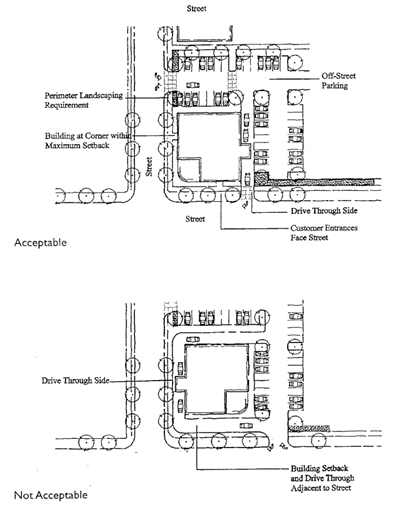
- The drive-up/drive-through facility shall orient to an alley, driveway, or interior parking area, and not a street;
- None of the drive-up, drive-in or drive-through facilities (e.g., driveway queuing areas, windows, teller machines, service windows, kiosks, drop-boxes, or similar facilities) are located within 20 feet of a street and shall not be oriented to a street corner. (Walk-up only teller machines and kiosks may be oriented to a street or placed adjacent to a corner);
- Drive-up/in queuing areas shall be designed so that vehicles do not obstruct a driveway, fire access lane, walkway, or public right-of-way; and
- In the CBD district, no more than one drive-up, drive-in, or drive-through facility is allowed for a distance of 400 linear feet along the same block face (same side of street).
Figure 2.3.100 - Drive-Up and Drive-Through Facilities