
Danville City Zoning Code
ARTICLE 15
- DEFINITIONS
A.- Interpretations.
For the purpose of this ordinance, certain words and terms are to be interpreted as follows:
1.
Words used in the present tense can include the future; words used in the masculine gender can include the feminine and neuter; words in the singular number can include the plural; and words in the plural can include the singular, unless the obvious construction of the wording indicates otherwise.
2.
The word "shall" is mandatory. The word "may" is permissive.
3.
Unless otherwise specified, all distances shall be measured horizontally and at right angles to the line in relation to which the distance is specified.
4.
The word "building" includes the word structure, and the word "structure" includes the word building; the word "lot" includes the word plot; the word "used" shall be deemed also to include designed, intended, or arranged to be used; the term "erected" shall be deemed also to include constructed, reconstructed, altered, placed, relocated or removed.
5.
The terms "land use" and "use of land" shall be deemed also to include building use and use of building.
6.
The word "adjacent" means nearby and not necessarily contiguous.
7.
The word "contiguous" means touching and sharing a common point or line.
(Ord. No. 2004-02.04, Art. 15, § A, 2-17-04)
B. - Definitions.
As used in this article, the following terms or words shall have meanings given below unless the context requires otherwise.
Accessory. As applied to use or structure, means customarily subordinate or incidental to the primary use or structure, and on the premises of such primary use or structure. The phrase "on the premises of" means on the same lot or on the contiguous lot in the same ownership.
Accessory apartment dwelling unit. A residential apartment which is incidental and subordinate to a single family detached residence for the purpose of accommodating not more than two (2) occupants and as further defined in the Ordinance.
Accessory use. A use which is clearly incidental and subordinate to or customarily found in connection with and (except where otherwise provided in the Ordinance) is located on the same lot as the principal use on the premises. Those uses connected to the principal building by an open breezeway will be considered accessory uses.
Acre. A measure of land equating to 43,560 square feet.
Acreage. A parcel of land, regardless of area, described by metes and bounds and not a lot of any recorded subdivision plat.
Addition. Any construction which increases the area of cubic content of a building or structure. The construction of walls which serve to enclose any portion of an existing structure, such as a porch, shall be deemed an addition within the meaning of the chapter.
Administrator. The Director of Planning/Zoning Administrator of the City of Danville, as designated by resolution of the City Council, who shall administer this ordinance on behalf of the Planning Commission and City Council.
Adult day care center. Any facility that is either operated for profit or that desires licensure and that provides supplementary care and protection during only a part of the day to four (4) or more aged, infirm or disabled adults who reside elsewhere except (i) a facility or portion of a facility licensed by the State Board of Health or the Department of Behavioral Health and Developmental Services, and (ii) the home or residence of an individual who cares for only persons related to him by blood or marriage. (§ 63.2-100 of the Code of Virginia)
Adult day support services. A facility licensed by the Department of Behavioral Health and Development Services that houses a structured program of activity and training services for adults with intellectual or developmental disability, provided to groups or individuals in nonresidential community-based settings. This service may include opportunities for peer interaction and community integration.
Adult entertainment establishment. An establishment consisting of, including, or having the characteristics of any of the following:
1.
Adult Bookstore. An establishment having as a substantial or significant portion of its stock in trade books, magazines, publications, tapes or films that are distinguished or characterized by their emphasis on matter depicting, describing or relating to sexual activities or anatomical genital areas.
2.
Adult Cabaret. (a) An establishment devoted to adult entertainment, either with or without a liquor license, presenting material distinguished or characterized by their emphasis on matter depicting, describing or relating to sexual activities or anatomical genital areas; (b) a cabaret that features topless or bottomless dancers, go-go dancers, strippers or similar entertainers for observation by patrons.
3.
Adult Motion Picture or Mini Motion Picture Theater. An enclosed building used for presenting material distinguished or characterized by an emphasis on matter depicting, describing or relating to sexual activities or anatomical genital areas.
Agriculture. The production, keeping or maintenance, for sale or lease on lots or portions of lots over two (2) acres, of plants and animals useful to man, including, but not limited to: forage and sod crops, grains and seed crops; dairy animals and dairy products; poultry and poultry products; livestock, including beef cattle, sheep, swine, horses, ponies, mules, goats or any mutations or hybrids thereof, including the breeding and grazing of any or all such animals; bees and apiary products; fur animals; trees and forest products; fruits of all kinds, including grapes, nuts and berries; vegetables; nursery, flora, ornamental and greenhouse products. The raising of livestock shall be no more than one (1) form of livestock animal or five poultry per every three (3) acres. This district does not permit feed lots and confinement operations for swine, veal, poultry and the like.
Alley. A public or private way less than 30' in width intended for vehicular traffic and designed to give access to the side and rear of properties whose principal frontage is on a street.
Alteration. Any material change in the architectural features of a structure and its surrounding site including, but not limited to, additions and removals of the supporting members of an existing building, such as bearing walls, columns, beams, girders or lower partitions, as well as any change in door or window, change in use, substantial landscaping and any subdivision. Modifications classified as ordinary repair are excluded from this definition.
Amusement arcade. Establishments in which a principal use is the operation of video, mechanical, electronic and/or coin operated games and/or devices for the amusement of the general public.
Amusement machines. Any video, mechanical, electronic and/or coin operated game and/or device for the amusement of patrons. This definition shall not be constructed to include coin operated music players, coin operated mechanical children's rides or coin operated television.
Animal shelter. As differentiated from a Kennel as defined herein, any place designated to provide for the temporary accommodation of five (5) or more common, unowned household pets until appropriate disposition of such pets can be effectuated.
Apartment. See Dwelling, Multiple family.
Architect. A professional who is registered with the State Department of Professional and Occupational Registration as an architect.
Attached residential buildings. A row of two (2) or more dwelling units, separated from one another by continuous vertical wall(s) without opening from basement floor to roof, with each unit located on a separate lot of record. Townhouses are included in this category.
Automobile and/or trailer sales area. An open space, other than a street or required automobile parking space, used for display or sale of new or used automobile or trailers and where no repair work is done.
Automobile repair. General repair, engine rebuilding or reconditioning of motor vehicles; collision service, such as body, frame or fender straightening and repair; overall painting of motor vehicles.
Automobile salvage yard. Any lot or place which is exposed to the weather and upon which more than five (5) motor vehicles of any kind incapable of being licensed or operated on the highways are placed, located or found.
Automobile service station. A place where gasoline stored only in underground tanks, kerosene or motor oil and lubricants or grease, for operation of motor vehicles, are directed related to the public on premises, and including minor accessories, and services for automobiles, but not including automobile repairs and rebuilding.
Average daily traffic (ADT). Total volume of traffic during a given period of time (in whole days greater than one day and less than one year) divided by the number of days in that time period.
Bank. See Financial institution.
Base Flood. See Flood. Also, refer to the FP-O District regulations for additional definitions related to floodplains, floodways, flood fringes, and other words related to the floodplain regulations.
Base Flood Elevation. The highest height, expressed in feet above sea level of floodwaters occurring in regulatory base flood.
Basement. Any area of the building having its floor sub-grade (below ground level) on all sides. A basement shall be counted as a story only if the vertical distance from the average adjoining grade to the ceiling is over five (5) feet.
Bed and breakfast lodging. A single family dwelling, occupied by its owner or operator, containing sleeping and breakfast accommodations as an accessory use to the principal use as a private residence. Such lodging shall have no more than eight (8) room accommodations for transient persons and wherein a charge is normally paid for such accommodations. A bed and breakfast may include banquet/event facilities for private parties as an accessory use.
Berm. A landscaped earthen mound intended to screen, buffer, mitigate noise and generally enhance views of parking areas, storage areas or required yards particularly from public streets or adjacent land uses.
Block. That land abutting on one side of a street extending to the rear lot lines, or for parcels of land extending through to another street, to a line midway between the two (2) streets and lying between the two (2) nearest intersecting and intercepting streets or between the nearest intersecting or intercepting street and the boundary of any railroad right-of-way, park, school ground or non-subdivided acreage or center line of any drainage channel twenty (20) feet or more in width.
Bicycle shop. Any building wherein the primary occupation is the sale of new or used bicycles, associated merchandise including clothing, helmets, tires, tubes, pumps, electronics, etc. for usage on or attached to a bicycle, and the repair or reconstruction of the same. For the purpose of this ordinance, however, bicycle shops shall not include the sale of motorcycles or powered scooters/mopeds.
Board of Zoning Appeals. The Board of Zoning Appeals of the City of Danville. A local body, created by ordinance, and appointed by the Circuit Court, whose responsibility is to hear appeals and to consider requests for variances from provisions of the Zoning Ordinance in accord with State Statutes 15.2-2308 of the Code of Virginia.
Buffer or screening. Any device or natural growth, or a combination thereof, which shall serve as a barrier to vision, light, or noise between adjoining properties, wherever required by this ordinance and further defined herein.
Buildable area. The portion of a lot remaining after required yards and open space requirements have been provided and sensitive environmental factors have been applied.
Building. Any structure having a roof supported by columns or walls and intended for the shelter, housing or enclosure of any individual, animal, process, equipment, goods, or materials of any kind.
Building footprint. The area on the ground surface covered by the building.
Building front. That one (1) face or wall of a building which is architecturally designed as the front of the building, which normally contains the main entrance(s) for use by the general public.
Building height. See Height, building.
Building, rear. That portion of a building which is, by either service area, secondary entry and egress or the facade directly opposite the front facade of the structure; the reverse frontage of the building.
Bulk regulations. Regulations controlling the size of structures and the relationship of structures and uses to each other and to open areas and lot lines. Bulk regulations include provisions controlling (a) maximum building height, (b) maximum floor area ratio and (c) minimum yard requirement.
Business service and office supply establishment. Any establishment containing no more than 5000 square feet of net floor area wherein the primary occupation is the provision of services or supplies principally to the business, commercial, industrial or institutional community, but not including retail sales to the general public except as a secondary and subordinate ancillary activity. This term shall include establishments such as catering and printing establishments which serve the general public. Business service and supply service establishments shall not involve the use of more than three (3) vehicles other than passenger cars.
Campground. Campgrounds are as defined in Virginia Administrative Code, Title 12, Health, Agency 5, Department of Health, Chapter 450 Section 10, Definitions.
Camping unit. Camping units are as defined in Virginia Administrative Code, Title 12, Health, Agency 5, Department of Health, Chapter 450 Section 10, Definitions.
Cannabis dispensing facility. A facility that (i) has obtained a permit from the Virginia Board of Pharmacy; (ii) is owned, at least in part, by a pharmaceutical processor; and (iii) dispenses cannabis products produced by a pharmaceutical processor to a registered patient, his registered agent, or, if such patient is a minor or an incapacitated adult, such patient's parent or legal guardian.
Canopy. A roof-like structure, with an approved covering, which is attached to a building at one end and is otherwise supported by one (1) or more posts; or a freestanding roof-like structure supported by posts and open on all sides.
Car wash. A commercial establishment whose primary purpose is the washing of motor vehicles for a stipulated fee which must comply with all stormwater and/or plumbing regulations in effect at the time of application for a zoning clearance.
Caregiver. An adult who provides care for a mentally or physically impaired person within the Commonwealth. A caregiver shall be either related by blood, marriage, or adoption to or the legally appointed guardian of the mentally or physically impaired person for whom he is caring.
Caretaker. One who is employed to look after or take charge of goods or property for an owner who is absent.
Caretaker's residence. A dwelling unit on a non-residential premises, occupied by the person (including their immediate family) who oversees the nonresidential operation 24-hours a day.
Carport. Any space outside a building, wholly or partly covered by a roof, and used for the shelter of parked motor vehicles. A carport may be attached or freestanding and is to be enclosed on no more than three sides. Carports shall be considered accessory structures.
Cellar. See Basement.
Cemetery. Property used for the interring of the dead, in which mausoleums may be utilized.
Center line. A line lying midway between the side lines of a street or alley right-of-way as measured in the horizontal plane.
Certificate of Occupancy. A certificate granted by the City's Building Official which permits the use of a building in accordance with the approved plans and specifications and which certifies compliance with the provisions of law for the use and occupancy of the building in its several parts together with any special stipulations or conditions of the building permit. Unless such a certificate is issued, a building cannot be occupied.
Child care center. A regularly operating service arrangement for five (5) or more children under the age of thirteen (13) where, during the absence of a parent or guardian, a person or organization has agreed to assume responsibility for the supervision, protection and well-being of a child for less than a twenty-four (24) hour period, in a facility that is not the residence of the provider or of any of the children in care.
Child therapeutic day support services. A facility licensed by the Department of Behavioral Health and Development Services that houses a structured program of activity and training services for children under the age of 18 with intellectual or developmental disability, provided in groups or individuals in non-residential community based settings. This service may include opportunities for peer interaction and community integration.
Church or place of religious worship. A building whose primary use is for the assembly of persons for religious worship and instruction. The religious facility may include offices, classrooms, parlors and meeting rooms for religious purposes.
Clinic. An establishment where patients who are not lodged overnight are admitted for examination and treatment by one (1) or more physicians practicing medicine, dentistry or psychiatric treatment.
Club. A group of people organized for a common purpose to pursue common goals, interests, or activities and usually characterized by certain membership qualifications, payment of fees and dues, regular meetings and a constitution and bylaws.
Cluster subdivision. An alternate means of subdividing a lot premised on the concept of reducing lot size, yard and bulk requirements in return for the provision of common open space and recreational improvements within the development. Cluster subdivisions are often permitted at higher net densities in comparison to conventional developments, but also leave more open space by reducing lot sizes.
Commercial Communication Tower. Any pole, tower tripod, telescoping mast, or any other structure, not to include a building or water tower, which supports a device used for the transmission, retransmission or reception of electronic signals or information for commercial use.
Commercial Communication Antenna. Any device that is designed, and/or adaptable, for mounting on preexisting or new structures, for example non-residential buildings or water towers, and used for transmission, retransmission, or reception of electronic signals or information for commercial use.
Commercial use. An occupation, employment, enterprise or activity involves the sale of goods and/or services that is carried on for profit or charitable not for profit purposes by the owner, lessee or licensee.
Commercial vehicle. Any motor vehicle used for non-private use which is over one ton in weight.
Commission. The Planning Commission of the City of Danville.
Commission of Architectural Review (CAR). A seven-member commission appointed by the City Council to administer the zoning regulations governing historic district(s) established by the Zoning Code.
Community center. A building used for recreational, social, educational and cultural activities, open to the public or a portion of the public, owned and operated by a public or private not-for-profit group or agency.
Complete application. An application form or petition completed as specified by ordinance and the rules and regulations of the municipal agency and all accompanying documents required by ordinance for approval of the application or petition.
Comprehensive plan. The official document or elements thereof, adopted by the City Council and intended to guide the physical development of the City or a portion thereof. Such plan, including maps, plats, charts, policy statement and/or descriptive material shall be that adopted in accordance with Section 15.2-2223 of the Code of Virginia.
Condominium. Real property and any incidentals thereto or interests therein which have been or are to be lawfully established as such under the Virginia Condominium Act.
Congregate care facility. a structure other than a single-family dwelling where more than four (4) unrelated persons reside under supervision for special care, treatment, training or similar purposes on a temporary or permanent basis.
Contractor's offices and shops. Establishments for the installation and servicing of such items as air conditioners, electrical equipment, flooring, heating, painting, plumbing, roofing, tiling and ventilating, as well as, those areas established to manage such operations.
Convalescent home. An extended or intermediate care facility licensed or approved to provide full-time convalescent or chronic care to individuals who, by reason of advanced age, chronic illness or infirmity, are unable to care for themselves.
Convenience store. A small retail establishment offering for sale purchased food products, household items, newspaper and magazines, and sandwiches and other prepared foods for offsite consumption. Such establishments, typically serve a small market area (i.e. neighborhood) and should be designed at a size and scale that is compatible with the surrounding community.
Cul-de-sac. A local street, one end of which is closed and consists of a circular turn-around. A "cul de sac" is distinguished from the terms "roundabout" and "rotary".
Curb grade. The elevation of the established curb in front of the building measured at the midpoint of such frontage. Where no curb exists, the City engineer shall establish such curb grade for the existing or proposed street in accordance with the existing street grading plans of the City.
Curb line. The face of a curb along private streets, travel ways, service drives and/or parking bays/lots.
Day care facility (adult or child). See Adult day care center and Child care center (not including a family day care home).
Demolition. The complete or substantial removal of any structure or external element of any structure.
Density. The number of dwelling units per acre in a development.
Developer. The legal or beneficial owner or owners of all the land proposed to be included in a given development, or the authorized agent thereof. In addition, the holder of an option or contract to purchase, a lessee having a remaining term of not less than thirty (30) years, or other persons having an enforceable proprietary interest in such land shall be deemed to be a developer for the purpose of this ordinance.
Development. The division of land, or construction or substantial alteration of residential, commercial, industrial, institutional, recreational, transportation or utility facilities or structures.
Development plan, generalized. A required submission at the time of filing for an amendment to the Official Zoning Map for any and all zoning districts, to be prepared and approved in accordance with the provisions of this ordinance, and which generally characterizes the proposed development of the subject lot or property.
Dinner Theater. Establishment where a motion picture or theatrical production is viewed, while eating a sit down dinner.
Directional or Panel Antenna. Any type of commercial communication antenna that is used for the one hundred eighty (180) degree transmission, retransmission, or reception of electronic signals or information for commercial uses.
Distillery. A facility for the production, bottling, packaging and sale of high alcohol content beverages produced on site for distribution, retail or wholesale, on or off premises sales and which meets all Virginia Alcoholic Beverage Control laws and regulations.
District (or zoning district). Any designated geographical section of the City of Danville in which the regulations governing the use of the buildings and premises, the heights of building, the size of yards and the intensity of the use are uniform.
Dormitory. A structure specifically designed for a long-term stay by students of a college, university, nonprofit organization, or government entity for the purpose of providing rooms for sleeping purposes. One common kitchen and some common gathering rooms for social purposes may also be provided.
Drive-in bank. Any financial institution which offers its services to persons within a motor vehicle.
Drive-in-theater. An open lot devoted primarily to the showing of motion pictures or theatrical productions on a paid admission basis to patrons seated in automobiles.
Drive-thru service. An establishment that by design, physical facilities, service, or by packaging procedures encourages or permits customers to receive services or obtain goods, while remaining in their motor vehicles.
Driveway. That privately owned and maintained space or area of a lot that is specifically designated and reserved for the movement of motor vehicles within the lot or from the lot to a public street from a garage, parking space, or other structure.
Duplex. A group of two (2) single family dwelling units which are generally joined to one another by a common party wall, a common floor/ceiling and/or connecting permanent structures such as breezeways, carports, garages or screening fences or walls, whether or not such a group is located on a single parcel of ground or on adjoining individual lots. Each unit on a lot shall have its own outside entrance(s).
Dustless surface. A surface adequately covered in accordance with good practice with a minimum of either two (2) applications of bituminous surface treatment, concrete, bituminous concrete or equivalent paving material approved by the City Engineer, and to be maintained in good condition at all times.
Dwelling. A building or portion thereof, designed or used exclusively for residential occupancy. The term "dwelling" shall not be construed to mean a boat, trailer, mobile home, motor home, manufactured home, motel, rooming house, hospital or other accommodation used for transient occupancy.
Dwelling, manufactured home. A single family residential structure subject to federal regulation (the National Manufactured Housing Construction and Safety Standards Act, 42 U.S.C. 5401 et seq.) with all of the following characteristics: (a) built on a permanent chassis; (b) designed to be transported in one or more sections after factory fabrication on detachable wheels or on a flat bed or other trailer; (c) consisting of eight (8) body feet or more in width and forty (40) body feet or more in length in the traveling mode or cover three hundred and twenty (320) or more square feet when erected on site; (d) designed for long-term human occupancy and containing sleeping accommodations, a flush toilet, a tub or shower, bath and kitchen facilities with plumbing and electrical connections provided for attachment to outside systems; (e) ready for occupancy upon the arrival at the intended site except for minor and incidental unpacking and assembly operations; (f) may be placed on either an impermanent or permanent concrete foundation with appropriate connection to utilities, and the like; and (g) designed for removal to and installation or erection on other sites. A manufactured home may include one (1) or more units, separately towable, which when joined together shall have the characteristics as described above. For the purpose of this ordinance, a manufactured home shall not be deemed a Single family detached dwelling.
Dwelling, mobile home. See Dwelling, manufactured home.
Dwelling, modular unit. A factory-fabricated transportable building designed to be used by itself or to be incorporated with similar units at a building site into a modular structure that will be a finished building placed in a fixed location on a permanent foundation (ie. conventional basement or crawl space foundation) incorporating a system of supports, including piers. The term is intended to apply to major assemblies, and does not include prefabricated panels, trusses, plumbing trees and other prefabricated sub-elements incorporated into a structure at the site. For the purpose of this ordinance, a modular unit shall be deemed a Single family dwelling and shall not be deemed a Manufactured home.
Dwelling, multiple family. A dwelling unit within a residential building containing three (3) or more separate dwelling units located on a single lot or parcel of ground. A multiple family dwelling, commonly known as an apartment building, generally has a common outside entrance(s) for all the dwelling units, and the units are generally designed to occupy a single floor one above another. For the purpose of this ordinance, a multiple family dwelling shall not be construed to mean a Single family attached dwelling as defined herein.
Dwelling, single family. A residential building containing only one (1) Dwelling Unit and not occupied by more than one (1) family.
Dwelling, single family attached. A group of two (2) or more single family dwelling units which are generally joined to one another by a common party wall, a common floor/ceiling and/or connecting permanent structures such as breezeways, carports, garages or screening fences or walls, whether or not such a group is located on a single parcel of ground or on adjoining individual lots. Each unit on a lot shall have its own outside entrance(s); architectural facades or treatment of materials shall be varied from one unit to another; and no more than two (2) abutting units in a row shall have the same rear and front setbacks, with a minimum setback offset being two and one half (2 1/2) feet unless otherwise approved by the Director of Planning/Zoning Administrator. For the purpose of this ordinance, dwellings such as a semidetached, garden court dwelling, patio house, zero lot line dwelling, City house, duplex and two-family dwelling shall be deemed a single family attached dwelling.
Dwelling, single family detached. A single family dwelling unit which is entirely surrounded by open space or yards on the same lot. Such dwelling unit may include rental space for occupancy by not more than two (2) persons unrelated to the resident family, provided that such rental space does not include separate kitchen facilities or a separate entrance for the exclusive use of the renters.
Dwelling, townhouse. An attached residence located on an individually platted lot, in which each dwelling unit shares a common wall (including without limitation the wall of an attached garage or porch) with at least one (1) other dwelling unit, and in which each dwelling unit has living space on the ground floor and a separate, ground floor entrance.
Dwelling unit. One (1) or more rooms in a residential building or residential portion of a building which are arranged, designed, used or intended for use as a complete, independent living facility for one (1) family, and which include permanent provisions for living, sleeping, eating, cooking and sanitation.
Easement. A right created by an express or implied agreement of one (1) owner of land to make lawful and beneficial use of the land of another for a special purpose not inconsistent with any other uses already being made of the land.
Egress. An exit.
Elderly housing. A structure, typically containing multi-family dwelling units, where the occupancy of the dwellings are restricted to persons 50 years of age or older, or couples where either the husband or wife is 50 years of age or older and which meets the Fair Housing Amendments Act of 1988 for elderly housing. Such a structure may consist of individual dwelling units, community dining areas, common recreation areas, special support services and limited medical or nursing care.
Electric Fence. A fence designed to carry an electric current which is used for security or for establishing a boundary for a private or commercial property. An electric fence designed solely for the protection or herding of animals is not considered an electric fence for the purposes of this Ordinance.
Engineer. A professional who is registered with the State Department of Professional and Occupational Registration as a professional engineer.
Enlargement. An increase in the size of an existing structure.
Exterminator. A person or company that provides services involved in the extermination of vermin, including insects, bugs, snakes, rats, etc.
Facade. The exterior walls of a building exposed to public view or that wall viewed by persons not within the building.
Family.
(1)
One (1) person or two (2) or more persons related by blood, adoption, marriage or guardianship living together as a single housekeeping unit with no more than two (2) boarders; or
(2)
A group of not more than three (3) unrelated persons living together as a single housekeeping unit;
(3)
A residential facility in which no more than eight individuals with mental illness, intellectual disability, or developmental disabilities reside, with one or more residents or non-resident staff persons, as residential occupancy by a single family. For the purposes of this subsection, mental illness and developmental disability shall not include current illegal use of or addiction to a controlled substance as defined in § 54.1-3401 of the Code of Virginia. No conditions more restrictive than those imposed on residences occupied by persons related by blood, marriage, or adoption shall be imposed on such facility. For purposes of this subsection, "residential facility" means any group home or other residential facility for which the Department of Behavioral Health and Developmental Services is the licensing authority pursuant to this Code.
(4)
A residential facility in which no more than eight aged, infirm or disabled persons reside, with one or more resident counselors or other staff persons, as residential occupancy by a single family. No conditions more restrictive than those imposed on residences occupied by persons related by blood, marriage, or adoption shall be imposed on such facility. For purposes of this subsection, "residential facility" means any assisted living facility or residential facility in which aged, infirm or disabled persons reside with one or more resident counselors or other staff persons and for which the Department of Social Services is the licensing authority pursuant to this Code.
Family day care home. A home occupation permitted by special use permit in which the resident and not more than one additional employee cares for more than five (5) but no more than twelve (12) non-related children for less than a twenty-four (24) hour period.
Fast food restaurant. Any establishment which provides as a principal use wrapped and/or packaged food and drink which is ready for consumption, either on or off-the premises.
Fence. An artificially constructed barrier of any material or combination of materials erected to enclose, screen or separate areas.
Financial institution. Any building where the primary occupation is concerned with such State regulated businesses as banking, savings and loans, loan companies and investment/securities companies. However, for the purpose of this ordinance, any financial institution having a drive-in window(s) shall be deemed a Drive-in bank as defined herein.
Flood (100-Year) or Base flood. The flood having a one percent chance of being equaled or exceeded in any given year.
Floodplain. All land areas in and adjacent to streams and water courses subject to continuous or periodic inundation from flood events as designated by the United States Department of Housing and Urban Development (HUD), or the Federal Emergency Management Agency (FEMA), and/or the United States Geological Survey.
Floor area, gross. The sum of the total horizontal areas of all floors of all buildings on a lot, measured from the interior faces of exterior walls. The term "gross floor area" shall include basements; elevator shafts and stairwells at each story; floor space used for mechanical equipment with structural headroom of six (6) feet, six (6) inches or more; penthouses, attic space, whether or not a floor has actually been laid, providing structural headroom of six (6) feet, six (6) inches or more; interior balconies; and mezzanines.
Floor area, net. The total floor area designed for tenant occupancy of all floors of all buildings on a lot, measured from the center line of joint partitions to the interior faces of exterior walls, which excludes areas designed for permanent uses such as toilets, utility closets, corridors for pedestrian or vehicle through traffic, enclosed parking areas, meters, rooftop mechanical structures, mechanical and equipment rooms, fire exits, stairwells, elevators and escalators. For the purposes of this ordinance, the term "net floor area" shall not include outdoor display areas for the sale, rental and display of recreational vehicles, boats and boating equipment, trailers, horticultural items, farm or garden equipment and other similar products.
Floor area ratio. The ratio determined by dividing the gross floor area of all buildings on a lot by the area of that lot.
Foster home. A residence in which any child, other than a child by birth or adoption, resides as a member of the household and has been placed therein.
Fraternity house. A dwelling or dwelling unit maintained exclusively for fraternity members and their guests or visitors and affiliated with an academic or professional college, university or other institution of higher learning.
Frontage. The portion of a property adjacent to a right-of-way.
Funeral home. A building used for the preparation of the deceased for funeral and the ceremonies connected therewith before burial or cremation.
Garage, private. An accessory building designed and used only for storage purposes which is owned and/or by the occupants of the building to which it is accessory.
Garage, public. A building, or portion thereof, other than a private garage, designed or used primarily for equipping, servicing, repairing, renting or selling motor driven vehicles and accessories.
Garage, commercial parking or storage. A building, or portion thereof, designated or used exclusively for the parking or storage of vehicles for a fee, but within which no licensed and operable passenger vehicles are serviced, repaired, equipped or sold.
Garage/yard sale. Any on-premises sale of goods operated out of a one-family, two-family or multi-family dwelling. Such sales shall be limited to two days in duration, and no more than two such sales shall occur in any calendar year.
Gasoline sales establishments. A facility for the sale of gasoline, diesel, compressed natural gas, and/or blends of these fuels with other materials such as methanol or ethanol, also including electric plug-in facilities for use in motor vehicles.
Geometric design. The dimensions and arrangements of the visible features of a roadway. These include pavement widths, horizontal and vertical alignment, slopes, channelization, interchanges, and other features the design of which significantly affects traffic operation, safety and capacity.
Golf course. Land, whether publicly or privately owned, on which the game of golf is played, including accessory uses such as golf driving ranges and buildings customary thereto.
Golf driving range. A practice range for hitting golf balls from a common tee-off area, and for purposes of this ordinance, not operated in conjunction with a golf course or country club.
Grade. A horizontal reference plane representing the average of finished ground level adjoining a building at all exterior walls; also referred to as Grade plane.
Grade, finished. The final elevation of the ground surface after development.
Gross leasable area. The total area for which the tenant pays rent and which is designed for the tenant's occupancy and exclusive use, exclusive of public or common areas such as utility rooms, stairwells, halls, etc.
Gross site area. The total area measured in acres within the boundaries of a given parcel of land. See also Net developable area which is a subset of Gross site area.
Group home. A residential facility with one or more resident counselors or other staff persons, in which more than: (a) eight (8) mentally ill, mentally retarded or developmentally disabled persons reside and such home is licensed by the Virginia Department of Mental Health, Mental Retardation and Substance Abuse Services; or (b) eight (8) mentally retarded persons reside and such home is licensed by the Virginia Department of Social Services; or (c) eight (8) handicapped persons reside, with handicapped defined in accordance with the Federal Fair Housing Amendments Act of 1988; or (d) three (3) non-related children (defined as being under the age of 18) who have demonstrated a tendency toward alcoholism, drug abuse, mental illness, or antisocial or criminal conduct.
Guest house. Dwelling or lodging units for a temporary or non-paying guest or guests in an accessory building. No such quarters shall be occupied by the same guest or guests for a period of time of more than three (3) months in any twelve (12) month period, and no such quarters shall be rented, leased, or otherwise made available for compensation of any kind.
Hardship, inordinate. To establish a case of "inordinate hardship," the applicant shall submit evidence that the strict conformance to any of the provisions of this ordinance would burden the applicant, whereby the he cannot make reasonable economic use of the property due to such regulations. Such evidence may include proof of consideration of plans for construction, attempts to sell, rent or lease the property and information regarding annual income and expenses. Any hardship created by action of the applicant shall not be considered in reviewing any application.
Height, building. The vertical distance to the highest point of the roof for flat roofs; to the deck line of mansard roofs; and to the average height between eaves and the ridge for gable, hip and gambrel roofs measured from the curb level if the building is not more than ten (10) feet distance from the front lot line, or from the Grade in all other cases.
Heliport. An area designed to accommodate all phases of operation of helicopters with suitable space and facilities for a terminal, loading, unloading, service and storage of such aircraft, to include facilities for such accessory uses as are commonly associated with an airport terminal.
Helistop. An area designed to accommodate touch-down and lift-off of helicopters, for the purpose of picking up and discharging passengers or cargo. Such an area shall contain no operation facilities other than one (1) tie down space and such additional facilities as are required by law, ordinance or regulation.
Historic area or district. An area or existing site containing buildings or places in which historic events occurred or having special public value because of notable architectural or other features relating to the cultural or artistic heritage of the community of such significance as to warrant conservation and preservation.
Historic preservation. The protection, rehabilitation and restoration of districts, sites, buildings, structures and artifacts significant in American history, architecture, archaeology or culture.
Home occupation. Any occupation or activity which is clearly incidental and secondary to use of the premises for dwelling and which is carried on wholly or in part within a main building or accessory building or on the premises by a member of the family that resides on the premises. Such use shall not change the the character of the dwelling unit nor have any exterior evidence other than a sign as provided for in Article 10 of this ordinance.
Homecare provider. An allowable home occupation in which the resident cares for no more than five (5) non-related children during normal business hours.
Homeless shelter. A structure used as a temporary dwelling for transient or homeless individuals on a daily, weekly, or similar short-term basis, where no compensation is provided for, or may be accepted by the provider, operated by a non-profit entity of religious or philanthropic nature. This definition shall not include hotels/motels, congregate care facilities, boarding house or bed and breakfast inn as defined elsewhere in this Code.
Homeowners association. A community association internally organized in a specific development in which individual owners share common interests in open space or facilities.
Hospital. Any institution receiving in-patients and rendering medical, surgical or obstetrical care, to include general hospitals and specialized institutions in which care is oriented to cardiac, eye, ear, nose, throat, psychiatric, pediatric, orthopedic, skin and cancer and obstetric cases.
Hotel. See Motel.
Housing. See Dwelling.
Indoor shooting facility. A facility designed or used for shooting at targets, by archery, or with rifles, pistols, or shotguns and which is completely enclosed within a building(s) or structure(s).
Industrial, heavy. Land use classification consisting of, but not limited to, large manufacturing operations, heavy equipment facilities, construction and maintenance yards, businesses which store, process or distribute fuel in containers (i.e. propane) and other basic intensive industrial activities that typically impose significant impacts on adjacent uses (i.e. noise, light, air, water, waste treatment and traffic generation).
Industrial, light. Land use classification consisting of, but not limited to, light manufacturing, fabricating, processing, wholesale distributing and warehousing uses appropriately located for access by highways. These uses are typically less intensive in nature than heavy industrial uses and pose only minor impacts on adjacent uses (i.e. noise, light, air, water, waste treatment and traffic generation).
Industrial park. A planned development of a tract of land with two (2) or more separate industrial buildings. Such development is planned, designed, constructed and managed on an integrated and coordinated basis with special attention given to on-site vehicular circulation, parking, utility needs, building design and orientation and open space.
Ingress. Access or entry.
Institutional home. A facility providing assisted community living for more than eight (8) persons deemed as indigent, orphaned or the like.
Institutional use. A nonprofit corporation or a nonprofit establishment whose purpose is of a civic, educational, charitable, religious or philanthropic nature.
ITE. Institute of Traffic Engineers.
Junk. Dilapidated and inoperative automobiles, trucks, tractors, and other such vehicles and parts thereof, dilapidated wagons and other kinds of vehicles and parts thereof, discarded appliances, scrap building material, scrap contractor's equipment, tanks, casks, cans, barrels, boxes, drums, piping, bottles, glass, wood scraps, old iron, machinery, rags, paper, excelsior, hair, mattresses, beds or bedding or any other kind of scrap or waste material which is stored, kept, handled or displayed.
Junk vehicle. Any motor vehicle, trailer or semi-trailer which is either inoperable or unfit for licensing and which by virtue of its condition may not be feasibly restored. In addition, any vehicle may be presumed to be a junk vehicle when State inspection stickers are not displayed or have been expired for more than ninety (90) days.
Jurisdiction. The area within the corporate boundary of the City of Danville.
Kennel. Any place or establishment in which dogs and other small domestic animals normally kept as pets are kept, bred, trained, boarded or handled for a fee.
Landfill. A land depository, excavation, or area operated in a controlled manner by a person or business entity, for the dumping of debris or inert material other than clean dirt; or a disposal site operated by means of compacting and covering solid waste at least once a day with an approved material. This term is intended to include both debris landfills and sanitary landfills.
Landscape Architect. Any professional who is registered with the State of Virginia's Department of Professional and Occupational Registration as a Landscape Architect.
Landscaping. The improvement of a lot with grass, shrubs, trees, other vegetation and/or ornamental objects. Landscaping may include pedestrian walks, flower beds, ornamental objects such as fountains, statues and other similar natural and artificial objects designed and arranged to produce an esthetically pleasing effect.
Land surveyor. Any professional who is registered with the State Department of Professional and Occupational Registration as a Land Surveyor.
Laundromat. An establishment providing washing, drying or dry cleaning machines on the premises for rental use to the general public for family laundering or dry cleaning purposes.
Level of service. A qualitative measure that represents the collective factors of speed, travel time, traffic interruptions, freedom to maneuver, safety, driving comfort and convenience, and operating costs provided by a highway facility under a particular volume conditions.
Loading space. A space, within a building or on the premises, providing for the standing, loading or unloading of vehicles.
Lot. A parcel of land that is designated at the time of application for a rezoning, a special permit, a special exception, a building permit, or a residential/non-residential use permit, as a tract all of which is to be used, developed or built upon as a unit under single ownership. A parcel of land shall be deemed to be a lot in accordance with this definition, regardless of whether or not the boundaries thereof coincide with the boundaries of lots or parcels as shown on any map of record.
Lot area. The total horizontal area measured in the horizontal plane included within the lot lines of a lot.
Lot, corner. A lot at the junction of and abutting on two (2) or more intersecting streets when the interior angle of intersection does not exceed 135 degrees. On a corner lot, all yards lying between the furthermost projecting wall of the principal building parallel to the street and the intersecting street(s) shall be deemed front yards, the remaining yard shall be deemed a rear yard.
Lot Coverage. That portion of the lot that is covered by buildings and structures.
Lot depth. The minimum horizontal distance between the front and rear lot lines.
Lot, flag. A lot where only a portion of the lot fronts on or abuts a public street and the remainder of the lot is located behind an adjacent lot (see also Lot, pipestem).
Lot, interior. Any lot, including a through lot, other than a corner lot.
Lot line. Any boundary of a lot as defined herein. Where applicable, a lot line shall coincide with a Street line or Right-of-way line. Where a lot line is curved, all dimensions related to said lot line shall be based on the chord of the arc.
Lot line, front. A line which is contiguous to the street boundary of a lot; or, in the case where a lot does not abut a street other than by its driveway, or is a through lot, that lot line which runs generally parallel to and/or in front of the principal entrance of the main building on the lot.
Lot line, rear. That lot line that is most distance from, and is most nearly parallel with, the front lot line. If a rear lot line is less than ten (10) feet in length, or if the lot comes to a point at the rear, the rear lot line shall be deemed to be a ten (10) foot line parallel to the front lot line, lying wholly within the lot for the purpose of establishing the required minimum rear yard.
Lot line, side. A lot line which is neither a front lot line nor a rear lot line as defined herein.
Lot, minimum area of. The smallest lot area established by the Zoning Ordinance on which a use or building may be located in a particular zoning district.
Lot, nonconforming. An otherwise legally platted lot that does not conform to the minimum area or width requirements prescribed in this Zoning Ordinance for the district in which it is located, either at the effective date of the Ordinance or as a result of subsequent amendments to the Ordinance.
Lot, pipestem. A lot approved which does not abut a public street other than by its driveway which affords access to the lot (see also Lot, flag).
Lot of record. A lot, shown upon a plan or plat, referred to in a deed, or described by metes and bounds, which has been recorded in the Clerk's office of the Circuit Court of the City of Danville.
Lot, reverse frontage. A residential through or corner lot, intentionally designed so that the front lot line faces a local street rather than facing a parallel major thoroughfare.
Lot size requirements. Restrictions on the dimensions of a lot, to include a specified zoning district size, lot area and lot width, all established to limit the minimum size and dimension of a lot in a given zoning district.
Lot, through. An interior lot, but not a corner lot, abutting on two (2) or more public streets.
Lot width. The distance between side lot lines, measured in one of the following manners, whichever is applicable:
1.
In the case of a rectangular-shaped lot, the width shall be measured along the front lot line;
2.
In the case of an irregular-shaped lot or a curvilinear front lot line, the width shall be measured between the lot's narrowest dimensions at that location on the lot where the center of the building is proposed/located; or
3.
In the case of a pipestem lot, the width shall be measured between the lot's narrowest dimensions at that location on the lot where the center of the building is proposed/located.
Lowest Floor. The lowest floor of the lowest enclosed area (including basement). An unfinished or flood-resistant enclosure, usable solely for parking of vehicles, building access or storage in an area other than a basement area is not considered a building's lowest floor; provided, that such enclosure is not built so as to render the structure in violation of the applicable non-elevation design requirements of Federal law.
Mall. A shopping center where stores on both sides of a pedestrian way which may be enclosed or open.
Manufactured home. See Dwelling, manufactured home.
Manufacturing. The processing, fabrication, assembly, distribution or production of goods such as, but not limited to: scientific and precision instruments, photographic equipment, communication equipment, computation equipment, household appliance, toys, sporting and athletic goods, glass products made of purchase glass, electric lighting and wiring equipment, industrial controls, radio and TV receiving sets, optical goods and electrical machinery.
Marina, commercial. A marina designed and operated for profit, or operated by any club or organized group where hull and engine repairs, boat and accessory sales, packaged food sales, eating establishments, personal services, fueling facilities, storage and overnight guest facilities or any combination of these are provided.
Marina, private. A marina designed and intended to be used for mooring of boats by residents of the general neighborhood with no commercial facilities other than those necessary for minor servicing or repair.
Marquee. A permanent roof-like structure projecting over an entrance.
Mentally or physically impaired person. A person who is a resident of Virginia and who requires assistance with two or more activities of daily living, as defined in § 63.2-2200, as certified in a writing provided by a physician licensed by the Commonwealth.
Microbrewery. A facility for the production, bottling, packaging and sale of beer, malt beverages, and or hard cider of low alcohol content, produced on site for distribution, retail or wholesale, on or off-premises sales, with a capacity of not more than 15,000 barrels per year.
Micro-winery. A facility for the production (including but not limited to crushing, fermenting, aging and storage) of grapes or other products, fruits or vegetables into wine including the bottling, packaging, and sale of wine for human consumption, produced on site for distribution, retail or wholesale, on or off-premises sales, with a capacity of not more than 5,000 gallons per year.
Mini-warehouse. A building consisting of individual, small, self-contained units that are leased for the storage of household goods, business goods or contractors' supplies.
Mobile home or trailer. See Dwelling, mobile home.
Mobile home park. Any area of twenty (20) acres or more, however designated, that is occupied or designed for occupancy by one (1) or more manufactured homes. The term "mobile home park" shall not include sales lots on which unoccupied mobile homes, whether new or used, are parked for the purposes of inspection and sale.
Motel. A building or portion thereof or a group of buildings which provide sleeping accommodations in six (6) or more separate units or rooms for transients on a daily, weekly, or similar short-term basis for reasonable monetary compensation, whether such establishment is designated as a hotel, inn, automobile court, motel, motor lodge, tourist cabin, tourist court, tourist home or otherwise. A hotel or motel shall be deemed to include any establishment which provides residential living accommodations for transients on a short-term basis, such as an apartment hotel, but not to include a homeless shelter.
Net developable area. The land deemed most suitable for development within a given area or parcel. It is calculated by subtracting the critical environmental areas within the area or parcel that should be protected from development and the estimated right-of-way requirements from the total gross area. The result is the net developable area, which provides a realistic measure of land holding capacity for an area or parcel in the City. (Refer to illustrative example of the net developable area calculation in the Appendix of the Zoning Ordinance.)
Nightclub. A place of assembly that provides exhibition, performance, or other forms of entertainment; serves food and/or alcoholic beverages; and provides music and space for dancing.
Nonconforming building or use. A building or use, lawfully existing on the effective date of this ordinance or prior ordinances, which does not conform with the regulations of the zoning district in which it is located, except as may be qualified by this ordinance.
Nonconforming lot. A lot, the area, dimension or location of which was lawful prior to the adoption, revision or amendment of the Zoning Ordinance, but which fails by reason of such adoption, revision or amendment to conform to the present requirements of the zoning district in which it is located.
Notice, public. The advertisement of a public hearing in a newspaper of general circulation in the area, indicating the time, place and nature of a public hearing as required by the Code of Virginia, 1950, as amended.
Nursery school. A private school program, as recognized and accredited by the State Board of Education, operated for the purpose of providing training, guidance, education and/or care for children below the age of compulsory school attendance, separated from their parents or guardians during any part of the day other than from 6:00 p.m. to 6 a.m.
Nursing home. A home for the aged, or infirm, senile, chronically ill or convalescent in which persons not of the immediate family are received, kept or provided with food, shelter, treatment and care for compensation, not including hospitals, clinics or similar institutions.
Office. Any room, studio, clinic, suite or building wherein the primary use is the conduct of a business such as accounting, correspondence, research, editing, administration or analysis; or the conduct of a business by salesmen, sales representatives or manufacturer's representatives; or the conduct of a business by professionals such as engineers, architects, land surveyors, artists, musicians, lawyers, accountants, real estate brokers, insurance agents, dentists or physicians, urban planners and landscape architects.
For the purpose of this ordinance, an office shall not involve manufacturing, fabrication, production, processing, assembling, cleaning, testing, repair or storage of materials, goods and products; or the sale and/or delivery of any materials, goods or products which are physically located on the premises. An office shall not be deemed to include a veterinary clinic.
Off-site. Any area outside the boundary of a lot.
Off-street loading space. A space or berth used for the loading or unloading of commercial vehicles that is directly accessible to an access aisle, and which is not located on a dedicated street right-of-way.
Off-street parking space. A temporary storage area for a motor vehicle that is directly accessible to an access aisle, and which is not located on a dedicated street right-of-way. Required off-street parking must be constructed of an all-weather, dust-free surface paving, unless otherwise exempt.
Omnidirectional or whip antenna. Any type of commercial communication antenna that is used for the three hundred sixty (360) degree transmission, retransmission, or reception of electronic signals or information for commercial use.
On-site. That area which is within the boundary of a lot.
Open space. That area intended to provide light and air, and is designed for either scenic or recreational purposes. Open space shall, in general, be available for entry and use by the residents or occupants of the development, but may include a limited proportion of space so located and treated as to enhance the amenity of the development by providing landscaping features, screening for the benefit of the occupants or those in neighboring areas, or a general appearance of openness. Open space shall not include driveways, parking lots, or other vehicular surfaces, any area occupied by a building, or areas so located or so small as to have no substantial value for the purpose stated in this definition.
Open space, common. All open space that is designed and designated for use and enjoyment by all residents or occupants of the development or by the residents or occupants of a designated portion of the development. Common open space shall represent those areas not to be dedicated as public lands and rights-of-way, but which are to remain in the ownership of a homeowners association or of a condominium in accordance with the provisions set forth in this ordinance. Pedestrian paths and sidewalks may be included in the calculation of required common open space. Vehicular travel ways, parking lots and individual private yards within the area of platted residential lots may not be included in the calculation of required common open space.
Open space, dedicated. All open space which is to be dedicated or conveyed to the City or an appropriate public agency, board, or body for public use as open space.
Open space, landscaped. That open space within the boundaries of a given lot that is designed to enhance privacy and the amenity of the development by providing landscaping features, screening for the benefit of the occupants or those in neighboring areas, or a general appearance of openness. Landscaped open space may include, but need not be limited to lawns, decorative planting, flower beds, sidewalks/walkways, ornamental objects such as fountains, statues and other similar natural or artificial objects, wooded areas and water courses, any or all of which are designed and arranged to produce an esthetically pleasing effect within the development. Landscaped open space may be either Common or Dedicated open space as defined herein.
Outdoor Display. To show, exhibit or make visible goods or merchandise for sale.
Outdoor Storage. The holding, keeping or storage, in an unroofed area, of any goods, junk, materials, merchandise or vehicles in the same place for more than twenty-four (24) hours. All outdoor storage shall be required to be enclosed by a fence, wall, landscaped berm, or other suitable and appropriate method.
Overlay District. A zoning district superimposed on one or more underlying zones, that imposes additional requirements above those required by the underlying zoning district.
Owner. Any individual, firm, association, syndicate, partnership or corporation having sufficient proprietary interest to the land in question (i.e. holder of legal title or the lessee of the land in question having a remaining term of not less than thirty (30) years).
Parking bay. A combined travel way and parking area developed as a private improvement designed to provide necessary and sufficient vehicular access and off-street parking service to a private development. Spaces with parking bays are normally oriented perpendicular to the line of travel in the travel way. A parking bay may be either single-loaded (parking only on one side of the travel way) or double loaded (parking on both sides of the travel way). Refer to the City's Design and Construction Standards Manual for geometric requirements and transportation design criteria for parking bays and travel ways.
Parking garage. An off-street, single or multi-level building used for the temporary parking of motor vehicles.
Parking lot. An area containing one (1) or more spaces for the purpose of temporary, daily or overnight off-street parking. A parking lot shall include automobile and truck display lots, lots for the display of other types of vehicles, lots for the storage of vehicles and commercial parking lots.
Parking, off-street. Any space specifically allotted to the parking of motor vehicles as an accessory use. For the purpose of this ordinance, such space shall not be located in a dedicated right-of-way, a travel lane, a service drive, nor any easement for public ingress or egress.
Parking space. The area required for parking one (1) automobile which shall be a minimum of nine (9) feet wide and eighteen (18) feet long, not including passageways.
Parking unit, private. A self-contained and privately maintained area accessed by a public street but allowing no through traffic routes and providing such off-street parking as may be required under this chapter for the building served. Said parking unit may be entered by a private drive from the public street, provided, that such drive offers adequate ingress and egress for emergency vehicles and otherwise complies with acceptable City standards.
Performance standards. A set of criteria or limits relating to nuisance elements which a particular use or process may not exceed.
Person. A public or private individual, group, company, firm, corporation, partnership, association, society, joint stock company, or any other combination of human beings whether legal or natural.
Personal service establishment. Any building wherein the primary occupation is the repair, care of, maintenance or customizing of personal properties that are worn or carried about the person or are a physical component of the person. For the purpose of this ordinance, personal service establishments shall include but need not be limited to barber shops, beauty parlors, pet grooming establishments, laundering, cleaning and other garment servicing establishments, tailors, dressmaking shops, shoe cleaning or repair shops, and other similar places of business.
Pharmacy. A store where the primary area is utilized for the filling of medical prescriptions and the sale of drugs, medical devices and supplies, nonprescription medicines, and hygienic supplies.
Plan of development. A sketch of the site drawn to scale, showing the dimensions and acreage of the property, and approximate location of buildings, roads, parking areas and landscaping, the number of dwelling units or commercial or other types of buildings and other information essential for determining whether the provisions of this ordinance are being observed, such as pertinent site engineering data.
Plat. A drawing, map or plan for a parcel of land or subdivision, or rearrangement, revision of re-subdivision of land.
Porch. A roofed open area, which may be glazed or screened, usually attached or made a part of and with direct access to or from a building.
Post-release housing. A place established to provide counseling, food, and shelter on a temporary basis for individuals that are part of a transitional program from incarceration to society; individuals within the program must not have been found guilty of a violent offense. Post-release housing must be operated by a non-profit entity of religious or philanthropic nature with a resident counselor(s). Support is to be provided to the same individuals for not less than 60 days and no more than 24 months, with or without compensation. The number of individuals allowed per structure shall be based on the square footage of the bedrooms available. Multiple occupancy bedrooms must have a minimum of 50 sf per occupant and must have at least two means of emergency egress. Single occupancy bedrooms must be a minimum of 70 sf and at least two means of emergency egress. One structure is not to exceed twelve (12) individuals. Where more than six (6) individuals within the program are to occupy one structure an additional counselor must be provided. This definition shall not include hotels/motels, congregate care facilities, boarding house, bed and breakfast, homeless shelter or transitional living facility as defined elsewhere in this Code.
Premises. A lot, together with all buildings or structures occupying it.
Primary residence. The dwelling in which a resident occupies as their usual home. If a person maintains more than one (1) residence, the primary residence shall be the dwelling where the resident lives for more than half the calendar year.
Principal building. A building in which is conducted the principal use of the lot on which it is located.
Principal use. The main use of land or structures as distinguished from a secondary or accessory use.
Private club. An association organized and operated on a non-profit basis for persons who are bona fide members paying dues, from which the association owns or leases premises, the use of which premises is restricted to such members and their guests, and which manages the affairs of such association by and through a board of directors, executive committee, or similar body chosen by the members. Food, meals and beverages may be served on such premises, provided adequate dining space and kitchen facilities are available.
Pro-rata share. The payment of a subdivider or developer of land for his share of the cost of providing reasonable and necessary drainage or utility facilities located outside the property limits of the land owned or controlled by the subdivider or developer of land and necessitated or require, at least in part, by the construction or improvement of his subdivision or development.
Public building. A building, or part thereof, owned or leased by a governmental agency and used for governmental functions by an agency or political subdivision of the United States, the Commonwealth of Virginia, Pittsylvania County or the City of Danville. Also referred to as "Public facility."
Public facility. See Public building.
Public floor area. The gross building area, as figured on a per-story basis, which clearly serves the general public, such as vestibules and lobbies, corridors, waiting rooms and toilets, servicing areas, and required stairs, ramps and elevators. Employee-oriented areas, such as kitchens and freezer rooms, storage, maintenance and service areas, shall not apply. Unfinished areas shall be included and figures on the basis of potential use.
Public use. Any area, building or structure held, used or controlled exclusively for public purposes by any department or branch of the Federal government, Commonwealth of Virginia, the City of Danville government under the direct authority of the City Council, the City School Board or City Park Authority, or Pittsylvania County, without reference to the ownership of the building or structure or the realty upon which it is situated. For the purposes of this Ordinance, uses sponsored by City agencies, such as the Danville Department of Utilities, Danville Public Library, Parks & Recreation, Social Services, Adult and Juvenile Court and Detention Centers, the Department of Public Works, Housing and Development Division, Economic Development Authority, and the Danville Regional Airport, shall be deemed public uses.
Public utility. A business or service having an appropriate franchise from the Commonwealth of Virginia, which is engaged in regularly supplying the public with some commodity or service which is of public consequence and need, such as; gas, water, transportation or communication.
Public utility, heavy. A business or service which is engaged in regularly supplying the public with a service which is of public consequence and whose operations have the potential to negatively impact the environment in terms of noise, odor, and personal harm (i.e. sewage treatment and electricity generation plants).
Public utility, light. A use or structure which is engaged in conducting the supply of utility services to the public which is of public consequence and whose operations have little or no potential to negatively impact the environment in terms of noise, odor and personal harm (i.e. electric transformer, natural gas, telecommunications facilities, water and sewer transmission, collection, distribution and metering devices and water and sewerage pumping stations).
Quorum. A majority of the full authorized membership of an agency, board or commission.
Recycling center. A facility in which used material is separated and processed prior to shipment to other facilities that will use those materials to manufacture new products.
Refuse. Waste materials including ashes, garbage, rubbish, junk, industrial waste, dead animals and other solid waste materials, including salvageable waste.
Regional brewery. A facility for the production, bottling, packaging and sale of beer, malt beverages, and or hard cider of low alcohol content, produced on site for distribution, retail or wholesale, on or off-premises sales, with a capacity of not more than 6,000,000 barrels per year
Rehabilitation. The upgrading of a building previously existing in a dilapidated or substandard condition, for human habitation or use.
Renovation. The upgrading of a building.
Repair service establishment. Any building containing no more than 5,000 square feet of net floor area wherein the primary occupation is the repair and general service of common home appliances such as musical instruments, sewing machines, televisions and radios, washing machines, vacuum cleaners, power tools, electric razors, refrigerators and lawn mowers; or any building wherein the primary occupation is interior decorating, to include reupholstering and the making of draperies, slipcovers and other similar articles, but not to include furniture or cabinet-making establishments.
Research laboratory. An establishment or other facility for carrying on an investigation into a neutral, physical or social science, or engineering and development as an extension of investigation with the objective of creating end products.
Restaurant. Establishment in which the principle activity is the sale of food and beverages for consumption on the premises.
Restaurant, drive-thru. An establishment where food and drink are prepared and served for consumption primarily within the principal building, exclusive or drive-thru facilities.
Restoration. The replication or reconstruction of a building's original architectural features.
Retail sales establishment. Any building wherein the primary occupation is the sale of merchandise in small quantities, either in broken lots or parcels, not in bulk, for use or consumption by the immediate purchaser. For the purpose of this ordinance, however, retail sales establishments shall not be interpreted to include Automobile-oriented uses.
Retaining wall. A structure constructed to hold back or support an earthen bank.
Review board. Refer to the Tourism Corridor Review Board, the appointed body which contributes to the administration of the Tourism Corridor Overlay District.
Review commission. The Commission of Architectural Review, the appointed body which contributes to the administration of the Historic Preservation Overlay District.
Right-of-way lines. Lines which separate private property from dedicated public property containing or proposed to contain publicly-owned street surfaces, curb and gutter, sidewalks and planted strips. Where a public street is designated on the major thoroughfare plan, all requirements of this chapter which relate to rights-of-way shall be measured from the indicated proposed right-of-way lines.
Rooming house. see Boardinghouse.
Salvage yard. Any space or area or portion of lots used for the storage, sale, keeping or abandonment of junk or waste materials, including used building material, for the dismantling, demolition, sale or abandonment of automobiles and other vehicles, machinery or parts thereof.
Sanitary landfill. A disposal facility for solid waste so located, designed and operated that it does not pose a substantial present or potential hazard to human health or the environment, including pollution of air, land, surface water or groundwater.
Seasonal retail use. Commercial activities, such as roadside agricultural sales, including pumpkin and holiday tree sales, landscape material sales, craft sales, and civic retail sales that are of a scale and character that are compatible with adjacent uses, will not adversely affect the surrounding neighborhood by means of odor noise, dust, or other nuisances, and are limited to a duration of no longer than three consecutive months. These uses are intended to be allowed for a time period longer than those defined as Temporary retail uses, but no longer than three consecutive months per calendar year.
Service. Buildings and premises wherein the primary use is the supply and dispensation at retail of gasoline, oil, grease, batteries, tires and motor vehicle accessories, and where in addition, the services for minor engine repair, tire servicing, exhaust systems, washing, brake repairs and other minor repair activities may be rendered and sales made, but only as accessory and incidental to the primary occupation.
Semi-Public Use. Any use which is essentially public in nature, as in services rendered, although it is under private ownership or control.
Setback. In this ordinance, the term setback is not used, as such term represents a distance that is established in like manner as that for a Yard in the minimum yard requirements.
School. Any building or part thereof which is designed, constructed, or used for education or instruction in any branch of knowledge.
Screening. A method of visually shielding or obscuring one abutting or nearby structure or use from another by fencing, walls, berms, or densely planted vegetation.
Shopping center. Any group of two (2) or more commercial uses which: (a) are designed as a single commercial group, whether or not located on the same lot; (b) are under common ownership or management; (c) are connected by party walls, partitions, canopies or other structural members to form one continuous structure, or if located in separate buildings, are interconnected by walkways and access ways designed to facilitate customer interchange between the uses; (d) share a common parking area; and (e) otherwise present the appearance of one (1) continuous commercial area.
Short-term rental. Any furnished residential-property that provides sleeping accommodations for monetary compensation for thirty (30) or fewer consecutive days. This definition specifically excludes other businesses licensed with the City or State like bed and breakfast establishments, hotels, and motels.
Shrink-swell soil. Expansive and contracting soil composed largely of clay and as further defined by geotechnical evaluation of soils subject to land development activity in the City. The soil will expand generally in an upward direction when water from any source is interspersed into a shrink/swell soil. When a shrink/swell soil dries, cracks and voids are sometimes created between the soil and constructed footings, which can subsequently lead to foundation settlement.
Sign. A name, display or illustration which is affixed to, or represented, directly or indirectly, upon a building, structure, parcel or lot which directs attention to an object, place, activity, institution, organization or business located on the premises. The term "sign" shall not be deemed to include official court or governmental notices nor the flag, emblem or insignia of a nation, political unit, school or religion, or directional aids for traffic flow and other public safety purposes.
Site plan. A required submission, prepared and approved in accordance with the provisions of Article 11 of this ordinance, which is a detailed engineering drawing of the proposed improvements required in the development of a given lot or lots.
Sorority house. A dwelling or dwelling unit maintained exclusively for sorority members and their guests or visitors and affiliated with an academic or professional college, university or other institution of higher learning.
Special exception. A yard exception or height exception specifically listed in the Zoning Ordinance which may be permitted in a specified district or in all districts in accord with terms of the Ordinance by the Board of Zoning Appeals under certain conditions, such conditions to be determined in each case by the terms of this ordinance and by the Board of Zoning Appeals.
Special use. A use that, owing to some special characteristics attendant to its size, siting, intensity, operation or installation, is permitted in a district after site specific review and subject to special conditions approved by the City Council.
Spot zoning. Rezoning of a lot or parcel of land for a use incompatible with surrounding land uses, without reference to the land use plan. According to Section 15.2-2280 of the Virginia Code, spot zoning is illegal "when the zoning ordinance is designed solely to serve the private interests of one or more landowners: but, if the legislative purpose is to further the welfare of the entire county or city as part of an overall zoning plan, the ordinance does not constitute illegal spot zoning."
Stadium. A large open or enclosed place used for games and major events and partly or completely surrounded by tiers of seats for spectators.
Storage yard. The use of any space, whether inside or outside a building, for the storage or keeping of construction equipment, machinery, vehicles or parts thereof, boats and/or farm machinery, and inventory which, due to its physical character, is not normally stored within a structure.
Story. That part of a building between the level of one (1) finished floor and the level of the next higher finished floor or, if there is no higher finished floor, then part of the building between the level of the highest finished floor and the top of the roof beams.
Stream. A body of running water moving over the land in a defined channel with bed and banks within which concentrated water flows either continuously or intermittently.
Street. A strip of land intended primarily for vehicular traffic and providing the principal means of access to property, including but not limited to road, lane, drive, avenue, highway, boulevard or any other thoroughfare. The term "street" does not distinguish between a public or a private street.
Street, arterial. A street which carries the major portion of the trips entering and leaving an urban area, as well as the majority of through movements desiring to bypass the central business area of the City. Because of the nature of travel served by an arterial street, almost all fully and partially controlled access streets are a part of this functional class, including freeways, major thoroughfares, and expressways. Arterial streets are public.
Street, collector. A street which provides for principal internal movements at moderate operating speeds within residential developments, neighborhoods, and commercial or industrial districts. It also provides the primary means of circulation between adjacent neighborhoods and can serve as a local bus route. A collector street functions to distribute trips from arterial streets to local and other collector streets. Conversely, it collects traffic from local streets and channels it into the arterial system. The collector street provides for the dual purpose of serving both individual property access and local traffic movement. Collector street are public.
Street, cul-de-sac. A street with a common ingress and egress with a turnaround at the end.
Street line. The dividing line between a street and a lot. This term may be used synonymously with the right-of-way line of a public street, or the curb line of a parking bay, travel lane or private street.
Street, local. A street which primarily provides direct access to residential, commercial, industrial or other abutting property. The local street system includes all facilities not classified as a principal arterial, minor arterial or collector street. A local street offers the lowest level of mobility and may not serve a bus route. Overall operating speeds are low in order to permit frequent stops or turning movements.
Street, principal highway. Any highway so classified by the Virginia Department of Highways and Transportation, which serves as a multi-lane arterial devoted purely to traffic movement.
Street, private ("private street"). A local or collector street, not a component of the State or City primary or secondary public road system, which is guaranteed to be maintained by a private corporation or other private entity and is subject to the provisions of this ordinance.
Street, public. A platted City street, dedicated for the use of the general public, graded and paved in order that every person has the right to pass and to use it at all times, for all purposes of travel, transportation or parking to which it is adapted and devoted, and which is maintained by the City.
Street, service drive. A public street paralleling and contiguous to a major thoroughfare, designed primarily to promote safety by providing free access to adjoining property and limited access to major thoroughfares. All points of ingress and egress are subject to approval by City officials as designated in this ordinance.
Street tree. Any tree which grows in the street right-of-way or on private property abutting the street right-of-way.
Structure. That which is built or constructed, the use of which requires permanent location on the ground or attachment to something having a permanent location on the ground.
Subdivider. Any person who subdivides land pursuant to the Subdivision Ordinance of the City of Danville.
Subdivision. A division of a lot, parcel or tract of land into two (2) or more lots for the purpose, whether immediate or future, of transfer of ownership; or any division of land upon which a street, alley or public right-of-way is involved. The term includes re-subdivision and, where appropriate to the context, shall relate to the process of subdividing or to the land subdivided and solely for the purpose of recordation of any single division of land into two (2) lots, a plat of such division shall be submitted.
Subdivision, cluster. An alternate means of subdividing a lot premised on the concept of reducing lot size, yard and bulk requirements in return for the provision of common open space and recreational improvements within the development. Cluster subdivisions are often permitted at higher net densities in comparison to conventional developments, but leave more open space by reducing lot sizes.
Subdivision, conventional. The subdivision of a lot in accordance with the lot size requirements and bulk regulations specified in the district regulations.
Substantial improvement. Any extension, repair, reconstruction or other improvement of a property, the cost of which equals or exceeds fifty (50) percent of the fair market value of a property before the improvement is started or, if the property has been damaged and is being restored, before the damage occurred.
Temporary family health care structure. A transportable residential structure, providing an environment facilitating a caregiver's provision of care for a mentally or physically impaired person, that (i) is primarily assembled at a location other than its site of installation, (ii) is limited to one occupant who shall be the mentally or physically impaired person, (iii) has no more than 300 gross square feet, and (iv) complies with applicable provisions of the Industrialized Building Safety Law (§ 36-70 et seq.) and the Uniform Statewide Building Code (§ 36-97 et seq.). Placing the temporary family health care structure on a permanent foundation shall not be required or permitted.
Temporary structure or building. A structure or building without any foundation or footings and which is removed when the designated time period, activity or use for which the structure or building was erected has ceased.
Temporary retail use. Commercial activities, such as seasonal sales, roadside agricultural sales, including pumpkin and holiday tree sales, landscape material sales, craft sales, and civic retail sales that are of a scale and character that are compatible with adjacent uses, will not adversely affect the surrounding neighborhood by means of odor noise, dust, or other nuisances, and are limited to a duration of no longer than 15 consecutive days per calendar year.
Theater. A building or structure designed for the enactment of dramatic and other artistic performances and/or showing of motion pictures. For the purpose of this ordinance, a dinner theater shall be deemed a restaurant. A drive-in theater shall be deemed a separate use.
Tourist home. A private residence where, as a subordinate and incidental use occupying less than fifty (50) percent of the primary single-family residential use of the building, temporary accommodations to overnight guests are provided for free.
Townhouse. An attached residence located on an individually platted lot, in which each dwelling unit shares a common wall (including without limitation the wall of an attached garage or porch) with at least one (1) other dwelling unit, and in which each dwelling unit has living space on the ground floor and a separate, ground floor entrance.
Transformer. A device used to transfer electric energy, usually that of an alternating current, from one circuit to another within a regional power network.
Transitional living shelter. A place established to provide temporary food and shelter for individuals and/or families that are escaping violent or abusive situations. A transitional living shelter must be operated by a non-profit entity of religious or philanthropic nature. Support may not be provided to the same individuals for more than sixty (60) consecutive days. This definition shall not include hotels/motels, congregate care facilities, boarding house, bed and breakfast or homeless shelter as defined elsewhere in this Code.
TIA. Traffic Impact Assessment. A traffic impact assessment is a formal evaluation of traffic required of developers by the City which is used to provide an efficient means for the incorporation of transportation systems analysis for future development projects, including redevelopment activities.
TSM. Transportation Safety Measures. Transportation safety measures are specific transportation applications designed to reduce the potential number of vehicular accidents at a particular intersection or section of road, street or highway.
Trash. see Refuse.
Travel way. A private street which is intended to serve the vehicular access requirements of and provides internal access to a private development. A travel way may incorporate perpendicular or parallel parking. Refer to the City's Design and Construction Standards Manual for geometric requirements and transportation design criteria for travel ways.
Tree canopy or tree cover. Shall include all areas of coverage by plant material exceeding five (5) feet in height.
Unrelated person(s). More than one (1) person(s) occupying a dwelling and living as a single housekeeping unit, all of whom are not related by birth, adoption, marriage, guardianship or as distinguished from a family as defined.
Use. Any purpose for which a structure or tract of land may be designed, arranged, intended, maintained or occupied; also, any activity, occupation, business or operation carried on, or intended to be carried on, in or on a structure or on a tract of land.
Variance. A reasonable deviation from those provisions regulating the shape, size, or area of a lot or parcel of land, or the size, height, area, bulk, or location of a building or structure when the strict application of the ordinance would unreasonably restrict the utilization of the property, and such need for a variance would not be shared generally by other properties, and provided such variance is not contrary to the purpose of the ordinance. It shall not include a change in use, which change shall be accomplished by a rezoning or by a conditional zoning.
Vehicle service establishment. Buildings and premises wherein mechanical and body work, repair of transmissions and differentials, straightening of body parts, painting, welding or other similar work is performed on vehicles within a completely enclosed structure. Vehicle service establishments shall not be deemed to include Heavy equipment sale, rental and service establishments.
Vehicle sale, rental and ancillary service establishment. Any use of land whereon the primary occupation is the sale, rental and ancillary service of any vehicle in operating condition such as an automobile, motorcycle, truck, trailer, ambulance, taxicab, recreational vehicle, mobile home or boat. For the purpose of this ordinance, vehicle sale, rental and ancillary service establishments shall not be deemed to include Heavy equipment sale, rental and service establishments.
V/C. Volume to Road Capacity Ratio. In this ratio, volume represents the number of vehicles passing over a given section of a lane or roadway in a given time, which can be one (1) hour or more, and road capacity represents the maximum number of vehicles that can reasonably be expected to pass over a given section of a lane or roadway in one direction, or both directions if so indicated, during a given time (usually one (1) hour) under prevailing roadway and traffic conditions.
Waiver. The ability of the City Council, Planning Commission or Director of Planning/Zoning Administrator, depending upon the circumstance, and the guidance of this Ordinance, to allow an applicant to avoid a regulation when such an opportunity is specifically made available by this Ordinance.
Warehouse. A building used primarily for the holding or storage of goods and merchandise.
Water-dependent facility. A development of land that must be located on the Dan River or other shoreline by reason of the intrinsic nature of its operation. These facilities may include, but are not limited to:
(a)
Storm water management facilities.
(b)
The intake and outfall structures of power plants, water treatment plants, sewage treatment plants and storm sewers.
(c)
Boat docking structures.
(d)
Public water-oriented recreation areas.
(e)
Fisheries.
Water Feature. A body of water on the land including streams, ponds, lakes, rivers, tributaries, sounds, channels, etc. Manmade drainage channels or structures are not to be considered water features.
Wetlands. An area as identified on the national Inventory of Wetlands or other qualified professional and/or regulated by the Army Corps of Engineers.
Wholesale trade establishment. Any building wherein the primary occupation is the sale of merchandise in gross for resale, and any such building wherein the primary occupation is the sale of merchandise to institutional, commercial and industrial consumers. For the purpose of this ordinance, a warehouse shall not be deemed a wholesale trade establishment.
Wildlife rehabilitation center. A professionally operated facility with on-site staff where care is regularly given to sick, injured, orphaned, or disabled wildlife until such time as such wildlife possesses sufficient health that it can be returned to its native habitat.
Written notice. A notification in writing delivered in person to the individual or parities intended; or delivered at, or sent by, certified or registered mail to the last residential or business address of legal record.
Yard. Any open space on a property with a principal building or group of buildings or a use that is unoccupied and unobstructed from the ground up unless allowed by this ordinance.
Yard, front. The yard between the front property line and the nearest part of the principal building or use that extends across the full property width.
Yard, interior side. The yard between an interior side property line and the nearest part of the principal building or use that extends from the front yard to the rear yard.
Yard, minimum. The minimum yard requirements set forth in this ordinance represent that minimum distance which the principal building(s) shall be set back from the respective lot lines. On a lot where a service drive is to be dedicated to the City, such dedication shall not affect the applicable minimum yard requirements.
Yard, rear. The yard between the rear property line and the nearest part of the principal building or use that extends across the full property width.
Yard, street side. The yard between an street side property line and the nearest part of the principal building or use that extends from the front yard to the rear yard.
Figure 15.1 Yards and Property Lines
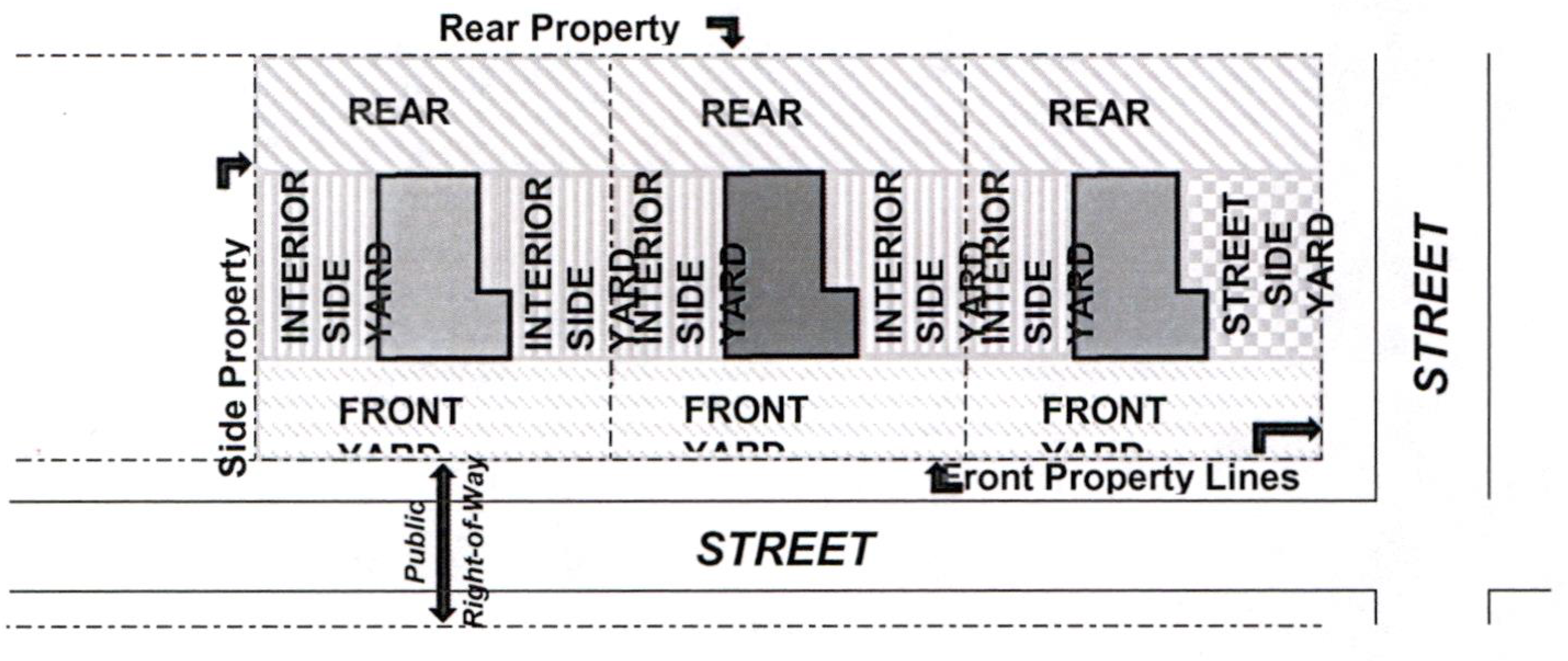
Zero lot line dwelling. The location of a residential building on a lot in such a manner that one or more of the buildings sides rests directly on a lot line.
Zone. A specifically delineated area or district in the City of Danville, Virginia within which regulations and requirements uniformly govern the use, placement, spacing and size of land and buildings.
Zoning. The legislative process by which a governing body classifies land within a community in to areas and districts referred to as zones.
Zoning Administrator. See Administrator. (Also referred to in the City of Danville as the Director of Planning.) The person in the City designated to administer the Zoning Ordinance and other land use regulations.
Zoning clearance. Approval granted by the Zoning Director that an application to construct, alter repair, remove, or demolish a building or structure complies with all applicable provisions of the Zoning Ordinance.
Zoning map. The map or maps which are part of the Zoning Ordinance, and delineate the boundaries of each zone.
Zoning text. The text of the Zoning Ordinance containing the terms and conditions of zoning within the City of Danville, Virginia and setting forth the standards, procedures and requirements.
(Ord. No. 2004-02.04, Art. 15, § B, 2-17-04; Ord. No. 2005-01.03, 1-4-05; Ord. No. 2005-04.04, 4-5-05; Ord. No. 2008-03.02, 3-4-08; Ord. No. 2008-07.04, Art. 15, § B, 7-15-08; Ord. No. 2009-07.02, 7-7-09; Ord. No. 2009-11.07, 11-5-09; Ord. No. 2009-12.08, 12-15-09; Ord. No. 2012-08.02, 8-21-12; Ord. No. 2012-09.09, 9-18-12; Ord. No. 2012-12.07, 12-18-12; Ord. No. 2012-11.09, 11-20-12; Ord. No. 2013-02.03, 2-19-13; Ord. No. 2013-06.01, 6-4-13; Ord. No. 2013-10.06, 10-17-13; Ord. No. 2014-08.09, 8-19-14; Ord. No. 2015-07.05, 7-21-15; Ord. No. 2015-09.09, 9-15-15; Ord. No. 2016-04.03, 4-5-16; Ord. No. 2016-07.03, 7-5-16; Ord. No. 2017-08.01, 8-3-17; Ord. No. 2019-05.04, 5-7-19; Ord. No. 2019-07.05, 7-2-19; Ord. No. 2021-07.07, 7-6-21; Ord. No. 2021-09.03, Exh. A, 9-7-21; Ord. No. 2022-02.01, Exh. A, 2-1-22; Ord. No. 2022-02.03, Exh. A, 2-1-22; Ord. No. 2022-05.07, Exh. A, 5-3-22; Ord. No. 2022-06.02, Exh. A, 6-7-22; Ord. No. 2023-04.08, 4-4-23; Ord. No. 2023-05.04, 5-2-23; Ord. No. 2023-12.14, 12-5-23)

