
Daphne City Zoning Code
ARTICLE XIII
DISTRICT REQUIREMENTS
The following limitations and requirements are hereby placed on uses in each district. Such limitations established by this article are in accordance with the stated purpose and intent of this Ordinance.
13-1 - General.
(a)
Permitted uses: The following are permitted uses in all residential districts, unless otherwise provided herein: customary accessory structures, satellite receiving dishes, gardens, playgrounds, parks, public buildings including schools and libraries, agriculture or farming including horticulture, plant nurseries, market gardening, field crops, orchards and home occupations meeting all requirement as prescribed in Article XXXI, Home Occupations, Automobile Service Stations, Cemeteries, Bed and Breakfast Establishments, Extended Stay Hotel Facilities.
(b)
Uses permitted by special exception: Certain public and semi-public uses are essential and desirable for the general convenience and welfare but may not fit compatibly within residential neighborhoods. When it is established by the board of zoning adjustment through site plan review that the location, design, and proposed activities will not adversely affect the public health, safety, morals, and general welfare of the surrounding neighborhood, the following public and semi-public uses may be permitted within a residential district by special exception. Such uses shall thereafter be submitted to the planning commission for site plan review and approval:
(1)
Public elementary, intermediate, and high schools, church schools, private or parochial elementary or high schools having a curriculum approximately the same as ordinarily given in public elementary and high schools and meeting all standards of the State Board of Education for instruction and site size.
(2)
Churches, synagogues, and other places of worship including parish houses, rectories, and other facilities normally incidental to places of worship but excluding funeral homes.
(3)
Cultural activities not carried on as a gainful business, including art galleries, non-public libraries, and museums.
(4)
Convalescent and nursing homes for the aged.
(5)
Recreation facilities, country clubs, community centers, and clubs which would draw a substantial number of users from the immediate neighborhood in which they are located, excluding residential accommodations and any activity carried on as a gainful business other than incidental concessions.
(6)
Day care centers, whether public or private, kindergartens, or play schools, upon approval of the state and the department of human resources.
(c)
Prohibited uses: Any use not permitted or permitted by special exception, except as otherwise determined under section 13-3, Compliance with district requirements. Commercial and Industrial uses such as garages, repair, storage yards, warehouses, buildings used as correctional institutions, and industrial type operations of any kind.
(d)
Unlisted uses: In any case where a requested use is not specifically referred to in the Table of Permitted Uses, its status shall be determined by the planning commission by reference to the most clearly analogous use or uses that are specifically referred to in the Table of Permitted Uses.
When the status of a use has been so determined by the planning commission, such determination shall thereafter have general application to all uses of the same type and shall be added to the Table of Permitted Uses.
13-2 - Table of permitted uses—Defined.
The uses permitted in each of the zoning districts are listed in the Table of Permitted Uses, Article XXXV, in three (3) categories, as follows:
(a)
Uses by right: Uses in the Table identified by as "by right", are subject to the conditions specified in the table or otherwise provided herein.
(b)
Uses requiring planning commission approval: Uses in the table identified as "planning commission approval" are permitted upon approval by the planning commission of the location and the site plan appropriate with regard to transportation, access, water supply, waste disposal, fire, police protection, and other public facilities; as not causing undue traffic congestion or creating a traffic hazard; and in harmony with the orderly and appropriate development of the district in which the development is to occur.
(c)
Special exceptions by the board of zoning adjustment: Uses in the table identified by "special exceptions by the board of zoning adjustment" are subject to the same approval of location and site plan as uses requiring planning approval. These uses are subject to approval of the board of zoning adjustment in accordance with the provisions provided in Article XIII, Uses Permitted by Special Exception, and are subject to site plan review by the planning commission.
13-3 - Compliance with district requirements.
Any use permitted in any district whether by right, planning approval, administrative approval, or as a special exception, must comply with the requirements of the district in which it is located, unless a variance from such requirement is specifically requested and granted by the board of zoning adjustment; unless approved as a planned unit development with modifications as required by the planning commission provisions of section 11-5, Subdivision exceptions and exemptions.
(a)
Planning approval: Any use requiring planning approval is subject to review and approval of the planning commission. Each application to the planning commission for approval must be accompanied by a site plan prepared by the applicant or his/her authorized agent. The planning commission shall review the application at its next meeting and take into consideration all existing regulations and ordinances of the City of Daphne, as well as, recommendations from the director of community development, the city engineer, the building official or his/her designee, the code enforcement officer, the Baldwin County Health Department, public and/or private utility entities and any other such local official. The planning commission may either approve the use request as is, approve the request with conditions, or deny the request.
(b)
Special exception: Any use permitted by special exception is subject to review and approval of the board of zoning adjustment. Each application shall be accompanied by a site plan. The board of zoning adjustment shall consider the recommendations of the director of community development, the city engineer and the building official or his/her designee, and make such recommendations a part of the record of any public hearing held on an application for a special exception, prior to making a decision on the application. If the decision of the board of zoning adjustment is not consistent with such recommendations, the minutes of the meeting at which such decision is made shall set forth the particular reasons for deviating from such recommendations.
If the special exception is approved, the site plan shall then be submitted to the planning commission for review and consideration.
(Ord. No. 2022-14, § II(i), 2-21-22)
13-4 - Requirements for lot area, width, coverage, density, height and other factors.
The following shall apply in districts as outlined, except planned unit developments or innovative design for single-family, and as provided below:
MINIMUM LOT REQUIREMENTS
a.
Maximum lot coverage percentages do not apply to lots of record smaller than required in the district in which they are located.
b.
Maximum density = total number of dwelling units per gross acre to be developed.
c.
Minimum lot area determined by adding seven thousand five hundred (7,500) square feet for one (1) unit plus two thousand five hundred (2,500) square feet for each additional unit.
d.
Applies to unzoned lots contained within any subdivision located in the extraterritorial planning jurisdiction where the size of the development exceeds ten (10) acres.
e.
Maximum height does not apply to overlay districts (see specific applicable overlay districts. Structures up to seventy-five (75) feet may be permitted on sites zoned B-2 or R-7 upon approval by the planning commission. In no case shall such building exceed seventy-five (75) feet in height.
(Ord. No. 2016-39, § I(C), 7-5-16)
13-5 - Requirements for lot area, width, coverage and other factors for public and semi-public buildings.
(a)
Definition: A public building is one which is used exclusively for public purposes by any department or branch of government. A semi-public building is one of an institutional nature and serving a public need, such as a house of worship; hospital; school; library; museum; post office; police, rescue and fire stations; and public utilities and services.
(b)
Minimum lot area and lot width: None specified; however, the lot shall be large enough to provide the minimum yards as specified herein.
(c)
Yard regulations:
(1)
Front yard: Each lot shall provide a front yard with a minimum depth of forty (40) feet.
(2)
Side yard: Each lot shall have a side yard of a minimum of thirty-five (35) feet on each side.
(3)
Rear yard: Each lot shall have a rear yard with a minimum depth of thirty-five (35) feet.
(d)
Maximum building height: No structure shall exceed a height of thirty-five (35) feet, except a church may have a maximum height of fifty (50) feet, provided one (1) foot shall be added to all minimum yard requirements for each additional foot of height in excess of thirty-five (35) feet (does not apply to a church sanctuary).
(e)
Maximum building coverage: The maximum land covered by a building shall be no more than fifty (50) percent of the total lot area.
(f)
Minimum landscaping: A minimum of twenty (20) percent of the lot area shall be maintained as a landscaped common area designed in accordance with the provisions of Article XIV, Landscape Standards and Tree Protection.
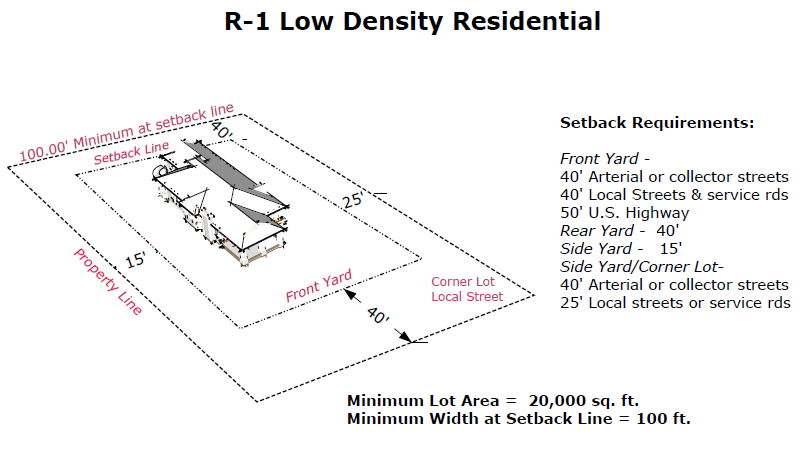
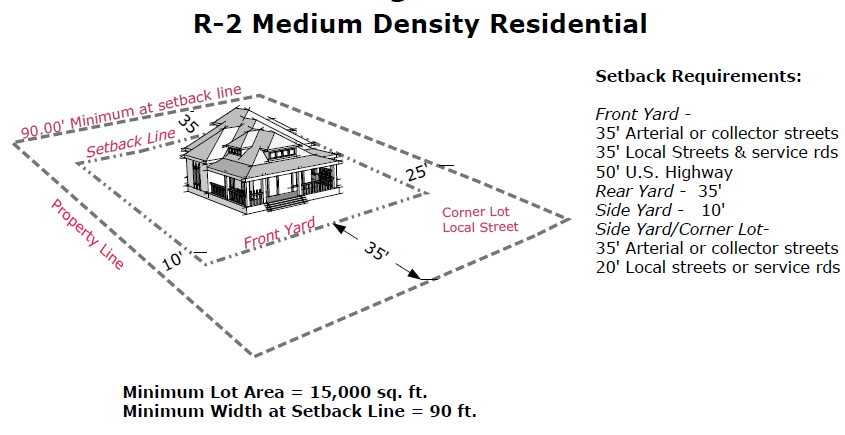
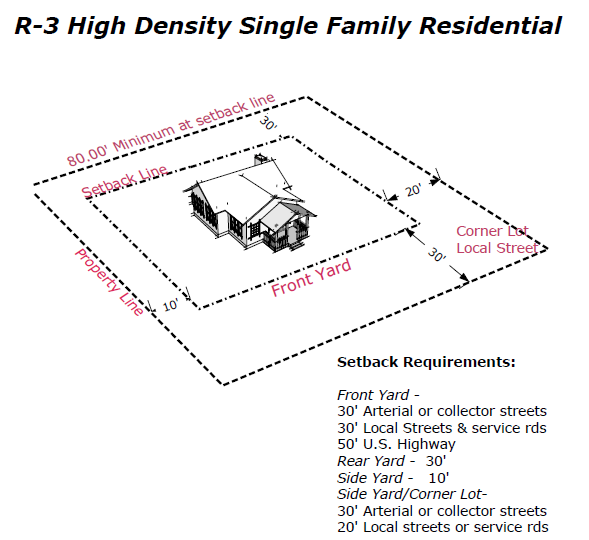
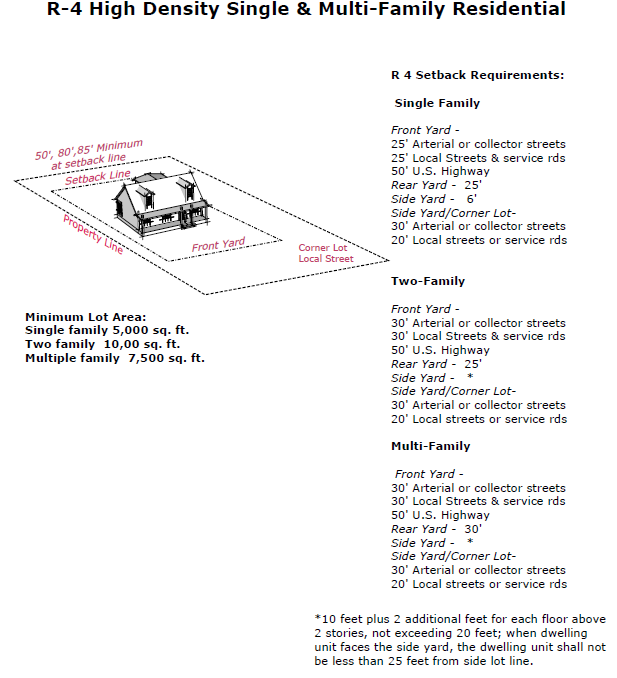
13-6 - Minimum zoning district setback requirements.
The following setback requirements shall apply in districts as outlined below, except in a Planned Unit Development, the Olde Towne Daphne District, the Village Overlay District, the Eastern Shore Park Overlay District, or the Jubilee Retail Overlay District, unless otherwise provided in said overlay district.
SETBACKS
NOTES FOR PREVIOUS TABLE:
(a)
Side yards shall be ten (10) feet plus two (2) additional feet for each floor above two (2) stories, but not exceeding twenty (20) feet; when the dwelling unit faces the side yard, the dwelling unit shall be at least twenty-five (25) feet from the side lot line.
(b)
None, except it will be five (5) feet where abutting an alley, or where abutting a residential district it shall be at least thirty (30) feet.
(c)
Yard shall be twenty (20) feet, except when abutting any part of a residential or business district, a setback at least forty (40) feet is required.
(d)
Where a public or semi-public use, multi-family residential, or mixed use district abuts any part of a single-family residential district, a buffer zone ten (10) feet wide shall be required. Where a B-2 district abuts any part of a single-family residential district, a buffer zone fifteen (15) feet wide shall be required. Where an industrial district abuts any part of a business or mixed use district, a buffer zone of twenty (20) feet shall be required. Where an industrial district abuts any part of a residential, a buffer zone of thirty (30) feet shall be required. Each buffer zone shall be designed in compliance with the provisions established in Article XIV, Landscape Standards and Tree Protection.
(e)
Per Act No. 94-572 of the Legislature of Alabama enacted April 21, 1994, as amended, the following setbacks shall apply for any state or county road or highway and measured from the centerline of the R.O.W: principal arterials—Interstate 10 and U.S. Highway 98—require a one-hundred-twenty-five-foot setback; minor arterials—U.S. Highway 90, State Highway 181 and U.S. 31 require a one-hundred-foot setback; major collectors—County Road 64 requires a seventy-five-foot setback.
Lot orientation: On corner lots the front yard shall be considered as parallel to the street upon which the lot has its least dimension. ET-SF*: Applies to unzoned lots contained within any subdivision located in the extraterritorial planning jurisdiction where the size of the development exceeds ten (10) acres. Side yards on buildings between fifty (50) feet and one hundred twenty-five (125) feet in height: all yard setbacks shall be at least fifty (50) feet on each side of building. Additional provisions are outlined in the Article XXXVIII, Residential High-Rise Condominium Development District.
(Ord. No. 2016-39, § I(D), 7-5-16; Ord. No. 2020-02, § I, 1-6-20)
13-7 - Performance standards.
(1)
Performance standards for nonresidential districts. In all nonresidential districts (with commercial, institutional and/or industrial uses) where facilities are permitted lots, tracts or parcels shall comply with the following minimum standards:
(a)
Lots shall be of sufficient size to be used for the purpose intended, provide adequate parking and loading facilities in addition to space required for conduct of other operation of the business, and otherwise comply with the provisions provided herein.
(b)
The minimum lot size for marinas shall be one (1) acre and shall be constructed above mean sea level.
(c)
No entrances or exits shall direct traffic into adjacent residential districts.
(d)
Noise, air pollutants including dust emissions, and surface runoff shall not exceed background levels by more than ten (10) percent.
(e)
Uses in all business districts must comply with all applicable health and safety standards, including sanitary facilities; paved and landscaped parking areas, and all other requirements of this Ordinance, as well as pertinent state and federal regulations.
(f)
Nonpermanent structures such as trailers, sheds, and other such buildings used for business purposes may be permitted in business districts on a temporary basis pending construction of a permanent building. Such structures may be permitted by the Building Official for a three (3) month period, renewable upon written request from the business owner, up to a maximum of one (1) year. Said nonpermanent structure shall be removed immediately upon completion of construction. Delayed removal of the nonpermanent structure may be allowed for no more than thirty (30) calendar days upon review and approval of the building official.
(g)
All non-residential structures shall be so designed as to present an aesthetically pleasing appearance that is generally compatible with existing buildings in the district, except those less desirable in appearance that have been grandfathered under this Ordinance.
(h)
Every effort to make structures aesthetically pleasing shall be made by the developer. Depending upon the location of the proposed facility, as a means to ensure compatibility with existing development or to encourage a higher standard along major corridors, subsequent improvements and changes to building architecture may be required by the planning commission.
(i)
In all non-residential zoning districts the following are preferred building materials for any wall area facing a public street or any residential land use: brick, textured concrete block, stone, wood, metal veneers, stucco or exterior insulation and finish systems (E.I.F.S), concrete, steel, vinyl or stone panels provided they contain some architectural relief and exhibit structural strength, or alternate building material approved by the planning commission. Additionally, any tilt-up tilt-slab or tilt-wall type building construction must include vertical architectural element.
Metal buildings may be permitted in any C/I, Commercial/Industrial, zoning district that is not located as follows: along County Road 13, Highway 98, Highway 90, Highway 181, Olde Towne Daphne, the Village Overlay District, the Eastern Shore Overlay District or, the Jubilee Retail Overlay District.
(j)
Reserved.
(k)
A shipping container may be permitted where property is zoned C-2, outdoor amusement, after having received approval for said use by the planning commission. When approved the shipping container(s) shall be no closer than fifty (50) feet to the property lines.
(l)
Architectural plans shall be signed and stamped by a licensed architect. Plans shall include preliminary floor plans and building elevations.
1.
Elevation drawings shall be presented in color. Architectural renderings and roofline treatments shall be presented for all sides.
(m)
Streetscape. Landscaping and street furniture complement residential surroundings.
(2)
Performance standards for residential districts.
(a)
Streetscape:
1.
Landscape plans shall establish street/lot themes. See Article 19 for further details.
(b)
Residential streets:
1.
Traffic Calming is required within all residential developments. See Article 11 for details regarding traffic management plan.
2.
Street designs should discourage through traffic; reduced street paving widths may be considered where off-street guest parking bays are installed.
(c)
Design standards for new residential subdivisions and/or residential site developments: The following standards shall apply to all new residential site developments and/or residential subdivisions larger than two (2) lots; provided, however, that any residential subdivision wherein each resulting lot is equal to or greater than twenty thousand (20,000) square feet in area shall be exempt from the application of these standards.
These design standards shall consider functional and aesthetic features that contribute to community sustainability, livability, and the overall quality of life. As such, design standards shall address compatibility at the neighborhood, block and individual lot level. Design standard compliance shall be provided by the applicant at the time of preliminary plat, preliminary/final plat, or site plan application. For any proposed planned unit development (PUD) prezoning or rezoning application, design standard compliance shall be provided with the prezoning or rezoning application.
1.
Architectural themes:
i.
Building materials including brick, stone, textured traditional cement stucco (i.e., real stucco) and cement siding are required as the primary veneer on new dwellings.
ii.
Roofs must be varied in roofline treatments.
iii.
The front facing garage (i.e., garage fronts) on single family homes shall be recessed and constitute not more than forty-two (42) percent of the residential facade (as measured from the outside edge of garage doors, not including the frame).
iv.
Garage locations:
1.
Recessed garage doors oriented toward the front property line shall be as follows:
a.
Garage doors must be positioned between five (5) feet and twenty (20) feet behind the front wall plane of the house. The front wall plane is defined as the principal building façade facing the primary street right-of-way.
b.
The minimum front yard setback for said garage shall be forty (40) feet.
c.
The minimum front yard setback for the principal structure may be reduced to twenty (20) feet.
2.
The side-street facing garage setback shall be a minimum of twenty-two (22) feet from the sidewalk and recessed three (3) feet behind the side façade.
3.
Where the garage is located at the rear of the primary structure, the front yard setback shall be reduced to fifteen (15) feet, or ten (10) feet with an open air front porch.
v.
Any single family residential dwelling on a lot less than fifty (50) feet wide shall include an alley loaded garage that is located in the rear of the dwelling. The garage shall be set back from the alley right-of-way (ROW) or easement a minimum of twenty-two (22) feet.
vi.
Townhome garage and required parking shall be located in the rear of the dwelling and served by an alley or drive aisle. The garage shall be set back from the alley right-of-way (ROW) or easement a minimum of twenty-two (22) feet.
2.
Variety:
i.
Colored elevations shall illustrate that a minimum of three (3) different elevations are provided in each block face.
ii.
Developments of thirty-five (35) dwelling units or more should offer a minimum of five (5) different elevations and ten (10) percent of each respective elevation shall be provided in each block face.
3.
Design standard review committee:
i.
An applicant may appeal any decision of the planning commission regarding design standards for new residential subdivisions and/or residential site developments to the design standards review committee.
ii.
Said committee shall be appointed by the city council and shall include the mayor, a member of the board of zoning adjustment, a member of the city council, the executive director of city development, and the building inspector.
iii.
An application on the prescribed form shall be filed with the department of community development by the owner, developer, or authorized agent of the subject property by the first day of the month. The application shall include all the specified pertinent data including an explanation of the grounds on which the appeal is being made.
iv.
A meeting for the design standards review committee shall be held at such time and place as specified by the committee chairperson.
v.
In exercising the powers granted the design standards review committee may allow an alternate means of achieving the intent of the provisions the requirements outlined in the (c) design standards for new residential subdivisions and/or residential site developments; however, the committee shall not be authorized to eliminate the applicability of the standards set forth.
vi.
The decision of the committee shall be binding.
(Ord. No. 2022-74, § 3, 1-3-23; Ord. No. 2023-43, § 3(A), (B), 1-2-24; Ord. No. 2024-12, § 1(A), (B), 6-3-24)
13-8 - Fixed dwellings.
(a)
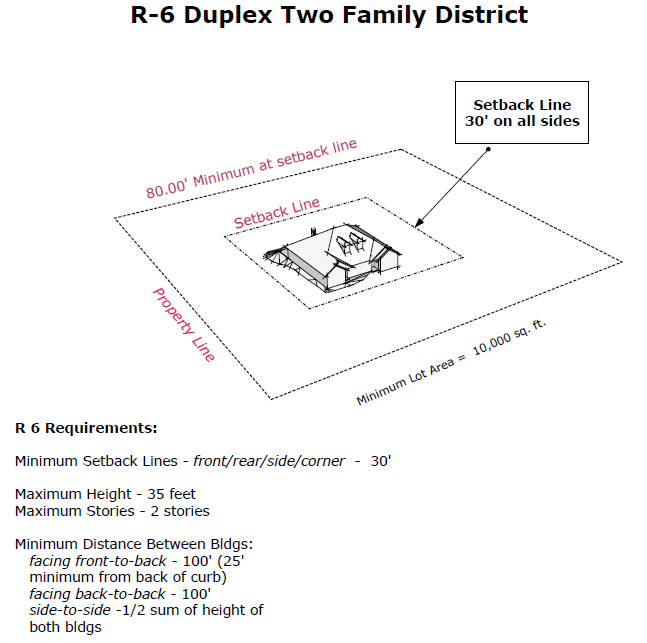
R-6(D), Duplex—Two-family district provisions:
(1)
Duplex—Two-family definition: A building containing two (2) single-family dwelling units totally separated from each other by an unpierced wall extending from basement to roof, and not exceeding two and one-half (2½) stories or thirty-five (35) feet in height. (See also definition of building height).
(2)
Regulation for buildings and yards: The following list provides the minimum yard setbacks, minimum lot requirements, and maximum allowable building height for R-6(D), Duplex districts.
R-6(D) DUPLEX—TWO-FAMILY MINIMUM REQUIREMENTS
(b)
R-7(A), Apartment District:
(1)
Multiple family garden apartments definition: One (1) or more two- or three-story, multi-family structures containing eight (8) to twenty (20) dwelling units and including related off-street parking, open space and recreation facilities, and not exceeding fifty (50) feet in height. Structures shall not exceed two hundred (200) feet in length. Access may be from a common hall or individual entrance. Dwelling units may be located back to back, adjacent, and on top of one another.
(2)
Regulation for buildings and yards: See Article XIII, Minimum Requirements for Fixed Dwellings, for the minimum yard setbacks, minimum lot requirements, and maximum allowable building height for R-7(A), Apartment Districts.
(c)
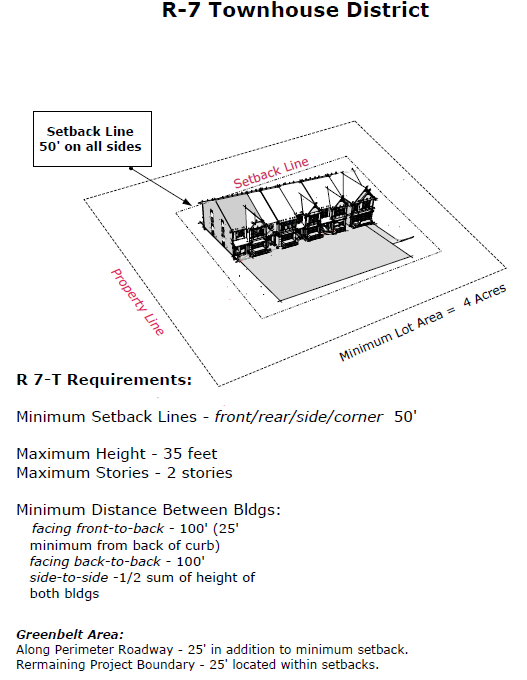
R-7(T), Townhouse District:
(1)
Town house—Single-family definition: A one-family dwelling with ground floor outside access, attached to three (3) or no more than five (5), one-family dwellings by common vertical fire resistant walls without openings, and not exceeding two and one-half (2½) stories or thirty-five (35) feet in height. (See also definition of building height).
(2)
Regulation for buildings and yards: See Article XIII, Minimum Requirements for Fixed Dwellings, for the minimum yard setbacks, minimum lot requirements, and maximum allowable building height for R-7(T), Townhouse District.
(d)
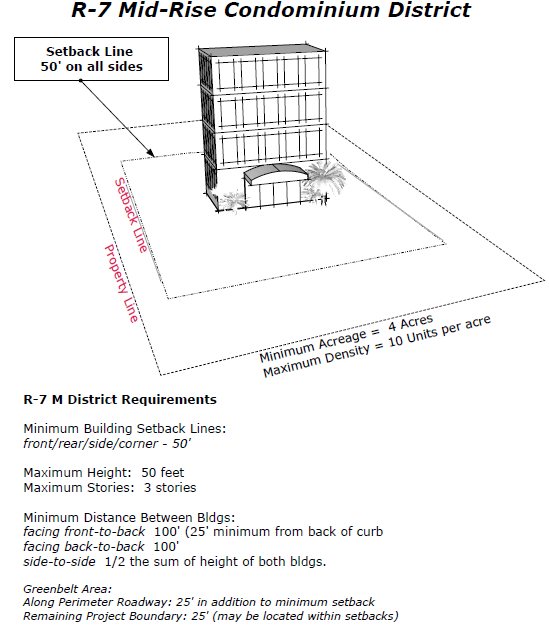
R-7(M), Mid-Rise Condominium District:
(1)
Condominium, mid-rise definition: A building, if containing three (3) to seven (7) stories in which dwelling units, offices, or floor area owned by all owners or a proportional, undivided basis. Underground parking facilities are not counted in the height; however, ground level parking beneath the building shall be counted as a story. Structures of more than fifty (50) feet in height may be permitted subject to the approval of the city council with the planning commission's recommendation; however, in no event shall a mid-rise condominium be approved for a height greater than seventy-five (75) feet. See Article XXXVIII for high-rise condominium requirements.
(2)
Regulation for buildings and yards: See Article XIII, Minimum Requirements for Fixed Dwellings, for the minimum yard setbacks, minimum lot requirements, and maximum allowable building height for R-7(M), Mid-Rise Condominium District.
13-9 - Minimum district requirements.
The following fixed dwelling minimum requirements shall apply in districts as outlined below, except in overlay districts.
(Ord. No. 2022-58, § 3, 9-6-22)
13-10 - Requirements for lot area, width, coverage and other factors for outdoor amusement uses.
(a)
Definition: Public, private, or semi-private property which is used exclusively for recreational and amusement purposes, generally these activities are not enclosed within a building.
(b)
Permitted uses: Outdoor amusement facilities permitted in the City of Daphne are listed in Article XXXV, Table of Permitted Uses.
(c)
Minimum lot area and lot width: None specified, however, the lot shall be large enough to provide the minimum yards as specified herein.
(d)
Setback regulations:
(1)
Front: Each lot shall provide a front yard with a minimum depth of forty (40) feet.
(2)
Side: Each lot shall have a side yard of a minimum of forty (40) feet on each side.
(3)
Interior side exception: The interior side setback may be reduced to fifteen (15) feet where abutting property zoned B-1, Local Business, B-2, General Business, C/I, Commercial/Industrial, or where abutting a public or semi-public use.
(4)
Rear: Each lot shall have a rear yard with a minimum depth of thirty-five (35) feet.
(5)
Rear yard exception: The rear setback may be reduced to ten (10) feet where abutting property zoned B-1, Local Business, B-2, General Business, or C/I, Commercial/Industrial, or where abutting a public or semi-public use.
(e)
Maximum building height: Fifty (50) feet.
(f)
Maximum building coverage: The maximum land covered by a building shall be no more than twenty-five (25) percent of the total lot area.
(g)
Minimum landscaping: A minimum of twenty (20) percent of the lot area shall be maintained as a landscaped common area designed in accordance with the provisions of Article XIX, Landscape Standards and Tree Provisions.
(h)
Performance standards:
(1)
Amusement and recreation services must be so arranged that noise, vibration, lights, and all other possible disturbing aspects are enclosed, screened or otherwise controlled so that operation of the establishment will not unduly interfere with the use and enjoyment of properties in the surrounding area.
(2)
Unless otherwise noted herein, any permanent or temporary building or structure shall be one hundred (100) feet from any property line.
(i)
Parking requirements: All parking requirements shall be based upon the most current industry standard for each particular outdoor amusement use, modifications to said parking standard may be considered as deemed appropriate by the planning commission.
13-11 - Requirements for lot area, width, coverage and other factors for golf course uses.
(a)
Definitions:
Golf course: A tract of land for playing golf, improved with tees, greens, fairways, hazards, and which may include clubhouses, shelters, putting greens, and or driving ranges. Included would be executive or par three golf courses. Specifically excluded would be independent driving ranges and any miniature golf course.
Green space: An area of land covered in grass or other vegetation or a natural water feature. Uses in green space may include stormwater areas, wooded slopes, graded and re-vegetated slopes, required yards on both residential and nonresidential lots, landscaped areas, and other land covered in vegetation.
(b)
Permitted uses: Any green space and/or golf course as defined above shall be permitted in the GC zone. Additional information on permitted uses is listed in Article XXXV, Table of Permitted Uses.
(c)
Minimum lot area and lot width: None specified, however, the lot shall be large enough to provide the minimum yards as specified herein.
(d)
Building setback regulations:
(1)
Front: Each lot shall provide a front yard with a minimum depth of forty (40) feet.
(2)
Side: Each lot shall have a side yard of a minimum of forty (40) feet on each side.
(3)
Interior side exception: The interior side setback may be reduced to fifteen (15) feet where abutting property zoned B-1, Local Business, B-2, General Business, C/I Commercial/Industrial, or where abutting a public or semi-public use.
(4)
Rear: Each lot shall have a rear yard with a minimum depth of thirty-five (35) feet.
(5)
Rear yard exception: The rear setback may be reduced to ten (10) feet where abutting property zoned B-1, Local Business, B-2, General Business, or C/I Commercial/Industrial, or where abutting a public or semi-public use.
(e)
Maximum building height: Fifty (50) feet.
(f)
Maximum building coverage: The maximum land covered by a building shall be no more than twenty-five (25) percent of the total lot area.
(g)
Minimum landscaping: A minimum of twenty (20) percent of the lot area shall be maintained as a landscaped common area designed in accordance with the provisions of Article XIX, Landscape Standards and Tree Protection.
(h)
Performance standards:
(1)
Golf courses must be so arranged that noise, vibration, lights, and all other possible disturbing aspects are enclosed, screened or otherwise controlled so that operation of the establishment will not unduly interfere with the use and enjoyment of properties in the surrounding area.
(2)
Unless otherwise noted herein, any permanent or temporary building or structure shall be one hundred (100) feet from any property line.
(i)
Parking requirements: All parking requirements shall be based upon the most current industry standard for golf courses, modifications to said parking standard may be considered as deemed appropriate by the planning commission.

