
Dayton City Zoning Code
7.2.3 General
Development Standards
7.2.310 Single Family And Middle Housing Dwelling Design Standards
All new single-family, two-family, and single-room occupancy dwellings, including manufactured homes located on individual lots, shall contain at least three (3) of the following design elements on the side of the house which fronts the street, to provide architectural relief:
- Dormer(s) or gable(s).
- Cupola(s).
- Bay or bow window(s).
- Exterior shutters.
- Recessed entry or entries.
- Front porch at least 100 square feet in area.
- Covered porch entry or entries.
- Pillars or posts in the front entry or entries.
- Eave(s) (minimum 6").
- Off-set(s) on building face or roof (minimum 16")
Amended by Ord. 665 on 3/3/2025
7.2.312 Pedestrian Access And Circulation
- Safe and convenient pedestrian and bicyclist facilities that minimize travel distance to the extent practicable shall be provided as follows:
- New non-residential development and parking areas over half an acre in size shall provide safe and convenient bicycle and pedestrian facilities connecting to adjacent commercial developments, industrial areas, residential areas, public transit stops, and neighborhood activity centers such as schools and parks, as follows:
- For the purposes of this section, "safe and convinient" means pedestrian and byciclist facilities that: are free from hazards that wouold interfere with or discourage travel for short trips; provide a direct route of travel between destinations; and meet the travel needs of pedestrians and bicyclist considering destination and lenght of trip, and considering that the optimum trip length of pedestrians is 1/4 to 1/2 mile.
- To meet the intent of this Section, pedestrian rights-of-way connecting cul-de-sacs or passing through blocks provided in accordance with Section 7.2.302.10 shall be a minimum of 15 feet wide with 8 feet of pavement and 7 feet of landscaping.
- 12 foot wide pathways (10 feet wide minimum, where necessary) shall be provided where shared use paths are planned in the 2025 Transportation System Plan.
- Pedestrian connectivity shall be encouraged in new developments by clustering buldings or constructing convenient pedestrian ways. Pedestrian pathways shall be provided in accordance with the following standards:
- The pedestrian circulation system shall be at least 5 feet in width and shall connect the sidewalk at each abutting street to the primary entrance of the primary structure on the site to minimize out of direction pedestrian travel.
- Pathways at least 5 feet in width shall be provided to connect the pedestrian circulation system with existing or planned pedestrian facilities that abut the site but are not adjacent to the streets abutting the site.
- Pathways shall be direct. A pathway is direct when it follows a route for which the length is not more than 20 feet longer or 120 percent of the straight-line distance, whichever is less, unless otherwise approved through the land use review process.
- Pathway/driveway crossings shall be minimized. Where a pathway crosses a parking area or driveway ("crosswalk"), it shall be clearly identified with pavement markings or contrasting paving materials (e.g., pavers, light-color concrete inlay between asphalt, or similar contrast). The crosswalk may be part of a speed table to improve driver-visibility of pedestrians.
- With the exception of pathway/driveway crossings, pathways shall be separated from vehicle parking or vehicle maneuvering areas by grade, different paving material, painted crosshatching or landscaping. They shall be constructed in accordance with the sidewalk construction standards in Title 12. (This provision does not require a separated pathway system to collect drivers and passengers from cars that have parked on site unless an unusual parking lot hazard exists).
- Weather protection features such as awnings or covered passageways within 30 feet of all primary building entrances shall be provided above pathways.
- Pedestrian amenities such as covered pathways, awnings, visual corridors and benches are encouraged. For every two benches provided, the minimum parking requirements shall be reduced by one, up to a maximum reduction of two parking spaces per site. Benches shall have direct access to the pedestrian circulation system.
- For commercial uses, pathways shall be provided along the full length of the structure along any facade featuring a customer entrance, and along any facade abutting public parking areas. Such walkways shall be located at least 4 feet from the facade of the building with planting beds in between facade and the walkway for foundation landscaping, except where features such as covered passageways or entryways are part of the facade.
- New multi-family developments and residential subdivisions shall meet the following pedestrian standards:
- Internal connections. On sites larger than 10,000 square feet, an internal pedestrian connection system shall be provided. The system shall connect all main entrances (in the case of multi-family development) or lots (in the case of a subdivision) to the following:
- Onsite shared facilities (if proposed) including parking areas, bicycle parking, recreational areas, and outdoor areas; and
- Adjacent offsite improvements including public transit stops, schools, and parks.
- Public sidewalks shall be part of the pedestrian connection system for subdivisions and shall meet the standards in Table 16.04.050-B.
- On-site circulation systems required by the standards of this section shall be hard surfaced and shall meet the following minimum width requirements:
- The circulation system on sites with up to 10 residential units shall be at least four feet wide.
- The circulation system on sites with more than 10 residential units shall be at least five feet wide.
- Internal connections. On sites larger than 10,000 square feet, an internal pedestrian connection system shall be provided. The system shall connect all main entrances (in the case of multi-family development) or lots (in the case of a subdivision) to the following:
- Where the pedestrian system crosses driveways, parking areas, and loading areas, the system shall be clearly identifiable, through the use of elevation changes, speed bumps, a different paving material, or other similar method approved as part of a discretionary review. Striping does not meet this requirement. Elevation changes and speed bumps shall be at least four inches high.
- Where the system is parallel and adjacent to an auto travel lane, the system shall be a raised path or be separated from the auto travel lane by a raised curb, bollards, landscaping, or other physical barrier approved as part of a discretionary review. If a raised path is used it shall be at least six inches high and the ends of the raised portions shall be equipped with curb ramps. Bollard spacing shall be no farther apart than five feet on center.
- New non-residential development and parking areas over half an acre in size shall provide safe and convenient bicycle and pedestrian facilities connecting to adjacent commercial developments, industrial areas, residential areas, public transit stops, and neighborhood activity centers such as schools and parks, as follows:
- Where a development site is traversed by or adjacent to a planned trail or multi-use path linkage in the adopted City of Dayton Transportation System Plan, improvement of the trail or path linkage shall occur concurrent with development. The trail or path shall be dedicated to the City.
- Pedestrian facilities installed concurrent with development of a site shall be extended through the site to the edge of adjacent property(ies).
- Continuous pedestrian walkways shall be provided to any existing or planned public transit bus stop that is within 300 feet of the primary entrance of the site’s primary structure(s).
- Pedestrian pathways must be accessible and meet Americans with Disabilities Act (ADA) standards.
- To improve access between a development site and an existing key community destination such as a commercial center, school, park, or trail/path system, as part of a discretionary land use review, the Planning Commission or City Planning Official may require off-site pedestrian facility improvements concurrent with development that are related and proportional to the development’s impact.
Adopted by Ord. 668 on 1/5/2026
7.2.313 Transit Stop Improvements
Development that is proposed adjacent to an existing or planned transit stop, as designated in an adopted transportation or transit plan, shall provide easements and/or transit stop improvements (e.g., seating, shelters, signage, trash receptacles, bicycle parking, and/or lighting) in coordination with the transit service provider and consistent with the Yamhill County transit master plan and the City’s Transportation System Plan (TSP) transit plan element.
Adopted by Ord. 668 on 1/5/2026
668
656
665
7.2.301.01 Purpose
The purpose of this Section is to carry out the Comprehensive Plan with respect to development standards and policies and promote and maintain healthy environments and minimize development impacts upon surrounding properties and neighborhoods.
7.2.301.02 Application Of Standards
- Application. The standards set forth in Section 7.2.3 shall apply to partitions; subdivisions; commercial and industrial development; public and non-commercial development; single family dwellings, duplexes, accessory dwelling units, and multi-family structures. These regulations shall apply in all zones. (Amended ORD 642-Effective 07/02/18)
- Modification to Standards. The application of these standards to a particular development shall only be modified as follows:
- Development standards which are unique to a particular use as set forth within the zone, or standards which are unique to a special use as set forth in Section 7.2.4.
- Those development standards which are unique to a particular district shall be set forth in the Section governing that district.
7.2.301.03 Application Of Public Facility Standards
Standards for the provision and utilization of public facilities or services available within the City of Dayton shall apply to all land developments in accordance with the following table of reference. No development permit, including building permit, shall be approved or issued unless:
- The following improvements are provided prior to occupancy or operation; or,
- The improvement is specifically waived by the Department of Public Works due to existing improvements or circumstances within the area; or,
- Future provision for the necessary improvements is assured in accordance with Subsection 7.3.202.01.
PUBLIC FACILITIES IMPROVEMENT REQUIREMENTS TABLE* (Amended by Ordinance 589 – Effective 4/2/09)
Legend: No = Not required Yes = Required C = Conditional, as noted:LAND USE FIRE
HYDRANTSTREET IMPROVEMENT WATER HOOKUP SEWER HOOKUP STORM DRAIN BIKE PARKING AND BIKEWAY;
PEDESTRIAN WAYSSFD/Duplex No C-2 Yes Yes Yes Yes MFD Yes Yes Yes Yes Yes Yes (4 plus units) New Public, commercial or Industrial Yes Yes Yes Yes Yes Yes Public, Commercial or Industrial Expansion C-1 Yes Yes Yes Yes Yes Partition, Subdivision, MHP Yes Yes Yes Yes Yes Yes C-1: Fire Hydrants for Commercial or Industrial Expansions: One or more fire hydrants are required when the total floor area of a new or expanded building exceeds 2,500 square feet, or the proposed use is classified as Hazardous (H) in the Uniform Building Code or Uniform Fire Code.
- C-2: Street Improvements for Single Family Dwellings: New single family dwellings which require a street extension must provide street improvements to City street standards; otherwise, street improvements are not required. Street extensions are required for (1) the extension of an unimproved street; or, (2) the extension of a partially or fully improved street.
MFD = Multi-family dwelling (3 or more units);
MHP = Manufactured home park; SFD = Single family dwelling * Specific improvements for streets, water, sewer, drainage shall be found in this Section.
7.2.302.01 Purpose
The purpose of the street standards are to provide for safe, efficient, and convenient vehicular movement in the City; to provide reasonably direct access to all proposed developments; to provide adequate area in all public rights-of-way for pedestrians, bicycles, sanitary sewers, storm sewers, water lines, power lines and other utilities commonly and appropriately placed in such rights-of-way; and, to provide improvement standards for dedicated but unimproved or partially improved right-of-ways.
(Amended by Ordinance 589 – Effective 4/2/09)
7.2.302.02 Scope
The provisions of this Section shall be applicable for the following:
- Land Divisions. The creation, dedication or construction of all new public or private streets, and accessways in all subdivisions, partitions or other developments in the City. (Amended by Ordinance 589 – Effective 4/2/09)
- Street Expansion. The extension or widening of existing public or private street rights-of-way, easements, or street improvements including those which may be proposed by an individual or the City, or which may be required by the City in association with other development approvals.
- Utility Improvements. The construction or modification of any utilities or sidewalks, or bikeways in public rights-of-way or private street easements. (Amended by Ordinance 589 – Effective 4/2/09)
- Exceptions. Provisions of this Section do not apply in existing developed areas of the City. Improvements in these areas shall be based on standards adopted by the Department of Public Works.
7.2.302.03 General Provisions
The following provisions shall apply to the dedication, construction, improvement or other development of all public streets in the City of Dayton:
- General Requirement. The location, width, and grade of streets shall be considered in their relation to existing and planned streets, to topographical conditions, to public convenience and safety, and to the proposed use of the land to be served by the streets.
- Continuation of Streets and accessways. Where feasible development proposals shall provide for the continuation of, and connection to, all streets, and access ways within and outside the development to promote appropriate vehicle, bicycle, and pedestrian circulation in the vicinity of the development. Exceptions may be granted if one or more of the following exist: (Amended by Ordinance 589 – Effective 4/2/09)
- Physical or topographic conditions make a street or accessway connection impracticable. (Added by Ordinance 589 – Effective 4/2/09)
- Building or other existing development on adjacent lands physically preclude a connection now or in the future considering the potential for redevelopment; or (Added by Ordinance 589 – Effective 4/2/09)
- Where streets or accessways would violate provisions of leases, easements, covenants, restrictions or other agreements existing as of May 1, 1995 which preclude a required street accessway connection. (Added by Ordinance 589 – Effective 4/2/09)
- Alignment. All streets other than local streets or cul-de-sacs, as far as practical, shall be in alignment with existing streets by continuation of the existing centerlines. Staggering of street alignments resulting in "T" intersections shall, wherever practical, be avoided. If unavoidable, the “T” intersection shall meet with the approval of the City Engineer and minimally acceptable traffic safety standards. (Amended by Ordinance 589 – Effective 4/2/09)
- Future extension of streets. When it appears possible to continue a street, bicycle path and/or pedestrian access way into a future subdivision, adjacent acreage or area attractors such as schools and shopping centers, said facilities shall be platted to a boundary of the subdivision. The street may be platted without a turnaround unless the Public Works Department or local Fire District finds a turnaround is necessary for reasons of traffic safety.
- Intersection angles. Streets shall be laid out to intersect at angles as near to right angles as practical, except where topography requires lesser angles. Intersections of less than 60 degrees shall require special intersection designs and approval of Public Works Department.
- Existing Streets. Whenever existing public streets adjacent to or within a tract are of a width less than the street design standard, additional right-of-way shall be provided at the time of subdivision, partitioning, or development.
- Cul-de-sacs. The City discourages the use of cul-de-sacs. When cul-de-sacs are necessary, the maximum length shall be 800 feet. Cul-de-sacs over 400 feet in length shall provide access ways to provide connectivity to adjacent streets and uses, unless physical constraints preclude a pedestrian/bicycle access way.
- Street Names. Street names and numbers shall conform to the established standards and procedures in the City.
- Alleys. Alleys are encouraged in residential zones to preserve the integrity and safety of the local street. Alleys shall be provided in commercial and industrial zones unless other permanent provisions for access to off-street parking and loading facilities are provided.
- Clear Vision Areas. Clear vision areas shall be maintained on corner lots at the intersection of public streets and at the intersections of a public street with a private street, alley or private access driveway.
- Lots Abutting a Partial Street. Development of property abutting an existing public street which does not meet the minimum right-of-way standards in Section 7.2.3 shall provide sufficient yard setback equal to the minimum yard requirements of the zoning district, plus, the additional land required to meet the minimum right-of-way width.
7.2.302.04 General Right-Of-Way And Improvement Widths
The following standards are general criteria for public streets in the City of Dayton. These standards shall be the minimum requirements for all streets, except where modifications are permitted under Subsection 2.202.05.
STREET STANDARDS
| SERVICE AREA (a),(b),(c),(d) | WIDTH CURB/CURB | CURB (f),(g) | SIDEWALK (e) | TOTAL R-O-W WIDTH |
| LOCAL STREET I Up to 19 d/u or serving 190 ADT or 79,999 sf. | Parking 2 sides 30 feet | 6"/side (1 ft. total) | 5 ft. curbline Two sides | 46 feet |
| LOCAL STREET II 20-79 d/u or 200-790 ADT or 79,999-319,999 sf | Parking 2 sides 32 feet | 6"/side (1 ft. total) | 5 ft. curbline Two sides | 48 feet |
| LOCAL STREET III 80 or more d/u or 800 or more ADT or more than 320,000 sf | Parking 2 sides 34 feet | 6"/side (1 ft. total) | 5 ft. curbline Two sides | 50 feet |
| CUL-DE-SAC or less than 450 ADT or less than 183,999 sf | As above; Min. Curb Radius 38 feet | 6"/side (1 ft. total) | 5 ft. curbline entire cul-de-sac | |
| COLLECTOR | Parking 2 sides (7-foot parallel parking lanes) Two 12ft. lanes | 6"/side (1ft. total) | 5ft. curbline Two sides | 52 feet |
| ARTERIAL | (i) | (i) | (i) | (i) |
| (a) ADT = Average Daily Trips (ITE, Trip Generation Manual)
(b) Trip Generation Rater for SFD = 10 ADT
(c) Minimum Lot Size = 5,000 sq. ft.; Duplex = 7,000 sq. ft. (d) Calculated per street entrance; use largest number. (e) Required width around signs, mailboxes, utility poles, etc. | (f) Full curb height between driveways.
(g) Max. 2 weep holes through curb face per lot. (h) Additional easements may be necessary. (i) Arterial streets will be evaluated on an individual basis. | |||
Amended by Ord. 668 on 1/5/2026
7.2.302.05 Modification Of Right-Of-Way And Improvement Width
The City may allow modification to the public street standards of Subsection 2.302.04, when the following criteria are satisfied:
- Modification Permitted. The modification is necessary to provide design flexibility where:
- Unusual topographic conditions require a reduced width or grade separation of improved surfaces; or
- Parcel shape or configuration precludes accessing a proposed development with a street which meets the full standards of Section 2.302.04; or
- A modification is necessary to preserve trees or other natural features determined by the City to be significant to the aesthetic character of the area.
- The modification of street standards is necessary to provide greater privacy or aesthetic quality to the development.
- Vehicular Access Maintained. Modification of the standards shall only be approved if the City finds that the specific design proposed provides adequate vehicular access based on anticipated traffic volumes.
7.2.302.06 Construction Specifications
Construction specifications for all public streets shall comply with the standards of the most recently adopted public works/street standards of the City of Dayton.
7.2.302.07 Private Streets
Streets and other right-of-ways that are not dedicated for public use shall comply with the following:
- Application. At least three (3), and no more than six (6), lots or parcels may be served by a private street. Private street standards shall also apply if at least three (3), and no more than six (6), parcels may be created through a series of separate partitions. This limit shall not apply to planned unit developments.
- Construction Standards. Private streets shall be subject to the following construction standards:
- Width. Private streets shall have a minimum easement width of 25 feet and a minimum paved width of 20 feet. Paving shall be either asphalt or concrete.
- Construction Standards. All private streets shall be constructed to the same cross-sectional specifications required for public streets and shall include provisions for adequate drainage in conformance with Public Works Standards.
- On-Street Parking. Private streets shall provide one (1) on-street parking space per lot or parcel. The parking spaces may be designed as a “parking pocket” or located along the private street. The parking space dimensions shall comply with the provisions in Section 7.2.303. The provision for on-street parking may require a wide private street easement.
- Sidewalk Requirements. A sidewalk/pathway, constructed to City standards, shall be located along one side of the private street. The sidewalk/pathway shall be placed within the easement and shall run the entire length of the private street.
- Public and Private Utilities. Unless otherwise required by the City Engineer, the private street shall include easements for public and private utilities.
- Turn-around. Private streets serving more than one ownership shall provide a turn-around if in excess of 250 feet and having only one outlet. Turn-arounds shall be either a circular turn-around with a minimum paved radius of 35 feet, or a "tee" or "hammerhead" turn-around with a minimum paved dimension across the "tee" of 70 feet.
- Maintenance. Provision for the maintenance of the street shall be provided in the form of a maintenance agreement, home owners association, or other instrument acceptable to the City. The applicable document shall be recorded against the deed record of each parcel, and if appropriate, placed on the final partitioning plat.
- Public Dedication. Any private street that is designed, or has the potential capacity, as a collector or an arterial street shall be dedicated as a public right-of-way.
(Revised by Ordinance #541, 6/03/02 - Effective 07/03/02)
7.2.302.08 Private Access Driveway
A private access driveway created as the result of an approved partitioning shall conform to the following.
- Width. Private access driveways shall only be allowed where the applicable criteria of Section 7.2.307.03, are satisfied. The driveway shall comply with the following standards:
- Minimum easement width: 20 feet
- Minimum paved width: Serving one dwelling - 12 feet; serving two or more dwellings - 16 feet
- Maximum length: 300 feet
- No more than two (2) dwelling units shall have their sole access to the easement
- Maintenance. Provision for the maintenance of a private access driveway shall be provided in the form of a maintenance agreement, home owners association, or other instrument acceptable to the City. The applicable document shall be recorded against the deed record of each parcel, and if appropriate, placed on the final partitioning plat.
- Turn-around. A turn-around shall be required for any access driveway which is the sole access and which is either in excess of 150 feet or which serves more than two dwellings. Turn-arounds shall be either a circular turn-around with a minimum paved radius of 35 feet, or a "tee" or "hammerhead" turn-around with a minimum paved dimension across the "tee" of 70 feet.
- Fire Lanes. All private access driveways shall be designated as fire lanes and signed for "no parking."
In addition, the term “private access easement” contained elsewhere in the Development Code shall be replaced with private access driveway.
(Revised by Ordinance #541, 6/03/02 - Effective 07/03/02)
7.2.302.09 Lots And Parcels Served By Private Streets And Access Easements
The following shall apply to all lots and parcels that are accessed by either a private street or private access driveway:
- Lot and Parcel Size. The easement containing the private street or private access driveway shall be excluded from the lot or parcel size calculation.
- Setbacks. The lot line fronting along a private street or private access driveway shall be considered the front property line. Setbacks to the garage and home shall be measured from the easement line.
- Lot Depth and Width. Where required by the underlying zone, the lot width shall be measured along the easement boundary and the lot depth shall be measured from the easement boundary to the rear lot line.
(Added by Ordinance #541, 6/03/02 - Effective 07/03/02)
7.2.302.10 Design Standards For Accessways
Accessways shall meet the following design standards:
- Connections with adjoining streets shall be provided if either of the following conditions exists:
- If any portion of the site has frontage on a collector or arterial street, or
- If the local street frontage is over 600 feet.
- Exceptions may be granted if one or more of the following conditions exists:
- Physical or topographic conditions make a street or accessway connection impracticable.
- Building or other existing development on adjacent lands physically preclude a connection now or in the future considering the potential for redevelopment; or
- Where streets or accessways would violate provisions of leases, easements, convenants, restrictions or other agreements existing as of May 1, 1995 which preclude a required street or accessway connection.
- Minimum dedicated width: 15 feet
- Minimum improved width: 10 feet
- Maximum length: 250 feet with a clear line of vision for the entire length of the accessway.
- When an accessway is in excess of 100 feet in length, then pedestrian scale lighting fixtures shall be provided along the accessways and lighted to a level where the accessways can be used at night.
- The accessway shall be designed to prohibit vehicle traffic.
- The accessway shall be maintained by a home owners association or other mechanism acceptable to the City.
(Added by Ordinance 589 – Effective 4/2/09)
7.2.303.01 Purpose
The purpose of this Section is to provide adequate areas for the parking, maneuvering, loading and unloading of vehicles for all land uses in the City.
7.2.303.02 Scope
The provisions of this Section shall apply to the following types of development:
- New Building. Any new building or structure erected after the effective date of this Code.
- Expansion. The construction or provision of additional floor area, seating capacity, or other similar expansion of an existing building or structure.
- Change in Use. A change in the use of a building or structure which requires a building permit and/or the change in use is not otherwise permitted outright within the zone.
7.2.303.03 General Provisions Off-Street Parking And Loading
- Owner Responsibility. The provision and maintenance of off-street parking and loading space is a continuing obligation of the property owner. No building permit shall be issued until plans are presented that show property that is and will remain available for exclusive use as off-street parking and loading space. The subsequent use of property for which the building permit is issued shall be conditional upon the unqualified continuance and availability of the amount of parking and loading space required by this Code.
- Interpretation. Requirements for types of buildings and uses not specifically listed herein shall be determined by the City Manager based upon the requirements of comparable listed uses. Amended ORD 608 effective 10/06/11
- Combined Uses. In the event several uses occupy a single structure or parcel of land, the total requirements for off-street parking shall be the sum of the requirements of the several uses computed separately, unless a reduction is approved for shared parking.
- Use of Parking Spaces. Required parking spaces shall be available for the parking of operable passenger automobiles of residents, customers, patrons or employees only, and shall not be used for storage of vehicles or materials or for the parking of trucks used in conducting the use.
- Park and ride spaces, handicapped parking and parking for carpools and vanpools shall not count as required parking, loading, or be used for vehicle storage. (Amended ORD 619 – Effective 10/02/14)
- Existing development may redevelop a portion of an existing off-street parking area for transit-oriented uses, including bus stops and pullouts, bus shelters, and ride stations, provided the minimum off-street parking requirements in Section 7.2.303.06 can still be met.
Amended by Ord. 668 on 1/5/2026
7.2.303.04 Location And Use Provisions
Off-street parking and loading areas shall be provided on the same lot with the main building or structure or use except that:
- Non-residential Zone. In any non-residential zone, the parking area may be located off the site of the main building, structure or use if it is within 500 feet of such site. Evidence must be submitted to the City indicating a permanent recorded easement for the off-site parking.
- Accessory Parking Use, Non-residential. Parking of vehicles in a structure, or outdoors, is a permitted accessory or secondary use in non-residential zones provided all of the vehicles are owned by the owner or lessee of the lot.
- Accessory Parking Use, Residential. Parking of vehicles in a structure or outdoors is a permitted accessory use in conjunction with a dwelling in any zone provided:
- All of the vehicles are owned by the owner or lessee of the lot.
- Vehicles parked on a lot in a residential zone shall be for the personal use of the occupants of the dwelling.
- One vehicle used in conjunction with a home occupation or other employment may be parked on the lot.
7.2.303.05 Shared Use
Parking area may be used for a loading area during those times when the parking area is not needed or used. Parking areas may be shared subject to City Manager approval for public, commercial and industrial uses where hours of operation or use are staggered such that peak demand periods do not occur simultaneously. Such joint use shall not be approved unless satisfactory legal evidence is presented which demonstrates the access and parking rights of parties. (Amended ORD 608 effective 10/06/11)
- Tandem parking stalls. (Added ORD 619 – Effective 10/02/14)
- For the purpose of this section, “tandem parking stall” shall be defined as a parking space within a group of two parking spaces arranged one behind the other such that the space nearest the parking access serves as the only means of access to the other space.
- Tandem parking stalls are permitted in privately owned parking garages and privately owned parking areas provided that;
- Both parking stalls shall be assigned to the same dwelling unit.
- Parking stalls for guest parking cannot be tandem and shall be easily accessible.
- Tandem parking shall be limited to maximum of two (2) cars in depth, and both parking stalls shall met the dimensional standards for standard vehicles, under DLUDC 7.2.303.09.
- Handicap parking shall not be included as one of the tandem parking stalls.
7.2.303.06 Off-Street Vehicle Parking Requirements
- Number of Spaces. Off-street parking shall be provided in the amount not less than listed on the following chart:
PARKING REQUIREMENTS(Amended ORD 642-Effective 07/02/18) * Square footage = Gross floor area.
LAND USE ACTIVITY MOTOR VEHICLE SPACES BICYCLE SPACES HOW MEASURED 1. All dwelling types, except ADU’s 2 a Per dwelling unit 2. Accessory dwelling unit (ADU) 1 a Per dwelling unit 3. Senior apartments 1 a Per dwelling unit 4. Hotel, motel, bed & breakfast 1 b Per guest room 5. Club, lodge (Combination of uses being conducted: hotel, restaurant, etc.) 6. Hospital, nursing home, convalescent home, assisted care centers 1 b Per 2 beds 7. Assisted living centers (amended ORD 584-12/3/07) .5 b Per room 8. Churches, auditorium, stadium, theater 1 b Per 4 seats or every 8 feet of bench 9. Elementary/junior high school 2 c Per classroom 10. High school 1+1 c Per classroom + per 10 students 11. Bowling alley, skating rink, community center 1 b Per 200 square feet 12. Retail store 1 b Per 300 square feet 13. Service repair center; retail store handling bulky merchandise (e.g. furniture) 1 b Per 900 square feet 14. Bank, offices, medical clinic 1 b Per 300 square feet 15. Eating and drinking establishment 1 b Per 250 square feet 16. Wholesale establishment 1+1 d Per 1,000 square feet + 700 square feet of retail 17. Government offices 1 b Per 600 square feet 18. Industrial, manufacturing, processing
(0–24,999 square feet and over1 b Per 700 square feet 19. Industrial, manufacturing, processing (25,000-49,999 square feet) 1 b Per 800 square feet 20. Industrial, manufacturing, processing (50,000-79,999 square feet) 1 b Per 1,000 square feet 21. Industrial, manufacturing, processing (80,000-199,999 square feet) 1 b Per 2,000 square feet 22. Industrial, manufacturing, processing (200,000 square feet and over) 1 b Per 3,000 square feet 23. Warehousing and storage terminals
(0 to 49,999 square feet)1 d Per 2,000 square feet 24. Warehousing and storage terminals (50,000 square feet and over) 1 d Per 5,000 square feet
(a) None required for less than three dwelling units; otherwise, one for every three dwelling units.
(b) One bicycle space, plus one for every 20 vehicle parking spaces.
(c) Six (6) bicycle spaces per classroom
(d) One bicycle space, plus one for every 40 vehicle parking spaces. - Maximum Number of Spaces. With the exception of single family homes and duplexes, the number of minimum required parking spaces shall not be increased by more than 50%.
(Amended effective 12/3/07, Ordinance #584)
7.2.303.07 Standards For Disabled Person Parking Spaces
The number of spaces shall comply with the provisions of the Uniform Building Code. Striping and signing of the handicap space(s) shall conform with the Oregon Transportation Commission's standards.
7.2.303.08 Commercial And Industrial Off-Street Loading Requirements
All commercial or industrial buildings shall require a minimum loading space of 12 feet wide, 30 feet long, and 14 feet high in the following amount: for buildings containing over 5,000 square feet of gross floor area, 1 space; for each additional 40,000 square feet of gross floor area, or any portion thereof, 1 space.
7.2.303.09 Parking And Loading Area Development Requirements
All Parking and loading areas shall be developed and maintained as follows:
- Surfacing. All driveways, parking and loading areas shall be paved with asphalt or concrete. These areas shall be improved prior to occupancy of the primary building.
- Parking Spaces. Parking spaces shall be a minimum 9 feet wide and 18 feet in length.
- Driveways. The following driveway width (or aisle) dimensions shall apply:
- Without adjacent parking:
- Single family residence - No driveway width shall be less than 12 feet nor exceed 24 feet as measured at the property line. (As amended by Ordinance #534, 11/05/01 – Effective 12/5/01)
- One-way: 12 feet
- Two-way: 22 feet
- With adjacent parking:
Parking Angle Driveway Width 0 to 40 12 feet 41 to 45 13 feet 46 to 55 15 feet 56 to 70 18 feet 71 to 90 24 feet
- Without adjacent parking:
- Screening. Parking or loading area within or abutting a residential zone shall be screened from all residential properties with a fence or wall from 4 feet to 7 feet in height.
- Lighting. All lighting shall be directed entirely onto the loading or parking area and away from any residential use. The lighting shall not cast a glare or reflection onto the public rights-of-way.
- Traffic Flow. Off-street parking access shall be designed to allow flow of traffic, provide maximum safety of traffic access and egress, and the maximum safety of pedestrians and vehicular traffic.
- Entrance/Exits. Service drive entrances/exits shall have a minimum vision clearance area of 15 feet from the intersection of the street and driveway.
- Landscaping. For parcels containing more than 50 parking spaces the following provisions shall apply:
- A minimum of 5% of the parking area shall be landscaped. This requirement is exclusive of landscaping necessary to comply with the provisions within the underlying zone.
- Parking lot landscaping shall be located within the perimeter of the parking area, bordered by curbing and sidewalks. Landscaping located adjacent to the paved parking surface shall not count toward this requirement.
- Landscaping improvements shall comply with provisions in Section 7.2.306.
- Parking Spaces Adjacent to a Street. (Added ORD 534, Effective 12/05/01)
- General - Parking facilities containing more than four spaces shall be accessed by a driveway and prohibited from backing movements or other maneuvering within a street right-of-way, other than an alley.
- Single Family Residences - No more than two parking spaces that back onto a public street, other than an alley.
- Parking Lots that are over half an acre in size shall provide pedestrian facilities in conformance with Section 7.3.106.07.
Amended by Ord. 668 on 1/5/2026
7.2.303.10 Residential Parking Provisions
In addition to the parking requirements in Section 7.2.303, vehicle parking and storage within the R-1, R-2, R-3 and CR zones shall be subject to the following provisions:
- For the purpose of this Section, the following terms shall apply:
- Parking: shall refer to the temporary storage of registered vehicles that are used on a daily or weekly basis. “Registration” shall mean a currently licensed and insured vehicle that may operate on the public roads and streets of the State.
- Storage: shall refer to the long-term parking of vehicles, and may include but is not limited to automobiles, trucks, motorcycles, boats, trailers, recreational vehicles and similar equipment. Storage is distinguished from “parking” in that the vehicle is used occasionally or seasonally and often for recreational purposes. The term “storage” shall apply to all non-registered vehicles and those registered vehicles that are not self-propelled. (Revised Ord 614, 10/7/13- Effective 11/06/13)
- Storage Container: shall refer to non-vehicle storage such as dumpsters and storage containers, and shall be limited to those licensed or permitted by the Oregon Department of Transportation in compliance with ORS 825.240 and under a for-hire service agreement. (Added ORD 619 – Effective 10/02/14)
- Yard Parking Restrictions. Exclusive of driveways, it shall be prohibited for any automobile, truck, motorcycle, boat, trailer, recreational vehicle or similar vehicle to be parked or stored in a front yard or yard adjacent to the street, for a period in excess of 24 hours within any 7-day period.
- Storage. The storage of vehicles, trucks, motorcycles, utility trailers, house or vacation trailers, boats, or other similar vehicles not located within a garage shall be subject to the following:
- A property owner shall be permitted to locate one vehicle storage space adjacent to a driveway. This storage space shall be paved with concrete, asphalt, gravel, or surfaced with similar improvements such as brick or concrete paving stones or gravel surface. Dirt, bark dust, or similar material shall not be used as a surfacing material. This additional space shall be limited to registered vehicles. (Amended ORD 619 – Effective 10/02/14)
- All remaining vehicle storage space(s) shall be located in the rear or side yards and screened by a six-foot, sight-obscuring fence, wall or hedge. The enclosure shall comply with the provisions regarding the location for fences and maintaining a clear vision area. The number of vehicles stored in this manner shall be consistent with provisions in the Dayton Municipal Code. (Revised Ordinance 614, 10/7/13- Effective 11/06/13)
- For Properties located within a floodplain, all recreational vehicles shall be fully licensed and ready for highway use, on its wheels or jacking system, have no permanently attached additions, and comply with all other applicable City regulations. (Updated by ORD 594, adopted 2/1/10 & enacted 3/2/10)
- Extended Parking Prohibited. It is unlawful to locate any mobile home, recreational vehicle, residential trailer, boat trailer, or storage container upon a public right of way for a period of more than seventy two (72) hours and only for the purpose of loading, unloading or otherwise preparing the mobile home, recreational vehicle, residential trailer, or trailer for use, unless otherwise approved in writing by the City Manager. (Added ORD 619 – Effective 10/02/14)
- Violation – Penalty. Any person, firm or corporation or other entity who violates any provision of this section shall be punished by a fine according to the City of Dayton fee schedule. Each day that the violation continues shall constitute a separate offense. (Added ORD 619 – Effective 10/02/14)
(Added ORD 534, Effective 12/05/01)
7.2.303.11 Bicycle Parking Development Requirements
- Minimum Development Requirements: At a minimum bicycle parking facilities shall be consistent with the following design guidelines.
- Location: All bicycle parking shall be:
- Within 100 feet from a building entrance;
- Located within a well lighted area; and
- Clearly visible form the building entrance
- Bicycle parking shall be convenient and easy to find. Where necessary, a sign shall be used to direct users to the parking facility.
- Each bicycle parking space shall be at least 2 feet by 6 feet with a vertical clearance of 6 feet.
- An access aisle of at least 5 feet in width shall be provided in each bicycle parking facility.
- Bicycle parking facilities shall offer security in the form of either a lockable enclosure in which the bicycle may be stored or stationary object, i.e., a “rack, upon which the bicycle can be locked. Structures that require a user supplied lock shall accommodate both cables and U-shaped locks and shall permit the frame and both wheels to be secured (removing the front wheel may be necessary).
- Where bicycle parking is provided for employees on a “work shift”, it shall be sheltered, i.e., covered, from the weather or employees shall be provided access to a secure room within a building for bicycle parking.
- Location: All bicycle parking shall be:
(Added by Ordinance 589 – Effective 4/2/09)
7.2.303.12 Carpool And Vanpool (Rideshare) Parking
- Uses with at least 25 or more required parking spaces shall include designated carpool or vanpool (rideshare) parking.
- At least 10% of the employees, student, or commuter parking spaces shall be carpool or vanpool parking.
- Carpool and vanpool designated spaces must be the closest non-ADA parking spaces to the main employee, student, or commuter entrance.
- Carpool and vanpool parking may count toward the minimum parking requirements by use in Table 17.96.020
- Carpool and vanpool parking shall be marked "Reserved - Carpool/Vanpool Only"
Adopted by Ord. 668 on 1/5/2026
7.2.304.01 Purpose
To provide for the drainage of surface water from all residential, commercial and industrial development; to minimize erosion; to reduce degradation of water quality due to sediments and pollutants in storm water runoff.
7.2.304.02 Scope
The provisions of this Section shall apply to all new residential land partitions and subdivisions, multi-family developments (3 or more units), commercial developments, and industrial development; and to the reconstruction or expansion of such developments.
7.2.304.03 Plan For Storm Drainage And Erosion Control
No construction of any facilities in a development included in Subsection 2.301.02 shall be permitted until a storm drainage and erosion control plan for the project is prepared by a professional engineer, and, approved by the City. This plan shall contain at a minimum:
- Run-off. Minimize the amount of runoff, siltation, and pollution created from the development both during and after construction.
- Facilities. Plans for the construction of storm sewers, open drainage channels and other facilities which depict line sizes, profiles, construction specifications and other such information as is necessary for the City to review the adequacy of the storm drainage plans.
- Engineering Calculations. Calculations used by the engineer in sizing storm drainage facilities.
7.2.304.04 General Standards
- Requirements. All development shall be planned, designed, constructed and maintained to:
- Protect and preserve existing natural drainage channels to the maximum practicable extent;
- Provide a system by which water within the development will be controlled without causing damage or harm to the natural environment, or to property or persons within the drainage basin;
- Assure that waters drained from the development are substantially free of pollutants, through such construction and drainage techniques as sedimentation ponds, reseeding, phasing of grading;
- Assure that waters are drained from the development in such a manner that will not cause erosion to any greater extent than would occur in the absence of development;
- Provide dry wells, bio-swales, or similar methods, as necessary to supplement storm drainage systems;
- Avoid placement of surface detention or retention facilities in road rights-of-way.
- Easements. Adequate easements for storm drainage purposes shall be provided to the City. This shall not imply maintenance by the City.
- Channel Obstructions. Channel obstructions are not allowed except as approved for the creation of detention or retention facilities approved under the provisions of this Code.
- Inspection Required. Prior to acceptance of a storm sewer system by the City, the storm sewers shall be inspected by the City. All costs shall be borne by the developer.
7.2.305.01 Purpose
To provide adequate services and facilities appropriate to the scale and type of development.
7.2.305.02 Standards
- Impact. The location, design, installation and maintenance of all utility lines and facilities shall be carried out with minimum feasible disturbances of soil and site.
- Water. Development requiring water service shall install water facilities and grant necessary easements pursuant to the requirements of the City.
- Private Utilities. All development which has a need for electricity, gas and communications services shall install them pursuant to the requirements of the district or company serving the development. Except where otherwise prohibited by the utility district or company, all such facilities shall be underground.
- Sanitary Sewers. All development which has a need for public/private sanitary sewers shall install the facilities pursuant to the requirements of the city. Installation of such facilities shall be coordinated with the extension of necessary water services and storm drainage facilities.
- Street Lights. When required, installation of street lights shall be pursuant to the requirements of the city and the company serving the development.
- Easements. Easements shall be provided along property lines as deemed necessary by the City, special districts, and utility companies. Easements for special purpose uses shall be of a width deemed appropriate by the responsible agency. Such easements shall be designated on the final plat of all subdivisions and partitions.
7.2.306.01 Purpose
- Landscaping Guidelines. To guide the planting and maintenance of landscaping materials.
- Appearance. To enhance the appearance of the City, provide areas for outdoor recreation and to:
- Provide shade and windbreaks where appropriate to conserve energy in building and site design;
- Buffer and screen conflicting land uses;
- Provide for the landscaping of parking areas to facilitate vehicular movement and break up large areas of impervious surface.
- Promote public safety through appropriate design principles.
- Erosion control. To prevent or reduce erosion potential on steep terrain by providing appropriate landscape materials.
7.2.306.02 Scope
All construction, expansion, or redevelopment of structures or parking lots for commercial, multi-family, or industrial uses shall be subject to the landscaping requirements of this Section. The provisions of this Section shall apply to the following types of development:
- New Building. Any new building or structure erected after the effective date of this Code.
- Expansion. The construction or provision of additional floor area, seating capacity, or other similar expansion of an existing building or structure.
- Change in Use. A change in the use of a building or structure which requires a building permit and/or the change in use is not otherwise permitted outright within the zone.
7.2.306.03 General Provisions
- Landscaped Area. A "landscaped area" must be planted in lawn, ground cover plants, shrubs, annuals, perennials or trees, or desirable native vegetation, or be used for other landscape elements, provided a minimum of 50% of the landscaped area is in living vegetative cover.
- Location. Landscaped areas may include landscaping around buildings; in open spaces and outdoor recreation areas; in islands and perimeter planting areas in parking and loading areas; and in areas devoted to buffering and screening as required in this Section and elsewhere in this Code.
- Setback Areas. All required yards adjacent to a street shall be landscaped, save that portion used for access and off-street parking.
- Planting Height. No sight-obscuring plantings exceeding thirty (30) inches in height shall be located within any required clear-vision area as defined in Section 1.2 of this Code.
- Plant Materials. Plant materials shall not cause a hazard. Landscape plant materials over walks, pedestrian paths and seating areas shall be pruned to avoid interference with traffic and pedestrians or traffic safety devices.
- Utility Interference. Landscape plant materials shall be selected which do not generally interfere with utilities above or below ground.
- Re-planting. Trees or shrubbery which die-off within one year of planting shall be replaced with a new plant.
- Maintenance. Landscaping shall be continually maintained. Appropriate methods of care and maintenance of landscaped plant material shall be provided by the owner of the property.
- Irrigation Methods. With the exception of single family homes and duplexes, underground irrigation shall be required.
- Installation. All required or approved landscaping shall be installed within one year of occupancy of a new building or structure, the occupancy of an addition to an existing structure or occupation resulting from a change in use.
7.2.306.04 Screening And Buffering
- Screening. Screening shall be used to eliminate or reduce the visual impacts of the following uses:
- Commercial and industrial uses when abutting residential uses.
- Industrial uses when abutting commercial uses.
- Service areas and facilities, including garbage and waste disposal containers, recycling bins, and loading areas.
- Outdoor storage areas.
- Parking areas for 20 or more vehicles for multi- family developments, or 30 or more vehicles for commercial or industrial uses.
- At and above-grade electrical and mechanical equipment, such as transformers, heat pumps, and air conditioners.
- Screening Methods. Screening may be accomplished by the use of sight-obscuring plant materials (generally evergreens), earth berms, walls, fences, building parapets, building placement or other design techniques. Where vegetative methods are used, the screening shall reach a minimum of six feet in height upon maturity.
- Buffering. Buffering shall be used to mitigate adverse visual impacts, dust, noise or pollution, and to provide for compatibility between dissimilar adjoining uses. Where buffering is determined to be necessary, one of the following buffering alternatives shall be employed:
- Planting Area: Width not less than 15 feet, planted with either one row of trees staggered and spaced not more than fifteen 15 feet apart; or, at least one row of shrubs forming a continuous hedge at least 5 feet in height within one year of planting.
- Berm Plus Planting Area. Width not less than 10 feet, with the combined total height of the berm and hedge not less than 5 feet.
- Wall Plus Planting Area. Width must not be less than 5 feet with a masonry wall or fence not less than 5 feet in height and lawn, shrubs or ground cover covering the remaining area.
- Other approved methods which produce an adequate buffer considering the nature of the impacts to be mitigated.
7.2.306.05 Site Plan Requirements
Where required as part of a land use action, the submitted landscaping plan shall include the following:
- Existing natural and vegetative features of the property.
- The location of existing and proposed structures.
- The extent and location of all major landscaping features including, but not limited to, planters, planting strips, vegetative barriers, yard areas, pathways, benches, irrigation methods, and similar items.
7.2.306.06 Contiguous Open Space Provisions For Multifamily Residential Development
Where a multi-family residential development is proposed, sufficient contiguous area shall be provided for open space and recreational purposes. The open space areas shall be subject to the following requirements:
- A minimum of 2,000 square feet of contiguous area shall be required for the first 4 to 16 dwelling units, and 100 square feet of area for each additional unit thereafter.
- Where the contiguous open space area requirement exceeds 2,000 square feet, the developer shall have the option of creating a number of smaller areas. Each smaller open space area shall contain, at a minimum, the greater of 2,000 square feet or 25% of the required total contiguous open space requirement.
- The contiguous open space area required by this section shall be free and clear of obstructions to maximize the potential use. Exceptions shall be allowed for outdoor recreational facilities, such as playground equipment or basketball courts, and for buildings providing recreational, educational or meeting space specifically for residents of the proposed development. Other improvements may be considered as part of a site development review process.
- The contiguous open space area(s) shall be credited toward the total landscaped area required by the underlying zone. However, landscaping within required setback areas shall not be credited toward the contiguous open space requirement of this Section.
(Added ORD 530 – Effective 7/04/01)
7.2.307.01 Purpose
To provide for the orderly, safe, efficient and livable development of land within the City of Dayton.
7.2.307.02 Scope
Application. The provisions of this Section shall apply to all subdivisions and partitions within the City of Dayton.
7.2.307.03 Standards For Lots Or Parcels
- Minimum lot area. Minimum lot area shall conform to the requirements of the zoning district in which the parcel is located.
- Access. All lots and parcels created after the effective date of this Code shall provide a minimum frontage, on an existing or proposed public street, equal to the minimum lot width required by the underlying zone. The following exceptions shall apply:
- Residential lots or parcels may be accessed via a private street or partition access easement developed in accordance with the provisions of Section 7.2.302 when the City finds that public street is not necessary to provide for the future development of adjoining property.
- Commercial or Industrial uses located in a campus or park-like development may be accessed via private streets when developed in accordance with Subsection 2.302.08.
- Cul-de-sac lots shall have a minimum frontage of 25 feet.
- Flag lots, as permitted in Subsection 2.307.03.C.
- Access standards for streets are: (Added by Ordinance 589 – Effective 4/2/09)
Street Classification Minimum Street Spacing Minimum Driveway Spacing Arterial Spacing standards are defined in the Oregon Highway Plan Spacing standards are defined in the Oregon Highway Plan Collector 150 feet 75 feet Local 150 feet 25 feet (except for single-family and middle housing)
- Flag Lots. Flag lots shall only be permitted if it is the only reasonable method by which the rear portion of a lot being unusually deep or having an unusual configuration may be accessed. If a flag-lot is permitted, the following standards shall be met:
- The access strip shall not be less than 20 feet wide. The access strip shall be improved with a minimum 12 foot wide paved driveway.
- The access strip shall not be included in the calculation of lot area for purposes of determining compliance with any minimum lot size provision of this Code.
- Flag lots located side-by-side shall share a common driveway. This requirement shall be placed in the deed record of each parcel and noted on the final plat.
- Through Lots. Through lots are discouraged unless essential to provide separation of residential development from major traffic arteries, adjacent non-residential activities, or to overcome specific site disadvantages. If approved, access may be limited to one street.
- Lot Lines. The side lines of lots, as far as practicable, shall run at right angles to the right-of-way line of the street upon which the lots face. The rear lot line shall be no less than ½ the dimension of the front lot line.
- Utility Easements. Utility easements shall be provided on lot areas where necessary to accommodate public utilities.
Amended by Ord. 668 on 1/5/2026
7.2.307.04 Additional Design Standards For Subdivisions
- Standards for Blocks. The length, width, and shape of blocks shall be designed with regard to providing adequate building sites for the use contemplated. Blocks shall not exceed 600 feet in length between street center lines, except blocks adjacent to arterial streets may be greater in length but not more than 1,300 feet without an accessway. Block perimeters shall not exceed 1,800 feet in length. Exceptions to block length and perimeter may be granted if one or more of the following conditions exist: (Amended by Ordinance 589 – Effective 4/2/09)
- Conditions including but not limited to freeways, railroads, steep slopes, or other bodies of water prevent a street or accessway connection.
- Building or other existing development on adjacent lands physically prevent a connection now or in the future considering the potential for redevelopment.
- Where streets or accessways would violate provisions of leases, easements, covenants, restrictions or other agreements existing as of May 1, 1995 which preclude a required street or accessway connection.
- Where one side of the block is an arterial street; or
- Where an accessway exists in the block.
- Traffic Circulation. The proposed subdivision shall be laid out to provide safe, convenient, and direct vehicle, bicycle and pedestrian access to nearby residential areas, neighborhood activity centers such as schools and parks, commercial areas, and industrial areas; and to provide traffic circulation with safe convenient and reasonably direct access. (Amended ORD 589 – Effective 4/2/09)
- Connectivity. To achieve the objective in B., above, the City may require the following:
- Stub Streets: Where the potential exists for additional residential development on adjacent property.
- Pedestrian/Bicycle Accessways: Public accessways to provide a direct connection to cul-de-sac streets and to pass through oddly shaped or unusually long blocks.
- Design Standards for Accessways. Accessways shall meet the following design standards: (Amended by ORD 589 – Effective 4/2/09)
- Connections with adjoining arterial and collector streets shall be provided if any portion of the site’s arterial or collector street frontage is over 600 feet from either a subdivision access street or other accessway. Exceptions may be granted if one or more of the following conditions exists:
- Physical or topographical conditions make a street or accessway connection impracticable.
- Building or other existing development on adjacent lands physically preclude a connection now or in the future considering the potential for redevelopment; or
- Where streets or accessways would violate provisions of leases, easements, covenants, restrictions or other agreements existing as of May 1, 1995 which preclude a required street or accessway connection.
- Minimum dedicated width: 15 feet
- Minimum improved width: 10 feet
- Maximum length: 250 feet with a clear line of vision for the entire length of the accessway.
- When an accessway is in excess of 100 feet in length, then pedestrian scale lighting fixtures shall be provided along the accessways and lighted to a level where the accessways can be used at night.
- The accessway shall be designed to prohibit motor vehicle traffic.
- The accessway shall be maintained by a homeowners association or other mechanism acceptable to the City.
- Connections with adjoining arterial and collector streets shall be provided if any portion of the site’s arterial or collector street frontage is over 600 feet from either a subdivision access street or other accessway. Exceptions may be granted if one or more of the following conditions exists:
- Park Requirements for Residential Subdivisions. Subdivisions shall provide for public parks by one of the following methods:
- Dedication - The dedication of park land shall be subject to the following:
- Area: Land shall be dedicated at an area equal to one acre per 100 potential residents. For the purposes of this section, the potential residential population shall be computed at the rate of 3.25 persons for each potential unit for single family homes and duplexes; and, 2.75 persons for each potential unit for multiple family homes.
- Location: The location of any dedicated park land shall be determined by the Planning Commission, consistent with the guidelines in the Comprehensive Plan or in a Master Parks Plan adopted by the City Council.
- Financial Contribution - If the Planning Commission determines there is no need for park land in this location, or, there is no suitable location on the subject property for a public park, the developer shall contribute toward a City park fund an amount equivalent to the amount of land that would have been required in item 1. above. The financial contribution shall be subject to the following:
- Appraisal Requirements: Market value shall be established by a professional land appraiser who is a member of the American Institute of Real Estate Appraisers or is certified by the State of Oregon as a certified appraiser. A date which is within 60 days of the final approval of the tentative plan shall be used for the purpose of fixing value.
- Responsibility: The City shall be responsible for securing the services of a professional appraiser. The selected individual shall be acceptable to both the City and the developer.
- Annexation: If the property is subject to an annexation, the appraisal shall always be determined on a date subsequent to the parcel’s annexation to the City.
- Payment Schedule: The sum of money established by this procedure shall be paid to the City prior to the approval and recording of the final plat.
- Dedication - The dedication of park land shall be subject to the following:
- Small-Scale Subdivisions (Added by Ordinance #541, 6/03/02 - Effective 07/03/02)
In addition to the standards contained in Section 3.2.207.04.A to E, the following standard shall apply to those subdivisions containing no more than ten (10) lots and that do not exceed 2 acres in size.- Lots. Lots shall comply with the dimension requirements of the underlying zone and the design provisions contained elsewhere in Section 7.2.307.
- Facilities. All sewer, water and storm water facilities shall be designed and constructed to comply with adopted Public Works Standards.
- Streets. All streets shall be dedicated to the public and constructed to adopted Public Works Standards. Streets shall contain the following minimum improvements:
- Right-of-Way: 35 feet.
- Surfacing Width: 27-feet, curb-to-curb. This width shall provide for two travel lanes at 10-feet each and a 7-foot parking lane on one side.
- Curbs/Sidewalks. Curbs shall be located on both sides of the surfaced width and a sidewalk shall be required on at least one side of the street.
- Cul-de-sacs. Streets designed as cul-de-sacs shall comply with standards contained in Section 7.2.302.04.
- Design Limitations. Provisions in this section shall not apply if the proposed development has the potential to exceed ten lots or contain more than two acres.
Amended by Ord. 668 on 1/5/2026
7.2.307.05 Improvement Requirements - Partitions
During the review of partition proposals, the City shall require, as a condition of approval, the following improvements:
- Private Access. Where included, private driveways serving flag lots, or private streets, shall be surfaced per the requirements of this Code.
- Street Frontage Improvements. The following improvements shall be required:
- If the street frontage of the subject property is less than or equal to 250 feet, the applicant shall sign a non-remonstrance agreement with the City of Dayton. This agreement shall stipulate that the applicant or future property owner will agree to participate in right-of-way improvements. The agreement may include provisions for the following: street paving, curbing, sidewalks, water lines, storm sewer facilities and sanitary sewer facilities. The agreement shall be recorded at the County Clerk’s Office at the time of the recording of the final plat.
- If the street frontage of the subject property exceeds 250 feet, or extends and existing dedicated right-of-way, the applicant shall improve the following:
- Public streets upon which the property fronts to public standards, including: surfacing from center line to curb, installation of curbing, storm sewers, sanitary sewers, water lines and other necessary public utilities per approved master plans. Where a master plan has not been adopted, the developer shall enter into a non-remonstrance agreement consistent with item B.1., above.
- Sidewalks, meeting City standards, along public street frontage.
- The installation of storm sewers, sanitary sewers, water lines and other utilities necessary to serve lots accessing off of the new street.
- Public Facilities. Prior to recording the final partition plat, the developer shall submit engineering plans to the City for review. The plans shall address the required improvements contained in Section 7.2.301, and any conditions of approval, and shall conform with City Public Works Design Standards. The plans shall be approved prior to the recording of the final partition plat.
- Completion Requirements. All required improvements shall be completed prior to the issuance of any building permits for the subject property. Alternatively, improvements required under this Section may be assured through a performance bond or other instrument acceptable to the City prior to the approval of the final plat of the partition.
(Revised Ordinance #541, 6/03/02 - Effective 07/03/02)
7.2.307.06 Improvement Requirements - Subdivisions
The following improvements shall be required for all subdivisions:
- Frontage Improvements. Street improvements to full City Standards shall be required for all public streets on which a proposed subdivision fronts in accordance with Section 2.302 of this Code. Such improvements shall be designed to match with existing improved surfaces for a reasonable distance beyond the frontage of the property. Additional frontage improvements shall include: sidewalks, curbing, storm sewer, sanitary sewer, water lines, other public utilities as necessary, and such other improvements as the City shall determine to be reasonably necessary to serve the development or the immediate neighborhood.
- Project Streets. All public or private streets within the subdivision shall be constructed as required by the provisions of Section 2.302.
- Monuments. Upon completion of street improvements, centerline monuments shall be established and protected in monument boxes pursuant to ORS Chapter 92.
- Bench Marks. Elevation bench marks shall be set at intervals established by the City Engineer. The bench marks shall consist of a cap set in a curb or other immovable structure.
- Surface Drainage and Storm Sewer System. Drainage facilities shall be provided within the subdivision and to connect the subdivision drainage to drainage-ways or to storm sewers outside the subdivision. Design of drainage within the subdivision shall take into account the capacity and grade necessary to maintain unrestricted flow from areas draining through the subdivision and to allow extension of the system to serve such areas.
- Sanitary Sewers. Sanitary sewer shall be installed to serve the subdivision and to connect the subdivision to existing mains both on and off the property being subdivided.
If the required sewer facilities will, without further sewer construction, directly serve property outside the subdivision, the Commission may recommend to the City Council construction as an assessment project with such arrangement with the sub-divider as is equitable to assure financing the sub-divider's share of the construction.
The City may require that the sub-divider construct sewage lines of a size in excess of that necessary to adequately service the development in question, where such facilities are or will be necessary to serve the entire area within which the development is located when the area is ultimately developed. The City may also require that the construction take place as an assessment project with such arrangement with the sub-divider as is desirable to assure his share of the construction. - Water System. Water lines with valves and fire hydrants serving the subdivision and connecting the subdivision to the City mains shall be installed. The design shall take into account provisions for extension beyond the subdivision to adequately grid the City system and to serve the area within which the development is located when the area is ultimately developed. However, the City will not expect the developer to pay for the extra pipe material cost of mains exceeding ten inches in size.
- Sidewalks. Sidewalks shall be installed along both sides of each public street and in any pedestrian ways within the subdivision. The City may defer sidewalk construction until the dwellings or structures fronting the sidewalk are constructed. Any required off-site sidewalks (e.g. pedestrian walkways) or sidewalks fronting public property shall not be deferred.
- Street Lights. The installation of street lights is required at locations and of a type required by City standards.
- Street Signs. The installation of street name signs and traffic control signs is required at locations determined to be appropriate by the City and shall be of a type required by City standards. Street signs shall be installed prior to obtaining building permits.
- Public Works Requirements. Facility improvements shall conform to the requirements and specifications of the Dayton Public Works Department.
- Curb Cuts. Curb cuts and driveway installations, excluding common drives, are not required of the sub-divider, but if installed, shall be according to the City standards.
- Financial Requirements. All improvements required under this Section shall be completed to City standards or assured through a performance bond or other instrument acceptable to the City Attorney, prior to the approval of the Final Plat of the subdivision.
7.2.307.07 Improvement Procedures
In addition to other requirements, improvements installed by a developer for any land division, either as a requirement of these regulations or at his own option, shall conform to the requirements of this Code and improvement standards and specifications adopted by the City, and shall be installed in accordance with the following procedure:
- Plan Review. Improvement work shall not commence until plans have been checked for adequacy and approved by the City. Plans shall be prepared in accordance with requirements of the City.
- Notification. Improvement work shall not commence until the City has been notified in advance; and, if work has been discontinued for any reason, it shall not be resumed until the City has been notified.
- Inspection. Improvements shall be constructed under the inspection and to the satisfaction of the City Engineer and the Director of Public Works. The City may require changes in typical sections and details in the public interest, if unusual conditions arise during construction to warrant the change.
- Underground Facilities. All underground utilities, sanitary sewers, and storm drains installed in streets by the developer shall be constructed prior to the surfacing of the streets. Stubs for service connections for underground utilities and sanitary sewers shall be placed to a length eliminating the necessity for disturbing the street improvements when service connections are made.
- Final Engineering Plans. Upon completion of the public improvements and prior to final acceptance of the improvements by the City, the developer shall provide certified as-built drawings of all public utility improvements to the City. As-built conditions and information shall be reflected on one set of mylar based as-built drawings. The as-built drawings shall be submitted to the City Engineer by the Developer's engineer.
7.2.307.08 Land Division Design Requirements
Development and improvements associated with land divisions shall comply with the applicable provisions of this Code. The following includes referenced items and applicable requirements:
- Street Improvements. Streets, including public streets, private streets, and private access driveways shall be improved per requirements contained in Section 7.2.302. Requirements in Section 7.2.307.04.F., shall apply to small-scale subdivisions.
- Street Frontage Improvements. Frontage improvements for partitions shall be subject to provisions in Section 7.2.307.05; for subdivisions, applicable street improvement provisions in Section 7.2.302 shall apply.
- Storm Drainage. Storm drainage improvements shall be subject to provisions in Section 7.2.304.
- Sanitary Sewer Facilities. Sanitary sewer facilities shall be subject to provisions in Section 7.2.305.
- Water Facilities. Water facility improvements shall be subject to provisions in Section 7.2.305.
- Utilities General. All utility improvements shall comply with adopted Department of Public Works Standards of the City of Dayton. In addition to the street, storm water, sanitary sewer and water facility provisions noted above, partitions are required to comply with the remaining improvement provisions in Section 7.2.307.05 and subdivisions with Section 7.2.307.06.
- Parking. The following parking provisions apply:
- Public Streets - On-street parking on public streets shall conform to applicable right-of-way improvements contained in Section 7.2.302.
- Private Streets - Land divisions involving private streets shall comply with parking provisions in Section 7.2.307.07.
- Lots or Parcels - Off-street parking requirements for individual lots shall comply with provisions in Section 7.2.303.
(Added by ORD 541 – Effective 07/03/02)
7.2.308.01 Lot Coverage, Generally
Specific standards for lot size or area, for lot dimensions, and for lot coverage are set forth in the applicable zone. Where a standard for lot coverage is expressed as a percentage, such standard means the percentage of total lot area covered by buildings and by roofed but unenclosed structures, whether or not attached to buildings. Covered structures less than five feet in height and having less than 20 square feet of gross floor area shall not be included in calculating lot coverage.
7.2.308.02 Yard And Yard Area, Generally
- Yards Apply Only to One Building. No required yard or other open space for any building or structure shall be considered as providing a yard or open space for any other building, nor shall any yard or other required space on an adjoining lot be considered as providing a yard or open space on the lot whereon the building is to be erected.
- Yards to be Unobstructed. A "required yard" is the minimum required setback area between a structure and a lot line, whether or not additional open space is actually provided between the structure and the lot line. Every required yard or setback area shall be open and unobstructed by buildings, or structures from the ground to the sky except for those exceptions permitted in this Section.
- Yard Areas not to be Reduced. No lot shall be so reduced or diminished that the required yards or other open space shall be smaller than prescribed by this zoning Code.
- Multiple family developments shall comply with provisions in Section 7.2.306.06. (Added by ORD 530, 6/4/01 – Effective 7/04/01)
7.2.308.03 Separation Of Lot Or Yard Areas
- Reduction in Lot Area. No portion of a lot necessary to provide the required area per dwelling unit shall be separated in ownership.
- Separation of Required Yards. No required yard or other open space around an existing building shall be separated in ownership from the lot upon which the building is located.
7.2.308.04 (Reserved)
(Revised ORD 534 – Effective 12/05/01)
7.2.308.05 Front Yard Projections
Planter boxes, chimneys and flues, steps, cornices, eaves, gutters, belt courses, leaders, sills, pilasters, lintels, and other ornamental features of not more than two feet, from main buildings, uncovered porches and covered but unenclosed porches when not more than one story high and which do not extend more than ten feet beyond the front walls of the building are exempt from the front yard setback provisions.
7.2.308.06 Side Yard Projections
- Building Features. Cornices, eaves, gutters and fire escapes when not prohibitive by any other code, may project into a required side yard not more than one-third of the width of the side yard, nor more than four feet in any case.
- Architectural Features. Chimneys, flues, belt courses, leaders, sills, pilasters, lintels and ornamental features may project up to 1 ½ feet into a required side yard, provided, however, chimneys and flues shall not exceed six feet in width.
- Decks and Patios. Uncovered decks and patios attached to the main building when measured directly beneath the outside edge of the deck or patio may be extended to the side yard property line when they are three feet or less in height from ground level.
7.2.308.07 Rear Yard Projections
- Architectural Features. Chimneys, flues, belt courses, leaders, sills, pilasters, lintels, gutters and other ornamental features, may project up to 1 ½ feet into a required rear yard, provided, however, chimneys and flues shall not exceed six feet in width.
- Building Features. A fire escape, balcony, outside stairway, cornice or other unenclosed, unroofed projections may project not more than 5 feet into a required rear yard and set back at least 6 feet from any property line.
- Steps and Porches. Planter boxes, steps, uncovered porches, covered but unenclosed porches, including covered patios when not more than one story high, which are not more than four feet above grade, are exempt from the minimum rear yard depth requirements.
- Setbacks. No permitted projection into a required rear yard shall extend within ten feet of the center line of an alley or of a rear lot line if no alley exists.
- Decks and Patios. Uncovered decks and patios attached to the main building when measured directly beneath the outside edge of the deck or patio may be extended to the rear yard property line when they are three feet or less in height from ground level.
7.2.308.08 Clear Vision Area
A clear vision area shall be maintained where streets and private points of access intersect. The clear vision area shall conform with the following:
- Measurement. A clear vision area at an intersection shall be the triangular area established according to the following procedure:
- A line extending a certain number of feet from the intersection along the edge of the roadway of a public street;
- A line extending a certain number of feet from the intersection along the intersecting access;
- A third line that creates the triangular clear vision area by connecting the ends of the lines described in 1, and 2, above.
- Street-Driveway. The clear vision area for a street-driveway intersection shall be 10 feet along the driveway from its intersection with the edge of the roadway and 35 feet along the edge of the roadway at the point of intersection with the driveway.
- Street-Alley. The clear vision area for street-alley intersections shall be 10 feet along the alley from its intersection with the edge of the roadway and 35 feet along the edge of the roadway at the point of intersection with the alley.
- Street-Private Access Driveway. The clear vision area for street-access easement intersections shall be 10 feet along the access easement from its intersection with the edge of the roadway and 35 feet along the edge of the roadway at the point of intersection with the access easement.
- Corner Lots. The clear visions area for corner lots shall be 35 feet along the edge of the roadway of each intersecting street.
- Prohibited Development. A clear vision area shall contain no planting, fence, wall, structure, or temporary or permanent obstruction exceeding 36 inches in height, measured from the top of the curb or, where no curb exist, from the established street centerline grade, except that the following may be allowed in the clear vision area:
- Trees, provided all branches and foliage are removed to a height of eight feet above grade;
- Telephone, power, and cable television poles; and
- Telephone switch boxes provided they are less than ten inches wide at the widest dimension.
Figure 7.2.308.08 Vision Clearance Areas
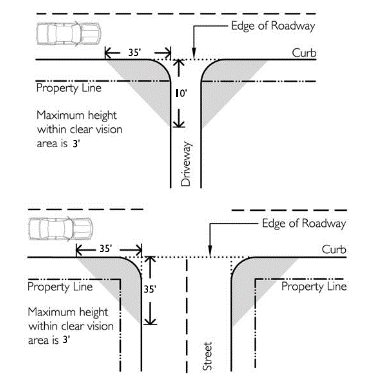
- (Removed Ordinance 614, 10/7/13- Effective 11/06/13)
Amended by Ord. 656 on 11/6/2023
7.2.308.09 Fences And Walls
- Residential, Public and Semi-Public Uses
- Height, location: Fences and walls may be located in any required yard or along the edge of any yard, subject to the maintenance of clear-vision area. A fence or wall may not exceed 6 feet, 6 inches in height without approval of a variance. Fences and walls shall not exceed a height of four feet along, and within, ten feet of any property line adjacent to the street and containing a street access.
- Clear Vision Area. The placement and location of a fence shall not violate the clear vision requirements in Section 7.2.307.
- Construction material: Fences or walls constructed of unsafe materials, including, but not limited to barbed wire, electric fencing, broken glass, and spikes shall be prohibited.
- Swimming pool requirements: Swimming pools shall be enclosed by a locking fence of six feet in height. The dwelling may be used to meet part of the enclosure requirement.
- An entrance wall to a subdivision or other residential development shall be permitted provided the wall or gate does not exceed six feet in height nor violate provisions of the clear vision area.
- Commercial and Industrial Uses
- Height, location: Fences and walls may be located in any required yard or along the edge of any yard, subject to the maintenance of clear-vision area. A fence or wall may not exceed 12 feet in height without approval of a variance.
- Construction material: Electric and barbed wire fencing shall be permitted in the C, I and P zones. Angled fencing shall not extend beyond the property line.
7.2.309.01 Single Family And Duplex
For single family residential and duplex uses on an individual lot:
- Height. The maximum height shall be 25 feet, provided, the structure shall not exceed the height of the primary building.
- Property Setbacks. When a wall adjacent to a property line or alley is nine feet or less in height, the minimum setback shall be two feet. For each one foot increase in the wall height above nine feet, the setback shall increase one additional foot.
- Building Separation. Accessory structure shall be separated from the primary buildings by a minimum of 6 feet. A covered walkway, which contains no habitable space, may connect the two buildings without violation of the separation requirement. Accessory structures less than 6 feet from the primary structure or connected by a fully enclosed walkway will be considered as part of the primary structure and subject to the setback requirements of the primary structure.
- Building Size and Lot Coverage. Accessory structure, in combination with the primary structure, shall not exceed the maximum lot coverage limitation of the underlying zone.
- Historic Structures - Accessory structures located on an individual lot or parcel adjacent to a significant historic resource identified in the Dayton Comprehensive Plan shall comply with the following: (Added by Ordinance #510, 12/7/98 – Effective 12/7/98)
- The exterior of the accessory structure shall be residential in appearance. No specific siding material is required, except that use of vertical metal siding shall be prohibited.
- The height of the accessory structure shall not exceed the height of the adjacent historical building. If the site of the historical resource does not contain a building, the accessory structure shall not exceed the height of the residence which the structure will be located.
- These provisions shall apply to all accessory structures regardless of whether a building permit is required.
7.2.309.02 Multi-Family, Commercial, Industrial Structures
For multi-family, public, semi-public, commercial and industrial uses:
- Location and Number. Accessory structures may be located within any yard area. There is no limit to the number of permitted structures.
- Height. The accessory structure shall comply with the height limitations of the underlying zone.
- Property Setbacks. Accessory structures shall comply with the setbacks for the primary building in the underlying zone.
- Building Size and Lot Coverage. There is no limit to the size of the accessory structure provided the structure and all buildings on the property comply with the applicable lot coverage limitations.
7.2.311.01 Purpose
- To produce a residential development equal to or better than one resulting from traditional lot-by-lot development.
- To allow flexibility which will encourage a more creative approach in the development of land, and will result in a more efficient, aesthetic and desirable use of open area, while substantially maintaining the same population density and area coverage permitted in the district in which the project is located.
- To allow flexibility in design, placement of buildings, use of open spaces, circulation facilities, off-street parking areas, and to best utilize the site potential characterized by special features of geography, topography, size and shape.
7.2.311.02 Applicant For Planned Unit Development Projects
Planned Unit Development projects may be applied for by the owner of all the property involved, if under one ownership, or jointly by all owners of the property in the area proposed for the Planned Unit Development project, if there is more than one owner.
7.2.311.03 Uses Permitted
In a Planned Unit Development only the following uses are permitted:
- Residential Uses.
- Recreational facilities including, but not limited to, tennis courts, swimming pools and playgrounds.
- Open space uses.
- Schools, libraries, community halls, and churches.
- Offices, buildings and facilities required for the operation, administration and maintenance of any Planned Unit Development and for recreation purposes such as: golf courses, recreation rooms, and vehicle storage areas.
- Convenience establishments of a commercial and service nature, including stores, laundry, and dry-cleaning establishments, beauty shops and barber shops, (but specifically excluding gas stations, and repair garage) provided:
- Such convenience establishments are an integral part of the general plan of development for the Planned Unit Development and provide facilities related to the needs of the prospective residents.
- Such convenience establishments and their parking areas will not collectively occupy more than one 2% of the gross land area.
- Such convenience establishments will be located, designed and operated to efficiently serve frequent trade and to serve the needs of persons residing in the Planned Unit Developments.
- Such convenience establishments will not, by reason of their location, construction or operation, have adverse effects on residential uses within or adjoining the district, or create traffic congestion or hazards to vehicular or pedestrian traffic.
7.2.311.04 Development Requirements
Planned Unit Developments shall comply with the following development standards:
- Minimum Parcel Size: The minimum parcel size for a PUD is one acre.
- Site Adaptation: To the maximum extent possible, the plan and design of the development shall assure that natural or unique features of the land and environment are preserved.
- Lot Arrangement: All lots or dwelling spaces within the development shall be designed and arranged to have access to, or frontage on, open space or recreation areas.
- Amount of Open Space: The required amount of open space or outdoor recreational area shall be at least twenty (20) percent of the gross area. Such open space may include school access routes, bicycle trails, natural or landscaped buffer areas, community buildings and facilities and similar shared facilities whenever practical or appropriate. At least 50% of the open space area shall be open and unenclosed. Land unusable for any public purpose, such as steep slope areas, shall not be included in the open space calculation.
- Density of Development: The density shall not exceed the maximum allowable density within the underlying zone, provided a 1% increase in density is allowed for each percentage increase in open space.
- Community Option: The Planning Commission may request the dedication of land or granting an easement to the City for the proposed open space land which is reasonably suited for use as a City park or for recreation purposes and when such dedication is consistent with the ability of the City to maintain such parks. This request shall take into consideration such factors as size, shape, topography, geology, access, location, and adopted Master Park Plan.
- Lot Size and Setback Provisions:
- Lot Size: The PUD development may be organized as a condominium with common ownership of the land (consistent with state law), establish individual lots similar to a conventional subdivision, or a combination of both. The minimum lot size requirements in the underlying zone shall be waived.
- Setbacks: Yard setbacks along the perimeter of the project shall be the same as that required for the subject zoning district. A minimum front yard setback of twenty (20) feet shall be required for any garage structure whose opening faces onto a public street. Otherwise, the minimum setback requirements of the underlying zone shall be waived.
- Circulation:
- Streets within a PUD shall comply with the applicable standards of Section 7.2.302.
- Roads, pedestrian and bikeway paths shall be an integrated system designed to provide efficient and safe circulation to all users. Developments should be designed to minimize the length of roadway.
- Pedestrian/bikeways shall be clearly signed and have adequate crossing facilities where warranted.
- Internal PUD access shall access a public street.
- Off-Street Parking
Off-street parking requirements shall be as specified in Section 7.2.303. Parking may be provided on each lot or in clustered parking areas. Additional off-street parking for guests and recreational vehicles may be required by the Planning Commission if warranted by reduced lot sizes, type of street and/or traffic volumes. - Utilities
In addition to other requirements set forth herein, the following shall apply:- All sewer and water provisions shall be approved by the City before construction of such improvements.
- All utility services shall be placed underground.
- Provisions shall be made for fire prevention, including service water lines, non-freeze hydrants, and adequate emergency access for fire fighting equipment around buildings.
- Provision shall be made for control of site storm water drainage, as required by Section 7.2.304.
- Home Owners Association
A non-profit incorporated homes owners association, or an alternative acceptable to the City Attorney, shall be required for improving, operating and maintaining common facilities, including open space, streets, drives, service and parking areas and recreation areas. The following principles shall be observed in the formation of any home owners association and shall be reviewed by the City Attorney.- A homes owners association shall be formed and in place at the time of the recording of the final plat, or any portion thereof.
- Membership shall be mandatory for each home buyer and any successive buyer.
- The open space restrictions shall be in perpetuity.
- The home owners association shall be responsible for liability insurance, local taxes, and the maintenance of recreational and other facilities.
- Home owners shall pay their pro rate share of the cost or the assessment levied by the association shall become a lien on the property.
- The association shall be able to adjust the assessment to meet changes needed.
- No change in open space use or dissolution of home owners association shall occur without a public hearing before the Planning Commission and approval by the City Council.
7.2.311.05 Process
Planned Unit Developments shall be processed in accordance with the submittal requirements and procedures established for a subdivision. Approval shall only be granted if the requirements of this Section and all other applicable requirements of this Code are met.

