
De Beque City Zoning Code
CHAPTER 14
04.- GENERAL PROVISIONS AND DEFINITIONS2
Editor's note— Ord. No. 555 (Series 2025), Exh. 1, adopted Nov. 18, 2025, repealed the former ch. 14.04, §§ 14.04.010—14.04.150, 14.04.210, 14.04.220 and enacted a new ch. 14.04 as set out herein. The former ch. 14.04 pertained to similar subject matter and derived from the 1995 Code, §§ 14.01.010—14.01.080, 14.01.100—14.01.180; Ord. No. 292, § 1, adopted in 2004; Ord. No. 324, § 2, adopted in 2006; Ord. No. 412, § 1, adopted in 2011; Ord. No. 440, § 2, adopted in 2013; Ord. No. 443, § 2, adopted in 2014; Ord. No. 467, § 2, adopted in 2015; Ord. No. 48, § 6, adopted in 2017; Ord. No. 483, § 2, adopted in 2016; Ord. No. 486, § 3, adopted in 2017; Ord. No. 531 (Series 2023), Exh. 2(14.01.170), Exh. 2(14.01.180), adopted March 28, 2023; Ord. No. 546 (Series 2025), Exh. 5, adopted Feb. 25, 2025; and Ord. No. 556 (Series 2025), § 4, adopted Oct. 28, 2025.
Sec. 14.04.010. - Short title.
The ordinance codified in this title shall be known and may be cited and referred to as the "Town of De Beque Land Use and Development Code" and herein may be referred to as "this title," "these regulations," "this Code," or "title 14."
(Ord. No. 555 (Series 2025), Exh. 1, 11-18-2025)
Sec. 14.04.020. - Authority.
This title is authorized by C.R.S. §§ 31-23-101 et. seq., 29-20-101 et. seq., and 24-65-101 et. seq.
(Ord. No. 555 (Series 2025), Exh. 1, 11-18-2025)
Sec. 14.04.030. - Jurisdiction.
These regulations shall apply to all land and all land uses within the municipal boundaries of the Town of De Beque, Colorado.
(Ord. No. 555 (Series 2025), Exh. 1, 11-18-2025)
Sec. 14.04.040. - Amendments to the Colorado Revised Statutes.
Whenever a section of the C.R.S., referenced in this title, is later amended or superseded, this title shall be deemed amended to refer to the amended section or section that most nearly corresponds to the superseded section.
(Ord. No. 555 (Series 2025), Exh. 1, 11-18-2025)
Sec. 14.04.050. - Purpose.
The regulations in this title shall be held to be the minimum requirements enacted to promote the health, safety, and general welfare of the Town of De Beque, Colorado. To these ends such regulations have been prepared in accordance with the Towns' Comprehensive Plan and are designed to:
(1)
Lessen congestion in the streets, to secure safety from fire, panic, flood waters and other dangers.
(2)
Provide adequate open spaces for light and air.
(3)
Prevent the overcrowding of land and undue concentration of population.
(4)
Facilitate the adequate provision of transportation, water, sewerage, schools, parks and other public requirements.
(5)
Designate, regulate and restrict the location and use of buildings, signs, fences, structures and land for residence, commerce, trade, industry and other purposes.
(6)
Regulate and limit the height, number of stories, and size of buildings, signs, fences, and other structures hereafter erected or altered.
(7)
Establish standards for off-street parking; to divide the Town into zones of such number, shape, and area as may be deemed best suited to carry out these regulations.
(8)
Provide for the administration, enforcement, amendment, and review of these regulations.
This title is drawn with reasonable consideration, among other things, of the character of the Town, neighborhoods, and other areas of the Town regarding the suitability for particular uses, to conserve the value of buildings and encourage the most appropriate uses of land throughout the Town, and to otherwise provide for the growth of an orderly and viable community.
(Ord. No. 555 (Series 2025), Exh. 1, 11-18-2025)
Sec. 14.04.060. - Severability.
If any section, subsection, paragraph, clause, phrase or provision of these regulations shall be adjudged invalid or held to be unconstitutional by a court of competent jurisdiction, the validity of these regulations shall not be affected in whole or in part, other than the provision adjudged to be invalid or unconstitutional.
(Ord. No. 555 (Series 2025), Exh. 1, 11-18-2025)
Sec. 14.04.070. - Organization.
This title is divided into separate chapters to address different aspects of these regulations. The headings and section titles in these regulations are for convenience only and are not intended to be used to interpret or give effect to any of the provisions of these regulations.
(Ord. No. 555 (Series 2025), Exh. 1, 11-18-2025)
Sec. 14.04.080. - Administration.
(a)
Interpretation. In their application and interpretation, the provisions of this title shall be held to be minimum requirements for protecting the health, safety, and general welfare of the public. Nothing herein is intended to repeal, abrogate, annul, impair, or interfere with existing provisions of other laws or ordinances except those specifically repealed by this title, or with private restrictions placed upon property by covenants, deed or other private agreement, or with restrictive covenants running with the land.
(b)
Conflicting provisions. Whenever the provisions of this title and the provisions of any other lawfully adopted rules, regulations, or ordinance address the same matter, the more restrictive, or that imposing higher standards, shall govern.
(c)
Review and decision-making bodies.
(1)
Purpose. This subsection sets forth the powers and duties of the administrative entities responsible for administering, interpreting, and enforcing this title.
(2)
Mayor and Board of Trustees ("Board of Trustees"). The Board of Trustees shall have all the powers and duties granted by the De Beque Municipal Code.
(3)
Planning Commission. The Planning Commission shall have the powers and duties granted it by the De Beque Municipal Code, as well as those permitted under C.R.S. tit. 31, art. 23, §§ 31-23-201—31-23-227.
(4)
Board of Adjustment. The Board of Adjustment shall have the powers, duties, and obligations granted by the De Beque Municipal Code, as well as those permitted under C.R.S. tit. 31.
(5)
Town staff.
a.
Town Administrator. The Town Administrator shall be responsible for the following:
1.
Appointing the Town Planner, Code Enforcement Officer, and Floodplain Administrator.
2.
Establishing the powers, duties, and responsibilities of the Town Planner, Code Enforcement Officer, and Floodplain Administrator.
3.
Overseeing the actions of the Town Planner, Code Enforcement Officer, and Floodplain Administrator.
b.
Town Planner. Unless otherwise stated herein, the Town Planner shall be responsible for administering, interpreting, and assisting the with enforcement of this title. In performing such responsibilities, the Town Planner may delegate such duties to other Town staff, as they deem appropriate.
c.
Code Enforcement Officer. The Code Enforcement Office shall be responsible for enforcing this title.
d.
Floodplain Administrator. The Floodplain Administrator shall be responsible for administering, interpreting, and implementing the applicable floodplain provisions set forth in this title.
(d)
Procedure for quasi-judicial hearings. All quasi-judicial hearings held before the Board of Trustees; any board, commission, official, or employee of the town; or, any hearing officer appointed to hear and receive evidence and render a decision on the law and facts shall comply with title 2, chapter 2.12 of the De Beque Municipal Code.
(Ord. No. 555 (Series 2025), Exh. 1, 11-18-2025)
Sec. 14.04.090. - Public notice requirements.
(a)
Applicant responsibilities. For all actions of the Town described in this title requiring a public hearing(s), the applicant shall:
(1)
Provide public notice;
(2)
Demonstrate that public notice conforms to the requirements of this section;
(3)
Ensure the accuracy and proper mailing, publication, and posting of notice for a public hearing(s);
(4)
Be responsible for all costs incurred in connection with providing notice for a public hearing(s); and
(5)
Submit proof of giving public notice, to the Town, prior to commencement of the applicable public hearing(s).
(b)
Public notice requirements. All notices for a public hearing shall include the following:
(1)
A statement of the nature of the matter being considered.
(2)
The time, date, and place of the public hearing.
(3)
The agency or office and phone number where further information may be obtained.
(4)
A legal description of the subject property.
(c)
Mailed notice.
(1)
Notice of the public hearing shall be sent by certified mail, to all property owners within 200 feet of the subject property, as measured from the boundary of the property. The notice must be mailed a minimum of 15 calendar days in advance of the date of the public hearing.
(2)
The Mesa County Assessor's records shall be used to determine the addresses of property owners.
(d)
Published notice. Notice of the public hearing shall be published, one time, in a local newspaper having general circulation within the Town. The notice must be published a minimum of 15 calendar days in advance of the date of the public hearing. If there is no local newspaper having general circulation within the Town, notice of the public hearing must be published in a local newspaper having general circulation within Mesa County.
(e)
Posted notice. Notice of the public hearing shall be posted on a sign, with a minimum size of two feet by three feet, on the subject property and in a location that is clearly visible from adjacent roadways. The notice must be posted on the subject property a minimum of 15 calendar days in advance of the date of the public hearing.
(f)
Mineral owner notice. As required by State statute, notice to mineral estate owners shall be sent by certified mail, return receipt requested, or by a nationally recognized overnight courier, not less than 30 calendar days before the date scheduled for the first public hearing on an "application for development," which may include applications for:
(1)
A sketch plan, a preliminary or final plat for a subdivision.
(2)
A planned unit development (PUD).
(3)
General development plans.
(4)
Special use permits.
(5)
Zoning or rezoning to a planned unit development that would change or create lot lines where such applications are in anticipation of new surface development.
(g)
Major activity notice. As required by State statute, the Town shall send notice of a proposed subdivision or commercial or industrial activity, which will cover five or more acres of land, to the Colorado Geologic Survey and the Mesa County Board of Commissioners prior to approval of any zoning change, development permit, subdivision, or building permit associated with such proposal.
(h)
Constructive notice.
(1)
Minor notice defects. Minor defects in any notice for a public hearing shall not impair the notice or invalidate proceedings pursuant to the notice if a bona fide attempt has been made to comply with applicable notice requirements. Minor defects in a notice for a public hearing are limited to the following:
a.
Errors in a legal description.
b.
Typographical or grammatical errors that do not affect the discernability of the notice.
(2)
Failure to observe or receive notice. Failure of a party to observe or receive written notice of a public hearing shall not invalidate or prohibit subsequent action. If questions arise at the public hearing regarding the adequacy of notice, the decision-making body shall make a formal finding as to whether there was substantial compliance with the notice requirements of this title.
(Ord. No. 555 (Series 2025), Exh. 1, 11-18-2025)
Sec. 14.04.100. - Fees and costs.
(a)
Application fees.
(1)
Schedule of fees. A schedule of fees for land use applications will be adopted by resolution of the Board of Trustees and may be amended from time to time by resolution. A copy of the schedule of fees is to be made available at De Beque Town Hall and on the Town's website.
(2)
Payment of fees. Each application shall be submitted with the fees set forth by the Board of Trustees for that application. The fees shall be considered a minimum for each type of application. To the extent these application fees do not provide sufficient funds to pay for outside professional services for the review of the application, the applicant will be charged the actual review costs including but not limited to, the costs of outside town consultants and town legal fees. All fees shall be due and payable upon submission, and all additional fees will be due and payable at such time as a statement is presented to the applicant.
(b)
Public notice costs. As provided elsewhere in this Code, all costs of providing notice, including publication, mailing, and posting, shall be borne by the applicant.
(c)
Recording costs. Recording and filing fees imposed by the Mesa County Clerk and Recorder, and others, as a result of the application, shall be advanced by the applicant prior to the documents being tendered for recording.
(d)
Unpaid fees and costs.
(1)
All land use application fees, other fees and costs authorized by this title, and all actual review costs including but not limited to, the cost of outside town consultants, engineers and Town legal fees shall constitute a lien upon any lot, land, building or premises which is the subject of a land use application until fully paid. If said fees and costs are not paid when due, the Town Treasurer may certify the amount of the same to the County Treasurer, to be placed on the tax list for the current year, and to be collected in the same manner as other taxes are collected, with 18 percent added thereto to defray the costs of collection, in accordance with C.R.S. § 31-20-105. All laws of this State for the assessment and collection of general taxes, including the laws for the sale of property for taxes and redemption of the same, shall apply.
(2)
In addition, failure to pay the fees and costs authorized by this title when due and owing shall constitute grounds to deny any pending land use application and shall also constitute grounds to revoke any prior land use approval related to such unpaid fees and costs.
(Ord. No. 555 (Series 2025), Exh. 1, 11-18-2025)
Sec. 14.04.110. - Certificate of planning and zoning compliance and building permits.
(a)
Certificate of planning and zoning compliance.
(1)
Certificate required. No site preparation for, or construction of, any building or structure shall commence without first obtaining a certificate of planning and zoning compliance indicating conformance with the applicable requirements of this title and all other applicable requirements of De Beque's Municipal Code. A certificate of planning and zoning compliance must be issued prior to the issuance of a building permit.
(2)
Submittal requirements. An application for a certificate of planning and zoning compliance must include the following items:
a.
Application. A completed and signed copy of the application form furnished by the Town.
b.
Application fee. Payment for the applicable fee as established by the Town's fee schedule.
c.
Agreement to pay form. A completed and signed copy of the agreement to pay consulting fees and expenses furnished by the Town.
d.
Authorization letter. A letter signed by all owner(s) of the property, if the owner(s) intends to have a representative complete the application and its processing.
e.
Site plan. A site plan, drawn to scale and prepared in accordance with section 14.28.030.
f.
Drainage and grading plan. All applications, except those for the construction or alteration of a single-family dwelling not located in a special flood hazard area, shall include a drainage and grading plan, prepared by a qualified professional engineer, drawn to scale, and that includes the following items:
1.
The legal boundaries and the topography of the lot to be built upon, as well as adjacent properties and other potentially affected properties.
2.
The dimensions and size of the building(s) to be erected.
3.
The location of such building(s) on the lot with reference to the legal boundaries and the existing and proposed topography of the subject property and other potentially affected properties.
4.
Other information that may be required by the Town Engineer.
The Town Engineer may waive the requirement for a drainage and grading plan if, in their opinion, the proposal will not significantly alter drainage in a manner that will affect adjacent properties, public infrastructure, and/or the proposed building or structure.
g.
Building elevations. Building elevations and other information to demonstrate compliance with the architectural standards set forth in chapter 14.32.
h.
Landscape plan. A final landscape plan, prepared in accordance with section 14.32.130, that demonstrates compliance with the landscape standards set forth in chapter 14.32.
i.
Lighting plan. A lighting plan, prepared in accordance with section 14.32.230, that demonstrates compliance with the lighting standards set forth in chapter 14.32.
j.
Additional information. Any other information deemed necessary by the Town Planner to ensure a complete and proper review of the request.
(3)
Waiver of application submittal requirements.
a.
At the discretion of the Town Planner, one or more submittal requirements for a planning and zoning compliance application may be waived if they determine that the information is not necessary to evaluate the application for compliance with the applicable requirements of this title.
b.
A decision to grant a waiver does not prevent the Town Planner from requiring an applicant to submit additional information, at any time during the review process, if such information is necessary for a proper and complete review of an application.
(4)
Application completeness review.
a.
Within ten business days of the town receiving an application, the Town Planner will review the application and determine whether the application is complete and includes sufficient information to be evaluated for compliance with the applicable requirements of De Beque's Municipal Code.
b.
If the application is deemed complete, it will be accepted for review by the Town.
c.
If the application is deemed incomplete, the Town Planner will provide the applicant with written notice of the application's deficiencies. The applicant will have 90 business days to correct all deficiencies in their application. If the applicant fails to correct the application's deficiencies within the allotted time, the application will be considered withdrawn for failure to achieve completeness.
(5)
Review and decision.
a.
Within ten business days of a determination of completeness, the Town Planner will circulate the application for review and comment by town departments, town consultants, and/or referral agencies that may be affected by the proposal. The Town Planner is responsible for determining the appropriate town departments, town consultants, and referral agencies to involve in the review of an application.
b.
The comment period for the review by referral agencies shall be 28 business days from the date that the application is circulated by the Town Planner. Upon request by a referral agency, the Town Planner may authorize one extension of this comment period by up to ten business days. Town departments and town consultants may provide comments on an application at any time during the review process.
c.
Upon the conclusion of the review process, the Town Planner will render a decision to approve, approve with conditions, or deny the application and provide the applicant with written notice of their decision.
d.
If, during the review process, a town department, town consultant, and/or referral agency determines that an application contains erroneous information, is technically deficient, and/or does not comply with all applicable regulations, standards, and/or laws of the Town, county, state, and/or federal government the Town Planner will do the following:
1.
Withdraw the application from the review process.
2.
Provide the applicant with written notice of the issues that have been identified by a town department, town consultant, and/or referral agency, that the application has been withdrawn from the review process, and that no further action will be taken on the application until such issues have been addressed by the applicant.
If an applicant fails to correct all application issues within 90 business days of the date of the written notice from the Town Planner, the Town Planner may deem the application to be withdrawn. If the Town Planner deems the application to be withdrawn, they shall provide the application with written notice of this decision.
(6)
Fast-track review process for affordable housing projects. To comply with the requirements of C.R.S. § 29-32-105(2) et seq., the following fast-track review process applies to all planning and zoning compliance applications for affordable housing projects:
a.
Upon a determination of completeness in accordance with subsection (a)(4), an application will be reviewed in accordance with subsection (a)(5) and the Town Planner will render a decision within 90 calendar days.
b.
The fast-track review process is permitted to be extended as follows:
1.
A one-time extension of up to 90 calendar days may be granted by the Town Planner, upon receipt of a written request from the applicant.
2.
To allow time to comply with a state law or court order. The length of such an extension will be determined by the state law or court order.
3.
To allow for review by an agency not under the control of the Town and with approval authority over the project (e.g., De Beque Fire Protection District) and to allow for comments from such agency to be addressed by the applicant.
4.
An extension of up to 30 calendar days may be granted by the Town Planner to address comments that arise during the application review process. The extension period shall begin upon the Town's receipt of the applicant's response to such comments. If the Town Planner authorizes such an extension, they must provide the applicant with written notification.
The Town Planner is authorized to grant more than one extension of up to 30 calendar days if additional extensions are deemed necessary to address application review comments.
c.
At the discretion of an applicant, an application may be opt-outed of the fast-track review process.
(7)
Public improvements.
a.
As part of the review of a planning and zoning compliance application, the Town Planner will consultant with the appropriate town departments, town consultants, and/or referral agencies to determine whether the design and installation or construction of public improvements (e.g., street paving, curbs, gutters, sidewalks, drainage facilities, extension of water or sewer mains, fire hydrants, etc.), is required to serve and/or mitigate the impacts from a proposed development.
b.
If it is determined that public improvements are required, the Town Planner shall provide the applicant with written notice of such a determination.
c.
An applicant may appeal the Town Planner's decision on the public improvements required for their development to the Board of Trustees. The applicant must submit their appeal, in writing, to the Town Clerk within 15 calendar days of the issuance of the decision by the Town Planner. Any appeal received later than this will not be considered by the Town. Within 60 calendar days of the receipt of an appeal, the Board of Trustees shall review the Town Planner's decision and render a decision on what, if any, public improvements will be required for the development.
d.
If the Town determines that public improvements are required for a proposed development, the Town Planner shall include a condition in the certificate of planning and zoning compliance that requires the construction of such public improvement(s) by the applicant and the dedication thereof to the Town.
(8)
Development improvements agreement required.
a.
A development improvements agreement, prepared in accordance with section 14.04.170, shall be required for all developments that require the construction of public improvements.
b.
In such cases, no certificate of planning and zoning compliance shall be issued until a development improvements agreement has been executed between the applicant and the Board of Trustees.
(9)
Appeals. Unless otherwise stated in this section, an applicant may file an appeal of the Town Planner's decision on an application in accordance with chapter 14.24.
(10)
Record of certificates. A record of certificates of planning and zoning compliance that have been issued by the Town shall be kept in the office of the Town Clerk.
(b)
Building permits.
(1)
Mesa County serves as the building department for the Town of De Beque. Building permit applications are submitted to Mesa County for processing, review, and scheduling of inspections.
(2)
A copy of a certificate of planning and zoning compliance, issued by the Town, must be included with a building permit application.
(Ord. No. 555 (Series 2025), Exh. 1, 11-18-2025)
Sec. 14.04.120. - Certificate of occupancy.
(a)
Certificate of occupancy required. No building or structure shall be used or occupied, until a certificate of occupancy has been issued by the Town.
(b)
Issuance of certificate of occupancy.
(1)
A certificate of occupancy for a new building or structure or the alteration of an existing building or structure shall be applied for coincident with the application for a building permit.
(2)
A certificate of occupancy shall be issued within ten business days of the erection or alteration of such building or structure being completed in conformance with the provisions of this title and the building code(s) adopted by the Town of De Beque.
(3)
A certificate of occupancy issued by the Town shall state that a building or structure complies with all building and health laws and ordinances and with the provisions of this title.
(c)
certificate of occupancy records.
(1)
The Town's Building Department shall keep a record of all certificates of occupancy issued in the Town of De Beque.
(2)
The Town shall provide a copy of a certificate of occupancy upon request by any person having proprietary or tenancy interest in the building or structure affected.
(d)
Fees. No fee shall be charged for an original certificate of occupancy applied for coincidental with the building permit application. For all certificates of occupancy or copies of an original certificate of occupancy, there shall be a fee as set by the Board of Trustees.
(e)
Completion of landscape improvements prior to certificate of occupancy.
(1)
Unless otherwise stated in this subsection, no certificate of occupancy shall be issued for any building or structure until all required landscape improvements have been installed and a qualified professional, including but not limited to a licensed landscape architect, landscape contractor, nursery professional, or other similar professional with equivalent credentials acceptable to the Town, has verified, in writing, that the landscape improvements have been installed in accordance with the approved landscape plan.
(2)
If weather and/or seasonal conditions prevent the installation of the required landscape improvements, a certificate of occupancy may be issued if the following occur:
a.
All required landscape improvements are completed within six months of the issuance date of the certificate of occupancy, unless an extension is granted in accordance with this subsection.
b.
The applicant provides the Town with a performance guarantee in an amount equal to 120 percent of the estimated cost of the materials and labor for the uninstalled landscape improvements to guarantee that such improvements are installed by an agreed upon date and in accordance with the approved landscape plan. The type and amount of the performance guarantee is subject to approval by the Town and the performance guarantee must comply with all applicable requirements set forth in subsection 14.04.170(n).
c.
The applicant complies with all applicable Town sediment and erosion control requirements until all required landscape improvements have been installed.
(3)
A performance guarantee shall only be released by the Town once all required landscape improvements have been installed and a qualified professional, as described in subsection 14.04.170(f)(1), has verified, in writing, that the landscape improvements have been installed in accordance with the approved landscape plan. If an applicant fails to complete the installation of all required landscape improvements within the designated timeframe, the Town shall have the authority to use the performance guarantee to install the required landscaping.
(4)
An applicant may request an extension of the completion date for landscape improvements. Such a request must be submitted to the Town in writing and demonstrate the following:
a.
Failure to complete the landscape improvements was beyond the applicant's control due to weather conditions, seasonal conditions, and/or other similar cause(s).
b.
All landscaping improvements will be completed prior to the termination of the requested extension period.
c.
If applicable, the homeowner's association is supportive of the requested extension.
(5)
The Town Planner may authorize one extension for the completion of all required landscape improvements for a period of up to six calendar months.
(Ord. No. 555 (Series 2025), Exh. 1, 11-18-2025)
Sec. 14.04.130. - Vested property rights.
(a)
Purpose. The purpose of this section is to provide the procedures necessary to implement the provisions of C.R.S. tit. 24, art. 68, which article establishes a vested property right to undertake and complete development and use of real property under the terms and conditions of a site-specific development plan.
(b)
Definitions. Unless modified in this subsection, the terms used in this section shall have the same meaning as set forth in C.R.S. § 24-68-102. As used in this section, unless the context otherwise requires:
(1)
Site-specific development plan means a plan that has been submitted to the Town by a landowner or such landowner's representative describing with reasonable certainty the type and intensity of use for a specific parcel or parcels of property, which plan shall create a vested property right. The following shall be considered site-specific development plans:
If not indicated above, a "site-specific development plan" shall mean the final approval step, irrespective of the name or designation of such approval, which occurs prior to building permit application. Provided, however, the Board of Trustees may by agreement with the applicant designate an approval step other than those indicated above, or the final approval step, to serve as the site-specific development plan approval for a specific project.
The following are specifically excluded from, and shall not constitute, a site-specific development plan:
•
Variances issued by the Board of Adjustment;
•
Sketch or preliminary plans;
•
Business licenses;
•
Floodway or floodplain permits;
•
Franchises;
•
Temporary use permits;
•
Any comprehensive master plan element;
•
Creation of improvement Districts;
•
Zoning or rezoning;
•
Final architectural plans; and
•
Final construction drawings and related documents specifying materials and methods for construction of improvements.
(2)
Vested property right means the right to undertake and complete development and use of property under the terms and conditions of a site-specific development plan.
(c)
Applications—Approval by the Town.
(1)
Except as otherwise provided in this subsection, an application for approval of a site-specific development plan as well as the approval, conditional approval, or denial of approval of a plan shall be governed only by the duly adopted laws and regulations in effect at the time the application is submitted to the Town.
For purposes of this subsection, laws and regulations includes any zoning or development law of general applicability adopted by the Town as well as any zoning or development regulations that have previously been adopted for the parcel described in the plan and that remain in effect at the time of application for approval of the plan.
In the event the application for a site-specific development plan requires review and approval in multiple stages, application means the original application submitted at the first stage in any process that may culminate in the ultimate approval of a site-specific development plan.
(2)
Notwithstanding the limitations contained in subsection (c)(1) above, the Town may adopt a new or amended law or regulation when necessary for the immediate preservation of public health and safety and may enforce such law or regulation in relation to applications for site-specific development plans pending at the time such law or regulation is adopted.
(d)
Alternative creation of vested property rights. If any applicant desires an approval step, other than as defined in subsection (b)(1) above, to constitute an approval of a site-specific development plan with the effect of creating vested property rights pursuant to this section and C.R.S. tit. 24, art. 68, the applicant must so request at least 30 days prior to the date of said approval by the Board of Trustees or Planning Commission, as applicable, is to be considered. Failure to do so renders the approval by the Board of Trustees or Planning Commission, as the case may be, to not constitute an approval of a site-specific development plan and no vested property right shall be deemed to have been created by such approval, except in the case of an approval as set forth in subsection (b)(1) above.
(e)
Establishment of vested property rights; public notice required.
(1)
A vested property right shall be deemed established with respect to any property upon the approval, or conditional approval, of a site-specific development plan, following notice and public hearing, by the Town.
(2)
A vested property right shall attach to and run with the applicable property and shall confer upon the landowner the right to undertake and complete the development and use of said property under the terms and conditions of the site-specific development plan, as approved, including any amendments thereto.
(3)
A site-specific development plan shall be deemed approved upon the effective date of the Town's legal action, resolution or ordinance relating thereto. Such approval shall be subject to all rights of referendum and judicial review; except that the period of time permitted by law for the exercise of such rights shall not begin to run until the date of publication, in a newspaper of general circulation within the Town, of a notice advising the general public of the site-specific development plan approval and creation of a vested property right pursuant to this section and C.R.S. tit. 24, art. 68. Such publication shall occur no later than 14 days following approval.
(f)
Approval of site-specific development plan—Conditions.
(1)
The Town may approve a site-specific development plan upon such terms and conditions as may reasonably be necessary to protect the public health, safety and welfare, and failure to abide by such terms and conditions may, at the option of the Board of Trustees, after public hearing, result in the forfeiture of vested property rights. This subsection shall be strictly construed.
(2)
Terms and conditions imposed or agreed upon may include, without limitation:
a.
Future approvals by the Town not inconsistent with the original approval;
b.
Approvals by other agencies or other governments;
c.
Satisfactory inspections;
d.
Completion of all or certain phases of a project by certain dates;
e.
Waivers of certain rights;
f.
Completion and satisfactory review of studies and reports;
g.
Payment of fees to the Town or other governmental or quasi-governmental agencies as they become due and payable;
h.
Payment of costs and expenses incurred by the Town relating to the approval;
i.
Continuing review and supervision of the plan and its implementation and development;
j.
Obtaining and paying for building permits, water taps and wastewater taps;
k.
Compliance with other codes and laws, including building codes, of general applicability;
l.
Construction of improvements or facilities for the use of future inhabitants or the public at large;
m.
Payment of any applicable impact fees; and
n.
Dedication of public or park land, common area or open space, with provision for its maintenance; or payment of a fee in lieu thereof.
(g)
Duration and termination of vested property rights.
(1)
A property right which has been vested pursuant to this section and C.R.S. tit. 24, art. 68, shall remain vested for a period of three years. This vesting period shall not be extended by any amendments to a site-specific development plan unless expressly authorized by the Board of Trustees.
(2)
Notwithstanding the provisions of (1) above, the Town is authorized to enter into development agreements with landowners providing that property rights shall be vested for a period exceeding three years where warranted in the light of all relevant circumstances including, but not limited to, the size and phasing of the development, economic cycles, and market conditions. Such development agreements shall be adopted as legislative acts subject to referendum.
(3)
Following approval or conditional approval of a site-specific development plan, nothing contained in this section or C.R.S. tit. 24, art. 68 shall exempt such a plan from subsequent reviews and approvals by the Town to ensure compliance with the terms and conditions of the original approval, if such further reviews and approvals are not inconsistent with said original approval.
(h)
Waiver of vested property rights. An applicant may waive a vested property right by separate agreement, which shall be recorded in the office of the Mesa County Clerk and Recorder. Unless otherwise agreed to by the Town, any landowner requesting annexation to the Town shall waive in writing any preexisting vested property rights as a condition of such annexation.
(i)
Subsequent regulation prohibited—Exceptions.
(1)
A vested property right, once established as provided in this section and C.R.S. tit. 24, art. 68, precludes any zoning or land use action by the Town or pursuant to an initiated measure which would alter, impair, prevent, diminish, impose a moratorium on development, or otherwise delay the development or use of the property as set forth in an approved site-specific development plan, except:
a.
With the consent of the affected landowner;
b.
Upon the discovery of natural or manmade hazards on or in the immediate vicinity of the subject property, which hazards could not reasonably have been discovered at the time of site-specific development plan approval, and which hazards, if uncorrected, would pose a serious threat to the public health, safety, and welfare; or
c.
To the extent that the affected landowner receives just compensation for all costs, expenses and liabilities incurred by the landowner after approval by the Town, including, but not limited to, costs incurred in preparing the site for development consistent with the site-specific development plan, all fees paid in consideration of financing, and all architectural, planning, marketing, legal, and other consultants' fees, together with interest thereon at the legal rate until paid. Just compensation shall not include any diminution in the value of the property which is caused by such action.
(2)
Establishment of a vested property right pursuant to law shall not preclude the application of ordinances or regulations which are general in nature and are applicable to all property subject to land use regulation by the Town of De Beque, including, but not limited to, building, fire, plumbing, electrical, housing, mechanical, and dangerous building codes.
(j)
Payment of costs. In addition to any and all other fees and charges imposed by this title, the applicant for approval of a sitespecific development plan shall pay all costs incurred by the Town as a result of the site-specific development plan review, including publication of notices, public hearing and review costs, when such costs are incurred apart and in addition to costs otherwise incurred by the Town or applicant for a public hearing relative to the subject property.
(k)
Other provisions unaffected. Approval of a site-specific development plan shall not constitute an exemption from or waiver of any other provisions of this title pertaining to the development and use of property.
(l)
Limitations. Nothing in this section is intended to create any vested property right, but only to implement C.R.S. tit. 24, art. 68, as amended. In the event of the repeal of said article or judicial determination that said article is invalid or unconstitutional, this section shall be deemed to be repealed and the provisions hereof no longer effective.
(Ord. No. 555 (Series 2025), Exh. 1, 11-18-2025)
Sec. 14.04.140. - Land dedication requirements.
(a)
General requirements.
(1)
At the time of annexation, subdivision (except minor subdivisions), or residential, commercial, or industrial development, whichever occurs first, the Board of Trustees shall require the dedication of land for parks and recreation or fee in lieu of such dedication, in accordance with this section.
(2)
All dedications of land to the Town must be free and clear of all liens and encumbrances and shall be made by means of a final plat dedication or deed.
(3)
If a subdivision or residential, commercial, or industrial development increases the requirement for land for parks and recreation above that previously approved for the subject property, the Board of Trustees may require additional dedication of land or fee in lieu, in accordance with this section.
(4)
Exemptions. These requirements shall not apply in cases where satisfactory dedication arrangements were made and approved by the Board of Trustees at the time of annexation or previous subdivision of the same property.
(b)
Dedication of land for parks and recreation.
(1)
The applicant shall convey to the Town land to be used for public parks and recreation at locations designated by the Town in the following manner:
a.
Seven acres for every 1,000 residents of the proposed annexation, subdivision, or development (approximately one acre per 143 residents).
b.
For the purpose of calculating the foregoing requirement, the number of residents attributable to each type of dwelling unit shall be as follows:
1.
Single-family dwellings: 3.5 residents per dwelling unit.
2.
Two-family dwellings: 3.0 residents per dwelling unit.
3.
Multi-family dwellings: 2.5 residents per dwelling unit.
(2)
For commercial or industrial developments, the applicant shall dedicate and convey to the Town a minimum of eight percent of the total gross area of the subject property.
(3)
Dedicated land may include: the 100-year floodplain; national and state historical or natural features; and proposed public areas set aside in town, county, regional, or state plans.
(4)
Dedicated land shall not include: sites for technical, private, or public schools; sites for public agencies; sites for service organizations that are not open to the public; and sites that are unsuitable for public use due to steep slopes, rock formations, adverse topography, utility easements, or other features which may be harmful to the health and safety of citizens.
(5)
A minimum of 80 percent of land dedicated shall lend itself to utilization for public recreation purposes which includes, but is not limited to, the following: ballfields, trails, tennis courts, picnic sites, and boating areas.
(c)
Credit for private recreation facilities. The Board of Trustees may reduce the total acreage required for public parks and recreation by no more than 50 percent if the applicant provides private recreation facilities and the following requirements are met:
(1)
The Board of Trustees determines that the private recreation facilities offered will absorb a major portion of the recreational demands of the residents and/or employees of the proposed annexation, subdivision, or development;
(2)
The private recreation facilities will be constructed at the same time as, or prior to, the residential, commercial, and/or industrial components of the proposed annexation, subdivision, or development; and
(3)
There are sufficient safeguards in the annexation agreement, subdivision improvements agreement, or development improvements agreement to ensure that the private recreation facilities are completed at the same time as, or before, the remainder of the development.
(d)
Payment in lieu of dedication of lands for parks and recreation.
(1)
At the option of the Board of Trustees, an applicant may:
a.
Make a cash payment in lieu of land dedications;
b.
Dedicate other property not within the area to be annexed, subdivided, or developed; or
c.
Provide a combination of cash payment and dedication of other property.
(2)
If the Board of Trustees determines to accept other property, not within the area to be annexed, subdivided, or developed, the acreage required shall be computed as described in subsection 14.04.150(b). If the acreage to be dedicated is not sufficient to meet the requirements of subsection 14.04.150(b), the remaining requirement may be met with a cash in lieu payment.
(3)
Upon a recommendation from the Planning Commission, the Board of Trustees shall, by resolution, set the per acre fee for the cash in lieu payment for public parks and recreation. This fee shall be updated at least every two years and be based on the average fair market value of vacant residential land within the corporate limits of the Town. The average fair market value of vacant residential land shall be derived from actual value data from the Mesa County Assessor or from data prepared for the town by a qualified professional.
(4)
Payment in lieu of land dedication shall be made prior to final approval of the ordinance approving the annexation, subdivision, or development. Such payment shall be placed in a specific fund established and maintained by the Town for the following purposes:
a.
Acquisition of land for public parks and recreation; and/or
b.
Development of, or capital improvement to, public parks, playgrounds, trails, recreation facilities, or other similar amenities.
The use of such funds may benefit the residents of the Town in general, as well as those of the proposed annexation, subdivision, or development.
(5)
In extraordinary circumstances, the Board of Trustees may authorize the deferral of the payment of cash in lieu of land dedication for public parks and recreation. In such an event, the applicant shall agree with the town, in such a form that is acceptable to the Town Attorney, to pay such sums prior to the issuance of any building permit(s) for the subject property. Notice shall be given of such deferred payment by the recording of a mortgage or other security instrument with the Clerk and Recorder of Mesa County, Colorado.
In no event shall the deferral of a payment of cash in lieu of land dedication extend beyond a period of five years from the date it would otherwise be payable. The applicant shall agree to pay the higher of either the land dedication fee calculated in accordance with this section at the time originally owed, or at the time actually paid.
(6)
All funds collected pursuant to this subsection shall be accounted for in the manner required by C.R.S. § 29-1-801 et seq., and other applicable law.
(Ord. No. 555 (Series 2025), Exh. 1, 11-18-2025)
Sec. 14.04.150. - Transition from prior regulations.
(a)
Purpose. Within the zone districts established in this Code there exist uses of land, lots, structures, and/or buildings that were lawfully established before this Code was passed or amended, but which would be prohibited, regulated, or restricted under the terms of this Code as amended. It is the intent of these regulations to permit such legal nonconformities to continue until they are removed. It is not the intent of these regulations to allow legal nonconformities to be enlarged, expanded, or extended, nor be used as grounds for adding other uses, structures and/or buildings prohibited elsewhere in the same zone district.
(b)
Burden of proof. The burden of establishing the lawful existence of a nonconforming use of land, structure, or lot shall solely be the responsibility of the owner of the property containing the nonconformity.
(c)
Change of ownership or tenancy. Changes in ownership, tenancy, and/or management of a legal nonconforming lot of record or a property with a legal nonconforming use(s) of land and/or legal nonconforming structure(s) is permitted and shall not affect the status of such legal nonconformity provided it continues to comply with all applicable requirements set forth in this section.
(d)
Approved projects.
(1)
Any permits, plans, variances, or other forms of authorization approved prior to the effective date of this title, or amendment thereto, shall remain valid until their expirations date.
(2)
Projects with valid approvals or permits shall be completed pursuant to any terms and conditions of approval and the development standards in effect at the time of approval. However, said projects shall comply with any applicable standards of this title regarding on-going operations and maintenance.
(3)
If the approval of a project expires, is revoked, or otherwise becomes invalid, any subsequent activity on the property shall be subject to the provisions of this title, or amendment thereto.
(e)
Pending approvals.
(1)
An application that has been determined to be complete prior to the effective date of this title may be reviewed under the regulations in effect prior to the effective date of this title, or reviewed under these regulations at the request of the applicant.
(2)
No application will be processed under a combination of prior regulations and these regulations.
(f)
Legal nonconforming uses of land.
(1)
Where at the time of the passage of this Code, or amendments thereof, a lawful use(s) of land exists that is not be permitted by the regulations imposed by this title, the use(s) may be continued if it remains otherwise lawful, subject to the following provisions:
a.
A legal nonconforming use of land shall not be enlarged or increased, nor extended to occupy an area of land greater than that occupied by the use as of the effective date of, or amendment to, this title.
b.
A legal nonconforming use of land shall not be moved in whole or in part to any portion of the lot or parcel other than that occupied by the use as of the effective date of, or amendment to, this title.
c.
If, for any reason, a legal nonconforming use of land ceases for a period of one year, any subsequent use of such land shall conform to the regulations specified by this title for the zone district in which such land is located.
d.
No additional structure, not conforming to the requirements of this title, shall be erected in connection with a legal nonconforming use of land.
(g)
Legal nonconforming structures.
(1)
A lawful structure that exists, as of the effective date of, or amendment to, these regulations, that could not be built under the provisions of this Code by reason of restrictions on area, lot coverage, height, setbacks, its location on the lot, or other requirements concerning the structure may be continued so long as it remains otherwise lawful, subject to the following provisions:
a.
A legal nonconforming structure shall not be enlarged or altered in any way which increases its degree of nonconformity.
b.
A nonconforming structure, or portion thereof, may be altered to decrease its degree of nonconformity.
c.
Should a legal nonconforming structure, or portion thereof, be destroyed, by any means, and not repaired or replaced within one year from the date of said loss, it must be reconstructed in conformance with the applicable requirements of this title.
d.
If a legal nonconforming structure is moved for any reason and/or for any distance, it shall thereafter conform to the regulations for the zone district in which it is located.
(2)
Maintenance and repair of legal nonconforming structures.
a.
The maintenance and minor repair of a legal nonconforming structure is permitted provided that no increase in the degree of nonconformity occurs.
b.
Maintenance and minor repair activities are limited to the following:
1.
Ordinary repairs.
2.
Repair or replacement of nonbearing walls, fixtures, wiring, or plumbing.
3.
Correcting any damage, or deterioration, to the structural soundness of a structure, or the exterior or interior appearance of a structure.
4.
Repairs necessary to comply with current building code requirements.
c.
If a legal nonconforming structure or portion of a structure containing a nonconforming use becomes physically unsafe or unlawful due to lack of repairs and maintenance, and is declared by any duly authorized official to be unsafe or unlawful by reason of physical condition, it shall not thereafter be restored, repaired, or rebuilt except in conformity with the regulations of the zone district in which it is located.
(h)
Legal nonconforming lots of record.
(1)
Where, as of the effective date of these regulations, or amendments hereto, a legally created lot of record exists and does not meet the minimum requirements for area and/or dimensions and which does not adjoin property under the same ownership, said lot may be used for a structure or building that is permitted in the applicable zone district provided such structure or building conforms to all other applicable dimensional standards.
(2)
If a legal nonconforming lot adjoins other property under the same ownership, a boundary line adjustment with the adjoining parcel or merging of the nonconforming lot with the adjoining property shall be required provided the resulting lot, or lots, conform to all use and dimensional requirements of the zone district before a structure or building is allowed on the property.
(Ord. No. 555 (Series 2025), Exh. 1, 11-18-2025)
Sec. 14.04.160. - Violations.
(a)
Designated.
(1)
It shall be unlawful to erect, construct, reconstruct, alter, maintain or use any land, structure, or building in violation of any provision of this title or any amendment thereof.
(2)
Any person, including but not limited to the officers and agents of a corporation responsible for its actions or inaction, and the partners or members of a partnership, firm, or joint venture, either as owner, lessee, occupant, or otherwise, who violates these regulations, or any amendment thereof, or who interferes in any manner with any person in the performance of a right or duty granted or imposed upon them by this Code shall be guilty of a violation of this title.
(b)
Authorization for inspection or investigation.
(1)
Whenever an inspection or investigation is deemed necessary to ensure compliance with the provisions of this title, the Town's Code Enforcement Officer is authorized to enter a building, structure, real property, or premises.
(2)
An inspection or investigation shall be carried out during normal business hours, unless it is determined that an emergency exists. All inspections and investigations shall be conducted in the following manner:
a.
If the premises is occupied, the Code Enforcement Officer will present proper identification and request access.
b.
If the premises is unoccupied, the Code Enforcement Officer shall make a reasonable effort to contact the owner or other persons having charge of the premises or structure to request access.
(3)
If the Code Enforcement Officer is denied access for an inspection or investigation, they shall have recourse to the remedies provided by law or this title to secure access, including but not limited to seeking an inspection warrant issued by the Municipal Court.
(4)
The Municipal Court may issue an inspection warrant upon presentation by the Code Enforcement Officer of an affidavit setting forth:
a.
Information showing reasonable cause to believe that any provision of this title is being, or has been, violated;
b.
A statement or other evidence that the occupant or owner has denied access for an inspection or investigation; and
c.
A general description of the affected property.
(c)
Penalty. Any person, including but not limited to the officers and agents of a corporation responsible for its actions or inaction, and the partners or members of a partnership, firm, or joint venture convicted of a violation of this title shall be guilty of a Class B municipal offense.
(d)
Remedies. If a structure or building is erected, constructed, reconstructed, altered, repaired, converted, or maintained or a structure, building, or land is used in violation of this title or other regulation made under authority conferred hereby, the Town, in addition to other remedies, may institute any appropriate action or proceedings to prevent such unlawful erection, construction, reconstruction, alteration, repair, conversion, maintenance, or use, to restrain, correct or abate such violation, to prevent any illegal act, conduct, business or use in, or about, such premises.
(e)
Reimbursement of costs. In addition to the penalties and remedies provided herein, anyone convicted of a violation of this title may be ordered to pay restitution to the Town for all costs and expenses incurred by the Town in enforcing these regulations.
(f)
Prior violations.
(1)
If a violation, under the regulations in effect prior to the effective date of this title, is in full compliance with these regulations, it shall no longer be deemed a violation. Unpaid fees and/or penalties from prior enforcement of violations are still valid and shall remain the responsibility of the violator under the prior regulations.
(2)
Any violation, under the regulations in effect prior to the effective date of this title, not in full compliance with these regulations, shall continue to be a violation and subject to penalties and enforcement under this section and other applicable provisions of De Beque's Municipal Code.
(Ord. No. 555 (Series 2025), Exh. 1, 11-18-2025)
Sec. 14.04.170. - Subdivision and development improvements agreements.
(a)
Subdivision improvements agreement required.
(1)
No approval for a subdivision final plat shall be issued until a subdivision improvements agreement and related documents, setting forth financial arrangements to secure the actual construction of public improvements required by the Town, has been executed between the applicant and the Board of Trustees.
(2)
The subdivision improvements agreement shall include a guarantee to construct all required public improvements together with collateral sufficient to secure the completion of said improvements in accordance with the subdivision engineering design and the development schedule.
(b)
Development improvements agreement required.
(1)
A development improvements agreement shall be required for any planned unit development, special use, or building permit that requires the construction of public improvements.
(2)
No approval for such a planned unit development, special use, or building permit shall be issued until a development improvements agreement that includes a guarantee to construct all required public improvements together with collateral sufficient to secure the completion of said improvements in accordance with the engineering design and the development schedule, has been executed between the applicant and the Board of Trustees.
(c)
Design and construction of improvements.
(1)
The applicant, at their sole expense, shall design, purchase, and install all elements of all public and other required improvements whether such improvements are located within (on-site), or outside of (off-site), the subject property.
(2)
All public and other required improvements shall be designed and built in conformance with the Town of De Beque Public Works Manual in effect as of the date of the subdivision or development improvements agreement, unless otherwise provided in the approved plans and specifications.
(3)
All public and other required improvements shall be designed and approved by a registered professional engineer retained by the applicant. All drawings and plans for such improvements shall be stamped by the engineer. Prior to the commencement of construction of any improvements, the Town Engineer shall review and approve the drawings and plans.
(d)
Schedule of improvements to be constructed by applicant.
(1)
A subdivision or development improvements agreement shall include a schedule of improvements showing in detail all public and other required improvements that the applicant is responsible for constructing and the costs of such improvements.
(2)
The applicant shall not commence work on such improvements until the schedule of improvements has been approved by the Town and the performance guarantee has been delivered to the Town pursuant to appropriate sections of the subdivision or development improvements agreement.
(3)
The schedule of improvements shall, at a minimum, include the following improvements and associated construction costs necessary to provide the improvements for the development of the subdivision or planned unit development, establishment of a special use, or construction of a structure subject to a building permit. All improvements shall be constructed in accordance with the applicable provisions of the Town of De Beque Public Works Manual.
a.
Water distribution system. Water distribution facilities including water mains, lateral service lines to the lot lines, valves, fire hydrants, and all other appurtenant facilities necessary to provide treated municipal water service.
b.
Wastewater collection system. Wastewater collection system to fully service the subdivision, including collection lines, service lines to the lot lines, manholes, and all other appurtenant facilities necessary to provide municipal wastewater service.
c.
Street improvements. Street improvements necessary to fully service the subdivision, including grading, road base and sub-base, asphalt, curbs and gutters, sidewalks, handicap ramps, drainage facilities, and all other appurtenant facilities necessary to provide street access.
d.
Stormwater drainage facilities and appurtenances.
e.
Utilities, including, telephone, cable television, internet, electrical service, and natural gas service.
f.
Street and exterior lighting.
g.
Soil stabilization and revegetation measures.
h.
Visual screening facilities.
i.
Non-potable water irrigation system.
j.
Landscaping.
k.
Any other improvements required by the Board of Trustees as a condition of approval of the subdivision, planned unit development, special use, or building permit.
l.
The subdivision or development improvements agreement shall also describe terms and stipulations relative to the transfer of water rights from the subdivider to the Town pursuant to the Town of De Beque Municipal Code.
m.
Architectural design requirements.
(e)
Construction schedule.
(1)
The subdivision or development improvements agreement shall include a time schedule for the construction and completion of the public and other required improvements. Said schedule shall provide for a commencement date as well as a date when such improvements will be substantially completed. Under such schedule, all public and other required improvements shall be completed no later than one year following the start of development. Said schedule shall be reviewed and approved by the Board of Trustees prior to the commencement of construction of any such improvements.
(2)
If an applicant is prevented from commencing or completing any of the public and other required improvements within the time periods set forth in the construction schedule or otherwise set forth in the subdivision or development improvements agreement due to an unforeseeable cause or delay beyond the control and without the fault or negligence of the applicant the times for commencement and/or completion of such improvements may be extended by the Board of Trustees in an amount equal to the time lost due to such delay if a request is made in writing to the Town by the applicant. Delays beyond the control of the applicant shall include, but not be limited to, acts of neglect by the Town, fires, floods, epidemics, pandemics, abnormal weather conditions, strikes, freight embargos or acts of God. Time extensions, however, will not be granted for rain, snow, wind, or other natural phenomena at normal intensity within Mesa County. Delays attributable to and within the control of the applicant's contractors, subcontractors, or suppliers shall be deemed to be delays within the control of the applicant.
(f)
Warranty.
(1)
The applicant shall warrant all public improvements they are required to construct and convey or dedicate to the Town pursuant to the subdivision or development improvements agreement for a period of two years from the date the Town's Engineer certifies that the same conform with the approved specifications.
(2)
Specifically, but not by way of limitation, the applicant shall warrant the following:
a.
That the title conveyed shall be good and its transfer rightful;
b.
All facilities conveyed shall be free from any security interest or other lien or encumbrance; and
c.
All facilities so conveyed shall be free of any and all defects in materials or workmanship.
(g)
Town inspections. The Town shall have the right to make engineering inspections and require testing during construction of the public and other required improvements in such reasonable intervals as the Town Engineer may request. Inspection, acquiescence, and approval of any engineering inspector of the construction of physical facilities, at any time, shall not constitute the approval by the Town of any phase of the construction of such public and other improvements. Such approvals shall be made by the Town only after completion of construction and in the manner hereinafter set forth.
(h)
Approval by Town Engineer. Upon completion of construction by the applicant of such public and other required improvements, the Town Engineer shall inspect the improvements and certify with specificity its conformity or lack thereof to the approved plans and specifications. The applicant shall make all corrections necessary to bring the system or improvements into conformity with applicable Town standards and the construction plans, as approved. The Town shall be under no obligation to provide any water service, irrigation service, or wastewater collection service until all such facilities are brought into conformance with the applicable plans and specifications and approved by the Town Engineer.
(i)
Provision of "as-built" drawings.
(1)
The applicant shall provide the Town with all engineering designs, surveys, field surveys, and "as-built" drawings necessary for the required public improvements and utility improvements. Said designs, surveys, and drawings shall be stamped by the applicant's engineer and approved by the Town Engineer.
(2)
The legal description of all utility service lines shall be prepared by a registered land surveyor at the applicant's sole expense.
(3)
The applicant shall be responsible for the cost and expense of any incidental services related to the construction of the required improvements. In addition, all expenses incurred by the Town in updating the Town's base maps shall be paid to the Town, by the applicant.
(j)
Conveyance of public improvements.
(1)
All public improvements constructed by the applicant in accordance with the subdivision or development improvements agreement shall be dedicated to the Town and warranted for a period of two years following completion and approval, as provided in subsection (f) above.
(2)
Upon completion of construction in conformity with the plans, and any properly approved changes, the applicant shall convey to the Town, by bill of sale, all physical facilities constructed by the applicant necessary for the extension, maintenance, and repair of municipal utility services and other public facilities. Acceptance of said conveyance shall be authorized by the Board of Trustees.
(3)
Following such dedication or conveyance, the Town shall be solely responsible for the maintenance of such improvements, unless otherwise provided for by agreement, except for any correction work required during the warranty period.
(4)
In addition, all other required improvements such as shallow utility installations and other improvements as shown in approved construction drawings submitted to the Town shall be warranted for a period of two years following completion and approval, as provided in subsection (f) above.
(k)
Improvements required prior to issuance of building permits and certificates of occupancy.
(1)
Unless specifically authorized by an approved subdivision or development improvements agreement, no building permit for the construction of any building or structure, within the subdivision or property subject to such agreement, shall be issued until the following improvements, as applicable, have been installed by the applicant and approved by the Town Engineer.
a.
Survey monuments.
b.
Wastewater lines and laterals to each lot.
c.
Water mains and laterals to each lot.
d.
Irrigation lines and laterals to each lot.
e.
Fire hydrants.
f.
Storm drainage structures.
g.
Utilities, including telephone, cable television, internet, electrical service, and gas lines.
h.
Grading and base construction of streets and alleys.
i.
Soil stabilizing structures.
(2)
Unless specifically authorized by an approved subdivision or development improvements agreement, no certificate of occupancy for any building or structure, within the subdivision or property subject to such agreement, shall be issued until the following improvements, as applicable, have been installed by the applicant and approved by the Town Engineer.
a.
Street paving and curbs and gutters.
b.
Sidewalks and bikeways.
c.
Street signs.
d.
Street and exterior lighting.
e.
Landscaping.
f.
Land dedication deeds.
g.
Final soil stabilization and revegetation measures.
h.
Compliance with applicable architectural design requirements.
i.
Any other improvements required by the subdivision or development improvements agreement.
(l)
Revegetation required.
(1)
All areas disturbed by construction associated with a subdivision or development shall be promptly revegetated with native vegetation following completion of such work unless a building permit application has been requested for a particular lot.
(2)
The applicant shall comply with all regulations of the Town concerning dust suppression. In addition, the applicant shall control all noxious weeds and rodents within such areas to the reasonable satisfaction of the Town of De Beque until conveyed to individual lot owners.
(m)
Performance guarantee security required.
(1)
Acceptable types of securities. To secure the construction and installation of the public improvements itemized in the schedule of improvements, for which the applicant is responsible, the applicant shall furnish the Town with one of the following types of security:
a.
Cash to be deposited in an escrow account that is acceptable to the Town pursuant to an escrow and disbursement agreement approved by the Town Attorney;
b.
An irrevocable letter of credit that is acceptable to the Town Attorney;
c.
A cash or performance bond issued by a surety approved by the Town Attorney; or,
d.
Other security that is acceptable to the Town Attorney and the Board of Trustees to secure the performance and completion of the public improvements included in a subdivision or development improvements agreement.
(2)
Amount of security. The amount of the security shall be equal to 120 percent of the estimated cost of the public improvements itemized in the schedule of improvements that the applicant is responsible for.
(3)
Delivery of security. The applicant shall deliver, to the Town, the required security prior to the commencement of any work or the issuance of a building permit within the subdivision or development.
(n)
Performance guarantee security standards.
(1)
General standards. The following standards shall apply to all securities delivered to the Town:
a.
Must bear an expiration date of at least two years from the date of issuance, as applicable. The applicant shall be responsible for renewing such security, as necessary, to secure the performance and completion of all required public improvements without further notice from the Town.
b.
The security is to be payable upon presentation of an affidavit, by the Town, stating that the applicant:
1.
Is in default under this section;
2.
Has received notice of such default as required by this section; and
3.
Has failed to cure such default within the time set forth in this section or in the case of a letter of credit, the applicant has failed to renew the letter of credit as required herein.
(2)
Letter of credit standards. In addition to the general standards set forth in subsection (1) above, the following standards shall apply to all letter of credits issued to the Town:
a.
The letter of credit shall be payable at sight to the Town, or its designee.
b.
At least 30 days prior to the expiration date of a letter of credit issued to the town by an applicant, the applicant shall be responsible for providing the Town with a substitute letter of credit that is acceptable to the Town Attorney.
c.
If an applicant fails to provide the Town with an acceptable substitute letter of credit, at least 30 days prior to the expiration of the initial letter of credit delivered to the town, the town may, at its sole option, draw the full amount of the letter of credit and hold the proceeds as a performance guarantee deposit. The proceeds of such draw shall be deposited in a federally insured interest-bearing account, and all interest earned shall be added to, and become a part of, the performance guarantee deposit.
(o)
Increase in amount of performance guarantee security. If a substantial amount of time elapses between the time of posting of the performance guarantee security and actual construction of the improvements, the Town reserves the right to require a reasonable increase in the amount of the applicable security, if necessary, because of estimated increased costs of construction.
(p)
Partial release of performance guarantee security.
(1)
Upon completion of portions of the public improvements by the applicant, evidenced by a detailed cost breakdown of the completed improvements, the amount of any performance guarantee security issued pursuant to the subdivision or development improvements agreement may be reduced by 75 percent of the approved estimated cost for the installation of such improvements, upon written request of the applicant, and approval by the Board of Trustees.
(2)
Upon completion of all the public improvements by the applicant, and upon final inspection and approval by the Town Engineer of all such improvements, the Board of Trustees shall further authorize the reduction of the amount of the security guaranteeing the public improvements to ten percent of the approved total estimated cost of such improvements.
(q)
Full release of performance guarantee security. Any performance guarantee issued pursuant to a subdivision or development improvements agreement shall be fully released and discharged upon expiration of the two-year warranty period, and the correction of any defects discovered during such warranty period.
(r)
Notice of default.
(1)
Upon an applicant's failure to perform their obligations under the terms of a subdivision or development improvements agreement within the time periods set forth in said agreement, the Town Administrator shall give written notice to the applicant of the nature of the default and an opportunity to be heard before the Board of Trustees concerning such default. Notice shall be sent to the applicant via certified mail, return receipt requested.
(2)
If a default has not been remedied within 30 days of receipt of the notice or of the date of any hearing before the Board of Trustees, whichever is later, (or such reasonable time period as is necessary to cure the default provided that the applicant or developer has commenced to cure the default), the Town Administrator may then give written notice to the applicant and to the issuer or holder of the performance guarantee security that the Town, as agent for the applicant, is proceeding with the task of installing the public improvements in whole, or in part, and that the security will be expended by the Town for the installation of public improvements required by the subdivision or development improvements agreement.
(s)
Power of attorney granted.
(1)
As a condition of all subdivision or development improvements agreements, applicants shall designate and irrevocably appoint the Mayor of the Town of De Beque, Colorado, as its Attorney-In-Fact and agent for the purpose of completing all public improvements required by the subdivision or development improvements agreement in the event of a default by the applicant.
(2)
The power of attorney may be enforced by the Town pursuant to all legal, and equitable remedies available, including an action for specific performance in a court of competent jurisdiction.
(t)
Indemnification and insurance required. Every subdivision or development improvements agreement shall require an applicant to indemnify, hold harmless, and defend the Town, its elected and appointed officials, agents, employees, and representatives from, and against, any claim, injury, sickness, disease, death, property loss or damage, or any other loss of any kind whatsoever, which arises out of, or is in any manner connected with, work performed by the applicant and/or the applicant's contractor(s) and subcontractors within town rights-of-way, easements, or other property if such injury, loss or damage is caused in whole, or in part, by, or is claimed to be caused in whole, or in part, by, an act, omission, error, professional error, mistake, negligence, or other fault of the applicant and/or the applicant's contractor(s) and any subcontractor.
(u)
Cost estimate not binding. The purpose of the cost estimate described in subsection (d) above is solely to determine the amount of security required and may be revised from time to time to reflect the actual costs. No representations are made as to the accuracy of these estimates, and the applicant shall agree to pay the actual cost of all such improvements. Neither the estimated costs nor the amount of the security establishes the maximum amount of the applicant's liability.
(v)
Reimbursement of costs. Prior to the approval and acceptance of the construction and installation of the required public and other improvements, the applicant shall pay to the Town the actual cost of all inspections of such improvements made or conducted at the direction of the Board of Trustees, Town Engineer, or Town Public Works Director.
(w)
Issuance of certificate of compliance. Upon satisfactory completion of all required improvements, set forth in a subdivision or development improvements agreement, expiration of the applicable warranty period, and compliance with all the terms of the said agreement, the Town Planner shall, upon written request from the applicant, execute a certificate stating that all improvements have been constructed in compliance with the subdivision or development improvements agreement.
(Ord. No. 555 (Series 2025), Exh. 1, 11-18-2025)
Sec. 14.04.180. - Rules of construction.
For the purposes of this title, any words and phrases set forth in this section shall have the meanings respectively ascribed to them herein, and the word "building" shall include the word "structure" and the word "used" shall include "arranged, designed, constructed, altered, converted, rented, leased or intended to be used."
In addition, whenever appropriate with the context:
(1)
Words used in the present tense include the future tense.
(2)
Words used in the singular number include the plural and words used in the plural number include the singular.
(3)
The word "shall" is always mandatory.
(4)
The word "may" is permissive.
(5)
The word "lot" includes the word "plot" or "parcel" or "site."
(6)
The word "person" includes a firm, association, organization, partnership, trust, company or corporation, as well as an individual.
(7)
The words "zoning map" or "De Beque Zoning Map" mean the official zoning map of the Town of De Beque, Colorado.
(8)
The words "Town Clerk" shall include "Building Official" and/or any positions which may be appointed on a full or part-time basis or retained on a consulting basis for the purpose of reviewing development applications.
(Ord. No. 555 (Series 2025), Exh. 1, 11-18-2025)
Sec. 14.04.190. - General terms defined.
(a)
For the purposes of this title, certain terms are defined as set forth in Table 14.04.190, below.
(b)
Any term, phrase, word, or derivation thereof, used in this title and not defined in this chapter, other title of De Beque's Municipal Code, or other code adopted by the Town shall be construed according to the common and approved usage of the language, but technical terms that may have acquired a peculiar and appropriate meaning in law shall be construed and understood according to such meaning.
Table 14.04.190. Defined terms.
Map of Original Townsite Lots in De Beque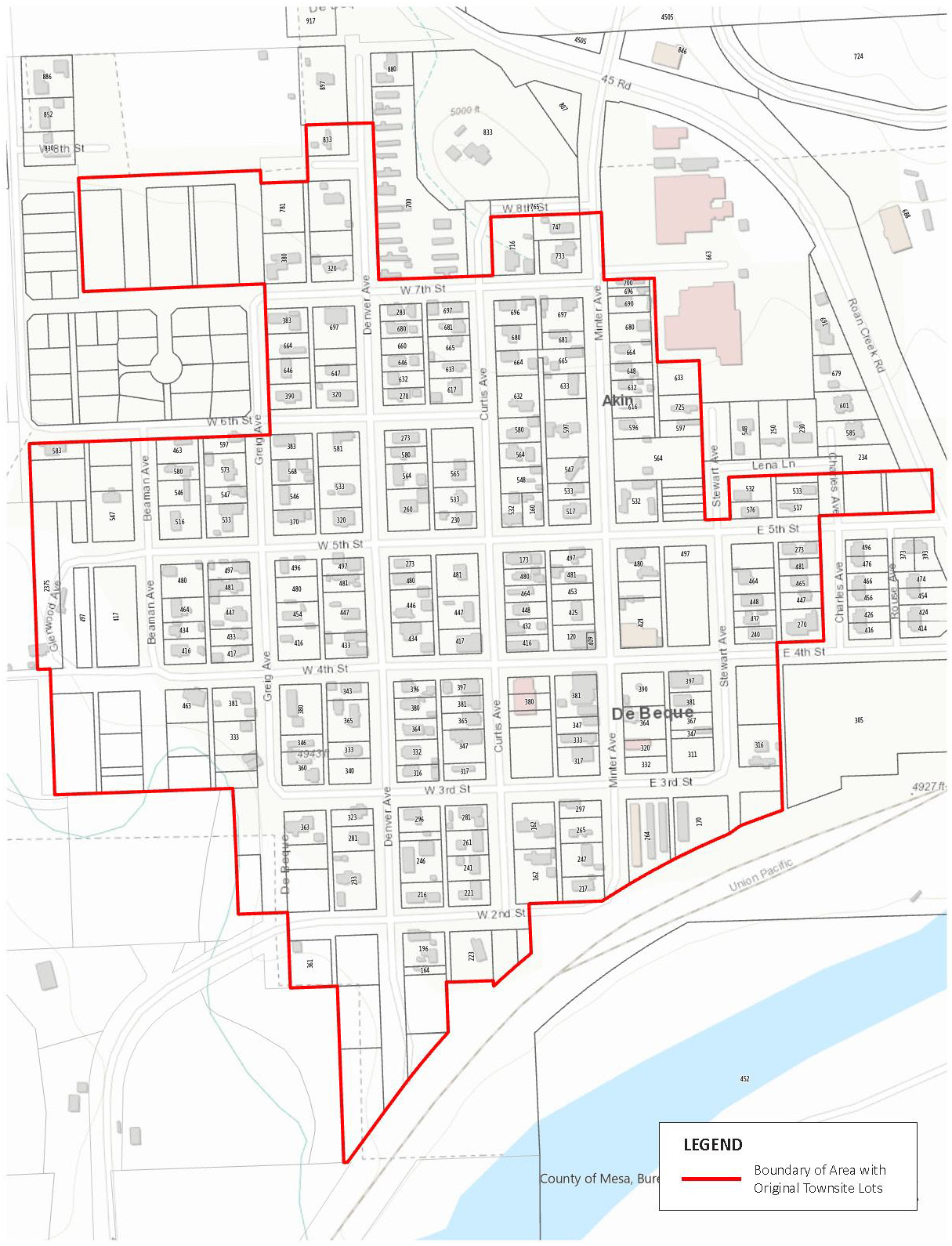
(Ord. No. 555 (Series 2025), Exh. 1, 11-18-2025)
Sec. 14.04.200. - Other definitions.
Other definitions are found in various sections of these regulations. Such other definitions sections further define relevant terms necessary for the enforcement of these regulations. The rules of construction prescribed in section 14.04.170 apply to all definitions in these regulations.
(Ord. No. 555 (Series 2025), Exh. 1, 11-18-2025)

