
Decatur City Zoning Code
ARTICLE 5
- ZONING DISTRICTS
Section 5.1 - Zoning Districts Established
The City is hereby divided into the following zoning districts. The Use, height, area regulations, and other standards, as set out herein apply to each district. The districts established herein shall be known as:
5.1.1 Established Districts
Table 1. Zoning Districts
5.1.2 SF-1, Single-Family Residential District
A.
General Purpose and Description. The SF-1, Single-Family Residential District is intended to provide for development of primarily detached single family residences for the purpose of large lot subdivisions of one-half (½) acre or greater and for lots in residential areas that are rural in nature.
B.
Permitted Uses. Uses permitted in this district are outlined in Section 6.1 Use Chart.
C.
Height Regulations. Two and one-half (2½) stories (see 7.1.1D. Height Regulations for additional height requirements).
D.
Area Regulations.
(1)
Size of Yards:
(a)
Minimum Front Yard: Thirty feet (30′).
(b)
Minimum Side Yard: Ten percent (10%) of the lot width, but not less than five feet (5') and not to exceed fifteen feet (15′).
(c)
Minimum Rear Yard: Fifteen feet (15′).
(2)
Size of Lots:
(a)
Minimum Lot Area: One-Family Dwelling Detached: One-half (½) acre (twenty-one thousand seven hundred eighty (21,780) square feet).
(b)
Minimum Lot Width: One-Family Dwelling Detached: One hundred feet (100′).
(c)
Minimum Lot Depth: One-Family Dwelling Detached: One hundred feet (100′).
(3)
Minimum Floor Area per Dwelling Unit: Fifteen hundred (1,500) square feet.
(4)
Maximum Lot Coverage: Twenty-five percent (25%), including main Structure and Accessory Buildings.
(5)
Parking Regulations:
(a)
A minimum of two (2) enclosed off-street parking spaces are required behind the front building line on the same lot as the main structure.
(b)
See Section 7.3 Off-Street Parking and Loading Regulations for additional requirements.
E.
Special Regulations.
(1)
Recreational vehicles, travel trailer or motor homes may not be used for on-site dwelling purposes.
(2)
Electrical fencing and barbed wire is prohibited as perimeter fencing except for containment of farm animals on parcels of one (1) or more acres.
(3)
Open storage is prohibited (except for materials for the resident's personal use or consumption such as firewood, garden materials, etc.).
(4)
Single-family homes with side entry garages where lot frontage is only to one (1) street shall have minimum of thirty feet (30′) from the door face of the garage or carport to the side property line for maneuvering.
(5)
For dwellings in existence prior to March 23, 2015, the elimination of a garage space by replacing a garage door with a building wall shall be permitted as long as there are two off-street parking spaces provided.
(6)
Site plan approval in accordance with 4.5.2A. Required Site Plan shall be required for all allowed non-residential uses (e.g., school, church, child care center).
(7)
Bingo operations shall meet the following standards:
(a)
If a "Religious Society" is located in a residential zoned district, charitable bingo shall be allowed.
(b)
Only a state licensed authorized organization shall engage in bingo operations within the City.
(c)
The following acts shall be prohibited in relation with or as a result of a Bingo Operations (also referred to as "Use"). The following is not an exhaustive list but is intended as illustrative of actions that violate the standards for conducting a Bingo Operations in a residential district:
(i)
Bingo Operations shall not be allowed within a residential structure.
(ii)
No external evidence of the Use shall be detectable at any lot line or beyond, including advertising, signs, smoke, dust, noise, fumes, glare, vibration, or electrical disturbance beyond the property line shall be allowed.
(iii)
No exterior storage of material, equipment, vehicles, and/or supplies used in conjunction with the Bingo Operations shall be allowed.
(iv)
In residential zoned districts, the parking shall meet parking requirements for C-2, Business Thoroughfare.
(v)
A maximum of one (1) commercial vehicle, capacity one (1) ton or less, may be used or parked on the property in connection with Bingo Operations. The commercial vehicle shall not be parked on the street.
(vi)
Regular deliveries by heavy load delivery trucks or vehicles in excess of one and one-half (1½) tons shall be prohibited.
(vii)
Outdoor merchandise shall not be offered or displayed for sale on the premises.
(viii)
Any need for parking shall be accommodated within the off-street parking provided and along the street frontage of the lot, except as prohibited by Subsection (5) above.
(ix)
A ready inventory of any commodity for sale shall not be allowed.
(x)
The Bingo Hall shall not accept customers or patrons or operate before 6:00 p.m. or after 11:00 p.m.
(xi)
Except as expressly allowed by and in accordance with this Ordinance and other applicable City Ordinances, outdoor activities such as play areas shall be prohibited.
(d)
The following acts shall be prohibited in relation with or as a result of a Bingo Operations (also referred to as "Use"). The following is not an exhaustive list but is intended as illustrative of actions that violate the standards for conducting a Bingo Operations in a C-O, C-1, C-1A, C-2, CD and PD Districts:
(i)
No smoke, dust, noise, fumes, glare, vibration, or electrical disturbance beyond the property line shall be allowed.
(ii)
No exterior storage of material, equipment, vehicles, and/or supplies used in conjunction with the Bingo Operations shall be allowed.
(iii)
Outdoor merchandise shall not be offered or displayed for sale on the premises.
(iv)
A ready inventory of any commodity for sale shall not be allowed.
(v)
Except as expressly allowed by and in accordance with this Ordinance and other applicable City Ordinances, outdoor activities such as play areas shall be prohibited.
(8)
Other regulations as established in Article 7. Development Standards.
F.
Performance Standards.
(1)
No retail or wholesale sales activity shall be conducted.
(2)
No activity shall be conducted that causes or creates abnormal noise, smoke, dust, obvious gases, odor, vibrations, electrical interference or radiation beyond the property line.
(Ord. No. 2018-07-13, § 2.02, 7-23-18; Ord. No. 2021-02-01, § 2.2, 2-8-21; Ord. No. 2024-08-22, § 2.01, 8-12-24)
5.1.3 SF-2, Single-Family Residential District
A.
General Purpose and Description. The SF-2, Single-Family Residential District is intended to provide for development of primarily detached single-family residences on lots of not less than eight thousand (8,000) square feet in size.
B.
Permitted Uses. Uses permitted in this district are outlined in Section 6.1 Use Chart.
C.
Height Regulations.
(1)
Two and one-half (2½) stories (see 7.1.1D. Height Regulations for additional height requirements).
(2)
Roof Projections, including without limitation, cooling towers, roof gables, chimneys and vent stacks, water stand pipes and tanks, church steeples, domes and spires may extend for an additional height not to exceed twenty (20) feet above the roof line.
D.
Area Regulations.
(1)
Size of Yards:
(a)
Minimum Front Yard: Twenty-five feet (25′).
(b)
Minimum Side Yard: Ten percent (10%) of the lot width, but not less than five feet (5') and not to exceed fifteen feet (15′).
(c)
Minimum Rear Yard: Ten feet (10′).
(2)
Size of Lots:
(a)
Minimum Lot Area: One-Family Dwelling Detached: Eight thousand (8,000) square feet.
(b)
Minimum Lot Width: One-Family Dwelling Detached: Fifty feet (50′).
(c)
Minimum Lot Depth: One-Family Dwelling Detached: Seventy feet (70′).
(3)
Minimum Floor Area per Dwelling Unit: One thousand (1,000) square feet.
(4)
Maximum Lot Coverage: Thirty-five percent (35%).
(5)
Parking Regulations:
(a)
A minimum of two (2) enclosed off-street parking spaces are required behind the front building line on the same lot as the main structure.
(b)
See Section 7.3 Off-Street Parking and Loading Regulations for additional requirements.
E.
Special Regulations.
(1)
Recreational vehicles, travel trailer or motor homes may not be used for on-site dwelling purposes.
(2)
Electrical fencing and barbed wire is prohibited as perimeter fencing except for containment of farm animals on parcels of one (1) or more acres.
(3)
Open storage is prohibited (except for materials for the resident's personal use or consumption such as firewood, garden materials, etc.)
(4)
Single-family homes with side entry garages where lot frontage is only to one street shall have minimum of thirty feet (30′) from the door face of the garage or carport to the side property line for maneuvering.
(5)
For dwellings in existence prior to March 23, 2015, the elimination of a garage space by replacing a garage door with a building wall shall be permitted as long as there are two off-street parking spaces provided.
(6)
Site plan approval in accordance with 4.5.2 A. Required Site Plan shall be required for all allowed non-residential uses (e.g., school, church, child care center).
(7)
Bingo operations shall meet the following standards:
(a)
If a "Religious Society" is located in a residential zoned district, charitable bingo shall be allowed.
(b)
Only a state licensed authorized organization shall engage in bingo operations within the City.
(c)
The following acts shall be prohibited in relation with or as a result of a Bingo Operations (also referred to as "Use"). The following is not an exhaustive list but is intended as illustrative of actions that violate the standards for conducting a Bingo Operations in a residential district:
(i)
Bingo Operations shall not be allowed within a residential structure.
(ii)
No external evidence of the Use shall be detectable at any lot line or beyond, including advertising, signs, smoke, dust, noise, fumes, glare, vibration, or electrical disturbance beyond the property line shall be allowed.
(iii)
No exterior storage of material, equipment, vehicles, and/or supplies used in conjunction with the Bingo Operations shall be allowed.
(iv)
In residential zoned districts, the parking shall meet parking requirements for C-2, Business Thoroughfare.
(v)
A maximum of one (1) commercial vehicle, capacity one (1) ton or less, may be used or parked on the property in connection with Bingo Operations. The commercial vehicle shall not be parked on the street.
(vi)
Regular deliveries by heavy load delivery trucks or vehicles in excess of one and one-half (1½) tons shall be prohibited.
(vii)
Outdoor merchandise shall not be offered or displayed for sale on the premises.
(viii)
Any need for parking shall be accommodated within the off-street parking provided and along the street frontage of the lot, except as prohibited by Subsection (5) above.
(ix)
A ready inventory of any commodity for sale shall not be allowed.
(x)
The Bingo Hall shall not accept customers or patrons or operate before 6:00 p.m. or after 11:00 p.m.
(xi)
Except as expressly allowed by and in accordance with this Ordinance and other applicable City Ordinances, outdoor activities such as play areas shall be prohibited.
(d)
The following acts shall be prohibited in relation with or as a result of a Bingo Operations (also referred to as "Use"). The following is not an exhaustive list but is intended as illustrative of actions that violate the standards for conducting a Bingo Operations in a C-O, C-1, C-1A, C-2, CD and PD Districts:
(i)
No smoke, dust, noise, fumes, glare, vibration, or electrical disturbance beyond the property line shall be allowed.
(ii)
No exterior storage of material, equipment, vehicles, and/or supplies used in conjunction with the Bingo Operations shall be allowed.
(iii)
Outdoor merchandise shall not be offered or displayed for sale on the premises.
(iv)
A ready inventory of any commodity for sale shall not be allowed.
(v)
Except as expressly allowed by and in accordance with this Ordinance and other applicable City Ordinances, outdoor activities such as play areas shall be prohibited.
(8)
Other regulations as established in Article 7. Development Standards.
F.
Performance Standards.
(1)
No retail or wholesale sales activity shall be conducted.
(2)
No activity shall be conducted that causes or creates abnormal noise, smoke, dust, obvious gases, odor, vibrations, electrical interference or radiation beyond the property line.
(Ord. No. 2018-07-13, § 2.02, 7-23-18; Ord. No. 2021-02-01, § 2.3, 2-8-21; Ord. No. 2024-08-22, § 2.02, 8-12-24; Ord. No. 2024-12-34, §§ 2.01, 2.02, 12-9-24)
5.1.4 TH, Townhouse Residential District
A.
General Purpose and Description. The TH, Townhouse Residential District is intended to provide for the development of primarily detached single-family residences on lots of not less than eight thousand (8,000) square feet in size, or attached single-family residences on lots of not less than two thousand (2,000) square feet per dwelling unit in size.
B.
Permitted Uses. Uses permitted in this district are outlined in Section 6.1 Use Chart.
C.
Height Regulations.
(1)
Three and one-half (3½) stories, not to exceed forty-five feet (45′) (see 7.1.1D. Height Regulations for additional height requirements).
(2)
All other detached buildings, including detached living units, shall not exceed two and one-half (2½) stories or 35′ in height.
(3)
Roof Projections, including without limitation, cooling towers, roof gables, chimneys and vent stacks, water stand pipes and tanks, church steeples, domes and spires may extend for an additional height not to exceed twenty (20) feet above the roof line.
D.
Area Regulations.
(1)
Size of Yards:
(a)
Minimum Front Yard: Twenty-five feet (25′).
(b)
Minimum Side Yard:
(i)
One-Family Dwelling Detached: Five feet (5′) or ten percent (10%) of the lot width, but not to exceed fifteen feet (15′).
(ii)
One-Family Dwelling Attached: See 7.1.1 F(8).
(c)
Minimum Rear Yard: Ten feet (10′).
(2)
Size of Lots:
(a)
Minimum Lot Area per Dwelling Unit:
(i)
One-Family Dwelling Detached: Eight thousand (8,000) square feet.
(ii)
One-Family Dwelling Attached: Two thousand (2,000) square feet.
(b)
Minimum Lot Width per Dwelling Unit:
(i)
One-Family Dwelling Detached: Fifty feet (50′).
(ii)
One-Family Dwelling Attached: Twenty feet (20′).
(c)
Minimum Lot Depth:
(i)
One-Family Dwelling Detached: One hundred feet (100′).
(ii)
One-Family Dwelling Attached: One hundred feet (100′).
(3)
Minimum Floor Area per Dwelling Unit:
(a)
One-Family Dwelling Detached: One thousand two hundred fifty (1,250) square feet.
(b)
One-Family Dwelling Attached: One thousand four hundred fifty (1,450) square feet.
(4)
Maximum Lot Coverage: Seventy percent (70%).
(5)
Parking Regulations:
(a)
A minimum of two (2) enclosed off-street parking spaces are required behind the front building line on the same lot as the main structure.
(b)
See Section 7.3 Off-Street Parking and Loading Regulations for additional requirements.
E.
Special Regulations.
(1)
One-Family Detached structures located within this District shall comply with all regulations for One-Family Detached Dwelling structures located in the SF-2, Single-Family Residential District.
(2)
Recreational vehicles, travel trailers, or motor homes may not be used for on-site dwelling purposes.
F.
Performance Standards.
(1)
No retail or wholesale sales activity shall be conducted.
(2)
No activity shall be conducted that causes or creates abnormal noise, smoke, dust, obvious gases, odor, vibrations, electrical interference or radiation beyond the property line.
(Ord. No. 2024-08-22, § 2.03, 8-12-24; Ord. No. 2024-12-34, §§ 2.03, 2.04, 12-9-24)
5.1.5 2F, Two-Family Residential District
A.
General Purpose and Description. The 2F, Two-Family Residential District is intended to provide for the development of primarily duplex style two-family housing, as well as some townhomes and single family dwellings.
B.
Permitted Uses. Uses permitted in this district are outlined in Section 6.1 Use Chart.
C.
Height Regulations.
(1)
Two (2) stories (see 7.1.1D. Height Regulations for additional height requirements).
(2)
Maximum allowed height of a Single Family Detached dwelling shall comply with the height regulations for One-Family Detached dwelling structures located in the SF-2, Single-Family Residential District.
(3)
Maximum allowed height of a Single Family Attached dwelling shall comply with the height regulations for One-Family Attached Dwelling structures located in the TH, Townhouse Residential District.
(4)
Roof Projections, including without limitation, cooling towers, roof gables, chimneys and vent stacks, water stand pipes and tanks, church steeples, domes and spires may extend for an additional height not to exceed twenty (20) feet above the roof line.
D.
Area Regulations.
(1)
Size of Yards:
(a)
Minimum Front Yard: Twenty-five feet (25′).
(b)
Minimum Side Yard: Five feet (5′) or ten percent (10%) of the lot width, but not to exceed fifteen feet (15′).
(c)
Minimum Side Yard One-Family Dwelling Attached: Shall comply with the side yard regulations for One-Family Attached Dwelling structures located in the TH, Townhouse Residential District.
(d)
Minimum Rear Yard: Ten feet (10′).
(2)
Size of Lots:
(a)
Minimum Lot Area per Dwelling Unit:
(i)
One-Family Dwelling Detached: Eight thousand (8,000) square feet.
(ii)
One-Family Dwelling Attached: Two thousand (2,000) square feet.
(iii)
Two-Family Dwelling: Four thousand (4,000) square feet.
(b)
Minimum Lot Width per Dwelling Unit:
(i)
One-Family Dwelling Detached: Seventy feet (70′).
(ii)
One-Family Dwelling Attached: Thirty-five feet (35′).
(iii)
Two-Family Dwelling: Seventy feet (70′).
(c)
Minimum Lot Depth:
(i)
One-Family Dwelling Detached: Seventy feet (70′).
(ii)
One-Family Dwelling Attached: Seventy feet (70′).
(iii)
Two-Family Dwelling: Seventy feet (70′).
(3)
Minimum Floor Area per Dwelling Unit:
(a)
One-Family Dwelling Detached: One thousand (1,000) square feet.
(b)
One-Family Dwelling Attached: One thousand four hundred fifty (1,450) square feet.
(c)
Two-Family Dwelling: Six hundred (600) square feet, plus an additional two hundred (200) square feet per additional bedroom.
(4)
Maximum Lot Coverage: Forty percent (40%).
(a)
One-Family Dwelling Detached: Thirty-five percent (35%).
(b)
One-Family Dwelling Attached: Seventy percent (70%).
(c)
Two-Family Dwelling: Forty percent (40%).
(5)
Parking Regulations:
(a)
A minimum of two (2) enclosed off-street parking spaces are required behind the front building line on the same lot as the main structure.
(b)
See Section 7.3 Off-Street Parking and Loading Regulations for additional requirements.
E.
Special Regulations.
(1)
One-Family Detached and One-Family Attached structures located within this District shall comply with all regulations for One-Family Detached and One-Family Attached Dwelling structures located in the applicable SF-2, Single-Family Residential District or TH, Townhouse Residential District.
(2)
Recreational vehicles, travel trailers, or motor homes may not be used for on-site dwelling purposes.
F.
Performance Standards.
(1)
No retail or wholesale sales activity shall be conducted.
(2)
No activity shall be conducted that causes or creates abnormal noise, smoke, dust, obvious gases, odor, vibrations, electrical interference or radiation beyond the property line.
(Ord. No. 2024-08-22, § 2.04, 8-12-24; Ord. No. 2024-12-34, § 2.05, 12-9-24)
5.1.6 MF, Multiple-Family Residential District
A.
General Purpose and Description. The MF, Multiple-Family Residential District is intended to provide for development of Multi-Family Dwellings, Single Family Attached Dwellings, Single Family Detached Dwellings, and Two Family Dwellings. This District serves as a buffer between nonresidential development or heavy automobile traffic and a medium or low density residential development.
B.
Permitted Uses. Uses permitted in this district are outlined in Section 6.1 Use Chart.
C.
Height Regulations.
(1)
Maximum allowed height for multi-family structures shall be the lesser of forty-five feet (45′) or three (3) stories, provided that one (1) additional foot for a third story shall be added to the width and depth of side and rear yards when the multi-family use abuts a nonresidential use.
(2)
Maximum allowed height for Accessory Structures in this District shall be the lesser of fifteen feet (15′) or one (1) story.
(3)
Maximum allowed height of a Single Family Detached dwelling shall comply with the height regulations for One-Family Detached Dwelling structures located in the SF-2, Single-Family Residential District.
(4)
Maximum allowed height of a Single Family Attached dwelling shall comply with the height regulations for One-Family Attached Dwelling structures located in the TH, Townhouse Residential District.
(5)
Maximum allowed height of a Two-Family dwelling shall comply with the height regulations for Two-Family Dwelling structures located in the 2F, Two-Family Residential District.
(6)
Roof Projections, including without limitation, cooling towers, roof gables, chimneys and vent stacks, water stand pipes and tanks, church steeples, domes and spires may extend for an additional height not to exceed twenty (20) feet above the roof line.
(7)
See 7.1.1D. Height Regulations for additional height requirements.
D.
Area Regulations.
(1)
Size of Yards:
(a)
Minimum Front Yard: Twenty-five feet (25′).
(b)
Minimum Side Yard: Five feet (5′) or ten percent (10%) of the lot width, but not to exceed fifteen feet (15′).
(i)
When adjacent to a Residential Use, the side yard shall be a minimum of sixty feet (60′).
(ii)
Interior building separation is regulated by E(2) below.
(c)
Minimum Side Yard One-Family Dwelling Detached: Shall comply with the side yard regulations for One-Family Detached Dwelling structures located in the SF-2, Single-Family Residential District.
(d)
Minimum Side Yard One-Family Dwelling Attached: Shall comply with the side yard regulations for One-Family Attached Dwelling structures located in the TH, Townhouse Residential District.
(e)
Minimum Side Yard Two-Family Dwelling: Shall comply with the side yard regulations for Two-Family Dwelling structures located in the 2F, Two-Family Residential District.
(f)
Minimum Rear Yard:
(i)
One-Family Dwelling Detached: Ten feet (10′).
(ii)
One-Family Dwelling Attached: Ten feet (10′).
(iii)
Two-Family Dwelling: Ten feet (10′).
(iv)
Multi-Family: Fifteen feet (15′).
(2)
Size of Lots:
(a)
Minimum Lot Area per Dwelling Unit:
(i)
One-Family Dwelling Detached: Eight thousand (8,000) square feet.
(ii)
One-Family Dwelling Attached: Two thousand five hundred (2,500) square feet.
(iii)
Two-Family Dwelling: Four thousand (4,000) square feet.
(iv)
Multi-Family Two Stories: Two thousand one hundred (2,100) square feet per unit.
(v)
For each Additional Unit on each Additional Story over Two: Six hundred (600) square feet.
(b)
Minimum Lot Width per Dwelling Unit.
(i)
One-Family Dwelling Detached: Fifty feet (50′) per Dwelling Unit.
(ii)
One-Family Dwelling Attached: Thirty-five feet (35′) per Dwelling Unit.
(iii)
Two-Family Dwelling: Thirty-five feet (35′) per Dwelling Unit.
(iv)
Multi-Family: Seventy feet (70′).
(c)
Minimum Lot Depth:
(i)
One-Family Dwelling Detached: Seventy feet (70′).
(ii)
One-Family Dwelling Attached: Seventy feet (70′).
(iii)
Two-Family Dwelling: Seventy feet (70′).
(iv)
Multi-Family: One hundred feet (100′).
(3)
Minimum Floor Area per Dwelling Unit.
(a)
One-Family Dwelling Detached: One thousand (1,000) square feet.
(b)
One-Family Dwelling Attached: One thousand four hundred fifty (1,450) square feet.
(c)
Two-Family Dwelling: Six hundred (600) square feet, plus an additional two hundred (200) square feet per additional bedroom.
(d)
Multi-Family: Six hundred (600) square feet, plus an additional one hundred fifty (150) square feet per additional bedroom.
(4)
Maximum Lot Coverage.
(a)
One-Family Dwelling Detached: Thirty-five percent (35%).
(b)
One-Family Dwelling Attached: Seventy percent (70%).
(c)
Two-Family Dwelling: Forty percent (40%).
(d)
Multi-Family: Fifty percent (50%).
(5)
Parking Regulations: See Section 7.3 Off-Street Parking and Loading Regulations for requirements.
E.
Special Regulations.
(1)
Maximum Floor Area Ratio (FAR): 4:1.
(2)
Building Separation: A minimum separation of fifteen feet (15′) shall be required between one-story buildings. A minimum separation of twenty feet (20′) shall be required for a two-story building adjacent to a one-story building. A minimum separation of twenty-five feet (25′) shall be required for a three-story building adjacent to a one-story, two-story or three-story building.
(3)
Maximum Density: Twenty-one (21) dwelling units per acre.
(4)
Where Inner Courts exist, the faces of all opposite walls in such Courts shall be a minimum distance of thirty (30) feet apart, and no balcony or canopy shall extend into such Court area for a distance greater than five (5) feet or one-sixth (⅙) of the Court width.
(5)
No parking area, storage area, or required open space for one Building shall be computed as being the open space, yard or area requirements for any other dwelling or other use.
(6)
No single wall or side of any Multiple Family Dwelling Structure shall exceed two hundred (200) feet in length and space shall be provided between all structures per (2) above to assure reasonable access for fire-fighting equipment.
(7)
No single structure designed or erected for Multiple Family occupancy shall contain more than twelve thousand (12,000) square feet per floor, and each structure shall be spaced in relation to other structures and provide the required yards and open space as required by the City of Decatur, Texas Design Standards, and other applicable City ordinances. (The limitation on square footage does not apply to a Multiple Family structure when it is located within a C-2 Zoning District. See Section 5.1.11. All other regulations apply.)
(8)
No balcony or porch, or any portion of the Building may extend into a required side yard, except that a roof may overhang such side yard not to exceed four (4) feet.
(9)
The front door of each Dwelling Unit shall be no more than one-hundred-fifty (150) feet from a fire lane (measured by an unobstructed pathway, or route, for fire hoses).
(10)
Boats, campers, trailers, and other recreational vehicles shall be prohibited unless oversize parking areas are provided as part of the approved Site Plan. This parking area shall not be used to meet the minimum parking requirements and shall not be visible from a public street.
(11)
Recreational vehicles, travel trailer or motor homes may not be used for on-site dwelling purposes.
(12)
Open storage is prohibited.
(13)
Accessory Structures shall comply with the requirements of Section 7.6 Accessory Structure Regulations.
(14)
Site plan approval in accordance with Subsection 4.5.2A shall be required for all allowed non-residential uses (e.g., school, church, child care center).
(15)
One-Family Detached, One-Family Attached, and Two-Family structures located within this District shall comply with all regulations for One-Family Detached, One-Family Attached, and Two-Family Dwelling structures located in the applicable SF-2, Single-Family Residential District, TH, Townhouse Residential District, or 2F, Two-Family Residential District.
(16)
Other regulations as established in Article 7. Development Standards.
F.
Performance Standards.
(1)
No retail or wholesale sales activity shall be conducted.
(2)
No activity shall be conducted that causes or creates abnormal noise, smoke, dust, obvious gases, odor, vibrations, electrical interference or radiation beyond the property line.
(Ord. No. 2019-01-07, § 2, 1-28-19; Ord. No. 2023-12-37, § 2.01, 12-18-23; Ord. No. 2024-12-34, § 2.06, 12-9-24)
5.1.7 MHD, Manufactured Home District
A.
General Purpose and Description. The MHD, Manufactured Home District is intended to provide for the placement of HUD-Code Manufactured Homes on approved lots.
B.
Permitted Uses. Uses permitted in this district are outlined in Section 6.1 Use Chart.
C.
Height Regulations.
(1)
Two (2) stories for permanent buildings.
(2)
Twenty feet (20′) in height maximum for all manufactured homes.
(3)
The average height of the structure's frame above ground elevation, measured at ninety (90) degrees to the frame, shall not exceed three feet (3′).
(4)
Maximum allowed height of a Single Family Detached dwelling shall comply with the height regulations for One-Family Detached Dwelling structures located in the SF-2, Single-Family Residential District.
D.
Area Regulations.
(1)
Size of Yards:
(a)
Minimum Front Yard: Twenty-five feet (25′).
(b)
Minimum Side Yard: Five feet (5′) or ten percent (10%) of the lot width, but not to exceed fifteen feet (15′).
(i)
Where the MHD, Manufactured Home District abuts upon a District boundary line dividing such District from a Residential District, a minimum ten (10) foot side yard shall be provided on the adjacent to the Residential District.
(c)
Minimum Rear Yard: Fifteen feet (15′).
(2)
Size of Lots:
(a)
Minimum Lot Area:
(i)
One-Family Dwelling Detached: Eight thousand (8,000) square feet.
(ii)
Manufactured Home Dwelling: Three thousand five hundred (3,500) square feet.
(b)
Minimum Lot Width:
(i)
One-Family Dwelling Detached: Fifty feet (50′).
(ii)
Manufactured Home Dwelling: Forty feet (40′).
(c)
Minimum Lot Depth:
(i)
One-Family Dwelling Detached: Seventy feet (70′).
(ii)
Manufactured Home Dwelling: Seventy feet (70′).
(3)
Minimum Floor Area per Dwelling Unit:
(a)
One-Family Dwelling Detached: One thousand (1,000) square feet.
(b)
Manufactured Home Dwelling: One thousand two hundred fifty (1,250) square feet.
(4)
Maximum Lot Coverage:
(a)
One-Family Dwelling Detached: Thirty-five percent (35%).
(b)
Manufactured Home Dwelling: Sixty percent (60%).
(5)
Parking Regulations:
(a)
A minimum of two (2) enclosed off-street parking spaces are required behind the front building line on the same lot as the main structure.
(b)
See Section 7.3 Off-Street Parking and Loading Regulations for additional requirements.
E.
Special Regulations.
(1)
Maximum Floor Area Ratio (FAR) for the MHD, Manufactured Home District: 1:2.
(2)
One-Family Detached Dwellings shall comply with all regulations for One-Family Detached Dwelling structures in the SF-2, Single-Family Residential District.
F.
Performance Standards.
(1)
No retail or wholesale sales activity shall be conducted.
(2)
No activity shall be conducted that causes or creates abnormal noise, smoke, dust, obvious gases, odor, vibrations, electrical interference or radiation beyond the property line.
(Ord. No. 2024-12-34, § 2.07, 12-9-24)
5.1.8 C-O, Office District
A.
General Purpose and Description. The C-O, Office District is intended to provide for the development of primarily a professional or administrative office buildings.
B.
Permitted Uses. Uses permitted in this district are outlined in Section 6.1 Use Chart.
C.
Height Regulations.
(1)
Three (3) stories.
(2)
Roof Projections, including without limitation, cooling towers, roof gables, chimneys and vent stacks, water stand pipes and tanks, church steeples, domes and spires may extend for an additional height not to exceed twenty (20) feet above the roof line.
D.
Area Regulations.
(1)
Size of Yards:
(a)
Minimum Front Yard: Twenty-five feet (25′).
(b)
Minimum Side Yard: Zero feet (0′).
(i)
Where a commercial, retail, or other nonresidential use abuts upon a District boundary line dividing such District from a Residential District, a minimum ten (10) foot side yard shall be provided on the side adjacent to the Residential District.
(c)
Minimum Rear Yard: Ten feet (10′).
(2)
Size of Lots:
(a)
Minimum Lot Area: N/A.
(b)
Minimum Lot Width: N/A.
(c)
Minimum Lot Depth: N/A.
(3)
Maximum Floor Area Ratio (FAR): 1:2.
(4)
Parking Regulations: See Section 7.3 Off-Street Parking and Loading Regulations for requirements.
E.
Special Regulations.
(1)
Bingo operations shall meet the following standards:
(a)
If a "Religious Society" is located in a residential zoned district, charitable bingo shall be allowed.
(b)
Only a state licensed authorized organization shall engage in bingo operations within the City.
(c)
The following acts shall be prohibited in relation with or as a result of a Bingo Operations (also referred to as "Use"). The following is not an exhaustive list but is intended as illustrative of actions that violate the standards for conducting a Bingo Operations in a residential district:
(i)
Bingo Operations shall not be allowed within a residential structure.
(ii)
No external evidence of the Use shall be detectable at any lot line or beyond, including advertising, signs, smoke, dust, noise, fumes, glare, vibration, or electrical disturbance beyond the property line shall be allowed.
(iii)
No exterior storage of material, equipment, vehicles, and/or supplies used in conjunction with the Bingo Operations shall be allowed.
(iv)
In residential zoned districts, the parking shall meet parking requirements for C-2, Business Thoroughfare.
(v)
A maximum of one (1) commercial vehicle, capacity one (1) ton or less, may be used or parked on the property in connection with Bingo Operations. The commercial vehicle shall not be parked on the street.
(vi)
Regular deliveries by heavy load delivery trucks or vehicles in excess of one and one-half (1½) tons shall be prohibited.
(vii)
Outdoor merchandise shall not be offered or displayed for sale on the premises.
(viii)
Any need for parking shall be accommodated within the off-street parking provided and along the street frontage of the lot, except as prohibited by Subsection (5) above.
(ix)
A ready inventory of any commodity for sale shall not be allowed.
(x)
The Bingo Hall shall not accept customers or patrons or operate before 6:00 p.m. or after 11:00 p.m.
(xi)
Except as expressly allowed by and in accordance with this Ordinance and other applicable City Ordinances, outdoor activities such as play areas shall be prohibited.
(d)
The following acts shall be prohibited in relation with or as a result of a Bingo Operations (also referred to as "Use"). The following is not an exhaustive list but is intended as illustrative of actions that violate the standards for conducting a Bingo Operations in a C-O, C-1, C-1A, C-2, CD and PD Districts:
(i)
No smoke, dust, noise, fumes, glare, vibration, or electrical disturbance beyond the property line shall be allowed.
(ii)
No exterior storage of material, equipment, vehicles, and/or supplies used in conjunction with the Bingo Operations shall be allowed.
(iii)
Outdoor merchandise shall not be offered or displayed for sale on the premises.
(iv)
A ready inventory of any commodity for sale shall not be allowed.
(v)
Except as expressly allowed by and in accordance with this Ordinance and other applicable City Ordinances, outdoor activities such as play areas shall be prohibited.
(2)
Recreational vehicles, travel trailers, or motor homes may not be used for on-site dwelling purposes.
F.
Performance Standards.
(1)
No exchange of goods or sales shall be conducted on the property other than that associated with snack bars, cigar stands and other similar incidental activities.
(2)
No merchandise other than samples shall be displayed, and all merchandise shall be stored and displayed within a building and not visible from outside of the building.
(Ord. No. 2018-07-13, § 2.02, 7-23-18; Ord. No. 2024-08-22, § 2.05, 8-12-24)
5.1.9 C-1, Restricted Business District
A.
General Purpose and Description. The C-1, Restricted Business District is intended to provide for the development of primarily low-intensity retail and service uses usually near existing residential areas.
B.
Permitted Uses. Uses permitted in this district are outlined in Section 6.1 Use Chart.
C.
Height Regulations.
(1)
Maximum allowed height for all nonresidential structures shall be three (3) stories.
(2)
Maximum allowed height of a Single Family Detached dwelling shall comply with the height regulations for One-Family Detached Dwelling structures located in the SF-2, Single-Family Residential District.
(3)
Maximum allowed height of a Single Family Attached dwelling shall comply with the height regulations for One-Family Attached Dwelling structures located in the TH, Townhouse Residential District.
(4)
Maximum allowed height of a Two Family dwelling shall comply with the height regulations for Two-Family Dwelling structures located in the 2F, Two-Family Residential District.
D.
Area Regulations.
(1)
Size of Yards:
(a)
Minimum Front Yard: Twenty-five feet (25′).
(b)
Minimum Side Yard: Zero feet (0′).
(i)
Where a commercial, retail, or other nonresidential use abuts upon a District boundary line dividing such District from a Residential District, a minimum ten (10) foot side yard shall be provided on the side adjacent to the Residential District.
(c)
Minimum Side Yard for residential dwelling structures shall comply with the side yard regulations for One-Family Detached Dwelling, One-Family Attached Dwelling, and Two Family Dwelling structures located in the applicable SF-2, Single-Family Residential District, TH, Townhouse Residential District, or 2F, Two-Family Residential District.
(d)
Minimum Rear Yard: Ten feet (10′).
(2)
Size of Lots:
(a)
Minimum Lot Area:
(i)
Minimum Lot Area for residential dwelling structures shall comply with the lot area regulations for One-Family Detached Dwelling, One-Family Attached Dwelling, and Two Family Dwelling structures located in the applicable SF-2, Single-Family Residential District, TH, Townhouse Residential District, or 2F, Two-Family Residential District.
(ii)
Minimum Lot Area for nonresidential structures: N/A.
(b)
Minimum Lot Width:
(i)
Minimum Lot Width for residential dwelling structures shall comply with the lot area regulations for One-Family Detached Dwelling, One-Family Attached Dwelling, and Two Family Dwelling structures located in the applicable SF-2, Single-Family Residential District, TH, Townhouse Residential District, or 2F, Two-Family Residential District.
(ii)
Minimum Lot Width for nonresidential structures: N/A.
(c)
Minimum Lot Depth: N/A.
(i)
Minimum Lot Depth for residential dwelling structures shall comply with the lot area regulations for One-Family Detached Dwelling, One-Family Attached Dwelling, and Two Family Dwelling structures located in the applicable SF-2, Single-Family Residential District, TH, Townhouse Residential District, or 2F, Two-Family Residential District.
(ii)
Minimum Lot Depth for nonresidential structures: N/A.
(3)
Maximum Floor Area Ratio (FAR) for nonresidential structures: 1:2.
(4)
Parking Regulations: See Section 7.3 Off-Street Parking and Loading Regulations for requirements.
E.
Special Regulations.
(1)
Residential dwelling structures shall comply with all regulations for One-Family Detached, One-Family Attached, and Two-Family Dwelling structures located in the applicable SF-2, Single-Family Residential District, TH, Townhouse Residential District, or 2F, Two-Family Residential District.
(2)
Bingo operations shall meet the following standards:
(a)
If a "Religious Society" is located in a residential zoned district, charitable bingo shall be allowed.
(b)
Only a state licensed authorized organization shall engage in bingo operations within the City.
(c)
The following acts shall be prohibited in relation with or as a result of a Bingo Operations (also referred to as "Use"). The following is not an exhaustive list but is intended as illustrative of actions that violate the standards for conducting a Bingo Operations in a residential district:
(i)
Bingo Operations shall not be allowed within a residential structure.
(ii)
No external evidence of the Use shall be detectable at any lot line or beyond, including advertising, signs, smoke, dust, noise, fumes, glare, vibration, or electrical disturbance beyond the property line shall be allowed.
(iii)
No exterior storage of material, equipment, vehicles, and/or supplies used in conjunction with the Bingo Operations shall be allowed.
(iv)
In residential zoned districts, the parking shall meet parking requirements for C-2, Business Thoroughfare.
(v)
A maximum of one (1) commercial vehicle, capacity one (1) ton or less, may be used or parked on the property in connection with Bingo Operations. The commercial vehicle shall not be parked on the street.
(vi)
Regular deliveries by heavy load delivery trucks or vehicles in excess of one and one-half (1½) tons shall be prohibited.
(vii)
Outdoor merchandise shall not be offered or displayed for sale on the premises.
(viii)
Any need for parking shall be accommodated within the off-street parking provided and along the street frontage of the lot, except as prohibited by Subsection (5) above.
(ix)
A ready inventory of any commodity for sale shall not be allowed.
(x)
The Bingo Hall shall not accept customers or patrons or operate before 6:00 p.m. or after 11:00 p.m.
(xi)
Except as expressly allowed by and in accordance with this Ordinance and other applicable City Ordinances, outdoor activities such as play areas shall be prohibited.
(d)
The following acts shall be prohibited in relation with or as a result of a Bingo Operations (also referred to as "Use"). The following is not an exhaustive list but is intended as illustrative of actions that violate the standards for conducting a Bingo Operations in a C-O, C-1, C-1A, C-2, CD and PD Districts:
(i)
No smoke, dust, noise, fumes, glare, vibration, or electrical disturbance beyond the property line shall be allowed.
(ii)
No exterior storage of material, equipment, vehicles, and/or supplies used in conjunction with the Bingo Operations shall be allowed.
(iii)
Outdoor merchandise shall not be offered or displayed for sale on the premises.
(iv)
A ready inventory of any commodity for sale shall not be allowed.
(v)
Except as expressly allowed by and in accordance with this Ordinance and other applicable City Ordinances, outdoor activities such as play areas shall be prohibited.
(3)
Recreational vehicles, travel trailers, or motor homes may not be used for on-site dwelling purposes.
F.
Performance Standards.
(1)
No wholesale sales shall be conducted in the C-1, Restricted Business District.
(2)
No merchandise or equipment shall be stored or displayed outside of a building.
(3)
In the C-1, Restricted Business District, all products shall be sold and all services rendered inside a building, except that banks and savings and loan establishments may have drive-up service.
(4)
No noise, smoke, radiation, vibration or concussion, heat or glare shall be produced that is perceptible outside of a building and no dust, fly ash or gas that is toxic, caustic or obviously injurious to humans or property shall be produced.
(Ord. No. 2018-07-13, § 2.02, 7-23-18; Ord. No. 2024-08-22, § 2.06, 8-12-24)
5.1.10 C-1A, Decatur Square Business District
A.
General Purpose and Description. The C-1A, Decatur Square Business District is intended to provide for and strengthen the development of the mixed-use, pedestrian-oriented nature of the existing nine-block historic downtown area that surrounds the courthouse.
B.
Permitted Uses. Uses permitted in this district are outlined in Section 6.1 Use Chart.
C.
Height Regulations.
(1)
Three (3) stories.
(2)
Roof Projections, including without limitation, cooling towers, roof gables, chimneys and vent stacks, water stand pipes and tanks, church steeples, domes and spires may extend for an additional height not to exceed twenty (20) feet above the roof line.
D.
Area Regulations.
(1)
Size of Yards:
(a)
Minimum Front Yard: Zero feet (0′).
(b)
Minimum Side Yard: Zero feet (0′).
(i)
Where a commercial, retail, or other nonresidential use abuts upon a District boundary line dividing such District from a Residential District, a minimum ten (10) foot side yard shall be provided on the side adjacent to the Residential District.
(c)
Minimum Rear Yard: Zero feet (0′).
(2)
Size of Lots:
(a)
Minimum Lot Area: N/A.
(b)
Minimum Lot Width: N/A.
(c)
Minimum Lot Depth: N/A.
(3)
Maximum Floor Area Ratio (FAR): 2:1.
(4)
Parking Regulations: See Section 7.3 Off-Street Parking and Loading Regulations for requirements.
E.
Special Regulations.
(1)
The following Multiple Family Dwelling uses shall be allowed within the C-1A, Decatur Square Business District upon issuance of a Specific Use Permit approved in accordance with this Ordinance: (1) as a Loft Dwelling or Live-Above Unit on upper floors of a building above a non-residential use; or (2) on the first floor of a building when part of a Mixed Use Development that includes commercial, retail and office uses.
(2)
Single-Family Attached Structures located within this District shall comply with all regulations for Townhome Structures located in the TH, Townhome Residential District with the exception of size of yards, minimum floor area, and parking which shall be regulated in accordance with the C-1A area regulations.
(3)
Single-Family Detached Structures located within this District shall comply with all regulations for Single-Family Structures located in the SF-2, Single-family Residential District with the exception of size of yards, minimum floor area, and parking which shall be regulated in accordance with the C-1A area regulations.
(4)
Bingo operations shall meet the following standards:
(a)
If a "Religious Society" is located in a residential zoned district, charitable bingo shall be allowed.
(b)
Only a state licensed authorized organization shall engage in bingo operations within the City.
(c)
The following acts shall be prohibited in relation with or as a result of a Bingo Operations (also referred to as "Use"). The following is not an exhaustive list but is intended as illustrative of actions that violate the standards for conducting a Bingo Operations in a residential district:
(i)
Bingo Operations shall not be allowed within a residential structure.
(ii)
No external evidence of the Use shall be detectable at any lot line or beyond, including advertising, signs, smoke, dust, noise, fumes, glare, vibration, or electrical disturbance beyond the property line shall be allowed.
(iii)
No exterior storage of material, equipment, vehicles, and/or supplies used in conjunction with the Bingo Operations shall be allowed.
(iv)
In residential zoned districts, the parking shall meet parking requirements for C-2, Business Thoroughfare.
(v)
A maximum of one (1) commercial vehicle, capacity one (1) ton or less, may be used or parked on the property in connection with Bingo Operations. The commercial vehicle shall not be parked on the street.
(vi)
Regular deliveries by heavy load delivery trucks or vehicles in excess of one and one-half (1½) tons shall be prohibited.
(vii)
Outdoor merchandise shall not be offered or displayed for sale on the premises.
(viii)
Any need for parking shall be accommodated within the off-street parking provided and along the street frontage of the lot, except as prohibited by Subsection (5) above.
(ix)
A ready inventory of any commodity for sale shall not be allowed.
(x)
The Bingo Hall shall not accept customers or patrons or operate before 6:00 p.m. or after 11:00 p.m.
(xi)
Except as expressly allowed by and in accordance with this Ordinance and other applicable City Ordinances, outdoor activities such as play areas shall be prohibited.
(d)
The following acts shall be prohibited in relation with or as a result of a Bingo Operations (also referred to as "Use"). The following is not an exhaustive list but is intended as illustrative of actions that violate the standards for conducting a Bingo Operations in a C-O, C-1, C-1A, C-2, CD and PD Districts:
(i)
No smoke, dust, noise, fumes, glare, vibration, or electrical disturbance beyond the property line shall be allowed.
(ii)
No exterior storage of material, equipment, vehicles, and/or supplies used in conjunction with the Bingo Operations shall be allowed.
(iii)
Outdoor merchandise shall not be offered or displayed for sale on the premises.
(iv)
A ready inventory of any commodity for sale shall not be allowed.
(v)
Except as expressly allowed by and in accordance with this Ordinance and other applicable City Ordinances, outdoor activities such as play areas shall be prohibited.
(5)
Recreational vehicles, travel trailers, or motor homes may not be used for on-site dwelling purposes.
F.
Performance Standards.
(1)
Wholesale offices and sample rooms shall be permitted in the C-1A, Decatur Square Business District.
(2)
No merchandise or equipment shall be stored or displayed outside of a building.
(3)
No noise, smoke, radiation, vibration or concussion, heat or glare shall be produced that is perceptible outside of a building and no dust, fly ash or gas that is toxic, caustic or obviously injurious to humans or property shall be produced.
(Ord. No. 2018-05-06, § 2.02, 5-29-18; Ord. No. 2018-07-13, § 2.02, 7-23-18; Ord. No. 2024-08-22, § 2.07, 8-12-24; Ord. No. 2024-12-34, § 2.08, 12-9-24)
5.1.11 C-2, Thoroughfare Business District
A.
General Purpose and Description. The C-2, Thoroughfare Business District is intended to provide for development of a mixture of relatively high intensity general retail and service uses usually oriented to major thoroughfare and includes high density Multi-Family Dwelling units greater than four (4) family units which may exceed 12,000 square feet. Compatible uses include office, retail, some types of commercial and entertainment uses which should generally be located along high-volume thoroughfares. The characteristics of each development site should be designed in such a manner as to create an attractive appearance from the thoroughfare.
B.
Permitted Uses. Uses permitted in this district are outlined in Section 6.1 Use Chart.
C.
Height Regulations.
(1)
Maximum allowed height for nonresidential structures shall be twenty (20) stories, provided that one (1) additional foot for each story above two (2) stories shall be added to the width and depth of side and rear yards when the nonresidential use abuts any residential use.
(2)
Roof Projections, including without limitation, cooling towers, roof gables, chimneys and vent stacks, water stand pipes and tanks, church steeples, domes and spires may extend for an additional height not to exceed twenty (20) feet above the roof line.
D.
Area Regulations for Nonresidential Uses.
(1)
Size of Yards:
(a)
Minimum Front Yard: Twenty-five feet (25′).
(i)
Gasoline service station pump islands may be located up to eighteen feet (18′) from the front property line.
(b)
Minimum Side Yard: Zero feet (0′).
(i)
Where a commercial, retail, or other nonresidential use abuts upon a District boundary line dividing such District from a Residential District, a minimum ten (10) foot side yard shall be provided on the side adjacent to the Residential District.
(c)
Minimum Side Yard for Multi-Family structures shall comply with the side yard regulations for Multi-Family structures located in the MF, Multiple-Family Residential District.
(d)
Minimum Rear Yard.
(i)
Multi-Family: Fifteen feet (15′).
(ii)
Nonresidential: Ten feet (10′).
(2)
Size of Lots:
(a)
Minimum Lot Area:
(i)
Multi-Family Two Stories: Two thousand one hundred (2,100) square feet per unit.
(ii)
Multi-Family for each Additional Unit on each Additional Story over two (2): Six hundred (600) square feet.
(iii)
Nonresidential: N/A.
(b)
Minimum Lot Width:
(i)
Multi-Family: Seventy feet (70′).
(ii)
Nonresidential: N/A
(c)
Minimum Lot Depth:
(i)
Multi-Family: One hundred feet (100′).
(ii)
Nonresidential: N/A.
(3)
Maximum Floor Area Ratio (FAR): 2:1.
(a)
Multi-Family: 4:1.
(b)
Nonresidential: 2:1.
(4)
Parking Regulations: See Section 7.3 Off-Street Parking and Loading Regulations for requirements for applicable Nonresidential Use development.
E.
Special Regulations.
(1)
Drive-up or drive-in service is permitted at any nonresidential establishment.
(2)
All manufacturing, storage of materials and assembly of products as permitted shall be located entirely within a totally enclosed building or screened to the height equal to the materials stored outside, unless an SUP is granted and specifies otherwise.
(3)
No noise, smoke, radiation, vibration or concussion, heat or glare shall be produced that is perceptible outside of a building, and no dust, fly ash or gas that is toxic, caustic or obviously injurious to humans or property shall be produced.
(4)
Recreational vehicles, travel trailer or motor homes may not be used for on-site dwelling purposes.
(5)
Electrical fencing and barbed wire is prohibited as perimeter fencing.
(6)
Open storage is prohibited as the primary use. Incidental storage is allowed but must be screened from view of public right-of-way.
(7)
Multi-family Structures located within this District shall comply with all Special Regulations for Multi-family Structures found in Section 5.1.6 E except subsections 5.1.6 E(6) and (7), which shall be governed by the limitations of the C-2 District requirements and the adopted Building and Fire Codes.
(8)
Site plan approval in accordance with 4.5.2A. Required Site Plan shall be required for all allowed non-residential uses (e.g., school, church, child care center).
(9)
Bingo operations shall meet the following standards:
(a)
If a "Religious Society" is located in a residential zoned district, charitable bingo shall be allowed.
(b)
Only a state licensed authorized organization shall engage in bingo operations within the City.
(c)
The following acts shall be prohibited in relation with or as a result of a Bingo Operations (also referred to as "Use"). The following is not an exhaustive list but is intended as illustrative of actions that violate the standards for conducting a Bingo Operations in a residential district:
(i)
Bingo Operations shall not be allowed within a residential structure.
(ii)
No external evidence of the Use shall be detectable at any lot line or beyond, including advertising, signs, smoke, dust, noise, fumes, glare, vibration, or electrical disturbance beyond the property line shall be allowed.
(iii)
No exterior storage of material, equipment, vehicles, and/or supplies used in conjunction with the Bingo Operations shall be allowed.
(iv)
In residential zoned districts, the parking shall meet parking requirements for C-2, Business Thoroughfare.
(v)
A maximum of one (1) commercial vehicle, capacity one (1) ton or less, may be used or parked on the property in connection with Bingo Operations. The commercial vehicle shall not be parked on the street.
(vi)
Regular deliveries by heavy load delivery trucks or vehicles in excess of one and one-half (1½) tons shall be prohibited.
(vii)
Outdoor merchandise shall not be offered or displayed for sale on the premises.
(viii)
Any need for parking shall be accommodated within the off-street parking provided and along the street frontage of the lot, except as prohibited by Subsection (5) above.
(ix)
A ready inventory of any commodity for sale shall not be allowed.
(x)
The Bingo Hall shall not accept customers or patrons or operate before 6:00 p.m. or after 11:00 p.m.
(xi)
Except as expressly allowed by and in accordance with this Ordinance and other applicable City Ordinances, outdoor activities such as play areas shall be prohibited.
(d)
The following acts shall be prohibited in relation with or as a result of a Bingo Operations (also referred to as "Use"). The following is not an exhaustive list but is intended as illustrative of actions that violate the standards for conducting a Bingo Operations in a C-O, C-1, C-1A, C-2, CD and PD Districts:
(i)
No smoke, dust, noise, fumes, glare, vibration, or electrical disturbance beyond the property line shall be allowed.
(ii)
No exterior storage of material, equipment, vehicles, and/or supplies used in conjunction with the Bingo Operations shall be allowed.
(iii)
Outdoor merchandise shall not be offered or displayed for sale on the premises.
(iv)
A ready inventory of any commodity for sale shall not be allowed.
(v)
Except as expressly allowed by and in accordance with this Ordinance and other applicable City Ordinances, outdoor activities such as play areas shall be prohibited.
(10)
Other regulations as established in Article 7. Development Standards.
(11)
Single-Family Attached Structures located within this District shall comply with all regulations for Townhome Structures located in the TH, Townhome Residential District.
(Ord. No. 2018-07-13, § 2.02, 7-23-18; Ord. No. 2023-12-37, §§ 2.02—2.04, 12-18-23; Ord. No. 2024-12-34, § 2.09, 12-9-24)
5.1.12 LI, Light Industrial District
A.
General Purpose and Description. The LI, Light Industrial District is intended to provide primarily for the development of light industrial and heavy commercial uses.
B.
Permitted Uses. Uses permitted in this district are outlined in Section 6.1 Use Chart.
C.
Height Regulations. Any height not prohibited by other ordinances.
D.
Area Regulations.
(1)
Size of Yards:
(a)
Minimum Front Yard: Twenty-five feet (25′).
(b)
Minimum Side Yard: Zero feet (0′).
(i)
Where a commercial, retail, or other nonresidential use abuts upon a District boundary line dividing such District from a Residential District, a minimum twenty (20) foot side yard shall be provided on the side adjacent to the Residential District.
(c)
Minimum Rear Yard: Ten feet (10′).
(i)
Where a commercial, retail, or other nonresidential use abuts upon a District boundary line dividing such District from a Residential District, a minimum twenty-five (25) foot rear yard shall be provided adjacent to the Residential District.
(2)
Size of Lots:
(a)
Minimum Lot Area: N/A.
(b)
Minimum Lot Width: N/A.
(c)
Minimum Lot Depth: N/A.
(3)
Maximum Floor Area Ratio (FAR): 1:1.
(4)
Parking Regulations: See Section 7.3 Off-Street Parking and Loading Regulations for requirements.
E.
Special Regulations.
(1)
Recreational vehicles, travel trailers, or motor homes may not be used for on-site dwelling purposes without SUP approval.
F.
Performance Standards.
(1)
Noise.
(a)
At no point at the bounding property line of any use in the LI, Light Industrial District, HI, Heavy Industrial District, or an industrial PD, Planned Development District shall the sound pressure level of any operation or plant exceed the decibel limits specified in the Octave Band groups designated in Table 2.
Table 2. Maximum Permissible Daytime* Noise Limits
Note: "A Scale" levels are provided for monitoring purposes only and are not applicable to detailed sound analysis.
(b)
The following corrections shall be made to the table of octave band-decibel limits in determining compliance with these noise level standards:
(i)
Subtract seven (7) db when noise is present at nighttime.
(ii)
Subtract seven (7) db when noise contains strong pure-tone components or is impulsive; that is, when meter changes at ten (10) decibels or more per second.
(iii)
Add ten (10) db when noise is present for not more than:
• One-half (½) minute in any one-half (½) hour period;
• One (1) minute in any one (1) hour period;
• Ten (10) minutes in any two (2) hour period; or
• Twenty (20) minutes in any four (4) hour period.
(c)
Measurement of noise shall be made with a sound level meter or octave band analyzer meeting the standards prescribed by the American Standards Association.
(2)
Smoke and Particulate Matter.
(a)
No operation or use shall cause, create or allow the emission for more than three (3) minutes in any one (1) hour of air contaminants which at the emission point or within the property line are:
(i)
As dark or darker in shade as that designated as No. 2 on the Ringelmann Chart as published by the United States Bureau of Mines Information Circular 7118.
(ii)
Of such opacity as to obscure an observer's view to a degree equal to or greater than does smoke or contaminants in the standard prescribed in (i) above except that, when the presence of uncombined water is the only reason for failure to comply or when such contaminants are emitted inside a building which prevents their escape into the outside atmosphere, the standards in (i) and this (ii) shall not apply.
(iii)
The emission of particulate matter from all sources shall not exceed 0.5 pounds per acre of property within the plant site per any one (1) hour.
(iv)
The open storage and open processing operations, including on-site transportation movements which are the source of wind or airborne dust or other particulate matter, or which involves dust or other particulate air contaminant generating equipment such as used in paint spraying, grain handling, sand or gravel processing or storage, or sand blasting shall be so conducted that dust and other particulate matter so generated are not transported across the boundary line of the tract on which the use is located in concentrations exceeding four (4) grains per one thousand (1,000) cubic feet of air.
(3)
Odorous Matter.
(a)
No use shall be located or operated which involves the emission of odorous matter from a source of operation where the odorous matter exceeds the odor threshold at the bounding property line or any point beyond the tract on which such use or operation is located.
(b)
The odor threshold as herein set forth shall be determined by observation by the enforcing officer. The method and procedures as specified by American Society for Testing Materials ASTM-D1391 entitled Standard Method for Measurement of Odor in Atmospheres shall be used and a copy of ASTM-D1391 is hereby incorporated into this Ordinance by reference.
(4)
Fire and Explosive Hazard Material.
(a)
No use involving the manufacture or storage of compounds or products which decompose by detonation shall be permitted except that chlorates, nitrates, perchlorates, phosphorus and similar substances and compounds in small quantities for use by industry, school laboratories, druggists or wholesalers may be permitted when approved by the City's Fire Department.
(b)
The storage and use of all flammable liquids and materials such as pyroxylin plastics, nitrocellulose film, solvents and petroleum products shall be permitted only when such storage or use conforms to the standards and regulations of the City's Fire Code.
(5)
Toxic and Noxious Matter. No operation or use shall emit a concentration across the bounding property line of the tract on which such operation or use is located of toxic or noxious matter which will exceed ten (10) percent of the concentration (exposure) considered as the threshold limit for an industrial worker as such standards are set forth by the Texas State Department of Health in Threshold Limit Values Occupational Health Regulation No. 3 as amended, a copy of which all subsequent amendments thereto is hereby incorporated by reference and is on file in the office of the City's Building Inspector.
(6)
Vibration. No operation or use shall at any time create earthborn vibrations which, when measured at the bounding property line of the source of the operation, exceed the limits of displacement set forth in the following table in the frequency ranges specified:
Table 3. Maximum Permissible Displacement Limits
(7)
Open Storage. No open storage of materials or commodities shall be permitted except as an accessory use to a main use and which is located in a building. No open storage operation shall be located in front of the main building and no storage use shall constitute a wrecking, junk, or salvage yard, except when such is approved with development and operation standards as a Specific Use Permit.
(Ord. No. 2024-08-22, § 2.08, 8-12-24)
5.1.13 HI, Heavy Industrial District
A.
General Purpose and Description. The HI, Heavy Industrial District is intended to provide primarily for the development of heavy industrial uses.
B.
Permitted Uses. Uses permitted in this district are outlined in Section 6.1 Use Chart.
C.
Height Regulations. Any height not prohibited by other ordinances.
D.
Area Regulations.
(1)
Size of Yards:
(a)
Minimum Front Yard: Twenty-five feet (25′).
(b)
Minimum Side Yard: Zero feet (0′).
(i)
Where a commercial, retail, or other nonresidential use abuts upon a District boundary line dividing such District from a Residential District, a minimum twenty (20) foot side yard shall be provided on the side adjacent to the Residential District.
(c)
Minimum Rear Yard: Ten feet (10′).
(i)
Where a commercial, retail, or other nonresidential use abuts upon a District boundary line dividing such District from a Residential District, a minimum twenty-five (25) foot rear yard shall be provided adjacent to the Residential District.
(2)
Size of Lots:
(a)
Minimum Lot Area: N/A.
(b)
Minimum Lot Width: N/A.
(c)
Minimum Lot Depth: N/A.
(3)
Maximum Floor Area Ratio (FAR): 1:1.
(4)
Parking Regulations: See Section 7.3 Off-Street Parking and Loading Regulations for requirements.
E.
Special Regulations.
(1)
Recreational vehicles, travel trailers, or motor homes may not be used for on-site dwelling purposes without SUP approval.
F.
Performance Standards.
(1)
Noise. At no point at the bounding property line of any use in the LI, Light Industrial District, HI, Heavy Industrial District, or an industrial PD, Planned Development District shall the sound pressure level of any operation or plant exceed the decibel limits specified in the Octave Band groups designated in Table 4.
Table 4. Maximum Permissible Daytime* Noise Limits
Note: "A Scale" levels are provided for monitoring purposes only and are not applicable to detailed sound analysis.
(a)
The following corrections shall be made to the table of octave band-decibel limits in determining compliance with these noise level standards:
(i)
Subtract seven (7) db when noise is present at nighttime.
(ii)
Subtract seven (7) db when noise contains strong pure-tone components or is impulsive; that is, when meter changes at ten (10) decibels or more per second.
(iii)
Add ten (10) db when noise is present for not more than:
• One-half (½) minute in any one-half (½) hour period;
• One (1) minute in any one (1) hour period;
• Ten (10) minutes in any two (2) hour period; or
• Twenty (20) minutes in any four (4) hour period.
(b)
Measurement of noise shall be made with a sound level meter or octave band analyzer meeting the standards prescribed by the American Standards Association.
(2)
Smoke and Particulate Matter.
(a)
No operation or use shall cause, create or allow the emission for more than three (3) minutes in any one (1) hour of air contaminants which at the emission point or within the property line are:
(i)
As dark or darker in shade as that designated as No. 2 on the Ringelmann Chart as published by the United States Bureau of Mines Information Circular 7118.
(ii)
Of such opacity as to obscure an observer's view to a degree equal to or greater than does smoke or contaminants in the standard prescribed in (i) above except that, when the presence of uncombined water is the only reason for failure to comply or when such contaminants are emitted inside a building which prevents their escape into the outside atmosphere, the standards in (i) and this (ii) shall not apply.
(iii)
The emission of particulate matter from all sources shall not exceed 0.5 pounds per acre of property within the plant site per any one (1) hour.
(iv)
The open storage and open processing operations, including on-site transportation movements which are the source of wind or airborne dust or other particulate matter, or which involves dust or other particulate air contaminant generating equipment such as used in paint spraying, grain handling, sand or gravel processing or storage, or sand blasting shall be so conducted that dust and other particulate matter so generated are not transported across the boundary line of the tract on which the use is located in concentrations exceeding four (4) grains per one thousand (1,000) cubic feet of air.
(3)
Odorous Matter.
(a)
No use shall be located or operated which involves the emission of odorous matter from a source of operation where the odorous matter exceeds the odor threshold at the bounding property line or any point beyond the tract on which such use or operation is located.
(b)
The odor threshold as herein set forth shall be determined by observation by the enforcing officer. The method and procedures as specified by American Society for Testing Materials ASTM-D1391 entitled Standard Method for Measurement of Odor in Atmospheres shall be used and a copy of ASTM-D1391 is hereby incorporated into this Ordinance by reference.
(4)
Fire and Explosive Hazard Material.
(a)
No use involving the manufacture or storage of compounds or products which decompose by detonation shall be permitted except that chlorates, nitrates, perchlorates, phosphorus and similar substances and compounds in small quantities for use by industry, school laboratories, druggists or wholesalers may be permitted when approved by the City's Fire Department.
(b)
The storage and use of all flammable liquids and materials such as pyroxylin plastics, nitrocellulose film, solvents and petroleum products shall be permitted only when such storage or use conforms to the standards and regulations of the City's Fire Code.
(5)
Toxic and Noxious Matter. No operation or use shall emit a concentration across the bounding property line of the tract on which such operation or use is located of toxic or noxious matter which will exceed ten (10) percent of the concentration (exposure) considered as the threshold limit for an industrial worker as such standards are set forth by the Texas State Department of Health in Threshold Limit Values Occupational Health Regulation No. 3 as amended, a copy of which all subsequent amendments thereto is hereby incorporated by reference and is on file in the office of the City's Building Inspector.
(6)
Vibration. No operation or use shall at any time create earthborn vibrations which, when measured at the bounding property line of the source of the operation, exceed the limits of displacement set forth in the following table in the frequency ranges specified:
Table 5. Maximum Permissible Displacement Limits
(7)
Open Storage. No open storage of materials or commodities shall be permitted except as an accessory use to a main use and which is located in a building. No open storage operation shall be located in front of the main building and no storage use shall constitute a wrecking, junk, or salvage yard, except when such is approved with development and operation standards as a Specific Use Permit.
(Ord. No. 2024-08-22, § 2.09, 8-12-24)
Section 5.2 - Special Districts
5.2.1 CD, Convention Overlay District
A.
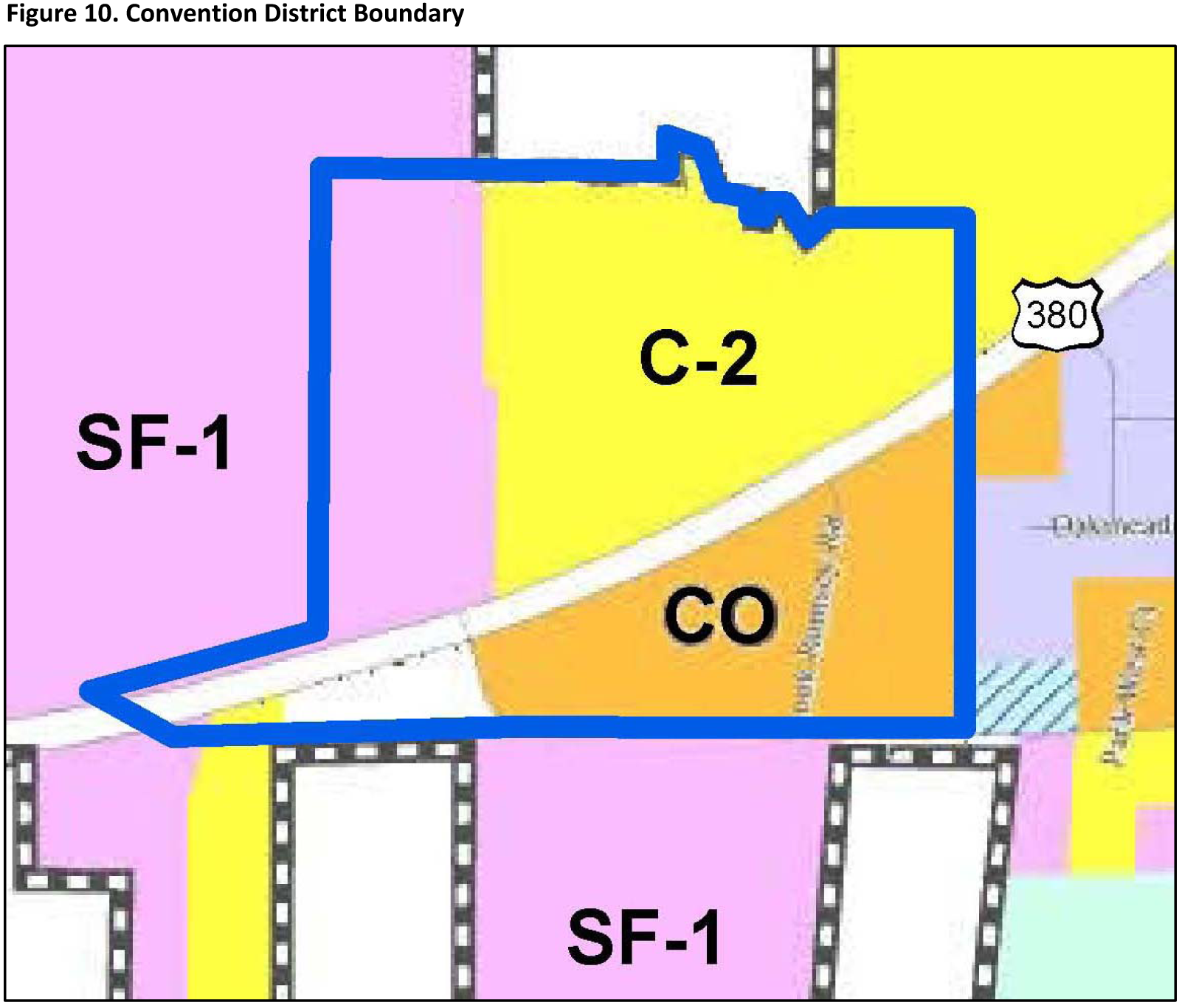
General Purpose and Description. The CD, Convention Overlay District is intended to provide for development of land within an established area around the Decatur Civic Center, as shown in Figure 10. Convention District Boundary. This area is a highly visible and heavily traveled gateway into the City, and is the site of one of the City's most valuable assets, the Civic Center. The purpose of the CD, Convention Overlay District is to establish a set of development standards that require development within the district to be consistent with the design, architecture, aesthetics, and character of the Civic Center in order to prevent the establishment of incompatible uses and of structures with inconsistent design, architecture, aesthetics and character. The overall purpose of the CD, Convention Overlay District and the regulations contained herein is to promote and maintain a convention activity identity and environment. The requirements of the CD, Convention Overlay District shall be in addition to the underlying base zoning district requirements.
B.
Permitted Uses. Uses permitted in this district are outlined in Section 6.1 Use Chart.
C.
Height Regulations. Height shall be as required by the underlying base district.
D.
Area Regulations.
(1)
Size of Yards:
(a)
Minimum Front Yard: Seventy-five feet (75′).
(b)
Minimum Side Yard: Zero feet (0′), or ten feet (10′) when adjacent to a Residential Use.
(c)
Minimum Rear Yard: Twenty-five feet (25′) when adjacent to a Residential Use.
(2)
Size of Lots:
(a)
Minimum Lot Area: N/A.
(b)
Minimum Lot Width: N/A.
(c)
Minimum Lot Depth: N/A.
(3)
Maximum Floor Area Ratio (FAR): N/A
(4)
Parking Regulations: Parking shall be as required by the underlying base district.
E.
Special Regulations.
(1)
Roofs: A Structure shall not have a flat roof on one hundred percent (100%) of such Structure, and pitched roofs shall be compatible with the 4:12 pitch of the Decatur Civic Center where visible from State Highway 380 or other right-of-way.
(2)
Exterior Facade: Structures shall have a one-hundred percent (100%) stone or brick masonry exterior. Any proposed variation in either material or percentage of stone or brick masonry shall be presented to the City Council for approval.
(3)
Driveway Spacing: Driveway spacing shall comply with access management guidelines of the State of Texas, shall be divided to separate ingress and egress, and shall be landscaped.
(4)
Entrances: Primary entrances shall be to the rear and to the sides of a Structure, and secondary entrances fronting [State Highway] 380 shall be similar in aesthetics to primary entrances.
(5)
Parking and Walkways: Parking shall be placed on the side or rear of a Structure with access via shared drives when practicable. Walkways shall be provided from all parking lots to facilitate pedestrian access to Structures.
(6)
Parking Lot Lighting: Lighting provided in all parking lot areas shall be sufficient to provide security; provided however, that lighting adjacent to a Residential District shall be designed to minimize illumination across the property line.
(7)
Street Lighting: Street lighting shall be provided throughout the property using thematic fixtures compatible with the Civic Center; details of such fixtures shall be provided in the construction drawings.
(8)
Parking Lot and Entry Landscaping: Landscaping shall also be provided for the interior parking lot. Trees shall be planted within a landscaped island within each parking lot to attain a minimum average density of one (1) shade tree (minimum two and one-half-inch (2.5″) caliper) for each fifteen (15) parking spaces provided, or any fraction thereof. All entries to the property shall be landscaped.
(9)
Street Trees: Minimum street trees shall be provided at a rate of one (1) tree per fifty (50) linear feet of frontage along rights-of-way.
(10)
Utilities: All utilities, whether constructed as a result of new development or as a result of replacing or upgrading existing utilities, shall be placed underground.
(11)
Open storage is prohibited.
(12)
Bingo operations shall meet the following standards:
(a)
If a "Religious Society" is located in a residential zoned district, charitable bingo shall be allowed.
(b)
Only a state licensed authorized organization shall engage in bingo operations within the City.
(c)
The following acts shall be prohibited in relation with or as a result of a Bingo Operations (also referred to as "Use"). The following is not an exhaustive list but is intended as illustrative of actions that violate the standards for conducting a Bingo Operations in a residential district:
(i)
Bingo Operations shall not be allowed within a residential structure.
(ii)
No external evidence of the Use shall be detectable at any lot line or beyond, including advertising, signs, smoke, dust, noise, fumes, glare, vibration, or electrical disturbance beyond the property line shall be allowed.
(iii)
No exterior storage of material, equipment, vehicles, and/or supplies used in conjunction with the Bingo Operations shall be allowed.
(iv)
In residential zoned districts, the parking shall meet parking requirements for C-2, Business Thoroughfare.
(v)
A maximum of one (1) commercial vehicle, capacity one (1) ton or less, may be used or parked on the property in connection with Bingo Operations. The commercial vehicle shall not be parked on the street.
(vi)
Regular deliveries by heavy load delivery trucks or vehicles in excess of one and one-half (1½) tons shall be prohibited.
(vii)
Outdoor merchandise shall not be offered or displayed for sale on the premises.
(viii)
Any need for parking shall be accommodated within the off-street parking provided and along the street frontage of the lot, except as prohibited by Subsection (5) above.
(ix)
A ready inventory of any commodity for sale shall not be allowed.
(x)
The Bingo Hall shall not accept customers or patrons or operate before 6:00 p.m. or after 11:00 p.m.
(xi)
Except as expressly allowed by and in accordance with this Ordinance and other applicable City Ordinances, outdoor activities such as play areas shall be prohibited.
(d)
The following acts shall be prohibited in relation with or as a result of a Bingo Operations (also referred to as "Use"). The following is not an exhaustive list but is intended as illustrative of actions that violate the standards for conducting a Bingo Operations in a C-O, C-1, C-1A, C-2, CD and PD Districts:
(i)
No smoke, dust, noise, fumes, glare, vibration, or electrical disturbance beyond the property line shall be allowed.
(ii)
No exterior storage of material, equipment, vehicles, and/or supplies used in conjunction with the Bingo Operations shall be allowed.
(iii)
Outdoor merchandise shall not be offered or displayed for sale on the premises.
(iv)
A ready inventory of any commodity for sale shall not be allowed.
(v)
Except as expressly allowed by and in accordance with this Ordinance and other applicable City Ordinances, outdoor activities such as play areas shall be prohibited.
(13)
Other regulations as established in Article 7. Development Standards.
F.
Performance Standards. Standards shall be as required by the underlying base district.
(Ord. No. 2018-07-13, § 2.02, 7-23-18)
5.2.2 H, Historic Overlay District
A.
General Purpose and Description.The H, Historic Overlay District is established to regulate future development within the historic corridor of the City of Decatur. The standards required within the H, Historic Overlay District are intended to preserve and enhance the unique historical character of the City. The purpose of the H, Historic Overlay District is to require development within the district to be consistent with the design, architecture, aesthetics, and character of the historic buildings in the corridor and to prevent the establishment of incompatible uses and of structures with inconsistent design, architecture, aesthetics and character. The overall purpose of the H, Historic Overlay District and the regulations contained herein is to promote and maintain a historic identity and environment. The requirements of the H, Historic Overlay District shall be in addition to the underlying base zoning district requirements.
The H, Historic Overlay District is designated as the lots, tracts, and parcels of land that are located adjacent to and within two hundred (200) feet of the following Street Rights-of-Way:
(1)
Walnut Street from Business 81/287 North to Business 81/287 South.
(2)
Main Street from Business 81/287 North to Business 81/287 South.
(3)
State Street from Pecan Street to Mill Street.
(4)
Trinity Street from Pecan Street to Mill Street.
If any portion of a lot, tract, or parcel is located within two hundred (200) feet from one (1) of the above referenced Street Rights-of-Way, the entire limits of the property shall be considered to be located within the H, Historic Overlay District.
B.
Permitted Uses. Uses permitted in this district are outlined in Section 6.1 Use Chart.
C.
Height Regulations. Height shall be regulated by the requirements for the underlying zoning district.
D.
Area Regulations.
(1)
Size of Yards: Size of yards shall be regulated by the requirements for the underlying Zoning District.
(2)
Size of Lots: Size of lots shall be regulated by the requirements for the underlying Zoning District.
(3)
Maximum Floor Area Ratio (FAR): N/A.
(4)
Parking Regulations: Parking shall be as required by the underlying base district.
E.
Special Regulations.
(1)
Development Standards. All new development and redevelopment located within the H, Historic Overlay District shall comply with the following development standards:
(a)
Building Exteriors. All non-residential building exteriors which are both facing on and visible from North US Highway 81/287 Business, South US Highway 81/287 Business, Walnut Street, Main Street, State Street, Pecan Street, Mill Street and Trinity Street shall be constructed of masonry material or wood, exclusive of windows, doors, fascias, and roofs. Alternative construction materials which are demonstrated to be critical to the architectural theme of the structure may be used upon recommendation of the Planning and Zoning Commission and approval of the City Council.
(2)
Applications. Each application for zoning or development within the H, Historic Overlay District shall be accompanied by an elevation drawing of the structure depicting the appearance of the building exterior.
F.
Performance Standards. Standards shall be as required by the underlying base district.
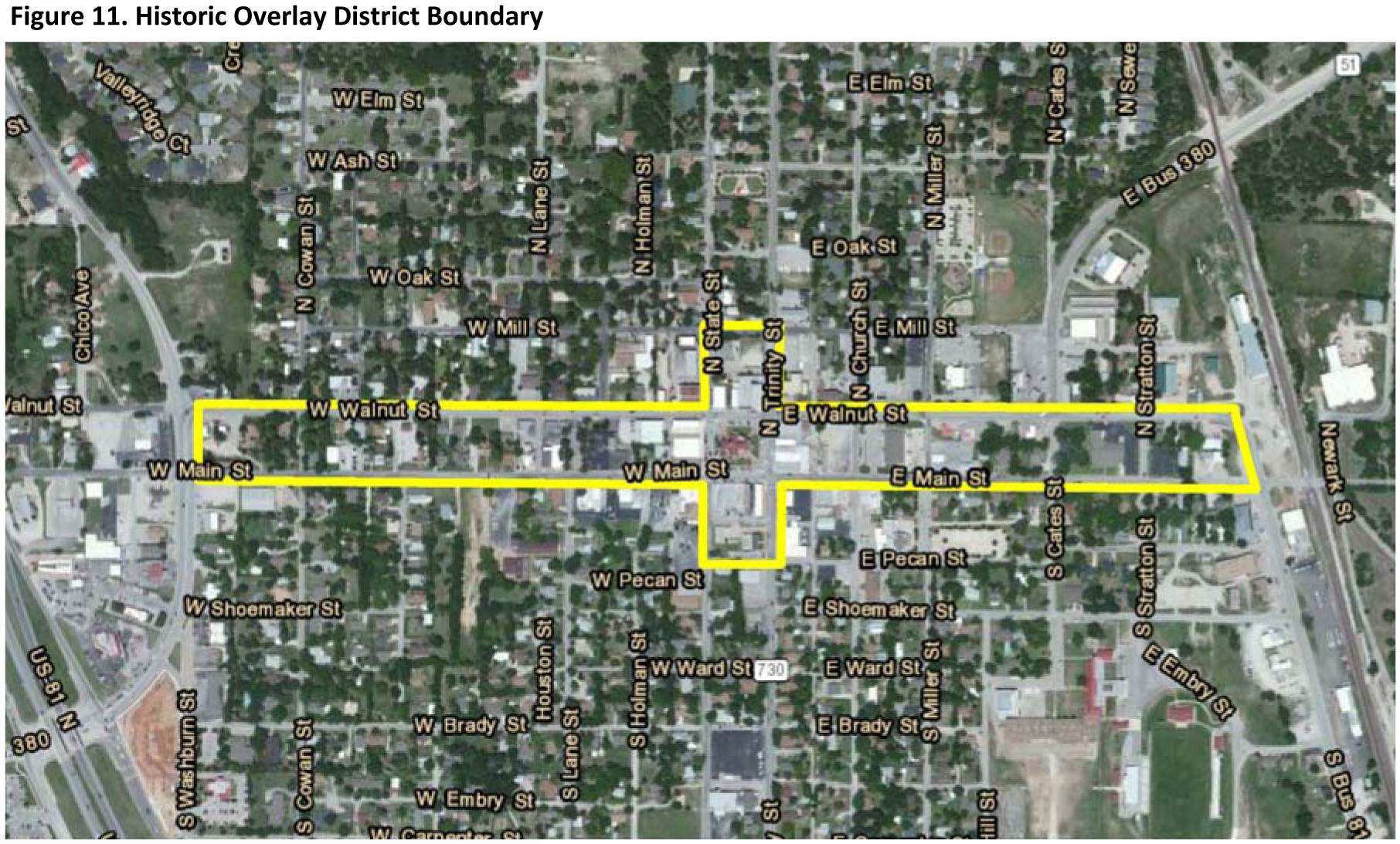
5.2.3 BC, Business Corridor Overlay District
A.
General Purpose and Description. The purpose of the BC, Business Corridor Overlay District is to protect and enhance the appearance of the Decatur business corridor area, promote the unique character of the City, protect and enhance property values within the corridor, and to prevent the establishment of incompatible types of development within the corridor. The requirements of the BC, Business Corridor Overlay District, shall be in addition to the underlying base zoning district requirements.
The BC, Business Corridor Overlay District is designated as all lots, tracts, and parcels of land which are located within three hundred (300) feet of the following Street Rights-of-Way:
(1)
FM 51 south of US 81/287 to the City Limits; and
(2)
Business 380 west of Business 81/287 to the City Limits.
If any portion of a lot, tract, or parcel is located within three hundred (300) feet from one of the above referenced Street Rights-of-Way, the entire limits of the property shall be considered to be located within the BC, Business Corridor Overlay District.
B.
Permitted Uses. Uses permitted in this district are outlined in Section 6.1 Use Chart.
C.
Height Regulations. Height shall be regulated by the requirements for the underlying zoning district.
D.
Area Regulations.
(1)
Size of Yards: Size of yards shall be regulated by the requirements for the underlying Zoning District.
(2)
Size of Lots: Size of lots shall be regulated by the requirements for the underlying Zoning District.
(3)
Maximum Floor Area Ratio (FAR): N/A.
(4)
Parking Regulations: Parking shall be as required by the underlying base district.
E.
Special Regulations. All development and redevelopment located within the BC, Business Corridor Overlay District shall comply with the following development standards:
(1)
All non-residential building exteriors which are facing FM 51 South or Business 380 West shall be constructed of masonry material or wood, exclusive of windows, doors, fascias, and roofs. Alternative construction materials which are demonstrated to be critical to the architectural theme of the structure or that possess the esthetic appearance of masonry material or wood may be used upon recommendation of the Planning and Zoning Commission and approval of the City Council.
(2)
Each application for zoning or development shall be accompanied by an elevation drawing of the structure demonstrating appearance of the building exterior.
(3)
All non-fuel dispensing permanently ground mounted mechanical equipment located in front and side yards shall be screened from view with wood or masonry landscaping sufficient in height and density to screen equipment.
(4)
All roof-mounted mechanical equipment shall be screened from view from any immediate and adjacent public right-of-way.
F.
Performance Standards. Standards shall be as required by the underlying base district.
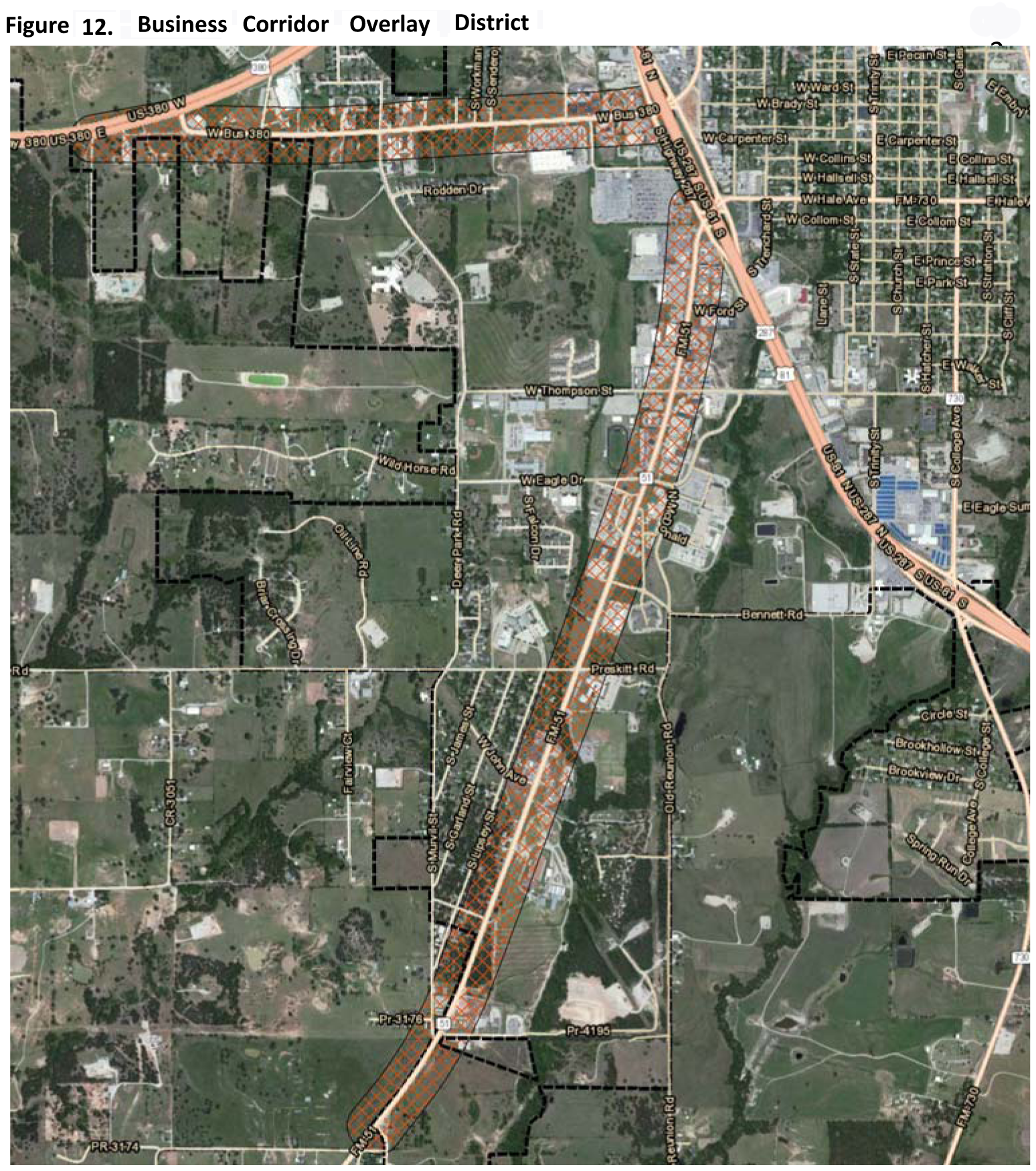
5.2.4 PD, Planned Development District
A.
General Purpose and Description. The purpose of the PD, Planned Development District is to provide a district which accommodates planned associations of uses developed as integral land use units. Examples include office parks, retail/commercial or service centers, shopping centers, residential developments having a mixture of housing options (e.g., single-family, multi-family, duplex [two-family], etc.), or any appropriate combination of uses which may be planned, developed or operated as integral land use units either by a single owner or a combination of owners. This zoning district shall be permitted for tracts of land fifteen (15) acres or more in area.
A PD, Planned Development District may be used to permit new or innovative land use concepts not permitted by other Zoning Districts in this Ordinance, to ensure the compatibility of land uses, and to allow for the adjustment of changing market demands to meet the current needs of the community by meeting one (1) or more of the following purposes:
(1)
To provide for a superior design on lots or buildings;
(2)
To provide for increased recreation and open space opportunities for public use and enjoyment;
(3)
To provide amenities or features that would be of special benefit to the property users or to the overall community;
(4)
To protect or preserve natural amenities and environmental assets such as trees, creeks, ponds, floodplains, slopes, viewscapes, or wildlife habitats;
(5)
To protect or preserve existing historical buildings, structures, features or places;
(6)
To provide an appropriate balance between the intensity of development and the ability to provide adequate supporting public facilities and services; and
(7)
To meet or exceed the standards of this Ordinance.
B.
Required Elements of a Requested PD District. The ordinance granting a PD district shall include at a minimum the following elements:
(1)
A general statement citing the reason for the PD request;
(2)
A statement as to the purpose and intent of the PD District granted therein;
(3)
Regulatory requirements developed by any of the following methods:
(a)
Referencing the requirements of an existing Zoning District;
(b)
Referencing the requirements of an existing Zoning District and showing amendments to that existing district; or
(c)
Creating original requirements that are similar in nature to those listed in an existing Zoning District;
(4)
Generally, a listing of the following regulatory requirements developed based on one (1) of the aforementioned methods:
(a)
Permitted uses;
(b)
Supplemental Use Regulations;
(c)
Area Regulations;
(d)
Fences, Screening and Buffering Regulations;
(e)
Landscaping Requirements;
(f)
Outdoor lighting;
(g)
Off-Street Parking and Loading Regulations;
(h)
Performance Regulations;
(i)
Accessory Structure Regulations; and
(j)
Any base Zoning District standards that apply
(5)
A legal description and accompanying map showing the area to be included in the proposed PD District; and
(6)
An approved Concept Plan meeting the requirements of this Ordinance.
C.
Concept Plan for PD District.
(1)
Purpose. The purpose of the Concept Plan is to ensure that a development project is in compliance with all applicable city ordinances and guidelines prior to the approval of the PD District.
(2)
Extent of area that should be included in a Concept Plan. The area included within the Concept Plan shall include the entire portion of the overall property that is to be rezoned and included in the new PD District.
(3)
Procedures and submission requirements for Concept Plan Approval. All Concept Plans shall be prepared by a qualified civil engineer, land planner, architect or surveyor, and shall clearly show with sufficient detail how the area will be developed and the uses to be allowed. To ensure the submission of adequate information, the Planning Director is hereby empowered to adopt, maintain and distribute a separate list of specific requirements that is deemed necessary for an Applicant to submit in order for the City to review the Concept Plan application for compliance with this Ordinance, as well as other local, state, and federal laws, rules, and regulations.
(4)
Review and Approval of a Concept Plan.
(a)
City Staff Review of Concept Plans.
(i)
Upon official submission of an application for Concept Plan approval, the City shall review the application. Specifically, the Planning Director, City Engineer, Building Official and such other City Staff as deemed appropriate by the Planning Director, shall review the Concept Plan prior to the Concept Plan for the PD District being forwarded to the Planning and Zoning Commission. Determination of application completeness, notice to applicant in writing of missing documents and information shall be in accordance with 4.4.3 Official Filing Date, Completeness of Application, Expiration of Application.
(ii)
Concept Plans shall be evaluated to ensure that all developments are, to the extent practicable, planned according to the City's codes and ordinances.
(iii)
Following City staff review, and following discussions regarding necessary revisions, the Applicant shall resubmit additional copies of the corrected Concept Plan to the Planning Director.
(iv)
Upon determination that all necessary information has been provided, the Planning Director shall then submit the corrected Concept Plan and other required elements of the PD District to the Planning and Zoning Commission.
(v)
If the corrected version is not resubmitted within the required time period in the written notice to the Applicant, the Planning Director shall forward the original plan application to the Commission.
(vi)
A corrected Concept Plan that is incomplete or is otherwise not ready for consideration shall be subject to denial.
(b)
Planning and Zoning Commission Review of Concept Plans and Other Required Elements of the PD District.
(i)
All Concept Plan applications shall be reviewed by the Planning and Zoning Commission in conjunction with the PD application.
(ii)
The Planning Director shall schedule consideration of the Concept Plan and PD application on the next regular agenda of the Planning and Zoning Commission for which the notice and posting requirements of State law may be satisfied.
(iii)
The Planning and Zoning Commission shall review the Concept Plan and PD application and shall recommend to the City Council approval, approval subject to certain conditions, or denial of the Concept Plan and PD application.
(c)
City Council Review of and Action on Concept Plans and PD Applications.
(i)
All Concept Plan applications shall be reviewed by the City Council after review and recommendation of the Planning and Zoning Commission in the same manner as a Rezoning.
(ii)
The Planning Director shall schedule consideration of the Concept Plan and PD application on the next regular agenda of the City Council for which state law notice and posting requirements may be satisfied.
(iii)
The City Council shall review the Concept Plan and PD application and shall approve, approve subject to certain conditions, or deny approval of the Concept Plan and PD application.
(5)
Revisions to the Approved Concept Plan and PD Application.
(a)
Amendments/Modifications.
(i)
Submission materials and requirements for approval of an Amended Concept Plan, or text amendments, for a PD district shall be as determined necessary and appropriate by the Planning Director. Failure of an Applicant to provide materials determined necessary and appropriate by the Planning Director shall be grounds for denial.
(ii)
The Planning and Zoning Commission shall review the Revised Concept Plan and/or PD application and provide a recommendation to the City Council. The City Council will then approve, deny, or approve the Concept Plan and/or PD application with conditions. Failure of an Applicant to provide materials determined necessary and appropriate by the Planning Director shall be grounds for denial.
(6)
Effect of Review/Approval. Upon approval, a Concept Plan shall be considered authorization to proceed with the rezoning of the site and creation of the district provided all other required City approvals are obtained, and all applicable fees are paid pursuant to 4.5.2 B Payment of all Indebtedness Attributable to the Subject Property.
(7)
Validity, Expiration, and Reinstatement of Concept Plan. Validity, expiration, and reinstatement of Concept Plan shall be governed by the regulations contained in Section 2.3 Vested Rights and Review Procedure of this Ordinance in accordance with State law.
D.
Special Regulations.
(1)
Bingo operations shall meet the following standards:
(a)
If a "Religious Society" is located in a residential zoned district, charitable bingo shall be allowed.
(b)
Only a state licensed authorized organization shall engage in bingo operations within the City.
(c)
The following acts shall be prohibited in relation with or as a result of a Bingo Operations (also referred to as "Use"). The following is not an exhaustive list but is intended as illustrative of actions that violate the standards for conducting a Bingo Operations in a residential district:
(i)
Bingo Operations shall not be allowed within a residential structure.
(ii)
No external evidence of the Use shall be detectable at any lot line or beyond, including advertising, signs, smoke, dust, noise, fumes, glare, vibration, or electrical disturbance beyond the property line shall be allowed.
(iii)
No exterior storage of material, equipment, vehicles, and/or supplies used in conjunction with the Bingo Operations shall be allowed.
(iv)
In residential zoned districts, the parking shall meet parking requirements for C-2, Business Thoroughfare.
(v)
A maximum of one (1) commercial vehicle, capacity one (1) ton or less, may be used or parked on the property in connection with Bingo Operations. The commercial vehicle shall not be parked on the street.
(vi)
Regular deliveries by heavy load delivery trucks or vehicles in excess of one and one-half (1½) tons shall be prohibited.
(vii)
Outdoor merchandise shall not be offered or displayed for sale on the premises.
(viii)
Any need for parking shall be accommodated within the off-street parking provided and along the street frontage of the lot, except as prohibited by Subsection (5) above.
(ix)
A ready inventory of any commodity for sale shall not be allowed.
(x)
The Bingo Hall shall not accept customers or patrons or operate before 6:00 p.m. or after 11:00 p.m.
(xi)
Except as expressly allowed by and in accordance with this Ordinance and other applicable City Ordinances, outdoor activities such as play areas shall be prohibited.
(d)
The following acts shall be prohibited in relation with or as a result of a Bingo Operations (also referred to as "Use"). The following is not an exhaustive list but is intended as illustrative of actions that violate the standards for conducting a Bingo Operations in a C-O, C-1, C-1A, C-2, CD and PD Districts:
(i)
No smoke, dust, noise, fumes, glare, vibration, or electrical disturbance beyond the property line shall be allowed.
(ii)
No exterior storage of material, equipment, vehicles, and/or supplies used in conjunction with the Bingo Operations shall be allowed.
(iii)
Outdoor merchandise shall not be offered or displayed for sale on the premises.
(iv)
A ready inventory of any commodity for sale shall not be allowed.
(v)
Except as expressly allowed by and in accordance with this Ordinance and other applicable City Ordinances, outdoor activities such as play areas shall be prohibited.
(2)
Lot Area Regulations. Residential dwelling structures in the PD, Planned Development District shall comply with lot area regulations, including minimum lot sizes, for One-Family Detached, One-Family Attached, and Two-Family Dwelling structures located in the applicable SF-2, Single-Family Residential District, TH, Townhouse Residential District, or 2F, Two-Family Residential District. This provision shall apply unless a development agreement is entered specifying differing lot area regulations. The city council shall only approve differing lot area regulations in a Planned Development District upon a specific finding of good cause which shall be recorded in the minutes of the meeting upon which the finding of good cause is made.
(Ord. No. 2018-07-13, § 2.02, 7-23-18; Ord. No. 2024-12-34, § 2.10, 12-9-24)
5.2.5 SUP, Specific Use Permit
A.
General Description and Purpose. The uses listed under the various zoning district classifications set forth in this Ordinance as uses allowed with an approved Specific Use Permit are so classified because they more intensely dominate the area in which they are located than do other uses permitted in the district, and therefore require additional review and regulation to ensure compatibility with surrounding uses.
B.
Consideration for Compatibility. With consideration given to setting, physical features, compatibility with surrounding land uses, traffic, and aesthetics, certain Uses requiring a Specific Use Permit may locate in an area where they will be compatible with existing or planned land uses generally allowed within a Zoning District.
C.
Review and Approval Authorities.
(1)
The Planning and Zoning Commission shall recommend to the City Council approval, approval with modifications, or denial for each Specific Use Permit Application.
(2)
Upon receipt and consideration of the recommendation from the Planning and Zoning Commission, the City Council shall review each case on its own merit, apply the criteria set forth in this Section and other related factors deemed necessary and appropriate given the facts and circumstances presented, and, if appropriate, authorize said use by granting a Specific Use Permit for the use. The City Council shall have the discretion to impose conditions in addition to those recommended by the Planning and Zoning Commission or to alter or remove such recommended conditions if the City Council determines such action to be necessary and appropriate to ensure compatibility or ensure protection of public health, safety, and welfare.
D.
Application and Site Plan Required.
(1)
Application and public hearing procedures for a Specific Use Permit shall be completed in the same manner as an Application for Rezoning. A Site Plan shall be included with the application.
(2)
The Planning and Zoning Commission or City Council may require additional information or drawings including but not limited to building floor plans, operating data and expert evaluation or testimony concerning the location, function and characteristics of any building or use proposed as it determines necessary and appropriate to evaluate the application.
E.
Specific Uses Permit Regulations and Procedures.
(1)
Compatibility Considerations.
(a)
The City Council and the Planning and Zoning Commission in considering any request for Specific Use Permit may only approve such request after they have determined that the use or uses allowed will not be detrimental to the adjacent properties or to the City as a whole.
(b)
The Planning Director, City Council and the Planning and Zoning Commission may require from the applicant any plans, information, operational data, and expert evaluation concerning the location, function, and characteristics of the proposed use or buildings as in their sole discretion, they determine necessary and appropriate to evaluate the application for a Specific Use Permit.
(c)
The City Council when evaluating a Specific Use Permit, and the Planning and Zoning Commission when making a recommendation concerning a Specific Use Permit, may establish conditions and regulations, in addition to those of the base zoning district, necessary to protect the health, safety, morals, and general welfare of the neighborhood and/or the City. Furthermore, the use shall be in general conformance with the Comprehensive Plan and general objectives of the City. The conditions imposed may include but shall not be limited to any one (1) or more of the following as a condition for granting continuation of a SUP:
(i)
Paving of streets, alleys, and sidewalks,
(ii)
Means of ingress and egress to public streets,
(iii)
Provisions for drainage,
(iv)
Adequate off-street parking,
(v)
Protective screening, landscaping, and open space,
(vi)
Area or security lighting,
(vii)
The locations and heights of structures,
(viii)
Architectural compatibility of buildings,
(ix)
Hours of operation,
(x)
Intensity of the use, and
(xi)
Adequate traffic circulation required to contain all stacking activity on the site.
(2)
Imposed Conditions for Approval.
(a)
In granting a Specific Use Permit, the City Council may impose conditions which shall be complied with by the owner or occupant of the property as a condition precedent to the issuance of a Certificate of Occupancy by the Building Official for use of the building on such property.
(b)
All special conditions shall be set forth in writing in the SUP, and shall be in addition to all other requirements of the zoning district and ordinances of the City.
(3)
Enlargement, Modification, Structural Alteration or Change.
(a)
A Building, premise, or land used under a Specific Use Permit may be enlarged, modified, structurally altered, or otherwise changed and used provided the changes do not:
(i)
Increase the height of structures, including antenna support structures;
(ii)
Increase building square footage from its size at the time the original Specific Use Permit was granted by greater than ten (10) percent;
(iii)
Reduce the distance between a building or noise-generating activity on the property and an adjacent, off-site residential use. This provision shall not apply should the property and the residential use be separated by a major thoroughfare depicted on the City's Thoroughfare Plan; or
(iv)
Reduce the amount of pervious coverage or landscaping as indicated on the previously approved Site Plan.
(b)
All enlargements, modifications, structural alterations, or changes that are not allowed shall require the approval of a Specific Use Permit. Antennas may be placed on an antenna support structure that is already permitted by an existing Specific Use Permit without approval of a separate Specific Use Permit subject to approval of a Final Plat and Site Plan for the property if appropriate. Modifications shall not increase the height of the antenna.
(4)
Board of Adjustment Exclusion. The Board of Adjustment shall not have jurisdiction to hear, review, reverse, or modify any decision, determination, or ruling with respect to the specific land use designated by any Specific Use Permit.
(5)
Zoning Map.
(a)
When the City Council grants a Specific Use Permit, the Zoning Map shall be amended according to its legend to indicate that the affected area has conditional and limited uses, and such amendment is to indicate the appropriate zoning district for the approved use and prefixed by an "S" designation;
(b)
Specific Use Permits granted shall be indicated by numerical designation on the Zoning District Map; and
(c)
Specific Use Permits shall be issued to the property.
(6)
Amend or Rescind a Specific Use Permit. After providing the required notice and public hearing, the Planning and Zoning Commission may recommend and the City Council may take action to amend or rescind a Specific Use Permit if one (1) or more of the following occur:
(a)
There is a violation and conviction of any of the provisions of this Ordinance that occurs on the property for which the Specific Use Permit is granted;
(b)
The building, premises, or land use authorized by the Specific Use Permit is enlarged greater than ten (10) percent (as noted in (3)(a)(ii) above), modified, structurally altered, or otherwise changed in violation of the terms of the Specific Use Permit and/or this Ordinance;
(c)
No activity or progress has occurred on the property for a period of two (2) years or longer.
(d)
Violation and correction of any provision of the terms or conditions of a Specific Use Permit, for which ten (10) days written notice of violation has been provided to the owner or occupant, and which violation is not remediated in accordance with the written notice. One (1) or more incidents of recurrence of the same violation(s) for which a correction was rendered within a calendar year period shall be cause for revocation of a SUP without additional notice to the Owner or Occupant, other than notice of date and time of public hearing pursuant to this Section;
(e)
Ad valorem taxes on the property are delinquent by more than six (6) months; or
(f)
The Specific Use Permit was obtained by fraud or with deception.
(7)
Existing Specific Use Permits. A list of existing Specific Use Permits granted prior to the effective date of this Ordinance is provided in Table 6.
Table 6. List of Existing SUPs

