
Decatur City Zoning Code
ARTICLE 7
- DEVELOPMENT STANDARDS
Section 7.1 - Area Regulations
Except as hereinafter provided, no Building or Structure or part thereof shall be erected, altered or converted for any use permitted in the district in which it is located unless it is in conformity with all the minimum area regulations herein specified.
7.1.1 Residential Lot Dimensions
Residential lot dimensions shall be in accordance with Table 8. Residential District Area Regulations.
A.
Lot Dimensions.
(1)
A lot having less area, width, or depth than herein required which was an official Lot of Record at the time of passage of this Ordinance may be used for a one-family dwelling, and no lot existing at the time of passage of this Ordinance shall be reduced in size below the minimum requirements set forth herein unless a Special Exception is granted.
(2)
A Special Exception to the requirements of this Section may be granted when an infill lot is unable, under reasonable means, to meet the area, width or depth requirements of this Section.
(a)
Requests for a Special Exception. Application for a Special Exception to Subsection (1) above shall be made to the BOA.
(b)
Notation of Conditions. If a special exception is granted the condition imposed on the development by the exception shall be noted on either the building permit or plat associated with the original request.
B.
Lot Coverage.
(1)
The maximum percentage of any lot area which may hereafter be covered by the main building and all accessory buildings and the maximum ratio of floor area to the total area of the lot or tract on which a building is located shall be in accordance with Table 8. Residential District Area Regulations.
(2)
When an existing single-family residential building, on the effective date of this Ordinance has a greater percentage of a lot covered or a higher floor area ratio than herein prescribed, such building coverage shall be considered conforming.
(3)
In SF-1, Single-Family Residential District, SF-2, Single-Family Residential District, 2F, Two-Family Residential District and MF, Multiple-Family Residential District, the main residential building and all accessory buildings shall not cover more than fifty (50) percent of that portion of the lot lying to the rear of a line erected joining the mid-point on one (1) side lot line with the mid-point of the opposite side lot line.
C.
Building Placement. Where a yard or building line has been established by a plat approved by the City and such line requires a greater or lesser yard or building line than is prescribed by this Ordinance for the district in which the yard or building line is located, the required yard or building line shall comply with the requirements so established by such plat.
D.
Height Regulations.
(1)
In measuring the height of a building, the following structures shall be excluded: chimneys, cooling towers, elevator bulkheads, penthouses, tanks, water towers, radio and television towers, ornamental cupolas, domes or spires, flagpoles, and parapet walls not exceeding four (4) feet in height (see Figure 13. Building Height).
(2)
In the districts where the height of buildings is restricted, cooling towers, roof gables, chimneys and vent stacks may extend for an additional height not to exceed forty (40) feet above the average grade line of the building. Water stand pipes and tanks, church steeples, domes and spires, may be erected to three (3) stories in height in residential areas restricted to two (2) stories in height, provided that one (1) additional foot shall be added to the width and depth of side and rear yards for each foot that such structures exceed two (2) stories in height.
(3)
The height for the first story shall be considered to be fifteen (15) feet in height, and the height of the second story and other subsequent stories shall be considered to be twelve feet (12) in height. The definition of a story does not include parapets, gables and other normal roof structures. In cases where the site has a significant slope, the height of a building shall be measured from a point representing the average slope from opposite sides of the building. For purposes of height measurement, a basement shall be counted as a story when more than one-half (½) of its height is above the average level of the adjoining ground or when subdivided and used for commercial or dwelling purposes by other than a janitor employed on the premises.
E.
Floor Area Ratio Calculations. The maximum FAR permitted by this Ordinance is calculated by dividing the gross square footage of the building(s) to the net (after right-of-way dedication) area of the lot (measured in square feet). Any below grade mechanical rooms, parking garages, or other non-occupied areas shall not be included in the gross square footage of the building(s) for the purposes of this calculation.
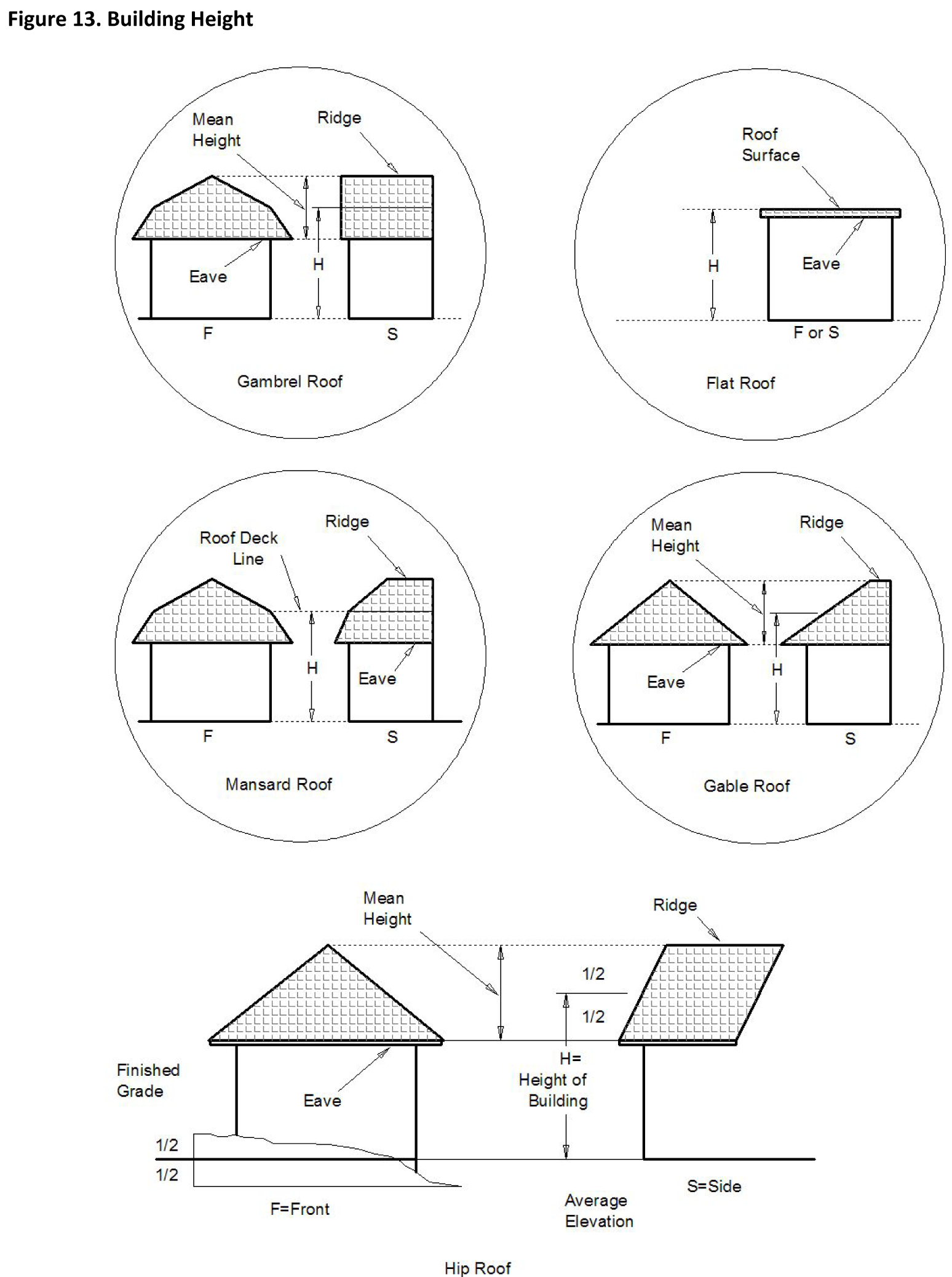
Table 8. Residential District Area Regulations*
* See 5.1.1 through 5.1.13 for additional and more detailed regulations for each District.
**Unless otherwise noted in D. Height Regulations
Table 9. Nonresidential District Area Regulations*
* See 5.1.1 through 5.1.13 for additional and more detailed regulations for each District.
** Unless otherwise noted in D. Height Regulations
F.
Residential Yard Measurements.
(1)
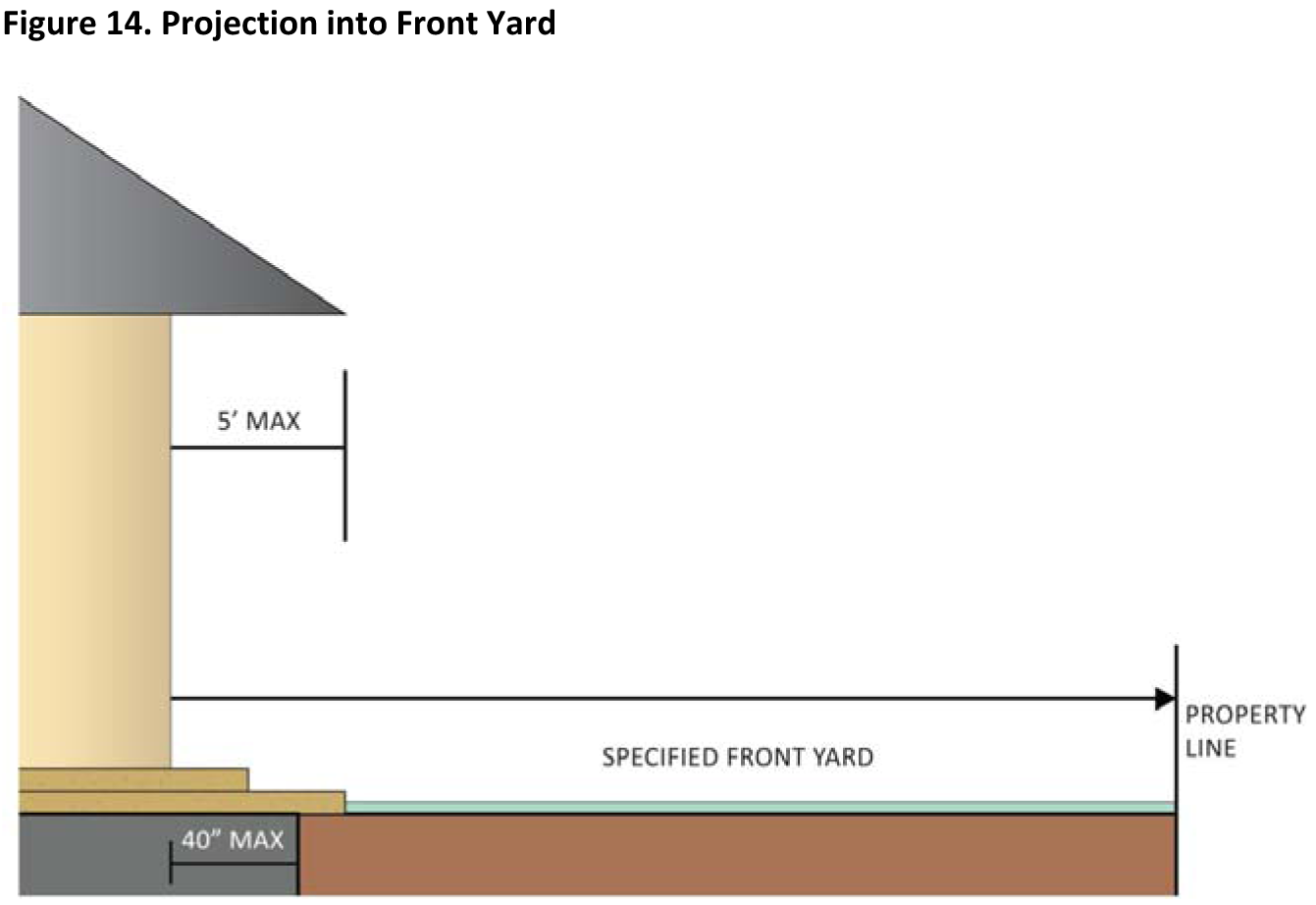
The front yard shall be measured from the property line to the front face of the closest building, covered porch, covered terrace or attached accessory building.
(2)
Eaves and roof extensions may project into the required front yard for a distance not to exceed five (5) feet (Figure 14. Projection into Front Yard).
(3)
Subsurface structures may not project into the front yard greater than forty (40) inches (Figure 14. Projection into Front Yard).
(4)
Every part of a required side yard shall be open and unobstructed except for accessory buildings as permitted herein, and the ordinary projections of window sills, belt courses, cornices and other architectural features projecting into the required side yard in an amount not to exceed twelve (12) inches and roof eaves projecting into the required side yard in an amount not to exceed twenty-four (24) inches.
(5)
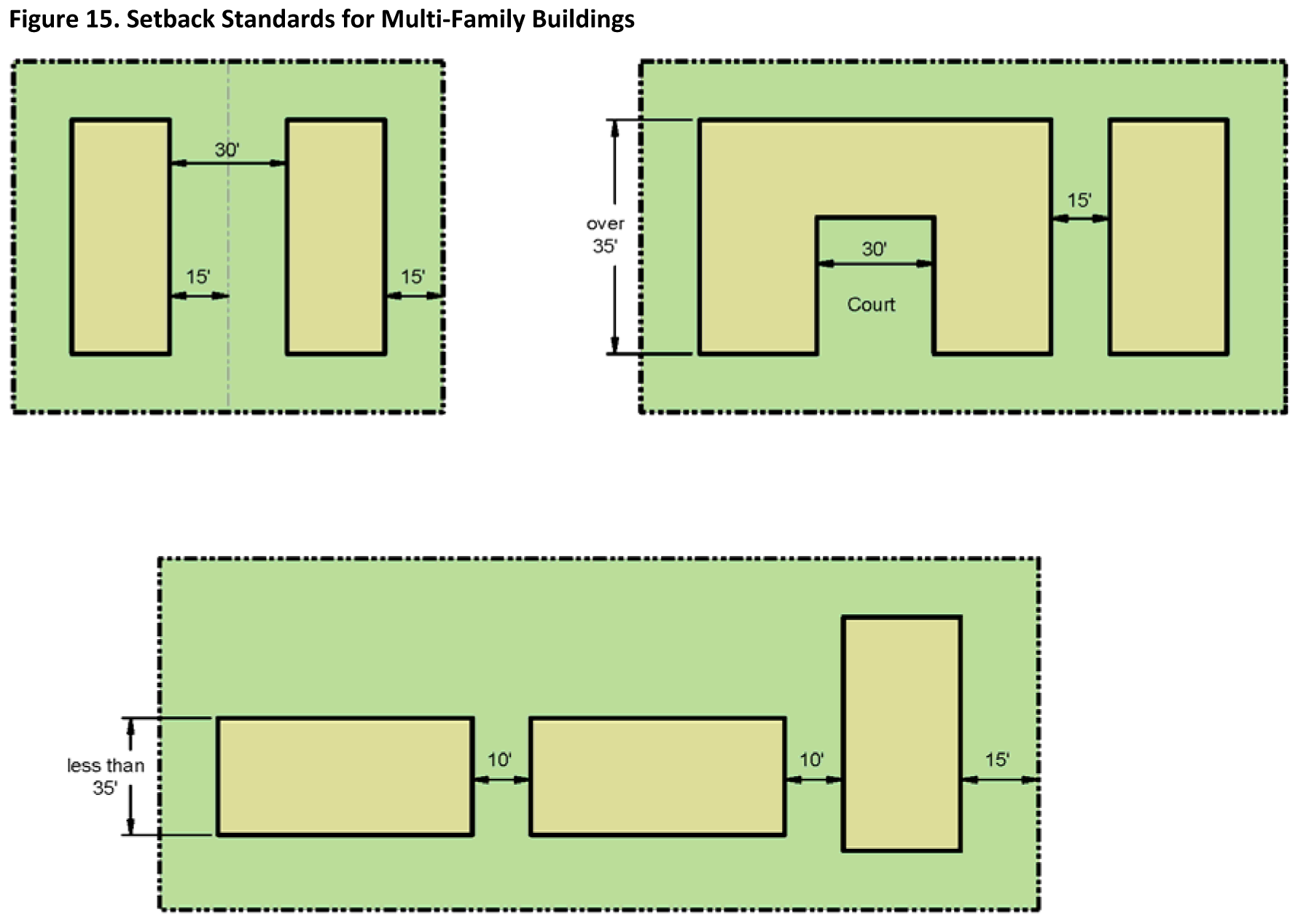
Multiple family dwellings shall provide a minimum separation of fifteen (15) feet between all building walls and any side lot line, except that any such building wall not exceeding thirty-five (35) feet in width may provide a separation of ten (10) feet (Figure 15. Setback Standards for Multi-Family Buildings).
(6)
Where structures are constructed to exceed two (2) stories in height, a side yard equal to one foot for each two (2) feet of building height for all building faces or walls having openings for light, air or access shall be provided. In all districts permitting the construction of apartment buildings exceeding two (2) stories in height, a minimum side yard of ten (10) feet shall be required for any building face or wall which contains no opening for windows, light or air (Figure 15. Setback Standards for Multi-Family Buildings).
(7)
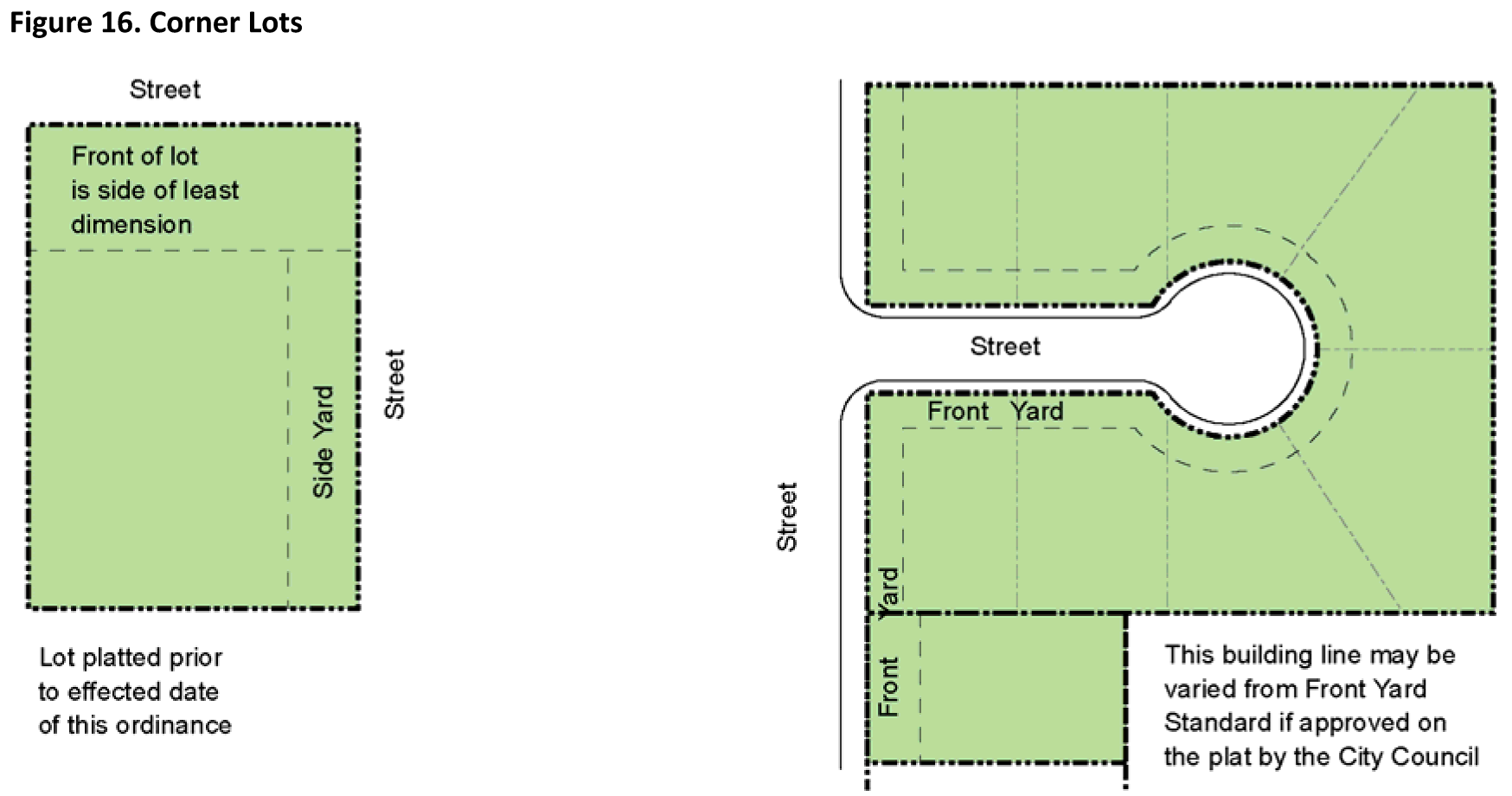
On a corner lot used for one-family or two-family dwellings, both street exposures shall be treated as front yards on all lots platted after the effective date of this Ordinance, provided however that where one (1) street exposure is designated as a side yard by a building line shown on a plat approved by the City containing a side yard of ten (10) feet or more, the building line provisions on the plat shall control. On corner lots, the lot width of least dimension shall be considered the front yard (Figure 16. Corner Lots).
(8)
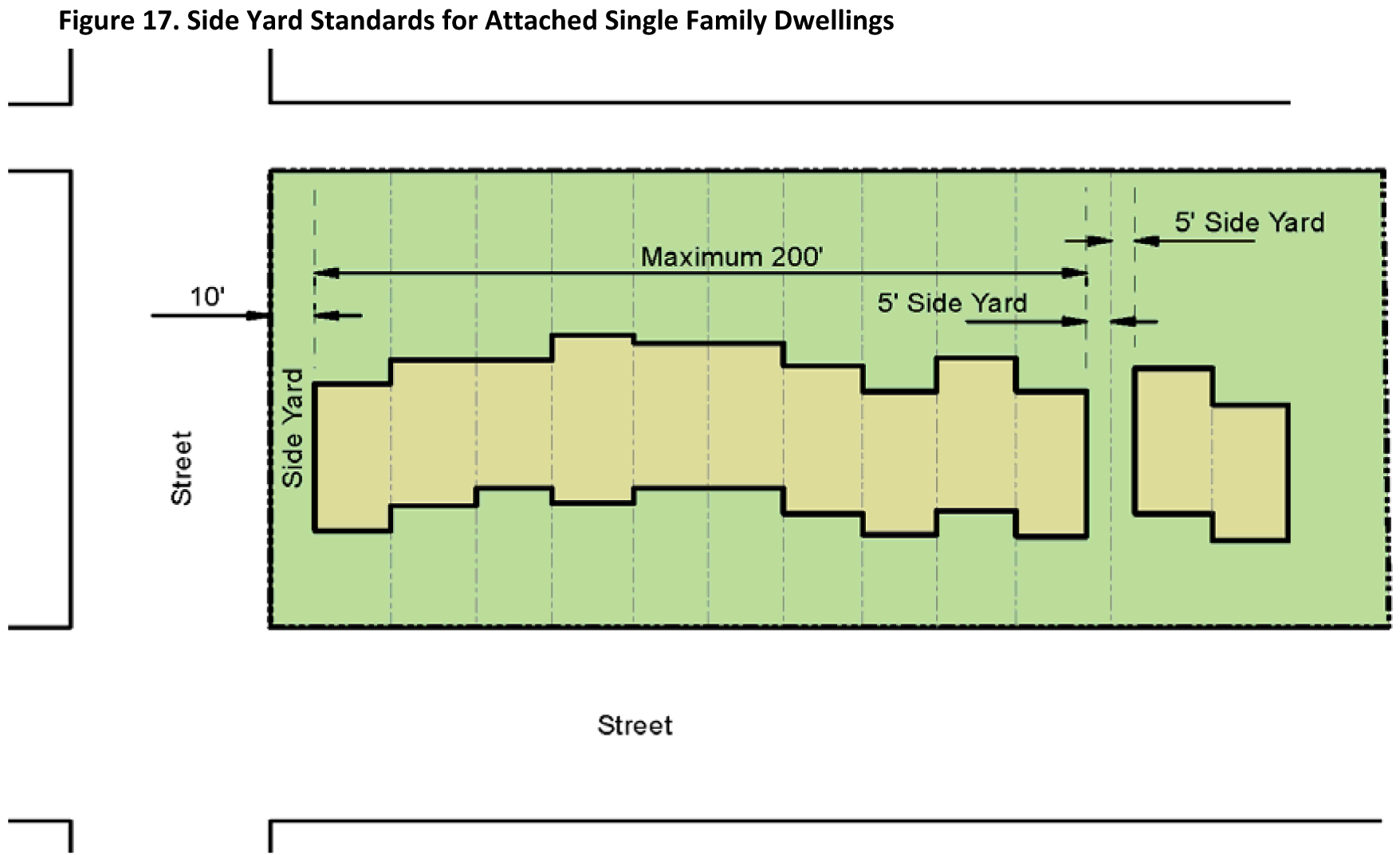
A one-family attached dwelling shall provide a minimum required side yard adjacent to a side street of ten (10) feet and no complex of attached one-family dwellings shall exceed two hundred (200) feet in length. A minimum required side yard of five (5) feet shall be provided at the end of each one-family attached dwelling complex so that the end of any two (2) adjacent building complexes shall be at least ten (10) feet apart (Figure 17. Side Yard Standards for Attached Single Family Dwellings).
(9)
The minimum side yard requirements in a PD, Planned Development District shall be established on the Concept Plan which shall be made a part of the PD Ordinance.
(10)
No side yard is specified for nonresidential use in the C-O, Office District, C-1, Restricted Business District, C-1A, Decatur Square Business District, C-2, Thoroughfare Business District, LI, Light Industrial District and HI, Heavy Industrial District except where commercial, retail or industrial or other nonresidential use abuts upon a district boundary line dividing such districts from a residential district in which event a minimum ten (10) foot side yard shall be provided on the side adjacent to such residential district.
G.
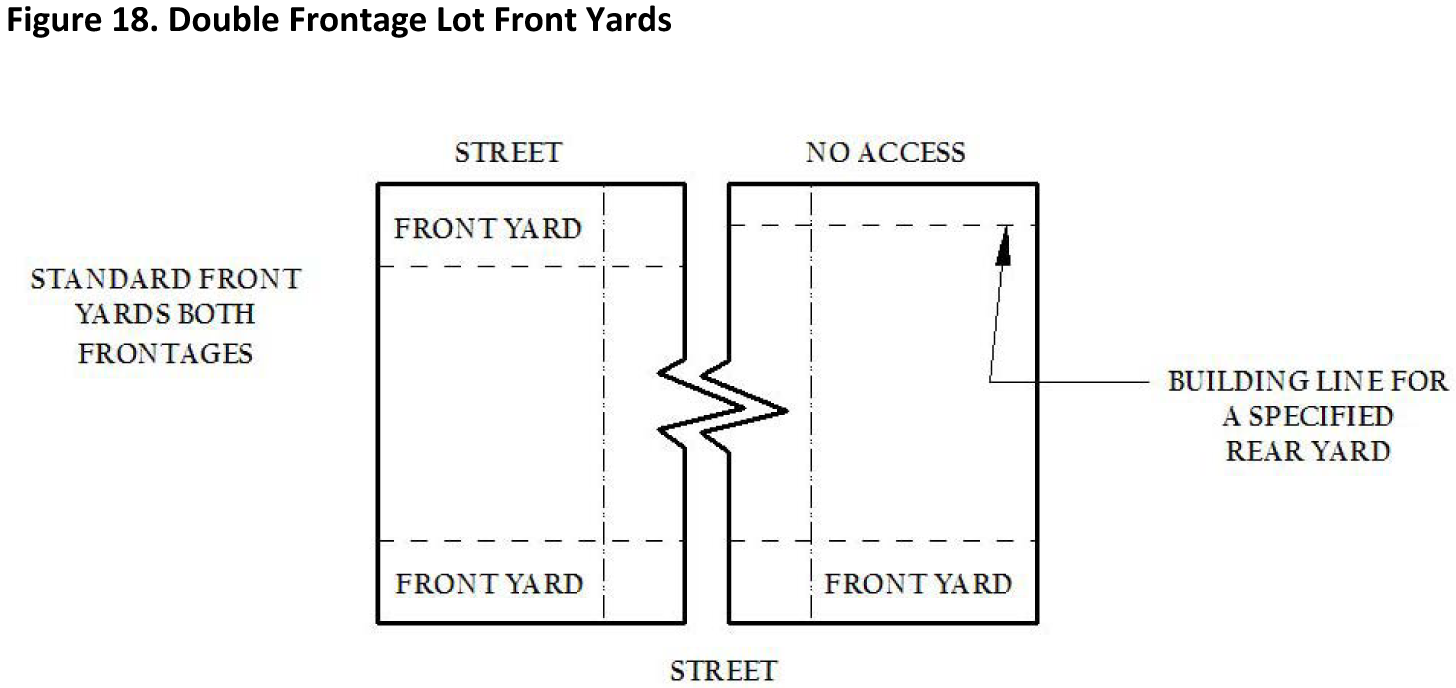
Double Frontage Yard Requirements. Where lots have double frontage, running through from one (1) street to another, a required front yard shall be provided on both streets unless a building line for accessory buildings has been established along one (1) frontage, in which event only one (1) required front yard need be observed (Figure 18. Double Frontage Lot Front Yards).
H.
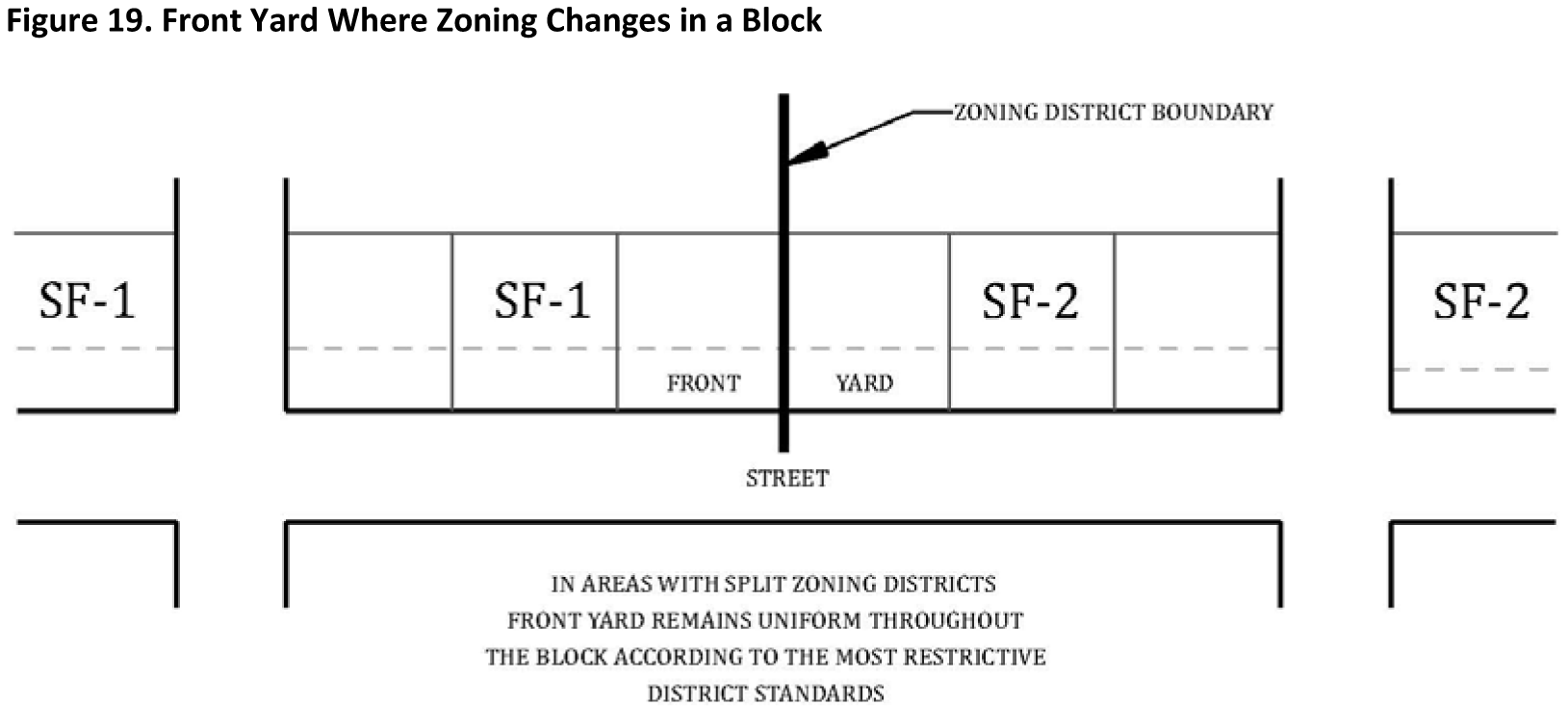
Adjoining District Yard Requirements. Where the frontage on one (2) side of a street between two (2) intersecting streets is divided by two (2) or more Zoning Districts, the front yard shall comply with the requirements of the most restrictive District for the entire frontage (Figure 19. Front Yard Where Zoning Changes in a Block).
7.1.2 Location of Multiple Dwellings and Buildings
A.
Only one (1) main building for one-family, two-family or multiple-family use with permitted accessory buildings may be located upon a Lot unless such structures are on an approved Site Plan.
B.
Each dwelling shall face or front upon a public street, or approved place, other than an alley, which means of access shall have a minimum width of thirty (30) feet.
C.
Where a Lot is used for residential, retail, commercial or industrial purposes, or a combination of same, or for a combination of retail and dwelling purposes and is part of a Planned Development District or an approved Site Plan, more than one (1) main building may be located upon the Lot, but only when such buildings conform to all the landscaping, parking and density requirements applicable to the uses and districts.
D.
No parking area, storage area, or required landscaping for one (1) building shall be computed as being the landscaping, yard or area requirements for any other use.
Section 7.2 - Awnings in the C-1A, Decatur Square Business District
7.2.1 Awnings or Canopies Required
A.
Within the C-1A, Decatur Square Business District, all new developments and redevelopment projects may utilize an awning or canopy.
(Ord. No. 2024-08-22, § 2.11, 8-12-24)
7.2.2 Dimensions
A.
The minimum height of an awning above grade level shall not be less than seven feet (7').
B.
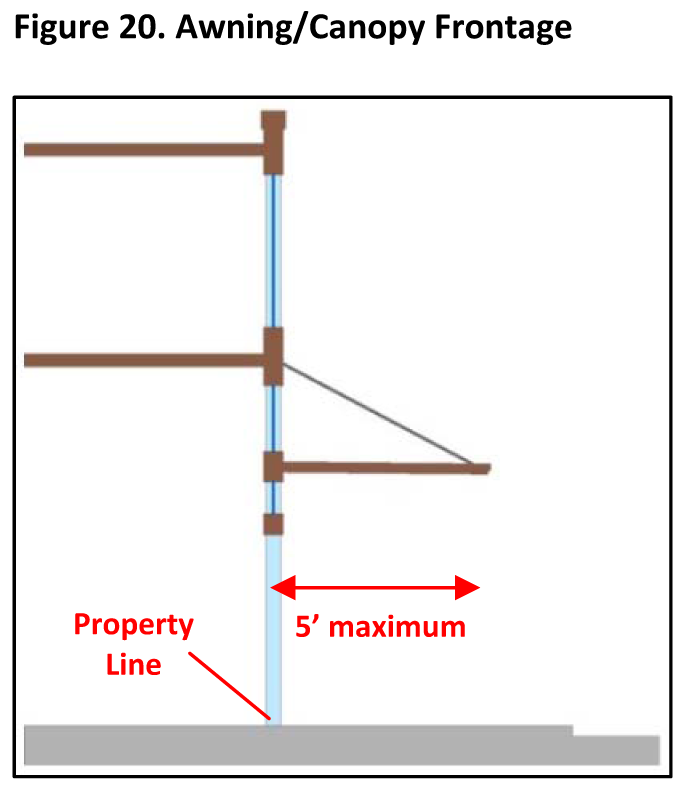
The awning or canopy may overlap the sidewalk but shall not extend more than five feet (5') beyond the property line.
(Ord. No. 2024-08-22, § 2.12, 8-12-24)
7.2.3 Design
A.
The awning or canopy may be structural, cantilevered, or shed roof and may be made of canvas, metal, or similar material. All canvas and similar materials must be maintained in good condition at all times.
B.
Structural design for awning support shall be provided for any awning that projects more than one foot (1').
C.
Ground support for awnings shall not be allowed.
(Ord. No. 2024-08-22, § 2.13, 8-12-24)
Section 7.3 - Off-Street Parking and Loading Regulations
The minimum off-street parking and loading shall be provided as set forth in the following schedule.
Table 10. Minimum Requirements for Parking Space Configuration, Arrangement, Size, and Circulation
7.3.1 Off-Street Parking
All parking shall be off-street and all vehicle maneuvering on the subject parcel shall not occur on the street or right-of-way. The space shall not be located within a public street or alley, nor shall head-in parking adjacent to a public street or alley, wherein the maneuvering is done on a public street or alley, be classified as off-street parking in computing the parking requirements for any use.
7.3.2 Off-Street Parking Provisions
A.
Residential Districts.
(1)
All required vehicle parking shall be on a concrete or asphalt paved surface.
(2)
All driveways and approaches to parking spaces shall be on a concrete or asphalt paved surface.
(3)
No required parking space, garage, carport, or other automobile storage space shall be used for the storage of any Heavy Load Vehicle (see Article 3. Definitions).
(4)
Additional parking shall be required in accordance with this Section for any recreational uses, clubhouse, office, sales offices and other similar accessory structures and uses.
B.
Nonresidential and Multi-Family Districts.
(1)
All parking areas shall be constructed of the same material as the adjoining street, or of concrete. All parking areas shall be separated from walkways, sidewalks, streets, or alleys by a wall, fence, curbing, or other protection device.
(2)
Covered Parking and Density Bonuses.
(a)
An increase in density of a total of up to twenty-four (24) units per acre is permitted when at least fifty (50) percent of the required parking spaces are constructed as covered or enclosed spaces.
(b)
An increase in density of a total of up to twenty-six (26) units per acre is permitted when one hundred (100) percent of the required parking spaces are constructed as covered or enclosed spaces.
(3)
No parking space may be located closer than six (6) feet from any building or closer than two (2) feet from any side or rear lot line.
(4)
For safety and fire-fighting purposes, access through to adjacent nonresidential parking areas shall be provided in accordance with 7.3.9 Fire Lanes.
(5)
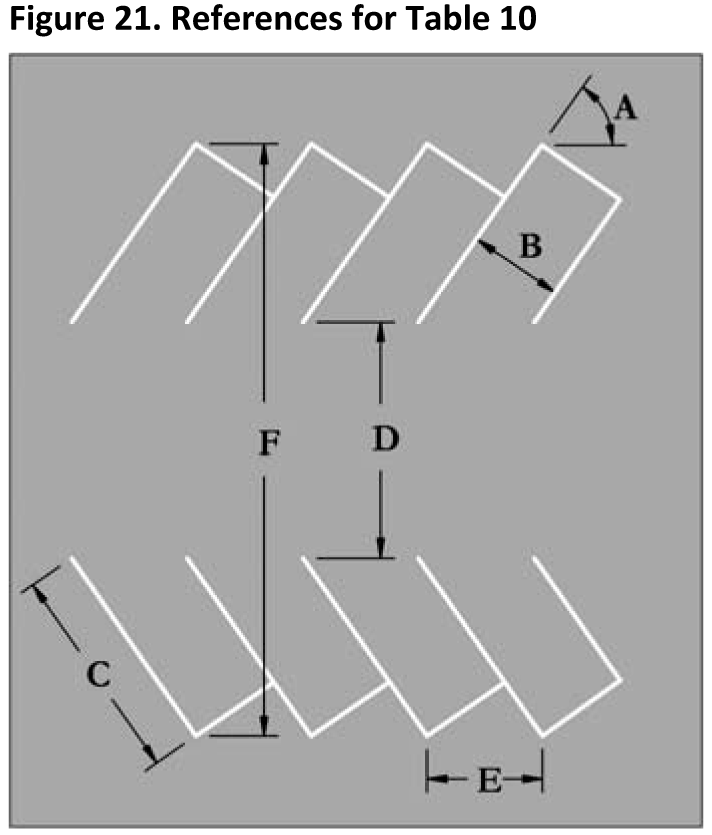
All off-street parking, driveways, maneuvering, and loading areas shall be designed in accordance with Figure 21. References for Table 10 and Table 10. Minimum Requirements for Parking Space Configuration, Arrangement, Size, and Circulation, shall be paved with a concrete or asphalt surface, and shall be curbed in accordance with the City's parking lot paving requirements.
(6)
For new construction only, all vehicle maneuvering shall take place on-site. No public right-of-way shall be used for backing or maneuvering into or from a parking space (except business locations in the downtown area that are already in existence as of the effective date of this Ordinance), or for circulation within the parking lot.
(a)
All entrances into parking lots shall be a minimum of twenty (20) feet in width, or a maximum of forty (40) feet in width.
(b)
Divided entrances into parking lots shall have a minimum ingress lane of eighteen (18) feet wide, a minimum landscaped median width of five (5) feet for an unbroken distance of at least one hundred (100) feet, and a minimum egress lane of twenty-two (22) feet wide. All divided entrances shall be a maximum of forty-five (45) feet in width.
(7)
In all nonresidential and multi-family zoning districts, the perimeter of all parking lots and driveways shall be provided with concrete curbs. Parking shall not be permitted to encroach upon the public right-of-way.
(8)
Refuse storage facilities placed in a parking lot shall not be located in a designated parking or loading space. Each refuse facility shall be located so as to facilitate pickup by refuse collection agencies and ease of egress from the site without having to back up further than twenty (20) feet and without having to go the wrong way in a traffic aisle.
(9)
Parking space(s) for persons with disabilities and other associated provisions (e.g., clear and unobstructed pathways into building, crosswalks across parking lots, etc.) shall be provided according to building codes, State laws, and requirements of the Americans with Disabilities Act (ADA).
(10)
Designated parking and loading areas shall not be used for the repair, storage, dismantling or servicing (except for normal maintenance of a private vehicle) of vehicles or equipment, or for the storage of materials or supplies, or for any other use in conflict with the designated parking and loading areas (i.e., advertising or outside storage of raw materials).
(11)
At no time after initial approval of the parking area layout shall changes be made in the location and number of provided spaces without written City approval of a revised plan.
(12)
A stacking space shall be an area on a site measuring at least eight (8) feet wide by twenty (20) feet long that has direct forward access to a service window or station of a drive-through facility and that does not constitute space for any other circulation driveway, parking space, or maneuvering area. An escape lane of at least eight (8) feet in width and with negotiable geometric design shall be provided to allow vehicles to get out of the stacking lane if necessary. Off-street stacking requirements for drive-through facilities shall be as follows:
(a)
For financial institutions with drive-through facilities, each teller window or station, human or mechanical, shall be provided with a minimum of five (5) stacking spaces. One (1) escape lane shall be provided.
(b)
For each service window of a drive-through restaurant, a minimum of five (5) spaces shall be provided for the first vehicle stop, and two (2) spaces shall be provided for each additional vehicle stop (order/pick-up windows, etc.). One escape lane shall be provided from the beginning of the stacking lane to the first vehicle stop.
(c)
For a full-service car wash, each vacuum or gas pump lane shall be provided with a minimum of four (4) stacking spaces. For the finish/drying area, adequate vehicle stacking and storage space shall be provided to keep finished vehicles out of circulation aisles, access easements, fire lanes, streets, etc.
(d)
For each automated self-service (drive-through/rollover) car wash bay, a minimum of three (3) stacking spaces, in addition to the wash bay itself, shall be provided. One (1) stacking space shall be provided at the exit end of each wash bay for window-drying and other detailing.
(e)
For each wand-type self-service (open) car wash bay, a minimum of two (2) stacking spaces, in addition to the wash bay itself, shall be provided. One (1) stacking space shall be provided at the exit end of each wash bay for window-drying and other detailing, unless a separate area/shade structure is provided (outside of circulation aisles) for these activities.
(f)
For automobile quick-lube type facilities, a minimum of three (3) stacking spaces shall be provided for each service bay in addition to the service bay itself.
(g)
For all other types of land use that provide drive-up service, a minimum of three (3) stacking spaces for each service window shall be provided.
(13)
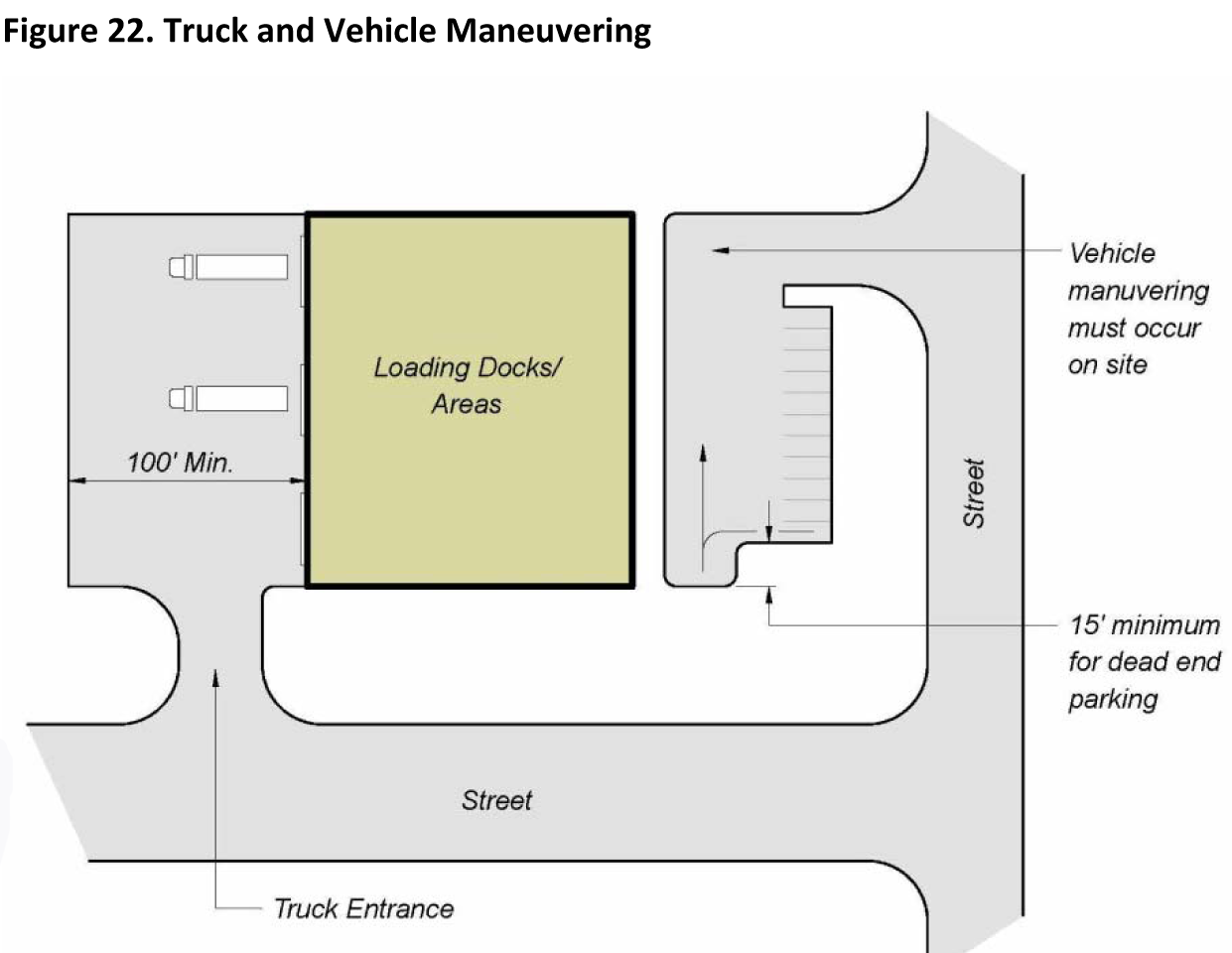
Dead-end parking areas shall be avoided if possible. If dead-end parking is necessary, then it shall be designed such that it is no more than forty-five (45) feet in length, unless adequate turnaround space is provided. A minimum hammerhead back-up space of at least fifteen (15) feet shall be provided at the end of any dead-end parking area.
(14)
All parking structures shall conform to the construction and design standards of the zoning district in which they are located.
(15)
A parking analysis and tabulation shall be required on the Site Plan for each development and shall be a part of the Site Plan submittal. Each analysis shall include an explanation of applicable parking requirement, and as a minimum shall include occupancy classification type, building square footages, and number of employees, total parking spaces required, total parking spaces provided, required and provided Americans with Disabilities Act (ADA) accessible spaces, and required and provided ADA van accessible spaces. When the Director of Public Works, or designee determines necessary, an additional traffic impact study may be required to determine the impacts of a development on the off-site public street system.
C.
Off-Street Loading Facilities. All retail and similar nonresidential structures shall provide and maintain off-street facilities for receiving and loading merchandise, supplies and materials within a building or on the lot or tract. All drives and approaches shall provide space and clearances to allow for the maneuvering of trucks off-street. Each site shall provide a designated on-site maneuvering area for trucks (see Figure 22. Truck and Vehicle Maneuvering).
(a)
Off-street loading space may be adjacent to a public alley or private service drive or may consist of a truck berth within the structure. Such off-street loading space or truck berth shall consist of a minimum area of ten (10) feet by seventy-five (75) feet, and such spaces or berths shall be provided in accordance with Table 11.
(b)
For normal retail, commercial sales service or industrial use buildings and establishments, off-street loading facilities shall be provided in accordance with Table 11.
Table 11. Retail, Commercial, and Industrial Off-Street Loading Facilities
(c)
For hotels, office buildings, restaurants and similar establishments, off-street loading facilities shall be provided in accordance with Table 12.
Table 12. Hotel, Office, and Restaurant Off-Street Loading Facilities
D.
Loading docks for any establishment which customarily receives goods between the hours of 9:00 p.m. and 8:00 a.m. and is adjacent to a residential use or district shall be designed and constructed so as to minimize the effects of the noise of the operation on adjacent residences. Other screening/buffering alternatives may be approved on the applicable required Concept or Site Plan provided that the City makes a finding that the method of screening/buffering will be adequate to minimize the impact on nearby residences.
E.
Below grade loading docks are required to have operational sump pumps or other approved drainage.
F.
Kindergartens, elementary schools, day care, and similar child training and care establishments shall provide one (1) paved off-street pedestrian loading and unloading space for an automobile on a through, "circular" drive for each ten (10) students cared for (excluding child care in a residence). An additional lane shall also be required to allow pass-by or through traffic to move while automobiles waiting or parked to pick up children occupy loading/unloading areas.
G.
Loading spaces that are adjacent and easily accessible to several buildings or uses, including buildings and uses on separate lots, shall be allowed to satisfy the loading requirements for the individual buildings or uses.
H.
Below grade loading docks are required to have operational sump pumps or other approved drainage.
7.3.3 Parking Requirements Based upon Use
The following parking requirements shall apply for all districts with the exception of C-1A, Decatur Square Business District.
A.
Residential Use Parking Schedule.
(1)
SF-1, Single-Family Residential District: Two (2) spaces for each dwelling unit.
(2)
SF-2, Single-Family Residential District: Two (2) spaces for each dwelling unit.
(3)
TH, Townhouse Residential District: Two (2) spaces for each dwelling unit.
(4)
2F, Two-Family Residential District: Two (2) spaces for each dwelling unit.
(5)
MF, Multiple-Family Residential District: Two and one-quarter (2¼) spaces for each dwelling unit in apartments, two (2) spaces for all other dwelling units.
(6)
MHD, Manufactured Home District: Two (2) spaces for each mobile home space. A minimum parking area of one hundred fifty (150) square feet per manufactured home space shall be provided in a common area for storage of boats or vehicles in excess of two (2) per manufactured home space, and for visitors' vehicles, to minimize on-street parking and to facilitate the movement of emergency vehicles into and through the park.
B.
Nonresidential Use Parking Schedule. Compliance with the following minimum parking space regulations shall be required:
(1)
Bank, Savings and Loan or Similar Financial Establishments: One (1) space for each two hundred (200) square feet of floor area.
(2)
Bed and Breakfast: One (1) space per guest room in addition to the requirements for a normal residential use.
(3)
Bowling Alley: Six (6) spaces for each lane.
(4)
Churches: One (1) space for each three (3) seats in the main sanctuary in addition to the requirements for other uses such as classrooms, offices, gymnasiums, and similar ancillary uses.
(5)
Clinics or Doctors' Offices: One (1) space for each three hundred (300) square feet of floor area (minimum of five (5) spaces).
(6)
Commercial Amusement, Indoor: Standalone: One (1) space per one hundred (100) square feet; In-line/strip style: One (1) space per two hundred and fifty (250) square feet.
(7)
Commercial Amusement, Outdoor: Twenty (20) spaces plus one (1) space for each one hundred (100) square feet of floor area over one thousand (1,000) square feet.
(8)
Assisted Living or Acute Care Living Facility: One (1) space for each three (3) beds.
(9)
Convenience Store with or without Gasoline Sales: One (1) space for each two hundred (200) square feet of Floor Area. Parking in front of pump stations shall be counted towards the required parking, however a minimum of six (6) parking spaces shall be provided adjacent to the main building.
(10)
Golf Course: Minimum of thirty (30) spaces.
(11)
High School, College or University: One (1) space for each classroom, laboratory or instruction area plus one (1) space for each one and one-half (1½) students accommodated in the institution.
(12)
Hospitals: One (1) space for every two (2) beds.
(13)
Hotel or Motel: One (1) space for each room, unit or guest accommodation, plus additional requirements specified for clubs, restaurants and other uses.
(14)
Institutions of a Philanthropic Nature: Ten (10) spaces plus one (1) space for each employee.
(15)
Library or Museum: Ten (10) spaces plus one (1) space for each three hundred (300) square feet of floor area.
(16)
Manufacturing, Processing or Repairing: One (1) space for each two (2) employees or one (1) space for each one thousand (1,000) square feet of floor area, whichever is greater.
(17)
Offices, General: One (1) space for each three hundred (300) square feet of floor area (minimum five (5) spaces).
(18)
Places of Public Assembly not listed: One (1) space for each three (3) seats provided.
(19)
Recreational, Private or Commercial area or building (other than listed): Standalone: One (1) space per one hundred (100) square feet; In-line/strip style: One (1) space per two hundred fifty (250) square feet.
(20)
Restaurant or Cafeteria: One (1) space for every three (3) seats under maximum seating arrangement (minimum of five (5) spaces).
(21)
Retail or Personal Service: One (1) space for each two hundred (200) square feet of floor area (minimum of five (5) spaces).
(22)
Schools, Elementary or Junior High: One (1) space for each classroom plus one (1) space for each four (4) seats in any auditorium, gymnasium or other place of assembly.
(23)
Storage or Warehousing: One (1) space for each two (2) employees or one (1) space for each one thousand (1,000) square feet of floor area, whichever is greater.
(24)
Theaters, Meeting Rooms and Places of Public Assembly: One (1) space for every three (3) seats.
C.
Special Off-Street Parking Regulations.
(1)
In the SF-1, Single-Family Residential District, SF-2, Single-Family Residential District, TH, Townhouse Residential District, 2F, Two-Family Residential District, MF, Multiple-Family Residential District, MHD, Manufactured Home District, C-O, Office District, C-1, Restricted Business District, and C-1A, Decatur Square Business District, no parking space, garage or carport, or other automobile storage space or structure shall be used for the storage of any truck, truck trailer or van, except panel and pickup trucks not exceeding one (1) ton capacity.
(2)
Floor area of structure devoted to off-street parking of vehicles shall be excluded in computing the off-street parking requirements of any use.
(3)
No open parking space or surfaced area shall be located nearer than two (2) feet to the side lot line.
(4)
No parking requirements are established for the C-1A, Decatur Square Business District.
D.
Parking Requirements for New and Unlisted Uses. Where questions arise concerning the minimum off-street parking requirements for any use not specifically listed herein, the requirements may be interpreted by the Planning Director as those of a similar listed use.
7.3.4 Construction Standards
Minimum construction standards for off-street parking shall include:
A.
Three thousand six hundred (3,600) psi reinforced concrete with a minimum thickness of six (6) inches or four (4) inches of Type "B" and two (2) inches of Type "D" HMAC.
B.
Subgrade thickness and content shall be determined from a geotechnical report sealed by a licensed professional engineer registered in Texas provided by the developer.
C.
Standard curb and gutter as shown in the NCTCOG standards manual shall be placed around all landscaping areas and the external boundary of the parking area.
D.
All off-street parking areas shall be striped in accordance with the latest edition of the Manual on Uniform Traffic Control Devices (MUTCD) published by the Texas Department of Transportation.
7.3.5 Parking Access from a Public Street
A.
Entrance/exit drive(s) shall be designed and located to minimize traffic congestion or conflict within the site and with adjoining public streets. Based upon analysis by the City, if projected volumes of traffic entering or leaving a development are likely to interfere with the projected peak traffic flow volumes on adjoining streets, additional right-of-way and paving in the form of a deceleration lane, a turn lane, or other roadway improvements may be required of a developer in order to reduce such interference and to help ensure traffic safety and efficiency. The dedication of additional right-of-way or street paving may also be required, and shall be determined at the time the required plan and final plat are approved by the City.
B.
Vehicular access to nonresidential uses shall not be permitted from alleys serving residential areas, and shall not be configured as "head-in" parking spaces that are accessed directly from the street.
C.
Parking space configuration, arrangement, size and circulation in all districts shall be constructed according to Table 10. Minimum Requirements for Parking Space Configuration, Arrangement, Size, and Circulation and Figure 21. References for Table 10.
7.3.6 Computing Number of Parking Spaces
In computing the number of parking spaces required for each of the above uses, the following rules shall govern:
A.
"Floor Area" shall mean the gross floor area of the specific use.
B.
"Seat" shall be interpreted as follows:
(1)
For fixed (e.g., church pews, grandstands, benches, etc.) seating, one (1) seat equals one and three-quarters (1.75) feet of length; and
(2)
For flexible (e.g., folding chairs, etc.) seating areas, one (1) seat equals eight (8) square feet of floor area occupied by such seating area (includes aisles).
C.
Where fractional spaces result, the parking spaces required shall be calculated by rounding up to the nearest whole number.
D.
Whenever a Building or Use is changed or enlarged in floor area, number of dwelling units, seating capacity or otherwise, to create a need for an increase of ten percent (10%) or more in the number of existing parking spaces, such spaces shall be provided on the basis of the enlargement or change. If a building or use that was in existence prior to the effective date of this Ordinance is enlarged by more than fifty percent (50%) in floor area, number of employees, number of dwelling units, seating capacity or otherwise, then such Building or Use shall be required to conform with the parking requirements herein for the entire Building or Use.
E.
For buildings which have a combination of uses within the same structure or on the same premises (such as retail, office, and other nonresidential uses), the off-street parking requirement shall be calculated as the summation of the parking requirements for each use, and no parking space for one particular use shall be allowed to count toward the parking requirement for some other use on the premises except in the case of a shared parking arrangement (see F below).
F.
Shared parking may be allowed in the case of mixed uses (different buildings) under the following conditions:
(1)
Up to fifty percent (50%) of the parking spaces required for a theater or other place of evening entertainment (after 6:00 p.m.), or for a church, may be provided and used jointly by banks, offices, and similar uses not normally open, used, or operated during evening hours.
(2)
Shared parking shall be on the same parking lot.
(3)
Reduction due to shared parking shall only be allowed if approved by the City on the applicable required plan (see Section 4.5 Building Permits, Certificates of Occupancy and Completion).
(4)
To assure retention of the shared parking spaces, each property owner shall properly draw and execute an irrevocable mutual parking agreement document expressing the same and after receiving approval as required by Subsection 7.3.7, shall file this agreement in the County Real Property Records, and shall provide a copy of the filed agreement to the City prior to issuance of a Certificate of Occupancy for any use that relies upon the parking agreement.
(a)
In the event that a parking agreement is terminated, the City may revoke the Certificate of Occupancy of either use if either use lacks the required amount of parking after the agreement is terminated.
7.3.7 Location of Parking Spaces
In any case where any additional Parking Spaces are required and are not located on the same Lot with the Building or Use served, or where such spaces are collectively or jointly provided and used, approval by the Planning and Zoning Commission and City Council is required subject to the following conditions:
A.
Except for location, all other requirements relating to off-street parking shall be met;
B.
Such space shall be conveniently usable without unreasonable:
(1)
Hazard to pedestrians;
(2)
Hazard to vehicular traffic;
(3)
Traffic congestion; or,
(4)
Detriment to the appropriate Use of other properties in the vicinity;
C.
A written agreement shall be drawn to the satisfaction of the City Attorney and executed by all parties concerned, assuring the continued availability of the off-street parking facility for the development it is intended to serve.
7.3.8 Use of Required Parking Spaces in Nonresidential Districts
Off-street parking and loading spaces shall be used only for these respective purposes and shall not be used for refuse containers, cart corrals, recycling kiosks, signs or sign support structures, telecommunications towers or support structures, storage or permanent display of boats, trailers, campers, motor vehicles or other goods, materials, or products for sale/lease/rent. For temporary display and outdoor sales, see 6.2.5 Outdoor Sales.
7.3.9 Fire Lanes
Fire lanes shall be provided in all nonresidential, multi-family, single-family, and manufactured home park developments, as required by the adopted Fire Code of the City and the Subdivision Ordinance.
7.3.10 Special Regulations for Recreational Vehicles or Equipment
A.
Recreational vehicles shall not be located in a recreational vehicle park or campground for more than a ninety (90) calendar day time period.
B.
An owner or tenant of a residential lot may park a recreational vehicle that they own on the same lot in accordance with City regulations. Such vehicle parking shall also meet all other required City ordinances.
7.3.11 Parking Area Lighting
A.
To prevent nuisance situations, all parking area lighting shall be designed, shielded and operated so as not to reflect or shine on adjacent properties and shall be in accordance with all applicable City ordinances.
B.
Nonresidential streets and driveways shall be lighted at night with a minimum intensity of two (2) foot-candles' illumination if off-street parking or loading facilities are to be used at night.
C.
All lighting facilities shall be arranged as to reflect the illumination away from any residentially zoned property. Such lighting facilities shall distribute not more than two-tenths (0.2) of one (1) foot candle of light upon any adjacent residentially zoned property.
D.
All lighting facilities shall be placed, masked or otherwise arranged such that illumination or glare shall not create a hazard to motorists on any street, alley or other public way.
Section 7.4 - Trash Receptacles/Refuse Containers
7.4.1 Trash Receptacle Requirement
All commercial properties shall provide a trash dumpster location that meets screening and construction requirements as designated in the City Design Standards.
7.4.2 Trash Receptacle Access and Clearance
A.
All driveways to trash dumpsters shall be designed to accommodate the weight of a fifty-six thousand (56,000) pound G.V.W. sanitation truck. Lifting pads shall be provided in front of each trash dumpster location to accommodate the front wheels of the sanitation truck.
B.
Access to the trash dumpster and lift pad shall be in a "straight in" manner, or other manner as approved by the Planning Director.
C.
Trash dumpsters shall not be located directly beneath any overhead utility line less than twenty-five (25) feet in height.
7.4.3 Required Screening
See 7.5.2F below for refuse area screening requirements.
Section 7.5 - Screening, Fencing, and Buffering
7.5.1 Purpose
To encourage the most appropriate use of land while conserving and protecting the privacy and value of adjacent permitted uses. Regulations are prescribed for the location and type of various screening devices to be used when required in the various zoning districts or in this Section in accordance with the following standards.
7.5.2 Buffering and Screening of Nonresidential and Multi-Family Areas.
A.
Buffer Area. A buffer area shall be required along all boundaries of any lot containing any use which is more intensive than the uses permitted by the Zoning Classification(s) abutting.
(1)
The buffer area shall be located within the boundaries of the higher intensity use property.
(2)
The buffer area shall consist of a combination of privacy wall(s), privacy style fencing, trees, and shrubs of such a type, height, spacing, and arrangement to effectively transition the activity on the lot from the neighboring area. At a minimum, the planting shall consist of:
a.
10-foot buffer area: 4 trees and 35 shrubs per 100 linear feet
b.
15-foot buffer areas: 6 trees and 40 shrubs per 100 linear feet
c.
20-foot buffer areas: 10 trees and 50 shrubs per 100 linear feet
d.
25-foot buffer area: 20 trees and 60 shrubs per 100 linear feet
(3)
An earthen berm, fence, or wall of a location, height, design, and material approved by the Planning Director or their designee may be substituted to offset a portion of the required planting and/or buffer. Fences and walls, if substituted, shall be a minimum of six (6) feet in height and constructed of materials approved by the Planning Director or their designee. Trees and shrubs shall supplement earthen berms, fences, or wall areas at a minimum of 50 percent of the approved landscape material. The landscaping shall be installed along the outside fence or wall. Landscape material shall form a continuous screen of at least six (6) feet in height within two (2) years of installation.
(4)
The minimum width of a buffer area shall follow the matrix below:
The existence of an easement shall not exempt property from the buffer requirements of this Article.
B.
Permits. All walls four (4) feet or more in height require permits.
C.
Sight Distance and Visibility. See Section 7.5.6 for sight visibility requirements for screening walls.
D.
Open Storage.
(1)
In districts permitting open storage, screening shall be required for those areas used for open storage. Open storage of materials, commodities, or equipment shall be screened with a minimum six-foot (6′) fence or wall and shall not be visible from the street or from adjacent property. (See definition of Outdoor Storage in Article 3. Definitions.) A six (6) foot screening fence or wall shall be provided and maintained at the property line adjacent to the area to be screened by one (1) or a combination of the following methods:
(a)
A combination of privacy wall(s), privacy style fencing, trees, and shrubs;
(b)
Wrought iron in conjunction with landscape screening;
(c)
Landscape material to form a continuous screen of at least six (6) feet in height within two (2) years of installation; and
(d)
All landscaping shall be maintained in perpetuity.
(2)
No outside storage may exceed the height of the fence. Outside storage exceeding eight (8) feet shall require a Specific Use Permit.
E.
Refuse Storage Areas. All new buildings and uses, except for single-family and two-family dwellings, shall provide facilities for the central storage of solid waste/refuse within the lot. Where such facilities are provided outside of a building, they shall be screened from adjacent property and streets by an enclosure constructed of materials congruous with the materials on the exterior wall of the main building. A gate for the front of the enclosure shall be required. Each refuse facility shall be located so as to facilitate pickup by refuse collection agencies. Reinforced concrete paved areas shall be provided for refuse facilities and their approaches for loading and unloading.
F.
Required Materials and Construction for Screening Walls. Any screening wall required under the provisions of this Section or under a Specific Use Permit, PD District, or other requirement shall be constructed of masonry, reinforced concrete, or a combination of privacy style fencing, trees, and shrubs. All wall openings shall be equipped with gates equal in height and screening characteristics to the wall itself.
G.
Irrigation. Prior to the installation of any irrigation, the applicant shall submit an irrigation plan to the City. The plan shall be drawn at the same scale as the landscape plan and indicate main, valve, and pump locations, pipe sizes and specifications, controller locations and specifications, backflow preventer and rain-sensing devices, and include a typical sprinkler zone plan indicating type, specifications, spacing, and coverage. If drip irrigation or soaker hoses are proposed, their layout shall be shown.
(1)
Irrigation systems shall be designed to avoid impacts with existing vegetation. Field changes may be made to avoid disturbances of such vegetation, such as line routing, sprinkler head placement, and spray direction adjustments.
(2)
Within all multi-family and non-residential uses, mechanical irrigation systems are required. Underground sprinkler systems are not required in all other residential single-family areas, unless required by an approved Planned Development.
H.
Maintenance Responsibilities: All Development. The property owner shall be responsible for the installation, preservation, and maintenance of all plantings and physical features required by this Ordinance, in a healthy growing condition, for replacing them when necessary, and for keeping the area free of refuse and debris. Any dead, unhealthy, or missing vegetation, or vegetation disfigured by pruning, shall be replaced with locally adapted vegetation that conforms to the standards of this Section and the approved site or subdivision plan. In the event that any vegetation or physical element functioning to meet the standards of this Ordinance is severely damaged due to an unusual weather occurrence or natural catastrophe, the owner shall have one growing season to replace or replant after reconstruction is complete.
I.
Replacement of Disturbed and Damaged Vegetation. The disturbance of any landscaped area or vegetation required by this Ordinance shall constitute a violation of the site or subdivision plan and shall be required to be replaced within ninety (90) days of citation. All disturbed landscaped areas and vegetation shall be replanted to meet the standards of this Ordinance as well as the approved site plan. Where the vegetation that has been disturbed or damaged existed on the site at the time the development was approved, all replacement vegetation shall meet the standards set forth in this Ordinance, taking into account any unique site conditions and significant vegetation remaining within the landscaped area.
(1)
Dead and Distressed Trees or Vegetation. Trees or landscape vegetation that die or are severely stressed shall be removed and replaced with new vegetation consisting of one or a combination of any of the following measures.
(a)
Replant according to the requirements of this Ordinance. A replanting plan denoting the proposed installation shall be submitted to the City for approval.
(b)
Replace damaged vegetation with an equal amount of new vegetation according to the size of vegetation removed. Any tree with a DBH (diameter breast height) of at least 12 inches that is damaged or removed shall be replaced with one or more trees that have a cumulative DBH equal to or greater than the original tree. A revegetation plan denoting the proposed installation shall be submitted to the Planning Director or designee for approval.
(c)
For all other cases where existing vegetation is damaged or removed, the type and amount of replacement vegetation required shall be of the type and amount that is necessary to provide the type of landscaping required under this Article.
(2)
Location of Replacement Trees. Replanting of trees should be located within the vicinity of the removed tree. If the area is too small for sufficient growth, a more suitable location on the site may be selected as permitted by the Planning Director or designee.
(3)
Stop Work Orders. Stop work orders shall be applied for damaging and/or destroying significant vegetation, interior specimen significant vegetation, landscape, or tree save areas.
J.
Native and Approved Non-Native Trees. The species listed below shall constitute an approved native or non-native tree. Native and non-native tree species not listed herein may be considered by the Planning Director or designee for inclusion in a landscape plan to meet the landscape requirements of this article.
(1)
Approved Tree List For Required Landscaping on Public Right-of-way:
(2)
Recommended Tree List For Required Landscaping on Private Property:
(3)
Recommended Shrubbery List:
(Ord. No. 2025-08-31, § 2.2, 8-25-25)
7.5.3 Fences in Residential Areas
A.
Location Criteria and Height.
1)
Any fence or wall located in a residential district shall not exceed eight feet (8′) in height in the permitted location on the property. All fences shall be installed with the posts or structural supports inside and the finished surface facing the adjacent properties and public rights-of-way.
2)
Side yard fences may be up to six feet tall under certain conditions:
a.
For corner lots and continuous corner lots, fences shall be permitted to a height of six feet when the fence is located behind the architectural rear of the house on the secondary street frontage, provided that visibility triangles are not obstructed.
b.
Fences located in side yards, between all properties, may be up to six feet in height but must be held back a minimum of twenty-five (25) feet from the secondary street frontage, unless otherwise permitted in a Planned Development. In no case shall a fence six feet in height extend beyond the architectural front of the structure without City Council approval.
3)
The following materials are prohibited for all fencing:
a.
Unfinished or bare wood, chicken wire, or agricultural grade welded wire, lattice; Chain link and slatted chain link fencing along street frontages.
b.
Electrically charged, barbed wire, razor wire, and other similar fencing materials capable of inflicting significant physical injury.
4)
Fences shall be allowed in front yards of any residential property within the following regulations:
a.
No fence in the front yard shall exceed thirty-six (36) inches in overall height, including fences on properties with multiple street frontages.
b.
Front yard fences shall provide fifty (50) percent visibility through the fence.
c.
Fence height shall be measured from the adjacent grade to the highest point of the fence. If the fence is placed on a concrete curb, not exceeding six inches in height, for structural support, the supporting curb shall not be calculated into the fence height, including support posts.
d.
Front yard fences must be a minimum of ten (10) feet from the property line, or five (5) feet inside the sidewalk, whichever is greater.
e.
No fence shall be placed in any right-of-way, easement, fire lane, required parking space, or obstruct any visibility sight lines or triangles.
f.
The following materials are permitted for front yard fencing:
i.
Aluminum, vinyl, finished wood picket, wrought iron picket, decorative/ornamental metal, decorative post with rope, or split rail. No solid panel or privacy fences are permitted in a front yard.
ii.
Masonry fences/walls not exceeding eighteen (18) inches in height. If decorative fence panels are added to the top of the masonry fence/wall, the height of the masonry fence/wall is included in the overall height regulations of thirty-six (36) inches.
iii.
All wood fencing shall be constructed using new decay-resistant or pressure-treated material and shall be finished with either a clear coat, wood stain, or be painted and maintained without discolored or rotting wood and shall not be missing pieces.
g.
The following materials are prohibited for front yard fencing:
i.
Unfinished or bare wood, chicken wire, or agricultural grade welded wire, solid panel, lattice, shadowbox;
ii.
Chain link and slatted chain link fencing along street frontages.
iii.
Electrically charged, barbed wire, razor wire, and other similar fencing materials capable of inflicting significant physical injury.
5)
All fences shall be maintained in sound condition and good repair, no matter when they were constructed. Any fence or privacy wall found to be in disrepair must be repaired or removed within fourteen (14) days of written notification to the property owner.
6)
All vegetation along any fence line must be properly maintained and must meet the requirements below to be considered compliant:
a.
Vegetation and landscaping must be actively managed so that no area or plants appear overgrown or unsightly.
b.
Appropriate pruning practices are being used to ensure the health of the plants.
c.
Landscape beds are clearly defined.
d.
Landscaping, vegetation, and household debris is properly disposed of or recycled.
B.
Vehicular Access Gates. Gates designed for vehicular access shall be set back from the front property line a minimum of twenty-five (25) feet.
C.
Swimming Pool Fences. Fences around swimming pools shall comply with the City's standards in Chapter 4, Article IV of this code.
D.
Sight Distance and Visibility. See Section 7.5.6 for the sight visibility requirements for fences and screening walls.
E.
Other Types of Fencing. Special-purpose fencing, such as fencing around tennis courts, may be permitted by approval of the Planning Director or their designee.
(Ord. No. 2021-02-01, § 2.5, 2-8-21; Ord. No. 2025-08-31, § 2.3, 8-25-25)
7.5.4 Mechanical Equipment
A.
Ground Mounted Mechanical Equipment. All non-fuel dispensing permanently ground mounted mechanical equipment located in either a front or side yard shall be screened from view and shall be constructed with wood or masonry material, or a suitable alternative, that is similar to, and aesthetically compatible with, the primary structure. Alternatively, landscaping sufficient in height and density to screen equipment shall be allowed.
B.
Roof Mounted Mechanical Equipment. All roof-mounted mechanical equipment shall be screened from view of any adjacent public Right-of-Way.
7.5.5 Alternative Materials and Construction
Alternative equivalent screening may be approved through the Site Plan approval process, Section 4.5.2A.
7.5.6 Sight Visibility
Visual clearance shall be provided in all zoning districts so that no fence, wall, architectural screen, earth mounding or landscaping thirty (30) inches or higher above the street center line obstructs the vision of a motor vehicle driver approaching any street, alley, or driveway intersection as follows:
A.
At a street intersection, clear vision must be maintained for a minimum of twenty-five (25) feet across any lot measured from the corner of the property line in both directions or as prescribed by the City's Design Standard Manual, whichever is greater.
B.
At an intersection with an alley, this clearance must be maintained for ten (10) feet.
C.
Shrubs and hedges that are typically less than thirty (30) inches in height at maturity, as measured from the centerline of the street, may be located in the visual clearance areas of all districts.
D.
A limited number of single-trunk trees having a clear trunk (branching) height of at least eight (8) feet may be located within sight visibility areas provided that they are spaced and positioned such that they will not produce a visibility inhibiting, "picket-fence" effect when they attain mature size.
Section 7.6 - Accessory Structure Regulations
7.6.1 Accessory Buildings and Structures in Residential Districts
A.
Front Yard. Attached accessory buildings shall have a front yard not less than that required for the main building. Detached accessory buildings shall be located in the area defined as the rear yard.
B.
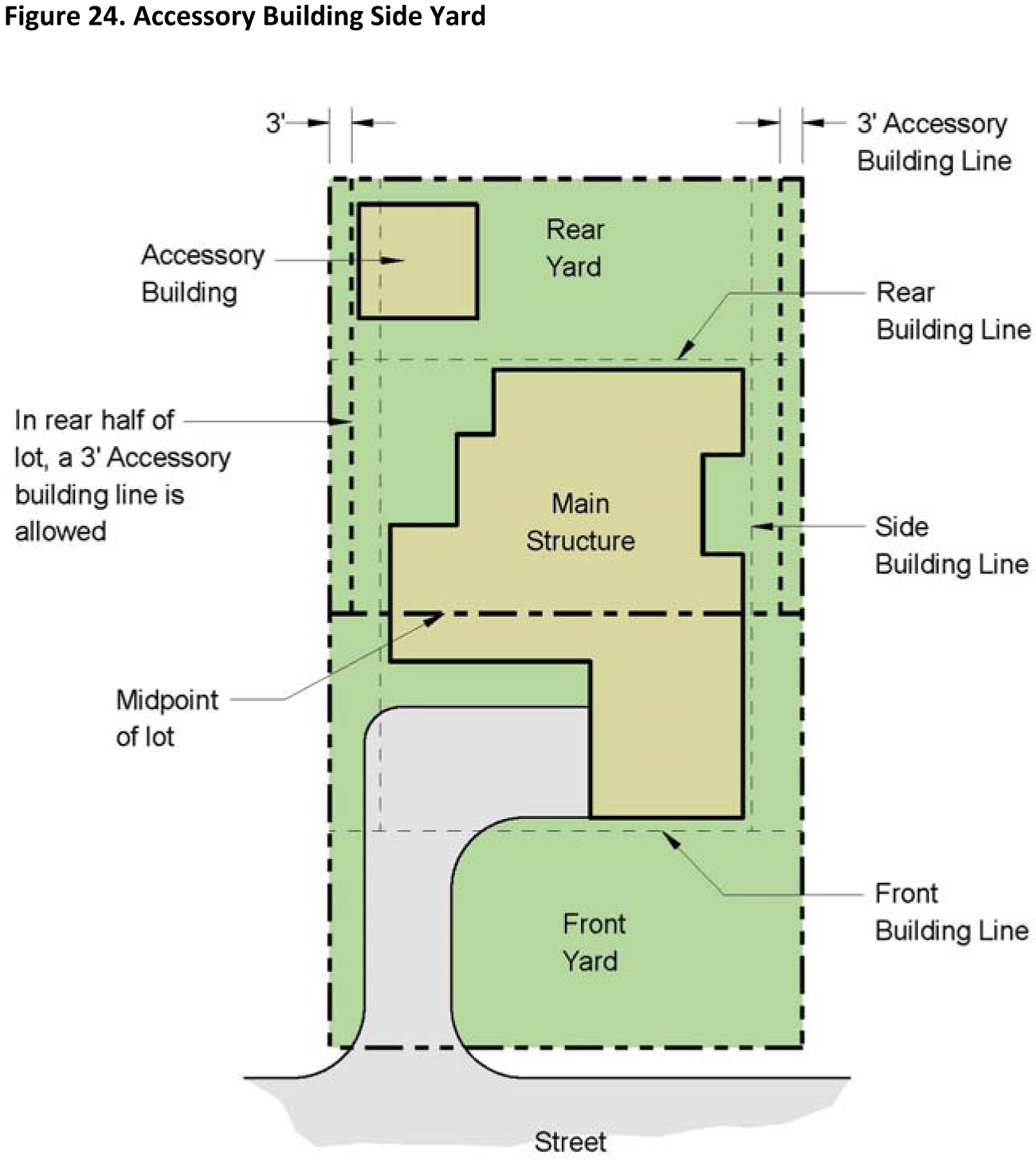
Side Yard. There shall be a side yard for any detached accessory building of not less than three (3) feet from any side lot line when such detached accessory building is located in the rear of the lot (the rear of a line erected connecting the midpoints on the two (2) opposite side lot lines of any lot, tract or plot). When a detached accessory building is located in front of the line connecting the two (2) midpoints of the opposite side lot lines as herein described, such accessory building shall observe the same side yard as specified for the main building (Figure 24. Accessory Building Side Yard).
C.
Rear Yard. There shall be a rear yard for accessory buildings not less than three (3) feet from any lot line, alley line or easement line, except that if no alley exists, the rear yard shall not be less than ten (10) feet as measured from the rear lot line. Where apartments are permitted, the main building and all accessory buildings shall not cover more than fifty (50) percent of the rear of the lot (that portion of the lot lying to the rear of a line erected joining the midpoint of one (1) side lot line with the midpoint of the opposite side lot line).
7.6.2 Air Conditioning or Similar Accessory Structures
Air conditioning compressors, cooling towers and similar accessory structures shall be subject to the regulations for all front, side or rear yards specified for accessory buildings. When such accessory structures are located in the side yard or that portion of the lot herein designated as the rear of the lot, the minimum side yard shall be three (3) feet. When such structures are located forward of the line dividing the rear of the lot from the front of the lot, the accessory structures shall be subject to the same side yard required for the main structure (Table 8. Residential District Area Regulations).
7.6.3 Swimming Pools
A.
All swimming pools shall be located behind the front yard or front building line, whichever is farthest from front property line and in no case shall the pool proper be nearer than five (5) feet to any bounding property line of the lot or tract on which it is situated.
B.
A private swimming pool shall not be operated as a business nor maintained in a manner to be hazardous or obnoxious to adjacent property owners.
7.6.4 Accessory Dwelling
Accessory Dwellings may be allowed by SUP approval only. The SUP ordinance shall establish use and development standards for each accessory dwelling. Only one accessory dwelling unit per platted lot or lot of record shall be allowed.
(Ord. No. 2024-08-22, § 2.14, 8-12-24)
7.6.5 Carports
Notwithstanding any other provision in the Zoning Ordinance that requires off-street parking spaces, carports shall be allowed in the City of Decatur as follows:
A.
Residential Uses.
(1)
Front Yard. Attached and detached carports shall have a front yard not less than that required for the main building.
(2)
Side Yard. There shall be a side yard for any carport of not less than three feet (3') from any side lot when such carport is built completely of non-combustible materials. When a carport is built completely or partially of combustible materials, the minimum side yard setback shall meet the minimum side yard setback for the lot but shall not be less than five feet (5').
(3)
Rear Yard. There shall be a rear yard for carports not less than three feet (3') from any lot line, alley line, or easement line, except that if no alley exists, the rear yard shall not be less than ten feet (10') as measured from the rear lot line.
(4)
Carports shall be included in the maximum lot coverage allowed for the Zoning District.
(5)
Carports in excess of twenty-four feet (24') in length or width shall only be allowed by SUP approval.
(6)
Carports in excess of twelve feet (12') in height shall only be allowed by SUP approval.
(7)
Carport construction shall be in accordance with locally adopted Building Codes, as amended. A standard detail, adopted by the City of Decatur, shall be utilized for carport engineering, or the carport can be engineered at the applicant's expense.
(8)
No more than one (1) carport shall be allowed on a legally platted lot. Additional carports may be allowed by SUP approval.
(9)
A carport shall not violate the open storage regulations for the Zoning District in which it is located.
(10)
Carports in existence in the City of Decatur on August 12, 2024, shall be considered legally non-conforming until altered.
B.
Non-Residential Uses.
(1)
Front Yard. Attached and detached carports shall have a front yard not less than that required for the main building.
(2)
Side Yard. There shall be a side yard for any carport of not less than three feet (3') from any side lot when such carport is built completely of non-combustible materials. When a carport is built completely or partially of combustible materials, the minimum side yard setback shall meet the minimum side yard setback for the lot but shall not be less than five feet (5').
(3)
Rear Yard. There shall be a rear yard for carports not less than three feet (3') from any lot line, alley line, or easement line, except that if no alley exists, the rear yard shall not be less than three feet (3') for carports made completely of non-combustible materials and not less than five feet (5') from the rear lot line for carports made completely or partially of combustible materials.
(4)
Carports shall be included in the maximum floor area ratio for the Zoning District.
(5)
Carport construction shall be in accordance with local adopted Building Codes, as amended.
(6)
A carport shall not violate the open storage regulations for the Zoning District in which it is located.
(7)
Carports in existence in the City of Decatur on August 12, 2024 shall be considered legally non-conforming until altered.
(Ord. No. 2024-08-22, § 2.15, 8-12-24)
Section 7.7 - Penalty for Violations
7.7.1 Penalties
Any person or corporation who shall intentionally, knowingly, recklessly, or with criminal negligence, violate any of the provisions of this Ordinance shall, upon conviction, be fined any sum not exceeding two thousand dollars ($2,000.00) and each and every day that the provisions of this Ordinance are violated shall constitute a separate and distinct offense. In addition to the said penalty provided for, the right is hereby conferred and extended upon any property owner owning property in any district, where such property owner may be affected or invaded, by a violation of the terms of the Ordinance, to bring suit in such court or courts having jurisdiction thereof and obtain such remedies as may be available at law and equity in the protection of the rights of such property owners.
7.7.2 Other Lawful Remedies
Nothing contained herein shall prevent the City from taking such other lawful action as is necessary to prevent or remedy any violation.
Section 7.8 - Validity
If any section, paragraph, subdivision, clause, phrase, or provision of this Ordinance shall be adjudged invalid or held unconstitutional, the same shall not affect the validity of this Ordinance as a whole or any part or provision thereof other than the part so decided to be invalid or unconstitutional.
Section 7.9 - Effective Date
This Ordinance shall be effective as of the date of its adoption by the City Council of the City of Decatur, Texas.
Section 7.10 - Savings/Repealing
7.10.1 Illegal Uses
By the passage of this Ordinance, no presently illegal use shall be deemed to have been legalized unless specifically such use falls within a use district where the actual use is a conforming use. Otherwise, such uses shall remain nonconforming uses where recognized, or an illegal use, as the case may be.
7.10.2 Repealing
All provisions of any ordinance in conflict with this Ordinance are hereby repealed; but such repeal shall not abate any pending prosecution for violation of the repealed ordinance, nor shall the repeal prevent a prosecution from being commenced for any violation if occurring prior to the repeal of the Ordinance.

