
Deland City Zoning Code
Sec. 33-78
Design, construction, and location standards.
33-78.01. Generally. All permanent signs must comply with the following design, construction and location standards.
33-78.02. Compliance with building and electrical codes required. All permanent signs, and the illumination thereof, shall be designed, constructed and maintained in conformity with applicable provisions of the building and electrical codes adopted by the city.
33-78.03. Illumination standards.
(a)
Sign lighting may not be designed or located to cause confusion with traffic lights.
(b)
Illumination by floodlights or spotlights is permissible so long as none of the light emitted shines directly onto an adjoining property or into the eyes of motorists or pedestrians using or entering public streets.
(c)
Illuminated signs shall not have lighting mechanisms that project more than 18 inches perpendicularly from any surface of the sign over public space.
33-78.04. Placement standards.
(a)
Near street and driveway intersections. Existing signs in excess of two feet in height and located within the clear visibility triangle, prescribed in section 33-90.03 of this chapter, must conform to the following:
1.
The bottom of the sign must be at least eight feet above the highest crown of any adjacent street.
2.
The sign must be supported by a single structure that does not exceed eight inches in diameter.
3.
Once a sign is removed from within the visibility triangle, it may not be replaced within the visibility triangle.
(b)
In right-of-way. Supports for signs or sign structures shall not be placed in or upon a public right-of-way or public easement, except under the terms of a lease between the owner of the easement or right-of-way and the owner of the sign.
(c)
Over right-of-way. No ground sign shall project over a public right-of-way.
(d)
Blocking exits, fire escapes, etc. No sign or sign structure shall be erected that impedes use of any fire escape, emergency exit, or standpipe.
(e)
Setbacks. Ground signs located along street frontages shall comply with the provisions of section 33-90.03(o), Clear visibility triangle, or be set back at least a minimum of five feet from the right-of-way, whichever is greater. Ground signs shall also be set back a minimum of five feet from the side property line. Due to site limitations, staff, the technical review committee, planning board or the city commission, depending on the type of site plan, may allow modifications that still meet the intent of the regulations.
33-78.05. Clearance standards.
(a)
Over pedestrian ways. All permitted permanent accessory signs over pedestrian ways in historically designated areas (per section 33-34) shall have a minimum clearance of seven feet, six inches. In all other areas, permitted permanent accessory signs shall have a minimum clearance of nine feet.
(b)
Over vehicular ways. All signs over vehicular ways shall provide a minimum of 13 feet, six inches of clearance.
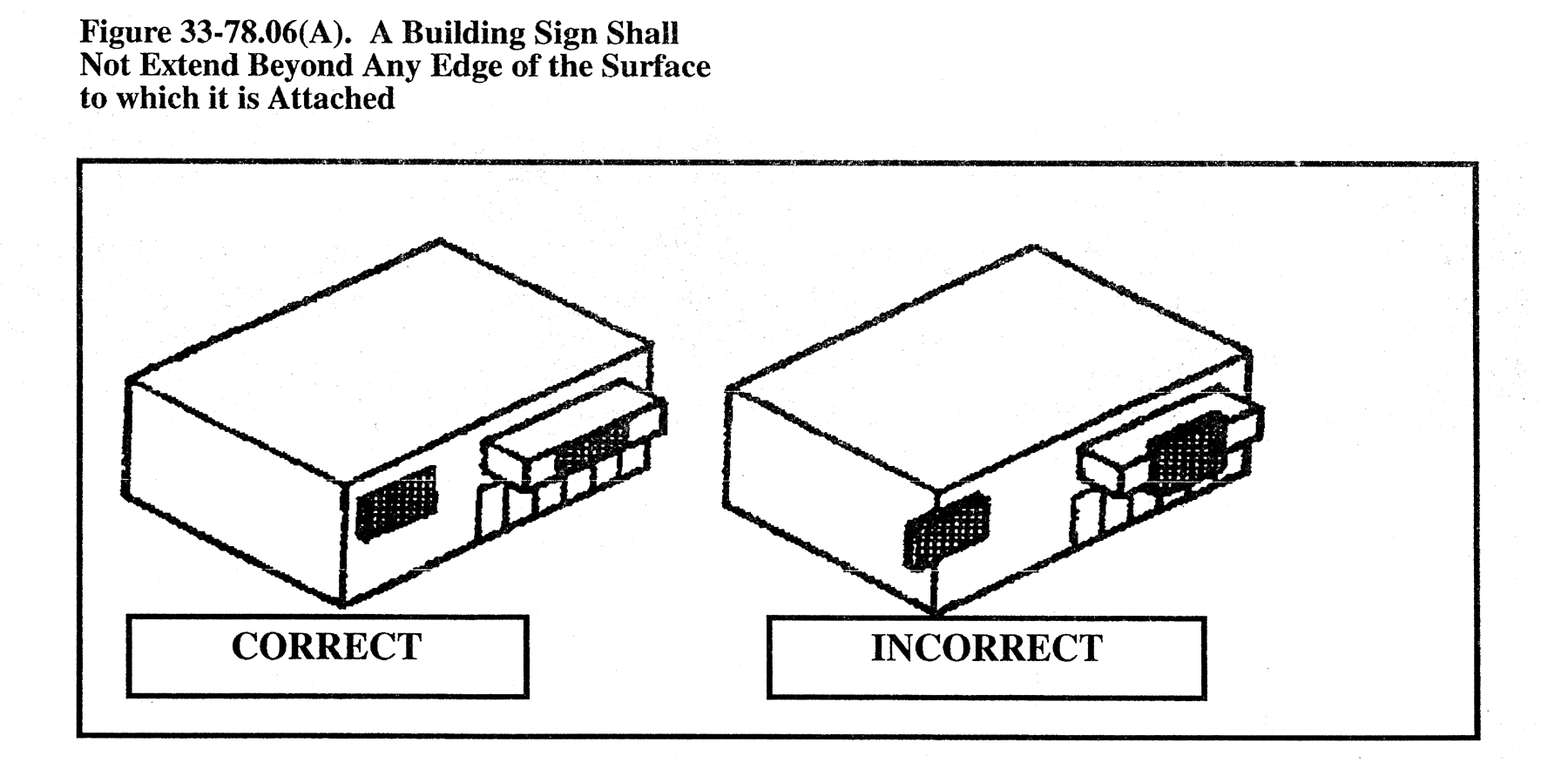
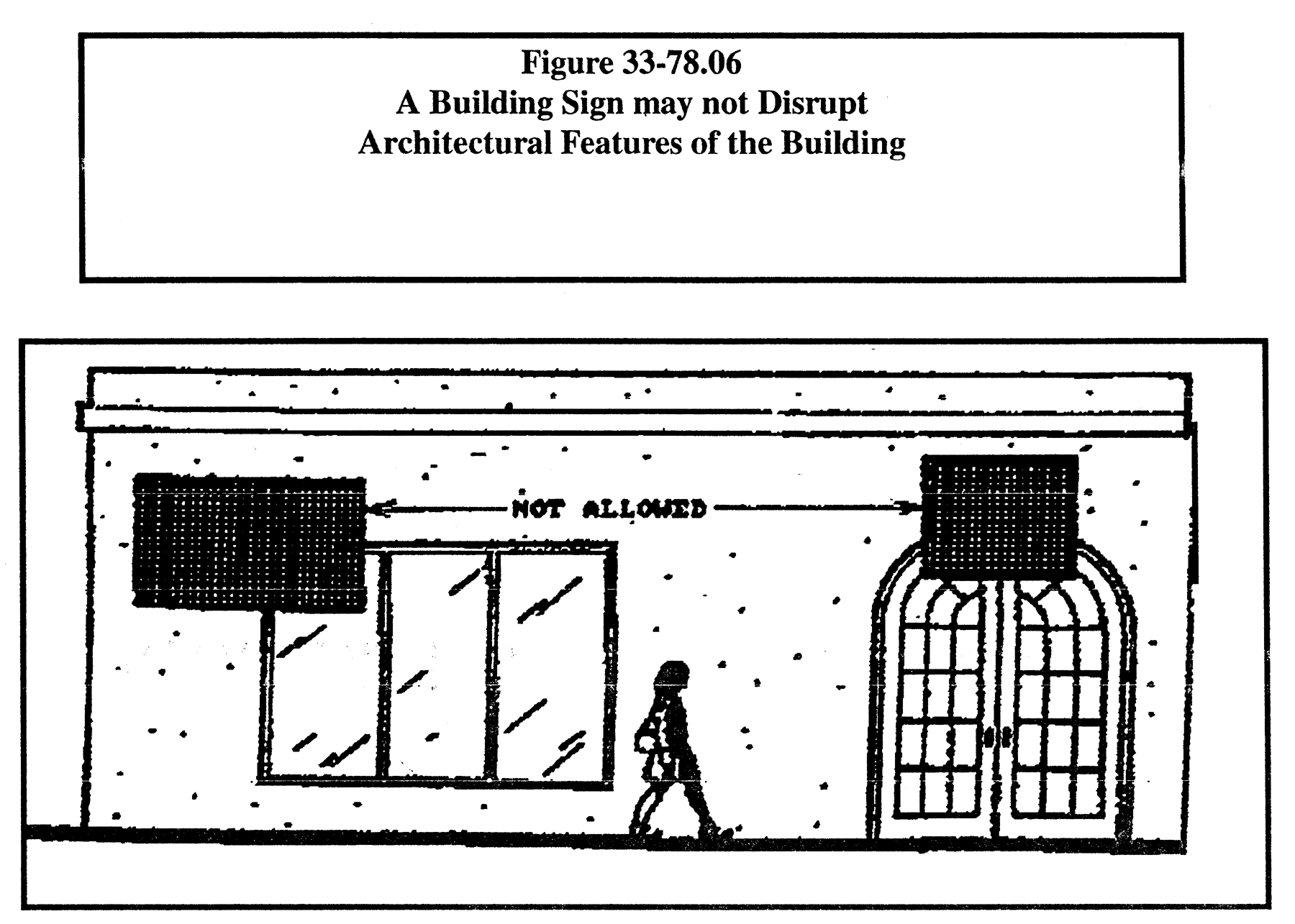
33-78.06. Relationship to building features. A building sign shall not extend beyond any edge of the surface to which it is attached or disrupt a major architectural feature of the building. (See Figure 33-78.06 (A) and Figure 33-78.06 (B).)
33-78.07. Maximum projection. A building sign may project no more than four feet perpendicularly from the surface to which it is attached.
33-78.08. Copy area. Sign copy area does not count towards the 10 percent accent color area of the building.
33-78.09. Formats.
(a)
Format for multiple tenant complexes or center. Building signs for multiple tenant complexes shall conform to an approved overall sign format. The sign format shall be included as a submittal for authorization to erect such a sign and shall be maintained on file in the planning department. The format shall be presented in a plan or sketch, together with written specifications in sufficient detail to enable the planning director to authorize signs based on the specifications. As a minimum, the sign format shall specify the types of signs and dimensions (not to exceed the size limits contained in this chapter) which will be permitted each occupant within the complex. The sign format shall also contain common design elements, such as placement, color, shade, or style of lettering, which lend a unified appearance to the signs of the occupants within the complex. The sign format may only be modified with the approval of the planning director upon submission of a revised plan and specifications detailing the revised format.
(b)
Format for multi-story buildings. In addition to the signs permitted for first floor tenants, multi-story office building(s) shall be allowed across the building primary frontage on the second floor provided that the total square footage of the second floor signs combined do not exceed the maximum of 0.5 square feet in area for each linear foot of building frontage and all signs are arranged so they share a common horizontal center line along the facade. For buildings displaying more than one sign, one of the following criteria shall be met:
1.
Signs shall be spaced evenly across the building facade; or
2.
Signs shall be separated from all other signs a minimum of two times the length of the longest sign on the facade.
33-78.10. Signs required to be certified by a registered engineer. The following signs shall be designed and certified by a Florida registered engineer:
(a)
Ground signs which exceed 32 square feet per sign face.
(b)
Ground signs which exceed six feet in height.
(c)
Any sign that exceeds 32 square feet in size shall be required to have plans designed by an engineer registered in the State of Florida submitted with the permit application. The plans shall be designed to the current wind load and other structural requirements as determined by the current edition of the Florida Building Code as adopted by the Florida Building Commission.
(d)
Other signs, as required by the city engineer.
33-78.11. Sign support structure standards. Ground signs other than monument signs, when supported by a single pole, column or braces, shall contain a cover that is at least two feet in width perpendicular to the street or right-of-way. For signs supported by more than one pole, column or brace, each support structure shall be at least 1½ feet square.
(Ord. No. 2013-11, § 1, 8-5-13)

