
Deland City Zoning Code
ARTICLE VII
SIGNS8
Editor's note— Ord. No. 2013-11, § 1, adopted Aug. 5, 2013, repealed former Art. VII, §§ 33-71—33-79, and enacted a new Art. VII as set out herein. Former Art. VII pertained to the same subject matter. See the Code Comparative Table and editor's note at the beginning and end of this chapter for complete derivation.
Sec. 33-71.- General provisions.
33.71.01. Findings.
(a)
The manner of the erection, location and maintenance of signs affects the public health, safety, morals, and welfare of the people of this community.
(b)
The safety of motorists, cyclists, pedestrians, and other users of the public streets is affected by the number, size, location, lighting and movement of signs that divert the attention of drivers.
(c)
The size and location of signs may, if uncontrolled, constitute an obstacle to effective fire-fighting techniques.
(d)
The construction, erection and maintenance of large signs suspended from or placed on the tops of buildings, walls or other structures may constitute a direct danger to pedestrian and vehicular traffic below, especially during periods of strong winds.
(e)
Uncontrolled and unlimited signs may degrade the aesthetic attractiveness of the natural and manmade attributes of the community and thereby undermine the economic value of tourism, visitation and permanent economic growth.
33-71.02. Intent. The provisions of this article shall be construed and implemented to achieve the following intentions and purposes of the city commission:
(a)
To protect and preserve the character and appearance within the City of DeLand.
(b)
To create a comprehensive and balanced system of sign control that accommodates both the need for a well-maintained, safe and attractive community, and the need for effective business identification, advertising and communication.
(c)
To permit signs that are:
1.
Compatible with their surroundings.
2.
Designed, constructed, installed and maintained in a manner which does not endanger public safety or unduly distract motorists.
3.
Appropriate to the type of activity to which they pertain.
4.
Large enough to convey sufficient information about the owner or occupants of a particular property, the products or services available on the property, or the activities conducted on the property and small enough to satisfy the needs for regulation.
5.
Reflective of the identity and creativity of individual occupants.
(d)
To promote the economic health of the community through increased tourism and property values.
33-71.03. Relationship to building and electrical codes. These sign regulations are intended to complement the requirements of the building and electrical codes adopted by the City of DeLand. All signs shall be erected, altered or maintained in accordance with the building and electrical codes of the City of DeLand. Wherever there is inconsistency between these regulations and other codes, the more stringent requirement shall apply. Due to this relationship between the building codes and the sign regulations, the building official is responsible for enforcing all regulations contained in this article.
33-71.04. No defense to nuisance action. Compliance with the requirements of these regulations shall not constitute a defense to an action brought to abate a nuisance under the common law.
33-71.05. Maintenance.
(a)
All signs, including their supports, braces, guys and anchors, electrical parts and lighting fixtures, and all painted and display areas, shall be maintained in accordance with the building and electrical codes adopted by the City of DeLand, and shall present a neat and clean appearance. The vegetation around, in front of, behind, and underneath the base of ground signs for a distance of ten feet shall be neatly trimmed and free of unsightly weeds, and no rubbish or debris that would constitute a fire or health hazard shall be permitted under or near the sign.
(b)
Routine maintenance of signs is permitted without obtaining a permit. Routine maintenance is considered the cleaning or repainting (no change to copy) of existing sign face or sign structure. Change of name of business is not considered routine maintenance, unless on a manually changeable message center or multi-tenant sign, and will require obtaining a building permit and the new sign to meet the requirements of article VII.
33-71.06.
Nonconforming signs.
(a)
Any sign made nonconforming by the enactment of this chapter, and which has a replacement cost of less than $300.00, and all signs prohibited by Section 33-73 (prohibited signs) of this chapter, shall be removed or made to conform within 90 days of the enactment of this chapter.
(b)
All nonconforming signs shall be made to conform with these Land Development Regulations when structurally altered, new copy is added, or when said signs are destroyed or damaged by wind, fire or other means to the extent of 60% or more of the replacement value.
(c)
Maintenance to a nonconforming sign shall be allowed as long as no wording is changed on the sign copy. If the name of the business changes or the new language is added to the sign, a sign maintenance permit will be required. If a nonconforming sign is removed from the base or disassembled without a sign permit; the sign shall not be allowed to be replaced without complying with article VII, Signs.
(d)
If a building is vacant and/or a sign is not in use for a period of 365 days, then the sign shall be required to be removed or come into compliance. A sign cannot be considered in use if the building is vacant.
Editor's note— Formerly codified as § 33-102.04(d), which was relocated as § 33-71.06 by Ord. No. 2022-07, § 29(b).
(Ord. No. 2013-11, § 1, 8-5-13; Ord. No. 2022-07, § 29(b), 5-16-22)
Sec. 33-72. - Exempt signs.
The following signs are exempt from the operation of these sign regulations, and from the requirement in this chapter that a permit be obtained for the erection of permanent signs, provided they are not placed or constructed so as to create a hazard of any kind:
(a)
Signs that are not designed or located so as to be visible from any street or adjoining property.
(b)
Signs of 1½ square feet or less and signs that include no letters, symbols, logos or designs in excess of two inches in vertical or horizontal dimension, provided that such sign, or combination of such signs, does not constitute a sign prohibited by section 33-73 of this article.
(c)
Signs necessary to promote health, safety and welfare, and other regulatory, statutory, traffic control or directional signs erected on public property with permission as appropriate from the State of Florida, the United States, the County of Volusia, or the City of DeLand.
(d)
Legal notices and official instruments.
(e)
Signs located on taxicabs, buses, trailers, trucks, or vehicle bumpers.
(f)
Signs carried by a person.
(g)
Public warning signs to indicate the dangers of trespassing, swimming, animals or similar hazards.
(h)
Except in the Historic District Overlay, signs appearing in or on the surface of the window not exceeding 25 percent of the surface area of the window. Signs appearing in or on the window(s) within the Historic District require staff approval prior to placement.
(i)
Sandwich board signs that meet the following criteria:
1.
These signs shall not exceed eight square feet per side;
2.
The overall height of the signs shall not exceed four feet and the vertical angle shall not exceed 30 degrees;
3.
The use of metallic or fluorescent paint, letters and/or numbers is prohibited.
4.
All permanent lettering must be of professional quality;
5.
These signs shall be permitted only within five feet of the store entryway or adjacent to the business front lot line in a manner which does not impede pedestrian traffic. If sign is to be located adjacent to or on a public sidewalk then there must be a minimum of five feet of clearance to allow free pedestrian movement;
6.
No signs shall be permitted in the FDOT-maintained right-of-way;
7.
The sign owner shall be responsible for determining the limits of the FDOT maintained right-of-way;
8.
All such signs shall be removed at the end of each business day and stored indoors;
9.
Only one "sandwich board" sign shall be permitted per business; however, in multiple occupancy buildings they cannot be located closer than 20 feet from another sandwich board sign. The sign may be located directly in front of the place of business or it may be located offsite in front of another business that does not have a sandwich board sign with the consent of the offsite business and meet all other regulations listed here in for sandwich board signs;
10.
Any person who wishes to place a "sandwich board" sign on a public sidewalk shall do so at his, her or its own risk and shall defend, indemnify and hold harmless the City of DeLand and the Florida Department of Transportation from and against any and all liability, losses, damages, claims, demands, expenses, fees, fines, penalties, suits, proceedings, actions and costs of actions (including attorney's fees), of whatsoever kind or nature arising out of or in any way related to the design, construction, installation or maintenance of the "sandwich board" sign or any act or omission of the sign owner or his, her or its agents, servants, employees, independent contractors, customers, patrons or invitees, whether on the public sidewalk or elsewhere;
11.
Neither the city nor FDOT shall be liable to any person under any circumstances for the design, construction, installation or maintenance of any "sandwich board" sign placed on a public sidewalk and the city expressly disclaims any duty to inspect "sandwich board" signs for any purpose whatsoever; and
12.
The city and/or FDOT shall have the right to remove and impound any signs which obstruct safe pedestrian or vehicular passage or which encroach upon the FDOT-maintained right-of-way or which violate any other provision of this Code.
(Ord. No. 2013-11, § 1, 8-5-13)
Sec. 33-73. - Prohibited signs.
33-73.01. Generally. It shall be unlawful to erect, cause to be erected, maintain or cause to be maintained, any sign not expressly authorized by, or exempted from this article. Any existing signs which are prohibited according to this article will be required to be removed within a specified period after adoption of this chapter. (See section 33-102.04(d).)
33-73.02. Specifically. The following signs are expressly prohibited unless exempted by section 33-72 of this article or expressly authorized by section 33-22 of article II, section 33-74, section 33-75, or section 33-76 of this article:
(a)
Signs that are in violation of the building code or electrical code adopted by the city.
(b)
Any sign that, in the opinion of the city, does or will constitute a safety hazard.
(c)
Blank temporary signs.
(d)
Signs with visible moving, revolving, or rotating parts or visible mechanical movement of any description or other apparent visible movement achieved by electrical, electronic, or mechanical means, except for traditional barber poles, multiple vision billboards and message centers.
(e)
Signs with the optical illusion of movement by means of a design that presents a pattern capable of giving the illusion of motion or changing of copy.
(f)
Strings of light bulbs, continuous neon borders, neon highlighted signs/graphics or other lighting borders, draping, wrapping or similar decorative lighting display used on commercially developed parcels for commercial purposes, other than traditional holiday decorations, are prohibited without staff approval. Lighting which distracts from, or may cause confusion relating to, traffic and/or pedestrian signage is prohibited.
Applicants wishing to apply such lighting shall submit to the planning department:
1.
Details regarding the lighting including illustrations depicting the fixture(s); and
2.
Evidence provided by a certified electrician or similarly qualified individual demonstrating the lighting will not constitute a public safety hazard due to weather, wind, component construction and/or other operation or exposure condition, at a minimum, all lighting must have the Underwriters Laboratory seal of approval); and
3.
The lighting owner is responsible for upkeep and maintenance of the lighting display upon approval and installation. The city shall be entitled to remove degraded or malfunctioning displays at the lighting owner's expense and shall have the right to record a lien against the property for the cost associated therewith, if not paid by the lighting owner within 30 days of invoice by the city.
(g)
Signs that incorporate protected images, emit any sound that is intended to attract attention, or involve the use of live animals.
(h)
Signs that emit audible sound, odor, or visible matter such as smoke or steam.
(i)
Signs or sign structures that interfere in any way with free use of any fire escape, emergency exit, or stand-pipe, or that obstruct any window to such an extent that light or ventilation is reduced to a point below that required by any provision of this chapter or other ordinance of the City of DeLand.
(j)
Signs that resemble any official sign or marker erected by any governmental agency, or that by reason of position, shape or color, would conflict with the proper functioning of any traffic sign or signal, or be of a size, location, movement, content, color, or illumination that may be reasonably confused with or construed as, or conceal, a traffic control device.
(k)
Signs that obstruct the vision of pedestrians, cyclists, or motorists traveling on or entering public streets.
(l)
Signs within ten feet of public right-of-way or 100 feet of traffic-control lights that contain red or green lights that might be confused with traffic-control lights.
(m)
Signs that are of such intensity or brilliance as to cause glare or impair the vision of any motorist, cyclist, or pedestrian using or entering a public way, or that are a hazard or a nuisance to occupants of any property because of glare or other characteristics.
(n)
Signs that contain any lighting or control mechanism that causes unreasonable interference with radio, television or other communication signals.
(o)
Searchlights used to advertise or promote a business or to attract customers to a property.
(p)
Signs that are painted, pasted, or printed on any curbstone, flagstone, pavement, or any portion of any sidewalk or street, except house numbers and traffic control signs; and signs attached to a utility pole, tree, fence post or other similar object.
(q)
Signs placed upon benches, bus shelters or waste receptacles, except as may be authorized in writing pursuant to § 337.407, Florida Statutes.
(r)
Signs erected on public property, or on private property (such as private utility poles) located on public property, other than signs erected by public authority for public purposes and signs authorized in writing pursuant to § 337.407, Florida Statutes.
(s)
Signs erected over, across or within any public street or right-of-way, except for governmental signs erected by or on the order of a public officer, banners for not-for-profit groups or organizations, signs as may be expressly authorized by this article, and signs that are permitted by specific license agreement with the city. Refer to section 33-74, permitted temporary signs, for the type of sign allowed.
(t)
Vehicle signs with a total sign area on any vehicle in excess of ten square feet, when the vehicle:
1.
Is parked for more than 60 consecutive minutes within 100 feet of any street right-of-way;
2.
Is visible from the street right-of-way that the vehicle is within 100 feet of; and
3.
Is not regularly used in the conduct of the business advertised on the vehicle. A vehicle used primarily for advertising, or for the purpose of providing transportation for owners or employees of the occupancy advertised on the vehicle, shall not be considered a vehicle used in the conduct of the business.
(u)
Signs displaying copy that is harmful to minors as defined by this article.
(v)
Portable signs as defined by this article.
(w)
Any sign, form, structure or building designed or constructed to resemble any human, animal, plant, or product.
(x)
Window signs at convenience stores, which obstruct the view of the cash register area from the outside.
(y)
Signs with lights or illuminations that flash, move, rotate, scintillate, blink, flicker, or vary in intensity or color except for time-temperature-date signs.
(z)
Signs that are considered roof signs.
(Ord. No. 2013-11, § 1, 8-5-13)
Sec. 33-74. - Permitted temporary signs.
33-74.01. Where allowed. Temporary signs are allowed throughout the city, subject to the restrictions imposed by this section and other relevant parts of this chapter.
33-74.02. Sign types allowed.
(a)
Ground signs (not electrical).
(b)
Building signs (not electrical).
(c)
Signs commonly referred to as wind signs, consisting of one or more festoons, flags, pennants, ribbons, spinners, streamers or captive balloons, or other objects or material fastened in such a manner as to move upon being subjected to pressure by wind, up to a maximum of one events per calendar year, per property, for a maximum of 15 days per event. Banner signs (without associated festoons, flags, pennants, ribbons, spinners, streamers or captive balloons or other such objects or materials) may be allowed for a maximum of four events per calendar year, per business, for a maximum of 30 days per event.
(d)
Political signs, which may be in place for a total of 127 days and which must be removed within seven days after the election.
(e)
Signs or banners that are used to promote cultural or civic events, or activities of general public interest. The sign or banner cannot be used for advertising a specific product or corporate entity, but it may contain no more than ten percent of copy area to identify a product or corporate entity sponsorship of the event or activity being promoted.
33-74.03. Removal of illegal temporary signs. Any temporary sign not complying with the requirements of this section is illegal and subject to immediate removal.
33-74.04. Restrictions on content of temporary signs. A temporary sign may display any message so long as it is not:
(a)
Harmful to minors as defined by this article.
(b)
Advertising as defined by this article, except that advertising for the following purposes may be displayed:
1.
To indicate that an owner, either personally or through an agent, is actively attempting to sell, rent or lease the property on which the sign is located.
(c)
Temporary advertising as defined by this article is permitted for the following purposes and time periods and no longer:
1.
To indicate the grand opening of a business, sale, or other activity. Festoons, flags, pennants, ribbons, spinners, streamers or captive balloons, or other objects or material fastened in such a manner as to move upon being subjected to pressure by wind, up to a maximum of one event per calendar year, per property, for a maximum of 15 days per event. Single banners indicating the grand opening of a business, sale or other activity may be displayed for a maximum of four events per calendar year, per business, for a maximum of 30 days per event.
2.
To identify construction in progress. Such message shall not be displayed more than 60 days prior to the beginning of actual construction of the project, and shall be removed when construction is completed. If a message is displayed pursuant to this section, but construction is not initiated within 60 days after the message is displayed, or if construction is discontinued for a period of more than 60 days, the message shall be removed, pending initiation or continuation of construction activities.
3.
To indicate the existence of a new business, or a business in a new location, if such business has no permanent signs. Such message may be displayed for a period of not more than 60 days or until installation of permanent signs, whichever shall occur first.
4.
To announce or advertise such temporary uses as fairs, carnivals, circuses, revivals, sporting events, flea markets, or any public, charitable, educational or religious event or function. Such message may be displayed for a period not exceeding 30 days prior to the event. Such message shall be removed within five days after the special event. Community, product or corporate sponsorship or underwriting may be recognized through the appearance of the sponsor's name and/or logo on the temporary sign or banner. Sponsorship identity may appear on no more than ten percent of the banner or sign area. Moreover, the sponsorship message(s) must be subordinate to the overall banner message and in balance with the overall banner design.
33-74.05. Permissible size, height and number of temporary signs. This section does not apply to section 33-74.02(c); unless authorized by section 33-22.
(a)
One-family and two-family residences. A parcel on which is located a single one-family or two-family residence may display not more than two temporary signs with an aggregate sign area of not more than ten square feet. No individual sign shall exceed six square feet nor exceed eight feet in height.
(b)
Three-family and four-family residences. A parcel on which is located a single three-family or four-family residence may display not more than four temporary signs with an aggregate sign area of not more than 16 square feet. No individual sign shall exceed six square feet in sign area nor exceed eight feet in height.
(c)
On all other parcels. All other parcels may display one square foot of temporary signage per ten feet of frontage up to a maximum of 100 square feet. No individual sign shall exceed 60 square feet nor exceed ten feet in height. Signs must be spaced at least 100 feet apart. For parcels containing more than one business, such as a shopping center, each business may have one banner sign attached to their building or portion of the building; however such banner signs cannot be located closer than ten feet from another sign. Any sign inside a Gateway Overlay District shall not exceed the requirements of section 33-36.
(Ord. No. 2013-11, § 1, 8-5-13)
Sec. 33-75. - Permitted permanent accessory signs.
33-75.01. Generally.
(a)
With the exception of those properties that fall inside the Gateway Overlay Districts, which include the Emerging, Redevelopment and Core Gateway Overlay Districts as delineated by article IV, section 33-36.03, Boundaries of the Gateway Overlay Districts, all parcels are permitted to have permanent accessory signs in the BR, E-1, P-1, C-1, C-2, C-2A, C-2AC, C-3, C-4, M-1, and PD zoning districts as provided below. In the P-1 and C-3 zoning districts, if the front yard or side yard of the property for which a sign is proposed is located adjacent to a residential land use, the total square footage of the sign shall not exceed 50 percent of the maximum square footage of the signage permitted in this district.
Signs inside a Gateway Overlay District must meet the requirements of section 33-36, article IV, Overlay and Floating Zones as described in Table 33-75.01(b) below.
(b)
TABLE—Signs in the Gateway Overlay Districts.
33-75.02. Sign types allowed. A permanent accessory sign may be a ground or building sign. A permanent accessory sign may not be a roof sign.
33-75.03. Content. A permanent accessory sign may display any message so long as it is not harmful to minors as defined by this article.
33-75.04. Permissible number, area, spacing and height of permanent accessory signs. The following section addresses all areas of the city not included in the Gateway Overlay District. The areas included in the Gateway Overlay District are described in article IV. Signs located in a Gateway Overlay District must meet the applicable criteria.
(a)
Ground signs.
1.
One ground, either monument type or pole type, sign may be permitted per street frontage.
2.
The maximum height of ground sign shall not exceed 12 feet, except in the Gateway Overlay Districts as specified in section 33-36.04.
3.
The maximum sign area of a ground sign shall be determined by the standards below:
a.
Any property having a total area of less than two and one-half acres may have one double-faced sign per street frontage, with a maximum of 48 square feet of sign area per side.
b.
Any property having a total area of two and one-half acres up to five acres may have one double-faced sign per street frontage, with a maximum of 68 square feet of sign area per side.
c.
Any property having a total area of five acres or more may have one double-faced sign per street frontage, with a maximum of 128 square feet of sign area per side.
d.
Any property having a total area of twenty acres or more may have one double-faced sign per street frontage, with a maximum of 150 square feet of sign area per side.
4.
Ground signs shall comply with the provisions of section 33-90.03(o) or be set back at least a minimum of five feet from the right-of-way, whichever is greater except in the Gateway Overlay Districts as specified in section 33-36.04. Depending on the type of site plan, city staff, the technical review committee, planning board or the city commission, as the case may be, may allow modification of the required setback where the modification meets the intent of the regulation.
5.
Shopping centers fronting the street in excess of 450 feet and having two entrances at least 300 feet apart may have two signs, smaller than or equal to the size limitations set forth herein, one at each of the specified entrances.
(b)
Building signs.
1.
Signage shall be permitted on the building frontage. Subject to the design criteria in section 33-78 of this article, the top of a building sign shall not exceed above the roofline.
a.
Sign area may be transferred from the primary building frontage to the sides and rear of the building provided those sides are not oriented toward residential uses and the following conditions are met:
(1)
Building facades on which additional signage is placed must be finished with the same or similar architectural facade treatment and quality as the primary building frontage.
(2)
Building signs for outparcels shall comply with the approved sign program for multi-tenant complexes or centers in accordance with section 33-78.09.
(3)
The size of the total signage is determined by the street frontage.
2.
For buildings and for each tenant storefront 50 feet in length or less, the maximum sign area shall be determined by multiplying the building front foot (length of building that faces street) by 1.5 feet. The maximum sign area for buildings greater than 50 feet, but less than 200 feet, in length shall be determined by multiplying the building front foot (length of building that faces street) by one foot, with a maximum of 100 square feet, whichever is less. If the building is more than 200 feet in length, the maximum sign area is 150 square feet. Maximum sign area cannot be exceeded regardless of which side(s) of the building the sign is displayed on. The above calculation shall be applied to each tenant store front in buildings with multiple tenant store fronts.
3.
Marquee type signs will contain no more than 32 square feet of area.
4.
Canopy signs, such as those used at automobile service stations, shall count towards the total copy area permitted per front facade of the primary building. Corporate designs, logos, stripes and color, if the color is an accent, count as part of the overall sign area.
(c)
Multiple frontages. If a building has frontage on two or more streets, each frontage shall be separately considered for the purposes of determining compliance with the provisions of these regulations, but the permitted sign area for one frontage may not be combined with that permitted on another frontage to increase the permitted number or area of signs on one frontage.
(d)
Historic signs.
1.
All signs inside the Historic District Overlay shall comply with the following standards in addition to the Gateway Overlay District:
a.
If the sign is a pole sign, the sign shall be cantilevered and meet the following:
(1)
Pole signs shall be tapered and constructed of a smooth black metal.
(2)
There shall be an approximate distance of three feet between the mounting of the cantilevered arm and the top of the pole.
(3)
The cantilevered arm shall be constructed of a smooth black metal and shall not extend more than four feet from the pole.
(4)
Pole signs must receive certificate of appropriateness from the historic preservation board.
(5)
Pole signs shall not exceed 12 feet in height.
(6)
Pole signs shall not exceed 16 square feet of copy area.
b.
If the sign is a ground mounted sign it shall be a monument sign that meets the following:
(1)
Ground mounted signs shall not exceed 8 feet in height.
(2)
Ground mounted signs shall not exceed 48 square feet of copy area.
2.
All building signs, including awning signage, inside a Historic District Overlay shall comply with the following standards:
a.
Sign material may consist of wood or other appropriate material that is compatible with the historic character of the building upon which it is located.
b.
Color of sign must be approved by the historic preservation board by either [its inclusion] on the approved color palette or direct vote of the board.
c.
Internally lighted signs are prohibited. Back light or front light signs are permitted.
d.
Signs may be painted directly onto building, using only approved colors.
e.
Sign copy placed upon, or under, awnings will count towards total area for building signs in accordance with section 33-78.05 a. and b.
(e)
Residential development identification signs.
1.
Ground signs.
a.
Developments of 12 units or less may have one ground sign, not to exceed 16 square feet in area per side, for each street frontage.
b.
Developments of 13 units or more may have one double-sided or up to two single-sided ground signs, not to exceed 48 square feet, for each street frontage.
c.
Signs may be installed on a perimeter fence or wall.
2.
Ground sign height and setback.
a.
Maximum sign height shall not exceed eight feet.
b.
Ground signs shall have a minimum setback of five feet from the right-of-way line and ten feet from a side lot line.
3.
Building signs.
a.
One building sign may be used in lieu of a ground sign of a maximum size specified in sections 1. and 2. above. No projecting or roof signs shall be permitted.
4.
Maintenance. The city shall ensure that such signs shall be maintained perpetually by the developer, the owner of the sign, a pertinent owners' association, or some other person who is legally accountable under the maintenance arrangement approved by the city staff. If no accountable person accepts legal responsibility to maintain the signs and no other provision has been made for the maintenance of them, the developer or owner shall remove the signs.
(f)
Nonresidential uses in residential zones. The following ground sign areas shall be permitted for nonresidential uses in residential zones.
1.
Houses of worship.
a.
All signs shall comply with the regulations of the applicable Gateway District. If the site is outside the Gateway District, then the following standards shall apply.
b.
The maximum area of the sign shall be 48 square feet per side. The maximum height of a ground sign shall not exceed eight feet.
c.
The maximum area for a building sign shall be 32 square feet. The building sign may be in the form of a marquee type sign.
2.
Day care, nursery school, associated with houses of worship. The maximum area of a ground sign shall be 16 square feet per side. The maximum height of a ground sign shall be eight feet. Ground signs shall comply with the provisions of section 33.90.03(o) or be set back a minimum of five feet from the right-of-way, whichever is greater.
3.
Home occupation. The maximum area of a sign shall be one square foot, affixed on the wall adjacent to the front entrance of the building.
(g)
Public uses and buildings. Public buildings, parks, community centers, and other public uses are exempt from the sign regulations. Design of signs shall be compatible with the building design.
(h)
Bed and breakfast signs.
1.
Generally. A permanent accessory sign may be displayed by any permitted bed and breakfast facility regardless of the zoning district in which they are located provided that the following standards are met.
2.
Restrictions.
a.
One cantilevered pole sign or ground sign shall be permitted in the front yard setback area provided the front lot line abuts a public right-of-way. The sign may be a single sign structure with two faces of equal size.
b.
Each bed and breakfast may also display one nonilluminated wall mounted sign with a maximum area of three square feet.
c.
Bed and breakfast advertising signs shall comply with the following standards:
(1)
In any residential zoning district and in the P-1 and E-1 district, the maximum pole or ground sign area shall not exceed ten square feet per side.
(2)
In residential zoning districts and in the P-1 and E-1 district, the overall height of the pole or ground sign/structure may not exceed eight feet.
(3)
Bed and breakfast advertising signs may be lit by incandescent or fluorescent shielded lights or landscape lighting, provided the bulb wattage does not exceed 100 watts and the illuminated area is limited to the subject property.
(4)
In no instance shall neon, metal halide, quartz, low- or high-pressure sodium lighting be permitted to be incorporated into the sign or to illuminate the sign.
(5)
In commercial zoning districts, the signs must comply with the applicable zoning district or Gateway District.
d.
Under no circumstances shall an off-premises sign be permitted to advertise a bed and breakfast located in a residential zoning district.
(i)
Utility signs. Public utility signs that identify the location of underground utility lines and facilities, high voltage lines and facilities, and other utility facilities and appurtenances are permitted so long as they do not exceed three feet in height, and so long as the sign face does not exceed one square foot.
33-75.05. Electronic or LED signs.
(a)
Time-temperature-date signs. Time-temperature-date signs are permitted as a permanent accessory sign on commercially developed parcels notwithstanding the general prohibition on changing signs. These signs may only display numerical information in an easily comprehensible way and shall be kept accurate. They may be ground or building signs, and are subject to the regulations applicable to such signs. They shall be counted as part of an occupancy's allowable sign area.
(b)
[Electronic message center signs.] Electronic message center signs are permitted in place of a manual changeable copy board sign, provided that the following conditions are met:
1.
A notarized affidavit is provided with the sign permit application stating the sign will be constructed and operated in compliance with city code, and that it will not flash, move, rotate, scintillate, blink, flicker, or vary in intensity or color in accordance with section 33-73(y); and
2.
The freestanding sign that contains a display screen shall meet the requirements of this chapter; and
3.
The display screen shall not be oriented toward or face a residential zoning district; and
4.
A photometric plan outlining the proposed illumination levels in foot-candles shall be provided with the sign permit, which plan shall demonstrate that illumination levels shall not exceed 0.3 foot-candles, measured with an illuminance meter set to measure foot-candles accurate to at least two decimals. Illuminance shall be measured with the electronic message center off, and again with the electronic message displaying a white image for full color-capable signs, or a solid message for single color signs. All measurements shall be taken perpendicular to the face of the electronic message center at a distance determined by the total square footage of the sign as set forth in the accompanying "Electronic Message Center Sign Area Versus Measurement Distance Table" below:
Electronic Message Center Sign Area
Versus Measurement Distance
; and
5.
The display screen must be integral to the design of the sign structure and shall not be the dominant element; and
6.
Only the identification of the tenants within the center shall be permitted, as off-site advertisement is prohibited; and
7.
The display area shall apply towards the maximum amount of signage permitted per each site regardless of whether it is illuminated or utilized; and
8.
Copy change of display screen shall not be more frequent than once per day; and
9.
The display screen is restricted to a single permanent background color, per copy change. A malfunctioning electronic message center shall be programmed to turn off or otherwise display a blank screen. Electronic message centers must be equipped with software programming controls that automatically turn the sign off if the display is malfunctioning in any way; and
10.
Any message or picture displayed shall be static in nature and shall not scroll, blink, flicker, flash, scintillate or be otherwise animated; and
11.
The display screen area shall provide a high resolution picture quality. Exposed neon or fiber-optic tubing on electronic message centers is prohibited; and
12.
Electronic message centers shall be equipped with a sensor or other device that automatically determines the ambient illumination and can be programmed to automatically dim according to ambient light conditions, or that can be adjusted to comply with the 0.3 foot-candle measurements; and
13.
An information sheet shall be submitted as part of the sign permit application which includes the manufacturing specifications of the display screen being installed, along with contact information of the property owner, sign contractor and the display screen maintenance provider; and
14.
The conversion of any existing permitted sign to an electronic message center or the installation of an electronic message center on or within an existing permitted sign shall require the approval of a new sign permit.
33-75.06. Directional signs. Directional signs limited in area to three square feet, giving directions to motorists regarding the location of parking areas and access drives, shall be permitted as permanent accessory signs on all parcels and shall not be counted as part of an occupancy's allowable sign area.
(Ord. No. 2013-11, § 1, 8-5-13)
Sec. 33-76. - Permitted permanent outdoor advertising signs.
33-76.01. Where allowed.
(a)
Generally. Permanent outdoor advertising signs are allowed in the following zoning districts: C-2 and M-1; provided, however, that they shall not be allowed on properties within or having frontage on the area bounded by: the south right-of-way line of U.S. 92 and C.R. 92; the north right-of-way line of Taylor Road; the west right-of-way line of S.R. 15A; and the east right-of-way line of Blue Lake Road and the Blue Lake Road extension.
(b)
Special prohibition relating to the downtown district. Notwithstanding subsection (a) above, permanent outdoor advertising signs are prohibited in the downtown district bounded by Clara Avenue on the west, Amelia Avenue on the east, Voorhis Avenue on the south and Michigan Avenue on the north.
33-76.02. Content. Outdoor advertising signs may display any message except for the following:
(a)
Messages harmful to minors as defined by this article.
(b)
Messages that advertise a commercial activity conducted on the parcel on which the sign is located.
33-76.03. Types of outdoor adverting signs allowed.
(a)
Single- and double-faced.
1.
An outdoor advertising sign may be single- or double-faced, but any double-faced outdoor advertising sign shall have advertising surfaces of equal size and shape.
2.
For the purposes of this section, the following types of outdoor advertising signs shall be considered double-faced:
a.
An outdoor advertising sign where the sign faces are placed back to back as long as the backs of the signs are not separated by more than 36 inches.
b.
An outdoor advertising sign constructed in the form of a "V" when viewed from above, provided the internal angle at the apex is not greater than 45 degrees and the outdoor advertising sign's structure is not separated by more than 36 inches at the apex of the "V."
(b)
Multifaced.
1.
An outdoor advertising sign may have a maximum of two advertising surfaces facing one direction.
2.
A multifaced outdoor advertising sign shall only be allowed under the following circumstances:
a.
Both surfaces shall be the same size and shape.
b.
The total length of the outdoor advertising sign shall not exceed 40 feet; the total height of the combined copy areas shall not exceed 26 feet and the total copy area size shall not exceed 300 square feet.
33-76.04. Dimensional requirements.
(a)
Maximum size. Each face of a single double-faced outdoor advertising structure shall be allowed an advertising display area of not more than 300 square feet.
(b)
Maximum height. No permanent outdoor advertising sign, or combination of signs, may exceed 40 feet above the ground level, except as provided above.
(c)
Ground clearance. An open space of not less than eight feet shall be maintained between the lower edge of an outdoor advertising sign and the ground.
(d)
Setbacks.
1.
Except as otherwise provided below, no portion of any outdoor advertising sign shall be erected or maintained nearer to any street than the established building setback line of such street; provided, further, that all other yard and setback requirements of the zoning district shall apply to outdoor advertising signs.
2.
Along limited access highways and expressways as established by the State of Florida or any of its political subdivisions, no outdoor advertising sign shall be allowed within 150 feet of the outside curb (the nearest curb to the proposed sign) of the main traffic route of such street or highway. It is intended specifically by this provision that such setback shall not be measured from the curb line of ramps or ways used exclusively for access to or exit from such highway or street; however, all outdoor advertising signs located along such ramps or ways shall meet all appropriate yard and building setback requirements for the zones in which they are located.
(e)
Spacing. No outdoor advertising sign shall be constructed within the area described in section 33-76.01(a). Outside of the above-described area, outdoor advertising signs may be allowed in the C-2 and M-1 zoning districts along arterial roads, subject to a minimum spacing requirement of 2,000 feet.
1.
Along limited access highways, including expressways, as established by the State of Florida or any of its political subdivisions, no outdoor advertising sign shall be erected closer than 1,000 feet to the nearest outdoor advertising sign on the same side of the highway having an advertising surface visible to traffic traveling in the same direction regardless of the size of the outdoor advertising sign structure.
2.
Along federal aid primary highways as established by the State of Florida or any of its political subdivisions, no outdoor advertising sign shall be erected closer than 1,000 feet to the nearest outdoor advertising sign on the same side of the highway having an advertising surface visible to traffic traveling in the same direction, regardless of the sizes of the outdoor advertising signs.
3.
Along all other roadways the following applies:
a.
No outdoor advertising sign having a copy area of 75 square feet or less per face shall be erected closer than 200 feet to the nearest outdoor advertising sign on the same side of the roadway having an advertising surface visible to traffic traveling in the same direction regardless of the size of the outdoor advertising sign.
b.
Outdoor advertising signs having a copy area of greater than 75 square feet per face shall not be erected closer than 200 feet to the nearest outdoor advertising sign having a copy area of 75 square feet or less per face nor closer than 500 feet to any other outdoor advertising sign having a copy area of greater than 75 square feet per face. These distances shall apply only to outdoor advertising signs on the same side of the roadway having an advertising surface visible to traffic traveling in the same direction.
c.
Along any roadway where there are located outdoor advertising signs which have copy areas which must follow the terms of both items a. and b. above, no more than 20 advertising surfaces shall be allowed per mile for each side of the roadway regardless of the respective number of each size of advertising surfaces.
4.
The distance between outdoor advertising signs shall be the distance measured linearly along the center line of the street or highway on which the common frontage sites each have frontage, between perpendiculars to such center line drawn from such outdoor advertising sign (at the point on each closest to the other) to the center line of such street.
5.
An outdoor advertising sign which is situated in such a manner so that the advertising surface is visible to traffic on two or more streets or highways shall meet the distance requirements on all such streets or highways for signs visible to traffic traveling in the same direction.
33-76.05. Design requirements.
(a)
Supporting structure. No portion of the supporting structure shall be visible above any advertising display area. The supporting structure shall be of monopole construction.
(b)
Illumination. No outdoor advertising sign shall be erected, or any existing outdoor advertising sign maintained, that incorporates flashing, scintillating, beacon or running lights.
(c)
Identification. Every outdoor advertising sign shall have the permit number, and the voltage of any electrical apparatus used in connection therewith visibly displayed unless there is any other adequate means of identification.
(Ord. No. 2013-11, § 1, 8-5-13)
Sec. 33-77. - Measurement determinations.
33-77.01. Distance between signs. The minimum required distance between signs shall be measured along street right-of-way from the closest parts of any two signs.
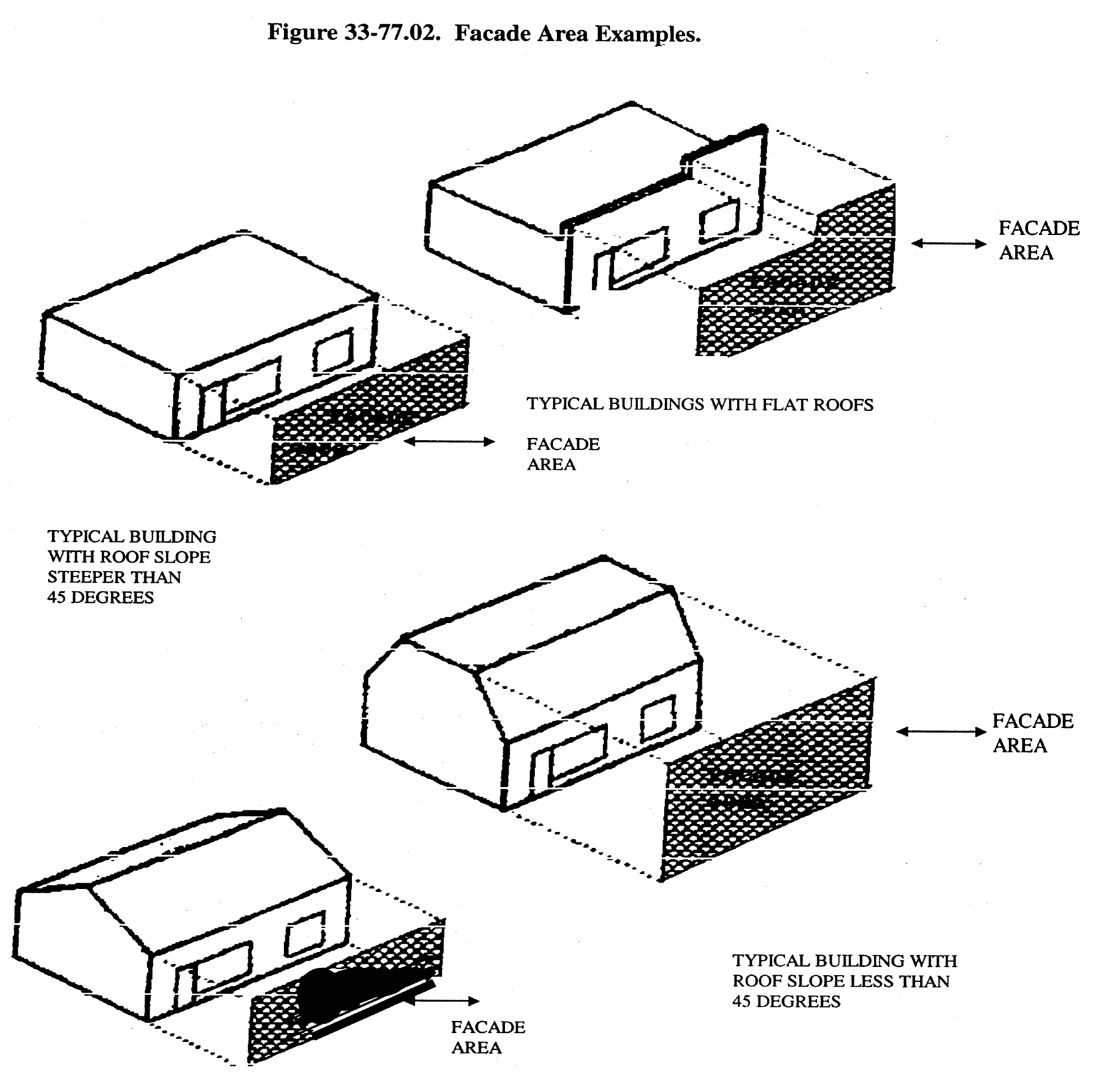
33-77.02. Facade area. The facade area shall be measured by determining the area within a two-dimensional geometric figure coinciding with the edges of the walls, windows, doors, parapets, marquees, and roof slopes of greater than 45 degrees that form a side of a building or unit. (See Figure 33-77.02.)
33-77.03. Sign area.
(a)
Generally. The area of a sign shall be the area within the smallest square, rectangle, parallelogram, triangle, circle or semicircle, the sides of which touch the extreme points or edges of the sign face.
(b)
Special situations.
1.
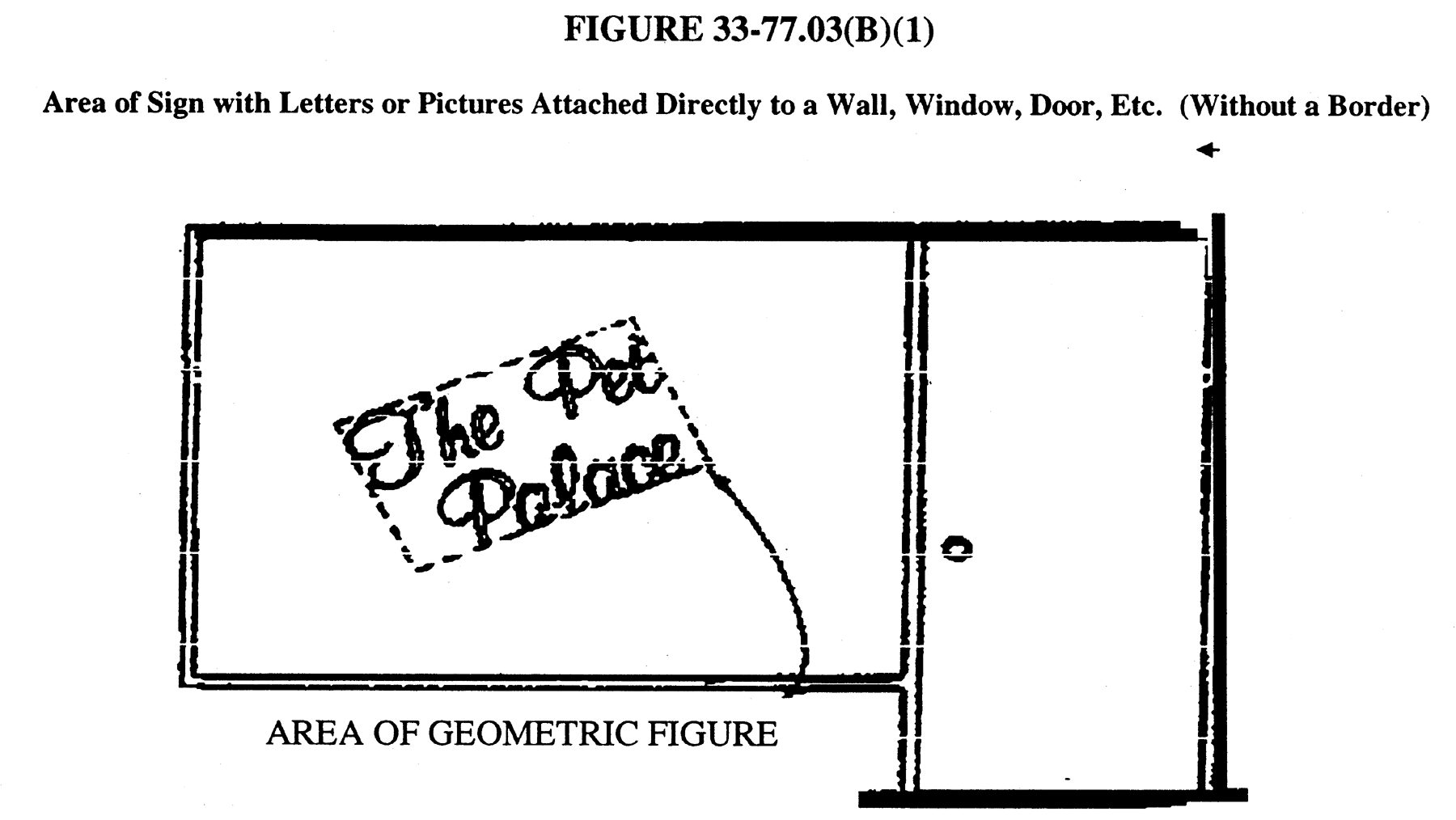
Where a sign is composed of letters or pictures attached directly to a facade, window, door, or marquee, and the letters or pictures are not enclosed by a border or trimming, the sign area shall be the area within the smallest rectangle, parallelogram, triangle, circle or semicircle, the sides of which touch the extreme points of the letters or pictures. (See Figure 33-77.03(b)1.)
2.
Where two sign faces are placed back to back on a single sign structure, and the faces are at no point more than four feet apart, the area of the sign shall be counted as the area of one of the faces.
3.
Where four sign faces are arranged in a square, rectangle, or diamond, the area of the sign shall be the area of the two largest faces.
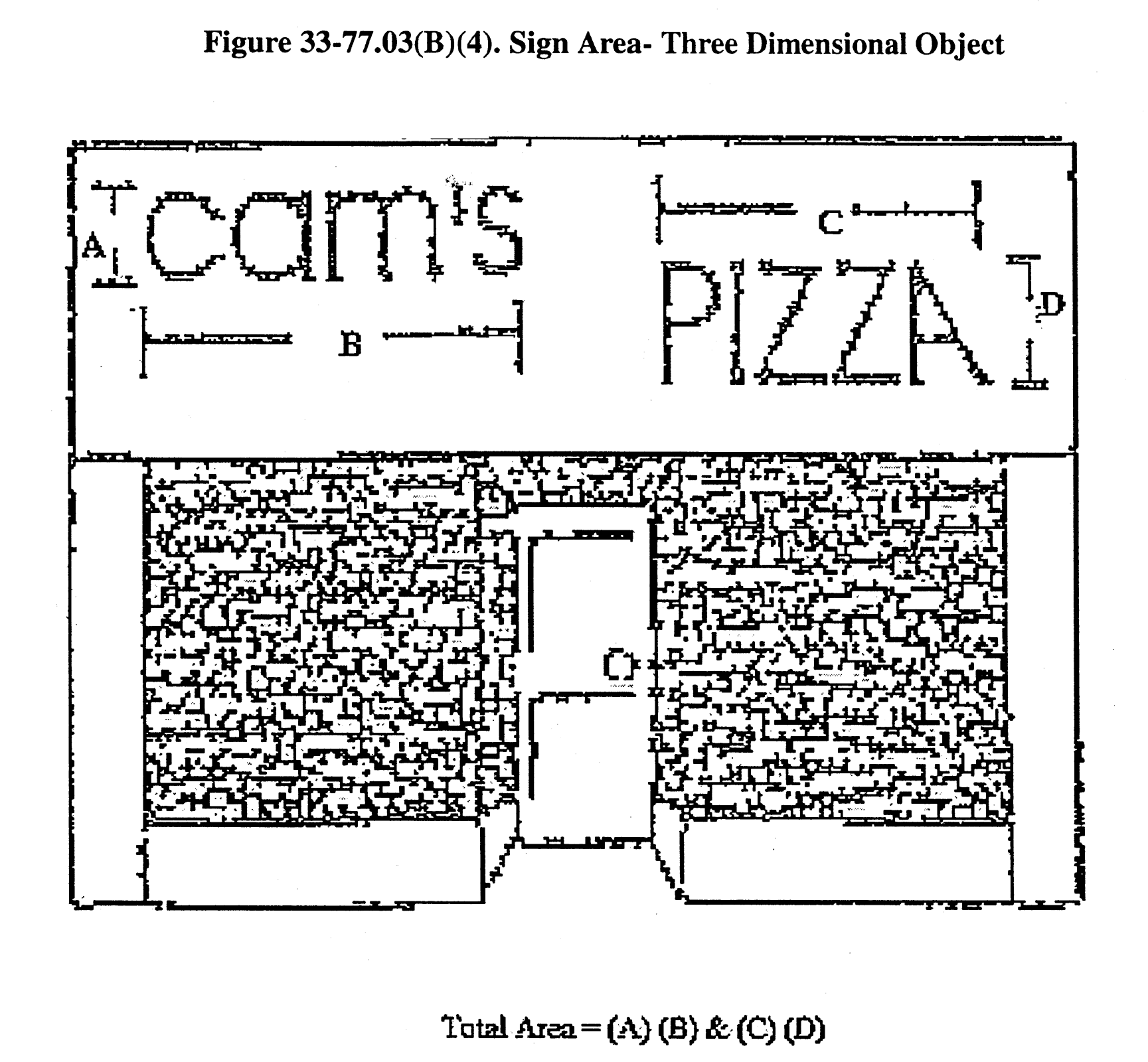
Where a sign is in the form of a three-dimensional object, the area shall be determined by drawing a square, rectangle, parallelogram, triangle, circle or semicircle, the sides of which touch the extreme points or edges of the projected image of the sign and multiplying that area by two. The "projected image" is that image created by tracing the largest possible two-dimensional outline of the sign. (See Figure 33-77.03(b)4.)
33-77.04. Number of signs.
(a)
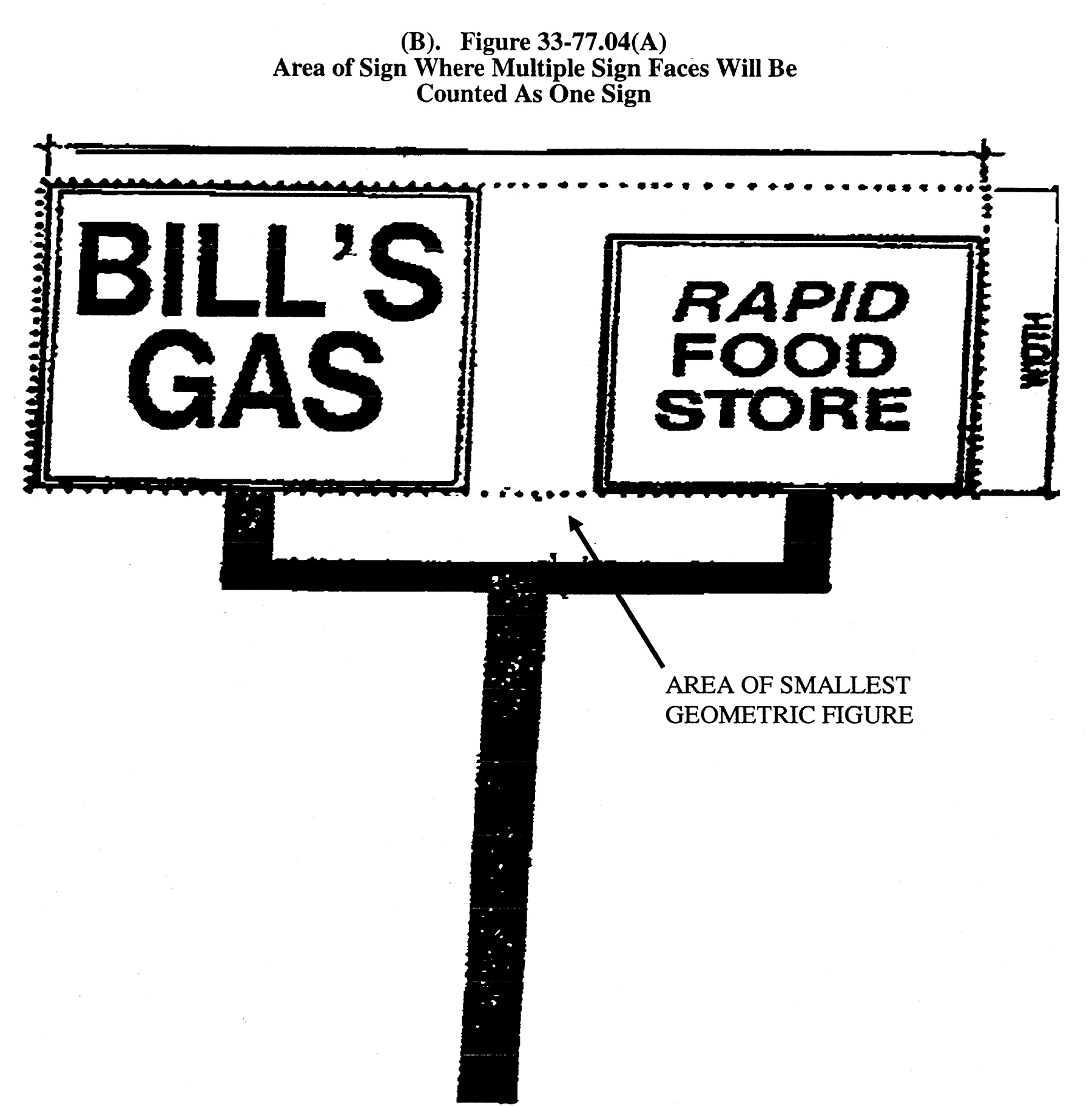
Generally. In general, the number of signs shall be the number of noncontiguous sign faces. Multiple noncontiguous sign faces may be counted as a single sign if all the sign faces are included in the geometric figure used for determining the sign area. (See Figure 33-77.04(a).)
(b)
Special situations.
1.
Where two sign faces are placed back to back and are at no point more than three feet apart, it shall be counted as one sign.
2.
If a sign has four faces arranged in a square, rectangle or diamond, it shall be counted as two signs.
33-77.05. Sign height. The height of a sign shall be measured as the vertical distance from the finished grade at the base of the supporting structure to the top of the sign, or its frame or supporting structure, whichever is higher.
(Ord. No. 2013-11, § 1, 8-5-13)
Sec. 33-78. - Design, construction, and location standards.
33-78.01. Generally. All permanent signs must comply with the following design, construction and location standards.
33-78.02. Compliance with building and electrical codes required. All permanent signs, and the illumination thereof, shall be designed, constructed and maintained in conformity with applicable provisions of the building and electrical codes adopted by the city.
33-78.03. Illumination standards.
(a)
Sign lighting may not be designed or located to cause confusion with traffic lights.
(b)
Illumination by floodlights or spotlights is permissible so long as none of the light emitted shines directly onto an adjoining property or into the eyes of motorists or pedestrians using or entering public streets.
(c)
Illuminated signs shall not have lighting mechanisms that project more than 18 inches perpendicularly from any surface of the sign over public space.
33-78.04. Placement standards.
(a)
Near street and driveway intersections. Existing signs in excess of two feet in height and located within the clear visibility triangle, prescribed in section 33-90.03 of this chapter, must conform to the following:
1.
The bottom of the sign must be at least eight feet above the highest crown of any adjacent street.
2.
The sign must be supported by a single structure that does not exceed eight inches in diameter.
3.
Once a sign is removed from within the visibility triangle, it may not be replaced within the visibility triangle.
(b)
In right-of-way. Supports for signs or sign structures shall not be placed in or upon a public right-of-way or public easement, except under the terms of a lease between the owner of the easement or right-of-way and the owner of the sign.
(c)
Over right-of-way. No ground sign shall project over a public right-of-way.
(d)
Blocking exits, fire escapes, etc. No sign or sign structure shall be erected that impedes use of any fire escape, emergency exit, or standpipe.
(e)
Setbacks. Ground signs located along street frontages shall comply with the provisions of section 33-90.03(o), Clear visibility triangle, or be set back at least a minimum of five feet from the right-of-way, whichever is greater. Ground signs shall also be set back a minimum of five feet from the side property line. Due to site limitations, staff, the technical review committee, planning board or the city commission, depending on the type of site plan, may allow modifications that still meet the intent of the regulations.
33-78.05. Clearance standards.
(a)
Over pedestrian ways. All permitted permanent accessory signs over pedestrian ways in historically designated areas (per section 33-34) shall have a minimum clearance of seven feet, six inches. In all other areas, permitted permanent accessory signs shall have a minimum clearance of nine feet.
(b)
Over vehicular ways. All signs over vehicular ways shall provide a minimum of 13 feet, six inches of clearance.
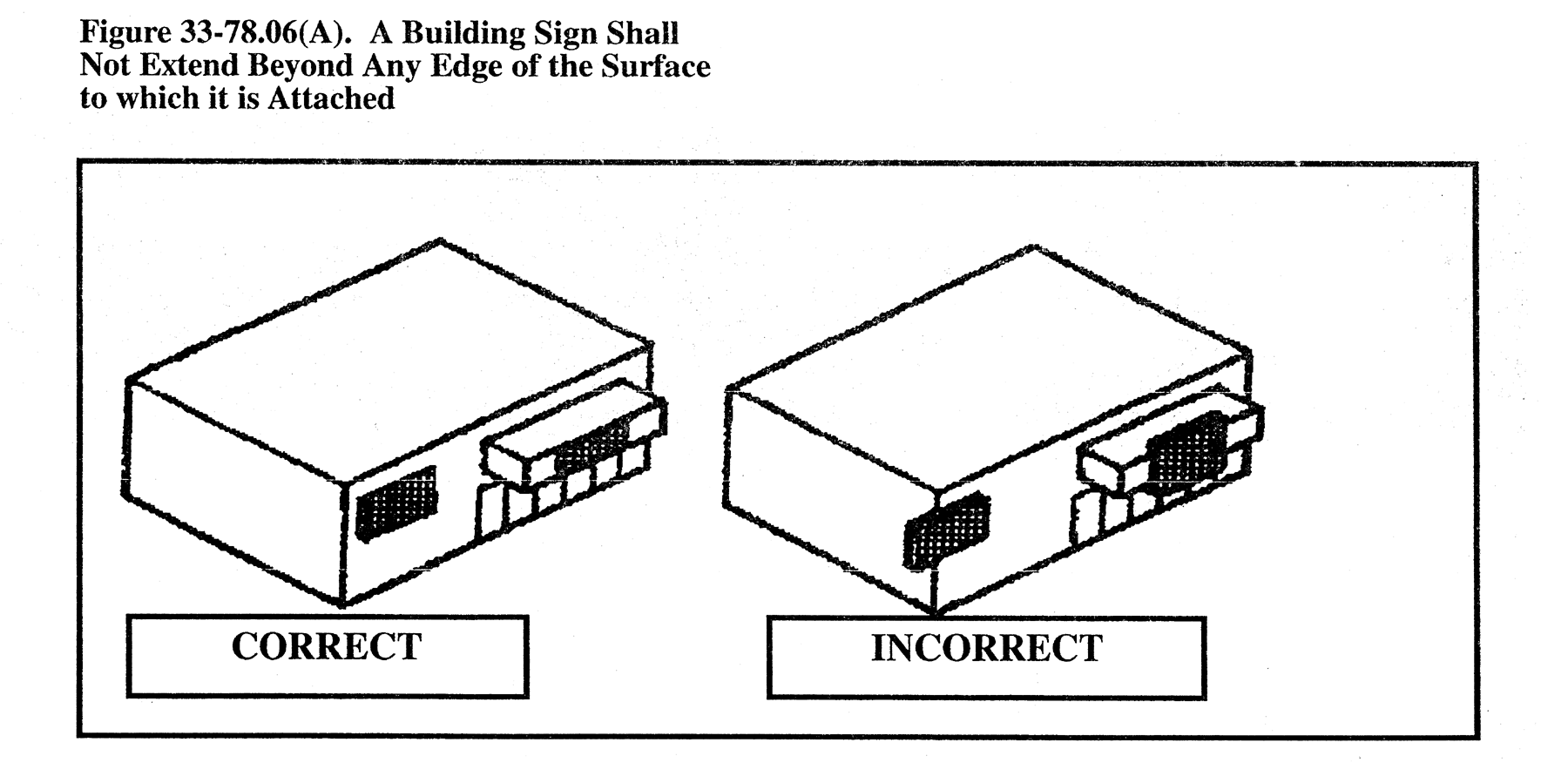
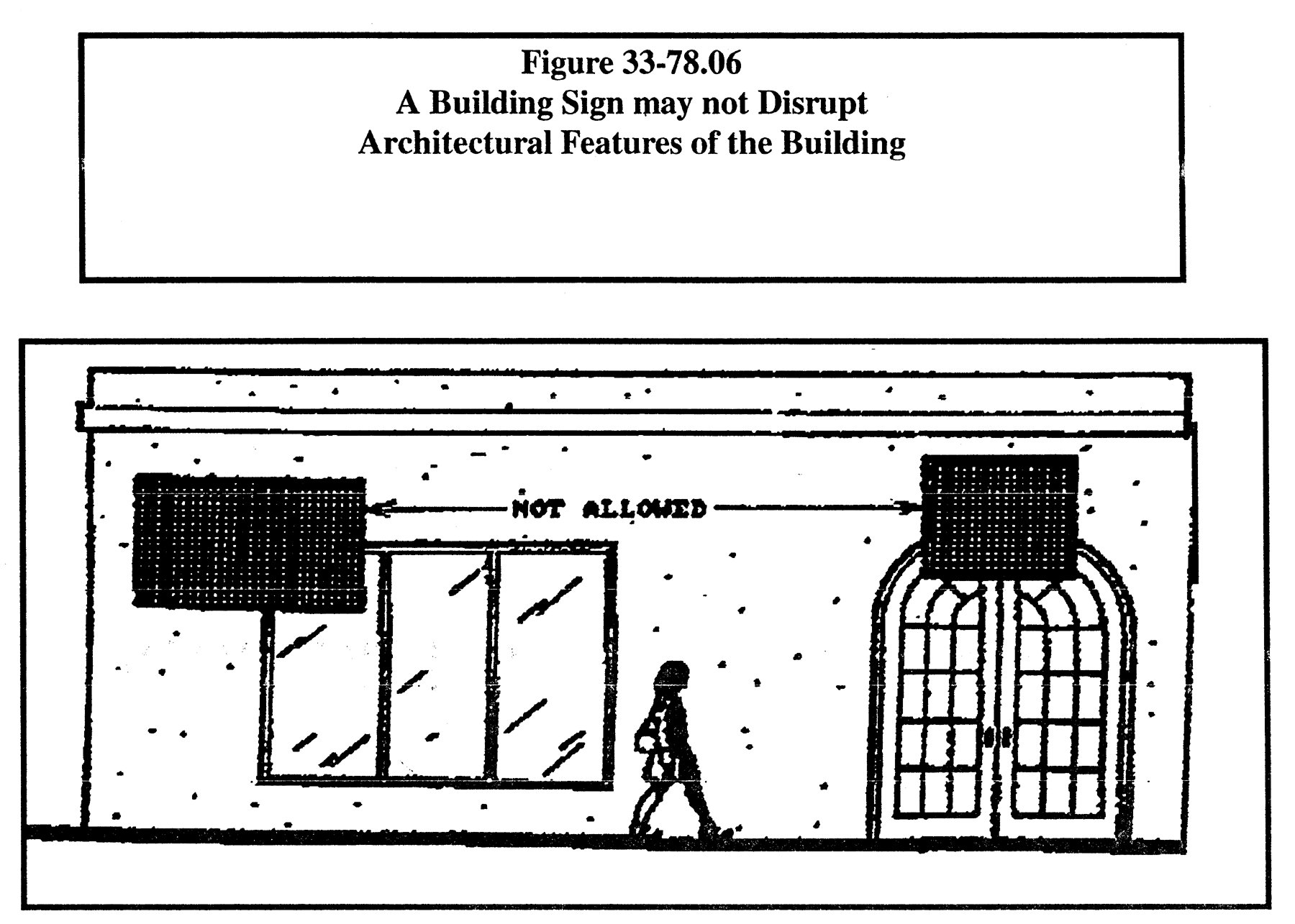
33-78.06. Relationship to building features. A building sign shall not extend beyond any edge of the surface to which it is attached or disrupt a major architectural feature of the building. (See Figure 33-78.06 (A) and Figure 33-78.06 (B).)
33-78.07. Maximum projection. A building sign may project no more than four feet perpendicularly from the surface to which it is attached.
33-78.08. Copy area. Sign copy area does not count towards the 10 percent accent color area of the building.
33-78.09. Formats.
(a)
Format for multiple tenant complexes or center. Building signs for multiple tenant complexes shall conform to an approved overall sign format. The sign format shall be included as a submittal for authorization to erect such a sign and shall be maintained on file in the planning department. The format shall be presented in a plan or sketch, together with written specifications in sufficient detail to enable the planning director to authorize signs based on the specifications. As a minimum, the sign format shall specify the types of signs and dimensions (not to exceed the size limits contained in this chapter) which will be permitted each occupant within the complex. The sign format shall also contain common design elements, such as placement, color, shade, or style of lettering, which lend a unified appearance to the signs of the occupants within the complex. The sign format may only be modified with the approval of the planning director upon submission of a revised plan and specifications detailing the revised format.
(b)
Format for multi-story buildings. In addition to the signs permitted for first floor tenants, multi-story office building(s) shall be allowed across the building primary frontage on the second floor provided that the total square footage of the second floor signs combined do not exceed the maximum of 0.5 square feet in area for each linear foot of building frontage and all signs are arranged so they share a common horizontal center line along the facade. For buildings displaying more than one sign, one of the following criteria shall be met:
1.
Signs shall be spaced evenly across the building facade; or
2.
Signs shall be separated from all other signs a minimum of two times the length of the longest sign on the facade.
33-78.10. Signs required to be certified by a registered engineer. The following signs shall be designed and certified by a Florida registered engineer:
(a)
Ground signs which exceed 32 square feet per sign face.
(b)
Ground signs which exceed six feet in height.
(c)
Any sign that exceeds 32 square feet in size shall be required to have plans designed by an engineer registered in the State of Florida submitted with the permit application. The plans shall be designed to the current wind load and other structural requirements as determined by the current edition of the Florida Building Code as adopted by the Florida Building Commission.
(d)
Other signs, as required by the city engineer.
33-78.11. Sign support structure standards. Ground signs other than monument signs, when supported by a single pole, column or braces, shall contain a cover that is at least two feet in width perpendicular to the street or right-of-way. For signs supported by more than one pole, column or brace, each support structure shall be at least 1½ feet square.
(Ord. No. 2013-11, § 1, 8-5-13)
Sec. 33-79. - Sign permits.
33-79.01. Generally. Before erecting, relocating, altering the structure, or replacing any sign not specifically exempt by section 33-72 or prohibited by section 33-73 of these regulations, the owner, agent, contractor, or other person having the right to place a sign on real property shall first secure a permit from the building department.
(1)
Drawing to scale. An applicant for a sign shall submit to the building official an accurate drawing to scale, showing the materials to be displayed, dimensions, construction details, all attachment details, foundation details if applicable, electrical plans and dimensions of property lines and/or building in respect to the proposed location of the sign to be erected.
(2)
Message center sign. The changing of letters and numbers in order to change the message on message center signs shall not require a permit.
(3)
Billboards. Permanent outdoor advertising displays (billboards), as per section 33-76, and any sign which is illuminated in any way, and any ground sign or pole sign, shall require the drawing indicated in [subsection] (1) above, be stamped by an engineer licensed in the State of Florida.
(4)
Application for sign permit. An application for a sign permit shall be filled out at the time the above-referenced plans are submitted. The city shall, within 30 days or receipt of a complete sign application, either grant the permit or deny the permit and advise the applicant as to the reasons for denial. A sign permit fee, in an amount set from time to time by the city, shall be payable at the time of issuance of the sign permit, but is not required for submittal of an application for a sign permit.
(5)
Registration of temporary signs. An applicant will register the location and duration of all temporary wind and banner signs and construction signs with the building department prior to displaying the signs on a property or building.
(Ord. No. 2013-11, § 1, 8-5-13)

