
Delano City Zoning Code
CHAPTER 20
13 - PARKING REGULATIONS
20.13.10 - Purpose and intent.
This Chapter is intended to ensure an adequate provision of parking, loading, and bicycle facilities proportionate to the needs created by the various land uses within the City. In providing adequate parking, loading, and bicycle facilities, it is the intent of this Chapter to:
1.
Progressively alleviate or prevent on-site and off-site traffic congestion and hazards;
2.
Ensure the maneuverability of emergency and service vehicles;
3.
Provide safe, accessible, convenient, attractive, and well-maintained off-street parking areas;
4.
Protect residential neighborhoods from the effects of vehicular noise and traffic by uses in adjacent nonresidential districts; and
5.
Implement General Plan circulation, air quality, and energy conservation policies.
20.13.20 - General regulations.
1.
Applicability.
a.
Any new building constructed, any new use established, any addition or enlargement of an existing structure or use, and any change in the occupancy of an existing building or the manner in which a use is conducted that would result in additional parking spaces being required, shall comply with the provisions of this Chapter.
b.
In the case of additions or enlargements of an existing building or use, or a change of occupancy or manner of operation that would result in additional parking spaces being required, the additional parking spaces shall be required only for such addition, enlargement, or change, and not for the entire building or use, unless a specific finding is made by the Community Development Director that additional parking for the entire building or use is necessary to protect the public health, safety, and welfare.
2.
Status of Existing Development and Approvals.
a.
No building or use of land which lawfully existed on the effective date of this Title shall be considered nonconforming solely because of the lack of off-street parking and loading facilities required by this Chapter.
b.
Projects with unexpired plot plans or conditional use permits approved prior to the effective date of this Title need only meet the requirements of the parking ordinance in effect on the date the plot plans or conditional use permits were approved.
c.
No off-street parking facilities located in a commercial, business park, or industrial zone district shall be used for any purpose other than the temporary parking of vehicles used by employees and patrons that the facilities are intended to serve without first obtaining approval of the City. The display of vehicles offered for sale shall be strictly prohibited on said off-street parking facilities.
3.
Calculation of Floor Areas. The floor areas used to calculate the number of spaces required by the schedules for provision of off-street parking and loading spaces contained in sections 20.13.30 and 20.13.40 of this Chapter shall include:
a.
All floor area which is devoted to office, retail, service, or other activities and uses including: Storage areas, restrooms, lounges, lobbies, kitchens, and interior hallways and corridors, unless specifically exempted in this Chapter.
b.
All outdoor patio, deck, balcony, terrace, kiosk, or other outdoor area that will accommodate a permanent activity that will generate a demand for parking facilities in addition to that which is provided for principal activities and uses within the building or structure.
c.
Gross floor area shall not include enclosed or covered areas used for off-street parking, loading, or bicycle facilities.
4.
Fractions. Where the application of the schedules for provision of off-street parking, loading spaces, and bicycle facilities contained in sections 20.13.30, 20.13.40 and 20.13.50 of this Chapter result in a fractional space, the fraction shall be rounded to the next lower whole number.
5.
Increases and Decreases in Requirements.
a.
The number of spaces required by the schedules for provision of off-street parking and loading spaces contained in sections 20.13.30 and 20.13.40 of this Chapter may be increased if it can be demonstrated through a parking study that the proposed use would have a parking or loading space demand greater than the requirements given in sections 20.13.30 and 20.13.40 of this Chapter. The Community Development Director may require that a parking study be provided by an applicant when, in the opinion of the Community Development Director, an increase in the number of parking or loading spaces may be warranted.
b.
A decrease in the number of spaces required by the schedules for provision of off-street parking and loading spaces and bicycle facilities contained in sections 20.13.30 and 20.13.40 of this Chapter may be granted under the circumstances identified in section 20.13.50 of this Chapter by approval of a variance or as part of an application for a conditional use permit.
6.
Multiple Uses. In situations where a combination of uses are developed on a site, including multiple uses under single ownership, the number of spaces required by the schedules for provision of off-street parking, loading spaces, and bicycle facilities contained in sections 20.13.30 and 20.13.40 of this Chapter shall be equal to the sum of the requirements for each of the uses, unless a reduction is granted pursuant to the shared parking provisions of section 20.13.50 of this Chapter. If the gross floor area of each individual user is less than the minimum for which parking or loading spaces would be required, the aggregate gross floor area shall be used in determining the required number of parking and loading spaces.
7.
Operation and Maintenance.
a.
All parking, loading, and bicycle facilities required by this Chapter shall be maintained for the duration of the use requiring such facilities.
(1)
Required parking and loading facilities shall not be used for the storage or display of merchandise, or for the storage or repair of vehicles or equipment.
(2)
Required parking and loading facilities shall not be used for the sale of merchandise, except for a special event, subject to the issuance of a Special Event Permit pursuant to the provisions of Section 20.2.100 (Special Event Permits) of this Title.
b.
It shall be the responsibility of the owner or operator of a specific use to ensure that required parking facilities are maintained in good operating condition, are periodically swept and cleaned, and are properly striped.
8.
Requirements Not Given in Parking and Loading Schedules.
a.
Where the parking and loading facilities requirements for a specific use are not listed in the schedules contained in Sections 20.13.30 and 20.13.40 of this Chapter, the required parking shall be determined through the individual development application review process.
b.
An applicant proposing to develop or expand a use whose parking requirements are not shown, shall submit a parking study to the Community Development Director providing justification for the proposed number of spaces. This study, along with any traffic engineering and planning data, that is appropriate to the establishment of a parking requirement for the proposed use shall be considered during review of the development application.
9.
Compact Parking. The maximum percentage of all on-site parking that may be permitted as compact spaces shall be as provided in Table 13.A of this Chapter, unless otherwise specified in Section 20.13.50 (Adjustment to off-street parking requirements) of this Chapter.
10.
Tandem Parking. Unless otherwise permitted in this Chapter, tandem parking shall not be used to meet the required number of parking spaces specified in the parking schedules, unless specifically permitted as part of an approved conditional use permit or unless findings for a variance can be made.
11.
Time-Restricted Customer Parking. Time-restricted customer parking may be delineated for high turnover businesses for the purpose of restricting long-term off-street parking within a multi-tenant commercial development. Time restricted customer parking shall comply with the following requirements. Requests for time restricted parking may be included within the required development application submittal for new or expanded uses, and shall be approved or denied based on the criteria listed in Section 20.13.20.11.c. below.
a.
Application Requirements. Requests for delineation of time-restricted customer parking shall be submitted to the Community Development Director on forms supplied by the Community Development Department and shall be acted upon by the Planning Commission. The following information shall be supplied within the application:
(1)
Site plan of the commercial activity, including information regarding the total number of parking spaces, the number and designation of proposed time-restricted parking spaces, and on-site vehicular, bicycle, and pedestrian circulation, access, and design.
(2)
A letter of justification describing how the proposed use will meet the required findings set forth in Section 20.13.20.11.c. below.
(3)
Other information as may be required by the Community Development Director or the Planning Commission.
b.
Approval Authority. Requests for time-restricted parking may be approved by the Planning Commission.
c.
Required Findings. A request for time-restricted customer parking may be approved provided that all of the following findings are made:
(1)
The amount and distribution of time-restricted customer spaces allows for time-restricted parking without adversely affecting the parking needs of other uses within the general area; and
(2)
The location of the time-restricted customer parking spaces will not impede vehicular, bicycle, or pedestrian circulation, and will not encroach into required fire lane access areas.
d.
Revocation of Time-Restricted Customer Parking.
(1)
Approvals for time-restricted customer parking spaces, granted pursuant to the provisions of this section, may be revoked by the Planning Commission if it is found that the continued use of time-restricted customer parking adversely affects the parking needs of the general area or impedes vehicular, bicycle, or pedestrian circulation due to changes in tenant mix, customer parking demands, or any other factors which change the parking demand characteristics.
(2)
Any decision to revoke a time-restricted customer parking approval shall become final thirty days after the decision to revoke is made.
12.
No vehicle, as defined in Section 20.1.190 (Definitions) of this Title, shall be permitted to be parked on any unpaved portion of a front yard setback area, or on any paved portion of a front yard setback area not designated as an access corridor (driveway) to an on-site parking facility (carport or garage) on any lot located in a residentially zoned district in the City.
(Ord. No. 2008-1174, § 1(Exh. A), 5-5-2008; Ord. No. 2017-1294, § 1(Exh. 2), 11-20-2017; Ord. No. 2020-1320, § 1(Exh. 1), 10-19-2020)
20.13.30 - Schedule of off-street parking requirements.
1.
Automobile Parking Requirements. Minimum off-street automobile parking requirements for uses within the City are specified in Table 13.A. of this Chapter. Section 20.13.60 of this Chapter provides design standards for automobile and truck parking.
2.
Schedule of Handicapped Parking Requirements. Handicapped parking requirements are established by the State of California. The following requirements for handicapped parking are intended to be identical to the state requirements at the time of adoption of this Title. Any future changes in state requirements shall preempt the standards for provisions of handicapped parking spaces contained in this Title.
a.
Handicapped parking space dimensions are provided in section 20.13.60 of this Chapter.
b.
Handicapped parking spaces shall be provided at the following rates:
3.
Schedule of Motorcycle and Bicycle Parking Requirements:
a.
Motorcycle parking space design standards are provided in section 20.13.60 of this Chapter.
b.
Motorcycle and bicycle parking spaces shall be provided for all nonresidential uses at the following rates:
(1)
Uses requiring more than twenty-five but less than one hundred parking spaces shall provide one designated motorcycle parking space.
(2)
Uses with one hundred or more parking spaces shall provide one designated motorcycle parking area for each one hundred required automobile parking spaces.
(3)
Motorcycle parking spaces required by this Section shall count toward meeting the total number of parking spaces required by the provisions of this Chapter.
4.
Recreational Vehicle Parking Spaces. Recreational vehicle spaces shall not be permitted within multiple-family residential developments unless a parking facility for recreational vehicles, as approved by the Planning Agency, is specifically provided as part of the multiple-family residential development.
20.13.40 - Schedule of off-street loading requirements.
1.
Loading space design standards are provided in section 20.13.60 of this Chapter.
2.
Minimum off-street loading space requirements for uses within the City are specified in Table 13.B of this Chapter.
20.13.50 - Adjustments to off-street parking requirements.
1.
Modified Parking Requirements in the Downtown Commercial Zone District:
a.
Modified parking requirements have been developed for use in the Downtown Commercial zone district as an incentive to preserve and maintain existing historic structures. The Community Development Director shall have the authority to approve a request for a parking adjustment, subject to the provisions of this section; the decision of which may be appealed to the Planning Commission as provided in section 20.2.180 of this Title.
b.
For land uses located in the Downtown Commercial zone district, off-street parking requirements may be modified by the Community Development Director by utilizing the following techniques:
(1)
A reduction of the required number of parking spaces by twenty percent; or
(2)
The crediting of on-street parking spaces which are adjacent to the frontage of the designated structure/site towards the total number of required off-street parking spaces required for the use, provided that a determination is made that such on-street parking spaces will remain available for public parking during all business hours in the future. No on-street parking spaces located within fifteen feet of a "stop sign" or corner radius shall be counted. No on-street parking spaces located in front of a bus stop shall be counted; or
(3)
A reduction in two-way aisle widths, as specified in Table 13.C. of this Chapter, from twenty-four feet to twenty-two feet; or
(4)
Allow the use of off-site parking in parking lots that are located within four hundred feet of the structure, where the applicant has provided adequate incentives for the use of such parking lots; or
(5)
Allow vehicles to back out onto alleys where it is determined that visibility is good and such backing out of vehicles can be done safely; or
Table 13.B
Off-Street Loading Requirements
(6)
Allow forty-five percent of a parking lot, located on the site of the structure/use, to be compact spaces, instead of twenty-five percent as permitted in section 20.13.20 of this Chapter; or
(7)
Allow tandem parking where it is determined that such parking would be effectively and safely used; or
(8)
Allow for the deletion of the loading space requirements prescribed by section 20.13.40 of this Chapter; or
(9)
Provide for in-lieu fees where such fees are applied to an identified parking district or other similar mechanism that will contribute to the development of public parking within the general area.
c.
The Community Development Director may approve a parking adjustment with conditions which are found to be necessary to effectuate the purpose of these adjustments within the Downtown Commercial zone district; the decision of which may be appealed to the Planning Commission as provided in section 20.2.180 (Appeals) of this Title.
(1)
Notice. Notice of an application for a parking adjustment shall be published in a newspaper of general circulation not less than ten days prior to the date set for the Community Development Director hearing. Notices shall also be mailed not less than ten days prior to the date of the meeting to owners of property within a radius of three hundred feet of the external boundaries of the property proposed for the modification described on the application, using for this purpose the name and address of such owners as shown on the latest official tax role of the County.
(2)
Findings for Approval. The Community Development Director, in approving a Parking Adjustment, shall find as follows:
(a)
The proposed parking modification and use of the structure is necessary or desirable for the development of the community, is in harmony with the various elements and objectives of the General Plan, and is not detrimental to existing uses or to uses specifically permitted in the zone district;
(b)
That approving the proposed parking adjustment and use will significantly improve the possibility that the structure will be preserved and maintained;
(c)
That the required parking cannot be provided without the approval of the requested adjustment;
(d)
That the proposed parking scheme will function safely;
(e)
That approval of the parking adjustment will not harm the integrity of the structure or the surrounding neighborhood.
2.
Shared Parking.
a.
A maximum reduction of thirty percent of the minimum parking requirements for individual uses may be granted by the Planning Agency where joint use of parking facilities or other factors will mitigate peak parking demand.
b.
Requests for parking reductions resulting from joint usage shall be supported by information that generally follows the format described below:
(1)
Initial project review involves documentation and quantification of proposed land uses and anticipated functional relationships between the parking needs of different land uses. The initial review will consist of data gathering regarding proximity to transit facilities, general location of parking facilities, surrounding land uses and mix, predicted pedestrian patterns, and similar variables which affect parking needs.
(2)
Adjustments for Peak Parking Factor includes calculating the number of off-street parking spaces required for each land use within the area proposed for joint parking use based upon the requirements of section 20.13.30 of this Chapter. Other elements to be considered include seasonal adjustment for parking demand and a determination of the mode of transit used in reaching or departing the area being considered.
(3)
Analysis of Hourly Accumulation involves an estimation of hourly parking accumulations for each land use during a typical week day or weekend day.
(4)
Estimate of Shared Parking merges the hourly parking demand estimate to calculate the overall parking required to be provided within the area being considered for shared parking facilities.
c.
In granting parking reductions for shared use of parking facilities, the Planning Agency shall make one or more of the following findings:
(1)
The report justifies the requested parking reduction based upon the presence of two or more adjacent land uses which, because of their substantially different operating hours or difference peak parking characteristics, will allow joint use of the same parking facilities.
(2)
The report indicates that there are public transportation facilities and/or pedestrian circulation opportunities that justify the requested reduction of parking facilities.
(3)
The report finds that the use otherwise adheres to the parking standards in this Chapter.
(4)
The report finds that the clustering of different land uses is such that a reduced number of parking spaces can serve multiple trip purposes to the area in question.
d.
As a condition of approval to the granting of a reduction in required parking, the Planning Agency may require the granting of reciprocal access and parking agreements with surrounding properties; recordation of conditions, covenants, and restrictions; or creation of other legal instruments to assure the permanent continuation of the circumstances under which parking requirement reductions were granted.
e.
Where parking spaces are provided for an individual development on a separate parcel, a joint access agreement will be required between affected property owners, in a form acceptable to the City.
3.
Transportation Management Plans.
a.
The number of parking spaces required for a project may be decreased up to twenty percent subject to Community Development Director approval of a transportation management plan supplied by the applicant for those applications requesting more than a ten percent reduction. Said plan shall provide evidence that identifies the actual parking requirement and supports and justifies the parking reduction request. Such a plan may include, but is not limited to car pooling, van pools, and staggered work hours.
b.
Decreases in the required number of parking spaces, approved pursuant to this subsection, may be in addition to any other reductions allowed by this section.
c.
Before approving such a request, the Community Development Director shall consider, among other factors:
(1)
Projected effectiveness of car pool, van pool, staggered work hours, or similar transportation management programs.
(2)
Proximity to public transportation facilities that could be reasonably expected to serve a significant portion of employees and/or customers.
(3)
Evidence of the likelihood that employees and/or customers will utilize regular transportation alternatives rather then individual use of automobiles, including transportation management plans prepared pursuant to San Joaquin Unified Air Pollution Control District requirements and Chapter 20.12 of this Title.
4.
Low Percentage of Usable Space.
a.
Where buildings contain extensive areas of employee facilities such as, but not limited to, cafeterias, racquetball courts, health facilities, covered patios, multiple stairways and elevator shafts, or atriums in multiple story buildings, gross leasable space may be significantly below the eighty-five percent average assumed in the parking schedules. In such cases, a proportionate reduction in parking requirements may be granted by the Community Development Director.
b.
To be eligible for reduction in parking requirements, due to low percentage of usable space, the applicant shall submit a detailed floor plan breaking down the proposed usage of all square footage within the building.
c.
As a condition of granting a reduction in parking requirements, due to low percentage of usable space, the applicant shall be required to sign an agreement stating that the percentage of leasable space will not be increased unless additional parking is provided pursuant to the requirements of this Chapter.
5.
Off-Site Parking Facilities. Required parking for a development may be provided off-site under certain instances. Requests for off-site parking facilities shall meet the following requirements:
a.
The off-site parking shall be located so that it will adequately serve the use for which it is intended. In making this determination, the following shall be considered:
(1)
Proximity of the off-site parking facilities;
(2)
Ease of pedestrian access to the off-site parking facility;
(3)
The type of use which the off-site parking is intended to serve, recognizing that such facilities are generally not appropriate for high-turnover uses;
(4)
The need for locating parking facilities off-site, and the resulting urban design benefits of off-site parking, if any.
b.
As a condition of granting approval to the development of off-site parking facilities, the applicant and other involved parties shall be required to sign an agreement ensuring the continued availability of the off-street parking facilities for the use they are intended to serve.
(Ord. No. 2008-1174, § 1(Exh. A), 5-5-2008)
20.13.60 - Design standards.
1.
Dimensions of Parking Spaces.
a.
Automobile.
(1)
All Uses. All parking spaces shall provide an additional two feet to the required parking space width where such parking spaces are adjacent to a wall, supporting column or post, garage wall, or other obstruction.
(2)
Covered/Enclosed Spaces. Covered parking spaces shall be a minimum of nine feet in width and nineteen feet in depth. The measurements shall not include the exterior walls or structural supports. Minimum width for private residential enclosed garage door openings shall be eight feet for a one-car garage, and sixteen feet for a two-car garage.
(3)
Uncovered Spaces, Full-Size. Each full-size uncovered space shall be a minimum of nine feet in width and nineteen feet in depth.
(4)
Uncovered Space, Compact. Each uncovered compact space shall be a minimum of eight feet in width and sixteen feet in depth.
(5)
Parallel Space. Each parallel parking space shall have a minimum dimension of eight feet wide by twenty-two feet long. However, if there is only one parallel space, and access is adequate to that space, the length may be reduced to twenty feet.
(6)
Tandem Space. Each tandem space shall be a minimum of nine feet in width and twenty-two feet in depth.
(7)
Handicapped Parking Spaces, all applicable uses. Each handicapped parking space shall be a minimum of fourteen feet wide, lined to provide a nine-foot wide parking area and a five-foot wide loading area, and shall be a minimum of nineteen feet in depth. If two handicapped spaces are located adjacent to each other, they may share the five-foot wide loading area, resulting in a width of twenty-three feet for the two spaces.
b.
Motorcycle Parking Spaces for all Applicable Uses. Each motorcycle parking space shall have a minimum usable area of fifty-six square feet.
c.
Recreational Vehicle Spaces, Multifamily Residential Uses. Recreational vehicle spaces shall require a minimum of four hundred square feet of usable area.
2.
Drive-Through Facilities. Drive-through facilities shall be designed to conform to the specific standards designated in section 20.11.15 of this Title.
3.
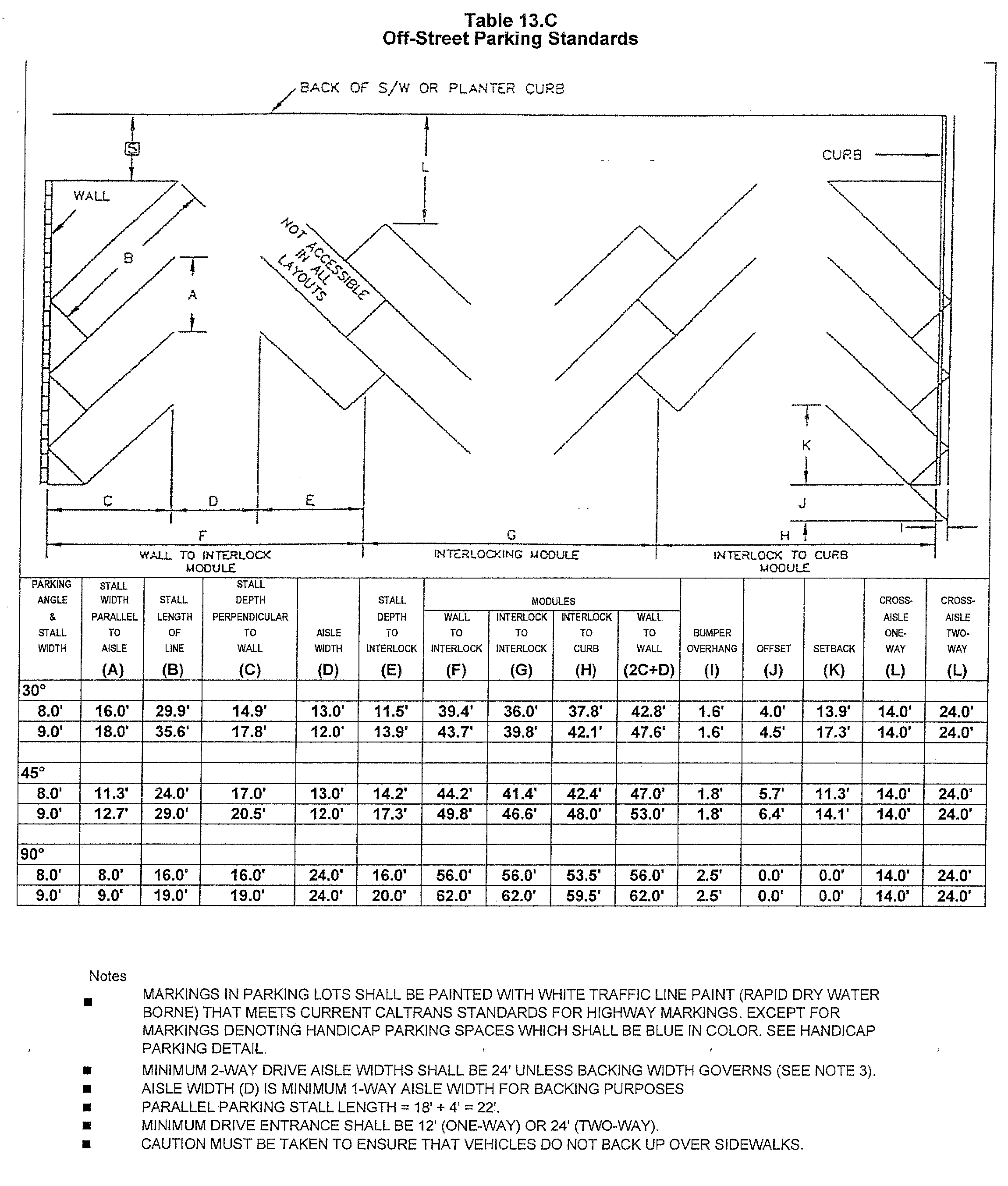
Dimensions of Parking Bays and Aisles. The minimum dimensions of parking bays and maneuvering aisles shall be as set forth in Table 13.C. of this Chapter.
4.
Standard Improvements.
a.
Directional Arrows and Signs.
(1)
Within parking facilities containing twenty-one or more spaces, all aisles, approach lanes, and maneuvering areas shall be clearly marked with directional arrows to facilitate vehicular movement.
(2)
In addition to directional arrows, the City Engineer may require installation of signs to ensure safe and efficient vehicular movement.
b.
Drainage. All parking facilities, except those serving two or fewer dwelling units, shall be graded and provided with drainage facilities for the disposal of water without surface flow over sidewalks within public rights-of-way.
c.
Lighting.
(1)
All parking facilities, except those serving two or fewer dwelling units shall be provided with night time security lighting.
(2)
Parking area lighting shall be designed to confine emitted light to the parking area.
(3)
Parking area lighting shall be of an energy-efficient type, such as, but not necessarily limited to, high or low pressure sodium lamps.
d.
Safety Features.
(1)
Additional requirements and guidelines for parking facility safety, including design, internal layout, acceptable turning radii, pavement slope, vehicular and pedestrian circulation, and other design features may be imposed by the City Engineer when determined to be appropriate.
(2)
The City Engineer may require cross-aisles within parking areas where necessary to prevent safety hazards and vehicular congestion on public streets which might otherwise be created by vehicles queuing, by utilizing public streets to travel between parking aisles, or by using the parking area as a "short-cut" between public streets.
(3)
Visibility of and between pedestrians, bicyclists, and motorists shall be assured when entering individual parking spaces, when circulating within a parking facility, and when entering or exiting a parking facility. To the extent possible, the parking facility shall be designed so that primary pedestrian traffic to and from building entrances is along, rather than across parking aisles.
(4)
Bicycle and automobile parking areas shall be separated by a physical barrier of sufficient identification and distance to protect parked bicycles from damage by cars.
e.
Shopping Cart/Hand Cart Storage. Parking facilities serving uses that make use of shopping carts/hand carts such as, but not limited to, supermarkets, drug stores, and lumber stores, shall contain shopping cart/hand cart storage areas. The dimensions and locations of such storage areas for the proposed use shall be approved by the Community Development Director.
f.
Striping and Identification.
(1)
All automobile parking spaces shall be clearly outlined with painted lines not less than three inches in width on the surface of the parking facility consistent with the dimensions specified in Table 13.C of this Chapter.
(2)
In addition to the requirements of section 20.13.60.1.a.(7) of this Chapter, all handicapped parking spaces shall be striped and marked according to applicable State standards.
(a)
Each parking space reserved for the handicapped shall be identified by a permanently affixed reflectorized sign, of a construction and material approved by the Public Works Director, displaying the international symbol of accessibility. The sign shall have a minimum size of seventy square inches, and shall be centered at the interior end of the parking space at a maximum height of eighty inches from the bottom of the sign to the finished grade of the parking space.
(b)
At each entrance to a parking facility containing one or more parking spaces for the handicapped, a sign with a minimum size of seventeen inches by twenty-two inches shall be posted, stating clearly and conspicuously in letters with a minimum height of one inch the following:
"Unauthorized vehicles not displaying distinguishing placards or license plates issued for physically handicapped persons may be towed away at owner's expense. Towed vehicles may be reclaimed at ______ or by telephoning ______."
(c)
Parking spaces reserved for the handicapped shall have, in addition to the requirements of subsection 4.f.(2) above, a surface identification in blue paint of at least three square feet in size, duplicating the international symbol of accessibility.
(3)
All parking spaces for compact cars shall be clearly identified as "Compact Car Only."
(4)
All motorcycle parking spaces shall have bollards installed and appropriately spaced to prevent automobile usage. Motorcycle spaces shall be marked in a manner to be clearly identified as motorcycle use only.
g.
Surfacing.
(1)
All permanent parking spaces, as well as loading and maneuvering areas, shall be paved and permanently maintained with asphalt or concrete, or an alternative all-weather surfacing material approved by the City Engineer.
(2)
In order to prevent damage to pavement from motorcycle kick stands, required motorcycle parking areas shall be paved with concrete or equivalent surfacing material approved by the City Engineer.
(3)
All bicycle parking and storage areas shall be surfaced to keep the area in a dust-free condition.
(4)
Temporary parking facilities shall be provided with surfaces to prevent dust.
5.
Location of Parking.
a.
All parking spaces shall be provided on the same site as the use requiring the parking spaces, except as authorized in section 20.13.50 (Adjustments to Off-Street Parking Requirements) of this Chapter.
b.
All automobile spaces required for multifamily residential uses shall be located a maximum of one hundred fifty feet from the dwelling units they are serving.
(1)
Distances shall be measured from a dwelling unit's entry to the parking space(s) serving that unit. For developments where a stairway or elevator provides access to a dwelling, the ground floor entry to that stairway or elevator shall be considered to be the dwelling entry for purposes of measuring distances to parking spaces.
(2)
Because design considerations may make it impossible or undesirable to meet the maximum distance requirement, a variation to this requirement may be approved pursuant to section 20.13.50 (Adjustments to Off-Street Parking Requirements) of this Chapter.
c.
All handicapped spaces shall be located as closely as possible to the entrance to the use they are intended to serve and shall be oriented so that the user of the handicapped parking space need not go past the rear of the parking space in order to reach said entrance.
d.
All car pool parking spaces shall be clearly marked "Reserved for Carpool" and shall be located as close as possible to the entrance of the use they are intended to serve.
e.
Permitted compact car spaces shall be dispersed throughout the parking facility in groups of five or more, if at least five compact spaces are provided. The location of compact parking facilities shall be approved by the Community Development Director.
f.
All bicycle spaces shall be located as closely as possible to the entrance of the use they are intended to serve, but situated in a way that does not obstruct primary pedestrian circulation.
g.
Bicycle facilities shall be located in highly visible areas to minimize conditions conducive to theft and vandalism.
6.
Landscape and Screening Requirements/Parking Lot Shading Requirements. It is the purpose of this section to provide reasonable standards for landscaping of uncovered automobile parking areas. The standards as set forth are to promote an attractive visual environment, promote a transition between land uses, and reduce energy consumption in buildings and to decrease high summer temperature by blocking heat and glare.
a.
Each unenclosed parking facility, excluding detached single-family residences, shall contain a minimum landscaped area in accordance with Table 13.D. of this Chapter. Where the total parking provided is separated by differences in grade or by at least ten feet of nonpaved area, each such area shall be considered to be a separate facility for the purpose of this requirement.
The parking area shall be computed by including the areas used for access drives, aisles, stalls, maneuvering areas, and landscaping areas within that portion of the project site that is devoted to vehicular parking and circulation.
Table 13.D
Minimum Parking Area Landscaping
b.
All automobile parking areas with a capacity of eight parking spaces or more shall contain shade trees so that within fifteen years of planting forty percent of the parking stalls and back-up aisles shall be in shade. This standard will require a minimum of one tree well or planter at a maximum ratio of one tree for each eight parking spaces. When special circumstances or exceptional characteristics are applicable to the property involved (size, slope, extent of use, etc.) this standard may be modified by the Planning Commission.
c.
No more than ten parking spaces shall be permitted in a single row unless separated by a landscaped island. Should anyone submitting a development proposal be either unwilling or unable to comply with this provision, that person may appear before the Community Development Director for its determination as to whether or not this provision shall apply.
(1)
Landscaped islands shall have the following minimum dimensions, exclusive of curbing, and shall be of sufficient size to accommodate the growth of trees:
(a)
Five feet wide by nineteen feet long for a single row of full size parking spaces.
(b)
Five feet wide by thirty-eight feet long for a double row of full size parking spaces.
(c)
Five (5) feet wide by sixteen (16) feet long for a single row of compact parking spaces.
(d)
Five feet wide by thirty-two feet long for a double row of compact parking spaces.
(2)
Within each landscaped island, a minimum of one canopy-type tree, at least fifteen gallons in size, shall be provided.
d.
All landscaped areas shall be provided with an automatic irrigation system, which shall be continuously maintained.
e.
In addition to the preceding landscape standards, parking facilities containing more than three thousand six hundred square feet of uncovered parking area shall include landscape islands at the ends of all parking lanes.
f.
The parking area landscape standards, contained herein, shall not apply to temporary parking facilities; however, minimum landscaping may be required for temporary parking facilities as part of the issuance of a temporary use permit.
g.
Factors to be considered in determining compliance with this requirement are as follows:
(1)
Shade trees shall generally be evenly distributed throughout the parking surface area. Multiple canopies shading the same surface area shall not be counted as multiple credits.
(2)
Trees planted along the perimeter of a lot may be counted as providing shade for only that portion of the paved area that is shaded.
(3)
Landscaped planters beneath the canopy may be considered shaded paved parkway areas for determining compliance.
(4)
All trees shall be installed within a tree well or continuous planter entirely enclosed within a concrete curb not less than six inches high. Growing area shall not be less than four feet wide.
(5)
Shrubs and trees shall be arranged in such a way as to avoid damage from the front of parked cars extending into the planter area.
(6)
Tree placement shall permit adequate sight-distance for motorists and pedestrians and shall not interfere with the effectiveness of parking lot lighting.
7.
Access.
a.
Parking Access from Streets.
(1)
Access to parking spaces, other than four or fewer spaces serving a residential use, shall not require backing onto a public or private street.
(2)
All spaces within a parking facility shall be accessible without entering a public right-of-way or private street.
b.
Driveway Widths and Clearances. For purposes of this Section, a driveway shall be defined as an access leading from a public street, a right-of-way, or a private street to a parking area, or from one parking area to another, but shall not be defined to include any aisle, or maneuvering area. All driveways shall comply with the following standards:
(1)
Driveways for single-family structures shall not be less than ten feet in width for a one-car garage and sixteen feet in width for a two-car garage, and shall be maintained free and clear of all obstructions.
(2)
Driveways for multifamily dwelling units and nonresidential uses shall be in accordance with the requirements of Table 13.E of this Chapter.
(3)
Driveways which serve a single-family development shall be defined as the paved area leading from a public street, or right-of-way, or a private street to the designated parking area.
(4)
All abandoned or unused existing driveway approaches, within a street right-of-way, shall be removed and shall be replaced with sidewalk, curb, and gutter at the expense of the lot owner in accordance with the standards adopted in this Title.
c.
Gated Entries. Gates which serve to limit or control access to parking facilities require special consideration and regulation since their design may significantly impact parking demand and usage, as well as vehicular circulation into and within the parking area. Requests for gated entries shall be submitted to the Community Development Director and shall be accompanied by a study addressing the following issues:
(1)
Type and operation of gate;
(2)
Adequacy of vehicle stacking area;
(3)
Effect of gated entry on parking usage and distribution on the site; and
(4)
Effect of gated entry on parking for surrounding or adjacent areas.
8.
Loading Area Design Requirements.
a.
Loading areas shall be designed to provide adequate area for backing and maneuvering on-site, and shall not require maneuvering within public rights-of-way or backing onto or from a public street.
b.
Loading doors fronting a public street shall not be located closer than seventy feet from the property line, and shall not encroach into side or rear setback areas.
c.
Screen walls and wing walls for screening loading areas shall have a maximum height of twelve feet.
Table 13.E
Driveway Dimensions for Multifamily
Dwellings and Nonresidential Uses
1.
On-site of driveway exposed to entry or exit by right turning vehicles. Applicable only to driveways with curb radius.
2.
Minimum spacing is measured along the curb line from the top of driveway "x" to the side property line, or the beginning of the intersection.
Note: A larger dimension if required for emergency vehicle access.
(Ord. No. 2008-1174, § 1(Exh. A), 5-5-2008)

