
Deltona City Zoning Code
ARTICLE VIII
- SUPPLEMENTARY REGULATIONS
Sec. 110-800. - Access control.
To promote the safety of vehicular traffic and pedestrians and to minimize traffic congestion and conflict, access to any project or development shall comply with the requirements of chapter 96, article II, Code of Ordinances, as it may be amended from time to time.
(Ord. No. 19-2011, § 1(Exh. A), 11-7-2011)
Sec. 110-801. - Exceptions to minimum yard or lot coverage requirements.
Every part of every yard shall be open and unobstructed from the ground up, except as otherwise permitted by this chapter:
(a)
Accessibility ramps needed to meet the current Florida Building Code accessibility requirements may encroach within any yard area. However, accessibility ramp encroachment into a yard area shall be minimized to the greatest extent possible.
(b)
On any corner lot, no structure or shrubbery shall cause any obstruction to vision of motorists in accordance with the provisions for obstructions to vision in chapter 96, article II, Code of Ordinances, as it may be amended from time to time.
(c)
In all zoning classifications, off-street parking lots may be in yards to the extent permitted by sections 110-828 and 110-811.
(d)
Fixed awnings may encroach on front yard setbacks as per section 102-100(3).
(e)
Projections of sills, belt courses, cornices, buttresses, ornamental features, chimneys, eaves, and other similar structures; provided, however, that none of the above mentioned projections may project into any yard more than 30 inches. If a yard is associated with a platted easement, then the terms of section 110-803 may be applicable.
(f)
Open or enclosed fire escapes, fire proof outside stairways, moveable awnings (when fully extended) and balconies may project into any minimum yard not more than three and one-half feet.
(g)
All structures erected to protect or support fern or other agricultural crops are exempt from the yard requirements. All buildings erected to protect or grow nursery plants are exempt from the maximum lot coverage requirements in all of the agricultural zoning classifications.
(h)
Those exceptions permitted in section 110-814 pertaining to automobile service stations.
(i)
In all residential classifications, where a lot is situated between two lots, each having a principal building which projects beyond the minimum front yard requirements for its classification, its minimum front yard requirement shall be the average of the distance between the front lines and the fronts of the principal buildings on the adjacent properties.
(j)
If, because of prior zoning regulations, or because of a unified plan of development, or for any other reason, a majority of the houses already constructed in a particular residential neighborhood observe a setback greater than that which is required by these regulations, the average setback actually observed shall apply to all new construction in that neighborhood, anything in these regulations to the contrary notwithstanding.
(k)
On any nonconforming lot not more than 50 feet in width, that has a single-family zoning classification, the minimum side yard may be decreased to seven feet.
(l)
On any lot with 50 feet or less of depth and at least 5,000 square feet of area, that has a single-family zone classification, the minimum front yard may be reduced to 12.5 feet and the minimum rear yard may be reduced to ten feet providing:
(1)
The lot abuts a city or county arterial thoroughfare road;
(2)
The lot was reduced in size by the action of the city, county, state or federal government;
(3)
The lot is to be utilized only for a single-family residence and its accessory uses and structures; and
(4)
The proposed single-family residence is to be connected to central water and sewer services.
(m)
In all zoning classifications, package sewage treatment plants may be located in yards to the extent permitted by sections 110-816 and 110-817(a)(3).
(n)
Reserved.
(o)
On any lot which has a septic system or a septic system drain field located in the rear yard to meet the requirements of the city's lot fill and underground utilities ordinance, Ordinance No. 01-20, one minimum side yard may be reduced to five feet providing:
(1)
The minimum distance separation between the principal building and the nearest adjacent principal building is not less than 12 and one-half feet; and
(2)
The principal building does not encroach into a platted easement; and
(3)
The reduction is the minimum necessary to provide a ten-foot clearance between the opposite side yard lot line and the projections, if any, of the principal building; and
(4)
No equipment or accessory structures may be located within the opposite side yard or within ten feet of the opposite side lot line from the rear of the principal building on that side to a line representing an extension of the rear line of the septic tank drain field; and
(5)
The change in setbacks is necessary to allow the passage to the rear yard of equipment that is necessary to maintain or replace the septic system.
(Ord. No. 01-00, § 2, 2-21-2000; Ord. No. 13-00, § 3, 8-7-2000; Ord. No. 19-2011, § 1(Exh. A), 11-7-2011; Ord. No. 06-2013, § 1(Exh. A), 6-17-2013)
Sec. 110-802. - Boat docks and boathouses.
The following regulations shall apply in all residential zoning classifications:
(a)
Boathouses and boat docks may be located in waterfront yards but shall not be permitted within 15 feet of any side lot line, or its extension into the water (see section 110-801(e), above). No boathouse extending into any waterway shall have more than 400 square feet area. The highest point of such structure shall not exceed 15 feet above the ordinary high-water mark.
(b)
No more than one boathouse may be erected on an individual waterfront lot.
(c)
Boathouses shall not be used for dwelling purposes or contain any sleeping or living quarters.
(Ord. No. 19-2011, § 1(Exh. A), 11-7-2011)
Sec. 110-803. - Construction or projections in platted easements.
(a)
Principal and accessory structures and related projections, including driveways and swimming pool decks shall not be erected in platted easements unless the easement has been abandoned/vacated consistent with sections 58-32—58-37 of the City Code of Ordinances.
(b)
However, the following improvements may be permitted in non-vacated/abandoned platted easements:
(1)
Fences.
(2)
Boat docks, boat houses and walkways that traverse platted easements in a perpendicular manner.
(Ord. No. 06-2007, § 3, 4-16-2007; Ord. No. 19-2011, § 1(Exh. A), 11-7-2011; Ord. No. 06-2013, § 1(Exh. A), 6-17-2013)
Sec. 110-804. - Erection of more than one principal structure on a lot.
In the A and RE-5 classifications, more than one principal structure may be erected on a lot; but only one principal standard or manufactured single-family or mobile home dwelling may be erected. In commercial, industrial conservation and public use classifications, more than one principal structure may be erected on a lot, provided that the requirements of this chapter shall be met for each principal structure as though it were on an individual lot, except hotels. In all other classifications, only one principal structure may be erected on a lot.
(Ord. No. 19-2011, § 1(Exh. A), 11-7-2011)
Sec. 110-805. - Exceptions to height regulations.
Spires, belfries, cupolas, clerestory windows, antennas, water tanks, ventilators, solar panels, windmills, chimneys, penthouses or other similar accessory structures customarily required to extend above the roof level, may extend for an additional 20 feet above the maximum building height prescribed for the classification in which they are located. Antennas are permitted in accordance with chapter 82, Code of Ordinances.
(Ord. No. 19-2011, § 1(Exh. A), 11-7-2011)
Sec. 110-806. - Fences, walls and hedges.
(a)
Purpose and intent. Fences, walls, and hedges are a recognized method to establish property boundaries, provide a level of privacy and security, and contain domesticated animals. However, fences, especially along roads, can alter the streetscape where vistas associated with the open space and natural characteristics of the city are diminished. In addition, fencing along roads can harmfully impact pedestrian and motorist safety by impeding sightlines and visibility. The requirements of this section are intended to ensure that the benefits of fencing, walls, and hedges remain an option while protecting the scenic characteristics of the city and maintaining a level of safety for the traveling public.
(b)
Fence permit.
(1)
A fence permit is required prior to building or installing any fence or wall within the City of Deltona.
(2)
Fence permits shall require a survey, signed, and certified by the surveyor, shall depict the current state of the property, and the permit shall run with the land.
(3)
Fence replacements for the same location and height previously permitted, do not require a new fence permit.
(4)
Fences taller than six feet in height shall require structurally engineered drawings per the Florida Building Code, as amended from time to time.
(c)
Walls.
(1)
Walls erected in accordance with this section shall be for the purposes of privacy and retaining walls, and shall meet the requirements of the Florida Building Code, as amended from time to time.
(2)
Walls as allowed by this section shall otherwise meet accessory structure setbacks as established per Section 110-307(e).
(3)
Walls shall be subject to review by the public works department for impacts to onsite drainage and easement conflicts. Any adverse impacts to easements, and subject property and/or adjacent property drainage shall be prohibited.
(4)
Walls are prohibited on vacant lots.
(d)
Materials.
(1)
Fences or walls may be constructed of wood, chain link, aluminum, galvanized metal, wrought iron, vinyl, masonry, concrete, or similar materials made for fences as approved by the building official and/or planning director. It shall be the homeowner's responsibility to maintain fences, walls, and hedges on their property.
(2)
Agricultural fencing along the perimeter of a property, such as razor wire, barbed wire, chicken wire, and electric fences are prohibited in residential zoning districts or for development; with the exception that electric fences to contain horses are permitted in the RE-5 and RE-1 zoning districts, where lots are two acres or larger and horses are present on the lots.
(e)
Height and setback requirements. The measurement of fence and hedge height shall be taken from the existing grade of any adjoining property at the lot line or proposed location of the fence. Refer to section 70-30 (definitions) for graphic illustration of yard areas.
(1)
Front yard. Fences and hedges no higher than five feet may be erected, placed, or maintained within any front yard. A minimum six foot visibility triangle shall be maintained from the intersection of a sidewalk and a driveway.
(2)
Rear yard. Any fence or hedge installed along the rear property line shall not exceed eight feet in height.
(3)
Side yard. Any fence or hedge installed along a side lot line between properties shall not exceed six feet in height.
(4)
Side street yard. Any fence or hedge installed along a side street yard shall not exceed five feet in height if located within the side street yard setback. Fences taller than five feet in height but no greater than eight feet in height within the side street yard shall be installed as allowed below, in order to facilitate greater use and privacy of the yard:
a.
The nearest exterior wall of the dwelling;
b.
The side street setback line; or
c.
The side street accessory structure setback line for the R1-AAA, AA, A, and R1 per section 110-307(e).
(5)
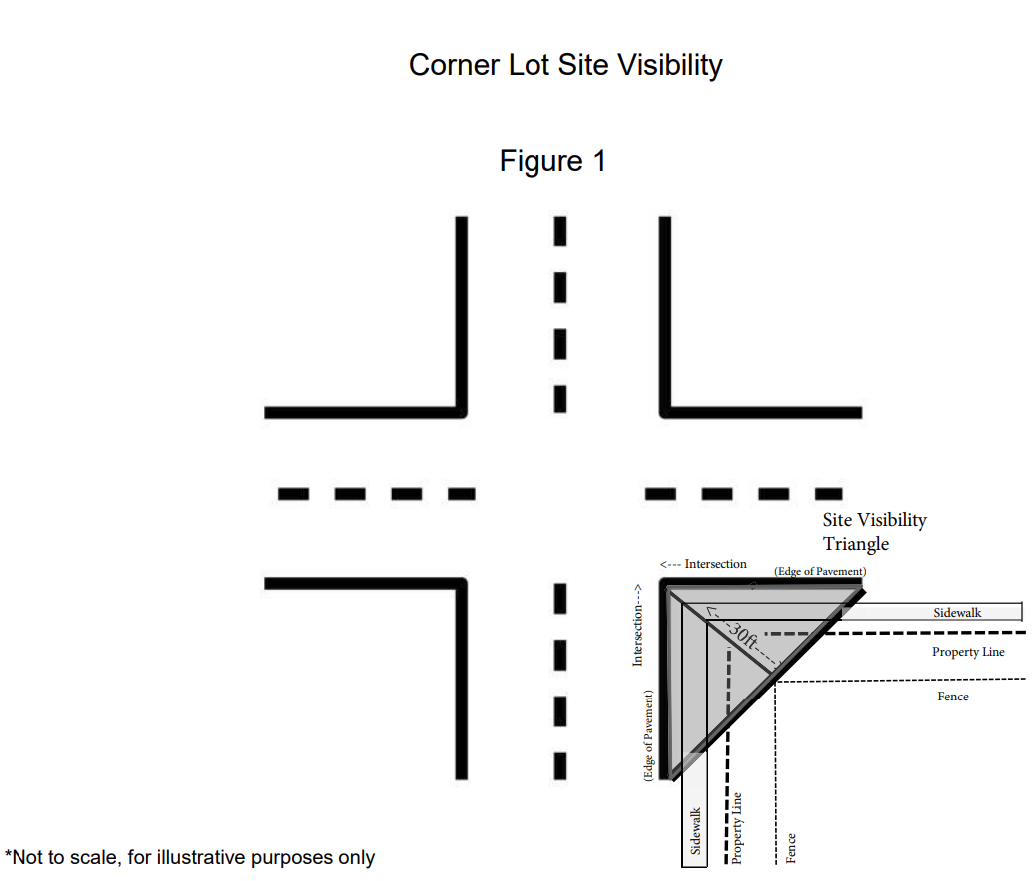
Corner lot sight visibility triangle. Any fence or hedge installed within the front yard and side street yard shall be reviewed for compliance with the following sight visibility triangle requirements. Fences shall not be permitted less than 30 feet from the edge of pavement of the intersection to ensure sight visibility is provided for safe vehicular movement and pedestrian crossing.
(f)
Fences shall be constructed with the finished side facing outward from the property. Fence posts and support beams shall be on the side of the fence facing away from the neighboring property.
(g)
Fences, walls, and hedges on waterfront lots. Fences, walls, and hedges shall not exceed six feet in height in the rear yard, as measured from above natural grade. The fence in the rear shall not have greater than 25 percent opacity. Waterfront lots shall have a survey depicting the current state of the property and prepared within two years or less of the permit submission, to ensure highwater marks and FEMA information is accurate.
(h)
Fences and hedges on vacant lots. On vacant lots, the permitted fencing is the same as that for developed lots in the same zoning district. On vacant corner lots, fences, and hedges shall be located only within the minimum allowable setback area. If a dwelling is added later, the fence or hedge may need to be relocated with possible height adjustments to meet code requirements.
(i)
The above regulations also apply to residential uses within non-residential zoning districts.
(j)
This section shall not be applied to any commercial, industrial, resource protection (RP), public (P) use classifications, or any publicly used property.
FENCING REQUIREMENTS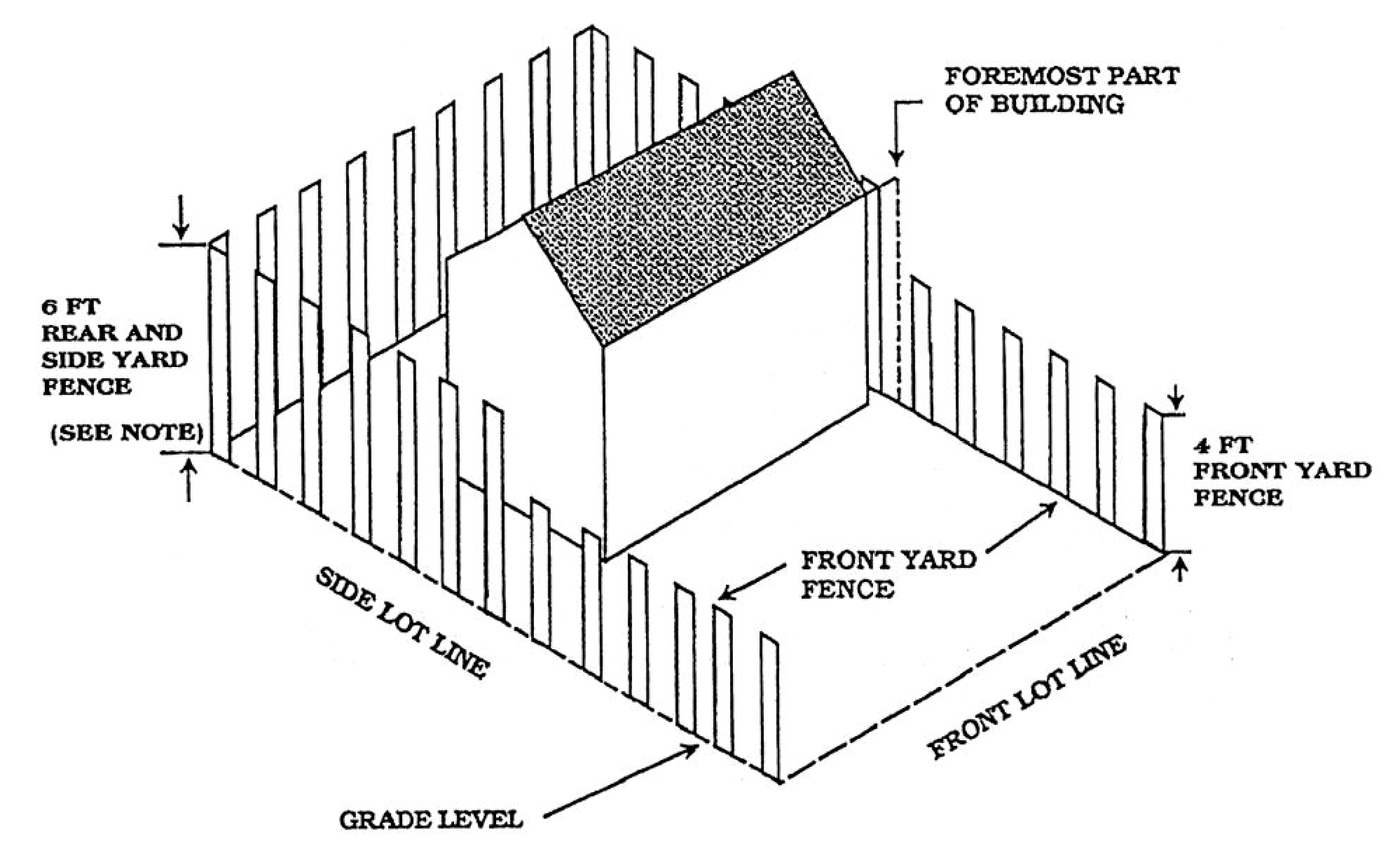
(Ord. No. 26-2006, § 1, 11-6-2006; Ord. No. 19-2011, § 1(Exh. A), 11-7-2011; Ord. No. 18-2013, § 1(Exh. A), 2-3-2014; Ord. No. 09-2015, § 1, 5-16-2016; Ord. No. 10-2023, § 1(Exh. A), 10-16-23; Ord. No. 17-2024, § 1(Exh. A), 12-9-24)
_____
Sec. 110-807. - Home-based businesses.
For the purposes of this subchapter the following definition shall apply unless the context clearly indicates or requires a different meaning.
Home-based business: A business that operates, in whole or in part, from a residential property and meets the criteria in F.S. § 559.955 and this code. A permitted home-based business shall meet the following criteria:
(a)
The employees of the business who work at the residential dwelling must also reside in the residential dwelling, except that up to a total of two employees or independent contractors who do not reside at the residential dwelling may work at the business. The business may have additional remote employees that do not work at the residential dwelling.
(b)
Parking related to the business activities of the home-based business complies with city zoning requirements in the residential zoning category, and the need for parking generated by the business may not be greater in volume than would normally be expected at a similar residence where no business is conducted. The use of vehicles or trailers operated or parked at the business or on a street right-of-way are regulated as provided in section 66-25 and section 66-35. Vehicles and trailers used in connection with the business must be parked in legal parking spaces that are not located within the right-of-way, on or over a sidewalk, or on any unimproved surfaces at the residence. The parking or storage of heavy equipment at the business that is visible from the street or neighboring property is regulated as provided in section 66-25 and section 66-35. For purposes of this section, the term "heavy equipment" means commercial, industrial or agricultural vehicles, equipment or machinery, including those defined as "prohibited vehicles" in section 70-30.
(c)
As viewed from the street, the use of the residential property is consistent with the uses of the residential areas that surround the property. External modifications made to a residential dwelling to accommodate a home-based business must conform to the residential character and architectural aesthetics of the neighborhood. The home-based business may not conduct retail transactions at a structure other than the residential dwelling; however, incidental business uses and activities may be conducted at the residential property.
(d)
The activities of the home-based business are secondary to the property's use as a residential dwelling.
(e)
The business activities comply with any relevant local or state regulations with respect to signage and equipment or processes that create noise, vibration, heat, smoke, dust, glare, fumes or noxious odors. Any local regulations on a business with respect to noise, vibration, heat smoke, dust, glare, fumes or noxious odors may not be more stringent than those that apply to a residence where no business is conducted.
(f)
No mechanical equipment shall be used except such as is permissible for purely domestic and household uses. Further, no equipment shall be used in the home occupation which creates fire hazards, electrical interference, noise, vibration, glare, fumes or odors detectable to the normal senses off the lot if the occupation is conducted in a single-family dwelling or mobile home dwelling, or outside the dwelling if conducted in other than a single-family dwelling or mobile home dwelling. In the case of electrical interference, no equipment or process shall be used which creates visual or audible interference in any radio or television receivers off the premises, or causes fluctuations in line voltage off the premises.
(g)
No vehicular traffic shall be generated by the home occupation in greater volumes than would normally be generated by the dwelling unit. For the purposes of this section the typical trip generation rates for each type of residential use are those specified in the latest edition Trip Generation, published by the Institute of Traffic Engineers (ITE). In an instance where two or more trip generation rates may apply to a particular land use the enforcement official shall determine the appropriate rate. In an instance where the Trip Generation Manual does not specify a rate for a particular proposed land use, the enforcement official shall determine a rate using a professionally acceptable source of information, or using the results of a professionally acceptable study that meets all of the requirements for such studies as outlined in Trip Generation and in other ITE publications.
(h)
The home occupation shall not adversely affect the habitability or value of the surrounding properties nor alter the essentially residential character of the neighborhood.
(i)
Any violation of these regulations may result in the revocation of any home occupation permit, in addition to any other remedy for such violation provided in this chapter or by law.
(j)
The issuance of a permit to engage in a home occupation in accordance with this chapter shall not be deemed to be a change of zoning nor an official expression of opinion as to the proper zoning for the particular property.
(k)
Agricultural home occupations shall be permitted as conditional uses in the A-1, Prime Agriculture classification. Agricultural home occupations include commercial land uses, as well as office uses and arts and handicrafts. Agricultural home occupations are permitted to have customers visit the premises, have employees on the premises, and have deliveries to the premises, subject to the conditions of their approval. Those agricultural home occupations that are covered by section 110-817, permitted conditional uses, are subject to the requirements of both section 110-817 and section 110-1006. All other agricultural home occupations shall be approved in accordance with the requirements of section 110-1006 that provides the procedures and standards for approval of conditional uses.
(Ord. No. 19-2011, § 1(Exh. A), 11-7-2011; Ord. No. 06-2013, § 1(Exh. A), 6-17-2013; Ord. No. 06-25, § 2(Exh. A), 5-5-25)
Sec. 110-808. - Landscaping requirements.
(a)
Application to development. The requirements of this section shall apply to all development within the City of Deltona. The requirements of this section apply to individual one- and two-family residential lots only to the extent that such lots are specifically addressed herein. This shall not be construed to exempt any residential developments that require approval from article II of the Land Development Code, Ordinance No. 96-25 [chapter 106, Code of Ordinances], as it may be amended from time to time.
(b)
Landscape plan and irrigation plan required. When the construction upon or the development of a new site or the redevelopment, reconstruction, upgrading, or expansion in use of a previously developed site will require a landscape plan and irrigation plan, the provisions of this section shall be applied to all landscaped areas required by this regulation consistent with the water-efficient landscaping standards established herein.
(1)
Landscape plan.
a.
The landscape plan shall graphically portray the layout of all landscape plant materials, turf areas, walls, fences and buffers, pavement and parking areas, curbing, structures, signs, easements, existing or proposed utility service lines and all other site improvement-s. The landscape plan shall list the common and botanical name, container size, quantity and spacing of each item. The landscape plan shall indicate the total regulated landscape area and size of each water use zone by square feet. In addition, the landscape plan shall clearly indicate the location of existing vegetation which shall remain undisturbed. Any existing trees six inches DBH or larger proposed for removal shall be clearly indicated.
b.
Low water use zone plant material shall comprise at least 20 percent of the total regulated landscaped areas. High water use zone plant material which includes most turfgrasses shall comprise no more than 40 percent of the total regulated landscape area.
(2)
Irrigation plan.
a.
Irrigation systems shall be designed to correlate to the organization of plants into zones as described above. A temporary above ground irrigation system may be used in areas where low water use zone plant material are proposed. All permanent underground irrigation systems shall be automatic with cycling capacity and shall be designed to avoid irrigation of impervious surfaces. Irrigation systems shall be maintained to eliminate waste of water due to loss from damaged, missing or improperly operating sprinkler heads, valves, pipes, or controllers.
b.
The irrigation plan shall be submitted showing a detailed layout and description of a permanent underground irrigation system providing 100 percent coverage of all landscaped areas. The irrigation plan shall include information such as sprinkler head type, pipe size, radius of throw, valve and backflow preventer and rain sensor device locations, location of well or source of water and other relevant information for an irrigation system.
c.
Installed trees and plant materials shall be grouped together into zones according to their water use needs. The water use zones shall correlate to the water use zone designations identified in the approved plant species list set forth in Figure I to this chapter. Plants with similar cultural (soil, climate, and light) requirements should be grouped together and irrigated according to their water requirements. Turfgrass shall be irrigated on a separate zone from trees, shrubs and ground cover beds.
d.
All water use zones shall be indicated on the landscape plan and irrigation plan. A rain sensor device or switch shall be required on any newly installed automatic irrigation system to prevent irrigation during periods of sufficient rainfall. The use of low volume, emitter or target irrigation is preferred for trees, shrubs and ground cover. The use of irrigation systems shall comply with all water use restrictions imposed by law.
e.
When an effluent reuse system is available to serve the premises and sufficient capacity exists, reclaimed water shall be used to irrigate any area required to be landscaped.
f.
Irrigation systems shall be installed according to manufacturer's specifications and the Florida Irrigation Society Standards and Specifications for Turf and Landscape Irrigation Systems.
g.
Refer to Code of Ordinances section 68-30, water use restrictions, regarding variances allowed for schedule dates of irrigation.
(c)
Review and enforcement. The landscaping and irrigation plan shall be reviewed by the Planning and Development Services Department, and no building permit or development order shall be issued for any structure until the landscaping and irrigation plan is approved. Any person aggrieved by a determination of the zoning enforcement official under this section may appeal that determination in writing to the city commission within 30 days after the rendition of a determination.
(d)
Approved plant species list. All plant material proposed to be installed on a site to meet the requirements of this chapter shall be site appropriate and selected from the following approved plant species lists.
(1)
Table 110-7 of this chapter.
(2)
Waterwise Florida Landscapes, Third Printing, April 2006, or subsequent printings.
(3)
The Florida-Friendly Landscaping Guide to Plant Selection & Landscape Design™, University of Florida, 2010 Edition or subsequent publications.
Use of any other plant material shall require prior approval by the enforcement official. The plants listed in Figure I to this part have demonstrated ability to grow and thrive in the Central Florida area.
Applicants, developers, and property owners are strongly encouraged to employ the Xeriscape™ principles as outlined in the Waterwise Florida Landscapes document noted in Section (d)(2) above.
(e)
Landscaped perimeter buffers. Landscape buffers shall be designed, established and maintained in accordance with this section.
(1)
General interpretation. When more than one requirement applies to a specific land use or development, the most restrictive requirement shall apply.
(2)
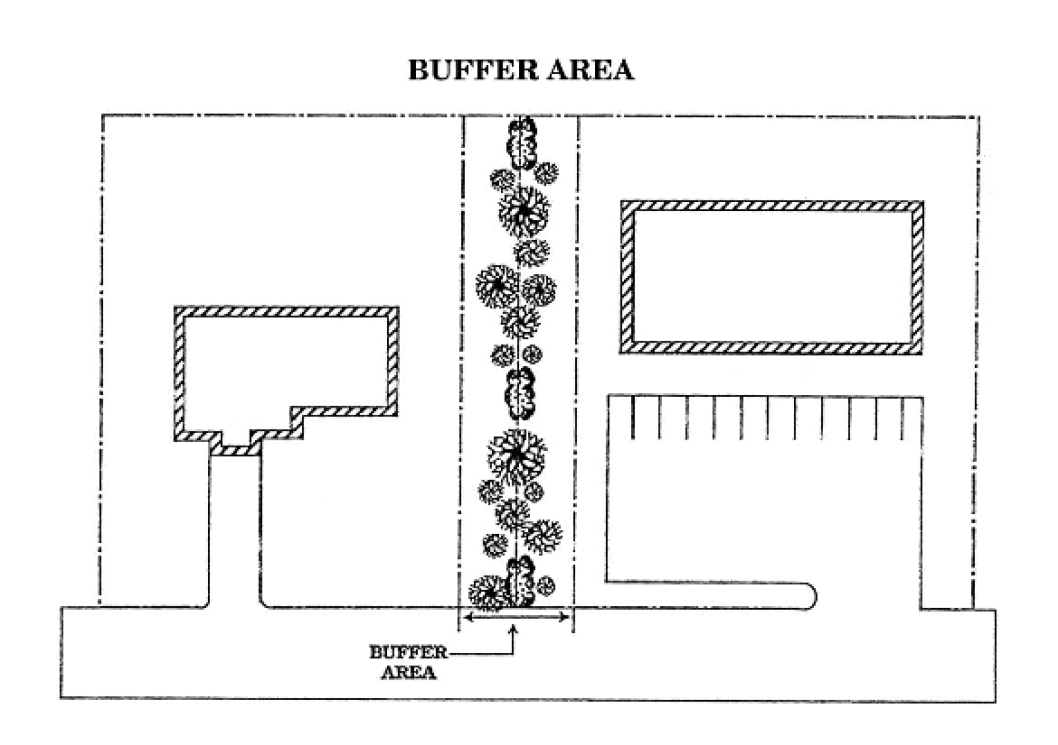
Bufferyards. Landscaped bufferyards shall be established between differing land uses around development project perimeters in accordance with the requirements of this section. These requirements shall be deemed the minimum necessary to achieve compatibility between land uses. After determining the existing land uses, zoned uses, and planned land uses around the development project, in order to calculate the appropriate bufferyard widths, apply the widest bufferyard in order to provide the greatest protection among existing or possible future uses.
(3)
Bufferyard requirements. Existing canopy trees, understory trees, shrubs, and groundcover that are located within a required perimeter bufferyard may satisfy the requirements of this section. The type, size, density, and health of existing plant materials must result in a sustained buffer equivalent to what otherwise would be required under the landscape provisions of the Land Development Code. The existing bufferyard area shall remain free of any trash, debris or existing structures that would detract from the aesthetics and effectiveness of such bufferyard. Bufferyard requirements shall be determined as follows:
a.
Two adjoining uses: Calculate the numerical difference between the land use intensity factors of the two adjoining uses by subtracting the land use intensity factor of the least intense land use from that of the more intense land use (use Table 110-4 Land Use Intensity Factors).
b.
Between land uses opposite each other across a right-of-way: Where two differing land uses are opposite each other across a right-of-way, the intensity factor, per Table 110-4, shall be further reduced as listed in Table 110-2 (Reduction of Intensity Difference):
Table 110-2 Reduction of Intensity Difference
c.
Use the resulting land use intensity difference to determine buffer design type shown in Table 110-3.
d.
For minimum bufferyard requirements, see Section 110-808(e)(5) Landscape buffers along rights-of-way and Section 110-808(e)(7) Perimeter landscape buffers.
However, all development adjacent to rights-of-way shall provide landscaping adjacent to the right-of-way in accordance with the minimum requirements of this section.
All plant materials in required landscape bufferyards between differing land uses shall be evergreen, except where natural vegetation is preserved. Natural vegetation may be preserved within the required landscape bufferyard. Natural vegetation shall be supplemented with walls, berms, or planted landscaping to achieve the desired screening.
Plant materials shall be placed within the required bufferyard to produce the maximum screening effect between the affected properties. Trees shall be spaced within the bufferyard to provide a continuous screen at maturity. Trees shall be selected and planted so their crown spreads at maturity will be as close as possible to one another. The use of flowering understory trees is required in this bufferyard. Shrubs shall also be located within the bufferyard to provide maximum opacity, whether they are evenly spaced or clustered. Plants shall be selected to provide variety and interest, as well as screening. The entire bufferyard shall not be covered with only one plant species of any type.
Bufferyard design type shall be based on the land use intensity score difference using the following table:
Table 110-3 Bufferyard Design Type Required Plantings
(4)
Land use intensity factors.
Table 110-4 Land Use Intensity Factors
*Impervious Surface Ratio (ISR) may exceed 0.65 for the purposes of this section, because the measurement shall not include landscaped bufferyards required along rights-of-way.
(5)
Landscape buffers along rights-of-way.
a.
Minimum width. The following landscape buffer widths shall be established and measured perpendicular to the property line at the right-of-way.
1.
All streets designated on the thoroughfare map in the Deltona Comprehensive Plan, as amended: 25 feet.
2.
All other streets: 15 feet.
b.
Multifamily development. Multifamily Development shall provide a landscape buffer of at least 20 feet on all streets, except where a greater buffer width is required by section(7)(a).
c.
Neighborhood and transitional commercial and transitional office. Neighborhood and transitional commercial and transitional office development, when lot frontages face one- or two-family residential development, shall provide a minimum landscape buffer of 30 feet along all streets.
d.
Minimum length. Landscape buffers shall extend along the entire length of the property boundary abutting a street right-of-way or adjacent property, and may only be altered for the following purposes:
1.
Construction of accessways as necessary and in compliance with an approved development plan. Accessways shall traverse the required buffer yards at angles between 80 and 90 degrees.
2.
Installation of stormwater, drainage or utility improvements as necessary and in compliance with an approved development plan. Such improvements and their associated easements shall traverse the required landscaped buffer yards by the shortest routes possible, and shall not have a length within the required buffer yard that exceeds 115 percent of the minimum required width of the buffer yard.
3.
Selective clearing for visibility of freestanding signs in accordance with an approved site or sign plan.
4.
The regular pruning of trees to provide clear trunk and visibility between three feet and eight feet above grade. Pruning to 15 feet above grade shall be required within the vision triangle at road and accessway intersections. Such pruning shall only be permitted for trees with height and maturity necessary to reasonably accommodate such activity. Such pruning shall be permitted only to provide a view of approved freestanding signs and traffic control devices, and to maintain drivers' visibility within required vision triangles at intersections and driveways, and to maintain the health of understory trees and shrubs. Other unnecessary excessive pruning shall be prohibited.
5.
The regular removal of dead material and debris.
6.
Installation of additional landscape materials required by this Code, including walls and fences.
7.
Construction of loading/unloading zones as required by this chapter for commercial lots adjacent to a platted alleyway, in which the loading zones are located in the rear of the commercial building, to be accessed through the alleyway, and to be shielded from view of the street. Additional screening of the loading zone is required in this situation to protect the view of residential zoning districts also adjacent to the alleyway. Such screening requirements shall include the use of fences, walls, landscaped berms and/or hedges to the height of eight feet at 100 percent opacity along the sides of the loading zone that face a residential zoning district.
No public or private right-of-way, stormwater retention or detention area, building, impervious surface, or easement other than those listed above shall be located in any required buffer yard.
(6)
Minimum planting requirements. Minimum planting requirements within landscape buffers along rights-of-way shall be determined based upon the required buffer width.
Table 110-5 Minimum Planting Requirements
When possible, placement of shrubs shall not be linear, and in clusters containing no less than seven shrubs each.
(7)
Perimeter landscape buffers.
a.
Minimum width. A minimum landscaped area shall be established along the entire length of all internal property lines, as described below.
1.
Five feet measured perpendicular to the property line for all land uses and major subdivisions, except multifamily and individual single-family lots. The landscaping for major subdivisions shall be around the subdivision perimeter, shall not be included within individual lots, and shall be maintained by a homeowners association.
2.
Fifteen feet measured perpendicular to the property line for multifamily.
b.
Minimum planting requirements. One shade tree, two understory trees shall be planted per 50 lineal feet of property frontage at the right-of-way line and at adjacent property lines. A row of shrubs shall be planted within the buffer areas that will reach three feet in height within one year after planting, and provide as nearly as possible 100 percent opacity.
(8)
Landscape buffers for double frontage residential lots.
a.
Minimum width. Landscape buffers for all double frontage residential lots shall be 25 feet measured from the property line parallel to the abutting the rights-of-way.
b.
Required vegetation. A minimum of one shade tree and two flowering evergreen understory trees shall be planted in each bufferyard, and arranged to create maximum screening of the building or building site at maturity. Alternatively, the bufferyards may be left in natural vegetation, but must be supplemented with additional plants if the desired screening effect is not achieved. Shrubs shall be planted within the buffer to provide additional 100 percent opaque screening to a height of four feet at maturity.
c.
Fences or walls. Fences or walls may be installed within the required buffers in accordance with the requirements for fences and walls in the front yards of the zoning district in which the double frontage residential lot is located. If a 100 percent opaque fence or wall is installed to a height of four feet on a double frontage residential lot, shrubs are not required to be planted behind it, or in front of it. The finished side of such fences and walls shall face the exterior property line. Masonry and concrete fences shall be finished with false brick facades, or with stucco or split face block in earth tones or pastel colors.
(9)
Buffer design guidelines.
a.
Landscape material selection. Landscape materials within buffers along rights-of-way shall be designed to display variety and color by utilizing flowering and variegated species. Such variety and color may be accomplished by using a combination of shrubs and ornamentals from the approved plant lists provided herein. Ornamentals may be substituted for required shrubs on a two ornamentals for one shrub basis. In no case shall more than 50 percent of the required shrubs be replaced by ornamentals.
b.
Location of landscaping.
1.
The placement of landscape materials within landscape buffers shall have a rational relationship to the existing patterns and densities of adjoining areas that have been preserved. Arrangements shall be organic or curvilinear, and shall not be linear unless dimensional limitations necessitate such an arrangement.
2.
Landscape materials shall be clustered into groupings, which simulate a natural, rather than man-made, appearance.
c.
Maximum vegetation removal.
1.
A minimum of 65 percent of any landscape buffer over ten feet in width shall be set aside for preservation of existing trees, except sand pines and exotic species. Removal of understory trees and shrubs may be permitted to provide for shallow swales without removal or damage to any existing shade trees in order to create retention areas. In no instance shall more than 50 percent of the preserved understory tree canopy be removed.
(f)
Landscaping adjacent to structures.
(1)
Minimum planting requirements. The interior of any site, including those areas directly adjacent to structures shall be landscaped in accordance with the following provisions. Landscape materials required in this subsection are in addition to any landscape materials that may otherwise be required in this chapter, unless otherwise stated herein, or the principal structure is located within 50 feet of a perimeter lot line where, in such cases, the perimeter landscape requirement may serve to satisfy the foundation landscape requirement for that portion of the building most parallel to such lot line and further provided that these landscape materials are installed in a manner that provides an effective buffering result. The measurement of any exterior building to determine the required number of plantings shall not include overhead or loading area doors, openings for motor vehicle bays or entrances, or the perimeter of attached or detached canopies.
a.
Non-residential.
1.
One foundation plant shall be required for every one foot of the front of building, and for every one foot of the building exterior that is faces a street, parking area, or is exposed to view from adjacent residential property.
2.
One understory tree shall be required for every 20 feet of the front of building, and for every 20 feet of the building exterior walls that are exposed to view from an adjacent street or parking area. One understory tree shall be required for every 15 linear feet of exterior building wall that is exposed to view from adjacent residential areas.
b.
Multifamily.
1.
One foundation plant shall be required for every one foot of the front of building and for every exterior wall that is exposed to view from an adjacent street. Two foundation plants shall be required for every one foot of every exterior wall of the building that is exposed to view from an adjacent single-family or two-family residential area.
2.
One understory tree shall be required for every 20 feet of the front of building and for every exterior wall of the building that is exposed to view from an adjacent street. One understory tree shall be required for every 15 feet of the building that is exposed to view from an adjacent two-family or single-family residential area.
3.
Landscaped berms, appropriately scaled, shall be provided adjacent to single-family and two-family development and on road frontages. Landscaped berms shall use topsoil that is clean and free of construction debris, weeds, rocks, noxious pests and diseases. Berms shall be stabilized to prevent subsidence and erosion. Berms shall not cause water runoff to adjacent properties or streets that is in excess of pre-development conditions or that otherwise poses a nuisance. Landscaped berms shall be at the maximum height possible for the width of the required buffer and the soil, topography, and drainage conditions on and adjacent to the site. All berms shall be planted with groundcover or sod, and shall be planted with a continuous hedge. In cases where more than 65 percent of the existing trees that are categorized as protected trees by the city's Land Development Code (excluding sand pines) must be removed to create the required landscaped berms, at least 15 percent of the developed site must be set aside in a natural vegetation retention area to preserve existing trees.
(2)
Planting. Foundation plants required by this subsection may be comprised of shrubs and/or ground covers in any arrangement or combination provided that no less than 50 percent of the total required materials are shrubs.
(3)
Function of landscape materials. Landscape materials required by this subsection should be located to achieve the following in order of priority:
a.
Provide transition between the building and the ground;
b.
Provide visual breaks along the front of monotonous building facades;
c.
Enhance walkways, entrances, seating areas, bus stops or any other pedestrian areas;
d.
Separate and buffer pedestrian and public areas from cruise lanes, drives and parking areas;
e.
Provide direction to focal areas and main entrances;
f.
Screen mechanical equipment, air conditioning units, or any other visible outdoor equipment; and
g.
Screen service areas.
(4)
Location of landscape materials. Generally, landscape materials required by this subsection should be located within five to 25 feet of the building foundation. Emphasis should be afforded to those areas, which are visible from any public or private street or from any public area internal to the site.
(g)
Landscaping of off-street parking areas. Required off-street parking areas constructed after April 13, 1989, and having off-street parking spaces for more than eight vehicles, shall have interior landscaped areas covering a minimum of 15 percent of the total off-street parking area, excluding any required landscaped buffer areas. Landscaped islands shall be required at the ends of each row of interior parking spaces not abutting the perimeter of the parking area. A landscaped island shall be provided for every ten parking spaces. Interior landscaped areas shall be dispersed so as to define aisles.
Landscaped row ends shall have a minimum area of 175 square feet with no width less than ten feet and no length less than 17.5 feet if it abuts one parking space, or 35 feet if it abuts two parking spaces. Islands in parking bays, other than row ends, shall have a minimum landscaped area of nine feet width and 16 feet length. Every landscaped island, including row ends, shall include at least one tree. Row end islands abutting parking facility entry and exit accessways, and in front of principal buildings shall have at least one overstory tree. Interior landscaped areas, other than required landscaped islands, shall have a minimum area of 100 square feet with no dimension less than ten feet. Two feet of these landscaped areas may be part of the required depth of each abutting parking space, provided wheel stops or curbs are used to protect them.
Each landscaped area less than 400 sq. ft. shall include at least one understory tree. A canopy tree may be used in lieu of the understory tree if recommended by the director of development services or his or her designee. In landscaped areas of 400 sq. ft. or more any canopy tree may be used in lieu of an understory tree. A minimum of 35 percent of each landscaped area shall have a combination of shrubs less than four feet high, and ground covers. The remaining area shall be landscaped with shrubs, grass, ground cover, or other materials, such as stone, gravel or mulch.
Accessways longer than 100 feet that provide direct access to entry or exiting driveways classified as intermediate or major driveways by the city's Land Development Code, as it may be amended from time to time, shall have landscaped buffers on each side. These landscaped buffers shall be planted with groundcover, a continuous shrub hedge broken only by traversing sidewalks, and two understory trees and one overstory tree for every 50 lineal feet of buffer. Perpendicular interior vehicular accessways shall not traverse the landscaped buffer strip at intervals of less than 100 feet.
Where the strict application of this subsection will seriously limit the function of the parking area, as determined by the zoning enforcement official or his or her designee, the required landscaping may be located near the perimeter of the paved area.
(h)
Wheel stops/curbing. All landscaped areas shall be protected from vehicle encroachment by wheel stops or curbing. If curbing is raised above abutting landscaped areas, it shall be perforated to permit drainage from the paved ground surface area onto the landscaped areas. Curbing used to protect landscaped areas shall not be inverted, or Miami, curbing. Where a wheelstop or curb is utilized, no more than two feet of the paved area between the curb and the end of the parking spaces may be omitted if the area is landscaped in addition to the required landscaping herein with a material such as ground cover, rock, or gravel, requiring minimal maintenance.
(i)
Landscape materials. All plant materials shall be Florida No. 1 grade, or better; according to the current "Grades and Standards for Nursery Plants," State of Florida, Department of Agriculture, Tallahassee, except where in the discretion of the enforcement official natural vegetation is adequate to provide the necessary visual screening. Existing trees situated in the required buffer may be used to satisfy the buffer tree requirement. Existing upland native vegetation shall be incorporated, where appropriate, into off-street parking areas and landscape buffers of a proposed development.
(1)
Tree planting standards. Canopy trees shall have a minimum caliper at DBH of one and one-half inches and a minimum height of six feet, and understory trees shall have a minimum height of six feet and minimum caliper at DBH of three-fourths inch at installation. Trees shall not be planted where they interfere with site drainage.
Where utility lines are present, trees shall be placed at the edge of the required buffer area farthest from the utility lines. The requirements for canopy trees may be waived by the enforcement official if they interfere with above ground utility lines. Trees planted under, or close to, utility lines shall be selected to ensure that their crowns at maturity will not interfere with the utility lines. This does not change the number of trees required.
a.
Required mix of tree species. When eight or more trees are required to be planted to meet the requirements of this section, a mix of tree species shall be provided, at least one of which shall be native to the Central Florida region. The minimum number of species to be planted are indicated below.
Table 110-6 Required Mix of Tree Species
(2)
Shrubs. Shrubs and hedges shall be a minimum of two feet in height, at installation. Plants shall be spaced no less than three feet apart measured from center to center. Hedges, where required, shall be planted and maintained so as to form a continuous, unbroken, solid, visual screen within a maximum of one year after the time of planting.
(3)
Ground cover. Ground cover plants include plant materials which reach a maximum height of not more than 24 inches and may be used in lieu of grass. Ground cover plants must present a reasonably complete coverage at time of planting. Ground cover plants shall be a minimum of one-gallon size when planted and spaced a maximum of two feet on center. Ground covers must present a finished appearance and provide reasonably complete coverage at the time of planting.
(4)
Turfgrass. Grass areas shall be planted in species normally grown as permanent lawns in the city of Deltona. Grass areas may be sodded, plugged, sprigged or seeded; provided, however, that solid sod shall be used in swales or other areas that are found to be subject to erosion. Grass sod shall be clean and reasonably free of weeds and noxious pests or diseases. Turfgrass areas should be consolidated and limited to those areas on the site that receive occasional pedestrian traffic, provide for recreational uses, provide soil erosion control such as on slopes or in swales; or where turfgrass is used as a design unifier, or other similar practical use. Unless sod or grass seed is used, nursegrass seed shall be sown for immediate effect and protection until coverage is otherwise achieved.
(5)
Use of drought-resistant plant material. All new or replacement plantings required for any off-street parking area or landscape buffer shall use, to the maximum extent possible, native plant material or other species with equivalent drought-resistant properties. The intent of this requirement is to promote and conserve the water resources of the city of Deltona and Volusia County.
(6)
Preservation of existing native plants and material. Every reasonable effort shall be made in the design and construction of all site improvements and alterations to save existing healthy trees and native vegetation and maintain the existing topography. The enforcement official may require alternate designs and construction techniques to better achieve tree and native vegetation preservation while still allowing the permitted use of the property. Existing native vegetation specified to remain shall be preserved in its entirety, with all trees, understory, ground cover and duff left intact. Areas of existing natural vegetation should not be irrigated.
(7)
Mulch. In order to preserve soil moisture, all planting areas not left in the natural state shall be mulched with no less than two inches of organic mulch. Wood chips, pine needles or oak leaves are preferred. Mulch shall be placed directly on the soil or landscaping fabric and planting areas shall be properly edged to retain mulch.
(j)
Solid waste containers. All solid waste containers shall be enclosed on at least three sides with a six-foot high screen. The screen shall consist of a masonry wall. A hedge consisting of shrubs of a species selected from Table 110-7C. planted one-foot apart within three feet of the solid waste container enclosure, and groundcover selected from Table 110-7D shall abut the enclosure walls, except that such hedge is not required in cases where solid waste containers are integrated and located within the interior of an area designated for commercial or industrial shipping and receiving and where the container enclosures are otherwise effectively buffered from view from adjoining properties planned or zoned for residential, office or institutional uses. The landscaping around the solid waste container enclosure shall be maintained in accordance with the requirements for maintenance of landscaping in this section, and shall be planted in a strip of soil wide and deep enough to ensure its survival.
The container shall be enclosed in such a manner so that said container will be screened from public streets and adjoining properties. A concrete or asphalt pad of appropriate size and construction shall be provided as a base for the container. The container pad shall be at the approximate level of the service vehicle approach areas so that the truck's loading mechanism can align with the container's sleeves.
The screened enclosure shall not be located within any street right-of-way or required yard area. Containers and enclosures shall be located so as to allow ease of access for collection trucks and direct access to drive areas. Straight-in or circular drives are encouraged to reduce truck-maneuvering problems. No parking or other obstructions shall be permitted in the access area for enclosures.
(k)
Enforcement official. The enforcement official may, in his or her discretion, waive or modify certain requirements in this section by an amount not to exceed 15 percent, if literal interpretation of this section will seriously hamper the use to which the property is intended.
(l)
Maintenance requirements. The property owner will be responsible for maintenance of all required landscape and irrigation improvements as originally approved. Therefore, these maintenance requirements shall carry with the land and shall be the responsibility of any subsequent owners of the property.
Landscape areas and site improvements shall be maintained in good condition for a healthy, neat, and orderly appearance and shall be kept free from weeds and debris. All plant materials shall be maintained in a healthy and vigorous condition through proper irrigation, fertilization, pruning, weeding, mowing, and other standard horticultural practices. Plant material should grow to their normal shape, color, and height, to fulfill the required functions of screening, shading, buffering, and aesthetic appeal set forth by the city of Deltona. The hat racking of trees is prohibited. All dead plants shall be replaced. This requirement includes, but is not limited to, the replacement of plants damaged by insects, diseases, vehicular traffic, acts of God, and vandalism. Mulch shall be maintained at the proper coverage and depth.
The irrigation system shall be fully operational and shall be operated on a regular basis to provide the appropriate amount of water to the plant materials to maintain adequate plant health and growth. In situations where drought tolerant plant materials have not been properly maintained primarily due to lack of sufficient watering, the enforcement official may require the installation of a permanent irrigation system meeting the specifications of this chapter.
The city shall notify the property owner in writing of any maintenance violations. Upon notification of a maintenance violation, the property owner, or his/her duly authorized agent shall correct the violation or file an appeal per section 110-808(n) within 30 days.
If an existing site that is nonconforming with regard to landscape or buffer requirements, number of trees or other landscape standards is made more so by the removal, destruction or death of the plant material, then the owner shall be required to replace what was removed or destroyed in that area and to provide additional materials to the extent that it would be practically and economically feasible to do so, to meet minimum current standards.
Table 110-7 Approved Plant Species List
Table 110-7A Canopy Trees
*Canopy trees that may be used in lieu of understory trees in landscaping with the parking areas if recommended by the director of development services or his or her designee.
Table 110-7B Understory Trees
Table 110-7C Shrubs, Small Palms and Cycads
Table 110-7D Groundcovers
Table 110-7E Non-Native Vines
Table 110-7F Turfgrasses
Water Zone Key:
H = High Water Use Zone - Plants which are associated with moist soils and require supplemental water in addition to natural rainfall to survive. This zone includes shallow rooted turfgrass varieties.
M = Moderate Water Use Zone - Plants which survive on natural rainfall with supplemental water during seasonable dry periods. This zone includes deep rooted turfgrass varieties.
L = Low Water Use Zone - Plants which, once established, survive on natural rainfall without supplemental water. Because of the relatively high water requirements of turfgrass, no presently available varieties are included in this category.
Sources: St. Johns River Water Management District Xeriscape Plant Guide South Florida Water Management District Xeriscape Plant Guide II Cooperative Extension Service
Figure I
Plant Material/100'
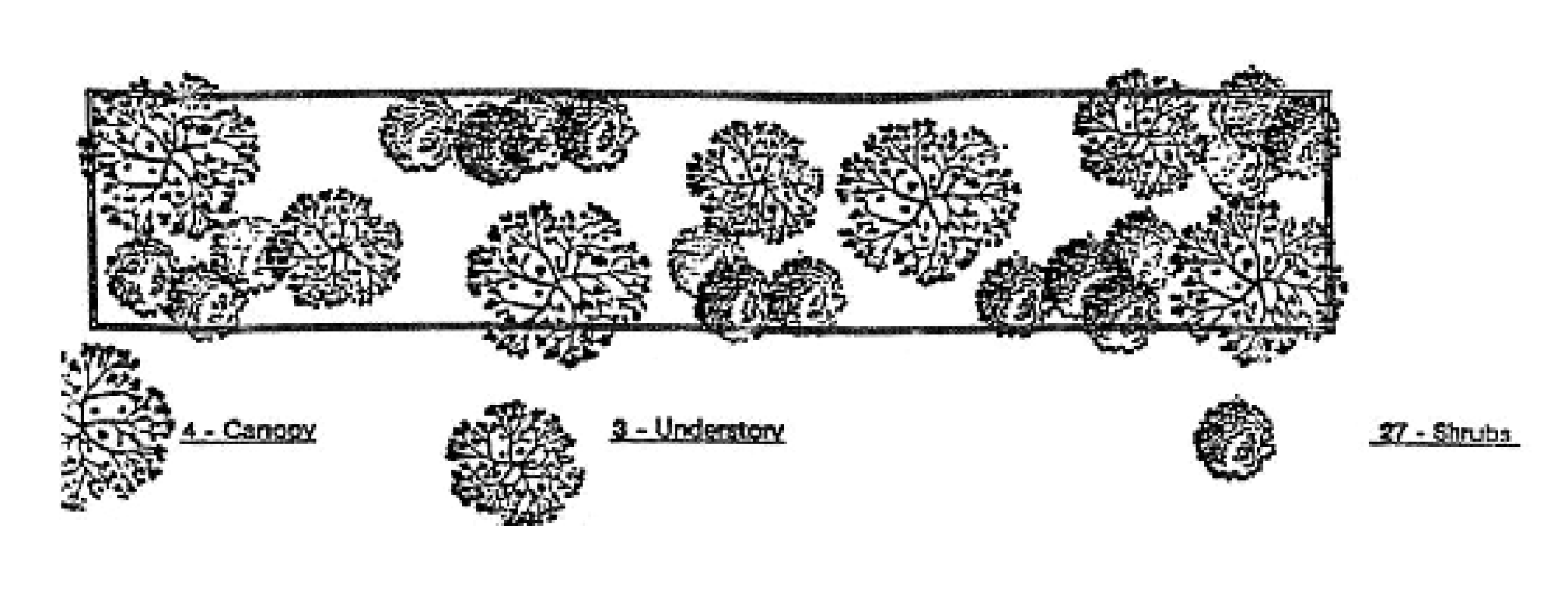
4—Canopy 3—Understory 27—Shrub
Figure II
Plant Material/100'
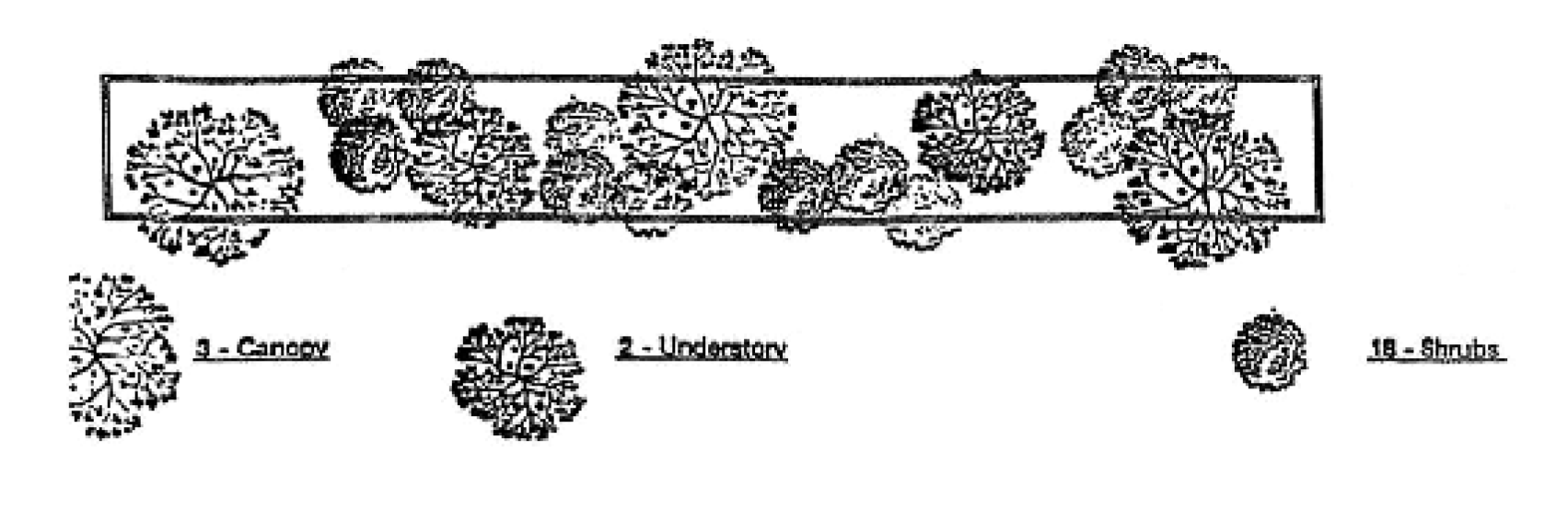
3—Canopy 2—Understory 18—Shrubs
Placement of plant material shall be in an irregular pattern, where possible, shrubs should be in clusters containing no less than three plants each.
(m)
Modification of development standards for site plan approval.
(1)
This section is established to provide standards and procedures for the granting of administrative modifications of development standards. The modification of standards is specifically intended to promote high standards for final site plan reviews under chapter 75, Code of Ordinances, as it may be amended from time to time, provide flexibility in the administration of standards in recognition of site specific conditions, and to establish conditions to ensure compatibility, where standards are modified.
(2)
The enforcement official may approve a maximum reduction of up to 20 percent of the required minimum yard setbacks for principal and accessory buildings and/or the number of required parking spaces upon making a finding that the adjustment will protect and encourage the preservation of large canopy, specimen, or historic trees.
(3)
Modification of the development standards listed above of less than one foot shall be deemed to be non-substantial. The enforcement official shall be authorized to approve the modification at the time of request based upon the requirements of this chapter. Non-substantial modifications shall be deemed to have no effect on adjacent properties.
(4)
Nothing in this section shall supersede the planning and zoning board review process or deny access by the applicant to relief through the zoning variance review procedures.
(5)
Application for modification of standards may be reviewed prior to application for final site plan review or may be made in conjunction with final site plan review. Application shall be made to the planning and development services department in conformance with the submittal requirements of this section.
(6)
Upon acceptance of the application, the enforcement official shall review it and render his decision approving, approving with conditions, or denying the request. A modification of standards report shall be issued and be attached to the final site plan.
(7)
When the enforcement official approves the modification of standards, he may prescribe appropriate conditions and safeguards in conformity with the intent and provisions of this section.
(n)
Appeals. Any person aggrieved by this decision of the enforcement official or any of the conditions imposed as part of the terms under which the modification of standards is approved, may elect to appeal the decision to the city commission. The appeal shall be filed under section 110-1002 City of Deltona Zoning Ordinance No. 30-98, as amended. The appeal shall be taken within ten working days after the decision is rendered by filing with the enforcement official and with the city attorney, a written notice of notice of appeal specifying its grounds, together with the appropriate fee.
(o)
Except as provided herein, the requirements of section 110-808 do not apply to properties that meet the following criteria:
(1)
The property is currently used for, was used for, and is zoned for commercial or industrial use.
(2)
The change in use will not require a rezoning.
(3)
The proposed use is a permitted or conditional use in the current zoning district.
(4)
No expansion will occur to the buildings gross square footage.
Development proposals that meet these criteria shall provide at least 15% of landscape coverage of the property to include a variety of trees, shrubs and other plant materials. The development plan shall integrate such green spaces within parking areas, along building foundations and provide buffers that may include attractive fences where appropriate along the perimeter of the property to mitigate visual impacts and enhance the aesthetic value of the property.
(Ord. No. 34-00, § 1, 11-7-2000; Ord. No. 16-2004, § 1, 8-2-2004; Ord. No. 33-2004, § 1, 1-24-2005; Ord. No. 34-2004, § 1, 1-24-2005; Ord. No. 02-2010, § 1, 2-15-2010; Ord. No. 19-2011, § 1(Exh. A), 11-7-2011; Ord. No. 06-2013, § 1(Exh. A), 6-17-2013; Ord. No. 18-2013, § 1(Exh. A), 2-3-2014; Ord. No. 04-2016, § 1(Exh. A), 4-4-2016)
Sec. 110-809. - Mobile home.
(a)
General requirements. The following regulations apply to mobile home parks:
(1)
Recreation area. There shall be at least one recreation area. The recreation area shall be easily accessible to all residents of the project.
(2)
Internal streets width. Required paving for two-way streets with no parking on street: 20 feet. An additional seven feet of right-of-way shall be provided if parking on one side of street is permitted only. An additional 14 feet of right-of-way shall be provided if parking on both sides of street is permitted.
Required paving for one-way streets: 18 feet if serving less than 50 spaces, and if parking is allowed on one side of street only.
The additional right-of-way for parking purposes as herein provided is not required to be paved.
Streets shall be constructed of materials which meet the specifications of the Land Development Code.
Dead-end streets or streets ending in cul-de-sac shall be limited in length to 600 feet and shall be provided with a turnaround, having a minimum paving width diameter of 86 feet.
(3)
Entrances and exits. Entrances and exits shall be limited in number and when combined, shall be separated with a landscaped median strip not less than five-feet wide. There shall be no direct vehicle access from any space to any exterior street.
(4)
Water supply, sewage disposal and garage and refuse handling. All mobile home parks shall comply with the Land Development Code, Ordinance No. 96-25, as it may be amended from time to time, regarding water supply and sewage disposal and the applicable provisions of the Florida Administrative Code regarding garbage and refuse handling.
(5)
Landscape buffer requirements. Landscaped buffer areas meeting the requirements of section 110-808 shall be constructed.
(6)
Project perimeter setback. No structure shall be located within 30 feet of the project's perimeter.
(7)
Final site plan development order required. A final site plan development order for new parks and expansion of existing parks, meeting the requirements of chapter 75 Code of Ordinances, as it may be amended from time to time, shall have been issued prior to commencement of construction. Prior to issuance of any building permit for any sale of the mobile homes in the park, construction of the required improvements shall have been completed in accordance with chapter 96, article III, Code of Ordinances, as it may be amended from time to time.
(b)
Existing mobile home parks—Compliance. Any subsequent construction or alteration that extends an existing mobile home park shall comply with the provisions of these regulations, including those provisions requiring a permit. No changes shall be made to the existing design of spaces or streets which increase their nonconformity. Subsequent changes to the basic design of existing spaces or streets which do not increase their nonconformity shall be permitted.
(Ord. No. 19-2011, § 1(Exh. A), 11-7-2011; Ord. No. 18-2013, § 1(Exh. A), 2-3-2014)
Sec. 110-810. - Driveway expansion (residential).
(a)
The expansion of an existing driveway that is contiguous to the existing driveway or construction of a second driveway requires a permit application and review by the department of planning and development services. The permittee will be responsible for any damages sustained to the right-of-way including, but not limited to: the edge of pavement, turf, sidewalks, meter boxes, above grade & below grade infrastructure, mailboxes, etc. There shall be no improvement within drainage or utility easements as recorded/referenced in the plat specific to the property. A building permit shall be obtained when impervious materials or designated parking area additions are constructed on any residential lot.
(1)
A building permit shall be obtained when impervious materials or designated parking area additions are constructed on any residential lot.
(2)
Parking must be limited to the driveway plus an area to accommodate two additional parking spaces of 380 square feet or 40 percent of the front yard area, whichever is less.
(3)
Excessive driveways, defined as those covering more than 40 percent of the front yard are prohibited.
(4)
Vegetative screening is required for new parking spaces that face the side property line. Screening is required along the side of the parking space parallel to the street. All additional parking spaces shall be accessible without the need to drive upon or over any curb and shall not create a "stacked" condition where one parked vehicle is unable to exit if another parking space is occupied.
(5)
The permit application shall designate dimensions of the requested driveway expansion or requested second driveway.
(6)
Permit application shall show materials to be used and, where applicable, the location of the concrete right-of-way apron. Said apron shall comply with the design criteria established under construction standards section 96-100 (a) as may be amended from time to time. The driveway shall be graded and formed to ensure proper and positive stormwater conveyance and, upon review, the agency may require installation of a culvert or other additional drainage structures. Any required culverts shall have mitered end sections and shall otherwise comply with design criteria as may be established or required pursuant to unique site conditions.
(7)
No driveway may exceed 24 feet in width inclusive of an additional permitted driveway expansion. Each driveway, where applicable, must show the location of the concrete right-of-way apron.
(8)
Parking may only occur on "approved surfaces." See subsection (b) below.
(9)
No driveway may extend into the side yard setback.
(10)
No driveway may interfere with the drainage or swale system.
(b)
"Approved driveway surfaces" for a driveway expansion or a second driveway shall consist of concrete or asphalt provided the lot meets the impervious surface ratio requirements or may consist of a minimum of four inches deep packed crushed pack, gravel, shell or other similar material acceptable to the city i.e., concrete, asphalt, pavers, gravel/washed shell. Any crushed material shall be held in place with a slightly raised border of landscaping timbers, paver stones, or bricks specifically made for an outdoor landscaping border use to prevent the material from washing away.
(c)
The area of the driveway expansion or a second driveway shall be continuously maintained in a smooth well-graded condition to prevent vegetative intrusion. (See section 70-30.)
(d)
If the driveway expansion or a second driveway traverses the right-of-way access to a property across the public right-of-way shall have an approved/permitted driveway apron that shall be of six-inch concrete and no wider than 24 feet. There shall be no pavers, gravel, mulch, shell, or similar allowed within the right-of-way.
(e)
A driveway apron, if required, must be constructed of concrete pursuant to construction standards section 96-100 (a).
(f)
Access to the main driveway, driveway expansion, or a second driveway along a publicly paved road shall be made via the concrete apron of the driveway.
(g)
Any driveway, driveway expansion, or second driveway that traverses over an existing sidewalk in the right-of-way, shall meet ADA requirements.
(Ord. No. 04-2016, § 1(Exh. A), 4-4-2016; Ord. No. 14-2024, § 1, 4-7-25)
Sec. 110-811. - Parking and storage of vehicles or watercraft.
(a)
Vehicles in agricultural and residential areas.
(1)
No vehicles greater than 10,000 lbs. manufacturer's gross weight or designed to carry 16 or more passengers, or requiring a commercial drivers license (CDL) of any endorsement to operate will be parked or stored in any residential or agricultural zoning district except in agriculture areas on lots of five acres or more. Vehicles that are inoperable or do not have a current and valid license plate and validation sticker affixed to the license plate are prohibited.
(2)
No vehicle with external refrigeration units may operate within these zoning districts.
(3)
No back-up noise alarms may operate between the hours of 10:00 p.m. and 7:00 a.m.
(4)
No vehicles or utility trailers may be parked or stored in the front yard forward of the edge of the principal dwelling that meet any of the following criteria:
Vehicles prohibited above, or
Greater than 21 feet in length, or
Greater than ten feet in height, including accessories with fully inflated tires.
(5)
Vehicles greater than 21 feet in length and/or greater than ten feet in height may be stored in the side or rear yard.
(6)
All vehicles parked in side or rear yards must be stored in a site plan approved parking area. Screening exceeding the height limitations for the zoning district in which it is located may only consist of vegetative screening for that portion exceeding said height limitations. All vegetative screening must be designed as three year to maturity from the approved plant list provided by the planning and development services department. All site plan approved parking shall meet the standards for minimum required parking in subsection 110-828(b) through 110-828(e). For parking the excess of minimum required parking spaces, the enforcement official may allow semi-impervious materials similar to those permitted by subsection 110-828(b)(1).
(7)
All vehicles parked or stored on property must be registered or assigned to the resident or their temporary guest.
(8)
Repairs other than normal maintenance and washing of vehicles or any repairs causing the vehicle to become inoperable are prohibited outside of an enclosed garage.
(9)
No vehicle or equipment shall be parked or stored in a manner which obstructs access to any door, window, or other entrance to or exit from the dwelling.
Exclusions:
Conversion vans with a handicapped sticker whose corresponding licensed driver is a resident of the principal dwelling are specifically excluded from these standards. Sport utility vehicles (SUVs) or pick-up trucks for personal use that have no commercial advertising may be parked in the driveway.
(b)
Mobile recreational shelters. Mobile recreational shelters and vehicles, other camping type vehicles excluding pickup covers when appropriately mounted on a vehicle, boats, boat trailers, utility trailers, and other trailers are permitted as an accessory use on any lot within the A, RE-1, RE-5, R-1, R-2, R-3, R-4, R1-B, the single- and two-family residential areas of RPUD, and the MPUD classifications provided the following conditions are met:
(1)
They shall have a current license plate or validation sticker, and shall be parked or stored in full compliance with all yard requirements for accessory structures. The ground area beneath such vehicles shall be kept free from debris, including excessive weed growth.
(2)
They may be temporarily parked in the driveway of the principal structure for trip preparation, loading, unloading and cleanup, for a maximum of 36 hours per week.
(3)
They shall not be parked or stored either within a public right-of-way, or within that portion of the lot lying across the full width of the lot between the front lot line and front most part of the principal structure, except as provided for by paragraph (2) above and paragraph (6) below.
(4)
No sewage shall be permitted to escape from such vehicles onto a lot or street.
(5)
They shall not be connected to water, sewer or electric lines or be used for residential purposes.
(6)
Motor vehicles commonly referred to as vans that have been converted to a recreational vehicle by a licensed recreational vehicle manufacturer by installation of 110-volt electrical wiring, LP gas piping, or a plumbing system consisting of a permanently attached water using toilet facility may be parked in the driveway of the principal structure when the occupant of the principal structure has a disability which may require the above facilities to be incorporated in a motor vehicle, and if the occupants have received a handicapped parking decal from the State of Florida for the vehicle.
(c)
Residential parking. In the R, PB, and MF districts when used only for single- or two-family residential uses, motor vehicles shall not be parked anywhere within that portion of the lot lying across the full width of the lot between the front lot line and the front most part of the principal structure, except on driveways. Automobiles are to be parked in designated off-street parking areas for all other uses within these districts.
(d)
Commercial vehicle storage and parking
(1)
Commercial vehicles which are used daily by residents of the household for transportation but which do not exceed the manufacturer's standard three-quarter size pick-up truck may be parked outdoors in a residential district provided that only one such commercial vehicle may be located at any one dwelling unit.
(2)
Commercial vehicles prohibited from outdoor parking in all residential areas:
a.
Any commercial vehicles not meeting the standards described in paragraph (1);
b.
Step vans;
c.
Flatbed and stakebed trucks;
d.
Wreckers, except when authorized by the city, the county sheriff's office, or the Florida highway patrol for on-call emergency service.
e.
Tractor, including truck tractors and their associated vans or trailers (see section 110-811(a), above).
(e)
Long term storage. Recreational vehicles shall be parked or stored within a side or rear yard, on site plan approved parking, but not within a side street yard, provided:
(1)
No portion of the vehicle or equipment shall extend into any part of the front yard.
(2)
No vehicle or equipment shall be parked or stored in a manner which obstructs access to any door, window, or other entrance to or exit from the dwelling.
(3)
No vehicle or equipment shall be parked or stored in any part of the required rear yard of a double frontage lot.
(4)
On corner lots, no vehicles or equipment shall be parked or stored in any part of the required side yard abutting any street and provide that no vehicle or equipment shall be parked or stored within 20 feet from any street right-of-way.
(f)
Special event parking. During such events, grass areas may be permitted to be used for parking provided the authority having jurisdiction (AHJ) from the fire department, consistent with section 10.15.2 as amended of the fire code, shall be permitted to regulate all outdoor events pertaining to access for emergency vehicle; access to fire protection equipment; placement of stands, concession booths, and exhibits; and the control of hazardous conditions dangerous to life and property.
(Ord. No. 12-00, § 3, 8-7-2000; Ord. No. 21-2007, § 4, 6-2-2008; Ord. No. 19-2011, § 1(Exh. A), 11-7-2011; Ord. No. 06-2013, § 1(Exh. A), 6-17-2013)
Sec. 110-812. - Environmental standards.
These environmental standards shall apply in all classifications:
(a)
Air pollution. There shall be no emission of fumes, odors, vapors, gases, chemicals, smoke, dust, dirt, fly ash, or any particulate matter in violation of applicable state standards.
(b)
Water pollution and sewage control. There shall be no discharge of liquid or solid wastes into any public or private sewage disposal system, or into or on the ground, or into any stream, waterway, water body or drainage canal, nor any accumulation of any liquid or solid wastes, in violation of the applicable provisions of the comprehensive plan, Land Development Code, Ordinance No. 96-25 as it may be amended from time to time, or applicable state standards.
(Ord. No. 19-2011, § 1(Exh. A), 11-7-2011)
Sec. 110-813. - Reserved.
Editor's note— Ord. No. 18-2013, § 1(Exh. A), adopted Feb. 3, 2014, repealed § 110-813, which pertained to planned unit development regulations and derived from Ord. No. 19-2011, § 1(Exh. A), adopted Nov. 7, 2011.
Sec. 110-814. - Additional regulations for certain permitted principal uses and structures.
The following additional regulations shall apply to specific permitted principal uses in all classifications where so permitted.
(a)
Adult entertainment establishments. Adult entertainment establishments shall be permitted only in accordance with the requirements of the adult entertainment code, chapter 78, Code of Ordinances.
(b)
Automobile service stations. The following regulations shall apply to automobile service stations, types A, B and C.
(1)
Location of principal and accessory structures. No accessory structures shall be erected closer than ten feet to a street or within the landscape buffer area, whichever is wider. If accessory structures are erected within any front yard, they shall be removed before the property is converted to a use other than an automobile service station.
(2)
Points of access. The number of points of access for one automobile service station shall be governed by the Land Development Code Ordinance No. 96-25, as it may be amended from time to time.
(3)
Landscape buffer requirements. Where lots to be used for service stations abut any property zoned for residential use, a landscaped buffer area meeting the requirements of section 110-808 shall be constructed.
(4)
Permanent storage of materials, merchandise and equipment. All materials, merchandise and equipment, other than motor vehicle fuels, shall be stored within the principal building.
(5)
Trash facilities. Adequate, enclosed trash storage facilities shall be provided on the site.
(6)
Parking of vehicles or vehicles offered for sale or rent at types A and B stations only.
Wreckers, service or customer vehicles, or vehicles offered for sale or rent, may be parked on the premises but shall be parked in a manner that will not create a traffic hazard or interfere with any vehicular maneuvering area necessary for gasoline pump areas, service bays, or with any required off-street parking spaces. No more than two motor vehicles may be offered for sale on the premises at any one time unless otherwise authorized by the provisions of this chapter, and in conformity with all applicable state regulations.
A truck or trailer rental service, established primarily for the transporting of household goods, shall be permitted, subject to the following:
The required minimum lot area shall be increased by 480 square feet for the parking of each rental truck proposed, and 50 square feet for each rental trailer proposed.
On corner lots, no vehicles offered for sale or rent shall be parked within a yard abutting a street.
(c)
Community residential homes. Community residential homes (CRH) are defined by F.S. ch. 419, as it may be amended from time to time. Pursuant to F.S. ch. 419, the following CRH provisions apply within the city:
(1)
A community residential home shall be a conditional use within principal structures in those zoning districts identified in the city's zoning ordinance, section 110-817, conditional applied to conditional uses, as it may be amended from time to time;
(2)
A CRH serving one to six non-family residents, not exceeding six non-family residents, is subject to the following:
a.
Located no less than 1,000 feet (measured from the closest property boundary) from another actively licensed CRH serving one to six non-family residents;
b.
Located no less than 1,200 feet (measured from the closest property boundary) from another actively licensed CRH serving seven to 14 non-family residents;
(3)
A CRH serving seven to 14 non-family residents, not exceeding 14 non-family residents, are subject to the following:
a.
Located no less than 1,200 feet (measured from the closest property boundary) from another actively licensed CRH, regardless of the number of non-family residents;
b.
Located no less than 500 feet (measured from the closest property boundary) from a single-family residential zoning district.
(4)
Obtain and keep current a city business tax receipt (BTR). At the time of BTR application, the applicant shall ensure that the required aforementioned radii are met;
(5)
Protect the character of the neighborhood and minimize potential public or private nuisances;
(6)
Comply with the city's Code of Ordinances, the Florida Building Code, the Florida Fire Prevention Code, and any licensing entity defined per F.S. ch. 419, including, but not limited to, the State of Florida Department of Elderly Affairs, the Agency for Persons with Disabilities, the Department of Juvenile Justice, the Department of Children and Families, and the Agency for Health Care Administration; and
(7)
Protect public health, safety, and welfare to ensure basic function operation, including, but not limited to, full utilities, access management in chapter 96, off-street parking in section 110-828, and solid waste in Chapter 50.
F.S. ch. 419, as amended from time to time, shall prevail when future amendments conflict with city regulations for uses that continue to maintain approved conditional use provisions. Should the CRH not maintain current licensure or adhere to the above city provisions, the city reserves the right to revoke or not renew a city business tax receipt and/or active conditional use approval. Where a CRH becomes inoperable, the CRH is responsible for continued care for its residents, including but not limited to resident relocations to alternate facilities. The CRH shall be responsible for providing to the city and ensuring that all licensure is current with the State of Florida licensing entity and the city shall maintain the right to verify this information.
(d)
Package sewage treatment plants and/or package water treatment plants.
All package sewage treatment plants and/or package water treatment plants shall conform to the conditional use application procedures.
(e)
Publicly owned parks and recreation areas.
(1)
Location of principal and accessory structures. No buildings, bleachers, dugouts, restrooms, concession stands, off-street parking areas or other structures shall be located less than 20 feet from any property line. Edges of playing fields and courts shall be located no closer than 20 feet from any property line.
(f)
Publicly owned or regulated water supply wells. All publicly owned or regulated water supply wells must be permitted by the Saint Johns River Water Management District, and meet the requirements of the Land Development Code, Ordinance No. 96-25, as it may be amended from time to time.
(g)
Bars, lounges and package stores. The definition of the term "place of business" as set forth in Rule 7A-1.006, Florida Administrative Code, as it may be amended from time to time, is hereby adopted for the purposes of this section and incorporated herein by reference. Places of business within hotels or motels having 100 or more rooms with access limited to the hotel or motel lobby and where parking is provided on the basis of one additional space per six seats, and places of business within restaurants where the sales of food and non-alcoholic beverages account for at least 51 percent of gross monthly sales are exempt from the limitations of this section.
(1)
Proximity to various land uses. Except as provided for in section 110-814(l), no place of business holding any of the following licenses issued by the Division of Alcoholic Beverages and Tobacco of the Florida Department of Business Regulation: (a) 1-COP (beer consumption); (b) 2-COP (beer and wine consumption); (c) COP (liquor consumption) shall be permitted within 500 feet of any of the following land uses permitted by this chapter:
a.
House of Worship;
b.
Public park;
c.
Public recreation area; or
d.
School.
(2)
No place of business holding a 1-COP; 2-COP; or COP license shall be located within 1,000 feet of an existing or approved bar, lounge, nightclub, or package store, except as provided for in section 110-814(l) or when it is part of a hotel or motel having 100 or more rooms with access limited to the hotel or motel lobby and where parking is provided on the basis of one additional space per six seats, or except when it is part of a restaurant in which has at least 51 percent of its sales consist of food and non-alcoholic beverages.
(3)
If located adjacent to a residential zoning district or a conforming residential use, screening and buffering shall be provided to minimize noise and glare impact as follows:
a.
No loud noises shall be permitted after 10:00 p.m. which have the effect of creating a nuisance to adjacent property, or which exceed 60 db at the property line of the adjacent residential land use;
b.
Screening in the form of a six-foot high masonry wall and landscaping shall be provided at all property lines adjoining residential land uses or zoning. Masonry walls shall include landscaping on both sides with a minimum distance of three feet between the exterior wall landscaping and the property line. Required landscaping shall be selected from the list of permitted groundcover, shrubs and understory trees in section 110-808 of this chapter, and shall otherwise comply with the sprinkler systems and maintenance requirements of section 110-808.
c.
Fencing shall be provided which impairs pedestrian access to nearby residential properties.
(h)
Mini-warehouses. Mini-warehouse developments shall be designed and constructed to comply with the following minimum requirements.
(1)
Use limitations. Mini-warehouses are intended exclusively for the storage of personal property and goods by the general public and for incidental storage of goods by small commercial users. Each user shall have direct access to his or her rented space during all hours of operation. For each cubicle, no utility service, other than lighting and one electrical outlet shall be permitted, except for air conditioning, dehumidifying, or similar equipment. Multiple storage cubicles collected into a single building for the purpose of air conditioning or dehumidification may be distinguished from commercial warehouses by the provision of direct access to a secured storage space by the renter. Mini-warehouse developments shall be limited to storage use only. No business activities, such as sales or service, shall be conducted on the premises. The operation of such a facility shall not be deemed to include a transfer and storage business where the use of vehicles is part of the business. Signs advertising individual businesses shall be prohibited. A mini-warehouse shall not be used as a business address for purposes of obtaining an occupational license, except for the mini-warehouse development itself. Manufacture, auto repair, or other similar activities are expressly prohibited. No garage sales shall be conducted on the premises. No servicing or repair of motor vehicles, watercraft, trailers, lawn mowers and other similar equipment shall be conducted on the premises.
(2)
Storage. All storage on the property shall be kept within an enclosed building. No unattended vehicles shall be permitted on the premises unless stored within an enclosed building. Alternatively, vehicles may be stored behind masonry screen walls high enough to completely obscure the vehicles from view from any street or road, and from any property within 500 feet of the mini-warehouse facility's property line. Such screen walls shall be set back in accordance with the minimum front, rear and side yard requirements of the applicable zoning district for the location of principal buildings on a lot or parcel of land.
(3)
On-site circulation and driveway widths.
a.
All single-loaded driveways shall be a minimum of 20 feet in width;
b.
All double-loaded driveways shall be a minimum of 30 feet in width;
c.
Traffic direction shall be designated by signing and/or painting on driveway surfaces;
d.
Access to storage cubicles shall only be provided from the interior of the site;
e.
Alleys shall not be used as part of the internal circulation system of mini-warehouse developments, and access from alleys shall be restricted to vehicles that service the development itself (such as solid waste collection vehicles). Alleys shall not be permitted to have a direct connection to the internal circulation system of a mini-warehouse development. Alleys shall not be used as parking or storage areas, except that employee parking may be provided in accordance with the requirements of section 110-828 of this chapter and the applicable requirements of the Land Development Code, as they may be amended from time to time.
(4)
Landscaping. Mini-warehouse developments shall be landscaped in accordance with the requirements of section 110-808 of this chapter. In addition, in order to reduce the visual impact of driveways, storage buildings and security fences common to mini-warehouse developments, a combination of landscape screen and decorative masonry wall ranging from three feet to six feet in height shall be required along a diagonal line in the front yard, along the front yard setback, and six feet in height along any other property line that abuts a residential district or public right-of-way. The required decorative masonry wall shall be set back from the property line at least five feet. A landscape buffer area meeting the requirements of section 110-808 of this chapter shall be placed between the required wall and the property line. The required wall shall be constructed with its finished side facing the adjacent lot or lots. Any part of the opposite side of the wall that is visible to the public shall also be finished.
Required interior landscaping adjacent to buildings shall give priority to softening end walls visible from a public right-of-way through foundation plantings, shrubs, and understory trees, and to landscaping perimeter buildings, entryway and management office areas.
(5)
Lighting. All lights shall be shielded to direct light onto the mini-warehouse development and away from adjacent property, but it may be of sufficient intensity and of a type to discourage vandalism and theft pursuant to the principles of Crime Prevention Through Environmental Design (CPTED). Lighting shall not increase illumination levels at the edge of pavement of adjacent streets, roads, and residential property lines by more than one lumen above the nighttime level of illumination existing at the time of development of the project. Exterior site lighting of parking and loading areas, and similar site lighting, on lots or parcels of land that are adjacent to residential zoning or development shall be provided with low pressure sodium light fixtures. These light fixtures will be fitted with full cutoff shields when located within 30 feet of the residential property lines and when mounted on lighting standards (poles) that are higher than 15 feet.
(6)
Building treatment.
a.
Only muted earth-tone colored buildings and doors shall be permitted. Color selection shall be subject to the approval of the enforcement official.
b.
Metal buildings' shall be designed and constructed in accordance with the requirements of subsection 110-814(i), "metal buildings."
c.
Except where completely obscured from view by a perimeter wall, garage doors or simulated garage doors shall not be permitted on the sides of a storage building facing a public right-of-way, public park, school, or residentially used or zoned area.
(7)
Hours of operation. Access to storage facilities shall not be allowed except during approved hours of operation. Hours of operation shall be noted on-site plan submittals and designed to provide maximum safety for users, while not interfering with existing or potential users of adjoining properties.
(8)
Maximum height of mini-warehouses. One story, not to exceed 15 feet.
(9)
Caretaker's or manager's residence. A caretaker's or manager's residence is permitted as an accessory use in a mini-warehouse development of over 100 units. The accessory residence shall not exceed 1,500 sq. ft. in habitable floor area. If a caretaker's or manager's residence is provided, at least two parking spaces shall be required in a location adjacent to, or within 20 feet of the residence's main entrance, in addition to all other minimum parking requirements for the mini-warehouse development.
(i)
Metal buildings. Metal buildings shall be permitted only in accordance with the following requirements:
(1)
That portion of a metal building visible from a street or residentially or commercially used or zoned property, public right-of-way, public park or building, school, office used or zoned area, or other area of similar use may adhere to the design principles outlined in the city of Deltona Urban Design Pattern Book and Urban Design Master Plan or employ at least one of the following techniques to achieve an opaque, attractive and durable visual screen between such metal building and properties described herein;
a.
Use of landscaping, hedges, berms, fences or a combination of these materials, or
b.
Construction of building walls using either wood, brick, split-face masonry, stucco or other synthetic materials of similar appearance and durability.
(2)
Notwithstanding any definition of accessory structure to the contrary, any metal building greater than 240 square feet that meets the locational criteria cited in section 110-814(i)(1) shall be considered a principal use for the purposes of this section and shall be required to meet the provisions of section 110-814(i)(1).
(3)
The roof of a metal building designated as a principal structure shall either have the same pitch and appearance of the roofs of neighboring buildings, or shall be obscured from view by parapets having the appearance of wood, brick, or masonry construction;
(4)
Only muted earth tone colors shall be permitted for any building designated as a principal structure.
(5)
No facade, roof or parapet materials or color on buildings designated as principal structures shall be used unless approved by the enforcement official as conforming to the requirements of this section. The applicant for a permit for the construction of a such metal building shall include the necessary information to make this determination both with the conceptual and final site plan applications and with the building permit application. The information supplied shall be as required by the enforcement official. The materials approved by the planning and development services department shall become a requirement of the building permit as the materials to be used in the construction of the building.
(6)
In those cases where facade design improvements are required for metal buildings, such design improvements shall complement the predominant physical character of surrounding development in terms of the building's scale, proportion, massing and orientation.
(j)
Garage sales or yard sales.
(1)
Garage sales or yard sales shall have the same meaning given to the term garage sales in article II of this chapter.
(2)
Homeowners' garage sales are permitted in the A, RE-5, RE-1, and R-1 through R1-B zoning districts provided that no more than two such sales are held during any calendar year and that such sales are limited to a duration of one week.
(3)
Garage or yard sales may be conducted at any single-family or two-family residential premises subject to the following conditions:
a.
No such sale shall be conducted unless a permit therefor has been obtained from the city. The permit shall be issued upon written application in accordance with these requirements and upon payment of the prescribed fee. A fee schedule shall be adopted by resolution of the city commission. Fees shall be periodically updated.
b.
Prior to issuance of any garage sale permit the person conducting such sale shall file a statement with the enforcement official setting forth the following information:
1.
Person's interest in the residential property—ownership, current lessee or such other control as the person may have;
2.
Ownership of the property or goods to be sold;
3.
An affirmative statement that the property to be sold was neither acquired or consigned for the purpose of resale.
(4)
A permit shall be issued along with, or in the form of, a sign which shall be posted on the property where the sale will occur to identify and advertise the garage or yard sale. No other sign shall be authorized or used.
(5)
All parking of vehicles shall be conducted in compliance with all applicable laws and ordinances. The permittee shall be responsible for enforcing such additional temporary controls as are needed to alleviate any special hazards and/or congestion created by the garage or yard sale.
(6)
No property offered for sale shall be displayed outdoors except on the driveway or other private property at least 15 feet from any road or sidewalk.
(7)
None of the items offered for sale during any permitted garage or yard sale shall be displayed or allowed to remain outside in any driveway or yard area prior to sunrise of the first permitted date of the sale or after sundown of the last permitted date of the sale.
(8)
In the event of a garage or yard sale held by a nonprofit organization or by more than one family or household, the permit shall be issued to the person owning, leasing, or otherwise having control of the premises at which the sale is held.
(k)
Temporary outdoor automobile and arts and crafts sales events and shows.
(1)
Temporary outdoor automobile and arts and crafts sales events and shows are permitted at shopping centers (as defined in this chapter) of 50,000 sq. ft. or more of gross floor area in the C-1 and C-2 zoning districts.
(2)
The temporary events permitted by this section shall not exceed seven consecutive days in duration, and shall not be held more than three times in any calendar year at any permitted location.
(3)
The display, or event, area shall be located on the same lot or parcel as the principal use for which the temporary outdoor event permit is issued.
(4)
The display, or event, area shall not be located so as to diminish the utility of any required parking space unless an alternative temporary parking plan is approved by the development review committee. The display, or event, area shall be located in the part of the parking facility that is farthest removed from the principal buildings, consistent with the maintenance of safe and efficient internal vehicular circulation and vehicular ingress and egress.
(5)
No temporary outdoor event permitted by this section shall occur during the continuous time period starting on November 15 and ending on January 2 of the following year.
(6)
The flow of traffic on designated on-site traffic lanes on or off the lot or parcel shall not be obstructed in a manner that would create an unsafe condition.
(7)
Adequate area for safe and efficient pedestrian movement shall be maintained.
(8)
A permit for a temporary outdoor display shall be obtained from the planning and development services department following submittal of a scale drawing showing the display or event area and its relationship to pedestrian and vehicular movement areas and parking bays.
(9)
It shall be unlawful for any person to display or place any vehicles, goods, wares or merchandise upon any public street or sidewalk in the city, except as permitted under this section, or other related ordinance or codes.
(10)
Signs for temporary outdoor events shall comply with the Deltona Sign Ordinance, Ordinance 12-97 [chapter 102, Code of Ordinances], as it may be amended from time to time. No off-site signs are permitted except as provided for special events in the Deltona Sign Ordinance.
(l)
Brewpubs/microbrewery, microwineries, and craft distilleries. In addition to the applicable federal, state, and local laws, and development standards of the zoning district, an establishment that meets the applicable definition of each use shall comply with the following:
(1)
No outdoor storage shall be allowed.
(2)
All activities related to the brewing, fermenting and/or distilling processes shall be contained within a building.
(3)
A brewpub/microbrewery, microwinery, or a craft distiller holding a 1-COP (beer consumption), 2-COP (beer and wine consumption), and/or COP (liquor consumption) licenses issued by the Division of Alcoholic Beverages and Tobacco of the Florida Department of Business Regulations shall not be permitted within 500 feet of any of the following land uses:
a.
Public park;
b.
Public recreation area; or
c.
School as defined within F.S. § 1002.01 or § 1003.01.
(Ord. No. 19-2011, § 1(Exh. A), 11-7-2011; Ord. No. 06-2013, § 1(Exh. A), 6-17-2013; Ord. No. 04-2016, § 1(Exh. A), 4-4-2016; Ord. No. 06-2017, § 1(Exh. A), 11-20-2017; Ord. No. 04-2018, § 1(Exh. A), 5-7-2018)
Sec. 110-815. - Reserved.
Editor's note— Ord. No. 18-2013, § 1(Exh. A), adopted Feb. 3, 2014, repealed § 110-815, which pertained final site plans and derived from Ord. No. 19-2011, § 1(Exh. A), adopted Nov. 7, 2011.
Sec. 110-817. - Conditions applied to conditional uses.
The following uses or structures are allowed as conditional uses only when listed as permitted conditional uses in article III and meet all requirements as set forth herein.
(a)
Public utility uses and structures.
(1)
A landscape buffer meeting the requirements of section 110-808 is required.
(2)
A final site plan meeting the requirements of chapter 75, Code of Ordinances, as it may be amended from time to time, is required.
(3)
Package sewage treatment plants may be permitted provided that they are consistent with the comprehensive plan and meet all applicable state requirements and the following additional requirements:
a.
Package sewage treatment plant structures shall not be located closer than 50 feet to adjoining lot lines.
b.
Evaporation/percolation ponds shall not be located within 100 feet of adjoining lot lines, streets rights-of-way, the mean high-water mark or water bodies, or bulkhead lines.
c.
Subsurface drainfields shall not be located within 50 feet of bulkhead lines or mean high-water mark of the water bodies.
d.
When spray irrigation fields are used, the minimum distance between said fields and adjoining lot lines, street rights-of-way, the mean high-water mark of water bodies, or bulkhead lines shall be determined on a case-by-case basis after due consideration of prevailing wind direction, average wind velocity, or other conditions that might carry sprayed effluent onto adjoining premises.
e.
The package plant structures shall, in the absence of an appropriate natural vegetation screen, be visually screened from adjoining properties or street rights-of-way with an appropriate fence, decorative masonry wall, or plant materials.
f.
Plants shall be designed to be transformed into a pump station when public central wastewater facilities are constructed to serve the area, provided that said availability is to be not more than ten years distant from the issuance of the development order/permit, except as provided for in item g. below.
g.
Notwithstanding the provisions of paragraph f. above, a package plant intended to correct any existing problem of public health, safety or welfare, may be permitted.
(4)
Package water treatment plants may be permitted providing they are consistent with the comprehensive plan and meet all applicable state requirements and the following additional requirements:
a.
Package water treatment plant structures shall not be located less than 50 feet to adjoining lot lines.
b.
Package water treatment plant structures shall, in the absence of an appropriate natural vegetation screen, be visually screened from adjoining properties or street rights-of-way with an appropriate fence, decorative masonry wall or plant material.
(b)
Professional or trade schools related to the permitted principal uses. Landscaped buffer areas meeting the requirements of section 110-808 and off-street parking and loading spaces, meeting the requirements of section 110-828, shall be constructed.
(c)
Golf courses, country clubs, swim clubs, tennis clubs, and similar uses are permitted, provided:
(1)
The total lot area covered with principal and accessory buildings shall not exceed 15 percent.
(2)
No dwelling units shall be provided on the premises except for living quarters for a resident manager, watchman or caretaker. Those living quarters, if any, shall be constructed as part of the principal building.
(3)
No principal or accessory building, swimming pool or tennis court shall be located less than 50 feet from any lot line.
(4)
No outdoor loudspeaker or call system shall be audible on adjoining property.
(5)
All artificial lights shall be directed away from adjoining properties.
(6)
Off-street parking areas meeting the requirements of section 110-828 and landscaped buffer areas meeting the requirements of section 110-808 shall be constructed.
(d)
Houses of worship, cemeteries, parochial or private schools are permitted, provided:
(1)
No principal or accessory building shall be located less than 50 feet from any property line.
(2)
Off-street parking areas meeting the requirements of section 110-828 and landscaped buffer areas meeting the requirements of section 110-808 shall be constructed. Notwithstanding the provisions of section 110-828(b)(2), off-street parking and loading areas shall be surfaced with brick, asphalt, bituminous, concrete or packed shell or marl material and shall be maintained in a smooth, well-graded condition.
(3)
Cemeteries shall comply with F.S. ch. 559 and any other applicable governmental regulations.
(4)
All private schools must meet the applicable Florida Statutes requirements or obtain a variance under article XI, section 110-1103 of this chapter.
(e)
Mini-warehouses, designed and operated according to the following standards:
(1)
Mini-warehouses shall meet the requirements contained in subsection 110-814(h), "Mini-warehouses."
(2)
Metal buildings in mini-warehouse developments shall meet the requirements contained in subsection 110-814(i), "Metal buildings."
(f)
Day care centers designed and constructed according to the applicable state standards and the following:
(1)
The intensity of the facility (e.g. number of residents) shall be compatible with the density and character of the surrounding residential area.
(g)—(j)
Reserved.
(k)
Farm worker living facility.
(1)
The minimum floor area per dwelling shall be 720 square feet.
(2)
No detached dwelling used in the farm worker living facility shall be closer than 50 feet to any other detached dwelling.
(3)
No dwelling used as a farm worker living facility shall be closer than 100 feet to any property line of the premises on which it is placed.
(4)
Potable water and sewage disposal facilities shall be in compliance with all applicable provisions of the Florida law and the comprehensive plan.
(5)
The area between the ground and the floor of a mobile home dwelling used as a farm worker living facility shall be enclosed with skirting.
(6)
No subsequent expansion of a farm worker living facility as shown on the approved site plan for the conditional use shall be allowed unless another special exception for that expansion is approved. However, subsequent decrease of the approved uses are permitted.
(7)
The applicant shall provide information to the enforcement official as to the kind of agricultural operation existing on the premises at the time of application for the farm worker living facility.
Table 110-8 Maximum Number of Dwellings Authorized Based on Size of Premises
The dwellings may be arranged in a cluster fashion on the premises.
(l)
Community residential homes and care facilities shall adhere to conditional use approval for the continued public health, safety, and welfare of the community that is in keeping with F.S. ch. 419. Specific conditions may be required to ensure that the existing neighborhood character and land use compatibility is maintained.
(m)
Private clubs are permitted provided:
(1)
The total lot area covered with principal and accessory buildings shall not exceed 15 percent.
(2)
No principal or accessory building, swimming pool or tennis court shall be located less than 50 feet from any lot line.
(3)
No outdoor loudspeaker or call system shall be audible on adjoining property.
(4)
All artificial lights shall be directed away from adjoining properties.
(5)
Off-street parking areas meeting the requirements of section 110-828 and landscaped buffer areas meeting the requirements of section 110-808 shall be constructed.
(n)
Reserved.
(o)
Excavations.
(1)
Exempt excavations. A conditional use is not required for the following activities:
a.
Installation of utilities, provided a valid underground utility permit or right-of-way utilization permit has been issued.
b.
Grading and filling in conjunction with commercial, industrial, or residential construction provided a development order or permit has been obtained.
c.
Foundations and building pads for any building or structure, provided that a valid building permit has been issued by planning and development services department.
d.
Minor landscaping projects provided they do not encroach in floodprone areas as depicted on the flood insurance rate maps, promulgated by the Federal Emergency Management Agency, or change the natural drainage pattern of the ground surface at the property line.
e.
Swimming pool construction provided a building permit has been issued for construction of the pool.
f.
For excavations relating to the accessory use of land and designed to be filled upon completion of excavation, such as septic tanks, graves, etc.
g.
Borrow pits designated or controlled by any federal or state agency or local government; or any federal or state agency or local government created by law to provide for mosquito control or drainage, or any drainage district created pursuant to Laws of Florida ch. 298.
h.
Where not otherwise governed by zoning requirements, any leveling of land within the confines of a single tract of land where the plans for such leveling are authorized by the Land Development Code, Ordinance No. 96-25, as it may be amended from time to time. If such plans are disapproved through the review procedures and standards established in the Land Development Code, the applicant may, upon application, appeal such decision in accordance with the provisions for appeals in Ordinance No. 96-25, as it may be amended from time to time.
i.
Excavations of leveling for private drives to provide ingress or egress authorized by the Land Development Code.
j.
Notwithstanding the provisions of subsection g to the contrary, excavated material from a tailwater recovery system or farm pond may be transferred from one parcel of land to a noncontiguous parcel when such system is designed to meet the standards and specifications of the United States Department of Agriculture Soil Conservation Service, or designed by a professional engineer licensed to practice in the State of Florida.
Said tailwater recovery system is defined as a facility to collect, store and transport irrigation tailwater in a farm irrigation distribution system. In order to qualify for said exemption, the design for said system shall be approved by the St. John's River Water Management District or U.S.D.A. Soil Conservation Service and submitted for authorization by the enforcement official. Each tailwater recovery system must be completed within six months of receiving approval.
k.
All projects funded by the city of Deltona, the Volusia County Department of Public Works and the Florida Department of Transportation. These projects would include but not be limited to borrow pits, road-building activities, and installation of utilities.
l.
Farm ponds. Accessory ponds established in conjunction with an agricultural use and which are three-fourths of an acre or less in size. The boundaries of excavation are to be wholly within one owner's property. Off-site drainage is not to be affected. Farm ponds are to be constructed to the standards and specifications promulgated by the U.S. Department of Agriculture, Soil Conservation Service, and shall be approved by that agency. The landowner shall forward to the planning and development services department a copy of the approved plans prior to construction of the pond. Each pond must be completed within six months of receiving soil conservation service approval. Farm ponds shall be permitted at a rate of not more than one pond per ten acres of land.
(2)
The following requirements and conditions must be met for any non-exempt excavation. A non-exempt excavation requires a conditional use to this chapter and issuance of a permit in accordance with the final site plan procedures of chapter 75, Code of Ordinances, as it may be amended from time to time.
a.
Each application for a special exception shall be accompanied by plans, drawings, and information prepared by a Florida registered engineer depicting, at a minimum:
1.
Existing and proposed topography at one-foot contour interval. Such topography shall extend a minimum of 150 feet beyond the top of the bank of excavation.
2.
Proposed side slopes and depths, which meet these minimums All sides of the excavated area shall, at a minimum, comply with the following:
a)
One foot vertical for each six feet horizontal to a depth of ten feet below the dry season water table elevation, unless waived by the city commission.
b)
For depths greater than ten feet below the dry season water table elevation, the slope may be one-foot vertical for each one-foot horizontal.
Notwithstanding section 110-806 of this zoning ordinance, any excavation in excess of the aforementioned slope shall be enclosed by a six-foot-high chain link fence approved by the planning and development services department and shall include a gate that shall be closed and locked at all times when the excavation pit is not in use. Fencing shall be completely installed prior to initiation of the excavating activity and shall remain in place, until the excavation is satisfactorily reclaimed, as determined by the city engineer or his/her designee.
3.
Wet and dry season water elevations and the existing surface drainage pattern.
4.
Notwithstanding any other minimum yard sizes required by this chapter, the top of the bank of an excavation shall be set 150 feet from the following:
a)
The right-of-way of any public street, road, or highway.
b)
Abutting residential or mobile home classified property.
c)
Any other abutting property.
d)
Any natural or man-made surface water body, watercourse, or wetland.
5.
Perimeter landscape buffers in which, at a minimum, are 50 feet in width. Said buffers shall be established prior to initiation of the excavating activity and shall meet the requirements of section 110-808(b)(1).
6.
The area and amount of material to be excavated in cubic yards. A discussion of the proposed method of excavation shall be provided.
7.
The proposed method of dewatering.
8.
The time, duration, phasing and proposed work schedule of the total project.
9.
A detailed reclamation plan, drawn to an acceptable scale, and program to be performed upon completion of the project. As a minimum, the plan of reclamation shall include:
a)
Time, duration, phasing and proposed work schedule of the reclamation.
b)
Depiction of finished, stabilized, side slopes, including methods and plant materials proposed for use. For a wet excavation, a littoral zone is required to be established around the resultant water body. The specifications of said zone shall be determined in conjunction with the Planning and Development Services Department, in accordance with the administrative policies and procedures established by that department. The establishment, to the fullest extent practical, of sinuous shorelines is required.
c)
Landscape plan for the portion of the property disturbed by excavation and associated activities, including an inventory of plant/tree species to be used. The reclamation plan must be approved by the development review committee.
d)
The resultant artificial water body shall comply with the standards established by the St. Johns River Water Management District and other appropriate agencies. Said water bodies may be required to be stocked with fish. Ambient water quality testing may also be required.
10.
A hydro-geologic report, prepared by a qualified engineer or hydrologist, of the proposed excavation-site. The report shall, at a minimum, provide:
a)
A detailed description of subsurface conditions.
b)
A groundwater contour map.
c)
A map depicting the thickness and depths of material to be excavated.
d)
A discussion of the environmental impacts of the proposed excavation, including but not limited to the impact of the proposed excavation upon existing area wells.
e)
A recommendation of the necessity to install monitoring wells.
11.
The proposed location of access points to the site and proposed haul routes for disposal of excavated material. Vehicular access to and from excavations shall be designated by the city commission at the time of approval of the special exception.
12.
Proposed plans for fencing and signs.
13.
A statement from the applicant identifying all other federal, state and local permits required, if any.
b.
The bottom of any reclaimed excavation should be graded to allow all water to drain to a sump area not less than 15 feet by 15 feet (225 square feet). The bottom of the excavation shall be graded in a fashion which will not cause water to accumulate in stagnant pools. The bottom of excavations shall be uniformly graded to prevent anoxic sinks.
c.
Whenever the city of Deltona of Public Works Department determines that the use of any city or county right-of-way designated by the applicant for ingress and egress to and from the excavation-site will be subject to excessive deterioration resulting in the breakdown of the subsurface and base of that right-of-way, the applicant may be required to agree to provide the city funds in the amount necessary to mitigate the adverse impact upon the right-of-way that is caused by the excavation operation and to ensure that the roadway is maintained in a satisfactory condition. In the case of roads maintained by the county, the applicant may be required to execute an agreement with the county to mitigate adverse impacts. The agreement with either the city or the county, or both, the excavator may be required by the city commission to post an acceptable performance bond, irrevocable letter of credit, or funds in escrow in the amount up to 100 percent of the estimated reconditioning costs, as estimated by the city's public works department.
d.
All excavations, as applicable, shall be reclaimed in accordance with the rules of the state, as found in the Florida Administrative Code. The requirements of this chapter shall not relieve a person from complying with the above said state rules, as applicable. Should the requirements of this chapter conflict with said State rules, the stricter reclamation and restoration requirements shall govern.
e.
All reclamation activities shall be initiated at the earliest possible date. Reclamation of the site concurrent with excavation activities is encouraged, provided that the reclamation activities will not interfere with the excavating activity or if the excavating activity will damage the reclaimed areas.
f.
All temporary structures shall be removed from the premises upon completion of the excavation activity, unless said structures are of sound construction and are compatible with the reclamation goals. Said structures shall be accurately depicted upon the approved reclamation plan.
g.
Whenever it is determined that reclamation of the excavation pit is required at the termination of the project, in order to prevent soil erosion, adverse effects on city or county-maintained rights-of-way or natural drainage patterns, to protect the natural environment surrounding the excavation pit or to protect the character and value of surrounding property, the city commission may require an acceptable performance bond, funds in escrow, or irrevocable letter of credit in the amount of 100 percent of the estimated cost of reclamation. The cost shall be derived using the proposed plan of reclamation. The bond or letter of credit shall be conditioned so that the excavation and reclamation shall be in accordance with the approved reclamation plan.
h.
No person may engage in the business of being an excavator, until that person has secured an occupational license in accordance with the city and county occupational license requirements.
i.
No excavator may excavate a parcel of land until he or she shall obtain an excavation permit issued by the planning and development services department in accordance with the terms of this chapter prior to any excavation being made on the property to be excavated.
j.
The excavation shall not be used for the disposal of foreign material without prior approval from the planning and development services department, and, when required, the county environmental management division, and the Florida Department of Environmental Protection and without obtaining all appropriate federal, state and local permits.
k.
The excavation shall comply with the tree protection requirements specified by chapter 98, article II, Code of Ordinances, as it may be amended from time to time, and the city noise ordinance, Ordinance No. 96-15 [chapter 38, article III, Code of Ordinances], as it may be amended from time to time.
l.
If upon the conclusion of public hearings the conditional use is approved, final site plan approval is required, as specified by chapter 75, Code of Ordinances, as it may be amended from time to time.
m.
Off-site discharge is prohibited.
(3)
Any excavator shall be responsible for notifying the city of Deltona, Department of Planning and Development Services, Volusia County and the Florida Department of State, Bureau of Historical Resources when human remains and/or artifactual materials are discovered. The county reserves the right to monitor the excavation activity and to prohibit such activity if artifactual materials and/or human remains are encountered.
(4)
All excavations shall use the most current best management practices (BMP) so as to control erosion and limit the amount of sediment reaching surface waters. The city reserves the right to monitor the excavation activity and prohibit said activity if it is determined that said activity is responsible for off-premises erosion.
(p)
Exempt landfills. No conditional use for the deposition of material is required by this chapter for the following activities provided that the activity does not violate any federal or state laws, rules, regulations or orders:
(1)
Normal farming operations/agricultural use.
(2)
Grading, filling and moving of earth in conjunction with commercial, industrial or subdivision construction provided a development order or permit has been obtained.
(3)
Foundations and building pads for any building or structure, provided that a valid building permit has been issued by the building and zoning services department.
(4)
Minor landscaping projects provided they do not encroach in floodprone areas as depicted on the flood insurance rate maps, promulgated by the Federal Emergency Management Agency, or change the natural drainage pattern of the ground surface at the property line.
(5)
Disposal by persons of solid waste resulting from their own activities on their own, same or contiguous property, providing that said disposal is exempted under Florida Administrative Code rule 17-701.030(3).
(6)
On-site disposal of construction and demolition debris, provided that disposal conforms to rule 17-701.061(3), Florida Administrative Code.
(q)
Bed and breakfast homestay.
(1)
Maximum number of guest rooms for bed and breakfast use in the home: Five.
(2)
Owner must reside in the building.
(3)
Separate cooking facilities are not permitted in the guest room.
(4)
Each guest room shall have private toilet and shower facilities, except where the building is designated as historically significant by the city or the county or is listed on the National Register of Historic Places, in which cases a minimum of one bathroom shall be provided exclusively for use by the guests.
(5)
Minimum bedroom area shall be 150 square feet.
(Ord. No. 09-2009, § 2, 4-20-2009; Ord. No. 19-2011, § 1(Exh. A), 11-7-2011; Ord. No. 06-2013, § 1(Exh. A), 6-17-2013; Ord. No. 18-2013, § 1(Exh. A), 2-3-2014; Ord. No. 04-2016, § 1(Exh. A), 4-4-2016; Ord. No. 06-2017, § 1(Exh. A), 11-20-2017)
Sec. 110-818. - Waterfront yards.
Such a yard shall be measured from the ordinary high-water mark on non-tidal waters whenever ordinary high-water mark falls within the lot lines. For the purposes of determining the maximum lot coverage and density for lots with waterfront yards, the ordinary high-water mark shall be substituted for lot lines wherever the ordinary high-water mark falls within the lot lines. Provided, however, on lots with seawalls the yard shall be measured from the seawall.
(Ord. No. 19-2011, § 1(Exh. A), 11-7-2011)
Sec. 110-819. - Temporary uses and structures.
(a)
Dwelling unit, model.
(1)
A model dwelling unit shall have received an approved building permit final inspection including zoning approval prior to occupancy.
(2)
Model home for residential development projects shall be located within the property lines shown for the project they serve on the development plans approved by the city pursuant to the Land Development Code.
Model homes shall be discontinued upon the sale of the last model home to the owner who will be occupying it.
(3)
Signs for model homes.
a.
Signs for model homes shall comply with the Deltona Sign Ordinance, chapter 102.
b.
Signs for model homes in areas zoned residential shall comply with the sign ordinance requirements regarding signs permitted for single-family homes within the zoning districts in which the model homes are located. Except that one lighted freestanding sign per model home or model home site shall be permitted.
c.
Lighting from model home signs shall not cause glare onto the adjacent streets which interferes with the night vision of drivers. Lighted signs shall not glare into the windows of nearby residences, nor increase the light level above one foot-candle at the property lines of adjacent residential lots (including lots across the street from the model home).
d.
All model home signs in residential districts shall use internal indirect lighting, floodlights are not permitted.
(4)
The model dwelling unit shall not be used as a residence or for a storage area for building materials or equipment.
(5)
Parking facilities for model homes.
a.
Parking facilities for model homes shall be provided in accordance with section 110-828.
b.
No more than two additional parking spaces for the type of proposed dwelling may be provided on the site of a model home in a residentially zoned area, beyond the minimum number required.
c.
A vacant lot adjacent to a model home may be developed as a parking facility in accordance with the driveway design and parking facility design and surfacing requirements of sections 110-828 and 110-829. Parking on non-site plan approved parking spaces, including other units under construction, is prohibited.
d.
A ten-foot wide landscaped buffer shall be provided around such parking facilities that at minimum meets the planting standards for landscaped buffers adjacent to residential zoning per section 110-808(e)(4). Use of such additional parking facilities after 7:00 p.m., or storage of vehicles, materials, or equipment therein is prohibited.
e.
Model home parking facilities associated with approved sites shall be removed and either landscaped or converted to residential use in accordance with applicable city requirements upon the discontinuation of the model home.
(6)
Lighting at the sites of model homes in residential zones shall be limited to the interior and exterior lighting normally associated with single-family residences in the immediate vicinity of the model home sites. In no case shall the illumination from a model home increase the level of illumination at the edge of pavement or at the property lines of adjoining properties more than one foot candle.
(7)
Model homes shall comply with the current Florida Building Code, Residential (FBCR), as determined by the building official. Access to the sales office shall comply with the requirements of the current Florida Building Code Accessibility (FBCA). At least one restroom facility shall be provided in the model home that complies with FBCA requirements for single-family homes structures by installing standard handicapped design options in the model.
(b)
Mobile offices. Mobile offices or mobile units designed as offices shall be permitted for only the initial builder/developer as temporary on-site contractor construction offices, on-site sales offices or as on-site security offices, providing:
(1)
Such mobile offices may only be used in conjunction with the development of approved subdivisions, mobile home parks, mobile recreational vehicle shelter parks, or in conjunction with the construction of commercial, multifamily or industrial buildings.
(2)
A mobile office may be used in conjunction with the rental or sale of mobile homes from licensed mobile home sales lots.
(3)
Such mobile office shall not be used as a residence. The use shall be limited to on-site construction, sales or security purposes in connection with the project on which the structure is located. Mobile offices shall not be located outside of the boundaries of the projects that they serve. The boundaries of the project are the site property lines shown on the plan of development approved pursuant to Ordinance No. 96-25 [Land Development Code], as it may be amended from time to time.
(4)
The person responsible for the development on which the mobile office is to be located shall obtain the proper permits from all applicable governmental agencies, including but not limited to electrical, plumbing and building permits.
(5)
Permits for mobile offices shall be issued as follows:
a.
For the construction of approved subdivisions, only after preliminary plat approval.
b.
For the development of mobile home parks, and mobile recreation vehicle shelter parks, only at the same time or after any applicable building permits for the installation of improvements are issued.
c.
For commercial, industrial or multifamily projects, only after final site plan approval.
d.
For the sale or rental of mobile homes, only at the same time or after the occupational license has been issued.
(6)
Permits for mobile offices shall expire and such mobile offices shall be removed as follows:
a.
For the development of approved subdivisions, after 80 percent of the lots have been sold.
b.
For the development of mobile home parks, and mobile recreation vehicle shelter parks, immediately after the park is abandoned.
c.
For commercial, industrial or multifamily projects, immediately after the certificate of occupancy is issued.
d.
For the rental or sale of mobile homes from mobile home sales lots, immediately after the rental or sales lot is abandoned.
(Ord. No. 20-00, § 2, 9-6-2000; Ord. No. 19-2011, § 1(Exh. A), 11-7-2011; Ord. No. 04-2016, § 1(Exh. A), 4-4-2016)
Sec. 110-820. - Airport hazards.
(a)
Application of certain federal and state standards. Notwithstanding any other maximum height provisions of this chapter or any PUD order and resolution adopted pursuant to this chapter, unless a variance is granted by the planning and land development regulation commission pursuant to F.S. ch. 333, and section 110-1103 of this chapter, no structure or tree shall exceed the maximum heights as set out in the Federal Obstruction Standards as contained in 14 C.F.R. sections 77.21, 77.23, 77.28 and 77.29, which are adopted by reference as part of this chapter.
(Ord. No. 19-2011, § 1(Exh. A), 11-7-2011; Ord. No. 06-2013, § 1(Exh. A), 6-17-2013)
Sec. 110-821. - Deed restrictions.
Within the platted areas where deed restrictions have been or will be recorded by the property owner, which are not consistent with the requirements established herewith, then the more restrictive shall govern. Provided, however, that the enforcement official shall only be responsible for administering or enforcing this chapter.
(Ord. No. 19-2011, § 1(Exh. A), 11-7-2011)
Sec. 110-822. - Temporary residence.
No trailer, mobile home, basement, tent, shack, garage, barn or other similar building erected on any lot shall at any time be used as a residence, temporarily or permanently, nor shall any residence of a temporary character be permitted.
(Ord. No. 19-2011, § 1(Exh. A), 11-7-2011)
Sec. 110-823. - Mining.
No oil drilling, oil development operations, oil refining, quarrying or mining operations of any kind shall be permitted upon any lot or in any lot. No derrick or other structure designed for use in boring for oil or natural gas shall be erected, maintained or permitted upon any lot.
(Ord. No. 19-2011, § 1(Exh. A), 11-7-2011)
Sec. 110-824. - Commercial animals.
Dogs, cats and other household pets may be raised, bred or kept on residential lots except when said animals comply with the definition of kennels as provided herein. Except for the above, it is specifically prohibited to keep livestock, poultry or other animals on residential lots, except as specifically permitted by the district regulations in article VII, or by the city's animal control ordinance, as they may be amended from time to time. In the case of conflicts between ordinance provisions, the most restrictive provision shall apply.
(Ord. No. 19-2011, § 1(Exh. A), 11-7-2011)
Sec. 110-825. - Dumping.
No lot shall be used or maintained as a dumping ground for rubbish. Trash, garbage or other waste shall not be allowed to accumulate and shall not be kept except in sanitary containers, which shall be maintained in a clean and sanitary condition.
(Ord. No. 19-2011, § 1(Exh. A), 11-7-2011)
Sec. 110-826. - Wells.
No individual well will be permitted on any lot or tract within the city, except for irrigation, sprinkler systems, swimming pools, or air conditioning. This restriction shall be enforceable so long as a water utility system is operated to the satisfaction of the state department of health and the Florida Department of Environmental Protection.
(Ord. No. 19-2011, § 1(Exh. A), 11-7-2011)
Sec. 110-827. - Accessory uses and structures.
This article shall be known and may be cited as "Accessory Uses and Structures."
(a)
Purpose. This section establishes requirements and restrictions for particular accessory uses and structures. Any accessory use or structure shall be required to obtain the same type of approval under these regulations as the principal use would have to obtain. Any accessory use or structure may be approved in conjunction with the approval of the principal use. However, no construction of an accessory use or structure shall commence before the principal use is approved and construction on the principal use has commenced in accordance with these regulations.
(b)
Residential accessory buildings and structures, generally.
(1)
Accessory buildings and structures customarily associated with single-family residences shall be permitted in all single-family residential districts, subject to the following limitations:
a.
Private garages shall be permitted as accessory buildings in all residential districts in accordance with the standards set forth in this section;
b.
Children's playhouses, patios, gazebos, etc. shall be permitted as accessory buildings and structures in all residential districts;
c.
Noncommercial greenhouses and plant nurseries, tool houses and garden sheds, garden work centers, children's play areas and equipment, private barbecue pits and similar accessory structures shall be permitted as accessory buildings and structures in all residential districts;
d.
Private swimming pools shall be permitted as accessory buildings and structures in all residential districts; and
e.
Private docks, on waterfront properties, shall be permitted in accordance with article VIII, section 110-802.
(2)
In the zoning districts RE-1, RE-5, and A, detached second-story garage apartments and mother-in-law apartments may be used as accessory dwelling units solely for the use of immediate family members or as servant quarters of the principal dwelling in accordance with the design standards and other requirements of this section.
(c)
Design standards.
(1)
In all residential zoning districts for single-family projects only, accessory buildings, antennas and their supporting structures, and swimming pools shall be subject to the following requirements:
a.
Swimming pools shall be allowed only in the rear and side yards.
b.
Transmission towers for amateur radio antennas and their supporting structures shall be allowed in accordance with chapter 82, communication antennas and towers, Code of Ordinances of the City of Deltona, Florida, as it may be amended from time to time, and shall meet the standards as set forth in chapter 82, division 2, Code of Ordinances, except that on single family residential and agricultural lots of five acres or more amateur radio antennas and their supporting structures shall be permitted uses up to a height of 199 feet measured from the finished grade at the base of the tower, and shall be set back from the nearest property line a distance equal to the height of the antenna plus the tower (i.e. the fall radius).
c.
The zoning lot coverage for all accessory buildings and structures on a zoning lot shall be included as part of the calculation of maximum impervious areas for the particular zoning district in which the use is located. However, only half of the surface area of swimming pool basins (not including surrounding deck area) shall be considered impervious surface.
d.
Accessory buildings and structures, other than lawn ornaments and fences built in accordance with this chapter, shall not be located in the front yard forward of the edge of the principal dwelling, or beyond any side street yard setback on lots of less than 2.45 acres. On lots of 2.45 acres or more, accessory uses and structures, other than swimming pools and their decks, may be located in the front yard and side street yard past the main building line provided they are set back a minimum of 100 feet from the front yard and the side street yard and 75 feet from any interior side lot line.
e.
Accessory structures, including pools and screened pool enclosures, shall not be located in any platted easements.
f.
Accessory buildings and structures, except for sheds as provided for herein, shall not exceed the maximum height requirement for the particular district in which they are located.
g.—i.
[Reserved.]
j.
Fences and walls, except those used in connection with a government use, and those required by chapter 82, communication antennas and towers, of the Code of Ordinances of the city of Deltona, Florida, shall be governed by the standards found in article VIII, section 110-806.
k.
Sheds:
1.
Up to two sheds, not including other types of accessory buildings and structures, shall be permitted on a residential lot that is equal to or less than 20,000 square feet, so long as the sheds do not exceed 240 square feet.
2.
Sheds shall have a maximum height limitation of 15 feet from average finished grade to ridgeline, or 15 feet from finished grade to peak on the front of the structure.
3.
Shed shall not be taller than the primary structure.
l.
Accessory buildings and structures may be permitted up to the maximum permitted lot coverage for buildings and impervious surfaces, as appropriate.
(2)
Private garages and carports shall be permitted as accessory buildings in all residential districts in accordance with the standards set forth in this subsection:
a.
Private garages and carports shall be used solely by the occupants of the dwellings to which they are accessory and only for noncommercial purposes. Private garages shall not be used as accessory structures to support activity or store equipment or material of an off-site business.
b.
Private garages and carports shall be constructed of materials similar in appearance, texture, and color to those used in the construction of the principal dwelling. Carports shall not extend forward of the most forward line of the closest other part of the main building to the front lot line.
(3)
Drain fields and septic tanks shall be installed in accordance with the requirements of state law, and section 96-27 and chapter 110, Zoning, of the Code of Ordinances of the city of Deltona.
(4)
Granny flats allowed in the A, RE-5, RE-1, Rl-AAA, AA, A, and R1 zoning classifications are subject to the following requirements:
a.
Minimum lot area required: 7,500 square feet;
b.
Can only be used as a dwelling unit by immediate family members or domestic help/caregiver quarters of the principal dwelling pursuant to the zoning district requirements;
c.
Shall be a minimum of 400 square feet of living area, but shall not be greater than 35 percent of the gross floor area of the principal dwelling unit;
d.
Shall have all utility services provided by a common meter with the principal dwelling;
e.
Shall not have a separate driveway connection to the street;
f.
Shall not be assigned a separate address; and
g.
All granny flats shall be subject to a declaration of use agreement between the owner and the city stipulating, at minimum, the nature of the occupancy and granting the city the right to inspect the premises in a reasonable manner.
(d)
Specific prohibitions.
(1)
No accessory building shall be constructed, erected, or otherwise placed on a single-family residential zoning lot that is not occupied by a principal building, except that when the single-family residential zoning lot of the proposed accessory structure is contiguous to the zoning lot of the principal building and both lots are under single ownership. When an accessory building is permitted to be placed on one of two adjoining single-family residential zoning lots, the two lots shall be joined together by a covenant recorded in the county property records. The covenant shall provide that the two lots are joined together and shall not be separated without the consent of the city. The covenant shall be in a form approved by the city and provided by the planning and development services department. All lien holders shall be notified of the joiner. Proof of title shall be provided in a form acceptable to the city.
(2)
Accessory buildings and structures shall not be located so as to restrict access to buildings by emergency equipment, to impair work in platted easements, or to restrict access to rear yard septic tanks by maintenance or construction equipment.
(3)
No accessory building or structure in any residential district except the A, RE-5, and RE-1, or approved as a conditional use within the R1-AAA, AA, A and R1 Single-Family classification shall be permitted to be used as a dwelling, dwelling unit, or other place of residence, or for housekeeping purposes.
(4)
No driveways may connect to streets by crossing both front lot lines of through lots. Driveways connecting to the rear lot line or additional front lot lines of atypical lots are prohibited. No driveway may connect to a thoroughfare, arterial or collector street from a corner residential lot, unless all lot lines front on one of these types of streets. When all lot lines of a corner lot abut a thoroughfare, arterial or collector street, the driveway connection shall be made to the street with the lowest traffic volume whenever corner distance separation requirements of the Land Development Code, chapter 96, can be met. One accessory driveway may connect across a side street yard on a single-family residential corner lot to a low volume (0—1000 ADT) local street if all corner distance separation requirements of the Land Development Code, chapter 96, can be met, there are no adverse stormwater impacts, no horizontal or vertical vision clearance issues, and a right-of-way use permit is obtained authorizing the connections in accordance with all applicable codes.
(e)
Location of structures and buildings in residential areas for principal residential structures on lots which abut or include public utility easements which equal or exceed 30 feet in width.
The side and rear yard setback requirements for a principal residential structure may be reduced to provide a minimum seven and one-half feet side yard setback and minimum ten feet rear yard setback from residential lot line(s) that directly abut or include public utility easements or public drainage easements which equal or exceed 30 feet in width. This exception shall not apply to any property line, which abuts an existing or proposed street right-of-way or alley. No structure shall be placed in a public utility or drainage easement without the prior approval of the city commission.
(f)
Non-residential accessory buildings and structures.
(1)
Review and approval of non-residential accessory uses and structures to ensure compliance with applicable provisions of the Land Development Code may be performed by the director of planning and development services or his/her designee.
(Ord. No. 13-00, § 3, 8-7-2000; Ord. No. 12-03, §§ 1, 2, 1-20-2004; Ord. No. 39-2004, § 1, 1-24-2005; Ord. No. 06-2007, § 2, 4-16-2007; Ord. No. 19-2007, § 1, 9-4-2007; Ord. No. 19-2011, § 1(Exh. A), 11-7-2011; Ord. No. 24-2012, § 1, 10-15-2012; Ord. No. 06-2013, § 1(Exh. A), 6-17-2013; Ord. No. 18-2013, § 1(Exh. A), 2-3-2014; Ord. No. 27-2014, § 1, 10-20-2014; Ord. No. 04-2016, § 1(Exh. A), 4-4-2016)
Sec. 110-828. - Off-street parking and loading. (Regulations)
(a)
Off-street parking and loading regulations. Where required by this chapter, every use or structure shall have an adequate number of off-street parking and loading spaces for the use of occupants, employees, visitors, customers, patrons or suppliers. Except as noted in this section, chapter 96, article II, Code of Ordinances shall apply to the design and construction of all required off-street parking and loading areas.
(b)
Surfacing, drainage, lighting, and access.
(1)
For single-family and two-family (duplex) residential dwellings, for model homes and model home parking lots located in residential zoning categories, and for city-owned facilities and Volusia County, or State of Florida, park and recreation facilities, offstreet parking areas and driveways that connect to paved streets or roads shall be surfaced with either concrete, brick, or asphalt, and maintained in a good condition for a minimum distance of 35 feet, or the distance to the house from the front or street side lot line, whichever is less. Additional driveways, driveways that connect to unpaved streets or roads, and parking spaces on these sites may be surfaced with crushed rock, shell, or stone, and maintained in a smooth well-graded condition. Material used at grades exceeding five percent (20′h.:1′v) must be attached to the ground, and may include paving brick or stone. Borders shall include provisions to ensure stormwater runoff is allowed to flow into the yard area adjacent to the driveway. Stormwater shall not be directed down the driveway into the public or private right-of-way or access easement except to the minimum extent necessary to effect a connection to the driveway apron at the property line, or onto adjacent property. The design storm event shall be as specified in the Deltona Land Development Code as it may be amended from time to time.
(2)
Any required off-street parking and loading areas, including overflow areas, for land uses other than single-family or two-family (duplex) dwellings shall be surfaced with brick, asphalt, bituminous, or concrete material and maintained in a smooth condition. All areas shall be designed for the safety and convenient access of pedestrians and vehicles. An illumination plan prepared by a licensed professional engineer with expertise in the field of illumination, including the latest illumination technology available, shall be submitted for each parking facility that is proposed to be illuminated. Lights, used to illuminate any off-street parking facility, shall be designed and installed to prevent a related hazard or nuisance to vehicular or air traffic and to prevent glare, annoyance or discomfort by directing light away from adjacent residential properties and adjoining streets. In no case shall illumination from a parking facility (including illuminated canopies) increase the level of illumination at the edge of pavement on adjacent streets or at the property lines of adjoining properties by more than one foot candle. The maximum height of the light fixture, including pole and lamphead, shall not exceed 35 feet and be erected such that any series of light poles and lampheads are equal in height, as measured from ground level.
(3)
To promote the safety of vehicular traffic and pedestrians and to minimize traffic congestion and conflict, access to any project or development, including single-family homes and duplexes, shall comply with the requirements of the Land Development Code, chapter 96, article II, as it may be amended from time to time, and shall require a hard surface driveway apron meeting city engineering standards connecting the driveway to a public street.
(c)
Location on vacant lot.
(1)
Residential: The minimum number of parking spaces required in section 110-828(f) for all single-family and two-family dwellings shall be located on the same lot as the main building. If additional parking spaces are required for any single-family or two-family dwelling, the additional parking spaces may be located either on the same lot as the main building, or on an adjacent vacant lot of an expanded residential building site.
(2)
Non-residential: If the required off-street parking spaces for all other uses cannot reasonably be provided on the same lot on which the principal building or use is located, such required off- street parking spaces may be located on a separate vacant lot, owned or leased by the owner of the lot on which the principal structure or use is located, providing the following conditions are met:
a.
The parking area shall be located within 800 feet of the premises to be served, and, shall be located only in one or more of the following classifications: RM-1, RM-2, OR, C-l, C-2, C-3,1, PUD or PB.
b.
The off-street parking area shall be used to serve only an existing conforming commercial use.
c.
If the off-street parking area is contiguous to the premises on which the principal commercial use is located, motor vehicles shall only enter or exit the parking area through that premises.
d.
The parking area shall be surfaced with, brick, asphalt, bituminous concrete or packed shell or marl material and maintained in a smooth, well-graded condition and shall comply with the land development code Ordinance No. 96-25, as it may be amended from time to time. If lighted, no artificial light source shall be visible from adjoining properties. Lighting shall be shielded so as not to directly illuminate adjacent residential properties, and shall not glare directly onto the adjacent streets.
e.
The off-street parking area shall be designed to meet the dimensional requirements of the Land Development Code.
f.
A parking plan meeting the requirements of the Land Development Code shall be submitted.
g.
A landscape plan shall be submitted that meets the requirements of section 110-808, except as may be otherwise allow herein:
1.
Not less than ten percent of the interior of the parking lot shall be landscaped. The required buffer area shall not be considered a part of this interior landscape requirement.
2.
A six-foot-high, opaque masonry wall, or wall having the appearance of masonry using a material approved by the enforcement official and the building official, shall be constructed adjacent to areas planned, zoned, or used for residential purposes. The wall shall be erected within five feet of the off-street parking area and be maintained in a neat and orderly manner at all times. Landscaped berms may be used in place of a wall. The berms shall be constructed to a height of four feet with inside slopes not exceeding a three to one ratio. Plant material shall be planted on top of the berm and shall be a minimum of two feet in height with a planting interval of at least three feet on center.
3.
An existing tree survey performed in compliance with chapter 98 of the Land Development Code, as it may be amended from time to time.
h.
The off-site parking area shall not be used until it has been constructed in accordance with the plans approved.
(3)
No parking space or portion of any parking facility shall be located or built within any platted easement unless an authorized use permit is issued by the city.
(d)
Plan requirement. An off-street parking or loading space plan shall be submitted as follows:
(1)
For single-family and duplex uses off-street parking plans shall be shown on the plot plans submitted with an application for a building or zoning permit. The plot plan shall accurately illustrate the number and location of parking spaces and driveways. The addition of parking spaces to an existing single-family or duplex residential building site shall require an application for a zoning permit, which shall include a plot plan and sealed survey of the expanded residential building site. All required landscaping and screening, areas proposed to be cleared, trees proposed to be removed, existing and proposed vehicle accessways, parking areas, and structures shall be shown on the plot plan. In addition, building permit applications shall be submitted for any proposed construction that is regulated by the city's adopted building code.
(2)
For all other uses, an off-street parking and loading space plan meeting the requirements of chapter 96, article II, Code of Ordinances shall be submitted and approved during the site plan review process of the Land Development Code.
(e)
Design requirements for off-street parking areas. Off-street parking areas shall be designed and located to meet the following requirements:
(1)
For single-family and duplex uses, except as otherwise provided in this article for expanded residential building sites, each off-street parking space shall be located on the premises which it serves; have minimum dimensions of nine feet in width by 19 feet in depth; not be located in any front yard except on a driveway but may be located within any garage or carport on the premises; and/or, may be located within any side or rear yard but not closer than five feet to any side or rear lot line, but not in any platted easements unless an authorized use permit is issued by the City of Deltona. Each such space must be accessible from a driveway connected to the street providing primary access to the premises. The design requirements for parking on the vacant lot of an expanded residential building site are set forth in paragraph (2) of this section.
(2)
When additional parking is installed on the vacant lot of an expanded residential building site, the parking area shall be designed and built in accordance with the requirements of this paragraph, as follows:
a.
Surfacing, drainage and access. Surfacing, drainage and access for any parking area on the adjacent vacant lot of an expanded residential building site shall meet the requirements of subsection 828(b).
b.
Driveway spacing. Driveway spacing shall meet the minimum standards of the Deltona Land Development Code, Ordinance No. 96-25, as it may be amended from time to time. No driveway connection to a street may be made to the vacant portion of a residential building site for the purpose of providing additional parking. Access shall be provided across the adjacent lot on which a one- or two-family dwelling exists. The driveway or accessway serving the parking facility on the vacant lot of an expanded residential building site shall be built using one of the types of surfacing required for parking areas in subsection 828(b), as it may be amended from time to time.
c.
Driveways, accessways, and parking areas. These facilities shall not be built in a manner that impairs any easement.
d.
Setbacks. Any additional parking area on the vacant portion of an expanded residential building site shall be no closer to the front or rear lot lines than 30 feet, and no closer to the exterior side lot line of the vacant lot than 20 feet. The exterior side lot line shall be the lot line directly opposite the common lot line that lies between the two lots comprising an expanded residential building site.
e.
Natural vegetation. Existing natural vegetation shall not be cleared from the area within the minimum setbacks required in paragraph "d." of this subsection, except to remove hazards or nuisance vegetation limited to exotic species, vines, poisonous plants, and dead or diseased plants, and in accordance with the tree protection requirements of chapter 98, article II of the Deltona Land Development Code as it may be amended from time to time.
f.
Lot clearing. Lot clearing shall be limited to an area beyond the setbacks specified in paragraph "e." of this subsection that shall not exceed 55 feet in depth measured from the common lot line of the expanded residential building site toward the opposite side lot line, and 50 feet in width. However, clearing to the maximum allowable width and depth shall not be permitted in every instance, but shall be limited to those instances where that is the minimum amount of clearing required to accommodate the types of vehicles being parked on the vacant lot of the expanded residential building site. In each case, clearing shall be limited in width to the minimum needed to accommodate one parking space of nine feet in width for each vehicle proposed to be parked plus a maximum of ten feet on each side to accommodate any visual screening required by paragraph "g." of this section. In each case clearing shall be limited in depth to a depth that equals the length of the vehicle proposed to be parked plus a maximum of an additional ten feet to accommodate any visual screening required by paragraph "g." of this section.
g.
Visual screening. If any portion of the parking area provided on the vacant portion of an expanded residential building site is visible from any adjacent street or lot, except the portion facing the common lot line of the site, that portion of the parking area must be screened from view. Minimum screening required shall be either a 100 percent opaque hedge, fence or wall at least four feet, but not more than six feet in height, and a row of understory trees high enough that their crowns obscure the parked vehicles from view. Chain link fences with cover materials or inserts shall not be permitted to meet this screening requirement. The required understory trees shall be planted so that their crown spreads at maturity shall completely cover the area within which any parked vehicle is visible. The required shrubs and understory trees shall reach maturity and achieve the required minimum screening within two years from the date of planting. All required landscaping materials shall be of the species specified in the approved plant species list in section 110-808 of the Land Development Code of the City of Deltona, as it may be amended from time to time. Except that deciduous species that drop their all or most of their leaves at any time of year are prohibited to be used as screening materials meeting the requirements of this section.
(3)
For all other uses, off-site parking and loading areas shall be designed and located according to the requirements of this ordinance and the applicable articles of the Land Development Code, Ordinance No. 96-25, as it may be amended from time to time.
(f)
Minimum off-street parking spaces. Minimum off-street parking spaces shall be provided with adequate means for vehicle ingress and egress from a public street or alley by an automobile of standard size. The number of proposed occupants is one of many criteria used to establish parking requirements. While the number of proposed occupants may or may not equate to the maximum number of occupants allowed, as calculated per the fire code and required to be posted in the building, the parking requirements of this Code shall be met. Fractional spaces shall be rounded to the closest whole number. In stadiums, houses of worship, sports arenas, or other places of assembly where occupants sit on seats without dividing arms, each 18 linear inches of such seat shall be counted as one seat.
The minimum and maximum number of parking spaces required for any use not specifically mentioned, shall be determined by the zoning enforcement official or his or her designee based upon data from the Institute of Transportation Engineers Parking Generation Manual, from publications and data from the American Planning Association or the Urban Land Institute, from studies using ITE recommended methodology and other professionally acceptable sources. Information that other land uses, which are the same as, or similar to, the land use for which a parking determination is sought, have been provided a given number of parking spaces in other jurisdictions shall not be controlling in determining parking requirements, unless such requirements in other jurisdictions are supported by publications, data and information available, or presented in writing, to the zoning enforcement official.
Table 110-9: Minimum Off-Street Parking Spaces
(g)
Minimum requirements for off-street handicapped parking. Except for standard and manufactured single-family dwellings, and two-family standard or manufactured dwellings, where off-street parking spaces are required by this chapter, the number to be reserved for the handicapped shall be determined from the following table.
Table 110-10: Minimum Requirements for
Off-Street Handicapped Parking
(h)
Off-street loading and unloading regulations. At the time of construction of one of the following categories of buildings, or at the time of structural alteration for an increase in size or capacity, there shall be provided minimum off-street loading or unloading spaces with adequate means of ingress and egress from a public street or alley, without interfering with the public use of streets, or off-street parking spaces. Off-street parking spaces may not be used to meet off-street loading requirements.
The dimensions, design, and location of all off-street loading spaces shall meet the requirements of article IV of the Land Development Code.
The minimum numbers of off-street loading spaces shall be determined from the following table:
Table 110-11: Off-Street Loading Spaces
(i)
Bicycle parking regulations. Each of the following uses shall be required to provide parking spaces for bicycles: parks and recreation areas; convenience stores; restaurants (Types A and B); game rooms; pharmacies; shopping centers (regional, community, and neighborhood); and any employment facility (i.e., office, industrial) with at least 50 employees.
The minimum number of bicycle spaces to be provided shall be determined from the following table:
Table 110-12: Minimum Number of Bicycle Spaces
All bicycle parking shall be located so as to not conflict with automobile or pedestrian traffic flow.
(j)
Mass transit parking requirements. Community and regional shopping centers shall be designed to accommodate buses for convenient and safe boarding and unloading of passengers as well as maintaining a safe traffic pattern. Shopping centers of greater than 100,000 square feet of gross leasable floor area shall provide a passenger shelter or covered benches to accommodate the mass transit system riders. Bus stops, shelters, and benches shall be designed so as to avoid interference with automobile and pedestrian traffic from mass transit operations and facilities.
(k)
Existing parking or expansion of existing parking areas may be shared by multiple non-residential uses on lots that meet the following provisions and performance criteria:
(1)
All shared parking spaces are fully or partially contained within an 800-foot radius of one another.
(2)
All affected property owners shall sign a recorded shared parking agreement that includes:
a.
A detail of land use demand and supply of shared parking spaces necessary to meet such demand;
b.
The expected duration of the shared parking agreement;
c.
A hold harmless statement;
d.
A statement that all affected property owners shall adhere to all related Land Development Code provisions; and
e.
A statement that the city planning and development services department will be provided sufficient advance notification of no less than three months relating to any proposed changes to the shared parking agreement and that the city shall approve such change prior to implementation.
(3)
Parking areas that are not connected by drive aisles shall be connected by a safe and efficient sidewalk system.
(4)
A shared parking plan shall be submitted for staff review and shall include:
a.
Boundaries of all affected propterties.
b.
Scaled drawing that clearly depicts the location and dimensions of all existing and proposed parking spaces, loading areas, dumpsters, drive aisles, external and interparcel access, sidewalks, street crossings and methods of transportation improvements, if applicable, landscaping, WB-40 truck turning movements (if required), lighting and other physical features to ensure the plan complies with the provisions of the Land Development Code.
c.
Other data or information as deemed necessary for proper review.
(5)
Implementation of shared parking shall not commence until all affected property owners have received written authorization from the city indicating approval of the shared parking plan.
(6)
Shared parking non-overlapping hours of operation: While adhering to other requirements as cited in section 110-828(k)(1) through (5), certain parking spaces may be used to meet the parking requirements for two uses that maintain non-overlapping hours of operation, provided a data sheet is submitted to the city that includes the following information:
a.
Separate parking calculations relating to the initial and subsequent shared parking periods demonstrating that the supply of parking spaces provided for each period is adequate to meet the land use demand for each use, as defined in section 110-828.
b.
Verification that at least a 30-minute period will occur between the closing hour of operation for uses in the initial shared parking period and the opening hour of operation for uses in the subsequent shared parking period.
c.
Other data or information as deemed necessary for proper review.
(Ord. No. 35-00, §§ 1, 2, 11-7-2000; Ord. No. 26-01, § 1, 9-17-2001; Ord. No. 28-01, § 2, 10-15-2001; Ord. No. 06-2003, § 3, 11-3-03; Ord. No. 27-2006, § 1, 11-6-2006; Ord. No. 06-2007, §§ 4, 5, 4-16-2007; Ord. No. 19-2011, § 1(Exh. A), 11-7-2011; Ord. No. 04-2016, § 1(Exh. A), 4-4-2016)
Sec. 110-829. - Off-street circulation, parking dimensions and loading facilities. (Requirements)
(a)
General design requirements. Internal site circulation shall follow a functional classification and hierarchical design criteria to assure that the movements between the public right-of-way, which is the high-speed movement facility, and the parking stall, which is the terminal facility, are conducted in an efficient and orderly form. All streams of departing traffic from the parking stalls in a parking lot shall be assembled and delivered to an internal collector facility that combines them into a few concentrated streams which will then be connected to the public right-of-way at a few properly spaced access locations.
(b)
Functional elements of off-street circulation system. Parking spaces, drive aisles, driveways and reservoir areas are the basic functional elements of the off-street circulation system. Additional elements, including but not limited to service roads, loading areas, bicycle parking areas, and mass transit loading (bus stop) areas within the proposed development, and left-turn lanes, right-turn lanes, traffic signals and marginal-access roads immediately adjacent to the proposed development, may also be required.
(1)
Parking stalls and aisles.
a.
The minimum size (in feet) of a parking space shall be as follows:
9 feet × 19 feet standard space
10 feet × 22 feet parallel space
Handicap parking spaces shall be a minimum of 12 feet × 19 feet with a five-foot wide striped access aisle. Where two handicap spaces are served by one access aisle, such aisle shall be no wider than eight feet. The City Code designates the minimum required number of handicap spaces. Applicants are encouraged to provide additional handicap spaces, when deemed appropriate to meet projected need.
Parking and maneuvering areas shall be designed in accordance with the diagram and table contained in section 70-60 of this Code.
Where wheels stops are used with a parking space, a maximum length of two feet as measured with the bumper overhang area may be sodded; provided this area is connected to and part of a larger landscaped area that is not part of a stormwater management facility.
b.
All required parking stalls shall have direct and unobstructed access from a parking aisle.
c.
No parking stall shall directly abut a driveway.
d.
No parking aisle or system of parking aisles in a parking lot shall connect more than 60 parking stalls.
e.
Access for emergency fire vehicles shall be in accordance with NFPA standards.
f.
All off-street parking areas shall be so arranged and marked as to provide for orderly safe loading, unloading, parking and storage of vehicles with individual parking stalls clearly defined, and with directional arrows and traffic signs provided as necessary for traffic control. All signs and pavement markings shall be in accordance with the "USDOT Manual on Uniform Traffic Control Devices."
g.
Acceptable plans must illustrate that proper consideration has been given to the surrounding street plan, traffic volumes, proposed street improvements, vehicular street capacities, pedestrian movements and safety.
(2)
Driveways.
a.
All parking aisles shall connect to a driveway.
b.
A parking lot which exceeds 60 parking stalls shall be designed with at least one two-way directional driveway loop system connecting the point of entry of the parking lot to the parking stalls and the principal building.
c.
The minimum distance from a driveway to a structure or property line shall be five feet.
d.
Single-lane driveways shall be a minimum of 14 feet wide. Two-lane driveways shall be a minimum of 24 feet wide. Required widths shall be increased according to vehicle type or if the number of parking stalls connected or the number of trips generated justifies such increase.
e.
Any off-street parking facility shall have either driveway approaches of sufficient width to allow for two-way traffic, or one-way driveways connected to aisles, parking areas or maneuvering areas in such a manner as to permit traffic to simultaneously enter and leave the property, facing forward at the same time. A driveway which is only wide enough for one-way traffic shall be signed for one-way operation.
(3)
Circulation design. A parking lot abutting a thoroughfare shall be designed for full circulation. A parking lot abutting a non-thoroughfare may be designed for partial circulation.
(4)
Parking and loading areas to be curbed. Except for one- and two-family dwellings, all parking and loading areas shall be constructed with a six-inch raised curb or bumper blocks located a minimum distance of seven feet behind the street right-of-way line and other property lines along sidewalks, safety islands, driveways, sight distance triangles, and other places as determined by the city traffic engineer or city traffic engineer consultant. The raised curb shall be constructed in such a manner as to prevent vehicles from crossing sidewalks or other pedestrian walkways, other than by means of an approved driveway approach.
(c)
Additional functional elements.
(1)
Off-street loading spaces.
a.
Off-street loading spaces shall be designed to accommodate both the parking of and maneuvering of the design vehicle exclusive of those areas designated for aisles, driveways or parking stalls. Backing from or onto public right-of-way shall not be permitted. Off-street loading spaces shall be directly accessible from a street without crossing or entering any other loading space and may not extend into any street.
b.
Off-street loading space dimensional requirements. Each required off-street loading space shall have a minimum dimension of 12 feet by 40 feet and a minimum overhead clearance of 14 feet above the paving grade.
(2)
Handicapped parking spaces.
a.
All handicapped parking spaces shall be accessible by a curb cut or curb ramp. Handicapped spaces shall be located at the closest practical point to the use or structure on the premises and so that it will not be necessary for individuals to access the space from behind other non-handicapped spaces.
b.
Each handicapped parking space, regardless of the angle of design, shall have a minimum width of 12 feet and shall comply with the standards specified in the Accessibility Requirements Manual, latest edition, published by the Florida Department of Community Affairs.
c.
Each handicapped space shall be prominently posted with a permanent sign of a design specified in "Roadway and Traffic Design Standards," latest edition, published by the Florida Department of Transportation.
(d)
Vehicular reservoir areas. Adequate reservoir capacity shall be required for both inbound and outbound vehicles to facilitate the safe and efficient movement between the public right-of-way and the development. An inbound reservoir shall be of sufficient size to ensure that vehicles will not obstruct the adjacent roadway, the sidewalk, and the circulation within the facility. An outbound reservoir shall be required to eliminate backup and delay of vehicles within the development.
(1)
Design. A reservoir area shall be designed to include a space of 12 feet wide by 25 feet long for each vehicle to be accommodated within the reservoir area and so that vehicles within the reservoir area do not obstruct the adjacent roadway and sidewalks, or unreasonably impede internal vehicular circulation of the facility.
(2)
Adjacent to thoroughfare. The minimum number of vehicles required to be accommodated within a reservoir area of a parking lot adjacent to a thoroughfare shall be in conformance with table 110-13.
(3)
Adjacent to non-thoroughfare street. The minimum number of vehicles required to be accommodated within a reservoir area adjacent to a non-thoroughfare shall accommodate at least one percent of the number of parking stalls served by the driveway. For parking lots with fewer than ten cars, the reservoir area shall be able to accommodate at least one car.
Table 110-13 Vehicle Reservoir Area Requirements
Adjacent to Thoroughfare
Note: One reservoir space is 12 ft. × 25 ft.
_____
(e)
Accessibility to structures for vehicles other than automobiles.
(1)
Structures intended for principal uses shall be made accessible to the following type of vehicles:
Residential uses, other than single-family or duplex: single-unit truck (SU);
Commercial and institutional uses: single-unit truck and semitrailer (WB-40) combination, intermediate;
Industrial use: single-unit truck (SU) and semitrailer-full trailer combination (WB-60).
Definitions of, as well as, required specifications for the above vehicle types shall be those found in the "AASHTO Geometric Design of Highways and Streets."
(2)
All buildings other than single-family or duplex residences shall be accessible to fire apparatus from two sides. Fire engines shall be considered as a WB-40 as defined by the "AASHTO Geometric Design of Highways and Streets." The area required to meet the AASHTO design standards shall be paved or treated to ensure support to a 16-ton weight vehicle. This area shall be maintained free of trees and bushes and shall be clearly designated for this purpose. Access from one side may be accepted by the DRC where access from two sides is not possible.
(3)
Fire lanes shall be provided for all buildings which are set back more than 150 feet from a public road, or which exceed 30 feet in height and are set back more than 50 feet from a public road, and may be required for other buildings. Fire lanes shall be at least 20 feet in width with a minimum of five feet provided between the fire lane and any adjacent building. No parking shall be permitted between the fire lane and the building.
(4)
Required parking spaces, parking aisles and driveways shall not be used as loading or parking areas for any type of vehicle including emergency vehicles other than automobiles.
(f)
Driveway entrance from a non-thoroughfare street. The following requirements apply to driveways connecting development to a non-thoroughfare street:
(1)
Design requirements.
a.
The driveway entrance shall be sufficient to allow access to the parking area without interference among vehicles entering and/or leaving and vehicles circulating in the parking lot.
b.
The minimum distance from the street right-of-way line at any driveway to any interior service drive or parking aisle with direct access to such driveway shall be 25 feet.
c.
In the case of a main driveway of a development subject to major review, such as a shopping center, multiple-family development, or business or industrial park, the minimum distance from the street right-of-way line of the driveway to any interior service drive or parking aisle having direct access to such driveway shall be 100 feet.
(2)
Number and location of driveway entrances. In order to provide the maximum safety with the least interference to the traffic flow on public streets, and to provide ease and convenience in ingress and egress to private property, the number and location of driveways shall be regulated relative to the intensity of use or size of the property served and the amount of frontage which that property has on a given street, as follows:
a.
One driveway shall be permitted for ingress and egress purposes to a single property or development.
b.
Two driveways entering on a particular street from a single property or development may be permitted if all other requirements of this section are met and if the minimum distance between the two driveways equals or exceeds 100 feet.
c.
Three driveways entering on a particular street from a single property or development may be permitted if all other requirements of this section are met and if the minimum distance between adjacent driveways equals or exceeds 150 feet.
d.
Not more than three driveways will be permitted from a single property or development. However, in the case of extensive property development (property exceeding ten acres in total land area and/or containing more than 1,000 parking stalls, additional driveways may be permitted provided all other requirements of this section are met and the minimum distance between adjacent driveways equals or exceeds 300 feet.
(3)
Driveway entrance width according to type.
a.
Ramp-type or swale-type driveway entrance. Except as provided in subsection 110-829(f)(3)b. below, all one- and two-family residential driveways shall be constructed with the standard ramp-type or swale-type driveway entrance and shall conform to the following width requirements.
Table 110-14 Driveway Entrance Width According to Type
(widths to be measured at the street right-of-way line)
The width of a curb opening shall not exceed the driveway width by more than five feet on each side.
b.
Street-type driveway entrance. Construction of a street-type driveway shall be required for entrances of any development except for one- and two-family residential development. Such driveway shall be a minimum width of 24 feet and a maximum width of 60 feet.
(4)
Limitations on driveway entrance improvements.
a.
No driveway shall be constructed in the radius return of an intersection.
b.
No driveway shall be constructed with a corner clearance of less than 50 feet, measured along the edge of the traveled way between the return radius and the nearest point of the driveway.
c.
No driveway entrance shall include any public facility such as traffic signal standards, catch basins, crosswalks, loading zones, utility poles, fire alarm supports, meter boxes, sewer cleanouts, or other similar type structures.
d.
Within the right-of-way limits, the maximum recommended driveway grade is approximately three percent. The maximum allowable grade is four and two-tenths percent or one-half inch per foot. The maximum slope immediately beyond the right-of-way line shall not change in excess of five percent for either angle of approach or breakover angle.
e.
Existing driveway approaches shall not be relocated, altered or reconstructed without prior approval. When the use of any driveway approach is changed, making any portion or all of the driveway approach unnecessary, the developer of the abutting property shall obtain a permit to abandon the driveway approach and shall, at his/her expense, replace all necessary curbs, gutters and sidewalks.
(g)
Parking space dimensions:
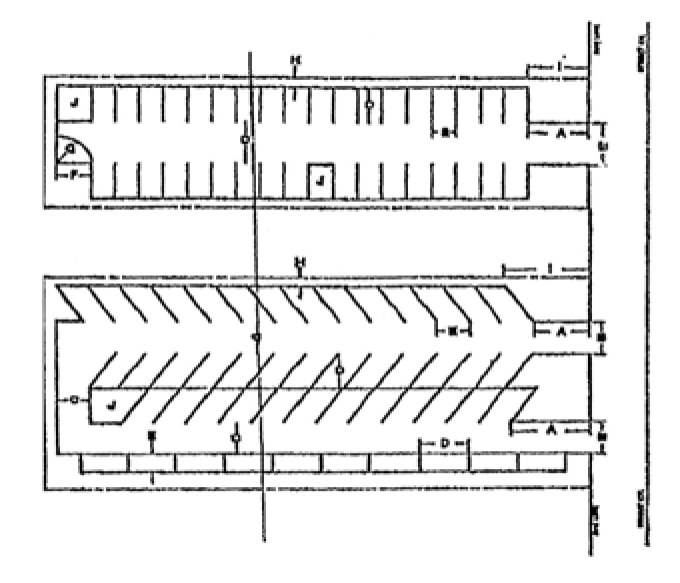
All dimensions set out in C through H below are minimum dimensions.
Dimensions of aisles and spaces for the following parking space angles are as follows:
Table 110-15 Parking Space Dimensions
(h)
Reserved.
(i)
Design of thoroughfare corridors. A site connected to a street at any point within a thoroughfare corridor shall meet the design criteria, requirements and standards of section 96-37.
(j)
Design of non-thoroughfare corridors. A site connected to a street which is not within a thoroughfare corridor shall meet the design criteria, requirements and standards of section 96-38 of this article.
(k)
Impervious area and storm water runoff.
(1)
The area covered by structures and impervious surface shall not exceed 70 percent for industrial and commercial lots and 60 percent for residential lots.
a.
Pervious areas may be used to satisfy requirements for landscaping and setbacks, buffer strips, drain fields, passive recreation areas, or any other purpose that does not require covering with a material that prevents infiltration of water into the ground.
b.
In the case of the use of an impervious material which does not cover all the surface to which it is applied, credit towards the computation of the pervious area shall be given according to the amount of percolation that is permitted.
c.
Parking areas, whether paved with impervious material or not, shall be considered impervious.
(2)
Each proposed development shall include provisions for the application of best management practices to minimize retention areas; such as grass ponds, grass swales, French drains, or combinations thereof, and shall meet all the recommendations of the "208" Areawide Water Quality Management Plan.
(l)
Functional landscaping and tree preservation. Compliance with the provisions of the zoning ordinance [chapter 110], as amended, and chapter 98, article II of this Code is required.
(Ord. No. 96-25, § 1(410), 3-4-1996; Ord. No. 19-2011, § 1(Exh. A), 11-7-2011; Ord. No. 06-2013, § 1(Exh. A), 6-17-2013; Ord. No. 04-2016, § 1(Exh. A), 4-4-2016)
Sec. 110-831. - Temporary portable storage unit: Intent, purpose and jurisdiction.
It is the intent and purpose of this ordinance to allow temporary portable storage units on residential property within the city so as to meet the temporary portable storage needs of the public while deterring adverse impacts on the city's permanent uses.
(a)
Temporary portable storage units allowed. A temporary portable storage unit is allowed on property solely for the loading, unloading and temporary storage of goods. A temporary portable storage unit shall be allowed in any residential zoning district within the city provided it meets the criteria set forth in this division. This section shall not override or substitute any other permit, certification or approval required by any other section of this chapter.
(b)
Criteria for temporary portable storage units.
(1)
Notice. Vendors of temporary portable storage units, to include lessors, are required to notify the City of Deltona's enforcement services director in writing, by letter, fax or e-mail, prior to placement of a temporary portable storage unit within the city limits. Such notice shall contain the residential address of the placement, the name of the occupant at such residential address and the anticipated duration of the placement.
(2)
Placement. Temporary portable storage unit may be allowed in any residential zoning district subject to the following provisions:
a.
Vendors of temporary portable storage units, to include lessors, are required to notify the city in writing by letter, fax or e-mail of the placement of a temporary portable storage unit within the city limits. Such notice shall contain the residential address of the placement, the name of the occupant at such residential address and the anticipated duration of the placement;
b.
Temporary portable storage units may be placed on any driveway area, but must be a minimum of five feet from the edge of any right-of-way and six feet from any side lot line;
c.
The unit shall not be located in any right-of-way;
d.
Temporary portable storage units shall not be modified by adding windows, electrical, plumbing or mechanical improvements and/or used as habitable space;
e.
The temporary portable storage unit must be placed on a paved surface.
f.
A maximum of two temporary portable storage units are allowed per lot at a time.
(3)
Time limit.
a.
The maximum time for the temporary portable storage unit to remain on the property shall be 30 consecutive days with a maximum of two occurrences per year per lot, not to run consecutively, with the following exception:
1.
The time period set forth in this subsection may be extended by the enforcement services director or his/her designee for up to 30 days, provided the applicant can show good cause. Good cause shall mean emergencies and situations where there exists a reasonable risk or threat to life and/or property damage if the extension is not granted.
(4)
Maintenance and prohibition of hazardous materials.
a.
The temporary portable storage unit shall be maintained in good condition, free from evidence of deterioration, rust, holes or breaks. When not in use the temporary portable storage unit shall be kept locked.
b.
Temporary portable storage units shall not be used to store solid waste, perishable foods, debris, recyclable materials, or used to store materials or goods for property other than at the site where the unit is located.
c.
A temporary/portable storage unit shall have the name and current telephone number and address of the company providing the temporary portable storage unit.
d.
No hazardous material as defined by the NFPA codes shall be allowed.
(5)
Liability. Notwithstanding any provision to the contrary, the property owner shall be liable for any violation under this section.
(6)
Penalties. A violation of this section may be enforced by issuance of a citation, summons, notice to appear in front of the special magistrate or by filing an action in civil court for injunctive relief or any other lawful means.
(Ord. No. 06-97, § 6, 7-7-1997; Ord. No. 17-2007, § 1, 1-22-2008; Ord. No. 19-2011, § 1(Exh. A), 11-7-2011)
Sec. 110-832. - Sidewalk cafés.
(a)
Purpose and intent. Within non-residentially zoned areas and added as part of an existing or proposed restaurants, an establishment may provide a designated space that includes sidewalk café seating areas consistent with the provisions of this subsection. Any such area shall have direct access to the building containing the restaurant or to a sidewalk network and be placed in a visible location that is convenient for use by the general public.
(1)
Sidewalk cafés shall only be allowed following approval of a site plan by the director of development services.
(2)
The sidewalk café site plan shall meet all relevant provisions of the Land Development Code.
(3)
The sidewalk café shall meet all minimum requirements of the fire code.
(4)
The fire marshal or designee may cause the immediate removal, relocation, redesign, and/or storage of all or part of a sidewalk café in emergency situations or for public safety considerations at the expense of the business owner.
(5)
The fire marshal or designee may require the temporary removal and/or relocation of all or part of a sidewalk café when street, sidewalk, or utility repairs, or other public construction, necessitates such action.
(6)
The owner of a sidewalk café shall maintain a current business tax license issued by the City of Deltona, Finance Department (refer to City of Deltona, Code of Ordinance, chapter 22, Businesses).
(7)
The clear width of adjacent sidewalks shall be a minimum of 36 inches to provide for adequate pedestrian access, and such sidewalk shall not bisect and shall be located outside the sidewalk café sitting area. Consistent with section 403.5.1 of the Florida Building Code, as may be amended, such width may be reduced to a minimum of 32 inches for a length of 24 inches maximum, provided that reduced width segments are separated by segments that are a minimum of 48 inches long and a minimum of 36 inches wide.
(b)
Indemnification and insurance.
(1)
Sidewalk cafés which serve alcoholic beverages shall carry liquor liability insurance at its own expense and liability.
(2)
Workers' compensation and employers' liability as required by the state.
(Ord. No. 06-2013, § 1(Exh. A), 6-17-2013)
Sec. 110-835. - Prescribing and dispensing controlled substances from same site prohibited.
Notwithstanding any other provision of this Code to the contrary, it shall be unlawful to dispense any controlled substance listed in F.S. § 893.03 (1) and (2), from the same site or location from which the prescription was issued. This prohibition shall not apply to the administration of a controlled substance by a duly licensed practitioner, nor to the dispensing of a starter sample of a controlled substance, at no cost, in conjunction with the issuance of a prescription. Further, this prohibition shall not apply to the prescribing and dispensing of controlled substances by veterinarians in conjunction with their practice or by pharmacies in conjunction with a retail clinic operated by the pharmacy so long as the pharmacy is owned by a publicly held corporation whose shares are publically traded on a national exchange or on the over-the-counter market and whose total assets at the end of the most recent fiscal quarter exceeded $50 million.
(Ord. No. 01-2011; Ord. No. 19-2011, § 1(Exh. A), 11-7-2011)
Sec. 110-840. - Establishments using slot machines or slot machine-like equipment prohibited.
(a)
A person may not design, promote, or operate a simulated gambling device to:
(1)
Conduct a game promotion, sweepstakes, drawing, raffle, or any game of chance, including the entry process or the revealing of a prize or outcome; or
(2)
Promote a game promotion, sweepstakes, drawing, raffle, or any game of chance that is conducted through the use of a simulated gambling display, including the entry process or the revealing of a prize or outcome.
(b)
It is unlawful for any organization which, pursuant to the authority granted by F.S. ch. 849, promotes, or conduct a drawing by chance:
(1)
To design, engage in, promote, or conduct any drawing using a simulated gambling device, as defined herein.
(2)
To design, engage in, promote, or conduct any drawing through the use of any mechanically or electronically operated machine, network, system, or device that is:
a.
Owned, leased, or otherwise controlled by the organization or a partner, affiliate, subsidiary, or agent of the organization; and
b.
Operated, played, or otherwise interacted with by an entrant to the drawing.
(c)
It is unlawful for any operator:
(1)
To design, engage in, promote, or conduct such a game promotion through a simulated gambling device, as defined herein.
(2)
To design, engage in, promote, or conduct such a game promotion through the use of any mechanically or electronically operated machine, network, system, or device that is;
a.
Owned, leased, or otherwise controlled by the organization or the organization's partners, affiliates, subsidiaries, contractors, or agents; and
b.
Operated, played, or otherwise interacted with by an entrant to the game promotion.
(d)
It is the intent of this section to prohibit any mechanism that seeks to avoid application of this section through the use of any subterfuge or pretense whatsoever.
(e)
Nothing in this section may be construed to prohibit activity that is lawfully conducted pursuant to F.S. § 849.161.
(f)
Any establishment in existence on the effective date hereof operating in violation of this section may continue in existence until such time as the establishment ceases to operate for a period of more than six (6) months, but may not be enlarged, expanded, extended, or relocated. Thereafter, such establishment shall be subject to the prohibitions contained herein. Enlargement, expansion or extension shall include, but not be limited to, any increase in the number of machines used for any such establishment when compared to the machines in use on the effective date hereof
(Ord. No. 03-2011 adopted 5/16/2011; Ord. No. 19-2011, § 1(Exh. A), 11-7-2011)

