
Diamond Bar City Zoning Code
ARTICLE III
- SITE PLANNING AND GENERAL DEVELOPMENT STANDARDS
CHAPTER 22.18.- SPECIAL PROCEDURES APPLICABLE TO HOUSING DEVELOPMENT PROJECTS[2]
Editor's note— Ord. No. 03(2024), § 9, adopted July 16, 2024, repealed the former Ch. 22.18 § 22.18.010, and enacted a new Ch. 22.18 as set out herein. The former Ch. 22.18 was entitled "Affordable Housing Incentives/Density Bonus Provisions," and derived from Ord. No. 04(2013), § 3, adopted June 18, 2013.
Sec. 22.16.010.- Purpose and applicability.
(a)
Purpose. The purpose of this chapter is to ensure that new or modified uses and development produce an environment of stable and desirable character which is harmonious with existing and future development, and protects the use and enjoyment of neighboring properties, consistent with the general plan.
(b)
Applicability. The standards of this chapter apply to all zoning districts (e.g., residential, commercial, manufacturing, etc.), and therefore, are combined in this chapter. These standards shall be considered in combination with the standards for each zoning district in article II (Zoning Districts and Allowable Land Uses). Where there may be a conflict, the standards specific to the zoning district shall override these general standards.
All new or modified structures and uses shall conform with the standards of this chapter as determined applicable by the director, except as specified in chapter 22.68 (Nonconforming Uses, Structures and Parcels).
(Ord. No. 02(1998), § 2, 11-3-98)
Sec. 22.16.020. - Access.
Every structure shall be constructed upon or moved to a legally recorded parcel with a permanent means of access to a public street or road or a private street or road, conforming to adopted city standards. All structures shall be located to provide safe and convenient access for servicing, fire protection and required off-street parking. Any parcel located on a private street or road which was legally established prior to the effective date of this Development Code, is exempt from the required compliance with the latest adopted city standards for private streets or roads.
Access driveways shall be provided as required in compliance with chapter 22.30 (Off-Street Parking and Loading Standards).
(Ord. No. 02(1998), § 2, 11-3-98)
Sec. 22.16.030. - Air emissions.
(a)
Dust and dirt emissions. Land use activities that may create dust emissions (e.g., construction, grading, etc.) shall be conducted to create as little dust or dirt emission beyond the boundary line of the parcel as possible including, but not limited to, the following:
(1)
Scheduling. Grading activities shall be scheduled to ensure that repeated grading will not be required, and that implementation of the proposed land use will occur as soon as possible after grading;
(2)
Operations during high winds. Clearing, earth-moving, excavation operations, or grading activities shall cease in high wind conditions when dust blows and control methods are no longer effective;
(3)
Area of disturbance. The area disturbed by clearing, demolition, earth-moving, excavation operations, or grading shall be the minimum required to implement the allowed use;
(4)
Dust control. During clearing, demolition, earth-moving, excavation operations, or grading, dust emissions shall be controlled by regular watering, paving of construction roads or other dust-preventive measures (e.g., hydroseeding, etc.), subject to the approval of the building official and city engineer;
a.
Material(s) excavated or graded shall be sufficiently watered or covered to prevent excessive amounts of dust. Watering, with complete coverage of the disturbed area, shall occur at least twice daily preferably in the late morning and after work is done for the day. Reclaimed water shall be used when available.
b.
Material(s) transported off-site shall not be loaded higher than six inches below the top of the trailer and either sufficiently watered with reclaimed water when available, or securely covered to prevent dust.
(5)
On-site roads. On-site roads shall be paved as soon as feasible, watered periodically with reclaimed water, whenever possible, or stabilized in an environmentally safe manner;
(6)
Revegetation. Graded areas shall be revegetated as soon as possible in compliance with the approved landscape plan and any conditions of approval; and
(7)
Fencing. Appropriate fences or other means may be required by the director to contain dust and dirt within the parcel.
(b)
Odor emissions. Land use activities that may produce odors or noxious matter (e.g., fumes, gases, vapors, etc.) shall comply with SCAQMD's rules and regulations, including rule 402 which prohibits the formation of an odor nuisance.
(c)
Exhaust emissions. The South Coast Air Quality Management District (SCAQMD) has established daily and quarterly significance thresholds for construction exhaust emissions, as identified in the California Environmental Quality Act (CEQA) Air Quality Handbook. All land use activities shall be conducted in a manner consistent with the provisions of the South Coast Air Quality Management Plan.
Exhaust emissions shall be calculated for each stage of grading and construction proposed. If exhaust emissions from construction activities (including fugitive dust) exceed daily or quarterly significance thresholds, the project applicant shall coordinate with the SCAQMD to determine the appropriate mitigation measures to minimize exhaust emissions, including prohibiting truck idling in excess of two minutes, and shall be subject to compliance with the SCAQMD rules and regulations pertaining to construction emissions (i.e., rule 403 as amended).
(Ord. No. 02(1998), § 2, 11-3-98)
Sec. 22.16.040. - Environmental resource protection.
Development proposals shall be evaluated in compliance with the California Environmental Quality Act (Public Resources Code § 21.000 et seq.), city and general plan environmental policies including, but not limited to, open space habitat, sensitive biological and botanical resources; rare, threatened and/or endangered species; air quality; mineral resources; archaeological resources; and geologic hazards.
(Ord. No. 02(1998), § 2, 11-3-98)
Sec. 22.16.050. - Exterior lighting.
(a)
Exterior fixtures. Lighting fixtures shall be architecturally compatible with the character of the surrounding structure(s) and shall be energy efficient. Fixtures shall be appropriate in height, intensity, and scale to the use they are serving. Generally, pole-mounted fixtures shall be low in height (20 feet or less) and be equipped with light shields to reduce or eliminate light spillage beyond the project's boundaries.
(b)
Intensity. Parking areas shall be provided with lighting capable of providing adequate illumination for nighttime security and safety. Lighting, as set forth in the lighting or electrical plan, shall provide a minimum one footcandle of illumination at the ground throughout the parking area and all associated walkways, plazas and courts. Building-mounted decorative lights shall not exceed five footcandles measured five feet from the light source.
(c)
Security lighting. Security lighting shall be provided in all nonresidential zoning districts at building entrances/exits. Security lighting shall provide a minimum of two footcandles and a maximum of three footcandles at the ground level of the entrance.
(d)
Shielding. Where the light source is visible from outside the project boundary, shielding shall be required to reduce glare so that neither the light source nor its image from a reflective surface shall be directly visible from any point five feet or more beyond the property line. This requirement shall not apply to single-family residential uses, traffic safety lighting, or public street lighting.
(e)
Recreational court lighting. The following standards shall apply to the lighting of outdoor recreational courts:
(1)
Light fixtures shall not be located closer than ten feet to the nearest property line.
(2)
Fixtures shall be of a type that is rectangular on a horizontal plane. The outside of the fixture, arm, and supporting pole shall be coated with a dark, low reflectance material.
(3)
Light fixtures shall not be located more than 18 feet from the court surface.
(4)
Not more than one light fixture per 900 square feet of court surface is allowed, with a maximum of eight poles and fixtures per recreational court.
(5)
Light fixtures shall be supported by an arm extending at least four feet from a support pole.
(6)
Light fixtures shall be designed, constructed, mounted and maintained so that, with appropriate shielding, the light source is completely cut off when viewed from any point five feet or more beyond the property line. The incident light level at a property line shall not exceed one footcandle measured from grade to a height of 12 feet. The incident light level upon any habitable building on an adjacent property shall not exceed 0.05 footcandle.
(7)
Recreational court lighting shall not be operated between 10:00 p.m. and 7:00 a.m. on weekdays and between 11:00 p.m. and 7:00 a.m. on Saturdays and Sundays.
(8)
In the event that an illuminated court surface is visible from another parcel, the court surface shall be treated with a low reflectance, dark-colored coating.
(9)
Provisions of this subsection may be waived or modified through the approval of a minor conditional use permit in compliance with chapter 22.56.
(Ord. No. 02(1998), § 2, 11-3-98; Ord. No. 02(2001), § 19, 11-6-01)
Sec. 22.16.060. - Height measurement and height limit exceptions.
All structures shall meet the following standards relating to height, except for fences and walls, which shall comply with chapter 22.20 (Fences, Hedges, and Walls):
(1)
Maximum height. The height of structures shall not exceed the standards established by the applicable zoning districts in article II (Zoning Districts and Allowable Land Uses). Maximum height shall be measured from the finished grade adjacent to any point at each exterior wall of the structure to the highest point of the roofline, above and parallel to the finished grade. Structures in hillside areas shall comply with the height regulations provided in section 22.22.120 (Architecture).
(2)
Exceptions to height limits. Exceptions to the height limits for nonresidential structures shall apply in the following manner:
a.
Elevator penthouses and lofts. Roof-mounted structures for the housing of elevators, lofts, stairways, tanks, ventilating fans, or similar equipment shall be allowed, up to a maximum of 15 feet above the allowed structure height. The total square footage of all structures above the allowed height shall not exceed 25 percent of the total roof area of the main structure. Additional height or area may be allowed subject to the approval of a minor conditional use permit in compliance with chapter 22.56.
b.
Chimneys, spires, towers, etc. Chimneys, cupolas, domes, flag poles, gables, spires, towers, and similar structures may exceed the height limit established for the applicable zoning district, up to a maximum of 20 feet. Additional height may be allowed subject to the approval of a minor conditional use permit in compliance with chapter 22.56.
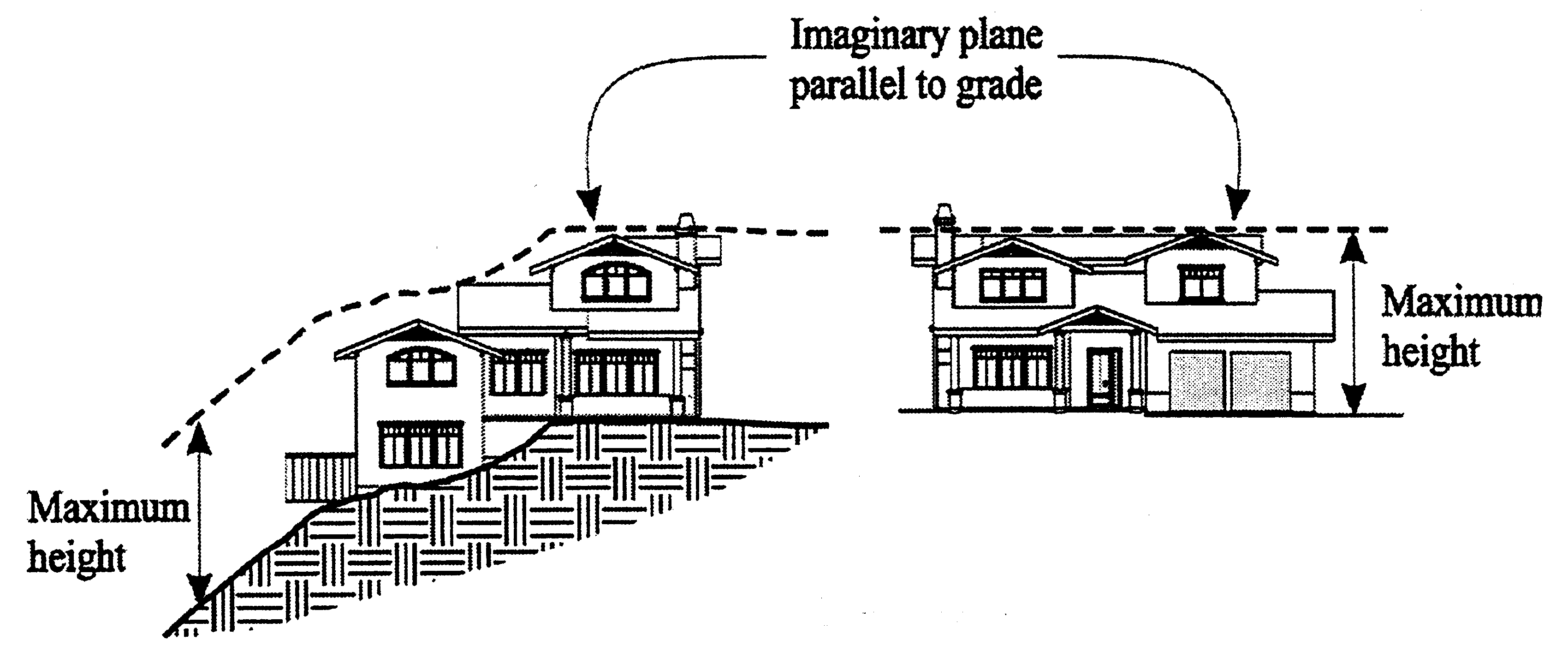
Figure 3-1
(Ord. No. 02(1998), § 2, 11-3-98; Ord. No. 04(2012), § 7, 4-17-12)
Sec. 22.16.070. - Open space for commercial projects.
This section provides requirements and incentives for the provision of pedestrian-oriented open spaces and amenities for newly developed or redeveloped commercial centers throughout the city. The intent is to make the pedestrian environment more pleasant through the provision of community open spaces, plazas, courtyards, outdoor dining and seating areas, and associated amenities, including public art where appropriate.
(1)
Open space required. Multitenant commercial centers one acre in size and larger shall provide a minimum of one percent of the total land area of the center as useable pedestrian-oriented open space, including plazas, patios, courtyards, and outdoor seating areas. The total land area of the center shall include all parcels that comprise the center including freestanding structures on separate parcels.
Project proponents are encouraged to provide open space areas that exceed the minimum amount required. The city may offer incentives in compliance with subsection (3), below.
(2)
Standards for open space development. To qualify as useable pedestrian-oriented open space, an area shall meet the following requirements:
a.
Pedestrian open space areas shall be designed as an integral part of the overall project and shall specifically relate to the main circulation pattern(s) within the project. Leftover pieces of the site that are not related to the primary pedestrian circulation system shall not be counted as qualified open space areas;
b.
The minimum area of a required open space area shall be 100 square feet of hardscape material. The minimum dimension of an open space area shall be ten feet in any direction. Outdoor dining areas may have a minimum dimension of six feet. The director may approve areas with less than the minimum dimension for projects of less than three acres.
c.
Areas shall be open to the sky except for shade trellises and roof overhangs. Glass-enclosed sun rooms or similar structures may qualify if located adjacent to a pedestrian sidewalk and the facility is readily available to the general public;
d.
Open space areas shall be oriented to the main pedestrian circulation network and shall incorporate seating, enhanced paving materials, lighting, shade trees and/or trellises, and landscaping. Fountains, works of art, and similar features are also strongly encouraged;
e.
Areas provided primarily for walkways or for the sole use of employees (e.g., lunch patios or entrance lobbies) shall not be counted as qualified open space areas; and
f.
Qualified pedestrian open space areas shall be located at ground level to a maximum of three feet above finished grade. Open space areas shall be easily accessible to the general public during normal business hours and shall be barrier free for handicapped access.
(3)
Open space bonuses. Development incentive bonuses to encourage pedestrian open spaces that exceed the above requirements and the provision of public art may be available at the discretion of the city. Eligible projects include new shopping centers greater than one acre in size and remodeled shopping centers greater than five acres in size. The types of bonus incentives that may be available to eligible projects include:
a.
Increase in maximum structure height;
b.
Increase in maximum lot coverage;
c.
Increase in floor area ratio;
d.
Reduction in landscaping requirements; and/or
e.
Reduction in front setback to accommodate pedestrian open space amenities.
(Ord. No. 02(1998), § 2, 11-3-98; Ord. No. 03(2024), § 6, 7-16-24)
Sec. 22.16.080. - Screening and buffering.
This section provides standards for the screening and buffering of adjoining land uses, equipment and outdoor storage areas, and surface parking areas with respect to multifamily and nonresidential land uses.
(1)
Screening between different land uses. An opaque screen consisting of plant material and a masonry wall, six feet in height, shall be installed along parcel boundaries whenever a commercial development adjoins a residential zoning district. Pedestrian access gates may be provided between the commercial properties and abutting common open area within residential developments. The wall shall be architecturally treated on both sides, subject to the approval of the director, or the hearing officer, if part of a project review.
(2)
Mechanical equipment. Roof- or ground-mounted mechanical equipment (e.g., air conditioning, heating, ventilation ducts and exhaust, water heaters, etc.), loading docks, service yards, waste and storage areas, and utility services shall be screened from public view from abutting public streets and rights-of-way, and abutting area(s) zoned for residential or open space uses, including views from above the subject project. The method of screening shall be architecturally compatible with other site development in terms of colors, materials, and architectural style subject to approval by the director.
The screening design/construction shall be subject to the approval of the director, or the hearing officer, if part of a project review, and shall blend with the design of the structure(s) and include appropriately installed and maintained landscaping when on the ground;
(3)
Outdoor storage and work yards. Uses with outdoor storage of materials, or operations shall comply with the following:
a.
Outside uses shall have a solid sight-obscuring wall not less than six feet, or more than seven feet, in height, of a type and design approved in advance of construction by the director, or the hearing officer, if part of a project review. The wall shall include sight-obscuring gates. The wall and gate(s) shall be maintained to continuously conform to the conditions of the director or hearing officer;
b.
Site operations in conjunction with the outdoor uses, including but not limited to, the loading and unloading of materials and equipment, shall be conducted entirely within a walled area;
(4)
Outdoor building and garden supply areas. Outdoor building and garden supply areas shall be screened with walls, fencing, landscaping, or similar material to minimize visibility of the storage area; and
(5)
Parking areas abutting public streets and rights-of-way. An opaque screen shall be installed along parking areas abutting public streets and rights-of-way. The screening shall have a total height of not less than 30 inches and not more than 42 inches. However, where the finished elevation of the parking area is lower at the boundary line than the abutting property elevation, the change in elevation may be used in lieu of, or in combination with, additional screening to satisfy the requirements of this subsection.
The opaque screen shall consist of one, or a combination, of the following:
a.
Landscaped berm. A berm constructed of earthen materials and landscaped to form an opaque screen;
b.
Fences. A solid fence constructed of wood, or other materials compatible to form an opaque screen; and/or
c.
Walls, including retaining walls. A wall of concrete, block, stone, brick, tile or other similar type of solid masonry material.
(Ord. No. 02(1998), § 2, 11-3-98)
Sec. 22.16.090. - Setback regulations and exceptions.
This section establishes standards to ensure the provision of open areas around structures for: Visibility and traffic safety; access to and around structures; access to natural light, ventilation and direct sunlight; separation of incompatible land uses; and space for privacy, landscaping and recreation.
(1)
Setback requirements. All structures shall conform with the setback requirements established for each zoning district by article II (Zoning Districts and Allowable Land Uses), and with any special setbacks established for specific uses by this Development Code and by the Uniform Building Code as adopted by the city. Portions of a structure, including eaves or roof overhangs, shall not extend beyond a property line or into an access easement or street right-of-way. Each yard shall be open and unobstructed from the ground upward, except as provided in this section.
(2)
Measurement of setbacks. Setbacks shall be measured as follows:
a.
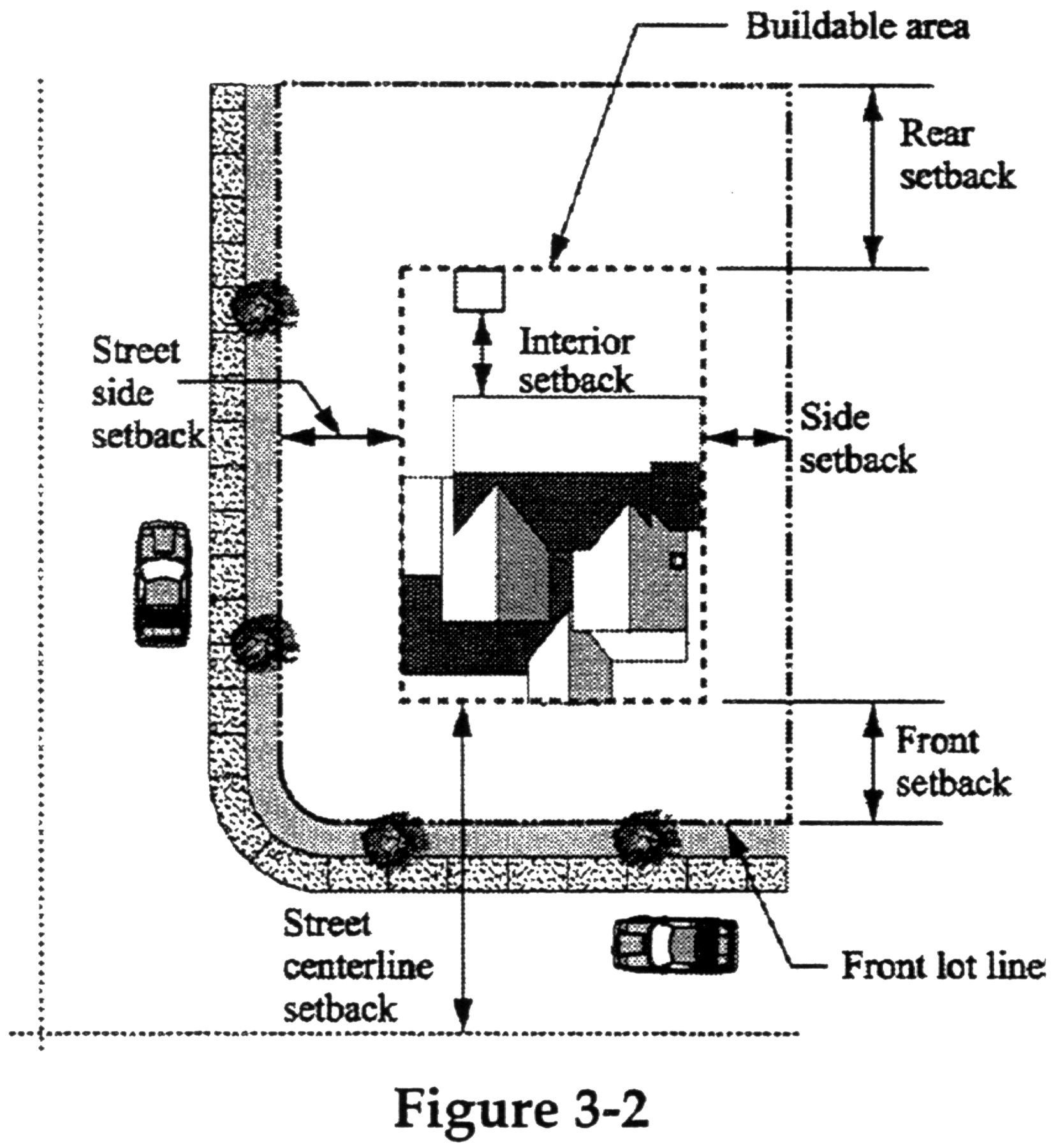
Front yard setbacks. The front yard setback shall be measured at right angles from the nearest point on the front property line of the parcel to the nearest point of the wall of the structure, except as follows:
1.
Corner parcels. The measurement shall be taken from the nearest point of the structure to the nearest point of the property line adjoining the street to which the property is addressed and the street from which access to the property is taken. Whenever a future right-of-way line is officially established, required yards shall be measured from the established line(s);
2.
Flag lots. The measurement shall be taken from a parallel line established where the access strip meets the buildable area of the parcel closest to the public street or right-of-way to the nearest point of the wall of the structure.
b.
Side yard setbacks. The side yard setback shall be measured at right angles from the nearest point on the side property line of the parcel to the nearest line of the structure; establishing a setback line parallel to the side property line, which extends between the front and rear yards.
c.
Street side yard setbacks. The side yard on the street side of a corner parcel shall be measured from the structure to the nearest point of the side property line adjoining the street.
d.
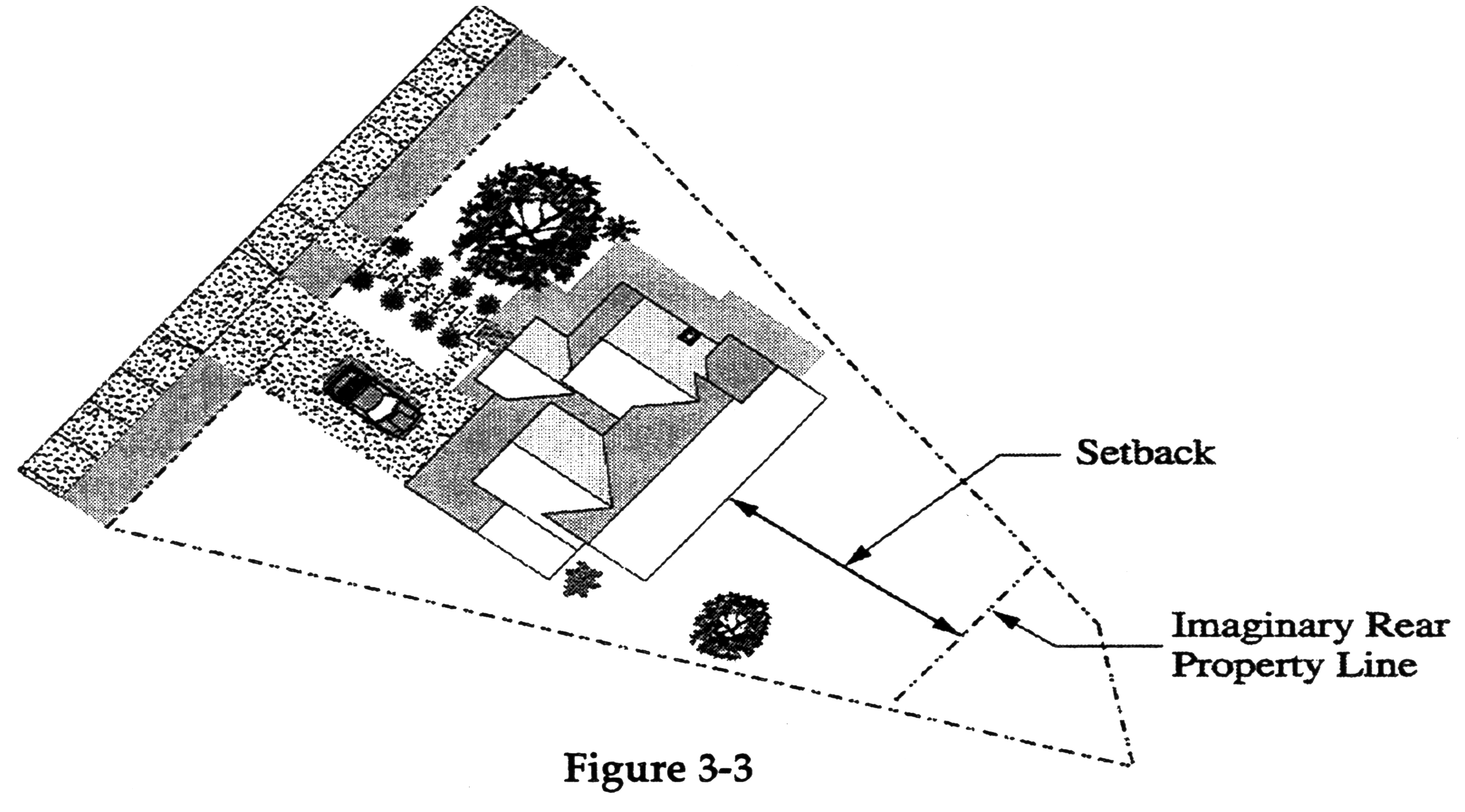
Rear yard setbacks. The rear yard shall be measured at right angles from the nearest point on the rear property line of the parcel to the nearest line of the structure, establishing a setback line parallel to the rear property line, which extends between the side yards, except:
1.
The rear yard on the street side of a double frontage lot shall be measured from the nearest point of the rear property line adjoining the street right-of-way. However, if an access easement or street right-of-way line extends into or through a rear yard, the measurement shall be taken from the nearest point of the easement or right-of-way line; and
2.
Where the side lot lines converge to a point, a line five feet long within the parcel, parallel to and at a maximum distance from the front lot line, shall be deemed to be the rear lot line for the purpose of determining the depth of the required rear yard (Figure 3-3).
(3)
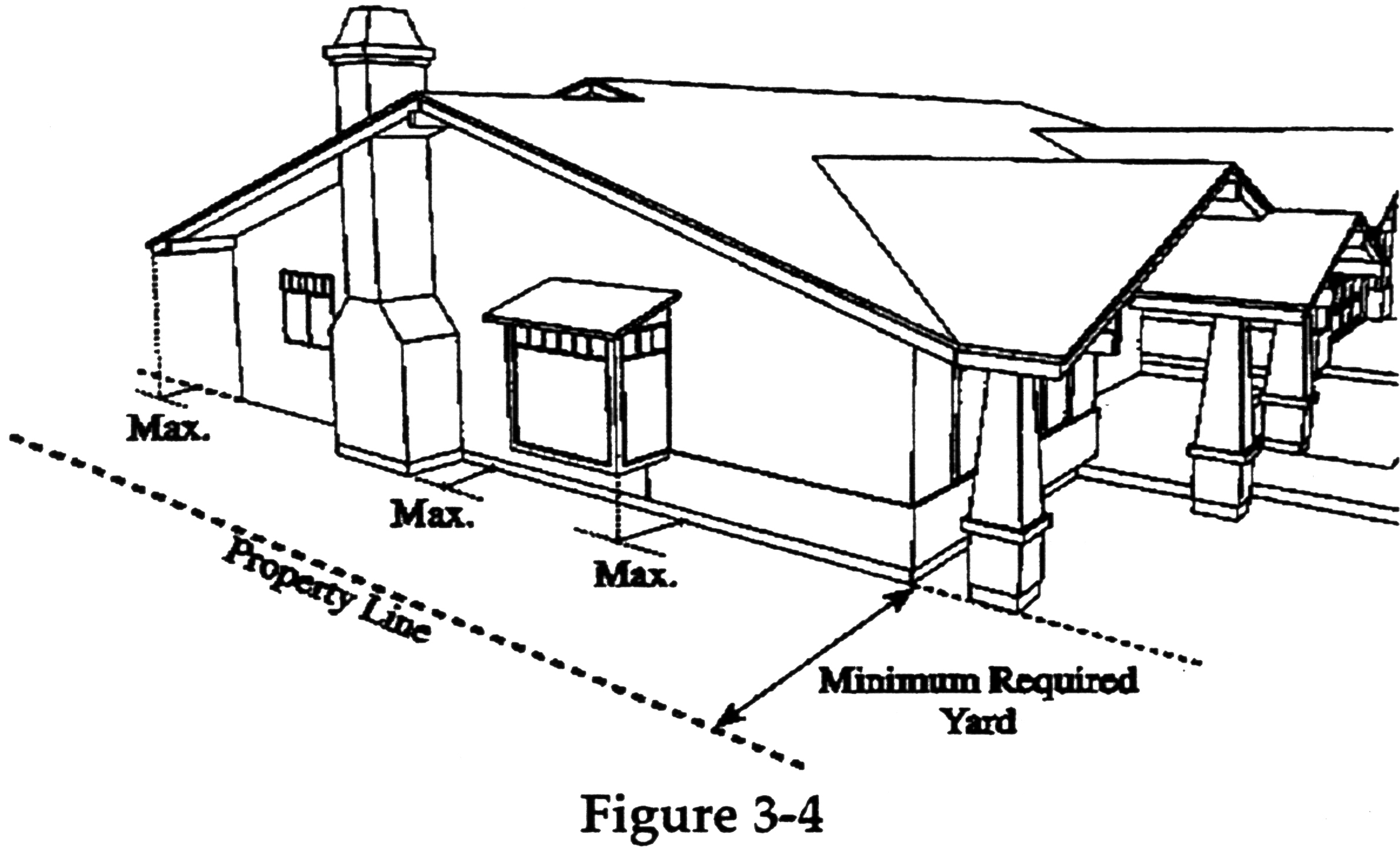
Allowed projections into setbacks. The following architectural features may extend beyond the wall of the structure and into the front, side and rear yard setbacks, only as follows:
a.
Chimneys/fireplaces. A chimney/fireplace, up to eight feet in width, may extend 30 inches into a required setback, but no closer than three feet to a side or rear property line.
b.
Canopies, cornices, eaves and roof overhangs. Cantilevered architectural features on the main structure, including, but not limited to, balconies, bay windows, canopies, cornices, eaves and solar devices, which do not increase the floor area enclosed by the structure, may extend into required yards as follows:
1.
Front yard setback: Up to three feet into the required front yard;
2.
Side yard setback: Up to 30 inches into a required side yard, but no closer than three feet to a side property line; and
3.
Rear yard setback: Up to five feet into the required rear yard but not closer than ten feet to the rear property line.
c.
Porches. Covered, unenclosed porches, located at the same level as the entrance floor of the structure, may extend up to six feet into the required front yard setback.
d.
Stairways. Outside stairways and landings that are not attached to a deck, are not enclosed and do not extend above a ground floor entrance, may extend into required yards as follows:
1.
Front yard setback: Up to six feet into a required front yard;
2.
Side yard setback: Up to 30 inches into a required side yard, but no closer than three feet to a side property line;
3.
Rear yard setback: Up to six feet into a required rear yard.
e.
Setback requirements for specific structures:
1.
Dwelling groups. An inner court providing access to a dwelling group (constructed and located face-to-face) shall provide a minimum width of 15 feet between rows for single-story structures with an additional five feet of width for each additional floor above the first floor.
2.
Planters. Planter boxes and masonry planters shall be allowed in all required setbacks not to exceed a height of 42 inches.
3.
Swimming pools and spas. Swimming pools and spas are allowed in side and rear setbacks provided they are not closer than five feet to any property line.
4.
Guard railings. Guard railings or fences for safety protection around depressed ramps may be located in required setbacks provided:
(a)
That an open-work railing or fence is used; and
(b)
That the height of the railing or fence complies with the requirements of the Uniform Building Code.
5.
Drives, walkways, and decks. Driveways, walkways, patio slabs, and wooden decks shall be allowed in required setbacks provided they did not exceed one foot above finished grade. This provision shall not exclude the use of steps providing access between areas of different elevations on the same property.
(a)
A deck shall not extend more than six feet over the top of slope, nor more than three feet above the slope at any point. A deck shall maintain a minimum side and rear setback of five feet from the property line or buildable pad's edge, whichever is applicable and a street side setback as required for the main structure setback.
6.
Equipment. Ground-mounted equipment (e.g., air conditioners, swimming pool pumps, heaters, filters, and fans, etc.) shall be allowed in required side or rear setbacks, provided:
(a)
The equipment is not located closer than 42 inches to a lot line; and
(b)
The equipment does not exceed a height of six feet measured from the finished grade at the base of the unit.
7.
Retaining walls.
(a)
Walls up to 42 inches. Retaining walls up to 42 inches in height are exempt from setback requirements.
(b)
Up to six feet. Retaining walls up to six feet in height may be located within a required setback provided the exposed side of the wall faces into the subject parcel.
8.
Fences and walls.
(a)
On a reverse corner lot, setbacks for fences and walls higher than 42 inches and not exceeding six feet in height shall comply with setbacks as described in Table 2-4. The director may reduce the required ten-foot setback to a minimum five feet for fences and walls on a reverse corner lot where a clear line of site is maintained for vehicular and pedestrian traffic.
(Ord. No. 02(1998), § 2, 11-3-98; Ord. No. 02(2001), §§ 2, 21, 11-6-01; Ord. No. 02(2003), 9-16-03; Ord. No. 03(2024), § 7, 7-16-24)
Sec. 22.16.100. - Solid waste/recyclable materials storage.
This section provides standards for the construction and operation of solid waste and recyclable material storage areas in compliance with state law (California Solid Waste Reuse and Recycling Access Act, Public Resources Code §§ 42900 through 42911).
(1)
Multifamily projects. Multifamily residential projects with five or more dwelling units shall provide solid waste and recyclable material storage areas in the following manner: See Table 3-1.
a.
Individual unit storage requirements. Each dwelling unit shall include an area with a minimum of six cubic feet for the storage of solid waste and recyclable material indoors. A minimum of three cubic feet shall be provided for the storage of solid waste and a minimum of three cubic feet shall be provided for the storage of recyclable material; and
b.
Common storage requirements. The following are minimum requirements for common solid waste and recyclable material storage areas for multifamily developments, which may be located indoors or outdoors as long as they are readily accessible to all residents. These requirements apply to each individual structure. All required areas are measured in square feet.
TABLE 3-1
MULTIFAMILY DEVELOPMENT
MINIMUM STORAGE AREAS REQUIRED (SQ. FT.)
(2)
Nonresidential structures and uses. Nonresidential structures and uses within all zoning districts shall provide solid waste and recyclable material storage areas. The following (Table 3-2) are minimum storage area requirements. These requirements apply to each individual structure. All required areas are measured in square feet.
TABLE 3-2
NONRESIDENTIAL STRUCTURES
MINIMUM STORAGE AREAS REQUIRED (SQ. FT.)
(3)
Location requirements. Solid waste and recyclable materials storage areas shall be located in the following manner:
a.
Solid waste and recyclable material storage shall be adjacent/combined with one another. They shall be located inside a specially designated structure, on the outside of a structure in an approved fence/wall enclosure, a designated interior court or yard area with appropriate access, or in rear yards and interior side yards. Exterior storage area(s) shall not be located in a required front yard, street side yard, parking area, landscaped or open space area or area(s) required by the Municipal Code to be maintained as unencumbered. Existing developments shall comply with these standards to the greatest degree feasible at the time of any expansion or additions subject to approval of the director.
b.
Storage area(s) shall be accessible to residents and employees. Storage areas within multifamily residential developments shall be located within 250 feet of an access doorway to the dwellings which they are intended to serve.
c.
Driveways or aisles shall provide unobstructed access for collection vehicles and personnel and provide at least the minimum clearance required by the collection methods and vehicles utilized by the designated collector. Where a parcel is served by an alley, exterior storage area(s) shall be directly accessible to the alley.
(4)
Design and construction. The design and construction of the storage area(s) shall:
a.
Be compatible with the surrounding structures and land uses;
b.
Be properly secured to prevent access by unauthorized persons, while allowing authorized persons access for disposal of materials;
c.
Provide a concrete pad within the fenced or walled area(s) and a concrete apron which facilitates the handling of the individual bins or containers;
d.
Protect the areas and the individual bins or containers provided within from adverse environmental conditions which might render the collected materials unmarketable; and
e.
The storage area(s) shall be appropriately located and screened from view. The design shall be architecturally compatible with the surrounding structures and subject to the approval of the director.
(Ord. No. 02(1998), § 2, 11-3-98)
Sec. 22.16.110. - Undergrounding of utilities.
All on-site electric and telephone facilities, fire alarm conduits, lighting wiring, cable television, and other wiring conduits and similar facilities shall be placed underground at the time of development.
Projects located within approved underground utility districts shall be subject to the requirements of chapter 13.04 of the Municipal Code.
(Ord. No. 02(1998), § 2, 11-3-98)
Sec. 22.16.120. - Vibrations.
The owner of a use that generates vibrations at levels that constitute a nuisance, in compliance with the Municipal Code (section 8.12.320(b)), shall abate the nuisance. If the nuisance is not abated in a timely manner, the city will abate the nuisance in compliance with section 15.00.2830 of the Municipal Code.
(Ord. No. 02(1998), § 2, 11-3-98)
Sec. 22.16.130. - View protection.
(a)
For the purpose of this section, a "view" means a vista of significant features, including mountains, ridges, hillside terrain, canyons, geologic features, and community amenities (e.g., parks, landmarks, permanent open space). The term does not mean an unobstructed panorama of these features.
(b)
The development of new projects shall respect the views of existing residential uses. New structures shall be located in a manner that preserves views by creating view corridors.
(c)
New developments that are within the viewshed of existing residential uses shall be kept as low as possible to reduce or eliminate the possibility of blocking views.
(d)
In reviewing projects with potential view blockage impacts, the council, commission, or director shall refer to the view protection guidelines in the city's "city-wide design guidelines" manual.
(Ord. No. 02(1998), § 2, 11-3-98; Ord. No. 03(2024), § 8, 7-16-24)
Sec. 22.16.140. - Second kitchen.
Second kitchens shall be permitted within the rural residential (RR) zone in single-family residences that are a minimum of 6,000 square feet in floor area. A second kitchen shall not constitute approval of an accessory dwelling unit and such kitchen shall not be so located as to facilitate the establishment of the accessory dwelling unit including a servant's quarters.
(Ord. No. 04(2005), § B, 3-15-05; Ord. No. 03(2017), § 3, 5-2-17)
Sec. 22.18.010.- Affordable housing incentives/density bonus provisions.
(a)
Purpose. The purpose of this section is to implement the incentive programs provided in Government Code Sections 65915 through 65918 (referred to collectively in this section as the "State Density Bonus Law") in order to provide additional opportunities for the provision of affordable housing within the City of Diamond Bar.
(b)
Applicability. This section applies to any "housing development," as defined in the State Density Bonus Law, including, without limitation, a development project for five or more residential units, including a mixed-use development, or a senior citizen housing development consisting of at least 35 units. This section also applies to density bonuses for land donations in accordance with Government Code Section 65915. In exchange for density bonuses, incentives or concessions, waivers or reductions of development standards, and/or reduced parking ratios, a portion of the units shall be reserved for very low income households, lower income households, senior citizen households, moderate income households, transitional foster youth, disabled veterans, homeless persons, or lower income college students as provided in this section and the State Density Bonus Law. All such projects shall comply with all requirements stated in the State Density Bonus Law and shall be subject to the subdivision, plot plan review and/or development review requirements of this title, as applicable. This section shall be interpreted in a manner consistent with the State Density Bonus Law, as it may be amended from time to time, and the requirements of the State Density Bonus Law shall prevail over any conflicting provision of this Development Code.
(c)
Definitions. As used in this section 22.18.010, the terms base density, concession, density bonus, development standard, disabled veterans, homeless persons, housing development, incentive, located within one-half mile of a major transit stop, lower income households, lower income student, maximum allowable residential density, moderate income households, persons and families of moderate income, qualified nonprofit housing corporation, replace, senior citizen housing development, shared housing building, shared housing unit, total dwelling units, total units, transitional foster youth, unit, unobstructed access to the major transit stop, very low income households, and very low income vehicle travel area shall have the meanings ascribed to them in the State Density Bonus Law, as it may be amended from time to time.
(d)
Determination of density bonus. Qualified projects that meet the eligibility requirements set forth in this section and/or the State Density Bonus Law shall be granted a density bonus or bonuses in an amount specified in the State Density Bonus Law, as it may be amended from time to time. Eligibility for and/or calculation of a density bonus shall be subject to the following:
(1)
A density bonus is a density increase over the otherwise maximum allowable gross residential density for a site as of the date of application by the applicant to the city. For the purpose of calculating the density bonus, the maximum allowable residential density, or base density, shall be the greatest number of units allowed on the site under the Development Code, an applicable specific plan, or the land use element of the general plan. Each component of any density calculation, including base density and bonus density, resulting in fractional units shall be separately rounded up to the next whole number.
(2)
Except as otherwise required by the State Density Bonus Law, the density bonus units shall not be included when determining the number of required affordable units or senior citizen units.
(3)
The developer can request a smaller density bonus than the project is entitled to, including no increase in density, but no reduction shall be permitted in the number of required affordable units.
(4)
For purposes of calculating the amount of the density bonus, an applicant who requests a density bonus shall elect the category and corresponding provision of the State Density Bonus Law pursuant to which the density bonus will be awarded. Unless otherwise specified in this section or the State Density Bonus Law, each residential development is entitled to only one density bonus, and density bonuses from more than one category may not be combined.
(5)
The granting of a density bonus and/or related concession(s) or incentive(s) shall not be interpreted, in and of itself, to require a general plan amendment, zone change, study, or other discretionary approval.
(6)
Pursuant to California Government Code Section 65915.5, the conversion of apartments to a condominium project shall not be eligible for a density bonus or other incentives if the apartments proposed for conversion constitute a housing development for which a density bonus or other incentives were previously provided under Government Code Section 65915.
(e)
Specific requirements.
(1)
Senior citizen housing requirements.
a.
Senior citizen housing development projects shall have a minimum of 35 units and shall meet the requirements described in Section 51.3 of the California Civil Code or any successor statute or regulation.
b.
Mobile home parks shall limit residency based on age requirements for housing for older persons pursuant to Section 798.76 or 799.5 of the California Civil Code, or any successor statute or regulation.
(2)
Land donation requirements. An applicant for a tentative map, parcel map or any other residential development approval shall receive a density bonus for the residential development in an amount specified by Government Code Section 65915, as it may be amended from time to time, when the applicant donates land to the city as provided in this section. This density bonus shall be in addition to any other density bonus provided for in this section, up to a total combined density bonus of 35 percent. Applicants are eligible for the land donation density bonus if all of the following conditions are met:
a.
The developer shall donate and transfer land to the city no later than the date of approval of the final map or other approvals required for the residential development.
b.
The developable acreage and general plan and zoning designation of the land being transferred are sufficient to permit development of units affordable to very low income households in an amount not less than ten percent of the number of residential units of the proposed development.
c.
The transferred land shall be at least one acre or of sufficient size to permit development of at least 40 residential units and shall have the appropriate general plan designations and be appropriately zoned with appropriate development standards for development at a density of at least 30 dwelling units per acre.
d.
The transferred land shall be served by adequate public facilities and infrastructure.
e.
The transferred land and the very low income units constructed shall be subject to a deed restriction recorded with the county recorder, to ensure continued affordability of the units consistent with this section, and the property owner shall enter into an affordable housing agreement with the city pursuant to this section. The deed restriction/affordable housing agreement shall be recorded on the property at the time of the transfer.
f.
The transferred land shall be conveyed in fee simple to the city or to a housing developer approved by the city.
g.
The transferred land shall be within the boundary of the proposed residential development, or no more than approximately one-quarter mile from the boundary of the qualified project, if the city so approves.
h.
No later than the date of approval of the final map or other discretionary approval required for the residential development, the transferred land shall have all of the permits and approvals, other than building permits, necessary for the development of the very low income housing units on the transferred land, and a proposed source of funding for the very low income units shall have been identified.
(3)
Childcare facility requirements.
a.
Subject to subsection (e)(3)c., below, the city shall grant either of the following to a qualifying housing development that includes a childcare facility located on the premises of, or adjacent to, the project:
i.
An additional density bonus that is an amount of square feet of residential space equivalent to the square footage of the childcare facility; or
ii.
An additional concession or incentive that contributes significantly to the economic feasibility of the construction of the childcare facility.
b.
As a condition of receiving the additional density bonus or concession for a childcare facility, the project shall comply with the following requirements:
i.
The childcare facility shall remain in operation for a period of time that is as long as, or longer, than the period of time during which the density bonus units are required to remain affordable.
ii.
Of the children who attend the childcare facility, the percentage of children of very low income, lower income, or moderate income households shall be equal to, or greater than, the percentage of affordable units required to be set aside for each such group.
c.
Notwithstanding any requirement of this section, the city shall not be required to provide a density bonus or concession for a childcare facility if it finds, based upon substantial evidence, that the community already has adequate child care facilities.
(4)
Replacement housing requirement. Pursuant to subdivision (c)(3) of Government Code Section 65915, an applicant will be ineligible for a density bonus or other incentives unless the applicant complies with the replacement housing requirements therein and the provisions of section 22.18.020, including in the following circumstances:
a.
The housing development is proposed on any parcel(s) on which rental dwelling units are subject to a recorded covenant, ordinance, or law that restricts rents to levels affordable to persons and families of lower or very low income; or
b.
The housing development is proposed on any parcel(s) on which rental dwelling units that were subject to a recorded covenant, ordinance, or law that restricted rents to levels affordable to persons and families of lower or very low income have been vacated or demolished in the five-year period preceding the application; or
c.
The housing development is proposed on any parcel(s) on which the dwelling units are occupied by lower or very low-income households; or
d.
The housing development is proposed on any parcel(s) on which the dwelling units that were occupied by lower or very low-income households have been vacated or demolished in the five-year period preceding the application.
(f)
Regulatory agreement. As a condition to the city's granting of a density bonus, incentives or concessions, waivers or reductions in development standards, and/or reduced parking ratios pursuant to this section, the property owner(s) shall enter into a regulatory agreement with the city pursuant to section 22.18.030, which satisfies the criteria set forth in subdivision (c) of Government Code Section 65915.
(g)
Concessions or incentives. In compliance with State Density Bonus Law, developers that request a density bonus to provide on-site affordable housing may also eligible to receive one or more concessions or incentives, based on the type and scope of the project.
(1)
The review authority shall grant applicants for qualified projects the number of incentives and concessions required by Government Code Section 65915. The review authority shall approve a specific requested concession or incentive for a proposed project unless the review authority makes a written finding, based on substantial evidence, of any of the following:
a.
The concession or incentive does not result in identifiable and actual cost reductions in order to provide for affordable housing costs or for affordable rents for the targeted units to be set aside;
b.
The concession or incentive would have a specific adverse impact, as defined in Section 65589.5(d)(2) of the California Government Code, upon public health and safety or on any real property that is listed in the California Register of Historical Resources and for which there is no feasible method to satisfactorily mitigate or avoid the specific adverse impact without rendering the development unaffordable to low- and moderate-income households; or
c.
The concession or incentive would be contrary to state or federal law.
(2)
Menu of concessions/incentives. Concessions or incentives that a developer may request include those of the type set forth in subsection (k) of Section 65915 of the California Government Code, including the following:
a.
Relaxation or other modification of zoning standards regulating such items as setbacks, height limitations, distances between buildings, required parking, parking development standards, projections into yards, and the like, which result in identifiable, and actual cost reductions. No separate variance application will be required for any modification of standards. However, the approved plans and application shall identify the zoning standards modifications which have been incorporated into the project.
b.
Modification of architectural regulations ordinarily applied to a residential development project, which result in identifiable and actual cost reductions.
c.
Approval of mixed-use zoning in conjunction with the housing project if commercial, office, industrial, or other land uses will reduce the cost of the housing development and if the commercial, office, industrial, or other land uses are compatible with the housing project and the existing or planned development in the area where the proposed housing project will be located.
d.
Other regulatory incentives or concessions proposed by the developer or the city, which result in identifiable, and actual project cost reductions.
(3)
Parking incentives.
a.
Notwithstanding any other provision of this title, except as otherwise required pursuant to the State Density Bonus Law or other applicable law, if requested by the developer, the minimum number of off-street parking spaces, inclusive of accessible and guest parking spaces, required to be provided for all units within a qualifying density bonus housing development shall be as follows:
(h)
Physical constraints. In accordance with Government Code Section 65915(e), in addition to any concessions or incentives requested, an applicant for a density bonus pursuant to this section may submit a proposal for the waiver or reduction of development standards that have the effect of physically precluding the construction of a housing development incorporating the density bonus and any incentives or concessions to which the applicant is entitled. The review authority shall approve a requested waiver or reduction of a development standard, unless it makes any of the following findings:
(1)
The application of the development standard does not have the effect of physically precluding the construction of a housing development at the density allowed by the density bonus and with the incentives or concessions granted to the applicant.
(2)
The waiver or reduction of the development standard would have a specific, adverse impact, as defined in paragraph (2) of subdivision (d) of Government Code Section 65589.5, upon health or safety, and for which there is no feasible method to satisfactorily mitigate or avoid the specific adverse impact.
(3)
The waiver or reduction of the development standard would have an adverse impact on any real property that is listed in the California Register of Historical Resources.
(4)
The waiver or reduction of the development standard would be contrary to state or federal law.
(i)
Project review procedures. All project applications for which a density bonus, concessions or incentives, modifications or waivers of development standards, and/or reduced parking ratios is/are being requested shall be reviewed in accordance with section 22.18.040 and shall be subject to the following project review procedures:
(1)
In addition to any other application required for a proposed housing development project, applications for any requested density bonus, incentives or concessions, waivers or reductions of development standards, and/or reduced parking ratios pursuant to this section shall be filed with the department pursuant to section 22.44.030. The application shall be filed concurrently with the application or applications for other required land use permits and approvals for the proposed project and shall be processed in the same manner as, and concurrently with, the application or applications for other required project approvals. In addition to any other information requested by the director, the application shall identify the category and corresponding provision(s) of the State Density Bonus Law pursuant to which a density bonus is requested; the base density of the proposed project; the number of density bonus units requested, along with supporting calculations; any concessions/incentives requested, any development standards requested to be waived/modified, and any reduced parking ratios requested pursuant to subsection (g)(3). The application shall be accompanied by reasonable documentation satisfactory to the director to establish eligibility for all requested density bonuses and parking ratios. Upon approval of a housing development project pursuant to this section, the planning division shall note in the project record that a density bonus has been granted, and the approved plans and application shall identify all concessions and incentives and/or waivers and modifications granted and any special conditions imposed on the project to ensure unit affordability.
(Ord. No. 03(2024), § 9, 7-16-24)
Sec. 22.18.020. - Dwelling unit protection regulations.
(a)
Purpose and applicability. The purpose of this section is to implement the provisions of the Housing Crisis Act of 2019, which require development project proponents to replace demolished residential dwelling units and protected rental units and to provide relocation assistance and other benefits to existing occupants of demolished protected rental units. This section applies to all development projects subject to Article 2 of Chapter 12 of Division 1 of Title 7 of the Government Code.
(b)
Definitions. If defined in therein, terms used in this section shall have the same meaning as defined in Government Code Sections 66300.5—66300.6. Unless otherwise defined in Government Code Sections 66300.5—66300.6, as used in this section, the following terms shall have the following meanings:
(1)
"Affordable housing cost" has the same meaning as defined in Health and Safety Code Section 50052.5.
(2)
"Affordable rent" has the same meaning as defined in Health and Safety Code Section 50053.
(3)
"Comparable unit" shall have the same meaning as the term "comparable replacement dwelling" as defined in Government Code Section 7260; provided, however, that with respect to an occupied protected unit that is a single-family home that will be demolished in conjunction with a proposed development project that consists of two or more dwelling units, a "comparable unit" need not contain more than three bedrooms or have the same or similar square footage or the same number of total rooms.
(4)
"Development project" means the development of land requiring city approval. A development project includes, but is not limited to, a housing development project.
(5)
"Equivalent size" means that the replacement protected units contain at least the same total number of bedrooms as the units being replaced.
(6)
"Extremely low income households" has the same meaning as defined in Health and Safety Code Section 50106.
(7)
"Housing Crisis Act" means and refers the provisions set forth in Chapter 12 of Division 1 of Title 7 of the Government Code, commencing with Section 66300, as such provisions may be amended from time to time.
(8)
"Housing development project" has the same meaning as defined in Government Code Section 65905.5.
(9)
"Lower income households" has the same meaning as defined in Health and Safety Code Section 50079.5. Lower income households includes very low income households and extremely low income households.
(10)
"Protected unit" shall have the same meaning as defined in the Housing Crisis Act and includes, but is not limited to, existing or previously demolished residential dwelling units that are or were either rented by lower or very low income households or subject to a recorded covenant, ordinance, or law that restricts rents to levels affordable to persons and families of lower or very low income within the five-year period preceding the application submittal date.
(11)
"Relocation Assistance Law" shall mean Chapter 16 (commencing with Section 7260) of Division 7 of Title 1 of the Government Code and its related implementing regulations.
(12)
"Replace" has the same meaning as provided in subparagraphs (B) and (C) of paragraph (3) of subdivision (c) of Government Code Section 65915; provided, however, that for purposes of a development project that that consists of a single residential unit on a site with a single protected unit, "replace" shall mean that the protected unit is replaced with a unit of any size at any income level.
(13)
"Replacement protected units" means and refers to affordable residential units proposed to be developed to replace one or more protected units.
(14)
"Very low income households" has the same meaning as defined in Health and Safety Code Section 50105. Very low income households includes extremely low income households.
(c)
One-to-one replacement of demolished dwelling units. If, and to the extent, required by the Housing Crisis Act, the final review authority shall not approve a housing development project that will require the demolition of one or more residential dwelling units unless the proposed project will create at least as many residential dwelling units as will be demolished in conjunction with the project.
(d)
Replacement of protected units. If, and to the extent, required by the Housing Crisis Act, the final review authority shall not approve a development project that will require the demolition of one or more occupied or vacant protected units, or that is located on a site where one or more protected units were demolished in the previous five years, unless all applicable requirements, including, but not limited to, the following, are complied with:
(1)
Number of total units required. If the project is a housing development project, the project shall include at least as many total dwelling units as the greatest number of permitted dwelling units that existed on the project site within the five-year period preceding the application submittal date.
(2)
Number of replacement protected units required. Unless otherwise provided in the Housing Crisis Act, the development project shall replace all existing occupied or vacant protected units that will be demolished as part of the proposed project and all protected units that were previously located on the project site and demolished on or after January 1, 2020. Any replacement protected units provided will be considered in determining whether a housing development project satisfies the requirements of Government Code Section 65915 and section 22.18.010.
a.
Projects involving demolition of occupied protected units. If any existing protected units to be demolished are occupied on the date of application submittal, the project shall provide at least the same number of replacement dwelling units of equivalent size to be made available at an affordable rent or affordable housing cost to, and occupied by, persons and families in the same or lower income category as those households in occupancy of the protected units. If a project site containing occupied protected units to be demolished also contains vacant protected units that will be demolished as part of the project, or previously contained protected units that were demolished within the five-year period preceding the application submittal date, the project shall also provide at least the same number of replacement protected units of equivalent size as such protected units, to be made available at an affordable rent or affordable housing cost to, and occupied by, persons and families in the same or lower income category as the last household in occupancy. If the income of the existing or last household in occupancy of any protected units is not known, it shall be rebuttably presumed that lower income renter households occupied such protected units in the same proportion of lower income renter households to all renter households within the City of Diamond Bar, as determined by the most recently available data from the United States Department of Housing and Urban Development's Comprehensive Housing Affordability Strategy database. All replacement protected unit calculations resulting in factional units shall be rounded up to the next whole number.
b.
Projects only involving vacated or demolished protected units. If all protected units on the project site are vacant or have been demolished within the five-year period preceding the application submittal date, the project shall provide at least the same number of replacement protected units of equivalent size as the number of protected units as existed at the highpoint of those units in the five-year period preceding the application submittal date, to be made available at an affordable rent or affordable housing cost to, and occupied by, persons and families in the same or lower income category as those persons and families in occupancy of the protected units at that time, if known. If the incomes of the persons and families in occupancy the protected units at the highpoint is not known, it shall be rebuttably presumed that low-income and very low income renter households occupied these protected units in the same proportion of low-income and very low income renter households to all renter households within the City of Diamond Bar, as determined by the most recently available data from the United States Department of Housing and Urban Development's Comprehensive Housing Affordability Strategy database. All replacement protected unit calculations resulting in factional units shall be rounded up to the next whole number.
c.
Replacement protected unit size. A replacement protected unit must include at least the same number of bedrooms as the protected unit being replaced; provided, however, that if, and to the extent permitted pursuant to the Housing Crisis Act, a protected unit may be replaced with two or more replacement protected units of the same or a lower income category as the protected unit, provided the cumulative number of bedrooms in the replacement protected units equals or exceeds the number of bedrooms in the protected unit being replaced.
d.
Single-family projects involving a single protected unit. Notwithstanding any other provisions of this subsection (d)(2), if a development project consists of the development of a single residential unit on a site with a single protected unit, that protected unit may be replaced with a unit of any size at any income level.
(3)
Location of replacement protected units. If the project is a housing development project, replacement protected units shall be constructed on the same site as the demolished protected units being replaced and integrated into the development project, if feasible. Subject to approval of the final review authority, and to the extent permitted by the Housing Crisis Act, an applicant may develop, or contract with another entity to develop, a replacement protected unit on a different parcel in the city zoned for residential use, provided that: (i) an application for development of the replacement protected units on different parcels is made concurrently with an application for all other components of the proposed development project, (ii) the other parcel is zoned for residential use and all objective general plan, zoning, and other standards and requirements are met, and (iii) the applicant demonstrates that no residential tenants on the other parcel have been or will be displaced as a result of development of the replacement protected unit.
(4)
Timing of construction of replacement units. All replacement units shall be constructed concurrently with or prior to other components of the proposed development project.
(5)
Affordability restrictions. All replacement protected units that will be rented shall be subject to a recorded affordability restriction for at least 55 years. Replacement protected units that will be offered for sale shall be subject to paragraph (2) of subdivision (c) of Government Code Section 65915.
(6)
Regulatory agreement required. The record owner(s) of the property shall enter into a regulatory agreement with city pursuant to section 22.18.030.
(e)
Benefits to be provided to occupants of protected units. The final review authority shall not approve a development project subject to the Housing Crisis Act that will require the demolition of one or more occupied protected units, unless the applicant and record owner(s) of the subject site agree to comply the requirements set forth in this subsection (e) and to provide any other benefits to existing occupants of protected units required pursuant to the Housing Crisis Act.
(1)
Right to remain in occupancy pending demolition. Any existing occupants of a protected unit to be demolished, regardless of their household income level, shall be allowed to occupy the unit until six months before the start of construction activities on the site. The project proponent and/or record owner of the occupied protected unit shall provide the existing occupants with written notice of the planned demolition, the date the occupants must vacate the unit, and their rights under the Housing Crisis Act. Said notice shall be provided at least six months in advance of the date that the existing occupants must vacate the unit, and a copy shall be concurrently delivered to the director.
(2)
Right to return if demolition does not proceed. Any existing occupants of a protected unit to be demolished, regardless of their income level, that are required to leave the unit shall be allowed to return at their prior rental rate if the demolition does not proceed and the unit is returned to the rental market. This right shall be memorialized in a written agreement, covenant, or other document that is enforceable by the occupant(s) of the protected unit, the form of which shall be subject to review and approval by the director.
(3)
Right of first refusal for a comparable unit in new housing development project. Except as otherwise expressly provided in this subsection (e)(3), the record owner(s) of a protected unit that will be demolished shall agree to provide existing occupants of the protected unit that are lower income households with a right of first refusal to rent or purchase a comparable unit available in the new housing development project, or in any required replacement units associated with a new development that is not a housing development project, affordable to the household at an affordable rent or affordable housing cost. The right of first refusal shall be memorialized in a written agreement, covenant, or other document that is enforceable by the occupant(s) of the protected unit, the form of which shall be subject to review and approval by the director. Notwithstanding the foregoing, this subsection (g)(3) shall not apply to either: (i) a development project that consists of a single residential unit located on a site where a single protected unit is being demolished; (ii) units in a housing development in which 100 percent of the units, exclusive of a manager's unit or units, are reserved for lower income households, unless the occupant of the protected unit qualifies for residence in the new development and providing a comparable unit to the occupant would not be precluded due to unit size limitations or other requirements of one or more funding source of the housing development; or (iii) a development project that is an industrial use and to which the requirement to provide replacement units does not apply.
(4)
Relocation benefits.
a.
The applicant and/or the record owner(s) of a protected unit that will be demolished as part of a development project shall provide existing occupants of the protected unit to be demolished that are lower income households with relocation benefits that are equivalent to the relocation benefits required to be paid by public entities pursuant to the Relocation Assistance Law. By way of example, said relocation benefits may include, without limitation, advisory assistance in finding comparable new housing, payment of moving expenses, and rental assistance payments.
b.
The applicant shall engage a qualified third-party contractor or consultant (a "relocation consultant") approved by the director to determine the eligibility of occupants for benefits, prepare a relocation plan, and oversee the provision of the required relocation benefits.
c.
The applicant's relocation consultant shall prepare a written relocation plan consistent with the provisions of the Relocation Assistance Law, which plan shall be subject to review and approval by the director. The relocation plan shall include, without limitation, provisions addressing the following:
i.
Determination of eligibility requirements;
ii.
Identification of eligible occupants;
iii.
Occupant interviews and needs assessments;
iv.
An evaluation of the availability of comparable replacement housing within the relevant geographic area;
v.
Identification of specific replacement housing options;
vi.
The provision for relocation advisory services to affected occupants;
vii.
A description of the relocation benefits available to eligible occupants;
viii.
A process for the provision of benefits and the submission of benefit claims by eligible occupants;
ix.
A process for occupants to appeal benefit determinations; and
x.
Procedures for providing the benefits required pursuant to this subsection (e), including copies of the required notices, agreements, and other forms needed to implement the provision of said benefits.
d.
Prior to the issuance of a grading or building permit for the development project, the relocation consultant shall provide a letter to the director certifying that the relocation process has been completed and that all required relocation benefits have been provided.
(f)
Fees. The city may impose a fee or fees to recover the city's other reasonable costs to implement the dwelling unit protection provisions of the Housing Crisis Act and this section. Any such fees shall be adopted by resolution of the city council.
(g)
Reimbursement of city's professional fees and costs. To the extent not factored into the fee or fees established pursuant to subsection (f), in addition to such fees, if benefits are required to be provided to existing occupants of protected units pursuant to subsection (e), the applicant shall reimburse the city for the actual fees and costs charged for the services of attorneys and/or other professional third-party consultants engaged by the city to provide consultation, advice, analysis, and/or review or preparation of documents in connection with the review of a relocation plan, notices, or other required forms and documents and the monitoring and/or enforcement of compliance with requirements for provision of benefits. Concurrent with or prior to the applicant's submittal of any notice, agreement, plan, or other document requiring approval of the director pursuant to subsection (e), the applicant shall execute a reimbursement agreement with the city in a form approved by the city manager and provide a deposit to the city in an amount sufficient to cover the estimated total professional fees and costs to be incurred by the city, as determined by the director in his or her reasonable discretion. The city manager or his or her designee is authorized to execute said reimbursement agreement on behalf of the city.
(Ord. No. 03(2024), § 9, 7-16-24)
Sec. 22.18.030. - Affordable housing regulatory agreements.
(a)
Purpose. The purpose of this section is to establish minimum requirements and procedures for the preparation, execution, and recording of regulatory agreements establishing covenants to ensure the initial and continued affordability of income-restricted residential dwelling units required to be provided in conjunction with the approval of a development project pursuant a provision of this Code or state law.
(b)
Definitions. As used in this section, the following terms shall have the following meanings:
(1)
"Affordable units" means residential dwelling units required to be made affordable to, and occupied by, households with incomes that do not exceed the limits specified in applicable law for middle income, moderate-income, lower income, very low income, or extremely low income households, as applicable, at an affordable rent or affordable housing cost, pursuant to state law or any provision of this Code.
(2)
"Owner" means the record owner or owners of the parcel or parcels on which affordable units will be located.
(3)
"Regulatory agreement" means an agreement or agreements entered into between the city and an owner pursuant to this section.
(c)
Requirement for regulatory agreement. Whenever an applicant for a development project offers to or is required as a condition of development pursuant to state law or any provision of this Code to construct a specified number or percentage of affordable units, the owner shall enter into a regulatory agreement with the city meeting the requirements of this section in the form approved by the city manager.
(d)
Required provisions of regulatory agreements. Unless otherwise provided by law or authorized by the city manager, each regulatory agreement shall include provisions addressing or requiring the following:
(1)
Identification of affordable units. The number, affordability level, unit size and bedroom count mix, and location of the affordable units shall be set forth in the regulatory agreement. Unless otherwise mutually agreed by the applicant and city, affordable units shall be dispersed throughout the project. Projects that include mixed income multifamily structures shall comply with the requirements set forth in Health and Safety Code Section 17929.
(2)
Timing of construction. The regulatory agreement shall require that the affordable units be constructed concurrently with or prior to other components of the development project.
(3)
Affordability period for affordable units. The regulatory agreement shall require that the affordable units remain affordable to, and be occupied by, persons and families of the required income level at an affordable rent or affordable housing cost, as applicable, for the minimum period of time required by law, or a longer period of time if required by a construction or mortgage financing assistance program, mortgage insurance program, or subsidy program associated with the development project. Where a minimum affordability period is not otherwise specified by statute or ordinance, the required affordability period for affordable units that will be rented shall be a minimum of 55 years and the required affordability for affordable units that will be offered for sale shall be a minimum of 45 years. Determinations of affordable rents, affordable housing costs, and household income levels shall be made in accordance with the regulations published from time to time by the California Department of Housing and Community Development pursuant to Health and Safety Code Section 50093.
(4)
Annual tenant income verification, compliance reporting, and certification. For projects containing affordable units that will be rented, the regulatory agreement shall include uniform provisions requiring the owner to verify and certify, prior to the initial occupancy, and annually thereafter, that each tenant household occupying each affordable unit meets the applicable income and eligibility requirements established for the affordable unit, and to annually prepare a compliance report and certify that the affordable units are in compliance with the regulatory agreement.
(5)
For-sale affordable units. For projects containing affordable units that will be offered for sale, the regulatory agreement shall include uniform provisions requiring the owner to either: (i) ensure that each affordable unit is offered at an affordable housing cost and is initially sold to and occupied by a household that meets the applicable income and eligibility requirements established for the affordable unit, or (ii) sell the affordable unit(s) to a qualified nonprofit housing corporation pursuant to applicable legal requirements and terms acceptable to the city. If the affordable units are developed pursuant to section 22.18.010 or section 22.18.020, the regulatory agreement shall contain provisions satisfying the criteria set forth in paragraph (2) of subdivision (c) of Government Code Section 65915. The regulatory agreement shall also require the initial purchaser and, if applicable, each subsequent purchaser, of an affordable unit, to execute and/or record one or more agreements and/or restrictive covenants benefiting and enforceable by the city, which address, among other things, the purchaser's obligations pertaining to certification of income, financing or refinancing of the unit, occupancy of the unit, property maintenance, insurance, periodic certification of compliance with applicable agreement terms, and re-sale of the unit. Such agreements or restrictive covenants may include, without limitation promissory notes, deeds of trust, reimbursement agreements, option agreements, equity sharing agreements, and/or other covenants and regulatory documents necessary to ensure continued compliance with pertinent provisions of applicable law, conditions of approval, and the regulatory agreement for the required affordability period.
(6)
Maintenance standards. The regulatory agreement shall contain uniform provisions governing the owner's maintenance obligations and the city's rights in the event the owner fails to adhere to its maintenance obligations.
(7)
Annual compliance report. Each regulatory agreement shall contain provisions requiring the owner to submit an annual compliance report containing specified information to the city in a form reasonably satisfactory to director and to annually certify that the affordable units are in compliance with the requirements of the regulatory agreement.
(8)
Recordkeeping requirements. The regulatory agreement shall contain uniform provisions requiring the owner to maintain affordable unit sales documents, tenant leases, income certifications, and other books, documents, and records related to the sale or rental of the affordable units and operation of the project for a period of not less than five years after creation of each such record; to allow the city to inspect any such books, documents, or records and to conduct an independent audit or inspection of such records at a location that is reasonably acceptable to the city manager upon prior written notice; and to permit the city and its authorized agents and representatives to access the property and examine the housing units and to interview owners, occupants, tenants and employees for the purpose of verifying compliance with the regulatory agreement.
(9)
Marketing and sale of affordable units. For housing development projects containing affordable units that will be offered for sale, the regulatory agreement shall contain uniform provisions addressing: (i) how eligible buyers of the affordable units will be solicited, identified, and selected; (ii) procedures for establishing the affordable sales prices of the affordable units; (iii) procedures for verifying the income and eligibility of prospective buyers of the affordable units; and (iv) a description of the responsibilities of an owner or buyer upon resale of an affordable unit.
(10)
Marketing and management plan for rental affordable units. For multi-family housing development projects containing affordable units that will be rented, the regulatory agreement shall contain uniform provisions regarding property management and management responsibilities and shall require the owner to prepare and obtain the city's approval of a marketing and management plan for the project prior to the issuance of a certificate of occupancy for any portion of the project. The marketing and management plan shall address in detail, without limitation, the following matters: (i) how the owner plans to market the affordable units to prospective tenant households; (ii) procedures for the selection of tenants of affordable units, including a description of how the owner plans to certify the eligibility of tenant households; (iii) procedures for annually verifying income and recertifying the eligibility of tenants of affordable units; (iv) the standard form(s) of rental agreement(s) the owner proposes to enter into with tenants of affordable units; (v) procedures for the collection of rent; (vi) procedures for eviction of tenants; (vii) procedures for ensuring that the required number and unit size mix of affordable units is maintained and that affordable units do not become congregated to a certain area of the building or project; (viii) procedures for complying with the owner's monitoring and recordkeeping obligations; (ix) the owner's property management duties; (x) the owner's plan to manage and maintain the project and the affordable units; (xi) the rules and regulations of the property and manner of enforcement; and (xii) and a program addressing security and crime prevention at the project.
(11)
Provisions regarding Section 8 certificates. For projects containing affordable units that will be rented, the regulatory agreement shall include uniform provisions regarding the acceptance of federal certificates for rent subsidies pursuant to the existing program under Section 8 of the United States Housing Act of 1937, or its successor (i.e., "Section 8 certificates"), which shall include the following requirements and limitations:
a.
The owner shall accept as tenants persons who are recipients Section 8 certificates on the same basis as all other prospective tenants; provided, the owner shall not rent one of the affordable units to a tenant household holding a Section 8 certificate unless none of the housing units not restricted to occupancy by the affordability covenants are available. If the only available housing unit is an affordable unit, the owner shall no longer designate the housing unit rented to a tenant household holding a Section 8 certificate as an affordable unit, shall designate the next-available housing unit as an affordable unit, and shall make available, restrict occupancy to, and rent such newly designated affordable unit to a qualified tenant at the applicable affordable rent pursuant to the affordability covenants, such that at all times reasonably possible all of the required affordable units shall not be occupied by tenants holding Section 8 certificates.
b.
Furthermore, in the event the owner rents an affordable unit to a household holding a federal certificate, the rental agreement (or lease agreement, as applicable) between the owner, as landlord, and the tenant shall expressly provide that monthly rent charged shall be the affordable rent required for the affordable unit (not fair market rent) and that the rent collected directly from such tenant holding a federal certificate shall be not more than the specified percentage of the tenant's actual gross income pursuant to the applicable federal certificate program regulations; i.e., the rent charged to such tenant under the rental agreement shall be the affordable rent chargeable under the affordability covenant and not fair market rent for the area, as would otherwise be permitted under the applicable federal certificate program.
c.
The owner shall not apply selection criteria to Section 8 certificate holders which are more burdensome than criteria applied to any other prospective tenants.
d.
If and to the extent these restrictions conflict with the provisions of Section 8 of the United States Housing Act of 1937 or any rules or regulations promulgated thereunder, the provisions of Section 8 of the United States Housing Act of 1937 and all implementing rules and regulations thereto shall control.
(12)
Annual monitoring fee. Each regulatory agreement shall contain a provision requiring the owner to reimburse city for the estimated reasonable costs incurred by the city in administering and monitoring the owner's compliance with the regulatory agreement, including, but not limited to, city's review of annual compliance reports and conduct of inspections and/or audits.
(e)
Recordation. Each regulatory agreement entered into pursuant to this section shall be recorded as a covenant against the property prior to final or parcel map approval, or, where the development project does not include a subdivision map, prior to issuance of a building permit for any structure in the development project. Except as otherwise authorized by the city manager, the regulatory agreement shall remain a senior, non-subordinate covenant and as an encumbrance running with the land for the full term thereof, and in no event shall the regulatory agreement be made junior or subordinate to any deed of trust or other documents providing financing for the construction or operation of the project, or any other lien or encumbrance whatsoever for the entire term of the required covenants.
(f)
Delegation of authority. The city manager is authorized to approve and execute each regulatory agreement and any amendments thereto on behalf of the city. The city shall maintain authority of each regulatory agreement and the authority to implement each regulatory agreement through the city manager. The city manager shall have the authority to make approvals, issue interpretations, waive provisions, make and execute further agreements and/or enter into amendments of each regulatory agreement on behalf of city.
(g)
Fees. The city may charge a fee or fees to recover the city's reasonable costs to implement the provisions of this section. Any such fees shall be adopted by resolution of the city council.
(h)
Reimbursement of professional fees and costs. To the extent not factored into the fee or fees established pursuant to subsection (g), in addition to such fees, the development proponent and/or owner shall reimburse the city for the actual fees and costs charged for the services of attorneys and/or other professional third-party consultants engaged by the city to provide consultation, advice, analysis, and/or review or preparation of documents in connection with: (i) preparation of the regulatory agreement and ancillary documents; (ii) establishing the affordable sales price and verifying the incomes and eligibility of prospective buyers of for-sale affordable units; (iii) review of the initial marketing and management plan and any amendments thereto; (iv) review of annual compliance reports submitted by an owner pursuant to a regulatory agreement; and (v) inspections and audits.
(i)
Preparation of regulatory agreement; reimbursement agreement. Unless otherwise approved by the city manager, each regulatory agreement shall be prepared by the city at the cost of the applicant and/or owner. Prior to the city commencing preparation of a regulatory agreement, the applicant and/or owner shall execute a reimbursement agreement with the city in a form approved by the city manager and provide a deposit to the city in an amount sufficient to cover the estimated total professional fees and costs to be incurred by the city for preparation of the regulatory agreement, as determined by the director in his or her reasonable discretion. The city manager or his or her designee is authorized to execute said reimbursement agreement on behalf of the city.
(Ord. No. 03(2024), § 9, 7-16-24)
Sec. 22.18.040. - Review of housing development projects.
(a)
Purpose. The purpose of this section is to implement specified provisions of state law pertaining to review by the city of applications for permits and/or land use entitlements for housing development projects. In the event of any conflict between the provisions of this section and any provision of state law, the provision of state law shall govern.
(b)
Definitions. As used in this section, the following terms shall have the following meanings:
(1)
"Housing Accountability Act" means and refers to the provisions of Government Code Section 65589.5.
(2)
"Housing development project" shall have the same meaning as defined in the Housing Accountability Act and includes: (a) developments consisting of two or more residential units, (b) mixed-use developments consisting of residential and nonresidential uses with at least two-thirds of the square footage designated for residential use, and (c) transitional housing or supportive housing.
(3)
"Housing element parcel" means and refers to any parcel of land identified in the city's general plan housing element site inventory described in subdivision (a)(3) of Government Code Section 65583, or in a housing element program to make sites available pursuant to subdivision (c)(1) of Government Code Section 65583, for residential development to meet the city's share of regional housing need allocated pursuant to Government Code Section 65584.
(4)
"Housing for very low, low, or moderate income households" shall have the same meaning as defined in the Housing Accountability Act.
(5)
"Specific, adverse impact" shall have the same meaning as defined in the Housing Accountability Act. Generally, a "specific adverse impact" is a significant, quantifiable, direct, and unavoidable impact, based on objective, identified written public health or safety standards, policies, or conditions as they existed on the date the application for a housing development project is deemed complete.
(c)
Compliance with state law.
(1)
Generally. Notwithstanding any provisions of this Development Code, all proposed housing development projects shall be reviewed in accordance with requirements and limitations imposed by state law, including, but not limited to, Government Code Sections 65589.5, 65915—65918, 65583, 65584, 65863, 65905.5, 65912.100—65912.105, 65852.24, 65852.28, 65913—65913.16, 65914.7, 65940—65945.3, 65650—65656, 65660—65688, 66300—66301, and 66499.41. Except to the extent otherwise provided by state law, such review shall ensure that proposed housing development projects comply with state law and all applicable, objective standards, provisions, conditions and requirements of the general plan, any applicable specific plan, this Development Code, and other applicable ordinances and policies of the city.
(2)
Findings required for disapproval of housing development projects. As provided in the Housing Accountability Act, when a proposed housing development project complies with applicable, objective general plan, zoning, and subdivision standards and criteria, including design review standards, in effect at the time that the application was deemed complete, the final review authority shall not disapprove the project or impose a condition that the project be developed at a lower density unless the review authority makes written findings, based on a preponderance of the evidence on the record, that: (a) the project would have a specific, adverse impact on public health and safety unless the project is disapproved or approved upon the condition that the project be developed at a lower density, and (b) there is no feasible method to satisfactorily mitigate or avoid the specific adverse impact, other than the disapproval of the housing development project or the approval of the project upon the condition that it be developed at a lower density.
(3)
Additional findings required for disapproval of housing development projects for very low, low, or moderate income households. As provided in the Housing Accountability Act, the final review authority shall not disapprove a housing development project for very low, low, or moderate income households or condition approval in a manner that renders the housing development project infeasible for development for the use of very low, low, or moderate income households, including through the use of design review standards, unless it makes written findings, based upon a preponderance of the evidence in the record, as required by subdivision (d) of the Housing Accountability Act.
(d)
Consistency review of housing development projects. The director is authorized to review and determine whether an application for a housing development project is consistent and complies with applicable, objective general plan, zoning, and subdivision standards and criteria within the time period(s) prescribed by law, including, but not limited to, those set forth in subdivision (j) of the Housing Accountability Act.
(e)
Housing development projects subject to discretionary review. The provisions of this subsection shall apply to the consideration of applications for development review, conditional use permits, or other quasi-judicial approvals required for the construction or operation of a housing development project that is not subject to ministerial review by the director. In the event of a conflict between the provisions of this subsection and any other provision of this Development Code, the provisions of this subsection shall apply.
(1)
Hearings. Government Code Section 95905.5 limits the number of hearings the city may conduct in connection with consideration of an application for a housing development project. Therefore, for so long as Government Code Section 95905.5 so provides and remains in effect, no more than five hearings or continued hearings shall be conducted in connection with consideration of an application for a housing development project, unless otherwise agreed to by the applicant or the applicant's designated representative. A meeting at which a hearing is continued to another date without public testimony or substantial discussion of the project occurring shall not count as one of the five allowed hearings. The final review authority shall consider and either approve, conditionally approve, or disapprove the application at one of the five hearings allowed pursuant to Government Code section 95905.5; provided, however, that, unless otherwise provided by law, the application shall not automatically be deemed approved if the final review authority does not act on the application at one of the five allowed hearings.
(2)
Required findings. Except as otherwise permitted or required by state law, the final review authority shall approve or conditionally approve an application for development review, a conditional use permit, or other quasi-judicial approval for a housing development project unless it makes written findings for disapproval in accordance with the Housing Accountability Act. If applicable, the final review authority shall also make no net loss findings pursuant to section 22.18.050. The findings set forth in sections 22.48.040 and 22.58.040 are not required to be made as a prerequisite to approval or conditional approval of a site development permit or conditional use permit for a housing development project.
(3)
Conditions of approval. The final review authority may impose reasonable conditions of approval that are necessary to ensure that a proposed housing development project complies with all local, state and federal laws, and that impacts resulting from the development are adequately mitigated, subject to the limitations set forth in the Housing Accountability Act.
(4)
Environmental review. Except as otherwise provided by law, a discretionary permit or approval for a housing development project shall not be approved until all applicable provisions of the California Environmental Quality Act have been complied with.
(f)
Ministerial review. The provisions of this subsection shall apply in the event that state law or any provision of this Code requires a housing development project to be reviewed ministerially and/or designates a housing development project a "use by right" as defined in Government Code Section 65583.2. Housing development projects subject to ministerial review include, without limitation: (a) multi-family housing development projects located on housing element parcels, in which at least 20 percent of the housing units are affordable to lower-income households, and (b) housing development projects that satisfy the criteria set forth in Government Code Sections 65650 et seq., 65660 et seq., 65852.21 and/or 66411.7, 65852.28 and/or 66499.41, 65912.110 et seq., 65912.120 et seq., 65913.4, or 65913.16 or in Health and Safety Code Section 17021.8.
(1)
The director is authorized to ministerially review and approve or disapprove the application(s) for the proposed housing development project in accordance with applicable law. The director's decision shall be transmitted to the applicant in writing within the time period mandated by law. Decisions of the director may be appealed to the commission, who's decision shall be final.
(2)
If the ministerial approval of a housing development project will result in fewer residential units by income category than projected for a housing element parcel in the general plan housing element, the "no net loss" provisions of Government Code Section 65863 and section 22.18.050 apply and the director must also make the required findings.
(3)
Except to the extent otherwise provided by state law, the director shall not ministerially approve a proposed housing development project unless it complies with all applicable, objective standards, provisions, conditions and requirements of the general plan, this Development Code, and other applicable ordinances and policies of the city.
(4)
Except as otherwise provided by state law, a ministerial approval pursuant to this subsection shall remain valid for two years from the date of the final action establishing that approval and shall continue remain valid thereafter provided demolition and grading activity on the development site has begun pursuant to a permit issued by the city and is in progress.
(g)
Standard conditions. The director is authorized to promulgate, modify, and enforce standard conditions and requirements that apply to approved housing development projects, which implement applicable state, city, and other local agency standards, provisions, and conditions, provided such standard conditions and requirements are consistent with the provisions of the Diamond Bar City Code and state law.
(Ord. No. 03(2024), § 9, 7-16-24)
Sec. 22.18.050. - No net loss.
(a)
Purpose. The purpose of this section is to implement the No Net Loss Law and the "no net loss" provisions of the Housing Crisis Act.
(b)
Definitions. The following definitions shall apply for purposes of this section:
(1)
"Housing Crisis Act" means and refers the provisions set forth in Chapter 12 of Division 1 of Title 7 of the Government Code, commencing with Section 66300, as such provisions may be amended from time to time.
(2)
"Housing element parcel" means and refers to any parcel of land identified in the city's general plan housing element site inventory described in subdivision (a)(3) of Government Code Section 65583, or in a housing element program to make sites available pursuant to subdivision (c)(1) of Government Code Section 65583, for residential development to meet the city's share of regional housing need allocated pursuant to Government Code Section 65584.
(3)
"Lower residential density" has the same meaning as defined in the No Net Loss Law. Except as otherwise provided in the No Net Loss Law, lower residential density means fewer residential units in any income category than were: (a) projected in the housing element site inventory to be accommodated on a housing element parcel; or (b) projected in a housing element program to be developed on a housing element parcel.
(4)
"Not Net Loss Law" means and refers to the provisions of Government Code Section 65863, as such provisions may be amended from time to time.
(c)
No net loss provisions applicable to all parcels where housing is an allowable use. With respect to land where housing is an allowable use, the Housing Crisis Act limits the city's authority to change the general plan land use designation, specific plan land use designation, or zoning of a parcel or parcels of property to a less intensive use or to reduce the intensity of land use within an existing general plan land use designation, specific plan land use designation, or zoning district. Therefore, notwithstanding any other provisions of this Development Code, for so long as the Housing Crisis Act continues to so limit the city's authority, the city shall not be obligated to accept or process an application for a general plan amendment, zoning map amendment, or zoning text amendment affecting a parcel on which housing is an allowable use if said application requests to change the general plan land use designation, specific plan land use designation, or zoning applicable to the parcel in a manner that would reduce the parcel's residential development capacity.
(d)
No Net Loss Law provisions applicable to housing element parcels.
(1)
Reductions of allowable residential density. Except as otherwise authorized pursuant to the No Net Loss Law, in addition to any other findings required pursuant to chapters 22.60, 22.70, and/or any other applicable provision of this Development Code, prior to or concurrent with approving any general plan amendment, specific plan amendment, zoning ordinance, or any other action to reduce, or require or permit the reduction of, the allowable residential density for any housing element parcel, the city council shall make written findings supported by substantial evidence of both of the following:
a.
The reduction of residential density is consistent with the adopted general plan, including the housing element.
b.
The remaining sites identified in the housing element are adequate to meet the requirements of Government Code Section 65583.2 and to accommodate the city's share of the regional housing need pursuant to Government Code Section 65584. This finding shall include a quantification of the remaining unmet need for the city's share of the regional housing need at each income level and the remaining capacity of sites identified in the housing element to accommodate that need by income level.
(2)
Approval of development of a housing element parcel at a lower residential density.
a.
Prior to or concurrent with approving an application allowing development of a housing element parcel at a lower residential density, the final review authority shall make a written finding supported by substantial evidence as to whether the remaining sites identified in the housing element are adequate to meet the requirements of Government Code Section 65583.2 and to accommodate the city's share of the regional housing need pursuant to Government Code Section 65584. This finding shall include a quantification of the remaining unmet need for the city's share of the regional housing need at each income level and the remaining capacity of sites identified in the housing element to accommodate that need by income level.
b.
If the final review authority approves a development project on a housing element parcel that results in a lower residential density and does not find that the remaining sites identified in the housing element are adequate to accommodate the city's share of the regional housing need by income level, the city shall within 180 days identify and make available additional adequate sites to accommodate the city's share of the regional housing need by income level in accordance with the No Net Loss Law. This subdivision shall not be interpreted to require the city to approve an application for any permit or legislative action associated with a proposed development project. However, pursuant to the No Net Loss Law, the final review authority for a permit for a proposed housing development project may not disapprove that permit on the basis that its approval would require the city to identify and make available additional adequate sites to accommodate the city's share of the regional housing need.
(3)
Applicant responsibility. If an applicant for a development project or permit requests in its initial application, as submitted, a non-residential development or a mixed-use or residential development at a residential density that would result in the remaining sites in the housing element not being adequate to accommodate the city's share of the regional housing need pursuant to Government Code Section 65584, the applicant shall assist the city to comply with the No Net Loss Law as follows:
a.
The applicant shall identify and include with its application a list of additional potential candidate sites to accommodate the shortfall in the city's share of the regional housing need by income level that would result from the proposed development project, along with such evidence as is reasonably requested by the director necessary to show that such candidate sites are adequate sites pursuant to Government Code Section 65583.2 and proof that the owner or owner(s) of each such candidate site consents to rezoning and/or identification of the site in the housing element. To the extent allowed by state law, sufficient additional adequate sites must be identified before the application may be deemed complete.
b.
The applicant shall fund and/or provide outreach to property owners and tenants of property within the vicinity of candidate sites as required by the director, including, without limitation, the mailing of written notices and the advertisement and conduct of community meetings to provide information to interested community members about the identification and/or potential rezoning of the candidate sites.
c.
To the extent permitted by state law, the applicant shall reimburse the city for the actual fees and costs charged for the services of attorneys and/or other professional third-party consultants engaged by the city to provide consultation, advice, analysis, and/or review or preparation of documents in connection with the identification of candidate sites and determination of their adequacy pursuant to Government Code Section 65583.2 and/or the preparation and processing of any required general plan and/or zoning amendments. Concurrent with submittal of an application for the proposed development project, the applicant shall execute a reimbursement agreement with the city in a form approved by the city manager and provide a deposit to the city in an amount sufficient to cover the estimated total professional fees and costs to be incurred by the city, as determined by the director in his or her reasonable discretion. The city manager is authorized to execute said reimbursement agreement on behalf of the city.
(Ord. No. 03(2024), § 9, 7-16-24)
Sec. 22.19.010.- Purpose.
The purpose of this chapter is to establish citywide objective design standards (ODS) to ensure consistent, transparent, and measurable review of multifamily and mixed-use residential development projects in accordance with state law. The ODS is intended to streamline project approvals by providing clear verifiable criteria for design that do not require subjective interpretation.
(Ord. No. 04(2026), § 1, 4-7-26)
Sec. 22.19.020. - Applicability.
The objective design standards will apply to construction projects located anywhere in the city involving the development or substantial improvement of any of the following:
(1)
Multifamily residential projects, including duplexes, townhouses, or multifamily dwellings.
(2)
Mixed-use projects featuring a combination of multifamily residential or other uses.
All such development shall be subject to the Diamond Bar Objective Design Standards for Multifamily and Mixed-Use Development, which is on file with the city clerk, and which is incorporated by reference into this section 22.19.020 as if fully set forth herein.
(Ord. No. 04(2026), § 1, 4-7-26)
Sec. 22.20.010.- Purpose.
The purpose of this chapter is to establish requirements for fences, hedges, and walls to ensure that these elements do not block views and sunlight; provide adequate buffering between different land uses; provide screening of outdoor uses and equipment; and are designed to provide aesthetic enhancement of the city.
(Ord. No. 02(1998), § 2, 11-3-98)
Sec. 22.20.020. - Applicability.
The provisions of this chapter apply to all fences, hedges, and walls unless otherwise stated. Fences and walls are subject to review and approval by the director.
(Ord. No. 02(1998), § 2, 11-3-98)
Sec. 22.20.030. - General height limitations.
Fences, hedges, and walls (except retaining walls) may be constructed to the heights shown in Table 3-3. See section 22.20.040 for height limitations for retaining walls.
TABLE 3-3
MAXIMUM HEIGHT OF FENCES, HEDGES AND WALLS
* The director may approve up to a maximum eight feet to enclose or screen areas within the rear of a parcel.
(Ord. No. 02(1998), § 2, 11-3-98)
Sec. 22.20.040. - Height limitations for retaining walls.
(a)
Retaining walls shall not exceed a height of six feet measured from the finished grade at the base of the wall. The director may approve additional height up to one foot in consideration of varying topographical features.
(b)
Where a retaining wall protects a cut below the natural grade and is located on a front, side, or rear lot line, the retaining wall may be topped by a fence or wall of the same height that would otherwise be allowed if no retaining wall existed. Where a retaining wall contains a fill, the height of the retaining wall shall be considered as contributing to the allowable height of a fence or wall. Regardless of the height of the retaining wall, an open-work, non-view-obscuring fence may be erected at the top of the retaining wall for safety protection to a maximum height of 42 inches.
(c)
Where a wall or fence is located in a required setback area adjacent to a retaining wall containing a fill, the wall or fence shall be set back from the retaining wall a distance of one foot for each one foot in height. The area between the wall or fence and the retaining wall shall be landscaped and continuously maintained in good condition.
(Ord. No. 02(1998), § 2, 11-3-98)
Sec. 22.20.050. - Measurement of fence or wall height.
Where there is a difference in the ground level between two adjacent parcels of less than two feet, the height of a fence or wall constructed along the property line shall be determined by using the finished grade at the base of the fence or wall on the highest parcel. When there is a difference in the ground level between two adjacent parcels of two feet or more, the height of a fence or wall shall be determined by the director.
To allow for variation in topography, the height of a fence or wall may vary up to six inches. However, the average height of a fence or wall shall not exceed the maximum height allowed.
(Ord. No. 02(1998), § 2, 11-3-98)
Sec. 22.20.060. - Walls required between different zoning districts.
Walls shall be provided and maintained between different zoning districts as follows:
(1)
Where a nonresidential zoning district abuts a residential zoning district, a solid masonry wall six feet in height shall be constructed on the zone boundary line;
(2)
Where a multifamily residential zoning district abuts a single-family residential zoning district, a solid masonry wall six feet in height shall be constructed on the zone boundary line;
(3)
Walls shall be of solid masonry construction and shall be of a decorative design when in view of public rights-of-way subject to approval of the director; and
(4)
The director may waive or modify requirements for new walls or walls six feet in height between different zoning districts where a solid masonry wall already exists on the contiguous property if the following findings can be made:
a.
The existing wall meets or can be modified to conform to the intent of this section;
b.
Suitable landscaping can be installed adjacent to the existing wall to supplement and enhance the desired physical separation;
c.
The existing wall can be protected with wheel stops or curbs to prevent vehicle damage, if necessary; and
d.
Concurrence of the adjacent property owner can be obtained, to modify the existing wall to meet the requirements of this section.
(Ord. No. 02(1998), § 2, 11-3-98)
Sec. 22.20.070. - Special wall and fencing requirements.
(a)
Swimming pools, spas and similar features. Swimming pools, spas and other similar features shall be fenced in compliance with requirements of the Uniform Building Code.
(b)
Outdoor equipment, storage and work areas. Screening of outdoor uses and equipment and activities shall be provided in compliance with section 22.16.080 (screening and buffering).
(c)
Temporary fencing. Temporary fencing used during site preparation and construction shall be subject to the approval of the director.
(d)
Fence and wall design. Fence or wall design shall be uniform throughout a multifamily or nonresidential development, or single-family subdivision. Perimeter fences/walls adjoining public rights-of-way shall be articulated by providing a minimum three-foot deep by six-foot long landscaped recession for every 50 feet of continuous wall. The design shall include a mix of materials and finishes that are compatible with the overall design of the project. This requirement is in addition to any parkway landscaping within the public right-of-way.
(Ord. No. 02(1998), § 2, 11-3-98)
Sec. 22.20.080. - Prohibited fence materials.
(a)
Barbed wire. Barbed wire, razor wire, and other similar materials shall not be permitted as part of any fence or wall; and
(b)
Chain link. The use of chain-link fencing shall not be allowed on a residentially zoned or developed property within a required yard area adjacent to a street.
(Ord. No. 02(1998), § 2, 11-3-98)
Sec. 22.20.090. - Authority to waive or modify requirements.
The hearing officer may waive or modify the requirements of this section in compliance with the provisions of chapter 22.56 (Minor Conditional Use Permits).
(Ord. No. 02(1998), § 2, 11-3-98)
Sec. 22.22.010.- Purpose.
This chapter establishes regulations for development within hillside areas to:
(1)
Preserve and protect the views to and from hillside areas in order to maintain the identity, image and environmental quality of the city;
(2)
Maintain an environmental equilibrium consistent with the native vegetation, animal life, geology, slopes, and drainage patterns;
(3)
Facilitate hillside preservation through appropriate development standards and guidelines of hillside areas. The guidelines are intended to provide direction and encourage development which is sensitive to the unique characteristics common to hillside properties, which include, slopes, land form, vegetation and scenic quality. Innovation in design is encouraged as long as the end result is one which respects the hillside and is consistent with the purposes expressed in this section and in the goals and objectives of the general plan;
(4)
Ensure that development in the hillside areas shall be concentrated in those areas with the least environmental impact and shall be designed to fit the existing land form;
(5)
Preserve, where possible, significant features of the natural topography, including swales, canyons, streams, knolls, ridgelines, and rock outcrops. Development may necessarily affect natural features by, for example, roads crossing ridgelines. Therefore, a major design criterion shall be the minimization of such impacts;
(6)
Provide a safe means of ingress and egress for vehicular and pedestrian traffic to and within hillside areas, with minimum disturbance to the undeveloped terrain;
(7)
Correlate intensity of development with the steepness of terrain in order to minimize the impact of grading, unnecessary removal of vegetation, land instability, and fire hazards;
(8)
Provide in hillsides alternative approaches to conventional flat land development practices by achieving land use patterns and intensities that are consistent with the natural characteristics of hill areas (e.g., slopes, land form, vegetation and scenic quality); and
(9)
Encourage the planning, design and development of sites that provide maximum safety with respect to fire hazards, exposure to geological and geotechnic hazards, drainage, erosion and siltation, and materials of construction; provide the best use of natural terrain; and to prohibit development that will create or increase fire, flood, slide, or other safety hazards to public health, welfare, and safety.
It is the intent of this chapter to establish regulations and guidelines to ensure that development will complement the character and topography of hillside areas. Specifically, the city desires the application of good hillside planning techniques and the use of landform grading and revegetation in the implementation of hillside projects.
(Ord. No. 02(1998), § 2, 11-3-98)
Sec. 22.22.020. - Applicability.
(a)
Development review. Hillside developments shall be subject to development review in compliance with chapter 22.48, except that residential developments in the RH-30 district shall be subject to non-discretionary development review if required pursuant to section 22.08.020(7).
(b)
Basis for slope determinations. For the purpose of this chapter, slope shall be computed on the natural slope of the land before grading is commenced, as determined from a topographic map having a scale of not less than one inch equals 100 feet and a contour interval of not more than five feet.
(c)
Conditional use permits. Hillside developments shall be subject to the approval of a conditional use permit in compliance with chapter 22.58.
(d)
Exemption. A lot of record as of the date of adoption of these regulations shall be entitled to one dwelling unit. Development upon such lots shall be subject to the guidelines and standards of this chapter and processed in compliance with article IV, chapter 22.48 (development review).
(Ord. No. 02(1998), § 2, 11-3-98; Ord. No. 06(2013), § 3(Exh. A), 9-3-13; Ord. No. 07(2013), § 3(Exh. A), 9-17-13)
Sec. 22.22.030. - Required plans and reports.
A subdivision or land use entitlement application for a site within a hillside area shall include the following documents, reports, and maps as determined appropriate by the director and city engineer. Exceptions to the filing requirements shall require a written justification supported by factual information submitted to the director and city engineer for consideration.
(1)
Natural features map. A natural features map shall identify all existing slope banks, ridgelines, canyons, natural drainage courses, federally recognized blue line streams, rock outcroppings, and existing vegetation. Also depicted shall be landslides and other existing geologic hazards.
(2)
Grading plan. A conceptual grading plan shall include the following items:
a.
A legend with appropriate symbols shall include the following items: Top of wall, top of curb, high point, low point, elevation of significant trees, spot elevations, pad and finished floor elevations, and change in direction of drainage;
b.
A separate map with proposed fill areas colored in green and cut areas colored in red, with areas where cut and fill exceed depths established in the hillside development guidelines and standards clearly shown. Additionally, the area of cut and fill, calculated as a percentage of the total site area, shall be included on the plan; and
c.
Contours for existing and natural land conditions and proposed work. Existing contours shall be depicted with a dashed line with every fifth contour darker, and proposed contours shall be depicted as above except with a solid line. Contours shall be shown at maximum five-foot intervals above 20 percent slope.
(3)
Drainage map. A conceptual drainage and flood control facilities map describing planned drainage improvements.
(4)
Slope analysis map. A slope analysis map for the purpose of determining the amount and location of land as it exists in its natural state falling into each slope category as specified below. For the slope map, the applicant shall use a base topographical map of the subject site, prepared and signed by a registered civil engineer or licensed land surveyor, which shall have a scale of not less than one inch to 100 feet and a contour interval of not more than two feet, provided that the contour interval may be five feet when the slope is more than 20 percent. The base topographical map shall include all adjoining properties within 150 feet of the site boundaries. Delineate slope bands in the range of zero—ten percent, 11—15 percent, 16—20 percent, 21—25 percent, 26—30 percent, 31—35 percent, and 36 percent or greater. Also included shall be a tabulation of the land/area in each slope category specified in acres.
(5)
Slope profiles. Provide a sufficient number of slope profiles as required by the city engineer to clearly illustrate the extent of the proposed grading. The slope profiles shall:
a.
Be drawn at the same scale and indexed, or keyed, to the grading plan, and project site map;
b.
Show existing and proposed topography, structures, and infrastructure. Proposed topography structures, and infrastructure shall be drawn with a solid, heavy line. Existing topography and features shall be drawn with a thin or dashed line.
c.
The slope profile shall extend far enough from the project site boundary to clearly show impact on adjacent property, within at least 150 feet.
d.
The profiles shall be drawn along those locations of the project site where:
1.
The greatest alteration of existing topography is proposed;
2.
The most intense or dense development is proposed;
3.
The site that is most visible from surrounding land uses; and
4.
At all site boundaries illustrating maximum and minimum conditions.
e.
At least two of the slope profiles shall be roughly parallel to each other and roughly perpendicular to existing contour lines. At least one other slope profile shall be roughly at a 45-degree angle to the other slope profiles and existing contour lines.
(6)
Certification required. The slope profiles shall be stamped and signed by either a registered landscape architect, civil engineer, or land surveyor indicating the datum, source, and scale of topographic data used in the slope profiles, and attesting to the fact that the slope profiles have been accurately calculated and identified.
(7)
Environmental studies. A geologic and soils report, prepared by an approved soils engineering firm and in sufficient detail to substantiate and support the design concepts presented in the application. Additional environmental studies and investigations (e.g., hydrologic, seismic, access/circulation, and biota research) may also be required in order to help in the determination of the buildable area of a site.
(8)
Ownership/maintenance. A statement of conditions for ultimate ownership and maintenance of all parts of the development including streets, structures and open spaces.
(9)
Custom lot subdivision. In the event that no grading is proposed (i.e., custom lot subdivision), a statement to that effect shall be filed with a plan which shows possible future house plotting, lot grading, driveway design, and location for each parcel proposed, to be prepared on a topographic map drawn at the same scale as the conceptual grading plan.
(10)
Elevations required. When unit development is proposed, illustrative building elevations, that show all sides of the proposed structure(s) and which accurately depict the building envelope for each lot, shall be provided.
(11)
Additional items. The following items may be required if determined necessary to aid in the analysis of the proposed project to illustrate existing or proposed conditions or both:
a.
A computerized or topographic model;
b.
A line of sight or view analysis;
c.
Photographic renderings; and
d.
Any other illustrative technique determined necessary to aid in review of a project.
(Ord. No. 02(1998), § 2, 11-3-98)
Sec. 22.22.040. - Density.
The maximum number of dwelling units that may be allowed on a given parcel shall be calculated in compliance with the requirements of this section. Also, an additional number of units may be eliminated due to environmental constraints as determined through the development review process.
(1)
Maximum density calculation. In order to retain natural features of the hillsides, densities shall be reduced as slope increases in compliance with Table 3-4. Each property to be developed shall be divided into cells of similar slope, utilizing the slope ranges listed below. The maximum density of the base zoning is multiplied by the relevant reduction factor assigned to each cell. The result of this calculation is the maximum allowable density for each cell.
TABLE 3-4
ALLOWABLE RESIDENTIAL DENSITY
(2)
Density transfer. To encourage the clustering of residential units away from steeper slopes to areas with more gentle slopes, a transfer of density may be allowed when development is transferred from one slope category to a lower slope category. When density is transferred from a higher slope category to a lower category (e.g., from the 31—35 percent category to the 26—30 percent category), the commission may increase the allowable density of the lower category to compensate for not developing in areas with steeper slopes.
The total number of units allowed for a project shall not exceed the number of units that would have been allowed without any transfer of density. Areas from which density is transferred shall be restricted from future development in an appropriate manner.
(3)
Environmental constraints. The maximum number of residential dwelling units may also be affected by the impact of the following development constraints:
a.
Land areas subject to inundation during a 100-year storm;
b.
Land areas that are above the hillside view line;
c.
Land areas that lie within a federally recognized blue line stream, or that contain significant riparian stream bed habitats or other established plant formations that constitute a significant natural feature or ecosystem or that contain rare or endangered species;
d.
Significant ecological areas (SEA);
e.
Land areas that are within 100 feet of a prominent ridgeline or hiking trail; and
f.
Land areas containing significant archaeological sites.
(Ord. No. 02(1998), § 2, 11-3-98)
Sec. 22.22.050. - Hillside development standards and guidelines.
(a)
General. The hillside development standards and guidelines are intended to ensure the appropriate management of hillside areas. The standards are requirements for the use, development, or alteration of land in hillside areas. The guidelines are to be utilized to provide direction to encourage development that is sensitive to the unique characteristics common to the hillside areas. The guidelines shall be used by the council and commission in evaluating development proposals that propose to deviate from the minimum standards contained in this chapter.
(b)
Exceptions. Exceptions to the standards in this chapter may be approved through the development review process, when the commission determines that the exceptions would not materially affect the intent of the standards and guidelines. In approving a development review, the commission shall make appropriate findings supporting the determination in compliance with the chapter 22.48 (development review).
Where development is proposed for a parcel that adjoins one or more vacant, developable parcels, cooperation of the respective property owners is encouraged in the planning of the road network, utilities plan, and open space network for the area as a whole. The city may consider variations from the strict application of the provisions of this chapter as may be needed to achieve cooperation among all contiguous property owners to the extent that the variations may better achieve the objectives of this chapter.
(Ord. No. 02(1998), § 2, 11-3-98; Ord. No. 06(2013), § 3(Exh. A), 9-3-13; Ord. No. 07(2013), § 3(Exh. A), 9-17-13)
Sec. 22.22.060. - Landform grading and revegetation standards.
Incorporation of the basic principles of the landform grading and revegetation concept in the design and construction of hillside development projects is required so that they will be in harmony with the natural topography and reflect existing plant distribution patterns.
The general principles of landform grading and revegetation include the following elements:
(1)
The basic land plan flows with the natural topography rather than against it. This means that street patterns and building pad configurations follow the underlying topographic features rather than cutting across them.
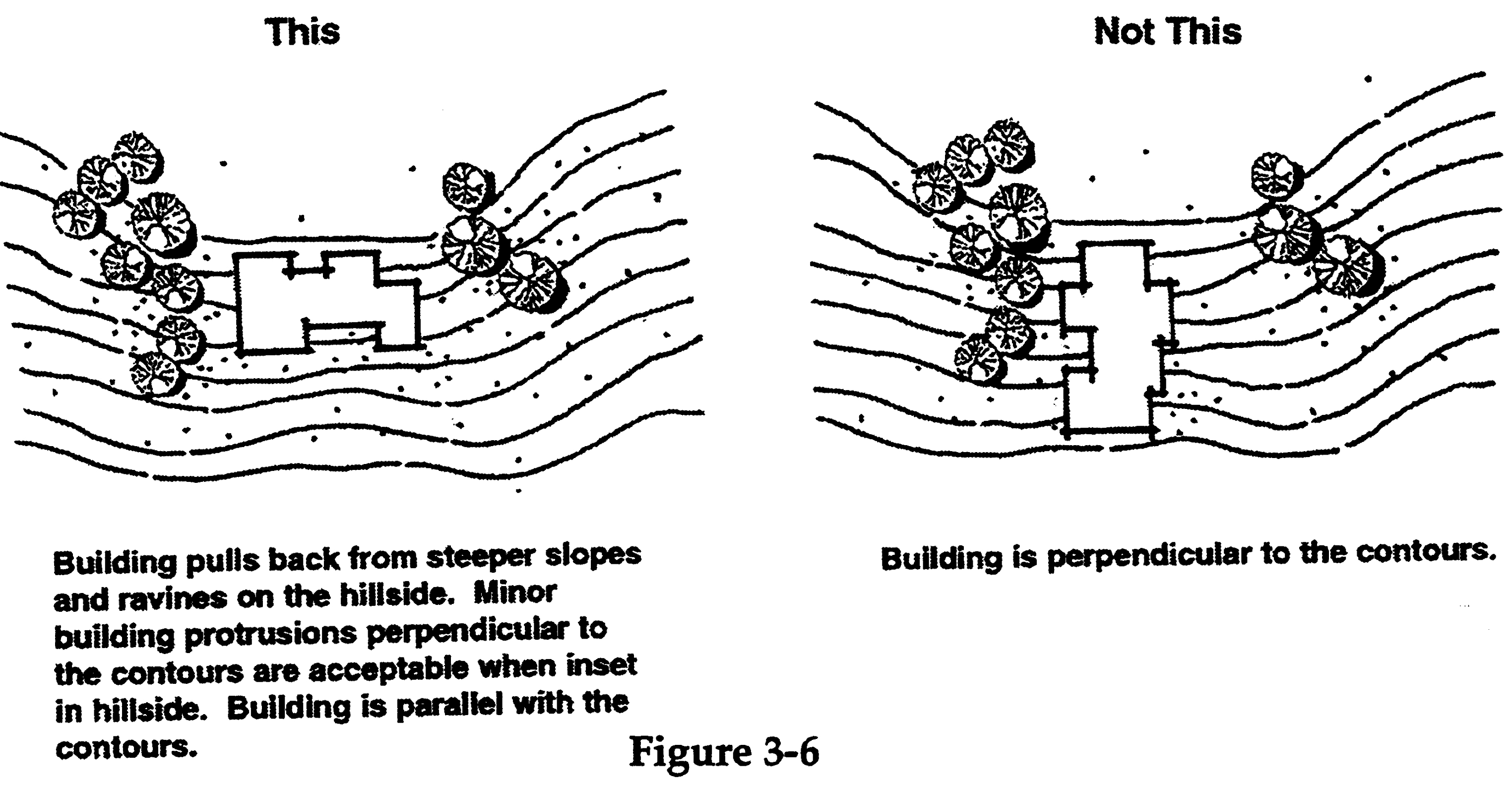
Figure 3-6
(2)
All manufactured cut and fill slopes exceeding nine feet in height, that will be either exposed to permanent public view or are adjacent to environmentally sensitive areas, shall be designed with features characteristic of natural slopes so that their ultimate appearance will resemble a natural slope. This includes slopes along streets and highways, slopes adjacent to parks, schools, open spaces, and other public facilities, and other prominent and highly visible slopes.
Side yard slopes and low (less than 25 feet in height) rear yard slopes whose view is blocked by future structures need not have landform design applied.
Slope drainage devices (e.g., down drains and interceptor drains) shall be designed so that they are built into the natural slope features and become hidden from view.
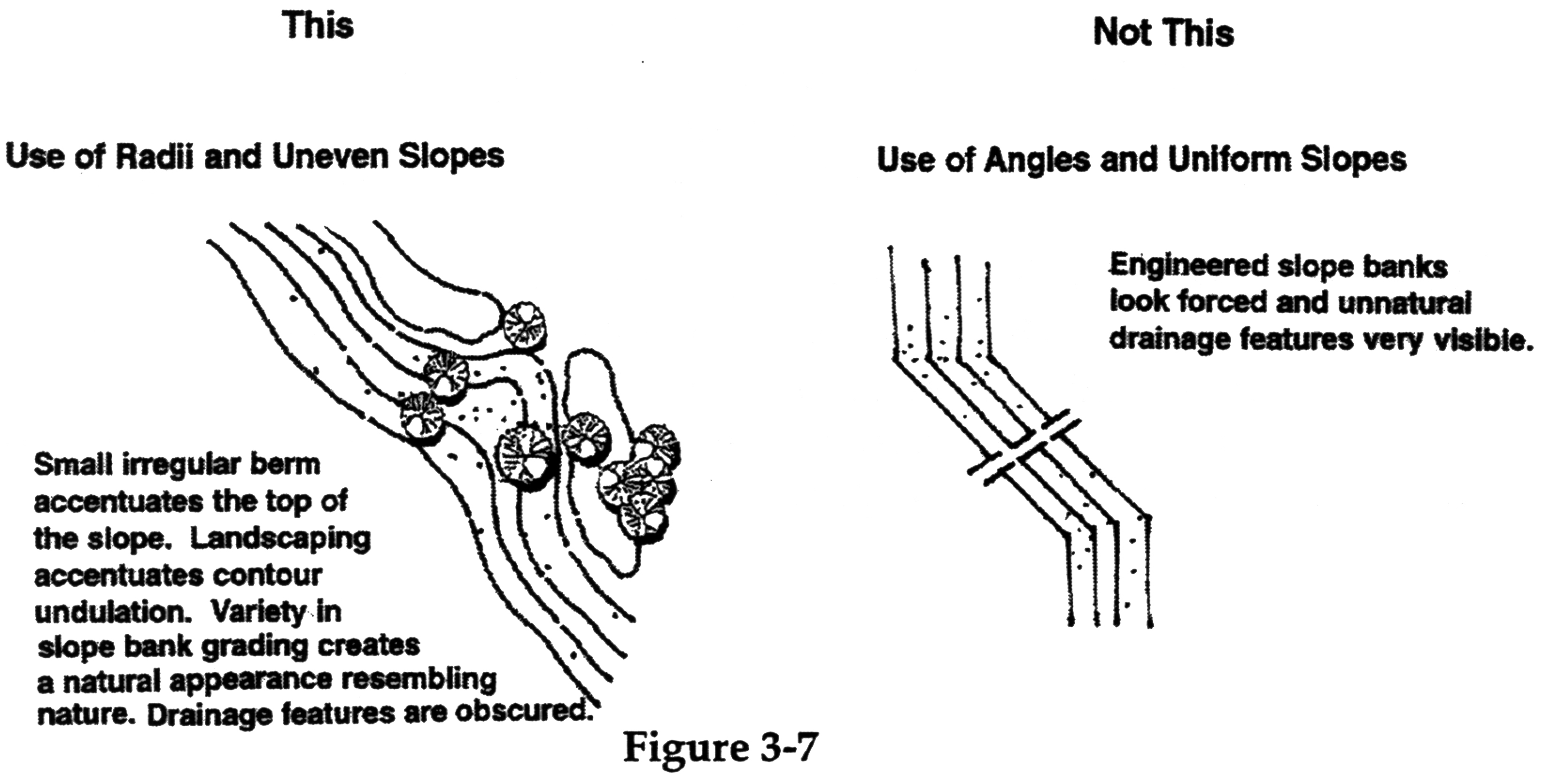
Figure 3-7
(3)
Terracing and the associated concrete drainage devices (e.g., terrace drains, down drains, and interceptor drains) distract from efforts to give cut and fill slopes a natural appearance and are therefore discouraged.
(4)
Landscaping shall not be applied in a conventional pattern, but in patterns resembling natural plant distribution. Trees or shrubs shall be clustered in the swaled (concave) components of the slope along with ground cover. Ground cover, only, should be applied to the protruding (convex) portions.
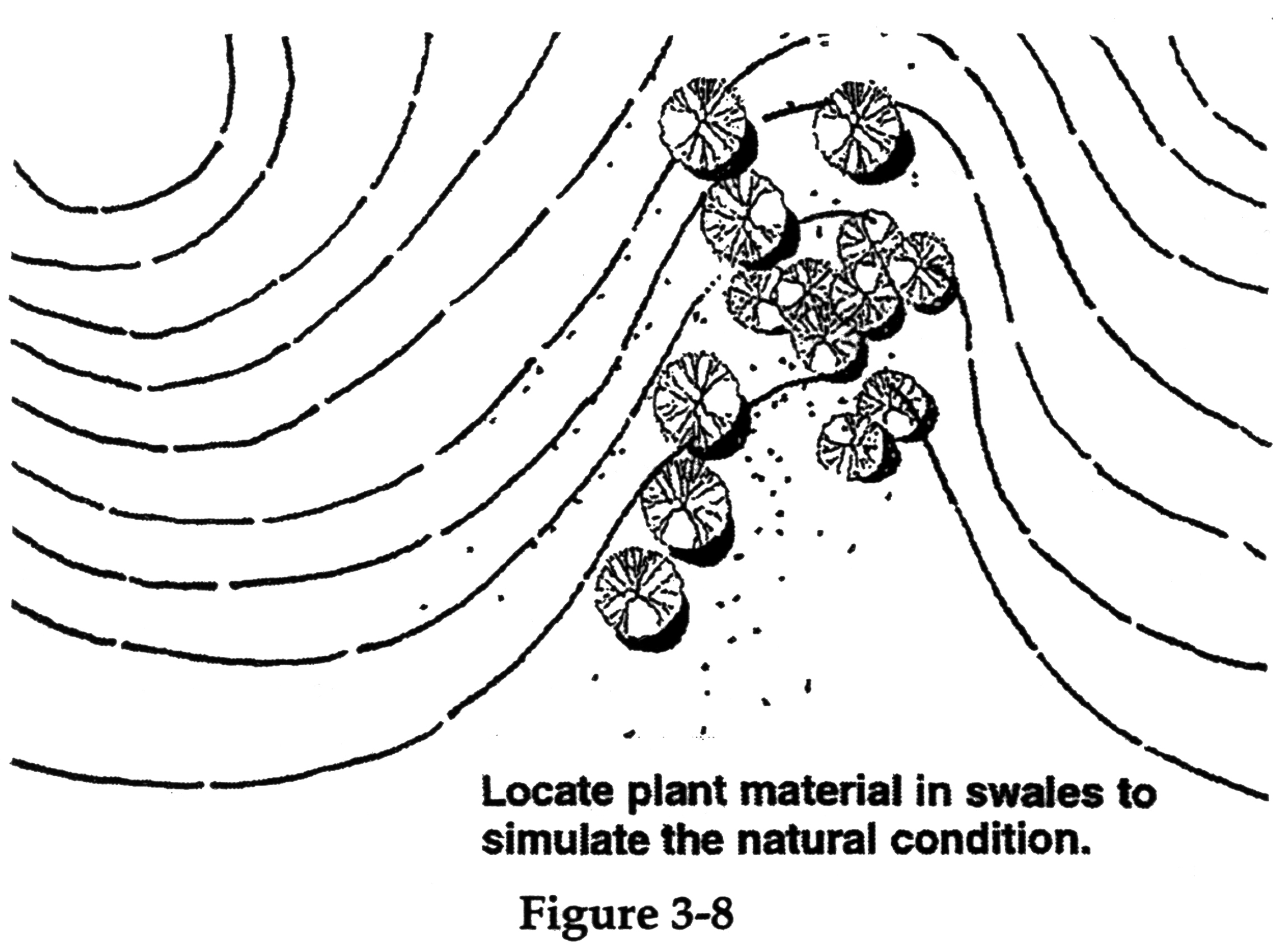
Figure 3-8
(Ord. No. 02(1998), § 2, 11-3-98)
Sec. 22.22.070. - Slope analysis.
(a)
Calculating average slope. Use the following formula to calculate the average slope of the entire parcel:
Slope = 0.002296 IL / A
I = Contour interval in feet
L = Summation of length of all contours in feet
A = Area in acres of parcel being considered
(b)
Slope categories. The following are standards for hillside slopes in areas that will not be landform graded. These standards ensure that development will complement the existing character and topography of the land. The standards for one category may be applied to limited portions of the site in an adjacent category when a project is developed on a site with more than one slope category.
TABLE 3-5
SLOPE CATEGORIES
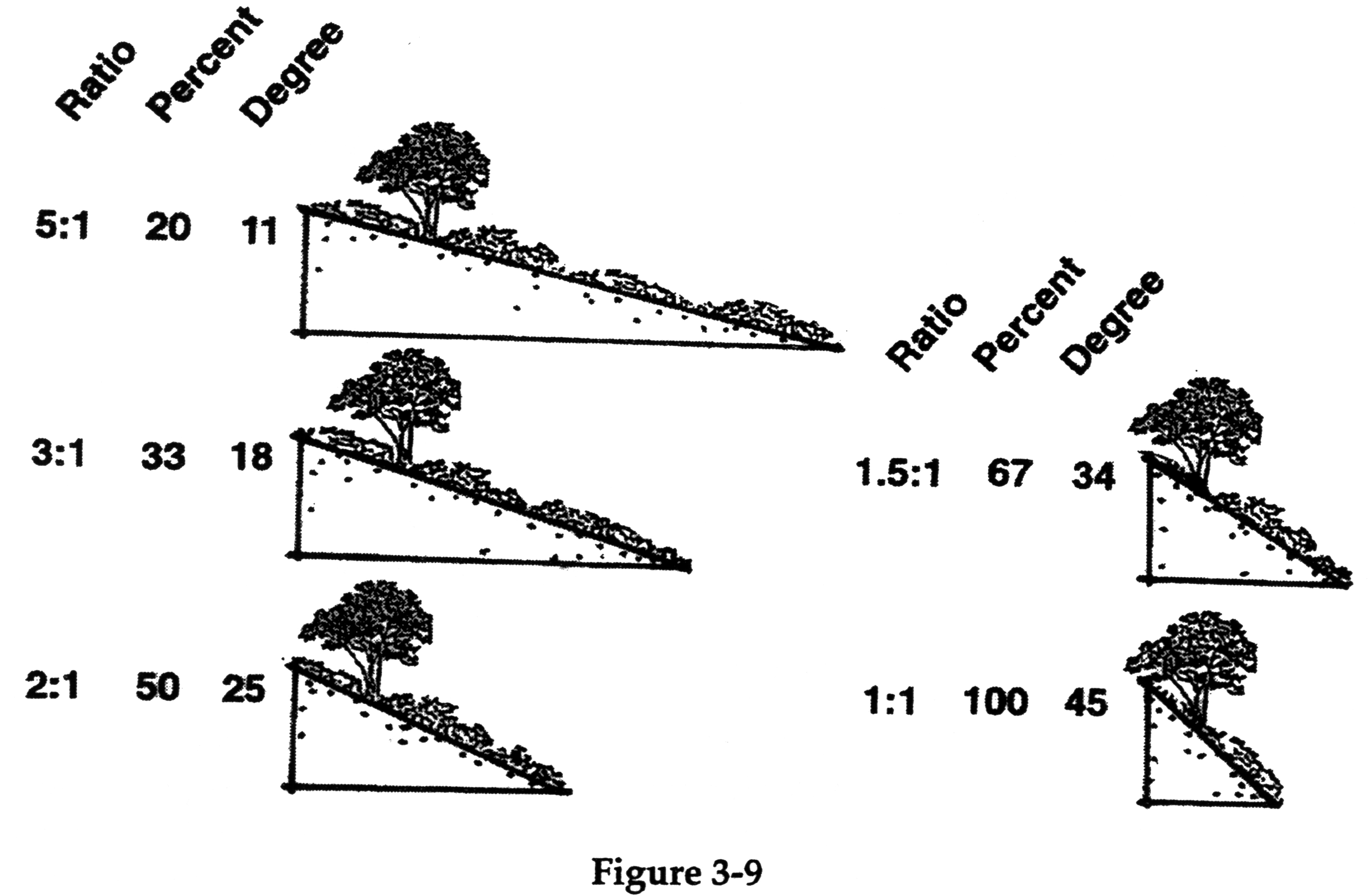
Figure 3-9
(Ord. No. 02(1998), § 2, 11-3-98; Ord. No. 06(2013), § 3(Exh. A), 9-3-13; Ord. No. 07(2013), § 3(Exh. A), 9-17-13)
Sec. 22.22.080. - Grading.
(a)
Landform grading techniques. The following standards define basic grading techniques that are consistent with the intent of this chapter and avoid unnecessary cut and fill. (Figures 3-10 and 3-14). Limitations on project grading amounts and configurations will be decided on a case-by-case basis under the development review process. Landform grading design standards include:
(1)
Ridgeline cuts. When convex shaped natural features (e.g., protruding ridgelines) are cut, the residual landform shall not be a flat slope face, but rather should be restored to resemble the original. This will require more than just rounding at the edges but, in effect, reconfiguring it so the final result will give the appearance of a protruding ridgeline. (Figure 3-10)
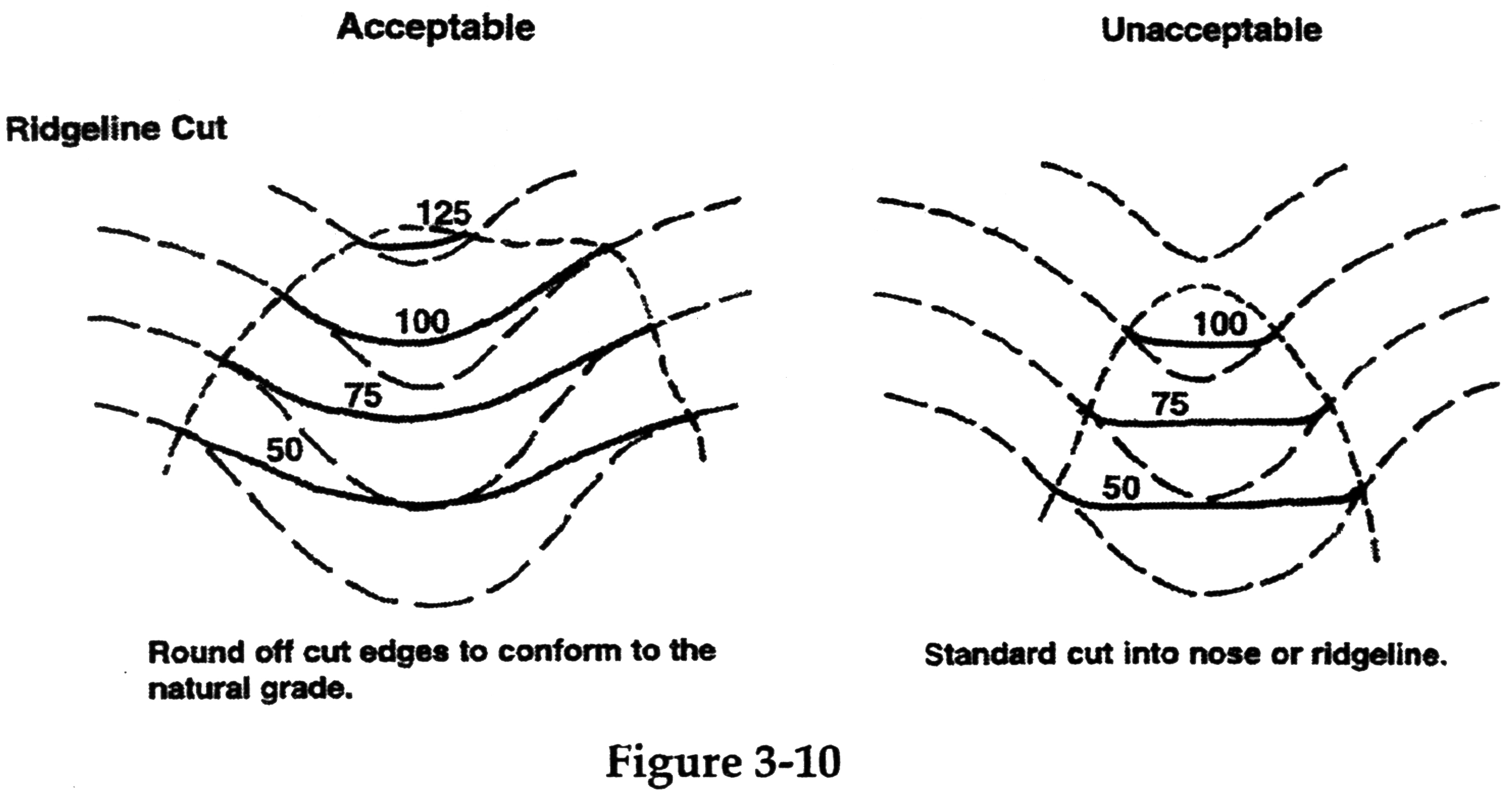
Figure 3-10
(2)
Canyon fills. Fill slopes shall not be placed perpendicular across a canyon. Straight line cutoff fill slopes shall not be made to appear like a dam. The terminus of the fill shall be concave in shape to restore the canyon appearance. Thin concave configuration shall be in combination with the use of substantially flatter slope ratio (4:1, 3.5:1, 3:1) at or near the center of this indentation. Symmetrical or unsymmetrical concave configurations shall be used depending upon the adjoining or underlying topographic characteristics. (Figure 3-11)
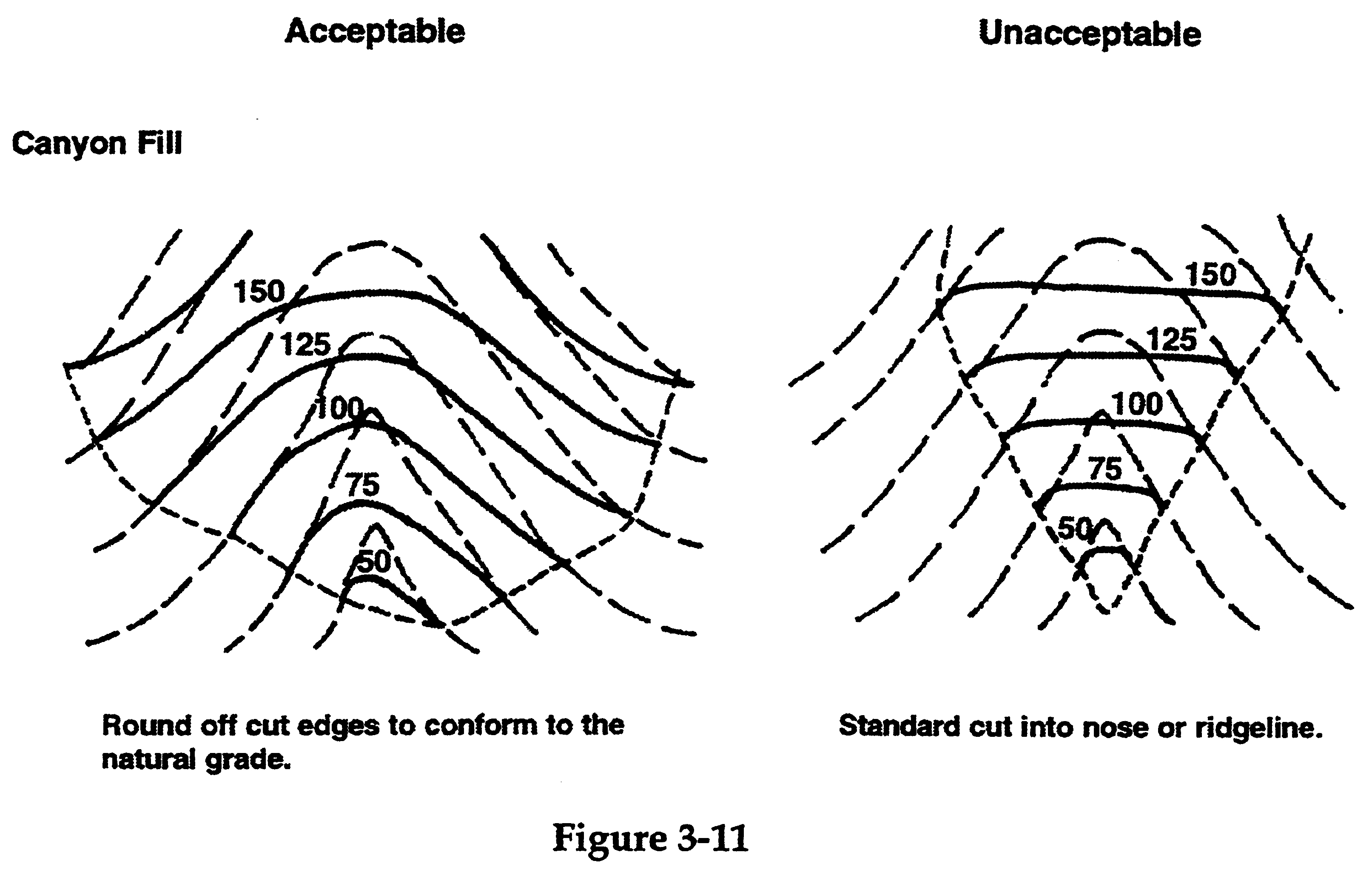
Figure 3-11
(3)
Transition areas. Minimal rounding at the edges of cut and fill slopes shall not be allowed. Proper transitioning to natural slopes shall be achieved through the use of radii or irregular curvilinear shapes that will blend into the adjoining topography tangentially and not create abrupt changes. (Figure 3-12)
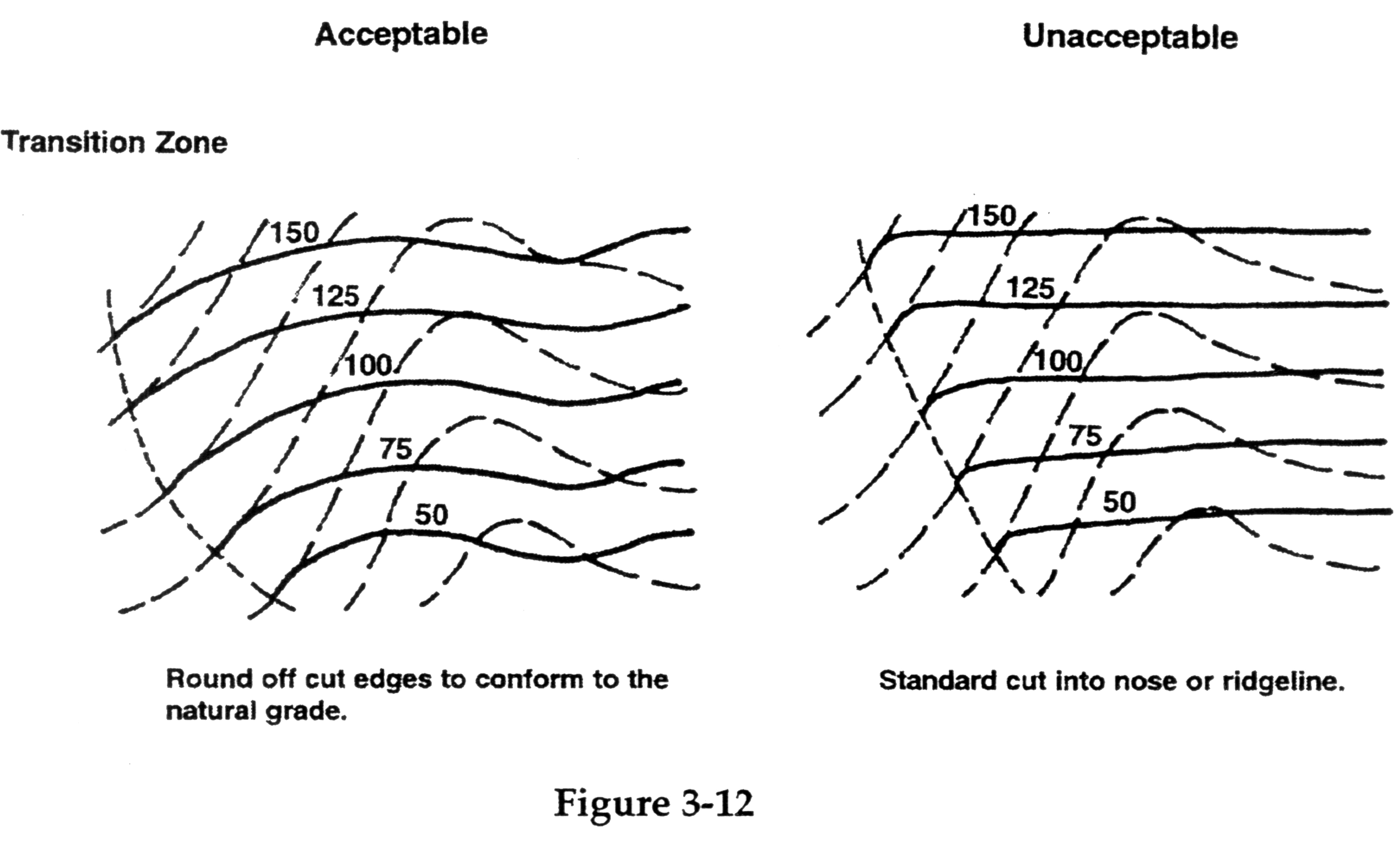
Figure 3-12
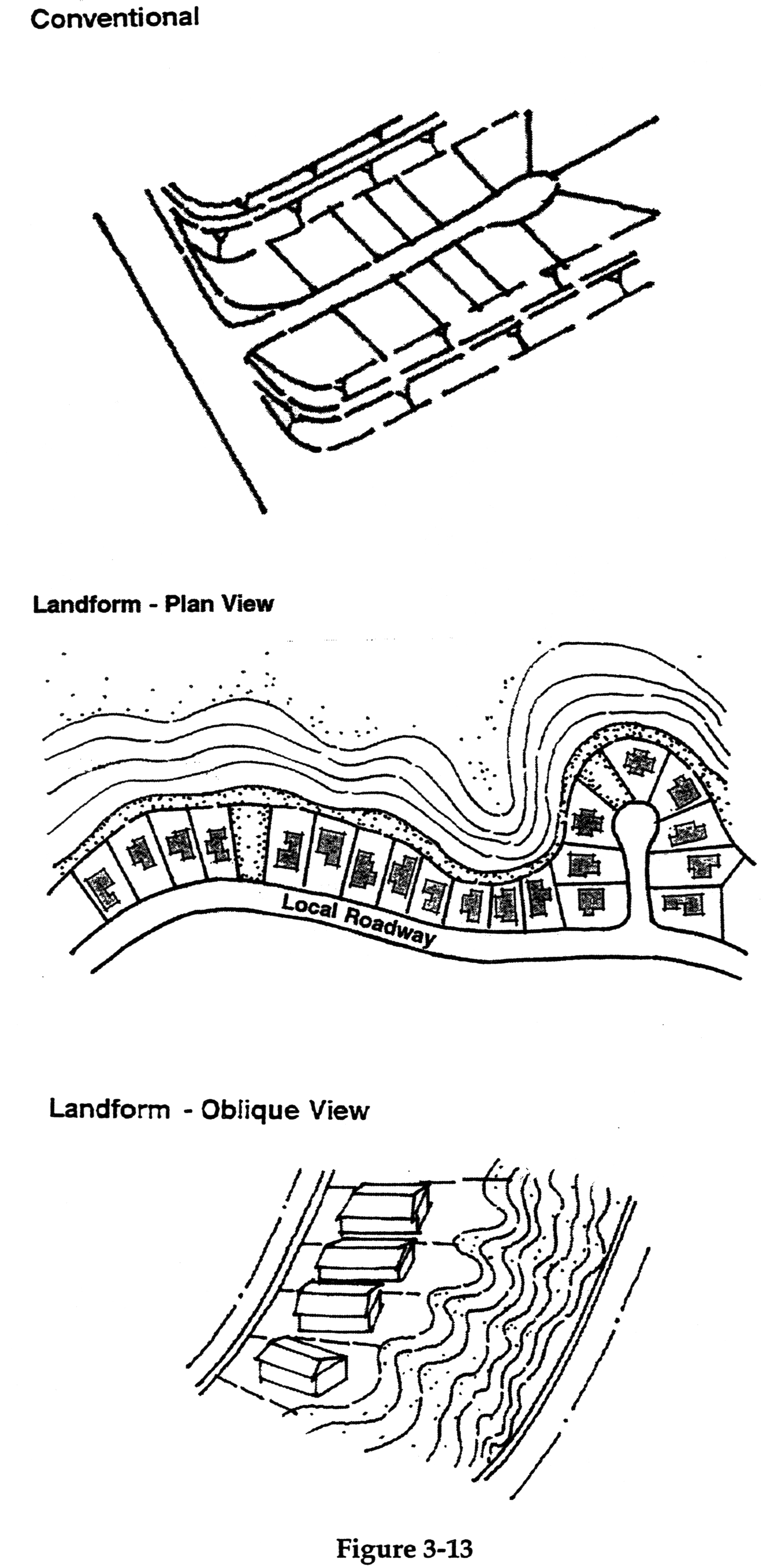
Figure 3-13
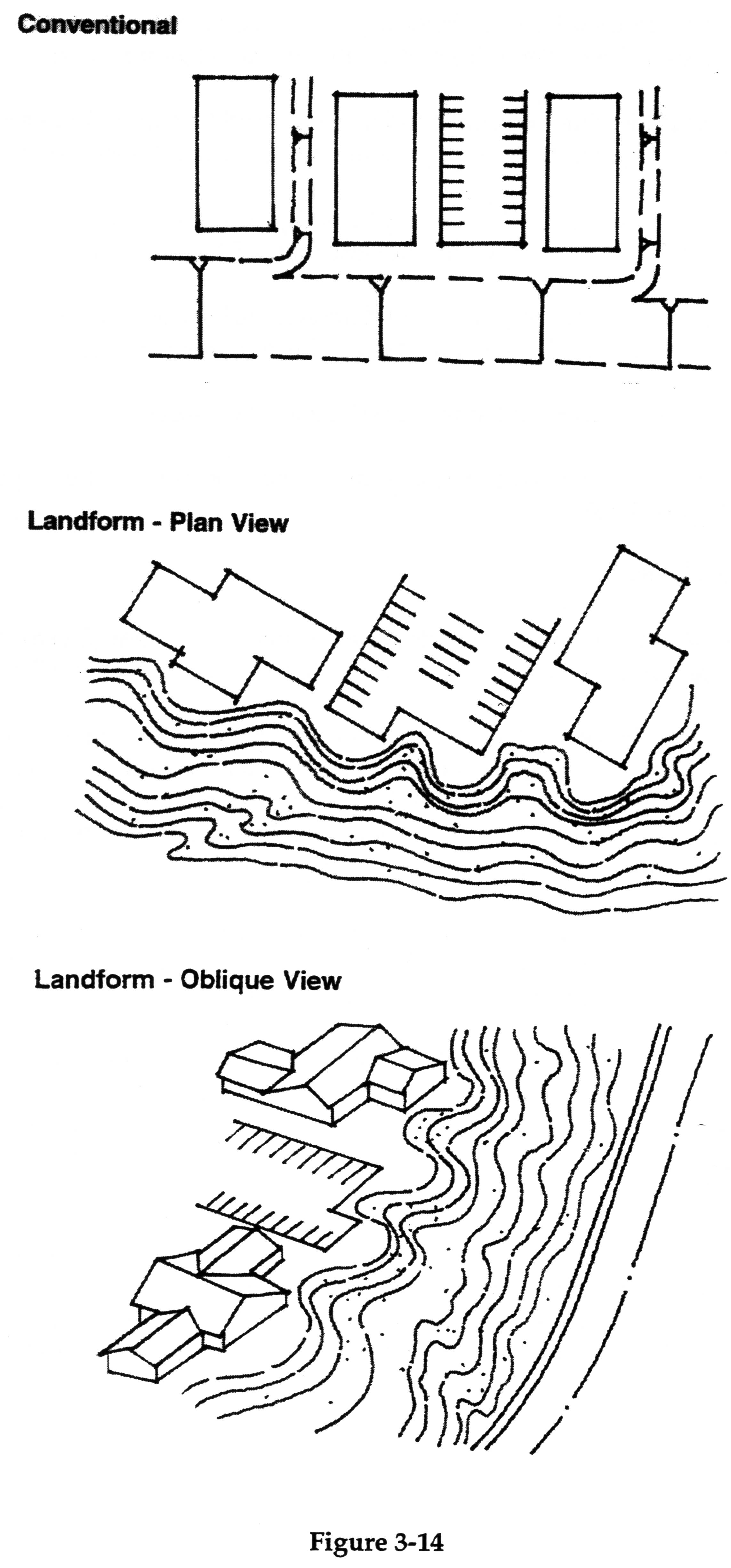
Figure 3-14
(4)
Use of variable slope ratios. The use of landform grading designs creates valleys and concave indentations on building pad areas which can result in a net loss of buildable area. Two methods shall be allowed to offset this loss:
a.
Pad areas lost due to concave indentations will be counted towards meeting the open space or landscape area requirements for the development.
b.
Segments of a cut or fill slope may be designed with variable slope ratios less than 2:1 (horizontal to vertical), but not less than 1.5:1 within the following guidelines:
1.
A geotechnical engineer shall demonstrate by analysis and certify that slopes so designed will meet standard stability requirements;
2.
Overall ratio from toe to toe will be a maximum of 2:1;
3.
Ratios greater than or less than 2:1 may be used in the slope design. (See Figure 3-15)
(b)
Grading standards.
(1)
Finished slopes shall not be created greater than 50 percent (2:1) except adjacent to a structure where the created slope is limited to a maximum of 67 percent (1.5:1).
(2)
Grading shall be phased so that prompt revegetation or construction will control erosion. Where possible, only those areas that will be built on, resurfaced, or landscaped shall be disturbed. Topsoil shall be stockpiled during rough grading and used on cut and fill slopes whenever feasible. Revegetation of cut and fill slopes shall occur within three months of grading completion.
(3)
Grading operations shall be planned to avoid the rainy season, October 15 to April 15. Grading permits may be issued any time of year when a plan for erosion control and silt retention has been approved by the city engineer.
(4)
Excavation or other earth disturbance shall not be allowed on a hillside area prior to the issuance of a grading permit with the exception of drill holes and exploratory trenches for the collection of geologic and soil data. Exploratory trenches and access roads should be properly backfilled and erosion treatment and revegetation provided.
(5)
No point on any structure subject to the provisions of this chapter shall be closer to a prominent ridge than 50 feet measured vertically on a cross section. (Figure 3-16). And in no case shall the roof line or any other portion of a structure extend above the line of sight between a ridgeline and any public right-of-way, whether the ridgeline is above or below the right-of-way.
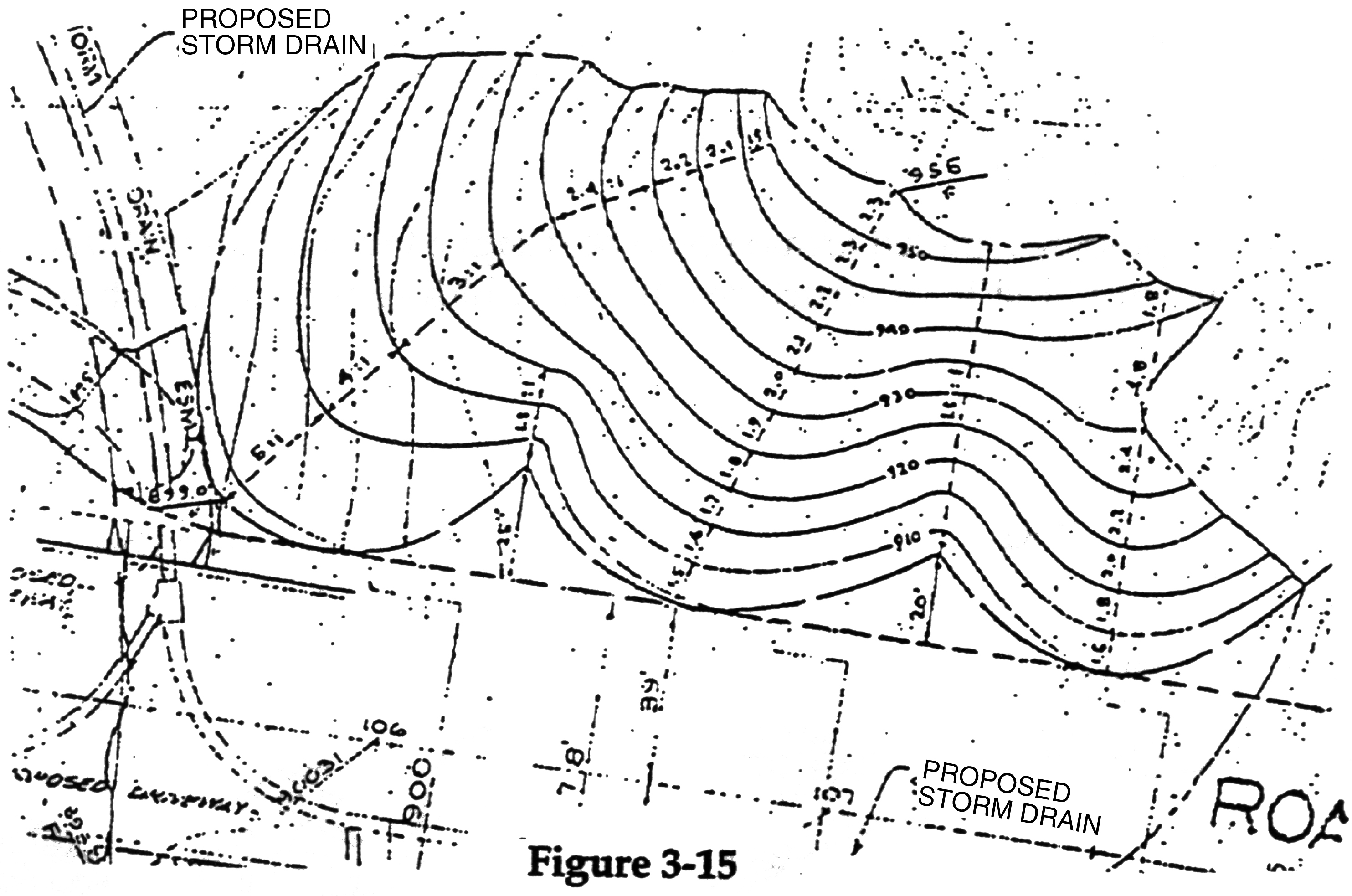
Figure 3-15
(6)
Lot pad grading is limited to the boundaries of the structure's foundation, vehicle parking space and front, rear, and side yard areas as shown on the approved grading plan, and in compliance with the setback requirements of section 22.08.040 (residential zoning district general development standards). For all lots subject to this chapter, building setbacks shall be measured from the edge of the building pad.
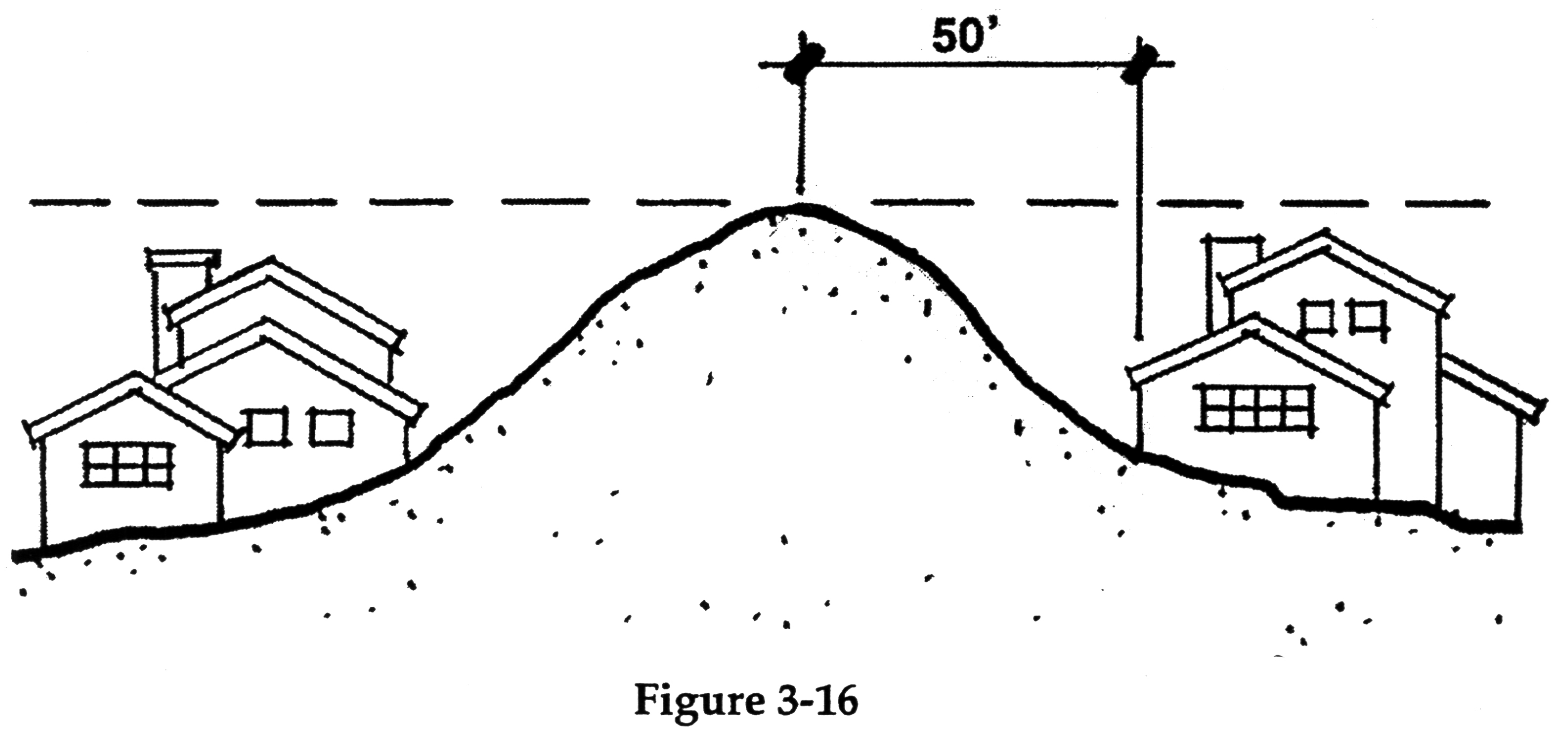
Figure 3-16
(7)
Retaining walls associated with lot pads shall not exceed four feet in height. Where an additional retained portion is necessary due to unusual or extreme conditions, (e.g., lot configuration, steep slope, or road design) the use of terraced retaining structures shall be considered on an individual lot basis. Terraced walls shall be separated by a minimum of three feet with appropriate landscaping. Terraced retaining walls shall not be used as a typical solution within a development and shall be limited to the minimum required subject to approval of the director.
(8)
Lot lines shall be placed two feet beyond top of major slope areas within public view corridors to help ensure their maintenance by the downhill owner.
(c)
Grading guidelines.
(1)
Where possible, graded areas should be designed with manufactured slopes located on the uphill side of structures, thereby hiding the slope behind the structure. (Figure 3-17)
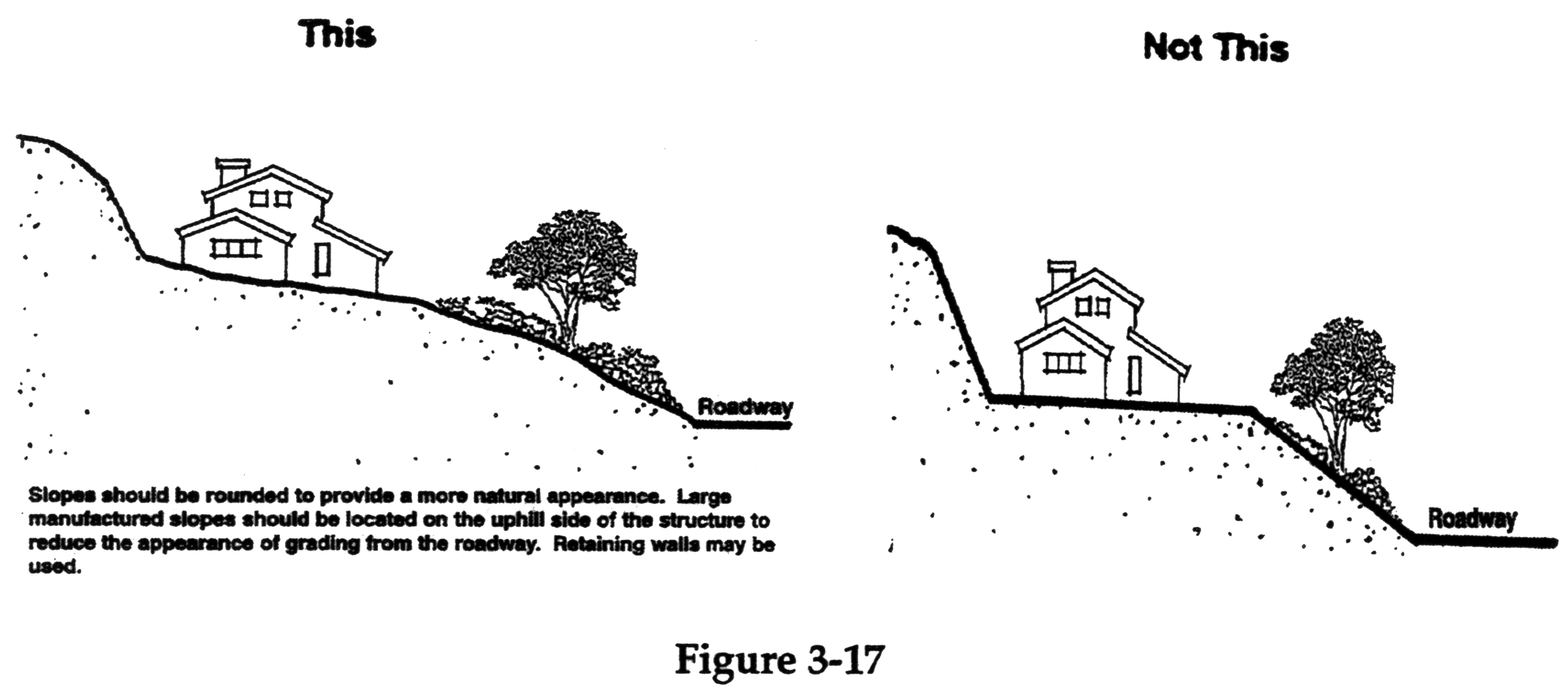
Figure 3-17
(2)
Terraced retaining structures up to four feet in height may be utilized when separated by a minimum of three feet and appropriate landscaping. (Figure 3-18)
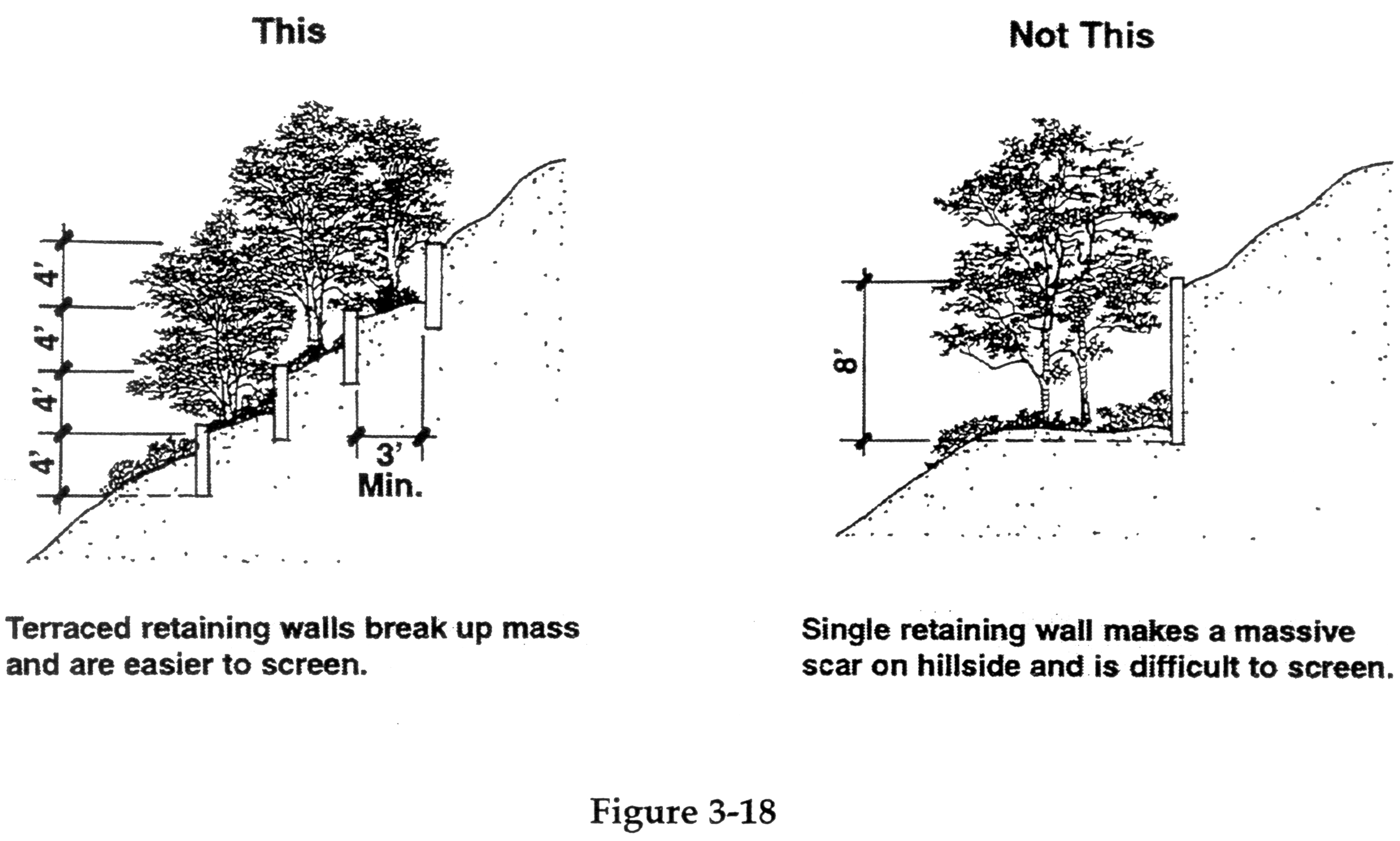
Figure 3-18
(3)
On lots sloping with the street, and other configurations not discussed above, one retaining wall, not to exceed 42 inches in height, may be used in a side yard where necessary.
(4)
Retaining walls that are an integral part of the structure may exceed four feet in height; however, their visual impact shall be mitigated through contour grading and landscape techniques. (Figure 3-19)
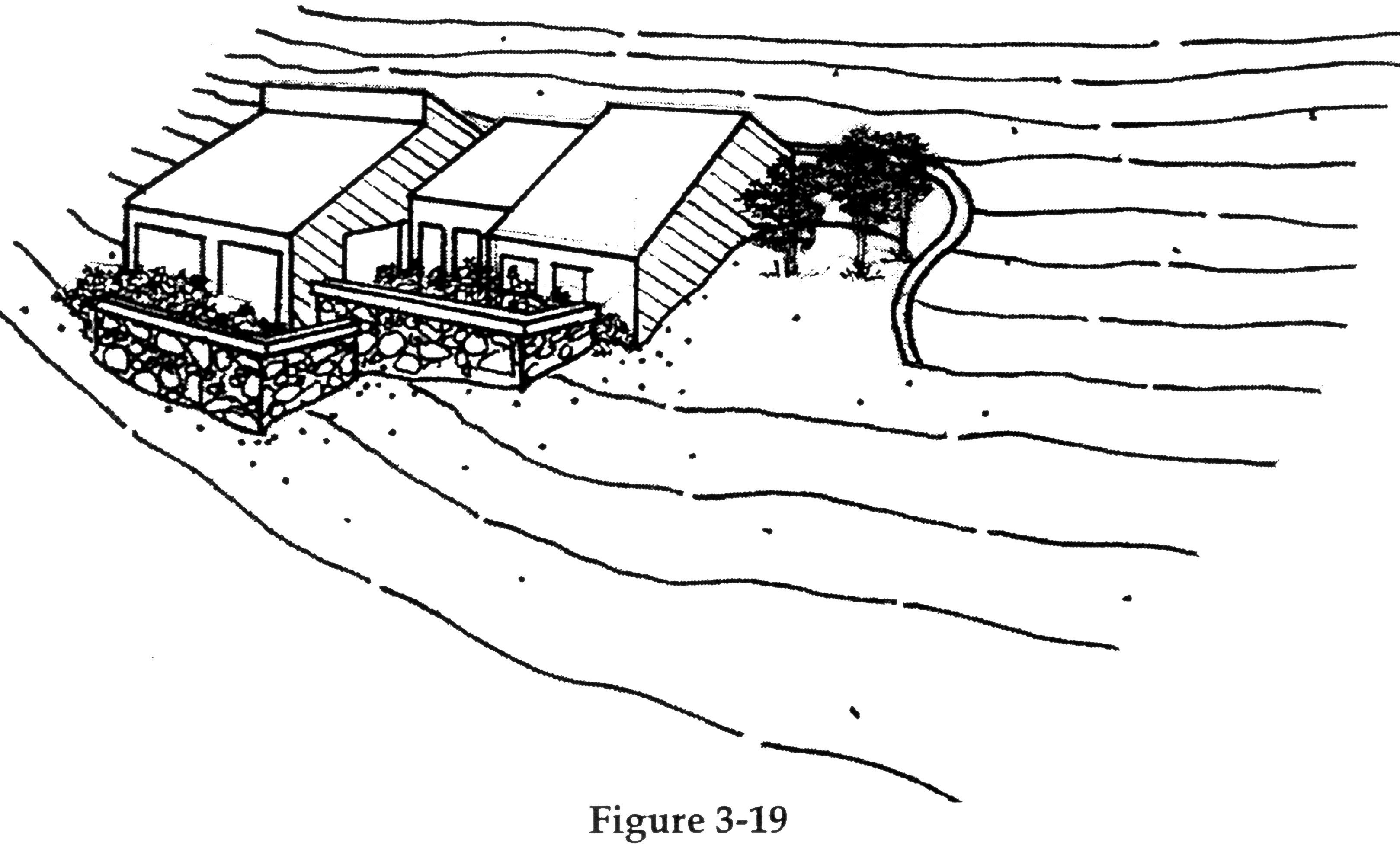
Figure 3-19
(5)
The following factors shall be taken into consideration in the design of a project:
a.
When space and proper drainage requirements can be met with approval by the city engineer, rounding of slope tops and bottoms shall be accomplished.
b.
When slopes cannot be rounded, vegetation shall be used to alleviate a sharp, angular appearance.
c.
A rounded and smooth transition shall be made when the planes of man-made and natural slopes intersect.
d.
When significant landforms are "sliced" for construction, the landforms shall be rounded to blend into natural grade.
e.
Manufactured slope faces shall be varied to avoid excessive "flat-planed" surfaces. (Figure 3-15)
(6)
No manufactured slope shall exceed 30 feet in height between terraces or benches (Figure 3-20)
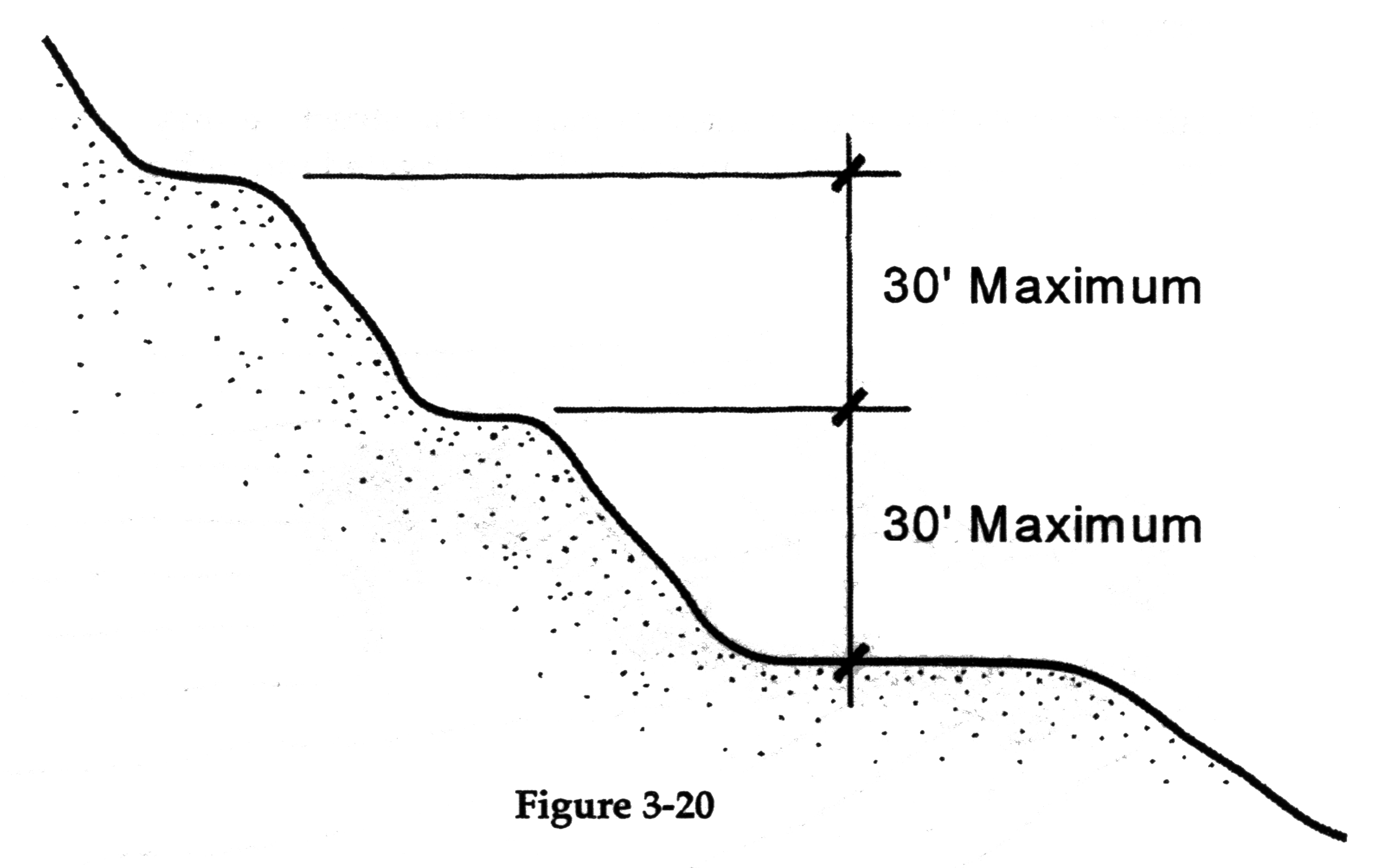
Figure 3-20
(7)
Where cut or fill conditions are created, slopes should be varied rather than left at a constant angle which may be unstable or create an unnatural, rigid, "engineered" appearance. (Figure 3-21)
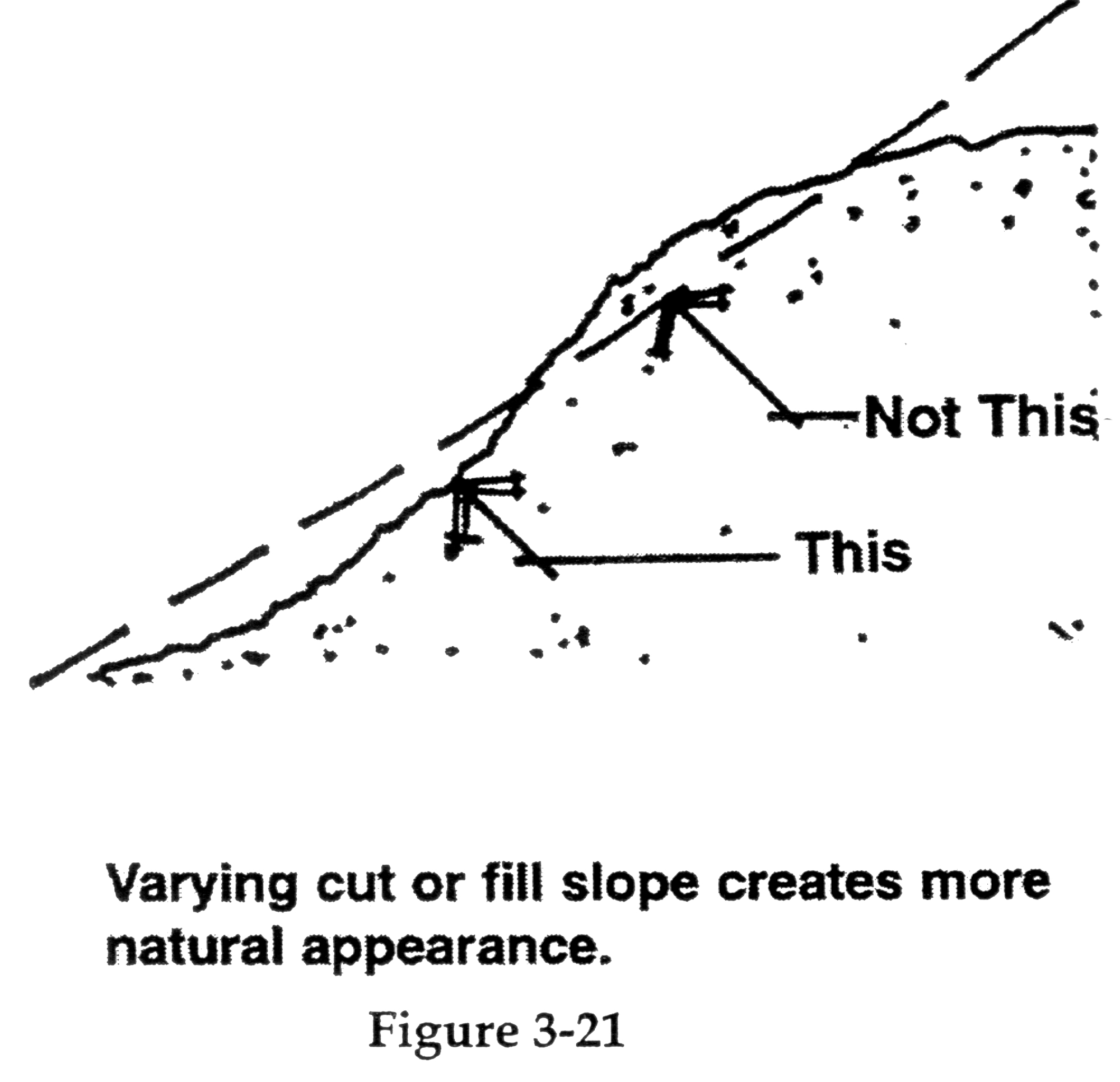
Figure 3-21
(8)
The angle of any graded slope should be gradually adjusted to the angle of the natural terrain. (Figure 3-22)
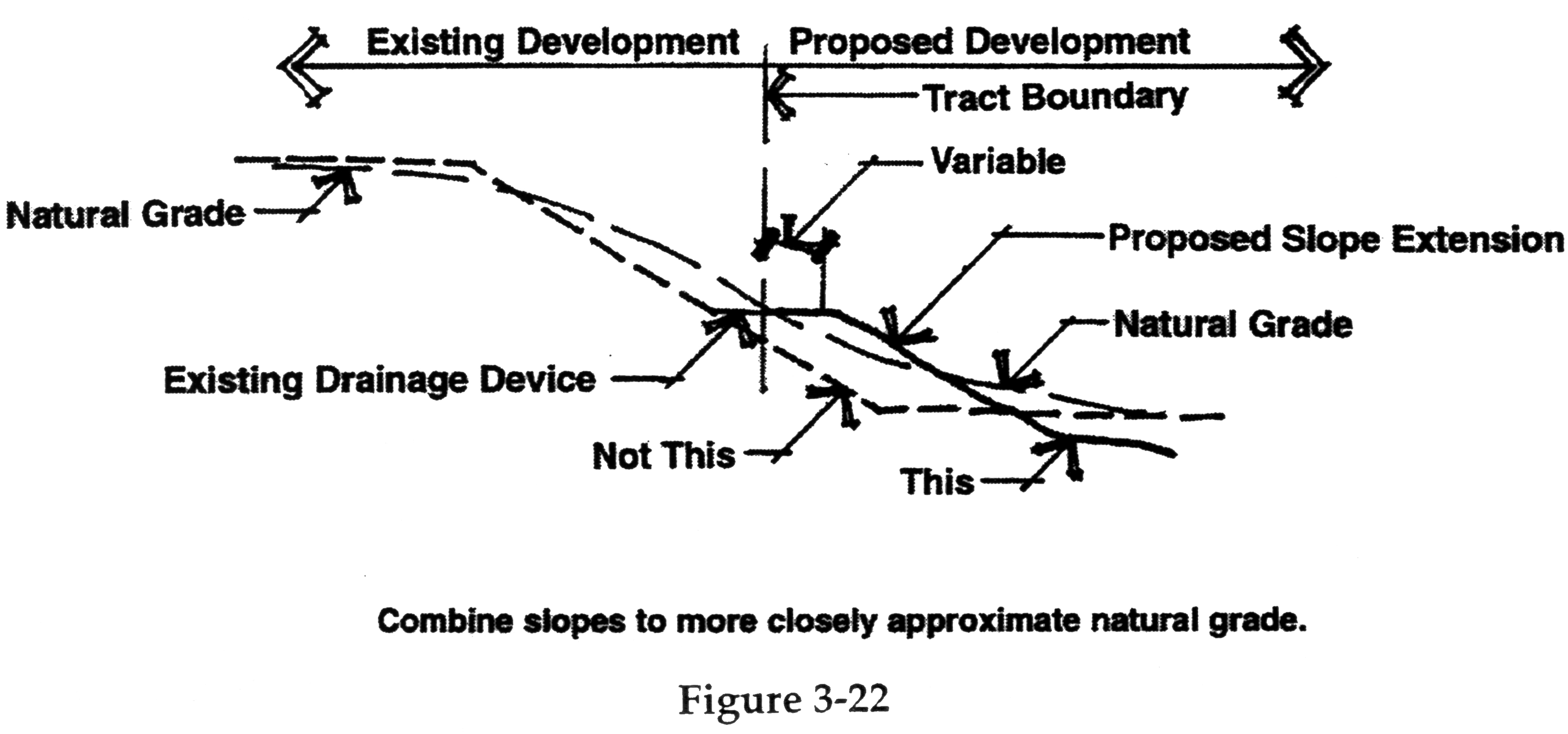
Figure 3-22
(9)
Manufactured slopes adjacent to roadways shall be consistent with the landform grading and revegetation technique to create visually interesting and pleasing streetscapes. (Figure 3-23)
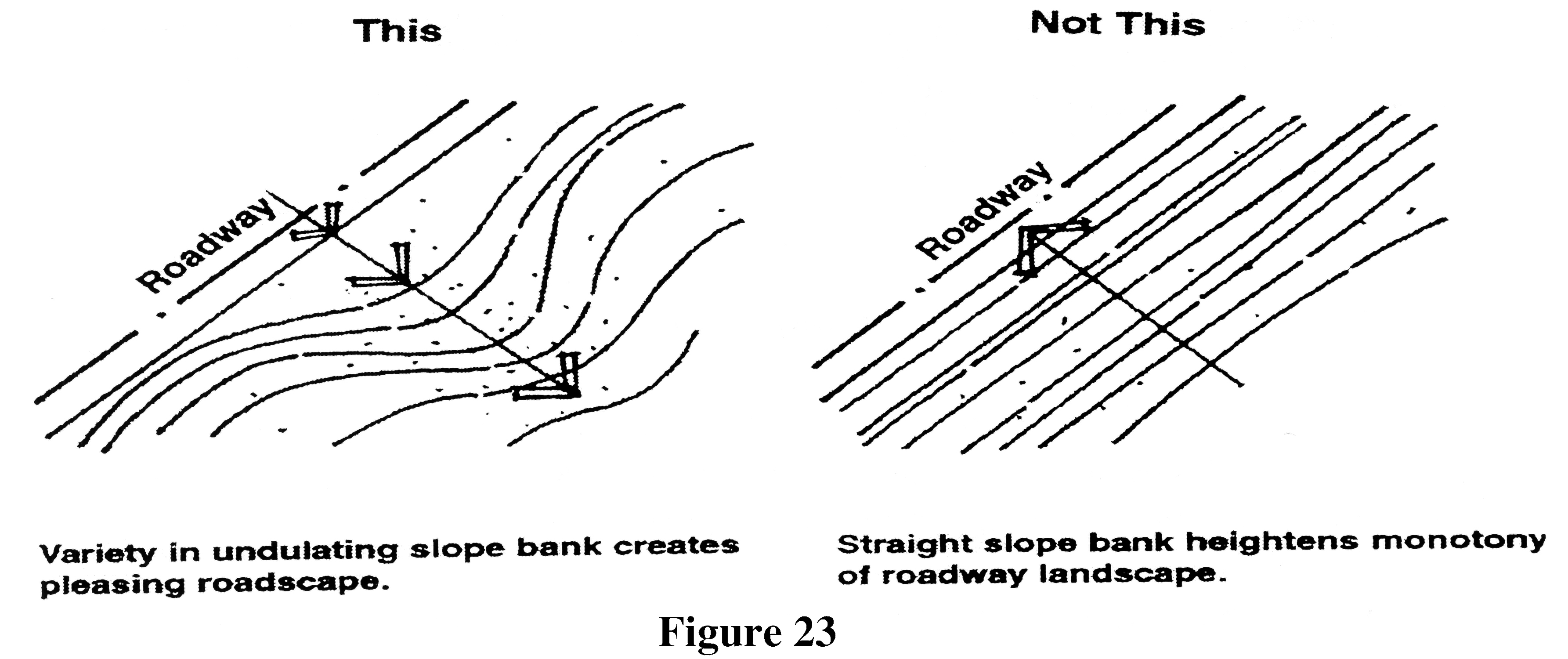
Figure 3-23
(Ord. No. 02(1998), § 2, 11-3-98; Ord. No. 06(2013), § 3(Exh. A), 9-3-13; Ord. No. 07(2013), § 3(Exh. A), 9-17-13)
Sec. 22.22.090. - Drainage.
Where a conflict exists between the provisions of this section and chapter 70 of the Uniform Building Code, the drainage, soils and geology provisions of this Development Code shall prevail.
(1)
Drainage standards.
a.
Debris basins, riprap, and energy dissipating devices shall be provided where necessary to reduce erosion when grading is undertaken. Except for necessary flood control facilities, significant natural drainage courses shall be protected from grading activity. In instances where crossing is required, a natural crossing and bank protection shall be preferred over steel and concrete systems. Where brow ditches are required, they shall be naturalized with plant materials and native rocks.
b.
Terrace drains where required shall follow landform slope configuration. Down drains shall not be placed in exposed positions. All down drains shall be hidden in swales diagonally or curvilinear across a slope face. In this manner they will be built into the overall landform of the slope. (Figure 3-24)
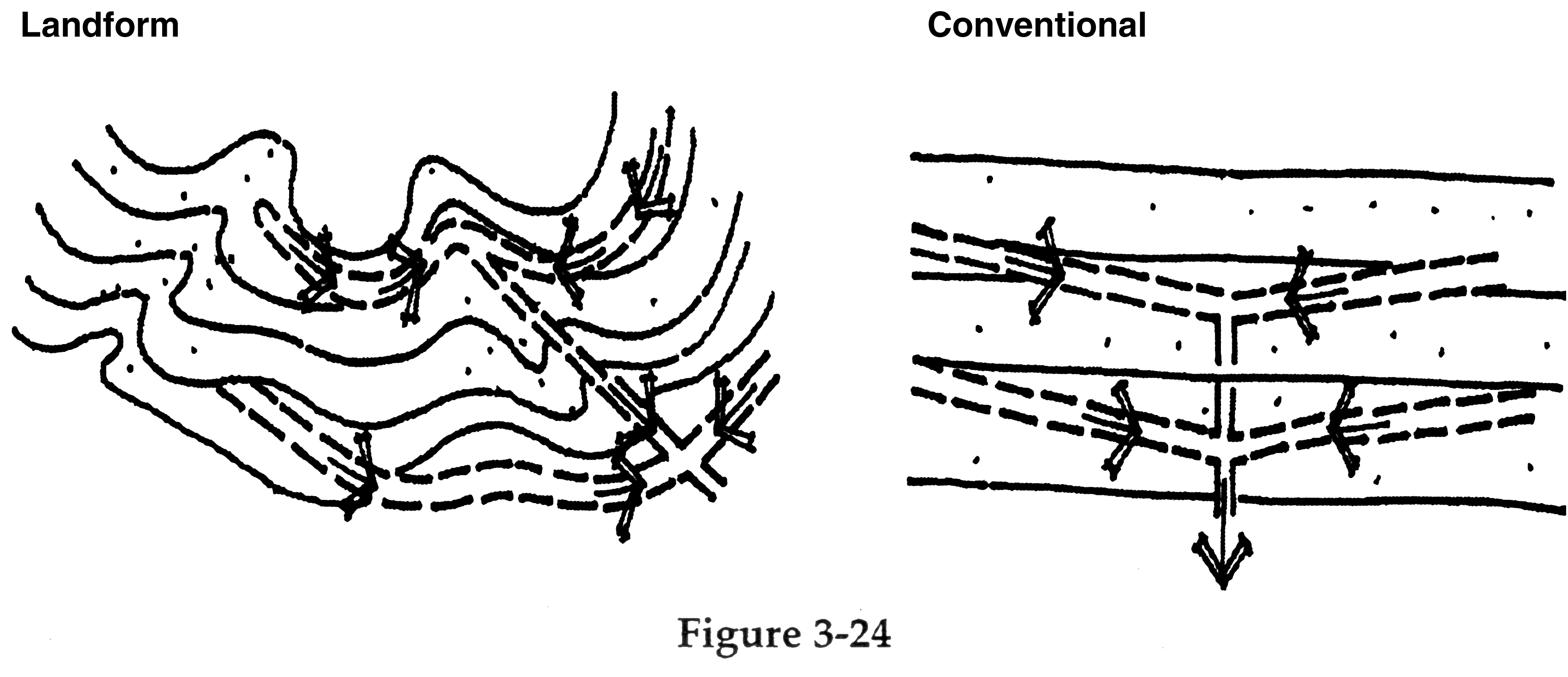
Figure 3-24
c.
Building and grading permits shall not be issued for construction on any site without an approved location for disposal of runoff waters, (e.g., a drainage channel, public street or alley, or private drainage easement).
d.
The use of cross lot drainage shall be subject to commission and council review and may be approved after demonstration that this method will not adversely affect the proposed lots or adjacent properties, and that it is absolutely required in order to minimize the amount of grading which would result with conventional drainage practices. Where cross lot drainage is utilized, the following shall apply:
1.
Project interiors. One lot may drain across one other lot if an easement is provided within either an improved, open V-swale gutter, that has a naturalized appearance, or within a closed drainage pipe that shall be a minimum 12 inches in diameter. In both cases, an integral wall shall be constructed. This drainage shall be conveyed to either a public street or to a drainage easement. If drainage is conveyed to a private easement, it shall be maintained by a homeowners' association, otherwise the drainage shall be conveyed to a public easement. The easement width shall be determined on an individual basis and shall be dependent on appropriate hydrologic studies and access requirements.
2.
Project boundaries. On-site drainage shall be conveyed in an improved open V-swale, gutter, which has a naturalized appearance, or within an underground pipe in either a private drainage easement, which is to be maintained by a homeowners' association, or it shall be determined on an individual basis and shall be dependent on appropriate hydrologic studies and access requirements. (Figure 3-25)
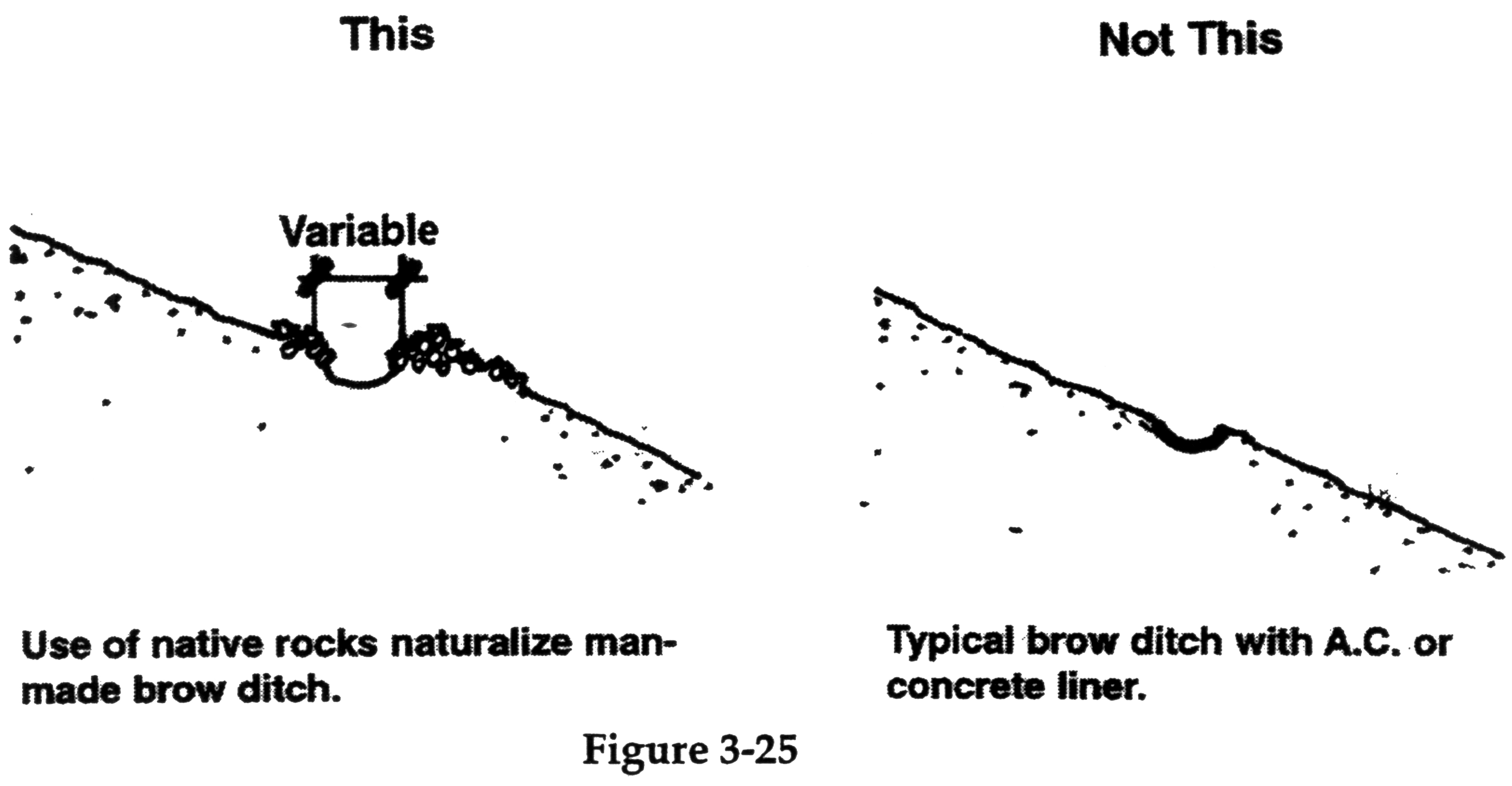
Figure 3-25
(2)
Drainage guidelines.
a.
Where possible, drainage channels should be placed in inconspicuous locations, and more importantly, they should receive a naturalizing treatment including native rock, colored concrete and landscaping, so that the structure appears as an integral part of the environment. (Figure 3-26)
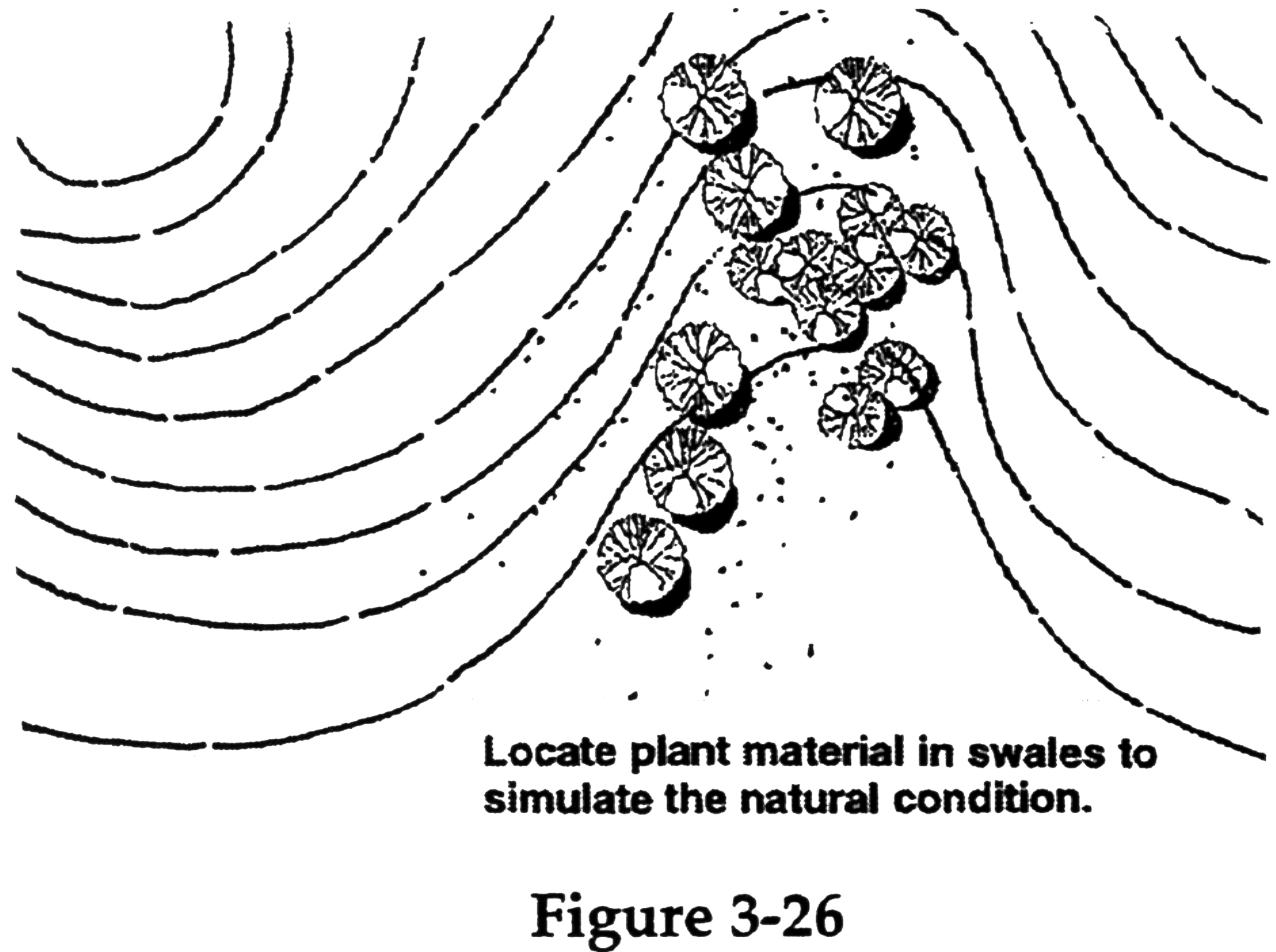
Figure 3-26
b.
Natural drainage courses should be preserved and enhanced to the extent possible. Rather than filling them in, drainage features should be incorporated as an integral part of the project design.
(Ord. No. 02(1998), § 2, 11-3-98)
Sec. 22.22.100. - Access, trails, and roadways.
(a)
Access, trails, and roadway standards.
(1)
Driveway grades up to a maximum of 20 percent are allowed, and shall be aligned with the natural contours of the land. Proper design considerations shall be employed (e.g., vertical curbs and parking landings). Parking landings shall be utilized on all drives over ten percent grade.
(2)
Grooves for traction shall be incorporated into the construction of driveways with a slope of 20 percent or greater.
(3)
Where retaining walls are necessary adjacent to roadways or within street setbacks, they shall be limited to three feet in height in order to avoid obstruction of motorists' and pedestrians' field of view, and to create an aesthetically pleasing streetscape. No more than three terraced or stepped retaining walls shall be utilized. Walls shall be separated by a minimum of three feet and include appropriate landscaping. (Figure 3-27)
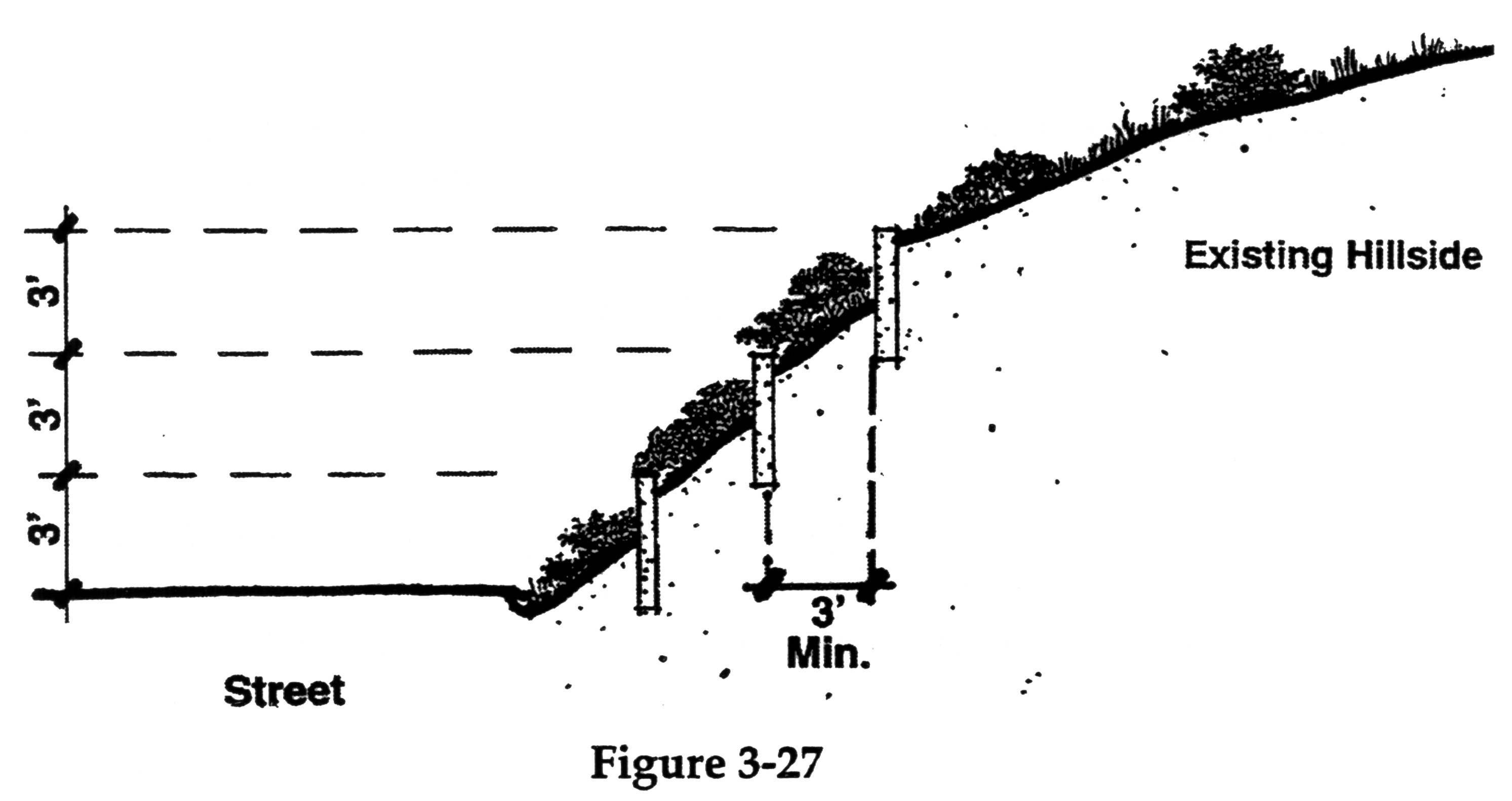
Figure 3-27
(4)
Driveways shall enter public/private streets maintaining adequate line of sight.
(5)
Local hillside street standards shall be used to minimize grading and erosion potential while providing adequate access for vehicles, including emergency vehicles.
(6)
Hillside collector and arterial streets and hillside local residential streets shall not exceed 12 percent.
(7)
Culs-de-sac may be allowed to a maximum of 1,000 feet in length.
(8)
All other street improvement standards shall conform to the standard plans and specifications for public streets of the city.
(9)
The commission or council may approve modifications to the above standards provided the modifications are in substantial conformance with the objectives stated in this section.
(b)
Access, trails, and roadway guidelines.
(1)
Roadways and driveways, where feasible, should conform to the natural landform. They should not greatly alter the physical and visual character of a hillside by creating large notches in ridgelines, defining wide straight alignments, or by building switch-backs on visually prominent hillsides. Split sections and parking bays should be utilized in the layout of hillside streets. (Figure 3-28)
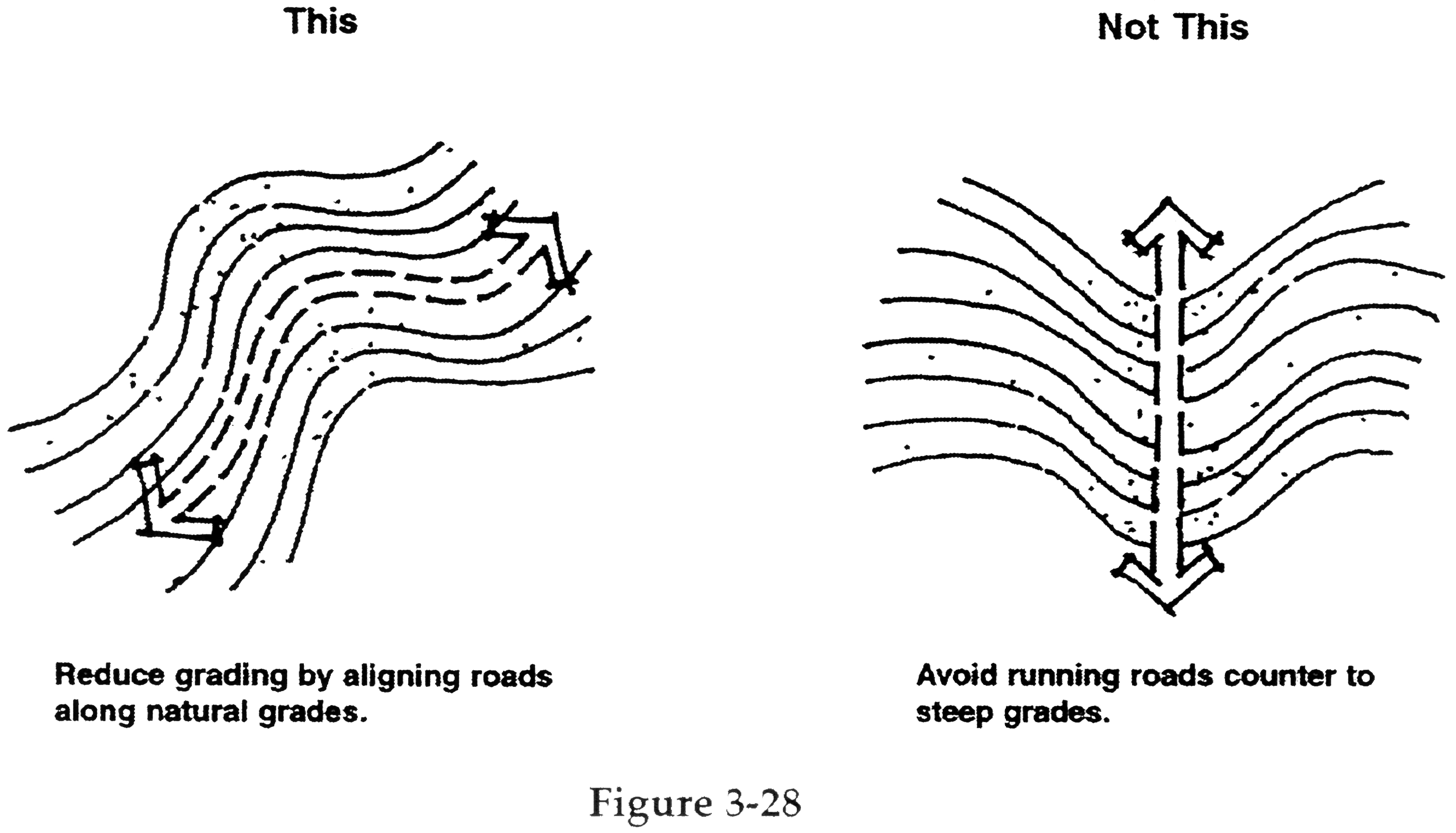
Figure 3-28
(2)
Where road construction is allowed in hillside areas, the extent of vegetation disturbance and visual disruption should be minimized by the combined use of retaining structures and regrading to approximate the natural slope. The following techniques should be used where feasible.
a.
Utilize landform revegetation planting in order to create a natural appearance and provide a sense of privacy.
b.
Reduce the visual and safety impacts by use of terraced retaining walls and landscaping.
c.
Split roadways increase the amount and appearance of landscaping and the median can be used to handle drainage. (Figure 3-29)
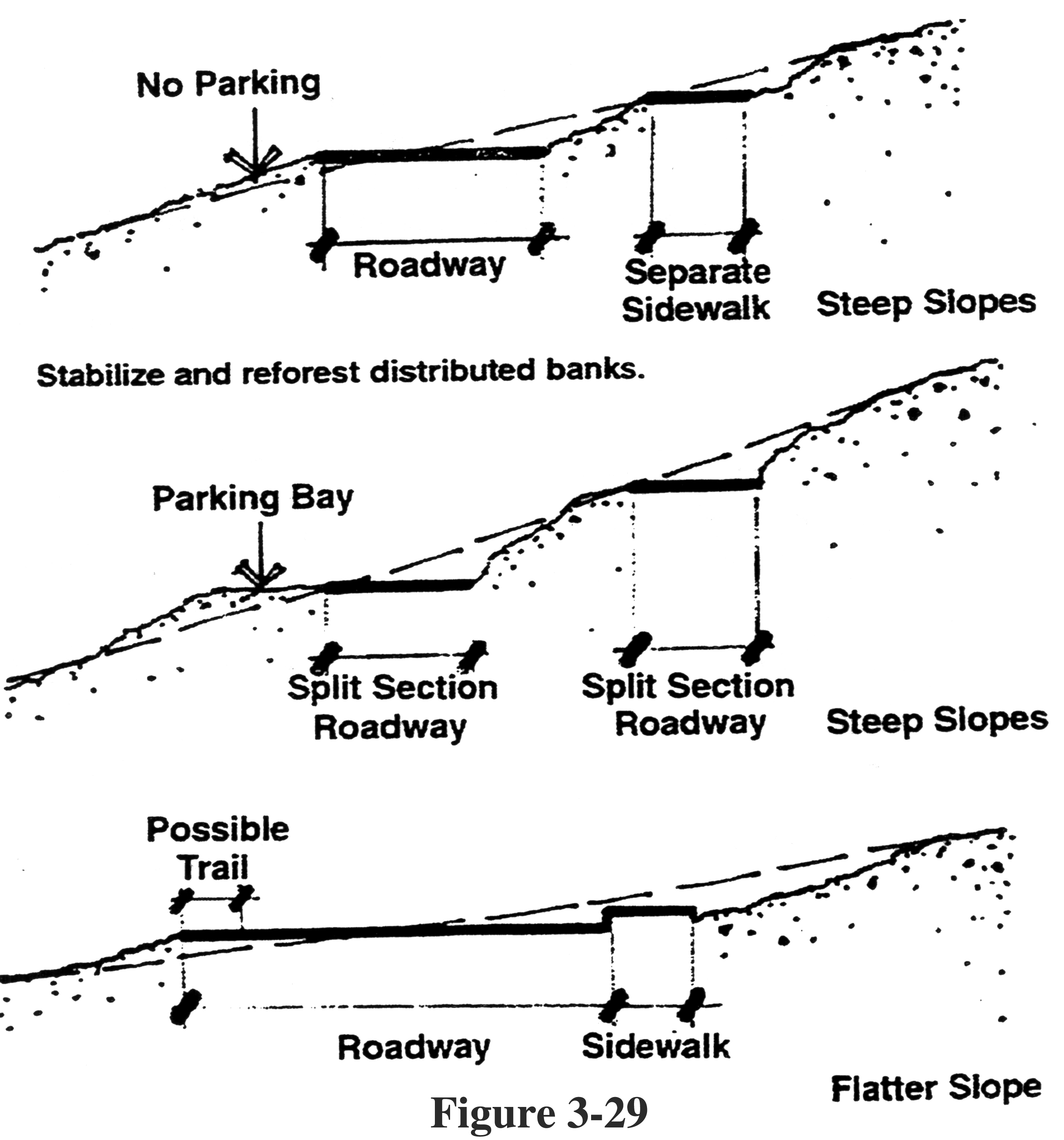
Figure 3-29
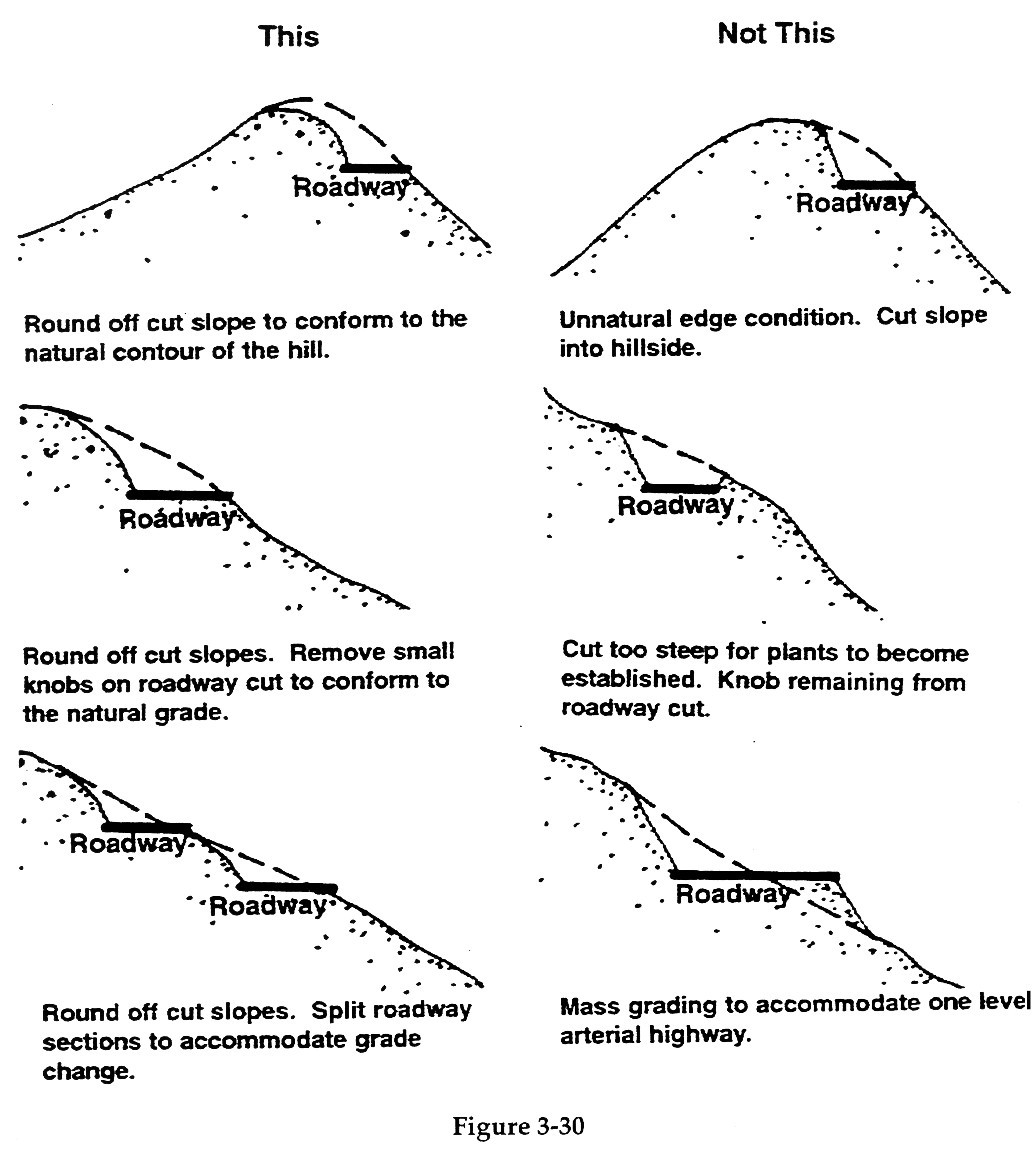
Figure 3-30
(3)
Trails are an integral part of a hillside area and provide recreation areas for equestrian, hiking and biking uses. They can also function as a means to convey drainage.
(4)
In hillside areas, it is not always necessary to provide full improvements for trails. A more natural experience may be achieved, and the amount of grading required can be reduced, by providing minimal improvements in appropriate areas (e.g., undevelopable, steep slopes and wildlife migration corridors).
(Ord. No. 02(1998), § 2, 11-3-98)
Sec. 22.22.110. - Site design.
(a)
Site design standards. The dimensions of a structure parallel to the direction of the slope shall be maximized in order to limit the amount of cutting and filling and to better fit the house to the natural terrain. (Figure 3-31)
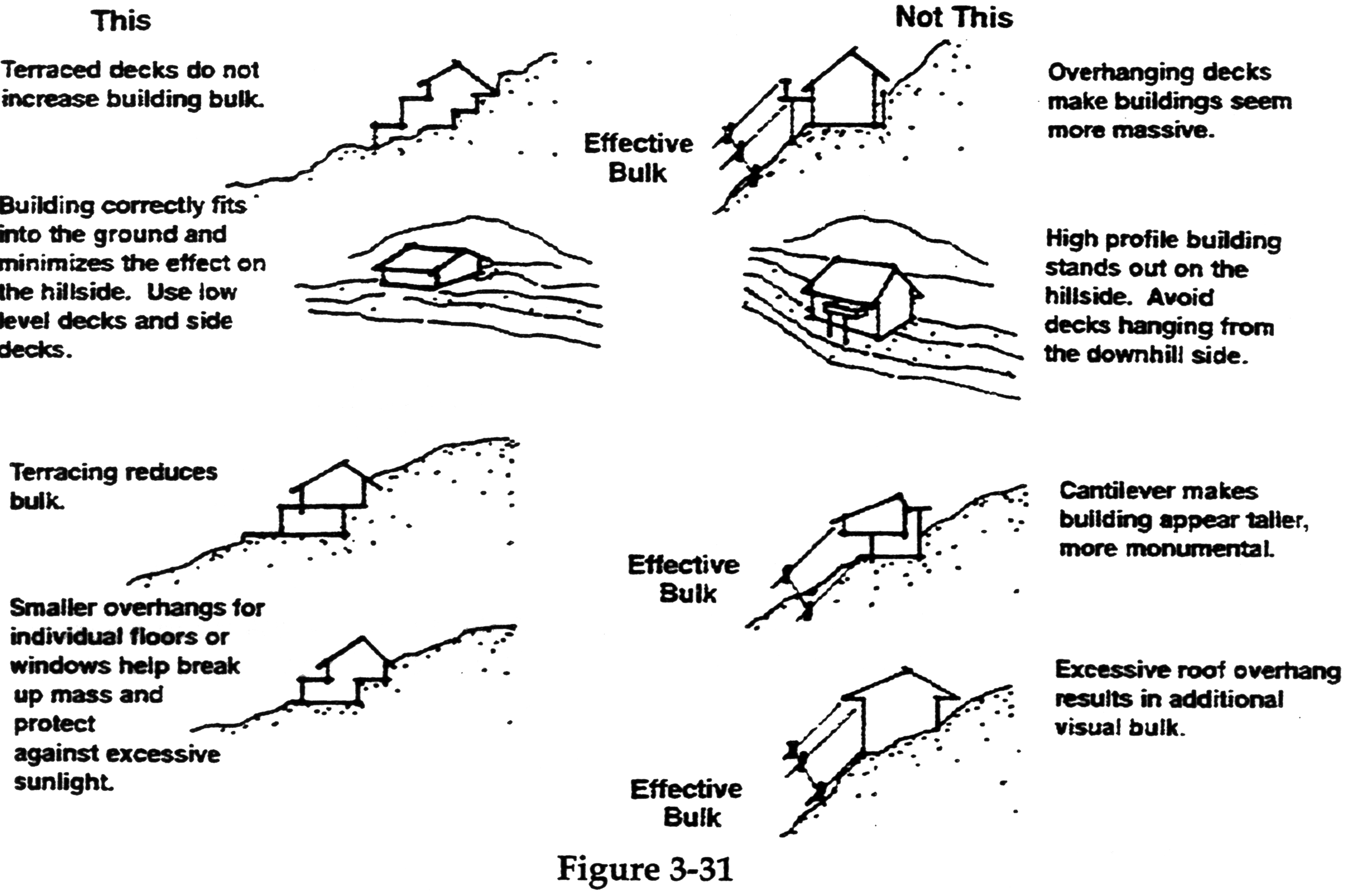
Figure 3-31
(b)
Site design guidelines.
(1)
Design of building sites should be sensitive to the natural terrain. Structures should be located in ways as to minimize necessary grading and to preserve natural features (e.g., knolls or ridgelines). (Figure 3-32)
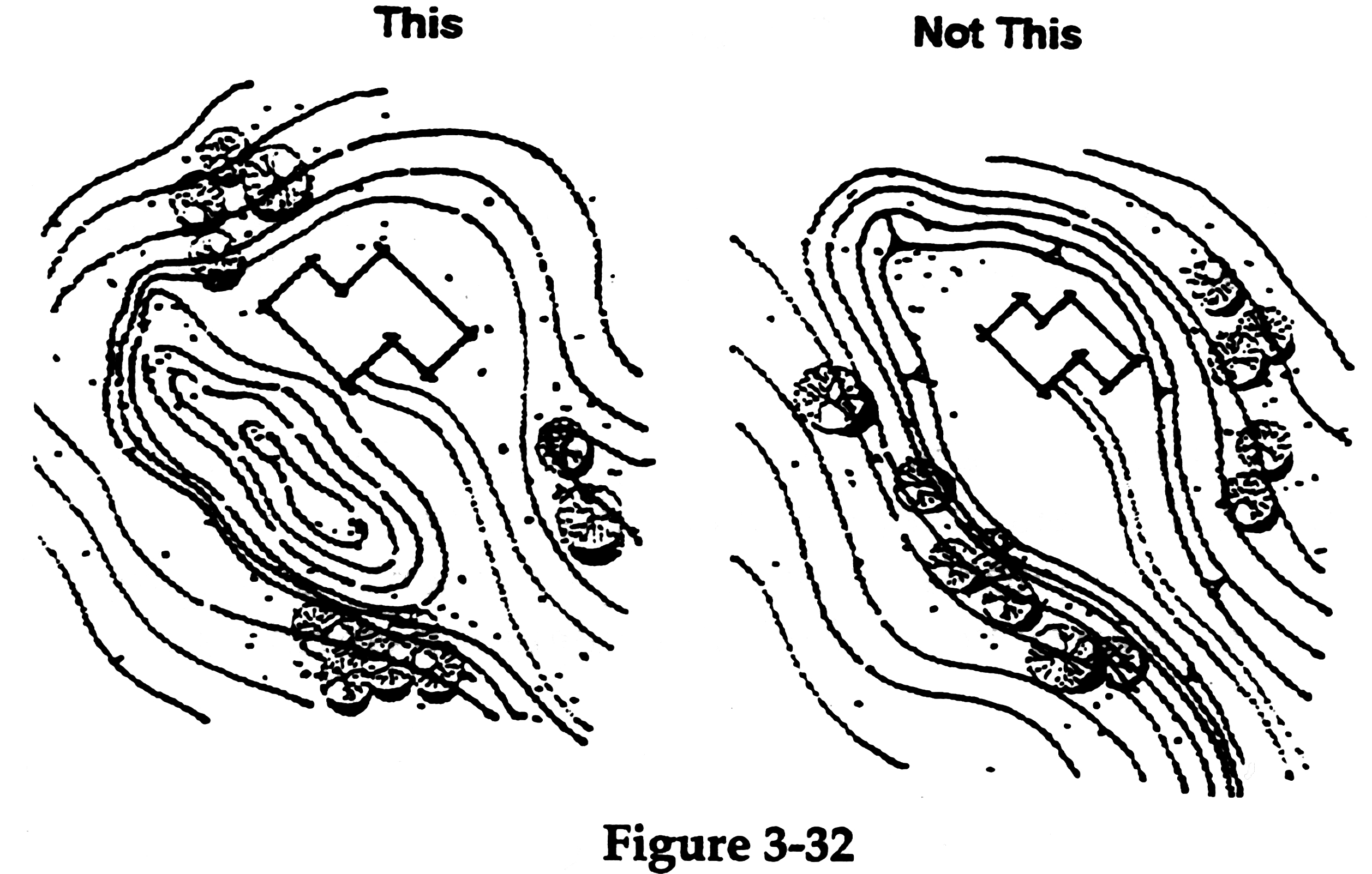
Figure 3-32
(2)
Views of significant visual features as seen from both within and outside a hillside development should be preserved. The following provisions shall be taken into consideration:
a.
Dwellings should be oriented to allow view opportunities, even if views are limited. Residential privacy should not be unreasonably sacrificed.
b.
Any significant public vista or view corridor as seen from a secondary, collector, or major arterial should be protected and enhanced where feasible.
c.
Over-emphasized vertical structures disrupt the natural silhouette of the hillside. Structures should fall below the top of ridge elevation. (Figure 3-33)
(3)
Projects should incorporate variable setbacks, multiple orientations, and other site planning techniques to preserve open spaces, protect natural features, and offer views to residents.
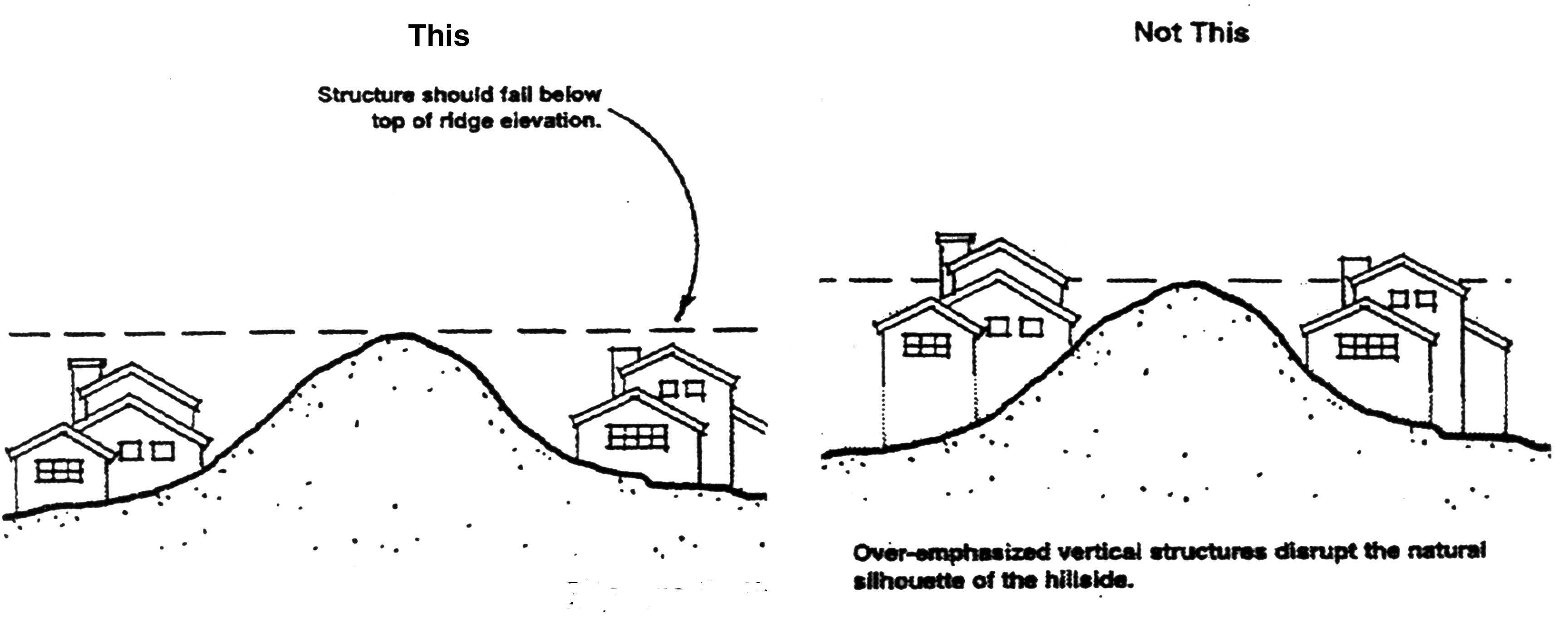
Figure 3-33
(Ord. No. 02(1998), § 2, 11-3-98)
Sec. 22.22.120. - Architecture.
(a)
Architecture standards.
(1)
The maximum structure height shall be 35 feet as measured from finished grade at the front setback, extending towards the rear of the parcel. The maximum height at the side setback shall be 25 feet extending up to the center of the lot at a 45 degree angle to a maximum height of 35 feet as measured from finished grade. (Figure 3-34)
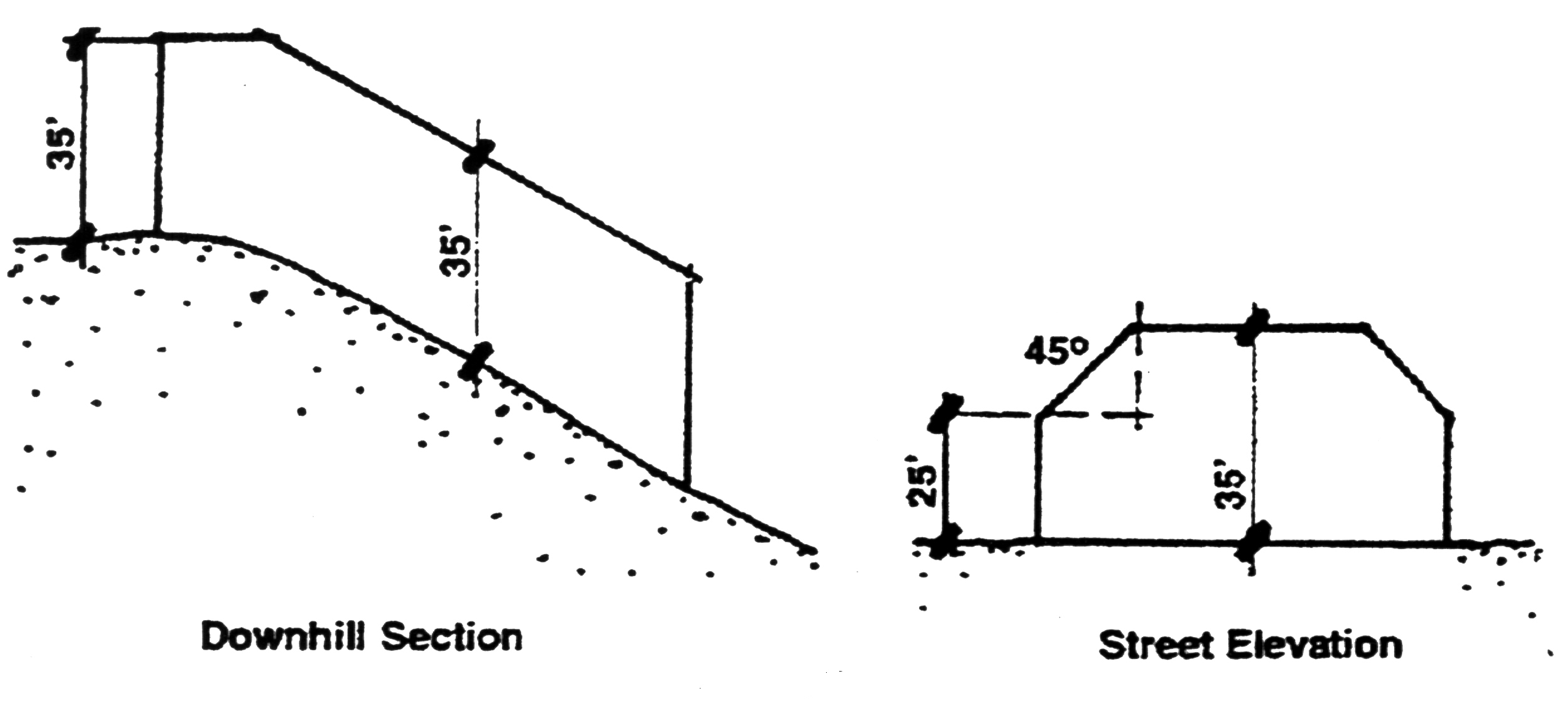
Figure 3-34
(2)
Structures shall be terraced to follow the natural slope.
(3)
Architectural treatment shall be provided to all sides of the structure visible from a public street.
(4)
Exterior structural supports and undersides of floors and decks not enclosed by walls shall be permitted provided fire safety and aesthetic considerations have been adequately addressed.
(5)
Exterior flood lighting for safety shall be located and shielded so as not to shine on adjacent properties. Decorative lighting to highlight a structure is allowed when properly shielded.
(b)
Architecture guidelines.
(1)
The form, mass, and profile of the individual structures and architectural features should be designed to blend with the natural terrain and preserve the character and profile of the natural slope. Some techniques that should be considered include: (Figure 3-35)
a.
Split pads, stepped footings, and grade separations to permit structures to step up the natural slope.
b.
Detaching parts of a dwelling (e.g., garage).
c.
Avoid the use of gable ends on downhill elevations. The slope of the roof should be oriented in the same direction as the natural slope and should not exceed natural slope contour by 20 percent.
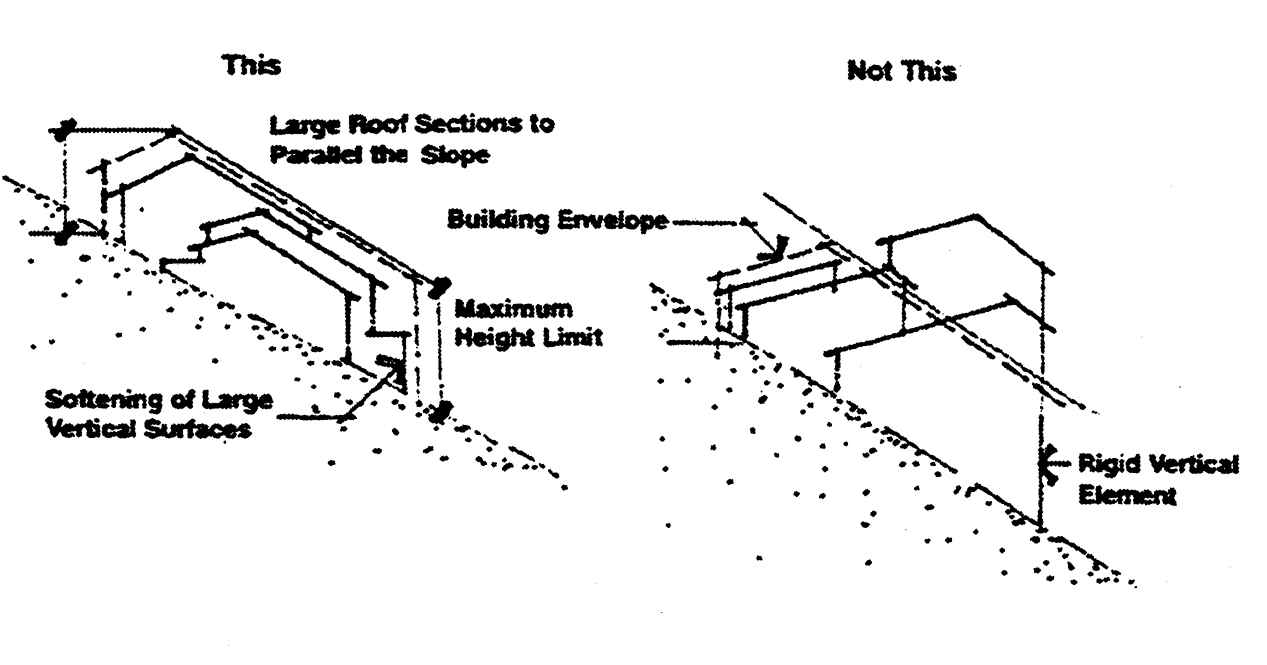
Figure 3-35
(2)
Avoid excessive cantilevers on downhill elevations.
(3)
Excavate underground or utilize below grade rooms to reduce effective bulk and to provide energy efficient and environmentally desirable spaces. However, the visible area of the structure shall be minimized through a combined use of regrading and landscaping techniques.
(4)
Use roofs on lower levels for open space decks for upper levels. (Figure 3-36)
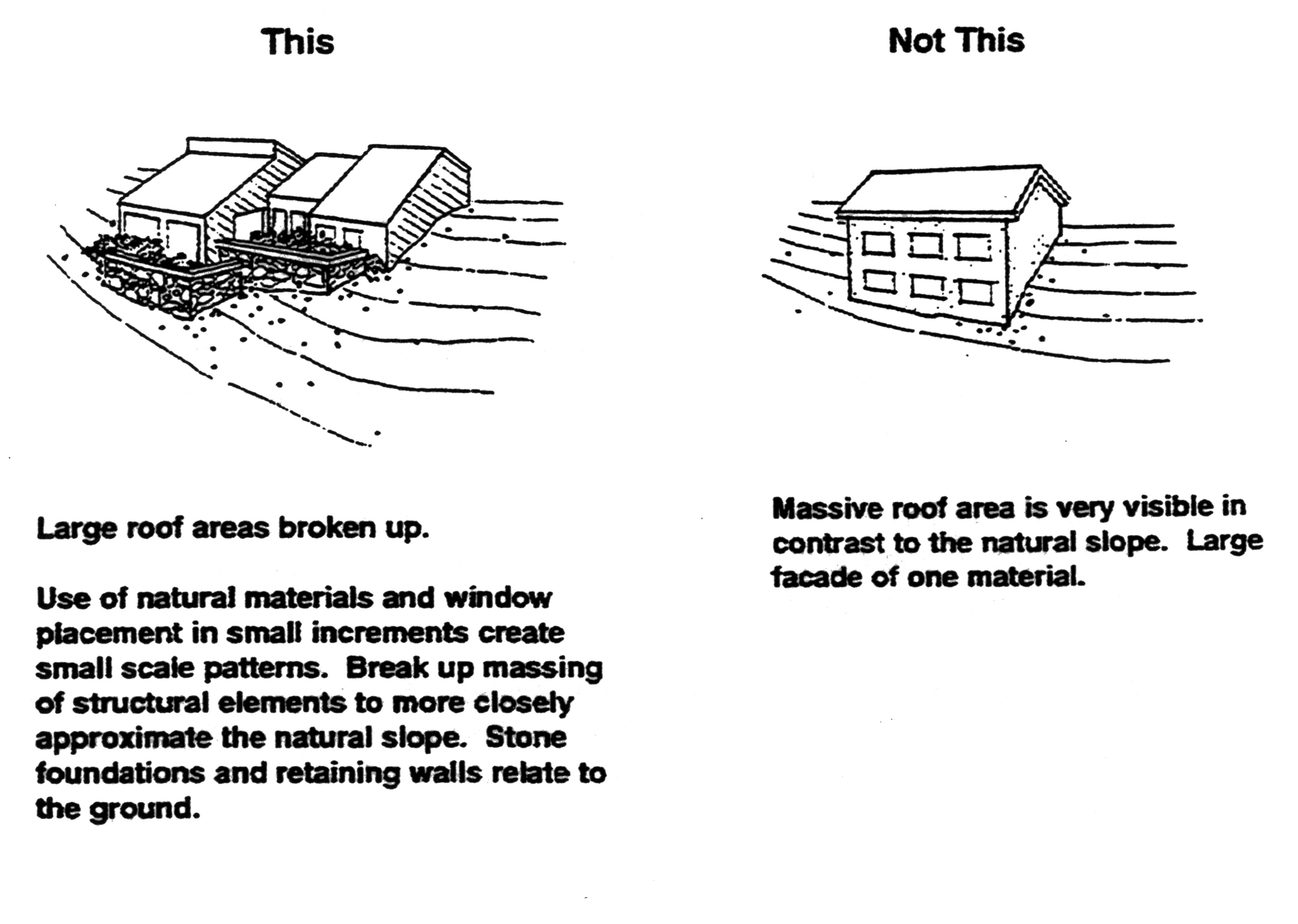
Figure 3-36
(5)
Use building materials and color schemes that blend with the natural landscape of earth tones and natural chaparral vegetative growth.
(6)
Minimize the width of a structure measured in the direction of the slope to limit the amount of cutting and filling and to better "fit" the structure to the natural terrain. (Figure 3-37)
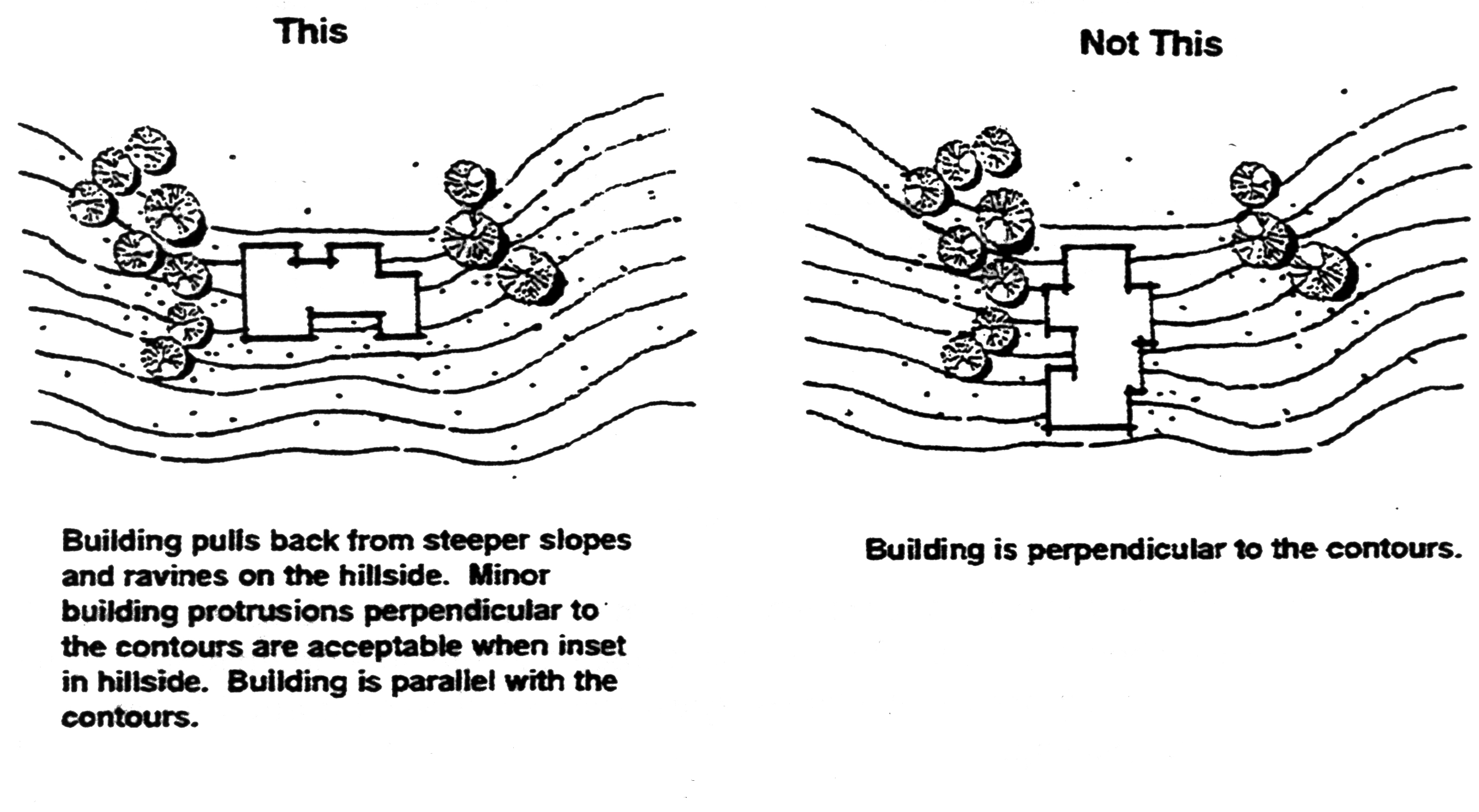
Figure 3-37
(Ord. No. 02(2001), § 20, 11-6-01; Ord. No. 04(2012), § 8, 4-17-12)
Sec. 22.22.130. - Fences and landscaping.
(a)
Fences and landscaping standards.
(1)
Walls and fencing, not exceeding six feet in height, visible from roadways or public rights-of-way shall be visually open and non-opaque. The director may waive this requirement for noise impacted sites.
(2)
Privacy walls and fences, not exceeding six feet in height, are allowed adjacent to structures, in order to provide private outdoor areas. Walls and fences shall use materials and colors compatible with the structure's facade.
(3)
Native or naturalized plants or other plant species that blend with the landscape shall be utilized in all areas with required planting in compliance with section 22.24.050 (Landscape standards).
(4)
Fire retardant plant materials shall be utilized in compliance with section 22.22.140 (Fire protection standards). Plants selected as ground cover, shrubs, or trees shall be from a list approved by the city.
(5)
A permanent landscape and irrigation system, for purposes of establishing and maintaining required planting, shall be installed on all slopes. The emphasis shall be toward using plant materials that will eventually need minimal irrigation. Water and energy conservation techniques shall be utilized, including drip irrigation, reclaimed water, and Xeriscape.
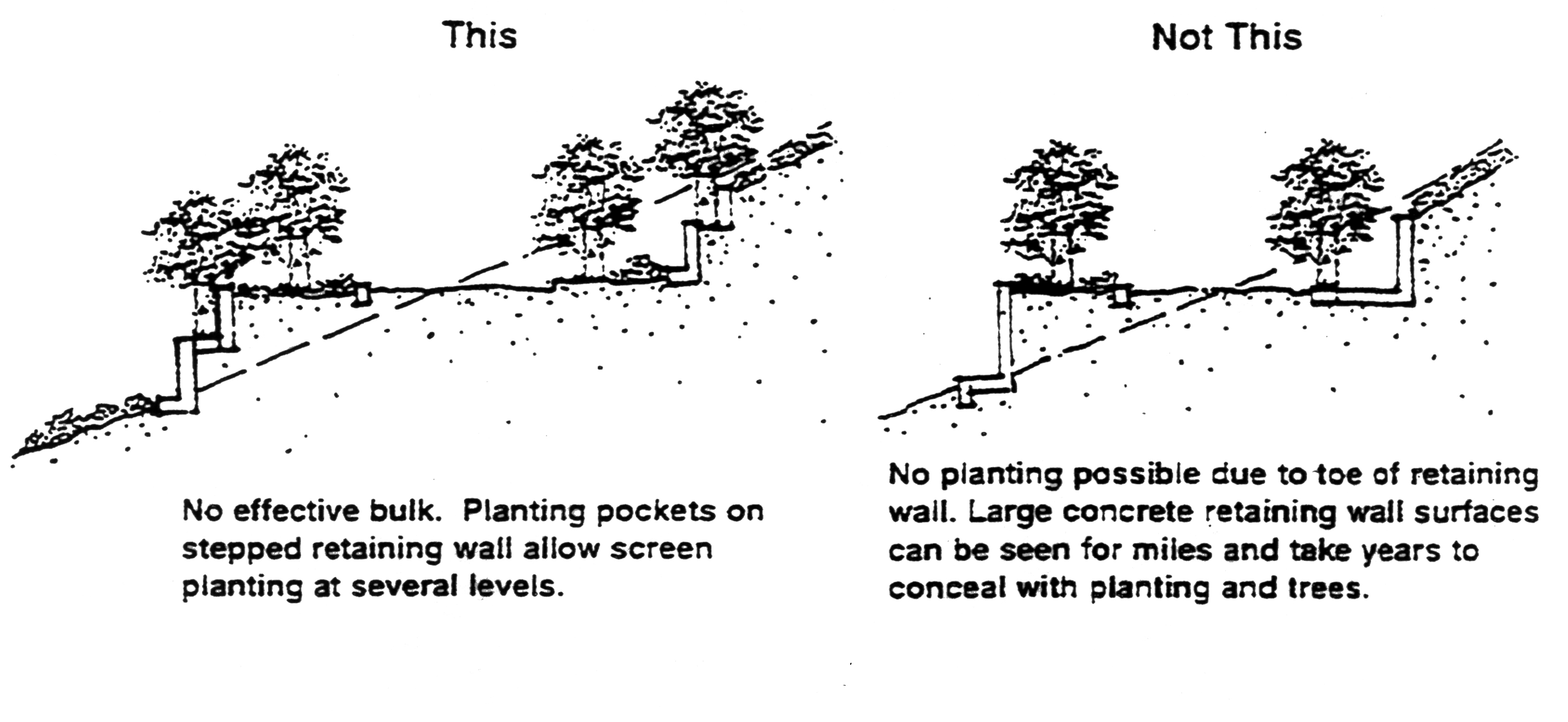
Figure 3-38
(6)
Landscaping shall be used to screen views of down slope building elevations. When the structure height exceeds 20 feet from finished grade on a down slope, additional landscaping is required and a landscaping plan shall be submitted for review with the submittal package.
(7)
Slopes with required planting shall be planted with informal clusters of trees and shrubs to soften and vary the slope plane. Where required by the city, jute netting shall be used to help stabilize planting and minimize soil erosion.
(8)
Native vegetation shall be retained and supplemented within undeveloped canyons and along natural drainage courses as allowed by state and federal resources agencies (State Department of Fish & Game, U.S. Fish and Wildlife, U.S. Army Corps of Engineers).
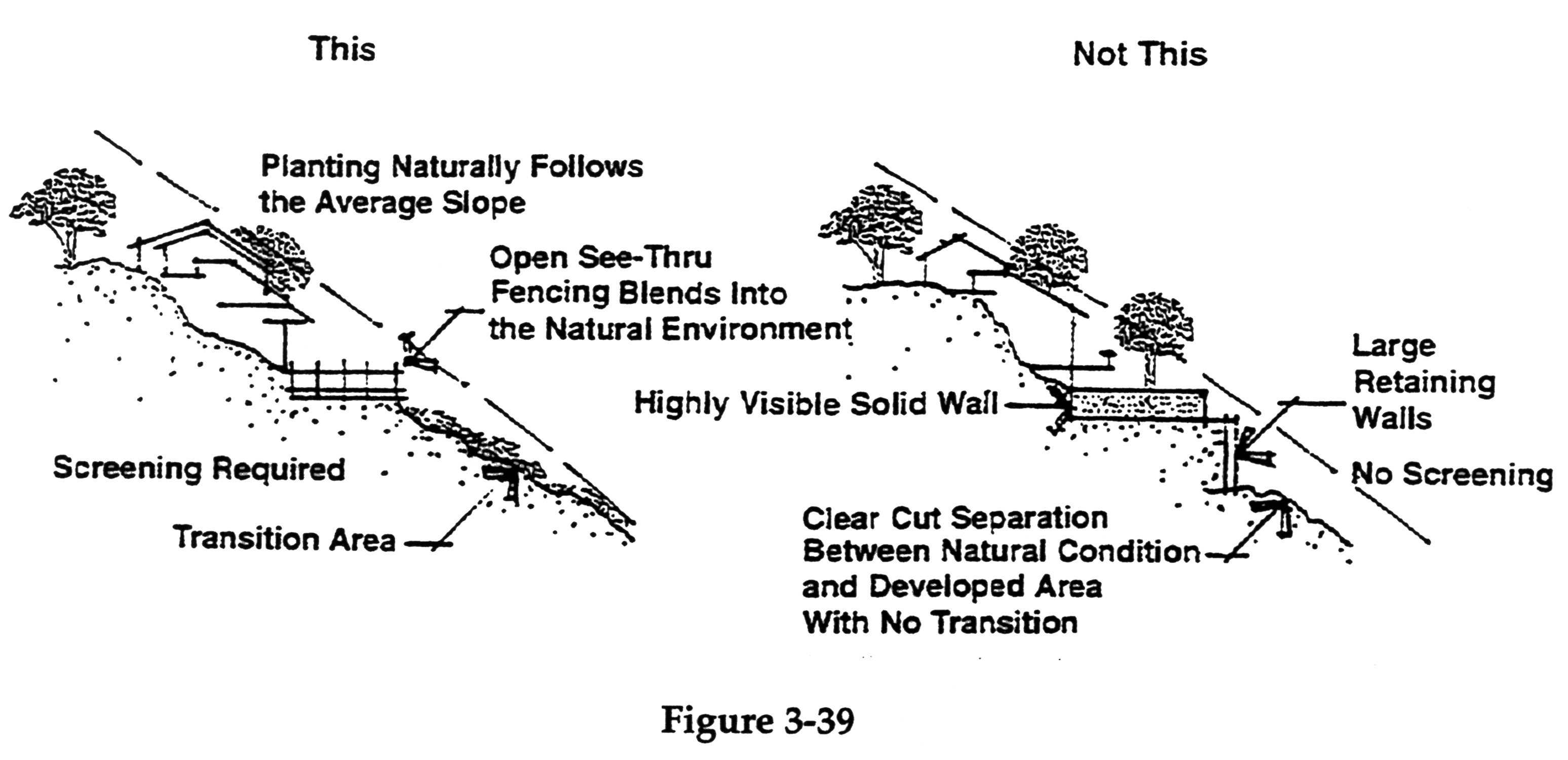
Figure 3-39
(b)
Fencing and landscaping guidelines.
(1)
Use natural landform planting to soften manufactured slopes, reduce impact of development on steep slopes or ridgelines, and provide erosion control.
(2)
Maintain a revegetative backdrop by replanting with approved trees. The vegetation should reduce the impact of the structures to the extent possible at maturity and preserve the appearance of the natural hillside.
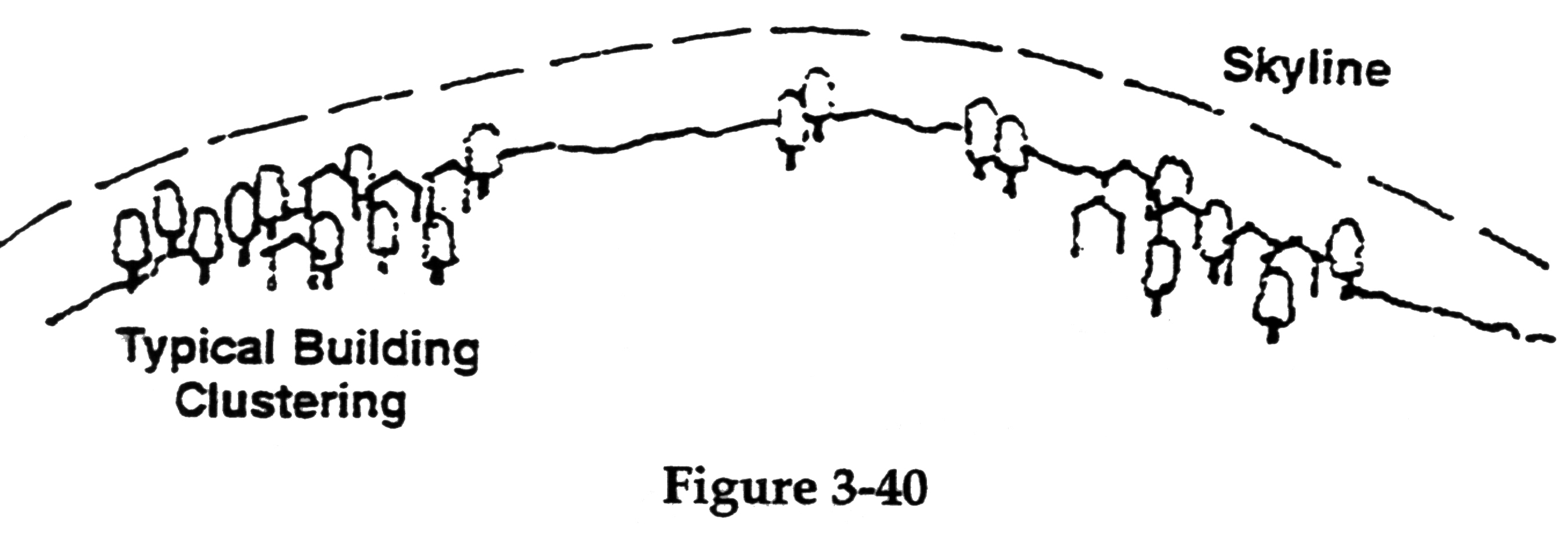
Figure 3-40
(3)
Use landform grading to replicate the irregular shapes of natural slopes resulting in aesthetically pleasing elevations and profiles. Landform-graded slopes are characterized by continuous series of concave and convex forms interspersed with mounds that blend into the profiles, not linear in plan view and varying slope gradients, and significant transition zones between man-made and natural slopes. Resultant pad configurations are irregular. (Figures 3-13 and 3-14)
(4)
Slope down-drain devices should be designed to either follow "natural" lines of the slopes or are tucked away in special swale and berm combinations in order to conceal the drains from view. Exposed segments in high visibility areas should be treated with natural rock.
(5)
Landscaping should become a "revegetation" process and be applied in patterns that occur in nature: Trees and shrubs are concentrated largely in concave areas, while convex portions are planted mainly with groundcovers. (Figure 3-42)
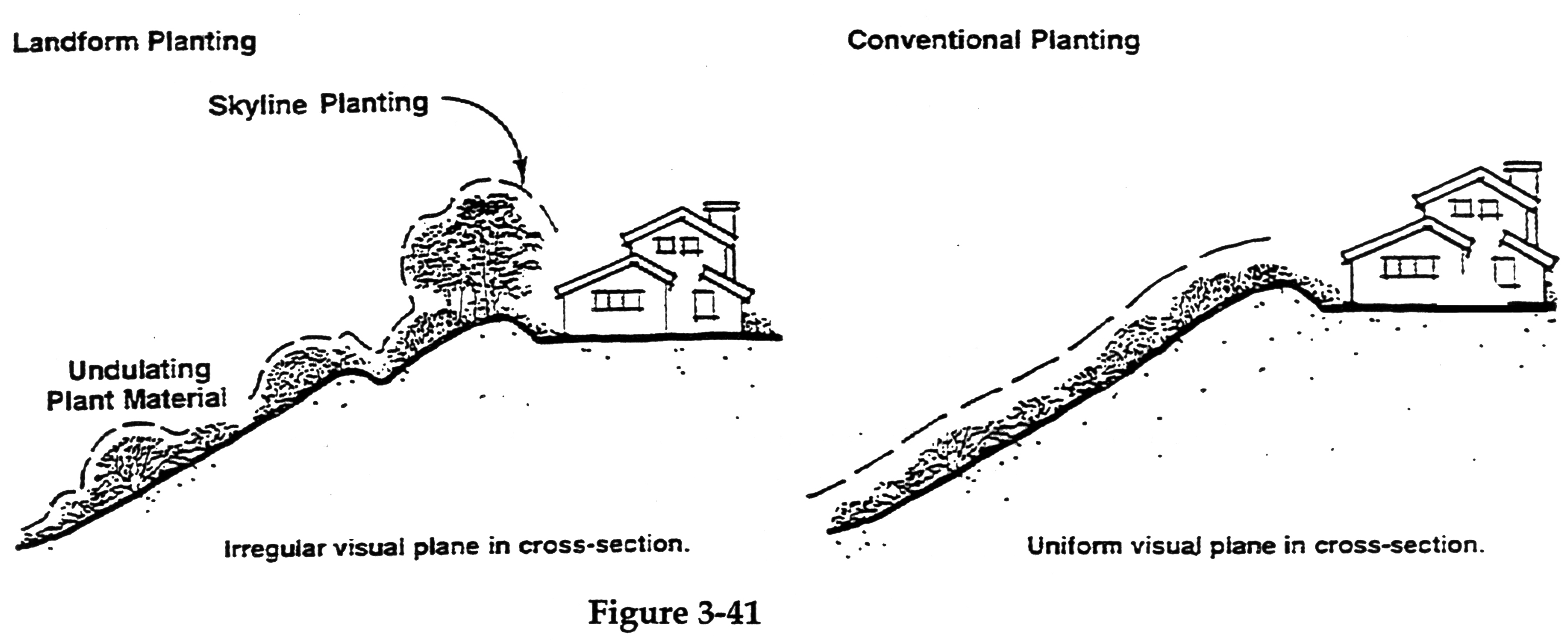
Figure 3-41
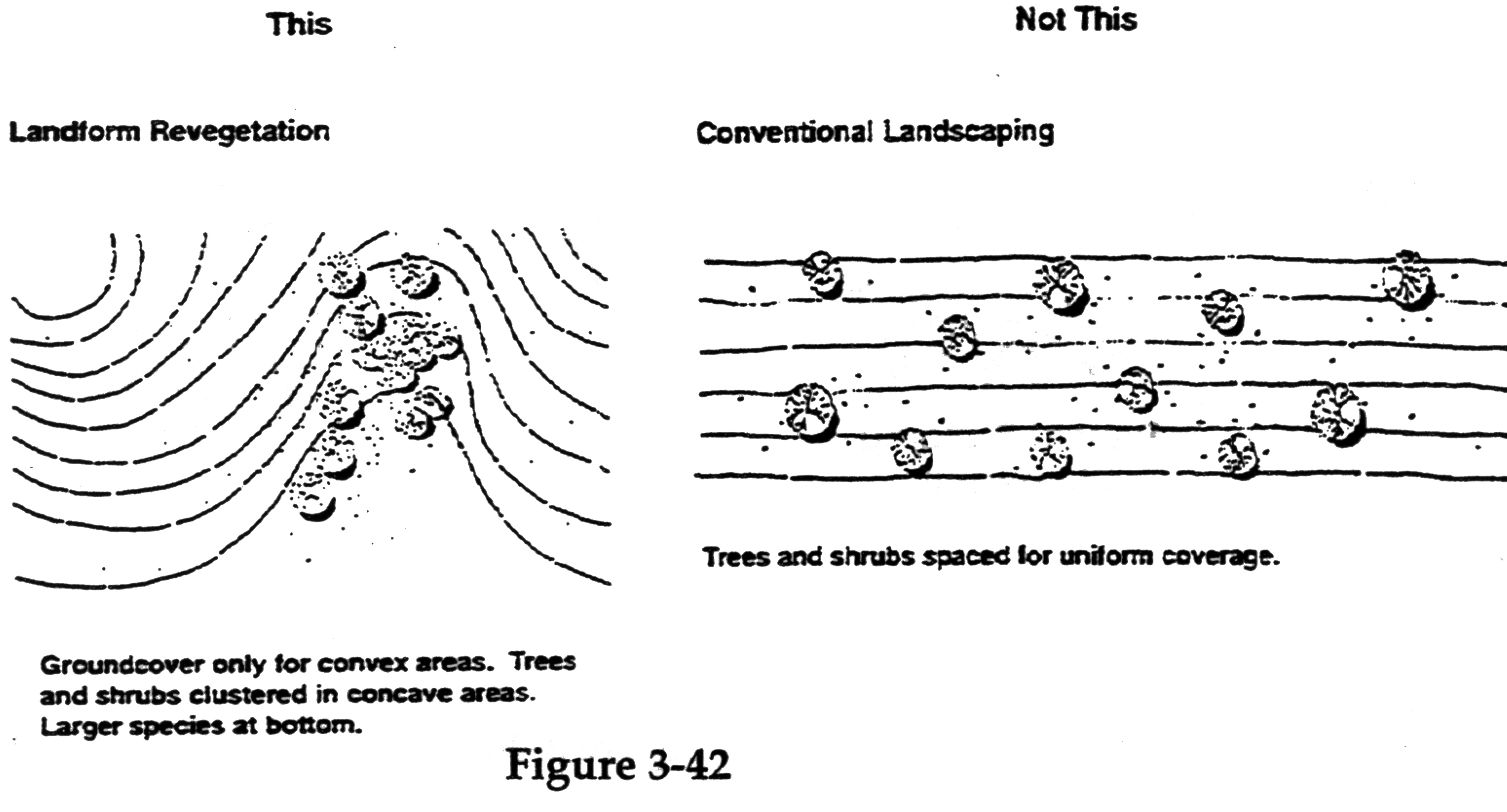
Figure 3-42
(Ord. No. 02(1998), § 2, 11-3-98)
Sec. 22.22.140. - Fire protection standards.
(a)
Development shall be constructed to reduce the potential for spread of brushfire.
(1)
In the case of a conflict, where more restrictive provisions are contained in the Uniform Building Code or in the fire code, the more restrictive provisions shall prevail.
(2)
Roofs shall be covered with noncombustible materials as defined in the building code. Open eave ends shall be stopped in order to prevent bird nests or other combustible material lodging within the roof and to preclude entry of flames.
(3)
Exterior walls shall be surfaced with noncombustible or fire-resistant materials.
(4)
Balconies, patio roofs, eaves and other similar overhangs shall be of noncombustible construction or shall be protected by fire-resistant material in compliance with the building code.
(b)
All development shall be constructed with adequate water supply and pressure for all proposed development in compliance with standards established by the fire marshal.
(c)
A permanent fuel modification area shall be required around development projects or portions thereof that are adjacent or exposed to hazardous fire areas for the purpose of fire protection. The required width of the fuel modification area shall be based on applicable building and fire codes and a fire hazard analysis study developed by the fire marshal.
In the event abatement is not performed, the council may instruct the fire marshal to give notice to the owner of the property upon which the condition exists to correct the prohibited condition. If the owner fails to correct the condition, the council may cause the abatement to be performed and make the expense of the correction a lien on the property upon which the conditions exist.
(d)
Fuel modification areas shall incorporate soil erosion and sediment control measures to alleviate permanent scarring and accelerated erosion.
(e)
If the fire marshal determines in any specific case that difficult terrain, danger of erosion, or other unusual circumstances make strict compliance with the clearance of vegetation undesirable or impractical, the fire marshal may suspend enforcement and require reasonable alternative measures designed to advance the purposes of this chapter.
(f)
Special construction features may be required in the design of structures where site investigations confirm potential geologic hazards.
(Ord. No. 02(1998), § 2, 11-3-98)
Sec. 22.22.150. - Evaluation of development review application.
The commission shall evaluate a development review application for hillside development based on the following objectives and the required findings in compliance with chapter 22.48 (development review).
(1)
The preservation of natural topographic features and appearances by means of landform grading so as to blend man-made or manufactured slopes into the natural topography;
(2)
The preservation of natural topographic features and appearances through restrictions on successive padding and terracing of building sites;
(3)
The retention of major natural topographic features, drainage courses, steep slopes, watershed areas, vernal pools, view corridors, and scenic vistas;
(4)
The preservation and enhancement of prominent landmark features, significant ridgelines, natural rock outcroppings, protected trees and woodlands (chapter 22.38, Tree Preservation and Protection), and other areas of special natural beauty;
(5)
The utilization of varying setbacks, building heights, foundation designs and compatible building forms, materials, and colors which serve to blend buildings into the terrain;
(6)
The utilization of clustered sites and buildings on more gently sloping terrain so as to reduce grading alterations on steeper slopes;
(7)
The utilization of building designs, locations, and arrangements which serve to avoid a continuous intrusive skyline effect and which afford view privacy and protection;
(8)
The preservation and introduction of plant materials so as to protect slopes from soil erosion and slippage and minimize the visual effects of grading and construction of hillside areas; and
(9)
The utilization of street designs and improvements which serve to minimize grading alterations and harmonize with the natural contours and character of the hillsides.
(Ord. No. 02(1998), § 2, 11-3-98; Ord. No. 06(2013), § 3(Exh. A), 9-3-13; Ord. No. 07(2013), § 3(Exh. A), 9-17-13)
Sec. 22.24.010.- Purpose.
The purpose of this chapter is to achieve the following:
(1)
Enhance the aesthetic appearance of development throughout the city by providing standards related to the quality and functional aspects of landscaping;
(2)
Increase compatibility between abutting land uses and public rights-of-way by providing landscape screening and buffers;
(3)
Provide for the conservation of water resources through the efficient use of irrigation, appropriate plant materials, and regular maintenance of landscaped areas; and
(4)
Protect public health, safety, and welfare by preserving and enhancing the positive visual experience of the built environment, providing appropriate transition between different land uses, preserving neighborhood character, and enhancing pedestrian and vehicular traffic and safety.
(Ord. No. 02(1998), § 2, 11-3-98)
Sec. 22.24.020. - Applicability.
(a)
All projects that require approval of either an administrative land use permit or a discretionary land use permit shall provide and maintain landscaping in compliance with the provisions of this chapter. Standards for the provision of landscaping within the public right-of-way in conjunction with a development project are located in title 21, chapter 21.30 (Subdivision Design and Improvement Standards).
(b)
Landscape plans, and plans for the ornamental use of water, including but not limited to lakes, ponds and fountains, shall be submitted to the department for review for compliance with the requirements of this chapter. Landscaping shall not be installed until the applicant receives approval of the final landscape plan. Changes to the approved landscape plans that affect the character or quantity of the plant material or irrigation system design are required to be resubmitted for approval prior to installation.
(Ord. No. 02(1998), § 2, 11-3-98)
Sec. 22.24.030. - Landscape plan requirements.
(a)
Preliminary landscape plan. A preliminary landscape plan shall be submitted as part of an application for a land use entitlement, for new development, and the significant expansion or redevelopment of an existing use as determined by the director.
(b)
Final landscape plan. Following approval of the land use entitlement, a final landscape plan shall be submitted as part of the application for a building permit. Final plans shall be approved by the director prior to the start of on-site construction or soil disturbance and prior to the issuance of a building permit. Projects requiring commission approval due to their size or use shall require plans be prepared by a licensed landscape architect or licensed contractor. Evidence shall also be provided that a licensed landscape contractor will be responsible for plant and irrigation installation.
(c)
Content. Preliminary landscape plans and final landscape plans shall contain information as specified in the instructions for preparing landscape plans, provided by the department.
(d)
Review and approval. After initial application, the director shall review each preliminary landscape plan and final landscape plan to verify its compliance with the provisions of this chapter.
(e)
Statement of surety. When required by the director, a statement of surety in the form of cash, performance bond, letter of credit, or certificate of deposit, in an amount equal to 120 percent of the total value of all plant materials, irrigation, installation, and maintenance shall be posted with the city for a two-year period. The director may require statements of surety for phased development projects, a legitimate delay in landscape installation due to seasonal requirements (including adverse weather conditions) and similar circumstances where it may not be advisable or desirable to install all of a project's landscaping before occupancy of the site. Statements of surety may also be required by the director in conjunction with the approval of a tree removal permit in compliance with section 22.38.050 (Tree removal permit and tree pruning permit).
(Ord. No. 02(1998), § 2, 11-3-98)
Sec. 22.24.040. - Landscape area requirements.
Landscaping shall be provided in the locations and amounts specified in this chapter.
(1)
General requirements. Landscaping shall be provided as follows:
a.
Setbacks. All setback and open space areas required by this Development Code shall be landscaped, except where a required setback is occupied by a sidewalk or driveway or where a required setback is screened from public view and it is determined by the director that landscaping is not necessary to fulfill the purposes of this chapter.
b.
Unused areas. All areas of a project site not intended for a specific use shall be landscaped unless it is determined by the director that landscaping is not necessary to fulfill the purposes of this chapter. Vacant pad sites within a shopping center that are to be developed in the future shall be landscaped to control dust and improve the appearance of the site.
c.
Parking areas. Parking areas shall be landscaped as required by chapter 22.30 (Off-Street Parking and Loading Standards). Parking lot landscaping, including perimeter screening, shall not be included to meet the landscape requirements of this chapter.
d.
Pools and patios. The surface area of a permanent swimming pool or spa or uncovered patio may be included to meet open space requirements for multifamily uses.
(2)
Specific zone landscaping requirements. Each development shall provide and maintain landscaped areas in compliance with Table 3-6 for the applicable zoning district. Landscaped areas are in addition to the landscaping required by subsection (1), above, and in addition to any pedestrian-oriented open space (e.g., plazas, courtyards, etc.). Additional landscaping may be required through the development review process to provide visual relief or contrast, or to screen incompatible features.
All required landscaping, irrigation, and equipment shall be installed prior to final inspection unless a bond or other surety is provided in compliance with section 22.24.030(e) (Statement of surety).
(3)
New single-family residences. New single-family developments shall provide landscaping with an automatic irrigation system for the area of the site between the street curb and the front of the structure from side property line to side property line. The landscape design shall include trees, shrubs, and ground cover and shall emphasize water-conserving plant materials and irrigation to the greatest extent feasible. Turf areas shall be limited to 50 percent of the total landscaped area. Common hillside slope areas shall be landscaped in compliance with chapter 22.22 (Hillside Management).
TABLE 3-6
MINIMUM LANDSCAPED AREA BY ZONING DISTRICT
(Ord. No. 02(1998), § 2, 11-3-98)
Sec. 22.24.050. - Landscape standards.
Landscape areas and materials shall be designed, installed, and maintained as provided by this section.
(1)
General design standards. The following features shall be incorporated into the design of the proposed landscape and shown on required landscape plans:
a.
Landscaping shall be planned as an integral part of the overall project design and not simply located in excess space after parking areas and structures have been planned;
b.
Pedestrian access to sidewalks or structures should be considered in the design of all landscaped areas;
c.
Landscape planting shall be provided for all adjacent public rights-of-way, in compliance with title 21, chapter 21.30 (Subdivision Design and Improvement Standards);
d.
Landscaping shall be provided throughout parking areas in compliance with chapter 22.30 (Off-Street Parking and Loading Standards);
e.
Landscaping adjacent to driveways and parking shall be protected from vehicle damage through the provision of minimum six-inch high concrete curbs or other types of barriers as approved by the director;
f.
Landscaped planter areas shall have a minimum inside width of five feet where trees are provided and three feet where turf or shrubs are provided;
g.
Landscaped areas shall be irrigated in compliance with subsection (3) below;
h.
Hardscaped areas shall be kept to the minimum required to provide efficient pedestrian circulation through a required landscaped area; and
i.
Where walls or fences are provided as required screening, a minimum ten-foot wide landscaped area shall be located on the residential side. If the commercial side of the wall or fence is visible from a street or adjacent property, a five-foot wide landscaped area shall be provided adjacent to the wall or fence. If adjacent to a parking area, that area may be counted towards required interior parking lot landscaping.
(2)
Plant materials. Plant materials shall be selected and installed to comply with the following requirements:
a.
A mix of plant materials shall be provided in compliance with Table 3-7. Calculations documenting the required mix shall be shown on the landscape plan;
TABLE 3-7
REQUIRED MIX OF PLANT MATERIALS
* Not to be used for compliance with chapter 22.38 (Tree Preservation and Protection)
b.
Plant materials shall emphasize drought-tolerant and/or native species in compliance with subsection (4) (Water conservation), below;
c.
Trees and shrubs shall be planted so that at maturity they do not interfere with service lines and traffic safety sight areas;
d.
Trees planted near public sidewalks or curbs shall be of a species and installed in a manner which prevents physical damage to sidewalks, curbs, gutters and other public improvements;
e.
Ground cover shall be of live plant material. Gravel, colored rock, bark, and similar materials may be used in combination with a living ground cover. Nonplant materials may be approved for use in limited areas through the development review process (chapter 22.48); and
f.
If existing landscaping is to be retained, a note shall be provided on the plan stating that "any existing landscaping indicated on the approved landscape plan for retention that is damaged or removed during construction shall be repaired or replaced subject to the approval of the director."
g.
Incorporate drought-tolerant deciduous vines, trellises, and canopies to shade south and westward facing walls, to cool them in summer months.
h.
Locate trees and hedges planted close to buildings so as to channel beneficial cooling breezes through openings.
(3)
Irrigation. Landscaped areas shall be supported by a permanent, automatic irrigation system coordinated to meet the needs of various planting areas and in compliance with the following standards:
a.
Equipment.
1.
Anti-drain valves. Integral, under the head, or in-line anti-drain valves shall be installed as needed to prevent low head drainage.
2.
Automatic control valves. Different hydrozones shall be irrigated by separate valves.
3.
Controllers. Automatic control systems shall be required for all irrigation systems and must be able to accommodate all aspects of the design. Automatic controllers shall be digital, have multiple programs, multiple cycles, and have sensor input capabilities.
4.
Rain/moisture sensor devices. Rain or moisture sensing override devices may be required where appropriate.
5.
Sprinkler heads. Sprinkler heads shall be selected for proper area coverage, application rate, operating pressure, and adjustment capability. Sprinklers shall have matched precipitation/application rates within each control valve circuit.
6.
Water meters. Separate landscape water meters or submeters may be required for projects where service includes both landscape and nonlandscape. Landscape submeters, if used, shall be purchased, installed and maintained by the owner.
7.
Drip irrigation. Drip irrigation systems may be approved if commercial or agricultural grade materials are used. Components shall be installed below the soil except for emitters.
b.
Runoff and overspray. Irrigation systems shall be designed to avoid runoff, low head drainage, overspray or other similar conditions where water flows or drifts onto adjacent property, nonirrigated areas, walks, roadways or structures.
(Ord. No. 02(1998), § 2, 11-3-98)
Sec. 22.24.060. - Waiver or modification of requirements.
(a)
Director to approve. The director may approve waivers from or modifications to the requirements of this chapter limited to the following:
(1)
Minor modifications to approved landscaping or irrigation plans that comply with the spirit and intent of these regulations, including, but not limited to, revising or substituting plant varieties, container sizes, plant locations, irrigation specifications, hardscape components, berm heights, berm locations, slope features, and similar changes;
(2)
Modifications of planting, installation and/or soil preparation details; and
(3)
Occupancy of structures prior to installation of landscaping due to exceptional and unforeseen circumstances when a bond or other surety is provided in compliance with section 22.24.030(e) (Statement of surety).
(b)
Conditions for waivers. In granting a waiver, the director may impose conditions as deemed necessary to comply with the spirit and intent of these regulations.
(Ord. No. 02(1998), § 2, 11-3-98)
Sec. 22.26.010.- Purpose.
These regulations are established in order to provide minimum standards and guidelines for the design and installation of landscaping and irrigation systems within specified development projects. The primary intent is to enhance the visual quality of the environment through suitable landscape design, planting and maintenance, and therefore to recognize and encourage water conservation principles and techniques in landscaping.
(Ord. No. 02(1998), § 2, 11-3-98)
Sec. 22.26.020. - Applicability.
These regulations apply to new and rehabilitated landscaping in conjunction with a development project, for which landscaping is required, with the following exceptions:
(1)
Homeowner-provided landscaping at single-family and residential projects;
(2)
Cemeteries;
(3)
Historical sites registered with the city;
(4)
Ecological restoration projects that do not require a permanent irrigation system;
(5)
Public land or a publicly owned facility;
(6)
Projects with a landscaped area less than 2,500 square feet;
(7)
School play yards;
(8)
Child care facility play yards; and
(9)
Golf courses.
(Ord. No. 02(1998), § 2, 11-3-98)
Sec. 22.26.030. - Landscape documentation.
(a)
Submittal required. A landscape documentation package in compliance with section 22.26.040 below shall be submitted. No building permit or land use permit shall be issued until the director reviews and approves the landscape documentation package.
(b)
Copy of package to be provided. A copy of the approved landscape documentation package shall be provided to the property owner or site manager along with the record drawings and other related information.
(c)
Elements to be included. Each landscape documentation package shall include the following elements:
(1)
Landscape design plan;
(2)
Irrigation design plan;
(3)
Certificate of substantial completion (to be submitted after installation of the project); and
(4)
Other information as deemed necessary by the director, including but not limited to, a grading design plan and/or soil analysis.
(Ord. No. 02(1998), § 2, 11-3-98)
Sec. 22.26.040. - Elements of landscape documentation package.
(a)
Landscape design plan. A landscape design plan meeting the following requirements shall be submitted as part of the landscape documentation package:
(1)
Plant selection and grouping.
a.
Plants having similar water use shall be grouped together in distinct hydrozones.
b.
Plants shall be selected appropriately based upon their adaptability to the climatic, geological, and topographical conditions of the site. Protection and preservation of native species and natural areas is required in compliance with chapter 22.38 (Tree Preservation) and chapter 22.22 (Hillside Management).
c.
A list of recommended planting materials shall be kept on file with the department and made available upon request. Alternative materials may be used when the overall landscape plan conforms with the intent of this chapter.
d.
Fire prevention needs shall be addressed in areas that are fire prone.
e.
Overall, the landscape design plan shall provide for a water efficient landscape concept.
f.
Where possible, the use of mulch is encouraged in landscape areas to improve the water-holding capacity of the soil by reducing evaporation and soil compaction.
(2)
Water features.
a.
Recirculating water shall be used for decorative water features.
b.
Pool and spa covers are encouraged.
(3)
Landscape design plan requirements. The landscape design plan shall be drawn on project base sheets at a scale that accurately and clearly identifies the following:
a.
Designation of hydrozones and a description of water usage within each hydrozone (i.e., low, moderate, and high irrigation water requirements);
b.
Landscape materials, trees, shrubs, groundcover, turf, and other vegetation. Planting symbols shall be clearly drawn. Plants shall be labeled by botanical name, common name, container size, spacing, and quantities of each group of plants indicated;
c.
Property lines and street names;
d.
Streets, driveways, walkways, and other paved areas;
e.
Pools, ponds, water features, fences and retaining walls;
f.
Existing and proposed structures, including pad elevations if applicable.
g.
Natural features including, but not limited to, rock outcroppings and existing trees and shrubs that will remain;
h.
Tree staking, plant installation, soil preparation details, and any other applicable planting and installation details;
i.
A calculation of the total landscaped area and percentage of turf area; and
j.
Designation of recreational areas.
(b)
Irrigation design plan. An irrigation design plan in compliance with the following requirements shall be submitted as part of the landscape documentation package:
(1)
Water efficiency. The irrigation design plan shall provide for a water efficient irrigation system.
(2)
Runoff and overspray. Soil types and infiltration rates shall be considered when designing irrigation systems. Irrigation systems shall be designed to avoid runoff, low head drainage, overspray, or other similar conditions. Appropriate irrigation equipment and schedules shall be used to closely match application rates to infiltration. Special attention shall be given to avoid runoff on slopes and overspray in narrow planting areas and median strips.
(3)
Equipment.
a.
Water meters. Separate landscape water meters are required for all projects except single-family homes and projects with a landscaped area less than 5,000 square feet.
b.
Controllers. Automatic controllers are required for all irrigation systems and shall be able to accommodate all aspects of the design.
c.
Valves. Plants that require different amounts of water shall be irrigated by separate valves. If one valve is used for a given area, only plants with similar water use shall be used in that area. Anti-drain (check) valves shall be installed at strategic points to minimize or prevent low-head drainage.
d.
Sprinkler heads. Heads and emitters shall have consistent application rates within each control valve circuit. Sprinkler heads shall be selected for proper area coverage, application rate, operating pressure, adjustment capability, and ease of maintenance.
e.
Rain-sensing override devices. Rain-sensing override devices are required on all irrigation systems.
f.
Soil moisture-sensing devices. Soil moisture-sensing devices shall be considered where appropriate.
(4)
Irrigation design plan specifications. The irrigation design plan shall be drawn on project base sheets. It shall be separate from, but use the same format as, the landscape design plan. The scale shall be the same as that used for the landscape design plan.
Irrigation systems shall be designed to be consistent with hydrozones. The irrigation design plan shall accurately and clearly identify the following:
a.
Location and size of separate landscape water meters;
b.
Location, type, and size of all components of the irrigation system including, but not limited to, automatic controllers, main and lateral lines, valves, sprinkler heads, moisture-sensing devices, rain switches, quick couplers, and backflow prevention devices;
c.
Static water pressure at the point of connection to the public water supply;
d.
Flow rate (gallons per minute), application rate (inches per hour), and design operating pressure (psi) for each station; and
e.
Estimated annual water use expressed in inches per square foot of landscape area per year.
(5)
Certificate of substantial completion. Prior to the issuance of a certificate of occupancy, the project proponent shall submit a certificate of substantial completion utilizing forms provided by the department. The certificate of substantial completion shall include results of a static water test and a water coverage test to determine the adequacy of the installed [system].
(Ord. No. 02(1998), § 2, 11-3-98)
Sec. 22.26.050. - Water efficient landscape criteria.
Landscape and irrigation plans shall be reviewed for compliance with the water efficient landscape criteria outlined below. These comprise a point system with points awarded for both landscape and irrigation techniques. A minimum of 100 points shall be achieved in each technique category in order for the director to approve the landscape and irrigation plans.
TABLE 3-8
WATER EFFICIENT LANDSCAPE CRITERIA
* This amount is based upon a formula established by the state department of water resources which states the maximum applied water budget for landscapes in the San Gabriel Valley region should be 80 percent of the annual evapotranspiration (53 inches per year). Therefore: 0.80 x 53 inches = 42 inches.
(Ord. No. 02(1998), § 2, 11-3-98)
Sec. 22.26.060. - Existing landscapes.
(a)
Water waste prohibited. Water waste resulting from inefficient landscape irrigation leading to excessive runoff, low head drainage, overspray, and other similar conditions where water flows onto adjacent property, nonirrigated areas, walks, roadways or structures is prohibited.
(b)
Maintenance required. Landscape areas shall be maintained in a healthful and sound condition. Irrigation systems and their components shall be maintained in a fully functional manner consistent with the originally approved design and the provisions of these regulations.
(c)
Maintenance schedule. Landscapes shall be maintained to ensure water efficiency. A regular maintenance schedule shall include, but not be limited to, checking, adjusting, and repairing irrigation equipment; resetting the automatic controller; aerating and dethatching turf areas; replenishing mulch; fertilizing; pruning; and weeding in all landscaped areas.
(Ord. No. 02(1998), § 2, 11-3-98)
Sec. 22.26.070. - Public education.
(a)
Developers of residential units shall provide information to prospective buyers of new homes regarding water efficient landscaping techniques.
(b)
Developers of nonresidential units shall provide information to prospective buyers or tenants regarding water efficient landscaping techniques.
(Ord. No. 02(1998), § 2, 11-3-98)
Sec. 22.28.010.- Purpose.
The purpose of this chapter is to establish standards in order to protect the health, safety, welfare, and living/working environments of those living and working in the city.
(Ord. No. 02(1998), § 2, 11-3-98)
Sec. 22.28.020. - Declaration of policy.
Excessive noise levels are detrimental to the health and safety of individuals. Noise is considered a public nuisance and the city discourages unnecessary, excessive or annoying noises from all sources. Creating, maintaining, causing or allowing to be created, caused or maintained any noise or vibration in a manner prohibited by the provisions of this chapter is a public nuisance and shall be punishable as a misdemeanor.
(Ord. No. 02(1998), § 2, 11-3-98)
Sec. 22.28.030. - Enforcement of regulations.
The director shall have responsibility for the enforcement of the noise regulations contained in this chapter. The director shall make all noise level measurements required for the enforcement of this chapter.
(Ord. No. 02(1998), § 2, 11-3-98)
Sec. 22.28.040. - Initial violations.
In the event of an initial violation of the provisions of this chapter, a written notice of violation shall be given the alleged violator, specifying the time by which the condition shall be corrected or an application for permit or variance shall be filed. No further action shall be taken if the cause of the violation has been removed, the condition abated, or fully corrected within the time period specified in the written notice.
(Ord. No. 02(1998), § 2, 11-3-98)
Sec. 22.28.050. - Activities exempt from regulations.
The following activities shall be exempt from the provisions of this chapter:
(1)
Emergency exemption. The emission of sound for the purpose of alerting persons to the existence of an emergency, or the emission of sound in the performance of emergency work.
(2)
Warning device. Warning devices necessary for the protection of public safety (e.g., police, fire and ambulance sirens, and train horns).
(3)
Outdoor activities. Activities conducted on public playgrounds and public or private school grounds, including, but not limited to, school athletic and school entertainment events.
(4)
Motion picture production and related activities. Activities in connection to production of motion pictures.
(5)
Railroad activities. All locomotives and rail cars operated by any railroad which is regulated by the state public utilities commission.
(6)
Federal or state preexempted activities. Any activity, to the extent regulation thereof has been preempted by state or federal law.
(7)
Public health and safety activities. All transportation, flood control, and utility company maintenance and construction operations at any time on public right-of-way, and those situations that may occur on private real property deemed necessary to serve the best interest of the public and to protect the public's health and well being, including, but not limited to, street sweeping, debris and limb removal, removal of downed wires, restoring electrical service, repairing traffic signals, unplugging sewers, house moving, vacuuming catchbasins, removal of damaged poles and vehicles, repair of water hydrants and mains, gas lines, oil lines, sewers, etc.
(8)
Motor vehicles on public right-of-way and private property. All legal vehicles of transportation operating in a legal manner in compliance with local, state and federal vehicle-noise regulations within the public right-of-way or air space, or on private property.
(9)
Minor maintenance to residential real property. Noise sources associated with the minor maintenance of residential real property, provided the activities take place between the hours of 7:00 a.m. and 8:00 p.m. on any day except Sunday, or between the hours of 9:00 a.m. and 8:00 p.m. on Sunday.
(Ord. No. 02(1998), § 2, 11-3-98)
Sec. 22.28.060. - Decibel measurement.
Decibel measurements made in compliance with the provisions of this chapter shall be based on a reference sound pressure of 20 micropascals, as measured with a sound level meter using the A-weighted network (scale) at slow response, or at the fast response when measuring impulsive sound levels and vibrations.
(Ord. No. 02(1998), § 2, 11-3-98)
Sec. 22.28.070. - Noise zones designated.
Receptor properties described in this chapter are assigned to the following noise zones:
(1)
Noise zone I, noise-sensitive area;
(2)
Noise zone II, residential properties;
(3)
Noise zone III, commercial properties; and
(4)
Noise zone IV, industrial properties.
(Ord. No. 02(1998), § 2, 11-3-98)
Sec. 22.28.080. - Exterior noise standards.
(a)
Standards for noise zones. Unless otherwise provided in this chapter, the following exterior noise standards shall apply to all receptor properties within a designated noise zone:
TABLE 3-9
EXTERIOR NOISE STANDARDS
(b)
Noise standards. No person shall operate or cause to be operated a source of sound location within the city or allow the creation of a noise on property owned, leased, occupied, or otherwise controlled by a person that causes the noise level, when measured on any other property to exceed the following exterior noise standards:
(1)
Standard No. 1. Standard No. 1 shall be the exterior noise level that may not be exceeded for a cumulative period of more than 30 minutes in any hour. Standard No. 1 shall be the applicable noise level from subsection (a); or, if the ambient L 50 exceeds the foregoing level, then the ambient L 50 becomes the exterior noise level for Standard No. 1.
(2)
Standard No. 2. Standard No. 2 shall be the exterior noise level that may not be exceeded for a cumulative period of more than 15 minutes in any hour. Standard No. 2 shall be the applicable noise level from subsection (a), plus 5 dB; or, if the ambient L 25 exceeds the foregoing level, then the ambient L 25 becomes the exterior noise level for Standard No.2.
(3)
Standard No. 3. Standard No. 3 shall be the exterior noise level that may not be exceeded for a cumulative period of more than five minutes in any hour. Standard No. 3 shall be the applicable noise level from subsection (a), plus ten dB; or, if the ambient L 8.3 exceeds the foregoing level, then the ambient L 8.3 becomes exterior noise level for Standard No. 3.
(4)
Standard No. 4. Standard No. 4 shall be the exterior noise level that may not be exceeded for a cumulative period of more than one minute in any hour. Standard No. 4 shall be the applicable noise level from subsection (a), plus 15 dB; or, if the ambient L 1.7 exceeds the foregoing level, then the ambient L 1.7 becomes the exterior noise level for Standard No. 4.
(5)
Standard No. 5. Standard No. 5 shall be the exterior noise level that may not be exceeded for any period of time. Standard No. 5 shall be the applicable noise level from subsection (a), plus 20 dB; or, if the ambient L 0 exceeds the foregoing level then the ambient L 1.7 becomes the exterior noise level for Standard No. 5.
(c)
Noise at zone boundaries. If the measurement location is on a boundary property between two different zones, the exterior noise level used in subsection (b) to determine the exterior standard shall be the arithmetic mean of the exterior noise levels, as specified in subsection (a), of the subject zones. Except as provided for in this subsection, when an intruding noise source originates on an industrial property and is impacting another noise zone, the applicable exterior noise level as designated in subsection (a) shall be the daytime exterior noise level for the subject receptor property.
(d)
Measurement of ambient noise histogram. The ambient noise histogram shall be measured at the same location along the property line utilized in subsection (b) of this section, with the alleged intruding noise source inoperative. If for any reason the alleged intruding noise source cannot be turned off, the ambient noise histogram will be estimated by performing a measurement in the same general area of the alleged intruding noise source but at a sufficient distance so that the noise from the alleged intruding noise source is at least ten dB below the ambient noise histogram. If the difference between the ambient noise histogram and the alleged intruding noise source is five to ten dB, then the level of the ambient noise histogram itself can be reasonably determined by subtracting a one decibel correction to account for the contribution of the alleged intruding noise source.
(e)
Abatement notice in lieu of citation. If the intrusive noise exceeds the exterior noise standards provided in subsections (b) and (c) of this section at a specific receptor property and the director has reason to believe that this violation was unanticipated and due to abnormal atmospheric conditions, the director shall issue an abatement notice in lieu of a citation. If the specific violation is abated, no citation shall be issued. If the specific violation is not abated, the director may issue a citation.
(Ord. No. 02(1998), § 2, 11-3-98)
Sec. 22.28.090. - Interior noise standards for residential uses.
(a)
Noise standards for residential units. No person shall operate or cause to be operated within a residential unit any source of sound, or allow the creation of any noise, that causes the noise level when measured inside a neighboring receiving residential unit to exceed the following standards:
(1)
Standard No. 1. The applicable interior noise level from subsection (b), for a cumulative period of more than five minutes in any hour;
(2)
Standard No. 2. The applicable interior noise level from subsection (b), plus five dB for a cumulative period of more than one minute in any hour; or
(3)
Standard No. 3. The applicable interior noise level from subsection (b), plus ten dB or the maximum measured ambient noise level for any period of time.
(b)
Interior noise levels. The following interior noise levels for residential dwellings shall apply within all single-family and dwellings with windows in their normal seasonal configuration.
If the measured ambient noise level reflected by the L 50 exceeds that permissible within any of the interior noise standards in subsection 22.28.080(a) (Standards for noise zones), the allowable interior noise level shall be increased in five dB increments in each standard as appropriate to reflect the ambient noise level (L 50 ).
(c)
Residential design requirements.
(1)
Whenever a residential project is to be developed on a site where the existing exterior ambient noise level exceeds 65 dBA, a detailed analysis of noise reduction requirements shall be made and the developer shall incorporate noise mitigation features into the design of the structure(s) that will ensure interior noise levels at, or below, 40 dBA.
(2)
All residential developments shall consider the following noise mitigation measures whenever appropriate:
a.
Increase the distance between the noise source and receiver;
b.
Locate land uses not sensitive to noise (i.e., parking lots, garages, utility areas, etc.) between the noise source and the receiver;
c.
Locate bedrooms on the side/rear of the structure away from major rights-of-way; and
d.
Provide quiet outdoor spaces in multifamily projects next to a noisy right-of-way by creating a U-shaped development that faces away from the noise source.
(Ord. No. 02(1998), § 2, 11-3-98)
Sec. 22.28.100. - Correction for certain types of sounds.
For any source of sound that emits a pure tone or impulsive noise, the noise levels provided in sections 22.28.080 (Exterior noise standards) and 22.28.090 (Interior noise standards) shall be reduced by five decibels.
(Ord. No. 02(1998), § 2, 11-3-98)
Sec. 22.28.110. - Measurement methods.
(a)
A-weighting scale. The noise level shall be measured at positions on the receiver's property utilizing the A-weighting scale of the sound-level meter and the slow meter response (use fast response for impulsive type sounds).
(b)
Microphone location. The microphone shall be located four to five feet above the ground and ten feet or more from the nearest reflective surface except in those cases where another elevation is deemed appropriate.
(c)
Interior noise. Interior noise measurements shall be made within the affected residential unit. The measurements shall be made at a point at least four feet from the wall, ceiling or floor nearest the noise source, with windows in their normal seasonal configuration. Calibration of the measurement equipment, utilizing an acoustic calibrator, shall be performed immediately prior to recording any noise data.
(Ord. No. 02(1998), § 2, 11-3-98)
Sec. 22.28.120. - Acts deemed violations of chapter.
The following acts are a violation of this chapter:
(1)
Construction noise.
a.
Operating or causing the operation of any tools or equipment used in construction, drilling, repair, alteration, or demolition work between weekday hours of 7:00 p.m. and 7:00 a.m., or at any time on Sundays or holidays, so that the sound creates a noise disturbance across a residential or commercial property line, except for emergency work of public service utilities is prohibited.
b.
Construction activities shall be conducted in a manner that the maximum noise levels at the affected structures will not exceed those listed in the following schedule:
1.
Residential structures:
(a)
Mobile equipment. Maximum noise levels for nonscheduled, intermittent, short-term operation (less than ten days) of mobile equipment shall be as follows:
(b)
Stationary equipment. Maximum noise level for repetitively scheduled and relatively long-term operation (periods of ten days or more) of stationary equipment shall be as follows:
2.
Nonstructures. Mobile equipment. Maximum noise levels for nonscheduled, intermittent, short-term operation of mobile equipment. Daily, including Sundays and legal holidays, all hours: Maximum of 85 dBA.
c.
All mobile or stationary internal combustion engine powered equipment or machinery shall be equipped with suitable exhaust and air-intake silencers in proper working order.
d.
In case of a conflict between this chapter and any other ordinance regulating construction activities, the provisions of a more specific ordinance regulating construction activities shall control.
(b)
Forced-air blowers in tunnel car washes. Operating or permitting the operation of a forced-air blower in a tunnel car wash between the hours of 7:00 a.m. and 8:00 p.m. in a manner that exceeds the following sound levels is prohibited:
(c)
Loading and unloading operations. Loading, unloading, opening, closing or other handling of boxes, crates, containers, building materials, garbage cans or similar objects between the hours of 10:00 p.m. and 6:00 a.m. in a manner to cause a noise disturbance is prohibited.
(d)
Noise disturbances in noise-sensitive zones. Creating or causing the creation of a noise disturbance within a noise-sensitive zone is prohibited, provided that conspicuous signs are displayed indicating the presence of the zone. Noise-sensitive zones shall be indicated by the display of conspicuous signs in at least three separate locations within 500 feet of the institution or facility.
(e)
Places of public entertainment. Operating, playing or permitting the operation or playing of a radio, television, phonograph, drum, musical instrument, sound amplifier or similar device that produces, reproduces, or amplifies sound in a place of public entertainment at a sound level greater than 95 dBA, (read by the slow response on a sound level meter) at any point that is normally occupied by a customer is prohibited, unless conspicuous signs are located near each public entrance, stating "Warning Sound Levels Within May Cause Hearing Impairment."
(f)
Powered model vehicles. Operating or permitting the operation of powered model vehicles that create a noise disturbance across a residential property line, or within a noise-sensitive zone between the hours of 8:00 p.m. and 7:00 a.m. the following day is prohibited.
(g)
Emergency signaling devices.
(1)
The intentional sounding or permitting the sounding outdoors of an emergency signaling device, including fire, burglar or civil defense alarm, siren, whistle, or similar stationary emergency signaling device, except for emergency purposes or for testing, is prohibited.
(2)
Testing of a stationary emergency signaling device shall not occur before 7:00 a.m. or after 7:00 p.m. Testing shall use only the minimum cycle test time. Test time shall not exceed 60 seconds. Testing of the complete emergency signaling system, including the functioning of the signaling device, and the personnel response to the signaling device, shall not occur more than once in each calendar month. Testing shall not occur before 7:00 a.m. or after 10:00 p.m.
(3)
Sounding or permitting the sounding of an exterior burglar or fire alarm, or motor vehicle burglar alarm is prohibited, unless the alarm is terminated within ten minutes of activation.
(h)
Stationary nonemergency signaling devices. Sounding or permitting the sounding of an electronically amplified signal from a stationary bell, chime, siren, whistle, or similar device intended primarily for nonemergency purposes, from any place, for more than ten consecutive seconds in any hourly period is prohibited.
(i)
Refuse collection vehicles.
(1)
Operating or permitting the operation of the compacting mechanism of any motor vehicle that compacts refuse and which creates, during the compacting cycle, a sound level in excess of 85 dBA when measured at 50 feet from any point of the vehicle is prohibited.
(2)
Collecting refuse, or operating or permitting the operation of the compacting mechanism of a motor vehicle that compacts refuse between the hours of 10:00 p.m. and 6:00 a.m. the following day within 500 feet of a residential area or noise-sensitive zone is prohibited.
(j)
Residential air conditioning or refrigeration equipment. Operating or permitting the operation of air conditioning or refrigeration equipment in a manner that exceeds the following sound levels is prohibited:
(k)
Street sales. Offering for sale, selling anything, or advertising by shouting or outcry within a residential or commercial area or noise-sensitive zone in the city is prohibited.
(l)
Vehicle or motorboat repairs and testing. Repairing, rebuilding, modifying or testing any motor vehicle, motorcycle or motorboat in a manner as to cause a noise disturbance across property lines or within a noise-sensitive zone is prohibited.
(m)
Vibration. Operating or permitting the operation of any device that creates vibration which is above the vibration perception threshold of any individual at or beyond the property boundary of the source if on private property, or at 150 feet from the source if on a public space or public right-of-way is prohibited. The perception threshold shall be a motion velocity of 0.01 in/sec over the range of one to 100 Hertz.
(Ord. No. 02(1998), § 2, 11-3-98)
Sec. 22.28.130. - Delay in compliance.
The director may grant a delay in the compliance with the requirements of this chapter for a period of not to exceed 60 days. The planning commission, upon conclusion of a public hearing, may grant a delay not to exceed one year, subject to any terms, conditions, or requirements to minimize adverse effects on the surrounding neighborhood. The director or planning commission's decision may be appealed to the city council. A delay in compliance may be granted only if one of the following conditions apply:
(1)
Additional time is necessary for the applicant to alter or modify his activity, operation or noise source to comply with this chapter; or
(2)
The activity, operation or noise source cannot feasibly be done in a manner that would comply with the provisions of this chapter, and no other reasonable alternative is available to the applicant at this time.
(Ord. No. 02(1998), § 2, 11-3-98)
Sec. 22.30.010.- Purpose.
The purpose of this chapter is to provide off-street parking and loading standards to:
(1)
Provide for the general welfare and convenience of persons within the city by ensuring sufficient parking facilities to meet the needs generated by specific uses;
(2)
Provide accessible, attractive, secure, and well-maintained off-street parking and loading facilities;
(3)
Increase public safety by reducing congestion on public streets;
(4)
Ensure access and maneuverability for emergency vehicles; and
(5)
Provide loading and delivery facilities in proportion to the needs of allowed uses.
(Ord. No. 02(1998), § 2, 11-3-98)
Sec. 22.30.020. - Applicability.
Every use, including a change or expansion of a use or structure, shall have appropriately maintained off-street parking and loading areas in compliance with the provisions of this chapter. A use shall not be commenced and structures shall not be occupied until improvements required by this chapter are satisfactorily completed.
(Ord. No. 02(1998), § 2, 11-3-98)
Sec. 22.30.030. - General parking regulations.
(a)
Parking and loading spaces to be permanent. Parking and loading spaces shall be permanently available, marked and maintained for parking or loading purposes for the use they are intended to serve. The approval of a temporary use permit may allow the temporary reduction of parking or loading spaces in compliance with section 22.50.030 (Allowed temporary uses).
(b)
Parking and loading to be unrestricted. Owners, lessees, tenants or persons having control of the operation of a premises for which parking or loading spaces are required by this chapter shall not prevent, prohibit or restrict authorized persons from using these spaces without prior approval of the director.
(c)
Vehicles for sale. Vehicles, trailers or other personal property shall not be parked on private property for the purpose of displaying the vehicle, trailer, or other personal property for sale, hire, or rental, unless the property is appropriately zoned, and the person or business at that location is licensed to sell vehicles, trailers, or other personal property. However, one vehicle or trailer owned by the owner, renter, or lessee of the property may be displayed for the purpose of sale.
(Ord. No. 02(1998), § 2, 11-3-98)
Sec. 22.30.040. - Number of parking spaces required.
Each use shall provide at least the minimum number of off-street parking spaces required by this chapter, except where a greater number of spaces is required through land use entitlement approval or where an exception has been granted through approval of a discretionary permit.
(1)
Parking requirements by land use. Each land use shall be provided the number of off-street parking spaces required by Table 3-10. Additional spaces may be required/approved through discretionary entitlement approval.
(2)
Expansion of structure, change in use. When a structure is enlarged or increased in capacity or intensity, or when a change in use requires more off-street parking, additional parking spaces shall be provided in compliance with this chapter. Also see chapter 22.68 (Nonconforming Uses, Structures, and Parcels).
(3)
Multitenant sites. A site with multitenants shall provide the aggregate number of parking spaces required for each separate use; except where the site is developed as a recognized shopping center, the parking ratio shall be that required for the shopping center as a whole as provided in Table 3-10. When a multitenant shopping center includes uses whose parking requirements are greater than a typical shopping center (e.g., theaters, restaurants), additional parking shall be required unless a specific parking reduction is approved in compliance with section 22.30.050 (Reduction of off-street parking requirements).
(4)
Uses not listed. Land uses not specifically listed by subsection (1) (Parking requirements by land use), above, shall provide parking as required by the director. The director shall use the requirements of subsection (1) as a guide in determining the minimum number of off-street parking spaces to be provided.
(5)
Excessive parking. Off-street parking spaces in excess of the requirements in Table 3-10 may be approved in conjunction with a discretionary entitlement, and when additional landscaping and pedestrian improvements are also provided.
(6)
Bench or bleacher seating. Where fixed seating is provided in the form of benches or bleachers, a seat shall be construed to be not less than 18 inches of continuous bench space for the purpose of calculating the number of required parking spaces.
(7)
Company-owned vehicles. The number of parking spaces required by this chapter does not include spaces needed for the parking of company-owned vehicles. Parking spaces for company-owned vehicles shall be provided in addition to the requirements for a particular land use as provided in Table 3-10.
TABLE 3-10
PARKING REQUIREMENTS BY LAND USE AND USE TYPE
* Guest parking shall be provided at the ratio of one space for each four required parking spaces. Spaces shall be dispersed evenly throughout the project and clearly marked for guest parking only.
(Ord. No. 02(1998), § 2, 11-3-98; Ord. No. 02(2001), § 17, 11-6-01; Ord. No. 04(2005), § B, 3-15-05; Ord. No. Ord. No. 07(2016), § 3, 11-1-16; Ord. No. 03(2021), § 2, 12-7-21)
Sec. 22.30.050. - Reduction of off-street parking requirements for shared use.
Where two or more nonresidential uses are developed as a recognized shopping or professional center and two or more uses have distinct and differing peak parking usage periods, (e.g. a theater and a bank), a reduction in the required number of parking spaces may be allowed through the approval of a parking permit, provided that the most remote space is located within 300 feet of the use it is intended to serve (as measured along the most direct pedestrian path). The amount of reduction may be up to the amount of spaces required for the least intensive of the two or more uses sharing the parking. A shared parking analysis may be required by the director to support a request for a parking reduction.
Reductions in parking in exchange for transportation demand management programs shall be considered for projects subject to the requirements of section 22.40.030 (Transportation demand management program requirements).
(Ord. No. 02(1998), § 2, 11-3-98)
Sec. 22.30.060. - Disabled/handicapped parking requirements.
Parking areas shall include parking spaces accessible to the disabled as follows:
(1)
Number of spaces, design standards. Parking spaces for the disabled shall be provided in compliance with section 1129B of the Uniform Building Code (UBC). (Figure 3-43)
(2)
Reservation of spaces required. Disabled accessible spaces required by this chapter shall be reserved by the property owner/tenant for use by the disabled throughout the life of the approved land use.
(3)
Upgrading of markings required. If amendments to state law change standards for the marking, striping, and signing of disabled parking spaces, disabled accessible spaces shall be upgraded in compliance with the new state standards. Upgrading shall be completed by affected property owners within 60 days of being notified in writing by the department of new state standards.
(4)
Fulfilling parking requirements. Disabled accessible parking spaces required by this chapter shall count toward fulfilling off-street parking requirements.
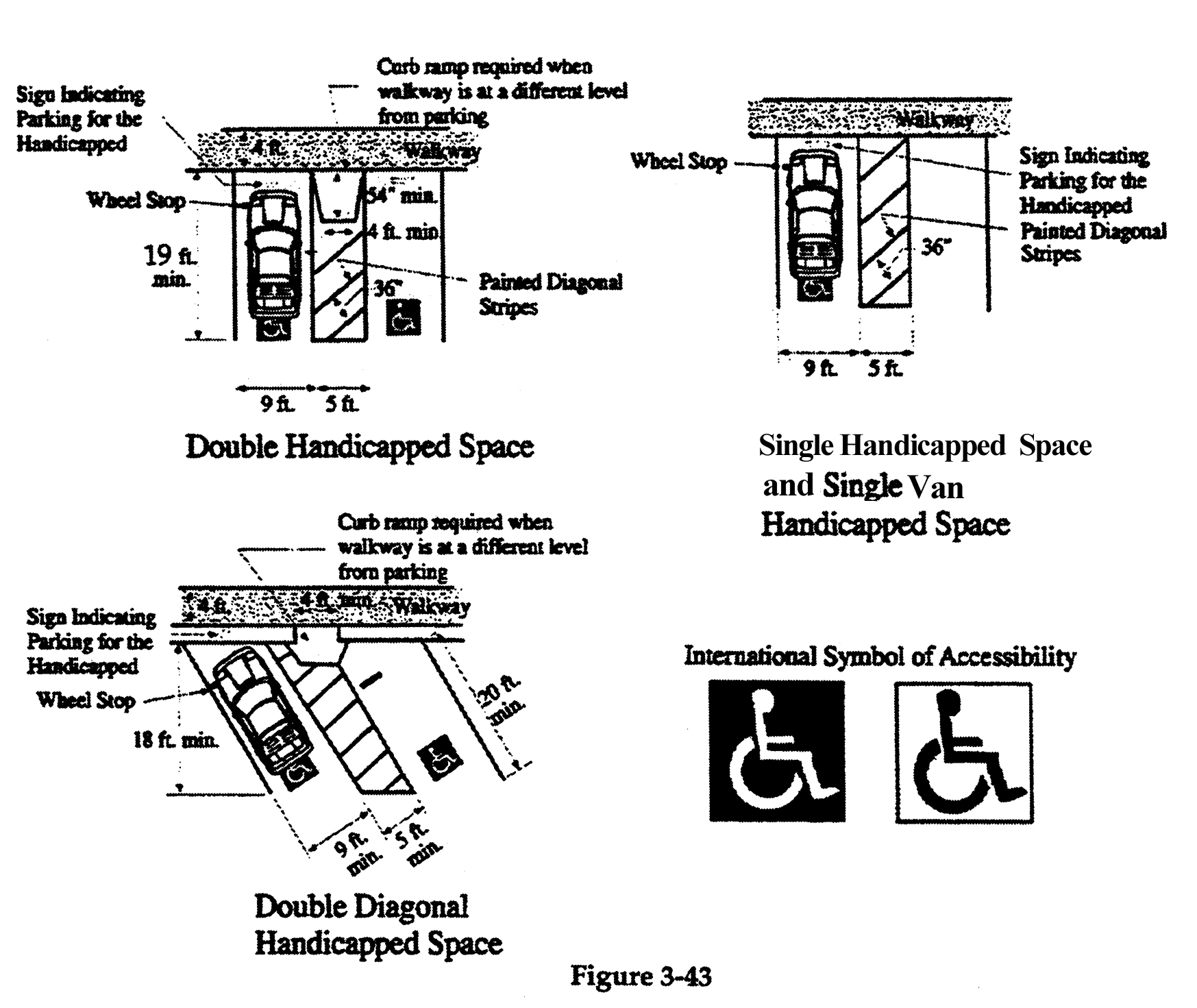
Figure 3-43
(Ord. No. 02(1998), § 2, 11-3-98; Ord. No. 02(2001), § 18, 11-6-01)
Sec. 22.30.070. - Development standards for off-street parking.
Off-street parking areas shall be provided as follows:
(1)
Access to parking. Access to off-street parking areas shall be provided in the following manner:
a.
Parking areas shall provide suitable maneuvering room so that vehicles enter an abutting street in a forward direction. Parking lots shall be provided so as to prevent access at any point other than at designated access drives. The director may approve exceptions for single-family homes and duplexes.
b.
Industrial uses located on arterial streets and commercial uses that provide 50 or more parking spaces shall have access driveways that are not intersected by a parking aisle, parking space, or another access driveway for a minimum distance of 50 feet from the street right-of-way line.
c.
Access driveways for multifamily residential uses shall not allow parking within a required setback area.
d.
A minimum unobstructed clearance height of 14 feet shall be maintained above areas accessible to vehicles.
(2)
Access to adjacent sites. Applicants for nonresidential developments are encouraged to provide shared vehicle and pedestrian access to adjacent nonresidential properties to provide for convenience, safety, and efficient circulation. A joint access agreement running with the land shall be recorded by the owners of the abutting properties, as approved by the director, guaranteeing the continued availability of the shared access between the properties.
(3)
Location. Off-street parking areas shall be located as follows:
a.
Parking spaces shall be accessible by drives and aisles in compliance with Table 3-12;
b.
Required parking shall be located on the same parcel as the uses served, except that parking may be located on a parcel adjacent to the parcel served subject to a recorded covenant running with the land recorded by the owner of the parking lot guaranteeing that the required parking will be maintained for the use or activity served; and
c.
Carpool and bicycle spaces shall be located as close as is practical to the entrance(s) to the use they are intended to serve. Spaces shall be situated so that they do not obstruct the flow of pedestrians at entrances or sidewalks.
(4)
Parking space and lot dimensions.
a.
General requirements for residential uses. Minimum parking dimensions shall be as indicated in Table 3-11.
TABLE 3-11
MINIMUM PARKING STALL DIMENSIONS
RESIDENTIAL USES
b.
General requirements for nonresidential uses. Minimum parking dimensions shall be as indicated in Table 3-12 and as illustrated by Figure 3-44.
TABLE 3-12
MINIMUM PARKING STALL AND LOT DIMENSIONS
c.
Parallel parking spaces. Parallel parking spaces shall have minimum width of nine feet and a minimum length of 24 feet. Aisle widths shall be 12 feet for one-way traffic and 26 feet for two-way traffic.
(5)
Drainage.
a.
Surface water from parking lots shall not drain over sidewalks or adjacent parcels; and
b.
Parking lots shall be designed in compliance with the stormwater quality and quantity standards of the city's best management practices.
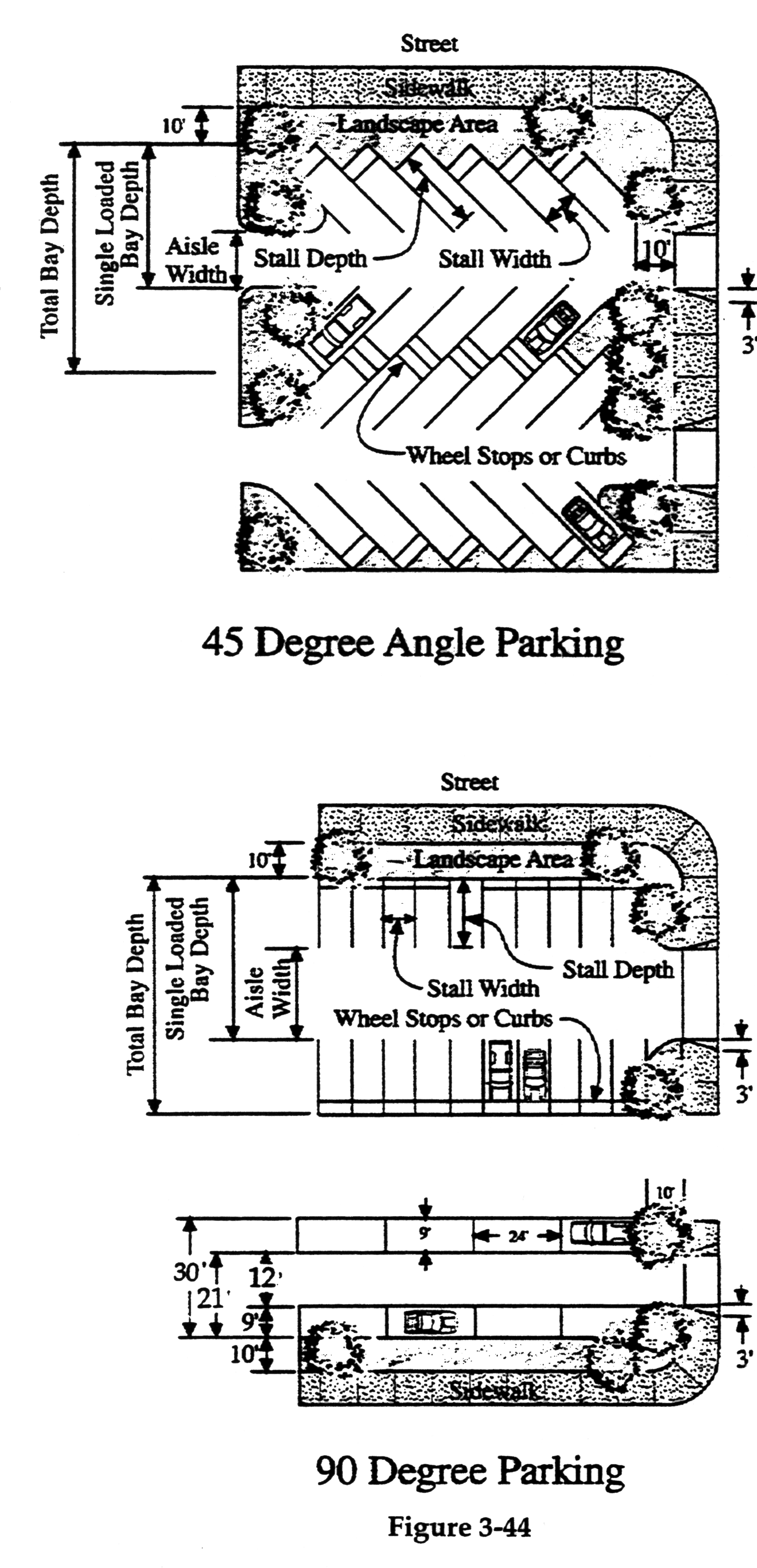
Figure 3-44
(6)
Directional arrows and signs.
a.
In parking facilities containing 40 or more parking spaces, aisles, approach lanes and maneuvering areas shall be clearly marked with directional arrows and lines to ensure the safe and efficient flow of vehicles.
b.
The director may require the installation of the traffic signs in addition to directional arrows to ensure the safe and efficient flow of vehicles in a parking facility.
c.
The exit from a parking area which provides parking for 40 or more vehicles shall be clearly marked with a vehicle "STOP" sign.
(7)
Grades of parking areas.
a.
Interior circulation drives/aisles. Ramps or driveways within the interior of a parking area (beyond 20 feet from ultimate right-of-way line) shall have a maximum grade of 15 percent. If a ramp or driveway exceeds ten percent, the design shall include transitions (at each end of the ramp) not less than eight feet in length, having a slope equal to one-half the ramp or driveway slope.
b.
Parking spaces. Parking spaces and abutting access aisles shall have a maximum grade of seven percent, measured in any direction.
c.
Vertical clearance. Covered parking spaces shall have a vertical clearance of at least seven feet six inches above the parking lot surface for all uses except residential.
(8)
Landscaping. Landscaping shall be provided in compliance with the following requirements:
a.
Landscape plan required. A comprehensive landscape and irrigation plan shall be submitted for review and approval by the review authority in compliance with chapter 22.24 (Landscaping Standards).
b.
Landscape materials. Landscaping materials shall be provided throughout the parking lot area using a combination of trees, shrubs and ground cover.
c.
Curbing, irrigation. Areas containing plant materials shall be bordered by a concrete curb at least six inches high and six inches wide, and provided with an automatic irrigation system. Alternative barrier design to protect landscaped areas from damage by vehicles may be approved by the director.
d.
Location of landscaping. Parking lot landscaping shall be located so that pedestrians are not required to cross landscaped areas to reach building entrances from parked cars. This should be achieved through proper orientation of the landscaped fingers and islands.
e.
Bumper overhang areas. To increase the parking lot landscaped area, a maximum of two feet of the parking stall depth may be landscaped with low-growth, hearty materials in lieu of paving, allowing a two-foot bumper overhang while maintaining the required parking dimensions.
f.
Perimeter parking lot landscaping.
1.
Adjacent to streets. Parking areas adjoining a public street shall be designed to provide a landscaped planting strip between the street right-of-way and parking, equal in depth to the setback required by the zoning district or seven feet, whichever is more.
The landscaping shall be designed and maintained to screen cars from view from the street to a height of between 30 inches and 42 inches. Screening materials may include a combination of plant materials, earth berms, solid masonry walls, raised planters, or other screening devices which meet the intent of this requirement. Trees shall be provided at a rate of one for every 20 lineal feet of landscaped area. Plant materials, signs, or structures within a traffic safety sight area of a driveway shall not exceed 30 inches in height.
2.
Adjacent to side or rear property lines. Parking areas shall provide a perimeter landscaped strip at least four feet wide (inside dimension) where the facility adjoins a side or rear property line. The perimeter landscaped strip may include a required yard or buffer area. Trees shall be provided at the rate of one for each 20 lineal feet of landscaped area.
3.
Adjacent to structures. When landscaping is located adjacent to structures, the width of the landscaped area shall be proportional to the height of the structure. The minimum width of a landscaped strip adjacent to a structure shall be five feet for structures up to two stories. For each additional story, the width of the adjacent landscaped strip shall be increased by two feet.
4.
Adjacent to residential use. Parking areas for nonresidential uses adjoining residential uses shall provide a landscaped buffer yard with a minimum 15-foot width between the parking area and the common property line bordering the residential use. A solid masonry wall and landscaping shall be provided along the property line. For each 100 feet of landscaped area, a minimum of 12 trees and ten shrubs shall be provided.
g.
Interior parking lot landscaping.
1.
Amount of landscaping. Multifamily, commercial, and office uses shall provide landscaping within the parking area at a ratio of five percent of the gross area of the parking lot. One tree shall be provided for every eight parking spaces. Industrial/manufacturing uses shall provide landscaping within the parking area at a ratio of five percent of the gross area of the parking lot. One tree shall be provided for every ten parking spaces.
Landscaping shall be evenly dispersed throughout the parking area. Parking lots with more than 100 spaces should provide a concentration of landscape elements at primary entrances, including specimen trees, flowering plants, enhanced paving, and project identification.
2.
Planters required. Trees shall be in planters located throughout the parking area. In order to be considered within the parking area, trees shall be located in planters that are bounded on at least three sides by parking area paving. Planters shall have a minimum interior dimension of five feet and be of sufficient size to accommodate tree growth.
(9)
Lighting.
a.
General requirements. Parking areas shall have lighting capable of providing adequate illumination for security and safety. Lighting fixtures shall be energy-efficient. Lighting standards shall be in scale with the height and use of the on-site structure(s). All illumination, including security lighting, shall be directed downward, away from adjacent properties and public rights-of-way in compliance with section 22.16.050 (Exterior lighting).
b.
Lighting requirements for commercial projects. Parking areas within commercial projects shall be provided with exterior lighting as follows:
1.
A minimum of one footcandle of illumination shall be maintained at the parking surface throughout the parking area.
2.
Lighting shall be on a time-clock or photo-sensor system.
3.
All lighting shall be designed to confine direct rays to the property. No spillover beyond the property line shall be permitted.
4.
Lighting fixtures shall have 90-degree horizontal cut-off flat lenses.
(10)
Shopping cart storage. Parking facilities for commercial uses shall contain shopping cart storage areas for appropriate uses (e.g., supermarkets, drugstores, etc.). The number, dimensions and locations of storage areas shall be determined by the director.
(11)
Striping and identification.
a.
Vehicular. Parking spaces shall be clearly outlined with four-inch wide lines painted on the surface of the parking facility. Carpool spaces shall be clearly identified for compact vehicle and carpool use only.
b.
Restriping. The restriping of any parking space or lot shall require the approval of a restriping plan by the director.
(12)
Surfacing.
a.
Vehicular. Parking spaces and maneuvering areas shall be paved and permanently maintained with asphalt, concrete or other all-weather surfacing approved by the director.
b.
Motorcycle. Motorcycle parking areas shall be paved with concrete or equivalent all-weather surfacing approved by the director.
c.
Bicycle. Bicycle parking areas shall be surfaced so as to keep the area in a dust-free condition, subject to the approval of the director.
(13)
Wheel stops/curbing. Continuous concrete curbing at least six inches high and six inches wide shall be provided for parking spaces located adjacent to fences, walls, property lines, landscaped areas and structures. Individual wheel stops may be provided in lieu of continuous curbing when the parking is adjacent to a landscaped area, and the drainage is directed to the landscaped area.
When provided, wheel stops shall be placed to allow for two feet of vehicle overhang area within the dimension of the parking space.
(Ord. No. 02(1998), § 2, 11-3-98)
Sec. 22.30.080. - Driveways and site access.
Driveways providing site access shall be from an improved street, alley or other public right-of-way, and shall be designed, constructed and maintained as follows:
(1)
Number of driveways. A maximum of two driveways shall be allowed for each multifamily and nonresidential parcel two acres or less in size unless the director and city engineer determine that more than two driveways are required to accommodate traffic volumes on specific projects. Additional driveways shall not be allowed if it is determined to be detrimental to traffic flow on the adjacent street(s). Whenever a property has access to more than one street, access shall be generally limited to the lowest volume street where the impact of a new access will be minimized.
Single-family and duplex residential shall be allowed one driveway. Circular driveways shall be allowed for parcels with 70 feet or more of street frontage.
(2)
Distance from street corners. Driveways to parking areas shall be located a minimum of 150 feet from the nearest intersection, as measured from the centerline of the driveway to the centerline of the nearest travel lane of the intersecting street. For parcels with frontages less than 150 feet, the minimum distance shall be 100 feet unless a lesser distance is approved by the city engineer.
(3)
Driveway spacing. Driveways shall be separated along the street frontage as follows:
a.
Single-family and duplex residential development. Driveways shall be separated by at least six feet, unless a shared, single driveway is approved by the director. The six-foot separation does not include the transition or wing sections on each side of the driveway; and
b.
Multifamily and nonresidential development. Where two or more driveways serve the same or adjacent multifamily or nonresidential development, the centerline of the driveways shall be separated by a minimum of 50 feet. Exceptions to this standard shall be subject to the approval of the city engineer.
(4)
Grades at entrance driveways. Driveways for nonresidential uses shall not exceed a maximum grade of 15 percent. Driveways for residential uses shall not exceed a maximum grade of 20 percent. Where there is a change in the slope of the driveway, it shall be demonstrated that vehicles will be able to pass over the change in slope without interference with the vehicle's undercarriage.
(5)
Driveway width and length.
a.
Single-family uses.
1.
Driveways are intended only to provide access to required off-street parking spaces in garages. No other paving, except walkways, shall be allowed within the front yard area. An extension of the primary driveway may be approved if the pavement width of the extension does not exceed 12 feet, is located toward the side property line nearest to the driveway and the total hardscape area of the front yard does not exceed 50 percent of the existing front yard area. An extension of the driveway toward the side yard farthest from the driveway shall not be permitted. Front yard area shall be measured from the front property line to the front building line.
Front Yard
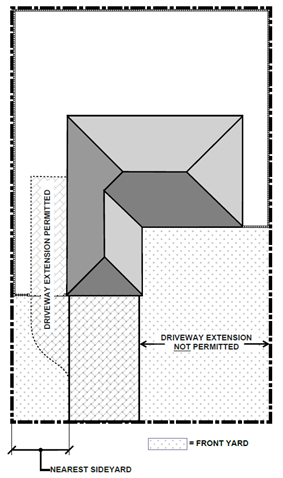
2.
Driveways that provide access to garages having a setback greater than 24 feet from the street property line shall have a minimum width of ten feet and a maximum width of 14 feet at the property line.
3.
Driveways that provide access to garages having a setback less than 24 feet from the street property line shall not exceed the width of the garage door opening plus two feet.
4.
When a garage is perpendicular (90 degrees) to the driveway, a minimum 24-foot deep unobstructed backout area shall be provided.
5.
Driveways may be allowed with greater widths than provided above with the approval of a minor conditional use permit.
b.
Multifamily uses.
1.
Driveways for multifamily uses with six or less units shall have a minimum paved width of 12 feet.
2.
Driveways for multifamily uses with more than six units shall have a minimum paved width of 26 feet.
c.
Nonresidential uses. Driveways for nonresidential uses shall have a minimum paved width of 12 feet for one-way driveways and 26 feet for two-way driveways. The maximum driveway width shall be 30 feet, exclusive of the area provided for a median divider.
(6)
Clearance from obstruction. The nearest edge of a driveway curb cut shall be at least three feet from the nearest property line, the centerline of a fire hydrant, utility pole, traffic signal, light standards, or other similar facilities. Street trees shall be a minimum of ten feet from the driveway access, measured at the trunk. Driveways shall have an overhead clearance of ten feet in height except within a parking structure which may be reduced to seven feet, six inches.
(7)
Traffic safety sight area. Structures or landscaping over 30 inches in height shall not be allowed within a traffic safety sight area formed by the intersection of public rights-of-way, driveways or alleys.
(Ord. No. 02(1998), § 2, 11-3-98; Ord. No. 02(2003), 9-16-03; Ord. No. 03(2024), § 10, 7-16-24)
Sec. 22.30.090. - Bicycle parking.
Bicycle parking facilities shall be provided for nonresidential uses as follows:
(1)
Number of spaces required. Bicycle parking spaces shall be provided at a rate of five percent of the number of required vehicle parking spaces. The director may modify this requirement where it can be demonstrated that a lesser number of bicycle spaces can adequately serve the intended use.
(2)
Bicycle parking design and devices. Bicycle parking areas shall be designed and provided as follows:
a.
Parking equipment. Each bicycle parking space shall include a stationary parking device to adequately support the bicycle.
b.
Parking layout.
1.
Aisles. Providing access to bicycle parking spaces shall be at least five feet in width.
2.
Spaces. Each bicycle space shall be a minimum of two feet in width and six feet in length and have a minimum of seven feet of overhead clearance.
3.
Location. Bicycle spaces shall be conveniently located and generally within proximity to the main entrance of a structure but not closer than ten feet.
4.
Relationship to motor vehicle parking. Bicycle spaces shall be separated from motor vehicle parking spaces or aisles by a fence, wall, curb, or at least five feet of open area, marked to prohibit motor vehicle parking.
(Ord. No. 02(1998), § 2, 11-3-98)
Sec. 22.30.100. - Off-street loading space requirements.
(a)
Number of loading spaces required. Nonresidential uses with less than 5,000 square feet of gross floor area shall provide one off-street loading space, which may be combined with an off-street parking space. Nonresidential uses with 5,000 square feet of floor area or more shall provide off-street loading space in compliance with Table 3-13. Requirements for uses not specifically listed shall be determined by the director based upon the requirements for comparable uses and upon the particular characteristics of the proposed use.
TABLE 3-13
REQUIRED LOADING SPACES
(b)
Standards for off-street loading areas. Off-street loading areas shall be provided in the following manner:
(1)
Dimensions. Loading spaces shall be not less than 15 feet in width, 25 feet in length, with 14 feet of vertical clearance;
(2)
Lighting. Loading areas shall have lighting capable of providing adequate illumination for security and safety. Lighting standards shall be energy-efficient and in scale with the height and use of adjacent structure(s) and be provided in compliance with section 22.16.050 (Exterior lighting);
(3)
Loading doors and gates. Loading bays and rollup doors shall be painted to blend with the exterior structure wall(s) and be located on the rear of the structure only. Bays and doors may be located on the side of a structure, away from a street frontage, where the director determines that the bays, doors and related trucks can be adequately screened from view from adjacent streets;
(4)
Loading ramps. Plans for loading ramps or truck wells shall be accompanied by a profile drawing showing the ramp, ramp transitions and overhead clearances;
(5)
Location. Loading spaces shall be located and designed as follows:
a.
As near as possible to the main structure and limited to the rear two-thirds of the parcel, if feasible;
b.
Situated to ensure that the loading facility is screened from adjacent streets as much as possible;
c.
Situated to ensure that loading and unloading takes place on-site and in no case within adjacent public rights-of-way or other traffic areas on-site;
d.
Situated to ensure that vehicular maneuvers occur on-site; and
e.
Situated to avoid adverse impacts upon neighboring residential properties.
(6)
Screening. Loading areas abutting residentially zoned parcels shall be screened in compliance with section 22.16.080 (Screening and buffering); and
(7)
Striping. Loading areas shall be striped indicating the loading spaces and identifying the spaces for "loading only." The striping shall be permanently maintained by the property owner/tenant in a clear and visible manner at all times.
(Ord. No. 02(1998), § 2, 11-3-98)
Sec. 22.32.010.- Purpose.
The purpose of this chapter is to implement the planned development overlay zoning district by promoting quality design, innovative site planning, transfer of development rights, and mixed uses consistent with the goals and policies of the general plan. The intent of the planned development standards is to promote high quality development that incorporates amenities beyond those expected under conventional development, to achieve greater flexibility in design, to encourage well-planned projects through creative and imaginative planning, and to provide for appropriate use of land that is sufficiently unique in its physical characteristics or other circumstances to warrant special methods of development.
(Ord. No. 02(1998), § 2, 11-3-98)
Sec. 22.32.020. - Applicability.
The provisions of this chapter apply to proposed projects within the planned development overlay zoning district and are subject to approval of development review in compliance with chapter 22.48 (Development Review).
(Ord. No. 02(1998), § 2, 11-3-98)
Sec. 22.32.030. - Development standards.
(a)
Allowable density/intensity. The number of allowable dwellings per parcel or the number of dwelling units per structure may exceed the number allowed within a particular residential zoning district provided the total number of units for the entire project does not exceed the limitations established by the general plan. The floor area ratio (FAR) allowed in a particular nonresidential zoning district may be increased when it can be demonstrated by the project proponent that a superior development will be achieved.
(b)
Setback requirements. Structure setbacks may deviate from the setback standards specified in this Development Code and shall conform to the approved development plan.
(c)
Lot coverage and floor area ratio. Lot coverage and floor area ratio of structures may deviate from the regulations of this Development Code and shall conform to the approved development plan.
(d)
Height limits. The height of structures may deviate from the height standards specified in this Development Code and shall conform to the approved development plan.
(e)
Parking requirements. The number and design of off-street parking areas may deviate from the parking standards specified in this Development Code and shall conform to the approved development plan.
(f)
Open space requirements.
(1)
In all residential developments, at least 30 percent of the gross property area shall be reserved for and devoted to landscaped and useable common open space area(s).
(2)
In all nonresidential developments, at least 20 percent of the gross property area shall be reserved for and devoted to landscaped and useable pedestrian-oriented open space area(s). Open spaces shall include plazas, courtyards, outdoor dining areas, and landscaped gardens.
(3)
Open space areas shall not be construed to include streets, whether public or private, off-street parking, access drives, and loading areas, or area(s) covered by structures.
(4)
The commission may grant a modification, including a modification of any open space requirement, after considering the general purposes and nature of the planned development project.
(g)
Maintenance of common areas. An applicant for a planned development shall provide for the permanent maintenance of all common area(s) within the development. The applicant shall provide the following:
(1)
A plan showing all common areas and areas to be dedicated to/for public and/or private use;
(2)
Where the development consists of only one parcel, a plan for maintenance; and
(3)
Where the development consists of more than one parcel, covenants, conditions and restrictions (CC&R's) or an agreement in a form approved by the city attorney providing for the permanent maintenance of all common areas. The CC&R's or agreement shall be prepared by an attorney licensed to practice in the state. The developer shall provide assistance to the residents of the subdivision in the formation of a homeowner's association for the purpose of maintaining common areas and enforcing CC&R's.
(h)
Development phasing. An applicant for a planned development shall submit a schedule indicating the development of open space related to the construction of residential dwelling units. Where development is to be completed in phases, the development may be coordinated between phases. Projects developed in phases shall be designed so that each successive phase will contain open space to independently qualify under the provisions of subsection (f), above.
(Ord. No. 02(1998), § 2, 11-3-98)
Sec. 22.34.010.- Purpose.
This chapter provides for the abatement of conditions that are offensive or annoying to the senses, detrimental to property values and community appearance, an obstruction to or interference with the comfortable enjoyment of adjacent property, or hazardous or injurious to the health, safety, or welfare of the general public in a manner which may constitute a nuisance.
(Ord. No. 02(1998), § 2, 11-3-98)
Sec. 22.34.020. - Applicability.
The standards for property maintenance provided in this chapter apply to all properties within the city, except where otherwise provided in this chapter.
(Ord. No. 02(1998), § 2, 11-3-98)
Sec. 22.34.030. - Single-family standards.
(a)
Storage in front yard/side yard abutting a street.
(1)
The entire front yard visible from an adjacent street or sidewalk shall be kept and maintained free and clear of all construction and automotive materials or parts, trash, refuse, debris, trash storage receptacles, inoperative vehicles, dismounted camper bodies, discarded or broken materials, appliances, equipment or similar materials.
(2)
Emergency or minor repairs to a motor vehicle owned by a person residing upon the parcel may be conducted on a vehicle upon a paved driveway or paved parking area. Repair shall be concluded within ten consecutive days of the commencement thereof or up to 30 days at the discretion of the director.
(3)
Interior side yards and side yards abutting a street shall be maintained in a clean and orderly manner.
(b)
Vehicle parking.
(1)
Parking of vehicles, including recreational vehicles, on a single-family parcel shall occur within a garage, or carport, or upon a driveway or other allowed paved parking area. If parked on a side yard, an open pedestrian walkway at least 36 inches in width shall be maintained on one side yard for public safety access purposes.
(2)
No person shall park or store a commercial vehicle, commercial trailer or related commercial equipment for a period in excess of 72 hours. No more than two commercial vehicles or trailers may be parked on a parcel at any one time.
(c)
Structure maintenance. All structures shall be maintained in a structurally sound, safe manner with a clean, orderly appearance. Any physical damage or deterioration (e.g., broken windows/doors, leaking roof, etc.), peeling paint, graffiti or other types of damage or deterioration shall be repaired as soon as possible. When re-roofing a structure, the entire roof shall be completed. All re-roofing shall be uniform in material and color or match existing except as approved by the director in cases of emergency. Graffiti shall be removed within 72 hours by the owner/occupants of the structure.
(d)
Landscape maintenance. Yards and setback areas shall be landscaped with lawn, trees, shrubs, or other plant material, and shall be permanently maintained in a neat and orderly manner and substantially free of weeds, debris and dead, diseased or dying vegetation and broken or defective decorative elements of the landscaped area. Foliage in landscaped areas shall be mowed, groomed, trimmed, pruned and adequately watered so as to maintain healthy growing conditions and not detract from the appearance of the immediate neighborhood. Irrigation systems shall be maintained to prevent public health or safety hazards.
(1)
The standards contained in this section shall apply to an exposed surface which forms an incline that has a ratio of 10:1 (horizontal:vertical) or greater.
a.
Slopes adjacent to a public highway shall be maintained in a neat and clean manner, free of weeds and debris. A public highway shall include local streets, the entire width of every highway including all portions dedicated for highway purposes, such as the sidewalks, parkways and roadways. Said slopes shall be irrigated seasonally or at intervals sufficient to ensure survival and growth of slope plant material. Plant material shall be neatly trimmed and shall not encroach into the public right-of-way. Erosion control methods shall be utilized to maintain slope stability. Walls, fences and/or slope plant material shall be maintained in a manner that does not detract from the appearance of the immediate neighborhood. Overgrown vegetation that harbors rats or other vermin, or attains such growth as to become a fire hazard when dry or that is otherwise noxious, dangerous or unsightly shall be prohibited. Failure to maintain said slopes in the manner described is declared unlawful and a public nuisance endangering the health, safety and general welfare of the public and detrimental to the surrounding community and shall be abated pursuant to section 22.34.070.
(e)
Fence and wall maintenance. All structures shall be maintained in a structurally sound, safe manner with a clean, orderly appearance. Any physical damage or deterioration, peeling paint, loose boards, graffiti, or other types of damage or deterioration shall be repaired as soon as possible. Graffiti shall be removed within 72 hours by the owner/occupant of the structure.
(f)
Temporary erosion control. Sandbags and other temporary erosion control measures may be utilized for a maximum of one year. Sandbags and other erosion control material and devices shall be maintained in good condition and replaced as necessary. After one year, a permanent solution shall be pursued.
(g)
Maintenance of paved driveway and similar areas. All paved surfaces visible from an adjacent street or sidewalk shall be kept and maintained so as not to detract from the appearance of adjacent properties. Areas shall be kept in a neat and clean condition, free of trash, debris or rubbish, and free of standing water, oil stains, cracks exceeding one-half inch in width, lifting exceeding one-half inch, and/or broken areas.
(Ord. No. 02(1998), § 2, 11-3-98; Ord. No. 02(2001), § 22, 11-6-01; Ord. No. 04(2001), § 1, 11-20-01; Ord. No. 06(2003), 12-2-03; Ord. No. 04(2012), § 11, 4-17-12)
Sec. 22.34.040. - Multifamily standards.
(a)
Storage yards.
(1)
The entire front yard and side yard abutting a street shall be kept and maintained free and clear of all construction materials, automotive parts, trash, refuse, debris, trash storage receptacles, inoperative motor vehicles, recreational vehicles, boats, camper shells, discarded or broken materials, appliances, furniture, junk, equipment or similar materials. All rubbish, trash and debris shall be kept within approved trash enclosures.
(2)
Emergency or minor repairs of a motor vehicle owned by a person residing upon the parcel may be conducted on a motor vehicle upon a paved driveway. Repair shall be concluded within ten consecutive days of the commencement thereof or a maximum of 30 days as approved by the director.
(b)
Storage in garages and carports. No storage of materials, including, but not limited to, trash and trash receptacles, newspapers, building and automotive materials, landscape maintenance tools, equipment, debris, inoperative motor vehicles, camper shells not mounted on motor vehicles or boats and trailers shall be permitted within a garage or carport so as to restrict the parking of an operative motor vehicle in the required parking spaces.
(c)
Motor vehicle parking.
(1)
All parking of motor vehicles, including recreational vehicles, shall occur only within a garage, carport, or upon a driveway or other paved parking area that is in compliance with the parking requirements of this Development Code.
(2)
No person shall park or store a commercial vehicle, trailer or related equipment for a period in excess of 72 hours. No more than two commercial vehicles shall be parked on a parcel at any one time.
(d)
Structure maintenance. All structures shall be maintained in a structurally sound, safe manner with a clean, orderly appearance. Any physical damage or deterioration (e.g., broken windows/doors, leaking roof, etc.) peeling paint, graffiti or other types of damage or deterioration shall be repaired as soon as possible. When re-roofing a structure, the entire roof shall be completed. All re-roofing shall be uniform in material and color or match existing except as approved by the director in cases of emergency. Graffiti shall be removed within 72 hours by the owner/occupants of the structure.
(e)
Landscape maintenance. Yards and setback areas shall be landscaped with lawn, trees, shrubs, or other plant material, and shall be permanently maintained in a neat and orderly manner and substantially free of weeds, debris and dead, diseased or dying vegetation and broken or defective decorative elements of the landscaped area. Foliage in landscaped areas shall be mowed, groomed, trimmed, pruned and adequately watered so as to maintain healthy growing conditions and not detract from the appearance of the immediate neighborhood. Irrigation systems shall be maintained to prevent public health or safety hazards.
(1)
The standards contained in this section shall apply to an exposed surface which forms an incline that has a ratio of 10:1 (horizontal:vertical) or greater.
a.
Slopes adjacent to a public highway shall be maintained in a neat and clean manner, free of weeds and debris. A public highway shall include local streets, the entire width of every highway including all portions dedicated for highway purposes, such as the sidewalks, parkways and roadways. Said slopes shall be irrigated seasonally or at intervals sufficient to ensure survival and growth of slope plant material. Plant material shall be neatly trimmed and shall not encroach into the public right-of-way. Erosion control methods shall be utilized to maintain slope stability. Walls, fences and/or slope plant material shall be maintained in a manner that does not detract from the appearance of the immediate neighborhood. Overgrown vegetation that harbors rats or other vermin, or attains such growth as to become a fire hazard when dry or that is otherwise noxious, dangerous or unsightly shall be prohibited. Failure to maintain said slopes in the manner described is declared unlawful and a public nuisance endangering the health, safety and general welfare of the public and detrimental to the surrounding community and shall be abated pursuant to section 22.34.070.
(f)
Fence and wall maintenance. All structures shall be maintained in a structurally sound, safe manner with a clean, orderly appearance. Any physical damage or deterioration (e.g., broken windows/doors, leaking roof, etc.), peeling paint, graffiti, or other types of damage or deterioration shall be repaired as soon as possible. Graffiti shall be removed within 72 hours by the owner/occupant of the structure.
(g)
Maintenance of parking and similar areas. Parking, loading, storage, driveway and vehicle maneuvering areas shall be kept and maintained so as not to detract from the appearance of adjacent properties and to protect the health, safety and welfare of the user, occupant and general public. Areas shall be kept in a neat and clean condition, free of trash, debris or rubbish, and free of potholes, sinkholes, standing water, cracks and/or broken areas. Parking space and pavement striping and signs shall be repainted, refurbished and/or replaced when they become faded, damaged or destroyed to an extent that they are no longer effective. Parking areas shall be periodically resurfaced or sealed to minimize seepage of water into the ground below.
(h)
Temporary erosion control. Sandbags and other temporary erosion control measures may be utilized for a maximum of one year. Sandbags and other erosion control material and devices shall be maintained in good condition and replaced as necessary. After one year, a permanent solution shall be pursued.
(Ord. No. 02(1998), § 2, 11-3-98; Ord. No. 02(2001), § 23, 11-6-01; Ord. No. 04(2001), § 2, 11-20-01; Ord. No. 06(2003), 12-2-03)
Sec. 22.34.050. - Commercial standards.
(a)
Storage in yards. Storage within front, side, and rear yard areas approved in compliance with this Development Code shall be maintained in a neat and orderly fashion and shall contain only items and/or vehicles incidental to the business, or owned by the business or owner of the business.
(b)
Motor vehicle parking.
(1)
Parking of motor vehicles shall occur on paved parking areas in compliance with chapter 22.30 (Off-Street Parking and Loading Standards).
(2)
No person shall park or store any commercial vehicle, trailer or related equipment for a period in excess of 72 hours. No more than two commercial vehicles may be parked on any parcel at any one time.
(c)
Structure maintenance. All structures shall be maintained in a structurally sound, safe manner with a clean, orderly appearance. Any physical damage or deterioration (e.g., broken windows/doors, leaking roof, etc.) peeling paint, graffiti or other types of damage or deterioration shall be repaired as soon as possible. When re-roofing a structure, the entire roof shall be completed. All re-roofing shall be uniform in material and color or match existing except as approved by the director in cases of emergency. Graffiti shall be removed within 72 hours by the owner/occupants of the structure.
(d)
Landscape maintenance. Yards and setback areas shall be landscaped with lawn, trees, shrubs, or other plant material, and shall be permanently maintained in a neat and orderly manner and substantially free of weeds, debris and dead, diseased or dying vegetation and broken or defective decorative elements of the landscaped area. Foliage in landscaped areas shall be mowed, groomed, trimmed, pruned and adequately watered so as to maintain healthy growing conditions and not detract from the appearance of the immediate neighborhood. Irrigation systems shall be maintained to prevent public health or safety hazards.
(1)
The standards contained in this section shall apply to an exposed surface which forms an incline that has a ratio of 10:1 (horizontal:vertical) or greater
a.
Slopes adjacent to a public highway shall be maintained in a neat and clean manner, free of weeds and debris. A public highway shall include local streets, the entire width of every highway including all portions dedicated for highway purposes, such as the sidewalks, parkways and roadways. Said slopes shall be irrigated seasonally or at intervals sufficient to ensure survival and growth of slope plant material. Plant material shall be neatly trimmed and shall not encroach into the public right-of-way. Erosion control methods shall be utilized to maintain slope stability. Walls, fences and/or slope plant material shall be maintained in a manner that does not detract from the appearance of the immediate neighborhood. Overgrown vegetation that harbors rats or other vermin, or attains such growth as to become a fire hazard when dry or that is otherwise noxious, dangerous or unsightly shall be prohibited. Failure to maintain said slopes in the manner described is declared unlawful and a public nuisance endangering the health, safety and general welfare of the public and detrimental to the surrounding community and shall be abated pursuant to section 22.34.070.
(e)
Fence and wall maintenance. All structures shall be maintained in a structurally sound, safe manner with a clean, orderly appearance. Any physical damage or deterioration, peeling paint, graffiti, or other types of damage or deterioration shall be repaired as soon as possible. Graffiti shall be removed within 72 hours by the owner/occupant of the structure.
(f)
Temporary erosion control. Sandbags and other temporary erosion control measures may be utilized for a maximum of one year. Sandbags and other erosion control material and devices shall be maintained in good condition and replaced as necessary. After one year, a permanent solution shall be pursued.
(g)
Maintenance of parking and similar areas. Parking, loading, storage, driveway and vehicle maneuvering areas shall be kept and maintained so as not to detract from the appearance of adjacent properties and to protect the health, safety and welfare of the user, occupant and general public. Areas shall be kept in a neat and clean condition, free of trash, debris or rubbish, and free of potholes, sinkholes, standing water, cracks and/or broken areas. Parking space and pavement striping and signs shall be repainted, refurbished and/or replaced when they become faded, damaged or destroyed to an extent that they are no longer effective. Parking areas shall be periodically resurfaced or sealed to minimize seepage of water into the ground below.
(Ord. No. 02(1998), § 2, 11-3-98; Ord. No. 02(2001), § 24, 11-6-01; Ord. No. 06(2003), 12-2-03)
Sec. 22.34.060. - Industrial standards.
(a)
Storage in yards. Storage within front, side, and rear yard areas approved in compliance with this Development Code shall be maintained in a neat and orderly fashion and shall contain only items and/or vehicles incidental to the business, or owned by the business or owner of the business.
(b)
Motor vehicle parking.
(1)
Parking of motor vehicles shall occur on paved parking areas in compliance with chapter 22.30 (Off-Street Parking and Loading Standards).
(2)
No person shall park or store any commercial vehicle, trailer or related equipment for a period in excess of 72 hours. No more than two commercial vehicles may be parked on any parcel at any one time.
(c)
Structure maintenance. All structures shall be maintained in a structurally sound, safe manner with a clean, orderly appearance. Any physical damage or deterioration (e.g., broken windows/doors, leaking roof, etc.) peeling paint, graffiti or other types of damage or deterioration shall be repaired as soon as possible. When re-roofing a structure, the entire roof shall be completed. All re-roofing shall be uniform in material and color or match existing except as approved by the director in cases of emergency. Graffiti shall be removed within 72 hours by the owner/occupants of the structure.
(d)
Landscape maintenance. Yards and setback areas shall be landscaped with lawn, trees, shrubs, or other plant material, and shall be permanently maintained in a neat and orderly manner and substantially free of weeds, debris and dead, diseased or dying vegetation and broken or defective decorative elements of the landscaped area. Foliage in landscaped areas shall be mowed, groomed, trimmed, pruned and adequately watered so as to maintain healthy growing conditions and not detract from the appearance of the immediate neighborhood. Irrigation systems shall be maintained to prevent public health or safety hazards.
(1)
The standards contained in this section shall apply to an exposed surface which forms an incline that has a ratio of 10:1 (horizontal:vertical) or greater
a.
Slopes adjacent to a public highway shall be maintained in a neat and clean manner, free of weeds and debris. A public highway shall include local streets, the entire width of every highway including all portions dedicated for highway purposes, such as the sidewalks, parkways and roadways. Said slopes shall be irrigated seasonally or at intervals sufficient to ensure survival and growth of slope plant material. Plant material shall be neatly trimmed and shall not encroach into the public right-of-way. Erosion control methods shall be utilized to maintain slope stability. Walls, fences and/or slope plant material shall be maintained in a manner that does not detract from the appearance of the immediate neighborhood. Overgrown vegetation that harbors rats or other vermin, or attains such growth as to become a fire hazard when dry or that is otherwise noxious, dangerous or unsightly shall be prohibited. Failure to maintain said slopes in the manner described is declared unlawful and a public nuisance endangering the health, safety and general welfare of the public and detrimental to the surrounding community and shall be abated pursuant to section 22.34.070.
(e)
Fence and wall maintenance. All structures shall be maintained in a structurally sound, safe manner with a clean, orderly appearance. Any physical damage or deterioration (e.g., broken windows/doors, leaking roof, etc.), peeling paint, graffiti, or other types of damage or deterioration shall be repaired as soon as possible. Graffiti shall be removed within 72 hours by the owner/occupant of the structure.
(f)
Maintenance of parking and similar areas. Parking, loading, storage, driveway and vehicle maneuvering areas shall be kept and maintained so as not to detract from the appearance of adjacent properties and to protect the health, safety and welfare of the user, occupant and general public. Areas shall be kept in a neat and clean condition, free of trash, debris or rubbish, and free of potholes, sinkholes, standing water, cracks and/or broken areas. Parking space and pavement striping and signs shall be repainted, refurbished and/or replaced when they become faded, damaged or destroyed to an extent that they are no longer effective. Parking areas shall be periodically resurfaced or sealed to minimize seepage of water into the ground below.
(g)
Temporary erosion control. Sandbags and other temporary erosion control measures may be utilized for a maximum of one year. Sandbags and other erosion control material and devices shall be maintained in good condition and replaced as necessary. After one year, a permanent solution shall be pursued.
(Ord. No. 02(1998), § 2, 11-3-98; Ord. No. 02(2001), § 25, 11-6-01; Ord. No. 06(2003), 12-2-03)
Sec. 22.34.070. - Abatement procedures.
(a)
Public nuisance and nuisance per se.
(1)
The authority to abate and impose sanctions. Enforcement of this chapter shall be accomplished by the director in any manner authorized by law. The procedures identified in this chapter shall not be exclusive and shall not, in any manner, limit or restrict the city from enforcing other ordinances or abating public nuisances in any other manner provided by law. Whenever the director determines that any condition exists in violation of this chapter, the officer shall take appropriate enforcement action in compliance with this chapter. Notwithstanding the public nuisance abatement procedures, criminal and/or civil remedies may be employed as determined to be necessary and provided by law.
(2)
Written notice. Whenever the director has inspected the location of the alleged violation and it has been found or determined that conditions constituting a nuisance exist, the director shall prepare a notice and order and cause the owner of the property and the person, if other than the landowner occupying or otherwise in charge or control of property, to be notified in writing of the existence of the condition and/or require an appearance before the director at a stated time and place to show why the condition should not be abated by the city at the person's expense. The notice and order to abate the determined public nuisance shall contain the following information:
a.
The street address and a legal description sufficient for identification of the property on which the condition exists;
b.
A statement that the director has determined that a public nuisance is being maintained on the property with a brief description of the conditions which render the property a public nuisance;
c.
An order to secure all appropriate permits and to physically commence, within a certain time from the date of service of the notice and order, and to complete within that reasonable and established time and date, the abatement of the described conditions;
d.
A statement advising that the disposal of any material involved in public nuisances shall be conducted in a legal manner;
e.
A statement advising that if the required work is not commenced within the time specified, the director will proceed to cause the work to be done, and bill the persons named in the notice for the abatement costs and/or assess the costs against the property;
f.
A statement advising that a person having an interest or record title in the property may request consideration of the notice and order or any action of the enforcement within ten days from the date of service of the notice and order; and
g.
A statement advising that the notice and order will be recorded against the property in the office of the county recorder.
(b)
Manner of notice. The notice and order, and any amended notice and order, shall be mailed by first class mail, postage prepaid, to each person as required in compliance with subsection (a)(2) above at the address of the violation as it appears on the latest equalized assessment roll of the county, or as known to the director. The address of owners shown on the assessment roll shall be conclusively deemed to be the property address for the purpose of mailing the notice.
The failure of the director to make or attempt service on a person required in this chapter to be served shall not invalidate any proceedings hereunder as to any other person duly served. Service by mail, in compliance with this chapter, shall be effective on the date of mailing. The failure of any person entitled to receive notice shall not affect the validity of any proceedings taken under this chapter. Proof of service of the notice and order shall be documented at the time of service by a declaration under penalty of perjury executed by the person effecting service, declaring the time and manner in which service was made.
At the time the notice and order is served, the director shall file in the office of the county recorder a certificate legally describing the property and certifying that a public nuisance exists on the property and that the owner has been so notified. The director shall file a new certificate with the county recorder that the nuisance has been abated whenever the following actions occur:
(1)
Corrections ordered have been completed so that a public nuisance no longer exists on the subject property as described in the original certificate;
(2)
The notice and order is rescinded upon appeal; or
(3)
Whenever the city abates the nuisance and the abatement costs have been paid.
(c)
Extension of time to perform work. Upon receipt of a written request from any person required to comply with the order, the director may grant an extension of time within which to complete the abatement, if the director determines that an extension of time will not create or perpetuate a situation imminently dangerous to life or property. The director shall have the authority to place reasonable conditions on any extensions.
(d)
Hearing. The director may set a date, time and place to hear any relevant evidence concerning the existence of the alleged public nuisance and the question of whether the expense of abating the public nuisance, if determined to exist, should be made a lien on the property.
If, at the conclusion of the hearing, the director is satisfied that the condition exists and concludes that it should be abated at the expense of the landowner, the director shall advise the person in writing in the same manner as provided in subsection (b), above. The notice shall also inform the landowner of the right of appeal as provided in subsection (h), below. In the event any person given notice of hearing, as shown by the evidence of mailing, should fail to appear at the hearing, then the evidence available to the director shall be sufficient evidence of the existence of facts in support of the conclusion.
(e)
Request for reconsideration. Any person aggrieved by the action of the director in issuing a notice and order in compliance with this chapter may request a hearing before the council in compliance with subsection (h), below. If no appeal is filed within the time prescribed, the action of the director shall be final.
(f)
Council hearing. A request for a council hearing shall be made in compliance with the following provisions:
(1)
Hearing on director's decision. Any person entitled who is dissatisfied with a public nuisance determination of the director may request a hearing before the council within seven days from the date of mailing of the decision of the director. The written request shall be filed with the department.
(2)
Request for hearing. The request for a council hearing shall specify the following:
a.
The legal description and street address of the property;
b.
The determination that is the basis of the hearing request;
c.
The person's legal interest in the property;
d.
A statement of disputed and undisputed facts; and
e.
A signed verification of the truth of all stated matters.
(3)
Processing of requests for hearings. Requests for hearings shall be processed in the following manner:
a.
Upon the timely filing of a request for a hearing, the director shall place the matter on a regular meeting of the council scheduled to be held not less than 30 days after the appeal is received;
b.
The council may reverse or modify the decision of the director and/or remand the matter to the director for further consideration. If the council does not take any action reversing, modifying and/or remanding of the decision of the director within 30 days after the filing of the request for a hearing, the director's action on the matter shall be final and conclusive. Notice of a final determination shall be sent in the same manner as after the director's determination.
(g)
Abatement of nuisance(s). If the nuisance is not completely abated by the owner as directed within the abatement period, the city shall immediately cause the same to be abated by city personnel or private contract and the personnel or persons under contract are expressly authorized to enter upon the subject premises for these purposes. The owner of the premises shall be liable to the city for all costs of abatement, including all administrative and inspection costs.
(h)
Proceedings for abatement of imminently dangerous public nuisances. Whenever the director determines that a public nuisance is so imminently dangerous to life or adjacent property that the condition shall be immediately corrected, or isolated, the following procedures shall be instituted:
(1)
Personal interview. The director shall attempt to make contact through a personal interview, or by telephone with the landowner or the person, if any, occupying or otherwise in real or apparent charge and control of the subject property. In the event contact is made, the director shall notify the person(s) of the danger involved and require that the condition be immediately removed, repaired or isolated to preclude harm to any person or property;
(2)
Removal of the dangerous condition(s). In the event the director is unable to make contact, or if the appropriate persons, after notification by the director, do not take action as specified by the officer, within the time frame requested, then the director may, with the approval of the city manager, take all steps deemed necessary to remove or isolate the dangerous condition(s), with the use of city personnel or a contractor retained in compliance with the provisions of the Municipal Code; and
(3)
Account of the costs. The director shall keep an itemized account of the costs incurred by the city in removing or isolating the condition(s). These costs may be recovered in the same manner that abatement costs are recovered, in compliance with this chapter.
(i)
Costs of inspection. Whenever a public nuisance as defined in this chapter is found to exist as a result of the inspection, the reasonable costs for the inspection, as set by the council's fee resolution, shall be paid by the landowner.
(j)
Assessment of costs against real property. The following provisions shall apply:
(1)
Cost assessment. The director, personnel or persons who abate the nuisance shall keep an account of the cost of abatement. The personnel or persons shall submit an itemized written report showing the costs to the director for transmittal to the council.
(2)
Hearing on assessment. The city clerk shall set the report and account for hearing by the council at the first regular meeting which will be held at least seven days after the date of filing, and shall post a copy of the report and account and notice of the date, time and place of the hearing in a conspicuous place. The owner who is affected by the report and account shall be served a notice containing the date, time and place of the hearing.
(3)
Tax lien. The council shall consider the report and account at the time set for hearing, together with any objections or protests by any interested parties. Any owner of land or interested person may present a written or oral protest or objections to the report and account. The council may modify the report if it is deemed necessary, and shall then confirm the report by motion or resolution. In compliance with state law (Government Code §§ 25845 and 38773.5), the total costs of abatement, including all administrative costs, shall constitute a special assessment against the subject parcel. After the assessment is made and confirmed, it shall become a lien on the subject parcel.
(4)
Cost report. After confirmation of the report, a certified copy shall be filed with the county auditor on or before August 10th of each year and the auditor shall be requested to enter the amounts of the respective assessments on the county tax roll.
(5)
Special assessment. The special assessment shall be collected at the same time and in the same manner as ordinary property taxes are collected and shall be subject to the same penalties and the same procedures and sale in case of delinquency as provided for ordinary property taxes.
(6)
Refunds. The council may order refunded all or part of an assessment paid in compliance with this chapter, if it finds that all or part of the assessment has been erroneously levied. An assessment or any part thereof shall not be refunded unless a claim is filed with the city clerk on or before December 1st after the assessment becomes due and payable. The claim shall be verified by the person who paid the assessment, or the responsible administrator, executor or guardian.
(k)
Enforcement. Enforcement of the provisions of this chapter shall be in compliance with chapter 22.78 (Enforcement).
(Ord. No. 02(1998), § 2, 11-3-98)
Sec. 22.36.010.- Purpose.
The purpose of this chapter is to provide minimum standards to safeguard life, health, property and public welfare, and to preserve the character of the city by regulating the size, height, design, quality of materials, construction, location, lighting and maintenance of signs and sign structures not enclosed within a building, to accomplish the following:
(1)
Provide a reasonable and comprehensive system of sign controls;
(2)
Encourage a desirable city character with a minimum of clutter, while recognizing the need for signs as a major form of communication;
(3)
Provide for fair and equal treatment of sign users;
(4)
Encourage signs that are well designed and pleasing in appearance by providing incentive and latitude for variety, good design relationship, spacing and location;
(5)
Provide for maximum public convenience by properly directing people to various activities; and
(6)
Promote public safety by providing that official traffic regulation devices be easily visible and free from nearby visual obstructions, including blinking signs, excessive number of signs, or signs resembling official traffic signs.
(Ord. No. 02(1998), § 2, 11-3-98)
Sec. 22.36.020. - Applicability.
(a)
The sign standards provided in this chapter are intended to apply to signs in each zoning district in the city. Only signs authorized by this chapter shall be allowed in that zoning district unless otherwise expressly provided in this chapter.
(b)
If a new zoning district is created after the enactment of this chapter, the director shall have the authority to make determinations as to the applicability of appropriate sign regulations in compliance with chapter 22.04 (Interpretation of Development Code Provisions) until this chapter is amended to govern the new zoning district.
(Ord. No. 02(1998), § 2, 11-3-98)
Sec. 22.36.030. - General provisions for all signs.
(a)
Maintenance of signs. Signs and supporting hardware, including temporary signs, shall be maintained in good repair and functioning properly at all times. Repairs to signs shall be of equal or better in quality of materials and design as the original sign. Signs which are not properly maintained and are dilapidated shall be deemed to be a public nuisance.
When existing signs are removed or replaced, all brackets, poles, and other supports that are no longer required shall be removed. Unpainted areas shall be painted to match the adjacent portion of the building or sign support structure.
(b)
Measurement of sign height. Sign height shall be measured from the uppermost part of the sign used in determining the area of the sign to the elevation of the base of the sign nearest the curb of the public street or nearest the base of the adjacent on-site building, whichever is closer to the location of the sign. (Figure 3-45)
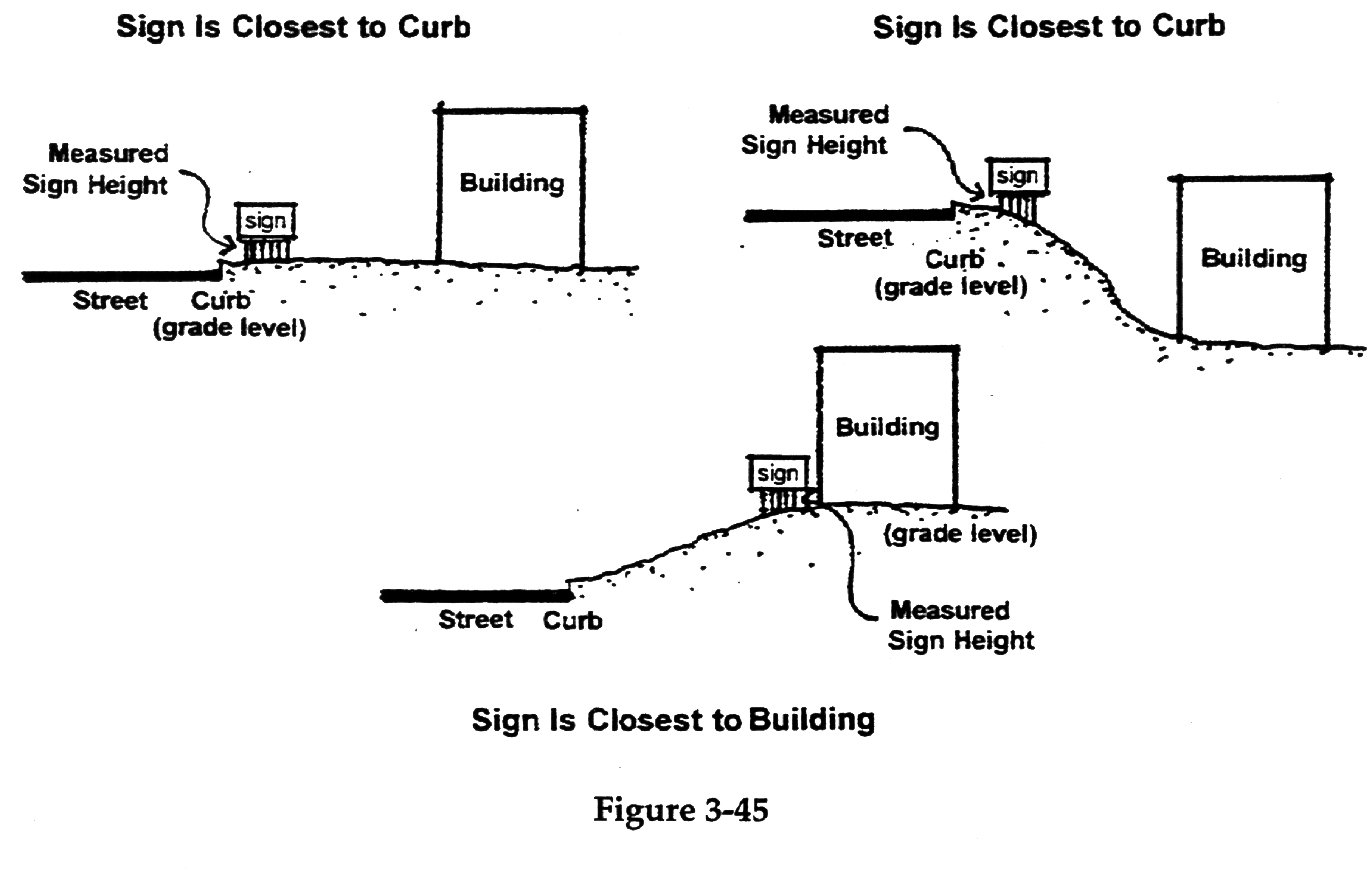
Figure 3-45
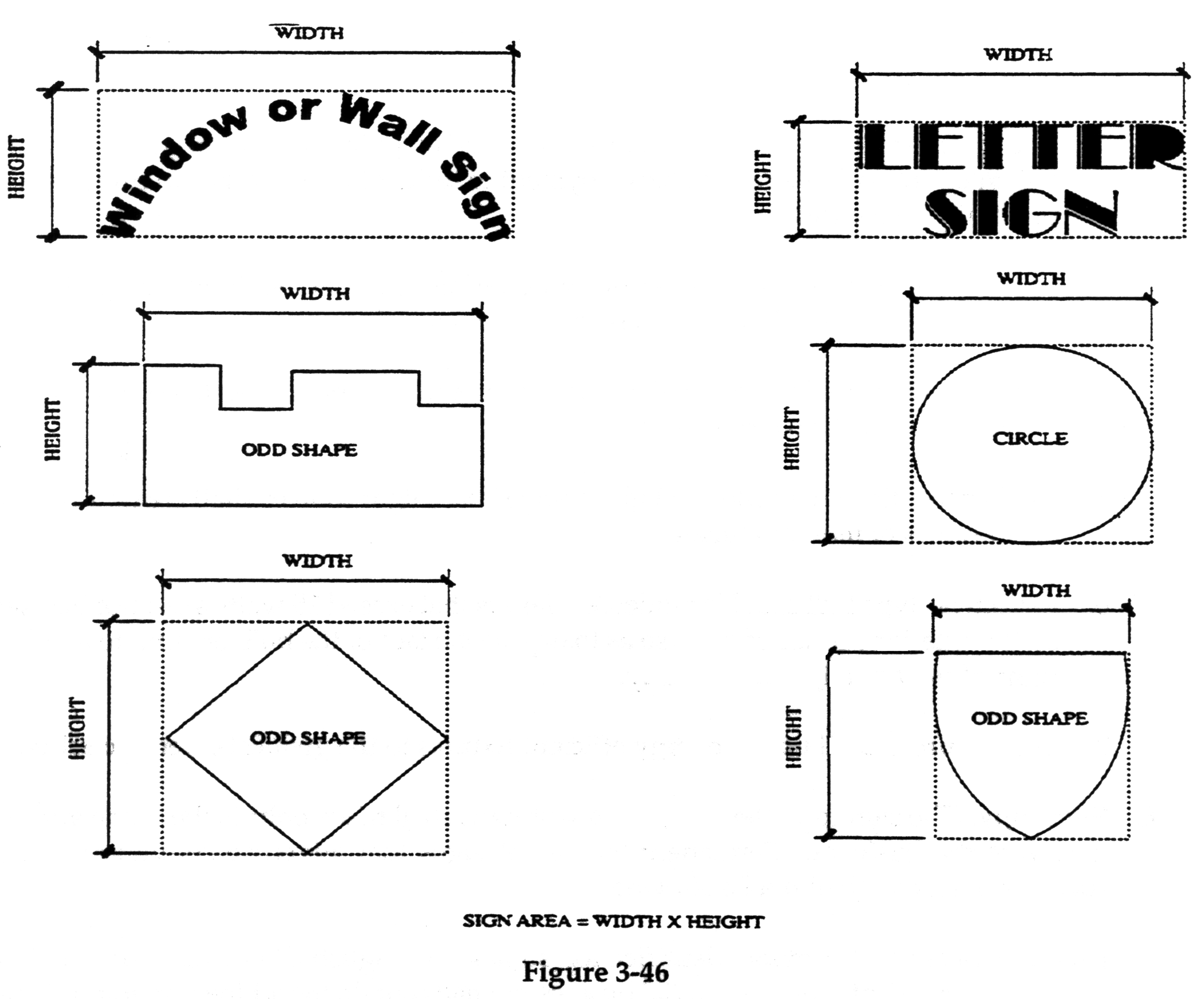
Figure 3-46
(c)
Measurement of sign area.
(1)
The surface area of a sign shall be calculated by enclosing the extreme limits of all writing, logo, representation, emblem, or other display within a single continuous perimeter composed of squares or rectangles with no more than eight lines.
(2)
Supporting framework or bracing that is clearly incidental to the display itself shall not be computed as sign area.
(3)
Signs composed of more than one sign face shall be computed as including only the maximum single display surface that is visible from any ground position at one time.
(4)
Where a sign consists of one or more three-dimensional objects (i.e., balls, cubes, clusters of objects, sculpture or statue-like trademarks), the sign area shall be measured as their maximum projection upon a vertical plane.
(5)
For signs that incorporate time and temperature devices, the area of these devices shall not be included in the total area of the sign.
(d)
Illumination of signs. The artificial illumination of signs, either from an internal or external source, shall be designed to eliminate negative impacts on surrounding rights-of-way and properties.
(1)
External light sources shall be directed and shielded to limit direct illumination of any object other than the sign.
(2)
The light from an illuminated sign shall not be of an intensity or brightness which will interfere with the reasonable enjoyment of residential properties in direct visual proximity to the sign.
(3)
Signs shall not have blinking, flashing, or fluttering lights or other illuminating devices that have a changing light intensity, brightness or color.
(4)
Colored lights shall not be used at a location or in a manner so as to be confused or construed as traffic control devices.
(5)
Neither the direct nor reflected light from primary light sources shall create a hazard to operators of motor vehicles.
(6)
Reflective-type bulbs and incandescent lamps that exceed 15 watts shall not be used on the exterior surface of signs so as to expose the face of the bulb or lamp to a public right-of-way or adjacent property.
(7)
Light sources shall utilize energy-efficient fixtures to the greatest extent possible.
(e)
Sign copy. The sign copy (text) of permanent signs shall relate only to the name and/or nature of the business. Permanent "come-on" signs that advertise continuous sales, special prices, etc., shall not be allowed.
Each business must provide identification signage in English characters not less than four inches in height. All commercial businesses shall contain the address or unit number or letter of the occupant. Unit letters shall be in the English alphabet. Address numbers shall be in Arabic numerals. All letters and numerals shall be provided in digits which are visible from the adjacent street or parking lot drive aisle.
Freestanding monument signs shall contain the street address of the use(s) in compliance with section 22.36.120(c) (Freestanding monument signs).
(f)
Substitution clause. Notwithstanding any other provision of this Code, any noncommercial copy may be substituted for any commercial copy on any sign permitted by this Code. If non-commercial copy is substituted, the resulting sign will continue to be treated as the original commercial sign under this Code and will not be deemed or treated as an off-site sign. The content of any noncommercial copy on any sign otherwise permitted by this Code may be changed without complying with any provisions of this Code normally required for sign copy or design approval.
(Ord. No. 02(1998), § 2, 11-3-98; Ord. No. 02(2005), § 1, 2-15-05)
Sec. 22.36.040. - Sign permits.
(a)
Sign permits required. To ensure compliance with the regulations of this chapter, a sign permit shall be required in order to erect, move, alter, or reconstruct any permanent or temporary sign, except signs that are exempt from permits in compliance with section 22.36.050 below.
(b)
Sign permit fee. A sign permit processing fee shall be collected upon application for a sign permit or appeal thereof.
(c)
Temporary sign permit bond. To ensure the removal of temporary signs in a timely manner, the director may require that the applicant post a bond in an amount sufficient to cover the cost of removing the temporary sign and restoring the premises to its proper condition.
(d)
Approval of sign permits. A sign permit application shall be approved by the director provided that the proposed sign is consistent with the intent and provisions of this chapter.
Review of the sign permit shall include consideration of size, color, material, illumination, location, and other elements of design in compliance with the sign design guidelines (section 22.36.070).
(e)
Revocation of sign permits. The director may revoke or modify a sign permit, in compliance with chapter 22.76 (Revocations and Modifications) if it is found that the sign(s) has been erected, altered, reconstructed, or is being maintained in a manner that is inconsistent with the approved permit.
(Ord. No. 02(1998), § 2, 11-3-98)
Sec. 22.36.050. - Exemptions from sign permits.
Sign permits shall not be required for the signs listed in this section. Exempt signs shall not be included in the determination of the total allowable number of signs or total allowable sign area for a site/use.
(1)
Permanent signs without specific size limitation. The following signs are exempt from sign permit review subject to the following limitations:
a.
Signs located within shopping centers or similar areas where the signs are not visible from any point on the boundary of the premises;
b.
Official and legal notices required by a court or governmental agency;
c.
A sign erected and maintained in compliance with and in discharge of a governmental function or required by a law, ordinance or governmental regulation, including signs erected by a public utility;
d.
Signs on licensed commercial vehicles, including trailers; provided, however, that vehicles/trailers shall not be used as parked/stationary outdoor display signs;
e.
Bench and other signs located at designated public transit locations; and
f.
Change of copy within an approved comprehensive sign program that conforms to the provisions of the comprehensive sign program (section 22.36.060).
(2)
Permanent signs limited by maximum size. The following signs are exempt from sign permit review subject to the following limitations:
a.
Occupant name, street number, and street name signs not exceeding two square feet in area per single-family or multifamily unit. Street address signs shall have Arabic numbers a minimum of four inches in height;
b.
Signs for commercial, office and industrial uses not exceeding two square feet and limited to business identification, hours of operation, address and emergency information;
c.
Vehicle oriented safety and directional signs solely for the purpose of guiding traffic, parking, and loading on private property, and not bearing advertising materials. Maximum sign area shall be four square feet in residential zoning districts and six square feet in commercial zoning districts. Maximum height for freestanding signs shall be four feet. Taller signs may be approved by the director, if visibility will not be impaired;
d.
Affiliation signs for auto-related uses, motels, and hotels that show notices of services provided or required by law, trade affiliations, credit cards accepted, and similar signs provided they are attached to an otherwise approved freestanding sign or structure. Signs or notices shall not exceed one-half square foot in area per sign, and no more than six signs are allowed per business;
e.
Gasoline pump signs identifying the brand, types, and octane rating provided the signs do not exceed two square feet per pump face;
f.
Names of structures, commemorative plaques, tables, dates of construction, and the like when carved in stone, concrete, or similar materials or made of bronze, aluminum, or other similar permanent material and mounted permanently on a structure. These signs shall not exceed four square feet in area and five feet in height; and
g.
Official flags of a nation, the State of California, other states of the nation, and municipalities provided that the pole height shall not exceed 25 feet in residential zoning districts and 35 feet in nonresidential zoning districts. The length of the flag shall not be more than one-fourth of the height of the pole. Larger flags may be approved subject to approval by the director.
(3)
Menu boards. Menu boards for drive-through restaurants shall not exceed a height of six feet and shall be placed within a landscaped area. Only two menu signs shall be allowed for each restaurant.
(4)
Temporary signs limited by size and period of display.
a.
Real estate signs. Real estate signs offering property for sale, lease, or rent are allowed on private property in any zoning district subject to the owner's permission and the following limitations:
1.
For single-family dwellings, one sign per street frontage not to exceed four square feet in area and six feet in height. In addition, up to four "open house" signs not exceeding two square feet each are allowed when a sales agent or owner is present at the site. Signs shall be removed when the open house ends.
2.
For multifamily dwellings, one sign per street frontage not to exceed 32 square feet and six feet in height;
3.
Individual commercial, office, and industrial properties not located in a commercial center or industrial/business park, one sign per street frontage not to exceed 16 square feet and six feet in height. Parcels with more than 200 feet of frontage, or that have a freeway orientation, or have limited visibility due to topographic constraints, may be allowed larger and/or higher signs subject to approval of the director; and
4.
Individual tenant spaces within multitenant commercial centers, office structures and industrial subdivisions offered for sale, rent, or lease, one sign per street frontage not to exceed 16 square feet and six feet in height. In addition, one sign for each tenant space available not to exceed six square feet to be located at the individual tenant space for rent or lease.
5.
Signs shall be removed within ten days after sale, lease, or rental of the property.
b.
Garage sale signs. Signs that announce the occurrence of a garage or yard sale may be allowed subject to the following limitations:
1.
Signs shall not exceed three square feet in area;
2.
Signs shall only be displayed during the time of the sale and shall be promptly removed at the end of the sale; and
3.
Signs shall not be placed on any public property, including properties of public utility companies.
c.
Future tenant signs. Future tenant identification signs that announce the future use of a project while under construction subject to compliance with the following limitations:
1.
One sign per street frontage except where a project has in excess of 500 lineal feet of street frontage, one additional sign may be allowed;
2.
Signs shall be limited to a maximum of 32 square feet and six feet in height. Maximum 50 square feet if combined with a construction sign; and
3.
Signs shall be removed upon occupancy of the site.
d.
Construction signs. Signs that provide the names of the architects, engineers, and contractors working on the site of a development project subject to compliance with the following limitations:
1.
One sign per street frontage not to exceed 20 square feet with a maximum height of six feet. Maximum size of 32 square feet if combined with a future tenant sign; and
2.
Signs shall be removed upon first occupancy of the site.
(5)
Temporary signs placed upon public property. The following provisions shall control the placement or proposed placement of signs on public property:
a.
No sign shall project over any public walkway, alley, street or public property except as may be expressly permitted pursuant to this section. On private property, in any outdoor area open to the public, no portion of any sign attached to a building and extending below a height of seven feet above ground level shall project more than six inches from the face of the building.
b.
No sign, other than those required for traffic safety or pursuant to law, shall be placed, located or maintained upon any center median of any street, highway or other improvement intended for utilization by vehicular traffic.
c.
No sign may be placed, located or maintained in, on or over any public walkway, parkway, alley, street or any other public property which interferes with the construction, maintenance or repair thereof or of any facilities therein or thereon, including, but not limited to, landscape, hardscape, meters, or irrigation facilities.
d.
No sign shall be affixed to any tree or other plant materials located in any public walkway, parkway, alley, street or any other public property.
e.
No sign placed on public property pursuant to this Code shall contain more than six square feet of sign area.
f.
Only one sign advertising, identifying, displaying, or directing or attracting attention to a particular idea or event shall be placed in the public right-of-way on each side of any single block. For the purposes of this section, "block" shall mean that portion of a street lying between the nearest two intersecting or intercepting streets.
g.
Any sign advertising, identifying, displaying, directing or attracting attention to, or conveying an idea related to an event which is to occur on a certain date shall not be placed in the public right-of-way more than 30 days prior to that date and shall be removed not later than ten days after that date.
(Ord. No. 02(1998), § 2, 11-3-98)
Sec. 22.36.060. - Comprehensive sign program.
(a)
Purpose. The purpose of a comprehensive sign program is to integrate a project's signs with the design of the structures to achieve a unified architectural statement. A comprehensive sign program provides a means for the flexible application of sign regulations for multitenant projects and other users of multiple signs in order to encourage creativity and provide incentive and latitude in the provision of multiple signs and to achieve, not circumvent, the intent of this chapter.
(b)
Comprehensive sign program required. Standards for signs provided in this chapter shall serve as a reference for evaluating comprehensive sign program applications. A comprehensive sign program shall be required whenever any of the following circumstances exist:
(1)
New multitenant developments of three or more separate tenants that share either the same parcel or structure and use common access and parking facilities;
(2)
Whenever five or more signs are proposed for a new or existing development;
(3)
Whenever wall signs are proposed on structures over two stories in height;
(4)
Whenever two or more signs are requested by a single tenant in an existing multitenant project that currently is not covered by a comprehensive sign program; and
(5)
Whenever the director determines that a comprehensive sign program should be developed for a project due to special circumstances (e.g., the number or size of signs proposed, constrained visibility of the site, location of site relative to major transportation routes, etc.).
(c)
Single-use buildings. For single-use buildings with 200 feet or more of frontage, a comprehensive sign program may be approved which exceeds the maximum aggregate sign area up to a limit of 200 square feet, provided that:
(1)
No single wall sign so approved exceeds 125 square feet, and no freestanding sign exceeds 24 square feet, except as stated by the provisions of this chapter.
(2)
Any two signs placed on the same frontage which taken together exceed 125 square feet shall be separated by no less than one-half the length of the building frontage.
(3)
No comprehensive sign program shall be approved which allows any combination of signs which exceed an overall maximum of 125 square feet per use, except as stated by the provisions of this chapter.
(d)
Lessees to be informed of comprehensive sign program. Lessees within developments subject to the requirements of an approved comprehensive sign program shall be made aware of the program in their lease and their responsibility to follow the approved comprehensive sign program.
(e)
Findings. In approving a comprehensive sign program, the commission hearing officer shall make the following findings:
(1)
The comprehensive sign program satisfies the purpose of this chapter and the intent of this section;
(2)
The signs enhance the overall development, are in harmony with, and are visually related to other signs included in the comprehensive sign program and to the structure and/or uses they identify, and to surrounding development;
(3)
The comprehensive sign program accommodates future revisions which may be required due to changes in uses or tenants; and
(4)
The comprehensive sign program complies with the standards of this chapter, except that flexibility is allowed with regard to sign area, number, location, and/or height to the extent that the comprehensive sign program will enhance the overall development and will more fully accomplish the purposes of this chapter.
(f)
Revisions to comprehensive sign programs. Revisions to a comprehensive sign program may be approved by the director if it is determined that the revision is minor and that the intent of the original approval, and any conditions attached thereto, are not affected. Revisions that would substantially deviate from the original approval may require planning commission approval.
(Ord. No. 02(1998), § 2, 11-3-98)
Sec. 22.36.070. - Sign design guidelines.
In determining the consistency of each proposed sign with the purposes of this chapter, the following guidelines shall be applied:
(1)
That the proposed sign will be legible to the intended audience under normal viewing conditions, based on its proposed location, and the design of its visual element;
(2)
That the proposed sign will not obscure front view or detract from existing signs, based on its location, shape, color, and other similar considerations;
(3)
That the proposed sign will be in harmony with adjacent properties and surroundings, based on the size, shape, height, color, placement, and the proximity of the proposed signs to adjacent properties and surroundings;
(4)
That the proposed structure, sign or display will be designed, constructed, and located so that it will not constitute a hazard to the public; and
(5)
That the proposed sign is not designed to be viewed from a freeway, unless specifically provided for under the terms of this chapter.
(Ord. No. 02(1998), § 2, 11-3-98)
Sec. 22.36.080. - Prohibited signs.
The following signs are inconsistent with the purposes and standards of this chapter and are, therefore, prohibited in all zoning districts:
(1)
Abandoned and/or dilapidated signs and sign structures;
(2)
Animals or human beings, live or simulated, designed or used so as to attract attention to the premises;
(3)
Animated, moving, flashing, blinking, reflecting, revolving, or other similar signs, except time/temperature devices and barber poles and signs or decorations commemorating a national, state, or local holiday;
(4)
Banners, streamers, and pennants, except as specifically allowed by the provisions of section 22.36.120(g);
(5)
Bench signs, except at approved bus passenger loading areas;
(6)
Changeable copy signs, except as approved for a civic organization/institution, place of worship, movie theater, or gasoline pricing sign;
(7)
Electronic reader board signs, except time/temperature devices and except as provided in section 22.36.120(d)(7);
(8)
Inflated signs, balloons, and figures except as provided in section 22.36.120(g)(2);
(9)
Neon signs, except as approved through a comprehensive sign program;
(10)
Obscene or offensive signs containing statements, words, or pictures of an obscene, indecent or immoral character which appeal to the prurient interest in sex, or which are patently offensive and do not have serious literary, artistic, political, or scientific value;
(11)
Off-site signs not specifically allowed by the provisions of this chapter;
(12)
Painted signs on fences, walls, or roofs;
(13)
Portable signs, except as approved through a comprehensive sign program;
(14)
Pole-mounted signs;
(15)
Price signs, except for service stations;
(16)
Projecting signs;
(17)
Roof signs extending above the edge of the roof of a structure;
(18)
Signs erected in a manner that a portion of its surface or supports will interfere in any way with the free use of a fire escape, exit, or standpipe or obstruct a required ventilator, door, stairway, or window above the first story;
(19)
Signs not in compliance with the provisions of this chapter;
(20)
Signs emitting audible sounds, odors, or visible matter;
(21)
Signs that conflict with or imitate traffic control devices due to color, wording, design, location or illumination, or that interfere with the safe and efficient flow of vehicular and/or pedestrian traffic;
(22)
Signs on public property or projecting within the public right-of-way, except political signs and signs with an encroachment permit issued by the city;
(23)
Strings of lights or signs outlined with individual light bulbs;
(24)
Signs attached to or painted on motor vehicles or trailers that are parked on or adjacent to property for more than 48 consecutive hours, the principal purpose of which is to attract attention to a product sold or business located on or near the property where the vehicle or trailer is located; and
(25)
Signs attached to trees.
(Ord. No. 02(1998), § 2, 11-3-98; Ord. No. 01(2002), § 1, 1-29-02; Ord. No. 01(2026), § 2, 1-20-26)
Sec. 22.36.090. - Nonconforming signs.
It is the intent of this section to recognize that the eventual elimination of signs that do not comply with the provisions of this chapter is as important as the prohibition of new signs that would violate these standards.
(1)
Amortization. Existing signs that are determined to be nonconforming on the effective date of this chapter (date of adoption) shall be modified or removed to comply with all provisions of this chapter within the time periods specified below. The specified time periods shall commence on the date of first written notice by the director to the sign owner that the sign is nonconforming and subject to a specified amortization period.
If the sign owner fails to alter or remove the sign to comply with the requirements of this chapter within the specified amortization period, the sign may be removed by the city at the expense of the owner.
a.
Temporary signs.
1.
Ninety days. Paper, cloth and cardboard signs, banners, balloons, flags, bunting, portable signs, moving, flashing and oscillating signs, and other similar signs.
2.
Twelve months. Signs painted on structures, walls, roofs, or fences.
b.
Permanent signs - 15 years. Signs constructed of durable materials (e.g., metal, plastic, wood) designed to have a useful life of more than one year.
(2)
Annexed areas. Except as otherwise provided in this section, signs in areas annexed to the city after the date of adoption of this chapter, which do not conform to the provisions of this chapter, shall be regarded as nonconforming signs and may remain for the amortization period as listed above, following notification by the director.
(3)
Exception. If a nonconforming sign has historical significance apart from its main purpose of advertising, the sign may be granted a conditional use permit for continued use in compliance with chapter 22.58 (Conditional Use Permits).
(4)
Maintenance and repair. Nonconforming signs and sign structures may be maintained and repaired in compliance with section 22.68.020 (Restrictions on nonconforming structures and uses).
(Ord. No. 02(1998), § 2, 11-3-98)
Sec. 22.36.100. - Abandoned signs.
A sign shall be removed by the owner or lessee of the premises upon which the sign is located when the business that it advertises is no longer conducted on the premises. The sign shall be removed within 30 days of the close of business. If the owner or lessee fails to remove the sign, the director shall give the owner 30 days written notice to remove it. Upon failure to comply with the notice, the director may have the sign removed at the owner's expense.
(Ord. No. 02(1998), § 2, 11-3-98)
Sec. 22.36.110. - Inventory and abatement of illegal and abandoned signs.
(a)
Inventory of signs required. Within six months following the adoption of this chapter, the director shall commence an inventory and identification of all illegal and abandoned signs within the city.
(b)
Authority to abate. The director is authorized to abate illegal and abandoned signs. Abatement of identified illegal or abandoned signs shall commence within eight months of the adoption of this chapter and shall be ongoing thereafter.
(c)
Illegal signs in the public right-of-way. Illegal signs posted in the public right-of-way or upon public property may be removed by the director without notice or hearing. Signs shall be retained by the city for a period of not less than 30 days. Thereafter, any unclaimed signs may be discarded.
(d)
Recovery of costs. When the city is required to remove illegal or abandoned signs in compliance with this section, the reasonable cost of the removal may be assessed against the owner of the sign(s).
(Ord. No. 02(1998), § 2, 11-3-98)
Sec. 22.36.120. - Standards for specific types of signs.
(a)
Awning signs.
(1)
Signs on awnings shall only be located on building frontages, including those fronting a parking lot or pedestrian way.
(2)
Signs on awnings are limited to ground level and second story occupancies only.
(3)
Awnings shall not be internally illuminated. Lighting directed downwards that does not illuminate the awning is allowed.
(b)
Billboards. Billboards may be permitted by conditional use permit and a development agreement on properties located within the I zone, subject to the following limitations:
(1)
No billboard shall be located more than 400 feet from the edge of a freeway right-of-way, measured from the nearest point of the sign structure to the nearest point of the right-of-way boundary.
(2)
No billboard shall be located within 800 feet of any existing static billboard, regardless of whether the proposed billboard is static or digital. In addition, no digital billboard shall be located within 2,000 feet of any existing digital billboard. Distance shall be measured in a straight line between the bases of the respective billboard structures.
(3)
No billboard shall be located within 400 feet of any parcel that is zoned or used for residential purposes. Distance shall be measured in a straight line from the closest point of the residentially-zoned or residentially-used parcel boundary to the base of the proposed billboard.
(4)
The maximum height of a billboard shall not exceed 75 feet, measured as the vertical distance from the highest point of the sign structure to the finished surface elevation at the edge of the nearest freeway travel lane. This measurement shall be taken along a line drawn perpendicularly from the base of the sign structure to the tangent of the nearest freeway lane. A decorative or architectural element may extend up to ten feet above the maximum height, provided it does not contain any additional display area or advertising content.
(5)
The maximum area of any individual sign face shall not exceed 672 square feet. Each sign face shall be limited to a maximum length of 48 feet and a maximum height of 14 feet. No billboard shall contain more than one sign face per direction of travel, and vertical stacking of sign faces on the same side of a structure is prohibited.
(6)
Architectural features such as framing, decorative borders, or structural shrouds that do not contain any advertising content shall be permitted above, below, or around the sign face and shall not count toward the maximum allowable sign area, provided they are designed as integral components of the sign structure and do not function as additional sign faces.
(7)
No billboard shall contain more than two sign faces. Where two sign faces are configured in a V-shaped or angled arrangement, the angle between the faces shall not exceed 45 degrees as measured between the planes of the two sign faces.
(8)
All illuminated billboards shall be equipped with automatic light-sensing technology to adjust brightness in response to ambient lighting conditions. Maximum luminance shall not exceed 0.3 foot-candles above ambient levels, measured at a distance of 250 feet perpendicular to the center of the sign face.
All luminance measurements shall be verified at a horizontal distance of 250 feet perpendicular to the sign face. A photometric analysis shall be submitted with the permit application and shall include certification by a qualified lighting professional or electrical engineer confirming compliance with these standards.
All illumination shall be directed to avoid light spillover onto adjacent properties, roadways, or into the night sky. Sign lighting shall not cause glare or impair visibility for motorists, and shall remain static, without flashing, strobing, or rapidly changing brightness.
(9)
Digital billboards shall display static images only. Each image shall remain on the screen for a minimum duration of eight seconds. Transitions between images shall be instantaneous, without any motion, animation, flashing, or other visual effects.
(c)
Freestanding monument signs.
(1)
Signs are allowed only for frontages adjoining a public street.
(2)
Signs shall not be located closer than 25 feet from a property line, except that a sign may be located up to ten feet from an ultimate street right-of-way line.
(3)
There shall be a minimum of 75 feet between two freestanding signs on adjoining sites to ensure adequate visibility for all signs. The director may waive this requirement in situations where its enactment would be impractical due to the locations of existing signs on adjacent properties.
(4)
Signs shall not project over public property, vehicular easements, or rights-of-way. Signs shall not obstruct traffic safety sight areas.
(5)
Landscaping shall be provided at the base of the supporting structure equal to twice the area of one face of the sign. For example, 30 square feet of sign area = 60 square feet of landscaped area.
(6)
Signs shall contain an Arabic number address plate identifying the project or use by specific street address. The address plate shall not exceed four square feet of sign face area. Numbers shall be a minimum of three inches in height and shall be clearly visible from the adjacent street. Address plates shall not be calculated against the permitted sign face area.
(d)
Freeway-oriented signs. On-site and off-site freestanding signs may be permitted by conditional use permit in lieu of freeway-oriented wall signs for certain properties when they are visible from and adjacent to a freeway right-of-way in compliance with the following:
(1)
Signs are only for the purpose of advertising fuel, food, and/or lodging accommodations;
(2)
Freeway-oriented signs are permitted only on freeway-adjacent sites for uses that are located within 200 feet of the freeway right-of-way;
(3)
It can be demonstrated that wall signage cannot be located on the building itself in a manner that will be visible to motorists traveling in either direction along the freeway;
(4)
The height of a freestanding sign shall not exceed 25 feet above adjacent street grade or the freeway travel lanes (excluding on/off ramps);
(5)
The maximum sign face areas shall not exceed ten feet in height and 20 feet in width. If the site upon which lodging accommodations are located contains businesses engaged in the sale of food and fuel in addition to the place of lodging, these uses may also be identified on the freeway sign provided that:
a.
No more than one freestanding sign shall be permitted per site;
b.
Changeable copy signage is not allowed;
c.
The maximum size permitted for the freestanding sign is not exceeded;
d.
No wall signs are visible from the freeway for uses identified on the freestanding sign; and
e.
Signs shall be separated by a minimum distance of 1,320 feet.
(6)
More than one use of each type may be identified on the freeway-oriented signs.
(7)
Freeway-oriented signs with an electronic reader board may be permitted by conditional use permit for commercial development complexes located within the C-3 zone containing one parcel equaling 4.5 acres or more or a group of parcels equaling 4.5 acres or more located immediately adjacent to the freeway. In addition, electronic reader boards shall meet the following requirements:
a.
Only one freeway-oriented sign with an electronic reader board shall be permitted for businesses which are located on the same parcel, or which are otherwise located in a single commercial development complex;
b.
Freeway-oriented signs with an electronic reader board shall be required to identify more than one business within a commercial development complex;
c.
Freeway-oriented signs with an electronic reader board shall not exceed a height of 65 feet and a total sign face area of 1,000 square feet, which shall include the electronic reader board area. The sign face area of the electronic reader board shall not exceed 33 percent of the total sign face area;
d.
Businesses utilizing a freeway-oriented sign with an electronic reader board may be located on a parcel different from that which the sign is located. However, such businesses shall be located within the commercial development complex that the sign is identifying;
e.
The property upon which an electronic reader board sign is located shall be a minimum 1,300 feet from any residential property; and
f.
Freeway-oriented signs with an electronic reader board shall be integrated with the design of structures on site in order to achieve a unified architectural statement.
(8)
Monument signs may be permitted by conditional use permit for commercial development complexes within the C-3 zone containing one parcel or a group of parcels equaling 4.5 acres or more located immediately adjacent to the freeway. In addition, the monument signs shall meet the following requirements:
a.
A monument sign may be more than six feet in height but shall not exceed 12 feet in height and 72 square feet and sign face area;
b.
Except as provided within this section, a monument sign shall be required to meet specific sign standards within chapter 22.36.
(9)
Wall signs may be permitted by conditional use permit for commercial development complexes within the C-3 zone containing one parcel or a group of parcels equaling 4.5 acres or more located immediately adjacent to the freeway. In addition, a wall sign shall meet the following requirements:
a.
A wall sign shall not exceed 300 square feet in total sign face area for commercial development complexes with 300 linear feet or more of property frontage adjacent to the freeway, and
b.
Except as provided within this section, a wall sign shall be required to meet specified sign standards within chapter 22.36.
(e)
Marquee signs.
(1)
Signs shall be mounted only on the front or sides of a marquee, or suspended below.
(2)
Signs shall not project more than six inches from the face of a marquee.
(3)
Signs shall not extend above the top of a marquee.
(4)
A clear distance of eight feet shall be maintained from the lowest part of a suspended sign to the ground below.
(f)
Neon signs and architectural lighting. The use of neon tubes for signs or architectural elements shall be permitted in commercial zoning districts only subject to the following requirements:
(1)
Neon signs and linear tubing shall be UL (Underwriters Laboratories) listed with a maximum 20 amps per circuit and be designed to accommodate a dimmer in order to reduce the brightness of the neon;
(2)
The neon manufacturer shall be registered with Underwriters Laboratories;
(3)
Neon tubing shall not exceed one-half inch in diameter;
(4)
Neon lighting adjacent to residential uses shall not exceed one-half footcandle measured at the property line;
(5)
Neon tubing shall not be combined with any reflective materials (e.g., mirrors, polished metal, highly glazed tiles, or other similar materials);
(6)
When used as an architectural element, neon tubing shall be used only to reinforce specific architectural elements of the structure and shall be concealed from view whenever possible through the use of parapets, cornices, or ledges; and
(7)
Neon signs hung inside a storefront window shall not occupy more than 25 percent of the window area.
(g)
Temporary signs.
(1)
Temporary special event signs. A special event sign or banner is intended to inform the public of a unique happening, action, purpose, or occasion (e.g., grand opening or community event), and shall comply with the following standards:
a.
A business or commercial center may be allowed to display special event signs or banners for a grand opening or similar event for six periods per calendar year for a maximum of 14 days per event, with a minimum of 30 days between events. Sign area is limited to 50 square feet;
b.
An organization may be allowed to display special event signs or banners in any zoning district for a period of up to two weeks. Periods up to 60 days may be approved by the director if the applicant provides written justification. Sign area is limited to 50 square feet. Inflatable devices shall not exceed three feet in diameter; and
c.
Special event signs shall not include promotional advertising.
(2)
Temporary advertising/promotional signs and devices. Temporary advertising/promotional signs painted on a window or constructed of paper, cloth, or similar disposable materials, windblown devices (e.g., pennants, streamers, and banners), and inflatable devices subject to the following limitations:
a.
Signs and other devices may be displayed for a maximum of 30 days within a 90-day period and a maximum of 90 days per calendar year to promote a particular event, sale, or product;
b.
The total area of all temporary signs and banners shall not exceed 25 square feet per business;
c.
Inflatable devices are allowed on freeway-oriented parcels in a commercial zoning district. Tethered balloons and inflatable devices shall not exceed a height of 60 feet above finished grade;
d.
The area of temporary signs attached to or painted on windows shall not exceed 25 percent of the window area;
e.
Signs shall not be attached to the exterior of windows or doors except painted-on signs; and
f.
Signs shall not be located above the edge of the roof or above the sill of the second story windows on a multistory structure.
(3)
Temporary business identification signs. A maximum of two temporary signs for the identification of a new business until permanent signs can be erected are allowed for a period not to exceed 90 days. One time extension may be granted by the director. Maximum sign area is limited to 50 square feet.
(4)
Temporary subdivision signs. The placement of on-site subdivision identification/directional signs shall comply with the following standards:
a.
Signs may contain only the name of the subdivision, name of the developer and/or agent, an identification emblem, sales price, and directional message;
b.
A maximum of two on-site signs may be located within the project;
c.
The total area of each sign shall not exceed 32 square feet;
d.
The height of each sign shall not exceed six feet;
e.
Signs shall not be illuminated;
f.
Signs may be displayed during the two years following date of recordation of the final map, or until 100 percent of the units have been sold, whichever occurs first. Small apartment complexes (29 units or less) may display sales signs during construction and for a period of one year following the issuance of the certificate of occupancy; and
g.
Apartment and group housing complexes of 30 units or more shall be considered within the definition of a subdivision for the purpose of this subsection.
(h)
Wall signs.
(1)
Signs shall be located only on building frontages unless specifically approved by the director.
(2)
Signs shall not project from the surface upon which they are attached more than required for construction purposes and in no case more than 12 inches.
(3)
Signs shall not project above the edge of the roof of a structure.
(4)
Signs shall not be placed to obstruct any portion of a window.
(i)
Window signs.
(1)
Signs shall be allowed only on windows located on the ground level and second story of a building frontage.
(2)
Signs shall be permanently painted or mounted on the inside of windows and doors.
(3)
Signs shall not occupy more than 25 percent of the window area of any one window including permanent and temporary signs.
(Ord. No. 02(1998), § 2, 11-3-98; Ord. No. 01(2002), § 2, 1-29-02; Ord. No. 01(2026), § 3, 1-20-26)
Sec. 22.36.130. - Sign standards by zoning district.
The sign standards provided in this section are intended to apply to signs in all zoning districts. Only signs authorized by this section shall be allowed unless otherwise expressly provided in this chapter. The following standards are maximums and lesser standards may be applied to a particular project if the circumstances warrant.
Table 3-14 does not provide standards for temporary signs or signs that are exempt from sign permits. Standards for these signs are provided in section 22.36.120(g) (Temporary signs) and section 22.36.050 (Exemptions from sign permits).
TABLE 3-14
SIGN STANDARDS BY ZONING DISTRICT
(a)
Signs permitted in residential zoning districts.
(b)
Signs permitted in commercial/industrial zoning districts.
(Ord. No. 02(1998), § 2, 11-3-98; Ord. No. 04(2012), § 10, 4-17-12)
Sec. 22.38.010.- Purpose.
One of the city's most important resources is the beauty of its natural environment. Native trees are a significant part of this environment. While impacted by development over the years, several areas in the city still contain native oak, walnut, and riparian woodlands which support species of trees important to our natural heritage.
Trees are an important natural resource, contributing to the environment by replenishing oxygen and counteracting air pollution, controlling soil erosion, and providing wildlife habitat. Trees are an aesthetic asset which provide scale, color, aroma, shade, visual buffers between land uses, and increased property value. It is essential to the public peace, health, and welfare that such trees be protected from random removal or cutting, especially where such trees are associated with a proposal for development.
[The] general plan, as the overall policy document for the city, requires the preservation and maintenance of native trees including oak, walnut, sycamore, willow, significant trees of cultural or historical value and pepper trees where appropriate. The purpose of this chapter is to protect and preserve these trees and when removal is allowed as a result of new development to require their replacement.
(Ord. No. 02(1998), § 2, 11-3-98; Ord. No. 02(2003), 9-16-03)
Sec. 22.38.020. - Applicability.
The provisions of this chapter shall apply in all zoning districts to the removal, relocation or pruning of protected trees as provided in section 22.38.030 (Protected trees). Exceptions to the provisions of this chapter are outlined in section 22.38.060 (Exemptions).
(Ord. No. 02(1998), § 2, 11-3-98)
Sec. 22.38.030. - Protected trees.
A protected tree is any of the following:
(1)
Native Oak, walnut, sycamore and willow trees with a diameter at breast height (DBH) of eight inches or greater;
(2)
Trees of significant historical or value as designated by the council;
(3)
Any tree required to be preserved or relocated as a condition of approval for a discretionary permit;
(4)
Any tree required to be planted as a condition of approval for a discretionary permit; and
(5)
A stand of trees, the nature of which makes each tree dependent upon the others for survival.
(Ord. No. 02(1998), § 2, 11-3-98; Ord. No. 02(2003), 9-16-03; Ord. No. 04(2012), § 9, 4-17-12)
Sec. 22.38.040. - Damaging protected trees prohibited.
Except as provided in section 22.38.060 (Exemptions), no person shall cut, prune, remove, relocate, or otherwise destroy a protected tree.
The topping of protected trees is prohibited. No reduction of the tree crown shall be permitted without a tree pruning permit and then only by "thinning out" selected branches in compliance with guidelines published by the National Arborists Association.
(Ord. No. 02(1998), § 2, 11-3-98)
Sec. 22.38.050. - Tree removal permit or tree pruning permit required.
No person shall remove or relocate a protected tree or develop within the protection zone of a protected tree without first obtaining a tree removal permit from the director. No person shall prune a protected tree without first obtaining a tree pruning permit from the director if branches are to be pruned that are over four inches in diameter at the point of the cut. The maximum amount allowed for the pruning of a protected tree shall be 20 percent, except for oak trees which shall be ten percent.
(Ord. No. 02(1998), § 2, 11-3-98)
Sec. 22.38.060. - Exemptions.
The following shall be exempt from the provisions of this chapter:
(1)
Trees, except those designated by the city council as a historical or cultural tree and trees required to be preserved, relocated, or planted as a condition of approval of a discretionary permit, located on all developed properties prior to adoption of this Development Code.
(2)
Trees held for sale by licensed nurseries or tree farms or the removal or transplanting of trees for the purpose of operating a nursery or tree farm.
(3)
A tree that is so damaged, diseased or in danger of falling (as verified by an arborist) that it cannot be effectively preserved, or its presence is a threat to other protected trees or existing or proposed structures.
(4)
Trees within public rights-of-way where their removal, pruning or relocation is necessary to obtain adequate line-of-site distances or to keep streets and sidewalks clear of obstructions as required by the city engineer.
(5)
Trees that present a dangerous condition requiring emergency action to preserve the public health, safety and welfare as determined by the director.
(6)
The maintenance of trees that interfere with a public utility's ability to protect or maintain an electric power or communication line, or other property of a public utility.
(7)
The pruning of branches not to exceed four inches in diameter or compensatory pruning in compliance with guidelines published by the National Arborists Association, intended to ensure the continued health of a protected tree.
(8)
Native oak, walnut, sycamore, willow, or pepper trees located upon a lot one-half acre or less are exempted from these regulations.
(9)
Any native oak, walnut, sycamore, willow or naturalized California Pepper trees planted subsequent to the subdivision of property of any size are exempted from these regulations.
(Ord. No. 02(1998), § 2, 11-3-98; Ord. No. 02(2003), 9-16-03)
Sec. 22.38.070. - Tree removal in conjunction with a discretionary permit.
When the removal or relocation of a protected tree is proposed in connection with an application for another discretionary permit, the director may waive the requirement of a separate tree removal permit and require necessary information to be submitted as part of the discretionary permit application. All of the standards of this chapter, including section 22.38.130 (Tree replacement/relocation standards) and section 22.38.140 (Tree protection standards) shall apply to the approval of a discretionary permit.
(Ord. No. 02(1998), § 2, 11-3-98)
Sec. 22.38.080. - Application submittal requirements.
(a)
Applications for a tree removal permit or a tree pruning permit shall be filed with the department. The department will consider an application complete when all necessary application forms, materials and exhibits, as established by the department, have been provided and accepted as adequate and all necessary fees have been paid.
(b)
The director may require the submittal of an arborist report before accepting the application for filing. Arborist reports shall be paid for by the applicant and may be required to include specific information as required by the director. This information may include but is not limited to: The impact on existing trees, the health and structural stability of existing trees and any remedial measures or mitigation recommended.
(c)
The director may require additional information when deemed necessary for permit processing. Any request for the removal or relocation of a protected tree proposed in conjunction with an application for another discretionary permit shall be subject to approval by the same hearing body as the discretionary permit.
(Ord. No. 02(1998), § 2, 11-3-98)
Sec. 22.38.090. - Action on application.
An application for a tree removal permit or tree pruning permit shall be approved, conditionally approved or denied by the director. Where the director finds that significant policy questions are at issue, the director may refer the application to the commission for action. If an application is denied, the reasons shall be provided to the applicant in writing.
(Ord. No. 02(1998), § 2, 11-3-98)
Sec. 22.38.100. - Conditions of approval.
In approving an application for a tree permit or tree pruning permit, the director or commission may require the applicant to meet certain conditions in order to secure the purpose of this chapter. Conditions may include, but are not limited to, measures designed to protect and preserve protected trees remaining on the site and the restoration of protected trees removed from the site.
(Ord. No. 02(1998), § 2, 11-3-98)
Sec. 22.38.110. - Findings for approval.
In order to approve an application for a tree removal permit or tree pruning permit, it shall be necessary that one or more of the following findings be made, otherwise the application shall be denied:
(1)
The tree is so poorly formed due to stunted growth that its preservation would not result in any substantial benefits to the community.
(2)
The tree interferes with utility services, or streets and highways, either within or outside of the subject property, and no reasonable alternative exists other than removal or pruning of the tree(s).
(3)
The tree is a potential public health and safety hazard due to the risk of it falling and its structural instability cannot be remediated.
(4)
The tree is a public nuisance by causing damage to improvements (e.g., building foundations, retaining walls, roadways/driveways, patios, and decks).
(5)
The tree is host to an organism which is parasitic to another species of tree which is in danger of being exterminated by the parasite.
(6)
The tree belongs to a species which is known to be a pyrophitic or highly flammable and has been identified as a public safety hazard.
(7)
Preservation of the tree is not feasible and would compromise the property owner's reasonable use and enjoyment of property or surrounding land and appropriate mitigation measures will be implemented in compliance with section 22.38.130 (Tree replacement/relocation standards) below.
(Ord. No. 02(1998), § 2, 11-3-98)
Sec. 22.38.120. - Tagging.
In the process of preparing a tree report, each tree is required to be physically marked for identification by consecutively numbered tags. The following method of tagging shall be used to identify and locate applicable trees:
(1)
A permanent tag, a minimum of two inches in length, shall be used for identifying applicable trees. The tag shall be made from a noncorrosive, all-weather material and be permanently attached to the tree in a manner preserving its health and viability.
(2)
Tags shall be located on the north side of the tree at a height of four and one-half feet above natural grade.
(Ord. No. 02(1998), § 2, 11-3-98)
Sec. 22.38.130. - Tree replacement/relocation standards.
(a)
Replacement trees shall be indigenous to the area whenever feasible as determined by an arborist.
(b)
Replacement trees shall be planted at a minimum 2:1 ratio for residential properties less than 20,000 square feet. Residential parcels greater than 20,000 square feet and commercial and industrial properties shall be planted at a minimum 3:1 ratio. The director or commission may grant exceptions to these requirements or may require additional replacement trees based on the following considerations:
(1)
The vegetative character of the subject property.
(2)
The number of protected trees which are proposed to be removed in relation to the number of protected trees currently existing on the subject property.
(3)
The anticipated effectiveness of the replacement of trees, as determined by arborists' report submitted by the applicant.
(c)
Replacement trees shall be a minimum box size of 24 inches for six or fewer replacement trees. For greater than six replacement trees, the sizes shall be determined by the director. Smaller container sizes may be approved by the director or commission when additional replacement trees are provided significantly exceeding the required replacement ratios.
(d)
Tree relocation or replacement shall be on the same site to the extent feasible. A written report by an arborist is required concerning the methodology and feasibility of transplanting trees.
(e)
Where site conditions preclude the long-term success of replacement trees, the director or commission may require either or both of the following alternatives:
(1)
Planting replacement trees on public property (e.g., designated open space areas or public parks); and/or
(2)
Monetary donation to a tree replacement fund in the amount equal to the value of required replacement trees, and the cost of installation as established by an arborist's report.
(f)
The applicant may be required as a condition of permit approval to enter into a tree maintenance agreement prior to removal of any protected tree or commencement of construction activities that may adversely affect the health and survival of trees to be preserved. The maintenance agreement may include provisions for the submittal of arborist reports during and after construction activities, installation of replacement trees and irrigation systems by or under the supervision of a certified arborist, replacement of trees that die during or after construction phases, periodic fertilizing and pruning, and submittal of a security deposit as may be necessary to ensure the health and survival of the affected trees during the effective date of the tree maintenance agreement. The performance security may be required for three years from the date of the approval or as determined by the director. The amount of the performance security deposit shall be equal to 125 percent of the cost of a nursery grown tree and installation by a qualified professional.
(Ord. No. 02(1998), § 2, 11-3-98)
Sec. 22.38.140. - Tree protection requirements.
The director shall determine during project review whether and to what extent measures will be required to protect the existing trees during construction. This decision shall be based upon the proximity of the area of construction activity to existing protected trees. The protective measures shall include but are not limited to the following:
(1)
The existing trees to be retained shall be enclosed by chain link fencing with a minimum height of five feet or by another protective barrier approved by the director prior to the issuance of a grading or building permit and prior to commencement of work.
(2)
Barriers shall be placed at least five feet outside the drip line of trees to be protected. A lesser distance may be approved by the director if appropriate to the species and the adjacent construction activity.
(3)
No grade changes shall be made within the protective barriers without prior approval by the director. Where roots greater than one inch in diameter are damaged or exposed, the roots shall be cleanly saw cut and covered with soil in conformance with industry standards.
(4)
Excavation or landscape preparation within the protective barriers shall be limited to the use of hand tools and small hand-held power tools and shall not be of a depth that could cause root damage.
(5)
No attachments or wires other than those of a protective or nondamaging nature shall be attached to a protected tree.
(6)
No equipment or debris of any kind shall be placed within the protective barriers. No fuel, paint, solvent, oil, thinner, asphalt, cement, grout or any other construction chemical shall be stored or allowed in any manner to enter within the protected barrier.
(7)
If access within the protection zone of a protected tree is required during the construction process, the route shall be covered in a six-inch mulch bed in the drip line area and the area shall be aerated and fertilized at the conclusion of the construction.
(8)
When the existing grade around a protected tree is to be raised, drain tiles shall be laid over the soil to drain liquids away from the trunk. The number of drains shall depend upon the soil material. Lighter sandy soils and porous gravelly material require fewer drains than heavy nonporous soils like clay. Dry wells shall be large enough to allow for maximum growth of the tree trunk. Dry well walls shall be constructed of materials that permit passage of air and water.
(9)
When the existing grade around a tree is to be lowered, either by terracing or a retaining wall, a combination may be used to lower grade. With either method, the area within the drip line shall be left at the original grade. The retaining wall shall be porous to allow for aeration.
(10)
Trees that have been destroyed or that have received major damage during construction shall be replaced prior to final inspection.
(Ord. No. 02(1998), § 2, 11-3-98)
Sec. 22.38.150. - Post decision procedures.
(a)
Appeals. Decisions of the director shall be considered final unless an appeal is filed in compliance with chapter 22.74 (Appeals). The decision of the director may be appealed to the planning commission. The decision of the commission may be appealed to the council.
(b)
Expiration/extension. A tree removal permit or tree pruning permit shall be exercised within one year from the date of approval or other time frame that may be established with a discretionary permit approval. Time extensions, for up to a total of two additional years, may be granted in compliance with chapter 22.66 (Permit Implementation and Time Extensions). If a tree removal permit or tree pruning permit is not exercised within the established time frame, and a time extension is not granted, the provisions of chapter 22.66 (Permit Implementation and Time Extensions) shall apply.
(c)
Construction monitoring. Monitoring of tree protection and restoration measures specified as conditions of approval shall be performed by site inspection conducted by the director, or by an arborist.
(d)
Revocation. A tree removal permit or tree pruning permit may be revoked or modified, in compliance with chapter 22.76 (Revocations/Modifications), if it is found that the tree removal, relocation or protection activities:
(1)
Resulted from misrepresentation or fraud;
(2)
Has not been implemented in a timely manner;
(3)
Has not met, or has violated, any conditions of approval;
(4)
Is in violation of any code, law, ordinance or statute;
(5)
Is detrimental to public health, safety or welfare; or
(6)
Constitutes a nuisance.
(e)
Enforcement.
(1)
Any person who cuts, damages, or moves a protected tree in violation of this chapter shall be deemed guilty of an infraction or misdemeanor in compliance with section 22.78.060 (Legal Remedies).
(2)
Violation of this chapter during construction activity may result in an immediate stop-work order issued by the city, until permits are obtained along with proper mitigation.
(Ord. No. 02(1998), § 2, 11-3-98)
Sec. 22.38.160. - Tree replacement fund.
Moneys received by the city in lieu of replacement trees as provided for in section 22.38.130 (Tree Replacement/Relocation Standards), or as civil penalties for violations of this chapter shall be deposited in a tree replacement fund and the city's general fund, respectively. Funds collected by the city for the tree replacement fund and interest earned thereon shall be used solely for the planting of trees or other vegetation on publicly owned property.
(Ord. No. 02(1998), § 2, 11-3-98)
Sec. 22.38.170. - Buyers awareness package.
When a project contains trees that have been protected or planted under the requirements of this chapter, the developer shall provide buyers with information regarding the proper care of the trees. The information shall be specific to different tree species and include information on proper pruning techniques, pest and disease control, fertilization requirements, watering needs, and other pertinent information about the particular tree species.
(Ord. No. 02(1998), § 2, 11-3-98)
Sec. 22.40.010.- Purpose.
The purpose of this chapter is to achieve the following:
(1)
Mitigate the impacts that new and expanding land uses may have on traffic congestion and air quality within the city and surrounding region;
(2)
Promote transportation demand management strategies that encourage employers to utilize both the existing and planned transportation infrastructure in an efficient manner through a variety of trip reduction techniques;
(3)
Specify responsibilities of applicants proposing nonresidential development within the city to consider transportation demand management strategies which incorporate design standards and other strategies that reduce single-occupant vehicle trips;
(4)
Require the implementation of strategies that reduce transportation demand through the city permit review process;
(5)
Support development of facilities that promote the use of alternative, energy-conserving transportation modes; and
(6)
Implement state law (Government Code § 65088, Congestion Management).
(Ord. No. 02(1998), § 2, 11-3-98)
Sec. 22.40.020. - Applicability.
Any new or expanded nonresidential development or change of use whose total square footage exceeds, or will exceed, the thresholds provided in section 22.40.030 (Transportation demand management program requirements) shall provide, as a minimum, all applicable transportation demand management and trip reduction measures in compliance with this chapter.
(Ord. No. 02(1998), § 2, 11-3-98)
Sec. 22.40.030. - Transportation demand management program requirements.
All applicable projects shall prepare and implement a transportation demand management (TDM) program which will encourage increased ridesharing and the use of alternative transportation modes. A TDM program shall include all of the requirements of this section and may include the optional measures provided in section 22.40.040 (Miscellaneous optional measures).
(1)
Projects 25,000 square feet to 50,000 square feet. All nonresidential projects/uses of 25,000 square feet to 50,000 square feet shall provide a bulletin board, display case or kiosk displaying transportation information located where the greatest number of employees are likely to see it. Information displayed shall include the following:
a.
Current maps, routes and schedules for public transit routes serving the site;
b.
Telephone numbers for referrals on transportation information including numbers for the regional ridesharing agency and local transit operators;
c.
Ridesharing promotional material supplied by commuter-oriented organizations;
d.
Bicycle route and facility information, including regional/local, bicycle maps and bicycle safety information; and
e.
A listing of facilities available for carpoolers, vanpoolers, bicyclists, transit riders and pedestrians at the site.
(2)
Projects 50,000 square feet and above. All nonresidential projects/uses of 50,000 square feet and more shall provide the measures outlined above in addition to the following:
a.
Carpool/vanpool preferential parking. At least ten percent of the employee parking spaces shall be designated for carpool vehicles by marking the spaces "Carpool Only." Carpool spaces shall be used only by carpool vehicles in which at least two of the persons are employees or tenants of the project. Spaces shall be located near the structure's employee entrance(s) or other preferential locations within the employee parking areas as approved by the director.
A statement that preferential carpool/vanpool spaces for employees are available and a description of the method for obtaining preferential spaces shall be included on the required transportation information board.
For the purposes of this section, the percentages listed below shall be used to determine the number of employee parking spaces:
b.
Bicycle parking. A bicycle parking/storage area shall be provided for use by employees and tenants, located in a secure location in close proximity to employee entrances. The minimum number of bicycle parking spaces to be provided shall be three spaces for each 100 employees or fraction thereof. This requirement is in addition to bicycle parking requirements for the public as provided in chapter 22.30 (Off-Street Parking and Loading Standards).
c.
Pedestrian access. Sidewalks and other paved pathways shall be provided on-site to connect off-site external pedestrian circulation systems, for both existing and proposed development.
d.
Commuter matching service. Commuter matching services for ridesharing and carpooling shall be provided to all employees on an annual basis and all new employees upon hiring.
(3)
Projects 100,000 square feet and above. All nonresidential projects/uses of 100,000 square feet and more shall provide all of the measures outlined above in addition to the following:
a.
Carpool/vanpool loading zones. A safe and convenient zone in which vanpool and carpool vehicles may deliver or board their passengers shall be provided near employee entrances.
b.
Transit waiting shelters. Bus pullouts, bus pads and bus shelters may be required by the review authority for projects located along high traffic volume streets and established or proposed bus routes.
The city will consult with local bus service providers in determining appropriate improvements. Structure entrances shall be designed to provide safe and efficient access to nearby transit stations/stops.
c.
Joint access and shared parking. For applicable projects, as determined by the review authority, joint access and shared parking across multiple parcels may be required to implement the intent of this chapter.
(Ord. No. 02(1998), § 2, 11-3-98)
Sec. 22.40.040. - Miscellaneous optional measures.
The following measures may be incorporated into a project in order to further implement the intent of this chapter:
(1)
Shower and locker facilities provided on-site for use by employees/tenants who commute to the site by bicycle/walking;
(2)
On-site day care facilities;
(3)
On-site lunchroom/cafeteria facilities; and
(4)
Telecommunication facilities available for shared use (e.g., teleconferencing, teleservices, or telecommuting).
(Ord. No. 02(1998), § 2, 11-3-98)
Sec. 22.40.050. - Monitoring.
(a)
Facilities required under this chapter shall be included in the building plans and submitted to the department.
(b)
Prior to the issuance of a certificate of occupancy, all requirements of this chapter shall be in place and operational.
(Ord. No. 02(1998), § 2, 11-3-98)
Sec. 22.42.010.- Purpose and applicability.
This chapter provides site planning and development standards for land uses that are allowed by article II (Zoning Districts and Allowable Land Uses).
(Ord. No. 02(1998), § 2, 11-3-98)
Sec. 22.42.020. - Adult-oriented businesses.
This section establishes standards for the location, development, and operation of adult entertainment business.
(1)
Purpose. It is the intent of this chapter to prevent community-wide adverse economic impacts, increased crime, decreased property values, and the deterioration of neighborhoods brought about by the concentration of adult-oriented businesses in close proximity to each other or proximity to other incompatible uses such as schools for minors, churches, and residentially zoned districts or uses. The council finds that it has been demonstrated in various communities that the concentration of adult-oriented businesses causes an increase in the number of transients in the area, and an increase in crime, and in addition to the effects described above can cause other businesses and residents to move elsewhere. It is, therefore, the purpose of this chapter to establish reasonable and uniform regulations to prevent the concentration of adult-oriented businesses or their close proximity to incompatible uses, while permitting the location of adult-oriented businesses in certain areas.
(2)
Applicability. Adult-oriented businesses shall be allowed in the light industry zoning district, subject to the approval of an adult-oriented business permit subject to the supplemental provisions outlined in subsection (3) below.
(3)
Adult-oriented business permit application. In order to operate an adult-oriented business within this city, the applicant or proprietor of the business shall obtain an adult-oriented business permit. All applicants for a permit, in addition to any application or documents required to be filed in compliance with the provisions of this chapter, shall file a written, signed, and verified application on a form provided by the director evidencing the following:
a.
The name and permanent address of the applicant;
b.
The name and business address of the applicants. If the applicant is a corporation, the applicant shall provide the name of and the state of incorporation. The name shall be exactly as set forth in its articles of incorporation, and the applicant shall show the name and address of each of the officers, directors, and controlling stockholders owning no less that ten percent of the stock of the corporation. If the applicant is a partnership, the application shall show the name and address of each of the partners, including limited partners;
c.
Location and address of the proposed adult-oriented business;
d.
Legal description of the subject property;
e.
A detailed description of the manner of providing proposed entertainment, including type of entertainment and the number of persons engaged in the entertainment;
f.
Proposed hours of operation;
g.
A floor plan showing where the specific entertainment uses are proposed to be conducted within the building;
h.
The name or names of the person or persons having responsibility for the management or supervision of the applicant's business and of any entertainment; and
i.
Statement of the nature and character of the applicant's business, if any, to be carried on in conjunction with the entertainment.
(4)
Referral of application for investigation. The director shall refer the permit application to the sheriffs department for an investigation to be made of the information as contained on the application.
a.
After the sheriff department's investigation, the director shall approve the application within 20 days of the sheriffs completed investigation unless one or more of the following findings is true:
1.
That the applicant, his or her employee, agent, partner, director, officer, controlling stockholder, or manager has knowingly made any false, misleading, or fraudulent statement of material fact in the application for a permit, or in any report or record required to be filed with any city or county agency or department.
2.
That on the date that the business for which a permit is required herein commences, or thereafter, there will be no responsible person on the premises to act as manager at all times during which the adult-oriented business is open.
3.
That an applicant is under 18 years of age.
4.
That the proposed business is located outside the light industry zoning district or is not in compliance with the separation requirements of subsection (6) of this section.
b.
In the event that the information requested is not immediately available, (i.e. within ten working days), the sheriffs department shall—if the application otherwise meets the requirements of this chapter and the investigation conducted reveals none of the factors set forth in subsection a., above—issue a report thereon and the permit shall issue therefrom. Whereupon, the director, or designee thereof, shall issue the permit. Should the information obtained materially vary from that on the application, the variance shall be cause to revoke the permit.
c.
The city's decision to grant or deny the permit shall not include information authorized or required to be kept confidential in compliance with Welfare and Institutions Code §§ 600 to 900.
(5)
Transfer of adult-oriented business permits.
a.
A permittee shall not operate an adult-oriented business under the authority of an adult-oriented business permit at any place other than the address of the adult-oriented business stated in the application for the permit.
b.
A permittee shall not transfer ownership or control of an adult-oriented business to another person unless and until the transferee obtains a new permit in compliance with subsection (3).
c.
No permit issued in compliance with this chapter shall be transferable.
d.
Any attempt to transfer a permit either directly or indirectly in violation of this section is hereby declared void, and the permit shall be deemed revoked.
(6)
Location/separation requirements. It is unlawful to cause or allow the establishment of an adult arcade, adult bookstore, adult cabaret, adult motel, adult motion picture theater or adult theater within 500 feet of any other similar adult business, religious institution, school, public park or any property designated for residential use or used for residential purposes.
(7)
Design standards.
a.
No adult-oriented business shall be located in any temporary or portable structure.
b.
Trash dumpsters shall be enclosed by a screening enclosure and locked at all times so as not to be accessible to the public.
c.
No landscaping shall exceed 30 inches in height, except trees with foliage not less than six feet above the ground.
d.
All off-street parking areas and premises entries of the adult-oriented business shall be illuminated from dusk to closing hours of operation with a lighting system which provides an average maintained horizontal illumination of one footcandle of light on parking surfaces and walkways. The lighting shall be shown on the site plan required by this chapter.
e.
The premises within which the adult-oriented business is located shall provide sufficient sound-absorbing insulation so that noise generated inside said premises shall not be audible anywhere on adjacent property, public rights-of-way or within any separate unit within the same building.
f.
The building entrance to the adult-oriented business shall be clearly and legibly posted with a notice indicating that persons under 18 years of age are precluded from entering the premises.
g.
All indoor areas of the adult-oriented business within which patrons are permitted, except restrooms, shall be open to view by the management at all times.
h.
All areas of the adult-oriented business shall be illuminated at a minimum of the following footcandles, minimally maintained and evenly distributed at ground level:
i.
The adult-oriented business shall provide and maintain separate restroom facilities for male patrons and employees, and female patrons and employees. Male patrons and employees shall be prohibited from using the restroom(s) for females, and female patrons and employees shall be prohibited from using the restroom(s) for males, except to carry out duties of repair, maintenance and cleaning of the restroom facilities. The restrooms shall be free from adult-oriented material and adult-oriented merchandise. The foregoing provisions of this paragraph shall not apply to an adult-oriented business which: (i) is not required to and does not provide restroom facilities to patrons or the general public; and (ii) deals exclusively with sale or rental of adult-oriented material or adult-oriented merchandise which is not used or consumed on the premises. No restrooms shall contain television monitors or other motion picture or video projection, recording, or reproduction equipment.
j.
Adult arcades shall comply with the following additional requirements:
1.
The interior of the premises shall be configured in a manner that from a manager's station there is an unobstructed view of every area of the premises to which any patron is permitted access for any purpose, excluding restrooms. If the premises has two or more designated manager's stations then the interior shall be configured in a manner that from at least one of the manager's stations there is an unobstructed view of each area of the premises to which any patron is permitted access for any purpose, excluding restrooms. The view required in this subparagraph shall be direct line of sight from the designated manager's station.
2.
The view specified in subparagraph 1. shall at all times remain unobstructed by doors, walls, merchandise, display racks, or other materials.
3.
The walls or partitions between viewing rooms or booths shall be maintained in good repair at all times. The walls or partitions between viewing rooms or booths shall not contain holes between any two rooms or booths as would allow either:
(a)
Viewing from one room or booth into another; or
(b)
Physical contact of any kind between the occupants of any two rooms or booths.
k.
Adult cabarets and adult theaters, except for businesses regulated by the Alcoholic Beverage Control Commission, shall comply with the following additional requirements:
1.
Separate dressing room facilities for male and female entertainers, exclusively dedicated to the entertainers' use, shall be provided.
2.
An entrance/exit for entertainers, separate from the entrance/exit used by patrons, shall be provided.
3.
Access between the stage and the entertainers' dressing room facilities, completely separated from the patrons, shall be provided. If separate access is not physically feasible, a minimum three-foot-wide walk aisle between the entertainers' dressing room facilities and the stage shall be provided. The walk aisle shall contain a railing, fence, or other barrier separating the patrons and the entertainers. The railing, fence, or other barrier shall be at least 30 inches in height and shall be sufficient to prevent any physical contact between patrons and entertainers.
(8)
Performance standards.
a.
No adult-oriented business shall be operated in a manner that permits the observation, from public rights-of-way or locations outside the establishment, of either: (i) adult-oriented material; (ii) adult-oriented merchandise; (iii) specified sexual activities; or (iv) any seminude person. This provision shall apply to any display, decoration, sign, show window or other opening.
b.
Exterior doors and windows of the adult-oriented business shall not be propped or kept open at any time while the business is open.
c.
Exterior windows of the adult-oriented business shall be covered with opaque covering at all times.
d.
Patrons shall not be permitted access to any area of the adult-oriented business which has been designated as an area in which patrons will not be permitted.
e.
No person under the age of 18 years shall be permitted within the adult-oriented business at any time.
f.
The adult-oriented business shall maintain a security system that visually monitors and records all off-street parking surfaces serving the business.
g.
Security guards shall be employed in order to maintain the public peace and safety, based upon the following standards:
1.
One security guard shall be on duty at all times while the business is open; provided, however, that an additional security guard shall be on duty if the occupancy limit of the premises is greater than 35 persons.
2.
The security guard(s) shall be: (i) certified by the State Commission on Peace Officer Standards and Training, (ii) currently employed, off-duty peace officer(s); and (iii) uniformed in a manner so as to be readily identifiable as a security guard by the public.
3.
The security guard(s) shall be charged with preventing violations of law, enforcing patron compliance with the requirements of this chapter, and with notifying the Los Angeles County Sheriffs Department of any violations of law observed.
4.
No security guard shall act as a door person, ticket seller, ticket taker, admittance person, or sole occupant of the manager's station while acting as a security guard.
h.
No owner or other person with managerial control over an adult-oriented business shall permit any person on the premises of the adult-oriented business to engage in a live showing of specified anatomical areas or specified sexual activities.
i.
Adult arcades shall comply with the following additional requirements:
1.
No viewing room or video booth may be occupied by more than one person at any one time.
2.
At least one employee shall be on duty and stationed at each manager's station at all times that a patron is present inside the premises.
3.
Customers, patrons or visitors shall not be allowed to loiter in either: (i) the vicinity of viewing rooms or booths; or (ii) the common area of the business.
4.
Signs prohibiting loitering shall be posted in prominent places in and near viewing rooms and booths.
5.
The floors, seats, walls and other interior portions of viewing rooms and booths shall be maintained clean and free from waste and bodily secretions. Presence of human excrement, urine, semen, or saliva in any viewing rooms or booths shall be evidence of improper maintenance and inadequate sanitary controls.
j.
Adult cabarets and adult theaters, except for businesses regulated by the Alcoholic Beverage Control Commission, shall comply with the following additional requirements:
1.
No entertainer shall perform except upon a stage which is both: (i) at least 18 inches above the level of the floor; and (ii) separated by a distance of at least ten feet from the nearest area occupied by patrons.
2.
No patron shall be permitted within ten feet of the stage while the stage is occupied by an entertainer.
3.
No entertainer shall have physical contact with a patron before, during or after performances. This subparagraph shall only apply to physical contact on the premises of the business.
4.
No patron shall have physical contact with an entertainer before, during or after performances. This subparagraph shall only apply to physical contact on the premises of the business.
5.
No patron shall directly pay or give any gratuity to an entertainer.
6.
No entertainer shall solicit any gratuity from a patron.
k.
Gross receipts records.
1.
Maintenance. The owner of an adult-oriented business shall maintain complete records which can be segregated with regard to all transactions involving products, merchandise, services or entertainment which is characterized by an emphasis on specified sexual activities. Records shall be sufficient to establish the percentage of gross receipts of the business which is derived from these transactions. Records shall be maintained for at least three years after the end of the calendar year for which the records were created.
2.
Exemption. This section shall not be applicable to a adult-oriented business for which such transactions constitute less than 20 percent of the gross receipts of the business.
l.
Register and permit number of entertainers.
1.
Maintenance. Every owner of an adult cabaret and every owner of an adult theater shall maintain on the premises of the business a register of all entertainers who perform at the business. The register shall list each entertainer's legal name, stage name(s), and adult-oriented business entertainer permit number.
2.
Annual filing. Every owner of an adult cabaret and every owner of an adult theater shall annually file with the director a copy of the register of entertainers who perform at the business. The filing shall be accompanied by a statement, signed by the owner, that all of the information in the register is true and correct to the best of the owner's information and belief.
(9)
Employment of persons without permits. No permittee, owner, operator or other person in charge of an adult-oriented business shall allow any person to perform at the business unless the person is in possession of a valid adult-oriented business entertainer permit.
(10)
Display of permit. Every adult-oriented business shall display at all times during business hours the permit issued in compliance with the provisions of this chapter for the business. The permit shall be displayed in a conspicuous place so that it may be readily seen by all persons entering the adult-oriented business.
(11)
Inspections. The owner, operator, or other person in charge of an adult-oriented business shall allow city officers and their authorized representatives to conduct unscheduled inspections of the premises of the adult-oriented business for the purpose of ensuring compliance with the law at any time the adult-oriented business is open for business or is occupied.
(12)
Conditions. The requirements of this section shall be deemed conditions of adult-oriented business entertainer permit approvals. Failure to comply with every requirement shall be grounds for suspension or revocation of an adult-oriented business entertainer permit.
(13)
Adult-oriented business entertainer permit. It is unlawful for any person to perform at an adult-oriented business unless that person first obtains from the director, and continues to maintain in full force and effect, an adult-oriented business entertainer permit. No person less than 18 years of age shall be eligible for an adult-oriented business entertainer permit.
a.
Application requirements. The following shall be submitted to the director at the time of application for an adult-oriented business entertainer permit:
1.
A completed application form signed by: (i) the applicant; and (ii) the owner of the adult-oriented business in which the applicant intends to perform.
2.
The applicant's legal name and any other names (including stage names and aliases) used by the applicant.
3.
Age, date, and place of birth.
4.
Height, weight, hair, and eye color.
5.
Present residence address and telephone number.
6.
Whether the applicant has ever been convicted of:
(a)
Any of the offenses established in California Penal Code §§ 315, 316, 266a, 266b, 266c, 266e, 266g, 266h, 266i, 647(a), 647(b) and 647(d) as those sections now exist or may hereafter be amended or renumbered.
(b)
The equivalent of any of the aforesaid offenses if committed outside the State of California.
7.
Whether a person is or has ever been licensed or registered as a prostitute, or otherwise authorized by the laws of any other jurisdiction to engage in prostitution in another jurisdiction. If any person mentioned in this subsection has ever been licensed or registered as a prostitute, or otherwise authorized by the laws of any other state to engage in prostitution, a statement shall be submitted giving the place of such registration, licensing or legal authorization, and the inclusive dates during which the person was so licensed, registered, or authorized to engage in prostitution.
8.
State driver's license or identification number.
9.
Satisfactory written evidence that the applicant is at least 18 years of age.
10.
The applicant's fingerprints on a form provided by the sheriffs department, and a color photograph clearly showing the applicant's face. Any fees for the photographs and fingerprints shall be paid by the applicant.
b.
Referral of application for investigation. The director shall refer the permit application to the sheriffs department for an investigation to be made of such information as is contained on the application.
1.
After the sheriffs department's investigation is completed, the director, within 20 days, shall approve the permit unless one or more of the following findings is true;
(a)
That the applicant, his or her employee, agent, partner, director, officer, controlling stockholder, or manager has knowingly made any false, misleading, or fraudulent statement of material fact in the application for a permit, or in any report or record required to be filed with any city or county agency or department.
(b)
That an applicant is under 18 years of age.
2.
In the event that the information requested in compliance with this chapter is not immediately available, the sheriffs department shall—if the application otherwise meets the requirements of this chapter and the investigation conducted reveals none of the factors set forth in subsection 1. above—issue a report thereon and the permit shall issue therefrom. Whereupon, the director, or designee thereof, shall issue the permit. Should the information obtained in compliance with this chapter of this Code materially vary from that on the application, the variance shall be cause to revoke the permit.
3.
The city's decision to grant or deny the permit shall not include information authorized or required to be kept confidential in compliance with Welfare and Institutions Code §§ 600 to 900.
c.
Nontransferable.
1.
No adult-oriented business entertainer permit shall authorize the permittee to perform at an adult-oriented business other than the business stated in the application for the permit.
2.
No adult-oriented business entertainer permit issued in compliance with this chapter shall be transferable.
3.
Any attempt to transfer an adult-oriented business entertainer permit is hereby declared invalid and the permit shall automatically become void effective the date of such attempted transfer.
d.
Display of permit. Every entertainer shall have his or her adult-oriented business entertainer permit available for inspection at all times during which the entertainer is on the premises of the adult-oriented business at which the entertainer performs.
(14)
Couch dancing/straddle dancing and other sexual activities prohibited.
a.
No person shall operate or cause to be operated an adult-oriented business, regardless of whether or not a permit has been issued under this Development Code, knowingly, or with reason to know, permitting, suffering, or allowing any employee:
1.
To engage in a couch dance or straddle dance with a patron at the business;
2.
To contract or otherwise agree with a patron to engage in a couch dance or straddle dance with a person at the business;
3.
To intentionally touch any patron at an adult-oriented business while engaged or simulating a "specified sexual activity"; or
4.
To voluntarily be within six feet of any patron while engaged in the display or exposure of any "specified anatomical area" or engaged in or simulating a "specified sexual activity."
b.
No employee of an adult-oriented business shall:
1.
Engage in a couch dance or straddle dance with a patron at the business;
2.
Contract or otherwise agree to engage in a couch dance or straddle dance with a patron at the business;
3.
Engage in the display or exposure of any "specified anatomical area" or engage in or simulate a "specified sexual activity" closer than six feet from any patron.
c.
No person at any adult-oriented business, regardless of whether or not said business is permitted under this Development Code, shall intentionally touch an employee who is simulating a "specified sexual activity" at the adult-oriented business.
d.
No person at any adult-oriented business, regardless of whether or not said business is permitted under this Development Code, shall engage in a couch dance or straddle dance with an employee at the business who is simulating a "specified sexual activity."
e.
No employee of an adult-oriented business, regardless of whether or not a permit has been issued for said business under this section, shall engage in a performance, solicit a performance, make a sale, solicit a sale, provide a service, or solicit a service between the hours of 2:00 a.m. and 9:00 a.m. of any particular day.
(15)
Establishment of an adult-oriented business. The establishment of an adult-oriented business shall include any of the following:
a.
The opening or commencement of operation of any adult-oriented business as a new business.
b.
The conversion of any existing business (whether or not an adult-oriented business) to any adult-oriented business.
c.
The addition of any adult-oriented business to any existing adult-oriented businesses if the addition results in enlargement of the place of business. For the purposes of this paragraph, enlargement shall mean an increase in the size of the building within which the business is conducted by either construction or use of an adjacent building or any portion thereof, whether located on the same or an adjacent lot or parcel of land.
(16)
Suspension or revocation of permits; grounds for suspension or revocation.
a.
The director shall suspend or revoke an adult-oriented business permit for the following causes:
1.
The permittee has knowingly made any false, misleading or fraudulent statement of material fact in the application, or in any report or record required to be filed with the city.
2.
The permittee, or an employee, owner, agent, partner, director, stockholder, or manager of the adult-oriented business has knowingly failed to comply with any of the requirements of this section.
3.
The permittee, or an employee, owner, agent, partner, director, stockholder, or manager of the adult-oriented business has knowingly allowed or permitted the occurrence of criminal activity on the premises of the adult-oriented business.
4.
The permittee, or an employee, owner, agent, partner, director, stockholder, or manager of the adult-oriented business has committed a misdemeanor or felony in the conduct of the business.
5.
The permittee, or an employee, owner, agent, partner, director, stockholder, or manager of the adult-oriented business has failed to abide by any disciplinary action previously imposed by an authorized city official.
6.
The approved use has been substantially enlarged without city approval.
b.
Procedures for revocation or modification of permits shall be as established by article V, chapter 22.76, Revocation and Modification.
(Ord. No. 02(1998), § 2, 11-3-98; Ord. No. Ord. No. 07(2016), § 4, 11-1-16)
Sec. 22.42.030. - Animals as pets.
(a)
Household pets. Animals commonly considered as household pets may be kept as an accessory use of residential property, provided the animals are kept in a humane and sanitary manner and in compliance with the provisions of this section as follows: Not more than three dogs and three cats per household plus any unweaned litter from such pets not over six months old, and parrots, canaries, and other house birds of a similar nature. Fowl (other than house birds) are prohibited. In addition, the following types of animals may be kept as household pets: Rabbits, hamsters, guinea pigs, rats, mice, turtles, salamanders, newts, chameleons, not more than three nonpoisonous reptiles not over six feet long, any nonpoisonous toad, lizard, or spider, and other animals of a similar nature as may be determined by the director.
(b)
Animal permit may be required. The keeping of animals other than those normally considered to be household pets, or in greater numbers or on smaller parcels than allowed by this section, shall require the approval of an animal permit in compliance with section 22.44.020 (Authority for land use and zoning decisions). An animal permit may only be issued in compliance with the following:
(1)
Horses. The keeping of horses is allowed on parcels greater than 15,000 square feet. One horse may be kept for each 5,000 square feet of parcel area to a maximum of four horses. Offspring that increase the total number upon the premises beyond the number permitted shall be removed from the premises no later than six months after birth, subject to compliance with the following standards:
a.
Horses shall not be kept within 40 feet of any habitable structure.
b.
Any building used to house horses (i.e. barns, stables) shall be located in the rear yard behind the residence on the lot and shall maintain side yard setbacks in accordance with article II, section 22.08.040 and a rear yard setback of a minimum of ten feet.
c.
Other structures used to enclose horses including corrals, paddocks, and similar enclosures may be located in rear yards five feet from side and rear property lines, provided the 40-foot distance from habitable structures is maintained.
d.
All structures housing horses shall be maintained free from litter, garbage, and the accumulation of weeds or manure. Premises shall be maintained in a neat and sanitary manner. All horse raising shall comply with public health laws regarding proper care of animals and removal of waste.
(2)
Nonissuance of animal permit. An animal permit shall not be granted if the review authority determines that the area proposed for the animal(s) to be kept is insufficient for the size/type of animal.
(c)
Conditional use permit. The keeping of more than four horses shall require approval of a conditional use permit in compliance with chapter 22.58.
(d)
Dangerous or offensive animals. No person shall keep, maintain, or have in their possession on any property owned or controlled by them any household pet(s) or any other animal(s) in a manner, number or kind so as to cause damage or hazard to persons or property in the vicinity or to generate offensive dust, noise, or odor.
(Ord. No. 02(1998), § 2, 11-3-98)
Sec. 22.42.035. - Computer services/network gaming centers.
(a)
Standards for computer services/network gaming centers. The following standards shall apply:
(1)
Conditional use permit required. Permit processing for computer services/network gaming centers shall be subject to the following:
a.
Shall provide at least one full-time adult attendant or supervisor, 21 years of age or older for each 20 machines plus one security guard for each 20 machines; (Additional attendants and/or security surveillance or guards may be required if it is deemed necessary by the Los Angeles County Sheriff's Department or the planning commission.)
b.
Computers shall be available for use only between 10:00 a.m. and 12:00 midnight on Sunday through Thursday; and between 10:00 a.m. and 2:00 a.m. on Friday and Saturday;
c.
Minors (under 18 years of age) shall not enter a computer services/network gaming center after 10:00 p.m. unless accompanied by a parent or guardian.
d.
Hours of operation shall be posted in a conspicuous place;
e.
A business license shall be obtained, prior to the issuance of certificate of occupancy, if required by the city or the County of Los Angeles;
f.
Shall provide a waiting area with seating equal to one seat for every four computer stations; and no waiting list shall be maintained beyond the seating capacity of the waiting area;
g.
There shall be no loitering around any computer services/network gaming center; business owner shall be responsible for posting "No Loitering" and curfew signs in front of the business;
h.
Each computer services/network gaming center shall provide at least one toilet and lavatory facility accessible to customers and employees;
i.
Shall provide one parking space for every 35 square feet of gross floor area devoted to computer stations;
j.
Shall provide one parking space for every seat in the waiting area;
k.
Shall provide bicycle parking adjacent to the premises;
l.
Floor plan shall be designed in a manner that places the attendant or supervisor on duty in a position to see all computer screens;
m.
Business unit windows and glass doors shall remain unobstructed at all times; all entrances and interior areas shall be adequately lighted, and a lighting plan shall be reviewed and approved by the city prior to commencement of business;
n.
Entrance doors shall be equipped with an automatic self-closing system;
o.
Alcohol consumption shall be prohibited;
p.
Accessing adult-oriented internet sites shall be prohibited unless the business has an adult business permit; business owner shall provide filters for the computer network to prevent user(s) from accessing adult websites;
q.
Walls separating the computer services/network gaming center from adjoining uses shall comply with the sound transmission code rating of at least 45 or employ other noise attenuating devices as approved by the city; and
r.
A computer services/network gaming center shall not be operated in a detrimental manner (i.e. loitering, creating excessive noise, etc.) to adjoining businesses and the community.
Procedures for revocation or modification of the conditional use permit shall be as established by Article V, Chapter 22.76, Revocations and Modifications.
(2)
Amortization. All computer services/network gaming center businesses in existence on the date of adoption of Ordinance No. 06(2002) shall be in full compliance with the provisions of section 22.42.035 within six months from the effective date of the ordinance.
(Ord. No. 06(2002), § 3, 5-7-02)
Sec. 22.42.040. - Child day care facilities.
This section establishes standards for the city review of child day care facilities, in compliance with state law and in a manner that recognizes the needs of day care operators and at the same time minimizes the effects on surrounding properties. These standards apply in addition to the other applicable provisions of this Development Code and requirements imposed by the California Department of Social Services through its facility licensing procedures. Licensing by the Department of Social Services is required for child day care facilities.
(1)
Standards for family day care homes. The following standards shall apply:
a.
Accessory use. In accordance with state law, the use of a home as a family day care home shall be considered a permitted accessory use of residential property and shall not require a city business license, use permit or zoning clearance. All site planning, development, and sign standards of the underlying zoning district shall apply, and use of residential property as a family day care home shall not fundamentally alter the nature of the underlying residential use.
b.
Compliance with state laws. All family day care homes shall comply with all applicable state laws, regulations, and rules governing family day care homes.
c.
Fire department standards. Family day care homes shall comply with all applicable standards established by the state fire marshal, including, without limitation, standards for such facilities to contain fire extinguishers, smoke detector devices, carbon monoxide detectors, and required exits.
(2)
Standards for child day care centers. The following standards shall apply:
a.
Conditional use permit required.
b.
Fire department standards. Child day care centers shall comply with all applicable standards established by the State Fire Marshal, including, without limitation, standards for such facilities to contain fire extinguishers, smoke detector devices, carbon monoxide detectors, and required exits.
c.
Noise. In order to protect adjacent residential dwellings from noise impacts, a facility within any residential zoning district may only operate up to 14 hours for each day between the hours of 6:00 a.m. and 8:00 p.m. and may only conduct outdoor activities between the hours of 7:00 a.m. and 7:00 p.m. Additionally, the facility shall be in full compliance with chapter 22.28 (noise control) for the subject zoning district.
d.
Fence or wall. A six-foot high solid decorative fence or wall shall be constructed on all property lines, except in the front yard or within a traffic safety sight area. Fences or walls shall provide for safety with controlled points of entry in compliance with chapter 22.20 (fences, walls, and hedges).
e.
Indoor play areas. The facility shall be provided with indoor play areas in compliance with state requirements. Separate and clearly defined play and activity areas shall be provided for each age group, including infant, toddler, preschool and school age children.
f.
Outdoor play lot. An outdoor play lot of at least 75 square feet of useable area for each child, but not less than 450 square feet in area exclusive of the required front yard setback, shall be provided. The outdoor play lot shall be located in the rear yard. Stationary play equipment shall not be located in front and side yards.
(Ord. No. 02(1998), § 2, 11-3-98; Ord. No. 03(2021), § 3, 12-7-21)
Sec. 22.42.050. - Drive-in and drive-through facilities.
Retail trade or service uses providing drive-in/drive-through facilities shall be designed and operated to effectively mitigate problems of traffic, congestion, excessive pavement, litter, noise and unsightliness in the following manner:
(1)
Drive-through aisles shall have a minimum ten-foot interior radius at curves and a minimum 12-foot width. Each drive-through entrance/exit shall be at least 50 feet from an intersection of public rights-of-way, measured at the closest intersecting curbs, and at least 25 feet from the curb cut on an adjacent property. Each entrance to an aisle and the direction of traffic flow shall be clearly designated by signs/pavement markings;
(2)
Each drive-through aisle shall be separated from the circulation routes necessary for ingress or egress from the property, or access to a parking space;
(3)
Pedestrian walkways should not intersect the drive-through drive aisles, but where they do, they shall have clear visibility and be emphasized by enhanced paving or markings;
(4)
The provision of drive-through service facilities shall not justify a reduction in the number of required off-street parking spaces;
(5)
Service areas, waste storage areas, and ground-mounted or roof-mounted mechanical equipment shall be screened from view from adjacent properties or public rights-of-way;
(6)
The vehicle queuing capacity of the drive-through facility and the design and location of the ordering and pickup facilities shall be determined by the director. The applicant shall submit a circulation study and appropriate documentation addressing the following issues:
a.
Nature of the product or service being offered;
b.
Method by which the order is processed;
c.
Time required to serve a typical customer;
d.
Arrival rate of customers;
e.
Peak service hour; and
f.
Anticipated vehicular queuing required.
(7)
Each drive-through aisle shall be appropriately screened with a combination of landscaping, low walls, and/or berms to prevent headlight glare from impacting adjacent streets and parking lots; and
(8)
A six-foot-high solid decorative wall shall be constructed on each property line that is adjoining a residentially zoned or occupied parcel. The design of the wall and the proposed construction materials shall be subject to the approval of the director.
(Ord. No. 02(1998), § 2, 11-3-98)
Sec. 22.42.060. - Guest houses.
This section establishes standard for the development and operation of guest houses in zoning districts where guest houses are allowed in compliance with article II (Zoning Districts and Allowable Land Uses), and subject to the approval of the director provided all of the following standards are met:
(1)
Intended use. A guest house, which may include only a sleeping area, living area, and bathroom, is intended to provide temporary living quarters within a detached or attached residential accessory structure, located on the same premises with the primary residence, for use by guests of the occupants of the premises.
(2)
Development standards. The location and construction of guest houses shall comply with the following standards and as such may be approved by the director:
a.
Number. A guest house shall not be permitted on any parcel for which an accessory dwelling unit has been permitted.
b.
Location. A guest house may be within, attached to, or detached from the existing primary residence. If detached, the guest house shall be located within the rear portion of the subject parcel.
c.
Access. The location of a detached guest house shall provide minimum of five-foot wide pedestrian access to the main development;
d.
Site requirements. The parcel proposed for a guest house shall have a minimum area of 10,000 gross square feet and a minimum buildable pad area of 8,000 square feet, a minimum width of 50 feet, and a minimum depth of 100 feet;
e.
Floor area. The guest house floor area shall not exceed 600 square feet if the parcel is between 10,000 and 20,000 gross square feet. For parcels greater than 20,000 square feet, the guest house floor area may exceed 600 square feet but shall not be greater than 900 square feet or 30 percent of the existing living area of the primary residence, whichever is smaller;
f.
Architectural compatibility. The architectural style of the guest house in design features, such as but not limited to, materials, colors, roofing, scale, surface treatments and details shall match the primary residence.
g.
Setbacks. The guest house shall: utilize the same setback requirements as the primary residence; not exceed one story or 15 feet in height as measured from the natural or finished grade to the highest area of the roofline; not exceed the maximum lot coverage permitted in the zone where the subject lot is located; and the design of the guest house shall not change the character of the surrounding residential neighborhood;
h.
Utilities. Utilities serving the guest house (e.g., electricity, gas, sewer, and water) shall be common to and dependent on the main dwelling. The guest house shall not be provided with separate metered utilities;
i.
Plumbing and electrical installations. Plumbing shall be limited to that required for a single bathroom, water closet, lavatory, and a shower or tub. Electrical installation shall be limited to the minimum required for heating, light, and ventilation. Line drawings shall be submitted for approval, and shall delineate all plumbing and electrical installations proposed in compliance with this standard;
j.
Kitchens prohibited. The guest house shall not contain a kitchen. A kitchen is defined to include, but not necessarily be limited to, the following:
1.
Cooking stove with or without an oven;
2.
Kitchen sink, cabinets and appurtenant plumbing;
3.
Convection ovens; and
4.
All appurtenances, related to the above.
k.
Rental is prohibited. The guest house shall not be separately rented or leased from the main dwelling, whether compensation is direct or indirect; or otherwise used as a separate dwelling;
m.
Sale or subdivision of a guest house. The sale or subdivision of a guest house separate from the primary residence shall be prohibited;
n.
Covenant and agreement. Prior to the issuance of any city permits, the owner of record shall sign and record a covenant and agreement, in a form provided by the city, which shall place future buyers on notice of the maximum size of the guest house, that the guest house may not be sold, transferred or assigned separately from the primary residence, that the owner of record shall reside on the property and that such restrictions shall run with the land and shall be binding upon all future owners.
(Ord. No. 02(1998), § 2, 11-3-98; Ord. No. 02(2000), 4-4-00; Ord. No. 04(2001), § 4, 11-20-01; Ord. No. 02(2003), 9-16-03; Ord. No. 04(2005), § B, 3-15-05; Ord. No. 04(2012), § 12, 4-17-12; Ord. No. 03(2017), § 4, 5-2-17)
Sec. 22.42.070. - Home-based businesses.
Home-based businesses are allowed in residential zoning districts when operated in compliance with the provisions of this subsection:
(1)
Operational standards. Home-based businesses shall comply with the following operating standards:
a.
Location. The location of the business shall be the principal residence of the person(s) conducting the business and shall be clearly incidental and secondary to the use of the property for residential purposes;
b.
No alterations. Alterations shall not be made which would alter the character of the residence or change its occupancy classification in compliance with the building code;
c.
Signs. Advertising sign(s), displays of merchandise or stock in trade, or other identification of the business activity shall not be provided on the premises;
d.
Nuisance factors. The business shall not create levels of glare, light, noise, electrical interference, dust, heat, odor, solid waste, vibration, or other characteristics in excess of that customarily associated with similar residential uses;
e.
Residents only. Persons engaged in the business shall be limited to persons residing on the premises and one employee;
f.
Size. The total floor area used for the business, including any area within accessory structures, shall not exceed 20 percent of the total living space of the dwelling unit or 400 square feet, whichever is larger. The space devoted to noncommercial business vehicles under one ton carrying capacity, parked in the garage, is excluded from the total floor area devoted to the business;
g.
Use to be enclosed. The business shall be conducted completely within the enclosed living space of the residence or accessory structure. If the business is conducted within a garage, the use shall not encroach within the required parking spaces for the residence. The vehicle door to the garage shall remain closed while the business activity is being conducted;
h.
No outside storage. Equipment, materials or products associated with the business shall not be stored outdoors. Contractors are not permitted to store landscaping, plumbing, electrical, construction or similar supplies or materials on the premises, except those contained within a single vehicle of less than three-fourths ton carrying capacity;
i.
Hazardous materials. The business shall not involve the storage or use of explosive, flammable, or toxic materials specifically defined as hazardous materials;
j.
Vehicle trips. The business shall not generate additional pedestrian or vehicular trips in excess of that customarily associated with the zoning district in which it is to be located. Clients, customers, patrons or students shall not visit or conduct business at the residence. Truck deliveries of mail or packages are not permitted to average more than two times per week; and
k.
Sale and storage of merchandise. Merchandise, products or stock-in-trade shall not be sold upon the premises, and stock used by the business that is not customary to a residence shall be stored at an off-site location (e.g., storage facility or other nonresidential location). Required parking spaces shall be kept clear and used only for the parking of vehicles owned by persons residing on the premises.
(2)
Prohibited home-based businesses. Home-based businesses are prohibited that would:
a.
Not comply with the standards and criteria contained in subsection (1) (Operational standards);
b.
Generate levels of dust, glare/light, noise, odor, or traffic which would have a significant adverse effect upon the neighborhood and environmental setting of the residential site;
c.
Be inconsistent with the general plan and any applicable specific plan;
d.
Threaten the health and safety of the citizens of the city; and
e.
Clearly represent a use that would conflict with the normal residential atmosphere of the neighborhood surrounding the subject site;
f.
Create parking demands exceeding the availability of spaces on the premises.
(Ord. No. 02(1998), § 2, 11-3-98)
Sec. 22.42.075. - Live entertainment/dancing.
This section establishes standards for live entertainment and dancing.
(a)
Live entertainment and dancing by patrons, employees and independent contractors is prohibited in bars, cocktail lounges and taverns, motels, and restaurants.
(b)
Live entertainment is permitted in community/cultural centers, "clubs, lodges and private meeting halls," and hotels only in connection with banquets, parties, and receptions. Community/cultural centers, "clubs, lodges and private meeting halls" and hotels shall not book a banquet, party or reception involving live entertainment for the same person or organization more than once in any 90-day period. The banquet or party space in a hotel in which live entertainment is provided must be accessible only through an interior lobby or foyer.
(c)
Nothing herein prohibits live entertainment in schools, and "theaters and auditoriums" provided that no alcoholic beverages are sold or otherwise made available to patrons or consumed on the premises.
(d)
This section is inapplicable to adult-oriented businesses, which are governed by section 22.42.020.
(e)
This section is inapplicable to religious places of worship.
(f)
This section is inapplicable to city sponsored events and events approved with a temporary use permit pursuant to chapter 22.50.
(g)
Live entertainment approved by conditional use permit and business license prior to January 19, 2010, that does not conform to the provisions of this section and which has been in operation continuously since such approval, may be continued in accordance with the provisions of chapter 22.68 (nonconforming uses, structures, and parcels).
(Ord. No. 01(2010), § 3, 1-19-10; Ord. No. 02(2010), § 3, 2-2-10)
Sec. 22.42.080. - Outdoor display and sales standards.
This section provides development and operational standards for outdoor uses, including temporary outdoor display and sales (subsection (1), below), permanent outdoor display and sales (subsection (2), below) and outdoor dining and seating areas (subsection (3), below).
(1)
Temporary outdoor displays and sales. Temporary outdoor displays and sales may be allowed with the approval of a temporary use permit, in compliance with the following standards. In approving an application for a temporary use permit, the director may impose conditions deemed necessary to ensure that the permit will be in compliance with the findings required by section 22.50.060 (Action by the director). These conditions may address any pertinent factors affecting the operation of the temporary event or use, and may include the following:
a.
Fixed period of time. Provision for a fixed period of time as specified by the permit, or where not specified, not to exceed ten consecutive days;
b.
Landscaping. Landscaping may be required to ensure that the event has a pleasing appearance and is adequately screened, subject to the approval of the director;
c.
Nuisance factors. Regulation of nuisance factors including, but not limited to, prevention of glare or direct illumination on adjacent parcels, dirt, dust, gases, heat, noise, odors, smoke, waste and vibration;
d.
Operating hours. Regulation of operating hours and days, including limitation of the duration of the temporary event, as identified in subsection (1)a., above;
e.
Parking. Provision for adequate temporary parking facilities, pedestrian and vehicular circulation, including vehicular ingress and egress and public transportation, if applicable, in compliance with chapter 22.30 (Off-Street Parking and Loading Standards);
f.
Performance bond. Submission of a performance bond or other surety measures, satisfactory to the director, may be required to ensure that any temporary facilities will be removed from the site within a reasonable time following the event, the property will be cleaned of debris, or other evidence of the event, and the site restored to its former condition;
g.
Sanitary and medical facilities. Provision for sanitary and medical facilities, as appropriate;
h.
Security. Provision for security and safety measures, if applicable;
i.
Setbacks. Provision of appropriate setbacks to ensure separation from adjacent land uses and a safe environment for pedestrians and vehicles, subject to the approval of the director;
j.
Signs. Regulation of signs, in compliance with chapter 22.36 (Signs);
k.
Temporary structures. Regulation of temporary structures and facilities, including placement, height and size, location of equipment and open spaces, including buffer areas and other yards;
l.
Waste collection and disposal. Provision for solid, hazardous, and toxic waste collection, recycling and/or disposal;
m.
Development code compliance. A requirement that the approval of the requested temporary use permit is contingent upon a finding, by the director, that the operation will be in compliance with the applicable provisions of this section, the Development Code and successful approval of all required permits from another department(s) or governing agency; and
n.
Other conditions. Other conditions that will ensure the operation of the proposed temporary event in an orderly and efficient manner.
(2)
Permanent outdoor displays and sales. The permanent outdoor display/sale of merchandise shall comply with the following standards and shall be subject to the approval of a minor conditional use permit, in compliance with chapter 22.56 (Minor Conditional Use Permits), unless a conditional use permit is specifically required below:
a.
Height of displayed materials. The outdoor display of merchandise shall not exceed a height of seven feet above finish grade. Heights greater than seven feet may be allowed subject to the approval of a conditional use permit, in compliance with chapter 22.58 (Conditional Use Permits);
b.
Location. Outdoor sales areas shall be located entirely on private property. Outdoor sales areas shall not encroach into required setback areas. In zoning districts where no setback area is required, the outdoor sales area shall be set back a minimum of ten feet from adjacent property line(s) unless otherwise allowed through the approval of a conditional use permit, in compliance with chapter 22.58 (Conditional Use Permits);
c.
Location of merchandise. Displayed merchandise shall occupy a fixed, specifically approved and defined location that does not disrupt the normal function of the site or its circulation, and does not encroach upon driveways, landscaped areas, parking spaces or pedestrian walkways. Displays shall not obstruct traffic safety sight areas or otherwise create hazards for vehicle or pedestrian traffic;
d.
Relationship to main use. The outdoor display and sales area shall be directly related to a business occupying a permanent structure on the subject parcel;
e.
Screening required. Outdoor sales and activity areas shall be screened from adjacent public rights-of-way by decorative walls, fences and/or landscaping in compliance with section 22.16.080 (Screening and buffering). Screening shall be provided to a height of one foot above the approved height of the merchandise and materials being displayed; and
f.
Signs. Additional signs, beyond those normally allowed for the subject use, shall not be provided as a result of the outdoor display and sales area.
(3)
Outdoor dining and seating areas. Outdoor dining and seating areas are allowed subject to the approval of a minor conditional use permit, in compliance with chapter 22.58 (minor conditional use permits) and the following standards:
a.
Alcoholic beverage sales. Areas in which alcoholic beverages will be served shall comply with the standards established by the state department of alcoholic beverage control, and the following standards:
1.
Accessible. The dining area shall be accessible from inside the restaurant only, unless the director waves this requirement in circumstances where this is not feasible or practical;
2.
Physically defined. The dining area shall be clearly and physically defined. It shall be clearly a part of the restaurant serves; and
3.
Supervision. The dining area shall be supervised by a restaurant employee to ensure compliance with laws regarding on-site consumption of alcoholic beverages.
b.
Parking requirements. Outdoor dining and seating areas shall comply with the following off-street parking requirements:
1.
Parking calculations. Off-street parking requirements shall be calculated in compliance with chapter 22.30 (off-street parking and loading standards). The director may reduce or waive parking requirements for outdoor dining areas less than 400 square feet in area that are operated on a seasonal basis; and
2.
Additional off-street parking. Outdoor dining areas that are not part of a specific restaurant, but are used in common with several restaurants or tenants within a commercial center, shall not be required to provide additional off-street parking for these common outdoor areas.
c.
Cleanup facilities. Outdoor dining areas, whether part of a restaurant or seating in common, shall provide adequate cleanup facilities, and associated procedures, in the following manner:
1.
Cleaning schedule. Outdoor dining areas shall be cleaned on a continual basis for removal of litter and food items which constitute a nuisance to public health and safety; and
2.
Waste receptacles. Outdoor dining areas shall contain waste receptacles for use by the public and/or restaurant employees.
d.
Design compatibility. Outdoor dining and seating areas are subject to compatibility with surrounding uses and a high standard of design quality, the following standards shall be implemented:
1.
Compatible elements. Outdoor dining and seating areas and associated structural elements, awnings, covers, furniture, umbrellas or other physical elements which are visible from the public rights-of-way, shall be compatible with the overall design of the main structure(s);
2.
Entertainment. Outdoor dining and seating areas that provide dancing, entertainment or amplified music shall require the preparation of a noise analysis with appropriate mitigation measures to ensure that noise levels will not exceed those specified in chapter 22.28 (noise control);
3.
Pedestrian experience. The use of awnings, plants, umbrellas and other human scale elements is encouraged to enhance the pedestrian experience;
4.
Potential impacts. Outdoor dining and seating areas and their relation to churches, hospitals, public schools and residential uses shall be considered by the review authority. Proper mitigation measures shall be applied to eliminate potential impacts related to glare, light, loitering and noise;
5.
Obstructions. Outdoor dining and seating areas shall not obstruct vehicular or pedestrian traffic flow and not necessitate the removal of existing pedestrian or vehicular movement areas;
6.
Separation requirements. Outdoor dining and seating areas shall be separated from residential uses, at a minimum distance of 200 feet, except in mixed-use projects;
7.
Setbacks. Outdoor dining and seating areas shall be set back a minimum of five feet from property lines or parking lots and shall not encroach on to the public right-of-way.
8.
Waste receptacles. Waste receptacles shall be provided in outside seating areas, where and when appropriate.
9.
Americans With Disabilities Act. Outdoor dining shall meet ADA requirements.
e.
One year review required. Minor conditional use permits for outdoor dining and seating areas are subject to review after one year, at which time the director shall conduct a study to determine if adverse impacts have resulted from the use. If none are found, then a permanent conditional use permit may be granted.
f.
[Waive permit process.] The director may waive the minor conditional use permit process for outdoor dining in connection with an existing approved restaurant if the outdoor dining does not exceed an occupancy of eight patrons and meets the development standards in this section (section 22.42.080, outdoor display and sales standards).
(Ord. No. 02(1998), § 2, 11-3-98; Ord. No. 04(2005), § B, 3-15-05)
Sec. 22.42.090. - Outdoor storage or work activities.
This section establishes standards for the location, screening, and operation of outdoor storage areas.
(1)
Outdoor storage areas. Where allowed by article II (zoning districts and allowable land uses), outdoor storage areas shall be entirely enclosed and screened by a solid fence or wall a minimum of six feet in height in conjunction with landscape screening.
(2)
Review and approval required. Uses proposing outdoor storage or work activities shall be subject to review and approval by the director in compliance with chapter 22.48 (Development Review).
(Ord. No. 02(1998), § 2, 11-3-98)
Sec. 22.42.100. - Recycling facilities.
This section establishes standards and procedures for the siting and operation of various types and sizes of commercial recycling facilities.
(1)
Permit requirements. Recycling facilities are subject to permit review in the commercial and industrial zoning districts in compliance with the following schedule:
(2)
Development and operating standards. Recycling facilities shall comply with the following specific standards:
a.
Reverse vending machines. Reverse vending machine(s) located within a commercial or manufacturing location shall not require additional parking spaces for recycling customers, and may be allowed in all commercial and manufacturing zoning districts, subject to development review and compliance with the following standards:
1.
Shall be installed as an accessory use in compliance with the applicable provisions of this Development Code and the Municipal Code;
2.
If located inside of a structure, shall be within 30 feet of the entrance and shall not obstruct pedestrian circulation;
3.
If located outside of a structure, shall not occupy parking spaces required by the main use, and shall be constructed of durable waterproof and rustproof material(s);
4.
Shall not exceed 50 square feet for each installation, including any protective enclosure, nor eight feet in height;
5.
Shall have a maximum sign area of four square feet for each machine, exclusive of operating instructions;
6.
Shall have operating hours which are consistent with the operating hours of the main use; and
7.
Shall be illuminated to ensure comfortable and safe operation if operating hours are between dusk and dawn, in compliance with section 22.16.050 (Exterior lighting).
b.
Small collection facilities. Small collection facilities are allowed within the manufacturing zoning district only, subject to development review and compliance with the following standards:
1.
May be installed in a manufacturing zoning district and be in full compliance with the applicable provisions of this Development Code and the Municipal Code;
2.
Shall not exceed an area of 350 square feet nor three parking spaces, not including space that will be periodically needed for the removal of materials or exchange of containers;
3.
Shall be set back at least ten feet from any public right-of-way, and not obstruct pedestrian or vehicular circulation;
4.
Shall accept only glass, metal or plastic containers, paper and reusable items;
5.
Shall not use power-driven processing equipment except for reverse vending machines;
6.
Shall use containers that are constructed with durable waterproof and rustproof material(s), secured from unauthorized removal of material, and shall be of a capacity sufficient to accommodate materials collected and the collection schedule;
7.
Shall not be located within 50 feet of any parcel zoned or occupied for residential use;
8.
Collection containers and site fencing shall be of a color and design to be both compatible and harmonious with the surrounding uses and neighborhood;
9.
Signs may be provided as follows:
(a)
Recycling facilities may have identification signs with a maximum area of 15 percent for each side of the structure or 12 square feet, whichever is greater. In the case of a wheeled facility, the side shall be measured from the ground to the top of the container;
(b)
Signs shall be both compatible and harmonious with the character of their location; and
(c)
Directional signs, consistent with chapter 22.36 (Signs) and without advertising message, may be installed with the approval of the director if found necessary to facilitate traffic circulation or if the facility is not visible from the public right-of-way.
10.
The facility shall not impair the landscaping required by chapter 22.24 (Landscaping) for any concurrent use allowed by this Development Code;
11.
Additional parking spaces shall not be required for customers of a small collection facility located in the established parking lot of the main use. One space shall be provided for the attendant, if needed;
12.
Mobile recycling units shall have an area clearly marked to prohibit other vehicular parking during hours when the mobile unit is scheduled to be present;
13.
Use of parking spaces by the facility and by the attendant shall not reduce available parking spaces below the minimum number required for the main use unless a parking study shows that existing capacity is not fully utilized during the time the recycling facility will be on the site; and
14.
Shall be subject to landscaping and/or screening as determined through development review.
c.
Large collection facilities. A large collection facility which is larger than 350 square feet, or on a separate parcel not accessory to a main use, which has a permanent structure is allowed in the manufacturing zoning district, subject to a conditional use permit, in compliance with chapter 22.58 (Conditional Use Permits) and the following standards:
1.
The facility does not abut a parcel zoned or occupied for residential use;
2.
The facility shall be screened from the public rights-of-way, within an enclosed structure, or behind fences, walls or screen planting;
3.
Structure setbacks and landscape requirements shall be those provided for the zoning district in which the facility is located;
4.
Exterior storage of material shall be in sturdy containers which are secured and maintained in good condition at all times. Storage, excluding truck trailers, shall not be visible above the height of the required fence, wall or screen planting;
5.
The site shall be maintained clean, sanitary and free of litter and any other undesirable materials, and will be cleaned of loose debris on a daily basis;
6.
Containers provided for "after hours" donation of recyclable materials shall be permanently located at least 100 feet from any residential zoning district, constructed of sturdy, rustproof material(s), with sufficient capacity to accommodate materials collected, and secured from unauthorized entry or removal of materials; and
7.
Dust, fumes, odor, smoke or vibration, above ambient levels, shall not be detectable from adjoining parcels.
d.
Processing facilities. Light and heavy processing facilities are allowed in the industrial zoning district subject to a conditional use permit and compliance with the following standards:
1.
The facility shall not abut a parcel zoned or occupied for residential use;
2.
Light processing facilities are limited to baling, briquetting, compacting, crushing, grinding, shredding and sorting of source-separated recyclable materials and repairing of reusable materials;
3.
A light processing facility shall not exceed 45,000 square feet, may have up to an average of two outbound truck shipments of material each day, and shall not bale, compact or shred ferrous metals other than beverage and food containers. A heavy processor may exceed 45,000 square feet and two outbound truck shipments each day, and may perform those functions not allowed at light processing facilities;
4.
Exterior storage of material shall be in sturdy containers or enclosures which are maintained and secured in good condition at all times. Storage containers for flammable materials shall be constructed of nonflammable material(s). Outdoor storage shall be screened by a six-foot high opaque fence or solid masonry wall. Storage, excluding truck trailers, shall not be visible above the height of the required fence or wall;
5.
Any containers provided for "after hours" donation of recyclable materials shall be permanently located at least 100 feet from any residential zoning district, constructed of sturdy, rustproof material(s), with sufficient capacity to accommodate materials collected, and secured from unauthorized entry or removal of the materials; and
6.
Dust, fumes, odor, smoke or vibration, above ambient levels, shall not be detectable from adjoining parcels.
e.
Time limits. Any permit issued in compliance with this section shall have a maximum term established by the approved conditional use permit. Before permit renewal, the director shall consider the permittee's history of compliance with the established conditions of approval, as well as the applicable provisions of this section and the Municipal Code.
(3)
General standards. Recycling facilities shall comply with the following standards:
a.
Signs. Facilities shall be provided with identification and informational signs that meet the standards of the applicable zoning district.
1.
Collection containers and reverse vending machines shall be clearly marked to identify the type of material which may be deposited, and display a notice stating that discarded material shall not be left outside of the recycling enclosure or machine; and
2.
The facility shall be clearly marked to identify the name and telephone number of the operator and the hours of operation. Additional identification and directional signs without an advertising message may be installed with the approval of the director, if necessary to facilitate traffic circulation.
b.
Refuse disposal. The facility shall maintain adequate on-site refuse containers for the disposal of nonrecyclable and nonhazardous waste materials.
(Ord. No. 02(1998), § 2, 11-3-98; Ord. No. 04(2012), § 13, 4-17-12)
Sec. 22.42.110. - Residential accessory uses and structures.
This section provides standards for specific residential accessory uses and structures allowed in the zoning district applicable to a parcel (see section 22.08.030, Residential zone land uses and permit requirements). Residential accessory uses include any use that is customarily related to a residence, including, but not limited to, garages, greenhouses, storage sheds, studios, swimming pools/spas and workshops. The standards applicable to accessory dwelling units and junior accessory dwelling units are set forth in section 22.42.120.
(1)
General requirements. Accessory uses and structures are subject to the following standards, except where more restrictive requirements are established by other provisions of this section for specific uses:
a.
Relationship of accessory use to the main use. Accessory uses and structures shall be incidental to and not alter the character of the site from that created by the main use.
b.
Attached structures. An accessory structure that is attached to a main structure shall be architecturally compatible with, and made structurally a part of, the main structure (e.g., share a common wall with the main structure). It shall also comply with the requirements of this Development Code applicable to the main structure, including but not limited to setbacks, heights and floor area ratio.
c.
Detached structures:
1.
Coverage. The floor area of a single detached accessory structure shall not exceed 30 percent, nor shall the sum of the floor area(s) of the total number of detached accessory structures exceed 40 percent, of the required rear yard of the parcel. A covered patio or barbecue area shall not be construed as an accessory structure for purpose of calculating floor area.
2.
Design. Detached accessory structures shall be compatible with the materials and architecture of the main dwelling(s) on the property.
3.
Setback requirements. As provided by Table 3-15, Required Setbacks—Accessory Uses and Structures. Accessory structures shall not be closer than three feet to any side lot line, nor within five feet of the side line of the front half of any adjoining parcel.
4.
Building height: A detached accessory structure shall not exceed one story or 15 feet in height; and shall not exceed the height of the main residential structure.
(2)
Antennas. Antennas are subject to the provisions of section 22.42.130 (Radio and television antennas and wireless telecommunications antenna facilities).
(3)
Garages. A detached accessory garage shall not occupy more than 1,000 square feet for each dwelling unit (including any workshop or storage space within the garage) unless a larger area is authorized by the director through development review, in compliance with chapter 22.48 (Development Review).
(4)
Greenhouses. An accessory greenhouse may occupy up to 500 square feet for each dwelling unit or ten percent of the parcel, whichever is less.
(5)
Home occupations. Home occupations are subject to the requirements of section 22.42.070 (Home-based businesses).
(6)
Swimming pools/spas/hot tubs. Private swimming pools, spas and hot tubs are allowed accessory to approved residential uses on the same parcel, subject to the following provisions:
a.
Limitation on use. The pool is to be used solely by occupants of the dwelling(s) on the same parcel and their guests; and
b.
Fencing. The swimming pool shall be secured by fencing and/or walls to prevent uncontrolled access by children, in compliance with the building code.
(7)
Tennis and other recreational courts. Noncommercial outdoor tennis courts and courts for other sports (e.g., racquetball, etc.) accessory to a residential use are subject to the following requirements:
a.
Fencing. Shall not exceed a maximum height of ten feet. When retaining walls/wall are utilized to create the tennis court pad, the maximum total height of fencing and wall together shall not exceed ten feet.
b.
Lighting. Court lighting shall not exceed a maximum height of 20 feet, measured from the court surface. The lighting shall be directed downward, shall only illuminate the court, and shall not illuminate adjacent property, in compliance with section 22.16.050 (Exterior lighting).
(8)
Workshops or studios. Any accessory structure intended solely or primarily for engaging in artwork, crafts, light hand manufacturing, mechanical work, etc., is subject to the following standards when located in a residential zoning district:
a.
Limitation on use. An accessory structure may be constructed or used as a studio or workshop in any residential zoning district solely for the following noncommercial activities:
1.
Amusements or hobbies;
2.
Artistic endeavors (e.g., painting, photography or sculpture);
3.
Maintenance of the main structure or yards;
4.
Maintenance or mechanical work on vehicles owned or operated by the occupants; or
5.
Other similar purposes.
Any use of accessory workshops for any commercial activity shall meet the standards for home-based businesses, in compliance with section 22.42.070 (Home-based businesses); and
b.
Floor area. A workshop shall not occupy an area larger than 25 percent of the floor area of the main structure, except where a workshop is combined with a garage. In this case, subsection (3) (garages), above shall apply.
TABLE 3-15
REQUIRED SETBACKS—ACCESSORY USES AND STRUCTURES
Notes:
(1)
Where a parcel is situated so that the front, side, or rear property lines are not readily determinable, required setbacks shall be established by the director.
(2)
A structure, projection or equipment shall not be placed or occur beyond the property lines of the subject parcel.
(3)
Rear yard setback for a detached accessory structure on a double-frontage parcel shall be a minimum of 20 percent of the parcel depth to a maximum of 25 feet.
(4)
Shall be in compliance with the standards set forth in the Building Code, such as maximum depth and pool barrier requirements.
(Ord. No. 02(1998), § 2, 11-3-98; Ord. No. 04(1999), § 2, 3-2-99; Ord. No. 02(2000), 4-4-00; Ord. No. 02(2001), § 16, 11-6-01; Ord. No. 02(2003), 9-16-03; Ord. No. 04(2012), § 14, 4-17-12; Ord. No. 03(2017), § 5, 5-2-17; Ord. No. 01(2021), § 2, 7-20-21; Ord. No. 03(2024), § 11, 7-16-24)
Sec. 22.42.120. - Accessory dwelling units and junior accessory dwelling units.
The purpose of this section is to provide for the creation of accessory dwelling units (ADUs) and junior accessory dwelling units (JADUs) in a manner consistent with state law, in order to provide for additional housing opportunities for development of low- and moderate-income housing for the community in keeping with the housing element of the Diamond Bar General Plan.
(1)
Applicability. Except as otherwise provided by state law, the standards and limitations set forth in this section apply to the development of new ADUs and JADUs in the city.
(2)
Interpretation. The provisions of this section shall be interpreted to be consistent with the provisions of Chapter 13 of Division 1 of Title 7 of the Government Code and shall be applied in a manner that is consistent with state law.
(3)
Effect of conforming. Consistent with state law, an ADU that conforms to the provisions of this section: (a) shall be deemed an accessory use or an accessory building and shall not be considered to exceed the allowable density for the lot upon which it is located; (b) shall be deemed a residential use that is consistent with the existing General Plan and zoning designation for the lot upon which it is located; and (c) shall not be considered in the application of any local ordinance, policy, or program to limit residential growth.
(4)
Definitions. As used in this section, the following terms shall have the following meanings:
a.
The terms "accessory dwelling unit", "accessory structure", "efficiency unit", "living area", "nonconforming zoning condition", "passageway", "proposed dwelling", "public transit", and "tandem parking" all have the same meaning as that stated in Government Code section 66313 as that section may be amended from time to time. The terms "accessory dwelling unit" and "ADU" shall have the same meaning.
b.
The term "junior accessory dwelling unit" shall have same meaning as that stated in Government Code section 66313 as that section may be amended from time to time. The terms "junior accessory dwelling unit" and "JADU" shall have the same meaning.
c.
The term "attached ADU" means an ADU, other than a converted ADU, that is physically attached to a primary dwelling structure.
d.
The term "detached ADU" means an ADU, other than a converted ADU, that is physically separated from, but located on the same lot as, a primary dwelling structure.
e.
The term "converted ADU" means an ADU that is constructed within all or a portion of the permitted existing interior space of an accessory structure or within all or a portion of the permitted existing interior space of a dwelling structure, including bedrooms, attached garages, storage areas, or similar uses. A converted ADU also includes an ADU that is constructed in the same location and to the same dimensions as a permitted existing structure or portion of a permitted existing structure.
(5)
Areas allowed.
a.
ADUs. ADUs conforming to the provisions in this section may be located on any lot in the city that is zoned to allow single-family or multifamily residential uses and that includes a proposed or existing legally developed single-family dwelling, duplex, or multifamily dwelling.
b.
JADU. JADUs conforming to the provisions in this section may be located within a proposed or existing legally developed single-family dwelling on any lot in the city that is zoned to allow single-family residential uses.
(6)
Number allowed.
a.
Single-family lots. No more than one ADU or JADU shall be allowed on a lot developed or proposed to be developed with a single-family dwelling; provided, however, that a single-family lot may have both one JADU and either: (i) one ADU located within the proposed space of a single-family dwelling or within the existing space of a single-family dwelling or accessory structure, or (ii) one detached, new construction, ADU not exceeding 800 square feet in total floor area.
b.
Multifamily lots. Multifamily lots may have up to two detached ADUs and multiple converted ADUs as follows:
i.
No more than a total of two detached ADUs may be constructed on a lot developed or proposed to be developed with one or more multifamily dwelling structures.
ii.
On lots with no detached ADUs, one or more converted ADUs may be constructed within portions of existing multifamily dwelling structures that are not used as livable space. No converted ADUs may be constructed within the existing livable space of a multifamily structure. The number of ADUs permitted under this subsection shall not exceed 25 percent of the existing multifamily dwelling units on the lot. For the purpose of calculating the number of allowable accessory dwelling units: (a) previously approved ADUs shall not count towards the existing number of multifamily dwelling units; and (b) fractions shall be rounded down to the next lower number of dwelling units, except that at least one converted ADU shall be allowed.
(7)
ADU standards and criteria.
a.
Development standards. Except as modified by this subsection or as otherwise provided by state law, an ADU shall conform to the height, setback, landscaping, lot coverage, and other development standards applicable to the lot on which it is located, as set forth in the Development Code and/or in an applicable specific plan or planned development ordinance or resolution. Notwithstanding the foregoing, when the application of a development standard related to floor area ratio, lot coverage, open-space, front setbacks, or minimum lot size would prohibit the construction of an attached or detached ADU of at least 800 square feet, such standard shall be waived to the extent necessary to allow construction of an ADU of up to 800 square feet.
b.
Location on lot. Attached and detached ADUs shall not be constructed within required setback areas. New detached ADUs shall be located in the rear half of the lot. Notwithstanding the foregoing, a portion of an ADU may be constructed within the required front setback area if, and only to the extent that, application of the requirements of this subsection (7)(b) would not permit an ADU of up to 800 square feet to be constructed on the lot in compliance with all other applicable development standards.
c.
Access. An attached or converted ADU shall maintain independent exterior access from the proposed or existing primary dwelling structure. Such access shall not be located on the front of the primary dwelling structure or face the street on which the primary dwelling fronts.
d.
Passageway. No passageway shall be required in conjunction with the construction of an ADU.
e.
Setbacks.
i.
Side and rear yard setbacks. Minimum setbacks of no less than four feet from the side and rear lot lines are required for new attached and detached ADUs.
ii.
Converted ADUs. No setbacks are required for converted ADUs, provided the side and rear setbacks of the existing converted structure are sufficient for fire and safety, as dictated by current applicable uniform building and fire codes.
f.
Building separation.
i.
A minimum separation of six feet is required between a detached ADU and the primary dwelling unit.
ii.
A minimum separation of six feet is required between an attached or detached ADU and all other freestanding accessory structures, including freestanding garages, on the property, provided, however, that a detached ADU may be attached to a freestanding garage in compliance with all Building Code requirements.
iii.
Building separation requirements do not apply to converted ADUs that do not include an expansion of floor area of the existing structure.
g.
Minimum ADU size. An ADU shall have a minimum floor area of at least 220 square feet.
h.
Maximum ADU size.
i.
Attached ADUs: The total floor area of an attached ADU shall not exceed the following:
1.
Studio or one bedroom: 850 square feet or 50 percent of the floor area of the primary dwelling unit, whichever is less; provided, however, that if the size of the primary dwelling unit is less than 1,600 square feet, an attached ADU may have a total floor area of up to 800 square feet.
2.
Two or more bedrooms: 1,000 square feet or 50 percent of the floor area of the primary dwelling unit, whichever is less; provided, however, that if the size of the primary dwelling unit is less than 1,600 square feet, an attached ADU may have a total floor area of up to 800 square feet.
ii.
Detached ADUs: The total floor area of a detached ADU shall not exceed the following:
1.
Studio or one bedroom: 850 square feet.
2.
Two or more bedrooms: 1,000 square feet.
3.
Notwithstanding the foregoing, where a detached ADU and a JADU are combined on the same lot, the total floor area of the detached ADU shall not exceed 800 square feet.
iii.
Converted ADUs: The maximum size limitations set forth in this subsection do not apply to converted ADUs that do not increase the existing floor area of a structure. In addition, a converted ADU created within an existing accessory structure may include an expansion of not more than 150 square feet beyond the physical dimensions as the existing accessory structure to the extent necessary to accommodate ingress and egress.
iv.
Patios and porches: An attached or detached ADU may include an attached covered patio and/or porch, which, if provided, shall be integrated into the design of the ADU and shall not exceed 60 square feet in size. Such a patio or porch shall not be considered in calculating the floor area of the ADU for purposes of the above maximum unit size limitations.
i.
Height.
i.
Detached ADUs:
1.
Except as provided below, the height of a detached ADU on a lot with an existing or proposed single-family or multifamily dwelling unit shall not exceed 16 feet.
2.
The height of a detached ADU located on a lot with an existing or proposed multifamily, multistory dwelling unit, shall not exceed 18 feet.
3.
The height of a detached ADU located on a lot with an existing or proposed single-family or multifamily dwelling unit that is within one-half of one mile walking distance of a major transit stop or a high-quality transit corridor, as those terms are defined in Section 21155 of the Public Resources Code, shall not exceed 18 feet; provided, however, that up to an additional two feet in height is allowed if necessary to accommodate a roof pitch on the ADU that is aligned with the roof pitch of the primary dwelling unit.
ii.
Attached ADUs: The height of an attached ADU shall not exceed 25 feet or the height limitation that applies to the primary dwelling, whichever is lower. In no event shall an attached ADU exceed two stories.
iii.
Converted ADUs: Converted ADUs are not subject to a height limitation.
iv.
Measurement: The height of an ADU shall be as measured from the finished grade to the highest area of the roofline.
j.
Exterior design. Except to the extent necessary to meet current fire and building codes, an ADU shall match the architectural style and design features of the primary residential structure as provided below:
i.
Exterior finishes: Exterior finish materials shall be the same as or visually match those of the primary residential structure in terms of colors, type, size, and placement;
ii.
Roof pitch: Roof pitch shall be the same as the predominant roof pitch of the primary residential structure;
iii.
Trim: The trim around the doors and windows shall be the same type and finish as the primary residential structure;
iv.
Windows: Windows shall match those of the primary residential structure in terms of type, proportion (height and width ratio) and orientation (vertical vs. horizontal);
v.
Eaves: For an attached ADU, eaves shall project from the ADU the same distance as the eaves on the primary residential structure. For a detached ADU, eaves shall project from the ADU at least one foot on all elevations;
vi.
Fascia boards: Fascia boards shall match the primary structure or in the event the primary structure has 2x4, shall be no wider than 2x6; and
vii.
The front elevation of an ADU that is visible from the street shall have the same architectural details as the primary residential structure.
A converted ADU that is constructed within all or a portion of the permitted existing interior space of a dwelling or accessory structure is not required to meet the foregoing exterior design standards; provided, however, that exterior alterations to the structure such as those necessary to meet building codes must meet the relevant design standards above.
k.
Recreational vehicles. Neither the primary residence nor the proposed ADU shall be a recreational vehicle.
l.
Off-street parking.
i.
One additional off-street parking space must be provided for a new attached or detached ADU. This parking space shall be accessible from the approved driveway approach, and may be provided in setback areas or as tandem parking on a driveway, unless specific findings are made by the director that parking in setback areas or tandem parking is not feasible based upon specific site or regional topographical or fire and life safety concerns. An existing driveway may be widened to accommodate the one off-street parking space pursuant to section 22.30.080.
ii.
Notwithstanding the foregoing, an additional off-street parking space is not required to be provided in the following instances:
1.
If the ADU is located within one-half mile walking distance of public transit.
2.
If the ADU is located within a historic district.
3.
If the ADU is part of the proposed or existing primary residence or an accessory structure;
4.
When on-street parking permits are required but not offered to the occupant of the ADU.
5.
When there is a car share vehicle located within one block of the ADU.
6.
If the ADU is a detached ADU that has a total floor area of 800 square feet or less.
7.
If the ADU is located on a lot developed or proposed to be developed with one or more multifamily dwelling structures.
iii.
The parking space required for a new attached or detached ADU is in addition to the parking spaces required for the primary dwelling. However, when a garage, carport, or covered parking structure is demolished in conjunction with the construction of an ADU or converted to an ADU, those off-street parking spaces are not required to be replaced.
m.
Utility service. Utilities serving an ADU (e.g., electricity, gas, sewer, and water) shall be common to and dependent on the primary residence. An ADU shall not be provided with separate metered utilities, unless otherwise required by applicable building, fire or electrical code provisions. For any ADU using septic facilities allowed by the California Regional Water Quality Control Board and the city, written certification of acceptability and approval by the local health officer shall be submitted.
n.
Impact fees. Construction of an ADU is subject to applicable development impact fees adopted by the city pursuant to California Government Code, Title 7, Division 1, Chapter 5 (commencing with § 66000) and Chapter 7 (commencing with § 66012). No impact fee is required for an ADU that is less than 750 square feet in size. Any impact fee that is required for an ADU that is 750 square feet or more in size shall be charged proportionately in relation to the square footage of the primary dwelling. For purposes of this section, "impact fee" does not include any planning application fee, plan check fee, or building permit fee that is otherwise applicable.
(8)
Standards and criteria applicable to JADUs.
a.
Footprint. A JADU may only be constructed within the walls of a proposed or existing single-family dwelling, including an existing attached garage.
b.
Unit size. A JADU shall not exceed 500 square feet in size.
c.
Separate entrance. A JADU must include a separate entrance from the main entrance of the proposed or existing single-family residence in which it located.
d.
Kitchen requirements. A JADU must include an efficiency kitchen, including a cooking facility with appliances, and a food preparation counter and storage cabinets that are of reasonable size in relation to the size of the JADU.
e.
Bathroom facilities. A JADU may include separate sanitation facilities or may share sanitation facilities with the proposed or existing single-family dwelling in which it is located. If a JADU does not include separate sanitation facilities, the JADU must include an interior entrance to the primary dwelling's main living area.
f.
Parking. No additional off-street parking is required for a JADU beyond that required at the time the existing primary dwelling was constructed. However, when an existing attached garage is converted to a JADU, any required off-street parking spaces for the primary dwelling that are eliminated as a result of the conversion shall be replaced. These replacement parking spaces may be located in any configuration on the same lot, including, but not limited to, as covered spaces, uncovered spaces, or tandem spaces.
g.
Fire protection. For purposes of any fire or life protection ordinance or regulation, a JADU shall not be considered a separate or new dwelling unit.
h.
Utility service. For purposes of providing service for water, sewer, or power, including a connection fee, a JADU shall not be considered a separate or new dwelling unit. A JADU shall be served by the same water, sewer, and other utility connections serving the primary single-family dwelling in which it is located, and no separate utility meters shall be permitted for a JADU.
(9)
Other requirements.
a.
No separate conveyance. Except as otherwise provided in Government Code section 66341 or by other applicable law, an ADU or JADU may be rented separate from the primary residence, but may not be owned, sold or otherwise conveyed separate from the primary residence, and a lot shall not be subdivided in any manner that would authorize such separate sale, conveyance, or ownership.
b.
No short-term rental permitted. An ADU or JADU may be rented, although rental is not required. Any rental term of an ADU or JADU that is legally created after June 1, 2017 shall be 30 days or longer.
c.
Owner occupancy.
i.
ADUs. Owner-occupancy of a lot on which an ADU is located is not required.
ii.
JADUs. An owner of record of the single-family lot upon which a JADU is located shall occupy either the JADU or the remaining portion of the primary single-family dwelling as his/her/their principal residence. In the event owner occupancy of the property ceases, the JADU shall automatically become unhabitable space, shall not be used as a separate dwelling unit, and shall not be separately rented or leased for any purpose.
d.
Recorded covenant. Prior to the issuance of a building permit for an ADU or a JADU, the owner(s) of record of the property shall provide to the director a copy of a covenant agreement, declaration of restrictions, or similar deed restriction recorded against the property, which is in a form prepared by and/or acceptable to the director. The deed restriction shall run with the land and shall bind all future owners, heirs, successors, or assigns; shall contain restrictions pertaining to ownership and conveyance, rental, owner occupancy, and the size and attributes of the ADU/JADU that conform to this section; and shall provide that it may not be modified or terminated without the prior written consent of the director.
(10)
Permit application and review procedures.
a.
Building permit required. A building permit is required prior to construction of an ADU or JADU. Except as otherwise provided in this section or by state law, all building, fire, and related code requirements applicable to habitable dwellings apply to ADUs and JADUs. However, fire sprinklers shall not be required if they are not required for the primary dwelling, and the construction of an ADU shall not trigger a requirement for fire sprinklers to be installed in an existing multifamily dwelling.
b.
Application. Prior to the issuance of a building permit for an ADU or JADU, the applicant shall submit an application on a form prepared by the city, along with all information and materials prescribed by such form. No application shall be accepted unless it is completed as prescribed and is accompanied by payment for all applicable fees.
c.
Review. Except as otherwise provided herein, the director shall consider and approve or disapprove a complete application for an ADU or JADU ministerially without discretionary review or public hearing within 60 days from the date the city receives a complete application. Notwithstanding the foregoing sentence, beginning January 1, 2025, the director shall consider and approve or disapprove a complete application for a detached ADU within 30 days from the date the city receives a complete application if the application utilizes either: (i) an ADU plan pre-approved by the city within the current triennial California Building Standards Code rulemaking cycle; or (ii) a plan that is identical to a plan used in an application for a detached ADU approved by the city within the current triennial California Building Standards Code rule-making cycle. Review is limited to whether the proposed ADU or JADU complies with the requirements of this section and/or state law, as applicable. If the director disapproves an application for an ADU or JADU, the director shall concurrently return in writing a full set of comments to the applicant with a list of items that are defective or deficient and a description of how the application can be remedied by the applicant. If an applicant requests a delay in processing the application, the time period for the director to review of an application shall be tolled for the period of the requested delay. If the application to create an ADU or a JADU is submitted with an application to create a new single-family or multifamily dwelling on the lot, the director may delay acting on the application for the ADU or the JADU until the city acts on the application to create the new single-family or multifamily dwelling, but the application to create the ADU or JADU will still be considered ministerially without discretionary review or a hearing.
d.
Zoning conformity. The city shall not require the correction of nonconforming zoning conditions, building code violations, or unpermitted structures that do not present a threat to public health and safety and are not affected by the construction of the ADU as a condition of approval of a permit application for the creation of an ADU or JADU.
e.
Demolition permits. A demolition permit for a detached garage that is to be replaced with an ADU will be reviewed with the application for the ADU and issued at the same time. The applicant shall not be required to provide written notice or post a placard for the demolition of a detached garage that is to be replaced with an ADU, unless the property is located within an architecturally and historically significant historic district.
f.
Conformity with state law. The city shall not apply any requirement or development standard provided for in this section to an ADU or a JADU to the extent prohibited by any provision of state law, including, but not limited to, subdivision (a) of Government Code section 66323.
(Ord. No. 03(2017), § 6, 5-2-17; Ord. No. 01(2021), § 3, 7-20-21; Ord. No. 03(2024), § 12, 7-16-24)
Editor's note— Ord. No. 03(2017), § 6, adopted May 2, 2017, amended 22.42.120 in its entirety to read as herein set out. Former 22.42.120 pertained to second units. See Code Comparative Table for complete derivation.
Sec. 22.42.130. - Radio and television antennas and wireless telecommunications antenna facilities.
(a)
Purpose. The purpose of this section is to establish development standards and land use controls for the installation and maintenance of radio and television antennas, including amateur radio station antennas and wireless telecommunications antenna facilities within specified land use zones of the city. The standards and controls are intended to insure the design and location of those antennas and related facilities are consistent with previously adopted policies of the city, as set forth in the general plan, to guide the orderly development of the community, to promote the public health, safety, comfort, convenience, and general welfare of the city's residents, to protect property values, and to enhance the aesthetic appearance of the city by maintaining architectural and structural integrity and by protecting views from obtrusive and unsightly accessory uses and facilities. As related to health, safety, and structural integrity, all such facilities shall comply with the structural design requirements of the current Uniform Building Code. The purpose of compliance with the Uniform Building Code is to insure that such facilities do not fail in a seismic event or high winds that traditionally occur in the city.
The city council expressly finds and determines that these regulatory requirements relating to a conditional use permit are necessary, desirable, and in the best interests of the community in order to protect public health, welfare and safety, to promote aesthetic objectives, and to maintain property values. The city council further finds and determines that these regulatory requirements are applicable only to the proposed installation of satellite earth station antennas that are not permitted accessory uses and that do not meet the criteria for exemption from local regulation established by the FCC under the Telecommunications Act of 1996.
(b)
Applicability. The standards of this section apply to all earth station antennas, amateur radio station antennas, and wireless telecommunications antenna facilities, except for small wireless facilities governed by and subject to the provisions of section 22.42.135, which shall be exempt from and not governed by the provisions of this section.
(c)
Satellite earth station antenna regulation. The regulatory provisions of this paragraph are applicable to all satellite earth station antennas within the city that are installed or modified after the effective date of this section.
(1)
Permitted accessory uses. Satellite earth station antennas described below in this subsection may be installed as permitted accessory uses without obtaining either a conditional use permit or a building permit, provided that they comply with all applicable development standards set forth in paragraph (d) (Development standards), as well as all applicable building codes, electrical codes, and fire codes:
a.
An antenna located in any zoning district that is designed to receive direct broadcast satellite service, including direct-to-home satellite services, that is one meter (39 inches) or less in diameter and that is either building-mounted or if elevated by a mast, shall not extend more than 12 feet above the roof line without a permit from the building and safety division.
b.
An antenna that is designed to receive video programming services and that is located in any zoning district where commercial or industrial uses are generally permitted, which antenna is two meters (6.5 feet) or less in diameter and is either building-mounted or, if elevated by a mast, shall not extend more than 12 feet above the roofline without a permit from the building and safety division.
c.
An antenna located in any zoning district that is designed to receive video programming services by means of multipoint distribution services, including multichannel multipoint distribution services, which antenna is one meter (39 inches) or less in diameter or diagonal measurement and which is either building-mounted or, if elevated by a mast, shall not extend more than 12 feet above the roofline without a permit from the building and safety division.
d.
An antenna located in any zoning district that is designed solely to receive television broadcast signals, which antenna, whether building-mounted or ground-mounted, shall not extend more than 12 feet above the roofline without a permit from the building and safety division.
(d)
Satellite earth station antenna development standards.
(1)
City-wide standards. The following development standards apply in all zoning districts to the siting, construction, and operation of all satellite earth station antennas, including those that require the issuance of a conditional use permit and the issuance of a building permit, as provided for in paragraph (e). The director may modify or waive any standard or requirement that impairs the installation, maintenance, or use of over-the-air reception devices.
a.
The height of a ground-mounted satellite earth station antenna shall not extend more than 12 feet above the roofline without a permit from the building and safety division.
b.
No satellite earth station antenna may be installed in any zoning district if it will impede normal vehicular or pedestrian circulation, or ingress to, or egress from any building, structure, or parking facility.
c.
Satellite earth station antennas, whether ground-mounted or building-mounted, including any guy-wires, masts, and accessory equipment, should, to the extent feasible, be located and designed so as to mitigate adverse visual impacts from adjacent properties and from public streets, which mitigation may involve screening by means of landscaping or the addition of new architectural elements that are compatible with the designed of adjacent buildings. Satellite earth station antennas shall be located in rear yards or side yards not visible or screened from view from adjacent properties and/or public right-of-way where such placement does not impair an antenna's reception. The director may modify any requirement in this section if the antenna reception is impaired.
d.
Satellite earth station antennas must be finished in a non-metallic finish or painted in a color that is compatible with the surrounding environment.
e.
All satellite earth station antennas must be installed with adequate ground wire to protect against a direct strike of lightning. The ground wire must be of a type approved by the electrical code for grounding masts and lightning arrestors.
f.
All satellite earth station antennas must be located away from utility lines by a four-meter (13-foot) vertical distance and a two-meter (6.5-foot) horizontal distance. Any mast that will be used to elevate a satellite earth station antenna must be secured by a separate safety wire in a direction away from adjacent power lines or other potential hazards.
g.
To the extent feasible, all cables, wires, or similar electrical transmission devices that connect with a satellite earth station antenna must be placed underground.
h.
If footings are required for the installation of a satellite earth station antenna, engineering calculations for those footings must be signed by a licensed structural or civil engineer.
i.
All connectors on a satellite earth station antenna, and on any mast to be used for elevation, must be capable of sustaining a wind loads of at least 20 pounds per square foot. Due to the fact that the city is located in an area traditionally subject to high winds, all structures including satellite earth station antenna shall be required to withstand an 80-mile-per-hour wind load.
j.
No satellite earth station antenna, nor any of its component parts or accessory facilities, may encroach into the public right-of-way unless that encroachment is authorized by the city engineer as provided for in this Code.
k.
All satellite earth station antennas must be properly maintained.
(2)
Residential standards. In addition to the development standards set forth above in subsection (1), the following development standards apply in all residential zones to the siting, construction, and operation of satellite earth station antennas:
a.
The height of the roof-mounted satellite earth station antenna shall not extend more than 12 feet above the roofline without a permit from the building and safety division.
b.
The height of a ground-mounted satellite earth station antenna shall not extend more than 12 feet above the roofline without a permit from the building and safety division.
c.
Satellite earth station may not exceed three meters (ten feet) in diameter.
(3)
Nonresidential standards. In addition to the development standards set forth above in subsection (1), the following development standards apply in all nonresidential zones to the siting, construction, and operation of satellite earth station antennas:
a.
All ground-mounted satellite earth station antennas must be located at least 1½ meters (five feet) from any property line.
b.
A satellite earth station antenna that is ground-mounted shall be located within the side or rear yard and at least five feet from any property line. If locating a ground-mounted satellite earth station antenna within the side or rear yard and at least five feet from any property line precludes the reception of acceptable quality signal, unreasonably delays installation, or unreasonably adds cost to the installation, the director may modify this setback requirement.
c.
The height of a ground-mounted satellite earth station antenna shall not extend more than 12 feet above the roofline without a permit from the building and safety division.
d.
The height of a ground-mounted satellite earth station antenna may not extend above the roofline.
(e)
Satellite earth station antenna conditional use permit.
(1)
If a proposed satellite earth station antenna will exceed the applicable height limitations referenced above in subparagraphs a. through d. of paragraph (c)(1) (permitted accessory uses) or if the diameter or diagonal measurement of the proposed satellite earth station antenna exceeds the one- or two-meter limitation specified in subparagraph a. through c. of paragraph (c)(1) (permitted accessory uses), then an application for a conditional use permit must be submitted in accordance with chapter 22.58 and, if the application is approved, a building permit must be obtained.
(2)
In addition to the requirements set forth in chapter 22.58, the application for a conditional use permit must include the following:
a.
Construction drawings that show the proposed method of installation, screening and the manufacturer's specifications.
b.
A plot plan showing the proposed location of the satellite earth station antenna.
c.
Engineering data evidencing that the satellite earth station antenna will be in compliance with all structural requirements of the building code.
(f)
Amateur radio station antenna regulation.
(1)
Conditional use permit required. The proposed installation of an amateur radio station antenna in any zoning district must be preceded by an application for a conditional use permit in accordance with chapter 22.58 and, if the application is approved, a building permit must be obtained.
(2)
Application requirements. In addition to the requirements set forth in chapter 22.58, the application for a conditional use permit must include the items set forth above in paragraph (e)(3), and copies of all licenses issued to the applicant by the FCC to engage in amateur radio service operations and to use the site as an amateur radio station.
(3)
Review factors. In conducting the conditional use permit review process for a proposed amateur radio station antenna, the reviewing authority must consider the following factors:
a.
The proposed height of the amateur radio station antenna, and the applicant's representations as to the technological necessity of that height to engage in amateur radio service operations of the nature contemplated.
b.
Proximity of the proposed amateur radio station antenna to inhabited buildings and structures.
c.
The nature of existing uses on adjacent and nearby properties.
d.
Surrounding topography, tree coverage, and foliage, and their effect on the proposed height of the amateur radio station antenna.
e.
Design of the proposed amateur radio station antenna, with particular reference to design features that provide for retraction of the antenna when not in use and design features that may reduce or eliminate visual obtrusiveness, particularly in or adjacent to residential zones.
(4)
Guidelines. In making any determination during the conditional use permit review process to deny or to condition the application for an amateur radio station antenna, the reviewing authority must adhere to the following guidelines:
a.
The imposition of conditions or restrictions relating to the placement, screening, or height of a proposed amateur radio station antenna, which conditions or restrictions are based upon protection of the public health, welfare, and safety, aesthetic considerations, or the preservation of property values, must be considered on a case-by-case basis, taking into account the unique features of the proposed site, the factors specified above in subsection (3), and the reasonable accommodation required under subparagraph b. below.
b.
The conditional use permit review process must be conducted so as to (1) reasonably accommodate the paramount federal interest in promoting amateur radio communications as voluntary, noncommercial communications services, particularly with respect to emergency communications; and (2) impose the minimum practical restrictions, limitations, and conditions in order to achieve the city's legitimate regulatory objectives.
(g)
Wireless telecommunications antenna facility approval process.
(1)
Applicability. The regulatory provisions of this paragraph (g) are applicable to all wireless telecommunications antenna facilities within the city that are installed or modified after the effective date of this section, including all facilities for which previously issued building permits have expired. All facilities for which applications were submitted and deemed to be complete prior to the effective date of this section are exempt from these regulatory provisions.
(2)
Administrative review. A wireless telecommunications antenna facility may be authorized under an administrative review conducted by the director. The application for administrative review must include the information required by subparagraphs a. through i. of paragraph (g)(5) as applicable. The director must consider the factors set forth in paragraph (g)(6) and must determine that the facility complies with the following requirements:
a.
Concealed antennas. Concealed antennas must be architecturally integrated with a building or structure so as not to be recognized as an antenna.
b.
Height and screening. Building or roof-mounted antennas must not exceed 4½ meters (15 feet) in height and must be screened from view.
c.
Minor addition/modification. The director may approve the following: Up to two additional omnidirectional (whip) antennas not to exceed 4½ meters (15 feet) in height; the reconfiguration or alteration of existing antennas on a single support structure; or the addition of a single dish under one meter (39 inches) in diameter to an existing freestanding antenna structure (i.e. monopole). The physical area of the reconfigured or altered antenna shall not exceed 15 percent of the area of the antenna as originally approved.
d.
Base stations. Support equipment and base stations must be located within a completely enclosed building or otherwise screened from view.
e.
Wireless telecommunications antenna facility sites. The facility must be located in any of the following zone districts: OP, OB, CO, C-l, C-2, C-3, I, or as identified on the city telecommunications facilities opportunities map.
f.
Freestanding antenna structures. No freestanding antenna support structures may be authorized under an administrative review.
g.
Development standards. The facility must be located, constructed, and maintained in accordance with all applicable development standards that are set forth below in paragraph (h) (Development standards).
(3)
Minor conditional use permit. A wireless telecommunications antenna facility may be authorized under a minor conditional use permit issued by the hearing officer. The application for a minor conditional use permit must include the information required by subparagraphs a. through j. of paragraph (g)(5), as applicable. The hearing officer must consider the factors set forth in paragraph (g)(6) and must determine that the facility complies with the following requirements:
a.
Narrative. The applicant must provide a written narrative describing why the facility does not meet the criteria for an administrative review.
b.
Location. The facility must be located in any of the following zone districts: OP, OB, CO, C-1, C-2, C-3, I, or as identified on the city telecommunications facilities opportunities map.
c.
Micro wireless telecommunications antenna facilities. The wireless telecommunications antenna facilities must be one-half meter (19 inches) or less in length and must be integrated with the architectural design and color of the surrounding buildings or support structures, such as light standards, utility poles, etc.
d.
Freestanding antenna support structure setback. The setback for a freestanding antenna support structure will be no less than 15 meters (50 feet) or the height of the antenna plus 20 percent, whichever is greater, from any existing or future residential structure.
e.
Development standards. The facility must be located, constructed, and maintained in accordance with all applicable development standards that are set forth below in paragraph (h) (Development standards).
(4)
Conditional use permit. All wireless telecommunications antenna facilities other than those meeting the criteria for an administrative review approval or minor conditional use permit specified above must be authorized by a conditional use permit. These facilities may be located in the OP, OB, CO, C-1, C-2, C-3, and I zoning districts, or as identified on the city telecommunications facilities opportunities map. These facilities may be located in residential zoning districts but on properties that do not contain residential structures (i.e., church properties, schools, water tanks or similar type facilities), provided that the facility is in compliance with the following requirements:
a.
Narrative. The applicant must provide a written narrative describing why the facility does not meet the criteria for an administrative review or minor conditional use permit.
b.
Development standards. The facility will be located, constructed, and maintained in accordance with all applicable development standards that are set forth below in paragraph (h) (Development standards).
c.
Wireless telecommunications antenna facilities. Wireless telecommunications antenna facilities shall only be located in residential zoning districts if on a church property, school, water tank, public property, or similar type facilities. Wireless telecommunications antenna facilities shall not be located on residential properties developed with residential structures or sited for residential development.
d.
Siting of multiple antenna structures within same parcel. The siting of multiple antenna structures within the same parcel (know as "antenna farms") shall be prohibited. Multiple antennas attached to an existing or proposed freestanding antenna support structure (know as "piggy-backing") is allowed.
(5)
Application. In addition to the information required by chapter 22.58, the application for an administrative review, minor conditional use permit, and a conditional use permit must include the following:
a.
Site plan. A site plan, drawn to scale, showing the proposed location of the wireless telecommunications antenna facility, the height of any existing or proposed new support structure, accessory equipment facility, above and below ground wiring and connection cables, existing or proposed easements on the property, the height above ground of any antenna array, and the distance between the antenna facility and any existing or proposed accessory equipment facility.
b.
Narrative. A brief narrative accompanied by written documentation that describes the applicant's efforts to locate the facility in accordance with the factors set forth in paragraph (6)f. of this section.
c.
Landscape plan. A landscaping plan for freestanding antenna support structures showing the location and type of plant materials, landscape elements, and associated irrigation system.
d.
Master plan. A master plan showing existing wireless telecommunications antenna facilities sites within the city that are owned or operated by the applicant and any proposed sites in the city that may be required for fixture area coverage. The master plan shall be overlaid on the city telecommunications facilities opportunities map. Proposed sites are not restricted to those shown on the telecommunications facilities opportunities.
e.
Photographic simulation. An exhibit ("photo-sim") showing how the completed facility will appear when viewed by the public.
f.
Engineering documentation. Detailed engineering calculations for foundation and wind loads, plus documentation that the electromagnetic fields (EMFs) from the proposed wireless telecommunications antenna facility will be within the limits approved by the FCC.
g.
Environmental assessment. A preliminary environmental assessment, with special emphasis placed upon the nature and extent of visual impacts.
h.
Licenses. Evidence of any required licenses and approvals to provide wireless telecommunications services in the city.
i.
Architectural elevations. Applicants may be required to provide architectural elevations showing the facility, as it will be viewed by the public.
j.
Mock-up. Applicants may be required to erect full-scale "mock-ups" of their proposed facilities.
(6)
Factors considered in approving wireless telecommunications antenna facilities. In determining whether to issue an administrative review approval, minor conditional use permit, or conditional use permit for a wireless telecommunications antenna facility, the reviewing authority must consider the following factors:
a.
Environmental integration. The extent to which the proposed facility blends into the surrounding environment or is architecturally integrated into a concealing structure, taking into consideration alternate sites that are available.
b.
Screening. The extent to which the proposed facility is screened or camouflaged by existing or proposed topography, vegetation, buildings, or other structures.
c.
Size. The total size of the proposed facility, particularly in relation to surrounding and supporting structures.
d.
Residential proximity. Proximity of the proposed facility to residential structures and to boundaries of residential districts.
e.
Access. Proposed ingress to and egress from the site of the proposed facility.
f.
Location. The location of the proposed facility and the extent to which it conforms to the following in order of preference (item 1. being the most preferred):
1.
Co-located with an existing facility or located at a pre-approved location.
2.
Attached to an existing structure, such as a building, communication tower, church steeple, or utility pole or tower.
3.
Located in an industrial/business park zoning district.
4.
Located in a commercial zoning district.
(h)
Development standards.
(1)
Architectural integration. Antenna arrays on wireless telecommunications antenna facilities that are proposed to be sited on an existing nonresidential building or support structure must, to the extent feasible, be integrated with the architectural design and color of that existing building or support structure.
(2)
Freestanding antenna structures. No new freestanding antenna structure will be permitted unless the reviewing authority makes the additional finding that, based upon evidence submitted by the applicant, no existing building or support structure can reasonably accommodate the proposed wireless telecommunications antenna facility. Evidence supporting this finding will be considered by the reviewing authority and may consist of any of the following:
a.
Location. No existing buildings or support structures are located within the geographic area proposed to be served by the applicant's facility.
b.
Structural criteria. Existing buildings or support structures are not of sufficient height or structural strength to meet the applicant's operational or engineering requirements.
c.
Interference. The applicant's proposed facility would create electromagnetic interference with another facility on an existing structure, or an existing antenna array on an existing building or support structure would create interference with the applicant's proposed antenna array.
d.
Limiting factors. There are other limiting factors that render existing buildings and support structures unsuitable for use by the applicant.
e.
Setback. A new freestanding antenna structure that is to be located near a residential use or the boundary of a residential zoning district must be set back from the nearest residential lot line or boundary a distance that is at least equal to the height of that structure plus 20 percent.
f.
Lattice towers. The use of a lattice tower as a support structure for a wireless telecommunications antenna facility is prohibited in all zoning districts.
g.
Skyline. Freestanding antenna support structures shall be located downslope from ridgelines so as not to impact significant public views of skylines.
(3)
Screening. If a new support structure for a facility will be visible from adjacent residential properties or from major arterial streets, the reviewing authority may require that the support structure be screened or camouflaged to mitigate adverse visual impacts.
(4)
Base stations. Protective structures housing accessory equipment must not exceed four meters (13 feet) in height, must comply with all applicable setback requirements, and must be screened from public view or be made compatible with the color and architectural deign of adjacent structures.
(5)
Undergrounding. All utilities and connection cables for a facility must be placed underground or within a protective structure for accessory equipment.
(6)
Security. Where applicable, each facility site shall have a security program that includes features such as fencing, anti-climbing devices, elevated ladders on towers, and monitoring to prevent unauthorized access and vandalism.
(7)
Landscaping. Landscaping, or the use of existing trees or vegetation on a proposed site, may be required for screening purposes, subject to such conditions as may be imposed by the reviewing authority. All landscaping shall be maintained in a healthy condition.
(8)
Fencing. Fencing shall be wrought iron or similar decorative material. Prohibited fencing includes razor wire and barbwire. Chain link fencing shall be screened by landscaping or topography, or both.
(9)
Finish. The exterior of a new wireless telecommunications antenna facility must have a noncorrosive, nonmetallic finish that is not conducive to reflection or glare. The support structure, the antenna array, and the accessory equipment facility must all be painted or camouflaged to blend with surrounding materials and colors.
(10)
Lighting. Artificial lighting shall be limited to mandatory safety lighting required by regulatory agencies possessing jurisdiction over wireless telecommunications antenna facilities. Security lighting around the base of a tower may be provided if such lighting does not adversely affect adjacent property owners.
(11)
Signage. The wireless telecommunications antenna facility shall not bear any signs or advertising devices other than certification, warning, or other required seals or required signage. Required signage shall be no higher than 2½ meters (eight feet). A concealed wireless telecommunications facility may bear signs or advertising devices where such signs or devices are an integral part of the design of the facility.
(12)
Co-location agreement. The applicant and the property owner must consent to the future co-location of facilities on the building or support structure to be used by the applicant, unless technical considerations preclude that co-location.
(i)
Maintenance and cessation of use. The following requirements apply to wireless telecommunications antenna facilities located on existing buildings or support structures and on new support structures:
(1)
Maintenance. The site must be maintained in a condition free of trash, debris, refuse, and undesirable vegetation. All graffiti must be removed within 72 hours.
(2)
Abandonment and removal. If a support structure, or an antenna array affixed to a building or to a support structure, becomes inoperable or ceases to be used for a period of six consecutive months, the permittee must give written notice of such inoperability or nonuse to the director. The antenna array and, if applicable, the support structure, must be removed within a 90-day period. If such removal does not occur, the city may remove the antenna array and, if applicable, the support structure, at the permittee's expense; provided, however, that if other antenna arrays owned or operated by other service providers are affixed to the same support structure, then only the antenna array that has become inoperable or has ceased to be used is required to be removed, and the support structure may remain in place until all service providers cease to use it. The permittee shall not be required to remove antenna structures or support structures that are architecturally concealed in a pre-existing structure or are concealed as part of a new freestanding structure.
(3)
Bonding. Prior to the issuance of a building permit for the construction or modification of a wireless telecommunications facility, the applicant may be required to provide to the city a bond or other approved security for the removal of the facility, and any accessory equipment, if that facility is abandoned or if the reviewing authority revokes the use of that facility.
(j)
Modifications to existing facilities.
(1)
Modifications. Modifications to wireless telecommunications antenna facilities that (i) were legally constructed prior to the effective date of this section, or (ii) are constructed after the effective date of this section in accordance with a minor conditional use permit or a conditional use permit, may be authorized by a minor conditional use permit or by an amendment to a minor conditional use permit if those proposed modifications comply with the following requirements:
a.
There will be no increase in the height of the support structure or the antenna array.
b.
Potential adverse visual impacts will be mitigated to the maximum extent possible.
c.
No required parking spaces will be eliminated as a result of the proposed modifications.
(2)
Conditional use permit. All modifications to wireless telecommunications antenna facilities that do not meet the criteria specified above in subsection (1) must be authorized by a conditional use permit or by an amendment to a conditional use permit.
(k)
Nonconforming facilities. Any wireless telecommunications antenna facility that was constructed in accordance with any ordinance or regulation of the city that preceded the effective date of this section, and that becomes nonconforming due to noncompliance with the development standards and other requirements set forth in this section, is subject to the provisions of chapter 22.68 of the Development Code, which is entitled "Nonconforming Uses, Structures and Parcels."
(l)
Enforcement.
(1)
Inspection. All wireless telecommunications antenna facilities that are authorized by an administrative review, minor conditional use permit, or a conditional use permit are subject to periodic inspection by the city to determine whether they are in compliance with all applicable provisions of this section.
(2)
Notice. Upon inspection, if any condition is discovered that may result in a danger to life or property, the city will give written notice to the permittee or to the property owner, or both, at their last known address, describing the dangerous condition and demanding that said condition be corrected within a specified period of time, but not later than ten days after that notice.
(3)
Abatement and permit revocation. Failure to comply with any applicable provision of this section, or with conditions imposed by a minor conditional use permit or conditional use permit may constitute a public nuisance subject to immediate abatement as well as grounds for revocation of that permit.
(m)
Liability and indemnification. The applicant will defend, indemnify, and hold harmless the city, its city council, boards, commissions, agents, officers, and employees, from any claim, action, or proceeding, arising out of or attributable to the ownership or operation of any wireless telecommunications antenna facility that is authorized under this section, and any injury to persons or damages to property proximately caused by any conduct undertaken by the applicant, its agents, employees, or subcontractors.
(Ord. No. 02(1998), § 2, 11-3-98; Ord. No. 04(1999), § 2, 3-2-99; Ord. No. 02(2001), §§ 4—15, 11-6-01; Ord. No. 02(2003), 9-16-03; Ord. No. 04(2012), § 15, 4-17-12; Ord. No. 02(2021), § I, 9-21-21)
Sec. 22.42.135. - Small wireless facilities.
(a)
Purpose. The purpose of this section is to:
(1)
Provide a uniform and comprehensive set of regulations and standards for the permitting, development, siting, deployment, design, operation, and maintenance of small wireless facilities in the city.
(2)
Establish clear local guidelines, standards, and time frames for the exercise of local authority with respect to the regulation of small wireless facilities in the city.
(3)
Impose clear and reasonable requirements so that applications for small wireless facilities will be processed in a consistent and timely manner. This section imposes requirements that are necessary to protect public health, safety, welfare, aesthetics, and provide for the orderly, managed, and efficient deployment of small wireless facilities in accordance with state and federal laws, rules, and regulations.
(4)
Provide for the orderly, managed, and efficient deployment of small wireless facilities in accordance with state and federal laws, rules, and regulations, and permit and manage reasonable access to public rights-of-way of the city for telecommunications purposes on a competitively neutral basis.
(5)
Enable the city to discharge its public trust responsibilities consistent with rapidly evolving federal and state regulatory policies, industry competition, and technological development through the encouragement of advanced and competitive telecommunications services on the widest possible equivalent basis to the businesses, institutions, and residents of the city while continuing to fairly and responsibly protect the public health, safety, and welfare.
(6)
Promote and protect public health, safety, welfare, and the aesthetic quality of the city consistent with the goals, objectives, and policies of the general plan.
(7)
Conserve the limited physical capacity of public rights-of-way held in public trust by the city.
(8)
Assure that the city's current and ongoing costs of granting and regulating private access to and use of public rights-of-way are fully paid by the persons seeking such access and causing such costs while securing fair and reasonable compensation for the city and the residents of the city for permitting private use of public rights-of-way, within the limits established by the FCC.
(b)
Interpretation. This section is not intended nor shall it be interpreted to:
(1)
Prohibit or effectively prohibit any small wireless service provider's ability to deploy small wireless facilities.
(2)
Prohibit or effectively prohibit any entity's ability to provide any interstate or intrastate telecommunications service, subject to any competitively neutral and nondiscriminatory rules or regulations for rights-of-way management.
(3)
Unreasonably discriminate among providers of functionally equivalent services.
(4)
Deny any request for authorization to place, construct, or modify small wireless facilities on the basis of environmental effects of radio-frequency emissions to the extent that the small wireless facilities comply with the FCC's regulations concerning such emissions.
(5)
Prohibit any co-location or modification that the city may not deny under federal or state law.
(c)
Definitions. For the purpose of this section, the following words and terms shall have the meaning set forth herein unless the context clearly indicates or requires a different meaning.
Accessory equipment means any equipment, other than antenna equipment, associated with the installation of a small wireless facility.
Antenna means the same as defined by the FCC in 47 C.F.R. § 1.6002(b), as may be amended or superseded, which defines that term as an apparatus designed for the purpose of emitting radiofrequency radiation, to be operated or operating from a fixed location, for the provision of personal wireless service and any commingled information services.
Antenna equipment means the same as defined by the FCC in 47 C.F.R. § 1.6002(c), as may be amended or superseded, which defines the term as equipment, switches, wiring, cabling, power sources, shelters or cabinets associated with an antenna, located at the same fixed location as the antenna, and, when collocated on a structure, is mounted or installed at the same time as such antenna.
Antenna facility means the same as defined by the FCC in 47 C.F.R. § 1.6002(d), as may be amended or superseded, which defines the term as an antenna and associated antenna equipment.
Applicant means a person or entity that submits an application for a small wireless facility permit under the provisions of this section and the agents, employees, and contractors of such person or entity.
Co-location means the same as defined by the FCC in 47 C.F.R. § 1.6002(g), as may be amended or superseded, which defines that term as mounting or installing an antenna facility on a pre-existing structure, and/or modifying a structure for the purpose of mounting or installing an antenna facility on that structure.
Decorative pole means any pole that includes decorative or ornamental features, design elements and/or finials intended to enhance the appearance of the pole or the public rights-of-way in which the pole is located.
Deployment means the same as defined by the FCC in 47 C.F.R. § 1.6002(h), as may be amended or superseded, which defines the term as placement, construction, or modification of a personal wireless service facility.
Director means the community development director for the City of Diamond Bar, or his or her designee.
FCC
means the Federal Communications Commission or its duly appointed successor agency.
Modification means any change to a small wireless facility that involves any of the following: co-location, expansion, alteration, enlargement, intensification, or augmentation, including, but not limited to, a change in size, shape, color, visual design, or exterior material. Modification does not include repair, replacement, or maintenance if those actions do not involve a change to the small wireless facility involving any of the following: co-location, expansion, enlargement, intensification, or augmentation.
New pole means any pole erected or installed after the effective date of this section. The term "new pole" does not include a "replacement pole" as defined in this section.
Pole means a single shaft of wood, steel, concrete, or other material capable of supporting the equipment mounted thereon in a safe and adequate manner and as required by provisions of this Code.
Public right-of-way or right-of-way means any public street, public way, public alley, that is dedicated for street purposes.
Public works director means the public works director of the city, or his or her designee.
Replacement pole means and shall only include a pole or structure that replaces a pole in the exact same location in order to accommodate small wireless facilities.
Small wireless facility or facility means the same as defined by the FCC in 47 C.F.R. § 1.6002(l), as may be amended or superseded, which defines the term as a facility that meets each of the following conditions:
(1)
The facility is: (i) mounted on structures 50 feet or less in height including their antennas; or (ii) mounted on structures no more than ten percent taller than other adjacent structures; or (iii) does not extend existing structures on which it is located to a height of more than 50 feet or by more than ten percent, whichever is greater;
(2)
Each antenna associated with any deployment, excluding associated antenna equipment, is no more than three cubic feet in volume;
(3)
All other wireless equipment associated with the structure, including the wireless equipment associated with the antenna and any pre-existing associated equipment on the structure, is no more than 28 cubic feet in volume;
(4)
The facility does not require antenna structure registration under 47 C.F.R. Part 17;
(5)
The facility is not located on Tribal lands, as defined under 36 C.F.R. 800.16(x); and
(6)
The facility does not result in human exposure to radiofrequency radiation in excess of the applicable safety standards specified in 47 C.F.R. 1.1307(b).
Structure means the same as defined by the FCC in 47 C.F.R. § 1.6002(m), as may be amended or superseded, which defines the term as a pole, tower, base station, or other building, whether or not it has an existing antenna facility, that is used or to be used for the provision of personal wireless service (whether on its own or comingled with other types of services).
(d)
Applicability. Notwithstanding any provision of the Diamond Bar Municipal Code to the contrary, this section shall govern all applications for small wireless facility permits in the city.
(e)
Required approvals.
(1)
A small wireless facility permit shall be required to locate or modify any small wireless facility on a pole, new pole, replacement pole, or structure located within the city, including without limitation on any public rights-of-way, public property, or private property. No small wireless facility shall be located or modified within the city without the issuance of an administrative small wireless facility permit, as required by this section. The director, in consultation with the public works director, shall have the authority to approve, approve with conditions, or deny any application for the deployment or modification of a small wireless facility.
(2)
Each applicant for a small wireless facility permit pursuant to this section proposed for location in or on any public right-of-way within the city shall also submit an application for an encroachment permit pursuant to the provisions of chapter 12.04 (streets and sidewalks) of this Code. The application for an encroachment permit shall be processed, reviewed, and approved concurrently with the application for a small wireless facility permit pursuant to the provisions of this section.
(3)
An administrative approval granted under this section shall not confer any exclusive right, privilege, license, or franchise to occupy or use the public right-of-way of the city for delivery of telecommunication services of any kind or for any other purposes.
(4)
All required approvals under this section shall be processed in conformance with the time periods established by applicable state and federal law, and FCC regulations and orders.
(5)
Upon a showing by the applicant that any requirement in this section would prohibit or have the effect of prohibiting the provision of personal wireless service through the wireless service provider's deployment of small wireless facilities, the director shall have the authority to modify or waive such requirement.
(f)
Application content. Each applicant for a small wireless facility permit shall file a written, signed, and verified application on such form as the director may prescribe, and shall provide the information, documents, and fees specified in this subsection:
(1)
Full name and contact information of the small wireless facility owner, small wireless facility operator, agent (if any), and property owner, and related letter(s) of authorization from the small wireless facility and/or property owner.
(2)
A full written description of the proposed small wireless facility, including its purpose, specifications, and placement of backup generator (if applicable).
(3)
A detailed site plan or photo simulation of the small wireless facility containing the exact proposed location of the small wireless facility, and any existing wireless facilities within a 500-foot radius of the proposed location.
(4)
Photographs of all proposed small wireless facility equipment and an accurate visual impact analysis with photo simulations, including reasonable line-of-sight locations from public streets, nearby vicinity, or other adjacent viewpoints as may be required by the director, in consultation with the public works director, and a map that shows the photo location of each view angle.
(5)
Building elevations and roof plan (for building- and/or rooftop-mounted small wireless facilities) indicating exact location and dimensions of equipment proposed. For all other small wireless facilities not mounted to a building or rooftop, indicate surrounding grades, structures, and landscaping from all sides.
(6)
Proposed landscaping and/or nonvegetative screening plan for all aspects of the small wireless facility.
(7)
Written documentation demonstrating that the proposed location complies with all applicable aesthetic and development standards set forth in this section and that the proposed small wireless facility will be screened to the greatest extent feasible in accordance with the design and development standards listed within this section.
(8)
If the application is for a small wireless facility that will be located within the public right-of-way, the applicant shall state the basis for its claimed right to enter the right-of-way, and provide a copy of its certificate of public convenience and necessity (CPCN), if a CPCN has been issued by the California Public Utilities Commission.
(9)
Evidence from the equipment manufacturer that the ambient noise emitted from all proposed equipment will not, both individually and cumulatively, exceed the applicable noise limits as found in division 3 (noise control) of chapter 8.12 (environmental protection) of this Code.
(10)
Evidence that demonstrates that the small wireless facility's antennas do not exceed three cubic feet in volume per antenna, and all other equipment (antenna equipment and accessory equipment) does not collectively exceed 28 cubic feet in volume.
(11)
An application and processing fee in an amount consistent with FCC regulations as established by a resolution by the city council for the estimated cost of the city, including staff time, and all other costs of whatever type or variety, incurred for the processing, review, commenting upon, evaluation, and consideration of the small wireless facility application.
(12)
A radio-frequency (RF) exposure compliance report prepared and certified by an electrical engineer licensed by the State of California that certifies that the proposed small wireless facility, as well as any collocated facilities, will comply with applicable federal RF exposure standards and exposure limits.
(g)
Design and development standards for small wireless facilities.
(1)
Small wireless facilities shall be located so as not to cause any physical or visual obstruction to pedestrian or vehicular traffic, inconvenience to the public's use of the public right-of-way, or create safety hazards to pedestrians and motorists.
(2)
Small wireless facilities shall not be located within any portion of the public right-of-way interfering with access to fire hydrants, fire stations, water valves, underground vaults, valve housing structures, utility lines or facilities, or any other vital public health and safety facility.
(3)
The applicant shall use screening and camouflage design techniques in the design and placement of small wireless facilities to ensure such facilities are as visually inconspicuous as possible.
(4)
Small wireless facilities shall be sited at least 500 feet away from other small wireless facilities to avoid an over-concentration of such facilities, to preserve community aesthetics, and to avoid the creation of potential hazards or inconvenience to the travelling public. Collocated small wireless facilities on the same pole/structure are not required to meet this minimum spacing standard with respect to one another.
(5)
To preserve community aesthetics, all small wireless facilities, excluding antennas and aboveground vents, shall be pole-mounted or placed underground, flush to the finished grade, whenever there are no physical or site constraints to make undergrounding infeasible, except as may be determined by the director, in consultation with the public works director. Infeasibility shall not be demonstrated by the mere cost to place the equipment underground.
(6)
If an applicant proposes to replace a pole to accommodate the small wireless facility, the replacement pole shall match the appearance of the original pole, including height, width and silhouette to the extent feasible, unless the director, in consultation with the public works director, finds that another design accomplishes the objectives of this subsection.
(7)
Small wireless facilities may incorporate reasonable and appropriate security measures, such as fences, walls, and anti-climbing devices, to prevent unauthorized access, theft, and vandalism. Security measures must be designed to enhance concealment to the maximum extent feasible. Security measures shall not include barbed wire, razor ribbon, electrified fences or any similar security measures.
(8)
Small wireless facilities shall not be installed on decorative poles, except as may be determined by the director, in consultation with the public works director.
(h)
Installation and operation requirements for small wireless facilities.
(1)
Small wireless facilities shall be operated in a manner so as to avoid any significant adverse impacts caused by noise.
a.
Backup generators shall only be operated during periods of power outages, and shall not be tested on weekends or holidays, or between the hours of 10:00 p.m. and 7:00 a.m.
b.
At no time shall equipment noise from any small wireless facility exceed the applicable noise levels as established in division 3 (noise control) of chapter 8.12 (environmental protection) of this Code.
(2)
Small wireless facilities shall not bear any signs or advertising devices other than certification, warning, or other signage required by law or permitted by the city.
(3)
Small wireless facility equipment shall not be illuminated unless specifically required by the Federal Aviation Administration, the FCC, or other governmental agency.
(4)
Only pole-mounted small wireless facilities shall be permitted in the public right-of-way. All poles shall be designed to be the minimum functional height and width required to support the proposed small wireless facility installation and meet FCC requirements.
(5)
Pole-mounted equipment shall be designed to occupy the least amount of space in the public right-of-way that is technically feasible.
(6)
If a small wireless facility is sited on the exterior of a pole, equipment shall not be installed in such a manner that would preclude possible future co-location by the same or other operators.
(7)
Each antenna associated with any deployment shall be no more than three cubic feet in volume. All other equipment associated with the small wireless facility, including associated antenna equipment and accessory equipment, shall be no more than 28 cubic feet in volume.
(8)
Small wireless facilities must be mounted on structures 50 feet or less in height including their antenna, or mounted on structures no more than ten percent taller than other adjacent structures, or which do not extend existing structures on which the small wireless facility is located to a height of more than 50 feet or by more than ten percent, whichever is greater.
(9)
Small wireless facilities shall be maintained in good working order and condition and shall be fully operable at all times. Each small wireless facility shall be clean and free of general dirt and grease; chipped, faded, peeling, and cracked paint; rust and corrosion; cracks, dents, and discoloration; missing, discolored, or damaged artificial foliage or other camouflage; graffiti, bills, stickers, advertisements, litter and debris; and damaged structural parts.
(i)
Conditions of approval for small wireless facilities. In addition to compliance with the requirements of section 22.42.135, approval of small wireless facilities shall be subject to each of the following conditions of approval:
(1)
In the event the deployment of a small wireless facility, as approved pursuant to this section, requires a building permit under the provisions of this Code, all conditions and restrictions imposed on the small wireless facility permit and encroachment permit approved pursuant to the provisions of this section shall be incorporated in, and made a condition of such building permit. All conditions shall be binding as to the Applicant and all successors in interest to permittee. The permittee shall construct, install, and operate the small wireless facility in strict compliance with all approved permits.
(2)
The permittee shall submit and maintain current at all times basic contact and site information on a form as may be provided by the director, in consultation with the public works director. The permittee shall notify the director of any changes to the information submitted within seven days of any change, including change of the name or corporate legal status of the owner or operator. This information shall include, but is not limited to, the following:
a.
Identity, including the name, address and 24-hour local or toll-free contact phone number of the permittee, the owner, the operator, and the agent or person responsible for the maintenance of the small wireless facility.
b.
The corporate legal status of the owner of the small wireless facility, including official identification numbers and FCC certification.
c.
Name, address, and telephone number of the property owner if different than the permittee.
(3)
The permittee shall not place any small wireless facility in a manner that will deny access to, or otherwise interfere with, any public utility, easement, or right-of-way located on the site. The permittee shall allow the city and utility providers reasonable access to, and maintenance of, all utilities and existing public improvements within or adjacent to the site, including, but not limited to, pavement, trees, public utilities, lighting, and public signage.
(4)
At all times, all required notices and signs shall be posted on the site as required by the FCC and California Public Utilities Commission, and as approved by the city. The location and dimensions of a sign bearing the emergency contact name and telephone number shall be posted pursuant to the approved plans.
(5)
At all times, the permittee shall ensure that the small wireless facility complies with the most current regulatory and operational standards, including, but not limited to, radio-frequency emissions standards, adopted by the FCC and antenna height standards adopted by the Federal Aviation Administration.
(6)
The permittee shall assume full liability for damage or injury caused to any property or person by the small wireless facility.
(7)
The permittee shall agree to the following indemnity provision, as approved by the city attorney, which shall substantially read as follows: The permittee shall agree to save, indemnify, and keep harmless the city and all its officers, agents, employees, departments and agencies against all liabilities, judgments, costs and expenses which may in any manner or form accrue against the city or against any of its officers, agents, employees, departments or agencies in consequence of the issuance or granting of a small wireless facility permit or in consequence of the use or occupancy of any sidewalk, street or other public place, or in any other wise by virtue thereof, and will in all things strictly comply with the conditions of the small wireless facility permit and with this Code, all ordinances, rules and regulations of the city relating to the small wireless facility permit.
(8)
All conditions of approval shall be binding as to the applicant and all successors in interest to the permittee.
(j)
Additional conditions of approval for small wireless facilities in the public right-of-way. In addition to the required approvals of section 22.42.135, approval of small wireless facilities in the public right-of-way shall be subject to the following conditions of approval:
(1)
The small wireless facility shall be subject to such conditions, changes or limitations as are from time to time deemed necessary by the director, in consultation with the public works director, for the purpose of:
a.
Protecting the public health, safety, and welfare;
b.
Preventing interference with pedestrian and vehicular traffic; and
c.
Preventing damage to the public right-of-way or any property adjacent to it.
(2)
The permittee shall not move, alter, temporarily relocate, change, or interfere with any existing structure, improvement, or property without the prior written consent of the owner of that structure, improvement, or property. No structure, improvement, or property owned by the city shall be moved to accommodate a small wireless facility unless the director, in consultation with the public works director, determines that such movement will not adversely affect the city or any surrounding businesses or residents, and the permittee pays all costs and expenses related to the relocation of the city's structure, improvement, or property. Prior to commencement of any work pursuant to an encroachment permit issued for any small wireless facility within the public right-of-way, the permittee shall provide the city with documentation establishing to the city's satisfaction that the permittee has the legal right to use or interfere with any other structure, improvement, or property within the public right-of- way to be affected by the permittee's small wireless facility.
(3)
The permittee shall repair, at its sole cost and expense, any damage including, but not limited to subsidence, cracking, erosion, collapse, weakening, or loss of lateral support to city streets, sidewalks, curbs, gutters, trees, parkways, slopes, street lights, traffic signals, improvements of any kind or nature, or utility lines and systems, underground utility lines and systems, or sewer systems and sewer lines that result from any activities performed in connection with the installation or maintenance of a small wireless facility in the public right-of-way. The permittee shall restore such areas, structures, and systems to the condition in which they existed prior to the installation or maintenance that necessitated the repairs. In the event the permittee fails to complete such repair within 15 calendar days stated on a written notice by the public works director, or such shorter timeframe as the public works director may provide in the event of health and safety issues, the public works director shall cause such repair to be completed at permittee's sole cost and expense.
(4)
The permittee shall modify, remove, or relocate its small wireless facility, or portion thereof, without cost or expense to the city, if and when made necessary by:
a.
Any public improvement project, including, but not limited to, the construction, maintenance, or operation of any underground or aboveground public infrastructure including but not limited to sewers, storm drains, conduits, gas, water, electric or other utility systems, or pipes owned by the city or any other public agency;
b.
Any abandonment of any street, sidewalk, or other public facility; or
c.
Any change of grade, alignment or width of any street, sidewalk, or other public facility.
(5)
Any modification, removal, or relocation of the small wireless facility shall be completed within 180 days of written notification by the director, in consultation with the public works director, unless exigencies dictate a different period for removal or relocation. Modification or relocation of the small wireless facility shall require submittal, review, and approval of a permit amendment pursuant to this Code. The permittee shall be entitled, on permittee's election, to either a pro-rata refund of fees paid for the original permit or to a new permit, without additional fee, at a location as close to the original location as the standards set forth in this Code allow. In the event the small wireless facility is not modified, removed, or relocated within said period of time, the city may cause the same to be done at the sole cost and expense of permittee. In the event of exigent circumstances, as determined by the director, in consultation with the public works director, the city may modify, remove, or relocate small wireless facilities without prior notice to the permittee provided that the permittee is notified in writing within a reasonable period thereafter.
(k)
Abandonment or discontinuation of use.
(1)
Small wireless facilities that have not provided wireless communication services for a cumulative period of 90 days in a one year period shall be considered abandoned and shall be removed promptly from the premises no later than three months after written notification is sent by the director to the operator of the small wireless facility and property owner. Such removal shall be in accordance with proper health and safety requirements and all ordinances, rules and regulations of the city. The permittee shall send to the city a copy of the discontinuation notice required by the California Public Utilities Commission or FCC at the time the notice is sent to the regulatory agencies.
(2)
Small wireless facilities that are abandoned but not removed within the required three-month period from the date of notice shall be in violation of this section, and the operators of the small wireless facility and the owners of the property shall be subject to penalties for violations under the enforcement and penalties provisions of this Code. The city may remove all abandoned small wireless facilities following the three-month removal period at the operators' expense. Facilities removed by the city shall be stored for no less than 15 days and thereafter disposed of as permitted by law.
(l)
Appeals. A decision of the director pursuant to this section may be appealed by the applicant or permittee to the city manager pursuant to chapter 22.74 (appeals) of this Code, and such appeal shall be reviewed and decided in conformance with the time periods and procedures established by applicable state and federal law, and FCC regulations and orders.
(Ord. No. 02(2021), § II, 9-21-21)
Sec. 22.42.140. - Group homes.
(a)
Group homes
1.
Purpose. The intent and purpose of regulating group homes is to ensure compatibility of such uses with surrounding uses and properties and to avoid any impacts associated with such uses.
2.
Additional application filing requirements. The application for a group home for which a CUP under section 22.08.030 is required shall include the following additional information:
a.
Client profile (the subgroup of the population of the facility is intended to serve such as single men, families, elderly, minor children, developmentally disabled, etc.);
b.
Maximum number of occupants and hours of facility operation;
c.
Term of occupant stay;
d.
Support services to be provided on-site and projected staffing levels; and
e.
Rules of conduct and/or management plan.
3.
Operation and development standards for group residential.
a.
Sufficient on-site parking shall be provided as required in this title. The precise number of parking spaces required will be determined based on the operating characteristics of a specific proposal.
b.
Both indoor and outdoor common areas shall be provided on site.
c.
The facility shall provide no more than 15 beds and shall serve no more than 15 persons at any one time.
d.
The facility may provide one or more of the following common facilities for the exclusive use by residents:
i.
Central cooking and dining area(s).
ii.
Recreation room.
iii.
Laundry facilities.
e.
A group residential facility shall not be located within 1,320 feet of any other group home.
4.
Location standards for parolee and probationer homes.
a.
To avoid over-concentration of parolee-probationer homes, there shall be a 10,000-foot separation requirement between parolee/probationer homes as measured from the nearest outside building walls between the subject use and any other parolee/probationer housing. There shall be no more than two conditional use permits issued for parolee-probationer homes issued at one time.
b.
A parolee-probationer home shall not be located within 1,320 feet of any other group home, a public or private school (pre-school through twelfth grade), university, college, child day care center, family day care home, public park, library, bar, cocktail lounge, tavern or business licensed for off-site sales of alcoholic beverages as measured from any point on the outside walls of the parolee/probationer housing to the nearest property line of the noted use.
5.
Operation and development standards for parolee and probationer homes.
a.
Sufficient on-site parking shall be provided in accordance with this title. The precise number of parking spaces required will be determined based on the operating characteristics of the specific proposal.
b.
Both indoor and outdoor common areas shall be provided on site.
c.
On-site staff supervision shall be required during all hours of facility operation.
d.
Individual client stays shall not exceed 180 days.
e.
The facility's management shall participate in any formal residential crime prevention program (e.g., crime free multi-housing program) provided by the city and as required under the CUP. If the program offers certification then that certification shall be obtained and maintained in current status.
f.
All property owners within 1,000 feet of the proposed facility, as measured from the subject property lines, shall be notified of the proposed CUP.
g.
An existing parolee-probationer home established pursuant to any permit discontinued for any period of time is deemed abandoned. Any subsequent establishment of parolee-probationer home shall be required to first obtain a new conditional use permit.
6.
Existing facilities. All group homes in existence prior to April 1, 2010 shall be in full compliance with the requirements of this ordinance within one year after the date of adoption of this ordinance. It is the burden of the group home owner, operator or occupants to demonstrate existence prior to April 1, 2010.
An owner of such an existing group home may request that the city council grant a time extension of up to six months beyond the required compliance deadline. Requests shall be in writing, including written documentation of the reason for the deadline, and shall be filed with the director of community development prior to the deadline date for compliance. The city council may grant an extension to the amortization period if the following findings are made:
1.
The amortization period as applied to the applicant is legally unreasonable due to special facts or circumstances;
2.
The extension of time granted is the minimum amount of time necessary to assure that the amortization period is reasonable; and
3.
The extension of the amortization period will not have a significant adverse effect on the public health, safety or welfare.
In determining whether the period of amortization is reasonable as applied to an individual applicant, the city shall consider all relevant factors including, but not limited to, such factors as the length of the amortization period, the extent of the nonconformity, the amount of the investment in the use, length and remaining term of any lease under which nonconforming use is maintained, and harm to the public if the use remains in existence beyond the amortization period. The filing of such a request shall stay further action under this ordinance until a final decision by the council is made.
The director is directed to provide written notice to all establishments in existence on the adoption date of this ordinance, notifying each of the adoption of this ordinance, the requirements herein, and the schedule for compliance.
(Ord. No. 03(2010), §§ 4, 5, 5-18-10; Ord. No. 03(2021), § 4, 12-7-21)
Sec. 22.42.150. - Emergency shelters.
In addition to other applicable standards set forth in this Code, emergency shelters shall also be subject to the following development standards:
(1)
Each resident shall be provided a minimum of 50 gross square feet of personal living space per person, not including space for common areas. In no case shall occupancy exceed 30 residents at any one time. Bathing facilities shall be provided in quantity and location as required in the California Plumbing Code (Title 24 Part 5), and shall comply with the accessibility requirements of the California Building Code (Title 24 Part 2).
(2)
Off-street parking shall be provided as set forth in chapter 22.30, except that the number of off-street parking spaces provided shall be one parking space per four adult beds, plus one space for each employee on the largest shift. Notwithstanding this requirement, the required number of off-street parking spaces shall not exceed the spaces required for similar uses of the same size in the I zone.
(3)
Outdoor activities such as recreation, drop-off and pick-up of residents, or similar activities may be conducted at the facility. Staging for drop-off, intake, and pickup shall take place inside a building, at a rear or side entrance, or inner courtyard. Emergency shelter plans must show the size and location of any proposed waiting or resident intake areas, interior or exterior.
(4)
Prior to commencing operation, the emergency shelter provider shall prepare and file with the city, for review and approval of the director of community development, a written management and operations plan. The management and operations plan shall include, without limitation, hours of operation, staffing levels, provisions for staff training, resident identification process, maximum length of stay, neighborhood outreach, policies regarding pets, the timing and placement of outdoor activities, temporary storage of residents' personal belongings, safety and security, loitering control, management of outdoor areas, screening of residents to ensure compatibility with services provided at the facility, and training, counseling and social service programs for residents, as applicable.
(5)
No more than one emergency shelter is permitted within a radius of 300 feet from another emergency shelter.
(6)
Individual occupancy in an emergency shelter is limited to six months total in any 12-month period.
(7)
Exterior lighting shall be provided at all building entrances and outdoor activity areas, and shall be activated between sunset and sunrise of each day. All exterior lighting shall comply with section 22.16.050.
(8)
Each emergency shelter shall have an on-site management office, with at least one employee on duty at all times the emergency shelter is in operation or is occupied by at least one resident.
(9)
Each emergency shelter shall have on-site security employees, with at least one security employee on duty at all times the emergency shelter is in operation or is occupied by at least one resident.
(10)
Facilities must provide a storage area for refuse and recyclables that is enclosed by a six-foot high landscape screen, solid wall or fence, which is accessible to collection vehicles on one side. It must be large enough to accommodate the number of bins that are required to provide the facility with sufficient service so as to avoid the overflow of material outside of the bins provided.
(11)
The emergency shelter facility may provide one or more of the following specific facilities and services, including but not limited to:
a.
Commercial kitchen facilities designed and operated in compliance with the California Retail Food Code;
b.
Dining area;
c.
Laundry;
d.
Recreation room;
e.
Support services (e.g., training, counseling); and
f.
Child care facilities.
(12)
Applications for emergency shelters shall be submitted to the community development director, and if the application meets all applicable standards, including design, development, and any other state or local requirement, the application shall be approved ministerially by the director. The director may not disapprove an application for an emergency shelter unless he or she makes written findings, based upon substantial evidence in the record, as to one of the following:
(1)
The city has met or exceeded the need for emergency shelters as identified in the Housing Element, and that the disapproval is not based on any of the reasons prohibited by California Government Code Section 65008.
(2)
The emergency shelter would have a specific, adverse impact upon the public health or safety, and there is no feasible method to satisfactorily mitigate or avoid the specific adverse impact without rendering the development of the emergency shelter financially infeasible. As used in this paragraph, a "specific, adverse impact" means a significant, quantifiable, direct, and unavoidable impact, based on objective, identified written public health or safety standards, policies, or conditions as they existed on the date the application was deemed complete.
(3)
The denial of the project or imposition of conditions is required in order to comply with specific state or federal law, and there is no feasible method to comply without rendering the development of the emergency shelter financially infeasible.
(4)
The emergency shelter is proposed on land zoned for agriculture or resource preservation that is surrounded on at least two sides by land being used for agricultural or resource preservation purposes, or which does not have adequate water or wastewater facilities to serve the project.
(5)
The emergency shelter is inconsistent with both the development code and general plan land use designation as specified in any element of the general plan as it existed on the date the application was deemed complete, and the jurisdiction has adopted a revised housing element in accordance with Government Code Section 65588 that is in substantial compliance with state law.
(Ord. No. 04(2013), § 4, 6-18-13)
Sec. 22.42.160. - Single-room occupancy housing (SRO).
Single-room occupancy housing shall conform to the following standards:
i.
The minimum size of a unit shall be 150 square feet and the maximum shall be 375 square feet, which may include bathroom and kitchen facilities, and shall be limited to maximum two persons per unit.
ii.
Each unit shall be provided a kitchen sink with a garbage disposal, serviced with hot and cold water, and a counter top measuring a minimum of 18 inches wide by 24 inches deep. If each individual unit is not provided with a minimum of a refrigerator and a microwave oven, a complete kitchen facility consisting of a range, sink with garbage disposal, and refrigerator shall be provided on each floor of the structure for residents.
iii.
For each unit a private toilet in an enclosed compartment with a door shall be provided. This compartment shall be a minimum of 20 square feet. If private bathing facilities are not provided for each unit, shared shower or bathtub facilities shall be provided at a ratio of one for every seven units. The shared shower or bathtub facility shall be on the same floor as the units it is intended to serve and shall be accessible from a common area or hallway. Each shared shower or bathtub facility shall be provided with an interior lockable door.
iv.
Twenty-four-hour on-site management shall be provided at an SRO. The applicant shall provide a copy of the proposed rules and residency requirements governing the SRO. The management shall be solely responsible for the enforcement of all rules that are reviewed and approved by the city as part of the conditional use permit.
v.
A management plan to address operations, safety and security and building maintenance shall be submitted to the director of community development for review and approval prior to issuance of certificate of occupancy.
vi.
Off-street parking shall be provided as set forth in chapter 22.30, except that the number of off-street parking spaces provided shall be one parking spaces per unit, plus two parking spaces for on-site management.
vii.
The building shall contain a minimum of 250 square feet of common space such as recreation areas, lounges, and living spaces. An additional ten square feet of common space is required per rooming unit over 11 units. Shared bathroom facilities, laundries, hallways, the main lobby, vending areas and shared kitchens shall not be counted as common space.
viii.
If laundry facilities are not provided in each unit, common laundry facilities shall be provided on-site.
ix.
Garbage disposal and receptacles are to be provided by the property owner as set forth under chapter 8.16 of title 8. Garbage receptacles shall be located on the property in a manner that does not hinder access to any required off-street parking or loading spaces.
x.
No more than one single room occupancy development is permitted within a radius of one-quarter mile (1,320 feet) from another single room occupancy development.
(Ord. No. 04(2013), § 5, 6-18-13)
Sec. 22.42.170. - Transitional and supportive housing.
(a)
Transitional housing and supportive housing. Consistent with subdivision (c)(3) of California Government Code Section 65583, transitional and supportive housing are considered residential uses of property and shall be subject only to those permit requirements, development standards, and restrictions that apply to other residential dwellings of the same type or configuration in the same zoning district, as determined by the department based on the predominant characteristics of the proposed development. The applicant for a transitional or supportive housing development shall provide all information reasonably requested by the department necessary to establish that the proposed use meets the definition of transitional housing or supportive housing pursuant to California Government Code Section 65582.
(b)
Permanent supportive housing for persons experiencing homelessness. Notwithstanding any other provision of this Development Code, in accordance with California Government Code Section 65650 et seq., a supportive housing development shall be a use by right in any zoning district where multifamily and mixed uses are permitted and shall be reviewed and approved by the director ministerially through the zoning clearance and/or plot plan procedures within the time periods set forth in California Government Code Section 65653 if it conforms to each of the following requirements:
(1)
The development shall consist of 50 units or fewer.
(2)
The development shall conform to all objective development standards and policies that apply to multifamily dwellings or multifamily residential components of mixed-use projects in the zoning district in which the development is located; provided, however, that, if the proposed development is located within one-half mile of a public transit stop, no minimum parking requirements shall apply to the units occupied by supportive housing residents.
(3)
The development shall satisfy all requirements set forth in California Government Code Section 65651, including, without limitation, the following:
a.
Units with the development shall be subject to a recorded affordability restriction for 55 years.
b.
One hundred percent of the units, excluding managers' units, within the development shall be restricted to lower income households and receiving public funding to ensure affordability of the housing to lower income Californians.
c.
At least 25 percent of the units in the development or 12 units, whichever is greater, shall be restricted to residents who meet criteria of the target population as defined in California Health and Safety Code Section 50675.14. If the development consists of fewer than 12 units, then 100 percent of the units, excluding manager's units, in the development shall be restricted to such residents.
d.
Nonresidential floor area shall be used for on-site supportive services in the following amounts:
1.
For a development with 20 or fewer total units, at least 90 square feet shall be provided for on-site supportive services.
2.
For a development with more than 20 units, at least three percent of the total nonresidential floor area shall be provided for onsite supportive services that are limited to tenant use, including, but not limited to, community rooms, case management offices, computer rooms, and community kitchens.
e.
The project shall replace any existing or previously demolished protected units on the site in the manner provided in subdivision (c)(3) of Government Code Section 65915.
f.
Units within the development, excluding managers' units, include at least one bathroom and a kitchen or other cooking facilities, including, at a minimum, a stovetop, a sink, and a refrigerator.
(4)
The applicant shall submit for review and approval by the director a plan for providing on-site supportive services, along with supporting documentation, in accordance with California Government Code Section 65652. Such on-site supportive services may include, but are not limited to, transportation services, counseling services, individual case management, job readiness training, assistance in applying for competitive employment, housing retention assistance services, health status improvement services, mental health services, drug rehabilitation services, parenting services, and budgeting and life skill services.
(5)
The property owner shall enter into a regulatory agreement with the city, in a form approved by the city manager, to ensure compliance with the provisions of Government Code Section 65651 and this section. The regulatory agreement shall be recorded as a covenant against the property prior to issuance of a building permit for any structure in the development. The regulatory agreement shall remain a senior, non-subordinate covenant and as an encumbrance running with the land for the full term thereof. In no event shall the covenant or regulatory agreement be made junior or subordinate to any deed of trust or other documents providing financing for the construction or operation of the project, or any other lien or encumbrance whatsoever for the entire term of the required covenants. The city manager is authorized to approve and execute each regulatory agreement and any amendments thereto on behalf of the city.
(c)
Low-barrier navigation centers. Notwithstanding any other provision of this Development Code, a low-barrier navigation center shall be permitted as a use by right in any areas zoned for mixed use and in nonresidential zoning districts permitting multifamily uses and shall be reviewed and approved by the director ministerially through the zoning clearance and/or plot plan procedures within the time periods set forth in California Government Code Section 65664 if it satisfies the requirements set forth in California Government Code Section 65662. The applicant for low-barrier navigation center shall provide all information reasonably requested by the department necessary to establish that it meets all applicable requirements.
(Ord. No. 03(2024), § 13, 7-16-24)

