
Diamond Bar City Zoning Code
ARTICLE VI
DEVELOPMENT CODE DEFINITIONS
Sec. 22.80.010. - Purpose of chapter.
This chapter provides definitions for various land uses, and the development terminology used in this Development Code.
(Ord. No. 02(1998), § 2, 11-3-98)
Sec. 22.80.020. - Definitions of specialized terms and phrases.
As used in this Development Code, the following terms and phrases shall have the meanings ascribed to them in this section, unless the context in which they are used clearly requires otherwise.
(a)
Definitions, "A." The following definitions are in alphabetical order:
A-weighted sound level. The sound level in decibels as measured on a sound level meter using the A-weighting network. The level so read is designated dB(A) or dBA.
Accessory dwelling unit. An attached or a detached residential dwelling unit which provides complete independent living facilities for one or more persons. It shall include permanent provisions for living, sleeping, eating, cooking, and sanitation on the same parcel as the single-family dwelling is situated. An accessory dwelling unit also includes an "efficiency unit" as defined in California Health and Safety Code Section 17958.1 and a "manufactured home" as defined in California Health and Safety Code Section 18007.
Accessory retail uses. The retail sales of various products (including food) in a store or similar facility that is located within a health care, hotel, office, or industrial complex for the purpose of serving employees or customers, and is not visible from public streets. These uses include pharmacies, gift shops, and food service establishments within hospitals; convenience stores and food service establishments within hotel, office and industrial complexes.
Accessory structure. A structure that is physically detached from, secondary and incidental to, and commonly associated with the primary structure. For the purposes of this Development Code, accessory structures and uses include: Detached garages, greenhouses, artist's studios, and workshops; hot tubs, Jacuzzis, spas, and swimming pools, together with any enclosures; and any other open air enclosures, including gazebos and detached patio covers.
Accessory use. A land use that is in addition to, secondary and incidental to, and commonly associated with the primary use.
Adult day care facilities. State-licensed facilities that provide nonmedical care and supervision for more than six adults for periods of less than 24 hours.
Adult-oriented business. Any of the following:
(1)
Adult-oriented arcade. An establishment where, for any form of consideration, as a regular and substantial course of conduct one or more still or motion picture projectors, or similar machines, for viewing by five or fewer persons each, are used to show films, computer generated images, motion pictures, video cassettes, slides or other photographic reproductions that are characterized by an emphasis upon specified sexual activities or the exposure of specified anatomical areas.
(2)
Adult-oriented bookstore, adult-oriented novelty store, adult-oriented video store. An establishment that as a regular and substantial course of conduct offers for sale, rent, or viewing for any form of consideration either sexually-oriented material, sexually-oriented merchandise, or both.
(3)
Adult-oriented cabaret. An establishment that serves food or beverages and that, for any form of consideration, as a regular and substantial course of conduct, presents live performances that either:
a.
Are characterized by the simulation of specified sexual activities; or
b.
Feature any seminude person.
(4)
Adult-oriented hotel/motel. A hotel, motel or similar establishment offering public accommodations for any form of consideration which either:
a.
Provides patrons with closed-circuit television transmissions, films, motion pictures, videos, slides or other photographic or electronic reproductions that are characterized by an emphasis upon specified sexual activities or the exposure of specified anatomical areas; and advertises the availability of such material by means of a sign visible from the public right-of-way, or by means of any off-premises advertising including, but not limited to, newspapers, magazines, pamphlets, leaflets, radio or television;
b.
Rents, leases or lets any single guestroom for less than any ten-hour period;
c.
Rents, leases or lets any single guestroom more than twice in any 24-hour period; or
d.
Allows a tenant or occupant to subrent a guestroom for a time period less than ten hours.
(5)
Adult-oriented material. Any book, periodical, magazine, photograph, drawing, sculpture, motion picture film, videotape recording, or other visual representation which is characterized by specified sexual activities or the exposure of specified anatomical areas.
(6)
Adult-oriented merchandise. Sexually oriented implements or paraphernalia, such as, but not limited to: dildos; auto sucks; sexually oriented vibrators; edible underwear; benwa balls; inflatable orifices; anatomical balloons with orifices; simulated vaginas, and similar sexually oriented devices which are designed or marketed primarily for the stimulation of human genital organs or sadomasochistic activity.
(7)
Adult-oriented motion picture theater. An establishment that, for any form of consideration, as a regular and substantial course of conduct offers to show films, computer-generated images, motion picture, video cassettes, slides, or other photographic reproductions that are characterized by an emphasis upon specified sexual activities or the exposure of specified anatomical areas.
(8)
Adult-oriented theater. An establishment that, for any form of consideration, as a regular and substantial course of conduct presents live performances that either:
a.
Are characterized by specified sexual activities; or
b.
Feature any seminude person.
(9)
Couch dancing/straddle dancing. An activity involving at least two persons where at least one of the persons is a patron who is sitting or resting on an object or the floor and at least one of the persons is dancing or moving such that said person's genitals, pubic region, buttock or female breast, regardless of whether such body area is covered or uncovered, is positioned for any period of time within three feet of, and at a level between, the chin and forehead of the person(s) who is/are sitting or resting on an object or the floor.
(10)
Entertainer. A person who, for any form of consideration, performs at an adult-oriented business. Such persons shall constitute "entertainers" regardless of their legal relationship (e.g., employee, owner, or independent contractor) with the adult-oriented business.
(11)
Modeling studio. An establishment that provides, for any form of consideration, seminude figure models or figure models who expose specified anatomical areas for the purpose of observation, sketching, photography, painting, sculpting or other depiction by persons paying such consideration. This definition shall not include the following:
a.
Schools maintained in compliance with standards set by the state board of education; and
b.
Schools maintained by an individual artist or group of artists, and that do not provide, permit, or make available specified sexual activities.
(12)
Owner.
a.
The sole proprietor of an adult-oriented business;
b.
Any general partner of a partnership that owns and operates an adult-oriented business;
c.
The owner of a controlling interest in a corporation that owns and operates an adult-oriented business; and
d.
The person designated by the officers of a corporation to be the permit holder for an adult-oriented business owned and operated by the corporation.
(13)
Perform at an adult-oriented business. To engage in or participate in any live performance at an adult-oriented business that either:
a.
Is characterized by an emphasis upon specified sexual activities; or
b.
Features any seminude person.
(14)
Regular and substantial course of conduct and regular and substantial portion of business. Any of the following conditions:
a.
At least 20 percent of the stock-in-trade is devoted to adult-oriented material, adult-oriented merchandise, or both; provided, however, that this criteria shall not apply to mail order businesses or wholesale businesses with no patrons on the premises.
b.
At least 20 percent of the total display area is devoted to adult-oriented material, adult-oriented merchandise, or both; provided, however, that this criteria shall not apply to mail order businesses or wholesale businesses with no patrons on the premises.
c.
The business presents any type of entertainment, live or otherwise, characterized by an emphasis on specified sexual activities or featuring any seminude person on any four or more separate days within any 30-day period.
d.
At least 20 percent of the gross receipts of the business are derived from the sale, trade, rental, display or presentation of services, products, materials or entertainment which is characterized by an emphasis on specified sexual activities or the exposure of specified anatomical areas.
(15)
Seminude. A state of dress in which clothing covers no more than the genitals, pubic region, buttocks, areola and nipple of the female breast, as well as portions of the body covered by supporting straps or devices.
(16)
Specified anatomical areas.
a.
Less than completely and opaquely covered human:
1.
Genitals or pubic region;
2.
Buttocks; and
3.
Female breast below a point immediately above the top of the areola;
b.
Human male genitals in a discernibly turgid state, even if completely and opaquely covered;
c.
Any device, costume or covering that simulates any of the body parts included in subparagraphs a. or b. above.
(17)
Specified criminal act. Sexual crimes against children, sexual abuse, rape, or crimes connected with another adult-oriented business including, but not limited to, distribution of obscenity; distribution, display, or sale of material harmful to minors; prostitution, or pandering.
(18)
Specified sexual activities. The following activities, whether performed directly or indirectly through clothing or other covering:
a.
The fondling or other erotic touching of human genitals, pubic region, buttocks, anus, or female breast;
b.
Sex acts, actual or simulated, including intercourse, oral copulation, or sodomy;
c.
Masturbation, actual or simulated;
d.
Excretory functions as part of, or in connection with, any of the other activities described in subparagraphs a. through c. of this paragraph.
(19)
Substantially enlarged. The increase in floor area occupied by an adult-oriented business by more than ten percent of its floor area as it existed at the time an adult-oriented business permit was issued for the business.
Agent. A person authorized in writing by a property owner or lessee to represent and act for a property owner in contacts with city employees, committees, commissions, and the council, regarding matters regulated by this Development Code.
Alcoholic beverage sales. The retail sale of beer, wine, and/or other alcoholic beverages for on- or off-premises consumption.
Alley. A public or private roadway, generally not more than 30 feet wide that provides vehicle access to the rear or side of parcels having other public street frontage, that is not intended for general traffic circulation.
Allowed use. Land uses that are listed as permitted or conditionally permitted in article II (Zoning Districts and Allowable Land Uses), subject to compliance with all applicable provisions of this Development Code.
Alteration. Any construction or physical change in the internal arrangement of rooms or the supporting members of a structure, or a change in the external appearance of any structure, not including painting.
Alternative transportation modes. Any mode of travel that serves as an alternative to a single occupant vehicle, including all forms of ridesharing (i.e. carpooling, vanpooling), public transit, bicycling, walking, etc.
Amateur radio station antenna. Any antenna, and its accompanying support structure, that is used solely for the purpose of transmitting and receiving radio signals in connection with the operation of an amateur radio station in accordance with licenses issued by the Federal Communications Commission (FCC).
Ambient noise histogram. The composite of all noise from sources near and far, excluding an alleged intrusive noise source. In this context, the ambient noise histogram shall constitute the normal or existing level of environmental noise at a given location.
Ambulance service. A commercial facility where ambulances are stored, and from which ambulances and emergency personnel are dispatched to emergencies.
Amenity. A public benefit in excess of the minimum which is required to be provided by the developer in conjunction with a development project as a condition of approval. Examples of amenities may include permanent open space and landscaping; public art; recreational facilities; and on-site child day care facilities.
Antenna. Any system of wires, poles, rods, reflecting discs, or similar devices used for the transmission or reception of electromagnetic waves.
Antenna array. A group of antenna elements on the same geometric plane.
Antenna height. The distance from the grade of the property at the base of the antenna or, in the case of a roof-mounted antenna, from the grade at the exterior base of the building, to the highest point of the antenna and its associated support structure when fully extended. The vertical distance between the highest point of a parabolic antenna when actuated to its most vertical position and the grade below, for a groundmounted parabolic antenna, and the roof below for a rooftop parabolic antenna.
Antenna, omnidirectional. Cylindrical shaped antenna, which transmits and receives in 360 degrees. This antenna typically does not exceed nine centimeters (3½ inches) in diameter and ranges from one-half meter (20 inches) to 4½ meters (15 feet) in height. Also called "stick antenna" and "whip antenna."
Antenna, satellite earth station. A parabolic or dish-shaped antenna or any other apparatus or device that is designed for the purpose of receiving radio waves.
Antenna structure. An antenna array and its associated support structure, such as a mast or tower, but not to include a suspended simple wire antenna, that is used for the purpose of transmitting or receiving electromagnetic signals, including but not limited to radio waves.
Antenna structure, freestanding. An antenna structure or mast that is not attached to a building, fence or similar structure. Freestanding antenna structures include communications towers, wooden utility poles and standard or decorative concrete and steel monopoles.
Antenna structure, lattice. Freestanding or guyed (wire ground connections) steel structure frame.
Approval. Includes both approval and approval with conditions.
Arborist.
(1)
A person currently certified by the Western Chapter of the International Society of Arboriculture as an expert on the care of trees;
(2)
A consulting arborist who satisfies the requirements of the American Society of Consulting Arborists; or
(3)
Such other qualified professionals who the director determines have gained through experience the qualifications to identify, remove or replace trees.
Arborist report. A report prepared by an arborist for: the potential impact of development on existing trees; the current health and/or structural stability of existing trees; the restorative or remedial measures for mitigation of potential or actual development impacts to existing trees, and the probability of long-term success of replacement trees.
Architectural projection. A building feature that is mounted on, and/or extends from, the surface of a building wall or facade, typically above ground level. Examples of architectural projections include balconies, bay windows, lighting fixtures, etc.
Art, antique, collectible and gift sales. Retail sales uses including antique shops, art galleries, curio, gift, and souvenir shops, and the sales of collectible items including sports cards and comic books. Stores selling handcrafted items that are produced on the site are instead defined as "artisan shops."
Artisan shops. Retail stores selling art glass, ceramics, jewelry, and other handcrafted items, where the facility includes an area for the crafting of the items being sold.
Auto and vehicle sales/rental. Retail establishments selling, leasing, and/or renting automobiles, trucks and vans. May also include repair shops and the sales of parts and accessories incidental to vehicle dealerships. Does not include: The sale of auto parts/accessories separate from a vehicle dealership (see "auto parts sales"); bicycle and moped sales (see "general retail stores"); tire recapping establishments (see "vehicle services"); businesses dealing exclusively in used parts, (see "recycling—scrap and dismantling yards"); or "service stations," which are separately defined.
Auto parts sales. Stores that sell new automobile parts, tires, and accessories. May also include minor parts installation (see "vehicle services"). Does not include tire recapping establishments, which are found under "vehicle services" or businesses dealing exclusively in used parts, which are included under "recycling—scrap and dismantling yards."
Automated teller machine (ATM). Computerized, self-service machines used by banking customers for financial transactions, including deposits, withdrawals and fund transfers, without contact with financial institution personnel. The machines may be located at or within banks, or in other locations.
Automobile repair. See "vehicle services."
Automobile dismantling yard. See "recycling—scrap, and dismantling yards."
Average slope. See "slope."
(b)
Definitions, "B." The following definitions are in alphabetical order:
Bakery, retail. A retail business specializing in the sale of baked goods (breads, cakes, cookies, donuts, etc.), where any products prepared from raw materials and baked on the site are primarily sold on the site.
Balcony. Outdoor living space located on the second or higher floor of a building, enclosed by a railing or other safety barrier.
Banks and financial services. Financial institutions including:
Banks and trust companies
Credit agencies
Holding (but not primarily operating) companies
Lending and thrift institutions
Other investment companies
Securities/commodity contract brokers and dealers
Security and commodity exchanges
Vehicle finance (equity) leasing agencies
See also, "automated teller machine," above.
Bars, cocktail lounges and taverns. "Bar" or "cocktail lounge" or "tavern" means an establishment: (1) that sells or offers for sale alcoholic beverages pursuant to a type 48 license from the department of alcoholic beverage control; (2) that limits entry to persons 21 years of age or older; and (3) where food service, if any, is subordinate to the sale of alcoholic beverages. Does not include a bar area that is an integrated part of a restaurant. May include beer brewing as part of a microbrewery and other alcoholic beverage tasting facilities. Live entertainment and dancing by patrons, employees and independent contractors is prohibited.
Base station (base transceiver station, BTS). A fixed station at a specified site authorized to communicate with mobile stations. Base stations are usually housed in metal cabinets or small structures within close proximity to the antenna structure, housing ancillary equipment and back-up power.
Basement. Habitable and non-habitable space within a structure where less than one-half of the distance from its floor to ceiling is below grade. A basement shall be considered a story.
Bay window. A window and related structure which extends outward from an exterior building wall and thereby forms an alcove in the adjoining interior space.
Billboard. See Sign/billboard.
Boarding or rooming house means a residence or dwelling unit, or part thereof, wherein a room or rooms are rented under two or more separate written or oral rental agreements, leases or subleases or combination thereof, whether or not the owner, agent or rental manager resides within the residence.
Broadcasting studios. Commercial and public communications uses including radio and television broadcasting and receiving stations and studios, with facilities entirely within buildings. Transmission and receiving apparatus, including antennas and towers, are included under the definition of "telecommunications facilities."
Building. Any structure used or intended for supporting or sheltering any use or occupancy.
Building frontage. That building elevation which fronts on a public street, pubic parking lot, private parking lot available to the general public, or pedestrian walk where customer access to a structure is available.
Building material stores. Retail establishments selling lumber and other large building materials, where most display and sales occur indoors. Includes paint, wallpaper, glass, fixtures, nursery stock, lawn and garden supplies. Includes all these stores selling to the general public, even if contractor sales account for a major proportion of total sales. Includes incidental retail ready-mix concrete operations, except where excluded by a specific zoning district. Establishments primarily selling electrical, plumbing, heating, and air conditioning equipment and supplies are classified in "warehousing and distribution." Hardware stores are listed in the definition of "general retail stores," even if they sell some building materials.
Building official. The City of Diamond Bar employee or independent contractor designated by the director as the building official.
Business frontage. That portion of a building frontage occupied by a single business tenant having a public entrance within the building frontage.
Business support services. Establishments primarily within buildings, providing other businesses with services including maintenance, repair and service, testing, rental, etc., also includes:
Blueprinting
Business equipment repair services (except vehicle repair, see "vehicle services")
Commercial art and design (production)
Computer-related services (rental, repair)
Copying, quick printing, and blueprinting services
Equipment rental businesses within buildings (rental yards are under "equipment rental")
Film processing laboratories
Heavy equipment repair services where repair occurs on the client site
Janitorial services
Mall advertising services (reproduction and shipping)
Other "heavy service" business services
Outdoor advertising services
Photocopying
Photofinishing
Protective services (other than office related)
Soils and materials testing laboratories
Window cleaning
Buspool. A vehicle carrying 16 or more passengers commuting on a regular basis to and from work with a fixed route, according to a fixed schedule.
(c)
Definitions, "C." The following definitions are in alphabetical order:
Cabinet shop. See "furniture and fixtures manufacturing."
California Environmental Quality Act (CEQA). California Public Resources Code § 21000 et seq.
Car washes. Permanent, self-service and/or attended car washing establishments, including fully mechanized facilities. May include detailing services. Temporary car washes are fund-raising activities, typically conducted at a service station or other established businesses, where volunteers wash vehicles by hand, and the duration of the event is limited to one day. See chapter 22.50 (Temporary Use Permits).
Carpool. Two to six persons traveling together in a single vehicle.
Carport. See "garage, or carport."
Cellar. Non-habitable space within a structure where one-half or more of the distance from its floor to ceiling is below grade. A cellar shall be considered a story.
Certified farmers' market. The temporary use of a site for the outdoor sales of food and farm produce items from vehicles, in compliance with California Food and Agriculture Code § 1392 et seq.
Chemical product manufacturing. Manufacturing facilities that produce or use basic chemicals, and other establishments creating products predominantly by chemical processes. Facilities included in this definition manufacture three general classes of products:
(1)
Basic chemicals, including acids, alkalies, salts, and organic chemicals;
(2)
Chemical products to be used in further manufacture, including synthetic fibers, plastic materials, dry colors, and pigments; and
(3)
Finished chemical products to be used for ultimate consumption, including drugs, cosmetics, and soaps; or to be used as materials or supplies in other industries including paints, fertilizers, and explosives.
Also includes sales and transportation establishments handling the chemicals described above in other than one of the uses listed under retail trade uses in article II (Zoning Districts and Allowable Land Uses).
Child day care center. A facility that provides nonmedical care and supervision of minor children for periods of less than 24 hours, and is licensed by the California State Department of Social Services. Includes commercial or non-profit child day care facilities designed and approved to accommodate 15 or more children. Includes infant centers, preschools, sick-child centers, and school-age day care facilities. These may be operated in conjunction with a school or church facility, or as an independent land use. Does not include family day care homes.
City. The City of Diamond Bar, State of California, referred to in this Development Code as the "city."
City council. The Diamond Bar City Council, referred to in this Development Code as the "council."
City engineer. The City of Diamond Bar employee or independent contractor designated by the council as city engineer.
Clubs, lodges, and private meeting halls. Permanent, headquarters-type and meeting facilities for organizations operating on a membership basis for the promotion of the interests of the members, including facilities for:
Business associations
Civic, social and fraternal organizations
Labor unions and similar organizations
Political organizations
Professional membership organizations
Other membership organizations
Co-location.
(1)
Siting multiple antenna structures within the same local area. Also called "antenna farms."
(2)
Multiple antennas attached to an existing or proposed freestanding antenna support structure. Also called donor sites, and "piggy-backing."
(3)
Roof-mount antenna (RMA) attached to the top of a building or other structure.
(4)
Facade-mount in which the antenna is attached to (an) exterior wall(s) of a building or other structure.
(5)
Enclosed in which the antenna facility is entirely contained within a building primarily occupied by another permitted use. Types 3, 4, & 5 are tenant improvements (TI).
Commission. See "planning commission."
Common interest development. Includes a condominium, community apartment project, planned development, or stock cooperative, in compliance with Civil Code § 1351.
Community apartment project. A development in which an undivided interest in land is coupled with the right of exclusive occupancy of any apartment on the land, as defined in Business and Professions Code § 11004, and Civil Code § 1351(d).
Community/cultural centers. Multipurpose meeting and recreational facilities typically consisting of one or more meeting or multipurpose rooms, kitchen and/or outdoor barbecue facilities available only by way of advance reservation by individuals or groups for activities such as meetings, banquets, parties and receptions.
Compensatory pruning. Pruning that is necessary to reinstate the proper root equilibrium.
Computer services/network gaming center. A business establishment that provides the space, equipment and technology to make fast, multi-player PC games and high-speed computers available to patrons for a fee. This type of business establishment also allows patrons to browse the Internet, check e-mail and download files. (See section 22.42.035.)
Concealed antenna, architecturally. Also called disguised, camouflaged or "stealth" antennas. These antennas are blended into the environment so as not to be seen or recognized. They include architecturally screened roof-mounted antenna as design features; bell, clock, and water towers; church steeples; water tanks, windmills and other types of architecturally concealed structures.
Concealed antenna, freestanding structure. These include "tree" monopoles which may appear to be palms or pines ("monopalms" and "monopines"); bell, clock, and water towers; city entry signage; commercial signage; light standards; flag and utility poles; and other types of concealed freestanding structures.
Concrete, gypsum, and plaster product manufacturing. Manufacturing establishments producing bulk concrete, concrete building block, brick and all types of precuts and prefab concrete products. Also includes ready-mix concrete batch plants, lime manufacturing, and the manufacture of gypsum products, including plasterboard. A retail ready-mix concrete operation as an incidental use in conjunction with a building materials outlet is defined under "building material stores."
Conditional use. A use of land identified by article II (Zoning Districts and Allowable Land Uses) as being allowed in a particular zoning district subject to conditional use permit approval in compliance with chapter 22.58 (Conditional Use Permits).
Condominium. As defined by Civil Code § 951(f), a development where undivided interest in common in a portion of real property is coupled with a separate interest in space called a unit, the boundaries of which are described on a recorded final map or parcel map. The area within the boundaries may be filled with air, earth, or water, or any combination thereof, and need not be physically attached to any land except by easements for access and, if necessary, support.
Construction equipment sales. Retail establishments selling or renting heavy construction equipment, including cranes, earth moving equipment, heavy trucks, etc.
Construction facilities. Base facilities for contract construction services (building, electrical, plumbing, etc.), including administrative offices, and the storage of vehicles, equipment, and/or materials.
Contour. A line drawn on a plan which connects all points of equal elevation.
Convenience stores. Retail stores of 3,500 square feet or less in gross floor area, which carry a range of merchandise oriented to convenience and travelers' shopping needs. These stores may be part of a service station or an independent facility.
County. The County of Los Angeles, State of California referred in this Development Code as the "county."
Cultural facilities, libraries and museums. Public or quasi-public facilities including aquariums, arboretums, art exhibitions, botanical gardens, historic sites and exhibits, libraries, museums, and planetariums, which are generally non-commercial in nature.
Facilities primarily devoted to meetings and/or public assembly are instead included under "clubs, lodges, and private meeting halls," "community/cultural centers," "religious places of worship," "outdoor recreation," and "theaters."
Cumulative period. An additive period of time composed of individual time segments which may be continuous or interrupted.
Cut. A portion of land surface or area from which earth has been removed or will be removed by excavation. The mechanical removal of earth material.
Cut and fill. The excavating of earth material in one place and depositing of it as fill in an adjacent place.
Cutting or pruning. The detaching or separating from a protected tree any trunk, limb, branch, or root.
(d)
Definitions, "D." The following definitions are in alphabetical order:
Damage. Any action causing or contributing injury to the root system or other parts of a tree, by fire, application of toxic substances, operation of machinery or equipment; improper watering; changing natural grade of land by excavation or filling the drip line area around the trunk; or by attaching signs or artificial material thereby piercing the bark of the tree.
DBH (diameter at breast height). The diameter of a tree trunk measured in inches at a height of 4.5 feet at the average point of the natural grade or existing grade adjacent to the trunk. If a tree splits into multiple trunks below 45 feet, the trunk is measured at its most narrow point beneath the split.
Deadwood. Limbs, branches or a portion of a tree that contains no leaves during a period of the year when leaves should be present.
Deck. A porch or platform which projects more than two feet from an adjacent structure or is freestanding and at least two feet wide that is fully unroofed and unenclosed.
Decibel. A unit for measuring the amplitude of a sound, equal to 20 times the logarithm to the base of ten of the ratio of the pressure of the sound measured to the reference pressure, which is 20 micropascals.
Density. The number of housing units per net acre, unless otherwise stated, for residential uses.
Density bonus. An increase in the number of dwelling units normally allowed on a parcel by the applicable zoning district, granted by the city in compliance with chapter 22.18 (Affordable Housing Incentives/Density Bonus Provisions).
Department. The Diamond Bar Community and Development Services Department, referred to in this Development Code as "department."
Detached. Any structure that does not have a wall or roof in common with another structure.
Development. Any construction activity or alteration of the landscape, its terrain contour or vegetation, including the erection or alteration of structures. New development is any construction, or alteration of an existing structure or land use, or establishment of a land use, after the effective date of this Development Code.
Development Code. The Diamond Bar Development Code, title 22 of the Diamond Bar Municipal Code, referred to herein as "this Development Code."
Development agreement. A contract between the city and an applicant for a development project, in compliance with chapter 22.62 (Development Agreements) of this Development Code and Government Code § 65864 et seq. A development agreement is intended to provide assurance to the applicant that an approved project may proceed subject to the policies, rules, regulations, and conditions of approval applicable to the project at the time of approval, regardless of any changes to city policies, rules, and regulations after project approval. In return, the city may be assured that the applicant will provide infrastructure and/or pay fees required by a new project.
Diameter at breast height. See "DBH."
Director. Where the term "director" is used in this Development Code, the title shall mean the Director of the Community Development Department or designee.
Diseased trees. Trees afflicted by but not limited to any of the following: Insect infestation, heart rot, exfoliation, slime flux, crown rot, leaf scorch, and root fungus which must be evaluated, treated and re-evaluated in an effort to restore or save the tree.
Drip line. A line which may be drawn on the ground around a tree directly under its outermost branch tips and which identifies that location where rainwater tends to drip from the trees. When depicted on a map, the dripline will appear as an irregular shaped circle that follows the contour of the tree's branches as seen from overhead.
Drive-in and drive-thru sales. Facilities where food or other products may be purchased by motorists without leaving their vehicles. These facilities include fast-food restaurants, drive-through coffee, dairy product, photo stores, etc.
Drive-in and drive-thru services. Facilities where services may be obtained by motorists without leaving their vehicles. These facilities include drive-up bank teller windows, dry cleaners, etc. Does not include: Automatic teller machines (ATMs) or automobile service stations, or car washes, which are separately defined.
Duplexes. Residential structures under single ownership containing two dwellings.
Dwelling unit. Any structure designed or used for the shelter or housing of one or more persons.
(e)
Definitions, "E." The following definitions are in alphabetical order:
Ecological restoration project. A project where the site is intentionally altered to establish a defined, indigenous, historic ecosystem.
Edge of roof. On a pitched roof, the lowest portion of the facia board covering the roof rafters, or if no facia board exists, the lowest point of the roof rafters. On a flat roof, the top of the parapet wall.
Effective bulk. The effective visual bulk of structure when seen from a distance or from above or below.
Efficiency unit. A unit for residential occupancy by no more than two persons, by statute (Health and Safety Code Section 17958.1), with a minimum floor area of 220 square feet with a partial kitchen and bathroom facilities.
Electronics and equipment manufacturing. Establishments engaged in manufacturing machinery, apparatus, and supplies for the generation, storage, transmission, transformation and use of electrical energy, including:
Appliances such as stoves/ovens, refrigerators, freezers, laundry equipment, fans, vacuum cleaners, sewing machines
Aviation instruments
Electrical transmission and distribution equipment
Electronic components and accessories, and semiconductors, integrated circuits, related devices
Electronic instruments, components and equipment such as calculators and computers
Electrical welding apparatus
Lighting and wiring equipment such as lamps and fixtures, wiring devices, vehicle lighting
Industrial apparatus
Industrial controls
Instruments for measurement, testing, analysis and control, associated sensors and accessories
Miscellaneous electrical machinery, equipment and supplies such as batteries, X-ray apparatus and tubes, electromedical and electrotherapeutic apparatus, electrical equipment for internal combustion engines
Motors and generators
Optical instruments and lenses
Photographic equipment and supplies
Pre-recorded magnetic tape
Radio and television receiving equipment such as television and radio sets,
Surgical, medical and dental instruments, equipment, and supplies
Surveying and drafting instruments
Telephone and telegraph apparatus
Transformers, switch gear and switchboards
Watches and clocks
Does not include testing laboratories (soils, materials testing, etc.) (see "business support services"), or research and development facilities separate from manufacturing (see "research and development").
Elevation. Height or distance above sea level.
Emergency machinery, vehicle or alarm. Any machinery, vehicle or alarm used, employed, performed or operated in an effort to protect, provide or restore safe conditions in the community or for the citizenry, or work by private or public utilities when restoring utility service.
Emergency shelter. A facility that provides housing with minimal supportive services for homeless persons or families that is limited to occupancy of six months or less by a homeless person.
Emergency work. Work performed for the purpose of preventing or alleviating the physical trauma or property damage threatened or caused by an emergency.
Employee parking area. The portion of total required parking at a development used by on-site employees.
Enlargement of use. The expansion of a land use activity on a site or within a structure so that the use/activity occupies more floor or site area than before the expansion.
Equestrian facilities. Horse, donkey, and mule facilities including horse ranches, boarding stables, riding schools and academies, horse exhibition facilities (for shows or other competitive events), pack stations, and barns, stables, corrals and paddocks accessory and incidental to these uses.
Equipment rental. Service establishments with outdoor storage/rental yards, which may offer a wide variety of materials and equipment for rental, including construction equipment.
Erosion. The process by which the soil and rock components of the earth's crust are worn away and removed from one place to another by natural forces such as wind and water.
Estimated annual water use. The annual estimated water use of a landscape that is based upon irrigation efficiency, precipitation rates, and scheduled length of water applications. This should be expressed in inches of irrigation water per square foot of landscape area per year.
Evapotranspiration. The total water loss from the soil, including that by direct evaporation and that by transpiration from the surfaces of plants.
(f)
Definitions, "F." The following definitions are in alphabetical order:
Fabric product manufacturing. Manufacturing establishments fabricating clothing, draperies, and other products by cutting and sewing purchased textile fabrics, and related materials such as leather, rubberized fabrics, plastics and furs. Custom tailors and dressmakers not operating as a factory and not located on the site of a clothing store ("general retail stores") are instead included under "personal services." See also, "textile and leather product manufacturing."
Fair Housing Laws means the "Fair Housing Amendments Act of 1988" (42 U.S.C. § 3601, et seq.), including reasonable accommodation required by 42 U.S.C. § 3604 (f)(3)(B), and the "California Fair Employment and Housing Act" (California Government Code Section 12900, et seq.), including reasonable accommodation required specifically by California Government Code Sections 12927 (c)(1) and 12955(l), as any of these statutory provisions now exist or may be amended from time to time, and each Act's implementing regulations.
Family means one or more persons living together as a single housekeeping unit in a dwelling unit.
Family day care home. A facility that regularly provides care, protection, and supervision of 14 or fewer minor children, in the provider's home, for periods of less than 24 hours per day, while the parents or guardians are away. These facilities are required to be licensed by the California State Department of Social Services. Children under the age of ten years who reside in the home count as children served by the day care facility. A family day care home includes a detached single-family dwelling, a townhouse, or a dwelling unit within a covered multifamily dwelling in which the underlying zoning allows for residential uses. A family day care home is where the daycare provider resides, and includes a dwelling or a dwelling unit that is rented, leased, or owned.
Feasible. Capable of being accomplished in a successful manner within a reasonable period of time, taking into account economic, environmental, social and technological factors.
Fill. A deposit of earth material placed by artificial means.
Finish grade. See "grade."
Fixed noise source. A stationary device which creates sounds while fixed or motionless, including, but not limited to, residential, agricultural, industrial and commercial machinery and equipment, pumps, fans, compressors, air conditioners and refrigeration equipment.
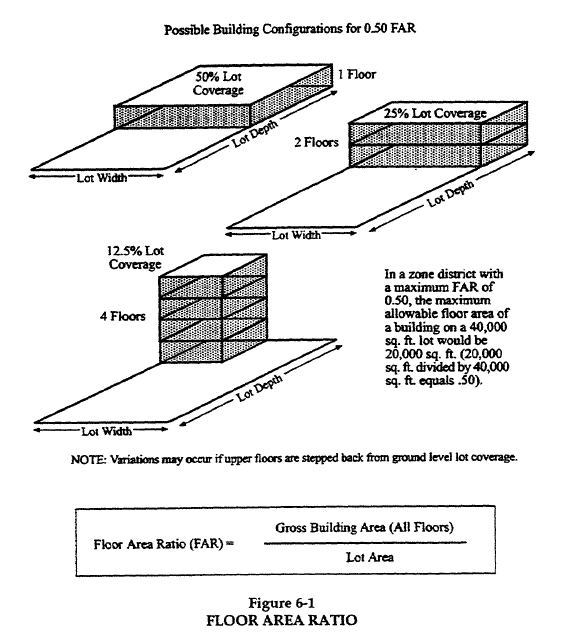
Floor area ratio (FAR). The floor area ratio (FAR) is the ratio of floor area to total lot area. FAR restrictions are used to limit the maximum floor area allowed on a site (including all structures on the site). The maximum floor area of all structures (measured from exterior wall to exterior wall) permitted on a site (including carports) shall be determined by multiplying the floor area ratio (FAR) by the total net area of the site (FAR x net site area = maximum allowable floor area). (Figure 6-1)
Food and beverage manufacturing. Manufacturing establishments producing or processing foods and beverages for human consumption, and certain related products. Includes:
Bakeries
Bottling plants
Breweries
Candy, sugar and confectionery products manufacturing
Catering services separate from stores or restaurants
Coffee roasting
Dairy products manufacturing
Fats and oil product manufacturing
Fruit and vegetable canning, preserving, related processing
Grain mill products and by-products
Meat, poultry, and seafood canning, curing, byproduct processing
Soft drink production
Miscellaneous food item preparation from raw products
May include tasting and accessory retail sales of beverages produced on-site. A tasting facility separate from the manufacturing facility is included under the definition of "bars and night clubs" if alcoholic beverages are tasted, and under "restaurant" if beverages are non-alcoholic.
Does not include: Bakeries which sell all products on-site (listed in article II (Zoning Districts, Allowable Land Uses And Zone-Specific Standards) as "bakeries" or beer brewing as part of a brew pub, bar or restaurant (see "bars and night clubs").
Fueling stations. Retail sales facilities for the fueling of gasoline-powered and electric vehicles. Facilities where other vehicle services are also provided are classified under "service stations."
Furniture and fixtures manufacturing. Manufacturers which produce wood and metal: Household furniture; bedsprings and mattresses; all types of office furniture, and partitions, shelving, lockers and store furniture; and miscellaneous drapery hardware, window blinds and shades. Includes wood and cabinet shops, but not sawmills or planing mills, which are instead included under "lumber and wood product manufacturing." The manufacture of household appliances is included under "electronics and equipment manufacturing."
Furniture, furnishings and equipment stores. Stores engaged primarily in selling the following products and related services, including incidental repair services:
Draperies
Floor coverings
Furniture
Glass and chinaware
Home appliances
Home furnishings
Home sound systems
Interior decorating materials and services
Large musical instruments
Lawn furniture
Movable spas and hot tubs
Office furniture
Other household electrical and gas appliances
Outdoor furniture
Refrigerators
Stoves
Televisions
(g)
Definitions, "G." The following definitions are in alphabetical order:
Garage, or carport. Parking space and shelter for automobiles or other vehicles, where the size of the parking space complies with the provisions of chapter 22.30 (Off-Street Parking and Loading Standards).
(1)
A garage is an attached or detached accessory structure with a door, enclosed on at least three sides.
(2)
A carport is an attached or detached accessory structure enclosed on no more than two sides.
Gateway corporate center. A mixed use office, research and development and commercial center located at the intersection of the Orange 57 and Pomona freeways, south of Golden Springs Drive, encompassing Gateway Center Drive, Copley Drive, Valley Vista Drive, and Bridge Gate Drive. Gateway Corporate Center is comprised of approximately 225 acres of land, including 80 acres of developable sites and 175 acres maintained as hillside open space. All proposed land uses within this area are subject to the provisions contained with the Gateway Corporate Center Design Guidelines, adopted by the city council Resolution 89-104.
General plan. The City of Diamond Bar General Plan, including all elements thereof and all amendments thereto, as adopted by the city council under the provisions of Government Code § 65300 et seq., and referred to in this Development Code as the "general plan."
General retail stores. Stores and shops selling many lines of merchandise. These stores and lines of merchandise include:
Artists' supplies
Bakeries (retail only)
Bicycles
Books
Cameras and photographic supplies
Clothing and accessories
Department stores
Drug and discount stores
Dry goods
Fabrics and sewing supplies
Florists and houseplant stores (indoor sales only—outdoor sales are "plant nurseries")
General stores
Hardware
Hobby materials
Jewelry
Luggage and leather goods
Musical instruments, parts and accessories
Newsstands
Orthopedic supplies
Pet stores
Religious goods
Small wares
Specialty shops
Sporting goods and equipment
Stationery
Toys and games
Variety stores
Glass product manufacturing. Manufacturing establishments producing flat glass and other glass products which are pressed, blown, or shaped from glass produced in the same establishment. Does not include artisan and craftsman type operations of a larger scale than home occupations; see "handcraft industries and small scale manufacturing."
Golf courses/country clubs. Golf courses, and accessory facilities and uses including: Clubhouses with bar and restaurant, locker and shower facilities; driving ranges; "pro shops" for on-site sales of golfing equipment; and golf cart storage and sales facilities.
Grade. The ground surface immediately adjacent to the exterior base of a structure, typically used as the basis for measurement of the height of the structure.
(1)
Existing or natural grade. The contour of the ground surface before grading.
(2)
Finish grade. The final contour of the ground surface of a site that conforms to the approved grading plan.
(3)
Natural grade. The elevation of the ground level in its natural state before grading, filling or construction.
(4)
Street grade. The elevation of the centerline of the street adjacent to the site proposed for development.
Grading. To bring an existing surface to a designed form by excavating, filling, or smoothing operations.
(1)
Conventional grading. See Figure 6-2.
a.
Conventionally graded slopes are characterized by essentially linear, flat slope surfaces with unvarying gradients and angular slope intersections. Resultant pad configurations are rectangular.
b.
Slope drainage devices are usually constructed in a rectilinear configuration in exposed positions.
c.
Landscaping is applied in random or geometric patterns.
(2)
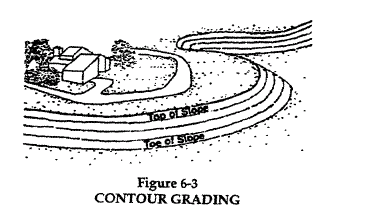
Contour grading. See Figure 6-3.
a.
Contour-graded slopes are basically similar to conventionally graded slopes except that in plan the slopes are curvilinear rather than linear, the gradients are unvarying and profiles are planar, transition zones and slope intersections have generally some rounding applied. Resultant pad configurations are mildly curvilinear.
b.
Slope drainage devices are usually constructed in a geometric configuration and in an exposed position on the slope face.
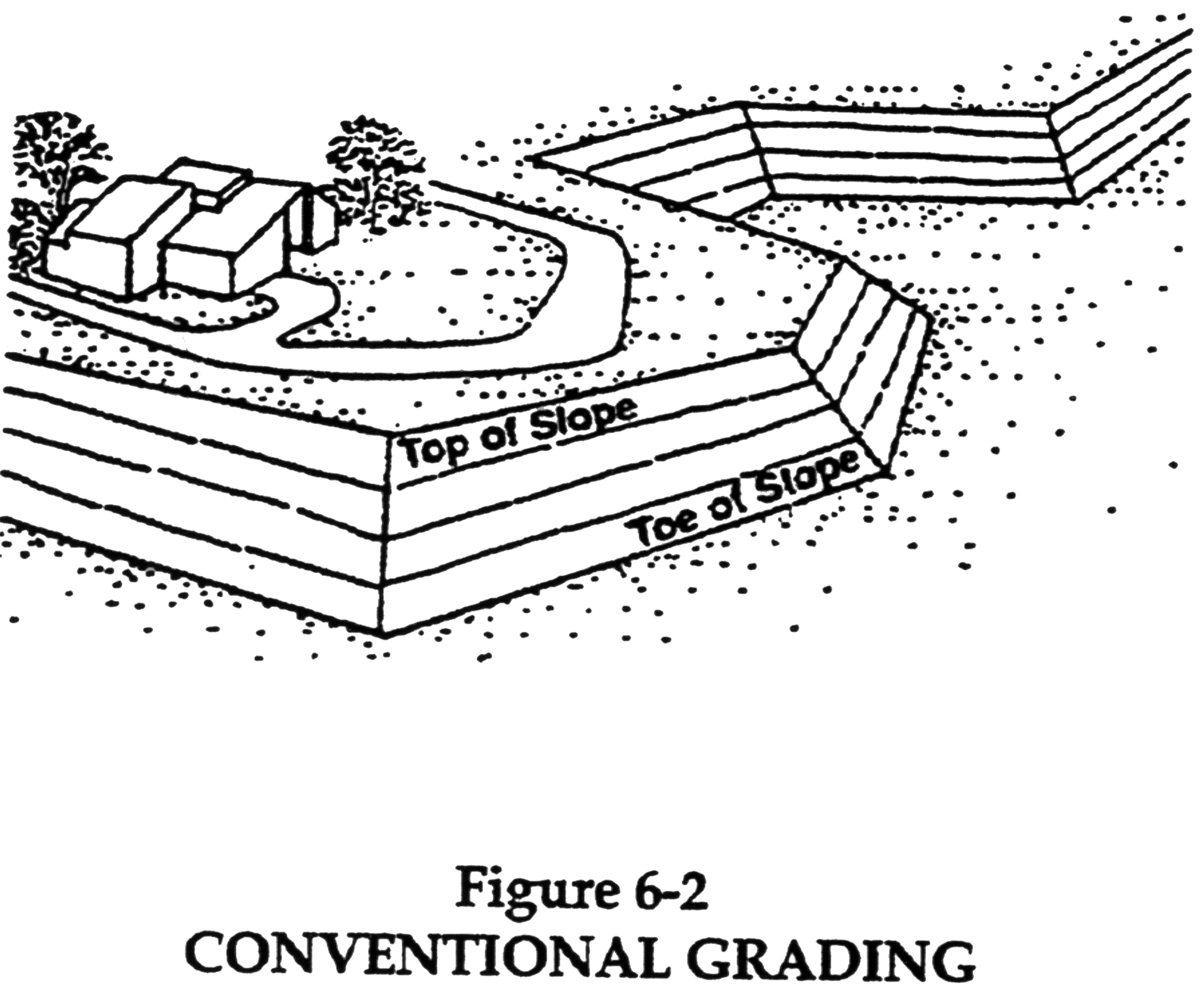
Figure 6-2. Conventional Grading
c.
Landscaping is applied in random or geometric patterns.
(3)
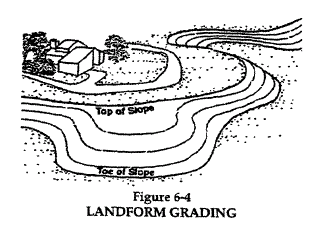
Landform grading. See Figure 6-4.
a.
Landform grading replicates the irregular shapes of natural slopes resulting in aesthetically pleasing elevations and profiles. Landform-graded slopes are characterized by continuous series of concave and convex forms interspersed with mounds that blend into the profiles, not linear in plan view, and varying slope gradients, and significant transition zones between man-made and natural slopes. Resultant pad configurations are irregular.
b.
Slope down-drain devices either follow the natural line of the slopes or are tucked away in special swale and berm combinations in order to conceal the drains from view. Exposed segments in high visibility areas are treated with natural rock.
c.
Landscaping becomes a "revegetation" process and is applied in patterns that occur in nature: trees and shrubs are concentrated largely in concave areas, while convex portions are planted mainly with groundcovers.
Grand opening. A promotional activity not exceeding 30 calendar days used by newly established businesses, within two months after initial occupancy, to inform the public of their location and services available to the community. "Grand opening" does not mean an annual or occasional promotion of retail sales by a business.
Grocery stores. Stores where most of the floor area is devoted to the sale of food products for home preparation and consumption, which typically also offer other home care and personal care products, and which are substantially larger and carry a broader range of merchandise than "convenience stores."
Group homes means all shared living arrangements where three or more persons are not living together as a single housekeeping unit. This classification includes without limitation group residential; parolee-probationer homes; general, small licensed and small unlicensed residential care facilities; and sober living homes.
Group residential means shared living quarters, occupied by three or more persons not living together as a single housekeeping unit. This classification includes without limitation boarding or rooming houses, dormitories and senior citizen rest homes, but excludes residential care facilities (general, small licensed, and small unlicensed).
Guest house. A detached or attached structure of 300 square feet or more, accessory to a single-family dwelling, accommodating living/sleeping quarter, but without kitchen or cooking facilities. (Refer to section 22.42.060.)
(h)
Definitions, "H." The following definitions are in alphabetical order:
Handcraft industries. Establishments manufacturing and/or assembling small products primarily by hand, including jewelry, pottery and other ceramics, as well as small glass and metal art and craft products.
Hazardous materials. Any substance or material that, by reason of its toxic, caustic, corrosive, abrasive, or otherwise injurious properties may be detrimental or deleterious to the health of any person handling or otherwise coming into contact with such material or substance.
Health/fitness facilities. Fitness centers, gymnasiums, health and athletic clubs including indoor sauna, spa or hot tub facilities; indoor tennis, handball, racquetball, and other indoor sports activities.
Health care institution. A hospital, convalescent home, or other similar facility that provides health care, medical treatment, room, board or other services for the ill, mentally or physically disabled, or convalescent.
Hearing officer. The City of Diamond Bar Community and Development Services Department employee designated by the director as the city's hearing officer, with the authority and responsibility to conduct public hearings and approve or disapprove land use permit applications in compliance with article IV (Land Use and Development Permit Procedures).
Height of structure. See section 22.16.060 (Height measurement and height limit exceptions).
Heliport. A facility for the landing and takeoff of helicopters, and associated passenger and freight loading and unloading.
Hillside. A parcel of land which contains grades in excess of ten percent.
Home occupation. The conduct of a business within a dwelling unit or residential site, employing occupants of the dwelling, with the business activity being subordinate to the residential use of the property.
Hospital. See "medical services—hospitals."
Hotel or motel. Facilities with guest rooms or suites, provided with or without kitchen facilities, rented to the general public for transient lodging (less than 30 days). Hotels provide access to most guest rooms from an interior walkway, and typically include a variety of services in addition to lodging; for example, restaurants, meeting facilities, personal services, etc. Motels provide access to most guest rooms from an exterior walkway. Also includes accessory guest facilities such as swimming pools, tennis courts, indoor athletic facilities, accessory retail uses, etc.
Hydrozone. A portion of the landscaped area having plants with similar water needs that are served by a valve or set of valves with the same schedule. A hydrozone may be irrigated or nonirrigated. For example, a naturalized area planted with native vegetation that will not need supplemental irrigation once established is a nonirrigated hydrozone.
(I)
Definitions, "I." The following definitions are in alphabetical order:
Improvement. Any man-made immovable, permanent item or structure that becomes part of, is placed upon, or is affixed to real estate.
Impulsive noise. A sound of short duration, usually less than one second and of high intensity, with an abrupt onset and rapid decay.
Individual with a disability, or disabled person as more specifically defined under the fair housing laws, means an individual who has a physical or mental impairment that limits one or more of that person's major life activities; anyone who is regarded as having such impairment; or anyone who has a record of having such an impairment, but not including an individual's current, illegal use of a controlled substance.
Indoor amusement/entertainment facilities. Establishments providing indoor amusement/entertainment services for a fee or admission charge, including:
Bowling alleys
Card rooms
Coin-operated amusement arcades
Electronic game arcades
Ice skating and roller skating
Pool and billiard rooms as primary uses (see also chapter 5.16 of the Municipal Code)
Archery and shooting ranges
Four or more electronic games or coin-operated amusements in any establishment, or a premises where 50 percent or more of the floor area is occupied by amusement devices, are considered an electronic game arcade as described above, three or fewer are not considered a land use separate from the primary use of the site.
Infiltration rate. The rate of water entry into the soil expressed as a depth of water per unit of time (inches per hour).
Infrastructure. Facilities and services that are required to support and sustain land uses in all zoning districts, including: water, sewer lines and other utilities; streets communications; and public facilities including fire and sheriffs stations, parks, and schools.
Intensification of use. A change in the use of a structure or site, where the new use is required by chapter 22.30 (Off-Street Parking and Loading Standards) to have more off-street parking spaces than the former use; or a change in the operating characteristics of a use (for example, hours of operation), which generate more activity on the site.
Intrusive noise. The alleged offensive noise that intrudes over and above the existing ambient noise at the receptor property.
(j)
Definitions, "J." No definitions of terms beginning with the letter "J" are used at this time.
(k)
Definitions, "K." The following definitions are in alphabetical order:
Kennels and animal boarding. Commercial facilities for the breeding, keeping, grooming, boarding or maintaining of four or more dogs four months of age or older, or four or more cats for commercial purposes, except for dogs or cats in pet shops.
Kitchen or kitchenette. An area designed and/or used for the preparation of food, which includes any three of the following features:
(1)
Cooking or food heating equipment, including a hot plate, microwave, oven, or range;
(2)
A refrigerator or other device for cold storage;
(3)
Cabinets, shelves, or other facilities for storage of food and/or utensils; or
(4)
A sink and water supply.
(l)
Definitions, "L." The following definitions are in alphabetical order:
Land use permit. Authority granted by the city to use a specified site for a particular purpose, including conditional use permits and minor conditional use permits, development plans and minor development plans, planned development permits, temporary use permits, variances and minor variances, and zoning clearances, as established by article IV (Land Use and Development Permit Procedures) of this Development Code.
Landscaped area. The entire parcel less the building footprint, access drives, nonirrigated portions of parking lots, hardscapes (e.g., decks and patios) and other nonporous areas. Water features are included in the calculation of the landscaped area.
Large family day care home. See "child day care facilities."
Laundries and dry cleaning plants. Service establishments engaged primarily in high volume laundry and garment services, including: Power laundries (family and commercial); garment pressing and dry cleaning, linen supply; diaper service; industrial laundries; carpet and upholstery cleaners. Does not include coin-operated laundries or dry cleaning pick-up stores without dry cleaning equipment; see "personal services."
Live entertainment. Any live performance, including but not limited to all forms of music, theatrical or comedic performance, song, dance, karaoke, or vocal entertainment by a disc jockey or announcer, participated in by one or more employees, independent contractors, guests, customers, or any other person or persons. Does not include ambient or incidental music provided for guests or patrons by one nonamplified musician or the use of a radio or other electronic playback device in any establishment, except when utilized by an announcer or "disc jockey" who at any time provides any form of vocal entertainment for the purpose of gaining the attention and interest of, or diverting or amusing guests or patrons, including the announcing of song titles or artists' names.
Lot or parcel. A recorded lot or parcel of real property under single ownership, lawfully created as required by the Subdivision Map Act and city ordinances, including this Development Code. Types of lots include the following. See Figure 6-5 (Lot Types).
(1)
Corner lot. A lot located at the intersection of two or more streets, where they intersect at an interior angle of not more than 135 degrees. If the intersection angle is more than 135 degrees, the lot is considered an interior lot.
(2)
Flag lot. A lot having access from the building site to a public street by means of private right-of-way strip that is owned in fee.
(3)
Interior lot. A lot abutting only one street.
(4)
Key lot. The first interior lot to the rear of a reversed corner lot. The front property line of the key lot is formed by a continuation of the side line of the reversed corner lot.
(5)
Reverse corner lot. A corner lot, the rear of which abuts a key lot.
(6)
Through lot. A lot with frontage on two generally parallel streets.
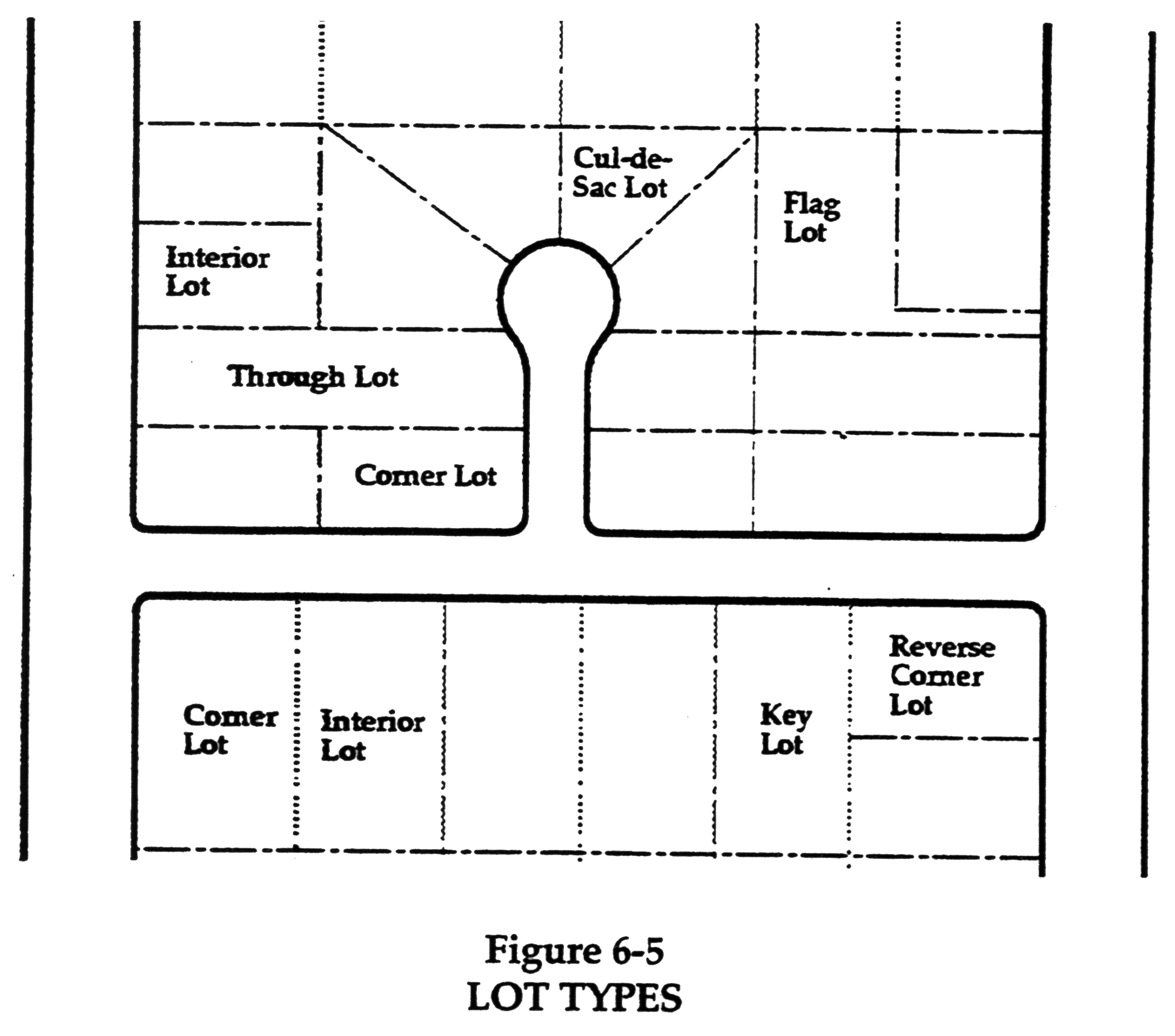
Figure 6-5. Lot Types
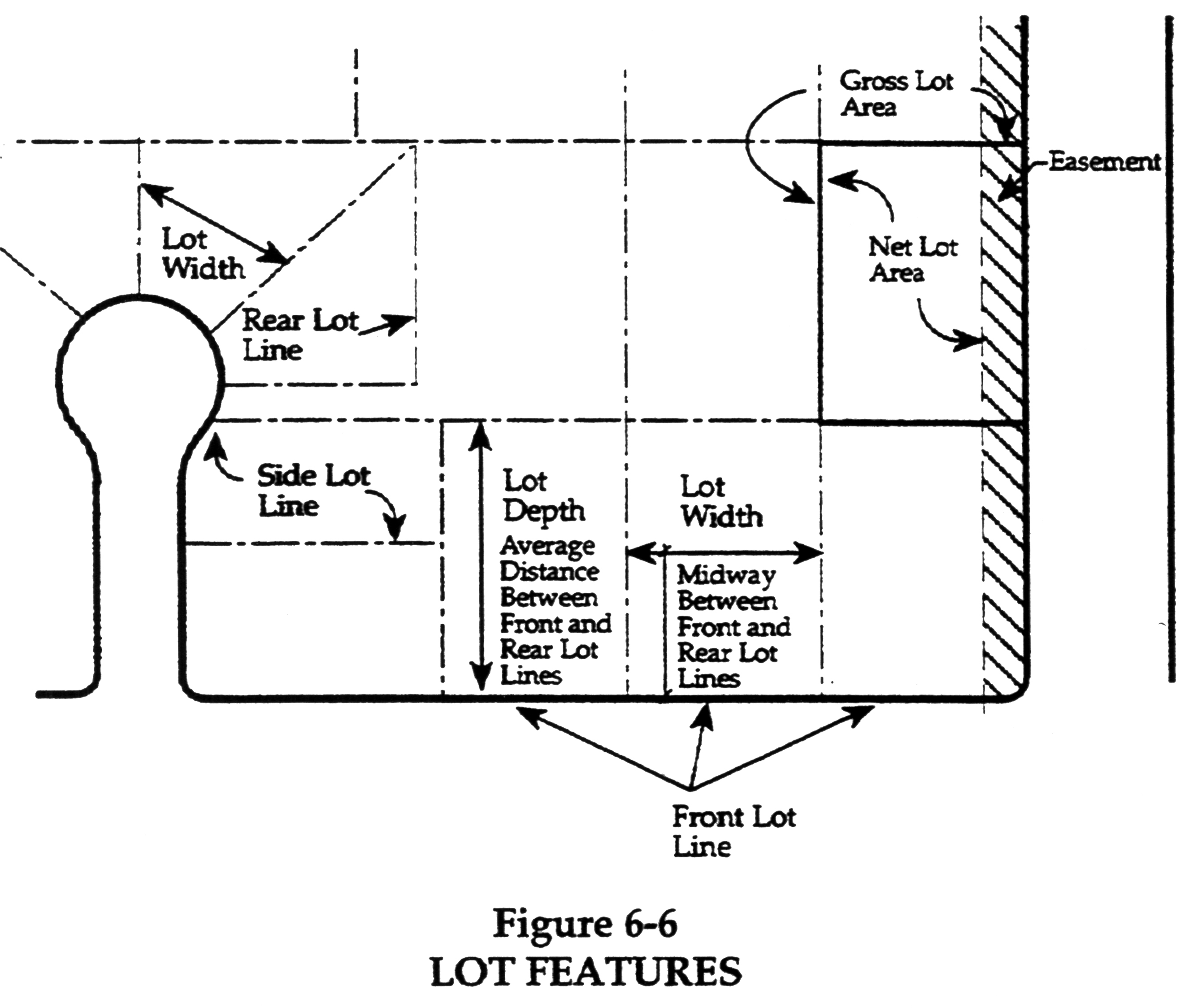
Figure 6-6. Lot Features
Lot area. Gross lot area is the total area included within the lot lines of a lot, exclusive of adjacent dedicated street rights-of-way. Net lot area is exclusive of easements, including those for utilities or flood control channels, which limit the use of the lot.
Lot coverage. See "site coverage."
Lot depth. The average linear distance between the front and the rear lot lines or the intersection of the two side lot lines if there is no rear line. See Figure 6-6 (Lot Features). The director shall determine lot depth for parcels of irregular configuration.
Lot frontage. The boundary of a lot adjacent to a public street right-of-way.
Lot line or property line. Any recorded boundary of a lot. Types of lot lines are as follows (see Figure 6-6 (Lot Features)):
(1)
Front lot line. On an interior lot, the property line separating the parcel from the street. The front lot line on a corner lot is the line with the shortest frontage. (If the lot lines of a corner lot are equal in length, the front lot line shall be determined by the director.) On a through lot, both lot lines are front lot lines and the lot is considered to have no rear lot line.
(2)
Interior lot line. Any lot line not abutting a street.
(3)
Rear lot line. A property line that does not intersect the front lot line, which is most distant from and most closely parallel to the front lot line.
(4)
Side lot line. Any lot line that is not a front or rear lot line.
Lot width. The horizontal distance between the side lot lines, measured at right angles to the lot depth at a point midway between the front and rear lot lines. See Figure 6-6 (Lot Features). The director shall determine lot width for parcels of irregular shape.
Low-barrier navigation center. A housing first, low-barrier, service-enriched shelter focused on moving people into permanent housing that provides temporary living facilities while case managers connect individuals experiencing homelessness to income, public benefits, health services, shelter, and housing. A low-barrier navigation center includes any facility that meets the definition and requirements set forth in Sections 65660 and 65662 of the California Government Code.
Lumber and wood product manufacturing. Manufacturing, processing, and sales uses involving the milling of forest products to produce rough and finished lumber and other wood materials for use in other manufacturing, craft, or construction processes. Includes the following processes and products:
Containers, pallets and skids
Milling operations
Trusses and structural beams
Turning and shaping of wood products
Wholesaling of basic wood products
Wood product assembly
Craft-type shops are included in "handcraft industries and small-scale manufacturing." Other wood and cabinet shops are included under "furniture and fixture manufacturing." The indoor retail sale of building materials, construction tools and equipment is included under "building material stores."
(m)
Definitions, "M." The following definitions are in alphabetical order:
Major reasonable accommodation means any deviation requested and/or granted from the strict application of the city's laws, rules, policies, practices and/or procedures of the city, including land use and zoning regulations of this title, resulting in a deviation from the allowed uses and permit requirements of this title, or a physical modification to the property which cannot be restored or terminated within 90 days or less after the need for the reasonable accommodation ends.
Map Act. See "Subdivision Map Act."
Massage establishment. A business engaging in massage services pursuant to the provisions set forth in section 5.08.070.
Medical services—Clinics and laboratories. Facilities primarily engaged in furnishing outpatient medical, mental health, surgical and other personal health services, but which are separate from hospitals, including:
Health management organizations (HMOs)
Medical and dental laboratories
Medical, dental and psychiatric offices
Out-patient care facilities
Other allied health services
Counseling services by other than medical doctors or psychiatrists are included under "offices."
Medical services—Extended care. Residential facilities providing nursing and health-related care as a primary use with in-patient beds, including: Board and care homes; convalescent and rest homes; extended care facilities; skilled nursing facilities. Long-term personal care facilities that do not emphasize medical treatment are included under "residential care homes."
Medical services hospitals. Hospitals and similar facilities engaged primarily in providing diagnostic services, and extensive medical treatment, including surgical and other hospital services. These establishments have an organized medical staff, inpatient beds, and equipment and facilities to provide complete health care. May include on-site accessory clinics and laboratories, accessory retail uses and emergency heliports (see the separate definition of "accessory retail uses").
Metal products fabrication, machine and welding shops. Establishments engaged primarily in the assembly of metal parts, including the following uses that produce metal duct work, tanks, towers, cabinets and enclosures, metal doors and gates, and similar products.
Blacksmith and welding shops
Sheet metal shops
Machine shops and boiler shops
Minor reasonable accommodation means any deviation requested and/or granted from the strict application of the city's laws, rules, policies, practices and/or procedures of the city, including land use and zoning regulations of this title, and which can be removed or terminated in 90 days or less after the need for the reasonable accommodation ends.
Mixed-use. The combination of nonresidential and residential uses located on the same property as part of a unified development. Mixed-use development may consist of commercial and residential uses integrated either vertically (vertical mixed-use) in the same structure or group of structures, or horizontally on the same development site (horizontal mixed-use) where parking, open spaces, and other development features are shared. In a residential/commercial mixed-use development, both uses are considered primary uses of the land.
Mobile home. A trailer, transportable in one or more sections, that is certified under the National Manufactured Housing Construction and Safety Standards Act of 1974, which is over eight feet in width and 40 feet in length, with or without a permanent foundation and not including recreational vehicle, commercial coach or factory-built housing. A mobile home on a permanent foundation is included under the definition of "single-family dwellings."
Mobile home and recreational vehicle sales. Retail establishments selling and/or renting the following new or used vehicles and products:
Boats
Campers/camper shells
Golf carts
Jet skis
Mobile homes
Motor homes
Motorcycles
Snowmobiles
Travel/recreational trailers
Other recreational vehicles
May also include repair shops and the sales of parts and accessories, incidental to vehicle dealerships. Does not include: Parts/accessory sales separate from a vehicle dealership (see "auto parts sales"); or bicycle and moped sales (see "general retail stores").
Mobile home park. Any site that is planned and improved to accommodate two or more mobile homes used for residential purposes, or on which two or more mobile home lots are rented, leased, or held out for rent or lease, or were formerly held out for rent or lease and later converted to a subdivision, cooperative, condominium, or other form of resident ownership, to accommodate mobile homes used for residential purposes.
Mobile noise source. A noise source other than a fixed noise source.
Mortuaries. Funeral homes and parlors, where deceased are prepared for burial or cremation, and funeral services may be conducted.
Mulch. Any material (e.g., leaves, bark, straw, compost, manure, or other materials) left loose and applied to the soil surface to reduce evaporation.
Multifamily dwellings. A building or a portion of a building used and/or designed as three or more independent dwelling units. Includes: Triplexes, fourplexes (buildings under one ownership with three or four dwelling units, respectively, in the same structure) and apartments (five or more units under one ownership in a single building); townhouse development (three or more attached single-family dwellings where no unit is located over another unit); senior citizen multifamily housing; and common ownership, attached unit projects including condominiums. Duplexes are separately defined.
Multiple tenant site/center. A commercial or industrial development consisting of two or more separate businesses that share either the same parcel or structure and use common access and parking facilities.
Municipal Code. The City of Diamond Bar Municipal Code, as it may be amended from time to time by the council.
(n)
Definitions, "N." The following definitions are in alphabetical order:
Natural grade. See "grade."
Natural slope. See "slope."
Night club. See "bars and night clubs."
Noise disturbance. An alleged intrusive noise that violates an applicable noise standard of this chapter.
Noise histogram. A graphical representation of the distribution of frequency of occurrence of all noise levels near and far measured over a given period of time.
Noise level (LN). The noise level expressed in decibels that exceeds the specified (L) value as percentage of total time measured. For example, an L 25 noise level means that noise level that is exceeded 25 percent of the time measured.
Noise-sensitive zone. An area designated for the purpose of ensuring exceptional quiet.
Noise zone. A defined area or region of a generally consistent land use.
Nonconforming parcel. A parcel that was legally created prior to the adoption of this Development Code and which does not conform to current code provisions/standards (e.g., access, area or width requirements, etc.) prescribed for the zoning district in which the parcel is located.
Nonconforming sign. See "sign—nonconforming sign."
Nonconforming structure. A structure that was legally constructed prior to the adoption of this Development Code and which does not conform to current code provisions/standards (e.g., open space, distance between structures, etc.) prescribed for the zoning district in which the structure is located.
Nonconforming use. A use of a structure (either conforming or nonconforming) or land that was legally established and maintained prior to the adoption of this Development Code and which does not conform to current code provisions governing allowable land uses for the zoning district in which the use is located.
Nonconformity upon annexation. Nonconformities shall include a structure, use, or parcel legally existing and located in the unincorporated territory which, upon annexation to the city, does not comply with the provisions of this Development Code.
Nuisance per se. Examples of activities that are nuisances per se include water pollution by discharge, structures which amount to a fire hazard, noise, air pollution, weeds, rubbish and refuse, junkyards, earth movement and illegal signs.
(o)
Definitions, "O" The following definitions are in alphabetical order:
Occupancy. All or a portion of a structure occupied by one tenant.
Offices—Administrative/business. Establishments providing direct services to consumers, including insurance agencies, real estate offices, post offices (not including bulk mailing distribution centers, which are included under "vehicle and freight terminals").
Does not include: Medical offices (see "medical services—clinics and laboratories"); or offices that are incidental and accessory to another business or sales activity that is the primary use. Incidental offices that are customarily accessory to another use are allowed as part of an approved primary use.
Offices—Production. Office-type facilities occupied by businesses engaged in the production of intellectual property. These uses include:
Advertising agencies
Architectural, engineering, planning and surveying services
Computer software production and programming services
Educational, scientific and research organizations
Media postproduction services
Photography and commercial art studios
Writers and artists offices
Does not include: Medical offices (see "medical services—clinics and laboratories") or offices that are incidental and accessory to another business or sales activity that is the primary use. Incidental offices that are customarily accessory to another use are allowed as part of an approved primary use.
Offices—Professional. Professional or government offices including:
Accounting, auditing and bookkeeping services
Attorneys
Counseling services
Court reporting services
Data processing services
Detective agencies and similar services
Employment, stenographic, secretarial and word processing services
Government offices
Literary and talent agencies
Management and public relations services
Does not include: Medical offices (see "medical services—clinics and laboratories") or offices that are incidental and accessory to another business or sales activity that is the primary use. Incidental offices that are customarily accessory to another use are allowed as part of an approved primary use.
Offices—Temporary. A mobile home, recreational vehicle or modular unit used as a temporary office facility. Temporary offices may include: Construction supervision offices on a construction-site or off-site construction yard; a temporary on-site real estate office for a development project; or a temporary business office in advance of permanent facility construction.
Offices—Temporary real estate. The temporary use of a dwelling unit within a residential development project as a sales office for the units on the same site, which is converted to residential use at the conclusion of its office use.
Open space, common. Outdoor areas within a development project that may be used by all residents/tenants of the site.
Open space, private. Art outdoor area within a development project that is reserved for use by the residents/tenants of a specific unit or portion of the site.
Organizational houses. Residential lodging houses operated by membership organizations for their members and not open to the general public. Includes fraternity and sorority houses, convents, monasteries, and religious residential retreats.
Outdoor recreation. Facilities for various outdoor participant sports and types of recreation where a fee is charged for use, including:
Amphitheaters
Amusement and theme parks
Drive-in theaters
Go-cart and miniature auto race tracks
Golf driving ranges separate from golf courses
Health and athletic club outdoor facilities
Miniature golf courses
Motorcycle racing and drag strips
Race tracks
Skateboard parks
Stadiums and coliseums
Swim and tennis clubs
Tennis courts
Water slides
Zoos
May also include commercial facilities customarily associated with the above outdoor commercial recreational uses, including bars and restaurants, video game arcades, etc.
Outdoor retail sales and activities. Permanent outdoor sales and rental establishments including auto dealers, lumber and other material sales yards, newsstands, outdoor facilities for the sale or rental of other vehicles/equipment, and other uses where the business is not conducted entirely within a structure.
Outdoor retail sales, temporary. Temporary outdoor retail operations including:
Christmas trees, pumpkins or the sale of other seasonal items
Farmers' markets
Semiannual sales of art/handcrafted items in conjunction with community festivals or art shows
Sidewalk or parking lot sales longer than one weekend
Retail sales from individual vehicles in temporary locations outside the public right-of-way
Overspray. The water that is delivered beyond the landscaped area, wetting pavements, walks, structures, or other nonlandscaped areas.
(p)
Definitions, "P." The following definitions are in alphabetical order:
Pad. A level area created by grading to accommodate development.
Paper product manufacturing. The manufacture of paper and paperboard, from both raw and recycled materials, and their conversion into products including paper bags, boxes, envelopes, wallpaper, etc.
Parcel. See "lot, or parcel."
Parking facilities/vehicle storage. Service establishments in the business of storing operative cars, trucks, buses, recreational vehicles, and other motor vehicles for clients. Includes both day use and long-term public and commercial garages, parking lots and structures, except when accessory to a primary use. (All primary uses are considered to include any customer or public use off-street parking required by the Development Code.) Includes sites where vehicles are stored for rental or leasing. Does not include dismantling yards (classified in "recycling facilities—scrap and dismantling yards").
Parks and playgrounds. Public parks, play lots, playgrounds, and athletic fields for noncommercial neighborhood or community use, including tennis courts. If privately-owned, the same facilities are included under the definition of "private residential recreation facilities." See also "outdoor recreation."
Parolee-probationer home means any residential structure or unit, whether owned and/or operated by an individual or a for-profit or nonprofit entity, which houses two or more parolees-probationers unrelated by blood, marriage, or legal adoption, in exchange for monetary or nonmonetary consideration given and/or paid by the parolee-probationer and/or any public or private entity or person on behalf of the parolee-probationer. A parolee-probationer includes: (1) any individual who has been convicted of a federal crime, sentenced to a United States prison, and received conditional and revocable release in the community under the supervision of a Federal Parole Officer; (2) any individual who has served a term of imprisonment in a state prison and who is serving a period of supervised community custody, as defined in Penal Code Section 3000, and is under the jurisdiction of the California Department of Corrections, Parole and Community Services Division; (3) an adult or juvenile sentenced to a term in the California Youth Authority and who has received conditional and revocable release in the community under the supervision of a youth authority parole officer; or (4) any individual who has been convicted of a felony, sentenced to any correctional facility, including county correctional facilities, and is under the jurisdiction of any federal, state, or county parole or probation officer. For the purposes of this section, "felony" means a felony as defined by any California or United States statute.
Patio. A typically paved outdoor area on the site of a dwelling that is used for lounging, dining, etc.
Paving and roofing materials manufacturing. The manufacture of various common paving and petroleum-based roofing materials, including bulk asphalt, paving blocks made of asphalt, creosote wood and various compositions of asphalt and tar. The manufacture of wood roofing materials (shingles, shakes, etc.) is included under "Lumber and wood product manufacturing."
Permitted use. A use of land identified by article II (Zoning Districts and Allowable Land Uses) as being allowed in a particular zoning district, subject to the approval of a zoning clearance, in compliance with chapter 22.46 (Zoning Clearances).
Person. Any individual, firm, co-partnership, corporation, company, association, joint stock association; city, county, state, or district; and includes any trustee, receiver, assignee, or other similar representative thereof.
Personal services. Establishments providing nonmedical services to individuals as a primary use, including:
Clothing rental
Dry cleaning pick-up stores
Hair cutting/styling
Home electronics repair
Laundromats (self-service laundries)
Massage
Nail salons
Shoe repair shops
Tailors
Tanning salons
Tattoo parlors
These uses may also include accessory retail sales of products related to the services provided.
Pet shops. Retail stores selling birds, cats, dogs, fish, and other common household pets, including supplies for the care and feeding of the animals sold. This use may include pet grooming, but not the boarding of animals other than those for sale. See "veterinarians, animal hospitals, kennels."
Planned development. As defined by Civil Code § 1351(k), a development (other than a community apartment project, condominium, or stock cooperative) having either or both of the following features:
(1)
The common area is owned either by an association or in common by the owners of the separate interests who possess appurtenant rights to the beneficial use and enjoyment of the common area; and/or
(2)
A power exists in the association to enforce an obligation of an owner of a separate interest with respect to the beneficial use and enjoyment of the common area by means of an assessment which may become a lien upon the separately owned parcel, or area in compliance with Civil Code § 1367.
Planning commission. The Diamond Bar Planning Commission, appointed by the city council in compliance with Government Code § 65101, referred to throughout this Development Code as the "commission."
Plant nurseries and garden supply stores. Commercial agricultural establishments engaged in the production of ornamental plants and other nursery products, grown under cover or outdoors. Includes stores selling these products, and commercial scale greenhouses. The sale of house plants or other nursery products entirely within a building is also included under "general retail stores." Home greenhouses are included under "residential accessory uses and structures."
Plastics and rubber product manufacturing. The manufacture of rubber products including tires; rubber footwear; mechanical rubber goods; heels and soles; flooring and other rubber products from natural, synthetic or reclaimed rubber. Also includes establishments engaged primarily in manufacturing tires. Also includes: establishments engaged in molding primary plastics for other manufacturers, and manufacturing miscellaneous finished plastics products; fiberglass manufacturing, and fiberglass application services. Establishments engaged primarily in recapping and retreading automobile tires are classified in "vehicle services—major repair/body work."
Powered model vehicle. A self-propelled airborne, waterborne or land borne plane, vessel or vehicle which is not designed to carry individuals, including, but not limited to, any model airplane, boat, car or rocket.
Preferential parking. Parking spaces designated or assigned, through use of a sign or painted space markings for carpool and vanpool vehicles carrying commute passengers on a regular basis that are provided in a location more convenient to a place of employment than parking spaces provided for single occupant vehicles.
Primary structure. A structure that accommodates the primary use of the site.
Primary use. The main purpose for which a site is developed and/or used, including the activities that are conducted on the site a majority of the hours during which activities occur.
Primary zoning district. The zoning district applied to a site by the zoning map, to which an overlay zoning district may also be applied.
Printing and publishing. Establishments engaged in printing by letterpress, lithography, gravure, screen, offset, or electrostatic (xerographic) copying; and other establishments serving the printing trade, including bookbinding, typesetting, engraving, photoengraving and electrotyping. This use also includes establishments that publish newspapers, books and periodicals; establishments manufacturing business forms and binding devices. "Quick printing" services are included in the definition of "Business support services."
Private residential recreation facilities. Privately-owned, non-commercial outdoor recreation facilities provided for members or project/neighborhood residents, including swim and tennis clubs, park and sport court facilities. Does not include golf courses/country clubs, which are separately defined.
Prominent ridge. See "Ridge, prominent."
Protection zone. The area within the drip line of a tree and extending to a point at least five feet outside of the dripline, or 15 feet from the trunk of a tree, whichever distance is greater.
Psychic readers. Commercial services that involve the practicing or carrying on of any art, profession or business which shall include, but not limited to, psychic advisors, the telling of fortunes, forecasting of futures, or furnishing of any information not otherwise obtainable by the ordinary process of knowledge, for or without consideration or compensation of any kind.
Public nuisance. A public nuisance affects an entire community or neighborhood, or any considerable number of persons at the same time, although the extent of the annoyance or damage inflicted upon individuals may be unequal, Civil Code § 3480. A public nuisance is an act or omission which interferes with the interests of the community or interferes with the public health, safety, and welfare.
Public right-of-way. The area dedicated to public use for street or pedestrian purposes, including privately owned and maintained roads within the city that are generally held open to the public for purposes of vehicular and pedestrian traffic and includes alleys, driveways, highways, medians, parkways, planter strips, roads, sidewalks, and streets.
Public safety facilities. Facilities operated by public agencies including fire stations, other fire prevention and firefighting facilities, police and sheriff substations and headquarters, including interim incarceration facilities.
Public utility facilities. Fixed-base structures and facilities serving as junction points for transferring utility services from one transmission voltage to another or to local distribution and service voltages. These uses include any of the following facilities that are not exempted from land use permit requirements by Government Code § 53091:
Corporation and maintenance yards
Electrical substations and switching stations
Natural gas regulating and distribution facilities
Public water system wells, treatment plants and storage
Telephone switching facilities
Wastewater treatment plants, settling ponds and disposal fields
These uses do not include office or customer service centers (classified in "offices"), or equipment and material storage yards.
Pure tone noise. A sound that can be judged as audible as a single pitch or a set of single pitches by the director. For the purposes of this chapter, a pure tone shall exist if the one-third octave band sound-pressure level in the band with the tone exceeds the arithmetic average of the sound-pressure levels of the two contiguous one-third octave bands by five dB for center frequencies of 500 Hertz and above, and by eight dB for center frequencies between 160 and 400 Hertz, and by 15 dB for center frequencies less than or equal to 125 Hertz.
(q)
Definitions, "Q." No definitions of terms beginning with the letter "Q" are used at this time.
(r)
Definitions, "R." The following definitions are in alphabetical order:
Rain-sensing device. A system which automatically shuts off the irrigation system when it rains.
Recreational area. Areas of active play or recreation (e.g., sports fields, school yards, picnic grounds) or other areas with intense foot traffic.
Recreational vehicle (RV). A motor home, travel trailer, truck camper, or camping trailer, with or without motive power, originally designed for human habitation for recreational, emergency, or other occupancy, which meets all of the following criteria:
(1)
It contains less than 320 square feet of internal living room area, excluding built-in equipment, including wardrobe, closets, cabinets, kitchen units or fixtures, and bath or toilet rooms;
(2)
It contains 400 square feet or less of gross area measured at maximum horizontal projections;
(3)
It is built on a single chassis; and
(4)
It is either self-propelled, truck-mounted, or permanently towable on the highways without a towing permit.
Recreational vehicle park. A site where one or more lots are used, or are intended to be used, by campers with recreational vehicles or tents for temporary stays not exceeding 30 days. Recreational vehicle parks may include public restrooms, water, sewer, and electric hookups to each lot and are intended as a higher density, more intensively developed use than campgrounds. May include accessory retail uses where they are clearly incidental and intended to serve RV park patrons only.
Recycling facilities. This land use type includes a variety of facilities involved with the collection, sorting and processing of recyclable materials.
(1)
Collection facility. A center where the public may donate, redeem or sell recyclable materials, which may include the following:
a.
Reverse vending machine(s);
b.
Small collection facilities which occupy an area of 350 square feet or less and may include:
1.
A mobile unit;
2.
Bulk reverse vending machines or a grouping of reverse vending machines occupying more than 50 square feet; and
3.
Kiosk-type units which may include permanent structures.
c.
Large collection facilities which occupy an area of more than 350 square feet and/or include permanent structures.
(2)
Mobile recycling unit. An automobile, truck, trailer, or van used for the collection of recyclable materials, carrying bins, boxes, or other containers.
(3)
Processing facility. A structure or enclosed space used for the collection and processing of recyclable materials for shipment, or to an end-user's specifications, by such means as baling, briquetting, cleaning, compacting, crushing, flattening, grinding, mechanical sorting, remanufacturing and shredding. Processing facilities include the following types, both of which are included under the definition of "Recycling facilities—Scrap and dismantling yards":
a.
Light processing facility occupies an area of under 45,000 square feet of collection, processing and storage area, and averages two outbound truck shipments each day. Light processing facilities are limited to, baling, briquetting, compacting, crushing, grinding, shredding and sorting of source separated recyclable materials sufficient to qualify as a certified processing facility. A light processing facility shall not shred, compact, or bale ferrous metals other than food and beverage containers; and
b.
A heavy processing facility is any processing facility other than a light processing facility.
(4)
Recycling facility. A center for the collection and/or processing of recyclable materials. A "certified" recycling or processing facility is certified by the California Beverage Container Recycling and Litter Reduction Act of 1986. A recycling facility does not include storage containers located on a residentially, commercially or industrially designated site used solely for the recycling of material generated on the site. See "collection facility" above.
(5)
Recycling or recyclable material. Reusable domestic containers and other materials which can be reconstituted, remanufactured, or reused in an altered form, including glass, metals, paper and plastic. Recyclable material does not include refuse or hazardous materials.
(6)
Reverse vending machine. An automated mechanical device which accepts at least one or more types of empty beverage containers and issues a cash refund or a redeemable credit slip with a value not less than the container's redemption value, as determined by state law. These vending machines may accept aluminum cans, glass and plastic bottles, and other containers.
A bulk reverse vending machine is a reverse vending machine that is larger than 50 square feet, is designed to accept more than one container at a time, and issues a cash refund based on total weight instead of by container.
(7)
Scrap and dismantling yards. Outdoor establishments primarily engaged in assembling, breaking up, sorting, and the temporary storage and distribution of recyclable or reusable scrap and waste materials, including auto wreckers engaged in dismantling automobiles for scrap, and the incidental wholesale or retail sales of parts from those vehicles. Includes light and heavy processing facilities for recycling (see the definitions above). Does not include: Places where these activities are conducted entirely within buildings; pawn shops, and other secondhand stores; the sale of operative used cars; or landfills or other waste disposal sites.
Rehabilitated landscape. A relandscaping project that requires or is a component of a required permit, including a grading permit, building permit, or conditional use permit.
Religious places of worship. Religious facilities operated by organizations for worship, or the promotion of religious activities, including churches, synagogues, mosques, etc., and religious schools; and accessory uses on the same site, including living quarters for ministers and staff, and child day care facilities where authorized by the same type of land use permit required for the church itself. Other establishments maintained by religious organizations, including full-time educational institutions, hospitals and other potentially related operations (i.e., a recreational camp) are classified according to their respective activities.
Repair services. Service establishments where repair of consumer products is the principal business activity, including: Computer and electronic equipment repair shops; shoe repair, television and radio; vacuum and other appliance repair; watch, clock and jewelry repair; re-upholstery and furniture repair. Does not include businesses serving the repair needs of heavy equipment on the equipment site, which are included under "business support services."
Research and development. Indoor facilities for scientific research, and the design, development and testing of electrical, electronic, magnetic, optical and mechanical components in advance of product manufacturing, that are not associated with a manufacturing facility on the same site. Includes chemical and biotechnology research and development. Does not include computer software companies (see "Offices—Production"), soils and other materials testing laboratories (see "Business support services"), or medical laboratories (see "Medical services—Clinics and labs").
Residential accessory uses and structures. Any use and/or structure that is customarily a part of, and clearly incidental and secondary to, a residence and does not change the character of the residential use. These uses include the following detached accessory structures, and other similar structures normally associated with a residential use of property:
Garages
Gazebos
Greenhouses
Spas and hot tubs
Storage sheds
Studios
Swimming pools
Tennis and other on-site sport courts
Workshops
Also includes the indoor storage of automobiles (including their incidental restoration and repair), personal recreational vehicles and other personal property, accessory to a residential use. Does not include home satellite dish and other receiving antennas for earth-based TV and radio broadcasts; see "Telecommunications facilities."
Residential care facilities, general means any place, site or building, or groups of places, sites or buildings, licensed by the state or unlicensed, in which seven or more individuals with a disability reside who are not living together as a single housekeeping unit and in which every person residing in the facility (excluding the licensee, members of the licensee's family, or persons employed as facility staff) is an individual with a disability.
Residential care facilities, small licensed means state-licensed facilities that provide care, services, or treatment in a community residential setting for six or fewer adults, children, or adults and children and which are required by state law to be treated as a single housekeeping unit for zoning purposes. Small licensed residential care facilities shall be subject to all land use and property development regulations applicable to single housekeeping units. This term does not include child day care facilities or adult day care facilities as those terms are defined in the Diamond Bar Municipal Code.
Residential care facilities, small unlicensed means any place, site or building, or groups of places, sites or buildings, which is not licensed by the State of California and is not required by law to be licensed by the state, in which six or fewer individuals with a disability reside who are not living together as a single housekeeping unit and in which every person residing in the facility (excluding persons employed as facility staff) is an individual with a disability. Any place, site or building, or groups of places, sites or buildings, which is not licensed by the State of California and is not required by law to be licensed by the state, and houses recovering individuals recovering from alcohol or drug addiction shall meet the definition for sober living homes or alcohol and drug free residential recovery homes below to be regulated as a small unlicensed residential care facility. Failure of such facility to meet that definition means the facility shall be regulated as group residential.
Residential district or zone. Any of the residential zoning districts established by section 22.06.020 (Zoning districts established).
Restaurant, counter service. A retail business where customers are served prepared food from a walk-up ordering counter for either on- or off-premises consumption. A restaurant with drive-up or drive-through service is instead included under the definition of "Drive-in and drive-thru sales."
Restaurant, table service. An establishment that: (1) sells, or offers for sale, food and beverages during all hours it is open for business primarily by way of table service, (2) prepares food on-site in a kitchen capable of preparing food from its component ingredients and otherwise meets the definition of a "bona fide public eating place" contained in California Business and Professions Code § 23038, and (3) does not limit entry to persons 21 years of age or older and service of alcoholic beverages is secondary to service of food. Take-out service is permissible but must be secondary to on-site table service. Live entertainment and dancing by patrons, employees and independent contractors is prohibited.
Review authority. The individual or official city body (the director, hearing officer, planning commission, or city council) identified by this Development Code as having the responsibility and authority to review, and approve or disapprove the permit applications described in article IV (Land Use and Development Permit Procedures).
Ridesharing. The cooperative effort of two or more people traveling together for the purpose of getting to work. Utilization of carpools, vanpools, buspools, taxipools, trains and bus and rail transit are all examples of ridesharing.
Ridge. A long, narrow, conspicuous elevation of land.
Ridge, prominent. A ridge or bill location which is visible from a major arterial, secondary, or collector street, which forms part of the skyline or is seen as a distinct edge against a backdrop of land at least 300 feet horizontally behind it, or is so designated by the planning commission or city council.
Runoff. Water that is not absorbed by the soil or landscape to which it is applied and flows from the area. For example, runoff may result from water that is applied at too great a rate (application rate exceeds infiltration rate) or when there is a severe slope.
(s)
Definitions, "S." The following definitions are in alphabetical order:
School, private. An institution conducting regular academic instruction at kindergarten, elementary, secondary or higher levels operated by a nongovernmental organization and which is not a trade school.
School, public. A public governmental institution conducting regular academic instruction at kindergarten, elementary, secondary, or higher levels.
School, trade. Private schools offering preponderant instruction in the technical, commercial and/or trade skills, such as real estate schools, business colleges, electronic schools, automotive and aircraft technician schools, and similar commercial establishments.
Second hand stores. Indoor retail establishments that buy and sell used products, including books, clothing, furniture and household goods. The sale of antiques is included under "art, antique, collectible and gift sales." The sale of cars and other used vehicles is included under "auto, mobile home and vehicle sales." Does not include pawn shops.
Service station. A retail business selling gasoline or other motor vehicle fuels, which may also provide services which are incidental to fuel services. These secondary services may include vehicle engine maintenance and repair, towing and trailer rental services.
Does not include the storage or repair of wrecked or abandoned vehicles, vehicle painting, body or fender work, or the rental of vehicle storage or parking spaces.
Setback. The distance by which a structure, parking area or other development feature must be separated from a lot line, other structure or development feature, or street centerline. Setbacks from private streets are measured from the edge of the easement. See also "yard." Figure 6-7 (Setbacks) shows the location of front, side, street side, rear, and interior setbacks.
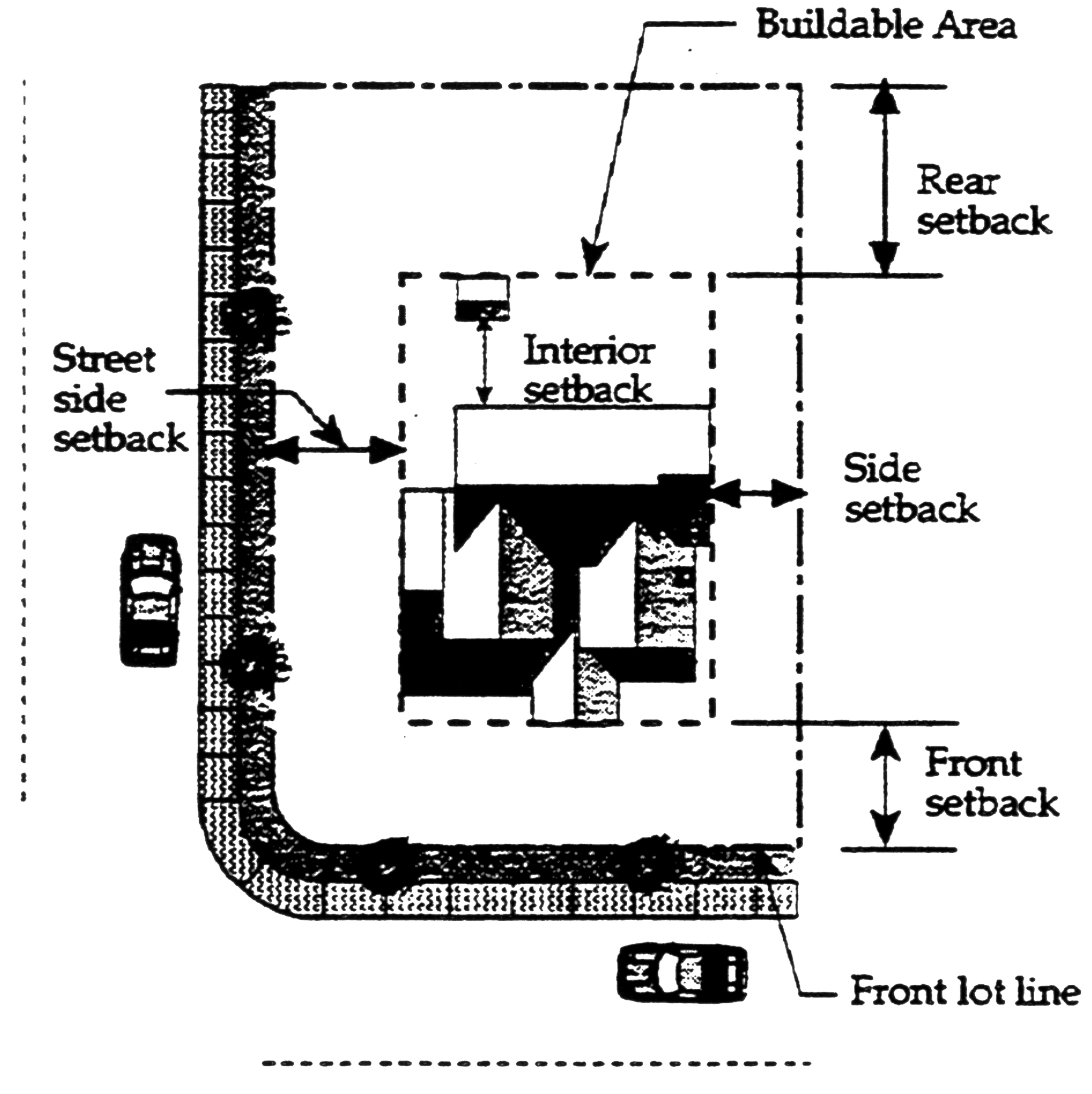
Figure 6-7. Setbacks
Shopping center. Primarily retail commercial sites with two or more separate businesses sharing common pedestrian and parking areas. A small-scale shopping center is 55,000 square feet or less in gross floor area; is on a site less than five acres in net area; has the majority of its parking located between the public streets and its buildings, and no parking underground or within a parking structure.
Short-term occupancy. The use or possession, or right to use or possess, of any portion of a dwelling unit, room or rooms offered for remuneration for dwelling, lodging or sleeping purposes for a period of less than 30 days. Short-term occupancy is prohibited in all residential zoning districts.
Short-term rental. The use of any dwelling unit, or any portion thereof, for short-term occupancy. Short-term rentals are prohibited in all zoning districts.
Sign. Any structure, device, figure, painting, display, message placard, or other contrivance, or any part thereof, situated outdoors or indoors, which is designed, constructed, intended, or used to advertise, or to provide data or information in the nature of advertising, to direct or attract attention to an object, person, institution, business, service, event, or location by any means, including words, letters, figures, designs, symbols, fixtures, colors, illumination, or projected images. The following terms related to signs are used in this Development Code:
(1)
Abandoned sign. Any sign which no longer advertises a business, lessor, owner, product, service or activity on the premises where the sign is displayed.
(2)
Alteration. Any change of copy, sign face, color, size, shape, illumination, position, location, construction, or supporting structure of any sign.
(3)
Animated or moving sign. Any sign which uses movement, lighting, or special materials to depict action or create a special effect to imitate movement.
(4)
Area of a sign. See "sign area."
(5)
Awning sign. Any sign copy or logo attached to or painted on an awning.
(6)
Banner, flag, or pennant. Any cloth, bunting, plastic, paper, or similar non-rigid material used for advertising purposes attached to any structure, staff, pole, line, framing, or vehicle, not including official flags of the United States, the State of California, and other states of the nation, counties, municipalities, official flags of foreign nations and nationally or internationally recognized organizations.
(7)
Bench sign. Copy painted on any portion of a bench.
(8)
Billboard. A freestanding sign structure designed and used to display offsite advertising copy, including commercial or non-commercial messages that direct attention to a business, product, service, activity, event, or location not located on the same premises as the sign. A billboard may be either a static billboard or a digital billboard as defined below. Billboards do not include on-site business identification signs, civic information signs, or temporary political signs:
a.
Digital billboard. A billboard that displays off-site advertising copy using electronic changeable copy technology, such as light-emitting diodes (LEDs) or similar digital display methods. The content may change remotely and at programmed intervals but shall comply with limitations on message duration and visual effects as set forth in this title.
b.
Static billboard. A billboard that displays a fixed image or message, typically through printed or painted panels. The copy does not change electronically and remains static until physically replaced.
(9)
Business identification sign. A sign which serves to identify only the name, address, and lawful use of the premises upon which it is located and provides no other advertisements or product identification.
(10)
Cabinet sign (can sign). A sign which contains all the text and/or logo symbols within a single enclosed cabinet and may or may not be illuminated.
(11)
Changeable copy sign. A sign designed to allow the changing of copy through manual, mechanical, or electrical means including time and temperature.
(12)
Channel letters. Three dimensional individually cut letters or figures, illuminated or unilluminated, affixed to a structure.
(13)
Civic event sign. A temporary on-site sign, other than a commercial sign, posted to advertise a civic event sponsored by a public agency, private school, church, civic-fraternal organization, or similar noncommercial organization.
(14)
Contractor or construction sign. A sign which states the name of the developer and contractor(s) working on the site and any related engineering, architectural or financial firms involved with the project.
(15)
Directional sign. An on-site sign which is designed and erected solely for the purposes of directing vehicular and/or pedestrian traffic within a project.
(16)
Directory sign. A sign for listing the tenants and their suite numbers of a multiple tenant structure or center.
(17)
Double-faced sign. A sign constructed to display its message on the outer surfaces of two identical and/or opposite parallel planes.
(18)
Electronic reader board sign. A sign with a fixed or changing display/message composed of a series of lights, but not including time and temperature displays.
(19)
Flashing sign. A sign that contains an intermittent or sequential flashing light source.
(20)
Future tenant identification sign. A temporary sign that identifies the names of future businesses that will occupy a site or structure.
(21)
Garage sale sign. A sign with a message advertising the resale of personal property that has been used by the resident.
(22)
Height of sign. The vertical distance from the uppermost part of the sign used in determining the area of the sign to the elevation of the top of the curb of the public street or the base of the building, whichever is closer to the location of the sign.
(23)
Holiday decoration sign. Temporary signs, in the nature of decorations, dearly incidental to and customarily associated with nationally recognized holidays and which contain no advertising message.
(24)
Illegal sign. A sign which includes any of the following:
a.
A sign erected without first complying with all regulations in effect at the time of its construction or use;
b.
A sign that was legally erected, but whose use has ceased, the structure upon which the display is placed has been abandoned by its owner, or the sign is not being used to identify or advertise an ongoing business for a period of not less than 90 days;
c.
A sign that was legally erected that later became nonconforming as a result of the adoption of an ordinance, the amortization period for the display provided by the ordinance rending the display conforming has expired, and compliance has not been accomplished;
d.
A sign that was legally erected which later became nonconforming and then was damaged to the extent of 50 percent or more of its current replacement value;
e.
A sign which is a danger to the public or is unsafe;
f.
A sign which is a traffic hazard not created by relocation of streets or highways or by acts of the city; or
g.
A sign that pertains to the specific event and five days have elapsed since the occurrence of the event.
(25)
Institutional sign. A sign used by a nonprofit, religious, or public entity (e.g., church, library, school, hospital, or government building).
(26)
Internally illuminated sign. A sign that has characters, letters, figures, designs, or outlines and whose light source is located in the interior of the sign so that the rays go through the face of the sign, or light source which is attached to the face of the sign and is perceived as a design element of the sign.
(27)
Logo. A distinctive organization or company signature, trademark, or symbol.
(28)
Marquee (canopy) sign. A sign which is attached to or otherwise made a part of a permanent roof-like structure which projects beyond the building wall in the form of a large canopy to provide protection from the weather.
(29)
Menu board. A sign depicting the menu of a restaurant or fast-food takeout facility.
(30)
Monument sign. An independent, freestanding structure supported on the ground having a solid base as opposed to being supported by poles or open braces.
(31)
Nameplate. A small sign or plaque identifying the name and/or address of the occupant of a structure or business.
(32)
Nonconforming sign. An advertising structure or sign that was lawfully erected and maintained prior the effective date of this Development Code, but does not now completely comply with the requirements of this Development Code.
(33)
Off-site directional sign. A sign identifying a publicly owned facility, emergency facility, or a temporary subdivision sign, but excluding real estate signs.
(34)
Off-site sign. Any sign identifying a use, facility, service, or product which is not located, sold, or manufactured on the same premise as the sign or which identifies a use, service, or product by a brand name which, although sold or manufactured on the premises, does not constitute the principal item for sale or manufactured on the premise.
(35)
Permanent sign. A sign constructed of durable materials and intended to exist for the duration of time that the use or occupant is located on the premises.
(36)
Political sign. A sign designed for the purpose of advertising support of or opposition to a candidate or proposition for a public election.
(37)
Portable sign. A sign that is not permanently affixed to a structure or the ground.
(38)
Projecting sign. A sign other than a wall sign suspending from, or supported by, a structure and projecting outward.
(39)
Promotional sign. A sign erected on a temporary basis to promote the sale of new products, new management, new hours of operation, a new service, or to promote a special sale.
(40)
Real estate sign. A sign indicating that a property or any portion thereof is available for inspection, sale, lease, rent, or directing people to a property, but not including temporary subdivision signs.
(41)
Roof sign. A sign constructed upon or over a roof, or placed so as to extend above the edge of the roof.
(42)
Special event sign/banner. A temporary sign or banner that is intended to inform the public of a unique happening, action, purpose, or occasion (i.e., grand opening or community event).
(43)
Temporary sign. Any sign intended to be displayed for a limited period of time and capable of being viewed from any public right-of-way, parking area or neighboring property.
(44)
Translucent. Surface that allows light to shine through, but is diffused to the extent that distinct images cannot be perceived.
(45)
Vehicle sign. A sign which is attached to or painted on a vehicle which is parked on or adjacent to any property, the principal purpose of which is to attract attention to a product sold or business located on the property.
(46)
Wall sign. A sign which is attached to or painted on the exterior wall of a structure with the display surface of the sign approximately parallel to the building wall.
(47)
Window sign. Any sign posted, painted, placed, or affixed in or on any window exposed to public view. Any interior sign which faces any window exposed to public view and is located within three feet of the window.
Sign area. The entire area within a perimeter defined by not more than eight straight lines joined at right angles that enclose the extreme limits of the sign's lettering, logos, trademarks, or other graphic representations, together with any background trim forming an integral part of the display and used to differentiate the sign from the supporting structure or surface upon which it is placed.
Significant ecological area (SEA). Areas designated by the County of Los Angeles as containing significant biological resources. A portion of the city and the majority of its sphere of influence are within the Tonner Canyon/Chino Hills SEA 15, which contains a significant regional riparian woodland complex, supporting a variety of habitats containing representative plant and animal groups.
Single-family residential or single-family dwelling means a building or buildings containing one dwelling unit located on a single lot for occupancy by one family or single-housekeeping unit, and with one indoor kitchen, except as provided in section 22.16.140. This classification includes mobile homes, manufactured homes and factory-built housing on permanent foundations. Dwellings with multiple self-contained living quarters with separate entrances designed to accommodate more than one family on the same lot, not including permissible second units and guest houses, are not included within this definition.
Single housekeeping unit means the functional equivalent of a traditional family, whose members are an interactive group of persons jointly occupying a single dwelling unit, including the joint use of and responsibility for common areas, and sharing household activities and responsibilities such as meals, chores, household maintenance, and expenses, and where, if the unit is rented, all adult residents have chosen to jointly occupy the entire premises of the dwelling unit, under a single written lease with joint use and responsibility for the premises, and the makeup of the household occupying the unit is determined by the residents of the unit rather than the landlord or property manager.
Single-room occupancy housing (SRO). A multi-tenant facility, other than a group home or group residential facility, providing individual secure rooms for one or two person households as their primary residence, which may have individual or shared kitchen and/or bathroom facilities. SRO units are rented on a monthly basis or longer.
Site. A parcel or adjoining parcels under single ownership or single control, considered a unit for the purposes of development or other use.
Site coverage. The percentage of total site area occupied by structures. Structures/building coverage includes the primary structure, all accessory structures (e.g., carports, garages, patio covers, sheds, trash dumpster enclosures, etc.) except tennis courts and pools/spas and architectural features (e.g., chimneys, balconies, decks above the first floor, porches, stairs, etc.). Structures/building coverage is measured from exterior wall to exterior wall. See Figure 6-8 (Site Coverage).
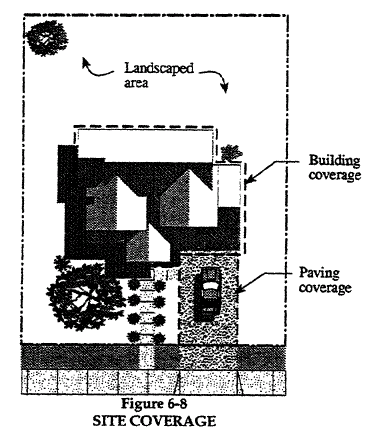
Slope. An inclined ground surface, the inclination of which is expressed as a ratio of horizontal distance (run) to vertical distance (rise), or change in elevation. The percent of any given slope is determined by dividing the rise by the run, multiplied by 100.
(1)
Average slope. Average slope shall be determined by using the following formula:
Where:
S = Average slope of the parcel in percent
A = Total number of acres in the parcel
L = Length of contour lines in scaled feet
I = Vertical distance of contour interval in feet
(2)
Man-made slope. A manufactured slope consisting wholly or partially of either cut or filled material.
(3)
Natural slope. A slope which is not man-made. A natural slope may retain natural vegetation during adjacent grading operations or it may be partially or completely removed and replanted.
Slope transition. The area where a slope bank meets the natural terrain or a level graded area either vertically or horizontally.
Small-scale manufacturing. Manufacturing establishments not classified in another major manufacturing group, including: Musical instruments; toys; sporting and athletic goods; pens, pencils, and other office and artists' materials; buttons, costume novelties, miscellaneous notions; brooms and brushes; and other miscellaneous products.
Small family day care homes. See "child day care facilities."
Sober living home or alcohol and drug free residential recovery home means the use of a residential, dwelling structure or unit for a cooperative living arrangement to provide an alcohol and drug free environment for persons recovering from alcoholism or alcohol and/or drug abuse who seek a living environment in which to remain clean and sober; and which demonstrates each of the following identifying characteristics that shall serve to distinguish the alcohol and drug free residential recovery home and sober living home, as a use of residential property, from similar land uses such as residential treatment facilities or community care facilities that are subject to state licensing requirements and from all other uses of residential property:
1.
All residents, including live-in managers, operators, or owners, are recovering from alcohol and/or drug abuse;
2.
All residents actively participate in legitimate programs, including, but not limited to, Alcoholics Anonymous (AA) or Narcotics Anonymous (NA) programs, and maintain current records of meeting attendance;
3.
All owners, managers, operators, and residents observe and promote a "zero tolerance" policy regarding the consumption or possession of alcohol and controlled substances, except for prescription medications obtained and used under direct medical supervision;
4.
There is a written policy dealing with the use of drugs or alcohol;
5.
Owners, operators, managers and residents do not provide on-site, nonmedical services including any of the following services as they are defined by Section 10501(a)(6) of Title 9, California Code of Regulations:
a.
Detoxification;
b.
Educational session;
c.
Individual or group counseling sessions;
d.
Treatment or recovery planning;
6.
The number of residents subject to the sex offender registration requirements of Penal Code Section 290 does not exceed the limit set forth in Penal Code Section 3003.5, and does not violate the distance provisions set forth in Penal Code Section 3003;
7.
Residents do not require nonmedical care and/or supervision as those terms are defined at Health & Safety Code Section 11834.26 and Section 80001(c)(3) of Title 22 of the California Code of Regulations;
8.
The operators and/or residents maintain current membership in a recognized nonprofit organization of sober living homes that provide a credible quality assurance service for applicants or members or have received a sober living home certification from the State of California Department of Alcohol and Drug Programs; and
9.
Owners, managers, operators, and residents ensure that the property and its use comply with all applicable state and local laws.
Soil moisture sensing device. A device that measures the amount of water in the soil.
Sound level meter. An instrument, including a microphone, an amplifier, an output meter and frequency weighting network, for the measurement of sound levels, that satisfies the requirements pertinent for Type S2A meters in American National Standards Institute specifications for sound level meters.
Specialized education and training. Small scale facilities, typically occupying no more than one demised instructional space. These include facilities for, but not limited to, art, ballet and other dance, drama, drivers' education, language, martial arts, math, music, science, tutorial services.
Also includes facilities, institutions and conference centers that offer specialized programs in personal growth and development, including fitness, environmental awareness, communications, and management. Does not include preschools and child day care facilities (see "Child day care facilities").
Stand. A natural grouping of three or more trees.
State. The State of California.
Stock cooperative. A development defined by Business and Professions Code § 11003.2 and Civil Code § 1351(m), where a corporation is formed to hold title to improved real property and the shareholders in the corporation receive a right of exclusive occupancy in a portion of the real property.
Stone and cut stone product manufacturing. Manufacturing establishments engaged primarily in cutting, shaping, and finishing marble, granite, slate, and other stone for building and miscellaneous uses. Also includes establishments engaged primarily in buying or selling partly finished monuments and tombstones.
Storage, indoor. The storage of various materials entirely within a structure, as the primary use of the structure. The storage of materials accessory and incidental to a primary use is not considered a land use separate from the primary use.
Storage, outdoor. The storage of various materials outside of a structure other than fencing, either as an accessory or principal use.
Storage, personal storage facility (mini-storage). A structure or group of structures containing generally small, individual, compartmentalized stalls or lockers rented as individual storage spaces and characterized by low parking demand.
Story. A horizontal section of a building, with a single continuous or primarily continuous floor, including all rooms on the same floor or level of the building.
Street. A public or private thoroughfare, which affords principal means of access to abutting property, including avenue, place, way, drive, lane, boulevard, highway, road, and any other thoroughfare except an alley as defined in this subsection.
Street line. The boundary between a street right-of-way and property.
Structure. Anything constructed or erected, the use of which requires attachment to the ground or attachment to something located on the ground. For the purposes of this Development Code, the term "structure" includes "buildings."
Structure, primary. See "Primary structure."
Structural clay and pottery product manufacturing. Manufacturing establishments engaged primarily in producing brick and structural clay products, including pipe, china plumbing fixtures, and vitreous china articles, fine earthenware and porcelain products. Artist/craftsman uses are included in "cottage industries," "handcraft industries and small scale manufacturing," "home occupations."
Studio. The workplace of one or more individuals who are engaged in the production of works of art or handcrafts for a living, including, but not limited to, painting, sculpture, music, photography, ceramics and glass works.
Subdivider. A person, firm, corporation, partnership or association, a governmental agency, public entity, or public utility, or the grantor to any such agency, entity, utility, or subsidiary, who proposes to subdivide land or real property for themselves or others, except employees and consultants or other persons or entities acting in this capacity on behalf of the subdivider.
Subdivision. The division, by any subdivider, of any unit or portion of land shown on the latest equalized Los Angeles County assessment roll as a unit or contiguous units, for the purpose of sale, lease or financing, whether immediate or future. Property shall be considered as contiguous units, even if it is separated by roads, streets, utility easement or railroad rights-of-way. Subdivision includes a condominium project, as defined in § 950 of the Civil Code, a community apartment project, as defined in § 11004 of the Business and Professions Code, or the conversion of five or more existing dwelling units to a stock cooperative, as defined in § 11003.2 of the Business and Professions Code.
Subdivision Map Act, or Map Act. Division 2, Title 7 of the California Government Code, commencing with § 66410 as presently constituted, and any amendments to those provisions.
Supportive housing. A housing development, as defined in either Section 65582 or 65650 of the California Government Code, with no limit on length of stay, that is occupied by the applicable target population, and that is linked to on-site or off-site services that assist the supportive housing resident in retaining the housing, improving his or her health status, and maximizing his or her ability to live, and when possible, work in the community. Supportive housing does not include parolee-probationer homes; nor does this definition include commercial lodging facilities providing prenatal and/or postnatal accommodations.
(t)
Definitions, "T." The following definitions are in alphabetical order:
Telecommunications facilities. Public, commercial and private electromagnetic and photoelectrical transmission, broadcast, repeater and receiving stations for radio, television, telegraph, telephone, cellular telephone, and data network communications; including commercial earth stations for satellite-based communications. Includes antennas, towers, commercial satellite dish antennas, and equipment buildings. Does not include telephone, telegraph and cable television transmission facilities utilizing hard-wired or direct cable connections (see "pipelines and utility lines").
Telecommuting. A work arrangement for performing work electronically, where employees work at a location other than the primary work location (i.e., at home or in a subordinate office).
Teleconferencing. Telephone or video multi-access link for group communication.
Teleservices. Automatic information services (i.e., automatic teller machines, telephone information services, telephone banking/transactions, computer mail, computer modem, facsimile).
Textile and leather product manufacturing. Manufacturing establishments engaged in performing any of the following operations:
Coating, waterproofing, or otherwise treating fabric
Dying and finishing fiber, yarn, fabric, and knit apparel
Manufacture of knit apparel and other finished products from yarn
Manufacture of felt goods, lace goods, non-woven fabrics and miscellaneous textiles manufacturing of woven fabric, carpets and rugs from yarn
Preparation of fiber and subsequent manufacturing of yarn, threads, braids, twine cordage
Upholstery manufacturing
Theaters. Indoor facilities for public assembly and group entertainment, other than sporting events, including:
Civic theaters, meeting halls and facilities for "live" theater and concerts
Exhibition and convention halls
Meeting halls for rent
Motion picture theaters
Public and semipublic auditoriums similar public assembly uses
Does not include outdoor theaters, concert and similar entertainment facilities, and indoor and outdoor facilities for sporting events; see "Outdoor recreation."
Topping or pollarding. The practice of making large perpendicular cuts on a main trunk or laterals, resulting in a flush of small brittle branches in an unnatural growth pattern. Often used to decrease height of trees.
Traffic safety sight area. A triangular area on a corner parcel formed by measuring 35 feet from the intersection of the front and street side property lines, and connecting the lines across the property. See Figure 6-9.
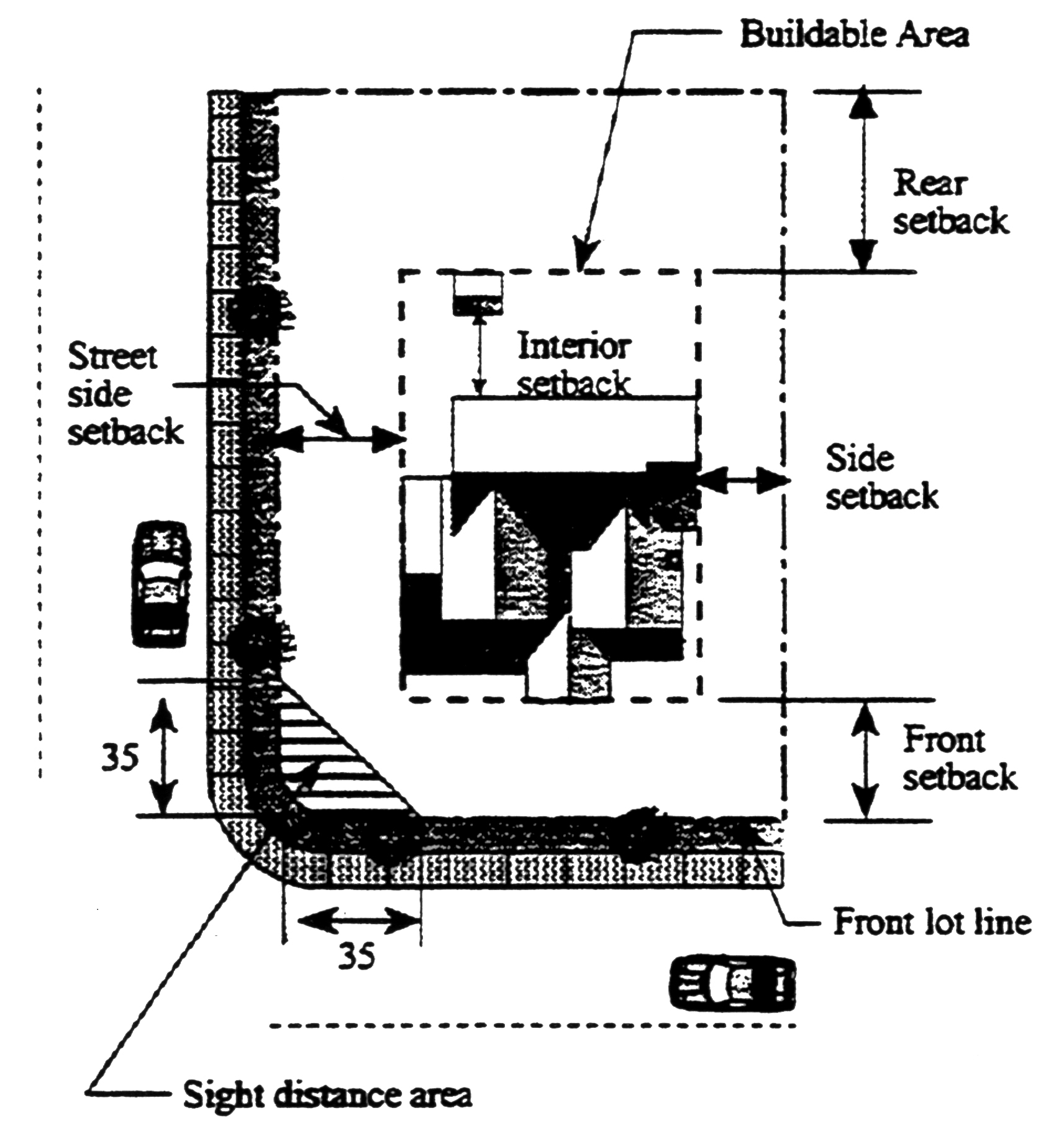
Figure 6-9. Traffic Safety Sight Area
Transitional housing. A form of supportive housing consisting of buildings configured as rental housing developments, but operated under program requirements that require the termination of assistance and recirculating of the assisted unit to another eligible program recipient at some predetermined future point in time that shall be no less than six months from the beginning of the assistance. Transitional housing does not include parolee-probationer homes; nor does this definition include commercial lodging facilities providing prenatal and/or postnatal accommodations.
Transit stations and terminals. Passenger stations for vehicular, ferry, and rail mass transit systems; also terminal facilities providing maintenance and service for the vehicles operated in the transit system. Includes buses, taxis, railway, etc.
Transit stop shelter. A small-scale covered waiting area for busses, taxis, and rail/mass transit stops.
Transportation demand management. The implementation of programs, policies or permit approvals designed to encourage changes in individual travel behavior, including emphasis on alternative travel modes to single occupant vehicle use (i.e. carpools, vanpools and public transit, reduction or elimination of vehicle trips, shifts in peak hour vehicle commuting, etc.).
Trees of significant historical or cultural value. A tree that is deemed historically or culturally significant by action of the city council because of its size or location, association with a particular place, or its status as a local landmark.
Trip reduction. Reduction of the number of work related trips taken during peak-hours in single occupant vehicles.
Turf. A single-bladed grass or sod.
Tutorial services. A type of business designed to provide individualized instructions to persons generally in fields of general education or the arts with no more that two students per one instructor on the premises at the same time. Tutorial services, not in a classroom setting, shall include, but are not limited to, instructing, tutoring, educational counseling, testing, training, etc. Students typically do not stay more than two hours.
(u)
Definitions, "U." The following definitions are in alphabetical order:
Unit. See "Housing unit."
Use. The purpose for which land or a structure is designed, arranged, intended, occupied, or maintained.
Use, primary. See "Primary use."
Utility lines. Facilities for the transmission of electrical energy for sale, including transmission lines for a public utility company. Also includes telephone, telegraph, cable television and other communications transmission facilities utilizing direct physical conduits. Does not include offices or service centers (see "Offices"), or distribution substations (see "Public utility facilities").
(v)
Definitions, "V." The following definitions are in alphabetical order:
Vanpool. A van occupied by seven or more persons commuting together to and from work on a regular basis.
Variance. A discretionary entitlement that may waive or relax the development standards of this Development Code, in compliance with chapter 22.54 (Variances).
Vehicle. In accordance with the California Vehicle Code, a device by which any person or property may be propelled, moved, or drawn upon a highway, excepting a device moved exclusively by human power or used exclusively upon stationary rails or tracks.
Abandoned vehicle. A vehicle is abandoned if the owner has intentionally and permanently relinquished title to, or control or possession of the vehicle. A vehicle is also abandoned when it is left unattended on any private real property without the consent of the owner, lessee or processor of said real property, or any agent thereof. Factors that may be considered for determining abandonment include, but are not limited to, the vehicle's location and condition, period of time it remains in a location, whether the vehicle has a current record of valid ownership or registration with the state department of motor vehicles, absence of a license plate number or a vehicle identification number, ability of a governmental agency to identify or successfully contact a registered owner, as well as the failure of any last known registered owner to respond in a timely manner to any notice from a governmental agency of abandonment or a violation of law involving said vehicle.
Inoperative, wrecked or dismantled vehicle. A vehicle is inoperative, wrecked, or dismantled if it is mechanically incapable of being driven upon a highway. Factors that may be considered in determining whether a vehicle is mechanically incapable of being driven upon a highway include, but are not limited to, the vehicle's location and condition, period of time it remains in a location, whether the vehicle has a current record of valid ownership or registration with the state department of motor vehicles, absence of a license plate number or a vehicle identification number, whether the vehicle has damaged, faulty or missing components, such as the engine, battery, transmission, tires, wheels, hood, mirrors, lights, windows or windshields.
Vehicle and freight terminals. This land use consists of transportation establishments furnishing services incidental to air, motor freight, and rail transportation including:
Freight forwarding services
Freight terminal facilities
Joint terminal and service facilities
Packing, crating, inspection and weighing services
Postal service bulk mailing distribution centers
Transportation arrangement services
Trucking facilities, including transfer and storage
Vehicle services. The repair, alteration, restoration, towing, painting, cleaning (including self-service and attended car washes), or finishing of automobiles, trucks, recreational vehicles, boats and other vehicles as a primary use, including the incidental wholesale and retail sale of vehicle parts as an accessory use. This use includes the following categories:
(1)
Major repair/body work. Repair facilities dealing with entire vehicles. These establishments provide towing, collision repair, other body work, and painting services; and also include tire recapping establishments.
(2)
Maintenance/minor repair. Minor facilities specialize in limited aspects of repair and maintenance (e.g., muffler and radiator shops, quick-lube, etc.).
Does not include automobile parking (see "Parking facilities/vehicle storage"), repair shops that are part of a vehicle dealership on the same site (see "Auto and vehicle sales," and "Mobile home and recreational vehicle sales"); automobile service stations, which are separately defined; or automobile dismantling yards, which are included under "Recycling—Scrap and dismantling yards."
Veterinary clinics and animal hospitals. Office and indoor medical treatment facilities used by veterinarians, including large and small animals veterinary clinics, and animal hospitals as well as the boarding of large and small animals as an ancillary use.
Vibration. The minimum ground or structure-borne vibrational motion necessary to cause a normal person to be aware of the vibration by direct means (e.g., sensation by touch or visual observations of moving objects). The perception threshold shall be presumed to be a motion velocity of 0.01 in/sec over the range of one to 100 Hertz.
(w)
Definitions, "W." The following definitions are in alphabetical order:
Warehouse retail stores. Retail stores that emphasize the packaging and sale of products in large quantities or volumes, some at discounted prices, where products are typically displayed in their original shipping containers. Sites and buildings are usually large and industrial in character. Patrons may or may not be required to pay membership fees.
Warehousing, wholesaling and distribution. These facilities include the following:
(1)
Warehousing. Facilities for the storage of farm products, furniture, household goods, or other commercial goods of any nature. Includes cold storage.
Does not include: Warehouse, storage or mini-storage facilities offered for rent or lease to the general public (see "Storage, personal storage facilities"); warehouse facilities in which the primary purpose of storage is for wholesaling and distribution (see "Wholesaling and distribution"); or terminal facilities for handling freight (see "Vehicle and freight terminals").
(2)
Wholesaling and distribution. Establishments engaged in selling merchandise to retailers; to industrial, commercial, institutional, farm, or professional business users; or to other wholesalers; or acting as agents or brokers in buying merchandise for or selling merchandise to such persons or companies. Includes such establishments as:
Agents, merchandise or commodity brokers, and commission merchants
Assemblers, buyers and associations engaged in the cooperative marketing of farm products
Merchant wholesalers
Stores primarily selling electrical, plumbing, heating and air conditioning supplies and equipment
Water efficient irrigation. The scheduling and management of an irrigation system to supply moisture to a landscape without excess or waste in compliance with the landscape/irrigation criteria established in this chapter.
Water efficient landscaping. A landscape that is designed and maintained to function in a healthful and visually pleasing manner in compliance with the standards provided in this chapter. This generally involves the strategic use of plants which have minimal water requirements for subsistence, plants native to hot/dry environments (xeriscape), and hardscape to achieve an overall landscape concept that is water conserving.
Weekday. Any day, Monday through Friday, which is not a legal holiday.
Wind-sensing device. A device that automatically shuts off the irrigation system during times of heavy wind.
Wireless telecommunications antenna facilities. Communication towers, antennas arrays, and the necessary appurtenances. A facility that sends or receives radio frequency signals using antennas, microwave dishes or horns, and structures or towers to support receiving or transmitting devices, accessory development and structures, and the land on which they all are situated.
Wireless telecommunications antenna facilities, micro. Communication antenna and support equipment that is one-half meter (19 inches) or less in length, such as "microcells," "micropanels," and "shoebox" installations.
Wireless telecommunications antenna site. The defined area that is subject to review under any land use permit application for communication facilities.
(x)
Definitions, "X." No definitions of terms beginning with the letter "X" are used at this time.
(y)
Definitions, "Y." The following definitions are in alphabetical order:
Yard. An area between a lot line and a setback, unobstructed and unoccupied from the ground upward, except for projections permitted by this Development Code. See section 22.16.090 (Setback measurement and exceptions) and Figure 6-7 (Setbacks).
(1)
Front yard. An area extending across the full width of the lot between the front lot line and the required setback.
(2)
Rear yard. An area extending the full width of the lot between a rear lot line and the required setback.
(3)
Side yard. An area extending from the front yard to the rear yard between the nearest side lot line and the required setback.
(z)
Definitions, "Z." The following definitions are in alphabetical order:
Zoning district. Any of the residential, commercial, industrial, special-purpose, or combining districts established by article II of this Development Code (Zoning Districts and Allowable Land Uses), within which certain land uses are allowed or prohibited, and certain site planning and development standards are established (e.g., setbacks, height limits, site coverage requirements, etc.).
(Ord. No. 02(1998), § 2, 11-3-98; Ord. No. 04(1999), § 2, 3-2-99; Ord. No. 02(2001), §§ 27—31, 11-6-01; Ord. No. 04(2001), § 6, 11-20-01; Ord. No. 06(2002), 5-7-02; Ord. No. 07(2003), 12-2-03; Ord. No. 04(2005), § B, 3-15-05; Ord. No. 01(2010), § 4, 1-19-10; Ord. No. 02(2010), § 4, 2-2-10; Ord. No. 03(2010), §§ 1, 2, 5-18-10; Ord. No. 04(2012), § 17, 4-17-12; Ord. No. 04(2013), § 7, 6-18-13; Ord. No. 07(2016), § 5, 11-1-16; Ord. No. 03(2017), § 8, 5-2-17; Ord. No. 03(2021), §§ 5, 6, 12-7-21; Ord. No. 04(2022), § 1, 12-6-22; Ord. No. 03(2024), § 26, 7-16-24; Ord. No. 01(2026), § 4, 1-20-26; Ord. No. 04(2026), § 2, 4-7-26)

