
Dickinson City Zoning Code
ARTICLE IX
PARKING REGULATIONS
Sec. 18-92.- General requirements.
At the time any building, use, or structure is erected, enlarged, structurally altered, or converted from one use to another which requires an increase in the number of parking space, off-street parking spaces shall be provided in accordance with these regulations for the use of occupants, employees, visitors and patrons. Where off-street parking facilities are provided in excess of the minimum amounts specified by this article, or when off-street parking facilities are provided but not required, said off-street parking facilities shall comply with the minimum requirements for parking and maneuvering space as specified in this article.
Off-street parking facilities shall be maintained and continued as long as the building, use or structure is continued. No person shall utilize such building, use or structure without providing the required off-street parking facilities. In addition, it shall be unlawful to discontinue or dispense with, or cause the discontinuance or reduction of, the required parking facilities apart from the discontinuance of the building, use or structure, without establishing alternative off-street parking facilities, which meet these requirements.
(Ord. No. 420-2001, § 1, 7-24-01)
Sec. 18-93. - Construction standards.
The provisions of this section, in addition to the applicable sections of the city's building code shall govern the design and construction of driveways, parking areas, and sidewalks. Driveways, parking areas, vehicle access and maneuvering areas, and sidewalks shall be designed and constructed in accordance with the following minimum requirements.
(1)
Residential driveways shall be constructed of concrete or mortarless brick paving. Concrete shall be a minimum strength of three thousand (3,000) psi, with a four (4) inch minimum thickness, with six-inch by six-inch by six-inch welded wire mesh reinforcement, supported by chairs, and shall be tied into existing concrete street pavement with one-half (½) steel dowel bars at twenty-four (24) inches c.c., with dowel bar penetration into the existing concrete at a minimum of six (6) inches, and with expansion joints at intervals not to exceed twenty (20) feet. Residential drives located on a single lot one (1) acre or greater, or tract of land one (1) acre or greater, are exempt from this requirement.
(2)
Sidewalks shall be constructed of concrete or mortarless prick paving. Concrete shall be a minimum strength three thousand (3,000) psi, with a four (4) inch minimum thickness, with six inch by six-inch by six-inch welded wire mesh reinforcement, supported by chairs. Sidewalks shall be a minimum of four (4) feet wide and expansion joints should not exceed thirty-six (36) feet.
(3)
Driveway approach. That portion of any driveway within the public right-of-way shall be constructed of concrete or mortarless brick paving if the adjacent street is concrete; however, if the adjacent street is asphalt, then the driveway approach may be constructed of asphalt, concrete, or mortarless brick paving.
(4)
No building permit shall be granted for construction of any new residential dwelling that does not provide for the construction of a driveway and a minimum of two (2) off-street parking spaces. Driveways shall not be located within two (2) feet of an adjoining property line. Off-street parking spaces shall not be located within an adjoining street right-of-way. Each off-street parking space shall be a minimum of nine (9) by twenty (20) feet in size.
(5)
No building permit shall be granted for any enlargement, structural alteration, or remodeling of an existing residential dwelling, which results in a twenty-five (25) percent increase in the livable floor space, unless there is an existing driveway and a minimum of two (2) off-street parking spaces or such enlargement, alteration, or remodeling provides for the construction of a driveway and off-street parking spaces as required herein.
(6)
No permit shall be granted for the placement of a manufactured home that does not provide for the construction of a driveway and a minimum of two (2) off-street parking spaces as required herein. The provisions of this paragraph shall not apply to a permit for the placement of a manufactured home within a manufactured home community, or the authorized replacement of a nonconforming manufactured home, which was lawfully existing on the date of adoption of this provision.
(7)
Multiple family residential, commercial and industrial driveways and parking areas shall be constructed of concrete or mortarless brick paving. Concrete shall be a minimum strength of three thousand (3,000) psi, having a six-inch minimum thickness, with #4 rebar on eighteen (18) inch centers supported by chairs, and shall be tied into existing concrete street pavement with #4 steel dowel bars at twenty-four (24) inches c.c. The pavement structure shall be designed based on soil data from the site and based on the anticipated traffic volume, loading and service life of the proposed pavement structure. Sub-grade shall be stabilized with a minimum six (6) percent lime by weight, six (6) inches thick and compacted to ninety-five (95) percent standard proctor density or as specified by a licensed professional engineer. Horizontal dowels or saw cutting to expose existing steel are required to create a minimum ten (10) inch overlap of reinforcing steel when making a connection of a proposed concrete driveway or parking area to an existing street or drive. When the existing concrete street has no exposed steel, the following shall apply: (1) dowels should be number four (#4) bars, twenty-four (24) inches long, embedded twelve (12) inches and epoxied, and spaced in accordance with this section; and (2) as an alternative, saw cut to two (2) inches in depth and remove existing concrete to expose a minimum of twelve (12) inches of longitudinal steel, in good condition, with an equivalent cross section area of steel equal to the proposed pavement steel.
(8)
Mortarless brick paving shall, at a minimum, be laid over a flexible base, constructed of compacted subgrade, a compacted aggregate base of not less than four (4) inches, and a minimum of one (1) inch of sand.
(9)
Any off-street display area shall be constructed, at a minimum, of one and one-half (1½) inches of asphalt pavement on top of six (6) inches of limestone base or as specified by a licensed professional engineer.
(Ord. No. 420-2001, § 1, 7-24-01)
Sec. 18-94. - Parking, prohibited.
Recreational vehicles, travel trailers, boats, campers, pick up coaches, motor homes, and other mobile structures are hereby limited by the following prohibitions:
(1)
It shall be unlawful for any person to park any recreational vehicle, trailer, or combination thereof, on any street, public right-of-way, or alleyway of the city for more than seventy-two (72) hours continuously, and such occurrence shall be limited to once every ninety (90) days. Provided, however, lawfully registered and operable passenger and light trucks are hereby excluded from this prohibition.
(2)
No person shall park, place, or locate a recreational vehicle on any public property, or during daylight hours within any area of a public park not designated for recreational vehicle usage, for a period of more than four (4) hours, except in cases of emergency.
(3)
No person shall park, place, or locate a recreational vehicle which is used for living quarters, or in which cooking is done, on any lot, tract, or parcel of land for a period of more than forty-eight (48) hours, unless within a recreational vehicle park, except:
a.
Recreational vehicles may be parked on land owned by persons whose business is the repair of recreational vehicles; provided, however, when such vehicles are so parked, their use for living, sleeping, storing, or working quarters is prohibited.
b.
Recreational vehicles may be parked on privately owned property, with the owner's permission, for storage purposes as long as such storage does not violate any other ordinance or regulation of the city.
(Ord. No. 420-2001, § 1, 7-24-01)
Sec. 18-95. - Design requirements.
(a)
An off-street parking space shall not be in a street or alley right-of-way. Each off-street parking space shall be permanently reserved for the temporary storage of one (1) automobile and connected with a street or alley that affords unobstructed ingress and egress to each space.
(b)
Each parking space shall be accessible from a street or alley through aisles and/or driveways, except that tandem parking arrangements are permitted for single-family, two-family and manufactured home residential uses. With the exception of the above residential uses on local and collector streets, off-street parking facilities shall be so arranged that in order to depart from the premises it shall not be necessary that any automotive vehicle be backed into any public street right-of-way.
(c)
Circulation within a parking area with more than one (1) aisle shall be such that a vehicle need not enter the street in order to reach another aisle within the same parking area. Dead-end aisles are not permitted for parking spaces with angles greater than zero (0) degrees and less than ninety (90) degrees unless adequate turnarounds are provided. All circulation and maneuvering of vehicles shall occur without encroaching any right-of-way or adjacent property, except in the case of joint parking facilities.
(d)
All parking spaces shall be clearly marked on the pavement with yellow or white traffic paint, curbs, or raised pavement markers approved by the city. Traffic control signs or other pavement markings shall be used as necessary to ensure safe and efficient traffic operation. The provisions of this paragraph shall not apply to a single-family dwelling.
(e)
Placement, signing, and markings for fire zones shall be approved by the city's fire official.
(f)
A parking lot shall be designed to physically prevent any portion of a vehicle from encroaching or overhanging any public right-of-way line or private property line through the installation of a permanent curb, wall, or other physical barrier.
(Ord. No. 420-2001, § 1, 7-24-01)
Sec. 18-96. - Location requirements.
The off-street parking facilities required by this article shall, to the greatest extent practicable, be located on the same lot or parcel of land as the building, use or structure in which they are required. In the event of difficulties in providing the off-street parking facilities on the same parcel of land, the zoning official may permit such required parking facilities on another lot or parcel, provided that the straight line distance between the two (2) parcels shall not exceed three hundred (300) feet, and provided further that provisions are made to safeguard the permanency of such facilities. However, under the following conditions, a proposed use or new tenancy of an existing structure shall only be required to provide the maximum number of off-street parking spaces that can be arranged for functional parking use on the space available on the subject lot or parcel:
(1)
The full amount of required facilities cannot be provided on the same lot or parcel of land as the structure because existing structure(s) consume space that would otherwise be available for functional parking; and,
(2)
The zoning official determines that on-street parking in the area of the proposed use will not create a hazardous condition or detrimentally affect traffic movements, based on the application of the following criteria to the adjacent street(s):
a.
Whether the adjacent street width is adequate for parking;
b.
Parking regulations on the adjacent street;
c.
Speeds on the adjacent street; and,
d.
Volume of traffic on the adjacent street.
(Ord. No. 420-2001, § 1, 7-24-01)
Sec. 18-97. - Joint parking facilities.
Required off-street parking for any number of separate uses may be combined in a joint parking facility under the conditions of this section, subject to the approval of a joint parking facility plan by the zoning official. Such joint parking facility plan shall be reviewed by the zoning official for conformance with this section.
(1)
Joint parking facilities permitted. Whenever two (2) or more uses are located together in a common building, shopping center, or other integrated building complex, the parking requirements may be complied with by providing a permanent, common parking facility, cooperatively established and operated, which contains the requisite number of spaces for each use. The joint parking facility shall be located within three hundred (300) feet from all uses, and shall not be separated from such uses by arterial streets. The total number of spaced provided shall not be less than the sum of the individual requirements for all uses, unless otherwise permitted in these regulations. Spaces provided for any permanent residents of dwellings shall be clearly designated and separated from spaces provided for employees, customers and service.
(2)
Multiple ownerships and structures. Where buildings, uses or structures participating in a joint parking facility are owned by multiple owners, each owner shall provide evidence of a permanent, legal instrument, approved by the city attorney, which guarantees such owner's rights to the use of the parking facility. Any termination of or amendment to such an agreement shall be subject to the approval of the city.
(3)
Churches. Churches may establish joint parking facilities with other uses that do not have a time conflict in parking demand. However, only fifty (50) percent of a church's required parking spaces may be provided in this manner. In addition, such joint parking facilities shall be located no more than four hundred (400) feet from the church sanctuary.
(4)
Guarantee. Joint parking facilities shall guarantee the permanency of the joint use through an appropriate legal instrument, approved by the city attorney, and filed of record.
(Ord. No. 420-2001, § 1, 7-24-01)
Sec. 18-98. - Computation of the number of parking spaces.
In computing the number of parking spaces required, the following rules govern:
(1)
Service areas such as mechanical rooms, attics, and closets are excluded from the calculation of "floor area" for determining required parking spaces.
(2)
Where fractional spaces result in computing required parking spaces, the required number of spaces must be increased to the nearest whole number.
(3)
The parking space requirements for a use not specifically listed shall be the same as those for the most similar to the proposed use, as determined by the zoning official.
(4)
Whenever a building or use constructed or established after the effective date of this chapter is changed or enlarged in floor area, number of employees, number of dwelling units, seating capacity or otherwise, to create a need for an increase of ten (10) percent or more in the number of existing parking spaces, such spaces shall be provided on the basis of the enlargement or change. Whenever a building or use existing prior to the effective date of this chapter is enlarged to the extent of fifty (50) percent or more in floor area or in the area used, said building or use shall then and thereafter comply with the parking requirements set forth herein.
(5)
In the case of mixed uses, the parking spaces required shall equal the sum of the requirements of the various uses computed separately.
(6)
Where requirements are established on the basis of the number of seats, such requirements shall be based on the seating capacity permitted by the building and/or fire code and approved by the city's building and fire officials. When determining seating capacity for a building, use, or structure utilizing bench seating, each twenty-two (22) inches of bench shall be considered one (1) seat.
(7)
Where a manufacturing/industrial use has more than one working shift of employees, parking facilities shall be adequate to accommodate overlap requirements during transition periods.
(8)
When the developer of a large-scale development can demonstrate that such development will require fewer parking spaces than required by the standards of this chapter, the zoning official may permit a reduction in the number of required parking spaces for the development. Such a reduction in parking spaces shall be justified through the development of a parking study prepared by a professional traffic engineer or transportation planner and submitted to the zoning official. The balance of the land necessary to meet these requirements shall be held in reserve as an undeveloped area, to meet any future needs generated by an expansion of the business, a change in land use, or underestimated parking demand.
(Ord. No. 420-2001, § 1, 7-24-01)
Sec. 18-99. - Off-street parking schedule.
The minimum number of parking spaces required is as follows:
OFF-STREET PARKING STANDARDS
(Ord. No. 420-2001, § 1, 7-24-01)
Sec. 18-100. - Minimum dimensions for off-street parking.
All parking spaces, aisles and modules shall meet the minimum requirements, as shown in the following table. Provided in the table below are the minimum standards for two (2) parking stall width options—Nine-foot wide spaces and ten-foot wide spaces.
PARKING SPACE AND AISLE DIMENSIONS
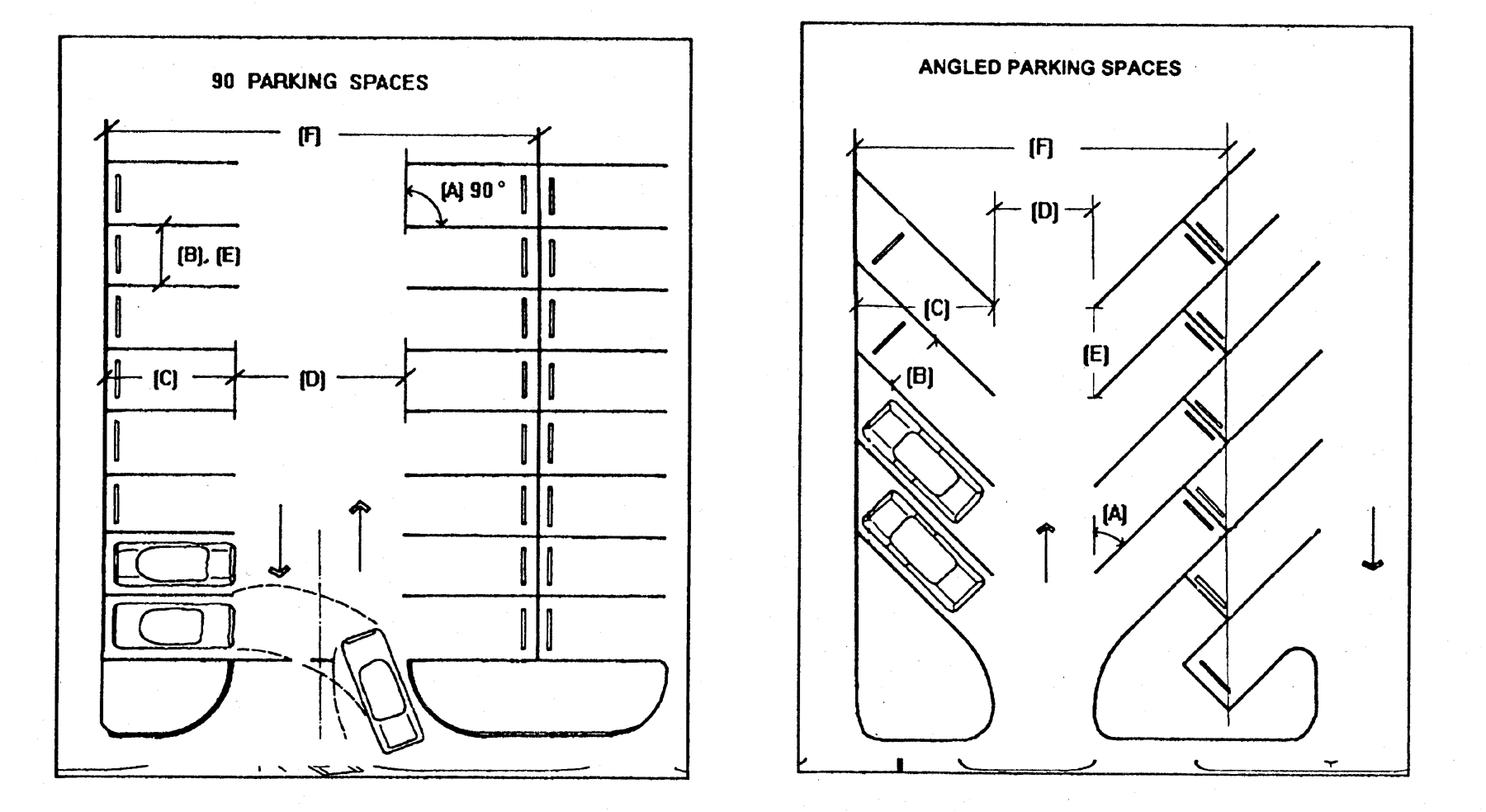
90 PARKING SPACES—ANGLED PARKING SPACES
(1)
Off-street parking spaces (ninety (90) degree only) that abut a landscape island may be reduced in length to eighteen (18) feet provided that the island is a minimum of four (4) feet in depth and protected by wheel stops or curb.
(2)
Off-street parking spaces (ninety (90) degree only) that abut a sidewalk adjacent to a building may be reduced in length to eighteen (18) feet provided that the sidewalk is a minimum of six (6) feet in width.
(3)
The width of the alley may be assumed to be a portion of the maneuvering space requirement for off-street parking facilities located adjacent to a public alley.
(Ord. No. 420-2001, § 1, 7-24-01)
Sec. 18-101. - Accessible parking spaces for disabled persons.
Handicap parking spaces accessible to disabled persons shall be provided in accordance with this section, the American's with Disabilities Act (ADA), and any federal regulations promulgated hereafter. Parking lots must designate accessible spaces for use of persons with disabilities (handicap accessible spaces) as follows:
Note: A minimum of one (1) van accessible space measuring ninety-six (96) inches wide minimum is required.
Handicap accessible spaces must be marked and designated in accordance with the standards and specifications adopted by the commissioner of licensing and regulation of the Texas Department of Transportation under Section 5(c), Article 9102, Revised Statutes, relating to the identification and dimensions of parking spaces for persons with disabilities, as amended, or as otherwise required by federal or state law.
Additional handicap accessibility standards are as follows:
Parking:
a.
Accessible route(s) from the parking area to the building.
b.
Curb ramps a minimum of forty (40) inches wide with a maximum slope of 1:12 and textured surfaces.
c.
Curb cuts at each corner.
Sidewalks:
a.
Maximum level change of one-half (½) inch.
b.
Minimum width of forty-eight (48) inches.
c.
Maximum openings in surfaces of three-eighths (⅜) inch.
(Ord. No. 420-2001, § 1, 7-24-01)
Sec. 18-102. - Parking lot lighting.
Illumination of parking areas shall be required for all parking areas with more than twenty (20) parking spaces. The illumination may be provided through the use of light fixtures on either a pole or on a building. Lighting used to illuminate parking areas shall be arranged, located or screened to direct light away from any adjoining or abutting residential district or use or any street right-of-way. Illumination for parking areas shall be provided as follows:
The minimum amount of maintained illuminations for open parking shall be as follows:
For purposes of interpreting the table above, high activity uses include athletic fields, large shopping malls and similar uses; medium activity uses include fast food restaurants and small to medium shopping centers; and low activity uses include local merchant parking, educational parking, industrial parking, and similar uses. The light fixtures shall be arranged in order to provide uniform illumination throughout the parking lot as indicated by the uniformity ratio above of average illumination to minimum illumination. The required illumination shall be measured at the pavement.
(Ord. No. 420-2001, § 1, 7-24-01)
Sec. 18-103. - Drive-in and drive-through stacking distance requirements.
Uses that have drive-through window services, unless otherwise provided below, shall provide a minimum stacking distance of one hundred sixty (160) feet, of which eighty (80) feet shall be provided to the menu board, exclusive of any aisle or parking space. The following drive-in and drive-through facilities shall conform to the following requirements.
These minimum vehicle storage requirements shall remain in force, unless the applicant can present a traffic study from a professional engineer that provides verifiable evidence to allow the reduction of these minimum stacking lengths. Deviations from these requirements shall be approved by the zoning official.
Stacking for all uses shall conform to the following standards:
(1)
No stacking space may occupy any portion of a public right-of-way.
(2)
The minimum pavement lane width shall be twelve (12) feet.
(3)
Stacking spaces shall not be used to satisfy any of the off-street parking or loading requirements.
(4)
Stacking lanes shall not interfere with parking spaces, parking aisles, loading areas, internal site circulation, or driveways.
(5)
A twelve-foot by-pass lane is required adjacent to the stacking lane to allow vehicles to circumvent the drive-through lane.
(Ord. No. 420-2001, § 1, 7-24-01)
Sec. 18-104. - Off-street loading requirements.
Every building (or part thereof) erected or occupied for retail business, service, manufacturing, storage, warehousing, hotel, mortuary, or any other use similarly involving the receipt or distribution by vehicles or materials or merchandise, shall provide and maintain on the same premises loading space in accordance with the following requirements:
Off-street loading spaces shall meet the following design requirements:
(1)
Each off-street loading space shall be a minimum of twelve (12) feet in width and forty-five (45) feet in length, with a vertical clearance of at least fifteen (15) feet. Such spaces shall be at grade level and on the same parcel of land as the corresponding building, use or structure.
(2)
Adjacent public rights-of-way and private properties shall not be used for maneuvering. All maneuvering shall be contained on site. Maneuvering areas for loading facilities shall not conflict with parking spaces or with the maneuvering areas for parking spaces.
(Ord. No. 420-2001, § 1, 7-24-01)

