
Dinwiddie County Unincorporated
City Zoning Code
City Zoning Code
ARTICLE V
- SUPPLEMENTARY DISTRICT REGULATIONS
Sec. 22-235.- Uses not provided for.
If, in any district established under this chapter, a use is not specifically permitted and an application is made by a property owner to the administrator for such use, the administrator shall refer the application to the planning commission, which shall make its recommendations to the board of supervisors within 30 days. If the recommendation of the planning commission is approved by the board of supervisors, this chapter shall be amended to list the use as a permitted use in that district, henceforth.
(Code 1970, § 17-94)
Sec. 22-236. - Additional setbacks in case of widening of highways or streets.
Whenever there shall be plans in existence, approved by either the state department of highways and transportation or by the board of supervisors for the widening of any street or highway, the commission may recommend additional front yard setbacks for any new construction or for any structures altered or remodeled adjacent to the future planned right-of-way, in order to preserve and protect the right-of-way for such proposed street or highway widening.
(Code 1970, § 17-95)
Sec. 22-237. - Off-street parking and loading.
(a)
In any district, all structures erected or enlarged and all uses established or expanded, shall provide off-street parking and loading in accordance with the requirements established herein.
(b)
Required off-street parking spaces for dwellings shall be a minimum of nine feet by 20 feet in dimensions with a driveway to afford safe and convenient access. Parking spaces shall be on the same lot with the main building. In the case of buildings and uses other than dwellings, spaces may be located up to 600 feet from said building or use, subject to approval of the administrator.
(c)
Any parcel of land used as a public parking area shall be constructed of concrete, asphalt, or other equivalent permanent dustless surface, except that in areas zoned agricultural, churches, civic associations and agritourism activities shall be exempt from this requirement. The administrator may approve the use of cobblestone, Belgian block, brick, grid pavers, interlocking pavers or similar surface material upon specific request at the time of site plan submission. The administrator may also approve unpaved or gravel parking areas for temporary use of less than 90 days provided that a specific request is submitted in writing at the time of plan submission.
(d)
Outdoor lighting shall be provided at appropriate locations in order to adequately illuminate parking areas and pedestrian and vehicular circulation routes to establishments which will be patronized during non-daylight hours. Any lighting equipment should be designed and arranged so as to direct light and glare away from abutting properties and adjacent rights-of-way. Lighting fixtures and intensity levels shall be compatible with both natural and architectural characteristics of the development.
(e)
Such parking spaces shall not be drained onto or across public sidewalks, nor shall they be drained onto adjacent property except when directed into a natural water course or a recognized drainage easement.
(f)
Parking lots shall be designed and constructed so that spaces are grouped into bays separated by landscape traffic islands. Such islands and bays shall be designed to provide a clear delineation of circulation patterns, guide vehicular traffic, break large expanses of pavement into sub-areas to improve both the appearance and climate of the parking lot, minimize glare and noise, and delineate safe pedestrian walkways.
(g)
Where the nature and characteristics of the proposed use dictate, such parking areas shall be designed to include appropriate stopping, parking and circulation areas for alternate modes of transportation such as bicycles, mopeds, motorcycles and buses.
(h)
Sidewalks shall be provided where necessary to facilitate safe and convenient pedestrian movements within and between such parking areas and the establishments which they serve. Sidewalks shall be designed in accordance with all applicable barrier-free access standards as specified by the Virginia Uniform Statewide Building Code.
(i)
Speed bumps, if installed, shall be designed to county criteria, and appropriate signage shall be provided within such parking areas to insure safe and efficient vehicular circulation.
(j)
The minimum dimensions of spaces and aisles within such lots shall be in accordance with the following standards:
Notes: ;hg;* This measurement used where stalls abut pedestrian walkways.
** Measured between ends of stall lines.
*** Measured to nearest foot.
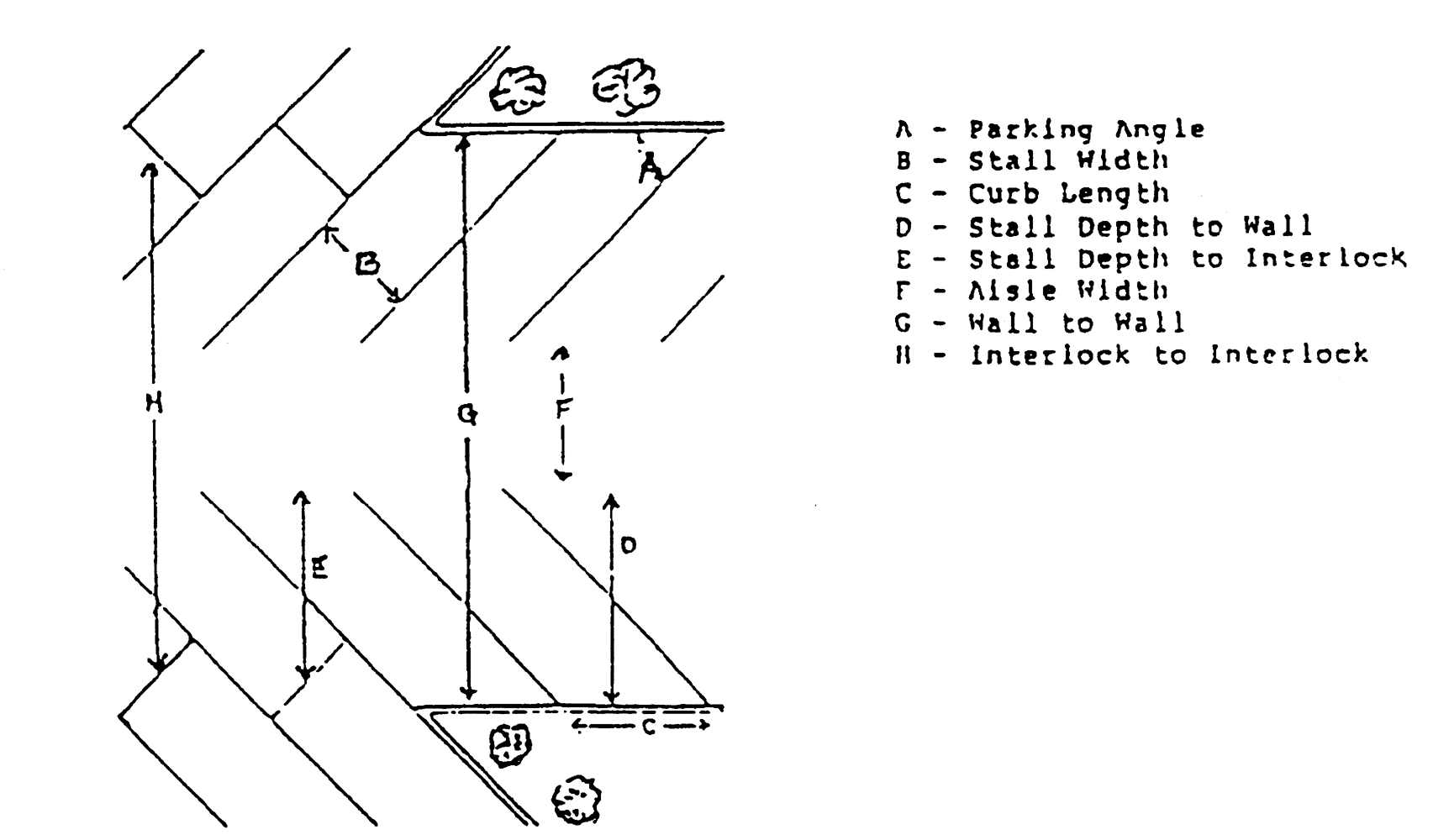
Parking spaces diagram
(k)
Parking spaces for the physically handicapped shall be provided and labeled on the plan in accordance with the standards established for the physically handicapped and aged, by the Virginia Uniform Statewide Building Code. Such spaces shall be arranged and dispensed throughout the lot so as to provide convenient access to all major entrances to the proposed establishment.
(l)
There shall be provided, at the time of erection of any main building or at the time any main building is enlarged, minimum off-street parking space, with adequate provision for entrance and exit by standard sized automobiles, as follows:
(1)
In all residential districts, there shall be provided, either in a private garage or on the lot, space for the parking of one automobile for each dwelling unit in a new building, or each dwelling unit added in the case of the enlargement of an existing building.
(2)
Tourist homes and motels shall provide, on the lot, parking space for one automobile for each accommodation, plus one additional space per employee but in no case less than two additional spaces.
(3)
For church, high school, college and university auditoriums, and for theaters, general auditoriums, stadiums and other similar places of assembly, at least one parking space shall be provided for every five fixed seats provided in such building.
(4)
For hospitals, at least one parking space shall be provided for each two patient/occupant beds plus one additional space per employee/staff member on the largest anticipated working shift.
(5)
For medical and dental clinics, at least ten parking spaces shall be provided. Three additional parking spaces shall be furnished for each doctor or dentist having offices in such clinic in excess of three doctors or dentists.
(6)
For tourist courts, apartments and apartment motels, at least one parking space shall be provided for each individual sleeping or living unit. For hotels and apartment motels at least one parking space shall be provided for each two sleeping rooms, up to and including the first 20 sleeping rooms, and one parking space for each three sleeping rooms over 20.
(7)
For mortuaries and liquor stores, at least 30 parking spaces shall be provided.
(8)
For restaurants, including fast-food restaurants one parking space shall be provided for each 100 square feet of floor space in the building.
(9)
Any commercial building or public facility not listed above hereinafter erected, converted or structurally altered shall provide one parking space for each 300 square feet of business floor space in the building.
(10)
Minimum required parking spaces for industrial, manufacturing and related uses shall be as follows:
a.
Warehousing, distributing: Establishments having not more than 20,000 square feet of gross floor area, on a single parcel of land and/or within a single development, shall provide one space for each 2,000 square feet of gross floor area. Establishments having more than 20,000 square feet but not more than 100,000 square feet of gross floor area shall provide one space for each 2,500 square feet of gross floor area. Establishments having more than 100,000 square feet of gross floor area shall provide one space for each 3,000 square feet of gross floor area.
b.
Mini-storage warehouse, commercial storage locker: Mini-storage warehouse or commercial storage locker establishments shall provide off-street parking to the extent required for office space or other uses accessory to the primary use.
c.
Other permitted industrial and manufacturing uses: One space per employee for the first 300 employees plus one space per each two employees in excess of 300 (maximum onsite at any one time).
(m)
Other provisions of this article notwithstanding, the administrator may waive the requirement that the entire number of parking spaces required by this chapter to be constructed at the time of development, subject to the following:
(1)
Such waiver may be considered only for structures with a gross floor area in excess of 6,000 square feet in the case of public and commercial buildings in excess of 10,000 square feet in the case of industrial buildings. Waiver of construction may be considered only for those spaces required as a result of floor areas in excess of 6,000 or 10,000 square feet, respectively.
(2)
The decision to grant such waiver from construction shall be based upon evidence supplied by the applicants, observations of similar uses in the region, or standard reference works by qualified officials or competent professional/research associations, which substantiates the projected parking demand of the proposed use and indicates that the site can be adequately served initially by fewer than the full number of required spaces. In no case shall a waiver be considered which would reduce the parking and circulation areas below that required by this article.
(3)
Such waiver shall not relieve the applicant of responsibility for reserving an adequate area on the site to accommodate the entire member of parking spaces otherwise required by this article.
(4)
The location, design and other pertinent details of all required parking spaces shall be depicted on the site plan in accordance with all applicable design requirements. At the time of site plan approval, the administrator, in exercising the above described waiver provisions, shall clearly indicate on the face of the site plan those spaces which need not be constructed at the time of initial development.
(5)
The area which such spaces would otherwise occupy shall be reserved for their future construction should the parking demand characteristics of the original or any subsequent or additional use or uses increase to the extent that the number of spaces actually constructed is no longer adequate. In no case shall any improvements, structural enlargements or additions be made on the site which would encroach on the area so reserved.
(6)
Monitoring and determination of the adequacy of the existing parking spaces shall be the responsibility of the administrator who shall make periodic inspections of the site. Upon determining that parking demand is in excess of the available supply of spaces the administrator shall order, in writing, the construction of such additional spaces as are necessary to accommodate the demand. In no case shall the applicant be required to provide more spaces than the total number required before waiver.
(7)
Failure to comply with the administrator's order to construct additional adequate parking areas within 90 days weather permitting, shall be deemed a violation of the ordinance and shall be punishable as prescribed herein.
(8)
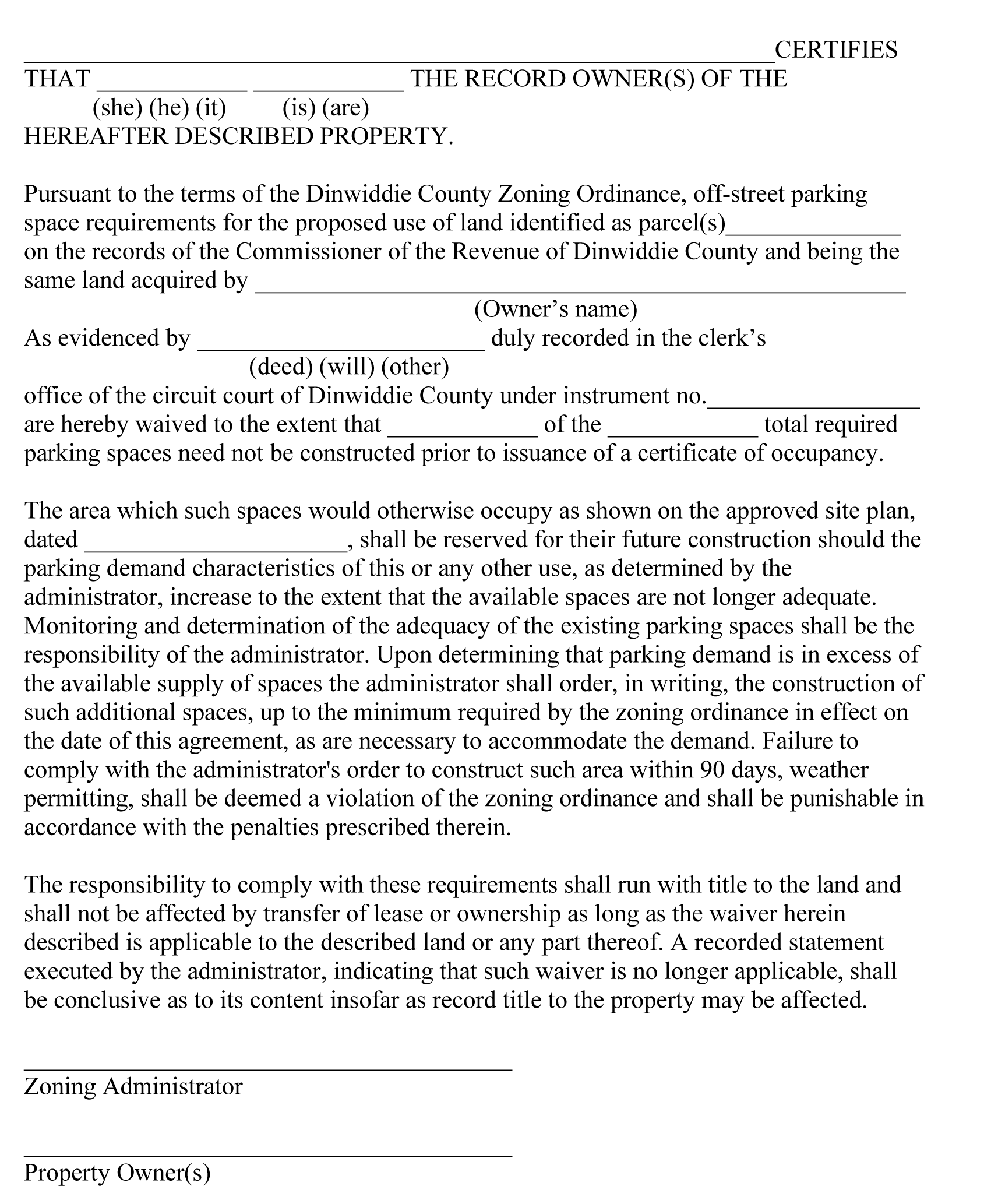
The following statement, to be signed and acknowledged by both the administrator and the applicant, shall be affixed to the approved site plan and shall also be recorded, at the cost of the property owner, in the Clerk's Office of the Circuit Court of Dinwiddie County:
(n)
All off-street loading areas, including aisles and driveways shall be constructed and maintained with a permanent, dustless surface material, except that in areas zoned agricultural, churches, civic associations and agritourism activities shall be exempt from this requirement. Off-street loading areas may be incorporated into the overall design and layout of parking and circulation systems provided that no individual parking spaces will be encroached upon. Vehicles utilizing such loading spaces will not interfere with vehicular circulation on the site or on adjacent public rights-of-way.
(1)
Each off-street loading space shall be not less than 12 feet by 50 feet in dimensions with a vertical clearance of not less than 15 feet, including necessary maneuvering space off the street.
(2)
All lighting fixtures used to illuminate off-street loading areas shall be designed and arranged so as to direct light and glare away from abutting properties and adjacent rights-of-way.
(3)
No space designated as off-street parking space shall be utilized as an off-street loading space.
(o)
Adequate fire lanes shall be required as deemed necessary by the fire marshal for the access and egress of emergency vehicles. Fire lanes shall be a minimum of 20 feet in width and shall be marked for case of visibility as required by the fire marshal. Numbers and placement of fire lanes shall be in accordance with nationally recognized standards.
(p)
Containers, shipping containers, trailers or semi-trailers designed for transport by a tractor trailer, or other portable storage containers are not allowed in any zoning district, except that such containers:
(1)
Are temporarily allowed as an accessory use for a dwelling in a residential or agricultural zoning district for a 30 day period;
(2)
Are allowed for permanent storage in connection with a conforming agricultural use or with a legal nonconforming agricultural use existing as of June 18, 2013; and
(3)
Are allowed in the B-1, B-2, B-3, M-1, and M-2 zoning districts, and in the B-1, B-2, B-3, M-1, and M-2 zoning districts shall be subject to the following standards:
a.
Screening. Containers must be screened from view of all public streets, public places and adjoining properties, through the use of features such as fences, building walls, opaque fencing and screening, false facades, or dense landscaping (with exception for access to the unit).
b.
Location. Containers should be located behind the principal building, or at the side if the physical nature of the site renders real placement impossible, as determined by the Zoning Administrator.
c.
Setbacks. Containers must comply with the principal use building setbacks for the district.
d.
Containers must meet building code requirements if electrical, HVAC or plumbing is installed.
(q)
The general standards applicable to all recreational vehicles are as follows:
(1)
Except for recreational vehicles parked in a parking area associated with a multi-family dwelling or parked in the driveway of a principal dwelling or accessory storage building, all recreational vehicles shall be parked behind the front setback line unless such vehicles are parked in a completely enclosed garage or other building.
(2)
No recreational vehicle shall be used for living purposes in any zoning district, or connected to utility services except for maintenance purposes, except for as follows:
In agricultural zoning districts, a recreational vehicle may be used as a temporary residence during the course of actual construction of a single- family dwelling subject to the following standards:
a.
Only one such temporary residence may be allowed per lot.
b.
No such temporary residence may be allowed if other residences exist on the lot.
c.
All building, health, public works or other required permits for the temporary residence must be obtained, all installations be completed, inspected and approved prior to occupancy of the temporary residence.
d.
The use of the temporary residence may not begin until a building permit for the permanent residence is issued.
e.
Actual construction on the permanent residence must start within 60 days of the issuance of the building permit for the residence or the use of the temporary residence must cease, the unit be vacated and be disconnected from all utilities until actual construction is started.
f.
The use of the temporary residence must cease within 18 months of the date of issuance of the building permit for the permanent residence or occupancy of the permanent dwelling, whichever occurs first. Upon cessation of the use, recreational vehicles serving as a temporary residence pursuant to this section 22-237(q)(2) shall be disconnected from all utilities.
(Code 1970, § 17-96; Ord. of 9-21-94; Ord. of 9-4-96; Ord. of 6-20-06, § 1; Ord. of 11-16-10, § 1; Ord. of 6-18-13 [A-13-2], § 1; Ord. of 2-16-16 [A-16-1], § (1))
Sec. 22-238. - Requirements for manufactured home parks.
This section is intended to encourage site development for manufactured home parks in accordance with sound planning principles, and to prevent detrimental effects to the use of development of adjacent properties. A manufactured home park shall require a conditional use permit issued by the board of supervisors. In addition, each manufactured home in a manufactured home park shall require a certificate of occupancy. Each conditional use permit may require additional requirements not herein set forth due to the characteristics of the property and/or adjacent property.
Operators of such parks shall comply with the following development standards for all manufactured home parks:
(1)
All manufactured home parks shall have a landscaped or wooded setback line of 50 feet from any highway or public road right-of-way or 75-foot setback from the centerline of any highway or public road, whichever distance is greater.
(2)
Each manufactured home park shall have at least 25 feet of open space abutting all adjoining property and shall be contained within a board fence, evergreen hedge or screen which shall be a minimum of eight feet in height or of sufficient density to screen the site from adjacent properties. All borders shall be maintained properly in compliance with the intent of this requirement. No fence, hedge or screen need be constructed abutting any highway or public road provided subsection (1) of this section is complied with.
(3)
All ingress and egress shall be to the required standards of the Virginia Department of Transportation.
(4)
The minimum size of any manufactured home park shall be 15 acres.
(5)
No manufactured home site shall be offered for sale or sold.
(6)
Streets within the manufactured home park must be constructed to the specifications of the Virginia Department of Transportation (i.e., secondary road standards). Proper stormwater management design will be applied, with drop inlets (storm drains) for drainage where necessary. Area for streets will be independent of manufactured home space area.
(7)
All utility lines shall be underground, including electrical wiring and telephone lines.
(8)
A minimum of ten percent of the gross land area of the manufactured home park shall be reserved for recreational and open space uses. This area must be for recreational purposes.
(9)
All fuel tanks will be concealed except for necessary ventilation.
(10)
The manufactured home park operator shall maintain a register for each manufactured home lot for at least the previous two years; such register shall be available at all times for inspection by law enforcement officers, public health officials, and other state and local officials and representatives whose duties necessitate acquisition of the information contained in such register and shall contain:
a.
The names of each manufactured owner and occupants;
b.
The dates of arrival and departure of each manufactured home on each manufactured home lot;
c.
The name, make, date of manufacture, and serial number of the manufactured home;
d.
The license number of each manufactured home and motor vehicle;
An updated copy of such register shall be filed each year in March with the county sheriff's department, the department of planning and community development, and the commissioner of revenue.
(11)
Manufactured home park owners/operators must create a set of rules and regulations for his/her park. Such rules and regulations shall be enforced by the owner/operator. A copy of these rules and regulations shall be filed in the office of the county sheriff's department and the department of planning and community development.
(12)
Refuse shall be the responsibility of the owner of the property to collect or contract for collection on a frequency of not less than twice weekly of all garbage, refuse and rubbish. Collection may be on a lot by lot basis or by a centralized box system. The storage and disposal of refuse must be handled in such a manner as to create no health hazards, rodent harborage, insect breeding areas, accident or fire hazards or air pollution.
(13)
Before an application for a permit for the construction of a manufactured home park shall be approved by the board of supervisors, the applicant shall, in lieu of construction, furnish cash escrow or a performance bond in an amount calculated by the board of supervisors to secure the required improvements in a workmanlike manner and in accordance with established or approved specifications and construction schedules, which bond shall be payable to and held by the county. The manufactured home park's plans, construction schedule, and amount of bond shall be re-evaluated by the board of supervisors at least once every year to ensure compliance with the requirements of this section.
In lieu of bond, development may be presented for inspection in completed form.
(14)
Manufactured home park site plan development shall follow procedure and approval as set forth for subdivisions in chapter 18 of this Code.
(15)
No existing manufactured home park shall be enlarged or extended unless the addition to the park is made to conform to all requirements for a new manufactured home park.
(16)
No manufactured home shall be placed in a manufactured home park until development standards are met, either by completion of plan or by bond.
(17)
Minimum lot size for manufactured home lots shall be 8,500 square feet, with no lot line less than 85 feet in length.
(18)
Every manufactured home space shall have all corners clearly marked and shall be designated a number, which shall be clearly visible from the roadway. These numbers shall be assigned in accordance with the 911 emergency system.
(19)
Each manufactured home space shall be directly accessible from an approved internal park street. No direct access to manufactured home spaces from public streets shall be permitted.
(20)
Parking shall be provided at the minimum rates of two paved spaces for each manufactured home space. Such parking shall be conveniently located to manufactured home spaces. Each parking space shall be ten feet by 20 feet.
(21)
Each manufactured home lot shall have a patio, the minimum size not less than 200 square feet, convenient to the entrance of the manufactured home.
(22)
Each manufactured home lot shall be provided with individual water and sewer connections. All water and sewer lines shall be constructed with the approval of the Dinwiddie County Water Authority. Manufactured home parks will only be allowed in areas served by the Dinwiddie County Water Authority. All water lines shall be at least 24 inches below the surface of the ground to prevent freezing and shall have a cut-off valve below frost depth; such valves shall be other than a stop and waste cock valve. All manufactured home park water and sewer lines shall be approved by the Dinwiddie County Water Authority in the same manner as subdivision systems (by an authorized signature on a plat of the manufactured home park.)
(23)
All manufactured homes will be parked on a bed of gravel or crushed stone two inches in depth.
(24)
Each manufactured home shall front on, but be set back 20 feet from, an internal manufactured home park street, road, or right-of-way.
(25)
Individual manufactured homes shall be situated so that there is a minimum of 20 feet between manufactured homes.
(26)
Each manufactured home shall be provided with individual electrical service pedestals (meter and post).
(27)
The open space beneath each manufactured home shall be skirted with approved material in accordance with the requirements of section 22-26(7).
(28)
All hitches will be concealed.
(Code 1970, § 17-97; Ord. of 12-2-87; Ord. of 1-5-94; Ord. of 9-20-95)
Sec. 22-239. - Temporary trailer parks.
Conditional use permits for temporary trailer parks may be issued by the board of supervisors, subject to the following conditions:
(1)
That the location of a temporary trailer park is necessary for the housing of construction workers employed on an industrial or highway construction project.
(2)
That the request if filed by or certified to by the industry or state department of highways and transportation as being essential to the construction.
(3)
That a minimum area of 2,000 square feet be provided for each space.
(4)
That sanitary facilities conform to the state health department's "Trailer Camp Sanitation" requirements.
(5)
That the period for operating such temporary park shall concur with the anticipated period of the construction. Applications for renewal may be submitted if more time is required to complete the project. Such renewal applications shall be filed at least 90 days prior to the expiration of the original temporary use permit.
The board of supervisors, in granting such a conditional use permit, may require the posting of a bond to assure that the temporary trailer park will be removed and the site left in good order at the expiration of the permit. The board of supervisors shall establish such additional requirements as are in the best interest of the public.
(Code 1970, § 17-98)
Sec. 22-240. - Restrictions applicable in areas adjacent to airports.
(a)
The commission shall determine whether there exists any areas which would be involved under the federal aviation agency's criteria for determining obstruction or air navigation. If there are, they shall be marked on a copy of a zoning map in the office of the administrator. It shall be available to the public for examination.
(b)
The administrator shall prepare height and other regulations governing the construction of buildings within areas marked pursuant to this section. They are to be consistent with the federal aviation agency's recommendations. Following approval by the board of supervisors, the administrator shall enforce these regulations.
(c)
Places of public assembly, such as schools, churches, hospitals, apartment houses, theaters and assembly halls, shall not be erected or otherwise located in any area which would be classified as an "approach zone." This zone includes an area of 11,000 feet from the end of any runway. The approach zone for airports accommodating heavy jet aircraft extends to three and one-half miles from the end of the runway.
(Code 1970, § 17-99)
Sec. 22-241. - Requirements for campgrounds.
This section is intended to provide guidance to campground operators on requirements which are in addition to those rules and regulations stipulated by the Commonwealth of Virginia governing campgrounds. All campgrounds shall meet and comply with the following requirements.
(1)
Each campground shall contain a minimum of ten acres, a minimum of 50 campsites, and shall not exceed an average of 20 campsites per acre inclusive of service roads, toilet buildings, recreational areas, etc.
(2)
All campgrounds shall have a landscaped or wooded setback line of 50 feet from any highway or public road right-of-way or 75-foot setback from the centerline of any highway or public road, whichever distance is greater.
(3)
Each campground shall have at least 25 feet of open space abutting all adjoining property and shall be contained within a board fence, evergreen hedge or screen which shall be a minimum of eight feet in height or of sufficient density to screen the site from adjacent properties. All boarders shall be maintained properly in compliance with the intent of this requirement. No fence, hedge or screen need be constructed abutting any highway or public road provided subsection (2) of this section is compiled with.
(4)
All ingress and egress shall be to the required standard of the Virginia Department of Transportation.
(5)
Streets within the campground shall be constructed with stone of sufficient width and depth to facilitate vehicular movement within the campground. Proper drainage of the site shall be provided.
(6)
A minimum of ten percent of the gross land area of the campground shall be reserved for recreational uses.
(7)
Campground owners/operators must create a set of rules and regulations of his/her park. Such rules and regulations shall be enforced by the owner/operator. A copy of these rules and regulations shall be filed in the office of the county department of planning and community development.
(8)
Before an application for a permit for the construction of a campground shall be approved by the board of supervisors, or its agent, the applicant shall, in lieu of construction, furnish cash escrow or a performance bond in an amount calculated by the board of supervisors, or its agent, to secure the required improvements in a workmanlike manner and in accordance with established or approved specifications and construction schedules, which bond shall be payable to and held by the county. In lieu of bond, development may be presented for inspection in completed form.
(9)
Campground site plan development shall follow procedure and approval as set forth for subdivisions in chapter 18 of this Code.
(10)
No existing campground shall be enlarged or extended unless the addition to the campground is made to conform to all requirements contained herein.
(11)
No camping unit shall be placed in a campground until development standards are met, either by completion of plan or by bond.
(12)
Each camping unit space shall be directly accessible from an approved internal street. No direct access to camping units spaces from public streets shall be permitted.
(13)
All permanent buildings and structures shall be constructed under the provisions of the Uniform Statewide Building Code and the Board of Health. Any reconstruction, alteration, conversion or repairs required by the application of the Virginia Code and the regulations of the board of health shall be carried out in accordance with the provisions of the Uniform Statewide Building Code;
(14)
Permanent structures may be constructed on individual campsite lots but may not be permanently attached to the camping unit. The structure(s) are limited to an A-frame roof supported by posts and/or a porch/deck. The length of the A-frame structure and porch/deck shall not exceed the length of the camping unit by more than 12 inches. The opening under which the camping unit sits shall not exceed the width of the unit by more than 12 inches or the height of the unit by more than 12 inches (sitting level). The maximum width of the porch/deck shall be eight feet. The maximum overhang at the eaves of the roof or deck/porch is not to exceed 12 inches. Porches may have wainscoting to a height not exceeding three feet and must be of the same material as the gable ends, if applicable. The porches may be screened. Two weather-proof outlets may be provided and a ceiling fan outlet to serve the deck/porch but such outlet shall be limited to one 120 volt, 20-amp circuit.
(15)
Any nonconforming structure in existence on the date of adoption of this ordinance which is substantially destroyed or which deteriorates or is damaged so that substantial replacement of the structure is necessary, shall be replaced only with a structure that conforms to and satisfies all requirements of this section.
Sec. 22-242. - One main building on each residential and agricultural lot.
Except in the case of planned residential developments, every principal, detached residential building structure, including a permanent manufactured or mobile home, hereafter erected, installed or structurally altered shall be located when permitted in a residential or agricultural zoning district, and in no case shall there be more than one such building per lot, unless otherwise permitted in this chapter.
(Ord. of 8-4-99)
Sec. 22-243. - Limitation on number of dogs permitted in residential zoning districts and/or residential subdivisions.
Except as otherwise provided in this section, it shall be unlawful to house, board, breed, handle or otherwise keep or care for dogs in excess of the numbers established herein per lot size in residential zoned districts established by section 22-6, or in any residential subdivision.
(a)
Two dogs—Lot size less than 20,000 square feet.
(b)
Four dogs—Lot size between 20,001 square feet and one acre.
(c)
Five dogs—Lot size between 1.01 acre to 1.5 acres.
(d)
Six dogs—Lot size greater than 1.5 acres.
(Ord. of 7-3-02; Ord. of 10-2-02)
Sec. 22-244. - Keeping of companion birds.
The requirements listed in this section shall apply to the keeping of companion birds by all persons, whether such keeping is by right or pursuant to a conditional use permit. If the keeping of companion birds is pursuant to a conditional use permit, the conditional use permit shall include among its conditions all of the requirements set forth below unless one or more such conditions is expressly waived by the board of supervisors, as well as such additional requirements deemed necessary by the board of supervisors to serve public necessity, convenience, general welfare and/or good zoning practice.
(a)
It shall be unlawful for any person to keep or cause to be kept any kind of companion bird outdoors within 50 feet of any structure owned by another person and used for human habitation, occupation, or assemblage.
(b)
The aggregate number of companion birds kept by persons within the dwelling and on the premises owned by such persons shall not exceed 50.
(c)
Persons who keep companion birds shall not permit them to travel at large on the premises, in the streets, public places, or anywhere outside of an enclosed structure.
(d)
Persons who keep companion birds shall not permit them to depredate the property of any other person.
(e)
Persons who keep companion birds outdoors shall provide them with a house or shelter. Such house shall be shielded from the right-of-way or public view, shall be kept dry and well-ventilated, and shall be cleaned at least once a week, between November 1 and May 1, and at least twice a week, between May 1 and November 1, of each year, and more often if necessary or required.
(f)
Persons who keep companion birds shall keep their property clean and free from all decaying feathers, feces or vegetable matter or odors related to the keeping of the birds.
(Ord. of 10-20-09, § 1)
Sec. 22-244.1. - Keeping of chickens in the R-R, Residential, Conservative, District.
Keeping and housing chickens on R-R, Residential, Conservative, District zoned and occupied property shall be solely for purposes of household consumption and shall comply with the following requirements.
(a)
Chickens allowed pursuant to this section shall be kept and raised only for domestic purposes and no commercial activity such as selling eggs or selling chickens for meat shall be allowed. (However, their by-products such as eggs may be sold off-site at farmers' markets or at retail stores as regulated by the applicable state and federal agencies.) Harvesting of chickens is not permitted.
(b)
No more than 12 female chickens (hens) shall be allowed. No male chickens (roosters) shall be allowed.
(c)
Persons who keep chickens shall not permit them to travel at large on the premises, in the streets, public places, or anywhere outside of an enclosed structure.
(d)
It shall be unlawful for any person to keep or cause to be kept any chicken within 50 feet of any structure owned by another person and used for human habitation, occupation, or assemblage.
(e)
Coops or cages and runs shall only be located in the rear yard area of the property. The zoning administrator may grant an exception to this requirement in cases where due to unusual lot configuration, topography, or proximity of neighbors, another area of the yard is more suitable for such an activity. No chickens, coops or cages and runs shall be located in any front yard area of the property.
(f)
Coops or cages and runs shall be situated at least 35 feet from adjoining property lines.
(g)
Coops or cages and runs shall be completely enclosed with chicken wire fence or similar predator-resistant fencing. All coops, cages shall provide at least four square feet per chicken inside the coop or cage, and runs shall provide at least ten square feet of outdoor space per chicken. Neither the coops or cages and runs shall exceed ten feet in height.
(h)
All areas associated with the keeping of chickens shall be cleaned and made free of waste on a regular basis. Waste associated with the use shall be disposed of in an appropriate waste disposal container that is periodically removed from the property or properly composted.
(i)
Persons who keep chickens shall keep their property clean and free from all decaying feathers, feces or vegetable matter and employ a means of eliminating odor problems and propagation of insects related to the keeping of the chickens.
(j)
All chicken feed or other material intended for consumption by chickens shall be kept in containers impenetrable by rodents, insects, or predators.
(k)
Any more restrictive covenants dealing with the keeping of chickens shall supersede and control over the provisions of this section.
(Ord. of 9-17-19(3) [A-19-6], § (1))
Sec. 22-245. - Requirements for home occupations.
(a)
These provisions are adopted in recognition that certain small-scaled commercial activities may be appropriate accessory uses within residential dwellings. The character and scale of such commercial activities must be subordinate and incidental to the principal use of the premises for dwelling purposes and must be consistent with the predominant residential character of the property and/or surrounding neighborhood. In addition, these provisions are intended to limit the size of such home occupations so as to not create an unfair competitive advantage over businesses located in commercially zoned areas.
(b)
The general standards applicable to all home occupations are as follows:
(1)
There shall be no limit on the number of home occupations permitted at one residence provided that the aggregate floor area occupied by all home occupations at the residence does not exceed the amount specified in subsection (c) below.
(2)
Outside storage of goods, products, equipment, or other materials associated with the home occupation shall be prohibited unless expressly permitted in subsection (c) below.
(3)
The use, sale or storage of toxic, explosive, flammable, radioactive, or other hazardous materials in conjunction with a home occupation shall be prohibited.
(4)
No use permitted only in zones M-1 and/or M-2 shall be permitted as a home occupation.
(5)
The sale of products from a dwelling unit or accessory structure in conjunction with the home occupation shall be permitted.
(6)
All signs related to home occupations shall comply with the county zoning ordinance, including but not limited to Article VII therein.
(7)
All home occupations shall comply with sections 15-1 and 15-2 of this Code concerning noise. The exception for commercial activities shall apply to home occupations between the hours of 9:00 a.m. and 10:00 p.m. daily.
(8)
The operation of the home occupation shall not be permitted to significantly exceed, expand, or alter the residential nature of the dwelling unit and/or accessory structure, including but not limited to the following:
(i)
The color, material, construction, or lighting of the exterior of the dwelling unit or accessory structure;
(ii)
The parking and type and volume of traffic connected with the dwelling unit and/or accessory structure, including commercial deliveries and pickups;
(iii)
The demand for water and sewer services to the extent that usage might meet the commercial usage threshold;
(iv)
Vibration, glare, fumes, odors, or electrical interference detectable to the normal senses off the premises or through common walls. In the case of electrical interference, no equipment or process shall be used which creates visual or audible interference in any radio or television receivers off the premises or through common walls.
(c)
The specific standards applicable to Type 1 and Type 2 home occupations shall be as described in the chart below:
(Ord. of 11-16-10, § 1)
Sec. 22-245.1. - Temporary family health care units.
(a)
Definitions. For purposes of this section, the following words and phrases shall have the meanings respectively ascribed to them by this section:
(1)
"Caregiver" means an adult who provides care for a mentally or physically impaired person within the commonwealth. A caregiver shall be either related by blood, marriage, or adoption to or the legally appointed guardian of the mentally or physically impaired person for whom he is caring.
(2)
"Mentally or physically impaired person" means a person who is a resident of Virginia and who requires assistance with two or more activities of daily living, as defined in Code of Virginia Section 63.2-2200, as certified in a writing provided by a physician licensed by the commonwealth.
(3)
"Temporary family health care unit" means a transportable residential unit, not on a permanent foundation, providing an environment facilitating a caregiver's provision of care for a mentally or physically impaired person.
(b)
For purposes of this chapter, use of a temporary family health care unit (for purposes of this chapter, a "unit") shall be considered a by-right accessory use on any lot zoned for a single-family detached dwelling if the unit and use meet the following criteria. If these criteria are not met, such unit and/or use may be allowed as a conditional use, subject to section 22-22.
(1)
Unit shall be accessory to a single-family dwelling located on a lot.
(2)
Occupancy of the unit shall be limited to one mentally or physically impaired person who is either related to the caregiver by blood, marriage, or adoption, or for whom the caregiver is the legally appointed guardian;
(3)
The caregiver of the impaired person shall reside in the single-family dwelling located on the lot;
(4)
A planning permit shall be obtained, and maintained, from the planning department for the unit. The planning department may revoke the permit for any violation of this section. In conjunction with the request for a permit and annually thereafter, the following shall be submitted:
(i)
Documentation, as deemed necessary by the planning department, to insure compliance with this section,
(ii)
Documentation of the need for care for the mentally or physically impaired person,
(iii)
Documentation of the relationship of the mentally or physically impaired person and the caregiver, and
(iv)
Permission for a planning department representative to inspect, at reasonably convenient times, the unit and the single-family dwelling on the lot to determine compliance with this section.
(v)
The fee specified in section 22-8, but only for the initial permit application. No fee shall be required in connection with any annual submission thereafter.
(5)
Only one unit shall be permitted per lot;
(6)
Unit shall not exceed 300 gross square feet in area;
(7)
Unit shall comply with setback requirements for primary structures in the district;
(8)
Unit shall comply with height limitations for accessory structures in the district;
(9)
Unit shall be assembled primarily at a location other than the lot on which it is to be located;
(10)
No signage advertising or otherwise promoting the existence of the unit shall be permitted either on the exterior of the unit or elsewhere on the lot.
(11)
Unit shall not be placed on a permanent foundation.
(c)
Unit shall be removed within 30 days of the use not qualifying under subsection (b) or the terms of any conditional use permit, including but not limited to the mentally or physically impaired person no longer receiving or no longer being in need of the assistance facilitated by the unit.
(d)
After the termination of the use, the unit shall not be used for, or converted to, another use.
(Ord. of 11-16-10, § 2)
Sec. 22-245.2. - Large group homes; conditional use permit factors.
The county shall evaluate conditional use applications for large group homes as follows:
(a)
The county will evaluate whether the proposed use is compatible with the county zoning ordinance based on criteria such as parking, traffic, noise, utility use, and other typical zoning concerns.
(b)
If the county determines that the use is not compatible with the county's zoning ordinance, the county will evaluate whether one or more reasonable accommodation(s) to the county's zoning laws and regulations will make the use compatible with the county's zoning ordinance.
(c)
For purposes of this section, a "reasonable accommodation" to the county's zoning laws and regulations is defined as an exception to a county law and/or regulation which (i) will not impose an undue burden or expense on the county and which (ii) will not create a fundamental alteration in the county's zoning scheme. In evaluating whether the proposed modification satisfies (i) and (ii) above, the county will consider the scope and magnitude of the modification requested and the features of the surrounding neighborhood, among other factors.
(Ord. of 12-20-11, § 1)

