
Dundee City Zoning Code
ARTICLE 3
DEVELOPMENT DESIGN AND IMPROVEMENT STANDARDS
3.07.00. - DEVELOPMENT STANDARDS FOR USES PERMITTED BY SPECIAL EXCEPTION
The purpose of this section is to create an approval process for special exception uses, those which are permitted only through special application and public review. Its intent is to ensure that such uses, if approved, are compatible with surrounding properties, and are developed in suitable locations with those design features which are necessary to safeguard the public health, safety, and welfare.
Special exceptions shall be granted in accordance with the provisions of section 7.05.00. Special standards and requirements presented in this section are conditions for approval of the special exception and shall be binding on all development authorized under the special exception.
The following standards apply to uses listed as special exceptions in section 2.02.01, table A, and approved under the provisions of section 7.05.00. Where standards provided herein exceed and/or create greater restrictions than those of the underlying zoning district, this section shall supersede any other provision of this code. Where no standard is established in this section, that of the relevant zoning district shall apply.
3.08.00. - SUPPLEMENTAL STANDARDS
Certain uses have unique characteristics that require the imposition of development standards in addition to those minimum standards which may pertain to the general group of uses encompassing the use. These uses are listed in this section together with the specific standards that apply to the development and use of land for the specified activity. These standards shall be met in addition to all other standards of this code, unless specifically exempted.
3.01.01. - Purpose.
The purpose of this article is to provide development design and improvement standards applicable to all development activity within the Town of Dundee.
3.01.02. - Responsibility for improvements.
Unless otherwise specifically provided, all improvements required by this article shall be designed, installed, and paid for by the developer.
3.01.03. - Principles of development design.
The provisions of this article are intended to ensure functional and attractive development. Development design shall first take into account the protection of natural resources as prescribed in article 5 of this Code. All development shall be designed to avoid unnecessary impervious surface cover; to provide adequate access to lots and sites; and to avoid adverse effects of shadow, glare, noise, odor, traffic, drainage, and utilities on surrounding properties.
3.02.01. - General provisions.
(A)
Purpose. This section establishes minimum requirements applicable to the development transportation system, including public and private streets, bikeways, pedestrian ways, parking and loading areas, and access control to and from public streets. The standards in this section are intended to minimize the traffic impacts of development, [and] to assure that all developments adequately and safely provide for the storage and movement of vehicles consistent with good engineering and development design practices.
(B)
Compliance with technical construction standards. All required elements of the transportation system shall be provided in compliance with engineering design and construction standards adopted by the Town of Dundee.
3.02.02. - Reserved.
Editor's note— Ordinance No. 05-71, § 1(Exh. A), adopted August 9, 2005, repealed § 3.02.02, which pertained to base building lines and derived from Ord. No. 92-10, 11-10-92.
3.02.03. - Street design standards.
(A)
General design standards.
1.
All streets in a new development shall be designed and constructed pursuant to all engineering design standards adopted by the Town of Dundee. Streets shall be dedicated to the town upon completion, inspection, and acceptance by the town.
2.
The street system of the proposed development shall, to the extent practicable, conform to the natural topography of the site, preserving existing hydrological and vegetative patterns, and minimizing erosion potential, runoff, and the need for site alteration. Particular effort should be directed toward securing the flattest possible grade near intersections.
3.
Streets shall be laid out to avoid environmentally sensitive areas.
4.
No public streets shall be dedicated within 40 feet of the high-water elevation of any lake, except where public access to the lake is to be provided.
5.
Private streets may be allowed within any development, provided they are designed and constructed pursuant to all engineering standards applicable to public roads of the same functional classification.
6.
Private ownership of streets may be permitted with approval by the town commission, if the developer, in writing, assures the town that these private improvements shall be kept in a satisfactory state of repair and maintenance by the developer or by legally established homeowners' association, which shall be clearly stated on the face of the final plat.
7.
The street layout in all new development shall be coordinated with and interconnected to the street system of the surrounding area.
8.
Streets in proposed subdivisions shall be connected to rights-of-way in adjacent areas to allow for proper inter-neighborhood traffic flow. If adjacent lands are unplatted, stub-outs in the new development shall be provided for future connection to the adjacent unplatted land.
9.
Residential streets shall be arranged to discourage through traffic.
(B)
Right-of-way widths. The minimum right-of-way width for each street classification shall be as provided in the following table:
(C)
Cul-de-sac turnarounds.
1.
Permanent dead-end streets extending more than two lots or more than 125 feet shall provide a cul-de-sac turnaround, the location and specification of which shall be established by the town engineer and the fire department.
2.
An unobstructed 12-foot-wide moving lane with a minimum outside turning radius of 38 feet shall be provided at the terminus of every permanent cul-de-sac.
(D)
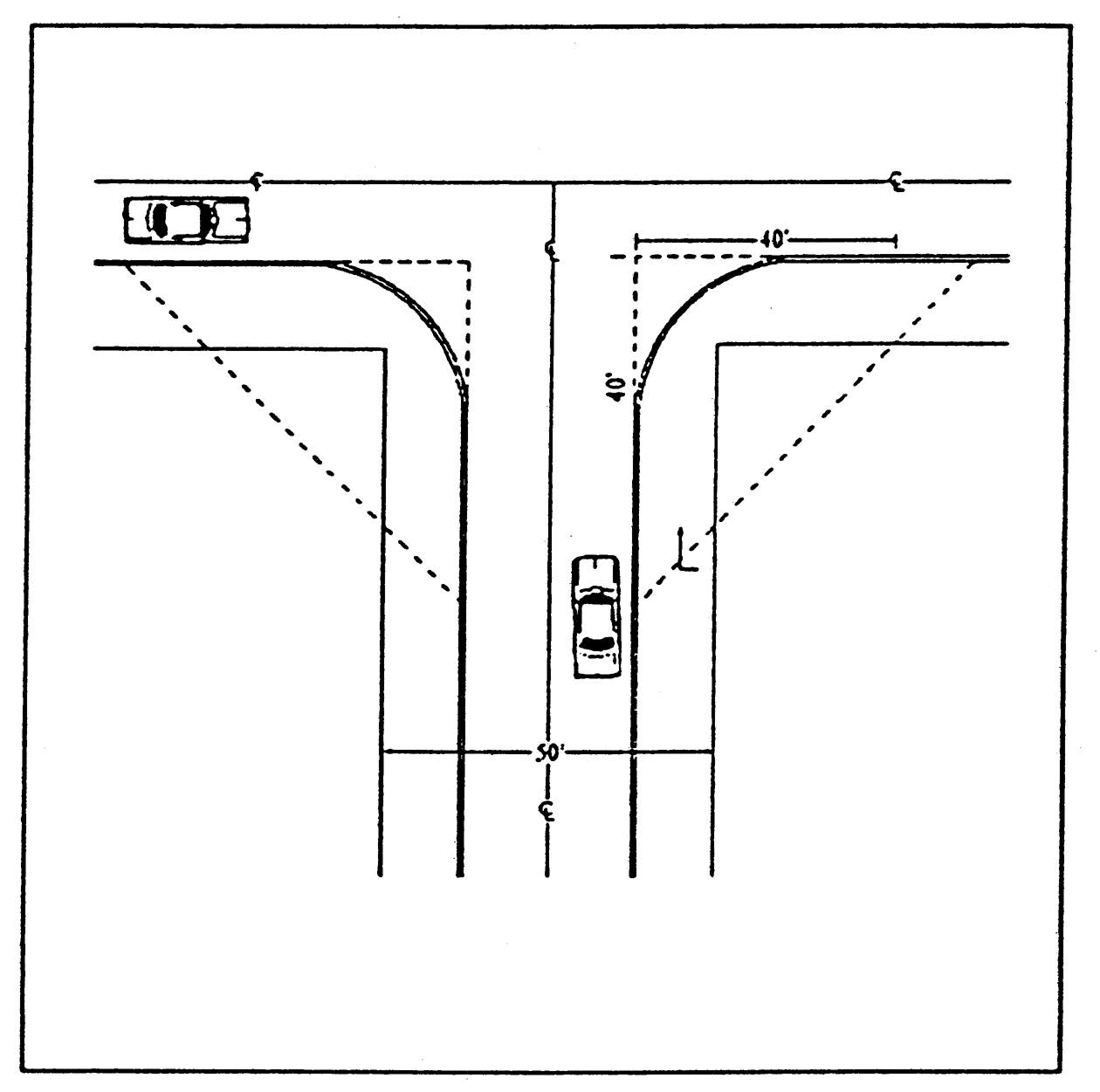
Clear visibility triangle. In order to provide a clear view of intersecting streets to the motorist, there shall be a triangular area of clear visibility formed by two intersecting streets or the intersection of a driveway and a street. The following standards shall be met:
1.
Nothing shall be erected, placed, parked, planted, or allowed to grow in such a manner as to materially impede vision between a height of two feet and ten feet above the grade, measured at the centerline of the intersection.
2.
The clear visibility triangle shall be formed by connecting a point on each street centerline, to be located at the distance from the intersection of the street centerlines indicated below, and a third line connecting the two points.
3.
The distance from the intersection of the street centerlines for the various road classifications shall be as follows:
4.
Where roads of different functional classifications intersect, the larger distance requirement shall be observed.
EXAMPLE OF CLEAR VISIBILITY TRIANGLE
(E)
Signage and signalization. The developer shall deposit with the town sufficient funds to provide all necessary roadway signs and traffic signalization as may be required by the town, based upon town or state traffic standards. At least two street name signs shall be placed at each four-way street intersection, and one at each "T" intersection. Signs shall be installed under light standards and free of visual obstruction. The design of street name signs shall be consistent, of a style appropriate to the community, and of a uniform size and color.
(F)
Blocks.
1.
Where a tract of land is bounded by streets forming a block, said block shall have sufficient width to provide for two tiers of lots of appropriate depths.
2.
The lengths, widths, and shapes of blocks shall be consistent with adjacent areas.
(Ord. No. 05-71, § 1(Exh. A), 8-9-05; Ord. No. 12-12, § 1, 2-14-12)
3.02.04. - Sidewalks and bikeways.
(A)
When required.
1.
Projects abutting collector or arterial facilities shall provide sidewalks adjacent to such roadways. Location of sidewalks shall be consistent with planned roadway improvements.
2.
Sidewalks shall be provided on both sides of all residential streets where the average lot width at the street is 60 feet or less.
3.
Sidewalks shall be provided on one side of all residential streets where the average lot width at the street is greater than 60 feet but less than 150 feet.
4.
Where a proposed development includes improvements or new construction of collector or arterial facilities, facility designs shall include provision for sidewalks and bikeways within the right-of-way.
5.
Residential projects adjacent to or in the immediate vicinity of commercial, office, service, or recreation activities shall provide pedestrian and bicycle access from the development to the activity center.
6.
Pedestrian ways or crosswalks, not less than ten feet wide with a sidewalk meeting the requirements of this section, may be required to be placed in the center of blocks more than 800 feet long where deemed necessary to provide circulation or access to schools, playgrounds, shopping centers, transportation and other community facilities.
(B)
Design and construction standards. Design and construction of sidewalks, bikeways, or other footpaths shall conform to all applicable engineering requirements adopted by the Town of Dundee, including provisions for access by physically handicapped persons.
3.02.05. - Access points onto streets.
All proposed development shall meet the following standards for vehicular access and circulation:
(A)
Number of access points.
1.
The maximum number of points of access permitted onto any one road shall be as follows:
2.
In lieu of any two openings onto any one road, there may be permitted a single point of access up to 35 feet in width.
3.
Adjacent uses may share a common driveway provided that appropriate access easements are granted between or among the property owners.
(B)
Separation of access points.
1.
There shall be a minimum distance of 12 feet between any two openings onto the same street.
2.
No point of access shall be allowed within ten feet of the intersection of the right-of-way lines of any public road.
3.
The distance between access points shall be measured from the centerline of the proposed driveway or roadway to the centerline of the nearest adjacent driveway or roadway.
(C)
Access to residential lots.
1.
No residential lots having a width less than 125 feet shall abut an arterial without also directly abutting a local or collector street.
2.
No lot in a subdivision shall be approved with less than 20 feet of frontage on a public street right-of-way.
3.02.06. - Standards for drive-up facilities.
All facilities providing drive-up or drive-through service shall provide onsite stacking lanes in accordance with the following standards:
1.
The facilities and stacking lanes shall be located and designed to minimize turning movements in relation to driveway access to streets and intersections.
2.
The facilities and stacking lanes shall be located and designed to minimize or avoid conflicts between vehicular traffic and pedestrian areas such as sidewalks, crosswalks, or other pedestrian accessways.
3.
A bypass lane shall be provided.
4.
Stacking lane distance shall be measured from the service window to the property line bordering the furthest street providing access to the facility.
5.
Minimum stacking lane distance shall be as follows:
a.
Financial institutions shall have a minimum distance of 200 feet. Two or more stacking lanes may be provided which together total 200 feet.
b.
All other uses shall have a minimum distance of 120 feet.
6.
Alleys or driveways in or abutting areas designed, approved, or developed for residential use shall not be used for circulation of traffic for drive-up facilities.
7.
Where turns are required in the exit lane, the minimum distance from any drive-up station to the beginning point of the curve shall be 34 feet. The minimum inside turning radius shall be 25 feet.
8.
Construction of stacking lanes shall conform to all engineering design standards adopted by the Town of Dundee.
3.03.01. - Applicability.
This section shall apply to all new construction requiring offstreet parking, and existing nonconforming parking facilities if onsite renovation, construction or repair exceeds 50 percent of the assessed value of the property.
3.03.02. - Offstreet parking.
(A)
Number of required spaces. In all districts, off-street parking shall be provided as set forth in the following table and as may be modified by the provisions following the table:
*Square feet, gross floor area (SFGFA) is defined as the total floor area of a building from its outside dimensions.
**Square feet, gross leasable area (SFGLA) is defined as the floor area of a building, less administrative, public and similar areas.
(B)
Off-street parking for the physically disabled. All development covered by F.S. § 553.5041, shall provide parking for the physically disabled pursuant to the requirements of that section and Section 4.1 of the Americans with Disabilities Act Accessibility Guidelines (ADAAG). In addition, all residential developments with greater than 25 required parking spaces shall comply with the requirements of F.S. § 316.1959. Specifically, said developments shall provide off-street parking for the physically disabled in accordance with the following table. (This amendment includes the all-new table below highlighted in yellow.)
(C)
Bicycle parking.
1.
Number of spaces required. One bicycle parking space shall be provided for every ten automobile parking spaces, or fraction thereof, required for the use, except as provided below:
2.
Design standards.
a.
The development director shall maintain a list of approved bicycle parking facilities.
b.
Other bicycle parking devices may be used if it is established to the satisfaction of the department that the standards below are met.
c.
The rack or other facility shall:
(1)
Be designed to allow each bicycle to be supported by its frame.
(2)
Be designed to allow the frame and wheels of each bicycle to be secured against theft.
(3)
Be designed to avoid damage to the bicycles.
(4)
Be anchored to resist removal and solidly constructed to resist damage by rust, corrosion, and vandalism.
(5)
Accommodate a range of bicycle shapes and sizes and to facilitate easy locking without interfering with adjacent bicycles.
(6)
Be located to prevent damage to bicycles by cars.
(7)
Be consistent with the surroundings in color and design and be incorporated whenever possible into building or street furniture design.
(8)
Be located in convenient, highly visible, active, well-lighted areas.
(9)
Be located so as not to interfere with pedestrian movements.
(10)
Be located as near the principal entrance of the building as practicable.
(11)
Provide safe access from the spaces to the right-of-way or bicycle lane.
(D)
Location of parking spaces. Parking spaces required by this section shall be located as follows:
1.
Such parking spaces as required in this section shall in no part exist upon, and no portion of any vehicle shall overhang, the right-of-way of any public road, street, alley, or walkway. There shall be no offstreet parking in the front yards of residential districts except as normally exists in driveways.
2.
Parking spaces for all dwellings shall be located on the same development site as the main building.
3.
Parking spaces for all other uses shall be provided on the same development site as the main building, or not more than 300 feet distant, as measured along the nearest pedestrian walkway. Such parking area may be located in an adjacent residential district provided that such parking area is screened so as to prevent headlights from shining on residential properties and to minimize vehicular noise.
4.
Parking requirements for two or more uses, of the same or different types, may be provided by the establishment of the required number of spaces for each use in a common parking area.
(E)
Required parking lot improvements. Any offstreet parking lot serving any use other than dwellings of four units per building or less shall meet the following requirements for offstreet parking lot improvements:
1.
Buffer and canopy. The parking area will be buffered and canopy provided pursuant to section 2.03.01.
2.
Surfacing. For all retail sales and services, business services, and professional services serving the general public and having access to and abutting a paved street, the offstreet parking area shall be provided with a hard surface of all-weather pavement, of asphalt or concrete, and shall be so graded and drained as to provide for the adequate runoff and disposal of surface water, and shall be constructed in accordance with standards established by the town engineer.
3.
Lighting. Where lighting facilities are provided for the parking area, they shall be designed and installed so as to reflect the light away from any contiguous residential property.
(F)
Parking deferral.
1.
To avoid requiring more parking spaces than actually needed to serve a development, the town commission may waive the provision of some portion of the offstreet parking spaces required by this section if the conditions and requirements of this section are satisfied.
2.
As a condition precedent to obtaining such a waiver by the town commission, the developer must show any one or more of the following:
a.
A parking study prepared by a qualified professional indicates that there is not a present need for the deferred parking.
b.
The developer has established or will establish an alternative means of access to the use that will justify deferring the number of parking spaces sought to be deferred. Alternative programs that may be considered by the town commission include, but are not limited to:
(1)
Private and public carpools and vanpools.
(2)
Charging for parking.
(3)
Subscription bus services.
(4)
Flexible work-hour scheduling.
(5)
Ride sharing.
(6)
Establishment of a transportation coordinator position to implement carpool, vanpool, and transit programs.
c.
The percentage of parking spaces sought to be deferred corresponds to the percentage of residents, employees, and customers who regularly walk, use bicycles and other nonmotorized forms of transportation, or use mass transportation to come to the facility.
3.
If the developer satisfies one or more of the criteria in (2), the town commission may approve a deferred parking plan submitted by the developer. The number of parking spaces deferred shall correspond to the estimated number of parking spaces that will not be needed because of the condition or conditions established.
4.
A deferred parking plan shall:
a.
Be designed to contain sufficient space to meet the full parking requirements of this section, shall illustrate the layout for the full number of parking spaces, and shall designate which are to be deferred.
b.
Locate deferred spaces outside areas required for landscaping, buffer zones, setbacks, or areas that would otherwise be unsuitable for parking spaces because of the physical characteristics of the land or other requirements of this code.
c.
Include a landscaping plan for the deferred parking area.
d.
Include a written agreement with the town that, one year from the date of issuance of the certificate of occupancy, the deferred spaces will be converted to parking spaces that conform to this code at the developer's expense should the town commission determine from experience that the additional parking spaces are needed.
e.
Include a written agreement that the developer will cover the expense of a traffic study to be undertaken or commissioned by the town to determine the advisability of providing the full parking requirement.
5.
At any time after one year from the date of issuance of a certificate of occupancy for the development, the town commission shall have the authority to require that the deferred spaces be converted to operable parking spaces by the developer.
6.
The developer may at any time request that the town commission approve a revised development plan to allow converting the deferred spaces to operable parking spaces.
(G)
Reduction for mixed or joint use of parking spaces. The town commission shall authorize a reduction in the total number of required parking spaces for two or more uses jointly providing offstreet parking when their respective hours of need of maximum parking do not normally overlap. Reduction of parking requirements because of joint use shall be approved if the following conditions are met:
1.
The developer submits sufficient data to demonstrate that hours of maximum demand for parking at the respective uses do not normally overlap.
2.
The developer submits a legal agreement approved by the town attorney guaranteeing the joint use of the offstreet parking spaces as long as the uses requiring parking are in existence or until the required parking is provided elsewhere in accordance with the provisions of this section.
(H)
Reduction for low percentage of leasable space. If a use has a very low percentage of leasable space because of cafeterias, athletic facilities, multiple stairways or elevator shafts, or for other reasons, the town commission may reduce the parking requirements if the following conditions are met:
1.
The developer submits a detailed floor plan describing how all of the floor area in the building will be used.
2.
The developer agrees in writing that the use of the square footage identified as not leasable shall remain as identified, unless and until additional parking is provided to conform fully with this code.
(I)
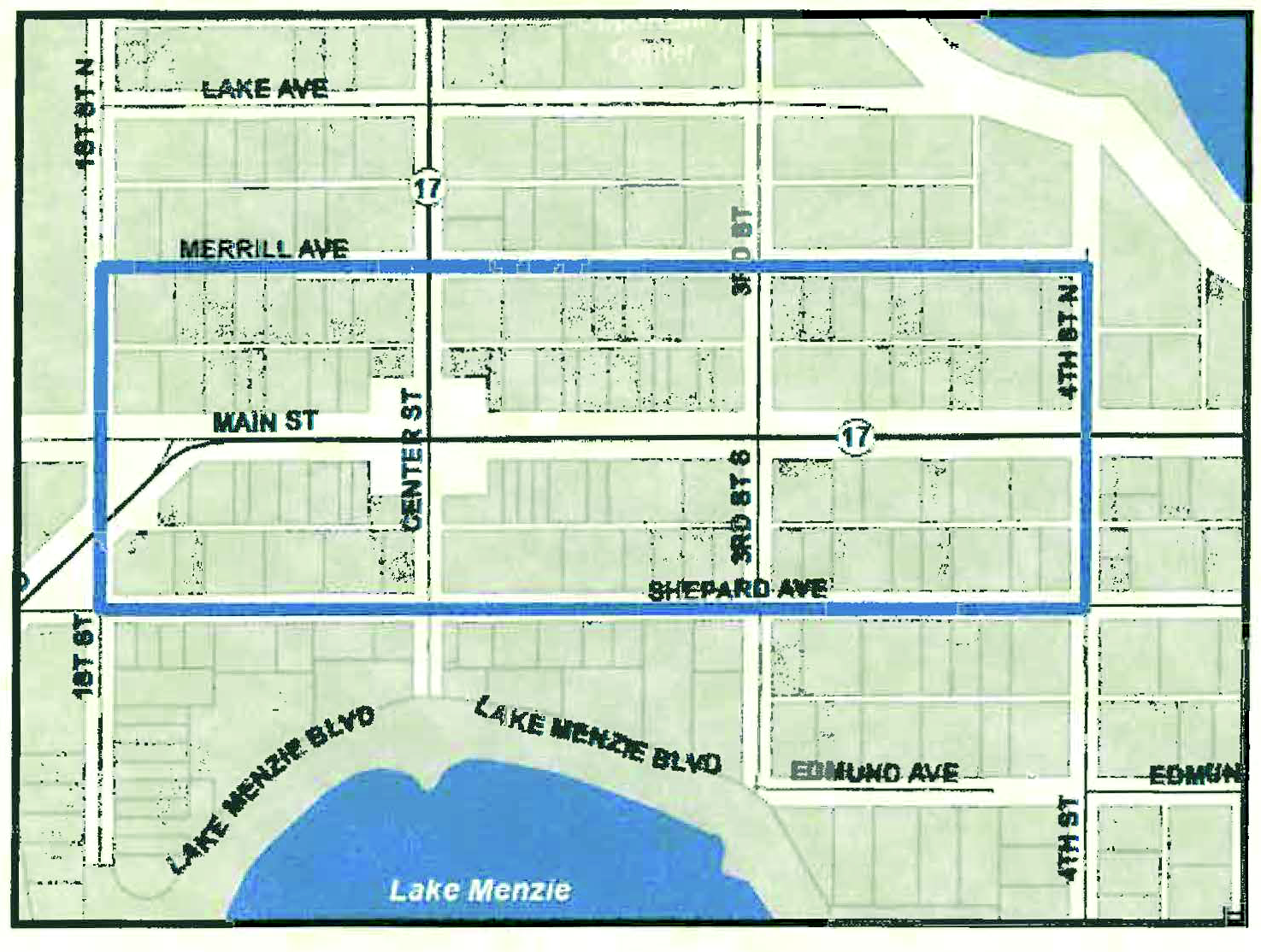
Establishment of downtown parking district and parking requirements within the downtown parking district. There is hereby established a downtown parking district within the Town of Dundee, Florida, which is defined as the area bounded by Merrill Avenue on the North, Shepard Avenue on the south, 4 th Street on the east, and 1 st Street on the west.
Figure 3.03.02(I)(1): Downtown Parking District
1.
General requirements.
(a)
Parking requirements for all development in the downtown parking district shall respect the parking standards of article 3, section 3.03.02 of this Code, except as expressly supplemented or modified in this section.
(b)
Any adjustments or alternatives to parking requirements not expressly provided in this Code must be submitted to the planning and zoning board for review and the town commission for approval. A parking study shall be required to support such adjustments as established in section 3.03.02(I)(8).
(c)
Parking requirements established in section 3.07.00 for uses identified as special exceptions and in section 3.08.00 for supplemental standards must be followed.
2.
Off-street parking.
(a)
Off-street parking shall be provided on the same lot as the building and use(s) for which parking is required.
(b)
Off-street parking requirements may be satisfied by on-street parking (parking located in the public right-of-way), parking located in public parking facilities, and/or payment of a fee in lieu of parking as provided in sections 3.03.02(I)(5), 3.03.02(I)(6), and 3.03.02(I)(7).
3.
Off-street parking reduction.
(a)
The downtown parking district warrants an automatic 25 percent reduction to the off-street parking requirements as included in the table in section 3.03.02(A). This reduction does not apply to uses that have specific parking requirements in place through section 3.07.00 or 3.08.00.
(b)
Off-street parking impacts must be completed if the impact generates more than two parking spots.
4.
Shared off-street parking. Notwithstanding any other parking requirements set forth in this section for individual land uses, when any land or building is used for two or more distinguishable purposes (i.e. joint or mixed use development), the minimum number of parking spaces required to serve the combination of all uses shall be determined in the following manner:
(a)
Multiply the maximum allowable parking requirement for each individual use (as set forth in the table in section 3.03.02(A) for each use) by the automatic 25 percent reduction to determine the maximum parking requirement for each use.
(b)
Multiply the result for each individual use by the appropriate percentage as set forth in the shared-use parking credit schedule as set forth below for each of the five designated time periods (columns).
(c)
Add the resulting sums from each of the five time periods (columns). Where the computation results in a fractional number, a fraction over one-half shall require one space.
(d)
The time period total (column) having the highest total value is the maximum shared parking space requirement for that combination of land uses.
Shared-Use Parking Credit Schedule
5.
On-street parking. On-street public parking may be provided where adequate right-of-way exists. The construction of on-street parking spaces, directly and wholly abutting the lot, may be provided and counted towards the off-street parking requirement of the development site it is intended to serve, provided that:
(a)
The adjacent right-of-way has not been previously utilized for parking or, in cases where the adjacent right-of-way has been used for parking, only those spaces in addition to the number of existing spaces shall be counted.
(b)
Such parking spaces are clearly identified on the final site development plan and designed in accordance with appropriate town, county and/or state standards, as applicable.
(c)
Such parking spaces shall be publicly accessible and cannot be reserved or restricted by the owner(s) or tenant(s) of the lot, unless approved by the town commission for special events or valet parking purposes.
(d)
One parking space credit shall be given for each on-street public space constructed.
(e)
No part of an on-street parking space shall extend past a side property line of the lot it serves.
(f)
In the event the town, county, or state removes the parking spaces at any time for a public purpose, the property shall be considered lawfully nonconforming with respect to parking.
(g)
The construction of on-street public parking spaces may reduce the number of in-lieu public parking spaces required where a parking in-lieu fee is sought to meet parking requirements. (See section 3.03.02(I)(7).)
6.
Parking located in public parking facilities. The construction of parking spaces within public parking facilities may be provided and counted towards the off-street parking requirement of the development site it is intended to serve. Required parking for residential components of mixed-use developments are not eligible for this option.
7.
Parking in-lieu fee. Subject to the limitations of this section, new development, changes of use, building additions, and/or other improvements that result in the requirement to provide new parking or additional parking, have the option of requesting some of the parking spaces to be approved by the town manager through the payment in-lieu of parking program. The amount of the fee and time of payment shall be established by commission resolution.
(a)
Required parking for residential components of mixed-use developments are not eligible for this in-lieu option.
(b)
A maximum limit of 30 percent of eligible required parking can be provided under this option, except for changes of use, for which there is no maximum.
(c)
Before granting such approvals, the town manager must find that adequate public parking options are available and that the request is consistent with the town's land development regulations and the comprehensive plan.
(d)
Where a contribution is accepted, the money is held in trust and spent on public parking facility purposes in a location that will meet the needs of the area generally.
8.
Parking study requirements.
(a)
Applicability: A parking study, in addition to the application for site development approval, shall be submitted for proposed developments requesting a waiver or reduction of the total number of required off-street parking spaces.
(b)
Contents of the parking study: The parking study shall be designed to provide evidence supporting the requested waiver of the required number of parking spaces. The study shall be prepared, signed, and sealed by a certified professional traffic engineer and shall consider the following:
i.
Estimates of parking requirements shall be based on recommendations in studies such as those from the Urban Land Institute (ULI) or the Institute of Transportation Engineers (ITE) based on data collected from uses or combinations of uses that are the same or comparable to the proposed use; comparability shall be determined by density, scale, area, type of activity and location; the study shall document the source of data used to develop recommendations;
ii.
The extent to which a transportation system management program and use of alternative forms of transportation lessen the parking requirement.
(Ord. No. 06-17, § 1(Exh. A), 6-13-06; Ord. No. 12-12, § 1, 2-14-12; Ord. No. 14-09, § 2(Exh. A), 5-13-14)
3.03.03. - Offstreet loading requirements.
Offstreet loading spaces shall be provided in accordance with the following standards:
1.
Every hospital, institution, commercial or industrial building or similar use shall be provided with one loading space for each 20,000 square feet or more of floor area, and [every use] requiring the receipt or distribution by vehicles of materials or merchandise shall have at least one permanent offstreet loading space for each 20,000 square feet of gross floor area, or fraction thereof, immediately adjacent to the principal building.
2.
Retail operations, wholesale operations, and industrial operations with a gross floor area of less than 20,000 square feet shall provide sufficient space for loading and unloading operations in order that the free movement of vehicles and pedestrians over a sidewalk, street or alley shall not be impaired.
3.
Every offstreet loading and unloading space shall have a direct access to a public street or alley, and shall have the following minimum dimensions:
a.
Length: 30 feet;
b.
Width: 12 feet;
c.
Height: 14 feet.
4.
Mobile home and trailer sales establishments shall provide adequate space off the public right-of-way for the maneuvering of mobile homes and trailers into position on the property without blocking traffic on the abutting street or road.
3.03.04. - Design standards for offstreet parking and loading areas.
(A)
Location. Except as provided herein, all required offstreet parking spaces and the use they are intended to serve shall be located on the same parcel as the use itself. The town commission may approve offsite parking facilities as part of the parking required by this code if:
1.
The location of the offsite parking spaces will adequately serve the use for which it is intended. The following factors shall be considered:
a.
Proximity of the offsite spaces to the use that they will serve.
b.
Ease of pedestrian access to the offsite parking spaces.
c.
Whether or not offsite parking spaces are compatible with the use intended to be served, e.g., offsite parking is not ordinarily compatible with high turnover uses such as retail.
2.
The location of the offsite parking spaces will not create unreasonable:
a.
Hazards to pedestrians.
b.
Hazards to vehicular traffic.
c.
Traffic congestion.
d.
Interference with access to other parking spaces in the vicinity.
e.
Detriment to any nearby use.
3.
The developer supplies a written agreement, approved in form by the town attorney, assuring the continued availability of the offsite parking facilities for the use they are intended to serve.
4.
All parking spaces required by this chapter [article] for residential uses shall be located no further than the following distances from the units they serve:
Resident parking: 200 feet.
Visitor parking: 250 feet.
Distances shall be measured from a dwelling unit's entry to the parking space. Where a stairway or elevator provides access to dwelling units, the stairway or elevator shall be considered to be the entrance to the dwelling unit. For purposes of measuring these distances, each required parking space shall be assigned to a specific unit on the development plan, whether or not the developer will actually assign spaces for the exclusive use of the specific unit.
(B)
Size.
1.
Standard and compact parking spaces shall be sized according to figure A below.
2.
Parallel parking spaces shall be a minimum of eight feet wide and 22 feet long. If a parallel space abuts no more than one other parallel space, and adequate access room is available, then the length may be reduced to 20 feet.
3.
Tandem parking spaces must be a minimum of nine feet wide and 20 feet long.
4.
A standard motorcycle parking space shall be 4¼ feet wide and 9¼ feet long.
5.
The standard offstreet loading space shall be ten feet wide, 25 feet long, provide vertical clearance of 15 feet, and provide adequate area for maneuvering, ingress and egress. The length of one or more of the loading spaces may be increased up to 55 feet if full-length tractor-trailers must be accommodated. Developers may install spaces that are larger than the standard, but the number of spaces shall not be reduced on that account.
6.
The town commission may modify these requirements where necessary to promote a substantial public interest relating to environmental protection, heritage conservation, aesthetics, tree protection, or drainage. The town engineer shall certify that the modification does not create a serious hazard or inconvenience, and the town commission shall submit a written statement of the public interest served by allowing the modification.
FIGURE A
(C)
Layout.
1.
Pedestrian circulation facilities, roadways, driveways, and offstreet parking and loading areas shall be designed to be safe and convenient.
2.
Parking and loading areas, aisles, pedestrian walks, landscaping, and open space shall be designed as integral parts of an overall development plan and shall be properly related to existing and proposed buildings.
3.
Buildings, parking and loading areas, landscaping and open spaces shall be designed so that pedestrians moving from parking areas to buildings and between buildings are not unreasonably exposed to vehicular traffic.
4.
Landscaped, paved, and gradually inclined or flat pedestrian walks shall be provided along the lines of the most intense use, particularly from building entrances to streets, parking areas, and adjacent buildings. Pedestrian walks should be designed to discourage incursions into landscaped areas except at designated crossings.
5.
Each offstreet parking space shall open directly onto an aisle or driveway that, except for single-family and two-family residences, is not a public street.
6.
Aisles and driveways shall not be used for parking vehicles, except that the driveway of a single-family or two-family residence shall be counted as a parking space for the dwelling unit, or as a number of parking spaces as determined by the development director based on the size and accessibility of the driveway.
7.
The design shall be based on a definite and logical system of drive lanes to serve the parking and loading spaces. A physical separation or barrier, such as vertical curbs, may be required to separate parking spaces from travel lanes.
8.
Parking spaces for all uses, except single-family and two-family residences, shall be designed to permit entry and exit without moving any other motor vehicle.
9.
No parking space shall be located so as to block access by emergency vehicles.
10.
Compact car spaces shall be located no more and no less conveniently than full size car spaces, and shall be grouped in identifiable clusters.
(Ord. No. 12-12, § 1, 2-14-12)
3.04.01. - Requirements for all developments.
The following basic utilities are required for all developments subject to the criteria listed herein:
(A)
Electricity. Every principal use and every lot within a subdivision shall have available to it a source of electric power adequate to accommodate the reasonable needs of such use and every lot within such subdivision.
(B)
Telephone. Every principal use and every lot within a subdivision shall have available to it a telephone service cable adequate to accommodate the reasonable needs of such use and every lot within such subdivision.
(C)
Water and sewer. Every principal use and every lot in a newly platted subdivision shall have central potable water and wastewater hookup whenever required by the comprehensive plan. Connection to the town water and sewer system shall be in strict conformance with the provisions of chapter 54, utilities, article i, section 54-5, titled "availability of service," and to all other applicable provisions of chapter 54.
(D)
Illumination. All streets, driveways, sidewalks, bikeways, parking lots and other common areas and facilities in developments shall provide illumination meeting design standards adopted by the Town of Dundee.
(E)
Fire hydrants. All developments served by a central water system shall include a system of fire hydrants consistent with design standards adopted by the Town of Dundee.
(Ord. No. 99-06, 6-8-99)
3.04.02. - Design standards.
(A)
Compliance with technical construction standards. All utilities required by this chapter [article] shall meet or exceed minimum design standards adopted by the Town of Dundee.
(B)
Placement of utilities underground.
1.
All electric, telephone, cable television, and other communication lines (exclusive of transformers or enclosures containing electrical equipment, including but not limited to switches, meters, or capacitors which may be pad mounted), and gas distribution lines shall be placed underground within easements or dedicated public rights-of-way, installed in accordance with the town's adopted design standards.
2.
Lots abutting existing easements or public rights-of-way where overhead electric, telephone, or cable television distribution supply lines and service connections have previously been installed may be supplied with such services from the utility's overhead facilities provided the service connections to the site or lot are placed underground.
3.
Screening of any utility apparatus placed above ground shall be required.
3.04.03. - Utility easements.
When a developer installs or causes the installation of water, sewer, electrical power, telephone, or cable television facilities and intends that such facilities shall be owned, operated, or maintained by a public utility or any entity other than the developer, the developer shall transfer to such utility or entity the necessary ownership or easement rights to enable the utility or entity to operate and maintain such facilities.
3.05.01. - General provisions.
All uses shall conform to the standards of performance described within this article and shall be constructed, maintained and operated so as not to be injurious or offensive to the occupants of adjacent premises by reason of the emission or creation of noise, vibration, smoke, dust or other particulate matter, toxic or noxious waste materials, odors, fire and explosive hazard or glare. Within 100 feet of a residential district, all processes and storage, except for vehicle parking, shall be in completely closed buildings. Processes and storage located at a greater distance shall be effectively screened by a solid wall or fence at least six feet in height. Where other ordinances or regulations (whether federal, state, or local) which may be adopted hereinafter impose greater restrictions than those specified herein, compliance with such other ordinances and regulations is mandatory.
3.05.02. - Specific standards.
3.05.02.01. Noise.
Every use shall be so operated as to comply with the maximum performance standards governing noise described below. Objectionable noises due to intermittence, beat frequency or shrillness shall be muffled or eliminated so as not to become a nuisance to adjacent uses. Sound levels shall be measured with a sound level meter and associated octave band filter manufactured according to standards prescribed by the American Standards Association.
MAXIMUM PERMITTED SOUND LEVEL IN DECIBELS
3.05.02.02. Vibration.
Every use shall be so operated that ground vibration inherently and recurrently generated is not perceptible, without instruments, at any point on the property line of the property on which the use is located. No vibration at any time shall produce an acceleration of more than 0.1 g or shall result in any combination of amplitudes and frequencies beyond the "safe" range of table 7, U.S. Bureau of Mines Bulletin No. 442. The equations of such bulletin shall be used to determine the values of enforcement.
3.05.02.03. Smoke.
Every use shall be so operated as to prevent the emission of smoke, from any source whatever, to a density greater than described as number 1 on the Ringelmann smoke chart; provided, however, that smoke equal to, but not in excess of, that shade of appearance described as number 2 on the Ringelmann chart may be emitted for a period or periods totaling four minutes in any 30 minutes. For the purpose of grading the density of smoke, the Ringelmann chart as published and used by the United States Bureau of Mines, and which is hereby made, by reference, [a part of this section,] shall be standard. All measurements shall be at the point of emission. Smoke emission must comply with applicable rules of the Florida department of environmental regulation.
3.05.02.04. Dust and dirt.
Every use shall be so operated as to prevent the emission into the air of dust or other solid matter which may cause damage to property and health of persons or animals at or beyond the lot line of the property on which the use is located. Emissions must comply with applicable rules of the Florida department of environmental regulation.
3.05.02.05. Industrial sewage and waste.
Every use shall be so operated as to prevent the discharge into any stream, lake or the ground of any waste which will be dangerous or discomforting to persons or animals or which will damage plants or crops beyond the lot line of the property on which the use is located. Industries shall comply with applicable rules of the Florida department of environmental regulation.
3.05.02.06. Hazardous wastes.
The handling and discharge of all hazardous waste shall follow all applicable standards established by the county health department, state legislature and the U.S. Congress. Appropriate town officials shall review all procedures involving the handling and discharge of all hazardous waste to ensure that it does not create any safety or health problems.
3.05.02.07. Odors.
Every use shall be so operated as to prevent the emission of objectionable or offensive odors in such concentration as to be readily perceptible at any point at or beyond the lot line of the property on which the use is located. There is hereby established, as a guide in determining the quantities of offensive odors, table III, chapter 5, Air Pollution Abatement Manual of the Manufacturing Chemists Association, Inc., Washington, D.C.
3.05.02.08. Glare.
Every use shall be so operated as to prevent the emission of glare of such intensity as to be readily perceptible at any point on the lot line of the property on which the use is located.
3.05.02.09. Fumes, vapors and gases.
There shall be no emission of fumes, vapors, or gases of a noxious, toxic or corrosive nature which can cause any danger or irritation to health, animals, vegetation, or to any form of property.
3.05.02.10. Heat, cold, dampness, or movement of air.
Activities which shall produce any adverse effects on the temperature, motion or humidity of the atmosphere beyond the lot line shall not be permitted.
3.05.02.11. Fire and safety hazard.
Each use shall be operated so as to minimize the danger from fire and explosion. The specific regulations to be met are set forth in the building code and the fire prevention code of the town.
3.05.02.12. Radioactive emission.
There shall be no radiation emitted from radioactive materials or byproducts exceeding a dangerous level of radioactive emissions at any point. Radiation limitations shall not exceed quantities established as safe by the U.S. Bureau of Standards.
3.05.02.13. Electromagnetic radiation.
(A)
Compliance with FCC regulations. No person shall operate, or cause to be operated, any planned or intentional source of electromagnetic radiation for such purposes as communication, experimentation, entertainment, broadcasting, heating, navigation, therapy, vehicle velocity measurement, weather survey, aircraft detection, topographical survey, personal pleasure, or any other use directly or indirectly associated with these purposes which does not comply with the current regulations of the Federal Communications Commission regarding such sources of electromagnetic radiation. Further, such operation in compliance with the Federal Communications Commission regulations shall be unlawful if such radiation causes an abnormal degradation in the performance of other electromagnetic receptors or radiators of quality and proper design because of proximity, primary field, blanketing, spurious re-radiation, conducted energy in power or telephone systems or harmonic content.
(B)
Evaluation of performance. The determination of abnormal degradation in performance and of good quality and proper design shall be made in accordance with good engineering practices as defined in the principles and standards of the American Institute of Electrical Engineers, the Institute of Radio Engineers, and the Radio Manufacturer's Association. In case of any conflict between the latest standards and principles of the above groups, the following precedence in the interpretation of the standards and principles shall apply: (1) American Institute of Electrical Engineers; (2) Institute of Radio Engineers; (3) Radio Manufacturer's Association.
Recognizing the special nature of many of the operations which will be conducted because of the research and educational activities, it shall be unlawful for any person, firm, or corporation to operate or cause to be operated, to maintain or cause to be maintained any planned or intentional source of electromagnetic energy, the radiated power from which exceeds 1,000 watts.
3.06.01. - General provisions.
Protection of water resources is critical to the health, safety, and welfare of the public. Innovative approaches to stormwater management shall be encouraged and the concurrent control of erosion, sedimentation, and flooding shall be mandatory. No site alteration shall adversely affect the existing surface water flow pattern. No site alteration shall cause siltation of wetlands, pollution of downstream wetlands, or reduce the natural retention of filtering capabilities of wetlands. All stormwater management proposals shall meet or exceed the Southwest Florida Water Management District requirements or the provisions of this section or other pertinent provisions of this code, whichever is more stringent.
3.06.02. - Stormwater management criteria.
A complete stormwater management system shall be provided for all areas of a proposed development project and for handling stormwater runoff that flows into or across the project area from the outside, without undesired additional flooding of any other lands. The system shall be designed for long life and ease of maintenance by normal methods. Soil types shall be considered, and full development of the basin shall be assumed for selection of proper runoff coefficients with which proposed developments shall be designed. The system shall be designed in accordance with accepted engineering principles for design floods resulting from rainstorms of the maximum intensity predicted for the area at 25-year intervals, 24-hour duration, with protection to a 50-year, 24-hour rainfall.
A minimum of the first inch of rainfall shall be retained onsite. In addition, the difference between pre- and post-development runoff volumes shall be detained onsite. A positive outfall for all runoff in excess of that retained shall be provided to a natural drainageway through appropriate easements, etc. If the downstream facilities are inadequate to convey the peak discharge for the design rainfall above, the proposed development must accommodate that portion of runoff above the downstream system actual capacity.
3.06.03. - Stormwater runoff criteria.
The following stormwater runoff criteria shall be met in all water management system designs:
(A)
Treatment of stormwater runoff. All drainage facilities shall be designed to remove oils, suspended solids, and other objectionable material in stormwater runoff.
(B)
Onsite percolation. Sites shall be developed to maximize the amount of natural rainfall which is percolated into the soil and to minimize direct overland runoff into adjoining streets and watercourses. Stormwater runoff from roofs and other impervious surfaces shall be diverted into swales or terraces on the lot when possible. Whenever development occurs on land which lies within 200 feet of a lake, and slopes toward said lake, an acceptable barrier shall be provided to minimize stormwater runoff into the lake and to maximize aquifer recharge, such as terraces sloping away from the lake, a tree line, etc.
(C)
Street drainage. Street drainage shall be diverted to a stormwater management system of sufficient capacity to retain at least the stormwater runoff from each drainage area for a 25-year, 24-hour storm event. Existing lakes shall not be used as detention areas. Positive drainage facilities shall be provided for all detention areas to handle the runoff from storms which exceed the 25-year, 24-hour storm in duration and severity.
(D)
Retention/detention. The actual acreage required will depend on the percolation rate for the specific site and the manner in which the land is developed. All retention/detention areas shall be sodded in accordance with town regulations, and should be planted in trees, shrubs, or other growing plants that take up large volumes of nutrients.
(E)
Disposition of stormwater runoff. All drainage systems shall include special engineering design features to minimize pollution and oil, suspended solids, and other objectionable material in stormwater runoff within acceptable limits. Treatment facilities shall be designed by a Florida registered engineer to treat adequately the stormwater runoff resulting from rainstorms of the maximum intensity predicted for the area at a 25-year, 24-hour duration.
(F)
Storm drainage into natural water bodies. The first inch of rainfall from each storm shall be retained and percolated into the ground, collected and evaporated, or given chemical-physical treatment wherever an outfall is utilized which discharges into a lake, a canal or stream with a daily mean discharge of less than five cubic feet per second, or a canal or stream which flows into a lake within one mile. Runoff from rainfall in excess of the first inch and outfalls into canals and streams with an average daily flow exceeding five cubic feet per second shall be treated as specified in section 3.06.03. Outfalls into lakes shall be designed to prevent lake bottom scouring. Acceptable methods include use of an energy dissipator or extending the outfall to discharge at a depth of ten feet or half the maximum depth of the lake, in accordance with current and amended regulatory permitting practices.
(G)
Inlet spacing. Street inlets shall be spaced so as to accept 100 percent of design runoff. Typically, the maximum allowable gutter run will be 1,000 feet on streets with standard curb and gutter, and 500 feet on streets where Miami curbs are used. Actual required spacing will depend on the characteristics of each site.
(H)
Natural watercourses. Should the proposed development area contain an existing natural watercourse, drainageway, channel, or similar drainage feature, such watercourse and associated vegetation shall be maintained and the proposed development designed so as to preserve the same. However, the use of such watercourse to carry runoff from any development shall be permitted, if provision for control of sediment in the excess runoff is made prior to the entrance of the runoff to the watercourse. This does not preclude the use of wetlands for storage and treatment of stormwater runoff, as long as the design drainage system does not measurably degrade the affected area.
3.06.04. - Outfall ditches and canals.
All swales, ditches, or canals shall have sufficient right-of-way provided to allow for the installation of the ditch, plus a minimum of a 20-foot maintenance berm on each side and a 15-foot property setback adjacent to the installation. Areas adjacent to the ditches and canals shall be graded in such a manner as to preclude the entrance of excessive runoff except at locations provided.
The maximum side slope permitted shall be 3 to 1, with the top ditch bank rounded off. The minimum bottom width of outfall ditches and canals shall be four feet.
All runoff from each individual unit must be handled to a point of positive outfall. No design of an individual unit shall be dependent upon the ultimate installation of a future unit.
3.06.05. - Positive outfall.
Where an existing outfall is being utilized and the capacity to handle any additional runoff is in question, data to support the design shall be included in the analysis. All ditches shall be sized using accepted engineering practices. In all cases, sufficient engineering data giving drainage area, velocity, and depth of flow is to be included in the drainage analysis.
Unless unstable or highly erosive soil conditions indicate that a lower design velocity is desirable, or unless erosion protection is provided, the maximum allowable velocity shall be five feet per second. The maximum grade of the outfall ditch, likewise, shall be that grade which will produce a velocity of five feet per second. The minimum grade shall be that grade required to provide for design flow.
3.06.06. - Retention/detention basins.
All retention/detention basins shall be readily accessible from streets or public rights-of-way, and shall be situated so that maintenance can be easily performed. All drainage facilities shall be of a low-maintenance type and designed as follows:
1.
Retention/detention basins shall be so designed that all detained water from the design storm is removed after 72 hours. If this is not accomplished by percolation and evaporation, the basin must include a bleed-down system to relieve the excess amount and return it to the discharge side of the outlet structure.
2.
The side slopes of all detention basins shall be kept as flat as possible (maximum of four feet horizontal to one foot vertical), providing soil conditions are suitable to sustain plant growth and control erosion. If one inch or more of water remains in the retention basin for more than 72 consecutive hours, detention basins shall be enclosed with a gated, six-foot high chain link fence, except when the detention facility is a man-made lake or is part of a landscaped park or conservation scheme.
(Ord. No. 01-14, § 1, 1-8-02)
3.06.07. - Underground seepage systems.
Underground seepage systems are not allowed.
3.06.08. - Tabulations.
All submitted stormwater design plans shall include the following tabulations:
1.
Location and type of structure.
2.
Type and length of line.
3.
Drainage area.
4.
Runoff factor.
5.
Time of concentration to structure.
6.
Rainfall intensity.
7.
Total runoff.
8.
Hydraulic gradient control elevation.
9.
Hydraulic grade line, crown elevation, and flow line of each pipe.
10.
Physical drop in pipe.
11.
Hydraulic gradient loss.
12.
Diameter of pipe.
13.
Hydraulic gradient slope.
14.
Velocity.
3.06.09. - Pipe materials permitted.
Pipe material shall be reinforced concrete pipe (RCP). The minimum diameter shall be 15 inches.
3.06.10. - Inlets, manholes, and junction boxes.
All structures shall be constructed of concrete and all fins and irregular projections shall be chipped off flush with the surface immediately following the removal of forms. All projecting wires and nails shall be cut off at least one-half inch under the surface. All cavities produced by metal spacers, form tiles, bolts, honeycomb spots, etc., shall be carefully cleaned, saturated with water, and then carefully painted with mortar. All construction and expansion joints in the completed work shall be left carefully tooled and free of mortar and concrete. Joint filler shall be left exposed for its full length with clean edges. Mortar topping for upper horizontal surfaces shall not be used. Paved inserts shall be required.
For all concrete surfaces which are to receive a surface finish, the contractor shall remove the forms and finish the concrete immediately after the concrete has set sufficiently. Minimum manhole diameters for intersecting pipe sizes shall be as follows:
Inlets shall be spaced in such a manner as to accept 100 percent of the design runoff. The actual required spacing will depend on the characteristics of each particular site.
Computation for drainage culverts, ditch sizes, and inlet spacings shall be based on the storm frequency design standards required in this code and shall be submitted for approval.
3.06.11. - Storm sewer alignment.
All storm sewer layouts shall avoid abrupt changes in direction or slope and shall maintain reasonable consistencies in flow velocity. Where abrupt changes in direction or slope are encountered, provisions shall be made to handle the resultant head loss.
3.06.12. - Underdrains.
In cases where there is a prevalence of soils that exhibit adverse water table characteristics, underdrains and/or fill or other acceptable alternatives that will provide necessary measures to maintain the structural integrity of the road will be required. The determination of need shall be made by reference to applicable portions of the most recent edition of Soil Survey and Supplement for Polk County, Florida, as prepared by the U.S. Department of Agriculture, Soil Conservation Service, and Soil Survey Supplement, or whatever subsequent authoritative soil survey may be published for Polk County after adoption of these regulations, or according to information generated by developers prepared by a registered soils engineer.
1.
Wherever road construction or lot development is planned in areas of the proposed subdivision having soil types with unacceptable water table characteristics, underdrains and/or fill shall be provided and shown on the engineering plans. Underdrains must be designed with free gravity outlet at carefully selected discharge points. Erosion control measures shall be provided as needed at all discharge points.
2.
Wherever road cuts in otherwise suitable soils indicate that the finish grade will result in a road surface-to-water table relationship that adversely exceeds the degree of limitation stated above, underdrains or other acceptable alternatives that will provide necessary measures to maintain the structural integrity of the road will be required.
3.
Wherever roadway construction reveals unexpected water-bearing strata that would cause deterioration of the pavement, underdrains or other acceptable alternatives that will provide necessary measures to maintain the structural integrity of the road will be required, even though not shown on the plans.
4.
Filtering media shall consist of stone, gravel, or slag, and shall contain no friable materials.
5.
Wherever underdrain pipe is required, the specifications shall be in accordance with the American Society for Testing and Materials, Designation: D3033-5.
3.06.13. - Special considerations.
Special consideration shall be given in the layout of streets, lots, blocks, buildings, and easements to the preservation of resource and specimen individual trees. Special consideration shall also be given to preserving natural drainage methods and natural topography and landscape. Special consideration shall be given to providing special screening, buffers, or berms where developments abut incompatible land uses.
3.07.01. - Recreational vehicle parks.
It is the purpose of these standards to provide minimum development guidelines for a recreational vehicle park designed specifically to accommodate the recreational vehicle of an overnight or limited vacation-season type as defined herein, to protect established or permitted uses under these regulations in the vicinity of such a park, and to protect and promote the orderly growth and development of Dundee.
3.07.01.01. General requirements.
Recreational vehicle parks shall be permitted only as a special exception in the RMH district. Development standards provided in this section shall supersede those of the underlying zoning district.
A recreational vehicle park meeting the required design and locational standards shall accommodate the traveling public for a defined maximum time period associated with the specialized seasonal vacation and transient characteristics of such development, as contrasted to the more permanent and extended stay characteristics of a mobile home park.
3.07.01.02. Environmental requirements.
(A)
General. Condition of soil, groundwater level, drainage, and topography shall not create hazards to the property or to the health and safety of the occupants.
(B)
Soil and ground cover requirements. Exposed ground surfaces in all parts of every vehicle site area or other vehicle parking area shall be paved, or covered with stone screenings, or other solid material, or protected with a vegetative growth that is capable of preventing soil erosion and of eliminating objectionable dust.
(C)
Drainage requirements. Surface drainage plans for the entire tract shall be reviewed by appropriate town staff, who shall determine whether the proposed plan is compatible with the surrounding existing drainage pattern and any relevant drainage plan of Polk County, prior to issuance of site plan approval and building permits. No permit shall be issued in such instance where the development director finds the plan to be incompatible with surrounding areas.
3.07.01.03. Tract requirements.
1.
The tract shall have at least 75 feet of frontage on a principal arterial road, as designated on the future traffic circulation map of the Dundee comprehensive plan.
2.
Minimum tract size for a recreational vehicle park development shall be ten acres.
3.
Minimum width of the tract shall be 150 feet at the front building setback line.
4.
Minimum depth of the tract shall be 200 feet.
5.
Minimum perimeter setbacks shall be as follows:
a.
Front: 25 feet, measured from property line to the most forward projection of any structure or vehicle.
b.
Side and rear: 15 feet. Where a public right-of-way abuts a side or rear property line, the minimum setback shall be 25 feet.
6.
Where any property line of a recreational vehicle park abuts land either zoned for residential use or occupied by a residential use permitted by this code, there shall be provided and maintained along said property line a continuous visual buffer with a minimum height of six feet. The buffer shall be a compact evergreen hedge or other type of foliage screening or shall be a combined wooden fence and shrubbery screen, the latter facing the residential zone or permitted residential use.
3.07.01.04. Vehicle site requirements.
1.
The minimum vehicle site area shall be 1,200 square feet.
2.
For the purpose of determining vehicle site width and depth, the width of a vehicle site shall be measured at right angles to and between the designated side boundary lines. The depth of a vehicle shall be measured at right angles to and between the designated front and rear boundary lines.
a.
The minimum vehicle site width shall be 20 feet.
b.
The minimum vehicle site depth shall be 40 feet.
3.
Maximum density shall be ten sites per gross acre.
4.
The minimum distance between recreational vehicles shall be ten feet. The minimum distance between a recreational vehicle and any structure shall be 20 feet. The minimum allowable distance between recreational vehicles shall, for the purpose of this section, be measured from and between the outermost structural parts or attached accessory features.
5.
Each vehicle site shall be clearly defined by a permanent marker, constructed of a durable material such as masonry or metal, placed at all corners.
6.
The addition or attachment of any accessory structures such as awnings, porches, carports, or individual storage facilities, not specifically designed and included as a standard part of the original recreational vehicle, shall be expressly prohibited.
3.07.01.05. Recreational and open space requirements.
There shall be provided within a recreational vehicle park at least one area designed for recreational and open space use which is easily accessible from all vehicle sites. The size of such recreation area shall not be less than ten percent of the entire tract area.
3.07.01.06. Street system and offstreet parking requirements.
(A)
General. All parking areas shall be provided with safe and convenient vehicular access from abutting public streets and roads to each vehicle site. Alignment and gradient shall be properly adapted to topography. Surfacing and maintenance shall provide a smooth, hard and dense surface which shall be well drained.
(B)
Access. Access to a recreational vehicle park from a public street or road shall be designed to minimize congestion and hazards at the entrance and on adjacent streets. All traffic into or out of the parking areas shall be through such entrances and exits.
(C)
Internal streets. The designation of private right-of-way for internal streets is optional. Road surfacing shall meet the following minimum width requirements:
1.
One-way travel: 12 feet.
2.
Two-way travel: 24 feet.
(D)
Offstreet parking and maneuvering space. Each recreational vehicle park shall be designed so that parking, loading or maneuvering of vehicles incidental to parking spaces shall not necessitate the use of any public street, sidewalk, or right-of-way, or any private grounds not part of the recreational vehicle park parking area.
Sufficient maneuvering space and offstreet parking facilities shall be provided at each site to accommodate a towing vehicle, if any.
3.07.01.07. Service requirements.
(A)
Utilities.
1.
Water supply system. Connection to a potable public supply of water is required. Provision of water supply, water storage and water distribution shall be made in accordance with requirements and standards established by this code and the State of Florida.
2.
Watering stations. Each recreational vehicle park shall be provided with one or more easily accessible water supply outlets for filling recreational vehicle water storage tanks in accordance with design and construction requirements established by the State of Florida.
3.
Sewage disposal system. The recreational vehicle park sewerage system shall be connected to the town's public sewage system. The distribution system shall be designed, constructed and maintained in accordance with requirements of this code and by the State of Florida.
4.
Sanitary connections. Each recreational vehicle park shall be provided with individual connections to each vehicle site in the recreational vehicle park.
5.
Electrical and gas systems. Each recreational vehicle park shall be provided with an electrical or gas system which shall be installed and maintained in accordance with applicable codes and regulations.
6.
Lighting. Adequate lighting shall be provided for all roads, walkways, service buildings, watering and sanitary stations, and other facilities subject to nighttime use in accordance with requirements established by appropriate town departments and in the Standard Lighting Guide published by the Illuminating Engineering Society.
3.07.01.08. Refuse handling.
(A)
General. The storage, collection and disposal of refuse (garbage, ashes, and rubbish) in a recreational vehicle park shall be so conducted as to create no health hazards, rodent harborage, insect breeding areas, accident or fire hazard or air pollution in accordance with requirements established by the State of Florida.
(B)
Location. All refuse shall be stored in watertight, flyproof, rodentproof containers.
(C)
Collection. All refuse containing garbage shall be collected at least twice weekly, in accordance with requirements established by the State of Florida.
3.07.01.09. Service buildings and facilities.
(A)
General. The requirements of this section shall apply to service buildings, recreation buildings and other service facilities, such as:
1.
Management offices, repair shops and storage areas.
2.
Sanitary facilities.
3.
Laundry facilities.
4.
Indoor recreation areas.
(B)
Service building for dependent vehicles. A central service building containing the necessary toilet and other plumbing fixtures specified by the State of Florida shall be provided in a recreational vehicle park which provides vehicle sites for dependent vehicles. Service buildings shall be conveniently located within a radius of approximately 300 feet of the sites to be served.
(C)
Service facilities in connection with other businesses. When a recreational vehicle park requiring a service building is operated in connection with a resort or other business establishment, the number of sanitary facilities for such business establishment shall be in addition to those required by the public health standards for vehicle sites and shall be based upon the total number of persons using or expected to use such facilities.
(D)
Pedestrian access to service buildings and facilities. Surfaced, appropriately drained walkways having a width of not less than three feet shall be provided from the vehicle sites to all service buildings and facilities, refuse collection areas, and recreation areas.
(E)
Outdoor cooking and incinerator facilities. All outdoor cooking and incinerator facilities shall be so located, constructed, maintained and used as to minimize fire hazard and smoke nuisance both on the property on which they are used and on neighboring property. Plans, construction, and operation of incinerators shall be carried out in accordance with requirements of the State of Florida.
3.07.01.10. General operating requirements.
(A)
General. The person to whom appropriate permits and licenses are issued shall operate the recreational vehicle park at all times in compliance with applicable state and local laws pertaining to the management and operation of such a facility.
(B)
Duration of stay. Vehicle sites shall be rented by the day or week only, and the occupant of a vehicle site shall remain at that site and within the recreational vehicle park for a limited period of time consistent with the special seasonal, vacation and transient requirements of the recreational vehicle user, but in no case exceeding 120 calendar days within any 360-day period, whether accumulated consecutively or intermittently.
3.07.01.11. Permit procedures and requirements.
(A)
Special exception. Any applicant for the required permits to establish, construct, alter or extend a recreational vehicle park in Dundee shall first request and receive a special exception in accordance with the provisions of article 2 and section 7.05.00 of this code. Following receipt of this approval, the applicant shall proceed with the preparation and submittal of the detailed site development plan in accordance with the requirements of section 7.02.00. When completed, two copies of the proposed detailed site development plan shall be submitted to the development director for review and certification.
(B)
Health and sanitation permit. After receipt of required land use approvals, applicant shall then apply for and receive a health and sanitation permit for the proposed recreational vehicle park from the Polk County health department and the State of Florida in accordance with the requirements of appropriate agencies.
(C)
Building permit. Upon completion of (1) and (2) [(A) and (B)] above, application shall be made to the development director for the building permit to construct, alter, or extend a recreational vehicle park in accordance with the provisions of this section. Before issuing a building permit for the construction, alteration or extension of a recreational vehicle park, the development director shall determine that all applicable review procedures and standards required under this code have been satisfactorily met.
3.07.01.12. Plan preparation requirements.
All applications for town permits, in addition to plan requirements established by this code and requirements of the State of Florida, shall contain the following:
1.
Name, address, and telephone number of applicant.
2.
Interest of the applicant in the proposed recreational vehicle park.
3.
Location, address, and legal description of the entire proposed recreational vehicle park site.
4.
Existing zoning of subject property and all adjacent properties.
5.
Complete engineering plans and specifications of the proposed recreational vehicle park showing:
a.
The area and dimensions of the entire tract of land.
b.
The land uses occupying the adjacent properties.
c.
The number, type (transient or destination), size and location of the proposed vehicle sites and other parking areas.
d.
The location, right-of-way and surfaced roadway width, and surfacing material of roadways and walkways.
e.
The proposed interior vehicular and pedestrian circulation patterns.
f.
The location of service buildings, sanitary stations, and any other existing or proposed structures.
g.
The location of water and sewer lines and riser pipes.
h.
Plans and specifications of the water supply, sewage disposal and refuse facilities.
i.
Plans and specifications of all buildings constructed or to be constructed within the recreational vehicle park.
j.
The locations and details of lighting, electric and gas systems.
6.
Where a recreational vehicle park development is proposed for construction in a series of stages, a master plan for the development of the entire tract of land shall be submitted along with the detailed plans and specifications for the initial stage as well as any subsequent stages.
3.07.02. - Regulations for miniwarehouse in CC, CH, and CS.
It is the purpose of these standards to provide minimum development guidelines for a miniwarehouse facility and to protect established or permitted uses under these regulations in the vicinity of such a facility.
A miniwarehouse in a CC, CH or CS district shall be permitted only as a special exception under the provisions of article 2. Development standards provided in this section shall supersede the normal development standards of those districts. Once approved through a special exception, miniwarehouse shall be the sole use of the property. Other activities in place of or in addition to miniwarehouse shall not be permitted.
No storage bay or unit in a miniwarehouse shall be used as a place of business by persons renting storage space, and no occupational license shall be approved for the property other than that of the miniwarehouse owner/operator.
(A)
Development site requirements.
1.
Minimum lot size. An area not less than 20,000 square feet, with a minimum width of 100 feet and a minimum depth of 200 feet.
2.
Setbacks.
Front: 35 feet.
Side: 40 feet if contiguous to property designated for residential use on the future land use map; ten feet if contiguous to property designated for commercial or industrial use on the future land use map.
Rear: 40 feet if contiguous to property designated for residential use on the future land use map; 20 feet if contiguous to property designated for commercial or industrial use on the future land use map.
3.
Maximum lot coverage. No more than 40 percent of the development site shall be covered by structures.
(B)
Design requirements.
1.
Lighting. All lights shall be shielded to focus and direct light onto the uses established, and away from adjacent property, but may be of sufficient intensity to discourage vandalism and theft. Reference section 3.05.00, Performance Standards, for applicable glare and lighting standards.
2.
Fencing. Where a property line abuts and is contiguous to any residential land use classification, a six-foot solid face masonry wall shall be constructed along the property line.
3.
Signs. A single sign shall be permitted for each abutting road right-of-way, not to exceed 15 feet in height or 40 square feet in gross surface area. No other signs shall be permitted on the property, except traffic directional signage. Signs shall be set back at least 15 feet from all property lines.
4.
Landscaping. Landscaping shall be provided in all required setback areas according to the standards of section 2.03.01 except where a solid face masonry wall is required.
5.
Parking. There shall be a maximum of two parking spaces, which shall be located in proximity to the business or manager's office on the site.
3.07.03. - Regulations for a outdoor flea market in CH.
It is the purpose of these standards to provide minimum development guidelines for an outdoor flea market in a highway commercial district and to protect established or permitted uses under these regulations in the vicinity of such a facility.
An outdoor flea market in a CH district shall be permitted only as a special exception under the provisions of article 2. Development standards provided in this section shall supersede the normal development standards of CH. Flea markets shall be permitted only on property fronting on an arterial road, as designated on the future traffic circulation map of the Dundee comprehensive plan, with all major points of ingress/egress connecting to that road.
At least one enclosed building of 300 square feet or more in size shall be constructed on the property.
(A)
Development site requirements.
1.
Minimum lot size. An area not less than five acres, with a minimum width of 200 feet and a minimum depth of 300 feet.
2.
Setbacks.
Front: 50 feet.
Side: 100 feet if contiguous to property designated for residential use on the future land use map; 30 feet if contiguous to property designated for commercial or industrial use on the future land use map.
Rear: 100 feet if contiguous to property designated for residential use on the future land use map; 30 feet if contiguous to property designated for commercial or industrial use on the future land use map.
3.
Maximum lot coverage. No more than 40 percent of the development site shall be covered by structures.
(B)
Design requirements.
1.
Lighting. All lights shall be shielded to focus and direct light onto the uses established, and away from adjacent property, but may be of sufficient intensity to discourage vandalism and theft. Reference section 3.05.00, Performance Standards, for applicable glare and lighting standards.
2.
Fencing. Where a property line abuts and is contiguous to property zoned for residential use, a six-foot solid masonry wall shall be constructed along the property line. Within required structural setback distances from public roads, the height of the wall shall be four feet.
3.
Signs. Signs are permitted according to the standards established in article 4.
4.
Parking. Required offstreet parking spaces shall be required in accordance with section 3.03.00. Parking areas shall have a smooth, stabilized and dustless surface, provided that no more than 50 percent of the required parking spaces may be grass or other suitable material in overflow and remote locations. Parking spaces within 150 feet of any structure on the development site shall be paved with asphalt, concrete or other rigid paving material.
5.
Landscaping. Landscaping of vehicle use areas shall be in accordance with section 3.02.00, except where a solid face masonry wall is required.
(Ord. No. 12-17, § 1(Exh. A), 8-28-12)
3.07.04. - Outdoor amusement enterprises.
Such facilities shall be subject to the following requirements:
1.
No outdoor amusement enterprise shall be located within 300 feet of existing residential development or property designated for residential use on the future land use map of the Dundee comprehensive plan. This distance shall be measured from the boundary of the property on which the proposed outdoor amusement enterprise would be located.
2.
Minimum lot size shall be one acre.
3.
Lighting to illuminate buildings, stages, open areas or advertising shall be designed so as to shine only on the subject property, and shall be directed away from any public street or residential area.
4.
Outdoor amusement activities shall be subject to applicable performance standards provided in section 3.05.00.
5.
No building, mobile home, trailer, vehicle, or mechanical equipment shall be located within 50 feet of any property line.
3.07.05. - Cluster/zero lot line development.
The purpose of this section is to encourage creative development design in the Town of Dundee and to provide a mechanism for preserving open space, protecting natural resources, or reserving land for recreational facilities to serve the town's residents. It may be used in implementing various policies of the comprehensive plan.
A special exception for cluster/zero lot line development may be granted in any district where single-family detached development is permitted as a principal use, except AL. The town commission may limit the approved special exception to permit cluster subdivision development only, or zero lot line development only; or, both techniques may be authorized for use in conjunction with each other.
3.07.05.01. Cluster subdivision.
Clustering of single-family detached dwelling units on a development site may be permitted where the comprehensive plan requires preservation of a natural resource, where land is needed for open space or low-intensity recreational use, or where the developer wishes to create an amenity for residents of the site or for the town as a whole. Approval or denial of the clustering concept at a particular location shall be based on consistency with the comprehensive plan, compatibility with surrounding land uses, and compliance with the following requirements:
(A)
Density. Gross density of the subdivision shall not exceed the maximum permitted density for the zoning district wherein the site is located, as shown in table 2.02.01(B). For purposes of calculating density, the development site shall include all platted residential lots, together with roads, drainage facilities, utility sites and all other common property within the perimeter of the subject property, regardless of whether such facilities will ultimately be dedicated to the town.
(B)
Development site to be unified. In making application for approval of a special exception for cluster development, the applicant shall furnish proof that the development site is unified by title, and not spatially divided by ownership (however, multiple ownership is permissible so long as each owner or investor holds a percentage or proportionate interest in the site as a whole). The entire site shall have the zoning designation required to accommodate the principal residential use.
(C)
Platting. Information supplied to the development director in support of the special exception application shall include a subdivision sketch plan meeting the requirements of section 7.01.04.01(B)(1)—(16). The development director may waive these requirements individually, as appropriate.
The submitted sketch plan shall become a binding condition of approval of the special exception. The development director may subsequently approve minor changes to the development concept which do not involve increases in density, additional points of access to existing roads, or substantial rearrangement of lots. Where the development director finds that major changes are being proposed, such changes shall be referred to the town commission in the same manner as the original proposal.
(D)
Lot size and lot coverage. The normal minimum residential lot size and lot coverage requirements established in table 2.02.01(B) shall be waived under this special exception. Where cluster subdivision development has been approved, minimum lot requirements shall be as follows:
(E)
Amenity tract. The final subdivision plat and all preliminary or sketch plans for the cluster subdivision shall designate a specific parcel as an amenity tract, which will encompass the natural feature(s) or open space area which the developer intends to preserve. No residential, commercial, industrial, or public institutional use shall be permitted within an amenity tract.
Amenity tracts shall primarily consist of open or undisturbed land, with passive or low-intensity recreation facilities. Such areas shall be accessible and available for the use and enjoyment of all residents of the subdivision. Permitted uses include boat ramps, playing fields, nature trails and boardwalks. Uses requiring offstreet parking and utilities shall be prohibited.
The minimum size of the amenity tract shall be one acre, or the difference between the total area of all platted residential lots and the total area which would be required under ordinary development standards, whichever is greater.
Example: Under normal development standards, 15 lots in RSF1 (at 10,000 square feet per lot) would require a minimum land area of 150,000 square feet, or 3.44 acres. In a cluster subdivision, 15 lots would require 97,500 square feet, or 2.24 acres. Therefore, the amenity tract must be at least 52,500 square feet, or 1.21 acres, in size.
Where natural features are being preserved, amenity tracts may include wooded areas, wetlands and floodplains. However, lands not in their natural state shall be usable for recreational purposes and shall be free of waste or debris, dangerous or hazardous materials, and all structures not related to the property's designated use under the special exception. Amenity tracts shall not include drainage or utility sites and facilities. Water bodies may be included, but shall not count toward the minimum required area for an amenity tract. Other exclusions include, but are not limited to, the following:
All easements.
All rights-of-way, either existing or proposed.
Areas under 20 feet in width.
Unvegetated areas.
Lands in use for active agricultural activities.
Existing residential property.
Other areas may be excluded if, in the development director's opinion, the use of such areas in an amenity tract would be inconsistent with the intent of this subsection.
Prior to submitting the final subdivision plat to the town commission for approval, the development director shall verify that the plat includes a notation indicating the ownership and maintenance responsibility for the amenity tract, including all recreation facilities, existing or planned. No amenity tracts or associated facilities shall be dedicated to the Town of Dundee unless specifically accepted by the town commission.
3.07.05.02. Zero lot line development.
The purpose of this subsection is to promote architectural design flexibility and efficient use of land in residential subdivisions. Under this concept, the dwelling unit may be placed against a side lot line in order to maximize usable open area within each residential lot. The requirements provided below shall apply in addition to those of article 3 and section 7.01.00.
(A)
Lot sizes. The permitted lot sizes in a zero lot line development shall be as provided in table 2.02.01(B), unless a special exception for cluster development has been assigned concurrently to the development site.
(B)
Platting. Information supplied to the development director in support of the special exception application shall include a subdivision sketch plan meeting the requirements of section 7.01.04.01(B)(1)—(16). The development director may waive these requirements individually, as appropriate.
The submitted sketch plan shall become a binding condition of approval of the special exception. The development director may subsequently approve minor changes to the development concept which do not involve increases in density, additional points of access to existing roads, or substantial rearrangement of lots. Where the development director finds that major changes are being proposed, such changes shall be referred to the town commission in the same manner as the original proposal.
Building permits shall not be issued in a zero lot line subdivision until all requirements of section 7.01.00 have been met.
(C)
Building envelope and maintenance easements. All zero lot line subdivision plats shall show building envelopes wherein all structures shall be located. No structures shall be placed outside the designated building envelope. No windows, doors, air conditioning units, or other openings or projections of any kind shall be permitted where the structure meets the side lot line.
For each unit constructed along a side lot line, an easement five feet in width shall be created on the neighboring property. The purpose of this easement is to permit maintenance and repair of the portion of the structure bordering the zero side yard. All maintenance easements shall be shown on the final plat, along with an indication of the lot to which each easement is assigned. No fence, patio, deck, or structure of any kind shall be placed within a maintenance easement.
(D)
Setbacks. Each dwelling unit in a zero lot line subdivision shall be set back 15 feet from one side lot line, with no setback normally required from the opposite lot line. However, on corner lots, the front setback requirement shall apply to both road frontages. In all cases, principal structures shall be at least 15 feet apart.
Front and rear setbacks for principal structures shall be 20 feet.
Detached accessory structures shall not be located within front or side street setback areas. Such structures shall be set back at least five feet from side and rear property lines, and shall be limited to 400 square feet in size.
(Ord. No. 12-12, § 1, 2-14-12)
3.07.06. - Group home without medical facilities.
1.
Facility shall be licensed by the Florida department of health and rehabilitative services.
2.
No staff shall be employed on a fulltime or live-in basis other than the owner/operator of the facility and his/her immediate family members.
3.
In AL, RSF1, RSF2, and RTF districts, the total number of residents shall not exceed ten, including the owner/operator and family members.
4.
No sign indicating the purpose or nature of the facility shall be permitted in AL, RSF1, RSF2, and RTF districts.
5.
In addition to parking spaces normally required for a residential dwelling unit, one space shall be provided for each five residents, excluding staff and family members.
6.
Any violation of applicable state regulations shall be deemed a violation of this code, and shall constitute grounds for termination of the special exception.
3.07.07. - Group home with medical facilities, nursing home, rehabilitation facility (non-secure).
1.
Facility shall be licensed by the Florida department of health and rehabilitative services.
2.
Facility shall provide at least two offstreet parking spaces, plus one additional space for each 200 square feet of floor area devoted to medical or therapeutic treatment activities, plus one space for each five residents, excluding staff and family members.
3.
Any violation of applicable state regulations shall be deemed a violation of this code, and shall constitute grounds for termination of the special exception.
3.07.08. - Bed and breakfast.
Property shall front on a collector or arterial roadway. Primary points of ingress-egress shall connect to such roadway.
3.07.09. - Building supply sales with outdoor storage.
1.
Property shall be at least one acre in size.
2.
Building materials shall be stored no less than 20 feet from side and rear lot lines.
3.
Storage areas shall be screened from view with a wall or opaque fence, except where a solid face masonry wall has been constructed along the property line.
3.07.10. - Boardinghouse in CC.
Residential density shall not exceed 12 units per acre.
3.07.11. - Hotel/motel in CC.
1.
Development site shall not exceed one acre.
2.
Hotel/motel shall be limited to 20 rooms.
3.07.12. - Power substation.
1.
Facility shall be surrounded by a fence at least six feet in height to prevent unauthorized entry.
2.
All structures and/or equipment shall be set back not less than 15 feet from all property lines. Landscaping shall be provided in all setback areas according to landscape standard D (see section 2.03.00).
3.07.13. - Communications tower.
1.
Minimum lot size shall be one acre.
2.
Tower shall be set back from all property lines a distance equal to its height. Alternatively, the tower shall be set back a distance equal to 50 percent of its height with certification by an engineer licensed in the State of Florida that the structure is designed to collapse within the boundaries of the property on which it is built.
3.
Tower shall meet all applicable standards of the Federal Communications Commission, the Federal Aviation Administration, and any other relevant federal or state agency.
3.07.14. - Church.
1.
Development site shall front on a road with a functional classification of "collector" or higher.
2.
Structure shall be set back no less than 50 feet from any adjoining property under different ownership.
3.07.15. - Bulk storage of explosive gases.
Storage tanks shall be located at least 75 feet from all property lines.
3.07.16. - Sewer/water plant (onsite).
1.
Plant shall be located within the boundary of a subdivision or other development site.
2.
Once approved, the facility shall not serve residential units or commercial/industrial development outside the development site wherein it is located.
3.
Facility shall meet all relevant standards established by the department of environmental regulation and other federal, state, or regional agencies having jurisdiction.
3.07.17. - Sewer lift station.
Facility shall meet all relevant standards established by the department of environmental regulation and other federal, state, or regional agencies having jurisdiction.
3.07.18. - Recycled materials collection (outdoor).
Materials in a storage area collected for recycling purposes shall be screened from outside view by an opaque fence no less than six feet in height.
3.07.19. - Hospital.
1.
Development site shall front on a road with a functional classification of "arterial."
2.
Structure shall be set back no less than 75 feet from any adjoining property under different ownership.
3.07.20. - Warehouse/wholesale distributor.
1.
Development site shall not exceed one acre.
2.
Structures shall be set back 40 feet from the front lot line, 30 feet from side and rear lot lines.
3.07.21. - Contractor storage yard.
All equipment and building materials shall be screened from outside view by an opaque fence no less than six feet in height.
3.07.22. - Manufacture of finished products.
1.
Development site shall be at least one acre in size.
2.
All manufacturing activities shall take place within an enclosed structure.
3.
Structures shall be set back at least 25 feet from all property lines.
3.07.23. - Freight/trucking terminal.
1.
Development site shall have frontage on a road with a functional classification of "arterial."
2.
Structures and truck parking areas shall be set back at least 25 feet from side and rear property lines.
3.07.24. - Citrus processing plant.
1.
Minimum lot size shall be 20,000 square feet, with a minimum width of 200 feet.
2.
Facility shall be set back at least 100 feet from any adjoining property not designated for industrial use on the future land use map of the Town of Dundee comprehensive plan.
3.07.25. - Electric power plant.
1.
Minimum lot size shall be five acres.
2.
All structures, equipment and fuel storage areas shall be set back 100 feet from any adjoining property not designated for industrial use on the future land use map of the Town of Dundee comprehensive plan.
3.07.26. - Sewage disposal facility.
1.
Minimum lot size shall be ten acres.
2.
All facilities or disposal activities, including spray equipment and land spreading areas, shall be set back no less than 100 feet from all property lines.
3.
Property shall be screened from outside view by opaque fencing or vegetative buffer areas.
4.
Facility shall meet all applicable standards of the Florida department of environmental regulation.
3.07.27. - School (K through 12).
Institutions approved under this special exception shall be private or parochial elementary, junior high, or high schools offering a general educational curriculum.
3.07.28. - College/university/vocational-technical school.
1.
Development site shall front on and primary ingress/egress points shall connect to an arterial road.
2.
Landscaping of vehicle use areas shall be in accordance with section 2.03.00. Landscaping shall be provided in all setback areas according to landscape standard C, except where a solid face masonry wall is required.
3.07.29. - Storage of sand/gravel/blocks.
1.
Minimum lot size shall be one acre.
2.
Stored materials shall be completely screened from view by an opaque fence no less than ten feet in height. Said fence may be constructed along property lines, but shall be set back no less than 25 feet from the right-of-way of any abutting public roads.
3.
All lights shall be shielded to focus and direct light onto the uses established, and away from adjacent property, but may be of sufficient intensity to discourage vandalism and theft. Reference section 3.05.00, Performance Standards, for applicable glare and lighting standards.
3.07.30. - Reserved.
Editor's note— Ord. No. 12-17, § 1(Exh. A), adopted August 28, 2012, repealed § 12-17, which pertained to temporary produce stand in CC.
3.07.31. - Commercial incinerator.
1.
Minimum lot size shall be five acres.
2.
Incinerator facility shall be located at least 300 feet from any existing residential structure.
3.
Landscaping shall be provided in all setback areas according to landscape standard D (see section 2.03.00).
4.
Incinerator facility shall meet applicable standards for noise, smoke, lighting, and gases established in section 3.05.00, performance standards.
3.07.32. - Adult and Child Day Care Facilities.
(A)
Applicability. The following design standards and application requirements shall apply to child care and adult care facilities and shall take precedence over any other town code or land development regulation when in conflict herewith. All other zoning regulations not provided for by this section shall apply in accordance with the zoning district regulations in which the child or adult day care facilities is located or is to be located. The design standards and application requirements set forth herein are in addition to other requirements of the town set forth in the code and land development regulations.
(B)
Licensing. A child care facility shall be licensed by the Florida Department of Children and Family Services. Adult day care facilities must maintain the required licensing from the Florida Agency for Health Care Administration and shall comply with the requirements of F.S. ch. 400, pt. V. In residential zoning districts, in home occupational licenses do not apply.
(C)
Standards.
(1)
In residential zoning districts, the facility shall be designed to look like a single family home or shall be located in a single family home. In non-residential districts, the lot shall be 10,000 square feet with a minimum street frontage of 100 linear feet.
(2)
No sign larger than two square feet shall be displayed indicating the purpose or nature of the facility shall be permitted in any residential districts, in accordance with article 4, "sign regulations."
(3)
The facility may not include employment of help, other than the members of the resident family and one assisting non-family employee.
(3)
Fencing of play areas. A six-foot-high fence or wall shall surround all play areas accessory to child care facilities.
(4)
Landscaped yard around play area. Child care facilities with play areas adjacent to residential districts shall have a landscaped yard around such play areas in addition to the required fence or wall.
(5)
Screening. Adequate screening shall be provided for all outside use areas accessory to care facilities as deemed necessary by the development director.
(6)
Ground floor location. Child care facilities which are located in and are accessory uses to multifamily or commercial use buildings shall be located on the ground floor. Required parking shall be provided as established in section 3.03.00.
(7)
Parking. On-street or off-street parking and loading areas must be available for drop-off and pick-up of children or adults, unless the facility is incorporated into a complex where a general parking area is provided.
(8)
Hours of operation. All care facilities located in or adjacent to residential districts shall not be permitted to operate between the hours of 8:00 p.m. and 6:00 a.m. Care facilities in all other districts shall not be permitted to operate between the hours of 10:00 p.m. and 5:00 a.m. These restrictions shall apply only to the regular operation of a day care center and shall not preclude scheduled parent/family and staff meetings during other hours. The hours of operation may be extended or reduced as a condition of the special exception.
(Ord. No. 14-01, § 1(Exh. A), 3-11-14)
3.08.01. - Service stations.
(A)
Site. The minimum frontage on an arterial street shall be 150 feet. The minimum area of a service station development site shall be 15,000 square feet. Construction on a site of minimum area shall include no more than two service bays and two pump islands. One service bay and one pump island may be added for each additional 2,000 square feet.
(B)
Service area. Service areas shall be provided as follows:
1.
Paving. The entire area of service station sites not covered by structures and landscaping shall be paved; either concrete or asphaltic concrete shall be used for the paved areas.
2.
Curb. At the property line, face each street side of the service area which is not included in a driveway with a concrete vertical curb six inches wide by 13 inches deep with a top six inches above the finished pavement grade except where a transition is made to a driveway.
3.
Equipment. Pits, hoists, and all lubricating, washing, and repair equipment and workspace shall be enclosed within a building. Washing and lubricating service areas shall drain to a town standard sand and grease trap, drainfield and dry well.
4.
Offstreet parking. The service area shall include no less than one employee parking space for each two employees, with a minimum of two employee parking spaces.
(C)
Bulk storage. Liquid petroleum fuels shall be stored in underground tanks.
(D)
Structures. Structures shall conform to the following standards:
1.
Building. The building shall be set back a minimum of 40 feet from street property lines. This distance shall be measured to vertical canopy supports if they are used, and the building vertical walls if vertical canopy supports are not used. The building shall be set back a minimum of ten feet from interior property lines. A canopy overhang shall not project more than ten feet from the canopy vertical supports.
2.
Pump islands. Pump islands shall be set back a minimum of 25 feet from any property line.
3.
Exterior lighting. Exterior lighting fixtures shall cast no glare beyond a property line.
(E)
Outdoor display. Outdoor displays shall be limited to the following:
1.
Racks containing cans of lubricating oil may be displayed on each service island.
2.
One rack or pedestal for the display of no more than one tire may be placed on each service island and along any side of the main entrance.
3.
One stationary storage cabinet may be located no more than four feet from the wall of the main structure.
4.
The display of standards, banners, flags, and any sign not specifically authorized by town ordinance is prohibited except that one permit for the display of standards, banners and flags for not more than 30 days may be issued to a newly constructed service station.
5.
The service area shall drain into a catchbasin on the site and thence to a storm sewer if a storm sewer is available. If no storm sewer passes the site, a drainage plan approved by the town engineer shall be used.
(F)
Shopping centers. One service station may be constructed at a shopping center having a building development with a floor area of not less than 100,000 square feet and having a land area of not less than 15 acres; provided, however, that such service station shall only be operated as an adjunct to a tenant's regular business and shall not comprise a major part thereof.
(G)
Storage, sale and rental of vehicles and trailers. The storage of vehicles and trailers shall be permitted only as incidental to the customary servicing of vehicles and trailers, except that one vehicle or trailer may be stored for each 200 square feet of land over 15,000 square feet of lot area. The sale of vehicles and trailers shall be prohibited. The rental of vehicles or trailers shall be permitted provided that an additional 200 square feet of lot area is provided for each rental vehicle and/or trailer.
3.08.02. - Development standards for junkyards and storage areas.
(A)
Storage of materials.
1.
Material that is not salvageable shall not be permitted to accumulate, except in bins or containers, and shall be disposed of in an approved sanitary landfill. The period of accumulation is limited to two months.
2.
In no case shall material that is not salvageable be buried or used as fill.
3.
Any items which can be recycled or salvaged shall be accumulated in bins or containers to be sold or donated to a recycling firm.
4.
Recyclable material which cannot be stored in bins or containers may be stored in the open.
5.
Junkyard operators shall be responsible for compliance with all applicable federal and state regulations pertaining to the handling, storage, and disposal of waste fluids. In no case shall disposal of waste fluids be permitted onsite, except with the express approval of the Florida department of environmental regulation (DER).
6.
In any open storage area, it shall be prohibited to keep any icebox, refrigerator, deep-freeze locker, clothes washer, clothes dryer, or similar airtight unit having an interior storage capacity of 1.5 cubic feet or more from which the door has not been removed.
7.
There shall be no stacking or piling of materials higher than eight feet.
(B)
Screening. All junkyards shall comply with the following screening requirements:
1.
All outdoor storage facilities shall be surrounded by a substantial continuous masonry, wood or metal fence (not including chainlink fences), or a wall, any of which shall be a minimum of eight feet in height without openings of any type except for one entrance and/or one exit which shall not exceed 25 feet in width.
2.
Gates at entrance or exit shall be of a material without openings.
3.
The screen shall be constructed of the noncorrosive material throughout.
4.
Screens shall be maintained and in good repair at all times.
(C)
Buffer in lieu of screening. Where an outdoor storage facility does not abut a public street or highway, a vegetative buffer may be permitted in lieu of screening. Such buffer may be approved by the town commission after a finding that the proposed buffer would provide screening equivalent to that required in paragraph (B) above.
(Ord. No. 12-12, § 1, 2-14-12)
3.08.03. - Regulations for antennas, communications towers and satellite dishes.
(A)
Antennas.
1.
An antenna shall be an accessory use only, and shall not be the principal use of the property.
2.
Antennas shall not exceed 30 feet in height.
3.
Antennas shall not be located forward of the front building line or within a required side street setback area.
4.
An antenna not mounted on or affixed to a principal structure shall be set back from all property lines a distance equal to its height.
5.
No more than one antenna shall be permitted for each lot or development site.
6.
An antenna installation permit shall be required for all antennas exceeding 25 feet in height and four feet in diameter. Applications for this permit shall include a site plan, sketch plan or other scaled drawing showing all structures on the property, and the location, height and size of the proposed antenna.
(B)
Communications tower in CC, CH, CS, IL and PI. Each tower shall be set back from all property lines a distance equal to its height. Alternatively, a statement from a registered engineer in the State of Florida may be provided to certify that, in the event of structural failure, the tower would fall within the boundaries of the property on which it is located. In no case shall the tower be set back a distance of less than 50 percent of its height.
(C)
Satellite dish antenna.
1.
Satellite dish antennas shall be considered structures and shall be installed in accordance with all applicable provisions of this code and any other relevant regulations. No satellite dish antenna shall exceed 12 feet in diameter and 18 feet in height, as measured from the ground to the highest projection of the antenna or supporting structure.
2.
No satellite dish antenna shall be placed forward of the front building line, and shall be set back from all property lines a distance at least equal to its height. On a corner lot, it shall meet required side street setbacks for accessory structures. Setbacks shall be measured from the outermost projection of the antenna or supporting structure.
3.
Where the satellite dish antenna is not mounted on a building, the supporting structure holding the antenna shall not elevate the lower edge of the antenna dish more than 18 inches above the elevation of the eaves of the roof of the principal structure. Where mounted on a building, the combined height of the building and the satellite dish antenna shall not exceed the maximum permitted building height in the applicable zoning district.
4.
The following regulations apply to satellite dish antennas in specific districts:
AL, RSF1, RSF2, and RTF districts:
a.
A satellite dish antenna shall be permitted only as an accessory use to a single-family detached dwelling unit.
b.
Roof-mounted satellite dish antennas shall be prohibited.
c.
No more than one satellite dish antenna shall be placed on any one lot or development site.
RMF and RMH districts:
a.
A satellite dish antenna shall be permitted as an accessory use to a single-family detached dwelling unit, or for the common use of the residents of a multiple-family structure or a mobile home park.
b.
Roof-mounted satellite dish antennas shall be permitted for multifamily developments and mobile home parks only. Roof-mounted dish antennas in mobile home parks shall be affixed only to buildings of conventional construction.
c.
No more than one satellite dish antenna shall be placed on any one lot or development site.
CC, CH, CS, IL, and PI districts:
a.
A satellite dish antenna shall be permitted either as an accessory use or, if permissible in the zoning district, a principal use. However, the dish antenna shall not be installed prior to construction of a building at least 300 square feet in size.
b.
No more than two satellite dish antennas shall be placed on any one lot or development site, except at schools, colleges and broadcast studios.
3.08.04. - Swimming pools.
Swimming pools located on property developed for residential use shall be subject to the following standards:
1.
Swimming pools are permitted accessory to a residential use only, and shall not be used for commercial purposes.
2.
Swimming pools, including all decking and screen enclosures, shall be located to the rear of the front building line, and shall not encroach into side street setback areas.
3.
Swimming pools shall be subject to the same side and rear setback requirements applicable to other accessory structures, and shall not be located within public utility or drainage easements along side and rear lot lines. For purposes of setback measurement, the term "swimming pool" shall include all surrounding decking and vertical supports for screen enclosures.
4.
All swimming pools shall be surrounded by a fence at least four feet in height or a screen enclosure, unless elevated at least four feet above the ground and constructed with a detachable ladder or other means of preventing access. A fence, for the purpose of this section, shall be of chainlink or solid face wood or masonry construction. The fence or screen enclosure shall be equipped with self-closing and latching gates.
5.
Lighting for pools shall be located and installed so that no direct light or reflected light is visible from adjoining properties.
3.08.05. - Indoor amusement enterprises.
Such facilities shall be subject to the following requirements:
1.
All activities shall be conducted entirely within an enclosed structure.
2.
No bowling alley or skating rink shall be maintained or operated within 300 feet of a school, library, church, hospital, child care center, nursing home, or other similar public or semipublic institution.
3.
Lighting to illuminate buildings, open areas or advertising shall be designed so as to shine only on the subject property, and shall be directed away from any public street or residential area.
( Ord. No. 19-08 , § 1(Exh. A), 7-9-19)
3.08.06. - Home occupations.
Authorized home occupations shall comply with all of the following provisions:
1.
No person other than a member of the family residing on the premises shall be employed in the home occupation.
2.
The use of the dwelling unit for the home occupation shall be clearly incidental and subordinate to the use of the unit for residential purposes by its occupants. Under no circumstances shall the residential character of the property be changed by the home occupation.
3.
There shall be no indication from the exterior that the building is being used in whole or in part for any purposes other than that of a dwelling, except that a sign two square feet in size may be attached to the building.
4.
Business activities associated with a home occupation, including storage of merchandise and materials, shall take place only within a structure.
5.
No home occupation shall occupy more than a total of 500 square feet of floor area.
6.
Traffic shall not be generated by the home occupation in greater volumes than would normally be generated by a dwelling unit in a residential area. No additional parking spaces shall be provided in excess of those required to serve the residential unit under section 3.03.00.
7.
No equipment or process shall be used in a home occupation which creates noise, vibration, glare, fumes, odors or electrical interference, in accordance with section 3.05.00. In case of electrical interference, no equipment or process shall be used which creates visual or audible interference in radio or television receivers or causes fluctuations in line voltages off the premises.
8.
No articles or materials pertaining to the home occupation shall be stored on the premises, except within a structure.
3.08.06.01. Procedure for approval of a home occupation.
A home occupation may be approved administratively by the development director upon payment of a review fee established by the town commission and submission of an application containing the following information and documentation:
1.
Name(s) of owner(s) and a copy of the deed to the property.
2.
Legal description of the property.
3.
Complete written description of the activity proposed as a home occupation.
4.
Copy of Polk County property appraiser's map showing subject property and all surrounding properties within a 100-foot radius of subject property's boundaries.
5.
Certified survey of subject property (at development director's discretion).
6.
Signatures of all property owners within 100 feet on a petition indicating no objection to the home occupation.
The development director may refer the matter to the town commission for approval if signatures from all property owners within 100 feet of the subject property cannot be obtained, or for any other reason which may justify such referral. Home occupation approvals shall be handled through the same process as a zoning district change or special exception approval.
(Ord. No. 12-12, § 1, 2-14-12)
3.08.07. - Recreational vehicle park in PR.
Recreational vehicle parks in a PR district shall meet development standards set forth in section 3.07.01.
3.08.08. - Regulations for historic sites.
(A)
Criteria for designation of historic sites. The purpose of this section is to establish criteria for identifying structures and sites of historical significance in the Town of Dundee, and to establish procedures to preserve them. The town commission shall designate historic sites based on the following criteria:
1.
The site or structure is associated with events that are significant to local, state, or national history; or the site or structure embodies the distinctive characteristics of a type, period, or method of construction, or represents the work of a master, or possesses high artistic values, or represents a significant and distinguishable entity whose components may lack individual distinction.
2.
The property is one which, by its location, design, setting, materials, workmanship, feeling and association adds to the city's [town's] sense of time and place and historical development.
3.
The property's design, setting, materials, workmanship, feeling and association have not been so altered that the overall integrity of the site has been irretrievably lost.
4.
The structure or site is more than 50 years old, unless there is a strong justification concerning its historical or architectural merit, or the historical attributes of the structure or site are considered to be less than 50 years old.
All properties listed in the National Register of Historic Places and/or the Florida Master Site File of Historic Places shall be presumed to meet the above criteria, and shall be classified as designated historic sites. Any other property may be so classified by the town commission upon a finding that it meets the above criteria. The development director may issue an official certificate of historic significance to the owners of designated historic sites, and is authorized to issue and place official signs at such locations.
Structures and buildings classified as designated historic sites shall be entitled to modified enforcement of the Standard Building Code as provided by Chapter 1, Section 101.5 of the Standard Building Code Congress International, Inc.
(B)
Criteria for modification of historic structures. No demolition, alteration, or relocation of a historic structure shall be permitted except as provided below:
1.
Work which does not require a construction permit and which is done to repair damage or prevent deterioration or decay of a structure or part thereof as nearly as possible to its condition prior to the damage, deterioration, or decay.
2.
Activity approved by the development director which restores the structure's original appearance, or a reasonable approximation.
3.
Activity approved by the town commission which will not preserve or re-create the structure's original appearance.
(C)
New construction on historic sites. All new construction within a designated historic site shall be reviewed and approved by the town commission. New structures, parking lots, drainage facilities, and other objects shall be depicted on a site development plan or sketch plan, which shall be submitted to the development director. All site alterations shall be consistent with the approved site plan.
In approving new structures or facilities on a historic site, the town commission shall determine that the proposal would not hinder the use or enjoyment of the historic site or surrounding historic properties. Also, the commission shall find that the new site feature(s) would be hidden to the greatest extent possible and/or are appropriate and compatible with the balance of the site and adjacent historic sites. The commission may place any conditions on approval which it determines are necessary to protect the integrity of the historic site or area.
(D)
Development on property adjacent to historic sites. New development on neighboring properties shall be compatible and architecturally consistent with historic sites. Prior to approval of a site development plan or building permit, the development director may require building plans, architectural renderings, or other information as to the final appearance of the site. At the director's discretion, such plans may be submitted to the town commission for review and approval. Any appropriate conditions may be placed on approval to ensure compatibility with surrounding historic sites.
(Ord. No. 12-12, § 1, 2-14-12)
3.08.09. - Commercial incinerator in PI.
Such facility shall be subject to development standards established in section 3.07.34 [3.07.31].
3.08.10. - Recycled materials processing facility.
The following regulations shall apply to recycled materials processing facilities in IL:
1.
All processing activities, as well as associated machinery or equipment, shall be located inside a permanent structure.
2.
No recycled materials shall be stored outdoors, either before or after processing.
3.
Facility structure shall be set back no less than 40 feet from all property lines.
3.08.11. - Shopping center in CC.
1.
Development site shall not exceed five acres.
2.
Total floor area shall not exceed 100,000 square feet.
3.
Development site shall front on a collector or arterial roadway. Primary points of ingress-egress shall connect to such roadway.
4.
Structures shall [be] set back no less than 50 feet from any property zoned or designated on the future land use map for residential use.
3.08.12. - Museum in CC.
1.
Development site shall front on a road with a functional classification of "collector" or higher.
2.
Minimum lot size shall be one acre.
3.08.13. - Truckstop.
1.
Development site shall be at least one acre in size, and shall have no less than 85 feet of frontage on U.S. 27.
2.
Truck parking areas shall be set back at least 50 feet from any property zoned or designated on the future land use map for residential use.
3.
No loading or unloading of freight shall be permitted on the site.
4.
Mechanical work shall be limited to minor automotive repairs, as defined in article 9.
3.08.14. - Veterinary clinic/kennel.
All animals shall be kept within a completely enclosed structure. Outside runs or pens shall be prohibited.
3.08.15. - Sales/minor storage of propane gas.
No more than 500 gallons shall be present on the development site at any time.
3.08.16. - Single-family attached development.
Developments containing single-family attached dwelling units, as defined in article 9, shall be designed and approved according to the following regulations:
(A)
Development plans. Single-family attached developments shall be platted according to the provisions of section 7.01.00. In addition to all other required information, plats shall show building envelopes for all structures. A site development plan meeting the requirements of section 7.02.00 shall be submitted to the town for review and approval before construction begins.
(B)
Density. Gross density of the development site shall not exceed the maximum permitted density for the zoning district wherein the site is located, as shown in table 2.02.01(B). For purposes of calculating density, the development site shall include all platted lots, together with roads, drainage facilities, utility sites and any other common property within the perimeter of the subdivision plat, regardless of whether such facilities will ultimately be dedicated to the town.
(C)
Nonresidential tracts.
1.
Prior to approving the final plat for recording in the public records of Polk County, the development director shall verify that all parcels or tracts not intended for use as residential lots are clearly delineated on the plat as to size and dimension. The purpose, ownership, and responsibility for maintenance for each parcel or tract shall be noted on the plat.
Unless specifically accepted by the town commission, the Town of Dundee shall not be responsible for maintenance and/or repair of any common facilities or properties.
2.
Clubhouses, swimming pools, and other structures erected on common property shall be approved only after submittal of a site development plan in accordance with the requirements of section 7.02.00. The development director may waive this requirement for structures under 300 square feet in size which do not require water, sewer, or parking facilities. Such structures shall be located a minimum of 25 feet from all property lines.
(D)
Private streets. Where internal streets are to be retained in private ownership, a security gate or other form of barrier to restrict access may be installed. However, the developer or homeowners' association shall be responsible for providing access to town or county emergency vehicles when necessary.
Private streets shall be placed on right-of-way meeting width requirements applicable to a public road. The use of easements to provide access to residential lots shall be prohibited.
(E)
Development standards.
1.
Development site requirements.
Minimum site size: 7,500 square feet.
Minimum site width: 75 feet.
Minimum site depth: 100 feet.
2.
Minimum residential lot requirements.
Minimum lot size: 2,000 square feet.
Minimum lot width: 20 feet.
Where a lot fronts on a cul-de-sac or other curved right-of-way, there shall be no less than 12 feet of frontage, as measured along the arc of the curve.
3.
Setbacks.
a.
All structures shall be located at least 25 feet from the front lot line and 20 feet from the rear lot line. Side street setbacks on corner lots shall be 25 feet.
b.
All principal structures shall be located at least ten feet from side lot lines where there is no common wall.
c.
Accessory structures on residential lots, where permitted, shall be set back at least 7.5 feet from side and rear lot lines. This requirement shall apply to swimming pools and screen enclosures.
d.
Where the development site includes two structures or more, and abuts a single-family residential zoning district, all principal and accessory structures shall be located at least 25 feet from the perimeter of the site.
4.
Floor area. Minimum floor area shall be 500 square feet.
5.
Maximum site coverage. Structural coverage on the development site shall not exceed 35 percent.
6.
Other requirements.
a.
No structure shall exceed 35 feet in height.
b.
Each unit shall have an individual access to the outside, both in the front and rear.
c.
Where ingress/egress to residential lots is from an arterial or collector road, driveway access points shall be limited to one per structure or one for each 50 feet of frontage, whichever is less.
d.
Accessory structures, including swimming pools, shall be prohibited on residential lots of less than 5,000 square feet. Where permitted, such structures shall be limited to a cumulative total of 400 square feet per lot. Swimming pools and screen enclosures are not included in this size limitation.
(Ord. No. 12-12, § 1, 2-14-12)
3.08.17. - Additional design standards and requirements for child and adult day care facilities.
(A)
Applicability. The following design standards and application requirements shall apply to child care and adult care facilities and shall take precedence over any other town code or land development regulation when in conflict herewith. All other zoning regulations not provided for by this section shall apply in accordance with the zoning district regulations in which the child or adult day care center is located or is to be located. The design standards and application requirements set forth herein are in addition to other requirements of the Town set forth in the code and land development regulations.
(B)
Licensing. A child care facility shall be licensed by the Florida Department of Children and Family Services. Adult day care facilities must maintain the required licensing from the Florida Agency for Health Care Administration and shall comply with the requirements of F.S. ch. 400, pt. V.
(C)
Standards.
(1)
Lot size. Minimum lot area in non-residential districts shall be 10,000 square feet with a minimum street frontage of 100 linear feet.
(2)
Fencing of play areas. A six-foot-high fence or wall shall surround all play areas accessory to child care facilities.
(3)
Landscaped yard around play area. Child care facilities with play areas adjacent to residential districts shall have a landscaped yard around such play areas in addition to the required fence or wall.
(4)
Screening. Adequate screening shall be provided for all outside use areas accessory to care facilities as deemed necessary by the development director.
(5)
Ground floor location. Child care facilities which are located in and are accessory uses to multifamily or commercial use buildings shall be located on the ground floor. Required parking shall be provided as established in section 3.03.00.
(6)
Parking. In addition to the parking requirements of section 3.03.00, adult daycare and child care facilities, which have buses associated with the use, shall provide the following: a paved unobstructed drop-off/pick-up space with adequate stacking area (as determined by the building and zoning department), and a pedestrian walkway system (as approved by same) between the drop-off/pick-up space and the building entrance.
(7)
Hours of operation. All care facilities located in or adjacent to residential districts shall not be permitted to operate between the hours of 8:00 p.m. and 6:00 a.m. Care facilities in all other districts shall not be permitted to operate between the hours of 10:00 p.m. and 5:00 a.m. These restrictions shall apply only to the regular operation of a day care center and shall not preclude scheduled parent/family and staff meetings during other hours.
(Ord. No. 14-01, § 1(Exh. A), 3-11-14)
3.08.18. - Special events facilities.
Such facilities shall be subject to the following requirements:
1.
A master plan for the special events facility shall be provided upon application for the special exception.
2.
No special events facilities shall be located within 100 feet of existing residential development or property designated for residential use on the future land use map of the Dundee Comprehensive Plan. This distance shall be measured from the boundary of the property on which the proposed special events facilities would be located.
3.
Minimum lot size shall be one acre.
4.
Lighting to illuminate buildings, stages, open areas or advertising shall be designed so as to shine only on the subject property, and shall be directed away from any public street or residential area.
5.
Special events facilities shall be subject to applicable performance standards provided in section 3.05.00.
6.
A minor or major traffic study shall be submitted based on the potential impacts of the special events facility.
7.
A management plan including but not limited to the following shall be submitted indicating hours of operation, parking, etc.
8.
Additional requirements may be applied based on the proposed use and its location to mitigate off-site impacts.
( Ord. No. 19-08 , § 1(Exh. A), 7-9-19)
3.08.19. - Medical marijuana dispensing facilities.
As authorized by F.S. § 381.986(11)(a), medical marijuana dispensing facilities must meet the following requirements:
(A)
Location: A medical marijuana dispensing facility may not be located within 500 feet of the real property that comprises a public or private elementary school, middle school, or secondary school unless approved by the town commission at a public hearing at which the town determines that the location promotes the public health, safety, and general welfare of the community. The distance shall be measured by following the shortest route of ordinary pedestrian travel along the public thoroughfare from the main entrance of the place of business to the nearest point of the school grounds used as a part of the school facilities.
(B)
Other criteria: Medical marijuana dispensing facilities shall meet all applicable state rules, regulations, and/or restrictions including but not limited to those relating to: Advertising, consumption on site, exterior lighting, hours of operation, sale of other products, and security as set forth in F.S. § 381.986 and other applicable Florida law.
(C)
If anything in this section is expressly pre-empted by the State Constitution or state general law then such provision shall be of no force and effect and the relevant state constitutional provision and/or state general law, if any, shall govern.
( Ord. No. 19-09 , § 2(Exh. A), 8-13-19)

