
Dunn City Zoning Code
ARTICLE III
DISTRICTS
DIVISION 13. - RESERVED[4]
Editor's note— Ord. No. O2009-19, adopted December 8, 2009, repealed the former division 13, §§ 22-231—22-234, which pertained to the TR-CW transitional commercial warehouse district, and derived from Ord. No. O2004-15, adopted June 3, 2004.
Sec. 22-51. - Designated; zoning map.
(a)
For the purposes of this chapter, the city is hereby divided into twelve (12) districts as follows:
(1)
RA-40—Single-family dwelling and agricultural district.
(2)
R-20—Single-family dwelling residential district.
(3)
R-10—Single-family dwelling residential district.
(4)
R-7—Single-family dwelling residential district.
(5)
R-M—Multifamily dwelling residential district.
(6)
C-1—Central commercial district.
(7)
C-2—Shopping center commercial district.
(8)
C-3—Highway commercial district.
(9)
C-4—Neighborhood business commercial district.
(10)
O & I—Office and institutional district.
(11)
I-10—Restricted industrial district.
(12)
I-100—Industrial district.
(b)
The boundaries of such districts are hereby established as shown on a map entitled, "Official Zoning Map for Dunn, North Carolina," which is hereby made a part of this article by reference and is on file and available for public inspection in the office of the zoning administrator.
(Code 1974, § 25-21; Ord. No. 02004-26, 8-5-04; Ord. No. O2010-01, 1-14-10; Ord. No. O2010-13, 10-12-10)
Sec. 22-52. - Interpretation of district boundaries.
When uncertainty exists with respect to the boundaries of districts as shown on the official zoning map, the following rules shall apply:
(1)
Delineation. District boundary lines are intended to be along or parallel to property lines, lot lines, the centerlines of streets, alleys, railroads, easements, and other rights-of-way, and creeks, streams, or other water channels.
(2)
Official zoning map. In the absence of specified distances on the map, dimensions or distances shall be determined by the scale of the official zoning map.
(3)
Board of adjustment. When the street or property layout existing on the ground is at variance with that shown on the official zoning map, the board of adjustment shall interpret the district boundaries of this chapter.
(Code 1974, § 25-22; Ord. No. O2010-01, 1-14-09)
Sec. 22-53. - Interpretation of district regulations.
Regulations for each district described in this article shall be enforced and interpreted according to the following rules:
(1)
Permitted uses. Uses not designated as permitted uses shall be prohibited.
(2)
Land covenants. Nothing in this chapter shall modify or repeal any deed restriction, but no such restriction shall constitute a basis for failing to comply with this chapter.
(Code 1974, § 25-23)
Sec. 22-54. - Reserved.
Editor's note— Ord. No. O2009-20, adopted December 8, 2009, repealed the former section 22-54 in its entirety, which pertained to applications for commercial zoning; failure of applicant to act, and derived from the Code of 1974, § 25-24.
Sec. 22-55. - One principal building per lot in residential districts.
No lot in a residential district (R-20, R-10, R-7 and R-M) shall be occupied by more than one (1) principal building. No part of a yard, court, or other open space provided about any building or structure in such a district for the purpose of complying with the provisions of that district shall be included as a part of a yard or other open space required under this chapter for another building or structure.
(Code 1974, § 25-25)
Sec. 22-56. - Satellite receiver dishes.
(a)
Satellite receiver dishes shall be deemed accessory uses in all residential, industrial, and commercial districts.
(b)
Every person intending to install or materially reconstruct a satellite receiver dish shall apply for and receive a building permit from the city before installing the dish or commencing work on such structure.
(c)
Any satellite receiver dish in any R-20, R-10, R-7, R-M, or C-O district shall not be located in a front or required side yard or mounted on a roof. The satellite receiver dishes shall have a maximum height of twenty (20) feet, shall be at least ten (10) feet from any main building existing or under construction on the same lot, and shall be at least five (5) feet from any rear or side property line.
(d)
In any other district, a satellite receiver dish shall not exceed twenty (20) feet in height, except as permitted in this section, and shall not be located closer than fifteen (15) feet to any public street. If used for advertising purposes, a satellite receiver dish shall be deemed to be a sign and shall also be governed by the sign regulations applicable to the property. Where a satellite receiver dish is proposed to be mounted on the roof of a building, it shall not extend more than ten (10) feet above the height limit established for the district in which the structure is located, and such satellite receiver dish shall not be used for any commercial or advertising purposes.
(e)
Satellite receiver dishes shall be securely anchored to the ground or structure upon which they are located, and electrical wiring for a satellite receiver dish shall meet the requirements of the North Carolina Building Code. Satellite receiver dishes shall meet all manufacturer's specifications, and it shall be the duty of anyone applying for a permit to erect or materially reconstruct a satellite receiver dish to furnish such specifications to the chief building inspector prior to the issuance of a building permit.
(f)
In addition to the minimum requirements set forth in this section, satellite receiver dishes shall be subject to any additional requirements for accessory uses as are set forth in other sections of this chapter.
(Code 1974, § 25-25.1)
Cross reference— Building code, § 4-32.
Sec. 22-57. - Non-residential incidental accessory uses.
(a)
Accessory uses in institutional or professional office buildings, institutional and industrial/manufacturing facility zoning districts shall be conducted solely for the use of employees, patients, patrons, students, or visitors and not the general public. Such uses shall be conducted wholly within the principal building without access thereto other than from within the building and without exterior advertising display.
(b)
Some examples of incidental accessory uses would include:
Primary—Hospital.
Incidental accessory use—Pharmacy, gift or flower shop, cafeteria or other food/beverage service.
Primary—Private or public elementary school.
Incidental accessory use—Before or after school child care program.
Primary—Industrial or manufacturing.
Incidental accessory use—Employer provided childcare, employee exercise room.
(Ord. No. 02003-11, 11-6-03)
Sec. 22-58. - Development standards.
(a)
Fencing and walls. Except as otherwise noted in this chapter, fences or yard walls are permitted subject to the following regulations:
(1)
Razor wire or concertina wire is specifically not permitted on any lot zoned or used for residential, commercial or office purposes, or adjacent to a lot zoned or used for residential, commercial or office purposes.
(2)
No fencing or walls shall be allowed in the road right-of-way or in areas required for vehicular sight distance.
(3)
No fencing shall exceed four (4) feet in height in any front yard, unless topography or other cause would defeat the purpose of the fence and only with the approval of the zoning administrator.
(4)
No fencing shall exceed six (6) feet in height in any side or rear yard, unless topography or other cause would defeat the purpose of the fence and only with the approval of the zoning administrator.
(5)
Barbed wire is specifically not permitted within the city limits, except where it is installed on top of a galvanized fence not less than six (6) feet high measured from the highest adjacent grade.
(Ord. No. 02005-04, 2-3-05)
Sec. 22-59. - Landscape regulations.
(a)
Established. The minimum standards for this provision include the installation and maintenance of landscape plantings which are necessary to preserve and enhance the aesthetic beauty of the city, and to ensure the health, safety, and general welfare of its residents. More specifically, the intent of these regulations is to provide for adequate buffering between incompatible land uses; protect, preserve and enhance the aesthetic appeal and scenic beauty of the city; reduce noise and air pollution; reduce storm water run-off; filter and reduce glare from artificial light sources; and provide shaded areas along streets and in parking lots.
This section is established in support of the findings that:
(1)
Screening between two (2) lots lessens the transmission from one lot to another of dust, noise and glare.
(2)
Screening can lessen the visual pollution that may otherwise occur within an urbanized area. Even minimal screening can provide an impression of separation of spaces and more extensive screening can shield entirely one use from another dissimilar adjacent use.
(3)
Screening can establish a greater sense of privacy from visual or physical intrusion, the degree of privacy varying with the intensity of the screening.
(4)
The provisions of this section are necessary to safeguard the public health, safety and welfare.
(b)
Definitions.
Buffer-yard means a landscaped area parallel to recorded side or rear property lines, and public street right-of-ways in order to provide spatial separation and/or screening between adjacent land uses.
Canopy trees means any locally adapted tree variety expected to reach a height in excess of thirty (30) feet at maturity.
Fencing means a wall or fence provided for aesthetic purposes or for the purpose of protecting adjacent uses from potential noise, glare, trash, odor, visual disorder or other detrimental effects.
Landscape plan means the design and specifications for the placement of all natural and manmade features (such as plantings, fencing, earth berms, buildings, parking, drives, walkways, etc.) within a specified exterior space; including the retention of existing viable features, as well as the introduction of new or replacement features for the purpose of enhancing the property and its appearance, minimizing the potential for negative impacts upon public senses, and protecting the community environment.
Planting means the introduction or retention of hedges, plantings, natural vegetative covers or berms for the purpose of beautifying and enhancing property, controlling soil erosion and air temperature, reducing glare or noise and screening adjoining uses.
Screening means the introduction or retention of hedges, plantings, natural vegetative covers, berms or walls for the purpose of protecting adjacent uses from potential noise, glare, trash, odor, visual disorder or other detrimental effects.
Shrub means a locally adapted permanent evergreen or deciduous species expected to reach four (4) feet in height within three (3) years of planting.
Understory tree means a locally adapted tree variety not expected to reach a height in excess of thirty (30) feet or less than ten (10) at maturity.
22-59.1. Affected property.
(a)
New developments. All new developments, buildings, structures, and parking areas shall comply with the minimum landscape requirements set forth herein provided however, developments that provide four (4) or less parking spaces shall be exempt from the landscape requirements for parking areas.
(b)
Renovation to existing development. Any "change of use" as defined by the state building code or if total renovations to an existing development within a five-year period enlarge the total footprint twenty-five (25) percent or more, then the parking area for such development shall be required to comply with the minimum requirements set forth herein to the fullest extent technically feasible as determined by the permit-issuing authority.
Development exempt from approval. The following activities or uses shall be exempt from Buffer requirements in this section:
(1)
Public projects. The construction of any public street or utility service line, whether publicly or privately owned.
(2)
Maintenance. Maintenance of any structure is exempt from site plan review.
(3)
Agricultural. The use or intended use of land, with or without accessory structures, for purposes of agriculture, raising of crops or animals, forestry and the like.
(4)
Single family residences. Single family residences, including manufactured homes, on a single lot of record are exempt from buffer requirements, but shall comply with all other requirements regarding single family residences and manufactured homes.
(5)
Home occupations. Home occupations as defined in this chapter, unless expressly provided otherwise.
(6)
Accessory structures integral to permitted development. Any accessory structure or use, whether temporary or permanent, integral to an approved development permitted in accordance with the provisions of this title. Such accessory structure or use shall comply with the design and performance provisions of this chapter.
(7)
Temporary uses, nonmaterial. Those activities of short duration that do not materially affect the area's natural environment, parking requirements, transportation patterns, public health or economic values shall be reviewed for approval by the zoning administrator.
(8)
Proposed (land) use. The intended or anticipated use of the property once the certificate of occupancy is issued.
(9)
Existing (land) use. The legal or permitted use of the land according to the city zoning ordinance.
22-59.2. Responsibility of requirements. One hundred (100) percent of the applicable buffer requirements shall be the responsibility of the developing land use.
a.
Where there are competing or conflicting land uses and or differences in the intensity of the land uses, buffer-yards and screening shall be required according to the following: The designated buffer-yards are intended to be an aggregate dimension between the competing uses.
b.
If a proposed use is to develop next to an undeveloped or "vacant" property, the proposed use will be required to designate one-half of the required buffer-yard based on the previous or the potential use of the adjacent property. The existing zoning or the proposed use as shown in the land use plan will determine the potential use of the adjacent property.
c.
If a proposed use is to develop next to an existing land use that was not previously required to create a buffer-yard, the proposed use will be required to create the entire buffer-yard.
d.
Perpendicular encroachments by driveways, pedestrian-ways, and utilities across or through the buffer are permitted, but should be minimized so as to maintain the sprit and intent of the ordinance.
22-59.3. Landscape material specifications.
(a)
All plant materials shall be healthy, living plants. The use of artificial plants to satisfy requirements set forth herein shall be prohibited.
(b)
All plant materials used to satisfy requirements set forth herein shall be suitable for the climatic characteristics of the city. The recommended plant list in subsection 22-59.16 lists species of plants that are suitable for the climate of the city.
(c)
Equal spacing of plant material installed to satisfy requirements set forth herein shall not be required. Plant materials may be grouped and clustered in order to present a more natural appearance; provided however, material installed to comply with buffer requirements set forth herein shall be placed in a manner to form a continuous buffer.
(d)
Existing trees, regardless of classification may be counted toward requirements for shade trees or ornamental trees as set forth herein provided such trees are a minimum of three (3) inches in caliper, in good health, and located in the approximate area as required herein.
(e)
Ornamental trees may be substituted on a 1:1 ratio for shade trees where tree installation is required in close proximity to overhead utility services.
(f)
Shade trees shall be defined as any deciduous or leaf bearing tree that reaches a mature height in excess of forty (40) feet. Shade trees shall be a minimum of two (2) inches in caliper or eight (8) feet in height at the time of installation.
(g)
Evergreen trees shall be defined as any tree that maintains foliage on a year round basis. Evergreen trees shall be a minimum of one and one-half (1.5) inches in caliper or six (6) feet in height at the time of installation.
(h)
Ornamental trees or understory trees shall be defined as any deciduous or evergreen tree that has a particular ornamental characteristic and tends to have a mature height less than that of a shade tree. The ornamental characteristic of such trees may include a distinctive shape, color, flower, or limb configuration. Ornamental trees shall be a minimum of one and one-half (1.5) inches in caliper or six (6) feet in height at the time of installation.
(i)
Shrubs shall be a minimum of three (3) gallons in size at the time of installation. Where these regulations specifically require the installation of "tall, evergreen shrubs," such shrubs shall be a minimum of three (3) gallons in size and three (3) feet in height at the time of installation; shall reach a minimum mature height of six (6) feet; and shall be a species of shrub that does not loose all its leaves at one (1) time.
(j)
Groundcover shall consist of grass, turf, sod, ivy, bedding plants, or low, spreading vines. Pebbles, wood chips, bark, mulch, straw and similar materials shall be used to delineate planting beds, but in no instance shall such materials be used for the purpose of sidewalks, parking areas, or driveways. Areas dedicated for lawns shall be cleared of debris, graded level, and covered with sod, turf, or grass seed.
22-59.4. Landscape plan preparation. All landscape plans shall be drawn to scale and prepared in a professional manner. The code enforcement officer shall reserve the right to refuse acceptance of landscape plans that have not been prepared in a professional manner. All landscape plans shall comply with the requirements set forth herein. Landscaping shall not be haphazardly placed in order to fill left over space, but rather to accomplish the intent of these regulations as required herein.
22-59.5. Landscape plan submittal requirements.
(a)
Two (2) copies of the proposed landscape plan shall accompany all applications for building permits. In situations where a site meets the minimum requirements set forth herein or a proposed development is not subject to requirements set forth herein, the code enforcement officer may waive the requirement for the submittal of a landscape plan.
(b)
The landscape plan shall illustrate the following information:
(1)
Location and labels for all proposed plant materials;
(2)
Location and labels of existing vegetation to be saved or remain undisturbed;
(3)
Methods and details for the protection of existing vegetation;
(4)
Location and specifications for proposed fences, walls, or berms;
(5)
Plant list or schedule with the botanical and or common name, quantity, spacing, and size of all proposed materials at the time of installation;
(6)
Location of all existing and proposed structures, paved areas, landscape islands, and sidewalks;
(c)
If an irrigation system is proposed that is equipped with automatic timers and is connected to the city public water system, then such system shall be equipped with automatic rain and soil moister sensors that are activated to prevent the operation of those irrigation systems while rain is falling and/or when soil moisture is adequate. Any irrigation system connected to the city public water system shall require the installation of a double backflow protection device.
22-59.6. Reserved.
22-59.7. Required screening types. In situations where a development is adjacent to multiple uses then the most restrictive buffer requirement for a property line shall be required along each side and rear property line abutting the property, otherwise the development shall follow the requirements listed below. Residential uses are identified as uses number one, two and three in the land use relationship table in subsection 22-59.8.
Buffer-yards shall be required to meet the following minimum screening requirements:
Type C. A five-feet landscaping buffer; typically the areas abutting a right of way and other perimeters not required to have either a type A or type B buffer-yard, typically on the front and corners side property lines or adjacent to similar uses (indicated by a "0" in the land use relationship table in subsection 22-59.8). This type of buffer shall consist of, lawn, low-growing evergreen shrubs or broadleaf evergreens, or other ground cover.
22-59.8. Land use relationships. The following land use relationships shall be used to determine required screening and buffering as provided in subsection 22-59.7. Buffer-yards shall range in width from ten (10) to forty (40) feet. The following table illustrates the required buffer-yard widths, in feet:
#1—Single Family Dwelling District, RA-40, R-20 and R-10
#2—Single Family Dwelling District, R-7
#3—Multifamily Dwelling District, R-M
#4—Central Commercial District, C-1
#5—Shopping Center District, C-2
#6—Highway Commercial District, C-3
#7—Neighborhood Business District, C-4 and Office and Institutional District, O & I
#9—Restricted Industrial District, I-10 and Industrial District, I-100
22-59.8.1. Exceptions to the land use relationships.
(a)
All residential developments shall maintain a minimum type A buffer of forty (40) feet parallel to the railroad right-of-way.
(b)
All developments adjacent to a public park with active recreation shall require a minimum type A buffer of twenty (20) feet.
(c)
A public greenway trail may exist in any required buffer, if a public greenway trail is dedicated in a required buffer there shall be a reduction of the required planting equal to one-half of the standard requirement.
22-59.9. Modifications of the requirements.
a.
Alteration of screening and buffer-yard requirements.
(1)
In the event that the unusual topography or elevation of a development site or the location or size of the parcel to be developed would make strict adherence to the requirements of this section serve no meaningful purpose or would make it physically impractical to install and maintain the required screening and buffering, the zoning director may alter the requirements provided the spirit and intent is maintained. Such an alteration may occur only at the request of the developer, who shall submit a plan to the zoning director showing existing site features that would screen the proposed use and any additional screen materials the developer may propose to have installed. The zoning director shall have no authority to alter the screening and buffering requirements unless the developer demonstrates that existing site features and any additional screening materials will screen the proposed use as effectively as the required screening.
(2)
The vacancy or non-use of an adjoining parcel shall not constitute grounds for providing relief to the screening and buffering requirements contained in this section. Neither shall the desire of an owner to make more intensive use nor greater economic use of the property be grounds for reducing the screening/buffer requirements.
(3)
The retention of existing vegetation shall be maximized to the extent practical, wherever such vegetation contributes to required buffering and screening or to the preservation of significant trees.
b.
If the required buffer-yard area makes up over twenty (20) percent of an existing parcel, no greater than one acre in size, the use of a solid wall or fence may reduce the yard requirement by one-half (½).
A fence or solid wall shall be of material compatible with the principle building in composition and color. The fence or wall shall also conform to section 22-58.
Minimum height: Six (6) feet.
A minimum of one (1) understory tree or four (4) shrubs per twenty (20) feet of linear fence or wall shall be planted.
c.
If required landscaping of a buffer-yard makes up over twenty (20) percent of a lot greater than one (1) acre in size, the use of an earth berm may reduce the yard requirement by one-fourth (¼).
Berms must be placed and planted within the developing property.
• Minimum height, three (3) feet.
• Minimum crown width, two (2) feet.
• Minimum slope, 2:1.
In no way shall the berm be allowed to impact or detain natural storm-water flows.
22-59.10. Supplementary screening.
a.
Utility and mechanical screening. All non-residential and multi-family developments' mechanical and utility equipment which is greater than five (5) tons in nominal capacity, and is located on, beside, or adjacent to any building or developments shall be fully screened from the view of streets and adjacent property. The screen shall exceed the height of the equipment, shall not interfere with the operation of the equipment, and shall use one or a combination of the following screening techniques:
(1)
Building materials and design which are compatible with those used for the exterior of the principal building, or
(2)
Evergreen plantings. In situations where mechanical and utility equipment is (are) located on the roof of a structure, all devices will be fully screened from the view of streets or adjacent property using technique 1 (one).
b.
Trash containment areas screening. All trash containment devices, including compactors and dumpsters, shall be located and designed so as not to be visible from the view of adjacent streets and properties. If the device is not visible from off the site, then it need not be screened. The type of screening used shall be equal to the standards in subsection a.
22-59.11. Street frontage landscaping requirements. Parking areas located adjacent to public rights-of-way shall provide a landscape strip between the parking area and its point of intersection with the right-of-way.
This section shall not apply to the central commercial district. Parking areas in the central commercial district shall have wheel stops or curbing installed so as to not allow the front of a vehicle to protrude into the public right-of-way.
(a)
If the parking area does not exceed ten thousand (10,000) square feet in area, then such landscape strip shall be a minimum of five (5) feet in width and shall contain a minimum of eight (8) shrubs per forty (40) linear feet of street frontage (see figure 1). Such required shrubs shall be a species with a minimum mature height of three (3) feet.
(b)
If the parking area exceeds ten thousand (10,000) and does not exceed one hundred thousand (100,000) square feet in area, then such landscape strip shall be a minimum of eight (8) feet in width and shall contain a minimum of one (1) shade tree and eight (8) shrubs per forty (40) linear feet of street frontage (see figure 1). Such required shrubs shall be a species with a minimum mature height of three (3) feet.
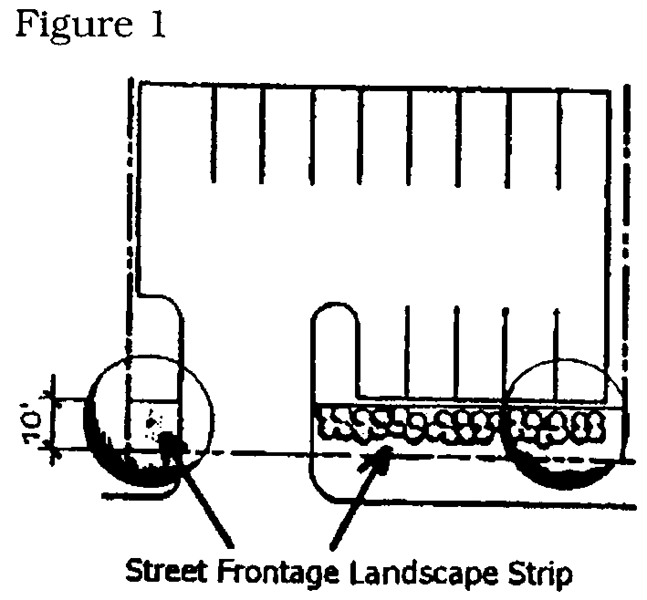
Figure 1 Street Frontage Landscape Strip
(c)
If the parking area exceeds one hundred thousand (100,000) square feet in area, then such landscape strip shall comply with one (1) or a combination of the following options:
(1)
Such landscape strip shall be a minimum of twenty (20) feet in width and shall contain a berm with a minimum height of two and one-half (2.5) feet above the finished elevation of the parking area. Such berm shall have a maximum slope of one foot of rise to three feet run (1:3) and a minimum crown width of three (3) feet. In addition to the required berm, one (1) shade tree and eight (8) shrubs per forty (40) linear feet of street frontage shall be required (see figure 2).
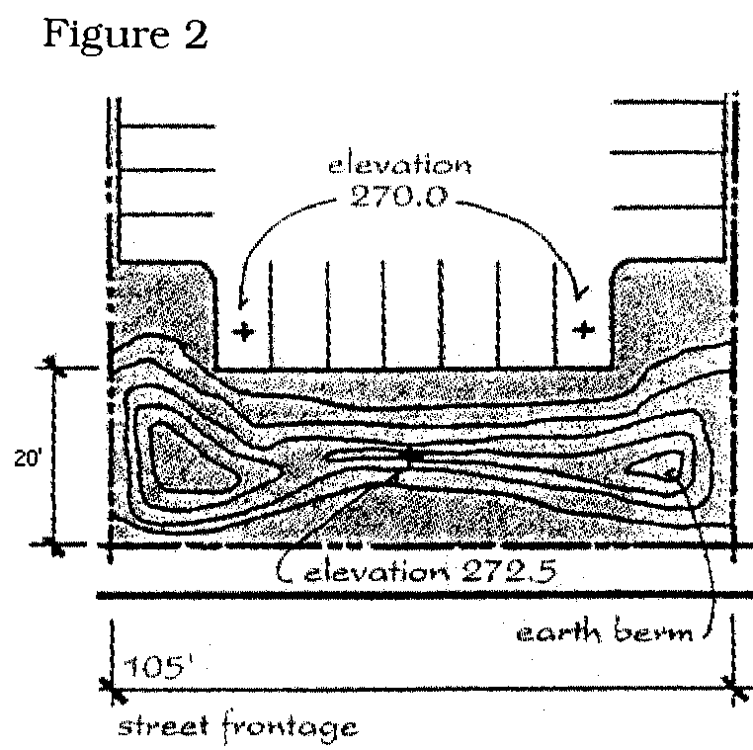
Figure 2
(2)
Such landscape strip shall be a minimum of twenty-five (25) feet in width and consist of undisturbed woodland or forest (see figure 3).
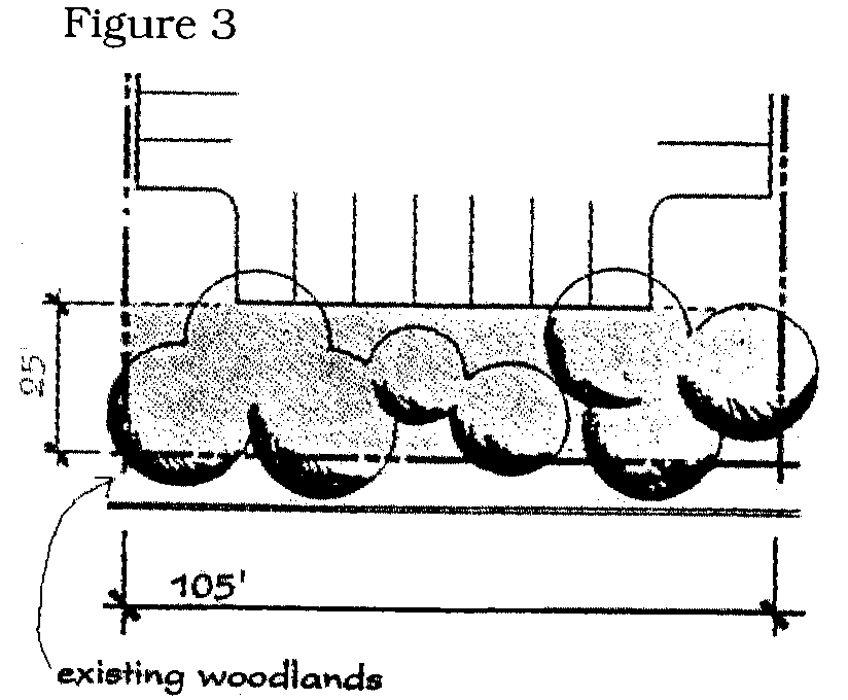
Figure 3
22-59.12. Peripheral landscaping requirements. A landscape border a minimum of five (5) feet in width shall encompass the periphery of parking areas not located adjacent to public rights-of-way. Such landscape border shall be required between any parking area and any property line, yard, required yard, or buildings. Such landscape border may be interrupted for ingress and egress to buildings and adjoining lots. The landscape border shall contain a minimum of one (1) shade tree or one (1) ornamental tree, and eight (8) shrubs per forty (40) linear feet of perimeter (see figure 4).
This section shall not apply to the central commercial district. Parking areas in
the central commercial district shall have wheel stops or curbing installed so as
to not allow the front of a vehicle to protrude into adjacent property.
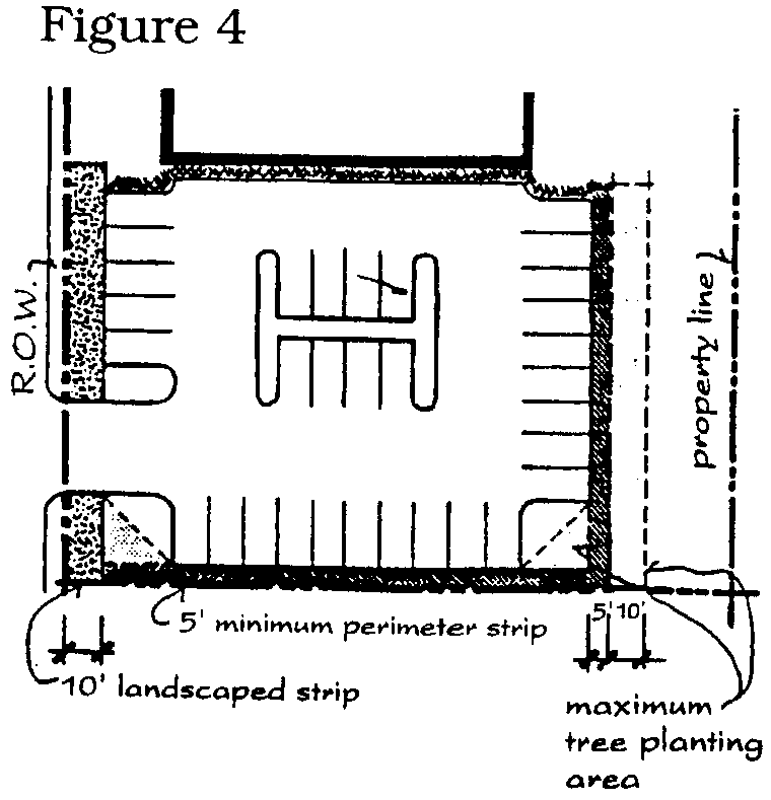
Figure 4
22-59.13. Landscape requirements for the interior of parking areas.
(a)
The interior of parking areas shall contain tree landscape islands and peninsulas located in such a manner as to divide and break up large expanses of paving; guide and delineate an orderly traffic flow pattern; promote pedestrian and vehicular safety; and preserve existing trees and vegetation.
(b)
A maximum of twelve (12) consecutive parking spaces in a row shall be permitted without a tree landscape island or peninsula.
(c)
Each end of each row of parking spaces shall require a tree landscape island (see figure 5).
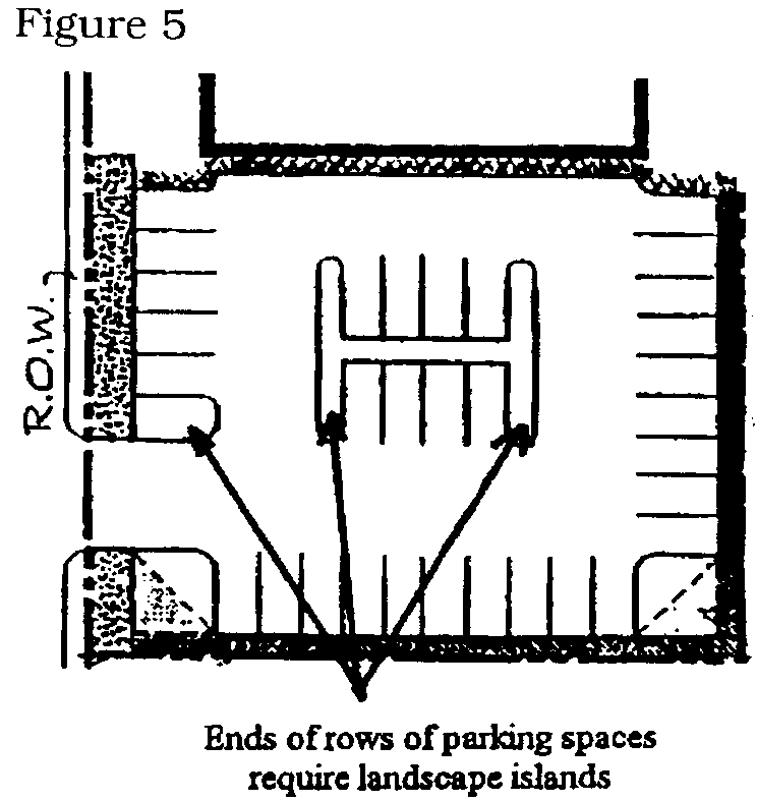
Figure 5
(d)
The minimum width for a tree landscape island or peninsula that is parallel to a parking space shall be nine (9) feet, and the minimum length for the same shall be eighteen (18) feet. Each tree landscape island or peninsula shall contain a minimum of one (1) shade tree and the balance of the area shall contain a permeable ground cover (see figure 6).
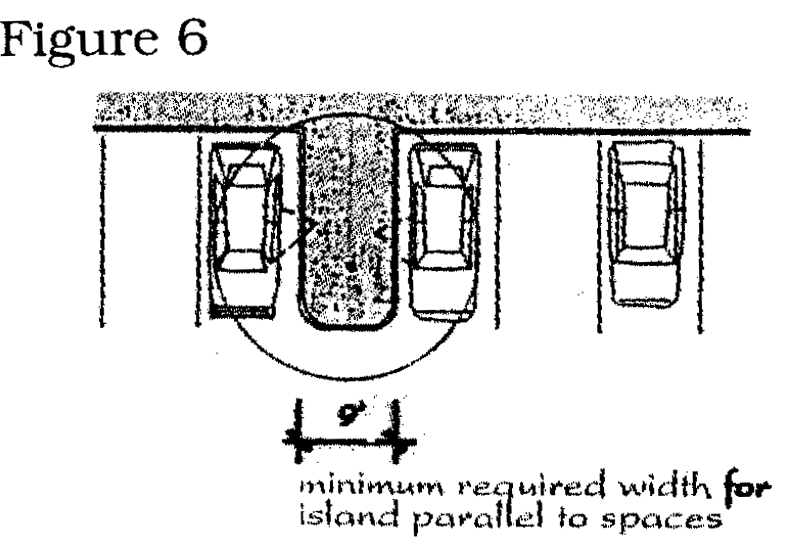
Figure 6
(e)
No more than four (4) double rows of parking spaces shall exist without a landscape island extending the entire length of one double row of parking. Such tree landscape island shall be a minimum of nine (9) feet in width and shall contain one (1) shade tree per forty (40) linear feet of length and the balance of the area shall contain a permeable ground cover (see figure 7).
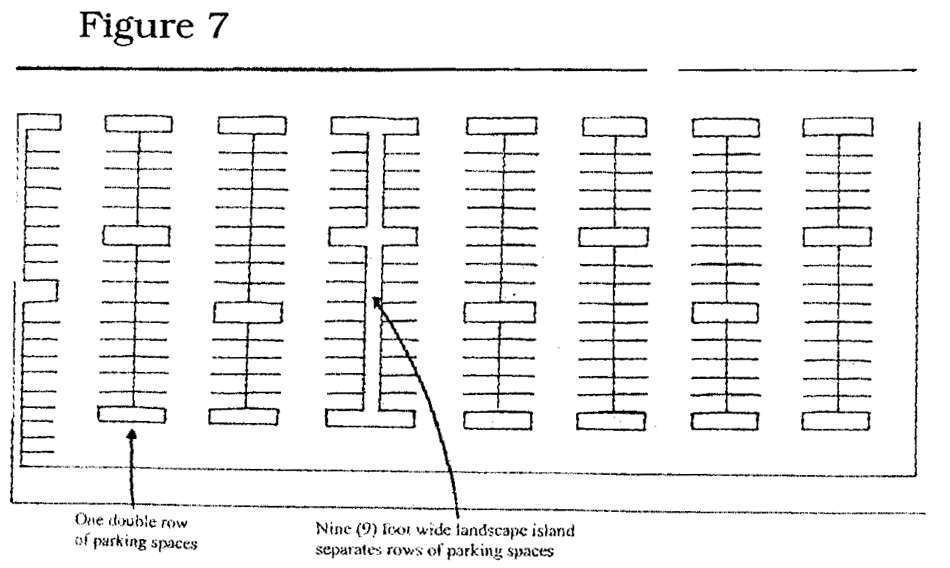
Figure 7
(f)
The permit-issuing authority may require the channelization of ingress and egress points to parking areas in order to facilitate and ensure the safe and efficient movement of vehicular traffic into, from, and through such parking area. Channelization may be accomplished by limiting parking spaces along primary ingress and egress points, and or the use of tree landscape islands, raised concrete islands, or other structures that will guide and delineate traffic flow.
22-59.14. Landscape material installation and maintenance.
(A)
All landscaping material shall be installed in accordance with accepted planting procedures prior to the issuance of a certificate of occupancy or a financial guarantee posted in accordance with subsection 22-59.11.
(B)
The owner, occupant, tenant, or agent shall be jointly and severally responsible for the maintenance of all landscaping. Landscaping shall be maintained in a good condition so as to present a healthy, neat, and orderly appearance. Proper maintenance shall include watering, weeding, mowing, mulching, fertilizing, and pruning. Any dead or damaged landscaping material shall be promptly replaced with materials of an approved size and type.
(C)
Trees planted and retained to fulfill the requirements of this ordinance shall be permitted to attain their normal, mature size. Trees shall be pruned only as necessary to promote healthy growth and prevent hazardous conditions.
22-59.15. Financial guarantees. The city recognizes that vegetation used in landscaping or screening should be planted at certain times of the year to ensure the best chance of survival. In order to ensure compliance with requirements set forth herein, and to reduce the potential expense of replacing landscaping or screening materials which were installed in an untimely or improper fashion, in lieu of requiring the completion and installation of any and all landscape improvements prior to the issuance of a certificate of zoning compliance, the code enforcement officer may enter into a written agreement with the developer whereby the developer shall agree to complete all required landscape improvements. Once said agreement is signed by both parties and the security required herein is provided, the certificate of zoning compliance may be issued if all other requirements of these regulations are met. To secure this agreement, the developer shall provide as approved by the code enforcement officer either one or a combination of the following guarantees equal to 1.25 times the entire cost of the improvements secured. Any expense associated with cost verification by the code enforcement officer shall be paid entirely by the developer.
(A)
Surety performance bond. The developer shall obtain a performance bond from a surety bonding company authorized to do business in the state. The bond shall be payable to the city. The duration of the bond shall be until such time as the city approves the improvements.
(B)
Cash or equivalent security. The developer shall deposit cash, an irrevocable letter of credit or other instrument readily convertible into cash at face value, either with the city or in escrow with a financial institution designated as an official depository of the city. The use of any instrument other than cash shall be subject to the approval of the code enforcement officer. If cash or other instrument is deposited in escrow with a financial institution as provided herein, then the developer shall file with the city an agreement between the financial institution and himself guaranteeing the following:
(1)
That said escrow amount will be held in trust until released by the city and may not be used or pledged by the developer in any other transaction during the term of the escrow; and
(2)
That in case of a failure on the part of the developer to complete said improvements, the financial institution shall upon notification of the city to the financial institution of an estimate of the amount needed to complete the improvements, immediately pay the city the funds estimated to complete the improvements, up to the full balance of the escrow account, or deliver to the city any other instruments fully endorsed or otherwise made payable in full to the city.
(C)
Default. Upon default, meaning failure on the part of the developer to complete the required improvements in the time allowed by this section or as spelled out in the performance bond or escrow agreement, then the surety, or financial institution holding the escrow account shall if requested by the city, pay all or any portion of the bond or escrow fund to the city up to the amount needed to complete the improvements based on an estimate by the city. Upon payment, the city, in its discretion, may expend such portion of said funds, as it deems necessary to complete all or any portion of the required improvements. The city shall return to the developer any funds not spent in completing the improvements.
(D)
Release of guarantee security. The code enforcement officer may release part of any security posted as the improvements are completed and approved by the city. Such funds may be released within ten (10) days after the corresponding improvements have been so approved.
22-59.16. Recommended plant list. The following list contains some plant species that are native to the Dunn area or are known to be suitable for the climate of the Dunn area. Applicants seeking landscape approval shall not be required to select materials from the following list, but shall be required to select plant species that are known to be suitable for the climate of the Dunn area.
(A)
Shade trees.
• American Beech
• Bald Cypress
• Black Gum
• Elm
• Hickory
• Japanese Zelkova
• Laurel Oak
• Live Oak
• Pecan
• Pin Oak
• Poplar
• Red Maple
• Red Oak
• River Birch
• Southern Magnolia
• Southern Sugar Maple
• Sycamore
• Water Oak
• White Oak
• Willow Oak
(B)
Ornamental trees.
• American Holly
• Carolina Silver Bell
• Crabapple
• Crape Myrtle
• Eastern Redbud
• Flowering Apricot
• Flowering Dogwood
• Japanese Maple
• Red Cedar
• Saucer Magnolia
• Southern Magnolia
• Star Magnolia
• Wax Myrtle
• Yaupon Holly
(C)
Evergreen trees (for buffers).
• Carolina Cherry Laurel
• Canadian Hemlock
• Eastern Red Cedar
• Douglas Fir
• Leyland Cypress
• White Cedar
(D)
Shrubs and hedges.
• Abelia
• Azalea
• Barberry
• Boxwood
• Camelia
• Dwarf Yaupon Holly
• Gardenia
• Hydrangea
• Indian Hawthorn
• Juniper
• Nandina
• Rosemary
• Wax Myrtle
• Redtips
• Privet
(E)
Groundcover.
• Carolina Jasmine
• Centipede Grass
• Common Periwinkle
• Confederate Jasmine
• Creeping Fig
• Creeping Gardenia
• Creeping Juniper
• Daylily
• English Ivy
• Fescue Grass
• Honeysuckle
• Lantana
• Liriope
• Vebena
• Winter Creeper
• Zoysia Grass
(Ord. No. O2007-12, 9-6-07; Ord. No. O2010-01, 1-14-09)
Sec. 22-70. - Permitted uses generally.
The following uses shall be permitted in an RA-40 single-family dwelling and agricultural district:
(1)
Single-family on minimum land area of forty thousand (40,000) square feet. It may be reduced to twenty thousand (20,000) square feet if public water is used and is in conjunction with land area for septic waste disposal system approved by Harnett County Health Department;
(2)
Family care home;
(3)
Bona fide farm; commercial and non-commercial—excluding concentrated animal feeding operation;
(4)
Agricultural, horticultural, and garden uses provided that no buildings used for growing or storage are within one hundred (100) feet of a property line or are shielded by a blind fence when such building exceed two hundred (200) square feet in gross area.
(5)
Public and nonprofit institutions of an educational, religious, or cultural type, excluding corrective institutions and hospitals treating other than human beings, on a minimum land area of two (2) acres, provided that automobile parking for more than two (2) cars within fifty (50) feet of a lot used for or to be used for single-family dwelling purposes shall be screened from such lot by a blind fence, wall, or hedge at least six (6) feet high;
(6)
Governmental buildings and uses;
(7)
Public and private utilities provided they are enclosed with a blind fence when installed within one hundred (100) feet of an existing residential use;
(8)
Private stables or corals, provided that such uses shall not be located nearer than two hundred (200) feet to a lot not in the same zoning district classification (RA-40) or other uses not located within the same planned development;
(9)
Class A manufactured home;
(10)
Agra-tourism, eco-tourism, winery and associated facilities;
(11)
Public and private gardens, gardens shall meet the setbacks for accessory buildings;
(Ord. No. O2010-01, 1-14-10)
Sec. 22-70.01. - Accessory uses.
The following accessory uses shall be permitted in an RA-40 single-family dwelling and agricultural district, provided that when any such use shall be detached from the principal structure of the property on which the use is located, such use shall be located in the rear yard and not less than fifty (50) feet from any street right-of-way:
(1)
Automobile parking and garage, only as an accessory use to the principal uses of the property on which the use is located;
(2)
Servants' quarters, not serviced by separate utility meters and not leased or rented to anyone other than the family of a bona fide servant spending more than fifty (50) percent of his employed time at the premises to which the servants' quarters is an accessory use and in the employ of the family occupying such premises;
(3)
Guest quarters, serviced by separate utility meters and not containing cooking facilities;
(4)
Private, noncommercial swimming pools, provided that, except for those used as an accessory use to a single-family, detached dwelling, such uses shall not be located nearer than fifteen (15) feet to a lot used for or to be used for single-family dwelling purposes, measured from the edge of the pool;
(5)
Private stables and corrals, provided that such uses shall not be located nearer than two hundred (200) feet to a lot or building used for or to be used for dwelling purposes;
(6)
Public and private gardens, gardens shall meet the setbacks for accessory buildings;
(7)
Customary home occupations as an accessory use to a single-family dwelling.
(Ord. No. O2010-01, 1-14-10)
Sec. 22-70.02. - Dimensional requirements.
Lots and structures in an RA-40 single family dwelling and agricultural district shall conform to the following dimensional requirements:
(1)
Minimum requirements:
a.
Lot area: Twenty thousand (20,000) square feet.
b.
Depth of front yard: Thirty (30) feet.
c.
Depth of rear yard: Twenty-five (25) feet.
d.
Width of side yard: Fifteen (15) feet.
e.
With of lot: Seventy-five (75) feet.
f.
Depth of lot: One hundred twenty (120) feet.
(2)
Maximum requirements:
a.
Height of principal structure: Two (2) stories or thirty-five (35) feet.
b.
Height of accessory structure: Two (2) stories or twenty-four (24) feet.
c.
Lot coverage with impervious material: Thirty (30) percent of total lot area.
(Ord. No. O2010-01, 1-14-10)
Sec. 22-71. - Permitted uses generally.
The following uses shall be permitted in an R-20 single-family dwelling district:
(1)
Single-family detached dwellings on a minimum land area per dwelling unit of twenty thousand (20,000) square feet, excluding tents and trailers of any kind used for dwelling purposes;
(2)
Family care home;
(3)
Reserved.
(4)
Public and nonprofit institutions of an educational, religious, or cultural type, excluding corrective institutions and hospitals treating other than human beings, on a minimum land area of two (2) acres, provided that automobile parking for more than two (2) cars within fifty (50) feet of a lot used for or to be used for single-family dwelling purposes shall be screened from such lot by a blind fence, wall, or hedge at least six (6) feet high;
(5)
Governmental buildings and uses;
(6)
Public utility uses required to service only the district in which located;
(7)
Public and private noncommercial recreational uses and facilities, such as country clubs and golf courses, parks, and playgrounds, provided that automobile parking for more than two (2) cars within fifty (50) feet of a lot used for or to be used for single-family dwelling purposes shall be screened from such lot by a blind fence, wall, or hedge at least six (6) feet high;
(8)
Public and private gardens, gardens shall meet the setbacks for accessory buildings;
(9)
Duplexes;
(10)
Class A manufactured home.
(Code 1974, § 25-26; Ord. No. 1990-002, § 4, 1-4-90; Ord. No. 02003-11, 11-6-03; Ord. No. 02004-11, 6-3-04; Ord. No. O2010-01, 1-14-10)
Sec. 22-72. - Accessory uses.
The following accessory uses shall be permitted in an R-20 single-family dwelling district, provided that when any such use shall be detached from the principal structure of the property on which the use is located, such use shall be located in the rear yard and not less than fifty (50) feet from any street right-of-way:
(1)
Automobile parking and garage, only as an accessory use to the principal uses of the property on which the use is located;
(2)
Servants' quarters, not serviced by separate utility meters and not leased or rented to anyone other than the family of a bona fide servant spending more than fifty (50) percent of his employed time at the premises to which the servants' quarters is an accessory use and in the employ of the family occupying such premises;
(3)
Guest quarters, serviced by separate utility meters and not containing cooking facilities;
(4)
Private, noncommercial swimming pools, provided that, except for those used as an accessory use to a single-family, detached dwelling, such uses shall not be located nearer than fifteen (15) feet to a lot used for or to be used for single-family dwelling purposes, measured from the edge of the pool;
(5)
Private stables, and corrals, provided that such uses shall not be located nearer than two hundred (200) feet to a lot or building used for or to be used for dwelling purposes; noncommercial agricultural uses;
(6)
Public and private gardens, gardens shall meet the setbacks for accessory buildings;
(7)
Customary home occupations as an accessory use to a single-family dwelling.
(Code 1974, § 25-27; Ord. No. O2010-01, 1-14-10; Ord. No. O2010-12, 9-14-10)
Sec. 22-73. - Dimensional requirements.
Lots and structures in an R-20 single-family dwelling district shall conform to the following dimensional requirements:
(1)
Minimum requirements:
a.
Lot area: Twenty thousand (20,000) square feet.
b.
Depth of front yard: Thirty (30) feet.
c.
Depth of rear yard: Twenty-five (25) feet.
d.
Width of side yard: Ten (10) feet.
e.
Width of lot: Seventy-five (75) feet.
f.
Depth of lot: One hundred twenty (120) feet.
(2)
Maximum requirements:
a.
Height of principal structure: Two (2) stories or thirty-five (35) feet.
b.
Lot coverage with impervious material: Thirty (30) percent of total lot area.
c.
Height of accessory structure: Shall not exceed the height of the principal structure.
d.
Accessory structure setbacks: Shall meet the principal building setbacks.
e.
Lot coverage by accessory structure: Twenty-five (25) percent of rear yard.
(Code 1974, § 25-28; Ord. No. O2010-01, 1-14-10; Ord. No. O2010-12, 9-14-10)
Sec. 22-81. - Principal permitted uses.
The following uses shall be permitted in an R-10 single-family dwelling district:
(1)
Single-family, detached dwellings on a minimum land area per dwelling unit of ten thousand (10,000) square feet, excluding tents and trailers of any kind used for dwelling purposes;
(2)
Reserved.
(3)
Public and nonprofit institutions of an educational, religious, or cultural type, excluding corrective institutions and hospitals of any kind, on a minimum land area of two (2) acres, provided that automobile parking for more than two (2) cars within fifty (50) feet of a lot used for or to be used for single-family dwelling purposes shall be screened from such lot by a blind fence, wall, or hedge at least six (6) feet high;
(4)
Governmental buildings and uses;
(5)
Public utility uses required to service only the district in which they are located;
(6)
Public and private noncommercial recreational uses and facilities, such as country clubs and golf courses, parks and playgrounds, provided that automobile parking for more than two (2) cars within fifty (50) feet of a lot used for or to be used for single-family dwelling purposes shall be screened from such lot by a blind fence, wall, or hedge at least six (6) feet high;
(7)
Public and private gardens, gardens shall meet the setbacks for accessory buildings;
(8)
Family care home.
(Code 1974, § 25-29; Ord. No. 02003-11, 11-6-03; Ord. No. 02004-11, 6-3-04; Ord. No. O2010-01, 1-14-10)
Sec. 22-82. - Accessory uses.
The following accessory uses shall be permitted in an R-10 single-family dwelling district, provided that when any such use shall be detached from the principal structure of the property on which the use is located, such use shall be located in the rear yard and not less than forty (40) feet from any street right-of-way:
(1)
Automobile parking and garages, only as accessory uses to the principal uses of the property on which the use is located;
(2)
Servants' quarters not serviced by separate utility meters and not leased or rented to anyone other than the family of a bona fide servant spending more than fifty (50) percent of his employed time at the premises to which the servants' quarters is an accessory use and in the employ of the family occupying such premises;
(3)
Guest quarters not serviced by separate utility meters and not containing cooking facilities;
(4)
Private, noncommercial swimming pools, provided that except for those uses constituting accessory uses to single-family detached dwellings, such uses shall not be located nearer than fifteen (15) feet to a lot used for or to be used for single-family dwelling purposes, measured from the edge of the pool;
(5)
Public and private gardens, gardens shall meet the setbacks for accessory buildings;
(6)
Customary home occupations as an accessory use to a single-family dwelling.
(Code 1974, § 25-30; Ord. No. O2010-01, 1-14-10; Ord. No. O2010-12, 9-14-10)
Sec. 22-83. - Dimensional requirements.
Lots and structures in an R-10 single-family dwelling district shall conform to the following dimensional requirements:
(1)
Minimum requirements:
a.
Lot area: Ten thousand (10,000) square feet.
b.
Depth of front yard: Twenty-five (25) feet.
c.
Depth of rear yard: Twenty (20) feet.
d.
Width of side yard: Ten (10) feet.
e.
Width of lot: Seventy-five (75) feet.
f.
Depth of lot: One hundred twenty (120) feet.
(2)
Maximum requirements:
a.
Height of principal structure: Two (2) stories or thirty-five (35) feet.
b.
Lot coverage with impervious material: Thirty-five (35) percent of total lot area.
c.
Height of accessory structure: Shall not exceed the height of the principal structure.
d.
Accessory structure gross square footage: Shall not exceed fifty (50) percent of square footage of principal structure.
e.
Lot coverage by accessory structure: Fifty (50) percent of rear yard.
(Code 1974, § 25-31; Ord. No. O2010-01, 1-14-10; Ord. No. O2010-12, 9-14-10)
Sec. 22-101. - Principal permitted uses.
The following uses shall be permitted in an R-7 single-family dwelling district:
(1)
Single-family, detached dwellings on a minimum land area per dwelling unit of seven thousand (7,000) square feet, excluding tents and trailers of any kind used for dwelling purposes;
(2)
Reserved.
(3)
Public and nonprofit institutions of an educational, religious, or cultural type, excluding corrective institutions and hospitals of any kind, on a minimum land area of two (2) acres, provided that automobile parking for more than two (2) cars within fifty (50) feet of a lot used for or to be used for single-family dwelling purposes shall be screened from such lot by a blind fence, wall, or hedge at least six (6) feet high;
(4)
Governmental buildings and uses;
(5)
Public utility uses required to service only the district in which located;
(6)
Public and private noncommercial recreational uses and facilities, such as country clubs and golf courses, parks, and playgrounds, provided that automobile parking for more than two (2) cars within fifty (50) feet of a lot used for or to be used for single-family dwelling purposes shall be screened from such lot by a blind fence, wall, or hedge at least six (6) feet high;
(7)
Duplexes; provided with a minimum lot area of twenty thousand (20,000) square feet;
(8)
Public and private gardens, gardens shall meet the setbacks for accessory buildings;
(9)
Family care home.
(Code 1974, § 25-32; Ord. No. 02003-11, 11-6-03; Ord. No. 02004-11, 6-3-04; Ord. No. O2010-01, 1-14-10)
Sec. 22-102. - Accessory uses.
The following accessory uses shall be permitted in an R-7 single-family dwelling district, provided that when any such use shall be detached from the principal structure of the property on which it is located, the use shall be located in the rear yard and not less than thirty (30) feet from any street right-of-way:
(1)
Automobile parking and garages, only as an accessory use to the principal use of the property on which located;
(2)
Servants' quarters, not serviced by separate utility meters and not leased or rented to anyone other than the family of a bona fide servant spending more than fifty (50) percent of his employed time at the premises to which the servants' quarters is an accessory use and in the employ of the family occupying such premises;
(3)
Guest quarters, not serviced by separate utility meters and not containing cooking facilities;
(4)
Private, noncommercial swimming pools, provided that except for those used as accessory uses to single-family detached dwellings, such uses shall not be located nearer than fifteen (15) feet to a lot used for or to be used for single-family dwelling purposes, measured from the edge of the pool;
(5)
Public and private gardens, gardens shall meet the setbacks for accessory buildings;
(6)
Customary home occupations as an accessory use to a single-family dwelling.
(Code 1974, § 25-33; Ord. No. O2010-01, 1-14-10; Ord. No. O2010-12, 9-14-10)
Sec. 22-103. - Reserved.
Editor's note— Ord. No. 02004-08, adopted May 6, 2004, repealed § 22-103, which pertained to special use permit for class A manufactured home and derived from Ord. No. 1990-002, § 7, adopted Jan. 4, 1990.
Sec. 22-104. - Dimensional requirements.
Lots and structures in an R-7 single-family dwelling district shall conform to the following dimensional requirements:
(1)
Minimum requirements:
a.
Lot area: Seven thousand (7,000) square feet.
b.
Depth of front yard: Twenty-five (25) feet.
c.
Depth of rear yard: Twenty (20) feet.
d.
Width of side yard: Ten (10) feet.
e.
Width of lot: Fifty (50) feet.
f.
Depth of lot: One hundred (100) feet.
(2)
Maximum requirements:
a.
Height of principal structure: Two (2) stories or thirty-five (35) feet.
b.
Lot coverage with impervious material: Forty (40) percent of total lot area.
c.
Height of accessory structure: Shall not exceed the height of the principal structure.
d.
Accessory structure gross square footage: Shall not exceed fifty (50) percent of square footage of principal structure.
e.
Lot coverage by accessory structure: Fifty (50) percent of rear yard.
(Code 1974, § 25-34; Ord. No. O2010-01, 1-14-10; Ord. No. O2010-12, 9-14-10)
Sec. 22-121. - Principal permitted uses.
The following uses shall be permitted in an R-M multifamily dwelling district:
(1)
Single-family detached dwellings.
(2)
Family care home.
(3)
Duplexes; provided with a minimum lot area of twenty thousand (20,000) square feet;
(4)
Public and private gardens, gardens shall meet the setbacks for accessory buildings.
(Ord. No. 02003-14, 12-10-03; Ord. No. 02003-15, 12-10-03; Ord. No. 02008-15, 11-17-08; Ord. No. O2010-01, 1-14-10)
Sec. 22-122. - Accessory uses.
The following accessory uses shall be permitted in an R-M multifamily dwelling district, provided that when any such use shall be detached from the principal structure of the property on which it is located, such use shall be located in the rear yard and not less than thirty (30) feet from any street right-of-way:
(1)
Automobile parking and garages, only as an accessory use to the principal;
(2)
Private, noncommercial swimming pool, meeting the requirements of the North Carolina Building Code for residential swimming pools.
(3)
Public and private gardens, gardens shall meet the setbacks for accessory buildings;
(Ord. No. 02003-14, 12-10-03; Ord. No. 02003-15, 12-10-03; Ord. No. O2010-01, 1-14-10; Ord. No. O2010-12, 9-14-10)
Sec. 22-123. - Dimensional requirements.
Lots and structures in an R-M multifamily dwelling district shall conform to the following dimensional requirements:
(1)
Minimum requirements:
a.
Lot area: Seven thousand (7,000) square feet.
b.
Depth of front yard: Twenty-five (25) feet.
c.
Depth of rear yard: Twenty (20) feet.
d.
Width of side yard: Ten (10) feet.
e.
Width of lot: Fifty (50) feet.
f.
Depth of lot: One hundred (100) feet.
(2)
Maximum requirements:
a.
Height of principal structure: Two (2) stories or thirty-five (35) feet.
b.
Lot coverage with impervious material: Forty (40) percent of total lot area.
c.
Height of accessory structure: Shall not exceed the height of the principal structure.
d.
Accessory structure gross square footage: Shall not exceed fifty (50) percent of square footage of principal structure.
e.
Lot coverage by accessory structure: Fifty (50) percent of rear yard.
(Ord. No. 02003-14, 12-10-03; Ord. No. 02003-15, 12-10-03; Ord. No. O2010-01, 1-14-10; Ord. No. O2010-12, 9-14-10)
Sec. 22-141. - Principal permitted uses.
The following uses shall be permitted in the C-1 central commercial district:
(1)
Apothecaries;
(2)
Appliance sales and repair;
(3)
Bakeries;
(4)
Banks and credit unions;
(5)
Barbershops and beauty shops;
(6)
Building trades/services
(7)
Churches;
(8)
Commercial and public parking lots and garages;
(9)
Convenience stores;
(10)
Dry cleaning;
(11)
Florists;
(12)
Financial institutions;
(13)
Funeral homes;
(14)
Governmental building and uses;
(15)
Grocery stores;
(16)
Hardware retail;
(17)
Hotels, motels and associated conference facilities;
(18)
Medical offices and clinics;
(19)
Microbrewery;
(20)
Newspaper offices and printing;
(21)
Offices (general and professional);
(22)
Photographic/art studios and galleries;
(23)
Private meeting halls and fraternal organizations with an occupancy of less than fifty (50) people;
(24)
Public utilities with storage and service yards, blind fence;
(25)
Recreational facilities, public and private, non-commercial, i.e. parks and playgrounds;
(26)
Restaurants, both indoor and drive-thru;
(27)
Retail stores;
(28)
Retail stores conducting incidental and secondary wholesale departments;
(29)
Taxicab stands;
(30)
Theaters;
(31)
Upper floor residential dwelling unit (mixed use).
(Code 1974, § 25-38; Ord. No. 1994-003, 5-5-94; Ord. No. 1999.01, 2-4-99; Ord. No. 02002-02, 2-7-02; Ord. No. 02004-02, 3-4-04; Ord. No. 02004-14, 6-3-04; Ord. No. 02008-05, 2-7-08; Ord. No. O2014-17, 12-9-2014; Ord. No. O2020-03, 3-10-20)
Sec. 22-142. - Reserved.
Editor's note— Ord. No. 02004-03, adopted March 4, 2004, repealed § 22-142, which pertained to uses permitted within certain portions of [C-1] district and derived from Code 1974, § 25-39.
Sec. 22-143. - Accessory uses.
The following regulations shall govern permitted accessory uses in the C-1 central commercial district:
(1)
Automobile parking shall be only for automobiles in operating condition. Automobile storage may exceed no more than seventy-two (72) hours.
(2)
Swimming pools shall be no nearer than fifty (50) feet to a lot used or zoned for single-family dwelling purposes, as measured from the edge of the pool. All pools shall be enclosed by a fence at least four (4) feet in height.
(3)
Employee facilities including employees' cafeteria, child care center, or recreational facilities for use of employees or visitors and not the general public.
(Code 1974, § 25-40; Ord. No. 02004-05, 3-4-04)
Sec. 22-144. - Dimensional requirements.
Lots and structures in the C-1 central commercial district shall conform to the following dimensional requirements:
(1)
Minimum lot area: None.
(2)
Minimum lot size:
a.
Depth: None.
b.
Width: Twenty (20) feet.
(3)
Minimum yard sizes:
a.
Front: None (property line).
b.
Rear: None. Where this district abuts a residential district to the rear of the lot, there shall be a fifteen-foot rear yard and six-foot high blind fence or buffer.
c.
Side: None. If a side yard is voluntarily preserved, it shall be a minimum of ten (10) feet. Common wall construction is permitted. Where a residential district abuts to the side yard, there shall be a side yard of not less than fifteen (15) feet. In any case where a fence is required between this district and a residential district, if the adjacent residential property owner requests that this required fence not be installed, the requirement may be waived by the city council.
(4)
Maximum building height: No structure shall exceed fifty (50) feet, unless the outer walls of the additional height are constructed with an indentation of one (1) foot for each two (2) feet above fifty (50) feet.
(Code 1974, § 25-41)
Sec. 22-145. - Reserved.
Editor's note— Ord. No. 02003-01, adopted March 6, 2003, repealed § 22-145, which pertained to offstreet parking and derived from Code 1974, § 25-42.
Sec. 22-161. - Purpose and location.
The C-2 shopping center district is a special floating commercial district that applies to development under one (1) ownership. The permitted uses will be those retail uses common to the downtown central commercial district. The district is to be located on an outlying tract along a major highway.
(Code 1974, § 25-43)
Sec. 22-162. - Principal permitted uses.
The following uses shall be permitted in the C-2 shopping center district:
(1)
Apothecaries;
(2)
Appliance sales and repair;
(3)
Bakeries;
(4)
Banks and credit unions;
(5)
Barbershops and beauty shops;
(6)
Building supplies retail;
(7)
Churches;
(8)
Coin-operated laundries;
(9)
Convenience stores;
(10)
Discount stores/indoor flea market;
(11)
Dry cleaning;
(12)
Financial institutions;
(13)
Funeral homes;
(14)
Garden centers;
(15)
Governmental building and uses;
(16)
Grocery stores;
(17)
Hardware retail;
(18)
Hotels, motels and associated conference facilities;
(19)
Medical offices and clinics;
(20)
Microbrewery;
(21)
Offices (general and professional);
(22)
Photographic/art studios and galleries;
(23)
Private meeting halls and fraternal organizations with an occupancy of less than fifty (50) people;
(24)
Professional medical complex;
(25)
Recreational facilities, public and private, non-commercial, i.e. parks and playgrounds;
(26)
Restaurants, both indoor and drive-thru;
(27)
Retail stores;
(28)
Theaters.
(Code 1974, § 25-44; Ord. No. 1999.01, 2-4-99; Ord. No. 02003-11, 11-6-03; Ord. No. 02004-02, 3-4-04; Ord. No. 02008-05, 2-7-08; Ord. No. O2014-17, 12-9-14; Ord. No. O2020-03, 3-10-20)
Sec. 22-163. - Accessory uses.
The following regulations shall govern permitted accessory uses within the C-2 shopping center district:
(1)
Automobile parking shall be only for automobiles in operating condition. Automobile storage may exceed no more than seventy-two (72) hours.
(2)
Swimming pools shall be no nearer than fifty (50) feet to a lot used or zoned for single-family dwelling purposes, as measured from the edge of the pool. All pools will be enclosed by a fence at least four (4) feet in height.
(3)
Child care center for use of employees and not the general public.
(Code 1974, § 25-45; Ord. No. 02004-05, 3-4-04)
Sec. 22-164. - Dimensional requirements.
The following dimensional requirements shall apply within the C-2 shopping center district:
(1)
Minimum lot area: Three (3) acres. For outparcel.
(2)
Minimum yard size:
a.
Front: Forty (40) feet.
b.
Rear: Twenty (20) feet.
c.
Side: Twenty (20) feet, each side.
d.
Width of lot: One hundred (100) feet.
e.
Depth of lot: One hundred (100) feet.
(3)
Minimum lot area—Outparcels: Forty thousand (40,000) square feet for outparcel with no separate road access.
(Code 1974, § 25-46; Ord. No. O2007-12, 9-6-07; Ord. No. O2019-03, 5-14-19; Ord. No. O2019-04, 6-11-19)
Sec. 22-165. - Reserved.
Editor's note— Ord. No. 02003-01, adopted March 6, 2003, repealed § 22-165, which pertained to offstreet parking and derived from Code 1974, § 25-47.
Sec. 22-166. - Plan—Required; contents.
(a)
A total plan shall be submitted with the application for rezoning to C-2 shopping center district status to the planning board for review.
(b)
The plan shall contain the necessary information relative to five-foot contours, ingress and egress, building locations, setback distances, drainage alignments, easements, parking lot areas, loading platforms, ownership information, intended uses, north arrow, and scale.
(Code 1974, § 25-48)
Sec. 22-167. - Same—Approval prerequisite to rezoning.
The total plan required by section 22-166 must be approved by the planning board before approval of a request for rezoning and before initial construction if the site is already in the C-2 shopping center district.
(Code 1974, § 25-49)
Sec. 22-168. - Common wall construction; separate uses.
(a)
Common wall construction shall be permitted in a C-2 shopping center district.
(b)
Separate uses, such as drive-in branch banks, will be permitted in a C-2 shopping center district, but only if incorporated as a part of the total development plan.
(Code 1974, § 25-50)
Sec. 22-169. - Reserved.
Editor's note— Ord. No. 02004-04, adopted March 4, 2004, repealed § 22-169, which pertained to driveways and derived from Code 1974, § 25-51.
Sec. 22-181. - Principal permitted uses.
The following uses shall be permitted in a C-3 highway commercial district:
(1)
Animal hospitals/kennels;
(2)
Apothecaries;
(3)
Appliance sales and repair;
(5)
Auto car wash;
(6)
Auto parts (new);
(7)
Auto sales and service;
(8)
Bakeries;
(9)
Banks and credit unions;
(10)
Barbershops and beauty shops;
(11)
Boat sales;
(12)
Building supplies retail;
(13)
Building trades/services;
(14)
Bus station;
(15)
Churches;
(16)
Commercial and public parking lots and garages;
(17)
Convenience stores;
(18)
Dance schools and similar instruction;
(19)
Farm implement/heavy machinery sales and service;
(20)
Financial institutions;
(21)
Funeral homes;
(22)
Furniture showrooms;
(23)
Garden supplies;
(24)
Golf driving range;
(25)
Governmental building and uses;
(26)
Grocery stores
(27)
Hardware retail;
(28)
Hospitals/professional medical complex (emergency care);
(29)
Hotels, motels and associated conference facilities;
(30)
Indoor machinery sales
(31)
Laundromats and dry cleaners;
(32)
Microbrewery;
(33)
Miniature golf courses;
(34)
Mobile home sales;
(35)
Offices (general and professional);
(36)
Private meeting halls and fraternal organizations with an occupancy of less than fifty (50) people;
(37)
Public utilities with storage and service yards, blind fence;
(38)
Restaurants, both indoor and drive-ins;
(39)
Retail stores;
(40)
Taxicab stands;
(41)
Vending companies;
(42)
Outdoor advertising signs (billboards) allowed in C-3 zoning districts immediately adjacent to I-95.
(Code 1974, § 25-52; Ord. No. 1997.01, 1-2-97; Ord. No. 1999.01, 2-4-99; Ord. No. 02004-02, 3-4-04; Ord. No. 02008-05, 2-7-08; Ord. No. O2014-17, 12-9-14; Ord. No. O2020-03, 3-10-20)
Sec. 22-182. - Accessory uses.
The following regulations shall govern permitted accessory uses within the C-3 highway commercial district:
(1)
Automobile parking shall be only for automobiles in operating condition. Automobile storage may exceed no more than seventy-two (72) hours.
(2)
Swimming pools shall be no nearer than fifty (50) feet to a lot used or zoned for single-family dwelling purposes, as measured from the edge of the pool. All pools shall be enclosed by a fence at least four (4) feet in height.
(3)
Child care center for use of employees and not the general public.
(Code 1974, § 25-53; Ord. No. 02004-05, 3-4-04)
Sec. 22-183. - Dimensional requirements.
The following dimensional requirements shall apply within the C-3 highway commercial district:
(1)
Minimum lot size:
a.
In town: Ten thousand (10,000) square feet.
b.
In fringe: One-half (½) acre (twenty-one thousand seven hundred eighty (21,780) square feet).
c.
Depth: Seventy-five (75) feet.
d.
Width: Seventy-five (75) feet.
(2)
Minimum yard sizes:
a.
In town:
1.
Front: Twenty (20) feet from front property line.
2.
Rear: Ten (10) feet; buffer of blind fence must separate from residential district which abuts.
3.
Side: Ten (10) feet (each side); blind fence must separate C-3 highway commercial district from an abutting residential district.
b.
In fringe:
1.
Front: Forty (40) feet from front property line.
2.
Rear: Twenty (20) feet; buffer of blind fence must separate C-3 highway commercial district from an abutting residential district.
(Code 1974, § 25-54; Ord. No. O2007-12, 9-6-07)
Sec. 22-184. - Special use permit for adult oriented business.
In any C-3 district, the zoning board of adjustment may grant a special use permit for an adult oriented business, provided the board finds that the evidence presented at the hearing establishes each of the following:
(1)
No such business shall be located within two thousand (2,000) feet of any other sexually oriented business, as measured in a straight line from property line to property line.
(2)
No such business shall be located within one thousand (1,000) feet of a church, public or private elementary school, child day care nursery, public park, residentially used or residentially zoned property, or any establishment with an on-premise ABC license, as measured on a straight line from property line to property line.
(3)
There shall be no more than one (1) adult oriented business on the same property or in the same building, structure, or portion thereof.
(4)
No other principal or accessory use may occupy the same building, structure, property or portion thereof of any adult oriented business.
(5)
Except for signs as permitted under article IV of this chapter, there shall be no other advertisements, displays, or other promotional materials visible to the public from pedestrian sidewalks, walkways, or vehicular use areas.
(6)
Each facility shall provide off-street parking in accordance with Article V, Off-Street Parking.
(7)
If such special use permit is granted, the permit is valid for two (2) years from the date of approval. Upon expiration of the permit, the sexually oriented business [shall be] in violation of the locational requirements until the applicant applies for and receives another permit. If the board of adjustment denies such permit, the applicant may not reapply for a permit until at least twelve (12) months have elapsed since the date of the board of adjustment's action for the same property or any part thereof.
(8)
That all other applicable provisions of the City Code of Ordinances will be observed.
(Ord. of 7-6-95, § 2)
Sec. 22-191. - Principal permitted uses.
The following uses shall be permitted in the C-4 neighborhood business district:
(1)
Bakeries;
(2)
Barbershops and beauty shops;
(3)
Churches;
(4)
Governmental building and uses;
(5)
Hardware retail;
(6)
Private meeting halls and fraternal organizations;
(7)
Public utilities.
(Code 1974, § 25-55; Ord. No. 02008-05, 2-7-08)
Sec. 22-192. - Accessory uses.
The following regulations shall govern permitted accessory uses within the C-4 neighborhood business district:
(1)
Automobile parking shall be only for automobiles in operating condition. Automobile storage may exceed no more than seventy-two (72) hours.
(2)
Swimming pools shall be no nearer than fifty (50) feet to a lot used or zoned for single-family dwelling purposes, as measured from the edge of the pool. All pools shall be enclosed by a fence at least four (4) feet in height.
(Code 1974, § 25-56)
Sec. 22-193. - Dimensional requirements.
The following dimensional requirements shall apply within the C-4 neighborhood business district:
(1)
Building size: Not in excess of ten thousand (10,000) square feet of interior space on the minimum lot size.
(2)
Minimum lot size: Twenty thousand (20,000) square feet.
(3)
Minimum yard sizes:
a.
Front: Twenty (20) feet.
b.
Rear: Ten (10) feet.
c.
Side: None, except a ten (10) foot side yard adjacent to a residential district. If a side yard is provided when none is required, that side yard shall be at least ten (10) feet wide. Common wall construction may be approved at the discretion of the planning board.
(4)
Maximum height: Thirty-five (35) feet.
(Code 1974, § 25-57)
Sec. 22-201. - Principal permitted uses.
The following uses shall be permitted within the, O & I office and institutional district:
(1)
Banks and credit unions;
(2)
Churches;
(3)
Governmental building and uses;
(4)
Medical offices and clinics;
(5)
Offices (general and professional);
(6)
Professional medical complex;
(7)
Public utilities.
(Code 1974, § 25-58; Ord. No. 1998.03, 11-5-98; Ord. No. 2000-01, 4-6-00; Ord. No. 0-1998.10, 12-3-98; Ord. No. 02004-02, 3-4-04; Ord. No. 02004-06, 5-6-04; Ord. No. 02008-05, 2-7-08; Ord. No. O2009-18, 12-8-09)
Sec. 22-202. - Accessory uses.
The following regulations shall govern permitted accessory uses within the, O & I office and institutional district:
(1)
Automobile parking shall be only for automobiles in operating condition. Automobile storage may exceed no more than seventy-two (72) hours.
(2)
Swimming pools shall be no nearer than fifty (50) feet to a lot used or zoned for single-family dwelling purposes, as measured from the edge of the pool. All pools shall be enclosed by a fence at least four (4) feet in height.
(3)
Child care center for use of employees and not the general public.
(Code 1974, § 25-59; Ord. No. 02004-05, 3-4-04; Ord. No. O2009-18, 12-8-09)
Sec. 22-203. - Dimensional requirements.
(a)
The following dimensional requirements shall apply within the, O & I office and institutional district:
(1)
Minimum lot size: Seven thousand (7,000) square feet.
a.
Depth: Fifty (50) feet.
b.
Width: Fifty (50) feet.
(2)
Minimum yard sizes:
a.
Front: Twenty (20) feet.
b.
Rear: Ten (10) feet.
c.
Side: Ten (10) feet, each side.
(3)
Maximum building height: Thirty-five (35) feet.
(b)
Common wall construction may be approved at the discretion of the planning board.
(Code 1974, § 25-60; Ord. No. O2009-18, 12-8-09)
Sec. 22-211. - Principal permitted uses.
The following uses shall be permitted in the I-10 restricted industrial district:
(1)
Warehousing, completely within an enclosed building;
(2)
Freight terminal offices and warehouses;
(3)
Brewery;
(4)
Manufacture, assembly, or packaging of products of the following previously prepared materials: cloth, plastic, paper, leather, precious, and semiprecious metals and stones; wood products; and of any inorganic type; manufacturing area shall be less than fifteen thousand (15,000) square feet;
(5)
Reserved.
(6)
Experimental, film, or testing laboratories; building operation shall be less than fifteen thousand (15,000) square feet;
(7)
Manufacture or processing of food products and pharmaceuticals, exclusive of the production of fish or meat products, sauerkraut, vinegar or the like, and exclusive of the rendering or refining of fats and oils; manufacturing area shall be less than fifteen thousand (15,000) square feet;
(8)
Outside storage, provided that in the interest of safety to children and adjacent property, such storage shall be completely enclosed by a blind fence. Storage shall not be stacked or piled to a height which is greater than its distance to the nearest property line;
(9)
Sale or storage of garden supplies, landscape supplies; retail or wholesale;
(10)
Mini-storage; no storage in building setbacks. Outside storage shall consist of only motor vehicles, recreational vehicles, recreational trailers, heavy equipment; outside storage shall be completely enclosed by a blind fence;
(11)
Public utility uses and governmental uses;
(12)
Convenience store/gasoline service stations, provided that no inoperative automobiles shall be stored on the exterior except in conformity with the requirements for outside storage contained in subsection (8) of this section;
(13)
Wholesale offices and warehouse sales;
(14)
Building trades and services; shall conform to subsection (8) of this section;
(15)
Processing enterprises not otherwise prohibited in section 22-224; building operation shall be less than fifteen thousand (15,000) square feet.
(Code 1974, § 25-61; Ord. No. 2000-01, 4-6-00; Ord. No. 02004-09, 5-6-04; Ord. No. O2010-04, 4-13-10; Ord. No. O2020-03, 3-10-20)
Sec. 22-212. - Accessory uses.
The following accessory uses shall be permitted in the I-10 restricted industrial district:
(1)
Reserved;
(2)
Automobile and truck parking and garages; provided that provisions for more than two (2) vehicles within one hundred (100) feet of a lot used for or to be used for single-family dwelling purposes shall be screened from such lot by a blind fence;
(3)
Office space, used in connection with a principal use;
(4)
Reserved;
(5)
Reserved;
(6)
Outside storage, provided that in the interest of safety to children and adjacent property, such storage shall be completely enclosed by a blind fence. Storage shall not be stacked or piled to a height which is greater than its distance to the nearest property line.
(Code 1974, § 25-62; Ord. No. 02004-05, 3-4-04; Ord. No. O2010-04, 4-13-10)
Sec. 22-213. - Minimum dimensional requirements.
The following minimum dimensional requirements shall apply within the I-10 restricted industrial district:
(1)
Depth of front yard: Twenty (20) feet;
(2)
Depth of rear yard: Twenty (20) feet, except where adjacent to a lot used for or to be used for dwelling purposes, in which case the minimum depth of rear yard shall be forty (40) feet;
(3)
Width of side yard: Ten (10) feet, except where adjacent to a lot used for or to be used for dwelling purposes, in which case the minimum width of side yard shall be twenty (20) feet;
(4)
Width of lot: Seventy (70) feet, (for newly created parcels);
(5)
Depth of lot: One hundred (100) feet, (for newly created parcels);
(6)
Area of lot: Ten thousand (10,000) square feet, (for newly created parcels).
(Code 1974, § 25-63; Ord. No. 1990-007, 2-20-90; Ord. No. O2010-04, 4-13-10)
Sec. 22-221. - Principal permitted uses.
The following uses shall be permitted in the I-100 industrial district:
(1)
Horticultural uses;
(2)
Reserved;
(3)
Reserved;
(4)
Any use permitted in the I-10 district, subject to all the regulations of that district except dimensional restraints;
(5)
Freight terminal offices and warehouses;
(6)
Recreational facilities.
(Code 1974, § 25-64; Ord. No. 02004-02, 3-4-04; Ord. No. O2010-04, 4-13-10; Ord. No. O2014-04, 5-8-14)
Sec. 22-222. - Accessory uses.
The following accessory uses shall be permitted in the I-100 industrial district:
(1)
Reserved;
(2)
Automobile and truck parking and garages, provided that provisions for more than two (2) vehicles within one hundred (100) feet of a lot used for or to be used for single-family dwelling purposes shall be screened from such lot by a blind fence;
(3)
Office space, used in connection with a principal use;
(4)
Employee facilities including employees' cafeterias, child care facility, or recreational facilities for use of employees or visitors and not the general public;
(5)
Reserved;
(6)
Outside storage, provided that in the interest of safety to children and adjacent property, such storage shall be completely enclosed by a blind fence. Storage shall not be stacked or piled to a height which is greater than its distance to the nearest property line.
(Code 1974, § 25-65; Ord. No. 02004-05, 3-4-04; Ord. No. O2010-04, 4-13-10)
Sec. 22-223. - Reserved.
Editor's note— Ord. No. 02004-01, adopted March 4, 2004, repealed § 22-223, which pertained to conditional uses [I-100 district] and derived from Code 1974, § 25-66.
Sec. 22-224. - Prohibited uses.
No building or land shall be used and no building shall be hereafter erected or structurally altered for the purpose of conducting any of the uses listed in this section within any of the various districts as established by this chapter, unless plans for the abatement of noise, odor, smoke, ignitable corrosivity, toxicity, or other nuisance or menace to the public welfare which may be created by such activity are submitted to the city council after recommendation from the planning board. These plans shall include a statement of the level of noise, odor, smoke, or other emissions which is to be emitted from such installation, using a recognized standard of measurement. If the city council finds after public hearing as required for amendments to this chapter that the use will not be detrimental to the public health, safety, and welfare, they may issue a conditional use permit to allow the use in the I-100 industrial district. If at any time any of the following uses exceeds the level of emission as stated in the application for a conditional use permit, the use shall be discontinued until such time as the stated level is reached:
(1)
Abattoirs;
(2)
Acetylene gas manufacture and/or storage;
(3)
Acid manufacture;
(4)
Airports and landing fields for fixed wing aircraft;
(5)
Ammonia, bleaching powder or chlorine manufacture;
(6)
Asphalt manufacture or refining;
(7)
Brick, tile or terracotta manufacture;
(8)
Cellophane manufacture;
(9)
Cement, lime, plaster manufacture;
(10)
Creosote manufacturing or treatment plants;
(11)
Distillation of bones, coal, petroleum, refuse grain, tar, and wood;
(12)
Explosives, ammunition, fireworks, gunpowder manufacture;
(13)
Fat rendering or storage (greater than two thousand (2,000) gallons, or the production of fats and oils from animal or vegetable products by boiling or distillations;
(14)
Fertilizer manufacture;
(15)
Forging plants;
(16)
Garbage, offal, and animal reductions, or processing;
(17)
Glue and size manufacture;
(18)
Linseed oil, shellac, turpentine, manufacture or refining;
(19)
Oilcloth or linoleum manufacture;
(20)
Ore reduction;
(21)
Racing of vehicles;
(22)
Rubber manufacture;
(23)
Tanning, cutting, curing, cleaning or storing of green hides or skins;
(24)
Disposal of hazardous waste as defined by G.S. 130-166.16(4). In addition to the findings required to be made by the city council before a conditional use permit may be issued for this particular use, the permittee shall satisfy the city council that it has met all of the conditions of G.S. chs. 130A and 130B concerning the management of hazardous wastes and any other applicable federal, state and local laws.
(Ord. No. O2010-04, 4-13-10)
Sec. 22-225. - Dimensional requirements.
The following dimensional requirements shall apply within the I-100 industrial district:
(1)
Minimum requirements.
a.
Depth of front yard: Fifty (50) feet.
b.
Depth of rear yard: Fifty (50) feet, except where adjacent to a lot used for to be used for dwelling purposes, in which case the minimum depth of rear yard shall be one hundred (100) feet.
c.
Width of side yard: Thirty (30) feet, except where adjacent to a lot used for or to be used for dwelling purposes, in which case the minimum width of side yard shall be fifty (50) feet.
d.
Width of lot: Three hundred (300) feet (for newly created parcels).
e.
Depth of lot: Three hundred (300) feet (for newly created parcels).
f.
Area of lot: One hundred thousand (100,000) square feet (for newly created parcels).
g.
Reserved.
h.
Hazardous waste, low-level radioactive waste and medical waste. To promote public safety, no hazardous waste facility, low-level radioactive waste facility nor medical waste facility shall be located within one-half-mile of any existing residential dwelling. No hazardous waste, low-level radioactive waste or medical waste facility shall locate within one thousand (1,000) feet of any stream, branch, creek or river; within any water shed containing an impoundment reservoir supplying water for human consumption or use; within the one-hundred-year floodplain. Any hazardous waste, low-level radioactive waste or medical waste facility shall have all federal and state regulatory permits approved prior to consideration by the city of an application for a building permit or zoning permit.
(2)
Maximum requirements.
a.
Height of principal structure: One-half (½) times the horizontal distance between the building and the nearest lot line adjacent to a lot used for or to be used for single-family dwelling purposes, or fifty (50) feet, whichever is least.
b.
Height of accessory structure: Thirty (30) feet.
c.
Lot coverage by building: Fifty (50) percent of total lot area.
(Code 1974, § 25-67; Ord. No. 1990-007, 2-20-90; Ord. No. O2010-04, 4-13-10)

