
Dunn City Zoning Code
ARTICLE V
- OFF-STREET PARKING AND LOADING6
Editor's note— Ord. No. O2011-06 adopted May 10, 2011, amended art. V in its entirety to read as herein set out. Former art. V, §§ 22-341—22-348, pertained to off-street parking, and derived from the Code of 1974, §§ 25-68—25-75; Ord. No. 02003-01, adopted March 6, 2003; Ord. No. 02004-04, adopted March 4, 2004 and Ord. No. O2007-12, adopted September 6, 2007.
Sec. 22-341.- Off-street parking general.
Minimum permanent off-street parking space, with adequate provision for ingress and egress by standard-sizes vehicles in accordance with the requirements of this code, shall be provided at the time of the erection of any building and at the time any buildings are altered, enlarged, converted or increased in capacity.
(1)
Purpose and intent. Parking lots, loading areas, and similar facilities are necessary elements in the urban environment. However, these facilities have been known to cause the following negative impacts:
a.
Increased storm water volume and velocity;
b.
Increased surface pollutants;
c.
Increased surface level heat and glare;
d
Reduction in the efficiency of the connecting street system;
e
Reduction in the operations of the surrounding pedestrian and bicycle network;
f.
To mitigate these negative impacts, and to provide adequate service, the city has enacted standards to regulate the construction, expansion and renovation of such facilities.
(2)
Applicability.
a.
New development. The off-street parking and loading standards of this section shall apply to the erection of any building, and to any new use established.
b.
Downtown exempted. However, within the central commercial district, there shall be no minimum parking requirements in existing platted areas that are, or previously have been, in commercial use.
c.
Expansions and alterations. The off-street parking and loading standards of this section shall apply when an existing structure or use is expanded or enlarged. Additional off-street parking and loading spaces shall be required to serve only the enlarged or expanded area, provided that in all cases the number of off-street parking and loading spaces provided for the entire use (pre-existing plus expansion) must equal at least seventy-five (75) percent of the minimum ratio established in the off-street parking schedules of this section.
d.
Change of use. Off-street parking and loading must be provided for any change of use or manner of operation that would, based on the off-street parking schedules of this section, result in a requirement for more parking or loading spaces than the existing use.
(Ord. No. O2011-06, 5-10-11)
Sec. 22-342. - Parking plans approved with zoning compliance/development permit.
Each application for a zoning compliance/development permit shall include information as to the number, location, and dimensions of off-street parking and loading space and the means of ingress and egress to such place. This information shall be in sufficient detail to enable the zoning/planning director to determine whether or not the requirements of this article are met.
(Ord. No. O2011-06, 5-10-11)
Sec. 22-343. - Parking space requirements; combination of uses; location of the lot.
(a)
Reserved.
(b)
Combination of uses. Where there is a combination of uses on a lot, the required number of spaces shall be the sum of that found for each use. The required space assigned to one (1) use may not be assigned to another use, except that one-half (½) of the parking space required for churches, theaters, or assembly halls, whose peak attendance will be at night or on Sundays, may be assigned to a use which will be closed at night and on Sundays.
(c)
Location of the lot. The parking spaces required by this Code shall be provided on the same lot as the use or where the exclusive use of such is provided on another lot not more than five hundred (500) feet radially from the subject lot within the same or less-restrictive zoning districts. In such cases, the applicant for a zoning clearance for the principal use shall submit with his application an instrument, duly executed and acknowledged, and recorded with the Harnett County Register of Deeds, which subjects such land to parking use in connection with the principal use for which it is made available.
(Ord. No. O2011-06, 5-10-11)
Sec. 22-344. - Parking space requirements; generally.
(a)
Width. A minimum width of nine (9) feet shall be provided for each parking space.
Exceptions:
(1)
Compact parking spaces shall be permitted to be eight (8) feet wide.
(2)
Parallel parking spaces shall be permitted to be eight (8) feet wide.
(3)
The width of a parking spaces shall be increased ten (10) inches for obstructions located on either side of the space within fourteen (14) feet of the access aisle.
(4)
Developers are encouraged to provide parking widths up to ten (10) feet wide to accommodate larger vehicles and where the provision of a wider space would facilitate the entering and exiting of passengers from vehicles typical to a specific use.
(b)
Length. A minimum length of twenty (20) feet shall be provided for each parking space.
Exceptions:
(1)
Compact parking spaces shall be permitted to be eighteen (18) feet in length.
(2)
Parallel spaces shall be a minimum of twenty-two (22) feet in length.
(c)
Identification of compact spaces. All compact spaces shall be clearly marked as such by sign or by pavement signage.
(d)
Compact-to standard space ratio. The maximum ratio of compact spaces to standard spaces in any parking area shall not exceed one (1) to six (6).
(e)
Space accessibility. Each required parking space shall be individually and easily accessible. No automobile shall be required to back onto any public street or sidewalk to leave any parking space when such a space serves more than two dwellings or other than residential uses. No automobile shall be allowed to exit from a parking space directly onto any public road when such a space serves more than two (2) dwellings or other than residential uses. All portions of a public lot or garage shall be accessible to other portions thereof without requiring the use of any public street.
(1)
Every parking space shall be provided with access from an internal drive.
a.
Driveways with sixty-degree parking shall have a minimum aisle width of twenty-four (24) feet.
b.
Driveways with ninety-degree parking shall have a minimum aisle width of twenty-five (25) feet. (Revised 03-04-04)
(Ord. No. O2011-06, 5-10-11)
Sec. 22-345. - Design of parking facilities and access management.
(a)
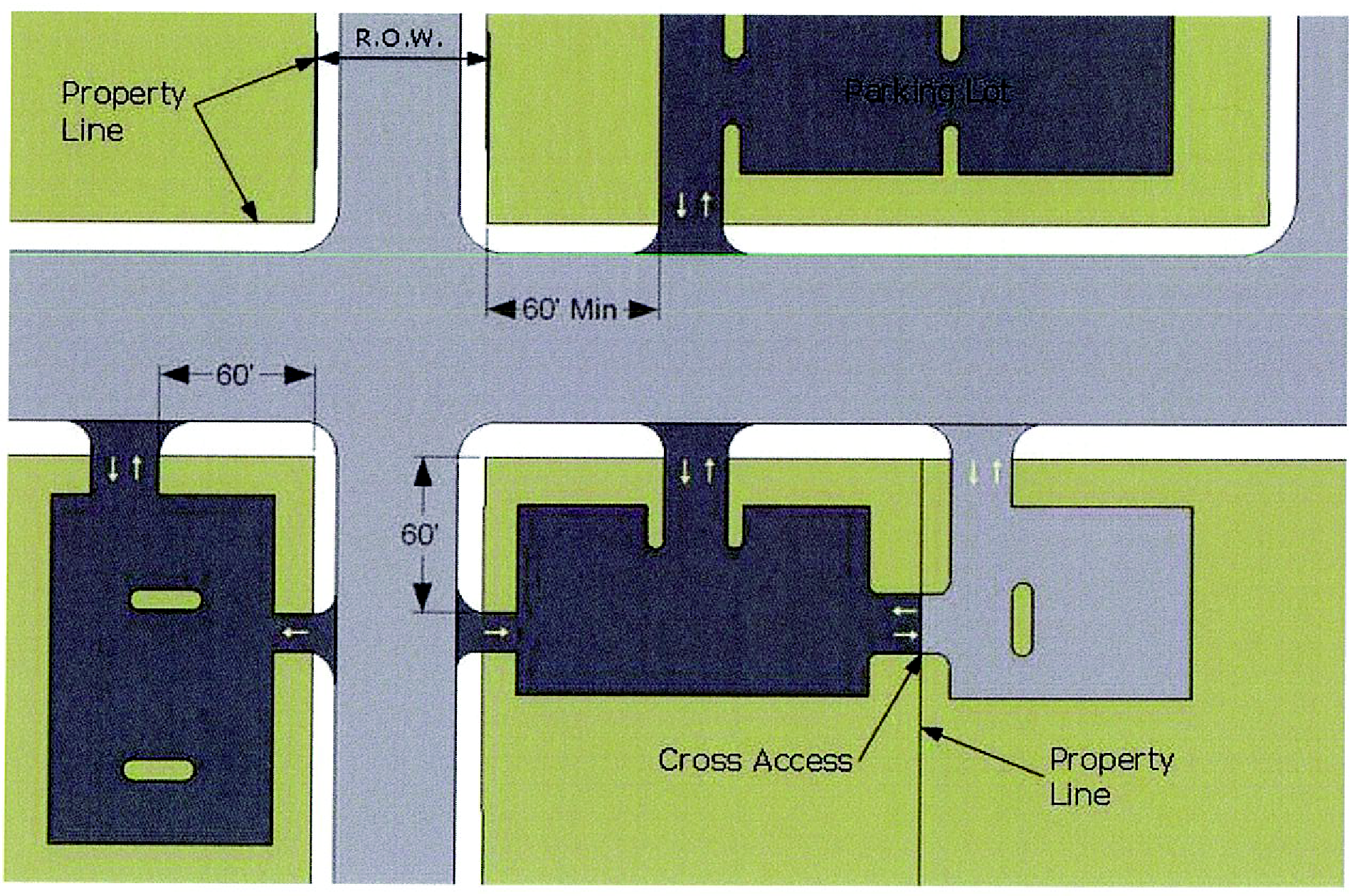
Driveways. Driveways for all commercial, industrial, office and multiple-family developments shall be located a minimum of sixty (60) feet from the intersection of two (2) public roads. Driveways for developments in excess of three (3) acres shall be located with the purpose of minimizing traffic hazards, inconvenience, and congestion. Both of these provisions are to increase public safety and minimize injury and property damage.
(1)
Entrance driveway width. Every parking facility or driveway access shall be provided with one (1) or more access points all access points shall follow these dimensional requirements:
(2)
For residential driveways.
a.
Shall not exceed sixteen (16) feet in width at the property line.
b.
Shall be installed a minimum of five (5) feet to a side property line.
c.
Shall be paved between the edge of the existing roadway pavement edge and the front property line.
(3)
For non-residential driveways.
a.
Shall not exceed fourteen (14) feet in width at the property line for one-way enter/exit.
b.
Shall not exceed twenty-six (26) feet in width at the property line feet for two-way enter/exit. Additional lanes shall be twelve (12) feet for each exit direction, for developments in excess of one (1) acre.
c.
Shall be installed a minimum of five (5) feet to a side property line.
d.
Entrances for developments in excess of three (3) acres may be required to extend or to construct public roads into the development. (Revised 03-04-04)
(Ord. No. O2011-06, 5-10-11)
(b)
Driveway and ramp slopes. The maximum slope of any driveway or ramp shall not exceed twenty (20) percent. Transition slopes in driveways and ramps shall be provided in accordance with the standards set by code official and the jurisdiction's engineer.
(c)
Number of driveway access points. Developments should minimize or eliminate curb cuts along arterials. Where possible, vehicular access should be shared with the adjacent properties and/or alleys or should be utilized for access. All lots, parcels, or any other division of land adjacent to an arterial roadway may be allowed driveways or street connections in accordance with the following:
Generally outparcels will not be allowed to have a separate road access;
An outparcel in this instance is considered a small lot at the outer edge of a shopping center, usually reserved for later sale to a fast-food outlet or stand-alone retailer.
(d)
Location of driveway access points. Location guidelines for driveway access points along arterials are shown in the illustration below. If the access to a lot, parcel, or any other lawful division of land is physically unobtainable under the provisions illustrated below, driveway access points are to be located the greatest distance possible from one another and from other public and private streets.
(e)
Reserved.
(f)
Reserved.
(g)
Surfacing. All driveway access points shall be of a hard surface paving material (acceptable paving materials include: traffic rated brick pavers, poured concrete, or continuous asphalt pavement) from the existing street surface to the edge of the right of way.
Parking lots and driveways containing more than six (6) parking spaces shall be constructed with a hard surface paving material (acceptable paving materials include: traffic rated brick pavers, poured concrete, or continuous asphalt pavement).
(h)
Markings.
(1)
All parking spaces shall be striped with an approved pavement marking paint, Exception: A private garage or parking area for the exclusive use of a single-family dwelling.
(2)
Wheel stops shall be used to designate parking spaces in gravel or other non-paved surfaces. Wheel stops shall be of approved material.
(i)
Lighting—Private parking areas. All lighting illuminating a parking area shall be designed and located to eliminate any glare and light spill over onto a public street or adjoining properties. All lighting shall employ-full cut-off light fixtures. The light source visibility shall be shielded from the adjoining property and from any public street.
(Ord. No. O2011-06, 5-10-11)
Sec. 22-346. - Minimum number of required parking spaces.
(a)
Off-street parking schedule "A." Unless otherwise expressly stated in this Code, off-street parking spaces shall be provided in accordance with table 22-346(1).
Table 22-346(1): Off-Street Parking Schedule "A"
(b)
Off-street parking schedule "B." Uses subject to off-street parking schedule "B" shall provide the following minimum number of off-street parking spaces.
Table 22-346(1): Off-Street Parking
Schedule "B"
(c)
Off-Street parking schedule "C." Uses that reference schedule "C" have widely varying parking and loading demand characteristics, making it impossible to specify a single off-street parking or loading standard. Upon receiving a development application for a use subject to schedule "C" standards, the planning director shall apply the off-street parking and loading standard specified for the listed use that is deemed most similar to the proposed use, or shall establish minimum off-street parking requirements on the basis of a parking and loading study prepared by the applicant. Such as study must include estimates of parking demand based on recommendations of the Institute of Traffic Engineers (ITE), or other acceptable estimates as approved by the planning director, and should include other reliable data collected from uses or combinations of uses that are the same as, or comparable with, the proposed use. Comparability will be determined by density, scale, bulk, area, type of activity, and location. The study must document the source of data used to develop the recommendations.
(Ord. No. O2011-06, 5-10-11)
Sec. 22-348. - Off-street loading requirements generally.
(a)
The number of off-street loading berths required by this section shall be considered as the absolute minimum. The developer should evaluate his own needs to determine if they are greater than the minimum specified by this section. For the purposes of this section, an off-street loading berth shall have minimum plan dimensions of twelve (12) feet by twenty-five (25) feet and fourteen (14) feet overhead clearance, with adequate means for ingress and egress.
(b)
The number of off-street loading berths required shall be as follows:
(Ord. No. O2011-06, 5-10-11)
Sec. 22-352. - Circulation and connectivity.
(a)
Purpose and intent. The purpose of this section is to support the creation of a highly connected transportation system with the city in order to provide choices for drivers, bicyclists, and pedestrians; promote walking and bicycling; connect neighborhoods to each other and to local destinations such as schools, parks, and shopping centers; reduce vehicle miles of travel and travel times; increase effectiveness of municipal service delivery, and free up arterial capacity to better serve regional long distance travel needs.
It is the intent of this Code to build streets that are integral components of community design. Streets shall be detailed to compliment neighborhoods and commercial centers and shall be pedestrian in scale. In addition to these standards, streets shall conform to the provisions of chapter 20. In certain situations, streets are encouraged to be designed with on-street parking.
(b)
Arterial streets. The street layout in any subdivision shall conform to the arrangement, width and location of public streets indicated on the regulating plan for the area. Whenever a tract of land included within any proposed development plan embraces any part of the arterial system as designated on the current city transportation plan, the development shall be required to dedicate and plat the arterial right-of-way, and shall be responsible for the cost and the installation of the improvements in accordance with the city's standards for roadways. Arterial streets are also referred to as highways, expressways and major streets throughout this Code of Ordinance and adopted plans.
Developments which embrace only one (1) side of an existing or planned arterial right-of-way will only be required to dedicate and plat additional right-of-way for that portion of roadway with which the development has frontage, and shall be responsible for the cost and the installation of the improvements in accordance with the city's standards for roadways.
(c)
Collector streets. The street layout in any subdivision shall conform to the arrangement, width and location of public streets indicated on the regulating collector street plan for the area. Whenever a tract of land included within any proposed development plan embraces any part of the collector street system as designated on the city collector street plan, the development shall be required to dedicate and plat the collector right-of-way, and shall be responsible for the cost and the installation of the improvements in accordance with the city's standards for roadways.
Developments which embrace only one (1) side of an existing or planned collector street right-of-way will only be required to dedicate and plat additional right-of-way, and shall be responsible for the cost and the installation of the improvements in accordance with the city's standards for roadways.
New developments will also be required to provide a collector street to the outer perimeter boundaries of the development based on the criteria below. If the street in question meets at least two (2) of the criteria, then the street must be built to an appropriate collector street standard.
(1)
The street intersects directly with an arterial street and provides access to an area with an overall density of ten (10) dwelling units per acre, or provides access to more than one hundred fifty (150) dwelling units.
(2)
The street by its general configuration, in relationship to the existing development of the area, in effect serves a collector function.
(3)
The street extends into an undeveloped area in such a manner as to serve a future collector street function.
(4)
The street serves as primary access to a significant nonresidential, institutional, or recreational land, as well, as an access to a residential area of twenty (20) or more acres.
(Ord. No. O2011-06, 5-10-11)
Sec. 22-353. - Vehicular connectivity.
(a)
Street arrangement. Streets should be designed and located so that they relate to the topography, preserve natural feature such as streams and tree growth and provide for adequate public safety and convenience. Vehicular connections from adjacent property (street stub-outs) must be utilized unless the planning board deems the connection impractical due to topographic conditions, environmental constraints, property shape or property accessibility.
When a through street or a series of streets establishes a connection between two (2) public streets, such street shall be a public street. Local public and private streets may incorporate traffic calming devices. Streets should be designed so pedestrians have convenient and safe means to cross streets. Allowable treatments may include, but are not limited to, roundabouts, raised pedestrian crosswalks, multi-way stops, bulb-outs, alternative pavement treatments, and signals at cross walks when warranted.
(b)
Cross access. Traffic studies have shown that highly connected street networks provide much greater traffic throughout and mobility for a community, at less cost. A high degree of connectivity should occur not only at the level of the arterials, but also on collector, local and other secondary roads. Such connectivity vastly improves a street network's performance. The street pattern should not force short trips of one (1) or two (2) miles onto arterials; it should be possible to make trips of this sort by using collector or other secondary streets. With a highly connected street network, cross-city trips should be possible using fairly direct secondary roads.
All development in commercial and industrial zoning districts shall be designed to allow for cross-access to adjacent properties within commercial and industrial zoning districts to encourage shared parking and shared access points on public and private streets. When cross access is deemed impractical by the planning director on the basis of sever topography, environmental constraints, or vehicular safety factors, the requirement may be waived provided that appropriate bicycle and pedestrian connections are provided between adjacent developments or land uses. Development plans should provide cross-access easement and complete the connection if completing the link can derive an immediate benefit. If not immediate benefit can be derived, development plans should provide cross access and construction easements and arrange the site design so when the adjoining property owner extends the connection to the property line, the link will be completed. If the link is to be completed in the future, the grade of the connection, parking, landscaping, and other improvements must be set to allow for extension into the adjacent property.
(c)
Pedestrian connectivity. Pedestrian circulation and connectivity should primarily take place adjacent to planned streets. All sidewalks shall be designed to comply with the standard outlined in city's standard specifications and details manual.
Pedestrian crossings shall be made safer for pedestrians whenever possible by shortening crosswalk distance with curb extensions, reducing curb radii, and eliminating free right-turn lanes. Traffic calming devices may be installed to help facilitate safer pedestrian crossings.
Pedestrian walkways shall form on-site circulation system that minimizes conflict between pedestrians and traffic at all points of pedestrian access to on-site parking and building entrances. Pedestrian walkways shall connect building entrances to one (1) another and from building entrances to public sidewalk connections and existing or planned transit stops. All developments that contain more than one (1) building shall provide walkways between the principal entrances of the buildings.
(Ord. No. O2011-06, 5-10-11)

