
East Donegal Township
City Zoning Code
City Zoning Code
ARTICLE II
DEFINITIONS
Sec. 52-27.- Definitions.
The following words, terms and phrases, when used in this chapter, shall have the meanings ascribed to them in this section, except where the context clearly indicates a different meaning. Words in the singular include the plural, and those in the plural include the singular:
Access corridor means that portion of a parcel that provides access from a street to the flag portion of a flag lot.
Access drive means an improved cartway or paved service road designed to provide vehicular access between the public road and the off-street parking area for a designated use not including a one- and two-family dwelling, townhouse or single nonresidential use.
Accessory alternative energy system means an alternative energy system that is accessory to a principal use and supplies energy primarily for on-site use, except that when a property upon which the system is installed also receives electrical power supplied by a utility company, excess electrical power generated and not presently needed for on-site use may be used by the utility company. This definition shall not in any way limit or preclude those accessory alternative energy systems conducted pursuant to and part of power purchase agreements.
Admission means a monetary exchange or charge of any character whatsoever, including donations, contributions, dues and membership fees (periodical or otherwise) charged, paid or in any other manner received by a landowner or producer and obtained from the general public, or a limited or selected number thereof, directly or indirectly, for the privilege of attending or engaging in any amusement.
Agriculture means the tilling of the soil, raising of crops, forestry, horticulture gardening and animal and poultry husbandry, including sale of crops, dairy and horticultural products incidental to the operation of the farm.
Airport means a place where aircraft can land and take off, usually equipped with hangars, facilities for refueling and repair, and related terminal services and offices for accommodating goods and passengers specifically intended to be transported by aircraft. See article XIII of this chapter for additional definitions related to airpark zoning.
Alley means a minor right-of-way, privately- or publicly-owned, primarily for service access to the back or side of lots.
Alteration means, as applied to building, structure or sign, means change, rearrangement, renovation, relocation or enlargement in the structural parts of exterior or which would change its use classification.
Amusement means any manner or form of public entertainment conducted within the Township, including, but not limited to, theatrical performances, operatic performances, folk festivals, musical concerts or festivals, carnivals, circuses, campgrounds, sports events, vaudeville shows, side shows, amusement parks, exhibitions, craft or antique shows, dancing, and any other form of diversion, sport or pastime for which admission is charged, paid or required; provided, however, that any form of entertainment the proceeds of which after payment of reasonable expenses, inure exclusively to the benefit of religious, educational or charitable institutions, societies or organizations, veterans' organizations or police or firemen's organizations, or which is conducted by or on behalf of a government body, shall not be considered a commercial amusement within the meaning of this chapter.
Indoor amusement means any amusement which is conducted entirely within the confines of a permanent building regularly used for such amusement.
Outdoor amusement means any amusement which is totally or partially conducted outside of a permanent building, or which is conducted entirely within the confines of a building not regularly used for such amusement.
Anaerobic digestion means the process in which microorganisms in the absence of oxygen convert the energy stored in volatile acids in livestock and poultry manure or other organic materials into biogas.
Animal unit means a unit of measurement of weight for an individual animal at 1,000 pounds.
Animal equivalency units means a unit of measurement of weight for total number of animals to occupy a defined space which equals one animal unit.
Area means the extent of surface contained within the boundaries or extremities of land or building.
Automobile service station means a building or lot or part thereof supplying and selling gasoline or other equivalent fuel for motor vehicles at retail direct from pumps and storage tanks and which may include accessory facilities for rendering services, such as lubrication, washing and minor repairs.
Automotive body shop means a facility used for repairs to the bodies and frames of automobiles and other motor vehicles, including spray painting, but not including the sale of gasoline, oil, diesel or other motor fuels.
BMP (best management practice) means activities, facilities, control measures, planning or procedures used to minimize accelerated erosion and sedimentation and manage stormwater to protect, maintain, reclaim, and restore the quality of waters and the existing and designated uses of waters within this state before, during and after earth-disturbance activities. See also Non-structural BMP and Structural BMP.
Base flood elevation means the projected flood height of the base flood.
Basement means any area of the building having its floor below ground level on all sides.
Bed and breakfast establishment means a single-family detached dwelling in which bed and breakfast units are provided, for compensation, on a nightly basis. Breakfast may be served to guests as part of said compensation.
Bed and breakfast unit means a room within a bed and breakfast establishment used as lodging for no more than four persons, excluding children of the immediate family under 12 years of age.
Bio-gas means a fuel consisting of methane, carbon dioxide, and small amounts of water and other compounds produced as part of anaerobic digestion processes.
Buffered means the transition of one site to another through the design and placement of trees, shrubs and/or fences to limit views and sounds between sites.
Building means a combination of materials to form a permanent structure having walls and a roof. Included shall be all manufactured homes and trailers to be used for human habitation.
Accessory building means a detached, subordinate building, the use of which is customarily incidental to that of the principal building and which is located on the same lot as that occupied by the principal building.
Farm building means buildings such as those for agricultural uses; namely barns, poultry houses, corncribs, silos and other similar farm structures.
Principal building means a building in which is conducted the principal use of the lot on which it is located.
Utility shed means an accessory building used for storage of equipment, but too small to house an automobile, with maximum dimensions not to exceed 170 square feet of gross floor area and a height of ten feet.
Building area means the total area of the greatest outside dimensions on a horizontal plane of the principal building and all accessory buildings.
Building height means the vertical distance measured from the average elevation of the finished grade at the corners of the building to the highest roof beams of a flat roof or the mean level of the highest gable or slope of a hip roof. When the finished ground level slopes away from the corners of the building, the lowest point within the area between the building and the lot line shall establish the finished grade elevation, or when the lot line is more than six feet from the building, the lowest point within the area between the building and a point six feet from the building shall establish the finished grade elevation.
Building line means a line formed by the intersection of a horizontal plane and a vertical plane that coincides with the exterior surface of the building on any side. In case of a cantilevered or projected section of a building, except overhanging eaves, gutters and cornices, the vertical plane will coincide with the most projected surface.
Camper means a motorized or automotive-drawn vehicle with facilities for sleeping and cooking while camping. Such vehicle shall not be used for residential purposes whether temporary or permanent.
Campground means an outdoor amusement comprised of a lot or tract of ground on which may be placed tents, campers or travel trailers, or other recreational vehicles, where persons or families may live temporarily for a period not to exceed 90 days, and which may include service and accessory structures that are incidental to the camping facility and are to be used solely by the occupants of the campground.
Campsite means any plot of ground within a campground intended for the exclusive occupancy by a tent, camper or travel trailer, or other recreational vehicle and, including any appurtenances thereto.
Carport means a roofed-over structure, open on at least two sides, used in conjunction with a dwelling for storage of private motor vehicles.
Cartway means the surface of a street or alley available for vehicular traffic.
Cemetery means land used or intended to be used for the burial of the deceased, including columbariums, crematoria, mausoleums and mortuaries when operated in conjunction with the cemetery and within the boundaries.
Centerline means the center of the surveyed street, road, lane, alley or alley right-of-way, or where not surveyed, the center of the traveled cartway or a watercourse.
Certificate of use and occupancy means a certificate issued and enforced by the zoning officer upon completion of the construction of a new building or upon a change or conversion of the structure or use of a building, which certifies that all requirements and regulations provided herein, and within all other applicable regulations have been complied with.
Change of use means an alteration of a building, structure or land by change of use, therefore existing, to a new use group which imposes other special provisions of law governing building construction, equipment, exits or zoning regulations.
Channel means a natural or artificial watercourse with a definite bed and banks which confine and conduct continuously or periodically flowing water.
Child day care center means a facility licensed by the state involving the supervised care of children under the age of 16 for periods of 18 hours or less.
Collocation means the location of one or more communication antennas on one communications tower, building, public utilities transmission tower or other structures.
Commercial communication antenna means any device used for the transmission or reception of radio, television, wireless telephone, pager, commercial mobile radio service or any other wireless communications signals, including, without limitation, omnidirectional or whip antennas and directional or panel antennas, owned or operated by any person or entity licensed by the Federal Communications Commission to operate such device. This definition shall not include private residence mounted satellite dishes or television antennas or amateur radio equipment, including, without limitation ham or citizen band radio antennas.
Commercial communication tower means a structure other than a building such as a monopole, self-supporting or guyed tower, designed and used to support commercial communication antennas.
Common open space means an area of land or water within the development site intended for the use or enjoyment of residents of a development and, where designated, the community at large, not including streets, off-street parking areas and areas set aside for public use. The term "common open space" shall not include:
(1)
The land area of lots allocated for single-family detached dwellings, single-family semi-detached dwellings, whether or not the dwelling units are sold or rented.
(2)
The land area of lots allocated for apartment and townhouse dwellings, including front yards, side yards, rear yards, interior yards and off-street parking facilities, whether or not the dwelling units are sold or rented.
(3)
The land area of lots allocated for total commercial use, including front yards, side yards, rear yards, and parking facilities, whether or not the commercial facilities are sold or rented.
(4)
Street rights-of-way, driveways, off-street parking and service areas.
Completely dry space means a space which will remain totally dry during flooding; the structure is designed and constructed to prevent the passage of water and water vapor.
Corner lot means a lot adjacent to a street intersection with frontage on both streets.
Country club means an outdoor amusement comprised of a combination of uses which include a golf course and one or more buildings used for a clubhouse, restaurant, banquet facilities or other similar uses, and which may include facilities for other types of sports events.
Crop means a plant or plant product that can be grown and harvested extensively for profit or subsistence.
Density.
Net density means the number of dwelling units in relation to the land area actually in use or proposed to be used for residential purposes, exclusive of public rights-of-way, streets, sidewalks, playgrounds, common open space, etc.
Gross density means the number of dwelling units in relation to an area of land actually in use or proposed to be used for residential purposes, excluding rights-of-way, whether exterior or interior, but, including interior parking areas and access lanes, sidewalks, parks, playgrounds, common open space, etc.
Development means any manmade change to improved or unimproved real estate, including, but not limited to, the construction, reconstruction, renovation, repair, expansion or alteration of buildings or other structures; the placement of manufactured homes; streets and other paving; utilities; filling, grading and excavation; mining; dredging; drilling operations; and the subdivision of land.
Disabled means an individual who:
(1)
Has a physical, emotional or mental impairment that substantially limits one or more major life activities;
(2)
Has a record of such impairment; or
(3)
Is generally regarded as having such an impairment.
Domestic pet means the keeping and housing of non-farm animals as a noncommercial use, that are generally locally available for purchase as pets and not detrimental to the health, safety and welfare of the community. Examples include, but are not limited to, dogs, cats, fish, birds, rodents, potbellied pigs and miniature horses. Any animal which requires the issuance of a permit by the Pennsylvania Game Commission or is classified as an exotic animal shall not be considered a domestic pet.
Driveway means the improved vehicular cartway of ingress and egress to a lot for a one- and two-family dwelling, townhouse dwelling or multifamily dwelling building, or for one single, nonresidential use.
Dwelling means a building permanently erected on and attached to a foundation, having a fixed location on the ground, and used as the living quarters for one or more families, which building, where so erected and attached shall, in the normal frame of reference, be immobile.
Dwelling Types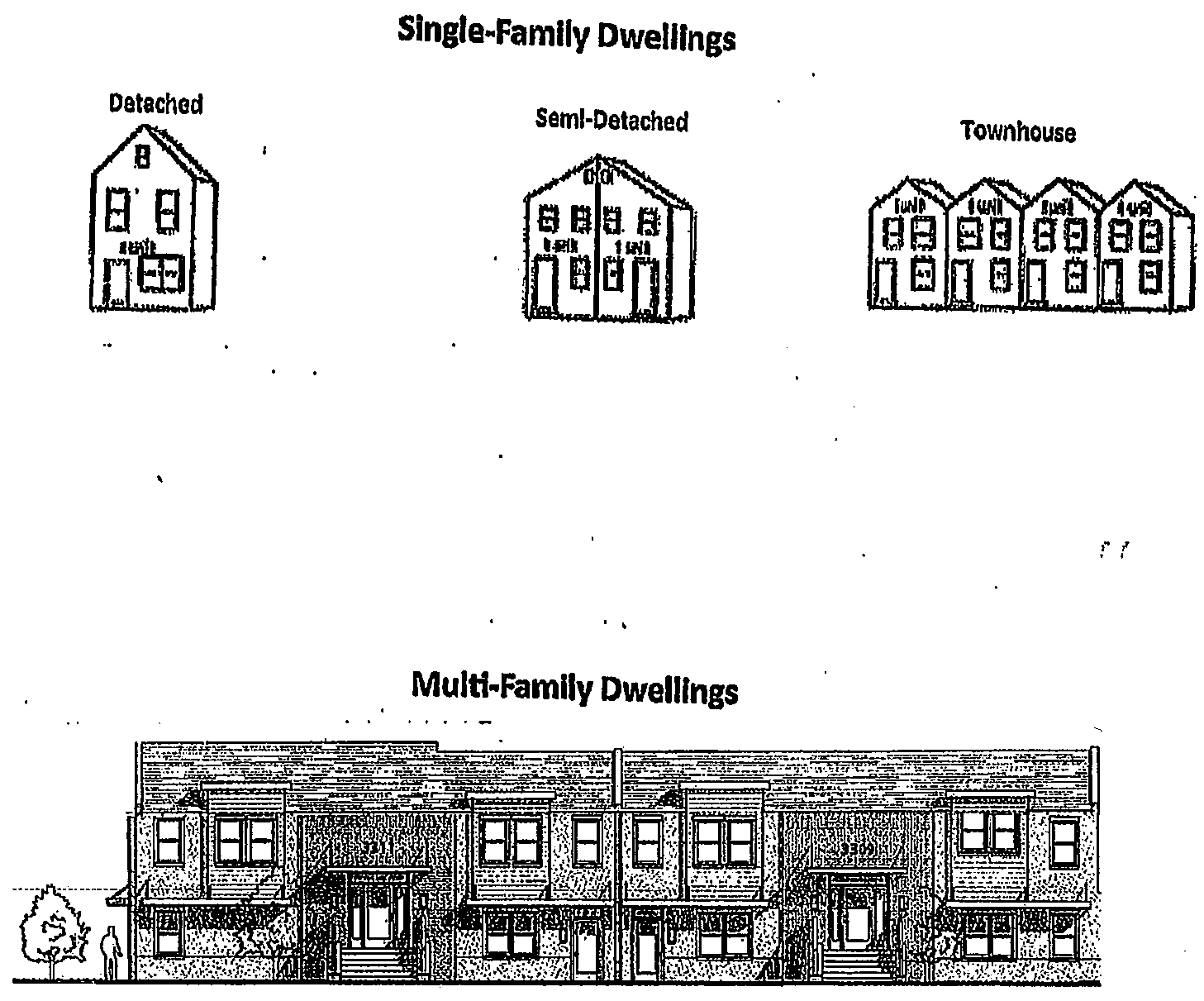
Dwelling unit means one or more living and/or sleeping rooms arranged for the use of one or more individuals living as a family with cooking, living and sanitary facilities.
Multifamily means a building which does not have a lot line between dwelling units and is designed to accommodate three or more dwelling units. A multifamily dwelling building shall not exceed two stories in height nor contain more than eight dwelling units.
Single-family detached dwelling means a detached residential dwelling unit designed for and occupied by one family only that shall contain a minimum of 1,000 square feet of residential floor area.
Single-family semi-detached dwelling means two dwelling units accommodating two families which are attached side by side through the use of a party wall, and having one side yard adjacent to each dwelling unit.
Townhouse means a building with three dwelling units but not more than six dwelling units attached by party walls and not having any horizontal division between the dwelling units.
Easement means a right-of-way granted for limited use of land for public or quasi-public purpose.
Elder cottage means a small manufactured or modular, free-standing housing unit specifically designed for elderly disabled or handicapped persons. This unit is designed to be transported and moved and to be installed on the same lot as an existing principal dwelling.
Elderly means a person 60 years of age and over or a couple where one of them is 60 years of age or over.
Essentially dry space means a space which will remain dry during flooding, except for the passage of some water vapor or minor seepage; the structure is substantially impermeable to the passage of water.
Exotic animals means any animal, including a mammal or reptile, not normally raised as livestock, for work, or breeding purposes, and not defined as a domestic pet, or any animal which is wild, fierce, dangerous, noxious or naturally inclined to do harm which represents a danger to life and limb. Examples include, but are not limited to, raccoons, lions, alligators, tigers, poisonous snakes, chimpanzees, bears, wolves and skunks
Family means an individual or individuals related by blood, marriage or adoption (including persons receiving foster care) that maintain one common household and live within one dwelling unit. Additionally, up to three unrelated individuals who maintain a common household and live within one dwelling unit may be considered a family. Finally, a family shall also expressly include any number of unrelated persons who reside within a licensed group home, as defined herein.
Farm means a lot devoted to or available for the cultivation of land as described under the definition of the term "agriculture."
Farm occupation means any use carried on by the owner of a farm which use is clearly incidental and secondary to the use of the farm and does not change the agricultural character thereof.
Floor area.
Residential floor area means the total floor area of the dwelling unit actually used for habitation excluding cellars, storage, attics, porches, garages, etc.
Commercial floor area means all that space relegated to use by the customer and the retail employee to consummate retail sales; and to include display area used to indicate the variety of goods available for the customer; but not to include office space, storage space and other general administrative areas.
Gross floor area means the total area of a building measured from the outside walls and, including all floors of the building.
Forestry means the management of forests and timberlands when practiced in accordance with accepted silvicultural, principles, through developing, cultivating, harvesting, transporting and selling trees for commercial purposes, which does not involve any land development.
Fraternal organization means a group of people formally organized for a common interest, usually cultural, religious or entertainment, with regular meetings, rituals and formal written membership requirements.
Garage.
Community garage means a building for use of storage space for more than three motor vehicles. A garage of this type shall be deemed a commercial use.
Private garage means an accessory building used for the storage of motor vehicles which may include one commercial vehicle, owned and operated by the owner and occupants of the premises, and for the storage of not more than three private noncommercial vehicles owned and operated by the owner or occupants of the premises.
Geothermal energy system, closed-loop means a type of geothermal heating and/or cooling system, not designed or used for the generation of power, that utilizes various devices and equipment in which the heat transfer fluid (potable water) is not exposed to the atmosphere. The heat transfer fluid may contain an approved antifreeze solution.
Closed-loop geothermal system, horizontal, means a mechanism for heat exchange which consists of various devices and equipment installed horizontally in the earth and are connected to the heat exchange system of the building in which the heat transfer fluid is circulated through the piping.
Closed-loop geothermal system, vertical, means a mechanism for heat exchange which consists of various devices and equipment installed vertically in the earth and are connected to the heat exchange system of the building in which the heat transfer fluid is circulated through the piping.
Golf course means an outdoor amusement comprised of an area of land for the playing of golf which has a minimum of 1,500 yards of play, and which may include accessory facilities such as a driving range, pro shop shelters and a clubhouse.
Group home means a dwelling unit operated by a responsible individual, family or organization with a program to provide a supportive living arrangement for individuals where special care is needed by the persons served due to age, emotional, mental or developmental or physical disability. This definition shall expressly include facilities for the supervised care of persons with disabilities subject to the Federal Fair Housing Act as amended, including those under supervision for alcohol and/or drug abuse. Group homes must be licensed where required by any appropriate government agency.
(1)
Group homes shall be subject to the same limitations and regulations by the Township as the type of dwelling unit they occupy.
(2)
It is the expressed intent of the Township to comply with all provisions of the Federal Fair Housing Act, as amended, and regulations promulgated thereunder in the construction of the term "group home."
(3)
A group home shall not include a treatment center.
Hazardous material means materials which have the potential to damage health, endanger human life or impair safety.
Handicapped means anyone with a physical or mental disability that substantially impairs or restricts one or more of such major life activities as walking, seeing, hearing, speaking, working or learning.
Historically associated gift shops means a shop that specializes in the retailing of gifts and/or souvenirs of historical significance.
Historic preservation means historic preservation aims at halting further deterioration and providing structural safety but does not contemplate significant rebuilding. Historic preservation includes:
(1)
Techniques of arresting or slowing the deterioration of a building, structure, or site;
(2)
Improvement of structural or site conditions to make a building, structure or site, safe, habitable or otherwise useful;
(3)
Normal maintenance and minor repairs that do not change or adversely affect the fabric or historic appearance of a building, structure or site.
Historic reconstruction means the process of accurately reproducing by new construction the form and details of a vanished building or structure, or a part thereof, as it appeared at some period in time. Historic reconstruction includes:
(1)
Full reconstruction;
(2)
Partial reconstruction.
Historic resource means any prehistoric or historic district, site, building, structure or object depicted on the official historic resource list and map of the Township.
Historic restoration means the process of accurately recovering, by the removal of later work and the replacement of missing original work, the form and details of a building or structure or part of a building or structure, together with its setting, as it appeared at some period in time. Historic restoration includes:
(1)
Full restoration which includes both exterior and interior;
(2)
Partial restoration which includes exterior, interior or any partial combination thereof;
(3)
Adaptive restoration which includes all or a portion of the exterior restored, with interior adapted to modern functional use.
Historic structure means any structure that is:
(1)
Listed individually in the National Register of Historic Places (a listing maintained by the Department of the Interior) or preliminarily determined by the Secretary of the Interior as meeting the requirements for individual listing on the National Register;
(2)
Certified or preliminarily determined by the Secretary of the Interior as contributing to the historical significance of a registered historic district or a district preliminarily determined by the Secretary to qualify as a registered historic district;
(3)
Individually listed on a state inventory of historic places in states with historic preservation programs which have been approved by the Secretary of the Interior; or
(4)
Individually listed on a local inventory of historic places in communities ties with historic preservation programs that have been certified either:
a.
By an approved state program as determined by the Secretary of the Interior; or
b.
Directly by the Secretary of the Interior in states without approved programs.
Home occupation means any use customarily conducted entirely within a dwelling, or an accessory building to said dwelling, and carried on by occupants thereof, which use is clearly incidental and secondary to the use of the dwelling for dwelling purposes and does not change the residential character thereof.
Horticulture means the growing of fruit, vegetables, flowers, ornamental plants or trees for a profit.
Hospital means an institution, licensed in the state as a hospital, which renders inpatient and outpatient medical care on a 24-hour-per-day basis; and provides primary health services and medical/surgical care to persons suffering from illness, disease, injury, deformity and other abnormal physical or mental conditions. A hospital use can also include attached and detached accessory uses provided that all accessory uses are contained upon the hospital lot.
Identified floodplain area means the floodplain area specifically identified in this chapter as being inundated by the 100-year flood.
Impervious surface means a surface which prevents the percolation of water into the ground. All buildings, including roof, without limitation, overhangs, parking areas, driveways, roads, sidewalks, and such areas as those in concrete, asphalt and compacted gravel shall be considered impervious surfaces within this definition. Limited use farm lanes utilized in agricultural operations are not included within this definition.
Improvement means those physical conditions and changes to the land and/or buildings and structures that may be necessary to produce usable and desirable parcels and developments.
Inn means a commercial facility for the housing and feeding of transients, located either in an existing structure or in a newly constructed building compatible in its appearance with adjacent buildings and the existing character of the area.
Jugging operation means the processing of milk and milk products produced on a farm for retail sale.
Junkyard means an area of land, with or without buildings used for storage outside of a completely enclosed building of used and discarded materials, including, but not limited to, waste paper, rags, metal, building materials, house furnishings, machinery, vehicles, or parts thereof, with or without the dismantling, processing, salvage, sale or other use or disposition of the same. The deposit or storage on a lot of two or more unlicensed, wrecked or disabled vehicles, or the major part thereof, shall be deemed to constitute a junkyard.
Kennel means a structure for housing, boarding, breeding and/or rearing dogs, cats, or other domestic animals on a commercial basis.
Land development means any of the following activities:
(1)
The improvement of one lot or two or more contiguous lots, tracts or parcels of land for any purpose involving:
a.
A group of two or more residential or nonresidential buildings, whether proposed initially or cumulatively, or a single nonresidential building on a lot or lots regardless of the number of occupants or tenure; or
b.
The division or allocation of land or space, whether initially or cumulatively, between or among two or more existing or prospective occupants by means of, or for the purpose of streets, common areas, leaseholds, condominiums, building groups or other features.
(2)
A subdivision of land.
Landowner means the legal or beneficial owner or owners of land, including the holder of an option or contract to purchase (whether or not such option or contract is subject to any condition), a lessee if he is authorized under the lease to exercise the rights of the landowner, or other person having a proprietary interest in land, shall be deemed to be a landowner for the purposes of this chapter.
Landscape design elements means the design and placement of trees, shrubs and grasses or ground cover to create an attractive amenity in the landscape.
Landscaping means and includes, but shall not be limited to, grass and other plantings such as trees, shrubs and bushes.
Livestock means animals kept or raised for use, profit or pleasure and where the species of animal typically requires area for grazing.
Lot means a designated parcel, tract or area of land established by a plat or otherwise as permitted by law and to be used, developed or built upon as a unit.
Lot Configurations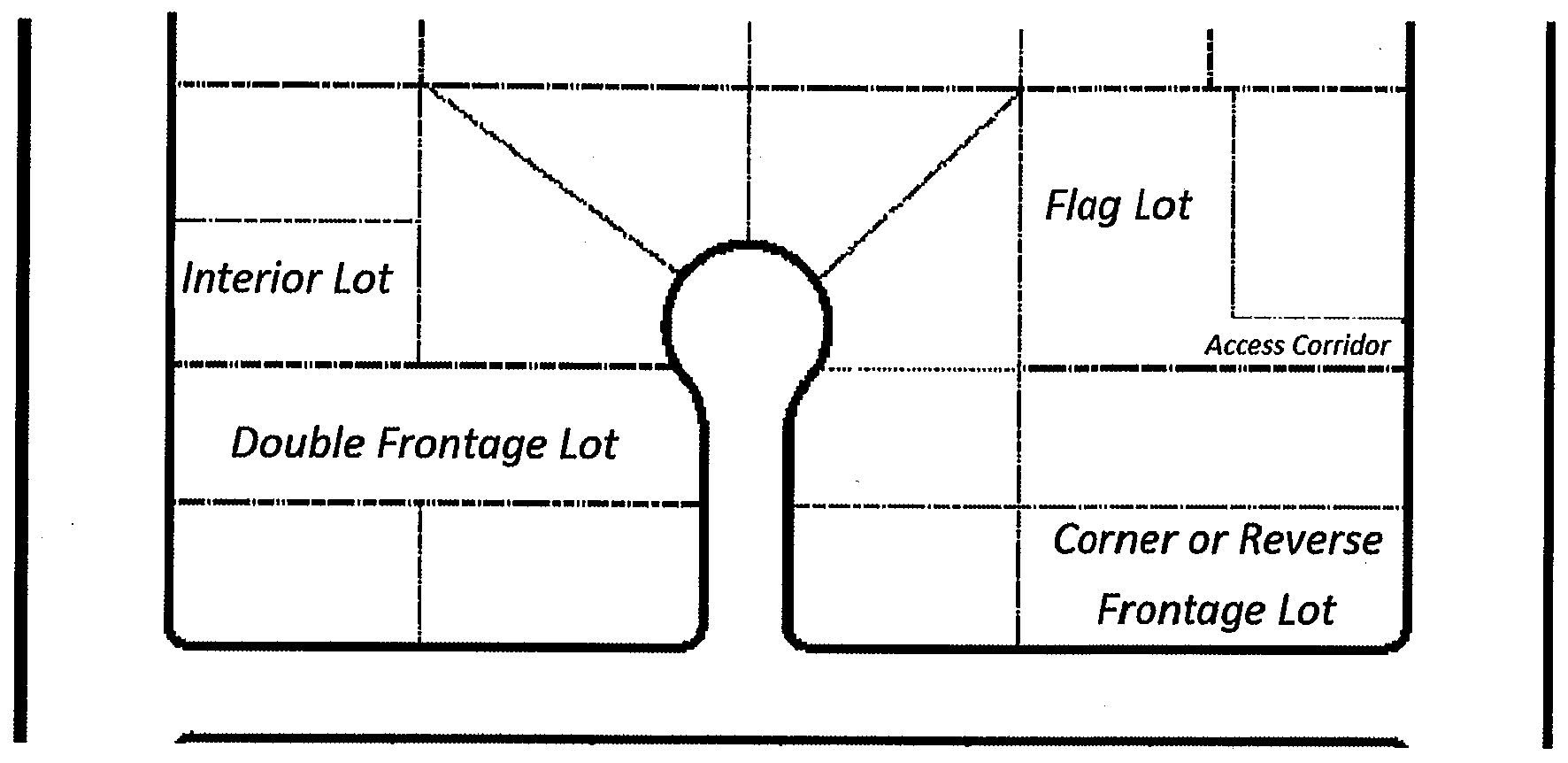
Lot area means the area contained within the lot lines of the individual parcels of land, including the area of any easement, but excluding area within any street right-of-way.
Lot coverage means the ratio of the total area of all impervious surfaces to the total area of the lot on which they are located.
Lot depth means the average distance between the street right-of-way line and the rear lot line, measured perpendicular or radial to the street right-of-way line.
Lot, flag, means an interior lot located generally to the rear of another lot, but with a narrow portion of the lot extending to the public street identified as an access corridor. The narrow portion of the lot that extends to the street shall be suitable for ingress and egress, and shall not be included in the calculation of the minimum lot area. The minimum lot area of a flag lot exclusive of the narrow portion of the lot used for ingress and egress shall be not less than that defined in the given zoning district. No part of the narrow portion of the lot shall be more than 25 feet in width. The front yard of a flag lot shall be identified as the lot line closest, and most parallel to the street upon which the access corridor is located.
Lot line means lines forming the front, rear and sides of lots as described in the title ordered. Any lot line which abuts a street or other public way shall be measured from the right-of-way.
Front lot line means the line separating a lot from a street right-of-way.
Rear lot line means the lot line which is opposite and most distant from the front line. But in the case of corner lots, the owner shall, for the purpose of this chapter, have the privilege of selecting any lot line; other than one of the front lot lines, to be the rear lot line, provided that such choice, in the opinion of the zoning officer will not be injurious to the existing or the desirable future development of adjacent property. The rear lot line of any irregular or triangular lot shall, for the purpose of this chapter, be a line entirely within the lot, ten feet long.
Side lot line means all lot lines other than front or rear lot lines.
Lowest floor means the lowest floor of the lowest fully enclosed area (including basement). An unfinished, flood resistant partially enclosed area, used solely for parking of vehicles, building access and incidental storage, in an area other than a basement area is not considered the lowest floor of a building, provided that such space is not designed and built so that the structure is in violation of the applicable non-elevation design requirements of this chapter.
Manufactured home means a structure, transportable in one or more sections, which is built on a permanent chassis and is designed for use with or without a permanent foundation when attached to the required utilities. The term "manufactured home" includes park trailers, travel trailers, recreational and other similar vehicles which are placed on a site for more than 180 consecutive days.
Manufactured home lot means a parcel of land in a manufactured home park, improved with the necessary utility connections and other appurtenances necessary for the erections thereon of a single manufactured home.
Manufactured home park means a parcel of land under single ownership, which has been planned and improved for the placement of two or more manufactured homes for non-transient use.
Minerals means any aggregate or mass of mineral, whether or not coherent. The term "minerals" includes, but is not limited to, limestone and dolomite, sand and gravel, rock and stone, earth, fill, slag, iron ore, zinc ore, vermiculite and clay, anthracite and bituminous coal, coal refuse, peat and crude oil and natural gas.
Mini-warehouse means a structure or group of structures containing separate storage spaces leased on an individual basis.
Minor repair means the replacement of existing work with equivalent materials for the purpose of its routine maintenance and upkeep, but not including the cutting away of any wall, partition or portion thereof, the removal or cutting of any structural beam or bearing support, or the removal or change of any required means of egress, or rearrangement of parts of a structure affecting the exit-way requirements; nor shall minor repairs include addition to, alteration of, replacement or relocation of any standpipe, water supply, sewer, drainage, drain leader, gas, oil, waste, vent or similar piping, electric wiring or mechanical or other work affecting the public health or general safety.
Modular means a single dwelling made by assembling one or more factory-produced three dimensional sections into an integral living unit, whose construction materials and specifications conform to those of conventionally-built units.
Motel means a building or group of buildings, whether detached or in connected units, used as individual sleeping or dwelling units, designed primarily for transient automobile travelers and provided with accessory off-street parking facilities. The term "motel" includes buildings designed as tourist courts, motor lodges, into courts and other similar designations.
Municipal building means any building owned by the Township that has a public use.
Nature-based sports club means an outdoor amusement comprised of a site retained by a group of people organized for a specific sport which is wholly dependent upon the natural existing plant and animal life or the aquatic environment of the site, including, but not limited to, hunting clubs, fishing clubs and boating clubs.
New construction means structures for which the start of construction commenced on or after December 13, 1979, and includes any subsequent improvement thereto.
No-impact home-based business means a business or commercial activity administered or conducted as an accessory use which is clearly secondary to the use as a residential dwelling and which involves no customer, client or patient traffic, whether vehicular or pedestrian, pickup, delivery or removal functions to or from the premises, in excess of those normally associated with residential use. The business or commercial activity must satisfy all of the following requirements:
(1)
The business activity shall be compatible with the residential use of the lot and surrounding residential uses.
(2)
The business shall employ no employees other than family members residing in the dwelling.
(3)
There shall be no display or sale of retail goods and no stockpiling or inventory of a substantial nature.
(4)
There shall be no outside appearance of a business use, including, but not limited to, parking, signs or lights.
(5)
The business activity may not use any equipment or process that creates noise, vibration, glare, fumes, odors or electrical or electronic interference, including interference with radio or television reception, which is detectable in the neighborhood.
(6)
The business activity may not generate any solid waste or sewage discharge, in volume or type, which is not normally associated with residential use in the neighborhood.
(7)
The business activity shall be conducted only within the dwelling and may not occupy more than 25 percent of the habitable floor area.
Nonconforming lot means a lot the area or dimension of which was lawful prior to the adoption or amendment of this chapter, but which fails to conform to the requirements of the zoning district in which it is located by reason of such adoption or amendment.
Nonconforming structures means a structure or part of a structure manifestly not designed to comply with the applicable use or extent of use provisions in this chapter or amendment heretofore or hereafter enacted, where such structure lawfully existed prior to the enactment of such ordinance or amendment or prior to the application of such ordinance or amendment to its location by reason of annexation. Such nonconforming structures include, but are not limited to, nonconforming signs.
Nonconforming use means a use, whether of land or of structure, which does not comply with the applicable use provisions of this chapter or amendment heretofore or hereafter enacted, where such use was lawfully in existence prior to the enactment of such chapter or amendment, or prior to the application of such ordinance or amendment to its location by reason of annexation.
Non-tillable land means all land not considered to be tillable land.
Nursing or retirement care facility means facilities designed for the housing, boarding and dining associated with some level of nursing or retirement care.
One hundred-year flood (100-year flood) means a flood that, on the average, is likely to occur once every 100 years (i.e., that has a one percent chance of occurring each year, although the flood may occur in any year).
Open space means that area which is unoccupied by buildings and paved parking surfaces.
Outdoor advertising business means provision of outdoor displays or display space on a lease or rental basis only.
Outdoor wood-fired boiler means a solid fuel-burning appliance, device or unit approved and/or listed by a nationally recognized testing agency, designed to heat a space and/or water through the transfer of a heated fluid via various devices and equipment.
Park means an area of land set aside primarily for both active and passive outdoor leisure time activities, including, but not limited to, playgrounds, sports fields, picnic areas and natural areas, but specifically not including outdoor amusements.
Private park means a park operated for restricted use in conjunction with a particular housing development or private residences, and open only to the residents and guests of said developments or private residences.
Public park means a park operated as a nonprofit enterprise by a government or nonprofit organization, and open to the general public.
Parking facilities means all improvements associated with parking of motor vehicles on a lot, including, but not limited to, parking spaces, interior driveways, curbing and islands.
Parking lot means a parking facility containing more than four parking spaces.
Parking space means an off-street space available for the parking of a motor vehicle and which, in this chapter, is held to be an area ten feet wide by 20 feet long, exclusive of passageways and driveways appurtenant thereto and giving access thereto.
Permanent planted riparian buffer means a BMP that is an area of permanent vegetation along a watercourse.
Places of worship means a building used for public worship and education by a congregation excluding buildings used exclusively for residential, burial, recreational and other uses not normally associated with worship. This term "places of worship" shall also permit the operation of a child day care when such day care is a contributing function of the place of worship and is accomplished in accordance with section 52-262.
Person means and includes an individual, partnership, public or private association or corporation, limited liability company, firm, trust, business trust, estate, foundation, municipality, government entity, public utility, other association or any other legal entity whatsoever, which is recognized by law as the subject of rights and duties.
Personal service shops and professional offices means a building or portion of a building in which the services of a person permitted to practice a specific profession are offered to the general public. Examples of such uses include, but are not limited to, real estate agents, barbers, beauticians, clothes cleaners, doctors, laundromats, lawyers, optometrists, photographers, tailors, undertakers and utility collection offices, state-licensed massage therapy and tattoo parlors, and small animal veterinary services not including kennels or other boarding arrangements for animals.
Planned residential development means an area of land, controlled by a landowner, to be developed as a single entity for a number of dwelling units, the development plan for which does not correspond in lot size, bulk or type of dwelling, density, lot coverage and required open space to the regulations established in any one residential district created, from time to time, under the provisions of this chapter.
Planning commission means the planning commission of the Township.
Public hearing means a formal meeting held pursuant to public notice by the Township board of supervisors or planning commission, intended to inform and obtain public comment, prior to taking action in accordance with this chapter.
Public meeting means a forum held pursuant to notice under the Sunshine Act, as amended.
Public notice means notice published once each week for two successive weeks in a newspaper of general circulation in the Township. Such notice shall state the time and place of the hearing and the particular nature of the matter to be considered at the hearing. The first publication shall not be more than 30 days and the second publication shall not be less than seven days from the date of the hearing.
Public sanitary sewer system means the disposal of sewage by the use of sanitary sewer collection facilities with a central sewage treatment plant approved by the state department of environmental protection and operated by the Township or a municipal authority or company approved by the Township.
Public space means a plot or area of land outside the building dedicated to public use by legal mapping or any other lawful procedure.
Public water means the supply of potable water through a distribution system and source; a safe adequate and healthful supply of water to a user from a source approved by the state department of environmental protection and operated by the Township or a municipal authority or company approved by the Township.
Rear access lane means a lane for the purpose of providing access to rear yard parking for a group of lots. Such a lane may be designated within a right-of-way or by way of easements.
Rehabilitation related to historic structures and resources means the process of making possible a compatible use for a property through use, repair, alternations and additions, while preserving those portions or features that convey what have been determined to be important cultural or architectural values.
Recreational vehicle means a vehicle which is:
(1)
Built on a chassis;
(2)
Not more than 400 square feet, measured at the largest horizontal projections;
(3)
Designed to be self-propelled or permanently towable by a light-duty truck;
(4)
Not designed for use as a permanent dwelling but as temporary living quarters for recreational, camping, travel or seasonal use.
Rental storage means the providing of space within a building for the placement of vehicles, equipment or other material for a period of time typically longer than three months.
Repetitive loss means flood-related damages sustained by a structure on two separate occasions during a ten-year period for which the cost of repairs at the time of each such flood event, on average, equals or exceeds 25 percent of the market value of the structure before the damages occurred.
Residential conversion unit means a building which has been altered to accommodate one or more dwelling units provided that such alteration is confined to the interior of an already existing structured shell and that such alteration may not include an extension of the sides or an increase in the height of an existing structure.
Riding academy means any stable, barn or other building, or group of buildings, where more than three horses are kept or stabled for the purpose of maintaining or conducting a school or club for equestrians and the general promotion of horsemanship, or for the furnishing of any instructions in riding horses, or for renting or letting out horses for riding purposes, whether under the constant direction of an instructor or in connection with the privileges of a club, society or school, or for hire, or otherwise.
Right-of-way means the space or area between lot lines, dedicated to the public use, for a thoroughfare, road, street or alley.
School means a nonprofit educational institution offering a curriculum approved by the department of public instruction.
Setback line means a line established by this chapter with respect to street classifications which is parallel to the street line bounding an area within which no structure, portion thereof, or appurtenance thereto shall be located; the line which establishes the minimum front yard requirement.
Shopping center means a group of stores, six or more in number, planned and designed as an integrated unit with off-street parking provided on the property as an integral part of the unit.
Short-term rental units means an individual existing dwelling unit that is occupied by transient families for periods not exceeding 30 consecutive calendar days.
Sign means a device for visual communication that is used to bring the subject to the attention of the public.
(1)
The term "sign" includes lettering, logos, trademarks, or other symbols which are an integral part of the architectural design of a building, which are applied to a building, or which are located elsewhere on the premises; signs affixed to windows or glass doors or otherwise internally mounted such that they are obviously intended to be seen and understood by vehicular or pedestrian traffic outside the building; flags and insignia of civic, charitable, religious, fraternal, patriotic or similar organizations; and insignia of governments or government agencies.
(2)
The term "sign" does not include architectural features which may be identified with a particular business; signs within a building which are obviously intended to be seen primarily from within the building; flags of governments or government agencies; and displays of merchandise either behind store windows or outdoors.
Sign, changeable message, means a sign (including a billboard) that can electronically display and/or change its message through lighting, light-emitting diodes (LED) or other electronic format.
Solar energy system means a system of devices and equipment designed to collect solar energy from the sun and transform such energy into electrical current for use in a residential and nonresidential capacity.
Special permit means a special approval which is required for hospitals, nursing homes, jails and new manufactured home parks and subdivisions and substantial improvements to such existing parks, when such development is located in all, or a designated portion of, a floodplain.
Street means a street, avenue, boulevard, road, highway, freeway, parkway, lane, alley, viaduct and any other strip of land, including the entire right-of-way used or intended to be used by vehicular traffic or pedestrians whether public or private.
Street classification means specific street classifications as set forth in the current comprehensive plan in effect for the Township.
Streetscape design elements means street trees, hedges, sidewalks, grass verge between street and sidewalk, pedestrian-oriented streetlights, bollards, fencing, bicycle racks, identification signage, benches, refuse receptacles or other similar features.
Structure means any manmade object having an ascertainable stationary location on or in land or water, whether or not affixed to the land.
Accessory above-grade structure means an accessory structure, such as a deck, loading dock or raised patio that has an elevation above the adjacent finished grade.
Accessory structure means a structure customarily incidental and subordinate to the principle building or to the use of the principle building or to the principle use of the lot and which is located on the same lot as the principle building or use.
Subdivision means the division or redivision of a lot, tract, or parcel of land by any means into two or more lots, tracts, parcels or other divisions of land, including changes in existing lot lines, for the purpose, whether immediate or future, of lease, partition by the court for distribution to heirs or devisees, transfer of ownership or building or lot development; provided, however, that the subdivision by lease of land for agricultural purposes into parcels of more than ten acres, not involving any new street or easement of access or any residential dwelling, shall be exempted.
Substantial damage means damage from any cause sustained by a structure whereby the cost of restoring the structure to its before-damaged condition would equal or exceed 50 percent or more of the market value of the structure before the damage occurred.
Substantial improvement means any reconstruction, rehabilitation, addition or other improvement of a structure, the cost of which equals or exceeds 50 percent of the market value of the structure before the start of construction of the improvement. The term "substantial improvement" includes structures which have incurred substantial damage or repetitive loss regardless of the actual repair work performed. The term "substantial improvement" does not, however, include either:
(1)
Any project for improvement of a structure to correct existing violations of state or local health, sanitary, or safety code specifications which have been identified by the local code enforcement official and which are the minimum necessary to ensure safe living conditions; or
(2)
Any alteration of a historic structure, provided that the alteration will not preclude the structure's continued designation as a historic structure.
Swimming pool means any body of water designed or intended for swimming, bathing or wading having a potential of water depth of 24 inches or greater. Exception: naturally existing streams, ponds and lakes.
Tillable land means all land designated by the United States Department of Agriculture, soil conservation service, as being comprised of Class I, II or III soils; excluding, however, those lands shown, to the satisfaction of the board of supervisors, to be non-tillable due to:
(1)
Rock outcroppings;
(2)
Surface bedrock;
(3)
Swampy or wet land;
(4)
Excessive slope;
(5)
Odd land shape.
Township means the Township of East Donegal.
Township engineer means a professional engineer licensed as such in the state, duly appointed as the engineer for the Township. The term "Township engineer" shall also include any duly appointed alternate engineer of record for the Township.
Travel lane means a vehicular lane within a cartway designated for use by moving vehicles.
Uniform Construction Code (UCC) means the statewide building code adopted by the Pennsylvania General Assembly in 1999 applicable to new construction in all municipalities whether administered by the municipality, a third party or the Department of Labor and Industry. Applicable to residential and commercial buildings, this Code adopted the International Residential Code (IRC) and the International Building Code (IBC), by reference, as the construction standard applicable with the state floodplain construction. For coordination purposes, references to the above are made specifically to various sections of the IRC and the IBC.
Editor's note— See also Chapter 5, Article 1, Uniform Construction Code.
Urban growth area means a line which delimits the extent to which planned urban land uses are provided for within the Township.
Use means the purpose for which land, structure, sign or a building is arranged, designed or intended, or which either land, structure, sign or a building is, or may be used, occupied or maintained.
Accessory use means a use customarily incidental and subordinate to the principal use of a building or structure or principal use of the land, or a use not the principal use and located on the same lot with such principal use or principal building or structure.
Conditional use means a use which may not be appropriate to a particular zoning district as a whole, but which may be suitable in certain localities within the district only when specific conditions and factors prescribed for such cases within this chapter are present. Conditional uses are allowed or denied by the board of supervisors after recommendations by the Township planning commission.
Principal use means the main or primary purpose for which land, a structure, building and/or sign, or use thereof is designed, arranged or intended, or for which they may be occupied or maintained under the this chapter. All other structures, buildings, signs or uses on the same lot and incident or supplementary thereto and permitted under this chapter shall be considered accessory uses.
Special exception use means the granting of a modification of the provisions of this chapter as authorized in specific instances listed, and under the terms, procedures and conditions prescribed herein, special exceptions are administered by the zoning hearing board.
Temporary use means a use that is established for a limited, fixed period of time with the intent to discontinue such use upon the expiration of such time and, does not involve the construction or alteration of any permanent structure.
Utility, community, means a building, structure or use or extension thereof which is operated, owned or maintained by a public utility corporation, municipality or municipal authority, or which is privately-owned and approved by the state public utility commission, for the purpose of providing public sewage disposal and/or treatment; public water supply, storage and/or treatment; or for the purpose of providing the transmission of energy or telephone service.
Vehicular dwelling means a transient dwelling, containing less than 400 square feet of gross floor area, including automotive drawn trailers or trailer coaches, which are designed primarily for vehicular mobility.
Violation means the construction, alteration or use of any structure. building, sign or land or the change of use, area of use, percentage of use or displacement of the use of any structure, building, sign or land without first obtaining a permit; the use of any building, structure, sign or land without receipt of a certificate of use and occupancy; or the failure to comply with any other provisions of this chapter.
Warehousing means the storage of goods and materials within a building, generally for subsequent distribution to other locations and not involving retail activities.
Watercourse means a permanent or intermittent stream, river, brook, run, creek, channel, swale, pond, lake or other body of surface water carrying or holding surface water, whether natural or artificial.
Wind energy system means a system of devices and equipment designed to collect wind energy and transform such energy into electrical current for use in a residential and nonresidential capacity.
Yard means the unobstructed open space around a building. Porches and carports shall be considered a part of the building. Overhanging eaves, gutters and cornices shall not be considered an infringement of the yard requirement.
Front yard means the required minimum open space between a building and the street right-of-way line and extending the full width of the lot.
Rear yard means the required minimum open space between a building and the rear lot line or street right-of-way line, whichever is the closer to the building, and extending the full width of the lot.
Side yard means the required minimum open space between a building and the interior side lot line and extending the full depth of the lot.
Zoning officer means the duly constituted Township official designated to administer and enforce this chapter.
Zoning permit means a permit stating that the purpose for which a building or land is to be used is in conformity with the uses permitted and all other requirements under this chapter for the zoning district in which it is located or is to be located.
(Code 1993, ch. 27, § 201; Ord. No. 2001-1, § 201, 2-27-2001; Ord. No. 2002-5, §§ 1, 2, 10-10-2002; Ord. No. 2004-2, §§ 1—10, 10-7-2004; Ord. No. 2005-3, § 1, 4-7-2005; Ord. No. 2005-4, § 1, 5-5-2005; Ord. No. 2006-3, § 1, 12-7-2006; Ord. No. 2017-5, § 2, 12-7-2017; Ord. No. 2024-3, § 1, 5-2-2024)

