
East Lansing City Zoning Code
ARTICLE I
- IN GENERAL
Sec. 50-1.- Short title.
This chapter shall be known, cited, and referred to as the "Zoning Ordinance of the City of East Lansing."
(Code 1994, ch. 55, § 5.1)
Sec. 50-2. - Map adopted.
The map herein referred to is identified by the title "Zoning Use District Map of the City of East Lansing," as adopted by Ordinance No. 451, and the map and all explanatory material thereof is hereby adopted and made a part of this chapter, provided however, that said map may be amended in any manner, from time to time, by ordinance, in which case, such changes described shall be equally effective as though incorporated in the map itself.
(Code 1994, ch. 55, § 5.2)
Sec. 50-3. - Purpose.
This chapter is enacted pursuant to P.A. 207 of 1921, as amended, (being the City and Village Zoning Act, MCL 125.581 et seq.). The continued administration of this chapter, amendments to this chapter, and all other matters concerning operation of this chapter shall be done pursuant to P.A. 110 of 2006, as amended, (being the Michigan Zoning Enabling Act, MCL 125.3101 et seq.). In their interpretation and application, the provisions of this chapter shall be held to be the minimum requirements adopted for the promotion of the public health, safety, convenience, economic and general welfare of the residents of the city by regulating the development of land and establishing districts in which uses of land and structures are regulated. Among other purposes, the provisions of this chapter are intended to accomplish the following:
(1)
Establish the appropriate use and preservation of land, open space, and natural resources in accordance with their character and suitability for particular purposes and prevent the improper use of land and natural resources.
(2)
Foster harmonious relationships among land uses and prevent or minimize land use incompatibilities.
(3)
Promote and enhance the stability of the city's neighborhoods, commercial areas, and special or historic areas.
(4)
Avoid over concentrations of population.
(5)
Reduce the hazards to life and property from fire, flood, and other dangers.
(6)
Limit or lessen congestion on the public roads and streets and ensure the provision of safe and efficient transportation systems for all forms of travel.
(7)
Provide for adequate space, light, and air.
(8)
Preserve desirable natural features and resources.
(9)
Promote wise and efficient expenditure of public funds for public improvements and services to conform to the most advantageous uses of land and resources.
(10)
Facilitate adequate and efficient provision of sewage disposal, safe and adequate water supply, storm drainage, hazardous materials management, education, recreation, and other public services, utilities, and facilities.
(11)
Control activities, operations, or uses that produce adverse environmental impacts or risks to the public health including noise, odor, dust, vibration or other irritants.
(Code 1994, ch. 55, § 5.3; Ord. No. 1061, 2-7-2006; Ord. No. 1157, 11-8-2006)
Sec. 50-4. - Interpretation.
For the purposes of this chapter, "planning and zoning official" shall mean the director of planning, building and development or his or her designee or, should that position cease to exist, the chief supervisory official responsible for the planning activities of the city, or his or her designee. "Building official" shall mean the director of planning, building and development or his or her designee or, should that position cease to exist, the chief supervisory official responsible for the administration and enforcement of the building and related trade codes of the city, or his or her designee.
(Code 1994, ch. 55, § 5.4; Ord. No. 1313, 3-4-2014)
Sec. 50-5. - Definitions, A through C.
The following words, terms and phrases, when used in this chapter, shall have the meanings ascribed to them in this section, except where the context clearly indicates a different meaning:
Accessory building means a subordinate building or portion of the main building, situated upon the same lot or portion of the main building, the use of which is incidental thereto.
Accessory dwelling unit (ADU) means a residential living unit on the same parcel as, and accessory or subordinate to, a single-family dwelling or a multifamily structure. It provides complete independent living facilities for one or more persons and may take various forms: a detached unit; a unit that is part of an accessory structure, such as a detached garage; a unit that is part of an expanded or remodeled single-family unit; or a unit in a multifamily dwelling.
Accessory structure means any subordinate building, fence, wall, deck, porch, freestanding sign, or portion of the main building situated upon the same lot as the main building, the use of which is incidental thereto.
Accessory use means a use subordinate to the main use on a lot and used for the purposes customarily incidental to those of the main use.
Auto service center means an establishment for the servicing of motor vehicles which may include the retail sale and dispensing of motor fuels and related products; the retail sale and installation of minor automobile parts and accessories such as tires, batteries, spark plugs, fan belts, shock absorbers, mirrors, floor mats, lubricants, cleaning and polishing materials, and similar items; and, when provided in conjunction with either or both of the above activities, minor repairs, cleaning, or polishing of motor vehicles within enclosed service bays or stalls. These services may be provided to customers on the premises, or the facilities may be made available to customers for self-service, subject to any applicable state requirements. An auto service center shall not include any establishment engaging in major auto or truck repair functions such as body repair or painting, welding, frame straightening, tire recapping or vulcanizing, or storage of wrecked vehicles.
Automatic teller machines (ATMs) means electronic funds transfer terminals and/or funds transmission facilities which perform deposit account transactions between financial institutions and their customers.
Average day means a Tuesday, Wednesday, or Thursday for most uses. The average day may be a Saturday for uses that have higher peak-hour traffic volumes on a Saturday rather than mid-week.
Bed and breakfast means a single-family residential structure that:
(1)
Has seven or fewer sleeping rooms, including sleeping rooms occupied by the owner;
(2)
One or more sleeping rooms are consistently available to transient tenants; and
(3)
Serves meals at no extra cost to its transient tenants.
Boardinghouse means a building, other than a hotel, where lodging and meals for five or more persons, other than the family, are regularly served for compensation.
Building means a fabric or edifice, framed or constructed and designed to stand more or less permanently, and covering a space of land, for use as a dwelling, store, storehouse, factory, shelter, or some other useful purpose. Building in this sense does not include a mere wall, fence, monument, or similar structure; nor any car, trailer or tent.
Building coverage means that part or percent of the lot area that is occupied by buildings, including accessory buildings and any decks which are enclosed or covered by a roof.
Building height means the vertical distance from the average elevation of the street curb paralleling the front, or if on a street corner, the front and exposed side of the building, to the highest point of the building's roof surface if the roof is flat; to the deck line, if the roof is of the mansard type; or to the average height between the eaves and the ridge if the roof is gable, hip, or gambrel type. For buildings set back from the street line, this vertical distance shall be taken above the average elevation of the finished grade along the façade of the building which faces the nearest public street, provided the building's distance from the street line is more than the average height of such finished grade above the established curb elevation. Building height shall not include mechanical equipment, antennas, chimneys or similar devices which are placed on or extend above the roof, nor elevator shaft enclosures, nor solid screen walls or enclosed penthouses constructed on the roof to contain and enclose mechanical equipment or rooftop gardens and recreational facilities provided for residents or employees of the building which are designed and sufficiently set back from the outer edge of the roof to be inconspicuous.
Building-integrated solar energy systems is a solar energy system that is an integral part of a building or structure (rather than a separate device), replacing or substituting for an architectural or structural component of the building or structure. Building-integrated systems include, but are not limited to, photovoltaic or hot water solar energy systems that are contained within roofing materials, windows, skylights, and awnings.
Building-mounted solar energy systems is a solar energy system that is attached to a building on a parcel as the principal method of physical support.
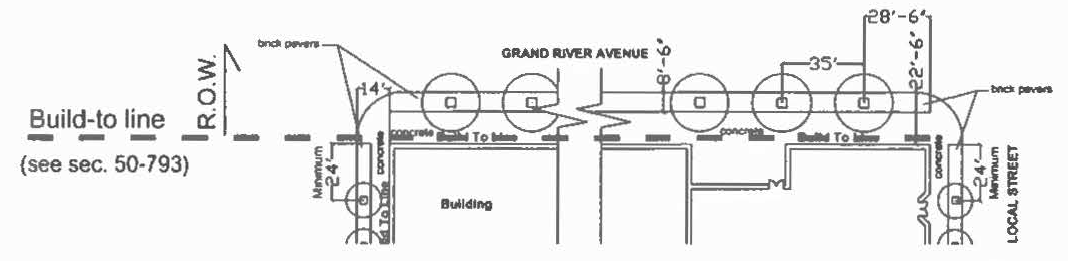
Build-to line (BTL) means an alignment established a certain distance from the curb line to a line along which the building shall be built. Build-to lines vary for major streets and local streets and are dimensioned on the siting plans (see section 50-793). Build-to lines along Grand River Avenue will be based on the future right-of-way (R.O.W.) for Grand River Avenue improvements based on the 2000 Grand River Avenue Study and any future plans developed from the study.
Carport energy system means a solar array that covers a required parking area.
Child care organization means a facility for the care of children under 18 years of age, as licensed and regulated by the state under Public Act No. 116 of 1973 (MCL 722.111 et seq.), and the associated rules promulgated by the state department of social services. Such organizations shall be further defined as follows:
(1)
Child care center or day care center means a facility, other than a private residence, receiving more than six preschool or school-age children for group care for periods of less than 24 hours a day, and where the parents or guardians are not immediately available to the child. It includes a facility which provides care for not less than two consecutive weeks, regardless of the number of hours of care per day. The facility is generally described as a child care center, day care center, day nursery, nursery school, parent cooperative preschool, play group, or drop-in center. "Child care center" or "day care center" does not include a Sunday school conducted by a religious institution or a facility operated by a religious organization where children are cared for during short periods of time while persons responsible for such children are attending religious services.
(2)
Foster family home is a private home in which one, but not more than four, minor children, who are not related to an adult member of the household by blood, marriage, or adoption, are given care and supervision for 24 hours a day, for four or more days a week, for two or more consecutive weeks, unattended by a parent or legal guardian.
(3)
Foster family group home means a private home in which more than four but fewer than seven children, who are not related to an adult member of the household by blood, marriage, or adoption, are provided care for 24 hours a day, for four or more days a week, for two or more consecutive weeks, unattended by a parent or legal guardian.
(4)
Family day care home means a private home in which one, but less than seven, minor children are received for care and supervision for periods of less than 24 hours a day, unattended by a parent or legal guardian, except children related to an adult member of the family by blood, marriage, or adoption. It includes a home that gives care to an unrelated child for more than four weeks during a calendar year.
(5)
Group day care home means a private home in which more than six, but not more than 12, children are given care and supervision for periods of less than 24 hours a day unattended by a parent or legal guardian, except children related to an adult member of the family by blood, marriage, or adoption. It includes a home that gives care to an unrelated child for more than four weeks during a calendar year.
City means the incorporated municipality of East Lansing, Michigan.
Curb level means the main level of the established curb in front of the building. Where no curb has been established, the city engineer shall establish such curb level for the purpose of these regulations.
(Code 1994, ch. 55, § 5.5; Ord. No. 1149, 9-5-2006; Ord. No. 1357, 5-11-2016; Ord. No. 1492, 12-15-2020; Ord. No. 1530, 5-21-2024; Ord. No. 1535, 11-19-2024; Ord. No. 1543, 7-15-2025)
Cross reference— Definitions generally, § 1-7.
Sec. 50-6. - Definitions, D through F.
The following words, terms and phrases, when used in this chapter, shall have the meanings ascribed to them in this section, except where the context clearly indicates a different meaning:
Diameter at breast height (d.b.h.) means the diameter of a tree as measured at 4.5 feet above grade level.
Dispensary means any of the following:
(1)
Two or more primary caregivers growing medical marihuana in the same building, structure or lot except for multiple-unit residential structures;
(2)
Two or more primary caregivers storing medical marihuana in the same building, structure or lot except for multiple-unit residential structures;
(3)
Two or more primary caregivers delivering, transferring or providing qualifying patients with medical marihuana out of the same building, structure or lot except for multiple-unit residential structures;
(4)
Two or more primary caregivers growing medical marihuana in the same unit of a multiple-unit residential structure;
(5)
Two or more primary caregivers storing medical marihuana in the same unit of a multiple-unit residential structure; or
(6)
Two or more primary caregivers delivering, transferring or providing qualifying patients with medical marihuana out of the same unit of a multiple-unit residential structure.
Domestic unit. See subsection (3) under "family."
Drive-ins means establishments which offer goods or services directly to customers either waiting in motor vehicles or to customers who return to their vehicles to consume the goods while on the premises. Car washing establishments are deemed to be drive-ins.
Driveway means a paved surface which provides for access for motor vehicles from a street, alley, or private road to one or more garages, carports, parking spaces, or parking lots. Driveways may also include paved areas provided for maneuvering vehicles on a lot, such as circular driveways and turnarounds.
Dwelling means any house, building, structure, shelter, or portion thereof which is designed for, or occupied exclusively as the home, residence, living or sleeping place of one or more human beings, either permanently or transiently.
Dwelling unit means a room or group of rooms located within a building and forming a single habitable unit with facilities which are used or intended to be used for living, eating, sleeping, cooking, and sanitation, excluding public halls, public stairs, and areas not included within the perimeter of the room or group of rooms.
Dwellings, classes of. For the purpose of this chapter, dwellings are divided into the following classes: (1) one-family dwellings; (2) two-family dwellings; and (3) multiple-family dwellings.
(1)
A one-family dwelling is a detached building designed for or occupied exclusively by one family.
(2)
A two-family dwelling is a detached building designed for or occupied exclusively by two families living independently of each other.
(3)
A multiple-family dwelling is a building used or designed as a residence for three or more families living independently of each other or occupied by five or more unrelated persons whether or not equipped with cooking facilities, including apartments, hotels, fraternities, and sororities.
Dwellings, classes of multiple. All multiple dwellings for the purpose of this chapter are divided into two classes, namely: class A and class B.
(1)
Class A. Multiple dwellings of class A are dwellings which are occupied for residence purposes and in which the rooms are occupied in apartments, suites or groups, in which each combination of rooms is so arranged and designed as to provide a separate room for cooking and kitchen sink accommodations or a kitchenette, and a toilet room within each of the separate units. This class includes tenement houses, flats, apartment houses, apartment hotels, bachelor apartments, and all other dwellings similarly occupied whether specifically enumerated herein or not.
(2)
Class B. Multiple dwellings of class B are dwellings which are occupied by individuals who are lodged, with or without meals, and in which as a rule the rooms are occupied singly and without any provision therein or therewith for cooking or kitchen accommodations for the individual occupants. This class includes fraternities, sororities, hotels, lodginghouses, boardinghouses, bed-and-breakfasts, and all other dwellings similarly occupied, whether specifically enumerated herein or not.
Electric vehicle means a fully electric automobile or hybrid gas and electric automobile.
Erected includes built, constructed, reconstructed, moved upon, or any physical operations on the premises required for the building. Excavations, fill, drainage, and the like, shall be considered a part of erecting.
Essential services means the erection, construction, alteration, maintenance, addition, reconstruction, or replacement of or maintenance by public utilities or municipal departments or commissions of underground, surface, or overhead distribution of gas, electricity, communications (but excluding wireless communication facilities), steam, or water transmission or distributing systems, collection, supply or disposal systems including poles, mains, drains, sewers, pipes, conduits, wires, cables, high voltage transmission lines, towers in connection with such lines, fire alarm boxes, police call boxes, traffic signals, hydrants, and other similar equipment and accessories in connection therewith, but not including buildings reasonably necessary for the furnishing of adequate service to this city and surrounding territory by such public utilities or municipal departments or commissions or for public health, safety, or general welfare.
Extended care/nursing facility means a building wherein infirm, aged, or incapacitated persons are accepted and furnished, for compensation, care, food and lodging and may receive on-site medical care.
Exterior site boundaries means the outer boundaries on one or more lots that have been identified on a plan for existing or proposed development.
Façade means the elevation or "face" of a building, from ground level to roof line.
Family.
(1)
"Family" means one person or two related persons or two unrelated persons residing in a dwelling unit, or where there are more than two persons residing in a dwelling unit, persons classified constituting a family shall be limited to husband, wife, son, daughter, father, mother, brother, sister, grandfather, grandmother, grandson, granddaughter, aunt, uncle, stepchildren, and legally adopted children, or any combination of the above persons living together in a single dwelling unit.
(2)
Anyone seeking the rights and privileges afforded a member of a family by this Code shall have the burden of proof by clear and convincing evidence of their family relationship.
(3)
Domestic unit. As herein defined, a "domestic unit" shall be given the same rights and privileges and shall have the same duties and responsibilities as a family, as defined herein for purposes of construing and interpreting this chapter. Domestic unit shall mean a collective number of individuals living together in one dwelling unit whose relationship is of a regular and permanent nature and having a distinct domestic character or a demonstrable and recognizable bond where each party is responsible for the basic material needs of the other and all are living and cooking as a single housekeeping unit.
(4)
This definition shall not include any society, club, fraternity, sorority, association, lodge, combine, federation, group, coterie, or organization, nor include a group of individuals whose association is temporary or seasonal in character or nature or for the limited duration of their education, nor a group whose sharing of a house is not to function as a family, but merely for convenience and economics.
(5)
Any person seeking the rights and privileges afforded a member of a domestic unit by this chapter shall have the burden of proof by clear and convincing evidence of each of the elements of a domestic unit.
(6)
Nothing in this section shall be deemed to confer any legal rights upon any person on the basis of conduct otherwise unlawful under any existing law.
First story means the lowest story of a building, the ceiling of which is more than six feet above the average finished grade at the front of the building, or a public sidewalk adjacent to its exterior walls.
Floodplain, 100-year means the low land near a watercourse which has been, or may be, covered by water of a flood of 100-year frequency, as established by engineering practices of the U.S. Army Corps of Engineers. It shall also mean that a flood of this magnitude may have a one-percent chance of occurring in any given year.
Floodway means the channel of a river or other watercourse and the adjacent land areas that must be reserved in order to discharge the base flood without cumulatively increasing the water surface elevation more than a designated height.
Floodway encroachment means any fill, structure, building, accessory use, or development in the floodway.
Floodplain/floodway remediation means the process of improving the floodway capacity that has by natural and manmade circumstances decreased over the years, causing an increase in the 100-year floodplain.
Floor area, gross, means the total of all floor areas of a building as measured to the outside surfaces of exterior walls and including halls, stairways, elevator shafts, attached garages, porches, balconies, and basements.
Floor area, net, means the total of all floor areas of a building excluding stairwells and elevator shafts; maintenance, equipment, and utility rooms; interior vehicular parking or loading areas; common or public areas such as central lobbies, hallways, and restrooms; and all areas below first or ground floor when used solely for ancillary storage.
(Code 1994, ch. 55, § 5.5; Ord. No. 1061, 2-7-2006; Ord. No. 1245C, 3-15-2011; Ord. No. 1313, 3-4-2014; Ord. No. 1535, 11-19-2024; Ord. No. 1543, 7-15-2025)
Cross reference— Definitions generally, § 1-7.
Sec. 50-7. - Definitions, G through M.
The following words, terms and phrases, when used in this chapter, shall have the meanings ascribed to them in this section, except where the context clearly indicates a different meaning:
Gap/critical gap means the median time headway (in seconds) between vehicles in a major traffic stream which will permit side-street vehicles at STOP or YIELD controlled approach to cross through or merge with the major traffic stream under prevailing traffic and roadway conditions.
Garage, private, means a building or other structure designed for the housing of automobiles and having capacity for not more than four automobiles.
Garage, public, means any building or premises, other than a gasoline filling station, used for housing or care of more than four automobiles, or where any such automobiles are equipped for operation, repaired, or kept for remuneration, hire, or sale.
Ground coverage means that part or percent of lot area included within the outside boundary lines of all buildings and structures located on the lot, including porches, decks, patios, breezeways, balconies, bay windows, paved drives and walks, and other area covered with impervious materials.
Ground-mounted solar energy systems is a freestanding solar energy system that is not attached, and is separate from, any building on the parcel of land.
Habitable room means a room designed for living and/or sleeping, excluding bathrooms, kitchens, dining areas, closets, hallways, and service areas.
Home occupation means an accessory use of a dwelling for gainful employment on a recurring basis involving the manufacture, sale, or provision of goods, materials or services. Class A home occupations may involve the provision of personal service, such as typing, computing, sewing and tutoring; the provision of professional services such as medical and health care, legal, financial, accounting, engineering, architectural, real estate, insurance, counseling, and religious assistance; the creation and/or sale of goods, materials, or handicrafts, except for the sale of food or beverages to be consumed on the premises; and the repair of small appliances, bicycles, and similar products which are not powered by internal combustion engines. Class A home occupations shall be established and operated in compliance with the provisions of section 50-147(7). Also, for the purposes of this chapter, "child care organizations," as defined in section 50-5, shall be considered separate from home occupations.
Hotel means a multiple-family dwelling in which persons are lodged for hire on a temporary basis, and in which as a rule the rooms are occupied singly, and in which there are more than 25 sleeping rooms, and a dining room with kitchen facilities for accommodation of at least 25 guests.
Household pet daycare means a premises containing up to six cats or dogs or a combination making a total of six where care and supervision are provided for periods of 12 hours or less per day with or without financial compensation. This does not include household pets as allowed under section 4-4 of this Code.
Kennel means any premises where more than four cats or dogs or a combination making a total of more than four are kept overnight or where more than ten animals, including those allowed under section 4-4 of this Code, are provided care and supervision regardless of duration, except where accessory to an agricultural use.
Level 2 or better charging station means a public or private parking space that is served by battery charging station equipment that has as its primary purpose the transfer of electric energy by conductive or inductive means to a battery or other energy storage device in an electric vehicle equipped with a level 2 or better charging equipment.
Level of service means a qualitative measure, defined on a scale from A to F, describing operational conditions within a traffic stream; generally described in terms of such factors as speed and travel time, delay, freedom to maneuver, traffic interruptions, comfort and convenience, and safety.
Lodging house means a building or part thereof, other than a hotel, where lodging is provided for hire, more or less transiently, including so-called tourist homes, and with or without provisions for meals.
Lot means a parcel of land occupied or to be occupied by a building and its accessory buildings together with such open spaces as are required under this chapter and having its principal frontage upon a street.
Lot line. Lot line or adjacent property line shall be any boundary line separating one lot from another, whether the line be at the side, rear, or front of the properties.
Lot width means the distance from one side lot line to the other side lot line measured at the minimum building setback permitted in this chapter.
Lots, corner, interior, and through. A "corner lot" is a lot of which at least two contiguous sides abut upon a street for their full length. An "interior lot" is a lot other than a corner lot. A "through lot" is an interior lot or a corner lot, having a frontage on two streets which do intersect at a point contiguous to such lot.
Lots, front, rear, and depth. The front of a lot is that boundary line which borders on a street other than an alley. In the case of a through lot, the front of the lot shall be that boundary which would most conform to adjacent development patterns as designated in the approved plat, or otherwise, as determined by the planning and zoning official. Other lot lines bordering a street shall be considered a "corner lot line" or "corner side lot line" and shall be subject to such setback requirements as defined in individual districts. If such setbacks are not specified, front setback requirements shall apply.
In the case of a corner lot, the side which has the narrowest dimension bordering on a street shall be deemed to be the front of such lot. The rear of a lot is the side opposite to the front. In the case of a triangular or irregular lot, the rear is the boundary line not bordering on a street. The depth of a lot is the dimension measured from the front of the lot to the extreme rear line of the lot. In the case of irregularly shaped lots, the mean depth shall be taken.
Major street means an expressway, regional thoroughfare, or major arterial as identified in the major street plan adopted by the city as part of the comprehensive plan.
Marihuana means that term as defined in section 7106 of the public health code, 1978 PA 368, MCL 333.7106.
Marihuana establishment means a marihuana grower, marihuana safety compliance facility, marihuana processor, marihuana microbusiness, marihuana retailer, marihuana secure transporter, or any other type of marihuana-related business licensed by the department of licensing and regulatory affairs pursuant to the Michigan Regulation and Taxation of Marihuana Act.
Marihuana grower means a person licensed pursuant to the Michigan Regulation and Taxation of Marihuana Act to cultivate marihuana and sell or otherwise transfer marihuana to marihuana establishments.
Marihuana-infused product means a topical formulation, tincture, beverage, edible substance, or similar product containing any usable marihuana, as defined by the Michigan Medical Marihuana Facilities Act, that is intended for human consumption in a manner other than smoke inhalation. Marihuana-infused products shall not be considered a food.
Marihuana microbusiness means a person licensed pursuant to the Michigan Regulation and Taxation of Marihuana Act to cultivate not more than 150 marihuana plants; process and package marihuana; and sell or otherwise transfer marihuana to individuals who are 21 years of age or older or to a marihuana safety compliance facility, but not to other marihuana establishments.
Marihuana processor means a person licensed pursuant to the Michigan Regulation and Taxation of Marihuana Act to obtain marihuana from marihuana establishments; process and package marihuana; and sell or otherwise transfer marihuana to marihuana establishments.
Marihuana retailer means a person licensed pursuant to the Michigan Regulation and Taxation of Marihuana Act to obtain marihuana from marihuana establishments and to sell or otherwise transfer marihuana to marihuana establishments and to individuals who are 21 years of age or older.
Marihuana safety compliance facility means a person licensed pursuant to the Michigan Regulation and Taxation of Marihuana Act to test marihuana, including certification for potency and the presence of contaminants.
Marihuana secure transporter means a person licensed pursuant to the Michigan Regulation and Taxation of Marihuana Act to obtain marihuana from marihuana establishments in order to transport marihuana to marihuana establishments.
Mass timber building is defined as one comprising structural elements of heavy timber construction primarily of solid, built-up, panelized, or engineered wood products that meet minimum cross-section dimensions as defined in the most current adopted version of the International Building Code.
Master plan means the comprehensive plan for the physical development of the city adopted by the planning commission pursuant to section 2-342 of this Code and the Municipal Planning Act, Act 285 of 1931.
Medical marihuana grower facility means a location where an individual, corporation, limited liability company, partnership, limited partnership, limited liability partnership, limited liability limited partnership, trust, or other legal entity is licensed as a commercial entity by the state, under the Michigan Medical Marihuana Facilities Act, to cultivate, dry, trim, or cure and package marihuana for sale to a processor or provisioning center.
Medical marihuana processor facility means a location where an individual, corporation, limited liability company, partnership, limited partnership, limited liability partnership, limited liability limited partnership, trust, or other legal entity is licensed as a commercial entity by the state, under the Michigan Medical Marihuana Facilities Act, to purchase marihuana from a grower and extract resin from the marihuana or create a marihuana-infused product for sale and transfer in packaged form to a provisioning center.
Medical marihuana provisioning center facility means a location where an individual, corporation, limited liability company, partnership, limited partnership, limited liability partnership, limited liability limited partnership, trust, or other legal entity is licensed as a commercial entity by the state, under the Michigan Medical Marihuana Facilities Act to purchase marihuana from a grower or processor and sell, supply, or provide marihuana to registered qualifying patients, directly or through the patients' primary caregivers. Provisioning center includes any commercial property where marihuana is sold at retail, under the Michigan Medical Marihuana Facilities Act, to registered qualifying patients or registered primary caregivers. Dispensaries and noncommercial locations used by primary caregivers to assist qualifying patients connected to the caregiver through the marihuana registration process in accordance with the Michigan Medical Marihuana Act are not provisioning centers.
Medical marihuana safety compliance facility means a location where an individual, corporation, limited liability company, partnership, limited partnership, limited liability partnership, limited liability limited partnership, trust, or other legal entity is licensed as a commercial entity by the state, under the Michigan Medical Marihuana Facilities Act, to receive marihuana from a marihuana facility or primary caregiver, test it for contaminants and for tetrahydrocannabinol and other cannabinoids, return the test results and the marihuana to the marihuana facility.
Medical marihuana secure transporter facility means a location where an individual, corporation, limited liability company, partnership, limited partnership, limited liability partnership, limited liability limited partnership, trust, or other legal entity is licensed as a commercial entity by the state, under the Michigan Medical Marihuana Facilities Act, to store marihuana and transport marihuana between marihuana facilities for a fee.
Michigan Medical Marihuana Act means the Michigan Medical Marihuana Act, Public Act 1 of 2008, being MCL 333.26421—333.26430.
Michigan Medical Marihuana Facilities Act means the Michigan Medical Marihuana Facilities Act, Public Act 281 of 2016, being MCL 333.27101—333.27801.
Michigan Regulation and Taxation of Marihuana Act means the Michigan Regulation and Taxation of Marihuana Act, 2018 IL 1, being MCL 333.27951—333.27967.
Mixed market rental unit means a rental dwelling unit within a multiple-family dwelling which has a mix of studio, one-bedroom, two-bedroom and three-bedroom units with no more than 25 percent of the units being three-bedroom units and each dwelling unit rented under a single rental contract.
Multistory unit means a dwelling unit or sleeping unit with habitable space located on more than one story.
(Code 1994, ch. 55, § 5.5; Ord. No. 1285, 1-15-2013; Ord. No. 1313, 3-4-2014; Ord. No. 1348-C, 2-2-2016; Ord. No. 1395, 12-5-2017; Ord. No. 1469, 10-29-2019; Ord. No. 1530, 5-21-2024; Ord. No. 1536, 11-19-2024; Ord. No. 1543, 7-15-2025)
Cross reference— Definitions generally, § 1-7.
Sec. 50-8. - Definitions, N through R.
The following words, terms and phrases, when used in this chapter, shall have the meanings ascribed to them in this section, except where the context clearly indicates a different meaning:
Natural feature means natural topography, rivers, streams, lakes, ponds, marshes, wetlands, surface drainageways, floodplains, floodways, any tree of four inches in diameter or more, cluster of trees, cluster of shrubs exceeding two feet in height, or any other natural ground cover which increases the resistance of soil or rock to erosion, sedimentation, sliding, or other earth movement.
New urbanism means the process of reintegrating the components of modern life (housing, workplace, shopping, and recreation) into compact, pedestrian-friendly, mixed-use neighborhoods linked by transit.
Nonconforming building means any building which does not conform to the regulations for the district in which it is located.
Nonconforming lot means any lot which does not meet the minimum dimensions, area, or other regulations of the district in which the lot is located.
Nonconforming use of building means the use of any building other than a use specifically permitted in the district in which the building is located and which was a lawful use at the time of passage of the 1960 zoning ordinance or amendments thereto.
Nonconforming use of land means the use of any land other than a use specifically permitted in the district in which the lot or parcel of land is located.
Nuisance shall embrace public nuisance as known in common law or in equity jurisprudence; and whatever is dangerous to human life or detrimental to health; and any dwelling or building which is overcrowded with occupants or is not provided with adequate ingress or egress to or from the same, or is not sufficiently supported, ventilated, sewered, drained, cleaned, or lighted, in reference to its intended or actual use; and whatever renders the air or human food or drink unwholesome are also severally, in contemplation of this chapter, nuisances, and all such nuisances are hereby declared illegal.
Open space means an area of land associated with and located on the same tract of land as a major building or group of buildings, in relation to which it serves to provide light and air or scenic, recreational, or similar purposes. Such space shall be suitably improved for its intended use. Such space shall, in general, be of such a location, shape, and character suitable for entry and use by the occupants of the building or buildings involved, but may include a limited proportion of space so located and treated as to enhance the amenity of the development by providing landscaping features, screening for the benefit of the occupants of those in neighboring areas, or a general appearance of openness. Open space area may include, but shall not be limited to lawns, decorative plantings, wooded areas, landscaped areas covering structures that are not more than 12 feet above ground level, sidewalks and walkways, active and passive recreational areas, and permanent water surfaces that comprise not more than 20 percent of the total open space area. It shall not include parking lots or other vehicular surfaces or accessory buildings other than swimming pools.
Owner means, for the purpose of this chapter, an owner is the deedholder, titleholder, or purchaser by contract with the most immediate control of and responsibility for the management and operation of the property.
Parking space means a paved surface, at least eight feet by 16 feet in size, which is accessible and can be used at all times for parking a motor vehicle. Except as otherwise provided in this chapter, parking spaces shall be defined exclusive of driveways, fire and sanitary lanes, and commercial loading space.
Parking study means a plan prepared to determine the parking requirements based on the proposed uses and the expected range of time of day each use would require parking. The plan shall provide solutions and/or alternatives as needed.
Pave, pavement, and its derivatives, means the placement of materials on the ground for the purposes of providing parking, access or other improvements. Materials include, but are not limited to, concrete, gravel, bituminous material, crushed stone, tile, permeable pavers as defined in this section, or brick pavers.
Pavement expansion means the extension of the existing boundaries of the paving on a premises.
Pavement maintenance means the minor repair and routine maintenance of existing paving, including applying surface sealers and patches, filling cracks and potholes, and raking and leveling loose paving materials.
Pavement reconstruction means the replacement of the existing paved surfaces, or the supplementation of existing paving materials, or the placement of a new type of surface material over an existing paved surface.
Peak hour means a one-hour period representing the highest hourly volume of traffic flow on the adjacent street system during the morning (a.m. peak hour), during the afternoon or evening (p.m. peak hour); or representing the hour of highest volume of traffic entering or exiting a site (peak hour of generator).
Permeable pavers/paving means a system intentionally designed to temporarily store stormwater, thereby reducing peak runoff volumes and promoting infiltration. This system comprises interlocking paver units or similar structural elements installed over a subsurface infiltration bed engineered for effective stormwater management. Materials lacking an integrated subsurface infiltration bed shall not be classified as permeable pavers. A maintenance plan, outlining responsible parties, procedures, and schedules for permeable pavement areas must be submitted and approved by the city engineer.
Pool means any structure intended for swimming, recreational bathing or wading that contains water over 24 inches deep. This includes in-ground, above-ground and on-ground pools; hot tubs; spas and fixed-in-place wading pools.
Primary caregiver means a person who is registered under the Michigan Medical Marihuana Act and is defined as a person who is at least 21 years old and who has agreed to assist with a patient's medical use of marihuana and who has never been convicted of a felony involving illegal drugs.
Primary caregiver operation means either of the following:
(1)
A building, structure or lot from which a primary caregiver transfers, delivers, or provides marihuana to his or her qualifying patients; or
(2)
A building, structure or lot where a primary caregiver grows and/or stores medical marihuana that is not the primary caregiver's primary residence.
Private restricted use charging station means an electric vehicle charging station that is:
(1)
Privately owned and restricted access; for example executive parking or designated employee parking; or
(2)
Publicly owned and restricted; for example fleet parking with no access to the general public.
Public use charging station means an electric vehicle charging station that is:
(1)
Publicly owned and publicly available; for example park and ride, public library lot, or on street parking; or
(2)
Privately owned and available to visitors of the use; for example shopping center parking.
Public utility means any person, firm, corporation, municipal department, or board duly authorized to furnish, or furnishing under regulation, to the public electricity, gas, steam, communication (but excluding wireless communication facilities), transportation, drainage, or water.
Qualifying patient means a person who has been diagnosed by a physician as having a debilitating medical condition for purposes of the Michigan Medical Marihuana Act.
Regional transportation plan means the most recent plan adopted by the Tri-County Regional Planning Commission which identifies transportation deficiencies and guides the expenditure of transportation funds in the region.
Registered qualifying patient means a person who has been diagnosed by a physician as having a debilitating medical condition and who has received a registry identification card.
Registry identification card means a document issued by the department of community health that identifies a person as a registered qualifying patient or registered primary caregiver.
Repairs means the rebuilding or renewal of a part of an existing building for the purpose of maintaining its original type and classification.
Restaurant means all public places where food is cooked, prepared, provided, or served for human consumption.
Riverbank improvement plan means a plan prepared to determine where the use of riverbank improvement techniques would be beneficial to the river environment. The plan will be secondary to the city's floodplain/floodway remediation plan and shall be provided by the developer at the request of the city.
Roof-mounted solar energy systems is a solar energy system mounted on racking that is attached to or ballasted on the roof of a building or structure.
Roomer means any person who engages a sleeping room in a dwelling for which a consideration is given.
(Code 1994, ch. 55, § 5.5; Ord. No. 1061, 2-7-2006; Ord. No. 1245C, 3-15-2011; Ord. No. 1287, 6-18-2013; Ord. No. 1302, 12-17-2013; Ord. No. 1313, 3-4-2014; Ord. No. 1323, 4-1-2014; Ord. No. 1392, 1-10-2017; Ord. No. 1530, 5-21-2024; Ord. No. 1543, 7-15-2025)
Cross reference— Definitions generally, § 1-7.
Sec. 50-9. - Definitions, S through Z.
The following words, terms and phrases, when used in this chapter, shall have the meanings ascribed to them in this section, except where the context clearly indicates a different meaning:
Secure transporter means a licensee that is a commercial entity located in this state that stores marihuana and transports marihuana between marihuana facilities for a fee.
Setback means the minimum required horizontal distance between the front, side, or rear line of a building, excluding steps and unenclosed porches, and the front, rear, or side lot line.
Shared parking means parking spaces assigned to more than one use where persons utilizing the spaces are unlikely to need the spaces at the same time of day.
Shed means a lightly constructed one- or two-story building for temporary use during the erection of a permanent building; or a light one-story structure attached to, or auxiliary to, another building and intended for storage only.
Shopping center means a group of commercial establishments planned and developed, owned, or managed as a unit, with off-street parking and loading provided on the premises, and related in its location, size, and type of stores, to the trade area which it serves.
(1)
Regional shopping center means a large-scale shopping center designed to provide general merchandising and opportunities to the consumer for comparison shopping in a regional trade area. Minimum site size is 50 acres.
(2)
Community shopping center means a moderate-scale shopping center designed to provide general merchandising of a limited nature, such as junior department stores, variety stores, and home furnishings in a community trade area. Minimum site size is 20 acres.
(3)
Neighborhood shopping center means a small-scale center designed for the sale of convenience goods and personal services in a neighborhood trade area. Minimum site size is two acres.
Siting means the location and placement of a building, structure, parking, or other objects.
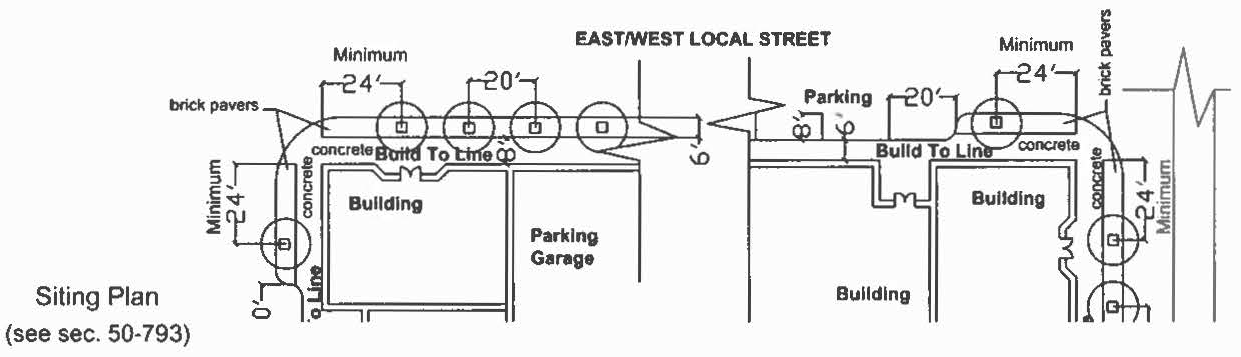
Site plan means the documents and drawings required by the zoning ordinance to ensure that a proposed land use or activity is in compliance with local ordinances and state and federal statutes. A site plan shall include one or more accurate drawings at a scale of at least one inch to 100 feet which covers at least one lot or parcel, that shows the boundaries of the lot or parcel, and specifies the: proposed use and occupancy; exact location and dimensions of structures; preliminary floor plans and elevations of buildings; pedestrian and vehicular circulation, parking and loading facilities; freestanding signs and exterior lighting; existing grades and contours, significant vegetation, wetlands, floodplains and other natural features; and a proposed schedule for development. A site plan shall also include surrounding existing conditions within 50 feet beyond the property lines so as to show existing grades and contours, vegetation, retaining walls, and other manmade and physical features. Other related data may be required when relevant to city's evaluation.
Sleeping unit means a room or space in which people sleep, which can also include permanent provisions for living, eating, and either sanitation or kitchen facilities but not both. Such rooms and spaces that are also part of a dwelling unit are not sleeping units.
Street wall means the main wall of a structure that is closest to and most nearly parallel with an adjacent street.
Solar energy systems means any equipment or structure used to harness radiant heat and/or light from the sun for heating, cooling, conversion to electricity.
(1)
Personal scale solar energy systems means any equipment or structure used to harness radiant heat and/or light from the sun for heating, cooling, conversion to electricity, or other similar purposes and which the system is an accessory use to the principal use of the site and where the sale and distribution of excess available energy is incidental to the primary use of the system.
(2)
Utility scale solar energy systems means a solar energy system or systems installed with its primary purpose being the sale of generated energy or excess energy for commercial sale, or its primary end user being a utility company.
State licensed residential facility means a structure conducted for residential purposes that is licensed by the state under the Adult Foster Care Facility Licensing Act, 1979 PA 218, MCL 400.701—400.737, or 1973 PA 116, MCL 722.111—722.128, and provides residential services for six or fewer persons under 24-hour supervision or care.
Story or story height. A story is the portion of a building included between the surface of any floor, and the surface of the floor next above it, or to the ceiling for the top floor. A half story is the space under a sloping roof which has the line of intersection of the roof decking and the wall face not more than three feet above the top floor level and in which not more than two-thirds of the floor area is finished for use. Story height is the number of stories in a building which are placed above the average finished grade along the façade of the building which faces the nearest public street. Basements which extend more than six feet above the average finished grade along the façade of the building which faces the nearest public street shall be considered as a story. Attic space, penthouses or similar structures used only for storage or mechanical purposes and rooftop gardens and recreational facilities provided for residents or employees of the building shall not be considered as a story. Story height shall not apply to multiple-level parking garages or to parking levels within multi-use structures; such structures shall comply with the building height limit, as stated in feet, for the district in which the structure is located.
Structure means anything constructed or erected, the use of which requires location on the ground or attachment to something having location on the ground. Structures include, but are not limited to, principal and accessory buildings, towers, decks, fences, privacy screens, walls, antennas, swimming pools, and signs.
Structural alterations means any change in the supporting members of a building, such as bearing walls, columns, beams, or girders, or any substantial changes in the roof or exterior walls.
Study area means the geographic area containing those critical arterial intersections (and connecting roadway segments) which are expected to be affected by the site-traffic generated by a development.
Temporary means less than 30 days.
Townhouse means one of a series of single-family dwelling units connected by common side walls, each with its own outside entrance and exit, and constructed as part of a series of dwellings, all of which are either attached to the adjacent dwelling or dwellings by party walls or are located immediately adjacent thereto with no visible separation between walls and roofs.
Traffic impact study means the analysis of the potential traffic impacts generated by a proposed project, and is subject to the requirements and procedures of section 50-105. This type of study and level of analysis will vary dependent upon the type and size of the project. The types of traffic impact studies:
(1)
Traffic impact rezoning study means a traffic study which typically contrasts the traffic impact associated with uses permitted under current zoning with uses permitted under the zoning district requested.
(2)
Traffic impact assessment means a traffic impact study for relatively low traffic generating uses which focuses on the impacts at proposed site access points.
(3)
Traffic impact statement means a traffic impact study which evaluates the impacts on roadways adjacent to the study site and specified nearby intersections.
(4)
Regional traffic analysis means a traffic impact study for very high traffic-generating uses. This type of study typically covers a large geographic area and may include traffic condition projections for up to a 20-year period.
Transparency means use of material that allows one to see into a building.
Trip/directional trip means a single or one-direction vehicle movement with either the origin or the destination (exiting or entering) inside a study site.
Trip generation rates means those trip generation rates and formulas for different land use categories provided in the most recent edition of Trip Generation published by the Institute of Transportation Engineers (ITE).
Type A dwelling/sleeping unit means a residential dwelling unit meeting the criteria for a type A design and construction requirements as specified in the Michigan Building Code.
Type B dwelling/sleeping unit means a residential dwelling unit meeting the criteria for a type B design and construction requirements as specified in the Michigan Building Code.
Unrelated persons means two or more persons not constituting a family as defined in section 50-6.
Utility scale solar systems means a collection of solar energy systems rated at 15 kWh or higher, installed with its primary purpose being the sale of generated energy for commercial sale or its primary end user being a utility company.
Wetland means land characterized by the presence of water at a frequency and duration sufficient to support, and that under normal circumstances does support, wetland vegetation or aquatic life and is commonly referred to as a bog, swamp or marsh. This term shall be considered with those defined in chapter 49 of this Code, wetland protection.
Wetland consultant shall mean a person(s) professionally knowledgeable in wetland delineation and resource value assessment, wetland protection, wetland restoration and wetland mitigation.
Wetland inventory map refers to the City of East Lansing Wetland Inventory Map completed to comply with Section 30308 of Act 451 and adopted by the city council on April 22, 2003, as may be amended in accordance with chapter 49 of this Code.
Wind energy system means any structure-mounted or tower-mounted device, such as a windmill or wind turbine, which is designed and used to convert wind power into a form of useful energy. Equipment needed to convert and transfer the power, such as generators, alternators, rotors, towers, and transformers, are included under this definition.
Wireless communications facilities means a broad range of telecommunication services that enables people on devices to communicate independent of location. This includes, but is not limited to, current technologies of cellular communications and personal communication services. This excludes public utilities, noncommercial antennas, radio and television signals and noncommercial satellite dishes.
Yard means an open space, unoccupied and unobstructed from the ground upwards, except as otherwise provided herein, and being on the same lot with a building. The measurement of a yard shall be construed as the minimum horizontal distance between the lot line and the building or structure.
(1)
A "required yard" is that portion of any lot on which the erection of a main building is prohibited.
(2)
A "front yard" is a yard on the same lot with a building between the front line of the building and the front lot line and extending from one side lot line to the other side lot line.
(3)
A "rear yard" is a yard on the same lot with a building between the rear line of the building and the rear lot line and extending from one side lot line to the other side lot line.
(4)
A "side yard" is a yard on the same lot with a building between the side lot line, including corner lot lines or corner side lot lines, and the nearest side line of the building and extending from the rear yard to the front yard.
(Code 1994, ch. 55, § 5.5; Ord. No. 970, pt. I, 4-3-2001; Ord. No. 1061, 2-7-2006; Ord. No. 1149, 9-5-2006; Ord. No. 1157, 11-8-2006; Ord. No. 1256, 1-15-2013; Ord. No. 1313, 3-4-2014; Ord. No. 1395, 12-5-2017; Ord. No. 1530, 5-21-2024; Ord. No. 1543, 7-15-2025)
Cross reference— Definitions generally, § 1-7.

