
East Palo Alto City Zoning Code
ARTICLE 1
- GENERAL PROVISIONS AND DEFINITIONS
18.02.010 - Title
This title, containing the City's zoning and subdivision regulations, shall be known as the "City of East Palo Alto Development Code" and referred to as the "Development Code."
18.02.020 - Purpose, Intent and Authority
A.
Purpose. The Development Code is intended to carry out the policies of the City of East Palo Alto General Plan. More specifically, the purpose of this Code is as follows:
1.
To guide, control, and regulate the future growth and development in the City of East Palo Alto;
2.
To protect the character and the social and economic stability of residential, commercial, industrial, and other private and public areas within the City, and to ensure the orderly and beneficial development of these areas;
3.
To prevent danger to public safety resulting from the locating of structures, and their use, and the use of land, adjacent to streets and highways which are a part of the Circulation Element of the General Plan, or which are important thoroughfares, in a manner which prevents interference with existing or prospective traffic movements on City streets and highways;
4.
To provide adequate air, light, privacy, and convenience of access to property, and to ensure safety from fire, inundation, and other dangers; and
5.
To prevent overcrowding the land and prevent undue congestion of population.
B.
Intent. It is the intent of the Development Code to promote the orderly development of the City; promote and protect the public health, safety, comfort, convenience, morals, peace, and general welfare; protect the character, social diversity, and economic vitality of neighborhoods; and ensure the beneficial development of the City.
C.
Authority. The Development Code is enacted based on the authority vested in the City of East Palo Alto and the State of California, including but not limited to the State Constitution, Planning and Zoning Law (California Government Code Section 65000 et seq.), Subdivision Map Act (California Government Code Section 66410 et seq.), California Environmental Quality Act (California Public Resources Code Section 21000 et seq.), and the California Health and Safety Code.
D.
City's Level of Compliance. The City shall endeavor to comply with the minimum requirements specified in the Development Code to the maximum extent possible.
18.02.030 - Relationship to Prior Ordinances
No provision of the Development Code shall validate or legalize any land use, structure, or subdivision constructed, created, established, or maintained in violation of the City's Zoning and Subdivision Codes as they existed before repeal by the ordinance enacting the Development Code, except as addressed by non-conformances created by the Development Code.
18.02.040 - Relationship to General Plan
The Development Code is the primary tool used by the City to implement the goals, policies, and actions of the General Plan and various specific plans. The Council intends that the Development Code be consistent with the General Plan and any applicable specific plan, and that any development, land use, or subdivision approved in compliance with the Development Code will also be consistent with the General Plan and any applicable specific plan. A proposed use is considered to be consistent with the General Plan and any applicable specific plan when all of the following conditions exist:
A.
Compatible. The proposed use is compatible with the description of the land use plan designation in which the use is located, as shown by the Land Use Plan Map, and as described in the text of the General Plan and any applicable specific plan;
B.
Conformance. The proposed use is in conformance with the actions, goals, policies, programs, and maps, and the intent of the General Plan and any applicable specific plan; and
C.
Consistent. The proposed use is to be established and maintained in a manner which is consistent with all elements of the General Plan and any applicable specific plan and all applicable provisions contained in these plans.
18.02.050 - Relationship to CEQA
When a project application filed in compliance with the provisions of the Development Code is determined to be subject to the provisions of the California Environmental Quality Act (CEQA), the application shall be reviewed for compliance with the provisions of the Development Code, the California Environmental Quality Act (CEQA - Public Resources Code, Section 21000 et seq.), the CEQA Guidelines (Title 14, California Code of Regulations, Section 15000 et seq.), and any environmental guidelines and other applicable rules adopted by the City.
18.02.060 - Relationship to Design Guidelines
Any design guidelines adopted by the City shall be considered complementary to the development and design standards specified in the Development Code. In the event of any conflict between adopted design guidelines and the provisions of the Development Code, the City retains the right to use the most restrictive design standard or interpretation.
18.02.070 - Effect of Development Code on Projects in Progress
The enactment of the Development Code, or the adoption of any subsequent amendment to the Development Code, may have the effect of imposing different standards on a land use than those that applied to existing development. In the absence of specific provisions in the adopting ordinance related to any grandfathering or other special conditions, the following provisions determine how requirements apply to a development project in progress at the time the Development Code or an amendment goes into effect.
A.
Application Complete. A planning permit application accepted by the Community Development Department as complete before the effective date of this Development Code or any amendment, shall conform to the requirements specified in the previously applicable law.
B.
Project Under Construction. A project for which a building permit has been issued under the provisions of earlier laws, and on which substantial construction has been performed by integration of materials on the site may be continued and completed in compliance with the plans and specifications upon which the permit was issued.
C.
Subdivision Maps. Subdivision maps shall be processed in compliance with the Subdivision Map Act (Government Code Section 66410 et seq.) and Article 5 (Subdivisions).
18.02.080 - Violation Constitutes a Public Nuisance
Any violation of any provision of the Development Code, as determined by the City Council, Planning Commission, Director of Community Development, or City Attorney, shall constitute a public nuisance.
18.02.090 - Severability
If any portion of the Development Code is held to be invalid, unconstitutional, or unenforceable by a court of competent jurisdiction, the determination shall not affect the validity of the remaining portions of the Development Code. The Council hereby declares that the Development Code and each article, chapter, section, subsection, paragraph, subparagraph, sentence, clause, phrase and portion thereof is adopted without regard to the fact that one or more portions of the Development Code may be declared invalid, unconstitutional, or unenforceable.
Title, chapter and section headings shall not be deemed to govern, limit, modify or in any manner affect the scope, meaning or intent of the provisions of any title, chapter or section.
18.04.010 - Purpose and Intent
The purpose of this chapter is to specify the authority and procedures for clarifying any ambiguity in the regulations of the Development Code, and to ensure its consistent interpretation and application.
18.04.020 - Rules of Interpretation
A.
Authority. The Director has the authority to interpret the provisions of the Development Code in compliance with this chapter. Whenever the Director determines that the meaning or applicability of a requirement is subject to interpretation, the Director shall issue a written interpretation. The Director may also refer any issue of interpretation to the Commission for a determination. A decision of the Director may be appealed to the Commission.
B.
Terminology. When used in this title, the following rules apply to all provisions of the Development Code:
1.
Language. The words "shall," "must," "will," "is to," and "are to" are always mandatory. "Should" is not mandatory but is strongly recommended; and "may" is permissive.
2.
Tense. The present tense includes the past and future tense, and the future tense includes the present.
3.
Number. The singular number includes the plural number, and the plural the singular, unless the natural construction of the sentence indicates otherwise.
4.
Calculations.
a.
Residential Density. When the number of dwelling units allowed on a site is calculated based on the minimum site area per dwelling unit, any fraction of a unit shall be rounded down to the next lowest whole number.
b.
Other Calculations. For all calculations other than residential density, the fractional/decimal results of calculations shall be rounded to the next highest whole number, unless otherwise specified.
5.
Conjunctions. "And" indicates all connected items or provisions shall apply. "Or" indicates the connected items or provisions may apply singly or in any combination. "Either…or" indicates the connected items and provisions shall apply singly but not in combination. "Includes" and "including" mean "including but not limited to".
6.
Local Reference. "City" means the City of East Palo Alto and all public officials, bodies, and agencies referenced in this Code are those of the City, unless otherwise stated.
7.
Definitions. As defined or as determined by the Director. The provisions of Civil Code Sections 13 and 1645 are adopted in the interpretation of words and phrases, unless otherwise provided.
C.
Number of Days. Whenever the number of days is specified in the Development Code, or in any permit, condition of approval, or notice issued or given, the number of days shall be construed as calendar days. When the last of the specified number of days falls on a weekend or City holiday, time limits shall extend to the end of the next working day.
D.
State Law Requirements. Where the Development Code refers to provisions of state laws, the references shall be interpreted to be to the applicable State law provisions as they may be amended from time to time.
E.
Minimum Requirements. When interpreting and applying the regulations of the Development Code, all provisions shall be considered to be minimum requirements, unless specifically stated otherwise.
18.04.030 - Procedures for Interpretation
A.
Authority of Director to Interpret; Referral to Commission. Whenever the Director determines that the meaning or applicability of any of the requirements of the Development Code is subject to interpretation generally, or as applied to a specific case, the Director may issue an official interpretation or refer the question to the Commission for determination.
B.
Request for Interpretation. Any party may file a request for an interpretation or determination with the Director and shall include with the request the specific provisions in question and any other information necessary to assist the Director in the review.
C.
Appeals. Any interpretation by the Director or Commission may be appealed.
18.04.040 - Uses Not Classified
Use Not Listed is Not Allowed. If a proposed use of land is not specifically listed either as permitted or conditionally permitted, the use is prohibited.
18.04.050 - Headings and Illustrations
A.
Headings. The headings of the chapters, sections, subsections, subparagraphs, and clauses of the Development Code, together with the accompanying illustrations, examples, and explanatory notes, are inserted as a matter of convenience and in no way define, limit, or enlarge the scope or meaning of the Code or its provisions.
B.
Illustrations. In case of a conflict between the Development Code text and any diagram, illustration, or image, the text shall control.
18.04.060 - Official Version of Development Code
Responsibility for Maintaining Official Version. The City Clerk shall maintain the official version of the Development Code. In the event the City Clerk maintains an online version, (an electronic version), and/or a printed (hard copy) version of the Development Code or contracts with an outside vendor to provide online public access, the printed (hard copy) version of the Development Code maintained by the City Clerk shall be the controlling legal authority. The City Clerk may provide an online version or an electronic version as a public service in order to enhance public access and interaction. A disclaimer should indicate the Development Code and related materials posted to, or linked from, the City's website are provided as a public service and may, from time to time, contain information not completely up-to-date.
18.06.010 - Purpose and Intent
This chapter establishes the zones applied to property located within the City and adopts the Official Zoning Map.
18.06.020 - Establishment of Zones
A.
General. The City is divided into zones to allow for orderly, planned development and to implement the General Plan and adopted Specific Plans. All zones shall be appropriately designated on the Official Zoning Map.
B.
Base Zones. Every parcel shall have a base zone that establishes the primary type and intensity of land use allowed, along with development regulations for that particular type and intensity of land use.
C.
Overlay/Combining Zones. An overlay/combining zone supplements the base zone for the purpose of establishing special use or development regulations for a particular area in addition to the provisions of the underlying base zone. In the event of conflict between the base zone regulations and the overlay/combining zone regulations, the City retains the right to use the most restrictive design standard or policy, except as otherwise provided in the General Plan or adopted Specific Plan.
D.
Effect of Establishment of Zones. Except as otherwise provided in the Development Code, no structure shall be erected and no existing structure shall be added to, altered, enlarged, or moved, nor shall any land, structure, or premises be used, designed, or intended to be used for any purpose or in any manner other than those uses specifically listed as allowed in the zone in which the structure, land, or premises is located. No land use shall be established unless it is a permitted use or conditional use.
18.06.030 - Zoning Map
The boundaries, designations, and locations of the zones established by the Development Code shall be shown upon the map(s) entitled "Zoning Map for the City of East Palo Alto" and referred to as the Zoning Map. Any additional maps adopted shall also be a part of the Development Code by reference. Changes in the boundaries of any identified zones shall be made by ordinance. The Development Code, together with the Zoning Map, is adopted in compliance with current State planning, zoning, and development laws.
18.06.040 - Rights-of-Way and Vacated Boundary Lines
Where a public street or alley is officially abandoned or vacated, the property encompassed by areas associated with the abandoned or vacated street or alley shall be included within the zone(s) of the adjoining properties. If the adjoining properties are in different zones, the boundary lines shall be the centerline of the former street or alley and the extension of the side yard lines of the abutting properties. In the event the street, alley, or right-of-way was a boundary between two or more different zones, the new zone or zone boundary shall be the property line created by the abandonment or vacation.
18.06.050 - Uncertainty of Boundaries
If there is uncertainty about the location of a zone boundary shown on the Zoning Map, the Director shall determine the precise location of the boundary in the following manner:
A.
Where a zone or area boundary approximately follows a parcel line, street line, or alley line, the parcel line, street centerline, or alley centerline shall be construed as the zone boundary.
B.
Where a zone or area boundary divides a parcel and the boundary line location is not specified by distances indicated on the subject map, the location of the boundary shall be determined by using the scale appearing on the map.
18.06.060 - Classification of Annexed Lands
A.
Any land annexed to the City of East Palo Alto shall be deemed to be zoned to a classification most nearly the equivalent zoning classification in the County.
B.
Whenever it is determined the zoning of annexed lands is inconsistent with adopted General Plan land use policy or other City policies, the Commission may recommend and the Council may adopt the zone classification(s) which shall apply to the annexed lands.
18.08.010 - General
A.
This chapter provides definitions of the technical and other terms and phrases used in the Development Code. Where any definition conflicts with definitions in other titles of the East Palo Alto Municipal Code, these definitions shall prevail for the purposes of the Development Code. If a word is not defined, the most common dictionary definition is presumed to be correct.
B.
In addition to the definitions provided in this chapter, definitions for signs, definitions for adult business uses, subdivisions and affordable housing, are contained in the chapters pertaining to those uses, as are occasional other specific circumstances definitions.
"A" Definitions
Abutting. Having a common border with or contiguous to. For example, two parcels with a common property line are considered to be abutting. See also "Adjacent."
Access. The place or way by which pedestrians and vehicles have safe, adequate, and suitable ingress and egress to a property or use.
Accessory Dwelling Unit (ADU). Accessory Dwelling Unit or ADU means an attached or detached residential dwelling unit providing complete independent living facilities for one or more persons containing permanent provisions for living, sleeping, eating, cooking, and sanitation facilities which are defined as a full bathroom (tub/shower, sink, and a toilet). An ADU also includes an efficiency unit, as defined in Health and Safety Code Section 17958.1 and a manufactured home, as defined in Health and Safety Code Section 18007.
Accessory Structures and Uses.
Accessory Structures. A subordinate structure, the use of which is appropriate, subordinate, and customarily incidental to that of the main structure or to the main use of the land, and which is located on the same parcel with the main structure or use.
Nonresidential. An attached or detached structure that is a part of, and clearly incidental and secondary to, a nonresidential structure and which does not change the character of the nonresidential structure. Illustrative examples include:
Residential. An attached or detached structure which is a part of, and clearly incidental and secondary to, a residence and which does not change the character of the residential structure. Does not include Second/Accessory Dwelling Units or Guest Houses. Illustrative examples include:
Accessory Uses. A use incidental and accessory to the principal use of a parcel or a structure located upon the same parcel as the principal use.
Nonresidential. A use that is at all times a part of, and clearly incidental and secondary to, a principal use; which does not change the character of the nonresidential use; and does not necessitate an increase in required number of parking spaces. Includes the retail sales of various products or the provision of services in a defined area located within a health care, hotel, office, or industrial complex for the purpose of serving employees or customers; typically not visible from public streets. Does not include Accessory Alcohol Sales, Off-Site or On-Site Alcohol Sales. Illustrative examples include:
• ATMs
• child day care
• dry cleaning (collection/pick-up only)
• food service establishments
• gift shops
• newsstands
• pharmacies
• travel services
• vending machines
• personal service, general
Residential. A use which is a part of, and clearly incidental and secondary to, a residence; located on the same parcel as a residence; and which does not change the character of the residential use. Illustrative examples include:
• home occupations
• personal property sales (i.e., garage or yard sales)
Act. California Government Code Sections 66410 et seq., also known as the Subdivision Map Act.
Adjacent. The condition of being near to or close to but not necessarily having a common dividing line. Two parcels that are separated by a street or alley shall be considered as adjacent to one another. See also "Abutting."
Administrative Use Permits. A type of discretionary permit that allows any use which requires a special degree of review or control because of characteristics peculiar to it, or because of size, technological processes, or type of equipment, or because of the proposed site location with respect to surroundings, streets and existing improvements or demands upon public facilities. The additional control is to ensure the particular use on the particular proposed site is compatible with other existing or allowed uses surrounding the site.
Adult Day Care.
Adult Day Care, Small (8 or fewer adults). Day care facility located in a single-unit dwelling where an occupant of the dwelling provides care and supervision for 8 or fewer adults.
Adult Day Care, Large (9 to 14 adults). Day care facility located in a single-unit dwelling where an occupant of the dwelling provides care and supervision for 9 to 14 adults.
Adults - 15 or more. See "Day Care, General" for facilities serving 15 or more adults.
Adult Oriented Businesses. A use type that includes the following:
• Any business conducted for the entertainment of adults, engaged in the selling, renting, or displaying of publications depicting the specified anatomical areas or specified sexual activities or other material of a sexually explicit nature;
• Any business which, as a substantial or significant course of conduct, sells, offers for sale, rents, exhibits, shows, or displays publications depicting the specified anatomical areas or specified sexual activities or other material of a sexually explicit nature;
• Any business selling, renting, or displaying sexually oriented devices intended for use in the specified sexual activities;
• Any business conducted for the entertainment of adults wherein an employee, patron, or any other person engages in or is shown the specified sexual activities or exhibits or engages in partial or total nudity or otherwise exposes the specified anatomical areas; or
• Any business which, as a substantial or significant portion of its business, provides live or filmed entertainment wherein the specified anatomical areas are exposed.
Advertising Structure/Sign. A structure of any kind or character erected or maintained for outdoor advertising purposes, upon which any bill, poster, printing, painting, or other advertisement of any kind whatsoever may be placed, including statuary, for advertising purposes. Advertising Structure/Sign does not include:
1.
Official notices issued by any court or public body or officers;
2.
Notices posted by any public officer, in performance of a public duty or by any person in giving legal notice; and
3.
Directional, warning, or information structures required by or authorized by law or by governmental authority.
Advisory Agency. City staff member or policy-making or review authority responsible for acting on an application.
Airport. Any area of land or water which is used or intended for use for the landing and taking off of aircraft, and any appurtenant areas which are used or intended for use for airport structures or other airport facilities or rights-of-way together with all airport structures and facilities located on the land.
Alcohol Sales.
Alcohol Sales (off-site-sale). Any establishment that sells, serves, or gives away alcoholic beverages for consumption off the premises and that is applying for or has obtained an ABC License Type 20 (off-sale beer and wine-package store) or License Type 21 (off-sale general-package store). The establishment shall include any immediately adjacent area owned, leased, rented, or controlled by the licensee. Does not include an establishment selling alcoholic beverages as an accessory line of merchandise.
Alcohol Sales (on-site-sale). An establishment that has all of the following characteristics:
1.
Alcoholic beverages will be or are sold, served, or given away for consumption on the premises where sold, served, or given away;
2.
The establishment is applying for or has obtained an appropriate ABC License; and
3.
The sale of alcoholic beverages is accessory to the retail sale of food products and the display area for alcoholic beverages does not exceed 30 percent of the net floor area of the use. Illustrative examples include drug stores, grocery stores, and supermarkets, but do not include convenience markets.
Alley. A public or private thoroughfare or lane (generally not more than 30 feet wide) that affords only a secondary means of access to abutting property.
Allowed Use. A use of land identified as a permitted or conditional permitted use that may be established subject to compliance with applicable provisions.
Alter. To make any change in any of the supporting members of a structure (i.e., bearing walls, columns, beams, or girders), or to make any change or addition for which a building permit is required.
Alteration. Any change, addition, or modification in construction or occupancy of an existing structure.
Alteration, Structural. Any change in or replacement to the supporting members of a structure (e.g., bearing walls, columns, beams or girders, etc.).
Alternative Energy.
Solar Collector. A device or combination of devices, structure, or part of a device or structure which transforms direct solar energy into thermal, chemical, or electrical energy and contributes significantly to a structure's energy supply.
Solar Photovoltaic Energy System. (1) A design using natural and architectural features to cool or heat a structure, or (2) a mechanical assembly that may include a solar collector, storage facility, and any other components needed to cool or heat a structure.
Windmill. A tower and propeller assembly used to transform wind energy into mechanical energy for generating electricity or pumping water.
Windmill Energy System. Any mechanism or device designed for the purpose of converting wind energy into electrical or mechanical power (e.g., windmills, wind turbines, etc.).
Amendment. A change in the wording, context, or substance of the Development Code, or a change in the zone boundaries upon the Official Zoning Map.
Animal Keeping.
Animal, Domestic Farm. An animal, other than a domestic pet, customarily considered to be livestock and kept for noncommercial education or recreation purposes (e.g., fowl, goats, pigs, sheep, horses, cattle, etc). Does not include pot-bellied pigs.
Animal, Domestic Pet. A type of animal customarily kept by humans for companionship that lives in or near human habitation (e.g., cats, dogs, gerbils, hamsters, guinea pigs, rabbits, nonpoisonous reptiles and snakes, etc.). Includes pot-bellied pigs.
Animal, Wild. An animal not customarily confined or cultivated by man for domestic or commercial purposes but kept for display. Includes any animal which may be imported, transported, or possessed only after first obtaining a permit from the California Department of Fish and Wildlife.
Animal Sales and Services.
Animal Boarding/Kennels. An establishment where more than three dogs over the age of four months, three cats over the age of four months, or three other animals are treated, conditioned, boarded, raised, or offered for sale for any form of compensation including donations by a person or entity.
Animal Grooming. An establishment that bathes, clips, or combs animals for the purpose of enhancing their aesthetic value or health.
Animal Retail Sales. Retail sales and boarding of animals offered for sale.
Veterinary Services. An establishment where veterinarians provide medical and surgical treatment to animals and accessory boarding services.
Annex/Annexation. To incorporate a land area into an existing district or municipality, with a resulting change in the boundaries of the annexing jurisdiction.
Antenna. A device used to transmit and/or receive radio or electromagnetic waves between earth and/or satellite-based systems. An antenna may be directional, bidirectional or omnidirectional.
Amateur Radio Antennas. An antenna used for the purpose of transmitting and receiving radio signals in conjunction with an amateur radio station licensed by the Federal Communications Commission.
Antenna Structure. A supporting mast or tower for an antenna.
Mast. A pole of wood or metal used to support an amateur radio antenna and maintain it at the proper elevation.
Satellite Dish Antenna. A parabolic and/or disk shaped antenna of either solid or mesh construction, intended for the purposes of receiving communications from an orbiting satellite, transceiving or transmitting signals or communications to a satellite, as well as supporting equipment necessary to install or mount the antenna.
Whip Antenna. An antenna, consisting of a single, slender, rod-like element less than one wavelength long, supported only at or near its base.
Arcade (Also known as Electronic Game Center and Electronic Amusement Devices). Any establishment that provides six or more amusement devices, whether or not the devices constitute the primary use or an accessory or incidental use of the premises. Any electronic machine, device, contrivance apparatus or mechanism which, upon insertion of any card, coin, plate, disk, slug, or key into any sparkle, receptacle, crevice or other opening, or by the payment of any fee(s) operates or may be operated as a game or contest of skill or amusement of any description and that makes no provision for the return of money, and the use or possession of which is not prohibited by any state or local laws. Does not include billiard/pool tables. May also include internet/cyber cafes, where three or more computers and/or other electronic devices, for access to the "internet," e-mail, playing video games and/or access to other computer programs is provided to the public for compensation and/or for public access. Internet cafe is also synonymous with PC cafe, cyber cafe, internet gaming center, computer/internet rental and cyber centers.
Architectural Feature. Exterior architectural element attached to a structure not providing floor area. Architectural features include belt courses, buttresses, chimneys, cornices, eaves, fireplaces, pilasters, pillars, sills, and window seats. Architectural features do not include awnings, fences, railings, porticos, porches, colonnades, covered parking areas and driveways, balconies, terraces, decks, open stairways, elevated walkways, exterior pipes, signs, mechanical equipment, walls, and covered patios.
Area, Gross. The total area of a parcel, including those areas that cannot be built upon (e.g., dedicated or proposed street rights-of-way and other improvements (i.e., parks, open space, stormwater detention and retention facilities, etc.). "Gross area" is expressed in either acres or square feet.
Area, Net. The portion of a parcel for residential or nonresidential development which can be built upon, excluding dedicated or proposed street rights-of-way and other improvements (i.e., parks, open space, stormwater detention and retention facilities, etc.). "Net area" is expressed in either acres or square feet.
Artisan Shop. A retail store where art glass, ceramics, jewelry, and other art and handcrafted items are sold. The store may include an accessory area for the crafting of the items being sold. Does not include handicraft industries.
Artists' Studios. Work space for artists and artisans, including individuals practicing the fine arts, or skilled in an applied art or craft, and producing custom-made works. Does not include handicraft industries.
Attached Housing. A residential project, or part thereof, in which each dwelling unit has one or more exterior walls in common with or attached to a wall of another dwelling unit.
Attic. The area located between the top plate of the uppermost habitable floor and the roof or ridge of a structure, as further defined in the California Building Code (CBC).
Automated Teller Machines (ATMs). An automated device used by the public to conduct banking and financial transactions electronically. Does not include retail point-of-sale transactions within a fully enclosed structure.
Awning. A sheet of canvas or other material stretched on a frame and used to keep the sun or rain off a storefront, window, doorway, or deck.
"B" Definitions
Balcony. A projecting platform on a structure, sometimes supported from below, sometimes cantilevered; enclosed with a railing or low wall.
Bar. Any structure, or any portion of a structure, or any premises or place where alcoholic beverages are sold, given, delivered, or consumed, or allowed to be sold, given, delivered, or consumed in compliance with the provisions of the Business and Professions Code. See "Eating and Drinking Establishments."
Basement. A space in a structure that is partly or wholly below grade and where the vertical distance from grade to a finished floor directly above such space is less than or equal to forty-two inches. If the finished floor directly above the space is more than forty-two inches above grade at any point along the perimeter, such space shall be considered a story, and the entire space shall be included in the calculation of floor area. This requirement applies to all lots.
Bay Window. A large window or series of windows projecting from the outer wall of a structure and forming a recess within. Some bay windows may have window seats.
Bedroom. An enclosed space in a structure designed to be used for sleeping purposes which meets the room dimension requirements of the most recent edition of the California Building Code (CBC), not accessed directly from the garage, and with one or more windows.
Berm. A raised earthen area.
Best Management Practices (BMPs). Methods or techniques found to be the most effective and practical means in achieving an objective, such as preventing or minimizing pollution. A BMP can be a structural "thing" or a ""process" or "practice". BMPs include but are not limited to treatment requirements, operating procedures, and practices to control site runoff, spillage or leaks, sludge or waste disposal, or drainage from raw material storage.
Bicycle Parking Space. An area equipped with a bicycle rack or bicycle storage locker for the purpose of parking and securing bicycles.
Block. All property fronting upon one side of a street between intersecting and intercepting streets, or between a street and right-of-way, water way, end of dead-end street or City boundary. An intercepting street shall determine only the boundary of the block on the side of the street which it intercepts.
Boarding or Rooming House. A residence or dwelling unit, or part thereof, where a room or rooms are rented under two or more separate written or oral rental agreements, leases or subleases, or combination thereof, whether or not the owner, agent, or rental manager resides within the residence.
Breezeway. A structure with a roof and open sides connecting two structures. A breezeway is considered part of the primary structure for the purpose of determining setbacks and floor area.
Building. A structure with a roof and walls used as a placed for people to live, work engage in activities, store things, etc.
Building Envelope. The ground area of a parcel which is defined by the minimum setback requirements within which construction of a principal structure and any attached accessory structures is allowed. See "Setback."
Building Official. The Building Official of the City of East Palo Alto, or authorized designee(s).
Building Permit. A full structural building permit as well as partial permits (e.g., foundation-only permits.
Bulk Storage Plants for Petroleum Gas. An establishment where petroleum gas products are stored for sale to a retailer or end user.
Business. The purchase, sale, or other transaction involving handling or disposition (other than assembly manufacture, reduction, or destruction) of any article, substance, commodity or service for profit or livelihood including, office buildings, offices, garages, laundries, lumber yards, outdoor advertising signs, and outdoor advertising structures, recreational and amusement enterprises conducted for profit, but not including junk yards.
"C" Definitions
Calendar Day. A 24-hour time period measured from midnight to midnight.
California Environmental Quality Act (CEQA). Public Resources Code Section 21000 et seq. which requires state, regional, county, and local agencies to conduct environmental review for any discretionary activity proposed to be carried out or approved by those agencies.
Canopy or Canopy Structure. A sheet of flexible material, fabric, or membrane (i.e., nylon, plastic, or other similar material) supported by or attached to a frame having a location on the ground and made of fiberglass, metal, wood, or plastic or any other similar material, and generally used for the shielding or protection of vehicles or other equipment stored outside. Canopy structures include, but are not limited to, prefabricated canopies ready-made for simple assembly and canopies which are built, constructed, or composed of parts joined together in some definite manner. Does not include awnings attached to structures.
Card Room. Any structure, or any portion of a structure, or any premises where the lawful playing of cards is allowed, regardless of whether the tables, chairs, and other furniture and fixtures are temporary or permanent, or whether the premises are at times used for other purposes.
Carport. A permanent roofed structure, not completely enclosed, used for covered motor vehicle parking.
Carwash. See "Vehicle/Equipment Services".
Catering Services. A facility for the preparation and storage of food and food utensils for off-premises consumption and service.
Cellar. See "Basement."
Certificate of Compliance; Conditional Certificate of Compliance. A document issued by the City and recorded by the County Recorder certifying a specified real property complies with the provisions of the Subdivision Map Act and this Code. A Conditional Certificate of Compliance includes any conditions the City may impose upon the granting of the certificate requiring specified terms be complied with before the subsequent issuance of a permit or other grant of approval for development of the property.
Charitable Organizations and Institutions. A not-for-profit group, association or corporation, or any organization legally recognized as a charitable organization pursuant to 26 U.S. Code Section 501(c)(3).
Child Day Care.
Small (eight or fewer). A day care facility located in a dwelling where an occupant of the dwelling provides care and supervision for 8 or fewer children. Children under the age of 10 years who reside in the dwelling count as children served by the day care facility.
Large (9 to 14). A day care facility located in a dwelling where an occupant of the dwelling provides care and supervision for 9 to 14 children. Children under the age of 10 years who reside in the dwelling count as children served by the day care facility.
Children - 15 or more. See "Day Care, General" for facilities serving 15 or more children.
Cooperative. Any cooperative arrangement between parents for the care of their children which satisfies all of the conditions specified in Health and Safety Code Section 1596.792(e), and is exempt from regulation under Chapter 3.5 (commencing with Section 1596.90) and Chapter 3.6 (commencing with Section 1597.30).
Chimney. A primary vertical structure containing one or more flues, for the purpose of carrying gaseous products of combustion and air from a fuel-burning appliance to the outside atmosphere.
City. The City of East Palo Alto.
City Boundary. The limits of incorporation of the City of East Palo Alto.
City Engineer. The City Engineer of the City of East Palo Alto, or authorized designee(s).
City Manager. The City Manager of the City of East Palo Alto or authorized designee(s).
Clubs. Any structure, or any portion of a structure, or any premises or place, occupied by a group of associated persons or an organization organized for charitable, fraternal, professional, service, social, or trade purposes.
Colleges. An educational institution offering advanced instruction in any academic field beyond the secondary level, not including trade schools or business colleges.
Commercial Recreation and Entertainment. An establishment where entertainment is provided for a fee (admission or membership) for the pleasure of the patrons, either independent of or in conjunction with another use. Does not include "Adult Oriented Businesses" or "Bars, Lounges, and Nightclubs." Illustrative examples include:
Commercial Use. Any retail or wholesale business providing goods or services to the public for remuneration.
Commission. The City of East Palo Alto Planning Commission.
Communication Facilities. An establishment that provides commercial and public communications services with facilities contained entirely within structures. Does not include transmission and receiving apparatus, including antennas and towers.
Community Benefits. Specific amenities or mitigations provided by a developer. Community benefits may be physical, such as the provision of indoor or outdoor public facilities (conference center, library, theater, park, stadium, or other similar amenities) or a facility in which health care, child care, educational, cultural or social services are provided. Community benefits may be other than physical and include items such as financial support for job training, targeted job opportunities, environmentally beneficial changes in operations, provision of free or subsidized space. Community benefits may also include infrastructure, new facilities, employment opportunities for residents, income restricted affordable housing, local serving retail and other benefits as defined by the City Council.
Community Garden. A site used for growing plants for flowers, fiber, food, herbs, and others, which is shared and maintained by community residents.
Community Impact Report. A document compiled by a developer that assesses the fiscal (costs and benefits), employment (jobs created or eliminated), housing (impact on need for both affordable and market-rate housing, as well as whether units will be created or eliminated, and any displacement of current residents), neighborhood needs (increase or decrease demands for services) and smart-growth (livability and public transit) impacts of a proposed project. All community impact reports shall satisfy the requirements of Westside Area Plan Policies 5.2 and 5.5 as they relate to increases of intensity or change of use for development projects.
Conditional Use. A use of land identified as being allowed in a particular zone subject to the approval of a Conditional Use Permit.
Conditional Use Permits. A type of discretionary permit that allows any use which requires a special degree of review or control because of characteristics peculiar to it, or which because of size, technological processes or type of equipment, or because of the proposed site location with respect to surroundings, streets and existing improvements or demands upon public facilities., The additional control is to ensure the proposed particular use on a particular site is compatible with other existing or allowed uses surrounding the site.
Condominium. A structure or group of structures, in which units are owned individually, and the structure, common areas, and facilities are owned by all the owners on a proportional, undivided basis. Includes development in which the individual owns land directly below the "footprint" of a unit, and all other land within the project is owned in common. Includes a condominium project, community apartment project, or stock cooperative, as defined in Civil Code Section 1351.
Condominium Project. The entire parcel of real property proposed to be used or divided, as land or airspace, into two or more units as a condominium.
Condominium Unit. The particular area of land or airspace designed, intended, or used for exclusive possession or control of individual owners or occupiers.
Congregate Care Homes. Age-segregated housing built specifically for the disabled or elderly that provides services to its residents, the minimum of which is usually an on-site meal program, but which may also include housekeeping, laundry, social activities, counseling, and transportation (sometimes referred to as "assisted living facilities"). Does not include "Convalescent Facilities."
Contour. A line drawn on a contour map or plan connecting points of equal elevation.
Contour grading. A grading technique designed to result in earth forms that resemble natural terrain characteristics. Horizontal and vertical curve variations are often used for slope banks. Contour grading does not necessarily minimize the amount of cut and fill.
Convalescent Facilities. An establishment providing care on a 24-hour basis for persons requiring regular medical attention. Does not include facilities providing emergency medical services or surgical services.
Conversion of Residential Structures. The use of residential structures converted for combined residential and nonresidential use or converted for solely nonresidential use.
Cornice. An ornamental molding representing the uppermost horizontal molded projection or other uppermost horizontal element located at the top of a structure or portion of a structure.
Council. The City Council of the City of East Palo Alto.
Coverage.
Impervious Surface Coverage. The area of a parcel covered by structure(s) and other impervious surface(s), expressed as a percentage of the total parcel area.
Lot or Site Coverage.
Single-family residential use. The total land area within a site that is covered by buildings, including all projections except the exterior or outermost four feet of any eave or roof overhang, but excluding ground level paving, landscaping features, and open recreational facilities, such as hot tubs and pools.
All uses other than single-family residential. The total land area within a site that is covered by buildings, excluding parking garages, all projections, ground level paving, landscaping features, and open recreational facilities such as hot tubs and pools.
Structure Coverage. The area of a parcel covered by a structure or structures, expressed as a percentage of the total parcel area.
Cul-de-sac. A road or street that is not a through road or street, open at one end for ingress and egress. At the end of a cul-de-sac is a special provision or area for vehicles to turn around (generally a circular area which may or may not have a center curb area).
Cultural Institutions. A public or private institution such as a library or museum displaying or preserving objects of community or cultural interest in one or more of the arts or sciences, or a performing arts center or youth center.
Curbline. The line of the face of the curb nearest to the street or roadway, including the extension of the line across a drive approach or other break in the curb.
Cut. Earth material removed by artificial means (i.e., excavation or any other method), or the act of removing the material.
"D" Definitions
Dance Academies and Halls. An establishment where patrons come to dance, and/or learn to dance, to live or recorded music or simply enjoy entertainment performed by live entertainers.
Day. Unless otherwise specified, a calendar day.
Day Care, General. An establishment providing nonmedical care for persons on less than a 24-hour basis, including nursery schools, preschools, and day care centers for children or adults.
Deck. Any unroofed patio, balcony, terrace, gallery, veranda, piazza, porch, portico or similar projection from an outer wall of a structure, other than a carport, over 18 inches above grade. A deck includes any associated stairs. A deck shall have no enclosure, other than the side(s) of the principal structure to which it is attached; provided, however, a deck may have a railing or wall that complies with California Building Code (CBC) requirements.
Dedication. The grant of real property for public use.
Demolition. The intentional destruction and removal of 50 percent or more of the enclosing exterior walls and 50 percent of the roof of any existing structure.
Density. The number of dwelling units per net unit of land; usually density is expressed "units per acre (du/acre)," or "minimum land area per unit." The density of a development of 100 units occupying 20 acres is five units per acre or 5 du/acre.
Department. The Community and Economic Development Department responsible for administering the Development Code.
Design Guidelines. Any of the City of East Palo Alto's adopted design guidelines.
Detached Housing. A residential project, or part thereof, In which each dwelling unit has no exterior wall with or attached to another dwelling unit.
Developer. Any association, corporation, firm, joint venture, partnership, person, or any entity or combination of entities seeking City permits or approvals for all or part of a development.
Development Agreement. An agreement entered into between the City and a developer allowed by Government Code Section 65864.
Development Permit. Any permit that requires approval from the Community and Economic Development Department, including but not limited to: grading, drainage, tree, fence, design review, tentative or final maps or tenant improvements.
Director. The Director of the Community and Economic Development Department of the City of East Palo Alto, or authorized designee(s).
Disability or Handicap. Physical or mental impairment that substantially limits one or more of a person's major life activities, or a record of having an impairment, but not including current, illegal use of, or an addiction to, a controlled substance.
Discretionary Approval. Any required entitlement or approval which is not automatic and which can be made subject to conditions.
Drive-Through or Drive-In Facilities. An establishment selling products or providing services to occupants in vehicles, including drive-through windows and drive-in services. Examples include fast-food restaurants, banks, and pharmacies. Does not include "click and collect" facilities in which an online order is picked up in a stationary retail business without use of a drive-in service.
Driveway. An improved area providing vehicle access from a public right-of-way to a parking area or garage.
Dry Cleaning Establishments (Retail Only). A place of business equipped to perform the service of dry cleaning as defined in the California Business and Professions Code. It may include a dry cleaning agency, a retail or wholesale dry cleaning plant, and self-service or coin operated dry cleaning.
Dwelling Unit. An area within a structure on a parcel that:
1.
Contains separate or independent living facilities for one or more persons, with area or equipment for sleeping, sanitation and food preparation, and with independent exterior access to ground level.
2.
If located on multiple levels, the unit provide interior connections from a common living area.
Facilities for food preparation. A room or part of a room used, intended, or designed to be used for cooking or the preparation of food and legally permitted for such use. Does not include a bar or pantry. Only one kitchen is allowed per dwelling unit.
Independent access. An arrangement of dwelling units so that each dwelling unit has an entrance directly into the unit separate from the entrance into another unit.
"E" Definitions
Easement. A grant of one or more of property rights by the property owner to and/or for the use by the public, a corporation, or another person or entity.
Eating and Drinking Establishments.
Accessory Food Service. A type of food service establishment that:
1.
Sells food and/or beverages as an accessory use in a retail, office, or institutional structure;
2.
Does not change the character of the principal use;
3.
Does not sell, serve, or give away alcoholic beverage;
4.
Does not have an entrance separate from the principal use; and
5.
Has hours of operation that are the same as those of the principal use.
Bar, Lounge, and Nightclub. An establishment selling or serving alcoholic beverages for consumption on the premises and holding or applying for a public premises license from the California State Department of Alcoholic Beverage Control (ABC). Persons under 21 years of age are not allowed to enter and remain on the premises. The establishment includes any immediately adjacent area that is owned, leased, rented, or controlled by the licensee.
Fast-Food. An establishment whose design or principal method of operation includes four or more of the following characteristics:
1.
A permanent menu is provided from which to select and order food;
2.
Belongs to or is part of a chain or is operated as a franchise restaurant;
3.
Customers pay for food before consuming it;
4.
A self-service condiment bar and/or drink service is/are provided;
5.
Trash receptacles are provided for self-service bussing; and
6.
Furnishing plan indicates stationary seating arrangements.
A fast-food establishment may or may not have late hour operations. Alcoholic beverages are not sold, served, or given away on the premises. If alcoholic beverages are sold, served, or given away on the premises, the use shall be considered a food service use.
Food Service (No Late Hours). An establishment selling food and beverages, including alcoholic beverages, prepared for primarily on-site consumption, with all of the following characteristics:
1.
Establishment does not have late hour operations;
2.
Customers order food and beverages from individual menus;
3.
Food and beverages are served to the customer at a fixed location (i.e., booth, counter, or table); and
4.
Customers pay for food and beverages after service and/or consumption.
Food Service (Late Hours). An establishment selling food and beverages, including alcoholic beverages, prepared for primarily on-site consumption, with all of the following characteristics:
1.
Establishment has late hour operations;
2.
Customers order food and beverages from individual menus;
3.
Food and beverages are served to the customer at a fixed location (i.e., booth, counter, or table); and
4.
Customers pay for food and beverages after service and/or consumption.
Outdoor Dining, Accessory. An outdoor dining area contiguous and accessory to a food service establishment.
Take-Out Service, Limited. An establishment selling food or beverages with all of the following characteristics:
1.
Sales are primarily for off-site consumption;
2.
Customers order and pay for food at either a counter or service window;
3.
Incidental seating up to 6 seats may be provided for on-site consumption of food or beverages; and
4.
Alcoholic beverages are not sold, served, or given away on the premises.
Typical uses include bakeries, candy, coffee, nut and confectionery stores, ice cream and frozen dessert stores, small delicatessens, and similar establishments.
Take-Out Service Only. An establishment offering a limited variety of food or beverages and with all of following characteristics:
1.
Sales are exclusively for off-site consumption;
2.
Seating is not provided for on-site consumption of food or beverages; and
3.
Alcoholic beverages are not sold, served, or given away on the premises.
Eave. The extension of a roof beyond an exterior wall, with no enclosed area underneath it.
Electronic Amusement Devices. See "Arcade."
Electronic Amusement Devices, Accessory. Up to five amusement devices where the games are accessory to another principal use. Does not include "Arcades."
Emergency Health Care Facilities/Urgent Care. Establishments providing emergency medical service (i.e., outside normal physician office hours or before a physician appointment is available) with no provision for overnight or continuing care on an inpatient basis. Includes walk-in clinics. Does not include hospitals.
Emergency Shelters. Housing with minimal supportive services for homeless persons limited to occupancy of 180 days or less by a homeless person, in compliance with Health and Safety Code Section 50801(e) and Government Code Sections 65583 and 65589.5.
Enclosed. A structure surrounded by walls on all sides.
Environmental Analysis. An analysis conducted in compliance with the provisions of the California Environmental Quality Act (CEQA), Public Resources Code Section 21000 et seq.
Establishment. Any business.
"F" Definitions
Façade. The portion of any exterior elevation of a structure from grade to the top of the roofline and extending the width of the structure.
Fair Housing Laws. 42 United States Code Section 3604(f)(3)(B) and Government Code Sections 12927c(1) and 12955(1), as amended from time to time.
Family. One or more persons occupying a premises and living as a single nonprofit housekeeping unit as distinguished from persons occupying a club, fraternity, hotel, or sorority house. A family shall be deemed to include necessary servants.
Family Care Facility. A structure or portion of a structure designed or used for the purpose of providing 24 hours per day, non-medical residential living accommodations in exchange for the payment of money or other consideration, where the duration of tenancy is determined in whole or in part, by the individual resident's participation in group or individual activities (i.e., counseling, recovery planning, medical or therapeutic assistance).
FAR. See Floor Area Ratio.
Fence. A structure, solid or otherwise, 18 inches or more in height, the purpose of which is to either partially or totally define parcel boundaries, create or define portions of yards, or secure private areas. Does not include "Hedge."
Fill. Earth material placed by artificial means any other form of activity or the act of placing the material.
Financial Institutions and Related Services.
Chartered Financial Institutions. Establishments that solicit, receive, or accept money or its equivalent on deposit and loan money as a regular business. Typical examples include federal or state-regulated banks, savings and loan associations, savings banks, credit unions, and lending establishments, with or without automatic teller machines (ATMs) as an accessory use. Does not include accounting, financial investment, mortgage broker, or similar offices.
Non-Chartered Financial Institutions. Establishments, other than state or federally chartered bank, credit union, mortgage lender, or savings and loan association, that offer deferred deposit transaction services or check cashing services and loans for payment of a percentage fee. Specifically included in the term "non-chartered financial institutions" are deferred deposit transaction (payday loan) businesses that make loans upon assignment of wages received, check cashing businesses that charge a percentage fee for cashing a check or negotiable instrument, and motor vehicle title lenders who offer a short-term loan secured by the title to a motor vehicle. Non-profit financial institutions are not encompassed by the term non-chartered financial institution.
Fire Chief. The Fire Chief of the Menlo Park Fire Protection District which provides fire inspection and protection services to the City of East Palo Alto, or authorized designee(s).
Fire Escape. A form of egress for emergency purpose, typically a set of stairs located on the exterior of a structure.
Fireplace. An assembly consisting of a hearth and fire chamber of noncombustible material and provided with a chimney, for use with solid or gaseous fuels.
Flag. Any fabric, banner, or bunting containing distinctive colors, patterns, or symbols, used as a symbol of a government, political subdivision, or other entity.
Flatwork. Where the ground is covered with non-structural concrete, asphalt, or any material that creates an impervious surface.
Flood Hazard. A potential danger to life, land, or improvements due to inundation or stormwater runoff having sufficient velocity to transport or deposit debris, scour the surface soil, dislodge or damage structures, or erode the banks of watercourses.
Floor Area. The area in square feet confined within the exterior walls of a Building, but not including the area of the following: exterior walls, stairways, shafts, rooms housing building-operating equipment or machinery, parking areas with associated driveways and ramps, space allocated to bicycle parking, and basement storage areas.
Floor Area Ratio (FAR). The floor area allowed on a site divided by the total gross area of the site, expressed in decimals. For example, on a site with 10,000 gross square feet of land area, a floor area ratio of 1.0 will allow a maximum of 10,000 gross square feet of structure floor area to be built. On the same site, an FAR of 1.5 would allow 15,000 gross square feet of floor area and an FAR of 0.5 would allow 5,000 gross square feet. Floor Area Ratio shall include but not be limited to: total square footage of the floors in a main structure and all accessory structures and secondary/accessory dwelling units on the lot. The City shall take the most expansive view in calculating FAR.
Freeway. A highway in which the owners of abutting lands have no right or easement of access to or from their abutting properties or in which the owners have only limited or restricted right of easement of access and which is declared to be in compliance with the Streets and Highways Code.
Frontage. That portion of a parcel which abuts a public or private street or highway to which the parcel has the right of access. May also refer to that face of a structure or length of a parcel that is parallel to, or is at a near parallel angle to a public street or public parking area.
Funeral Homes and Mortuaries. Establishments engaged in the provision of service involving the care, preparation, or disposition of human remains, other than in cemeteries. May or may not include a crematory and/or mortuary. No internment is provided on site. May include areas for assembly services and living quarters for funeral home/mortuary personnel.
Crematory. A facility where cremation, the process of reducing human remains to basic chemical compounds in the form of gases and bone fragments, takes place.
"G" Definitions
Garage. An accessory structure or portion of a main structure, completely enclosed by walls and/or doors on all sides, which is designed or used to shelter one or more self-propelled motor vehicles. Does not include a carport.
Garden Window. A large window or series of windows projecting from the outer wall of a structure and forming a recess within, where glass is present on all sides, except for the bottom. Some garden windows may have shelves.
Gate. A physical barrier similar to a fence or wall to demarcate areas, which can be operated either manually or mechanically to provide ingress or egress between areas.
Gazebo. A detached, covered, freestanding, open-air structure designed for recreational use only and not for habitation.
General Plan. The City of East Palo Alto General Plan, and all of its amendments, as adopted by the City Council under the provisions of Government Code Sections 65300 et seq.
Geologic Hazard. A hazard in the earth, inherent or artificially created, which is dangerous or potentially dangerous to life, property, or improvements due to the movement, failure, or shifting of earth.
Governmental Facility. A structure owned, operated, or occupied by a governmental agency to provide a service to the public.
Grade. The surface of the ground or pavement at a stated location. How determined:
1.
For structures adjoining one street only, the elevation of the sidewalk at the center of that wall adjoining the street.
2.
For structures adjoining more than one street, the average of the elevations of the sidewalks at the centers of all walls adjoining streets.
3.
For structures having no wall adjoining the street, the average level of the finished surface of the ground adjacent to the exterior walls of the structures.
4.
All walls approximately parallel to and not more than five feet from the street line shall be considered as adjoining the street.
5.
Where no sidewalks exist, the elevation of the curb shall be substituted for sidewalk elevation; where no curbs or sidewalks exist, the elevation of the crown of the road shall be substituted for sidewalk elevation.
Grade, Existing. The surface of the ground or pavement at a stated location as it exists before disturbance in preparation for a project.
Grade, Finished. The surface of the ground or pavement at a stated location as it exists after completion of a project.
Grade, Natural. The unaltered natural surface of the ground at a stated location.
Grading. Excavating, filling, or smoothing earth.
Guest House. A house or rooms for guests in an accessory structure on parcels of at least 5,000 square feet, that does not contain kitchen or cooking facilities, and is used for the housing of guests and occupants of the principal structure and not as a rental unit.
Guest Room. A room in a dwelling which is intended, arranged, or designed to be occupied or which is occupied by one or more guests, but not including dormitories for sleeping purposes.
"H" Definitions
Habitable. A structure or property constructed for human occupancy.
Handicraft Industry. Establishments engaged in on-site production of goods by hand involving the use of hand tools and small-scale equipment (e.g., drills and saws, hammers and chisels; paint brushes and sprayers; pottery wheels and kilns; sewing machines; spinning wheels, etc.) and the incidental direct sale to consumers of only those goods produced on-site. Illustrative examples include:
Hardscape. Decks, driveways, paths, patios, and sidewalks and similar areas which do not require irrigation. Artificial turf shall not be considered hardscape.
Hazardous Waste Facility. All contiguous land and structures, other appurtenances, and improvements on the land used for the treatment, transfer, storage, resource recovery, disposal, or recycling of hazardous waste. A hazardous waste facility may consist of one or more treatment, transfer, storage, resource recovery, disposal, or recycling hazardous waste management units, or combinations of these units.
Health/Fitness Facilities.
Small (Less than 2,000 sq. ft.). An indoor facility of 2,000 square feet or less in size where passive or active exercises and related activities are performed using minimal muscle-building equipment or apparatus for the purpose of physical fitness, improved circulation or flexibility, and/or weight control. Examples of uses include Pilates, personal training, and yoga studios.
Large (2,000 sq. ft. or greater). A full-service fitness center, gymnasium, or health and athletic club over 2,000 square feet in size which may include the following: aerobic classes and other indoor sports activities; indoor handball, racquetball, or tennis courts; locker rooms and showers; sauna, spa, or hot tub facilities; swimming pools, weight rooms, etc.
Hedge. A group of shrubs or trees planted in a line or in groups forming a compact, dense, barrier that protects, shields, separates, or demarcates an area from view. For purposes of this definition, a shrub is a perennial woody plant smaller than a tree, having multiple permanent stems branching from or near the base and lacking a single trunk; a bush. A hedge is not a fence.
Height. The vertical distance from the finished grade to the topmost point of a structure, excluding elevator equipment, ventilating and air conditioning equipment, solar panels and chimneys.
High Quality Transit Corridor. A high quality transit corridor is a corridor with fixed route bus service with service intervals no longer than 15 minutes during peak commute hours.
Home Occupations (Home Businesses). An accessory use of a dwelling, conducted entirely within the dwelling, and carried on by one or more persons, all of whom reside in the dwelling, and where no persons are employed other than domestic help and where the use is clearly incidental and secondary to the use of the dwelling for residential purposes and does not change the character or adversely affect the uses allowed in the residential zone of which it is a part.
Hospitals, Rest Homes and Sanitariums. An establishment providing medical, surgical, psychiatric, or emergency medical services to sick or injured persons, on an inpatient or outpatient basis, including facilities for training, research, and administrative services for patients and employees. May include accessory pharmacy uses and food service uses. Does not include walk-in clinics.
House, Boarding or Rooming. A dwelling with not more than five guest rooms, where lodging is provided, with or without meals, for compensation.
Housing Development Project. A project consisting of any of the following: residential units only, mixed use developments consisting of residential and nonresidential uses with at least two-thirds of the square footage designated for residential use, or transitional housing or supportive housing, in accord with Government Code section 65589.5. A housing development project may include adjacent sites that are the subject of a single development application. Housing development includes the alteration of existing residential structures or the conversion of a non-residential use to a residential use.
Housing, Supportive. Housing with no limit on length of stay, occupied by the target population, and linked to on-site or off-site services that assist the supportive housing resident in retaining the housing, improving his or her health status, and maximizing his or her ability to live and, when possible, work in the community.
"I" Definitions
Impervious Surface. Any material or structure on or above the ground that prevents the movement of water from the land surface into the underlying soil or dirt. Impervious surface includes hardened surfaces caused by human action including paved parking lots, sidewalks, roof tops, driveways, patios, and roads. May include "semi-hardened" surfaces that greatly impede water flow and are also caused by human action, including highly compacted gravel, sand, soils, or clay, which can be nearly concrete-like in their imperviousness.
Improvement. Any structure, bridge, work of art, area, parking facility, public facility, fence, gate, wall, landscaping, or other object constituting a physical addition to real property, or any part of the addition.
Industry. Establishments engaged in the manufacturing of finished parts or products, either from raw materials or previously prepared materials, within a totally enclosed structure. Includes assembly, fabrication, processing, treatment, testing (e.g., laboratories), packaging, incidental office storage, sales, and distribution of the parts or products; and laundry and dry cleaning plants. Excludes vehicle/equipment rentals, vehicle/equipment repair, vehicle/equipment sales, and vehicle/equipment services.
Small. Establishments located in facilities 5,000 square feet or less in size.
Large. Establishments located in facilities over 5,000 square feet in size.
Inoperable Vehicle. Any car, truck, motorcycle, trailer, boat or vessel, motor home, or other conveyance intended to be used on public roadways or waterways that cannot legally and safely be operated on public roadways or waterways; any off-road vehicle that cannot be operated on or off public roadways. A "certificate of non-operation" issued by the California Department of Motor Vehicles relates only to the registration fees due and has no bearing on the operable status of any vehicle or vessel.
Institutional and Community Facilities. Any hospital or public works facility.
Integrated Development. A group of two or more adjacent uses and/or parcels planned and/or developed in a joint manner which may include shared structures, public spaces, landscape, and/or parking facilities. Integrated developments may be under single or multiple ownership.
"J" Definitions
Reserved.
"K" Definitions
Kitchen. Any room or space within a structure, all or part of which is designed and permitted for cooking, refrigeration and storage of food and which includes one or more of the following: stove, oven, range top, dishwasher, kitchen sink, and refrigerator/freezer.
"L" Definitions
Laboratories. An establishment providing medical or dental laboratory services or photographic or analytical services. Other types of laboratories are classified under "Industry."
Land Use. The purpose for which land or a structure is designed, arranged, intended, occupied, or maintained.
Landform Grading. A land grading concept which seeks to replicate the irregular shapes of natural slopes. Does not include conventional grading or contour grading.
Landscaping. Any combination of native or exotic plants, lawn, groundcover, trees, shrubs, and other plant materials, plus decorative outdoor and complementary elements, paved or decorated walkways or surfaces of rock, stone, brick, block, or similar material (excluding driveways, parking, loading, or storage areas), and sculptural elements. Plants on rooftops or porches or in boxes attached to structures typically are not considered landscaping.
Late Hour Operations. Facilities providing service after 11:00 p.m. any day of the week.
Lease. An oral or written agreement or contract for the use of property; may be a tenancy at will, month-to-month, or for one or more years.
LEED. Leadership and Energy Efficient Design (LEED) is an internationally recognized green building certification system developed by the U.S. Green Building Council (USGBC), providing third-party verification that a structure or community was designed and built using strategies aimed at improving performance across the following types of metrics: energy savings, water efficiency, CO 2 emissions reduction, improved indoor environmental quality, and stewardship of resources and sensitivity to their impacts.
Live Entertainment. Entertainment provided by one or more live performers. For purposes of this definition, a disc jockey or a person whose performance consists of selecting or manipulating prerecorded music is considered a performer. Does not include "Adult Oriented Businesses." Does not include live, unamplified music in a restaurant provided by no more than two performers (including patrons) as an accompaniment to dining, without dancing.
Amplified. The increase in the degree of sound level of voices or instruments through electronic devices and equipment (e.g., amplifiers, loudspeakers, microphones, etc.).
Unamplified. Voices or instruments without sound boosting electronic devices and equipment.
Live-work Units. A structure or spaces within structures used jointly for commercial and residential purposes.
Loading Space. An off-street space or berth on the same parcel with a structure, or contiguous to a group of structures, for the temporary parking of a commercial vehicle while loading or unloading merchandise or materials.
"M" Definitions
Maintenance and Repair Services. Establishments providing home appliance and/or electronic or office equipment repair and maintenance, or building maintenance services. Does not include maintenance and repair of vehicles.
Major Transit Stop. A major transit stop means a site containing any of the following: (a) an existing rail or bus rapid transit station; (b) a ferry terminal served by either a bus or rail transit service; or (c) the intersection of two or more major bus routes with a frequency of service interval of 15 minutes or less during the morning and afternoon peak commute periods.
Manufactured Housing. A factory-built structure manufactured or constructed under authority of federal or state law used as a place for human habitation. The structure is manufactured either in whole or in substantial part at an off-site location, transported to the site, assembled on-site, and placed on a permanent foundation. A manufactured home shall be considered the same as any site-built, single-family detached dwelling. Does not include mobile homes. A mobile home is not a manufactured home unless it has been converted to real property and is taxed as a site-built dwelling.
Master Fee Schedule. The schedule of fees, established by the City Council by resolution and updated from time to time, for the payment of funds to the City for processing and reviewing land use permit applications or other entitlements or for issuing licenses.
Meeting Hall. Any structure, or any portion of a structure, or any premises or place where people are allowed to congregate or meet for social, service, fraternal, recreational, professional, or trade purposes, regardless of whether or not the premises are used for any other additional purposes.
Ministerial. A governmental decision, including the issuance of a permit, involving little or no judgment by the public official as to the wisdom or manner of carrying out the action.
Minor Variance. A discretionary entitlement which allows the relaxation of specified, but very limited, development standard(s).
Mixed Use Development (Mixed Use Project). An approach to land use development that involves integrating two or more different types of uses on the same property as part of a unified development.
Mixed Use Project. A development with two or more different land uses on the same site (i.e., a combination of residential, office, manufacturing, retail, public, or entertainment) in a single or physically integrated group of structures. Integration can be either vertical or horizontal or a mixture of the two.
Mobile Home. A trailer, transportable in one or more sections, over eight feet in width and 40 feet in length, with or without a permanent foundation, certified under law as being a mobile home. Does not include a recreational vehicle, commercial coach, or factory-built housing.
Multiple-Family Dwellings. A structure or development containing three or more dwelling units, each of which is for occupancy by one or more persons as a single housekeeping unit. (includes: triplexes, (structures under one ownership with three dwelling units in the same structure), fourplexes (structures under one ownership with four dwelling units in the same structure) and apartments (five or more units under one ownership in a single structure or complex); and common ownership, attached unit projects including condominiums. Also includes factory-built, modular housing units and mobile homes/manufactured housing units when placed on permanent foundation systems. Does not include duplexes.
"N" Definitions
National Pollutant Discharge Elimination System (NPDES). A system established by the Federal Water Pollution Control Act for issuing permits for wastewater discharge into waters of the United States.
Natural. The condition of land before human alteration, determined on the basis of the oldest reliable evidence available. For example, "natural slope" means the slope of a parcel, or portion of a parcel, that is not manufactured or manmade.
Neighborhood Service Uses. Uses serving the local neighborhood, such as personal services, independently owned stores focusing on local resident needs, coffee shops, bakeries and similar establishments, restaurants open no later than 11:00 p.m. and health clubs.
Neighborhood Services Conditional Use Permit. A conditional use permit possible on the Westside which is intended to provide neighborhood and community retail, business and service establishments in appropriately scaled clusters. no greater than 2,000 square feet in size oriented to and built close to the street, separated from each other by at least 500 feet. Retail uses within the RHD and RUHD zones may be appropriate in area where a more compact urban development patter exists or where a neighborhood compatible commercial district exhibiting a pedestrian scale and character is established. Such locations may include the peninsula and arterials and intersections with an existing urban or neighborhood-oriented building pattern. Residential units shall not be displaced by neighborhood service uses.
Noise. Any undesired audible sound.
Nuisance. Anything which is injurious to health, or is indecent or offensive to the senses, or an obstruction to the free use of property, so as to interfere with the comfortable enjoyment of life or property, or unlawfully obstructs the free passage or use, in the customary manner, of any navigable lake, or river, bay streams, canal, or basin, or any public park, square, street or highway.
"O" Definitions
Offices.
Offices - Business. An office where common business services are provided to the general public. Typically, these uses have a higher rate of walk-in traffic than a professional office and visits are often made without an appointment.
Offices - Corporate. An office where administration services for large organizations are provided.
Offices - Financial Institutions. A bank, savings and loan, credit union, or other financial institution that provides retail banking services to individuals and businesses. These uses include only those institutions engaged in the on-site circulation of cash money. Does not include independent check cashing services.
Offices - Medical and Dental. An office providing consultation, diagnosis, therapeutic, preventive, or corrective personal treatment services by doctors, dentists, medical and dental laboratories, and similar practitioners of medical and healing arts for humans, licensed for these services by the state. Incidental medical and/or dental research within the office is considered part of the office use, where it supports the on-site patient services.
Offices - Professional. An office where professional services (e.g., accounting, architectural, engineering, legal, planning, psychological, psychiatric, etc.) are provided. Typically, these uses serve visitors on an appointment only basis and walk-in traffic is minimal.
Off-Site. Located outside the parcel lines of the principal use.
Off-Street Parking. An area together with the required number of parking spaces and improvements for vehicle parking and maneuvering necessary to serve particular land uses, irrespective of the zones in which they occur.
On-Site. Located within the parcel lines of the primary use.
Open Fencing. A fence constructed of rails, pickets, wrought iron, or wire, with the materials spaced so that at least 50 percent of the surface area is open, allowing visibility through the fence.
Open Space. A parcel or area of land or water set aside, designated, dedicated, or reserved for public or private use or enjoyment.
Common Open Space. The land area within a residential or nonresidential development not individually owned or dedicated for public use and designed, intended, and reserved exclusively for the shared enjoyment or use by all the residents and their guests. Does not include enclosed spaces/facilities (e.g., community center, meeting rooms, etc.). Illustrative examples include:
•
areas of scenic or natural beauty
•
barbecue areas
•
habitat areas
•
hiking, riding, or off-street bicycle trails
•
landscaped areas
•
play areas
•
swimming pools
•
tennis courts
•
turf areas
Private Open Space. An outdoor or unenclosed area directly adjoining and accessible to a dwelling unit, reserved for the exclusive private enjoyment and use of residents of the dwelling unit and their guests (e.g., balcony, deck, porch, terrace, etc.). Boundaries are evident through the use of fences, gates, hedges, walls, or other similar methods of controlling access and maintaining privacy.
Usable Open Space. An outdoor or unenclosed area within a residential development on the ground, or on a roof, balcony, deck, porch or terrace, designed and accessible for outdoor living, active or passive recreation, pedestrian access, or landscaping. Parking facilities, driveways, utility or service areas and submerged land do not constitute usable open space.
Open Space and Conservation Resources.
Open Space. Land where basic natural values have been retained. The function of open space may differ, depending upon the location. It may have a protective function, as in the case of open space in floodplain areas, where it serves to protect health and safety. It may have a structural or buffer function to space and separate conflicting land uses. It may serve a recreational function, or a scenic function to provide aesthetic views of forests or mountains.
Conservation. The planned management, protection, and use of natural resources in order to prevent the wasteful exploitation, destruction, or neglect of these resources. Implicit in conservation is the concept of wise use as distinguished from nonuse or preservation.
Ordinary Maintenance and Repair. Work for which a building permit is not required, the purpose and effect of which is to correct deterioration of, or damage to, a structure and to restore the structure to its condition before the deterioration or damage.
Outdoor Dining. A dining area with seats or tables located outdoors of a restaurant, coffee shop, or other food service establishment, and which is: (a) located entirely outside the walls of the subject structure, (b) enclosed on two sides or fewer by the walls of the structure with or without a solid roof cover, or (c) enclosed on three sides by the walls of the structure without a solid roof cover.
Outdoor Storage and Display. The storage of various materials outside of a structure, either as an accessory or primary use.
Outpatient Surgery Facility. An establishment, separate from or not within a hospital, which offers planned surgical procedure(s) on an outpatient basis, with no overnight stays (i.e., the period between 6:00 p.m. of one day and 6:00 a.m. of the next day).
"P" Definitions
Pad. A graded or prepared area on a parcel upon which a structure may be placed.
Parcel. The basic unit of land development. A portion of real property shown as a single designated area of land established by plat, subdivision, lot line adjustment, or as otherwise allowed by law, to be used, developed, or built upon as a unit. Typically a parcel is indicated upon a final map, parcel map, lot line adjustment map, certificate of compliance, or record of merger filed in the Office of the County Recorder. Types of parcels include the following. (See Figure 1-1.)
Corner Parcel. A parcel located at the intersection of two or more streets, where they intersect at an interior angle of not more than 135 degrees. If the intersection angle is more than 135 degrees, the parcel is considered an interior parcel. The front parcel line of a corner parcel abuts the shortest street property line, unless otherwise determined by the Director.
Flag Lot. A parcel not meeting minimum parcel frontage requirements and where access to the private or public street is provided by a narrow private access way that is between abutting parcels and that is owned in fee title.
Interior Parcel. A parcel abutting only one street.
Key Lot. An interior parcel, the front of which abuts the side property line of a corner parcel.
Reversed Corner Parcel. A corner parcel, the rear of which abuts the side of another parcel.
Through Parcel. A parcel with frontage on two generally parallel streets. May be an interior parcel having frontage on more than one street or a corner parcel having frontage on more than two streets. The parcels front setback shall be determined by the Director.
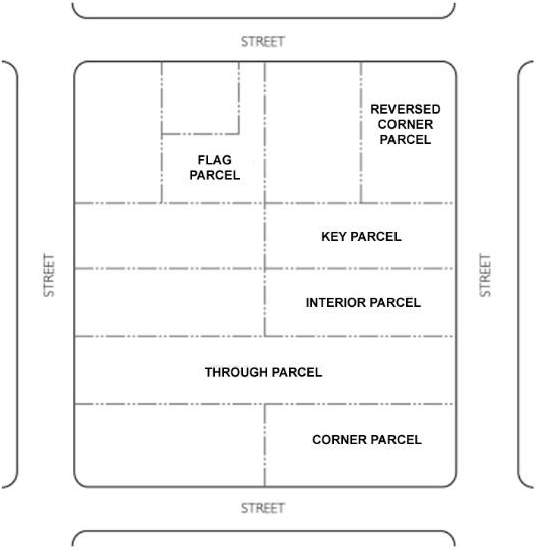
Figure 1-1
Parcel Types
Parcel Area. The total area measured in a horizontal plane within the exterior lines of a parcel including public access corridors, vehicular easements, and areas to be included in future street rights-of-way or other public facilities or uses established by easement, dedication, or ordinance.
Parcel Depth. The horizontal distance from the midpoint of the front parcel line to the midpoint of the rear parcel line; or for irregularly shaped parcels where the side parcel lines converge to a point at the rear of the parcel, the horizontal distance from the midpoint of the front parcel line to a line 10 feet long within the parcel, parallel to and at a maximum distance from the front parcel line.
Parcel Line. Any recorded boundary of a parcel. Types of parcel lines are as follows:
Front parcel line. On an interior parcel, the property line separating the parcel from the street. The front parcel line on a corner parcel is the property line with the shortest frontage within residential zones and the longest frontage within nonresidential zones. If the parcel lines of a corner parcel are equal in length, the Director shall determine which is the front parcel line. On a through parcel, the front parcel line is the line abutting a street where primary access is taken.
Interior parcel line. Any parcel line not abutting a street.
Rear parcel line. A parcel line that does not intersect the front parcel line and that is most distant from and most closely parallel to the front parcel line. In the case of irregularly shaped parcels, the line shall be determined by the Director.
Side parcel line. Any parcel line that is not a front or rear parcel line.
Parcel Width. For standard parcels, the horizontal distance between side parcel lines, measured at the required front setback line. For flag lots, the pole portion of the parcel (strip) is not included as part of the parcel width determination and the parcel width is measured at the applicable front setback line. For cul-de-sac parcels, the parcel width is measured at the front parcel line.
Park/Plaza. An outdoor active or passive space that may provide a variety of recreational opportunities including playground equipment, open space areas for passive recreation and picnicking, and sport and active recreation facilities.
Parking Facilities. Lots and structures providing parking spaces for automobiles, bicycles, motorcycles, scooters, and/or trucks.
Parking Facilities, Commercial. Parking lots or structures providing daily parking for a fee. Does not include towing impound and storage facilities
Parking Facilities for On-site Uses. Parking lots or structures located on the same site of a primary use which provide parking for those users of the primary use.
Parking Structures. A structure for parking of motor vehicles; composed of one or more levels; which may be totally below grade (an underground parking garage) or either partially or totally above grade. A fee may or may not be charged.
Parking Structures, Residential Zone. A parking structure located within any residential zone intended for use by residents.
Parking, Tandem. The placement of parking spaces one behind the other, so that the space nearest the driveway or street access serves as the only means of access to the other space. May be located within a pull-through garage.
Parks and Recreational Facilities (Active and Passive).
Parks and Recreation, Active. A type of outdoor recreation or activity that requires the use of organized play areas (e.g., baseball, football, softball, and soccer fields; swimming pools; tennis and basketball courts; children's play equipment, etc.).
Parks and Recreation, Passive. A type of outdoor recreation or activity that can be carried out with little alteration or improvement to existing topography of a site, with the use of existing natural resources, and with a minimal impact (e.g., bicycling, bird-watching, hiking, jogging, picnicking, walking, etc.)
Parolee-Probationer Home. Any residential structure or dwelling unit, whether owned and/or operated by an individual or a for-profit or nonprofit entity, which houses two or more parolees-probationers unrelated by blood, marriage, or legal adoption, in exchange for monetary or nonmonetary consideration given and/or paid by the parolee-probationer and/or any public or private entity or person on behalf of the parolee-probationer.
Patio. A paved, or improved with individual bricks or tiles, unenclosed outdoor area.
Patio Cover. A solid or open roof structure covering a patio, platform, or deck area, which is either detached from or attached to another structure.
Permit. A specific authorization from the City to engage in a particular type of development or activity.
Person. Any individual, association, firm, co-partnership, joint venture, social club, fraternal organization, corporation, estate, trust, business trust, receiver syndicate, or any governmental entity, or political subdivision or any other group or combination acting as a unit.
Personal Property Sales. The sale or offering for sale to the general public of miscellaneous personal property. Includes "estate sales," "garage sales," "lawn sales," and "yard sales." Does not include "sidewalk sales".
Personal Services.
Personal Services, General. Establishments that provide recurrently needed services of a personal nature. Illustrative examples include:
•
barber and beauty shops
•
clothing rental shops
•
dry cleaning pick up stores with limited equipment
•
laundromats (self-service laundries)
•
locksmiths
•
shoe repair shops
•
tailors and seamstresses
Accessory retail sales of products related to the personal services may be provided.
Personal Services, Restricted. Personal service establishments which may tend to have a blighting and/or deteriorating effect upon surrounding areas may need to be dispersed from other similar uses to minimize adverse impacts. Illustrative examples include:
•
day spas
•
healing arts (acupuncture, aromatherapy, etc.) other than massages services
•
internet cafes
•
palm and card readers
•
tanning salons
•
tattoo services and body piercing studios
Accessory retail sales of products related to the personal services may be provided.
Massage Establishments. An establishment where massage services — the application of a system of structured touch, pressure, movement, and holding to the soft tissues of the human body with the intent to enhance or restore the health and well-being of the client — are provided in compliance with state law.
Massage Services, Accessory. A massage establishment operated as an accessory use in conjunction with an approved health club, athletic club, gym, or hotel or in conjunction with a medical office or chiropractic office. For the purpose of this definition, an accessory use shall mean a use that is not more than 25 percent of the floor area of the related health or athletic activities of the primary use. Does not include "Adult Oriented Businesses".
Nail Salons. An establishment where 25 percent or more of the work stations are used to provide manicure and/or pedicure services.
Personal Storage (Mini-Storage). A structure or group of structures containing generally small, individual, compartmentalized stalls or lockers rented as individual storage spaces.
Pilasters. A rectangular column (structural or decorative) placed against a wall.
Pillars. A column (structural or decorative) on a fixed base or pedestal.
Planned Development Permit. A type of discretionary permit that provides a procedure for land to be designed and developed as a single unit. By taking advantage of site planning techniques, the intent is to produce a more efficient use of land, a better living environment, a superb site plan, and excellence of design not otherwise possible through strict application of the development standards, in exchange for a modification of specified development standards.
Planning Permit. A generic term referring to any permit or other entitlement authorized by the Development Code and required by the City.
Police Chief. The Police Chief of the City of East Palo Alto, or authorized designee(s).
Porch. Any covered area located at a structure's entrance, whether it is a projecting feature with a separate cover, or a recessed area behind the structure wall.
Porte-Cochere. An accessory structure customarily open on three sides and attached to the side or front of a structure through which vehicles pass, established for the convenient loading and unloading of passengers from a motor vehicle. A porte-cochere is not a carport or garage nor may it be used to satisfy off-street parking requirements.
Postal and Package Shipping Services. An establishment providing commercial postal and package shipping services directly to the customer, including letter and parcel mailing, post office box rental, and related services.
Prescription Pharmacies.
Prescription Pharmacies, Medical Supplies. An establishment selling medical equipment and supplies for home health care.
Prescription Pharmacies, in Connection With Medical Offices. An establishment located in the same structure that provides space for medical offices and related uses.
Principal Use. The primary or predominant use of any parcel or structure.
Printing and Duplicating Services. Establishments providing printing and duplicating services, including small-scale photo processing. Does not include photographic laboratories and industrial printing and publishing plants.
Private Street. A thoroughfare providing recorded vehicular access to more than one property, in which any or all properties over which the access traverses are owned and maintained by a private individual(s) or entity (e.g., a homeowner's association).
Prohibited Land Use. Any land use not expressly allowed by the Development Code is prohibited under the principle of exclusionary zoning.
Public Assembly/Meeting Facilities. A facility for public or private assembly and meetings. May include incidental serving of food and alcoholic or nonalcoholic beverages. Illustrative examples include:
•
banquet rooms
•
civic and private auditoriums
•
community centers
•
conference/convention facilities
•
meeting halls for clubs and other membership organizations
•
places of worship
Also includes functionally related internal facilities (i.e., kitchens, multi-purpose rooms, storage, etc.) Does not include conference and meeting rooms accessory and incidental to another principal use and typically used only by on-site employees and clients, which occupy less floor area on the site than the principal use they support. Does not include sports or other commercial entertainment facilities Does not include funeral homes and mortuaries.
Public Parks and Playgrounds. Land owned or operated by a governmental entity or school district, designed to serve the recreational needs of the residents of the City. Includes parks, play lots, playgrounds, athletic fields, sports courts. May also include passive outdoor recreation areas that are located in conservation areas. Does not include the same facilities which are privately-owned or commercial facilities.
Public Structures, Facilities and Uses. Public structures and facilities include facilities and grounds owned or operated by park and recreation districts, schools, fire departments, churches, municipal institutions, and community organizations including clubs, lodges, and similar uses.
"Q" Definitions
Reserved.
"R" Definitions
Reasonable Accommodation. A type of discretionary permit that provides for persons with disabilities seeking equal access to housing under federal or state law some flexibility in the application of building and zoning laws and other land use policies, procedures, laws, rules and regulations.
Recreational Vehicle (RV). A trailer as defined in Health and Safety Code Section 18009.3 or a recreational vehicle as defined in Health and Safety Code Section 18010. A motor home, travel trailer, truck camper, or camping trailer, with or without motive power, originally designed for human habitation for recreational, emergency, or other occupancy, which meets all of the following criteria:
1.
Contains less than 320 square feet of internal living room area, excluding built-in equipment, including wardrobe, closets, cabinets, kitchen units or fixtures, and bath or toilet rooms;
2.
Contains 400 square feet or less of gross area measured at maximum horizontal projections;
3.
Is built on a single chassis;
4.
Is self-propelled, truck-mounted, or permanently towable on the highways without a towing permit.
Recycling. The series of activities by which discarded materials which would otherwise remain waste are collected, separated, or processed and used to make new products. Recyclable material includes reusable materials that can be reconstituted, remanufactured, or reused in an altered form, including glass, metals, paper, and plastic. Recyclable material does not include refuse or hazardous materials.
Recycling Facilities. Facilities involved with the collection of recyclable materials. Does not include storage containers located on a residential or nonresidential site used solely for the recycling of material generated on the site.
Small Collection Facilities. A facility occupying an area of 350 square feet or less where the public may donate, redeem, or sell recyclable materials.
Large Collection Facilities. A facility occupying an area of more than 350 square feet and/or includes permanent structures where the public may donate, redeem, or sell recyclable materials.
Religious Places of Assembly. Any structure used for non-profit purposes by an established religious organization holding either tax exempt status under Internal Revenue Code Section 501(c)(3) or under the California Property Tax Law, where the structure is primarily intended to be used as a place of worship. The term includes, but is not necessarily limited to, church, temple, synagogue and mosque.
Remodel. An activity which alters an existing structure where less than or equal to 50 percent of the structure is removed, repaired or altered, excluding the interior finish wall coverings.
Research and Development (R&D).
General. Research and development establishments engaging in industrial or scientific research, including product testing. Includes electronic research firms or pharmaceutical research laboratories. Excludes manufacturing, except of prototypes, and medical testing and analysis.
Restricted. Research and development establishments engaging in activities that may involve the use of potentially hazardous materials, flammable substances, or chemical compound mixtures or devices; that may result in hazardous waste byproducts, conditions commonly recognized as offensive; that may involve testing on animals; or that may require special handling protocols or security measures.
Residential Care Facility. A facility in which multiple unrelated people reside, including but not limited to, health facilities, community care facilities, and alcoholism or drug abuse recovery or treatment facilities as defined in the Health and Safety Code and other similar care facilities.
General Licensed. A place, site, or structure, or groups of places, sites, or structures, licensed by the state, in which seven or more individuals with a disability reside who are not living together as a single housekeeping unit and in which every person residing in the facility (excluding the licensee, members of the licensee's family, or persons employed as facility staff) is an individual with a disability.
Residential Model Homes. A show house, also called a model home or display home, demonstrating homes for sale located within a condominium or subdivision development.
Residential Use. A structure providing permanent housing for one or more households.
Residential Zone. A zone intended primarily for dwellings and related accessory uses.
Retail Sales.
General. Retail establishments, completely enclosed within structures, engaged in selling goods or merchandise to the general public. Examples include:
Bulk Retail Merchandise. Retail establishments engaged in selling goods or merchandise to the general public as well as to other retailers, contractors, or businesses, and rendering services incidental to the sale of the goods. Bulk retail is differentiated from general retail by either of the following characteristics:
1.
A high volume of sales of related and/or unrelated products in a warehouse setting (i.e., "big box" retail).
2.
The sale of goods or merchandise which require a large amount of floor space warehoused and retailed at the same location.
Examples include:
Retail Sales (Firearms). Retail establishments customarily selling a wide variety of firearms, ammunition, and related accessories and equipment governed by federal laws under the jurisdiction of the Bureau of Alcohol, Tobacco, and Firearms (ATF).
Retail Sales (Used Merchandise) - General. Retail establishments offering used merchandise for sale to the general public. Illustrative examples include:
•
Clothing Stores
•
Consignment Stores
•
Furniture Stores
•
Household Items Sales
•
Secondhand Stores
Retail Sales (Used Merchandise) - Restricted. Retail establishments offering used merchandise for sale to the general public Illustrative examples include:
•
Junk Collector
•
Junk Dealer
•
Pawn Broker
•
Pawn Shop
•
Secondhand Dealer
Review Authority. The individual or official City body identified having the responsibility and authority to review and approve or deny ministerial and discretionary permit applications and appeals.
Right-of-Way. A strip of land acquired by reservation, dedication, prescription, or condemnation and intended to be used for or occupied by a road, railroad, electric transmission lines, oil or gas pipeline, water line, sanitary storm sewer, or other similar use.
Roof Deck. The walkable or otherwise usable open space area (including any swimming pools) located above the roof framing of the structure, the only access to which is from the floors below.
"S" Definitions
Schools, Public and Private. Public or private academic educational institutions or schools providing specialized education/training. Illustrative examples include:
Also includes facilities that offer specialized programs in personal growth and development (i.e., arts, communications, diet centers, environmental awareness, management, etc.). Does not include part-time religious instruction at places of worship or preschools and child day care facilities.
Schools, Public. Educational institutions operated by a governmental organization or agency, customarily not for profit.
Schools, Private. Educational institutions operated by a private organization, customarily for profit.
Schools, Related to Medical Professions. An establishment that provides specialized on-site training of technical medical skills.
Seasonal Sales. Temporary retail sale of seasonal merchandise. Examples include farm produce stands, Christmas tree sales lots, and pumpkin patches.
Senior Citizen Housing. An age-restricted multiple-family residential development designed and intended to be principally occupied by senior citizens (i.e., a person 62 years of age or older, or 55 years of age or older in a senior citizen housing development). The development may include a congregate meals program in a common dining area.
Sensitive Uses. A use of land that normally requires the peace and quiet of a more tranquil environment and that may be negatively impacted by other uses which, by their nature and operational characteristics, are known to cause negative impacts on nearby uses. Examples of sensitive uses in need of protection include public or private schools, public playgrounds, hospitals, residential care facilities, rest homes, sanitariums, religious places of assembly, or property used or zoned for residential purposes.
Setback. The distance by which a structure or other development feature shall be separated from a parcel line. A setback area is an open area.
Setback Area. An area within a parcel established for the purpose of governing the location of structures on the parcel. A setback area is an open area located between a parcel line and the nearest relevant parallel setback line, unobstructed and unoccupied from the ground upward.
Front Setback Area. An area extending across the full width of the parcel between the front parcel line and the required front setback line.
Rear Setback Area. An area extending across the full width of the parcel between a rear parcel line and the required rear setback line.
Side Setback Area. An area extending from the front setback line to the rear parcel line between the nearest side parcel line and the required side setback line.
Setback Line. A line delineating the minimum required distance between the parcel line and a structure on the same parcel.
Single Housekeeping Unit. The functional equivalent of a traditional family, whose members are an interactive group of persons jointly occupying a single dwelling unit, including the joint use of and responsibility for common areas, and sharing household activities and responsibilities (e.g., meals, chores, household maintenance, expenses, etc.) and where, if the unit is rented, all adult residents have chosen to jointly occupy the entire premises of the dwelling unit, under a single written lease with joint use and responsibility for the premises, and the makeup of the household occupying the unit is determined by the residents of the unit rather than the landlord or property manager.
Single Room Occupancy (SRO) Facilities. A multiple tenant structure with individual resident rooms. Tenants typically share bathrooms and/or kitchens, while some rooms may include kitchenettes, bathrooms, or half-baths.
Single-Family Dwellings. A structure containing one dwelling unit located on a single parcel for occupancy by one housekeeping unit. Also includes factory-built, modular housing units, and mobile homes/manufactured housing when placed on permanent foundation systems.
Single-Family Dwellings, Attached. A dwelling attached to another dwelling, excluding accessory dwellings. Each dwelling is separately owned, located on a discrete parcel, and is joined to another dwelling along a single parcel line. Each dwelling is totally separated from the other by an unpierced wall extending from ground to roof.
Single-Family Dwellings, Detached. A dwelling not attached to another dwelling, excluding an accessory dwelling unit. The dwelling is owned in fee and is located on an individual parcel.
Site. A parcel or group of adjacent parcels not divided by any alley, street, other right-of-way or City limit proposed for development, and in a single ownership, or with multiple owners all of whom join in an application for development.
Site Plan and Design Review. A type of discretionary permit that provides a process for the review of the layout and design of proposed development projects.
Slope. Land gradient described as the vertical rise divided by the horizontal run, and expressed in percent or ratio.
Smoking Lounges. An establishment dedicated, in whole or part, to providing tobacco or other substances for smoking by patrons on the premises for a fee, including but not limited to, establishments known as cigar lounges, hookah lounges, tobacco clubs, or tobacco bars. Does not include a shop which sells tobacco products and smoking accessories but does not provide for on premises use of tobacco produces.
Solar Collector. A device or combination of devices, structure, or part of a device or structure that transforms direct solar energy into thermal, chemical, or electrical energy and which contributes significantly to the energy supply.
Solar Photovolatic Energy System. (1) A design using natural and architectural features to cool or heat a structure, or (2) a mechanical assembly that may include a solar collector, storage facility, and any other components needed to cool or heat a structure.
Specific Plan. A City-adopted plan consisting of text, maps, and other documents regulating development within a defined area. A specific plan may include all detailed regulations, conditions, programs, and/or proposed legislation which may be necessary or convenient for the systematic implementation of any General Plan element(s).
Sphere of Influence. The probable ultimate physical boundary of the City as established by the Local Agency Formation Commission (LAFCO) in compliance with the Cortese-Knox-Hertzberg Local Government Reorganization Act of 2000 (Government Code Section 56000 et seq.). A sphere of influence contains unincorporated County land located outside the City's boundaries related to the City's planning efforts.
Stables and Corrals.
Stables and Corrals, commercial. Commercial establishments for donkeys, horses, and/or mules, which are rented, used, or boarded for compensation, examples of which include boarding stables, riding schools and academies, horse ranches, horse exhibition facilities (for shows or other competitive events), and barns, corrals, paddocks, and stables accessory and incidental to these uses.
Stables and Corrals, private. An accessory structure(s) for the keeping of horses and/or ponies for the private use of the occupants of the premises, not for hire, remuneration, or sale, and subject to specified standards.
Stand. A structure for the display and sale of products with no space for customers within the structure itself.
State. The State of California.
Storefront. The primary (front facade) structure entrance where access is taken from a public street, alley, public or private parking lot, or pedestrian mall/arcade or passage.
Story. The portion of a structure included between the upper surface of any floor and the upper surface of the next floor above, except that the topmost story is the portion of a structure included between the upper surface of the topmost floor and the ceiling above.
Street. A public or private right-of-way dedicated, conveyed, condemned, or otherwise acquired for use of a right-of-way which affords the principal means of access to abutting property.
Structural Alteration. Any change in the supporting members of a structure (i.e., bearing walls, beams, columns, floor or roof joists, girders or rafters), or changes in roof or exterior lines.
Structure. Anything constructed or erected principally above ground, the use of which requires location on the ground or attachment to something having location on the ground, including a walled and roofed building, a gas or liquid storage tank, as well as a manufactured home, but not including a tent or vehicle. Includes "Building."
Structure, Attached. A structure connected to another structure by means of a wall, roof, stairway, atrium, breezeway, or other structural connection.
Structure, Detached. A structure without a wall or roof in common with another structure.
Studio - Instructional. A small-scale facility accommodating one student or a group of students at a time, in no more than one instructional space. Examples include: instruction and training in art, dance, martial arts, gymnastics, photography and the processing of photographs produced only by users of the studio facilities; production studios for individual filmmakers, musicians, painters, sculptors, photographers, and other artists. May also include accessory retail sales of products related to the services provided.
Supportive Housing. Housing with no limit on length of stay, occupied by the target population and linked to on-site or off-site services to assist the supportive housing resident in retaining the housing, improving his/her health status, and maximizing his/her ability to live, and when possible, work in the community. Supportive housing units are residential uses subject to requirements and restrictions applicable to other residential uses of the same type in the same zone and the underlying zone's development standards, including density. For those zones in which residential uses are allowed only with approval of a discretionary land use permit, the permit shall first be obtained to allow the establishment of the supportive housing.
Swimming Pools/Spas. See "Accessory Structures and Uses".
"T" Definitions
Tattooing. Any method of placing permanent designs, letters, scrolls, figures, symbols, or any other marks upon or under the skin with ink or any other substance, by the aid of needles or any other instruments designed to contact, touch or puncture the skin, resulting in either the coloration of the skin, or the production of scars or scarring, other than by branding.
Telecommuting. An employee foregoes a trip to the normal work site and instead works from home or from a satellite office near home.
Temporary Structure. A structure without any permanent foundation or footings, which is removed when the designated time period, activity, or use for which the temporary structure was erected has ceased.
Temporary Use Permit. A type of discretionary permit that allows a use to occupy a site for a limited period of time.
Temporary Uses. A stationary use, intended for limited duration, to be located in a zone not allowing that use by right, and not continuing a nonconforming use or structure.
Top Soil. The immediate surface area of land, consisting either of topsoil or subsoil.
Top Soil Site. Premises from which any topsoil is removed or excavated for the purpose of disposition away from the immediate premises whether the disposition is immediate or in the future. Up to 25 cubic yards of topsoil may be removed from a building site after a permit has been secured from for the construction of a permanent structure on the same site without the operation being construed to be topsoil site.
Townhouse. A structure designed for or used exclusively for residential purposes of one family. The structure is attached to similar structures in a linear arrangement and separated vertically by party walls. Each dwelling unit has a totally exposed front and rear wall used for direct ground-level access to the outdoors.
Trails, Public. A marked or beaten path, as through woods or wilderness, created and maintained for public use.
Transitional Housing. Residential structures configured as rental housing developments, but operated under program requirements which include the termination of assistance and recirculation of the assistive unit to another eligible program recipient at a predetermined future point in time not less than 180 days from the beginning of assistance. Transitional housing units are residential uses subject to those requirements and restrictions that apply to other residential uses of the same type in the same zone.
Transportation Demand Management (TDM). A strategy for reducing demand on the road system by reducing the number of vehicles using the roadways or increasing the number of persons per vehicle. TDM attempts to reduce the number of persons who drive alone on the roadway during the commute period and to increase the number of persons using buses, carpools, trains, vanpools, walking, and biking.
Trash Enclosure. A structure suitable for containing trash, garbage, and refuse for collection and/or recycling on a regular basis.
Two-Family Dwelling. A structure located on a single parcel and containing two dwelling units, each of which is for occupancy by one single housekeeping unit. Also includes factory-built, modular housing units, and mobile homes/manufactured housing units when placed on permanent foundation systems. Often referred to as a duplex.
"U" Definitions
Unenclosed. A structure that is not enclosed.
Uninhabitable. A structure or property that is not appropriate for human occupancy, as defined by the California Building Code (CBC).
Use. The purpose for which land or a structure is, arranged, designed, intended, maintained, or occupied.
Utilities, Minor and Major.
Utilities, Minor. Utility facilities necessary to support legally established uses and involve only minor structures (e.g., electrical distribution lines, underground water lines, underground sewer lines, etc.). Minor facilities generally have no significant effect on surrounding uses.
Utilities, Major. Utility facilities functioning as independent uses (e.g., generating plants, electrical substations, above ground electrical transmission lines, lone switching structures, refuse collection, transfer recycling or disposal facilities, water reservoirs, flood control or drainage facilities, water or wastewater treatment plants, transportation or communications utilities, and similar facilities of public agencies or public utilities.) Major facilities may have a more significant effect on surrounding uses.
"V" Definitions
Variance. A discretionary entitlement that allows the waiver or relaxation of specified development standards.
Vehicle. Any self-propelled vehicle designed primarily for transportation of persons or goods along public streets or alleys, or other public ways.
Vehicle, Commercial. Any vehicle larger than a pickup truck, including semi-trucks and trailers, delivery vans. Does not include recreational vehicles regardless of gross vehicle weight rating.
Vehicle/Equipment-Related Services.
Motor Vehicle Washing/Detailing. Establishments engaged in the washing, waxing, or cleaning/detailing of automobiles or similar light vehicles.
Full-Service. A motor vehicle washing establishment where operating functions are performed entirely by the establishment's operator/owner with the use of washing, waxing, and drying equipment supplemented with manual detailing by the operator/owner.
Self-Service or Accessory Use. A motor vehicle washing establishment where washing, drying, polishing, or vacuuming of the vehicles is done by the vehicle's driver or occupant.
Refueling/Service Stations. An establishment engaged in the retail sale of gasoline, diesel, and alternative fuel, lubricants, parts, and accessories, including incidental "minor" maintenance and repair of automobiles and light trucks, vans, or similar size vehicles. Does not include body and fender work or "heavy" repair of trucks or other motor vehicles. All maintenance and repair activities shall be conducted within a fully enclosed structure.
Vehicle Storage. Storage of operative or inoperative vehicles, including tow yards (i.e., outdoor storage facilities for the temporary storage of towed vehicles), impound yards, and storage lots for automobiles, trucks, buses, and recreational vehicles. Does not include vehicle/equipment repair activities or vehicle dismantling or salvage.
Vehicle/Equipment Rentals.
General. Rental of automobiles, construction equipment, motorcycles, recreational vehicles, trucks, and similar vehicles and equipment, including on-site storage and incidental maintenance when conducted within a fully enclosed structure.
Limited (No outdoor repair or storage). Rental of mopeds, scooters, Segways, and similar sized vehicles with electric power or engines less than 100cc. May also include the maintenance, minor repair, and on-site storage of the equipment offered for rent but only when conducted within a fully enclosed structure.
Office only. Rental of automobiles, motorcycles, recreational vehicles, trucks, and other types of transportation vehicles without on-site storage of or incidental maintenance of these vehicles.
Vehicle/Equipment Repair (All Operations Conducted in a Fully Enclosed Structure).
General. Major vehicle and equipment repair when conducted within a fully enclosed structure. Examples include body and fender shops, brake shops, full-service motor vehicle repair garages, machine shops, painting shops, tire sales and installation shops, towing services, and transmission shops. Does not include vehicle dismantling or salvage and tire retreading or recapping.
Limited. Minor vehicle and equipment repair when conducted within a fully enclosed structure. Examples include brake adjustments and repairs, installation of electronic equipment (e.g., alarms, stereos, etc.), system servicing (cooling, electrical, fuel, and exhaust), oil and lube shops, wheel alignment and balancing.
Vehicle/Equipment Sales (New/Used).
General. Sale of automobiles, construction equipment, motorcycles, recreational vehicles, trucks, and similar vehicles and equipment, including display, storage, maintenance, repair, and incidental rental of the vehicles and equipment. May include the sale, installation, and servicing of related equipment and parts. All maintenance and repair activities shall be conducted within a fully enclosed structure.
Limited. Sale of automobiles, including display, storage, minor maintenance, and incidental rental. Does not include maintenance and/or repair requiring pneumatic lifts. All maintenance activities shall be conducted within a fully enclosed structure.
Office Only. Sales limited to offering automobiles and light duty trucks. Does not include on-site inventory, display, storage, maintenance, or repair of these vehicles.
Vehicles for Hire. The provision of vehicles with drivers to the general public for the purpose of transportation (e.g., taxi or limousine service). May also include business office and the maintenance, minor repair, and on-site storage of vehicles for hire. Does not include vehicle rental uses or a vehicle for hire office only use and does not include storage or maintenance of vehicles on-site. All maintenance and repair activities shall be conducted within a fully enclosed structure.
Visitor Accommodations.
Bed and Breakfast Inns. A dwelling unit offering guest rooms or suites for a fee for less than 30 days, with incidental eating and drinking service provided from a single kitchen for the exclusive use of guests only.
Hotel. An establishment providing guest rooms or suites for a fee to transient guests for sleeping purposes. Access to units is primarily from interior lobbies, courts, or halls. Related accessory uses may include conference and meeting rooms, restaurants, bars, and recreational facilities. Guest rooms may or may not contain kitchen facilities for food preparation.
Motel. An establishment providing guest rooms for a fee to transient guests for sleeping purposes. Guest rooms do not contain kitchen facilities. A motel is distinguished from a hotel primarily by direct independent access to, and adjoining parking for, each guest room.
Recreational Vehicle (RV) Park. A parcel upon which two or more recreational vehicle sites are located, established, or maintained for occupancy for a rental fee by recreational vehicles of the general public as temporary living quarters for recreation or vacation purposes.
Short-Term Lodging. A dwelling unit rented or leased as a single housekeeping unit for a period of less than 30 days.
Time Share Project. A development in which a purchaser receives the right in perpetuity, for life, or for a term of years, to the recurrent, exclusive use or occupancy of an ownership interest in a parcel, unit, room(s), or segment of real property, annually or on some other seasonal or periodic basis, for a period of time that has been or will be allotted from the use or occupancy periods into which the project has been divided and includes, but is not limited to, time share estate, interval ownership, vacation license, vacation lease, club membership, time share use, hotel/condominium, or uses of a similar nature.
"W" Definitions
Wall. A physical barrier constructed largely of masonry, brick, concrete, stucco, concrete block, or any combination thereof and intended to mark a boundary.
Water Provider. The agency responsible for the administration of water resources, which may act through a third party. The developer must demonstrate sufficient water supply for the project.
Wireless Telecommunication Facilities. Wireless communication facilities are any co-located, ground-mounted, roof-mounted, or stealth device or system used for transmitting and/or receiving electromagnetic signals, including, but not limited to, microwaves and radio waves for cellular technology, data transmission, e-mail, mobile services, paging systems, personal communications services and related technologies. Includes antennas, antenna structures, microwave dishes, parabolic structures; support facilities that house support equipment; and other accessory development, equipment, improvements, and structures used to support operations.
Minor:
Satellite dish antennas up to and including 10 feet in diameter;
Building-mounted antennas and associated equipment rooms;
Co-located wireless antennas;
Public utility antennas and/or related facilities.
Major:
Satellite dish antennas that exceed 10 feet in diameter;
Support structure-mounted antennas and associated equipment rooms (i.e., monopoles, lattice towers, etc.), located in either an interior space in an adjacent existing structure or in a separate attached or detached exterior structure;
Any public or private utility antenna or antenna structure located on a City-owned site.
"X" Definitions
Reserved.
"Y" Definitions
Yard. The area between a parcel line and the side of a principal structure. An area of a yard may be smaller (if a nonconforming parcel), the same, or larger in size than a required setback area.
Yard Sale. The sale of goods, wares or merchandise on a residential property principally used as a residence on a temporary basis. Commonly known as a patio, yard, garage, and/or backyard sale.
"Z" Definitions
Zero Lot Line. When a structure is located on or very near the edge of the property line.
Zone. Any of the residential, commercial, industrial, mixed use, special-purpose, or combing/overlay districts within which certain land uses are allowed or prohibited, and certain site planning and development standards are prescribed.
Zoning Clearance. A nondiscretionary administrative verification procedure used to determine a proposed land use, improvement, or structure complies with the list of activities allowed in the applicable zone and the development standards applicable to the use, improvement, or structure.
(Ord. No. 02-2022, § 3, 5-3-2022; Ord. of 2-6-2024(1), § 1)

