
East Palo Alto City Zoning Code
ARTICLE 3
REGULATIONS APPLICABLE TO ALL ZONES
Chapter 18.28 - Trees on Private Property[1]
Editor's note— Ord. No. 02-2022, § 2(Att. B), adopted May 3, 2022, amended Ch. 18.28 in its entirety to read as herein set out. Former Ch. 18.28, §§ 18.28.010—18.28.040 was entitled "Landscaping and Trees."
18.22.010 - Purpose and Applicability
A.
Purpose. The purpose of this chapter is to ensure development is consistent with the General Plan, complies with all standards, produces an environment that is harmonious with existing and future development, and protects the use and enjoyment of neighboring properties.
B.
Applicability.
1.
The standards in this chapter apply to all zones.
2.
These standards shall be considered in combination with the standards and regulations for each zone and specific land use. Where there may be a conflict, the standards specific to the zone or specific land use shall override the general standards.
3.
All structures, additions to structures, and uses shall conform to the standards as determined applicable by the Director.
18.22.020 - Corner Vision Triangle
A.
Visibility at Corners of Intersections Required. Corner parcels shall be developed in a manner that ensures visibility across the corners of the intersecting streets, alleys, and private driveways.
B.
Corner Vision Triangle Area Described. The corner vision triangle area is a triangular-shaped area on a corner parcel formed by measuring the prescribed distance from the intersection of the front and street side property lines, an intersecting alley, or an intersecting driveway and connecting the lines diagonally across the property making a 90-degree triangle. See Figure 3-1.
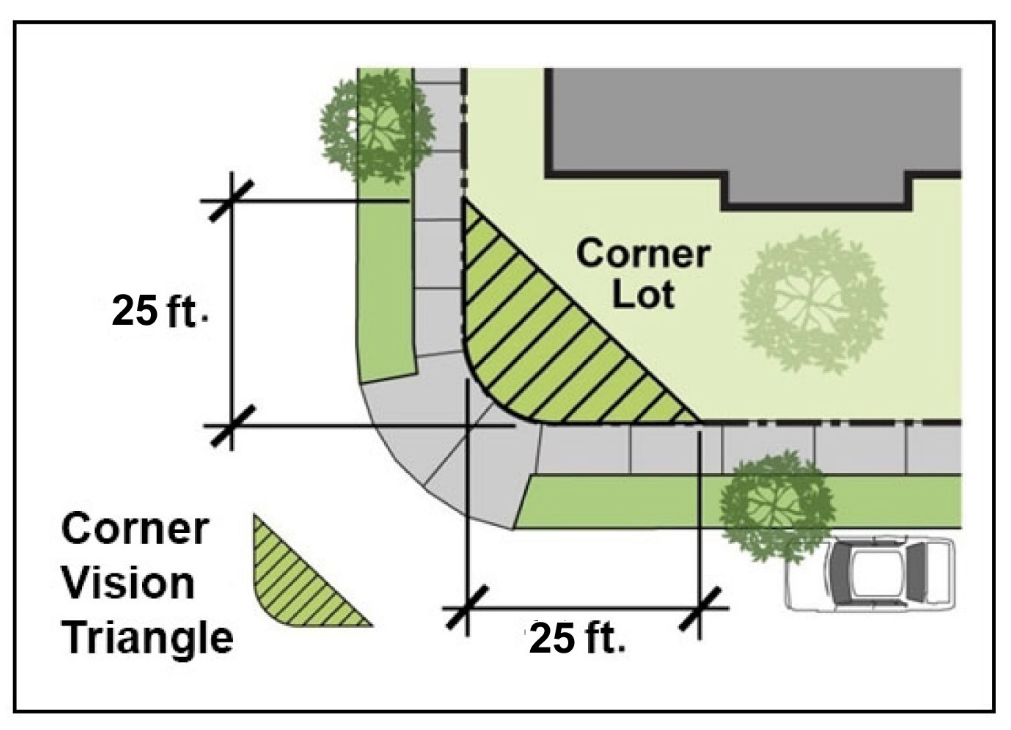
Figure 3-1 -
Corner Vision Triangle
C.
Area of Corner Vision Triangle. The dimensions of a corner vision triangle are 25 feet from the intersection of two public or private street rights-of-way.
D.
Height Limit. It is illegal to erect, place, plant, or allow to grow within the corner vision triangle area.
1.
Fences, walls, signs, accessory structures, mounds of earth, or other visual obstructions over 48 inches in height;
2.
Hedges, shrubbery, and vegetation over or with a growth characteristic over 48 inches in height; and
3.
Tree canopies maintained at a height less than seven feet above ground level, as measured from adjacent street curb elevation.
18.22.030 - Height Limits
A.
Height of Structures and Measurement.
1.
Structure height established. Structures shall not exceed the maximum allowable height for the zone in which the structure is located, except as provided in this section.
2.
Height measurement. Height shall be measured as the vertical distance from the established grade of the pad to the highest part of the structure, including any protective guardrails and parapet walls. Structures with slopping roofs shall be measured to the peak of the roof. Structures with flat roofs shall be measured to the top of the roof, guardrail, or parapet wall.
B.
Mechanical Equipment.
1.
Nonresidential zones. In nonresidential and mixed use zones, roof-mounted mechanical equipment, not more than 30 percent of the total roof area, including required screening devices, shall be allowed to exceed the maximum height limit by up to five feet. Elevator housings may exceed the maximum allowed height limit by 10 feet.
2.
Residential zones. In residential zones, roof-mounted equipment is not allowed to exceed the maximum height limit for the zone.
18.22.040 - Mechanical and Electrical Equipment Screening and Outdoor Storage
Multiple-family residential uses and nonresidential land uses shall comply with the standards for the screening and buffering of adjoining land uses, equipment, and outdoor storage areas as set forth in this section.
A.
Roof-Mounted and Ground-Mounted Mechanical Equipment.
1.
Screening required. The screening of roof-mounted and ground-mounted mechanical equipment is required in all zones at the time of new installation or replacement. Roof-mounted and ground-mounted mechanical equipment other than solar collectors and related equipment shall be screened from public view.
2.
Roof-mounted mechanical equipment.
a.
Screening. Roof-mounted mechanical equipment shall not be visible from a point six feet above ground level in any direction (360 degrees) from a public right-of-way or adjacent residential property. Screening shall be compatible with the architectural style, materials, and color of the structure upon which the equipment is located, subject to Design Review approval.
b.
Height limit. Roof-mounted mechanical equipment and screening shall be subject to a 15-foot height limitation.
3.
Ground-mounted mechanical equipment.
a.
Screening. Ground-mounted mechanical equipment shall not be visible from a point six feet above ground level and shall be screened from public rights-of-way and/or public property.
b.
Setback required. Ground-mounted mechanical equipment and screening, except landscaping, shall be subject to the setback requirements and any allowed encroachments.
c.
Screening methods. Screening of ground-mounted mechanical equipment shall be accomplished with fences, walls, solid hedges, or other methods approved by the Director. Chain link fencing with or without slats is not allowed.
4.
Sound rating. Roof-mounted and ground-mounted mechanical equipment shall be subject to the noise requirements.
5.
Mixed Use and commercial zones. Mechanical equipment within mixed use or commercial zones shall be located so that the impact of noise on residential uses within the development and on adjacent residential uses is minimized to the greatest extent feasible.
6.
Maintenance required. Screening shall be maintained in good condition at all times. Landscaping used as screening shall provide a dense, year-round screen.
B.
Outdoor Storage and Display Areas. Where equipment, material, or merchandise is allowed to be stored outdoors, these items shall be screened from view.
C.
Solid Waste Storage Areas. Screening of solid waste storage areas and trash receptacles shall be provided.
D.
Screening and buffering between different zones.
1.
Nonresidential use. Where a nonresidential zone, including mixed use zones, abuts a residential zone, to provide appropriate screening and buffering, wall a minimum of six feet in height is required. The nonresidential property owner is responsible for the construction and maintenance of the wall.
2.
Industrial use. Where an industrial zone abuts a residential zone, a solid masonry wall a minimum of eight feet in height is required. The industrial property owner is responsible for the construction and maintenance of the wall.
18.22.050 - Outdoor Lighting
A.
General Outdoor Lighting Standards.
1.
Outdoor lighting shall not exceed the minimum levels specified in IES recommended practices for night-time safety, utility, security, productivity, enjoyment, and commerce. All outdoor lighting shall be designed to curtail light pollution, reduce sky glow, help protect the natural environment from the adverse effects of night lighting from gas or electric sources and to conserve energy and resources to the greatest extent possible.
2.
All outdoor lighting fixtures shall be designed, shielded, aimed, located and maintained to minimize adverse impacts on adjacent properties and to not produce glare onto adjacent properties or roadways. Parking area light fixtures and light fixtures on structures shall be full cut-off fixtures.
3.
In parking areas, light fixture poles shall not be more than 30 feet in height and lamps shall be high pressure sodium (HPS), unless modified by the Review Authority.
4.
Flashing, revolving, or intermittent exterior lighting visible from any property line or street is prohibited.
B.
Outdoor Lighting Standards for Nonresidential Uses.
1.
The average maintained lighting levels for nonresidential uses, including mixed uses, shall not exceed the following standards:
a.
Five foot-candles for parking lots and other open areas measured at all property line boundaries, as applicable.
b.
Ten foot-candles along fronts of structures and along main drive aisles within parking lots; and
c.
Twenty foot-candles for high security areas (e.g., automated teller machines, motor vehicle display areas, and under vehicle fuel station canopies), but not including parking areas. Lighting levels shall be reduced to a maximum of 10 foot-candles after the close of business.
2.
Light fixtures under any canopy shall be recessed into the canopy ceiling with a flat lens to prevent glare;
3.
Lighting levels shall not exceed 0.1 foot-candles at any common property line with property zoned, used as, or planned for residential uses, including residential uses in a mixed use zone; and
4.
A photometric plan certified by a licensed lighting engineer may be required as part of a development application to determine compliance if it is determined that there is a potential for a significant negative impact on surrounding land uses, adjacent roadways, or sensitive habitat areas.
C.
Outdoor Lighting Standards for Multiple-Family Uses. The average maintained lighting levels for multiple-family developments shall not exceed the following:
1.
0.1 foot-candles at property line boundaries; and
2.
Ten foot-candles at structures, parking lots, sports areas, or other similar areas at property line boundaries.
D.
Outdoor Lighting Standards for Structures, Man-Made Objects, and Landscapes. Spotlighting or floodlighting used to illuminate structures, statues, signs, or any other objects mounted on a pole, pedestal, or platform, or used to accentuate landscaping shall consist of full cut-off or directionally shielded lighting fixtures that are aimed and controlled so that the directed light shall be substantially confined to the object intended to be illuminated to minimize glare, sky glow, and light trespass. The beam width shall not be wider than that needed to light the subject feature with minimum light spillover. The lighting shall not shine directly into the window of a residence or directly into a roadway. Light fixtures attached to a structure shall be directed downward.
E.
Lighting Zones. The City Council may designate areas as lighting zones, defined as follows, and impose specific requirements as necessary:
1.
No ambient lighting (LZ-0). Areas where the natural environment will be seriously and adversely affected by lighting. Impacts include disturbing the biological cycles of flora and fauna and/or detracting from human enjoyment and appreciation of the natural environment. User vision is adapted to the darkness, and they expect to see little or no lighting. When not needed, lighting should be extinguished.
2.
Low ambient lighting (LZ-1). Areas where lighting might adversely affect flora and fauna or disturb the character of the area. Lighting may be used for safety and convenience but it is not necessarily uniform or continuous. Most lighting should be extinguished or reduced as activity levels decline.
3.
Moderate ambient lighting (LZ-2). Areas of human activity where the vision of human residents and users is adapted to moderate light levels. Lighting may typically be used for safety and convenience but it is not necessarily uniform or continuous. Lighting may be extinguished or reduced as activity levels decline.
4.
Moderately high ambient lighting (LZ-3). Areas of human activity where the vision of human residents and users is adapted to moderately high light levels. Lighting is generally desired for safety, security and/or convenience and it is often uniform and/or continuous. Lighting may be extinguished or reduced in most areas as activity levels decline.
5.
High ambient lighting (LZ-4). Areas of human activity where the vision of human residents and users is adapted to high light levels. Lighting is generally considered necessary for safety, security and/or convenience and it is mostly uniform and/or continuous. Lighting may be extinguished or reduced in some areas as activity levels decline.
F.
Exemptions. All of the following are exempt from the requirements of this Section:
1.
Airport lighting, lighting of the American flag, and lighting governed by state or federal law;
2.
Street lighting installed within the public right-of-way;
3.
Lighting required by the Building Code;
4.
Security lighting controlled and activated by motion sensor devices for a duration of 15 minutes or less; and
5.
Construction and emergency lighting used by construction workers, police, firefighting, or medical personnel, provided the lighting is temporary and is discontinued immediately upon completion of the construction work or abatement of the emergency requiring the lighting.
18.22.060 - Setback Regulations, Exemptions and Encroachments
Setback standards are to ensure the provision of open areas around structures for visibility and traffic safety; access to and around structures; access to natural light and ventilation; separation of incompatible land uses; space for privacy, landscaping, and recreation; protection of natural resources; and safety from fire and geologic hazards.
A.
Setback Requirements.
1.
Principal structures. Principal structures shall conform to the setback requirements established for each zone and any specific uses.
2.
Setback areas to be open. Each required setback area shall be open and unobstructed from the ground upward, except as otherwise provided.
B.
Location and Measurement of Setbacks. Setbacks shall be located and measured as follows:
1.
General. The distance/depth of a setback area (i.e., front, side, or rear) shall be measured at right angles from the nearest property line establishing a setback area line parallel to that property line.
2.
Front setback area.
a.
General. The front setback area shall extend across the entire width of the parcel frontage. The Director shall have the discretion to identify the front setback based on the location of the nearest point of the front wall of the structure to the official plan line.
b.
Corner parcel. The front setback area for a corner parcel is the required distance parallel to the shortest property line adjoining the street.
c.
Required increase of front and side setback for additional height. In a single-family residential zone, where a new structure or an addition to an existing structure will exceed 18 feet in height, the required setback from the front and side property lines shall be increased by one foot for each two feet of height in excess of 18 feet; however, the increased setbacks shall be imposed only on that portion of the new structure or addition that exceeds 18 feet in height.
3.
Side setback area.
a.
General. The side setback area shall be established by a line parallel with the side property line and extending between the front and rear setback areas.
b.
Side setback for corner parcel. In any residential zone the side setback on the street side of the corner parcel shall be not less than 12 feet.
c.
Side setbacks for narrow parcels. Side setbacks for existing, legally subdivided parcels which do not meet current minimum zoning standards with respect to width may be reduced up to 10 percent of the parcel width or three feet, whichever is greater subject to all of the following:
(1)
This provision applies only to portions of the structure under 18 feet in height;
(2)
Where a new structure or an addition to an existing structure will exceed 18 feet in height, the required setback from each property line of the site shall be increased by one foot for each two feet of height in excess of 18 feet; and
(3)
Increased setbacks shall be imposed only on that portion of the new structure that exceeds 18 feet in height.
4.
Rear setback area.
a.
General. The rear setback area shall extend across the entire width of the rear of the parcel.
b.
Irregular shaped parcels. See Figure 3-2.
(1)
Where the angle created by the convergence of two side parcel lines at the rear of the parcel is 90 degrees or less, a line 10 feet long within the parcel, parallel to and at a maximum distance from the front parcel line, shall be deemed to be the rear parcel line for the purpose of determining the depth of the required rear setback area.
(2)
Where the angle created by the convergence of two side parcel lines at the rear of the parcel is greater than 90 degrees, a line 10 feet from the point of convergence and perpendicular to the front parcel line shall be deemed the required rear setback line.
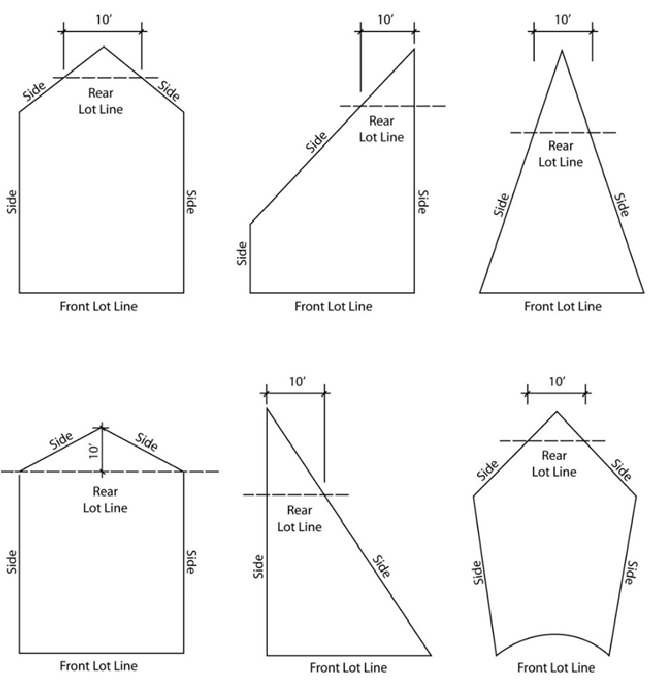
Figure 3-2 -
Rear Setback Areas on Irregularly-Shaped Parcels
C.
Allowed Encroachments into Setback Areas. Encroachments into required setback areas are allowed in compliance with the following standards:
1.
Awnings, canopies, chimneys, cornices, eaves, bay windows and greenhouse windows, or any other architectural features may extend into front, side, or rear setback areas a distance not exceeding two feet; provided that no architectural feature shall extend to within three feet of any side or rear parcel line.
2.
Fire escapes may extend into a front, side, or rear setback a distance not exceeding four feet.
3.
Stairways, landing places or uncovered porches may extend into a front setback a distance not exceeding six feet and may extend into a side or rear setback a distance not exceeding three feet provided that:
a.
The landing place or uncovered porch shall have its floor no higher than the entrance floor of the adjacent structure;
b.
A railing no higher than 42 inches may be placed around the landing place or uncovered porch;
c.
The stairway, landing place, or porch is unroofed and unenclosed above and below;
d.
The stairway, landing place, or uncovered porch shall not reduce the effective side setback clearance to a distance less than three feet; and
e.
It can be demonstrated that the stairway, landing place or uncovered porch is required for access into the main structure as a reasonable accommodation through submission and approval of a Reasonable Accommodation Application.
4.
A covered porch structure, one story in height, open on the street side and at least one other side may project five feet into the required setback. If a covered porch is incorporated into the design of a single-family residence so that a street facing attached garage wall/door is set back a minimum of five feet from the front of the porch, the street facing garage wall/door shall be set back a minimum of 23 feet from the front property line.
5.
Fences, hedges, and walls may be established within required setback areas in compliance with the standard requirements.
18.22.070 - Solid Waste and Recyclable Materials Storage
Standards for the provision of solid waste (refuse) and recyclable material storage areas support the City's compliance with the California Solid Waste Reuse and Recycling Access Act (Public Resources Code Sections 42900 through 42911) and apply to new multiple-family residential development, nonresidential development, and changes to existing multiple-family or nonresidential development which increase gross floor area by 30 percent or more. Recycling and solid waste facilities (including carts, bins, containers, and enclosures) shall be adequate in capacity, number, and distribution to serve the uses on-site as determined by the Review Authority.
A.
General Requirements.
1.
Any additions to nonresidential structures that equal or exceed 30 percent of the existing floor area of structures on a site shall require the property owner to provide adequate enclosures for the storage of recycling containers and solid waste containers.
2.
Plans depicting the proposed design, materials, size and location of enclosures, and the number, size, type, and placement of bins and containers shall accompany each development application, which will in turn be reviewed by the City's solid waste franchise hauler to ensure design enables solid waste servicing. The Director may approve a development application, require modifications, or may impose additional requirements to ensure the safe and efficient collection of solid waste and recyclable materials.
3.
Plans shall include an adequate number of bins and containers located within the enclosed storage areas to allow for the collection and loading of solid waste, green or organic waste, and recyclable materials generated by the development project.
4.
The enclosure shall be adequate in size for garbage, recycling, green or organic waste and, if a restaurant or office building with kitchens, oil, fat and grease containers. The City's franchise waste hauler may assist with calculating the estimated waste generation, and the footprint of each bin or cart within the enclosure. There shall be enough space to allow each bin to be accessed easily by building occupants and service providers.
5.
Each recycling and solid waste enclosure shall have four sides and meet the following minimum requirements:
• A water-tight bermed area for bin storage at least four inches high to preclude spills and leaks from escaping into the surrounding area.
• The enclosure must be at street level, or within 25 feet from a public street or a paved roadway that is at least 16 feet wide.
• One side of the enclosure shall include a door or gate, unless the containers are stored inside a standard building.
• The enclosure gates must open a minimum of 90 degrees (straight out or wider) and have "cane bolts" to secure them from moving while the bins/carts are being serviced.
• Hinges and gate shall be flush with the enclosure wall in order to allow adequate maneuverability of the bins/carts in and out of the enclosure for service.
• Enclosures shall be a minimum of six feet high and fully screen all materials and containers from public view.
• The enclosure shall be completely covered with a solid roof with a minimum one-foot open clearance between enclosure walls and bins to allow for ventilation.
• The enclosure shall contain bump stops to keep the bins/carts from hitting walls.
• Each recycling and solid waste enclosure shall be connected to a sanitary sewer line, approved by the local sanitary district.
• The enclosure shall be level or at a grade of less than 2 percent.
• A vertical height clearance of 25 feet is required for accessing containers.
• Two feet of space is required between the bins/carts and enclosure bump stops.
• Permanent, weatherproof "No Parking Signs" shall be placed on the outside of the enclosure, and the property owner shall ensure enclosures are not blocked on service days.
• Permanent, weatherproof educational signs shall be hung inside the enclosure to educate users on the garbage and recycling programs and appropriate disposal sorting.
6.
Recycling and solid waste enclosures shall not be located in any parking, landscape, or setback areas, including any increased setbacks on commercial and industrial properties as required by the Development Code, unless otherwise approved by the Review Authority.
7.
The property owner is responsible for the maintenance and cleanup of recycling and solid waste enclosures and for preventing any materials from exiting the enclosure.
8.
The recycling and solid waste contractors are responsible for ensuring proper maintenance of their respective bins and containers. Each refuse bin shall be covered with a lid at all times, and the bins shall be sized to ensure the lid forms a seal when closed.
9.
A sign shall be permanently posted or painted on each container clearly identifying the name and telephone number of the company responsible for maintaining the containers.
10.
In a development complex where driveways do not circulate from street to street, a turnaround area for the collection vehicle shall be provided. A truck turning radius of 40 feet is required. For backup distances of greater than 150 feet, a turnaround shall be provided.
11.
Vehicle access to the enclosure shall be unobstructed and provide a minimum of 15 feet vertical clearance.
12.
The loading area shall have a minimum 20 feet vertical clearance with a concrete stress apron extending eight feet from the enclosure opening engineered to withstand a 60,000 pound vehicle. A level concrete pad consisting of five inch aggregate base and six-inch Portland cement paving, or equivalent, as approved by the Director, shall be constructed in front of each enclosure for the collection vehicle.
13.
Landscaping adjacent to the enclosure to screen the enclosure from view may be required by the Review Authority.
14.
If used, each garbage chute installed on a property shall include two additional chutes (one for recycling and another for green organic waste) located within ten feet to assist the City in reaching landfill diversion goals.
B.
Residential Development.
1.
Single-family and multiple-family dwellings of three or fewer units shall store recycling, green or organic waste, and solid waste containers so they are either screened from public view from the public right-of-way or stored in the side yard of the premises behind the front of the dwelling. Containers may remain in public view during the 54-hour period commencing at 12:01 a.m. on the day preceding the day of scheduled pick-up and terminating at 6:00 a.m. on the day following the pick-up.
2.
Multiple-family uses of four or more dwellings shall provide recycling and solid waste enclosures for storage of recyclable materials, solid waste and refuse.
a.
Enclosures shall be constructed of wood or masonry compatible with the main structure(s).
b.
Enclosure doors shall be of solid steel or aluminum.
c.
Enclosures shall be located within a maximum of 250 feet from any unit they are designed to serve, unless otherwise approved by the Review Authority.
C.
Commercial/Office/Mixed Use/Public Facilities Uses.
1.
Enclosures shall be constructed of masonry with exterior material that matches the main structure(s).
2.
Enclosure doors shall be of solid steel.
D.
Industrial Uses.
1.
Enclosures shall be, at minimum, slatted chain link fencing. The Director may require enclosures to be constructed of wood or masonry to be compatible with the main structure(s) or to enhance the public view of the enclosure.
2.
Fencing shall be a minimum of six feet in height.
E.
Exemptions. All of the following are exempt from the requirements of this section:
1.
Recycling bins not accessible to the general public used exclusively by a business for its recycling program.
2.
Recycling centers approved by the City.
18.24.010 - Purpose and Applicability
A.
Purpose. This chapter establishes standards for the development and use of accessory structures customarily incidental to an allowed primary use. The development standards are intended to ensure that accessory structures do not adversely impact either adjacent parcels or the surrounding neighborhood or uses, and are developed in a manner that protects the integrity of the zone.
B.
Applicability. The provisions of this chapter apply to all accessory structures.
18.24.020 - Permit Requirements
A.
Permits. The construction and/or relocation of detached accessory structures require a building permit to ensure compliance with the Development Code, unless specifically exempted.
B.
Exemptions for Residential Zones. Storage sheds and other similar accessory structures that comply with the following regulations are required to receive a Zoning Clearance.
1.
The footprint of the structure is not more than 120 square feet and is less than 15 feet in total height;
2.
The structure does not occupy more than 25 percent of the rear setback area;
3.
The structure is located at least three feet from all property lines and at least three feet from any adjacent structures;
4.
The structure does not exceed the site coverage limitations for the zone in which it is located;
5.
The structure is constructed of materials that are visually appealing, painted or stained (unless natural wood will weather attractively), and if the structure has a pitched roof, the roof does not produce glare;
6.
The structure is built to the specifications of the California Building Code as well as any other applicable codes in force;
7.
If the structure is proposed on a corner parcel, it shall not encroach upon the exterior side setback; and
8.
The structure is not proposed in any setback other than the rear setback, unless approved by the Director.
18.24.030 - Standards for Accessory Structures
A.
Residential Zones, Nonexempt Structures.
1.
Structures greater than 120 square feet. A one-story detached accessory structure with a footprint greater than 120 square feet may be constructed after approval of a Zoning Clearance and obtaining building permits, if all of the following requirements are met:
a.
The structure does not occupy more than 25 percent of the front or rear yard.
b.
At least 750 square feet of useable rear yard area is maintained.
c.
The structure has a height no greater than 15 feet.
d.
The structure is located as follows:
(1)
At least six feet from the rear property line;
(2)
In the rear half of the lot;
(3)
At least three feet from side property lines; and
(4)
At least six feet from any adjacent structures.
e.
The structure has a projected roof area of less than 1,000 square feet;
f.
The structure does not exceed the site coverage limitations for the zone in which it is located;
g.
The structure is constructed of a material that is visually appealing, painted or stained, fully enclosed, and with a hip or other approved roof that does not produce glare, and of a compatible exterior appearance with the principal structure on the premises;
h.
The applicant has submitted plans to the Building Official and has received a building permit to proceed with construction; and
i.
If the structure is proposed on a corner parcel, the structure does not encroach upon the exterior side setback.
2.
Additional location requirements. Detached accessory structures in residential zones shall conform to all of the following additional location regulations within the parcel:
a.
Accessory structures shall not be allowed in the front first half of a lot;
b.
On an interior parcel abutting upon one street, a detached accessory structure shall not be erected or altered so as to encroach upon the front setback of the parcel;
c.
On an interior parcel abutting upon two or more streets, a detached accessory structure shall not be erected or altered so as to encroach upon the one-fourth of the parcel nearest either street;
d.
On any corner parcel, a detached accessory structure shall not be erected or altered so as to be closer to any street side property line than a distance equal to the width of a side setback required for the parcel;
e.
No natural gas-fueled or electrical heating or air conditioning apparatus, pump, plumbing, or other mechanical equipment shall be installed within any accessory structure (with the exception of a single wash basin and/or plumbing required for a washing machine), unless otherwise approved by the Director.
B.
Nonresidential Zones, Development Standards. All of the following regulations apply to all accessory structures in nonresidential and mixed use zones:
1.
Incidental to the primary structure or use. The accessory structure shall serve occupants and/or patrons of the primary structure or use and shall not alter the character of the site or use;
2.
Height. The height is limited to one story no greater than 15 feet in height;
3.
Setbacks. All accessory structures shall meet the setback requirements for the zone in which they are located;
4.
Site coverage. The total square footage of all accessory structures on a parcel, including any exempt structures, counts toward the calculation of total site coverage for the zone in which they are located; and
5.
Architectural consistency. All accessory structures shall be consistent in exterior appearance with the primary structure through the use of similar/matching exterior paint colors, material types, roof materials, and architectural style, as determined by the Director.
C.
Exemptions. Ancillary structured parking serving a building complex. The development standards applicable to ancillary structured parking shall be the same standards applied to the building complex, not the standards set forth in this chapter for accessory structures generally.
18.26.010 - Purpose and Applicability
A.
Purpose. This chapter establishes standards for the construction and maintenance of fences and walls, and the planting and maintenance of hedges used for screening or buffering purposes. The standards are intended to ensure that all fences, hedges, and walls provide desired privacy and safety but do not create a public safety hazard or nuisance, and meet the City's standards for quality design and maintenance.
B.
Applicability. The regulations in this chapter apply to all fences, hedges, and walls in all zones.
18.26.020 - Location and Height
A.
General. Fences, hedges, and walls shall be subject to all of the following regulations, unless an exception applies.
1.
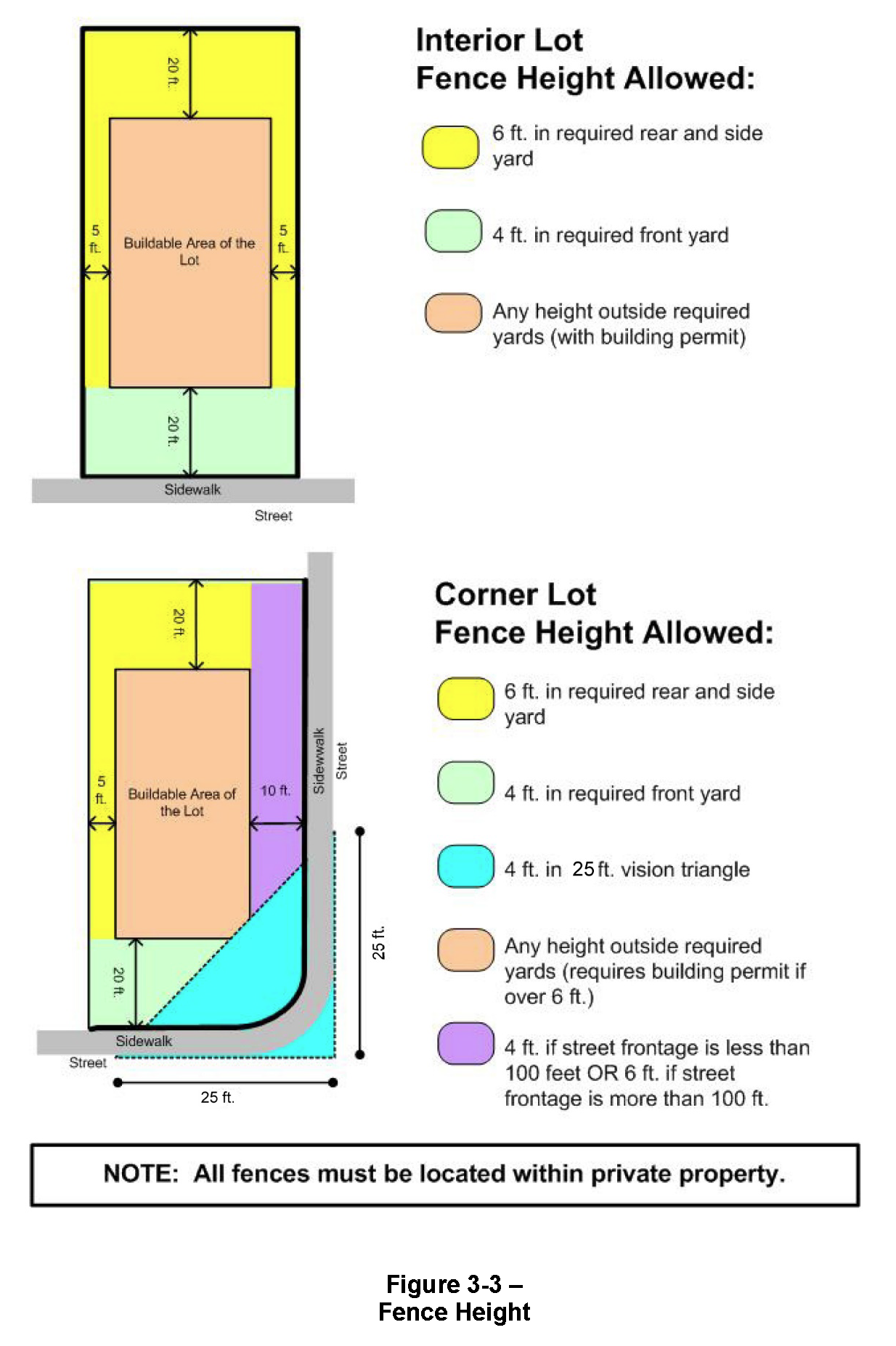
Fences, walls, and hedges not exceeding four feet in height may occupy any front setback area. See Figure 3-3.
2.
Fences, walls, and hedges not exceeding six feet in height may occupy any side or rear setback area, provided:
a.
They do not extend into any required front setback; and
b.
In the case of a corner parcel, they do not extend into the side setback area required along a side street or into that portion of the rear setback area abutting a side street that is equal to the width of the side setback required on the side street.
3.
The installation of fences, hedges or walls for the expressed purpose of creating a gated community is expressly prohibited by the City.
B.
Corner Vision Triangle. All fences, hedges, and walls shall comply with the height limitations required for safe vision.
C.
Trees to be Trimmed. Where trees are located within 25 feet on the intersected street lines, the main trunks of the trees shall be trimmed free of branches to a height of seven feet above the grade of the nearest street curb.
D.
Prohibited Fence Materials. Barbed wire, electric fence, razor wire, and other similar materials are prohibited in all zones.
18.26.030 - Measurement of Fence or Wall Height
A.
Flat Elevation. Fence height shall be measured as the vertical distance between the highest finished grade of the ground abutting the fence and the top edge of the fence material. Adjacent grades shall not be artificially elevated in order to allow for a fence or wall that is higher than the allowable maximum height.
B.
Uneven Grade. Whenever there exists an abrupt shift in the height of the land at the boundary between two property owners the lower owner may erect a fence, wall or hedge on the boundary to the height limit, but in no event shall it be more than eight feet in height.
18.28.010 - Purpose
A.
Preserve trees on private property for the health, safety, and welfare of the community while recognizing individual rights to develop and maintain private property;
B.
Utilize trees to create scenic beauty and wildlife habitat, attract visitors and businesses and serve as a source of community pride;
C.
Mitigate storm water runoff, prevent erosion of topsoil, protect against flood hazards, and counteract pollutants in the air; and
D.
Reach climate goals by shading structures and outdoor places, cooling sidewalks, reduce impacts from increasing temperatures and decreasing wind velocities while improving public health outcomes for residents.
(Ord. No. 02-2022, § 2(Att. B), 5-3-2022)
18.28.020 - Definitions
ANSI A-300 Standards. Accredited industry standards and practices for managing trees and other woody plants.
Applicant. Owner of the property to be developed who submits an application to remove a protected tree located on the subject property, or the private property owner applying to remove a protected tree.
Appraisal of Tree Value. An unbiased estimate of the tree's worth performed in accordance with the current edition of the Guide for Plant Appraisal by the Council of Tree and Landscape Appraisers.
Certified Arborist. An arborist certified by the International Society of Arboriculture and approved by the Director.
Diameter. Diameter at standard height (DSH), or trunk diameter measured at 54" above grade.
Dripline. Area directly located under the outer circumference of the tree branches or with a radius of ten times the diameter of the trunk as measured at 54 inches above grade (DSH), whichever is greater.
Excessive Pruning. Removal of functioning leaf, stem, or root area of a tree in any thirty-six (36) month period such as to cause a significant decline in health, increased risk of failure, or the unbalancing of a tree.
Master Plan. City of East Palo Alto Urban Forest Master Plan, which sets forth the policies and guidelines for planting and maintenance programs for the care and protection of its trees.
Protected Tree. Any tree on private property having a main stem or trunk of 8" or greater in diameter at a height of 54" above grade (DSH); any tree required to be preserved as a condition of a development approval; any tree required to be planted as a condition of a development approval.
Remove. Complete removal, such as cutting the tree to the ground, or taking any action that would lead to the death of a tree or permanent damage to its health, including excessive pruning, girdling, cutting of tree roots, poisoning, over-watering, under-watering, trenching, excavating, altering the grade, paving within the dripline or unauthorized relocation or transportation.
Tree Canopy Cover. Measurement of the total area of a tree's branches, stems, and leaves when viewed from above.
(Ord. No. 02-2022, § 2(Att. B), 5-3-2022)
18.28.030 - Authority, Responsibilities and Duties
A.
Director. The Director has the responsibility to implement and authority to make decisions and judgments to enforce the provisions of this chapter. Duties include but are not limited to implementing tree protection policies for trees on private property and throughout the development process, accepting and reviewing applications from any person requesting to remove one or more trees on any private property, and approving or denying applications involving trees based on criteria set forth in this chapter, with appropriate conditions.
B.
Property Owner. Every owner of real property within the City, and every person responsible for removing or damaging a tree, regardless of whether the person is engaged in a tree removal business, is subject to the regulations in this chapter.
(Ord. No. 02-2022, § 2(Att. B), 5-3-2022)
18.28.040 - Tree Planting
A.
ANSI. All trees selected for planting shall conform to the American Association of Standards, ANSI Z60.1 Specifications for Acceptance of Nursery Trees at the Time of Delivery. Tree planting shall follow the current edition of ANSI A-300 Tree Planting, including post-planting pruning, and early tree care. Newly planted trees should be provided regular maintenance, including irrigation and pruning as needed, during the first five years.
B.
Species. Tree species must be appropriate for the site, keeping in mind "right tree right place" principles. Trees shall be selected for function and purpose as outlined in the Master Plan. Tree should be situated to maximize benefits and to minimize hazards, nuisances and hardscape damage.
C.
New Single-Family Subdivisions. In all new single-family residential subdivisions there shall be a minimum of two trees on each parcel. This tree requirement is in addition to the 150 square feet of permanent private open space required for each parcel.
D.
Multiple-Family Residential Subdivisions and Non-Residential Subdivisions. There shall be a goal of 20% canopy cover over the site within 15 years of final building permit issuance. This requirement is in addition to landscaping required within parking lots and trees installed along the street frontage.
(Ord. No. 02-2022, § 2(Att. B), 5-3-2022)
18.28.050 - Pruning
No permit is required for pruning a private protected tree. Private protected tree pruning should be performed in compliance with the most current edition of ANSI A300—Pruning, which includes pruning young trees to develop lowest branching structure above homes or nearby structures, and crown cleaning, crown thinning, crown raising, crown restoration, crown reduction and utility line pruning in semi-mature and mature trees. Excessive pruning, topping, vandalizing, mutilating, or destroying a protected tree is prohibited.
(Ord. No. 02-2022, § 2(Att. B), 5-3-2022)
18.28.060 - Permit Required
A.
Tree Removal Permit. No person shall remove, destroy or disfigure any protected tree within the city without a permit. If the tree removal is part of a development application, a separate Tree Removal Permit is required, but the Tree Removal Permit will be considered as part of the development application. A Certified Arborist report as noted below, is required.
B.
Application. An application for a Tree Removal Permit shall be made to the Director on the form provided. The application shall be accompanied by a fee as set forth in the master fee schedule. The application shall contain the number and location of each tree to be removed, the type and approximate size of the tree, the reason for removal, and any additional information required by the Director. The application shall include a tree report by a Certified Arborist report. Any expense associated with the preparation of the tree report shall be the responsibility of the applicant. The Director may refer the application or report to another department, or person for an additional report or recommendation.
C.
Tree Protection Plan. All development projects shall submit an Arborist Report and Tree Protection Plan.
1.
The report by the Certified Arborist shall specify the following:
a.
The location of trunk and dripline, size, health, and species of all trees on site with a diameter of 6" or greater.
b.
The reason for removal for any tree proposed to be removed.
c.
Recommendations for tree protection measures.
d.
An appraisal of the condition and replacement value of all affected trees. The appraisal shall be performed in accordance with the current edition of the Guide for Plant Appraisal Council of Tree and Landscape Appraisers.
2.
If an application for a development permit includes tree removal, the report by the Certified Arborist also shall include a planting plan detailing the number of tree replacements, species and irrigation system. Prior to acceptance of improvements, a final tree report by a Certified Arborist shall be submitted to the Director. The report shall assess the health and condition of the trees retained and protected during development and any changes in physical condition.
D.
Owner Responsibility. If the removal request is approved, the property owner may perform the work as approved and must comply with all requirements to provide proper and sufficient measures to mitigate against any hazards or nuisances. The property owner is responsible for any damages, necessary repairs or needed replacements. No liability shall be imposed upon the City or upon any of its officers or employees for damages related to an unsafe tree to relieve the owner or occupant of any private property from the duty to keep in safe condition any trees upon the property or adjacent to or overhanging the public right-of-way.
E.
Emergency. If the condition of a tree presents an immediate hazard to life or property, as defined by ANSI A300, it may be removed without a permit on order of the City Manager, Building Official, or the Director; an after-the-event permit will be required.
F.
Public Utilities. Public utilities subject to the jurisdiction of the State Public Utilities Commission may, without a permit, take actions necessary to comply with the safety regulations of the Commission and as may be necessary to maintain safe operation of facilities. Where possible, trees shall be preserved.
G.
Financial Security. A check, or an alternative form of payment if approved by the City shall be provided to the City for the appraised value of the trees impacted by development and the value of replacement trees as mitigation for the removal of trees, as well as the cost of staff time. The financial security shall be refunded upon the receipt of a final arborist report certifying preservation or proof of replacement, or payment of an in-lieu impact fee.
(Ord. No. 02-2022, § 2(Att. B), 5-3-2022)
18.28.070 - Criteria for Tree Removal
A Protected Tree may be removed under the following circumstances:
A.
The tree is dead, expected to die within 5 years, or poses a high or extreme risk (as defined by International Society of Arboriculture Best Management Practice (A300 part 9)), or is classified as invasive by the California Invasive Plant Council (Cal-IPC, 2017). Where an arborist report indicates that a tree fits this category, fees may be waived.
B.
The tree is structurally unsound and cannot be corrected or the risk cannot be significantly reduced by traditional pruning, cabling, or bracing or is causing visible damage to property, which cannot be corrected without destroying the tree canopy or root system.
C.
The tree is causing visible damage to property which cannot be corrected without destroying the tree canopy or root system.
D.
The tree interferes with proposed development, repair, alteration, or improvement of a site and preservation would stop the implementation of a well-integrated and thoughtful design that enhances the property and neighborhood while meaningfully furthering the goals set forth in the General Plan and the project will incorporate replacement trees.
E.
Removal is requested by a utility, public transportation agency, or other governmental agency due to a health or safety risk resulting from the tree's interference with existing or planned public infrastructure and preservation of the tree would add unreasonable cost to the project.
(Ord. No. 02-2022, § 2(Att. B), 5-3-2022)
18.28.080 - Replacement of Trees or In-Lieu Fee
If the city allows a tree to be removed, either replacement tree(s) of an equivalent value must be planted or an in-lieu fee must be paid.
A.
Replacement. Trees shall be replaced on a one-to-one basis; however, more than one replacement tree may be required to accomplish the goal of replacing the lost canopy. Replacement tree(s) planted on-site are a priority.
B.
In-Lieu. If replacement cannot be fully accomplished on-site, staff may authorize payment of in-lieu fees. The value of the removed tree(s) for in-lieu fee payment shall be calculated in compliance with the latest edition of the Guide for Plant Appraisal by the Council of Tree and Landscape Appraisers.
(Ord. No. 02-2022, § 2(Att. B), 5-3-2022)
18.28.090 - Tree Removal Review Process
A.
Tree Removal Application and Noticing. The property owner shall notify adjacent property owners and tenants, if any, of the intent to remove a protected tree. Upon submittal of the application, notice is required to be posted. Once the decision is final, a second notice is required to be posted at least 48 hours prior to removal. The notification shall be in a written form, dated and posted on the tree or in another visible location within close proximity to the tree that is clearly visible to adjacent owners and tenants.
B.
Review Process. Tree removal permit applications shall be reviewed and decided upon by the Director within 30 days of a complete application being submitted. Notice of the decision will be mailed to the applicant, the owners and occupants of all adjacent properties, and any person requesting notice of the decision. The decision shall become final 15 days after the notice is mailed. The decision of the Director may be appealed within 15 days of the notice of decision by filing an appeal in writing. Appeals shall be to the Planning Commission and conducted consistent with the provisions of Chapter 18.106. The decision of the Planning Commission is final.
(Ord. No. 02-2022, § 2(Att. B), 5-3-2022)
18.28.110 - Enforcement
A.
Violations. Violation of a provision contained in this chapter is unlawful and a public nuisance. The Director may serve notice upon any person violating any provision of this chapter. Violators shall be subject to the provisions set forth in Chapter 1.118.
B.
Replacement. Intentional or negligent removal or destruction of a protected tree without a Tree Removal Permit shall require replacing on-site each unlawfully removed/destroyed tree with two or three new trees, or a greater number of new trees, as the Director may determine to be necessary to ensure the replacement of the lost canopy and to provide an aesthetic quality reasonably equivalent to the unlawfully removed/destroyed tree within 10 to 15 years. The size, species, and condition of the replacement trees shall be subject to approval by the Director. All replacement trees shall be maintained by the property owner under a five-year maintenance agreement with the City.
C.
Value. If the Director determines that on-site replacement trees will not provide sufficient reasonably equivalent canopy cover and aesthetic quality, the Director shall determine the cost of the mitigation needed to remedy the effects of the unlawful removal/destruction based upon the value of the tree(s) in compliance with the latest edition of the Guide for Plant Appraisal, published by the Council of Tree and Landscape Appraisers, and the cost of planting replacement trees elsewhere. The established value of the tree(s) shall be the civil penalty assessed, in addition to the penalty prescribed by law for the commission of the offense. Such an amount shall be payable to the City.
D.
Business License Revocation. A violation of any provision by a person of a tree removal, landscaping, construction, or other business in the City shall constitute grounds for revocation of the Business License issued to the person or business.
(Ord. No. 02-2022, § 2(Att. B), 5-3-2022)
18.30.010 - Purpose
The purpose of this chapter is to provide off-street parking and loading standards to:
A.
Provide for the general welfare and convenience of persons by ensuring sufficient parking facilities are available to meet the needs generated by specific uses and adequate parking is provided, to the extent feasible;
B.
Ensure accessible, attractive, secure, and well-maintained off-street parking and loading facilities;
C.
Increase public safety by reducing congestion on public streets and to minimize impacts to public street parking;
D.
Ensure access and maneuverability for emergency vehicles;
E.
Provide loading and delivery facilities in proportion to the needs of allowed uses; and
F.
Encourage the use of bicycle transportation by providing appropriate bicycle parking facilities.
18.30.020 - Applicability
A.
Off-Street Parking Required. Each use, including a change or expansion of a use or structure, shall have appropriately maintained off-street parking and loading areas. A use shall not be commenced and structures shall not be occupied until improvements required by this chapter are satisfactorily completed.
B.
Change, Enlargement, or Intensification of Use. Changes in use and enlargement or intensification of an existing use that creates a need for an increase of more than 10 percent in the number of off-street parking spaces shall require compliance with the off-street parking requirements, except as authorized for nonconforming uses, structures and parcels. If a change in use creates a need for an increase of less than five off-street parking spaces, no additional parking facilities shall be required.
18.30.030 - Permit Requirements
A.
New Parking Facilities. The design of new parking facilities not otherwise exempt from the parking requirements shall be reviewed in conjunction with the building permit and any other land use or development permit required for the project which creates a need for additional parking. A site plan shall be submitted to the Director in conjunction with the required permit(s) and shall include sufficient detail to determine compliance.
B.
Modification of Existing Parking Facilities. Modification or improvement to an existing parking facility which changes the parking space layout, configuration, number of stalls, or landscaping shall first require Director review and approval.
18.30.040 - Exemptions
Parking facility improvements considered minor in nature exempt from permit requirements:
A.
Resurfacing, slurry coating, and restriping of a parking area with identical delineation of parking spaces;
B.
Repair or replacement of damaged planters and curbs in the same location; and
C.
Repair of any defects in the surface of the parking area, including holes and cracks.
18.30.050 - Off-Street Parking Requirements
A.
Parking Spaces Required by Type of Use. Table 3-1 establishes the number of spaces and facilities required for off-street parking for the uses specified. These standards shall apply at the time a new structure is erected, when an existing structure is altered or enlarged, when a new land use is established, and/or when a use is intensified by the addition of floor space or seating capacity, unless otherwise specified in this chapter. The Director shall have the discretion to require a parking study, paid for by the applicant, for any project.
B.
Uses Not Listed. Where the parking requirements for a use are not specifically listed in Table 3-1, the parking requirements for the use shall be determined by the Director. The Director shall establish a parking standard based upon the requirements for similar uses or by utilizing the ITE Parking Generation Manual.
C.
Calculation of Spaces Required.
1.
Gross floor area. For the purpose of calculating parking spaces, "floor area" for offices, merchandising, or service types of uses shall mean the gross floor area used, or intended to be used, for service to the public as customers, patrons, clients or patients, or as tenants, including areas occupied by fixtures and equipment used for display or sale of merchandise. Floor area does not include areas used principally for non-public purposes, including kitchens, storage, incidental repair, processing or packaging of merchandise, show windows, offices incidental to the management or maintenance of stores or structures, toilet or restrooms, utilities, dressing rooms, or fitting or alteration rooms. The burden of proof is on the property owner or applicant to provide a site plan to the Director that clearly identifies gross floor area for parking purposes.
2.
Fractional spaces. Fractional parking space requirements shall be rounded up to the next whole space.
3.
Bench seating. In stadiums, sports arenas, and other places of assembly in which patrons or spectators occupy benches, pews, or other similar seating facilities, each 20 inches of seating facilities shall be counted as one seat for the purpose of determining requirements for off-street parking facilities.
4.
Spaces per maximum occupancy load. References to spaces per occupant are to be calculated on the basis of maximum occupancy approved by the Fire District.
D.
Mixed Use Development.
1.
General. In the case of mixed uses or occupancies in a structure and/or on a parcel, the total number of off-street parking spaces shall be calculated for each use by applying the applicable parking standard for the principal use to each of the separate uses. Off-street parking facilities for one use shall not be considered as providing required parking facilities for any other use.
2.
Parking reduction. In the event that a mixed use development includes uses that have different peaks in parking demand, (e.g., a mixed commercial and residential development) an alternative parking requirement may be established, as determined appropriate by the Director. The applicant shall be required to pay for a parking study to ensure mixed use development projects are adequately parked if the parking reduction request is being made.
E.
Parking Required On-Site. All required parking shall be located on the same parcel or development site as the uses served, except for parking approved to be located off-site.
F.
Permanent Availability Required. Each required parking and loading space shall be permanently available and maintained for parking purposes for the use it is intended to serve.
G.
Maintenance. Parking spaces, driveways, maneuvering aisles, turnaround areas, and landscaping areas shall be kept free of dust, graffiti, and litter. Striping, paving, walls, light standards, and all other facilities shall be permanently maintained in good condition.
H.
Nonconforming Parking and Loading. Land uses and structures that are nonconforming due solely to the lack of off-street parking or loading facilities required by this chapter, shall be subject to the provisions for nonconforming uses, structures and parcels).
I.
Handicap Accessible Parking. Handicap accessible parking shall be provided in compliance with the requirements of the Building Code.
18.30.060 - Exception to Parking Requirements
Hardship. In cases of practical difficulties and unusual circumstances, the Planning Commission may, after required hearings, recommend exceptions to the requirements for on-site parking, if supported by a parking study, consistent with the provisions of Section 18.030.100.
18.30.070 - Compact Parking Spaces
A.
Maximum number. For any commercial, office, industrial or multiple-family development, up to 40 percent of the required off-street parking spaces may consist of compact parking spaces.
B.
Size. Each compact parking space shall be not less than 16 feet in length and eight feet in width, exclusive of aisles and access drives.
C.
Affordable housing. For housing developments granted a density bonus, up to 50 percent of the required off-street parking spaces may consist of compact spaces.
18.30.080 - Parking Areas, Development and Maintenance
A.
Single-family residential zones.
1.
Recreational vehicle parking. The parking of recreational vehicles is only allowed in the R-LD zone and shall be subject to all of the following standards:
a.
The recreational vehicle shall be owned by the occupant of the residence at which the vehicle is parked;
b.
The recreational vehicle shall be parked either on a legal driveway within the front yard area or on a paved surface within a side or rear yard area;
c.
No recreational vehicle or portion thereof shall overhang any public right-of-way; and
d.
No electrical, plumbing, or other similar hook-ups shall be extended and/or used by the recreational vehicle.
2.
Commercial vehicles. It is unlawful to store and/or park on any parcel in any residential zone any commercial vehicle exceeding a one-ton rated carrying capacity as specified by the manufacturer.
3.
Parking in front yard area. It is unlawful to park any vehicles in any front yard area of a single-family residential use other than the legal driveway.
4.
Paved areas in front yard. Paved areas within the front yard, including the driveway and any walkways, shall not exceed 50 percent of the front yard area with the remaining area landscaped with live plant material. The use of pervious materials for driveways, walkways, patios, and outdoor living areas is strongly encouraged.
5.
Driveway. Single-family homes are prohibited from having more than one driveway entrance. All dwelling units must be served by the same driveway access to the street as the main dwelling. If an existing property has more than one driveway, any new development permit, including but not limited to, design review, grading, drainage, or tenant improvements, shall be conditioned to remove the additional driveway(s).
B.
Multiple-family residential zones.
1.
Parking spaces shall be provided in off-street parking areas located within 1,000 feet of the use they are intended to serve;
2.
It is unlawful to rent, lease or otherwise convey to or allow use of a required parking space by any person who is not a tenant or visitor for whom the parking spaces are required.
3.
For tenancies beginning after June 1, 2014, it is unlawful for any manager or owner of any residential unit to separately charge, require or receive a fee, rent or other remuneration from a resident for the use of the required off-street parking (other than from the consideration received for the rent or lease of the dwelling and its associated parking spaces). All required parking spaces are considered an inseparable part of the rented premises, unless the tenant elects to relinquish access to the off-street parking.
4.
All on-site required parking spaces shall be available to the occupants of the property. For properties developed after June 1, 2014, the occupants of each unit shall have use of the parking developed for the unit, unless the tenant elects to relinquish access to the off-street parking. For properties developed before June 1, 2014, with less than two covered parking spaces per unit and where the property owner lives at the multiple-family property, the property owner may reserve for his or her personal use two legal parking spaces (uncovered or covered) which shall be contiguous, if possible. The remaining on-site legal parking spaces not utilized by the property owner shall be allocated among the other units.
5.
If a landlord removes an on-site, off-street parking space from a tenancy in violation of these provisions
a.
The tenant may apply for a rent decrease by an amount commensurate with the value of the removed parking space for the temporary period of time during which the space is removed;
b.
The landlord shall be subject to criminal prosecution; and
c.
The City may bring a civil action for injunctive relief.
6.
Temporary removal of a parking space reasonably necessitated by required repair or maintenance does not give rise to a penalty.
7.
A landlord and tenant are not prohibited from voluntarily agreeing to the substitution of one parking space for another at the same property.
C.
Non-residential uses. Required parking facilities for all uses other than residential shall be provided as follows:
1.
Parking spaces shall be provided in off-street parking areas located within 1,000 feet of the use they are intended to serve;
2.
Parking spaces shall be permanently maintained and shall not be utilized for the storage of merchandise, materials, collection kiosks, or service vehicles specifically maintained for the business or for any other individual or business; and
3.
Required parking spaces shall not be rented, leased or otherwise conveyed or used by any person who is not a tenant of, visitor to, or employee for who the parking spaces are required. No employee shall be restricted from using the parking spaces required for the use where he or she is employed. Parking spaces developed in excess of the minimum required for the use may be rented or leased to another business or use.
18.30.090 - Parking Lot Design Standards
A.
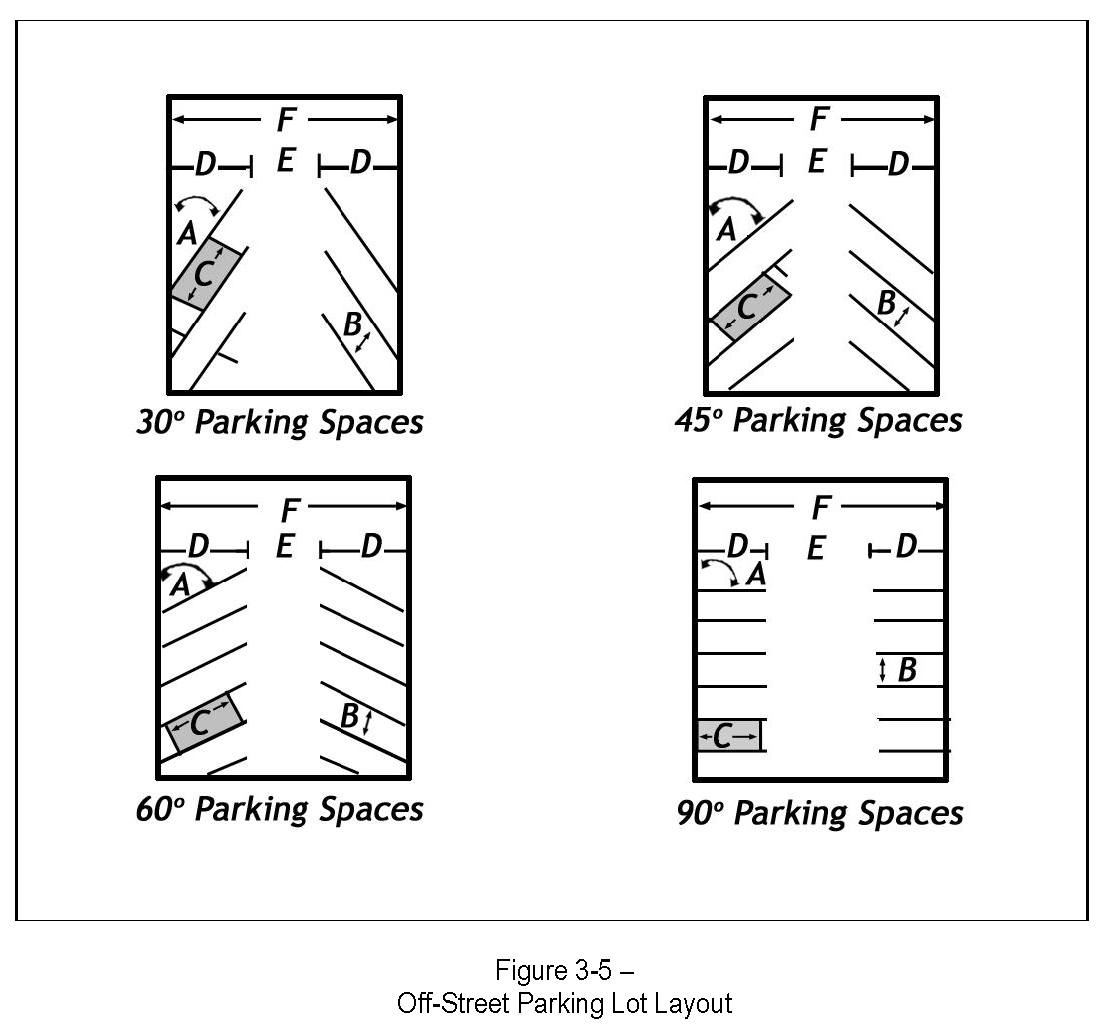
Parking space and drive aisle dimensions. Parking lots shall be designed and constructed as indicated in Table 3-2 and Figure 3-5.
Table 3-2 - Minimum Off-Street Parking Dimensions
B.
Covered parking. Each covered off-street parking space shall have minimum inside dimensions of 10 feet by 20 feet. If parking is within a residential garage, and there is a minimum clear space of 20 feet in length and 10 feet in width, the parking space may be 18 feet in length and nine feet in width.
C.
Parking stall marking. All parking spaces, except parallel spaces, shall be marked by appropriate stripes and the width of each space shall be measured from center to center of the stripes. This provision does not apply to single-family detached properties.
D.
Landscaping.
1.
Landscaped buffer. Any parking area not separated by a fence or wall from a street, alley, or other public right-of-way shall be provided with a minimum four-foot-wide landscape buffer between the parking area and the street, alley, or other public right-of-way, as measured from the edge of the right-of-way to the parking area. In addition, any area within the street right-of-way between the edge of the sidewalk and the outer edge of the right-of-way shall be developed as landscaped area in conjunction with the required four-foot area above, unless this requirement is waived by the City Engineer. Where a parking area has a capacity of more than 10 parking spaces, landscaped areas including the above four-foot street buffer strip shall not be less than five percent of the total parking lot area.
2.
Landscape screen. Landscaping, other than trees, shall be designed and maintained to establish a minimum screen of approximately 36 inches in height. Screening materials may include a combination of plant materials, earthen berms, raised planters, low walls, or other screening devices that meet the intent of this requirement, as approved by the Director. Not more than 30 percent of the landscaped area may be covered with hard surfaces (e.g., gravel, landscaping rock, concrete, or other impervious materials).
3.
Landscape material. Planting in parking areas shall consist of water-efficient evergreen shade trees, groundcover, low shrubs, flowering plants, and mulch to provide 100 percent coverage of required landscape areas. Landscaping fronting a street shall include a minimum of one tree for every 30 feet of frontage. Trees shall be a minimum of 15 gallons in size and six feet in height at the time of planting, and shall be of a variety that is fast growing and capable of providing maximum shade coverage. All landscaping shall be installed and maintained in compliance with Chapter 18.28.
4.
Parking lot shade. At least 50% of a paved parking lot shall be shaded with tree canopies within 15 years of obtaining a building permit or certificate of occupancy. Plantings shall comply with the following specifications:
a.
Landscaping fronting a street shall include a minimum of one tree for every 30 feet of frontage. Trees shall be a minimum of 15 gallons in size and six feet in height at the time of planting and shall be of a fast growing variety capable of providing maximum shade coverage.
b.
Tree well dimensions shall be a minimum of 6' × 6'. Irregular tree well design may be allowed if a minimum of 36 square feet of surface area is provided and a minimum of 85 cubic feet of rootable soil volume is incorporated into the tree well planting. Deviations from this standard are subject to approval by the Director.
c.
Trees should be planted in the center of the tree well. For irregular tree wells, trees should be planted in equal distances from curbs.
d.
Two feet of vehicle overhang into a planter area is allowed, provided the planter has a minimum width of four feet and trees are aligned with the parking strip.
e.
Structural soil systems for trees in parking lots or hardscape areas should be used to increase the volume of rootable soil, the eventual size of the canopy, and the amount of shade the tree provides.
f.
Continuous planting islands are encouraged to allow for multiple tree plantings and increased rootable soil volume. These islands could be designed to incorporate surface water runoff treatment measures such as bio-swales. To increase the amount of planting area available for shade trees, planter fingers connected to continuous planting islands are recommended.
g.
If more than 10 trees are required, a mix of tree species or cultivars shall be provided. If 20—40 trees are required, no more than 50% of the trees may be of the same type. If more than 40 trees are required, no more than 25% of the trees may be of the same type.
h.
Native climate-adapted species are recommended.
i.
Parking lot lighting should not conflict with required shade tree locations or growth. Light standards no greater than 16 feet in height are preferred. Buildings located close to streets must reduce potential conflicts between trees and free-standing signs.
j.
If the installation of required trees is not feasible due to conditions such as soil contamination, groundwater levels or utility easements, an in-lieu fee or an alternative tree planting program may be approved, as set forth in Chapter 18.28.
5.
Concrete curb. Each planting area shall be bound by a concrete curb having a minimum height and width of not less than six inches.
6.
Permanent irrigation system and maintenance. All planting areas shall be planted to maximize benefits and minimize hazards. Trees shall be provided with permanent irrigation, monitored and regularly maintained.
E.
Screening from residential zones. Vehicle parking facilities for more than 10 vehicles shall be effectively screened by a wall on each side that adjoins or faces premises situated in residential zones. The wall shall not be less than six feet in height, except within required front setback areas and shall be maintained in good condition. Screen planting or wooden fences may be substituted for aesthetic reasons, or in cases of practical difficulties or unusual hardship, provided that the design and plant material is first approved by the Director. A bond to guarantee the installation and maintenance of the screen planting or fencing, for a period of three years, shall be posted with the Department.
F.
Surfacing and drainage. Parking lot surfacing materials shall consist of sturdy, all-weather surfaces including, but not limited to, concrete, asphalt, and any other material capable of capturing, carrying, and disposing of surface water runoff. Pervious or partially pervious surfaces are acceptable to help achieve water quality goals and requirements, provided the proposed surfaces are approved by the City Engineer. All parking lots shall be designed to convey surface runoff to approved retention and/or drainage facilities. In no case shall a drainage course be allowed across the surface of a public sidewalk.
G.
Protective installations. To ensure the proper maintenance and utilization of parking facilities, public parking areas shall be designed so a parked vehicle does not overhang sidewalks, planters, or landscaped areas. A permanent curb, bumper, wheel stop, or similar device shall be installed adequate to protect sidewalks, planters, landscaped areas, and structures from vehicular damage. If the protection is provided by means of a method designed to stop the wheel rather than the bumper of the vehicle, the stopping edge shall be placed no closer than two feet from the edges of the sidewalks, planter, or landscaped areas and from any structure. The Director may require other barrier curbs or wheel stops as deemed necessary to protect areas within or adjacent to the parking area from vehicular encroachment.
H.
Parking lot lighting. All parking lots shall be provided with outdoor lighting. Lighting shall be installed and maintained in a manner that provides security for tenants and visitors, but does not impact surrounding uses. A parking lot lighting plan shall be provided for review and approval by the Director.
I.
Access and circulation.
1.
Each parking space shall be accessible from a street or alley, independent of any other parking space; provided, however, in the case of off-street parking for a single-family dwelling or a second unit, tandem parking spaces within a garage or carport or elsewhere on the site is allowed. In some circumstances, mechanical or lift parking may be approved by the City.
2.
Parking spaces within a parking lot or structure shall be designed and located so any required maneuvering into or out of the space will not interfere with vehicles entering or exiting the parking lot, and so vehicles can enter an abutting street in a forward direction.
3.
Within a parking lot or structure, the drive aisles shall be designed so that a vehicle is not required to enter a street to move from one drive aisle to another.
4.
Vehicle circulation shall be designed to avoid conflicts with pedestrian circulation within the parking lot.
5.
Within a parking structure, piers and pillars shall not encroach into parking stalls.
J.
Entrance and exit identification. Whenever an entrance or exit to off-street parking facilities is provided from a street or alley, each entrance or exit shall be clearly marked and visually identified.
(Ord. No. 02-2022, § 4, 5-3-2022)
18.30.100 - Adjustments to Off-Street Parking Requirements
All new non-residential development of 15,000 or more square feet or 25 or more employees, and all new residential development of 10 or more units including residential components of mixed use developments, shall submit a Transportation Demand Management Plan. The required number of parking spaces may be reduced only in compliance with the following standards and procedures, unless a Transportation Demand Management program modifies the requirements. The Director shall have the authority to require a TDM for any development project if doing so is in the public interest.
A.
Parking reduction for density bonus units. Residential units approved under the provisions of Chapter 18.36 shall be provided a reduction in the number of required parking spaces in compliance with that chapter.
B.
Parking reduction for senior housing. Residential units approved under the provisions of Municipal Code Chapter 14.20 shall be provided a reduction in the number of required parking spaces in compliance with that chapter.
C.
ADA compliance. The Director may administratively reduce parking requirements due to a loss of parking spaces to accommodate required ADA parking requirements associated with tenant improvements.
D.
Reduced parking demand. Required off-street parking may be reduced with the approval of a Conditional Use Permit and with all of the following conditions:
1.
The applicant has provided sufficient data, including a parking study if required by the Director, to indicate parking demand will be less than the required number of spaces or that other parking is available; and
2.
A parking management plan shall be prepared.
E.
Joint use of parking facilities. In the case of mixed use developments, the Director may grant an Administrative Use Permit to the cumulative off-street parking requirement which would normally apply if the individual activities within a single complex were considered separately. In no event shall an Administrative Use Permit be issued that reduces the overall off-street parking standard by more than 20 percent. To qualify for a reduction, a mixed use complex shall be under one management. The following types of mixed use developments shall be eligible for consideration:
1.
Commercial office/multiple-family residential;
2.
Commercial office/retail and/or service commercial (applies to shopping centers only);
3.
Hotel or motel/retail or service commercial;
4.
Residential/retail or service commercial;
5.
Industrial/retail or service commercial.
F.
Parking management plan. When a parking management plan is required to mitigate impacts associated with a reduction in the number of required parking spaces, the parking management plan shall include, but is not limited to, the following as required by the Review Authority:
1.
Restricting land uses to hours or days of operation so the same parking spaces can be used by two or more uses without conflict;
2.
Restricting land uses with high parking demand characteristics;
3.
Securing additional off-site parking;
4.
Providing parking attendants and valet parking; and
5.
Other appropriate mitigation measures.
G.
Required data. In reaching a decision to allow a reduction of required parking spaces, the Review Authority shall consider data submitted by the applicant or collected/prepared at the applicant's expense.
H.
Permit approval. Approval of an Administrative Use Permit shall be required for a parking facility or any portion of required parking not located on the same site as the use it is intended to serve.
I.
Findings. In order to approve an Administrative Use Permit for an off-site parking facility, the Review Authority shall make all of the following findings in addition to those required for the approval of an Administrative Use Permit:
1.
The parking facility is located within 1,000 feet to the use it is intended to serve;
2.
On-street parking is not being counted towards meeting parking requirements;
3.
Use of the parking facility will not create undue traffic hazards or impacts in the surrounding area; and
4.
The parking facility will be permanently available and maintained for the use it is intended to serve.
J.
Parking agreement. A parking agreement, which guarantees the long term availability of the parking facility for the use it is intended to serve, shall be recorded with the County Recorder's Office. The agreement shall be in a form approved by the City Attorney and the Director.
K.
Shared Parking. If a parcel is located within 1,000 feet of the property proposed for shared parking, both property owners may enter into a shared parking agreement for a proposed use. The agreement must state the use depends on continuation of the agreement and the agreement shall be notarized and recorded with the County. The Shared Parking Agreement is subject to periodic review by the City.
L.
Loss of off-site parking.
1.
Notification to City. The owner or operator of a business that uses an approved off-site parking facility to satisfy the parking requirements shall immediately notify the Director of any change of ownership or use of the property where the spaces are located, or changes in the use the spaces are intended to serve, or of any termination or default of the agreement between the parties.
2.
Effect of termination of agreement. Upon notification the agreement for the required off-site parking has terminated, the Director shall establish a reasonable time in which one of the following shall occur:
a.
Substitute parking acceptable to the Director is provided; or
b.
The size or capacity of the use is reduced in proportion to the parking spaces lost.
18.30.110 - Transportation Demand Management
Any Transportation Demand Management program shall be as is set forth in Municipal Code Chapter 10.32.
18.30.120 - Bicycle Parking Requirements
Designated, safe, and secure bicycle parking facilities shall be provided for all applicable uses in compliance with the Santa Clara County Valley Transportation Authority, Bicycle Technical Guidelines, Section III, Bike Parking.
18.30.130 - Off-Street Loading Requirements
A.
Applicability. Every commercial, industrial, civic, and institutional structure and/or use shall have and maintain loading space(s).
B.
Number and size of loading spaces required. Table 3-3 provides the number and size of loading spaces required.
C.
Location of loading facilities. Required loading facilities shall be located on the same lot or parcel of land with the use in which it is intended to serve. Loading facilities shall be located and designed in a manner that does not interfere with any required parking facilities or internal site circulation. Loading is not permitted in a public alley or street.
18.32.010 - Purpose
This chapter establishes regulations for all types of signs intended to promote and support economic success in the community while protecting and enhancing aesthetic qualities in the business districts and residential neighborhoods; enhancing property values; promoting the use of signs complementary in scale, proportion, and style with the developments they support; minimizing visual clutter; and ensuring signs are designed and located in a manner that minimizes potential hazards to the safety and movement of vehicles and pedestrians.
18.32.020 - Applicability
It is unlawful to post, erect, re-erect, construct, enlarge, alter, repair, move, improve, remove, convert, or equip any sign or sign structure, or paint a new sign, or cause or allow the same to be done, contrary to or in violation of any of the provisions of this chapter. Properties located within an area governed by a specific plan are subject to regulations of the specific plan. The provisions of this chapter shall apply only to the extent the specific plan does not regulate a particular sign or provide a standard or regulation and the provisions of this chapter are not in conflict with the provisions of the specific plan.
18.32.030 - Sign Message Neutrality
It is the City's policy and intent to regulate both commercial and noncommercial signs from a viewpoint- neutral and content-neutral manner. The message of the sign shall not be reviewed, except to determine the type category of the sign.
18.32.040 - Substitution of Messages
Authorized signs are allowed to display noncommercial messages in lieu of any other commercial or noncommercial messages. This provision prevails over any more specific provision to the contrary within this chapter. The purpose of this provision is to prevent an inadvertent favoring of commercial speech over noncommercial speech, or favoring of any particular noncommercial message over any other noncommercial message.
18.32.050 - Sign Permit
A Sign Permit shall be required for all signs, except those specifically exempted. Signs requiring a Sign Permit shall be subject to approval by the Director or Commission according to the sign approval authority specified for the applicable sign permit.
18.32.060 - Exempt Signs
A.
Exceptions to Sign Permit. The following signs are allowed without a Sign Permit in any zone and shall not be included in the determination of type, number, or area or signs allowed on each parcel. Exempted signs shall be required to adhere to the regulations established for each sign type. Signs erected without complying with the applicable regulations are considered illegal and may be removed.
1.
Signs or notices incidental to a commercial establishment (e.g., hours of operation, credit card information, emergency contact information, etc.) provided the signs do not contain any commercial messages and in total do not exceed four square feet in area for all incidental signs;
2.
Commemorative plaques, tables, date of construction, and similar signs constructed of permanent material. Only one sign per building not to exceed two square feet in area;
3.
Bulletin boards on properties at which a public, charitable, or religious institution exists. Only one bulletin board not exceeding 24 square feet in area and six feet in height;
4.
Copy changes in approved changeable copy signs;
5.
Signs on a property providing guidance for pedestrian or vehicular traffic. Each sign not to exceed four square feet in area and four feet in height;
6.
A sign or flag erected by a governmental entity;
7.
Temporary signs and decorations pertaining to holidays and seasonal events when the signs contain no reference to the goods or services sold or provided by the establishment. All signs and/or decorations shall be removed within 10 days following the applicable holiday;
8.
"No Trespassing" signs. Each sign is limited to one square foot in area. Signs may be placed at each corner and each entrance to a parcel and at intervals of not less than 50 feet or in compliance with legal requirements;
9.
Signs erected by a governmental entity and information signs and notices issued by any court, person, or officer in performance of a public duty, or any other sign required to be posted by any governmental agency;
10.
Signs placed by utilities or other publicly regulated service providers indicating location of underground facilities, danger, and aids to service or safety, including official advisory and signal flags;
11.
A sign at a restaurant indicating menu items not exceeding four square feet and attached to the building near the main entrance;
12.
Temporary signs warning of construction, excavation, or similar hazards, as long as the hazard exists;
13.
Temporary signs not exceeding four square feet total for each property located in residential zones and 10 square feet total for each parcel located in nonresidential zones; and
14.
Temporary signs indicating the parcel on which the sign is located is for sale, lease, or rent.
B.
Routine maintenance. Painting, repainting, or cleaning of a sign shall not be considered erecting or altering a sign. No permit shall be required unless structural changes are to be made.
C.
Building Permit may be required. Under certain circumstances, temporary signs and other exempt signs may require a building or electrical permit, as required by the uniform codes adopted by the City.
18.32.070 - Prohibited Signs
The following sign types and sign characteristics are prohibited, in additional to any sign not specifically allowed:
A.
Traffic interference. Any sign which simulates or imitates in size, color, lettering, or design any traffic sign or signal, or which makes use of words, symbols, or characters in a manner to interfere with, mislead, or confuse pedestrian or vehicular traffic.
B.
Signs on public property. Any sign, whether temporary or permanent placed upon any public property or within any public right-of-way, or upon or attached to any structure, pole, post, tree, shrub, wire, or other object located within any public right-of-way, except when placed by the public agency owning or in control of the property.
C.
Hazardous location. Signs located in a manner so the sign or a portion of the sign or sign structure interferes with the free use of a fire escape, exit or standpipe, or obstruct a required door, stairway, ventilator, window, or public way or signs otherwise hazardous.
D.
Painted signs. Signs painted on fences or roofs, except addresses.
E.
Signs with off-site commercial messages. Signs advertising a business, accommodation, service, or activity not provided on the premises on which the sign is located, except those approved by the Commission.
F.
Residential care facility. A sign for an adult care facility, child day care facility, or residential care facility located in any residential zone.
G.
Home business. A sign for a home business located in a residential zone.
H.
Sign encroachment. Private signs, other than allowed projecting signs or temporary signs, located on or extending over public property without a valid encroachment permit from the City.
I.
Property owner permission. Any sign erected without the permission of the property owner, or authorized agent, of the parcel on which the sign is located.
J.
Portable sign. Any sign designed to be transported by means of wheels.
K.
Vehicle sign. Any sign placed or painted on a vehicle parked and visible from the public right-of-way, not including signs identifying the business painted on vehicles used in the normal day-to-day operations of the business.
L.
Roof sign. Any sign, permanent or temporary, placed upon the roof of any structure.
M.
Temporary signs. Any temporary sign, except those exempt or specifically allowed.
N.
Reflective or fluorescent material. Signs made wholly or partially of highly reflective material, except energy saving reflective material, and fluorescent painted signs.
O.
Projected sign. Signs projected by electronic means (e.g. video projector, movie projector, or similar device).
P.
Clearance from utilities. Any sign not conforming with all of the clearance requirements from communications lines, utility lines, and power lines, including any restrictions adopted by the California Public Utilities Commission.
Q.
Animated signs. Signs consisting of or containing any moving, rotating, flashing, or otherwise animated light or component, including changeable copy that is changed by incorporating video display, flip-disks, incandescent lamps, fluorescent lamps, fiber optics, light-emitting diodes, liquid crystal displays, plasma-displays, field emission displays, or any other mechanical or light-emitting matrix to convey changing copy or images with the exception of approved time and temperature displays and complying electronic message signs and electronic billboards.
Table 3-4 - Minimum Clearance of Signs from Conductors
18.32.080 - General Provisions for All Signs
A.
Quality of materials and workmanship. All signs shall be constructed in a workmanship manner of durable materials intended to provide long life, ease of maintenance, high quality appearance, and clearly legible information for the sign user and public. The Director and/or the Commission shall retain the right to require a licensed sign contractor(s) design, build, and/or erect the sign if the value, location, and/or visual impact of the sign warrants this requirement;
B.
Signs to include identification label. Each permanent sign shall have an identification label which includes an identifying number, name of the contractor or installer, the month and year of installation, and if illuminated, the voltage. The label shall be placed on the exterior surface of the sign body in a location where the information will be readily visible after installation;
C.
Computation of area for individual signs. The area of a sign face (the sign area of a wall sign or other sign with only one face) shall be computed by means of the smallest square, circle, rectangle, triangle, or combination thereof that will encompass the extreme limits of the writing, representation, emblem, logo, or other display, together with any material or color forming an integral part of the background of the display or used to differentiate the sign from the backdrop or structure against which it is placed, but not including any supporting framework, bracing, or wall when the fence or wall otherwise meets Development Code regulations and is clearly incidental to the display itself;
D.
Computation of area of multi-faced signs. The sign area for a sign with more than one face shall be computed by adding together the area of all sign faces visible from any one point. When two identical signs are placed back to back so both faces cannot be viewed from any point at the same time, and when the sign faces are part of the same sign structure and are not more than 42 inches apart, the sign area shall be computed by the measurement of only one of the faces;
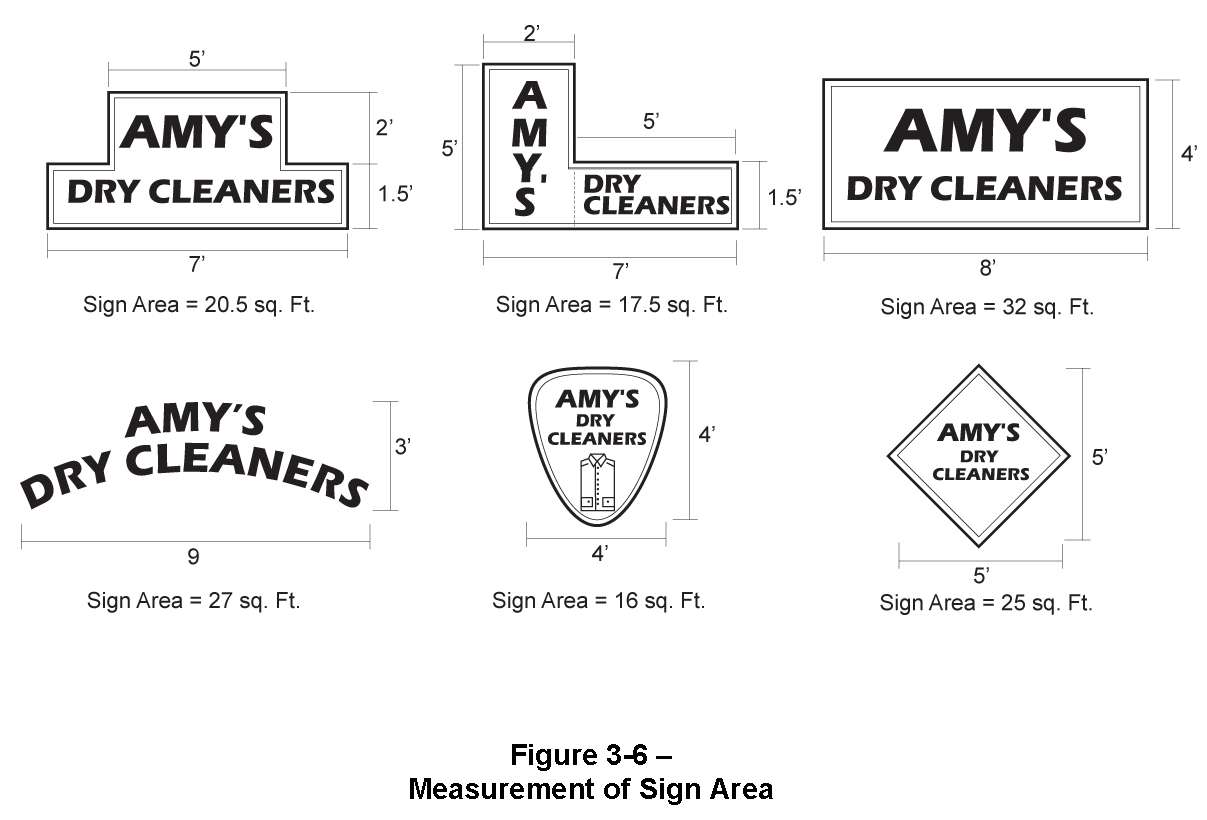
E.
Computation of maximum total sign area. The allowed sum of the area of all individual signs on a parcel shall be computed by applying the formula for maximum total sign area to the parcel frontage, building frontage, or wall area, as appropriate, for the zone in which the property is located. Parcels fronting two or more streets are permitted the allowed sign area for each street frontage. The total sign area oriented toward a particular street shall not exceed the portion of the parcel's total sign area allocation derived from the parcel, building, or wall area frontage on that street;
F.
Computation of sign height. The height of a sign shall be computed as the distance from the base of the sign at normal grade to the top of the highest attached component of the sign;
G.
Computation for mixed use zones. For purposes of calculating sign area or sign height for a sign within a mixed use zone, the standards for the C-O (Commercial Office) zone shall apply;
H.
Sign removal or replacement. When a sign is removed, all brackets, poles, and other structural elements that supported the sign shall also be removed. Affected building surfaces shall be restored to match the adjacent portion of the building by filling holes and painting; and
I.
Maintenance and repair. All signs shall be maintained in a safe, presentable, and sound structural condition at all times. The replacement of defective parts, painting, repainting, cleaning, and other acts required for the maintenance of the sign shall be done in a timely manner. The Director shall require compliance with all standards. If the sign was not constructed or maintained in compliance with the requirements, the Director shall require its removal.
18.32.090 - Standards for Permanent Signs
A.
Allowed sign types. Signs are allowed on private property in compliance with the provisions of Sign Table A (Appendix 1). The letter "P" indicates the sign is allowed without prior Sign Permit approval. The letter "S" indicates the sign is allowed only with prior Sign Permit approval. Special conditions may apply in some cases and Commission approval may be required. The letter "N" indicates the sign is prohibited.
B.
Allowed sign area. A sign designated by an "S" or a "P" in Sign Table A is allowed only if the sum of the area of all building and freestanding signs on the parcel conforms with the maximum allowed sign area as determined by the formula for the zone in which the parcel is located as specified in Sign Table B (Appendix 1).
C.
Allowed size, location, and number. The size, location, and number of signs on the parcel shall conform with the requirements of Sign Table C (Appendix 1), which establishes allowed sign dimensions by sign type, and with any additional limitations listed in Sign Table A.
D.
Sign characteristics. The characteristics of the sign shall conform to the limitations of Sign Table D (Appendix 1) and with any additional limitations on characteristics listed in Sign Table A.
E.
Standards subject to reasonable adjustment. The standards contained within the Sign Tables (Appendix 1) are minimum standards and the Director shall have the discretion to make reasonable adjustments to those standards as particular circumstances and conditions related to the public health, safety, and welfare warrant. The Director shall have the discretion to have the Commission review the reasonable sign adjustment.
18.32.100 - Standards for Specific Types of Permanent Signs
A.
Awning and canopy signs. The following regulations apply to all signs placed on an awning or canopy attached to a building:
1.
Lettering, logos, symbols, and graphics are allowed on up to 50 percent of the area of a shed (slope) portion of the awning and valance portion of the awning. Signs shall be applied flat against the awning surface. In the case of a barrel shaped (curved) awning, signs shall not occupy more than 60 percent of the bottom 12 inches of the awning.
2.
Only permanent signs that are an integral part of the awning are allowed. Temporary signs shall not be placed on awnings.
3.
Awning signs are allowed for first and second story commercial occupancies only.
4.
Awnings shall conform to the size and shape of the window or door they are located above. Overly large awnings and awnings with unusual shapes designed for the purpose of providing additional sign area are not allowed. The upper most part of an awning shall not be located more than two feet above a window or door.
5.
Awnings shall not be lighted from under the awning (back-lit awning) so the awning appears internally illuminated.
6.
A minimum of eight feet of clearance shall be provided between the lowest part of an awning and the grade below.
B.
Changeable copy signs. A sign containing a changeable copy element, either manual or electronic/digital, may be approved by the Commission.
C.
Electronic message signs. The following regulations apply to all changeable electronic/digital message signs, whether or not the changeable electronic message component incorporates the entire sign face or is a smaller component of the sign face:
1.
Standards. Changeable electronic/digital message signs are allowed in compliance with Sign Tables A, B, C, and D (Appendix 1) and all of the additional standards set forth in this section.
2.
Brightness. Light produced by an electronic/digital message sign shall not exceed 0.3 foot-candles over ambient light levels. Additionally, signs shall not exceed a maximum illumination of 5000 nits (candelas per square meter) during daylight hours and a maximum illumination of 500 nits (candelas per square meter) between dusk to dawn, as measured from the sign's face.
3.
Brightness review. Each electronic/digital message sign shall be subject to a 30-day review period during which time the Director may determine that a reduction in illumination, or turning off of the sign for certain evening hours, is necessary due to negative impacts on surrounding property or the community in general. In addition, and at any time, the Director may order the dimming of any illumination found to be excessively bright and may also order that any sign remain on a single static image without changing or be completely turned off. The Director's determination shall be made without regard to the message content of the sign.
4.
Dimmer control. Signs shall have an automatic dimmer control to produce a distinct illumination change from a higher illumination level to a lower level for the time period between one-half hour before sunset and one-half hour after sunrise.
5.
Change of message. Messages displayed on an electronic/digital message sign shall be complete within each message/display and without continuation in content to the next message or to any other sign. The message/display shall change instantaneously without any fading in/out, scrolling, dissolve, or similar animation.
6.
Duration of message. Messages displayed on an electronic/digital message sign shall be a static display without changes for a minimum duration of eight seconds, except for those messages where the hour-and-minute, date, or temperature/weather information is updated.
7.
Static display. Any form of moving, animated, oscillating, or rotating images, or any other design intended to attract attention through movement or the semblance of movement on any part of the sign is prohibited at all times
8.
Hours of operation. Electronic/digital message signs in residential zones shall be turned off daily from 9:00 p.m. to 6:00 a.m. of the following morning.
9.
Maintenance. Signs shall be properly maintained in good working order at all times. Signs shall be designed and equipped to freeze the changeable message in one position or to go dark if a malfunction occurs. The sign owner shall immediately stop the electronic/digital display when notified by the City that it is malfunctioning or not complying with regulations.
10.
Nonconforming sign structure. An existing sign or sign structure nonconforming as to location, size, height, or other regulation shall not be changed to a new electronic/digital message sign until all nonconformities have been eliminated to the satisfaction of the Director.
D.
Freestanding signs.
1.
Standards. Freestanding signs shall comply with the requirements provided in Sign Tables A, B, C, and D and the additional requirements provided below.
2.
Where allowed. Freestanding signs shall be allowed only for parcels with at least 25 feet of frontage adjoining a public street. In addition, freestanding signs are only allowed when a building is set back from the front property line a minimum of 10 feet.
3.
Location.
a.
There shall be a minimum of 50 feet between freestanding signs on adjoining sites to ensure adequate visibility for all signs.
b.
Freestanding pole or pylon signs shall be located a minimum of 50 feet from a lot line of any residentially zoned property.
c.
Freestanding signs shall not project over any building, or over any on-site driveway or vehicle circulation area.
4.
Supporting structure. The supporting structure of a pole or pylon sign shall be surrounded by a decorative cover architecturally compatible with the sign cabinet and subject to the approval of the Director.
5.
Minimum letter size. To ensure the readability of freestanding signs, the minimum letter size allowed shall be six inches. Sign copy shall not be located closer than one half-letter height to the sign edge or other line of copy.
6.
Landscaping required. Landscaping with automatic irrigation shall be provided at the base of the supporting structure equal to twice the area of one face of the sign or 75 square feet, whichever is greater. For example, 40 sq. ft. of sign area = 80 sq. ft. of landscaped area. The Director may waive or modify this requirement on a case-by-case basis to take into account existing site conditions.
7.
Address required. All freestanding signs shall contain an address plate identifying the subject property. Numbers shall be a minimum of six inches in height and shall be clearly visible from the public right-of-way. Address plates shall not be counted against the allowed sign area.
E.
Luminous tube signs. The use of luminous tubes (neon) for signs shall be allowed in commercial and mixed use zones only subject to all of the following requirements:
1.
Tube size. Tubing shall not exceed one-half inch in diameter;
2.
Brightness. Luminous tube lighting adjacent to residential uses shall not exceed one half foot-candle measured at the property line where the sign is located;
3.
Color limitation. No electric or luminous signs containing red or green colors shall be erected within 150 feet of an intersection containing stop lights without first securing a Conditional Use Permit;
4.
No reflective materials. Luminous tubes shall not be combined with any reflective materials (e.g., mirrors, polished metal, highly glazed tiles, or other similar materials); and
5.
Where not allowed. Luminous tube lighting shall not be used to surround a window, door, or similar element except as part of an allowed sign.
F.
Wall signs.
1.
Standards. Wall signs shall comply with the requirements specified in Sign Tables A, B, C, and D and the additional requirements provided below.
2.
Location. Signs shall be located only on a building frontage and shall not extend above an eave or parapet, or above or below a fascia on which they are located.
3.
Projection. Signs shall be placed flat against the wall and shall not project from the wall more than required for normal construction purposes and in no case more than 12 inches.
4.
Middle of building. Signs shall be located within the middle 50 percent of the building or tenant frontage measured from lease line to lease line. The Director may waive this requirement where it can be clearly demonstrated that it severely limits proper sign placement.
G.
Window signs, permanent and temporary.
1.
Location.
a.
Signs shall be allowed only on windows located on the ground floor and second story of either a primary or secondary building frontage. Window signs are not allowed above the second story.
b.
Interior signs located within five feet of a storefront window shall be counted as window signs for the purpose of calculating total sign area and number of signs.
2.
Size. Window signs, whether permanent or temporary signs, shall not occupy more than 25 percent of each individual window on either a primary or secondary building frontage. For the purpose of this requirement, a window is any glazed area, including glass curtain walls.
18.32.110 - Electronic Digital Display Billboards
A.
Applicability. The following regulations apply to all electronic digital display billboards and are intended to implement and be incompliance with the California Outdoor Advertising Act of 2014, as related to outdoor advertising displays, and Section 131 of Title 23 of the United States Code, including any amendments as may be adopted from time to time.
B.
Permit requirements. No electronic digital display billboard shall be erected or maintained until a Conditional Use Permit has first been approved in compliance with the Development Code and any other applicable federal and state statutes, including the California Department of Transportation Outdoor Advertising Permit Requirements.
C.
Conditions of approval. Approval of a Conditional Use Permit to allow an electronic digital display billboard shall consider/include language addressing all of the following:
1.
Fees and/or other public benefits to be conveyed to the City. The City's intent and objective in requiring the payment of fees is to compensate for the aesthetic impact on the community associated with the presence of off-site signs.
2.
Any allowed deviations from the development standards.
3.
The amount of time each day dedicated to public service announcements will be displayed, at no cost to the City.
4.
Terms requiring periodic review to ensure compliance with the development standards and conditions of approval. The City reserves the right to place additional conditions of approval at any time if doing so is in the public interest.
5.
For every one digital sign installed two non-digital signs must be permanently removed from the City.
D.
Required findings. Approval of a Conditional Use Permit to allow an electronic digital display billboard shall be based on all of the following findings and any additional findings as may be required by the Department or the Commission:
1.
The proposed electronic digital display billboard is to be located in an appropriate area;
2.
The proposed electronic digital display billboard is placed on its site in the least visually impacting manner;
3.
The Conditional Use Permit contains appropriate language addressing revenue for the City;
4.
The proposed electronic digital display billboard complies with all of the applicable operational standards, unless modified by the Commission, as well as all applicable federal and state laws;
5.
The placement of the proposed electronic digital display billboard will not adversely affect residential use of property; and
6.
The placement of the proposed electronic digital display billboard will not pose a traffic hazard.
E.
Development standards.
1.
Sign face dimensions. The electronic digital display billboard area shall not exceed 1,200 square feet, including border and trim, and excluding base or apron supports and other structural members. The overall length shall not exceed 60 feet.
2.
Height. Unless allowed by the terms of the Conditional Use Permit, the maximum overall height of an electronic digital display billboard shall not exceed 25 feet, measured from the finished grade at the structure's base to the top of the billboard structure.
3.
Location. No digital billboard shall be located within 1,500 feet of a parcel zoned residential or a residential dwelling.
4.
Separation. No electronic digital display billboard shall be located closer than 1,500 linear feet of another electronic display billboard, as measured from the centerline of each support structure.
5.
Support structure. All proposed electronic digital display billboards shall be designed to have a single cylindrical column support.
6.
Cutouts and attachments. No cutouts or attachments shall be allowed, unless allowed in compliance with the conditions of the Conditional Use Permit.
7.
Double-faced signs. Double-faced electronic digital display billboards shall be located on the same cylindrical column structure and shall be positioned back-to-back. At no point shall the distance between the two sign faces exceed eight feet. Double-faced signs shall not be allowed when one portion of the sign is within 1,500 feet of a residential parcel.
8.
Mechanical screening. Each sign structure shall include a facing of proper dimensions to conceal back bracing, framework, and structural members and/or any electrical equipment.
9.
Owner identification. Owner identification signs shall be provided on all electronic digital display billboards.
10.
Undergrounding of utilities. All utilities installed in connection with the electronic digital display billboard shall be underground.
F.
Operational standards.
1.
Brightness. Light produced by an electronic/digital message sign shall not exceed a maximum illumination of 5000 nits (candelas per square meter) during daylight hours and a maximum illumination of 500 nits (candelas per square meter) between dusk to dawn as measured from the sign's face.
2.
Brightness review. Each electronic display billboard shall be subject to a 30-day review period during which time the Director may determine a reduction in illumination, or turning off of the sign for certain evening hours, is necessary due to negative impacts on surrounding property or the community in general. In addition, and at any time, the Director may order the dimming of any illumination found to be excessively bright and may also order any sign remain on a single static image without changing or be completely turned off. The Director's determination shall be made without regard to the message content of the sign.
3.
Dimmer control. Signs shall have an automatic dimmer control to produce a distinct illumination change from a higher illumination level to a lower level for the time period between one-half hour before sunset and one-half hour after sunrise.
4.
Change of message. Messages displayed on an electronic digital display billboard shall be complete within each message/display and without continuation in content to the next message or to any other sign. The message/display shall change instantaneously without any fading in/out, scrolling, dissolve, or similar animation.
5.
Duration of message. Messages displayed on an electronic digital display billboard shall be a static display without change for a minimum duration eight seconds except for those messages where the hour-and-minute, date, or temperature/weather information is updated.
6.
Static display. Any form of moving, animated, oscillating, or rotating images, or any other design intended to attract attention through movement or the semblance of movement on any part of the sign is prohibited at all times.
7.
Maintenance. Signs shall be properly maintained in good working order at all times. Signs shall be designed and equipped to freeze the changeable message in one position or to go dark if a malfunction occurs. The sign owner shall immediately stop the electronic/digital display when notified by the City that it is malfunctioning or not complying with regulations of this Section.
8.
Nonconforming sign structure. An existing sign or sign structure nonconforming as to location, size, height, or other regulation shall not be changed to a new electronic display billboard until all nonconformities have been eliminated.
9.
Public service announcements. All electronic display billboards shall be required to provide for public service announcements, including Amber Alerts, and other community service announcements in compliance with the terms of the Conditional Use Permit.
18.32.120 - Standards for Temporary Signs
A.
Sign permit not required. These regulations apply to temporary signs on private property. Approval of a Sign Permit is not required in compliance with Sign Tables A and B (Appendix 1), except as specifically identified.
B.
General requirements. It is unlawful to place, erect, install, or maintain a temporary sign in any zone, except as authorized and in compliance with Sign Tables A and B (Appendix 1) and all of the following requirements:
1.
No temporary sign shall be placed upon any private property without the prior consent of the property owner or the person in lawful possession of the property;
2.
No temporary sign shall be placed upon the roof of any structure;
3.
No temporary sign shall be illuminated;
4.
No temporary sign shall be erected to overhang any street, sidewalk, or other public property, unless an encroachment permit has been issued by the City;
5.
No temporary sign shall be erected in a manner or place that will obstruct a motorist's line of sight or otherwise constitute a safety hazard for vehicular or pedestrian traffic upon any street, sidewalk, or right-of-way; and
6.
Each temporary sign shall contain a legibly printed identification with the name, address, and telephone number of the sign owner who is responsible for the posting and removal of the sign.
C.
Real estate signs. Where a Planned Development Permit is granted, as part of the permit the Commission may approve a Master Sign Plan for the entire project that includes a specification of the number, size, design, location, period of time, and other requirements for the posting of temporary real estate signs within the development.
D.
Subdivision signs.
1.
A Sign Permit shall be required for subdivision flags or streamers. The permit may be issued at any time after recordation of the final subdivision map and shall be for a term not exceeding 12 months. All ornamental flags and streamers shall then be removed upon expiration of the permit, unless renewal of the permit for a period of not more than one additional 12-month period is approved by the Director;
2.
One sign, not exceeding 24 square feet in area advertising a new subdivision, may be erected or displayed at each entrance to the subdivision;
3.
No subdivision sign shall exceed four feet in height; and
4.
In the case of a subdivision having five or more parcels, ornamental flags or streamers may be erected at each entrance to the subdivision and along the boundaries of the project adjacent to public streets, as determined by the Director. The height of the pole or other support structure for the ornamental flag or streamer shall not exceed the height limit for the zone in which the property is located.
E.
Construction project signs. A temporary construction sign may be allowed in any zone in compliance with the general restrictions and all of the following regulations:
1.
A Sign Permit shall be required for any temporary construction sign. The permit may be issued at any time on or after issuance of a building permit for the structure in question. The Sign Permit shall expire six months following the date on which the permit was issued or upon the sooner completion of construction. The sign shall be removed on expiration of the permit unless, prior to expiration, the permit is renewed on approval of the Director. The permit renewal shall not be for a period in excess of an additional six months. The permit shall not thereafter be further renewed; and
2.
No more than one sign having an area not exceeding 16 square feet may be erected or displayed on the site of a construction project. Where the development consists of a residential subdivision where a temporary subdivision sign would be allowed, then no temporary construction sign shall be allowed.
F.
Grand opening signs. In any commercial or mixed use zone, temporary grand opening signs or banners to announce the commencement of a new business establishment shall be allowed provided they conform to the general restrictions and all of the following regulations:
1.
The grand opening sign or banner shall not exceed 20 square feet in area;
2.
The grand opening sign or banner shall be erected on the same site as the business establishment; and
3.
The grand opening sign or banner shall not be displayed for more than 30 days before, or more than 30 days from and after, the date on which the establishment opens for business.
G.
Special event signs. The installation of temporary signs, banners, or other advertising pertaining to a community-wide civic event, activity, or observation conducted or sponsored by the City shall be allowed.
H.
Window signs. Refer to standards for permanent and temporary window signs.
I.
Noncommercial temporary signs. Temporary noncommercial signs may be erected within any zone provided they conform to the general restrictions and all of the following regulations:
1.
No freestanding sign shall exceed an area of 10 square feet and four feet in height; and
2.
A noncommercial sign that relates to a specific event shall be removed within five calendar days after the occurrence of the event.
18.32.130 - Sign Permit Requirements
A.
General. Unless a sign is specifically exempt from obtaining a Sign Permit, any person, business, or property owner desiring to construct, maintain, or display a sign shall submit a Sign Permit application to the Department. The application shall include plans, drawings, and descriptive material sufficient to depict the sign proposal. Authorization of the property owner or the property owner's authorized agent is required as a prerequisite to the Department accepting the application as complete. Content of a commercial message shall be considered only to the extent required to determine whether the sign is an on-site or off-site sign.
B.
Signs requiring discretionary approval. The following signs shall require discretionary approval by the Director or Commission:
1.
Illuminated signs. Signs that incorporate exposed neon tubes or light bulbs shall require approval by the Commission;
2.
Additional sign height or area. Any individual sign or combination of all signs on a parcel that exceeds the height or area limitations by more than five percent shall require approval of a Minor Variance;
3.
Off-premises signs. Any new off-premises sign, including outdoor advertising structures (i.e., billboards) whether or not the sign is static or includes an electronic digital display shall require approval by the Commission; and
4.
Other signs and devices. Any other signs or visual devises that do not, in the discretion of the Director comply with the purpose of this chapter or the intended interpretation of these standards shall require approval by the Commission.
18.32.140 - Master Sign Plan Required
No Sign Permit shall be approved for any sign until a Master Signage Plan for the subject parcel(s) on which the sign(s) will be erected has been approved by the Director. The requirement for a Master Signage Plan shall apply to new commercial and mixed use developments consisting of one or more parcels, and to signs proposed on projects for which a Conditional Use Permit or other discretionary entitlement is required.
18.32.150 - Application for Sign Permit and Master Signage Plan
A Sign Permit application or application for a Master Signage Plan shall be submitted to the Department in compliance with all of the following provisions.
A.
Application contents. For any parcel on which one or more signs are proposed which require a Sign Permit, the owner(s) shall submit a Master Signage Plan containing all of the following:
1.
An accurate plot plan of the subject property, of a quality and at a scale as the Director may reasonably require;
2.
Location of buildings, parking lots, driveways, curb cuts, and landscaped areas on the subject parcel and names of adjacent streets and other applicable uses;
3.
Computation of the maximum total sign area, the maximum area for individual signs, the height of signs and the number of freestanding signs allowed on the subject property included in the proposed plan;
4.
Drawing(s) depicting the lettering or graphic style, lighting associated with materials, and sign proportions (scaled) of each proposed sign; and
5.
An accurate indication on the plot plan of each present and proposed future sign of any type, as well as scaled elevations depicting the size, height and location of each present and proposed future sign.
B.
Window signs to be shown on plans. A Master Signage Plan including window signs shall indicate in plan elevation(s) the areas of the windows to be covered by window signs and the general type of window signs (e.g., paper affixed to window, painted, etched on glass, or other material hung inside window) and need not specify the exact dimension or nature of every window sign although a total window sign area shall be indicated for purposes of calculating total allowed sign area. The total proposed window sign area, including permanent and temporary signs, shall not exceed 25 percent of each individual window area of all windows facing a public street.
C.
Limit on number of freestanding signs. The Master Signage Plan for all parcels with multiple uses or multiple users shall limit the number of freestanding signs to a total of one for each street on which the parcels included in the plan have frontage and shall provide for shared or common usage of the freestanding signs.
D.
Other provisions of Master Signage Plans. The Master Signage Plan may contain other restrictions as the owner(s) of the parcel(s) may reasonably determine or the Director may reasonably require.
E.
Consent. The Master Signage Plan shall be signed by all owners or their authorized agents in a form as the Director shall require.
F.
Procedures. A Master Signage Plan shall be included in any development plan, site plan, planned unit development plan, or other official plan required by the City for the proposed development or Conditional Use Permit, and shall be processed simultaneously with other plans or permit applications.
G.
Amendment. A Master Signage Plan may be amended by filing a new Master Signage Plan conforming to all requirements in effect at the time. Minor modifications to the MSP may be approved by the Director. Major Modifications shall require Commission review.
H.
Nonconforming existing signs. If a new or amended Master Signage Plan is filed for a parcel(s) on which existing signs are located, it shall include a schedule for bringing into conformance, within three years, all signs not conforming to the proposed amended plan or the requirements in effect on the date of submission.
I.
Binding effect. After approval of Master Signage Plan, no sign shall be erected, placed, painted, or maintained, except in conformance with the plan, and the plan may be enforced the same way as any provision of the Development Code. In the event of a conflict between the provisions of the plan and any other provision of this chapter, the provisions of this chapter shall control.
J.
Time for Review.
1.
Director approval. For signs subject to review by the Director, the Director shall review the application within the timeframes of the Permit Streamlining Act. The Director may impose only those conditions that will ensure compliance with the provisions of this chapter.
2.
Commission approval. For those signs subject to review by the Commission, the Commission shall review the application within the timeframes identified in the Permit Streamlining Act.
3.
Other discretionary approval. If a MSP is approved by the Director or Commission, and the project starts construction within the approved timeframes the MSP is vested.
K.
Required Findings. The Director or Commission, as applicable, shall approve a Sign Permit or Master Signage Plan if all of the following findings can be made:
1.
The sign plan meets the standards and sign design criteria specified in this chapter; and
2.
The sign plan is compatible with development on the subject property and developments in the immediate vicinity of the subject property, and does not detract from the character or quality of surrounding properties.
L.
Appeals. A decision by the Director or the Commission may be appealed.
18.32.160 - Sign Design Criteria
The following criteria shall serve as design standards for all signs placed or erected in the City:
A.
Multiple signs. When more than one sign is allowed for the same activity, all signs shall be coordinated with respect to color, letter style, illumination, and other graphic features;
B.
Multiple occupancies. For a multiple owner/tenant occupancy, the various signs proposed for identification of different activities/businesses shall be coordinated with respect to placement on the building facade, legibility, and illumination. Signs allowed for one property or tenancy shall not adversely affect the identification and reasonable use of the neighboring parcel or tenancy;
C.
Monument signs. Monument signs placed on parcels on street corners shall not impede adequate and safe view of motorists through and/or around the street corner;
D.
Coordination of signs. All signs shall be considered an architectural and site plan feature of any existing and/or proposed building or development and shall be coordinated in size, height, color, illumination, location, graphic design, and finish detailing with the building(s), landscaping, area lighting, and vehicular and pedestrian circulation;
E.
Freestanding portable sign. The product, price, or changeable copy area of a freestanding portable sign shall occupy no more than one-fourth the allowed sign area;
F.
Sign illumination. All of the following standards shall apply to all internally or externally illuminated signs:
1.
Sign illumination shall not interfere with the use and enjoyment of adjacent properties, create a public nuisance, or create public safety hazards. Exterior light sources shall be shielded from view and directed to illuminate only the sign face;
2.
Reflective-type bulbs and incandescent lamps that exceed 15 watts shall not be used on the exterior surface of signs so that the face of the bulb or lamp is exposed to a public right-of-way or adjacent property;
3.
Internal illumination is allowed for cabinet signs only if the sign background is opaque and the only portion of the sign appearing as illuminated is the actual lettering and/or a trademark or logo;
4.
Where signs are to be placed near a residential use, sign location and illumination shall be adjusted for minimum impact to the residential use. The Director shall retain the right to require reasonable adjustment for size and height to ensure minimum impact to the residential use; and
5.
Each illuminated sign shall be subject to a 30-day review period, during which time the Director may determine a reduction in illumination is necessary due to negative impacts on surrounding property.
G.
Negative impact on surroundings. The distraction of motorist attention due to any moving, rotating, flashing, or otherwise animated light or component associated with a sign shall be minimized by requiring adequate separation between signs along a street frontage and at intersections. Signs may not be allowed should the review authority make the finding the sign as proposed is inappropriate for the site due to its proximity to the street, other similar signs, or a residential zone, or if the review authority makes the finding and determination (and citing its rationale in making the determination) the sign would have a negative aesthetic impact on the surrounding zone.
18.32.170 - Nonconforming On-Premises Signs
A.
Amortization time periods. All existing signs legally allowed and authorized by the City or a preceding jurisdiction which do not meet the size, location, or similar measurement or placement or operational standard established by the Development Code are deemed legal, nonconforming and shall be required to comply with the amortization provisions during the following time periods:
1.
Signs painted on buildings, walls or fences — Two years from July 1, 2011;
2.
All other signs — Seven years from July 1, 2011.
B.
Ravenswood/4 Corners Specific Plan. All existing signs located in the Ravenswood/4 Corners Specific Plan Project Area that were legally installed between September 4, 2012 and November 1, 2013, but that do not comply with the size, location, or similar measurement or placement standard established by the Development Code are deemed legal, nonconforming signs and shall be required to comply with the amortization provisions during the following time periods:
1.
Signs painted on buildings, walls or fences — Two years from February 7, 2014;
2.
All other signs — Seven years from February 7, 2014.
C.
No alteration. Nonconforming signs shall not be altered, reconstructed, moved, or undergo a face change without complying with all requirements with this chapter. Normal maintenance or repair of any nonconforming sign, as determined by the chief building official or Director, is not prohibited.
D.
Billboards. The amortization provisions are not intended to apply to billboards visible from a state highway.
18.32.180 - Replacement of Nonconforming Off-Site Advertising Structures
A.
Applicability. Any legally nonconforming off-site sign (billboard) may be considered a candidate for removal and replacement on a two for one basis. Upon agreement between the sign owner and the City, the sign owner may remove two legally nonconforming off-site signs and replace them with one new off-site sign, subject to the provisions of this chapter.
B.
Commission may waive standards. If a sign replacement/relocation request is made, the new sign shall comply with all standards of this chapter relating to off-site signs, except that compliance with location or spacing requirements may be waived by the Commission. In no instance shall spacing between any two off-site signs be less than 1,000 feet.
C.
Conditional Use Permit. The replacement of signs shall require approval of a Conditional Use Permit. In considering an application, the Commission shall take into account all of the following:
1.
Whether or not the area has excessive visual clutter;
2.
Whether or not the proposed new sign would be compatible with uses and structures on the proposed site and in the surrounding area;
3.
Whether or not the off-site sign would create a traffic or safety problem with regard to on-site access, circulation, or visibility;
4.
Whether or not the proposed sign would interfere with required on-site parking or landscaping, or other required facilities;
5.
Proximity to residential zones or residential housing;
6.
Proximity to other off-site signs;
7.
Field of vision shared with other off-site signs and on-site signs;
8.
Maintenance quality and appearance of the signs proposed for removal; and
9.
Aesthetic and visual problems caused in their existing locations by the signs proposed for removal.
D.
Timing of removal. The signs to be removed shall be removed from their respective sites before commencement of construction or installation of the new sign. A building permit shall be required for removal.
18.32.190 - Development Standards for Off-Site Advertising Structures
A.
Maximum Height. 25 feet, measured from the ground surface to the uppermost point of the sign. For freeway-oriented off-site signs, height shall be measured from the closest freeway grade to the uppermost point of the sign.
B.
Maximum Area. 1,200 square feet for each sign face with a maximum length of 60 feet.
C.
Maximum number of sign faces. Two.
D.
Minimum Distance from another off-site sign. 1,000 feet.
E.
Minimum distance from freeway ramp or street intersection. 375 feet.
F.
Other standards. All off-site advertising structures shall comply with the applicable regulations of the California Business and Professions Code, Section 5270 et seq.
18.32.200 - Abandoned Signs
Except as otherwise provided in this chapter, any on-premises sign remaining in place or not maintained for a period of 90 calendar days that no longer advertises or identifies an ongoing business, product or service available on the parcel where the display is located, or any sign that pertains to a time, event, or purpose that no longer applies, shall be deemed to have been abandoned. An abandoned sign is prohibited and shall be removed or painted over by the owner of the sign, owner of the property, or the Director, at the expense of the owner of the sign or property.
18.32.210 - Dangerous and/or Defective Signs
It is unlawful for any business or property owner to maintain or permit to be maintained on any business or property any sign that is in a dangerous or defective condition. A sign shall be removed or repaired by the owner of the sign, owner of the property, or the Director, at the expense of the owner of the sign or property.
18.32.220 - Violations
Any of the following shall constitute a violation of this chapter and shall be subject to the enforcement remedies and penalties provided in the Development Code or state law:
A.
To install, create, erect, or maintain any sign in a way inconsistent with any plan or permit governing the sign or the zone on which the sign is located;
B.
To post, install, create, erect, and maintain any sign requiring a permit without a permit; and/or
C.
To fail to remove any sign installed, created, erected, or maintained in violation of this chapter, or for which the Sign Permit or other applicable permit has lapsed.
18.32.230 - Enforcement and Remedies
A.
The Director, Director of Public Works, any police officer, or code enforcement officer shall have concurrent authority to enforce the provisions of this chapter.
B.
If any sign is posted, installed, erected or maintained in violation of any standard or restriction contained in this chapter, any person having authority to enforce this chapter may remove the sign upon giving 24 hours prior notice of the violation and intended removal to the sign owner. If the sign owner cannot be determined or found, or if the sign constitutes an immediate hazard to the public health or safety, the sign may be summarily removed immediately.
C.
The sign owner shall be responsible for payment of all removal costs, or an administrative penalty to be established by resolution of the Council for each sign removed by the City. Any person desiring to contest the payment may request a hearing before the City Manager.
D.
Any sign removed under this section shall be retained for a period of five calendar days, during which time the sign owner may retrieve the sign upon payment of the removal costs or administrative penalty. Any sign not retrieved within the five-day period shall be deemed to have been abandoned by the owner and may be destroyed or otherwise disposed of by the City. Owners of signs painted on the exterior of a building or other structure and abated by the City shall not be entitled to any restitution, financial or otherwise.
18.32.240 - Chief Building Official Determination
Sign Permit applications shall be routed to the Chief Building Official. When it is determined a separate building, electrical, or other permit is required, the applicant shall be notified and the Sign Permit shall not be issued until other permits are obtained from the Chief Building Official. Nothing in this chapter shall infer that signs which do not require a Sign Permit are not required to have a building permit. It shall be the sole discretion of the Chief Building Official, utilizing the uniform codes adopted by the City, as to which signs require building permits.
18.32.250 - Appeal Procedure
Any appeal of the decision of the City Manager pertaining to the payment of removal costs or an administrative penalty shall follow the appeal procedure specified in Chapter 18.114.
APPENDIX 1. SIGN TABLES
SIGN TABLE A: PERMITTED SIGNS BY TYPE AND ZONING DISTRICT
SIGN TABLE B: MAXIMUM TOTAL SIGN AREA PARCEL BY ZONING DISTRICT
SIGN TABLE C: NUMBER, DIMENSIONS, AND LOCATION OF SIGNS BY ZONING DISTRICT
SIGN TABLE D: PERMITTED SIGN CHARACTERISTICS BY ZONING DISTRICT
18.34.010 - Purpose
The purpose of this chapter is to establish uniform performance standards for development to promote compatibility with surrounding areas and land uses.
18.34.020 - Applicability
The following provisions, standards, and specifications apply to all properties, structures, uses, and activities in all zones, unless an exception is specifically noted. The provisions of Municipal Code Chapter 8.08 with regard to nuisances also should be considered.
18.34.030 - Address Assignments
A.
New address assignment. A new address is assigned when any of the following situations occurs:
1.
Construction of a new building;
2.
Construction or legalizing a secondary dwelling unit;
3.
Current address is out of sequence or range;
4.
Existing entrance for a corner lot is on a different street;
5.
Existing duplicate address or street name;
6.
New address will facilitate better emergency response from the Police or Fire Departments; or
7.
A new parcel number is required to be issued for this project.
B.
Submittal requirements for new address.
1.
Submittal of the Department Application Form.
2.
A letter explaining why the new address is required and how it complies with the City's Address Assignment criteria listed above.
3.
Payment of two hours of staff time plus a five percent technology fee based on the City's adopted Master Fee Schedule.
4.
A site plan or parcel map identifying the location of the new building or secondary dwelling unit, if applicable.
5.
Location of the new mailbox.
C.
Submittal procedures. The property owner or a designated representative shall submit the information listed above to the Department. Applications will be processed in accordance with the Permit Streamlining Act. Once addresses are assigned, an addressing notice will be prepared and sent to the Department's distribution list, including post office, county assessor, city departments, utility companies, and emergency services.
D.
Limitations on address assignment.
1.
Addresses are not assigned to empty lots or vacant land.
2.
Addresses will only be assigned when new development or alteration work is proposed.
3.
Multi-tenant buildings will have one street address with suite numbers for tenant spaces.
18.34.040 - Air Quality, Dust and Dirt
A.
Air quality. It is unlawful for operations or activities to cause the emission of any smoke, fly ash, dust, fumes, vapors, gases, or other forms of air pollution, beyond any boundary line of the parcel, which exceeds the requirements of any air quality plan, rule or regulation, or General Plan Air Quality Element. The requirements of the Bay Area Air Quality Management District shall be met by all development.
B.
Grading. To ensure a dust free environment, appropriate grading procedures shall include, but are not limited to, the following:
1.
Schedule all grading activities to ensure that repeated grading will not be required and implementation of the subsequent land use (e.g. planting, paving or construction) will occur as soon as possible after grading;
2.
Disturb as little native vegetation as possible;
3.
Comply with all provisions of Municipal Code Chapter 15.48; and
4.
Re-vegetate graded areas as soon as possible.
18.34.050 - Crime Prevention Design Review
The Director shall determine which projects will require a crime prevention review in consultation with the Administrative Policies of the East Palo Alto Police Department.
18.34.060 - Hazardous Materials
A.
Fire and explosive hazards. All activities involving and all storage of flammable and explosive materials shall be provided at all times with adequate safety devices, adequate firefighting and fire suppression equipment, and devices standard in the industry, except as otherwise provided by applicable fire codes.
B.
Radioactivity or electric disturbances. Activities shall not emit dangerous radiation or create electrical disturbances that affect activities and operations on any other property. Radioactive emissions shall be further subject to applicable federal and state law and regulations. Existing or proposed uses generating electrical disturbances that may be considered hazardous or a nuisance shall be shielded, contained, or modified to prevent any disturbances.
C.
Hazardous materials. All uses and activities shall comply with the requirements of Municipal Code Chapter 8.40.
18.34.070 - Heat and Cold
It is unlawful for operations or activities to emit heat or cold which would cause a temperature increase or decrease on any adjacent property in excess of five degrees Fahrenheit, whether the change is in the air, on the ground, or in any structure, or in any body of water.
18.34.080 - Mechanical Devices
Air conditioners, antennas, heating, cooling, ventilating equipment, swimming pool pumps, transformers, and all other mechanical devices shall be screened from surrounding properties and streets with a fence, architecturally compatible wall, landscaping, berming, or combination thereof, and shall be operated in a manner so that they do not disturb adjacent uses and activities.
18.34.090 - Noise
All uses and activities shall comply with the regulations specified in Municipal Code Chapter 8.52.
18.34.100 - Odor
It is unlawful to emit odorous gases or other odorous matter in any quantity readily detectable beyond the property lines of the source. Any process that may involve the creation or emission of any odors shall be provided with a secondary safeguard system so that control will be maintained if the primary safeguard system should fail.
18.34.110 - Outdoor Light and Glare
All outdoor lighting shall be arranged so as to keep light directed only on the subject property. It is unlawful to create illumination exceeding 0.1 foot-candles on any adjacent property. It is unlawful to create or allow direct glare, whether from floodlights or from high temperature processes (e.g., combustion, welding, etc.) visible at the property line in violation of Section 18.34.110.
18.34.120 - Outdoor Storage, Refuse Areas and Service Areas
All allowed storage areas for maintenance equipment, vehicles, or refuse, and all collection areas and service areas, shall be enclosed or effectively screened from public view with a fence, wall, and landscaping.
18.34.130 - Vibration
It is unlawful to create or allow vibration that can be felt at or beyond the property line.
18.34.140 - Enforcement
A.
Enforcement of performance standards. Enforcement of the provisions of this chapter shall be processed in compliance with the provisions of Chapter 18.116.
B.
Measurement. The determination of the existence of any objectionable elements shall be made at the location of the use creating the objectionable elements and at any points where the existence of the elements may be more apparent. The measurements necessary for enforcement of standards shall be taken at property line boundaries; unless the Director determines another location is more appropriate.
C.
Additional enforcement provisions. Initial and continued compliance with performance standards is required of every use, and provisions for enforcement of continued compliance with performance standards shall be invoked by the Director against any use if there are reasonable grounds to believe that the standards are being violated.
18.35.010 - Purpose and Intent
Rental and owner-occupied housing in East Palo Alto has become steadily more expensive. Although East Palo Alto has historically provided much of the housing affordable to San Mateo County's workforce, in recent years housing costs have escalated sharply, increasing faster than incomes for many groups in the community. As a result, there is a severe shortage of adequate, affordable housing for extremely low, very low, lower, and moderate income households.
Because of the shortage of affordable housing in East Palo Alto, many households overpay for their housing. Providing decent housing at affordable costs allows households to utilize their resources for other necessary pursuits, such as education, food, investment, and saving for retirement.
It is the City Council's policy to enhance the public welfare by encouraging a variety of housing prices throughout the city to give households of all income levels, but particularly lower income households, the opportunity to find suitable housing. The City can achieve its goals of providing more affordable housing and achieving an economically balanced community only if part of the new housing built in the city is affordable to households with limited incomes.
The affordable requirements will substantially advance the City's legitimate interest in providing additional housing affordable to all income levels and dispersed throughout the city because affordable units required, including both rental and ownership units, must be affordable to either extremely low, very low, lower, and moderate income households.
The provisions in this chapter are being adopted pursuant to the City's police power authority to protect the public health, safety, and welfare. Requiring affordable units is consistent with the community's housing element goals of protecting the public welfare by fostering an adequate supply of housing for persons at all economic levels and maintaining both economic diversity and geographically dispersed affordable housing. Requiring builders of new developments to provide for housing affordable to extremely low, very low, lower, and moderate income households is also reasonably related to the impacts of their projects.
The purpose of this chapter is to enhance the public welfare by establishing policies related to the development of housing affordable to households of extremely low, very low, lower, and moderate incomes, meet the City's regional share of housing needs, and implement the goals and objectives of the general plan and housing element.
The adoption of a citywide affordable housing program also will assist in alleviating the use of available residential land solely for the benefit of households that are able to afford market rate housing because such market-rate development will be required to contribute to the provision of affordable housing for the entire East Palo Alto community, and will assist in alleviating the impacts of the service needs of households in new market-rate residential development.
18.35.020 - Definitions
Affordable Housing Fund. A fund or account designated by the City to maintain and account for all monies received in compliance with affordable housing requirements.
Affordable Ownership Cost. The affordable ownership cost is the maximum purchase price that will be affordable to the specified household at the specified income level. The purchase price shall be considered affordable only if it is based on a reasonable down payment, and monthly housing payments, including mortgage loan principal and interest, any associated loan insurance and financing fees, property taxes and assessments, an allowance for property maintenance and repairs established by the City based on the initial cost and size of the home, homeowners insurance, a reasonable allowance for utilities based on the utility allowance applicable under Section 8 of the United States Housing Act of 1937 (not including telephone service), land rent (if the home is on rented land) and homeowners association dues, if any, which are equal to or less than one-twelfth of 30 percent of the maximum annual household income designated for an affordable unit, during the first calendar year of a household's occupancy. The maximum household income for an affordable unit shall be based on presumed occupancy levels of one person in a studio dwelling unit, two persons in a one-bedroom dwelling unit, three persons in a two bedroom dwelling unit, and one additional person for each additional bedroom thereafter. Affordable ownership cost shall be calculated assuming a down payment equal to 10 percent of the total purchase price, and a conventional fixed-rate, 30-year fully amortizing loan in the amount of the difference between the purchase price and the down payment.
Affordable Rent. Monthly rent, including a reasonable allowance for utilities based on the utility allowance applicable under Section 8 of the United States Housing Act of 1937, and all fees for housing services, equal to or less than one-twelfth of 30 percent of the maximum annual household income designated for an affordable unit. Rents for the lower income density bonus units shall be set at an affordable rent as defined in Health and Safety Code Section 50053. Affordable rent shall be based on presumed occupancy levels of one person in a studio dwelling unit, two persons in a one bedroom dwelling unit, three persons in a two bedroom dwelling unit, and one additional person for each additional bedroom thereafter for rental target units reserved for very low income, lower income, or moderate income households, not exceeding the following calculations:
• Very low income: 50 percent of the area median income for San Mateo County, adjusted for household size, multiplied by 30 percent and divided by 12.
• Lower income: 60 percent of the area median income for San Mateo County, adjusted for household size, multiplied by 30 percent and divided by 12. In addition, for those lower income households with gross incomes which exceed 60 percent of the area median income adjusted for family size, the affordable rent may be established at a level not to exceed 30 percent of gross income of the household.
• Moderate income: 110 percent of the area median income for San Mateo County, adjusted for household size, multiplied by 30 percent and divided by 12.
Affordable Sales Price. A sales price at which lower income households, as defined in Health and Safety Code Section 50079.5, very low income households as defined in Health and Safety Code Section 50105, or moderate income households as defined in Health and Safety Code Section 50093, can qualify for the purchase of target units, as calculated by the Director.
Affordable Units. Dwelling units affordable to extremely low, very low, lower, or moderate income households.
Eligible Household. A household whose income does not exceed the maximum incomes for extremely low income, very low income, low-income or moderate income.
Extremely Low Income Household. Household whose income does not exceed the extremely low income limits applicable to San Mateo County, as published and periodically updated by the State Department of Housing and Community Development in compliance with Health and Safety Code Section 50106.
Household Income. The combined adjusted gross income for all adult persons living in a dwelling unit as calculated for the purpose of the Section 8 program under the United States Housing Act of 1937, as amended, or its successor.
Lower Income Household. Household whose income does not exceed the lower income limits applicable to San Mateo County, as published and periodically updated by the State Department of Housing and Community Development in compliance with Health and Safety Code Section 50079.5.
Market Rate Unit. A unit in a housing development that has no affordability restrictions.
Median Income. The area median income, adjusted for household size, applicable to San Mateo County as published annually in compliance with Title 25 of the California Code of Regulations, Section 6932 (or its successor provisions) by the California Department of Housing and Community Development.
Moderate Income Household. Household whose income does not exceed the moderate income limits applicable to San Mateo County, as published and periodically updated by the State Department of Housing and Community Development in compliance with Health and Safety Code Section 50093.
Qualifying Resident. Persons eligible to reside in a target unit.
Target Population. Persons with low incomes having one or more disabilities, including mental illness, HIV or AIDS, substance abuse, or other chronic health conditions, or individuals eligible for services under federal or state law. May include adults, emancipated youth, families, families with children, elderly persons, young adults aging out of the foster care system, individuals exiting from institutional settings, veterans, and homeless people.
Target Unit. A dwelling unit within a housing development which will be reserved for sale or rent to, and affordable by very low, low, moderate income, senior, or qualifying resident households.
Very Low Income Household. Household whose income does not exceed the very low income limits applicable to San Mateo County, as published and periodically updated by the State Department of Housing and Community Development in compliance with Health and Safety Code Section 50105.
18.35.030 - Requirement and Implementation
A.
Exemptions from the requirements of this chapter include:
1.
Housing developments exempted by California Government Code Section 66474.2 or 66498.1.
2.
Housing developments for which a planning permit has been approved by the City prior to the operative date of this chapter.
B.
An applicant for a planning permit shall not avoid the requirements of this chapter by submitting piecemeal planning permit applications.
C.
When a residential development includes both for-sale and rental dwelling units, the provisions of this chapter that apply to for-sale residential development shall apply to that portion of the development that consists of for-sale dwelling units, while the provisions of this chapter that apply to rental residential development shall apply to that portion of the development that consists of rental dwelling units.
D.
The requirements of this chapter are minimum requirements and shall not preclude a residential development from providing additional affordable units or affordable units with lower rents or sales prices.
18.35.040 - Standards for Affordable Units
A.
Single-family detached affordable units shall be dispersed throughout the housing development. Townhouse, row-house, and multiple-family affordable units shall be located so as not to create a geographic concentration of affordable units within the housing development.
B.
The quality of exterior design and overall quality of construction of the affordable units shall be consistent with the exterior design of all market rate units in the housing development and meet all site, design, and construction standards of this Code, including but not limited to, compliance with all design guidelines included in applicable specific plans or otherwise adopted, and the affordable housing guidelines. Affordable units shall have functionally equivalent parking.
C.
Affordable units may have different interior finishes and features than market rate units in the same housing development, so long as the finishes and features are functionally equivalent to the market rate units and are durable and of good quality and comply with the affordable housing guidelines.
D.
The affordable units shall have the same amenities as the market rate units, including the same access to and enjoyment of common open space and facilities in the housing development.
E.
The affordable units shall have the same proportion of unit types as the market rate units in the housing development except that single-family detached housing projects may include single-family attached affordable units and single-family detached affordable units may have smaller lots than single-family detached market rate units.
F.
The affordable units shall have a comparable square footage and the same or greater bedroom count and bedroom count ratio as the market rate units.
18.35.050 - Timing of Construction of Affordable Units
A.
All required affordable units shall be made available for occupancy concurrently with the market rate units.
B.
The city may not issue building permits for more than 90 percent of the market rate units within a construction phase in a residential development until it has issued building permits for all of the affordable units to be included in that construction phase. The city may also not approve final inspections for single-family detached homes, or certificates of occupancy for all other residences, for more than 90 percent of the market rate units within a construction phase until it has approved final inspections or certificates of occupancy, as appropriate, for all of the affordable units within that construction phase.
18.35.060 - Initial Occupancy and Continued Affordability
A.
Any household that occupies an affordable unit must occupy that unit as its principal residence.
B.
No household may begin occupancy of an affordable unit until the household has been determined to be eligible to occupy that unit.
C.
All affordable units shall remain affordable to the designated income group in perpetuity.
18.36.010 - Purpose and Intent
The purpose of this chapter is to provide a means for granting density bonuses, incentives, or concessions for the production of housing for very low income, lower income, moderate income households, or senior households, including condominium conversions, projects to substantially rehabilitate and convert commercial buildings to residential use, rehabilitate an existing multiple family dwelling to increase available residential units, and for child day care facilities in compliance with Government Code Section 65915 et seq. In enacting this chapter, it is the intent of the City to facilitate the development of affordable housing and child day care facilities and to implement the goals, objectives, and policies of the Housing Element of the General Plan. The regulations and procedures established in this chapter shall apply to all housing developments of five units or more. If there is a conflict between any provision of this chapter and state law, state law shall control.
18.36.020 - Definitions
In addition to the definitions in Article 1 of the Development Code, and the definitions in Chapter 18.35, the following definitions are applicable to this chapter.
Additional Incentives or Concessions. Incentives and concessions as specified in Government Code Section 65915 to include, but not be limited to, the reduction of site development standards or zoning code requirements, direct financial assistance or incentives, approval of mixed use zoning in conjunction with the housing development, or any other incentive that would result in identifiable cost avoidance or reductions that are offered in addition to a density bonus for development incentives and concessions.
Child Day Care Facility. A facility certified and licensed in compliance with all applicable state licensing requirements for the provision of, and providing, non-medical daytime care to children under 18 years of age in need of personal services, supervision, or assistance essential for sustaining the activities of daily living or for the protection of the individual on less than a 24-hour basis, including, but not limited to, nursery schools, preschools, extended day care facilities, and employer-sponsored child care centers, but excluding family day care homes.
Density Bonus. An increase in the number of primary dwelling units on a property for qualifying projects in compliance with this chapter and with Government Code Section 65915 et seq.
Density Bonus Housing Agreement. A legally binding agreement between a developer and the City to ensure the requirements of this chapter are satisfied.
Density Bonus Units. Residential units granted in compliance with the provisions of this chapter which exceed the maximum residential density for the development site.
Equivalent Financial Incentive. A monetary contribution, based upon a land cost per dwelling unit value, equal to one of the following:
• A density bonus and additional incentive(s); or
• A density bonus, where an additional incentive(s) is not requested or is determined to be unnecessary.
Maximum Residential Density. The maximum number of residential units permitted by the General Plan, excluding the provisions of this chapter, based upon compliance with the site area standards for the applicable residential zones. If the housing development is within a planned unit development, the maximum residential density shall be determined on the basis of the General Plan.
Senior Citizen Housing. A housing development consistent with the California Fair Employment And Housing Act (Government Code Section 12900 et seq.), designed to meet the physical and social needs of senior citizens, and which qualifies as housing for older persons as that phrase is used in the Federal Fair Housing Amendments Act of 1988 (P.L. 100-430) and implementing regulations (24 CFR, part 100, subpart E), and in Civil Code Sections 51.2 and 51.3.
18.35.030 - Implementation
A.
The City shall grant a density bonus and at least one additional incentive or concession to an applicant/developer of a housing development who agrees to provide, at a minimum, one of the following:
1.
At least five percent of the total units of the housing development as target units affordable to very low income households; or
2.
At least 10 percent of the total units of the housing development as target units affordable to lower income households; or
3.
A senior citizen housing development as defined in Civil Code Sections 51.2 and 51.3, or mobile home park that limits residency based on age requirements for housing for older persons in compliance with Civil Code Sections 798.76 or 799.5; or
4.
At least 10 percent of the total units of a newly constructed common interest development project as target units affordable to moderate income households; or
5.
At least 10 percent of the total units of the housing development for transitional foster youth as defined in Education Code Section 66025.9, disabled veterans as defined in Section 18541 or homeless persons as defined in the federal McKenny-Vento Homeless Assistance Act (42 U.S.C. Section 11301 et seq.) with a recorded affordability restriction of at least 55 years, provided at the same affordability level as very low income units; or
6.
A child day care facility containing at least the minimum square footage required by applicable state child care licensing requirements, provided affordable housing also is developed as required by Government Code Section 65915.
B.
Consistent with and subject to the provisions of Government Code Section 65915.5, the City shall grant either a density bonus of 25 percent over the number of apartments/units to be provided within the existing structure(s) proposed for conversion, or other equivalent financial incentives if the applicant/developer agrees to provide 33 percent of the total units in a condominium conversion project as target units affordable to low or moderate income households as defined in Health and Safety Code Section 50093, or 15 percent of the total units in a condominium conversion project as target units to lower income households as defined in Health and Safety Code Section 50079.5. The conversion of apartments to condominiums shall be in compliance with Municipal Code Chapter 14.24.
C.
Consistent with to the provisions of Government Code Section 65915(c)(3), an applicant/developer shall not be eligible for a density bonus or any other incentive or concession if the housing development is proposed on any property that includes a parcel or parcels on which rental dwelling units are or, if the dwelling units have been vacated or demolished in the five-year period preceding the application, have been subject to a recorded covenant or the City's Just Cause for Eviction and Rent Stabilization Ordinance, subject to any other form of rent or price control or occupied by lower or very low income households, unless the proposed housing development replaces those units, and either of the following applies: (i) The proposed housing development, inclusive of the units replaced, contains affordable units; and (ii) Each unit in the development, exclusive of a manager's unit or units, is affordable to, and occupied by, either a lower or very low income household.
D.
In determining the density bonus to be granted, the maximum residential density for the site shall be multiplied by the percentages set forth in the Government Code and replicated below. When calculating the number of allowed density bonus units, any fractions of whole units shall be rounded to the next larger whole number.
Table 3-5 -
Very Low-Income
Table 3-6 -
Low-Income
Table 3-7 -
Moderate-Income
1.
A project qualifying for a density bonus for senior housing shall receive a density bonus of 20 percent.
2.
A project qualifying for a density bonus for child care facilities shall receive either an additional density bonus that is an amount of square feet of residential space that is equal to or greater than the amount of square feet in the child care facility or an additional concession or incentive that contributes to the economic feasibility of construction of the facility, so long as the requirements set forth in Government Code Section 65915(h)(2) are met.
3.
A project qualifying for a density bonus for condominium conversions shall receive a density bonus of 25 percent or other incentives or equivalent financial value.
E.
The density bonus units shall not be included when determining the total number of target units in the housing development. When calculating the required number of target units, any resulting decimal fraction shall be rounded to the next larger whole number.
F.
In cases where a density increase of less than that allowed is requested, no reduction shall be allowed in the number of target units required. In cases where a density increase of more than that permitted is requested, the requested density increase, if granted, shall be considered an additional incentive.
G.
An applicant/developer who agrees to construct both 10 percent of the total units for lower income households and five percent of the total units for very low income households is entitled to only one density bonus; however, the applicant/developer is entitled to an additional incentive or concession.
H.
Consistent with and subject to the provisions of Government Code Section 65917.5(b), the City may grant a density bonus and at least one additional incentive or concession to an applicant/developer of a commercial or industrial project containing at least 50,000 square feet of floor area, when that developer has set aside at least 2,000 square feet of floor area and 3,000 outdoor square feet to be used for a child care facility.
I.
In compliance with state law, the granting of a concession or incentive shall not be interpreted, in and of itself, to require of the applicant/developer a General Plan amendment, Zoning Map change, or other discretionary approval.
J.
If the housing development has already received an incentive under the terms of the R-MD multiple-family zone density/intensity provisions, no similar incentive or concession will be granted; however, the applicant/developer may propose a different incentive or concession under the terms of this chapter.
K.
When an applicant for a tentative subdivision map, parcel map, or other residential development approval donates land to the City, the applicant shall be entitled to a 15 percent increase above the maximum allowable residential density under the applicable residential zone and land use element of the General Plan for the entire development, as follows:
Table 3-8 -
Very Low-Income
1.
This increase shall be in addition to any increase in density mandated by this section, up to a maximum combined density increase of 35 percent if an applicant seeks both the increase required in compliance with this section and Section 18.36.050. All density calculations resulting in fractional whole units shall be rounded up to the next whole number.
2.
Nothing in this section shall be construed to enlarge or diminish the authority of the City to require a developer to donate land as a condition of development. An applicant/developer donating land to the city shall be eligible for the increased density bonus as described in this section and consistent with Government Code Section 65915(g) if all of the following conditions are met:
a.
The applicant identifies the proposed source of funding, donates and transfers the land no later than the date of approval of the final subdivision map, parcel map, or residential development application.
b.
The developable acreage and zoning classification of the land being transferred are sufficient to permit construction of units affordable to very low income households in an amount not less than 10 percent of the number of residential units of the proposed development, zoned at a density required to meet the City's regional housing need share.
c.
The transferred land is at least one acre in size or of sufficient size to permit development of at least 40 units, has the appropriate General Plan designation, is appropriately zoned for development as affordable housing, and is or will be served by adequate public facilities and infrastructure. The land shall have appropriate zoning and development standards to make the development of the affordable units feasible. No later than the date of approval of the final subdivision map, parcel map, or of the residential development, the transferred land shall have all of the permits and approvals, other than building permits, necessary for the development of the very low income housing units on the transferred land, except that the development may be subject to design review to the extent authorized Government Code Section 65583.2.
d.
The transferred land has all the permits and approvals, other than building permits, necessary for the development of the very low income housing units on the transferred land not later than the date of the approval of the final subdivision may, parcel map, or residential development application, although the proposed development may be subject to design review if the design was not reviewed prior to the transfer.
e.
The transferred land and the affordable units shall be subject to a deed restriction ensuring continued affordability of the units consistent with Government Code Section 65915, which shall be recorded on the property at the time of transfer.
f.
The land is transferred to the local agency or to a housing developer approved by the local agency. The local agency may require the applicant to identify and transfer the land to the developer.
g.
The transferred land shall be within the boundary of the proposed development or, if the local agency agrees, within one-quarter mile of the boundary of the proposed development.
h.
A proposed source of funding for the very low income units is identified no later than the date of approval of the final subdivision map, parcel map, or residential development application.
18.36.040 - Development Standards
A.
Development schedule. Target units shall be constructed concurrently with market rate units, unless both the City and the applicant/developer agree within the density bonus housing agreement to an alternative schedule for development.
B.
Affordability restrictions.
1.
An applicant/developer shall agree to the continued affordability of all very low and low-income rental units that qualified for the award of the density bonus for 55 years or a longer period of time if required by the construction or mortgage financing assistance program, mortgage insurance program, or rental subsidy program.
2.
An applicant/developer shall agree that the initial occupant of all for sale units that qualify for the award of a density bonus are persons and families of very low, low, or moderate income and that the units are offered at an affordable housing cost. The equity sharing agreement shall comply with the provisions set forth in Government Code Section 65915(c)(2).
C.
Household and unit size. In determining the maximum affordable rent or affordable sales price of target units the following household and unit size assumptions shall be used:
Table 3-9 -
Very Low-Income
D.
Location and mix of units. Except where an agreement is reached between an applicant/developer and the City, target units shall be built on-site and shall be dispersed within the housing development. The number of bedrooms of the target units shall be equivalent to the bedroom mix of the non-target units; except that the developer may include a higher proportion of target units with a greater number of bedrooms. The design and appearance of the target units shall be compatible with the design of the total housing development. Housing developments shall comply with all applicable development and design standards, except those that may be modified as provided by this chapter.
E.
Alternative site. Circumstances may arise in which the public interest would be served by allowing some or all of the target units associated with one housing development to be produced and operated at an alternative development site. Where the applicant/developer and the City reach an agreement, the resulting linked developments shall be considered a single housing development for purposes of this chapter. Under these circumstances, the applicant/developer shall be subject to the same requirements for the target units to be provided on the alternative site.
F.
Decreased parking ratio. At the request of the applicant/developer, the parking ratios required in Chapter 18.30 shall be reduced in compliance with Government Code Section 65915(p).
G.
Condition of other approvals. A density bonus housing agreement shall be made a condition of a discretionary permit (e.g., tract maps, parcel maps, site plans, planned unit development) for all housing developments in compliance with this chapter. The agreement shall be recorded as a restriction on the parcel(s) on which the target units will be constructed.
18.36.050 - Development Incentives or Concessions
A.
Written request. An applicant/developer shall submit a written proposal for the specific incentives or concessions the applicant/developer requests, and shall provide supporting documentation.
1.
The City shall grant the concession or incentive requested by the applicant/developer, unless the City makes a written finding, based upon substantial evidence, of any of the factors set forth in Government Code Section 65915(d), such as the concession or incentive does not result in identifiable and actual cost reductions to provide affordable housing or targeted rents, the concession or incentive would have a specific adverse impact upon health and safety, the environment or a historic resource, or the concession or incentive would be contrary to state or federal law.
2.
The applicant/developer shall receive the following number of incentives or concessions:
a.
One incentive or concession for projects that include at least 10 percent of the total units for lower income households, at least five percent for very low income households, or at least 10 percent for persons and families of moderate income in a common interest development.
b.
Two incentives or concessions for projects that include at least 20 percent of the total units for lower income households, at least 10 percent for very low income households, or at least 20 percent for persons and families of moderate income in a common interest development.
c.
Three incentives or concessions for projects that include at least 30 percent of the total units for lower income households, at least 15 percent for very low income households, or at least 30 percent for persons and families of moderate income in a common interest development.
B.
Modification of standards. An applicant/developer may seek a waiver or modification of development or zoning standards. The City shall not apply any development standard that will have the effect of physically precluding construction of a project that is eligible for the incentive or concession, unless the waiver would result in any specific adverse impact as specified in Government Code Section 65915. The seeking of the waiver or modification of development standards shall not count against the number of incentives or concessions that the developer is entitled to. The applicant/developer shall comply with all standard application requirements.
C.
Additional incentives. The approval of additional incentives shall be determined on a case-by-case basis. The additional incentives may include, but are not limited to, any of the following:
1.
A reduction of site development standards or a modification of Development Code or architectural design requirements that exceed the minimum building standards provided in Health and Safety Code Part 2.5, Division 13. These may include, but are not limited to, one or more of the following:
a.
Tier One:
(1)
Reduced minimum parcel sizes and/or dimensions.
(2)
Reduced minimum parcel setbacks.
(3)
Reduced minimum outdoor and/or private outdoor open space.
(4)
Reduced minimum building separation requirements.
b.
Tier Two:
(1)
Increased maximum parcel coverage.
(2)
Reduced on-site parking standards, including the number or size of spaces, requirements for spaces to be covered, and restrictions on tandem parking formats.
c.
Tier Three:
(1)
Increased maximum building height and/or stories.
(2)
Mixed use development as may be allowed.
(3)
Other regulatory incentives or concessions proposed by the applicant/developer that demonstrate actual cost reductions.
(4)
Deferred development impact fees (e.g. capital facilities, park land in-lieu, park facilities, fire, or traffic impact fees).
(5)
The City may offer an equivalent financial incentive in lieu of granting a density bonus and additional incentive(s). The value of the equivalent financial incentive shall at least equal the land cost per dwelling unit savings that would result from a density bonus and shall contribute significantly to the economic feasibility of providing the target units in compliance with this chapter. The City may recapture subsidies awarded and may recommit them to qualifying project(s) within five years of the initial award.
2.
Concessions granted under Tier One and Tier Two may be handled administratively by the Director. At the Director's discretion, the Director may refer Tier Two concessions to the Commission. Tier Three concessions shall be considered by the Commission.
18.36.060 - Application Requirements and Review
A.
Concurrent processing. An application in compliance with this chapter shall be processed concurrently with any other application(s) required for the proposed housing development. Approval or denial of an application shall be made by the Commission. An aggrieved party may file an appeal of this action.
B.
Preliminary application. An applicant/developer proposing a housing development in compliance with this chapter may submit a preliminary application before the submittal of a formal request for approval of a housing development, including a preliminary application for prospective additional incentives. A preliminary application shall include all of the following information:
1.
A brief description of the proposed housing development, including the total number of units, target units, and density bonus units proposed;
2.
The zoning and General Plan designations and assessor's parcel number(s) of the project site;
3.
A vicinity map and preliminary site plan, drawn to scale, including building footprints, driveway and parking layout; and
4.
If an additional incentive(s) is requested, the application shall describe why the additional incentive(s) is necessary to provide the target units. The applicant/developer may provide financial information, including a pro-forma that demonstrates a detailed breakdown of project costs as well as unit sale prices based on current market conditions, for the City's review in determining qualification for development incentives or concessions). The applicant/developer shall bear all costs of preparation and any outside analysis of documents carried out for the purposes of incentives or concessions.
C.
Alternative incentives. The Director shall inform the applicant/developer the requested additional incentive(s) will be recommended for consideration with the proposed housing development, or that alternative or modified additional incentive(s) will be recommended for consideration in lieu of the requested incentive(s). If alternative or modified incentive(s) are recommended by the Director, the recommendation shall establish how the alternative or modified incentive(s) affect affordability that is equivalent to the requested incentive(s).
18.36.070 - Density Bonus Housing Agreement
A.
An applicant/developer requesting a density bonus shall agree to enter into a density bonus housing agreement with the City.
B.
Following execution of the agreement by all parties, the completed agreement, or memorandum, shall be recorded and the conditions filed and recorded on the parcel(s) designated for the construction of target units. The approval and recordation shall take place before final map approval, or, where a map is not being processed, before issuance of building permits for the parcels or units. The density bonus housing agreement shall be binding on all future owners and successors in interest.
C.
The density bonus housing agreement shall include at least all of the following:
1.
The total number of units approved for the housing development, including the number of target units;
2.
A description of the household income group to be accommodated by the housing development and the standards for determining the corresponding affordable rent or affordable sales price and housing cost;
3.
The location, unit sizes in square feet, and number of bedrooms of all target units;
4.
Tenure of use restrictions for all target units;
5.
A schedule for completion and occupancy of all target units;
6.
A description of the additional incentive(s) or equivalent financial incentive(s) being provided by the City;
7.
A description of remedies for breach of the agreement by either party (the City may identify tenants or qualified purchasers as third party beneficiaries under the agreement); and
8.
Any other provisions to ensure implementation and compliance with this chapter.
D.
In the case of for-sale housing developments, the density bonus housing agreement shall provide for the following conditions governing the sale and use of all target units during the applicable use restriction period:
1.
Target units shall be sold to eligible very low, lower, or moderate income households at an affordable sales price and housing cost, or to qualified residents.
2.
Target units shall be owner-occupied by eligible very low or lower income households, or by qualified residents in the case of senior citizen housing, or by eligible moderate income households within condominium projects.
3.
The purchaser of each target unit shall execute an instrument or agreement approved by the City restricting the sale of the target unit during the applicable use restriction period. The instrument or agreement shall be recorded against the parcel containing the target unit and shall contain the provisions as the City may require to ensure continued compliance with the law.
E.
In the case of rental housing developments, the density bonus housing agreement shall provide for the following conditions governing the use of all target units during the use restriction period:
1.
The rules and procedures for qualifying households, establishing affordable rent, filling vacancies, and maintaining all target units for qualified tenants;
2.
Provisions requiring owners to verify household incomes and maintain books and records to demonstrate compliance; and
3.
Provisions requiring owners to submit an annual report to the City, that includes the name(s), address, and income of each household occupying target units and that identifies the bedroom size and monthly rent or cost of each target unit.
F.
An agreement for partnered housing, consistent with and subject to Government Code Section 65915.7, between a commercial developer and a housing developer shall identify how the commercial developer will contribute to affordable housing and shall be subject to approval by the City.
18.37.010 - Purpose
A.
The purpose of this chapter is to enhance the public welfare by establishing policies which require the development of housing affordable to households of 35% AMI, very low, low, median and moderate incomes, help meet the City's regional share of housing needs, and implement the goals and objectives of the general plan and housing element.
B.
The adoption of a citywide inclusionary housing program will also assist in alleviating the use of available residential land solely for the benefit of households that are able to afford market rate housing, because such market-rate development will be required to contribute to the provision of inclusionary housing for the entire East Palo Alto community, and will assist in alleviating the impacts of the service needs of households in new market-rate residential development by making additional inclusionary housing available.
C.
The City Council also desires to provide and maintain affordable housing opportunities in the community through an inclusionary housing program for both ownership and rental housing, and, in furtherance of that goal, includes rental inclusionary housing requirements in this chapter consistent with Government Code Sections 65850(g) and 65850.01.
D.
The City Council also desires to provide the residential development community with alternatives to construction of the inclusionary units on the same site as the market rate residential development. Therefore, this chapter includes options from which a developer may apply to the City Council to approve an alternative to the construction of inclusionary units on the same site as the market rate residential development.
(Ord. No. 425, § 2, 11-19-2019)
18.37.020 - Definitions
The definitions set forth in this section shall govern the application and interpretation of this chapter. Words and phrases not defined in this section shall be interpreted so as to give this chapter its most reasonable application.
A.
"35% AMI Income Household" are those households whose income does not exceed 35 percent of the area median income, adjusted for family size and as published annually by the City of East Palo Alto.
B.
"Affordable Rent" means the maximum monthly rent, including an allowance for tenant paid utilities, calculated at the specified income level as follows:
1.
35% AMI income households: one-twelfth of 30 percent of 35 percent of area median income adjusted for family size appropriate for the unit or market rent, whichever is less.
2.
Very low-income households: one-twelfth of 30 percent of 50 percent of area median income adjusted for family size appropriate for the unit or market rent, whichever is less.
3.
Low-income households: one-twelfth of 30 percent of 60 percent of area median income adjusted for family size appropriate for the unit or market rent, whichever is less.
C.
"Affordable Sales Price" means the maximum purchase price that will be affordable to the specified household at the specified income level as follows:
1.
Median-income households: one-twelfth of 30 percent times 70 percent of area median income adjusted for family size appropriate for the unit.
2.
Moderate-income households: Not be less than 28 percent of the gross income of the household, nor exceed one-twelfth of 35 percent times 110 percent of area median income adjusted for family size appropriate for the unit.
The affordable sales price shall include a reasonable down payment, and monthly housing payments (including interest, principal, mortgage insurance, property taxes, homeowner's insurance, homeowner's association dues, and a reasonable allowance for property maintenance, repairs, and utilities), all as determined by the City.
D.
"Applicant" or "Developer" means a person, persons, or entity that applies for a residential development and also includes the owner or owners of the property if the applicant does not own the property on which residential development is proposed.
E.
"Approval Body" means the body with the authority to approve the proposed residential development.
F.
"Area Median Income" means the annual median income for San Mateo County, adjusted for household size, as published periodically in the California Code of Regulations, Title 25, Section 6932, or its successor provision, or as established by the City of East Palo Alto in the event that such median income figures are no longer published periodically in the California Code of Regulations.
G.
"Building Permit" includes full structural building permits as well as partial permits such as foundation-only permits.
H.
"Common Ownership or Control" refers to property owned or controlled by the same person, persons, or entity, or by separate entities in which any shareholder, partner, member, or family member of an investor of the entity owns ten percent (10%) or more of the interest in the property.
I.
"Construction Phase" means either:
1.
The area included within one approved tentative subdivision map for residential development where a single final map implements the entire approved tentative map;
2.
The area included within each separate final map for residential development where multiple final maps implement the entire approved tentative map; or
3.
An area designated as a construction phase in an approved inclusionary housing plan.
J.
"Contiguous Property" means any parcel of land that is:
1.
Touching another parcel at any point;
2.
Separated from another parcel at any point only by a public right-of-way, private street or way, or public or private utility, service, or access easement; or
3.
Separated from another parcel only by other real property of the applicant which is not subject to the requirements of this chapter at the time of the planning permit application by the applicant.
K.
"Density Bonus Units" means dwelling units approved in a residential development pursuant to California Government Code Section 65915 et seq., and Chapter 18.36 of the East Palo Alto Municipal Code that are in excess of the maximum allowable residential density otherwise permitted by the City of East Palo Alto.
L.
"First Approval" means the first of the following approvals to occur with respect to a residential development after the effective date of this chapter: planning permit or building permit.
M.
"Housing Element" means the then-current Housing Element of the City's General Plan prepared in accordance with state housing law (California Government Code Section 65580 et seq.).
N.
"Housing Fund" means a fund or account designated by the City to maintain and account for all monies received pursuant to this chapter.
O.
"Inclusionary Housing Agreement" means an agreement in conformance with Section 18.37.090.B of this chapter between the City and an applicant, governing how the applicant shall comply with this chapter.
P.
"Inclusionary Housing Guidelines" means any requirements for implementation and administration of this chapter adopted by the City Manager in accordance with Section 18.37.090.D of this chapter.
Q.
"Inclusionary Housing Plan" means a plan containing all of the information specified in and submitted in conformance with Section 18.37.090.A of this chapter, specifying the manner in which inclusionary units will be provided in conformance with this chapter and any adopted inclusionary housing guidelines.
R.
"Inclusionary unit" means a dwelling unit required by this chapter to be affordable to 35% AMI, very low, low, median or moderate-income households and subject to recorded affordability restrictions.
S.
"Low-Income Households" are those households whose income does not exceed 60 percent of the area median income, adjusted for family size and as published annually by the City of East Palo Alto.
T.
"Market Rate Unit" means a new dwelling unit in a residential development that is not an inclusionary unit subject to recorded affordability restrictions that meet the requirements of this Chapter.
U.
"Median-Income Households" are those households whose income does not exceed 80 percent of the area median income, adjusted for family size and as published annually by the City of East Palo Alto.
V.
"Moderate-Income Households" are those households whose income does not exceed 120 percent of the area median income, adjusted for family size and as published annually by the City of East Palo Alto.
W.
"Ownership Residential Development" means any residential development that includes the creation of one or more additional dwelling units that may be sold individually. A residential ownership development also includes the conversion of a residential rental development to a residential ownership development pursuant to Chapter 18.66 of the East Palo Alto Municipal Code. If dwelling units are approved with a condominium map but are not yet eligible to be sold individually, such development shall be considered a rental residential development subject to the requirements of Section 18.37.050.A.2 until such time as it converts to an ownership residential development, at which time the development shall be subject to the requirements of Section 18.37.050.A.1.
X.
"Planning Permit" means any discretionary approval of a residential development including, but not limited to, a general or specific plan adoption or amendment, rezoning, tentative map, parcel map, conditional use permit, variances, design review, or coastal development permit.
Y.
"Rental Residential Development" means any residential development that creates one or more additional dwelling units that cannot be lawfully sold individually in conformance with the Subdivision Map Act.
Z.
"Residential Development" means any development for which a planning permit or building permit is required that includes:
1.
The creation of one or more additional dwelling units;
2.
Conversion of nonresidential uses to dwelling units; or
3.
The conversion of a use from a residential rental development to a residential ownership development.
AA.
"Very Low-Income Household" are those households whose income does not exceed 50 percent of the area median income, adjusted for family size and as published annually by the City of East Palo Alto.
(Ord. No. 425, § 2, 11-19-2019)
18.37.030 - Applicability
The provisions of this chapter shall apply to:
A.
All residential development except for any residential development exempt under Section 18.37.040; and
B.
All residential development and contiguous properties that are under common ownership or control.
(Ord. No. 425, § 2, 11-19-2019)
18.37.040 - Exemptions
A.
The following residential developments shall be exempt from the provisions of this chapter:
1.
Residential developments which are developed in accordance with the terms of a development agreement adopted by ordinance pursuant to the authority and provisions of California Government Code Section 65864 et seq., and that is executed prior to the effective date of the ordinance codified in this chapter, provided that such residential developments shall comply with any inclusionary housing requirements included in the development agreement or any predecessor ordinance in effect on the date the development agreement was executed.
2.
Residential developments exempted by California Government Code Section 66474.2 or 66498.1, provided that such residential developments shall comply with any predecessor ordinance, resolution, or policy in effect on the date the application for the development was deemed substantially complete.
3.
Residential developments for which a building permit has been issued and substantial work has been completed in good faith reliance on the permit no later than the effective date of this chapter, provided that such residential developments shall comply with any predecessor ordinance, resolution, or policy in effect on the date the application for the development was approved.
B.
Planning permit expiration. Upon the expiration of any planning permit, and unless otherwise exempted, the residential development shall be subject to the inclusionary housing requirements of this chapter, and shall not proceed until such time as an inclusionary housing plan is approved in conjunction with any other required planning permit or amendment thereto. The provisions of this chapter shall also apply to any residential development which is granted a discretionary extension of a planning permit beyond its initial term, to the extent consistent with state law.
(Ord. No. 425, § 2, 11-19-2019)
18.37.050 - Inclusionary Housing Requirement
All new residential developments, unless exempt under Section 18.37.040, and contiguous property under common ownership and control shall include inclusionary units.
A.
On-site inclusionary requirement. Unless exempted from this chapter, or unless an alternative is approved as described in Section 18.37.080, residential developments proposing five or more dwelling units shall provide 20 percent of the dwelling units in the residential development as inclusionary units upon the same site as the residential development as follows:
1.
Ownership residential development. The applicant shall provide:
a.
50 percent of the inclusionary units in the residential development available at an affordable sales price to median-income households.
b.
50 percent of the inclusionary units in the residential development available at an affordable sales price to moderate-income households.
2.
Rental residential development. The applicant shall provide:
a.
25 percent of the inclusionary units in the residential development available at an affordable rent to 35% AMI income households.
b.
50 percent of the inclusionary units in the residential development available at an affordable rent to very low-income households.
c.
25 percent of the inclusionary units in the residential development available at an affordable rent to low-income households.
In the event only one inclusionary unit is required, or the inclusionary requirement results in a fraction that does not evenly divide by the percentages required above, inclusionary units shall first be provided at the lower required affordability level.
B.
Residential developments with fewer than five dwelling units. Unless exempted from this chapter, or unless an alternative is approved as described in Section 18.37.080 of this chapter, residential developments proposing fewer than five dwelling units shall, at the applicant's option, either provide one inclusionary unit or pay a fee to the City in-lieu of constructing the inclusionary unit within the residential development. In-lieu fees may be established from time-to-time by resolution of the City Council or may be determined for a specific residential development through the preparation of an affordability gap analysis that will determine the difference between the inclusionary sales price or rent and the fair market rate price for the unit. If the applicant elects to pay an in-lieu fee, no building permit shall be issued by the City for any market rate unit in the residential development until all in-lieu fees for the residential development have been paid to the City. Prior to recordation of any final or parcel map for the development, notice of this requirement shall be recorded against each lot in the subdivision. The applicant shall provide specific written notice to any purchaser of any dwelling unit prior to the acceptance of any offer to purchase, and shall obtain executed acknowledgment of the receipt of such notice, that purchaser shall not have any right to occupy the dwelling unit until such time as all in-lieu fees owing for the residential development are paid to the City. All in-lieu fees shall be deposited in the housing fund described in Section 18.37.110.
C.
Calculating the number of inclusionary units.
1.
Calculations of the number of inclusionary units required by this section shall be based on the number of dwelling units in the residential development, excluding any density bonus units.
2.
In computing the total number of inclusionary units required in a residential development, fractions of an inclusionary unit shall be provided by the payment of an in-lieu fee as established in Section 18.37.050.B.
3.
When a residential development includes both ownership and rental dwelling units, the provisions of this chapter that apply to ownership residential development shall apply to that portion of the development that consists of ownership dwelling units, while the provisions of this chapter that apply to rental residential development shall apply to that portion of the development that consists of rental dwelling units.
D.
Common ownership and control. An applicant for a planning permit shall not avoid the requirements of this chapter by submitting piecemeal planning permit applications. At the time of the application for first approval for the residential development, the applicant shall identify all contiguous property under common ownership and control. The applicant shall not be required to construct dwelling units upon the contiguous property at the time of the application for first approval; however, the applicant shall be required to include the contiguous property under common ownership or control in its inclusionary housing plan. The inclusionary housing agreement shall be recorded against the residential development and all contiguous property under common ownership or control and shall require compliance with this chapter upon development of each contiguous property at such time as there are planning permit applications that would authorize a total of five or more residential units for the residential development and the contiguous property under common ownership or control.
(Ord. No. 425, § 2, 11-19-2019)
18.37.060 - Inclusionary Housing Standards and Incentives
A.
Inclusionary housing units included in a residential development resulting from the conversion of a use from a residential rental development to a residential ownership development shall be considered units resulting from the application of the below market rate housing program provisions pursuant to Section 14.24.090.B of the City's Municipal Code for purposes of determining the affordable housing mitigation fee required pursuant to Section 14.24.090, provided, however, the provision of inclusionary units pursuant to this Chapter shall not relieve any applicant from the obligation to pay the affordable housing mitigation fee required pursuant to Section 14.24.090.
B.
Construction appearance and quality. Inclusionary units shall be comparable in exterior appearance and overall quality of construction to market-rate units in the same housing development. Interior finishes, features, and amenities may differ from those provided in the market rate units, so as long as the finishes, features, and amenities are durable, of good quality, compatible with the market rate units, and consistent with contemporary standards for new housing.
C.
Bedroom Mix and Unit Size. The number of bedrooms and the size of the inclusionary units shall be comparable to or greater than the average number of bedrooms and average size of the market-rate units consistent with any adopted inclusionary housing guidelines.
D.
Location. The inclusionary units shall be located so as not to create a geographic concentration of inclusionary units within the residential development.
E.
Amenities. The inclusionary units shall have the same amenities as the market rate units included within the affordable rent or affordable sales price for the inclusionary unit. For example, residents of the inclusionary units shall have the same access to and enjoyment of common open space, parking, storage, and other facilities in the residential development, and residents of the inclusionary units shall not be charged more than affordable rents or affordable sales prices as for the use of such facilities and amenities.
F.
Density bonus. The developer of a residential development providing all required inclusionary units upon the same site as the market-rate units may, at the developer's sole option and concurrently with the submittal of the inclusionary housing plan, submit a written request for a density bonus, waivers, modification of parking standards, or other regulatory incentives pursuant to Government Code Section 65915 et seq., and the provisions of Chapter 18.36 of the East Palo Alto Municipal Code, if the residential development meets all of the applicable requirements to qualify for a density bonus in Government Code Section 65915.
(Ord. No. 425, § 2, 11-19-2019)
18.37.070 - Timing of Construction of Inclusionary Units
All required inclusionary units shall be made available for occupancy concurrently with the market rate units. For the purposes of this subsection, "concurrently" means one of the following:
A.
The City may not issue building permits for more than fifty percent (50%) of the market rate units until it has issued building permits for all of the inclusionary units, and the City may not approve any final inspections or certificates of occupancy for more than fifty percent (50%) of the market rate units until it has issued final inspections or certificates of occupancy for all of the inclusionary units.
B.
In-lieu fees, if required, have been paid.
C.
The applicant has met, or made arrangements satisfactory to the City to meet, an alternative requirement as permitted by Section 18.37.080.
(Ord. No. 425, § 2, 11-19-2019)
18.37.080 - Developers' Alternative Compliance Options
A.
Unless otherwise specified, if the developer applies for, and the City Council approves, any of the compliance options in Paragraphs B through D of this section, the inclusionary housing requirement shall be increased by five percent (5%) over the inclusionary housing requirement for projects with five or more units as described in Section 18.37.050.A of this chapter, as shown below.
1.
Ownership residential development. 13 percent of the dwelling units in the residential development available at an affordable sales price to median-income households and 12 percent of the dwelling units in the residential development available at an affordable sales price to moderate-income households.
2.
Rental residential development. 7 percent of the dwelling units in the residential development available at an affordable rent to 35% AMI income households, 12 percent of the dwelling units in the residential development available at an affordable rent to very low-income households, and 6 percent of the dwelling units in the residential development available at an affordable rent to low-income households.
The compliance options in Paragraphs B through D of this section do not qualify the residential development for a density bonus or other regulatory incentives unless the dedication of land conforms to the provisions of Government Code Section 65915(g).
B.
The inclusionary housing requirement in Section 18.37.050.A as increased in Paragraph A of this Section may be satisfied by the payment of a fee to the City in-lieu of constructing the inclusionary units within the residential development. In-lieu fees may be established from time-to-time by resolution of the City Council or may be determined for a specific residential development through the preparation of an affordability gap analysis that will determine the difference between the inclusionary sales price or rent and the fair market rate price for the unit. No building permit shall be issued by the City for any market rate unit in the residential development until all in-lieu fees for the residential development have been paid to the City. Prior to recordation of any final or parcel map for the development, notice of this requirement shall be recorded against each lot in the subdivision. The developer shall provide specific written notice to any purchaser of any dwelling unit prior to the acceptance of any offer to purchase, and shall obtain executed acknowledgment of the receipt of such notice, that purchaser shall not have any right to occupy the dwelling unit until such time as all in-lieu fees owing for the residential development are paid to the City. All in-lieu fees shall be deposited in the housing fund described in Section 18.37.110.
C.
Off-site construction of inclusionary units. The applicant, or an entity controlled by the applicant, or another entity that has entered into an agreement with the applicant to provide inclusionary housing, which agreement is subject to City review and approval, may propose to construct the inclusionary units required by Section 18.37.050 as increased in Paragraph A of this Section on another site. Two or more applicants may also jointly propose off-site construction of inclusionary units on a single site. The City may grant a credit for off-site construction if the proposal meets all of the following conditions:
1.
Off-site inclusionary units shall comply with the standards defined in Sections 18.37.060.A—D and be consistent with any adopted inclusionary housing guidelines;
2.
Financing or a viable financing plan, which may include public funding, shall be in place for the off-site inclusionary units;
3.
The off-site location is suitable for the proposed inclusionary housing, consistent with any adopted inclusionary housing guidelines and the Housing Element, and will not tend to cause residential segregation; and
4.
Construction of the off-site inclusionary units may not have commenced prior to the first approval of the residential development.
Final inspections for occupancy of the market-rate units will be granted only after building permits for the off-site inclusionary units related to those market-rate units have been issued, unless the approval body modifies the timing requirements set forth in this subsection. The City may require that completion of off-site inclusionary units be further secured by the applicant's agreement to pay in-lieu fees in the amount due under Section 18.37.080.B of this chapter in the event the off-site units are not timely completed.
D.
Other alternative compliance methods. A developer may propose an alternative compliance method to provide inclusionary units through other means consistent with any adopted inclusionary housing guidelines. The approval body may approve or conditionally approve such an alternative only if the approval body determines, based on substantial evidence, that such alternative compliance will provide as many or more inclusionary units at the same or lower income levels or will otherwise provide greater public benefit than would provision of the inclusionary units on-site.
(Ord. No. 425, § 2, 11-19-2019)
18.37.090 - Application and Review Procedures
A.
Inclusionary housing plan.
1.
An application for the first approval of a residential development shall include an inclusionary housing plan describing how the development will comply with the provisions of this chapter. As an alternative to compliance with the basic provisions included in Section 18.37.050 of this chapter, an applicant may propose one of the alternatives listed in Section 18.37.080 of this chapter as part of the inclusionary housing plan.
2.
Any proposed density bonus, waivers, modification of parking standards, or other regulatory incentives shall be included in the inclusionary housing plan.
3.
Any adopted inclusionary housing guidelines may specify the contents of the inclusionary housing plan. No application for a first approval for a residential development may be deemed complete unless an inclusionary housing plan is submitted in conformance with this chapter.
4.
The inclusionary housing plan shall be processed concurrently with all other permits required for the residential development. Before the approval body may approve the inclusionary housing plan, the approval body must affirmatively find that the inclusionary housing plan conforms to the requirements set forth in this chapter. A condition shall be attached to the first approval of any residential development to require recordation of the inclusionary housing agreement described in Paragraph B of this Section prior to the approval of any final or parcel map or building permit for the residential development.
5.
The approved inclusionary housing plan for a residential development, or for a building phase in a residential development, where phasing has been approved as part of planning permit approvals, may be amended prior to issuance of any building permit for the residential development or building phase, if applicable. A request for a minor modification of an approved inclusionary housing plan may be granted by the City Manager or their designee if the modification is substantially in compliance with the original inclusionary housing plan and conditions of approval. Other modifications to the inclusionary housing plan shall be processed in the same manner as the original plan.
6.
Fair Housing and Marketing Plan. The inclusionary housing plan shall describe the applicant's marketing plan, which shall comply with all applicable fair housing laws and shall not discriminate in the sale or rental of inclusionary units on the basis of race, national origin, color, religion, gender, disability, familial status, age, income source, or marital status.
B.
Inclusionary housing agreement.
1.
The applicant shall enter into an inclusionary housing agreement with the City, in a form approved by the City Attorney, to be executed by the City Manager or their designee, to ensure that all the requirements of this chapter are satisfied. The inclusionary housing agreement shall be recorded against the residential development (and contiguous property under common ownership and control in accordance with Section 18.37.050.D or any off-site development sites if an alternative is approved pursuant to Section 18.37.080.C) prior to approval of any final or parcel map, or issuance of any building permit, whichever occurs first.
2.
The inclusionary housing agreement shall specify the number, type, location, size, and phasing of all inclusionary units, provisions for income certification and screening of potential purchasers or renters of units, and resale control mechanisms, including the financing of ongoing administrative and monitoring costs, consistent with the approved inclusionary housing plan and any adopted inclusionary housing guidelines, as determined by the city manager or designee.
3.
In selecting households for the inclusionary units in accordance with this chapter, the inclusionary housing agreement shall specify that preference shall be given as described in the inclusionary housing guidelines, if any.
C.
The City Council, by resolution, may establish fees for the ongoing administration and monitoring of the inclusionary units, which fees may be updated periodically, as required.
D.
The City Council hereby authorize the City Manager to adopt inclusionary housing guidelines to implement this chapter.
(Ord. No. 425, § 2, 11-19-2019)
18.37.100 - Continued Affordability
A.
All inclusionary units shall remain affordable to the targeted income group in perpetuity.
B.
Any adopted inclusionary housing guidelines may include standard documents such as a resale restriction, deed of trust, or regulatory agreement, for execution by the City Manager or their designee, in a form approved by the City Attorney, to secure the continued affordability of the inclusionary units approved for each residential development, provide ongoing maintenance obligations, define rent and sale price increase procedures, and provide formulas for how resale prices for ownership inclusionary units are calculated, including the ability for homeowners to capture some or all of the depreciated value of capital improvements they made to the inclusionary unit. Such document(s) shall be recorded against the residential development, all inclusionary units as applicable, and any site subject to the provisions of this chapter.
C.
Any eligible household that occupies an inclusionary unit must occupy that unit as its principal residence, unless otherwise approved in writing for rental to a third-party eligible household for a limited period of time due to household hardship, as may be specified in any adopted inclusionary housing guidelines.
D.
No household may begin occupancy of an inclusionary unit until the household has been determined to be eligible to occupy that unit by the Community and Economic Development Director or that person's designee. Any adopted inclusionary housing guidelines may establish standards for determining household income, affordable housing cost, provisions for continued monitoring of tenant eligibility, and other eligibility criteria.
E.
Officials, employees, or consultants of the City, members of city boards and commissions, and the applicant and the applicant's officials shall comply with all applicable laws, regulations, and policies relating to conflicts of interest as to their eligibility to develop, construct, sell, rent, lease, occupy, or purchase an inclusionary unit. Any adopted inclusionary housing guidelines shall include conflict of interest provisions relating to the administration of this chapter and the eligibility of persons to occupy inclusionary units.
(Ord. No. 425, § 2, 11-19-2019)
18.37.110 - Housing Fund
A.
All in-lieu fees, promissory note repayments, or other funds collected under this chapter shall be deposited into the City's Housing Fund.
B.
The moneys in the Housing Fund and all earnings from investment of the moneys in the Fund shall be expended exclusively to provide rental housing affordable to low income households (or below), ownership housing affordable to moderate-income households (or below), and any special needs populations in the City, consistent with the goals and policies contained in the City's Housing Element, and for administration and compliance monitoring of the inclusionary housing program, as approved by the City Council.
(Ord. No. 425, § 2, 11-19-2019)
18.37.120 - Waiver
A.
Notwithstanding any other provision of this chapter, the requirements of this chapter may be waived, adjusted, or reduced by the approval body based upon a showing that applying the requirements of this chapter would result in an unconstitutional taking of property or would result in any other unconstitutional result.
B.
Any request for a waiver, adjustment, or reduction under this section shall be submitted to the City concurrently with the inclusionary housing plan. The request for a waiver, adjustment, or reduction shall set forth in detail the factual and legal basis for the claim.
C.
The request for a waiver, adjustment, or reduction shall be reviewed and considered in the same manner and at the same time as the inclusionary housing plan.
D.
In making a determination on an application for waiver, adjustment, or reduction, the applicant shall bear the burden of presenting substantial evidence to support the claim. The City may assume each of the following when applicable:
1.
That the applicant will provide the most economical inclusionary units feasible, meeting the requirements of this chapter and any adopted inclusionary housing guidelines; and
2.
That the applicant will benefit from the incentives for the residential development as described in this chapter and elsewhere in the City Code.
E.
The waiver, adjustment or reduction may be approved only to the extent necessary to avoid an unconstitutional result, after adoption of written findings, based on substantial evidence, supporting the determinations required by this section. If a reduction, adjustment, or waiver is granted, any change in the residential development shall invalidate the reduction, adjustment, or waiver, and a new application shall be required for a reduction, adjustment, or waiver pursuant to this section.
(Ord. No. 425, § 2, 11-19-2019)
18.37.130 - Enforcement
A.
The City Attorney shall be authorized to enforce the provisions of this chapter and all inclusionary housing agreements, regulatory agreements, and all other covenants or restrictions placed on inclusionary units, by civil action and any other proceeding or method permitted by law.
B.
Failure of any official or agency to fulfill the requirements of this chapter shall not excuse any applicant or owner from the requirements of this chapter. No permit, license, map, or other approval or entitlement for a residential development shall be issued, including without limitation a final inspection or certificate of occupancy, until all applicable requirements of this chapter have been satisfied.
C.
The remedies provided for herein shall be cumulative and not exclusive and shall not preclude the City from any other remedy or relief to which it otherwise would be entitled under law or equity.
(Ord. No. 425, § 2, 11-19-2019)
18.38.010 - Purpose and Applicability
A.
Purpose. The housing impact fee authorized by this chapter serves the public necessity and general welfare and will promote the orderly development of the City. The fee will serve to implement California law by enabling the City to provide a share of the regional housing need, assist the City in meeting housing obligations and implement the Housing Element of the City's General Plan.
B.
Applicability. Each new market-rate unit in a residential project shall be subject to an Affordable Housing Impact Fee in compliance with the requirements of this chapter.
18.38.020 - Nexus Study
A Residential Nexus Study was prepared in 2013 and shall be periodically updated. The Nexus Study shall conform to the Mitigation Fee Act (Government Code Sections 66000—66025) by establishing an Affordable Housing Impact Fee Program that is roughly proportional to, and bears a reasonable relationship with the impact of new housing. Periodic updates to the Housing Impact Fee, and nexus study, will respond to market fluctuations, ensuring that the housing impact fee incorporates any changes in administration costs, rents, and sales prices.
18.38.030 - Definitions
In addition to the definitions in Article 1 of the Development Code, and the definitions in Chapter 18.35, the following definitions are applicable to this chapter.
Affordable Housing Impact Fee. A fee imposed upon certain dwelling units that reflects the reasonable costs to the City needed to mitigate the deleterious impacts of new development, which includes, but not limited to, the costs the City has or will incur to fund the construction, acquisition, or financing of new or existing single- or multiple-family affordable housing projects.
New Construction. In addition to newly built units, new construction includes the voluntary removal and replacement of existing units but does not include the enlargement of existing units.
Residential Ownership Project. A residential project that includes the creation of one or more residential dwelling units that may be sold individually. A residential ownership project also includes condominium and stock cooperative conversions.
Residential Project.
• Any City land use approval, that authorizes two or more new dwelling units or live-work units or residential lots, or a combination of two or more residential lots, new dwelling units and live-work units; or
• Concurrent construction of two or more new dwelling units on a lot or adjacent lots not within the area of an approval, if, in the case of adjacent lots, there is evidence of overlapping ownership or control of the lot or lots in question. Construction shall be considered concurrent for all units for which, at any one time, a discretionary City land use approval, or building permit, or application for an approval or permit, is outstanding, and a certificate of occupancy has not yet been issued.
Residential Rental Project. Any residential project that creates residential dwelling units that cannot be sold individually.
18.38.040 - Basic Requirement
A.
Affordable Housing Impact Fee. Except as otherwise noted, each new market-rate unit in a residential project shall be subject to an Affordable Housing Impact Fee upon adoption of the fee by resolution in compliance with the latest adopted nexus study. To account for market fluctuations and to ensure that the impact fee stays current with the reasonable costs of providing affordable housing, the Affordable Housing Impact Fee will be adjusted effective the first day of each new calendar year, as follows:
1.
Ownership projects. For ownership projects, the fee is to be adjusted annually based on the percentage change in the three-year trailing Freddie Mac San Francisco-Oakland-Fremont MSA House Price Index; and
2.
Rental projects. For rental projects, the fee shall be adjusted annually based on the annual percentage change in median rents by bedroom count in the City, averaged across unit sizes, as documented by the City's rent stabilization program.
B.
Inclusionary housing agreement. In the event a developer, subject to the provisions of this chapter, proposes to construct affordable dwelling units or to deed restrict the rents or sale prices of existing market-rate units, the City shall consider the request in the context of an inclusionary housing agreement, which is a regulatory agreement that outlines the obligations of the developer and the City. In that instance, at least 20 percent of all market-rate units in residential ownership projects constructed in the City shall be provided at an affordable ownership cost and shall be constructed not later than the related market rate units in the same residential project. The inclusionary housing agreement shall specify all of the following:
1.
Number of units. Number of units affordable to moderate-income, low-income, very low-income, and extremely low-income households;
2.
Income restrictions. The units shall be sold or rented to extremely low income, very low income, low-income or moderate income households at an affordable ownership cost or affordable rent, subject to the affordability restrictions;
3.
Agreement required. When a unit is sold or rented, the purchaser or lessee of each unit shall execute an instrument or agreement approved by the City restricting the sale and prohibiting the sublease of the units in accordance with this chapter. The instrument or agreement shall be recorded against the parcel containing the unit and shall contain provisions, as the City may require, to ensure continued compliance with this chapter;
4.
Additional conditions. In the event of rental housing, an agreement shall additionally provide for the following conditions governing the use of the units during the restriction period, including:
a.
The rules and procedures for qualifying households, establishing affordable rent, vacancies and maintaining units;
b.
Provisions requiring owners to verify household incomes and maintain books and records to demonstrate compliance with this chapter; and
c.
Provisions requiring owners to submit an annual report to the City, which includes the name(s), address and income of each household occupying the units, and that identifies the bedroom size and monthly rent or cost of each unit.
5.
Location. Location of the units, if not within the same site as the market-rate housing;
6.
Bedrooms. Number of bedrooms in each unit; and
7.
Marketing. Organization proposed to market the units, which shall be different than the developer, and shall have demonstrated experience in the sale or rental of the product type.
C.
Term of affordability for all units. The City requires a minimum 59-year renewable term for ownership units, and a 99-year renewable term for rental housing.
D.
City subsidized rental projects. Any residential rental project for which the applicant requests and receives direct City financial contribution, or any form of assistance specified in Government Code Chapter 4.3 (commencing with Section 65915) of Division 1 of Title 7, affordable housing may be required by the City in compliance with the terms of that assistance. If affordable housing is required, the City shall require, as a condition of City assistance, that the rental regulatory agreement include the applicant's agreement to any limitation on rents in consideration for the City's assistance, to ensure compliance with the Costa-Hawkins Act (Civil Code, Chapter 2.7 of Title 5 of Part 4 of Division 3).
18.38.050 - Density Bonus
A.
Applicability of fees. Any market-rate units contained in a residential project utilizing the City's density bonus provisions in compliance with Chapter 18.36 shall also be subject to the Affordable Housing Impact Fee in compliance with the provisions of this chapter. However, the Affordable Housing Impact Fee shall not be assessed on those units built and awarded under the City's density bonus provisions.
B.
Administration. Any affordable units constructed in compliance with Chapter 18.36 shall be jointly administered with the provisions of this chapter.
18.38.060 - Affordable Housing Plan
A.
Affordable housing plan and conditions of approval.
1.
Application. An application for the initial approval of a residential project shall include an affordable housing plan describing how the residential project will comply with the provisions of this chapter, including the anticipated fee (based upon net square footage of each unit).
2.
Conditions. Conditions shall be imposed upon the initial application to carry out the purposes of this chapter.
3.
Additional conditions. Additional conditions may be imposed on later City approvals or actions, including without limitation planned unit developments, subdivision approvals, conditional use permits, and building permits, to implement the purposes of this chapter.
B.
Issuance of building permits. A building permit shall not be issued for any market-rate unit in a residential project until the developer has paid the applicable Affordable Housing Impact Fee in compliance with the requirements of this chapter.
18.38.070 - Administrative Guidelines
A.
Maximum sales price. For a deed restricted ownership affordable unit the maximum sales price allowed on resale shall be the lowest of the following amounts:
1.
Purchase price plus allowed increase. The seller's lawful purchase price increased by the percentage of increase in the median income from the date of the original purchase of the home by the seller to the date the City is notified of the seller's intent to sell the home; or
2.
Fair market value. Fair market value; provided, however, that in no event shall this chapter require a sales price lower than the seller's lawful purchase price, plus the seller's reasonable cost of sales and the value of capital improvements, to the extent authorized by resale restrictions entered into by the City and the owner.
B.
Household eligibility. A household shall not be allowed to begin occupancy of a unit that is required to be affordable under this chapter unless the City or its designee has approved the household's eligibility. If the City maintains a list of eligible households, households newly occupying affordable units shall be selected first from that list to the extent provided in the regulatory agreement or resale restrictions. To the extent allowed by existing law, households in which at least one member has lived or worked in the City for at least one year shall have priority in receiving the opportunity to purchase or rent affordable units.
C.
Recorded restrictions. Regulatory agreements and, if the affordable units are owner-occupied units, resale restrictions, deeds of trust or other documents, all consistent with the requirements of this chapter, shall be recorded against affordable owner-occupied units and residential projects containing affordable rental units. The documents recorded under this Subsection shall require that the affordable units be maintained as the purchaser's primary place of residence.
1.
Owner occupied units. For owner occupied units, restrictions shall be effective for 59 years, and thereafter until payment of any funds due to the City under the applicable resale restrictions, and shall renew for a new term of 59 years upon any transfer during an existing fifty-nine-year term. The resale restrictions shall grant an option to the City or its designee to purchase any affordable owner-occupied unit at the maximum price that could be charged to a purchaser household, at any time the owner proposes sale.
2.
Rental units. For rental units, restrictions shall be effective for a term of 99 years and shall renew for a new term of 99 years upon any transfer during an existing ninety-nine-year term, or for so long as the structures that make up the residential rental project remain in existence, whichever period is shorter.
3.
Approved forms. The City Attorney shall approve model forms of the documents required and all major variances from those forms for specific residential projects.
D.
Comparability of units. Affordable units shall be comparable to market-rate units in the same residential project in size, number of bedrooms, exterior appearance, interior features, overall quality of construction and all other respects, except for affordable multifamily units in a residential project in which all the market-rate units are detached housing, which need not be comparable in size or exterior appearance. Affordable units shall be dispersed throughout the residential project in a manner approved to the City.
E.
Guidelines/procedures. The City may choose to adopt guidelines or procedures for implementing this chapter.
F.
Minimum requirements. The requirements of this chapter are minimum requirements. The City may require additional affordable units or additional measures to further affordable housing goals to the extent it has authority to do so without respect to this chapter.
18.38.080 - Use and Expenditure of Fees
A.
Affordable housing fund. All fees collected under this chapter shall be deposited into a separate account designated as the Affordable Housing Fund.
B.
Provision of affordable housing.
1.
Use of fees. The fees collected under this chapter and all earnings from investment of the fees shall be expended exclusively for provision of affordable units in the City through acquisition, construction, development assistance, rehabilitation, financing, rent or other subsidies, provision of supportive services, or other methods and for the costs of administering this chapter. Eligible use shall include funding a revolving reserve fund to be used to purchase resale-restricted affordable units for resale to another qualified buyer to minimize the loss of affordability of these units.
2.
Housing type and cost. The housing shall be of a type, or made affordable at a cost or rent, for which there is an unmet need in the City and that is not adequately supplied in the City by private housing development in the absence of public assistance by the City.
3.
Administration. Administration includes reviewing the compliance and administration of resale restrictions on existing affordable units to ensure that adequate provisions are made to minimize the loss of affordability of these units.
18.38.090 - Exemptions
The provisions of this chapter shall not apply to the following:
A.
Deed restricted units. Units contained within a 100 percent deed restricted affordable project provided that the affordability is consistent with covenants and terms approved by the City;
B.
Density bonus units. Affordable dwelling units built and awarded under Chapter 18.36; and
C.
Accessory dwelling units. Accessory dwelling units approved in compliance with Chapter 18.96.
18.38.100 - Enforcement
A.
Misdemeanor. It shall be a misdemeanor for any person to sell or rent an affordable unit under this chapter at a price or rent exceeding the maximum allowed or to a household not qualified under this chapter.
B.
Enforcement. The City Attorney shall be authorized to enforce the provisions of this chapter and all regulatory agreements and resale controls placed on affordable units by civil action and any other proceeding or method allowed by law.
C.
Revocation. The City may revoke, deny or suspend any permit or development approval for a residential project that has failed to comply with this chapter.
D.
Failure to fulfill requirements. Failure of any official or agency to fulfill the requirements of this chapter shall not excuse any applicant or owner from the requirements of this chapter.
E.
Cost recovery. The City shall be entitled to recover all costs, including reasonable attorneys' fees incurred in enforcing this chapter.
18.38.110 - Waiver
A.
Suspension of requirements. Notwithstanding any other provision of this chapter, the City Council may waive, limit or suspend the requirements of this chapter upon a finding and determination that doing so is in the best interests of the City, including without limitation the bases set forth below.
1.
No deleterious impact finding. Where the applicant establishes to the City's satisfaction that the proposed development project will not generate any additional need for affordable housing, the City Council may waive the requirements of this chapter.
2.
Deprivation of constitutional rights. The City shall not condition any permit in any manner that results in a deprivation of the applicant's constitutional rights.
3.
Hardship. The City may waive or limit the requirements of this Chapter if doing so would work an undue hardship on the applicant. It is entirely the burden of the applicant to show hardship and to produce evidence to support the following findings:
a.
The imposition of the mitigation or fee otherwise required by this Chapter would make the development of the particular project infeasible; and
b.
The benefits to the City from the particular development project outweigh its burdens in terms of increased demand for affordable housing and other deleterious impacts.
c.
For purposes of this subsection, "infeasible" shall mean incapable of being accomplished in a successful manner within a reasonable period of time, taking into account economic, environmental, legal, social and technological factors.
B.
Burden of proof. The burden of establishing, by satisfactory factual proof, the applicability and elements of defenses shall be on the applicant.
C.
Finding. No waiver or limit shall be granted in compliance with this section unless a finding is made, based on satisfactory factual proof provided by the applicant, that at least one of the requirements set forth in this section have been satisfied.
18.38.120 - Appeal
A.
Appeal to Commission. The applicant for a residential project subject to the provisions of this chapter and aggrieved by any administrative decision of the City relating to the imposition of requirements of this chapter may appeal the decision to the Commission.
B.
Appeal to City Council. The applicant for a residential project subject to the provisions of this chapter and aggrieved by any decision made by the Commission may appeal the decision to the Council.
18.40.010 - Authority and Applicability
A.
Authority. The fees established by this chapter are adopted under the authority of California Constitution Article XI, Section 7, which provides: "A county or city may make and enforce within its limits all local, police, sanitary, and other ordinances and regulations not in conflict with general laws," and in accordance with the findings specified in Ordinance 397, adopted July 19, 2016.
B.
Applicability. This chapter shall apply to all nonresidential development projects the extent permitted by the statutes and laws of the state.
18.40.020 - Purpose
The purpose of this chapter is to:
A.
Enhance the public welfare by imposing a nonresidential development project Housing Impact Fee whereby developers of nonresidential development projects will mitigate the impacts of their projects on the need for affordable housing by contributing to the supply of housing for households with very low, low, and moderate incomes; and
B.
Implement the Housing Element by creating a mechanism to provide benefits to the community from new development in the form of affordable housing, thereby helping to meet the needs of all socioeconomic elements of the community as provided in the Housing Element.
18.40.030 - Definitions
In addition to the definitions in Article 1 of the Development Code, and the definitions in Chapter 18.35, the following definitions are applicable to this chapter.
Affordable Impact Fee-Nonresidential Development and Housing Fees—Nonresidential Development. The fee paid by developers of nonresidential development projects to mitigate the impacts that such developments have on the demand for affordable housing in the City.
Gross Square Footage. The sum of all areas that may relate to an applicable adopted Impact Fee. The gross square footage devoted to Office, R&D, Medical Office, or other commercial and industrial uses shall include lobbies and interior common areas, but shall not include space devoted to parking.
Housing Impact Fee-Nonresidential Development. A fee paid by developers of nonresidential development projects to mitigate the impacts that the developments have on the demand for affordable housing in the City.
Nonresidential Development Project. An application for a planning permit or Building Permit that includes the new construction of gross square feet of nonresidential space or the conversion of a residential use to a nonresidential use.
(Ord. No. 09-2020, § 1, 12-15-2020)
18.40.040 - Housing Impact Fee - Nonresidential Development
A.
Imposition of Fee. A Housing Impact Fee is imposed on all developers of nonresidential development projects. The amount of the Housing Impact Fee shall be established from time to time by resolution of the City Council. Housing impact fees shall not exceed the cost of mitigating the impact of nonresidential development projects on the need for affordable housing in the City.
B.
Payment of Fee. The Housing Impact Fee for nonresidential development projects shall be paid in full at the time of issuance of a building permit. Where a project is constructed in phases, the Housing Impact Fee may be paid in phases and the fee is due at issuance of a building permit for each building constructed.
(Ord. No. 09-2020, § 1, 12-15-2020)
18.40.050 - Exemptions from Housing Impact Fee
A.
Additions Less Than 10,000 Square Feet. The Housing Impact Fee shall not apply to developers of nonresidential development projects adding 10,000 square feet or less of new square footage. The Housing Impact Fee shall apply, however, to developers of more than one project when each project adds 10,000 or less net new square footage.
B.
Other Exemptions. The Housing Impact Fee shall not apply to developers of nonresidential development projects in one or more of the following categories:
1.
Nonresidential development projects located on property owned by the state, the United States of America, or any of its agencies and used exclusively for governmental or educational purposes.
2.
Any structure proposed to repair or replace a building that was damaged or destroyed by fire or other calamity, so long as the square footage and use of the building remains the same, and construction of the replacement building begins within one year of the damage's occurrence.
3.
Nonresidential development projects that have received a vested right to proceed without payment of Housing Impact Fees in compliance with state law, including those that are the subject of development agreements currently in effect with the City, if the development agreements were approved prior to the effective date of Ordinance 397 (adopted July 19, 2016) and where the agreements expressly preclude the City from requiring payment of the Housing Impact Fee.
4.
Nonresidential development projects that have received all required building and planning permits prior to the effective date of Ordinance 397 (adopted July 19, 2016).
5.
Other uses that may be specified by resolution of the Council.
18.40.060 - Alternatives to Paying Housing Impact Fee
A.
Alternatives. As an alternative to compliance with the basic provisions of this chapter, developers of nonresidential development projects may propose to mitigate the affordable housing impacts of nonresidential development through the construction of affordable units on site or through an alternative mitigation program proposed by the developer and the Review Authority, including the provision of off-site affordable units, donation of land for the construction of affordable units, or purchase of existing units for conversion to affordable units.
1.
The City Council may adopt by resolution the percentage of affordable units needed to mitigate the impact of nonresidential development projects on the need for affordable housing.
2.
Any affordable rental or for-sale units proposed as an alternative to the payment of the Housing Impact Fee shall be subject to the basic requirements and administrative guidelines specified in with regard to the housing impact fee for residential development in Chapter 18.38.
3.
If a developer proposes to provide affordable rental units, then, to ensure compliance with the Costa-Hawkins Rental Housing Act (Chapter 2.7 of Title 5 of Part 4 of Division 3 of the Civil Code), the City may only approve a proposal if, as required by Civil Code Sections 1954.52(b) and 1954.53(a)(2), the developer agrees in a contract with the City to limit rents in compliance with the provisions related to the housing impact fee for residential development in Chapter 18.38 in consideration for a direct financial contribution from the City or a form of assistance specified in the Density Bonus Law (Chapter 4.3, commencing with Section 65915, of Division 1 of Title 7 of the Government Code). The developer may request that the City waive the Housing Impact Fee as a direct financial contribution to the rental residential development project.
B.
Affordable Housing Plan. If the developer seeks an alternative to the payment of the Housing Impact Fee, then the application for the first approval of a nonresidential development project for which the alternative is sought shall include an affordable housing plan that describes how the alternative will comply with the provisions of this chapter and Chapter 18.38. No affordable housing plan is required if the developer proposes only to pay the Housing Impact Fee.
1.
Nonresidential development projects requesting an alternative to payment of the Housing Impact Fee require that an affordable housing plan be submitted in compliance with this chapter prior to the application being deemed complete.
2.
The affordable housing plan shall be processed concurrently with all other permits required for the nonresidential development project. Before approving the Affordable housing plan, the Review Authority shall find that the affordable housing plan conforms to the requirements of this chapter. A condition shall be attached to the first approval of any nonresidential development project to require recordation of an affordable housing agreement, as described in this section, prior to the approval of any final or parcel map or building permit for the nonresidential development project.
3.
The approved affordable housing plan may be amended prior to issuance of any building permit for the nonresidential development project. A request for a minor modification of an approved affordable housing plan may be granted by the Review Authority if the modification is substantially in compliance with the original affordable housing plan and conditions of approval. Other modifications to the affordable housing plan shall be processed in the same manner as the original plan.
4.
If required to ensure compliance with the approved affordable housing plan, affordable housing agreements acceptable to the Review Authority shall be recorded against the nonresidential development project prior to approval of any final or parcel map, or issuance of any building permit, whichever occurs first. The affordable housing agreement shall specify the number, type, location, size, and phasing of all affordable units, provisions for income certification and screening of potential purchasers or renters of units, and resale control mechanisms, including the financing of ongoing administrative and monitoring costs, consistent with the approved affordable housing plan, as determined by the Review Authority.
C.
Findings. The Review Authority may approve or conditionally approve an affordable housing plan that proposes on-site construction of affordable units if the Review Authority first determines, based on substantial evidence, that:
1.
The proposed affordable units comply with the standards in Chapter 18.38, including the requirement that the affordable units be made available for occupancy concurrently with the market-rate units; and
2.
The affordable units will mitigate the impact of the project on the need for affordable housing.
D.
Off-Site Affordable Units. If a developer proposes off-site affordable housing units or any other alternative in the affordable housing plan, the Review Authority may approve the proposal if it is able to make the findings and the proposal meets all of the following conditions:
1.
Financing or a viable financing plan, which may include public funding sources, is in place for the proposed affordable housing units; and
2.
The proposed location is suitable for the proposed affordable housing unit, is consistent with the Housing Element, General Plan, and applicable zoning, and will not tend to cause residential segregation.
18.40.070 - Standards for Development of Affordable Housing
A.
Standards. All affordable units provided shall meet the standards set forth in Chapter 18.35 and Chapter 18.36.
B.
Timing. All affordable units provided shall be made available for occupancy concurrently with the market-rate units. For the purposes of this section, "concurrently" means that the City shall not issue building permits for more than 50 percent of the market-rate units until it has issued building permits for all of the affordable units, and the City may not approve any final inspections or certificates of occupancy for more than 50 percent of the market-rate units until it has issued final inspections or certificates of occupancy for all of the affordable units.
C.
Resale Restriction. All affordable units provided shall be subject to a resale restriction, deed of trust, and/or regulatory agreement recorded against the property.
18.40.080 - Affordable Housing Fund
A.
Affordable Housing Fund. All Housing Impact Fees or other funds collected under this chapter shall be deposited into the Affordable Housing Fund.
B.
Expenditure of Funds. The monies in the Affordable Housing Fund and all earnings from investment of the moneys in the Fund shall be expended exclusively to provide housing affordable to extremely low income, very low income, lower income, and moderate income households in the City, consistent with the goals and policies contained in the Housing Element and the purposes for which the fees were collected, and for administration and compliance monitoring of the affordable housing program. The Council may, from time to time, adopt guidelines for expenditure of monies in the Affordable Housing Fund.
18.40.090 - Administrative Relief
A.
Waiver or Modification of Fees. As part of an application for the first approval of a nonresidential development project, a developer may request that the requirements of this chapter be waived or modified by the Review Authority, based upon a showing that applying the requirements of this chapter would result in an unconstitutional taking of property or would result in any other unconstitutional result, or because there is no reasonable relationship between the impact of the development and the need for affordable housing.
1.
A request for a waiver or modification shall be submitted concurrently with the project application. The developer shall specify in detail the factual and legal basis for the claim, including all supporting technical documentation.
2.
A request for a waiver or modification shall be reviewed and considered at the same time as the project application. The Council may from time to time establish by resolution a processing fee for review of any request for a waiver or modification.
B.
Analysis. The waiver or modification may be approved only to the extent necessary to avoid an unconstitutional result, based upon legal advice provided by or at the recommendation of the City Attorney, after adoption of written findings, based on legal analysis and the evidence. If a waiver or modification is granted, any change in the project shall invalidate the waiver or modification, and a new application shall be required for a waiver or modification in compliance with this section.
18.40.100 - Enforcement
A.
Actions. Payment of the Housing Impact Fee is the obligation of the developer for a nonresidential development project. The City may institute any appropriate legal actions or proceedings necessary to ensure compliance with the requirements of this chapter, including, but not limited to, actions to revoke, deny, or suspend any permit or development approval.
B.
Enforcement. The City Attorney is be authorized to enforce the provisions of this chapter and all affordable housing agreements, regulatory agreements, and all other covenants or restrictions placed on affordable units, by civil action and any other proceeding or method permitted by law.
C.
Failure to Enforce. Failure of any official or agency to enforce the requirements of this chapter shall not excuse any developer or owner from the requirements of this chapter. No permit, license, map, or other approval or entitlement for a nonresidential development project shall be issued, including without limitation a final inspection or certificate of occupancy, until all applicable requirements of this chapter have been satisfied.
D.
Remedies are Cumulative. The remedies provided for in this section shall be cumulative and not exclusive and shall not preclude the City from any other remedy or relief to which it otherwise would be entitled under law or equity.
18.42.010 - Purpose and Applicability
A.
Purpose.
1.
The purpose of this chapter is to regulate the installation, operation, and maintenance of wireless communications facilities in the City. The City recognizes that the unrestricted installation of redundant wireless communications facilities is contrary to the City's efforts to stabilize economic and social aspects of neighborhood environments, and to promote safety and aesthetic considerations, family environments, and a basic residential character within the City.
2.
Protect the benefits derived by the City, its residents and the general public from access to wireless services while minimizing, to the greatest extent feasible, the redundancy of wireless telecommunications facilities, and balancing these goals by allowing the installation and operation of facilities where they are needed while reducing, to the greatest extent feasible, adverse economic, safety and aesthetic impacts on nearby properties and the community as a whole.
3.
This chapter is intended to regulate all uses of wireless communications in the City, including uses by public utilities, to the extent of the City's power to regulate the use of land, but not to exceed the scope of the City's authority. This chapter shall not apply to any City-owned wireless communications facilities.
4.
This chapter is intended to encourage the location of wireless communication facilities in those areas where adverse aesthetic impacts are minimized to the greatest extent possible, including the collation of antennas within existing facilities.
5.
This chapter is intended to comply with applicable state and federal law, including the 1996 Telecommunications Act and Section 6409(a) of the Middle Class Tax Relief and Job Creation Act of 2012, applicable state laws, administrative and court decisions, and related determinations.
6.
This chapter is intended to regulate wireless communications facilities within the public right-of-way consistent with the rights conferred on telephone corporations and municipalities under the California Public Utilities Code Sections 7901 and 7901.1, while addressing the aesthetic and safety concerns due to the facility's highly visible location in the public right-of-way.
7.
The regulations in this chapter are not intended to be applied to or interpreted to:
a.
Confer any additional rights to construct or maintain wireless communications facilities, other than those rights or entitlements provided under applicable state or federal law;
b.
Prohibit or effectively prohibit the provision of wireless communication services;
c.
Unreasonably discriminate among functionally equivalent wireless communication service providers; or
d.
Regulate wireless communications facilities and transmission equipment on the basis of the environmental or public health effects of the frequency exposure to the extent that the emissions comply with the standards established by the Federal Communications Commission.
B.
Applicability.
1.
Covered facilities. This chapter provides regulations for the location, development, design, and modification of all wireless communications facilities including broadcast, satellite, commercial mobile service, or other communications system that employ radio spectrum and require granting of licenses from the Federal Communications Commission (FCC) and/or the Public Utilities Commission (PUC).
2.
Exempt facilities. The following facilities are exempt from the provisions of this chapter:
a.
Any ground- or building-mounted antenna that receives broadcast radio or television signals for use only by occupants of the property on which the antenna is located and does not exceed one meter (39 inches) in diameter and does not exceed the maximum height limit for the zone in which it is located; and
b.
Any antenna, including its support structure, used by an authorized amateur radio operator licensed by the FCC that is in compliance with the development standards established for amateur radio antennas. For the purpose of this chapter, amateur radio means the licensed noncommercial, nonprofessional, private use of designated radio bands for the purposes of private recreation including the noncommercial exchange of messages and emergency communication. This includes HAM radio and citizens band antenna.
18.42.020 - Allowed Locations and Permit Requirements
Unless the provisions of this chapter provide otherwise, before installation or modification of any wireless communications facility, the applicant shall obtain an Administrative Use Permit or Conditional Use Permit in compliance with the provisions of this section and Chapter 18.86 and in compliance with the allowed uses established in Article 2.
A.
New wireless facilities. New wireless communication facilities may be allowed as follows:
1.
Stealth wireless communication facilities are allowed in all zones subject to the approval of an Administrative Use Permit;
2.
Camouflaged wireless communication facilities are allowed in all zones subject to the approval of a Conditional Use Permit;
3.
Observable wireless communication facilities are allowed in nonresidential zones subject to the approval of a Conditional Use Permit;
4.
Stealth wireless communication facilities and camouflaged wireless communication facilities where the non-antenna transmission equipment is also stealth are allowed in the public right-of-way subject to the approval of an Administrative Use Permit;
5.
Ground or building mounted satellite dish antenna which receives broadcast radio or television signals for use only by occupants of the property on which the antenna is located that exceeds one meter (39 inches) in diameter are allowed subject to the approval of an Administrative Use Permit; and
6.
Wireless communication facilities are prohibited on any property where the primary use of the property is residential, except those antennae exempt from the regulations of this chapter.
B.
Existing wireless facilities. Existing wireless communication facilities may be expanded or modified as follows:
1.
Existing facilities not located in public right-of-way - No substantial change. Collocations on or modifications to existing, approved wireless communication facilities, not in the public right-of-way, that do not constitute a substantial change and that meet the requirements of this chapter are allowed subject to the approval of a modification to the existing permit. In compliance with federal law (Title 47, United States Code, Section 1455 and implementing regulations) an eligible facility request for collocation on, or modification to existing facilities may not be denied and shall be approved if the modification does not substantially change the physical dimensions of a tower or base station. The law requires the City to approve or deny such an application within 60 days after application submission, unless tolled due to issuance of a notice of incomplete filing or by mutual agreement between applicant and City.
2.
Existing facilities not located in public right-of-way - Substantial change. Collocations on or modifications to existing wireless communication facilities, not in the public right-of-way, which constitute a substantial change are allowed subject to the approval of a modification to the existing permit.
3.
Facilities located in public right-of-way. Collocations on or modifications to existing wireless communication facilities in the public right-of-way are allowed subject to the approval of a modification to the existing permit.
C.
Eligible facility request. For the purpose of implementing these provisions, the term "eligible facility request" means a request for modification of an existing wireless tower or base station that involves any of the following:
1.
Collocation of new transmission equipment;
2.
Removal of transmission equipment; or
3.
Replacement of transmission equipment.
D.
Modifications constituting a "substantial change". For the purpose of implementing these provisions, the following definition of "substantial change" shall be applied to proposed collocation or modification to an existing wireless communication facility:
1.
Wireless tower located outside of the public right-of-way:
a.
Height. The proposed collocation or modification would increase the height more than 10 percent, or the height of one additional antenna array would be more than 20 feet above the height of the nearest existing antenna, whichever is greater; and
b.
Width. The proposed collocation or modification would protrude from the edge of the tower more than 20 feet, or more than the width of the tower structure at the level of the existing appurtenance, whichever is greater.
2.
Wireless tower located in the public right-of-way:
a.
Height. The proposed collocation or modification would increase the height more than 10 percent or 10 feet, whichever is greater, above the originally approved height.
b.
Width. The proposed collocation or modification would protrude from the edge of the originally approved structure by more than six feet.
3.
Base station wherever located:
a.
Height. The proposed collocation or modification would increase the height of the base station more than 10 percent or 10 feet, whichever is greater, above the originally approved height.
b.
Width. The proposed collocation or modification would protrude from the edge of the originally approved base station structure by more than six feet.
4.
Additional equipment cabinets. The proposed collocation or modification would involve adding more than the standard number of new equipment cabinets for the technology involved, but in no event shall exceed four new equipment cabinets.
5.
Work outside existing boundaries. A proposal that includes excavation or deployment of equipment outside the boundaries of the controlled, leased, or owned property surrounding the wireless tower and base station and any access or utility easements related to the site.
6.
Change in approved appearance. A proposal to alter or expand the exterior of any wireless communication facility or base station that was originally approved as stealth or camouflaged that defeats the originally approved stealth or camouflaged design elements. For the purposes of this provision, the term "defeat" means to change a stealth or camouflaged wireless communication facility in a manner so that it shall no longer be considered stealth or camouflaged.
7.
Violation of condition of approval. The proposed collocation or modification would violate an existing condition of approval, unless the noncompliance is due to an increase in height, increase in width, addition of cabinets, new excavation, or aesthetic change that does not exceed the corresponding "substantial change" thresholds with respect to a wireless tower or base station, or the condition is preempted by federal law.
8.
Site alterations. A proposal that would alter required access, parking, or landscaping from that shown on the approved site plans.
9.
Replacement of facility. A proposal to replace the wireless tower or foundation.
10.
Violation of regulations. A proposal to alter the width, bulk, or arrangement of a wireless communication facility that may violate any law, rule, regulation, or other requirement intended to protect public health and safety.
E.
Other permits. In addition to any Administrative Use Permit or Conditional Use Permit or modification to a permit required under this chapter, an applicant for any proposed new, collocated, or modified wireless communication facilities shall also obtain any separate permits or approvals for the facility required by the City.
18.42.030 - Application Approval for Eligible Facilities
Within 60 business days of receiving an application that has been deemed complete, the Director shall approve an application for an eligible facility request that proposes collocation or modification of an existing wireless tower or base station if findings can be made consistent with this chapter that the collocation or modification does not substantially change the physical dimensions of the tower or base station. The Director may impose only the conditions necessary to ensure compliance with the provisions of this chapter.
18.42.040 - Application Requirements, New and Expanded Facilities
A.
Applications for new facilities not located in the public right-of-way. Applicants for a new wireless communication facility shall submit the following, as applicable:
1.
Permits and fees. The required permit application or other City authorizations along with appropriate application fees;
2.
Deposit. A cash deposit for any third party peer review determined by the Director to be necessary to ensure compliance with the requirements of the chapter;
3.
Legal authority. Evidence that the applicant has all of the required licenses and registrations from the FCC and CPUC to provide the wireless communication services being proposed;
4.
Property owner consent. Evidence that the applicant has the consent of the property owner to use the proposed property for the installation of wireless communications facilities;
5.
Encroachment Permit. An Encroachment Permit is required;
6.
Statement of Purpose. A written statement that includes: (a) a description of the technical objectives to be achieved; (b) an annotated topographical map that identifies the targeted service area to be benefitted; (c) the estimated number of users in the targeted service area; and (d) full-color signal propagation maps with objective units of signal strength measurement that show the applicant's current service coverage levels from all adjacent sites without the proposed site, predicted service coverage levels from all adjacent sites with the proposed site, and predicted service coverage levels from the proposed site without all adjacent sites;
7.
Least intrusive location. Written documentation demonstrating a good faith effort to locate the proposed facility in the least intrusive location in compliance with the location requirements, as well as an explanation of how the proposed design complies with the applicable design standards;
8.
Site Plans. A fully dimensioned site plan and elevation drawings prepared by a licensed engineer showing all existing on-site wireless communication facilities and other improvements and the proposed facility with all transmission equipment and other improvements and the legal boundaries of the property surrounding the proposed facility and any access or utility easements related to the site;
9.
Photographs. Photographs from surrounding areas with a locational map identifying where the photographs were taken;
10.
Visual simulations. Scaled visual simulations showing the proposed facility superimposed on photographs of the site and surroundings, to assist the Review Authority in assessing the visual impacts of the proposed facility and its compliance with the provisions of this chapter;
11.
Master plan. A master plan that identifies the location of the proposed facility in relation to all existing and potential facilities maintained by the operator intended to serve the City. The master plan shall reflect all potential locations that are reasonably anticipated for construction within two years of submittal of the application. Applicants shall not file, and the City shall not accept, applications that are not consistent with the master plan for a period of two years from approval of applicable discretionary permit or authorization unless the following apply:
a.
The applicant demonstrates materially changed conditions that could not have been reasonably anticipated to justify the need for a wireless communications facility site not shown on a master plan submitted to the City within the prior two years; or
b.
The applicant establishes before the applicable Review Authority that a new wireless communications facility is necessary to close a significant gap in the applicant's communications service, and the proposed new installation is the least intrusive means to do so.
12.
Alternative siting analysis. A map depicting existing wireless communication facilities within a one mile radius of the proposed facility and an explanation of why collation on these existing facilities is not feasible. The explanation shall include necessary technical information to document the reasons why collation is not a viable option;
13.
Height Certification. A certification prepared by a licensed engineer that provides technical data sufficient to justify the proposed height of any new monopole or building mounted facility;
14.
Collation statement. A written statement of the willingness to allow other carriers to co-locate when technically and economically feasible and aesthetically desirable, or a statement of why future collation is not technically feasible;
15.
FCC compliance. An affirmation, under penalty of perjury, that the proposed installation will be FCC compliant, in that it will not cause members of the general public to be exposed to radio frequency (RF) levels exceeding the levels deemed safe by the FCC. A copy of the fully completed FCC form "A Local Government Official's Guide to Transmitting Antenna RF Emission Safety: Rules, Procedures, and Practical Guidance" shall be submitted:
a.
Appendix A, titled "Operational Checklist for Determination of Whether a Facility is Categorically Excluded" for each frequency band of RF emissions to be transmitted from the proposed facility upon the approval of the application;
b.
All planned radio frequency emissions on all frequency bands shall be shown on the Appendix A form(s) attached to the application; and
c.
All planned radio frequency emissions are to be entered on each Appendix A form only in wattage units of "effective radiated power".
16.
Noise study. A noise study, prepared by a qualified engineer, for the proposed wireless communications facility including, but not limited to, equipment (i.e., air conditioning units and back-up generators);
17.
Color samples. Color samples and materials of any visible portion of the facility, including any stealth or camouflage concealing structure;
18.
Landscape plan. A conceptual landscape plan for any ground mounted facilities;
19.
Statement of accuracy. A statement signed by a person with legal authority to bind the applicant attesting under penalty of perjury to the accuracy of the information provided in the application;
20.
As-built photographs. As-built photographs of the facility shall be submitted within 90 days of installation of the facility, detailing the installed equipment; and
21.
Additional information. Other information as the Director may determine necessary, or to respond to changes in law or technology.
B.
Applications for collocations and modifications not located in the public right-of-way. Applicants seeking to expand or modify an existing wireless communication facility not in the public right-of-way or to collocate on an existing wireless communication facility not in the public right-of-way need only submit application items 1, 2, 3, 4, 8, 10, 15, 16, 17, 18, 19, 20 and 21, as applicable.
C.
Additional application requirements for facilities located in the public right-of-way. Applicants for a new wireless communication facility proposed to be located in a public right-of-way or modifications to or collocations on an existing facility in the public right-of-way shall submit the following additional items, as applicable:
1.
A written justification for the applicant's claimed right to permanently install a facility in the public right-of-way. In cases where the applicant claims a right based on a franchise or a certificate of public convenience and necessity (CPCN) issued by the CPUC, a copy of the franchise agreement or CPCN shall be provided, including a copy of the certified environmental document from the CPUC covering the proposed wireless communication facilities within the City, including all mitigation measures as required by the CPUC in compliance with the required environmental analysis. Any applicant providing communication service before to 1996, under an administratively equivalent document issued by the CPUC, shall submit copies of that documentation in lieu of a CPCN;
2.
A complete application for an Encroachment Permit if any proposed facility may impact traffic;
3.
An executed right-of-way agreement or proof the applicant has previously entered into the right-of-way agreement and that the agreement remains valid;
4.
Written authorization from the appropriate utility company for the collocation on a streetlight pole, utility pole, or other utility apparatus;
5.
A fully dimensioned and scaled site plan illustrating all of the following information within 150 feet of the proposed wireless communication facility:
a.
The distances between all proposed and existing wireless communication facilities and all other infrastructure within the public right-of-way as other existing transmission equipment, utility poles, light poles, fire hydrants, bus stops, traffic signals and above and below ground utility equipment vaults;
b.
The distance and location of adjoining property lines and easement boundaries abutting the public right-of-way, curbs, driveway approaches, easements, walls, existing utility substructures, and parkway trees from the wireless communication facility;
c.
The immediate adjacent land uses and building locations;
d.
The dedicated width of the public right-of-way; and
e.
The location of all existing sidewalks and parkway landscape planters.
6.
All conduit locations between the proposed wireless communication antennas and the infrastructure necessary to operate the antennas;
7.
Conceptual landscape and irrigation plans;
8.
An approved long-term landscape maintenance agreement with the private property owner;
9.
An analysis demonstrating the proposed equipment location and landscaping will not impede vehicular visibility at any adjacent intersection or driveway; and
10.
Other information as may be reasonably required by the Director or Public Works Director in order to demonstrate the proposed facility will not be detrimental to the public health, safety or welfare.
D.
Independent technical review. The Director is authorized to retain an independent technical expert to peer review any application for a wireless communication facility. The applicant shall pay for the cost of the review and shall provide a reasonable advance deposit of the estimated cost of the review with the City before the commencement of any work by the technical consultant. The review is intended to be a review of technical aspects of the proposed wireless communications facility or modification of an existing wireless communications facility and may address any or all of the following:
1.
Whether the proposed wireless communications facility is necessary to close a significant gap in coverage and is the least intrusive means of dong so;
2.
The accuracy and completeness of submissions;
3.
Technical demonstration of the unavailability of alternative sites or configurations and/or coverage analysis;
4.
The applicability of analysis techniques and methodologies;
5.
The viability of alternative sites and alternative designs; and
6.
Any other specific technical issues designated by the City.
18.42.050 - Development Standards
Wireless communications facilities shall be located, developed, and maintained as follows:
A.
Preferred locations. Wireless communications facilities, not within the public right-of-way, shall be located in the most appropriate location as specified in this section when doing so would not conflict with federal or state law. The following range of locations is organized from the most appropriate to the least appropriate:
1.
Collocation on an existing stealth facility;
2.
Collocation on an existing camouflaged facility;
3.
Location or collocation on an existing utility or light pole;
4.
New stealth facility;
5.
A new utility pole or light pole with a camouflaged facility;
6.
Location on a new structure in a commercial or mixed use zone or Ravenswood Specific Plan zone; and
7.
Location on a new structure in a public institutional or parks and recreation zone.
B.
Alternative location. No new facility shall be placed in a less appropriate location unless the applicant demonstrates to the satisfaction of the applicable Review Authority that no more appropriate location can feasibly serve the area that the proposed facility is intended to serve. The applicable Review Authority may approve a facility to be established in a less appropriate location if doing so is necessary to prevent substantial aesthetic impacts.
C.
General development standards. All of the following development standards apply to wireless communication facilities in all zones and are subject to the approval of the Director:
1.
Stealth wireless facilities are preferred over camouflage wireless facilities, particularly where existing structures are available or new structures could be constructed to accommodate a stealth wireless facility;
2.
The overall development footprint of each wireless communication facility shall be as small as technically feasible and accessory buildings, structures, shelters, cabinets, underground vaults and other ground mounted equipment shall be grouped together to the maximum extent feasible;
3.
There shall be no net loss of required parking or landscaping when siting a wireless communication facility;
4.
Paint colors shall be selected to minimize visual impacts by blending with the surrounding environment and buildings;
5.
The exterior surfaces shall be constructed of non-reflective materials;
6.
Wireless communication facilities shall not be lighted or marked unless required by the FCC or the Federal Aviation Administration;
7.
No signs, flags, banners, or any form of advertising shall be attached to a wireless communication facility except for government-required certifications, warnings, or other required seals or signs, or except as expressly provided by other provisions of the Development Code;
8.
The height shall not exceed the maximum structure height in the applicable zone, unless supported by a technical study that clearly demonstrates the need to exceed the height limitation; and
9.
A facility shall not encroach into any applicable setback for structures in the applicable zone.
D.
Building and roof mounted standards. All of the following development standards apply to building and roof mounted wireless communication facilities in all zones:
1.
Facilities shall be architecturally integrated into the applicable building design so that it matches the proportion, style, and quality of exterior design of the building and surrounding visual environment and is otherwise as unobtrusive as possible;
2.
Roof mounted wireless communication facilities shall be screened from public view using screening devices that are compatible with the existing architecture, color, texture, and materials of the building; and
3.
Cable trays and runs on a roof deck shall be mounted below or otherwise screened by the parapet wall or other screening device.
E.
Ground-mounted standards. All of the following additional development standards apply to ground-mounted wireless communication facilities:
1.
Facilities shall be designed and situated in a manner that utilizes existing natural or man-made features including, but not limited to, topography, vegetation, buildings, or other structures to visually screen the wireless communication facility to the greatest extent feasible;
2.
Attempts to replicate trees or other natural objects may be used where allowed if deemed compatible to existing trees or natural objects in the immediate vicinity;
3.
No guy wires or other diagonal or horizontal support structures shall be utilized;
4.
Cable trays and runs shall be located inside the pole and underground; and
5.
A facility shall be set back a distance of at least 150 percent of the height of the facility from the nearest property line of any residentially zoned or occupied parcel.
F.
Public right-of-way standards. The following additional design and development standards for wireless communication facilities apply to facilities located in the public right-of-way:
1.
To minimize aesthetic and visual impacts, wireless communication facilities located in the public right-of-way shall be designed and located according to the following preferences, ordered from most preferred to least preferred, to the maximum extent feasible:
a.
Collocation on an existing stealth facility;
b.
Collocation on an existing camouflaged wireless tower or base station;
c.
Location or collocation on an existing utility or light pole with a camouflaged facility;
d.
A new stealth facility; and
e.
A new utility pole or light pole with a camouflaged facility.
2.
Wireless communication facilities are prohibited in all center street medians.
3.
No wireless communication facility shall be located or constructed in a manner that would unreasonably interfere with the use of City property or the public right-of-way by the City, by the general public or by other persons authorized to use or be present in or upon the public right-of-way. Unreasonable interference includes disruption to vehicular or pedestrian traffic or parking on City property or within the public right-of-way, interference with public utilities, interference with visibility along the public right-of-way, and any other activities that would present a hazard to public health, safety or welfare when alternative locations or methods of construction would result in less disruption.
4.
All wireless communication facilities shall be built in compliance with the Americans with Disabilities Act (ADA), including but not limited to the provision of adequate surface access and pedestrian traffic movement in and around wireless towers and base stations.
5.
All facilities shall have subdued colors and non-reflective materials that blend with the surrounding area.
6.
Conduits shall be concealed within the support pole to the maximum extent feasible.
7.
Utility and light poles:
a.
Pole-mounted transmission equipment or any portion of a wireless communication facility shall not exceed six feet above the pole tip height unless supported by a technical study that clearly demonstrates the need to exceed the height limitation;
b.
No portion of the antenna or transmission equipment mounted on a pole shall be less than 16 feet above any road surface;
c.
Pole-mounted equipment, other than the antenna, shall not exceed a total of 8.5 cubic feet in area and shall be compatible in structure, scale, and proportion to the existing streetlight or utility pole equipment;
d.
No new poles shall be installed on a public right-of-way except as replacements for existing poles or where there are presently no overhead utility facilities unless the CPUC has authorized the applicant to install the facilities and the applicant demonstrates that no other feasible options exist; and
e.
All wireless communication facilities mounted on a utility pole shall comply with CPUC General Order 95, as it may be amended.
8.
Non-antenna transmission equipment:
a.
Non-antenna transmission equipment, including electric meter pedestals, shall be placed underground to the maximum extent feasible.
b.
Non-antenna transmission equipment shall be located so as not to cause any physical or visual obstruction to pedestrian or vehicular traffic, or to otherwise inconvenience public use of the right-of-way, or create safety hazards to pedestrians or motorists.
c.
Non-antenna transmission equipment and underground vaults require an Excavation Permit and a valid right-of-way agreement.
d.
All ground-mounted, non-antenna transmission equipment installed above ground shall be screened from public view with landscaping or other decorative features to the satisfaction of the Director.
G.
Collocation and modification standards. The following additional development and design standards apply to collocations and modifications to existing wireless communication facilities:
1.
The collocated or modified facility shall comply with all applicable approvals and conditions of the permit for the host wireless communication facility;
2.
Related equipment for collocated facilities shall be located within the lease-hold or existing equipment enclosure, or if not possible, then the equipment shall be located as close as possible to the existing equipment enclosure; and
3.
The stealth or camouflage techniques approved and used for the existing wireless communication facility shall be extended to all proposed new transmission equipment.
18.42.060 - Special Findings
A Conditional Use Permit or Administrative Use Permit for a new wireless communication facility or an administrative modification to an existing permit may be granted only if all of the following findings are made by the Review Authority, in addition to any findings specified under Chapter 18.86.
A.
The new or substantially modified wireless facility is necessary to close a significant gap in wireless service coverage, as evidenced by call testing of existing facilities with the area the applicant contends is a significant gap in coverage to be served by the facility.
B.
No feasible alternative site exists that would close a significant gap in wireless service coverage which alternative site is a more appropriate location for the facility.
C.
The facility complies with all design standards and other requirements of this chapter.
D.
The proposed wireless communication facility has been designed to achieve compatibility with the surrounding community to the maximum extent reasonably feasible in compliance with the provisions of this chapter.
E.
The proposed wireless communication facility constitutes the least intrusive means to reasonably achieve the applicant's stated technical objectives and will not have an adverse impact on the use of the public right-of-way, including but not limited to, the safe movement and visibility of pedestrians and vehicles.
18.42.070 - Maintenance and Operation of Facilities
A.
Radio frequency report. Within 60 days of commencement of operations, the permittee of a new wireless communication facility shall provide the Department with a report, prepared by a qualified engineer acceptable to the Director, indicating that the actual radio frequency (RF) emissions of the facility, measured at the property line or nearest point of public access and in the direction of maximum radiation from each antenna, is in compliance with all applicable FCC safety standards. This report shall include RF emissions from all collocation facilities, if any, at the site. The permittee shall also provide an updated report within 60 days after completion of any change in design, number of antennas, operation, or other significant change in circumstances, or when a report is otherwise required by the FCC, to the satisfaction of the Director.
B.
State and Federal regulations. All wireless communication facilities shall comply with all standards and regulations of the FCC, and any other state or federal agency with the authority to regulate wireless communication facilities.
C.
Maintenance. The site and the wireless communication facility, including all landscaping, fencing, and related transmission equipment shall be maintained in a neat and clean manner and in compliance with all approved plans. All graffiti on wireless communication facilities shall be removed at the sole expense of the permittee within 48 hours of notification by the Director.
D.
Noise. No transmission equipment or any other associated equipment shall emit noise that exceeds the applicable limits established in Section 18.34.090.
E.
Interference with public right-of-way. A wireless communication facility located in the public right-of-way shall not unreasonably interfere with the use of any City property or the public right-of-way by the City, by the general public or by other persons authorized to use or be present in or upon the public right-of-way. Unreasonable interference includes disruption to vehicular or pedestrian traffic, and interference with any other City or public utilities.
F.
Revocation notice. If any FCC, CPUC or other required license or approval to provide communication services is revoked, the permittee shall inform the Director of the revocation within 10 days of receiving notice of the revocation.
G.
Removal after revocation. A wireless communication facility and all equipment associated with the use shall be removed in its entirety by the permittee, at the permittee's sole expense, within 180 days of a FCC or CPUC license or registration revocation, or if any applicable City permit or approval is revoked, and the permittee shall immediately cease all transmitting and receiving operations at the applicable facility or facilities. Following the removal of a facility, the site shall be restored to its reasonable pre-installation condition or better as determined by the Director and, where necessary, revegetated to blend in with the surrounding area. In the case of building mounted facilities, all antennas, equipment, screening devices, support structures, cable runs, and other appurtenant equipment shall be removed. Restoration and revegetation of the site shall be completed within two months of removal of the facility.
H.
Performance bond. The City may require posting of a performance bond to cover the applicant's or owner/operator of the facility's obligation to restore the site to its reasonable pre-installation condition. The bond coverage shall include, but not be limited to, removal of the facility, maintenance obligations, and landscaping obligations. The amount of the performance bond shall be set by the Director on a case-specific basis and in an amount reasonably related to the obligations required and in compliance with Government Code Section 65964(b).
18.42.080 - Transfer of Ownership
Upon transfer of an approved wireless communication facility or any rights under the applicable permit or approval, the permittee of the facility shall within 30 days of the transfer provide written notification to the Director of the date of the transfer and the identity of the transferee. The Director may require submission of any supporting materials or documentation necessary to determine that the facility is in compliance with the existing permit or approval and all of its conditions including, but not limited to, statements, photographs, plans, drawings, and analysis by a qualified engineer demonstrating compliance with all applicable regulations and standards of the City, FCC, and CPUC.
18.42.090 - Exceptions
A.
Evidence for exception. An exception to the standards or requirements of this chapter may be granted if an applicable standard or requirement would prohibit or have the effect of prohibiting the provision of wireless communication services by the applicant. The Review Authority may grant an exception to terms deemed appropriate in cases where approval of the exception is necessary to comply with any state or federal law or regulation and where the applicant shows by clear and convincing evidence that no other location or combination of locations or type of facility can provide comparable wireless communication services.
B.
Written explanation. An applicant seeking an exception shall submit to the Director a written explanation specifying clear and convincing evidence that the location(s) and the design of the proposed facility is necessary to close a significant gap in service coverage, that there is no feasible alternate location(s), or design, that would close a significant gap or to reduce it to less than significant, and that the proposed facility is the least intrusive means to close a significant gap in service coverage or to reduce the gap to less than significant.
C.
Review Authority review. All exceptions are subject to the review and approval of the Review Authority. The burden shall be on the applicant to prove that a significant gap in service coverage exists and that the exception requested for the proposed facility is the least intrusive means to close the identified service coverage gap or to reduce the gap to less than significant.
18.42.100 - Standards for Nonexempt Satellite Antennas
Satellite antennas, including portable units and dish antennas, shall be designed, installed, and maintained in compliance with the regulations of the FCC. Satellite antennas with diameters larger than one meter in residential zones and two meters in nonresidential zones shall comply with all of the following requirements provided these provisions do not conflict with applicable state and federal regulations.
A.
Application and plans. Plans for satellite antennas shall be submitted with an application for a Zoning Clearance and shall include a site plan and elevation drawings indicating the height, diameter, color, setbacks, foundation details, landscaping, and method of screening;
B.
Location. No satellite antenna shall be located within any required front yard or street side yard setbacks in any zone. In addition, no portion of a satellite antenna shall extend beyond a property line;
C.
Color. A satellite antenna and its supporting structure shall be painted a single, neutral, nonglossy color (e.g., earth tone, gray, or black);
D.
Wiring. All wiring shall be placed underground, whenever possible;
E.
Residential Zones. In any residential zone, satellite antennas shall be subject to all of the following standards:
1.
Satellite antennas shall not exceed 15 feet in height, as measured from the finished grade or other surface on which the antenna is placed. Roof-mounted antennas shall not exceed the height of roof line;
2.
Only one satellite antenna shall be allowed on any single-family residential site;
3.
Only one antenna shall be allowed for each group of attached dwelling units on a multi-family residential site;
4.
A satellite antenna shall be separated from adjacent properties by at least a six-foot-high solid wall or fence or by trees or other plants of equal minimum height;
5.
Any satellite antenna that is taller than an adjacent property line fence shall be located away from the side or rear property line a distance equal to or greater than the height of the antenna;
6.
The diameter of a satellite antenna shall not exceed two meters. This requirement may be modified by the Director if the applicant provides a sufficient technical study prepared by a qualified engineer demonstrating to the Director's satisfaction that strict compliance would result in no satellite reception; and
7.
A satellite antenna shall be used for private, noncommercial purposes only.
F.
Nonresidential Zones. In any nonresidential zone, including mixed use zones, satellite antennas may be roof- mounted or ground-mounted subject to all of the following standards:
1.
If roof-mounted, satellite antennas shall be screened from ground view by a parapet or other screening device approved by the Director. The minimum height and design of a parapet, wall, or other screening shall be subject to the approval of the Director;
2.
If ground-mounted, satellite antennas shall not be located between a structure and an adjacent street, and shall be screened from public view and neighboring properties subject to the approval of the Director;
3.
The location and height of satellite antennas shall comply with all requirements of the underlying zone; and
4.
If the subject site abuts a residential zone, all antennas shall be set back a minimum distance from the property line equal to the height of the antenna and screened from view subject to the approval of the Director.
18.42.110 - Standards for Amateur Radio Antennas
A.
Standards. Amateur radio antennas shall be designed, constructed, and maintained as follows:
1.
The maximum extended height of any part of the antenna shall not exceed 40 feet, measured from finished grade immediately adjacent to the base of the antenna;
2.
Any fixed boom that is part of an extendable antenna shall not exceed 25 feet in height;
3.
Antennas may be roof- or ground-mounted; and
4.
Antennas shall not be located in any front or side yard areas.
B.
Modification of standards. The above standards may be modified or waived by the Director on a case-by-case basis where required to comply with FCC PRB-1 and Government Code Section 65850.3 and where the modification or waiver is based on sufficient technical information provided in writing by the applicant.

