
Eastvale City Zoning Code
CHAPTER 120
04. - STANDARDS RELATED TO SPECIFIC USES
Sec. 120.04.005. - Intent.
This chapter includes special provisions for certain land use categories and activities. These regulations are in addition to other development standards and regulations in other parts of this title, such as chapter 120.05, development standards. The intent of this chapter is to ensure that the uses regulated are compatible with the surrounding uses.
(Ord. of 7-2012, § 4.0)
Sec. 120.04.010. - Accessory dwelling units.
(a)
Intent. The intent of this section is to regulate accessory dwelling units in residential zoning districts consistent with state law. Implementation of this section is intended to expand housing opportunities for low-income and moderate-income or elderly households by increasing the number of rental units available within existing neighborhoods while maintaining the primarily single-family residential character of the area.
(b)
Applicability.
(1)
Except as provided in Government Code Section 66323, an accessory dwelling unit or junior accessory dwelling unit shall not be established without first obtaining an accessory dwelling unit permit from the city. An accessory dwelling unit permit application shall be approved ministerially by the community development director or designee without discretionary review if the ADU or JADU meets the definitions and criteria listed in this section and all other applicable zoning, building and health and safety codes. If the community development director or designee denies an application for an accessory dwelling unit permit they shall provide a full set of comments to the applicant with a list of deficiencies and a description of how they can be remedied within the time frames below for approval or denial of the application.
a.
Existing developments. The permit application shall be approved or denied within 60 days from the date the city receives a completed application if there is an existing single-family or multifamily dwelling on the lot. If the city does not approve or deny the application within this timeframe the application shall be deemed approved unless the applicant has requested a delay, in which case the deadline for approval or denial shall be tolled (suspended) for the period of the delay.
b.
New developments. If the permit application is submitted with a permit application to create a new single-family or multi-family dwelling on the lot, the application shall be approved or denied concurrently with the building permit for the new single-family or multi-family dwelling.
c.
For accessory dwelling units and junior accessory dwelling units that meet the requirements of Government Code 66323(a), including but not limited to size, height, setback, and access, an applicant may apply for a building permit directly without the need for an accessory dwelling unit permit. Such accessory dwelling units and junior accessory dwelling units are exempt from the standards listed in subdivisions (d) and (e) of this section 120.04.010 but must comply with the requirements of Government Code 66323(a)(l)—(4) and applicable building code.
(2)
The applicant for an accessory dwelling unit permit must be the owner of the property on which the accessory dwelling unit will be located.
(3)
For the purposes of meeting the city's applicable Regional Housing Needs Allocation (RHNA) as contained in the adopted housing element, accessory dwelling units may be reported as new production of housing units.
(4)
No other local ordinance, policy, or regulation shall be the basis for the delay or denial of an accessory dwelling unit permit under this section.
(5)
The city shall notify an applicant for an accessory, dwelling unit permit whether their application is complete or incomplete within 15 business days after the city received the application. If determined to be incomplete, the city shall provide the applicant with a list of incomplete items and a description of how the application can be made complete concurrently with the determination of incompleteness. The city shall have 15 business days to review any resubmittal and determine whether the identified deficiencies have been cured. The city shall not require an applicant to provide any item that was not included in the initial determination of incompleteness. If the city does not make a timely determination of completeness or incompleteness for an application or resubmitted application, the application or resubmitted application shall be deemed complete.
(6)
An applicant may appeal a determination that their application for an accessory dwelling unit permit for an ADU or JADU is incomplete, and/or may appeal the denial of an accessory dwelling unit permit for an ADU or JADU, to the planning commission. The applicant shall file a written notice of appeal stating the grounds therefore with the city clerk within ten days from the date of the determination that is the subject of the appeal accompanied with the appeal fee set by resolution of the city council. A final written determination on the appeal shall be issued no later than 60 business days after receipt of the applicant's written appeal unless the applicant agrees in writing to an extension of time.
(c)
Definitions.
(1)
"Accessory dwelling unit" or "ADU" means an attached or detached residential dwelling which provides complete independent living facilities for one or more persons and is located on a lot with a proposed or existing primary residence. It shall include permanent provisions for living, sleeping, eating, cooking, and sanitation on the same parcel as the single-family or multi-family dwelling is or will be situated. An accessory dwelling unit also includes the following: an efficiency unit, as defined in Section 17958.1 of the Health and Safety Code, and a manufactured home, as defined in Section 18007 of the Health and Safety Code.
(2)
"Accessory structure" means a structure that is accessory and incidental to a dwelling located on the same lot.
(3)
"Attached" accessory dwelling means an ADU that is or will be attached to or located within the existing or proposed primary dwelling, including new construction additions and conversions of existing space such as attached garages, storage areas or similar uses.
(4)
"Converted" accessory dwelling unit means an ADU that is or will be created by converting an existing accessory structure that is detached from an existing primary dwelling, including detached garages.
(5)
"Detached" accessory dwelling unit means a new construction ADU that is or will be detached from the proposed or existing primary dwelling.
(6)
"Junior accessory dwelling unit" or "JADU" means an accessory dwelling unit that is no more than 500 square feet of interior livable space and contained entirely within a proposed or existing single-family residence. It may contain separate sanitation facilities or may share them with the primary dwelling. A junior accessory dwelling unit shall include an efficiency kitchen consisting of a cooking facility with appliances and a food preparation counter and storage cabinets that are of reasonable size in relation to the size of the junior accessory dwelling unit.
(7)
"Livable space" means a space in a dwelling intended for human habitation, including living, sleeping, eating, cooking, or sanitation.
(8)
"Living area" means the interior habitable area of a dwelling unit, including basements and attics, but does not include a garage or any accessory structure.
(9)
"Objective standards" means standards that involve no personal or subjective judgment by a public official and are uniformly verifiable by reference to an external and uniform benchmark or criterion available and knowable by both the development applicant or proponent and the public official prior to submittal.
(10)
"Passageway" means a pathway that is unobstructed clear to the sky and extends from a street to one entrance of the accessory dwelling unit.
(11)
"Tandem parking" means that two or more automobiles are parked on a driveway or in any other location on a lot, lined up behind one another.
(d)
Development standards. No accessory dwelling unit permit application shall be approved for an accessory dwelling unit or junior accessory dwelling unit unless it complies with the following requirements:
(1)
The lot is within a single-family or multi-family residential zone and includes a proposed or existing single-family or multi-family primary dwelling.
a.
One detached accessory dwelling unit may be permitted per lot with a proposed or existing single-family dwelling.
b.
One attached accessory dwelling unit or converted accessory dwelling unit may be permitted per lot with a proposed or existing single-family dwelling.
c.
One junior accessory dwelling unit may be permitted per lot with a proposed or existing singlefamily dwelling.
d.
For accessory dwelling units on lots with existing or proposed multi-family dwellings:
1.
At least one attached accessory dwelling unit may be permitted per lot with existing multifamily residential within the portions of the existing multifamily dwelling structure that are not used as livable space, including, but not limited to, storage rooms, boiler rooms, passageways, attics, basements, or garages. The total number of attached accessory dwelling units permitted on the lot shall not exceed 25 percent of the existing number of multi-family residential units on the lot.
2.
Up to eight detached accessory dwelling units are permitted per lot with an existing multifamily dwelling, provided the number of accessory dwelling units does not exceed the number of existing units on the lot,
3.
Up to two detached accessory dwelling units are permitted per lot with a proposed multifamily dwelling.
(2)
An accessory dwelling unit that is not a JADU does not exceed the following sizes:
a.
850 square feet of interior livable space if the accessory dwelling unit has one bedroom or less; or
b.
1,000 square feet of interior livable space if the accessory dwelling unit has more than one bedroom.
Notwithstanding the foregoing, where there is an existing primary dwelling an attached accessory dwelling unit shall not exceed 50 percent of the existing primary dwelling's floor area or the aforementioned square footages, whichever is less, subject to paragraph (d)(14) below.
(3)
Home occupations which involve storage or materials or inventory of any kind or which involve clients visiting the home occupation may not be conducted in the accessory dwelling unit.
(4)
Detached accessory dwelling units shall be located to the rear or side of the primary dwelling unit.
(5)
The accessory dwelling unit shall comply with all building codes and objective standards for accessory structures of the zone in which the lot is located, including, but not limited to parking, height, setbacks, landscaping and lot coverage, except as otherwise provided for in this section, and except for any minimum lot size requirements. Construction of an accessory dwelling unit shall not constitute a Group R occupancy change under the building code unless the building official makes a written finding based on substantial evidence in the records that the construction of the accessory dwelling unit could have a specific, adverse impact on public health and safety.
(6)
No setback is required for an existing living area or accessory structure or a structure constructed in the same location and to the same dimensions as an existing structure that is converted to an accessory dwelling unit or to a portion of an accessory dwelling unit.
(7)
A setback of four feet from the side and rear lot lines shall be required for an accessory dwelling unit that is not converted from an existing structure or a new structure constructed in the same location and to the same dimension as an existing structure.
(8)
For purposes of calculating allowable density, an accessory dwelling unit is not counted as an additional unit. Accessory dwelling units are a residential use and deemed consistent with the residential general plan and zoning designations.
(9)
All-weather access for emergency vehicles shall be provided to all accessory dwelling units as required by applicable building, safety, and fire codes.
(10)
Fire sprinklers shall only be required in an accessory dwelling unit if they are also required for the primary residence. The construction of an accessory dwelling unit shall not trigger a requirement for fire sprinklers to be installed in the existing primary dwelling.
(11)
A converted accessory structure may include an expansion of up to 150 square feet beyond the existing dimensions of the existing accessory structure to accommodate ingress and egress.
(12)
Attached accessory dwelling units and junior accessory dwelling units shall have independent exterior access from the primary residence. If the independent exterior access is on an upper story any exterior stairs shall be located on the side or rear of the primary residence.
(13)
Accessory dwelling units shall not exceed the height of the primary dwelling unit, except as follows:
a.
A detached accessory dwelling unit may be up to 16 feet high even if the primary dwelling is less than 16 feet high.
b.
A detached accessory dwelling unit on a lot with an existing or proposed multifamily, multistory dwelling, may be up to 18 feet high.
c.
A detached accessory dwelling unit on a lot within 1/2 mile of a major transit stop or a high-quality transit corridor, as those terms are defined in Public Resources Code Section 21155, may be up to 18 feet high. An additional two feet in height shall also be allowed to accommodate a roof pitch on the accessory dwelling unit that is aligned with the roof pitch of the primary dwelling unit.
d.
An attached or converted accessory dwelling unit shall not exceed the height limitation that applies to the primary dwelling unit or 25 feet, whichever is lower. This clause shall not be construed to permit an attached accessory dwelling unit to exceed two stories.
(14)
Any development standard in this paragraph (d) regarding minimum or maximum size for an accessory dwelling unit, size based upon a percentage of the proposed or existing primary dwelling, or limits on lot coverage, floor area ratio, open space, front setbacks, and minimum lot size, for either attached or detached dwellings shall be waived if its application to a lot would preclude an accessory dwelling unit with at least 800 square feet of interior livable space and with four-foot side and rear yard setbacks from being constructed in compliance with all other development standards. This provision does not apply to JADUs.
(e)
Parking.
(1)
Except as provided in subsection (e)(3) below, off-street parking shall be required for the accessory dwelling unit in addition to any off-street parking requirements for the existing dwelling unit. One parking space shall be provided for each accessory dwelling unit. The required off-street parking for an accessory dwelling unit may be located in setback areas or through tandem parking, unless specific findings are made that parking in setback areas or tandem parking is not feasible based upon specific site or regional topographical or fire and life safety conditions.
(2)
When a garage, carport, or covered parking structure is demolished in conjunction with the construction of an accessory dwelling unit or wholly or partially converted to an accessory dwelling unit, replacement off- street parking is not required to be provided.
(3)
No off-street parking shall be required for an accessory dwelling unit in the following instances.
a.
The accessory dwelling unit is located within one-half mile of an existing public transit stop.
b.
The accessory dwelling unit is located within an officially designated architectural and/or historic district.
c.
The accessory dwelling unit is an attached accessory dwelling unit, a converted accessory dwelling unit, or a junior accessory dwelling unit.
d.
When on-street parking permits are required but not offered to the occupant of the accessory dwelling unit.
e.
When there is a designated car share vehicle station located within one block of the accessory dwelling unit.
f.
When a permit application for an accessory dwelling unit is submitted with a permit application to create a new single-family dwelling or a new multifamily dwelling on the same lot, provided that the accessory dwelling unit or the parcel satisfies any other criteria listed in this paragraph (e)(3).
(f)
Miscellaneous.
(1)
Attached accessory dwelling units, including junior accessory dwelling units, shall not be required to install a new or separate utility connection directly between the accessory dwelling unit and the utility, or be subject to a related connection fees or capacity charges for utilities, unless the accessory dwelling unit is constructed with a new single-family dwelling and is not a junior accessory dwelling unit.
(2)
No impact fees shall be imposed on accessory dwelling units with 750 square feet of interior livable space or less, including junior accessory dwelling units. For accessory dwelling units with more than 750 square feet of interior livable space, impact fees shall be charged proportionately in relation to the square footage of the primary dwelling. No impact fees shall be imposed on a permit approved for a previously unpermitted accessory dwelling unit constructed prior to January 1, 2020 pursuant to subsection (f)(11) below.
(3)
No passageway shall be required in conjunction with the construction of a detached accessory dwelling unit.
(4)
No accessory dwelling unit may later be considered a primary dwelling unit for any purpose. This provision shall not be construed to prohibit a property owner from eliminating an attached accessory dwelling unit and enlarging the primary residence to encompass the area that was formerly part of the accessory dwelling unit, provided that all development standards applicable to the primary residence are satisfied.
(5)
The accessory dwelling unit and/or primary residence may be occupied by any person without rent or may be rented, except that if the lot contains a junior accessory dwelling unit then one of the units on the lot must be owner-occupied if the JADU has shared sanitation facilities with the primary residence, unless the owner is another governmental agency, land trust, or housing organization. The rental of an accessory dwelling unit shall be for a term longer than 30 days.
(6)
Except as otherwise provided in Government Code Section 66341, no ADU may be sold or otherwise conveyed separately from the primary residence. No junior accessory dwelling unit shall be sold or otherwise conveyed separate from the primary residence. A deed restriction shall be recorded for an JADU containing the information required by Government Code Section 66333(c).
(7)
The city shall not require an applicant for an accessory dwelling unit permit to correct any existing physical improvements on the lot that do not conform with current zoning standards as a condition of the approval of an accessory dwelling unit permit.
(8)
The city shall not issue a certificate of occupancy for an accessory dwelling unit before a certificate of occupancy is issued for the primary dwelling unit.
(9)
A demolition permit for a detached garage that is to be replaced with an accessory dwelling unit shall be reviewed with the application for the accessory dwelling unit and issued at the same time.
(10)
The city shall not deny an ADU or JADU application due to a nonconforming zoning condition, building code violation, or unpermitted structure on the lot that does not present a threat to the public health and safety and that is not affected by the construction of the ADU or JADU.
(11)
The city shall not deny a permit to legalize an existing but unpermitted ADU or JADU that was constructed before January 1, 2020, if denial is based on either of the following grounds: (i) the ADU or JADU violates applicable building standards, or (ii) the ADU or JADU does not comply with state ADU law or this Section 120.04.010).
a.
Notwithstanding subsection (f)(11) above, the city may deny a permit to legalize an existing but unpermitted ADU or JADU that was constructed before January 1, 2020, if the city makes a finding that correcting a violation is necessary to comply with the standards specified in California Health and Safety Code section 17920.3.
b.
Subsection (f)(11) does not apply to a building that is deemed to be substandard in accordance with California Health and Safety Code section 17920.3.
(Ord. of 7-2012, § 4.1; Ord. No. 2018-05, § 2, 6-27-2018; Ord. No. 2020-03, § 2(Exh. A), 4-22-2020; Ord. No. 24-07, § 2(Exh. A), 9-25-2024; Ord. No. 26-01, § 2(Exh. A), 1-28-2026)
Sec. 120.04.020. - Mobilehomes.
(a)
Intent. For the purposes of this title, the term "mobilehome" shall be synonymous with the term "manufactured housing." Installation of mobilehomes not on foundations is permitted in several of the city's existing zone classifications. Provisions allow mobilehomes to be installed on foundations in compliance with Government Code § 65852.3, as amended, and continue to allow the installation of mobilehomes not on foundations in certain zone classifications. This title is intended to supplement the provisions of this Code relating to mobilehomes, but shall take precedence over any portion of this Code that is inconsistent herewith.
(b)
Findings. Pursuant to Government Code § 65852.3, all lots zoned to permit the construction of conventional single-family dwellings are compatible for the installation of a mobilehome on a foundation system.
(c)
Mobilehomes on foundations. A mobilehome may be installed on a foundation on any lot that is zoned to permit the construction of a conventional single-family dwelling; subject to development standards of that zone.
(d)
Mobilehomes not on foundations. All specific mobilehome provisions in the various zone classifications refer to mobilehomes not on a foundation system and shall continue in effect irrespective of the fact that certain zones may then provide for mobilehomes both on and not on a foundation system. For purposes of permit issuance, the mobilehome on a foundation is allowed whenever a conventional single-family dwelling is allowed, subject to the requirements of this section. The mobilehome not on a foundation is allowed whenever it is specifically so provided in the various zone classifications subject to any requirements set forth therein. When a mobilehome is not in conformance with the development standards of the zone classification in which it is located, that mobilehome constitutes a nonconforming use, and as such cannot be altered except to comply with the requirements of this section.
(e)
Mobilehome parks in residential zones; standards. A mobilehome park that is permitted with a conditional use permit in a residential zone, not including the R-R zone, shall comply with the following requirements:
(1)
Unit size. The mobilehome unit shall have a floor living area of 750 square feet, excluding patios, porches, garages, and similar structures;
(2)
Opaque skirt. The area between the ground level and floor level and the unit shall be screened by an opaque skirt;
(3)
Density. The average density of the mobilehome park shall be in conformance with the density of the underlying zone classifications, provided that a density bonus of 25 percent of the density permitted by the underlying zoning may be allowed if it is determined that the higher density is compatible with the area in which the development is proposed to be located;
(4)
Minimum size space. Notwithstanding subsection (e)(3) of this section, the minimum size of each space shall be 3,600 square feet, provided that a minimum space size of 2,500 square feet may be permitted when deemed compatible with the surrounding development. Each space shall have a minimum width of 30 feet;
(5)
Wall. A masonry wall six feet in height shall be erected along the perimeter of the mobilehome park.
(f)
Mobilehome parks in the R-R zone; standards. A mobilehome park permitted in the R-R Zone shall comply with the following requirements:
(1)
Unit size. The mobilehome unit shall have a floor living area of 450 square feet, excluding patios, porches, garages, and similar structures;
(2)
Opaque skirt. The area between the ground level and floor level and the unit shall be screened by an opaque skirt;
(3)
Density. The overall density of the mobilehome park shall be determined by the physical and service constraints of the parcel being considered, and the compatibility of the proposed mobilehome park with the surrounding development;
(4)
Minimum size space. Notwithstanding subsection (f)(3) of this section, the minimum size of each space shall be 2,500 square feet. Each space shall have a minimum width of 30 feet;
(5)
Wall. A masonry wall six feet in height shall be erected along the perimeter of the mobilehome park;
(6)
Automobile storage. Automobile storage shall be provided as required by section 120.05.060.
(g)
Mobilehomes in nonresidential zones; standards. A mobilehome that is permitted in a nonresidential zone shall comply with the following requirements:
(1)
The mobilehome must be kept mobile and licensed pursuant to state law;
(2)
The mobilehome may only be used by a caretaker or security officer's unit; and
(3)
No more than one mobilehome per parcel is permitted.
(h)
Recreation and open space. Open space or recreation facilities are not required for mobilehome parks approved in residential zones.
(Ord. of 7-2012, § 4.2)
Sec. 120.04.030. - Congregate care residential facilities.
(a)
Intent. Alternative housing opportunities for those persons capable of independent living who do not need the level of care provided at convalescent facilities may be provided, subject to the provisions of this section. This section will provide needed housing for those persons who have been identified as impacted groups by the city general plan. The city also finds that this section will provide a standard for distinguishing between congregate care residential facilities and other multifamily uses.
(b)
Development standards. The following standards of development shall apply for congregate care residential facilities:
(1)
Density. The allowable density for a project shall not exceed the density permitted by the underlying zoning classification or the applicable general plan land use category, whichever is less.
(2)
Location. The project shall be located in accordance with all applicable developmental and locational guidelines under the general plan and shall be located in those areas which offer appropriate services for the residents of these facilities, including necessary medical, transportation, shopping, recreational, and nutritional programs.
(3)
Elevators. No building shall be constructed that exceeds one story in height unless it contains elevators for the use of the occupants. Elevators shall be spaced in a manner which will minimize the walking distance from the elevators to the residential units.
(4)
Dwelling units.
a.
The net livable area for each unit shall not be less than 400 square feet for a studio unit, 550 square feet for a one-bedroom unit, and 700 square feet for a two-bedroom unit;
b.
Not less than four percent of the residential units shall be accessible for the handicapped, and all other units shall be adaptable for the handicapped. The handicap units shall be distributed equally throughout the project. All handicap units shall meet the standards set forth in title 24, part II of the California Administrative Code;
c.
Kitchenettes may be permitted provided that they are sized to meet the immediate needs of the occupants of the unit;
d.
No more than 30 percent of the units shall be studio units.
(5)
Hallways and walkways. Hallways should be kept to a minimum length to avoid the appearance of an oversized home or an institution. Paved pedestrian walkways five feet in width shall be installed between the dwelling units and the recreational areas of the project. All hallways and pedestrian walkways shall be maintained with a minimum of five feet of unobstructed width and adequate vertical clearance to provide unobstructed walking capability. Not less than one accessible route for handicapped persons to all on-site facilities shall be provided. Hallways shall be designed to accommodate the use of walkers, canes or other mechanical assistance.
(6)
Open space and recreation facilities. Not less than 40 percent of the net area of the project shall be used for open space, recreational facilities, or a combination thereof. Not less than 25 percent of the required open space area shall be used for active recreational facilities, such as pool, spa, tennis and gardening, by residents. Recreational, public assembly and similar buildings may be permitted within the project if they are intended for the primary use of persons residing within the project and are located so as not to be detrimental to adjacent properties.
(7)
Yard setbacks. Building setbacks from a project's exterior streets and boundary lines shall be the same as those prescribed by the zone in which the project is located; however, in no case shall such building setbacks for any project be less than those prescribed in the R-3 zone. The minimum building setback for interior drives and parking areas shall be ten feet.
(8)
Building height. The height of buildings shall not exceed that which is permitted in the zone in which the project is located. The maximum permitted height limits must be reduced if it is determined to be necessary for a planned development to achieve compatibility with the area in which the development is located.
(9)
Trash areas. Adequate enclosed trash pickup areas, convenient to the residents which they are intended to serve, shall be provided in the project. Trash areas will be screened by a six-foot-high decorative block wall.
(10)
Screening. A six-foot-high decorative block wall shall be constructed on all project boundary lines to provide adequate security and privacy. The exterior side of all block walls shall be coated with a protective coating that will facilitate the removal of graffiti.
(11)
Parking. The number of required automobile storage spaces shall be determined at the time of the approval of the project; however, notwithstanding any provision of this title to the contrary, a 20 percent reduction in the total number of required vehicle parking spaces for residential purposes may be allowed if appropriate, and an additional five percent reduction may be allowed if the applicant proposes alternative senior citizen transportation programs; however, in no case shall the reduction of parking spaces exceed 25 percent of the total spaces required. Public street parking and tandem parking shall not be counted in this requirement. All required parking spaces shall be located entirely within the development, accessible to the units which they serve, and no parking space shall be located more than 150 feet from the unit it is designed to serve. Parking requirements for other facilities within the development may not be reduced. Not less than ten percent of the required parking spaces shall be designed and designated for use by handicapped persons; however, there shall be at least one designed and designated handicapped parking space provided for each handicapped resident. Handicap parking spaces shall be distributed evenly throughout the parking areas.
(12)
Access. The number and location of vehicular access openings into a project shall be as specified by the road commissioner. Projects must be located on a street with a minimum 66-foot right-of-way.
(13)
Supportive services. Services that support the residents shall be provided. At a minimum the following services shall be provided:
a.
Laundry facilities. One washing machine and dryer shall be provided for every 20 rooms;
b.
Housekeeping and linen service. At a minimum, weekly service shall be provided;
c.
Communications. A panic button, intercom or other similar device shall be provided in each room so communication with the central office/security desk is available;
d.
Central dining. A central dining room shall be provided. The size of the room shall be sufficient to accommodate all of the residents. The minimum room size shall be the product of the proposed maximum number of residents in the facility multiplied by five square feet per resident; however, in no instance shall the central dining room be less than 350 square feet;
e.
Miscellaneous facilities. The following services are permitted within a congregate care residential facility provided they do not exceed five percent of the total square footage of the area in the building:
1.
Barbershops and beauty shops;
2.
Religious facilities;
3.
Commercial uses that are compatible with the proposed use and provide a service to the residents.
Such uses may be open to the general public.
(14)
Public transit access. A public transit turnout shall be included within the project's design.
(15)
Airport influence area. Proposed facilities shall not be located within the Airport influence area, as depicted on the maps included in the most recently adopted version of the Chino Airport land use compatibility plan.
(Ord. of 7-2012, § 4.3)
Sec. 120.04.040. - Home occupations.
(a)
Intent. The regulations contained in this section shall apply to home occupations to ensure the compatibility of the home occupations with the principal residential uses in order to protect the integrity and character of neighborhoods.
(b)
Definition. The term "home occupation" means an accessory, nonresidential business activity that is conducted within a dwelling by its inhabitants, incidental to the residential use of the dwelling, which does not change the character of the surrounding area by generating more traffic, noise, or storage of material than would be normally associated with a residential zone.
(c)
Approval process. A home occupation shall not be conducted prior to approval of zoning clearance (see chapter 120.02, land use permits and entitlements).
(d)
Business registration. Business registration is required for any home occupation.
(e)
Development standards. Home occupation shall be subject to the following limitations:
(1)
Number of home occupations. There is a limit of one home occupation per residence, provided that the performance standards identified in this section are met. All of the standards set forth in this subsection (e) are calculated and/or applied based on a single residence.
(2)
Employees. Off-site employees or partners are permitted as part of the home occupation as long as they do not report for work at the subject property.
(3)
Habitable floor area. The use of the dwelling for the home occupation shall be clearly incidental and subordinate to its use for residential purposes.
(4)
Off-site effects. There shall be no mechanical equipment or operation used which creates or makes dust, odor, vibration, or other effects detectable at the property line. Noise level at the property line shall not exceed 55 dBA (A-weighted decibel) and shall comply with the city's noise ordinance (see chapter 8.52). No process shall be used which is hazardous to public health, safety, morals or welfare.
(5)
On-site sales. There shall be no products sold on the premises except artist's originals or products individually made to order on the premises.
(6)
On-site production. Products which are not artist's originals or individually made to order, may be constructed on site, using equipment normally found in a residence; however, these products may only be sold at a permitted commercial location.
(7)
Display. There shall be no display of products produced by occupants of the dwelling which are visible in any manner from the outside of the dwelling unit.
(8)
Traffic/vehicles. The use shall not generate pedestrian or vehicular traffic beyond that which is normal in a residential district, nor in any case require the parking of more than two additional vehicles at the home at any one time. No motor vehicle that is used or kept on the premises in conjunction with the home occupation shall exceed two axles or a length of 20 feet.
(9)
Storage. There shall be no storage of material or supplies within view of a public right-of-way, and storage shall not utilize a required parking space (e.g., within a required garage).
(10)
Exterior appearance. There shall be no remodeling or construction of facilities especially for the home occupation which changes the external appearance of the neighborhood from a residential to a more commercial look when viewed from the front of the building.
(11)
Signs. No signs other than one unlighted identification sign, not more than two square feet in area, shall be erected on the premises.
(12)
Visitors and customers. Visitors and customers shall not exceed those normally and reasonably occurring for a residence, including not more than one business visitor an hour and eight per day, during the hours of 8:00 a.m. to 7:00 p.m. (regardless of how many businesses operate out of the home).
(13)
Deliveries. Deliveries shall not exceed those normally and reasonably occurring for a residence and not more than one delivery of products or materials a week. Deliveries of materials for the home occupation shall not involve the use of commercial vehicles except for FedEx, UPS or USPS-type home pickups and deliveries.
(14)
Hazardous materials. No storage of hazardous materials is permitted beyond normal household use. Businesses that require hazardous chemicals (e.g., pest control, pool cleaning, etc.) are not permitted as home occupations.
(f)
Limitations on specific home-based businesses.
(1)
Certified massage practitioners are permitted if the following criteria are met:
a.
Only one client is on site at a time and by appointment only;
b.
The use shall be conducted on a parttime basis;
c.
The practitioner must submit proof of a certificate of training from a state-approved school (e.g., department of education, office of post secondary education);
d.
The use will not be conducted in such a fashion as to constitute a public or a private nuisance.
(2)
Mobile food vendor vehicles cannot be parked at a private residence.
(3)
Taxicab, limousine or pedicab service shall not be on-call and available for service; no vehicle shall be dispatched from the residence by radio, telephone or other means, but may be parked at the residence when not in service.
(g)
Prohibited home occupations.
(1)
Alcohol beverage manufacturing or sales business.
(2)
Ambulance service.
(3)
Ammunition reloading, including custom reloading.
(4)
Boardinghouse, bed and breakfast hotel, timeshare condominium.
(5)
Carpentry, cabinetmakers.
(6)
Ceramics (kiln of six cubic feet or more).
(7)
Firearms sales.
(8)
Health salons, gyms, dance studios, aerobic exercise studios.
(9)
Medical, dental, chiropractic or veterinary clinics.
(10)
Mortician, hearse service.
(11)
Noncertified massage practitioners.
(12)
Palm reading, fortunetelling.
(13)
Private clubs.
(14)
Repair or reconditioning of boats or recreation vehicles.
(15)
Restaurants or taverns.
(16)
Retail sales from site (except direct distribution of artist's originals).
(17)
Sex-oriented businesses.
(18)
Storage, repair or reconditioning of major household appliances.
(19)
Storage, repair or reconditioning of motorized vehicles or large equipment on site.
(20)
Tattoo and piercing service.
(21)
Tow truck service.
(22)
Veterinary uses (including boarding).
(23)
Welding services.
(Ord. of 7-2012, § 4.4)
Sec. 120.04.050. - Planned residential developments.
(a)
Intent and applicability. Planned residential developments (PRDs) provide development standards that vary from the standard requirements of the city's residential zoning districts. A PRD can be used to addresses site-specific conditions, or can be proposed to allow the development of residential products than cannot be accommodated by standard residential zoning.
(b)
General requirements for all PRDs.
(1)
PRDs may be established on any property designated by the general plan for residential use.
(2)
The PRD is a replacement for standard residential zoning, and shall be designated as PRD on the zoning map.
(3)
The total number of dwelling units in a PRD project may not exceed that which would be permitted by the general plan. The permitted density may be reduced from the maximum potential per the general plan if it is determined to be necessary to achieve compatibility with the area in which the development is located.
(4)
Variety in housing types is desired to provide visual interest and provide a range of housing types within the community.
(5)
PRDs may not be used to establish different permitted and/or conditional uses than are included in the city's standard residential zoning districts.
(c)
Mandatory PRD contents. All PRDs shall include development standards (in written and/or illustrative form, as appropriate) for the following:
(1)
Yards setbacks and building separations. Minimum setbacks must be established by the PRD. Setback should be based on the proposed residential product type and configuration, topography and compatibility with the area in which the development is located.
(2)
Height limits. All PRDs shall establish height limits for all types of structures. Maximum permitted height limits lower than those permitted in standard zoning districts may be established if it is determined to be necessary for a planned development to achieve compatibility with the area in which the development is located.
(3)
Open space. All PRDs shall include standards for open space, recreation, and community amenities.
(4)
Maintenance of common areas. All PRDs must provide a mechanism for the funding of ongoing maintenance of common areas in a manner acceptable to the city.
(5)
Community design and unit placement. All PRDs must include standards for the design and placement of individual housing units and/or multifamily buildings. These standards must ensure that privacy from unit to units and from unit to private open space is maximized, including window placement and orientation of units. These standards shall seek to minimize conflict between pedestrian and auto movements and to reduce the visual prominence of garage doors for individual units.
(6)
Other standards. All PRDs must identify the standard zoning district to be consulted for standards (such as permitted and conditionally permitted uses) which are not addressed in the PRD.
(d)
Standards applicable to all PRDs. The following development standards shall apply to all PRDs, whether or not they are included in the PRD document:
(1)
Screening. A six-foot-high masonry wall shall be constructed on any project boundary line where it is determined necessary to protect the adjacent property and ensure compatibility with the area in which the development is located.
(2)
Setbacks at project boundaries. In no case shall building setbacks from a project's exterior streets and boundary lines be less than ten feet. All other setbacks and building separations shall be established by the site plan and development standards of the PRD.
(3)
Minimum open space requirement. Not less than 40 percent of the net area of a project shall be used for open area or recreational facilities, or a combination thereof. The net area of a project shall be determined by excluding all streets, drives, and automobile storage areas. Neighborhoods should be arranged around common open space and amenities to create a sense of place.
(4)
Streets and circulation. All streets shall be designed and constructed in accordance with city standards. The circulation plan shall demonstrate a hierarchal street pattern design to promote a sense of place and provide a logical progression to community amenities and project entrances.
(e)
Special requirements for age-restricted PRDs. The following specific requirements apply to all PRD developments intended for senior citizens:
(1)
Design. The overall development shall be designed for ease of use by persons of advanced age. Not less than one accessible route for handicapped persons to all on-site facilities shall be provided. Where public facilities exist, such as bus stops, sidewalks and drop-off zones, accessible routes for handicapped persons shall be provided.
(2)
Location. Developments shall be located in areas which offer services to the aged, such as transportation, shopping, recreation, and nutrition programs.
(3)
Elevators. No building shall be constructed that exceeds one story in height unless it contains elevators for the use of the occupants. Residential buildings which exceed one story shall provide additional elevators if they are needed due to the number of units or project design proposed. Elevators shall be spaced in order to minimize the walking distance from the elevators to the residential units.
(4)
Recreation. Common recreational facilities or buildings designed for senior citizen use shall be provided for the use of the occupants.
(5)
Medical. Medical offices and convalescent facilities, not including hospitals, may be required for the use of the occupants.
(6)
Handicapped units. At least ten percent of the residential units shall be adaptable for handicapped persons. Those units shall meet the standards set forth in the California Code of Regulation, title 24.
(Ord. of 7-2012, § 4.5)
Sec. 120.04.060. - Commercial fertilizer operations.
(a)
Intent. The following regulations shall apply to the commercial stockpiling, drying, mechanical processing, and sale of farm animal manure (with the exception of poultry operations) produced on the premises, in any zone that permits such use.
(b)
Development standards.
(1)
The minimum parcel size on which such fertilizer processing operation will be permitted is ten gross acres with a minimum parcel width of 660 feet.
(2)
Driveways and employee parking areas shall be surfaced with an asphaltic penetration coat at the rate of two gallons per square yard, followed in six months by an asphaltic seal coat.
(3)
There shall be no manufacturing of chemical additives on the premises.
(4)
Inorganic chemical additives shall be limited to ten percent by volume of the organic manure processed.
(5)
The use shall comply with all requirements of the county health department and the South Coast Air Quality Management and the state regional water quality control board.
(6)
Manure stockpiles shall be maintained at least 150 feet from any road right-of-way and 35 feet from side and rear property lines.
(7)
No manure stockpile shall exceed a height of 25 feet.
(8)
Stockpiles shall be shaped to a 1:4 minimum slope to prevent detrimental water seepage into the ground and minimize the stockpile area subject to rainfall.
(9)
There shall be no draining of runoff water from any stockpile area onto adjoining properties.
(10)
No commercial fertilizer operations or manure stockpiles shall be permitted within the airport influence area, as depicted in the most recently adopted version of the Chino Airport land use compatibility plan.
(Ord. of 7-2012, § 4.6)
Sec. 120.04.070. - Kennels and catteries.
(a)
Intent. The intent is to ensure that parcels containing kennels or catteries are adequate for the uses to reduce negative impacts on adjacent properties (i.e., noise, health, and other potential impacts).
(b)
Permitted zoning. Kennels or catteries are only permitted in zones identified in chapter 120.03, zoning district regulations.
(c)
Development standards.
(1)
Residency. In those zones permitting class I kennels, such kennels may be placed upon parcels containing detached single-family dwelling units. All class II kennels and all catteries shall include a single-family dwelling to be used by a live-in caretaker. Notwithstanding any provision within this Code to the contrary, no parcel with a kennel or cattery shall contain more than the maximum number of detached single-family dwelling units permitted by the existing zoning on the property. Multifamily dwelling units and attached single-family dwelling units shall not be permitted in conjunction with kennels or catteries; provided, however, that a guest dwelling or second unit shall be permitted.
(2)
Minimum lot size. The minimum lot size for a kennel or cattery in an agricultural, residential, rural or open space zone is one acre (gross). There is no minimum lot size for a kennel or cattery in an industrial zone other than what is required by the zoning on the property.
(3)
License. The applicant shall obtain and continuously maintain all necessary licenses from the county health department.
(d)
Zoning clearance requirements. Each kennel or cattery shall obtain a zoning clearance from the community development director prior to establishment.
(Ord. of 7-2012, § 4.7; Ord. No. 23-22, § 1, 2-8-2023)
Sec. 120.04.080. - Animal keeping.
(a)
Intent. The provisions set forth in this section provide minimum development standards for animal keeping.
(b)
Noncommercial.
(1)
Hogs. The noncommercial raising of hogs shall comply with the following standards:
a.
Shall not exceed five hogs;
b.
The total number of hogs permitted on parcels of less than one acre shall not exceed two hogs;
c.
No hogs shall be permitted on lots of less than 20,000 square feet; and
d.
For the purposes of determining the number of hogs on a parcel, both weaned and unweaned hogs shall be counted.
(2)
Miniature pigs. The noncommercial raising of miniature pigs shall comply with the following standards:
a.
In the RR and A-l zones: not more than five miniature pigs on lots of not less than 20,000 square feet;
b.
In the R-A, R-L, R-2 and R-3 zones:
1.
Minimum lot size of 7,200 to 19,999 square feet for not more than one miniature pig;
2.
Minimum lot size is 20,000 square feet, for not more than two miniature pigs;
c.
Any person owning or having custody or control of a miniature pig over the age of four months shall pay for and obtain a license from the animal control department;
d.
Any miniature pig kept or maintained on a lot as a permitted use shall be spayed or neutered as a condition of being licensed. No license shall be issued unless the owner or custodian of the miniature pig presents a valid certificate from a veterinarian. All unaltered miniature pigs shall be subject to immediate impoundment;
e.
No miniature pig may weigh more than 200 pounds;
f.
Any person owning or having charge, care, custody or control of any miniature pig shall keep such pig exclusively upon his own premises; however, such pig may be off such premises if under restraint of a competent person; and
g.
The miniature pig must be kept in an enclosure that is no closer than 30 feet from the front property line, 15 feet from any side or rear property line, and no closer than 35 feet from any dwelling unit other than the dwelling unit on the subject lot.
(3)
Horses, cattle, sheep and goats. The noncommercial keeping of horses, cattle, sheep, and goats shall comply with the following standards:
a.
Lots or parcels shall be more than 20,000 square feet in area and 100 feet in width;
b.
Such animals must be kept, fed, and maintained not less than 50 feet from any residence;
c.
Two such animals may be kept on each 20,000 square feet up to one acre and two such animals for each additional acre, except within the R-R zone (see subsection (b)(3)d of this section);
d.
Within the R-R zone, such animals are not to exceed five per acre.
(4)
Poultry. The keeping or raising of male and female poultry shall comply with the following standards:
a.
Poultry keeping in the A-1, A 2, R-A, and R-R zones shall be exempt from obtaining approval of a poultry keeping permit application, except when a request is made to increase the permitted number of mature poultry as identified in Table 120.04.080-1.
Table 120.04.080-1 Maximum Poultry per Lot.
1.
Poultry shall be kept in an enclosed area located not less than 20 feet from any property line and not less than 50 feet from any residence and shall be maintained on the rear portion of the lot in conjunction with a residential use. To mitigate potential noise and to avoid the creation of a public nuisance due to noise, the enclosed area shall be constructed and the poultry shall be maintained as follows:
(i)
The poultry shall be kept in a solid walled enclosure with a solid roof attached to all perimeter walls of the enclosure.
(ii)
Poultry shall be confined inside the walled and roofed enclosure between sunset and sunrise each day.
(iii)
The walled and roofed enclosure shall be completely screened, except for its entry, by landscaping, including trees and shrubbery.
b.
All poultry keeping in the R-1, R-2, R-3, PRD, R-5, R-6, and R-T Zones shall be required to obtain approval of a poultry keeping permit application from the community development department with the required fee.
1.
Each poultry keeping permit shall allow no more than four mature female chickens. Roosters or any other poultry, with the exception of female chickens, shall not be permitted.
2.
Setbacks. Female chickens shall be kept in an enclosed area located not less than five feet from any property line and not less than 20 feet from any habitable structure on an adjacent lot, and shall be maintained at all times on the rear and side portion of the lot in conjunction with the residential use.
3.
All female chickens shall be housed in a coop that is designed to be:
(i)
Predator proof with solid walls with a solid roof attached to all perimeter walls of the enclosure;
(ii)
Thoroughly ventilated
(iii)
Watertight;
(iv)
Easily accessed and cleaned;
(v)
No taller than six feet tall;
(vi)
A minimum of two square feet of area per hen, while not to exceed a cumulative total of eight square feet; and
(vii)
Located in the rear and side yard.
4.
All female chickens shall be provided a chicken run that is designed to be:
(i)
Predator proof; and
(ii)
A minimum of four square feet of area per hen, while not to exceed a cumulative total of 16 square feet.
5.
The premises where the animals are kept will be maintained in a clean and sanitary condition, and the animals will not be subject to suffering, cruelty or abuse.
6.
Animal droppings and food scraps shall be properly disposed of at least once a week or more frequently if, in the opinion of the community development director or designee, it is necessary to prevent unsanitary conditions.
7.
All food for poultry shall be stored in containers which offer protection against rodents.
8.
Poultry shall be confined inside the walled and roofed enclosure between sunset and sunrise each day.
9.
The slaughtering of any animals is prohibited. Refer to chapter 120.01 for poultry keeping permit requirements.
(c)
Reserved.
(d)
Small animals. Rabbits, fish, frogs, guinea pigs, parakeets, chinchillas, poultry, crowing fowl (chickens only) or other similar small fowl or animals. The raising or breeding shall comply with the following standards if a lot is one acre or more:
(1)
Animals may be kept for the use of the occupants of the premises only;
(2)
Animals must be kept and maintained in an enclosed area, located not less than 20 feet from any property line, and at least 50 feet from any residence existing at the time such use is established.
(e)
Residential beekeeping. The raising, breeding, and maintenance of domestic honey bees (apis mellifera species) in residential zones shall comply with the following standards:
(1)
Residential beekeeping shall mean the keeping or maintenance of bees as an accessory use.
(2)
Any beekeepers in a residential zone shall obtain a residential beekeeping permit from the community development department.
(3)
Each residential lot shall have no more than four bee boxes.
(4)
Bee boxes shall not exceed six feet in height.
(5)
Bee boxes must be continuously occupied by bees under the control of the permit holder.
(6)
Hives shall be located on the property in the following manner:
a.
Bee boxes shall be located in a rear yard.
b.
Bee boxes location shall be secured from unauthorized access.
c.
Bee boxes shall be screened so that they cannot be seen from an adjacent public street.
(7)
It is declared a public nuisance to keep bees in a manner that through action or inaction allows for any of the following conditions to occur:
a.
Bees exhibit defensive or objectionable behavior, or interfere with the normal use of neighboring properties.
b.
Bees swarm and are not contained or relocated by the owner of the bees as quickly as possible, but no more than three days.
(Ord. of 7-2012, § 4.8; Ord. No. 19-07, § 4(Exh. A), 9-11-2019; Ord. No. 24-05, § 4, 7-24-2024)
Sec. 120.04.090. - Alcoholic beverage sales.
(a)
Intent. The following provisions provide minimum development standards for alcoholic beverage sales. These standards are designed to provide for the appropriate development of alcoholic beverage sales and to protect the health, safety, and welfare of residents by furthering awareness of laws relative to drinking.
(b)
Permitted zoning. Refer to chapter 120.03, zoning district regulations.
(c)
Development standards.
(1)
A conditional use permit shall be required for any type of alcohol sales.
(2)
Such facilities shall not be situated in such a manner that vehicle traffic from the facility may reasonably be believed to be a potential hazard to a school, church, public park or playground.
(3)
Notice of hearing shall be given to all owners of property within 1,000 feet of the subject facility, to any elementary school or secondary school district within whose boundaries the facility is located, and to any public entity operating a public park or playground within 1,000 feet of the subject facility. The community development director may require that additional notice be given, in a manner the director deems necessary or desirable, to other persons or public entities.
(4)
The following additional development standards shall apply to the concurrent sale of motor vehicle fuels and beer and wine for off-premises consumption:
a.
Only beer and wine may be sold;
b.
The owner of each location and the management at each location shall educate the public regarding driving under the influence of intoxicating beverages, minimum age for purchase and consumption of alcoholic beverages, driving with open containers and the penalty associated with violation of these laws. In addition, the owner and management shall provide health warnings about the consumption of alcoholic beverages. This educational requirement may be met by posting prominent signs, decals, or brochures at points of purchase. In addition, the owner and management shall provide adequate training for all employees at the location as to these matters;
c.
No displays related to alcoholic beverages shall be located within five feet of any building entrance or checkout counter;
d.
Cold beer or wine shall be sold from or displayed in the main, permanently affixed electrical coolers only;
e.
No advertising related to alcoholic beverages shall be located on gasoline islands; and no lighted advertising for beer, wine, or other alcoholic beverages shall be located on the exterior of buildings or within window areas;
f.
Employees selling beer and wine between the hours of 10:00 p.m. and 2:00 a.m. shall be at least 21 years of age;
g.
No sale of alcoholic beverages shall be made from a drive-in window.
(d)
Additional development requirements. Additional development standards may be required as conditions of approval.
(Ord. of 7-2012, § 4.9; Ord. No. 23-22, § 1, 2-8-2023)
Sec. 120.04.100. - Farmers' markets.
(a)
Intent. The following provisions are intended to ensure that farmers' markets complement adjacent land uses and do not have negative impacts on nearby properties.
(b)
Definitions. The following words, terms and phrases, when used in this section, shall have the meanings ascribed to them in this subsection, except where the context clearly indicates a different meaning:
Farm products means fruits, vegetables, mushrooms, herbs, nuts, shell eggs, honey or other bee products, flowers, nursery stock, fish, and livestock food products including meat, milk, cheese and other dairy products.
Farmers' market means an outdoor market open to the public, operated by a governmental agency, a nonprofit corporation or one or more producers, at which at least 75 percent of the products sold are farm products or value-added farm products; and the vendors regularly participating during the market's hours of operation are producers, or family members or employees of producers.
Producer means a person or entity that raises or produces farm products on land that the person or entity farms and owns, rents or leases.
Value-added farm product means any product processed by a producer from a farm product, such as baked goods, jams and jellies.
(c)
Permitted zoning. Farmers' markets are only permitted in zones identified in chapter 120.03, zoning district regulations.
(d)
Development standards.
(1)
The market must be located within the buildable portion of the lot on which it is to be located.
(2)
All farmers' markets and their vendors shall comply with all federal, state, and local laws and regulations relating to the operation, use, and enjoyment of the market premises.
(3)
All farmers' markets and their vendors shall receive all required operating and health permits, and these permits (or copies) shall be in the possession of the farmers' market manager or the vendor, as applicable, on the site of the farmers' market during all hours of operation.
(4)
All farmers' markets shall have an established set of operating rules addressing the governance structure of the farmers' market, hours of operation, maintenance, and security requirements and responsibilities; and appointment of a market manager.
(5)
All farmers' markets shall have a market manager authorized to direct the operations of all vendors participating in the market on the site of the market during all hours of operation.
(6)
All farmers' markets shall provide for composting, recycling, and waste removal in accordance with all applicable city, health department and other outside agency codes and regulations.
(Ord. of 7-2012, § 4.10)
Sec. 120.04.110. - Recycling facilities.
(a)
Intent. The provisions set forth in this section provide minimum development standards for recycling facilities. These standards are designed to provide appropriate development of recycling facilities pursuant to the 1986 California Beverage Container Recycling and Litter Reduction Act (Public Resources Code § 14500 et seq.).
(b)
Permitted zoning.
(1)
State-certified reverse vending machines and mobile recycling units shall be permitted in any commercial or industrial zone, provided that the use is located within a convenience zone designated by the state department of conservation.
(2)
Recycling collection facilities shall be permitted in the following zones:
a.
C-1/C-P and C-P-S zones with an approved minor development review and provided the facility operates within an enclosed building with not more than 200 square feet of outside storage;
b.
I-P zone with an approved minor development review provided the facility operates totally within an enclosed building with no outside storage;
c.
M-SC, M-M and M-H zones with an approved minor development review.
(3)
Recycling processing facilities shall be permitted in the following zones:
a.
M-SC and M-M zones with an approved conditional use permit;
b.
M-H zone with an approved minor development review;
c.
I-P zone with an approved minor development review provided the facility operates totally within an enclosed building with no outside storage.
(c)
Development standards.
(1)
Reverse vending machines. See chapter 120.06, glossary, for definition.
a.
Location. Reverse vending machines shall be established in conjunction with supermarkets or other commercial or industrial uses which are subject to approved development review or conditional use permits, and shall be located within 30 feet of the entrance to the commercial or industrial structure, without obstructing pedestrian or vehicular traffic, or occupying parking spaces required by the primary use;
b.
Parking. No additional parking spaces for access or use shall be required;
c.
Size. Reverse vending machines shall occupy no more than 50 square feet of floor area per machine, and shall be no more than eight feet in height;
d.
Design. Reverse vending machines shall be constructed and maintained with durable waterproof and rustproof material, and shall be clearly marked to identify material to be deposited, operating instructions, the identity and the telephone number of the operator or responsible person to contact in the event of machine malfunction or if the machine is inoperative;
e.
Signs. Signs shall have maximum surface area of four square feet;
f.
Maintenance. Units shall be maintained in a clean, litter-free condition, and shall be sufficiently illuminated to ensure safe operations at all times;
g.
Operating hours. Such facilities shall have operating hours at least the same as the primary use.
(2)
Mobile recycling units.
a.
Units to be established with uses subject to review and permit. Mobile recycling units shall be established in conjunction with supermarkets or other commercial or industrial uses which are subject to approved development review or conditional use permits.
b.
Size restrictions. Mobile recycling units shall be no larger than 500 square feet and occupy no more than five parking spaces, not including space needed for material removal or transfer.
c.
Facilities to accept only materials suitable for recycling. Such facilities shall accept only glass, metals, plastics, papers and such other nonhazardous materials suitable for recycling.
d.
No additional parking spaces required. No additional parking spaces for customer use at facilities located at established parking lots of a primary use shall be required. Mobile recycling units shall have an area which is clearly marked to prohibit other vehicular parking during times when the mobile unit is scheduled to be present.
e.
Setbacks.
1.
Units shall be set back at least ten feet from any street line and shall not obstruct pedestrian or vehicular traffic;
2.
The storage, operation and concealment of materials shall conform to the setback and development standards of the zone in which the project is located;
3.
Containers for 24-hour material donation shall be at least 30 feet from any residentially zoned property unless superseded by an acoustic barrier approved by the community development director.
f.
Storage.
1.
Storage containers shall be securable and constructed of waterproof and rustproof materials;
2.
Storage of recyclable materials outside of containers or mobile unit when an attendant is not present is prohibited;
3.
Containers shall be clearly marked to indicate the type of material acceptable for collection. The facility shall identify the operator and hours of operation.
g.
Maintenance facilities. Maintenance facilities shall be maintained in a safe and litter-free condition.
h.
Hours of operation.
1.
Facilities located within 100 feet of any residentially zoned property shall operate only between the hours of 9:00 a.m. and 7:00 p.m.
2.
All facilities shall be attended while in operation.
i.
Signs.
1.
All on-site signs shall comply with the provisions of section 120.05.070;
2.
Directional signs may be installed, as approved by the city, if necessary to facilitate traffic circulation;
3.
A sign shall be affixed to the facility prohibiting the deposit of hazardous or toxic materials after hours or at any time an attendant is not present.
j.
Noise. The facility shall not exceed noise levels of 60 dBA as measured at the exterior property line of residentially zoned property. In no event shall the noise level exceed 70 dBA.
k.
Landscaping. Facilities shall be located so as not to affect the landscaping required for any concurrent land use.
l.
Additional development requirements. Additional development standards may be required as conditions of approval.
(3)
Recycling collection facilities.
a.
Standards that apply to all zones.
1.
Collection facilities shall be set back at least 150 feet from property zoned or designated for residential use pursuant to the general plan;
2.
Containers provided for after hours donation shall be set back at least 50 feet from any property zoned or occupied for residential use, and shall be constructed of sturdy and durable containers that have the capacity to accommodate donated materials.
b.
Standards that apply to the commercial zones. In the C-1/C-P and C-P-S zones, the collection facility area shall at least be enclosed by an opaque block wall or solid wood fence at least six feet in height and landscaped on all street frontages.
c.
Standards that apply to the manufacturing/industrial zones. In the I-P, M-SC, M-M and M-H zones, collection facilities shall comply with the setback, landscape, and structural requirements of the zone in which the project is located.
d.
Standards that apply only to the I-P zone. In the I-P zone, collection facilities shall operate totally within an enclosed building. Outside storage shall not be permitted.
e.
Storage of materials.
1.
All exterior storage of materials shall be in sturdy weatherproof and rustproof containers which are covered, baled, or palletized, and which are secured and maintained in good condition;
2.
Storage for flammable materials shall be in nonflammable containers;
3.
Storage for the recycling of oil shall be in containers approved by the health department.
f.
Parking. Parking shall be provided for six vehicles or the anticipated peak customer demand load, whichever is greater. One additional parking space for each commercial vehicle operated by the facility shall be provided.
g.
Noise. The facility shall not exceed noise levels of 65 dBA as measured at the exterior property line of residentially zoned property. In no event shall the noise level exceed 75 dBA.
h.
Hours of operation. If the facility is located within 500 feet of property zoned or designated for residential use pursuant to the general plan, it shall not operate between the hours of 7:00 p.m. and 7:00 a.m.
i.
Signs. All on-site signs shall be in conformance with the standards set forth in this Code, and shall clearly identify the responsible operating parties and their telephone numbers.
j.
Power-driven machinery. The use of power-driven machinery shall be limited to state-approved reverse vending machines. In addition:
1.
Machinery which is necessary for the temporary storage, efficient transfer, or securing of recyclable materials may be permitted with the approval of development review;
2.
In the I-P, M-SC, M-M and M-H zones, power-driven machinery which is used to briquette, shred, transform, and otherwise process recyclable materials may be approved with a conditional use permit.
k.
Additional development requirements. Additional development standards may be required as conditions of approval.
(4)
Recycling processing facilities.
a.
Standards that apply only to the I-P zone. In the I-P zone, the processing facility shall operate totally within an enclosed building with no outside storage, and shall be located at least 150 feet from property zoned for residential use. Outside storage shall not be permitted.
b.
Standards that apply only to the M-SC, M-M and M-H zones. In the M-SC, M-M and M-H zones, setbacks, landscaping and structural requirements shall comply with the development standards of the underlying zone.
c.
Storage of materials.
1.
All outside storage of materials shall be in sturdy weatherproof and rustproof containers which are covered, baled or palletized; and which are secured and maintained in good condition;
2.
Storage for flammable materials shall be in nonflammable containers;
3.
Storage for the recycling of oil shall be in containers approved by the health department;
4.
Storage of recyclable materials outside of containers or mobile/recycling unit when attendant is not present is prohibited;
5.
Containers shall be clearly marked to indicate the type of material accepted for collection.
d.
Parking. Parking shall be provided on site for the peak load circulation and parking of customers. If the facility is to service the public, parking spaces shall be provided for a minimum of ten customers, or the peak customer demand load, whichever is greater.
e.
Noise. The facility shall not exceed noise levels of 65 dBA as measured at the exterior property line of residentially zoned property. In no event shall the noise level exceed 75 dBA.
f.
Hours of operation. The facility shall identify the operator and the hours of operation. If the facility is located within 500 feet of property zoned or planned for residential use pursuant to the city's general plan, it shall not operate between the hours of 7:00 p.m. and 7:00 a.m.
g.
Signs. All on-site signs shall be in conformance with the standards set forth in section 120.05.070, and shall clearly identify the responsible operating parties and their telephone numbers.
h.
Site condition. The site shall be maintained in a safe and litter-free condition on a daily basis.
i.
Additional development requirements. Additional development standards may be required as conditions of approval.
(Ord. of 7-2012, § 4.11; Ord. No. 23-22, § 1, 2-8-2023)
Sec. 120.04.120. - Mini-storage facilities.
(a)
Intent. The provisions set forth in this section provide minimum development standards for mini-storage facilities. These standards are designed to provide for the appropriate development of mini-storage facilities and to protect the health, safety, and welfare of city residents using such facilities or who live or conduct business adjacent to such facilities.
(b)
Permitted zoning. Mini-storage facilities shall be allowed per chapter 120.03, zoning district regulations.
(c)
Permitted uses. Mini-storage facilities shall be designed and operated for the storage of goods in individual compartments or rooms, which are available for use by the general public on a rental or lease basis. In no case shall storage spaces be used for manufacturing, retail or wholesale selling, compounding, office functions, other business or service uses or human habitation.
(d)
Development standards.
(1)
Storage spaces. Individual storage spaces within a mini-warehouse shall have a maximum gross floor area of 500 square feet.
(2)
Walls. A six-foot-high decorative masonry wall combined with an earthen berm or landscaping to provide an eight-foot-high screen shall be provided around the entire mini-warehouse land use, unless otherwise approved by the hearing body. The rear and sides of mini-warehouse buildings may be used in place of portions of the required wall where no individual storage units are accessible from the building sides. The exterior side of all perimeter masonry walls and building sides (if used in place of portions of the walls), shall be coated with a protective coating that will facilitate the removal of graffiti.
(3)
Surface covering. All surfaces shall be color coated in coordinating colors as approved by the hearing body.
(4)
Roofing. Roofing materials shall be compatible with area development.
(5)
Lighting.
a.
All lighting shall be indirect, hooded, and positioned so as not to reflect onto adjoining property or public streets;
b.
Lighting fixtures may be installed in each individual storage space, provided that the fixtures shall not include or be adaptable to provide electrical service outlets;
c.
Light fixtures shall be controlled by time switches located in the respective individual storage unit with a maximum of 30-minute time limit per activation.
(6)
Gates. All gates shall be decorative wrought iron, chainlink, other metal type or wood. All metal type or wood gates must be painted in a color which coordinates with the rest of the mini-warehouse development. All gates shall be subject to review and approval by the fire department and police department to ensure adequate emergency access.
(7)
Landscaping. All street setbacks and walls serving as buffers between the mini-warehouse use and residentially zoned property shall be landscaped. This landscaping shall include shrubs, trees, vines or a combination thereof which act to soften the visual effect of the walls. This landscaping shall be in addition to and coordinated with the landscaping required for parking areas.
(8)
Setbacks.
a.
No building, structure or wall shall be located closer than 20 feet from any street right-of-way;
b.
No building shall be located closer than 20 feet from any residential zoned property. Walls shall be located so as to provide a buffer between the residential zone and the mini-warehouse zone;
c.
All open areas, including interior setbacks, may be used for driveways, parking, outdoor storage or landscaping.
(9)
Caretaker's residence. One caretaker's residence may be included within the site plan for a mini-warehouse land use. Where a caretaker's residence is proposed, a minimum of two parking spaces shall be provided for the caretaker's residence in addition to those required for the mini-warehouse land use.
(10)
Prohibited materials. The following materials shall not be stored in mini-storage facilities:
a.
Flammable or explosive matter or material;
b.
Matter or material which creates obnoxious dust, odor, or fumes;
c.
Hazardous or extremely hazardous waste, as defined by applicable provisions of the Hazardous Waste Control Law (Health and Safety Code § 25100 et seq.);
d.
Any other prohibited materials per state or federal law.
(11)
Prohibited facilities.
a.
No water, sanitary facilities or electricity, with the exception of lighting fixtures, shall be provided in individual storage spaces;
b.
Prefabricated shipping containers shall not be used as mini-storage facilities.
(12)
Additional development requirements. Additional development standards may be required as conditions of approval.
(Ord. of 7-2012, § 4.12)
Sec. 120.04.130. - Metal shipping containers.
(a)
Intent. The provisions set forth in this section establish minimum development standards for the placement of metal shipping containers. These standards are designed to enhance the aesthetic appearance of the community, preserve property values and protect the public health, safety and welfare.
(b)
Permitted zoning and development standards. Placement of metal shipping containers shall be subject to the following limitations:
(1)
Metal shipping containers shall not be allowed as a principal use in any zone.
(2)
Metal shipping containers shall be allowed in all zones during construction or grading operations for the site where located and when utilized solely for the storage of supplies and equipment that are used for construction or grading on that site.
(3)
In commercial and industrial zones, placement of metal shipping containers as an accessory use is permitted provided development review has been approved pursuant to the provisions of section 120.02.010 or the placement has been approved as part of development review, conditional use permit or other approval.
(4)
In all zones, other than commercial and industrial zones, placement of metal shipping containers is allowed as an accessory use subject to the following development standards as well as the standards in section 120.05.110, temporary uses:
a.
The minimum lot size shall be five acres;
b.
No more than one metal shipping container shall be permitted on any parcel;
c.
The setback from all property lines shall be a minimum of 50 feet.
d.
Placement shall be to the rear of the main building on the rear half of the property;
e.
The metal shipping container shall be fully screened with an opaque fence or fast-growing landscaping. Fencing may not be provided by any type of chainlink fencing;
f.
The metal shipping container shall be painted a neutral color.
(c)
Exception. The provisions of this section shall not apply in the A-2 zone and the placement of metal shipping containers shall be permitted in the A-2 zone.
(Ord. of 7-2012, § 4.13)
Sec. 120.04.140. - Communication facilities.
(a)
Intent. The intent of this section is to do each of the following:
(1)
Enhance the ability of telecommunication service providers to effectively and efficiently provide new wireless communication services.
(2)
Encourage the design and placement of communication facilities in a way that minimizes their impact to the visual character, health, economic vitality, and biological resources.
(3)
Encourage and maximize the use of existing and approved communication facilities, buildings, and other structures while taking into account the use of concealment technology in order to reduce the number of facilities needed to serve businesses and residents.
(4)
Ensure continuous maintenance of new and existing communication facilities.
(5)
Ensure the timely removal of any unused or outdated communication facilities.
(b)
Exclusions. This section shall not apply to any tower or antenna that is less than 105 feet in total height and that is owned and operated by a federally licensed amateur radio station operator. This section shall also not apply to any tower or antenna used for commercial radio or television purposes.
(c)
Definitions. The following terms shall have the following meanings for purposes of this section:
Abandoned sites means:
(1)
Any communication facility that is not continuously operated for a period of 60 days shall be deemed abandoned.
(2)
The telecommunications service provider shall have 60 days after a notice of abandonment is mailed by the city to make the facility operable, replace the facility with an operable facility, or remove the facility.
(3)
Within 90 days of the date the notice of abandonment is mailed, the city may remove the communication facility at the underlying property owner's expense and shall place a lien on the property for the cost of such removal.
(4)
The owner of the property shall, within 120 days of the city's removal, return the site to its approximate natural condition. If the owner fails to do so, the city can restore and revegetate the site at the property owner's expense.
(5)
If there are two or more users of a single facility, the facility shall not be deemed abandoned until all users abandon it.
Antenna means a device used for the purpose of transmitting and/or receiving wireless communication signals.
Antenna structure means an antenna and its associated support structure, such as a monopole or tower.
Collocated communication facilities means:
(1)
Appropriate location. Collocated communication facilities may be located in any zone classification.
(2)
Permit application. An application for a minor development review shall be made to the community development director. A notice shall be sent to all property owners within 600 feet of the parcel on which the disguised communication facility would be located.
(3)
Requirements for approval. No application for a collocated communication facility shall be approved unless:
a.
The facility is owned by one telecommunication service provider and is attached to a facility owned by a different telecommunication service provider or tower owner or operator;
b.
The height of the existing facility is not increased by more than ten feet;
c.
Supporting equipment is located entirely within an equipment enclosure that is architecturally compatible with the surrounding area or is screened from view;
d.
The application has met the processing requirements set forth in this section;
e.
The application has met the location and development standards set forth in this section.
Concealed communication facilities means:
(1)
Appropriate location. Concealed communication facilities may be located in any zone classification.
(2)
Permit application. An application for development review shall be made to the community development director. The application shall be classified as a development review that is not subject to the California Environmental Quality Act (CEQA) and that is not transmitted to any governmental agency other than the planning department for review and comment. A city public hearing on the application shall not be required. Notwithstanding this subsection, the community development director may require the applicant to submit a separate application to the airport land use commission.
(3)
Requirements for approval. No development review application for a concealed communication facility shall be approved unless:
a.
The facility is designed so that it is not visible at all or, if visible, it is not recognizable as a communication facility;
b.
Supporting equipment is located entirely within an equipment enclosure that is architecturally compatible with the surrounding area or is screened from view;
c.
The application has met the processing requirements set forth in this section;
d.
The application has met the location and development standards set forth in this section;
e.
The community development director or approving body has either:
1.
Determined that notice to the Federal Aviation Administration is not required; or
2.
Received a determination of no hazard to air navigation for the project issued by the Federal Aviation Administration.
Development standards means all communication facilities shall comply with the following development standards:
(1)
Area disturbance. Disturbance to the natural landscape shall be minimized. Disturbed areas shall be remediated immediately after construction. Remediation techniques may vary depending on the site.
(2)
Fencing and walls. All communication facilities shall be enclosed with a decorative block wall, wrought iron fence, or other screening option at a maximum height of six feet as deemed appropriate by the community development director. Such fencing/walls shall conform to the city design standards and guidelines.
(3)
Height limitations. Concealed communication facilities are subject to the height limitations of the zone classification in which they are located. Disguised communication facilities in nonresidential zone classifications shall not exceed 70 feet. Disguised communication facilities in residential zone classifications shall not exceed 50 feet. Collocated communication facilities in the following nonresidential zone classifications shall not exceed 105 feet: I-P, M-SC, M-M, M-H, A-1, A-2 or W-1. Collocated communication facilities in the following nonresidential zone classifications shall not exceed 70 feet: C-1/C-P, C-P-S or C-O. Collocated facilities in residential zone classifications shall not exceed 50 feet. Other communication facilities shall not exceed 105 feet. Notwithstanding the height restrictions, in this definition, of any new communication facility may be subject to lower maximum levels, if required in order to achieve a determination of no hazard to air navigation from the Federal Aviation Administration.
(4)
Impacts. All communication facilities shall be sited so as to minimize adverse impacts to the surrounding community and biological resources.
(5)
Landscaping. All communication facilities shall have landscaping around the perimeter of the leased area and shall match and/or augment the natural landscaping in the area. Communication facilities constructed to look like trees shall have other similar tree species planted adjacent to and/or around the facility to enhance the concealing effect. If landscaping is deemed necessary in native habitats, only native plant species shall be used in order to avoid introduction of exotic invasive species. All landscaping shall be irrigated, unless a water source is unavailable within the parcel on which the facility is located. If a water source is not available, indigenous plants shall be used and manually watered until established.
(6)
Lighting. Outside lighting is prohibited unless required by the FAA or the state building code, including the appendix and standards adopted by the state building standards commission. All towers that require a warning light to comply with FAA regulations shall use the minimum amount possible. Any security lighting shall meet the requirements of the neighborhood preservation standards in chapter 120.05. Any lighting system installed shall also be shielded to the greatest extent possible so as to minimize the negative impact of such lighting on adjacent properties and so as not to create a nuisance for surrounding property owners or a wildlife attractant. Telecommunication towers and related equipment shall be unlit except when a manually operated or motion detector-controlled light above the equipment shed door may be provided, except that the light shall remain off except when personnel are present at night.
(7)
Noise. All noise produced by communication facilities shall be minimized, and in no case shall noise produced exceed 45 db (decibel) inside the nearest dwelling and 60 db at the property line.
(8)
Parking. Temporary parking for service vehicles may be permitted on site. No off-site parking shall be allowed for any service vehicle. Paving for the parking shall be required, where appropriate, and may not be removed without proper mitigation. No vehicles may remain parked overnight, with the exception of technicians working at the site during the night. If a new communication facility is placed on existing parking spaces required by the use currently on-site, the parking spaces shall be replaced so that the current use has the necessary parking required. If such replacement of spaces is not feasible, a variance may be requested.
(9)
Paved access. All communication facilities located within residential developments containing lots 18,000 square feet or smaller shall be accessed via a paved road. All communication facilities within residential developments containing lots larger than 18,000 square feet shall be accessed via an all-weather surface.
(10)
Power and communication lines. No aboveground power or communication lines shall be extended to the site, unless an applicant demonstrates that undergrounding such lines would result in substantial environmental impacts or a letter is received from the power company indicating it is unable to underground the wires. All underground utilities shall be installed in a manner to minimize disturbance of existing vegetation and wildlife habitats during construction. Removal of underground equipment upon the abandonment of a facility is not recommended unless leaving the equipment underground would pose a threat to health, safety or sensitive resources.
(11)
Roof-mounted facilities. Communication facilities mounted on a roof shall be less than ten feet above the roofline.
(12)
Sensitive viewshed. Communication facilities proposed on ridgelines and other sensitive viewsheds shall be concealed and sited so that the top of the facility is below the ridgeline as viewed from any direction.
(13)
Setbacks. Concealed communication facilities shall meet the setback requirements of the zone classification in which they are located. Disguised communication facilities in or adjacent to nonresidential zone classifications shall be set back from habitable dwellings a distance equal to 125 percent of the facility height. Disguised communication facilities in or adjacent to residential zone classifications shall be set back from habitable dwellings a distance equal to 200 percent of the facility height or shall be set back from residential property lines a distance equal to 100 percent of the facility height, whichever is greater. Collocated communication facilities shall meet the setback requirements of the zone classification in which they are located. Other communication facilities shall be set back from habitable dwellings a distance equal to 1,000 feet.
(14)
Support facilities. Freestanding equipment enclosures shall be constructed to look like adjacent structures or facilities typically found in the area and shall adhere to the city design standards and guidelines where appropriate. Where there are no structures in the immediate vicinity, equipment enclosures shall blend with existing naturally occurring elements of the viewing background and/or shall be screened from view by landscaping, fencing/walls or other methods. Equipment enclosures shall not exceed 13 feet in height.
(15)
Treatment. Communication facilities shall be given a surface treatment similar to surrounding architecture. All finishes shall be dark in color with a matte finish and have a reflective rating of 38 percent.
Disguised communication facilities means:
(1)
Appropriate location. Disguised communication facilities may be located in the following zone classifications: I-P, M-SC, M-M, M-H, A-1 (lots larger than 2½ acres), A-2, A-D, W-1, C-1/C-P, C-P-S or C-O. Disguised communication facilities may also be located in the following zone classifications: A-1 (lots 2½ acres and smaller), R-3, R-5, R-R, R-A, R-1, R-2, PRD, R-6 or R-T.
(2)
Permit application. An application for a minor development review shall be made to the community development director. A notice shall be sent to all property owners within 600 feet of the parcel on which the disguised communication facility would be located.
(3)
Requirements for approval. No development review application for a disguised communication facility shall be approved unless:
a.
The facility is designed and sited so that it is minimally visually intrusive;
b.
Supporting equipment is located entirely within an equipment enclosure that is architecturally compatible with the surrounding area or is screened from view;
c.
The application has met the processing requirements set forth in this section;
d.
The application has met the location and development standards set forth in this Code;
e.
The application has met the requirements for approval set forth in section 120.02.010;
f.
The community development director or approving body has either:
1.
Determined that notice to the Federal Aviation Administration is not required; or
2.
Received a determination of no hazard to air navigation for the project issued by the Federal Aviation Administration.
Effect of encroachment permit issuance means an encroachment permit does not, under any circumstances, authorize the construction of communication facilities.
Effect of location on public property means, whether located on public or private property, communication facilities cannot be constructed unless a permit has first been obtained in accordance with this section.
Equipment enclosure means any freestanding or mounted structure, shelter, cabinet, or vault used to house and protect the electronic and supporting equipment necessary for processing wireless communication signals. Supporting equipment includes, but is not limited to, air conditioners, emergency generators and other backup power suppliers.
Monopole means a vertical, unguyed structure erected on the ground to support an antenna.
Other communication facilities means:
(1)
Appropriate location. Other communication facilities may be located in the following zone classifications: I-P, M-SC, M-M, M-H, A-1 (lots larger than 2½ acres) or W-1.
(2)
Permit application. An application for a conditional use permit is required.
(3)
Requirements for approval. No conditional use permit for another communication facility shall be approved unless:
a.
The facility is not located within a sensitive viewshed;
b.
Supporting equipment is located entirely within an equipment enclosure that is architecturally compatible with the surrounding area or is screened from view;
c.
The application has met the processing requirements set forth in this section;
d.
The application has met the location and development standards set forth in this section.
e.
The community development director or approving body has either:
1.
Determined that notice to the Federal Aviation Administration is not required; or
2.
Received a determination of no hazard to air navigation for the project issued by the Federal Aviation Administration.
Processing requirements means, in addition to the application requirements of the appropriate permit, all of the following shall be submitted with a communication facility application:
(1)
A site plan drawn to scale by a state-licensed land surveyor or civil engineer showing property lines; the location of the proposed facility; the distance of the proposed facility from property lines; adjacent roadways and rights-of-way; contours; the height of the proposed facility and the facility type; guy wires and anchors; facility dimensions; setbacks; existing structures on the underlying property; elevation drawings depicting the typical design of the proposed facility; parking; access easements; elevation above mean sea level at the base of the antenna structure and at the top of the antenna structure and fencing;
(2)
A conceptual landscape plan indicating all existing vegetation, identifying landscaping that is to be retained on the site and identifying any additional vegetation that is needed to satisfactorily control erosion and screen the facility from adjacent land uses and public vistas. All existing trees larger than four inches in diameter at a height of 4½ feet shall be identified in the landscape plan by species type, and the plan shall indicate whether the trees are to be retained or removed. Landscape plans are not required for concealed communication facilities;
(3)
Propagation diagrams showing the existing network coverage within one mile of the site and the proposed coverage based upon the proposed facility at the proposed height;
(4)
Photo simulations showing the proposed facility from all public roads and all residential developments within a half-mile radius of the site;
(5)
A letter stating whether or not Federal Aviation Administration (FAA) clearance is required. If FAA clearance is required, a letter stating the type of lighting necessary and the tower color. The community development director and his designee shall independently whether FAA notice is required, based on the elevation information provided and the distance of the site from the runways at the Chino Airport;
(6)
A fully executed copy of the lease or other agreement entered into with the owner of the underlying property. The lease or other agreement shall include a provision indicating that the telecommunication service provider, or its successors and assigns, shall remove the communication facility completely upon its abandonment. The lease or other agreement shall also include a provision notifying the property owner that if the telecommunication service provider does not completely remove a facility upon its abandonment, the city may remove the facility at the property owner's expense and lien the property for the cost of such removal. Proprietary information in the lease may be redacted;
(7)
A list of all towers owned by the applicant located within the city that includes the following:
a.
Zoning permit numbers.
b.
Assessor's parcel numbers.
c.
GPS coordinates.
d.
Street addresses.
e.
Thomas Brothers map page and coordinates (identify edition used).
f.
Type of facility (concealed, disguised, collocated, other).
g.
Number of antennas on each facility.
(8)
If required by the county geologist, a geotechnical report that shall include the following:
a.
Soils and geologic characteristics of the site based upon site-specific sampling and testing;
b.
Foundation design criteria for the proposed facility;
c.
A slope stability analysis;
d.
Grading criteria for ground preparation, cuts and fills and soil compaction;
e.
A geologic hazards evaluation to include regional seismicity, potential for strong ground shaking, all appropriate primary and secondary seismic hazards, and recommended mitigation measures;
f.
A detailed fault hazard evaluation prepared by a state-registered geologist or certified engineering geologist for any communication facility located within an Alquist-Priolo Special Studies Zone, county fault zone, or within 150 feet of any other active or potentially active fault; and
g.
A detailed liquefaction hazard evaluation prepared by a state-registered geologist or certified engineering geologist for wireless communication towers located within a city liquefaction zone.
(9)
If required by the county biologist, a biological assessment that shall include the following:
a.
A proposed facility description including location, height of tower as measured from the ground, description of associated equipment, width and length of access roads and driveways, and length and right-of-way width of power and communication lines;
b.
Existing biological resources onsite including quantification of vegetation and habitat types, color photo documentation of onsite and surrounding vegetation, a description of water resources, potential habitat for federal and state-listed species, and sensitive species habitats;
c.
The results of any focused surveys for federally listed species, if required; and
d.
Impacts to biological resources including quantification of the habitat to be removed as a result of the proposed facility.
Telecommunication service provider means the private sector entity that is responsible for providing wireless communication to the general public or the private sector entity that owns or operates a communication facility.
Tower means a structure that supports, holds, or contains equipment that sends and/or receives communication signals, including, but not limited to, antennas.
Communication facilities means facilities that send and/or receive personal wireless communication signals, including, but not limited to, antennas, microwave dishes or horns, antenna structures, towers, equipment enclosures and the land upon which they are all situated. Communication facilities are classified as follows:
(1)
Concealed communication facilities. Facilities blended into the environment so as not to be seen at all or, if seen, not to be recognized as communication facilities. Concealed communication facilities include, but are not limited to, architecturally screened roof-mounted facilities, facade-mounted design feature facilities, clock tower facilities, and entry statement signage facilities. The community development director shall make the final determination as to whether a facility under review constitutes a concealed communication facility.
(2)
Disguised communication facilities. Facilities designed and sited so as to be minimally visually intrusive. Disguised communication facilities include, but are not limited to, disguised palm trees (monopalms), disguised pine trees (monopines), disguised ball field light poles, disguised water towers, disguised street lights, disguised electric utility poles, suspended wire antennas, and painted poles located within a grove of live trees. The community development director shall make the final determination as to whether a facility under review constitutes a disguised communication facility.
(3)
Collocated communication facilities. Facilities owned by one telecommunication service provider that are attached to facilities owned by a different telecommunication service provider. The community development director shall make the final determination as to whether a facility under review constitutes a collocated communication facility.
(4)
Other communication facilities. Facilities that are not concealed, disguised or collocated.
(Ord. of 7-2012, § 4.14; Ord. No. 23-14, § 3, 2-8-2023; Ord. No. 23-22, § 1, 2-8-2023)
Sec. 120.04.150. - Cannabis facilities, cultivation, and deliveries.
(a)
Definitions. The following words used in this section are defined as follows:
Cannabis has the meaning set forth in Business and Professions Code section 26001(f), as it may be amended from time to time, and includes all parts of the plant Cannabis sativa Linnaeus, Cannabis indica, or Cannabis ruderalis, whether growing or not; the seeds thereof; the resin, whether crude or purified, extracted from any part of the plant; and every compound, manufacture, salt, derivative, mixture, or preparation of the plant, its seeds, or resin. "Cannabis" also means the separated resin, whether crude or purified, obtained from cannabis. "Cannabis" does not include the mature stalks of the plant, fiber produced from the stalks, oil or cake made from the seeds of the plant, any other compound, manufacture, salt, derivative, mixture, or preparation of the mature stalks (except the resin extracted therefrom), fiber, oil, or cake, or the sterilized seed of the plant which is incapable of germination. "Cannabis" does not mean "industrial hemp" as defined by section 11018.5 of the Health and Safety Code.
Cannabis products has the meaning set forth in Health and Safety Code section 11018.1, as it may be amended from time to time, and includes cannabis that has undergone a process whereby the plant material has been transformed into a concentrate, including, but not limited to, concentrated cannabis, or an edible or topical product containing cannabis or concentrated cannabis and other ingredients.
Commercial cannabis activity has the meaning set forth in Business and Professions Code section 26001(k), as it may be amended from time to time, and includes the cultivation, possession, manufacture, processing, storing, laboratory testing, labeling, transporting, distribution, or sale of cannabis or cannabis products as provided under MAUCRSA.
Commercial cannabis facility means any building, facility, use, establishment, property, or location where any person or entity establishes, commences, engages in, conducts, or carries on, or permits another person or entity to establish, commence, engage in, conduct, or carry on, any commercial cannabis activity that requires a state license or nonprofit license under Business and Professions Code sections 26000 and following, including but not limited to cannabis cultivation, cannabis distribution, cannabis transportation, cannabis storage, manufacturing of cannabis products, cannabis processing, the sale of any cannabis or cannabis products, and the operation of a cannabis microbusiness. Commercial cannabis facility includes any building, facility, use, establishment, property, or location where cannabis and/or cannabis products are sold or distributed in exchange for compensation in any form for medicinal purposes under Health and Safety Code sections 11362.5 and 11362.7 and following. Commercial cannabis facility does not include an exempt facility.
Cultivation has the meaning set forth in Business and Professions Code section 26001(1), as it may be amended from time to time, and includes any activity involving the planting, growing, harvesting, drying, curing, grading, or trimming of cannabis.
Delivery has the meaning set forth in Business and Professions Code section 26000(p), as it may be amended from time to time, and means the commercial transfer of cannabis or cannabis products to a customer. "Delivery" also includes the use by a retailer of any technology platform.
Distribution has the meaning set forth in Business and Professions Code section 26000(r), as it may be amended from time to time, and means the procurement, sale, and transport of cannabis and cannabis products between entities licensed by the state under Division 10 of the California Business and Professions Code.
Exempt facility means the following facilities if such facilities are otherwise regulated by this code or applicable law: a clinic licensed pursuant to Chapter 1 of Division 2 of the Health and Safety Code, a health care facility licensed pursuant to Chapter 2 of Division 2 of the Health and Safety Code, a residential care facility for persons with chronic life-threatening illness licensed pursuant to Chapter 3.01 of Division 2 of the Health and Safety Code, a residential care facility for the elderly licensed pursuant to Chapter 3.2 of Division 2 of the Health and Safety Code, a residential hospice, or a home health agency licensed pursuant to Chapter 8 of Division 2 of the Health and Safety Code, as long as any such use complies strictly with applicable law, including, but not limited to the Compassionate Use Act of 1996, Health and Safety Code Section 11362.5.
Medicinal cannabis or medical cannabis has the meaning set forth in Business and Professions Code section 26000(ai), as it may be amended from time to time, and means cannabis or a cannabis product, respectively, intended to be sold for use pursuant to the Compassionate Use Act of 1996 (Proposition 215), found at Section 11362.5 of the Health and Safety Code, by a medicinal cannabis patient in California who possesses a physician's recommendation.
MAUCRSA means the Medicinal and Adult-Use Cannabis Regulation and Safety Act as codified in Division 10 of the Business and Professions Code, as the same may be amended from time to time.
Primary caregiver has the meaning set forth in Health and Safety Code sections 11362.5(e) and 11362.7(d), as they may be amended from time to time.
Private residence means a house, an apartment unit, condominium, an accessory dwelling unit, or other similar dwelling.
Qualified patient has the meaning set forth in Health and Safety Code section 11362.7(f), as it may be amended from time to time.
(b)
Purpose. The purpose of this section is to prohibit commercial cannabis facilities within the city, except as expressly authorized herein, and to regulate cannabis cultivation within the city limits.
(c)
Commercial cannabis facilities and cannabis deliveries.
1.
Commercial cannabis facilities are prohibited in all zones in the city, except that a delivery-only medicinal cannabis retailer (Type 9 retail license from the State's Department of Cannabis Control with an M-designation) may be conditionally permitted in the 1-P and M-SC zones, subject to the requirements of paragraph (g) of this section and provided that the delivery-only medicinal cannabis retailer is located a minimum of 1,000 feet from a residential use or zone as measured from the nearest property lines. No person or entity may establish or operate a commercial cannabis facility within the city limits, except for a delivery-only medicinal cannabis retailer with all appropriate permits.
2.
No property owner may allow its property to be used by any person or entity as a commercial cannabis facility within the city limits, except for a delivery-only medicinal cannabis retailer with all appropriate permits.
3.
The delivery of cannabis to any person within the city limits is prohibited, except for deliveries of medicinal cannabis by a primary caregiver to one of the primary caregiver's qualified patients or to an exempt facility. These deliveries are only permitted to occur from the hours of 7:00 a.m. to 8:00 p.m., and to a private residence or an exempt facility.
(d)
Cannabis cultivation. No person may cultivate cannabis at any location within the city, except in compliance with all of the following:
1.
No more than six living cannabis plants, mature or immature, may be cultivated inside a private residence for personal use at any one time by the occupant(s) of the private residence. Such cultivation may only occur in a private residence, or accessory structure belonging to and under the control of the occupants of such private residence, that is fully enclosed and secured against unauthorized entry. Any cannabis produced by the plants in excess of 28.5 grams must also be kept in the fully enclosed and secured private residence or accessory structure.
2.
All owners of the private residence have provided written consent allowing cannabis cultivation to occur at the private residence.
3.
No person younger than 21 years of age may take part in any cultivation activity.
4.
The private residence or accessory structure in which cannabis is cultivated complies with all applicable building code requirements.
5.
Gas products (C02, butane, propane, natural gas, etc.) may not be used on the property for purposes of cannabis cultivation.
6.
The planting, cultivating, harvesting, drying, and processing of cannabis plants, and the storage of any cannabis produced by the plants in excess of 28.5 grams, shall not be visible by normal unaided vision from any place that is accessible to the public generally or a significant segment of the public.
7.
Indoor grow lights cannot exceed 1,000 watts per light.
8.
Adverse impacts of cannabis cultivation must be mitigated so that a public nuisance, as defined by Civil Code section 3480, does not exist, including but not limited to, adverse impacts of odors or the use or storage of hazardous materials, processes, products, or wastes.
9.
A portable, working, fire extinguisher must be kept in the same room or structure where cannabis cultivation is occurring.
10.
Cannabis and cannabis products must be disposed in a secure waste receptacle located on the property of the private residence where the cultivation occurs. Disposed cannabis plants and products must be rendered unusable and unrecognizable by grinding and incorporating cannabis waste with any non-consumable solid waste with a resulting mixture of at least 50 percent non-cannabis waste.
(e)
Violation. Violation of any provision of this section is a misdemeanor subject to enforcement remedies and penalties, including but not limited to those as set forth in Eastvale Municipal Code Chapter 1.01. Any enforcement officer may issue an administrative citation and fine for a violation of this section without prior issuance of a Notice of Violation, as provided in Section 8.17.040 of this Code, and the administrative fine shall be up to $1,000.00 per violation. For the purposes of subsection {d), each cannabis plant present in violation of this section is a separate violation. The property owner and each owner of the occupant business entity engaging in commercial cannabis activity in violation of this section shall be jointly and severally liable for all penalties and fines.
Each and every day a violation of this section exists shall constitute a separate and distinct violation. Aggregate fines shall not exceed $10,000.00 per day if administrative fines are imposed immediately without prior issuance of a Notice of Violation.
If the city imposes fines immediately, the property owner or their agent shall have five days in which to submit evidence to the city of the following: i) a tenant is in possession of the property, ii) the rental or lease agreement with the tenant prohibits commercial cannabis activity, and iii) the property owner or agent did not know the tenant was engaging in illegal commercial cannabis activity and no complaint, property inspection, or other information alerted the rental property owner or agent to the illegal commercial cannabis activity.
The city manager or their designee must determine whether the evidence submitted by the property owner or rental agent proves items i, ii, and iii above to be true. If the city manager or their designee so finds, the city will suspend the fines and provide the property owner or their agent with ten days to remedy the violations before fines are reinstated.
The remedies and penalties provided herein are cumulative, alternative and nonexclusive. The use of one does not prevent the use of any other criminal, civil, or administrative remedy or penalty authorized by law.
(f)
Civil penalties. Any violation of this section is declared to be a public nuisance per se and contrary to the public interest and will at the discretion of the city, be subject to a cause of action for injunctive relief. In addition to any other method of enforcement, the city attorney may bring a civil action for injunctive relief and civil penalties against any person or entity that violates this section. In any civil action brought pursuant to this section, a court of competent jurisdiction may award reasonable attorneys' fees and costs to the prevailing party. The city may refer cases involving unlicensed commercial cannabis activity to the Attorney General to undertake civil enforcement action as authorized by the Government Code.
(g)
Conditions of approval. A conditional use permit for a delivery-only medicinal cannabis retailer shall include the following minimum conditions of approval.
1.
The premises must be equipped with an odor absorbing ventilation and exhaust system so that odor generated inside the cannabis business that is distinctive to its operation is not detected outside the cannabis business, anywhere on adjacent property or public rights-of-way, on or about any exterior or interior common area walkways, hallways, breeze-ways, foyers, lobby areas, or any other areas available for common use by tenants or the visiting public, or within any other unit located within the same building as the cannabis business. As such, cannabis businesses must install and maintain the following equipment or any other equipment which the city determines has the same or better effectiveness:
a.
An exhaust air filtration system with odor control that prevents internal odors from being emitted externally; or
b.
An air system that creates negative air pressure between the cannabis businesses' interior and exterior so that the odors generated inside the cannabis business are not detectable outside the cannabis business.
2.
Interior and exterior cameras shall be installed that meet all of the requirements of Department of Cannabis Control Regulation 15044 pertaining to video surveillance systems, and such surveillance system shall be maintained in good working order. The City shall have final approval over the location of security cameras and their placement shall not be altered thereafter without the prior approval of the City.
3.
An alarm system shall be installed and operated that complies with Department of Cannabis Control Regulation 15047.
4.
Commercial grade, non-residential locks shall be used on all points of entry and exit to the premises, and on all limited-access areas within the interior of the premises in compliance with Department of Cannabis Control Regulation 15046.
(Ord. No. 2018-10, §§ 1, 3(Exh. A), 9-26-2018; Ord. No. 2020-06, § 1, 8-26-2020; Ord. No. 23-26, § 3(A), (B), 1-10-2024; Ord. No. 24-01, § 1, 1-24-2024)
Sec. 120.04.160. - Short-term rentals.
(a)
Definitions. For purposes of this section, the following words or phrases shall have the following meanings:
(1)
Person. Any natural person, joint venture, joint stock company, partnership, association, club, company, corporation, business trust or organization of any kind.
(2)
Short-term rental. Renting for a period of 30 consecutive calendar days or less any dwelling unit, the property on which it is located, or the use of the property on which it is located, in whole or in part, for transient use.
(3)
Transient. Any person who exercises occupancy or is entitled to occupancy of a dwelling unit, the property on which it is located, or the use of the property on which it is located, in whole or in part, for a period of 30 consecutive calendar days or less.
(b)
Short-term rental prohibition. No person shall undertake, maintain, authorize, aid, facilitate or advertise any short-term rental within the city.
(c)
Enforcement.
(1)
Any person violating any provision in this section shall be guilty of an infraction or a misdemeanor punishable in accordance with section 1.01.220 of this Code.
(2)
Any person who violates any provision of this section shall be subject to administrative fines pursuant to chapter 8.17 of this Code.
(3)
Any interested person may seek an injunction or other relief to prevent or remedy violations of this section. The prevailing party in such an action shall be entitled to recover reasonable costs and attorney's fees.
(4)
The city may issue and serve administrative subpoenas necessary to obtain specific information regarding short-term rental listings located in the city, including, but not limited to, the names of the persons responsible for each listing, the address of each such listing, the length of stay for each such listing and the price paid for each stay, to determine whether the short-term rental listing violate this section. Any subpoena issued pursuant to this subsection shall not require the production of information sooner than 30 days from the date of service. A person that has been served with an administrative subpoena may seek judicial review during that 30-day period.
(5)
The remedies provided in this subsection are not exclusive, and nothing in this section shall preclude the use or application of any other remedies, penalties or procedures established by law.
(Ord. No. 21-02, § 1, 3-24-2021; Ord. No. 23-18, § 1, 2-8-2023)
Sec. 120.04.170. - Drive-in and drive-through uses.
(a)
Intent. The intent of this section is to do each of the following:
(1)
Regulate drive-through businesses to ensure compatibility of such uses with surrounding uses and properties.
(2)
Ensure that an adequate amount of space is allocated for on-site maneuvering and circulation.
(3)
Ensure vehicles in a queue for service do not impede traffic on abutting streets and parking areas.
(4)
Ensure that vehicle stacking lanes will not have nuisance impacts on neighboring properties and nearby residential uses.
(5)
Establish development standards to mitigate the impacts of traffic, congestion, excessive pavement, litter, and noise while ensuring pedestrian connectivity is uninterrupted by vehicles.
(6)
Ensure outdoor spaces are provided and preserved.
(b)
Permitted zoning. Drive-in and drive-through facilities shall be allowed per chapter 120.03, zoning district regulations.
(c)
Design and development standards.
(1)
Required studies. The design of all drive-through lanes for any facility shall be subject to review and approval of a drive-through queuing analysis (or such other study as requested by the City Engineer or their designee) prepared by an independent traffic engineer licensed by the State of California, and provided to the City by the developer, at such developer's sole expense, at the time of application for such use.
(2)
Building placement and orientation.
a.
The minimum net land area for uses with drive-through facilities is one (1) acre. This minimum land area may be modified by the reviewing authority through the design review process when the drive-through facility is within a specific plan or an integrated shopping center.
b.
Buildings shall be placed on the front yard or street side yard setback line and oriented so that the primary public entrance faces the street and so that any mechanical equipment or other supporting equipment are screened from the public view at grade and from higher buildings.
c.
Outdoor dining and seating areas shall be located near the main pedestrian entrance.
d.
Walk-up windows, if used, shall be located near outdoor dining areas or other pedestrian areas, to encourage accessibility and limit vehicle and pedestrian conflicts.
e.
Buildings may be clustered to create a plaza or outdoor dining area between buildings.
f.
Pedestrian pathways and sidewalks must provide safe and convenient access to the building, shall connect directly to the public right-of-way, and shall not cross driveways or stacking lanes to get to the building entrance.
g.
The drive-through lanes shall not be located between the property line and the front of the building.
h.
Drive-through lanes shall be located to the side or rear of the building and shall be screened with a combination of decorative and split face low screen walls with capping and dense landscaping. The drive-through lanes may be designed to pass through an enclosed building element that is architecturally consistent and integrated into the building's design so that the lanes are enclosed.
i.
Loading and service areas must be located on the site to minimize potential noise incompatibility with surrounding properties and so that, to the maximum extent feasible, they are not visible from the rights -of-way.
j.
Future drive-through facilities proposed in a master plan or shopping center shall be identified early in the review process to avoid retrofitting the site at a later date.
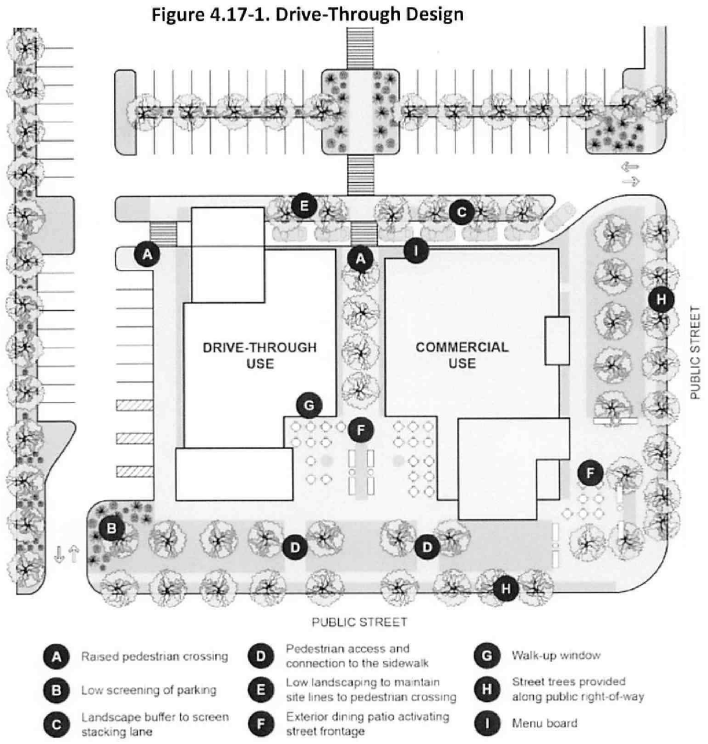
(3)
Building entrances.
a.
Primary building entrances and entry features shall be clearly defined through variation of architectural planes on the building and pavement surfaces, and must be accessible from a courtyard or plaza.
b.
The primary building entries shall be accessed directly from the sidewalk in the public right-of-way or from within the development site. Pedestrian circulation paths may only intersect or cross a drive-through lane(s) if the applicant can demonstrate that there are no other feasible or practical options available., in which case the pedestrian crossing shall be raised to create a hump to enhance pedestrian safety.
(4)
Building architecture and articulation.
a.
Prominent architectural features shall be located near corners, intersections, or where visible to the public right-of-way to promote and enhance the primary building entrance.
b.
Drive-through facilities within an integrated shopping center or master plan must have an architectural style consistent with the theme established in the center.
c.
The architecture of drive-through facilities must be compatible and consistent with surrounding uses in form, materials, colors, scale, etc.
d.
Building planes shall have variation in depth and angle to create variety and interest in the basic form and silhouette of the building.
e.
Articulation of building surfaces shall be encouraged through the use of openings and recesses which create texture and shadow patterns.
f.
For the purposes of screening, mechanical and/or electrical equipment, when feasible shall be integrated into the architecture and design of the proposed building.
(5)
Outdoor dining areas for restaurants.
a.
Outdoor dining areas are required for all new drive-in and drive-through restaurant facilities.
b.
Outdoor dining areas shall be designed as an integral part of the drive-through facility, and can include plazas, arcades, colonnades, or courtyards.
c.
Outdoor dining areas and other publicly accessible outdoor spaces shall include tables and seating, trash cans, and structures that provide shade and protection from the weather.
d.
To the maximum extent feasible, outdoor dining areas shall be oriented for maximum benefit of sunlight and views and to the extent possible, outdoor dining areas shall be oriented away from drive-through stacking lanes.
e.
The minimum dimension of an outdoor dining area shall be 20 feet measured in any direction with a minimum area of 450 square feet.
(6)
Parking and circulation.
a.
Parking. The parking for drive-through facilities shall be determined according to Sec. 120.05.060. - Off-street vehicle parking.
b.
Setbacks. Parking and the drive-through lane(s} shall be set back a minimum of 45 feet from the curb face of a public street. Greater setbacks may be required as mentioned in an applicable specific plan or as deemed necessary during the design review process.
(7)
Stacking requirements.
a.
Drive-through lanes shall be designed to accommodate adequate vehicle stacking as determined by a drive-through queuing analysis, reviewed by the City Engineer or their designee, that shall be based on the number of vehicles in the drive-through lanes for seven (7) consecutive days during peak lunch hours between 11:00 a.m. to 2:00 p.m. and peak dinner hours between 5:00 p.m. to 8:00 p.m. at three (3) different locations in cities with a similar population as Eastvale and in a similar location as the proposed site. At the request of the City Engineer or their designee, additional information may be requested to ensure a complete and accurate evaluation of the drive-through design.
b.
All stacking must be designed to be accommodated on the site of the drive through use without impacting or causing obstructions to adjacent tenants, drive-aisles, parking spaces, or public or private streets.
c.
In the event that the number of vehicles waiting at the service window or kiosk exceeds the length of the stacking lane(s), personnel from the drive-through establishment shall manage the queue to ensure that all vehicles do not block or interfere with on-site vehicular and pedestrian circulation and parking areas.
d.
Drive-Through Lane Design.
i.
The entrance and exit of a drive-through lane must be at least 50 feet from an intersection of public rights-of-way when measured at the closest intersecting curbs.
ii.
The drive-through lane must be at least 10 feet wide with a minimum 10- foot interior radius at curves.
iii.
At a minimum, food and beverage drive-through businesses shall provide stacking space for at least six (6) vehicles before the order menu board, and other service-oriented drive-through businesses shall provide stacking space for at least six (6) vehicles before the drive-up window or kiosk.
iv.
The drive-through lanes shall be separate from the circulation route necessary for ingress and egress from the property or access to any parking spaces within the site using concrete curbing or paint striping on at least one side of the lane. These requirements do not apply to the reuse of existing properties.
v.
All stacking lanes must be clearly identified with pavement markings and signage to indicate the entrance, direction of traffic flow and exit.
vi.
At the discretion of the approving authority, the driveway-through lane design may be required to provide for a minimum nine (9) feet wide escape/emergency lane allowing motorists to exit the stacking lane before reaching the drive-through window.
(8)
Performance standards.
a.
The use shall be operated in a manner that does not interfere with the normal use of adjoining properties. If, in the opinion of the Community Development Director or their designee, the provisions of this paragraph are being violated, the violations shall be grounds for reopening conditional use permit hearings and adding conditions to control the violation. Performance standards include, but are not limited to, the following considerations, which, where appropriate, shall be incorporated as conditions of approval in all use permits as determined by the approving body:
i.
All graffiti shall be removed within 72 hours.
ii.
No undesirable odors shall be generated on the site.
iii.
Noise levels measured at the property line shall not exceed the level of background noise normally found in the area or as required per Chapter 8.52. - Noise regulation.
iv.
All exterior lighting shall be contained to the subject property and shall not encroach onto neighboring properties as consistent with Sec. 120.05.050. - Outdoor lighting.
v.
A traffic management plan shall be submitted, reviewed, and approved by the Community Development Director and the City Engineer. This plan shall include detailed information and mitigation measures (such as traffic control measures, tablets, online orders, temporary drive-through closures, and/or use of off-duty officers for traffic control) to ensure visitor vehicles shall remain completely on-site and shall not impede any public rights-of-way (streets, drives, walks, etc.), drive aisles, parking spaces, etc. This plan shall be kept onsite and made available to the store manager from implementation as required.
(9)
Additional permit findings.
a.
In addition to the findings required for the granting of the applicable discretionary application, the following additional findings are required to be made by the approving body in approving a discretionary permit for a drive through business:
i.
That the proposed amount of parking, circulation plan, and traffic management plan will provide adequate area for safe stacking and maneuvering of vehicles, and the site design will provide adequate buffering for the use from adjoining land uses:
ii.
The proposed location of the drive-through facility will not result in adverse impacts upon the vicinity after giving consideration to a litter clean-up plan, the hours of operation, and the site plan;
iii.
The proposed location of the drive-through facility will not block existing drive aisles in shared parking areas;
iv.
The proposed location of the drive-through facility will not interfere with and or impact on-site pedestrian access and circulation.
v.
The use will not substantially less the usability of adjacent or nearby commercially zoned property or commercial use by interfering with pedestrian traffic;
vi.
That the use will not create increased traffic hazards to pedestrians;
vii.
That the site will be adequate in size and shape to accommodate said use and to accommodate all yards, walls, parking, landscaping, and other required improvements; and
viii.
That the use will not substantially lessen the usability and suitability of adjacent or nearby residentially zoned property for residential use.
(Ord. No. 25-09, § 4, 9-10-2025)

