
Eastvale City Zoning Code
CHAPTER 120
05. - DEVELOPMENT STANDARDS
Sec. 120.05.010. - Dimensional requirements.
(a)
Intent. In order to maintain view corridor and solar access for residential properties, this section establishes height limits on adjacent nonresidential zoning districts.
(b)
Height regulations.
(1)
Generally. Except as otherwise provided by this section or any other provisions of this Code, all structures shall be limited to the maximum height identified in the underlying (or applicable overlay) zoning district as identified in chapter 120.03, zoning district regulations, and chapter 120.04, standards related to specific uses.
(2)
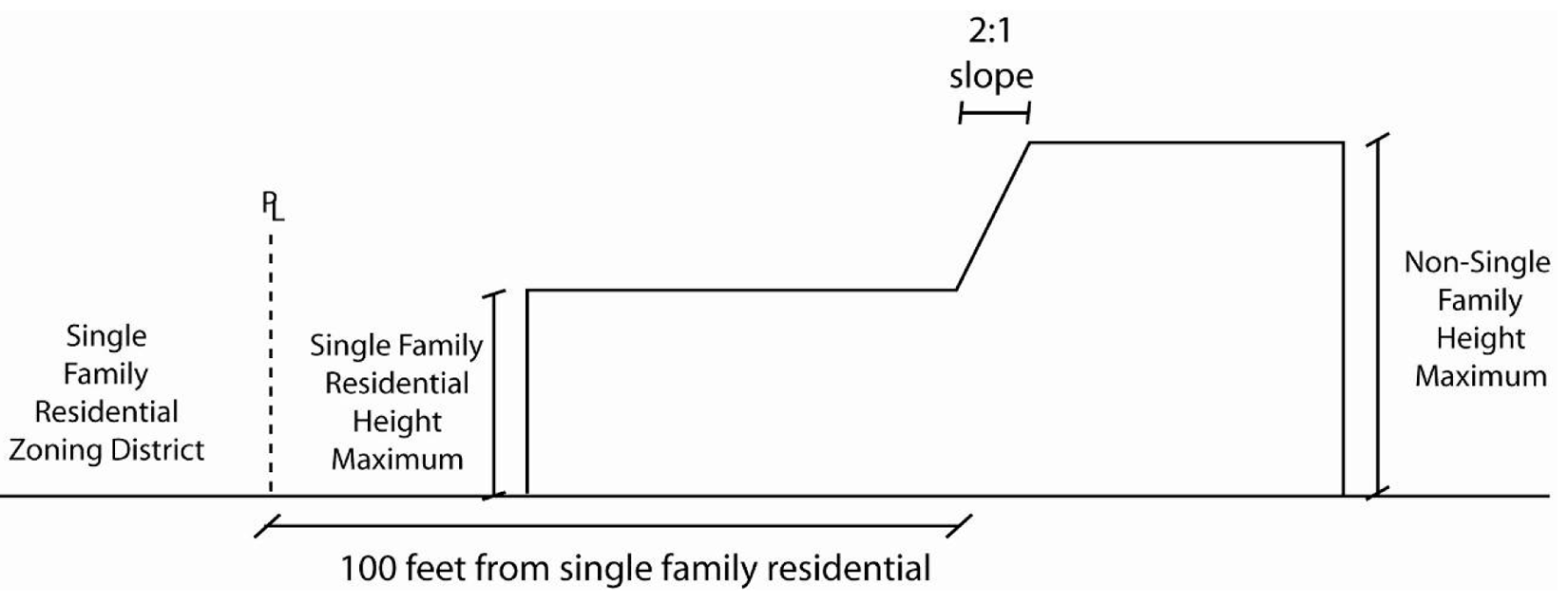
Height compatibility with single-family development. Whenever a structure is proposed on a lot that is adjacent to a single-family residential zone, the proposed structure shall maintain the same maximum height allowed in the adjacent single-family residential zone within 100 feet of the shared property line. From that point measured 100 feet from the shared line, the maximum height of the proposed structure may increase to the maximum allowed by its underlying zoning at a 2:1 ratio (see figure 5.1-1, height compatibility with single-family development). In the instance where the zones are separated by a public right-of-way, this rule shall still apply and the 100-foot distance measurement shall begin from the property line of the residential zone adjacent to the right-of-way.
Figure 5.1-1. Height Compatibility with Single-Family Development
(3)
Height limits in aircraft approach zones. Height limits in aircraft approach zones must comply with Federal Aviation Administration (FAA) regulations. In reviewing any permit application, the community development director and designee shall determine:
a.
The distance to the nearest point of the runway at the Chino Airport;
b.
Elevation of the runway at that point; and
c.
The elevation at mean seal level at the top point of the proposed structure. If this subsection exceeds subsection (b)(3)b of this section by more than (subsection (b)(3)a times 0.01), and subsection (b)(3)a of this section does not exceed 20,000 feet, the applicant shall be required to file with the FederalAviation Administration, and the permit shall not be issued until the Federal Aviation Administration has issued a determination of no hazard to air navigation.
(c)
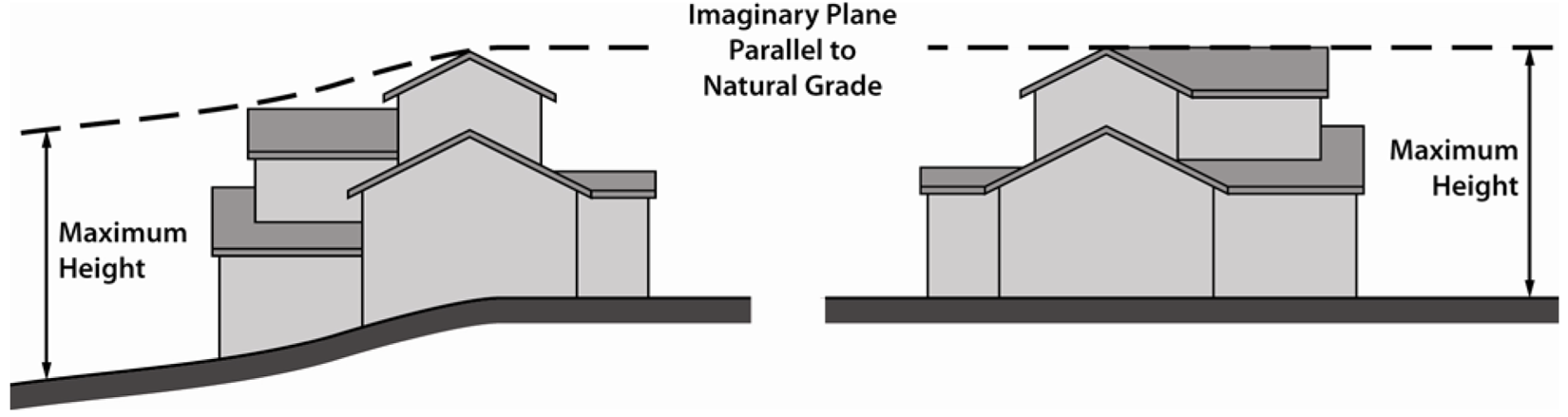
Height measurement. The height of a structure shall be measured as the vertical distance from the finish grade of the site to an imaginary plane located within the allowed number of feet above and parallel to the grade (see figure 5.1-2, measurement of height).
Figure 5.1-2. Measurement of Height
(d)
Height exceptions. Public or semipublic buildings in the R-1 and R-2 zones may be erected to a height not exceeding four stories or 60 feet when the required yards are increased by an additional two feet for each foot by which the height exceeds 35 feet. Structures necessary for the maintenance and operation of a building and flagpoles, wireless masts, chimneys or similar structures may exceed the prescribed height limits where such structures do not provide additional floor space. Exceptions to the height regulations are as follows:
(1)
General height exceptions. Towers, penthouses, and other roof structures for the purpose of shelter for mechanical equipment, cupolas, water tanks, church steeples, carillon towers, radio television antennas, and similar structures and necessary mechanical appurtenances may be erected on a building, or on the ground, to a height greater than the limit otherwise established within the underlying zone, or for that use, provided that no such exception shall cover at any level more than 15 percent of the area of the lot nor have an area at the base greater than 1,600 square feet (see section 120.04.140, communication facilities). All construction is subject to approval of building inspection. Signs may not be placed on such structures at a height exceeding the height of an otherwise permitted building. Fences or walls may be required and conditioned to exceed six feet in height for a project, as determined by the approving authority hearing related planning matters on the same parcel of land.
(2)
Height exceptions for residential zones. As part of minor and major development review, the designated approving authority may allow apartment houses, schools, churches, public buildings, and other similar buildings to be erected to a height not to exceed 75 feet, provided that the required yards are increased one foot for each one foot of height increase of said building. Please refer to sections 120.02.030 (Adjustments) and 120.02.040 Variances) for additional information.
(3)
Commercial and industrial zones. As part of development review, the designated approving authority may permit the maximum height for buildings in the commercial and industrial zones to be increased to a maximum of 150 feet, provided that all portions of the building exceeding the underlying height maximum are set back from the ultimate right-of-way line of all abutting streets and freeways a distance of at least equal to the height of that portion of the building.
(4)
Hazards to air navigation. Notwithstanding the regulations set forth in this section, no building or structure may be permitted at a height or elevation determined to be a hazard to air navigation.
(Ord. of 7-2012, § 5.1; Ord. No. 23-14, § 3, 2-8-2023; Ord. No. 23-19, § 1, 2-8-2023; Ord. No. 23-22, § 1, 2-8-2023)
Sec. 120.05.020. - Yard measurements.
(a)
Yard and setback regulations.
(1)
Required yard area. Except as otherwise specified in this zoning code, required yard areas shall be kept free of buildings and structures. Building overhangs, bay windows, and other such elements may intrude as permitted (see [figures 6-2—6-4 in chapter 120.06] lot and yard types).
(2)
Lots abutting two or more streets. In the case of a lot abutting two or more streets, the main buildings and accessory buildings shall be erected so as not to encroach upon the required yards of any of the streets (see [figures 6-2—6-4 in chapter 120.06] lot and yard types).
(3)
Through lots. Where a through lot has a depth of 125 feet or more, said lot may be treated as two lots, with the rear line of each approximately equidistant from the front lot lines, provided all the yard requirements are met (see [figures 6-2—6-4 in chapter 120.06] lot and yard types).
(4)
Lot area, depth, width, and setback reduction. Where a lot area or a lot width, depth, or setback has been reduced for an existing legally created lot by not more than 15 percent as a result of acquisition or dedication for a highway, road, drain, or other public purpose or as a result of dedication pursuant to a condition of approval, the lot area or yard so reduced may be included in determining compliance with lot area or yard requirements in the same manner as if the acquisition or dedication has not taken place.
(5)
Setback measurement. The setback of all buildings and structures shall be determined by the exterior boundaries of the streets and highways and their proposed widening and extensions as indicated on the circulation plan roadway system and sizing map of the city's general plan. The width of any street or highway which does not appear in the circulation plan shall be determined from the standards for street widths and improvements set forth in the city's development standards.
See chapter 120.03, sections 120.03.020 and 12.03.030 for more detailed yard and setback requirements and refer to chapter 120.06 for definitions and illustrations of lot types.
(b)
Yard encroachments. Where yards are required by this code, they shall be open and unobstructed from the ground to the sky and kept free of all structural encroachments, except as follows:
(1)
Outside stairways or landing places, if unroofed and unenclosed, may extend into a required side yard for a distance not to exceed three feet and/or into the required rear yard a distance not to exceed five feet.
(2)
Cornices, canopies, and other similar architectural features not providing additional floor space within the building may extend into a required yard a distance not to exceed one-foot. Eaves, not including patio cover eaves, may extend three feet into a required yard. One pergola or one covered but unenclosed passenger landing may extend into either side yard provided it does not reduce the side yard below five feet and its depth does not exceed 20 feet.
(3)
Detached accessory structures as identified in this section.
(4)
Window bays, including roof overhangs, having a minimum surface area of 50 percent glass, may encroach 24 inches into the required yard area when the finished floor of the window bay is at least 15 inches above the finished floor of the room.
(Ord. of 7-2012, § 5.2; Ord. No. 2013-09, § 3, 5-22-2013)
Sec. 120.05.030. - Fences, walls and screens.
Unless otherwise exempt, minor development review approval shall be required for fences and walls.
(1)
Exemptions. The following fences and walls shall be exempt from development review (a building permit may be required).
a.
Retaining walls. Retaining walls less than 36 inches in height.
b.
Residential fences. Fences located on residential property (privacy fences) constructed in compliance with the standards of this section.
c.
Required fences. Fences and walls required by a state or federal agency, or by the city for public safety.
(2)
Height limits and locations. For residential zoning districts, each fence, wall, and screen (including landscaping use as a screen) shall comply with height limits and locations shown in table 5.3-1, maximum height of fences, walls and screening in required yard area for residential zoning districts. Please refer to subsection (5) of this section, special fencing and screening requirements, for fence and wall standards specific to commercial and industrial uses.
TABLE 5.3-1. MAXIMUM HEIGHT OF FENCES, WALLS, AND SCREENING IN REQUIRED YARD AREA FOR RESIDENTIAL ZONING DISTRICTS
Notes.
1 Fences, walls and screening are not required between land uses unless otherwise specified in this title. Fences, walls and screening must also be located outside of any public utility easement except as authorized by the applicable utility agency.
2 Maximum height may be increased by the designated approving authority as part of development review.
3 Applies to the entire area in the front yard of a house, as defined by the front facade.
(3)
Height measurement.
a.
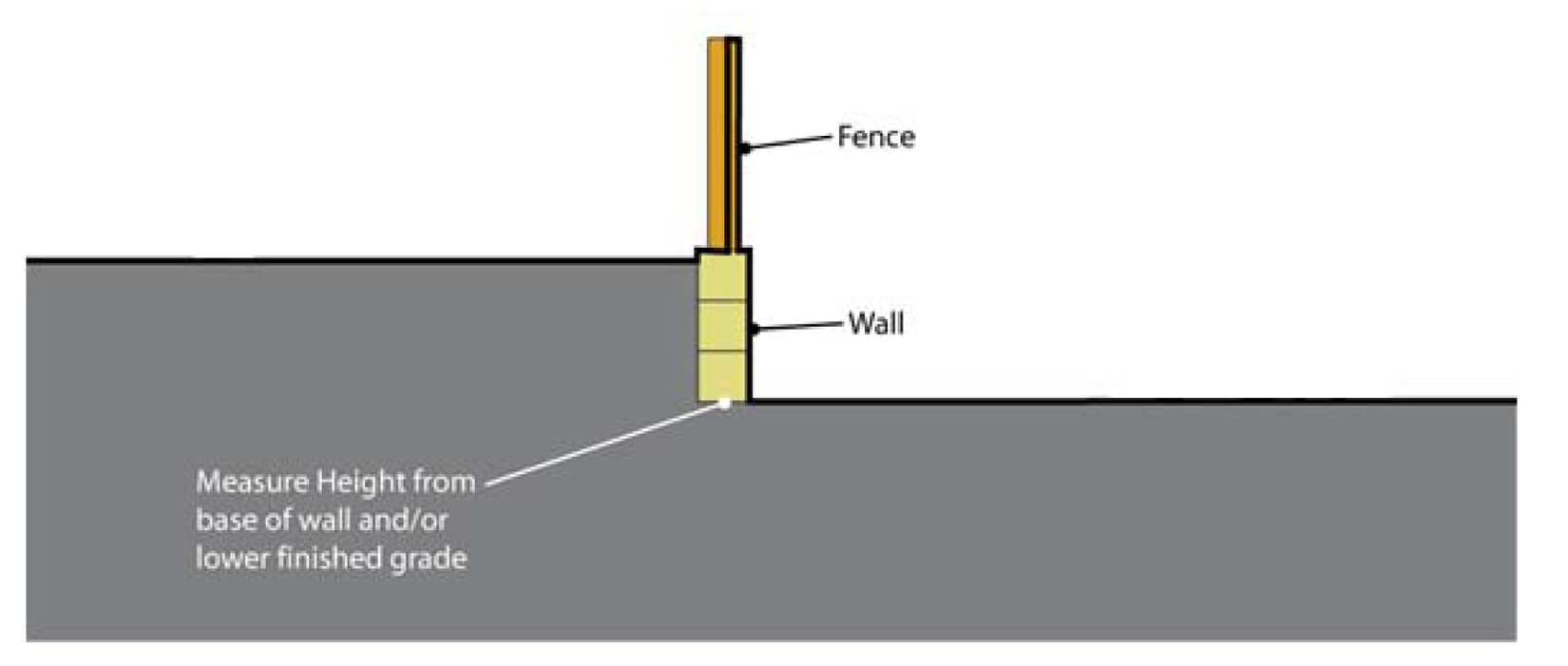
Fence height shall be measured as the vertical distance between the finished grade at the base of the fence and the top edge of the fence material. Grade may not be modified in order to increase fence height.
b.
The height of fencing placed atop a wall shall be measured from the base of the wall, except as provided in subsection (3)c of this section.
c.
The height of the fence must not exceed six feet as measured from the base of the wall and/or fence from the perspective of the sidewalk, roadway and/or adjacent property.
Figure 5.3-1. Height Measurements
(4)
Prohibited materials. The following fence materials are prohibited in all zones unless approved through a minor development review or conditional use permit process for security needs (i.e., an industrial user) or required by the city or state or federal law or regulation:
a.
Barbed wire or electrified fence.
b.
Razor or concertina wire in conjunction with a fence or wall, or by itself.
c.
Chainlink fencing within a front yard or street side yard.
(5)
Special fencing and screening requirements. This section establishes screening standards and special provisions for walls and fencing.
a.
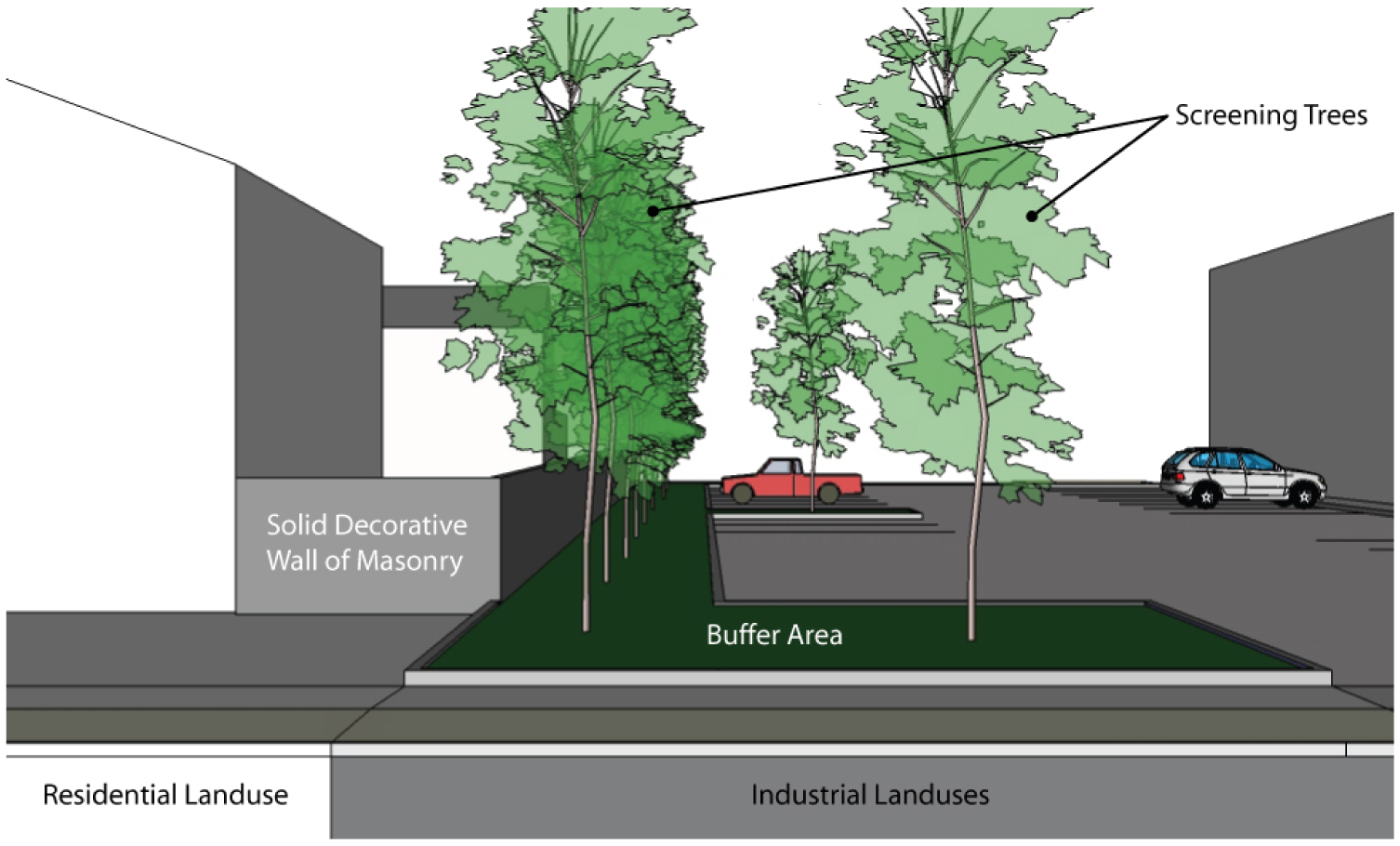
Screening between different land uses. The city encourages the integration and connection of compatible uses. To that end, contiguous barriers in the form of solid fences and walls, including soundwalls, should only be used between land uses when residential uses are located next to industrial uses or when necessary, as determined by the designated approving authority. When used, the screening shall meet the following standards (see figure 5.3-2, screening between different land uses):
1.
The screen shall consist of a solid decorative wall of masonry or similar durable material or, in lieu of decorative masonry, the wall shall be covered with plant materials (e.g., ivy) or shall be blocked from view by landscape materials. The wall shall be a minimum of six feet in height, shall be architecturally treated on both sides, and shall comply with the height limitations listed in subsection (2) of this section, height limits and location;
2.
The decorative wall is subject to minor development review approval;
3.
A landscaping strip with a minimum width of five feet shall be installed adjacent to a screening wall, except that a minimum of six feet of landscaping (with trees) shall be provided between a parking lot and a screening wall;
4.
The designated approving authority may waive, or approve a substitute for, the requirements in this subsection (5)a if it is determined that:
(i)
The relationship of the proposed uses makes screening unnecessary or undesirable;
(ii)
The intent of this section is successfully met by alternative screening methods; and/or
(iii)
Physical characteristics and/or constraints on the site make required screening infeasible or unnecessary.
Figure 5.3-2. Screening Between Different Land Uses
b.
Screening of mechanical equipment. Mechanical equipment shall be screened as follows:
1.
All exterior mechanical equipment shall be screened from view on all sides;
2.
Screening on top of the equipment may be required by the designated approving authority if necessary to protect views from a neighboring residential zone.
c.
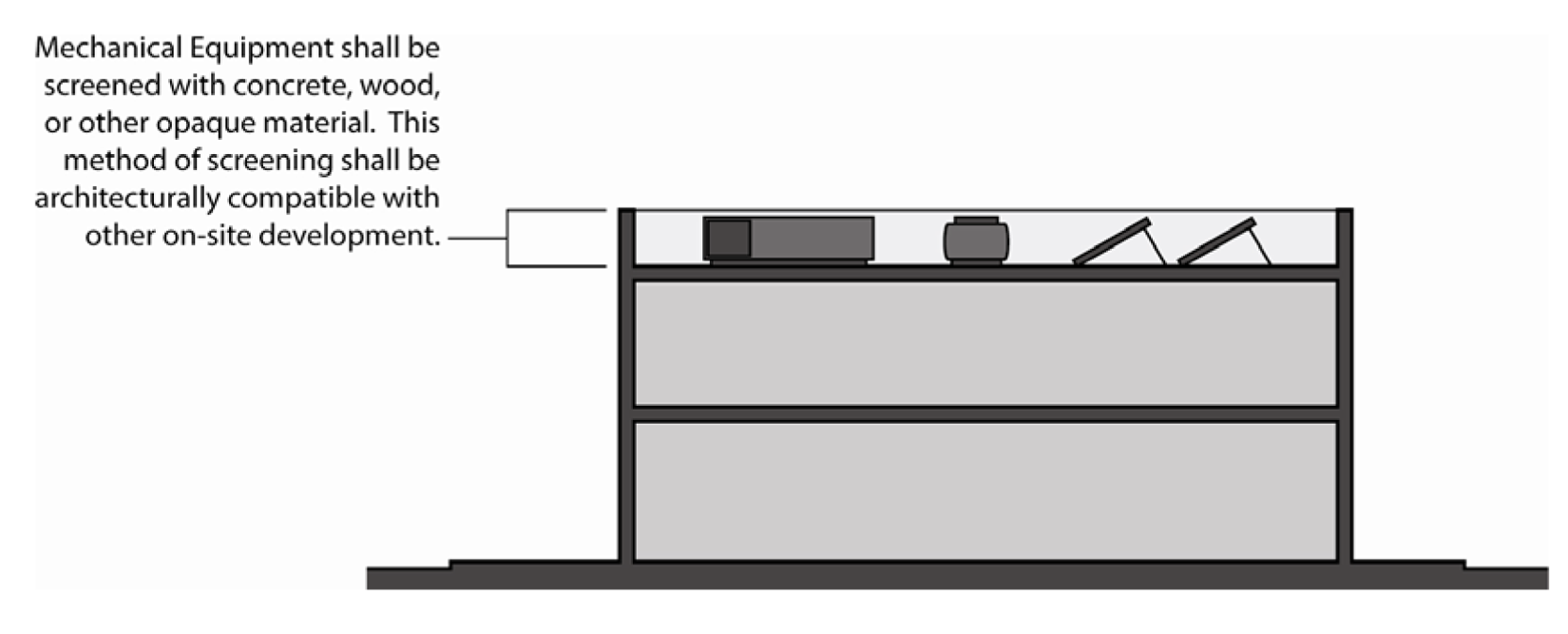
Screening of roof-mounted equipment. Roof-mounted mechanical equipment shall be screened in compliance with the following standards (see figure 5.3-3, screening of roof-mounted equipment):
1.
Screening materials may be solid concrete, wood or other opaque material and shall effectively screen the mechanical equipment so that it is not visible from a public street;
2.
The method of screening shall be architecturally compatible with other on-site development in terms of colors, materials and architectural styles;
3.
Mechanical equipment must be screened from the perspective of the adjacent public streets, right-of-way and/or sidewalk.
Figure 5.3-3. Screening of Roof-Mounted Equipment
d.
Screening of ground-mounted antennas. Ground-mounted antennas shall be screened with a fence, wall or dense landscaping so that the antennas are not visible from the public right-of-way and to minimize the visual impact on abutting properties. Building-mounted antennas shall be screened as follows:
1.
Wall-mounted equipment shall be flush-mounted and painted or finished to match the building, with concealed cables;
2.
Roof-mounted equipment shall be screened from view of public rights-of-way by locating the antenna below the roofline, parapet wall or other roof screen and by locating the antenna as far away as physically feasible and aesthetically desirable from the edge of the building;
3.
Antennas shall have subdued colors and nonreflective materials which blend with the materials and colors of the surrounding area or building.
e.
Screening of commercial loading docks and refuse areas. Loading docks and refuse storage areas shall be screened from public view and adjoining public streets and rights-of-way and residentially zoned areas. The method of screening shall be architecturally compatible with other on-site development in terms of colors, materials and architectural style. Exceptions may be permitted through development review for sites with unique characteristics (e.g., shallow lot depth, adjacency to single-family unit). All dumpsters shall be closed when not in use.
f.
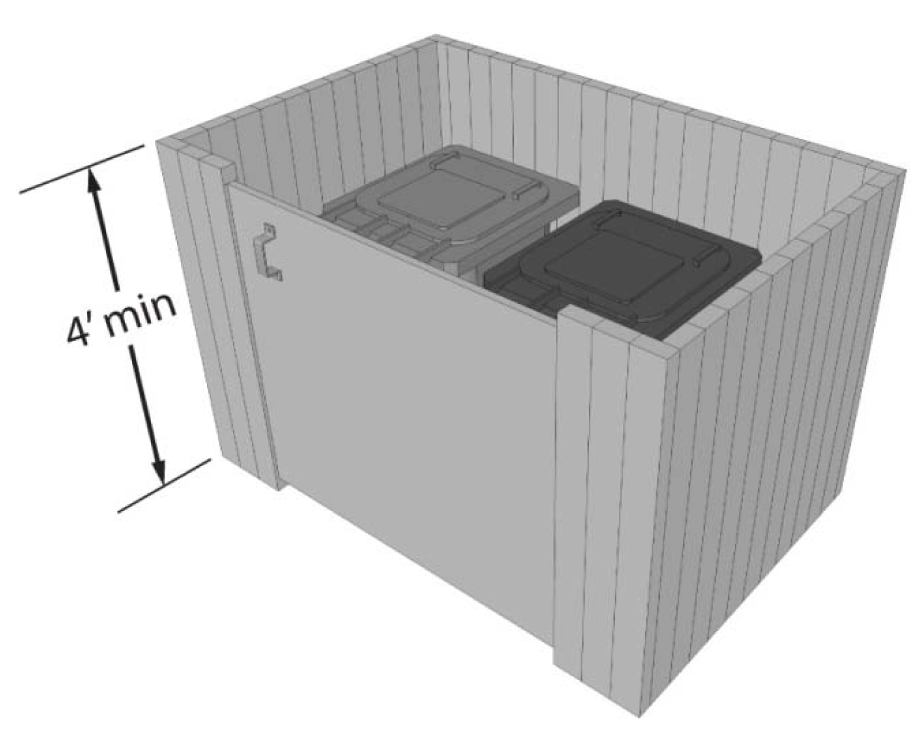
Screening of trash enclosures/recycle containers. Trash receptacles (including recycling and green waste containers) shall not be stored within a required front or street side yard and shall be screened from view of the public right-of-way by a solid fence not less than four feet in height. Exceptions to fence height standards may be granted by the designated approving authority to ensure proper placement and screening of trash receptacles. See figure 5.3-4, screening of trash enclosures/recycling containers.
Figure 5.3-4. Acceptable Screening of Trash Enclosures/Recycling Containers
g.
Outdoor equipment, storage, and work areas. Outdoor storage areas for materials other than plants shall be enclosed and screened from view from the public right-of-way and abutting property by a solid fence or wall a minimum of six feet in height. All gates provided for ingress and egress in any required fence or wall shall be at least six feet in height and shall be of view-obstructing construction.
h.
Screening for special uses. The following uses shall be screened from abutting properties and the public right-of-way as provided as follows:
1.
Automobile dismantling. Outdoor storage areas for automobile dismantling uses shall be screened from public view by a masonry wall no less than six feet tall and no more than 14 feet tall. Materials and goods stored in the yard area may not be stacked above the height of the enclosing wall. Those portions of walls fronting onto public rights-of-way shall be buffered by a minimum ten-foot-wide landscape area that includes a ground cover and evergreen trees planted 30 feet on-center. The wall shall be covered with either graffiti-resistant paint or coating or with vines or other landscaping. The design of the landscaping (e.g., irrigation, planting) shall be consistent with the standards of section 120.05.040, landscaping, general provisions.
2.
Junk tire facility. Junk tires shall be stored behind a visual screen fence no higher than eight feet tall and shall not be stacked higher than the top of the fence. Fences shall be required between a licensed junk tire facility and any adjoining parcel which has a more restrictive land use zoning designation.
3.
Potable water storage facility. Potable water storage facilities shall be enclosed by a six-foot-tall solid masonry wall and buffered from the public right-of-way by a minimum ten-foot-wide landscape planter that includes ground cover and evergreen trees planted 30 feet on-center. The masonry wall shall be covered in either graffiti-resistant paint or coating or with vines or other landscaping. The design of the landscaping (e.g., irrigation, planting) shall be consistent with the standards of section 120.05.040, landscaping, general provisions.
4.
Service stations. Service stations shall be screened from abutting residential zoning districts and uses by a solid six-foot masonry wall along the property line between the service station and the abutting property, except that within the first 25 feet from the street right-of-way line said wall shall not exceed 2.5 feet in height.
i.
Retaining walls. An embankment to be retained that is over 48 inches in height shall be benched so at the low side no individual retaining wall exceeds a height of 36 inches above the finished grade and each bench has a minimum depth of 36 inches.
j.
Swimming pools, spas and similar features. Swimming pools/spas and other similar water features shall be fenced in compliance with the adopted building code.
k.
Temporary fencing. Temporary fencing may be required by the designated approving authority where necessary to protect trees or other sensitive features and the general public from construction activities during site preparation and construction. Temporary fencing shall be removed after 90 days once construction is complete.
l.
Temporary security fencing. Temporary security fencing (including chainlink) with a maximum height of six feet may be installed around the property lines of vacant property with approval from the designated approving authority. Properties shall be maintained in a condition free from weeds and litter.
m.
Open space and trails. Fences adjacent to open space and trail areas shall be constructed and maintained as open view fencing and shall not be chainlink.
n.
Soundwalls. Whenever soundwalls are required to mitigate sound impacts adjacent to streets, the following standards shall apply. These standards shall notpreclude the use of other innovative methods of project design utilizing greater setbacks, building design, mounding, or single-story structures with solid walls facing the street.
1.
Setbacks. Walls shall be set back a sufficient distance from the ultimate public street right-of-way in accordance with noise attenuation and landscaping. The area between the right-of-way and the wall shall include a public sidewalk and landscaping, including canopy street trees;
2.
Height. Maximum height of a wall shall not exceed six feet above the finished grade at the base of the wall on the roadway side, unless additional height is needed as documented by a noise study and approved by the community development director; in which case a specific maximum height in excess of six feet shall be established and adhered to;
3.
Earth mounds. When the sound and visual attenuation requires a wall exceeding six feet above the grade of the adjacent roadway, earth mounds shall be used, such that no more than six feet of the wall is visible from the roadway. The mounds shall not exceed a 3:1 ratio slope. The mounds may support the wall or be placed against the wall on the street side. Drainage shall be contained, so there is no sheet flow of water onto the sidewalk where the slope exceeds a 6:1 ratio;
4.
Type of wall. Walls shall be constructed of graffiti-resistant solid brick or masonry material that requires minimum maintenance and provides the required sound and visual attenuation.
o.
Agricultural fencing. All fences which enclose livestock shall be designed, constructed, and maintained so as to control and contain such livestock at all times and so as to prevent such livestock from reaching across any property lines and damaging adjacent property.
(6)
Continued maintenance and operation.
a.
Maintenance. Fences, walls and landscape screening shall be continuously maintained in an orderly and good condition, at no more than their maximum allowed height.
b.
Graffiti resistance. Each fence or wall adjacent to a public right-of-way in any zoning district shall be provided with a permanently maintained graffiti-resistant coating (a painted wood fence meets this requirement, since it can be repainted).
(Ord. of 7-2012, § 5.3; Ord. No. 23-22, § 1, 2-8-2023)
Sec. 120.05.040. - Landscaping, general provisions.
(a)
Application requirement. A landscaping plan, landscaping grading plan, irrigation plan, and shading plan shall be required for all development review (minor and major), conditional use permits, surface mining permits, subdivisions, and any other permit when the community development director deems it necessary.
(1)
The landscaping plan, landscape grading plan, irrigation plan and shading plan shall be submitted under one application consistent with the provisions of section 120.02.010, development review.
(2)
The landscaping plan, landscaping grading plan, irrigation plan, and shading plan may be submitted on four separate exhibits or may be combined on one to three exhibits, provided that the information required to be displayed for each plan is legible and clearly discernible.
(3)
No less than the number of copies as determined by the community development director of the landscaping plan, landscaping grading plan, irrigation plan, and shading plan shall be submitted for approval by the community development director.
(4)
All landscaping shall comply with state water-efficient landscaping requirements.
(5)
All plans shall show the following information:
a.
The first sheet of a multiple sheet set shall contain a title block with the name and address of the project, sheet number, and numbers of sheets and a revision block to indicate date and type of revisions;
b.
Each sheet shall show the required technical data, including scale of drawing, north arrow, date drawn and dates of revisions (if applicable), all property lines and project limits, if other than property limits, all easements, fences, walls, curbs, roads, walks, structures, mounds, swales, manholes, banks, and all plant and landscaping materials, grading, irrigation and other exterior elements proposed. A legend shall also be included for each symbol used.
(b)
Landscaping plan requirements.
(1)
Trees that are native to the area, and/or suitable for the local climate as determined by the community development director, should be used.
(2)
The location of all existing landscaping materials and where proposed landscaping material is to be placed shall be shown. Existing trees shall be preserved whenever it is practical to do so, and shall be shown on the landscaping plan.
(3)
The quantities, sizes, and locations of all trees, shrubs and ground cover, hydroseed and wildflower mixtures, etc., shall be indicated. Trees shall be a minimum 24-box size. Shrubs shall be a minimum five-gallon size; however, the use of smaller plants may be approved for areas where color or growth habits make it suitable.
(4)
All trees and shrubs shall be drawn to reflect the average specimen size at 15 years of age/maturity.
(5)
All plants shall be listed by correct botanical name and common name.
(6)
The soil surface of all planters shall be shown planted or covered with mulch (e.g., bark, rock, etc.).
(7)
Lawns shall be indicated by common name of species and method of installation (seeding, hydromulching or sodding).
(8)
Proposed treatment of all ground surfaces, including paving, turf and mulch (bark or rock).
(9)
Planting details and methods of application shall be shown.
(10)
Complete construction detail referencing (fencing, walls, etc.) shall be indicated.
(c)
Landscaping grading plan requirements. The grading plan shall show the drainage of all planting areas and the heights of mounds. Mounds shall not exceed 3:1 slope, and no mound over 30 inches high shall be placed within ten feet of any street and/or alley intersections.
(d)
Irrigation plan requirements. An irrigation plan shall show the following:
(1)
Locations of all irrigation components, such as sprinkler heads, valves, pipes, backflow prevention devices and water taps, drip irrigation, automatic controllers and quick couplers.
(2)
Proposed radius or diameter of throw (sprinkler coverage) at a stated pressure (pounds per square inch (psi)) for each sprinkler head and drip-irrigation specifications.
(3)
Worst case irrigation system pressure loss calculations.
(4)
Static water pressure psi, available gallons per hour (gph), water pressure zone, agency reading locations and source of information for each one.
(5)
City-required water budget calculations based on the water efficient landscape ordinance requirements.
(e)
Shading requirements.
(1)
Parking area landscaping shall include shade trees, so as to provide for adequate shade canopies within 15 years of age as follows:
TABLE 5.4-1. PERCENTAGE OF TOTAL PARKING AREA REQUIRED TO BE SHADED
Note—The percentage of parking area required to be shaded shall be based on the number of uncovered parking spaces; driveways and aisles are excluded. Multilevel parking structures are exempt from shading requirements.
(2)
Trees shall be a minimum 24-box size at planting.
(3)
Trees shall be planted and maintained throughout the parking area to ensure that the percentage of the parking area that is shaded is no less than the minimum amount required by table 5.4-1, percentage of total parking area required to be shaded, in subsection (e)(1) of this section. The parking area shading plan shall be developed in compliance with a landscaping plan. Each planting area shall be of adequate size for the landscaping approved and shall have adequate irrigation for that landscaping.
(f)
Landscaping design standards. Landscaping shall be incorporated into the design of all off-street parking areas, including covered and decked, as follows:
(1)
Countywide design guidelines. In addition to the landscaping standards in this section, the standards of the countywide design guidelines adopted by the city shall also apply. In the event of a conflict between this title and the countywide design guidelines, the more stringent standard shall apply.
(2)
General landscaping provisions.
a.
These provisions apply to:
1.
Landscaping throughout and immediately surrounding parking areas; and
2.
Additional landscaping as required by this title.
b.
Landscaped areas shall be distributed throughout the entire off-street parking area as evenly as is approved in the design of the parking facility;
c.
Nothing in this section shall preclude the installation of additional landscaping and the planting of additional trees so long as such planting is consistent with visibility regulations;
d.
Any open areas in the interior shall be landscaped with appropriate plant materials and maintained in good condition as provided in this title;
e.
All landscaped areas shall be designed so that plant materials are protected from vehicle damage, encroachment or overhang;
f.
All trees shall be double-staked and secured with a rubber or plastic strip, or other commercial tie material. Wire ties and twist-a-brace shall not be used;
g.
No trees shall be planted within ten feet of driveways, alleys and/or street intersections;
h.
All landscaping shall be within planters bounded by a curb at least six inches high;
i.
A six-inch-high curb with a 12-inch-wide concrete walkway shall be constructed along planters on end stalls adjacent to vehicle parking spaces;
j.
In urban areas, all parking areas shall be screened from view along the entire perimeter of the parking lot by the construction of either a three-foot-high and three-foot-wide earthen berm, or a five-foot-wide planter with shrubbery that can be maintained at a height of three feet. When the parking area is adjacent to a public road right-of-way, the berm or planter shall be five feet in width;
k.
In addition to the perimeter landscaping required by this title, parking areas of five spaces or more shall be required to provide additional landscaped areas within the parking area. A minimum percentage of the total parking area shall be landscaped as follows:
TABLE 5.4-2. MINIMUM PERCENTAGE OF TOTAL INTERIOR PARKING AREA TO BE LANDSCAPED
l.
At the discretion of the appropriate authority, a barrier-free, four-foot-wide paved walkway may be provided through the required planter at street and driveway intersections to provide unencumbered access for persons with disabilities from the sidewalk to the parking lot. No planting area shall by bisected by a handicap walk making it less than five feet wide.
1.
Such a walkway shall be located so as to facilitate the most direct movement of persons using sidewalk curb ramps, if provided;
2.
Bus shelters may be located within this planter if approved by the community development director. Such shelters shall not be placed so as to reduce the number of trees which are otherwise required by this title.
(3)
General planter provisions. Planters containing organic landscaping shall be provided adjacent to and within parking areas. The dimensions of a planter refer only to that which is plantable area.
a.
No planter shall be smaller than 25 square feet;
b.
Each planter shall include an irrigation system;
c.
The planter shall include shrubs, and other natural growth or other features such as berms, designed to form a partial visual screen at least three feet in height, except within ten feet of street and driveway intersections where landscaping shall not be permitted to grow higher than three feet;
d.
Planters shall be provided adjacent to all public road rights-of-way, consistent with the following:
1.
The planter shall be at least five feet wide. Trees in this planter shall be planted at an average spacing of 25 feet.
2.
For parking lots with more than 150 feet of frontage on a public right-of-way, a landscaped planter at least eight feet wide (measured including curbs) shall be provided between parking spaces so that no more than five parking spaces are grouped together. Each of these planters shall include at least one tree.
3.
Any area within the road right-of-way between the edge of the walkway and the outer edge of the right-of-way shall also be developed as a landscaped area, in conjunction with the required planter, unless this requirement is waived by the community development director.
4.
In the event that any of these standards conflict with the standards in the countywide design guidelines, the more stringent standard shall apply.
e.
A planter at least five feet wide shall be provided adjacent to properties used for residential purposes and/or zoned R-1, R-2, R-3, PRD, R-6, R-A, R-R or R-T. Within this planter, one screen tree shall be planted at an average distance apart of no less than 25 feet on-center in combination with other plants to provide a dense visual screen;
f.
All planters located adjacent to all parking spaces shall have a six-inch-high and 12-inch-wide concrete walkway and must maintain a minimum of five feet of the actual planting area.
(4)
General plant materials provisions.
a.
Existing mature trees on the site shall be preserved whenever it is practical to do so;
b.
All plant materials shall be maintained free from physical damage or injury arising from lack of water, chemical damage, insects and diseases. Plant materials showing such damage shall be replaced by the same or similar species;
c.
Planting areas shall be kept free from weeds, debris and undesirable materials which may be detrimental to public safety, drainage or site appearance;
d.
Drought tolerant species and native species to the state are to be used to the maximum extent possible over nondrought tolerant and nonnative species:
1.
The quantity and extent of drought-tolerant species shall be dependent on the climatic zone of the project;
2.
Landscaping may include natural features such as rock and stone, nondrought tolerant plants, and structural features such as fountains, reflecting pools, art work, screens, walls and fences;
e.
Plant materials shall be grouped together in regards to water and soil requirements. In order to conserve water, alternative types of low volume irrigation concepts may be used, including, but not limited to, drip, rotary spray (in areas 15 feet wide or larger), mini-spray, bubbler and low volume sprays.
(5)
General irrigation provisions.
a.
An automatic irrigation system for all planted areas shall be required.
b.
The layout of the system should consider meter water pressure, pipe size and length, dripping and type of heads.
c.
Sprinkler spacing shall not exceed the manufacturer's recommended spacing or, if no spacing is recommended, spacing shall not exceed 60 percent of the diameter of throw (sprinkler coverage). Head-to-head spray coverage is required.
d.
Sprinklers in hazardous locations shall be flush-mounted on high pop models only.
e.
Backflow prevention devices for sprinklers shall comply with the latest edition of the building code, as adopted by the city.
(g)
Request for modification from landscaping standards. The community development director may, without notice or hearing, permit modifications to the landscaping requirements where topographic or other physical conditions make it impractical to require strict compliance with these requirements.
(h)
Enforcement of landscaping design standards.
(1)
Prior to the issuance of a final building occupancy certificate, all required landscape planting and irrigation shall have been installed and be in a condition acceptable to the community development director.
a.
The plants shall be healthy and free of weeds, disease or pests;
b.
The irrigation system shall be properly constructed and in good working order.
(2)
At the discretion of the community development director, the city can require financial security, per year, to ensure the maintenance of landscape.
(Ord. of 7-2012, § 5.4; Ord. No. 23-22, § 1, 2-8-2023)
Sec. 120.05.050. - Outdoor lighting.
(a)
Permit required. Unless otherwise exempt by subsection (b) of this section, exempt lighting, all outdoor lighting fixtures for new multifamily residential, commercial, industrial, mixed use and public/quasi-public uses require development review approval by the designated approving authority pursuant to section 120.02.010, development review. Such approval shall be granted in conjunction with required land use and development permits for a project. Any retrofit or amendment to an existing site and/or building lighting that would have a measurable impact on abutting property or views from street right-of-way as determined by the community development director shall require minor development review approval.
(b)
Exempt lighting. The following items shall be exempt from minor development review requirements:
(1)
All outdoor light fixtures producing light directly by the combustion of fossil fuels, such as kerosene lanterns or gas fixtures.
(2)
Temporary lights used for holiday decorations.
(3)
Lighting for temporary uses and special events permitted consistent with this title.
(c)
Prohibited lighting. The following types of lighting are prohibited:
(1)
Neon tubing or band lighting along buildings and/or structures as articulation, except as approved through minor development review.
(2)
Searchlights, laser source lights, or any similar high-intensity light, except for emergency use by police or fire personnel at their discretion, or for lighting approved by the city for a temporary event.
(3)
Lighting fixtures operated in such a manner as to constitute a hazard or danger to persons or to safe vehicular travel.
(4)
Illumination of entire buildings, except for public, civic, and religious buildings.
(5)
Roof-mounted lighting except for security purposes.
(6)
Moving, flashing or animated lighting.
(d)
General lighting standards. The following standards shall apply to all outdoor lighting:
(1)
Maintenance. Fixtures and lighting shall be maintained in good working order and in a manner that serves the original design intent.
(2)
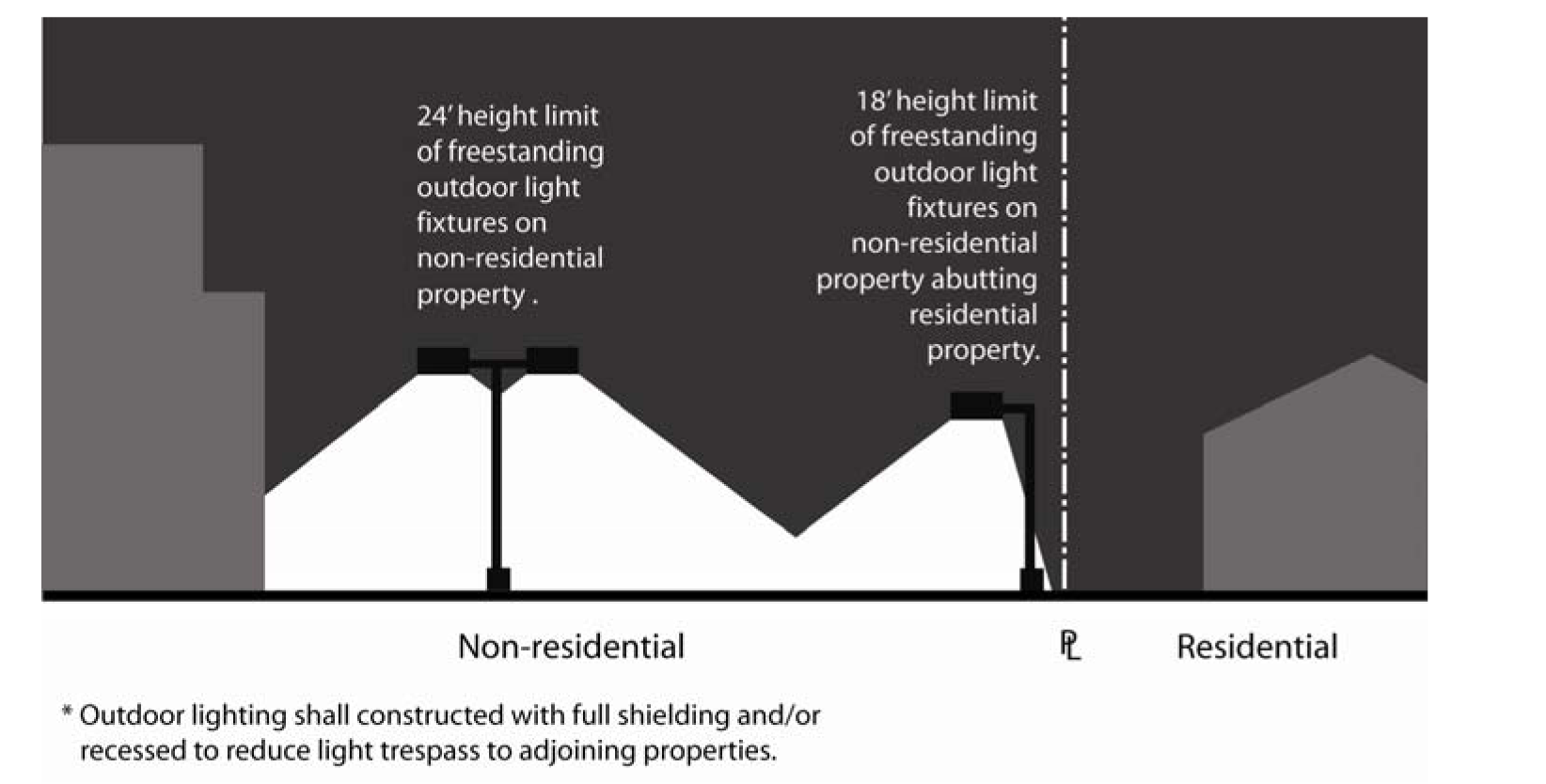
Shielding. Except as otherwise exempt, all outdoor lighting shall be constructed with full shielding and/or recessed to reduce light trespass to adjoining properties. Each fixture shall be directed downward and away from adjoining properties and public rights-of-way, so that no light fixture directly illuminates an area outside of the site (see figure 5.5-1, shielding and maximum height of freestanding outdoor light fixtures, in subsection (d)(4) of this section).
(3)
Level of illumination. Outdoor lighting shall be designed to illuminate at the minimum level necessary for safety and security and to avoid the harsh contrasts in lighting levels between the project site and adjacent properties. Illumination standards are as follows:
a.
Parking lots, driveways, trash enclosures/areas, public phones and group mailboxes shall be illuminated with a minimum maintained one footcandle of light and an average not to exceed four footcandles of light.
b.
Convenience stores, card rooms and check-cashing establishments shall provide a minimum level of illumination of 1.5 footcandles across the parking lot during business hours.
c.
Pedestrian walkways shall be illuminated with a minimum maintained one-half footcandle of light and an average not to exceed two footcandles of light.
d.
Entryways and exterior doors of nonresidential structures shall be illuminated during the hours of darkness, with a minimum maintained one footcandle of light, measured within a five-foot radius on each side of the door at ground level.
e.
In order to minimize light trespass on abutting residential property, illumination measured at the nearest residential structure or rear yard setback line shall not exceed the moon's potential ambient illumination of one-tenth footcandle.
f.
Athletic facilities may exceed the specified levels of illumination as needed. Measures shall be taken to minimize glare off site.
(4)
Maximum height of freestanding outdoor light fixtures. The maximum height of freestanding outdoor light fixtures and related structures is limited as follows:
a.
18 feet when abutting or within 25 feet of residential zoning district.
b.
No height limit for lights on public property when used to illuminate athletic fields.
c.
24 feet for all other lights.
d.
Height shall be measured from the finish grade, inclusive of the pedestal, to the top of the fixture.
Figure 5.5-1. Shielding and Maximum Height of Freestanding Outdoor Light Fixtures
(5)
Energy-efficient fixtures required. Outdoor lighting shall utilize energy-efficient (high-pressure sodium, metal halide, low-pressure sodium, hard-wired compact fluorescent or other lighting technology that is of equal or greater efficiency) fixtures and lamps. All new outdoor lighting fixtures shall be energy efficient with a rated average bulb life of not less than 10,000 hours.
(6)
Accent lighting. Architectural features may be illuminated by uplighting provided that the lamps are low intensity to produce a subtle lighting effect and no glare or light trespass is produced. Wherever feasible, solar powered fixtures shall be used. In the Chino Airport influence area, uplighting is not permitted. Refer to the most recently adopted version of the Chino Airport land use compatibility plan.
(7)
Signs. Lighting of signs shall be in compliance with section 120.05.070, signs.
(8)
Sports fields/outdoor activity areas. Where playing fields or other special activity areas are to be illuminated, lighting fixtures shall be mounted, aimed and shielded so that the light falls within the primary playing area and no significant off-site light trespass is produced. Lights shall be turned off within one hour after the end of the event, and no later than 11:00 p.m.
(9)
Alternative designs, materials and installations. The designated approving authority may grant approval of alternatives to this section as part of a development review process.
(e)
Outdoor lighting plans required.
(1)
When required. A preliminary outdoor lighting plan shall be submitted as part of each planning permit application, and a final plan shall be submitted as part of an application for a building permit for a new structure or an addition of 25 percent of the gross floor area, seating capacity or parking spaces. A final outdoor lighting plan is required for all new outdoor lighting installations on commercial, mixed-use, multiunit residential, industrial and institutional properties. The director may request outdoor lighting plans from applicants for other types of projects due to location, size or proposed use, as necessary.
(2)
Plan content. At a minimum, an outdoor lighting plan shall include the following:
a.
Manufacturer specifications sheets, cut sheets, and other manufacturer-provided information for all proposed outdoor light fixtures to show fixture diagrams and outdoor light output levels;
b.
The proposed location, mounting height and aiming point of all outdoor lighting fixtures;
c.
If building elevations are proposed for illumination, drawings of all relevant building elevations showing the fixtures, the portions of the elevations to be illuminated, the illumination level of the elevations, and the aiming point for any remote light fixture;
d.
Photometric data including a computer-generated photometric grid showing footcandle readings every ten feet within the property or site and ten feet beyond the property lines.
(Ord. of 7-2012, § 5.5; Ord. No. 23-22, § 1, 2-8-2023)
Sec. 120.05.060. - Off-street vehicle parking.
The purpose of this section is to provide sufficient off-street parking and loading spaces for all land uses in the city and to ensure the provision and maintenance of safe, adequate and well-designed off-street parking facilities. It is the intent of this section that the number of required parking and loading spaces will meet the needs created by the particular uses. The standards for parking facilities are also intended to reduce street congestion and traffic hazards and promote vehicular and pedestrian safety and efficient land use. Off-street vehicle parking shall be provided in accordance with this section when the associated building or structure is constructed or the use is established. Additional off-street parking shall be provided in accordance with this section when an existing building is altered or dwelling units, apartments or guestrooms are added, or a use is intensified by the addition of floor space or seating capacity, or there is a change of use.
(1)
Parking design standards.
a.
Approval of off-street parking plan. Zoning clearance, pursuant to the provisions of section 120.02.010, development review, shall be filed for approval of all off-street parking facilities, except for one- and two-family residences, unless the off-street parking facilities are approved as a part of development review or conditional use permit approval.
b.
Number of required parking spaces.
1.
In the case of mixed land uses, the total number of parking spaces shall be the sum of the requirements for the various uses computed separately, unless shared parking is approved as provided in this title;
2.
The table set forth in subsection (1)c of this section is designed to allow calculation of parking spaces required for the uses shown.
c.
Location and design of parking spaces.
1.
A driveway for stacking leading to a drive-up window shall be designed so as not to interfere with the free or orderly circulation of the parking area;
2.
Unless otherwise specified, all parking must be within 300 feet of the use served, on the same parcel as the use, or on an adjoining appropriately zoned parcel;
3.
All vehicle storage (stacking) spaces shall be located off of the street.
*The city does not regulate public schools.
d.
Parking requirements for uses not specified. When parking requirements for a use are not specifically stated, the parking requirement for such use shall be determined by the community development director, based on the requirement for the most comparable listed use in this title.
e.
Request for modifications from parking standards. The community development director may, without notice or hearing, permit modifications to the circulation and parking layout requirements where topographic or other physical conditions make it impractical to require strict compliance with these requirements.
(2)
Alternative programs for parking.
a.
A residential, commercial or industrial project may provide for alternative programs which reduce parking demand in return for a reduction in the number of off-street parking spaces required.
b.
Alternative programs that may be considered by the community development director under this provision include, but are not limited to, the following:
1.
Private car pool/van pool operations. Office or industrial developments which guarantee preferred parking spaces to employees who participate regularly in a car or van pool may have their parking requirement reduced by two parking spaces for every one space which is marked for car or van pool at a preferred location;
2.
Mass transit. Developments which are located within 150 feet of a bus stop or any other type of transit stop may have their parking requirement reduced by two percent of the total number of required parking spaces;
3.
Planned residential development for senior citizens. A 20 percent reduction in the total number of required parking spaces may be allowed when an alternative senior citizen transportation program is proposed;
4.
Bicycle parking. Developments which provide secured bicycle parking facilities exceeding the minimum requirement may reduce the number of required vehicle parking spaces by one vehicle space for every three additional bicycle spaces provided. The total reduction in vehicle parking spaces shall not exceed five percent;
5.
Shared parking requirements. The community development director may, upon application by the owner or lessee of any property, authorize shared use of parking facilities under the following conditions:
(i)
Sufficient evidence shall be presented to the community development director to demonstrate that no substantial conflict in the principal hours or periods of peak demand will exist between the uses or structures which propose to share parking;
(ii)
The building or use for which an application for shared parking is being made shall be located within 150 feet of the parking area to be shared;
(iii)
No more than 50 percent of the parking space requirement shall be met through shared parking;
(iv)
Parties sharing off-street parking facilities shall provide evidence of a reciprocal parking agreement for such joint use by a legal instrument approved by the city.
(3)
Special review of parking. The community development director may reduce the parking requirement otherwise prescribed for any use or combination of uses as part of the review of a development plan including, but not limited to, development review, a conditional use permit, a surface mining permit, a planned residential development or a specific plan, based on the following conditions:
a.
The applicant shall submit a request for modification of parking standards, including sufficient evidence and documentation, to demonstrate to the community development director that unusual conditions warrant a parking reduction. Evidence shall include, but is not limited to, the following:
1.
Information showing that the parking area serves uses having peak parking demands which occur at different times;
2.
Floor plans which indicate that the floor area devoted to customer or employee use is less than typical for the size building proposed;
3.
Documentation that other programs which will be implemented by the developer or tenant will result in a reduced parking demand, such as the provision of monetary incentives to employees who regularly utilize public transit or participate in a car or van pool.
b.
As a condition of approval of the parking reduction, the applicant may be required to record agreements or covenants prior to issuance of a building permit, which ensure that appropriate programs are implemented for the duration of the parking reduction.
(4)
Development standards for off-street parking facilities.
a.
Layout design standards. All parking areas shall be designed as follows:
1.
Location of parking areas. No parking space shall be located within three feet of any property line. No parking space located on driveways providing direct access to a street shall be located closer than 30 feet from the property line at the right-of-way;
2.
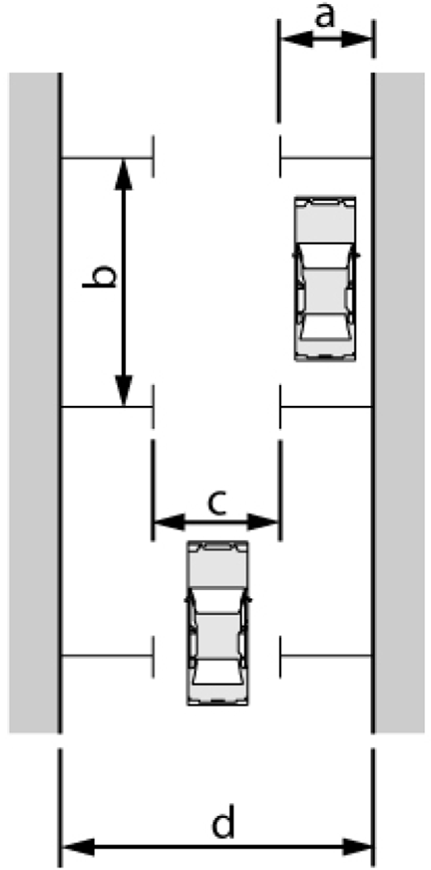
Parking space and driveway specifications. The location and dimensions of parking spaces and aisles adjacent to parking spaces shall be arranged in accordance with the following figures and the tables:
TABLE 5.6-1. ANGLE PARKING SPACE AND DRIVE AISLE DIMENSIONS
*One-way aisle
**Two-way aisle
Figure 5.6-1. Angle Parking Space and Drive Aisle Dimensions
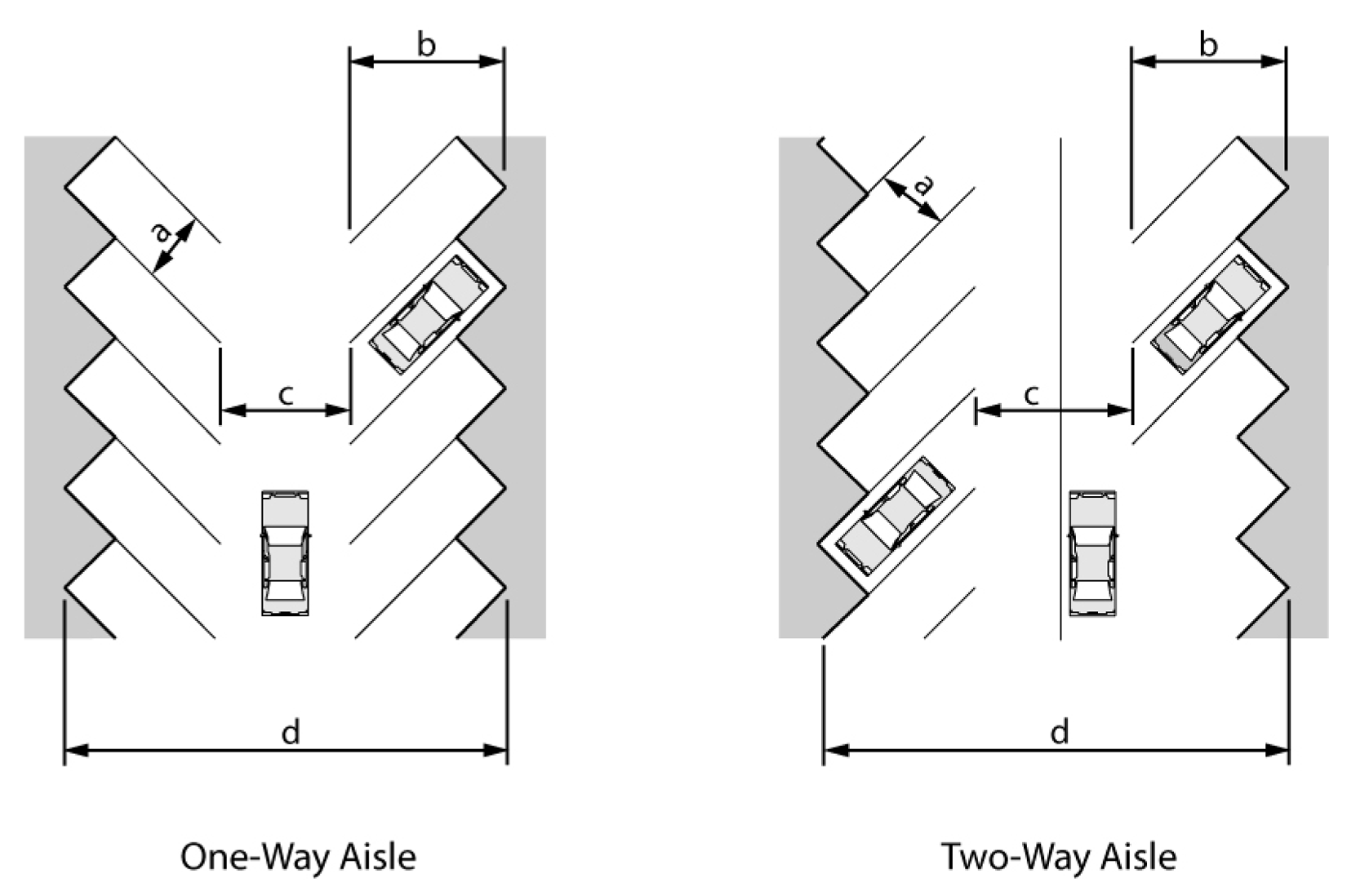
TABLE 5.6-2. PARALLEL PARKING SPACE AND DRIVE AISLE DIMENSIONS
*One-way
Figure 5.6-2. Parallel Parking Space and Drive Aisle Dimensions
3.
Compact parking spaces. Up to 20 percent of the total required parking spaces may be sized for compact cars. Compact car parking spaces shall be clearly marked "COMPACT CARS ONLY". Compact car parking spaces and aisles may be reduced from the dimensions listed in the figures and tables in section 120.05.060.D.1.b as follows:
(i)
Parking space width may be reduced by no more than one-half-foot.
(ii)
Parking space length may be reduced by no more than two feet.
(iii)
When an entire section of the parking area is restricted to compact car parking, and the parking spaces are at a 90 degree angle to the aisle, the aisle width may be reduced to 23 feet.
4.
Off-street parking for private residences. Off-street parking and driveways for detached dwellings, manufactured homes, single-family attached dwellings, and two-unit attached dwellings shall meet the following requirements:
(i)
Any vehicle, trailer, or vessel which is inoperable and/or without current registration shall be stored entirely within an enclosed structure and shall not be parked or stored in any yard within a residential zoning district or neighborhood;
(ii)
Unless specifically permitted by this title, required off-street parking spaces shall not be located within any required front yard or required street side yard setback of any parcel. Required parking must be provided within a garage, carport, or other permanent structure providing weather protection;
(iii)
Parking in excess of the required parking (e.g., driveways) may be provided within the front and street side yard setback, as follows:
A.
Vehicle parking (including driveways) in residential areas shall be provided on permanent paved surfaces. Permeable pavement is permitted as an alternative to a standard asphalt or concrete surface;
B.
Parking areas shall not exceed the maximum impervious surface allowed on a parcel;
C.
Parking may not occur within any required clear vision triangle area on a corner lot.
(iv)
Each parking space shall be at least 8.5 feet wide by 18 feet deep;
(v)
Tandem (end-to-end) parking is allowed to meet the minimum off-street parking requirements;
(vi)
Required parking may be provided in the rear yard only when an alley is available for access;
(vii)
All vehicles are required to be parked on a paved surface. Driveways and driveway approaches shall be paved;
(viii)
The minimum driveway width is ten feet;
(ix)
The use of structures, temporary canopies, tarps and other similar types of covering for vehicles is strictly prohibited within the front setback;
(x)
Parking of RVs, trailers and vessels shall conform with the city's neighborhood preservation standards (see section 120.05.080, neighborhood preservation standards).
b.
Surfacing standards for parking areas. The following standards shall apply to the development of all off-street parking facilities, including driveways, whether the space is required or optional:
1.
One- and two-family. (Residences less than a two-acre parcel, equal to, or greater than a two-acre parcel). Surfacing material shall be made of concrete, asphaltic concrete, brick or equivalent at least three inches of decomposed granite or equivalent.
2.
Multiple-family residences. Surfacing material shall be made of concrete, asphaltic concrete, brick or equivalent driveways with an inverted section shall be constructed with a concrete ribbon gutter.
3.
All other uses.
(i)
Standards. At least 25 percent of the total street frontage within 660 feet from the boundaries of the proposed use, including both directions from the property and both sides of the street, is in commercial, industrial, residential use or other developed use. Where the proposed use would front on two or more streets, this provision refers to the street with the greater general plan designation or right-of-way requirement. Other cases where the aforementioned circumstances do not apply or as determined by the community development director.
(ii)
Surfacing material. Concrete surfacing with a minimum thickness of 32 inches, with expansion joints; or asphaltic concrete paving compacted to a minimum thickness of three inches on four inches of class 2 base. A base of decomposed granite or equivalent compacted to a minimum thickness of three inches to act as an all-weather surfacing material.
(iii)
Off-street parking area striping.
A.
Each space shall be clearly marked with white paint or other easily distinguishable material;
B.
If ten or more parking spaces are provided, and one-way aisles are used, directional signs or arrows painted on the surface shall be used to properly direct traffic.
(iv)
Drainage. All parking areas, including driveways, shall be graded to prevent ponding and to minimize drainage runoff from entering adjoining properties.
(v)
Curbs, bumpers, wheelstops or similar devices. Public parking areas shall be equipped with permanent curbs, bumpers, wheelstops or similar devices so that parked vehicles do not overhang required walkways, planters or landscaped areas.
A.
If the method used is designed to stop the wheel rather than the bumper of the vehicle, the stopping edge shall be placed no closer than two feet from the edge of any required walkway, planter or landscaped area, or from any building;
B.
The innermost two feet of each parking space, between the wheel stop or other barrier, and any required planter or walkway, may either be:
i.
Paved; or
ii.
Planted with low ground cover.
This additional planting area is considered part of the parking space and may not be counted toward satisfying any landscaping requirements.
(vi)
Lighting. A minimum lighting level of one footcandle and a maximum of four footcandles of lighting is required for all parking areas for security. Lighting facilities shall be located and shielded to prevent lights from shining directly onto adjoining properties or streets.
(vii)
Walls. All paved parking areas, other than those required for single-family residential uses, which adjoin property zoned R-1, R-2, R-2A, R-3, PRD, R-5, R-6, R-A, R-R or R-T, shall have a six-foot-high solid masonry wall provided with an anti-graffiti coating installed to preclude a view of the parking area from such adjoining property. However, any walls within ten feet of any street or alley shall be 30 inches high.
(5)
Loading space requirements.
a.
On each lot used for manufacturing, storage, warehousing, goods display, a department store, a wholesale store, a market, a hotel, a hospital, a laundry, dry cleaning or other uses which involve the receipt or distribution by vehicles of materials or merchandise, there shall be provided and maintained adequate loading space for delivery vehicle stacking, and for loading activities. The loading space and delivery vehicle stacking area shall be located and designed so as to avoid undue interference with the public use of streets and alleys.
b.
Each required loading space shall be paved with six inches of concrete over a suitable base and shall not be less than ten feet wide, 35 feet long and 14 feet high.
c.
The minimum number of loading spaces indicated in the following table shall be provided:
TABLE 5.6-4. MINIMUM NUMBER OF LOADING SPACES
(6)
Parking for persons with disabilities.
a.
Parking spaces shall be provided for access by persons with disabilities in accordance with the number indicated by the table in this subsection. These numbers are based on the total number of parking spaces required, given the intended use of the site.
TABLE 5.6-5. NUMBER OF ACCESSIBLE PARKING SPACES FOR PERSONS WITH DISABILITIES
Note. A higher percentage of accessible parking spaces is required for medical care outpatient facilities as follows: ten percent of the total number of parking spaces provided for outpatient facilities; 20 percent of total numbers of parking spaces provided for facilities that specialize in treatment or services for persons with mobility impairments.
b.
Accessible parking spaces shall be located so as to provide for safety and optimum proximity to curb ramps or other pedestrian ways, thereby providing the most direct access to the primary entrance of the building served by the parking lot.
c.
For a single accessible space, the space shall be 14 feet wide and outlined to provide a nine-foot wide parking space and a five-foot-wide loading/unloading area.
d.
For multiple accessible spaces, two spaces shall be provided within a 23-foot wide area outlined to provide a five-foot wide loading/unloading area between the nine-foot wide parking spaces.
e.
Each loading/unloading area for a van-accessible space shall be eight feet wide with a minimum length of 18 feet.
f.
A minimum of one in every eight accessible parking spaces shall be served by an access aisle with a minimum width of eight feet.
1.
The parking space shall be designated van-accessible;
2.
All such van-accessible parking spaces may be grouped on one level of a parking structure.
g.
In each parking space, a wheelstop or curb shall be provided and located to prevent encroachment of cars over the walkways.
h.
The parking spaces shall be located so that persons with disabilities are not compelled to wheel or walk behind parked cars other than their own.
i.
Pedestrian ways which are accessible for persons with disabilities shall be provided from each such parking space to the related facilities and shall include curb cuts or ramps as needed.
1.
Ramps shall not encroach into any parking space. However, ramps located at the front of accessible parking spaces may encroach into the length of such spaces when the encroachment does not limit the ability of persons with disabilities to leave or enter their vehicles, and when it is determined that compliance with any regulation of this subsection would create an unreasonable hardship;
2.
Parking spaces may be provided which would require persons with disabilities to wheel or walk behind parking spaces that are not designed for accessibility when it is determined that compliance with the accessible parking regulations would create an unreasonable hardship.
j.
Surface slopes for accessible parking spaces shall be the minimum possible, and shall not exceed one-fourth-inch per foot (2.083 percent gradient) in any direction.
k.
Each accessible parking space shall be identified by a permanently affixed reflectorized sign displaying the international symbol of accessibility.
1.
The sign shall be posted immediately adjacent to and visible from each accessible parking space;
2.
The sign shall not be smaller than 70 square inches in area and shall be centered at the interior end of the parking space at a minimum height of 80 inches from the bottom of the sign to the parking space finished grade; or
3.
The sign may be centered on the wall of the interior end of the accessible parking space at a minimum height of three feet from the parking space finished grade or walkway.
l.
An additional sign shall be posted in a conspicuous place, at each entrance to the off-street parking facilities. The sign shall not be less than 17 inches by 22 inches in size with lettering not less than one inch in height, which clearly and conspicuously states the following:
"Unauthorized vehicles parked in designated accessible spaces not displaying distinguishing placards or license plates issued for persons with disabilities may be towed away at owner's expense. Towed vehicles may be reclaimed at _______ or by telephoning _______."
m.
The surface of each accessible parking space shall have a surface identification duplicating the symbol of accessibility in blue paint of at least three square feet in size.
n.
For additional accessible parking and site development standards, reference the California Code of Regulations, title 24.
(7)
Bicycle parking facilities.
a.
Bicycle parking facility classifications. Bicycle parking facilities shall be classified as follows:
1.
Class I. An enclosed box with a locking door, typically called a bicycle locker, where a single bicyclist has access to a bicycle storage compartment;
2.
Class II. A stationary bicycle rack designed to secure the frame and one wheel of the bicycle, where the bicyclist supplies only a padlock.
b.
Bicycle parking requirements.
1.
Minimum bicycle parking facilities. The minimum bicycle parking shall be provided as follows:
TABLE 5.6-6. BICYCLE SPACES FOR BICYCLE PARKING FACILITY CLASS
Notes.
Where the application of the above table results in the requirement for a fraction of a bicycle parking space, such a space need not be provided unless the fraction exceeds 50 percent.
Where the application of the above table results in the requirement of fewer than six employee spaces, class II racks need not be placed within an enclosed lockable area.
2.
Design standards. Bicycle parking facilities shall be installed in a manner which allows adequate spacing for access to the bicycle and the locking device when the facilities are occupied. General space allowances shall include a two-foot width and a six-foot length per bicycle and a five-foot-wide maneuvering space behind the bicycle. The facilities shall be located on a hard, dust-free surface, preferably asphalt or concrete.
c.
Exemptions. Requests for exemptions from bicycle parking requirements shall be made in writing to the community development director.
1.
Exemptions from bicycle parking requirements shall be submitted and processed concurrently with the project application.
2.
Exemptions may be granted depending upon the location of the site with respect to an urbanized area, the nature and hours of operation of the proposed use and the accessibility of the site by bicycle at present and in the future.
(Ord. of 7-2012, § 5.6; Ord. No. 2013-09, § 3, 5-22-2013; Ord. No. 23-22, § 1, 2-8-2023; Ord. No. 25-09, § 5, 9-10-2025)
Sec. 120.05.070. - Signs.
(a)
Purpose and intent. All displays and signs described herein shall conform to the applicable provisions of this title. If any specific zoning classification within this title shall impose more stringent requirements than are set forth within this title, the more stringent provisions shall prevail.
(b)
Definitions. For purposes of this title, the following words or phrases shall have the following definitions:
Abandoned sign means any sign which is located on a premise that has been vacated for a period of more than 90 days as regulated in subsection (f) of this section, nonconforming and abandoned signs.
Billboard means a sign which advertises or identifies a use, good or service not located on the same lot or premises as the sign.
Display face.
(1)
The term "display face" means the surface area of a sign available for the purpose of displaying an advertising message.
(2)
The term "display face" does not include the structural supports or lighting.
Freestanding sign means any sign not attached to any building or structure.
Freeway means a divided arterial highway for through traffic with full control of access and with grade separations at intersections.
Highway means roads, streets, boulevards, lanes, courts, places, commons, trails, ways or other rights-of-way or easements used for or laid out and intended for the public passage of vehicles or persons.
Illegal sign means any of the following:
(1)
A sign and related structures erected without first complying with all applicable city ordinances and regulations in effect at the time of its construction, erection or use;
(2)
A sign and related structures which do not comply with this title;
(3)
A sign and related structures which are a danger to the public or are unsafe.
Maximum height means the highest point of the structure or sign measured from the average natural ground level at the base of the supporting structure.
Noncommercial structure or sign means any sign that does not do any of the following:
(1)
Advertise a product or service for profit or for a business purpose;
(2)
Propose a commercial transaction; or
(3)
Relate solely to economic interests.
Shopping center means a parcel of land not less than three acres in size, on which there exists four or more separate business uses that have mutual parking facilities.
Sign means a sign used for outdoor advertising purposes as defined and directional as provided in this title.
Sign structure means any structure defined as follows:
(1)
For a freestanding sign or a sign that projects from another structure, the sign structure shall be a physical structure upon which letters or symbols are placed;
(2)
For a sign placed parallel to the surface or a building, the sign structure shall consist of all elements placed directly upon the building, including individually mounted letters.
(c)
General sign standards.
(1)
General plan. Signs shall be consistent with the general plan.
(2)
Roof mounts. No sign shall be affixed on or over the roof of any building and no display shall be affixed to the wall of a building so that it projects above the parapet of the building.
(3)
Display movement. No sign shall move or rotate or display any moving and/or rotating parts. No propellers, flag, or other noise-creating devices, and no architectural embellishments which utilize mechanical or natural forces for motion, shall be permitted. Use of daylight reflective materials or electronic message boards using flashing, intermittent or moving light or lights is prohibited; provided, however, that electronic message boards displaying only time and/or temperature for periods of not less than 30 seconds is permitted.
(4)
Mobile displays. No person shall place, use, maintain or otherwise allow a mobile vehicle, trailer, or sign not permanently affixed to the ground to be used as a sign. Incidental logos and graphics affixed to a vehicle are not considered signs.
(5)
Lighting and illumination of displays. A sign may be illuminated unless otherwise specified, provided that the displays are so constructed that no light bulb, tube, filament or similar source of illumination is visible beyond the display face. Displays making use of lights to convey the effect of movement or flashing, intermittent or variable intensity shall not be permitted.
(6)
Illegal signs. All illegal signs and all abandoned signs shall be removed or brought into conformance with this title immediately.
(7)
Sign maintenance and construction.
a.
All permanent signs shall be constructed of quality, low-maintenance materials such as metal, concrete, natural stone, glass or acrylics. All temporary signs and banners shall be made of a material designed to maintain and attractive appearance for as long as the sign is displayed;
b.
Signs shall be cleaned, updated and/or repaired as necessary to maintain an attractive appearance and to ensure safe operation;
c.
All equipment related to the sign operation such as transformers, programmers and other items shall be concealed within the sign structure when possible or painted to match the building.
(d)
Sign standards by type. No person shall erect an on-site advertising structure or sign in the city in violation of the provisions contained within any specific zoning classification in this title or in violation of the following provisions:
(1)
Freestanding signs.
a.
Located within 660 feet of the nearest edge of a freeway right-of-way line.
1.
The maximum height of a sign shall not exceed 45 feet;
2.
The maximum surface area of a sign shall not exceed 150 square feet.
b.
Shopping centers, all locations. Notwithstanding the provisions of this subsection (d)(1) and subsection (d)(2) of this section, an alternate standard for freestanding on-site advertising signs for shopping centers is established as follows:
1.
The maximum surface area of a sign shall not exceed 50 square feet or 0.25 percent of the total existing building floor area in a shopping center, whichever is greater, except that in any event, no sign shall exceed 200 square feet in surface area;
2.
The maximum height of a sign shall not exceed 20 feet.
c.
All other locations.
1.
The maximum height of a sign shall not exceed 20 feet;
2.
The maximum surface area of a sign shall not exceed 50 square feet.
d.
Number of freestanding signs, all locations. Not more than one freestanding sign shall be permitted on a parcel of land, except that if a shopping center has frontage on two or more streets, the shopping center shall be permitted two freestanding signs, provided that the two signs are not located on the same street; are at least 100 feet apart; and the second sign does not exceed 100 square feet in surface area and 20 feet in height.
(2)
Signs affixed to building, all areas.
a.
No sign shall be affixed on, above or over the roof of any building, and no on-site advertising sign shall be affixed to the wall of a building so that it projects above the parapet of the building. For the purposes of this section, a mansard-style roof shall be considered a parapet.
b.
The maximum surface area of signs affixed to a building shall be as follows:
1.
Front wall of building: surface area of the sign shall not exceed ten percent of the surface area of the front face of the building.
2.
Side walls of a building: surface area of the sign shall not exceed ten percent of the surface area of the side face of the building.
3.
Rear wall of a building: surface area of the sign shall not exceed five percent of the surface area of the rear face of the building.
(3)
Subdivision signs. Subdivision signs shall be subject to the following minimum standards:
a.
Signs must be within the subdivision boundaries;
b.
No sign shall exceed 100 feet in surface area;
c.
No sign shall be within 100 feet of any existing residence that is outside of the subdivision boundaries;
d.
No more than two such signs shall be permitted for each subdivision;
e.
No sign shall be artificially lighted.
(4)
On-site identification signs. On-site identification signs affixed to the surface of walls, windows, and doors of permanent structures, which do not exceed four inches in letter height and do not exceed four square feet in area, are permitted in addition to any other sign permitted in this title.
(5)
Billboards. In addition to the general sign limitation provided in this section the following provisions apply to billboards:
a.
Zoning. Billboards are permitted only in the C-1/C-P, M-SC, M-M and M-H zones provided that the display meets all of the other requirements of the zoning classification and this title. Signs are expressly prohibited in all other zones.
b.
Height. The maximum height of a billboard shall not exceed a height of 25 feet from the roadbed of the adjacent freeway or highway to which the display is oriented, or a maximum height of 25 feet from the grade on which it is constructed, whichever is greater.
c.
Setbacks. No billboard shall be erected within an established setback or building line, or within road right-of-way lines or future road right-of-way lines as shown on any specific plan of highways. A minimum setback from the property line of one foot shall be required. No person shall place, erect, use or maintain any sign located within 660 feet from the edge of the right-of-way of, and the copy which is visible from, any primary highway without first obtaining a valid state billboard permit.
d.
Poles. A maximum of two steel poles are allowed for support of a billboard.
e.
Number of billboards. No more than one billboard is permitted per parcel.
f.
Number of display faces. No more than two display faces per billboard shall be permitted. Only single-face, back-to-back and V-type displays shall be allowed provided that they are on the same sign structure and provided that the V-type displays have a separation between display faces of not more than 25 feet.
g.
Display face size. No billboard face shall have a total surface area of more than 300 square feet.
h.
Identification. No person shall place, erect, use or maintain a billboard and no billboard shall be placed, erected, used or maintained anywhere within the city unless there is securely fastened thereto and on the front display face thereof the name of the billboard owner in such a manner that the name is visible from the roadway.
i.
Relocated billboards. Nothing in this title shall prevent the city from entering into a billboard relocation agreement when:
1.
The original location of the billboard is within a contemplated public right-of-way; and
2.
The billboard complied with all applicable city ordinances and regulations in effect at the time it was erected.
A billboard located on a parcel that is zoned to prohibit signs may, pursuant to such an agreement, be relocated to another place on that same parcel.
(6)
Freeway-oriented electronic billboard. Freeway-oriented electronic billboards shall be subject to the following:
a.
No more than one freeway oriented electronic billboard shall be allowed within the city.
b.
A single freeway-oriented electronic billboard shall only be permitted in the area along the I-15 freeway beginning at the Hwy 60 freeway and extending south approximately 3,794 feet (the area in which current federal law would allow the placement of these signs).
c.
All design standards and specifications will be identified in a development agreement with the city and will require approval by the planning commission and city council.
(7)
Temporary signs. Banners and other signage displays are permitted for a period not to exceed the time limits established in table 5.7-1, allowed temporary on-site sign standards by type. Inflatable signs are prohibited. See specific requirements in the following table 5.7-1, allowed temporary on-site sign standards for standards and additional limitations:
TABLE 5.7-1. ALLOWED TEMPORARY ON-SITE SIGN STANDARDS BY TYPE
Notes.
1 Must be located outside of the clear vision triangle.
2 Only allowed Friday to Monday.
3 Signs shall be removed within 30 days of close of escrow or lease of final unit.
4 Banner shall be attached flat against the wall or fascia of a building and not hung from poles, awnings, eaves or similar structures. Banners shall be hung with permanent attachments, such as bolts or screws, and not be tied to a structure with rope, twine or similar materials. Banners that are faded and/or torn shall be removed or replaced.
(e)
Temporary signs in the public right of way.
(1)
Temporary signs may be placed in the public right of way during the period beginning 4:00 p.m. Friday and ending 7:00 p.m. Sunday. Signs in place outside this period will be subject to removal.
(2)
Temporary sign size, materials, and maintenance criteria. All temporary signs placed in the right of way must:
a.
Be free-standing and securely mounted on a wooden or metal stakes;
b.
Be no higher than four feet above grade;
c.
Be no larger than six square feet and no more than three feet in either height or width;
d.
Be constructed of substantial sturdy, durable and weather-proof material;
e.
Be kept in good repair;
f.
Be non-illuminated;
g.
Include the contact name and phone number of the person responsible for the sign in a clearly legible manner, either on the front or back of the sign; and
h.
Be located in a permitted location as defined in subsection (e)(3).
(3)
Sign location. Temporary signs in the public right of way must be located at least 20 feet from the curved portion of the corner in order to maintain visibility for motorists, as shown in the illustration. In addition, the following apply:
a.
Signs must be located at least two feet from the edge of a curb or sidewalk, or from the edge of the pavement if there is no curb or sidewalk.
b.
Signs shall be installed so as not to damage plant materials, irrigation equipment or other public property.
c.
Signs may not be placed on a sidewalk.
d.
Signs may not be placed in a roadway median.
e.
Signs may not be attached to utility poles, sign posts, fences, walls, or any other structure.
Permitted Locations for Temporary Signs
in the Public Right of Way
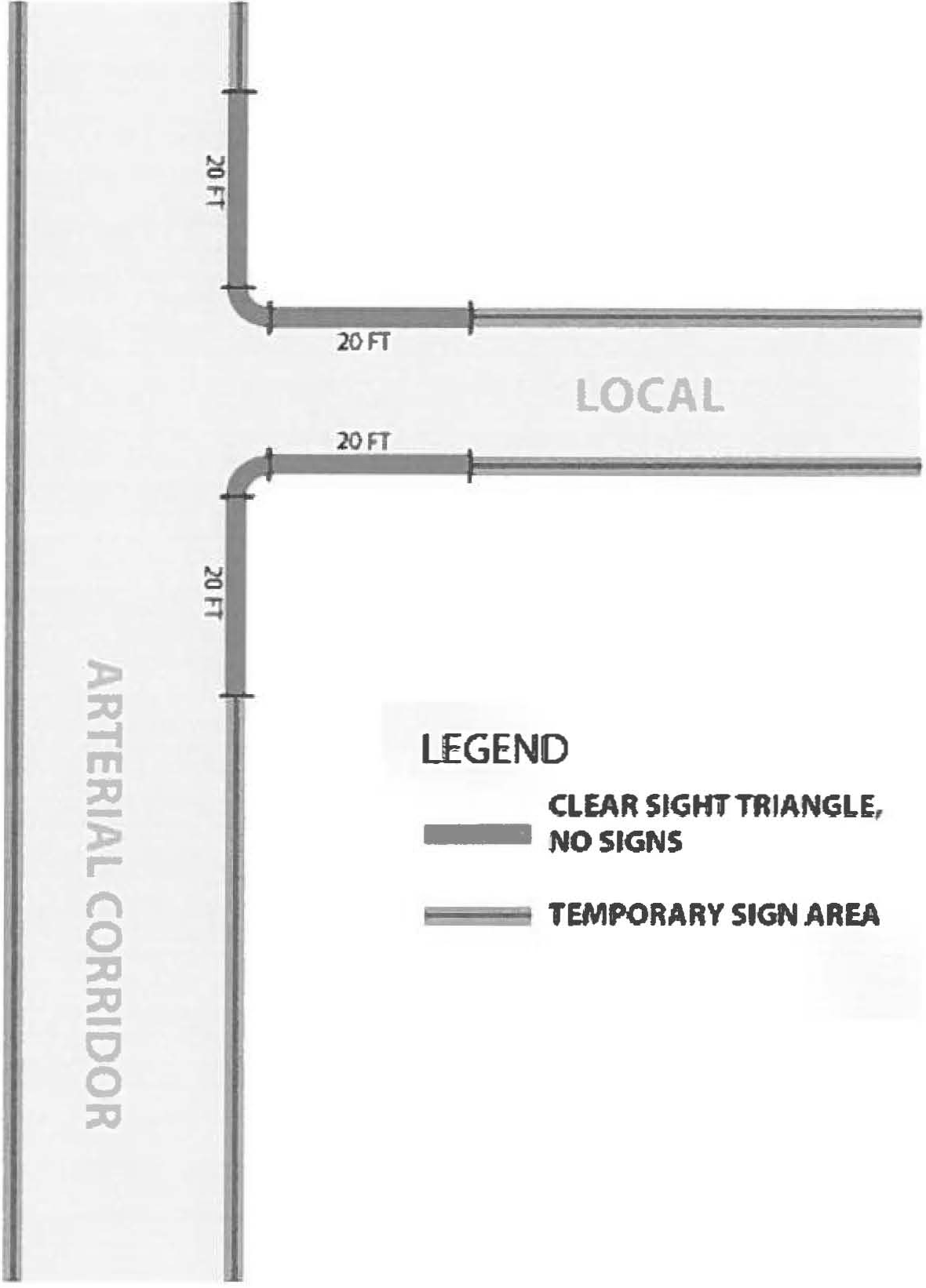
(4)
Temporary sign—Definition. For purposes of this section, temporary sign shall mean any sign, including commercial, non-commercial or political sign displayed for a limited period of time.
(f)
Nonconforming and abandoned signs.
(1)
Except as otherwise provided in this section, any sign lawfully in use on the effective date of this title or any amendment thereto, shall be considered a legal use and as such may continue to operate and exist, provided:
a.
Nonconforming signs shall be kept in good repair and visual appearance. Structural alterations or modifications of any nonconforming sign are prohibited. Structural repair resulting in same size and shape is permitted subject to the provisions of this Code. Change of copy on a nonconforming sign shall be allowed, provided the change does not increase the area of the sign;
b.
Whenever any modifications, alterations, or changes occur or are proposed, the sign shall be brought into conformance with the provisions, standards and regulations of this section, requiring issuance of zoning clearance.
(2)
The city council, planning commission or other designated approving authority, may, as a condition of rezoning, development review or conditional use permit, or other development entitlement, require any nonconforming sign on the applicable property to be removed or altered so as to comply with the provisions of this section.
(3)
Sign structures which have no message attached to them for more than 90 days shall be considered abandoned signs and as such may be abated by the city. Adequate notice shall be provided to the property owner prior to any removal. For regulatory purposes, any factors indicating abandonment shall not begin occurring until 90 days after the effective date of the ordinance from which this section is derived.
(g)
Electronic message board signs. This sign type is intended to provide for the location of centrally controlled message signs incorporating an illuminated LED panel at public facilities throughout the city for the purpose of providing information to the public. Electronic message board signs shall be subject to the following:
(1)
Type. Community electronic message signs must be one of the following types:
a.
Monument (ground-mounted on a base).
b.
Pole (elevated above the ground on a central support).
c.
Building-mounted (affixed to a building).
Standards for each sign type are provided below.
(2)
Brightness. The following standards apply to the brightness of signs:
a.
Maximum brightness of the LED panel for any community electronic message sign shall not exceed 7,500 nits.
b.
Brightness must be controlled to dim the sign to respond to ambient lighting conditions to reduce spillover to adjacent properties.
c.
The city may impose a lower maximum lighting level as part of the approval of the conditional use permit for any individual sign.
(3)
Enclosures and supports. Sign enclosures and supports must be designed to be compatible with the architecture of the school or other buildings on the site.
(4)
Number and spacing of signs.
a.
No more than one sign may be placed on a site (school, park, public facility, etc.), except that two signs may be placed at the high school.
b.
No specific spacing is required between signs, except that the planning commission may impose a spacing requirement based on site-specific circumstances as part of the review of the conditional use permit for an individual sign.
(5)
Height, size, hours of operation and other standards. Standards for the various types of community electronic message signs are as follows:
a.
Monument signs.
• Maximum height shall not exceed ten feet.
• Maximum screen size shall not exceed four feet high by eight feet wide.
• Sign may be single- or double-sided. Size for a double-sided sign is calculated by measuring one sign face.
b.
Pole signs.
• The maximum height shall not exceed 20 feet. The maximum height to the bottom of the LED panel shall not exceed 12 feet.
• The maximum screen size shall not exceed six feet high by 12 feet wide.
• The sign support must be at least one-third the width of the sign face.
c.
Building-mounted signs.
• The sign must be mounted to a vertical surface, such as a building wall or other architectural feature, provided that the top of the sign may not be more than 45 feet above the ground at the base of the wall.
• The sign may not project over the top of the wall on which the sign is placed.
• The LED panel may not exceed eight feet high by 16 feet wide.
d.
Hours of operation.
• Signs may be operated between the hours 6:00 a.m. and 10:00 p.m.
e.
Content.
• Community electronic message signs may display advertising messages for uses not located on the site and are not subject to the requirements of section 5.7.D.5 of this Zoning Code ("Billboards").
(6)
Permitted locations. Signs may be placed at the following locations:
a.
Up to nine signs may be placed at nine public schools.
b.
Up to five signs may be places at public parks.
c.
Public facilities.
d.
City-owned property.
e.
Public road right-of-way (except roadway medians).
Signs at public facilities, city-owned property, and public road right of way may only be installed and operated by the city, or by another entity specifically authorized by the city.
(7)
Prohibited locations. Community electronic message signs may not be placed in any of the following locations:
a.
Private property.
b.
Roadway medians.
(8)
Approval process. All community electronic message signs require a conditional use permit, which may impose conditions based on the specific circumstances at the site. The conditional use permit shall be reviewed and approved as provided in this Zoning Code.
Size and operational standards which are more stringent than those specified in this section may be applied if needed to address site-specific conditions. An application for a specific sign type may be denied if the city, in light of evidence in the record, determines that the proposed sign is not appropriate for the proposed location.
(Ord. of 7-2012, § 5.7; Ord. No. 2013-17, § 3, 1-8-2014; Ord. No. 15-01, § 3, 3-11-2015)
Editor's note— Ord. No. 15-01, § 3, adopted March 11, 2015, set out provisions for use herein. Inasmuch as those provisions were not specifically amendatory, they have been included as § 120.05.070(g).
Sec. 120.05.080. - Neighborhood preservation standards.
(a)
Intent. To provide standards that address unique neighborhood concerns regarding quality of life in the city by:
(1)
Supplementing general maintenance requirements on public properties within the neighborhood.
(2)
Restricting uses on private properties beyond the general requirements of the underlying zone.
(3)
Providing regulatory framework for effective code enforcement efforts.
(b)
Applicability. Applicable to all residentially zoned property within the city.
(c)
Definitions. Refer to chapter 120.06, glossary, for definitions of the following terms:
(1)
Accessory structures.
(2)
Attractive nuisances.
(3)
Business sign.
(4)
Commercial vehicle.
(5)
Covenants, conditions and restrictions (CC&Rs).
(6)
Decorative fence.
(7)
Holiday display.
(8)
Home occupation sign.
(9)
Overlay zone.
(10)
Temporary exterior display.
(d)
Neighborhood preservation standards. In order to maintain a safe, clean, orderly, sanitary and aesthetically pleasing neighborhood character, the following standards of physical environment shall apply within all residential zones.
(1)
Street environment.
a.
Public streets and sidewalks shall be kept free from any type of obstructions such as planters, landscaping, fences, temporary signs or similar structures;
b.
All landscaped areas in a public street, sidewalk or right-of-way that is abutting a residential property shall be maintained by the adjoining property owner, unless it is maintained through another mechanism such as community facilities district or landscape maintenance district;
c.
Trash, garbage, recycling or green waste containers (cans, bins, boxes or other such containers) shall not be kept in any front yard, driveway, walkway, sidewalk, street or right-of-way for more than 36 sequential hours in any seven-day period, including trash and recycling pick-up day. Trash containers used for construction or remodeling of the property shall be exempt provided that they are removed within 45 days following issuance of building permits, unless additional time is granted or approved by the department of building and safety;
d.
For single-family residential developments, the trash or recycling containers shall be stored in garage, side yard, or rear yard, in a manner that they are not visible from any public street;
e.
For multifamily residential developments, the trash enclosures shall be constructed of sturdy and opaque materials (with trash receptacles screened from public view) that are in harmony with the architecture and materials of the main buildings;
f.
Permanent basketball goals shall not be permitted in or upon any street, sidewalk or public right of way. Basketball goals may be permanently installed to the home and basketball goals may be permanently installed in the front yard, street side yard, rear yard, or adjacent to the driveway of private property subject to the locational requirements specified in subsection g below. For the purpose of this subsection, the following definitions apply:
1.
"Basketball goal" or "hoop" means, except where the context clearly indicates some specific part, any part of a back-board, hoop, net, or supporting apparatus.
g.
To ensure the safety of players and the public, permanent equipment shall be properly maintained. The following standards apply to the permanent installation of basketball goals permitted under subsection f:
1.
For front yards, unenclosed street side yards, or unenclosed rear yards abutting a street, basketball goals must be located so that the distance from the supporting apparatus to the edge of the sidewalk closest to the home is at least ten feet.
2.
For street side yards and rear yards fully enclosed by a fence or wall five feet in height or more, basketball goals may be located anywhere within the enclosed portion of the street side yard or rear yard, provided that no portion of the basketball goal extends beyond the fence or wall.
3.
No part of a permanent supporting apparatus may be located in the driveway.
The figure below illustrates these standards:
Basketball Goal Location Standards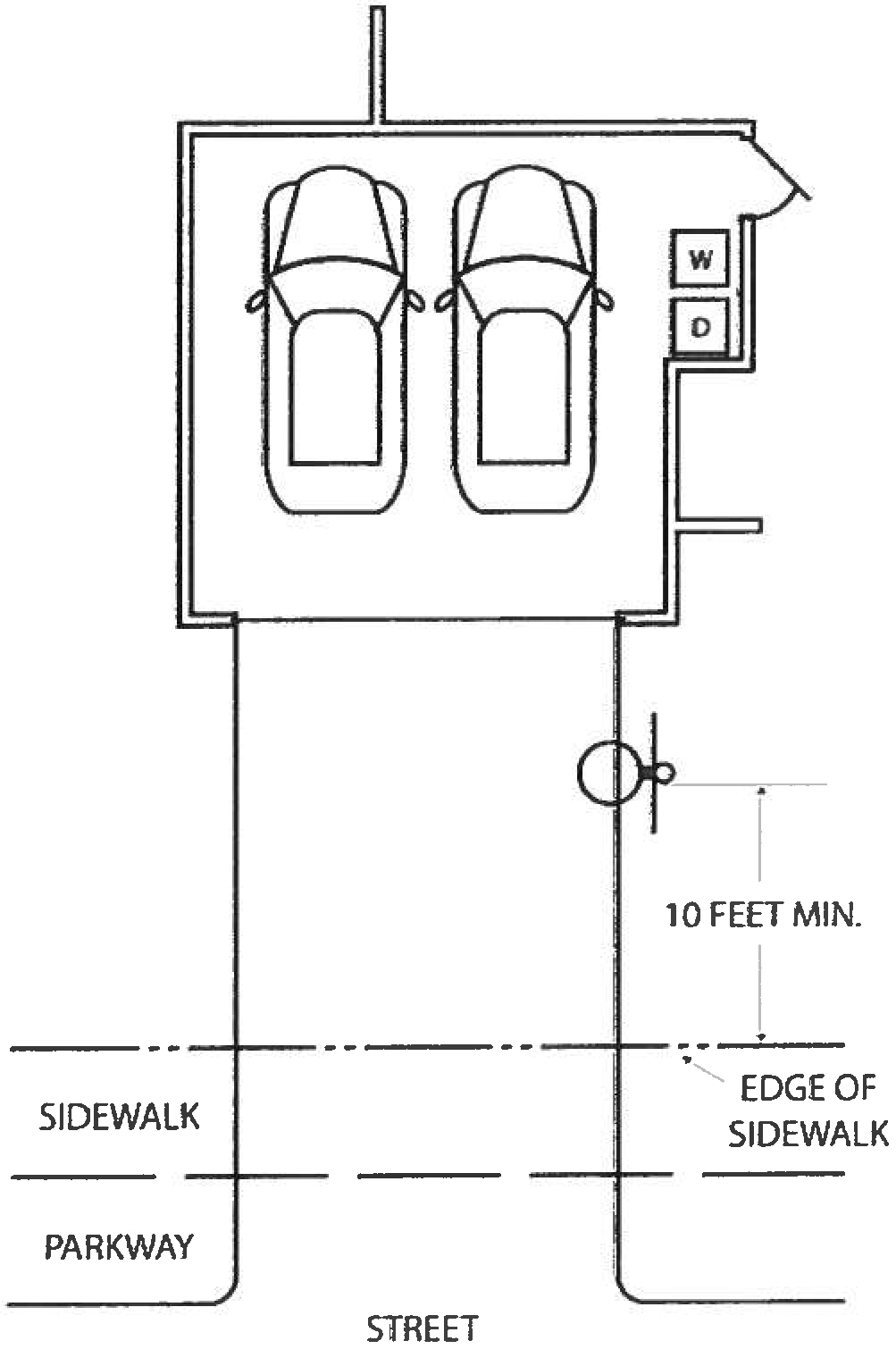
h.
Moveable recreational equipment, including but not limited to basketball goals, may be placed for use in a front yard, street side yard, or rear yard abutting a street, on the driveway or any other appropriate surface which is permitted by this zoning code, provided that the minimum distance specified above is maintained. Moveable recreational equipment, including but not limited to basketball goals, may be used in any side or rear yard area, provided that enough space is provided for the safe use of the equipment.
(2)
Parking.
a.
No vehicle shall be parked upon a public street for more than 72 consecutive hours within a radius of 500 yards and shall be subject to citation and/or removal by the city as provided for in state law;
b.
No person shall construct, repair, grease, lubricate, or dismantle any vehicle, or any part thereof, upon a public street, sidewalk or right-of-way, except for temporary emergency purposes;
c.
No vehicle, such as a car, truck, or motorized bike, shall be parked in any landscaped area, but may be parked in a garage or carport, or upon a driveway or other improved parking area that has a direct connection to the street via a driveway approach. Non-operable and/or long-term parked vehicles shall only be allowed if they are screened behind a fence or wall of at least five feet in height and parked in a garage, side yard or rear yard. A direct connection to the street via a driveway approach is not required for non-operable and/or long-term parked vehicles;
d.
The improved parking area, and driveway, shall be constructed of concrete cement and shall not cover more than 50 percent of the required front and/or side yard area, consistent with section 120.050.080(d)(3)(a)(l)(i). The improved parking area and driveway that existed on or were approved prior to the effective date of the ordinance from which this title is derived shall be exempt from this provision;
e.
No commercial vehicles, or any part thereof, shall be parked upon a public street, sidewalk, right-of-way, private yard or private driveway, except when it is actively used for loading or unloading purposes, or while the owner of such commercial vehicle is working at the property where such vehicle is parked. No overnight parking of commercial vehicles is permitted;
f.
No recreational vehicles shall be parked in any front yard area of a property. No recreational vehicle, or any part thereof, shall encroach upon a public street, sidewalk or right-of-way. Recreational vehicles shall be allowed, if they are screened behind a fence or wall of at least five feet in height and parked in a garage, side yard or rear yard. A recreational vehicle may be parked in a public right-of-way or approved parking area for a period of not more than 48 hours twice a month for the purposes of loading or unloading said vehicle;
g.
Parking upon a public street or right-of-way shall be restricted for a designated day during the week in order to clear the curbside for street sweeping. This parking restriction shall be applicable only after a street sweeping schedule for the ENPO zone is established and legal notification of such restriction has been properly provided.
(3)
Yard maintenance.
a.
Any front and side landscaped area up to the street/curb (including the landscaped area, if any, between the sidewalk and the street/curb) that is visible from any public street or area, shall be landscaped and maintained by the property owner, unless maintained by a Maintenance District or Homeowners' Association. Maintenance shall include the following:
1.
General yard maintenance:
(i)
At least 50 percent of the required front and/or side yard area shall be landscaped with live plant materials, artificial turf with a dense pile height of at least 1.5 inches, decorative organic and inorganic landscaping material (mulch, rock, bark, etc.), or a combination of these materials;
(ii)
Keeping yards free of litter, trash, dead vegetation, and waste;
(iii)
Keeping lighting in working order;
(iv)
Mowing the lawn to a height of not more than six inches; and
(v)
Applying mulch, bark, etc., as needed to cover all unplanted and unpaved areas.
2.
Care of plants:
(i)
If the yard contains plants, maintenance includes applying water, fertilizer, etc., as needed (consistent with any applicable watering limits) to all planted areas, including potted plants, to maintain plants in a healthy condition;
(ii)
Pruning trees and shrubs as needed for appearance, the health of the plant or tree, and to comply with other city requirements; and
(iii)
Removing dead wood and branches.
b.
All landscaping shall be maintained in a manner that does not cause a potential fire hazard or cause threat to public health, welfare and safety;
c.
An attractive nuisance shall not be harbored in a public street, sidewalk, right-of-way or a private property;
d.
Outdoor storage shall not be permitted in a front yard, or side yard that is visible from any street, and shall not impede vehicular or pedestrian traffic in a public street, sidewalk or right-of-way;
e.
Landscaping within a yard shall not obstruct a public street, intersection, sidewalk or right-of-way, either physically or visually;
f.
Dying, decayed, untrimmed or hazardous trees, shrubbery or other landscaping in any front yard, or side yard that is visible from any public area, shall be addressed and remediated within seven days of issuance of a code enforcement notice of violation, or as specified therein;
g.
No accessory structure shall be permitted in a front yard. However, an accessory structure may be constructed in a side yard or rear yard if it is constructed according to the requirements of this title and screened from the public view. An accessory structure, which is determined by the building and safety department to be substandard, unstable, dilapidated, constitutes a fire hazard or otherwise is potentially dangerous to public health, welfare and safety, shall be removed from the property within 30 days of issuance of a code enforcement notice of violation, or as specified therein.
(4)
Fences and walls.
a.
All fences and walls shall be properly maintained in order to preserve their structural integrity and to provide a neat appearance. All fences and walls shall be kept free from graffiti, undergrowth, weeds or other similar conditions at all times. All fences and walls shall be of materials and colors that are compatible with the architectural design of the buildings in the neighborhood. No fence, wall or a portion thereof, shall be constructed or altered to add razor wire, barbed wire, metal spikes, broken glass, readily flammable material or other similar material;
b.
Chainlink fences shall not be erected or constructed in any front yard, or side yard that is visible from any public area, for lots less than one-half acre net in area. Chainlink fences that exist on, or were approved prior to, the effective date of the ordinance from which this title is derived shall be exempt from this provision;
c.
Any fence or wall, including decorative fence, shall not obstruct a public street, intersection, sidewalk, or right-of-way, either physically or visually;
d.
Any fence or wall, including decorative fence, located in the front yard or within 30 feet of an intersection, shall not be higher than four feet. Fences and walls that existed on or were approved prior to the effective date of the ordinance from which this title is derived shall be exempt from this provision. Vertical calculation of the height of the fence or wall shall be made by vertical measurement along the length of the outside face when measured from final finished grade;
e.
The height of a gate, the gate posts, or columns, located in a front yard or side yard that are visible from any street shall not exceed 120 percent of the maximum height of the fence or wall;
f.
Any approved fence or gate for a temporary use and swimming pool shall be exempt from the provisions of this section.
(5)
Facade treatment.
a.
Any part of a building facade, such as siding, shingles, roof covering, railings, fences, walls, ceilings, porches, doors, windows, screens and other exterior parts shall be maintained in weathertight, sound condition and good repair.
b.
Any compromising building conditions, including but not limited to peeling exterior paint, broken windows or doors or partially constructed/demolished structure, shall be repaired within 30 days of issuance of a code enforcement notice of violation, or as specified therein.
c.
Any ground-mounted mechanical equipment, including but not limited to air conditioning unit or heating pump, shall be visually screened from public view.
d.
Plywood, plastic sheeting, tarp, aluminum foil or similar materials shall not be used to cover windows and other openings, unless otherwise approved by the department of building and safety.
(6)
Outdoor lighting.
a.
Lighting fixtures shall be located such that no light or reflected glare is directed off-site. Lighting fixtures shall provide that no light is directed above a horizontal plane passing through the bottom of the fixture;
b.
All on-site lighting shall be stationary, directed away from adjacent properties and public rights-of-way. Incandescent lighting fixtures, greater than 100 watts or 1,700 lumens, shall require proper shielding to minimize their impact on neighboring properties;
c.
To minimize the impact on neighboring properties, any outdoor security lighting shall require proper shielding, and should utilize both motion-sensitive and time-sensitive fixtures.
(7)
Signage.
a.
All signs shall be of materials and colors that are compatible with the architectural design of the buildings in the neighborhood;
b.
One home occupation sign may be allowed per dwelling unit, if the sign is in accordance with other provisions of this Code;
c.
Any business signs, pennants, reflective, flashing, or movable signs shall not be allowed;
d.
Any home-occupation or other sign that relates to an abandoned or discontinued use shall be removed;
e.
See section 120.01.050(8), sign permit, and section 120.05.070(f), nonconforming and abandoned signs, for additional regulations related to permanent and temporary signs.
(8)
Temporary exterior display and holiday display.
a.
Any temporary exterior display or holiday display shall not physically impede vehicular or pedestrian traffic on any street, sidewalk or right-of-way;
b.
Any temporary exterior display or holiday display shall be allowed for a period not to exceed 45 consecutive days;
c.
Any and all applicable city, state or other permits shall be obtained prior to installing such a temporary display;
d.
Any temporary outdoor event (e.g., community fair, music festival, or yard sale) may be exempted by the planning department from the provisions of this section. (See section 120.01.050(7).)
(Ord. of 7-2012, § 5.8; Ord. No. 2013-09, § 3, 5-22-2013; Ord. No. 2018-03, § 3(Exh. A), 4-11-2018; Ord. No. 23-20, § 1, 2-8-2023)
Sec. 120.05.090. - Housing incentives and density bonus.
(a)
Purpose. The purpose of this section is to provide incentives for the production of housing for very low, low, and moderate income, special needs, and senior households in accordance with Government Code §§ 65915 through 65918. In enacting this section, it is the intent of the city council to facilitate the development of affordable housing and to implement the goals and policies of the city's general plan housing element.
(b)
Eligibility for incentives and bonuses. The city shall grant one density bonus, with concessions or incentives, as specified in subsection (d) of this section, number and types of incentives and bonuses allowed, or provide other incentives or concessions of equivalent financial value based upon the land cost per dwelling unit, when the applicant for the housing development seeks and agrees to construct a housing development, excluding any units permitted by the density bonus awarded pursuant to this section, that will contain at least one of the following:
(1)
Ten percent of the total units of a housing development for lower income households;
(2)
Five percent of the total units of a housing development for very low income households;
(3)
Housing for special needs populations;
(4)
A senior citizen housing development; or
(5)
Ten percent of the total dwelling units in a common interest development as defined in Civil Code § 1351, for persons and families of moderate income, provided that all units in the development are offered to the public for purchase.
(c)
General provisions for incentives and bonuses. The following general provisions apply to the application and determination of all incentives and bonuses:
(1)
All density calculations resulting in fractional units shall be rounded up to the next whole number;
(2)
The granting of a density bonus shall not be interpreted, in and of itself, to require a general plan amendment, rezone or other discretionary approval;
(3)
The density bonus shall not be included when determining the number of housing units that is equal to five or ten percent of the total;
(4)
Upon request by the applicant, the city shall not require that a housing development meeting the requirements of subsection (b) of this section, eligibility for incentives and bonuses, provide a vehicular parking ratio, inclusive of handicapped and guest parking, that exceeds the following:
a.
Zero (studio) to one bedrooms: one on-site parking space per unit.
b.
Two to three bedrooms: two on-site parking spaces per unit.
c.
Four and more bedrooms: 2½ parking spaces per unit.
(5)
If the total number of parking spaces required for a housing development is other than a whole number, the number shall be rounded up to the next whole number. For purposes of this subsection, a development may provide on-site parking through tandem parking or uncovered parking, but not through on-street parking;
(6)
The city shall not apply any development standard that would have the effect of precluding the construction of a housing development meeting the requirements of subsection (b) of this section, eligibility for incentives and bonuses, at the densities or with the incentives permitted by this section. An applicant may submit to the city a proposal for the waiver or reduction of development standards. Nothing in this subsection, however, shall be interpreted to require the city to waive or reduce development standards if the waiver or reduction would have a specific adverse impact, as defined in Government Code § 65589.5(d)(2), upon public health and safety or the physical environment or on any real property that is listed in the state register of historical resources and for which the city determines there is no feasible method to satisfactorily mitigate or avoid the specific adverse impact. Furthermore, the applicant shall be required to prove that the waiver or modification is necessary to make the target units economically feasible.
(d)
Number and types of incentives and bonuses allowed.
(1)
General project density bonus. A housing development that satisfies all applicable provisions of this section shall be entitled to the following density bonus:
a.
For developments providing lower income target units, a 20 percent base density bonus plus a 1.5 percent supplemental increase over that base for every one percent increase in low income units above ten percent. The maximum density bonus allowed including supplemental increases is 35 percent;
b.
For developments providing very low income target units, a 20 percent base density bonus plus a 2.5 percent supplemental increase over that base for every one percent increase in very low income units above five percent. The maximum density bonus allowed including supplemental increases is 35 percent;
c.
For senior citizen housing developments, a flat 20 percent density bonus;
d.
For common interest developments providing moderate income target units, a five percent base density bonus plus a one percent increase in moderate-income units above ten percent. The maximum density bonus allowed including supplemental increases is 35 percent.
(2)
Number of incentives or concessions. In addition to the eligible density bonus percentage described in this section, an applicant may request one or more incentives or concessions in connection with its application for a density bonus as follows:
a.
One incentive or concession for projects that include at least ten percent of the total units for lower income households, at least five percent for very low income households, or at least ten percent for persons and families of moderate income in a common interest development;
b.
Two incentives or concessions for projects that include at least 20 percent of the total units for lower income households, at least ten percent for very low income households, or at least 20 percent for persons and families of moderate income in a common interest development;
c.
Three incentives or concessions for projects that include at least 30 percent of the total units for lower income households, at least 15 percent for very low income households, or at least 30 percent for persons and families of moderate income in a common interest development.
(3)
Available incentives and concessions. The following incentives and concessions are available for compliance with this section:
a.
A reduction in the site development standards or a modification of zoning code requirements or architectural design requirements that exceed the minimum building standards approved by the state building standards commission as provided in Health and Safety Code, div. 13, part 2.5, § 18907, including but not limited to a reduction in setback and square footage requirements and in ratio of vehicle parking spaces that would otherwise be required and that results in identifiable, financially sufficient and actual cost reductions;
b.
Approval of mixed-use development in conjunction with the housing development if the nonresidential land uses will reduce the cost of the housing development and the nonresidential land uses are compatible with the housing development and surrounding development;
c.
Other regulatory incentives or concessions proposed by the applicant or that the city determines will result in identifiable, financially sufficient and actual cost reductions;
d.
Priority processing of a housing development that provides income-restricted units.
(4)
Additional density bonus and incentives and concessions for donation of land to the city.
a.
When an applicant for a tentative subdivision map, parcel map, or other residential development approval donates land to the city and agrees to include a minimum of ten percent of the total units before the density bonus for very low income households, as provided for in this subsection, the applicant shall be entitled to a 15 percent base density bonus plus a one percent supplemental increase for each additional percentage of very low income units to a maximum density bonus of 35 percent;
b.
The density bonus provided in this subsection shall be in addition to any other density bonus provided by this section to a maximum combined density bonus of 35 percent;
c.
The applicant shall be eligible for the increased density bonus described in this subsection if all of the following conditions are met:
1.
The applicant donates and transfers the land no later than the date of approval of the final subdivision map, parcel map, or residential development application;
2.
The developable acreage and zoning designation of the land being transferred are sufficient to permit construction of units affordable to very low income households in an amount not less than ten percent of the number of residential units of the proposed development;
3.
The transferred land is at least one acre in size or is of sufficient size to permit development of at least 40 units, has the appropriate general plan land use and zoning designations, and is or will be served by all required public facilities and infrastructure;
4.
The transferred land and the affordable units shall be subject to a deed restriction ensuring continued affordability of the units consistent with the requirements of this section;
5.
The land is transferred to the city or to a housing developer approved by the city; and
6.
The transferred land shall be within the boundary of the proposed development or, at the city's approval, within one-quarter mile of the boundary of the proposed development.
d.
Nothing in the provisions of this subsection (d)(4) shall be construed to enlarge or diminish the authority of the city to require a developer to donate land as a condition of development.
(5)
Additional density bonus and incentives and concessions for development of child care facility.
a.
Housing developments meeting the requirements of subsection (b) of this section, eligibility for incentives and bonuses, and including a child care facility that will be located on the premises of, as part of, or adjacent to the housing development shall receive either of the following:
1.
An additional density bonus that is an amount of square footage of residential space equal to or greater than the amount of square footage in the child care facility;
2.
An additional incentive or concession that contributes significantly to the economic feasibility of the construction of the child care facility.
b.
The density bonus housing agreement for the housing development shall ensure that:
1.
The child care facility shall remain in operation for a period of time as long as or longer than the period of time during which the target units are required to remain affordable; and
2.
Of the children who attend the child care facility, the children of very low income households, lower income households, or persons or families of moderate income shall equal a percentage that is equal to or greater than the percentage of target units that are required pursuant to subsection (b) of this section, eligibility for incentives and bonuses.
c.
The city shall not be required to provide a density bonus or incentive or concession for a child care facility if it makes a written finding, based upon substantial evidence, that the community has adequate child care facilities.
(6)
Condominium conversion incentives for low income housing development.
a.
When an applicant for approval to convert apartments to a condominium project agrees to the following, the city shall grant either a density bonus of 25 percent over the number of apartments (to be provided within the existing structure or structures proposed for conversion) or provide other incentives of equivalent financial value:
1.
Provide at least 33 percent of the total units of the proposed condominium project to persons and families of low or moderate income, or provide at least 15 percent of the total units of the proposed condominium project to lower income households; and
2.
Agree to pay for the reasonably necessary administrative costs incurred by the city.
b.
For purposes of this subsection, other incentives of equivalent financial value shall not be construed to require the city to provide cash transfer payments or other monetary compensation but may include the reduction or waiver of requirements which the city might otherwise apply as conditions of conversion approval;
c.
Nothing in this subsection shall be construed to require the city to approve a proposal to convert apartments to condominiums;
d.
An applicant shall be ineligible for a density bonus or other incentives under this subsection if the apartments proposed for conversion constitute a housing development for which a density bonus or other incentive was previously provided.
(e)
Location of bonus units. As required by state law, the location of density bonus units within the housing development may be at the discretion of the developer; however, the inclusionary units shall:
(1)
Be dispersed throughout the development (where feasible);
(2)
Contain, on average, the same number of bedrooms as the noninclusionary units in the development; and
(3)
Be compatible with the design or use of the remaining units in terms of appearance, materials, and quality finish.
(f)
Continued availability.
(1)
If a housing development providing low or very low income target units receives only a density bonus, the target units must remain restricted to low or very low income households for a minimum of 30 years from the date of issuance of the certificate of occupancy.
(2)
If a housing development providing low or very low income target units receives both a density bonus and an additional incentive, the target units must remain restricted to low or very low income households for a minimum of 50 years from the date of issuance of the certificate of occupancy.
(3)
In the case of a common interest housing development providing moderate income target units, the initial occupant of the target unit must be a person or family of moderate income. Upon resale any appreciation shall be shared between the seller and the city. The seller of the target units shall retain the value of any improvements, the down payment, and the seller's proportionate share of appreciation, which shall be used within three years for any of the purposes described in Health and Safety Code § 33334.2(e) that promote homeownership. The city's proportionate share is the difference between the original fair market value of the home and the initial sales price of the home. This allows the city to recover the financial assistance to the homeowner that was provided at the initial sales to make the home affordable to the buyer.
(g)
Process for approval or denial.
(1)
Process for approval. The density bonus and incentives and concessions request shall be considered in conjunction with any necessary development entitlements for the project. The designated approving authority for density bonuses shall be the city council. In approving the density bonus and any related incentives or concessions, the city and applicant shall enter into a density bonus agreement. The form and content of the density bonus agreement shall be determined by the city.
(2)
Approval required unless denial findings made. The city shall grant the density bonus, incentives, and concessions requested by the applicant unless the city makes a written finding, based upon substantial evidence, of either of the following:
a.
The incentive or concession is not required in order to provide for affordable housing costs or affordable rents;
b.
The incentive or concession would have a specific adverse impact, as defined in Government Code § 65589.5(d)(2), upon public health and safety or physical environment or any real property that is listed in the state register of historical resources and for which the city determines there is no feasible method to satisfactorily mitigate or avoid the specific adverse impact without rendering the development unaffordable to low and moderate income households.
(Ord. of 7-2012, § 5.9)
Sec. 120.05.100. - Outdoor displays, sales and storage.
(a)
Permit requirements and exemptions. The following outdoor activities shall be subject to the permit requirements listed herein:
(1)
Permanent outdoor display and sales. Permanent outdoor displays and sales are permitted (consistent with the allowed use provisions of the underlying zoning district), subject to zoning certification, when all related activities are developed and operated consistent with the standards of this Code.
(2)
Temporary outdoor display and sales. Temporary outdoor display and sales shall require the issuance of a temporary use permit for fireworks stands, provided they are consistent with the standards of the fire district and/or other regulatory agencies and a valid business license has been issued consistent with the requirements of the Code of Ordinances.
(3)
Permanent outdoor storage. Permanent outdoor storage is permitted as a specified land use (storage yards) in the allowed use tables of chapter 120.03, zoning district regulations.
*Must be screened from public view with fences, walls or landscaping.
(4)
Temporary outdoor storage. Generally, temporary outdoor storage shall require the issuance of a temporary use permit and shall be consistent with the development standards of this chapter. The following uses and activities shall be exempt from such permit requirements: Storage of construction materials and equipment as part of an active construction site, provided a valid building permit or improvement permit is in effect and the materials and equipment are stored on the construction site pursuant to approved permits.
(b)
Development standards.
(1)
General development standards for all activities. The following development standards apply to all outdoor display, sales, and storage activities:
a.
Location. Outdoor activities shall not be located within any public right-of-way (unless an encroachment permit has been issued), in required parking spaces, or within designed vehicle drive aisles, or within required landscape planter areas. Outdoor activities may also not disrupt or impede required pedestrian circulation paths as required by the building code;
b.
Hours of operation. Except as otherwise provided, hours of operation for outdoor activities shall be consistent with those for the corresponding primary use;
c.
Noise. Any noise generated by the outdoor activity shall be consistent with the city's noise ordinance (see chapter 8.52);
d.
Signs. No additional business identification or advertising signs for the outdoor activity may be permitted above the maximum allowable sign area for the corresponding primary use, except when the outdoor activity is the primary use (e.g., Christmas tree lot);
e.
Maintenance. Outdoor activity areas shall be kept free of garbage and other debris.
(2)
Standards for outdoor display and sales. The following development standards shall apply to all permanent and temporary outdoor display and sales activities:
a.
Associated with the primary use. All outdoor display and sales activities shall be associated with the primary use of the property. Only those goods and services associated with the primary use may be stored, sold, or displayed. All outdoor display and sales activities that are independent of the primary use shall be considered their own primary use and regulated as such (e.g., seasonal sales as a temporary use requiring a temporary use permit).
b.
Maximum area. Unless otherwise approved in conjunction with development permits, the area used for permanent outdoor display and sales of materials shall not exceed ten percent of the gross floor area of the corresponding commercial building. The following uses and activities are specifically exempt from this requirement, provided all other development standards are satisfied: Vehicle and equipment sales and rentals (e.g., automobile, boat, RV, construction equipment, etc.), provided storage and display is limited to vehicles offered for sale or rental only.
c.
Time limit for temporary activities. See the provisions of section 120.01.050(7), temporary event and permit, for duration and permit requirements for temporary promotional sales.
(3)
Standards for outdoor storage. The following development standards shall apply to all permanent and temporary outdoor storage activities.
a.
Location. Outdoor storage may not be located within any required front or street side yard for the underlying zoning district within which the activity is located.
b.
Height limitation. The height of stacked materials and goods shall be no greater than that of any building, wall, fence, or gate enclosing the storage area.
c.
Screening. Screening of outdoor storage shall be consistent with section 120.05.030, fences, walls and screens.
d.
Parking. Parking for permanent outdoor storage shall be provided as required in section 120.05.060, off-street vehicle parking.
(Ord. of 7-2012, § 5.10)
Sec. 120.05.110. - Temporary uses.
(a)
Purpose. The purpose of this section is to establish regulations for uses of private property that are temporary in nature. These provisions place restrictions on the duration of the temporary use, its location, and other development standards. The intent of these regulations is to ensure that the temporary use does not adversely impact the long-term uses of the same or neighboring sites, or impact the general health, safety, and welfare of persons residing within the community. (Refer to section 120.01.050(7), temporary event and permit.)
(b)
Permit required. Except as otherwise provided in this title, the temporary uses listed in this section shall require the issuance of a temporary use permit from the community development director prior to establishment of the use. The community development director may impose conditions on the approval of a temporary use.
(c)
Temporary use regulations.
(1)
Exempt temporary uses. The following temporary uses are exempt from the permit requirements of this section, provided they comply with the development standards listed in this subsection:
a.
Emergency facilities. Temporary facilities to accommodate emergency public health and safety needs and activities;
b.
Construction yards, on-site. Yards and sheds for the storage of materials and equipment used as part of a construction project, provided a valid building permit has been issued and the materials and equipment are stored on the same site as the construction activity;
c.
Miscellaneous. Activities conducted on public property or within the public right-of-way that are approved by the city or as otherwise required by this Code of Ordinances.
(2)
Allowed temporary uses and related standards. The following temporary uses may only be established after first obtaining a valid temporary use permit. Uses that do not fall within the categories defined as follows shall comply with the use and development regulations and planning permit requirements that otherwise apply to the property:
a.
Construction office. A temporary construction office, used during the construction of a main building or buildings on the same site;
b.
Construction yards, off-site. Site contractors' construction yards, in conjunction with an approved construction project;
c.
Model homes. A model home or model home complex may be authorized before the completion of subdivision improvements;
d.
Temporary real estate offices, including sales trailers and related facilities. May be established within the area of an approved residential subdivision project, solely for the first sale of homes. In addition, conditions of approval regulating the hours of operation, landscaping or other aspects, as deemed necessary may be imposed as part of the temporary use permit;
e.
Seasonal sales lots. Temporary seasonal sales activities (e.g., Christmas trees, pumpkin sales, and other similar outdoor sales) may be permitted in any commercial or industrial zoning district, or on any religious facility or school site that abuts a collector or arterial roadway as designated in the general plan. Seasonal sales may be permitted in any nonresidential zoning district upon issuance of a temporary use permit. The term of permit shall not exceed 60 days per calendar year. Temporary dwellings, including mobilehomes, when a primary dwelling is being constructed or remodeled may be permitted, provided a valid building permit has been issued. The temporary dwelling shall be limited to a maximum of one year.
(3)
Director determination for uses not listed. When a temporary use is not specifically listed in this subsection, the director shall determine whether the proposed use is similar in nature to listed uses and shall establish the term and make necessary findings and conditions for the particular use.
(d)
General development standards. Each use granted a temporary use permit shall comply with all applicable zoning district and development standards as outlined in this title. The director shall establish the following standards in combination with the provisions in subsection (c) of this section and, based on the type of temporary use, in addition to standards within this title for guidance:
(1)
Measures for removal of the activity and site restoration, to ensure that no changes to the site would limit the range of possible future land uses otherwise allowed by this title.
(2)
Limitation on the duration of approved temporary structures to a maximum of one year, so they shall not become permanent or long-term structures.
(3)
Other requirements as appropriate to minimize any adverse impacts of the use.
(e)
Similar uses. When a temporary use is not specifically listed in this section, the director shall determine whether the proposed use is similar in nature to listed uses and shall establish the term and make necessary findings and conditions for the particular use, consistent with the provisions in section 120.01.050(1), official zoning interpretation.
(Ord. of 7-2012, § 5.11; Ord. No. 23-22, § 1, 2-8-2023)
Sec. 120.05.120. - Accessory structures.
(a)
Applicability. The regulations and standards contained in this section shall apply to accessory structures as defined in chapter 120.06, glossary. These uses may only be located in those zoning districts as described in, and shall only be authorized in concert with the permit requirements of, chapter 120.03 zoning district regulations and chapter 120.04 standards related to specific uses. Specifically, this section covers those accessory uses within the residential uses land use category. Other land use categories are addressed in other chapters of this code.
(b)
Permit requirements. Except as otherwise exempt below, the majority of accessory structures governed by this section shall go through a simple plan check (zoning clearance) at the time a building permit is issued to ensure compliance with applicable regulations. However, in accordance with section 120.02.010 development review, some larger, enclosed accessory structures may require development review permit approval to ensure compliance with all applicable provisions of this code.
(c)
Development standards. The development standards in this section are intended to supplement the standards in the underlying base zoning district for accessory structures. In the event of conflict between these standards and the underlying zoning district regulations, the provisions of this section shall apply.
(1)
The total square footage of all accessory structures on a single parcel, except swimming pools, shall not exceed 50 percent of the habitable floor area of the primary residential dwelling on the same parcel.
(2)
Not more than 30 percent of the required rear yard shall be occupied by accessory structures, not including patio covers.
(3)
The appropriate approving authority may apply additional conditions to a conditional use permit relative, but not limited to, dwelling size, location, access, height, etc., if special circumstances arise requiring such mitigation of anticipated adverse impacts to neighboring residences.
(4)
Accessory structures must be constructed in conjunction with or subsequent to construction of the primary building(s) on the site.
(5)
Proposed structures must meet the development standards outlined in table 5.12-1. Unless otherwise described in the table, all accessory structures must meet the setbacks in the "general" category.
Notes:
1.
Includes landscape features (e.g. garden gateways, gazebos, gates) and play equipment.
2.
The minimum setback distance shall be the same as the minimum setback distance for the primary structure in the underlying zoning district. On all lots, the accessory structures shall not be placed in front of the principal building. If located to the side of the principal building, the structure shall not be placed closer to the front lot line than the farthest back front wall of the principal building.
3.
Patio covers shall not exceed nine feet in height within the required rear or street side yard.
4.
For street side yards not fully enclosed by a fence or wall of five feet in height or more, the minimum setback distance shall be the same as the minimum setback distance for the primary structure in the underlying zone district. For street side yards fully enclosed by a fence or wall of five feet in height or more, the minimum setback distance for patio covers, including eaves, shall be three feet measured from the wall or fence. See figure 5.12-1 patio cover encroachment.
5.
The minimum setback distance shall be the same as the minimum setback distance for the primary structure in the underlying zone district.
6.
Minimum setback distance for patio covers, including eaves. See figure 5.12-1 patio cover encroachment.
7.
Swimming pools, spas, pool slides, diving boards, and ground-mounted heaters/filters/pumps and related equipment may not be located within the required front or side street yard.
Figure 5.12-1 Patio Cover Encroachment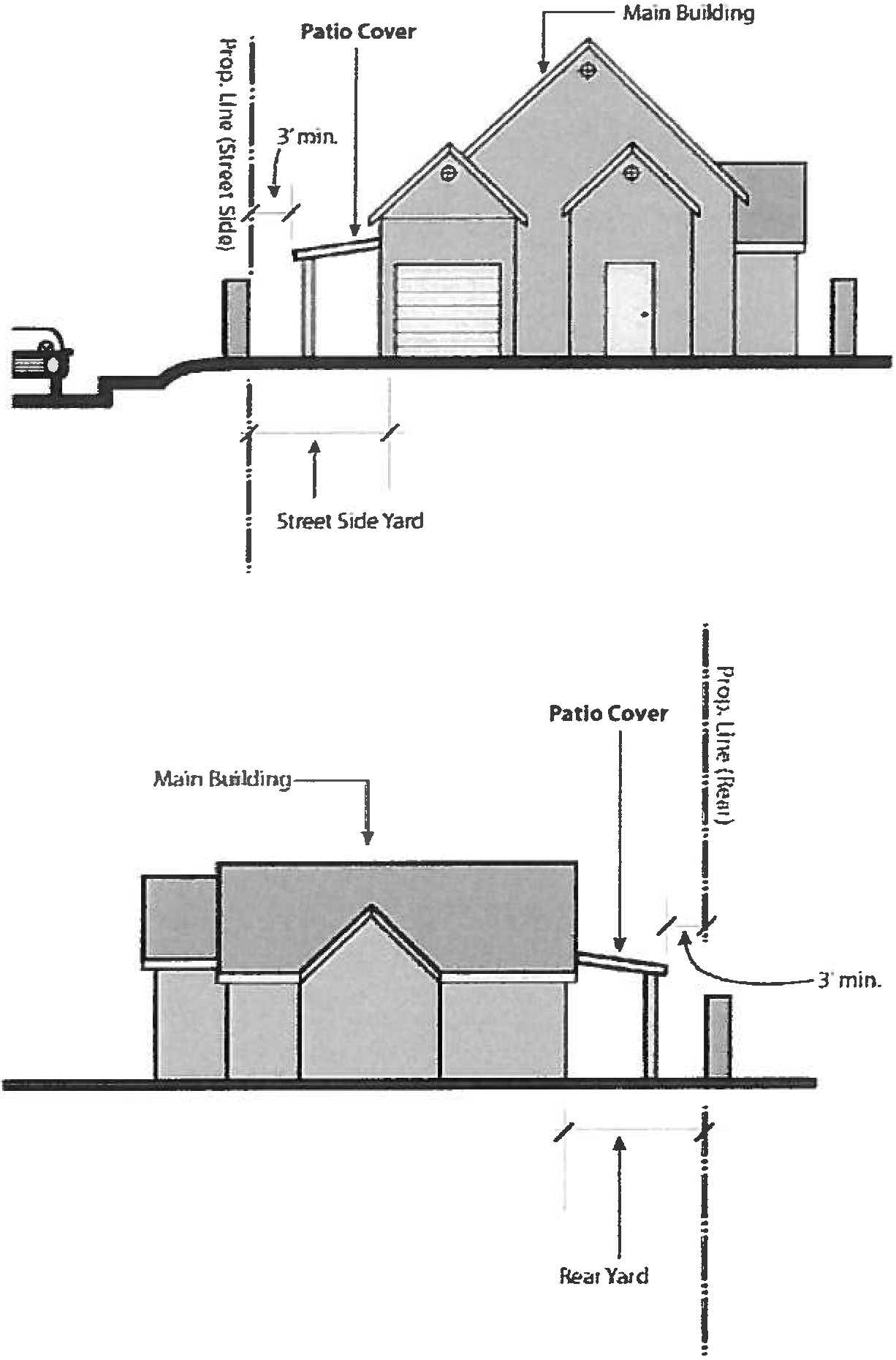
(Ord. of 7-2012, § 5.12; Ord. No. 2013-09, § 3, 5-22-2013)
Sec. 120.05.130. - Noise, odor and vibration performance provisions.
(a)
Applicability. The standards of this section apply to all new and existing land uses within the city, unless otherwise exempted.
(b)
Noise standards. All uses shall comply with the noise standards set forth in the city's general plan and within the city's noise ordinance (see chapter 8.52).
(c)
Odor, particulate matter and air contaminants standards.
(1)
Odor. No obnoxious odor or fumes shall be emitted that are perceptible without instruments by a reasonable person at the property line of the site.
(2)
Particulate matter and air contaminants. The operation of facilities shall not directly or indirectly discharge air contaminants into the atmosphere, including smoke, sulfur compounds, dust, soot, carbon, noxious acids, gases, mist, odors, or particulate matter, or other air contaminants or combinations which exceed any local, state or federal air quality standards or which might be obnoxious or offensive to anyone residing or conducting business either on site or abutting the subject site. Particulate matter shall not be discharged into the atmosphere in excess of the standards of federal and state requirements.
(d)
Vibration standards. Uses shall be operated in compliance with the following provisions:
(1)
Uses, activities and processes shall not generate vibrations that cause discomfort or annoyance to reasonable persons of normal sensitivity or which endanger the comfort, repose, health or peace of residents whose property abuts the property lines of the subject parcel.
(2)
Uses shall not generate ground vibration that interferes with the operations of equipment and facilities of adjoining parcels.
(3)
Vibrations from temporary construction/demolition and vehicles that leave the subject parcel (e.g., trucks, trains and aircraft) are exempt from the provisions of this section.
(Ord. of 7-2012, § 5.13)

