
Eden Prairie City Zoning Code
SECTION 11
26. - TOD TRANSIT ORIENTED DEVELOPMENT DISTRICTS.
Subd. 1. Purposes.
The intent of the Transit Oriented Development (TOD) zoning ordinance is to provide for development of attractive, compact, pedestrian-friendly, high density, environmentally and economically sustainable, transit-oriented areas which allow a complementary mix of land uses. A TOD land use pattern supports transit system investments, optimizes development opportunities, and helps achieve many goals and policies outlined in the Eden Prairie Comprehensive Plan. To support the intent of Transit Oriented Development (TOD), the specific purposes of the TOD zoning districts are to:
A.
Promote high density development within convenient walking and biking distance of a transit station, including increased residential densities, employee densities, and non-residential floor area ratios (FARs);
B.
Accommodate a complementary mix of market-supportive land uses including residential, office, public (buildings, plazas, open spaces), light industrial, and where appropriate, select commercial uses;
C.
Ensure building and site design is oriented to public spaces - streets, sidewalks, plazas, open spaces, and the transit station and emphasizes a pedestrian-friendly environment;
D.
Support an urban design pattern that encourages active living - the integration of physical activity into daily routines and healthy mobility choices, including walking, biking, riding scooters, and rollerblading, and other forms of pedestrian travel and includes accommodations for persons with disabilities to connect to transit;
E.
Promote strategies and designs that decrease the need for parking, including compact/mixed-use development patterns, on-street parking, joint use parking, structured parking, access to transit and shuttle services, bike sharing, and car sharing;
F.
Incorporate public amenities such as parks and plazas, civic spaces, public art, landscaped streetscapes, benches, and sidewalks/trails that provide connections between development sites, transit, and the City's overall sidewalk/trail network;
G.
Incorporate urban design principles that promote the safety and comfort of residents, employees, visitors, and transit riders;
H.
Promote high quality and aesthetically attractive building forms that contribute to a positive City image, help to identify the unique characteristics of the location, and enhance the streetscape environment for pedestrians, bicyclists, transit riders, and vehicular drivers; and
I.
Incorporate sustainability practices relating to building lifespan such as reuse and recycling of materials, energy and water efficiency, storm water management, and economic resilience through lower operating costs.
There are three (3) Transit Oriented Development (TOD) zoning districts:
1.
The TOD-Mixed Use (TOD-MU) district encourages high-density, mixed-use, and pedestrian-oriented development that supports transit usage.
2.
The TOD-Residential (TOD-R) district allows for moderate- to high-density residential development with some allowance for limited commercial uses.
3.
The TOD-Employment (TOD-E) district allows for moderate- to high-density office, light industrial and institutional development with some allowance for limited commercial uses.
The individual TOD district standards are described in Subdivision 4.
Subd. 2. Definitions.
Ten-Minute Walkshed is the area surrounding each of an existing or planned commuter bus or light rail transit station that is accessible by walking within a ten-minute timeframe.
Attached Building is an individual structure on a parcel consisting of multiple similar units arranged side by side where each unit shares a common wall with the adjacent unit. All building entries are located at the ground level facing the primary street or facing a courtyard that is open to the street.
Building Break means a recess in the building façade that provides facade articulation, creates the impression that one (1) building is two (2) or more buildings, incorporates a unique building element, and improves the building's overall composition and aesthetic. Minimum requirements for a building break are a depth of two (2) feet and a width of four (4) feet.
Building Stepback means a setback of a building's upper floor(s) in order to reduce the building's bulk, articulate the base of the building, ensure a more comfortable street environment, and provide light and air at street level.
Building Street Frontage means the proportion of a lot's frontage on a public street that is occupied by a building as measured at the required maximum front yard setback. Corner lots must meet maximum front yard setback requirements for both public street frontages.
Building Transparency means openings in the street-facing façade of a building which are transparent, including windows and doors that enable increased physical and/or visual interaction between street/sidewalk/plaza activities and a building's interior uses and activities.
Commercial Ready means a space constructed to meet a minimum ground floor height that accommodates retail/commercial use as established by City Code Chapter 11. The intent of Commercial Ready standard is to provide the flexibility to occupy ground floor space in accordance with market demand while allowing a future transition to retail/commercial uses as the market dictates.
Drive-Thru Facilities means facilities that accommodate automobiles and from which the occupants of the automobiles may make purchases or transact business, including the stacking spaces needed for waiting vehicles. Examples of drive-thru facilities include, but are not limited to, drive-up windows, menu boards, order boards or boxes, drive-in restaurants and drive-up banks.
Flex Building is a building designed to be versatile and may be used in combination with office, research and development, sales/showroom, industrial processing, distribution/warehousing, or high tech.
Flex Space means a use providing its occupants the flexibility of utilizing the space. Usually provides a configuration allowing a flexible amount of office or showroom space in combination with manufacturing, laboratory, warehouse distribution, etc.
Ground Floor Height means a measurement taken from floor to floor.
Joint Use Parking means a parking facility shared by two (2) or more uses, tenants, or properties.
Liner Building is a building designed to line the outside of a parking structure along a public street frontage with an active ground floor use. A liner building may also include active upper floors.
Mixed-Use Building means a multi-story building that contains allowed retail and services on the ground floor and allowed residential and/or office uses on the upper floors.
Neighborhood Commercial means small-scale retail stores and personal services primarily serving nearby residential areas and nearby businesses and their employees and small-scale specialty shops and services. No individual tenant space shall exceed ten thousand (10,000) square feet in area with the exception of grocery stores, which shall not exceed twenty-five thousand (25,000) square feet in area. Drive-thru facilities are prohibited as a neighborhood commercial use.
Ornamental Grillwork is a decorative metal grate placed on a building façade to provide screening and architectural interest along a street front facade.
Pilaster is a shallow rectangular column placed on a building façade, typically as a decorative architectural element to provide articulation of the building façade.
Public Open Space means a publicly or privately owned area designated for use by the public such as a park, trail, sidewalk or plaza that is accessible to the public.
Stacked Building is a multi-level structure comprised of single-floor or multi-floor units that are stacked vertically and connected with one (1) or more shared entries. This building type is typically designed for residential, hospitality, or office uses.
Transit Oriented Development (TOD) is commonly described as a community or development that mixes residential, office, commercial and open space, and allows for convenient or direct access to public transportation. The design of TOD is specifically influenced by transit and focuses on walkability and connections to other sites as well as transit.
Visitor Parking means an off street, surface parking areas for motor vehicles that will be parked for short periods of time, and visiting within the Transit Oriented Development district. Visitor parking does not include long term or all day employee parking or parking of delivery vehicles engaged in loading or unloading goods.
Subd. 3. Applicability. A Transit-Oriented Development (TOD) district shall apply to property zoned under this section. Any provisions contained in this Section 11.26, which are inconsistent with or are in conflict with any other provision of the City Code shall supersede such other provisions. Such properties will generally be within a ten-minute walkshed (the area within a ten-minute walking distance, or roughly a half-mile) of an existing or planned commuter bus or light rail transit station consistent with the Comprehensive Guide Plan.
Subd. 4. Permitted Uses. Refer to the table in Section 11.06.
Subd. 5. District Development Standards.
The following tables and diagrams include development standards for each of the three TOD zoning districts and are intended to illustrate the desired character, form, and scale of development within each district. Additional standards and required conditions that apply across all of the TOD zoning districts are addressed in Subdivisions 6 through 10 of this section.
A.
Development Standards: Transit Oriented Development - Mixed Use (TOD-MU).
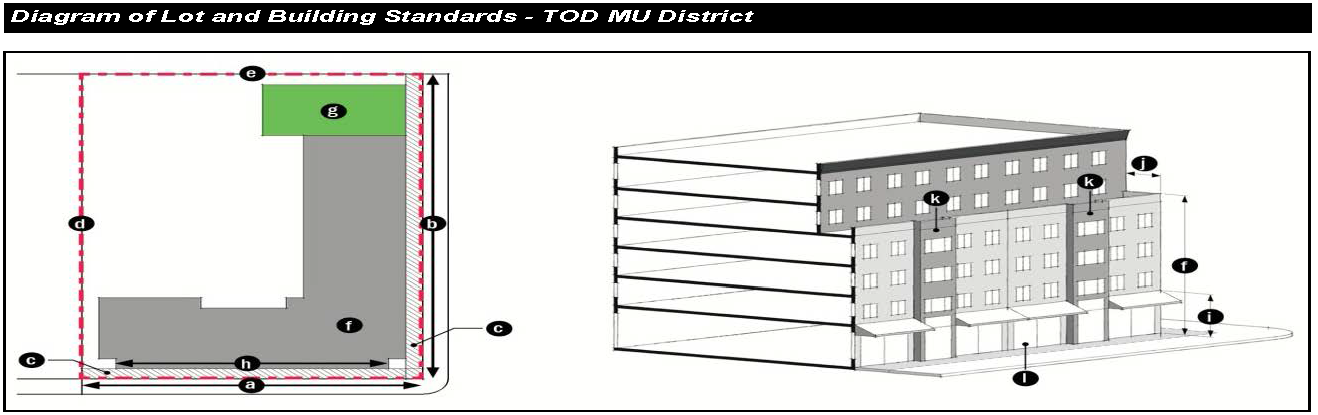
STATEMENT OF POLICY: The TOD-Mixed Use (TOD-MU) district encourages high-density, mixed-use, and pedestrian-oriented development that supports transit usage. The TOD-MU district is intended to generally be applied closest to the transit station. Buildings are mid- to high-rise structures with active ground floor uses. A mix of office, residential, hotel, and institutional uses, along with ground floor shops, services, and restaurants encourage activity throughout the day, and provide residents, visitors, transit riders, and employees with amenities and services that support their day-to-day needs within convenient walking distance. The specific permitted uses are set forth below in the chart titled Permitted Uses-TOD-MU District. The diagrams set out below are intended to illustrate the application of the above statement of policy.
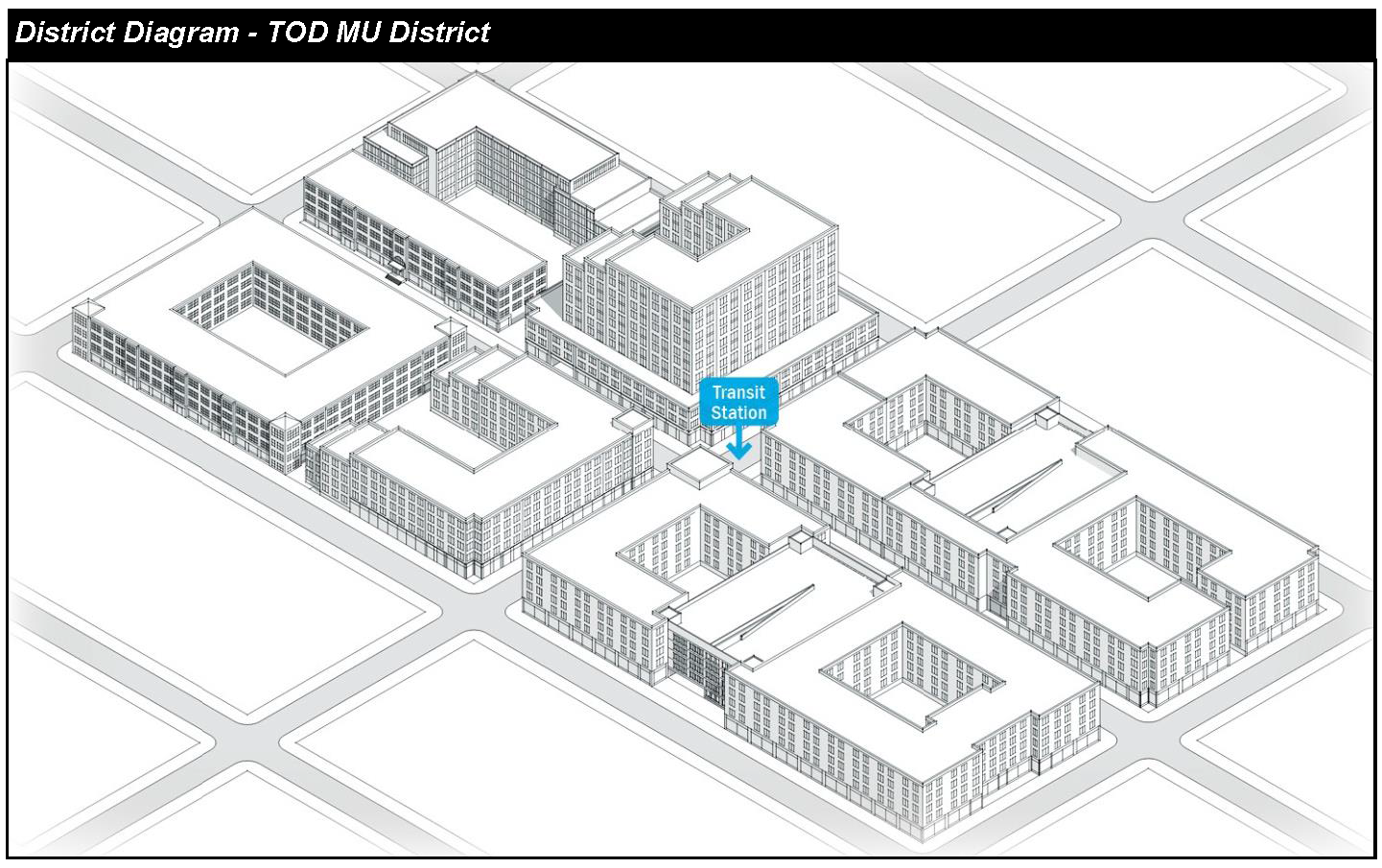
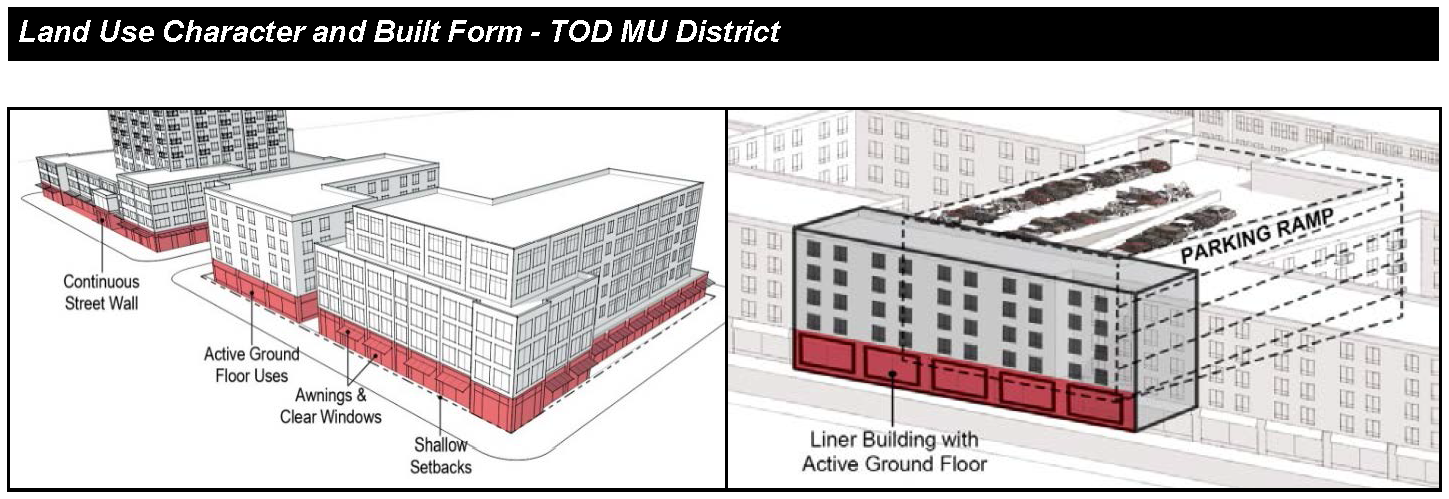
District Diagram, Land Use Character and Built Form Description: The TOD MU district features a high-density development pattern with stacked mixed-use buildings. Requirements for street-fronted architecture, minimal setbacks, and active ground floor uses contribute to a more safe and walkable street environment. To that end, parking is predominantly provided in structured or underground parking and is located away from primary transit streets.
B.
Development Standards: Transit Oriented Development - Residential (TOD-R).
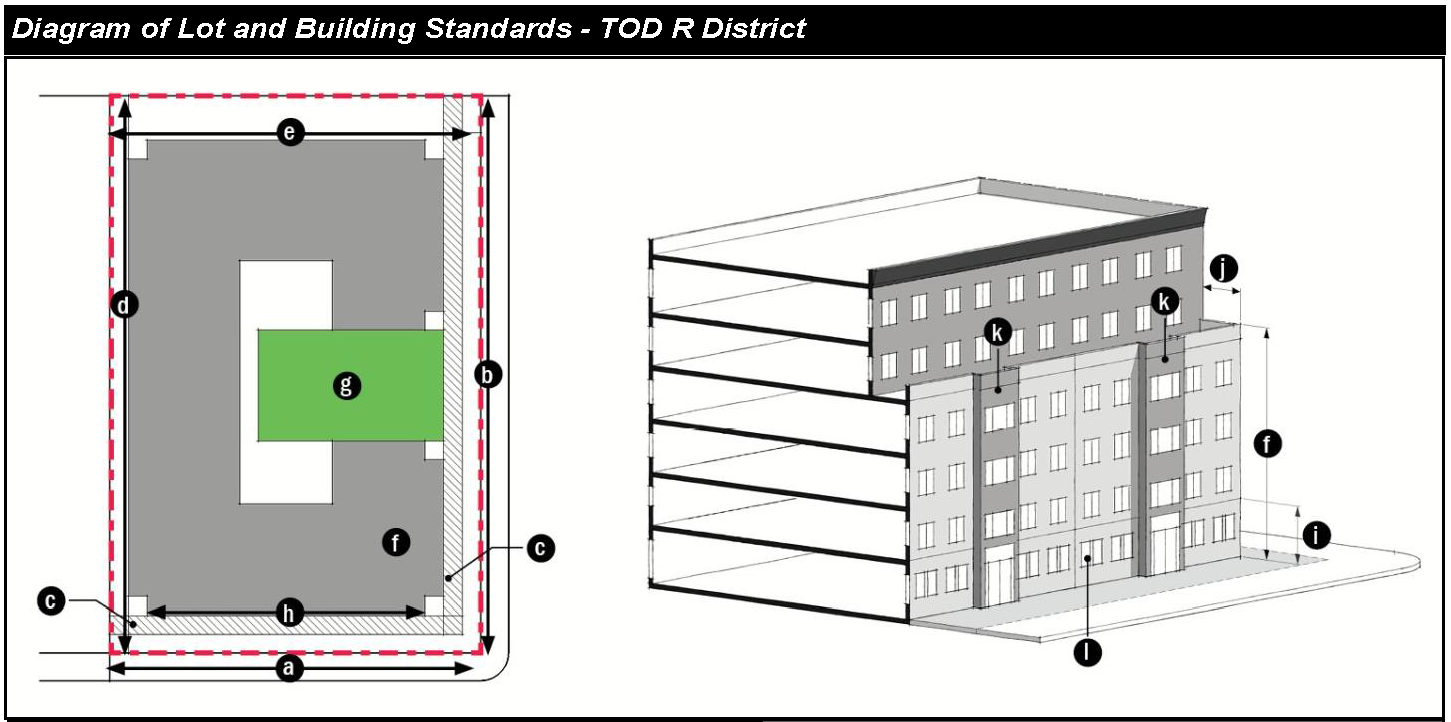
STATEMENT OF POLICY: The Transit Oriented Development - Residential (TOD-R) district allows for a mix moderate to high-density housing, including stacked and attached residential building types, as well as limited mixed-use development. Land uses in the TOD-R district shall be residential with a small amount commercial uses (ground floor retail, services, and restaurants) that support the day-to-day needs of residents. The TOD-R district shall generally be applied farther out from the transit station and provides more latitude in density and street frontage requirements while still promoting transit-supportive densities and pedestrian-oriented urban design. The specific permitted uses are set forth below in the chart titled Permitted Uses-TOD-R District. The diagrams set out below are intended to illustrate the application of the above statement of policy. These higher density housing types, both rental and ownership, shall be designed to optimize the district's walkable access to retail, services, restaurants, parks and trails, transit and community facilities. Buildings shall be located and designed to take advantage of views of nearby natural amenities and where significant shading of lower buildings will not occur.
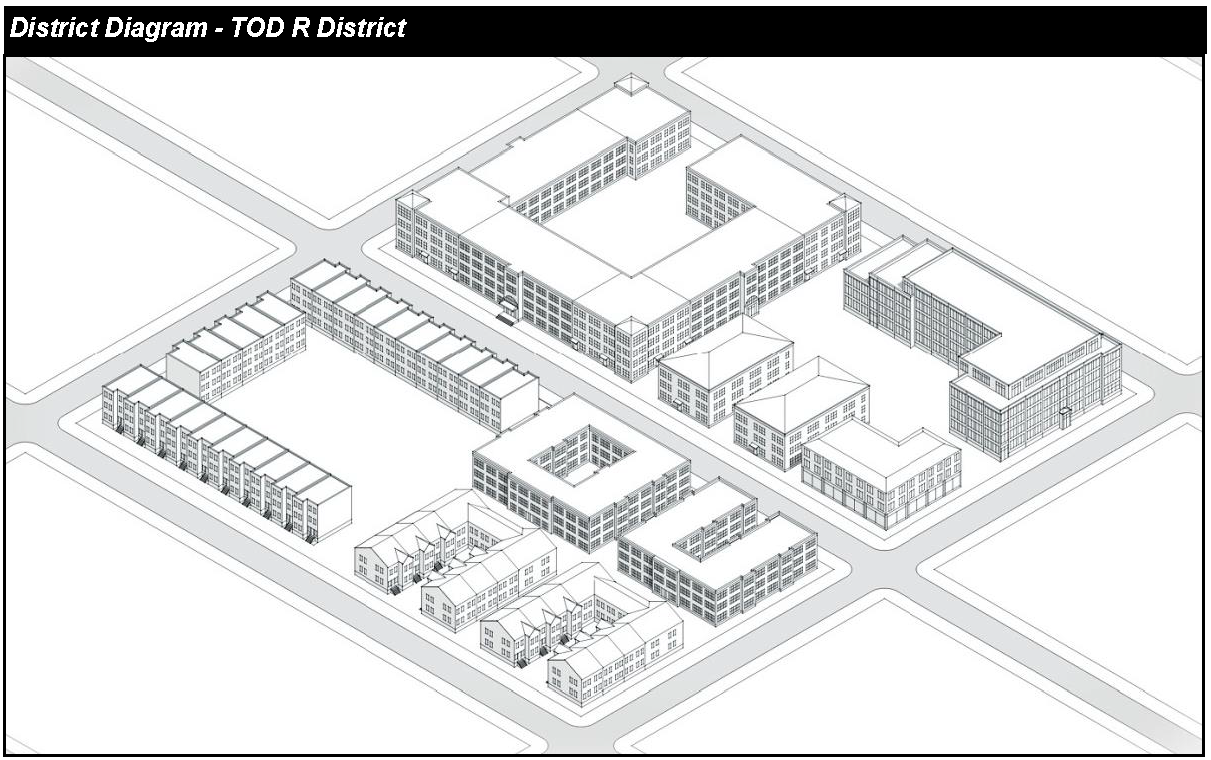
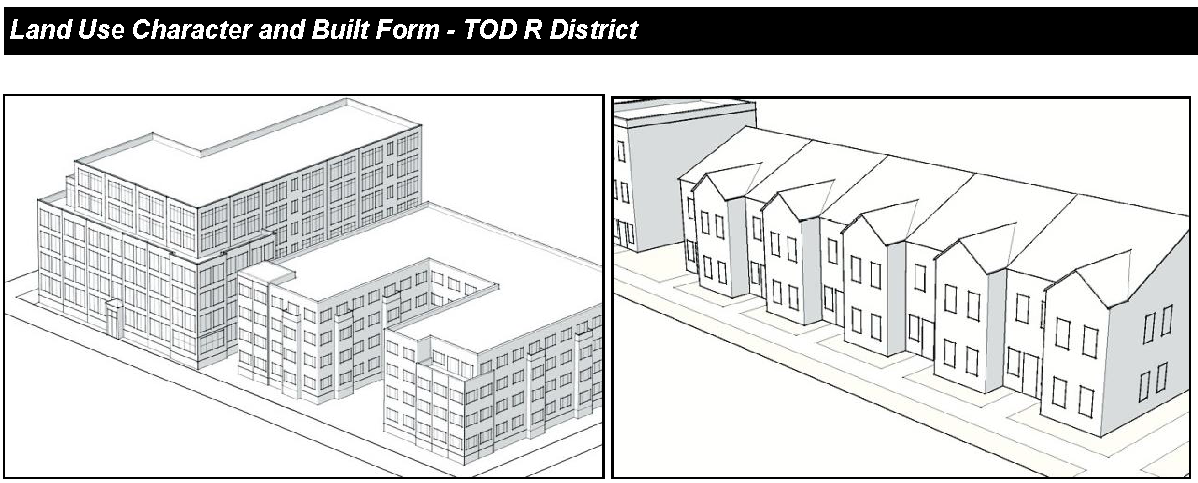
District Diagram, Land Use Character and Built Form Description: The TOD-R district features stacked and attached residential building types, as well as mixed-use building with active ground-floor uses. Requirements for street-fronted architecture and structured parking contribute to a more safe and walkable street environment. Slightly deeper setbacks allow for additional landscaping, gardens, and small front or side yards. Street-facing architectural details such as porches, stoops, and balconies encourage social interaction and contribute to the safety and comfort of the public realm.
C.
Development Standards: Transit Oriented Development - Employment (TOD-E).
STATEMENT OF POLICY: The Transit Oriented Development - Employment (TOD-E) district allows for a mix of moderate- to high-density office, light industrial and institutional development with some allowance for limited commercial uses. The TOD-E district allows stacked office and mixed use buildings as well as multi-story flex buildings that can accommodate a range of living wage employment opportunities at higher densities. Retail, services, and showrooms are allowed in the district but limited to smaller scale businesses that support the needs of district employees or complement existing light industrial or office uses. The TOD-E district would generally be applied farther out from the transit station and provide more latitude in density and street frontage requirements while still promoting transit-supportive densities and pedestrian-oriented urban design. The diagrams set out below are intended to illustrate the application of the above statement of policy.
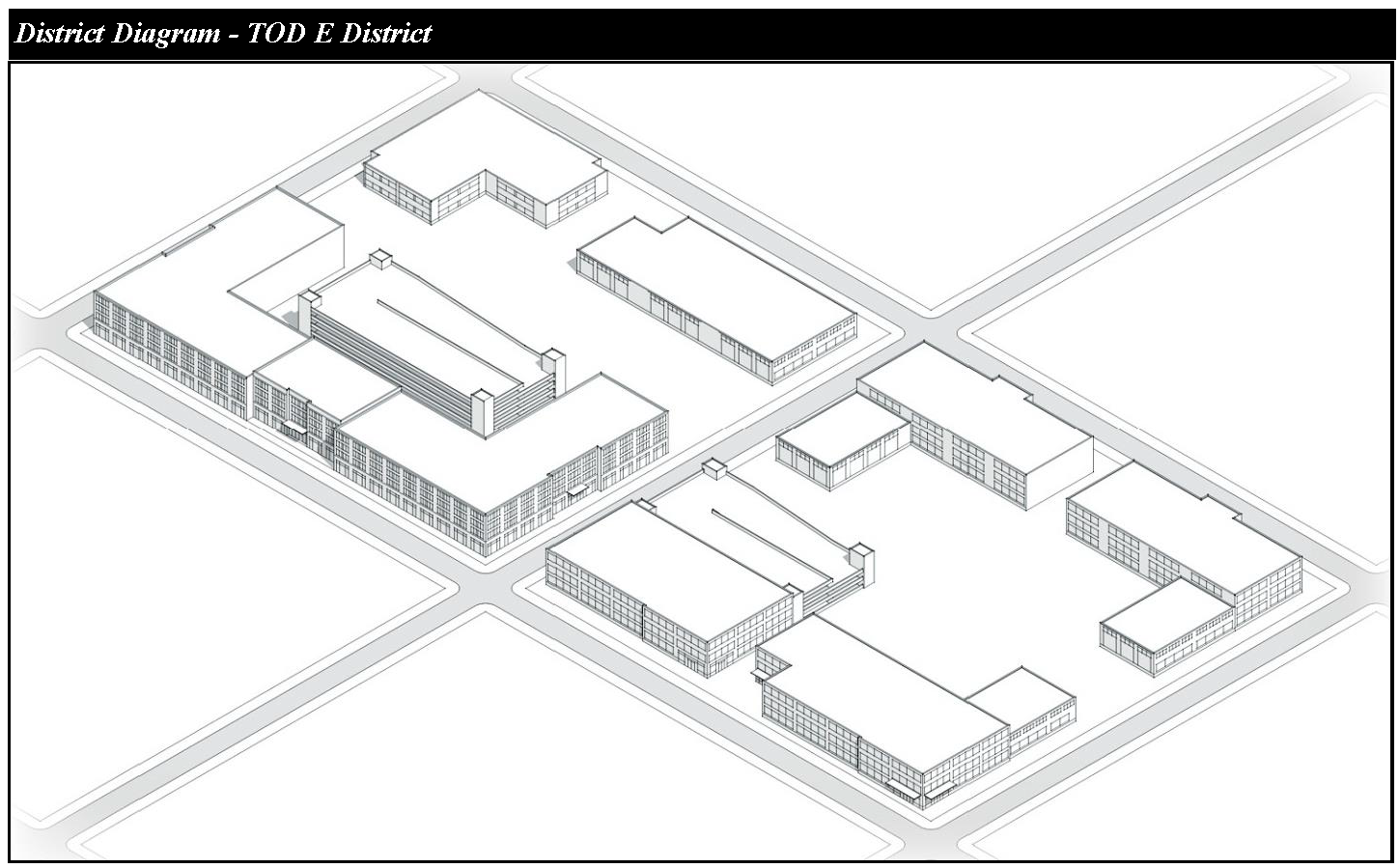
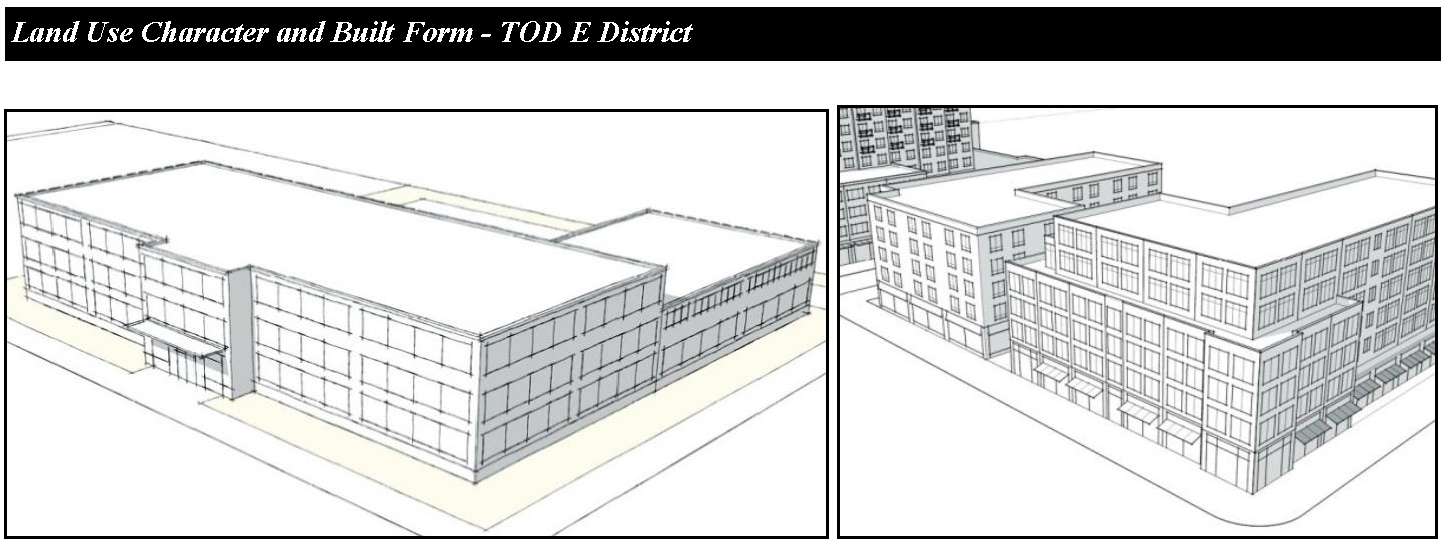
District Diagram, Land Use Character and Built Form Description: The TOD-E district features stacked office and mixed use buildings, as well as multistory flex buildings. Requirements for street-fronted architecture contribute to a more safe and walkable street environment. Slightly deeper setbacks allow for additional landscaping, plazas, and other types of open space. Street adjacent features such as a canopy, awnings, plazas, and courtyards create a safe and welcoming environment.
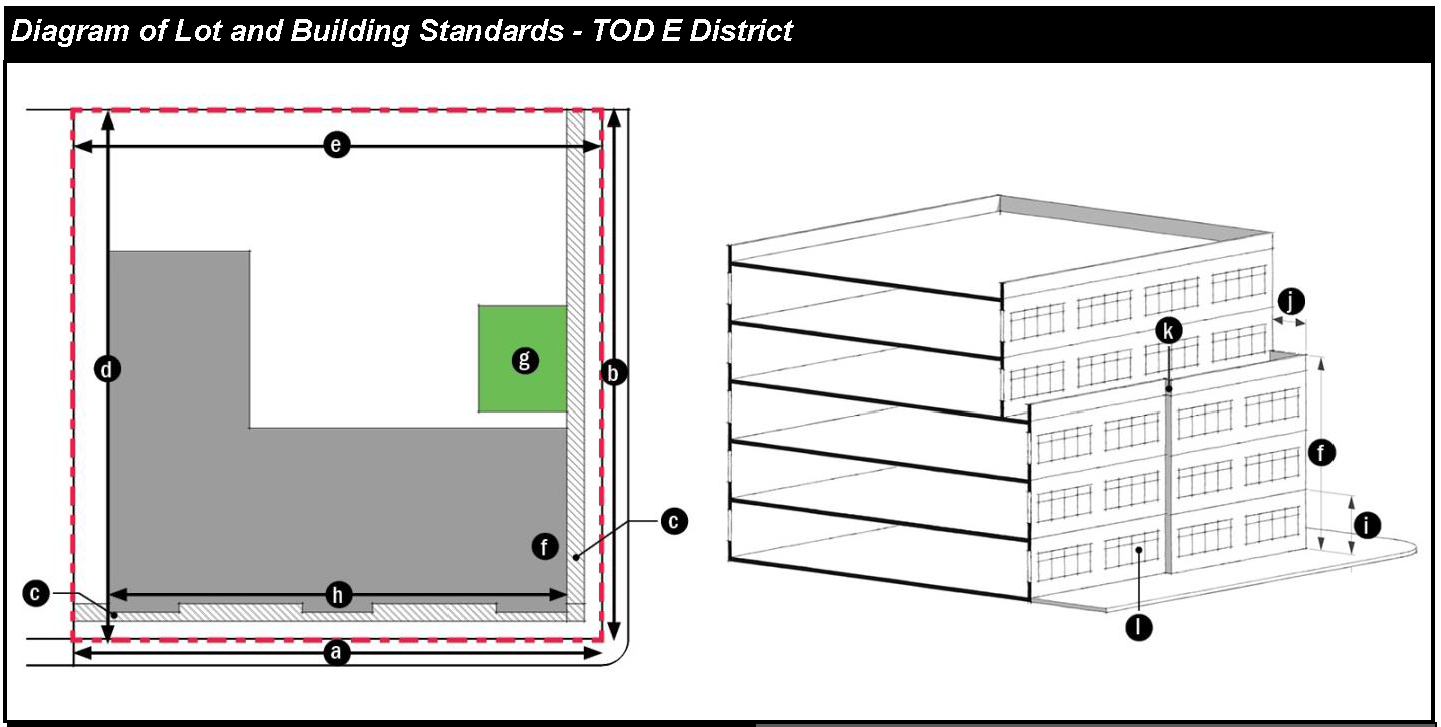
Subd. 6. Building Standards. All buildings shall provide pedestrian-oriented design features along streets, sidewalks, pedestrian ways, and pedestrian areas. Buildings and developments shall comply with the following standards for building design and pedestrian orientation:
A.
Buildings shall have a primary entrance facing a public sidewalk or public open space.
B.
Primary building entrances shall be architecturally emphasized and highly visible from the street, sidewalk, or pedestrian way, utilizing design features such as protruding or recessed entryways, awnings, canopies, pillars, unique building materials and/or architectural details. Residential buildings shall incorporate elements such as porches, stoops, and balconies that enhance the safety and comfort of the public realm.
C.
Buildings are required to incorporate articulation in street-facing façades that improves the building's overall composition and aesthetic, and contributes to a more aesthetically and visually interesting and walkable street environment. Articulation includes recesses in the building façade, material changes, or other methods of building articulation that break down the perceived scale of the building or create visual interest.
Subd. 7. Off-Street Vehicle Parking Standards.
A.
Parking structures shall be located behind buildings or located along secondary streets.
B.
Parking structure facades visible from public streets and public open space shall architecturally complement the building or buildings the parking structure serves through the use of exterior materials, architectural elements, and color. Parking structures shall include architectural elements that enhance the structure, break up its mass, and complement the building or buildings the parking structure serves. Examples of specific architectural elements that assist in meeting this requirement include decorative piers and pilasters, banding, reveals, architectural accents, wall plane articulation, decorative artwork, ornamental grillwork, recessed window openings, façade treatment variations, and locating tenant signs on the side of parking ramps.
C.
Parking structures may also incorporate liner buildings that screen the parking structure with active street-level uses. Liner building may include upper floor uses, or may utilize appropriate architectural elements as described above.
Subd. 8. Pedestrian and Off-Street Bicycle Facility Standards.
A.
Public sidewalks and/or trails may be required to be constructed by the applicant in conformance with the Comprehensive Guide Plan and/or the City Pedestrian and Bicycle Plan. Design shall conform to the requirements of the City Engineer, Parks and Recreation Director or designee.
B.
An off-street sidewalk or multi-use trail shall be provided by the applicant that connects the front door of the building to adjacent public sidewalks or trails that are either existing or contemplated in an approved city trail plan or Capital Improvement Plan.
C.
Off-Street Bicycle parking shall be provided at the following ratios at the time of initial certificate of occupancy and at the time of enlargement of a structure:
1.
Office - minimum of ten (10) spaces, plus one (1) space per seven thousand five hundred (7,500) square feet of gross floor area.
2.
Commercial - minimum often (10) spaces, plus one (1) space per three thousand five hundred (3,500) square feet of gross floor area.
3.
Public - minimum often (10) spaces, plus one (1) space per 3,500 square feet of gross floor area.
4.
Light Industrial - minimum of ten (10) spaces, plus one (1) space per ten thousand (10,000) square feet of gross floor area.
5.
Residential - one (1) space per two (2) dwelling units.
D.
Location. Bicycle parking shall be located within fifty (50) feet of the primary building entrance(s) and shall not obstruct sidewalks except as approved through a shared bicycle plan as referenced in Subsection G.
E.
Bicycle racks shall be securely anchored to the ground and on a hard surface. Up to twenty-five (25) percent of bicycle parking may be temporary or seasonal, but all temporary or seasonal bicycle parking shall be included within the Proof of Bicycle Parking Plan.
F.
Covered spaces. If twenty (20) or more bicycle spaces are required, then at least fifty (50) percent of the required bicycle spaces shall be covered. Coverage may be provided under roof overhangs or awnings, in bicycle lockers, indoor room, fenced in corral, within adjacent parking structures, or within underground parking structures.
G.
Shared Bicycle Parking. Shared off-street bicycle parking facilities are allowed to collectively provide bicycle parking in any district for more than one (1) structure or use. The applicant shall demonstrate meeting the requirement through a joint use, district or shared parking agreement.
H.
Proof of Bicycle Parking. If the applicant demonstrates that the required bicycle parking is in excess of the actual demand, all of the required bicycle parking need not be constructed prior to the issuance of the initial certificate of occupancy for the building being served. Any spaces not constructed, as shown on the site plan, shall be constructed when determined necessary by the City Planner. The area of future parking shall be landscaped, which, landscaping shall not be used to satisfy landscaping requirements. The City Planner shall notify the property owner in writing of the need to construct additional proof of bicycle parking spaces. No more than fifty (50) percent of bicycle parking stalls shall be placed in proof of bicycle parking.
Subd. 9. Landscaping and Open Space Standards.
A.
All sites and buildings within the TOD district shall comply with Screening and Landscaping standards established in Section 11.42, except for Subdivision 5.A (Minimum Size Requirements for Plantings) and Subdivision 5.B (Total Caliper Inches Required). The following standards apply within the TOD district in lieu of said Subdivision 5.A and Subdivision 5.B:
1.
Minimum Size Requirements for Plantings. Deciduous overstory plantings shall be a minimum of three (3) caliper inches; deciduous understory trees shall be a minimum of two (2) caliper inches; and coniferous trees shall be a minimum of eight (8) feet in height.
2.
Total Caliper Inches Required. Sites with up to five (5) acres of on-site pervious area require a minimum of three (3) caliper inches of trees for every five hundred (500) square feet of the on-site pervious surface area. Sites with five (5) acres or greater of on-site pervious area require a minimum of three (3) caliper inches of trees for every seven hundred fifty (750) square feet of the on-site pervious area. Pervious pavement areas, green roofs, and undevelopable areas including but not limited to: wetlands, floodways, archeological resource areas, and water bodies are excluded from the on-site pervious surface area calculation.
3.
Planting beds and/or decorative planting containers may replace up to fifty percent (50%) of the required caliper inches for trees at a rate of three (3) caliper inches of trees per five hundred (500) square feet of cumulative planting beds and/or decorative planting containers.
4.
Planting Beds and/or Decorative Planting Containers: Each planting bed or container shall include a variety of plants which may include shrubs, ornamental grasses, ground cover, vines, annuals, or perennials to provide year round color and interest. Native plant species to the local hardiness zone and those which provide interest and/or color in the winter are encouraged.
5.
Existing trees on the developable portions of the site that will remain after construction and/or existing trees on the overall site that provide benefits such as screening may be considered as counting toward a portion of the caliper inches required by this section as determined through the PUD process. Any existing trees proposing to remain shall be determined to be healthy and of the appropriate species as determined by the City.
6.
Eco-grass, green roofs, rooftop gardens, limiting irrigation through xeriscaping and rainwater collection and reuse, public art, and other sustainable practices related to landscaping may be considered as counting toward a portion of the caliper inches required by this section as determined through the PUD process.
B.
Due to the urban character of the TOD District, less landscaping space will be available typically than in other zoning districts. Therefore, a higher level of landscaping design detail is required for the concentrated open space, pervious surface areas, plazas, planters, screening areas and streetscape areas. Examples of a higher level of landscaping design include rooftop gardens and green roofs, both of which are encouraged. A detailed landscape plan prepared by a landscape architect shall be submitted with the development application. Other privately owned amenities are encouraged, such as plazas, courtyards, fountains, outdoor art, rooftop gardens and green roofs, and other decorative elements.
C.
The following privately owned and maintained Usable Open Space forms are permitted to meet the requirements for usable outdoor open space:
1.
Pocket Park. A Pocket Park is an open space of no less than 0.05 acres in size that is available for recreation. A Pocket Park may be spatially defined by landscaping rather than building frontages and may be linear in form or shape. A pocket park may consist of a landscaped and maintained lawn, trees, and seating areas that are naturalistically disposed.
2.
Square. An open space available for passive recreation and civic purposes. A Square Usable open Space is spatially defined by building frontages. Its landscape shall consist of paths, lawns, trees, hardscape, and public art formally disposed. Square Usable Open Spaces shall be located at the intersection of important main streets. There shall be no minimum size for a square.
3.
Plaza. An open space available for public use, community events, and/or commercial activities. A Plaza Usable Open Space shall be spatially defined by building frontages. Its landscape shall consist primarily of hardscape, plantings, public art, and trees. There shall be no minimum size for a Plaza.
4.
Play Area. An open space designed and equipped for the recreation of children. A Play Area shall be fenced and may include an open shelter. Play areas shall be interspersed within residential or mixed-use areas and may be placed within a block. Play areas may be included within parks and greens. There shall be no minimum or maximum size.
5.
Pedestrian Way. Natural or landscaped walking paths and running trails.
D.
The following shall not constitute Useable Open Space: landscape strips or enlargements/enhancements of landscaping areas adjacent to the sidewalk; shrubs, flowers and other low profile landscaping around buildings, sidewalks and parking areas; required minimum building setback areas; yards associated with private dwellings; or outdoor areas that prohibit public or tenant access during normal business hours. Alternative useable open space areas may be considered as counting toward a portion of the useable open space requirement of this section as determined through the PUD process.
Subd. 10. Supplemental Analysis or Study.
A.
Traffic. All development and zoning projects in the TOD District require documentation of the expected traffic impacts of the development. The scope of the traffic analysis is dependent on several factors including the size, type, and location of the development. The City Engineer should be contacted early in the project to determine the appropriate scope of traffic analysis and to determine if a formal Traffic Impact Study is required. All development applications, regardless of size, shall document the size and type of the proposed development and provide Daily, a.m. Peak, and p.m. Peak traffic generation estimates for the development.
B.
Travel Demand Management (TDM). All development applications for office and light industrial uses shall include a Travel Demand Management (TDM) plan. The plan shall document TDM measures to be implemented, a two-year budget, and an evaluation plan. TDM strategies that shall be considered in the TDM plan include, but are not limited to, financial incentives for carpoolers, vanpoolers and bicyclists, subsidized transit passes, preferential location of carpool/vanpool parking, bicycle racks and storage, access to shower and lockers, and promotion of commuter programs. As a condition of approval a TDM cash escrow, letter of credit with a corporation approved by the City Manager or other guarantee acceptable to the City Manager equal to one hundred percent (100%) of the cost of implementing the first two (2) years of the TDM Plan will be required. All new residential development applications should consider TDM strategies such as bikeshare and carshare memberships, subsidized transit passes, and an information kiosk onsite.
C.
Parking. All zoning and development projects in the TOD District require documentation of the parking plan for the project site including the number of required parking spaces, the number of provided parking spaces and any proposed use of proof of parking. The location and quantity of parking will be reviewed on a case-by-case basis as part of the development review process. Based on the specifics of the parking plan for the project site a formal Parking Study may be required. The City Planner should be contacted prior to application and early in the project to review the parking plan for the project and to determine if a formal Parking Study is required.
Subd. 11. General Requirements and Conditions. Except as otherwise provided in this Section, properties in the TOD District are subject to all provisions of this chapter that are applicable to all districts or specifically apply to the TOD District, except that properties within the TOD district are exempt from the Tree Replacement Plan Requirements provided in Section 11.55, Subdivision 4. Refer to Section 11.08 for provisions that apply to all zoning districts.
Subd. 12. Architectural Standards. All buildings shall comply with Architectural Standards established in Section 11.46.
Subd. 13. Signage. All sites and buildings shall comply with Sign Permits standards established in Section 11.70.
Subd. 14. Lighting. All sites and buildings shall comply with Glare standards established in Section 11.08, Subdivision 3.
Subd. 15. Mechanical Equipment, Trash, Loading Facilities. All sites and buildings shall comply with the Screening standards in Section 11.42, Off-Street Loading Facilities standards in Section 11.43, Trash and Recycling standards in Section 11.08, Subdivision 4, and Wastes standards in Section 11.08, Subd. 9.F.
(Source: Ordinance No. 20-2023, 12-14-2023; Ordinance No. 18-2018, 9-27-2018; Ordinance No. 15-2016, 8-25-2016)

