
Emmett Charter Township
City Zoning Code
City Zoning Code
ARTICLE 8
- SIGN REGULATIONS3
Editor's note— Ord. No. 3-2018, § 1, adopted Sept. 13, 2018, repealed the former Art. 8, §§ 8.01—8.09, and enacted a new Art. 8 as set out herein. The former Art. 8 pertained to similar subject matter and derived from Ord. No. 1-2015, § 1, adopted Sept. 17, 2015 and legislation adopted on March 14, 2002.
Section 8.01.- Statement of purpose.
The purpose of this article is to establish reasonable regulation of the use of signs and outdoor advertising in a manner that will minimize their harmful effects while permitting latitude for creative and effective advertising and identification. To achieve this purpose, this article has the following objectives:
a.
To prevent the number of signs and sign messages from exceeding a level reasonably necessary to identify businesses and their products;
b.
To prevent the placement of signs in a manner that will conceal or obscure existing signs or adjacent buildings;
c.
To keep signs within a reasonable scale with respect to their surroundings;
d.
To prevent off-premises signs from conflicting with business, residential and other uses;
e.
To keep the areas adjacent to streets clear of signs that might obstruct the view and/or distract the attention of motorists;
f.
To ensure that the number, size and location of signs do not create a negative impact on the image or aesthetic environment of the Township; and,
g.
To control the use of signs and their motion, colors, and illumination that may negatively affect property values and may be injurious to the mental or physical wellbeing of the public.
(Ord. No. 3-2018, § 1, 9-13-2018)
Section 8.02. - Definitions.
The following words and terms shall, have the meanings shown herein, within this article.
Abandoned sign. A sign and/or sign structure that has ceased to be used for more than six (6) months, or is found to be abandoned by the zoning administrator after having given a three (3) month notice to the property owner of record. If the owner fails to respond to the notice, or if the zoning administrator has documented six (6) months of non-use, then sign and/or sign structure shall be considered to be abandoned and shall thereafter only be re-established in full compliance with this ordinance.
Animated sign. An animated sign employs actual motion or the illusion of motion. Animated signs, are differentiated from changeable signs as defined and regulated by this article, including the following types:
1.
Electrically Activated. Animated signs producing the illusion of movement by means of electronic, electrical or electro-mechanical input and/or illumination capable of simulating movement through employment of the characteristics of one or both of the classifications noted below:
A.
Flashing. Animated signs or animated portions of signs whose illumination is characterized by a cycle of blinking, flashing, fluttering, or change in color intensity during which the period of illumination is either the same as, or less than the period of no illumination and provided that no single light shall blink, flash, flutter, or change its intensity of color more often than one time every 4 seconds.
B.
Patterned Illusionary Movement. Animated signs or animated portions of signs whose illumination is characterized by simulated movement through alternate or sequential activation of various illuminated elements for the purpose of producing light patterns designed to appear in some form of motion provided that no single light shall blink, flash, flutter, or change its intensity of color more often than one time every 4 seconds.
2.
Environmentally Activated. Animated signs or devices motivated by wind, thermal changes or other natural environmental input including spinner, pinwheels, pennant strings, and/or other devices or displays that respond to naturally occurring external motivation, provided that no blinking, flashing, fluttering, or change its intensity of color occurs more often than one time every 4 seconds.
3.
Mechanically Activated. Animated signs characterized by repetitive motion and/or rotation activated by a mechanical system powered by electric motors or any other mechanically induced means, provided that no blinking, flashing, fluttering, or change its intensity of color occurs more often than one time every 4 seconds.
Architectural projection. Any projection that is not intended for occupancy and that extends beyond the face of an exterior wall of a building, but that does not include signs as defined herein. See also "Awning"; "Backlit awning"; and "Canopy, attached and freestanding."
Awning. An architectural projection or shelter projecting from and supported by the exterior wall of a building and composed of a covering of rigid or non-rigid materials and/or fabric on a supporting framework that may be either permanent or retractable, including such structures that are internally illuminated by fluorescent or other light sources.
Awning sign. A sign displayed on or attached flat against the surface or surfaces of an awning. See also "Wall or fascia sign."
Backlit awning. An awning with a translucent covering material and a source of illumination contained within its framework.
Banner. A flexible substrate on which copy or graphics may be displayed.
Banner sign. A sign utilizing a banner as its display surface.
Billboard. See "Off-premises sign" and "Outdoor advertising sign."
Building elevation. The entire side of a building, from ground level to the roofline, as viewed perpendicular to the walls on that side of the building.
Canopy (Attached). A multisided overhead structure or architectural projection supported by attachments to a building on one or more sides and either cantilevered from such building or also supported by columns at additional points. The surface(s) and/or soffit of an attached canopy may be illuminated by means of internal or external sources of light. See also "Marquee."
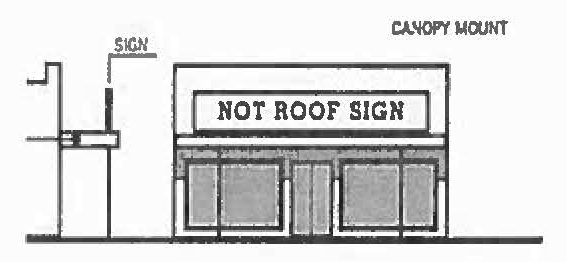
Canopy (Free-Standing). A multisided overhead structure supported by columns, but not enclosed by walls. The surfaces(s) and or soffit of a free-standing canopy may be illuminated by means of internal or external sources of light.
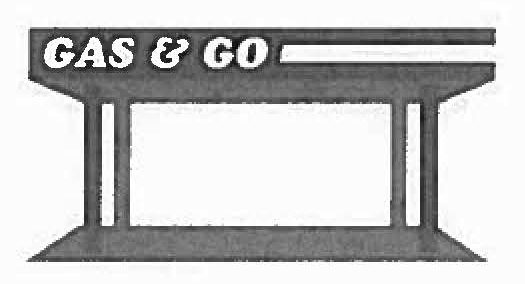
Canopy sign. A sign affixed to the visible surface(s) of an attached or free-standing canopy.
Changeable sign. A sign with the capability of content change by means of manual or remote input, including signs which are:
1.
Electrically Activated. Changeable sign whose message copy or content can be changed by means of remote electrically energized on-off switching combinations of alphabetic or pictographic components arranged on a display surface, provided that no blinking, flashing, fluttering, or change in its intensity of color occurs more often than one time every 4 seconds. Illumination may be integral to the components, such as characterized by lamps or other light-emitting devices; or it may be from an external light source designed to reflect off the changeable component display. See also "Electronic message sign or center."
2.
Manually Activated. Changeable sign whose message copy or content can be changed manually, provided that no blinking, flashing, fluttering, or change its intensity of color occurs more often than one time every 4 seconds.
Combination sign. A sign that is supported partly by a pole(s) and partly by a building structure.
Commercial outdoor advertising sign. A permanent off-premises sign erected, maintained or used in the outdoor environment for the purpose of providing copy area for commercial or noncommercial messages.
Copy. Those letters, numerals, figures, symbols, logos video, and graphic elements comprising the content or message of a sign.
Development complex sign. A free-standing sign identifying a multiple-occupancy development, such as a shopping center or planned industrial park, which is controlled by a single owner or landlord.
Directional sign. Any sign that is designed and erected for the purpose of providing direction and/or orientation for pedestrian or vehicular traffic.
Double-faced sign. A sign with two faces, back to back.
Electric sign. Any sign activated or illuminated by means of electrical energy.
Electronic message sign or center. An electrically activated changeable sign whose variable message capability can be electronically programmed.
Festoon decoration. A sign consisting of strings of exposed lights, balloons or strings of pennants hung overhead to draw attention to items on display or a particular business establishment.
Flashing sign. See "Animated sign, electrically activated."
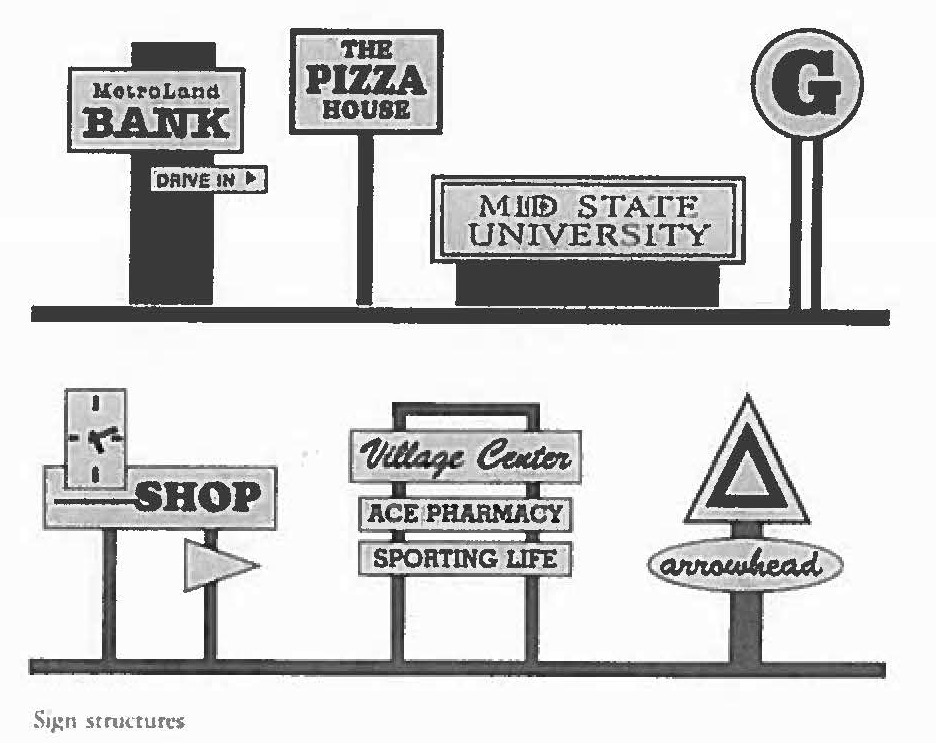
Free-standing sign. A sign principally supported by a structure affixed to the ground, and not supported by a building, including signs supported by one or more columns, poles or braces placed in the ground.
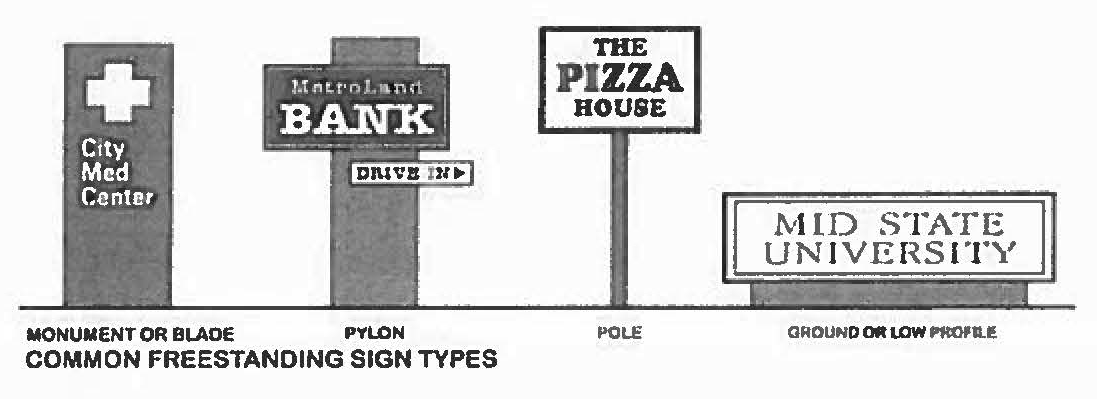
Freeway sign. On-premises free-standing sign designed to be visible to the public while traveling on a limited access highway and to attract traffic to a premises located within one hundred feet of the location of the sign structure.
Frontage (building). The length of an exterior building wall or structure of a single premises orientated to the public way or other properties that it faces.
Frontage (property). The length of the property line(s) of any single premises along either a public way or other property on which it borders.
Ground sign. See "Free-standing sign."
Illuminated sign. A sign characterized by the use of artificial light, either projecting through its surface(s) (internally illuminated); or reflecting off its surface(s) (externally illuminated).
Interior sign. Any sign placed within a building, but not including "window signs" as defined by this ordinance. Interior signs, with the exception of window signs as defined, are not regulated by this article.
Mansard. An inclined decorative roof-like projection that is attached to an exterior building facade.
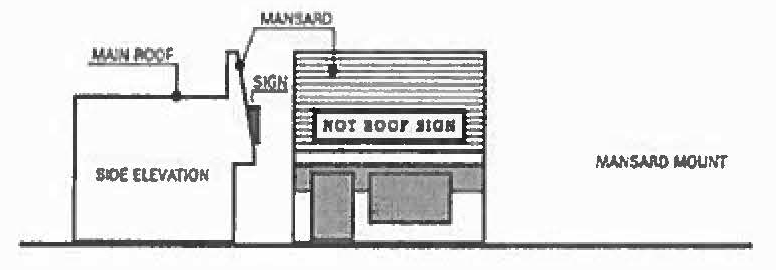
Marquee. See "Canopy (attached)."
Marquee sign. See "Canopy sign."
Menu board. A freestanding sign orientated to the drive-through lane for a restaurant that advertises the menu items available from the drive-through window.
Multiple-faced sign. A sign containing three or more faces.
Non-residential use. A land use other than single family dwelling, two family dwelling, multiply family dwelling, family care home, mobile home, or bed and breakfast.
Off-premises sign. See "Outdoor advertising sign."
On-premises sign. A sign erected, maintained or used in the outdoor environment for the purpose of the display of messages appurtenant to the use of, products sold on, or the sale or lease of the property on which it is displayed.
Outdoor Advertising Sign. A permanent sign erected, maintained or used in the outdoor environment for the purpose of the display of commercial or noncommercial messages not appurtenant to the use of, products sold on, or the sale or lease of, the property on which it is displayed.
Parapet. The extension of a building facade above the line of the structural roof.
Pole sign. See "Free-standing sign."
Political sign. A temporary sign intended to advance a political statement, cause or candidate for office. A legally permitted outdoor advertising sign shall not be considered to be a political sign.
Portable sign. Any sign not permanently attached to the ground or to a building or building surface.
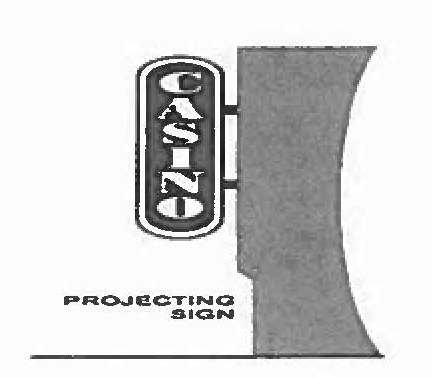
Projecting sign. A sign other than a wall sign that is attached to or projects more than 18 inches from a building face or wall or from a structure whose primary purpose is other than the support of a sign.
Real estate sign. A temporary sign advertising the sale, lease or rental of the property or premises upon which it is located.
Revolving sign. A sign that revolves 360 degrees about an axis. See also, "Animated sign, mechanically activated."
Residential zoning districts. Those districts using the initials OC, RR, RA, RB, MH, and MF.
Roof sign, limited. A sign mounted on, and supported by, the roof of a building, below the actual height of the building as determined based upon the definition of "building height" found in section 21.02.21 of this appendix.
Sign. Any device that is visible from a public place that displays either commercial or noncommercial messages by means of graphic presentation of alphabetic or pictorial symbols or representations. Noncommercial flags displayed from flagpoles or staffs will not be considered to be signs.
Sign area. Sign Area is the area of the smallest geometric figure, or the sum of the combination of regular geometric figures, which comprise the sign face. The area of any double-sided or "V" shaped sign shall be the area of the largest single face only. The area of a sphere shall be computed as the area of a circle. The area of all other multiple-sided signs shall be computed as 50 percent of the sum of the area of all faces of the sign.
Sign copy. Those letters, numerals, figures, symbols, logos and graphic elements comprising the content or message of a sign, excluding numerals identifying a street address only.
Sign face. The surface upon, against or through which the sign copy is displayed or illustrated, not including structural supports, architectural features of a building or sign structure, nonstructural or decorative trim, or any areas that are separated from the background surface upon which the sign copy is displayed by a distinct delineation, such as a reveal or border.
1.
In the case of panel or cabinet type signs, the sign face shall include the entire area of the sign panel, cabinet or face substrate upon which the sign copy is displayed or illustrated, but not open space between separate panels or cabinets.
2.
In the case of sign structures with routed areas of sign copy, the sign face shall include the entire area of the surface that is routed, except where interrupted by a reveal, border, or a contrasting surface or color.
3.
In the case of signs painted on a building, or individual letters or graphic elements affixed to a building or structure, the sign face shall comprise the sum of the geometric figures or combination of regular geometric figures drawn closest to the edge of the letters or separate graphic elements comprising the sign copy, but not the open space between separate groupings of sign copy on the same building or structure.
4.
In the case of sign copy enclosed within a painted or illuminated border, or displayed on a background contrasting in color with the color of the building or structure, the sign face shall comprise the area within the contrasting background, or within the painted or illuminated border.
Sign structure. Any structure supporting a sign.
Temporary sign. A sign intended to display either commercial or noncommercial messages of a transitory or temporary nature. Portable signs or any sign not permanently embedded in the ground, or not permanently affixed to a building or sign structure that is not permanently embedded in the ground, are considered temporary signs.
Under canopy sign or under marquee sign. A sign attached to the underside of a canopy or marquee.
V sign. Signs containing two faces of approximately equal size, erected upon common or separate structures, positioned in a "V" shape with an interior angle between faces of not more than 90 degrees with the distance between the sign faces not exceeding 5 feet at their closest point.
Wall or fascia sign. A sign that is painted or attached directly to the wall or other exterior surface of a building, or is directly visible through and attached to the inside or outside of a window of a building, and that does not project more than 18 inches from the exterior surface, with the face of the sign running on a parallel plane to the exterior surface of the building wall.
Window sign. A sign affixed to the surface of a window with its message intended to be visible to and readable from the public way or from adjacent property.
(Ord. No. 3-2018, § 1, 9-13-2018; Ord. No. 3-2023, § 1, 4-13-2023)
Section 8.03. - General provisions.
a.
Conformance to codes. Any sign hereafter erected shall conform to the provisions of this article and the provisions of the Michigan Building Code and of any other applicable ordinance or regulation within this jurisdiction. On premises, signs and sign structures are permitted in appropriate zoning districts in conjunction with legally established land uses. Legal nonconforming uses are not authorized to increase the area of existing signs or to create new sign structures.
b.
Signs in Right-of-Way. No sign other than an official traffic sign shall be erected within 3 feet of the right-of-way lines of any street, or within any public way, unless specifically authorized by other ordinances or regulations of Emmett Charter Township.
c.
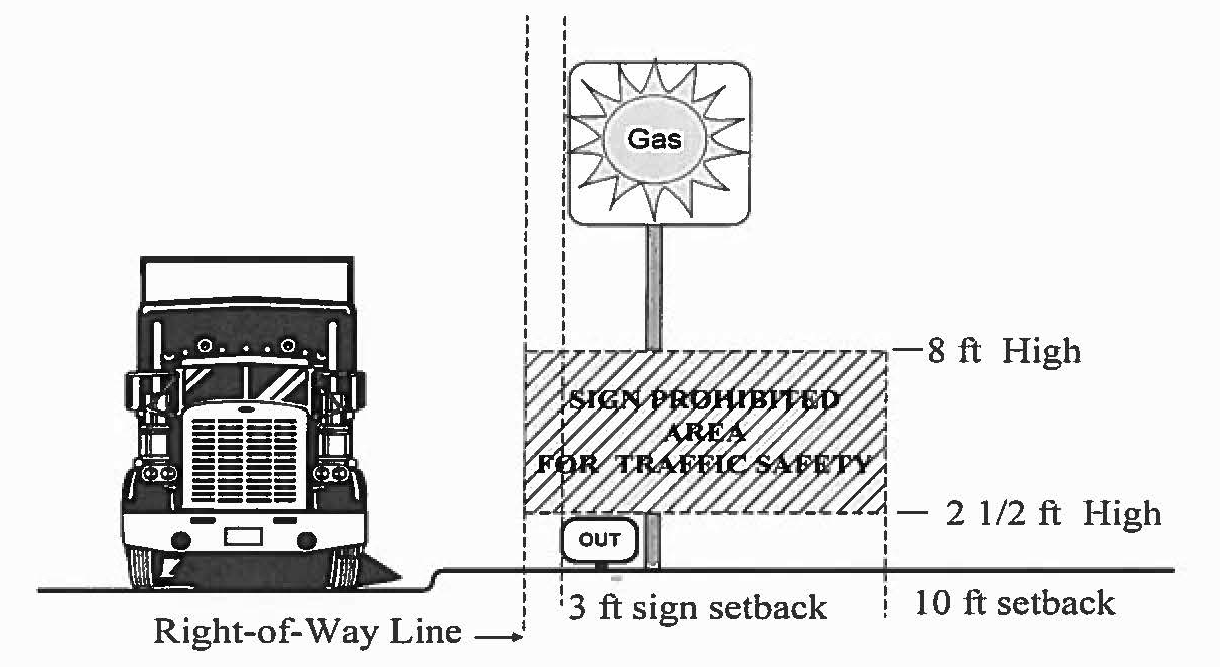
Signs in Clear Vision Area. No sign, temporary sign, or portable sign shall be placed or erected in an area between 2½ feet and 8 feet vertical and 3 feet and 10 feet horizontal as measure at the road right-of-way line and the elevation of the road at the centerline (see drawing below) as it may interfere with or obstruct the view of or be confused with any authorized traffic sign, signal or device.
d.
Traffic Visibility. No sign or sign structure shall be erected at the intersection of any street in such a manner as to obstruct free and clear vision, nor at any location where by its position, shape or color it may interfere with or obstruct the view of or be confused with any authorized traffic sign, signal or device.
e.
Computation of Frontage. If premises contain walls facing more than one property line or encompasses property frontage bounded by more than one street or other property usages, the sign area(s) for each building wall or property frontage will be computed separately for each building wall or property line facing a different frontage. The sign area(s) thus calculated shall be permitted to then be applied to permitted signs placed on each separate wall or property line frontage.
f.
Maintenance, Repair, and Removal. Every sign permitted by this ordinance shall be kept in good condition and repair. When any sign becomes insecure, in danger of falling or is otherwise deemed unsafe by the zoning administrator, or if any sign shall be unlawfully installed, erected or maintained in violation of any of the provisions of this ordinance, the owner thereof or the person or firm using same shall, upon written notice by the zoning administrator forthwith in the case of immediate danger, and in any case within not more than 10 days, make such sign conform to the provisions of this ordinance, or shall remove it.
g.
Obsolete Sign Copy. Any sign copy that no longer advertises or identifies a use conducted on the property on which said sign is erected must have the sign copy covered or removed within 60 days after written notification from the zoning administrator.
h.
Nonconforming Signs. Any sign and/or sign structure legally existing at the time of the passage of this ordinance that does not conform in use, location, height or size regulations of this ordinance, shall be considered a legal nonconforming sign and shall be permitted to continue. Structural changes, enlargement, replacement, or reestablishment of nonconforming signs or sign structures may only be authorized upon successful appeal by order of the Zoning Board of Appeals. A sign which is determined to be abandoned is no longer a nonconforming sign.
(Ord. No. 3-2018, § 1, 9-13-2018)
Section 8.04. - Exempt signs.
a.
Exempt Signs. The following signs shall be exempt from the provisions of this article. No sign shall be exempt from section 10.05.
1.
Official notices authorized by a court, public body or public safety official.
2.
Directional, warning or information signs authorized by federal, state, or municipal governments.
3.
Memorial plaques, building identification signs and building cornerstones when cut or carved into a masonry surface or when made of noncombustible material and made an integral part of the building or structure.
4.
The flag of a government or noncommercial institution, such as a school.
5.
Religious symbols, and seasonal decorations within the appropriate public holiday season, and temporary signs for special events posted for not more than 30 days prior to the event.
6.
Works of fine art displayed in conjunction with a commercial enterprise where the enterprise does not receive direct commercial gain.
7.
Street address signs, combination nameplate, and street address signs that contain no advertising copy and which do not exceed 6-square feet in area.
(Ord. No. 3-2018, § 1, 9-13-2018)
Section 8.05. - Prohibited signs.
a.
Prohibited signs. The following devices and locations shall be specifically prohibited:
1.
Signs located in such a manner as to obstruct or otherwise interfere with an official traffic sign, signal or device, or obstruct or interfere with a driver's view of approaching, merging or intersecting traffic.
2.
Except as provided for elsewhere in this article, signs encroaching upon or overhanging public right-of-way, including signs placed on utility poles, traffic control signs, structures or devices. A sign which is unlawfully placed within a public right-of-way may be removed and impounded by the zoning administrator or his authorized designees. No sign shall be attached to any utility pole, light standard, street tree or any other public facility located within the public right-of-way.
3.
Signs which blink, flash, or are animated by lighting in any fashion that would cause such signs to have the appearance of traffic safety signs and lights, or municipal vehicle warnings from a distance.
4.
Portable signs except as allowed for temporary signs.
5.
Any sign attached to, or placed on, a vehicle or trailer parked on public or private property, except for signs meeting all of the following conditions:
A.
The primary purpose of such a vehicle or trailer is not the display of signs.
B.
The signs are magnetic, decals or painted upon an integral part of the vehicle or equipment as originally designed by the manufacturer, and do not break the silhouette of the vehicle.
C.
The vehicle or trailer is in operating condition, currently registered and licensed to operate on public streets when applicable, and actively used or available for use in the daily function of the business to which such signs relate.
D.
The sign and/or vehicle are not illuminated.
E.
The business has sufficient parking.
F.
No portion of the vehicle encroaches on the road right-of-way.
G.
The vehicle does not in any manner obstruct the view of vehicular traffic from any driveway, parking space or parking isle, nor create any obstruction or hazard to vehicular traffic movement on the site or in the vicinity.
6.
Vehicles and trailers used primarily as static displays, advertising a product or service, or utilized as storage, shelter or distribution points for commercial products or services for the general public.
7.
Balloons, streamers, or pinwheels except those temporarily displayed as part of a special sale, promotion or community event. For the purposes of this subsection, "temporarily" means no more than 30 days in any calendar year.
8.
Signs in Clear Vision Area as described in section 10.03.
9.
Temporary signs except as permitted in Sections 10.04 and 10.10.
(Ord. No. 3-2018, § 1, 9-13-2018)
Section 8.06. - Permit fees.
Permit fees to erect, alter or relocate a sign shall be in accordance with the fee schedule adopted by resolution of the Board of Trustees of the Charter Township of Emmett unless specifically exempted, a sign permit must be obtained from the zoning administrator for the erection, alteration, repair, or replacement of any sign located within the jurisdiction of the Charter Township of Emmett.
Changes to the sign copy which are achieved without changing the area or shape of the sign face, or the structural integrity of the sign or sign structure as determined by the zoning administrator are exempt from the requirement to obtain a sign permit. Exemptions from a sign permit, however, shall not be construed to relieve the owner of the sign from responsibility to adhere to all the applicable provisions of this article and/or the Michigan Building and Electrical Codes.
(Ord. No. 3-2018, § 1, 9-13-2018)
Section 8.07. - Specific sign requirements.
a.
Changes to Signs. No sign shall be structurally altered, enlarged or relocated except in conformity to the provisions herein, nor until the proper permit, if required, has been secured. The changing or maintenance of movable parts or components of an approved sign that is designed for such changes, or the changing of copy, business names, lettering, sign faces, colors, display and/or graphic matter, or the content of any sign shall not be deemed a structural alteration.
b.
Illumination. The illuminance of the sign face by externally mounted light fixtures shall not exceed 100 foot-candles (lumens per square feet) as measured on the surface of the sign face. The luminance of internally illuminated signs shall be limited to a maximum of 2,000 nits (candela per square meter) as measured at the light source.
(Ord. No. 3-2018, § 1, 9-13-2018)
Section 8.08. - Identification signs.
Maximum Overall Area. Identification signs shall be in accordance with the following tables.
* For subdivision or apartment identification signs placed on a decorative entry wall approved by the zoning administrator, two identification signs shall be permitted to be placed at each entrance to the subdivision or apartment complex, one on each side of the driveway or entry drive.
a.
Maximum Overall Area: Wall Signs. Every residential complex, commercial or industrial building, and every separate non-residential building in a residential zone may display wall signs per street frontage subject to the limiting standards set forth in Table A. Limitations on the area of wall signs include window signs and limited roof signs, marquee signs, awning signs, canopy, and under canopy signs. Temporary placards and banners are excluded, only when issued temporary sign permits. (See definitions and additional requirements for specific sign types below.)
b.
Maximum Overall Area and Height: Free-Standing Signs. In addition to any allowable wall type signs, every residential complex, commercial or industrial building, and every separate non-residential building in a residential zone shall be permitted to display a (1) free-standing sign per street frontage subject to the limiting standards set forth in Table B. Limitations on the area of free standing signs include combination signs, projecting signs and revolving signs. Temporary placards and banners are excluded, and are permitted only when issued temporary sign permits. (See additional requirements for specific sign types below c.—h.)
(See Footnotes.)
1 Building width is measured along the architectural elevation of the building that is most closely parallel to the street.
2 For shopping centers or planned industrial parks, two monument-style free-standing signs not exceeding 50 percent each of the permitted height and area, and spaced not closer than 100 feet to any other free-standing identification sign, shall be permitted to be allowed in lieu of any free-standing sign otherwise permitted.
3 For any commercial or industrial development complex exceeding 1,000,000 square feet of gross leasable area, or 40 acres in size, such as regional shopping centers, auto malls or planned industrial parks, one free-standing sign per street front shall be permitted to be increased the maximum sign area by up to 50 percent.
c.
Canopy and Marquee Signs.
1.
The permanently affixed copy area of canopy or marquee signs shall not exceed an area equal to 25 percent of the face area of the canopy, marquee, or architectural projection upon which such sign is affixed or applied.
2.
Graphic striping, patterns, or color bands on the face of a building, canopy, marquee or architectural projection shall not be included in the computation of sign copy area.
d.
Awning Signs.
1.
The copy area of awning signs shall not exceed an area equal to 25 percent of the background area of the awning or awning surface to which such a sign is affixed or applied, or the permitted area for wall or fascia signs, whichever is less.
2.
Neither the background color of an awning, nor any graphic treatment or embellishment thereto such as striping, patterns, or valances, shall be included in the computation of sign copy area.
e.
Projecting Signs.
1.
Projecting signs shall be permitted in lieu of freestanding signage on any street frontage limited to one sign per occupancy along any street frontage with public entrance to such an occupancy, and shall be limited in height to 16 feet; and to an area of 1 square foot per each lineal feet of building frontage, except that no individuals sign shall exceed an area of 24 square feet.
2.
No such sign shall extend vertically above the building height as defined in this Ordinance.
3.
Such signs shall not extend over a sidewalk in excess of 67 percent of the width of the sidewalk.
4.
Such signs shall maintain a clear vertical distance above any sidewalk a minimum of 12 feet.
f.
Under Canopy Signs.
1.
Under canopy signs shall be limited to no more than one such sign per public entrance to any occupancy, and shall be limited to an area not to exceed 8 square feet.
2.
Such signs shall maintain a clear vertical distance above any sidewalk or pedestrian way a minimum of 12 feet.
g.
Roof Signs. Roof signs as defined in this Article are permitted as a type of wall sign in commercial and industrial zoning districts, subject to the following limitations:
1.
Such signs shall be limited in height to the distance below the building height as defined in this ordinance.
2.
The sign area for roof signs shall be assessed against the aggregate permitted area for wall signs on the elevation of the building most closely parallel to the face of the sign.
h.
Animated and Changeable Sign Faces. Animated and Changeable Sign Faces, except as prohibited by section 10.05, are permitted in the commercial and industrial zoning districts, and for churches, schools, community, or public buildings in residential districts, provided the sign operates at all times in manner consistent with definitions in this Article.
(Ord. No. 3-2018, § 1, 9-13-2018)
Section 8.09. - Non-identification signs.
The following type of signs are not considered in the maximum size calculations applicable to identification signs:
a.
Directional Signs. No more than two directional signs shall be permitted per street entrance to any residential development complex, non-residential use in a residential district and in the commercial or industrial use in a commercial or industrial zoning district, but not to exceed 2½ feet in height. There is no limit to the number of directional signs providing directional information within the interior of parking lots. In residential zoning districts, the maximum area for directional signs shall be 6 square feet. For all other zoning districts, the maximum area for any directional sign visible from adjacent property or rights-of-way shall be 8 square feet. Not more than 25 percent of the area of any directional sign shall be devoted to business identification or logo, which area shall not be included in the total allowed area for identification sign area.
b.
Menu Boards. Menu board signs shall not be permitted to exceed 50 square feet and no more than 20 percent of the total area for such a sign utilized for business identification.
(Ord. No. 3-2018, § 1, 9-13-2018)
Section 8.10. - Temporary signs.
a.
Real Estate Signs. Real estate signs shall be permitted in all zoning districts provided the signs are removed not later than 10 days after execution of a lease agreement in the event of a lease, or the closing of the sale in the event of a purchase; subject to the following limitations:
b.
Development and Construction Signs. Signs temporarily erected during construction to inform the public of the developer, contractors, architects, engineers, bankers, the nature of the project or anticipated completion dates, provided construction signs may not be displayed until after the issuance of construction permits by the building official, and must be removed not later than 2 days following issuance of an occupancy permit for any or all portions or the project; and shall be permitted in all zoning districts, subject to the following limitations:
c.
Special Promotion, Event, and Grand Opening Signs. Signs temporarily displayed to advertise special promotions, events and/or grand openings, including but not limited to, house parties, auctions and estate sales, shall be permitted in all zoning districts for no more than 30 days in any 3-month period, but not more than 60 days in a calendar year, beginning not more than 1 week prior to the event or opening and removed not more than 2 days after the ending of the event or opening, subject to the following limitations.
d.
Portable signs. Portable signs shall be permitted only in the Commercial and Industrial zoning districts, as designated in this article, subject to the following limitations:
1.
Such signs shall be displayed not more than 30 consecutive days in any 3-month period, and not more than 60-days in a calendar year.
2.
Any electrical portable signs shall comply with the ICC Electrical Code, as adopted. No portable sign shall be displayed prior to obtaining a sign permit.
3.
Trailers with message boards and trailers used as signs shall be treated as portable signs, and may not be installed as permanent signage.
4.
Portable signs shall be subject to the same restrictions on distance from the right-of-way applicable to permanent signs on the site.
5.
No more than one such sign may be displayed on any property, which shall not exceed a height of 5 feet or an area of 32 square feet.
e.
Political signs. Political signs shall be permitted in all zoning districts, subject to the following limitations:
1.
Such signs shall not exceed a height of 6 feet or an area of 32 square feet.
2.
Such signs for election candidates or ballot propositions shall be displayed only for a period of 91 days preceding the election and shall be removed within 10 days after the election, provided that signs promoting successful candidates or ballot propositions in a primary election may remain displayed until not more than 10 days after the general election.
3.
Such signs shall not be placed in any public right-of-way obstructing traffic visibility.
(Ord. No. 3-2018, § 1, 9-13-2018)
Section 8.11. - Freeway signs.
When a lot with a property line is within 200 feet of a freeway or freeway access ramp and located within a commercial or industrial zoning district one (1) additional on-premises freestanding sign is permitted subject to the following limitations:
Sign structure must be within 100 feet of closest wall of the premises being served by the sign.
a.
Maximum Sign Area. 150 square feet.
b.
Maximum Height. 80 feet.
c.
Minimum Distance from Property Line. ¼ of height with a minimum of 10 feet.
d.
Orientation. Sign faces shall be oriented to attract vehicular traffic from freeway.
(Ord. No. 3-2018, § 1, 9-13-2018)
Section 8.12. - Off-premises billboards.
Billboards shall be located so as to be visible to persons traveling on Interstate Highways, State Primary Highways or designated business loops and shall conform to the regulations and provisions under Act 106 of the Public Acts of Michigan of 1972, as amended, unless such billboard is prohibited by the provisions of this Ordinance. Billboards are prohibited in all districts except commercial and industrial. All billboards located in commercial and industrial districts shall conform to the following requirements:
a.
No billboard shall be located within three hundred (300) feet of any residence or residential zone.
b.
Where two (2) or more billboards are along the frontage of a single street or highway, they shall not be less than one thousand (1,000) feet apart. A double face, (back to back) structure shall be considered a single sign. No V-type signs shall be allowed where the face of each side of the sign can be seen from one location. Billboards shall not be located less than five hundred (500) feet from any on-premises free-standing sign approved or installed in order to minimize conflict between signs.
c.
The total surface area of a billboard, facing in one direction, viewable from State Primary Highways or designated business loop shall not exceed two-hundred (200) square feet and the maximum height shall not exceed thirty (30) feet above the grade of the ground providing support for the sign. The total surface area of any billboard, facing in one direction, viewable from and Interstate Highway shall not exceed six hundred seventy-two (672) square feet and the maximum height shall not exceed forty (40) feet above the grade of the highway (amended December 2005).
d.
No billboard shall be erected on the roof of any building, nor have one sign above another sign.
e.
Billboards may be illuminated by reflected light only, provided the source of light is not directly visible and is so arranged to reflect away from the adjoining premises and provided that such illumination shall not be so placed as to cause confusion or a hazard to traffic or conflict with traffic control signs or lights. No illumination involving movement by reason of the lighting arrangement or other devices shall be permitted.
f.
Billboards shall be designed, constructed, operated, maintained and managed so as to be harmonious and appropriate in appearance with the existing or intended character of the general vicinity, and so their use will not change the essential character of the same area.
(Ord. No. 3-2018, § 1, 9-13-2018)

