
Enfield City Zoning Code
ARTICLE X
- SITE DEVELOPMENT REGULATIONS
Section 10.00. - Purposes.
The purpose of this article is to guide site development activities to assure that such activities are conducted in a manner that protects the health, safety and the general welfare of the citizens in Enfield.
Section 10.10. - Off-street parking and loading regulations.
A.
The following regulations are designed to provide adequate off-street parking and loading facilities and safe vehicle movements while minimizing any detrimental effects to adjacent properties, neighborhoods and the environment. Accessory off street parking facilities in existence on the effective date of these regulations shall not hereafter be reduced below, or if already less than required shall not be further reduced below, the requirements for a similar new building or use under the provisions of these regulations.
B.
No building or structure shall be erected, enlarged, modified, or its use changed to a use requiring additional off-street parking and/or loading spaces unless permanently maintained off-street parking and loading spaces are provided for the new use in accordance with the provisions of these regulations, except where such change of use, new building, alteration or increase in floor area requires no increase in parking over what presently exists.
10.10.1. General requirements.
A.
Accessory off street parking and off-street loading facilities shall be provided as required by these regulations for all buildings and structures erected and all uses of land established in each district after the effective date of these regulations.
B.
When the intensity of use of any building, structure or lot shall be increased through the addition of dwelling unit gross floor area, seating capacity, or other units of measurement in the amount specified herein requiring parking or loading facilities, such additional parking and loading facilities as required herein shall be provided.
C.
Whenever the existing use of a building or structure shall hereafter be changed to a new use, parking or loading facilities shall be provided as required for such new use. However, if the said building or structure was erected prior to the effective date of these regulations, additional parking or loading facilities are mandatory only in the amount by which the requirements for the new use would exceed those for the existing use if the latter were subject to the parking and loading provisions of these regulations.
D.
In situations where parking facilities are permitted on land other than the lot on which the building or use being served is located, such facilities shall be in the same possession as the lot occupied by the building or use to which the parking facilities are accessory. Such possession may be either by deed or long-term lease, the term of such lease to be determined by the commission. The owner of the land on which the parking facilities are to be located shall be bound by covenants, filed on record in the office of the town clerk, requiring such owner, his or her heirs and assigns, to maintain the required number of parking facilities for the duration of the use served or of said lease, whichever shall terminate sooner.
E.
Off street parking facilities required as an accessory use to all uses permitted by these regulations shall be solely for the parking of passenger vehicles of patrons, occupants, and employees of those uses.
F.
When the application of these off-street parking regulations results in a requirement of not more than three spaces on a single lot in any business district, such parking spaces need not be provided. However, where two or more uses are located on a single lot only one of these uses shall be eligible for the above exemption. This exemption shall not apply to dwelling units.
G.
Not more than one camping-type vehicle and/or boat may be parked on any lot in a HR-33, R-33, R-44 or R-88 zone. Such vehicle shall be parked or stored only in a garage or on a paved surface located no closer to the front property line than the front wall of the residence. Such paved area shall not be located within any required side yard or within five feet of the rear lot line. Commercial vehicles in residential districts may be parked only in accordance with section 3.30.13 of these regulations. (Amended 11/25/03).
10.10.2. Number of required parking and loading spaces. Parking and loading spaces shall be provided in all zones in sufficient number to accommodate the motor vehicles of all occupants, employees, customers and any others normally visiting the premises for each new, expanded or change in use in accordance with the following schedule:
Table 10.10.2 Parking Standards
10.10.3. Determination of required parking spaces.
A.
The parking space requirements for a use not mentioned or variations of above uses shall be determined by the commission. Where a determination must be made, the decision shall be based upon: (1) standards set forth herein for uses with similar characteristics, (2) previous experience with similar uses and (3) studies or standards such as those promulgated by such professional organizations as the Institute of Traffic Engineers; the American Planning Association; The Urban Land Institute; and the Congress for the New Urbanism.
B.
Multiple uses: Where two or more different uses occur on a single lot, the total amount of parking facilities to be provided shall be the sum of the requirements of the uses computed separately for each individual use on the lot. However, the commission may reduce this total where it can be demonstrated that the uses on a site have peak parking needs at different hours of the day.
C.
Fractional measurements: Where fractional spaces result from calculation of parking space requirements equal or greater than one-half total parking spaces required shall be the next highest whole number.
10.10.4. Special requirements for regional shopping centers.
A.
The number of parking spaces required shall be four for each 1,000 square feet of gross leasable floor area (GLA).
The applicant may attain such parking ratio either: (i) by constructing spaces in a number sufficient to meet minimum standard or determined need (ii) by constructing not less than three and one-half spaces for each 1,000 square feet of gross leasable area and showing on its site plan "reserved future parking areas" containing parking spaces in a number which, when combined with the constructed parking, shall result in a total number of spaces that meets the minimum standard or determined need.
B.
If the applicant is approved for reserved future parking areas, then, one year following the granting of a certificate of occupancy for the building spaces, the applicant shall submit a parking analysis to the director of planning, which analysis shall demonstrate the adequacy of the number of on-site parking spaces during the non-holiday peak shopping hour and the peak shopping days.
If the director of planning determines that the number of existing on-site parking spaces are insufficient, he/she shall notify the applicant and the commission of such finding and the applicant shall construct, in the reserved future parking area, such additional spaces as may be required to solve the parking deficiency.
10.10.5. Reserved.
10.10.6. Parking design, layout, and location. The standards of this section shall apply to all parking areas that serve three or more vehicles or two or more uses.
A.
General design requirements:
i.
All off street parking areas and driveways shall be designed, to include drainage design, and constructed to the town standards.
ii.
Lighting: Any lighting used to illuminate off-street parking areas shall be directed away from residential properties so as not to create a nuisance. In a parking area containing three or more parking spaces, such lighting shall be extinguished one-half hour after the close of the business, except as may otherwise be permitted or required by the planning and zoning commission.
iii.
All parking areas must be designed in a manner as to provide safety for vehicles, pedestrians, landscaping and signage.
iv.
Up to 25 percent of the minimum number of required parking spaces may be allocated for compact cars and correspondingly reduced in size subject to the approval of a compact car parking layout plan. A compact car space shall not be less than eight feet wide and 16 feet long. All such spaces must be identified by signs indicating that the parking spaces are only for the use of compact cars.
B.
Layout requirements:
i.
All parking areas shall be designed to provide safe turning movements from streets into the parking areas and within the parking areas.
ii.
Each required off-street parking space shall open directly upon an aisle or driveway of such width and design as to provide safe and efficient means of vehicular access to such parking space. All off-street parking facilities shall be designed with appropriate means of vehicular access to a street or alley in a manner which will least interfere with traffic movement.
iii.
Each required parking space, exclusive of driveways and aisles, shall be at least nine feet wide and 18 feet long. The dimensions for parking spaces and drive aisles shall conform to the following table:
In addition to the requirements set forth in the above table, the commission may require collector drive aisles to be 30 feet in width and may require major entry and exit drive aisles to be of such a width and to contain sufficient lanes as may be necessary to safely accommodate projected traffic volumes and turning movements.
iv.
Every parking area shall be landscaped to the standards of sections 10.10.7 and 10.20.
C.
Locational requirements:
i.
Off street parking may be located in any yard and shall be located on the same lot as the building or use unless otherwise provided for in these regulations.
ii.
Off street parking for buildings or uses existing on the on the effective date of these regulations that are altered so as to require additional parking spaces, or new uses established in any business district, may be served by parking areas located on lots other than those on which the building or use is located only if such offsite parking areas are within 500 feet of the main entrance to the use being served. Such offsite parking areas shall be located in a zoning district where off street parking is a permitted or special permit use.
Figure 10.10.6 illustrates possible layouts and the dimensions for parking areas, aisles and driveways.
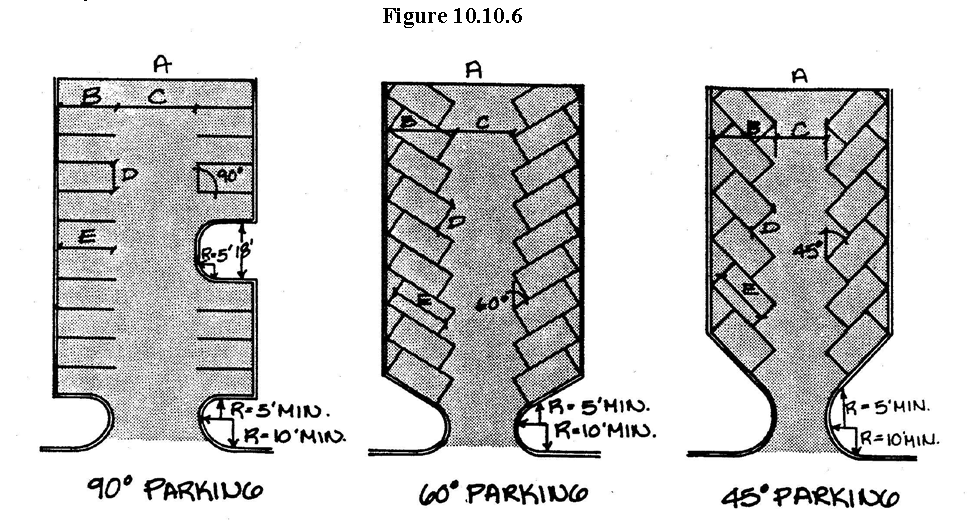
This is an interpretive aid only and is not part of the regulations.
iii.
Notwithstanding the foregoing, in the BR, BP, I-1, I-2 and I-P zones, the dimensions of a parking space may be decreased to 8.5 feet wide by 18 feet long in a professional office building complex provided that the professional office building complex has at least 300,000 SF of gross floor area and at least 80 percent of the gross floor area is occupied either by not more than three tenants or by the owner of the building and its affiliated entities and that the complex has at least 1,100 parking spaces. (Amended 04/01/04)
iv.
Every parking area shall be landscaped to the standards of sections 10.10.7 and 10.20.
10.10.7. Parking area setbacks and landscaping standards.
A.
Landscape setback requirements: Excluding driveway crossings, landscaped areas adjacent to streets shall be provided as follows:
i.
Any parking area designed and intended for use by at least three but not more than 25 parking spaces shall have a minimum landscaped setback from the right-of-way of five feet.
ii.
Any parking area designed or intended for use by more than 25 parking spaces shall have a minimum landscaped setback from the right-of-way of eight feet.
iii.
Any parking area designed or intended for use by more than 100 parking spaces shall have a minimum landscaped setback from the right-of-way of ten feet.
iv.
Landscaped areas shall be planted with ground cover and one canopy tree for each 50 feet of frontage.
v.
A sidewalk not less than four feet wide shall be constructed and may be located in either the landscaped setback or street right-of-way.
vi.
Any parking area designed or intended for use by at least three parking spaces shall have a minimum landscaped setback of all parking spaces and driveways/aisles from all side and rear property lines of ten feet; and, except for loading areas, shall have a minimum landscaped separation of all parking spaces and driveway/aisles from buildings of ten feet.
B.
Parking lot landscaping:
i.
Any parking area designed or intended for use by at least three parking spaces shall have a minimum of 15 percent of the gross parking area in landscaped areas. These landscaped areas shall occur in interior or end parking lot islands all of which shall be at least ten feet wide.
ii.
When existing facilities are expanded, the commission shall have the right to approve the location of the required landscaping in areas other than interior or end parking lot islands in the newly constructed areas, to approve a modification of the size of the required landscaped areas and to approve other modifications to the landscaping requirements so as to spread the new landscaping throughout the existing and newly constructed parking area.
[iii.]
The minimum amount of landscaping materials required in landscape areas shall be suitable ground cover and one canopy tree for each five parking spaces.
10.10.8. Loading area requirements.
A.
On any lot which is hereafter developed for a non-residential use, there shall be provided adequate space suitably located on the lot for the loading and unloading of goods and material. Loading areas shall meet the following standards:
i.
Loading areas associated with loading docks shall be screened from the street in the BR, BP and IP zones.
ii.
All loading spaces that abut a residential district or an intervening alley separating an industrial district from a residential district shall be screened by walls or fences uniform in color, at least eight feet high.
iii.
Loading spaces shall not be located within 40 feet of an intersection.
iv.
Loading spaces shall not be in a required front or side yard.
v.
No motor vehicle repair work shall be permitted in conjunction with loading facilities.
(Amended 09/08/17)
Section 10.20. - Landscaping standards.
A.
Site plans for all construction, including new developments and changes to existing developments, shall meet the following landscaping standards.
i.
Canopy trees shall be a minimum of two and one-half inches in caliper.
ii.
Evergreen trees shall be a minimum of six feet in height.
iii.
Understory trees shall be a minimum of one and one-half inches in caliper.
iv.
Deciduous shrubs shall be a minimum of two and one-half feet in spread.
v.
Evergreen shrubs shall be a minimum of two and one-half feet in height with a mature height of at least six feet.
B.
Buffer yards: Any lot developed or proposed to be developed with commercial or industrial uses which abuts or is located across the street from a residential district shall establish and maintain buffer yards as a minimum to the standards which follow. Additionally, the commission may require that a buffer yard be placed on any lot in a residential district when a special permit is being approved for such a lot abutting another lot in a residential district. Buffer yard examples are shown in figure 10.20.
i.
"A" buffer yard — These standards shall be required where any business district is across the street from any residential district. Additionally, the commission may require this buffer yard be placed on any lot in a residential district when a special permit is being approved for such a lot abutting another lot in a residential district. An "A" buffer yard is 25 feet deep.
ii.
"B" buffer yard — These standards shall be required where any industrial district is located across the street from any residential district. A "B" buffer yard is 50 feet deep.
iii.
"C" buffer yard — These standards shall be required where any business district abuts a residential district. A "C" buffer yard is 35 feet deep.
iv.
"D" buffer yard — These standards shall be required where any industrial district abuts a residential district. A "D" buffer yard is 100 feet deep.
C.
The commission may modify the buffer yard standards when, in the opinion of the commission, the adjoining land users are sufficiently protected.
D.
Additional requirements: The commission may, in addition to requiring buffer yards, require that a berm as shown in figure 10.20 be built and may require the substitution of evergreen trees for understory trees in those instances where it determines that it is necessary to screen a site from adjacent uses.
Figure 10.20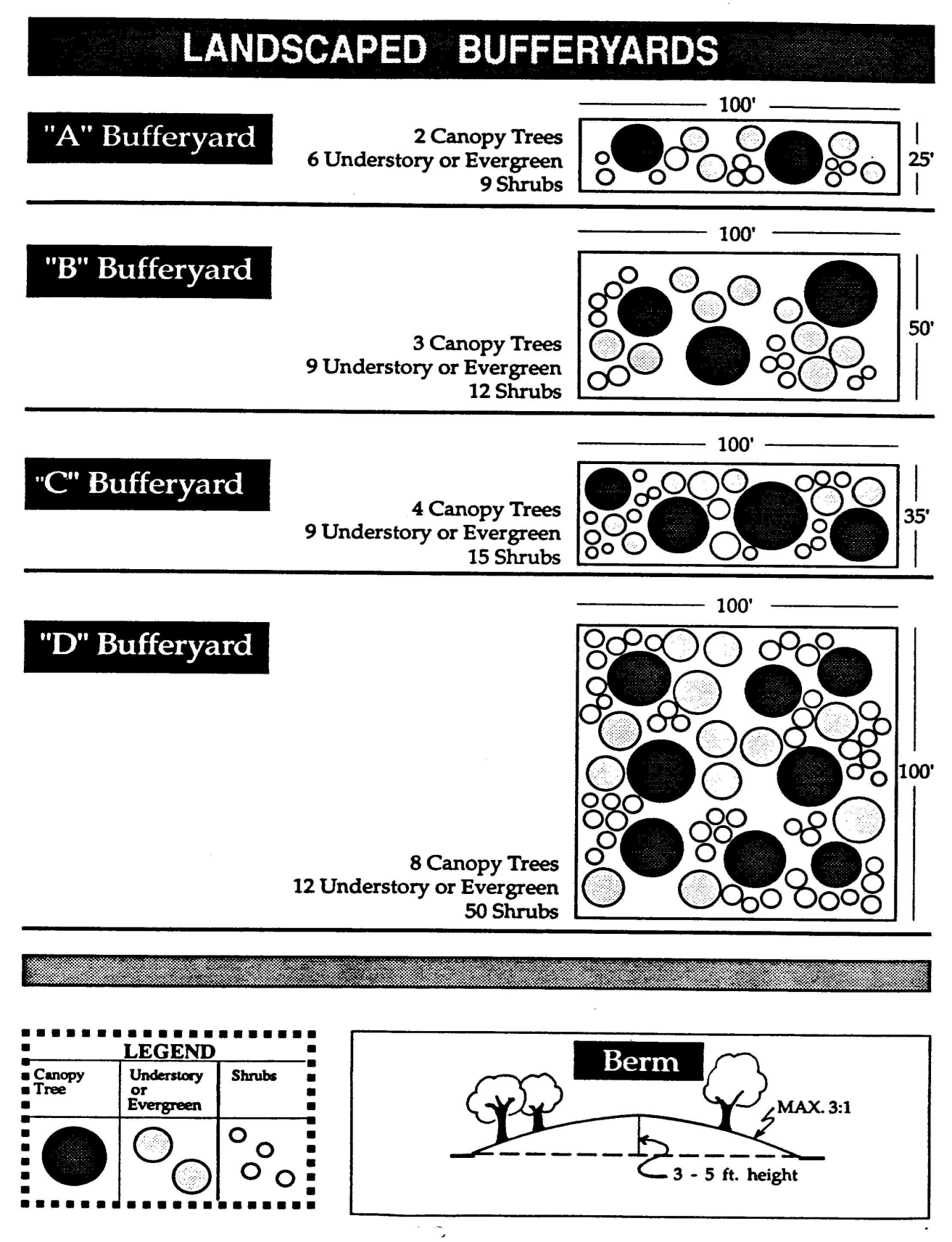
Section 10.30. - Sign regulations.
A.
The purpose of these regulations is to control the height, size, and location of signs in the community in order to ensure public safety, protect property values, encourage economic development, insure neighborhood compatibility and to further the general purpose of the zoning regulations.
10.30.1. General requirements.
A.
Measurement of sign area: The area of a sign shall be considered that of the smallest rectangle or triangle which encompasses all lettering, wording design or symbols together with any background which is designed as an integral part of and obviously related to the sign. See figure 10.30.1.
Figure 10.30.1 Sign Area Measurements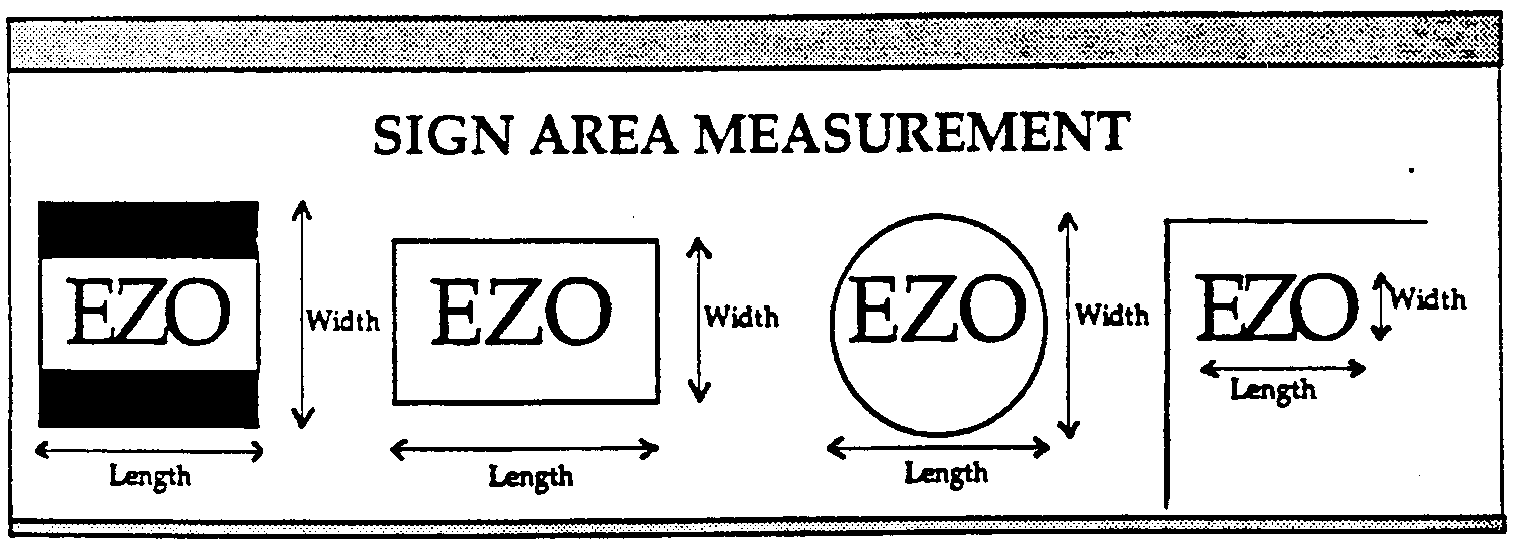
B.
Square feet limitations contained in this article refers to the area of each face of two-faced signs.
C.
Sign location: No attached sign shall project more than 12 inches from the face of a structure. All freestanding signs must be at least ten feet back from the street line unless otherwise stated. Signs must be located so that only a single side is visible from any viewing point.
D.
Height of signs: The height of a freestanding sign is to be measured from the ground to highest point of the sign.
E.
No sign, or portion thereof, attached to a structure shall project above the exterior wall of the said structure. No sign shall be erected above those locations illustrated in figure 10.2.
Figure 10.30.2 Maximum Height of Attached Sign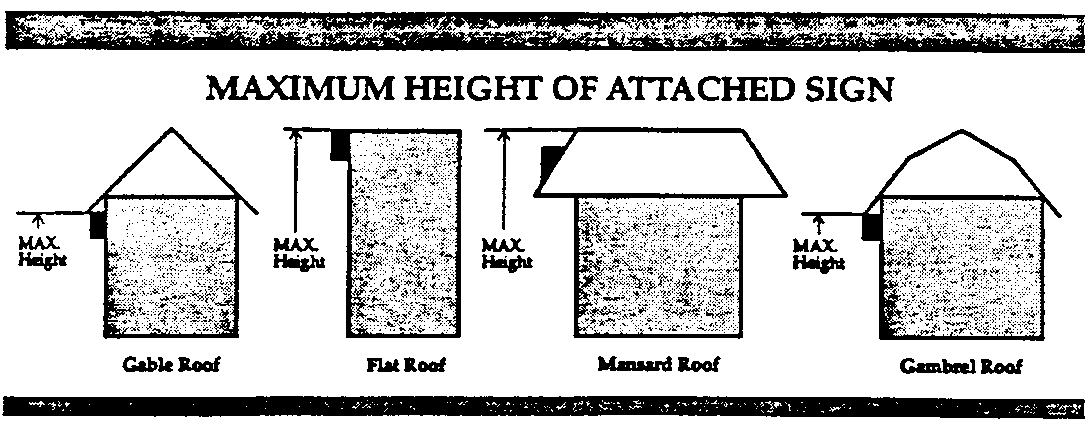
F.
Sign illumination/sign movement: A sign may be illuminated if illumination is confined to or directed toward the surface of the sign.
i.
No flashing, rotating or intermittent illumination shall be permitted except signs indicating time and/or temperature by means of intermittent lighting, provided the longest dimension of such signs does not exceed five feet.
ii.
The light sources of signs shall be so designed and shielded that they cannot be seen from beyond the property lines on which the said sign is located and to minimize night glare.
iii.
Signs with exposed neon tubes shall be permitted in all business districts. The outlining of buildings or structures, ornamental features or architectural elements such as windows by use of exposed neon tubing, strings of lights, light emitting diodes or otherwise is allowed by special use permit only. (Amended 7/28/03)
G.
No signs, or any parts of any signs, shall be permitted to be mechanically rotated or moved.
H.
The following are exempt from the sign regulations:
i.
Public art on private and public properties that contain no commercial message.
10.30.2. Sign review procedures.
A.
Type A sign: All signs designated herein as type A signs are permitted as a matter of right and require no formal application.
B.
Type B sign: All signs designated herein as type B signs shall be approved by the office of the director of planning in accordance with the following procedures:
i.
The office of the director of planning shall review plans for compliance with the applicable provisions of this chapter. Upon completing the review, the office of the director of planning shall approve or deny such application within five working days. The following shall constitute an application:
a.
Application form (available in the office of the director of planning);
b.
Filing fee as determined by the commission or by ordinance; and
c.
Drawing and/or photograph of the proposed signage, indicating its dimensions, height (as measured from the ground), location, color and content of the proposed sign.
ii.
Should the office of the director of planning determine the application does not conform to these regulations; the application must be altered to conform. An applicant may appeal a determination of the director of planning to the commission.
iii.
Nothing in this section shall prevent an applicant from seeking approval of a type B sign by the commission in association with any use requiring a site plan approval or a special permit approval. An approval of signage by the commission shall constitute a type B sign approval.
C.
Type C sign: All signs designated as type C signs shall require the filing of an application for a site plan in accordance with article IX of these regulations. Application requirements for a type C sign permit shall be the same as that required for a type B sign.
D.
Signs associated with multi-tenant buildings: During the review of a site plan or special permit of any building or development containing more than one tenant, the commission shall review and approve a sign theme for the building or development, showing uniform location and sizes of all wall signs for all tenant spaces. Future applications for individual signs shall be generally consistent with the approved theme.
10.30.3. Signs permitted in single family residence districts.
A.
The following table describes all signs permitted in single family residence districts:
Table 10.30.3 Signs Permitted in Single Family Residential Districts
Notes to Table 10.30.3.
1.
Only municipal, non-profit, and special permit uses signs may be illuminated. Lighting must be external, incorporated into the sign structure, and shine down from the top onto the sign face. Lighting must be completely shielded to prevent off-site glare. (Amended 6/03/03)
2.
Open or welcome flags are permitted for non-conforming business uses or special permit uses only. The commission shall consider any possible negative impact on any abutting residences. Flags may display only colors and/or the words "open" or "welcome."
3.
Open or welcome flags shall be mounted on building wall and shall not project above wall.
4.
All freestanding signs shall be at least ten feet from the street line; farm stand signs shall be 15 feet from the edge of street pavement.
5.
Height of freestanding signs limited to 12 feet.
6.
Home occupation and professional signs must be of a simple round, square, or rectangular design. (Amended 6/03/03)
7.
Up to 32 square feet allowed by special use permit provided the property has a minimum of 150 feet of frontage; 12 sq. ft. per side maximum otherwise. (Amended 6/03/03)
10.30.4. Signs in permitted in special residential developments.
A.
The following table describes all signs permitted in special residential developments:
Table 10.30.4 Signs Permitted in Special Residential Developments
Notes to Table 10.30.4.
1.
Individual unit sale/lease signs shall be located within 25 feet of entrance to unit.
2.
Home occupation and professional office signs may not be illuminated and must be of a simple round, square, or rectangular design.
3.
All freestanding signs shall be at least ten feet from the street line.
4.
Height of freestanding signs is limited to 12 feet.
10.30.5. Signs permitted in business districts.
A.
The following table describes all signs permitted in business districts except that attached signs are generally covered under paragraph B.
Table 10.30.5 Signs Permitted in Business Districts
Notes to Table 10.30.5.
1.
Rows 1 through 9 apply to all business zones; Row 10 applies only to properties in the LO district; Row 11 applies only to properties in Hazardville; Rows 12 to 13 apply to all business zones, except those in Thompsonville.
2.
The total sign area on any lot (sum of attached and freestanding signs) shall not exceed two sq. ft. per linear foot of the front wall(s) of the building(s) on the site. No individual sign may exceed an area of 300 sq. ft. unless approved by the commission as a type C sign. Front wall for the purposes of this section shall mean:
i.
for a single-tenant building, that wall of the building which contains the main entrance;
ii.
for a multi-tenant building, that wall or walls of the building (maximum of three) upon which wall signs may be attached, but shall not include the rear wall of the building which provides service entrances.
3.
On lots zoned business regional which are three acres or greater in area, and within 1,000 feet of a limited access highway, the commission may grant a type C sign permit allowing a freestanding sign greater than 20 feet in height. The maximum height of such a sign shall not exceed 20 feet above the elevation of the traveled portion of the highway closest to the site on which the sign is located.
4.
All freestanding signs shall be at least ten feet from the street line.
5.
For those sites containing a multi-tenant building with tenants located more than 200 feet from the street, the commission may permit a permanently mounted sign attached to the freestanding sign, which may display a temporary message associated with any business on the site.
i.
The maximum sign area not to exceed one-third the size of either the existing freestanding sign area or the maximum freestanding sign area allowed by these regulations, whichever is smaller;
ii.
The applicant shall demonstrate that the number of lines of text and height of letters will be easily readable from the adjacent roadways; and
iii.
The sign shall be located below the freestanding sign and shall not extend beyond the boundaries formed by the vertical extension of the existing freestanding sign.
6.
Flags may display only colors and/or the words "open" or "welcome." Open or welcome flags shall be mounted on a building wall and shall not project above a wall.
7.
Height of freestanding signs is limited to 20 feet.
8.
(Amended 5/05/03) For the purpose of this section, "parcels" and "lot" shall include "out parcels" within which are sited freestanding satellite uses within business centers, regardless of whether satellite uses occupying such land areas have been actually subdivided from the business center or are exclusive use land lease areas within such centers, and where:
a.
Such satellite uses front upon public highways with a minimum of 75 feet of frontage at the street or highway line.
b.
Such satellite uses use and occupy land areas which are accessible by motor vehicles only from within business centers.
Freestanding signs identifying such uses within business districts shall be subject to special use permit approval by the Enfield Planning and Zoning Commission and shall:
i.
Not create a visual obstruction to both traffic within the main traveled portion of any highway upon which such use fronts, or to traffic entering and exiting the highway within the vicinity of the sign, which vicinity shall include, at a minimum, the safe sight lines in both directions required by the posted speed limit within the highway.
ii.
Be individually visible to approaching motor vehicle traffic within the main traveled portion of the highway which the sign addresses for a sufficient time to have directional value to the motoring public utilizing such sign for direction.
iii.
Not exceed six feet in height and shall not exceed 64 square feet in total area including both sides and shall otherwise comply with the provisions of this section.
iv.
Not be located closer than 125 feet to another free-standing sign.
The applicant shall reasonably demonstrate a need for the sign; the criterion for such need shall be that the sign will enhance public safety by having significant directional value.
9.
(Amended 5/20/04)
a.
No canopy sign shall exceed 32 square feet in area.
b.
No canopy sign shall extend above, below, or project beyond, the canopy.
B.
Attached signs in business districts, except for the Thompsonville district, shall meet the following requirements:
i.
Attached signs for each occupant in a building are allowed on any portion of a wall facing a public street. The total attached signage shall not exceed:
a.
One square foot per linear foot of wall to which the sign is attached, if any part of the building is within 25 feet of the right-of-way;
b.
One and one-half square feet per each linear foot of wall to which the sign is attached, if the closest portion of the building to the right-of-way is between 25 feet and 50 feet;
c.
Two square feet per linear foot of wall to which the sign is attached, if the closest portion of the building to the right-of-way is greater than 50 feet; and
d.
Signs measuring up to two square feet of sign per linear foot of wall are permitted for those uses which face a street, the traveled portion of which is 20 feet or more from the right-of-way line of the property upon which the sign is to be located.
ii.
Attached signs for each occupant in a building are allowed on any portion of a wall visible from a public street. The total attached signage for such wall shall not exceed 75 percent of the signage area as calculated in a through d above.
C.
Regulations for attached signs for the Thompsonville district are found in section 10.30.7.
10.30.6. Signs permitted in industrial districts.
A.
The following table describes all signs permitted in industrial districts, except that attached signs are generally covered under paragraph B.
Table 10.30.6 Signs Permitted in Industrial Districts
Notes to Table 10.30.6.
1.
The total sign area on any lot (sum of attached and freestanding signs) shall not exceed two sq. ft. per linear foot of the front wall(s) of the building(s) on the site. No individual sign may exceed an area of 300 sq. ft. unless approved by the commission as a type C sign. Front wall for the purposes of this section shall mean:
i.
for a single tenant building, that wall of the building which contains the main entrance; or
ii.
for a multi-tenant building, that wall or walls of the building (maximum of three) upon which wall signs may be attached, but not to include the rear wall of the building which provides service entrances.
2.
If a freestanding sign is to be located over 100 feet back from the right-of-way, and the parcel is ten acres or more in size, then it is to be considered a type C sign. In such a case, a permit may be granted allowing a maximum height of 20 feet, and a maximum area of 75 square feet per side. Such a sign should be consistent with the design of the building on the site.
3.
Directory signs shall be designed and located so that it is intended to be reviewed from a pull-over lane. The sign shall be located at least 100 feet back from the street line of major thoroughfare (excluding industrial park internal road system). For the purposes of this section, an industrial park shall mean a multiple tenant office or industrial development under unified ownership or control at the time of application, the size of which is 25 acres or greater.
4.
All freestanding signs shall be at least ten feet from the street line; farm stand signs shall be 15 feet from the edge of street pavement.
5.
For those sites containing a multi-tenant building with tenants located more than 200 feet from the street, the commission may permit a permanently mounted sign attached to the freestanding sign, which may display a temporary message associated with any business on the site.
i.
The maximum sign area not to exceed one-third the size of either the existing freestanding sign area or the maximum freestanding sign area allowed by these regulations, whichever is smaller;
ii.
The applicant shall demonstrate that the number of lines of text and height of letters will be easily readable from the adjacent roadways; and
iii.
The sign shall be located below the freestanding sign and shall not extend beyond the boundaries formed by the vertical extension of the existing freestanding sign;
6.
Flags may display only colors and/or the words "open" or "welcome." Open or welcome flags shall be mounted on a building wall and shall not project above a wall.
7.
Height of freestanding signs limited to eight feet unless otherwise noted.
8.
Type B hiring signs shall not be internally illuminated, shall be located behind the street line, and shall be maintained for a maximum duration of six months.
B.
Attached signs in industrial districts shall meet the following requirements:
i.
Attached signs for each occupant in a building are allowed on any portion of a wall facing or visible from a public street. The total attached signage shall not exceed:
a.
One square foot per linear foot of wall to which the sign is attached, if any part of the building is within 25 feet of the right-of-way;
b.
One and one-half square feet per linear foot of wall to which the sign is attached if the closest portion of the building to the right-of-way is between 25 feet and 50 feet;
c.
Two square feet per linear foot of wall to which the sign is attached, if the closest portion of the building to the right-of-way is over 50 feet; and
d.
Signs measuring up to two square feet per linear foot of wall are permitted for those uses which front a street, the traveled portion of which is 20 feet or more from the right-of-way line of the property on which the sign is to be located.
10.30.7. Special sign requirements, Thompsonville district.
A.
Within the Thompsonville district, all signs shall be type B signs except for the following:
i.
Any sign over 100 square feet shall only be approved by the commission as a type C sign;
ii.
Flag signs for multi-tenant buildings shall be type C signs;
iii.
A marquee sign may be allowed by the commission for a film theater or performing arts theater as a type C sign. The size, height and length of projection from the face of the building shall be determined and approved by the commission; and
iv.
Decorative street pole or pedestrian oriented banners within the public right-of-way installed and maintained by the town identifying the Thompsonville district or civic or seasonal holidays are permitted as type A signs.
B.
No freestanding or pole signs or roof signs shall be allowed, except the commission may allow monument type freestanding signs for a building existing as of August 1, 1993 if the building is set back from the street line at least 20 feet, and if the sign does not exceed eight feet in height, nor exceed 32 square feet in area.
C.
Attached sign shall be so located on the building in a manner compatible to the architecture of the building;
D.
Projecting signs may be permitted by the commission where the sign is no larger than 12 square feet, extends no more than three feet from the face of the building, where the bottom of the sign is at least ten feet above the sidewalk and where the sign does not extend above the sills of the windows on the second floor.
E.
Attached signs shall not exceed one square foot of sign area for each one foot of building facade to which it is attached, which fronts on a street, and shall not extend above the sill of the windows of the second floor.
F.
Awning signs may be placed on canvas or fabric awnings where the awnings are part of the overall building design approved by the commission in accordance with the design theme of the Thompsonville revitalization strategy.
G.
Flags shall be permitted under this section provided they comply with the following criteria:
i.
A maximum of one flag for each single tenant building;
ii.
The number of flags per multi-tenant buildings as approved by the Commission;
iii.
A maximum size of 15 square feet for each flag;
iv.
Flags mounted exclusively to wall of building; and
v.
Flag shall not project beyond the top of the building wall for single story buildings, or extend above the sill of the windows of the second floor.
H.
A sign theme shall be presented as part of a site plan application, for approval of the commission with any proposed multi-tenant building; and no sign shall be erected that is not in compliance with the approved sign theme.
I.
Public informational and directional signs may be erected identifying destinations or uses to the public such as parking, parks, types of businesses, municipal or government uses, public restrooms, public telephones and similar uses. Such signs shall be only in locations and of a design approved by the commission as part of the site plan approval.
J.
No internally illuminated signs shall be allowed, except where only the sign's letters are illuminated and the background is non-illuminated; each sign may be externally illuminated in a manner approved by the commission.
K.
Temporary signs shall be allowed in the same manner as set forth in rows 1 through 8 of table 10.30.5, above.
10.30.8. Special sign requirements, Hazardville design district A (HDDA). (Amended 6/03/04)
A.
Signs within the Hazardville design district overlay shall comply with the requirements for the underlying district except as specified in section 8.70.B.vi. and the following:
i.
Decorative street pole or pedestrian oriented banners within the public right-of-way installed and maintained by the town, or an organization designated by the town council, identifying the Hazardville design district or containing a civic or seasonal theme are permitted as type A signs. Such signs may display sponsor's names in a traditional font but may not contain any corporate logos or advertising messages.
10.30.9. Freestanding tenant identification signs (pylon signs) in business, and industrial districts. (Added 09/08/17)
A.
Purpose: The purpose of this section is to provide free standing tenant identification signs for larger size multi-tenant buildings or multi-building sites.
B.
The owner of a multi-tenant building or multi-building site may apply for one or more free standing signs adjacent to entrances/exits of the tenant site subject to the provisions of these sig regulations in business and industrial zones.
C.
The commission shall use the criteria required for the review of a special permit in addition to the criteria of this section to consider signs provided for in this section.
D.
Parcels shall be either one acre or greater in size or have at least 10,000 square feet of gross building size in order to apply under this section.
E.
The commission must make a finding that the free standing multi-tenant identification sign is proportional to the size of the development and the streetscape where the property is located. In no event will a freestanding tenant identification sign exceed a height of 40 feet or an area per side of 240 square feet.
F.
All signs under this section will be considered type C signs.
G.
The commission shall consider the public safety and directional value of any proposed sign.
H.
The following are exempt from the sign regulations:
i.
Public art on private and public properties that contain no commercial message.
(Ord. of 10-27-2022(2); Ord. No. 26-01, §§ 29, 30, 2-12-26)

