
Enfield City Zoning Code
ARTICLE VIII
- SPECIAL REGULATIONS
Section 8.00. - Purposes.
It is the purpose of this article to provide standards for a variety of uses so that their location and operation will be consistent with the protection of the public's health, safety, and welfare.
Section 8.10. - Retail sale of alcoholic liquor.
All uses operating under a permit issued by the state liquor control commission shall comply with the requirements of this section. Furthermore, a special permit shall be required for the sale of alcoholic liquor.
8.10.1. Definitions. All definitions of words used in this chapter shall be the same as defined in Section 30-1 of the Connecticut General Statutes, Revision of 1958, as amended, unless herein specifically otherwise stated. "A Regional Shopping Development" shall mean only a planned commercial development permitted to be constructed in a business regional district (Section 5.30). "Permit premises" shall mean only that area of a particular building that is actually used for the sale or storage of alcoholic beverages. "Specified land use" shall mean a lot or part of a lot used or reserved to be used for the purposes of a public school, public playground, a church, or a building used as a place of worship.
8.10.2. Classification of permit premises. All permit premises are classified as follows:
A.
Class 1 — A hotel permit, a hotel permit for the sale of beer only, a restaurant permit, a restaurant permit for the sale of wine and beer only, a restaurant permit for the sale of beer only.
B.
Class 2 — Tavern permits and cafes.
C.
Class 3 — Package store for the sale of all alcoholic beverages, and druggist permits for the sale of alcoholic beverages.
D.
Class 4 — Package store for the sale of beer only, grocery stores for the sale of beer only, and druggist permits for the sale of beer only.
E.
Class 5 — Premises holding a club permit.
8.10.3. Separation requirements.
A.
Measurement of separation distances: Separation distances shall be measured along the center line of the public right-of-way from the principal front entrance of the existing use to the principal front entrance of the building where the proposed use will be conducted. Included in this measurement will be the distance to the entrance to the building(s) as measured from the centerline of the street.
B.
Permit premises shall observe the following separation requirements:
Table 8.10.3—Separation Distances
1 The commission may grant a special permit to reduce or waive this separation requirement.
2 The commission may grant a special permit to reduce or waive this separation requirement in the TD-4 and TD-5 Zones.
8.10.4. Requirements concerning retail sale of alcoholic liquor within planned commercial developments within a business regional district.
A.
The commission may, using special permit procedures, waive any of the separation requirements between permit premises and specified land uses.
B.
The commission may, using special permit procedures, waive the separation requirements between like classes providing the following conditions are met:
i.
The development contains a minimum of 120,000 square feet of gross floor area. This threshold may permit up to two like classes to exist in the development without the specified separation requirements.
ii.
Additional like class permit premises may be approved providing there shall be at least 75,000 square feet of gross floor area for each two permit premises for any one class.
iii.
The commission shall take into consideration the number of approved locations for all classes of permits within the business regional district, the effect which a new permit location may have on the business regional district, and whether another permit premises in the locality is in the best public interest.
(Ord. of 03-12-2025(1))
Section 8.20. - Wireless communication facilities.
8.20.1. Purpose. The purpose of this section is to permit wireless communication facilities within the town while protecting the public and the town's neighborhoods and minimizing the adverse visual and operational effects of wireless communication facilities. More specifically, the purposes are:
A.
To encourage creative design measures to minimize adverse visual effects;
B.
To provide standards for design, siting, and vegetative screening to minimize adverse visual effects;
C.
To reduce the number of antennas and towers needed in the future;
D.
To accommodate the need for wireless communications towers and antennas while not unreasonably regulating their location and number; and
E.
To encourage the joint use of any existing or new towers
8.20.2. Locational preferences. The order of preference for siting the equipment associated with wireless communication facilities shall range from one, as the most preferred, to six, as the least preferred, as noted below:
1.
On existing structures such as buildings, water towers, and utility poles;
2.
On existing approved towers;
3.
On new towers less than 80 feet in height located in commercial or industrial zones;
4.
On new towers less than 80 feet in height located in residential zones;
5.
On new towers 80 feet or greater in height located in commercial or industrial zones; or
6.
On new towers 80 feet or greater in height located in residential zones.
8.20.3. Special standards.
A.
No lights shall be mounted on towers unless required by the Federal Aviation Administration (FAA). Strobe lighting shall be avoided where possible.
B.
Towers not requiring special FAA painting or marking may be galvanized, painted a non-contrasting blue, gray, or other neutral color, or other such color as needed to blend into its location.
C.
Towers may not be used to exhibit any signage or advertising.
D.
Towers shall be designed in all respects to accommodate both the applicant's antennas and comparable antennas for two additional users if the proposed antenna is over 100 feet in height; if over 50 feet in height, it shall be designed to accommodate one additional comparable antenna.
E.
Towers shall be set back from all property lines a distance equal to their height. The commission may waive this requirement when there is adequate documentation that the tower structure has been designed to collapse in a manner which will not impact adjacent properties.
F.
Antennas or equipment buildings/boxes mounted to or on buildings or structures shall to the greatest degree possible blend with the color and/or design of such structure/building.
G.
Roof top antennas shall not exceed a height of 15 feet above the highest part of a structure or building. Additionally, such antennas shall be set back from the roof edge a minimum of ten feet or ten percent of the roof depth, whichever is greater.
H.
Antennas mounted on the facade of a building shall match the color of the building and shall project not more than three feet horizontally from the wall or facade of the building and project not more than five feet vertically above the cornice line of the building or wall to which attached.
I.
Unless waived by the commission, dish antenna shall comply with the following:
i.
Dish antennas shall not exceed two feet in diameter in residential zones.
ii.
Dish antennas shall not exceed six feet in diameter in non-residential zones.
The commission may waive the above requirements when there is satisfactory documentation that such antennas are screened from view from adjacent lots and from public streets.
J.
Accessory buildings, to be used for housing only telecommunications equipment, are permitted. Such buildings shall not exceed 750 square feet in area and shall be architecturally designed to blend into the neighborhood. Such buildings shall not exceed a height of 12 feet.
K.
A fence of appropriate design eight feet in height shall enclose the facility. This requirement may be waived when the design of the facility does not warrant a fence, e.g., a flag pole design or a similar stealth design. Landscape buffers shall be provided around the perimeter of the facility as provided for in section 10.20.B.
L.
No proposed wireless communications facility shall be designed, located, or operated so as to interfere with existing or proposed public safety communications.
M.
The design and operation of the wireless communication facility shall comply with the Federal Communications Commission (FCC) standards regulating non-ionizing electromagnetic emissions.
N.
All utilities to serve the facility shall be installed underground unless otherwise approved by the commission.
O.
Generators, if utilized, shall comply with all state regulations and the town noise ordinance.
8.20.4. Permits. Wireless communication facilities shall be permitted in all zones subject to the following:
A.
Site plan: Where the commission determines that an antenna proposed on an existing structure or building meets the following criteria (i, ii or iii below), such antenna and wireless communication facilities may be allowed subject to the submission and approval of a site plan in accord with the requirements of article IX.
i.
An omni-directional or whip antenna with a length of 20 feet or less and seven inches or less in diameter, provided its material and or color blends with the exterior of the structure.
ii.
A directional or panel antenna six feet or less in height and two feet or less in width provided its location and appearance blends with the exterior of the structure.
iii.
A satellite and microwave dish antenna six feet or less in diameter provided the building or rooftop mount is located or screened so it is not visible from abutting public streets.
B.
Special permits: Wireless communication facilities that do not qualify for site plan approval under section 8.20.4 above may be permitted only after the approval of a special permit as provided for in article IX and this section.
8.20.5. Application requirements. In addition to complying with other application requirements of section 8.20, an application for a wireless communication facility shall include the following:
A.
A Site Plan application meeting the standards of section 9.10.1 and 9.10.2.
B.
A map showing the extent of planned coverage within the town and adjacent communities, and the location and service area of the proposed facility. This map shall be accompanied by a report that documents the need for the wireless communications facility. At the minimum, this report will document that the facility is needed to provide acceptable coverage and/or capacity for wireless communications.
C.
A statement containing a description of the siting criteria and the process by which other possible sites were considered.
D.
Architectural renderings and/or photo simulations of views of the tower from nearby properties.
E.
A report from a qualified radio frequency engineer that the proposed facility will meet the FCC requirements for radio frequency radiation at the time that the facility will be operating at maximum capacity.
F.
A report from a qualified radio frequency engineer that the proposed facility will not interfere with existing or proposed public safety communications.
G.
When a tower is proposed, a statement from the applicant indicating that, weather permitting, the applicant will raise a balloon, with a diameter of at least three feet, at the proposed ground mounted tower site and to the proposed tower height. Such balloon shall be raised at least three days prior to the date of the public hearing scheduled on the application. A legal notice of the scheduled balloon raising shall be published in a local newspaper. Proof of such publication shall be submitted at the public hearing.
H.
In all cases in which the commission determines that an expert peer review of the applicant's service area, tower sharing, alternative location or other technical issues is reasonably warranted, the applicant shall be required to reimburse the town for the cost of performing such peer review.
8.20.6. Removal. A wireless communication facility not in use for 12 consecutive months shall be removed by the service facility owner. This removal shall occur within 90 days of the end of such 12-month period. Upon removal, the site shall be restored to its previous appearance and, where appropriate, re-vegetated to blend with the surrounding area. The commission may require that a bond in a form acceptable to the commission and the director of finance be submitted prior to the issuance of any building permits for the full costs of the removal of such wireless communications facilities and full site restoration as estimated by the town.
Section 8.30. - Municipal and public utility uses.
8.30.1. Purposes. The purpose of this section is to permit necessary municipal and public utilities in a manner that minimizes conflict with adjacent uses and the surrounding area, and protects the health and safety of the public.
8.30.2. Special permit required.
A.
Municipal and public utility uses, buildings, and structures, including governmental and emergency services communication towers and/or antennas, may be authorized by the commission as a special permit in any zone under the applicable criteria of article IX and provided that the following conditions are met:
i.
The proposed use is compatible with existing development.
ii.
All of the requirements of the zoning district are met. The commission may exempt uses from meeting floor area, lot area, and lot width requirements when the proposed use does not involve use by the general public.
iii.
When the commission exempts a use from the minimum floor area, lot area, and/or lot width requirements, the commission must determine that the land is of sufficient area and width to protect the public health, safety, and welfare.
iv.
Municipal solar energy systems are allowed in any district by special permit subject to meeting the applicable requirements of section 8.80. (Added 3/19/12)
B.
These requirements shall not apply to standard utility distribution systems.
(Ord. No. 26-01, § 16, 2-12-26)
Section 8.40. - Excavation operations.
8.40.1. Purpose. The purpose of this section is to prevent conditions detrimental to the public health, safety and general welfare, including, but not limited to, erosion, creation of dangerous open pits, stagnant water bodies, nuisances, or permanent damage to the landscape. These regulations are also directed at minimizing any deleterious effects on adjacent or nearby land uses.
8.40.2. General requirements.
A.
Authorization: Excavation operations are authorized only after the owner of the premises has received a special permit in accordance with the provisions of these regulations, except in the case of the following operations:
i.
Excavation operations within the actual rights-of-way of public streets or highways of either the town or the state or within streets or roads as shown on a subdivision map or a plan of conservation and development map approved by the commission;
ii.
Excavation operations within a premise as a result of bona-fide construction operations, such as building erection, for which operation a building permit has been issued by the building official;
iii.
Excavation operations completely within a premises as a result of bona-fide landscaping, agricultural, or construction operation for which operation no building permit is required, provided that no such excavation operation shall result in removal or filling in of more than 600 cubic yards of earth products for each individual premises; and
iv.
The town shall be exempt from the provisions of this section.
B.
Site plans: In addition to the requirements of article IX, site plans for excavation operations shall show the following:
i.
The site plan shall provide for proper drainage of the area of the operation after completion;
ii.
Slopes shall not exceed a vertical rise of one foot over two feet of horizontal distance;
iii.
The site plan shall note and show that at the conclusion of the operation or of any substantial portion thereof, the whole area where removal takes place shall be covered with not less than four inches of top soil and seeded with suitable crop cover.
iv.
Excavation shall not occur within 30 feet of any side or rear property line unless authorized by the commission. Natural vegetation within this 30-foot area shall be preserved.
C.
Hours of operation: Excavation and removal may occur only on weekdays between the hours of 7:00 a.m. and 5:00 p.m. No excavation/removal shall take place on weekends or holidays.
D.
On-site equipment: Except in an industrial district, no stone crusher or other machinery not required for actual removal of the material shall be used.
E.
Bonding: Prior to the start of any excavation operation authorized as a special permit, the applicant shall post a bond in accordance with section 9.10.4 of these regulations. Any bond for excavation activities shall include funds adequate to guarantee restoration of the site.
F.
Criteria for approval: When approving such applications, the Commission shall consider the effect of such removal on the surrounding property and the future usefulness of the premises when the operation is completed.
G.
Modification of site plans: The applicant may request modifications to the approved site plan provided that any bonding as required in section 8.40.2.E. shall not be reduced until all of the requirements of this section have been satisfied.
H.
Duration of permit: Such permits shall be issued for a period not exceeding two years. Permits may be renewed providing there is compliance with the provisions of this section.
Section 8.50. Connecticut River conservation overlay zone regulations.
8.50.1. Purposes. The purpose of this section is to provide standards for the preservation and usage of land within the conservation zone along the Connecticut River. These standards are designed to promote development practices which will support the following goals:
i.
Protecting and improving the water quality of the Connecticut River;
ii.
Preserving the necessary flood storage capacity of floodplains;
iii.
Preserving unique natural, historic and scenic areas and the natural topography of riverfront land;
iv.
Preserving and encouraging the development of agricultural land uses which contribute to conservation of the area's soil and water resources and which increase a long-term food producing capacity;
v.
Promoting the recreational potential of the river area and public access to the riverfront which is consistent with the ability of the land and the river to support such use;
vi.
Influencing the visual impact of riverfront development; and
vii.
Encouraging the preservation and rehabilitation of the Connecticut River greenbelt.
8.50.2. Definitions. For the purposes of this section, the following definitions shall apply:
A.
Clearing plan: A plan showing the existing mix of forest tree species, their approximate height, age and density; a description of the cutting or removal activities to be undertaken.
B.
Greenbelt: An area of natural vegetation bordering the Connecticut River that is either publicly or privately managed.
8.50.3. Location. The conservation zone is an overlay zone and is shown on the official zoning map of the town. The area of the conservation zone is as defined in Public Act 82-296 of the State of Connecticut, Title 25, Chapter 477c of the Connecticut General Statutes.
8.50.4. Standards for uses within the floodplain.
A.
Purpose: Floodplain use is regulated so as to preserve the necessary flood storage capacity; to promote public health, safety and general welfare through minimizing flood losses in floodplain areas; and to promote floodplain uses which are compatible with beneficial floodplain functions.
B.
Activities permitted as of right.
i.
Agricultural or farming uses, excluding farm buildings and farm structures.
ii.
Fences accessory to farm or agricultural uses.
C.
Obstructions and encroachments within the floodplain: In acting upon any proposal for obstruction or encroachment in the floodplain, the commission shall use the following guidelines:
i.
The following activities are generally considered compatible with floodplain values:
a.
Conservation activities which do not require significant physical alteration of watercourses and floodplains (e.g., wild life and nature preserves, game farms, fish hatcheries, etc.).
b.
Parks and recreation areas provided that the placement of small piers, catwalks, floats, docks, piles and other similar structures including trails and pedestrian access routes providing such facilities:
1.
do not include dredging or filling of the watercourses and do not require significant physical alterations of floodplains;
2.
are elevated on low-impact pile foundations;
3.
do not interfere with or obstruct navigation; and
4.
do not restrict circulation or tidal flushing.
c.
The repair, relocation and/or rearrangement of floating docks, open pile docks, and similar structures within an established marina or boat basin which involves no disturbance of the watercourse or floodplain other than removing or relocating anchors or pilings.
d.
The construction of boat launching ramps where encroachment is to the minimum necessary to provide access to navigable waters.
e.
Erection of water-dependent industrial and commercial facilities when:
1.
Elevated pile-supported construction is utilized;
2.
The facilities do not interfere with the circulation of navigable or tidal waters;
3.
The facilities are designed to minimize the destruction of indigenous vegetation;
4.
They do not significantly affect native wildlife;
5.
Their encroachment is limited to that minimally necessary to provide structural stability;
6.
There is no alternative for accomplishing the applicant's objective which is prudent and technically feasible, and which further minimizes adverse impacts;
7.
The height, width and length of structures are limited to the minimum dimensions necessary to accomplish their intended function; and
8.
The facilities are flood proofed.
ii.
The following activities are incompatible with floodplain activities.
a.
Activities which require incremental filling of the floodplain, where incremental shall mean fill, including any material or structure, which would have the effect of displacing water or the flood storage capacity of the property. (Shifting existing contours without the addition of new fill from off site and which does not reduce the existing flood storage capacity of the subject property is not considered incremental filling.)
b.
Construction of any structure whose lowest floor, including basement, is lower than the flood elevation.
c.
Construction of any structure which is not anchored to prevent flotation, collapse, or lateral movement of the structure.
d.
Construction of waste disposal systems which are not flood proofed to avoid impairment to them or contamination from them during flooding.
e.
Construction of industrial facilities using, producing or storing hazardous or toxic substances (nuclear power plants, chemical factories, oil storage tanks, etc.) which are not protected against a flood of rare occurrence.
D.
Lot coverage: No residential building or an accessory building thereto shall be constructed, reconstructed, enlarged, extended, moved or structurally altered in such a manner as to exceed the maximum percentage of total lot coverage allowed for such buildings in the aggregate on any single lot as indicated in the following table.
Table 8.50.3 — D
Maximum Lot Coverage — Residential Zones
8.50.4. Required plans.
A.
The zoning enforcement officer shall not sign off on any building permit submitted in connection with any subdivision, multi-family project or permitted non-residential use in any district unless a site plan and an soil erosion and sedimentation control plan shall have been submitted to and approved by the commission. (Subdivision plans need not show house locations, driveways or other lot specific improvements unless the subdivision is also a senior residential development or a special residential development.) (Amended 08/01/10)
B.
A cutting plan shall be submitted as part of the supporting documentation filed with a required site plan or as one of the required exhibits to be submitted for land subdivision.
Section 8.60. - King Street/Enfield Street design overlay district.
A.
Purpose: These standards are intended to promote the use of design elements which respect traditional architectural styles common to the traditional New England Town. The standards contained herein are directed at guiding new development and renovations such that their scale and architecture will harmonize with the surroundings and reflect and/or complement traditional New England architectural styles. These standards apply to the King Street/Upper Enfield Street Design Overlay District as shown on the zoning map.
B.
Siting: All spaces and structures visible to the public from public roadways shall be designed to add to the visual amenities of the area. Building setbacks from the street, side setbacks from adjacent buildings, and orientation of the axis of buildings shall be consistent with and recognize the location, spacing, and orientation of other adjacent buildings. Visually important landscapes and vistas shall be preserved. Existing site features such as stone walls, large trees, and other features shall be incorporated into all new designs to the greatest extent possible. When feasible, new development proposals shall include creative reuse of existing buildings of significant historical and architectural interest.
C.
Building design elements: Materials, texture, and color used on the exterior walls and roofs shall be those associated with traditional New England architecture. Preferred building materials shall be brick, stone, and wood including narrow width siding, clapboards, wood shingles, or reasonable equivalents.
D.
Architectural details: Architectural details characteristic of the particular style and period proposed should be incorporated into the design for any new construction and should relate harmoniously to adjacent buildings. It is not intended that the architectural details of old buildings be duplicated precisely, but they should be regarded as suggestive of the extent, nature and scale of details that would be appropriate on new buildings or alterations. Desirable architectural features, where appropriate for a particular style, include gabled roofs, multi-pane windows, chimneys, porches, shutters, gothic arches, white columns and entablature, and fanlights. Examples of designed architectural style include Colonial, Georgian, Federal, Greek Revival, Romantic Revival and Victorian styles. Stonewalls, picket-type fences, wrought iron fences, and decorative wrought iron street-furniture are encouraged.
E.
Signs: Design and placement of signs should complement the building's composition and architectural details. Signs shall consist of materials and colors which are appropriate to facade design and materials, use lettering styles, sizes, and composition that relate to architectural style within the district, and be illuminated externally. The commission may approve an internally lit sign that is deemed appropriate in design for its setting, its location, and its proximity to residential areas during the application review process for new or expanded businesses. An applicant for a sign permit may also request commission review and approval of an internally lit sign for an existing business that does not otherwise have a pending application before the commission. (Amended 9/25/07)
F.
Waiver of yard requirements: The commission may waive up to 50 percent of any required yard/setback when, in its sole discretion, such waiver will accomplish one or more of the following:
i.
Permit a more functional use of the site relative to building location, parking, or access;
ii.
Provide for the preservation of existing site features to include specimen trees and other plantings; or
iii.
Allow for a superior building site design meeting the purposes of the district.
iv.
Waivers shall require a special permit application.
G.
(Effective 5/23/05) Waiver of building height: The commission may waive the maximum height of the proposed building(s) when, in its sole discretion, such a waiver will accomplish one or more of the following:
i.
Permit a more functional use of the site relative to overall site design meeting the purposes of the district; or
ii.
Provide for the preservation of existing site features to include wetlands or watercourses, specimen trees and other plantings; or
iii.
Allow for a superior building site design meeting the purposes of the District.
iv.
No building shall contain more than three stories)
v.
Waivers shall require a special permit application.
(Ord. No. 26-01, § 17, 2-12-26)
Section 8.70. - Hazardville design districts.
A.
Purpose: These use and design standards contained herein are intended to promote a variety of residential and commercial uses which will complement and enhance the existing historical architecture of the Hazardville section of Enfield and encourage and enable the rehabilitation and/or adaptive reuse of vacant, deteriorated buildings and the lots on which such buildings are located. The standards contained herein shall apply to the Hazardville Design District A ("HDDA") as shown on the zoning map. The standards for the overlay design district shall be in addition to the requirements of the underlying zone.
B.
Special standards for the HDDA overlay district:
i)
All requirements of section 4.20 regarding home occupations, home professional offices shall apply to properties zoned R-33 except that within the HDDA, there shall be no limitation as to non-resident employees/employer. Additionally, any structure proposed for such use shall have such use limited to the ground floor of the structure and the second floor shall be devoted to residential use.
ii)
Any property located within the HDDA shall also be designated as being in the limited office district under the provisions of section 5.70 of the zoning regulations.
iii)
Any property located within the HDDA may apply for development approval under a planned design special permit ("PDSP"). Such special permit may allow a use of land, buildings and other structures, and related site development, not permitted within the existing zoning district where the lot is located but which would be beneficial to and consistent with the orderly development of the town and the neighborhood, and consistent with the purposes of these regulations and the plan of conservation and development. In order to be approved for a PDSP, the proposed development must be shown to accomplish the following:
a)
Successfully addresses a specific goal for Hazardville as contained in the plan of conservation and development.
b)
Provides for a new or renovated building the design of which complements and improves the appearance of Hazardville.
c)
Provides pedestrian amenities such as gathering areas, sidewalk cafes, new sidewalks or extensions thereof.
d)
Provides a service or business to address the needs of the neighborhood.
iv)
Planned design special permits shall require applications for site plan and special permit approval. Applications shall include a restoration plan for the building, as well as a narrative statement detailing the uses proposed, the lot, building, and yard requirements proposed for the property, and the manner, if any, in which such uses and standards differ from those of the underlying zone.
v)
Conversion of only existing non-residential buildings to business-residential mixed use buildings may take place under this section, subject to the following requirements and notwithstanding sections 4.70.6 and 4.70.8 of these regulations:
vi)
Permitted sign areas for attached and free-standing signs may be increased by 20 percent when the commission determines that the design of the sign has incorporated appropriate historical details relevant to the Hazardville area.
vii)
New or expanded residential structures may observe a 15-foot front yard setback providing that the new or expanded structure incorporates an open porch along the full frontage of the structure, and that the width of the width of the structure along the frontage is at least 85 feet of the width of the widest part of the structure parallel to Hazardville Avenue.
viii)
Existing, otherwise non-conforming site conditions, shall be allowed to continue in accordance with section 3.40 (non-conforming uses, structures, and lots).
C.
Building design elements: Materials, texture, and color used on the exterior walls and roofs shall be those associated with traditional New England architecture. Preferred building materials shall be brick, stone, and wood including narrow width siding, clapboards, wood shingles, or reasonable equivalents.
D.
Architectural Details: Architectural details characteristic of the particular style and period proposed should be incorporated into the design for any new construction and should relate harmoniously to adjacent buildings. It is not intended that the architectural details of old buildings be duplicated precisely, but they should be regarded as suggestive of the extent, nature and scale of details that would be appropriate on new buildings or alterations. Desirable architectural features, where appropriate for a particular style, include gabled roofs, multi-pane windows, chimneys, porches, shutters, gothic arches, white columns and entablature, and fanlights. Examples of designed architectural style include Colonial, Georgian, Federal, Greek Revival, Romantic Revival and Victorian styles. Stonewalls, picket-type fences, wrought iron fences, and decorative wrought iron street-furniture are encouraged.
E)
In addition to the standards set forth above and in the evaluation criteria found in article IX of these regulations all applications for development within the Hazardville design district A as shown on the Enfield Zoning Map shall contain a review of the application's consideration of the guidelines contained in the Hazardville Study Design Review Guide which is found in the appendix of these regulations. (Amended 06/02/08)
(Ord. of 1-14-2021(1); Ord. No. 26-01, § 18, 2-12-26)
Section 8.75. - Scitico design overlay district.
A.
Purpose: These design standards contained herein are intended to encourage a variety of residential and commercial uses which will promote a village design for the Scitico section of Enfield. The standards contained herein shall apply to the Scitico design overlay district as shown on the zoning map. The standards for the overlay design district shall be in addition to the requirements of the underlying zone unless specifically modified.
B.
Special standards for the Scitico design overlay district include:
i.
Any property located within the Scitico design overlay district may apply for development approval under a planned design special permit. (PDSP) All new or substantial rehabilitation construction must apply for a (PDSP).
ii.
Such special permit may allow a use of land, buildings and other structures, and related site development, not permitted within the existing zoning district or zoning envelope where the lot is located but which would be beneficial to and consistent with the orderly development of the town and the neighborhood, and consistent with the purposes of these regulations and the plan of conservation and development. In order to be approved for a PDSP. The planning and zoning commission must make a finding that the proposed development accomplishes the following:
a.
Successfully addresses the village mixed use goal as contained in the plan of conservation and development.
b.
Provides for a new or renovated building meets the design standards of the district.
c.
Provides pedestrian amenities such as gathering areas, sidewalk cafes, new sidewalks or extensions of sidewalks.
d.
Contributes to a village ambiance of the Scitico area.
iii.
Planned design special permits shall require applications for site plan and special permit approval. Applications shall also include a narrative statement detailing the uses proposed and the lot, building, and yard requirements proposed for the property, and the manner, if any, in which such uses and standards differ from those of the underlying zone.
C.
Building design and architectural elements: Materials, texture, and color used on the exterior walls and roofs shall be those associated with traditional New England architecture. Preferred building materials shall be brick, architectural stone and wood, including narrow width siding, clapboards, wood shingles, or reasonable equivalents. These architectural design elements shall be submitted as part of the formal site plan submission for any construction and/or substantial rehabilitation.
D.
Reserved.
E.
Site design. The preferred site design is for buildings to be located near the street with parking either on the side or in the rear. Parking in front of the building is restricted. Pedestrian amenities are to be incorporated.
(Added 09/08/17)
(Ord. No. 26-01, §§ 19—21, 2-12-26)
Section 8.80. - Solar energy systems.
A.
Purpose: The purpose of this subsection is to provide for the regulation of the construction and operation of solar energy facilities in the Town of Enfield, subject to reasonable conditions that will protect the environment, public health, safety, and welfare.
B.
Definitions:
Solar energy system, large: A solar energy collection system, which is interconnected to the local utility electrical grid and generates electricity that can be sold directly into the wholesale electricity market through a regional transmission organization, and/or that can be used to serve all or part of the electric load at one of more properties and consumers.
Solar energy system, roof-mounted: A solar collection system that is installed upon or is part of the roof of a building or structure located on the subject property. Systems integrated as awnings or attached to the roofs of porches, sheds, carports and covered parking structures also fall under this distinction.
Solar energy system, small: An accessory solar energy collection system that is interconnected to the local utility electrical grid on the customer's side of the electric meter, generates electricity for direct consumption on the subject property to offset electricity purchased from the local electric distribution company, and performs in accordance with current state net-metering laws.
8.80.1. Small-scale solar energy systems. Small solar energy systems shall be a permitted as an accessory use by right in all zoning districts subject to the requirements set forth in this section: Solar energy systems include ground, pole and roof mounted systems.
8.80.1.1. Energy: The energy generated by the small solar energy system shall be used for direct consumption on the subject property and be interconnected to the electric utility power grid to off-set energy use on the subject property, in accordance with current state net-metering laws.
8.80.1.2. The construction of the small solar energy system shall be in accordance with an approved building permit application. If the small solar energy system is to be interconnected to the local utility power grid, a copy of the notification from the local electric distribution company (EDC) that the EDC has received a complete interconnection request ("application").
8.80.1.3. Setback:
a.
In residential districts ground- or pole-mounted small-scale solar energy systems shall be placed so that no individual component is closer than five feet from the rear lot line (except on through lots as defined in section 2.30 of these regulations) and five feet from side lot lines. Ground or pole-mounted solar energy system shall only be allowed in the rear or the side yard behind the front building line.
b.
In business and industrial districts ground- or pole-mounted small-scale solar energy systems shall be placed so that no individual component of the solar system may extend into the front, side or rear setback for the district. Ground mounted small-scale solar systems shall be screened from adjoining residential districts by arborvitae or similar evergreen hedge planted six feet on center located on the outside of the perimeter fence. The commission may allow additional or alternative screening methods such as berms and opaque fencing when it is determined that such alternatives are more appropriate for the particular site.
8.80.1.4. Ground-mounted small solar energy systems:
a.
The total height of the solar energy system, including any mounts shall not exceed 18 feet above the ground at maximum height. If the solar energy system is intended to provide power for outdoor lighting, the system shall not extend higher than the permitted height of the structure to which it is attached and/or inter-connected.
b.
Panels shall be mounted onto a pole, rack or suitable foundation, in accordance with manufacturer specifications, in order to ensure the safe operation and stability of the system. The mounting structure (fixed or tracking capable) shall be comprised of materials approved by the manufacturer, which are able to fully support the system components and withstand adverse weather conditions.
c.
Multiple mounting structures shall be spaced apart at the distance recommended by the manufacturer to ensure safety and maximum efficiency.
d.
Any electrical wiring used in the system shall be underground (trenched) except where wiring is brought together for inter-connection to system components and/or the local utility power grid
e.
No ground-mounted small solar energy systems shall be affixed to a fence.
f.
Ground-mounted small-scale solar energy systems in business and industrial districts shall be subject to site plan review pursuant to the provisions of section 9.10 of these regulations.
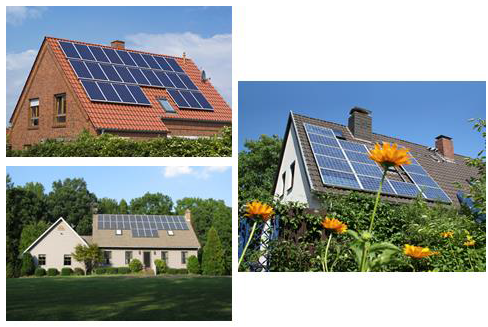
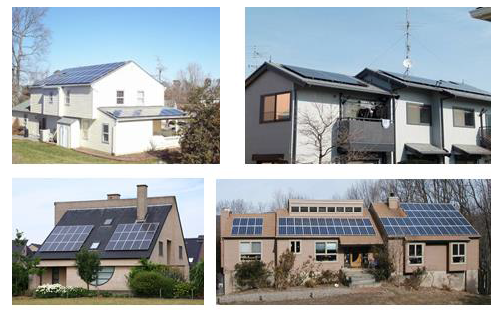
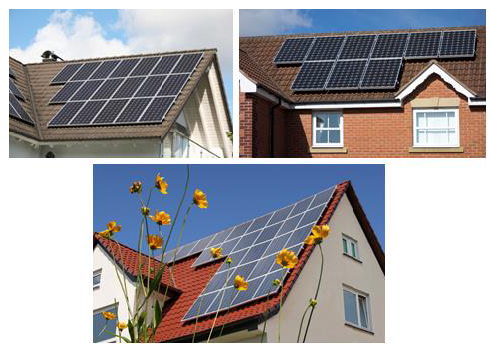
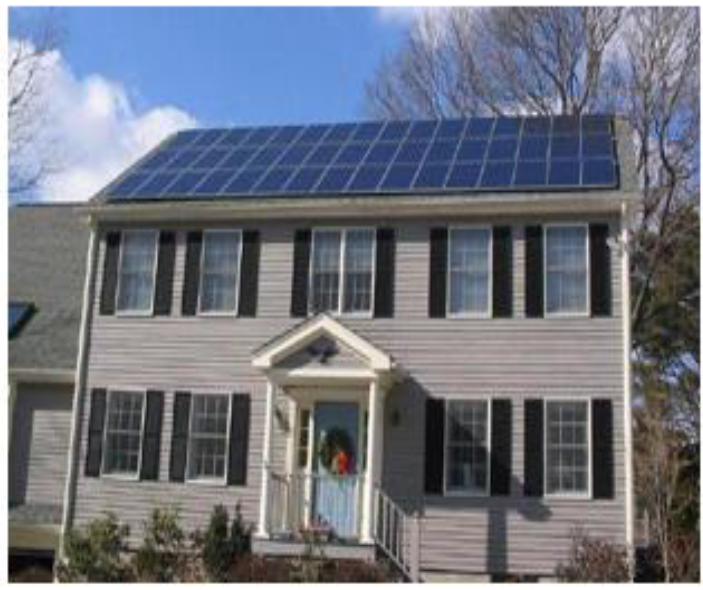
8.80.1.5. Roof-mounted small solar energy systems: Roof-mounted small solar energy systems shall include integrated solar shingles, tiles, or panels as the surface layer of the roof structure with no additional apparent change in relief or projection (the preferred installation), or separate flush or rack-mounted solar panels mechanically fastened to and/or secured with ballast on the roof surface.
a.
Separate flush or rack-mounted small solar energy systems installed on the roof of a building or structure shall not:
i.
Project vertically more than four inches above the peak of the sloped roof to which it is attached; or
ii.
Project vertically more than five feet above a flat roof installation.
b.
It shall be demonstrated that the placement of the system shall not adversely affect safe access to the roof, pathways to specific areas of the roof, and safe egress from the roof.
c.
Any glare generated by the system must be mitigated or directed away from an adjoining property or adjacent road when it creates a nuisance or safety hazard.
d.
Roof top panels shall be configured in an overall square or rectangular pattern so as to present a uniform appearance. This may be one square or rectangular panel or two or more square or rectangular panels that form an overall uniform appearance. Examples are shown on diagrams below. (Amended 5/9/2016)
8.80.1.6. Appearance:
a.
Appearance, color, and finish. The small solar energy system shall remain painted or finished the color or finish that was originally applied by the manufacturer.
b.
All signs, other than the manufacturer's, or installer's identification, appropriate warning signs, or owner identification on a small solar energy system shall be prohibited. Installer and/or developer are limited to one sign indicating their role in the system installation.
8.80.1.7. Code compliance: A small solar energy system shall comply with all applicable construction and electrical codes.
8.80.1.8. Removal: All obsolete or unused systems shall be removed within 12 months of cessation of operations without cost to the town. System components should be reused or recycled whenever possible.
8.80.1.9. Violations. Subsequent to the effective date of this ordinance, it is unlawful for any person to construct, install, or operate a small solar energy system that is not in compliance with this chapter or with any condition contained in a building permit issued pursuant to this chapter.
8.80.2. Large scale solar energy system.
8.80.2.1. Compliance with laws, ordinances and regulations. The construction and operation of all large-scale solar energy system shall be consistent with all applicable local, state and federal requirements, including but not limited to all applicable safety, construction, electrical, and communications requirements
8.80.2.2. Building permit and building inspection. No large-scale solar energy system shall be constructed, installed or modified as provided in this section without first obtaining a building permit.
8.80.2.3. Site plan review. Ground-mounted large-scale solar energy system with 250 kW or larger of rated nameplate capacity are allowed in industrial districts subject to site plan review by the Enfield Planning and Zoning Commission prior to construction, installation or modification as provided in this section.
a.
General. All plans and maps shall be prepared, stamped and signed by a professional engineer licensed to practice in Connecticut.
b.
Required documents. Pursuant to the site plan review process, the project proponent shall provide the following documents in addition to the site plan submission requirements of section 9.10.2:
i.
Blueprints or drawings of the solar energy system signed by a professional engineer licensed to practice in Connecticut showing the proposed layout of the system and any potential shading from nearby structures;
ii.
Manufacturer's data sheets or similar documentation of the major system components to be used, including the PV panels, mounting system, and inverter;
iii.
Full contact information, including name, address, phone number and e-mail address for proposed system installer;
iv.
Name, address, phone number and signature of the project proponent, as well as all co-proponents or property owners, if any;
v.
The name, contact information and signature of any agents representing the project proponent; and
vi.
Documentation of actual or prospective access and control of the project site;
vii.
An operation and maintenance plan;
viii.
Zoning district designation for the parcel(s) of land comprising the project site;
ix.
Proof of liability insurance;
The Enfield Planning and Zoning Commission may waive documentary requirements that it finds are unnecessary to determine compliance with these regulations, as it deems appropriate.
8.80.2.4. Site control. The project proponent shall submit documentation of actual or prospective access and control of the project site sufficient to allow for construction and operation of the proposed solar energy system.
8.80.2.5. Operation and maintenance plan. The project proponent shall submit a plan for the operation and maintenance of the large- scale ground-mounted solar energy system, which shall include measures for maintaining safe access to the installation, storm water controls, as well as general procedures for operational maintenance of the installation.
8.80.2.6. Utility notification. No large-scale ground-mounted solar energy system shall be constructed until evidence has been given to the Enfield Planning and Zoning Commission that the utility company that operates the electrical grid where the installation is to be located has been informed of the solar energy system owner or operator's intent to install an interconnected customer-owned solar energy system. Off-grid systems shall be exempt from this requirement.
8.80.2.7. Dimension and density requirements.
a.
Setbacks. For large scale ground-mounted solar energy system, front, side and rear setbacks shall be as follows:
i.
Front yard: The front yard depth shall be at least ten feet; provided, however, where the lot is across from a residential district, the front yard shall not be less than 50 feet.
ii.
Side yard. Each side yard shall have a depth at least 25 feet; provided, however, where the lot abuts a residential district, the side yard shall not be less than 100 feet.
iii.
Rear yard. The rear yard depth shall be at least 20 feet; provided, however, where the lot abuts a residential district, the rear yard shall not be less than 100 feet
b.
Minimum lot size. The minimum lot size for any large-scale solar energy system shall be seven acres.
c.
Height. The total height of any large-scale solar energy system, including any mounts, shall not exceed nine feet above the ground.
8.80.2.8. Accessory structures. All accessory structures to large- scale ground-mounted solar energy system shall be subject to the underlying zoning requirements concerning the bulk and height of structures, lot area, setbacks, open space, parking and building coverage requirements. All such accessory structures, including but not limited to, equipment shelters, storage facilities, transformers, and substations, shall be architecturally compatible with each other. Whenever reasonable, structures should be shaded from view by vegetation and/or joined or clustered to avoid adverse visual impacts.
8.80.2.9. Design standards.
a.
Lighting. Lighting of large-scale solar energy system shall be consistent with local, state and federal law. Lighting of other parts of the installation, such as accessory structures, shall be limited to that required for safety and operational purposes, and shall be reasonably shielded from abutting properties. Lighting of the solar energy system shall be directed downward and shall incorporate full cut-off fixtures to reduce light pollution.
b.
Signage. Signs on large-scale ground-mounted solar energy system shall comply with the sign regulations. A sign consistent with the regulations shall be required to identify the owner and provide a 24-hour emergency contact phone number.
c.
Utility connections. Reasonable efforts, as determined by the Enfield Planning and Zoning Commission, shall be made to place all wiring from the solar energy system underground, depending on appropriate soil conditions, shape, and topography of the site and any requirements of the utility provider. Electrical transformers, inverters and switch gears for utility interconnections may be above ground.
d.
Screening. A ground mounted large solar energy system shall be screened from adjoining residential districts by arborvitae or similar evergreen hedge planted six feet on center located on the outside of the perimeter fence. The commission may allow additional or alternative screening methods when it is determined that such alternatives are more appropriate for the particular site. The commission may also allow fencing up to eight feet in height where deemed appropriate.
8.80.2.10. Safety and environmental standards.
a.
Emergency services. The large-scale solar energy system owner or operator shall provide a copy of the project summary, electrical schematic, and site plan to the local fire marshal. Upon request, the owner or operator shall cooperate with local emergency services in developing an emergency response plan. All means of shutting down the solar energy system shall be clearly marked. The owner or operator shall identify a responsible person for public inquiries throughout the life of the installation.
b.
Land clearing and soil erosion impacts. Clearing of natural vegetation shall be limited to what is necessary for the construction, operation and maintenance of the large-scale ground-mounted solar energy system or otherwise prescribed by applicable laws, regulations, and bylaws.
8.80.2.11. Monitoring and maintenance.
a.
Solar energy system conditions. The large scale ground-mounted solar energy system owner or operator shall maintain the facility in good condition. Maintenance shall include, but not be limited to, painting, structural repairs, and integrity of security measures. Site access shall be maintained to a level acceptable to the local fire marshal and emergency medical services. The owner or operator shall be responsible for the cost of maintaining the solar energy system and any access road(s), unless accepted as a public way.
b.
Modifications. All material modifications to a solar energy system made after issuance of the required building permit shall require approval by the Enfield Planning and Zoning Commission.
8.80.2.12. Abandonment or decommissioning.
a.
Removal requirements. Any large-scale ground-mounted solar energy system which has reached the end of its useful life or has been abandoned consistent with section 8.80.2.12.b of this regulation shall be removed. The owner or operator shall physically remove the installation no more than 150 days after the date of discontinued operations. The owner or operator shall notify the Enfield Planning and Zoning Commission by certified mail of the proposed date of discontinued operations and plans for removal. Decommissioning shall consist of:
i.
Physical removal of all large-scale ground-mounted solar energy system, structures, equipment, security barriers and transmission lines from the site.
ii.
Disposal of all solid and hazardous waste in accordance with local, state, and federal waste disposal regulations.
iii.
Stabilization or re-vegetation of the site as necessary to minimize erosion. The Enfield Planning and Zoning Commission may allow the owner or operator to leave landscaping or designated below-grade foundations in order to minimize erosion and disruption to vegetation.
iv.
A stabilization/re-vegetation plan shall be submitted along with the site plan application.
b.
Abandonment. Absent notice of a proposed date of decommissioning or written notice of extenuating circumstances, the solar energy system shall be considered abandoned when it fails to operate for more than one year without the written consent of the Enfield Planning and Zoning Commission. If the owner or operator of the large- scale ground-mounted solar energy system fails to remove the installation in accordance with the requirements of this section within 150 days of abandonment or the proposed date of decommissioning, the town may enter the property and physically remove the installation.
(Effective 3/19/12)
Section 8.90. - Special requirements for outdoor special events.
Outdoor special events as defined in section 2.30 shall be permitted in all zoning districts subject to the following requirements:
8.90.1. Approvals. All outdoor special event applications shall be approved by the North Central District Health Department, the police department and the fire marshal's office, if applicable, prior to a the issuance of a zoning permit by planning department staff regardless of zoning district or duration. All outdoor special events shall require site plan approval by the Enfield Planning and Zoning Commission except as provided for in sections 8.90.6 and 8.90.7 below.
8.90.2. Parking requirements. Outdoor special events shall provide adequate off-street parking as determined by the commission after consultation with staff. An application for an outdoor special event shall include a parking needs analysis. Available parking for the event shall be clearly shown on a plot plan.
8.90.3. Setback requirements. No tents or temporary structures associated with outdoor special events shall be located within any front, side or rear yard setbacks of the applicable zoning district, with the exception of tents up to five feet in width which may be required by the health district for the delivery of food to the location where it will be served, but not to be used to serve food.
8.90.4. Hours of operation.
A.
An application for approval of an outdoor special event shall include the proposed days and hours of operation. The commission may set limits on the hours of operation to protect nearby residential uses.
8.90.5. Lights and noise. Outdoor special events shall minimize the impact of lights and noise on surrounding residential properties. All events are subject to chapter 38, of the Enfield Town Code, article IV (commonly referred to as the Town of Enfield Noise Ordinance) and any other applicable local ordinances and/or regulations.
8.90.6. Exceptions. Outdoor special events located on town-owned property authorized by the town council and/or the town manager pursuant to established policies, including but not limited to chapter 54 of the Enfield Town Code, Town of Enfield Regulations for the Use of Town Green and Gazebo, and the town's facilities use policy, shall be exempt from the need for a zoning permit.
8.90.7. Repeat or annual events. Repeat or annual events in which the director of planning has found that there are no material changes and there have been no substantive complaints in prior years, may be allowed to obtain an approval from planning staff without commission approval. The approval of North Central District Health Department, the police department and the fire marshal's office, if applicable shall be obtained prior to the granting of any staff approvals.
(Added 5/1/13)
Section 8.100. - Mobile food vendors.
A.
Purpose: The purpose of this section is to provide the permit standards for mobile food vendors on private property.
B.
Exemptions to this section:
a.
Family one-day gatherings at a residential property, not to exceed four times a year.
b.
Special Events sponsored by the Town of Enfield and located on town property.
c.
Mobile food vending on public streets as regulated by town council Ordinance 58-35 and its implementing rules and regulations as it may be amended from time to time.
d.
Mobile food trucks serving private employers when restricted to employees of the building or industrial complex.
e.
Mobile food trucks approved as part of a special events permit issued by the planning and zoning commission.
f.
When associated with a farm brewery, cidery, distillery, and winery subject to health department approvals (1/13/22).
C.
One-day vending from a specific location: With the written permission of a private property owner, a mobile food vendor can vend for one day provided the requirements and standards of the zoning regulations and Ordinance 58-35 are met. This is limited to four times a year without applying for a planning and zoning permit.
D.
More than one day but one week or less vending from a specific location.
Vending that is proposed for more than one day to less than one week may apply for a zoning permit.
E.
More than one week vending from a specific location.
Vending that is proposed for more than one week will require an approval from the planning and zoning commission consistent with the special events standards.
F.
All mobile food vending is restricted to daylight hours beginning no earlier than 7:00 a.m. and no later than 8:00 p.m.
G.
Mobile food vendors cannot be located within a half-mile of a brick and mortar food establishment unless given written permission by the brick and mortar establishment. Such permission must be filed with the planning office.
H.
All mobile food vendors must be licensed by the North Central Health District.
(Ord. of 1-13-2022)
Section 8.110. - Planned senior life community.
A.
Purpose. Under the Town of Enfield Zoning Regulations, this use is allowed by special exception in any zone except business regional (BR) to encourage the development of a managed residential community representing a range of housing types and services to encourage aging residents to maintain a maximum level of independence depending on his/her own condition. This section allows variations in height, bulk, density and residential use types that are not otherwise possible to meet the specialized needs of Enfield's aging population while ensuring the design, construction and operation of facilities under this section are in harmony with surrounding area.
B.
Permitted uses. Permitted uses shall be active adult, independent living, assisted living, memory care and skilled nursing facilities as well as accessory uses that are intended and designed for the maintenance and/or operation of the facilities and/or the use by residents.
C.
Planned senior life communities shall meet the following requirements:
1.
The site shall be served by both public sewer and public water.
2.
The site shall have access from a state road, or an arterial or collector road classified by the Town of Enfield.
3.
The use may be permitted in any zone except business regional (BR)
4.
The campus style development may include a structure or groups of structures in any one or a combination of the following: (I) A free-standing building containing multiple residential units or beds in the case of memory care and skilled nursing facilities; (II) groups of buildings containing multiple residential units and/or beds; and/or (III) single unit buildings.
5.
The development may contain acceptable accessory units.
6.
At least four of the following amenities shall be included in the development:
a.
Passive walking/hiking trails;
b.
Active hiking/biking trails;
c.
Pedestrian areas with benches;
d.
Scenic area displaying natural or artificial water feature;
e.
Resident gardens (flower and/or vegetable);
f.
Planting areas;
g.
Outdoor picnic areas;;
h.
Meditation/reflection areas;
i.
Fitness center building;
j.
Sports court (i.e. tennis, basketball, volleyball, etc.);
k.
Outdoor or indoor pool;
l.
Putting green;
m.
On-site storage facility;
n.
Other deliberately shaped area(s) or focal feature(s) that enhance community space as determined by the commission;
o.
Alternative active or passive amenities as proposed by applicant.
7.
The planning and zoning commission shall have the authority to determine if the architectural design, scale and mass of buildings, including exterior building materials, colors, roof lines, and building elevations are coordinated with the appearance of the surrounding area.
8.
The mechanical equipment and refuse containers shall be screened from view.
9.
The development shall be graded to meet the accessibility provisions of the Americans with Disabilities Act and shall incorporate pick-up/drop-off and pedestrian circulation patterns that account for the mobility needs of the populations living on site.
10.
Internal circulation shall be designed to provide for the safe and easy movement of vehicles, pedestrian traffic including handicapped pedestrian movement, and access of emergency vehicles. All internal circulation roads shall be constructed in accordance with the Town of Enfield access road standards. At the commission's discretion, roadway widths may be reduced to minimize stormwater impacts.
11.
Bulk requirements:
1 Upon finding that such change is compatible with the neighborhood PZC may increase building height up to four stories.
2 The commission may consider less parking at its discretion.
D.
Application consideration. Upon application of the owner of the land or the owner's duly authorized agent, the commission may, in appropriate cases and subject to appropriate modifications and safeguards prescribed by it, grant a special exception/site plan of development approval for a planned senior life community subject to the requirements of these regulations.
E.
Review criteria. In addition to the special exception criteria of Article 10, the commission shall also consider the following in acting upon an application for approval of a planned senior life community:
1.
The facility will help meet senior housing needs of Enfield and provide options for its aging populating to remain within the community.
2.
The facility has been designed to meet the needs of handicapped residents and visitors.
3.
The architectural design is aesthetically pleasing and blends well into the surrounding area.
(Ord. No. 26-01, § 22, 2-12-26)
Section 8.120. - Thompsonville districts.
8.120. Purpose. The purpose of the Thompsonville districts, each of which is identified on the Thompsonville district map is to encourage transit-oriented development in proximity to the planned commuter rail station at Main and North River Streets and to leverage and protect the unique historical and natural features of this area.
8.120.1. Thompsonville district 1 (TD-1). The purpose of Thompsonville district 1 is to provide walkable residential neighborhoods consistent with historic patterns of development and encourage the development of public amenities along the Connecticut River Waterfront.
8.120.2. Thompsonville district 2 (TD-2). The purpose of Thompsonville district 2 is to provide a walkable residential neighborhood with a diversity of housing choice. Development within this zone will be consistent with historic patterns of development.
8.120.3. Thompsonville district 3 (TD-3). The purpose of Thompsonville district 3 is to provide a walkable residential neighborhood with a diversity of housing choices and opportunities for the development of higher density housing.
8.120.4. Thompsonville district 4 (TD-4). The purpose of Thompsonville district 4 is to allow a variety of housing, food services, lodging, minor retail, and marine/waterfront activities in direct proximity to the planned rail station adjacent to the Connecticut River and Freshwater Brook.
8.120.5. Thompsonville district 5 (TD-5). The purpose of Thompsonville district 5 is to preserve and provide walkable neighborhood commercial districts that build upon the historic function of Thompsonville's retail areas. Development in this zone shall include a mixture of retail, restaurant, services, office space, and residences that will serve local residents and future rail commuters.
8.121. Area and bulk requirements. Table 8.120.6 establishes the lot, yard and bulk requirements for each of the Thompsonville districts. Except as herein otherwise provided, no lot shall have an area or width less than provided in table 8.121.
No building or buildings (including accessory buildings), loading docks, decks, porches, or steps attached to or otherwise associated with such building or buildings, shall encroach upon the minimum front, side and rear yards, nor shall they cover a greater area or exceed the height requirements provided in table 8.121.
Table 8.121 Lot and Bulk Requirements
* Building height shall be measured from top of curb to the highest point on the building, excluding an elevator housing, a mechanical housing, a roof stairway entrance, a ventilating fan, a skylight, a steeple, a chimney, a smoke stack, a fire wall, a parapet wall, a flagpole or similar device not structurally essential to the building, as determined by the Enfield Planning and Zoning Commission.
8.121.1 notes to Table 8.121.
1.
The commission may approve a smaller front yard to achieve compatibility with adjacent structures.
2.
Rear yard shall be a minimum of 20 feet in depth if adjoining a building containing exclusively residential use or greater than 50 percent residential uses. Properties containing exclusively commercial uses or greater than 50 percent commercial uses may have a ten-foot rear yard setback.
3.
Unenclosed front porches may project up to ten feet into the required front yard setback, or beyond the front building line of a pre-existing non-conforming principal structure (See figure B), subject to the following:
i)
unenclosed front porch steps may project an additional five feet provided that neither the steps nor the porch may be closer than five feet to a front property line; two feet from the property line on Main Street and North River Street.
4.
Freestanding canopies attached to a building may be erected forward of the front building line, but in no case shall freestanding canopies be erected closer than ten feet to the front property line (two feet in TD-4 Zone). Freestanding canopies shall not be enclosed or have any completely enclosed buildings beneath them forward of the front building line. The ground projection of any canopy shall be computed as building ground coverage.
5.
Buildings may be built to the common lot line provided the party or other walls separating them are of masonry construction and without openings.
6.
Where property boundaries extend into a watercourse, the rear yard setback shall be the minimum setback from the mean high-water mark of the Connecticut River or Freshwater Brook, as applicable. See figure C.
7.
Minimum dwelling unit size of assisted living facilities and housing for the elderly as provided in section 4.40.
8.
Height exceptions are allowed as per section 3.30.
9.
Rear Lots are not permitted in any of the Thompsonville district.
Figure A: Typical Lot Requirements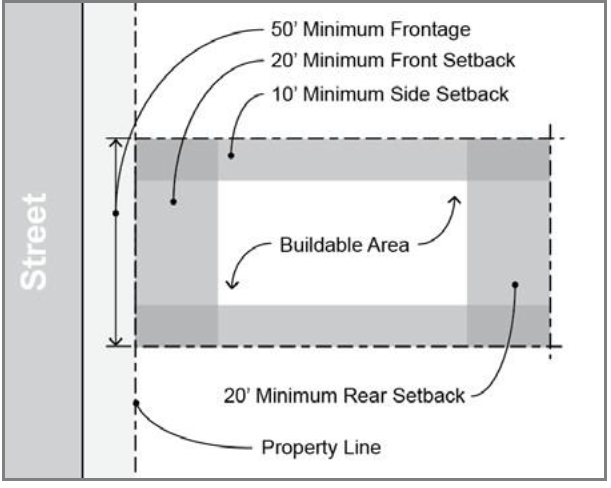
Figure B: Typical Front Yard Setback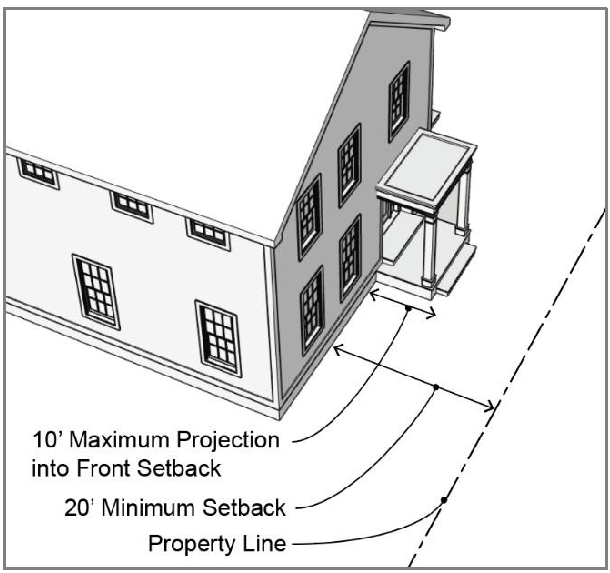
Figure C: Rear Yard Setback for Waterfront Properties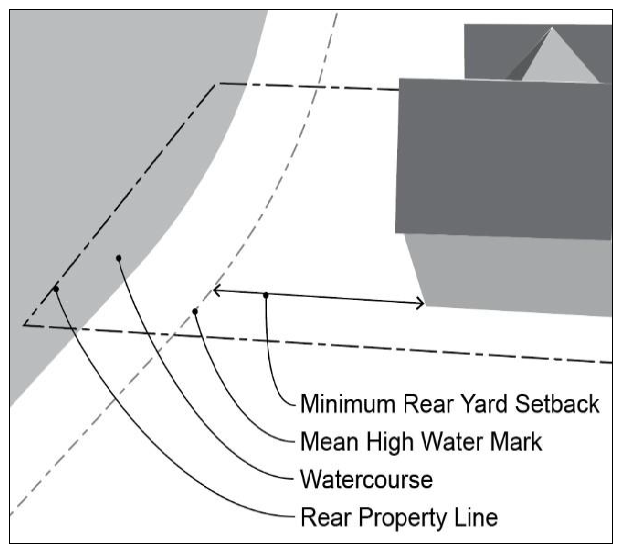
Table 8.122 Use Table for Thompsonville Districts
The following table establishes use requirements for residential and commercial districts.

8.122.1. Notes to Table 8.122.
1.
Reserved.
2.
Bed and breakfast inns, boarding houses and rooming houses shall comply with the section 4.30.1.
3.
All boats and recreational vehicles must be stored inside garages or to the rear of the existing front building line and must comply with section 3.30.9. Commercial vehicles in residential districts are allowed only in accordance with section 3.30.13.
4.
Reserved.
5.
Home occupations and home professional offices shall comply with section 4.50.5. The zoning enforcement officer or designee may require a special permit if deemed necessary. A special permit is also required for any home office/occupation looking to employ non-residents. No more than two non-residents may be employed, and adequate on-site parking must be provided for employees and customers.
6.
Outdoor display of merchandise, including sidewalk sales, is permitted on a seasonal basis only as an accessory use to retail stores.
7.
Room rental is allowed only as an accessory use to a principal dwelling used by the owner as his or her residence and must comply with section 4.30.5.
8.
Solar energy systems must comply with section 8.80.
9.
Swimming pools must comply with section 4.50.7.
10.
Must comply with section 4.40 with exception of lot and bulk requirements which must be compliant with standards in table 6.1 of the Thompsonville regulations.
11.
Drive-thrus are only permitted as an accessory use to restaurants and financial institutions and are only permitted on parcels that front Enfield Street.
12.
See section 4.50.10 temporary conversion to allow accessory apartments accessory apartment must be attached to the home as they cannot be located over a detached garage/accessory building.
13.
Adult/child daycare facilities are not permitted in a single-family home. Nonmedical care are provided to the elderly, the mentally or physically impaired, or children under the age of 18 for part of a 24-hour day. No overnight accommodations or residency is permissible.
14.
Adaptive reuse or former municipal properties may be permitted provided the new use is similar but not more intensive than the previous municipal use.
8.123. Thompsonville district 5 requirements.
1.
Mixed use development is encouraged within Thompsonville district 5. The first floor of all building space that fronts Main Street, North Main Street, or Pearl Street must be occupied by retail, restaurant, service, recreation, office, or municipal uses. Residential uses are encouraged on upper floors. The intention of this restriction is to provide an active pedestrian environment which provides access to goods and services.
2.
The preservation of the exterior of any structure in existence as of the date of the adoption of these regulations is encourage. See appendix B, preserving a community historic rehabilitation standard guidelines for the Village of Thompsonville.
8.124. Parking requirements. Parking within Thompsonville districts shall comply with section 10.10.2 except as specified below:
1.
Residential buildings with up to four units shall provide two parking spaces per unit.
2.
Mixed-use residential buildings, or residential buildings with five (5) or more dwelling units shall provide parking as follows:
i)
Studio: 1 parking space
ii)
1 Bedroom: 1 parking space
iii)
2 Bedroom: 2 parking spaces
3.
Retail Sales: 4 spaces per 1,000 sf gross leasable area
4.
Personal Service Business: 4 spaces per 1,000 gross square feet
5.
Offices: 3 spaces per 1,000 gross square feet
6.
Legally permissible on-street parking, parking within municipal parking lots, or parking secured at a privately-owned parking facility via a parking agreement (providing these resources are within 500 feet of the site in question) may be used to satisfy up to 50 percent of the parking requirement. The applicant shall provide a report demonstrating the availability of parking at off-site facilities.
7.
Reduction: The commission may authorize a reduction in these standards where the applicant has provided a report which demonstrates that the nature of the particular use(s) does not require the normal amount of parking or where due to mass transit, carpooling, or other such features, less rigorous parking standard should apply.
8.125. Parking Area Design Standards. See Figure D.
Parking areas within Thompsonville Districts shall comply with section 10.10.6 and 10.10.7 except as specified below:
1.
The maximum frontage of any surface parking lot on Main Street, North Main Street or Pearl Street within the Thompsonville district 5 shall be limited to 60 feet per parcel.
2.
No parking space shall be provided within the front setback, except in the TD-4 Zone.
Figure D: Parking Area Design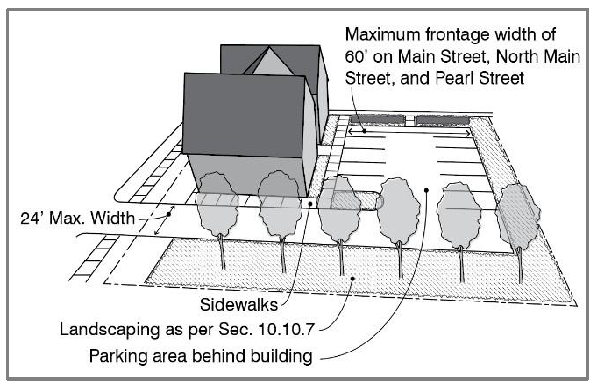
8.126. Site access and circulation.
1.
Sidewalks and pathways shall connect all parking areas to the larger sidewalk network; sites shall be laid out to maximize pedestrian connectivity between uses and sites. In the absence of a larger sidewalk network beyond the site property, sidewalks and pathways shall provide connectivity within the site, with the potential to connect to a future sidewalk network in the ROW.
2.
Potential conflict points between pedestrians or bicyclists and motor vehicles shall be minimized.
3.
Sites should be served by no more than two driveways.
4.
Driveway or private accessway widths should be no more than 24 feet.
5.
The site lines of all driveways and parking lots shall be sufficient to allow a stopped vehicle to see and be seen from approaching traffic from either direction.
8.127. Architectural design standards. The following design standards, consistent with appendix B, preserving a community historic rehabilitation standards and guidelines for the Village of Thompsonville are applicable to projects within Thompsonville districts:
8.127.1. New construction:
1.
New residential construction shall reflect the architecture, bulk and setbacks of the historic streetscape. (See figure E.) Contemporary designs or simplified versions of historic domestic styles are appropriate when they meet the following criteria:
i)
Conform to the prevailing scale, form, and massing of the streetscape.
ii)
Include architectural elements common to the streetscape, such as roof and window types, and employ similar materials.
Figure E: Scale of Residential Infill Development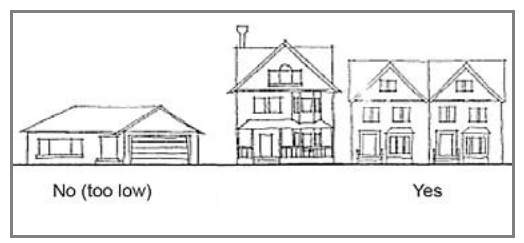
2.
New commercial construction shall conform to the prevailing height and scale of the existing historic streetscape and meet the following criteria (See figure F.)
i)
Maintain existing cornice (roof and storefront) lines.
ii)
Employ appropriate materials that are compatible with adjacent buildings.
iii)
Facade design shall incorporate historic or modernized versions of historic architectural elements from adjoining historic buildings, including, but not limited to, cornice design, storefront configuration, and window and door types.
Figure F: Orientation of Commercial Infill Development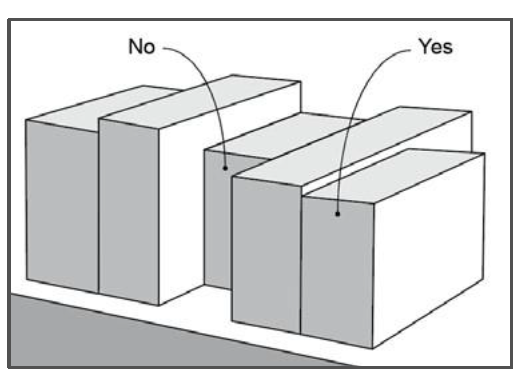
3.
New infill construction on vacant lots shall conform to the typical scale, proportion, massing, and materials of the adjacent historic streetscape and layout of the historic neighborhood.
4.
Architectural details characteristic of the particular style and period proposed shall be incorporated into the design for any new construction and should relate harmoniously to adjacent buildings. It is not intended that the architectural details of old buildings be duplicated precisely, but they should be regarded as suggestive of the extent, nature and scale of details that would be appropriate on new buildings or alterations. Desirable architectural features, where appropriate for a particular style, include gabled roofs, multi-pane windows, chimneys, porches, shutters, gothic arches, white columns and entablature, and fanlights. Examples of designed architectural style include Colonial, Georgian, Federal, Greek Revival, Romantic Revival and Victorian styles. Stonewalls, picket-type fences, wrought iron fences, and decorative wrought iron street-furniture are encouraged.
8.127.2. Remodeling and/or rehabilitation. (See figure G.)
1.
The historic architectural features shall be preserved by retaining, repairing, and/or refinishing all distinctive features, materials, and finishes, including, but not limited to, siding, architectural details, porches, windows, and doors.
Figure G: Preservation of Historic Features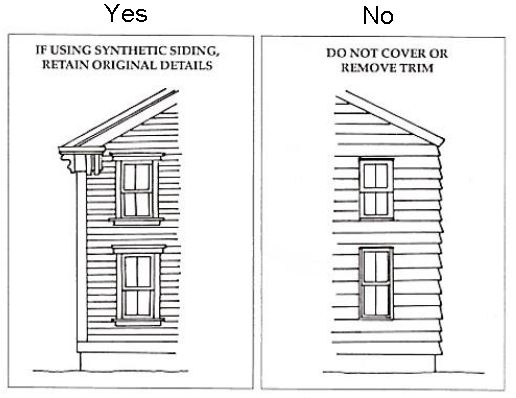
2.
New architectural elements shall match the original design and materials, or if missing, be based upon appropriate examples from a similar style or period or be documented by historic photographs.
3.
Historic window sash and window surrounds shall be retained and repaired. Replacement windows should match the design, material, and size of the original features. Modern windows styles (picture, awning or casements) should only be used in rear elevations.
4.
The use of vinyl siding is discouraged. If used, only installation methods that protect and preserve existing historic features and architectural details shall be permitted. Special architectural features and details including, but not limited to, brackets, roof cornices and returns, window and door surrounds, and all corner, sill, and frieze boards shall be preserved. Historic entranceways, including, but not limited to, door hoods, columns, posts, pilasters, sidelights, transoms, and entablatures must also be preserved.
i)
Block out window trim boards to maintain the original profile depth (projection out from the original siding).
ii)
Match the exposure (width) of original siding as closely as possible and maintain the horizontal direction.
iii)
Do not install new siding over wall surfaces with shaped shingles or any other special sheathing, such as vertical board-and-batten.
iv)
Window and door casings shall not be covered.
v)
Never cover roof cornices, soffits, and frieze boards with vinyl or aluminum.
5.
Every effort-shall be made to retain and preserve historic porches. Retain all historic porches and associated architectural features, including, but not limited to, columns, posts, spindle courses, scrollwork, brackets, and balustrades
8.127.3. Additions. (See figure H.)
1.
Compatible new additions and exterior alterations to historic buildings shall reflect but not duplicate the design of the original structure or convey a false historic appearance. Appropriate additions should clearly read as new construction and conform to the following design criteria:
i)
Be restricted to less visible rear or side elevations.
ii)
Scaled in proportion to existing height and massing, but not exceed 30 percent of the existing building footprint.
iii)
Employ similar materials and/or modernized versions of existing historic architectural elements.
2.
New additions and exterior alterations shall be compatible with the scale and proportions of the existing building and generally confined to less visible rear elevations.
3.
An addition to a historic building shall be a secondary form that preserves the form of the historic building. A proposed addition should be no larger than two-thirds the street frontage of an existing building.
Figure H: Additions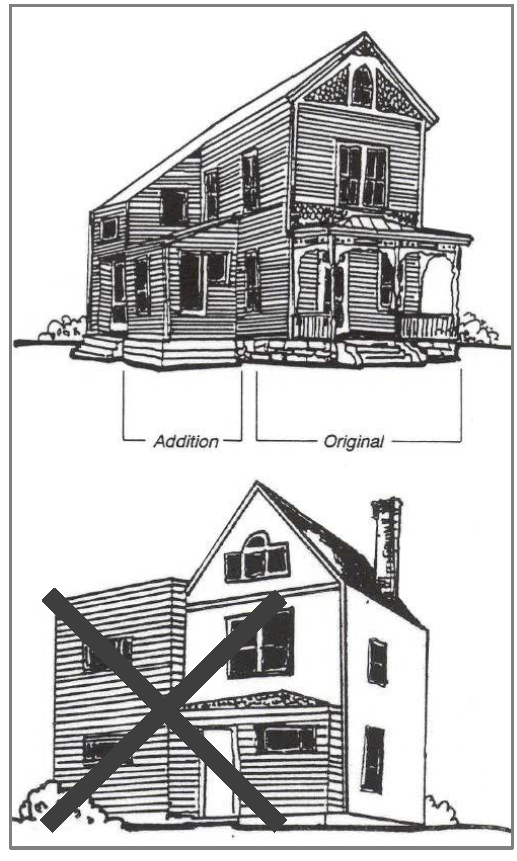
8.128. Building massing within Thompsonville districts 3 through 5 (inclusive).
1.
For sites with multiple buildings proposed, building footprints should be varied in size and shape so as to avoid monotony of structures. (See figure I.)
2.
The primary structure shall be oriented to the street. More than one principal structure may be found on the property.
3.
Building structures with a footprint of 5,000 square feet or more shall be articulated by smaller sections and structures. This may be accomplished via the use of horizontal offsets, bump outs, cross-gable features, and other architectural features and elements.
4.
Blank wall surfaces (surfaces lacking doors, windows, or other architectural features) greater than 40 feet in length shall not be visible from streets or other public areas. (See figure J.)
Figure I: Orientation of Buildings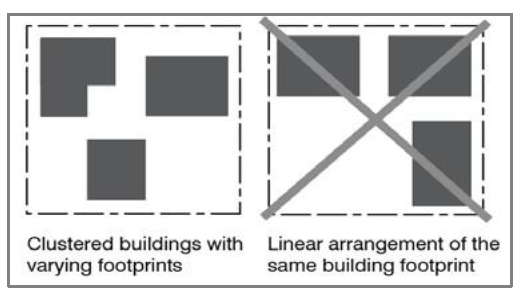
Figure J: Building Massing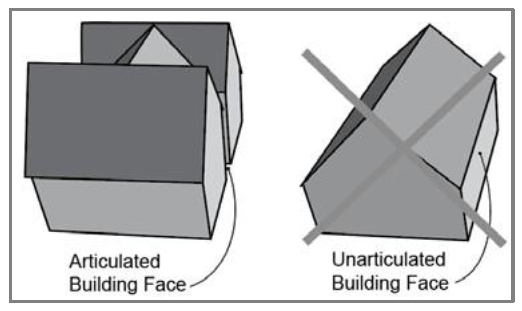
8.129. Public amenity requirements. (See figures K and L.) (For new construction of buildings 10,000 square feet of more)
Projects exceeding 10,000 square feet of gross floor area shall be required to provide publicly accessible amenities as follows:
1.
The area of publicly accessible amenities shall be equal to or greater than two percent of the gross floor area.
2.
Public amenities shall be located in areas with pedestrian traffic or if such spaces are provided in the interior of a lot, pedestrian connections to the sidewalk network must be provided.
3.
Public amenities shall be in the form of well-maintained lawn, brick-lain plazas or other aesthetic hardscape materials (excluding asphalt), including complementary landscaping and planting beds, or a combination thereof.
4.
Where possible, open spaces, paths, parks or plazas shall be designed so that adjacent buildings have windows, terraces or other features that provide a visual connection between the building tenants and the public amenity.
5.
Public amenities include, but are not limited to, items such as lighting, fountains, sculptures, public art, seating areas, and landscaping.
Figure K: Example of Public Amenities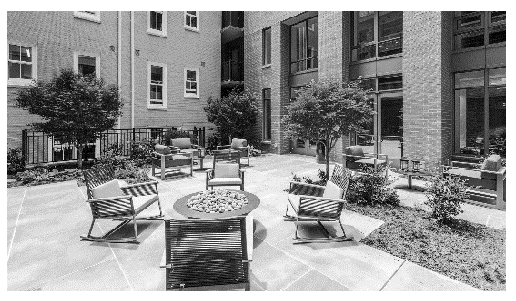
Figure L: This example would NOT qualify as a Public Amenities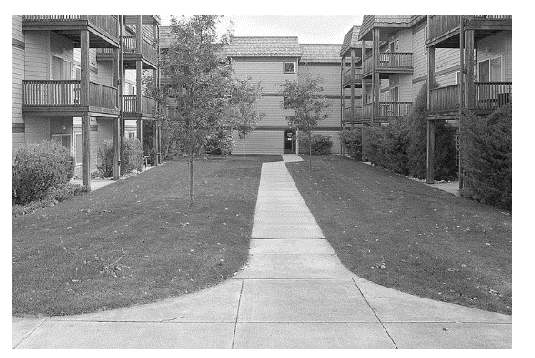
8.130. Landscaping standards. Landscaping shall comply with section 10.20.A except as specified below:
1.
Any portion of a developed lot that is not used for the location of buildings, structures, accessory uses, outside storage areas, off-street parking and loading areas, sidewalks or other paved areas, shall be landscaped. Landscaping shall be sustainable and include a variety of plants including lawns, groundcovers, shrubs and trees to create interest, color, fragrance and texture. Landscaping shall integrate the proposed development to the site, with consideration for natural topography and existing vegetation.
2.
Landscaping shall be provided around buildings to establish continuity within the site, complement structures, and screen unsightly building features.
3.
Use of native species for landscaping is encouraged; the use of resource-efficient, landscapes and gardens of slow-growing, drought-resistant plant species indigenous to the region is encouraged.
4.
Vegetated areas shall be designed to integrate low impact development stormwater techniques.
5.
No plant should be located, nor grown to create a visual hazard for vehicular or pedestrian traffic either within or at the intersection of the site's access with a street.
6.
A minimum of one deciduous canopy tree shall be provided per 50 feet of frontage. Required trees shall be provided within the front yard setback, or may be located between the edge of roadway and front property line if approved by the town.
7.
A minimum of one tree or shrub shall be provided per 1,000 sf of gross floor area. Trees required in parking areas per section 10.10.7 may contribute to this requirement.
8.
Where site constraints within the Thompsonville district 4 and 5 are prohibitive of meeting the tree planting requirement, the required number of trees shall be provided to the town in the form of minimum two and one-half-inch caliper deciduous canopy trees for planting within the public realm in the district area.
9.
When site constraints within the TD-4 are prohibitive of meeting the parking lot landscaping requirements of 10.10.7.A, the landscaped setback from the right-of-way in parking areas of more than 25 parking spaces shall have a two-foot minimum setback from the right-of-way. If parking areas are considered on-street parking than no minimum shall exist.
10.
Where site constraints within the TD-4 are prohibitive of meeting the parking lot landscaping requirements of 10.10.7.B, a reduction to five percent of the gross parking area required to be landscape area can be provided. Furthermore, the requirement of one tree per five parking spaces shall be reduced to one tree per 20 parking spaces and shall be allowed to be located in areas of the site other than the parking area to meet this requirement.
8.131. Outdoor lighting standards. (See appendix B, preserving a community historic rehabilitation standard guidelines for the Village of Thompsonville.)
1.
Lighting shall be at a pedestrian scale and designed to provide both safety of travel and ambience complimentary to the overall site design.
2.
Pole mounted fixtures shall be ten to 14 feet in height and supplied by an underground wire. Low wattage lighting with close spacing is preferred over high wattage lighting spaced further apart.
3.
Significant contrasts in illumination should be avoided with adjacent dissimilar land uses (i.e. brightly lit retail area adjacent to dimly lit residential area).
4.
Building lights shall not blink, flash or change in intensity.
5.
Lighting fixtures shall have shielding devices or sharp cut-off refractors to eliminate up-lighting.
6.
Soft, low wattage spotlighting of signs and signature architectural or site features are acceptable.
8.132. Fences.
1.
Fences within the Thompsonville districts shall not exceed six feet in height.
2.
Fences located within the front yard setback shall not exceed four feet in height. Corner lots shall comply with section 3.30.3 corner visibility.
3.
Modern stockade, rail, and other ornamental fencing shall be utilized within the front yard setback. Industrial chain link or similar fencing shall be reserved for use in side or rear yards where they will be less visible from the street.
4.
Fences shall be designed to avoid barriers to pedestrian connections.
5.
Fences shall be used to visually reinforce a space, add a decorative element, or provide a screen as required elsewhere in the zoning regulations.
6.
Fences may be covered with vegetation.
8.133. Garbage/recycling receptacles.
1.
All garbage and recycling receptacles must be moved to the side or rear yard, or indoors within the timeframe as set forth in the town's solid waste ordinance. No garbage or recycling receptacles shall be stored in the front yard setbacks.
8.134. Non-conforming structures and uses.
1.
All structures and uses in existence at the time of adoption of these regulations shall be grandfathered-allowed to continue per Conn. Gen. Stat. §§ 8-2 and 8-13a and Public Act 17-39 as may be amended. See also section 3.40, non-conforming uses, structures, and lots.
(Ord. of 9-23-2021; Ord. of 11-21-2024(1), att., 11-21-2024; Ord. of 3-13-2025(1); Ord. No. 26-01, §§ 23—26, 2-12-26)
Section 8.140. - Farmworker housing.
8.140.1. Purpose. The intent of this section is to permit farmworker housing as of right on farms to:
1.
Support agricultural economic viability by meeting the need for high quality farmworker housing near agricultural production;
2.
Recognize the importance of farm labor housing to commercial farms;
3.
Implement the farmland preservation objectives of the plan of conservation and development.
8.140.2. Procedure. Farmworker housing may be located as-of-right subject to section 9.10 site plan review by staff and issuance of a certificate of site plan compliance.
8.140.3. Location. Farmworker housing may be located on any conforming and nonconforming farm with more than ten contiguous acres in all zoning districts as an accessory use. Setbacks and side yards shall be no less than 100 feet.
8.140.4. Exclusive use. Farmworker housing shall be occupied only by workers employed by the owner of the farm on which the housing is located or on other farms under the same ownership, where such employment is "agricultural labor" as defined in G.S. § 31-222(a)(1)(H)(vi), as may be amended.
8.140.5. Minimum acreage. Farmworker housing may be located on any farm greater than ten contiguous acres.
8.140.6. Number of beds. No more than two beds per acre of the farm owner's cultivated land under the same ownership in Enfield. No single parcel of land shall have no more than six beds per acre.
8.140.7. Lot coverage. Lot coverage of farmworker housing shall not exceed two percent.
8.140.8. Compliance with the law. Farmworker housing shall comply with all federal, state, and local laws, including, but not limited to, the Migrant and Seasonal Agricultural Worker Protection Act (MSPA) 20 CFR Part 654 Subpart E Housing for Farmworkers, and G.S. §§ 19-13-B53—19-13-B63 and §§ 22-17a-1 through 12.
(Ord. No. 2025-02, 2-13-25)
Section 8.200. - Recreational marijuana.
8.200.1. Purpose. The intent of this section is to regulate the location of marijuana establishments. The primary purposes of these regulations are to provide access to state-approved marijuana establishments while also preventing a concentration of these uses in any one area, to minimize any potential adverse impacts, and to protect and preserve the quality of Enfield's neighborhoods, business districts, property values and the quality of life through effective land use planning.
8.200.2. Definitions. For use in this section of the regulations, definitions shall be those established in the Connecticut General Statutes 21a-408 thru section 21a-414, as may be amended.
A.
Marijuana: as defined in Section 21a-240, C.G.S.
B.
Marijuana establishment: Producer, dispensary facility, cultivator, micro-cultivator, retailer, hybrid retailer, delivery service.
C.
Cultivator: A person or entity that is licensed to engage in the cultivation, growing and propagation of the marijuana plant at an establishment with not less than 15,000 square feet of grow space.
D.
Delivery service: A person or entity that is licensed to deliver cannabis from (A) micro-cultivators, retailers and hybrid retailers to consumers and research program subjects, and (B) hybrid retailers and dispensary facilities to qualifying patients, caregivers and research program subjects, as defined in Section 21a-408, C.G.S., or to hospices or other inpatient care facilities licensed by the Department of Public Health pursuant to Chapter 368v, C.G.S. that have a protocol for the handling and distribution of marijuana that has been approved by the department, or a combination thereof.
E.
Dispensary facility: A place of business where marijuana may be dispensed, sold, or distributed in accordance with Chapter 420f, C.G.S. and any regulations adopted thereunder, to qualifying patients and caregivers, and to which the department has issued a dispensary facility license under Chapter 420f, C.G.S. and any regulations adopted thereunder.
F.
Hybrid retailer: A person or entity that is licensed to purchase marijuana and sell recreational marijuana and medical marijuana products.
G.
Retailer: A person or entity, excluding a dispensary facility that is licensed to purchase marijuana and marijuana products from producers, cultivators, and to sell marijuana and marijuana products to consumers and research programs.
H.
Micro-cultivator: A person or entity licensed to engage in the cultivation, growing and propagation of the cannabis plant at an establishment containing not less than 2,000 square feet and not more than 10,000 square feet of grow space, prior to any expansion authorized by the commissioner.
8.200.3. Applicability: The facilities and establishments found in the above section (A—H.), licensed by the State of Connecticut, shall be permitted by special permit only, subject to approval as a special permit use in accordance with section 9.20 of these regulations and the requirements of this section.
8.200.4. Applicable zones: Marijuana Establishments as defined in the above section 8.200.2, shall be limited to the I-1, I-2, I-P, B-R, B-L, and B-G Zones. For Thompsonville District applicability refer to section F.
8.200.5. Separation requirements: Excluding the Thompsonville Districts as defined in section 8.120, regulated uses identified in this section shall be subject to the following separation distances:
Separating Distances
(1)
Production facilities shall not be located within 200 feet of a residentially zoned property, within 100 feet of a property containing a residential use, within 1,000 feet of another existing dispensary or production facility located within the Town of Enfield and/or within 1,500 feet of a school and 1,000 feet of public buildings, public parks, public and private recreation areas, and places of worship.
(2)
Dispensing facilities shall not be located within 200 feet of a residentially zoned property, within 100 feet of a property containing a residential use, within 1,000 feet of another existing dispensary or production facility located within the Town of Enfield and/or within 1,500 feet of a school and 1,000 feet of public buildings, public parks, public and private recreation areas, and places of worship.
(3)
For the purposes of this section:
a.
School means any public, private or parochial educational facility including, but not limited to, child day care facilities, nursery schools, preschools, kindergartens, elementary schools, middle schools, junior high schools, high schools, vocational schools, secondary schools, continuation schools, special education schools, alternative schools, junior colleges, colleges, and universities. School includes the school grounds but does not include any facility used primarily for another purpose and only incidentally as a school.
b.
Public building means any building owned, leased, or otherwise held by the United States, the state, the town, any other town, any fire district, any school district, or any other agency or political subdivision of the United States or the state, which building is used for governmental purposes.
c.
Public park and recreation area means public land that has been designated for park or recreational activities including, but not limited to, a park, playground, nature trails, swimming pool, reservoir, athletic field, golf course, basketball or tennis courts, pedestrian or bicycle paths, open space, wilderness areas, or similar public land within the town that is under the control, operation, or management of the town, any other town, or the state.
d.
Private recreation area means any private business, whether for-profit or not-for-profit, intended to serve or attract clients, customers, or users under 18 years of age, for the purpose of engaging in indoor or outdoor youth-oriented programs or activities, including but not limited to sports or fitness centers, martial arts, dance, gymnastics, music, or art studios, indoor open or guided play areas, camps, land trusts, private open space and the like.
e.
Place of worship means a building or place that by design is intended for conducting organized religious services.
f.
Separation distance means a straight measurement taken from the nearest lot line of the proposed use to the nearest lot line of the protected use.
(4)
Modifications of separation distances in BR zones.
a.
Criteria:
■
The specific physical, use, infrastructure, vehicular and pedestrian circulation and other like attributes of the location and its immediate environs.
■
The hours of operation, patronage, scale, access and other attributes of the protected use in relation to the same attributes of the proposed use.
■
The likelihood of interaction between the use and protected uses in proximity to the proposed use where such interaction would create undue risk to the health or safety of occupants, employees or patrons of the protected use.
b.
Findings: Based on the above considerations, before the commission may approve a modification under these provisions, the commission shall find:
-
The proposed use will not likely create undue risks to the health or safety of occupants, patrons, employees or others using the protected use's site or facilities AND;
-
The application if approved will not create conflicts with, or undermine the town's comprehensive plan or the general principles of orderly development; and
-
That, in the commission's sole discretion, as or if necessary, the special permit approval includes conditions and/or modifications which will serve to sufficiently mitigate any relevant potential issues under the commission's legal purview in acting on the special permit application.
c.
In considering and acting on a modification request, the Commission may require the applicant to submit documentation in support of the request and relating to the criteria and findings described herein, including but not necessarily limited to surveys, written reports, land records, data, photographs or other materials. Applicants shall also be free to provide whatever additional documentation they feel supports their modification request.
(5)
Prohibition on variances to separation distances. The zoning board of appeals is prohibited from granting variances to any of the separation distance requirements contained in section 8.200.
8.200.6. Separation requirements within Thompsonville Districts. Regulated uses identified in this section shall be subject to the following separation distances:
Separating Distances
(1)
Production facilities and dispensing facilities are limited to the TD-5 zone, TD-4 zone, and parcels within the TD-2 zone of former municipal uses.
(2)
Production facilities shall not be located within 1,000 feet of another existing dispensary or production facility located within the Town of Enfield and/or within 1,500 feet of schools, and 100 feet of public buildings, public parks, public and private recreation areas, and places of worship.
(3)
Dispensing facilities shall not be located within 1,000 feet of another existing dispensary or production facility located within the Town of Enfield and/or within 1,500 feet of schools, and 100 feet of public buildings, public parks, public and private recreation areas and places of worship.
8.200.7. Parking requirements. All vehicle parking shall be located on site:
(1)
Dispensing facilities use shall follow retail parking standards from article 10.10.
(2)
Cultivation shall follow warehousing parking standards from article 10.10
(3)
Hybrid facilities shall follow parking standards based on the percentage of each use in the facility.
(4)
Parking requirements in Thompsonville shall follow requirements in article 8.124
8.200.8. In addition to the standard site plan and special permit standards and procedures in article IX, the applicant shall specifically address the systems to be used for:
(1)
Odor control;
(2)
Water use and wastewater discharge;
(3)
Noise abatement;
(4)
External equipment and screening;
(5)
Site lighting;
(6)
Traffic;
(7)
Fire;
(8)
Security.
(Ord. of 5-12-2022(1); Ord. of 10-27-2022(1))

