
Ephraim City Zoning Code
10.08 DEFINITIONS
LAND USE REGULATIONS
10.08.010 Definitions - Land Use Regulations
Unless the context requires otherwise, the following definitions shall be used in the interpretation and construction of this Ordinance. Words used in the present tense include the future; the singular number shall include the plural, and the plural the singular; "building" shall include the word "structure"; the words "used" or "occupied" shall include arranged, designed, constructed, placed, located, altered, converted, rented, leased, or intended to be used or occupied; the word "shall" is mandatory and not directory, and the word "may" is permissive; the word "person" includes a firm, association, organization, partnership, trust, company, or corporation as well as an individual; the word "lot" includes the words plot, or parcel. Words used in this Ordinance but not defined herein shall have the meaning as defined in any other Ordinance adopted by the City Council or as defined in the latest edition of Webster’s New Collegiate Dictionary. "A" FRAME SIGN: Temporary and/or movable sign constructed with two sides attached at the top so as to allow the sign to stand in an upright position. ABANDONED SIGN: A sign which no longer identifies or advertises a bona fide business, lessor, service, owner, product, or activity, and/or for which no legal owner can be found. ACCESSORY USE OR BUILDING: A use or building on the same lot with, and of a nature customarily incidental and subordinate to, the principal use or building. For the purposes of this ordinance, accessory buildings include both permanent and temporary structures such as garages, carports, sheds, shipping containers, etc. regardless of whether said structures are unenclosed or enclosed. ACCESSORY APARTMENT: A dwelling unit that has been added onto, or created within, a single family house, incidental and secondary to the primary residence (not a duplex). See also “Dwelling Unit, Accessory” AFFECTED ENTITY: A county, municipality, independent special district under Utah Code 17A-2, Independent Special Districts, local district under Utah Code 17B-2, Local Districts, school district, interlocal cooperation entity established under Utah Code 11-13, Interlocal Cooperation Act, specified public utility, or the Utah Department of Transportation, if:
- the entity’s services or facilities are likely to require expansion or significant modification because of an intended use of land;
- the entity has filed with the municipality a copy of the entity’s general or long-range plan; or
- the entity’s boundaries or facilities are within one mile of land which is the subject of a general plan amendment or land use ordinance change.
AGENT OR OWNER: Any person who can show written proof that he is acting for the property owner and with the property owner's knowledge and permission. AGRICULTURE: The cultivating of the soil, raising of crops, horticulture and gardening; breeding, grazing and keeping or raising of domestic animals and fowl, except household pets; and not including any agricultural industry or business. AGRICULTURAL INDUSTRY OR BUSINESS: An industry or business involving agricultural products in manufacturing, packaging, treatment, sales, intensive feeding, or storage, including but not limited to commercial greenhouses, feed yards, fruit stands, fur farms, food packaging or processing plants; commercial poultry or egg production, and similar uses as determined by the Planning Commission; provided, that any such use is of a substantial commercial or industrial character as determined by standards developed by the Planning Commission and approved by the City Council. AIRPORT: Any area of land or water designed and set aside for the landing and the taking off of aircraft. AIRPORT AREA: The area covered by airport approach zones, horizontal zones, conical zones, and transition zones, as defined herein. ALLEY: A public access-way or thoroughfare less than sixteen feet but not less than ten feet in width, which is dedicated or deeded to the public for public use and is designed to give secondary access to lots or abutting properties; an alley shall not be considered a street, for the purpose of this Ordinance. ALTERATIONS, SIGN: A change or rearrangement in the structural parts or design whether by extending on a side; increasing in area or height; or by relocation or changing the position of a sign. ALTERATIONS, STRUCTURAL: Any change in the supporting members of a building, such as bearing walls, columns, beams or girders. AMUSEMENT PARK: Any place of organized amusement activity not conducted wholly within a completely enclosed building. ANIMATED SIGN: (see also and note the difference from changeable sign) A sign or display manifesting either kinetic or illusionary motion occasioned by natural, manual, mechanical, electrical, or other means. Animated signs include the following types:
- NATURALLY ENERGIZED SIGNS: Signs whose motion is activated by wind or other atmospheric impingement. Wind-driven signs include flags, banners, pennants, streamers, metallic disks, or other similar devices designed to move in the wind.
- MECHANICALLY ENERGIZED SIGNS: Signs manifesting a repetitious pre-programmed physical movement or rotation in either one or a series of planes activated by means of mechanical based drives. Electrically Energized - Illuminated signs whose motion or visual impression of motion is activated primarily by electrical means. Electrically energized animated signs are of two types:
- FLASHING SIGNS: Illuminated signs exhibiting a preprogrammed repetitious cyclical interruption of illumination from one or more sources in which the duration of the period of illumination (on phase) is either the same as or less than the duration of the period of darkness (off phase), and in which the intensity of illumination varies from zero (off) to 100 percent (on) during the programmed cycle.
- ILLUSIONARY MOVEMENT SIGNS: Illuminated signs exhibiting the illusion of movement by means of a pre-programmed repetitious sequential switching action in which illuminated elements of the sign are turned on or off to visually simulate the impression of motion characteristic of chasing, running, blinking, oscillating, twinkling, or expanding and contracting light patterns.
ANTENNA: A transmitting or receiving device used in telecommunications that radiates or captures electromagnetic waves used for communication.
APPEAL AUTHORITY: A person, board, commission, agency, or other body appointed by the mayor and approved by the City Council to decide an appeal of a decision of a land use application or a variance. ARCHITECTURAL PROJECTION: Any building or structural projection which is not intended for occupancy and which extends beyond the face of an exterior wall of a building or structure, but not including signs. AREA OF SPECIAL FLOOD HAZARD: The land in the flood plain within a community subject to a one percent (1%) or greater chance of flooding in any given year. AREA, SIGN: (see "Sign, Area of") ATTIC: That part of the building that is immediately below and wholly or partly within the roof framing. AUTOMATIC CAR WASH: A facility for automatic or self-service washing and cleaning of automobiles and small trucks not exceeding one and one-half tons capacity. AUTOMOBILE PAINT AND BODY SHOP: A facility for the painting and body repair of automobiles, trucks, trailers, boats, or other travel or recreation vehicles or units. AUTOMOBILE SALES AREA: An open area used for display, sale, or rental of new or used motor vehicles in operable condition. AUTOMOBILE REPAIR FACILITY OR SERVICE STATION: A place where gasoline, or any other motor fuel, lubricating oil or grease for operating motor vehicles is offered for sale to the public and repair services performed may include tube and tire repair, battery charging, storage of merchandise, lubricating of automobiles, replacement of spark plugs, lights, fans and other small parts, including major auto repair. AVERAGE PERCENT OF SLOPE: An expression of rise or fall in elevation along a line perpendicular to the contours of the land to the lowest point of land within an area or within a lot. A vertical rise of one hundred feet between two points one hundred feet apart, measured on a horizontal plane is a one hundred percent slope. AWNING: A shelter projecting from and supported by the exterior wall of a building constructed of non-rigid materials on a supporting framework. (Compare "Marquee") AWNING SIGN: A sign painted on, printed on, or attached flat against the surface of an awning. BACK LIT AWNING: (see "Electric Awning Sign") BANNER SIGN: A sign made of fabric or any no rigid material with no enclosing framework. BASE FLOOD: The flood having a one percent (1%) chance of being equaled or exceeded in any given year. BASEMENT: A story partly underground. A basement shall be counted as a story for the purposes of height measurement if its height is one half or more above the grade. BASEMENT HOUSE: A residential structure without a full story structure above grade. BED AND BREAKFAST: Shall mean overnight accommodations and a morning meal in a dwelling unit provided to individuals on a temporary basis for compensation BEDROOM: A private room planned and intended for sleeping, separated from other rooms by a door, and accessible to a bathroom within the same dwelling unit. BEGINNING OF CONSTRUCTION: The pouring of concrete footing for a building or structure. BILLBOARD: (see "Off-premise Sign") BLADE SIGN: (see "Ground Sign") BLOCK: The land surrounded by streets or other rights-of-way, other than an alley, or land which is designed as a block on any recorded subdivision plat. BOARDING HOUSE: Shall mean a dwelling or part thereof with shared facilities in which, for compensation, lodging is provided which may or may not include meals. For purposes of this ordinance, a boarding house shall not be considered as a temporary lodging facility. BODY AND FENDER SHOP: A facility for major automobile, truck, mobile home, recreational vehicle repairs to the body, or fenders, and including major rebuilding. BUILDABLE AREA: The portion of a lot remaining after required yards have been provided, except that land with an average grade exceeding twenty (20) percent shall not be considered buildable area unless it is approved by conditional use permit for construction, after study by a geologist, soils engineer, or other qualified professional as required by the Planning Commission. See also ECC 10.04.040 Paragraph A and ECC 10.12.020 Paragraph C. BUILDING: Any structure used or intended to be used for the sheltering of any use or occupancy, or enclosure of persons, animals, or property. BUILDING, ACCESSORY: A building which is subordinate to, and the use of which is incidental to, that of the main building or use of the same lot. See also “Accessory Use or Building”. BUILDING, HEIGHT OF: The vertical distance from the average finished grade surface to the highest point of the building roof or coping. BUILDING INSPECTOR: The official designated as the building inspector for Ephraim City. BUILDING LINE: The line of the building that defines the space for that building’s occupancy. CAMPGROUND: A public area designated by a public agency for camping, or a private area licensed by the county for camping. CAMPING: A temporary establishment of living facilities such as tents or recreational vehicles for a period not to exceed fourteen days as regulated by this Ordinance. CANOPY (BUILDING): A rigid multi-sided structure that may or may not be illuminated by means of internal or external sources, covered with fabric, metal or other material and supported by a building at one or more points or extremities and by columns or posts embedded in the ground at other points or extremities. (compare "Marquee") CANOPY (FREESTANDING): A rigid multi-sided structure that may or may not be illuminated by means of internal or external sources, covered with fabric, metal or other material and supported by columns or posts embedded in the ground. CANOPY SIGN: A sign affixed or applied to the exterior facing surface or surfaces of a building or freestanding canopy. CARPORT: A private garage not completely enclosed by walls or doors. For the purposes of this Ordinance, a carport shall be subject to all the regulations prescribed for a private garage. (see also accessory buildings) CELLAR: A room or rooms wholly under the surface of the ground, or having more than fifty percent of its floor to ceiling height under the average level of the adjoining ground. A cellar access shall be outside and not enter directly into another building or dwelling. CHANGEABLE SIGN: A sign whose informational content can be changed or altered by manual or electric, electro-mechanical, or electronic means. Changeable signs include the following types:
- MANUALLY ACTIVATED SIGNS: Signs whose alphabetic, pictographic, or symbolic informational content can be changed or altered by manual means.
- ELECTRICALLY ACTIVATED SIGNS: Signs whose alphabetic, pictographic, or symbolic informational content can be changed or altered on a fixed display surface composed of electrically illuminated or mechanically driven changeable segments. Includes the following two types:
- FIXED MESSAGE ELECTRONIC SIGNS: Signs whose basic informational content has been pre-programmed to include only certain types of information projection, such as time, temperature, predictable traffic conditions, or other events subject to prior programming.
- COMPUTER CONTROLLED VARIABLE MESSAGE ELECTRONIC SIGNS: Signs whose informational content can be changed or altered by means of computer-driven electronic impulses.
- MOBILE CHANGEABLE COPY SIGN: A sign mounted on a trailer; frame or legs, lighted or unlighted, box or "A" frame and shall have changeable lettering.
CHILD NURSERY: An establishment for the care and/or the instruction of five or more children, for compensation, other than for members of the family residing on the premises, but not including a public school. A child nursery may be operated as a secondary use in a residential dwelling or in a building designed for a commercial operation as is permitted in the zoning district. CHURCH: A building, together with its accessory buildings and uses, maintained and controlled by a duly-recognized religious organization where persons regularly assemble for worship. CITY: The City of Ephraim, Utah. CITY-OWNED PROPERTY: Real property that is owned, leased or controlled by the City. CLEARVIEW ZONE; DRIVEWAYS (CORNER LOTS): refers to that portion of the corner lot lying within a triangular area formed by measuring back ten feet from the point where the interior property line shared with the adjacent lot meets the property line along the public right of way. See figure 1 below:
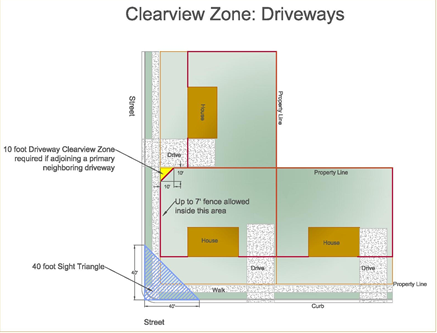
Figure 1: Clearview Zone: Driveways
CLEARVIEW ZONE; INTERSECTIONS: The area of a corner lot closest to the intersection which is kept free of impairment to allow full view of both pedestrian and vehicular traffic. Such area is established by marking a point at which the two curb lines intersect, measuring back forty feet along each street, and drawing a line between the two back points to form a triangular area, also referred to as “sight triangle”. See figure 2 below:
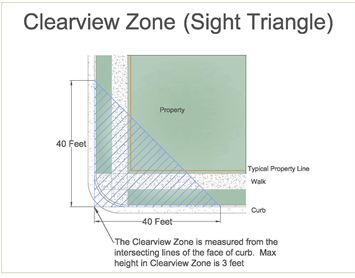
Figure 2: Clearview Zone (Sight Triangle) CLINIC, DENTAL OR MEDICAL: A building in which a group of dentists, physicians, and allied professional assistants are associated for the conduct of their professions. The clinic may include a dental and/or a medical laboratory and an apothecary, but it shall not include in-patient care or operating rooms for major surgery. CLUB, SOCIAL: Any organization, group, or association supported by its members where the sole purpose is to render a service to its members and their guests. Includes private non-profit locker clubs. CO-LOCATION: The location of an antenna on an existing structure, tower or building that is already being used for personal wireless services facilities. COMMON AREA: Any area or space designed for joint use of residents of a mobile home park, condominium, apartment complex, etc. COMMUNITY MANAGEMENT: The person or persons who own or has charge, care or control of a mobile home park, condominium, apartment complex, etc. COMPREHENSIVE PLAN: See General Plan CONDITIONAL USE: A land use that, because of its unique characteristics or potential impact on the municipality, surrounding neighbors, or adjacent land uses, may not be compatible in some areas or may be compatible only if certain conditions are required that mitigate or eliminate the detrimental impacts. CONDOMINIUM: A project of two or more units where an individual owns the air space in a single unit together with undivided interest in common in the buildings, common areas and facilities of the property. CONGREGATE RESIDENCE: Any building or portion thereof which contains facilities for living, sleeping and sanitation and may include facilities for eating and cooking, for occupancy by other than a family, but with a maximum occupancy of the lesser of ten persons or 2 persons per bedroom. A congregate residence may be a shelter, convent, monastery, dormitory, fraternity or sorority house, but does not include jails, hospitals, nursing homes, hotels or lodging houses. A congregate residence is permitted according to ECC 10.20.030 Table B. In the R2 and R3 residential zones, the maximum density may be further limited at the discretion of the land use authority, upon recommendation from the Planning Director, in order to mitigate any potential negative impacts to the adjoining residential properties. A congregate residence is not permitted in any R1, R1A, or RA zones of the City. CONSERVATION STANDARDS: Guidelines and specifications for soil and water conservation practices and management, enumerated in the Technical Guide prepared by the USDA Soil Conservation Service, adopted by the Soil and Water Conservation District supervisors, and containing suitable alternatives for the uses and treatment of land based upon its capabilities, from which the land-owner selects that alternative which best meets his needs in developing his soil and water conservation plan. CONSTRUCTION SIGN: A temporary sign identifying an architect, contractor, subcontractor, and/or material supplier participating in construction on the property on which the sign is located. CONVENIENCE STORE: A one story commercial retail operation containing less than 2,500 square feet of gross floor area, designed and stocked to sell primarily food, beverages, limited variety of goods for personal consumption, and other household supplies to retail customers who purchase only a relatively few items as well as gasoline and car care items. COPY SIGN: The graphic content of a sign surface in either permanent of removable letter, pictographic, symbolic, or alphabetic form. CORRAL: A space, other than a building, less than one (1) acre in area, or less than one hundred (100) feet in width, used for the confinement of animals or fowl. COURT, BUILDING: An open, unoccupied space, other than a required yard, on the same lot with a building or group of buildings, and which is bounded on two or more sides by such building or buildings. COVERAGE, BUILDING: The percent of the total site area covered by buildings. CROSSWALK OR WALKWAY: A right-of-way to facilitate pedestrian access through a subdivision block; designed for use by pedestrians and not for use by motor vehicles; may be located within or without a street right-of-way, or separated from vehicular traffic. DAIRY: A commercial establishment for the manufacture, processing or packaging of dairy products, and their sale; for purpose of this definition, the production of milk on a farm for wholesale marketing off the premises shall not be classified as a dairy. DENSITY: The number of persons, units, apartments, dwellings, mobile homes or mobile home stands per acre of gross area.
DESIGN, SUBDIVISION: The design includes; alignment, grade and width for easements and rights-of-way for utilities; the grading and general layout of lots and streets within the area; location of land to be dedicated for park and/or recreational purposes; and, such specific requirements in the plan and configuration of the entire subdivision as may be necessary or convenient to insure conformity to or implementation of applicable general or specific plans. DEVELOPMENT: Any man-made change to improved or unimproved real estate, including, but not limited to, buildings or other structures, mining, dredging, filling, grading, paving, excavation or drilling operations. DIAGONAL TIE: Any tie-down designed to resist horizontal or shear forces and which deviates not less than 30 degrees from a vertical direction. DIRECTIONAL/INFORMATION SIGN: An on-premise sign giving directions, instructions, or facility information and which may contain the name or logo of an establishment, but no advertising copy, e.g., parking or exit and entrance signs. May contain logo provided that the logo may not comprise more than 20% of the total sign area. May include information about sales of agricultural products produced upon the premises. DISTRICT, LAND USE: A portion of the unincorporated territory of Ephraim City, established as a zoning district by this Ordinance, within which certain uniform regulations and requirements or various combinations thereof apply under the provisions of this Ordinance; also includes "zone" and "zoning district". DOUBLE-FACED SIGN: A sign with two faces diverged from a common angle of not more than 45 degrees or back-to-back. DRIVEWAY: A private right-of-way, providing access to only one parcel or facility the use of which is limited to persons residing, employed, or otherwise using or visiting the parcel on which the driveway is located. DWELLING: Shall mean any building or portion thereof designed exclusively for residential occupancy, but not including hotels, motels, bed and breakfasts, or other temporary use lodging facilities. A dwelling can consist of one or more “dwelling units”. DWELLING, FARM OR RANCH HOUSING: Dwelling units constructed to provide housing for migratory or temporary farm workers, or for persons or families permanently working on a farm or a ranch. DWELLING, MOBILE HOMES: (See "Mobile Homes") DWELLING, SINGLE-FAMILY: A building arranged or designed to be occupied by one family, the structure having only one dwelling unit. DWELLING, TWO-FAMILY: A building arranged or designed to be occupied by two families, the structure having only two dwelling units. DWELLING, THREE-FAMILY: A building arranged or designed to be occupied by three families, the structure having only three dwelling units. DWELLING, FOUR-FAMILY: A building arranged or designed to be occupied by four families, and having more than four dwelling units. DWELLING, MULTIPLE-FAMILY: A building arranged or designed to be occupied by more than four families, and having more than four dwelling units. DWELLING GROUP: A group of two or more detached buildings used as dwellings, located on a lot or parcel of land. DWELLING UNIT: One or more rooms with private bath and kitchen facilities comprising of an independent, self-contained space for occupancy by one family, individual, and/or individuals for living and sleeping purposes. A unit may be attached or detached.
DWELLING UNIT, ACCESSORY: Shall mean a dwelling unit within a dwelling that is incidental and secondary to the primary residence (not a Duplex). See also “Accessory Apartment” DWELLING UNIT, APARTMENT: A dwelling which contains three or more dwelling units DWELLING, DUPLEX: A building containing two single family dwelling units totally separated from each other by an unpierced wall extending from ground to roof. EASEMENT: That portion of a lot or lots reserved for present or future use by a person or agency other than the legal owner of said property. The easement may be for use under, on or above said lot or lots. A vested or acquired right to use land, other than as a tenant, for a specific purpose; such right being held by someone other than the owner who holds title to the land. ELECTRIC, MOBILE HOME PARK: All of the electrical wiring, fixtures, equipment and appurtenances related to electrical installations within a mobile home park feeder assembly. ELECTRIC AWNING SIGN (also "Back Lit Awning"): An internally illuminated fixed space-frame structure with translucent, flexible reinforced covering designed in awning form and with graphics or copy applied to the visible surface of the awning. ELECTRICAL SIGN: A sign or sign-structure in which electrical wiring, connection, or fixtures are used. ELECTRONIC MESSAGE CENTER: (see "Changeable Signs, Electrically Activated") ESSENTIAL FACILITIES: Utilities or sanitary and public safety facilities provided by a public utility or other governmental agency for overhead or surface or underground services. Any privately owned electrical sub-station or transmission line of fifty KV or greater capacity, including related facilities such as buildings, etc. requires a conditional use permit. (2010) FAA: Federal Aviation Administration. FCC: Federal Communications Commission. FACADE: The entire building front including the parapet. FACE OF A SIGN: The area of a sign on which the copy is placed. FAMILY: An individual, or two (2) or more persons related by blood, marriage or adoption, living together as a single housekeeping unit in a dwelling unit; or a group of not more than two (2) persons living together as a single housekeeping unit in a dwelling unit; or a group of not more than four (4). FARM OR RANCH: A farm is a parcel of land in an Agricultural land use district which is used primarily for horticultural or farming purposes, such as the growing of crops or other vegetative, or fruit agricultural uses. A ranch is a parcel of land in an Agricultural zoning district which is used primarily for ranching purposes, such as grazing of livestock or other non-vegetative or fruit agricultural use. FEED YARD: A building or open enclosure where horses, cattle, sheep, goats, hogs, turkeys, ducks, geese, or guinea hens are kept in a relatively restricted area for intensive feeding in preparation for being sold or slaughtered as contrasted to open pasturage, provided that any such use is of a substantial commercial or industrial character as determined by standards developed by the Planning Commission and adopted by the City Council. FEEDER ASSEMBLY: The overhead or under-chassis feeder conductors, including the grounding conductor, together with the necessary fittings and equipment, or a power supply cord listed for mobile home use, designed for the purpose of delivering energy from the source of electrical supply to the distribution panel board within the mobile home. FENCE: An artificially constructed barrier of any material or combination of materials erected to enclose, screen, or separate areas. FESTOONS (SIGN): A string of ribbons, tinsel, small flags, or pinwheels. FINAL PLAT: A subdivision map prepared in accordance with the provisions of this Ordinance, which is designed to be placed on record in the office of the County Recorder. FIRE PROTECTION: Such water supply, water lines, fire hydrants and other protective devices as may be required in accordance with the provisions of this Ordinance. FLASHING SIGN: (see "Animated Sign, Electrically Energized") FLOOD OR FLOODING: A general and temporary condition of partial or complete inundation of normally dry land areas from:
- The overflow of inland or tidal waters; and/or
- the unusual and rapid accumulation or runoff of surface waters from any source.
FLOOD HAZARD: A hazard to land or improvements due to inundation or overflow water having sufficient velocity to transport or deposit debris, scour the surface soil, dislodge or damage buildings, or erode the banks of water courses. FLOOD INSURANCE RATE MAP (FIRM): An official map of a community on which the Federal Emergency Management Agency has delineated areas of special flood hazard designated as Zone A. FLOODLIGHTED SIGN: (see "Illuminated Sign") FLOODPLAIN: Any land area susceptible to be inundated by water from the base flood. As used in this ordinance, the term refers to that area designated as subject to flooding from the base flood (100 year flood). FLOODWAY: The channel of a river or other watercourse and the adjacent land areas that must be reserved in order to discharge the base flood without cumulatively increasing the water surface elevation more than one foot. FLOOR AREA: Area included within surrounding walls of a building or portion thereof, exclusive of vents, shafts, and courts. FOREST INDUSTRY: An industry which uses forest products, such as sawmill, pulp or paper plant, wood products plant, and similar uses. FREESTANDING SIGN: A sign supported permanently upon the ground by poles or braces and not attached to any building. FRONT YARD SETBACK: That part of a lot, extending the full width of the lot, which is between the front property line and the front building line. The depth of the front yard is measured from the front lot line, curb face, or the edge of the pavement of the road (if the city finds that no widening of the road is anticipated) to the building line of the building. If the property line falls within the easement of a prescriptive use right of way, a substitute front lot line shall be established by finding the centerline of the road, measuring thirty feet from that centerline and then measuring the front setback from there. Unenclosed stoops (porches) of thirty six square feet or less are not considered the front line of a building. (See also: Setback, Front and Lot, Corner) FRONTAGE, BLOCK: All property fronting on one side of the street between intersecting or intercepting streets, or between a street and a right-of-way, waterway, end of dead-end streets, or political subdivision boundary, measured along the street line. An intercepting street shall determine only the boundary of the frontage on the side of the street which it intercepts or that common line between a lot and a public street. FRONTAGE, BUILDING: The length of an outside building wall on a public right-of-way or an approved private road. FRONTAGE, LOT: The lineal measurement of the front lot line. GARAGE, PRIVATE: A detached accessory building, or a portion of a main building, used or intended to be used for the storage of motor vehicles, recreational vehicles, boats, snow mobiles, or other recreational vehicles. GARAGE, REPAIR: A structure or portion thereof, other than a private garage, used for the repair of self-propelled vehicles, trailers, or boats, including general repair, rebuilding or reconditioning of engines, motor vehicles, recreational vehicles, and minor collision service, but not including major body, frame or fender repairs or overall automobile or truck painting, except as permitted in the land use matrix. A repair garage may also include incidental storage, care, washing, or sale of automobiles. GENERAL PLAN (OR MASTER PLAN): A long range generalized plan adopted by the City Council for Ephraim City, Utah. GEOLOGICAL HAZARD: A hazard inherent in the crust of the earth, or artificially created, which is dangerous or potentially dangerous to life, property, or improvements, due to the movement, failure, or shifting of the earth. Such hazards also include rock fall or avalanche. GRADE: The lowest point of elevation of the finished surface of the ground, paving or sidewalk within the area between the building and the property line or, when the property line is more than five feet from the building, between the building and a line five feet from the building. GOVERNING BODY: The City Council of Ephraim City, Utah. GOVERNMENT SIGN: Any temporary or permanent sign erected and maintained by the city, county, state or federal government. GROUND ANCHOR: Any device used for the purpose of securing a mobile home or any other structure to the ground. GROUND SIGN (also "Blade Sign"): A sign which is anchored to the ground similar to a pylon or freestanding sign, but which has a monolithic or columnar line and which maintains essentially the same contour from grade to top. Height and setbacks are to be the same as for freestanding signs. GUYED TOWER: A tower that supports an antenna or antennas and requires guy wires or other stabilizers for support. HEIGHT (of a Sign): The vertical distance measured from the highest point of the sign, excluding decorative embellishment (see “Sign: area”), to the grade of the adjacent street or the surface grade beneath the sign, whichever is less. (compare "Sign: Clearance") HOME OCCUPATION: Any use conducted entirely within a dwelling and carried on by persons residing in the dwelling unit and no more than one employee hired outside of the home who will work within the home, which use is clearly incidental and secondary to the use of the dwelling for dwelling purposes and does not change the character thereof and in connection with which there is no advertising, except as otherwise permitted herein, no public display outside of the dwelling unit except as provided in ECC 10.20.040 Table C, and no noise created which is audible at the boundaries of the premises. The intent of this definition is that the conditional use permit approving any home occupation shall assure that the character of the premises and of the neighborhood will remain in harmony with the general intent of the zoning district and that, where uncertainty exists, neighborhood residential values shall be considered paramount. (See ECC 10.12.020 Paragraph G governing issuance of home occupation permits). HOSPITAL: Institution for the diagnosis, treatment and care of human illness or infirmity, but not including sanitariums, clinics and instant care facilities. HOTEL/MOTEL: Shall mean a building with or without kitchen facilities offering temporary use accommodations to general public HOUSEHOLD PETS: Animals or fowl ordinarily permitted in the house and kept for company or pleasure, such as dogs, cats, and canaries, etc.. Household pets shall not include the keeping of inherently or potentially dangerous animals, such as lions or tigers, etc. IDENTIFICATION SIGN: A sign whose copy is limited to the name and address of a building, institution, or person and/or to the activity or occupation being identified. ILLEGAL SIGN: A sign which does not meet the requirements of this code and which has not received non-conforming status. ILLUMINATED SIGN: A sign with an artificial light source incorporated internally or externally for the purpose of illuminating the sign. IMPROVEMENT: May include, but is not limited to, street construction, water systems, sewer systems, sidewalks, curbs and gutters, drainage facilities, on site, street trees, street signs, street lights, traffic control or safety devices, fire hydrants, and such other facilities, utilities, or construction as is required by the Subdivision Chapter, Regulations or the Planning Commission and/or City Council. INCIDENTAL SIGN: A small sign, emblem, or decal informing the public of goods, facilities, or services available on the premises, e.g., a credit card sign or a sign indicating hours of business. INOPERATIVE VEHICLE OR TRAILER: Any vehicle or trailer that due to mechanical, electrical, structural problems, or lack of maintenance, cannot operate as it was originally constructed and designed to do or should not be operated due to conditions rendering it as unsafe. This includes any vehicle or trailer that is not currently licensed or which its operation is in violation of local, state and federal laws. INTERIOR SIGN: A sign located within a building so as to be visible only from within the building in which the sign is located. INUNDATION: Ponded water or water in motion of sufficient depth or velocity to damage property, due to the presence of the water or to the deposit of silt. JUNK: Any salvaged or scrap copper, brass, iron steel, metal, rope, rags, batteries, paper, wood, trash, plastic, rubber, tires, waste, or other articles or materials commonly designated as junk. Junk shall also mean any dismantled, wrecked or inoperable motor vehicles or parts thereof which remain in such condition for a period of time in excess of sixty days. An automobile, truck or bus shall be considered as inoperable if it is parked or stored on property outside of an enclosed garage and is not currently registered and licensed in this state or another state. JUNK YARD: The use of any lot, portion of a lot, or tract of land for the storage, keeping or abandonment of junk, including scrap metals or other scrap material, or for the dismantling, demolition or abandonment of automobiles, or other vehicles, or machinery or parts thereof; provided that this definition shall be deemed not to include such uses which are clearly accessory and incidental to any agricultural use permitted in the district. KENNEL: Any premises where three or more dogs older than four months are kept, except that more than three of such dogs may be kept in the agricultural, and multiple-use districts as an accessory to permitted and conditional uses allowed in that zoning district, examples are: sheep dogs on a ranch, seeing eye dogs in a handicapped residential facilities, etc. LAND USE APPLICATION: An application required by any Ephraim City Land Use Ordinance. LAND USE AUTHORITY: A person, board commission agency or other body designated by the City Council to act upon a land use application. Unless otherwise specified, the Planning Commission and/or Planning Director shall act as Land Use Authority for all land use decisions as governed by the provisions of this ordinance. LAND USE ORDINANCE: The uniform land use ordinance of Ephraim City, Utah, which are also known as Zoning, Subdivision, and Development Ordinances. (2006) LANDSCAPING: The installation of some combination of planted trees, shrubs, vines, ground cover, flowers, or lawns. In addition, the combination of design may include rocks, and such structural features as fountains, pools, artworks, screens, walls fences, walks, or benches, but such objects alone shall not meet the requirements of this title. LATERAL SEWER: A sewer which discharges into another sewer and has only sewer inlets from buildings and structures tributary into it. LATTICE SEWER: A self-supporting three or four-sided, open steel frame structure used to support telecommunications equipment. LIGHT VEHICLE OR EQUIPMENT MAINTENANCE: The performance of routine maintenance tasks such as; Changing the oil, checking tire pressure, replacing water hoses, etc., which do not involve the removal, repair or replacement of major mechanical, electrical, hydraulic, pneudralic, or components of the vehicle. LOCAL ATTORNEY: The City Attorney or any other attorney officially representing Ephraim City. LOCAL BUILDING INSPECTOR: The building inspector employed by or officially representing Ephraim City. LOCAL ENGINEER: The engineer employed by or officially representing Ephraim City. LOCAL GOVERNING BODY: (See Governing Body) LOCAL HEALTH OFFICER: The health officer or department with jurisdiction in Ephraim City. LOCAL JURISDICTION: Ephraim City, Utah LOCAL PLANNER: The Planning Director or any other planner employed by or officially representing Ephraim City, Utah. LOCAL SURVEYOR: The County surveyor or any other surveyor officially representing Ephraim City, Utah. LOT: A parcel or unit of land described by metes and bounds and held or intended to be held in separate lease or ownership, either as an undeveloped or developed site, or a parcel or unit of land shown as a lot, plat, or parcel on a recorded subdivision map, or shown on a plat used in the lease or sale or offer of lease or sale of land resulting from the division of a larger tract into two or more smaller units. LOT AREA: The total area reserved for exclusive use of the occupants of a dwelling unit. LOT, CORNER: A lot abutting upon two or more streets at their intersection or upon two parts of the same street, such streets or parts of the same street forming an interior angle of less than one hundred thirty-five degrees. For placement of structures on a corner lot please see definition for Setbacks, Corner. LOT DEPTH: The horizontal distance between the front and the rear lot lines measured in the main direction of the side lot lines. LOT FRONTAGE: The lot frontage required is the length of the front lot line which, is coterminous with the front street lines. LOT, INTERIOR: A lot other than a corner lot. LOT LINE: The property lines bounding the lot. A line bounding the lot as shown on the accepted plot plan. LOT LINE, FRONT: To an interior lot, the lot line adjoining the street; for a corner lot or through lot, the lot line adjoining either street, as elected by the lot owner. (2006) LOT LINE, REAR: Ordinarily, that line of a lot which is opposite and most distant from the front line of the lot. In the case of a triangular or gore-shaped lot, a line ten (10) feet in length within the parcel parallel to and at the maximum distance from the front line. In cases where these definitions are not applicable, the land use officer or building inspector shall designate the rear lot line. LOT LINE, SIDE: Any lot boundary line not a front or rear lot line. A side lot line separating a lot from another lot or lots is an interior side lot line; a side lot line separating a lot from a street is a street side lot line. LOT RIGHT-OF-WAY: A strip of land of not less than sixteen feet in width connecting a lot to a street for use as private access to that lot. LOT WIDTH: The minimum lot width for each zoning district shall either remain consistent or expand larger form the front to the rear setback. LOW PROFILE SIGN (also "Monument Sign"): A sign mounted directly to the ground with maximum height not to exceed six feet. MAINTENANCE SIGN: For the purposes of this Ordinance, the cleaning, painting, repair, or replacement of defective parts of a sign in a manner that does not alter the basic copy, design, or structure of the sign. MAINTENANCE, VEHICLE OR EQUIPMENT: The maintenance or repair of a vehicle or piece of equipment that is other than routine maintenance, which the result of is to make it operable or safe to operate. May involve; the removal and/or replacement of major mechanical, electrical, hydraulic, pneumatic or other components, modification in design, operation or structure. MANSARD: A sloped roof or roof-like facade architecturally comparable to a building wall. MANUFACTURED HOME: A transportable factory built housing unit constructed on or after June 15, 1976, according to the Federal Home Construction and Safety Standards act of 1974 (HUD Code), in one or more sections, which in the traveling mode, is eight body feet or more in width or 40 body feet or more in length, or when erected on site, is 400 or more square feet, and which is built on a permanent chassis and designed to be used as a dwelling with or without a permanent foundation when connected to the required utilities, and includes the plumbing, heating, air-conditioning, and electrical systems. All manufactured homes constructed on or after June 15, 1976, shall be identifiable by the manufacturer's data plate bearing the date the unit was manufactured and a HUD label attached to the exterior of the home certifying the home was manufactured to HUD standards. (Refer to Utah Code § 10-9-1-514.) MARQUEE: A permanent roof-like structure or canopy of rigid materials supported by and extending from the facade of a building. (Compare "Awning") MARQUEE SIGN: Any sign attached to or supported by a marquee structure. MINE: A site from which ore, gravel, rock, minerals, precious metals or natural substances, that are other than plant or animal organisms, can be extracted. It includes the site of the mine with its surface buildings, structures, elevator shafts, and equipment. MINING: The process or business of extracting ore, gravel, rock, minerals, precious metals or natural substances from the surface and/or below the surface of the earth. MOBILE HOME: A transportable factory built housing unit built prior to June 15, 1976, in accordance with a state mobile home code which existed prior to the Federal Manufactured housing and Safety Standards Act (HUD Code). Designed to be a long term residential dwelling unit, with or without a permanent foundation, and originally constructed as a complete package which includes major appliances, plumbing, and electrical facilities prepared for appropriate connections. No permanent connections for water or sewer shall be granted, nor shall occupancy be permitted for any structure which is less than 40 feet long or 8 feet wide. Temporary offices on work sites are permitted in accordance with the other provisions of this ordinance. See also “Trailers”. (2010)
MODULAR HOME: A permanent dwelling structure built in prefabricated units, which are assembled and erected on the site, or at another location and brought as a unit to the site; said modular home is classed as a mobile home until it is placed on a permanent foundation and complies with all applicable building codes. MONOPOLE:A single, self-supporting, cylindrical pole, constructed without guy wires or ground anchors which acts as the support structure for antennas. MONUMENT SIGN: (see "Low Profile Sign") MOTEL/HOTEL: Shall mean a building with or without kitchen facilities offering temporary use accommodations to general public MULTIPLE-FACE SIGN: A sign containing three or more faces, not necessarily in back-to-back configuration. NAMEPLATE (SIGN): A non-electric on-premise identification sign giving only the name, address, and/or occupation of an occupant or group of occupants. NATIONAL COOPERATIVE SOIL SURVEY: The soil survey conducted by the U.S. Department of Agriculture in cooperation with the State Agricultural Experiment Station and other Federal and/or Utah State agencies. NATURAL WATERWAYS: Those areas, varying in width, along streams, creeks, springs, gullies or washes which are natural drainage channels as determined by the Building Inspector in which areas no buildings shall be constructed. NONCOMPLYING STRUCTURE: A structure that;
- legally existed before its current land use designation; and
- because of one or more subsequent land use ordinance changes, does not conform to setback, height restrictions, or other regulations, excluding those regulations that govern the use of land. (2006)
NONCONFORMING SIGN: A sign which;
- was erected legally, but which does not comply with subsequently enacted sign restrictions and regulations.
- does not conform to the sign code requirements, but for which a valid sign permit has been issued.
NONCONFORMING USE: A use of land that;
- legally existed before its current land use designation;
- has been maintained continuously since the time the land use ordinance regulation governing the land changed; and
- because of one or more subsequent land use ordinance changes, does not conform to the regulations that now govern the use of the land. (2006)
NURSING HOME: An institution, other than a hospital, for the care of human illness or infirmity in which care, rather than diagnosis or treatment, constitutes the principal function. The term "nursing home" shall also include "rest home" and "convalescent home". OCCUPANCY: The portion of a building or premises owned, leased, rented, or otherwise occupied for a given use. OCCUPIED AREA: The total of all of the lot area covered by a building and its accessory buildings on a lot.
OFFICE, LOW IMPACT BUSINESS OR PROFESSIONAL: A professional office business that meets the following criteria and requirements:
- Contains a maximum of four (4) employees on any given shift or as otherwise approved by the Planning Commission on a case-by-case basis;
- Operating Hours are limited to between 7 AM - 6 PM;
- Adequate off-street parking is provided for employees and customers;
- Professional offices only – no food/retail/manufacturing;
- Occupies an existing residential structure;
- Sight obscuring fence required (6’ tall minimum) along the perimeter of the property;
- Aesthetic landscaping – particularly along the front of the property – is provided and maintained; and
- Signs limited as per sign ordinance for residential zones
OFFICIAL MAP: A map of the city used to show existing and/or future roads, zoning, rights of way and/or other land use applications. (2006) OFF-PREMISE SIGN (also "Billboard"): A sign structure advertising an establishment, merchandise, service, or entertainment, which is not sold, produced, manufactured, or furnished at the property on which said sign is located, e.g., "billboards" or "outdoor advertising". OFF-SITE DIRECTIONAL SIGN: A sign which provides directional assistance to access an establishment conveniently and safely. Such signs shall be limited by the Land Use Authority in size, height, and placement as justified. OFF-STREET PARKING SPACE: The space required to park one passenger vehicle, which space shall meet the requirements of this Ordinance. OFF-SITE IMPROVEMENTS: Improvements not on individual lots but generally within the boundaries of the subdivision which they serve, and as further outlined in this Ordinance. ON-SITE IMPROVEMENTS: Construction or placement of the dwelling and its appurtenant improvements on a lot. ON-PREMISE SIGN: A sign which pertains to the use; product or commodity sold; service performed on the premises and/or property on which it is located. OPEN SPACE: The area reserved in parks, courts, playgrounds, golf courses, and other similar open areas to meet the density requirements of planned unit developments. OPEN SPACE, USABLE: Usable open space shall be any portion of a lot or building which meets all the following conditions:
- The space shall be open to the sky or shall be open to view in at least two sides.
- The space shall be readily accessible by foot traffic from the building to which it is accessory.
- The space shall not be provided from any required front or side yard, parking area, or driveway space.
OWNER: The holder of the fee title to land or buildings or to property, whether a person, partnership, corporation, or other entity recognized by law, and his or its lessees, permittees, assignees, or successors in interest. OVERHANGING SIGN: (see "Mansard, Roof Sign") PACKAGE AGENCY: A retail liquor location operated under a contractual agreement with the Alcoholic Beverage Control Department, by a person other than the state, who is authorized by the Alcoholic Beverage Control Commission to sell package liquor for consumption off the premises of the agency. PAINTED WALL SIGN: Any sign which is applied with paint or similar substance on the surface of a wall. PARAPET: The extension of a false front or wall above a roofline. PARCEL OF LAND: (See "Lot") PARKING LOT: An open area, other than a street, used for the parking of automobiles and available for public use, whether free, for compensation, or accommodation for clients or customers. PEDESTAL SIGN: A temporary and/or movable sign supported by a column(s) and a base so as to allow the sign to stand in an upright position. PEDESTRIAN-WAY: (See "Cross-walk") PERMANENT MONUMENT: Any structure of concrete, masonry and/or metal permanently placed on or in the ground, including those expressly placed for surveying reference, which meets the requirements of Sanpete County and/or the State of Utah for permanent monuments. PERSON: Any individual, corporation, association, firm, partnership, or similarly defined interest. PERSONAL WIRELESS SERVICES: “Personal wireless services” has the same meaning as provided in Section 704 of the Telecommunications Act of 1996 (47 U.S.C. § 332(c)(7)(c)), which includes what is commonly known as cellular and Personal Communication System (PCS) services. PERSONAL WIRELESS SERVICES FACILITIES: Facilities for the provision of personal wireless services, hereafter referred to as “wireless facilities”. Wireless facilities include transmitters, antennas, structures supporting antennas, and electronic equipment that is typically installed in close proximity to a transmitter. PLANNED UNIT DEVELOPMENT ZONE (PUD ZONE): A zoning district, the boundaries of which are to be shown on the land use map, but the regulations for which shall be determined by a general development plan to be adopted by the City Council, after public hearing, as required for other zoning districts. PLANNED UNIT DEVELOPMENT (PUD): An integrated design for development of residential, commercial or industrial uses, or limited combinations of such uses, in which the density and location regulations of the district in which the development is situated may be varied or waived to allow flexibility and initiative in site and building design and location, in accordance with an approved plan and imposed requirements. PLAT: Any map, plan or chart of a city, town, section or subdivision, indicating the location and boundaries of individual properties. PLOT: A parcel of land consisting of one or more lots or portions thereof which is described by reference to a recorded plat or metes and bounds. PLOT PLAN: A plat of a lot, drawn to scale, showing its actual measurements, the size and location of any existing buildings and/or structures or buildings and/or structures to be erected, the location of the lot in relation to abutting streets, and such other information as may be required by the Planning Commission. POINT OF PURCHASE DISPLAY: Advertising of a retail item accompanying its display, e.g., an advertisement on a product dispenser, tire display, etc. POLE COVER (SIGN): Cover enclosing or decorating poles or other structural supports of a sign. POLITICAL SIGN: A temporary sign used in connection with a local, state, or national election or referendum. PORTABLE SIGN: Any sign designed to be moved easily and not permanently affixed to the ground or to a structure or building. PREFABRICATED HOUSING: (See Modular Home) PREMISES: A parcel of land with its appurtenances and buildings which, because of its unity of use, may be regarded as the smallest conveyable unit of real estate for that zoning district. PRELIMINARY PLAT: A drawing, to scale, representing a proposal to subdivide a tract, lot or parcel of land, and meeting the preliminary plat requirements of this ordinance. PRE-SECTIONED HOME: (See Modular Home) PRIVATE NON-PROFIT LOCKER CLUB: A social, recreational, or athletic club, or kindred association, incorporated under the provisions of the Utah Non-profit Corporation and Cooperation Act, which maintains or intends to maintain premises upon which liquor is or will be stored, consumed, or sold. PRIVATE NON-PROFIT RECREATIONAL GROUNDS AND FACILITIES: Non-profit recreational grounds and facilities operated by a non-profit corporation, association, or group. PRIVATE PROPERTY: Any real property not owned by the City or another public or governmental entity. PRIVATE STREET: A private owned way or lane which affords principal means of access to abutting individual dwellings, mobile homes, condominiums, community service buildings or apartments. PROCESS OR PROCESSING: The act, business or procedure of taking raw, extracted or pre-processed material and adding to or taking away from it, to produce a product that is purer, used, marketed, or uniquely different than the original raw material or product before the procedure was enacted. PROJECTING SIGN: A sign, other than a flat wall sign which is attached to and projects from a building wall or other structure not specifically designed to support the sign. PROPERTY SIGN: A sign related to the property upon which it is located and offering such information as the address, the property, warning against trespassing, any hazard, or other danger on the property. (see "Identification Sign") PROTECTION STRIP: A strip of land between the boundary of a subdivision and a street within the subdivision, for the purpose of controlling the access to the street by property owners abutting the subdivision. PUBLIC STREET: A public way which affords principal means of access to abutting properties. PUBLIC SYSTEM (WATER OR SEWAGE): A system which is owned and operated by a local governmental authority or by an established public utility company which is adequately controlled by a governmental authority. Such systems are usually existing systems serving a municipality, a township, an urban county, or a water or sewer district established and directly controlled under the laws of the state of Utah. PUBLIC HEARING: A hearing at which members of the public are provided a reasonable opportunity to comment on the subject of the hearing. PUBLIC MEETING: A meeting that is required to be open to the public under Utah Code 52-4, Open and Public Meetings. REAL ESTATE SIGN: A temporary sign advertising the real estate upon which the sign is located as being for rent, lease, or sale. REAR YARD SETBACK: That part of a lot between the rear building line and the rear lot line, and extending the full width of the lot. The depth of the rear yard is measured from the rear lot line to the building line of the building. Unenclosed stoops of thirty-six square feet or less are not considered the rear line of a building. (See also Setback, Rear.) RECREATIONAL VEHICLE: A vehicle, such as a travel trailer, tent camper, camp car or other vehicle with or without motive power, designed and/or constructed to travel on the public thoroughfare in accordance with the provisions of the Utah Vehicle Code, and designed for use as a human habitation for a temporary and recreational nature. RECREATIONAL VEHICLE PARK: Any area or tract of land or a separate designated section within a mobile home park where lots are rented or held out for rent to one or more owners or users of recreational vehicles for a temporary time not to exceed thirty days. Such park may also be designated as "Overnight Park." RECREATIONAL VEHICLE SPACE: A plot of ground within a recreational vehicle park designated and intended for the accommodation of one recreational vehicle. RESIDENCES WITH A DISABILITY: Refer to Utah Code § 10-9-A-520. RIGHT-OF-WAY: The area, either public or private, over which the right-of-passage exists. ROOF LINE: The top edge of a roof or building parapet, whichever is higher, excluding any mansards, cupolas, pylons, chimneys or minor projections.
ROOF LINE: On buildings without a pitched roof, the roof line shall mean the top of the exterior wall elevation. On buildings with a pitched roof, roof line shall mean the ridge line of the roof. ROOF MOUNTED ANTENNA: An antenna or series of individual antennas mounted on a roof, mechanical room or penthouse of a building or structure. ROOF SIGN: Any sign erected partly or wholly over or on the roof of a building. A structure having main supports embedded in the ground shall not be considered to be a roof sign even if the sign's supports pass through a roof, canopy, or parapet of a building. (compare "Mansard, "Wall Sign") ROTATING SIGN: (see "Animated Sign, Mechanically Energized") RUNWAY (AIRPORT): A defined area on an airport prepared for landing and takeoff of aircraft. SALT: Any component, solid or liquid, of the Sodium elements, such as Sodium Chloride, Potash, Sodium Hydroxide, Brine, etc. SCHOOL PRIVATE: A school which is operated by a quasi-public or private group, individual, or organization, and which has curriculum similar to that provided in any public school in the state of Utah. Private schools may be non-profit, or profit-making establishments. SCHOOL, PUBLIC: A school operated by a school district or other public agency in the State of Utah. SETBACK, CORNER LOT: Those setbacks required for structures on a corner lot. (see definition Lot, Corner). When considering the placement of a structure on the lot, corner lots are considered to have a front setback adjoining each street, along with a rear setback and an interior side setback. The property owner may choose which is the rear setback, and which is the interior side setback. The street location determines the front setback, not the orientation of the house, The Planning director may allow two front setbacks and two side setbacks if normal rear setbacks cannot be met with any other configuration of the house on the lot. SETBACK, FRONT: That part of a lot, extending the full width of the lot, which is between the front property line and the front building line. The depth of the front yard is measured from the front lot line to the front line of the building. If the property line falls within the easement of a prescriptive use right of way, a substitute front lot line shall be established by finding the centerline of the road, measuring thirty three feet from that centerline and then measuring the front setback from there. Unenclosed stoops (porches) of thirty six square feet or less are not considered the front line of a building. (See also: Lot, Corner) SETBACK, REAR: That part of a lot between the rear building line and the rear lot line, and extending the full width of the lot. The depth of the rear yard is measured from the rear lot line to the building line of the building. Unenclosed stoops of thirty-six square feet or less are not considered the rear line of a building. SETBACK, SIDE: That part of a lot between the side building line and the side lot line, and extending from the Front Yard setback to the Rear Yard setback. The width of the side yard is measured from the side lot line to the building line of the building. Unenclosed stoops of thirty six square feet or less are not considered the side line of a building. SEWER CONNECTION: A connection consisting of all pipes, fittings, and appurtenances from the drain outlet of the building to the inlet of the corresponding sewer riser pipe of the sewage system serving the development. SEWER RISER PIPE: That portion of the sewer which extends vertically to at least ground elevation and terminates at each mobile home stand. SIDE YARD SETBACK: That part of a lot between the side building line and the side lot line, and extending from the Front Yard setback to the Rear Yard setback. The width of the side yard is measured from the side lot line to the building line of the building. Unenclosed stoops of thirty six square feet or less are not considered the side line of a building. (See also Setback, Side) SIGN: Any device, structure, fixture, or placard using graphics, symbols, and/or written copy for the primary purpose of identifying, providing directions, or advertising any establishment, person, entity, interest, product, goods, or services. It includes any structural supports, lighting systems, attachments, ornaments or other features. SIGN, AREA OF:
- PROJECTING AND FREESTANDING SIGN: The area of a freestanding or projecting sign shall have only one side of any double or multiple-faced sign counted in calculating its area. The area of the sign shall be measured as follows if the sign is composed of one (1) or more individual cabinets:
- A rectilinear line of not more than eight (8) sides shall be drawn around and enclosing the perimeter of each cabinet or module. The area shall then be summed and totaled to determine total area. The perimeter of measurable area shall not include embellishments such as pole covers, framing, decorative roofing, support structures, etc., provided that there is no written advertising copy on such embellishments.
- WALL SIGN: The area shall be within a single, continuous perimeter composed of any rectilinear line, geometric figure which encloses the extreme limits of the advertising message. If the sign is composed of individual letters or symbols using the wall as the background with no added decoration, the total sign area shall be calculated by measuring the area within the perimeter of each symbol or letter. The combined areas of the individual figures shall be considered the total sign area.
SIGN CLEARANCE: The smallest vertical distance between the grade of the adjacent street, highway, or street curb and the lowest point of any sign, including framework and embellishment, if extended over that grade. SIGN, ELECTRONIC MESSAGE: (see "Animated Sign, Electrically Energized") SIGN, FREE-STANDING: (see "Freestanding Sign") SIGN IDENTIFICATION AND INFORMATION: (see "Identification Sign") SIGN, ILLUMINATED: (see "Illuminated Sign") SIGN, MARQUEE: (see "Marquee Sign") SIGN SETBACK: The minimum distance that any portion of a sign or sign structure shall be from any street right-of-way line and yard line coterminous with a street or road. SIGHT TRIANGLE: See “clearview zone” SITE PLAN: A plan required by, and providing the information required by this ordinance. SKETCH PLAN: A generalized layout of a proposed subdivision or development, with accompanying general proposals and intentions of the subdivider or developer, and relating the proposed subdivision or development to its area, public utilities, facilities, services, and to special problems which may exist in the area. SNIPE SIGN: A temporary sign or poster affixed to a tree, fence, etc. SPECIAL DISTRICT: An entity established under the authority of Utah Code 17A, Special Districts, and any other governmental or quasi-governmental entity that is not a county, municipality, school district, or unit of the State. (2006) STABLE, PRIVATE: A detached accessory building for the keeping of horses owned by the occupants of the premises and not kept for hire, enumeration or sale. STABLE, PUBLIC: Any stable where horses are boarded and/or kept for hire. STATE STORE: A facility for the sale of package liquor located on premises owned or leased by the state of Utah and operated by state employees. State store does not apply to any licensee, permittee, or to package agencies. STEALTH FACILITIES: Wireless facilities, including transmission antennas, support equipment, equipment buildings and structures, that have been designed to be compatible with the natural setting and surrounding structures, that camouflage or conceal the presence of antennas, towers or equipment, and that have been certified as “Stealth Facilities” by the Planning Commission. STORY: That portion of a building included between the surface of any floor and the surface of the floor next above it, or if there is no floor above it, then the space between the floor and the ceiling next above it and including those basements used for the principal use. STORY, HALF: A partial story under a gable, hip, or gambrel roof, the wall plates of which on at least two opposite exterior walls do not extend more than four feet above the floor of such story, and the floor area does not exceed two-thirds of the floor area immediately below it. STREET: Shall mean public or private land used as a public thoroughfare primarily for vehicular traffic which provides access to property including all land which has been dedicated, condemned, or abandoned to the public for such use whether improved or unimproved. STRUCTURE: A walled and roofed building or manufactured home that is principally above ground. STRUCTURE HEIGHT (CELL TOWER): The vertical distance of a transmission facility measured from its base at grade to the top of the facility, including any attached antenna. If the facility is on a slope, the height shall be measured from the average elevation point to the top of the structure. STRUCTURE APPROVED FOR CO-LOCATION (CELL TOWER): A structure approved by the Planning Commission with space for co-location as per ECC 10.12.080 Paragraph E. SUBDIVIDER: Any person, firm, corporation, partnership or association who causes land to be divided into a subdivision for himself of others. SUBDIVISION: Any land that is divided, re-subdivided or proposed to be divided into two (2) or more lots, parcels, sites, units, plots, or other division of land for the purpose, whether immediate or future, for offer, sale, lease, or development either on the installment plan or upon any and all other plans, terms, and conditions. It includes the division or development of land whether by deed, metes and bounds description, devise and testacy, lease, map, plat, or other recorded instrument. It does not include a bona fide division or partition of agricultural land for agricultural purposes or of commercial, manufacturing, or industrial land for commercial, manufacturing or industrial purposes.
SUBDIVISION, CLUSTER: A subdivision of land in which the lots have areas less than the minimum lot area of the district in which the subdivision is located, but which complies with the cluster subdivision provisions of this Ordinance and in which a significant part of the land is privately reserved or dedicated as permanent common open space to provide low-density character for the residential lots in the subdivision. SUBDIVISION IDENTIFICATION SIGN: A freestanding or wall sign identifying a recognized subdivision, condominium complex, or residential development. SUBDIVISION VACATION: The process of removing from record a section of land that was subdivided into plats for development or sale, lease or to offer for sale. The subdivision area vacated ceases to exist, and the land is one parcel, and must be re-subdivided to sell in smaller sections. TEMPORARY SIGN: A sign not constructed or intended for long-term use, with a maximum time period of ninety days. TIEDOWN: Any device designed for the purpose of anchoring a mobile or manufactured home or other structure to ground anchors. TRAILER: A structure standing on wheels, towed or hauled by another vehicle, and used for short-term human occupancy, carrying of materials, goods, or objects, or as a temporary office. See also: definition of “Mobile Home”, and ECC 10.12.020 of this ordinance for provisions for temporary buildings. TOWER: A free-standing structure, such as a monopole tower, lattice tower, or guyed tower, that is used as a support structure for antenna(s). UNDER-CANOPY SIGN: A sign suspended beneath a canopy, ceiling, roof, or marquee. UNLICENSED MOTOR VEHICLE: Any vehicle which initially was designed or constructed to be self-propelled and which is not currently registered or licensed by the State of Utah, but does not include vehicles exempt from registration under state law. "Unlicensed Motor Vehicle" does not include any motor vehicle kept or stored at an approved impound lot or commercial storage yard. USE: The purpose for which a building, lot, sign or structure is intended, designated, occupied, or maintained. VACATION PLAT: A plat submitted for the purpose of removing a subdivision from the records of the County Recorder and the County Assessor. The plat shows the area that is to return to its original state. No plats exist in the area, the land is one parcel after approval. VICINITY PLAN: A map or drawing, to scale, showing the physical relationships of the proposed development to existing or proposed streets, buildings and utilities; other relevant information such as special terrain or surface drainage, and existing land use classifications of all land within three hundred feet of the property proposed for development. VIEW-OBSCURING FENCE, WALL OR HEDGE: A fence, wall, or hedge of vegetation growth which prevents full view of property on one side by a viewer standing on the other side. WALL MOUNTED ANTENNA: An antenna or series of individual antennas mounted on the vertical wall of a building or structure. WALL SIGN: A sign attached essentially parallel to and extending not more than eighteen inches from the wall of a building with no copy on the sides or edges. This definition includes painted, individual letters, and cabinet signs, and signs on a mansard. WATER CONNECTION: A connection consisting of all pipes, fittings, and appurtenances from the water riser pipe to the water inlet pipe of the distribution system within the dwelling. WATER RISER CONNECTION: That portion of the water supply system which extends vertically to at least ground elevation and terminates at the water inlet pipe for each mobile home lot or dwelling. WINDOW SIGN: A sign installed inside a window and intended to be viewed from outside the building. WIRELESS FACILITY(IES): See Personal Wireless Services Facilities. YARD: A required open space on a lot, other than a court, unoccupied and unobstructed from the ground upward, except as permitted elsewhere in this Ordinance. YARD, FRONT: (See: Front Yard Setback) YARD, REAR: (See: Rear Yard Setback) YARD, SIDE: (See: Side Yard Setback) ZONE: (See "district, land use") ZONING ADMINISTRATOR: The local official designated by the City Council to enforce the regulations of the Ordinance.
Amended by Ord. 16-01 on 3/30/2016

