
Ephraim City Zoning Code
10.12 GENERAL
AND SUPPLEMENTARY REGULATIONS
10.12.010 Effect
The regulations hereafter set forth in this Chapter qualify or supplement, as the case may be, the zone regulations appearing elsewhere in this Ordinance.
10.12.020 Supplementary Regulations To All Zones
- Zoning Map: There shall be a map created and maintained for the purposes of graphic illustration and physical location of the various zoning in the City; hereafter known as the official zoning map of Ephraim City. This map shall be located in the department of Planning and Zoning and maintained by the Planning Director or his designee, according to the direction of the City Council. For the purposes of this ordinance, the terms “zoning” and “land use” may be used interchangeably. (2006)
- Lots in Separate Ownership: The minimum lot area, lot widths, or minimum setback requirements of this ordinance shall not be construed to prevent the use for a single family dwelling any lot or parcel of land if that lot or parcel of land was held in separate ownership as of January 1, 1994.
- Lot Standards:
- Lot Standards:
- Except for planned unit developments, large lots as defined herein, or as otherwise provided by City ordinance, every lot shall have such area, width and depth as required for the zoning district in which it is located and shall have frontage upon a dedicated or publicly-approved street which meets the adopted road standards of the City before any building permit may be issued, except residential lots may front upon private roads approved by the City Council after consideration by the Planning Commission. Any lot fronting a private street shall only be allowed if emergency access requirements are met as determined by the Ephraim Fire Chief. Flag Lots and center of block developments shall be developed in accordance with ECC 10.12.100. For lots which are one and a-half acres or bigger frontage improvements will be required as per ECC 11.16.020 Paragraph B; Subdivisions.
- Lot Standards:
- Buildable Lot Requirements on Slopes: Structures shall not be built on slopes 20% or greater unless the final design is reviewed and approved by a professional geotechnical engineer or similarly qualified professional and a conditional use permit has been issued for the development. The City Engineer may require professional review for projects on slopes less than 20% if in his opinion the field conditions of the site warrant additional review due to unusual conditions or terrain. (See also definition for “Buildable Area”)
- Lot Improvements: A building permit for a primary building on a lot will only be issued on the condition that the lot be improved with curb/gutter, sidewalk, and asphalt along the street frontage of the lot in accordance with the Development Sequence and Guarantee of Improvements as outlined in ECC 10.12.140 through 10.12.200, and minimum utilities (including water, sewer, power, and gas) are available and adequate to service the property. Except as provided herein for large lots and otherwise specifically exempted by the city council due to exceptional circumstances, all development, whether single family, multi family, commercial, or subdivision development shall provide frontage improvements as per these ordinances. Any required improvements not installed before approval (road, sidewalk, drainage, and public utilities) must be bonded, deposited to escrow, or otherwise financially guaranteed in manner acceptable to the City, prior to issuance of permit. (See also paragraph N)
- Sale Or Lease Of Required Space: No space needed to meet the width, yard, area, coverage, parking or other requirements of this ordinance for a lot or building may be sold or leased away from such lot or building.
- Sale Of Lots Below Minimum Space Requirements: No parcel of land which has less than the minimum frontage, width and area requirements for the zone in which it is located may be severed from a larger parcel of land for any purpose whatsoever.
- Home Occupations: Home based businesses, which meet all of the requirements below are permitted in all commercial and residential zones and may be approved by the Planning Director or his designee. Contested applications require approval of the Planning Commission. Home based businesses require a Home Occupation permit and a business license from the City. Businesses not meeting all of the conditions below may apply for a conditional use permit in accordance with ECC 10.12.070 if the use is listed in ECC 10.20.030 Table B Land Use Matrix.
- The business is conducted entirely within the dwelling.
- The use is clearly incidental and secondary to the use of the home for residential purposes and does not change the character thereof
- There shall be no advertising signs outside of the dwelling unit except as permitted in ECC 10.20.040 Table C.
- No noise is created which is audible at the boundaries of the premises
- There is no outdoor storage, outdoor display of merchandise, nor parking/storage of any vehicle in excess of twelve thousand pounds (12,000 lbs) gross vehicle weight.
- The use is limited to the on-site employment of immediate family members who occupy the dwelling, plus one additional employee. (This criterion is not intended to limit the number of employees who are engaged in business for the home occupation but work off-premises.);
- The use shall not alter the residential character or appearance of the dwelling or neighborhood;
- The use shall not occupy more than twenty-five percent (25%) of the dwelling;
- The use shall not generate business-related vehicular traffic in excess of three (3) vehicles per hour;
- The use shall not cause a demand for municipal services in excess of that associated with normal residential use;
- The use is not a mortuary, animal hospital, kennel, clinic, hospital, RV service, junkyard, and auto repair service, public stable or adult oriented business.
- All adjoining land owners which are surrounding and across from the property must be notified and have opportunity to comment on the application as instructed in the Home Occupation permit application.
- Any application which is contested by the neighbors or which warrants additional review in the opinion of the Planning Director, shall be forwarded to the Planning Commission for review and consideration. If the Planning Commission deems it necessary, the application may be forwarded to the City Council for a final decision. In such a situation, the application must secure a conditional use permit from the Council after recommendation by the Planning Commission.
- Exception: The following types of businesses are not required to obtain home occupation permit so long as a Business License is obtained and conditions 1 through 11 above are met:
- Those businesses such as licensed contractors, painters, electricians, private consultants, etc. which typically perform their business at offsite locations, or;
- Those businesses which perform their business, whether by internet or otherwise, such that clientele will typically not be entering the premise and there will be no noticeable impact to the neighborhood in the form of increased traffic, excessive noise, outdoor storage of equipment or materials, delivery trucks for other than standard mail delivery services, etc.
- Those businesses meeting the above conditions may be approved as a Home Occupation in all zones regardless of whether the business is listed as permitted or not in a given zone. (2012)
- Yards Unobstructed – Exceptions:
- Every part of a required yard shall be unobstructed and open to the sky, except for:
- accessory buildings in a rear yard;
- the ordinary projections of eaves, skylights, sills, belt courses, cornices, chimneys, flues, and like features which project into a yard not more than two and one half feet; and
- Projections allowed by the building or fire codes for fire safety purposes shall be allowed to extend into a yard not more than five feet.
- In no case shall a building, stoop, cantilever, eave, or other projection extend into any designated easement for public utilities, drainage, access, etc. unless waived by the City Council due to unusual circumstances with consideration for: applicable State codes, requirements from the affected utilities and the City Engineer, any affected neighboring properties, and mitigation measures to protect and preserve the long-term integrity and efficacy of the utility infrastructure.
- Every part of a required yard shall be unobstructed and open to the sky, except for:
- Exceptions to Height Limitations: All buildings and structures must conform to the height limit of the zoning district in which they are located. No space above the height limit shall be allowed for purposes of providing additional floor space. The following are the only exceptions which shall be allowed to the height limits in any zoning district:
- penthouse or roof structures for the housing of elevators, stairways, tanks, ventilating fans, or similar equipment required to operate and maintain the building;
- fire or parapet walls, skylights, steeples, flagpoles, chimneys, smokestacks, and theater lofts;
- medical, emergency service, religious, public and quasi-public utility buildings; and
- provided the City Council issues a conditional use permit authorizing the same: towers, water tanks, wireless and television masts, and silos.
- Minimum Height of Main Building: No dwelling shall be erected to a height of less than one story above grade without the approval of the Planning Commission.
- Accessory Buildings: (see definition) All detached buildings or structures, including carports or shipping storage containers, must meet the following requirements:
- Must be located behind the front wall plane of the principal structure for non- corner lots.
- For corner lots, the accessory building may not extend closer to either road than the principle structure on the lot, and/or closer than the required front or front side setbacks unless located behind a sight obscuring fence which meets the provisions for fences in this ordinance, as approved by the Planning Director.
- Accessory buildings shall not cover more than 30% of the rear yard
- Accessory buildings, including carports, may be attached or detached to the existing house or any other structure, in accordance with applicable fire and building codes, including provisions for fire walls.
- Accessory buildings shall not contain more than one story unless the City Council issues a conditional use permit authorizing more than one story.
- Accessory buildings or structures must meet the following requirements:
- Must be set back at least 5 feet from property lines unless firewalls are provided for walls which lay closest and parallel to property lines, as approved by the building inspector or designee
- The roof must be no taller than 12 feet tall at the property lines and may slope higher at the maximum rate of 1 vertical foot per horizontal foot away from the property line. Buildings taller than 12 feet must be set back from property lines at least 1 foot for every foot above 12 foot in height.
- Exceptions to this setback requirement for height may be granted by the Planning Director or designee if all adjoining property owners agree to the proposed height in writing.
- Accessory buildings or structures over 200 square feet in area must have a building permit and comply with all requirements of this ordinance and the building and fire codes.
- No building which is accessory to any residential dwelling shall be erected to a height greater than twenty-five feet.
- Private garages and accessory buildings located less than 5 foot from the property line must also meet the following:
- the roof shall not project across the property line;
- storm water runoff from the building shall not flow onto adjacent property.
- Accessory buildings shall not provide living quarters nor act as a dwelling unit or an accessory apartment to the primary dwelling residence unless granted through a conditional use permit. Such accessory buildings used for residential occupancy shall only be permitted as specified in this ordinance.
- Detached Dwelling Units: On properties where a primary residence exists, there shall not be allowed additional detached dwelling units on the property without first obtaining a conditional use permit. Such detached dwelling units shall be limited in the number of allowed dwelling units by the zone in which they preside, and shall meet all requirements typical of any multi-family development, including but not limited to: off street parking, setbacks, landscaping, access and ingress/egress, minimum frontage, required frontage improvements, sight-obscuring fencing, and any other provisions as required by this ordinance for multifamily use. All detached dwelling units must be spaced at least 16 feet away from the primary dwelling on the lot unless appropriate fire and safety codes can be satisfied otherwise.
- Curb, Gutter and Sidewalk, and Asphalt: Except as provided elsewhere in this ordinance for large lots, at the time of issuance of a building permit for the primary structure on a lot, the installation of curb, gutter and sidewalk and asphalt of a type approved by the city is required along the frontage of the lot on any existing street where such improvements are not already in existence or where existing improvements are not in good repair in accordance with the policies of Ephraim City. (see also paragraph E). Those property owners who permanently remove existing sidewalk may be required by the City to replace the removed sidewalk at their expense. Failure by the property owner to replace the sidewalk within a reasonable timeframe after written notice from the City may result in action taken by the City in accordance with ECC 10.04.050 to compel the owner to replace the sidewalk. (2008)
- Improvements Encroaching Into the Public Right of Way: Those properties with strips of land between their property line and the public right of way along the road may utilize the public right of way with soft landscaping such as grass, small shrubs, low profile flowers, or other landscaping to help maintain and beautify the street-scaping, so long as said improvements do not include permanent structures of any kind, including fencing or walls of any kinds except as provided herein, buildings, etc. and do not affect the ability to maintain pedestrian and other traffic along said right of way nor cause public safety hazard in any form.
- Exception: Walkways and driveways may be paved with concrete in these areas, in accordance with Ephraim City Standards. Trees may be planted in these areas so long as they do not constitute a site or safety hazard for pedestrian or vehicular traffic, or negatively impact existing utilities in the right of way.
- The City Council may approve fences, in accordance with applicable fence requirements, to be placed within the city right of way so long as provisions are made to preserve walkway and utility easement corridors as defined in city development standards, and an agreement is recorded with the property which acknowledges the presence of the city right of way and states the true location of the property line, along with appropriate conditions of approval.
- Ephraim City maintains all rights of easement associated with the public right of way and shall not be liable for any damage to improvements within the public right of way due to utility or other typical municipal work done in the public right of way.
- Utility Requirements: In all areas of the City, connection shall be made to public water, electrical and sewer facilities unless waived by the City due to exceptional circumstances of terrain or otherwise. All utilities shall be located underground unless specifically approved otherwise by the City, and all construction shall comply with City and State building codes and standards.
- Clear View of Intersecting Streets:
- In all districts requiring a front yard, no obstruction to view in excess of three feet high or twelve inches wide shall be placed on any corner lot within the clear view area. Pole signs and a reasonable number of trees pruned to at least ten feet clearance to grade to permit unobstructed vision to automobile drivers and pedestrians are permitted.
- Signs or other advertising structures shall not be erected at the intersection of any street or driveway in such a manner as to obstruct free and clear vision. They shall not be erected at any location where by reason of the position, shape or color, they may interfere with, obstruct the view of or be confused with any authorized traffic sign, signal device, or make use of the words, “Stop,” “Drive-in, “Danger,” or any other words, phrases, symbols or characters in such a manner as to interfere with, mislead or confuse vehicle operators.
- Permanent Residential Placement of Mobile and Manufactured Homes: This section is enacted to ensure that manufactured homes are included in the spectrum of available housing options, to ensure that they are treated as much like any other type of residential construction as is practicable (in accordance with state law) and to protect the residential character of the neighborhoods in which these units are placed.
- Location and use:
- Mobile homes (see definition) are hereby banned from placement in the city.
- No manufactured home shall be located, placed, used or occupied in any zoning district other than where allowed by this ordinance.
- Manufactured homes may be stored, displayed and sold in commercial and industrial zones when such use is permitted or conditionally permitted. They shall not be occupied in those zones except where a residential structure permit is issued for temporary placement as allowed in this ordinance.
- Manufactured homes may be placed in any zone where single-family residential units are permitted, provided:
- each unit is placed, with the wheels and running gear removed, on a permanent foundation in accordance with plans providing for vertical loads, uplift, lateral forces and frost protection in compliance with the applicable building code;
- a building permit has been issued for the unit;
- the unit is being placed on a buildable lot in accordance with city ordinances and regulations;
- and the unit complies with all local land use, subdivision requirements and pertinent building codes applicable to single family residential uses within that zone.
- Location and use:
- Temporary Buildings: A building nonconforming as to type or location may be approved by the Planning Director for use as a temporary residence, sales office, commercial building or industrial building during the construction of permanent facilities. Approval shall not be made for a period extending more than one year. Extensions may be granted for cause by the Planning Director for additional six month terms up to a maximum of eighteen months or three such extensions.
- Trailers shall not be granted permanent residential occupancy within the limits of the City and shall not be permitted to obtain permanent connections for water or sewer. For uses not related to construction of a building, temporary residential occupancy of trailers may be granted for no more than 90 days unless an extension is specifically granted by the City Council for cause. Permanent residential occupancy shall not be granted for any mobile structure less than 40 feet long or 8 feet wide.
- Dumping or disposal:
- Prohibited: The use of land for the dumping, storage, or disposal of scrap iron, junk, garbage, rubbish or other refuse, or of ashes, slag, or other industrial wastes or by products, is prohibited in every zone except as otherwise provided in this ordinance.
- Excavated Material: The dumping of dirt, sand, rock or other material excavated from the earth shall be permitted in any zone provided:
- that the ground surface is in a condition suitable for other use permitted in the zone; and
- such fill does not increase the susceptibility of the property or surrounding properties to erosion, landslide, flooding or other dangerous condition.
- Concrete may be dumped as fill in excavations where it will be buried and not remain on land surface.
- Topsoil: No person shall strip, excavate or otherwise remove topsoil for sale or for use other than on the premises from which the same was taken, except in connection with the construction or alteration of a building on those premises or where an excavation permit has been issued by the city.
- Any of the materials mentioned in the preceding paragraphs shall not be permitted to be dumped on any street, sidewalk, or public right of way. Violators may be given 24 hours notice to remove all materials from the public right of way after which a citation may be given in accordance with the provisions of this ordinance. (2008)
- Storage Prohibited: No yard or other open space in any zone shall be used for the storage of junk, debris, abandoned or inoperable motor vehicles or equipment.
- Approved Containers Required: No trash, rubbish, weeds or other combustible material shall be allowed to remain on any lot outside of approved containers in any residential or commercial zone. No junk, debris, inoperable or dismantled motor vehicle or similar material shall be stored or allowed to remain on any lot in any residential zone for longer than seven days.
- Alteration of Grades: No land, parcel, or parts of a parcel shall be altered in depth or height more than four feet combined depth and height until the project has been reviewed by the city and issued a permit to do so by the Planning Director.
- Historic Properties: Registered historic properties shall follow the guidelines as defined by the Historic Preservation Commission in conjunction with the Utah State Historic Registry.
- Weight limit on Roads:
- Prohibited Travel: No heavy vehicle shall be allowed to travel upon City streets posted by Ephraim City indicating that such travel and use is prohibited except for vehicles making deliveries or servicing the posted streets. These vehicles may include, but not be limited to public works, public safety, utility, or other vehicles making deliveries or providing services to or from destinations on said posted streets.
- For purposes of this ordinance heavy vehicles shall be defined as any vehicle having a Gross Vehicle Weight Rating (GVWR) of 20,000 pounds or greater. The GVWR shall be measured by the manufactures placard located on the vehicle.
- Prohibited Travel: No heavy vehicle shall be allowed to travel upon City streets posted by Ephraim City indicating that such travel and use is prohibited except for vehicles making deliveries or servicing the posted streets. These vehicles may include, but not be limited to public works, public safety, utility, or other vehicles making deliveries or providing services to or from destinations on said posted streets.
- Dogs and Cats: Up to 4 dogs, or 4 cats, or any combination of cats and dogs not exceeding 4 total animals are allowed on any premise in any zone in the city, in accordance with all applicable ordinances and laws regarding licensing, vaccinating, keeping and care of such animals.
Amended by Ord. 22-04 on 1/5/2022
Amended by Ord. 22-12 on 3/16/2022
10.12.030 Nuisance And Abatement
- Public Nuisances: It is hereby declared unlawful and a public nuisance for:
- Any building or structure to be erected, constructed, altered, enlarged, converted, moved, or maintained contrary to the provisions of city ordinances, applicable building codes or state or federal law, and
- any land, building premises to be used, established, conducted or maintained contrary to the provisions of city ordinances, applicable building codes or state or federal law.
- Abatement: The City Attorney shall, upon the request of the City Council, immediately commence action or proceedings for the abatement, removal and enjoinment thereof in the manner provided by law, and shall take other steps and apply to such courts as may have jurisdiction to grant such relief as well as abate property use or remove such building or structure that violates this provision.
- Remedies Cumulative: The remedies provided herein may be cumulative and not exclusive.
10.12.040 Fences, Walls And Hedges
- Height Restrictions: Fences, walls, and hedges may not exceed seven feet in height. The City Council may waive this height requirement at its sole discretion.
- Sight-Obscuring Limitations: Notwithstanding any other provisions herein, no sight-obscuring fence, wall or hedge exceeding three feet in height shall be erected or allowed closer to any street line than the required building setback line or within the clearview zone for the intersection if on a corner lot (see paragraph C). In these restricted areas, substantially open fences such as chain link or wrought iron may be four feet high unless approved otherwise by the Planning Commission.
- Corner Lots: Houses on corner lots may have open or solid fencing along the rear, interior side, and exterior side property lines of the house up to seven feet tall, which do not encroach closer to the street than the primary front setback line or within the driveway and intersection clearview zones as described herein. Those properties which adjoin a driveway of the adjacent property must preserve a ten foot sight triangle to allow visibility to pedestrians on the sidewalk for those backing out of the adjoining driveway. (see figure 10-3-4-C-1 below).
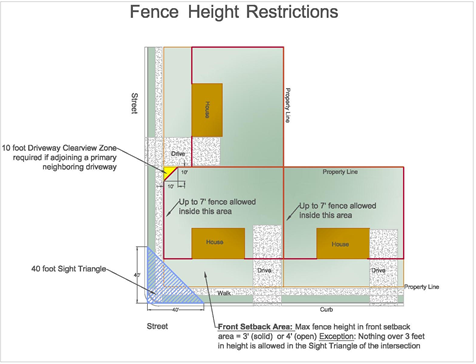
Figure 10.12.040-C-1: Fence Height Restrictions & Sight Triangles - Single Shrub Planting: For purpose of this section, single shrub planting shall not constitute a hedge if the closest distance between the foliage of any two plants is and remains at least five feet.
- Property Line Separation Height Requirement: Where a fence, wall, or hedge is located along a property line separating two lots and there is a difference in the grade of the properties on the two sides of the property line, the fence, wall, or hedge may be erected or allowed to the maximum height permitted on either side of the property line.
- Building Permit Required: Fences over 7 feet tall must be approved by the City Council and require a building permit.
- Fence Lines Adjacent to Sidewalk(s): Where sidewalk improvements have been made, fence lines may be adjacent to the sidewalk(s) in accordance with the provisions of this Ordinance.
- Multi Family Dwelling Unit Requirements: All new multi-family dwelling units must install a sight obscuring fence at least 6 feet tall around the interior side and rear sides of the property at the time of obtaining a building permit or expansion. (2006,2008) Note: This section does not supersede height requirements in the front setback listed in paragraph C.
- Exception: the following fences are exempt from these requirements so long as they do not constitute a safety hazard for vehicular and/or pedestrian traffic:
- Fences needed for safety purposes, such as utility areas, water ways, swimming pools, etc.
- Rear facing lots in subdivisions.
- Fences used for Government purposes
- Fences used for basketball, tennis or other sports related play areas (2006, 2008)
10.12.050 Signs; General Regulations
- Purpose: It is the purpose of this section to regulate and authorize signs that are compatible with their surroundings and legible under the circumstances in which they are seen; promote traffic safety and the convenience and enjoyment of public travel by minimizing visual distraction; protect pedestrians, attract tourists, preserve and enhance property values; establish first-class business and commercial districts; and promote civic beauty and order by establishing standards and regulations for sign design, location, size, type, compatibility, and aesthetics.
- Scope: This section regulates the design and placement of signs and related structures. It is not intended to regulate the protected content of public speech, and the regulations herein are intended to be content-neutral unless explicitly stated otherwise. These regulations apply to both on-premise and off-premise signs, but not to the official flags of any country, state, or other organization, provided the flag does not contain an advertisement or other commercial message; nor to hand-held placards and similar devices traditionally used for public protest and the exercise of free speech.
- Interpretation: The regulations of this section are declared to be the maximum allowable. If Planning Director feels it necessary, the application may be forwarded to the Planning and Zoning Commission for review and decision. (2012)
- Compliance Required: Any sign not expressly allowed by this ordinance is prohibited. When required, permits shall be secured from the city by making application to the Planning Director who shall review applications for compliance with this ordinance and all other applicable regulations. When the Planning Director determines that it is necessary, the applicant must also apply for and receive a building permit.
- Prohibited Signs: The following sign devices are prohibited in any zone:
- hot or cold air balloons or inflatables, except as specifically allowed by this section for temporary signs;
- any sign which flashes, blinks, uses chaser lights, or moves in any way, animate or inanimate, except commercial signs with time/temperature or electronic message center capability, and except for subtle lighting changes of low intensity;
- statuary bearing the likeness or suggestion of any product or logo; projecting signs which extend more than 18 inches away from or above the wall, except as provided by this ordinance;
- snipe signs;
- rapidly spinning wind-driven signs;
- temporary signs, except as specifically allowed in this section;
- signs on bus benches;
- any truck, trailer, or other vehicle conspicuously or regularly parked on- or off-premise with an advertising message or logo displayed to attract attention to a business, product or promotion;
- graffiti.
- Other Regulations:
- No person shall paint, mark or write on, post or otherwise affix any hand-bill or sign to or upon any sidewalk, crosswalk, curb, curbstone, park strip, street lamp post, hydrant, tree, shrub, tree stake or guard, railroad trestle, electric light or power or telephone or telegraph or trolley wire pole, or wire appurtenance thereof or upon any lighting system, public bridge, drinking fountain, life saving equipment, street sign or traffic sign.
- Nothing in this section shall apply to the painting of house numbers upon curbs. Any non-commercial message may be substituted for any commercial message permitted under this section.
- Illuminated signs not intended for temporary promotional events shall prevent excess light pollution into the night time sky. Externally lit signs must be downward lit or utilize directional hoods on the lights such that excess light will not be cast into the night time sky. (2006)
- The allowable sign area shall be in accordance to ECC 10.20.040 Table C. (2012)
- Permitted Signs:
- Primary Signs: Designed or intended to communicate or advertise to persons outside the property or to attract attention, traffic or business to the property. Rules governing primary signs shall be interpreted, as much as possible, in a content-neutral manner. Additional Rules:
- Sign area is calculated according to frontage toward which the sign is oriented, no other frontage counts toward allowable area.
- 20% allowable increase in sign area for monument signs - with Planning Commission approval.
- In the C-1 Commercial Zone of Ephraim, each separate building may utilize one projecting sign, subject to the following conditions:
- The maximum size allowed is twenty (20) square feet, or as otherwise determined by the available frontage of the lot; whichever is less.
- The sign may not project out from the plane of the building more than four (4) feet.
- The sign may not exceed the height of the building facade.
- For buildings with multiple tenants, the owner shall decide what portion of the projecting sign will be allotted to each tenant.
- The projecting sign will be included in the total allowable sign area per lot, as defined by this ordinance.
- All other provisions of this ordinance must be met, including lighting requirements, motion/animation requirements, height and clearance requirements, etc.
- No sign shall overhang the sidewalk or public right-of-way except that in commercial zones, if the building location is less than 20 feet from the property line, the sign may overhang the sidewalk if it has at least 8 and ½ feet of clearance.
- The total square footage allowed is the maximum per lot. For lots with more than one tenant, or needing more than one sign, the proportion allotted to each shall be decided by the tenants or the property owner.
- Exception to total allowable sign area: On premise awning signs, identification signs, incidental signs, nameplate signs, wall signs, and window signs, as defined by this ordinance, shall not be included in the total allowable sign area as established by this ordinance. Instead these signs are limited only by the area of the front wall of the building on which the sign is located, such that no sign or combination of signs listed in this paragraph shall cover more than 40% of the area of the front wall of the building.
- This exception is only to be applied to on-site, on-premise that are attached to the building. This exception shall not be applied or used for any business or other entity that does not reside in the building on which the sign is located.
- All signs which qualify for the exception to allowable area must meet all the other criteria of this ordinance, including lighting, animation, etc. (2006)
- Secondary Signs: Secondary signs arise out of safety or functional needs of a given piece of property and are intended to address specific issues related to the safe or efficient use of the property. Examples of secondary signs are entrance/exit signs, parking signs, restaurant menu boards, etc (see ECC 10.20.040 Table C, Part 2).
- Government Signs: Signs erected by a government agency in the course of official operations are allowed without a permit provided they do not constitute a traffic or safety hazard.
- Historical Signs: Signs considered being historically significant to the community and meeting the intent of the General Plan may be maintained with Planning Commission approval, regardless of any non conforming status with this ordinance, so long as the sign does not impose any safety hazard or undue hardship to the public or neighboring properties.
- Banners, Flags, and Decorations on City Poles: Only banners, flags, and decorations or approved by City Council will be allowed on City poles, except poles immediately adjoining Snow College campus wheron Snow College may place college-owned banners, flags, and decorations approved by City Council.
- Temporary Signs: Temporary signs shall not be placed in or over a public right-of-way, may not flash, blink, spin, rotate, block traffic visibility, constitute a vehicular or pedestrian traffic hazard, or cause a public nuisance. They shall not be attached to telephone poles, light poles, or street signs/poles. They must be firmly secured. Temporary signs may be attached to existing permanent signs for the grand opening period, or may cover or obscure an existing permanent sign only if the business has changed hands or changed names.
- Temporary signs announcing the initial opening of a business or the relocation or change of ownership of an existing business are allowed for not more than 60 days and only within the first year of operation. There shall be no more than two such signs allowed per business. A temporary sign permit is required.
- Signs advertising a business’s special promotions require a permit if the promotion will last more than three (3) days. Such promotions shall not exceed four periods during the calendar year. Each period may not exceed ten days in length. The periods may be combined to run consecutively. A temporary sign permit is required for all promotional events lasting more than 3 days.
- Signs advertising the liquidation of inventory for a failing business require a permit, which shall not exceed 90 days. Such permit will be allowed only once for any business license.
- Signs advertising the availability of a building or property are allowed provided they are removed within one week of the sale or rental.
- Temporary signs are allowed without a permit for
- the following holidays:
Presidents Day - February, 5 days,
Easter - March or April, 5 days,
Memorial Day - May, 5 days,
July 4th and July 24th, 5 days each,
Labor Day - September, 5 days,
Thanksgiving - November, 7 days,
Hanukkah, Christmas, New Year's, 21 days from Dec 15 to Jan 2. - One sign only is allowed during these periods. The sign must be removed by the end of the first working day after the holiday period ends.
- Historical markers issued or approved by a recognized governmental, nation-wide or state-wide historical society or group are allowed without a permit provided the property owner has given written permission. Other historical markers are allowed with the approval of the Planning Director. No historical marker may be placed in such a manner as to constitute a safety or traffic hazard.
- the following holidays:
- Portable Signs Encroaching into the Public Right of Way: For those businesses located within the C1 zone, which have no space between the building and the right of way, A-Frame signs and/or portable signs as defined herein may be placed in the public right of way or on the sidewalk (but not in the road) so long as no hazard is created for pedestrian or vehicular traffic and pedestrian access is maintained across the sidewalk. Said signs shall only be allowed during daylight hours only and must be removed every day at the close of business. For those businesses with space between the building and right of way, said portable signs may be used for promotional events but must be placed entirely on private property such that the sign does not encroach into the public right of way and said signs must be removed within 2 days after the promotional event.
- Primary Signs: Designed or intended to communicate or advertise to persons outside the property or to attract attention, traffic or business to the property. Rules governing primary signs shall be interpreted, as much as possible, in a content-neutral manner. Additional Rules:
- Enforcement:
- When a sign has been illegally erected, constructed, reconstructed, altered, repaired, converted, or maintained, or in any case where a sign is used in violation of any city ordinance or code, the Planning Director may:
- Issue a written notice of violation to the person having charge, control or benefit of any sign found to be unsafe, dangerous, or in violation of this ordinance;
- remove unsafe signs not repaired or made safe within five working days after the owner has received written notice;
- remove illegal signs not made conforming within 30 days after written notice has been given;
- remove temporary signs posted on private property without a permit or which are otherwise illegal, which, after written notice, have not been made conforming after 72 hours;
- remove any sign or hand-bill posted on public property, but shall not destroy the sign for a period less than 30 days from the date of removal;
- remove abandoned signs, signs identifying a discontinued use or non-maintained signs when such sign has not been repaired or put to use by the owner, person having control or person receiving benefit of such structure within 45 days after receiving written notice from the city.
- Any person ordered to alter or remove any sign, or any person whose application for a sign permit has been denied because of conflict with regulations stated herein, may appeal to the Appeal Authority by serving a written notice to the city within thirty days of the order or denial. Any person may also appeal to the Appeal Authority for an alleged error by the Planning Director or staff.
- The person having charge, control, or benefit of or who posted any sign removed by the city shall reimburse the city for the cost of the removal within thirty days of receiving a bill from the city.
- In no case shall the failure to remove illegal signs constitute approval by the city of their illegal placement.
- When a sign has been illegally erected, constructed, reconstructed, altered, repaired, converted, or maintained, or in any case where a sign is used in violation of any city ordinance or code, the Planning Director may:
- Nonconforming Signs:
- To minimize confusion and unfair competitive disadvantage, Ephraim City intends to regulate existing nonconforming signs with a view to their eventual elimination. This goal shall be achieved by limiting changes, expansions, alterations and by amortization. Excluding normal maintenance and repair, a nonconforming sign shall not be moved, altered or enlarged unless it is brought into complete compliance with this section. The following alterations are exempt from this provision:
- face changes in multi-tenant signs; and
- copy changes in permanent signs which were originally approved with a changeable copy feature.
- Within 45 days after vacation of an existing business, all on-site nonconforming signs must be removed or brought into compliance by the property owner. If removal does not occur, the city may remove the entire nonconforming sign, both face and structure. The property owner shall be liable for the cost of removing the sign, and the city may place a lien against the property to recover its costs if it removes the sign.
- An abandoned sign may not regain any legal nonconforming status later, even if the original business re-occupies the property.
- Exceptions:
- Upon appeal by a sign owner or business, the Appeal Authority may grant a special exception to allow the retention, alteration, movement, or expansion of a nonconforming sign, provided the board determines that:
- the nonconforming sign poses an alternative equivalent means of meeting the intent of this ordinance and the General Plan;
- the action will not impose a burden on other properties beyond that posed by a conforming sign; and
- approval will provide a forum for free expression or other benefits to the public.
- A new business generally shall not qualify for a special exception to reuse a nonconforming sign left by a previous business. Purely economic factors such as the expense of removing or altering a nonconforming sign or of purchasing a new conforming sign are not to be considered as reasons for granting a special exception by the board.
- The board may attach reasonable conditions with which the petitioner must comply as a condition of approval of a special exception.
- The duration of the special exception shall not extend beyond that period allowed by the Appeal Authority from the date the exception is granted.
- The Appeal Authority shall require a bond sufficient to cover the cost of removing the sign as a condition of approving a special exception.
- The Appeal Authority may attach a reasonable expiration date to a special exception.
- Upon appeal by a sign owner or business, the Appeal Authority may grant a special exception to allow the retention, alteration, movement, or expansion of a nonconforming sign, provided the board determines that:
- To minimize confusion and unfair competitive disadvantage, Ephraim City intends to regulate existing nonconforming signs with a view to their eventual elimination. This goal shall be achieved by limiting changes, expansions, alterations and by amortization. Excluding normal maintenance and repair, a nonconforming sign shall not be moved, altered or enlarged unless it is brought into complete compliance with this section. The following alterations are exempt from this provision:
Amended by Ord. 19-02 on 8/21/2019
10.12.055 Lighting Compliance
Lighting Compliance
- Purpose and Intent
- The purpose of this ordinance is to regulate outdoor lighting in order to minimize light pollution, reduce glare, and prevent light trespass. This ordinance aims to promote safety, provide Dark Sky education, conserve energy, and protect the night sky for the enjoyment and health of residents and wildlife.
- The purpose of this ordinance is to regulate outdoor lighting in order to minimize light pollution, reduce glare, and prevent light trespass. This ordinance aims to promote safety, provide Dark Sky education, conserve energy, and protect the night sky for the enjoyment and health of residents and wildlife.
- Definitions
- For the purposes of this ordinance, the following definitions shall apply:
- Light Pollution: Any adverse effect of artificial light, including sky glow, glare, light trespass, and clutter.
- Light Trespass: Light that falls beyond the property it is intended to illuminate.
- Kelvin (K): A unit of measurement used to describe the color temperature of a light source.
- Downward Facing Fixture: A lighting fixture designed to direct light downwards and prevent it from spreading into the sky or onto neighboring properties
- General Requirements
- Lighting Fixtures
- All outdoor lighting fixtures must be downward facing and shielded to minimize light pollution and light trespass.
- Lighting fixtures shall not cast light into the night sky or onto neighboring properties.
- The color temperature of all outdoor lighting fixtures shall not exceed 3,000 Kelvin to ensure the light is warm in color.
- Residential Lights
- Homeowners are encouraged to use night sky-friendly lighting fixtures to further reduce light pollution and protect the night sky.
- Lighting shall not trespass onto neighboring properties.
- Commercial Lighting
- Businesses are encouraged to turn off or dim their exterior signs and lighting after 10:00 PM to conserve energy and reduce light pollution.
- Exceptions can be made for businesses that operate past 10:00 PM; however, lighting must still adhere to the downward facing and shielded requirement and not exceed the specified color temperature.
- Light should not trespass on to neighboring properties.
- Parking lot lighting shall not cast into the night sky and should be downward cast.
- Lighting Fixtures
- Lighting Design Principles
- Useful: Lighting should provide necessary illumination for safety and functionality.
- Targeted: Light should be directed only where needed, minimizing excess illumination. Light should not trespass onto neighboring properties.
- Low Level: Use the lowest lighting levels necessary to accomplish the task.
- Controlled: Use timers, motion sensors, and other controls to reduce unnecessary lighting.
- Warm in Color: Lighting should be warm in color, not exceeding 3,000 Kelvin.
- Compliance and Enforcement
- All new outdoor lighting installations must comply with this ordinance.
Adopted by Ord. ECO 24-04 on 10/2/2024
10.12.060 Parking
At the time any building or structure is erected, enlarged or increased in capacity, use is established or changed, or a change of occupancy takes place, there shall be provided off street parking spaces on private property for automobiles in accordance with the requirements set forth in this section.
- Dimensions: The dimensions of each off street parking space, exclusive of access drives or aisles, shall be:
- At least nine feet by eighteen feet (9' x 18') for diagonal or ninety degree (90°) spaces;
- At least nine feet by twenty two feet (9' x 22') for parallel spaces.
- A parking stall may be reduced by two feet (2') lengthwise, if landscaping separated from the paved area of the parking stall by a curb or tire bumper guard is provided in the remaining two feet (2') of the parking stall.
- Landscaping: All areas within the parking area not paved shall be landscaped.
- Driveways and Access:
- Except for one and two-family dwellings, access to each parking space shall be from a private driveway and not from a public street.
- Driveways for residential lots shall not be more than twenty feet wide.
- Driveways for commercial uses shall be at least twenty feet wide, unless approved otherwise by the city engineer, except uses in the C1A zone may be treated as residential uses.
- Drives shall be spaced at least twelve feet apart.
- Limit on number of drives:
- Residential uses shall be limited to two drives per lot.
- Commercial uses shall be limited to two drives per 100 feet of road frontage.
- In no case shall the total amount of drive width exceed 50% of the frontage.
- Drives shall not be more than thirty-six feet wide.
- Drives shall not be closer than forty feet to an intersection.
- Drives may be shared by adjoining properties.
- Standards for width and access in this section do not supersede requirements of the fire code.
- Parking Requirements: See ECC 10.20.050 Table D. When a building or lot will contain more than one use, the parking requirements shall be calculated separately for each use and totaled. In the event a use is not listed in ECC 10.20.050 Table D, the Planning Director may determine the requirement based on the nearest comparable use standard in the table.
- Lighting: Parking lots shall be lighted by standards not more than 36 feet high using hooded sources. No glare or cast from lights shall fall outside the lot, or be directed into the nighttime sky. (2006)
- Paving: Every parcel of land hereafter used as a parking lot shall be paved with asphalt, concrete or composition of some other all weather hard surfacing material which meets applicable Fire Code and City Construction Standards Requirements. For the purposes of this ordinance, non-paved surfaces such as gravel and road base in parking lots shall not be considered as meeting the all weather hard surfacing requirement above unless specifically granted by the Planning Commission and City Council due to exceptional circumstances due to terrain or otherwise. Such exemption shall only occur after an acceptable landscaping plan has been approved by the city council.
- Storm Drainage: Applicant must provide a storm drainage plan to contain or reasonably disperse storm water from the parking lot. Storm drainage may not sheet flow across a public walkway. Any storm water discharges from off of the property shall not exceed pre-development flow rates. Larger multifamily and commercial developments may be required to submit a drainage report prepared by a licensed engineer.
- Shared Parking: The Planning Director may approve shared parking arrangements if in his opinion the applicant submits sufficient evidence showing the parking will adequately serve all of the uses at the peak combined times. See also ECC 10.16.060 regarding parking for mixed use developments.
- Other Considerations: some non-complying buildings (i.e., predating any land use enactment), especially buildings in the downtown area, are incapable of complying with these requirements. In such cases, new or expanding uses shall be required to provide as much off-street parking as possible, but shall not be limited by their inability to fully comply with this ordinance unless such non-compliance creates a serious threat to public health and safety (congested on-street parking is not such a threat).
- Potential Requirements for Multi-Family Developments. The Land Use Authority may require multi-family developments more than .75 miles away from Snow College to adhere to the parking standards required for Condominiums in ECC 10.20.050 Table D.
Amended by Ord. ECO 25-08 on 6/4/2025
10.12.070 Conditional Uses
Certain uses have characteristics that may have a greater impact on the adjoining properties, surrounding neighborhood, or community as a whole than do other permitted uses in the specific zoning district. These uses require a more comprehensive review to determine whether the proposed use at a specific location is appropriate, or whether the use can be made compatible by placing certain conditions on its operation that mitigate or eliminate potential detrimental impacts. The Planning Commission shall review and then recommend to the City Council to grant, to grant with conditions, or to deny each conditional use permit application, subject to the requirements of this section.
- Permit required: A conditional use permit shall be required for all uses listed as conditional uses in the zoning district regulations where they are, or will be located, or if the use is specified as conditional use elsewhere in this ordinance. Any change of use to other than a permitted use or any proposed expansion for a previously approved conditional use permit must reapply and secure a new conditional use permit from the City before proceeding with the proposed changes and/or expansions.
- No Presumption of Approval: The listing of a conditional use in any table of permitted and conditional uses found in this ordinance does not constitute an assurance or presumption that such conditional use will be approved. Rather, each proposed conditional use shall be evaluated on an individual basis, in relation to its compliance with the standards and conditions set forth in this ordinance and with the standards for the district in which it is located, in order to determine whether the conditional use is appropriate at the particular location. It is intended that review of conditional uses be site and case specific as well as fact-based.
- Application:
- Application for a conditional use permit shall be made to the Planning Director who, upon confirming that the application is complete, shall present the application to the Planning Commission for review.
- Each application for a conditional use permit shall be accompanied by maps, drawings, statements or other documents as required by the Planning Commission.
- Applications and submittals must be filed with the Planning Director for staff and public review by noon of the fourteenth day prior to the Planning Commission meeting. This deadline may be waived and/or adjusted at the discretion of the Planning Director.
- Application:
- Conditional Use Standards Of Review: The City shall not issue a conditional use permit unless the Planning Director, in the case of an administrative conditional use, or the Planning Commission, for all other conditional uses, concludes that the application fully mitigates all identified adverse impacts and complies with the following general standards applicable to all conditional uses, as well as the specific standards for the use.
- General Review Criteria: An applicant for a conditional use in the zone must demonstrate:
- The application complies with all applicable provisions of this chapter, state and federal law;
- The structures associated with the use are compatible with surrounding structures in terms of use, scale, mass and circulation.
- The use is not detrimental to the public health, safety and welfare;
- The use is consistent with the City General Plan as amended;
- Traffic conditions are not adversely affected by the proposed use including the existence or need for dedicated turn lanes, acceleration and deceleration lanes, pedestrian access, and capacity of the existing streets;
- There is sufficient utility capacity;
- There is sufficient emergency vehicle access;
- Off-street parking is of sufficient location and design, as well as compliance with off street parking standards (2012);
- There is a plan for fencing, screening, and landscaping to separate the use from adjoining uses and mitigate the potential for conflict in uses;
- Exterior lighting that complies with the lighting standards of the zone.
- Within and adjoining the site, impacts on the aquifer, slope retention, and flood potential have been fully mitigated and is appropriate to the topography of the site.
- There is sufficient landscaping and landscaped parking
- There is adequate and appropriate exterior and street lighting
- Specific Review Criteria For Certain Conditional Uses: In addition to the foregoing, the Planning Commission must evaluate the applicant’s compliance with each of the following criteria when considering whether to approve, deny or conditionally approve an application for each of the following conditional uses:
- Adult Oriented Businesses: The purpose and objective of this chapter is to establish reasonable and uniform regulations to prevent the concentration of adult-oriented businesses or their location in areas deleterious to the health, safety and welfare of the City, and to prevent inappropriate exposure of such businesses to the community. This chapter regulates the time, place, and manner of the operation of sexually-oriented businesses, consistent with the United States and Utah State Constitutions. See also ECC 10.12.120 for additional requirements.
- No adult-oriented business may be located within five hundred feet (500') of any: school, day care facility, cemetery, public park, library, religious institution, residential zoning boundary, liquor store, or other adult-oriented business.
- For the purposes of this section, distance is measured in a straight line, without regard to intervening structures or objects, from the closest exterior wall of the structure in which the adult-oriented business is located and:
- The closest exterior wall of another adult-oriented business;
- The closest property line of any school, day care facility, public park, library, cemetery or religious institution; and
- The nearest property line of any residential zone.
- Adult Oriented Businesses: The purpose and objective of this chapter is to establish reasonable and uniform regulations to prevent the concentration of adult-oriented businesses or their location in areas deleterious to the health, safety and welfare of the City, and to prevent inappropriate exposure of such businesses to the community. This chapter regulates the time, place, and manner of the operation of sexually-oriented businesses, consistent with the United States and Utah State Constitutions. See also ECC 10.12.120 for additional requirements.
- General Review Criteria: An applicant for a conditional use in the zone must demonstrate:
- Reasonable Conditions: A conditional use permit cannot be denied if detrimental effects can be mitigated by reasonable conditions, and that conditions are to be imposed in accordance with applicable standards.
- Denial: If the reasonably anticipated detrimental effects of a proposed conditional use cannot be mitigated by the proposal or the imposition of reasonable conditions to achieve compliance with applicable standards, the conditional use may be denied. (Utah Code §. 10-9a-507)
- Public Hearing: A public hearing on the conditional use permit application may be held if the Planning Director, Planning Commission or City Council shall deem a hearing to be necessary and in the public interest.
- Substantial Action Required: Unless there is substantial action under a conditional use permit within one year of its issuance, the permit shall expire.
- Extension for Good Cause: The Planning Commission may grant an extension for good cause shown. Only one extension may be granted and the maximum extension shall be six (6) months. In order to obtain an extension, the permit holder must apply for an extension in writing before the expiration of the original permit. The application must be submitted to the City Recorder and the application must describe the cause for requesting the extension.
- Notification: See Notice Matrix, ECC 10.20.060 Table E.
- Appeals: Any person aggrieved by a decision of the City Council regarding the issuance, denial or revocation of a conditional use permit may appeal such decision to the Appeal Authority provided such appeal is filed within 30 days of the City Council’s decision. The appeal shall be filed with the City Council and with the Appeal Authority.
- Revocation:
- Any conditional use permit shall be revocable by the City Council at any time due to failure of the permittee to observe any condition specified or failure to observe other requirements of the city code, or state or federal law in regard to the maintenance of improvements or conduct of the use or business as approved. The city shall also have a right of action to compel offending structures or uses to be removed at the cost of the violator or owner.
- No conditional use permit shall be revoked until a hearing is held by the City Council. Written notice to the permittee shall be postmarked at least fifteen days prior to the date of the scheduled hearing. The notification shall state the grounds for complaint or reasons for revocation, and the time and location at which the hearing is to be held. At the hearing, the permittee shall be given an opportunity to be heard. The permittee may call witnesses and present evidence.
- Transfer of Conditional Use Permit: A Conditional Use Permit granted in accordance with this section shall run with the land and continue to be valid regardless of ownership of the site or structure, as long as it operates within the conditions or stipulations of the Conditional Use Permit approval. If use is discontinued for a period of 1 year, the applicant must re-apply under the zoning ordinances which are current at the time of re-application. (2006)
10.12.080 Cell Phone Towers
It is the purpose of this section to regulate personal wireless services antennas, and related electronic equipment and structures, and to provide for the orderly establishment of personal wireless services facilities in the City, as well as to minimize the number of antenna support structures by encouraging the use of stealth facilities, by encouraging the co-location of multiple antennas on a single structure, by encouraging the location of antennas on pre-existing support structures, and by encouraging the use of City-owned property for antenna support structure, as well as to establish siteing, appearance, and safety standards that will help mitigate potential impacts related to the construction, use and maintenance of personal wireless services facilities. To comply with the Telecommunications Act of 1996 by establishing regulations that (1) do not prohibit or have the effect of prohibiting the provision of personal wireless services, (2) do not unreasonably discriminate among providers of functionally equivalent services, and (3) are not based on the environmental effects of radio frequency emissions to the extent that such facilities comply with the Federal Communication Commission’s regulations concerning such emissions.
- Applicability: This Article applies to both commercial and private low power radio services and facilities, such as “cellular” or PCS (personal communications system) communications and paging systems. Neither the term “wireless facility” nor the requirements of this Article shall apply to the following types of communications devices, although they may be regulated by other City ordinances and policies:
- Amateur Radio: Any tower or antenna owned and operated by an amateur radio operator licensed by the Federal Communications Commission.
- Satellite: Any device designed for over-the-air reception of television broadcast signals, multi-channel multipoint distribution service or direct satellite service.
- Cable: Any cable television headend or hub towers and antennas used solely for cable
- Wireless Internet broadcasting.
- Application Requirements: Any person desiring to develop, construct or establish a wireless facility in the City shall submit an application for site plan approval to the City in accordance with the requirements of paragraphs C and D regarding Site Plans. Additional application requirements may apply as per this article as well as per ECC 10.12.070 regarding Conditional Uses.
- Approval Process: The application shall be reviewed by the City in accordance with its standard site plan approval process. An exception to this is when a wireless carrier applies for a facility to be collocated on a monopole or other structure that was specifically designed and approved with room for one or more collocated transmission facilities. In this case, the submission requirements will be the same, but the site plan may be approved administratively by the Planning Director or his designee. If a transmission facility requires a conditional use permit, the review shall be in accordance with the City’s standard conditional use permit approval process. The City shall process all applications within a reasonable time and shall not unreasonably discriminate among providers of functionally equivalent services. Any decision to deny a request to place, construct, or modify wireless facilities shall be in writing and supported by substantial evidence contained in a written record.
- Land Use and Building Permits Required: No wireless facility shall be constructed until the applicant obtains a land use and building permit for the structure from the appropriate authority. No building permit shall be issued for any project for which a site plan, amended site plan or conditional use permit is required, until the site plan, amended site plan or conditional use permit has been approved by the appropriate authority. If the design or engineering of the antenna support structure is beyond the expertise of the City, the City may require third party review by an engineer selected by the City prior to the issuance of a land use permit. The applicant shall pay an additional fee to cover the cost of the third party review.
- Location and Type Priority:
- Priority of Antenna Site Locations: Wireless facilities shall be located as unobtrusively as is reasonably possible. To accomplish this goal, the provider shall make a good faith effort to site antennas in the following order of priority:
- Existing Structures or Stealth Facilities: First priority shall be granted to antennas located on existing structures or antennas qualifying as stealth facilities, as follows:
- Existing Structures: Lawfully existing wireless facilities designed for collocation, buildings, structures and antenna support structures, provided that the buildings, structures or support structures are:
- located on a wireless facility designed an approved for collocation,
- located in a non-residential zone, or
- located in a residential zone on property that is being used for non-residential uses (e.g. government, school or church), or
- located in a residential zone on a property that is being used for a multi-family residential building having eight (8) or more dwelling units;
- or Stealth Facilities: Antennas certified as stealth facilities as set forth in this ordinance.
- Existing Structures: Lawfully existing wireless facilities designed for collocation, buildings, structures and antenna support structures, provided that the buildings, structures or support structures are:
- On City-owned Property: Monopoles or lattice towers constructed on City-owned property. Monopoles or lattice towers on property owned by a non-City public agency.
- Monopole or lattice towers constructed on property owned by a non-City public agency.
- Monopoles or lattice towers on non-residential private property. Monopoles or lattice towers constructed on private property or other non-City property owned by a public agency, provided that the private property is (1) located in a non-residential zone, or (2) located in a residential zone on property that is used for a non-residential use (e.g. government, school or church). (3) Located outside of the nationally registered historic district.
- Other: Any combination of antenna type and location other than those listed above.
- Existing Structures or Stealth Facilities: First priority shall be granted to antennas located on existing structures or antennas qualifying as stealth facilities, as follows:
- Burden of Proof: If the applicant desires to locate antennas on a site other than the highest priority site, the applicant shall have the burden of demonstrating to the approving authority why it could not locate antennas on sites with a higher priority than the site chosen by the applicant. To do so, the applicant shall provide the following information to the approving authority:
- Higher Priority Sites: The identity and location of any higher priority sites located within the desired service area.
- Reason for Rejection of Higher Priority Sites: The reason(s) why the higher priority sites are not technologically, legally or economically feasible. The applicant must make a good faith effort to locate antennas on a higher priority site. The City may request information from outside sources to justify or rebut the applicant’s reasons for rejecting a higher priority site.
- Justification for Proposed Site: Why the proposed site is essential to meet the service demands of the geographic service area and the citywide network.
- If the applicant desires to construct a monopole, the applicant shall also submit a detailed written description of why the applicant cannot obtain coverage using existing buildings or structures or stealth facilities.
- Priority of Antenna Site Locations: Wireless facilities shall be located as unobtrusively as is reasonably possible. To accomplish this goal, the provider shall make a good faith effort to site antennas in the following order of priority:
- Permitted Uses and Locations:
- Permitted and Conditional Uses: Permissions are listed in the Land Use Matrix ECC 10.20.030 Table B. In determining whether or not to approve a conditional use permit the Planning Commission shall consider, as a minimum, the following:
- Compatibility of the facility with the height, mass and design of buildings, structures and uses in the vicinity of the facility.
- Whether the facility uses existing or proposed vegetation, topography or structures in a manner that effectively screens the facility.
- Whether the facility is disguised in a manner that mitigates potential negative impacts on surrounding properties.
- Whether the facility is located on a parcel of sufficient size to adequately support the facility.
- Location on Parcel. Whether the structure is situated on the parcel in a manner that can best protect the interests of surrounding property owners, but still accommodate other appropriate uses of the parcel.
- Location in General. Whether location or co-location of the facility on other structures in the same vicinity is practicable, without significantly affecting the antenna transmission or reception capabilities.
- The willingness of the applicant to allow co-location on its facility by other personal wireless services providers on such terms as are common in the industry.
- Not Permitted Uses: The following antenna types and antenna locations are not permitted, except upon a showing of necessity (inability to achieve coverage or capacity in the service area) by the applicant, in which case they shall be considered as conditional uses:
- Guyed towers are not permitted in any zone. Other poles are excepted, but only as per other sections of this Title.
- Towers in Residential zones. Any towers other than stealth facilities located on private property in the R1, R1A, R2, or R3 Zones, if the residentially zoned property has a residential use (as opposed to a school, church, or other non-residential use).
- Permitted and Conditional Uses: Permissions are listed in the Land Use Matrix ECC 10.20.030 Table B. In determining whether or not to approve a conditional use permit the Planning Commission shall consider, as a minimum, the following:
- Specific Regulations by Type: Wireless facilities are characterized by the type or location of the antenna structure. There are four general types of antenna structures contemplated by this ordinance: wall mounted antennas; roof mounted antennas; stealth facilities; and monopoles. If a particular type of antenna structure is allowed by this ordinance as a permitted or conditional use, the minimum standards for that type of antenna are as follows, unless otherwise provided in a conditional use permit:
- Wall Mounted Antennas:
- Wall mounted antennas shall not extend above the roof line of the building or structure or project more than four (4) feet from the face of the building.
- Wall mounted antennas shall not be located within twenty feet (20') feet of a residential zone unless it is located on a non-residential structure as approved by this title.
- Antennas mounted directly on existing parapet walls, penthouses, or mechanical equipment rooms are considered to be wall mounted antennas if no portion of the antenna extends above the roof line of the parapet wall, penthouse, or mechanical equipment room.
- Wall mounted antennas, equipment and supporting structures shall be painted to match the color of the building or structure or the background against which they are most commonly seen. Antennas and the supporting structure on the building shall be architecturally compatible with the building. Whip antennas are not allowed on a wall mounted antenna structure, but may camouflaged in a stealth facility as per stealth requirements of this article.
- The total area for all wall mounted antennas and supporting structures on any one building shall not exceed five percent (5%) of any exterior wall of the building.
- Roof Mounted Antennas:
- Maximum height of a roof mounted antenna shall be eighteen feet (18') above the roof line of the building.
- Roof mounted antennas shall be setback from the exterior wall of the building or structure a distance at least equal to the height of the antenna above the roof.
- Roof mounted antennas may be mounted directly on a roof, or on top of existing penthouses or mechanical equipment rooms if the total height of the antennas do not exceed eighteen feet (18') above the roof line of the building.
- Roof mounted antennas, equipment and supporting structures shall be painted to match the color of the building or structure or the background against which they are most commonly seen. Antennas and supporting structures shall be architecturally compatible with the building.
- Stealth Facilities:
- The maximum height of a stealth facility shall be eighteen feet (18’) higher than the maximum permitted structure height of the zone in which the stealth facility is located. The applicant may exceed the maximum structure height if otherwise allowed in this Chapter, or pursuant to a conditional use permit.
- Not every disguised or screened wireless facility qualifies as a stealth facility. Whether or not a particular facility qualifies as a stealth facility shall be decided by the Planning Commission as part of the conditional use permit approval process. In making the decision, the Commission shall consider the definition of Stealth Facilities set forth in this Article and shall consider whether the facility is disguised, blended or screened in a manner that eliminates any negative impact to surrounding properties. Each stealth facility certification applies to one location only. Because of differing circumstances specific to each site, an antenna that qualifies as a stealth facility in one location may not qualify as a stealth facility in a different location.
- Towers: If the applicant desires to construct a monopole or lattice tower, the applicant shall first submit a detailed written description of why the applicant cannot obtain coverage using existing buildings or structures or stealth facilities.
- The maximum height of the monopole or lattice tower shall be eighty feet (80'), although the approving body may, as a conditional use, allow an antenna or antenna support structure up to 120 feet (120’) in height, if the applicant demonstrates to the satisfaction of the approving body that the additional height is necessary to obtain coverage or to allow co-location, and that the applicant has taken steps to mitigate adverse effects on the surrounding neighborhood. The antenna itself shall not exceed ten feet (10') in height.
- Monopoles and lattice towers shall be set back a minimum of 110% of the height of the monopole from any residential lot line, measured from the base of the monopole to the nearest residential lot line.
- Monopole or lattice towers, antennas, and related support structures may be required to be painted a neutral color, or a color to match the background against which they are most commonly seen.
- Monopoles and lattice towers shall be located at least one half mile from each other. However, a new monopole with co-location space for other future or existing carriers may be permitted closer than a half mile to another legal nonconforming monopole that does not have any collocation space.
- Monopoles and lattice towers shall be located as unobtrusively on a parcel as possible, given the location of existing structures, nearby residential areas, and service needs of the applicant. Monopoles or lattice towers shall not be located in a required landscaped area, buffer area or parking area.
- Every new monopole or lattice tower shall be designed and constructed to be of sufficient size and capacity to accommodate at least two additional wireless telecommunications provider on the structure in the future unless otherwise approved by the Planning Commission.
- Wall Mounted Antennas:
- Lease Agreement: The City has no implied obligation to lease any particular parcel of City-owned property to an applicant. The City shall enter into a standard lease agreement with the applicant for any facility built on City property. The City Manager or designee is hereby authorized to execute the standard lease agreement on behalf of the City. The lease shall contain the condition that the site plan and/or conditional use permit must first be approved by the approving authority before the lease can take effect, and that failure to obtain such approval renders the lease null and void.
- Regulation Compliance:
- Compliance with FCC and FAA Regulations: All operators of wireless facilities shall demonstrate compliance with applicable Federal Communication Commission (FCC) and Federal Aviation Administration (FAA) regulations, including FCC radio frequency regulations, at the time of application and periodically thereafter as requested by the City. Failure to comply with the applicable regulations shall be grounds for revoking a site plan or conditional use permit approval.
- Other Licenses and Permits: The operator of every personal wireless services facility shall submit copies of all licenses and permits required by other agencies and governments with jurisdiction over the design, construction, location and operation of the facility to the City, shall maintain such licenses and permits in good standing, and shall provide evidence of renewal or extension thereof upon request by the City.
- Safety:
- Protection Against Climbing: Monopoles and lattice towers shall be protected against unauthorized climbing by removing the climbing pegs from the lower 20 feet of the structure.
- Fencing: Monopoles and lattice towers may be fully enclosed by a minimum 6-foot tall fence or wall, as directed by the City. The approving authority may determine that a wall or fence is needed or appropriate for a particular site due to conditions specific to the site.
- Security Lighting Requirements: Monopoles and lattice towers shall not contain lights on the towers unless mandated by FAA requirements for lighting. As part of the conditional use permit consideration, the City may also require security lighting for the site. If security lighting is used, the lighting impact on surrounding residential areas shall be minimized by using indirect lighting, where appropriate such that no light will be directed at the neighboring properties or into the nighttime sky.
- Abandonment: The City may require the removal of all antennas and towers if the facility has been inoperative or out of service for more than twelve (12) consecutive months.
- Notice to remove shall be given in writing by personal service, or by certified mail addressed to the operator’s last known address.
- Violation: Failure to remove the antennas and monopoles after receiving written notice to remove is a violation of the terms of this Chapter. The City may initiate criminal and/or civil legal proceeding against any person, firm, entity or corporation, whether acting as principal, agent, property owner, lessee, lessor, tenant, landlord, employee, employer or otherwise, for failure to remove antennas and monopoles in accordance with this Chapter. The City may seek a civil injunction requiring the removal of any structures on the site in accordance with this Chapter. The City may also remove such structures itself, and may bill its costs in removing the structures to the operator. Any lease agreement with the City may also stipulate failure to remove the antennas and monopoles after receiving written notice to do so pursuant to this Chapter automatically transfers ownership of the antennas, monopoles, support buildings and all other structures on the site to the City.
- Emergency: The City shall have authority to move or alter a wireless facility in case of emergency. Before taking any such action, the City shall first notify the owner of the facility, if feasible.
- Additional Requirements:
- Storage Areas and Solid Waste Receptacles: No outside storage or solid waste receptacles shall be permitted on the site unless in an enclosed area to provide visual screening.
- Equipment Enclosures: All electronic and other related equipment and appurtenances necessary for the operation of any wireless facility shall, whenever possible, be located within a lawfully pre-existing structure. When a new structure is required to house such equipment, the structure shall be harmonious with, and blend with, the natural features, buildings and structures surrounding such structure.
- Accessory Buildings: No more than three accessory structures are permitted for each wireless facility’s support equipment. A freestanding accessory buildings used with a wireless facility shall not exceed 240 square feet and shall comply with the setback requirements for structures in the zone in which the facility is located.
- Parking: The City may require a minimum of one (1) parking stall for sites containing a monopole, tower, and/or accessory buildings, if there is insufficient parking available on the site.
- Maintenance Requirements: All wireless facilities shall be maintained in a safe, neat and attractive manner.
- Landscaping: Freestanding wireless facilities that are not stealthed shall be landscaped on all sides visible from the street and from neighboring properties.
- Accessory Buildings are to be landscaped on all sides visible from the street and from neighboring properties with a row of evergreen trees at least 6 feet in height spaced to create a continuous screen and spaced as per approval of the Planning Commission. Additionally a row of shrubs must be added around the structure in front of the trees at five (5) per twenty (20) linear feet and shall reach a height of 3 feet within three years of planting.
- All other freestanding facilities and support structures are, at a minimum, to be enclosed with an architecturally solid fence six (6) feet in height, unless approved otherwise by the Planning Commission, due to specific conditions on the property. Additionally a row of shrubs must be added around the structure in front of the fence at five (5) per linear twenty (20) feet and shall reach a height of 3 feet within three years of planting.
- Exception: The landscaping and improvement requirements above may be waived or modified by the Planning Commission if water services are not reasonably available to maintain the landscaping, or if the above requirements are not compatible with the surrounding uses.
- Landscaping: Freestanding wireless facilities that are not stealthed shall be landscaped on all sides visible from the street and from neighboring properties.
10.12.090 Storm Water And Flood Damage Prevention
- Definitions:
ALLUVIAL FAN FLOODING: Flooding occurring on the surface of an alluvial fan or similar landform, which originates at the apex and is characterized by high-velocity flows; active processes of erosion, sediment transport, and deposition; and unpredictable flow paths.
APEX: A point on an alluvial fan or similar landform below which the flow path of the major stream that formed the fan becomes unpredictable and alluvial fan flooding can occur.
AREA OF SHALLOW FLOODING: A designated AO, AH, or VO zone on a community's Flood Insurance Rate Map (FIRM) with a one percent chance or greater annual chance of flooding to an average depth of one to three feet where a clearly defined channel does not exist, where the path of flooding is unpredictable and where velocity flow may be evident. Such flooding is characterized by ponding or sheet flow.
AREA OF SPECIAL FLOOD HAZARD: Is the land in the floodplain within a community subject to a one percent or greater chance of flooding in any given year. The area may be designated as Zone A on the Flood Hazard Boundary Map (FHBM). After detailed ratemaking has been completed in preparation for publication of the FIRM, Zone A usually is refined into Zones A, AE, AH, AO, A1-99, VO, V1-30, VE or V.
BASE FLOOD: The flood having a one percent chance of being equaled or exceeded in any given year.
BASEMENT: Any area of the building having its floor sub-grade (below ground level) on all sides.
CRITICAL FEATURE: An integral and readily identifiable part of a flood protection system, without which the flood protection provided by the entire system would be compromised.
DEVELOPMENT: Any man-made change in improved and unimproved real estate, including but not limited to buildings or other structures, mining, dredging, filling, grading, paving, excavation or drilling operations or storage of equipment or materials.
ELEVATED BUILDING: A non-basement building (i) built, in the case of a building in Zones A1-30, AE, A, A99, AO, AH, B, C, X, and D, to have the top of the elevated floor, or in the case of a building in Zones V1-30, VE, or V, to have the bottom of the lowest horizontal structure member of the elevated floor elevated above the ground level by means of pilings, columns (posts and piers), or shear walls parallel to the flow of the water and (ii) adequately anchored so as not to impair the structural integrity of the building during a flood of up to the magnitude of the base flood. In the case of Zones A1-30, AE, A, A99, AO, AH, B, C, X, and D, "elevated building" also includes a building elevated by means of fill or solid foundation perimeter walls with openings sufficient to facilitate the unimpeded movement of flood waters. In the case of Zones V1-30, VE, or V, "elevated building" also includes a building otherwise meeting the definition of "elevated building," even though the lower area is enclosed by means of breakaway walls if the breakaway walls met the standards of Section 60.3(e)(5) of the National Flood Insurance Program regulations.
EXISTING CONSTRUCTION: For the purposes of determining rates, structures for which the "start of construction" commenced before the effective date of the FIRM or before January 1, 1975, for FIRMs effective before that date. "Existing construction" may also be referred to as "existing structures."
EXISTING MANUFACTURED HOME PARK OR SUBDIVISION: A manufactured home park or subdivision for which the construction of facilities for servicing the lots on which the manufactured homes are to be affixed (including, at a minimum, the installation of utilities, the construction of streets, and either final site grading or the pouring of concrete pads) is completed before the effective date of the floodplain management regulations adopted by a community.
EXPANSION TO AN EXISTING MANUFACTURED HOME PARK OR SUBDIVISION: The preparation of additional sites by the construction of facilities for servicing the lots on which the manufactured homes are to be affixed (including the installation of utilities, the construction of streets, and either final site grading or the pouring of concrete pads).
FLOOD OR FLOODING: A general and temporary condition of partial or complete inundation of normally dry land areas from:- The overflow of inland or tidal waters.
- The unusual and rapid accumulation or runoff of surface waters from any source.
FLOOD INSURANCE STUDY: Is the official report provided by the Federal Emergency Management Agency. The report contains flood profiles, water surface elevation of the base flood, as well as the Flood Boundary-Floodway Map.
FLOODPLAIN OR FLOOD-PRONE AREA: Any land area susceptible to being inundated by water from any source (see definition of flooding).
FLOODPLAIN MANAGEMENT: The operation of an overall program of corrective and preventive measures for reducing flood damage, including but not limited to emergency preparedness plans, flood control works and floodplain management regulations.
FLOODPLAIN MANAGEMENT REGULATIONS: Zoning ordinances, subdivision regulations, building codes, health regulations, special purpose ordinances (such as a floodplain ordinance, grading ordinance and erosion control ordinance) and other applications of police power. The term describes such state or local regulations, in any combination thereof, which provide standards for the purpose of flood damage prevention and reduction.
FLOOD PROTECTION SYSTEM: Those physical structural works for which funds have been authorized, appropriated, and expended and which have been constructed specifically to modify flooding in order to reduce the extent of the areas within a community subject to a "special flood hazard" and the extent of the depths of associated flooding. Such a system typically includes hurricane tidal barriers, dams, reservoirs, levees or dikes. These specialized flood modifying works are those constructed in conformance with sound engineering standards.
FLOOD PROOFING: Any combination of structural and non-structural additions, changes, or adjustments to structures which reduce or eliminate flood damage to real estate or improved real property, water and sanitary facilities, structures and their contents.
FLOODWAY (Regulatory Floodway): The channel of a river or other watercourse and the adjacent land areas that must be reserved in order to discharge the base flood without cumulatively increasing the water surface elevation more than a designated height.
FUNCTIONALLY DEPENDENT USE: A use which cannot perform its intended purpose unless it is located or carried out in close proximity to water. The term includes only docking facilities, port facilities that are necessary for the loading and unloading of cargo or passengers, and ship building and ship repair facilities, but does not include long-term storage or related manufacturing facilities.
HIGHEST ADJACENT GRADE: The highest natural elevation of the ground surface prior to construction next to the proposed walls of a structure.
HISTORIC STRUCTURE: Any structure that is:- Listed individually in the National Register of Historic Places (a listing maintained by the Department of Interior) or preliminarily determined by the Secretary of the Interior as meeting the requirements for individual listing on the National Register
- Certified or preliminarily determined by the Secretary of the Interior as contributing to the historical significance of a registered historic district or a district preliminarily determined by the Secretary to qualify as a registered historic district;
- Individually listed on a state inventory of historic places in states with historic preservation programs which have been approved by the Secretary of Interior; or
- Individually listed on a local inventory or historic places in communities with historic preservation programs that have been certified either:
- by an approved state program as determined by the Secretary of the Interior or;
- directly by the Secretary of the Interior in states without approved programs.
LEVEE SYSTEM: A flood protection system which consists of a levee, or levees, and associated structures, such as closure and drainage devices, which are constructed and operated in accordance with sound engineering practices.
LOWEST FLOOR: The lowest floor of the lowest enclosed area (including basement). An unfinished or flood resistant enclosure, usable solely for parking or vehicles, building access or storage in an area other than a basement area is not considered a building's lowest floor; provided that such enclosure is not built so as to render the structure in violation of the applicable non-elevation design requirement of Section 60.3 of the National Flood insurance Program regulations.
MANUFACTURED HOME: A structure transportable in one or more sections, which is built on a permanent chassis and is designed for use with or without a permanent foundation when connected to the required utilities. The term "manufactured home" does not include a "recreational vehicle".
MANUFACTURED HOME PARK OR SUBDIVISION: A parcel (or contiguous parcels) of land divided into two or more manufactured home lots for rent or sale.
MEAN SEA LEVEL: For purposes of the National Flood Insurance Program, the National Geodetic Vertical Datum (NGVD) of 1929 or other datum, to which base flood elevations shown on a community's Flood Insurance Rate Map are referenced.
NEW CONSTRUCTION: For the purpose of determining insurance rates, structures for which the "start of construction" commenced on or after the effective date of an initial FIRM or after December 31, 1974, whichever is later, and includes any subsequent improvements to such structures. For floodplain management purposes, "new construction" means structures for which the "start of construction" commenced on or after the effective date of a floodplain management regulation adopted by a community and includes any subsequent improvements to such structures.
NEW MANUFACTURED HOME PARK OR SUBDIVISION: A manufactured home park or subdivision for which the construction of facilities for servicing the lots on which the manufactured homes are to be affixed (including at a minimum, the installation of utilities, the construction of streets, and either final site grading or the pouring of concrete pads) is completed on or after the effective date of floodplain management regulations adopted by a community.
RECREATIONAL VEHICLE: A vehicle which is:- built on a single chassis;
- 400 square feet or less when measured at the largest horizontal projections;
- designed to be self-propelled or permanently towable by a light duty truck; and
- designed primarily not for use as a permanent dwelling but as temporary living Quarters for recreational, camping, travel, or seasonal use.
STRUCTURE: A walled and roofed building, including a gas or liquid storage tank, that is principally above ground, as well as a manufactured home.
SUBSTANTIAL DAMAGE: Damage of any origin sustained by a structure whereby the cost of restoring the structure to its before damaged condition would equal or exceed 50 percent of the market value of the structure before the damage occurred.
SUBSTANTIAL IMPROVEMENT: Any reconstruction, rehabilitation, addition, or other improvement of a structure, the cost of which equals or exceeds 50 percent of the market value of the structure before "start of construction" of the improvement. This includes structures which have incurred "substantial damage", regardless of the actual repair work performed. The term does not, however, include either:- Any project for improvement of a structure to correct existing violations of state or Local health, sanitary, or safety code specifications, which have been identified by the local code enforcement official and which are the minimum necessary conditions or,
- Any alteration of a "historic structure", provided that the alteration will not preclude the structure's continued designation as a "historic structure."
VIOLATION: The failure of a structure or other development to be fully compliant with the community's floodplain management regulations. A structure or other development without the elevation certificate, other certifications, or other evidence of compliance required in Section 60.3(b)(5), (c)(4), (c)(10), (d)(3), (e)(2), (e)(4), or (e)(5) is presumed to be in violation until such time as that documentation is provided.
WATER SURFACE ELEVATION: The height, in relation to the National Geodetic Vertical Datum (NGVD) of 1929 (or other datum, where specified), of floods of various magnitudes and frequencies in the floodplains of coastal or riverine areas. - Special Flood Hazard Provisions:
- Lands To Which This Ordinance Applies: The ordinance shall apply to all areas of special flood hazard within the jurisdiction of Ephraim City.
- Basis For Establishing The Areas Of Special Flood Hazard: The areas of special flood hazard identified by the Federal Emergency Management Agency in a scientific and engineering report entitled, "The Flood Insurance Study for Ephraim City dated May 2, 2012, with accompanying Flood Insurance Rate Maps and Flood Boundary-Floodway Maps (FIRM and FBFM) and any revisions thereto are hereby adopted by reference and declared to be a part of this ordinance.
- Establishment Of Development Permit: Development Permit shall be required to ensure conformance with the provisions of this ordinance.
- Compliance: No structure or land shall hereafter be located, altered, or have its use changed without full compliance with the terms of this ordinance and other applicable regulations.
- Abrogation And Greater Restrictions: This ordinance is not intended to repeal, abrogate, or impair any existing easements, covenants, or deed restrictions. However, where this ordinance and another ordinance, easement, covenant, or deed restriction conflict or overlap, whichever imposes the more stringent restrictions shall prevail.
- Interpretation: In the interpretation and application of this ordinance, all provisions shall be:
- considered as minimum requirements;
- liberally construed in favor of the governing body; and
- deemed neither to limit nor repeal any other powers granted under State statutes.
- Warning And Disclaimer Or Liability: The degree of flood protection required by this ordinance is considered reasonable for regulatory purposes and is based on scientific and engineering considerations. On rare occasions greater floods can and will occur and flood heights may be increased by man-made or natural causes. This ordinance does not imply that land outside the areas of special flood hazards or uses permitted within such areas will be free from flooding or flood damages. This ordinance shall not create liability on the part of the community or any official or employee thereof for any flood damages that result from reliance on this ordinance or any administrative decision lawfully made thereunder.
- Administration:
- Designation Of The Floodplain Administrator: The Planning Director or his Designee is hereby appointed the Floodplain Administrator to administer and implement the provisions of this ordinance and other appropriate sections of 44 CFR (National Flood Insurance Program Regulations) pertaining to floodplain management.
- Duties & Responsibilities Of The Floodplain Administrator: Duties and responsibilities of the Floodplain Administrator shall include, but not be limited to, the following:
- Maintain and hold open for public inspection all records pertaining to the provisions of this ordinance.
- Review permit application to determine whether proposed building site, including the placement of manufactured homes, will be reasonably safe from flooding.
- Review, approve or deny all applications for development permits required by adoption of this ordinance.
- Review permits for proposed development to assure that all necessary permits have been obtained from those Federal, State or local governmental agencies (including Section 404 of the Federal Water Pollution Control Act Amendments of 1972, 33 U.S.C. 1334) from which prior approval is required.
- Where interpretation is needed as to the exact location of the boundaries of the areas of special flood hazards (for example, where there appears to be a conflict between a mapped boundary and actual field conditions) the Floodplain Administrator shall make the necessary interpretation.
- Notify, in riverine situations, adjacent communities and the State Coordinating Agency which is the State NFIP Coordinator, prior to any alteration or relocation of a watercourse, and submit evidence of such notification to the Federal Emergency Management Agency.
- Assure that the flood carrying capacity within the altered or relocated portion of any watercourse is maintained.
- When base flood elevation data has not been provided in accordance with paragraph C,2, the Floodplain Administrator shall obtain, review and reasonably utilize any base flood elevation data and floodway data available from a Federal, State or other source, in order to administer the provisions of Article 5.
- Permit Procedures: Application for a Development Permit shall be presented to the Floodplain Administrator on forms furnished by him/her and may include, but not be limited to, plans in duplicate drawn to scale showing the location, dimensions, and elevation of proposed landscape alterations, existing and proposed structures, including the placement of manufactured homes, and the location of the foregoing in relation to areas of special flood hazard. Additionally, the following information is required:
- Elevation (in relation to mean sea level), of the lowest floor (including basement) of all new and substantially improved structures;
- Elevation in relation to mean sea level to which any nonresidential structure shall be flood proofed;
- A certificate from a registered professional engineer or architect that the nonresidential Flood proofed structure shall meet the flood proofing criteria of Article 5, Section B,2;
- Description of the extent to which any watercourse or natural drainage will be altered or relocated as a result of proposed development.
- Maintain a record of all such information in accordance with paragraph D,2,a.
- Approval or denial of a Development Permit by the Floodplain Administrator shall be based on all of the provisions of this ordinance and the following relevant factors:
- The danger to life and property due to flooding or erosion damage
- the susceptibility of the proposed facility and its contents to flood damage and the effect of such damage on the individual owner;
- The danger that materials may be swept onto other lands to the injury of others;
- The compatibility of the proposed use with existing and anticipated development; The safety of access to the property in times of flood for ordinary and emergency vehicles;
- The costs of providing governmental services during and after flood conditions including maintenance and repair of streets and bridges, and public utilities and facilities such as sewer, gas, electrical and water systems;
- The expected heights, velocity, duration, rate of rise and sediment transport of the flood waters and the effects of wave action, if applicable, expected at the site;
- The necessity to the facility of a waterfront location, where applicable; The availability of alternative locations, not subject to flooding or erosion damage, for the proposed use;
- The relationship of the proposed use to the comprehensive plan for that area.
- Variance Procedures:
- The appeal authority as established by the legislative body shall hear and render judgment on requests for variances from the requirements of this ordinance.
- The Appeal Authority shall hear and render judgment on an appeal only when it is alleged there is an error in any requirement, decision, or determination made by the floodplain Administrator in the enforcement or administration of this ordinance.
- Any person or persons aggrieved by the decision of the Appeal Authority may appeal such decision in the courts of competent jurisdiction.
- The Floodplain Administrator shall maintain a record of all actions involving an Appeal and shall report variances to the Federal Emergency Management Agency upon request.
- Variances may be issued for the reconstruction, rehabilitation or restoration of Structures listed on the National Register of Historic Places or the State Inventory of Historic Places, without regard to the procedures set forth in the remainder of this ordinance.
- Variances may be issued for new construction and substantial improvements to be Erected on a lot of one-half acre or less in size contiguous to and surrounded by lots with existing structures constructed below the base flood level, providing the relevant factors in paragraph C,3,b have been fully considered. As the lot size increases beyond the one-half acre, the technical justification required for issuing the variance increases.
- Upon consideration of the factors noted above and the intent of this ordinance, the Appeal Authority may attach such conditions to the granting of variances as it deems necessary to further the purpose and objectives of this ordinance (paragraph A,3).
- Variances shall not be issued within any designated floodway if any increase in flood levels during the base flood discharge would result.
- Variances may be issued for the repair or rehabilitation of historic structures upon a determination that the proposed repair or rehabilitation will not preclude the structure's continued designation as a historic structure and the variance is the minimum necessary to preserve the historic character and design of the structure.
- Prerequisites for granting variances:
- Variances shall only be issued upon a determination that the variance is the minimum necessary, considering the flood hazard, to afford relief.
- Variances shall only be issued upon:
- showing a good and sufficient cause;
- a determination that failure to grant the variance would result in exceptional hardship to the applicant, and
- a determination that the granting of a variance will not result in increased flood heights, additional threats to public safety, extraordinary public expense, create nuisances, cause fraud on or victimization of the public, or conflict with existing local laws or ordinances.
- Any application to whom a variance is granted shall be given written notice that the structure will be permitted to be built with the lowest floor elevation below the base flood elevation, and that the cost of flood insurance will be commensurate with the increased risk resulting from the reduced lowest floor elevation.
- Variances may be issued by a community for new construction and substantial improvements and for other development necessary for the conduct of a functionally dependent use provided that:
- the criteria outlined in paragraphs D,4,a-i are met, and
- the structure or other development is protected by methods that minimize flood damages during the base flood and create no additional threats to public safety.
- Provisions For Flood Hazard Reduction:
- General Standards: In all areas of special flood hazards the following provisions are required for all new construction and substantial improvements:
- All new construction or substantial improvements shall be designed (or modified) And adequately anchored to prevent flotation, collapse or lateral movement of the Structure resulting from hydrodynamic and hydrostatic loads, including the effects of buoyancy;
- All new construction or substantial improvements shall be constructed by methods and practices that minimize flood damage;
- All new construction or substantial improvements shall be constructed with Materials resistant to flood damage;
- All new construction or substantial improvements shall be constructed with electrical, heating, ventilation, plumbing, and air conditioning equipment and other service facilities that are designed and/or located so as to prevent water from entering or accumulating within the components during conditions of flooding.
- All new and replacement water supply systems shall be designed to minimize or eliminate infiltration of flood waters into the system;
- New and replacement sanitary sewage systems shall be designed to minimize or eliminate infiltration of flood waters into the system and discharge from the systems into flood waters; and,
- On-site waste disposal systems shall be located to avoid impairment to them or contamination from them during flooding.
- Specific Standards: In all areas of special flood hazards where base flood elevation data has been provided as set forth in (i) paragraph C,2, (ii) paragraph D,2,h, or (iii) Article 5, Section C,3, the following provisions are required:
- Residential Construction: New construction and substantial improvement of any residential structure shall have the lowest floor (including basement), elevated to or above the base flood elevation. A registered professional engineer, architect, or land surveyor shall submit a certification to the Floodplain Administrator that the standard of this paragraph as proposed in paragraph D,3,a, is satisfied.
- Nonresidential Construction: New construction and substantial improvements of Any commercial, industrial or other nonresidential structure shall either have the lowest floor (including basement) elevated to or above the base flood level or together with attendant utility and sanitary facilities, be designed so that below the base flood level the structure is watertight with walls substantially impermeable to the passage of water and with structural components having the capability of resisting hydrostatic and hydrodynamic loads and effects of buoyancy. A registered professional engineer or architect shall develop and/or review structural design, specifications, and plans for the construction,and shall certify that the design and methods of construction are in accordance with accepted standards of practice as outlined in this paragraph. A record of such certification which includes the specific elevation (in relation to mean sea level) to which such structures are flood proofed shall be maintained by the Floodplain Administrator.
- Manufactured Homes: Require that all manufactured homes to be placed within Zone A on a community's FHBM or FIRM shall be installed using methods and practices which minimize flood damage. For the purposes of this requirement, manufactured homes must be elevated and anchored to resist flotation, collapse, or lateral movement. Methods of anchoring may include, but are not limited to, use of over-the-top or frame ties to ground anchors. This requirement is in addition to applicable State and local anchoring requirements for resisting wind forces.
- Standards For Subdivision Proposals:
- All subdivision proposals including the placement of manufactured home parks and subdivisions shall be consistent with paragraphs A,2, 3, and 4.
- All proposals for the development of subdivisions including the placement of manufactured home parks and subdivisions shall meet Development Permit requirements of paragraph C,3; paragraph D,3; and the provisions of Article 5 of this ordinance.
- Base flood elevation data shall be generated for subdivision proposals and other Proposed development including the placement of manufactured home parks and subdivisions which is greater than 50 lots or 5 acres, whichever is lesser, if not otherwise provided pursuant to paragraph C,2 or paragraph D,2,h.
- All subdivision proposals including the placement of manufactured home parks and subdivisions shall have adequate drainage provided to reduce exposure to flood hazards.
- All subdivision proposals including the placement of manufactured home parks and subdivisions shall have public utilities and facilities such as sewer, gas, electrical and water systems located and constructed to minimize or eliminate flood damage.
- General Standards: In all areas of special flood hazards the following provisions are required for all new construction and substantial improvements:
10.12.100 Center Of Block Development Standards
- Single-Family Dwellings – Flag Lots: For single-family dwellings, flag lots shall be allowed provided:
- Flag lots must be accessed by a paved driveway of at least 12 feet in width, whether in separate ownership from the parent lot or by recorded easement.
- The parent lot must maintain at least an 8 foot setback between the existing house on the parent lot and the resulting property line. For shared drives and drives accessed by easement, driveways shall be spaced no closer than 4 feet to the existing house on the parent lot to allow space for pedestrian access, unless exempted by the planning commission after consideration of pedestrian and vehicular access, emergency vehicle access, and other applicable safety concerns.
- Minimum lot size is met for both the parent lot and the flag lot, according to zoning requirements. Minimum lot size may be exempted by the planning commission if the maximum density is met for the original undivided property in the underlying zone.
- Minimum set backs are met for the parent lot. Minimum setbacks must also be met for the child flag lot unless waived by the Planning Commission after consideration for future roads, access, fire codes, safety, etc. In no case shall any setback be reduced to less than 8 feet on the child lot.
- Shared drives for flag lots are allowed for driveways at least sixteen (16) feet wide or as otherwise required by applicable Fire Code.
- If more than one flag lot is desired to be created from the same parent lot, whether at the same time or at any time after the initial flag lot is created, the applicant shall apply under a Planned Unit Development application. Figure 10.12.100-A-1: Flag Lot
- Other Uses: For all uses other than single-family dwellings, center of block development shall be done as part of a Planned Unit Development (P.U.D.) application according to Ephraim City Subdivision Regulations. Regulations specific to each development shall be reviewed and approved as part of the planned development process.
10.12.110 Condominium Conversion Projects
- Purpose: The purpose of this Section is to establish guidelines and minimum requirements relating to the conversion of existing structures to condominium ownership and the maintenance and operation of such projects. These provisions shall be supplemental and in addition to the general requirements for developments contained under other chapters of this ordinance, and also the requirements of the Utah Code Annotated, 1953, as amended.
- Permitted Uses: Uses permitted within a condominium project shall be limited to those uses specifically permitted within the zone which underlies the area of the project and shall be subject to all conditions and restrictions required within the zone for the use.
- Layout and Improvement: Each proposed condominium conversion project shall conform to the following minimum standards:
- Residential Conversion Projects:
- Off Street Parking: Not less than two (2) off street parking spaces shall be provided for each dwelling unit, and at least one of the required spaces shall be covered, unless waived by the Planning Commission. All driveways and off street parking areas shall be hard-surfaced.
- Common Vehicle Storage Area: In addition to any other parking requirements, at least one (1) space per five (5) dwelling units for recreational vehicles and boat storage, and an additional one (1) space per five (5) dwelling units for guest parking shall be provided. These spaces may be owned in common or by the homeowner’s association. If conditions within a condominium conversion preclude compliance with this requirement, a provision shall be placed in the bylaws or declaration precluding the parking of recreational vehicles and boats within the condominium development, and such preclusion shall be strictly enforced by the management. (Ord ECO 09-05, 8/19/09)
- Common Open Space: Common space shall be provided and shall not be less than twenty (20) percent of the total site area. The required open space shall be landscaped areas that are not occupied by buildings, structures, parking areas, streets, or alleys. Said open space shall be devoted to landscaping, preservation of natural features, patios, and recreational areas and facilities.
- Commercial and Industrial Conversion Projects: Each project shall conform to the minimum City standards with regard to location, parking, landscaping, access and similar issues which existed at the time the structure was established.
- Residential Conversion Projects:
- Utility and Facility Requirements:
- All units shall be separately metered for water, gas, and electricity unless the covenants, conditions and restrictions provide for the Association to pay the costs of services.
- Each unit shall be provided with readily accessible individual shut-off valves.
- All storage and solid waste receptacles outside of units must be housed in a closed structure compatible with the design of the development.
- Approval Procedure: If no new buildings will be constructed, and the existing apartments to be converted to condominiums are currently permitted in underlying zone of the property, the Planning Commission may approve the application after receiving preliminary review from the Development Review Committee (DRC) and after ensuring that all applicable provisions of this title have been met by the applicant. In all other cases where buildings are to be constructed, in addition to meeting the applicable requirements of this ordinance, the applicant must receive approval for a planned unit development (PUD) in accordance with the requirements for subdivisions found in ECC 11.
- Required Documents:
- The following documents shall be prepared and submitted by the developer for each condominium conversion project:
- Articles of Incorporation
- Corporation By-Laws
- Declaration of Covenants, Conditions, Restrictions and
- Management Policies/Declaration of Condominium
- Management Agreement
- Open Space Easement
- Title Report
- Record of Survey Map (Prepared by a Licensed Surveyor registered in the State of Utah)
- Property Report (see special provisions below)
- Where, in the opinion of the Planning Commission, a particular document required under this Section is inapplicable for the particular project proposed, the Planning Commission may waive the requirement for submitting said document.
- The following documents shall be prepared and submitted by the developer for each condominium conversion project:
- Special Provisions:
- Property Report (as required under paragraph F,1,i): The developer shall submit two copies of a property report describing the condition, useful life and capacity of the roof, foundations, mechanical, electrical, plumbing and structural elements of all existing buildings and structures or uses, and identifying existing or latent deficiencies, and estimated costs of any proposed repairs and/or renovations. Said report shall be prepared by a qualified licensed architect, engineer, or building inspector acceptable to the City. The report shall also contain a statement of disclosure identifying those aspects of the building and site area which do not meet the requirements of the zoning ordinance and the life safety provisions of the International Building Code as they currently exist.
- Notification of Tenants: Developers of a condominium conversion project shall, at the time of submission for final approval, submit to the County the following:
- Certification that the present tenants of the project have been notified of the proposed conversion. All tenants who want to move into the property after an application for conversion has been filed with the City shall be notified by the developer of his plans to convert the premises to condominiums, prior to occupancy by such tenant.
- The present tenant or tenants of any unit to be converted shall be given a nontransferable right of first refusal to purchase the unit occupied upon at least the same terms and conditions offered to the general public or other individuals. The right shall extend for at least sixty (60) days after beginning sales, providing that the tenant may cancel the purchase agreement if the unit is not conveyed to the tenant within six (6) months, or unless the tenant gives prior written notice of his/her intention not to exercise such right.
- Fees: The fees for such a project shall be the same as is constituted for a Multi-family land use permit.
- Enforcement: The Planning Director or his delegate shall have the authority to enforce this chapter against violations thereof by any of the following actions:
- To serve notice requiring the cessation or correction of any action in violation of this chapter upon any person who commits or assists in such violation.
- To deny the conversion application.
- To call upon the City Attorney to initiate an action to restrain or abate or correct the violation.
- To see any other remedy available at law or in equity to correct such violation.
- Declaration Of Covenants: Conditions And Restrictions And Project Elements. To achieve the purpose of this section, the Planning Director or his delegate shall review and approve the Declaration of Covenants, Conditions and Restrictions and project elements relating to the management of the common area and facilities be approved prior to final approval. In addition to such covenants, conditions and restrictions that may be required pursuant to the Utah Condominium Ownership Act or other state laws or policies, such declaration shall be subject to recording and shall provide for the following, none of which when approved by the Planning Commission, shall be amended, modified, or changed without first obtaining written consent. The minimum criteria and conditions which are described in this section and any other conditions to be placed in the covenants, conditions and restrictions shall be distributed to the developer at the time of application for preliminary approval.
- Maintenance: The developer shall retain responsibility for maintenance of the common areas and facilities until at least 75% of the units have been sold and the Planning Director or his designee has determined that the Homeowner's Association has assumed control of the maintenance functions.
- Enforcement: Techniques to be used in security compliance with the duties and provisions of the covenants, conditions and restrictions shall be specified.
- Utility Easements Over Private Streets and Other Areas: If the condominium project contains private streets, paths, or roadways, provision shall be made for public utility easements over the entire private street, path or roadway network. The Planning Director or his delegate may also require public utility easements over other portions of the project to accommodate fire hydrants, water meters, street furniture, storm drainage, sanitary sewers, water and gas mains, electrical lines, irrigation systems, and similar public improvements and utilities. The Planning Director or his delegate may also require access routes necessary to assure that firefighting equipment can reach and operate efficiently in all areas of the project. Each owner and the Association shall have an easement for entry upon any privately-owned unit, where necessary, in connection with construction, maintenance or repair for the benefit of the common area.
- Improvement Performance Bonds: Performance bonds or other assurances of performance for the installation of required improvements in a condominium project may be posted in accordance with City bonding standards if weather conditions, acts of God, or other circumstances beyond the control of the developer make it infeasible or impractical to complete the improvements prior to certification or recording. Posting of bonds or other assurances may not be used to guarantee completion of required fire separation or correction of code violations which are deemed to be hazardous to the life or safety of occupants.
- Unlawful to Sell or Lease: It shall be unlawful to record any record of survey map or declaration of a condominium project in the office of the County Recorder, unless the same shall bear thereon final approval of the Planning Commission as required by the terms of this Code, and any record of survey map or declaration so recorded without such approval shall be null and void. Any owner, or agent of any owner, of land or units located within a purported condominium conversion project, who transfers or sells any land, structure, or condominium unit in such purported project, before obtaining the final approval by the Planning Commission and City Council on the record of survey map and declaration, and recording the same in the Office of the County Recorder, shall be guilty of a misdemeanor for each lot, parcel of land, structure or condominium unit so transferred or sold.
10.12.120 Sexually Oriented Businesses
- Purpose: The purpose and objective of this section is to establish reasonable and uniform regulations to prevent the concentration of sexually oriented businesses or their location in areas deleterious to the City, regulate the signage of such businesses, control the adverse affects of such signage and prevent inappropriate exposure of such businesses to the community. This Ordinance is to be construed as a regulation of time, place and manner of the operation of these businesses, consistent with the United States and Utah Constitutions. See also ECC 10.12.070 Paragraph C. (Ord., 11-19-1997)
- Definitions: Terms involving sexually oriented businesses which are not defined in this Ordinance shall have the meanings set forth elsewhere in this ordinance. (Ord., 11-19-1997)
- Location of Businesses, Restrictions:
- Outcall Services: Outcall services shall only be permitted in areas zoned I (Industrial).
- Sexually Oriented Businesses: Sexually oriented businesses shall only be permitted in areas zoned I (Industrial) under this Ordinance, subject to the following additional restrictions:
- No sexually oriented business shall be located:
- Within one thousand feet (1,000') of any school, public park, library or religious institution.
- Within six hundred feet (600') of any residential use or any agricultural or residential zoning boundary.
- Within six hundred feet (600') of any other sexually oriented business, except outcall services.
- Within three hundred fifty feet (350') of any gateway corridor. The distance shall be measured from the right of way boundary.
- Measuring Distance Requirements:
- Distance requirements between structures and uses specified in this Section shall be measured in a straight line, without regard to intervening structures or zoning districts, from the property boundaries of the school, public park, religious or cultural activity, residential use or other sexually oriented business, or from the right of way line of a gateway to the structure of the sexually oriented business.
- Distance requirements from zoning districts for this section shall be measured in a straight line, without regard to intervening structures or zoning districts, from the closest zoning boundary of a residential or agricultural district to the sexually oriented business structure. (Ord., 11-19-1997)
- No sexually oriented business shall be located:
- Effect on Non-conforming Businesses: All existing legal, nonconforming sexually oriented businesses, as of the effective date hereof, or any amendment hereto, shall comply with the provisions of this section within nine months from the effective date hereof. (Ord., 11-19-1997)
- Signs: Notwithstanding anything other provision of this ordinance, the more restrictive requirements for signs shall prevail. Signs for sexually oriented businesses shall be limited as follows:
- No more than one exterior sign shall be allowed.
- No sign shall be allowed to exceed eighteen (18) square feet.
- No animation shall be permitted on or around any sign or on the exterior walls or roof of such premises.
- No descriptive art or designs depicting any activity related to or inferring the nature of the business shall be allowed on any sign. Said signs shall contain alphanumeric copy only.
- Only flat wall signs and/or awning signs shall be permitted.
- Painted wall advertising shall not be allowed.
- Other than the signs specifically allowed by this section, the sexually oriented business shall not attach, construct or allow to be attached or constructed any temporary sign, banner, light or other device designed to draw attention to the business location.
10.12.130 Nonconforming Uses
These regulations are designed to regulate and protect the rights of legally existing nonconforming buildings and uses. Any lawful use or activity conducted under county zoning regulations at the effective date of annexation or under previous city zoning regulations in effect at the adoption of this ordinance which no longer complies with the regulations of this ordinance shall be considered a legal nonconforming use. The site, building, or use may be encouraged to convert to a conforming use in the future, although limited expansion or enlargement may be allowed subject to the provisions of this section. The property owner has the burden to establish that use is legally nonconforming. The person or entity claiming that a nonconforming use has been abandoned bears the burden to establish the abandonment. (2006)
- Non Complying Structure Maintained: A non-complying building or structure may be maintained.
- Occupancy: The occupancy of a building or structure by a non-conforming use, existing at the time this ordinance became effective, may be continued.
- If a nonconforming use has been discontinued for a period of one year, it shall not thereafter be re-established and all subsequent uses shall conform with the provisions of this ordinance.
- A nonconforming use may expand to include the entire floor area of the building in which it is conducted.
- Nonconforming Use: The nonconforming use of land may be continued as follows:
- No nonconforming use of land shall in any way be expanded or extended either on the same or on adjoining property; and
- if a nonconforming use of land is abandoned for a period of one year or more, any future use of such land shall conform with the provisions of this ordinance.
- Repairs and Structural Alterations: Repairs and structural alterations may be made to a non-complying building or to a building housing a non-conforming use. In the event that a non-complying building or structure is damaged or destroyed by involuntary fire, flood, or other calamity, it may be restored and the occupancy or use which existed at the time of the damage or destruction may be maintained, provided that such restoration is started within a period of one year and is diligently pursued to completion. The reestablishment of a non-conforming use or non-complying structure after loss by fire or other casualty, can be denied by the City if abandoned for a period of at least one year or allowed to become uninhabitable or demolished. (2006)
- Additions, Enlargements, and Moving: A nonconforming use, building or structure may not be reconstructed, expanded, enlarged or moved to a new location on the same lot if the total of such activities over its life is more than 50% of its fair market value unless the City Council issues a conditional use permit. Before issuing a conditional use, the Planning Commission and City Council shall find:
- The addition, enlargement of, or moving of the building will be in harmony with one or more of the purposes of this ordinance.
- That the proposed change does not impose any unreasonable burden upon the lands located in the vicinity of the nonconforming use or structure.
- Conditional Use Process for Nonconforming Use: The nonconforming use of a building or structure may not be changed except to a conforming use, unless approval of a conditional use permit is given by the City Council. The approval process for the conditional use permit shall follow the requirements as defined ECC 10.12.070, except that a public hearing must be held and the proposed use need not be listed in ECC 10.20.030 Table B as a permitted or conditional use. In granting a conditional use permit, the approving body shall consider the well-being of the surrounding residents, and may impose reasonable conditionals of approval that will protect the health, safety and property values of the neighboring properties. (Amended May, 2005)
10.12.150 Enforcement And Responsibility
Ephraim City will not authorize the building inspector, nor will the city land use administrative officer or any administrative official of Ephraim City issue any permit for the proposed erection, construction, reconstruction, alteration, or use until proof of full compliance with all the provisions of this title has been provided. Any license or permit issued in conflict with the provisions of this title shall be null and void.
10.12.160 Guarantee Of Improvements Required
In lieu of the actual completion and acceptance by the city engineer or designee of the improvements required by this title the developer shall guarantee, by written agreement in a form approved by Ephraim City, and by one or more of the following methods, the installation and construction of the required improvements within one year from the date of approval of the final plat unless granted an extension by the city. Said agreement and guarantee must state "In favor of Ephraim City". In addition the developer shall guarantee by one or more of the following methods that the improvements shall be maintained in a state of good repair free from defective material or workmanship during the one year warranty period.
10.12.170 Option 1; Deposit With City (Preferred)
The developer shall deposit with the city a sum equal to one hundred fifteen percent (115%) of the costs of the required improvements not installed, constructed, and accepted by the city. The city shall deposit this amount in a separate interest bearing account. The developer shall have the right to draw against the account with the city all sums to one hundred percent (100%) of the cost of the improvements not installed which shall be paid to the order of persons installing, constructing, or maintaining the improvements. The city shall hold the additional fifteen percent (15%) to guarantee that the improvements are maintained in a state of good repair free from defects of material or workmanship throughout the one year warranty period following approval of the improvements. The city may, at least 30 days after making written demand on the developer, install or cause to be installed, constructed, or repaired the improvements and pay such costs from the developer's account. The city shall refund any sums remaining in the developer's account after the city engineer or appointee accepts the improvements and the one year warranty period expires.
10.12.180 Option 2; Bond
- The developer shall furnish and file with the city recorder a bond with corporate surety in an amount equal to one hundred fifteen percent (115%) of the cost of the improvements not previously installed and accepted plus fifteen percent (15%) of the cost of previously installed improvements within the one year warranty period immediately following the approval of the subdivision plat by the legislative body and a statement that the improvements shall be maintained in a state of good repair free from defects of material or workmanship for the entire warranty period following the date of final approval for the improvements, which bond shall be approved by the city attorney.
- Upon completion of the improvements for which a surety or cash bond has been filed, the developer shall call for inspection by the city engineer. If inspection shows city standards and specifications have been met in completion of such improvements, the portion of the bond corresponding to the completion to the improvements shall be released within seven (7) days from the time of inspection. The portion of the bond corresponding to the warranty improvements will be released following inspection and verification of the condition of the improvements after the warranty period has expired and following final approval.
10.12.190 Option 3; Escrow
The developer shall deposit with a city approved insurance company, bank, or savings and loan institution in an escrow account an amount of money equal to at least one hundred fifteen percent (115%) of the costs of the improvements required by this title not previously accepted by the city and fifteen percent (15%) of the cost of the improvements already installed and approved. The costs of the improvements shall be determined by the city engineer. The escrow agreement shall be subject to approval by the city attorney and shall be signed by the developer, the city, and the escrow holder.
10.12.200 Legal Remedies For Violation
In accordance with Utah Code § 10-9a-803, any applicant that violates this title may be charged with a class C misdemeanor and subject to all fines and imprisonment associated with such penalty.
- Because it is impractical to expect that all grading, infrastructure, and other improvements can be adequately inspected by Ephraim City, Ephraim City expects applicants to complete all development improvements in accordance with the approved plans. If an applicant installs improvements that are inconsistent with the development approval granted by the city council, the improvements will be corrected to satisfy the approval granted by the city council at the applicant's expense even if discovery of the inconsistency occurs after an initial acceptance of the development improvements. Failure to correct the inconsistencies may result in any legal action necessary to correct the inconsistencies.
10.12.210 Prohibited Travel Of Heavy Vehicles On City Streets
- No heavy vehicle shall be allowed to travel upon City streets posted by Ephraim City indicating that such travel and use is prohibited except for vehicles making deliveries or servicing the posted streets. These vehicles may include, but not be limited to public works, public safety, utility, or other vehicles making deliveries or providing services to or from destinations on said posted streets.
- For purposes of this ordinance heavy vehicles shall be defined as any vehicle having a Gross Vehicle Weight Rating (GVWR) of 20,000 pounds or greater. The GVWR shall be measured by the manufactures placard located on the vehicle.
10.12.220 Commercial Storage Units
- Purpose
The purpose and objective of this section is to establish reasonable and uniform regulations to prevent the concentration of commercial storage units or their location in areas deleterious to the health, safety, and welfare of the City. This section regulates the time, place, and manner of the operation of commercial storage units. - Definitions
- Commercial Storage Unit - A structure with a permanent foundation located in an approved zone where storage units are rented and used for the temporary storage of household items, vehicles and/or commercial goods and materials, but does not include any business/warehouse operations or use associated with the storage. Each unit is physically separated from other units within the building and has its own entrance.
- Regulations: Commercial storage units shall only be permitted in areas zoned C1, C2, and I under this Ordinance, and shall be subject to the following restrictions:
- No commercial storage units shall be located:
- Within the first half block adjoining main street/highway 89, unless located behind a building that substantially screens the view of the storage units from the main frontage along Highway 89, as determined by the Planning Commission and City Council. In that consideration, the height of the storage units shall not exceed the height of the frontage building.
- Within one thousand feet (1,000 ft) of any other commercial storage unit development.
- Within the first half block adjoining main street/highway 89, unless located behind a building that substantially screens the view of the storage units from the main frontage along Highway 89, as determined by the Planning Commission and City Council. In that consideration, the height of the storage units shall not exceed the height of the frontage building.
- Shipping containers may not be used for commercial storage unit developments.
- Colors of the units are limited to natural, muted tones that emulate the local geologic formations common to the area and blend with the predominant colors of the natural surroundings.
- Terms involving commercial storage units which are not defined in this Ordinance shall have the meanings set forth elsewhere in this ordinance.
- Decorative site obscuring fence consisting of brick or vinyl fencing shall be installed and kept in good repair. Chain link with slats, wood and cinder block fencing shall not be considered as adequate.
- Lighting shall be completely internal and downward facing (night sky friendly).
- Development shall have a controlled access.
- Development shall have a security system approved by the City and installed prior to obtaining a business license to operate for developments with 10 units or more.
- Adhere to the setback requirements.
- No utilities, to include water, power, sewer, etc., may be run to the storage units.
- All units shall be located in proximity to a Fire Hydrant as per IFC/Fire Chief requirements.
- Internal roads required to comply with IFC/Fire Chief requirements. Hard-surfaced roads required.
- Landscaping to be installed on private property along the frontage at a rate of 5% of the lot size.
- Frontage improvements to include curb, gutter, sidewalk, and asphalt required to be installed and approved prior to obtaining a business license to operate.
- Sight, sound, and smell shall be kept to a minimum so as not to become a nuisance.
- Storage of any hazardous, flammable, or explosive materials; hazardous or extremely hazardous waste; or any material which creates obnoxious dust, odor or fumes shall be prohibited.
- Each phase of the development shall be stand alone.
- No commercial storage units shall be located:
- Measuring Distance Requirements: Distance requirements between structures and uses specified in this Section shall be measured in a straight line, without regard to intervening structures or zoning districts, from the property boundaries of the commercial storage unit development, or from the right of way line of a gateway to the structure of the commercial storage unit development.
- Signs: Notwithstanding anything other provision of this ordinance, the more restrictive requirements for signs shall prevail. Signs for commercial storage units shall be limited as follows:
- No more than one exterior sign shall be allowed.
- No sign shall be allowed to exceed eighteen (18) square feet.
- No animation shall be permitted on or around any sign or on the exterior walls or roof of such premises.
- Only flat wall signs and/or awning signs shall be permitted.
- Painted wall advertising shall not be allowed.
- Other than the signs specifically allowed by this section, the commercial storage unit development shall not attach, construct, or allow to be attached or constructed any temporary sign, banner, light or other device designed to draw attention to the business location.
- Exceptions:
- Storage units installed as an accessory to the primary building/use(s) of the property, to benefit onsite commercial/residential tenants and not to be rented by the general public, shall be excluded from the requirements of this ordinance and treated as an accessory building.
- Storage units installed as an accessory to the primary building/use(s) of the property, to benefit onsite commercial/residential tenants and not to be rented by the general public, shall be excluded from the requirements of this ordinance and treated as an accessory building.
Adopted by Ord. 22-07 on 2/2/2022
Amended by Ord. 22-11 on 3/16/2022

