
Essex County Unincorporated
City Zoning Code
City Zoning Code
ARTICLE X
- DEFINITIONS
Section 36.745.- Word Usage.
For the purposes of this chapter, certain words or terms shall be defined as follows:
(1)
Words used in the present tense include the future. Words in the singular include the plural, and the plural includes the singular.
(2)
The word "shall" or "must" is always mandatory; the word "may" is permissive.
(3)
The words "used for" include "designed for," "arranged for" or "occupied for."
(4)
The word "building" includes "structures" and shall be construed as if followed by the phrase "or part thereof."
(5)
The word "person" includes "individual," "partnership," "company," "profit or nonprofit corporation," "organization" or other similar entities.
(6)
The word "erected" shall be deemed also to include "constructed, reconstructed, altered, placed, or moved".
(7)
The terms "land use" and "use of land" shall be deemed also to include "Building use" and "use of Building".
(8)
Unless otherwise specified, all distance shall be measured horizontally and at right angles to the line in relation to which the distance is tied.
(9)
The term "this chapter" means Chapter 36 of the Code of Essex County, Virginia.
Section 36.746. - Definitions.
Accessory building or structure means a building subordinate to and located on the same lot with a principal building, the use of which is clearly incidental to that of the principal building or to the use of the land, and which is not attached by any part of a common wall or roof to the principal building. The term "accessory building" also includes, but is not limited to, portable storage containers, gazebos, carports, private greenhouses, and sheds which may be modular in nature and are delivered to the site and which may or may not have a foundation. Accessory building or structure does not include alternative dwellings, motorhomes, travel trailers or other recreational vehicles.
Accessory dwelling unit means a dwelling that exists as part of a principal dwelling or on the same lot as the principal dwelling and is subordinate in size to the principal dwelling. Accessory dwelling unit does not include alternative dwellings, motorhomes, travel trailers or other recreational vehicles.
Accessory use (activity) means a use of a building, lot, or portion thereof which is customarily incidental and subordinate to the principal use of the principal building or the lot.
Acreage means a parcel of land, or portion thereof regardless of area, that may be described by metes and bounds but is not necessarily a numbered lot on any recorded subdivision plat.
Acreage coverage means the total acres covered by blocks of photovoltaic panels including spaces between panels, buildings, inverters, substation, battery storage, ancillary equipment, and fencing around these items but excluding wildlife corridors, mandated setbacks, wetlands, and other avoided natural or cultural features outside of the security fencing on the project site.
Acreage, gross means a unit of measure, the total land area to be developed including rights-of-way, easements and land set aside for public purpose.
Administrator means the official charged with the administration and enforcement of this chapter; also, referred to as the Zoning Administrator.
Agent, Subdivision means the Board of Supervisors or Plats officer of Essex County as designated to review and approve the subdivision of land and the plat of such subdivision when wholly or partly within the County.
Agriculture, intensive means the commercial, covered confinement, keeping of animals, with litter/manure storage, excluding pastureland having at least 90% of the total area with vegetative cover.
Agriculture/silviculture means any operation devoted to the bona fide production of crops, or animals, or fowl including, but not limited to, the production of fruits and vegetables of all kinds, and the production and harvest of products from silvicultural activity. This use does not include Agricultural, intensive (Code of Virginia, § 15.2-2288.6).
Agritourism means pursuant to the Code of Virginia, § 15.2-2288.6, any activity carried out at a farm winery, farm brewery, farm distillery, or an agricultural operation, that allows members of the general public, for recreational, entertainment, or educational purposes, to view or enjoy rural activities, including farming, wineries, ranching, historical, cultural, harvest-your-own activities, or natural activities and attractions, regardless of whether or not the participant paid to participate in the activity. These rural activities also include, but are not limited to, farm tours, tours of an individual agricultural operation, hayrides, heirloom plant and animal exhibits, crop mazes, and educational programs, workshops, or demonstrations related to agriculture or silviculture.
Alley means a public or private way less than 30 feet in width and affording a secondary means of access to abutting property.
Alternative dwelling means a structure or combination of structures, considered temporary or permanent, such as tents or yurts, intermodal shipping containers, or tiny houses which are dwelling units that contain less than 600 square feet in floor area, and similar structures intended to be located on a lot or premises for temporary (or permanent) residential occupancy. Alternative dwelling does not include motorhomes, travel trailers or other recreational vehicles.
Amateur radio antennas means a freestanding or building-mounted structure, including any base, tower or pole, and appurtenances, intended for airway communication purposes by a person holding a valid amateur radio (HAM) license issued by the Federal Communications Commission.
Applicant means the person or entity who submits an application to the locality for a permit under this ordinance.
Aquaculture means the growing and harvesting of marine or freshwater fish, plants or other organisms in a body of water such as a pond, lake, river, or ocean.
Assembly, place of means the use of land for a meeting place where persons gather together for purposes of attending civic, social, or private events on a regular or recurring basis including but not limited to, banquet facilities, conference centers, and event venues. A gathering of less than 25 persons shall not be considered a Place of Assembly provided the gathering is accessory and incidental to the principal use.
Automobile repair service means repair and/or maintenance of automobiles, noncommercial trucks, motorcycles, motor homes, recreational vehicles, or boats, including the sale, installation, and servicing of equipment and parts. Typical uses include tire sales and installation, wheel and brake shops, oil and lubrication services, and similar repair and service activities where minor repairs and routine maintenance are conducted.
Automobile sale, rental/leasing means a lot arranged, designed or used for the storage and display for sale, lease, or rent of any new or used motor vehicle capable of independent operation or any type of boat, travel trailer and recreation vehicle, provided the travel trailer and recreation vehicle is unoccupied, and where warranty repair work and other major and minor repair service is done wholly within an enclosed building as an accessory use. This definition excludes equipment sales and rental as defined in this ordinance.
Aviation facility, also referred to as an airport, means landing fields, aircraft parking and service facilities, and related facilities for operation, service, fueling, repair, storage, charter, sales, and rental of aircraft, and including activities directly associated with the operation and maintenance of airport facilities and the provision of safety and security.
Base parcel means the remaining acreage of a parcel after the subtraction of the acreage of perennial water features. The base parcel is comprised of the land acreage of a parcel. All development standards, density requirements, and submission requirements will be applied to the acreage of the base parcel.
Battery Energy Storage Facilities means one or more battery cells for storing electrical energy stored in a Battery Energy Storage System ("BESS") with a Battery Management System ("BMS").
Battery Energy Storage System (BESS) means a physical container providing secondary containment to battery cells that is equipped with cooling, ventilation, fire suppression, and a battery management system.
Battery Management System (BMS) means an electronic regulator that manages a battery energy storage system by monitoring individual battery module voltages and temperatures, container temperature and humidity, off-gassing of combustible gas, fire, ground fault and DC surge, and door access and being able to shut down the system before operating outside safe parameters.
Bed and breakfast means a dwelling unit occupied by the owner composed of transient lodging provided within a single-family dwelling and/or one or more structures that are clearly subordinate and incidental to the single-family dwelling, having not more than five bedrooms wherein food service shall be limited to breakfast and light fare for guests of the Bed and Breakfast.
Biomass means agricultural-related materials including vineyard, grain or crop residues; straws; aquatic plants; and crops and trees planted for energy production.
Biomass conversion, small-scale means the conversion of any renewable biomass, including, but not limited to, trees and tree residue-chips into heat, power, or biofuels (Code of Virginia, § 15.2-2288.01).
Block means an area of land bounded by streets, or by a combination of streets and public parks, cemeteries, railroad rights-of-way, shorelines of waterways or boundary lines of the County of Essex.
Board of Supervisors, or Governing Body, means the County's legislative body. Board members are elected by popular vote and are responsible for enacting ordinances, imposing taxes, making appropriations, and establishing County policy. The Board adopts the comprehensive plan, zoning, and subdivision regulations.
Board of Zoning Appeals means the board appointed to review appeals made by individuals with regard to decisions of the Zoning Administrator in the interpretation of this chapter and to authorize, upon appeal, variances from the terms of this chapter when justified by special conditions.
Boat yard means an establishment or site used for the provision of all such facilities as are customary and necessary to the construction, reconstruction, repair or maintenance and accessory sale of boats, marine engines, or marine equipment, supplies, or services including, but not limited to, rental of covered or uncovered boat slips, or dock space or enclosed dry storage space, lifting or launching services.
Brewery or distillery means the use of land, licensed by the commonwealth, where beer or spirits are manufactured for sale. Breweries have a capacity greater than 1,000 barrels a year and distilleries have a capacity greater than 5,000 gallons a year. Consumption on the premises is permitted as an accessory use (Code of Virginia, §§ 15.2-2288.3:1 and 15.2-2288.3:2).
Broadcasting or communication tower means any unstaffed facility for the transmission and/or reception of radio, television, radar, cellular telephone, personal paging device, specialized mobile radio (SMR), and similar services. A broadcasting or communication tower usually consists of an equipment shelter or cabinet, a support tower or other structure used to achieve the necessary elevation, and the transmission or reception devices or antenna. Excluded are amateur radio antennas, which are defined separately. Also excluded are wireless communication antennas which fit the definition of Small cell facility and "Administrative review-eligible project" as defined in the Code of Virginia, § 15.2-2316.6 and supplied as Utility service, minor by this ordinance.
Brownfield means former industrial or commercial sites typically containing low levels of environmental pollution such as hazardous waste or industrial byproducts.
Buffer area means an area of natural or established vegetation managed between uses or to protect other components of a resource protection area and state waters from significant degradation due to land disturbances.
Buildable area means the area of that part of the lot not included within the yards or open spaces required in this ordinance.
Buildable width means the width of that part of a lot not included within the yards or open spaces required in this ordinance.
Building means any structure, or part thereof, permanently affixed to a lot or lots and having a roof supported by columns or walls for the housing or enclosure of persons, animals or property of any kind.
Building, completely enclosed means any building having no outside openings other than ordinary doors, windows and ventilators.
Building, height of means the vertical distance measure from the average elevation of the finished grade at the front of the building to the highest point of the roof for flat roofs, to the deck line of mansard roofs, and the mean height between eaves and ridge for gable, hip, and gambrel roofs.
Building, principal means the building in which the primary use of the lot on which the building is located is conducted.
Building official means an appointed official of the County who is responsible for making and certifying building inspections.
Building site means a piece of land consisting of the minimum lot area the zoning district where it is located where a permitted use or structure may be placed.
Bulk means the size and shape of a building or structure and its relationship to other buildings, to the lot area for a building, and to open spaces and yards.
Bulk fuel storage and distribution means the storage of chemicals, petroleum products and other materials in above ground containers for subsequent resale to distributors or retail dealers or outlets.
Business or trade school means a use providing education or training in business, commerce, language, or other similar activity or occupational pursuit and not otherwise defined as an Educational facility, either primary and secondary, or college and university.
Business Support Service means the use of land for the sale, rental, or repair of office equipment and supplies or the provision of services used by office and service establishments. Typical uses include, but are not limited to, office equipment and supply firms, small business machine repair shops, convenience printing and copying establishments, or information technology support services.
Camp and campground means an area that provides recreational opportunities on a daily or overnight basis, upon which are located sites for three or more travel trailers, camping trailers, pickup truck campers, motor homes, tents, or other recreational vehicle for seasonal or temporary recreational occupancy. The term "camps" includes the land and buildings used by recreational vehicle parks and civic, religious and social organizations for social, recreational, educational and/or religious activities on a seasonal basis.
Camp, day or youth means an establishment, either publicly or privately owned, with its services designed for the recreation and education of youth.
Car wash means a structure or portion thereof containing facilities for washing and/or waxing motor vehicles, typically using production-line automated or semiautomated methods for washing, whether or not employing a chain conveyor, blower, steam cleaning or similar mechanical devices operated either by the patron or others. Car washes are a separate use and not treated as an accessory to gasoline stations, automobile service, or other similar uses.
Catering facility means an establishment in which food and meals are prepared on-premises, and where such food and meals are delivered to another location for public or private entertainment for a fee.
Cemetery means any land or structure used or intended to be used for the interment of human remains. Additionally, a cemetery includes mausoleums, columbaria, chapels, administrative offices, and maintenance and storage areas (Code of Virginia, § 15.2-2288.5). The sprinkling of ashes or their burial in a biodegradable container on church grounds or their placement in a columbarium on church property shall not constitute the creation of a cemetery.
Central sewer system means a publicly or privately owned sewer system, approved by either the State Department of Health or the State Water Control Board, which serves five (5) or more structures and consists of collection and transmission lines or mains, pumping stations if necessary, and a sewage treatment and disposal facility. Such system functions by transmission of sewage away from the points of origin; collection and treatment at a sewage treatment facility, which is not located on any of the lots or parcels served by the system; and disposal or discharge of the treated effluent either on land or in surface waters.
Central Water Supply and Distribution System (Type A) means a central water system serving not more than fifteen (15) connections in the case of residential consumers.
Central Water Supply and Distribution System (Type B) means a central water system serving the public, or more than twenty-five (25) individuals, or in the case of residential consumers, to more than fifteen (15) connections.
Central water system means a publicly or privately owned water system which meets State Department of Health requirements for an approved water supply, and which serves five (5) or more structures. Such system consists of a well or wells which are not located on any of the lots or parcels served by the system, pump houses, transmission lines or mains, and storage tanks if necessary.
Certificate of occupancy means a document issued by the building official allowing the occupancy or use of a building and certifying that the structure or use has been constructed or will be used in compliance with all applicable County codes and ordinances.
Commercial indoor entertainment means predominantly spectator uses conducted within an enclosed building. Typical uses include, but are not limited to, motion picture theaters, and concert or music halls.
Commercial indoor recreation/amusement means an establishment which provides an enclosed building for indoor sports and/or multiple coin operated amusement or entertainment devices or machines as other than an incidental use of the premises. Typical uses include bowling alleys, ice and roller skating rinks, indoor racquetball, swimming, billiard halls, game rooms, and video arcades.
Commercial outdoor recreation/amusement means participant or spectator uses conducted in open or partially enclosed or screened facilities. Typical uses include driving ranges, miniature golf, swimming pools, paintball facilities, sports arenas, motorized model airplane flying facilities, rodeos and outdoor amusement parks.
Commission means the Planning Commission of Essex County, Virginia.
Common open space means all open space within the boundaries of a planned "cluster" residential development designed and set aside for the common use of all residents of the development.
Comprehensive plan means the officially adopted comprehensive plan for the County.
Conditional use permit means an approval for a use that may be appropriate in a zoning district, but because of its nature, extent, and external effects, requires special consideration and restrictions relating to its location, design, and methods of operation before it can be deemed appropriate in the district and compatible with its surroundings.
Conditional zoning means a method for rezoning that permits the reasonable and orderly development and use of land with special restrictions in those situations in which unique, specific circumstances indicate that the existing zoning district regulations are not adequate.
Conservation means land set aside to achieve the preservation or conservation of water quality, land preservation, and wildlife including associated habitat. Includes game refuge and forest preserve uses.
Construction footprint means the area of all impervious surfaces, including, but not limited to, buildings, road and drives, parking areas, and sidewalks and the area necessary for construction of such improvements.
Construction material sales means establishment or place of business primarily engaged in retail or wholesale sale, from the premises, of materials used in the construction of buildings or other structures, but this use shall not include automobile or equipment supplies otherwise classified herein. Typical uses include building material stores and home supply establishments.
Construction yard means an establishment or place of business primarily engaged in construction activities, including outside storage of materials and equipment. Typical uses are building contractor's yards.
Consumer repair service means establishment or place of business primarily engaged in the provision of repair services to individuals, rather than businesses, but this use shall not include automotive and equipment repair use types. Typical uses include repair of electronics, shoes, watches, jewelry, or musical instruments.
Crematory means a commercial establishment that specializes in the cremation of corpses, including pets.
Cul-de-sac means a local street with only one (1) outlet and having a turnaround for reverse traffic movement.
Cultural facility means a use providing for the public display, performance, or enjoyment of heritage, history, or the arts. This use includes, but is not limited to: museums, arts performance venues, cultural centers, or interpretive sites, but does not include commercially-operated theatres.
Day care center means any facility operated for the purpose of providing care, protection, and guidance during only part of a twenty-four-hour day. This term includes nursery schools, preschools, day care centers for individuals, including adults, and other similar uses. Excluded are public and private educational facilities, family home day care, or any facility offering care to individuals for a full twenty-four-hour period.
Decommissioning plan means a plan to disconnect, remove and properly dispose of equipment, facilities, or devices and to restore the property to its original condition.
Density means the number of dwelling units or residential lots permitted on a given unit of land. Density is determined by dividing the total number of residential units or lots to be located on the parcel by the area of the base parcel.
Developer means any person, group or persons, corporation, or other legal entity who, having an interest in land directly or indirectly sells, leases or develops or offers to sell, lease or develop, or advertises for sale, lease or development any lot, tract, parcel, site, unit or interest for residential, commercial or industrial development as defined herein.
Development means the construction, or substantial alteration, of residential, commercial, industrial, institutional, recreation, transportation, or utility facilities or infrastructures.
Development, Commercial means the erection or construction of a building or structure intended for use as a business establishment engaged in the storage, cartage, sale or resale of goods, wares or merchandise and/or personal services, either directly or indirectly, to consumers, retailers, wholesalers or jobbers.
Development, Industrial means the erection or construction of a building or structure for the production, processing, cleaning, servicing, testing or repair of materials, goods or products.
Development standard means regulations that limit the size, bulk, or siting conditions of particular types of buildings, uses located within any designated district, or permitted as conditional uses.
District. Refer to Zoning district.
Driveway means a private access for vehicles to a parking space, garage, dwelling, or other structure.
Dwelling, or dwelling unit, means a room or group of rooms occupied or intended to be occupied as separate living quarters by a single family or other group of persons living together as a household or by a person living alone and having its own permanently installed cooking and sanitary facilities but not including, boats, trailers, motor homes and alternative dwellings.
Dwelling, manufactured means a structure which: (1) Is transportable in one or more sections; (2) Is eight feet or more in width and 40 feet or more in length in the traveling mode, or is 320 or more square feet when erected on-site; (3) Is built on a permanent chassis; (4) Is designed to be used as a Dwelling Unit for one Family, with or without a permanent foundation, when connected to the required utilities; and (5) Includes the plumbing, heating, air conditioning, and electrical systems necessary for the structure. For purposes of this chapter, a Manufactured Home must meet the standards promulgated by the United States Department of Housing and Urban Development (HUD), published at 24 CFR Part 3280, including the ANSI standards incorporated therein by reference. For purposes of this chapter, a Manufactured Home must bear a data plate declaring that it meets HUD standards. Manufactured dwelling was previously identified and synonymous with mobile homes.
Dwelling, multifamily means any building arranged or designed to be occupied by three or more dwelling units for permanent occupancy, regardless of the method of ownership. Included in the use type but not limited to would be garden apartments, low- and high-rise apartments, apartments for elderly housing and condominiums.
Dwelling, single-family means a site built or modular building designed for and used exclusively as one dwelling unit for permanent occupancy by one family, which is surrounded by open space or yards on all sides.
Dwelling, townhouse means a row of three or more dwelling units, each separated from one another by a continuous vertical wall without opening from basement floor to roof between units, which is commonly known as a firewall.
Dwelling, two-family also referred to as a duplex; means a structure arranged or designed to be occupied by two families, the structure having only two dwelling units.
Easement means an authorization by a property owner for use by another of any designated part of his property for one or more specified purposes, which purposes are consistent with the general property rights of the owner.
Educational facility, college/university means an educational institution authorized by the Commonwealth of Virginia to award associate, Baccalaureate or higher degrees, and facilities associated with it. This term includes academic buildings, administrative facilities, dormitories, special housing, parking areas, dining halls and other physical plants associated with the college or university use.
Educational facility, primary/secondary means a public, private or parochial school offering instruction at the elementary, junior and/or senior high school levels in the branches of learning and study required to be taught in the public schools of the Commonwealth of Virginia.
Emergency management services facility means a building operated by a public or private entity for the storage of emergency vehicles and equipment and ancillary operations such as, but not limited to, fire stations, police stations, and ambulance services.
Engineer means an engineer licensed by the Commonwealth of Virginia.
Equipment repair service, heavy means general repair and rebuilding of equipment commonly used in commercial, industrial, or construction enterprises, including engine work, body work, framework, and welding.
Equipment sales and rental, heavy means establishments primarily engaged in the sale or rental of tools, tractors, construction equipment, commercial equipment, agricultural implements, and similar industrial equipment. Included in this use type is the incidental storage, maintenance, and servicing of such equipment.
Erected means built, constructed, reconstructed, moved upon, placed altered, or any physical operations on the premises required for building. Excavations, fill, drainage, and the like shall be considered a part of erection.
Exploratory well means any well drilled: (i) to find and produce gas, oil, or other similar materials in an unproven area, (ii) to find a new reservoir in a field previously found to be productive of gas, oil, or other similar materials in another reservoir, or (iii) to extend the limits of a known gas, oil, or other similar materials reservoir.
Family means a person living alone, or any of the following groups living together as a single housekeeping unit: (1) any number of persons related by blood, marriage, adoption, guardianship, or duly-authorized custodial relationship; (2) up to four unrelated people; (3) two unrelated people and any children related to either of them; (4) residents of an assisted living facility or group home as allowed by the Code of Virginia, § 15.2-2291. Domestic servants, employed and residing on the premises, shall be considered as part of the family.
Family health care structure, temporary means pursuant to all conditions set forth in the Code of Virginia, § 15.2-2292.1, a transportable residential structure, providing an environment facilitating a caregiver's provision of care for a mentally or physically impaired person, that: (i) is primarily assembled at a location other than its site of installation; (ii) is limited to one occupant who shall be the mentally or physically impaired person, or in the case of a married couple, two occupants, one of whom is a mentally or physically impaired person and the other requires assistance with one or more activities of daily living as defined in Code of Virginia, § 63.2-2200, as certified in writing by a physician licensed in the Commonwealth; (iii) has no more than 300 gross square feet; and (iv) complies with applicable provisions of the Industrialized Building Safety Law (§ 36-70 et seq.).
Family home day care (4 or less individuals) means a single-family dwelling in which one to four individuals, are received for care, protection, and guidance during only part of a twenty-four-hour day. Individuals related by blood, legal adoption or marriage to the person who maintains the home shall not be counted towards this total (Code of Virginia, § 15.2-2292).
Family home day care (5—12 individuals) means a single-family dwelling in which more than four but less than 13 individuals, are received for care, protection and guidance during only part of a twenty-four-hour day. Individuals related by blood, legal adoption or marriage to the person who maintains the home shall not be counted towards this total (Code of Virginia, § 15.2-2292).
Farm supply and service establishment means to implement sales, rentals and service, feed and seed store, custom milling, milk depots and creameries, fertilizer storage in bags, or bulk storage of liquid or dry fertilizer in tanks or in a completely enclosed building.
Farm winery means an establishment as defined in Code of Virginia, § 4.1-100(i) and licensed by the Commonwealth pursuant to Code of Virginia, § 4.1-207 where wine may be sold for on-premises consumption and in closed containers for off-premises consumption. The serving of light snacks (cheese, crackers, peanuts, etc.) is permitted at a farm winery, without regulation. Other food prepared on-site shall be prepared in a facility in compliance with the Virginia State Building Code requirements and licensed by the Virginia Department of Health. The sale of wine-related items that are incidental to the sale of wine is permitted at a farm winery without regulation (Code of Virginia, § 15.2-2288.3).
Farmer's market means retail sale of fresh fruits and vegetables, and other food and related items, at a facility with spaces occupied by several different temporary tenants on a short-term or daily basis; indoor or outdoor; but this term does not include Wayside stands.
Final Plat means a map and any accompanying material prepared by the subdivider and approved by the Essex County Board of Supervisors or Plats Officer in accordance with the provisions of this Ordinance to be recorded as a Subdivision.
Financial institution means an establishment whose principal purpose is the provision of financial services, including, but not limited to, an insured depository institution, a credit union, a Federal home loan bank, a small business investment company, a depository institution holding company, a mortgage lending business, or other institutions as defined by federal statute.
Floodplain means all lands that would be inundated by floodwater as a result of a storm event of a 100-year return interval.
Frontage, river means the lot width along the property line parallel to the river, however such term does not dictate the location of the front of the property.
Frontage, road means the length of the front lot line measured from side lot line to side lot line.
Funeral home means an establishment engaged in undertaking services such as preparing the dead for burial and arranging and managing funerals.
Garden center means an establishment or place of business primarily engaged in retail sales from the premises including trees, shrubs, seeds, fertilizers, pesticides, plants, and plant materials primarily for agricultural, residential and commercial consumers. Such an establishment typically sells products purchased from others but may sell material which they grow themselves.
Gasoline station means any place of business with fuel pumps and underground or aboveground storage tanks that provides fuels and oil by individual sale for motor vehicles and equipment. A store associated with automobile fuel sales shall be considered a gasoline station.
Governing Body means the Board of Supervisors of Essex County, Virginia.
Greenhouse, commercial means a structure used for the cultivation and exhibition of plants under controlled conditions in which plants are offered for sale to the public, either at wholesale or at retail.
Group home means a licensed residential facility in which no more than eight mentally ill, intellectually disabled, or developmentally disabled persons or no more than eight aged, infirmed or disabled persons reside, with one or more resident counselors or other resident or nonresident staff persons, shall be considered a residential occupancy by a single family. Mental illness and developmental disability shall not include current illegal use of or addiction to a controlled substance as defined in the Code of Virginia, § 54.1-3401. Such facility shall be licensed by the Commonwealth of Virginia Department of Behavioral Health and Development Services (Code of Virginia, § 15.2-2291).
Halfway house means an establishment providing accommodations, supervision, rehabilitation, counseling, and other guidance services to persons suffering from alcohol or drug addiction, to persons re-entering society after being released from a correctional facility or other institution, or to persons suffering from similar disorders. This use is separate from Shelter, residential as defined in this ordinance.
Health Official means the Health Officer of Essex County, or his duly authorized representative, the sanitarian.
Helipad means an area designated for the landing or departure of helicopters (Code of Virginia, § 15.2-2293.2).
Highway Engineer means the resident engineer employed by the Virginia Department of Transportation.
Home occupation, class A means an accessory use of a dwelling unit for gainful employment involving the provision of goods and/or services and which does not generate any additional employees or more than five customers daily. Such occupations may require the use of accessory structures.
Home occupation, class B means an accessory use of a dwelling unit for gainful employment involving the provision of goods and/or services and which generates not more than two full- or part-time employees. No more than ten customers may be allowed on the premises daily. Such occupations may require the use of accessory structures.
Hospital means a building or group of buildings, having room facilities for overnight patients, used for providing services for the in-patient medical, surgical, or obstetrical care of sick or injured humans, and which may include related facilities, central service facilities and staff offices; provided, however, that such related facility must be incidental and subordinate to the main use and must be an integral part of the hospital operations.
Host designee means a person assigned by a host to be available 24/7 to answer problems associated with a short-term rental.
Hotel also referred to as a motel or motor lodge; means the use of land for transitory lodging or sleeping accommodations offered to the public for compensation. Typical uses include, hotels, motels, travel lodges, tourist homes, or hostels, but not including a Bed and Breakfast.
Individual Well means a well supplying a source of water to one (1) lot.
Janitorial business means a cleaning service that may include an office and storage of supplies.
Junkyard means an establishment or place of business that is maintained, operated, or used for storing, keeping, buying, or selling junk or for the maintenance or operation of an automobile graveyard. The term "junkyard" shall include the term "automobile graveyard" as defined in Code of Virginia, § 33.2-804.
Jurisdiction means the area of territory subject to the legislative control of the governing body.
Kennel, commercial means any location where raising, grooming, caring for, or boarding of dogs, cats, or other small animals for commercial purposes is conducted.
Kennel, private means keeping of four or more dogs that are all owned and licensed by a single owner and kept on the same property.
Laboratory, research and development means an establishment whose principal purpose is the research, compounding and/or packaging of scientific products, or research and development of innovative ideas in technology-intensive fields. Examples include research and development of communication systems, transportation, geographic information systems, multi-media and video technology. Development and construction of prototypes and light manufacturing may be associated with this use.
Laundry, commercial means establishments primarily engaged in the provision of laundering, cleaning or dyeing services other than those classified as Personal services. Typical uses include bulk laundry and cleaning plants, diaper services, or linen supply services.
Life care facility means a residential facility primarily for the continuing care of the elderly, providing for transitional housing progressing from independent living in various dwelling units, with or without kitchen facilities, and culminating in nursing home type care where all related uses are located on the same lot. Such facility may include other services integral to the personal and therapeutic care of the residents.
Livestock means any animal customarily kept by humans for the purpose of providing food, clothing, or work, including, but not limited to, cows, goats, horses, pigs, and poultry but not including cats, dogs, or other house pets.
Livestock market means a commercial establishment wherein livestock is collected for sale and auctioned off.
Lot means a parcel of land intended to be separately owned, developed, or otherwise used as a unit, established by plat, subdivisions or as otherwise permitted by law.
Lot, corner means a lot abutting on two or more streets at their intersection. Of the two sides of a corner lot, the front shall be deemed to be the shortest of the two sides fronting on streets.
Lot, depth of means the mean horizontal distance between the front and rear lot lines.
Lot, double frontage means a lot, other than a corner lot, having frontage on two streets.
Lot, flag means any lot, except a lot fronting on a cul-de-sac, that has a street frontage that is less than the minimum lot width required for the zoning district.
Lot, interior means any lot other than a corner lot.
Lot, through means a lot having a pair of opposite lot lines along two, more or less parallel, roads and which is not a corner lot. Except for a lot in a residential or residential townhouse district which has a buffer along a road, both road lines shall be front lot lines. For a lot with a buffer along a road, the land adjacent to the buffer shall be the rear lot line.
Lot, width of means the horizontal distance between side lot lines measured along the front building setback line.
Lot area means the total horizontal area within the lot lines of the lot.
Lot coverage means that percentage of a lot which when viewed from above would be covered by a structure or structures or any part thereof, excluding roof eaves and steps.
Lot line, front means the line separating the lot from a street on which it fronts. On a corner lot, the front shall be deemed to be along the shorter dimension of the lot; and where the dimensions are equal, the front shall be on that street on which a predominance of the other lots in the block front.
Lot line, rear means the lot line which is opposite the front lot line. If the lot is irregular in shape, the following criteria shall be used to determine the rear lot line:
(a)
If a rear lot line is less than 10 feet in length, or if the side lot lines come to a point at the rear, the rear lot line shall be deemed to be a line drawn parallel to the front lot line that is not less than 10 feet long, lying wholly within the Lot and located farthest from the front lot line.
(b)
If the lot has more than four contiguous Lot Lines that are not parallel to the front lot line, but all are greater than 10 feet in length, the rear lot line shall include all the lot lines that have a beginning point greater than 65 feet from the front line and have an interior angle of 135 degrees or less.
(c)
Any lot line 10 feet or less that has both ends intersecting with two lot line with the same designation shall be deemed as being part of the same line.
Lot line, side means any lot line other than a front or rear lot line.
Lot of record means a lot shown upon a plan of subdivision or upon a plat attached or referred to in a deed described by metes and bounds and recorded in the Circuit Court Clerk's Office of Essex County.
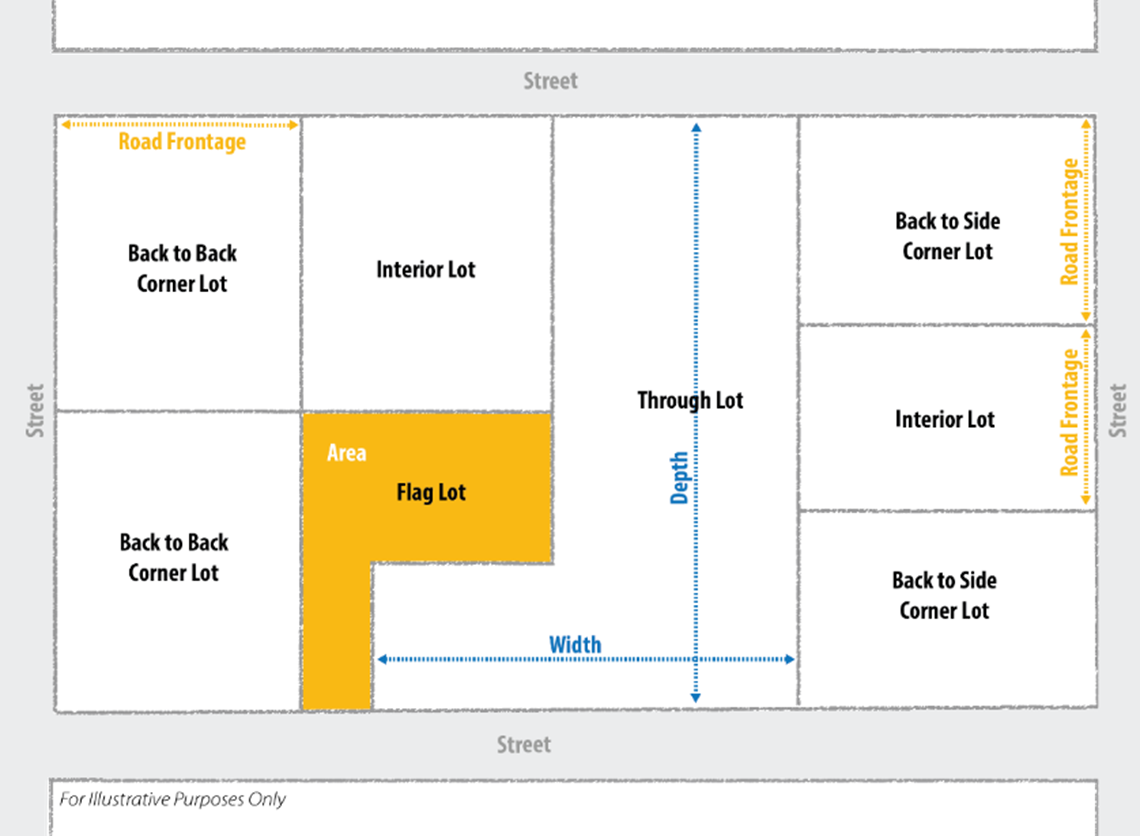
Figure 36.1. Lot Types
Manufactured home park means the use of land for any area designed to accommodate two or more independent Manufactured Homes intended for residential use where residence is exclusively in Manufactured Homes.
Manufactured home sales means establishments engaged in the sale or rental of manufactured homes.
Manufacturing, heavy means the processing and/or converting of raw, unfinished material and/or products into articles or substances of a different character or for use for a different purpose. Uses may have significant external effects, or which pose significant risks due to the involvement of explosives, radioactive materials, poisons, pesticides, herbicides, or other hazardous materials in manufacturing or other processes. Uses may include, but are not limited to, paper products, plastic products, and pharmaceuticals.
Manufacturing, light means establishments primarily engaged in the on-site production of goods by hand manufacturing, assembly, packaging or fabrication of materials and products within enclosed structures without significant external effects such as smoke, noise, soot, vibration, odor, and the like. Uses may include, but are not limited to, a machine shop, bottling, electronic equipment, ceramic products, business machines, musical instruments, furniture, medical appliances, tools or hardware, any other product of a similar nature. Retail sales may be incidental to the manufacturing use.
Marina means a commercial, waterfront establishment whose business is offering the sale or rental of boats and marine sporting equipment and the servicing, repair, or storage of same. These establishments may provide boat slip rental, gasoline sales, sanitary pump out service, and food and drink accommodations.
Micro-brewery means an establishment primarily engaged in brewing ale, beer, malt liquors, and nonalcoholic beer, with a capacity of not more than 1,000 barrels per year. Micro-brewery may include a restaurant or public tasting room as an accessory use.
Micro-distillery means an establishment primarily engaged in distilling and blending potable liquors, including mixing them with other ingredients, with a capacity of not more than 5,000 gallons of finished product per year. A micro-distillery may include a restaurant or public tasting room as an accessory use.
Mini-warehouse means a building designed to provide rental storage space in cubicles where each cubicle has a maximum floor area of 400 square feet. Each cubicle shall be enclosed by walls and ceiling and have a separate entrance for the loading and unloading of stored goods. The conduct of sales, business or any other activity within the individual storage units, other than storage, shall be prohibited.
Motor vehicle racing means participant or spectator facilities primarily for the sport of racing machines against one another or against time.
Nonconforming lot means an otherwise legally platted lot that does not conform to the minimum area, width, or lot frontage requirements of this Ordinance for the district in which it is located either at the effective date of this Ordinance or as a result of subsequent amendments to the Ordinance.
Nonconforming structure means an otherwise legal building or structure that does not conform with the lot area, yard, height, lot coverage, or other area regulations of this Ordinance, or is designed or intended for use that does not conform to the use regulations for this Ordinance, for the district in which it is located either at the effective date of this Ordinance or as a result of subsequent amendments to the Ordinance.
Nonconforming use means the otherwise legal use of a building or structure or of a tract of land that does not conform to the use regulations of this Ordinance for the district in which it is located, either at the effective date of this Ordinance or as a result of subsequent amendments to the Ordinance. Any use that was unlawful on the Date of Adoption of this Chapter shall remain unlawful and shall not be a nonconforming use.
Nursing home means a use providing bed care and in-patient services for persons requiring regular medical attention but does not include a facility providing surgical or emergency medical services or a facility providing care for alcoholism, drug addiction, mental disease, or communicable disease.
Office, general means the use of land wherein the primary use is the conduct of a business or profession such as, but not limited to, accounting, tax-preparation, lenders and securities brokers, architecture, computer software, or information systems research and development, engineering, insurance, law, management, organization and association offices, psychology, theology, real estate and travel. Retail Sales do not comprise more than an Accessory Use of the primary activity of a General Office. This definition does not include Office, medical/clinic as defined by this chapter.
Office, medical/clinic means the use of a site for facilities which provide diagnoses, minor surgical care and outpatient care on a routine basis, but which does not provide overnight care or serve as a base for an ambulance service. Medical offices are operated by doctors, dentists, or similar practitioners licensed by the Commonwealth of Virginia.
On-site sewer means a septic tank or similar installation, approved by the State Department of Health, located on an individual lot or parcel and serving a single dwelling unit or other structure located on that lot, which provides proper and safe treatment and disposal of sewage.
Operator means the person responsible for the overall operation and management of a facility.
Outdoor sales, seasonal means any business or use (primary or accessory) that is conducted primarily out of doors, which may include, but not be limited to: retail sales of fruits, vegetables, plants, flowers, Christmas trees, fireworks; and other similar businesses or uses.
Outdoor storage means the keeping, in other than a building, of any goods, materials, or merchandise on the same parcel for more than twenty-four consecutive hours. This use does not include junkyard.
Owner means the person or entity who owns all or a portion of a facility.
Parcel means a tract of land consisting of one or more lots of record.
Parent Parcel means a parcel of land that is proposed to be the subject of a development or subdivision of land.
Parent Tract means a separate lot, tract, or parcel of land conveyed by deed, devised by will or passing pursuant to the laws of descent and distribution, the boundaries of which are shown by a plat or described by metes and bounds, and recorded in the Clerk's Office of Essex County, Virginia on or before February 17 1988. However, the parent tract shall not be included as a separate lot unless the remainder is less than five (5) acres.
Parking lot, commercial means a site for surface parking use which is fee based and provides one or more parking spaces together with driveways, aisles, turning and maneuvering areas, incorporated landscaped areas, and similar features meeting the requirements established by this Ordinance. This use type shall not include parking facilities accessory to a permitted principal use.
Personal improvement service means establishments primarily engaged in the provision of informational, instructional, personal improvements and similar services. Typical uses include driving schools, health or physical fitness studios, reducing salons, dance studios, handicraft and hobby instruction.
Personal services means establishments or places of business engaged in the provision of frequently or recurrently needed services of a personal nature. Typical uses include beauty and barber shops; grooming of pets; seamstresses, tailors, or shoe repairs; florists; and laundromats and dry cleaning stations serving individuals and households.
Physical Improvements means any structure such as drainage structures, central water system, central sewage disposal systems, bridges, etc., and such other improvements as the agent may designate.
Pier, commercial means a fixed waterfront structure in which the owner of the pier charges a fee for members of the general public to use the pier. Allowed uses include crabbing, fishing, sunning, swimming and similar activities, but not boating or the docking of boats.
Pier, private means a waterfront structure, fixed or floating, used for the docking of boats owned and registered by the property owner or a guest visiting the owner, or for recreational uses such as fishing.
Planning Commission means a board of the local government consisting of such appointed members whose functions include advisory or nontechnical aspects of planning and may also include such other powers and duties as may be assigned to it by the Board of Supervisors.
Plat means a map or plan of a tract or parcel of land which is to be, or which has been subdivided. Includes the term map, plot, replat, or replot. When used as a verb, "plat" is synonymous with "subdivide".
Portable storage container means a portable, weather-resistant, receptacle designed and used for the storage or shipment of personal property, building materials or merchandise. Portable storage container is synonymous with shipping container.
Primary highway means a highway designated as a State Primary Highway or U.S. Highway by the Virginia Department of Transportation.
Proffer means a voluntary offer that addresses an impact or impacts from use of property or development, tendered by an applicant for conditional rezoning.
Public hearing means a meeting announced and advertised for soliciting formal public comment on matters under consideration.
Public park and recreational area means publicly owned and operated parks, picnic areas, playgrounds, indoor/outdoor athletic or recreation facilities, indoor/outdoor shelters, amphitheaters, game preserves, open spaces, and other similar uses. This use shall not include Public use or campground as defined in this ordinance.
Public use means the use of land, exclusively for public purposes, by any department or branch of the federal government, Commonwealth or any political subdivision, public authority, or any combination thereof. This use shall not include Public park and recreational area, Educational facilities, or Utility service (major or minor) as defined in this ordinance.
Public water and sewerage systems means a water or sewerage system owned and operated by the County or an authority or owned and operated by a private individual or a corporation approved by the governing body and properly licensed by the State Corporation Commission, and subject to special regulations as herein set forth.
Purchaser means an actual or prospective purchaser or lessee of any lot in a subdivision.
Rated capacity means the maximum capacity of a solar energy facility based on the sum total of each photovoltaic system's nameplate capacity.
Recreation facility, private means a use specifically for the residents and guests of a particular residential development, planned unit development, or residential neighborhood, including indoor and outdoor facilities. These facilities are usually proposed or planned in association with development and are usually located within or adjacent to such development.
Recreation playground equipment means play apparatus such as, but not limited to, jungle gyms, swing sets, slides, and sand boxes.
Recreational vehicle means a vehicular type or portable structure without a permanent foundation which can be towed, hauled, or driven and primarily designed as temporary living accommodations for recreational, camping, and travel use and including, but not limited to, travel trailers, truck campers, camping trailers and self-propelled motor homes.
Recreational vehicle storage, commercial means an area used for a fee for the storage of recreational vehicles and boats that are not currently being used.
Recycling center means a facility used by the general public for the collection of materials for recycling or reuse, including bins, boxes, buildings, self-propelled motor vehicles, trailers and other enclosures or receptacles. Except for County or other governmental sponsored programs to collect and/or recycle household hazardous wastes, this definition shall not include facilities for the collection of non-recyclable materials, such as business and household refuse, garbage, organic materials, medical waste, trash, junk, toxic substances or similar materials.
Religious assembly means a use located in a permanent building or in outdoor spaces and providing regular organized religious worship and related incidental activities. This use shall not include Educational facility, primary/secondary schools and Day care facilities.
Required open space means land area set aside for recreation, landscaping, or natural preservation, and not used for residences or business activities.
Resource extraction means a use involving on-site extraction of surface or subsurface mineral products or natural resources. Typical uses are quarries, borrow pits, sand and gravel operation, mining, soil mining, and other major excavations. Specifically excluded from this use type shall be grading and removal of dirt associated with an approved site plan or subdivision, or excavations associated with, and for the improvement of, a bona fide agricultural or forestry use.
Resource Management Area, or RMA, means that component of the Chesapeake Bay Preservation Area that is not classified as the Resource Protection Area. RMAs include land types that, if improperly used or developed, have the potential for causing significant water quality degradation or for diminishing the functional value of the Resource Protection Area.
Resource Protection Area, or RPA, means that component of the Chesapeake Bay Preservation Area comprised of lands adjacent to water bodies with perennial flow that have an intrinsic water quality value due to the ecological and biological processes they perform or are sensitive to impacts which may result in significant degradation to the quality of State waters.
Restaurant, drive-in means an establishment primarily engaged in the preparation of food and beverages, for either take-out, delivery or table service, served in disposable containers at a counter, drive-up, or drive-through service facility, or which offers curb service.
Restaurant, general means an establishment in which, for compensation, food or beverages are dispensed for consumption on the premises, including, among other establishments, cafes, tearooms, confectionery shops, eat-in delis and refreshment stands. Excluded from this definition are Restaurant, drive-in and Restaurant, mobile.
Restaurant, mobile means a readily movable wheeled cart, trailer, or vehicle designed and equipped for the preparing, service, and/or selling of food and operated at temporary locations. This definition shall include food trucks, food trailers, and food carts and shall not apply to those selling in short bursts of 30 minutes or less at a single location and moving to multiple properties through the course of a business day, such vehicles may include, but are not limited to, ice cream trucks.
Right-of-way means a legally established area or strip of land, either public or private, on which an irrevocable right of passage has been recorded, and which is occupied or intended to be occupied by a street, utility service, water main, sanitary or storm sewer main, or other similar use.
Sawmill, commercial means a sawmill permanently located for the purpose of processing timber from the property on which located, from adjoining property, or from other properties removed from the sawmill or its environs without regard to point of origination. Such mill may or may not be held out for the processing of timber bought or sold on a price basis. Facilities may include wood processing and wood manufacturing such as, but not limited to, planing, chipping, pallets or other secondary products.
Sawmill, mobile means a portable sawmill located on private property for no more than three days for the processing of timber cut only from that property or from property immediately contiguous and adjacent thereto, or incidental processing of timber transported from other property.
Secondary highway means a highway designated as a State Secondary Highway by the Virginia Department of Transportation.
Setback means the minimum distance by which any building, structure, or use must be separated from the property line(s) of the lot on which it sits.
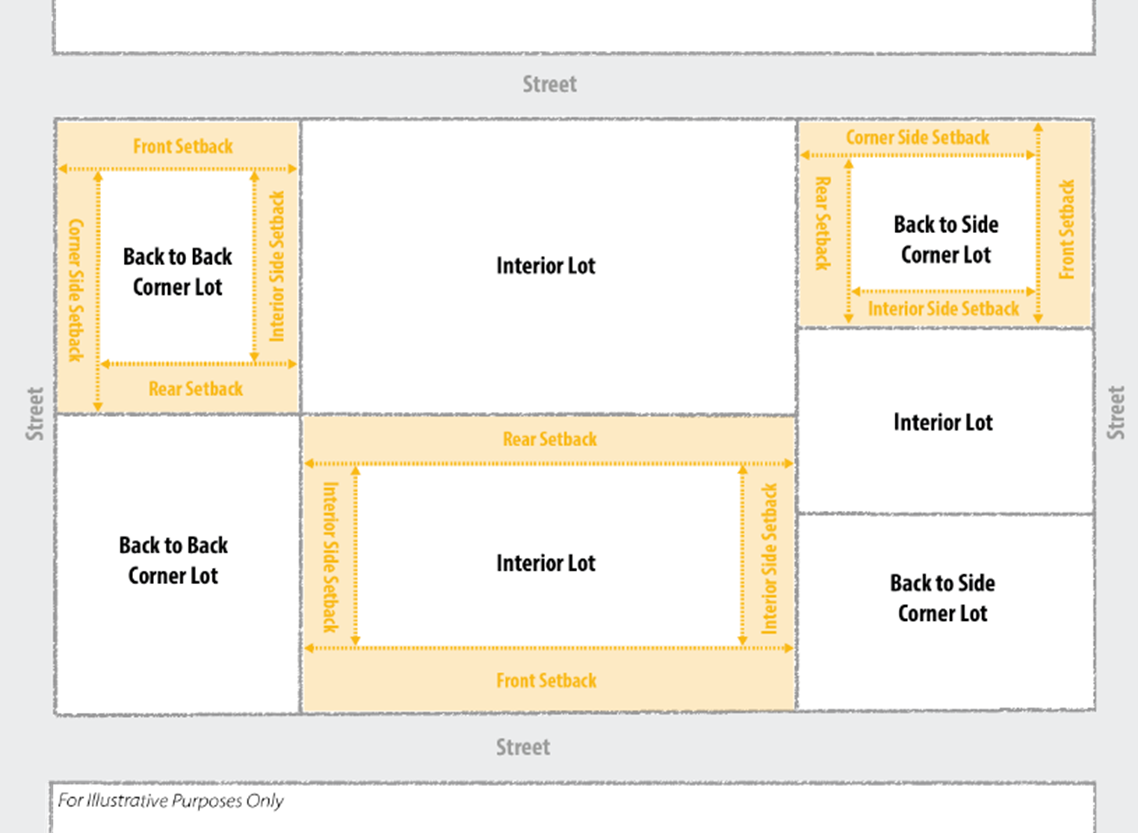
Figure 36.2. Setback Types
Setback, corner side means for corner lots, a line parallel to the right-of-way and side line of the lot denoting the minimum distance by which any structure, excluding open steps and stoops, must be separated from the side property line. The side located along the longer lot frontage shall be considered the corner side.
Setback, front means a line parallel to the front line of rectangular lots or, in the case of curved front lot lines, parallel to the chord of the curve, denoting the minimum distance by which any structure, excluding open steps and stoops, must be separated from the front property line. In the case of existing flag lots and irregularly shaped lots, the setback line shall be drawn on the plat in a position acceptable to the agent. In such cases, the setback line shall be perpendicular to the longer axis of the lot insofar as practicable.
Setback, interior side means for corner lots and interior lots, a line parallel to the side line of the lot denoting the minimum distance by which any structure, excluding open steps and stoops, must be separated from the side property line. In the case of existing flag lots and irregularly shaped lots, the setback line shall be drawn on the plat in a position acceptable to the agent.
Setback, rear means a line parallel to the rear line of rectangular lots or, in the case of curved front lot lines, parallel to the chord of the curve, denoting the minimum distance by which any structure excluding open steps and stoops must be separated from the rear property line. In the case of existing flag lots and irregularly shaped lots, the setback line shall be drawn on the plat in a position acceptable to the agent. In such cases, the setback line shall be perpendicular to the longer axis of the lot insofar as practicable.
Shelter, residential means a facility promoting temporary housing and feeding for one or more individuals who are otherwise temporarily or permanently homeless. Ancillary community support services may be provided including, but not limited to, childcare, counseling, food distribution, or vocational training. This definition excludes Halfway House, which is otherwise defined in this ordinance.
Shooting range, outdoor means the use of land for shooting clubs and other facilities for the discharge of firearms or other projectiles for the purposes of target practice, skeet and trap shooting, mock war games, or formal competitions, or in return for compensation.
Short-term rental means a residential dwelling unit that is used or advertised for rent for transient occupancy in increments of fewer than 30 consecutive days. This use type does not include bed-and-breakfast establishments and does not apply to month-to-month extensions following completion of a year's lease.
Sign means any object, device, display, or structure, or part thereof, visible from a public place, a public right-of-way, any parking area, or right-of-way open to use by the general public, or any navigable body of water that is designed and used to attract attention to an institution, organization, business, product, service, event, or location by any means involving words, letters, figures, designs, symbols, fixtures, logos, colors, illumination, or projected images.
Sign area means the entire area enclosing the extreme limits of writing, representation, pictorial elements, emblems, or a figure of similar character, together with all material, color, or lighting forming an integral part of the display or used to differentiate the Sign from the background against which it is placed.
Sign copy means those letters, numerals, figures, symbols, logos, and graphic elements comprising the content or message of a sign, exclusive of numerals identifying a street address only.
Sign face means the particular area of the sign structure upon which a message, copy, or advertisement is displayed for viewing.
Sign maintenance means to prevent through preservation, repair, or restoration, the development of any rust, corrosion, rot, chipping, peeling, or other deterioration in either the physical appearance or the safety of every sign.
Sign structure means any structure supporting a sign.
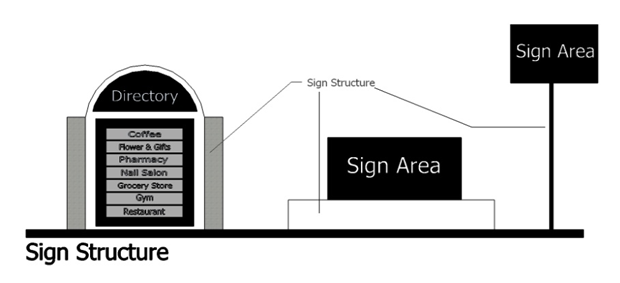
Sign, abandoned means a sign structure that has ceased to be used, and the owner intends no longer to have used, for the display of sign copy, or as otherwise defined by state law.
Sign, animated means a sign employing actual motion or the illusion of motion. Animated signs, which are differentiated from changeable signs as defined and regulated by this Ordinance, include the following types:
(1)
Electrically Activated means an animated signs producing the illusion of movement by means of electronic, electrical or electro-mechanical input and/or illumination capable of simulating movement through employment of the characteristics of one or both of the classifications noted below:
a.
Flashing means an animated signs or animated portions of signs whose illumination is characterized by a repetitive cycle in which the period of illumination is either the same as or less than the period of non-illumination. For the purposes of this Ordinance, flashing will not be defined as occurring if the cyclical period between on-off phases of illumination exceeds four seconds.
b.
Patterned Illusionary Movement means an animated signs or animated portions of signs whose illumination is characterized by simulated movement through alternate or sequential activation of various illuminated elements for the purpose of producing repetitive light patterns designed to appear in some form of constant motion.
(2)
Environmentally Activated means an animated signs or devices motivated by wind, thermal changes, or other natural environmental input. Includes spinners, pinwheels, and/or other devices or displays that respond to naturally occurring external motivation but excludes pennants and streamers.
(3)
Mechanically Activated means an animated signs characterized by repetitive motion and/or rotation activated by a mechanical system powered by electric motors or other mechanically induced means.
Sign, awning: See "Sign, canopy".
Sign, banner means a sign utilizing a banner as its display surface.
Sign, billboard means an off-premises sign or sign structure with display space available for lease and designed so that the copy or poster on the sign can be changed frequently.
Sign, canopy means a sign displayed on or attached flat against the surface or surfaces of a canopy. Illuminated canopies, if translucent, are considered part of the total canopy sign area.
Sign, changeable message means a sign that includes any changing of the message either electronically or manually in which the message is stationary and does not fluctuate in size or brightness.
Sign, exterior means any sign placed outside a building.
Sign, fascia: See "Wall Sign."
Sign, flashing: See "Sign, animated, electrically activated."
Sign, freestanding means a sign principally supported by a structure affixed to the ground, and not supported by a building, including signs supported by one or more columns, poles, or braces placed in or upon the ground.
Sign, illuminated means a sign characterized by the use of artificial light, either projecting through its surface(s) (internally illuminated); or reflecting off its surface(s) (externally illuminated).
Sign, interior means any sign placed within a building, but not including "Signs, window" as defined by this Ordinance. Interior signs, with the exception of window signs as defined, are not regulated by this Ordinance.
Sign, marquee: See "Sign, canopy".
Sign, minor means a wall or freestanding sign not exceeding three (3) square foot in area, not exceeding four feet in height, and not illuminated. Examples include not trespassing signs, displays of building address, security warning signs, parking signs, entrance/exit signs, and on-site directional signs.
Sign, monument means a "Sign, freestanding" having the appearance of a solid, rectangular, or cylindrical base.
Sign, off-premises means a sign which directs attention to a business, commodity, service, activity, or entertainment conducted, sold, or offered on a parcel of land other than the one on which the sign is located.
Sign, on-premises means a sign erected, maintained, or used in the outdoor environment for the purpose of the display of messages appurtenant to the use of, products sold on, or the sale or lease of the property on which it is displayed.
Sign, pennant means a sign made with flexible material, with or without lettering for design, usually suspended from one or two corners, and manufactured and placed for the purpose of attracting attention. Also referred to as a streamer.
Sign, pole: See "Sign, freestanding."
Sign, portable means any sign not permanently attached to the ground or to a building or building surface. For example, an A-frame sign.
Sign, projecting means a sign other than a wall sign that is attached to or projects more than 15 inches from a building face or wall or from a structure whose primary purpose is other than the support of a sign.
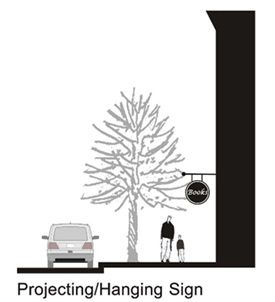
Sign, roof means a sign mounted on, and supported by, the main roof portion of a building, or above the uppermost edge of a parapet wall of a building and which is wholly or partially supported by such a building. Signs mounted on mansard facades, pent eaves, and architectural projections such as canopies or marquees shall not be considered to be roof signs.
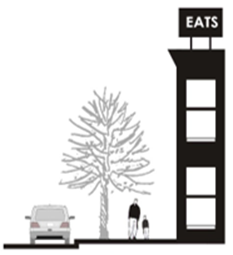
Sign, temporary means a sign designed or intended, based on materials and structural components, to be displayed for a specified or limited period of time, regardless of type or style of sign. Examples include real estate signs, yard sale signs, contractor's signs, and special or one-time event signs per year.
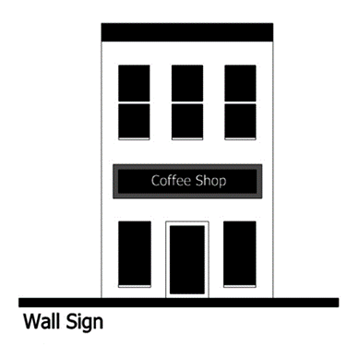
Sign, wall means a sign that is in any manner affixed to any exterior wall of a building or structure and that projects not more than 15 inches from the building or structure wall, including signs affixed to architectural projections from a building provided the copy area of such signs remains on a parallel plane to the face of the building I or to the face or faces of the architectural projection to which it is affixed.
Sign, window means a sign affixed to the surface of a window with its message intended to be visible to and readable from the public way or from adjacent property.
Site plan means a plan prepared by a professional engineer or land surveyor licensed by the State of Virginia showing all proposed improvements to the site. The site plan shall include all covenants, grants, or easements and other conditions relating to use, location, and bulk of buildings, density of development, open space, public facilities, and such other information as is required in applicable sections of this ordinance such as with conditional use, rezoning, or variance applications.
Site, solar facility means the entire area, including acreage coverage, setbacks, access roads, wildlife corridors, wetlands, and other natural features of a facility that generates electricity from sunlight.
Small cell facility means a wireless facility that meets both of the following qualifications: (i) each antenna is located inside an enclosure of no more than six cubic feet in volume, or, in the case of an antenna that has exposed elements, the antenna and all of its exposed elements could fit within an imaginary enclosure of no more than six cubic feet; and (ii) all other wireless equipment associated with the facility has a cumulative volume of no more than 28 cubic feet, or such higher limit as is established by the Federal Communications Commission. The following types of associated equipment are not included in the calculation of equipment volume: electric meter, concealment, telecommunications demarcation boxes, back-up power systems, grounding equipment, power transfer switches, cut-off switches, and vertical cable runs for the connection of power and other services (Code of Virginia, § 15.2-2316.4).
Solar energy, community means a facility that generates electricity from sunlight that was not constructed by an investor-owned utility and that will be part of an investor-owned utility's community solar pilot program. A community solar energy facility does not exceed two megawatts (2 MW) alternating current, in accordance with the Code of Virginia, § 56-585.1:3.
Solar energy, large-scale means a facility that generates electricity from sunlight which will be used to provide electricity to a utility provider and meets the definition of Community, Multi-family Shared, or Shared Solar Energy Facility.
Solar energy, medium-scale means a facility that generates electricity from sunlight primarily to reduce onsite consumption of utility power for commercial and industrial applications. Sites are between one to three acres with maximum capacity of 999 kW.
Solar energy, multi-family shared means a facility that generates electricity from sunlight that was not constructed by an investor-owned utility and that will be part of an investor-owned utility's multi-family shared solar pilot program. A multi-family shared solar energy facility does not exceed three megawatts (3 MW) alternating current at any single location or that does not exceed five megawatts (5 MW) alternating current at contiguous locations owned by the same entity or affiliated entities, serves at least three subscribers, is connected to the electric distribution grid serving the Commonwealth, and is located on a parcel of land on the premises of the multi-family utility customer or adjacent thereto, in accordance with the Code of Virginia, § 56-585.1:12.
Solar energy, Power Purchase Agreement (PPA) means a facility that generates electricity from sunlight that was not constructed by an investor-owned utility and that will be part of an investor-owned utility's power purchase agreement solar pilot program. A facility has a capacity of no less than 50 kilowatts and no more than three megawatts (3 MW) alternating current, in accordance with the Code of Virginia, § 56-594.02.
Solar energy, shared means a facility that generates electricity from sunlight that was not constructed by an investor-owned utility that will be part of an investor-owned utility's shared solar pilot program. A shared solar energy facility does not exceed five megawatts (5 MW) alternating current, serves at least three subscribers, has at least 40 percent of its capacity subscribed by customers with subscriptions of 25 kilowatts or less, is connected to the electric distribution grid serving the Commonwealth, and is located on a single parcel, in accordance with the Code of Virginia, § 56-594.3.
Solar energy, small-scale means a facility that either: (a) generates less than 20 kilowatts (kW) electricity from sunlight, consisting of one or more photovoltaic (PV) systems and other appurtenant structures and facilities within the boundaries of the site; or (b) utilizes sunlight as an energy source to heat or cool buildings, heat or cool water, or produce electrical or mechanical power by means of any combination of collecting, transferring, or converting solar-generated energy; and (c) meets at least one of the following criteria: has a disturbance zone equal to or less than one acre; is mounted on or over a building, parking lot, or other previously disturbed area; or utilizes integrated PV only.
Solar energy, utility-scale means a facility that generates electricity from sunlight which will be used to provide electricity to a utility provider. Sites are generally over two acres and have a capacity more than one megawatt (1 MW).
Sportsman club, commercial means an area of a property devoted to commercial use for a camp dedicated for hunting and/or fishing that often includes a structure for sleeping, but not for permanent a permanent dwelling. The structure may or may not include such features as a kitchen, indoor plumbing, and other amenities found in a typical dwelling unit. A sportsman club may include facilities such as Kennel, private as defined in this ordinance, as an accessory use.
Sportsman club, private means an area of a property devoted to the temporary, noncommercial seasonal use for hunting and/or fishing that often includes a structure for sleeping, but not for permanent use. The structure may or may not include such features as a kitchen, indoor plumbing, and other amenities found in a typical dwelling unit. A sportsman club may include facilities such as Kennel, private as defined in this ordinance, as an accessory use.
Stable, commercial means the sheltered boarding of horses or ponies, or other livestock, for a revenue generating purpose. Included in this definition are horse riding academies and horse or livestock grooming operations.
Stable, private means the keeping, breeding, or raising of horses or ponies, or other livestock, exclusively for the personal use and enjoyment of the owner or occupant of the property or the riding of horses or ponies by the owner or occupant of the property and their guests.
Store, adult means an establishment that: offers for sale or rent items from any of the following categories: (a) adult media, (b) sexually oriented goods, or (c) goods marketed or presented in a context to suggest their use for specified sexual activities; and the combination of such items constitutes more than 15 percent of its stock in trade or occupies more than 15 percent of its gross public floor area; and where there is no on-site consumption of the goods, media or performances for sale or rent.
Store, general means an establishment for display and sale of merchandise at retail.
Store, neighborhood convenience means an establishment primarily engaged in the provision of frequently or recurrently needed goods for household consumption, such as prepackaged food and beverages, and limited household supplies and hardware. Neighborhood stores shall not include fuel pumps or the selling of fuel for motor vehicles. Typical uses include neighborhood markets and country stores.
Store, specialty means a small-scale (less than 2,500 square feet per business) retail use which offers for sale items of art or crafts, or which offers for sale items related to a specific theme, e.g., kitchen wares, pet care, etc.
Store, specialty food means an establishment, such as a coffee, candy, or ice cream shop, where the primary client consumption is off-site with limited seating and the product is limited to one type or line of food service.
Story means that portion of a building, other than the basement, included between the surface of any floor and the surface of the next floor above it, or, if it is topmost Story, the portion included between the surface of its floor and the ceiling above it.
Story, half means a space under a sloping roof, which has the line of intersection of roof decking and wall face not more than three (3) feet above the top floor level, and in which space not more than two-thirds (2/3) of the floor area is finished off for use.
Street or road means a public or private thoroughfare which affords the principal means of access to abutting properties.
Street or Alley, Public Use of means the unrestricted use of a specified area or right-of-way for ingress and egress to two (2) or more abutting properties.
Street, centerline means the centerline thereof as shown in any of the official records of the County or as established by the Virginia Department of Transportation. If no such centerline has been established, the centerline of a street shall be a line lying midway between the side lines of the right-of-way thereof.
Street, Major means a through street or road that carries a large volume of through traffic, or anticipated traffic exceeding five hundred (500) vehicles per day.
Street, Private means a street affording a means of private access to two (2) or more abutting properties, having a right-of-way of not less than fifty (50) feet in width.
Street, Public means a thoroughfare, dedicated and accepted by the Virginia Department of Transportation for public use, which affords the principal means of access to abutting property, including road, highway, drive, lane, avenue, place, boulevard, or any other thoroughfare except an alley.
Street, Service Drive means a public right-of-way generally parallel and contiguous to a major highway, primarily designed to promote safety by eliminating promiscuous ingress and egress to the right-of-way by providing safe and orderly points of access to the highway.
Street, Through means a street, or roadway easement which affords the principal means of access to abutting properties and proving a link between two (2) or more road rights-of-way.
Street line, or right-of-way line, means the line between a lot, tract or parcel of land and a contiguous street.
Street Width means the total width of the strip of land dedicated or reserved for public travel, including roadway, curbs, gutters, sidewalks and planting strips.
Studio, fine arts means a building, or portion thereof, used as a place of work by a sculptor, artist, or photographer; or used as a place to exhibit and offer for sale works of the visual arts (other than film).
Subdivide means the process of dealing with land so as to establish a subdivision as defined herein.
Subdivider means any individual, firm, partnership, association, corporation owning any parcel of land to be subdivided.
Subdivision means the division of a parcel of land into two (2) or more lots or parcels of land for the purpose of transfer of ownership or building development, including any parcel previously separated by the owner or prior owner of such land for such purpose. The sale or exchange of parcels between adjoining lot owners, where such sale or exchange does not create additional building lots, shall be exempt from the provisions of the ordinance.
(a)
Major Subdivision: The division of any tract or parcel of land into six (6) or more lots;
(b)
Minor Subdivision: The division of any tract or parcel of land into five (5) lots or less;
(c)
Single Lot Subdivision: The division of any tract or parcel of land into one (1) lot; and
(d)
Family Subdivision: The division of any tract or parcel of land for gift to any person who is a natural or legally defined offspring, stepchild, spouse, sibling, grandchild, grandparent, or parent of the owner.
Subdivision Agent means the administrative official, or an authorized agent thereof, responsible for administering and enforcing the Subdivision portion of the Zoning and Subdivision Ordinance of the County, also referred to in the Subdivision Article, as the Agent.
Surveyor means a certified land surveyor authorized to do business in the State of Virginia.
Tattoo parlor and/or body piercing salon means any business that provides tattooing and/or body-piercing as those terms are defined in Code of Virginia, § 54.1-700, as amended.
Tradesperson service means an establishment or place of business primarily engaged in providing a specific trade service to individuals. Typical uses include, plumbing, electricians, blacksmith, welding, and taxidermy. This definition does not include automobile repair or construction material sales as otherwise defined in this ordinance.
Truck/freight terminal means an area of land used for the switching, storing, assembling, distributing, consolidating, moving, repairing, weighing, or transferring of freight.
Utility service, major means service of a regional nature which normally entails the construction of new buildings or structures such as electric generating plants and sources; electrical switching facilities and stations or substations; community wastewater treatment plants; water towers; sanitary landfills; and similar facilities. All overhead transmission lines are included in this definition.
Utility service, minor means service which is necessary to support development within the immediate vicinity and involve only minor structures. Included in this use type are small facilities such as "Administrative review-eligible project" as defined in the Code of Virginia, § 15.2-2316.6, transformers, relay and booster devices, and well, water and sewer pump stations.
Variance means a reasonable deviation from the provisions of this Ordinance regulating the shape, size, or area of a lot or parcel of land or the size, height, area, bulk, or location of a building or structure when the strict application of the Ordinance would result in unnecessary and undue hardship which is not created by the owner, relief or remedy is not available through this ordinance, and such need for a variance would not be shared generally by other properties, and provided such variance is not contrary to the purpose of this Ordinance.
Variance (Hardship) means a relaxation or variance of the terms of this Ordinance where such variance will not be contrary to the public interest and where, owing to conditions peculiar to the property and not the result of the actions of the applicant, a literal enforcement of the Ordinance would result in unnecessary and undue hardship.
Vested rights mean a right belonging completely and unconditionally to a person as a property interest which cannot be impaired or taken away (as through retroactive legislation) without the consent of the owner. A landowner's rights are vested when the landowner: (i) obtains or is the beneficiary of a significant affirmative governmental act which remains in effect allowing development of a specific project, (ii) relies in good faith on the significant affirmative governmental act, and (iii) incurs extensive obligations or substantial expenses in diligent pursuit of the specific project in reliance on the significant affirmative governmental act.
Veterinary hospital/clinic means an establishment rendering surgical and medical treatment of animals. Boarding of domestic animals shall only be conducted indoors, on a short-term basis, and shall only be incidental to such hospital/clinic use, unless also authorized and approved as a commercial kennel. Agricultural livestock such as horses and cows may be boarded outdoors as appropriate.
Vicinity map means the vicinity or location map shall show the relationship of the proposed subdivision to existing community facilities which serve or influence it. The map shall include subdivision name and location, main traffic arteries, schools, parks and playgrounds, scale, north arrow and date.
Warehousing and distribution means uses including storage, warehousing, and dispatching of goods within enclosed structures. Typical uses include wholesale distributors, e-commerce fulfillment centers, storage warehouses, data centers, and moving/storage firms.
Wayside stand means an establishment for the seasonal retail sale of agricultural or forestal goods and merchandise primarily produced by the operator on the site, or on nearby property. Agricultural goods produced on other properties owned or leased by the operator may also be allowed provided a majority of the produce comes from land surrounding the wayside stand. This use type shall include agricultural products picked by the consumer. Also referred to as a roadside or farm stand or wayside market.
Yard means an open space on a lot other than a court, unoccupied and unobstructed from the ground upward, except as otherwise permitted in this Ordinance.
Yard, corner side means for corner lots, the yard extending across the side of the lot between the right-of-way and the nearest line of the principal structure, from the front building setback line to the rear property line. The yard located along the longer lot frontage shall be considered the corner side yard.
Yard, front means an open space on the same lot as a building between the front line of the building (excluding steps) and the front lot or street line and extending across the full width of the lot. River frontages are not front yard lines. See Frontage, river.
Yard, interior side means for interior lots, the yard extending across the side of the lot between the side property line and the nearest line of the principal structure from the front setback line to the rear property line.
Yard, rear means an open, unoccupied space on the same lot as a building between the rear line of the building, excluding open steps and stoops, and the rear line of the lot and extending the full width of the lot.
Yard, side means an open, unoccupied space on the same lot as a building between the side line of the building, excluding open steps and stoops, and the side line of the lot and extending from the front yard line to the rear yard line.
Zoning Administrator means the administrative official, or an authorized agent thereof, responsible for administering and enforcing the Zoning and Subdivision Ordinance of the County, also referred to in this ordinance as the Administrator.
Zoning district means a specifically delineated section of the County in which the regulations are uniform and so designated on the zoning map.
Zoning map means a legally adopted map depicting the location of each zoning district of the county and all amendments thereto.

