
Estacada City Zoning Code
Division III
Zoning Regulations
2025-008
2019-005
2025-013
2022-010
2018-007
2025-001
2025-004
2024-002
2023-007
16.60.010 Clear Vision Areas
- A clear vision area, as defined in EMC 16.08.010, shall be maintained on the corners of all property at the intersection of two streets or from the intersection of a private road easement and a public street.
- A clear vision area shall contain no planting, fence, wall, sign, banner, structure or temporary or permanent obstruction exceeding 2.5 feet or thirty (30) inches in height measured from the top of the curb, or, where no curb exists, from the established street center line grade. Trees exceeding this height may be located in this area, provided that all branches and foliage are removed to a height of eight feet above grade.
(Prior code § 10.234)
Amended by Ord. 2025-008 on 11/10/2025
16.60.020 Exterior Lighting
Exterior lighting for uses in commercial and industrial zones shall be located in such a manner so as not to face or shine directly onto a lot in a residential zone, street or highway.
(Prior code § 10.455)
16.60.030 Accessory Structures And Uses
An accessory use shall comply with all requirements for a principal use, except as this title specifically allows to the contrary, and shall comply with the following limitations:
- Accessory Structures. An accessory structure not used for human habitation and separated from the main building may be located up to five feet from a rear property line if the structure is no more than fifteen (15) feet in height. Structures over fifteen (15) feet must meet the setback standards established in each zoning district.
- Fences. Fences, hedges and walls limited to six feet in height may be located within required setbacks, but shall not exceed two and one-half feet or thirty (30) inches in height in any required setback which abuts corner property at the intersection of two streets, or from the intersection of a private drive or road easement and a public street or alley.
- Decks. Unenclosed decks, unroofed landings, porches and stairs may project into any required setback providing the following conditions are met:
- No portion except for guard rails shall extend above the floor level of a habitable room.
- No such projection shall obstruct a stairway.
- No such projection shall extend into a required setback no more than one-third the distance of the required setback.
- Manager/Caretaker Residences. In the M-1 zone, a residence may be established secondary to the main use of the property for the sole purpose of providing living quarters for the owner, operator or caretaker of a commercial or industrial enterprise; provided that:
- The living space shall be located on the same property as the commercial or industrial operation and is justified by the requirement of twenty-four (24) hour attendance;
- Occupancy is limited to the manager/caretaker and their immediate family.
- R.V. Conversions. Recreational vehicles cannot be utilized for a commercial business on a permanent basis. Temporary placement may be authorized by the planning commission using the procedure for conditional uses as set forth in EMC 16.88.
(Prior code § 10.460)
Amended by Ord. 2019-005 on 3/9/2020
Amended by Ord. 2025-013 on 1/26/2026
16.60.040 Projections From Buildings
Architectural features such as cornices, eaves, canopies, sunshades, gutters, signs, chimneys and flues shall not project more than eighteen (18) inches into a required setback.
(Prior code § 10.500)
Amended by Ord. 2025-013 on 1/26/2026
16.60.050 General Exceptions To Setback Requirements
The following exceptions to setback requirements for any structure are authorized for a lot in any zone.
- The required front or rear setback for a structure may be based upon the average of the front or rear setbacks of dwellings/garages on all lots within one hundred (100) feet of both sides of the proposed structure. On vacant parcels within one hundred (100) feet, standard lot requirements shall be used in establishing the average.
- Special Setback Requirements. Under certain circumstances the following special setback requirements shall apply:
- Buildings and pens, which are part of kennels and animal hospitals, and active recreation use areas which are a part of outdoor commercial amusement or recreation establishments shall be located no closer than seventy-five (75) feet from a residential zone.
- Clubs, lodges, fraternal organizations, community swimming pools, and buildings housing recreational facilities in residential zones shall be located no closer than thirty (30) feet from any other lot in a residential zone.
(Prior code § 10.520)
Amended by Ord. 2025-013 on 1/26/2026
16.60.060 Residential Density
- Definitions. Refer to EMC 16.08 for definitions of "Density" and "Acreage, Net"
- Maximum Residential Density. Maximum density for multi-family dwellings is based on the maximum number of dwelling units permitted per net acre of land. Density for all other housing types is based on minimum lot size per dwelling unit. These standards are provided in the base zone chapters of the EMC.
Editor's note—Ord. No. 2016-003, § 1(Exh. C), adopted May 23, 2016, repealed § 16.60.060, which pertained to bed and breakfast inns and derived from prior code § 10.598.
Amended by Ord. 2022-010 on 12/12/2022
16.60.070 Minimum Residential Density
- Residential subdivisions and new multi-family development in the R-3, NCR, and C-2 zones must achieve a minimum density that is at least 50 percent of the maximum density permitted for the zoning district in which they are located. Residential subdivisions and new multi-family development in the MMU and CMU zones must achieve a minimum density of at least 15 dwelling units per net acre.
- Projects proposed at less than the minimum density must demonstrate on a site plan or other means, how, in all aspects, future intensification of the site to the minimum density or greater can be achieved.
- Minimum residential density is calculated as follows:
- For zones and housing types for which residential density is regulated by minimum lot area required per dwelling:
- Refer to the definition of “Acreage, Net.” Multiply the net acreage of the site by 0.50.
- Multiply the resulting number in step a by 43,560 to determine the total square footage of the site.
- Divide the resulting number in step b by the minimum land area required per dwelling for the applicable zone and housing type, as expressed in square feet, to determine the minimum number of dwellings that must be built on the site.
- For residential subdivisions and new multi-family development in the MMU and CMU zones:
- Refer to the definition of “Acreage, Net.”
- Multiply net acreage of the site by 15 to determine the minimum number of dwellings that must be built on the site.
- For zones and housing types for which residential density is regulated by maximum dwelling units per acre (except as provided in Subsection C.2):
- Refer to the definition of Net Acreage. Multiply the net acreage of the site by 0.50.
- Multiply the resulting number in step a by the maximum residential density required in the applicable zone, as expressed in dwelling units per net acre, to determine the minimum number of dwellings that must be built on the site.
- If the resulting number in step 1.b, 2.b, or 3.b is not a whole number, the number is rounded to the nearest whole number as follows: If the decimal is equal to or greater than 0.5, then the number is rounded up to the nearest whole number. If the decimal is less than 0.5, then the number is rounded down to the nearest whole number.
- For zones and housing types for which residential density is regulated by minimum lot area required per dwelling:
Adopted by Ord. 2022-010 on 12/12/2022
16.61.010 Purpose
Accessory dwelling units are allowed, in part, to forward the following priorities, so far as they are consistent with the adopted Comprehensive Plan:
- Create new housing units while respecting the look and scale of existing development;
- Support more efficient use of existing housing stock, the finite land supply within city limits, and existing infrastructure;
- Offer environmentally friendly housing choices with less average space per person and smaller associated carbon footprints;
- Provide housing that responds to changing family needs, smaller households, and increasing housing costs;
- Provide accessible housing for seniors and persons with disabilities; and
- Comply with State of Oregon housing guidelines.
(Ord. No. 2018-001, § 1, 6-11-2018)
16.61.020 Eligibility
Accessory dwelling unit (ADU) may be located on a lot of record in a zoning district where ADUs are permitted as accessory uses, provided the ADU is accessory to a legal single-family dwelling, a duplex, a triplex, a fourplex, a commonwall dwelling, or a multi-family dwelling on the same lot and provided all other requirements of the underlying zoning district are met. A maximum of two ADUs may be located on a lot with a single-family dwelling, provided they meet the standards of Section 16.61.030, Subsections A and B, and a maximum of one ADU can be located on a lot with a duplex, triplex, fourplex, commonwall dwelling, or multi-family dwelling. An ADU cannot be accessory to a dwelling unit that comprises a cottage cluster.
(Ord. No. 2018-001, § 1, 6-11-2018)
Amended by Ord. 2019-005 on 3/9/2020
Amended by Ord. 2022-010 on 12/12/2022
16.61.030 Creation
An accessory dwelling unit may be created by the construction of a new structure or the conversion or expansion of an existing structure. An ADU may be constructed while the primary dwelling it will be accessory to is also constructed; however, the ADU may not be occupied whenever construction of the primary dwelling is not authorized by a valid building permit and the primary dwelling has not been permitted for occupancy.
Up to two accessory dwelling units are allowed on a site with single-family dwelling, provided the following standards are met:
- The lot is at least 7,500 square feet in area; and
- At least one of the ADUs is internal to the primary dwelling (i.e., created by converting existing floor area in the primary dwelling).
(Ord. No. 2018-001, § 1, 6-11-2018)
Amended by Ord. 2022-010 on 12/12/2022
16.61.040 Occupancy And Use
Occupancy and use standards for an accessory dwelling unit shall be the same as those applicable to a primary dwelling on the same site.
(Ord. No. 2018-001, § 1, 6-11-2018)
16.61.050 Building Standards
An accessory dwelling unit shall meet all applicable health, fire safety, and building codes, pursuant to the Oregon Residential Specialty Code.
(Ord. No. 2018-001, § 1, 6-11-2018)
16.61.060 Design
Design standards specifically for accessory dwelling units are stated in this section. If a relevant design standard is not addressed in this section, the development standards of the underlying zoning district apply.
- All accessory dwelling units (detached dwelling units and accessory suites) must meet the following requirements:
- Size. An accessory dwelling unit may be no more than 900 square feet or the total habitable floor area of the primary dwelling, whichever is less; however, an accessory suite that occupies the entirety of the lowest floor of a primary dwelling may have a maximum area of 1,200 square feet.
- Height. The maximum height allowed is the height of the underlying zone.
- Parking. No additional off-street parking is required for one ADU. If a second ADU is proposed on a lot with a single-family dwelling, a minimum of one off-street parking space shall be provided on the subject property for the second ADU. The ADU's side and rear yard setback areas shall not be used for the required ADU parking space.
- Entry. All accessory dwelling units must have a minimum of one outdoor entrance.
- Lot Coverage. If an ADU is accessory to a single-family dwelling on a lot that is 5,000 square feet or smaller in area, the ADU may exceed the maximum lot coverage of the underlying zoning district by up to 10 percent.
- Accessory suites must meet the following additional requirements:
- Location of entrances. The entrance(s) to an accessory suite shall be on the side and rear of the primary dwelling, unless there is no ground-level access to the suite or if the primary dwelling has more than one front entrance prior to the development of the accessory suite and the total number of entrances to the primary dwelling is not increased.
- Exterior stairs. Fire escapes or exterior stairs for access to an upper level accessory suite shall not be located on the front of the primary dwelling.
- Detached accessory dwelling units must meet the following additional requirements:
- Design and appearance. The accessory dwelling unit shall be designed so that the appearance of the building conforms to the original design characteristics and style of the primary dwelling. To meet this requirement, the detached accessory dwelling shall have at least two of the following design features in common with the primary dwelling:
- Exterior color and exterior finish materials;
- Roof pitch;
- Eaves; or
- Trim.
- Windows orientation and privacy. Windows shall not be placed on any ADU building elevation that is facing and within 20 feet of an abutting residential property unless:
- The windows are limited to the upper one third of the ADU building elevation; or
- A minimum six (6) foot screen by fencing or evergreen shrubs is installed between the ADU and the abutting residential property. The screen or fencing shall extend the entire length of the ADU building elevation. Shrubs shall be no less than 5 five feet in height at time of planting.
- Setbacks.
- Except as provided below, the minimum side and rear yard setbacks for a detached accessory dwelling unit shall be the same as for the primary dwellings in the same zoning district;
- If the rear yard abuts an alley, the minimum rear yard setback for a detached ADU shall be five feet.
- If the rear yard does not abut an alley, and the ADU does not exceed two stories or a height of 25 feet, the minimum rear yard setback shall be 10 feet.
- An ADU that is converted from an existing and legal detached accessory structure may have a zero-foot setback.
- A detached accessory dwelling unit shall be at least 10 feet behind the front building line of any primary dwelling on the same lot, unless the ADU:
- Is created through the conversion of an existing and legal detached accessory structure that does not meet this standard and the ADU is not made any closer to the front lot line; or
- Is located above a detached garage and extends no closer to the front lot line than the garage below.
- Except as provided below, the minimum side and rear yard setbacks for a detached accessory dwelling unit shall be the same as for the primary dwellings in the same zoning district;
- Building footprint. The building footprint of a detached accessory dwelling unit may not be larger than the building footprint of any one primary dwelling on the same lot.
- Design and appearance. The accessory dwelling unit shall be designed so that the appearance of the building conforms to the original design characteristics and style of the primary dwelling. To meet this requirement, the detached accessory dwelling shall have at least two of the following design features in common with the primary dwelling:
(Ord. No. 2018-001, § 1, 6-11-2018)
Amended by Ord. 2022-010 on 12/12/2022
16.62.010 Purpose
The purpose of this section is to protect the character of the city's neighborhoods by limiting and regulating short-term rental of dwelling units.
(Ord. No. 2016-003, § 1(Exh. B), 5-23-2016)
16.62.020 Applicability
No person shall occupy, use, operate or manage, nor offer or negotiate to use, lease or rent, a dwelling unit for short-term rental occupancy unless issued a short-term rental business license. The standards of this section shall supersede the standards elsewhere in the development code, unless otherwise stated.
(Ord. No. 2016-003, § 1(Exh. B), 5-23-2016)
16.62.030 Review Type
- Permitted Use. Short-term rentals that adhere to the regulations contained in EMC 16.62 are allowed as permitted outright uses in the R-1, R-2, R-3, NCR, D, C-1, C-2, MMU, and CMU zoning districts. Short-term rentals are also allowed as accessory to an approved permitted use in all locations approved in the R-1, R-2, R-3, NCR, D, C-1, C-2, MMU, R-C, and CMU zoning districts. For example, an existing single-family dwelling may also contain a short-term rental.
- Conditional Use. Short-term rentals that do not adhere to the regulations as contained in EMC 16.62 may be requested for approval using the conditional use permit process. If a conditional use permit is requested, it shall be processed in accordance with EMC 16.88.
- Conditional Use, Outdoor Lodging. Outdoor lodging not located within a dwelling (i.e. tent, yurt, teepee, etc.) may be considered for approval using the conditional use permit process, if the following regulations are met:
- Outdoor lodging shall be located on a residential zoned property.
- Outdoor lodging shall be accessory to a dwelling unit with owner occupancy.
- Outdoor lodging shall be located on at least one acre.
- Outdoor lodging shall not be visible from the public right-of-way and located at least fifteen (15) feet from rear and side lot lines.
- Outdoor lodging shall be limited from the 1st of April to the 30th of September.
- Outdoor lodging facilities shall not be ripped, contain excessive sun faded materials, have excessive moss buildup, or be otherwise unsightly.
- Restroom facilities are available for use. Restroom facilities shall be connected to the sanitary sewer or an approved septic system.
- Outdoor burning is only available in a fire pit a maximum of three feet in circumference that is not capable of producing a flame higher than twelve (12) inches.
(Ord. No. 2016-003, § 1(Exh. B), 5-23-2016)
Amended by Ord. 2019-005 on 3/9/2020
16.62.040 Application Submittal Requirements
The following information shall be submitted to the city along with a form approved by the city in order to apply for a short-term rental business license:
- The name, address, email address and telephone number of the owner of the short-term rental for which the business license is to be issued, and the same for the authorized representative if different than the owner.
- A statement identifying the number of bedrooms proposed for short-term rental use. This number may be confirmed during inspection as detailed in EMC 16.62.110.
- A diagram and/or photograph of the premises showing and indicating the number, location and dimensions of designated off-street parking spaces that meet the minimum required number of parking spaces per the standards of EMC 16.76.
- If applicable, details regarding the existing use, and an explanation on whether the existing use will remain in conjunction with the short-term rental.
- Acknowledgment by signature that the owner and authorized representative have read all the regulations relating to the operation of a short-term rental.
- Notice labels for all owners of property within one hundred (100) feet of the exterior boundary of the property for which the application is made. For this purpose the names and addresses of the owners as shown on the records of the county assessor shall be used.
- Consent to inspection to ensure compliance with this chapter.
- If applicable, written confirmation from the Clackamas County Health Department for serving food and/or beverage.
(Ord. No. 2016-003, § 1(Exh. B), 5-23-2016)
16.62.050 Noticing
- The requirement for notice to affected property owners is intended to assure that an opportunity is provided for comments to be submitted regarding a proposed short-term rental and allow citizens the opportunity to participate in the decision making process.
- Notices shall be mailed at least fourteen (14) calendar days in advance of the issuance of the short-term rental business license. Staff shall consider affected property owner comments in determining if regulations comply with this chapter.
(Ord. No. 2016-003, § 1(Exh. B), 5-23-2016)
16.62.060 Concentration Limit
- Residential. The total number of short-term rentals within a residential zoning district shall be limited to fifteen (15) percent the total number of dwellings within the applicable zoning district.
- Commercial. There are no concentration limits for short-term rentals within commercial zoning districts.
(Ord. No. 2016-003, § 1(Exh. B), 5-23-2016)
16.62.070 Signs
- Residential. Signs for short-term rentals in the R-1, R-2, R-3, and NCR zones shall adhere to applicable standards under EMC 16.72.090.A.
- Commercial. Signs for short-term rentals in commercial or mixed-use zones shall adhere to all applicable standards under EMC 16.72.
(Ord. No. 2016-003, § 1(Exh. B), 5-23-2016)
Amended by Ord. 2025-008 on 11/10/2025
16.62.080 Parking
- Short-term rentals shall provide at least one off-street vehicle parking space per rented bedroom, with a minimum number of two parking spaces required.
- Outdoor lodging. The required number of parking spaces for outdoor lodging shall be determined by the planning commission during its review of the required conditional use permit.
- Paving. The parking spaces required by this section shall have a solid, durable, and dustless surface improved to minimum public road standards as determined by the city; shall be maintained adequately for all-weather use; and shall be so drained as to avoid flow water across public sidewalks. Brick or masonry pavers may be used to create a solid, durable, and dustless surface, subject to inspection per EMC 16.62.120.
(Ord. No. 2016-003, § 1(Exh. B), 5-23-2016)
Amended by Ord. 2018-007 on 1/28/2019
Amended by Ord. 2019-005 on 3/9/2020
16.62.090 Garbage And Recycling
The owner of the short-term rental shall provide covered and properly secured garbage containers. Garbage and recycling shall be removed a minimum of one time per week, unless the short-term rental is not being rented. Information providing directions to community recycling facilities shall also be provided in the rental unit.
(Ord. No. 2016-003, § 1(Exh. B), 5-23-2016)
16.62.100 Number Of Occupants
- The maximum number of occupants for the short-term rental shall not exceed three persons per bedroom. The maximum number of occupants may be reduced by the building official or fire marshal at the time of inspection for valid code reasons.
- The maximum occupancy for outdoor lodging shall be determined during review of the conditional use permit.
(Ord. No. 2016-003, § 1(Exh. B), 5-23-2016)
16.62.110 Contact Information
- Registry. The owner of the short-term rental shall keep on file with the city the name and telephone number of a contact person who shall be responsible for responding to questions or concerns regarding the operation of the short-term rental. This information must be kept current. The contact person must be available to accept telephone calls on a 24-hour basis at all times that the short-term rental is rented and occupied. The contact person must have a key to the rental unit and be able to respond physically to the short-term rental within thirty (30) minutes to address issues or must have arranged for another person to address issues within the same timeframe. The requirement for identifying a contact person applies to each person or entity making arrangements for renting a given short-term rental.
- Contact Information at Rental. Contact information for the owner or a contact person responsible for responding to questions or concerns regarding the operation of the short-term rental shall be posted in a conspicuous place (e.g., on the refrigerator) within the rental. Information shall also be posted regarding the maximum occupancy and good neighbor rules. The owner shall also provide in the dwelling unit information and equipment to assist renters in dealing with natural disasters, power outages and other emergencies.
(Ord. No. 2016-003, § 1(Exh. B), 5-23-2016)
16.62.120 Inspections
Short-term rentals shall be subject to inspection prior to issuance of a certificate of occupancy by the city and periodically thereafter in compliance with this section.
- Initial Parking Inspection. The city manager or designee may conduct a site visit upon an application for a short-term rental to confirm the number of bedrooms stated on the application and the number, location and availability of off-street parking spaces. The site visit will be coordinated with the applicant and be conducted during normal business hours, and with reasonable notice.
- Initial Building Official Inspection. At the time of initial application, the dwelling unit shall be inspected by the building official or designee. The purpose of this inspection will be to determine the conformance of the dwelling unit with the State of Oregon Residential Specialty Code regulations related to potential safety issues. Applicants must correct any identified deficiencies before a certificate of occupancy for short-term rental is issued.
- Reinspection. Every short-term rental shall be subject to reinspection of the dwelling unit by the building official or designee at the city's discretion, but no less than every five years. The purpose of this inspection will be to determine the conformance of the dwelling unit with the State of Oregon Residential Specialty Code regulations which may be directly related to potential safety issues. The city shall notify the owner at least six months prior to the renewal of the short-term rental business license that reinspection is required. The owner shall arrange for a reinspection by the building official or designee and must correct any identified deficiencies. Failure to complete correction of the identified potential safety deficiencies by the renewal due date for short-term rental license shall result in revocation of the short-term rental as described in EMC 16.62.140.
(Ord. No. 2016-003, § 1(Exh. B), 5-23-2016)
16.62.130 Violations
- Parking. Short-term rentals shall adhere to the parking standards as set forth with approval of the rental, or this may be cause for penalties or revocation of the short-term rental business license.
- Noise. Noise levels shall conform to the requirements of EMC 9.12. Excessive noise warranting police department response may be cause for penalties or revocation of the short-term rental business license.
- Chronic Nuisance Property. Short-term rentals that are located on property declared as chronic nuisance properties as described in EMC 8.16 shall be reviewed for revocation.
- Outdoor Lodging. Outdoor lodging facilities (i.e. tent, yurt, teepee, etc.) that are ripped, contain excessive sun faded materials, have excessive moss buildup, or are otherwise unsightly may be cause for penalties or revocation of the short-term rental business license.
- Other Violations. All other code violations shall be cause for penalties or revocation of the short-term rental business license.
(Ord. No. 2016-003, § 1(Exh. B), 5-23-2016)
16.62.140 Penalties
Penalties relating to short-term rentals shall adhere to the standards set forth in EMC 1.12.
(Ord. No. 2016-003, § 1(Exh. B), 5-23-2016)
16.62.150 Revocation
- Revocation. In addition to the penalties specified in this chapter, the city may determine that an appropriate penalty is the revocation of the short-term rental. The city council shall hold a hearing on a proposed revocation of a short-term rental. At the conclusion of the hearing, based on the evidence presented, the council may: Take no action on the request for the revocation of the short-term rental business license; attach conditions to the existing short-term rental business license; or revoke the short-term rental business license. Should a license be revoked, the owner may reapply for a new license one year after the date of revocation, or as otherwise determined in written form by council. Revocation of a short-term rental business license shall not constitute waiver of short-term rental fees and taxes due at the time of revocation.
- Change of Ownership. Short-term rental approval is specific to the owner of the dwelling unit. This means that the short-term rental business license approval shall not run with the land, but shall terminate and be void with no further proceedings on sale or transfer of the real property which was rented pursuant to the short-term rental approval.
Sale or transfer means any change of ownership during the lifetime of the business license holder, whether or not there is consideration, or after the death of the business license holder, except a change in ownership where title is held in survivorship with a spouse or domestic partner, or a transfer on the owner's death to a trust which benefits only a spouse, child(ren) or domestic partner for the lifetime of the spouse, child(ren) or domestic partner. The survivor may not sell or transfer title, except that title may transfer among the survivors. A sale or transfer also does not mean (1) the transfer of ownership from the owner(s) of the real property to or between the members of a limited liability company or partnership when the transfer involves the same owners, or (2) the transfer to a trustee, a corporation, a partnership, a limited partnership, a limited liability partnership, or other similar entity, if at least one owner is living at the time of transfer so long as that owner retains at least a twenty-five (25) percent interest in the entity. The business license or nonconforming right shall terminate if the original owner ceases to own at least twenty-five (25) percent interest in the entity. If the owner is a corporation, the shareholders of the corporation shall be considered the owners for purposes of this section.
(Ord. No. 2016-003, § 1(Exh. B), 5-23-2016)
16.64.010 Intent, Purpose And Findings
The city council intends by the adoption of this chapter to ameliorate adverse impacts upon schools and children caused by adult entertainment businesses, as defined herein, by means of reasonable regulation of the time, place and manner of such businesses, without suppression of the right to operate such businesses under the laws of the state of Oregon.
(Prior code § 10.219(1); Ord. No. 2015-002, § 1, 4-28-2015)
16.64.020 Definitions
As used in this chapter:
"Adult entertainment business" is a term intended to cover a broad range of activities characterized by exhibitions of live, closed circuit, or reproduced material which has an emphasis on nudity and/or sexual activity. The term "adult business" also includes the full range of adult theaters and related businesses defined below. Adult businesses generally limit their patrons to persons at least eighteen (18) years of age. Adult businesses include the following types of establishments: adult bookstores, adult theaters, adult arcades, adult cabarets, adult paraphernalia shops, and other establishments which feature a combination of activities or merchandise described above which collectively make up a substantial or significant portion of the establishment's activities or merchandise. The term "adult entertainment business" also includes other uses similar to the uses listed above, presenting material for patrons to view (live, closed circuit or reproductions), and/or purchase or rent, a substantial portion of which is characterized by an emphasis on nudity and/or specific sexual activity; and limiting entrance to patrons who are over eighteen (18) years of age.
"Adult bookstore" means an establishment having, as substantial or significant portion of its merchandise, such items as books, magazines, other publications, films, video tapes, or video discs, which are for sale, rent, or viewing on premises and which are distinguished by their emphasis on matters depicting specified sexual activities.
"Adult theater" is an establishment used primarily for presenting material (either live, closed circuit, or pre-recorded) for observation by patrons therein, having as a dominant theme an emphasis on nudity and/or specified sexual activities.
"Adult arcade" is an establishment offering viewing booths or rooms for one or more persons in which a substantial portion of the material presented (either live, closed circuit, or reproduced) is characterized by an emphasis on nudity and/or specified sexual activities.
"Adult cabaret" is an establishment having as its primary attraction live exhibition (either for direct viewing, closed circuit viewing, or viewing through a transparent partition) for patrons, either individually or in groups, where a substantial portion of the material presented is characterized by an emphasis on nudity and/or specified sexual activities.
"Adult paraphernalia shop" is an establishment offering as a substantial or significant portion of its merchandise, objects which simulate human genitalia and/or objects designed to be used to substitute for or be used with human genitalia while engaged in specified sexual activities.
"Nudity" or "nude" means being devoid of a covering for the male or female genitalia consisting of an opaque material which does not simulate the organ covered and in the case of a female exposing to view one or both breasts without a circular covering, centered on the nipple that is at least three inches in diameter and does not simulate the organ covered.
"Specified sexual activities" means real or simulated acts of human sexual intercourse, human/animal sexual intercourse, masturbation, sadomasochistic abuse, sodomy or the exhibition of human sexual organs in a stimulated state or the characterization thereof in printed form.
(Prior code § 10.219(2))
16.64.030 Special Requirements
An adult entertainment business shall be further restricted as follows:
- An adult entertainment business will only be allowed as a conditional use in the C-1 general commercial zone and no other zoning districts.
- No adult entertainment business shall be located within a distance closer than one thousand (1,000) feet from another adult entertainment business, a public or private kindergarten, elementary, junior high, high school, college or university, public park, church, or other place where children congregate regularly.
- The distance referred to herein shall be measured in a straight line, without regard to intervening streets, structures, or obstructions, from the closest point of the property housing the adult business establishment to the closest point of the properties containing a use identified in Subsection B of this section. If any portion of the premises of an adult entertainment business is within one thousand (1,000) feet of properties identified in Subsection B of this section of this section, it will not be allowed.
- All uses listed in subsection B, must locate at least one thousand (1,000) feet from any adult entertainment business authorized pursuant to this development code and state law. Distances are measured by a straight line between any point on the boundary line of the real property containing the adult entertainment business to any point on the boundary line of the real property proposed to contain a use identified in Subsection B of this section.
(Prior code § 10.219(4); Ord. No. 2015-002, § 2, 4-28-2015)
Editor's note—Ord. No. 2015-002, § 2, adopted Apr. 28, 2015, retitled § 16.64.030 from "Spatial separation requirements" to read as herein set out.
Amended by Ord. 2019-005 on 3/9/2020
16.64.040 Adult Entertainment Business License
- No person shall establish, conduct, maintain, manage, or operate an adult entertainment business in the city of Estacada without a valid business license issued by the city of Estacada pursuant to EMC 5.04.
- The issuance of a business license does not constitute a permit to engage in any activity prohibited by law or as a waiver of any other regulatory or license requirement imposed by the city or by any federal, state, or local law.
(Prior code § 10.219(5); Ord. No. 2015-002, § 3, 4-28-2015)
16.65.005 Applicability
EMC 16.65 applies to:
- Marijuana retailing as a conditional use in the C-1 (General Commercial) and H-C (Highway Commercial) zones.
- Marijuana and cannabis production as a conditional use in the M-1 (Light Industrial) zone.
- Marijuana and cannabis processing as a conditional use in the M-1 (Light Industrial) zone.
- Psilocybin production, processing, retailing, and operation of service centers as prohibited uses within Estacada city limits.
(Ord. No. 2016-005, § 14, 8-22-2016)
Amended by Ord. 2019-005 on 3/9/2020
Amended by Ord. 2025-001 on 3/10/2025
Amended by Ord. 2025-004 on 10/27/2025
16.65.010 Marijuana And Cannabis Facilities
The city council intends by the adoption of this chapter to ameliorate adverse impacts caused by marijuana and cannabis retailing, production, and processing businesses, by means of reasonable regulation of the time, place and manner of such businesses, without suppression of the right to operate such businesses under the laws of the state of Oregon.
(Ord. No. 2016-005, § 14, 8-22-2016)
Amended by Ord. 2025-004 on 10/27/2025
16.65.020 Marijuana Retailing
Marijuana retailing shall be subject to the following standards and criteria:
- Zone. A marijuana dispensing facility will only be allowed as a conditional use in the C-1 (General Commercial) and H-C (Highway Commercial) zones, and no other zoning districts.
- Hours. A marijuana retailer may only sell to consumers between the hours of ten a.m. and eight p.m. and may only permit consumers to be present in the building space occupied by the marijuana retailer between the hours of ten a.m. and eight p.m.
- Odor. As used in Subsection C of this section, "building" means the building, or portion thereof, used for marijuana retailing.
- Businesses shall be required to submit an odor control plan with business license and renewal applications, to be reviewed annually. The control plan shall include a description of the maintenance activities that are performed, the frequency with which such activities are performed, and the role/title(s) of the personnel responsible for maintenance activities. The activities shall serve to maintain the odor mitigation systems and optimize performance (e.g., change carbon filter, every 12 months, carried out by the facility manager).
- The building shall be equipped with an activated carbon filtration system for odor control to ensure that air leaving the building through an exhaust vent first passes through an activated carbon filter.
- The filtration system shall consist of one or more fans and activated carbon filters. At a minimum, the fan(s) shall be sized for cubic feet per minute (CFM) equivalent to the volume of the building (length multiplied by width multiplied by height) divided by three. The filter(s) shall be rated for the applicable CFM.
- The filtration system shall be maintained in good working order and shall be in use. The filters shall be changed a minimum of once every three hundred sixty-five (365) days, or as outlined in the submitted and approved odor control plan.
- Negative air pressure shall be maintained inside the building.
- Doors and windows shall remain closed, except for the minimum length of time needed to allow people to ingress or egress the building.
- The filtration system shall be designed by a mechanical engineer licensed in the state of Oregon. The engineer shall stamp the design and certify that it complies with Subsection C of this section.
- An alternative odor control system is permitted if the applicant submits a report by a mechanical engineer licensed in the state of Oregon demonstrating that the alternative system will control odor as well or better than the activated carbon filtration system otherwise required.
- Window Service. The use shall not have a walk-up window or drive-through window service.
- Lighting. Entrances and off-street parking areas shall be well lit and not visually obscured from public view.
- Waste Management. Marijuana waste shall be stored in a secured waste receptacle in the possession of and under the control of the OLCC licensee or OHA registrant.
- Minors. No one under the age of twenty-one (21) shall be permitted to be present in the building space occupied by the marijuana retailer, except as allowed by state law.
- Co-Location of Related Activities and Uses. Marijuana and tobacco products shall not be smoked, ingested, or otherwise consumed in the building space occupied by the marijuana retailer. In addition, marijuana retailing shall not be co-located on the same lot of record or within the same building with any marijuana social club or marijuana smoking club.
- Minimum Separation Distances. Minimum separation distances shall apply as follows:
- If the use is licensed by the Oregon Liquor Control Commission (OLCC) pursuant to Section 22, Chapter 1, Oregon Laws 2015, it shall be located a minimum of one thousand (1,000) feet from any other marijuana retailer so licensed by the OLCC.
- If the use is registered with the Oregon Health Authority (OHA) pursuant to ORS 475.314, it shall be located a minimum of one thousand (1,000) feet from any other marijuana retailer so registered with the OHA.
- The use shall be located a minimum of one thousand (1,000) feet from all of the following uses: another marijuana retailer, a public or private pre-school, elementary, junior high, high school, college, university, public park, sports field, church, or other place where children congregate regularly.
- For purposes of Subsection I of this section, distances are measured by a straight line between any point on the boundary line of the real property containing the marijuana retailer to any point on the boundary line of the real property containing a use identified in subsection I. If any portion of the premises of a proposed or registered facility is within one thousand (1,000) feet of properties identified in Subsection I of this section, it will not be allowed.
- A change in use (including a zone change) to another property to a use identified in Subsection I of this section of this section after a marijuana retailer has been approved shall not result in the marijuana retailer being in violation of Subsection I of this section.
- Business License.
- No person shall establish, conduct, maintain, manage, or operate a marijuana dispensing facility in the city of Estacada without a valid business license issued by the city of Estacada pursuant to EMC 5.04.
- The applicant must provide the city with proof of registration of the facility by the state of Oregon at the location indicated on the business license application, including the facility's registration number.
- The issuance of a business license does not constitute a permit to engage in any activity prohibited by law or as a waiver of any other regulatory or license requirement imposed by the city or by any federal, state, or local law.
- Right of Entry for Inspections for business licensing shall be authorized to city employees or persons assigned to conduct business inspections where there is reasonable cause to believe a dangerous, hazardous or unsafe condition or a violation of this Chapter exists under the terms set forth in EMC 1.08.010 including efforts to notify the owner in advance. Failure to allow inspections shall be grounds to terminate business licensing under EMC 5.04.095. Presence of an unrestrained or vicious animal upon the premises to be inspected shall be deemed refusal of entry.
(Ord. No. 2016-005, § 14, 8-22-2016)
Amended by Ord. 2019-005 on 3/9/2020
Amended by Ord. 2025-001 on 3/10/2025
Amended by Ord. 2025-004 on 10/27/2025
16.65.030 Marijuana/Cannabis Production And Processing
Marijuana and cannabis production and processing, as a use in facilities permitted prior to and after October 27, 2025, shall be subject to the following standards and criteria:
- Indoor Production and Processing. In the M-1 zone, marijuana and cannabis production and processing shall be located entirely within one or more completely enclosed buildings. This does not include a greenhouse, hoop house, or similar non-rigid structure that does not utilize any artificial lighting on mature plants, including but not limited to electrical lighting sources.
- Access. The subject property shall have frontage on, and direct access from, a constructed public road.
- Lighting. Entrances and parking areas shall be well lit and not visually obscured from public view.
- Odor. As used in Subsection D of this section, "building" means the building, or portion thereof, used for marijuana and/or cannabis production or processing.
- Businesses shall be required to submit an odor control plan with business license and renewal applications, to be reviewed annually. The control plan shall include a description of the maintenance activities that are performed, the frequency with which such activities are performed, and the role/title(s) of the personnel responsible for maintenance activities. The activities shall serve to maintain the odor mitigation systems and optimize performance (e.g., change carbon filter, every 12 months, carried out by the facility manager).
- The building shall be equipped with an activated carbon filtration system for odor control to ensure that air leaving the building through an exhaust vent first passes through an activated carbon filter.
- The filtration system shall consist of one or more fans and activated carbon filters. At a minimum, the fan(s) shall be sized for cubic feet per minute (CFM) equivalent to the volume of the building (length multiplied by width multiplied by height) divided by three. The filter(s) shall be rated for the applicable CFM.
- The filtration system shall be maintained in good working order and shall be in use. The filters shall be changed a minimum of once every three hundred sixty-five (365) days, or as outlined in the submitted and approved odor control plan.
- Negative air pressure shall be maintained inside the building.
- Doors and windows shall remain closed, except for the minimum length of time needed to allow people to ingress or egress the building.
- The filtration system shall be designed by a mechanical engineer licensed in the state of Oregon. The engineer shall stamp the design and certify that it complies with EMC 16.65.030 Subsection D.
- An alternative odor control system is permitted if the applicant submits a report by a mechanical engineer licensed in the state of Oregon demonstrating that the alternative system will control odor as well as or better than the activated carbon filtration system otherwise required.
- Security Cameras. If used, security cameras shall be directed to record only the subject property and may be directed to public rights-of-way as applicable, except as required to comply with licensing requirements of the Oregon Liquor Control Commission (OLCC) or registration requirements of the Oregon Health Authority (OHA).
- Waste Management. Marijuana and cannabis waste shall be stored in a secured waste receptacle in the possession of and under the control of the OLCC licensee or OHA registrant. Waste shall be stored in a receptacle which does not allow for any odor to be detected outside of the receptacle.
- Business License.
- No person shall establish, conduct, maintain, manage, or operate a marijuana and/or cannabis production or processing facility in the city of Estacada without a valid business license issued by the City of Estacada pursuant to EMC 5.04.
- The applicant must provide the city with proof of registration of the facility by the state of Oregon at the location indicated on the business license application, including the facility's registration number.
- The issuance of a business license does not constitute a permit to engage in any activity prohibited by law or as a waiver of any other regulatory or license requirement imposed by the city or by any federal, state, or local law.
- Right of Entry for Inspections for business licensing shall be authorized to city employees or persons assigned to conduct business inspections where there is reasonable cause to believe a dangerous, hazardous or unsafe condition or a violation of this Chapter exists under the terms set forth in EMC 1.08.010 including efforts to notify the owner in advance. Failure to allow inspections shall be grounds to terminate business licensing under EMC 5.04.095. Presence of an unrestrained or vicious animal upon the premises to be inspected shall be deemed refusal of entry.
(Ord. No. 2016-005, § 14, 8-22-2016)
Amended by Ord. 2019-005 on 3/9/2020
Amended by Ord. 2025-004 on 10/27/2025
16.65.040 Psilocybin Production, Processing, And Retailing
Psilocybin production, processing, retailing, and operation of service centers shall be prohibited within Estacada city limits.
Adopted by Ord. 2025-001 on 3/10/2025
16.66.010 Purpose
EMC 16.66 is intended to protect primary industrial, commercial, and institutional land uses, as well as members of the public, public facilities, and public space, from the impacts of food carts.
Adopted by Ord. 2018-007 on 1/28/2019
Amended by Ord. 2019-005 on 3/9/2020
16.66.020 Where Licensed
A food cart, as defined in EMC 16.08.010, may only be licensed to operate in those commercial and industrial zones where food carts are expressly listed in their respective chapter of the Development Code as permitted.
Adopted by Ord. 2018-007 on 1/28/2019
Amended by Ord. 2019-005 on 3/9/2020
16.66.030 City License Required
A food cart may not operate without a Food Cart License issued upon approval by the City of an application. Approval shall only be given to applications which sufficiently demonstrate the food cart will operate under the terms of this chapter. A food cart license shall be valid for a period of two years from the date of issue, but may be renewed with approval of an application to the City. A license may be revoked by the City with written findings that the food cart does not comply with a rule of this chapter or is inconsistent with the purpose identified in EMC 16.66.010. A decision to revoke a license may be appealed to the Planning Commission, provided a written request to appeal is submitted to the City within 14 days of the revocation.
Adopted by Ord. 2018-007 on 1/28/2019
Amended by Ord. 2019-005 on 3/9/2020
16.66.040 Drive-Thru Service; Interior Seating Or Vending
Drive-thru service, as well as customer seating or vending inside the food cart, is prohibited.
Adopted by Ord. 2018-007 on 1/28/2019
16.66.050 Maximum Size
The food cart shall not exceed 200 square feet, measured by the outside dimensions of the unit. Attachments to the food cart, such as awnings or canopies, shall be excluded when calculating the square footage.
Adopted by Ord. 2018-007 on 1/28/2019
16.66.060 Maximum Number
No more than two food carts may be operated on a single lot of record without a conditional use permit issued after a finding by the Planning Commission that more food carts would not unduly inhibit industrial land uses, the function or capacity of transportation and utility services, or the use of public facilities.
Adopted by Ord. 2018-007 on 1/28/2019
16.66.070 Minimum Setbacks And Separation Distance
The food cart, its attachments, and any accessory structures allowed by EMC 16.66.080 Subsection B shall be located a minimum of:
- Five feet from any other food cart and five feet from any structure not accessory to the food cart;
- Behind the front lot line; and
- Five feet from any side or rear lot line, except in an industrial zone, where the minimum side and rear setback distance for a food cart, its attachments, and any permitted accessory structures shall be zero.
Adopted by Ord. 2018-007 on 1/28/2019
Amended by Ord. 2019-005 on 3/9/2020
16.66.080 Accessory Items, Structures, And Storage
- Portable accessory items, such as picnic tables, trash receptacles, and potted plants, are permitted, so long as they are not permanently affixed to the ground, are not located in any right-of-way or access easement, and do not block any required parking space, emergency vehicle access, or pedestrian walkway.
- Portable accessory structures, such as those providing shelter to customers, are permitted, so long as they meet any applicable Building Code requirements, are not permanently affixed to the ground, are not located in any right-of-way or access easement, and do not block any required parking space, emergency vehicle access.
- Attachments to the food cart, such as awnings or canopies, are permitted only if they are supported entirely by the food cart and do not touch the ground.
- Neither the food cart nor any item relating to it shall lean against or hang from any structure or utility pole. No structure, including portable structures accessory to the food cart, shall be attached to the food cart.
- Items relating to a food cart shall be stored in, on, or under the food cart.
Adopted by Ord. 2018-007 on 1/28/2019
16.66.090 Surfacing And Parking
- The food cart shall be placed on a solid, smooth, durable, and dustless surface, such as one made of pavement, pavers, or concrete. That surface shall be maintained adequately for all-weather use and shall be so drained as to avoid flow water across public sidewalks.
- All other vehicle parking spaces, and any areas for parking, loading, and maneuvering, that serve the foot cart shall also have a paved, durable, and dustless surface improved to minimum public road standards as determined by the City; shall also be maintained adequately for all-weather use; and shall also be so drained as to avoid flow water across public sidewalks. A food cart shall be required to provide one off-street vehicle parking space, unless:
- The food cart is located on a lot with existing paved vehicle parking and the food cart and its accessory items and accessory structures would not reduce any land use’s parking below any required minimum; or
- The lot with the foot cart is connected to existing paved off-street vehicle parking space by a wheelchair-accessible walkway that is no longer than 100 feet long and the owner of the property with the parking space agrees to its use by customers of the food cart; or
- The lot with the foot cart is connected to an existing public on-street vehicle parking space by a wheelchair-accessible walkway that is no longer than 100 feet long.
Adopted by Ord. 2018-007 on 1/28/2019
Amended by Ord. 2019-005 on 3/9/2020
16.66.100 Utilities
- The food cart’s utilities shall be:
- Self-contained, with the use of only portable energy, water, and wastewater systems; or
- Connected to underground utility services according to applicable regulations and service provider policies; or
- Connected to aboveground utility services according to applicable regulations and service provider policies.
- The location of any fuel tank, aboveground power cord, or hose used for the food cart or its accessories shall be identified in a site plan approved by the City and the Fire Department.
Adopted by Ord. 2018-007 on 1/28/2019
16.66.110 Sanitation Facilities
If a food cart operator provides seating for their customers, they shall also provide a readily accessible restroom and shall identify the restroom on their food cart license application site plan. The restroom must have a handwashing facility that provides hot and cold running water and meets the requirements of OAR 333-150-0000. Portable handwashing facilities, if provided, may not drain to the surface.
Adopted by Ord. 2018-007 on 1/28/2019
Amended by Ord. 2019-005 on 3/9/2020
16.66.115 Portable Toilets
If a portable toilet is provided, it shall:
- Not be located in any public right-of-way or private access easement;
- Be set back at least 10 feet from all lot lines, building entrances, and other food carts;
- Be entirely screened from view from public rights-of-way;
- Be accompanied with the same handwashing facility required of all restrooms serving a food cart by EMC 16.66.110; and
- Fully and continuously comply with EMC 8.08.010.
Adopted by Ord. 2019-005 on 3/9/2020
16.66.120 Trash Receptacle
A trash receptacle for customer use shall be maintained no more than 10 feet from the food cart.
Adopted by Ord. 2018-007 on 1/28/2019
16.66.130 Obstruction Of Vehicular, Pedestrian, Bicycle, And Transit Facilities
- Neither the food cart nor any elements associated with it, such as aboveground power cords, seating areas, trash receptacles, signs, and customer queuing areas, shall occupy bicycle parking spaces, loading areas, driveways, onsite circulation drives, parking lot aisles, walkways, or transit facilities. However, occupying existing onsite automobile parking spaces is permitted, provided that such spaces are not simultaneously used for parking and further provided that such occupancy does not reduce the number of usable vehicle parking spaces for any land use below the minimum required by the Development Code.
- Windows and doors used for service to customers shall be located a minimum of 10 feet from loading areas, driveways, onsite circulation drives, and parking lot aisles, and a minimum of five feet from bicycle parking spaces, walkways, and transit facilities.
- The food cart shall not be parked in any public right-of-way or private access easement.
Adopted by Ord. 2018-007 on 1/28/2019
16.66.140 Obstruction Of Public Signage Or Intersections
The food cart shall not block the view of any public signage or the safe view of any intersection.
Adopted by Ord. 2018-007 on 1/28/2019
16.66.150 Obstruction Of Existing Landscaping
The food cart, sanitation facilities, and trash receptacles shall not occupy landscaping areas approved as part of a development or land use application.
Adopted by Ord. 2018-007 on 1/28/2019
16.68.010 Purpose
The intent of development guidelines is to provide procedures necessary to secure the desirable attributes of the city from depletion, and to protect against hazardous or otherwise undesirable development activities.
(Prior code § 10.700)
16.68.020 Scope
Development guidelines shall apply to those areas of concern delineated on the city comprehensive plan map and plan inventories or any area determined potentially hazardous by the planning commission and shall also apply to any property that has a slope of thirty-three (33) percent or greater as defined by a (3:1) ratio, 3 horizontal: 1 vertical.
(Prior code § 10.702)
16.68.030 Natural Hazard Areas
The following development guidelines are applicable to hazards identified above and in the State Department of Geology and Mineral Industries, Bulletin 99, Environmental Hazard Inventory, Clackamas County, Oregon. The above documents and mapping are referenced and adopted as part of the comprehensive plan and available in the office of the city recorder.
- Purpose. Various geological formations in the city have different characteristics with respect to suitability for development because of landslide potential, high groundwater, and soil characteristics. The following development guidelines have been prepared in order that geological hazards will be recognized and the losses resulting therefrom will be lessened.
- Areas of Concern. The primary areas of concern are active and potential landslides, high groundwater, weak foundation soils, and steep slopes.
- Considerations. The most important consideration with respect to natural hazard factors are:
- That development approved is not hazardous to buildings, structures or the inhabitants thereof;
- That protection to unsuspecting purchasers of property having natural hazards is provided;
- That unjustified expenditure of public funds or losses incurred due to natural hazards resulting in damage to development which should not have been approved initially, is prevented.
- Standards. The following shall be required in hazard areas as identified:
- Geologically recent landslide areas: a site specified geotechnical analysis by a qualified professional geologist or engineering geologist including all property outside of known or suspected hazard that is within one hundred (100) feet.
- Weak Foundation Soils. In areas known to have weak foundation soils for construction of buildings and roads, a detailed soils analysis shall be made by a qualified soils expert. The analysis shall include a recommendation to overcome identified limitations prior to development approval.
- Slopes Greater than Thirty-Three (33) Percent. A site specified geotechnical analysis by a qualified professional geologist or engineering geologist will be required.
- Procedure. When a geotechnical analysis or soils analysis is required, the following procedure shall be followed in determining the suitability and desirability of development proposed in areas having geological hazards:
- Requesters of development approval within hazard areas shall be required to submit a statement as to how such hazards have been recognized in the proposal. Such statement shall be required to include the following:
- The cause, the extent and the potential of the hazards;
- The provisions proposed to overcome the hazards;
- A certified declaration as to the on-going responsibility of the developer should such hazards be of a nature whereby possible future danger may exist. Such declaration should include the developer's intent to continue or absolve responsibility should the development be sold;
- Additional material as determined to be desirable to make a determination as to the acceptability of the statement;
- The name and professional stamp of that person or persons determining the causes, extent and potential of the hazards as well as the provisions proposed to overcome the hazards.
- Requesters of development approval within hazard areas shall be required to submit a statement as to how such hazards have been recognized in the proposal. Such statement shall be required to include the following:
(Prior code § 10.705)
16.72.010 Purpose
The purpose of this chapter is to provide a safe, consistent, equitable and legal system of signing. The regulations of such factors as size, location, construction, etc., will encourage the communication of information and orientation for both visitors and citizens; provide for the effective identification and advertisement of business establishments; eliminate visual blight; and provide standards to safeguard life, health, property and public welfare.
(Ord. No. 2008-007, § 1, 2-9-2009)
16.72.020 Definitions
As used in this chapter, the following words and terms shall have the meanings ascribed to them in this section:
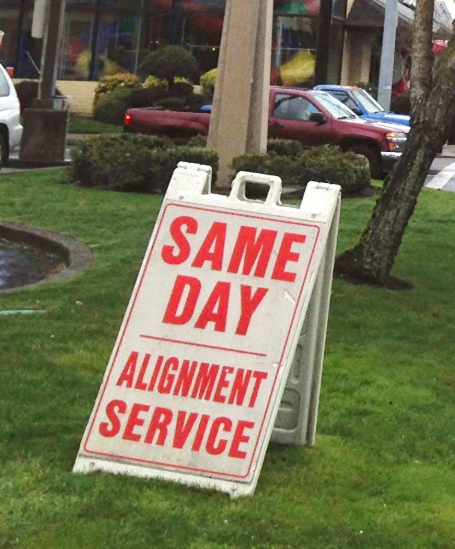
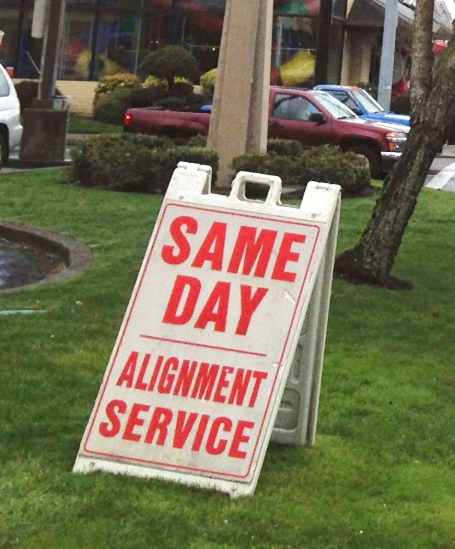
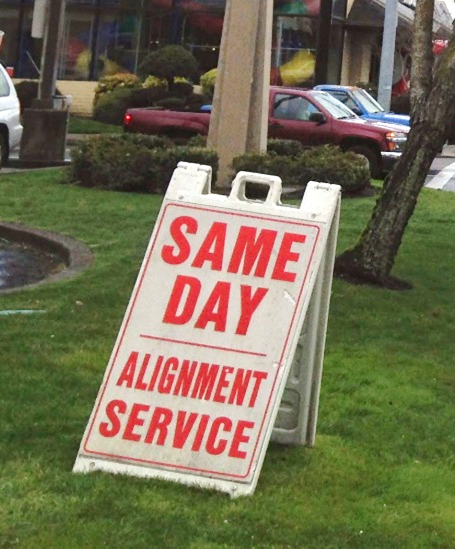
“A-frame sign” means a double-faced sign hinged or connected at the top which is spread for stabilization and set upon the ground. See also “Daily display sign” and “Sandwich board”.
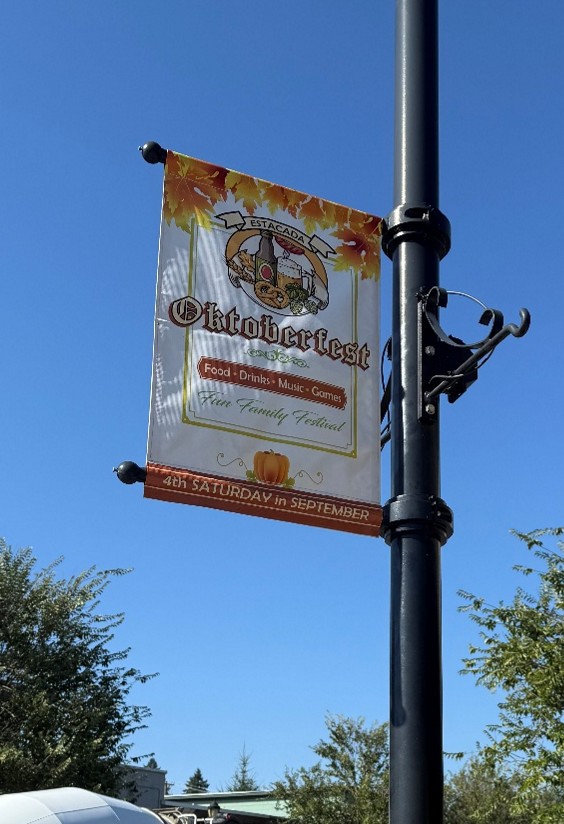
"Banner” means a temporary sign made of cloth, canvas, light fabric, thin plastic, vinyl, or other light material with no enclosing framework or electrical components that is supported or anchored on two or more edges or at all four corners. See also “Temporary sign” and “Cross-street banner”.
"Billboard" means a sign or structure erected for the purpose of leasing advertising space to promote an interest other than that of an individual, business, product or service available on the premises the billboard is located on.
"Building frontage" means the linear frontage of a building measured along a street or alley between two lines projecting perpendicular from the street to the corners of the building.
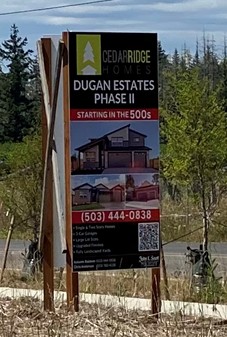
"Construction sign" means any sign located on vacant property that has received land use or building permit approval in the last five years.
"Cross-street banner" means and includes every type of decoration or banner displayed over, upon, or across city streets on a temporary or seasonal basis, whether attached to utility poles or any other structure. See also “Banner” and “Temporary sign”.
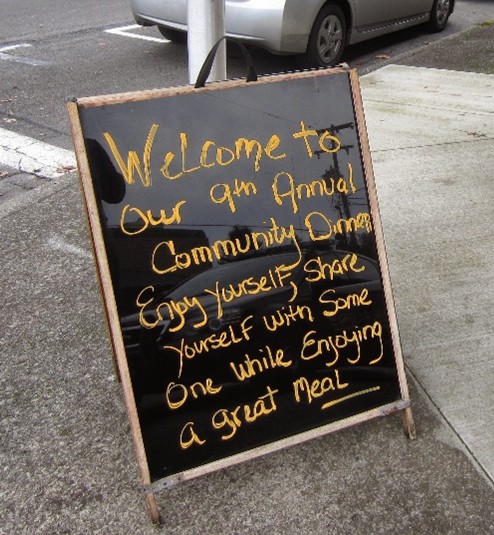
"Daily display sign" means a double-faced sign hinged or connected at the top which is spread for stabilization and set upon the ground, or a single- or double-faced sign mounted on a single pedestal, or other similar construction. See also "A-frame sign" and "Sandwich board".
"Electronic changing sign" means an electronic sign upon which the entire copy or message may appear or change from time to time upon a lamp bank, such as time and temperature displays, which by its nature and intensity is not a flashing sign.
"Flashing sign" means any sign which contains or is illuminated by a light source which produces a brilliant flash and darkness on an alternating basis, which results in a pulsating effect designed primarily to attract attention.
"Flat roof" means a building roof with a pitch or slope less than ten (10) degrees.
"Freestanding sign" means any sign set apart with no structural attachments to a building structure and affixed to the ground, and is meant to include ground or pole signs for the purpose of these regulations.
"Grade" means the relative finished ground level within twenty (20) feet of a sign.
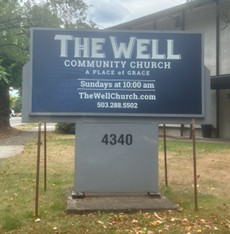
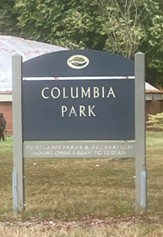
"Ground sign" means a sign which is mounted on the ground and supported by one or more uprights, poles or braces in or upon the ground other than a pole sign as defined. The bottom of such signs shall be no higher than three feet, and they shall extend no higher than eight feet. Ground signs are a type of freestanding sign, and therefore subject to freestanding sign standards.
"Height or height of sign" means the vertical distance from the average grade within twenty (20) feet of the structure to the highest point of a sign or any vertical projection thereof, including its supporting columns.
"Incidental sign" means small signs, less than two square feet in surface area, including signs designating restrooms, address numbers, hours of operation, entrances to buildings, directions, help wanted, public telephone, etc. Also included in this group of signs are those designed to guide vehicular traffic to an area or place on the premises of a business, building or development by means of a directory designating names and addresses only.
"Lighting, indirect or internal" means any immediate source of illumination that is visible when a sign is lighted and which does exceed ten (10) candle power per square foot measured at ten (10) feet from the sign.
"Moving sign" means any sign which produces apparent motion of the visual image, including, but not limited to, illusion of moving objects, moving patterns or bands of light, expanding or contracting shapes, rotation or any similar effect of animation which is designed or operated in a manner primarily to attract attention.
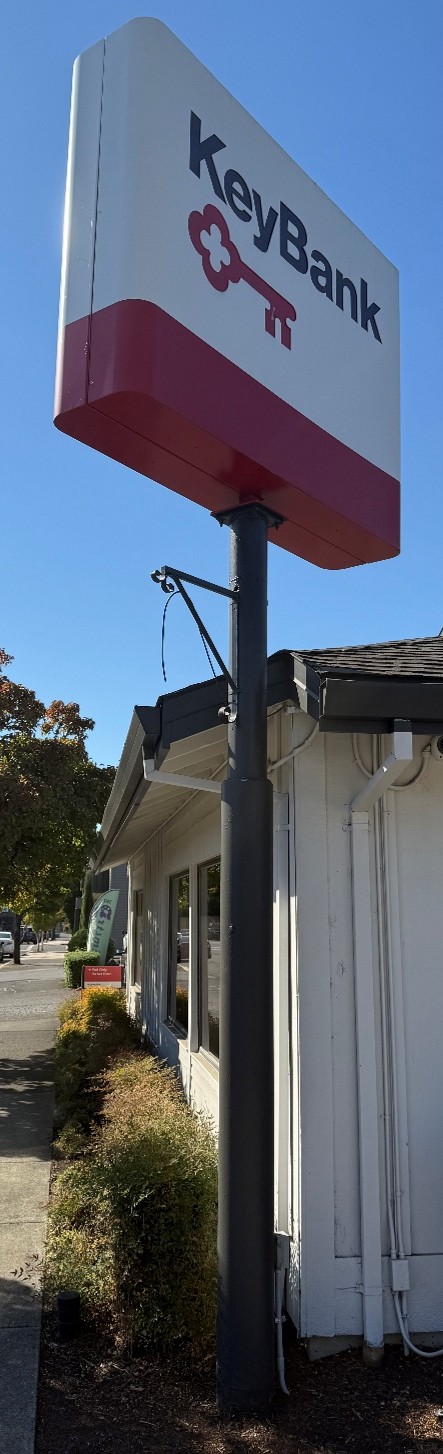
"Pole sign" means a single or multiple-faced sign eight or more feet above grade, supported by one or more uprights in the ground and detached from any building or structure. Pole signs are a type of freestanding sign, and therefore subject to freestanding sign standards.
"Portable sign" means any sign not meeting the anchorage requirements of the Uniform Sign Code.
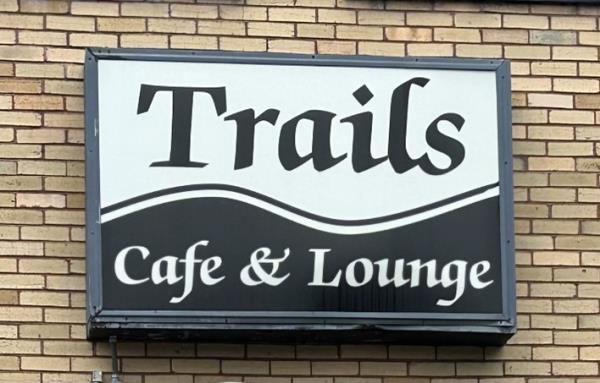
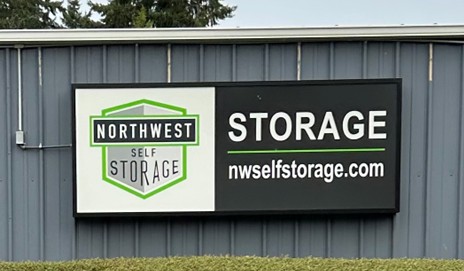
"Projecting sign" means a single or multiple-faced sign which is designed and constructed to be mounted to the wall of a building and which will extend more than twelve (12) inches from the wall.
"Roof sign" means any sign erected upon, against, or directly above a roof or on top of or above the parapet of a building, including a sign affixed to any equipment attached to the building.
"Sandwich board" means a double-faced sign hinged or connected at the top which is spread for stabilization and set upon the ground. See also “A-frame sign” and “Daily display sign”.
"Sign" means any medium, including its structure and component parts, other than paint on a building, which is used or intended to be used to attract attention to the subject matter for communication purposes.
"Sign area" means the surface contained within a single continuous perimeter which encloses the entire sign cabinet but excluding any support of framing structure that does not convey a message. Where signs are of a three-dimensional, round, or other solid shape, the largest cross-section viewed as a flat projection shall be used for the purpose of determining the sign area. Signs visible from more than one direction or without clearly defined sign faces shall be considered as having two faces and each face calculated in the total allowable area.
"Street frontage" means street(s), alley(s), or public right(s)-of-way parallel to the property line used to compute the area of sign(s) intended to be located in such a manner as to have primary exposure on that street or right-of-way.
"Temporary sign" means any sign, banner, pendant, valance, or advertising display constructed of cloth, canvas, light fabric, cardboard, wallboard, plywood, thin plastic, vinyl, or other light material that is easily moveable and has no footing, intended to be displayed for a period of less than six (6) months in any calendar year. See also “Banner” and “Cross-street banner”.
“Vertical clearance” means the vertical distance between grade (the relative finished ground level) and the bottom surface of an overhead sign or other overhead obstruction.
"Wall sign" means a single-face sign which does not extend more than twelve (12) inches from the wall.
"Window sign" means a sign which is applied to, attached to, or located within the interior of a window.
(Ord. No. 2008-007, § 1, 2-9-2009)
Amended by Ord. 2025-008 on 11/10/2025
16.72.025 Sign Code Picture Glossary
A-frame sign (a type of Daily display sign)


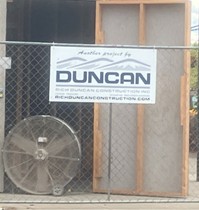
Banner (a type of Temporary sign)


Construction sign

Cross-street banner


Daily display sign

Electronic changing sign

Ground sign (a type of Freestanding sign)
Pole sign (a type of Freestanding sign)

Incidental sign
Portable sign
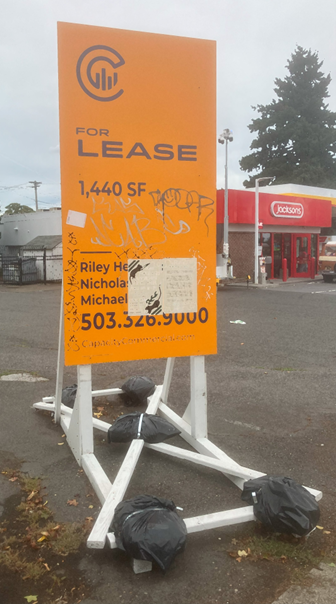
Projecting sign


Roof sign


Sandwich board (a type of Daily display sign)


Temporary sign



Wall sign

Window sign

Adopted by Ord. 2025-008 on 11/10/2025
16.72.030 How To Use The Sign Code
Read through the questions and answers below to determine what standards, if any, will apply to your sign.
Will my sign need a permit?
- First, check the City’s official Zoning Map to determine the zone designation for the property where the sign will be installed. If the property has an Estacada address but does not have a city zoning designation, then the property is outside city limits, and the City’s sign code standards would not apply.
- Once you’ve confirmed that the property is within Estacada city limits, look through the picture glossary under EMC 16.72.025 to determine which type of sign you’d like to display.
- Once you know the sign type, read through EMC 16.72.040 to find out if that type is exempt from sign code regulation. If it is listed as exempt, then no sign permit application, fee, or permit is required. If the sign type is not listed as exempt, read through EMC 16.72.050 to find out if it is prohibited.
- If your sign will be displayed within Estacada city limits, and the sign type is neither exempt nor prohibited, it may be permitted by the City, provided that a sign application and fee are submitted, and all applicable code standards are met.
Note: No sign that is subject to the City’s sign regulations may be erected, structurally altered, or relocated without first receiving a sign permit from the City.
What standards will apply to my sign?
If you’ve determined that your sign is regulated by the Estacada sign code, follow these steps to find out which standards apply:
- Check the City’s official Zoning Map on the city website to determine the zoning designation for the property where the sign will be installed.
- If the zone is R-1, R-2, R-3, or NCR, then the property is located in a residential zone, and the standards under EMC 16.72.090.A may apply.
- If the zone is anything other than the four residential zones listed above, then the property is in a commercial, industrial, or mixed-use zone, and the standards under EMC 16.72.090.B may apply.
- Look over sections EMC 16.72.090.D through J to determine whether additional standards will apply, based on the sign type.
How do I apply for a sign permit?
Read EMC 16.72.070 for a detailed description of the process and requirements for obtaining a sign permit in Estacada. To summarize:
- A completed sign permit application must be submitted, including a site plan and all other requested information.
- A sign permit fee must be paid before City Staff will review the application.
- If structural or electrical permitting is required, the applicant must pay any costs incurred by the City in reviewing and inspecting the sign.
What construction and maintenance standards will my sign have to meet?
See EMC 16.72.080 for a list of construction, electrical, and maintenance standards that signs must meet. In some cases, construction and electrical standards include references to state, federal, and international building codes.
Amended by Ord. 2019-005 on 3/9/2020
Amended by Ord. 2024-002 on 7/8/2024
Amended in its entirety by Ord. 2025-008 on 11/10/2025
16.72.040 Exempted Signs
The following signs shall be exempt from the application, permit, and fee requirements of this title.
- Impermanent construction signs not exceeding thirty-two (32) square feet in area;
- Directional, warning, or information signs or structures required or authorized by law, or by federal, state, county, city, or other public authority;
- Historical site plaques;
- Incidental signs;
- Official and legal notices issued by any court, public body, person, or officer in performance of a public duty or in giving any legal notice;
- Flags of the United States of America, cities, counties, municipalities, foreign nations, and internationally and nationally recognized organizations;
- Signs not readable from the public right-of-way, e.g., menu boards;
- Signs posted upon and related to structures intended for a separate use, e.g., bus shelters, Goodwill containers, etc.;
- Temporary signs up to four square feet on properties whose primary use is residential;
- Temporary signs on properties whose primary use is commercial or industrial, subject to the standards of EMC 16.72.090.B.5;
- Window signs.
(Ord. No. 2008-007, § 1, 2-9-2009)
Amended in its entirety by Ord. 2025-008 on 11/10/2025
16.72.050 Prohibited Signs
- Flashing and moving signs, except as allowed under EMC 16.72.040.B;
- Portable signs, except as allowed under EMC 16.72.090.J;
- Signs attached to utility, streetlights, or traffic control standard poles, or otherwise located in the public right-of-way without a permit;
- Signs in a dilapidated or hazardous condition;
- Signs on doors, windows, or fire escapes that restrict free ingress or egress;
- Signs which obstruct the visibility of any traffic sign or signal;
- Swinging signs;
- Billboards;
- Pole signs in the Riverfront Commercial (R-C), Highway Commercial (H-C), and Outdoor Commercial (O-C) zones, and in any residential zone (R-1, R-2, R-3, NCR);
- Temporary signs over four square feet on properties whose primary use is residential.
(Ord. No. 2008-007, § 1, 2-9-2009; Ord. No. 2012-005, § 7, 9-10-2012)
Amended by Ord. 2019-005 on 3/9/2020
Amended in its entirety by Ord. 2025-008 on 11/10/2025
16.72.060 Nonconforming Signs
- If, at the time of passage of the ordinance codified in this chapter, a sign does not conform to the provisions of said ordinance, the sign may be continued and maintained in reasonable repair. This grandfather status, however, shall not prevent the City from taking action under EMC 16.72.100 where a clear and immediate threat to the public safety and welfare exists.
- Nonconforming signs which are structurally altered, relocated or replaced shall comply immediately with all provisions of this chapter.
- If a nonconforming sign is destroyed by any cause to the extent of more than sixty (60) percent of its value, then and without further action by the planning commission, the sign shall be subject to all applicable regulations of this chapter. For the purpose of this chapter, the value of any sign shall be the estimated cost to replace the sign in kind, as determined by the building inspector.
(Ord. No. 2008-007, § 1, 2-9-2009)
Amended by Ord. 2025-008 on 11/10/2025
16.72.070 Permit Application Process
- No sign governed by the provisions of this chapter shall be erected, structurally altered, or relocated without first receiving a sign permit from the City. Where ODOT jurisdiction applies, ODOT regulations supersede those of this chapter.
- A property owner or their authorized agent shall apply to the City for a sign permit by filing an application with the City using forms prescribed for the purpose. A site plan and construction drawing shall accompany the application. The City may require other drawings or information necessary to determine compliance with sign regulations. The applicant shall pay a fee as established by resolution or ordinance of the City Council in effect at the time the application is filed. Prior to being issued a permit, the applicant shall pay, in addition to the fee established by the City Council, any costs incurred by the building official/engineer in reviewing the proposed sign.
(Ord. No. 2008-007, § 1, 2-9-2009)
Amended in its entirety by Ord. 2025-008 on 11/10/2025
16.72.080 Construction And Maintenance Requirements
All signs shall comply with the following requirements and those specified by zoning district:
- Construction shall satisfy the requirements of current version of the Uniform Sign Code.
- Electrical requirements for signs shall be governed by the current version of the National Electrical Code and Oregon Electrical Specialty Code Amendments.
- Except for exempt signs and approved daily display signs, all signs shall be securely attached to a building or the ground. No signs shall be erected or maintained on utility poles or upon trees, rocks, or other natural features.
- Signs shall not be placed in clear vision areas, as defined in EMC 16.08.010.
- All signs, together with their supports, braces, and guys shall be maintained in a safe and secure manner.
- All illuminated signs shall be internally or indirectly illuminated.
- Unless otherwise permitted, all signs shall be posted and maintained entirely on private property with the consent of the occupant of the premises.
- Cross-street banners shall be permitted, insured, installed, maintained, and removed according to the standards of EMC 16.72.090.H.
Adopted by Ord. 2024-002 on 7/8/2024
Amended in its entirety by Ord. 2025-008 on 11/10/2025
16.72.085 Sign Type Allowances By Zone Table
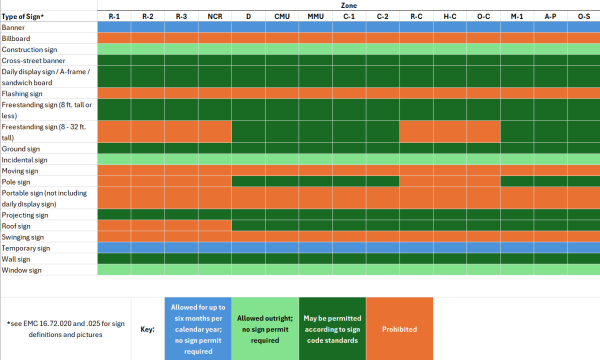
Adopted by Ord. 2025-008 on 11/10/2025
16.72.090 Sign Standards
- Signs In Residential Zones: R-1, R-2, R-3, And NCR
- No freestanding sign, pole sign, or ground sign may exceed eight feet in height or project beyond any property line.
- Building-mounted signs shall be wall-mounted and shall not be erected on any building roof.
- Short Term Rentals. Only one ground or wall nonilluminated wood sign no more than six square feet in size shall be allowed for residential short term rentals, regardless of zone.
- Home Occupations. One sign not exceeding six square feet in area shall be permitted, regardless of zone. The sign shall either be attached to the exterior of the building, placed in a window of the building or, if detached from the building, shall not be located in a required front or street setback.
- Other commercial uses allowed conditionally may be permitted to erect one sign per street frontage not to exceed thirty-two (32) square feet.
- On a property whose primary use is residential, a temporary sign may not exceed four square feet in area.
- Signs In Commercial, Industrial, and Mixed-Use Zones
- A total sign area per lot shall not exceed two square feet for each lineal foot of building frontage. Temporary signage shall not count toward total sign area.
- Freestanding or projecting signs shall be limited to one hundred fifty (150) square feet per face. Such signs shall not exceed thirty (30) feet in height from grade to the highest element.
- One daily display sign is allowed per business or use, per EMC 16.72.090.J.
- Where frontage is on more than one street, only the signs computed with the frontage of that street shall be located on that street.
- A temporary sign may not exceed thirty-two (32) square feet. Temporary signage shall not count toward the total sign area limit outlined in Subsection B,1 of this section. Only the first one hundred (100) square feet of temporary signage shall be exempt from the application, permit, and fee requirements of this title.
- No pole signs are allowed in the R-C, H-C, or O-C zones.
- Within shopping centers, each individual business shall be allowed a total sign area as calculated in accordance with Subsection B,1 of this section. In addition to the sign area allowed for individual businesses, shopping centers with more than one hundred thousand (100,000) square feet of floor area shall be allowed one double-faced indirectly lighted sign on each street right-of-way. Such signs shall neither extend beyond the property line nor be placed in the right-of-way and shall be used solely to identify the shopping center, shopping area, or business or activities conducted therein. These signs shall not exceed three hundred (300) square feet per face and shall not exceed thirty (30) feet in height from the grade to the highest element of the sign.
- Home Occupations. Signs shall conform to the standards under EMC 16.72.090.A.4.
- Signs Visible From Hwy 224
Signs visible from Hwy 224, regardless of zone, may require ODOT approval per ORS Chapter 377. - Freestanding, Ground, And Pole Signs
Freestanding signs, which include ground signs and pole signs, shall comply with all of the following provisions:- One freestanding sign shall be permitted along each street frontage, or each three hundred (300) feet of street front, with one additional freestanding sign allowed on the property.
- Freestanding signs shall be placed behind the property line and no closer than ten (10) feet to any adjacent private property line.
- Freestanding signs may project over the public property line, provided they conform to the standards established for projecting signs.
- Pole signs are prohibited in the R-C, H-C, and O-C zones, as well as in all residential zones (R-1, R-2, R-3, and NCR).
- Projecting Signs
- No projecting sign shall extend above the highest structural component of the building to which it is attached.
- Signs posted over the public right-of-way, including freestanding signs, shall conform to the following standards:
Vertical Clearance Maximum Projection Over Right-Of-Way Less than 8 feet Not permitted 8 feet 1 foot 9 feet and above 2 feet for every foot above 8 feet in height but no more than 9 feet - No sign shall project within two feet of the curb line.
- Roof Signs
- Roof signs shall be installed or erected in such a manner that no support structure is visible from any abutting public right-of-way.
- Roof signs may be erected so as to appear from all sides as a wall sign applied to an existing penthouse which appears to be a part of the building itself.
- Roof signs shall not exceed the highest point of the building or structure. On flat roofs, the roof sign shall not exceed eight feet above the highest point of the building.
- In no case shall a sign exceed the maximum allowable height of the building in the zone in which it is located.
- Wall Signs
- Wall signs may be attached flat to, or pinned away from the wall, but shall not project more than twelve (12) inches from the wall.
- Wall signs shall not extend above the height of the wall to which it is attached.
- Cross-Street Banners
- Permits.
- No person, firm, corporation or association shall display or cause to be displayed over or upon the city streets any cross-street banner without having first obtained a permit, the permit being subject to the approval and authorization of the Public Works Director.
- A request for a cross-street banner permit shall be on forms provided by the City and shall show the approximate location of the proposed installation or installations, height above street or sidewalk, location on pole or building, the approximate size of cross-street banner to be displayed; whether the cross-street banner is to be attached to utility poles, buildings or other structures, together with the date of installation and the date of removal.
- Upon satisfactory evidence that all requirements of this section have been fully complied with by the applicant, and upon satisfactorily showing that permission of the property owner has been obtained and that all conditions, rules and regulations required by the property owner have been complied with, the Public Works Director shall issue a permit for the installation as requested, providing that, in his or her judgment, no other requirements or additional safeguards other than those mentioned herein, would be in the interest of the public safety.
- Insurance Requirement. The grantee shall file with the permit application a certificate of insurance naming the City and the property owner as additional insured at a minimum of five hundred thousand dollars ($500,000.00) combined single limit bodily injury and property damage. The insurance to be for the protection of any persons sustaining bodily injury or property damage resulting from the placement, maintenance or removal of the cross-street banner.
- Installation/Removal Requirements.
- Cross-street banners other than those installed by utility company crews are to be installed from a mechanical hoist or by way of OSHA approved procedures and equipment, so that the individuals making installations do not have to climb utility poles.
- The holder of a permit for a cross-street banner shall be responsible for the maintenance of the banner in a safe condition at all times and for its safe and prompt removal upon the expiration of the permit authorized, or in the event the sign may become a hazard upon the public streets at any time.
- Cross-street banners are limited to sixty (60) days, unless an extension is approved by the Planning Commission.
- The Public Works Director, as well as the property owner involved, shall have the right to remove or cause to be removed any unauthorized, not maintained, improperly hung cross-street banners, or cross-street banners that are a hazard upon the public street without notice to the person, firm, corporation or association responsible for the display of said banners.
- Permits.
- Temporary Signs
- Allowed Time Frame. Temporary signs may not be posted for more than six months in any calendar year.
- Size Standards.
- On a property whose primary use is residential, a temporary sign may not exceed four square feet in area.
- On a property whose primary use is commercial or industrial, a temporary sign may not exceed thirty-two (32) square feet in area.
- Confiscation of Nonconforming Signs. The City may order the removal of any temporary sign erected or maintained in violation of this section, subject to the standards of EMC 16.72.100. Confiscated signs will be held by the City for at least thirty (30) days, during which time they will be available for retrieval by the property owner. Signs not retrieved within thirty (30) days of confiscation are subject to disposal.
- Daily Display Signs In Public Right-Of-Way
A daily display sign may be allowed within the public right-of-way, provided that all of the following conditions are met:- A sign permit is obtained that shows location of daily display sign in the right-of-way. This permit shall be revocable in cases of noncompliance.
- The sign is to be set back behind the curb so as not to interfere with on-street parking, or a minimum of ten (10) feet from the edge of the nearest street travel lane where curbs are not in place.
- The sign is to be placed so as to allow at least five feet of unimpeded pedestrian sidewalk maneuvering space, such maneuvering space being located as close as possible to the building frontage.
- The sign meets clear vision area standards, as defined in EMC 16.08.010 and regulated in EMC 16.60.010.
- The sign is properly maintained as required by EMC 16.72.080.
- The applicant shall assume all liability for incidents involving the sign, and execute a document satisfactory to the City, releasing and indemnifying the City for all liability arising from claims pertaining to the sign.
- Sign dimension shall not exceed a maximum of eight square feet per display surface and sixteen (16) square feet overall, with a maximum height limit of four and one-half feet above ground level.
- One daily display sign per use is allowed.
- Daily display signs count toward the total allowance of signage square footage, per EMC 16.72.090.B.1.
Adopted by Ord. 2025-008 on 11/10/2025
16.72.100 Enforcement And Removal Of Signs
- Any sign which is not in compliance is an unlawful sign and declared to be a public nuisance.
- The City may order the removal of any sign erected or maintained in violation of this chapter. It shall give twenty-four (24) hours' notice in writing to the owner of such sign, or of the building structure, or premises on which the sign is located, to remove the sign or bring it into compliance.
- The City may remove a sign immediately and without notice if, in its opinion, the condition of the sign is such as to present an immediate threat to the safety of the public, and is authorized to take such steps as may be necessary to remove the sign. Neither the City nor any of its agents shall be liable for any damage to the sign.
- The violation of or failure to comply with any of the provisions of this chapter or the erection, use or display or the allowing of, the permitting of, or the suffering erection, use or display of any sign not in compliance with all the provisions of this title is unlawful and upon conviction, the violator may be punished by a fine of not more than five hundred dollars ($500.00) and shall be required to remove such sign or to take such other action as shall be determined by the court to be necessary to bring such sign into full compliance with the provisions of this chapter.
- The remedies provided in this chapter for violations of or failure to comply with provisions of this ordinance shall be cumulative and shall be in addition to any other remedy provided by law.
Adopted by Ord. 2025-008 on 11/10/2025
16.74.010 Purpose
The purpose of this chapter is to ensure that transportation facilities are provided concurrent with the new development or a reasonable period of time following the approval of new development.
(Ord. 2007-6 § 20 (part))
16.74.020 Applicable Standards
- Approval of a development shall be granted only if the capacity of transportation facilities is adequate or will be made adequate in a timely manner. The following shall be exempt from this requirement:
- Modification or replacement of an existing development (or a development that has a current land use approval even if such development has not yet been constructed) on the same property, provided that an increase in motor vehicle traffic does not result;
- Unmanned utility facilities, such as wireless telecommunication facilities, where no employees are present except to perform periodic servicing and maintenance;
- Mass transit facilities, such as light rail transit stations and park-and-ride lots.
- As used in Subsection A of this section, "adequate" means the following mobility standards, as identified in the 2023 Estacada Transportation System Plan:
- The performance standards identified in the latest edition of the Oregon Highway Plan shall apply to facilities under the jurisdiction of the state of Oregon.
- The performance standards identified in Table 5-2a and 5-2b of Chapter 5 of the Clackamas County Comprehensive Plan (County TSP) shall apply to facilities under the jurisdiction of Clackamas County.
- For signalized intersections, a level of service D or better must be maintained during the weekday peak hour.
- For roundabouts, a volume-to-capacity ratio of less than or equal to 0.90 on each intersection approach must be maintained during the weekday peak hour.
- For stop-controlled and yield-controlled intersections, a level of service E or better must be maintained during the weekday peak hour. For two-way stop-controlled intersections, this applies to the minor (i.e., stop-controlled) approaches. For all-way stop-controlled intersections, this applies to the overall intersection measure.
- For the purpose of calculating capacity as required by Subsections A and B of this section, the following standards shall apply:
- Both the method of calculating LOS and the definitions given to the LOS letter designations are established by the latest edition of the Highway Capacity Manual. The method of calculating capacity on state facilities is established by the Oregon Highway Plan. The method for calculating capacity on Clackamas County facilities is established the Clackamas County Roadway Standards.
- The minimum capacity standards shall apply to all roadways and intersections within the impact area of the proposed development.
- Capacity shall be evaluated for motor vehicle traffic only.
- Capacity shall be evaluated for the peak fifteen (15) minute period of both the a.m. weekday and p.m. weekday peak hours of the transportation system within the impact area. The requirement to evaluate either the a.m. or the p.m. peak hour, or both, may be waived if the proposed use will not generate motor vehicle trips during the period(s).
- Both the method of calculating LOS and the definitions given to the LOS letter designations are established by the latest edition of the Highway Capacity Manual. The method of calculating capacity on state facilities is established by the Oregon Highway Plan. The method for calculating capacity on Clackamas County facilities is established the Clackamas County Roadway Standards.
- As used in Subsection A of this section, "timely" means:
- For facilities under the jurisdiction of the city of Estacada, necessary improvements are included in the Five-Year Capital Improvement Plan, fully funded, and scheduled to be under construction within three years of the date land use approval is issued;
- For facilities under the jurisdiction of the state of Oregon, necessary improvements are included in the Statewide Transportation Improvement Plan and scheduled to be under construction within four years of the date land use approval is issued;
- For facilities under the jurisdiction of Clackamas County, necessary improvements are included in that jurisdiction's capital improvement plan, fully funded, and scheduled to be under construction within three years of the date land use approval is issued;
- Alternatively, "timely" means that necessary improvements will be constructed by the applicant or through another mechanism, such as a local improvement district. Under this alternative:
- Prior to issuance of a certificate of occupancy for a conditional use or a development subject to design review and prior to recording of the final plat for a subdivision or partition, the applicant shall do one of the following:
- Complete the necessary improvements, or
- For transportation facilities under the jurisdiction of the City, the applicant shall provide the City with a deposit, letter of credit, performance bond, or other surety satisfactory to the City equal to the full cost of designing and constructing the necessary improvements For transportation facilities under the jurisdiction of the state, a city, or another county, the applicant shall comply with the respective jurisdiction's requirements for guaranteeing completion of necessary improvements. This option is only available if the jurisdiction has a mechanism in place for providing such a guarantee;
- Prior to issuance of a certificate of occupancy for a conditional use or a development subject to design review and prior to recording of the final plat for a subdivision or partition, the applicant shall do one of the following:
- For a phased development, the first phase shall satisfy Subsections D,1 through D,4 of this section at the time of land use approval. Subsequent phases shall be subject to the following:
- At the time of land use approval, necessary improvements shall be identified and the phase for which they are necessary shall be specified,
- Necessary improvements for a particular phase shall either:
- Comply with Subsections D,1 through D,3 of this section at the time of building permit approval, except that the improvements shall be scheduled to be under construction within three years of building permit approval rather than within three years of land use approval, or
- Comply with Subsection D,4 of this section, in which case the improvements shall be completed or guaranteed prior to issuance of a certificate of occupancy or recording of the final plat for the applicable phase.
- As used in Subsection D of this section, "necessary improvements" are:
- Improvements required by the Development Code;
- Improvements required by the City's adopted Comprehensive Plan, Transportation System Plan, Downtown and Riverside Area Plan, Street Tree Master Plan, or Active Transportation Plan, with the requirements of the most recently-adopted plan superseding any previous plan's requirements for the same area; and
- Improvements identified in a traffic impact study as being required in order to comply with the adequacy standard identified in Subsection B of this section. Traffic Impact Studies shall follow the requirements provided in EMC 16.74.040. If a Traffic Impact Study is not required per EMC 16.74.040, the City's engineering or planning staff shall identify necessary improvements or the applicant may opt to provide a traffic impact study.
(Ord. 2007-6 § 20 (part); Ord. No. 2018-003, § 3(Exh. 6), 10-8-2018)
Amended by Ord. 2019-005 on 3/9/2020
Amended by Ord. 2023-007 on 1/8/2024
16.74.040 Traffic Impact Study (TIS) And Traffic Assessment Letter Procedures
- When A TIS Is Required. The City or other road authority with jurisdiction may require a TIS as part of an application for development, a change in use, a change in zoning, a change in Comprehensive Plan designation, or a change in access. A TIS shall be required where a change of use or a development would involve one or more of the following:
- Operational or safety concerns documented in writing by a road authority;
- An increase in site traffic volume generation by 200 Average Daily Trips (ADT) or more;
- An increase in the use of adjacent streets by 10 or more vehicles per day exceeding 20,000-pound gross vehicle weight;
- Existing or proposed approaches or access connections that do not meet minimum spacing or sight distance requirements or are located where vehicles entering or leaving the property are restricted, or such vehicles are likely to queue or hesitate at an approach or access connection, creating a safety hazard; or
- A TIS is required by Clackamas County or ODOT.
- Traffic Assessment Letter. If a TIS is not required as determined by EMC 16.74.040.A, the applicant shall submit a Traffic Assessment Letter (TAL) to the City indicating that TIS requirements do not apply to the proposed action. This letter shall present the trip generation estimates and distribution assumptions for the proposed action and verify that driveways and roadways accessing the site meet the sight distance, spacing, and roadway design standards of the agency with jurisdiction of those roadways. Other information or analysis may be required as determined by the City Engineer. The TAL shall be prepared by a Professional Civil or Traffic Engineer currently licensed to practice within the State of Oregon, and with special training and experience in transportation engineering and planning. The requirement for a TAL may be waived if the City Engineer determines that the proposed action will not have a significant impact on existing traffic conditions.
- TIS General Provisions.
- All traffic studies shall be prepared by or under the direct supervision of a Professional Civil or Traffic Engineer currently licensed to practice within the State of Oregon, and with special training and experience in transportation engineering and planning.
- Prior to TIS scope preparation, the applicant shall pay to the City the fees and deposits associated with TIS scope preparation and TIS review in accordance with the adopted fee schedule. The City’s costs associated with TIS scope preparation and TIS review will be charged against the respective deposits. Additional funds may be required if actual costs exceed deposit amounts. Any unused deposit funds will be refunded to the applicant upon final billing.
- For preparation of the TIS, the applicant may choose one of the following:
- To prepare the TIS for submittal to the City, the applicant may hire a Professional Civil or Traffic Engineer currently licensed to practice within the State of Oregon, and with special training and experience in transportation engineering and planning. The City Engineer will then review the TIS and the applicant will be required to pay to the City any fees associated with the TIS review; or
- The applicant may request that the City Engineer prepare the TIS. The applicant will pay to the City any fees associated with preparation of the TIS by the City Engineer.
- The TIS shall be submitted with a concurrent land use application and associated with application materials. The City will not accept a land use application for process if it does not include the required TIS.
- The City may require a TIS review conference with the applicant to discuss the information provided in the TIS once it is complete. This conference would be in addition to any required pre-application conference. If such a conference is required, the City will not accept the land use application for processing until the conference has taken place. The applicant shall pay the TIS review conference fee at the time of conference scheduling, in accordance with the adopted fee schedule.
- A TIS determination is not a land use action and may not be appealed.
- TIS Scope. The City shall determine the study area, study intersections, trip rates, traffic distribution, and required content of the TIS based on information provided by the applicant about the proposed development.
- If notice to ODOT or other agency is required pursuant to noticing requirements in EMC 16.132, the City will coordinate with those agencies to provide a comprehensive TIS scope. ODOT may also require a TIS directly to support a state highway approach permit application.
- Conditions of Approval. The City may deny, approve, or approve a proposal with conditions necessary to meet operational and safety standards; provide the necessary right-of-way for planned improvements; and require construction of improvements to ensure consistency with the future planned transportation system.
- Where the existing transportation system will be impacted by the proposed development, dedication of land for streets, transit facilities, sidewalks, bikeways, paths, or accessways may be required to ensure that the transportation system is adequate to handle the additional burden caused by the proposed use.
- Where the existing transportation system is shown to be burdened by the proposed use, improvements such as paving, curbing, installation or contribution to traffic signals, traffic channelization, construction of sidewalks, bikeways, accessways, paths, or street that serve the proposed use may be required.
- The City may require the development to grant a cross-over access easement(s) to adjacent parcel(s) to address access spacing standards on arterials and collector roadways or site-specific safety concerns. Construction of shared access may be required at the time of development if feasible, given existing adjacent land use. The access easement must be established by deed.
(Ord. No. 2018-003, § 3(Exh. 6), 10-8-2018)
Amended by Ord. 2023-007 on 1/8/2024
16.75.010 Purpose And Intent
This chapter implements the pedestrian access and connectivity policies of City of Estacada Transportation System Plan and Active Transportation Plan, and those plans' policies for ensuring appropriate access to transit facilities. It is intended to provide for safe, reasonably direct, and convenient pedestrian access and circulation. The requirements of this Chapter apply to land divisions pursuant to Division IV and to the following land uses:
- Multifamily
- Commercial
- Light industry
- Activity centers, including but not limited to
- Schools
- Parks
- Hospitals and clinics
- Churches
- Residential care facilities and residential homes
Adopted by Ord. 2023-007 on 1/8/2024
16.75.020 Standards
Developments shall conform to all of the following standards for pedestrian access and circulation:
- Continuous Walkway System. A pedestrian walkway system shall extend throughout the development site and connect to adjacent sidewalks, if any, and to all future phases of the development, as applicable.
- Safe, Direct, and Convenient.
Adopted by Ord. 2023-007 on 1/8/2024
Amended by Ord. 2025-013 on 1/26/2026
16.75.030 Vehicle/Walkway Separation
Except as required for crosswalks, per 16.75.040, where a walkway runs parallel to a driveway or street it shall be raised six (6) inches and curbed along the edge of the driveway or street. Alternatively, the City Manager or designee may approve a walkway abutting a driveway at the same grade as the driveway if the walkway is physically separated from all vehicle-maneuvering areas. An example of such separation is a row of bollards (designed for use in parking areas) with adequate minimum spacing between them to prevent vehicles from entering the walkway.
Adopted by Ord. 2023-007 on 1/8/2024
Amended by Ord. 2025-013 on 1/26/2026
16.75.040 Crosswalks
Where a walkway crosses a parking area or driveway ("crosswalk"), it shall be clearly marked with contrasting paving materials (e.g., pavers, light-color concrete inlay between asphalt, or similar contrasting material) or painted crosswalk striping. The crosswalk may be part of a speed table to improve driver-visibility of pedestrians.
Adopted by Ord. 2023-007 on 1/8/2024
16.75.050 Walkway Width And Surface
Walkways shall be constructed of concrete, asphalt, brick or masonry pavers, or other durable surface, as approved by the City Manager or designee, and not less than five feet wide. Multi-use paths (i.e., designed for shared use by bicyclists and pedestrians) shall be concrete or asphalt and shall conform to city transportation standards.
Adopted by Ord. 2023-007 on 1/8/2024
16.75.060 Improvements At Transit Stops
A proposed development that is adjacent to or includes an existing or planned transit stop will be required to submit a plan showing access to the transit stop consistent with the adopted Active Transportation Plan and, when determined necessary by TriMet, dedicate sufficient territory of the subject property for, and to install, transit improvements TriMet requires.
Adopted by Ord. 2023-007 on 1/8/2024
16.75.070 Buildings Adjacent To Transit Stops
Any new building adjacent to a TriMet transit stop shall be located within 20 feet of the stop, a transit street, or an intersecting street, or else provide a pedestrian plaza at the transit stop or at the street intersection.
Adopted by Ord. 2023-007 on 1/8/2024
16.76.010 Off-Street Parking, Bicycle Parking And Loading Requirements
At the time a building permit is issued for a new structure, the use of an existing structure is enlarged, or the category of use is changed, off-street parking spaces, loading areas and access thereto shall be provided as set forth in this section. If such facilities have been provided in connection with an existing use, they shall not be reduced below the requirements of this title.
- Requirements for types of buildings and uses not specifically listed herein shall be determined by the city manager, based upon the requirements of comparable uses listed.
- In the event several uses occupy a single structure or parcel of land, the total requirements shall be the sum of the requirements of the several uses computed separately.
- Owners of two or more uses, structures or parcels of land may agree to utilize jointly the same parking and loading spaces when the hours of operation do not overlap; provided that satisfactory evidence is presented in the form of deeds, leases, agreements or contracts.
- Off-street parking spaces shall be located on the same lot or on an adjoining lot or lot located within one hundred fifty (150) feet, unless otherwise approved by the planning commission.
- Required parking spaces shall be available to operable motor vehicles and shall not be used for storage of vehicles or materials or for the parking of trucks used in conducting the business or use.
- Areas used for standing and maneuvering of vehicles shall have a paved, durable and dustless surface improved to minimum public road standards, maintained adequately for all-weather use, and be so drained as to avoid flow water across public sidewalks.
- Except for parking to serve dwelling uses, parking and loading areas adjacent to or within residential zones shall be designed to minimize disturbances with the installation of a sight-obscuring fence or vegetative buffer, of not less than five feet in height, except where vision clearance is required.
- Artificial lighting which may be provided for parking areas shall be designed to reflect light downward, away from the sky and from adjacent residential zones or adjacent dwellings.
- Groups of more than four parking spaces shall be served by a driveway so that no backing movements or other maneuvering within a street, other than an alley will be required and shall be contained by a curb or bumper rail at least four inches high and set back a minimum of four and one-half feet from the property line.
- Passenger Loading. A driveway designated for continuous forward flow of passenger vehicles for the purpose of loading and unloading children shall be located on the site of any school having a capacity of greater than twenty-five (25) students.
- Loading of Merchandise, Materials or Supplies. Buildings or structures which receive and distribute materials or merchandise by truck, shall provide and maintain off-street loading berths in sufficient numbers and size to adequately handle the needs of the particular use.
- Off-street parking areas used to fulfill the requirements of the code may be used for loading and unloading operations during periods of the day when not required to take care of parking needs.
- Compact parking spaces may be permitted at a ratio of one space to every three full-sized spaces. (See "Parking space" defined under EMC 16.08 for dimension requirements.)
- Except for parking intended to serve dwelling uses, parking spaces shall be clearly delineated through striping or some other means.
- Where an area provided for off-street parking is within or adjoins a residential zone, the perimeter of the area shall be screened by a sight-obscuring fence or planting. The screen shall be continuous and shall be at least six feet in height to the rear of the front setback of the residential zone and shall be three feet in height in that portion bounding the front yard.
- Parking spaces along the boundaries of a parking area shall be provided with a sturdy bumper guard or curb at least four inches in height and located far enough within the boundary to permit any portion of a vehicle within the parking area from extending over the property line or interfering with the required screening or sidewalk traffic.
- Off-Street Parking Requirements.
- Off-street parking shall be required according to the table below:
Use: Minimum Required Spaces: Bank 1 per 300 square feet of floor area Bowling alley 4 per lane Campsites and recreational cabins and yurts 1 per campsite/cabin/yurt Childcare facilities Small 2 total Large 2 per classroom Doctor's office, dental office, medical clinic, or similar use 3.5 per 1,000 square feet of floor area Dwellings Single-family and Duplex 2 total Triplex and Fourplex 1.5 for each dwelling unit, rounded up to the next whole number (except as provided in EMC 16.76.010, Subsection 3) Commonwall 2 for each commonwall dwelling (see on-street credit option in EMC 16.76.010, Subsection 4) Multi-family and cottage clusters 1 for each unit Accessory dwelling unit (ADU) No additional space for one accessory dwelling unit. One additional parking space shall be provided for a second ADU. Eating and drinking establishments 1 for every four customer seats Funeral home or mortuary 1 for every six seats or one space per 50 square feet of area used for assembly, whichever is greater, if there is an assembly area; 1 per 2 employees on maximum shift or operating hours if there is no assembly area Hospital 3 for every two patient beds Hotel, motel, boarding house, or resort 1 per lodging/accommodation unit Instructional class space, such as a martial arts or dance studio 1 per 200 square feet of leasable floor area Library 1 per 300 square feet of floor area Manufactured dwelling park 2 for each manufactured dwelling space Nursing home, convalescent care facility, extended care facility, or similar institution 1 for every three patient/resident beds Office 1 per 300 square feet of floor area Park For a park with an athletic field: 1 per 3 spectator seats, 1 space per 18 inches of bench-viewer bench length, or 25 per field, whichever amount is greatest For a park without an athletic field: 2.6 per acre Religious institution, membership club or community center, fraternal hall, or similar place of assembly 1 for every six seats or one space for each 50 square feet of floor area used for assembly, whichever is greater Retail store (general), including a grocery store, book store, gift shop, or any other general retail or shop 1 per 300 square feet of floor area Retail store (bulk), including for sale of furniture, appliances, vehicles, building materials, home furnishings, garden supplies, or agricultural supplies 1 per 500 square feet of bulk merchandise area or storage School for children, including a preschool, kindergarten, elementary, middle, or junior high school 2 per classroom School, other (including a high school, trade school, or college facility) 5 per classroom Service or repair shop 1 per 500 square feet of floor area Short-term rental of dwelling 1 per rented bedroom in addition to parking required for dwelling, with never less than 2 total parking spaces on the subject property Skating rink, arcade, gym, or other similar indoor recreational or athletic use or commercial amusement enterprise 1 per 100 square feet of floor area Warehouse, storage, or similar enterprise 1 per 2,000 square feet of floor area Other business or industrial use not elsewhere listed 1 per 2 employees on maximum shift or operating hours - Exemptions—Downtown Zone.
- There is no minimum off-street parking requirement for uses located within one hundred (100) feet of Broadway Street between OR 224 and 2nd Avenue. Uses in the Downtown zone but located outside the above described area are required to provide off-street parking in accordance with the table in Subsection Q.1, except that the minimum number of required off-street parking spaces may be reduced as follows:
- Reduce the minimum parking standard by ten (10) percent where the project is located within one thousand three hundred twenty (1,320) feet of an existing or planned public transit bus stop; and/or
- Reduce the minimum parking standard by twenty (20) percent where the city decision-making body determines there is public on-street parking adjacent to the subject site in a quantity equal to the reduction in the number of required parking spaces.
- Expansion of a nonconforming development, building or use that does not comply with the minimum parking ratios shall provide additional parking spaces based on the floor area or capacity added and not on the area or capacity existing prior to the expansion.
- There is no minimum off-street parking requirement for uses located within one hundred (100) feet of Broadway Street between OR 224 and 2nd Avenue. Uses in the Downtown zone but located outside the above described area are required to provide off-street parking in accordance with the table in Subsection Q.1, except that the minimum number of required off-street parking spaces may be reduced as follows:
- Reduced Parking for Internal Conversions. When a duplex, triplex, or fourplex is created through internal conversion of an existing single-family dwelling, the minimum number of required parking spaces (including existing retained parking spaces) shall be as follows:
- Duplex: Two spaces total.
- Triplex: Three spaces total.
- Fourplex: Four spaces total.
- On-street Parking Credit for Commonwall Dwellings. For each commonwall dwelling, the minimum parking requirement may be reduced by no more than one space if on-street parking is available that meets standards a through e below.
- The space is a legal place to park (consistent with location standards in the Estacada Municipal Code, such as not next to a fire hydrant or a mailbox).
- The space is abutting the subject lot (on the same side of the street).
- The space is on a street with a minimum paved width that meets standard for the local streets with parking on both sides, as established in the adopted Transportation System Plan.
- The space is at least 22 feet long and 7 feet wide.
- Only one commonwall dwelling can claim the space towards its off-street parking reduction.
- The maximum number of off-street automobile parking spaces allowed per site equals the minimum number of required spaces, pursuant to EMC 16.76.010 Subsections Q, 1-2, times a factor of:
- [1.2] spaces for uses fronting a street with adjacent on-street parking spaces; or
- [1.5] spaces, for uses fronting no street with adjacent on-street parking.
- Off-street parking shall be required according to the table below:
- Bicycle Parking.
- Minimum Required Bicycle Parking Spaces. Uses shall provide long- and short-term bicycle parking spaces, as identified in Subsection R,10 of this section. Where two options are provided (e.g., two spaces, or one per eight bedrooms), the option resulting in more bicycle parking is used.
- Exemptions. This section does not apply to single-family and two-family housing (attached, detached, or manufactured housing), home occupations, agriculture and livestock uses.
- Location and Design.
- Bicycle parking should be no farther from the main building entrance than the distance to the closest vehicle space, or fifty (50) feet, whichever is less. Long-term (i.e., covered) bicycle parking should be incorporated whenever possible into building design. Cover for bicycle parking can be provided by buildings, or roof overhangs, awnings, bicycle lockers, bicycle storage within buildings or freestanding shelters. Parking provided within a building shall be easily accessible for bicycles.
- Short-term bicycle parking, when allowed within a public right-of-way, shall be coordinated with the design of street furniture, as applicable.
- Bicycle parking for multiple uses, or a facility with multiple structures, may be clustered within fifty (50) feet of each building's entrance in one or several locations.
- Bicycle parking shall not impede or create a hazard to pedestrians.
- Visibility and Security. Bicycle parking for customers and visitors shall be visible from street sidewalks or building entrances to provide sufficient security from theft and damage.
- Options for Storage. Long-term bicycle parking requirements for multiple family uses and employee parking can be met by providing a bicycle storage room, bicycle lockers, racks, or other secure storage space inside or outside of the building.
- Lighting. For security, bicycle parking shall be at least as well lit as vehicle parking.
- Reserved Areas. Areas set aside for bicycle parking shall be clearly marked and reserved for bicycle parking only, and separated from motor vehicle parking to prevent damage to parked bicycles.
- Rack Types.
- Bicycle racks must hold bicycles securely by the frame and be securely anchored.
- Bicycle racks must accommodate both:
- Locking the frame and one wheel to the rack with a high-security U-shaped shackle lock; and
- Locking the frame and both wheels without removal of wheels to the rack with a chain or cable not longer than six feet.
- Rack Dimensions.
- Bicycle parking spaces shall be at least six feet long and two feet wide.
- Covered parking spaces shall include at least seven feet of overhead clearance.
- An aisle width five feet wide shall be provided for bicycle maneuvering.
- Bicycle Parking Table:
Uses Categories Specific Uses Long-Term Spaces (Covered or Enclosed) Short-Term Spaces (Near Building Entry) Residential Categories Household Living Multifamily 1 per 4 units 2, or 1 per 20 units Group Living 2, or 1 per 20 bedrooms None Dormitory 1 per 8 bedrooms None Commercial Categories Retail Sales and Service 2, or 1 per 12,000 sq. ft. of floor area 2, or 1 per 5,000 sq. ft. of floor area Lodging 2, or 1 per 10,000 sq. ft. of floor area 2, or 1 per 40,000 sq. ft. of floor area Office 2, or 1 per 10,000 sq. ft. of floor area 2, or 1 per 40,000 sq. ft. of floor area Commercial Outdoor Recreation 8, or 1 per 20 auto spaces None Major Event Entertainment 8, or 1 per 40 seats or per CU review None Industrial Categories Manufacturing And Production 2, or 1 per 15,000 sq. ft. of floor area None Warehouse And Freight Movement 2, or 1 per 40,000 sq. ft. of floor area None Institutional Categories Basic Utilities Bus transit center 8 None Community Service 2, or 1 per 10,000 sq. ft. of floor area 2, or 1 per 10,000 sq. ft. of floor area Park and ride 8, or 5 per acre None Parks (active recreation areas only) None 8, or per CU review Schools Grades 2-5 1 per classroom, or per CU review 1 per classroom, or per CU review Grades 6-12 2 per classroom, or per CU review 4 per school, or per CU review Colleges Excluding dormitories (see Group Living, above) 2, or 1 per 20,000 sq. ft. of net building area, or per CU review 2, or 1 per 10,000 sq. ft. of net building area, or per CU review Medical Centers 2, or 1 per 70,000 sq. ft. of net building area, or per CU review 2, or 1 per 40,000 sq. ft. of net building area, or per CU review Religious Institutions and Places of Worship 2, or 1 per 4,000 sq. ft. of net building area 2, or 1 per 2,000 sq. ft. of net building area Daycare 2, or 1 per 10,000 sq. ft. of net building area None Other Categories Determined through Land Use Review, Site Design Review, or CU Review, as applicable
S. Off-street parking areas with five or more parking spaces shall include pedestrian access and circulation facilities (or improvements), in accordance with EMC Chapter 16.75.
(Ord. 2007-6 §§ 10, 11; Ord. 2003-10 § 1; prior code § 10.238; Ord. No. 2012-005, § 8, 9-10-2012; Ord. No. 2016-003, § 1(Exh. A), 5-23-2016; Ord. No. 2017-006, § 6, 11-13-2017; 2018-001, § 1, 6-11-2018; Ord. No. 2018-003, § 3(Exh. 6), 10-8-2018)
Amended by Ord. 2019-005 on 3/9/2020
Amended by Ord. 2022-010 on 12/12/2022
Amended by Ord. 2023-007 on 1/8/2024
Amended by Ord. 2025-013 on 1/26/2026
16.76.020 Preferential Parking For Carpools And Vanpools
For commercial, industrial, and institutional developments requiring a minimum of 10 off-street vehicle parking spaces, at least one such required parking space shall be designated and signed or painted as reserved for employee carpools and vanpools. This designated space shall not be the furthest parking space from the employees' main entrance to the building serving the associated use.
(Ord. No. 2018-003, § 3(Exh. 6), 10-8-2018)
16.76.030 Substitution For Additional Bicycle Parking
For every five bicycle parking spaces provided for uses in the City's Downtown (D), General Commercial (C-1), Commercial Residential (C-2), and Light Industrial (M-1) zones that are beyond the required minimum and that meet the City's long-term bicycle parking standards, the vehicle parking requirement for the use is reduced by one space. This additional bicycle parking may substitute for no more than 25 percent of required minimum vehicle parking. Existing parking may be converted to take advantage of this provision.
(Ord. No. 2018-003, § 3(Exh. 6), 10-8-2018)
Amended by Ord. 2019-005 on 3/9/2020
16.76.040 Parking Reduction For Transit Shelter
The required number of vehicle parking spaces may be reduced by up to 25 percent if the site has a bus stop with transit service located adjacent to it, and the site's frontage is improved with a bus stop waiting shelter, consistent with TriMet standards.
(Ord. No. 2018-003, § 3(Exh. 6), 10-8-2018)
16.76.050 Substitution Of Transit-Supportive Plazas For Required Parking
- Sites where at least 20 vehicle parking spaces are required, and where at least one street lot line abuts a transit street, may substitute transit-supportive plazas for required parking, as follows. Existing parking areas may be converted to take advantage of these provisions. Adjustments to the regulations of this paragraph are prohibited.
- Transit-supportive plazas may be substituted for up to 10 percent of the required parking spaces on the site.
- The plaza must:
- Be adjacent to and visible from the transit street (if there is a bus stop along the site's frontage, the plaza must be adjacent to the bus stop);
- Be at least 300 square feet in area and be shaped so that a ten foot by ten foot square will fit entirely in the plaza; and
- Include all of the following elements:
- A plaza open to the public. The owner must record a public access easement that allows public access to the plaza;
- A bench or other sitting area with at least 5 linear feet of seating;
- A shelter or other weather protection. The shelter must cover at least 20 square feet. If the plaza is adjacent to the bus stop, TriMet must approve the shelter; and
- Landscaping. At least 10 percent, but not more than 25 percent, of the transit supportive plaza must be landscaped. This landscaping is in addition to any other landscaping or screening required for parking areas by the Development Code.
(Ord. No. 2018-003, § 3(Exh. 6), 10-8-2018)
16.76.060 Planning Commission Adjustment Of Off-Street Parking Standards
- Purpose
The purpose of allowing the Planning Commission to consider and grant adjustments to parking standards is to:
- Provide flexibility to uses which may be extraordinary or unique;
- Provide greater flexibility for areas that can accommodate a denser development pattern, based on existing infrastructure and ability to access the site by means of walking, biking or transit; and
- Avoid parking adjustments that would adversely affect the surrounding or planned neighborhood.
An adjustment to a minimum parking standard may be approved based on a determination by the Planning Commission that the adjustment is consistent with the purpose of this title, and the approval criteria can be met.
- Provide flexibility to uses which may be extraordinary or unique;
- Procedure
The following procedure shall be followed in applying for and acting on a parking adjustment request:- A request for a planning commission parking adjustment shall be initiated by a property owner or authorized agent by filing a land use application. The applicant's proposal shall consist of a written request, and a parking analysis which shall be prepared by the applicant or a licensed transportation engineer. The parking analysis, at a minimum, shall assess:
- The average parking demand and available supply for existing and proposed uses on the subject site;
- Opportunities for shared parking with other uses in the vicinity;
- Existing public parking in the vicinity;
- Transportation options existing or planned near the site, such as frequent bus service, carpools, or private shuttles; and
- Any other factors relevant to the request.
City Staff or the Planning Commission may request other drawings or materials essential to understanding the parking adjustment request.
- Before the Planning Commission may act on a request for a parking adjustment, it shall hold a public hearing per EMC 16.132, following the procedure for notice of public hearing.
- The Planning Commission's decision is final unless it is appealed as prescribed in EMC 16.132.
- A request for a planning commission parking adjustment shall be initiated by a property owner or authorized agent by filing a land use application. The applicant's proposal shall consist of a written request, and a parking analysis which shall be prepared by the applicant or a licensed transportation engineer. The parking analysis, at a minimum, shall assess:
- Enforcement of Parking Adjustment Permit Conditions
If at any time Staff finds that the conditions of parking adjustment approval are not being maintained, or that the parking adjustment has become detrimental to public health, safety, or welfare, Staff may refer the adjustment to the Planning Commission for consideration of revocation, as prescribed in EMC 16.76.060(D). - Revocation Of Parking Adjustment Permit
Any permit granted hereunder shall be subject to revocation by the Planning Commission if it is ascertained thereby that the application includes or included any false information, or if it develops that the conditions of approval have not been complied with or are not being maintained, or the parking adjustment becomes detrimental to public health, safety, or welfare.- To consider revocation of a parking adjustment permit, the Planning Commission shall hold a public hearing as prescribed in EMC 16.132. The permit holder shall be required to show cause as to why such permit should not be revoked.
- If the Planning Commission finds that the conditions of permit approval have not been complied with or are not being maintained, a period of up to 30 days shall be allowed for correction. If corrections are not made within the specified time, revocation of the permit shall become effective.
- Reapplication for a parking adjustment permit cannot be made within one year after revocation, except that the Planning Commission may allow a new application if, in its opinion, new evidence or a change in circumstances warrant it.
Adopted by Ord. 2025-001 on 3/10/2025
16.80.010 Purpose Of Temporary Use Permits
A temporary use permit may be approved to allow limited use of structures or activities which are temporary or seasonal in nature and do not conflict with the zoning district in which they are located. No temporary use permit shall be issued which would have the effect of permanently rezoning or granting a special privilege not shared by other properties in the same zoning district.
(Prior code § 10.470(1))
16.80.020 Permitted Temporary Uses
Temporary structures, activities or uses may be permitted as necessary to provide for housing of personnel, storage and use of supplies and equipment, or to provide for temporary sales offices for uses permitted in the zoning district. Other uses may include temporary signs, outdoor gatherings, short term uses, roadside stands, or other uses not specified in this chapter and not so recurrent as to require a specific or general regulation to control them.
(Prior code § 10.470(2))
16.80.030 Criteria For Decision
No temporary permits shall be issued except upon a finding that approval of the proposed structure, activity or use would not result in the permanent establishment within a zoning district of any use which is not permitted within the zoning district, or any use for which a conditional use permit is required following a public hearing and planning commission review of the request.
(Prior code § 10.470(3))
16.80.040 Approval Of Temporary Use Permits
- Reasonable conditions may be imposed in connection with approval of the temporary permit to minimize the potential impact of the proposed use upon other uses in the vicinity. Guarantees or evidence may be required that such conditions will be or are being complied with. Such conditions may include but are not limited to:
- Special yards and spaces;
- Fences or walls;
- Control points of vehicular ingress and egress;
- Special provisions on signs;
- Landscaping and maintenance thereof;
- Maintenance of grounds;
- Control of noise, odors or other nuisances;
- Limitation of time for certain activities;
- Restoration or reclamation of site.
- Any temporary permit shall clearly set forth the conditions under which the permit is granted and shall clearly indicate the time period for which the permit is issued. No temporary permit shall be transferable to any other owner or occupant.
- All structures for which a temporary permit is issued:
- Shall meet all other requirements of the zoning district in which they are located;
- Shall meet all applicable health and sanitation requirements;
- Shall meet all applicable building code requirements;
- Shall be removed upon expiration of the temporary permit or used in conjunction with a permitted use.
(Prior code § 10.470(4))
16.80.050 Issuance Of Permits
- Temporary permits shall be issued for the time period specified by the planning commission if all applicable conditions can be met.
- Temporary dwelling permits for care may be approved for up to two years when the applicant provides evidence substantiating the following:
- The temporary dwelling will be occupied by a person or persons who require care or who will provide care; and
- The temporary dwelling will be located on the same lot, parcel or tract as a legally established permanent dwelling. The permanent dwelling will be occupied by the person(s) receiving care from the occupant(s) of the temporary dwelling or by the person(s) providing care to the occupant(s) of the temporary dwelling.
- There exists a need for care. The need shall be documented by a signed statement from a licensed healthcare provider dated within ninety (90) days preceding the date of the application and shall identify the care recipient and generally indicate that an age-related and/or medical condition results in a need for care.
- There is no other temporary dwelling for care on the subject lot, parcel or tract.
- All other temporary use permits shall be issued for a period of one year, unless the temporary permit is renewed.
- Renewal of a temporary permit shall follow the same procedure as the initial application.
(Prior code § 10.470(5); Ord. No. 2010-004, § 4, 3-28-2011)
16.84.010 Designated
The use of any building, structure, or land which is lawful prior to the enactment or amendment of any zoning ordinance or regulation and subsequently fails to conform to the requirements of this title shall be considered a nonconforming use/structure and may be continued. Alteration of any such use may be permitted to reasonably continue the use. Alteration of any such use shall be permitted when necessary to comply with any lawful requirement for alteration in the use.
(Prior code § 10.540)
Amended by Ord. 2018-007 on 1/28/2019
16.84.015 Verification Of A Nonconforming Use/structure
Verification of a nonconforming use/structure requires review of an application demonstrating the nonconforming use lawfully existed at the time of the adoption of zoning regulations, or a change in zoning regulations, which prohibited or restricted the use/structure, and the nonconforming use has not been subsequently abandoned or discontinued. A decision on the application may be appealed to the planning commission.
Adopted by Ord. 2018-007 on 1/28/2019
16.84.020 Discontinuation Of A Nonconforming Use/structure
If a nonconforming use is discontinued for a period of more than twelve (12) consecutive months, the use shall not be resumed unless the resumed use conforms with the requirements of this title and other regulations applicable at the time of the proposed resumption.
(Prior code § 10.545)
16.84.030 Change Of Nonconforming Use/structure
- Normal maintenance of a nonconforming use is permitted provided there are not major structural alterations. Normal maintenance may include painting; roofing; siding; interior remodeling; re-paving of access roads, parking areas, or loading areas; replacement of landscaping elements; and similar actions.
- Alterations to nonconforming use may be approved when the following conditions are satisfied:
- The alteration of the structure or physical improvements are reasonably necessary in order to continue the existing use; and
- The alteration in the structure or physical improvements will have no greater adverse impact on the neighborhood than the existing structure and physical improvements.
- If a nonconforming use or structure is damaged or destroyed by fire, other casualty, or natural disaster, to an extent exceeding eighty (80) percent of its fair market value as indicated by the records of the county assessor and is not returned to use within twelve (12) consecutive months, from the date of destruction, a future structure or use on the site shall conform to this title.
- The alteration, expansion, replacement or restoration of a nonconforming use may be authorized by the planning commission using the procedure for conditional uses as set forth in EMC 16.88.
(Prior code § 10.550)
Amended by Ord. 2018-007 on 1/28/2019
16.84.040 Nonconforming Lots Of Record
- Except as provided in subsection B, lots of record that do not conform to the dimensional or area requirements of the applicable base zone may be developed. Any new structure built on the lot(s) must conform to the development standards for the applicable base zone (such as setbacks, lot coverage, minimum off-street parking, etc.) and must meet all requirements related to infrastructure and public utilities.
- If the lot area is less than the minimum lot size for a single-family dwelling in the applicable zone, any residential use of the lot shall be limited to a single-family dwelling, a duplex, or a commonwall dwelling, provided those housing types are permitted in the zone.
Adopted by Ord. 2022-010 on 12/12/2022
16.88.010 Purpose
Certain types of uses require special consideration prior to their being permitted in a particular zone. The planning commission may allow a conditional use, after a hearing conducted pursuant to EMC 16.132; provided, that the applicant provides evidence substantiating that all the requirements of this ordinance relative to the proposed use are satisfied, and demonstrates that the proposed use also satisfies the following criteria:
- The use is listed as a conditional use in the underlying district;
- The characteristics of the site are suitable for the proposed use considering size, shape, location, topography, existence of improvements and natural features;
- The site and proposed development is timely, considering the adequacy of transportation systems, public facilities and services existing or planned for the area affected by the use;
- The proposed use will not alter the character of the surrounding area in the manner which substantially limits, impairs, or precludes the use of surrounding properties for the primary uses listed in the underlying district;
- The proposal satisfies the goals and policies of the comprehensive plan which apply to the proposed use.
(Prior code § 10.570)
16.88.020 Authorization To Grant Or Deny Conditional Use Permit
Conditional uses listed in this title may be permitted, enlarged or altered upon authorization by the planning commission in accordance with the standards and procedures set forth in this chapter. In permitting a conditional use or the modification of a conditional use, the planning commission may impose, in addition to those standards and requirements expressly specified by this title, additional conditions which are considered necessary to protect the best interest of the surrounding area of the city as a whole. These conditions may include, but are not limited to the following:
- Increasing the required lot size or setbacks;
- Limiting the height of buildings;
- Controlling the location and number of vehicle access points;
- Increasing the street width;
- Increasing the number of required off-street parking spaces;
- Limiting the number, size, location and lighting of signs;
- Requiring fencing, screening, landscaping, diking, or other facilities to protect adjacent or nearby property;
- Designating sites for open space;
- Regulating the hours of operation;
- Setting a time limit for which the conditional use is approved.
- Providing improvements to facilitate pedestrian, bicycle, or transit use.
(Prior code § 10.572)
Amended by Ord. 2023-007 on 1/8/2024
Amended by Ord. 2025-013 on 1/26/2026
16.88.030 Procedure For Taking Action On A Conditional Use
The procedure for taking action on an application for a conditional use shall be as follows:
- A property owner may initiate a request for a conditional use or the modification of a conditional use by filing an application with the city.
- Before the planning commission may act on a request, it shall hold a public hearing as prescribed in EMC 16.132.
- The planning commission's decision is final unless it is appealed as prescribed in EMC 16.132.
(Prior code § 10.575)
16.88.040 Building Permit For An Approved Conditional Use
Building permits for all or any portion of a conditional use shall be issued only on the basis of the plan as approved by the planning commission. Any substantial change in the approved plan shall be submitted to the planning commission as a new application for a conditional use.
(Prior code § 10.578)
16.88.050 Time Limit Of A Conditional Use Permit
Authorization of a conditional use shall be void after two years or such lesser time as the authorization may specify unless substantial construction pursuant thereto has taken place. The planning commission may extend authorization for an additional period not to exceed one year provided conditions have not substantially changed and the criteria for approval can still be satisfied.
(Ord. 2000-29 § 2: prior code § 10.580)
16.88.060 Revocation Of Conditional Use Permit
Any permit granted hereunder shall be subject to revocation by the planning commission if it is ascertained thereby that the application includes or included any false information, or if it develops that the conditions of approval have not been complied with or are not being maintained, or the conditional use becomes detrimental to public health, safety or welfare.
- In order to consider revocation of a conditional use permit, the planning commission shall hold a public hearing as prescribed in EMC 16.132. The permit holder shall be required to show cause as to why such permit should not be revoked.
- If the planning commission finds that the conditions of permit approval have not been complied with or are not being maintained, a reasonable time shall be given for correction. If corrections are not made within the specified time, revocation of the permit shall become effective.
- Reapplication for a conditional use permit cannot be made within one year after revocation except that the planning commission may allow a new application if, in its opinion, new evidence or a change in circumstances warrant it.
(Prior code § 10.582)
16.92.010 Exemptions
In addition to meeting all other applicable standards listed below, home occupations that involve no customer traffic, retail sales, or any other outward appearance of a business shall be exempt from the conditional use process.
(Prior code § 10.587(a))
Amended by Ord. 2025-008 on 11/10/2025
16.92.020 Employees
The home occupation shall be secondary to the main use of the property as a residence. In no event shall the number of persons engaged in the home occupation exceed five.
(Prior code § 10.587(b))
16.92.030 Accessory Space
The home occupation shall be limited to either an accessory structure or to not over twenty-five (25) percent of the floor of the dwelling. If located within an accessory structure, the home occupation shall not utilize over five hundred (500) square feet of floor area.
(Prior code § 10.587(c))
16.92.040 Character
No structure alteration, including the provision of an additional entrance, shall be permitted to accommodate the home occupation except when otherwise required by law. Such structural alteration shall not detract from the outward appearance of the property as a residential use.
(Prior code § 10.587(d))
16.92.050 Licensing
The home occupation shall be licensed by the city and any appropriate county or state licensing required.
(Prior code § 10.587(e))
16.92.060 Display/Signs
- No window display and no sample commodities displayed outside the building shall be allowed.
- Signs shall conform to applicable standards under EMC 16.72.090.A.
(Prior code § 10.587(f))
Amended by Ord. 2025-008 on 11/10/2025
16.92.070 Traffic
No on-site sale of products except those incidental to the home occupation shall be allowed. A home occupation shall not generate more than a total of ten (10) trips to and from the property in one day.
(Prior code § 10.587(g))
16.92.080 Equipment And Process Restrictions
No materials or mechanical equipment shall be used which is detrimental to the residential use of the dwelling or adjoining dwellings because of vibration, noise, dust, smoke, odor, interference with radio or television reception, or other factors.
(Prior code § 10.587(h))
16.92.090 Deliveries
No materials or commodities shall be delivered to or from the residence which are of such bulk or quantity as to create traffic congestion.
(Prior code § 10.587(i))
16.92.100 Parking
- Parking spaces needed for employees or clients of a home occupation shall be provided in defined areas of the property which are accessible, usable, designed and surfaced for that purpose.
- Maximum number of vehicles which are associated with a home occupation and located on the property shall not exceed a total of four at any time, including employee vehicles, client vehicles or vehicles to be repaired.
- No vehicle associated with a home occupation shall be stored, parked, or repaired on public rights-of-way.
(Prior code § 10.587(j))
16.96.010 Standards For Manufactured Dwelling Parks
A manufactured dwelling park may be permitted as a conditional use when it meets all applicable requirements of ORS Chapter 446, and any other current state law. In addition, the following minimum standards shall apply:
- Minimum park size: one acre.
- Minimum lot size: three thousand five hundred (3,500) square feet.
- Minimum width of lot: thirty-five (35) feet.
- Minimum front setback: twenty (20) feet.
- Minimum side and rear setbacks: ten (10) feet.
- Minimum distance between mobile-homes: ten (10) feet.
- Minimum distance between mobile-homes and community or service buildings: twenty (20) feet.
- Each access road connecting with a public street shall have a surface width of at least thirty (30) feet for a distance of forty (40) feet as measured from the intersection of the public road. All other roads shall have a minimum surface width of at least twenty (20) feet for two-way traffic if parking is prohibited and thirty (30) feet for two-way traffic if parking is allowed on one side.
- Developed recreation areas shall be required in parks where lots are less than four thousand (4,000) square feet and children under fourteen (14) are permitted. Play areas shall have at least one hundred (100) square feet per lot, and shall be no less than two thousand five hundred (2,500) square feet. Play areas shall be restricted to that use and protected from all streets, driveways, and parking areas by a fence, or the equivalent thereof, of at least thirty (30) inches in height.
- All areas not used for homes, motor vehicles, parking, traffic circulation, or service or community buildings shall be completely and permanently landscaped and maintained in good condition.
- Each lot shall have clearly defined boundaries marked by a fence, planting or other suitable means.
- Each lot shall have a minimum of two parking spaces.
- Each lot shall have electricity, water and sewage disposal to each site.
- Each lot shall have a maximum lot coverage of seventy-five (75) percent.
- Accessory buildings or structures including community and service buildings, carports, cabanas, and ramadas intended for community use, but excluding signs and fences, shall be at least twenty-five (25) feet from public street rights-of-way.
- Screening consisting of a sight-obscuring fence and/or buffer strip of vegetation may be required along all property lines.
(Prior code § 10.588)
Amended by Ord. 2019-005 on 3/9/2020
16.96.020 Standards For Recreational Vehicle Parks
A recreational vehicle park may be permitted as a conditional use when it meets the requirements of ORS Chapter 446, and any other current state law. In addition, the following minimum standards shall apply:
- Minimum size of R.V. park: one acre.
- Minimum size of space: one thousand two hundred (1,200) square feet.
- Minimum width of space: twenty (20) feet.
- Minimum distance between R.V. and street right-of-way: twenty (20) feet.
- Minimum distance between R.V. and all other property lines: ten (10) feet.
- Minimum distance between R.V.s: ten (10) feet.
- Minimum distance between R.V.s and community service buildings: twenty (20) feet.
- A paved pad shall be provided for each R.V. space.
- Each R.V. space shall have electricity and potable water.
- Each access road connecting with a public street shall have a surface width of at least thirty (30) feet for a distance of forty (40) feet as measured from the intersection of the public road. All other roads shall have a minimum surface width of at least twenty (20) feet, for two-way traffic if parking is prohibited and thirty (30) feet for two-way traffic if parking is allowed on one side. All access roads and parking areas shall be surfaced to minimum city standards and be well drained and maintained in good condition. Walkways not less than three feet wide will be required to be provided from trailer spaces to community and service buildings. All access roads and walkways shall be well-lighted.
- Developed recreation areas may be required to be provided which contain a minimum of two thousand five hundred (2,500) square feet or two hundred (200) square feet per R.V. space, whichever requirement is the greater.
- All areas not used for R.V. spaces, motor vehicles, parking, traffic circulation or service or community buildings shall be completely and permanently landscaped. The landscaping shall be maintained in good condition.
- A sight-obscuring fence and/or buffer strip of vegetation may be required on every side of an R.V. park.
- Tent spaces shall not be provided in R.V. parks.
- Garbage service shall be provided to the occupants of an R.V. park.
(Prior code § 10.590)
16.100.010 Authorization To Grant Or Deny Variances
The planning commission may authorize variances from nonprocedural requirements of this title where it can be related to a specific piece of property and strict application of the ordinance would cause undue or unnecessary hardship. No variance shall be granted under the following conditions:
- To allow the use of property for a purpose not authorized within the zone in which the proposed use would be located;
- To increase building height more than ten (10) percent higher than is otherwise permitted in this title, except to complete a story of which more than half falls within the allowable height limit of that zone, or to allow construction of a structure one story higher than the finished ground elevation of the highest side of the structure. In granting a variance the planning commission may attach conditions which it finds necessary to protect the best interests of the surrounding property or neighborhood and otherwise achieve the purposes of this title.
(Prior code § 10.600)
16.100.020 Circumstances For Granting A Variance
A variance may be granted only in the event that either Subsection A or B of this section applies and Subsections C and D of this section must be satisfied.
- Exceptional or extraordinary circumstances apply to the property which do not apply generally to other properties in the same zone or vicinity, and result from lot size or shape, topography or other circumstances over which the owners of property since enactment of the ordinance have had no control;
- The variance is necessary so that the applicant can enjoy a property right, the nature of which owners of other property in the same zone or vicinity possess;
- The variance would not be materially detrimental to the purpose of this title, or to property in the zone or vicinity in which the property is located, or otherwise conflict with the objectives of any city plan or policy;
- The hardship is not self-imposed and the variance requested is the minimum variance which would alleviate the hardship.
(Prior code § 10.602)
Amended by Ord. 2019-005 on 3/9/2020
16.100.030 Variance Procedure
The following procedures shall be followed in applying for and acting on a variance:
- A property owner may initiate a request for a variance by filing an application with the city. The application shall be accompanied by a site plan drawn to scale showing the condition to be varied and the dimensions and arrangement of the proposed development. The planning commission may request other drawings or materials essential to an understanding of the variance request.
- Before the planning commission may act on a request for a variance, it shall hold a public hearing per EMC 16.132, following the procedure for notice of public hearing.
(Prior code § 10.605)
16.100.040 Time Limit On A Variance
Authorization of a variance shall be void after two years or such lesser time as the authorization may specify unless substantial construction pursuant thereto has taken place. The planning commission may extend authorization for an additional period not to exceed one year, on request, provided the same circumstances exist as when originally approved.
(Ord. 2000-29 § 1: prior code § 10.607)
16.101.010 Authorization To Grant Or Deny Zone Changes
The city council may allow a zone change after a hearing conducted pursuant to EMC 16.132 provided that the applicant provides evidence substantiating the following:
- Approval of the request is consistent with the comprehensive plan.
- The property and affected area is presently provided with adequate public sanitary sewer, surface water management and water facilities and services to support the use, or such facilities and services are planned to be provided concurrently with the development of the property.
- The transportation system is adequate, as defined in EMC 16.74.020 Subsection B, and will remain adequate with approval of the zone change. Transportation facilities that are under the jurisdiction of the state of Oregon are exempt from this subsection.
For the purpose of this criterion:
- The evaluation of transportation system adequacy shall include both the impact of the proposed zone change and growth in background traffic beginning with the year that a complete land use application is submitted to the end of the planning period identified in the adopted TSP.
- It shall be assumed that all improvements identified in the City of Estacada 20-Year Capital Improvement Plan, the Statewide Transportation Improvement Plan, and the capital improvement plans of Clackamas County are constructed and the jurisdiction for the planned improvements provides a written determination that funding is reasonably likely to be available to provide the transportation facilities needed to support the zone change.
- It shall be assumed that the subject property is developed with the primary use allowed in the proposed zoning district, with reasonable worst case development and associated vehicle trip generation.
- Transportation facility capacity shall be calculated pursuant to EMC 16.74.020 Subsection C.
- The proposal, as it relates to transportation facilities under the jurisdiction of the state of Oregon, complies with the Oregon Highway Plan. For state highways, the traffic analysis must evaluate the planning period identified in the TSP plan horizon or a minimum of fifteen (15) years, whichever is greater, from the date of the land use application.
- Safety of the transportation system is adequate to serve the level of development anticipated by the zone change.
(Ord. 2007-6 § 12: Ord. 2001-5 § 1)
Amended by Ord. 2019-005 on 3/9/2020
16.101.020 Transportation Planning Rule Compliance
Zone change proposals shall be reviewed to determine whether they would significantly affect a transportation facility pursuant to Oregon Administrative Rule (OAR) 660-012-0060 (Transportation Planning Rule TPR). Where the City, in consultation with the applicable roadway authority, finds that a proposed amendment would have a significant effect on a transportation facility, the City shall work with the roadway authority and applicant to modify the request or mitigate the impacts in accordance with the TPR and applicable law.
(Ord. No. 2018-003, § 3(Exh. 6), 10-8-2018)

