
Evart City Zoning Code
ARTICLE I
- IN GENERAL
Sec. 44-1.- Area of jurisdiction.
The provisions of this chapter apply to all development, public and private, throughout the city to the extent permitted by law.
(Ord. of 11-6-2017, § 1.2)
Sec. 44-2. - Purpose.
The purpose of this chapter is to promote the public health, safety, and general welfare of the residents of the city. This chapter shall serve the general good of the community in accordance with the adopted city master plan and any additions and amendments as may be approved by the city.
(Ord. of 11-6-2017, § 1.3)
Sec. 44-3. - Definitions.
The following words, terms and phrases, when used in this article, shall have the meanings ascribed to them in this section, except where the context clearly indicates a different meaning:
Accessory use or structure means a use, building, or structure on the same lot with and of a nature customarily incidental and subordinate to the principal use, building, or structure. Freestanding satellite dishes and antennas, solar panels, and wind generators shall be considered accessory structures.
Adult day care center means a facility, other than a private residence, in which one or more adults who are aged, mentally ill, developmentally disabled or physically handicapped are received for care and supervision for periods of less than 24 hours a day. The physical facility and operation of the center shall comply with all applicable federal, state, and local laws or regulations. An adult day care center does not include any establishment commonly described as an alcohol or a substance abuse rehabilitation center or a facility for persons released from or assigned to an adult correctional institution.
Adult day care home means a private home (that is the bona fide permanent residence of the operator of the adult day-care home) in which from one to six adults who are aged, mentally ill, developmentally disabled or physically handicapped are received for care and supervision for periods of less than 24 hours a day. The physical facility and operation of the home shall comply with all applicable federal, state and local laws or regulations. The term "adult day care home" does not include any establishment commonly described as an alcohol or a substance abuse rehabilitation center or a facility for persons released from or assigned to adult correctional institutions.
Adult entertainment business means any adult bookstore, adult hotel or motel, adult motion picture arcade, adult motion picture theater, cabaret, sexual encounter center or any other business or establishment that offers its patrons services or entertainment characterized by an emphasis on matter depicting, describing or relating to specified sexual activities or specified anatomical areas, but not including those uses or activities, the regulation of which is preempted by state law.
Alterations, structural, means any change in a supporting member of a building or structure, such as a bearing wall, column, beam, or girder; any substantial change in the roof; or any addition to or diminution of a structure or building.
Awning means a retractable attachment to the exterior of a building over a public right-of-way.
Basement means a portion of a building or a portion of a room located wholly or partially below grade but not including any part thereof not so located. The term "basement" shall not include an earth-bermed or earth-sheltered home.
Bed and breakfast means a use that is subordinate to the principal use of a dwelling unit as a single-family dwelling unit in which transient guests are provided a sleeping room in return for payment. A bed and breakfast operation shall meet all of the requirements in article IV of this chapter.
Building means anything that is constructed or erected having a roof supported by columns, walls or other supports that is used for the purpose of housing or storing persons, animals or personal property or for carrying on business activities or other similar uses.
Building envelope means the area formed by the front, side and rear building restriction or setback lines of a lot within which the principal buildings must be located.
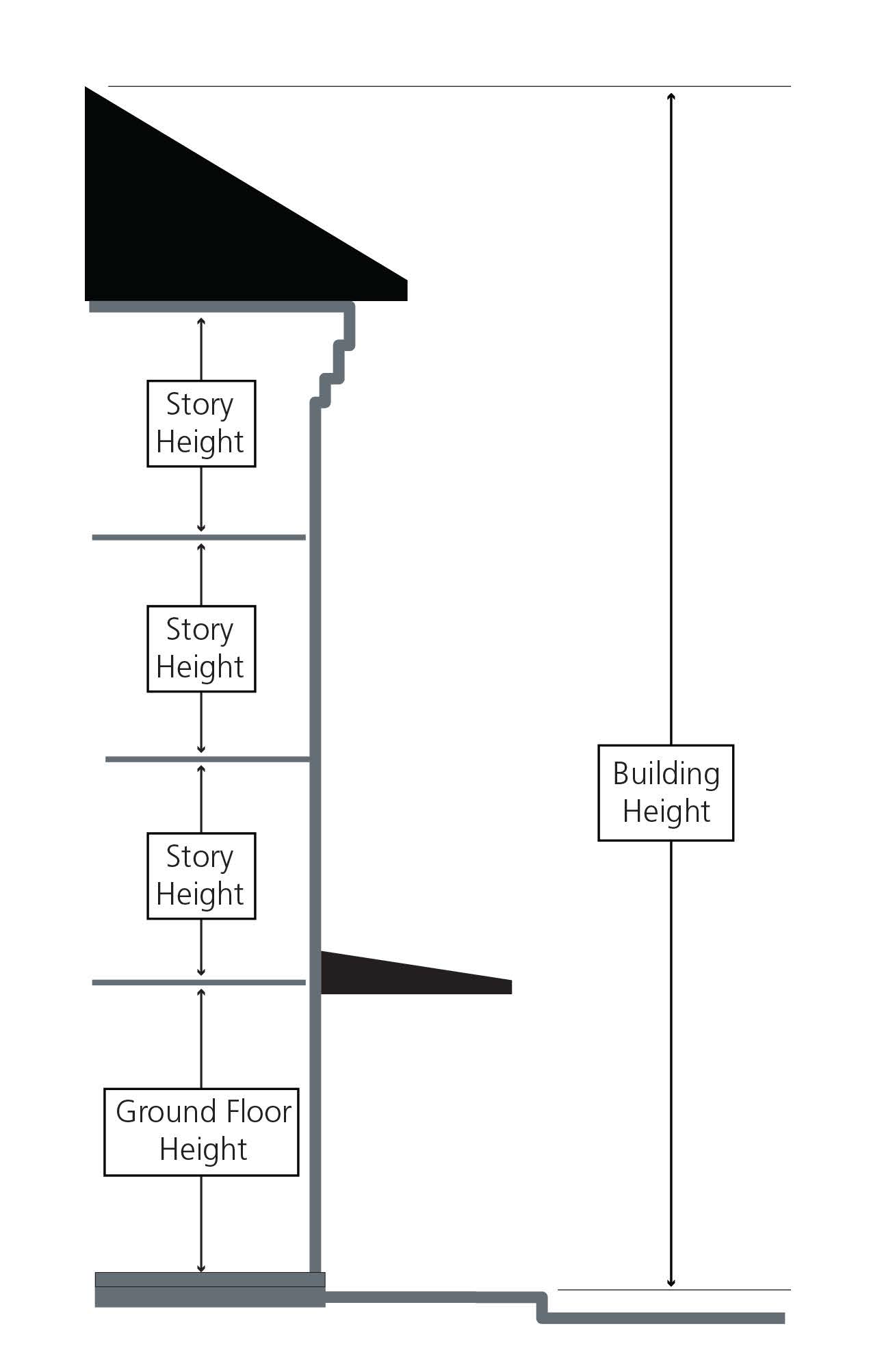
Building height means a vertical distance measured from the established grade to the highest point of the roof surface of flat roof; to the deck of mansard roofs; and to the mean height level between eaves and ridge of fable, hip, and gambrel roofs. Where a building is located on sloping terrain, the height shall be measured from the average ground level of the grade at the building wall facing the front yard.
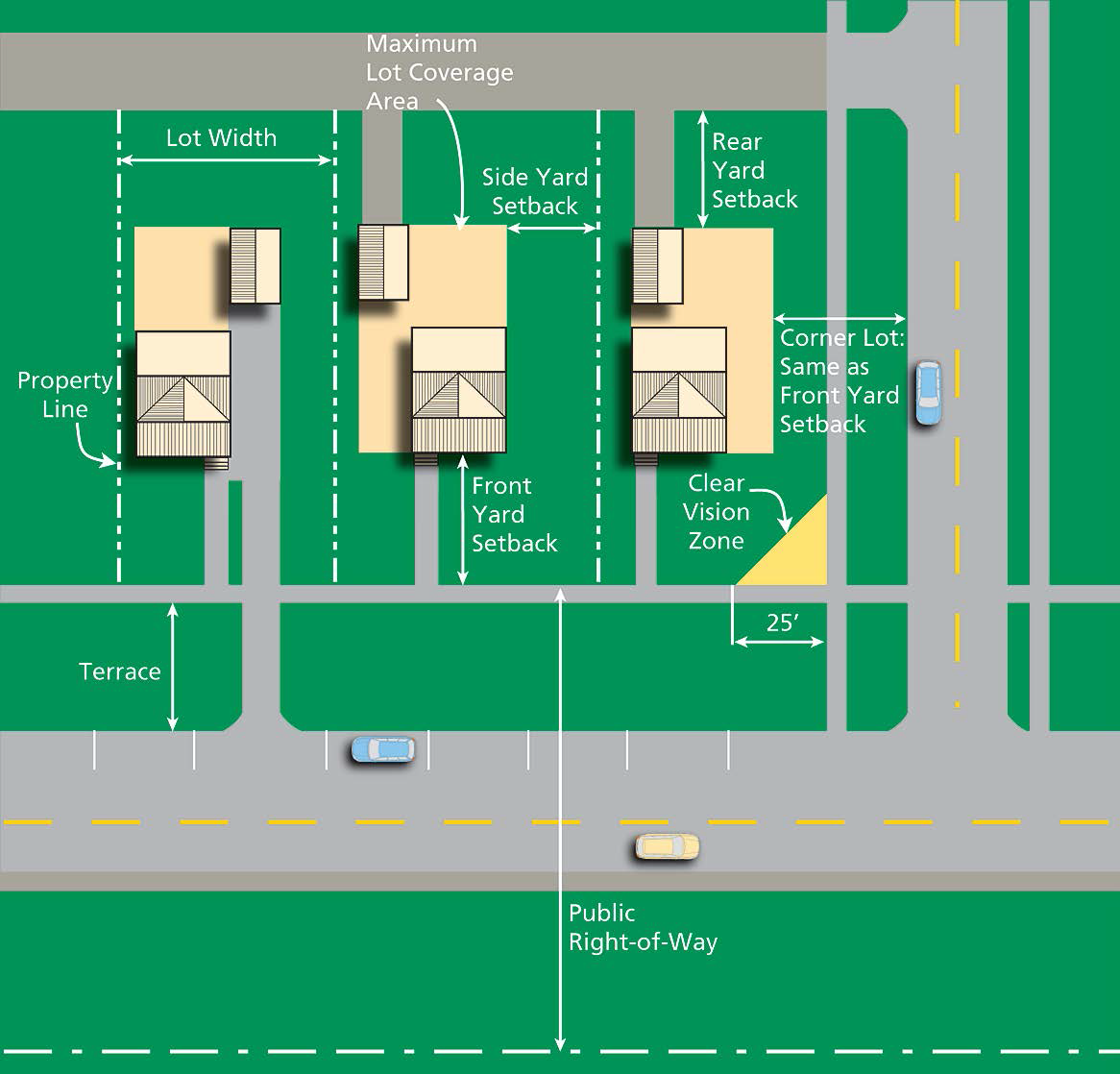
Building setback means a horizontal measurement from the road right-of-way line to the nearest point of the foundation of the building or structure. Steps and unenclosed porches may be located within the building setback. Fully enclosed porches are considered as part of the building or structure and may not be located within the building setback.
Canopy means an attachment to the exterior of a building that is self-supporting and non-retractable which extends out from the building over a public right-of-way.
Childcare center means a facility, other than a private residence, receiving one or more children under 13 years of age for care for periods of less than 24 hours a day, where the parents or guardians are not immediately available to the child. The term "childcare center" includes a facility that provides care for not less than two consecutive weeks, regardless of the number of hours of care per day. The facility is generally described as a childcare center, day care center, day nursery, nursery school, parent cooperative preschool, play group, before- or after-school program or drop-in center. The term "childcare center" does not include any of the following:
(1)
A Sunday school, vacation bible school or a religious instructional class that is conducted by a religious organization where children are attending for not more than three hours per day for an indefinite period or for not more than eight hours per day for a period not to exceed four weeks during a 12-month period.
(2)
A facility operated by a religious organization where children are in the religious organization's care for not more than three hours while persons responsible for the children are attending religious services.
(3)
A program that is primarily supervised, school-age-child-focused training in a specific subject, including, but not limited to, dancing, drama, music, or religion. This exclusion applies only to the time a child is involved in supervised, school-age-child-focused training.
(4)
A program that is primarily an incident of group athletic or social activities for school-age children sponsored by or under the supervision of an organized club or hobby group, including, but not limited to, youth clubs, scouting, and school-age recreational or supplementary education programs. This exclusion applies only to the time the school-age child is engaged in the group athletic or social activities and if the school-age child can come and go at will.
(5)
A program that primarily provides therapeutic services to a child.
Commercial recreation means commercial establishments related to recreational activities, such as, but not limited to, billiard or pool halls, indoor theaters, bowling alleys, miniature golf courses, driving ranges, skating rinks and video arcades.
Counseling rooms means a use that is subordinate to the principal use of a dwelling as a single-family dwelling unit in which persons reside for more than seven days at a time on a non-transient basis in return for payment.
Dwelling means a building or part of a building, containing living, sleeping, housekeeping accommodations, and sanitary facilities for occupancy by one or more families.
Dwelling, multifamily, means a building designed and used for occupancy by three or more families, living independent of each other.
Dwelling, single-family, means a building designed and used for occupancy by one family only.
Dwelling, two-family, means a building designed and used for occupancy by two families living independently of each other.
Family means one or more persons living together as a single, nonprofit housekeeping unit, organized as a single entity in which the members share common kitchen facilities in a domestic relationship based on consanguinity, marriage, adoption or other domestic bond. The term "family" does not include any society, association, organization or any other group whose domestic relationship is of a transitional or seasonal nature for an anticipated limited duration.
Family childcare home means a private home in which more than one but fewer than seven minor children are received for care and supervision for compensation for periods of less than 24 hours a day, unattended by a parent or legal guardian, except children related to an adult member of the family by blood, marriage or adoption. The term "family childcare home" includes a home in which care is given to an unrelated minor child for more than four weeks during a calendar year. The term "family childcare home" does not include an individual providing babysitting services for another individual. As used in this definition, the term "providing babysitting services" means caring for a child on behalf of the child's parent or guardian when the annual compensation for providing those services does not equal or exceed $600.00 or an amount that would according to the Internal Revenue Code of 1986 obligate the child's parent or guardian to provide a form 1099-MISC to the individual for compensation paid during the calendar year for those services.
Floor area, gross, means the total floor area used for the main and accessory activities and storage areas of the building served.
Floor area, usable, means the total area of all the floors of the building used by the principal activities, measured from the exterior faces of the building. The areas used for storage, mechanical equipment, stairwell or otherwise not occupied by people shall be excluded from the usable floor area calculation.
Group childcare home means a private home in which more than six but not more than 12 minor children are given care and supervision for periods of less than 24 hours a day unattended by a parent or legal guardian, except children related to an adult member of the family by blood, marriage or adoption. The term "group childcare home" includes a home in which care is given to an unrelated minor child for more than four weeks during a calendar year.
Home occupation means an income-generating activity traditionally or customarily carried on in the home as a use incidental to the use of the home as a dwelling place that conforms to the provisions applicable to home occupations in section 44-257.
Limited common element means an area that is appurtenant to a site condominium unit and that is reserved in the master deed for the site condominium subdivision for the exclusive use of the owner of the site condominium unit.
Lot means a piece or parcel of land occupied or intended to be occupied by a principal building or a group of such buildings and accessory structures or utilized for a principal use and accessory uses, together with such open spaces as are required by this article. Lot area shall not include any part of a public right-of-way. (In the case of a site condominium subdivision, a site condominium building site shall be considered to be the equivalent of a "lot" for purposes of determining compliance with the applicable requirements of this chapter and with other applicable laws, ordinances or regulations.)
Lot, corner, means a lot that has a least two contiguous sides abutting upon two intersecting streets for their full length.
Lot, interior, means a lot other than a corner lot.
Lot line means the line that defines the boundaries of a lot or parcel of land.
Lot line, front, means, in the case of an interior lot, the line that separates the front yard from the street right-of-way line. In the case of a through lot, the lines separating the lot from each road right-of-way. In the case of a corner lot, the line separating the lot from the right-of-way on that side of the lot that has the narrowest street frontage.
Lot line, rear, means the lot line that is opposite the front line. In the case of a through lot, there shall be no rear lot line. In the case of a lot with side lot lines converging at the rear, the rear lot line shall be an imaginary line parallel to the front lot line, not less than 20 feet long, lying farthest from the front lot line and wholly within the lot.
Lot line, side, means any lot line other than the front lot line or rear lot line.
Lot, through, means an interior lot having frontage on two streets that do not intersect at a point contiguous to such lot.
Marihuana. The term "marihuana" shall have the same definition as set forth in section 8-59.
Mobile home means a structure, transportable in one or more sections, that is built on a chassis and is designed to be used as a dwelling, with or without permanent foundation then connected to the required utilities and includes the plumbing, heating, air conditioning, and electrical systems in the structure. The term "mobile home" does not include a recreational vehicle.
Mobile home park means a parcel or tract of land upon which three or more mobile homes are located on a continuous, non-recreational basis that is offered to the public for that purpose regardless of whether a charge is made therefore, together with any building, structure, enclosure, street, equipment or facility used or intended for the occupancy of a mobile home.
Motel means a building or group of buildings on the same lot, whether detached or in connected rows, containing sleeping or dwelling units that may or may not be independently accessible from the outside, with garage or parking space located on the lot, and designed for or occupied by automobile travelers. The term "motel" includes any building or building groups designated as motor lodges, transient cabins, or by any other title intended to identify them as providing lodging, with or without meals, for compensation on a transient basis.
Nonconforming lot means a lot that was platted or otherwise lawfully of record prior to the effective date of the ordinance from which this chapter is derived or of any amendment to this chapter but that, under the terms of this chapter as enacted or amended, does not comply with the area, depth or width requirements of its zoning district.
Nonconforming structure means a building or structure that was lawful prior to the effective date of the ordinance from which this chapter is derived or of any amendment to this chapter but that, under the terms of this chapter as enacted or amended, is no longer a permissible building or structure because of requirements regarding the height, yards, size, areas, coverage or other characteristics of the building or structure or its location on the property in question.
Nonconforming use means a use of land, a building, or a structure that was lawful prior to the effective date of the ordinance from which this chapter is derived or of any amendment to this chapter, but that is no longer a permissible use under the terms of this chapter as enacted or amended.
Outdoor sales means retail businesses whose principal activity is the sale or rental of merchandise in an outdoor setting, such as, but not limited to, farm implements, plants and trees, mobile homes, building supplies and vehicles.
Principal or main use means the primary or predominant use of a lot.
Public or institutional uses means churches, accredited public, parochial or private schools; trade schools or colleges; hospitals and nursing homes; parks and nonprofit recreational uses; libraries; government-owned facilities; cemeteries; and fire stations or similar uses providing service necessary to the community.
Salvage yards means where junk, waste or discarded or salvaged materials, including wrecked vehicles, used building materials, structural materials and equipment and other manufactured goods that are worn, deteriorated, or obsolete are bought, sold, exchanged, stored, baled, packed, disassembled or handled.
Sign means the use of any words, numerals, figures, devices, designs or trademarks by which anything is made known, such as are used to show an individual, firm, profession or business, and that are visible to the general public.
Sign, freestanding, means a sign that is not attached to a building or any architectural feature thereof and that is supported by uprights: braces, frames or some object on the ground.
Sign, temporary, means a freestanding sign that is designed and constructed in such a way as to be readily movable and that is not attached to the ground in a permanent fashion.
Site condominium subdivision means a plan or project consisting of two or more site condominium units established in compliance with the Condominium Act, MCL 55.101 et seq.
State-licensed residential facility (six or fewer persons) means a structure constructed for residential purposes that is licensed by the state pursuant to the Adult Foster Care Facility Licensing Act, MCL 400.701 et seq., or the Child Care Organizations Act, MCL 722.111, that provides resident services for six or fewer persons under 24-hour supervision or care for persons in need of that supervision or care. The term "state-licensed residential facility" does not include adult foster-care facilities licensed by a state agency for the care and treatment of persons released from or assigned to adult correctional institutions.
State-licensed residential facility (more than six persons) means an adult foster-care facility that is licensed by the state pursuant to the Adult Foster Care Facility Licensing Act MCL 400.701 et seq., or a child-care facility that is licensed by the state pursuant to the Child Care Organizations Act, MCL 722.111, that provides resident services for more than six persons under 24-hour supervision or care for persons in need of that supervision or care.
Street means a publicly owned and maintained right-of-way that affords traffic circulation and principal means of access to abutting property, including any avenue, place, way, drive, land, boulevard, highway, road, or other thoroughfares.
Structure means anything constructed or erected, the use of which requires permanent location on the ground or attachment to something having a permanent location on the ground.
Vehicle repair, major, means general repair, rebuilding, or reconditioning of engines or motor vehicles, collision service (including body repair and frame straightening), painting, upholstering or vehicle steam cleaning and undercoating as a business.
Vehicle repair, minor, means minor repairs, incidental replacement of parts or motor service to motor vehicles not exceeding two-ton capacity, but not including any repair or work included in the definition of "major vehicle repair."
Yard means a required open space unoccupied and unobstructed by any principal building or structure or portion thereof from 30 inches above the general ground level of the lot upward; provided, however, that fences, walls, poles, posts and other customary yard accessories, ornaments and furniture may be permitted in any yard subject to height limitations and requirements limiting obstruction of visibility.
Yard, front, means a yard extending across the full width of the lot the depth of which is the distance between the street right-of-way line and the nearest point of the main building. The depth of the front yard shall be measured perpendicular to a straight line drawn along the shortest distance between the right-of-way and the nearest point of the main building.
Yard, rear, means a yard extending across the full width of the lot, the depth of which is the distance between the rear lot line and the nearest point of the main building.
Yard, side, means a yard between a main building and the side lot line extending from the front of the main building to the rear of the main building. The width of the required side yard shall be measured from the nearest point of the side lot line to the nearest part of the main building.
(Ord. of 11-6-2017, art. 14)
Sec. 44-4. - Interpretation and relationship to other regulations.
In interpreting and applying the provisions of this chapter, these provisions shall be held to be the minimum requirements for the promotion of public safety, health, convenience, comfort, prosperity and general welfare. It is not intended by this chapter to interfere with or abrogate or annul any easements, covenants, restrictions established by other ordinances or statutes, or agreements between private parties. However, where this chapter imposes a greater restriction upon the use of buildings or lots or upon the height of buildings, or requires larger open spaces than are imposed or required by any other applicable rule, covenant or law, the provisions of this chapter shall govern. The city has no responsibility or authority for enforcing private agreements or covenants.
(Ord. of 11-6-2017, § 1.4)
Sec. 44-5. - Conflict with state or federal regulations.
If the provisions of this chapter are inconsistent with those of the state or federal government, the more restrictive provisions will control, to the extent permitted by law.
(Ord. of 11-6-2017, § 1.5)
Sec. 44-6. - Official zoning map.
The boundaries of the zoning districts established by this chapter are shown on a map designated as the official zoning map. The official zoning map, including all notations, references, data and other information shown therein, is adopted and made a part of this chapter as fully as if it were contained within the pages of this chapter.
(1)
Location. The official zoning map is filed in the office of the city clerk.
(2)
Updates. The planning commission is responsible for updating the official zoning map to reflect amendments adopted by the city council.
(3)
Zoning district boundaries. Where uncertainty exists with respect to the boundaries of the various districts, the following rules shall apply:
a.
The district boundaries are public rights-of-way, including either streets, places or alleys unless otherwise shown; where the districts designated on the official zoning map are approximately bounded by street, road, place or alley lines, the same shall be construed to be the boundary of the district.
b.
Where the district boundaries are not otherwise indicated and where the property has been or may hereafter be divided into blocks and lots, the district boundaries shall be construed to be the lot lines; where districts designated on the official zoning map are approximately bounded by lot lines, the same shall be construed to be the boundary of the districts, unless otherwise indicated on the official zoning map.
c.
Whenever any street, road, alley, place or other public way is officially vacated by the city or county or state road commission, the district adjoining each side thereof shall be automatically extended to the center of such vacation and all area included in the vacation shall thereafter be subject to all appropriate regulations of the extended districts.
d.
Where physical or natural features existing on the ground are at variance with those shown on the official zoning map, or in other circumstances not covered by subsections (3)a through c of this section, the zoning administrator shall interpret the boundaries.
e.
Any dispute in the determination of the zoning district boundaries shall be heard by the zoning board of appeals.
(Ord. of 11-6-2017, § 1.6)
Sec. 44-7. - Nuisance per se.
Any building or structure that is erected, moved, placed, reconstructed, razed, extended, enlarged, altered, maintained or changed in violation of any term or provision of this chapter is declared to be a nuisance per se.
(Ord. of 11-6-2017, § 12.2; Res. No. 2019-27, 9-3-2019)

