
Fairway City Zoning Code
DIVISION 2
ZONING DISTRICTS
Sec. 15-264. - Use table.
This table indicates the uses permitted for each zoning district. Uses are either allowed subject to the general standards of the zoning districts, allowed subject to specific conditions listed in this article, or allowed only by special use permit. Where special conditions apply for a specific use, that section of the zoning regulations is referenced in the table. Only the uses specified in this table are permitted in the districts, unless otherwise allowed for in the supplemental provisions located in Division 3 of this article or as a temporary or special use pursuant to Division 4 of this article. All uses and any construction, relocation or alteration of any structure is subject to the requirements of this district and shall further be subject to all other requirements of this chapter, unless otherwise expressly exempted.
P = Permitted subject to general standards and conditions of the district.
PC = Permitted subject to special conditions listed in the zoning district standards
for that zoning district.
SP = Permitted only as a special use permit subject to any special conditions in the
Division or listed as part of the special review procedures.
* = All uses in planned districts (R-2P and B-3P) are subject to approval of a development
plan through the procedures of Division 4 of this article.
(Development Ord. 2004, § 15-4-2.101)
Sec. 15-265. - Description of uses.
(a)
This section contains descriptions associated with the uses of land. It is organized according to use categories and use types which correspond with the use table, some of which give examples of common uses. Where a general use type is described, and where more specific use type is further described that fits within that general use description, the more specific use type shall be excluded from the general use type. For example, neighborhood retail excludes grocery and convenience store, both of which are more specifically described. Where a use is not generally or specifically described or listed as an example, but meets all of the characteristics of the use category, use type, or is so similar to a described use type or a use specifically listed as an example as to create no perceptible differential impact, the Planning Commission may interpret the regulations as including the unlisted use within the listed use type. All other uses are different from those described and are not anticipated by these regulations, and may only be allowed by a zoning text amendment.
(b)
The following use definitions and descriptions are grouped into five (5) general use categories: dwellings; civic; office; retail; and service.
(1)
Dwelling use category. The dwelling use category includes all types of living arrangements, but not including motels, hotels, roominghouses or boardinghouses, institutions, or convalescent or nursing homes. The term "dwelling" or "dwelling unit" means any building, portion thereof, or other enclosed space or area used as or intended for use permanently or temporarily as the home of one (1) family, with separate cooking and housekeeping facilities.
a.
Single-family. A detached building designed for one (1) dwelling unit and occupied by one (1) family.
b.
Two-family. A detached building with only two (2) dwelling units within the building designed for or occupied by two (2) families.
c.
Townhouse. A dwelling unit attached to a series of other dwelling units by party walls, but no single unit shares party walls with more than two (2) other units, and where each unit maintains an individual entrance from the exterior of the building.
d.
Multiple-family/apartment. A building with three (3) or more dwelling units designed for or occupied by three (3) or more families with separate cooking and housekeeping facilities for each, where either the units share a common entrance from the exterior of the building or any single unit has common walls or floors with more than two (2) other units.
e.
Accessory dwelling unit. A dwelling unit that is associated with and incidental to another dwelling unit, and is on the same lot as the other dwelling.
f.
Mixed use. A building designed for one (1) or more other uses in addition to one (1) or more dwelling units and where the dwelling units are separated from and not accessory to any of the other uses.
(2)
Civic use category. The civic use category includes uses serving a broad and general public interest to enhance daily community life for adjacent landowners and residents, which are typically run by a government entity, not-for-profit agency or association, religious or charitable institutions, or similar philanthropic organizations.
a.
Elementary school. An education facility for grades K through 8.
b.
Secondary school. An education facility for grades 8 through 12.
c.
Higher education of continuing education institutions. Any business or institution established for the purposes of carrying on education activities at a post grade 12 level, whether through degree programs or for continuing adult education.
d.
Library, museum, or other public exhibit venue. An establishment offering educational resources, cultural or artistic exhibits, or similar experiences and attractions, and is open to the public.
e.
Place of worship. An establishment that conducts organized religious services and assemblies.
f.
Common open space. Any space dedicated for common use by a group of citizens due to their property ownership, residency, or patronage of facilities associated with the open space, exclusive or right-of-way and easements, and open from the ground to the sky. Common open space does not include any impervious surfaces designated for automobile use or any required yard or setback.
g.
Community center or club. A building or portion thereof or premises owned or operated for a social, literary, political, educational, or recreational purpose, primarily for the exclusive use of members and their guests.
h.
City uses, services, or facilities. Any structure or area of land, controlled and/or operated by the City.
i.
Other government offices. Any structure used for the administrative operations of a government entity other than the City.
j.
Other government facilities. Any structure or area of land, controlled and/or operated by a government entity other than the City, providing operational activities or services inherent to the role of that entity and available to or for the benefit of citizens of the City.
(3)
Office use category. The office use category consists of the use of buildings for conducting the business of professional firms, organizations, or government, whose products or services are of the nature that generally do not involve the frequent, continuing, and intensive interactions with clients, customers, or patrons on the premises, and where the exchange of products does not necessarily need to occur on the premises. Retail sales associated with the use may occur if either the product is not delivered on the premises or if less than fifteen percent (15%) of the total floor area is available for retail purposes and customer use.
a.
Neighborhood/professional service offices. Any small-scale office uses which involve individual tenant spaces typically no larger than ten thousand (10,000) square feet and cumulatively offer no more than twenty thousand (20,000) square feet in a single structure. Buildings are designed for and occupied by a profession offering services to clients, customers, or patrons which may involve occasional on-site contact with clients, customers or patrons. Examples include architect, accountant, real estate agent, insurance agent, engineer, lawyer, doctor, or other similar professions.
b.
Open office. Any building used for large scale office uses which involve individual tenant space above ten thousand (10,000) square feet or offering more than twenty thousand (20,000) square feet in a single structure.
c.
Office complex or campus. A premises used for any office use but comprised of multiple buildings and including any ancillary uses open primarily to office employees such as cafeterias, day care facilities and fitness centers, and the associated internal networks of roads, sidewalks, and open space.
d.
Home occupation. An operation for gain or support conducted only by members of a family residing on the premises limited in its use and not in a manner detrimental to the character of the surrounding neighborhood.
(4)
Retail use category. The retail use category consists of business that sell products and merchandise to consumers for use and consumption on or off premises.
a.
Grocery. A business engaged primarily in the retail sale of food for home consumption, but may also include limited accessory sales of household products, personal services, or food for consumption on premises.
b.
Convenience store. A business engaged in the retail sale of food and household products for consumption off premises and characterized by limited line of goods that primarily includes milk, bread, soda, and snacks and typically involves frequent, high, and rapid customer turnover. Convenience stores in association with an automobile service station shall meet all the requirements of an automobile service station.
c.
Neighborhood retail. A use primarily engaged in the small-scale sale of merchandise for consumer use off of the premises, typically involving less than fifteen thousand (15,000) square feet of floor area for the majority of tenants or business and no more than one hundred thousand (100,000) square feet of retail use in a single structure. Neighborhood retail uses are also characterized by a target market area with an approximately one and one-half (1.5) mile radius for on-site customers.
d.
Open retail. A use primarily engaged in the large-scale sale of merchandise for consumer use off premises, typically involving more than fifteen thousand (15,000) square feet per any individual business or more than one-hundred thousand (100,000) square feet for any group of businesses. Open retail uses are also characterized by target market areas of over one and one-half (1.5) miles for on-site customers.
e.
Automobile service station. Any building or land used for retail sale and dispensing of automobile fuel. Vehicle lubricants, supplies, accessories, and minor services may be offered if incidental to the sale of fuel and no more than three (3) interior vehicle storage and service bays are provided.
f.
Garden center. Any year-round, permanent retail sales of plants that may require outdoor storage and maintenance of merchandise at any time of the year.
g.
Restaurant. A business serving prepared meals for consumption on the premises, which may include accessory bar, carry out, or catering services.
h.
Drive-through facility. Any portion of a site or building that is dedicated to the sale, delivery, or consumption of merchandise or services to customers while they remain in the vehicle.
i.
Bar. A business serving alcoholic beverages, which may include limited accessory food and entertainment services.
j.
Outdoor sales. A retail use where a significant portion of the merchandise, either in area or in business value, is typically stored outside during business hours.
k.
Adult businesses. A business as defined in Section 7-139, Definitions, Subdivision a.
(5)
Service use category. The service use category is for businesses that offer clients, customers, or services for performance or delivery on the premises, and may offer some products or merchandise associated with the service typically for use or application on premises.
a.
Nursing home, assisted living, or extended care facility. A business providing living accommodations and care for persons suffering from illness, other than mental or contagious, which is not of sufficient severity to require hospitalization, or for persons requiring further institutional care after being discharged from a hospital, and where nonresident staff is present for more than eight (8) hours per day. This shall not include group homes according to K.S.A. 12-736.
b.
Clinic. A place used for the care, diagnosis and treatment of ailing, infirm, or injured persons, and those who are in need of medical and surgical attention, but who are not provided with board.
c.
Outdoor recreation facility. A business primarily engaged in the provision of outdoor sports, entertainment, or similar recreation opportunities for participants or spectators.
d.
Day care. A business providing children with instruction, food, or lodging, and general child care, away from the children home, where more than six (6) children under the age of sixteen (16) or more than three (3) children under the age of eighteen (18) months are accommodated. Similar businesses accommodating six (6) or less children under the age of sixteen (16) and three (3) or less children under the age of eighteen (18) months may be considered home occupations for the purposes of this chapter.
e.
General personal services. A business that provides specialized service, primarily to individual customers and which service is unrelated to any open retail use. Examples include a post office, bank, barbershop or beauty salon, bakery or catering, dry cleaner or laundry, film processing, small appliance repair, tailor, office support, or other similar service.
f.
Funeral home. An establishment used for the preparation of deceased humans and ceremonies prior to burial or cremation.
g.
Automobile repair. The repair, rebuilding or reconditioning of motor vehicles or parts thereof, including collision service, painting, and steam cleaning of vehicles. Vehicle lubricants, supplies, and accessories may be supplied and sold at retail.
h.
Indoor recreation facility. A business engaged in the provision of indoor sports, entertainment, or similar recreation opportunities for participants of spectators. Examples of uses include roller skating rinks, movie theaters, or fitness clubs.
i.
Radio or television station. A premises used for broadcast media including administrative and operational functions.
j.
Off-site parking lot. Any portion of a lot used for vehicle parking for a principal use on a different lot. This use does not include shared parking arrangements as provided in Division 3, Subdivision I of this article.
k.
Bed and breakfast. A business where lodging and/or meals are provided incidental to a principal single-family dwelling, where no cooking or dining facilities are provided in individual rooms, and where the owner resides on the premises.
l.
Hotel or motel. A business where temporary lodging is provided in individual rooms or suites on a daily or weekly basis, including accessory dining and meeting room facilities.
m.
Entertainment venue. A business where floor shows or other forms of entertainment by persons are provided for guests, which may include accessory dining, bar, and similar refreshment services. Examples include concert halls, dinner theaters, or banquet halls.
n.
Veterinary services. Any business where four (4) or more dogs over four (4) months of age are kept for general boarding or medical care.
o.
Wireless telecommunication facilities. Any complex, including tower, antennae, antenna support structure, cabinet, building, screen walls, transmission equipment, power source or other equipment constructed on the ground, and used to assist antennae in the generation or receipt of electromagnetic communication signals, or used for the transmission or receipt of electromagnetic communication signals.
(Development Ord. 2004, § 15-4-2.102; Ord. No. 1314; Ord. No. 1382; Ord. No. 1530, § 3, 7-9-2012)
Sec. 15-294. - Intent.
The R-1 Single-Family District is intended to provide a low to medium-density residential environment consisting of single-family dwelling units on lot sizes consistent with the patterns and arrangement of the neighborhood, and preserving the character of the existing neighborhoods within the district, each having their own character and architectural style.
(Development Ord. 2004, § 15-4-2.201; Ord. No. 1582, § 7, 12-8-2014; Ord. No. 1715, § 2, 5-11-2020)
Sec. 15-295. - Uses.
Uses allowed in the R-1 District are specified in Section 15-264.
(Development Ord. 2004, § 15-4-2.202; Ord. No. 1582, § 7, 12-8-2014)
Sec. 15-296. - Dimension standards.
(a)
Lots.
a Lots with existing front setbacks of less than 40 feet are eligible for status as a non-conforming lot in Division 3, Part 6 and may be eligible for exceptions with regard to future additions to the principal building.
(b)
Corner lots. The following corner lot patterns exist in the City. A corner lot shall maintain the existing lot pattern, however, through the site plan process the Planning Commission may approve a new pattern where the context suggests a new pattern is at least as appropriate with the character of the area. Setbacks for corner lots shall be as follows. (See Subdivision VII of this division, Figure 15-438-16.)
(1)
Standard corner lot. Standard corner lots are lots that are oriented the same as all other lots on the block, with a side yard adjacent to the side street.
a.
Street side setback. The greater of:
1.
The same as the required setback for all other lots; or
2.
Three (3) times the distance of the required setback, but measured from the back of the curb.
b.
The front, interior side, and rear setbacks shall be the same as required for all other lots;
c.
Accessory buildings shall be setback at least twenty feet (20') from the lot line on the street side lot.
(2)
Reverse corner lot: Reverse corner lots are lots that are oriented to the side street or shorter end of the block.
a.
Street side setback: Same as required for all other lots plus an additional fifteen feet (15');
b.
Front setback: Same as required for all other lots, except that the setback may be adjusted to reflect the front building line of the adjacent building also fronting on the side street, but in no case closer than 25' from the front lot line;
c.
Interior side and rear setbacks: Same as required for all other lots.
d.
Accessory buildings shall be setback at least twenty-five feet (25') from any lot line along a street or behind the front building line of the adjacent lot, whichever is greater.
(3)
Intersection lot. Intersection lots are lots that have a dual orientation or are oriented to the intersection. These lots shall have two (2) front setbacks on each street side, and two (2) side setbacks on the interior sides, and no rear setback.
a.
Front setbacks: Same as required for all other lots and is applied to both street frontages, except that the setback may be adjusted to reflect the front building line of each adjacent building, but in no case closer than twenty-five feet (25') from the front lot line.
b.
Interior side setbacks: Same as required for all other lots and shall be applied to both interior lot lines.
c.
Rear setback: There is no rear setback for an intersection lot.
d.
Accessory buildings shall be set back at least twenty-five feet (25') from any lot line along a street, or behind the front building line of the adjacent lot, whichever is greater.
(c)
Exception. As a part of the site plan process, the Planning Commission may grant exceptions to the dimension standards set forth in this section, based upon the following criteria:
(1)
Front setback exceptions. Where the front building lines along the same side of a block are less than the required setback, the Planning Commission may grant an exception to the front setback of an adjacent lot to make its building line consistent.
(2)
Side setback exceptions.
a.
The existing structure was legally constructed with a side setback of less than the currently required side setback;
b.
The proposed addition shall have a side setback that is equal (i.e., continuous and consistent with) or greater than the existing side build line of the existing structure;
c.
The proposed addition shall not cause further encroachment than that of the existing structure; and
d.
The exception shall not cause an adverse impact on the surrounding properties.
(Development Ord. 2004, § 15-4-2.203; Ord. No. 1582, § 7, 12-8-2014)
Sec. 15-297. - Site design standards.
(a)
Lot design.
(1)
Intent. The intent of the lot design standards is to:
a.
Reinforce the existing scale and patterns of neighborhoods, including appropriate transitions to adjacent neighborhoods.
b.
Promote the character of the neighborhood through the design and relationship of lots to streetscapes.
c.
Preserve and strengthen the generous tree canopy throughout neighborhoods.
d.
Minimize the impacts of development on prevailing grades and associated runoff through landscape design.
(2)
Greenspace requirement. The following greenspace requirements provide environmental and aesthetic benefits through landscape design.
a.
Lots up to ten thousand square feet (10,000 sq. ft.):
1.
At least sixty percent (60%) of the lot shall be permeable and uncovered surface.
2.
At least sixty percent (60%) of the lot in front of the front building line shall be permeable and uncovered surface.
b.
Lots greater than ten thousand square feet (10,000 sq. ft.) but less than thirty thousand square feet (30,000 sq. ft.):
1.
The first ten thousand square feet (10,000 sq. ft.):
i.
At least sixty percent (60%) of the lot shall be permeable and uncovered surface; and
ii.
At least sixty percent (60%) of the lot in front of the front building line shall be permeable and uncovered surface.
2.
Remaining square footage less than thirty thousand square feet (30,000 sq. ft.): At least seventy-five percent (75%) of the lot shall be permeable and uncovered surface.
c.
Lots greater than thirty thousand square feet (30,000 sq. ft.):
1.
The first ten thousand square feet (10,000 sq. ft.):
i.
At least sixty percent (60%) of the lot shall be permeable and uncovered surface; and
ii.
At least sixty percent (60%) of the lot in front of the front building line shall be permeable and uncovered surface.
2.
The square footage greater than ten thousand square feet (10,000 sq. ft.) but less than thirty thousand square feet (30,000 sq. ft.): At least seventy-five percent (75%) of the lot shall be permeable and uncovered surface.
3.
The square footage greater than thirty thousand square feet (30,000 sq. ft.): One hundred percent (100%) shall be permeable and uncovered surface.
d.
Exclusions. Permeable or uncovered surfaces recessed within the perimeter of the building footprint or any permeable surface less than four feet (4') in any dimension shall not count towards this requirement.
e.
Large shade trees. Large shade trees shall be maintained or established between the front building line and street in accordance with the following requirements:
1.
All lots shall have at least one (1) large shade tree for every forty feet (40') of street frontage, or fraction thereof. Existing large shade trees, including any large shade trees in the right-of-way, may be counted towards this requirement.
2.
Removal of an existing large shade tree that results in less than one (1) per forty feet (40') of street frontage shall require replacement of two (2) new large shade trees for each one (1) tree removed.
3.
Large shade trees shall be planted between the front building line and the street.
4.
Large shade trees species shall be selected from the "Great Trees for the Kansas City Region" guide and the "Large Trees for the Landscape" list.
5.
Any new trees required to be planted shall be at least three inch (3") caliper.
f.
Foundation planting. All buildings shall maintain a foundation planting bed at least four feet (4') deep along at least fifty percent (50%) of the building frontage. This planting bed shall be planted with ornamental living materials that complement the design of the site and building. (See Section 15-438, Figure 4-2-17.)
g.
Remaining surfaces. All of the remaining minimum permeable and uncovered surfaces on residential lots shall be planted with vegetation.
(3)
Curb cuts and driveways. The following driveway standards preserve the streetscape, maintain greenspace along the frontages and integrate driveways into the natural terrain and landscape, by keeping them as narrow as practical closer to the streetscape.
a.
Single curb cut. Each lot shall be entitled to a single curb cut that corresponds to a driveway to the dwelling unit's garage or alternative enclosed vehicle parking space. No such curb cut and driveway shall exceed twenty percent (20%) of the lot frontage up to twenty feet (20'), except:
1.
Lots less than eighty feet (80') in lot frontage may have a driveway up to a maximum of sixteen feet (16') in width.
2.
An additional three feet (3') may be permitted at the curb cut on each side of the driveway.
3.
Within twenty feet (20') forward of the front building line, the driveway width may be expanded to twenty feet (20') to accommodate garage entrances or parking. Between twenty feet (20') forward of the front building line and thirty feet (30') forward of the front building line, the driveway width may gradually transition to the maximum driveway width identified in Subsection (a)(3)a.1., above.
4.
There is no limit to the driveway width behind the front building line, other than by application of the overall lot greenspace requirement. (See Section 15-438, Figure 15-438-18.)
b.
Multiple curb cuts. Lots with a lot width of eighty feet (80') or more may be allowed two (2) curb cuts, subject to the following:
1.
The driveways corresponding to the two (2) curb cuts must interconnect in an area or similar fashion, and at least one (1) curb cut must correspond to a driveway to the dwelling unit's garage or alternative enclosed vehicle parking space. A connecting arc driveway is not subject to the lot frontage width limits below, provided that it is no wider than the two (2) connecting driveway portions.
2.
No single curb cut and driveway shall exceed ten percent (10%) of the lot frontage up to twelve feet (12'), except:
i.
An additional three feet (3') may be permitted as the curb cut on each side of the driveway.
ii.
Within twenty feet (20') curb-ward of the front building line, the driveway width may be expanded to twenty feet (20') to accommodate garage entrances or parking.
iii.
There is no limit to the driveway width beyond the front building line, other than by application of the overall lot greenspace requirement.
3.
There must be at least thirty-six linear feet (36 LF) between the two (2) curb cuts. (Measured along the street curb.)
c.
Location. No driveway or curb cut shall be located within two feet (2') of any side yard property line, except in the case of a side yard curb cut entrance for a corner lot, or a shared driveway serving two (2) properties. Driveway width and paved parking areas shall be limited in size by the greenspace requirements in Subsection (a)(2) above.
d.
Materials. Any construction or replacement of driveways shall be with a hard surface material. Gravel, crushed rock or other similar material is not considered hard surfaced material. Curb and driveway materials in the public right-of-way shall also be subject to any applicable right-of-way material requirement. Landscape strips or any landscape islands within driveways that are less than eight feet (8') in any dimension are prohibited.
e.
Nonconforming. Any legal nonconforming driveway or curb cut not complying with the above standards may be maintained, repaired or replaced without any modification other than adherence to any applicable right-of-way material requirement, provided that all driveways and curb cuts shall be brought into compliance in the event of a new dwelling unit, or when determined necessary, in the Building Inspector/Code Enforcement Officer's sole discretion, in the event of a substantial addition or remodel.
f.
KDOT. In the event any driveway or curb cut is associated with any KDOT project or is otherwise subject to KDOT right-of-way regulation, any conflicting KDOT requirement shall supersede the standards set forth hereinabove.
(b)
Building design. The following building standards apply to all principal buildings and any accessory building that exceeds one hundred twenty square feet (120 sq. ft.) in area.
(1)
Intent. The intent of the building design standards is to:
a.
Reinforce the existing scale and patterns of buildings within neighborhoods, including appropriate transitions to areas adjacent to neighborhoods.
b.
Promote the character of the neighborhood through the design and relationship of buildings to streetscapes.
c.
Ensure quality design and the longevity of investments in neighborhoods.
d.
Manage the relationship of adjacent buildings to maintain privacy and promote compatible building scale and transitions.
e.
Enhance the quality, aesthetic character, and visual interest within neighborhoods by breaking down larger masses, incorporating human scale details and ornamentation, and encouraging the integrity of various architectural styles found within neighborhoods.
(2)
Building entrances. The following standards break up the scale and mass of front façades and create human-scale details that relate buildings to the neighborhood streetscape:
a.
All principal buildings shall have a primary entrance or a primary entrance feature that faces the street.
b.
Any front façade that exceeds one and one-half (1½) stories shall be articulated by one (1) of the following unenclosed primary entrance features (see Section 15-438, Figure 15-438-1):
1.
A single-story covered front porch at least seven feet (7') deep with a total area of at least seventy square feet (70 sq. ft.);
2.
A stoop rising at least two feet (2') above the finished grade with enhanced architectural elements, such as decorative railings, decorative door moldings, or transom windows; or
3.
A single-story covered portico projecting from the front façade at least three feet (3') with a total covered area of at least twenty-four square feet (24 sq. ft.).
c.
Unenclosed primary entrance features meeting the minimum requirements of this section may encroach up to seven feet (7') into the front setback with a maximum of one hundred forty square feet (140 sq. ft.) within the front setback.
d.
Exception. Encroachments of unenclosed primary entrance features up to ten feet (10') into the front setback with a maximum of two hundred square feet (200 sq. ft.) within the front setback may be approved by the Planning Commission upon a determination of the following:
1.
The encroachment results in a setback, building lines, or other structural encroachment similar to that of the immediately adjacent property;
2.
The encroachment is architecturally compatible with and integrated into the principal building;
3.
The encroachment does not adversely impact any other required residential site design guideline; and
4.
The encroachment does not have a detrimental impact on adjacent property.
e.
In no case may any portion of the primary entrance feature, as provided in Subsection c. or d. above, be closer than thirty feet (30') to the front property line.
(3)
Garages. The following standards shall minimize car-oriented building features and maintain a human-scale relationship between buildings and the neighborhood streetscape.
a.
Overhead garage doors shall not be more than eight feet (8') in front of the threshold of the primary entrance of the principal building. Provided, in the event the garage doors face a direction different than that of the primary entrance of the principal building (e.g., a side-facing garage), this requirement shall apply to the foremost front portion of the garage structure.
b.
No more than forty percent (40%) of the linear width of the front façade may be occupied by front-facing overhead garage doors. (See Section 15-438, Figure 15-438-2.)
c.
All dwelling units shall maintain at least one (1) fully enclosed vehicle parking space. Conversion of an attached or detached garage to a different use shall require provision of an alternative fully enclosed vehicle parking space.
(4)
Building massing. The following building massing standards shall apply in addition to the setbacks and heights standards to break up the building massing in relation to adjacent lots:
a.
Side setback lines.
1.
Wall planes at or within one and one-half (1.5) times the side setback line shall be limited to eight hundred square feet (800 sq. ft.);
2.
Wall planes at one and one-half (1.5) or up to two (2) times the side setback line shall be limited to one thousand two hundred square feet (1,200 sq. ft.);
3.
Wall planes at two (2) times or more the side setback line shall not be limited, other than the general height, building footprint and design standards. (See Section 15-438, Figure 15-438-19.)
b.
Rear setback lines. Wall planes at or within fifteen feet (15') of the rear setback line shall be limited to eight hundred square feet (800 sq. ft.). (See Section 15-438, Figure 15-438-20.)
c.
Projections. Chimneys, bays, eaves and other massing elements that are integral to the design and style of a structure may project into the required setback and building massing standards subject to the following:
1.
Projections may be between two feet (2') and four feet (4'), but never more than fifty percent (50%) of the required setback, provided that window wells designed for egress may be four feet (4') deep and extend into the required setback in all cases.
2.
Projections shall be limited to no more than two hundred square feet (200 sq. ft.). (See Section 15-438, Figure 15-438-21.)
(5)
Building façades. The following design standards shall be used to organize the composition of façades consistent with the architectural style of the home and provide details that relate buildings to the neighborhood streetscapes and adjacent sites.
a.
No façades shall exceed more than six hundred square feet (600 sq. ft.) without architectural relief. Architectural relief shall be:
1.
A structural building element that breaks up a wall plane by creating a projection or recession of at least eighteen inches (18") that occurs cumulatively over at least twenty-five percent (25%) of the façade. Examples include dormers projecting from a roof, projecting primary entrance features, or projections or recessions in the façade building line (see Section 15-438, Figure 15-438-3); or
2.
Architectural details and ornamentation characteristic of a particular style that establish patterns and proportions on the overall façade. Examples include material changes, vertical or horizontal moldings, columns or trim or similar details and ornamentation that may be essential to any particular chosen architectural style.
b.
All façades shall have window or door openings covering at least fifteen percent (15%) of the façade above grade. The shape, style, and placement of windows and doors shall not be inconsistent with the architectural style of the home. In the event of an addition to an existing structure, this requirement may apply to the least restrictive of: (1) the entire façade facing the same direction (e.g., front, rear or either side façade), including both the addition and the existing structure; or (2) only the façade of the addition being built and not any part of the existing structure that is not being modified as part of the construction project. (See Section 15-438, Figure 15-438-5.)
1.
Windows shall have a vertical or square proportion, although groups of windows may be joined in a horizontal proportion;
2.
Windows shall be stacked for two-story façades with lower windows aligning with upper windows, and have a hierarchy with lower windows being larger than upper windows;
3.
In the event of an addition to an existing structure, this requirement may apply to the least restrictive of: (1) the entire façade facing the same direction (e.g., front, rear or either side façade), including both the addition and the existing structure; or (2) only the façade of the addition being built and not any part of the existing structure that is not being modified as part of the construction project. (See Section 15-438, Figure 15-438-4.)
(6)
Building materials. The following building material standards shall be used to create quality designs consistent with the architectural style of the home and prioritize natural materials that age and weather well.
a.
Acceptable materials. The following exterior surface materials are acceptable on all façades:
1.
Brick;
2.
Stone;
3.
Stucco;
4.
Wood shingles;
5.
Wood siding;
6.
Wood paneling;
7.
Glass blocks;
8.
Vinyl siding;
9.
Horizontal aluminum siding;
10.
Fiber cement siding designed to look like wood siding or shingles (e.g., Hardie board);
11.
Engineered wood siding (EWS), including strand and fiber wood products meeting ANSI 135.6 standards for hardboard, designed to look like wood lap siding or shingles and installed in accordance with the manufacturer's specifications (e.g., SmartSide, Catawba or TruWood).
Additional building materials may be approved by the Planning Commission.
b.
Provisional materials. The following provisional exterior surface materials may be approved by the Planning Commission, subject to the special provisions listed: exterior insulation finishing system (EIFS) shall require certification by an independent third party, paid for by the owner, certifying that the material was installed according to manufacturer's specifications.
c.
Prohibited materials. In addition to those materials prohibited by the City's building code, the following materials are prohibited on all façades:
1.
Corrugated metal siding;
2.
Sheet panel materials including particle board, plywood, oriented strand board (OSB) or engineered wood (e.g., four-foot (4') by eight-foot (8') panel material);
3.
Concrete masonry units, such as cinder block or split-faced block.
d.
Windows, doors, and louvers shall be wood, vinyl, or metal and glass.
e.
Siding material shall extend below the top of the exterior of the foundation or curtain wall or the joint between the siding and enclosure wall shall be flashed according to the City's building code.
f.
Material allocation. Allowed materials shall be allocated according to the following:
1.
All new buildings shall be limited to two (2) base materials and up to three (3) accent materials.
2.
Additions to existing buildings having one (1) base material at the time of adoption of these zoning regulations shall continue the use of the same base material on the addition, provided that any building with a brick or stone base material may use a second base material.
3.
Accent materials shall be limited to no more than twenty percent (20%) of any single façade.
4.
The architectural style and all materials shall be consistent and compatible on all façades.
5.
Base material changes shall only occur horizontally at architectural elements or vertically at internal corners. (See Section 15-438, Figure 15-438-5.)
g.
Any building lawfully existing at the time of adoption of these zoning regulations may continue the use of the building materials existing on the structure at that time whether through maintenance, siding replacement, or additions. Any new structure must conform with the provisions of this Subsection (b)(6).
(7)
Roofs.
a.
Acceptable primary materials. The following primary roofing materials are the types of materials that are acceptable:
1.
Composite shingles;
2.
Wood shake shingles;
3.
Clay or concrete tile;
4.
Natural slate;
5.
Glass, acceptable only for greenhouses or solarium; or
6.
Rolled composition or membrane roofing may be used on slopes of four to twelve (4:12) or less at the discretion of the Building Official/Codes Administrator.
Additional primary roofing materials may be approved by the Planning Commission.
b.
Prohibited materials. In addition to those materials prohibited by the City's building code, the following roofing materials are prohibited: corrugated metal roofs.
c.
Only one (1) roof material for each structure shall be visible from any area along the property line, but may include any accent materials up to twenty percent (20%) of the overall roof area. Accent materials may be approved by the Planning Commission in excess of twenty percent (20%) of the overall roof area where a degree of harmony will prevail between the architectural quality and the accent materials proposed. In addition to the acceptable roofing materials in Subsection (b)(7)a. above, copper and other standing seam metal roofing materials are acceptable for any accent material.
d.
The type of roofing material used on all building additions shall be consistent with the material on the existing roof.
(8)
Accessory buildings. Any accessory building greater than one hundred twenty square feet (120 sq. ft.) shall use materials, massing, and roof pitches that are consistent with the architectural style of the principle building.
(c)
Fences and walls. A building permit shall be required for construction, alteration, replacement, repair or relocation of a fence or wall on any residential lot. The proposed fence or wall shall meet all standards of the City's building code and demonstrate that the following additional standards are met:
(1)
Generally.
a.
Location.
1.
Fences/walls shall be located at or behind the front building lines of the principal building and any adjacent dwelling units.
2.
In the case of a rear yard that abuts a street, fences/walls shall be located at least twelve feet (12') from the rear property line.
3.
In the case of a corner lot, fences/walls shall be located at or behind the street-side building line(s) of any adjacent dwelling unit(s), and at least twelve feet (12') from the street-side property line. (See Section 15-438, Figure 15-438-6.)
4.
If an existing fence or wall is owned by an abutting property owner and is on or near the property line, the proposed fence or wall must be erected close enough to the abutting owner's fence or wall so as to inhibit the growth of vegetation or, in the alternative, provide sufficient space between the existing fence or wall and the proposed fence or wall for proper maintenance.
b.
Height. Fences/walls shall be no more than six feet (6') in height.
c.
Materials. Fences/walls shall be structurally stable and shall not incorporate the use of any type of wire such as barbed wire, chicken wire, or wire that is electrically charged.
d.
Design. Any support or framing members shall be on the fence side facing the owner's property.
e.
Nonconforming fences/walls. Any legal nonconforming fence or wall that does not meet the standards of this Subsection (c)(1) may be repaired, replaced and maintained at its present location, provided that:
1.
Any repair or replacement shall not increase the degree of the nonconformity.
2.
Where fifty percent (50%) or more of the legal nonconforming fence or wall is repaired or replaced, such fence or wall shall comply with Subsection (c)(1)b., c., and d. above (concerning height, materials and design). No property shall be allowed multiple permits over any eighteen (18) month period when the effect would be to circumvent this provision.
(2)
Decorative fences.
a.
Location. Decorative fences:
1.
Shall extend no further than twelve feet (12') in front of the front building line of the principal building and shall be at least twenty-five feet (25') from any public right-of-way.
2.
May only be located in front of the primary entrance to the principal building and shall not extend beyond either side of the principal building.
b.
Height. Decorative fences shall be no more than three feet (3') in height.
c.
Materials. Decorative fences shall be compatible with the style of the principal building, and shall be limited to the following types of materials: wood, brick, stone or wrought iron.
d.
Design. Decorative fences shall have a surface area with a minimum of fifty percent (50%) open area allowing an unobstructed view through the fence.
e.
Additional limitations. Decorative fences shall not:
1.
Connect with any other fence on the property.
2.
Create an area that is completely enclosed without an un-gated opening to the yard that is at least three feet (3') in width.
(d)
Exceptions. Through the site plan process, the Planning Commission may grant exceptions to the site design standards in this Section 15-297, based upon the following criteria:
(1)
The exception will equally or better serve the intent statements for the particular standards being altered;
(2)
The exception meets any specific exception criteria identified in the standards, but shall not be granted to allow something that is specifically prohibited in the zoning regulations;
(3)
Any lot design exception is consistent with sound planning, urban design and engineering practices when considering the site and its context within the neighborhood;
(4)
Any building design exception is consistent with the common characteristics of the architectural style applied to the overall design of the building; and
(5)
The requested exception coordinates quality design of the building and site—primarily considering the integrity of the architectural style, the energy performance of the site and building orientation, and the relationship of the internal function of the building to the site, streetscape and adjacent property.
(Development Ord. 2004, § 15-4-2.204; Ord. No. 1530, § 5, 7-9-2012; Ord. No. 1535, § 1, 8-13-2012; Ord. No. 1540, § 3, 10-8-2012; Ord. No. 1561, § 1, 11-12-2013; Ord. No. 1570, § 1, 4-14-2014; Ord. No. 1582, § 7, 12-8-2014; Ord. No. 1615, § 1, 12-14-2015; Ord. No. 1641, § 1, 12-12-2016; Ord. No. 1620, § 1, 3-4-2016; Ord. No. 1731, § 1, 2-8-2021; Ord. No. 1768, § 1, 8-8-2022)
Sec. 15-298. - Special conditions for uses.
In addition to the general standards for the R-1 Single Family District in this Subdivision II, the applicable supplemental provisions in Division 3, and any applicable special use conditions and procedures in Division 4, the following uses shall be subject to these special conditions in the R-1 district.
(1)
Home occupation. The following home occupation standards are intended to permit the establishment of certain incidental and accessory home occupation uses in residential neighborhoods under conditions that will ensure their compatibility with the residential character of the neighborhood. They are intended to permit residents to engage in home occupations that are compatible with residential land uses and to ensure that home occupations do not adversely affect the integrity of residential areas. Accordingly, a home occupation shall be allowed as an accessory use, subject to the following conditions:
a.
Use. The home occupation must be clearly incidental and secondary to the primary residential use of the premises as a dwelling. No more than twenty-five percent (25%) of the total floor area of the principal building, not including garage or basement space, shall be used for the home occupation. If more than one (1) home occupation is operated within the premises, the combined total floor area shall meet this standard. No accessory buildings shall be used in conjunction with a home occupation. No outside storage of any kind related to the home occupation shall be permitted.
b.
Change to exterior. The home occupation must not change the outside appearance of the principal building or provide any visible exterior evidence of the home occupation. No building addition shall be permitted solely for the purpose of accommodating the occupation, and no separate street-side entrance shall be permitted for the exclusive use of the home occupation.
c.
Signs. Exterior signage for the home occupation shall be prohibited.
d.
Employees. The home occupation shall be conducted only by family members residing on the premises with no assistance from other individuals or groups.
e.
Hours of operation. A home occupation may attract business-related traffic only between the hours of 6:00 a.m. and 9:00 p.m.
f.
Vehicles. The home occupation shall not utilize more than one (1) private commercial vehicle limited to three-quarter-ton capacity.
g.
Traffic, parking, sewerage and water. The home occupation must not generate pedestrian or vehicular traffic, parking, sewerage or water use in excess of what is normal in the residential neighborhood.
h.
Deliveries. Deliveries of materials to and from the premises in conjunction with the home occupation shall not require the use of vehicles other than parcel post or similar parcel service vehicles.
i.
Nuisances and hazards. The home occupation shall not create noise, dust, dirt, heat, smoke, odor, vibration, electrical interference, glare, light, or radio or television transmission interference that exceeds the levels normally associated with single-family dwellings or any such other nuisance. The home occupation shall not create any hazard to person or property. The production, dumping or storage of combustible, toxic or other hazardous substances shall be expressly prohibited on the site.
j.
Licenses. The home occupation and its operator(s) shall have all licenses/permits mandated by any applicable local, State and/or Federal laws.
(2)
Private swimming pools. Private swimming pools, spas and hot tubs shall be allowed as an accessory use, subject to the following conditions:
a.
All swimming pools, spas and hot tubs shall require a building permit.
b.
Construction of all swimming pools, spas, hot tubs and any accessory building or structure shall comply with all applicable building code requirements.
c.
All outdoor swimming pools, spas and hot tubs shall be completely enclosed by a fence or wall not less than five feet (5') nor more than six feet (6') in height, and shall comply with all other applicable fence or wall requirements. In addition, such fence or wall shall be designed to reasonably prevent unauthorized access by children, and shall be provided with self-closing gates equipped with self-latching devices.
d.
In lieu of the fence or wall requirement, spas and hot tubs may be equipped with a safety cover that shall securely cover the spa or hot tub at all times when not in use and under the supervision of an adult person. The safety cover shall be classified under "Covers for Swimming Pools and Spas" (WBAH) and meet the requirements of the American Society for Testing and Materials (ASTM) Standard F1346-91, Standard Performance Specifications of Safety Covers (as may be amended) or the equivalent. Each safety cover shall bear the classification marking "UL", the word "Classified", a control number, and the product name or the equivalent.
e.
No swimming pool, spa or hot tub shall be located in front of the front building lines of the principal building or any adjacent dwelling units.
f.
Subject to any easements, a swimming pool, spa or hot tub may be located anywhere within the interior area of a fence or wall located in compliance with the general fence or wall requirements; provided that the edge of the pool, spa or hot tub shall be not less than six feet (6') from the fence or wall, and further provided that the pool, spa or hot tub shall be not less than twenty feet (20') from any adjacent dwelling unit.
g.
All swimming pools, spas and hot tubs shall be designed so that any drainage shall comply with the City's NPDES Standards as codified Chapter 12, Article IV, Division 3 (Discharge Restrictions) of this Code (as may be amended). Swimming pools, spas and hot tubs shall not be drained at any time which may cause icing or other hazardous public street or sidewalk conditions.
(3)
Accessory buildings. Accessory buildings shall be allowed as an accessory use, subject to the following conditions:
a.
No more than one (1) accessory building shall be allowed per lot or principal building.
b.
Accessory buildings shall not be designed or used for dwelling purposes.
c.
No accessory building shall be used in conjunction with a home occupation.
(4)
Sport courts. Sport courts accessory to residential uses shall only be allowed subject to a special use permit issued according to the standards and procedures of Chapter 15, Article IV, Division 4.
(5)
Play structures. Play structures primarily intended for use by children for recreational purposes, including but not limited to basketball goals, swing sets, jungle gyms, playhouses and slides, shall be allowed as an accessory use, subject to the following conditions:
a.
No play structure shall be located in front of the front building line of the principal building, provided, however, that a single basketball goal or tether ball pole may be located in the front setback when the same is: located on or adjacent to the driveway, not less than twenty feet (20') from the front property line, and not less than three feet (3') from the side property line measured to the nearest component of the basketball goal or tether ball pole including adjustable armature and tether extensions.
b.
Play structures not exceeding ten feet (10') in height may be located anywhere in the rear yard, and may be located anywhere in any side yard, provided the same is: not less than six feet (6') from any side property line, no less than twelve feet (12') from any street-side side property line, and not located in front of the front building lines of any adjacent dwelling units.
c.
Play structures exceeding ten feet (10') shall be subject to the setback requirements for an accessory building.
d.
Playhouses shall not exceed eighty square feet (80 sq. ft.) in footprint and six feet (6') in height. Any enclosed playhouse that exceeds these limitations shall be considered an accessory building and shall be subject to the applicable conditions thereto.
e.
Notwithstanding the above location requirements, all play structures shall meet any manufacturer recommended setbacks for safety purposes.
(6)
Emergency generators. Permanent standby emergency generators shall be allowed as an accessory use, subject to the following conditions:
a.
A building permit is required prior to installation.
b.
The generator shall be installed in accordance with the National Fire Protection Association (NFPA) 37 Standards for the Installation and Use of Stationary Combustion Engines and Gas Turbines, and shall meet all other applicable building code requirements.
c.
The generator shall be connected to a natural gas line.
d.
The generator shall be contained in an enclosed cabinet or housing that provides sound attenuation, and the decibel level shall not exceed seventy-five decibels (75 dBA) at the property line.
e.
The footprint of the cabinet shall not exceed twelve square feet (12 sq. ft.).
f.
The generator shall be located within the building envelope but no further than five feet (5') from a wall of the principal building and not in a front or side yard, except that alternate locations may be approved by the Building Official or his/her designee for greater than five feet (5') from the wall and up to the minimum additional distance necessary to adequately address any safety and carbon monoxide issues.
Exception. An exception may be granted to this location requirement upon a finding of the following:
1.
Special circumstances or conditions affecting the property;
2.
Generator is set back from side property line a minimum of twelve feet (12') to meet the sound limitation in Subsection (6)d. above;
3.
Location will not cause an adverse impact on the adjacent properties;
4.
Location will be adequately screened from the street by vegetation, walls, fences or any combination thereof; and
5.
Building Official or his/her designee may impose any screening or other condition it deems necessary to mitigate any negative impacts of the proposed location.
In no event shall an exception be granted to locate a generator in any front yard.
g.
The generator shall be used only during emergency situations that result in power failures.
h.
The generator shall only be tested during daylight hours after 9:00 a.m., and not on any holiday.
(7)
Accessory structures and streetscape features. Accessory structures used to animate the streetscape, support neighborhood activities, and serve or provide ornaments for the residential lots, such as mailboxes, bird houses, little free libraries, flag poles or other similar features are permitted subject to the following:
a.
Any structure that is permanently fixed to the ground must meet all applicable building codes.
b.
No structure may be located in the public right-of-way.
c.
Permanent structures within the front setback area shall not exceed five feet (5') in height and shall not exceed three cubic feet (3 cu. ft.) of volume, excluding any support structure.
Exception. Flag poles mounted at grade shall not exceed twenty-five feet (25') in height and four inches (4") in diameter. Illumination of the flag shall be directed vertically from the base or top of the pole.
d.
No structure shall be located in a way that obscures safe ingress and egress of vehicles to the lot, considering visibility, and traffic speeds and volumes on the street.
e.
Any structure not kept in working condition and maintained shall be removed.
(8)
Solar energy systems. Solar energy systems are permitted as an accessory use subject to the following conditions:
a.
All solar energy systems shall be incorporated into a building (which may be either a principal or accessory building) and shall be integrated into the basic form and main structure of such building. Any panel or apparatus that is used to receive, collect or transfer solar energy shall be mounted on the roof of a building and either directly mounted against the roof or stand off up to six inches (6") from the roof. Nothing herein shall apply to windows or window walls.
b.
All mechanical piping, electrical conduits, motors and similar items which comprise the solar energy system shall be concealed and may be located on the roof or side of the building.
c.
All parts of any solar energy system shall be in general conformity with the building to which the system is attached, generally compatible with the character of the neighborhood, and situated in a manner that minimizes potential negative impacts on adjacent property or public streetscapes.
d.
The site plan submitted in support of the application for the solar energy system shall identify any trees that will be removed.
e.
No solar energy system shall be free-standing or mounted on the ground, provided that the Planning Commission may grant an exception to this condition based on the criteria set forth in Subsection (9) below.
(9)
Exceptions. Through the site plan process, the Planning Commission may grant exceptions to the special conditions for uses in this Section 15-298, based upon the following criteria:
a.
The exception will equally or better serve the intent statements for this section and the particular standards being altered;
b.
The exception meets any specific exception criteria identified in the standards, but shall not be granted to allow something that is specifically prohibited in the regulations;
c.
Any lot design exception is consistent with sound planning, urban design and engineering practices when considering the site and its context within the neighborhood;
d.
Any building design exception is consistent with the common characteristics of the architectural style applied to the overall design of the building;
e.
The requested exception coordinates quality design of the building and site—primarily considering the integrity of the architectural style, the energy performance of the site and building orientation, and the relationship of the internal function of the building to the site, streetscape and adjacent property.
(Development Ord. 2004, § 15-4-2.205; Ord. No. 1314; Ord. No. 1455; Ord. No. 1582, § 7, 12-8-2014; Ord. No. 1735, § 1, 4-12-2021; Ord. No. 1758, § 2, 3-14-2022; Ord. No. 1768, § 2, 8-8-2022)
Sec. 15-330. - Intent.
The R-2P Planned Residential District is intended to provide for appropriate opportunities for diverse residential formats that blend into the context of adjacent neighborhoods and the overall City character. It may be characterized by more compact development patterns and flexible development standards that allow smaller lots, more dense units, or other variations on the residential dwelling units in exchange for increased community amenities such as significant public or common open space, enhanced architectural qualities of buildings, and integrated community site design. This district is intended to be applied only through special application based on an overall development plan. It is most appropriate in close proximity to business districts so that any impacts from increased density can be alleviated by strong pedestrian connections to many daily needs, and so that businesses can benefit from expanded local markets.
(Development Ord. 2004, § 15-4-2.301)
Sec. 15-331. - Uses.
Uses allowed in the R-2P district are specified in Subdivision I of this division.
(Development Ord. 2004, § 15-4-2.302)
Sec. 15-332. - Development plan review process.
(a)
Development plan required. All allowed uses in the R-2P district shall be allowed according to the submittal of an overall project development plan. Approval of the development plan shall occur through the special procedures for development plans in Division 5 of this article and subject to the development plan meeting the intent, planning criteria, standards, and any special conditions for this district. The Planning Commission may recommend conditional approval or the Governing Body may conditionally approve any development plan; provided that the conditions further the intent or planning criteria specified.
(b)
Planning criteria. Development plans for the R-2P district shall be evaluated on how well they achieve the following site design goals:
(1)
Use of existing and planned streets to minimize any traffic impact on adjacent areas.
(2)
Proximity of the proposed R-2P district to facilities and land uses that may be frequented by pedestrians, including neighborhood retail, parks and civic uses, and the degree that the site design for the development plan encourages pedestrian activity with direct and convenient connections to these areas.
(3)
The compatibility of the architecture with any residential dwelling uses adjacent to the proposed R-2P district.
(4)
The degree to which the development plan creates transitions in both intensity or density of use and building scale, both within the development plan and to areas outside of the development plan.
(Development Ord. 2004, § 15-4-2.303)
Sec. 15-333. - Dimension standards.
a These are general height, setback and area regulations. Where specific regulations are otherwise provided for any specific type of accessory structure, the specific regulations shall govern.
(Development Ord. 2004, § 15-4-2.304)
Sec. 15-334. - Site design standards.
(a)
Block design. All development plans shall be organized into residential blocks. Residential blocks shall be formed by public streets or by private streets designed to public standards. All blocks shall meet the following requirements:
(1)
Block perimeter. The perimeter of all residential blocks, measured from the centerline of the streets forming the block, shall not exceed one thousand, four hundred feet (1,400') total, and shall not exceed five hundred feet (500') along any block face.
(2)
Dwelling types. Structures on opposing block faces, including structures within and external to the development plan, shall have the same or similar dwelling types. For the purposes of this section, the term "similar" shall include any dwelling type on the level immediately above or below the subject dwelling type:
a.
Level 1 Single-family.
b.
Level 2 Townhouse, duplexes.
c.
Level 3 Multifamily/apartments.
(3)
Curb cuts. Curb cuts shall be separated by at least one hundred feet (100') along any block face, and no single curb cut shall exceed twenty feet (20'); provided that an additional three feet (3') may be permitted per driveway wing. Shared access or rear alley access for vehicles is encouraged for all development plans.
(4)
Streets. All public and private streets shall be designed to create a pedestrian-friendly, residential character. All streets shall meet the following requirements:
a.
Finished street widths shall be between twenty-five feet (25') and thirty-two feet (32') wide.
b.
Parking shall be allowed on both sides of all streets.
c.
Sidewalks between five feet (5') and ten feet (10') wide shall be provided on both sides of all streets.
d.
Sidewalks shall be separated from the finished street by a planting strip between five feet (5') and twenty feet (20') wide, and at least as wide as the sidewalk in all cases.
e.
The planting strip shall contain street trees planted at least every forty feet (40') planted on center in the planting strip. Street trees shall reach a minimum bottom canopy height of approximately twenty feet (20') at maturity.
(b)
Lot design.
(1)
Private yard, courtyard or terrace. Each lot or dwelling unit in the development plan shall have a minimum private yard, courtyard, or terrace, exclusive of the front setback area, of at least four hundred (400) square feet. As an alternative to meeting this requirement, the development plan may propose adding this required square footage per unit to the required open space in addition to the minimum common or public open space requirements, provided the additional common or public open space is:
a.
Designed and located according to Subsection (d) of this section;
b.
Within three hundred feet (300') of the dwelling unit; and
c.
All other setback requirements for the lot are met.
(2)
Parking.
a.
All exterior off-street parking shall be located behind the rear building line.
b.
All required parking spaces shall be within one hundred feet (100') of the dwelling entrance it is intended to serve.
(3)
Green space requirement. All required front setback areas and required private open space shall maintain at least fifty percent (50%) permeable and uncovered surface planted with vegetation.
(c)
Building design. The following building standards apply to all principal buildings and any accessory building that exceeds one hundred and twenty (120) square feet in area.
(1)
Building entrances. All principal buildings shall have a primary entrance or a primary entrance feature that faces the street. Primary entrances shall:
a.
Be connected to the public right-of-way by a sidewalk at least four feet (4') wide, or by a similar pedestrian connection; and
b.
Be articulated by any of the following unenclosed primary entrance features (see Subdivision VII, Figure 15-438-1):
1.
A single-story porch at least seven feet (7') deep and covering at least fifty percent (50%) of the façade;
2.
A stoop entry rising at least two feet (2') above the finished grade, with an entry platform at least six feet (6') deep by eight feet (8') wide, and featuring architectural treatments such as decorative railings, significant decorative moldings and framing, or transom windows; or
3.
A single-story covered portico projecting from the front façade at least three feet (3') with a total covered area of at least twenty-four (24) square feet.
c.
Alternative handicap accessible entrances may be substituted, however they should seek to maintain the aesthetic qualities of the other entry options.
(2)
Garages.
a.
All dwelling units shall maintain at least one (1) fully enclosed vehicle parking space.
b.
Detached garages may be located in accessory buildings behind the rear building line subject to dimension standards for the district.
c.
No garage entry doors shall be allowed on the front façade.
(3)
Building façades.
a.
All façades shall not exceed more than six hundred (600) square feet without architectural relief. Architectural relief shall be a structural building element that breaks up a wall plane by creating a projection or recession of at least eighteen inches (18") and occurring cumulatively over at least twenty-five percent (25%) of the wall plane requiring relief. Examples include dormers projecting from a roof, projecting primary entrance features, or projections or recessions in the façade building line (see Subdivision VII, Figure 15-438-3).
b.
All façades shall have window or door openings covering at least fifteen percent (15%) of the façade above grade. In the event of an addition to an existing structure, this requirement may apply to the least restrictive of: the entire façade facing the same direction (e.g., front, rear or either side façade), including both the addition and the existing structure; or only the façade of the addition being built and not any part of the existing structure that is not being modified as part of the construction project (see Subdivision VII, Figure 15-438-4).
c.
No part of any façade may encroach into any front, side or rear setback. This requirement includes any cantilever, chimney, or any bay, bow, oriel, dormer or other projecting window. Provided that any grade level window well may encroach up to three feet (3') into any front, side or rear setback.
(4)
Building materials.
a.
Acceptable materials. The following exterior surface materials are acceptable on all façades:
1.
Brick;
2.
Stone;
3.
Stucco;
4.
Wood shingles;
5.
Wood siding;
6.
Wood paneling;
7.
Glass blocks;
8.
Vinyl siding;
9.
Horizontal aluminum siding;
10.
Fiber cement siding designed to look like wood siding or shingles (e.g., Hardie board).
b.
Provisional materials. The following exterior surface materials are acceptable on façades subject to the special provisions listed:
1.
Exterior insulation finishing system (EIFS) shall require certification by an independent third party, paid for by the owner, certifying that the material was installed according to manufacturer's specifications.
c.
Prohibited materials. In addition to materials prohibited by the City's building code, the following materials are prohibited on all façades:
1.
Corrugated metal siding;
2.
Pressed panel materials such as particle board, plywood, or oriented strand board (OSB);
3.
Concrete masonry units such as cinder block or split-faced block.
d.
Windows, doors, and louvers. Windows, doors, and louvers shall be wood, vinyl, or metal and glass.
e.
Siding material. Siding material shall extend below the top of the exterior of the foundation or curtain wall or the joint between the siding and enclosure wall shall be flashed according to the City's building code.
f.
Material allocation. Allowed materials shall be allocated according to the following:
1.
Buildings shall be limited to two (2) base materials and up to three (3) accent materials.
2.
Accent materials shall be limited to no more than twenty percent (20%) of any single façade.
3.
The architectural style and all materials shall be consistent and compatible on all façades.
4.
Base material changes shall only occur horizontally at architectural elements or vertically at internal corners (see Subdivision VII, Figure 15-438-5).
(5)
Roofs.
a.
Pitched roofs shall have a minimum eave projection and roof overhang of ten inches (10"), including guttering.
b.
Acceptable primary materials. The following primary roofing materials are acceptable:
1.
Composite shingles;
2.
Wood shake shingles;
3.
Stone-coated steel shingles;
4.
Clay or concrete tile;
5.
Natural slate; or
6.
Glass, acceptable only for greenhouses.
c.
Prohibited materials. In addition to those materials prohibited by the City's building code, corrugated metal roofs are prohibited.
d.
Only one (1) roof material for each structure shall be visible from any area along the property line; provided that this restriction shall not include accent materials covering no greater than ten percent (10%) of the overall roof area. In addition to the acceptable roofing materials in Subsection (c)(5)b of this section, copper and other standing seam metal roofing materials are acceptable for any such accent material.
e.
The type of roofing material used on all building additions shall be consistent with the material on the existing roof.
f.
Pitched roofs are preferred. Buildings with a flat roof should incorporate a parapet or decorative cornice line.
g.
An eave projection and roof overhang (including guttering) may encroach up to eighteen inches (18") into any front, side or rear setback.
(d)
Landscape and open space design. In addition to the general landscape and open space design standards in Article IV, Division 3, Subdivision III of this chapter, the following standards shall apply in the R-2P district:
(1)
All development plans shall provide, in addition to any areas on lots required to be open due to setbacks, common or public open space subject to the following dimensional standards:
(2)
Open space, whether common or public, shall be located in a central part of the development plan, including the following design standards:
a.
All open space meeting the requirements of Subsection (d)(1) of this section shall be abutted by public or private streets on at least one (1) side.
b.
Required common or public open space may be divided up in the development plan, however one (1) area shall provide at least sixty percent (60%) of the minimum open space required in Subsection (d)(1) of this section in a central and contiguous area.
c.
Open space should be designed and located to serve multiple functions including recreation, stormwater management, aesthetic enhancements, and screening, buffering or transitions between uses.
d.
Open space shall be designed for public gathering, including plazas or courtyards, public art, and seating areas. However all open space shall maintain significant natural features with at least seventy percent (70%) of the total project open space remaining as permeable and uncovered surface planted with vegetation.
(3)
All required open space shall contain landscape materials meeting the requirements of Article IV, Division 3, Subdivision III of this chapter.
(4)
Stormwater. Open space shall be designed and located in the development plan to encourage infiltration of stormwater. The rate of runoff for stormwater attributable to the development plan shall not be increased by development of the property. Stormwater calculations shall be clearly indicated in the development plan.
(e)
Fences and walls. A building permit shall be required for the construction, alteration, replacement, repair or relocation of a fence or wall on any lot or parcel. The proposed fence or wall shall meet all standards of the building code and, unless otherwise approved in the development plan, meet the additional standards required for fences and walls in the R-1 district.
(Development Ord. 2004, § 15-4-2.305)
Sec. 15-335. - Special conditions for uses.
(a)
Home occupation. Home occupations in the R-2P district shall be allowed as an accessory use, subject to the same conditions as set forth for home occupations in the R-1 district.
(b)
Accessory dwelling unit. In the R-2P district, accessory dwellings are allowed in a principal or accessory building subject to the following conditions:
(1)
Accessory dwelling units shall have a minimum floor area of seven hundred and fifty (750) square feet.
(2)
In no case shall the floor area of the accessory dwelling unit exceed fifty percent (50%) of the floor area of the principal use.
(3)
The owner of the principal building or lot shall be the occupant of the principal dwelling or of the accessory dwelling unit at all times.
(4)
No exterior structural alterations that provide visible evidence of an accessory dwelling unit shall be made to the principal building or accessory building which hosts the accessory dwelling unit. All other dimension and design standards for the structure in the R-2P district shall apply.
(5)
Parking for the accessory dwelling unit shall be within one hundred and fifty feet (150') of the accessory dwelling entrance.
(6)
Accessory dwelling unit shall be limited to one (1) per primary dwelling unit.
(c)
Private swimming pools. Unless otherwise provided for in the development plan, private swimming pools, spas and hot tubs in the R-2P district shall be allowed as an accessory use, subject to the same conditions as set forth for private swimming pools in the R-1 district.
(d)
Sport courts. Unless otherwise provided for in the development plan, sport courts in the R-2P district shall only be allowed subject to a special use permit issued according to the standards and procedures of Article IV, Division 4 of this chapter.
(e)
Play structures. Unless otherwise provided for in the development plan, play structures primarily intended for use by children for recreational purposes in the R-2P district shall be allowed as an accessory use, subject to the same conditions as set forth for play structures in the R-1 district.
(f)
Emergency generators. Unless otherwise provided for in the development plan, emergency generators in the R-2P district shall be allowed as an accessory use, subject to the same conditions as set forth for emergency generators in the R-1 district.
(Development Ord. 2004, § 15-4-2.306; Ord. No. 1314; Ord. No. 1456)
Sec. 15-359. - Intent.
The B-1 Neighborhood Business District is intended to provide limited retail, service, and civic uses to primarily serve adjacent residential neighborhoods. Uses in this district should be characterized by low-intensity and low-impact on surrounding property. This district is characterized by enhanced pedestrian-oriented characteristics represented in the building, site, and street designs. Residential uses may be introduced to the extent that they are accessory to neighborhood business uses in the district.
(Development Ord. 2004, § 15-4-2.401)
Sec. 15-360. - Uses.
Uses allowed in the B-1 district are specified in Section 15-264.
(Development Ord. 2004, § 15-4-2.402)
Sec. 15-361. - Dimension standards.
(Development Ord. 2004, § 15-4-2.403)
Sec. 15-362. - Site design standards.
(a)
Block design. Development in the B-1 district shall be organized in blocks bordered by public streets, alleys, or by private internal lanes designed to mimic public streetscapes. Where only a portion of a block is zoned B-1, the block design standards of this section shall apply to the portion of each lot that abuts a public right-of-way or private lane.
(1)
The perimeter of all commercial blocks, measured from the centerline of the public streets or private lanes forming the block, shall not exceed one thousand, four hundred feet (1,400') total, and shall not exceed five hundred feet (500') along any block face.
(2)
All blocks shall have a street edge between zero feet (0') and ten feet (10') from the public right-of-way or private lane (see Subdivision VII of this division, Figure 15-438-7).
a.
The street edge shall be formed by any of the following site elements:
1.
The front façade of a building;
2.
A two and one-half-foot (2½') to four-foot (4') decorative fence or wall matching the architectural style and materials of adjacent buildings; or
3.
A dense four-season vegetative screen where no more than fifty percent (50%) of the screen exceeds four feet (4').
b.
The street edge shall occupy at least seventy percent (70%) of each block face. Areas without a street edge may be open to provide access to parking, courtyards or plazas subject to other design standards in this subdivision.
c.
Where an entire block is zoned B-1, at least two (2) block faces on every block shall contain a street edge comprised of the front building façade along at least seventy percent (70%) of each block face (see Subdivision VII of this division, Figure 15-438-8).
(3)
Curb cuts shall be separated by at least one hundred and fifty feet (150') along any block face and limited to no more than twenty-four feet (24') wide. Shared access or rear alley access for vehicles is encouraged in the B-1 district.
(4)
All public streets and private lanes forming blocks shall be designed to create a pedestrian-friendly, neighborhood character. All streets and lanes shall meet the following requirements:
a.
Parking should be provided on streets and lanes subject to public works approval.
b.
Sidewalks shall be a minimum of ten feet (10') wide on all streets where buildings have a zero-foot (0') setback. Sidewalks shall be a minimum of six feet (6') wide at all other locations.
c.
Sidewalks may abut the finished street in areas where on-street parking is permitted.
d.
Sidewalks shall be separated from the finished street by a planting strip between four (4') feet and eight feet (8') wide where on-street parking is not permitted.
e.
Street trees should be planted in tree wells in the sidewalk or in planting strips every thirty-five feet (35'). Tree wells shall contain a minimum pervious area of twenty-five (25) square feet and no less than four feet (4') in any one (1) direction. In all cases tree wells shall be sized to ensure the survival of the species. Street tree species should have a minimum under canopy height of fourteen feet (14') at maturity.
(b)
Lot design.
(1)
Each lot shall have a direct pedestrian connection from the sidewalk at the perimeter of the block to the primary entrance of the building. Buildings with a zero-foot (0') setback or directly fronting the sidewalk of a private lane meet this standard by default. For any buildings set back from the perimeter sidewalk, the direct pedestrian connection shall:
a.
Be at least eight feet (8') wide;
b.
Shall separated from the grade of any parking surface by a curb and gutter (see Subdivision VII of this division, Figure 15-438-9).
(2)
All off-street parking shall be located behind the street edge.
(3)
Any area between the public right-of-way or private lane and the street edge shall be used for expanded pedestrian sidewalks, or where sufficient sidewalks exist in the right-of-way, this area may be used for enhanced landscape materials, plazas, or courtyard seating.
(c)
Building design.
(1)
Building materials.
a.
Exterior surface of all buildings and structures shall be brick, stone, concrete, stucco, wood shingles, wood siding, wood paneling, glass block, or a combination of these materials.
b.
Windows, doors, and louvers shall be wood or metal and glass.
c.
Roofs exposed to view from public streets or common areas and walkways adjacent to buildings shall be covered with wood shingles, wood shakes, compositions shingles, terne, copper, slate, or tile.
d.
No plastic or back-lighted awnings shall be allowed.
(2)
Entrances.
a.
All structures shall have a primary entrance that faces the street or private lane.
b.
Primary entrances shall be articulated by one (1) or a combination of the following design elements:
1.
A canopy or arcade;
2.
An entrance projecting from the façade by no more than three feet (3');
3.
An entrance recessed from the façade by between three feet (3') and ten feet (10'); or
4.
Architectural treatments such as significant decorative moldings and framing, transom windows, or sidelights (see Subdivision VII of this division, Figure 15-438-10).
(3)
Façades.
a.
Between fifty percent (50%) and eighty percent (80%) of all street-facing façades, between the ground and fourteen feet (14') shall be occupied by windows or door openings. All windows counting towards this requirement shall remain transparent. This provision is not intended to regulate window signs which are regulated by Division 3, Subdivision IV of this article (see Figure 15-438-11).
b.
All street-facing façades shall have an entrance at least every one hundred feet (100').
c.
Between twenty-five percent (25%) and fifty percent (50%) of any upper-story façades shall be occupied by window openings.
d.
Building façades longer than one hundred feet (100') shall be articulated by in one (1) or more of the following ways (see Figure 15-438-12):
1.
By providing awnings on ground level windows and awnings or balconies on upper level openings;
2.
By providing offsets in the façade between three feet (3') and ten feet (10') over at least twenty-five percent (25%) of the façade; or
3.
By providing prominent single-story entrance features, decorative cornice lines, and decorative horizontal molding between stories.
(d)
Landscape and open space design.
(1)
Each block which is zoned B-1 shall provide either common or public open space in one (1) of the following manners:
a.
By including courtyards or plazas within the block that:
1.
Cover at least five percent (5%) of the block;
2.
Border a public street or internal lane on at least one (1) side; and
3.
Are designed with landscape materials and public seating (see Subdivision VII of this division, Figure 15-438-13); or
b.
By being immediately adjacent to or including a trail, greenway or other enhanced dedicated pedestrian connection that connects the nonresidential uses in the district to surrounding neighborhoods.
(2)
Where an entire block is not zoned B-1, each lot which is zoned B-1 shall leave twenty percent (20%) of the lot as landscape or open space area. Individual lot open space may include:
a.
Lawn areas;
b.
Courtyards or plazas; or
c.
Parking lot landscape areas.
(3)
All landscape and open space areas shall meet the standards of Division 3, Subdivision III of this article.
(Development Ord. 2004, § 15-4-2.404)
Sec. 15-363. - Special conditions for uses.
(a)
Automobile service station. In the B-1 district, the following additional conditions shall apply to automobile service stations:
(1)
No more than two (2) pump islands with a maximum of four (4) pumps at each island shall be allowed.
(2)
No more than three (3) vehicle service bays, including car wash bays, shall be allowed.
(3)
Pump islands shall be located a minimum of ten feet (10') from all lot lines.
(4)
All lighting shall conform with Division 3, Subdivision III of this article regarding landscape and open space design. In addition, light or glare shall not spill onto adjacent property or rights-of-way. All light fixtures shall be either recessed into a canopy, or if they protrude shall have a box that shields the bulb from direct view. A light fixture that protrudes from the bottom of a canopy shall have a box completely surrounding the bulk and the lens shall be flush with the box. Lenses shall not protrude past the bottom of the box.
(5)
All disabled vehicles shall be stored in an enclosed area and all vehicle repairs shall occur in an enclosed area.
(6)
Outdoor storage of all vehicles shall be limited to no more than seven (7) calendar days on premises per vehicle per visit.
(7)
All automobile service stations are subject to special site enhanced screening conditions identified through a special use permit to appropriately screen adjacent property from parking, pump islands, or service bays. This site screening shall be specific to the context of the site and may involve landscaping, walls, or other elements consistent with the architecture of the surrounding buildings.
(b)
Drive-through facilities. Any proposed drive-through facilities in the B-1 district shall meet the following additional standards:
(1)
Any service area shall be oriented away from and fully screened from any property that is zoned for or used solely for residential uses. No speaker, sign, or service area shall be audible or visible from any property that is zoned for or used solely for residential uses.
(2)
Vehicle stacking lanes shall be designed so that lanes are located as far away from the street edge as possible and do not interrupt any required pedestrian path.
(3)
Drive-through lanes shall have ingress and egress through an internal parking lot, unless otherwise authorized by the Governing Body.
(4)
Menu boards or any other sign associated with the drive-through facility shall be limited to total of thirty-six (36) square feet and a maximum height of six feet (6').
(c)
Dwellings. Any proposed dwellings use in the B-1 district shall meet the following additional standards:
(1)
Dwellings shall only be allowed on the second story above another allowed use in the B-1 district.
(2)
All dwelling units or groups of dwelling units shall maintain their own individual entrance from the exterior of the building, separate from entrances to ground level uses.
(d)
Home occupation. Any dwellings in the B-1 district may have home occupations subject to the same conditions for home occupation in the R-1 district.
(Development Ord. 2004, § 15-4-2.405)
Sec. 15-385. - Intent.
The B-2 Office District is intended to provide for large-scale office complexes and employment centers as well as supporting commercial and service uses that benefit from proximity to office uses. These uses generally serve as an employment center drawing employees from surrounding communities. The district generally provides a campus atmosphere with edges buffered from surrounding areas, consolidated ingress and egress locations, and connections for pedestrians and vehicles internal to the site.
(Development Ord. 2004, § 15-4-2.501)
Sec. 15-386. - Uses.
Uses allowed in the B-2 district are specified in Subdivision I of this division.
(Development Ord. 2004, § 15-4-2.502)
Sec. 15-387. - Dimension standards.
(Development Ord. 2004, § 15-4-2.503)
Sec. 15-388. - Site design standards.
(a)
Block design. Development in the B-2 district shall be organized in blocks bordered by public streets, alleys, or by private internal lanes designed to mimic public streetscapes.
(1)
The perimeter of all commercial blocks, measured from the centerline of the public streets or private lanes forming the block, shall not exceed three thousand feet (3,000') total, and shall not exceed one thousand feet (1,000') along any block face.
(2)
All blocks shall have a street edge between twenty feet (20') and fifty feet (50') from the public right-of-way or private lane.
a.
The street edge shall be formed by any of the following site elements:
1.
The front or side façade of a building;
2.
A two and one-half-foot (2½') to four-foot (4') decorative fence or wall matching the architectural style and materials of adjacent buildings; or
3.
A dense four (4) season vegetative screen where no more than fifty percent (50%) of the screen exceeds four feet (4').
b.
The street edge shall occupy at least fifty percent (50%) of each block face.
c.
Areas between the public right-of-way and the street edge shall meet the landscape and open space design standards of Division 4, Subdivision II of this article.
(3)
Curb cuts shall be separated by at least one hundred and fifty feet (150') along any block face and limited to no more than thirty-two feet (32') wide. Shared access or rear alley access for vehicles is encouraged in the B-2 district.
(4)
All public streets and private lanes forming blocks shall be designed to create a pedestrian-friendly character. Where pedestrian connections along streets or private lanes are lacking, pedestrian paths or trails shall be provided between buildings and through open spaces in the B-2 district.
(b)
Lot design.
(1)
Each lot shall have a direct pedestrian connection from the sidewalk at the perimeter of the block to the primary entrance of the building.
(2)
All off-street parking shall be located behind the street edge or in cases where it is in front of the street edge, it shall be screened by:
a.
A two and one-half-foot (2½') to four-foot (4') decorative fence or wall matching the architectural style and materials of adjacent buildings; or
b.
A dense four (4) season vegetative screen where no more than fifty percent (50%) of the screen exceeds four feet (4').
(c)
Building design.
(1)
Building materials.
a.
Exterior surface of all buildings and structures shall be brick, stone, concrete, stucco, wood shingles, wood siding, wood paneling, glass block, or a combination of these materials.
b.
Windows, doors, and louvers shall be wood or metal and glass.
c.
Roofs exposed to view from public streets or common areas and walkways adjacent to buildings shall be covered with wood shingles, wood shakes, compositions shingles, terne, copper, slate or tile.
d.
No plastic or back-lighted awnings shall be allowed.
(d)
Landscape and open space design.
(1)
At least twenty percent (20%) of the total lot area shall be permeable landscape area. This area may include perimeter or internal parking lot landscape areas or may be located between the street edge and the public right-of-way or private lanes. Where any individual lot is part of a larger development, open space requirements may be provided on a separate lot, provided covenants and restrictions between the lots maintain open space in compliance with these regulations.
(2)
All landscape and open space areas shall meet the design standards of Division 3, Subdivision III of this article.
(Development Ord. 2004, § 15-4-2.504)
Sec. 15-389. - Special conditions.
(a)
Retail and service. All retail and service uses allowed subject to special conditions in the B-2 district, according to Section 15-264, shall subject to the following standards:
(1)
Retail and service uses that are not integrated into an office building shall be developed according to the B-1 district site design standards and any special conditions in the B-1 district.
(2)
Retail and service uses that are located inside an office building, are not accessory to the office use, and which rely on customers outside the office complex shall meet the following additional conditions (see Subdivision VII of this division, Figure 15-438-14):
a.
The use shall only be allowed on the ground floor.
b.
Uses shall maintain an individual entrance to the outside of the building. The entrance shall open onto or be directly connected to a pedestrian sidewalk at least eight feet (8') wide which runs along the entire frontage of the building façade.
c.
Façades along the ground-floor retail space shall include at least two (2) of the following special design features:
1.
Between fifty percent (50%) and eighty percent (80%) of the ground floor façade between zero feet (0') and fourteen feet (14') above grade occupied by clear glass windows or lightly tinted and non-reflective windows;
2.
Awnings or a canopy matching the architectural style of the building;
3.
Enhanced storefronts with at least fifteen feet (15') wide sidewalks, landscape features such as planting beds or tree wells with ornamental trees, and public seating areas.
(b)
Adult business. All adult businesses shall be subject to the licensing procedures enumerated in Chapter 7, Article V.
(Development Ord. 2004, § 15-4-2.505; Ord. No. 1314; Ord. No. 1382)
Sec. 15-407. - Intent.
The B-3P Planned Business/Mixed-Use District is intended to provide a large-scale City-wide or regional designation commercial, office and residential uses in a mixed-use and compact development plan that blends with existing adjacent neighborhoods. Alternatively, this district may also accommodate a large-scale office campus, providing major employment and ancillary uses, that results in an internally integrated plan that also provides for transitions and connections to existing adjacent neighborhoods. The B-3P district characterized by more compact development patterns and flexible development standards that allow greater density of residential units or more regional destination nonresidential uses in exchange for increased community amenities such as significant public or common open space, enhanced architectural qualities of buildings, and integrated community site design. It is most appropriate when planned with transitional uses that provide edges compatible with adjacent property and provides strong pedestrian connections into and within the planned area.
(Development Ord. 2004, § 15-4-2.601)
Sec. 15-408. - Uses.
Uses allowed in the B-3P district are specified in Section 15-264.
(Development Ord. 2004, § 15-4-2.602)
Sec. 15-409. - Special plan review process.
(a)
Plan required. All allowed uses in the B-3P district shall be allowed according to the submittal of an overall project development plan. Approval of the plan shall occur through the special procedures for development plans in Division 4 of this article, and subject to the plan meeting the intent, planning criteria, standards, and any special conditions for this district. The Planning Commission may recommend conditional approval or the Governing Body may conditionally approve any B-3P plan, provided that the conditions further the intent or planning criteria specified.
(b)
Planning criteria. Plans for the B-3P district shall be evaluated on how well they achieve the following site design goals:
(1)
Block design. The block layout and streetscape area in the B-3P plan should:
a.
Accommodate convenient and direct travel patterns for both pedestrians and vehicles on all streets and private internal lanes.
b.
Physically and perceptually link all sites in the district through internal site connections, particularly on portions of the site that do not contain public streets, by using consistent streetscape designs on all public rights-of-way and private internal lanes.
c.
Create frequent connections of either public streets or private internal lanes, generally at least every three hundred feet (300') to five hundred feet (500').
d.
Minimize conflict points between pedestrians and vehicles.
e.
Create a pleasing aesthetic appearance for public and private circulation routes in the district by defining these routes with building façades or other street edges.
(2)
Building and lot design. Building and lot orientation in the B-3P plan should:
a.
Create an enhanced streetscape design for the district made up of the public right-of-way, building façades that line the street, and landscape and open space elements between buildings and the public right-of-way.
b.
Develop buildings that orient towards public spaces and create a stronger sense of physical definition of the streetscape areas and open space in the district.
c.
Encourage architectural diversity and creativity.
d.
Locate buildings in a way that supports multi-modal transportation patterns through the district, including vehicles and pedestrians.
e.
Place high impact building elements such as loading docks, drive-through facilities, mechanical equipment, storage areas, and vehicle service bays away from public spaces and screen them from adjacent property.
(3)
Landscape and open space design. Open space and public or common space design in the B-3P plan should accomplish the following goals:
a.
Value the design, utility, and perceptual impact of open space rather than simply quantity.
b.
Integrate open space as a usable and functioning element of the plan.
c.
Link open spaces, whether private or public, to provide the greatest perceived impact.
d.
Locate open space elements at prominent locations to create a focal point for the community or for the district.
e.
Incorporate a wide array of open space including small courtyards, plazas, green space, parks, and trails.
f.
Relate constructed elements of the development, including buildings and pedestrian areas, to the open space.
g.
Integrate existing natural elements in the district as common or public open space.
(Development Ord. 2004, § 15-4-2.603)
Sec. 15-410. - Dimension standards.
Dimension standards for the B-3P district are as follows:
(Development Ord. 2004, § 15-4-2.604; Ord. No. 1743, § 1, 8-9-2021)
Sec. 15-411. - Site design standards.
(a)
Block design. Development in the B-3P district shall be organized in blocks bordered by public streets, alleys, or by private internal lanes designed to mimic public streetscapes.
(1)
The perimeter of all commercial blocks, measured from the centerline of the public streets or private lanes forming the block, shall not exceed one thousand, eight hundred feet (1,800') total, and shall not exceed five hundred and fifty feet (550') along any block face.
(2)
The perimeter of mixed-use, or residential blocks shall not two thousand feet (2,000') total, and shall not exceed seven hundred feet (700') along any block face.
(3)
All blocks shall have a street edge between zero feet (0') and thirty feet (30') from the public right-of-way or private lane (see Subdivision VII of this division, Figure 15-438-7).
a.
The street edge shall be formed by any of the following site elements (see Subdivision VII of this division, Figure 15-438-8):
1.
The front or side façade of a building;
2.
A two and one-half-foot (2½') to four-foot (4') decorative fence or wall matching the architectural style and materials of adjacent buildings; or
3.
A dense four (4) season vegetative screen where no more than fifty percent (50%) of the screen exceeds four feet (4').
b.
The street edge shall occupy at least seventy percent (70%) of each block face. Areas without a street edge may be open to provide access to parking, courtyards or plazas subject to other design standards in this article.
c.
At least fifty percent (50%) of the street edge on all sides of the block shall be made up of a building façade.
d.
A street edge less than twenty feet (20') from the public right-of-way or private lane shall only be allowed on designated "pedestrian-oriented" streets which contain on-street parking and a sidewalk at least eight feet (8') wide.
e.
Areas between the public right-of-way and the street edge shall meet the landscape and open space design standards of Division 4, Subdivision III of this article.
(4)
Curb cuts shall be separated by at least one hundred and fifty feet (150') along any block face and limited to no more than thirty-two feet (32') wide. Shared access or rear alley access for vehicles is encouraged in the B-3P district.
(5)
All public streets and private lanes forming blocks shall be designed to create a pedestrian-friendly character. All streets and lanes shall meet the following requirements.
a.
Parking should be provided on streets and lanes subject to public works approval.
b.
Sidewalks shall be a minimum of:
1.
Ten feet (10') wide on all streets where buildings have a zero-foot (0') setback;
2.
Eight feet (8') wide on all streets where buildings are set back less than twenty feet (20'); and
3.
Six feet (6') wide at all other locations.
c.
Sidewalks may abut the finished street in areas where on-street parking is permitted.
d.
Sidewalks shall be separated from the finished street by a planting strip between four feet (4') and eight feet (8') wide where on-street parking is not permitted.
e.
Street trees should be planted in tree wells in the sidewalk or in planting strips every thirty-five feet (35'). Tree wells shall contain a minimum pervious area of twenty-five (25) square feet and no less than four feet (4') in any one (1) direction. In all cases tree wells shall be sized to ensure the survival of the species. Street tree species should have a minimum under canopy height of fourteen feet (14') at maturity.
(b)
Lot design.
(1)
Each lot shall have a direct pedestrian connection from the sidewalk at the perimeter of the block to the primary entrance of the building. Buildings with a zero-foot (0') setback or directly fronting the sidewalk of a private lane meet this standard by default. For any buildings set back from the perimeter sidewalk around a block, the direct pedestrian connection shall:
a.
Be at least eight feet (8') wide;
b.
Shall separated from the grade of any parking surface by a curb and gutter (see Subdivision VII of this division, Figure 15-438-9).
(2)
All off-street parking shall be located behind the street edge.
(c)
Building design.
(1)
Building materials.
a.
Exterior surface of all buildings and structures shall be brick, stone, concrete, stucco, wood shingles, wood siding, wood paneling, glass block, or a combination of these materials.
b.
Windows, doors, and louvers shall be wood or metal and glass.
c.
Roofs exposed to view from public streets or common areas and walkways adjacent to buildings shall be covered with wood shingles, wood shakes, compositions shingles, terne, copper, slate, or tile.
d.
No plastic or back-lighted awnings shall be allowed.
(2)
Entrances.
a.
All structures shall have a primary entrance that faces the street or private lane.
b.
Primary entrances shall be articulated by one (1) or a combination of the following design elements (see Subdivision VII of this division, Figure 15-438-10):
1.
A canopy or arcade;
2.
An entrance projecting from the façade by no more than three feet (3');
3.
An entrance recessed from the façade by between three feet (3') and ten feet (10'); or
4.
Architectural treatments such as significant decorative moldings and framing, transom windows, or sidelights.
(3)
Façades.
a.
All street-facing façades shall have an entrance at least every one hundred and fifty feet (150').
b.
All street-facing façades shall have doors or window openings of at least twenty-five percent (25%) of the façade.
c.
Building façades longer than one hundred and fifty feet (150') shall be articulated in at least two (2) of the following ways (see Subdivision VII of this division, Figure 15-438-12):
1.
Window and door openings of fifty percent (50%) to eighty percent (80%) of the façade between zero feet (0') and fourteen feet (14') above grade, and having window or door openings of twenty-five percent (25%) to fifty percent (50%) of the façade above fourteen feet (14') (see Subdivision VII of this division, Figure 15-438-11);
2.
Awnings on all ground level openings and awnings or balconies shall be provided on upper level openings;
3.
Off-sets in the façade between three feet (3') and ten feet (10') over at least twenty-five percent (25%) of the façade; or
4.
Prominent single-story entrance features, decorative cornice lines, and decorative horizontal moldings between stories.
(d)
Landscape and open space design.
(1)
Each B-3P plan shall provide either common or public open space in one (1) or a combination of the following types: courtyards and plazas; parks and greens; or general green space. Where a combination each open space type is used, the open space shall be allocated to a specific area of the plan and calculated so that each area meets the minimum open space calculations for that specific type of open space. The following are the descriptions of the types of open space and minimum dimension and design standards for each type:
a.
Courtyards and plazas. Include courtyards or plazas within each block covering at least five percent (5%) of the block, bordering a public street or internal lane on at least one (1) side, and designed with landscape materials and public seating (see Subdivision VII of this division, Figure 15-438-13);
b.
Parks and greens. Include at least fifteen percent (15%) of the plan area as small parks or greens, located as focal points for the plan in central locations. Each park or green shall also meet the following design standards (see Subdivision VII of this division, Figure 15-438-15):
1.
Cover at least forty percent (40%) of the block it is on;
2.
Border a public street or internal lane on at least two (2) sides;
3.
Contain at least seventy percent (70%) of the park or green area as permeable surface covered with vegetation; and
4.
Be designed to include landscape materials and public; or
c.
Green space. Maintain at least twenty-five percent (25%) of the total plan area as permeable landscape area. This area may include perimeter or internal parking lot landscape areas or may be located between the street edge and the public right-of-way or private lanes.
(2)
All landscape and open space areas shall meet the design standards of Division 3, Subdivision III of this article.
(3)
Stormwater. Open space shall be designed and located in the development plan to encourage infiltration of stormwater. The rate of runoff for stormwater attributable to the development plan shall not be increased by development of the property. Stormwater calculations shall be clearly indicated in the development plan and approved by the City Council prior to issuance of a building permit.
(Development Ord. 2004, § 15-4-2.605)
Sec. 15-412. - Special conditions.
(a)
Open retail. Any proposed open retail use in the B-3P district shall be planned according to the following standards:
(1)
The open retail uses shall only be proposed as a mixed-use development, also involving land uses from at least two (2) non-retail use categories from the Use Table in Section 15-264.
(2)
The non-retail uses shall make up at least fifty percent (50%) of the floor area, and fifty percent (50%) of the land area for the proposed development plan.
(b)
Drive-through facilities. Any proposed drive-through facilities in the B-3P district shall meet the following additional standards:
(1)
Any service area shall be oriented away from and fully screened from any property that is zoned for or used solely for residential uses. No speaker, sign, or service area shall be audible or visible from any property that is zoned for or used solely for residential uses.
(2)
Vehicle stacking lanes shall be designed so that lanes are located as far away from the street edge as possible and do not interrupt any required pedestrian path.
(3)
Drive-through lanes shall only have ingress and egress through an internal parking lot. No drive-through lane shall enter from or exit onto a public street or internal private lane.
(4)
Menu boards or any other sign associated with the drive-through facility shall be limited to total of thirty-six (36) square feet and a maximum height of six feet (6').
(c)
Home occupation. Any dwellings in the B-3P district may have a home occupation subject to the same conditions for home occupations in the R-1 district.
(Development Ord. 2004, § 15-4-2.606)
Sec. 15-438. - Graphics.
| Figure 15-438-1: Enhanced entry features. Single-story front entry features such as porches, ornamental stoops, or covered porticos, help reduce the scale of large (two-story) front façades, create a pedestrian-friendly streetscape, and preserve the character of existing neighborhoods. [See Subsections 15-297(b)(2)a.; 15-334(c)(1)b.] | 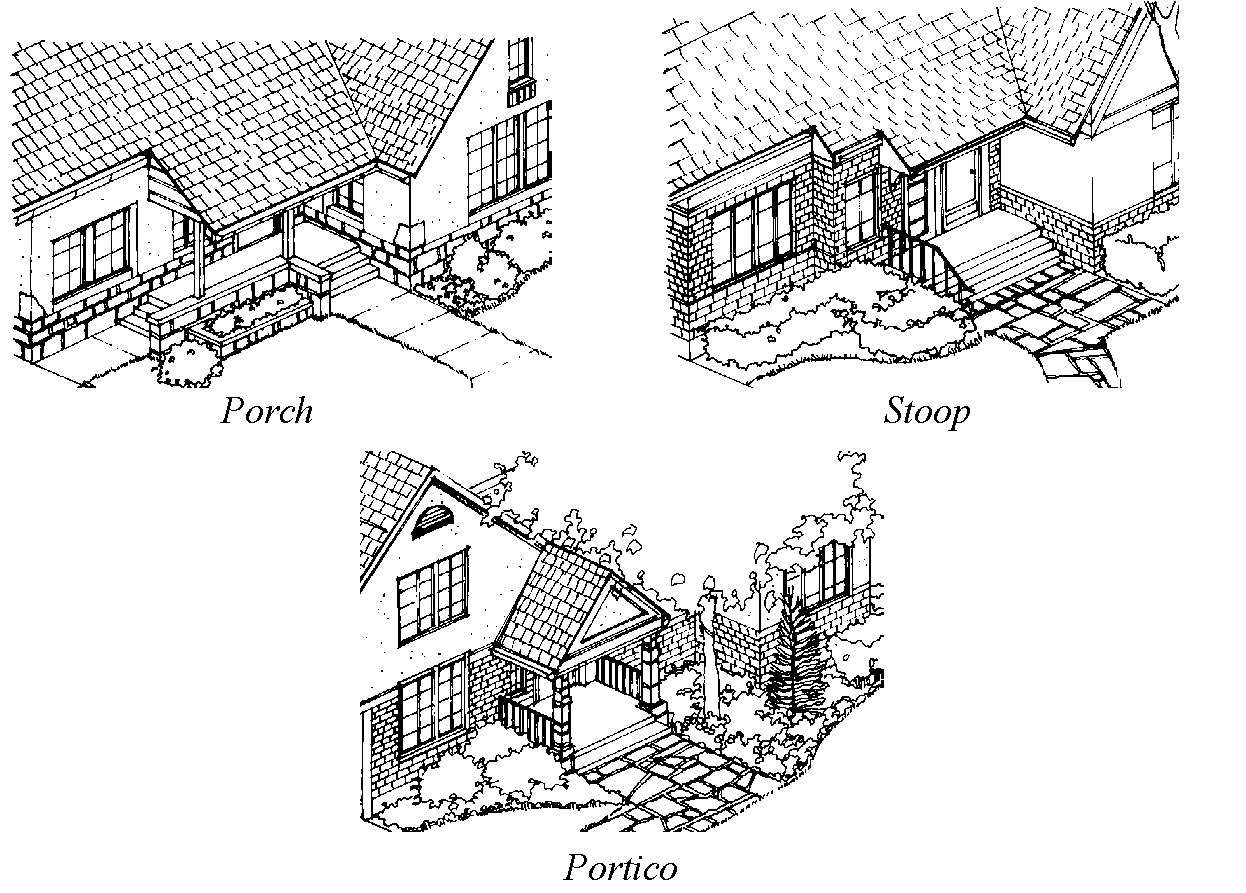 |
| Figure 15-438-2: Garage doors. Overhead garage doors present a blank building front along the street. Limiting front-facing overhead garage doors to a specified percentage of the total façade width helps preserve the character of the streetscape. [See Subsection 15-297(b)(3)b.] | 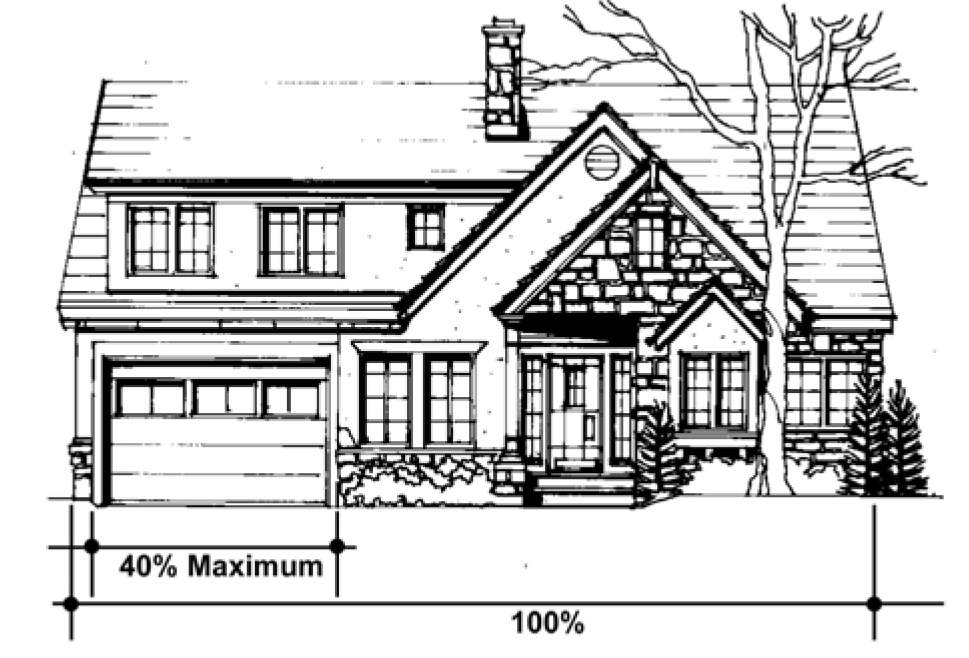 |
| Figure 15-438-3: Architectural relief. Offsets in the building, projections around window elements, and roof dormers are examples of architectural relief features that break up tall or long wall planes along a single building line and reduces the mass of residential façades. [See Subsections 15-297(b)(5)a.; 15-334(c)(3)a.] | 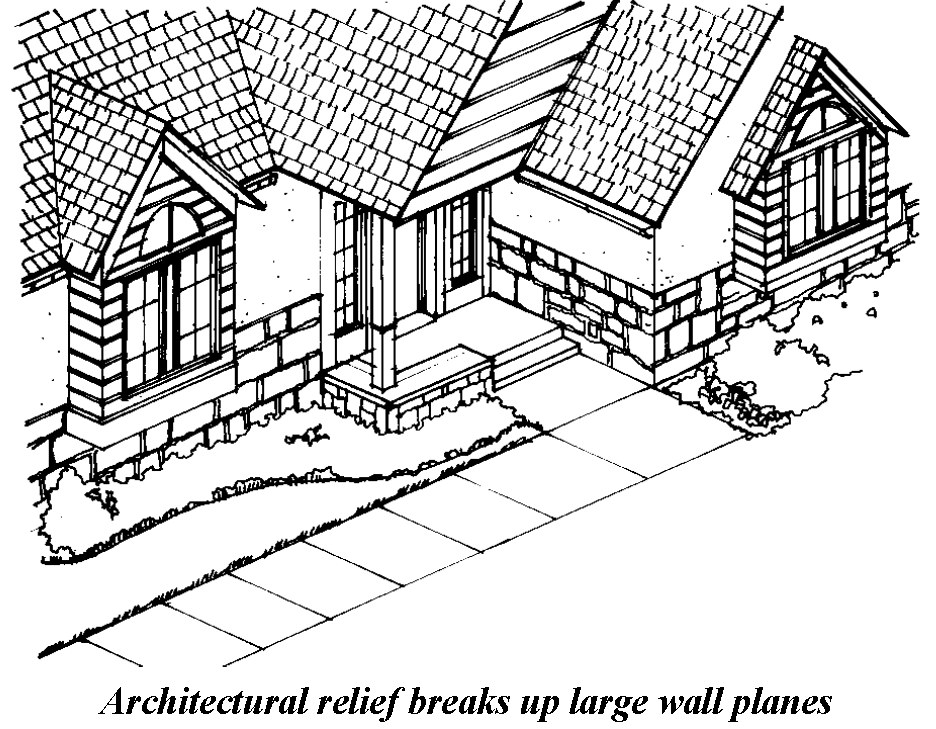 |
| Figure 15-438-4: Residential façade opening. Openings help break up the mass of larger façades. Residential openings include windows and doors. When calculating openings as a specified percent of a total façade, integral molding and architectural details may be included in the area of the opening, however removable, non-integral elements such as shutters shall not be included. [See Subsections 15-297(b)(5)b.; 15-334(c)(3)b.] | 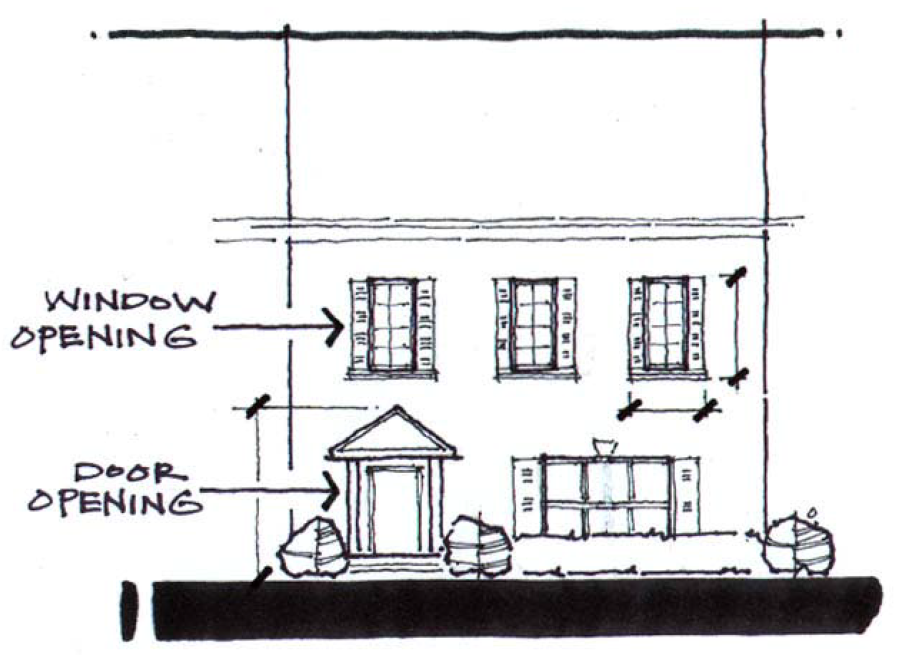 |
| Figure 15-438-5: Material change. Material changes, when limited to inside corners or horizontal architectural features helps better integrate diverse building materials into structural elements of the buildings [See Subsections 15-297(b)(6)f.5; 15-334(c)(4)f.4] | 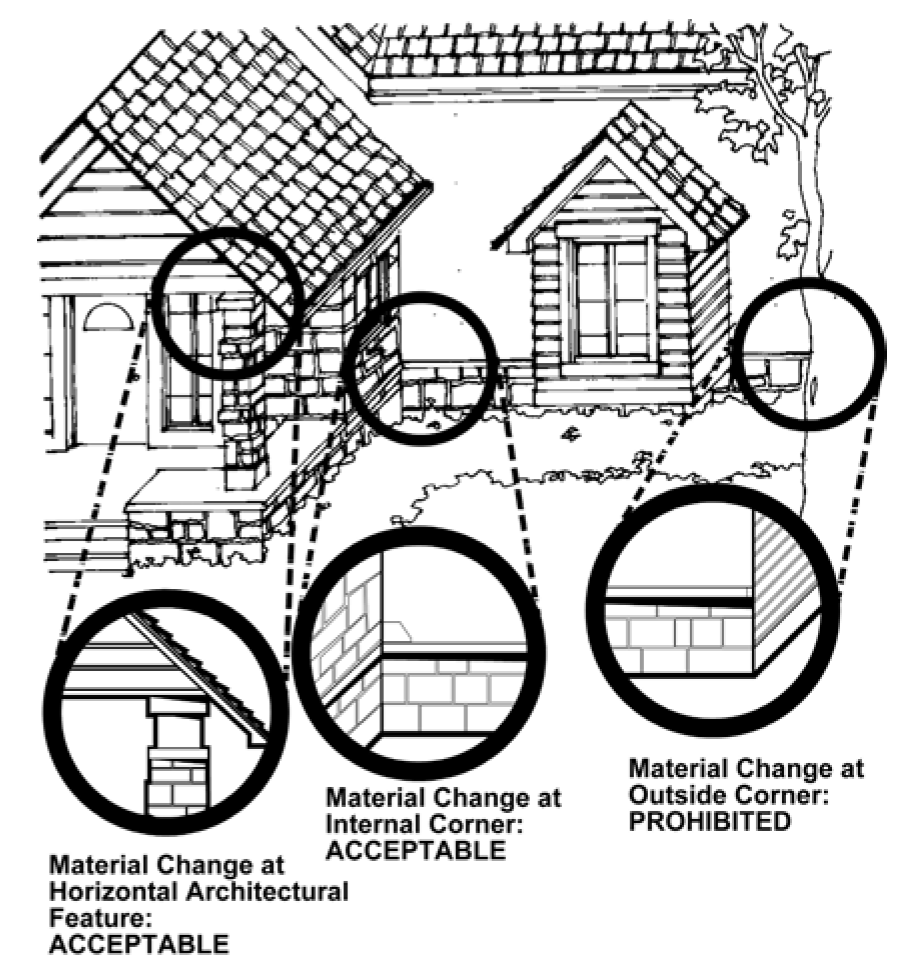 |
| Figure 15-438-6: Privacy fence or wall locations. Privacy fences or walls generally should not be in front of the front building line of adjacent buildings except in special circumstances on corner lots and subject to specific conditions. [See Subsections 15-297(c)(1)c.; 15-297(c)(2).] | 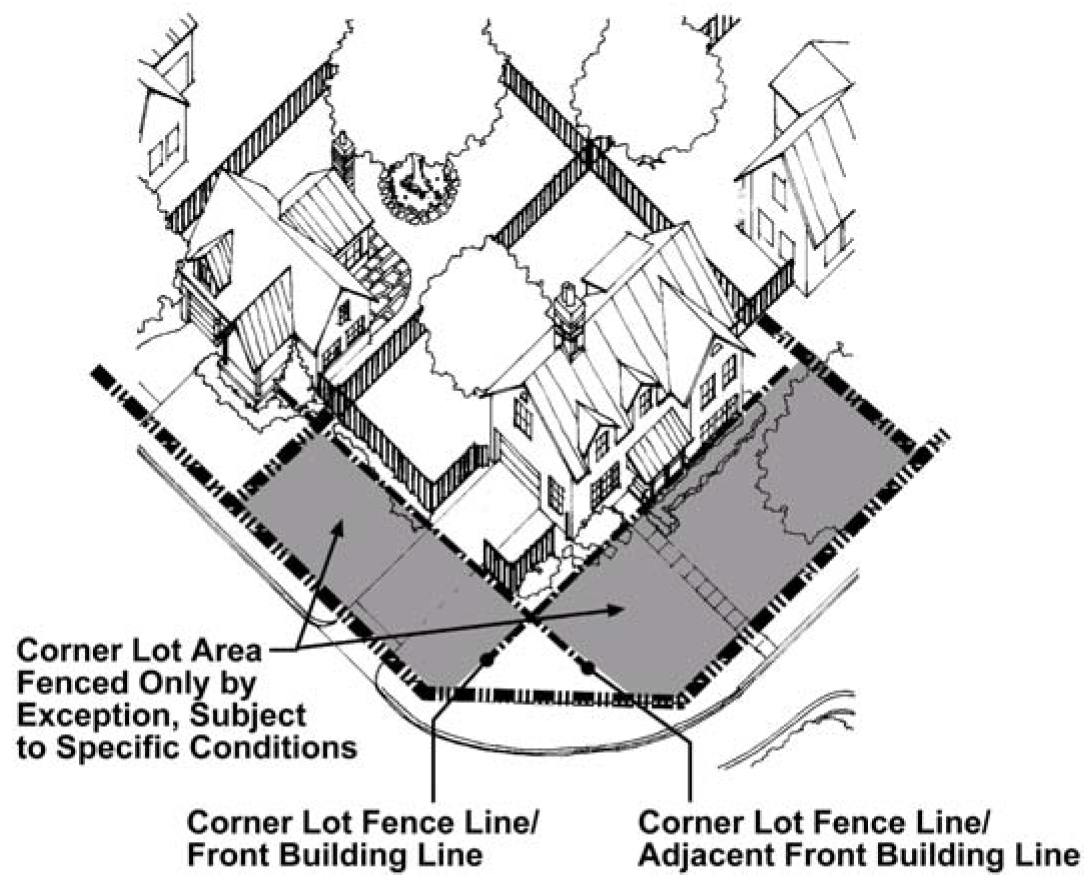 |
| Figure 15-438-7: Street edges. Street edges, formed by decorative fences or walls, planting treatments, building façades, or a combination of these elements, help define the spaces around blocks and creates a transition between public streetscapes and private areas. [See Subsections 15-297(a)(3).; 15-408.] | 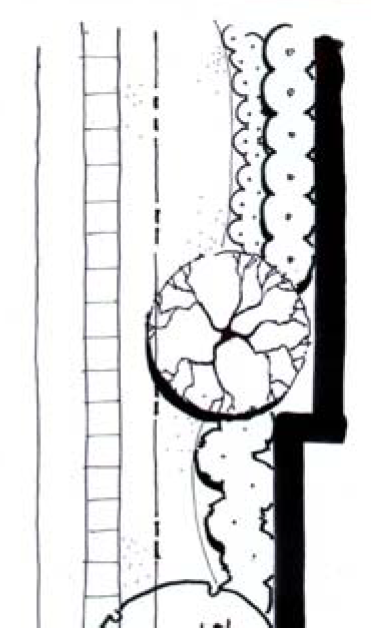 |
| Figure 15-438-8: Street edges/Block face. Depending on the zoning district, street edges may be made up of various percentages of "street edge elements" along a single block face. [See Subsections 15-297(a)(3)c.; 15-411(a)(3).a.] | 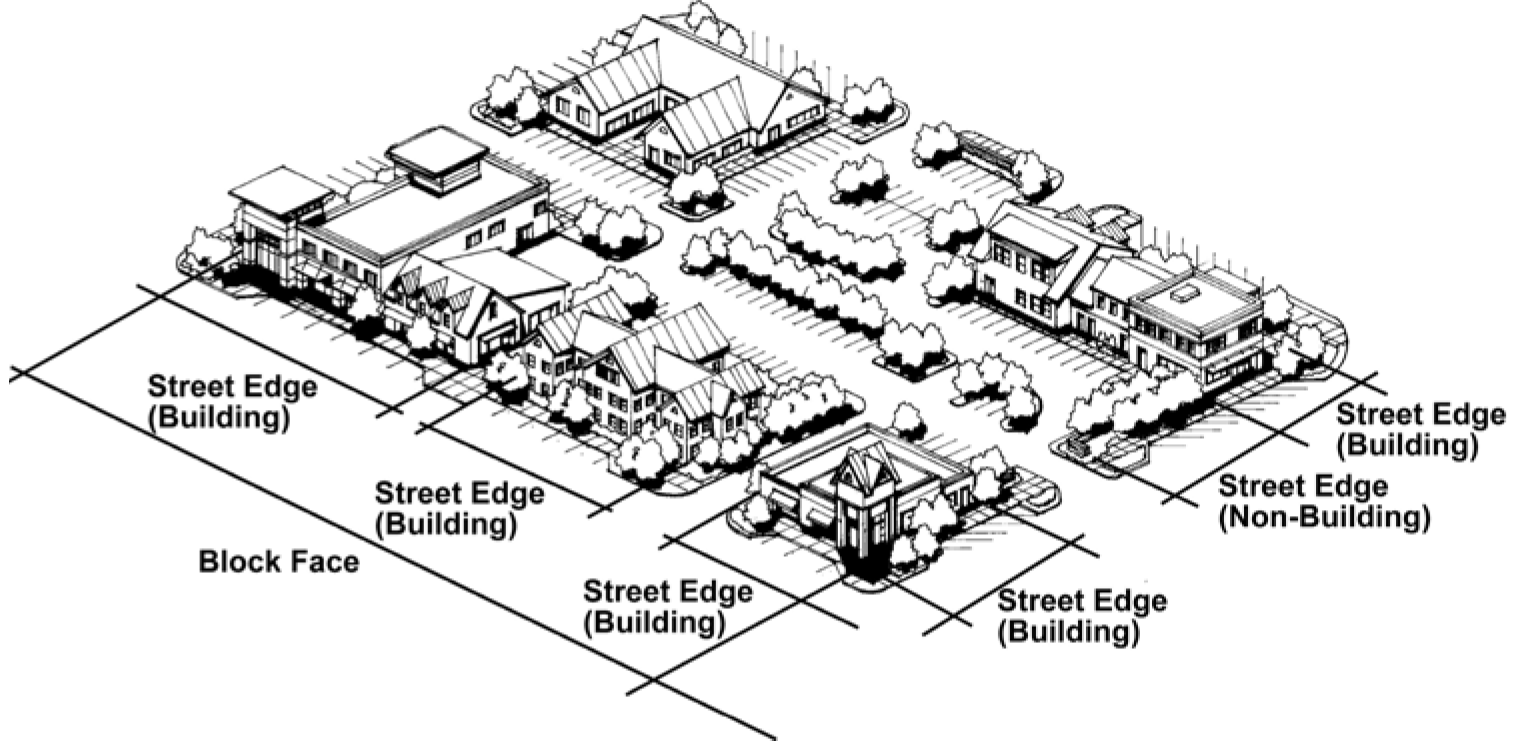 |
| Figure 15-438-9: Grade-separated pedestrian connections. When buildings do not front on the street, grade-separated pedestrian connections improve walkability by providing dedicated connections to building entrances from public sidewalks or internal pedestrian circulation systems. [See Subsection 15-362(b)(1)b.; 15-411(b)(1)b.] | 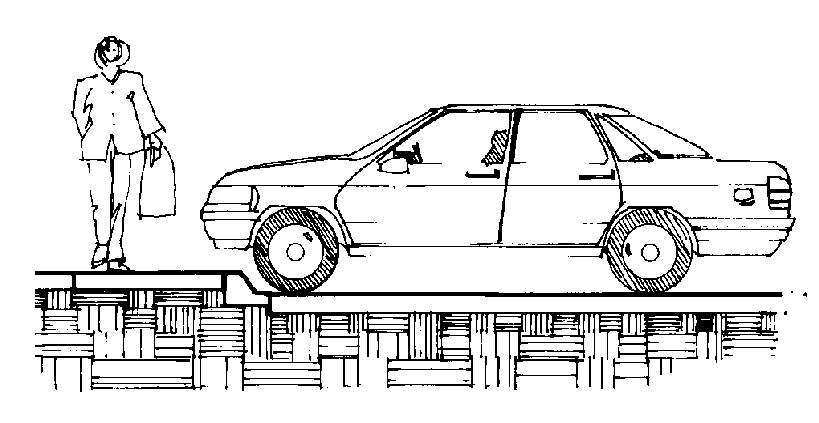 |
| Figure 15-438-10: Enhanced commercial entrances. Specialized architectural treatments at building entrances, when concentrated to a single story entrance feature, creates a pedestrian scale and adds interest to the streetscape. [See Subsections 15-362(c)(2)b.4; 15-411(c)(2)b.] | 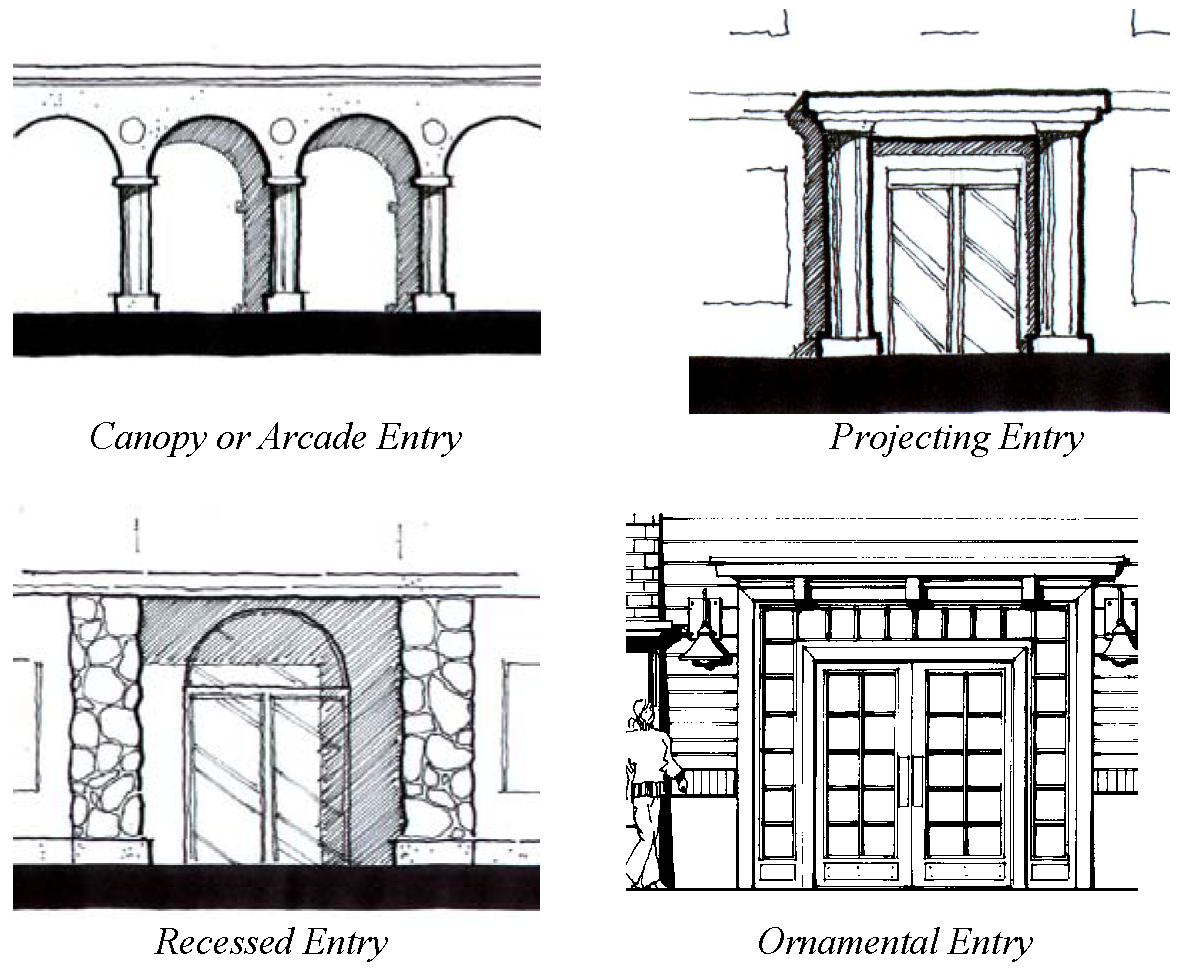 |
| Figure 15-438-11: Commercial façade openings. Commercial openings include windows and doors. When calculating openings as a specified percent of a façade or part of a façade, integral molding and architectural details may be included in the area of the opening, however removable, non-integral elements such as shutters shall not be included. [See Subsections 15-362(c)(3)a.; 15-411(c)(3)b.] | 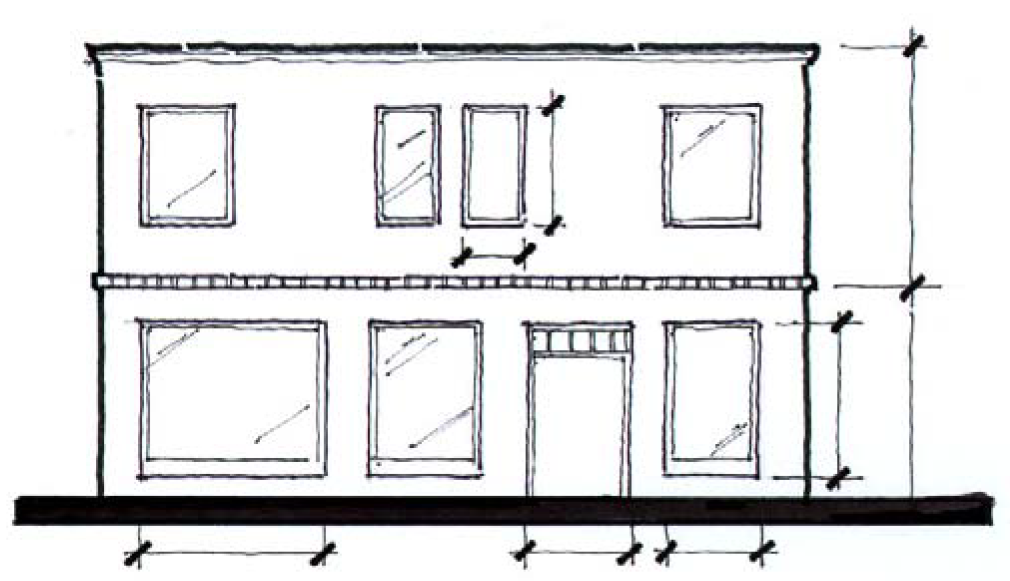 |
| Figure 15-438-12: Articulated commercial façades. Recurring building entrances, window and door openings, architectural details at the base, first story and top of buildings, awnings over windows and small off-sets of the building front help articulate large façades and reduce the scale of large buildings to a more pedestrian level. [See Subsections 15-362(c)(3)d.; 15-411(c)(3)c.] | 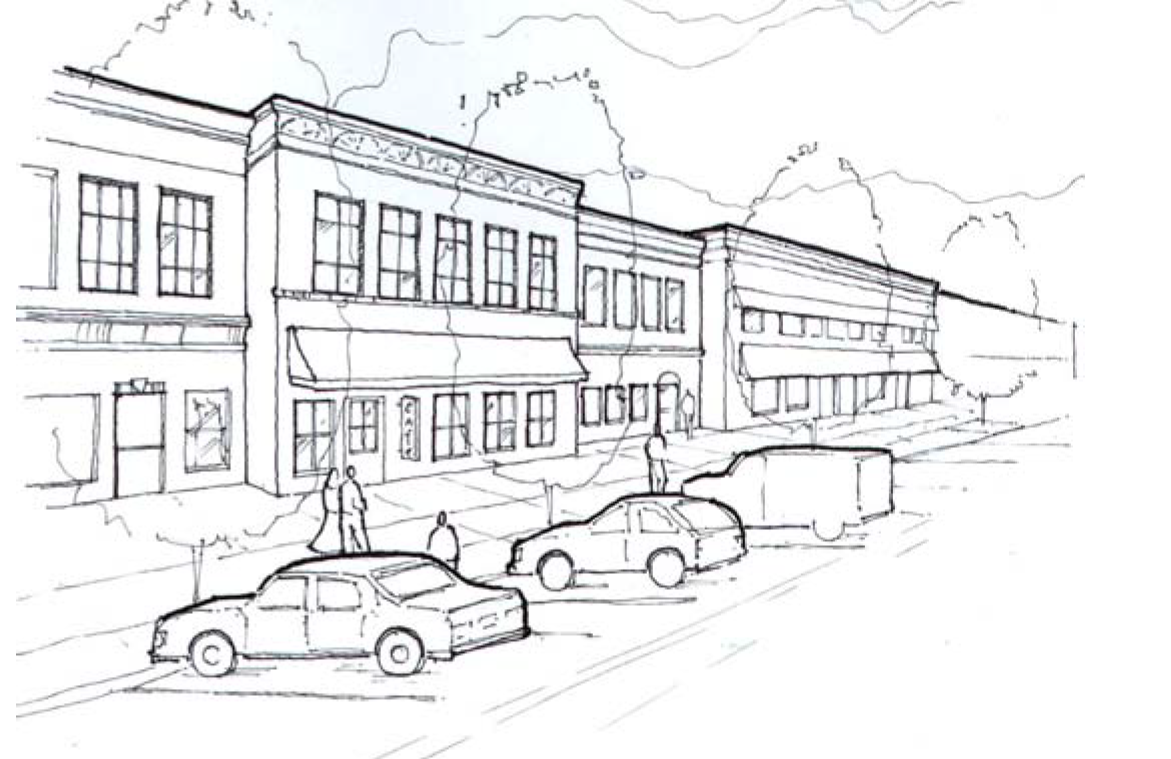 |
| Figure 15-438-13: Courtyards or Plazas. Small courtyards or plazas, when designed appropriately and frequently located, such as on every block, can provide better impact for open space than requirements on a per lot basis. [See Subsection 15-411(d)(1)a.] | 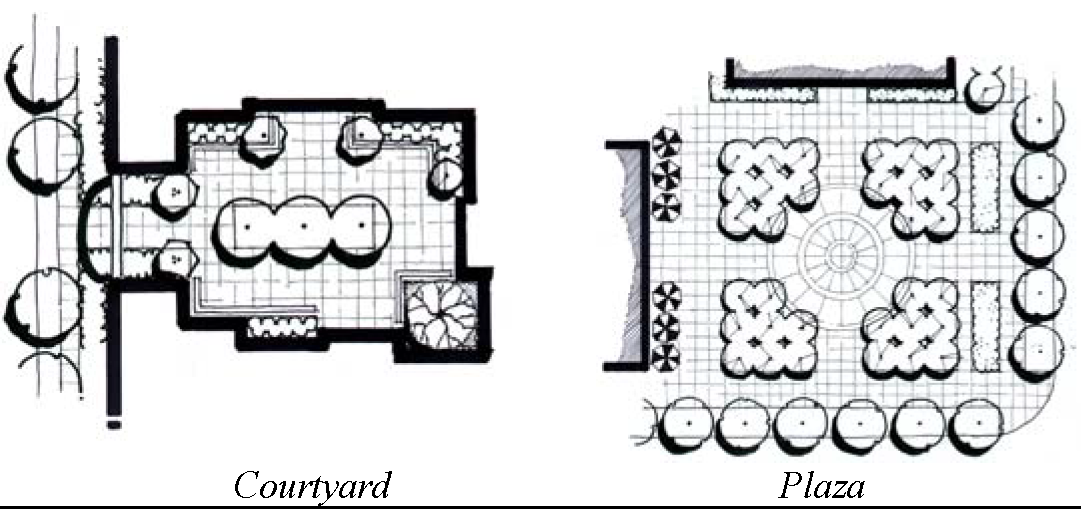 |
| Figure 15-438-14: Enhanced retail storefront. Office buildings can be improved to create a better mixed-use environment when ground level retail uses provided enhanced retail storefronts, including architectural elements on buildings or improved pedestrian areas along building frontages. [See Subsection 15-389(a)(2)] | 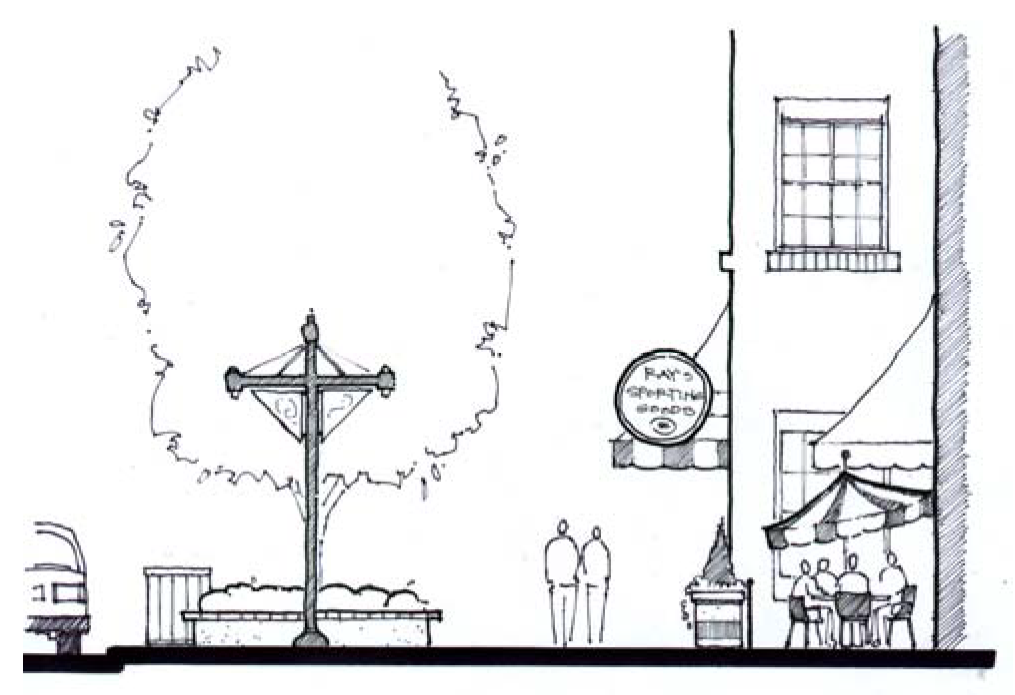 |
| Figure 15-438-15: Parks or Greens. Small parks or greens, when designed appropriately and centrally located can provide better impact for open space than requirements on a per lot basis. [See Subsection 15-411(d)(1)b.] | 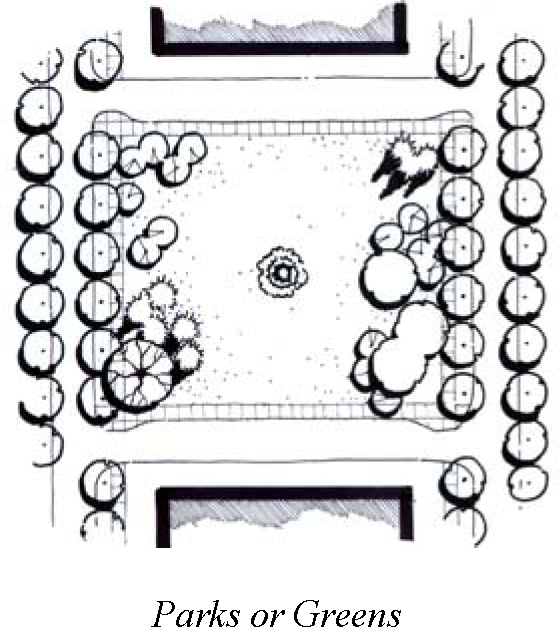 |
| Figure 15-438-16: Corner Lots. Standard, Reverse and Intersection are different corner lot patterns found in Fairway. Flexibility to side setbacks are provided in certain situations with the goal of maintaining good relationships to streetscapes and aligning building frontages along predominant block faces (either short sides of blocks, long sides of blocks or both) based on the particular context of the lot and block. [See Subsection 15-296(b)] | 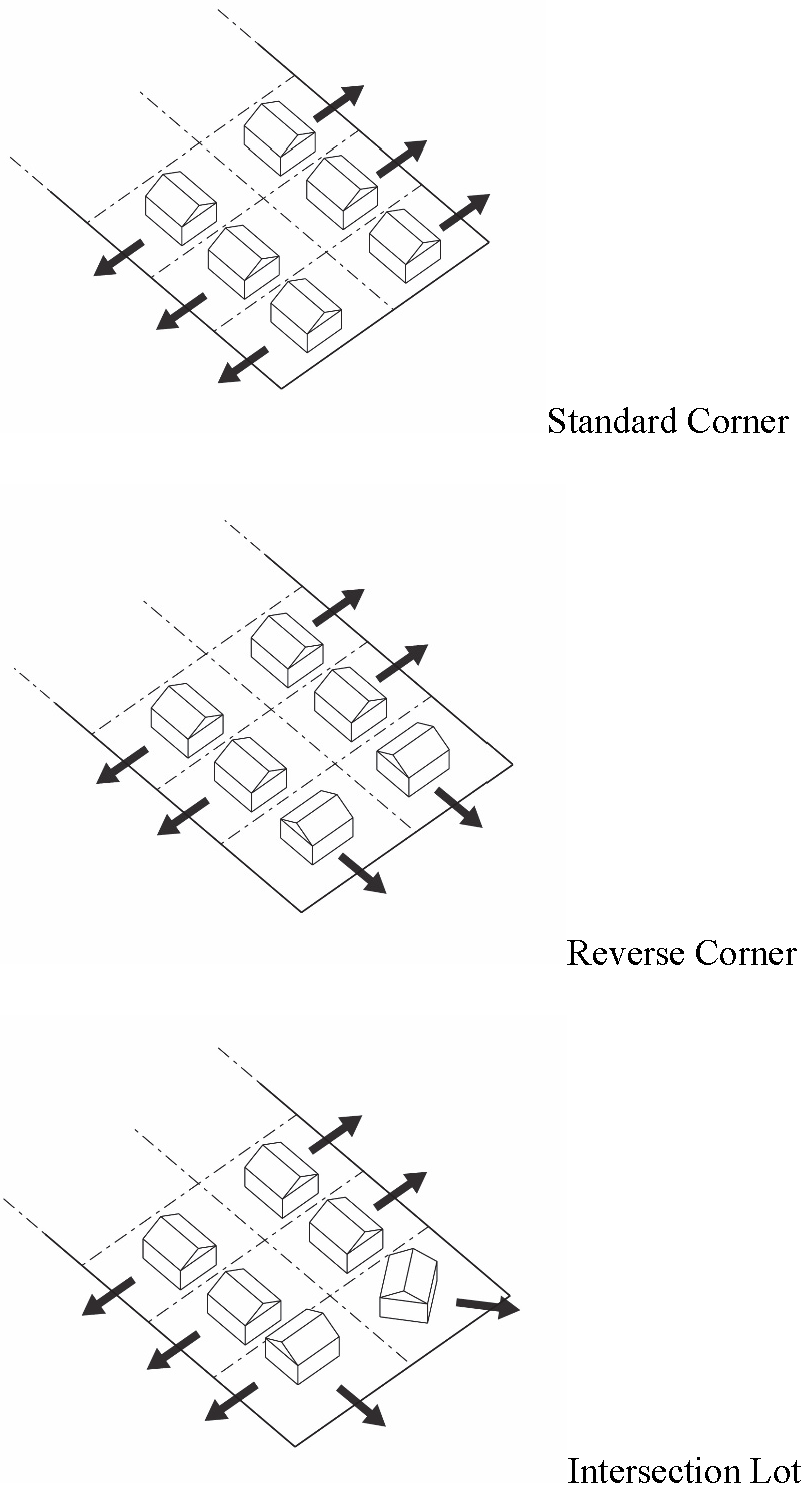 |
| Figure 15-438-17: Foundation Planting. Foundation planting contributes to the greenspace and streetscape appeal of neighborhoods by adding visual interest and breaking up the front façades of buildings. A minimum of half of the building frontage shall have foundation plantings. [See Subsection 15-297(a)(2)f.] | 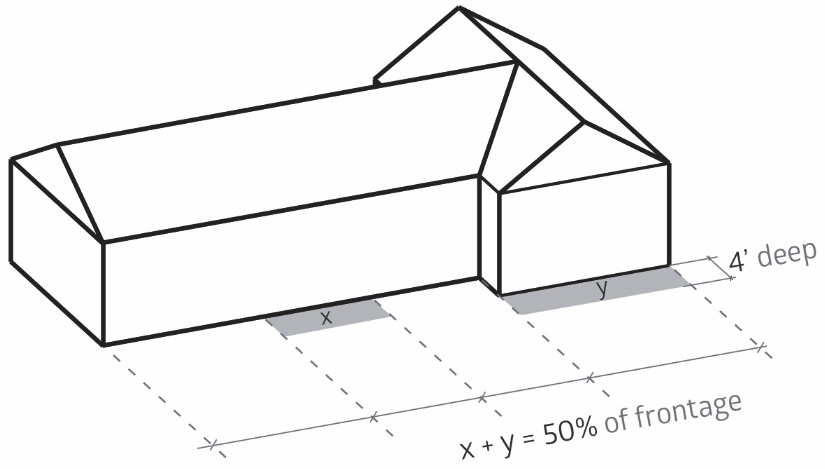 |
| Figure 15-438-18: Driveway Widths. Driveway width limits help preserve the greenspace and streetscape views along blocks and are proportioned to the lot widths based on a percentage. Overall limits cap the allowed width, and exceptions for areas deeper into lots help ensure adequate vehicle access on narrower lots. [See Subsection 15-297(a)(3)a.] | 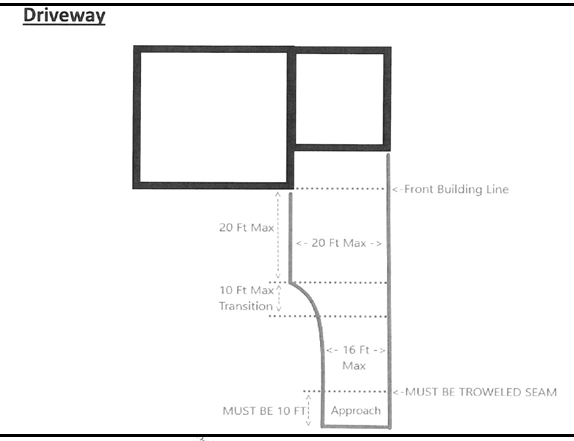 |
| Figure 15-438-19: Building Massing and Side Setbacks. A "3-dimensional" setback helps break up building massing for larger buildings and preserve smaller scale building relationships the closer buildings are to property lines. The tiered approach limits wall planes closest to the setbacks, and encourages massing common to Fairways housing stock with main masses and smaller wings. [See Subsection 15-297(b)(4)a.] | 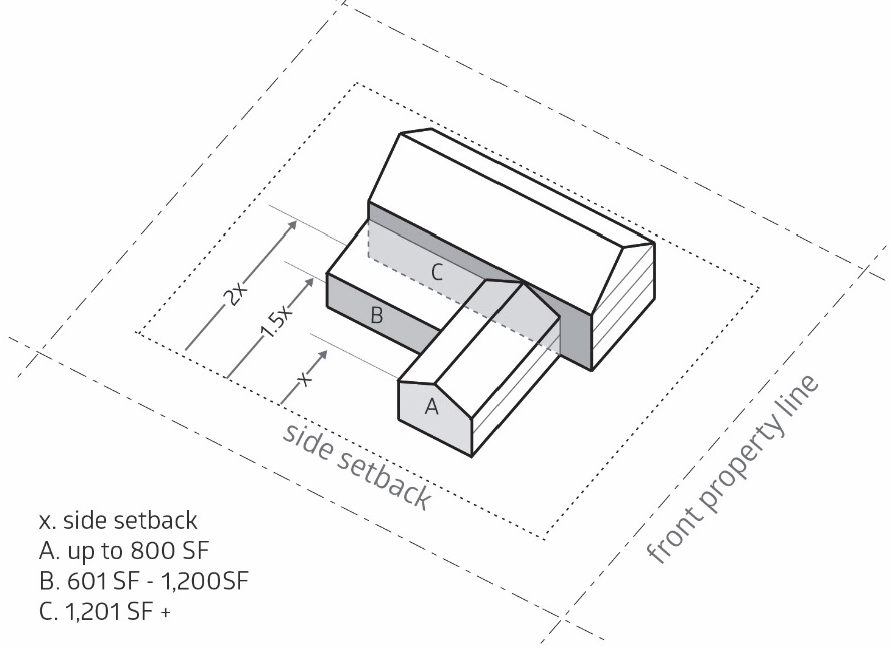 |
| Figure 15-428-20: Building Massing and Rear Setback. A "3-dimensional" setback helps break up building massing for larger buildings and preserves smaller scale building relationships the closer buildings are to property lines. The tiered approach limits wall planes closest to the setbacks, and encourages massing common to Fairways housing stock with main masses and smaller wings. [See Subsection 15-297(b)(4)b.] | 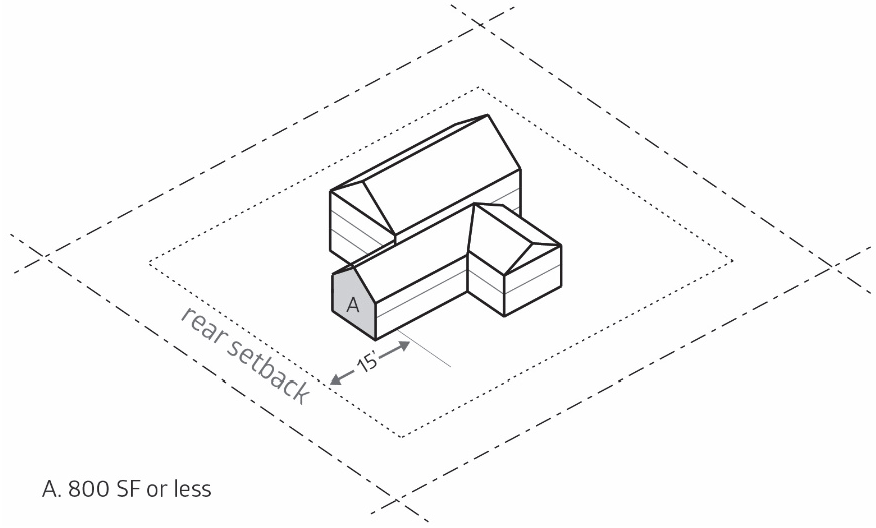 |
| Figure 15-438-21: Building Massing and Limited Projections. Limited projections are common to many architectural styles present in Fairway. The limitation on the projections, combined with the "3-dimensional setbacks" will help proportion the massing of buildings, break up larger façades, and preserve small scale relationships with adjacent buildings [See Subsection 15-297(b)(4)c.] | 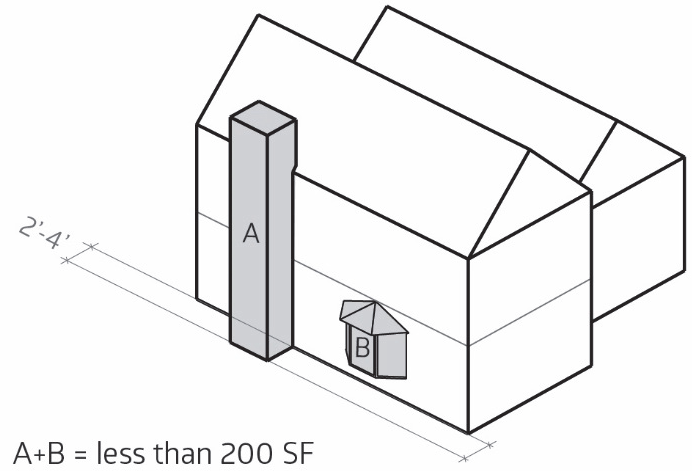 |
(Development Ord. 2004, art. 4, div. 2, pt. 7; Ord. No. 1582, § 9, 12-8-2014; Ord. No. 1768, § 3, 8-8-2022)

