
Fairway City Zoning Code
DIVISION 3
SUPPLEMENTAL PROVISIONS
Subdivision IV. - Signs[7]
Editor's note— Ord. No. 1702, § 1, adopted October 14, 2019 repealed the former Subdivision IV, §§ 15-548—15-559, and enacted a new Subdivision IV as set out herein. The former Subdivision IV pertained to similar subject matter and derived from Development Ord. 2004 and Ord. No. 1582, adopted December 8, 2014.
Subdivision V. - Wireless Facilities[8]
Editor's note— Ord. No. 1681, §§ 1, 2, adopted December 10, 2018, repealed the former subdivision V, and enacted a new subdivision V as set out herein. The former subdivision V pertained to similar subject matter and derived from the Development Ord. of 2004.
Subdivision VII. - Nonconformities[11]
State Law reference— Nonconformities, K.S.A. 12-758, 12-770, 12-771.
Sec. 15-487. - Intent.
This subdivision is intended to ensure that all land uses are provided with adequate site accessibility from a variety of modes of transportation, including pedestrian, bicycles, and automobiles. The parking requirements and design standards ensure adequate vehicle storage to support land uses; provide appropriate site location and design features that mitigate the impact of parking lots on other land uses and goals for the City; create the least visible impact of parking on adjacent private and public property; encourage parking designs that minimize runoff and incorporates infiltration of stormwater into the ground; and reduce the need to dedicate areas of sites to underutilized parking.
(Development Ord. 2004, § 15-4-3.101)
Sec. 15-488. - Required parking schedule.
(a)
Minimum parking shall be based on the following schedule:
*Gross floor area excludes basement or storage areas
**Where computation of required parking results in a fractional number, the required
number shall be the next higher whole number
***Each parking space shall contain a rectangular area at least 18 feet by 9 feet.
(b)
Accessible parking space requirements. Parking facilities accessible for physically handicapped persons shall be provided according to the most recent standards of the Americans with Disabilities Act and associated guidelines, including quantity, size, location, and accessibility. Applicants must clearly demonstrate compliance with these standards or in the alternative, demonstrate why the standards are not applicable to their project or parcel.
(c)
Maximum parking. No use shall provide more than ten percent (10%) more than the minimum required parking without providing two or more of the following mitigating design features:
(1)
The surface shall be an porous surface that allows all stormwater to be infiltrated below the surface, subject to the approval by the City. Any porous surface used shall demonstrate that it has at least the same or better performance standard as the required standard parking surface and does not present any maintenance issues;
(2)
The site shall be required to provide additional area, equal to or greater than the area of parking in excess of the maximum, as public or common open space. This additional open space shall be subject to the design and location requirements article be in addition the minimum open space requirements for the site;
(3)
Landscape material requirements for the site shall be increased by ten percent (10%) above the minimum amount required by this division and shall be allocated to provide enhanced buffering of all on-site parking; or
(4)
Internal landscape islands for the on-site parking shall be increased by five percent (5%) above the minimum percentage requirements of this division.
(Development Ord. 2004, § 15-4-3.102)
Sec. 15-489. - Shared parking.
In meeting the requirements of the parking schedule in Section 15-488, adjacent uses may share parking under the following conditions and standards:
(1)
Adjacent landowners shall execute the necessary cross access easements to facilitate shared parking and record all documents for the easements with the Recorder of Deeds.
(2)
A written agreement for the joint use of parking facilities shall be executed by the parties and approved by the City.
(3)
All shared parking spaces shall be within a reasonable proximity of the main entrance of any building sharing the parking and provide direct pedestrian access to the entrance.
(4)
Parking requirements shall be the cumulative requirements of the uses sharing the parking, except where different uses (retail or service, office, civic, or residential) are located on the same or adjacent lot. The following is a base guide for shared parking. Each use should provide a percentage of parking required by these regulations according to the following table. Whichever time period requires the highest total parking spaces among the various uses subject to the shared parking agreement should be the amount of parking provided. Alternative parking allocations may be approved by the City based on sufficient evidence an analysis of peak parking demands for specific uses which are subject to the agreement.
(Development Ord. 2004, § 15-4-3.103)
Sec. 15-490. - Parking credits.
A credit may be given to the requirements of the table in 15-488(a) Parking Schedule, under the following conditions:
(1)
On-street parking within three hundred feet (300') of any lot line may be credited to the parking requirement at a rate of one (1) credit for every two (2) on-street parking spaces.
(2)
Bicycle parking facilities within reasonable proximity of the main entrance may be credited at a rate of one (1) credit for every two (2) bicycle parking spaces, up to a maximum of twenty percent (20%) of the required vehicle parking.
(Development Ord. 2004, § 15-4-3.104; Ord. No. 1582, § 11, 12-8-2014)
Sec. 15-491. - Parking design.
(a)
Location. Except for parking for single-family homes, all parking should be located behind the street edge or on the street, and according to the lot design standards for each zoning district [See Section 15-492, Figure 15-492-1]
(b)
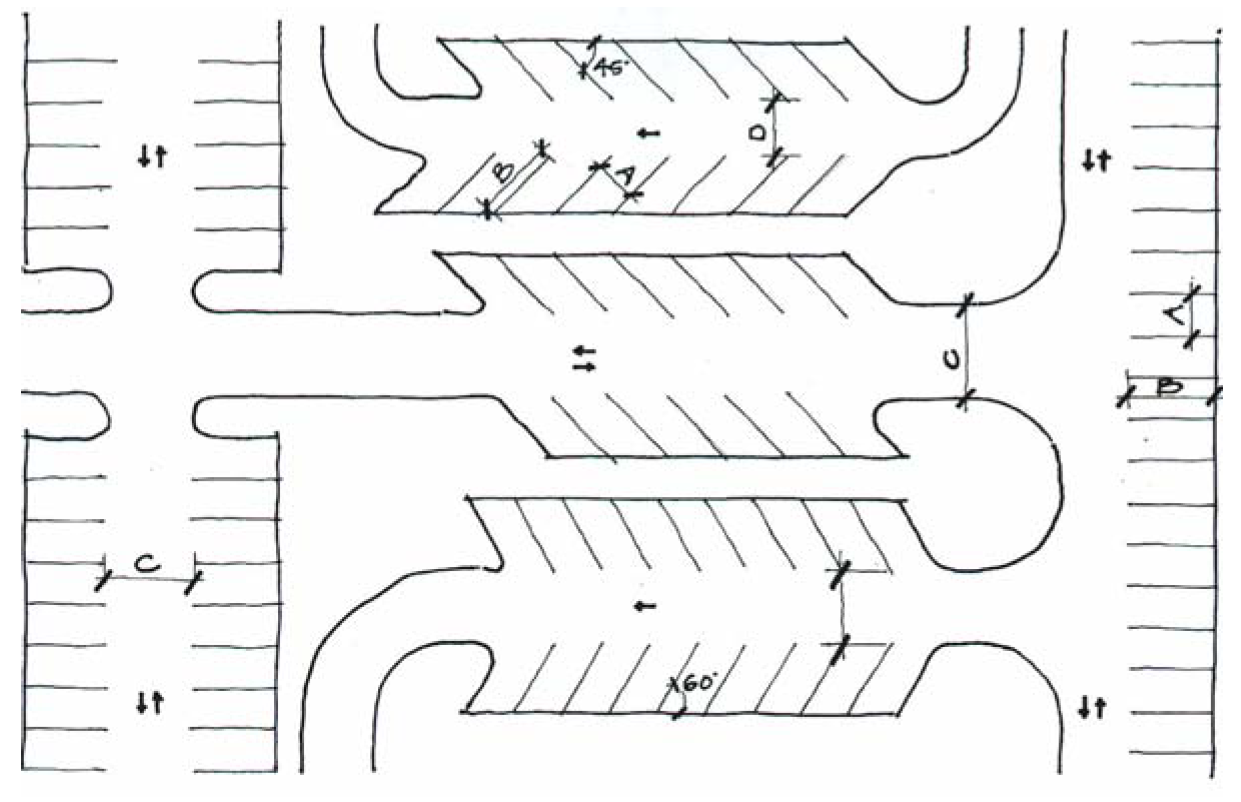
Size and circulation. Parking lot dimensions shall be as follows:
Figure 15-492-2 - Stall and aisle dimensions.
(c)
Landscape requirements.
(1)
Internal planting requirements. All parking lots shall provide internal planting islands subject to the following minimum dimensions standards:
(2)
Perimeter planting requirements. All parking lots shall provide perimeter planting strips subject to the following dimension standards:
a.
All parking lots shall provide a minimum ten (10) foot wide perimeter landscape area along all public rights-of-way.
b.
Parking lots with eighty (80) or fewer spaces shall provide a minimum six (6) foot wide perimeter landscape along all other edges not directly fronted by a building.
c.
Parking lots with greater than eighty (80) spaces shall:
1.
Provide a minimum ten (10) foot wide perimeter landscape area along all other edges not directly fronted by a building; and
2.
Contain a continuous intervening planting strip at least six feet (6') wide, so that no single parking area contains more than eighty (80) spaces without being surrounded by a perimeter planting strip. These intervening planting strips may count towards the requirements of Subsection (c)(2)c.1. of this section. [See Section 15-492, Figure 15-492-4]
(3)
Landscape and planting areas in parking shall contain plant materials meeting the requirements of Division 3, Subdivision III of this article. The primary landscape materials used in parking lots shall be trees which provide shade or are capable of providing shade at maturity. Shrubbery, hedges and other planting materials may be used to complement the tree landscaping, but shall not be the sole means of landscaping. Effective use of earth berms and existing topography is also encouraged as a component of a landscaping plan. In those instances where plant materials exist on a parking lot site prior to its development or redevelopment, such materials may be used if approved as meeting the requirements of Division 3, Subdivision III of this article.
(4)
Landscape and planting areas shall be reasonably dispersed throughout the parking lot, located to break the expanse of pavement, to guide traffic flow, and to treat stormwater runoff from the parking surface. Trees, shrubs, grass and other ground cover shall be planted in the interior landscape areas.
(5)
The dimensions of any planting area or planting median shall be sufficient to protect and ensure proper growth of the landscaping materials. In no event shall any such area be less than sixty (60) square feet or less than five feet (5') in width in any direction. Each area shall be protected by Portland cement concrete vertical curbs or similar structures, except that the Planning Commission may approve alternative designs to infiltrate stormwater into landscape areas, such as perforated curbs, rain gardens and other best management practices that meet sound engineering practices.
(d)
Pedestrian connections. All parking lots greater than twenty (20) spaces shall have a direct pedestrian connection from the lot to either the primary entrance of the building on the lot or to the public sidewalk. The pedestrian connection shall meet the following standards: [See Section 15-492, Figure 15-492-3]
(1)
It shall be of a different surface than the parking lot surface both in color and texture or material.
(2)
It shall be located at a central location in the parking lot.
(3)
It shall be at least eight feet (8') wide.
(4)
It shall cross all internal drive aisles and private lanes at designated crosswalks. In no instance shall a crosswalk across a drive aisle or private lane be greater than twenty feet (20') for any single crosswalk.
(5)
For lots greater than eighty (80) spaces, the pedestrian connection shall be separated from the parking surface by either a grade separation or be located within intervening planting strips so that the pedestrian connection is dedicated solely to pedestrian use [See Section 15-492, Figure 15-492-4].
(Development Ord. 2004, § 15-4-3.105; Ord. No. 1582, § 13, 12-8-2014)
Sec. 15-492. - Supporting graphics.
| Figure 15-492-1: Screened parking/street edge. Placing on-site parking behind low screens such as ornamental fences, walls, or landscape minimizes the impact of parking lots on public streetscapes. This concept works in conjunction with providing a street edge (see Figures 4-2-12 and 4-2-13) along nonresidential blocks (see Section 15-491(a)). | 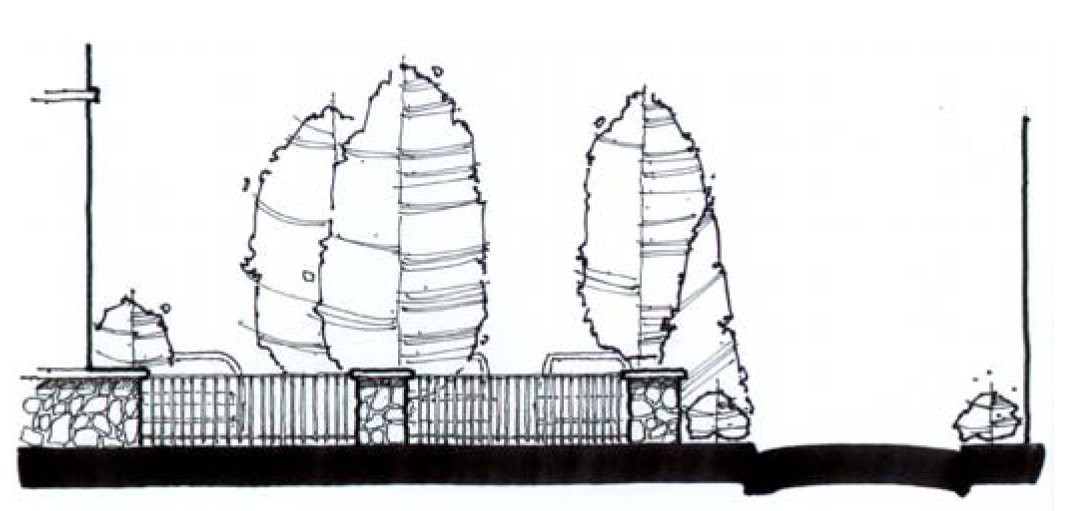 |
| Figure 15-492-2: Stall and aisle dimensions. | Figure appears with text in Section 15-491(b). |
| Figure 15-492-3: Pedestrian connections. Larger parking lots, such as those greater than 20 spaces, provide better safety and improved walkability when pedestrian connections are made through intervening parking areas, between building entrances and public sidewalks. These areas are more clearly identified to pedestrians and vehicles when textured or colored pavement treatments or grade-separated pedestrian paths are used (see Section 15-491(d)). | 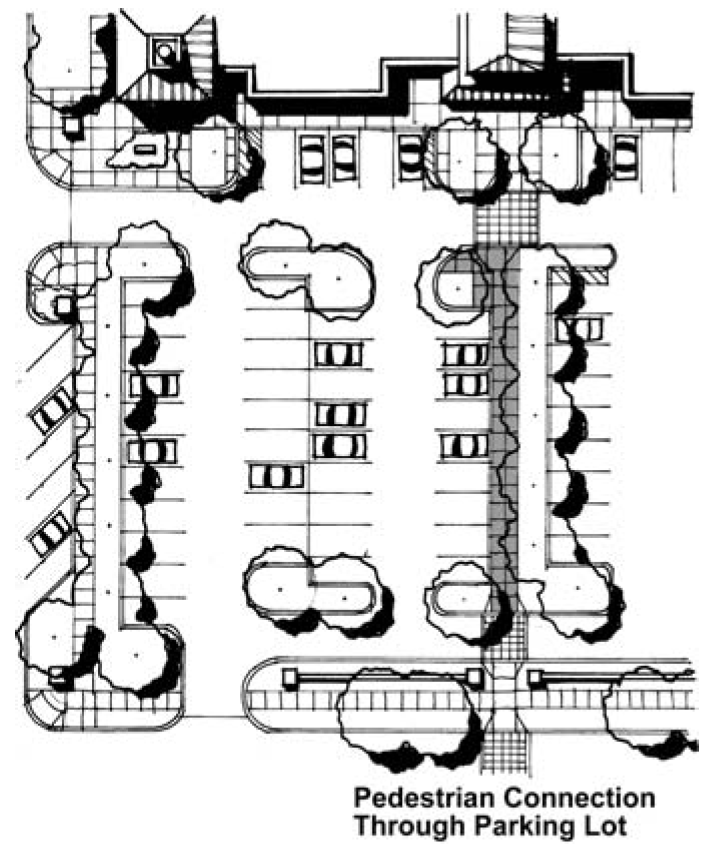 |
| Figure 15-492-4: Parking blocks. Extremely large parking areas, greater than 80 spaces, provide for better balance of pedestrian and vehicle access, and improved community aesthetics, when broken into "parking blocks" of fewer than 80 spaces. Perimeter landscaping, internal access lanes with enhanced streetscapes, and grade-separated pedestrian connections complete the design enhancements of parking blocks (see Sections 15-491(c)(2)c.2 and (d)(5)). | 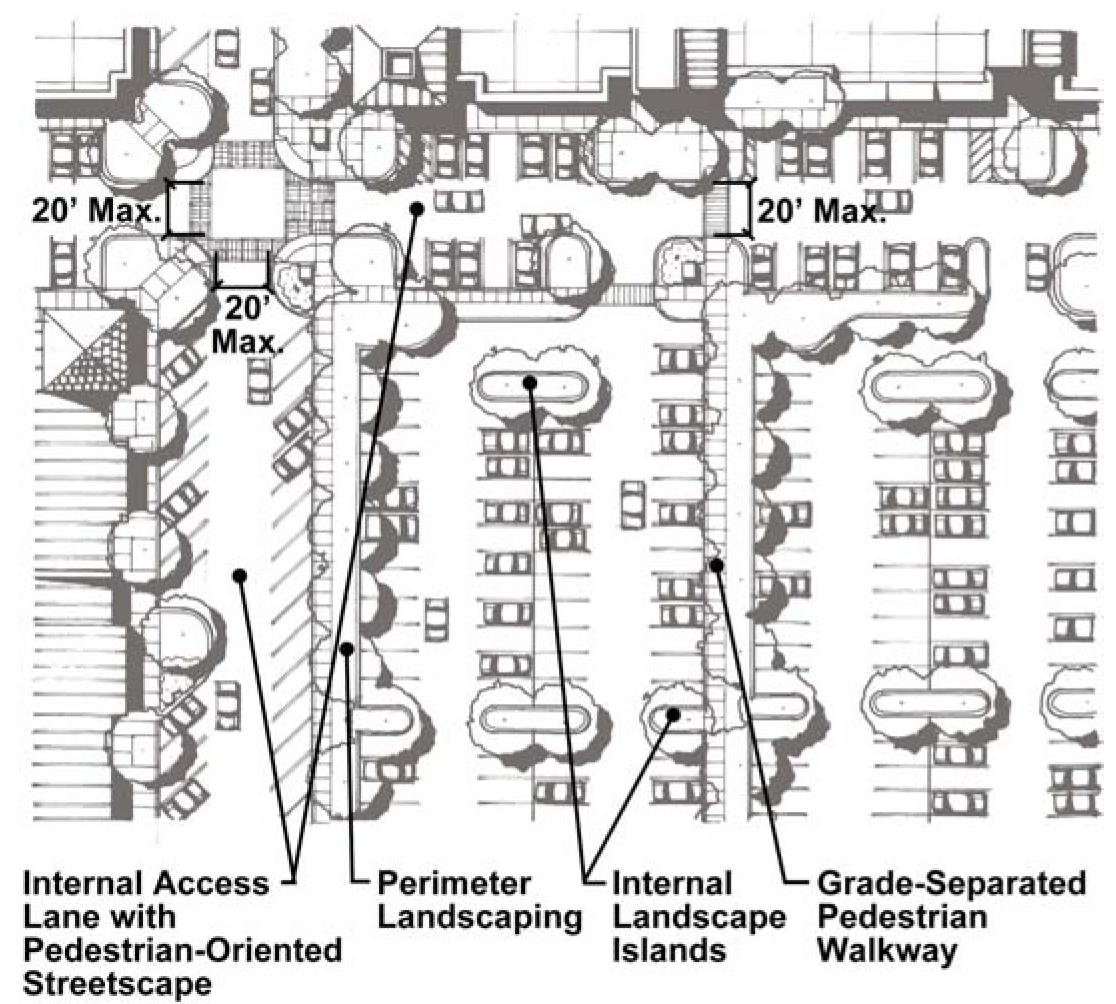 |
(Development Ord. 2004, § 15-4-3.106)
Sec. 15-523. - Intent.
The landscape, open space, and lighting design standards are intended:
(1)
To provide greenery to visually soften paved areas and buildings;
(2)
To incorporate usable and accessible open spaces, whether public, common, or private, into development projects;
(3)
To establish optimum environmental conditions by providing shade, air purification, oxygen regeneration, groundwater recharge, retardation of stormwater runoff, and abatement of noise, glare and heat;
(4)
To ensure the replenishment of the local stock of native trees by utilizing plant materials that are generally native or hearty to the region;
(5)
To preserve existing trees;
(6)
To screen certain unsightly equipment or materials from the view of persons on public streets or adjoining properties;
(7)
To provide visible, accessible, and safe areas on sites for community gathering and interaction; and
(8)
To buffer uncomplimentary land uses and generally enhance the quality and appearance of developed properties within the City.
(Development Ord. 2004, § 15-4-3.201)
Sec. 15-524. - Applicability.
The landscape and open space standards in this subdivision shall apply to all business districts, and in residential districts where a site plan is required or where uses requiring parking lots may be permitted. Where necessary to interpret the precise meaning of technical landscaping terms utilized in this subdivision or elsewhere in this chapter, reference shall be had to The American Standard for Nursery Stock, as published by the American Association of Nurserymen.
(Development Ord. 2004, § 15-4-3.202; Ord. No. 1582, § 13, 12-8-2014)
Sec. 15-525. - Landscape and open space plan.
Any development application requiring a site plan or a development plan, shall also include a landscape and open space plan as part of the site or development plan, signed by a landscape architect registered in the State and containing the following minimum information:
(1)
North point and scale.
(2)
Topographic information and final grading adequate to identify and properly specify planting for areas needing slope protection.
(3)
The location, size and surface of materials of all structures and parking areas.
(4)
The location, size and type of all aboveground and underground utilities and structures with proper notation, where appropriate, as to any safety hazards to avoid during installation of landscaping.
(5)
The location, size, type and quantity of all proposed landscaping materials, along with common and botanical names of all plant species. The size, grading and condition shall be specified according to American Association of Nurserymen Standards.
(6)
The location, size and common name of all existing plant materials to be retained on the site.
(7)
Mature sizes of plant materials shall be drawn to scale and called out on the plan by a common name or appropriate key.
(8)
Location of hose connections and other watering sources.
(9)
The location of all trees that are proposed for removal.
(10)
All screening required by this section, including dimensions and a description of building materials.
(Development Ord. 2004, § 15-4-3.203)
Sec. 15-526. - Required landscape material.
(a)
General requirements. All land areas that are to be unpaved or not covered by buildings, parking areas, or other structures shall be brought to finished grade and planted with turf or native grass or other appropriate ground cover. In addition to the minimum number of trees required to be planted by this part, an appropriate number or amount of shrubs, ground cover and/or turf area plantings shall be included in each project, to be determined by the design criteria for the project relating to visual safety, species and landscape function. When business uses are adjacent to residential property, the minimum tree and planting requirements shall be planted within the ten feet (10') of the setback area immediately adjacent to the residential property.
(b)
Minimum tree requirements.
(1)
Quantity. Each site shall contain the following minimum quantity of trees:
* Minimum quantity shall apply to each fraction of the area. Where a calculation results in a fraction of a tree, the required amount shall be rounded up to the nearest whole tree.
(2)
Location. Trees required for the street frontage shall be located in the landscaped setback abutting the street frontage or in the right-of-way as street trees. Trees may be clustered to achieve the best overall design for the site and need not be planted at 40-foot intervals. Trees required for parking spaces shall be located in the parking lot islands or perimeter landscape strips.
(3)
Species. Tree species shall be selected from the list of recommended trees that is maintained by the City as provided in Section 11-53.
(c)
Minimum planting requirements. Minimum planting requirements shall be as follows:
(1)
Medium and large shade trees—minimum three-inch caliper.
(2)
Small deciduous or ornamental trees—six feet (6') in height, with the exception of true dwarf species.
(3)
Conifers—five (5') to six feet (6') in height.
(4)
Upright evergreen trees—four feet (4') in height, except for true dwarf species.
(5)
The size of deciduous and conifer shrubs, including spreader and globe tree forms, shall be determined by the applicant.
(6)
Ground cover plants, whether in the form of crowns, plugs or containers, shall be planted in a number as appropriate by species to provide fifty percent (50%) surface coverage after two (2) growing seasons.
(7)
All other areas shall be sodded unless otherwise approved for seeding at the time of final site plan approval by the Planning Commission.
(d)
Maintenance of landscaping.
(1)
Trees, shrubs, and other landscaping materials depicted on landscaping plans approved by the City shall be considered to be elements of the project in the same manner as parking, building materials and other details. The developer, its successor and/or subsequent owners and their agents shall be responsible for maintenance of landscaping on the property on a continuing basis for the life of the development. Plant materials that exhibit evidence of insect pests, disease and/or damage shall be appropriately treated, and dead plants promptly removed and replaced within the next planting season after installation. All landscaping will be subject to periodic inspection by the City. Should landscaping not be installed, maintained and replaced as needed to comply with the approved plan, the owner and its agent or agents shall be considered in violation of the terms of the certificate of occupancy.
(2)
As a condition to issuance of a final certificate of occupancy, a cash escrow or irrevocable letter of credit in an amount up to twenty-five percent (25%) of the initial landscaping costs shall be required to be posted to ensure the needed replacement of materials and the continued maintenance of the same for a period of two (2) years after initial installation, unless this requirement is modified or waived by the Planning Commission. This cash escrow or irrevocable letter of credit may be forfeited if the necessary maintenance and replacement has not been performed in a satisfactory manner within the two-year period. Further, should it be determined that the landscaping, as approved on the landscaping plan, is not being maintained as specified beyond the initial two-year maintenance period, resubmission of the approved plan and the positing of an additional maintenance escrow may be required by the City.
(e)
Screening. Landscape and open space plans shall include a detailed drawing of enclosure and screening methods as provided below.
(1)
Trash enclosures shall be screened from public view on at least three (3) sides with a six-foot solid fence, and the fourth side shall be a solid gate, said fence and gate to be constructed of cedar, redwood, masonry or other compatible building material, and shall be appropriately landscaped.
(2)
Exterior-mounted or building-mounted equipment including, but not limited to, mechanical equipment, utilities and banks of meters, shall be screened from public view with landscaping or with an architectural treatment compatible with the building architecture.
(3)
All rooftop equipment shall be screened from public view from adjoining properties or any street right-of-way with an architectural treatment which is compatible with the building architecture.
(4)
All buildings or additions thereto in business districts shall provide a solid screen fence or wall not less than six feet (6') in height along all rear and side property lines which are common to property zoned for residential purposes, except that such screening shall not extend in front of the building line or adjacent dwellings. Such screening shall not be required where similar screening exists on the abutting residential property.
(5)
Trash enclosures shall not be located in the setback.
(6)
All landscape and screening material so that clear sight lines are provided for vehicle ingress and egress of the site. For the purposes of this section, distances and sight paths shall be based on the context of the ingress and egress locations and be developed in conformance with all other site design standards of this article and specific zoning district. Therefore, elements such as controlled intersections, required stopping locations, and design speeds for conflicting vehicle movements may all contribute to the appropriate design for clear sight lines.
(Development Ord. 2004, § 15-4-3.204; Ord. No. 1582, § 15, 12-8-2014)
Sec. 15-527. - Lighting performance standards.
Any lighting used to illuminate off-street parking areas, signs, buildings or other structures in business districts shall be arranged as to deflect light away from any adjoining residentially zoned property or from public streets. Direct or sky-reflected glare, from floodlights or commercial operations, shall not be directed into any adjoining property. The source of lights shall be hooded or controlled. Bare incandescent light bulbs shall not be permitted in view of adjacent property or public right-of-way. Any light or combination of lights that cast light on a public street shall not exceed one (1) footcandle (meter reading) as measured from the centerline of the street. Any light or combination of lights that cast light on adjacent residentially zoned property shall not exceed one-quarter (0.25) footcandle (meter reading) as measured from said property line.
(Development Ord. 2004, § 15-4-3.205)
Sec. 15-548. - General provisions.
(a)
Title. This subdivision shall be known as the Sign Regulations of the City of Fairway, Kansas, and may be referred to herein as the "Sign Regulations".
(b)
Findings, purpose and intent; interpretation. Signs obstruct views, distract motorists, displace alternative uses for land, and pose other problems that legitimately call for regulation. The purpose of the sign regulations is to regulate the size, color, illumination, movement, materials, location, height and conditions of all signs placed on private property for exterior observation, thus ensuring the protection of property values, the character of the various neighborhoods, the creation of a convenient, attractive and harmonious community, protection against destruction of or encroachment on historic convenience to citizens and encouraging economic investment. The sign regulations allow adequate communication through signage while encouraging aesthetic quality in the design, location, size and purpose of all signs. The sign regulations must be interpreted in a manner consistent with the First Amendment guarantee of free speech. The sign regulations are based on the following legislative intent and findings:
(1)
A sign placed on land or on a building for the purpose of identification, protection or directing persons to a use conducted therein must be deemed to be an integral but accessory and subordinate part of the principal use of the land or building. Therefore, the intent of the sign regulations is to establish limitations on Signs to ensure that they are appropriate to the land, building or use to which they are appurtenant and are adequate for the intended purpose, while balancing the individual and community interests identified above.
(2)
The sign regulations are intended to promote signs that are compatible with the use of the property to which they are appurtenant, landscape and architecture of surrounding buildings, are legible and appropriate to the activity to which they pertain, are not distracting to motorists, and are constructed and maintained in a structurally sound and attractive condition.
(3)
The sign regulations do not regulate every form and instance of visual communication that may be displayed anywhere within the jurisdictional limits of the City. Rather, they are intended to regulate those forms and instances that are most likely to meaningfully affect one or more of the purposes set forth in this Subsection 15-548(b).
(4)
The sign regulations do not entirely eliminate all of the harms that may be created by the installation and display of signs. Rather, they strike an appropriate balance that preserves ample channels of communication by means of visual display, while still reducing and mitigating the extent of the harms caused by signs.
(5)
The sign regulations are not intended to and do not apply to signs erected, maintained or otherwise posted, owned or leased by the federal government, the State of Kansas, Johnson County, Kansas or the City. The inclusion of "government" in describing some signs does not intend to subject the government to regulation, but instead helps illustrate the type of signs that falls within the immunities of the government from regulation.
(6)
The City is a unique asset within northeast Johnson County that attracts people and families to a peaceful quality of life within the context of a larger metropolitan area. Parks, natural areas and tree canopy throughout the City contribute to its charm and character. The City is primarily residential with minimal commercial development. Subsequent generations preserved the character of the City through the adoption of the City's Comprehensive Plan and stringent zoning regulations. In this way, the sense of an enclave away from the surrounding urban metropolis is preserved.
(7)
Many signs are intended to be temporary in nature, and so do not meet the regular structural and installation requirements necessary to prevent them from being affected by weather and other natural forces and present a potential hazard to persons and property. Severe weather conditions include, but are not limited to, thunderstorms with accompanying high wings, tornadoes, ice accumulation, and flooding, and are characteristic of local weather conditions.
(8)
The primary purpose of signs unrelated to traffic and placed along a roadway is to attract the attention of drivers and distract them from their primary responsibility of constant attention to traffic and road conditions. This concern is especially acute in this residential community where young children present a significant potential hazard for drivers. Thus, the distraction of signs is particularly hazardous in the City where drivers must exercise special caution when driving along its roads.
(9)
Signs inherently are out of keeping with their surroundings; they are intended to attract attention. Their purpose fails if they meld into the landscape. As such, they are a visual blight especially where the visual clutter of signs is at odds with the policy of the City's Comprehensive Plan to make structures blend into the topography and be compatible with their natural surroundings.
(10)
Signs have an adverse effect on the aesthetic quality of a city, and thus risk depreciating property values. This potential adverse effect is particularly acute in the City given the unique and historic character of the City that the City makes a strong effort to enhance through other land use regulations.
(11)
Residents are virtually captive audiences of signs displayed by neighbors. Signs are an intrusion into residential privacy and interfere with the enjoyment of a resident's property because the vista from the resident's property may become so marred by the clutter of signs that the resident cannot successfully avoid observing the sign clutter.
(Ord. No. 1702, § 1, 10-14-2019)
Sec. 15-549. - Definitions.
In addition to the applicable definitions set forth in Section 15-798, certain words and terms used in the sign regulations shall be defined as follows:
Flag. A sign made of fabric, bunting, or similar material, attached along one (1) side to a single pole that is either freestanding or attached to a building.
Government sign. A sign that is constructed, placed or maintained by the federal, state or local government, or a sign that the federal, state or local government requires a property owner to construct, place or maintain either directly or to enforce a property owner's rights, including, but not limited to, traffic control devices, parking control signs, street identification signs, warning signs, legal postings and signs prohibiting or controlling access to property.
Holiday decorations. Displays erected on a seasonal basis, including but not limited to strings of lights, in observance of religious, national or state holidays that are not intended to be permanent in nature and that contain no commercial message.
Monument sign. A freestanding sign consisting of a base and a sign face where the width of the base is a minimum of one-half (½) the width of the widest part of the sign face.
Sign. A name, identification, description, display or illustration that is affixed to, painted or represented directly or indirectly upon a building or other outdoor surface which directs attention to or is designed or intended to direct attention to the sign face or to an object, product, place, activity, person, institution, organization or business. Each display surface of a sign or sign face must be considered to be a sign. Provided, however, that the following shall not be considered to be signs: signs located completely within an enclosed building and not exposed to view from a street, bumper stickers that are no larger than eighteen inches (18") in length and five inches (5") in height, and decorative objects.
Sign area. The space enclosed within the extreme edges of the sign for each sign face, not including the supporting structure; or where attached directly to a building wall or surface, the space within the outline enclosing all of the sign elements. "Sign area" shall also include cabinets, background panels or colors that are part of the sign installation and not part of the building architecture or supporting sign base. Where a sign consists of more than one (1) sign face, "sign area" shall be equal to the size of the largest single sign face.
Sign face. The surface of a sign designed for, designated for or displaying sign copy, including the outer extremities of the framework or background.
Temporary sign. A banner, pennant, poster or sign constructed from nondurable materials, including paper, cloth, canvas, plastic, cardboard, wallboard, plywood or other like materials and that appears to be intended or is determined by the Building Official/Codes Administrator to be displayed for a limited period of time (rather than permanently attached to the ground or a structure).
Wall sign. A sign attached to and erected parallel to and within one foot (1') of the face or wall of a building, including signs painted on or projected on the wall of a building. "Wall sign" shall include signs attached to canopies, awnings, mansard roofs or similar near-vertical architectural elements of a building façade, but which are not part of the building roof.
Window sign. A non-illuminated sign that is placed on the inside of a windowpane and is intended to be viewed from outside the building.
Yard sign. A non-illuminated sign constructed of durable materials that is supported by one (1) or more uprights, posts or bases placed upon or affixed in the ground and not attached to any part of the building.
(Ord. No. 1702, § 1, 10-14-2019)
Sec. 15-550. - Sign use table.
The following table is for convenience of reference only, and shall not affect the meaning or interpretation of any other provisions of the sign regulations. When a conflict occurs, the other provision shall control.
R = Required
A = Allowed (with possible restrictions or conditions)
P = Requires permit by Building Official/Codes Administrator
PC = Requires permit by Planning Commission
GB = Requires permit by Governing Body upon Planning Commission recommendation
(Ord. No. 1702, § 1, 10-14-2019)
Sec. 15-551. - Regulations applicable to all districts.
(a)
Generally. No sign may be constructed, permitted or displayed in any district within the City, except as expressly provided for by the sign regulations or other applicable City ordinance. The following signs are allowed in all districts:
(1)
Address signs. All primary buildings shall have a permanent property address sign placed in a position to be plainly legible and visible from the street fronting the property. Multi-tenant buildings with separate tenant entrances shall have a permanent address sign by each entrance. These address signs shall contain the address number, and may contain the street name. Residential address signs shall have a minimum height of four inches (4"), with a maximum area of two square feet (2 sq. ft.). Nonresidential address signs shall have a minimum height of five inches (5"), with a maximum area of three square feet (3 sq. ft.).
(2)
Government signs. Government signs are exempt from the sign regulations except for the provisions set forth in this Section 15-551(a)(2). Government signs that form the expression of that government are allowed in every district and include the signs described and/or required in this Subsections 15-551(a)(2)a.—(a)(2)c. when erected and maintained pursuant to law. The Government Signs described in this Subsection 15-551(a)(2) are an important component of measures necessary to protect the public safety and serve the compelling governmental interest of protecting the public and traffic safety, complying with legal requirements, serving the requirements of emergency response and protecting property rights or the rights of persons on property.
a.
Traffic control devices on public or private property must be erected and maintained so as to comply with the Manual on Uniform Traffic Control Devices adopted by the Kansas Secretary of Transportation pursuant to K.S.A. 8-2003, and amendments thereto. Because the sign regulations do not apply to the federal, state or local governments, a failure to comply with this provision by those governments does not constitute evidence of negligence or form the basis for a cause of action.
b.
Where a federal, state or local law requires a property owner to post a sign on the owner's property to warn of a danger, to restrict access to the property either generally or specifically, or to advise of the existence of security systems on the property, the owner must comply with the federal, state or local regulation to exercise that authority by posting a sign on the property. If the federal, state or local regulation describes the form and dimensions of the sign, the property owner must comply with those requirements. Otherwise, when the form of the dimensions of the warning sign are not defined, and it is located on a building, fence or other structure on the property, the size and location of the warning sign must be proportional to the size of the structure and the distance from the street to the structure, but in no case larger than one square foot (1 sq. ft.). A warning sign may also be installed in a place on the property to provide access to the notice that is required to be made, but in no case shall the sign be larger than one square foot (1 sq. ft.). Any warning sign larger than one square foot (1 sq. ft.) must be approved and permitted under the same procedure as required for signs in business districts set forth below in Subsections 15-552(1), (2).
c.
Official notices or advertisements may be posted or displayed by or under the direction of any public or court officer in the performance of official or directed duties. If the federal, state or local regulation describes the form and dimensions of the official notice or advertisement, the property owner must comply with those requirements; otherwise, when not defined, the sign shall be no larger than twelve square feet (12 sq. ft.) and located in a place on the property to provide access to the notice that is required to be made; provided that all of these signs must be removed by the property owner no more than ten (10) days after their purpose has been accomplished or as otherwise required by law.
(3)
Holiday displays. Holiday displays are exempt from the sign regulations except for the provisions set forth in this Section 15-551(a)(3). Holiday displays may be used for decorative purposes in all districts during any nationally recognized holiday period; provided that holiday displays shall not exceed seven and one-half (7½) watts, traverse any street right-of-way, or create any traffic problem, congestion or hazard.
(4)
Temporary signs. Temporary signs are permitted subject to the following restrictions:
a.
Any number of temporary signs may be placed on any lot provided that the total sign area of the temporary signs shall not exceed six square feet (6 sq. ft.). Up to three (3) additional temporary signs may be placed on any lot from June 15 through August 15 and from September 15 through November 15.
b.
All temporary signs shall have a sign area no larger than six square feet (6 sq. ft.) and with a maximum height of four feet (4').
c.
No temporary sign shall obstruct or impair access to a public sidewalk, public or private street or driveway, traffic control sign, bus stop, fire hydrant, or any type of street furniture, or otherwise create a hazard, including a tripping hazard.
d.
No temporary sign shall be illuminated or painted with light-reflecting paint.
e.
A temporary sign may be posted for so long as it remains in good condition. Once a temporary sign is tattered or otherwise no longer in good condition, it shall be removed or replaced. If the Building Official/Codes Administrator determines that a temporary sign is not in good condition, the property owner shall be notified of that determination and shall remove or replace the temporary sign within three (3) days of the notification. Temporary signs that are not removed or replaced within three (3) days of the notification shall be subject to abatement in accordance with the provisions of Section 15-172. The Building Official/Codes Administrator's determination that a temporary sign is not in good condition may be appealed to the Board of Zoning Appeals in accordance with the provisions of Section 15-777, and amendments thereto. Any appeal to the Board of Zoning Appeals shall stay any abatement proceedings during the time the matter is pending before the Board of Zoning Appeals.
f.
Upon application (including any applicable fee), the Planning Commission is hereby authorized to issue a permit for a temporary sign exceeding the size requirements of this Subsection 15-551(a)(4); provided that no approved temporary sign may exceed sixteen square feet (16 sq. ft.) in sign area and six feet (6') in height. When approving any temporary sign permit, the Planning Commission may reasonably set any necessary material requirement. Applicants for an extension of an existing permit shall pay a new application fee.
(5)
Window signs. An unlimited number of window signs are permitted. The sign area of any single window sign shall not exceed three square feet (3 sq. ft.).
(b)
Maintenance requirements. All signs shall be of sound structural quality, be maintained in good repair, have a clean and neat appearance and, as appropriate, abide by all building, electrical and other codes. Land adjacent to signs shall be kept free from debris, weeds and trash.
(c)
Setback requirements. All signs shall be set back a minimum of ten feet (10') from the back edge of the curb of an adjacent street and five feet (5') from any adjacent side or rear property line; provided, however, that no sign shall be located within the public right-of-way, except for:
(1)
Government signs; and
(2)
Up to three (3) temporary signs placed on any lot from June 15 through August 15 and from September 15 through November 15.
(d)
Interference with traffic safety prohibited. No sign may be located in a way that it substantially interferes with the view necessary for motorists to proceed safely through intersections or to enter onto or exit from public or private streets or driveways.
(e)
Obstruction of or confusion with government sign prohibited. No sign may be erected such that by its location, color, size, shape, nature or message it would tend to obstruct the view of, or be confused with, traffic control devices or other government signs.
(f)
Obstruction of exits. No sign shall be erected or maintained so as to prevent free ingress or to egress from any door, window or fire escape of any structure.
(g)
Message substitution. Subject to the consent of the owner or occupant of the property on which the sign is located, a noncommercial message may be substituted for any allowed commercial message or any other allowed noncommercial message; provided that, the sign is legal without consideration of message content. If the sign is one for which no permit is required, the message substitution may be made without any additional approval. The purpose of this provision is to prevent any inadvertent favoring of commercial speech over noncommercial speech, or favoring of any particular noncommercial message over any other noncommercial message. This provision does not allow for the substitution of an offsite commercial message in place of an onsite commercial message.
(h)
Consent of owner/occupant. No sign shall be posted on any property without the consent of the owner or occupant of the property.
(i)
Prohibited signs. Any sign that is not either expressly permitted by the sign regulations or exempt from the sign regulations shall be a prohibited sign. It shall be unlawful for any person to erect, install, post or place any prohibited sign. Any prohibited sign shall be subject to removal in accordance with the provisions of Section 15-555. The following types of signs are prohibited within the city:
(1)
Signs containing a message that is obscene, as that term is defined in K.S.A. 21-4301, and amendments thereto.
(2)
Signs with flashing lights or reflectors, that fluctuate in light intensity, or that convey the impression of movement through lights or illuminations that flash, move, rotate, scintillate, blink, flicker or vary in intensity or color, except for holiday displays.
(3)
Signs that rotate, have moving components, or are animated.
(4)
Signs affixed to a pole.
(5)
Signs located on or above the roof of any building, not including false mansard roof, canopy or other fascia.
(6)
Signs with changeable copy, except as specifically allowed by the sign regulations.
(7)
Directly illuminated signs, including, but not limited to, exposed incandescent, neon or other tube type lights; provided that, indirect flood lighting with the same is permissible when specifically provided for by the sign regulations.
(8)
Searchlights.
(9)
Electronic message or graphic signs.
(10)
Signs directing attention to a business, organization, commodity, service, product or activity not conducted, sold, offered available, or located on the premises where the sign is located, including, but not limited to, signs affixed to or painted onto structures, such as benches and shelters, and freestanding off-premises signs commonly referred to as billboards or poster panels.
(11)
Attention-attracting devices not specifically allowed by the sign regulations.
(12)
Snipe signs, defined as a sign of any material whatsoever that is attached in any way to a utility pole, lamppost, tree, shrub, fence, another sign, curb, hydrant or other similar object located or situated on public or private property.
(13)
Portable signs, defined as signs that are capable of being carried, wheeled or otherwise transported from one (1) location to another.
(14)
Inflatable signs.
(15)
Any sign attached to or displayed on a vehicle. It shall be prohibited to park or use a vehicle in a way as to function as a sign, defined to include the parking of any vehicle, trailer or similar moving structure containing or supporting any sign within one hundred and fifty feet (150') of a street right-of-way, with the following exceptions:
a.
Vehicles actively involved in construction on, or delivery to the site.
b.
Vehicles parked in any business district screened from or not generally visible from the street right-of-way.
c.
Vehicles of a size that fully fits within a standard parking space, containing signs painted on or permanently affixed on the doors or integral side body panels that do not exceed sixteen square feet (16 sq. ft.) in sign area.
(Ord. No. 1702, § 1, 10-14-2019)
Sec. 15-552. - Signs permitted in business districts.
In addition to the provisions of Section 15-551 related to signs in all districts, the following requirements and provisions shall apply to signs in business districts (B-1, B-2 and B-3P).
(1)
Permits required. Except as otherwise provided for by this Section 15-552 or other applicable City ordinance, it shall be unlawful for any person or entity to construct, alter, replace, relocate, convert or change any sign in a business district without first obtaining approval and a sign permit, and paying any applicable permit fee; provided that the approval or permit is not required for ordinary maintenance and repair of a permitted sign. Applications for a sign in conjunction with the submission of a site plan shall include the plans for the sign within the site plan. Permits shall not be required for address signs, government signs, holiday displays, or window signs.
(2)
Sign approval and issuance of sign permit.
a.
Application. Applications for a sign permit and sign approval shall be submitted to the Building Official/Codes Administrator, and shall include the following information:
1.
Name, address, and telephone number of the applicant, the owner of property (if different) and the contractor (if applicable);
2.
Requested location of the proposed sign;
3.
Nine (9) sets of plans for the proposed sign drawn to scale indicating the sign location on the site, sign size, method of illumination, colors, materials, and method of attachment, but if a deviation from the sign regulations is requested, plans must also include the location and nature of all permanent signs located within one thousand feet (1,000') of the site where the proposed sign is to be located; and
4.
Any other information deemed necessary by the Building Official/Codes Administrator, the Planning Commission or the Governing Body.
b.
Sign review. The Planning Commission shall consider a completed application at its next regularly scheduled meeting. In reviewing a proposed sign, the Planning Commission shall consider whether the size, appearance and other characteristics of the sign are harmonious with the neighboring and surrounding areas and surrounding signs, and whether the sign meets the requirements of the sign regulations, other applicable City ordinances and the Comprehensive Plan. When appropriate to ensure traffic safety, the Planning Commission may request the applicant to provide a traffic study of the area in which the sign is to be located.
c.
Sign approval. The Planning Commission is authorized to approve the issuance of a sign permit for flags and yard signs. Wall signs and monument signs require approval by the Governing Body. After reviewing the proposed sign, the Planning Commission may recommend to the Governing Body that the sign be approved, approved with stipulations, or rejected. The Governing Body shall review this recommendation and any reasons therefor, and may then: adopt the recommendation, override the recommendation by a two-thirds (2/3) majority vote of its membership, or return the recommendation to the Planning Commission with a statement specifying the basis for its failure to approve or disapprove. If the recommendation is returned, the Planning Commission, after reconsidering the same, may resubmit its original recommendation giving the reasons therefor, or submit a new or amended recommendation. Upon the receipt of this recommendation, the Governing Body may then: adopt the recommendation, override the recommendation by a simple majority, or take no further action. If the Planning Commission fails to deliver a recommendation to the Governing Body after its next regular meeting, the Governing Body shall consider that inaction as a resubmission of the original recommendation and proceed accordingly. If the Governing Body takes no further action, the sign may be considered rejected.
d.
Issuance of sign permit. Upon approval of a sign, the Building Official/Codes Administrator shall issue a sign permit; provided that, all other applicable City ordinance requirements have been met, and any applicable permit fee has been paid.
e.
Revocation of sign permit. Upon the recommendation of the Building Official/Codes Administrator, the Governing Body may revoke a sign permit upon failure of the permit holder to comply with any provision of the sign regulations or other applicable City ordinance.
(3)
Standards for flags. A maximum of three (3) flags may be displayed provided that no flag shall exceed forty square feet (40 sq. ft.) in area, and no flagpole for the same shall exceed thirty-five feet (35') in height. Flagpoles shall be ground-mounted and must comply with the setback provisions.
(4)
Standards for wall signs. Each building may be permitted two (2) permanent wall signs; provided, however, that the Planning Commission may recommend that the Governing Body approve a deviation for additional wall signs for multiple tenants when the circumstances regarding the use and design of the building support that deviation. No wall sign shall exceed thirty square feet (30 sq. ft.) in sign area and five feet (5') in height, and the wall sign shall be attached firmly to the building parallel with and adjacent to the wall to which it is attached. All wall signs shall be constructed of materials and designed in a way as to be compatible with the buildings located on the same property. Wall signs shall not contain elements that extend above the top of the wall on which the wall sign is located.
(5)
Standards for monument signs. In lieu of wall signs described in Subsection 15-552(4) above, a detached monument sign may be permitted. The monument sign shall not exceed six feet (6') in height above the average grade and the sign face shall not exceed twenty square feet (20 sq. ft.) in sign area; provided that the sign area for a monument sign with identical sign faces on two (2) sides shall be calculated by using only one (1) sign face. The monument sign may be placed in the front setback; provided, however, that the monument sign shall be located at least ten feet (10') from the street curb, or more if safety requires. If not sitting within the landscaped setback, the monument sign base shall be located within curbed landscaped area, extending a minimum of three feet (3') on all sides of the monument sign base. The base of a monument sign shall be architectural in nature and utilize materials consistent with the design of surrounding buildings and neighborhood.
(6)
Standards for yard signs. Two (2) yard signs may be installed on a site; provided that yard signs shall not exceed two square feet (2 sq. ft.) in sign area. Yard signs shall be securely fastened to the ground or to some other substantial supportive structure so that there is no danger that either the yard sign or the supportive structure may be moved by the wind and cause injury to persons or property. All yard signs shall be of sound structural quality, be maintained in good repair and have a neat and clean appearance. Land adjacent to yard signs shall be kept free from debris, weeds and trash. If yard signs are not being maintained as described, the Building Official/Codes Administrator may deem them to be a public hazard or nuisance and order the yard signs to be repaired or removed.
(7)
Lighting. Signs may be approved and permitted to provide for internal lighting or back-lighting. If a sign is externally or ground lighted, the light source shall be completely concealed and not visible to pedestrians, vehicles and persons located on adjacent property. All illuminated signs shall abide by any lighting standards set forth in the sign regulations or other applicable city ordinances.
(8)
Sign schemes. A developer or property owner of an office park, shopping center, multi-tenant building or other grouping of three (3) or more tenants or establishments under unified control or ownership may seek approval of a designated sign scheme to enhance the quality, harmony and consistency of the development, and to expedite future sign approval. In applying for a sign scheme, the developer or owner shall prepare and submit a set of sign standards for all permanent exterior signs that comply with the requirements for signs established by the sign regulations. These standards shall set forth all sign scheme requirements, including location, placement, size, appearance, colors, materials, graphic design styles, font, type of illumination, possible variances/options, etc. The approval of a proposed sign scheme shall follow the same procedure for sign approval outlined in this Subsection 15-552(2)b., (2)c. above. Upon receipt of a completed application (including any applicable fee) for a proposed sign that meets the standards of an approved sign scheme, the Building Official/Codes Administrator shall issue a sign permit, unless, in his or her sole discretion, further approval is deemed necessary. The standards of the approved sign scheme shall run with all leases or sales of the approved development. Upon application, an approved sign scheme may be modified by the same process; provided that minor modifications may be approved by the Building Official/Codes Administrator.
(9)
Service stations. In addition to any other sign authorized by the sign regulations, service stations may also be permitted the following:
a.
One (1) sign that may be illuminated provided that the sign area shall not exceed thirty-six square feet (36 sq. ft.). The sign may be detached or wall-mounted.
b.
Two (2) non-illuminated signs on each fuel pump island canopy provided that the sign area of each sign shall not exceed six square feet (6 sq. ft.).
c.
Four (4) non-illuminated signs on each fuel pump island provided that two (2) of these signs shall not exceed two square feet (2 sq. ft.) in sign area and the two (2) of these signs shall not exceed one square foot (1 sq. ft.) in sign area.
d.
Fuel pumps may display other signs required by law which shall be of minimum size and quantity.
(Ord. No. 1702, § 1, 10-14-2019)
Sec. 15-553. - Signs permitted in residential districts.
In addition to the provisions of Section 15-551 related to signs in all districts, the following requirements and provisions shall apply to signs in residential districts (R-1 and R-2P):
(1)
Standards for flags. Flags are allowed provided that that no flag shall exceed twenty-five square feet (25 sq. ft.) in area.
(2)
Standards for yard signs. One (1) yard sign may be constructed and maintained on any lot for an indefinite period of time. All yard signs shall have a sign area no larger than six square feet (6 sq. ft.) and with a maximum height of three and one-half feet (3 ½') above grade. Yard signs shall be securely fastened to the ground or to some other substantial supportive structure so that there is no danger that either the yard sign or the supportive structure may be moved by the wind and cause injury to persons or property. All yard signs shall be of sound structural quality, be maintained in good repair and have a neat and clean appearance. Land adjacent to yard signs shall be kept free from debris, weeds and trash. If yard signs are not being maintained as described, the Building Official/Codes Administrator may deem them to be a public hazard or nuisance and order the yard signs to be repaired or removed.
(3)
Standards for wall signs. A public institution, including schools, houses of worship, community centers, cultural facilities, and other public/semi-public facilities, shall be allowed up to two (2) permanent wall signs. Wall signs must be approved and permitted under the same procedure as required for signs in business districts set forth above in Section 15-552. Wall signs shall be of a design, location and size as determined by the planning commission to be in harmony with the neighborhood and the building served. No wall sign shall exceed thirty square feet (30 sq. ft.) in area and five feet (5') in height. Wall signs shall not include a changeable copy panel.
(4)
Standards for monument signs. Monument signs may be approved and permitted under the same procedure as required for signs in business districts as set forth in Section 15-552, and subject to the following:
a.
No monument sign shall exceed twenty square feet (20 sq. ft.) in area and six feet (6') in height above the average grade; provided that the sign area for a monument sign with identical sign faces on two (2) sides shall be calculated using only one (1) sign face; and further provided that at the planning commission's discretion, a monument sign may be allowed up to an additional ten square feet (10 sq. ft.) for a changeable copy panel. Up to fifty percent (50%) of a the sign area of a monument sign may consist of a changeable copy panel.
b.
The monument sign may be on private property or non-street right-of-way; provided that, upon the recommendation of the Public Works Director, the Governing Body approves the location and determines that it shall not create a traffic hazard, maintenance problem, nuisance or other condition adverse to public interest.
c.
The monument sign is maintained in good condition and appearance at all times, and adjacent land is kept free of weeds and debris. The homeowner's association or property owners served by the monument sign shall be responsible for its maintenance. If long-term maintenance is a concern, the Governing Body may require a deposit of surety in the amount of the cost of one (1) year's maintenance plus the cost of demolition and removal.
d.
The design, shape, size and location of the monument sign shall be in harmony with the neighborhood served, and present a dignified appearance. Materials and design shall be such that long-term maintenance can be readily and economically accomplished.
(Ord. No. 1702, § 1, 10-14-2019)
Sec. 15-554. - Signs permitted in planned districts.
The overall project development plan for an approved planned district (R-2P and B-3P) may incorporate specific exceptions or additions to the sign regulations as authorized by the Planning Commission and approved by the Governing Body.
(Ord. No. 1702, § 1, 10-14-2019)
Sec. 15-555. - Removal of signs.
(a)
Removal of signs on vacated premises. If a building or premises is vacated for six (6) months or longer, any sign located thereon other than a government sign or yard sign shall be deemed abandoned. The property owner shall remove any abandoned sign, and shall restore the building façade to its normal appearance. In the case of a monument sign, the owner shall remove all lighting fixtures and structural members, or alternatively, arrange for an opaque surface to cover the fixtures and members. If the owner fails to remove the sign within ten (10) days of written notice, the City may remove the sign at the owner's expense.
(b)
Unsafe or unlawful signs. If the Building Official/Codes Administrator determines that any sign is unsafe, insecure, is a menace to the public, or has been constructed or maintained in violation of the sign regulations or any other applicable City ordinance, written notice shall be given to the property owner to remove that sign, or to bring it into proper compliance. If the owner fails to remove the sign or to bring it into proper compliance within five (5) days of the notice, then the City may remove or appropriately alter the Sign at the owner's expense, and any applicable permit shall be revoked. No further sign permit shall be issued to that party until the cost has been fully paid. The Building Official/Codes Administrator may immediately remove without notice (at the owner's expense when appropriate) any sign that is:
(1)
An immediate peril to persons or property;
(2)
Specifically prohibited by the sign regulations; or
(3)
On the right-of-way, public park or other public property without City authorization.
(Ord. No. 1702, § 1, 10-14-2019)
Sec. 15-556. - Nonconforming signs.
A nonconforming sign legally existing upon the adoption of the ordinance from which the sign regulations are derived may remain; provided that it undergoes no changes in the basic structure, source of illumination, location or appearance, or any maintenance or repair costing more than fifty percent (50%) of the sign's current value; and, further provided that, if the current business closes or relocates, the sign shall at that time be removed or otherwise brought into proper compliance with the sign regulations or other applicable City ordinance.
(Ord. No. 1702, § 1, 10-14-2019)
Sec. 15-557. - Deviations.
Upon the Planning Commission's recommendation, the Governing Body may grant a deviation to the sign regulations with regard to the size, color, location, illumination of, and number of signs, based upon unique architectural treatments, special project conditions, or specific hardship. The Planning Commission's consideration of a proposed deviation shall review whether the proposed deviation:
(1)
Complies with the general purpose and intent of the sign regulations and other applicable City ordinances;
(2)
Will adversely affect neighboring property owners, and whether the proposed deviation is consistent or compatible with the area as a whole. It should be considered whether any lighting will disturb residents on nearby residential properties;
(3)
Will adversely affect public safety, or distract traffic on adjacent streets;
(4)
In addition to all existing or potential future signs in the nearby and surrounding area, significantly clutters or negatively impacts or blights the visual landscape;
(5)
Is intended to account for topography, landscaping, existing buildings or unusual building designs that would otherwise substantially block or impair the visibility of the applicant's existing or proposed signs and appropriate to provide reasonable visibility of a business entity's main sign; and
(6)
Is of high quality and is compatible and integrates aesthetically with the daytime/nighttime color, lighting, and architecture of the area as a whole.
(Ord. No. 1702, § 1, 10-14-2019)
Sec. 15-582. - Intent.
The Telecommunications Act of 1996 affirmed the City's authority concerning the placement, construction, and modification of communication facilities. The intent of this chapter is to ensure the provision of quality wireless services within the City limits; establish a fair and efficient process for the review and approval of communication facility applications; assure an integrated, comprehensive review of environmental impacts of communications facilities, and promote the public health, safety, security, and the general welfare of the City.
(Ord. No. 1681, § 1, 12-10-2018)
Sec. 15-583. - Definitions.
For purpose of this chapter, and where consistent with the context of a specific section, the defined terms, phrases, words and abbreviations and their derivations shall have the meanings given in this section.
Accessory facility means an accessory facility, building, structure or equipment serving or being used in conjunction with communications facilities and generally located on the same site as the communications facilities, including, but not limited to, utility or transmission equipment, power supplies, generators, batteries, cables, equipment buildings, storage sheds or cabinets, or similar structures.
Antenna means communications equipment that transmits or receives electromagnetic radio signals used in the provision of wireless services; provided that for the purposes of this subdivision, antennae does not include dish receiving antennas and radio transmitting and receiving antennas as defined in Section 15-624 of this chapter.
(1)
Distributed antenna system (DAS) means a network that distributes radio frequency signals and consisting of:
a.
Remote communications or antenna nodes deployed throughout a desired coverage area, each including at least one (1) antenna for transmission and reception;
b.
A high capacity signal transport medium that is connected to a central communications hub site; and
c.
Radio transceivers located at the hub's site to process or control the communications signals transmitted and received through the antennas to provide wireless or mobile service within a geographic area or structure.
(2)
Small cell facility means a communications facility that meets both of the following qualifications:
a.
Each antenna is located inside an enclosure of no more than six (6) cubic feet in volume, or in the case of an antenna that has exposed elements, the antenna and all of the antenna's exposed elements could fit within an imaginary enclosure of no more than six (6) cubic feet; and
b.
Primary equipment enclosures that are no larger than seventeen (17) cubic feet in volume, or facilities comprised of such higher limits as the FCC has excluded from review pursuant to 54 U.S.C. § 306108. Accessory facilities may be located outside the primary equipment, and if so located, are not to be included in the calculation of equipment volume. Accessory facilities includes, but is not limited to, any electric meter, concealment, telecommunications demarcation box, ground-based enclosures, back-up power systems, grounding equipment, power transfer switch, cut-off switch and vertical cable runs for the connection of power and other services.
(3)
Small cell network means a collection of interrelated small cell facilities designed to deliver wireless service.
Applicant means any person or entity that is engaged in the business of providing wireless services or the wireless infrastructure required for wireless services and that submits an application pursuant to this chapter.
Application means all necessary and appropriate documentation that an applicant submits in order to receive approval for a communications facility.
Approval Authority means the Director for all applications pursuant to Section 15-585(a), and means the Governing Body for all applications pursuant to Section 15-585(b).
Base station means a station that includes a structure that currently supports or houses an antenna, transceiver, coaxial cables, power cables or other accessory facilities at a specific site that enables FCC-licensed or authorized wireless service to mobile stations, generally consisting of radio transceivers, antennas, coaxial cables, power supplies and other associated electronics. The term does not mean a tower or equipment associated with a tower; and it does not include any structure that, at the time the relevant application is filed with the City, does not support or house equipment described in this paragraph or that was not previously approved under the applicable zoning or siting process. (A non-tower support structure - for example, a building, church steeple, water tower, sign, street light, utility pole or other non-tower structure that can be used as a support structure for antennas or the functional equivalent of such.)
Collocation means the mounting or installation of transmission equipment on an eligible support structure for the purpose of transmitting and/or receiving radio frequency signals for wireless service.
Communications facility means a structure, facility, or location designed, or intended to be used as, or used to support antennas or other transmission equipment used in wireless services. This includes without limit, towers of all types, and base stations, including but not limited to buildings, church steeples, water towers, signs, or other structures that can be used as a support structure for antennas or the functional equivalent of such. It further includes all related accessory facilities associated with the site. It is a structure and facility intended for transmitting and/or receiving, wireless services, specialized mobile radio (SMR), personal communications services (PCS), commercial satellite services, microwave services, radio, television, and any commercial Wireless Service not licensed by the FCC.
Director means Director of Public Works or his/her designee.
Eligible facilities request means any request for modification of an existing tower or base station that does not substantially change (see definition) the physical dimensions of such tower or base station, involving:
(1)
Collocation of new transmission equipment;
(2)
Removal of transmission equipment; or
(3)
Replacement of transmission equipment.
Eligible support structure means any tower or base station (see definition), provided that it is existing at the time the relevant application is filed.
Existing [tower or base station]. A constructed tower or base station is existing if it has been reviewed and approved under the applicable zoning or siting process, provided that a tower that has not been reviewed and approved because it was not in a zoned area when it was built, but was lawfully constructed, is existing for purposes of this definition.
FAA means the Federal Aviation Administration.
FCC means the Federal Communications Commission.
Modification or modify means the addition, removal or change of any of the physical and noticeably visible components or aspects of a communications facility such as antenna, cabling, radios, equipment shelters, landscaping, fencing, utility feeds, changing the color or materials of any noticeably visible components, vehicular access, parking, upgrade or exchange of equipment for better or more modern equipment. Modification shall not include replacement of such components in kind. A collocation which changes the physical configuration of the existing facility or structure shall be considered a modification. The Director shall determine when changes such as enlarging the ground-mounted equipment area, increasing the screen wall height or installing additional equipment changes the physical and noticeably visible aspects of a communications facility.
Replacement means replacement of an existing communications facility that exists on a previously approved site, utility easement, or an approved special use permit area, with a new facility of comparable proportions and of comparable height or such other height that would not constitute a substantial change to an existing structure to support communications facilities or accommodate collocation. A replacement includes any associated removal of the pre-existing communications facilities. A replacement tower shall be within fifteen feet (15'), as measured horizontally along the ground, of an existing tower, and the existing tower shall be removed within thirty (30) days from the installation of the replacement tower. The Director may approve a separation greater than fifteen feet (15').
Site means, for towers other than towers in the public rights-of-way, the current boundaries of the leased or owned property surrounding the tower and any access or utility easements currently related to the site, and, for other eligible support structures, further restricted to that area in proximity to the structure and to other transmission equipment already deployed on the ground.
Stealth or stealth technology means using the least visually and physically intrusive facility by minimizing adverse aesthetic and visual impacts on the land, property, buildings and other facilities adjacent to, surrounding, and generally in the same area as the requested location of a communications facility. Specifically, this means ensuring that all antenna arrays, cables, and other accessory facilities used for providing the wireless service are not obtrusive or noticeably visible from adjacent properties or adjacent rights-of-way. Any accessory facilities mounted onto a tower or structure shall not project greater than one (1) foot, as measured horizontally, from the surface of the tower or structure and shall be painted or screened with materials that are a complementary color as the tower or structure. Cables shall not be allowed to travel along the exterior of a tower or structure. Understanding that new technologies are anticipated to change the components of communications facilities, the Director may determine if a communications facility or component of a communications facility is designed to be stealth.
Substantial change means a modification that substantially changes the physical dimensions of an eligible support structure (tower or base station) by any of the following criteria:
(1)
Height.
a.
For towers not in the public rights-of-way, an increase in the height of the tower by more than ten percent (10%) or by the height of one (1) additional antenna array with separation from the nearest existing antenna not to exceed twenty feet (20'), whichever is greater.
b.
For other eligible support structures (e.g., towers in the public rights-of-way or base stations), an increase in the height of the structure by more than ten percent (10%) or more than ten feet (10'), whichever is greater.
Changes in height are measured from the original support structure in cases where deployments are or will be separated horizontally (such as on buildings' rooftops); in other circumstances, changes in height are measured from the dimensions of the tower or base station, inclusive of originally approved appurtenances and any modifications that were approved prior to the passage of the Spectrum Act. (Middle Class Tax Relief and Job Creation Act 2012 [Pub. L.112-96 March 27, 2017])
(2)
Width/girth.
a.
For towers not in the public rights-of-way, adding an appurtenance to the body of the tower that protrudes from the edge of the tower more than twenty feet (20'), or more than the width of the tower structure at the level of the appurtenance, whichever is greater.
b.
For other eligible support structures (e.g., towers in the public rights-of-way or base stations), adding an appurtenance to the body of the structure that would protrude from the edge of the structure by more than six feet (6').
(3)
New equipment cabinets.
a.
For any eligible support structure (see definition), the installation of more than the standard number of new equipment cabinets for the technology involved, but not to exceed four (4) cabinets.
b.
For towers in the public rights-of-way and base stations, the installation of any new equipment cabinets on the ground if there are no pre-existing ground cabinets associated with the structure, or else the installation of ground cabinets that are more than ten percent (10%) larger in height or overall volume than any other ground cabinets associated with the structure.
(4)
Any excavation or deployment outside the current site.
(5)
Defeating the stealth technology or concealment elements of the eligible support structure.
(6)
Not complying with conditions associated with the siting approval of the construction or modification of the eligible support structure or base station equipment, provided however that this limitation does not apply to any modification that is non-compliant only in a manner that would not exceed the thresholds identified in Subsections (1) through (4) above.
Transmission equipment means equipment that facilitates transmission for any FCC-licensed or authorized wireless service, including, but not limited to, radio transceivers, antennas, coaxial or fiber-optic cable, and regular and backup power supply. The term includes equipment associated with wireless services including, but not limited to, private, broadcast, and public safety services, as well as unlicensed wireless services and fixed wireless services such as microwave backhaul.
Tower means any structure built for the sole or primary purpose of supporting any FCC-licensed or authorized antennas and their accessory facilities, including structures that are constructed for wireless services including, but not limited to, private, broadcast, and public safety services, as well as unlicensed wireless services and fixed wireless services such as microwave backhaul, and the associated site.
(1)
Monopole means a tower consisting of a single pole, constructed without guy wires and ground anchors.
(2)
Lattice tower means a guyed or self-supporting three (3) or four-sided, open, steel frame structure used to support antennas and transmission equipment.
Wireless services means "personal wireless services" and "personal wireless service facilities" as defined in 47 U.S.C. § 332(c)(7)(C), including commercial mobile services as defined in 47 U.S.C. § 332(d), provided to personal mobile communication devices through communications facilities or any fixed or mobile wireless services provided using communications facilities.
(Ord. No. 1681, § 1, 12-10-2018)
Sec. 15-584. - Overall policy.
In order to ensure that the placement, construction, and modification of communications facilities protect the public health, safety, security, and general welfare of the City, the following policies are hereby adopted (subject to applicable State and Federal law):
(1)
Optimize the number of communications facilities in the City.
(2)
Encourage opportunities for user collocation on existing communications facilities, buildings and other structures and maximize replacement strategies.
(3)
Comply fully with established planning guidelines regarding land use and performance standards.
(4)
Emphasize the use of stealth technology to integrate the appearance of communications facilities with many architectural and nature themes throughout the City and to use existing communications facilities instead of building new communications facilities.
(5)
Protect the public interests, where practical and applicable.
(6)
Protect the public health, safety and welfare.
(Ord. No. 1681, § 1, 12-10-2018)
Sec. 15-585. - Application approval authority.
(a)
Administrative approval. The Director may approve applications for communications facilities for the following:
(1)
The modification of an existing tower or base station that does not incur a substantial change (see definition) to the tower or base station or that otherwise qualifies as an eligible facilities request (see definition). (See (c)(1) for timeframe.)
(2)
New small cell/DAS facilities on an existing tower, utility pole or street light in the public right-of-way. This provision is also applicable when the existing tower, utility pole or street light is replaced by a tower, utility pole or street light that is not a substantial change (see definition) from the original. (See (c)(1) for timeframe.)
(3)
New antenna (including small cell/DAS facilities) on an existing tower or base station (such as a building) that does not incur a substantial change (see definition) to the tower/base station and that:
a.
Is permitted by right in the underlying zoning district; and
b.
Meets applicable performance standards. (See (c)2 for timeframe.)
(4)
New antenna (including small cell/DAS facilities) on an existing tower or base station (such as a building) that incurs a substantial change (see definition) to the tower or base station and that:
a.
Is permitted by right in the underlying zoning district; and
b.
Meets applicable performance standards. (See (c)(2) for timeframe.)
(5)
New tower permitted by right in the underlying zoning district that meets applicable performance standards. (See (c)(3) for timeframe.)
(6)
New tower or utility pole for small cell/DAS facilities in the public right-of-way. (See (c)(3) for timeframe.)
(b)
Special use permit approval. A special use permit (SUP) reviewed by the Planning Commission and approved by the Governing Body is required for applications for communications facilities for the following:
(1)
A substantial change (see definition) to an existing tower or base station that is not permitted by right in the underlying zoning district. (See (c)(2) for timeframe.)
(2)
Any other application for placement, installation or construction of transmission equipment that does not constitute an eligible facilities request (see definition). (See (c)(2) for timeframe.)
(3)
New tower that is not permitted by right in the underlying zoning district. (See (c)(3) for timeframe.)
(c)
Application timeframe.
(1)
A final decision shall be issued for applications under Subsections (a)(1), (a)(2), and (a)(3) within 60 calendar days.
(2)
A final decision shall be issued for applications under Subsections (a)(4), (b)(1) and (b)(2) within 90 calendar days.
(3)
A final decision shall be issued for applications under Subsections (a)(5), (a)(6) or (b)(3) within 150 calendar days.
(4)
The timeframes set forth in Subsections (c)(1)—(c)(3) begin to run when a completed application is filed following the pre-application conference. The applicable timeframe may be tolled by mutual agreement or in cases where the City determines that the application is incomplete. To toll the timeframe for incompleteness, the City may provide written notice to the applicant within thirty (30) days of receipt of the application, clearly and specifically delineating all missing documents and information. The timeframe begins running again when the applicant makes a supplemental submission responding to the City's notice. The City then has ten (10) days to notify the applicant that the supplemental submission did not provide the information identified in the original notice. The timeframe is tolled in the case of second or subsequent notices pursuant to this subsection. Second or subsequent notices may not specify missing documents or information that were not delineated in the original notice of incompleteness.
(d)
Small cell and DAS facilities—Consolidated application and exemption.
(1)
Consolidated application. Pursuant to Kansas Statute, an applicant may file one (1) consolidated application for a small cell network up to twenty-five (25) individual small cell facilities of a substantially similar design. Notwithstanding, the City may require a separate application for any small cell facilities that are not of a substantially similar design.
(2)
Exemption. No zoning or siting approval is required for the construction, installation or operation of any small cell or DAS facilities located in an interior structure or upon the site of any campus, stadium or athletic facility; provided, however, this exemption does not exempt any such facility from any applicable building or electrical code provision.
(Ord. No. 1681, § 1, 12-10-2018)
Sec. 15-586. - Application process and requirements.
(a)
Pre-application conference. A pre-application conference is required before filing an application for the replacement or modification of an existing communications facility or the construction of a new communications facility, unless waived by the Director. The purpose of the pre-application conference is to ensure the applicant understands all requirements, to establish a tentative timeline, and to determine the approval authority for the application. The pre-application conference should address issues that will expedite the review and approval process. Pre-application conferences for small cell/DAS facilities in the public right-of-way will be conducted with the City's Right-of-Way Coordinator.
(b)
Application fee. At the time the application is filed for a communications facility, the applicant will pay a non-refundable application fee as determined in the current version of the Governing Body resolution establishing applicable fees; provided, the application fee shall be subject to any applicable statutory maximum. An application shall not be deemed submitted unless the applicable fee is paid.
(c)
Application requirements. An application for the replacement or modification of an existing communications facility or the construction of a new communications facility shall include the following information and requirements, unless waived by the Director:
(1)
As applicable, a site plan or preliminary development plan, and if applicable, any other special use permit submission requirements set forth in Division 4, Article IV of Chapter 15.
(2)
A descriptive statement of the proposed communications facility. For towers or base stations, the statement shall provide the capacity of the structure, including the number and type of antennas it can accommodate. [9]
(3)
An affidavit from the applicant stating that it conducted a thorough analysis of available collocation opportunities within the applicable search ring. [10]
(4)
Elevation drawings of the proposed communications facilities showing all towers, base stations, antennas, transmission equipment, accessory equipment, cabinets, fencing, screening, landscaping, lighting, and other improvements related to the facility. Specific colors and materials shall be noted.
(5)
Digital photo simulations of the site providing "before and after" views demonstrating the true visual impact of the proposed communications facilities on the surrounding environment. Staff or the approval authority may require photo simulations from any specific vantage point.
(6)
A report from a licensed professional engineer that describes the communications facility's structural capacity, including a statement to the effect that the communications facility can safely accommodate all antennas, transmission equipment and/or accessory equipment. This may include structural calculations, geotechnical foundation studies, and other data as determined by the Director, as applicable, and in compliance with all City codes. In the event an existing communications facility is to be used, the report shall describe the condition of the existing communications facility based on a physical inspection and its ability to accommodate any additional accessory equipment and/or antennas.
(7)
A landscape plan that demonstrates the effective screening of the proposed communications facility and any accessory facilities as required by the Section 15-588(h). The landscape plan shall be sealed by a professional landscape architect, unless this requirement is waived by the Approval Authority.
(8)
If lighting is required by the FCC or the FAA, the applicant shall submit the proposed lighting plan and identify an available lighting alternative. If security lighting is to be used, the applicant may be required to submit a photometric plan to ensure that lighting is unobtrusive and inoffensive and that no light is directed towards adjacent properties or rights-of-way. All lighting will meet any requirement of Section 15-588(i).
(9)
If an emergency power system will be utilized, the applicant will provide: sufficient details showing the location and proposed use of the same; a proposed plan for any intended non-emergency use (e.g., testing); and certification that the system will not violate local health and safety requirements and local noise control ordinances.
(10)
A statement that the proposed communications facility and any accessory facilities and/or landscaping shall be maintained within City ordinances, under what arrangement, and by whom. The statement shall provide contact information for the responsible party.
(11)
An engineer's certification that the proposed communications facility and the cumulative effect of all communications facilities on the site comply with all FCC standards, including but not limited to, certifying that all facilities meet all provisions and regulations for radio frequency (RF) emissions or exposure, and that anticipated levels of electromagnetic radiation to be generated by all facilities on the site, including the effective radiated power (ERP) of the transmission equipment, shall be within the guidelines established by the FCC.
(12)
When applicable, a signed copy of the lease between the applicant and the landowner or other acceptable documentation signed by the landowner evidencing the landowner's approval for the proposed communications facility. The lease or other documentation shall contain a provision stating that the landowner shall be responsible for the demolition and/or removal of the communications facility in the event the lessee fails to remove it upon abandonment of the facilities or the termination of the lease.
(13)
Applicants for communications facilities in the right-of-way shall provide notice by certified mail to the owners of record of all property within two hundred feet (200') of the proposed location. The notice shall provide the following:
a.
City-issued case number (if available);
b.
Description of the proposed facility;
c.
Location of the proposed facility;
d.
Plan sheet showing the proposed location and the facility improvements; and
e.
Applicant's contact information and a statement that the owner shall have twenty (20) days from the date of the notice to provide the City with any input regarding the application. Each communications facility location shall be provided with its own notice; notices for multiple locations, even if under the same City case number, may not be provided in a single letter. No application will be approved until the applicant submits an affidavit affirming that the required notice was sent. For applications requiring a special use permit, the notice requirements outlined in Division 4, Article IV of Chapter 15 shall apply.
(14)
Any other information to satisfy the performance standards in Section 15-588 or that, as determined by the Director, will assist the review and approval process for communications facilities.
(d)
Independent third party review.
(1)
The applicant may be required to provide an independent review of the application as determined by the Director.
(2)
The Director will select and approve a list of acceptable consultants to be used for the third party independent review.
(3)
The scope of the third party review will be determined by the Director and may vary with the scope and complexity of the application; the scope will be determined following the pre-application conference. The independent third party review will generally be focused on the technical review of wireless services and verification of the information submitted by the applicant such as Federal RF emissions standards, and other technical requirements to ensure that the modeling parameters and data used in developing these technical requirements are valid and representative of the proposed communications facility.
(Ord. No. 1681, § 1, 12-10-2018)
Editor's note— Pursuant to Kansas Statute, the City may not require specific information about: the applicant's business decision regarding its designed service, customer service demand or quality of service for a particular area or site; the specific need for the communications facility; or any proprietary, confidential or other business information to justify the need for the site, including propagation maps and telecommunications traffic studies.
--- (10) ---
Editor's note— Pursuant to Kansas Statute, the City may not evaluate the application based on availability of other potential locations for siting, including options to collocate.
Sec. 15-587. - Location of communications facilities.
When possible, the City encourages, but does not require, new communications facilities to be located on existing communications facilities or on existing structures (for example, commercial buildings, water towers, utility poles and street lights) whereby the new communications facilities can be architecturally integrated or otherwise camouflaged in a stealth manner to minimize the intrusion upon the public and adjacent properties. If and when a new tower or new base station is installed for communications facilities, said new tower or new base station should be located and designed in a manner to minimize the intrusion upon the public and adjacent properties, and when possible, to be architecturally integrated or camouflaged in a stealth manner with surrounding structures. For any new tower or new base station the City's preference of location is as follows:
(1)
In Neighborhood Business, Office and Planned Business/Mixed Use Districts as permitted by right.
(2)
In Neighborhood, Business, Office and Planned Business/Mixed Use, public property or semi-public property (such as churches and schools), as permitted by special use permit pursuant to Division 4, Article IV of Chapter 15.
(3)
In Planned Residential District and Planned Business/Mixed Use District as permitted by special use permit pursuant to Division 4, Article IV of Chapter 15.
(4)
In a single-family residential district, as permitted by special use permit pursuant to Division 4, Article IV of Chapter 15.
(Ord. No. 1681, § 1, 12-10-2018)
Sec. 15-588. - Performance standards for communications facilities.
(a)
Height.
(1)
Towers. The maximum height which may be approved for a tower is one hundred fifty feet (150'), which includes any transmission equipment on top of the tower. A lightning rod, ten feet (10') in height or less, shall not be included within the height limitations.
(2)
Towers in right-of-way. The maximum height which may be approved for a tower and related transmission equipment in the public right-of-way is: fifty feet (50') along a main thoroughfare; and twenty feet (20') along all other streets.
(3)
Base stations. Base stations shall comply with any applicable height requirement for its particular type of structure as set forth in the applicable zoning district.
(b)
Design and color.
(1)
Tower.
a.
Design. Towers shall be a monopole or of some other stealth or stealth technology design unless required by the Approval Authority to be architecturally compatible to the surrounding development. Guy and lattice towers are not allowed. Furthermore, towers must be designed in compliance with all current applicable technical, safety, and safety-related codes adopted by the City or other applicable regulatory authority.
b.
Color and finish. Towers shall have a galvanized finish unless an alternative stealth or camouflaged finish is approved by the Approval Authority.
(2)
Base stations. Base stations shall comply with any applicable color and design requirement for its particular type of structure as set forth in the applicable zoning district, and shall blend with the surrounding buildings and/or natural environment.
(3)
Antennas.
a.
Design on towers. Antenna bridges and platforms on towers are not allowed. Antennas on towers may be:
1.
Internal;
2.
A panel of slim-line design mounted parallel with the tower;
3.
A design deemed by the Approval Authority to be less obtrusive or more stealth than the above-described designs; or
4.
An omni-directional antenna placed at the top of the tower when it gives the appearance of being a similarly sized or smaller extension of the tower. (The latter will be included in the tower height calculation.)
b.
Design on base stations. Antennas and visible accessory facilities on a base station or other building/structure shall be comprised of materials that are consistent with the surrounding elements so as to blend architecturally with said building/structure and to camouflage their appearance in a stealth manner. These facilities on rooftops may require screening that is architecturally compatible with the building. As applicable, the following additional requirements apply:
1.
Antennas may be installed on any existing building or structure (such as a water tower but excluding single-family residences and accessory uses) three (3) stories in height or greater but no less than thirty-five feet (35') provided that the additional antennas shall add no more than twenty feet (20') to the height of said existing structure.
2.
Antennas which are architecturally compatible to the building architecture may locate on non-residential buildings less than three (3) stories or thirty-five feet (35') in height, subject to final development plan approval pursuant to Division 5 of Article IV of Chapter 15.
3.
Attached antennas on a roof shall be located as close to the center of the roof as possible; and antennas mounted on a building or structure wall shall be as flush to the wall as technically possible, and shall not project above the top of the wall.
4.
Accessory facilities for antennas may be permitted on the roof so long as it is screened from view when deemed necessary by the Planning Commission or Governing Body. (For ground mounted accessory facilities see Section 15-588(g).)
c.
Color and finish. Antennas and visible accessory facilities shall be colored and finished in a manner consistent with the tower/base station and any surrounding elements so as to camouflage their appearance in a stealth manner. These facilities shall be of a neutral color that is identical to, or closely compatible with, the color of the tower/base station so as to make these facilities as visually unobtrusive as possible. Antennas mounted on the side of a building or structure shall be painted to match the color of the building or structure or the background against which they are most commonly seen.
(c)
Setbacks.
(1)
Communications facilities in Neighborhood Business, Office and Planned Business/Mixed Use zoning districts shall meet the setback requirements for other types of commercial structures of a similar size that are allowed by right in the zoning district in which the facilities are located. In the event the communications facilities will exceed the height allowed for other types of commercial structures in the district in which the facilities are located, the communications facilities shall meet the greater of the maximum setback requirements for the zoning district or a setback equal to the height of the facility, unless the Approval Authority reasonably finds that a greater setback is required in the interest of the public health, safety and welfare.
(2)
Communications facilities in single family residential zoning districts shall meet the greater of the maximum setback requirements for the zoning district or a setback equal to the height of the facility, unless the Approval Authority reasonably finds that a greater setback is required in the interest of the public health, safety and welfare. Setbacks for towers located on residentially zoned property that is shown on the Comprehensive Plan for a use other than very-low density or low density residential shall be determined at the time of the application.
(3)
In addition to the above setback requirements set forth in Subsections (c)(1) and (c)(2), towers shall have a minimum setback of two hundred feet (200') from any surrounding property which is shown as very-low or low-density residential on the Comprehensive Plan, unless such tower:
a.
Does not exceed the height requirement for other types of commercial structures in the district in which the tower is located;
b.
Is a utility pole or street light or a monopole similar in size thereof; or
c.
Is designed as an architecturally compatible element in terms of material, design and height to the existing or proposed use of the site.
(4)
Small cell/DAS facilities on utility poles or street lights shall not be subject to the setback requirements in Subsections (c)(1)—(c)(3) above.
(d)
Accessory facilities. Accessory facilities shall include only structures and facilities necessary for transmission functions for wireless services, but shall not include broadcast studios, offices, vehicle storage areas, or other similar uses not necessary for the transmission function. Accessory facilities shall be constructed of building materials consistent with the primary use of the site and shall be subject to the applicable approval process. Where there is no primary use other than the communications facility, the accessory facility and the building materials for the accessory facility shall be subject to the review and approval of the Approval Authority.
(e)
Equipment storage. Mobile or immobile equipment not used in direct support of a communications facility shall not be stored or parked on the site of the communications facility unless repairs to the communications facility are being made or pursuant to emergency approval as set forth in Section 15-590.
(f)
Parking areas and drives. All parking areas and drives associated with the communications facility shall comply with Sub-Division II, Division 3 of Article 4 of Chapter 15, except that the Approval Authority may waive the requirements for curbing and drainage facilities when they are not needed for drainage purposes. All access roads and turn-arounds shall be provided to ensure adequate emergency and service access.
(g)
Screening. Accessory facilities located at the base of a tower or base station shall be screened from view with a solid screen wall a minimum of six (6) feet in height. The materials of the wall, including any proposed razor wire or other security wire, shall be of a material designed to match the architecture of the surrounding structures, and shall be subject to the review and approval of the Approval Authority. The landowner or provider shall be responsible for maintenance of the screening. The Approval Authority shall have the ability to waive or reasonably modify this requirement where the design of the accessory facility is architecturally compatible to the primary use of the site or where the accessory facility will have no visible impact on the public right-of-way and any other nearby property.
(h)
Landscaping. A landscape plan shall be required in accordance with Section 15-525 of Chapter 15. The landscape plan shall be sealed by a professional landscape architect, unless this requirement is waived by the Approval Authority. A continuous landscaped area shall be provided around the perimeter of the accessory building or screening wall; and utility boxes will comply with any applicable utility box screening requirement. All plant materials are subject to Section 15-526 of Chapter 15 and shall include a mixture of deciduous and coniferous planting materials. Drought tolerant plant materials are encouraged. The owner or provider shall be responsible for maintenance of all approved landscaping. Where the visual impact of the equipment building would be minimal, the landscaping requirement may be reduced or waived by the Approval Authority.
(i)
Lighting. Communications facilities shall only be illuminated as required by the FCC and/or the FAA. If lighting is required, the Approval Authority may review the available lighting alternatives and approve the design that would cause the least disturbance to the surrounding views. Security lighting around the base of a tower may be provided if the lighting is shielded so that: no light is directed towards adjacent properties or rights-of-ways; the lighting avoids illuminating the tower; and the lighting meets any other applicable City requirements.
(j)
Utilities. All utilities at a communications facility site shall be installed underground and in compliance with applicable codes.
(k)
Security. All communications facilities shall be located, fenced, or otherwise secured in a manner that prevents unauthorized access.
(l)
Signage. Signage at the site is limited to non-illuminated warning and equipment identification signs required by the FCC or applicable regulatory body or otherwise approved by the Approval Authority.
(m)
Building codes and inspection.
(1)
Construction and maintenance standards. To ensure structural integrity, communications facilities shall be constructed and maintained in compliance with the standards contained in applicable local building codes and the Applicable Standards for Communications Facilities published by the Electronic Industries Association, (EIA) or any applicable regulatory authority (all as amended from time to time). If upon inspection the City concludes that a communications facility fails to comply with such codes and standards and constitutes a danger to persons or property, then the facility owner or landowner shall have thirty (30) days following written notice to bring such facility into compliance. If the facility owner or landowner fails to bring such facility into compliance within this period, the City may order the removal or cause the removal of such facility at the facility owner or landowner's expense. Failure of the City to inspect the facility shall not relieve the facility owner or landowner of their responsibility to comply with this provision.
(2)
Inspection. At least every twenty-four (24) months, the communications facility shall be inspected by an expert who is regularly involved in the maintenance, inspection and/or erection of communications facilities. At a minimum, this inspection shall be conducted in accordance with the inspection check list provided in the Electronic Industries Association (EIA) Standard 222, Structural Standards for Steel Antenna Towers and Antenna Support Structures (as amended from time to time). A copy of the inspection record shall be provided to the City upon request. The inspection shall be conducted at the facility owner or landowner's expense.
(n)
Operational standards.
(1)
Communications facilities shall meet or exceed all minimum structural, height, radio frequency radiation and other operational standards as established by the FCC, FAA, EPA and other applicable federal regulatory agencies. If such standards and regulations are changed, then the communications facilities shall be brought into compliance with the revised standards and regulations within six (6) months of the effective date of the ordinance or law from which these standards and regulations are derived, unless a more stringent compliance schedule is mandated by the controlling federal agency. Failure to bring communications facilities into compliance with any revised standards and regulations shall constitute grounds for the removal of the facility at the owner or provider's expense.
(2)
It is the responsibility of the wireless service provider to promptly resolve any electromagnetic interference problems in accordance with any applicable law or FCC regulation.
(o)
Removal of abandoned communications facilities. Any communications facility that is not operated for a continuous period of twelve (12) months shall be considered abandoned and a nuisance, and the owner of the facility or the landowner shall remove the facility within ninety (90) days of a receipt of notice from the City. If such facility is not removed within said ninety (90) days, the City may remove the facility at the facility owner or landowner's expense. If there are two (2) or more users of a single tower, then this provision shall not become effective until all users cease using the tower.
(p)
Unsafe communications facilities. Any communications facility which is not maintained to a suitable degree of safety and appearance (as determined by the City and any applicable code, statute, ordinance, law, regulations or standard) will be considered a nuisance and will be upgraded or removed at the owner or provider's expense.
(Ord. No. 1681, § 1, 12-10-2018)
Sec. 15-589. - Application denial.
(a)
The City may deny an application for any of the following reasons:
(1)
Failure to submit any or all required application documents and information.
(2)
Conflict with safety and safety-related codes and requirements.
(3)
Conflict with the historic nature or character of the surrounding area pursuant to Federal or State law.
(4)
The use or construction of a communications facility which is contrary to an already stated purpose of a specific zoning or land use designation.
(5)
The placement and location of the communications facility would create an unacceptable risk, or the reasonable probability of such, to residents, the public, businesses, City employees, or employees of the wireless service provider.
(6)
Conflict with a public health, safety and welfare issue, including, but not limited to, violation of noise ordinance, flashing or other light nuisance, and conflict with required sidewalk widths (including ADA accessibility requirements).
(7)
Conflict with planned future public improvements.
(8)
Conflict with or violation of any provision contained within this Chapter or any other applicable City code or with any applicable Federal or State law.
(b)
In the event of a denial, the Approval Authority or the City shall notify the applicant in writing of the City's final decision, supported by substantial evidence contained in a written record and issued contemporaneously. Such notice shall be made within the applicable timeframe set forth in Section 15-585.
(c)
Any denial shall not discriminate against the applicant with respect to the placement of communications facilities of other investor-owned utilities, wireless service providers, wireless infrastructure providers or wireless carriers.
(Ord. No. 1681, § 1, 12-10-2018)
Sec. 15-590. - Emergencies and disasters.
In the event of a declared emergency or disaster, the City Manager or the Director may authorize any temporary towers, base stations, transmission equipment or accessory equipment necessary to temporarily restore wireless services.
(Ord. No. 1681, § 1, 12-10-2018)
Sec. 15-591. - Performance standards for communications facilities.
The provisions of this chapter shall be construed in a manner consistent with all applicable Federal, State and local laws and standards regulating communications facilities. In the event any Federal or State law or standard is mandatory or is more stringent than provisions of this chapter, then such provisions shall be revised accordingly. If any section, subsection, clause, phrase or portion of this chapter is for any reason held invalid or unenforceable by any court or administrative agency of competent jurisdiction, such portion shall be deemed a separate, distinct and independent provision and such holding shall not affect the validity of the remaining portions hereof.
(Ord. No. 1681, § 1, 12-10-2018)
Sec. 15-624. - Definitions.
The following words, terms and phrases, when used in this subdivision, shall have the meanings ascribed to them in this section, except where the context clearly indicates a different meaning:
Antennae, dish receiving, means a conical, circular or similar shape element of any material, and all of its supporting structure and devices, used for the reception of signals of any frequency from an Earth satellite.
Antennae, radio transmitting and receiving, means an array or system of wires, tubing and supporting members mounted on a mast, tower or building, used for transmitting and/or receiving radio signals whose transmission requires an FCC license including but not limited to amateur citizens band and other special frequencies.
Antennae, standard residential receiving, means an array made up of small size metal tubing and supporting members which are commonly installed on or near residential buildings for the purpose of receiving television or radio signals.
Mast means any structure or part of a structure whose vertical dimension is greater than five (5) times its horizontal dimension that supports or lends support to any part of an antenna.
(Development Ord. 2004, § 15-4-3.501)
Sec. 15-625. - Restrictions.
No residential antenna shall be constructed or maintained that is not in compliance with the following restrictions:
(1)
No part of any antenna or mast may be higher than sixty feet (60') above ground level directly below the antenna or higher than twenty feet (20') above the highest point of any structure on which it is mounted.
(2)
No standard residential receiving antenna or radio transmitting and receiving antenna shall have any vertical, horizontal or diagonal dimension greater than thirty feet (30').
(3)
Only one (1) mast shall be permitted on a residential lot.
(4)
No mast shall be placed closer to any property line than one-third (⅓) of the total height of mast and attached antenna.
(5)
Only one (1) dish receiving antenna may be permitted per residential lot.
(6)
The maximum chord of any dish receiving antenna shall not exceed ten feet (10').
(7)
No mast or dish receiving antenna or portion hereof may be located in a front yard or street side yard of a corner lot, or closer than ten feet (10') to any lot line.
(8)
All antenna must comply with the standards promulgated by the Electrical Institute of America (EIA) and those specified in the National Electrical Code (NEC).
(Development Ord. 2004, § 15-4-3.502)
Sec. 15-626. - Permit.
A standard residential receiving antenna does not require a permit. However, no radio transmitting and receiving antenna and no dish receiving antenna shall be erected or placed on lot, plot, tract or premises until a permit therefore has been issued by the City.
(Development Ord. 2004, § 15-4-3.503)
Sec. 15-656. - Generally.
(a)
Within the zoning districts established by this article or its subsequent amendment, there exist:
(1)
Lots;
(2)
Structures;
(3)
Uses of land;
(4)
Uses of structures;
(5)
Uses of land and structures in combination; and
(6)
Characteristics of use, which were lawful before the zoning regulations of the ordinance from which this article is derived were adopted or amended, but which would now be prohibited, regulated or restricted under the terms of the zoning regulations or their subsequent amendment.
Such instances shall hereafter be considered lawful nonconformities.
(b)
A nonconformity that was never established as lawful cannot now be deemed as lawful solely by reason of the adoption or amendment of the ordinance from which this article is derived to the extent that said nonconformity is in conflict with the requirements of this article. The burden of proof to establish the lawfulness of a nonconformity or the entitlement to continue a nonconformity shall be on the property owner or the developer.
(Development Ord. 2004, § 15-4-3.601)
Sec. 15-657. - Intent.
(a)
It is the intent of this subdivision to recognize the legitimate interest of owners of lawful nonconformities by allowing such lawful nonconformities to continue, subject to the provisions contained herein. At the same time, it is recognized that lawful nonconformities may substantially and adversely affect the orderly development, maintenance, use and value of other property in the same zoning district, property that is itself subject to the regulations and terms of this article. To secure eventual compliance with the comprehensive plan and with the standards of the zoning regulations, it is therefore necessary to carefully regulate lawful nonconformities and to prohibit the re-establishment of any nonconformities that have discontinued.
(b)
To avoid undue hardship, nothing in the zoning regulations shall be deemed to require a change in the plans, construction, or designated use of any building on which actual construction was lawfully begun prior to the adoption or amendment of the ordinance from which this article is derived and upon which actual building construction has been carried on diligently. The term "actual building construction" is hereby defined to include the placement of construction materials in permanent position and fastened in a permanent manner.
(Development Ord. 2004, § 15-4-3.602)
Sec. 15-658. - Lawful nonconformities.
(a)
Lots.
(1)
Any lot having insufficient area, width or depth for the zoning district in which it is located, or insufficient frontage on an improved public or private street of a planned district, or any combination thereof, shall be considered a lawful nonconforming lot only if:
a.
It was lawfully platted and recorded and on file in the office of the County Register of Deeds prior to the adoption of the ordinance from which this article is derived; or
b.
There has been a building permit issued on that lot. No such lot or portion thereof shall be used or sold in a manner that will increase its degree of nonconformity.
(2)
A lawful nonconforming lot that has an area, width or depth that does not conform to the requirements of the zoning district in which it is located can be used in conformity with all other applicable regulations as if its area, width or depth were conforming; provided that no use is permissible that requires a larger lot size than the established minimum lot size for such zoning district.
(3)
Where the use of a lawful nonconforming lot conforms in all other respects but the applicable setback requirements, an exception to the setback requirements may be made by the Board of Zoning Appeals for non-planned districts or by the Planning Commission for planned districts when it is found that:
a.
Development of the lot is not reasonably possible for the proposed use without such exception;
b.
The exception is necessitated by the size or shape of the lot;
c.
The property can be developed as proposed without any significant adverse impact on surrounding properties or the public health, safety or welfare.
(b)
Structures. Structures that were lawfully constructed prior to the adoption or amendment of the ordinance from which this article is derived, but which could not be constructed under the terms of this article by reason of restrictions on area, lot coverage, height, setbacks, location on the lot or other requirements concerning structures, shall hereafter be considered lawful nonconforming structures. As such, they may continue to exist so long as they remain otherwise lawful, provided that no reconstruction, enlargement or alteration of these structures shall occur that will increase their nonconformity either in degree of nonconformity or in the portion of the structure that is nonconforming, except as provided for in this subdivision. However, any lawful nonconforming structure or portion thereof may be altered to reduce its nonconformity.
(c)
Uses. A primary use of land, structures or combination thereof lawfully existing at the time of the adoption or amendment of the ordinance from which this article is derived that occurs when property is used for a purpose or in any manner made unlawful by the use regulations or performance and design standards applicable to the zoning district in which the property is located. The term does not refer to accessory use of property.
(1)
Uses of land. Any use of land that would not be permitted under the terms of this article but was lawfully existing at the time of the adoption or amendment of the ordinance from which this article is derived, shall hereafter be considered a lawful nonconforming use of land. As such, it may be continued so long as it remains otherwise lawful and provided that no enlargement, increase or extension of the lawful nonconforming use of land occurs so that a greater area of land is occupied than that which was occupied at the time of the adoption of the ordinance from which this article is derived, and that no additional structures or additions to structures existing at the time of the adoption of the ordinance from which this article is derived shall be constructed on the same zoning lot. Further, no such lawful nonconforming use of land shall be moved or relocated in whole or in part to any other portion of the zoning lot on which it is located, other than that portion occupied at the time of the adoption of the ordinance from which this article is derived. If any lawful nonconforming use of land ceases for any reason for a period of more than one hundred and eighty (180) consecutive days, any subsequent use of such land shall conform to the terms of this article.
(2)
Uses of structures. Any use of a structure that would not be permitted under the terms of this article but was lawfully existing at the time of the adoption or amendment of the ordinance from which this article is derived, shall hereafter be considered a lawful nonconforming use of that structure. As such, it may be continued so long as it remains otherwise lawful and provided that the structure in which the lawful nonconforming use is located shall not be enlarged, extended, constructed, reconstructed, moved, relocated or structurally altered except in changing the use to a permitted use in the applicable district or as otherwise provided for in this article. However, a lawful nonconforming use of a structure may be extended throughout any part of the structure in which it is located where the structure or parts thereof were manifestly arranged or designed for this use at the time of adoption of the ordinance from which this article is derived, but no lawful nonconforming use of a structure shall be extended to occupy any land outside such structure or to require a greater nonconformity in overall parking requirements. If any lawful nonconforming use of a structure is discontinued for any reason for a period of more than one hundred and eighty (180) consecutive days, the structure shall only thereafter be used in conformity with the terms of this article.
(3)
Uses of land and structures in combination. Any use of land in combination with a structure that would not be permitted under the terms of this article but was lawfully existing at the time of the adoption or amendment of the ordinance from which this article is derived, shall hereafter be considered a lawful nonconforming use of land and structure in combination. As such, it may continue so long as it remains otherwise lawful and provided the use complies with the provisions herein.
(4)
Characteristics of use. When an otherwise lawful existing use is permitted generally in any given zoning district, but where, due to adoption or amendment of this article, required off-street parking, paving of residential driveway, paving of commercial drive access and parking area, landscaping, screening and similar regulations are not provided, such deficiencies attributable to the use shall be considered lawful, nonconforming characteristics of use. Said deficiencies shall be brought into conformance when the use they are attributable to is expanded, enlarged or the intensity is increased, even though the use is permitted generally.
(Development Ord. 2004, § 15-4-3.603)
Sec. 15-659. - Repair, maintenance and reconstruction.
(a)
Repairs and maintenance. Minor repairs to and routine maintenance of structures and property, where nonconforming situations exist, are permitted and encouraged. Major renovation (i.e., work estimated to cost more than fifty percent (50%) of the structural value of the structure to be renovated) shall not be permitted.
(b)
Destruction of structure. Should any lawful nonconforming structure be destroyed by any means to an extent of more than fifty percent (50%) of its replacement cost at the time of destruction, it may only be reconstructed and used in conformance with the zoning regulations of this chapter.
(c)
Destruction of use and structure in combination. Where nonconforming status applies to a use and structure in combination, and where removal or destruction of the structure was caused by an accident or act of God after the adoption of the ordinance from which this article is derived, and where removal or destruction exceeded fifty percent (50%) of its replacement cost, the re-establishment of the nonconforming use shall be prohibited.
(d)
Reconstruction. Reconstruction of a lawful nonconformity, where permitted, must commence within six (6) months of destruction. In such case where reconstruction does not commence within this limited time-frame, the nonconformity will be considered abandoned and the structure shall only be reconstructed as a permitted use.
(e)
Costs. For the purposes of this subdivision, the term "cost" shall mean the total fair-market value of all intended materials, work and services necessary to accomplish a repair, renovation or restoration, and no person may avoid the intent of this definition by doing the intended work incrementally.
(Development Ord. 2004, § 15-4-3.604)
Sec. 15-660. - Lawful nonconforming uses superseded.
Anywhere a lawful nonconforming use is superseded by or changed to a permitted use, such lawful nonconforming use shall not thereafter be resumed.
(Development Ord. 2004, § 15-4-3.605)
Sec. 15-661. - Change of nonconforming use of a structure.
The existing lawful nonconforming use of a structure may be changed to another nonconforming use upon the review and finding of the Planning Commission using the following criteria:
(1)
Such a change will not adversely affect the purpose and intent of this chapter;
(2)
The proposed use is no more intensive than the existing use;
(3)
The proposed use occupies no more area of the structure than the existing use;
(4)
The proposed use requires no more off-street parking than the existing use; and
(5)
Unless otherwise approved by the Planning Commission, all signage for the existing use shall be removed and all signage for the proposed use shall conform to the underlying district in which it is located as provided in the sign ordinance codified as Division 3, Subdivision IV of this article.
(Development Ord. 2004, § 15-4-3.606)

