
Falls Church City Zoning Code
ARTICLE I
- IN GENERAL
Sec. 48-1.- Preamble.
(a)
Authority. By act of the General Assembly of Virginia as provided in Code of Virginia, § 15.2-2280 et seq., and amendments thereto, authorizing councils to divide the area as may be deemed best suited to carry out the purpose of this article, and in such districts may establish setback building lines, regulate and restrict the location, erection, construction, reconstruction, alteration, repair, or use of buildings and other structures, their height, area and bulk, and the percentage of the lot to be occupied by buildings or other structures, the size of yards, courts, and other open spaces, and the trade, industry, residence, and other specific uses of the premises in such districts.
(1)
Additional zoning powers are granted by chapter 17 of the city Charter, approved April 4, 1950, and amendments thereto.
(2)
The planning commission, in compliance with the city Charter, has made a comprehensive study of present conditions and expected future growth of the city, and has prepared and adopted a master plan for said city, and has prepared a zoning ordinance based on such plan.
(3)
For the purpose of promoting health, safety, morals, comfort, prosperity and the general welfare requiring it, this chapter is adopted as the zoning ordinance, together with the accompanying zoning map adopted herewith as an integral part of the ordinance and to be known as the Official Zoning District Map of Falls Church, Virginia.
(b)
Purpose. The purpose of this chapter is to lessen congestion in the streets, secure safety from fire, panic and other danger, promote health, sanitation and general welfare, provide adequate light and air, prevent the overcrowding of land, avoid the undue concentration of population, facilitate public and private transportation and the supplying of public utility services and sewage disposal, and facilitate provision for schools, parks, playgrounds and other public improvements and requirements, and in general bring about the orderly physical development of the community by confining particular uses to defined areas, all in accordance with the city Charter.
(c)
Intent. The city exists primarily as a pleasant place of residence. In view of the above, it is the intent of this chapter to:
(1)
Preserve and protect the existing residential areas by encouraging the continued use of the land for residential purposes, encouraging the discontinuance of existing uses that would not be permitted under the provisions of this chapter, discouraging any use which would generate traffic on minor streets other than normal traffic to serve residents on those streets, limiting home occupations and home offices and transient residential uses such as boardinghouses and tourist homes.
(2)
Continue the basic low-density single-family character of the community, yet allow for a little greater variety in the types of dwelling accommodations available for persons with different requirements.
(3)
Create an opportunity for major retail business and service development in designated areas.
(4)
Provide as much space as possible for desirable types of industry in designated areas.
(5)
Anticipate and provide for increasing recreational needs.
It is essential that all of the uses of land and buildings within the city be so related as to provide for economy in government and mutually support each other in order that the fullest benefit may be derived from residential, commercial and industrial areas.
(d)
Interpretation and application. In their interpretation and application, the provisions of this chapter shall be held to be minimum requirements. Where this chapter imposes a greater restriction than is imposed or required by other provisions of law or by other rules, regulations, or ordinances, or by private restrictions, the provisions of this chapter shall control. Where this chapter imposes a lesser restriction than is imposed or required by other provisions of law or by other rules, regulations, or ordinances, the provisions thereof shall control.
(e)
Validity. If any article, section, subsection, paragraph, sentence or phrase of this chapter is for any reason held to be invalid by a court of competent jurisdiction, such decision shall not affect the validity of the remaining portions of this chapter.
(Code 1973, § 81-1; Code 1982, § 38-1)
Sec. 48-2. - Definitions.
(a)
Not construed as regulatory. Unless the context otherwise requires, the following definitions shall be used in the interpretation and construction of this chapter. These definitions are included to provide the intended meaning of certain words and are not to be construed as regulatory.
(b)
Tense, plurality, etc. All words in the present tense include the future tense. All words in the plural number include the singular, and vice versa. The word "lot" includes the word "plot;" the word "building" includes the words "use" and "structure;" and the word "shall" is mandatory and not discretionary.
(c)
Words, terms, and phrases. The following words, terms and phrases, when used in this chapter, shall have the meanings ascribed to them in this subsection, except where the context clearly indicates a different meaning:
Accessory dwelling means a complete independent dwelling unit, containing a kitchen and bathroom, that is located on the same lot as, under the same ownership as, and subordinate to a one-family dwelling, and is designed, arranged, used, or intended for occupancy for living purposes.
Accessory dwelling, attached or interior, means an accessory dwelling within the same building, or connected to, and subordinate to, a principal dwelling.
Accessory dwelling, detached, means an accessory dwelling that is subordinate to a principal dwelling and is located within an accessory structure that does not share a party wall with the principal dwelling.
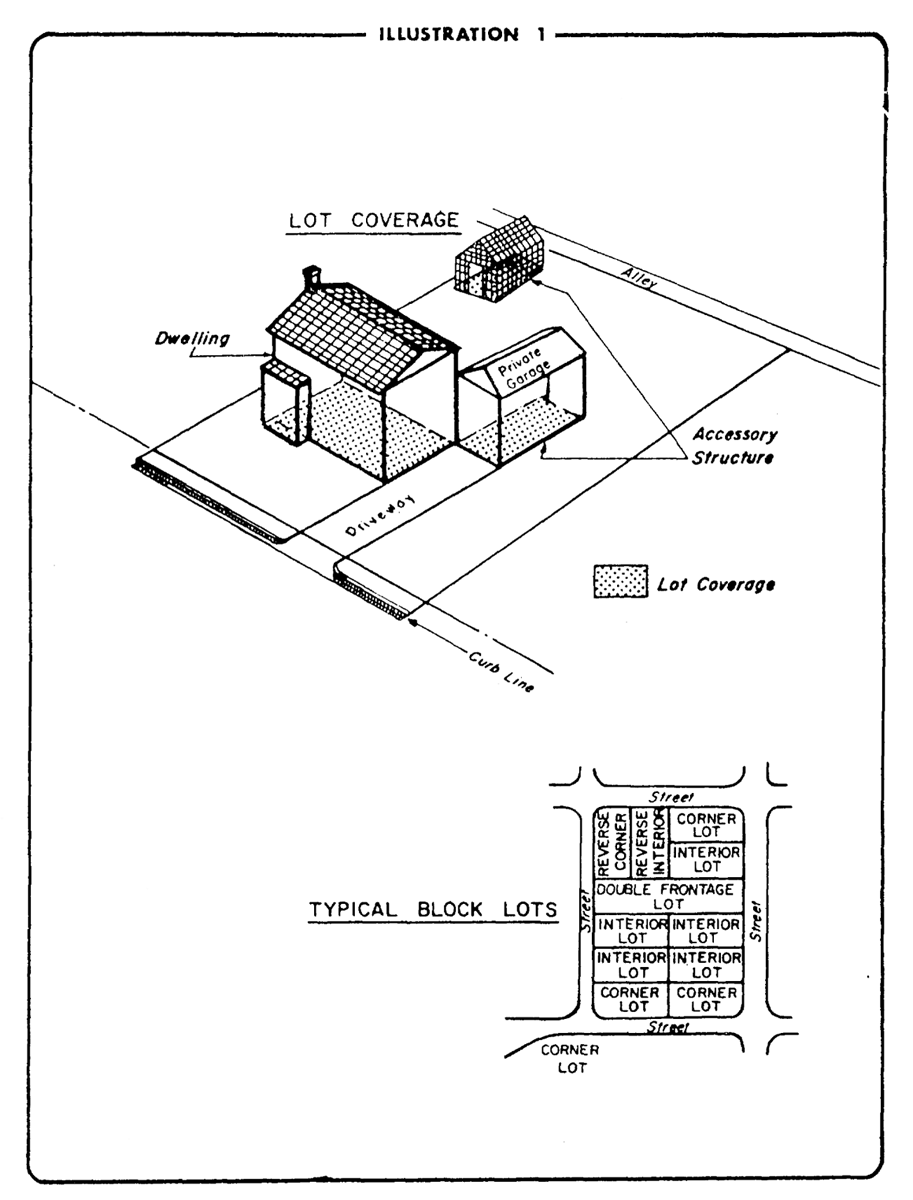
Accessory use or structure means a use or structure subordinate to the principal use or structure on the same lot and serving a purpose customarily incidental thereto. (See illustration 1 at the end of this section.)
Actual construction. See Construction, actual.
Adult use shall have the meaning ascribed to this term in city Code section 8-702.
Advertisement means any writing, printing, picture, painting, display, emblem, drawing, sign or device which is intended to solicit patronage or support of the public or to invite or draw attention to any goods, merchandise, real property, or commercial business, services, entertainment or amusement, manufactured, produced, conducted, furnished or dealt in by any person, or for any political party or for the candidacy of any individual for nomination to public office.
Advertising structure means any rigid or semi-rigid material, bracing, supports or framework, with or without advertisement display thereon, situated upon or attached to real property principally for the purpose of furnishing a background, base or support upon which an advertisement may be posted or displayed.
Affordable dwelling unit means a housing unit for which the rental and/or sale price is regulated pursuant to the provisions of article VII of this chapter, pertaining to the affordable dwelling unit program.
Alley means a passage or way open to public travel which affords a subordinate means of vehicular access to abutting lots and is not intended for general vehicular circulation. (See illustration 1 at the end of this section.)
Amusement arcade means any establishment, except those with a floor area greater than 15,000 square feet, in which more than four amusement machines are located and available for use and operated as a principal or accessory use. In an establishment with a floor area greater than 15,000 square feet, an amusement arcade shall exist as an accessory use, if more than 15 amusement machines are located and available for use or if more than five percent of the floor area of such establishment is devoted to amusement machine use.
Amusement machine means a mechanical and/or electrical device which provides entertainment to one or more persons by virtue of video or mechanical displays, lights, sounds, motion, or games of skill or chance. Musical instruments, music players, jukeboxes, vending machines and dispensers are not included.
Antenna means any device, including its supporting structure, designed to transmit or receive radio, television, cellular, data, or other wireless communications signals; amateur radio antennas are expressly excluded from the definition of "antenna." This term includes, but is not limited to, omnidirectional antennas (whip), directional antenna (panel), parabolic antennas (dish), and any similar equipment used for the transmission or reception of electromagnetic signals.
Apartment means a room or suite of rooms fitted especially with cooking and housekeeping facilities used, leased and/or owned as a dwelling. An apartment shall not be construed to mean a townhouse dwelling.
Apartment building means a structure containing separate residential apartments either leased or owned; also called apartment house or multifamily dwelling.
Approving authority means those persons delegated the responsibility of approving any portion or part of the requirements of this chapter.
Architect means an individual who is recognized by the State of Virginia and/or who is registered with the Virginia Department of Professional and Occupational Regulation as a professional architect.
As built site plan. See Site plan, as built.
Assisted living facilities means a special type of residential institution that provides personal care and support services to people who need help with daily living activities as a result of physical or cognitive disability, but do not require full-time daily medical care, distinguished from an independent living facility.
Average unit size shall equal the sum of the net floor area of each of the residential units in a project, divided by the number of residential units in that project. Common areas not controlled by the occupant of an individual residential unit and areas for vehicle parking are excluded from the calculation of average unit size.
Base flood, 100-year flood means a flood that, on the average, is likely to occur once every 100 years, (i.e., has a one percent chance of occurring each year, although the flood may occur in any year).
Base flood elevation (BFE) means the Federal Emergency Management Agency designated 100-year water surface elevation.
Bed and breakfast establishment means a single-family dwelling unit in which accommodations limited to no more than five guestrooms are rented for periods not to exceed 14 consecutive days per guest.
Block means that property abutting on one side of a street lying between the nearest two intersecting or intercepting streets or nearest intersecting or intercepting streets and railroad right-of-way or unsubdivided acreage. (See illustration 1 at the end of this section.)
Board of zoning appeals means the board appointed to review appeals made by individuals with regard to decisions of the zoning administrator in the interpretation of this chapter or requests for variances to this chapter.
Boardinghouse, lodginghouse orroominghouse means a building other than a hotel, motel or tourist home where meals, lodgings or both are provided for compensation, for four to eight persons, not transients.
Building means any structure having a roof supported by columns or walls, used or intended to be used for the shelter, housing or enclosure of persons, animals or chattels. The term "building" shall include tent, cabin and house trailer. Where divided by party walls, each portion of a building shall be deemed a separate building, except as otherwise provided herein.
Building capacity means the seating capacity of a structure or the number of employees shall be the maximum which can be accommodated on the premises, as certified in writing by the division of inspections.
Building footprint means the surface area occupied by a building, expressed in square feet.
Bulk plane means an imaginary inclined plane rising over a lot, drawn at a specific angle from the vertical at the curbline or property line, if no curb exists, and restricting the vertical building development. (See illustration in subsection 48-1081(c)(5).)
Business sign. See Sign, business.
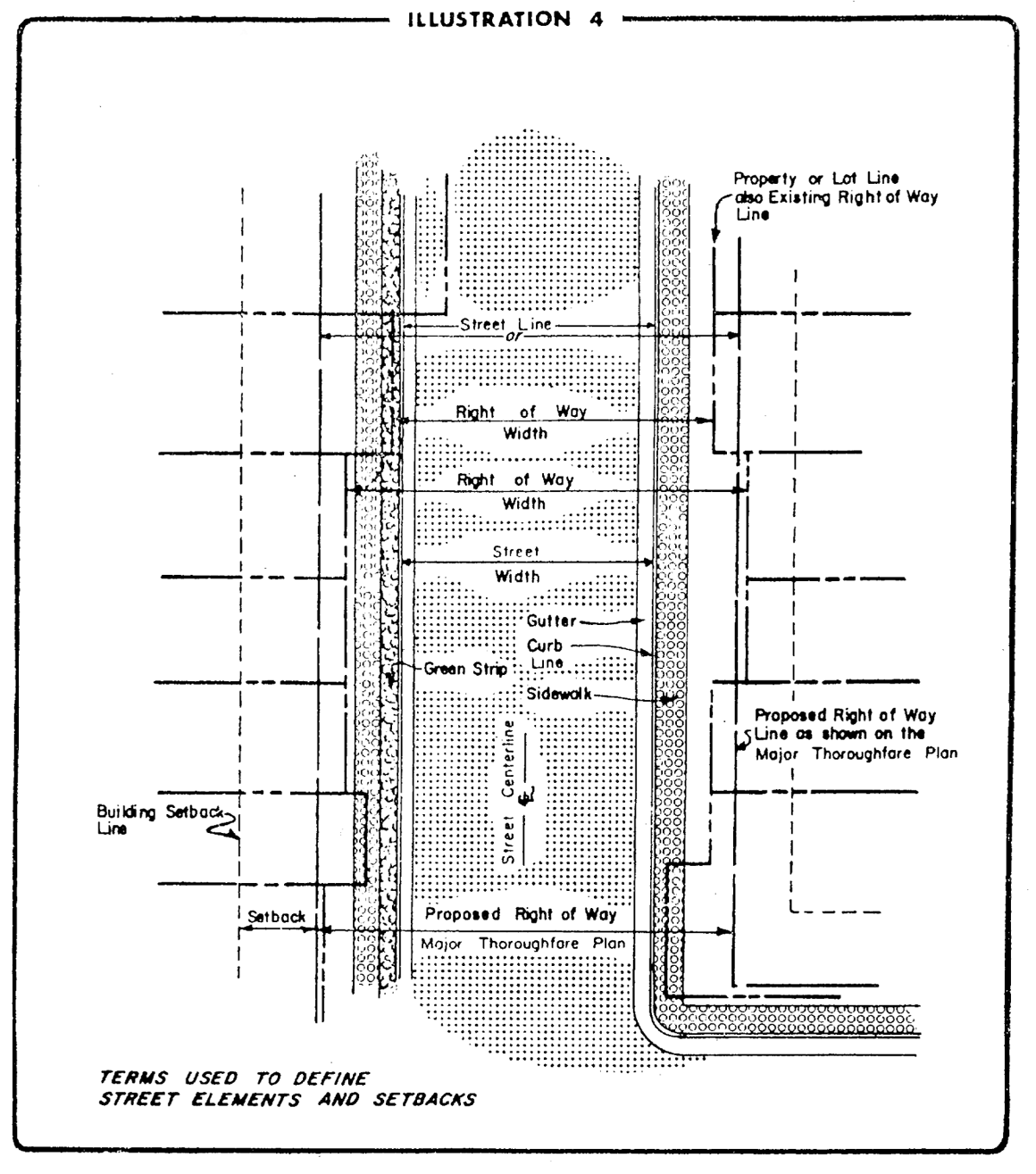
Centerline, street, means a line lying midway between the right-of-way lines of a street. (See illustration 4 at the end of this section.)
Clinic for human care means a medical services establishment or organization in which three or more medical or dental practitioners offer chiefly outpatient services from a single site.
Commercial use means any use for which the primary purpose is to conduct the buying or selling of commodities and services, to exclude any uses that are exclusively related to residential uses.
Common open space. See Open space, common.
Compact car means an automobile that is no wider than six feet, nor longer than 16 feet.
Conditional zoning means the allowing of reasonable conditions governing the use of the property in question, as a part of amending the zoning district map, such conditions being in addition to the regulations provided for a particular zoning district by the overall zoning chapter.
Condominium means the ownership of a single unit in a multiple-unit structure with common elements.
Condominium project means a plan or project whereby four or more apartments, townhouses, rooms, office spaces or other units in existing or proposed buildings or structures are offered or proposed for sale as condominiums.
Construction, actual, means the placing of construction materials in a permanent position and fastening them permanently, or extensive grading including demolition or removal of existing structures necessary for the development.
Construction costs means the cost to build, particularly an improvement; includes the direct costs of labor and materials plus the contractor's indirect costs. Construction costs may include the appraisal, building permits, zoning fees, tap fees, city review fees, utilities, occupancy permits, miscellaneous permit/fees, architectural/engineering costs, construction loan interest, legal fees, builder's risk insurance, liability insurance, real estate taxes, project supervision, soft cost contingency, development fees, and closing costs.
Construction standards means the department of public works design and construction standards as adopted by the city council.
Convenience store. See Store, convenience.
Conventional television or radio antenna means any receiving antenna other than a satellite television antenna.
Cornice means a horizontal molded projection which crowns or finishes the wall of a building.
Cottage housing development means a cluster of small single-family houses sharing common amenities and developed on a tract of land that is under single ownership or unified control.
Curbline means the established line at the face of the nearest curb of the abutting public street. In the absence of a curb, the curbline shall be established according to the projected width of the street indicated on the major thoroughfare plan or, in the absence thereof, shall be determined by article V, division 6 of this chapter. (See illustration 1 at the end of this section.)
Dental and optical laboratories means laboratories engaged in the manufacture of artificial dentures, bridges, etc., or eyeglasses, for the purpose of filling prescriptions submitted by members of the dental and ophthalmologic professions.
Designated agent means the site plan approving authority, as designated by City Council in accordance with Code of Virginia, § 15.2-2201.
Developed recreation space. See Recreation space, developed.
Development means any manmade change to improved or unimproved real estate including, but not limited to, buildings or other structures, mining, dredging, filling, grading streets and paving, excavation or drilling operations, or storage of equipment or materials.
District means a portion of the incorporated territory of the city within which certain uniform regulations and requirements or various combinations apply under the provisions of this chapter.
(1)
The term "R district" means any R-1A, R-1B, R-TH, or R-M district;
(2)
The term "T district" means any T-1 or T-2 district; and
(3)
The term "B district" means any B-1, B-2, or B-3 district.
Drive-through or drive-through facility. Whether a principle, conditional, or accessory use, the definition for a drive through is: Any facility where goods are sold to or services provided to a person riding on or seated within a motor vehicle, except as provided in this definition; or any facility where services or inspections are performed on motor vehicles where the motor vehicles stand or wait in a line immediately prior to the service being performed.
(1)
The term "drive-through" includes, but is not limited to, drive-through windows at a financial institution, a dry cleaner, a restaurant; carwash; a motor vehicle lube and oil change facility and motor vehicle inspection stations.
(2)
The term "drive-through" does not include motor vehicle service facilities where motor vehicles to be serviced are parked before being serviced in contrast to standing in a line adjacent to the bay where services are done; it also does not include the fueling component of a motor vehicle service station. A motor vehicle service station using only one bay for inspections shall not be considered a drive-through.
Driveway means that space specifically designated and reserved on the site for the movement of vehicles from one site to another or from a site to a public street. (See illustration 1 at the end of this section.)
Drug paraphernalia.
(1)
The term "drug paraphernalia" means all equipment, products, and materials of any kind which are used, intended for use, or designed for use, in planting, propagating, cultivating, growing, harvesting, manufacturing, compounding, converting, producing, processing, preparing, testing, analyzing, packaging, repackaging, storing, containing, concealing, injecting, ingesting, inhaling, or otherwise introducing into the human body marijuana and/or a controlled dangerous substance as defined in Code of Virginia, §§ 54.1-3446, 54.1-3448, 54.1-3450, 54.1-3452, 54.1-3454. The term "drug paraphernalia" includes, but is not limited to:
a.
Kits used, intended for use, or designed for use in planting, propagating, cultivating, growing, or harvesting of any species of plant which is marijuana or a controlled dangerous substance or from which a controlled dangerous substance can be derived;
b.
Kits used, intended for use, or designed for use in manufacturing, compounding, converting, producing, processing, or preparing marijuana and/or controlled dangerous substances;
c.
Isomerization devices used, intended for use, or designed for use in increasing the potency of any species of plant which is marijuana or a controlled dangerous substance;
d.
Testing equipment used, intended for use, or designed for use in identifying, or in analyzing the strength, effectiveness or purity of marijuana and/or controlled dangerous substances;
e.
Scales and balances used, intended for use, or designed for use in weighing or measuring marijuana and/or controlled dangerous substances;
f.
Dilutents and adulterants, such as quinine hydrochloride, mannitol, mannite, dextrose and lactose, used, intended for use, or designed for use in cutting marijuana and/or controlled dangerous substances;
g.
Separation gins and sifters used, intended for use, or designed for use in removing twigs and seeds from, or in otherwise cleaning or refining, marijuana;
h.
Blenders, bowls, containers, spoons and mixing devices used, intended for use, or designed for use in compounding marijuana and/or controlled dangerous substances;
i.
Capsules, balloons, envelopes and other containers used, intended for use, or designed for use in packaging small quantities of marijuana and/or controlled dangerous substances;
j.
Containers and other objects used, intended for use, or designed for use in storing or concealing marijuana and/or controlled dangerous substances;
k.
Hypodermic syringes, needles and other objects used, intended for use, or designed for use in parenterally injecting marijuana and/or controlled dangerous substances into the human body;
l.
Objects used, intended for use, or designed for use in ingesting, inhaling, or otherwise introducing marijuana, cocaine, hashish, or hashish oil into the human body, such as:
1.
Metal, wooden, acrylic, glass, stone, plastic, or ceramic pipes with or without screens, permanent screens, hashish heads, or punctured metal bowls;
2.
Water pipes;
3.
Carburetion tubes and devices;
4.
Smoking and carburetion masks;
5.
Roach clips; meaning objects used to hold burning material, such as a marijuana cigarette, that has become too small or too short to be held in the hand;
6.
Miniature cocaine spoons, and cocaine vials;
7.
Chamber pipes;
8.
Carburetor pipes;
9.
Electric pipes;
10.
Air-driven pipes;
11.
Chillums;
12.
Bongs;
13.
Ice pipes or chillers.
(2)
In determining whether an object is drug paraphernalia, the zoning administrator, the agent of the zoning administrator, or the chief of police should consider, in addition to all other logically relevant factors, the following:
a.
Statements by an owner or by anyone in control of the object concerning its use;
b.
Prior convictions, if any, of an owner or of anyone in control of the object, under any state or federal law relating to marijuana or any controlled dangerous substance;
c.
The proximity of the object, in time and space, to a direct violation of this chapter, Code of Virginia, § 18.2-248.2, or to marijuana or a controlled dangerous substance;
d.
The existence of any residue of marijuana or controlled dangerous substances on the object;
e.
Direct or circumstantial evidence of the intent of an owner, or of anyone in control of the object, to deliver it to persons whom he knows, or should reasonably know, intended to use the object to facilitate a violation of this chapter or the Code of Virginia, § 18.2-248.2; the innocence of an owner, or of anyone in control of the object, as to a direct violation of this chapter or the Code of Virginia, § 18.2-248.2, shall not prevent a finding that the object is intended for use, or designed for use, as drug paraphernalia;
f.
Instructions, oral or written, provided with the object concerning its use;
g.
Descriptive materials accompanying the object which explain or depict its use;
h.
National and local advertising concerning its use;
i.
The manner in which the object is displayed for sale;
j.
Whether the owner, or anyone in control of the object, is a legitimate supplier of like or related items to the community, such as a licensed distributor or dealer of tobacco products;
k.
Direct or circumstantial evidence of the ratio of sales of the object or objects to the total sales of the business enterprise;
l.
The existence and scope of legitimate uses for the object in the community;
m.
Expert testimony concerning its use.
If any provision of this definition or the application thereof to any person or circumstance is held invalid, the invalidity does not affect other provisions or applications of the ordinance adopting this definition which can be given effect without the invalid provision or application, and to this end the provisions of the adopting ordinance are severable.
Drug paraphernalia establishment means any retail sales establishment wherein drug paraphernalia is displayed, sold, offered for sale or given away.
Dwelling, cluster, means one of a group of two or more one-family, two-family, and/or townhouse units that, together, comprise a planned, unified development.
Dwelling, multifamily, means a residential structure containing three or more separate dwelling units (apartments), either leased or owned, located on a single lot or parcel of ground. A multiple-family dwelling, commonly known as an apartment building, generally has a common outside entrance for all the dwelling units, and the units are generally designed side by side or one above another. A multiple-family dwelling shall not be construed to mean a townhouse dwelling.
Dwelling, one-family, means a detached building containing one dwelling unit.
Dwelling, townhouse, means one of a series of three, but not more than eight, attached one-family dwellings separated from one another by continuous vertical walls without openings from basement floor to roof, having complementary but not identical facades or treatment of materials, and not more than two abutting dwellings having the same front yard setback.
Dwelling, two-family, means a building containing two dwelling units. For purposes of lot and yard requirements, a two-family dwelling may be placed on a single lot or may be placed on two contiguous lots, provided a party wall is constructed over the common boundary.
Dwelling unit means one or more rooms in a residential building or residential portion of a building which are arranged, designed, used or intended for use as a complete, independent living facility which includes permanent provisions for living, sleeping, eating, cooking, and sanitation for use by one family or housekeeping unit.
Easement means a grant by a property owner of the use of the land of the property owner by another party for a specific purpose.
Engineer means an individual who is recognized by the State of Virginia and/or who is registered with the Virginia Department of Professional and Occupational Regulation as a professional engineer.
Erect means to attach, affix, build, construct, hang, place or suspend. The term "erect" shall also include the painting of wall signs.
Facing or surface means the plane upon, against or through which an advertisement is displayed or illustrated.
Family refers to one person living alone or two or more persons related by blood, marriage, adoption, or who are living in an approved foster care program, with not more than two domestic servants living in the house as roomers; or a group of not more than eight persons not related by blood, marriage, or adoption living together on a single property, within the limits set forth in this Code pertaining to health, building or other relevant provisions of the law except a group home, residential institution, or a boardinghouse or roominghouse.
Flood.
(1)
A general and temporary condition of partial or complete inundation of normally dry areas from:
a.
The overflow of inland waters.
b.
The unusual and rapid accumulation of runoff or surface waters from any source.
(2)
The collapse or subsidence of land along the shore of a lake or other body of water as a result of erosion or undermining caused by waves or currents of water exceeding anticipated cyclical levels or suddenly caused by an unusually high water level in a natural body of water, accompanied by a severe storm, or by an unanticipated force of nature, such as a flash flood or by some similarly unusual and unforeseeable event which results in flooding.
Flood, 100-year means a flood that, on the average, is likely to occur once every 100 years (i.e., that has a one percent chance of occurring each year, although the flood may occur in any year).
Floodplain refers to:
(1)
A relatively flat or low land area adjoining a river, stream, or watercourse which is subject to partial or complete inundation;
(2)
An area subject to the unusual and rapid accumulation of runoff or surface waters from any source.
Flood-prone area means any land susceptible to being inundated by water from any source.
Floodway means the designated area of the floodplain required to carry and discharge floodwaters of a given magnitude. For the purposes of this chapter, the floodway shall be capable of accommodating a flood of the 100-year magnitude.
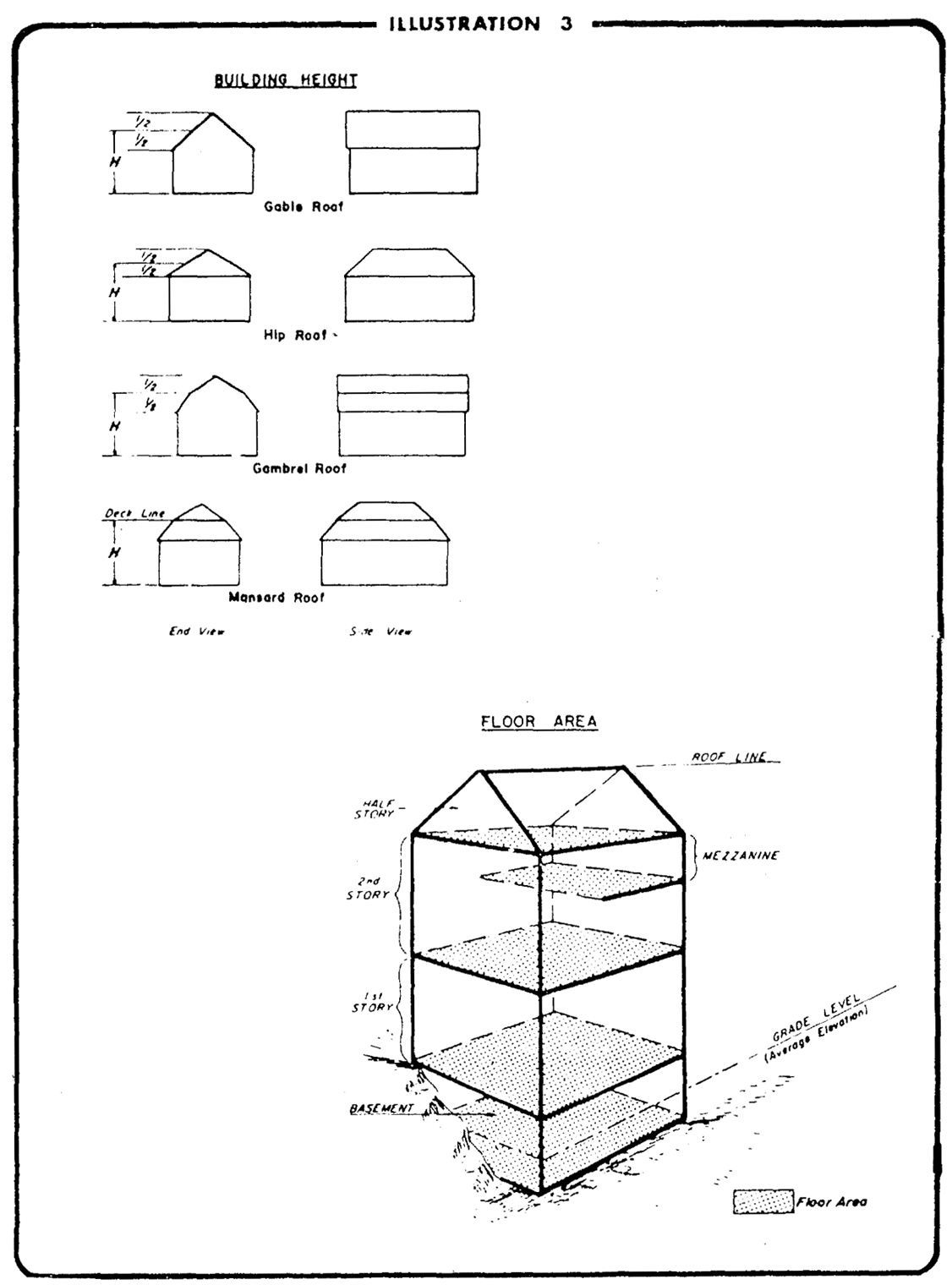
Floor area shall be interpreted as being the gross floor area. Gross floor area shall be the sum of the gross horizontal area of the floor or several floors of a building measured from the exterior faces of all exterior walls or from the centerlines of party walls if the portions of a building are to be computed separately including basements and habitable penthouses. (See illustration 3 at the end of this section.)
Floor area ratio (FAR) means a mathematical expression of the bulk or intensity of land development, determined by dividing the gross floor area of all buildings at or above grade level on a given parcel of land by the gross square footage of that same parcel of land. No parking structure or parking space shall be counted against the permitted floor area.
Fueling bay means an area designated for the fueling of a motor vehicle.
Garage, carport, means an open accessory structure for the storage of private noncommercial motor vehicles of families resident upon the premises, the capacity of which does not exceed one vehicle for each family, plus two additional vehicles.
Garage, private, means a completely enclosed accessory structure for the storage only of the private motor vehicles of the families resident upon the premises, the capacity of which does not exceed one vehicle for each family, plus two additional vehicles. (See illustration 1 at the end of this section.)
Grade level means the average natural topographical elevation or average elevation established either by artificial earth movement or hard-surfacing at which the major portion of the adjacent site area lies; except, that no specially constructed or graded area, ornamental or protective earthwork or raised landscaped areas shall be determinant of grade level. (See illustration 3 at the end of this section.)
Grade level, finished, means the grade level immediately adjacent to the building footprint, not otherwise deemed to be the natural grade level. The term "finished grade level" shall include ground disturbance, subject to a grading plan or that serves to increase allowable building height.
Grade level, natural, means the ground level immediately adjacent to the building footprint, with no adjustment having been made to the existing undisturbed ground level. The term "natural grade level" may include minor ground disturbances associated with landscaping, repairs to existing structures as required by the building official, or other incidental grade adjustments that do not serve to allow an increase in the height of an existing building or that would otherwise be possible prior to the ground disturbance.
Ground cover means a group of living plants other than grass approximately six inches in height when mature which is planted in such a manner as to permit a finished appearance and reasonably complete coverage within one year after planting.
Group home means a dwelling unit in which individuals with mental illness, intellectual disability, or developmental disabilities reside, with one or more resident or nonresident staff persons. For the purposes of this subsection, mental illness and developmental disability shall not include current illegal use of or addiction to a controlled substance as defined in Code of Virginia, § 54.1-3401. No conditions more restrictive than those imposed on residences occupied by persons related by blood, marriage, or adoption shall be imposed on such facility. For purposes of this subsection, "residential facility" means any group home or other residential facility for which the department of behavioral health and developmental services is the licensing authority pursuant to the Code of Virginia. A group home with more than eight residents shall be deemed to be a residential institution.
Guestroom means a sleeping room which is designed or intended for occupancy by or which is occupied by one or more guests for compensation, but in which no provision is made for cooking, and not including dormitories for sleeping purposes.
Hedge means two or more living shrubs planted and maintained so as to form a continuous, unbroken, visual screen.
Height of a building (in feet) means the vertical distance measured from the average grade of the building footprint to the highest point of the coping of a flat roof, or the deck line of a mansard roof, or the mean height level between eaves and ridge for gable, hip, and gambrel roofs. Average grade shall be determined using the finished grade level or the natural grade level, whichever is lower.
Height of a building (in stories) means the greatest number of stories in any part of the building.
Historic area means an area containing buildings or places in which historic events occurred or having special public value because of notable architectural or other features relating to the cultural or artistic heritage of the community, of such significance as to warrant conservation and preservation.
Historic structure means any structure that is:
(1)
Listed individually in the National Register of Historic Places (a listing maintained by the Department of the Interior) or preliminarily determined by the Secretary of the Interior as meeting the requirements of individual listing on the National Register; or is designated for protection by the city as a historic structure;
(2)
Certified or preliminarily determined by the Secretary of the Interior as contributing to the historical significance of a registered historic district or a district preliminarily determined by the Secretary to qualify as a registered historic district;
(3)
Individually listed on a state inventory of historic places in states with historic preservation programs which have been approved by the Secretary of the Interior; or
(4)
Individually listed on a local inventory of historic structures and places in communities with historic preservation programs that have been certified either:
a.
By an approved state program as determined by the Secretary of the Interior; or
b.
Directly by the Secretary of the Interior in states without approved programs.
Home occupation means an occupation whose activity at the site is conducted entirely within the private dwelling which is clearly incidental and secondary to the principal use as a dwelling; which occupies less than 25 percent of the floor area of the dwelling; which does not involve display or sale of goods on the premises; and which does not use any equipment or process that creates noise, vibration, glare, fumes, odors or electrical interference, detectable at the lot line. The term "home occupation" includes such activities as sewing, cooking, handicraft making, laundering, a home office or studio, and the like. The term "home occupation" shall not include such activities as a clinic, hospital, nursing home, barbershop, beauty shop, tea room, tourist home, kennel, animal hospital, and the like. A home occupation shall be classified and regulated as either a minor or major home occupation, as defined in this definition:
(1)
Major home occupation means a home occupation in which not more than one person, other than members of the family residing on the premises, is employed on the premises, which has not more than one unilluminated sign (not exceeding one square foot in area) as visible exterior evidence of conduct of the occupation and which accommodates both dwelling and home occupation parking needs off the street.
(2)
Minor home occupation means a home occupation in which no persons other than members of the family residing on the premises are engaged in the occupation, which has no visible exterior evidence of the conduct the occupation, which does not create need for off-street parking beyond normal dwelling needs, which does not generate additional traffic and in which no equipment is used other than that normally used in household, domestic or general office use.
Hotel means any building, or portion thereof, containing 12 or more guestrooms which are designed or intended to be used, let, or hired out primarily for transient occupancy.
House trailer means any vehicle or structure, including a mobile home, designed or equipped for movement upon a public street and designed or used for living purposes.
Impervious land cover means a surface composed of any material that significantly impedes or prevents natural infiltration of water into the soil. Impervious surfaces include, but are not limited to:
(1)
Nonvegetated roofs;
(2)
Buildings;
(3)
Streets;
(4)
Parking areas;
(5)
Sidewalks;
(6)
Driveways;
(7)
Any concrete, asphalt, or compacted gravel surface.
Exception: Structures smaller than 200 square feet that do not require a building permit shall not count toward lot coverage or impervious lot coverage. For purposes of calculating impervious land cover, driveways, walks and patios using pervious materials may be reduced by up to 25 percent. Materials eligible for a reduction in area include, but are not limited to, pervious pavers, "grasscrete", "grassblock" or other similar material.
Industrial research and development organization means organizations engaged in research directed to the discovery, invention or development of new processes or products of an industrial nature. While the manufacturing activity would usually terminate with the production of a prototype, production of standardized versions of the prototype as a continuing activity of the organization is permitted subject to the limitations of section 48-546(5).
Inn andbed and breakfast means a structure, either new or renovated, with fewer than 12 guestrooms or suites, for use by transients as overnight accommodation.
Inoperable vehicle means any motor vehicle, trailer, or semitrailer which is not legally operable on a public street due to one or more of the following:
(1)
Damage to or removal or deflation of one or more tires or wheels.
(2)
Damage to or removal of the engine or any other essential part (such as, but not limited to, the transmission, rear end, or windshield) required for the safe operation of the vehicle.
(3)
Lack of a valid state registration plate or plates.
(4)
Lack of a valid state inspection certificate, if required to operate the vehicle on a public street in the state in which the vehicle is registered.
(5)
Any condition which causes the vehicle to be an imminent health, safety, or fire hazard.
Institution for human care means a facility, such as, but not limited to, a hospital or clinic which provides full medical care to humans.
Junkyard means any area where waste, or discarded or salvaged materials are bought, sold, exchanged, baled, packed, stored, disassembled or handled, including automobile graveyards, auto wrecking yards, housewrecking yards, used lumberyards, and places or yards for storage of salvaged housewrecking and structural steel materials and equipment; but not including areas where such uses are conducted within completely enclosed buildings, and not including pawn shops and establishments for the sale, purchase, or storage of used furniture or household equipment, used cars in operating condition, salvaged machinery, or the processing of used, discarded or salvaged materials as part of a manufacturing operation.
Kennel means any place in or at which three or more dogs, more than three months of age, are boarded for a fee.
Land use intensity rating means a numerical scale which represents the capability of a parcel of land and its surrounding neighborhood to absorb an intensity of impact from the use of that land.
Landscaped area means an area planted in grass, trees, shrubs or other natural greenery, or containing any form of landscaping or architectural treatment designed by a registered landscape architect.
Landscaped open space means a pervious surface landscaped with a combination of trees and shrubs.
Loading space means a space or a portion of any area designed, required, or by its nature used as an area for the temporary parking of motor vehicles while transferring, loading or unloading goods, merchandise, products or while performing services.
Lot means any parcel of land occupied or intended to be occupied by a principal building and its accessory uses and structures, together with such open spaces as are required by this chapter, which adheres to the minimum requirements prescribed in the respective zoning districts.
Lot, corner, means one or more lots considered as a single entity, any portion of which borders on:
(1)
Two intersecting streets; or
(2)
Two intersecting chords of a single street;
wherein the interior angle of intersection does not exceed 140 degrees. (See illustration 1 at the end of this section.)
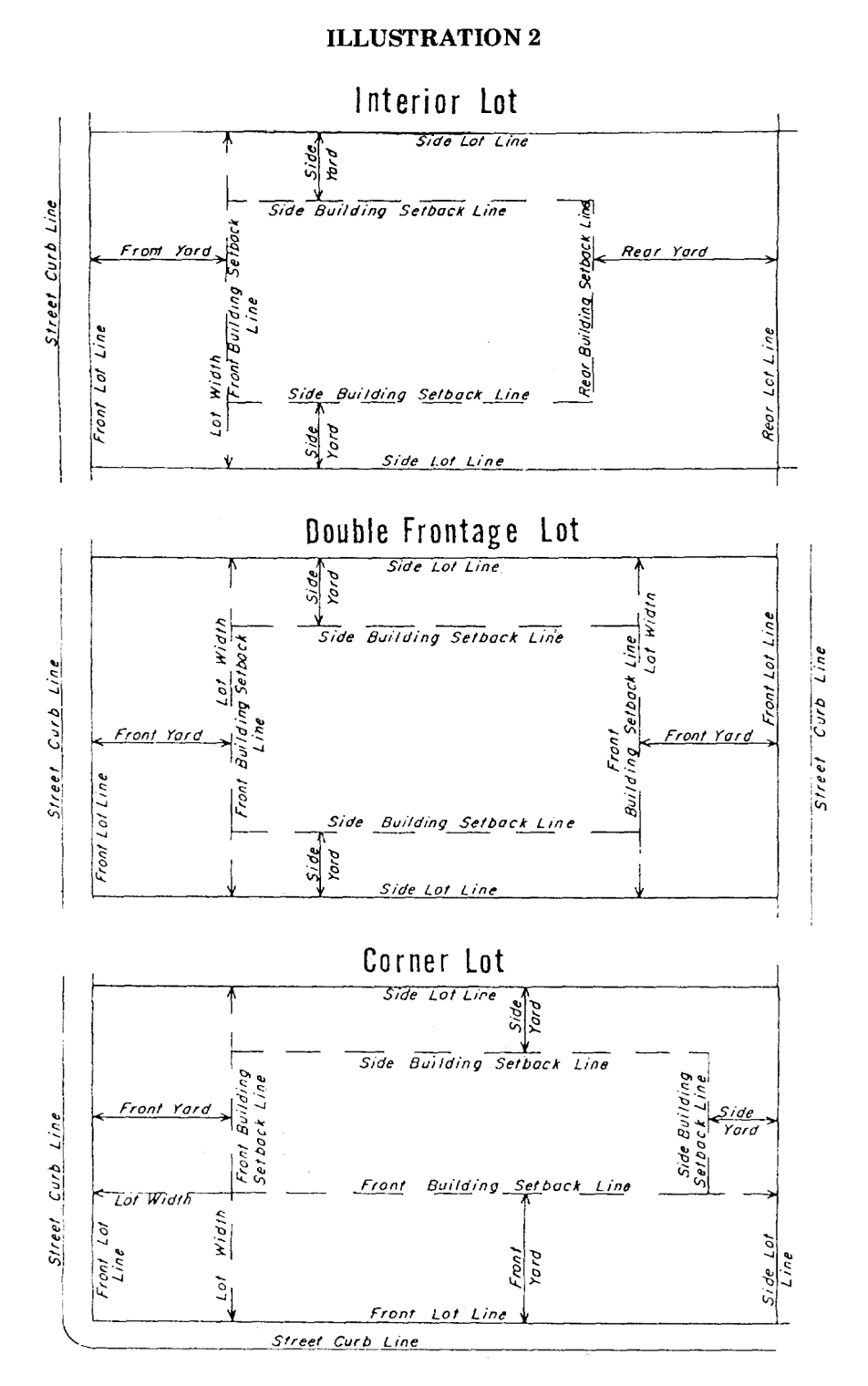
Lot depth means the mean horizontal distance between the front and rear lot lines. (See illustration 2 at the end of this section.)
Lot, double frontage, means a lot fronting on two nonintersecting streets. (See illustration at the end of this section 1 at the end of this section.)
Lot line, front, means the line separating the lot from a street upon which it fronts. On a corner lot or double frontage lot, each lot line that separates the lot from a street shall be considered a front lot line. (See illustration 2 at the end of this section.)
Lot line, rear, means the lot line opposite and most distant from the front lot line. On a corner lot or double frontage lot, there shall not be a rear lot line. (See illustration 2 at the end of this section.)
Lot line, side, means any lot line other than a front or rear lot line. (See illustration 2 at the end of this section.)
Lot, pipestem, means a lot, which is occupied or intended to be occupied by a one-family dwelling, the width of which is less than 30 feet at any point between the front lot line and the building setback line, the width being determined by a line which is perpendicular to any side lot line.
Lot width means the width of the lot measured at the front building setback line. (See illustration 2 at the end of this section.)
Low income means a household income that does not exceed 60 percent of the median income for the Washington Primary Metropolitan Statistical Area (PMSA), as determined by the U.S. Department of Housing and Urban Development (HUD), with adjustments for household size.
Note— HUD income determinations are updated annually and are available from local HUD offices for the appropriate jurisdictions.
Manufactured home means a structure subject to federal regulations, which is transportable in one or more sections; is eight body feet or more in width and 40 body feet or more in length in the traveling mode, or is 320 or more square feet when erected on site; is built on a permanent chassis; is designed to be used as a single-family dwelling, with or without a permanent foundation when connected to the required facilities; and includes the plumbing, heating, air conditioning, and electrical systems contained in the structure.
Manufactured home park/subdivision means a parcel, or contiguous parcels, of land divided into two or more lots for rent or sale.
Medical laboratories means laboratories serving the medical profession by the testing and analysis of specimens submitted by physicians. Activities of such laboratories are confined to serving the medical profession.
Mixed-use redevelopment (MUR) means a project within an area designated on the City of Falls Church Comprehensive Plan's Future Land Use Plan Map as a special area to be redeveloped with mixed-uses within mixed-use redevelopment areas as defined herein.
Mixed-use shared parking means city-authorized joint use of parking facilities for any property or building that is under the same ownership or for which recorded shared parking agreements exist, that is used for two or more purposes, and takes into account the various individual uses and their different peak demands peak demands for parking and loading spaces during different times of the day and days of the week.
Mixed-use within mixed-use redevelopment (MUR) areas means a combination of principal uses permitted by right within mixed-use redevelopment areas, integrated within an area or within individual buildings.
Moderate income means household income that is at least 61 percent and not more than 80 percent of the median income for the Washington Primary Metropolitan Statistical Area (PMSA), as determined by the U.S. Department of Housing and Urban Development (HUD), with adjustments for household size.
Motel means a building or group of buildings containing 12 or more guestrooms or suites each, which is designed or intended to be used, let or hired out primarily for transient occupancy, in which each room or suite has a separate outside entrance and an adjacent parking area.
Multiple-tenancy structure means any commercial or office building containing two or more businesses, establishments, facilities or offices, provided that such structure has more than one floor or common entranceway.
Municipal center area means an area of public buildings and adjacent designated properties where the public can be efficiently served in the varied transactions of public affairs. It is an area harmoniously controlled and in conformity with the civic interests and cultural achievements of the community served.
New construction means, for the purposes of determining insurance rates, structures for which the start of construction commenced on or after the effective date of the initial FIRM or after December 31, 1974, whichever is later, and includes any subsequent improvements to such structures. For floodplain management purposes, the term "new construction" means structures for which the start of construction commenced on or after the effective date of a floodplain management regulation adopted by a community and includes any subsequent improvements to such structures.
Nonconforming use means a building, structure or premises legally devoted to, or occupied by, or for a use that does not conform to the provisions of this chapter or any amendments thereto for the district in which located.
Off-site means any area which does not fall within the boundary of the land to be developed.
Off-street parking. See "Parking, off-street."
Off-street parking space. See "Parking space, off-street."
Office building means a structure in which at least two-thirds of the habitable floor area is devoted to office use in which services, clerical work, professional duties, or the like, are carried out.
Office space ratio. See "Open space, office ratio."
On-site means that area which is within the boundary of any land to be developed.
Open space, common, means all open space set aside for the common use of all residents and not dedicated to public use.
Open space, office ratio, means a number which, when multiplied by the square footage of floor area devoted to office use, establishes the minimum required open space on the site.
Open space, residential ratio, means a number which, when multiplied by the actual residential floor area in square feet, establishes the minimum open space required on the site.
Open space, residential recreation ratio, means a number which, when multiplied by the actual residential floor area in square feet, establishes the minimum required developed recreation space on the site.
Open space, usable, means outdoor, privately owned, landscaped area devoted to passive recreational or park space which may be in common use, and which conforms to the minimum requirements prescribed for the appropriate district, which shall not be in roadways, drives, aisles, off-street parking or loading spaces, in which there shall be no permanent structure except for artificial lighting, pedestrian ways, flagpoles, benches and decorative, monumental or ornamental fixtures, and which shall be accessible and available to all the occupants of the building.
Outdoor dining, means an outdoor seating area associated with a restaurant use. The outdoor dining use can consist of tables, chairs, barriers, tents, and other ancillary features that are directly related to the outdoor dining use.
Overhang, structural, means a projecting integral part of a building.
Owner means a party having title to the described property.
Parapet wall means any protective wall or barrier at the edge of or projecting above any balcony or roof.
Parking, enclosed, means any area on a building lot containing required off-street parking wholly within an accessory structure or substructure.
Parking lot means an area with demarcated spaces designed for the temporary storage of motor vehicles in the absence of their owners or operators.
Parking lot, public, means an area containing one or more parking spaces for self-propelled passenger vehicles, designed exclusively for and available to the public as an accommodation for patrons or customers, either with or without charge.
Parking, off-street, means any space specifically allotted to the parking of motor vehicles; such space shall not be within dedicated right-of-way lines.
Parking space means a space or a portion of any area designed, required, or by its nature used as an area for the temporary storage of passenger vehicles.
Parking space, off-street, means a space to contain passenger vehicles wholly segregated, except for entranceways, by means of walls, fences, curbs and landscaped areas, from any public street, alley or public right-of-way.
Persons with disabilities means any persons who are unable to engage in any substantial gainful activity because of any physical or mental impairments that are expected to result in death or have lasted or can be expected to last continuously for at least 12 months.
Physical and life science research laboratories means laboratories engaged solely in experimental and development activities in the physical and life science fields conducted entirely indoors; using processes and equipment having proper electronic shielding; that are not likely to be dangerous or offensive (because of odor, dust, fire, explosion, or other reason); that are not likely to produce objectionable noise, vibration, smoke, or other effect; and involving only negligible amounts of delivery, storage or shipment of materials or products.
Prenatal and early infant care counseling and support facility means psychological, social, economic or educational services provided to pregnant women and those with children less than 18 months old. The term "prenatal and early infant care counseling and support facility" also may include the accessory use of storing and providing furniture needed for infant care, but it does not include medical services.
Professional office means enclosed space used wholly for the transaction of remunerative endeavors by one or more persons or corporations licensed and taxed under the provisions of chapter 40.
Professional office building means a building of which 50 percent or more of the total floor area is used for professional offices.
Public building/facility means areas or structures owned or controlled by a governmental authority or other political subdivisions.
Recreation vehicle means a vehicle which is:
(1)
Built on a single chassis;
(2)
Four hundred square feet or less when measured at the largest horizontal projection;
(3)
Designed to be self-propelled or permanently towable by a light duty truck; and
(4)
Designed primarily not for use as a permanent dwelling but as temporary living quarters for recreational camping, travel, or seasonal use.
Residential institution means a facility which functions primarily as a living quarters for groups of individuals, either with or without medical services available; including, but not limited to, rest homes, nursing homes, convalescent homes, orphanages and similar uses, except a secure or detention facility, which shall mean a public or private locked residential facility which has construction fixtures designed to prevent escape and to restrict the movement and activities of persons held in lawful custody.
Residential open space ratio. See "Open space, residential ratio."
Residential recreation space ratio. See "Open space, residential recreation ratio."
Revised site plan. See "Site plan, revised."
Right-of-way lines means lines which separate private property from existing or dedicated public property containing or proposed to contain publicly owned street surfaces, gutter, curb, planted strips or sidewalks. Where a public street is designated on the major thoroughfare plan, all requirements of this chapter which relate to rights-of-way shall be measured from the indicated proposed right-of-way lines. (See illustration 4 at the end of this section.)
Roofline means either the uppermost edge of the roof or the top of the parapet, whichever forms the top line of the building silhouette; and where a building has several roof levels, the roofline shall be the one belonging to that portion of the building on which wall the sign is located. (See illustration 3 at the end of this section.)
Satellite television antenna means an apparatus capable of receiving communications from geostationary orbital satellites.
Scientific research organization means research organizations engaged in study and investigation in the fields of engineering, social sciences, psychology, education, mathematics, instrumentation, calibration, economics and the like which utilize scholarly inquiry sometimes assisted by computer-type equipment, with the object of expanding knowledge in the specified field, but excludes experimentation involving the use of animals.
Self-storage warehouse means a facility consisting of one or more buildings within which individual, self-contained units are leased for the storage of personal, business and household goods, and in which each lessee has direct access to the leased unit and the items stored therein.
Seniors means any persons who are not less than 62 years of age at the time of application.
Service bay means an area designated for the repairing and/or maintaining of a motor vehicle.
Setback line, building, means a line prescribed by the zoning district regulations delineating those above grade level portions of any lot into which no building or structure shall project. (See illustration 2 at the end of this section.)
Shopping center means a ground-level commercial development of eight or more retail sales and service establishments and/or one acre or more of land in a single parcel of common ownership, providing common parking facilities for all establishments, having multiple tenancy of a single or several large common structures, and being of a single development or of several phases of a single comprehensive development.
Sign means any letter, figure, design, symbol, trademark or illuminating device intended to attract attention to any place, subject, person, firm, corporation, public performance, article, machine or merchandise painted, printed or constructed and displayed in any manner out of doors as a recognized commercial, industrial, political, institutional, eleemosynary or other advertisement as defined in this section. Interior signs, if located on a window or within a distance of the window equal to the greatest dimension of the window or if obviously intended for viewing from the exterior, shall be considered a sign.
Sign, business, means any advertisement sign directing attention to a business, commodity, entertainment, facility, profession or service, conducted, sold or offered on the same lot where the sign is located.
Sign, interior. See "Sign."
Site area shall be interpreted as being composed of the greatest rectangular area or series of contiguous rectangular areas enclosing all, or the designated portions of the use so regulated, and shall include all areas devoted or accessory to such controlled principal use.
Site area, gross, means all that property shown on a site plan which, at the time of site plan submittal, is owned or controlled by the person or entity under whose authority the site plan is being submitted.
Site plan means detailed drawings indicating all building construction and improvements required by article V, division 7 of this chapter.
Site plan, as built, means a certification of building location as well as all on-site and off-site improvements, as approved.
Site plan, revised, means a site plan showing any proposed changes or revisions to an existing, previously approved site plan.
Specified anatomical areas means:
(1)
Less than completely and opaquely covered:
a.
Human genitals and/or pubic region;
b.
Buttocks; and
c.
Female breast below a point immediately above the top of the areola; and
(2)
Human male genitals in a discernibly turgid state, even if completely and opaquely covered.
Specified sexual activities means human genitals in a state of sexual stimulation or arousal; acts of human masturbation, sexual intercourse or sodomy; fondling or other erotic touching of human genitals, pubic region, buttocks or female breast.
Standing space means a space or portion of any area designed, required, or by its nature used as an area for the temporary stopping of a motor vehicle, while under the control of its operator, for the purposes of embarking or discharging passengers, baggage or merchandise, or for the purposes of utilizing special motor vehicle-oriented services, including but not limited to drive-in banks, carwashes and automobile inspection stations.
Start of construction means the date the building permit was issued, provided that actual state of construction, repair, reconstruction, rehabilitation, addition, placement, or other improvement was within 180 days of the permit date. The term "actual start" means either the first placement of permanent construction of a structure on a site, such as the pouring of slab or footings, the installation of piles, the construction of columns, or any work beyond the stage of excavation; or the placement of a manufactured home on a foundation. Permanent construction does not include land preparation, such as clearing, grading and filling; nor does it include the installation of streets and/or walkways; nor does it include excavation for a basement, footings, piers, or foundations or the erection of temporary forms; nor does it include the installation on the property of accessory buildings; such as garages or sheds not occupied as dwelling units or not part of the main structure. For a substantial improvement, the term "actual start of construction" means the first alteration on any wall, ceiling, floor, or other structural part of a building, whether or not the alteration affects the external dimensions of the building.
Store, convenience, means a small retail establishment offering for sale a limited variety of food items, or household products, primarily for consumption and/or use in a dwelling.
Story means that portion of a building included between the surface of any floor and the surface of the next floor above it, or if there be no floor above it, then the space between such floor and the ceiling next above it. A mezzanine floor shall be counted as a story if it covers more than one-third the area of the floor next below it or if the vertical distance from the floor next below it to the floor next above it is 24 feet or more. A basement shall be counted as a story, for the purpose of height measurement, if its ceiling is over five feet above the level from which the height of the building is measured, or if it is used as a separate dwelling unit by other than a janitor or other employee and his family. (See illustration 3 at the end of this section.)
Story, half, means a partial story under a gable, hip or gambrel roof, the wall plates of which on at least two opposite exterior sides are not more than two feet above the floor of such story. (See illustration 3 at the end of this section.)
Street means a public thoroughfare, however designated by name, which affords the principal means of access to abutting property. (See illustrations 1 and 4 at the end of this section.)
Street, centerline. See "Centerline, street." (See illustration 4 at the end of this section.)
Street line means parallel lines delineating the extreme horizontal width of a cross section of existing street surface. If, on the major thoroughfare plan, a street is proposed for widening, the proposed right-of-way lines shall be the street lines. (See illustration 4 at the end of this section.)
Street width means the shortest distance between lines delineating the horizontal width of a cross section of street surface. (See illustration 4 at the end of this section.)
Structural alteration means any change in the structural members of a building, such as bearing walls, columns, beams or girders.
Structural trim means the molding, battens, cappings, nailing strips, latticing and platforms which are attached to a sign structure.
Structure means anything constructed by an assembly of materials, the use of which requires a fixed location on the ground or is attached to something having a fixed location on the ground.
Substantial damage means damage of any origin sustained by a structure whereby the cost of restoring the structure to its before damaged condition would equal or exceed 50 percent of the market value of the structure before the damage occurred.
Substantial improvement means any reconstruction, rehabilitation, addition, or other improvement of a structure, the cost of which equals or exceeds 50 percent of the market value of the structure before the start of construction of the improvement.
(1)
The term "substantial improvement" includes structures which have incurred substantial damage regardless of the actual repair work performed.
(2)
The term does not, however, include either:
a.
Any project for improvement of a structure to correct existing violations of state or local health, sanitary, or safety code specifications which have been identified by the local code enforcement official and which are the minimum necessary to ensure safe living conditions; or
b.
Any alteration of a historic structure; provided that the alteration will not preclude the structure's continued designation as a historic structure.
Surface. See "Facing."
Surveyor means an individual who is recognized by the State of Virginia and/or who is registered with the Virginia Department of Professional and Occupational Regulation as a registered surveyor.
Temporary shelter means a brief or limited use of a structure for providing overnight sleeping accommodations at no or nominal charge to the persons provided the accommodation. A temporary shelter may not be operated for profitable purposes or to directly advance a profitable purpose.
Temporary stand means a structure of a nonpermanent nature, placed on a lot for not more than 30 days within any one calendar year.
Theater means a place for the presentation of motion pictures and/or live presentation of any of the performing arts.
Tourist home means a dwelling, otherwise permitted in the district in which the same is situated, in which not more than four guestrooms are provided for transients.
Travel lanes means that space specifically designated and reserved on the site for the movement of vehicular traffic.
Tree means any self-supporting woody plant growing upon the earth which usually provides one main trunk and produces a more or less distinct and elevated head with many branches. Trees shall measure no less than two inches in diameter at six inches above ground level.
Tree canopy represents the layer of leaves, branches, and stems of trees that cover the ground when viewed from above. Tree canopy includes all areas within a lot's property lines beneath the dripline of a tree whose trunk is also located on the property.
Usable open space. See "Open space, usable."
Yard means an open space on the same lot with a building, a group of buildings, or a use, which space is unoccupied and unobstructed from the ground upward, except as herein provided. (See illustration 2 at the end of this section.)
Yard, front, means a yard extending from side lot line to side lot line, between the front lot line and the front building setback line. (See illustration 2 at the end of this section.)
Yard, rear, means a yard extending across the full width of the lot from side lot line to side lot line, between the rear lot line and the rear building setback line. (See illustration 2 at the end of this section.)
Yard, side, means a yard extending from the front yard to the rear yard between the side lot line and the nearest side building setback line. For double frontage and corner lots that have no rear yards, the side yard shall be understood to extend from one front yard to the other front yard. (See illustration 2 at the end of this section.)
(d)
Graphics. The following illustrations relate to the definitions within this section:
(Code 1973, § 81-2; Code 1982, § 38-2; Ord. No. 609; Ord. No. 666; Ord. No. 724; Ord. No. 804; Ord. No. 866; Ord. No. 894; Ord. No. 908; Ord. No. 962, 3-23-1981; Ord. No. 987, 11-9-1981; Ord. No. 993, 1-11-1982; Ord. No. 999, 2-22-1982; Ord. No. 1015, 7-12-1982; Ord. No. 1039, 2-28-1983; Ord. No. 1131, 3-10-1986; Ord. No. 1138, 5-12-1986; Ord. No. 1139, 5-27-1986; Ord. No. 1154, 8-11-1986; Ord. No. 1203, 10-13-1987; Ord. No. 1250, 2-27-1989; Ord. No. 1263, 5-22-1989; Ord. No. 1277, § 1, 10-10-1989; Ord. No. 1278, 10-10-1989; Ord. No. 1338, 12-10-1990; Ord. No. 1382, 11-25-1991; Ord. No. 1477, 5-9-1994; Ord. No. 1531, 12-11-1995; Ord. No. 1541, 3-25-1996; Ord. No. 1583, 7-14-1997; Ord. No. 1627, 9-28-1998; Ord. No. 1636, 3-8-1999; Ord. No. 1710, 10-22-2001; Ord. No. 1721, 6-10-2002; Ord. No. 1734, 5-12-2003; Ord. No. 1792, § 38-2, 8-14-2006; Ord. No. 1846, 6-28-2010; Ord. No. 1915, 3-24-2014; Ord. No. 1966, 2-13-2017; Ord. No. 1991, 12-18-2018; Ord. No. 2059, 3-27-2023; Ord. No. 2068, 9-26-2023; Ord. No. 2088, 4-14-2025; Ord. No. 2104, 12-8-2025; Ord. No. 2106, 1-27-2026; Ord. No. 2108, § 1, 3-9-2026)
Cross reference— Definitions and rules of construction, § 1-2.
Sec. 48-3. - General regulations.
(a)
Use of land and buildings. Except as hereinafter specified, no land, building, structure or premises shall hereafter be used, designed or intended to be used, and no building or part thereof shall be located, erected, moved, structurally altered, reconstructed, enlarged or converted, except in conformity with the regulations herein specified for the district in which it is or is to be located.
(b)
Height limit. Except as hereinafter specified, no building shall be erected, reconstructed or structurally altered to exceed in height the limit hereinafter designated for the district in which such building is located.
(c)
Yards. Except as hereinafter specified, no building shall be erected, nor shall any existing building be altered, enlarged or rebuilt, nor shall any open space surrounding any building or use be encroached upon or reduced in any manner, except in conformity with the yard, lot area and other lot and building location regulations hereinafter designated for the district in which such building, use or open space is located.
(d)
Yard duplication. No yard or other open space on one lot shall be considered as providing a yard or open space for a building or use on any other lot. Except as specified for dwelling groups, no yard or open space provided about any building, for the purpose of complying with the provisions of this chapter, shall be considered as providing a yard or open space for any other building or use.
(Code 1973, § 81-4; Code 1982, § 38-3)
Sec. 48-4. - Applicants for special exceptions and use permits.
The city council, planning commission, or board of zoning appeals shall require any applicant for a special exception, or a special use permit, amendments to this chapter or variance to make complete disclosure in the application of the equitable ownership of the real estate to be affected including, in the case of corporate ownership, the name of stockholders, officers and directors and in any case the names and addresses of all of the real parties of interest. However, the requirement of listing names of stockholders, officers and directors shall not apply to a corporation whose stock is traded on a national or local stock exchange and having more than 500 shareholders.
(Code 1982, § 38-44; Ord. No. 1738, 6-23-2003)
State Law reference— Authority to require disclosure under oath regarding property interest of local officials, Code of Virginia, § 15.2-2287; authority to require disclosure of real parties in interest, Code of Virginia, § 15.2-2289.

